

Juno flyby of Europa on September 29, 2022
NASA’s Juno spacecraft will perform a close flyby of Jupiter’s icy moon Europa at 2:36 a.m. PDT (5:36 a.m. EDT) on September 29, 2022. The spacecraft will come within 222 miles (538 km), taking some of the highest-resolution images yet of portions of Europa’s surface. Scientists will also collect data on the moon’s interior, surface composition and ionosphere. Plus, it will record Europa’s interaction with Jupiter’s magnetosphere, all of which will be useful in the upcoming Europa Clipper mission, set to launch in 2024.
Juno Principal Investigator Scott Bolton of the Southwest Research Institute (SwRI) said:
Europa is such an intriguing Jovian moon, it is the focus of its own future NASA mission. We’re happy to provide data that may help the Europa Clipper team with mission planning, as well as provide new scientific insights into this icy world.
Jupiter’s moon Europa
Europa is one of the four largest moons of Jupiter. These moons are the Galilean moons, and Europa is the second closest to Jupiter and the smallest of the four. Even so, Europa is still 1,940 miles (3,100 km) in diameter, making it about 90% as large as our own moon. Scientists believe Europa has a surface of water ice, but they believe a liquid or slushy ocean lies beneath. This possible salty ocean could be a habitat for life.
The flyby
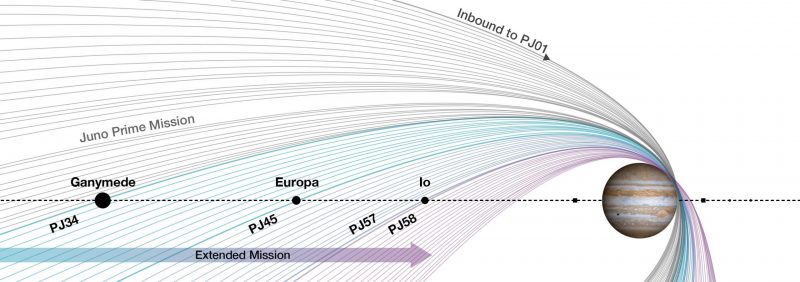
The closest point in Juno’s flyby of Europa brings it within 222 miles (538 km) of the icy moon. Juno will be just a bit more distant than the Galileo spacecraft came to the moon (218 miles or 351 km) on January 3, 2000. In 2021, Juno came within 645 miles (1,038 km) of Ganymede, and in 2023 and 2024 Juno will have close flybys of Io. The closest Juno will get to Io is about 932 miles (1,500 km).
When Juno is within one hour of its closest approach, it will begin collecting data on the moon and its interactions with Jupiter’s magnetosphere. At an hour from closest approach to Europa, the spacecraft will still be 51,820 miles (83,397 km) out. John Bordi of JPL said:
The relative velocity between spacecraft and moon will be 14.7 miles per second (23.6 kilometers per second), so we are screaming by pretty fast. All steps have to go like clockwork to successfully acquire our planned data, because soon after the flyby is complete, the spacecraft needs to be reoriented for our upcoming close approach of Jupiter, which happens only 7 ½ hours later.
You can keep track of where Juno is with NASA’s interactive Eyes on the Solar System web page.
Water plumes and an icy ocean
In 2013, scientists thought that the Hubble space telescope may have caught water plumes venting from Europa. Juno will search for these possible water plumes. Bolton said:
We have the right equipment to do the job, but to capture a plume will require a lot of luck. We have to be at the right place at just the right time, but if we are so fortunate, it’s a home run for sure.
Juno will look at the moon’s icy crust to learn more about its composition and temperature. Visible-light images will also help scientists compare Europa now with past images to see what has changed on its visible surface in the past two decades.
Get ready to see some great images of Europa!
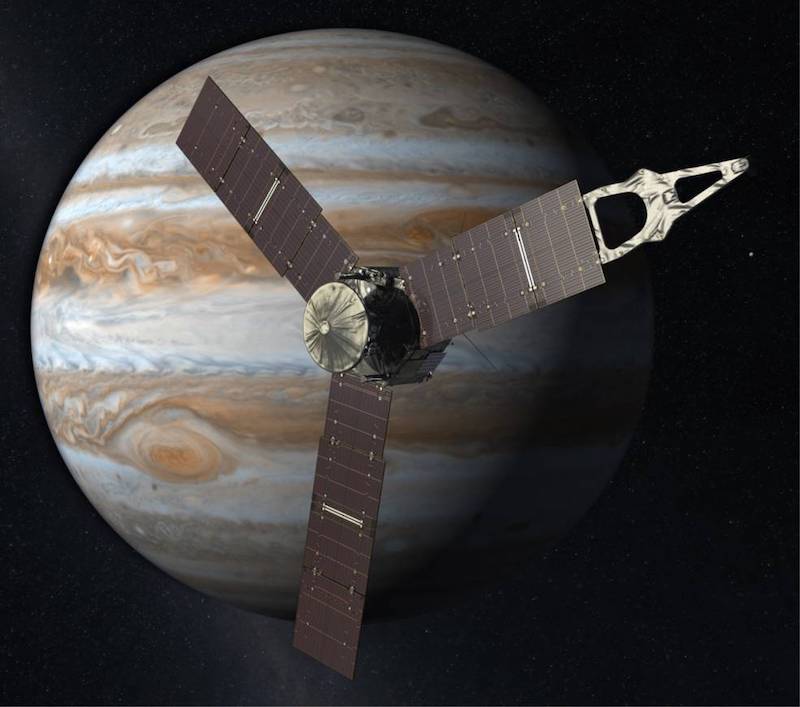
Bottom line: The Juno flyby of Europa on September 29, 2022, will come within 222 miles (538 km) of the satellite. Scientists hope to learn more about this icy world.
The post Juno flyby of Europa on September 29, 2022 first appeared on EarthSky.
from EarthSky https://ift.tt/quGf360
Juno flyby of Europa on September 29, 2022
NASA’s Juno spacecraft will perform a close flyby of Jupiter’s icy moon Europa at 2:36 a.m. PDT (5:36 a.m. EDT) on September 29, 2022. The spacecraft will come within 222 miles (538 km), taking some of the highest-resolution images yet of portions of Europa’s surface. Scientists will also collect data on the moon’s interior, surface composition and ionosphere. Plus, it will record Europa’s interaction with Jupiter’s magnetosphere, all of which will be useful in the upcoming Europa Clipper mission, set to launch in 2024.
Juno Principal Investigator Scott Bolton of the Southwest Research Institute (SwRI) said:
Europa is such an intriguing Jovian moon, it is the focus of its own future NASA mission. We’re happy to provide data that may help the Europa Clipper team with mission planning, as well as provide new scientific insights into this icy world.
Jupiter’s moon Europa
Europa is one of the four largest moons of Jupiter. These moons are the Galilean moons, and Europa is the second closest to Jupiter and the smallest of the four. Even so, Europa is still 1,940 miles (3,100 km) in diameter, making it about 90% as large as our own moon. Scientists believe Europa has a surface of water ice, but they believe a liquid or slushy ocean lies beneath. This possible salty ocean could be a habitat for life.
The flyby
The closest point in Juno’s flyby of Europa brings it within 222 miles (538 km) of the icy moon. Juno will be just a bit more distant than the Galileo spacecraft came to the moon (218 miles or 351 km) on January 3, 2000. In 2021, Juno came within 645 miles (1,038 km) of Ganymede, and in 2023 and 2024 Juno will have close flybys of Io. The closest Juno will get to Io is about 932 miles (1,500 km).
When Juno is within one hour of its closest approach, it will begin collecting data on the moon and its interactions with Jupiter’s magnetosphere. At an hour from closest approach to Europa, the spacecraft will still be 51,820 miles (83,397 km) out. John Bordi of JPL said:
The relative velocity between spacecraft and moon will be 14.7 miles per second (23.6 kilometers per second), so we are screaming by pretty fast. All steps have to go like clockwork to successfully acquire our planned data, because soon after the flyby is complete, the spacecraft needs to be reoriented for our upcoming close approach of Jupiter, which happens only 7 ½ hours later.
You can keep track of where Juno is with NASA’s interactive Eyes on the Solar System web page.
Water plumes and an icy ocean
In 2013, scientists thought that the Hubble space telescope may have caught water plumes venting from Europa. Juno will search for these possible water plumes. Bolton said:
We have the right equipment to do the job, but to capture a plume will require a lot of luck. We have to be at the right place at just the right time, but if we are so fortunate, it’s a home run for sure.
Juno will look at the moon’s icy crust to learn more about its composition and temperature. Visible-light images will also help scientists compare Europa now with past images to see what has changed on its visible surface in the past two decades.
Get ready to see some great images of Europa!
Bottom line: The Juno flyby of Europa on September 29, 2022, will come within 222 miles (538 km) of the satellite. Scientists hope to learn more about this icy world.
The post Juno flyby of Europa on September 29, 2022 first appeared on EarthSky.
from EarthSky https://ift.tt/quGf360

Aucun commentaire:
Enregistrer un commentaire