
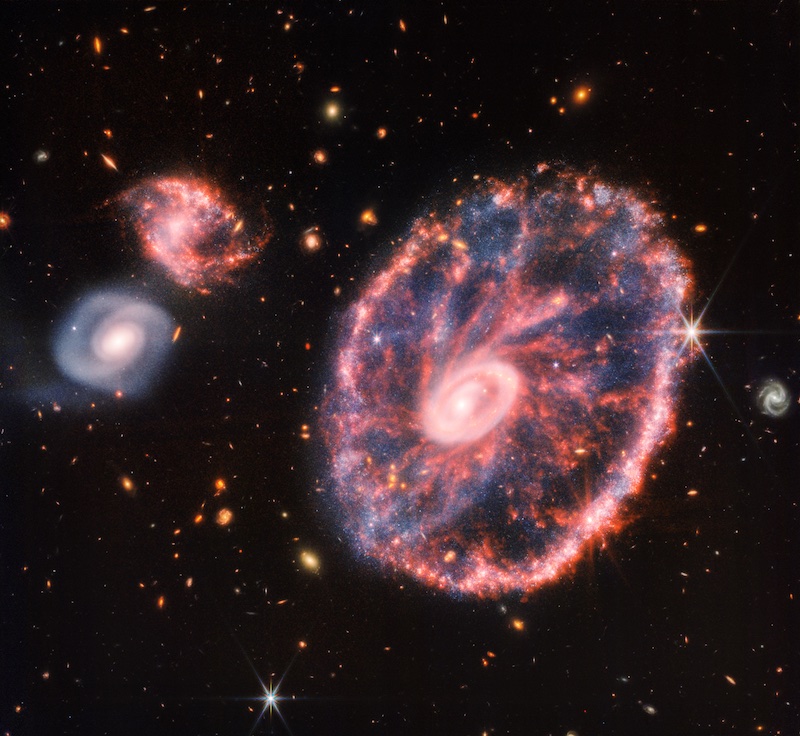
The Cartwheel Galaxy is lit up like a Ferris wheel ride at a carnival on a dark summer night in this new image from NASA’s James Webb Space Telescope released today (August 2, 2022). The galaxy has the classification of a ring galaxy, but you can also see the distinct spiral shape between the inner and outer rings. Many other galaxies appear in this image, including two smaller companion galaxies to the Cartwheel.
The Cartwheel Galaxy in infrared light
The Cartwheel Galaxy lies about 500 million light-years away in the constellation Sculptor. Its odd, dual-ringed appearance is thanks to a high-speed collision with a smaller galaxy not visible in this image. The result from this collision is the expanding rings.
Both rings are expanding outward from the scene of the collision. The inner ring surrounds the core, where gigantic young star clusters reside. The outer ring is plowing into gas, triggering star formation. Scientists think the outer ring has been expanding – and triggering star formation – for some 440 million years now.
Webb’s primary imager is the Near-Infrared Camera (NIRCam). Webb can see through the dust to spot the infrared light of young stars, such as those in the outer ring. In the image above, NIRCam data are colored blue, orange and yellow. The blue dots are individual stars or pockets of star formation. With NIRCam, we can see the difference between the smooth distribution of the older star populations in the core compared to the clumpy, younger star populations outside of it.
Another view
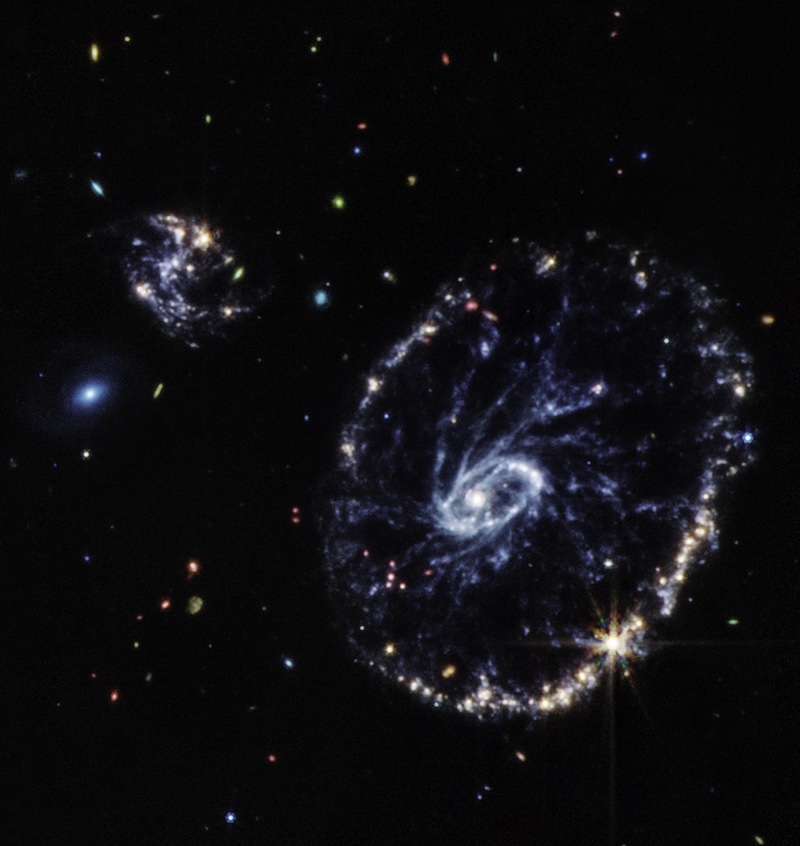
To see finer details in the Cartwheel Galaxy, we turn to Webb’s Mid-Infrared Instrument (MIRI). MIRI data are colored red in the composite image below. This shows regions rich in hydrocarbons and other chemical compounds. It also shows silicate dust, which is similar to much of the dust on Earth. With MIRI, we can see the spiraling spokes that form the galaxy’s skeleton.
Webb’s observations show a galaxy undergoing a transformation from a spiral into the current ring configuration. And the galaxy is still evolving.
Bottom line: The James Webb Space Telescope’s newest release is the Cartwheel galaxy, a gorgeous spiraling galaxy with inner and outer rings.
The post The Cartwheel Galaxy is Webb’s newest image first appeared on EarthSky.
from EarthSky https://ift.tt/Lv2IpeJ
The Cartwheel Galaxy is lit up like a Ferris wheel ride at a carnival on a dark summer night in this new image from NASA’s James Webb Space Telescope released today (August 2, 2022). The galaxy has the classification of a ring galaxy, but you can also see the distinct spiral shape between the inner and outer rings. Many other galaxies appear in this image, including two smaller companion galaxies to the Cartwheel.
The Cartwheel Galaxy in infrared light
The Cartwheel Galaxy lies about 500 million light-years away in the constellation Sculptor. Its odd, dual-ringed appearance is thanks to a high-speed collision with a smaller galaxy not visible in this image. The result from this collision is the expanding rings.
Both rings are expanding outward from the scene of the collision. The inner ring surrounds the core, where gigantic young star clusters reside. The outer ring is plowing into gas, triggering star formation. Scientists think the outer ring has been expanding – and triggering star formation – for some 440 million years now.
Webb’s primary imager is the Near-Infrared Camera (NIRCam). Webb can see through the dust to spot the infrared light of young stars, such as those in the outer ring. In the image above, NIRCam data are colored blue, orange and yellow. The blue dots are individual stars or pockets of star formation. With NIRCam, we can see the difference between the smooth distribution of the older star populations in the core compared to the clumpy, younger star populations outside of it.
Another view
To see finer details in the Cartwheel Galaxy, we turn to Webb’s Mid-Infrared Instrument (MIRI). MIRI data are colored red in the composite image below. This shows regions rich in hydrocarbons and other chemical compounds. It also shows silicate dust, which is similar to much of the dust on Earth. With MIRI, we can see the spiraling spokes that form the galaxy’s skeleton.
Webb’s observations show a galaxy undergoing a transformation from a spiral into the current ring configuration. And the galaxy is still evolving.
Bottom line: The James Webb Space Telescope’s newest release is the Cartwheel galaxy, a gorgeous spiraling galaxy with inner and outer rings.
The post The Cartwheel Galaxy is Webb’s newest image first appeared on EarthSky.
from EarthSky https://ift.tt/Lv2IpeJ

Aucun commentaire:
Enregistrer un commentaire