
Originally published on March 9, 2022, at Guy Ottewell’s blog, UniversalWorkshop.com. Reprinted with permission.
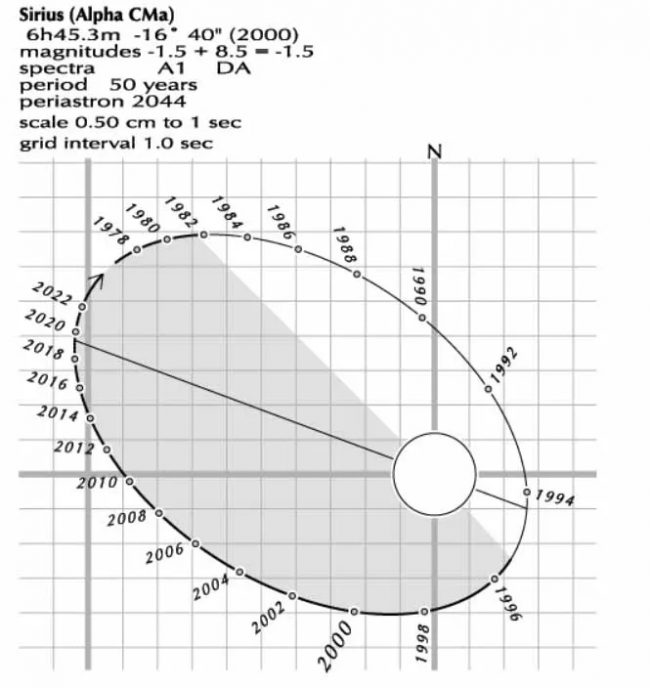
This kind of diagram, which I’ve gradually improved ever since the second year of my Astronomical Calendar, shows what to expect in a view through a telescope. The grid lines are at intervals of one second (the size of a cent or dime a kilometer away). The symbols for the two stars are sized for their “magnitude” (brightness), not for their apparent sizes, which are point-like. As you see from the dates, Sirius B is just past the apastron – the outermost point of its orbit, at the end of the diagonal line – and therefore at its least difficult to disentangle from the rays of the brilliant primary star.
Sirius B orbits around A in a plane tilted to our line of sight. The gray area is the half that is thought to be nearer to us. This is what the orbit would look like if we were looking down on it perpendicularly.
The other double star I dragged into service as a symbol was Albireo, because it is yellow and blue, like the flag of Ukraine. But it is a much wider pair than Sirius, and no revolving motion of the stars around each other has been detected, so they may not be gravitationally bound – it’s a matter of debate among experts. So to draw a picture of such a double-star system my program had to be adapted, a disentangling process that was surprisingly intricate and took me three days. It would now serve also for the many others pairs, mentioned in double-star catalogs, that are merely optical: stars that happen to be in the same line of sight but are at different distances.
Why is Albireo A shown as orangeish, rather than pure yellow? The main spectral types are O, B, A, F, G, K, M, in order of decreasing surface temperature. G stars, such as the Sun, are yellow; M stars are red (though star colors are pale, differing only subtly from white). So K stars are “orange.” I make my program color stars by their spectral type. But Albireo A’s type is, more exactly, K2, which verges on G.
Because stars appear only as points, their colors are hard to perceive. And colors stand out most, and appear to differ most, when they are contrastingly adjacent; this applies to bricks in walls, paints in pictures, as well as to stars. And so the literature on double stars is rich with attempts to give names to personal impressions. Here is part of what is said about Albireo in that classic of astronomy, Robert Burnham’s Celestial Handbook (of 1978, so some of the figures differ)..
“Albireo is one of the most beautiful double stars in the sky, considered by many observers to be the finest in the heavens for the small telescope. The brighter star is a golden yellow or “topaz,” magnitude 3.09, spectrum K3; the “sapphire” companion is magnitude 5.11, spectrum B8 V. The separation is 34.3,” an easy object for the low power telescope. Even a pair of good binoculars, if steadily held will split the pair. Albireo is noted for its superb color contrast, best seen with the eyepiece slightly displaced from the sharpest focus. Miss Agnes Clerke (1905) called the tints “golden and azure,” giving perhaps “the most lovely effect of color in the heavens.” For the average amateur telescope there is probably no pair so attractive, though the color effect seems to diminish in either very small or very large telescopes, or with too high a magnification. No more than 30X is required on a good 6-inch to show this superb pair as two contrasting jewels suspended ing region is wonderfully rich, and for wide-angle telescopes the star clouds to the NE are probably unequalled in splendor in the entire heavens.”
__________
ILLUSTRATIONS in these posts are made with precision but have to be inserted in another format. You may be able to enlarge them on your monitor. One way: right-click, and choose “View image”, then enlarge. Or choose “Copy image”, then put it on your desktop, then open it. On an iPad or phone, use the finger gesture that enlarges (spreading with two fingers, or tapping and dragging with three fingers). Other methods have been suggested, such as dragging the image to the desktop and opening it in other ways.
This weblog maintains its right to be about astronomy or anything under the sun.
Bottom line: Learn more about the double stars Sirius and Albireo with these helpful charts from Guy Ottewell’s blog at universalworkshop.com
The post Double Stars first appeared on EarthSky.
from EarthSky https://ift.tt/02OxJN4
Originally published on March 9, 2022, at Guy Ottewell’s blog, UniversalWorkshop.com. Reprinted with permission.
This kind of diagram, which I’ve gradually improved ever since the second year of my Astronomical Calendar, shows what to expect in a view through a telescope. The grid lines are at intervals of one second (the size of a cent or dime a kilometer away). The symbols for the two stars are sized for their “magnitude” (brightness), not for their apparent sizes, which are point-like. As you see from the dates, Sirius B is just past the apastron – the outermost point of its orbit, at the end of the diagonal line – and therefore at its least difficult to disentangle from the rays of the brilliant primary star.
Sirius B orbits around A in a plane tilted to our line of sight. The gray area is the half that is thought to be nearer to us. This is what the orbit would look like if we were looking down on it perpendicularly.
The other double star I dragged into service as a symbol was Albireo, because it is yellow and blue, like the flag of Ukraine. But it is a much wider pair than Sirius, and no revolving motion of the stars around each other has been detected, so they may not be gravitationally bound – it’s a matter of debate among experts. So to draw a picture of such a double-star system my program had to be adapted, a disentangling process that was surprisingly intricate and took me three days. It would now serve also for the many others pairs, mentioned in double-star catalogs, that are merely optical: stars that happen to be in the same line of sight but are at different distances.
Why is Albireo A shown as orangeish, rather than pure yellow? The main spectral types are O, B, A, F, G, K, M, in order of decreasing surface temperature. G stars, such as the Sun, are yellow; M stars are red (though star colors are pale, differing only subtly from white). So K stars are “orange.” I make my program color stars by their spectral type. But Albireo A’s type is, more exactly, K2, which verges on G.
Because stars appear only as points, their colors are hard to perceive. And colors stand out most, and appear to differ most, when they are contrastingly adjacent; this applies to bricks in walls, paints in pictures, as well as to stars. And so the literature on double stars is rich with attempts to give names to personal impressions. Here is part of what is said about Albireo in that classic of astronomy, Robert Burnham’s Celestial Handbook (of 1978, so some of the figures differ)..
“Albireo is one of the most beautiful double stars in the sky, considered by many observers to be the finest in the heavens for the small telescope. The brighter star is a golden yellow or “topaz,” magnitude 3.09, spectrum K3; the “sapphire” companion is magnitude 5.11, spectrum B8 V. The separation is 34.3,” an easy object for the low power telescope. Even a pair of good binoculars, if steadily held will split the pair. Albireo is noted for its superb color contrast, best seen with the eyepiece slightly displaced from the sharpest focus. Miss Agnes Clerke (1905) called the tints “golden and azure,” giving perhaps “the most lovely effect of color in the heavens.” For the average amateur telescope there is probably no pair so attractive, though the color effect seems to diminish in either very small or very large telescopes, or with too high a magnification. No more than 30X is required on a good 6-inch to show this superb pair as two contrasting jewels suspended ing region is wonderfully rich, and for wide-angle telescopes the star clouds to the NE are probably unequalled in splendor in the entire heavens.”
__________
ILLUSTRATIONS in these posts are made with precision but have to be inserted in another format. You may be able to enlarge them on your monitor. One way: right-click, and choose “View image”, then enlarge. Or choose “Copy image”, then put it on your desktop, then open it. On an iPad or phone, use the finger gesture that enlarges (spreading with two fingers, or tapping and dragging with three fingers). Other methods have been suggested, such as dragging the image to the desktop and opening it in other ways.
This weblog maintains its right to be about astronomy or anything under the sun.
Bottom line: Learn more about the double stars Sirius and Albireo with these helpful charts from Guy Ottewell’s blog at universalworkshop.com
The post Double Stars first appeared on EarthSky.
from EarthSky https://ift.tt/02OxJN4

Aucun commentaire:
Enregistrer un commentaire