aads

Living with a brain tumour – Sue’s story

Brain tumours are hard to treat and survival remains stubbornly low. That’s why brain tumour research is one of our top priorities. In the final of a 3-part series, Sue shares what it’s like to live with a brain tumour.

It might sound strange, but I was first diagnosed with a brain tumour because my gynaecologist referred me to an anaesthetist that he knew. I was 36 at the time and I’d been having migraines for years. I’d been to the GP but nothing they prescribed worked.

Botox was just coming out for migraines, but because of my medical history the anaesthetist couldn’t give me the injections without sending me for a brain scan first. That’s when they found the tumour.

I was referred to a neurosurgeon and was back in hospital within three days as an urgent case. The surgeon said he couldn’t do a biopsy because of the tumour’s location, as it would cause a massive bleed in my brain. I was straight in for surgery, which lasted five and a half hours. When my results came back, they’d found it was a grade 2 astrocytoma.

An invisible illness

Even though I’d been having symptoms for years, the diagnosis still came as a shock. I had 3 young children at the time and had to stop and think about them, and what would happen if something happened to me.

Because it wasn’t something you could see, like a broken leg, people just assumed that I was OK.

I recovered well from my operation and once I’d had my staples out and my hair was back to normal, you’d have never known I’d had brain tumour surgery.

Because it wasn’t something you could see, like a broken leg, people just assumed that I was OK now, so I didn’t feel that I got the support I needed. I wished people would have offered to take the kids out to the park for a few hours; my youngest was only 2 at the time so it was really difficult. But they just didn’t understand, which was frustrating.

At times like this you really find out who your friends are. We had some friends who, when I was on treatment, would come around and cook for us so many times. I never asked. It was brilliant, and just what I needed.

Living with unknowns

For the next 6 years I was well, and life was normal. I had to have scans every 6 months which were always OK. I don’t mind the machines, and there’s a lot to be said for building up relationships with the staff. I got to know them all and they’re all brilliant.

Then, in 2013, I had a serious seizure in my sleep while on holiday. We came back home the next day and I was given another MRI scan, but everything was fine. So, I was put on anti-seizure medication and for the next 6 months I was fine, the drugs seemed to stop everything. But then the seizures returned, first occasionally and then several times a day. The MRI scans still didn’t show anything, so in May the following year I had a different type of scan called an MRS, which is much longer and more detailed.

That picked up unusual levels of brain activity, so I had to go back in for surgery. The tumour had come back, but because it was picked up early it hadn’t had time to grow into a large mass. This time though, the tumour had changed to a grade 3.

For my type of tumour, it will never be: “You’re better now.” There’s no cure for it.

I needed to have 18 cycles of the chemotherapy drug temozolomide. It was 3 weeks on and 1 off, 18 times. It was a long, tough process. I did really well, I think it’s a brilliant drug. For me though, the worst part was the fatigue.

It really does wipe you out. But I had to carry on, and I was getting up every day to make sandwiches for my kids to take to school.

Right now, everything is OK. But for my type of tumour, it will never be: “You’re better now.” When I last saw my doctor, and asked him what my chances are, he said that unfortunately my tumour is the kind that will simmer away, and it will come back again.

There’s no cure for it. It’s how long I’ve got that’s the difficult thing to come to terms with.

For me it could be 10 years, or it could be 6 months. That’s the sad thing, I just don’t know. And that’s the way I must live.

Taking life as it comes

It’s been 11 years since my diagnosis, and I have good days and bad days. It’s changed my personality, which is probably because the tumour is near my temporal lobe, where emotions are made.

It depends on the circumstances as to how I react to people in different situations, but I’ve got a really bad temper. I know I’ve changed, but I never use the tumour as an excuse.

You’ve got to make the most of what you’ve got and enjoy the life that you have.

It’s worse when people around me have died because of their brain tumours. Because I’ve had cancer for a long time now, I’ve met a lot of people who have also had brain tumours. Some of these people haven’t been as unwell as I have, but then they’ve suddenly died from their disease, while for others their treatment hasn’t worked or stopped working.

In the last 3 months, 3 of my friends with the same tumour have had their disease come back and they didn’t have any symptoms. There just aren’t enough success stories for brain tumours.

I still have scans every 3 months, but my attitude is that I can’t change anything and I must take each day as it comes.

I’m quite tough, so I don’t believe in sitting around feeling sorry for myself. I don’t look at life as time I’ve got left. You’ve got to make the most of what you’ve got and enjoy the life that you have, because it passes you by.

If you’ve been affected by cancer and would like to speak to someone, you can call our nurses on freephone 0808 800 4040, 9am until 5pm Monday to Friday. Alternatively, you can join our friendly and supportive discussion forum, Cancer Chat.


from Cancer Research UK – Science blog https://ift.tt/2OCdOz8

Brain tumours are hard to treat and survival remains stubbornly low. That’s why brain tumour research is one of our top priorities. In the final of a 3-part series, Sue shares what it’s like to live with a brain tumour.

It might sound strange, but I was first diagnosed with a brain tumour because my gynaecologist referred me to an anaesthetist that he knew. I was 36 at the time and I’d been having migraines for years. I’d been to the GP but nothing they prescribed worked.

Botox was just coming out for migraines, but because of my medical history the anaesthetist couldn’t give me the injections without sending me for a brain scan first. That’s when they found the tumour.

I was referred to a neurosurgeon and was back in hospital within three days as an urgent case. The surgeon said he couldn’t do a biopsy because of the tumour’s location, as it would cause a massive bleed in my brain. I was straight in for surgery, which lasted five and a half hours. When my results came back, they’d found it was a grade 2 astrocytoma.

An invisible illness

Even though I’d been having symptoms for years, the diagnosis still came as a shock. I had 3 young children at the time and had to stop and think about them, and what would happen if something happened to me.

Because it wasn’t something you could see, like a broken leg, people just assumed that I was OK.

I recovered well from my operation and once I’d had my staples out and my hair was back to normal, you’d have never known I’d had brain tumour surgery.

Because it wasn’t something you could see, like a broken leg, people just assumed that I was OK now, so I didn’t feel that I got the support I needed. I wished people would have offered to take the kids out to the park for a few hours; my youngest was only 2 at the time so it was really difficult. But they just didn’t understand, which was frustrating.

At times like this you really find out who your friends are. We had some friends who, when I was on treatment, would come around and cook for us so many times. I never asked. It was brilliant, and just what I needed.

Living with unknowns

For the next 6 years I was well, and life was normal. I had to have scans every 6 months which were always OK. I don’t mind the machines, and there’s a lot to be said for building up relationships with the staff. I got to know them all and they’re all brilliant.

Then, in 2013, I had a serious seizure in my sleep while on holiday. We came back home the next day and I was given another MRI scan, but everything was fine. So, I was put on anti-seizure medication and for the next 6 months I was fine, the drugs seemed to stop everything. But then the seizures returned, first occasionally and then several times a day. The MRI scans still didn’t show anything, so in May the following year I had a different type of scan called an MRS, which is much longer and more detailed.

That picked up unusual levels of brain activity, so I had to go back in for surgery. The tumour had come back, but because it was picked up early it hadn’t had time to grow into a large mass. This time though, the tumour had changed to a grade 3.

For my type of tumour, it will never be: “You’re better now.” There’s no cure for it.

I needed to have 18 cycles of the chemotherapy drug temozolomide. It was 3 weeks on and 1 off, 18 times. It was a long, tough process. I did really well, I think it’s a brilliant drug. For me though, the worst part was the fatigue.

It really does wipe you out. But I had to carry on, and I was getting up every day to make sandwiches for my kids to take to school.

Right now, everything is OK. But for my type of tumour, it will never be: “You’re better now.” When I last saw my doctor, and asked him what my chances are, he said that unfortunately my tumour is the kind that will simmer away, and it will come back again.

There’s no cure for it. It’s how long I’ve got that’s the difficult thing to come to terms with.

For me it could be 10 years, or it could be 6 months. That’s the sad thing, I just don’t know. And that’s the way I must live.

Taking life as it comes

It’s been 11 years since my diagnosis, and I have good days and bad days. It’s changed my personality, which is probably because the tumour is near my temporal lobe, where emotions are made.

It depends on the circumstances as to how I react to people in different situations, but I’ve got a really bad temper. I know I’ve changed, but I never use the tumour as an excuse.

You’ve got to make the most of what you’ve got and enjoy the life that you have.

It’s worse when people around me have died because of their brain tumours. Because I’ve had cancer for a long time now, I’ve met a lot of people who have also had brain tumours. Some of these people haven’t been as unwell as I have, but then they’ve suddenly died from their disease, while for others their treatment hasn’t worked or stopped working.

In the last 3 months, 3 of my friends with the same tumour have had their disease come back and they didn’t have any symptoms. There just aren’t enough success stories for brain tumours.

I still have scans every 3 months, but my attitude is that I can’t change anything and I must take each day as it comes.

I’m quite tough, so I don’t believe in sitting around feeling sorry for myself. I don’t look at life as time I’ve got left. You’ve got to make the most of what you’ve got and enjoy the life that you have, because it passes you by.

If you’ve been affected by cancer and would like to speak to someone, you can call our nurses on freephone 0808 800 4040, 9am until 5pm Monday to Friday. Alternatively, you can join our friendly and supportive discussion forum, Cancer Chat.


from Cancer Research UK – Science blog https://ift.tt/2OCdOz8
Mars Express — from worry, to water

In 2004, a year after Europe’s first mission to Mars was launched, the flight dynamics team at ESA’s operations centre encountered a serious problem. New computer models showed a worrying fate for the Mars Express spacecraft if mission controllers continued with their plans to deploy its giant MARSIS (Mars Advanced Radar for Subsurface and Ionosphere Sounding) radar.

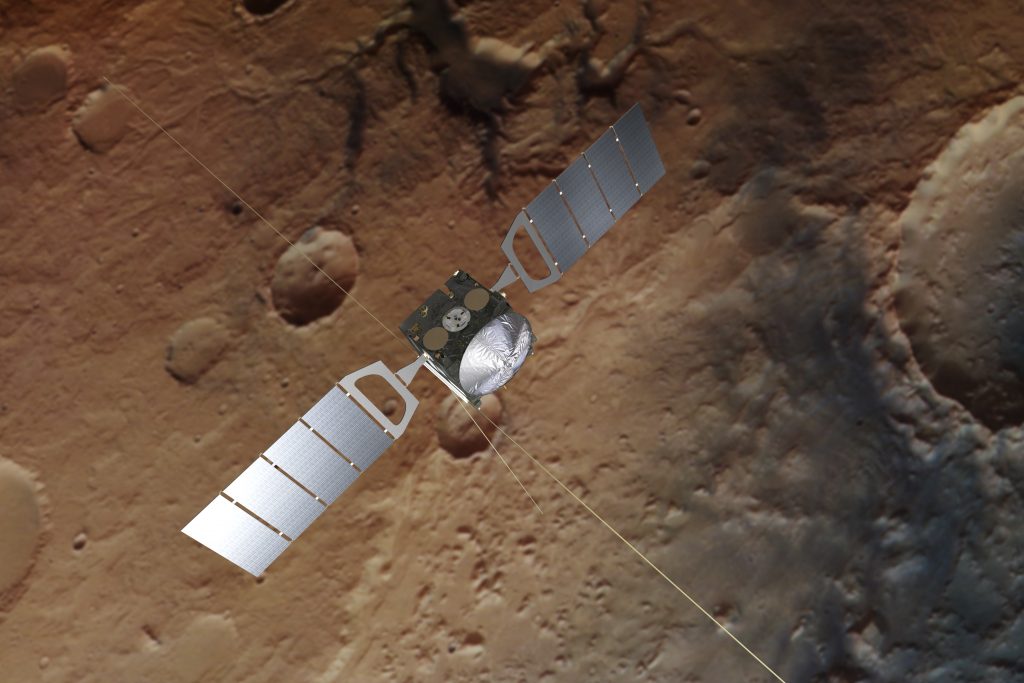
Artist’s impression of Mars Express. Credit: Spacecraft image credit: ESA/ATG medialab; Mars: ESA/DLR/FU Berlin, CC BY-SA 3.0 IGO

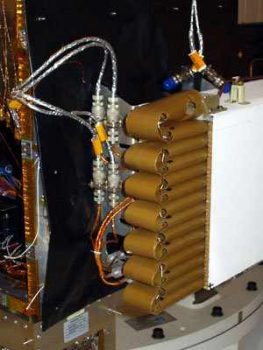
MARSIS main antenna. Credit: Universität der Bundeswehr – München

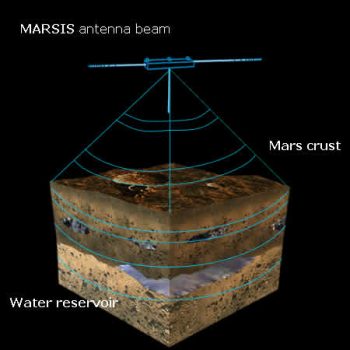
This extremely sensitive radar instrument spans 40 metres across once fully extended, making it longer than a Space Shuttle orbiter and was built with the direct intention of finding water beneath Mars’ surface. By sending out a series of chips between 1.8 and 5.0 Mhz in ‘subsurface’ mode would scour the red planet for any signs of water anywhere down to a depth of a few kilometres. A secondary ‘ionosphere’ mode at 0.1 to 5.4 Mhz surveyed the electrical conductivity of the Martian upper atmosphere.

Two ‘radar booms’, 20-metre long hollow cylinders, 2.5 centimetres in diameter, and one 7-metre boom, were folded up in a box like a concertina. Once the box was opened, all of the stored elastic energy from the glass fibre booms would be released, a little like a jack-in-the-box, and they would lock into a straight line.

New and updated computer models, however, showed that these long rods would swing back and forth upon release with an even greater amplitude than previously thought, potentially coming into close contact with the delicate parts of the Mars Express body.

Deployment was postponed

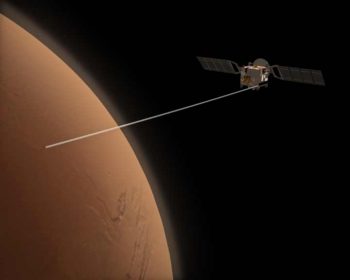
Artist’s impression of MARSIS Boom 1 deployed. Credit: ESA

Plans were made to get the spacecraft in a ‘robust’ mode before the deployment of each boom and while the glass fibre cylinders were extended. After each deployment the control team would conduct a full assessment of the spacecraft, taking up to a few days, before moving onto the next phase.

The first deployment began on 4 May 2005 with one of the two 20-metre ‘dipole’ booms, and flight controllers at ESA’s operations centre quickly realised something wasn’t quite right. 12 out of 13 of the boom segments had ‘snapped’ into place, but one, possibly number 10, was not in position.

Deployment of the second and third booms was postponed

Further analysis showed that prolonged storage in the cold conditions of outer space had affected the fibreglass and Kevlar material of the boom. What could be done to heat it up?

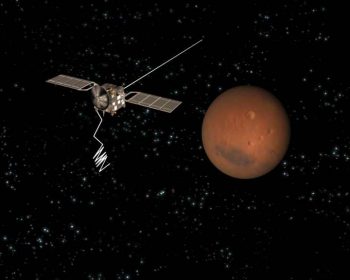
MARSIS boom 2 deployment begins. Credit: ESA, CC BY-SA 3.0 IGO.

Enter: the Sun. Mission teams decided to swing the 680 kg spacecraft to a position that would allow the Sun to heat the cold side of the boom. It was hoped that as the cold side expanded in the heat, the unlocked segment would be forced into place.

One hour later, as contact was reestablished at 04:50 CET on 11 May, detailed analysis showed all segments had successfully locked in place and Boom 1 was successfully deployed!

Following the rollercoaster rollout of the first antenna, flight controllers spent some time mulling over the events. A full investigation ensued, lessons were learnt, and plans were put in place to prevent the same irregularity from taking place in the next two deployments.

By 14 June 2005, operators felt confident that they, and Mars Express, were ready to deploy the second boom. At 13:30 CEST the commands were sent.

This time, Mars Express was set into a slow rotation to last 30 minutes during and after the release of the second 20-metre boom. The rotation was planned so that all of the boom’s hinges would be properly heated by the Sun before, during, and after deployment.

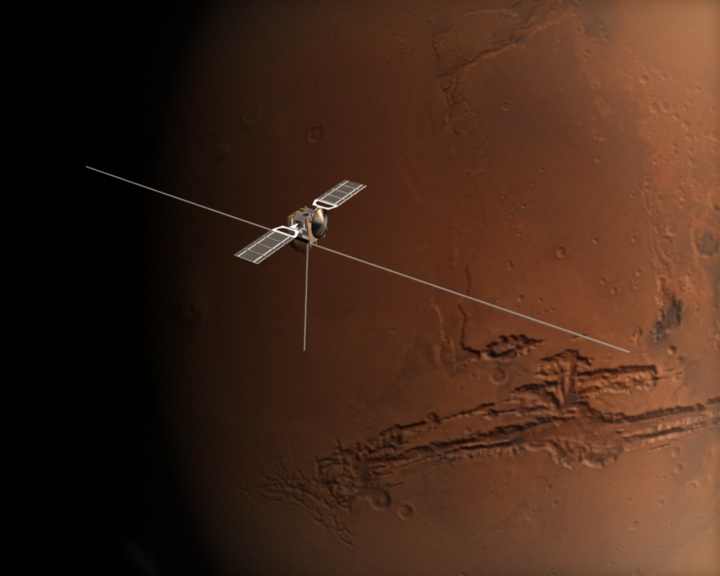
MARSIS fully deployed. Credit: ESA, CC BY-SA 3.0 IGO

Just three hours later and the first signs of success reached ground control, showing that Mars Express had properly re-oriented itself and was pointing towards Earth, transmitting data.

The data confirmed that the spacecraft was working with two fully and correctly deployed booms, and their deployment had not caused any damage to the spacecraft.

Not long after, the third boom was deployed, and the full MARSIS setup was complete on Mars Express.

Let the science begin

Just four months later, and ESA was reporting on the radar’s activities. MARSIS radar scientists were collecting data about a highly electrically conducting layer – surveyed in sunlight. They were also continuing the laborious analysis of data in the search for any possible signs of underground water, in a frozen or liquid state.

MARSIS prospecting for water. Credit: ESA

Radar science is based on the detection of radio waves, reflected at the boundaries between different materials. Each material interacts with light in a different way, so as the radio wave crosses the boundary between different layers of material, an echo is generated that carries a sort of ‘fingerprint’, providing information about the kind of material causing the reflection, including clues to its composition and physical state.

The Red Planet

Like Earth, Mars has two ice caps covering its poles, and early attempts to measure the composition of these regions suggested the northern cap could be composed of water ice, while the southern cap is made up of carbon dioxide ice.

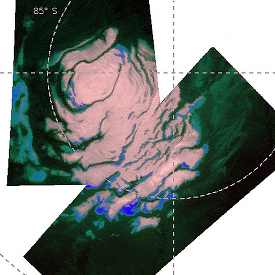
Map of the south pole at Mars, derived from OMEGA infrared spectral images. Credit: ESA/OMEGA.

Later observations by the OMEGA instrument on board Mars Express suggested the southern cap was in fact composed of a mixture of carbon dioxide and water. However, it was only with the arrival of Mars Express that scientists were able to obtain direct confirmation for the first time that water ice is present at the south pole.

MARSIS, the first radar sounder ever sent to orbit another planet, revealed that both polar ice caps are up to 3.5 km thick, each with a core of water ice that is covered by a layer of carbon dioxide ice, centimetres to decimetres thick.

A remarkable discovery

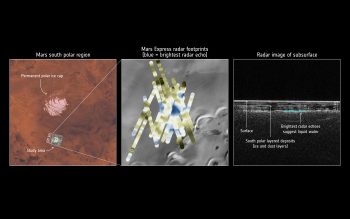
Mars Express detects water buried under the south pole of Mars. Credit: Context map: NASA/Viking; THEMIS background: NASA/JPL-Caltech/Arizona State University; MARSIS data: ESA/NASA/JPL/ASI/Univ. Rome; R. Orosei et al 2018

On 25 July 2018, fifteen years after its launch, it was confirmed that data from years of Mars Express’ observations were telling us something remarkable. Hidden beneath Mars’ south pole is a pond of liquid water, buried under layers of ice and dust.

The presence of liquid water at the base of the polar ice caps had long been suspected, but until now evidence from MARSIS had remained inconclusive. It has taken the persistence of scientists working with this subsurface-probing instrument over years, developing new techniques in order to collect as much high-resolution data as possible to confirm such an exciting conclusion.

Kasei Valles mosaic. Credit: ESA/DLR/FU Berlin (G. Neukum), CC BY-SA 3.0 IGO

Liquid water cannot survive on the surface of Mars, as the low atmospheric pressure causes it to evaporate in a matter of hours. But this has not always been the case. Evidence for the Red Planet’s watery past is prevalent across its surface in the form of vast dried-out river valley networks and gigantic outflow channels clearly imaged by orbiting spacecraft. Orbiters, together with landers and rovers exploring the martian surface, also discovered minerals that can only form in the presence of liquid water.

Over the course of the Red Planet’s 4.6 billion year history, its climate has vastly changed, meaning scientists today have to look for water underground. We now know for certain that under its surface Mars harbours ancient masses of liquid water.

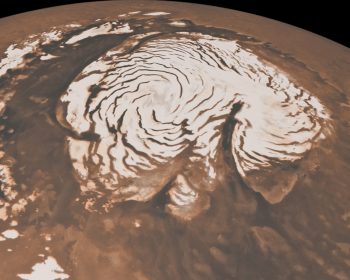
Mars’ northern polar ice cap. Credit: NASA/JPL-Caltech/MSSS

Kept in a liquid state by the vast pressures from glaciers above, it is thought that this water is also a briny solution. The presence of salts on Mars could further reduce the melting point of water, keeping it liquid even at below-freezing temperatures.

Dmitri Titov, ESA’s Mars Express project scientist: “This thrilling discovery is a highlight for planetary science and will contribute to our understanding of the evolution of Mars, the history of water on our neighbour planet and its habitability.”

So congratulations to everyone involved in this incredible discovery, and thank you to the flight controllers at ESA’s operations centre in Darmstadt whose dedication and ingenuity 14 years ago made possible what we know today.


from Rocket Science https://ift.tt/2O47oYw
v

In 2004, a year after Europe’s first mission to Mars was launched, the flight dynamics team at ESA’s operations centre encountered a serious problem. New computer models showed a worrying fate for the Mars Express spacecraft if mission controllers continued with their plans to deploy its giant MARSIS (Mars Advanced Radar for Subsurface and Ionosphere Sounding) radar.

Artist’s impression of Mars Express. Credit: Spacecraft image credit: ESA/ATG medialab; Mars: ESA/DLR/FU Berlin, CC BY-SA 3.0 IGO

MARSIS main antenna. Credit: Universität der Bundeswehr – München

This extremely sensitive radar instrument spans 40 metres across once fully extended, making it longer than a Space Shuttle orbiter and was built with the direct intention of finding water beneath Mars’ surface. By sending out a series of chips between 1.8 and 5.0 Mhz in ‘subsurface’ mode would scour the red planet for any signs of water anywhere down to a depth of a few kilometres. A secondary ‘ionosphere’ mode at 0.1 to 5.4 Mhz surveyed the electrical conductivity of the Martian upper atmosphere.

Two ‘radar booms’, 20-metre long hollow cylinders, 2.5 centimetres in diameter, and one 7-metre boom, were folded up in a box like a concertina. Once the box was opened, all of the stored elastic energy from the glass fibre booms would be released, a little like a jack-in-the-box, and they would lock into a straight line.

New and updated computer models, however, showed that these long rods would swing back and forth upon release with an even greater amplitude than previously thought, potentially coming into close contact with the delicate parts of the Mars Express body.

Deployment was postponed

Artist’s impression of MARSIS Boom 1 deployed. Credit: ESA

Plans were made to get the spacecraft in a ‘robust’ mode before the deployment of each boom and while the glass fibre cylinders were extended. After each deployment the control team would conduct a full assessment of the spacecraft, taking up to a few days, before moving onto the next phase.

The first deployment began on 4 May 2005 with one of the two 20-metre ‘dipole’ booms, and flight controllers at ESA’s operations centre quickly realised something wasn’t quite right. 12 out of 13 of the boom segments had ‘snapped’ into place, but one, possibly number 10, was not in position.

Deployment of the second and third booms was postponed

Further analysis showed that prolonged storage in the cold conditions of outer space had affected the fibreglass and Kevlar material of the boom. What could be done to heat it up?

MARSIS boom 2 deployment begins. Credit: ESA, CC BY-SA 3.0 IGO.

Enter: the Sun. Mission teams decided to swing the 680 kg spacecraft to a position that would allow the Sun to heat the cold side of the boom. It was hoped that as the cold side expanded in the heat, the unlocked segment would be forced into place.

One hour later, as contact was reestablished at 04:50 CET on 11 May, detailed analysis showed all segments had successfully locked in place and Boom 1 was successfully deployed!

Following the rollercoaster rollout of the first antenna, flight controllers spent some time mulling over the events. A full investigation ensued, lessons were learnt, and plans were put in place to prevent the same irregularity from taking place in the next two deployments.

By 14 June 2005, operators felt confident that they, and Mars Express, were ready to deploy the second boom. At 13:30 CEST the commands were sent.

This time, Mars Express was set into a slow rotation to last 30 minutes during and after the release of the second 20-metre boom. The rotation was planned so that all of the boom’s hinges would be properly heated by the Sun before, during, and after deployment.

MARSIS fully deployed. Credit: ESA, CC BY-SA 3.0 IGO

Just three hours later and the first signs of success reached ground control, showing that Mars Express had properly re-oriented itself and was pointing towards Earth, transmitting data.

The data confirmed that the spacecraft was working with two fully and correctly deployed booms, and their deployment had not caused any damage to the spacecraft.

Not long after, the third boom was deployed, and the full MARSIS setup was complete on Mars Express.

Let the science begin

Just four months later, and ESA was reporting on the radar’s activities. MARSIS radar scientists were collecting data about a highly electrically conducting layer – surveyed in sunlight. They were also continuing the laborious analysis of data in the search for any possible signs of underground water, in a frozen or liquid state.

MARSIS prospecting for water. Credit: ESA

Radar science is based on the detection of radio waves, reflected at the boundaries between different materials. Each material interacts with light in a different way, so as the radio wave crosses the boundary between different layers of material, an echo is generated that carries a sort of ‘fingerprint’, providing information about the kind of material causing the reflection, including clues to its composition and physical state.

The Red Planet

Like Earth, Mars has two ice caps covering its poles, and early attempts to measure the composition of these regions suggested the northern cap could be composed of water ice, while the southern cap is made up of carbon dioxide ice.

Map of the south pole at Mars, derived from OMEGA infrared spectral images. Credit: ESA/OMEGA.

Later observations by the OMEGA instrument on board Mars Express suggested the southern cap was in fact composed of a mixture of carbon dioxide and water. However, it was only with the arrival of Mars Express that scientists were able to obtain direct confirmation for the first time that water ice is present at the south pole.

MARSIS, the first radar sounder ever sent to orbit another planet, revealed that both polar ice caps are up to 3.5 km thick, each with a core of water ice that is covered by a layer of carbon dioxide ice, centimetres to decimetres thick.

A remarkable discovery

Mars Express detects water buried under the south pole of Mars. Credit: Context map: NASA/Viking; THEMIS background: NASA/JPL-Caltech/Arizona State University; MARSIS data: ESA/NASA/JPL/ASI/Univ. Rome; R. Orosei et al 2018

On 25 July 2018, fifteen years after its launch, it was confirmed that data from years of Mars Express’ observations were telling us something remarkable. Hidden beneath Mars’ south pole is a pond of liquid water, buried under layers of ice and dust.

The presence of liquid water at the base of the polar ice caps had long been suspected, but until now evidence from MARSIS had remained inconclusive. It has taken the persistence of scientists working with this subsurface-probing instrument over years, developing new techniques in order to collect as much high-resolution data as possible to confirm such an exciting conclusion.

Kasei Valles mosaic. Credit: ESA/DLR/FU Berlin (G. Neukum), CC BY-SA 3.0 IGO

Liquid water cannot survive on the surface of Mars, as the low atmospheric pressure causes it to evaporate in a matter of hours. But this has not always been the case. Evidence for the Red Planet’s watery past is prevalent across its surface in the form of vast dried-out river valley networks and gigantic outflow channels clearly imaged by orbiting spacecraft. Orbiters, together with landers and rovers exploring the martian surface, also discovered minerals that can only form in the presence of liquid water.

Over the course of the Red Planet’s 4.6 billion year history, its climate has vastly changed, meaning scientists today have to look for water underground. We now know for certain that under its surface Mars harbours ancient masses of liquid water.

Mars’ northern polar ice cap. Credit: NASA/JPL-Caltech/MSSS

Kept in a liquid state by the vast pressures from glaciers above, it is thought that this water is also a briny solution. The presence of salts on Mars could further reduce the melting point of water, keeping it liquid even at below-freezing temperatures.

Dmitri Titov, ESA’s Mars Express project scientist: “This thrilling discovery is a highlight for planetary science and will contribute to our understanding of the evolution of Mars, the history of water on our neighbour planet and its habitability.”

So congratulations to everyone involved in this incredible discovery, and thank you to the flight controllers at ESA’s operations centre in Darmstadt whose dedication and ingenuity 14 years ago made possible what we know today.


from Rocket Science https://ift.tt/2O47oYw
v

Why wildfires are bigger and harder to control

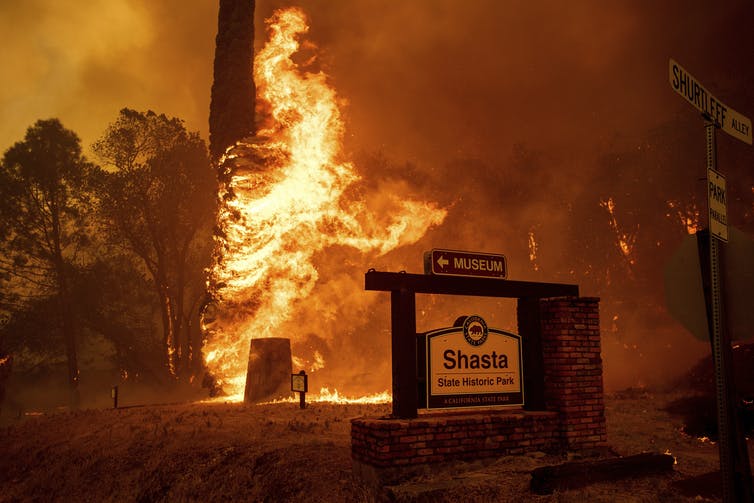
The Carr Fire tears through Shasta, California, July 26, 2018. Image via AP Photo/Noah Berger.

By Cassandra Moseley, University of Oregon

Hopes for fewer large wildfires in 2018, after last year’s disastrous fire season, are rapidly disappearing across the West. As of July 31, Six deaths have been reported in Northern California’s Carr Fire, including two firefighters. Fires have scorched Yosemite, Yellowstone, Crater Lake, Sequoia and Grand Canyon national parks. A blaze in June forced Colorado to shut down the San Juan National Forest. So far this year, 4.6 million acres have burned nationwide – less than last year, but well above the 10-year average of 3.7 million acres at this date.

These active wildfire years also mean higher firefighting costs. For my research on natural resource management and rural economic development, I work frequently with the U.S. Forest Service, which does most federal firefighting. Rising fire suppression costs over the past three decades have nearly destroyed the agency’s budget. Its overall funding has been flat for decades, while fire suppression costs have grown dramatically.

Earlier this year Congress passed a “fire funding fix” that changes the way in which the federal government will pay for large fires during expensive fire seasons. But it doesn’t affect the factors that are making fire suppression more costly, such as climate trends and more people living in fire prone landscapes.

Annual wildfire-burned area (in millions of acres), 1983 to 2015. The Forest Service stopped collecting statistics in 1997. Image via National Interagency Fire Center.

More burn days, more fuel

What is driving this trend? Many factors have come together to create a perfect storm. They include climate change, past forest and fire management practices, housing development, increased focus on community protection and the professionalization of wildfire management.

Fire seasons are growing longer in the United States and worldwide. According to the Forest Service, climate change has expanded the wildfire season by an average of 78 days per year since 1970. This means agencies need to keep seasonal employees on their payrolls longer and have contractors standing by earlier and available to work later in the year. All of this adds to costs, even in low fire years.

In many parts of the wildfire-prone West, decades of fire suppression combined with historic logging patterns have created small, dense forest stands that are more vulnerable to large wildfires. In fact, many areas have fire deficits – significantly less fire than we would expect given current climatic and forest conditions. Fire suppression in these areas only delays the inevitable. When fires do get away from firefighters, they are more severe because of the accumulation of small trees and brush.

Blue areas on this map experienced fire deficits (less area burned than expected) between 1994 and 2012. Red areas had fire surpluses (more area burned than expected), while yellow areas were roughly normal. Image via Parks, et al., 2015.

Protecting communities and forests

In recent decades, development has pushed into areas with fire-prone ecosystems – the wildland-urban interface. In response, the Forest Service has shifted its priorities from protecting timber resources to trying to keep fire from reaching houses and other physical infrastructure.

Fires near communities are fraught with political pressure and complex interactions with state and local fire and public safety agencies. They put enormous pressure on the Forest Service to do whatever is possible to suppress fires. There is considerable impetus to use air tankers and helicopters, although these resources are expensive and only effective in a limited number of circumstances.

As it started to prioritize protecting communities in the late 1980s, the Forest Service also ended its policy of fully suppressing all wildfires. Now fires are managed using a multiplicity of objectives and tactics, ranging from full suppression to allowing fires to grow larger so long as they stay within desired ranges.

This shift requires more and better-trained personnel and more interagency coordination. It also means letting some fires grow bigger, which requires personnel to monitor the blazes even when they stay within acceptable limits. Moving away from full suppression and increasing prescribed fire is controversial, but many scientists believe it will produce long-term ecological, public safety and financial benefits.

Suburban and exurban development has pushed into many fire-prone wild areas. Image via USFS.

Professionalizing wildfire response

As fire seasons lengthened and staffing for the national forest system declined, the Forest Service was less and less able to use national forest employees as a militia whose regular jobs could be set aside for brief periods for firefighting. Instead, it started to hire staff dedicated exclusively to wildfire management and use private-sector contractors for fire suppression.

There is little research on the costs of this transition, but hiring more dedicated professional fire staffers and a large contractor pool is probably more expensive than the Forest Service’s earlier model. However, as the agency’s workforce shrank by 20,000 between 1980 and the early 2010s and fire seasons expanded, it had little choice but to transform its fire organization.

In six of the past 10 years, wildfire activities have consumes at least half of the U.S. Forest Service’s annual budget. Image via CRS.

Baked-in fire risks

Many of these drivers are beyond the Forest Service’s control. Climate change, the fire deficit on many western lands and development in the wildland-urban interface ensure that the potential for major fires is baked into the system for decades to come.

There are some options for reducing risks and managing costs. Public land managers and forest landowners may be able to influence fire behavior in certain settings with techniques such as hazardous fuels reduction and prescribed fire. But these strategies will further increase costs in the short and medium term.

Another cost-saving strategy would be to rethink how firefighters use expensive resources such as airplanes and helicopters. But it will require political courage for the Forest Service to not use expensive resources on high-profile wildfires when they may not be effective.

Even if these approaches work, they will likely only slow the rate of increase in costs. Wildfire fighting costs now consume more than half of the agency’s budget. This is a problem because it reduces funds for national forest management, research and development, and support for state and private forestry. Over the long term, these are the very activities that are needed to address the growing problem of wildfire.

The ConversationThis is an updated version of an article originally published July 25, 2018.

Cassandra Moseley, Associate Vice President for Research and Research Professor, University of Oregon

This article was originally published on The Conversation. Read the original article.

Bottom line: Forestry expert on reasons why 2018 wildfire season is so bad.


from EarthSky https://ift.tt/2AzLytZ

The Carr Fire tears through Shasta, California, July 26, 2018. Image via AP Photo/Noah Berger.

By Cassandra Moseley, University of Oregon

Hopes for fewer large wildfires in 2018, after last year’s disastrous fire season, are rapidly disappearing across the West. As of July 31, Six deaths have been reported in Northern California’s Carr Fire, including two firefighters. Fires have scorched Yosemite, Yellowstone, Crater Lake, Sequoia and Grand Canyon national parks. A blaze in June forced Colorado to shut down the San Juan National Forest. So far this year, 4.6 million acres have burned nationwide – less than last year, but well above the 10-year average of 3.7 million acres at this date.

These active wildfire years also mean higher firefighting costs. For my research on natural resource management and rural economic development, I work frequently with the U.S. Forest Service, which does most federal firefighting. Rising fire suppression costs over the past three decades have nearly destroyed the agency’s budget. Its overall funding has been flat for decades, while fire suppression costs have grown dramatically.

Earlier this year Congress passed a “fire funding fix” that changes the way in which the federal government will pay for large fires during expensive fire seasons. But it doesn’t affect the factors that are making fire suppression more costly, such as climate trends and more people living in fire prone landscapes.

Annual wildfire-burned area (in millions of acres), 1983 to 2015. The Forest Service stopped collecting statistics in 1997. Image via National Interagency Fire Center.

More burn days, more fuel

What is driving this trend? Many factors have come together to create a perfect storm. They include climate change, past forest and fire management practices, housing development, increased focus on community protection and the professionalization of wildfire management.

Fire seasons are growing longer in the United States and worldwide. According to the Forest Service, climate change has expanded the wildfire season by an average of 78 days per year since 1970. This means agencies need to keep seasonal employees on their payrolls longer and have contractors standing by earlier and available to work later in the year. All of this adds to costs, even in low fire years.

In many parts of the wildfire-prone West, decades of fire suppression combined with historic logging patterns have created small, dense forest stands that are more vulnerable to large wildfires. In fact, many areas have fire deficits – significantly less fire than we would expect given current climatic and forest conditions. Fire suppression in these areas only delays the inevitable. When fires do get away from firefighters, they are more severe because of the accumulation of small trees and brush.

Blue areas on this map experienced fire deficits (less area burned than expected) between 1994 and 2012. Red areas had fire surpluses (more area burned than expected), while yellow areas were roughly normal. Image via Parks, et al., 2015.

Protecting communities and forests

In recent decades, development has pushed into areas with fire-prone ecosystems – the wildland-urban interface. In response, the Forest Service has shifted its priorities from protecting timber resources to trying to keep fire from reaching houses and other physical infrastructure.

Fires near communities are fraught with political pressure and complex interactions with state and local fire and public safety agencies. They put enormous pressure on the Forest Service to do whatever is possible to suppress fires. There is considerable impetus to use air tankers and helicopters, although these resources are expensive and only effective in a limited number of circumstances.

As it started to prioritize protecting communities in the late 1980s, the Forest Service also ended its policy of fully suppressing all wildfires. Now fires are managed using a multiplicity of objectives and tactics, ranging from full suppression to allowing fires to grow larger so long as they stay within desired ranges.

This shift requires more and better-trained personnel and more interagency coordination. It also means letting some fires grow bigger, which requires personnel to monitor the blazes even when they stay within acceptable limits. Moving away from full suppression and increasing prescribed fire is controversial, but many scientists believe it will produce long-term ecological, public safety and financial benefits.

Suburban and exurban development has pushed into many fire-prone wild areas. Image via USFS.

Professionalizing wildfire response

As fire seasons lengthened and staffing for the national forest system declined, the Forest Service was less and less able to use national forest employees as a militia whose regular jobs could be set aside for brief periods for firefighting. Instead, it started to hire staff dedicated exclusively to wildfire management and use private-sector contractors for fire suppression.

There is little research on the costs of this transition, but hiring more dedicated professional fire staffers and a large contractor pool is probably more expensive than the Forest Service’s earlier model. However, as the agency’s workforce shrank by 20,000 between 1980 and the early 2010s and fire seasons expanded, it had little choice but to transform its fire organization.

In six of the past 10 years, wildfire activities have consumes at least half of the U.S. Forest Service’s annual budget. Image via CRS.

Baked-in fire risks

Many of these drivers are beyond the Forest Service’s control. Climate change, the fire deficit on many western lands and development in the wildland-urban interface ensure that the potential for major fires is baked into the system for decades to come.

There are some options for reducing risks and managing costs. Public land managers and forest landowners may be able to influence fire behavior in certain settings with techniques such as hazardous fuels reduction and prescribed fire. But these strategies will further increase costs in the short and medium term.

Another cost-saving strategy would be to rethink how firefighters use expensive resources such as airplanes and helicopters. But it will require political courage for the Forest Service to not use expensive resources on high-profile wildfires when they may not be effective.

Even if these approaches work, they will likely only slow the rate of increase in costs. Wildfire fighting costs now consume more than half of the agency’s budget. This is a problem because it reduces funds for national forest management, research and development, and support for state and private forestry. Over the long term, these are the very activities that are needed to address the growing problem of wildfire.

The ConversationThis is an updated version of an article originally published July 25, 2018.

Cassandra Moseley, Associate Vice President for Research and Research Professor, University of Oregon

This article was originally published on The Conversation. Read the original article.

Bottom line: Forestry expert on reasons why 2018 wildfire season is so bad.


from EarthSky https://ift.tt/2AzLytZ

Arc to Arcturus and spike Spica

Tonight, or any night in the coming month or two, you can rely on the Big Dipper to star-hop to the bright stars Arcturus and Spica. Just remember this mnemonic: follow the arc to Arcturus, and drive a spike to Spica.

As late summer and autumn come to the Northern Hemisphere, the Big Dipper is found fairly high up in the northwest sky at nightfall. From middle-to-far northern latitudes, the Dipper is easy to spot in the August evening sky. It’s tougher from the Northern Hemisphere tropics, where the Big Dipper sits lower in the sky as darkness falls and swings beneath the horizon relatively early in the evening.

Meanwhile, the Big Dipper isn’t visible from far southerly latitudes in the Southern Hemisphere at nightfall, because it’s below the horizon from that part of the world.

Luckily, in August 2018, you don’t need the Big Dipper to find Spica at nightfall and early evening. Just look westward as darkness falls and you can’t miss the dazzling planet Venus – the brightest starlike object in the evening sky. Then note the king planet Jupiter. From northerly latitudes, Jupiter is in the southwest at nightfall. From the Southern Hemisphere, it’s closer to overhead as darkness falls.

Identify the star Spica between the brilliant planets Venus and Jupiter. Arcturus is also nearby. Then use your identification to confirm the handy skywatching phrase “follow the arc to Arcturus and drive a spike to Spica.” After that, for years to come – long after Venus and Jupiter are gone – you can always find these stars.

All month long, look for Spica in between Venus and Jupiter. Although Spica ranks as 1st-magnitude star, it’s nowhere as brilliant as Venus or Jupiter. Day by day, watch for Venus to move closer and closer to Spica on the sky’s dome. By September 1, 2018, Venus and Spica will actually be in conjunction.

The Big Dipper may not be visible from the Southern Hemisphere, but it’ll actually be easier to view Venus and Spica from southerly latitudes. That’s because Venus and Spica stay out longer after sunset than they do in the Northern Hemisphere.

Arcturus should be fairly easy to view from the Southern Hemisphere as well. Look for this brilliant yellow-orange star in your northwest sky at nightfall and early evening.

Click here to find out when the sun, Venus, Spica and Arcturus set in your sky.

Bottom line: Identify the star Spica between the brilliant planets Venus and Jupiter. Then use this identification to confirm the handy skywatching mnemonic “follow the arc to Arcturus and drive a spike to Spica.”


from EarthSky https://ift.tt/2wUVXhd

Tonight, or any night in the coming month or two, you can rely on the Big Dipper to star-hop to the bright stars Arcturus and Spica. Just remember this mnemonic: follow the arc to Arcturus, and drive a spike to Spica.

As late summer and autumn come to the Northern Hemisphere, the Big Dipper is found fairly high up in the northwest sky at nightfall. From middle-to-far northern latitudes, the Dipper is easy to spot in the August evening sky. It’s tougher from the Northern Hemisphere tropics, where the Big Dipper sits lower in the sky as darkness falls and swings beneath the horizon relatively early in the evening.

Meanwhile, the Big Dipper isn’t visible from far southerly latitudes in the Southern Hemisphere at nightfall, because it’s below the horizon from that part of the world.

Luckily, in August 2018, you don’t need the Big Dipper to find Spica at nightfall and early evening. Just look westward as darkness falls and you can’t miss the dazzling planet Venus – the brightest starlike object in the evening sky. Then note the king planet Jupiter. From northerly latitudes, Jupiter is in the southwest at nightfall. From the Southern Hemisphere, it’s closer to overhead as darkness falls.

Identify the star Spica between the brilliant planets Venus and Jupiter. Arcturus is also nearby. Then use your identification to confirm the handy skywatching phrase “follow the arc to Arcturus and drive a spike to Spica.” After that, for years to come – long after Venus and Jupiter are gone – you can always find these stars.

All month long, look for Spica in between Venus and Jupiter. Although Spica ranks as 1st-magnitude star, it’s nowhere as brilliant as Venus or Jupiter. Day by day, watch for Venus to move closer and closer to Spica on the sky’s dome. By September 1, 2018, Venus and Spica will actually be in conjunction.

The Big Dipper may not be visible from the Southern Hemisphere, but it’ll actually be easier to view Venus and Spica from southerly latitudes. That’s because Venus and Spica stay out longer after sunset than they do in the Northern Hemisphere.

Arcturus should be fairly easy to view from the Southern Hemisphere as well. Look for this brilliant yellow-orange star in your northwest sky at nightfall and early evening.

Click here to find out when the sun, Venus, Spica and Arcturus set in your sky.

Bottom line: Identify the star Spica between the brilliant planets Venus and Jupiter. Then use this identification to confirm the handy skywatching mnemonic “follow the arc to Arcturus and drive a spike to Spica.”


from EarthSky https://ift.tt/2wUVXhd

Where to look for life on Titan

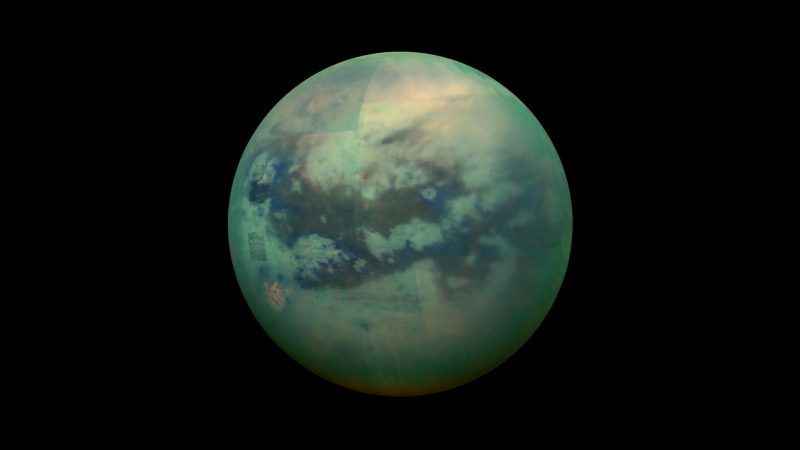
Saturn’s largest moon Titan as seen by the Cassini spacecraft. This world’s liquid methane and ethane rivers, lakes and seas might support some kind of life, and scientists now think they know the best places to look. Image via NASA/JPL-Caltech.

NASA’s Cassini spacecraft and ESA’s Huygens lander showed that Saturn’s large moon Titan mimics Earth in many ways. But Titan displays different kinds of chemistry in a far colder environment. Given the similarities, the question of life inevitably arises: could Titan support some kind of simple life? Given the differences, scientists ponder the best places to look for Titan life. In late July, 2018, a new study published in the journal Astrobiology and reported on in Astrobiology Magazine suggests the best places on Titan to look for evidence of life.

Titan is a geological wonderland for planetary scientists. It has rivers, lakes and seas of actual liquid – not water, but the hydrocarbons methane and ethane – and it has mountain ranges, possible ice volcanoes (aka cryovolcanoes) and vast hydrocarbon dunes. There is also evidence for a subsurface ocean of water, similar to those believed to lie beneath the surface of Jupiter’s moon Europa and Saturn’s moon Enceladus.

Perhaps surprisingly, the research team, led by Catherine Neish, a planetary scientist specializing in impact cratering at the University of Western Ontario, suggested that the best locations to look for life on Titan would not be the lakes or seas. Instead, the new work shows a better place to look would be within impact craters and cryovolcanoes on Titan.

The scientists reason that these areas are where water ice in Titan’s crust could temporarily melt into a liquid. Water is still the only solvent known to be able to support life as we know it.

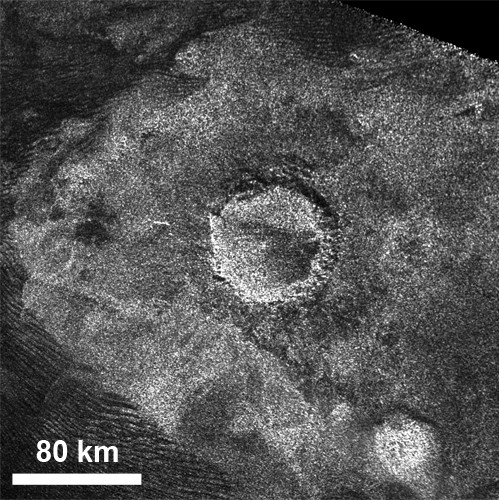
A large, fairly young crater on Titan, about 25 miles (40 km) in diameter. Such craters could temporarily melt frozen water in the crust, providing an environment for pre-biotic or biotic molecules to form. Image via NASA/JPL-Caltech.

Various studies have suggested that liquid methane and ethane could support life. But Saturn’s moon Titan – some nine farther from the sun than Earth – is very cold, with surface temperatures hovering around -300 degrees Fahrenheit (–179 degrees Celsius). Methane and ethane do remain liquid at Titan’s surface temperature, but it’s too cold there for biochemical processes, at least as far as we know (although that, too, is a matter of debate).

Titan’s surface is also covered with tholins, which are large, complex organic molecules produced when gases are subjected to cosmic radiation. When mixed with liquid water, tholins can produce amino acids, which are, essentially, life’s building blocks. According to researcher Morgan Cable at NASA’s Jet Propulsion Laboratory in Pasadena, California:

When we mix tholins with liquid water, we make amino acids really fast. So any place where there is liquid water on Titan’s surface or near its surface could be generating the precursors to life – biomolecules – that would be important for life as we know it, and that’s really exciting.

The temperatures on Titan’s surface are too cold for liquid water, so where could it be found? The answer is Titan’s craters and cryovolcanoes. The processes involved with both of these geologic features can melt water ice into liquid, even if only temporarily.

But that might be enough for more complex organic molecules like amino acids to form.

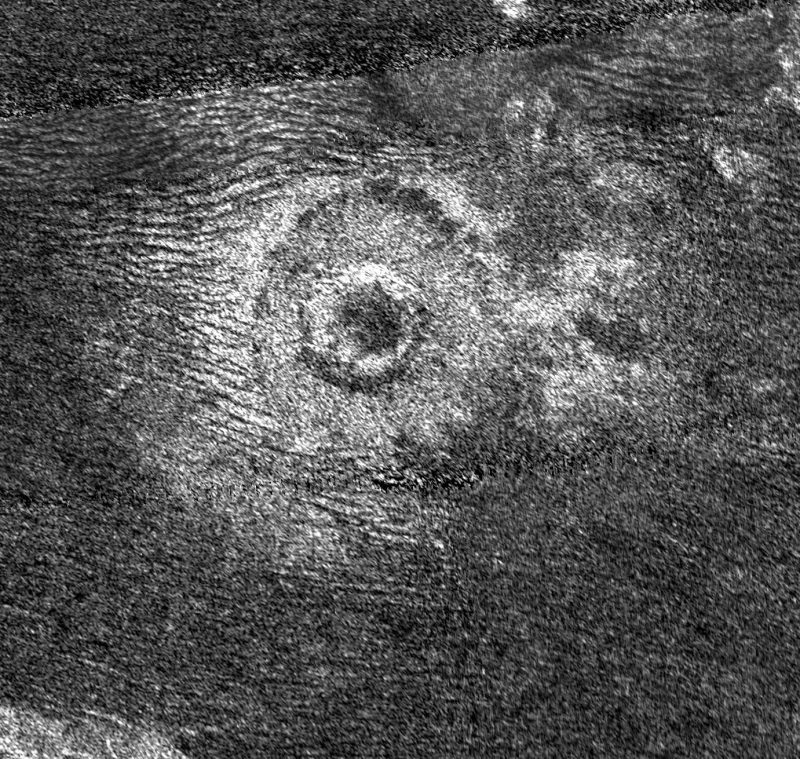
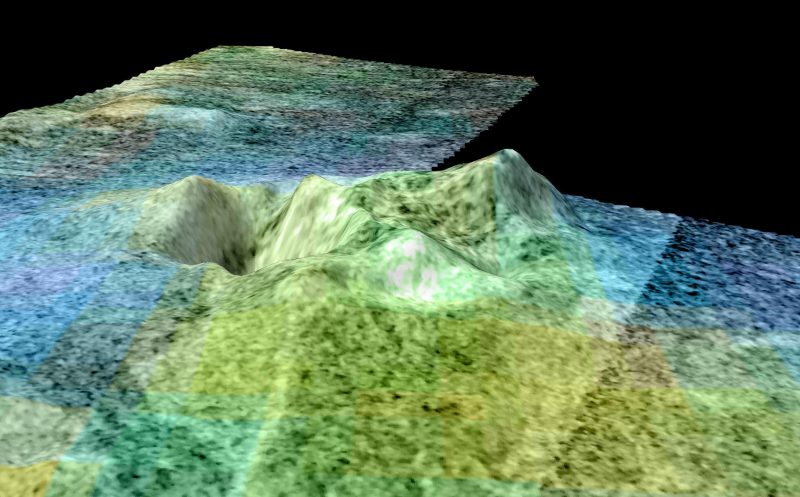
Sotra Facula is a possible cryovolcano on Titan, one of the few candidates known. Image via NASA/JPL–Caltech/USGS/University of Arizona.

Another view of Sotra Facula. This image was built from radar topography with infrared colors overlaid on top. Image via NASA/JPL–Caltech/USGS/University of Arizona.

Between craters and cryovolcanoes, it would seem that craters would be the most ideal location for pre-biotic or biotic chemistry to occur. As Neish explained:

Craters really emerged as the clear winner for three main reasons. One, is that we’re pretty sure there are craters on Titan. Cratering is a very common geologic process and we see circular features that are almost certainly craters on the surface.

Neish also noted that craters would produce more liquid water melt than a cryovolcano, so any water would remain liquid for a longer period of time. She also added:

The last point is that impact craters should produce water that’s at a higher temperature than a cryovolcano.

Warmer water would allow for faster chemical reaction rates, which would help in the creation of per-biotic or even biotic molecules. The largest known craters on Titan are Sinlap (70 miles/112 kms in diameter), Selk (56 miles/90 kms) and Menrva (244 miles/392 kms). These would be the primary locations to look for biomolecules

David Grinspoon at the Planetary Science Institute isn’t convinced yet, however. He commented:

We don’t know where to search even with results like this. I wouldn’t use it to guide our next mission to Titan. It’s premature.

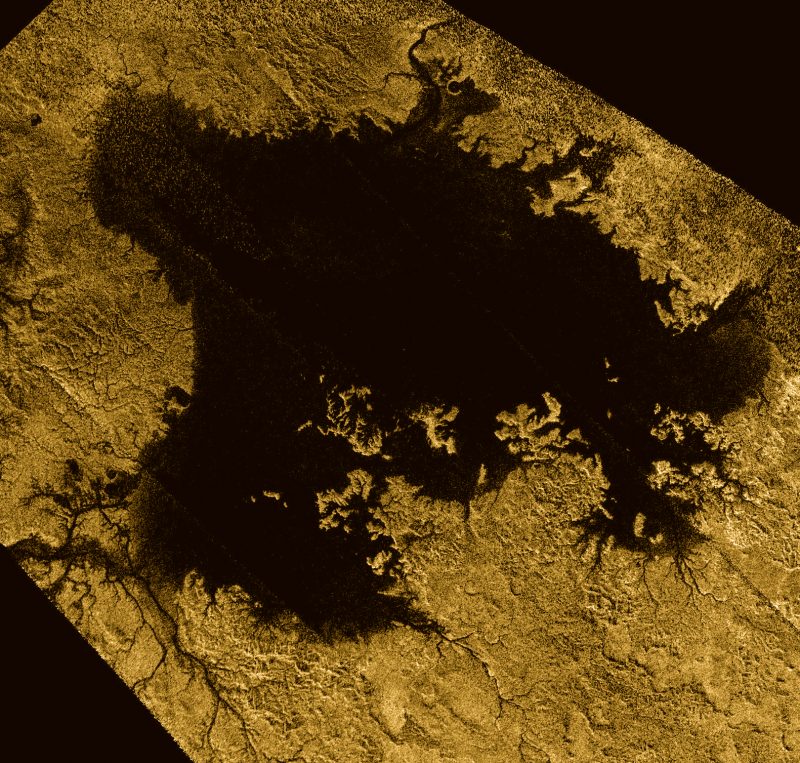
Titan is well-known for its lakes and seas of liquid methane/ethane, such as Ligiea Mare, shown here. Image via NASA/JPL-Caltech/ASI/Cornell.

So what about cryovolcanoes? They haven’t actually been confirmed yet to exist on Titan, and if they do, they are more rare than craters (even though craters are also relatively rare on Titan). The most likely feature to be a cryovolcano is a mountain with a caldera on top called Sotra Facula. Other than that, they seem to be few and far between. As Neish said:

Cryovolcanism is the harder thing to do and there is very little evidence of it on Titan.

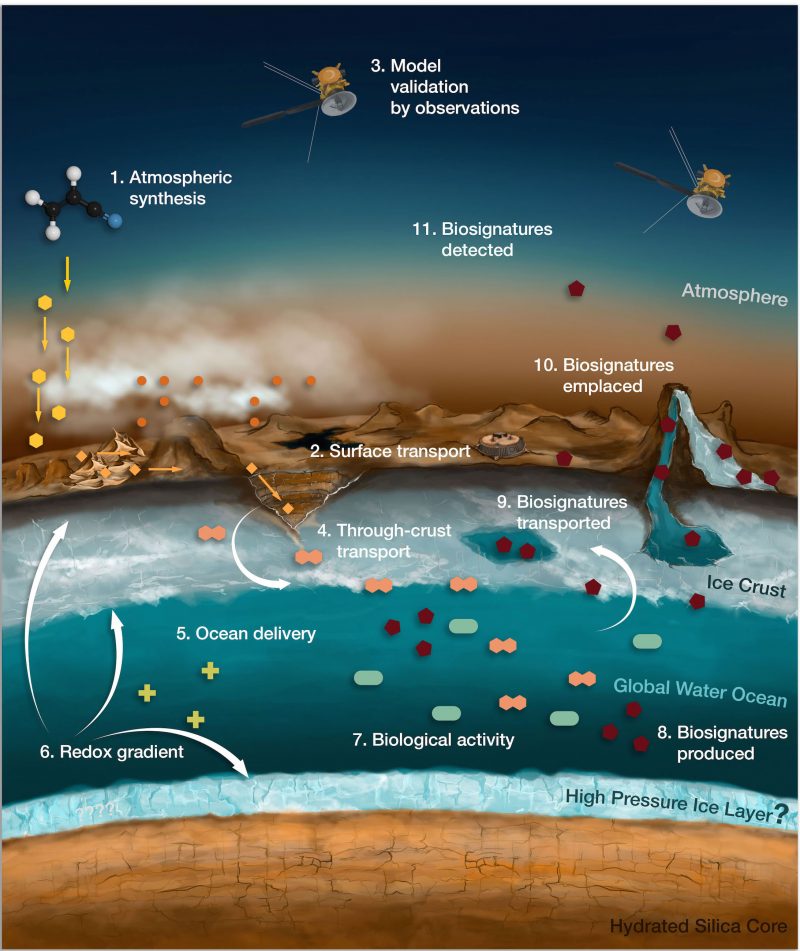
Diagram illustrating how biosignatures could also be transported from the subsurface ocean to the surface of Titan. Image via Athanasios Karagiotas/Theoni Shalamberidze.

There is also, of course, a possible subsurface ocean of water on Titan, but, if it exists, it is deep below the moon’s surface and inaccessible to any robotic probes in the near future. For now, we can only imagine what might be in that alien abyss.

The methane/ethane lakes and seas should still be explored too; they are the only other known bodies of liquid on the surface of another moon or planet in the solar system. Methane-based life could theoretically exist in such environments, so it would obviously be a good idea to look, at least.

Bottom line: Titan is a world that is eerily similar to Earth in some ways, yet still uniquely alien. Whether it supports any kind of life is still a big question, but researchers now think they know the best places to search for it.

Source: Strategies for Detecting Biological Molecules on Titan

Via Astrobiology Magazine


from EarthSky https://ift.tt/2LVhVIh

Saturn’s largest moon Titan as seen by the Cassini spacecraft. This world’s liquid methane and ethane rivers, lakes and seas might support some kind of life, and scientists now think they know the best places to look. Image via NASA/JPL-Caltech.

NASA’s Cassini spacecraft and ESA’s Huygens lander showed that Saturn’s large moon Titan mimics Earth in many ways. But Titan displays different kinds of chemistry in a far colder environment. Given the similarities, the question of life inevitably arises: could Titan support some kind of simple life? Given the differences, scientists ponder the best places to look for Titan life. In late July, 2018, a new study published in the journal Astrobiology and reported on in Astrobiology Magazine suggests the best places on Titan to look for evidence of life.

Titan is a geological wonderland for planetary scientists. It has rivers, lakes and seas of actual liquid – not water, but the hydrocarbons methane and ethane – and it has mountain ranges, possible ice volcanoes (aka cryovolcanoes) and vast hydrocarbon dunes. There is also evidence for a subsurface ocean of water, similar to those believed to lie beneath the surface of Jupiter’s moon Europa and Saturn’s moon Enceladus.

Perhaps surprisingly, the research team, led by Catherine Neish, a planetary scientist specializing in impact cratering at the University of Western Ontario, suggested that the best locations to look for life on Titan would not be the lakes or seas. Instead, the new work shows a better place to look would be within impact craters and cryovolcanoes on Titan.

The scientists reason that these areas are where water ice in Titan’s crust could temporarily melt into a liquid. Water is still the only solvent known to be able to support life as we know it.

A large, fairly young crater on Titan, about 25 miles (40 km) in diameter. Such craters could temporarily melt frozen water in the crust, providing an environment for pre-biotic or biotic molecules to form. Image via NASA/JPL-Caltech.

Various studies have suggested that liquid methane and ethane could support life. But Saturn’s moon Titan – some nine farther from the sun than Earth – is very cold, with surface temperatures hovering around -300 degrees Fahrenheit (–179 degrees Celsius). Methane and ethane do remain liquid at Titan’s surface temperature, but it’s too cold there for biochemical processes, at least as far as we know (although that, too, is a matter of debate).

Titan’s surface is also covered with tholins, which are large, complex organic molecules produced when gases are subjected to cosmic radiation. When mixed with liquid water, tholins can produce amino acids, which are, essentially, life’s building blocks. According to researcher Morgan Cable at NASA’s Jet Propulsion Laboratory in Pasadena, California:

When we mix tholins with liquid water, we make amino acids really fast. So any place where there is liquid water on Titan’s surface or near its surface could be generating the precursors to life – biomolecules – that would be important for life as we know it, and that’s really exciting.

The temperatures on Titan’s surface are too cold for liquid water, so where could it be found? The answer is Titan’s craters and cryovolcanoes. The processes involved with both of these geologic features can melt water ice into liquid, even if only temporarily.

But that might be enough for more complex organic molecules like amino acids to form.

Sotra Facula is a possible cryovolcano on Titan, one of the few candidates known. Image via NASA/JPL–Caltech/USGS/University of Arizona.

Another view of Sotra Facula. This image was built from radar topography with infrared colors overlaid on top. Image via NASA/JPL–Caltech/USGS/University of Arizona.

Between craters and cryovolcanoes, it would seem that craters would be the most ideal location for pre-biotic or biotic chemistry to occur. As Neish explained:

Craters really emerged as the clear winner for three main reasons. One, is that we’re pretty sure there are craters on Titan. Cratering is a very common geologic process and we see circular features that are almost certainly craters on the surface.

Neish also noted that craters would produce more liquid water melt than a cryovolcano, so any water would remain liquid for a longer period of time. She also added:

The last point is that impact craters should produce water that’s at a higher temperature than a cryovolcano.

Warmer water would allow for faster chemical reaction rates, which would help in the creation of per-biotic or even biotic molecules. The largest known craters on Titan are Sinlap (70 miles/112 kms in diameter), Selk (56 miles/90 kms) and Menrva (244 miles/392 kms). These would be the primary locations to look for biomolecules

David Grinspoon at the Planetary Science Institute isn’t convinced yet, however. He commented:

We don’t know where to search even with results like this. I wouldn’t use it to guide our next mission to Titan. It’s premature.

Titan is well-known for its lakes and seas of liquid methane/ethane, such as Ligiea Mare, shown here. Image via NASA/JPL-Caltech/ASI/Cornell.

So what about cryovolcanoes? They haven’t actually been confirmed yet to exist on Titan, and if they do, they are more rare than craters (even though craters are also relatively rare on Titan). The most likely feature to be a cryovolcano is a mountain with a caldera on top called Sotra Facula. Other than that, they seem to be few and far between. As Neish said:

Cryovolcanism is the harder thing to do and there is very little evidence of it on Titan.

Diagram illustrating how biosignatures could also be transported from the subsurface ocean to the surface of Titan. Image via Athanasios Karagiotas/Theoni Shalamberidze.

There is also, of course, a possible subsurface ocean of water on Titan, but, if it exists, it is deep below the moon’s surface and inaccessible to any robotic probes in the near future. For now, we can only imagine what might be in that alien abyss.

The methane/ethane lakes and seas should still be explored too; they are the only other known bodies of liquid on the surface of another moon or planet in the solar system. Methane-based life could theoretically exist in such environments, so it would obviously be a good idea to look, at least.

Bottom line: Titan is a world that is eerily similar to Earth in some ways, yet still uniquely alien. Whether it supports any kind of life is still a big question, but researchers now think they know the best places to search for it.

Source: Strategies for Detecting Biological Molecules on Titan

Via Astrobiology Magazine


from EarthSky https://ift.tt/2LVhVIh

How to see a full circle rainbow

Full circle rainbow was captured over Cottesloe Beach near Perth, Australia in 2013 by Colin Leonhardt of Birdseye View Photography. He was in a helicopter flying between a setting sun and a downpour. Used with permission. Order prints of this photo.

When sunlight and raindrops combine to make a rainbow, they can make a whole circle of light in the sky. But it’s a very rare sight. Sky conditions have to be just right for this, and even if they are, the bottom part of a full-circle rainbow is usually blocked by your horizon. That’s why we see rainbows not as circles, but as arcs across our sky.

When you see a rainbow, notice the height of the sun. It helps determine how much of an arc you’ll see. The lower the sun, the higher the top of the rainbow. If you could get up high enough, you’d see that some rainbows continue below the horizon seen from closer to sea-level. Mountain climbers sometimes see more of a full-circle rainbow, though even a high mountain isn’t high enough to show you the whole circle.

Pilots do sometimes report seeing genuine full-circle rainbows. They’d be tough to see out the small windows we passengers look through, but pilots have a much better view from up front.

By the way, we searched for images of full-circle rainbows. But most of the ones we found weren’t really rainbows. They were either halos around the sun – or airplane glories.

What’s NOT a rainbow? Hear from a master of sky optics

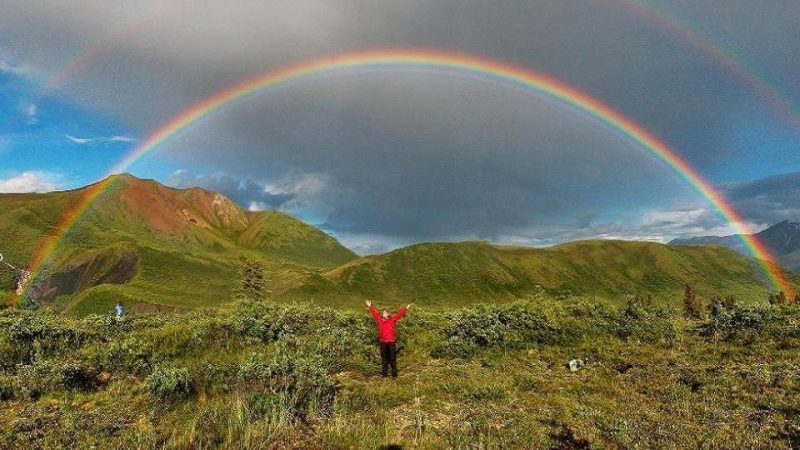
In this photo, the shadow of the photographer’s head – bottom, center – marks the center of the rainbow circle. This double rainbow was captured in Wrangell-St. Elias National Park, Alaska. Photo via Eric Rolph at Wikimedia Commons

Enjoying EarthSky? Sign up for our free daily newsletter today!

Bottom line: Can you ever see a full-circle rainbow in the sky? Yes, but they’re most often seen by pilots, who have a good view of the sky from the wide front windows of a plane.


from EarthSky https://ift.tt/17ANoUk

Full circle rainbow was captured over Cottesloe Beach near Perth, Australia in 2013 by Colin Leonhardt of Birdseye View Photography. He was in a helicopter flying between a setting sun and a downpour. Used with permission. Order prints of this photo.

When sunlight and raindrops combine to make a rainbow, they can make a whole circle of light in the sky. But it’s a very rare sight. Sky conditions have to be just right for this, and even if they are, the bottom part of a full-circle rainbow is usually blocked by your horizon. That’s why we see rainbows not as circles, but as arcs across our sky.

When you see a rainbow, notice the height of the sun. It helps determine how much of an arc you’ll see. The lower the sun, the higher the top of the rainbow. If you could get up high enough, you’d see that some rainbows continue below the horizon seen from closer to sea-level. Mountain climbers sometimes see more of a full-circle rainbow, though even a high mountain isn’t high enough to show you the whole circle.

Pilots do sometimes report seeing genuine full-circle rainbows. They’d be tough to see out the small windows we passengers look through, but pilots have a much better view from up front.

By the way, we searched for images of full-circle rainbows. But most of the ones we found weren’t really rainbows. They were either halos around the sun – or airplane glories.

What’s NOT a rainbow? Hear from a master of sky optics

In this photo, the shadow of the photographer’s head – bottom, center – marks the center of the rainbow circle. This double rainbow was captured in Wrangell-St. Elias National Park, Alaska. Photo via Eric Rolph at Wikimedia Commons

Enjoying EarthSky? Sign up for our free daily newsletter today!

Bottom line: Can you ever see a full-circle rainbow in the sky? Yes, but they’re most often seen by pilots, who have a good view of the sky from the wide front windows of a plane.


from EarthSky https://ift.tt/17ANoUk

Climate change made 2018 European heatwave up to ‘five times’ more likely

This is a re-post from Carbon Brief

rapid assessment by scientists of the ongoing heatwave across northern Europe this summer has found that human-caused climate change made it as much as five times more likely to have occurred.

The preliminary analysis, by a team of scientists at the World Weather Attribution network, uses data from seven weather stations in Ireland, the Netherlands, Denmark, Sweden, Norway and Finland. The team were not able to get sufficient data at short notice to include a UK station.

The findings suggest that rising global temperatures have increased the likelihood of such hot temperatures by five times in Denmark, three times in the Netherlands and two times in Ireland.

The sizeable year-to-year fluctuations in summer weather in Scandinavia makes it harder to pin down a specific change in likelihood for the heatwaves in Norway, Sweden and Finland, the researchers say. However, “we can state that, yes, heatwaves have increased – and are increasing – in Scandinavia as in the rest of Europe”, says one of the scientists involved.

Climate change link

From the UK to Canada through to Oman and Japan, the northern hemisphere has seen a pattern of prolonged heatwaves in recent weeks. The record-breaking temperatures have been linked to wildfires in Sweden, Greece and California and heatwave deaths in several countries.

Many news reports have speculated on the potential role that rising global temperatures could be having on the spate of extremes this summer. Carbon Brief has published a summary of all the media coverage from recent weeks.

Now, in a rapid analysis over the past few days, scientists have been able to quantify the impact that climate change is having.

The study uses data from individual weather stations, explained Dr Friederike Otto, the deputy director of the Environmental Change Institute at the University of Oxford, in a press conference this morning:

“What we have done in this study is look at locations – individual weather stations, so at the place where people live – to represent the heatwave that people are actually experiencing.”

These stations were selected because they had “data immediately available to us”, added Otto, and also because they had long records that could be analysed. Because the team needed data as close to real-time as possible – while they were carrying out their analysis – they used forecasts of temperature for the most recent few days.

The locations of each station were: Dublin, Ireland; De Bilt, Netherlands; Copenhagen, Denmark; Oslo, Norway; Linköping, Sweden; Sodankyla, northern Finland; and Jokioinen, southern Finland.

The researchers defined the heatwave at each location by taking the hottest three-day period in the year so far. Although this is a short period compared to the extended heatwave for much of Europe this summer, using longer period would have left fewer hot events to analyse, the researchers say.

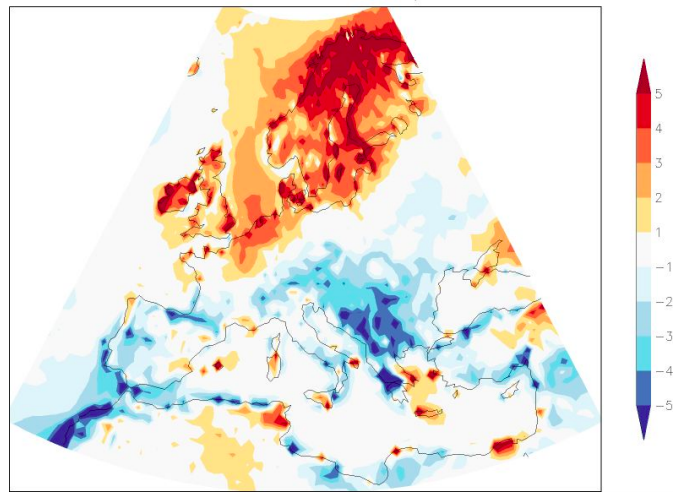
The map below shows how the hottest three-day period across Europe this summer so far compares to the hottest three-days in an average summer. The orange and red shading show higher-than-average temperatures, while the blues show lower. It illustrates how unusually warm Northern Europe, in particular, has been.

Map of The hottest 3-day consecutive period in 2018 (up to the end of July) compared to the average for the 1981-2010. Based on observed data up to 24 July, forecasts up to 31 July. Source: World Weather Attribution

The hottest 3-day consecutive period in 2018 (up to the end of July) compared to the average for the 1981-2010. Based on observed data up to 24 July, forecasts up to 31 July. Source: World Weather Attribution

The researchers used the long-term observed records of temperature to work out how rare this year’s heatwaves have been. They found that such warm three-day periods would occur once every five-to-eight years in Ireland, Denmark, Norway and the Netherlands, but just once every 30 years in Sweden and less than once every 90 years in Finland.

For the weather station in northern Finland, the recent heat is unlike anything on record, said Dr Geert Jan van Oldenborgh, from the Royal Netherlands Meteorological Institute:

“We found that for the weather station in the far north, in the Arctic Circle, the current heat wave is just extraordinary – unprecedented in the historical record.”

Using a collection of climate models, they then assessed the probability of such an event occurring in the current climate – which includes the influence of human-caused climate change – and in the past before the human impact on climate was detectable. Before using each model, they checked it could simulate heatwaves in each location accurately.

The findings suggest that climate change made the heatwave around twice as likely in Dublin (between a range of 1.2 and 3.3 times), five times as likely in Copenhagen (with a range of 2.4-12) and more than three times as likely in De Bild (with a range of 1.6-16).

The change in likelihood was “much harder to quantify” for the more northerly stations, the researchers say.

‘Heatwaves have increased’

The team also looked into how the frequency of heatwaves has changed over the long records of each station, explained van Oldenborgh in the press conference:

“For Ireland, Netherlands and Denmark, there is a clear trend in the observations towards more heatwaves. In the Netherlands, that trend is really large.”

For Norway, Sweden and Finland, there is not yet a statistically significant trend in heatwave changes in the observed data, noted van Oldenborgh:

“The reason for that is the variability of the weather from year to year is very large in this region and so it hides any trend.”

As a result, the team were “hesitant to put an actual number on the increase” in the region, said van Oldenborgh. Despite this, “we can state that, yes, heatwaves have increased – and are increasing – in Scandinavia as in the rest of Europe”, he added.

Single-event attribution

The new research is the latest in what are known as “single-event attribution” studies. The fast-moving area of research aims to identify the influence that human-caused climate change does – or does not – have on extreme weather events around the world. Carbon Brief has previously mapped all the peer-reviewed attribution studies in the scientific literature.

The research was conducted by World Weather Attribution – a network of scientists in six institutions established to provide near-real time analysis of possible links between climate change and extreme weather events.

It should be noted that the findings are still only preliminary, the researchers say:

“It is important to note that, compared to other attribution analyses of European summers, attributing a heatwave early in the season with the whole of August still to come will only give a preliminary result of the 2018 northern hemisphere heatwave season.”

The findings also have not yet been peer-reviewed. The researchers will be submitting the results to a journal once the summer is over. However, the methods underlying the findings are well established and have been published in previous attribution studies.


from Skeptical Science https://ift.tt/2M9CflZ

This is a re-post from Carbon Brief

rapid assessment by scientists of the ongoing heatwave across northern Europe this summer has found that human-caused climate change made it as much as five times more likely to have occurred.

The preliminary analysis, by a team of scientists at the World Weather Attribution network, uses data from seven weather stations in Ireland, the Netherlands, Denmark, Sweden, Norway and Finland. The team were not able to get sufficient data at short notice to include a UK station.

The findings suggest that rising global temperatures have increased the likelihood of such hot temperatures by five times in Denmark, three times in the Netherlands and two times in Ireland.

The sizeable year-to-year fluctuations in summer weather in Scandinavia makes it harder to pin down a specific change in likelihood for the heatwaves in Norway, Sweden and Finland, the researchers say. However, “we can state that, yes, heatwaves have increased – and are increasing – in Scandinavia as in the rest of Europe”, says one of the scientists involved.

Climate change link

From the UK to Canada through to Oman and Japan, the northern hemisphere has seen a pattern of prolonged heatwaves in recent weeks. The record-breaking temperatures have been linked to wildfires in Sweden, Greece and California and heatwave deaths in several countries.

Many news reports have speculated on the potential role that rising global temperatures could be having on the spate of extremes this summer. Carbon Brief has published a summary of all the media coverage from recent weeks.

Now, in a rapid analysis over the past few days, scientists have been able to quantify the impact that climate change is having.

The study uses data from individual weather stations, explained Dr Friederike Otto, the deputy director of the Environmental Change Institute at the University of Oxford, in a press conference this morning:

“What we have done in this study is look at locations – individual weather stations, so at the place where people live – to represent the heatwave that people are actually experiencing.”

These stations were selected because they had “data immediately available to us”, added Otto, and also because they had long records that could be analysed. Because the team needed data as close to real-time as possible – while they were carrying out their analysis – they used forecasts of temperature for the most recent few days.

The locations of each station were: Dublin, Ireland; De Bilt, Netherlands; Copenhagen, Denmark; Oslo, Norway; Linköping, Sweden; Sodankyla, northern Finland; and Jokioinen, southern Finland.

The researchers defined the heatwave at each location by taking the hottest three-day period in the year so far. Although this is a short period compared to the extended heatwave for much of Europe this summer, using longer period would have left fewer hot events to analyse, the researchers say.

The map below shows how the hottest three-day period across Europe this summer so far compares to the hottest three-days in an average summer. The orange and red shading show higher-than-average temperatures, while the blues show lower. It illustrates how unusually warm Northern Europe, in particular, has been.

Map of The hottest 3-day consecutive period in 2018 (up to the end of July) compared to the average for the 1981-2010. Based on observed data up to 24 July, forecasts up to 31 July. Source: World Weather Attribution

The hottest 3-day consecutive period in 2018 (up to the end of July) compared to the average for the 1981-2010. Based on observed data up to 24 July, forecasts up to 31 July. Source: World Weather Attribution

The researchers used the long-term observed records of temperature to work out how rare this year’s heatwaves have been. They found that such warm three-day periods would occur once every five-to-eight years in Ireland, Denmark, Norway and the Netherlands, but just once every 30 years in Sweden and less than once every 90 years in Finland.

For the weather station in northern Finland, the recent heat is unlike anything on record, said Dr Geert Jan van Oldenborgh, from the Royal Netherlands Meteorological Institute:

“We found that for the weather station in the far north, in the Arctic Circle, the current heat wave is just extraordinary – unprecedented in the historical record.”

Using a collection of climate models, they then assessed the probability of such an event occurring in the current climate – which includes the influence of human-caused climate change – and in the past before the human impact on climate was detectable. Before using each model, they checked it could simulate heatwaves in each location accurately.

The findings suggest that climate change made the heatwave around twice as likely in Dublin (between a range of 1.2 and 3.3 times), five times as likely in Copenhagen (with a range of 2.4-12) and more than three times as likely in De Bild (with a range of 1.6-16).

The change in likelihood was “much harder to quantify” for the more northerly stations, the researchers say.

‘Heatwaves have increased’

The team also looked into how the frequency of heatwaves has changed over the long records of each station, explained van Oldenborgh in the press conference:

“For Ireland, Netherlands and Denmark, there is a clear trend in the observations towards more heatwaves. In the Netherlands, that trend is really large.”

For Norway, Sweden and Finland, there is not yet a statistically significant trend in heatwave changes in the observed data, noted van Oldenborgh:

“The reason for that is the variability of the weather from year to year is very large in this region and so it hides any trend.”

As a result, the team were “hesitant to put an actual number on the increase” in the region, said van Oldenborgh. Despite this, “we can state that, yes, heatwaves have increased – and are increasing – in Scandinavia as in the rest of Europe”, he added.

Single-event attribution

The new research is the latest in what are known as “single-event attribution” studies. The fast-moving area of research aims to identify the influence that human-caused climate change does – or does not – have on extreme weather events around the world. Carbon Brief has previously mapped all the peer-reviewed attribution studies in the scientific literature.

The research was conducted by World Weather Attribution – a network of scientists in six institutions established to provide near-real time analysis of possible links between climate change and extreme weather events.

It should be noted that the findings are still only preliminary, the researchers say:

“It is important to note that, compared to other attribution analyses of European summers, attributing a heatwave early in the season with the whole of August still to come will only give a preliminary result of the 2018 northern hemisphere heatwave season.”

The findings also have not yet been peer-reviewed. The researchers will be submitting the results to a journal once the summer is over. However, the methods underlying the findings are well established and have been published in previous attribution studies.


from Skeptical Science https://ift.tt/2M9CflZ

adds 2