aads

Atlantic’s Hermine Is A Big Deal [Greg Laden's Blog]

For a while there it looked like the Atlantic might develop up to four simultaneous named storms, but that has not worked out. One of the storms will never get a name, one of the disturbances now looks like it may never be a storm. Gaston continues to chug away towards the Azores.

But one of these four weather events is now a named storm that will matter.

Tropical Storm Hermine is a global warming enhanced storm that will produce record rainfall events, catastrophic inland flooding, and likely, coastal storm flooding, in many locations in the US east.

Paul Douglans of Aeris Weather notes that this storm reminds him, somewhat of Sandy, because of its bigness and wetness and potential to reach far inland. It will not be as bad as Sandy, but, he notes, “there is a growing potential for disruptive weather all up and down the East Coast from Friday into Sunday; coastal Georgia and the Carolinas right up I-95 into Washington D.C. and New York City may be impacted by 40-60 mph winds, flash flooding and coastal flooding and beach erosion as Hermine churns north.”

Also like Sandy, a blocking pattern in the Atlantic will cause Hermine to stay longer off the coast than otherwise.

Places that normally flood are likely to flood. The storm will come over land at the base of the Florida Peninsula and the Florida Panhandle. It is possible that the storm will be a weak Category One hurricane just before lanfall, but not likely. It will then cross florida and run up the coast, either just on land or just off shore. One model h as the storm curving back from the Atlantic into southern Newe England, another model has it staying on land until New York City, then curving back out over Long Island. That gives you the range of uncertainty for the storm’s activity in several days from now.

But the track for the first several days is pretty well understood. Across the base of florida, then across Georgia, South Carolina, and into or near the Tidewater area, staying near the coast the whole time, more or less straddling the strandline.

It will be windy and wet with a lot of rainfall. The loss of Labor Day business will be bad for tourism regardless of any damage to such facilities that may occur as well.

Is Hermine enhanced by global warming?

Hermine is a weather event. Global warming caused by the human release of greenhouse gasses (and other human effects) is a climate phenomenon. So how can we possibly connect them?

Well, we have moved well past the days when one could pose such a lame brained question. Climate is weather, long term, and weather is climate, here and now. So, if climate is fundamentally changed, then the wether is fundamentally changed. The question is not whether weather that drenches or withers and climate wither are bound! The question is, what ways are a particular untoward weather event and the recent changes in the climate bound?

Here’s how.

Warmer seas and warmer air, causing generally more moisture in the air; and changes in air currents due to Arctic warming and other effects, causing a more uneven distribution of moisture in the air causing big dry areas and big wetter areas, and large wet blobs to form up and then move more slowly than usual across the landscape, make something like this storm (which at the base of it could have happened anyway) be bigger, wetter, slower-moving and thus rainier.

Climate Signals has a nice summary here.


from ScienceBlogs http://ift.tt/2c7kAew

For a while there it looked like the Atlantic might develop up to four simultaneous named storms, but that has not worked out. One of the storms will never get a name, one of the disturbances now looks like it may never be a storm. Gaston continues to chug away towards the Azores.

But one of these four weather events is now a named storm that will matter.

Tropical Storm Hermine is a global warming enhanced storm that will produce record rainfall events, catastrophic inland flooding, and likely, coastal storm flooding, in many locations in the US east.

Paul Douglans of Aeris Weather notes that this storm reminds him, somewhat of Sandy, because of its bigness and wetness and potential to reach far inland. It will not be as bad as Sandy, but, he notes, “there is a growing potential for disruptive weather all up and down the East Coast from Friday into Sunday; coastal Georgia and the Carolinas right up I-95 into Washington D.C. and New York City may be impacted by 40-60 mph winds, flash flooding and coastal flooding and beach erosion as Hermine churns north.”

Also like Sandy, a blocking pattern in the Atlantic will cause Hermine to stay longer off the coast than otherwise.

Places that normally flood are likely to flood. The storm will come over land at the base of the Florida Peninsula and the Florida Panhandle. It is possible that the storm will be a weak Category One hurricane just before lanfall, but not likely. It will then cross florida and run up the coast, either just on land or just off shore. One model h as the storm curving back from the Atlantic into southern Newe England, another model has it staying on land until New York City, then curving back out over Long Island. That gives you the range of uncertainty for the storm’s activity in several days from now.

But the track for the first several days is pretty well understood. Across the base of florida, then across Georgia, South Carolina, and into or near the Tidewater area, staying near the coast the whole time, more or less straddling the strandline.

It will be windy and wet with a lot of rainfall. The loss of Labor Day business will be bad for tourism regardless of any damage to such facilities that may occur as well.

Is Hermine enhanced by global warming?

Hermine is a weather event. Global warming caused by the human release of greenhouse gasses (and other human effects) is a climate phenomenon. So how can we possibly connect them?

Well, we have moved well past the days when one could pose such a lame brained question. Climate is weather, long term, and weather is climate, here and now. So, if climate is fundamentally changed, then the wether is fundamentally changed. The question is not whether weather that drenches or withers and climate wither are bound! The question is, what ways are a particular untoward weather event and the recent changes in the climate bound?

Here’s how.

Warmer seas and warmer air, causing generally more moisture in the air; and changes in air currents due to Arctic warming and other effects, causing a more uneven distribution of moisture in the air causing big dry areas and big wetter areas, and large wet blobs to form up and then move more slowly than usual across the landscape, make something like this storm (which at the base of it could have happened anyway) be bigger, wetter, slower-moving and thus rainier.

Climate Signals has a nice summary here.


from ScienceBlogs http://ift.tt/2c7kAew

Pacific Endeavor 2016 Integrates Real-World Lessons, New Capability

By Master Sgt. Todd Kabalan
Defense Media Activity, Forward Center Hawaii

The Pacific Endeavor 2016 exercise is in full swing after it began Aug. 22, and military communicators from 22 Indo-Asia Pacific nations, nongovernment organizations and academic advisers have come together to focus on improving humanitarian assistance and disaster response in the region.

Participants of Pacific Endeavor 2016 set up their high frequency radio antennas at Victoria Barracks during a field training exercise. DoD photo by Air Force Master Sgt. Todd Kabalan

Participants of Pacific Endeavor 2016 set up their high frequency radio antennas at Victoria Barracks during a field training exercise. DoD photo by Air Force Master Sgt. Todd Kabalan

Hosted by the Australian Defence Force and U.S. Pacific Command’s Multinational Communication Interoperability Program, this year’s Pacific Endeavor is the culminating event of a year-long planning effort, which took participants and planners to Papua New Guinea, Hawaii and Mongolia. The exercise wraps-up Sept. 2.

Based on recent real-world events, Pacific Endeavor 2016 features a scenario based on a Category 5 typhoon striking Brisbane, which requires participants to set up a Multinational Coordination Center and forward deploy to two other locations in the affected area. Their mission is to validate and document high-frequency voice and data transfer using ordinary field radios. Commonly referred to as Internet protocol over radio frequency, the practice involves transmitting not only voice, but images and e-mail data over the same IPRF signal.

‘No Simulations Here’

“There are no simulations here,” said Scott Griffin, director of Pacom’s multinational communication interoperability program. “We’re actually focusing more on real-world-type communications and real-world-type of events, by deploying them out there, setting up their antennas, setting up their radios and then transmitting back.”

Forward-deployed teams set up the forward operating bases at Damascus Barracks and Victoria Barracks, which are far enough away from the coordination center at Gallipoli Barracks that radio operators can truly test their equipment.

Sponsored by U.S. Pacific Command and hosted by the Australian Defence Force, Pacific Endeavor 2016 is a multinational workshop designed to enhance communication interoperability and expedite humanitarian assistance and disaster relief response in the Indo-Asia Pacific region. DoD photo by Air Force Master Sgt. Todd Kabalan

Sponsored by U.S. Pacific Command and hosted by the Australian Defence Force, Pacific Endeavor 2016 is a multinational workshop designed to enhance communication interoperability and expedite humanitarian assistance and disaster relief response in the Indo-Asia Pacific region. DoD photo by Air Force Master Sgt. Todd Kabalan

“It’s really important to test your high frequency [radios] by having a reasonable amount of distance between the two locations to make sure the systems are properly working,” said Australian Army Lt. Col. Michael King, Australian national lead for the multinational communication interoperability program. “Doing it here on the base allows for that, as well as the other locations around Australia, allow for a more realistic training environment to validate the interoperability between our radio systems.”

Most countries have digital radio frequency capabilities, but not all have satellite, which is the reason this exercise is great for interoperability. The challenges exercise participants encounter provide “hands-on” experience of what they might encounter during a real crisis.

Participants of Pacific Endeavor 2016 transmit voice and data communications over radio frequency at Victoria Barracks during a field training exercise. The workshop involved 250 participants from 22 allied and partner nations. DoD photo by Air Force Master Sgt. Todd Kabalan

Participants of Pacific Endeavor 2016 transmit voice and data communications over radio frequency at Victoria Barracks during a field training exercise. The workshop involved 250 participants from 22 allied and partner nations. DoD photo by Air Force Master Sgt. Todd Kabalan

“You’ve always got to prepare for those eventualities, you’ve never going to have everything perfect,” said New Zealand Army Cpl. Daniel Stratton, a radio operator.

With today’s technology, sending images or data over RF signal wouldn’t be needed because of the accessibility of the Internet and Wi-Fi. But, when a disaster or humanitarian crisis occurs, that same signal may become a lifeline.

“If you’re at an outside location, and I need you to send me a picture of the damage in a certain location, I can actually see what it looks like,” said U.S. Army Maj. Mitchell Letter, future operations chief with the 311th Signal Command.

Signalman Madallene Cooper of the Australian Army sets up her high frequency radio antenna at Damascus Barracks during a field training exercise at Exercise Pacific Endeavor 2016. DoD photo by Air Force Master Sgt. Todd Kabalan

Signalman Madallene Cooper of the Australian Army sets up her high frequency radio antenna at Damascus Barracks during a field training exercise at Exercise Pacific Endeavor 2016. DoD photo by Air Force Master Sgt. Todd Kabalan

Disaster Communications

“When a disaster hits, a lot of times everything is wiped out,” said Tom Grant, MCIP technical director. “You might not have any satellite links. Your cell systems might be down, and you might not have access to the Internet. It’s a valuable skill.”

Nongovernment organization representatives like Catherine Graham, vice president for business development with Humanity Road Inc., highlighted how lessons learned from a recent disaster response in Nepal were integrated into this year’s exercise.

Participants of Pacific Endeavor 2016 receive incoming voice transmissions from the field at the exercise’s Multinational Coordination Center. DoD photo by Air Force Master Sgt. Todd Kabalan

Participants of Pacific Endeavor 2016 receive incoming voice transmissions from the field at the exercise’s Multinational Coordination Center. DoD photo by Air Force Master Sgt. Todd Kabalan

“We can improve how [information sharing] happens in the future,” Graham explained. “The success of them doing their radio tests today will help improve the relaying of urgent needs like medicines and urgent needs for information on the condition of roads, so logistics can be improved.”

Raymond Doherty, U.S. Army Pacific’s data subject matter expert for Pacific Endeavor 2016, said that during the exercise, participants are learning real-world lessons about how they can communicate better, even though they aren’t necessarily using the same equipment or speaking the same language all the time.

Vice Adm. David Johnston, Chief of Joint Operations, Australian Navy, addresses participants of Pacific Endeavor 2016. The workshop involved 250 participants from 22 allied and partner nations. DoD photo by Air Force Master Sgt. Todd Kabalan

Vice Adm. David Johnston, Chief of Joint Operations, Australian Navy, addresses participants of Pacific Endeavor 2016. The workshop involved 250 participants from 22 allied and partner nations. DoD photo by Air Force Master Sgt. Todd Kabalan

“These are the things that are going to impact future missions,” Doherty said, “because we don’t know where the next disaster is going to be, and we don’t know who’s going to be there first. So these guys can do it together – that’s perfect – that’s what we’re looking for.”

Previously, “we’ve always understood disaster response was water, food and shelter, but nowadays with the usage of the Internet and social media, communications is an everyday life function,” Griffin said. “Before someone is asking for food, shelter, or water, someone is asking, is my loved-one safe?”

Follow the Department of Defense on Facebook and Twitter!

———-

Disclaimer: The appearance of hyperlinks does not constitute endorsement by the Department of Defense of this website or the information, products or services contained therein. For other than authorized activities such as military exchanges and Morale, Welfare and Recreation sites, the Department of Defense does not exercise any editorial control over the information you may find at these locations. Such links are provided consistent with the stated purpose of this DOD website.


from Armed with Science http://ift.tt/2c7hYgD

By Master Sgt. Todd Kabalan
Defense Media Activity, Forward Center Hawaii

The Pacific Endeavor 2016 exercise is in full swing after it began Aug. 22, and military communicators from 22 Indo-Asia Pacific nations, nongovernment organizations and academic advisers have come together to focus on improving humanitarian assistance and disaster response in the region.

Participants of Pacific Endeavor 2016 set up their high frequency radio antennas at Victoria Barracks during a field training exercise. DoD photo by Air Force Master Sgt. Todd Kabalan

Participants of Pacific Endeavor 2016 set up their high frequency radio antennas at Victoria Barracks during a field training exercise. DoD photo by Air Force Master Sgt. Todd Kabalan

Hosted by the Australian Defence Force and U.S. Pacific Command’s Multinational Communication Interoperability Program, this year’s Pacific Endeavor is the culminating event of a year-long planning effort, which took participants and planners to Papua New Guinea, Hawaii and Mongolia. The exercise wraps-up Sept. 2.

Based on recent real-world events, Pacific Endeavor 2016 features a scenario based on a Category 5 typhoon striking Brisbane, which requires participants to set up a Multinational Coordination Center and forward deploy to two other locations in the affected area. Their mission is to validate and document high-frequency voice and data transfer using ordinary field radios. Commonly referred to as Internet protocol over radio frequency, the practice involves transmitting not only voice, but images and e-mail data over the same IPRF signal.

‘No Simulations Here’

“There are no simulations here,” said Scott Griffin, director of Pacom’s multinational communication interoperability program. “We’re actually focusing more on real-world-type communications and real-world-type of events, by deploying them out there, setting up their antennas, setting up their radios and then transmitting back.”

Forward-deployed teams set up the forward operating bases at Damascus Barracks and Victoria Barracks, which are far enough away from the coordination center at Gallipoli Barracks that radio operators can truly test their equipment.

Sponsored by U.S. Pacific Command and hosted by the Australian Defence Force, Pacific Endeavor 2016 is a multinational workshop designed to enhance communication interoperability and expedite humanitarian assistance and disaster relief response in the Indo-Asia Pacific region. DoD photo by Air Force Master Sgt. Todd Kabalan

Sponsored by U.S. Pacific Command and hosted by the Australian Defence Force, Pacific Endeavor 2016 is a multinational workshop designed to enhance communication interoperability and expedite humanitarian assistance and disaster relief response in the Indo-Asia Pacific region. DoD photo by Air Force Master Sgt. Todd Kabalan

“It’s really important to test your high frequency [radios] by having a reasonable amount of distance between the two locations to make sure the systems are properly working,” said Australian Army Lt. Col. Michael King, Australian national lead for the multinational communication interoperability program. “Doing it here on the base allows for that, as well as the other locations around Australia, allow for a more realistic training environment to validate the interoperability between our radio systems.”

Most countries have digital radio frequency capabilities, but not all have satellite, which is the reason this exercise is great for interoperability. The challenges exercise participants encounter provide “hands-on” experience of what they might encounter during a real crisis.

Participants of Pacific Endeavor 2016 transmit voice and data communications over radio frequency at Victoria Barracks during a field training exercise. The workshop involved 250 participants from 22 allied and partner nations. DoD photo by Air Force Master Sgt. Todd Kabalan

Participants of Pacific Endeavor 2016 transmit voice and data communications over radio frequency at Victoria Barracks during a field training exercise. The workshop involved 250 participants from 22 allied and partner nations. DoD photo by Air Force Master Sgt. Todd Kabalan

“You’ve always got to prepare for those eventualities, you’ve never going to have everything perfect,” said New Zealand Army Cpl. Daniel Stratton, a radio operator.

With today’s technology, sending images or data over RF signal wouldn’t be needed because of the accessibility of the Internet and Wi-Fi. But, when a disaster or humanitarian crisis occurs, that same signal may become a lifeline.

“If you’re at an outside location, and I need you to send me a picture of the damage in a certain location, I can actually see what it looks like,” said U.S. Army Maj. Mitchell Letter, future operations chief with the 311th Signal Command.

Signalman Madallene Cooper of the Australian Army sets up her high frequency radio antenna at Damascus Barracks during a field training exercise at Exercise Pacific Endeavor 2016. DoD photo by Air Force Master Sgt. Todd Kabalan

Signalman Madallene Cooper of the Australian Army sets up her high frequency radio antenna at Damascus Barracks during a field training exercise at Exercise Pacific Endeavor 2016. DoD photo by Air Force Master Sgt. Todd Kabalan

Disaster Communications

“When a disaster hits, a lot of times everything is wiped out,” said Tom Grant, MCIP technical director. “You might not have any satellite links. Your cell systems might be down, and you might not have access to the Internet. It’s a valuable skill.”

Nongovernment organization representatives like Catherine Graham, vice president for business development with Humanity Road Inc., highlighted how lessons learned from a recent disaster response in Nepal were integrated into this year’s exercise.

Participants of Pacific Endeavor 2016 receive incoming voice transmissions from the field at the exercise’s Multinational Coordination Center. DoD photo by Air Force Master Sgt. Todd Kabalan

Participants of Pacific Endeavor 2016 receive incoming voice transmissions from the field at the exercise’s Multinational Coordination Center. DoD photo by Air Force Master Sgt. Todd Kabalan

“We can improve how [information sharing] happens in the future,” Graham explained. “The success of them doing their radio tests today will help improve the relaying of urgent needs like medicines and urgent needs for information on the condition of roads, so logistics can be improved.”

Raymond Doherty, U.S. Army Pacific’s data subject matter expert for Pacific Endeavor 2016, said that during the exercise, participants are learning real-world lessons about how they can communicate better, even though they aren’t necessarily using the same equipment or speaking the same language all the time.

Vice Adm. David Johnston, Chief of Joint Operations, Australian Navy, addresses participants of Pacific Endeavor 2016. The workshop involved 250 participants from 22 allied and partner nations. DoD photo by Air Force Master Sgt. Todd Kabalan

Vice Adm. David Johnston, Chief of Joint Operations, Australian Navy, addresses participants of Pacific Endeavor 2016. The workshop involved 250 participants from 22 allied and partner nations. DoD photo by Air Force Master Sgt. Todd Kabalan

“These are the things that are going to impact future missions,” Doherty said, “because we don’t know where the next disaster is going to be, and we don’t know who’s going to be there first. So these guys can do it together – that’s perfect – that’s what we’re looking for.”

Previously, “we’ve always understood disaster response was water, food and shelter, but nowadays with the usage of the Internet and social media, communications is an everyday life function,” Griffin said. “Before someone is asking for food, shelter, or water, someone is asking, is my loved-one safe?”

Follow the Department of Defense on Facebook and Twitter!

———-

Disclaimer: The appearance of hyperlinks does not constitute endorsement by the Department of Defense of this website or the information, products or services contained therein. For other than authorized activities such as military exchanges and Morale, Welfare and Recreation sites, the Department of Defense does not exercise any editorial control over the information you may find at these locations. Such links are provided consistent with the stated purpose of this DOD website.


from Armed with Science http://ift.tt/2c7hYgD

Decisions, Decisions

by Magdalene Cunningham

Toilet Decision editedThis summer, my husband and I are remodeling our bathrooms and kitchen and it’s involved a lot of choices. Toilets, for instance.

I just wanted new toilets to go with my two new bathrooms; little did I know I needed to make several decisions.  Do I want chair height or lower which is better for small children?  Do I want a rounded or elongated seat?  Do I want a regular flushing system or one of the newer engineered varieties such as the push 1 or push 2?

One decision was simple.  Since I work for EPA, I‘m familiar with the benefits of buying a high-efficiency WaterSense product, and it helped me work my way through toilet row at our big home improvement store.

One of the things I’ve learned is that toilets account for nearly 30 percent of an average home’s indoor water consumption and that older, inefficient, toilets use as much as 6 gallons per flush which can be a major source of wasted water in many homes. WaterSense-labeled models can reduce water used for toilets by 20 to 60 percent – saving nearly 13,000 gallons of water and $110 every year.

After I selected my WaterSense toilets, my husband had the fun job of getting two of these new-fangled toilets onto the cart and wheeled to the checkout cashier.  We were very lucky that the ones I picked happened to be stored on the floor and not an upper shelf.  The last time we bought toilets (15 years ago when we bought the house), each toilet came in two boxes: one for the tank and one for the seat part.  Unfortunately for my husband’s back, toilets now come already assembled in one very heavy, very large box.

If someone had thought to videotape our attempts at getting those boxes into what I used to think of as our “mid-sized” car, we’d win a prize on Funniest Home Videos.  He actually did a “Rocky” pose when the second one fit into the back seat.  After installing and using the WaterSense toilets, they work just the same as our old ones, just a lot faster and with a lot less water.

Our next trip: a new energy efficient refrigerator with water and crushed ice available on the outside – at least that can be delivered.


About the Author: Maggy started with EPA in 1987 and has worked in the Water Protection Division as the Region 3 Clean Water State Revolving Fund Coordinator for the past 17 years.  After 23 years of marriage, Maggy is happy to have survived this current and all previous home improvement projects.


from The EPA Blog http://ift.tt/2bM9Qld

by Magdalene Cunningham

Toilet Decision editedThis summer, my husband and I are remodeling our bathrooms and kitchen and it’s involved a lot of choices. Toilets, for instance.

I just wanted new toilets to go with my two new bathrooms; little did I know I needed to make several decisions.  Do I want chair height or lower which is better for small children?  Do I want a rounded or elongated seat?  Do I want a regular flushing system or one of the newer engineered varieties such as the push 1 or push 2?

One decision was simple.  Since I work for EPA, I‘m familiar with the benefits of buying a high-efficiency WaterSense product, and it helped me work my way through toilet row at our big home improvement store.

One of the things I’ve learned is that toilets account for nearly 30 percent of an average home’s indoor water consumption and that older, inefficient, toilets use as much as 6 gallons per flush which can be a major source of wasted water in many homes. WaterSense-labeled models can reduce water used for toilets by 20 to 60 percent – saving nearly 13,000 gallons of water and $110 every year.

After I selected my WaterSense toilets, my husband had the fun job of getting two of these new-fangled toilets onto the cart and wheeled to the checkout cashier.  We were very lucky that the ones I picked happened to be stored on the floor and not an upper shelf.  The last time we bought toilets (15 years ago when we bought the house), each toilet came in two boxes: one for the tank and one for the seat part.  Unfortunately for my husband’s back, toilets now come already assembled in one very heavy, very large box.

If someone had thought to videotape our attempts at getting those boxes into what I used to think of as our “mid-sized” car, we’d win a prize on Funniest Home Videos.  He actually did a “Rocky” pose when the second one fit into the back seat.  After installing and using the WaterSense toilets, they work just the same as our old ones, just a lot faster and with a lot less water.

Our next trip: a new energy efficient refrigerator with water and crushed ice available on the outside – at least that can be delivered.


About the Author: Maggy started with EPA in 1987 and has worked in the Water Protection Division as the Region 3 Clean Water State Revolving Fund Coordinator for the past 17 years.  After 23 years of marriage, Maggy is happy to have survived this current and all previous home improvement projects.


from The EPA Blog http://ift.tt/2bM9Qld

Huge hidden reef behind Great Barrier Reef

North-westerly view of the Bligh Reef area off Cape York. Depths are colored red (shallow) to blue (deep), over a depth range of about 50 meters. Image via James Cook University.

Northwesterly view off Cape York. Depths are colored red (shallow) to blue (deep), over a depth range of about 50 meters (164 feet). Image via James Cook University.

A team of researchers working with laser data from the Royal Australian Navy have discovered a vast reef system behind Australia’s familiar Great Barrier Reef.

Thea researchers say that the high-resolution seafloor data have revealed great fields of unusual donut-shaped circular mounds, called bioherms, each 200-300 meters (656-984 feet) across and up to 10 meters (33 feet) deep at the center.

Robin Beaman, of James Cook University in Queensland, Australia, is a coauthor the study, published in the journal Coral Reefs on August 26, 2016. Beaman said in a statement that the discovery was it an astounding revelation. He said:

We’ve known about these geological structures in the northern Great Barrier Reef since the 1970s and 80s, but never before has the true nature of their shape, size and vast scale been revealed.

The deeper seafloor behind the familiar coral reefs amazed us.

The bioherms are reef-like geological structures formed by the growth of a common green algae – called Halimeda – that’s composed of living calcified segments. When they die, the algae form small limestone flakes that look like white cornflakes. Over time these flakes build up into large reef-like mounds, or bioherms.

Mardi McNeil from Queensland University of Technology is lead author of the paper. McNeil said the extent of the bioherms is vast.

We’ve now mapped over 6,000 square kilometers [2,316 square miles]. That’s three times the previously estimated size … They clearly form a significant inter-reef habitat which covers an area greater than the adjacent coral reefs.

The researchers wonder about the bioherm field’s vulnerability to climate change even more pressing. As a calcifying organism, the Halimeda might be susceptible to ocean acidification and warming, the researchers say.

Enjoying EarthSky? Sign up for our free daily newsletter today!

Bottom line: Researchers have discovered a vast reef system behind Australia’s familiar Great Barrier Reef.

Read more from James Cook University


from EarthSky http://ift.tt/2bFyKny
North-westerly view of the Bligh Reef area off Cape York. Depths are colored red (shallow) to blue (deep), over a depth range of about 50 meters. Image via James Cook University.

Northwesterly view off Cape York. Depths are colored red (shallow) to blue (deep), over a depth range of about 50 meters (164 feet). Image via James Cook University.

A team of researchers working with laser data from the Royal Australian Navy have discovered a vast reef system behind Australia’s familiar Great Barrier Reef.

Thea researchers say that the high-resolution seafloor data have revealed great fields of unusual donut-shaped circular mounds, called bioherms, each 200-300 meters (656-984 feet) across and up to 10 meters (33 feet) deep at the center.

Robin Beaman, of James Cook University in Queensland, Australia, is a coauthor the study, published in the journal Coral Reefs on August 26, 2016. Beaman said in a statement that the discovery was it an astounding revelation. He said:

We’ve known about these geological structures in the northern Great Barrier Reef since the 1970s and 80s, but never before has the true nature of their shape, size and vast scale been revealed.

The deeper seafloor behind the familiar coral reefs amazed us.

The bioherms are reef-like geological structures formed by the growth of a common green algae – called Halimeda – that’s composed of living calcified segments. When they die, the algae form small limestone flakes that look like white cornflakes. Over time these flakes build up into large reef-like mounds, or bioherms.

Mardi McNeil from Queensland University of Technology is lead author of the paper. McNeil said the extent of the bioherms is vast.

We’ve now mapped over 6,000 square kilometers [2,316 square miles]. That’s three times the previously estimated size … They clearly form a significant inter-reef habitat which covers an area greater than the adjacent coral reefs.

The researchers wonder about the bioherm field’s vulnerability to climate change even more pressing. As a calcifying organism, the Halimeda might be susceptible to ocean acidification and warming, the researchers say.

Enjoying EarthSky? Sign up for our free daily newsletter today!

Bottom line: Researchers have discovered a vast reef system behind Australia’s familiar Great Barrier Reef.

Read more from James Cook University


from EarthSky http://ift.tt/2bFyKny

Satellite image: After Italy’s earthquake

Amatrice as of 25 August: red shows destroyed buildings, orange highly damaged.

Amatrice, Italy one day after the August 24 earthquake: red shows destroyed buildings, orange highly damaged.

On August 30, 2016 European Commission featured the satellite image above – of extensive damage to the town of Amatrice, Italy – following the 6.2-magnitude earthquake that rocked central Italy on August 24, killing nearly 300 people died and injuring hundreds more. The earthquake took place 60 miles (100 km) north of Rome, with the worst-hit towns being Amatrice, Accumoli, Arquata del Tronto and Pescara del Tronto.

The image is part of a group of satellite images from the Copernicus Emergency Management Service, produced at request of the Italian authorities and aimed at helping to support a preliminary assessment of the damage.

You can see the complete set of maps on this page. They start about midway down the page.

Read more from the European Commission.

Bottom line: Satellite image of damage in Amatrice, Italy from the August 24, 2016 earthquake.


from EarthSky http://ift.tt/2chbU7t
Amatrice as of 25 August: red shows destroyed buildings, orange highly damaged.

Amatrice, Italy one day after the August 24 earthquake: red shows destroyed buildings, orange highly damaged.

On August 30, 2016 European Commission featured the satellite image above – of extensive damage to the town of Amatrice, Italy – following the 6.2-magnitude earthquake that rocked central Italy on August 24, killing nearly 300 people died and injuring hundreds more. The earthquake took place 60 miles (100 km) north of Rome, with the worst-hit towns being Amatrice, Accumoli, Arquata del Tronto and Pescara del Tronto.

The image is part of a group of satellite images from the Copernicus Emergency Management Service, produced at request of the Italian authorities and aimed at helping to support a preliminary assessment of the damage.

You can see the complete set of maps on this page. They start about midway down the page.

Read more from the European Commission.

Bottom line: Satellite image of damage in Amatrice, Italy from the August 24, 2016 earthquake.


from EarthSky http://ift.tt/2chbU7t

New moon is September 1

View larger. | Youngest possible lunar crescent, with the moon's age being exactly zero when this photo was taken — at the precise moment of the new moon - at 07:14 UTC on July 8, 2013. Image by Thierry Legault. Visit his website. Used with permission.

Youngest possible lunar crescent, with the moon’s age being exactly zero when this photo was taken — at the instant of new moon – 0714 UTC on July 8, 2013. Image by Thierry Legault. Visit his website.

The ghostly image at the top of this post is a new moon. When the moon is new, its lighted half is facing entirely away from Earth, and its night face is facing us. That’s why we can’t see the moon at this time.

New moon comes on September 1 at 0903 UTC. Translate to your time zone.

This new moon will partially cover the sun, causing an annular – or “ring of fire” – eclipse over Africa on September 1. It’s final solar eclipse of 2016. The moon is too far away in its orbit to cover the sun completely, so, although the moon passes directly in front of the sun, the eclipse is not total.

Unless you see the eclipse, you won’t see the moon on September 1. A typical young moon sighting, for most people with ordinary eyesight, comes when the moon is around 24 hours from new, or more. Thus the moon will be back in the west after sunset on September 2 or 3, sweeping near the planets Jupiter and Venus.

However, with modern techniques – telescopes, filters, photography – the moon can be seen by extremely experienced observers even at the instant of new moon. That’s the case with the image at the top of this post, acquired by experienced amateur astronomer Thierry Legault in 2013. Read more about that image here.

In other words, a waning crescent seen within seconds of new moon is within the realm of possibility if special techniques and equipment are used.

On the day of new moon itself, however, most of us can’t see the moon with the eye alone for several reasons. First, at new moon, the moon rises when the sun rises. It sets when the sun sets. It crosses the sky with the sun during the day. A new moon is too close to the sun’s glare to be visible with the eye. Plus its lighted hemisphere is facing entirely away from us. It’s only as the moon moves in orbit, as its lighted hemisphere begins to come into view from Earth, that we can see it in our sky.

A new moon is more or less between the Earth and sun. Its lighted half is turned entirely away from us. Image via memrise.com.

A new moon is more or less between the Earth and sun. Its lighted half is turned entirely away from us. Image via memrise.com.

Composite image of a 2006 solar eclipse by Fred Espenak. Read his article on the August 21, 2017 total solar eclipse, first one visible from contiguous North America since 1979.

Composite image of a 2006 solar eclipse by Fred Espenak. Read his article on the August 21, 2017 total solar eclipse, first one visible from contiguous North America since 1979.

We can’t see the new moon from Earth, except during the stirring moments of a solar eclipse. Then the moon passes in front of the sun, and the night side of the moon can be seen in silhouette against the disk of the sun. Meanwhile, if you could travel in a spaceship to the opposite side of the moon, you’d see it shining brightly in daylight.

Once each month, the moon comes all the way around in its orbit so that it is more or less between us and the sun. If the moon always passed directly between the sun and Earth at new moon, a solar eclipse would take place every month.

But that doesn’t happen every month. Instead, in most months, the moon passes above or below the sun as seen from our earthly vantage point.

Then a day or two later, the moon reappears, in the west after sunset. Then it’s a slim waxing crescent visible only briefly after sunset – what some call a young moon.

It should be possible to see the moon on September 15, 2015. This photo is from the previous night, September 14. Gene Porter in Georgia wrote:

Young moon, visible a day or so after the new moon phase. A young moon is seen in the west after sunset. It’s a waxing crescent moon. Photo by Gene Porter in Georgia. On September 2, 2016, the young moon will be near Jupiter. On September 3, it’ll be near Venus.

As the moon orbits Earth, it changes phase in an orderly way. Follow these links to understand the various phases of the moon.

Four keys to understanding moon phases

Where’s the moon? Waxing crescent
Where’s the moon? First quarter
Where’s the moon? Waxing gibbous
What’s special about a full moon?
Where’s the moon? Waning gibbous
Where’s the moon? Last quarter
Where’s the moon? Waning crescent
Where’s the moon? New phase

Moon in 2016: Phases, cycles, eclipses, supermoons and more


from EarthSky http://ift.tt/19T9DUm
View larger. | Youngest possible lunar crescent, with the moon's age being exactly zero when this photo was taken — at the precise moment of the new moon - at 07:14 UTC on July 8, 2013. Image by Thierry Legault. Visit his website. Used with permission.

Youngest possible lunar crescent, with the moon’s age being exactly zero when this photo was taken — at the instant of new moon – 0714 UTC on July 8, 2013. Image by Thierry Legault. Visit his website.

The ghostly image at the top of this post is a new moon. When the moon is new, its lighted half is facing entirely away from Earth, and its night face is facing us. That’s why we can’t see the moon at this time.

New moon comes on September 1 at 0903 UTC. Translate to your time zone.

This new moon will partially cover the sun, causing an annular – or “ring of fire” – eclipse over Africa on September 1. It’s final solar eclipse of 2016. The moon is too far away in its orbit to cover the sun completely, so, although the moon passes directly in front of the sun, the eclipse is not total.

Unless you see the eclipse, you won’t see the moon on September 1. A typical young moon sighting, for most people with ordinary eyesight, comes when the moon is around 24 hours from new, or more. Thus the moon will be back in the west after sunset on September 2 or 3, sweeping near the planets Jupiter and Venus.

However, with modern techniques – telescopes, filters, photography – the moon can be seen by extremely experienced observers even at the instant of new moon. That’s the case with the image at the top of this post, acquired by experienced amateur astronomer Thierry Legault in 2013. Read more about that image here.

In other words, a waning crescent seen within seconds of new moon is within the realm of possibility if special techniques and equipment are used.

On the day of new moon itself, however, most of us can’t see the moon with the eye alone for several reasons. First, at new moon, the moon rises when the sun rises. It sets when the sun sets. It crosses the sky with the sun during the day. A new moon is too close to the sun’s glare to be visible with the eye. Plus its lighted hemisphere is facing entirely away from us. It’s only as the moon moves in orbit, as its lighted hemisphere begins to come into view from Earth, that we can see it in our sky.

A new moon is more or less between the Earth and sun. Its lighted half is turned entirely away from us. Image via memrise.com.

A new moon is more or less between the Earth and sun. Its lighted half is turned entirely away from us. Image via memrise.com.

Composite image of a 2006 solar eclipse by Fred Espenak. Read his article on the August 21, 2017 total solar eclipse, first one visible from contiguous North America since 1979.

Composite image of a 2006 solar eclipse by Fred Espenak. Read his article on the August 21, 2017 total solar eclipse, first one visible from contiguous North America since 1979.

We can’t see the new moon from Earth, except during the stirring moments of a solar eclipse. Then the moon passes in front of the sun, and the night side of the moon can be seen in silhouette against the disk of the sun. Meanwhile, if you could travel in a spaceship to the opposite side of the moon, you’d see it shining brightly in daylight.

Once each month, the moon comes all the way around in its orbit so that it is more or less between us and the sun. If the moon always passed directly between the sun and Earth at new moon, a solar eclipse would take place every month.

But that doesn’t happen every month. Instead, in most months, the moon passes above or below the sun as seen from our earthly vantage point.

Then a day or two later, the moon reappears, in the west after sunset. Then it’s a slim waxing crescent visible only briefly after sunset – what some call a young moon.

It should be possible to see the moon on September 15, 2015. This photo is from the previous night, September 14. Gene Porter in Georgia wrote:

Young moon, visible a day or so after the new moon phase. A young moon is seen in the west after sunset. It’s a waxing crescent moon. Photo by Gene Porter in Georgia. On September 2, 2016, the young moon will be near Jupiter. On September 3, it’ll be near Venus.

As the moon orbits Earth, it changes phase in an orderly way. Follow these links to understand the various phases of the moon.

Four keys to understanding moon phases

Where’s the moon? Waxing crescent
Where’s the moon? First quarter
Where’s the moon? Waxing gibbous
What’s special about a full moon?
Where’s the moon? Waning gibbous
Where’s the moon? Last quarter
Where’s the moon? Waning crescent
Where’s the moon? New phase

Moon in 2016: Phases, cycles, eclipses, supermoons and more


from EarthSky http://ift.tt/19T9DUm

Sleuthing a space collision

Since launch in 2014, Europe’s Sentinel-1A spacecraft has performed flawlessly, delivering a wealth of advanced radar imagery for Europe’s Copernicus programme. Later joined in orbit by sister satellite Sentinel-1B, the tandem mission recently delivered images of the zone in central Italy devastated by an earthquake on 24 August.

Sentinel-1, the first in the family of Copernicus satellites, is used to monitor many aspects of our environment, from detecting and tracking oil spills and mapping sea ice to monitoring movement in land surfaces and mapping changes in the way land is used. It also plays a crucial role in providing timely information to help respond to natural disasters and assist humanitarian relief efforts. Credit: ESA/ATG medialab

Sentinel-1, the first in the family of Copernicus satellites, is used to monitor many aspects of our environment, from detecting and tracking oil spills and mapping sea ice to monitoring movement in land surfaces and mapping changes in the way land is used. It also plays a crucial role in providing timely information to help respond to natural disasters and assist humanitarian relief efforts. Credit: ESA/ATG medialab

Ironically, just the day before, on 23 August, a solar panel on Sentinel-1A was hit by a millimetre-sized particle. The event has had, to date, no effect on the spacecraft’s routine operations, and such hits are not unexpected according to ESA’s Space Debris Office.

In fact, the effects of such hits on other spacecraft might have caused anomalies noticed by numerous satellite operators in past years, but it has been very difficult to definitely determine the cause, since other possible root causes could explain the effect.

In this case, however, the Sentinel-1A satellite is equipped with on-board cameras (meant to provide visual confirmation of solar array deployment shortly after launch and since switched off) and this system was switched back on to provide a view of the affected array, giving quick visual confirmation that an impact had occurred and providing clues as to what sort of strike may have happened.

We spoke with Holger Krag, Head of ESA’s Space Debris Office at ESOC, the European Space Operations Centre, Darmstadt, Germany, to get more details on his team’s involvement in this fascinating investigation.

Can you tell us in a nutshell what happened with Sentinel-1A?

As we do for other Earth missions, we routinely provide conjunction warnings for potential collisions between the Sentinel-series of satellites and known, catalogued space debris objects.

On 23 August, mission controllers working on Sentinel-1A noticed some odd occurrences. First, they saw a relatively sudden drop in power generated on board by the solar arrays, starting at 17:07 UTC (19:07 CEST), while on the same day ESOC’s Flight Dynamics team noticed that the orbit had inexplicably changed (referred to as a ‘discontinuity’) and that the satellite’s attitude – its orientation in space – had changed. All these pointed to a common cause – an impact of some sort. That’s when we were notified.

Holger Krag Credit: ESA

Holger Krag Credit: ESA

We should note, as mentioned in the initial web news, that the power reduction is relatively small [less than 5% – Ed.] compared to the overall power generated by the solar panel, which remains much higher than what the satellite needs to perform routine operations.

Also the small change in attitude was automatically compensated for by the spacecraft’s attitude and orbit control system, and the change in orbit can be compensated for in the next routine orbit correction manoeuvre, which Sentinel-1A does every week, so no permanent effect on the mission is expected.

What was your first step?

Our first reaction was to check the space debris catalogue that we maintain for ESA and we confirmed that no known object was expected to come anywhere close enough to run the risk of a collision at that time. So whatever the colliding object was, it was not previously known to us.

From our catalogue, we have a very good idea of all debris objects at the Sentinel-1A altitude, about 700 km, that are larger than about 5 cm or so (these are trackable via radar). A collision with any objects in the catalogue would also have generated much more severe effects, up to the complete destruction of the spacecraft. The effects noted by the Sentinel-1A operators pointed more to an object of a few millimeters diameter.

When we used the observed orbit and attitude change, we applied some basic physics to the balance of impulses and angular momentum, which confirmed the estimated size of a few millimeters. However, currently, we are not able to conclude whether the impact was due to an artificial object or due to a naturally occurring micrometeoroid. That’s a really interesting and challenging question that we’re now trying to solve, so we’ve got our Sherlock Holmes’ ‘deerstalker’ caps on!

How significant was this impact?

The object had a significant impact velocity component toward the spacecraft. It basically came out of the flight direction with some sideward component. If it had hit the main body of the satellite, it very well could have led to significant damage.

On average, human-caused debris objects have a relative impact velocity of around 11 km/second at Sentinel-1A’s orbit. Even at a few mm diameter, this means that a collision with a solar array can be significant. We know from ground tests that hyper-velocity impacts generate a plasma and electrostatic discharge. If power conducting cables are hit, ground tests have shown that a short circuit can be generated. Hence, there can be more than just mechanical damage.

If a debris collision occurs, it is common for a satellite to be hit on its solar arrays – these present the largest cross-sectional area – and this is less damaging, as we see in this case.

Conversely, natural micrometeroids are travelling with relative speeds at or greater than 20 km/second, hence for a meteoroid a smaller size would suffice to generate the same observed effect. This is why we cannot rule out a micrometeoroid as one explanation at this stage.

This event here is special in many ways. For example, ESA have analysed solar arrays from Hubble after spending a long time in space. One array was full of micro-craters, but a massive feature like the one Sentinel-1A has never been observed, which shows that such events are still rare.

What information do the photos provide?

The photos are excellent and a very rare bit of evidence – indeed, I’ve never seen an impact from which we got such photos.
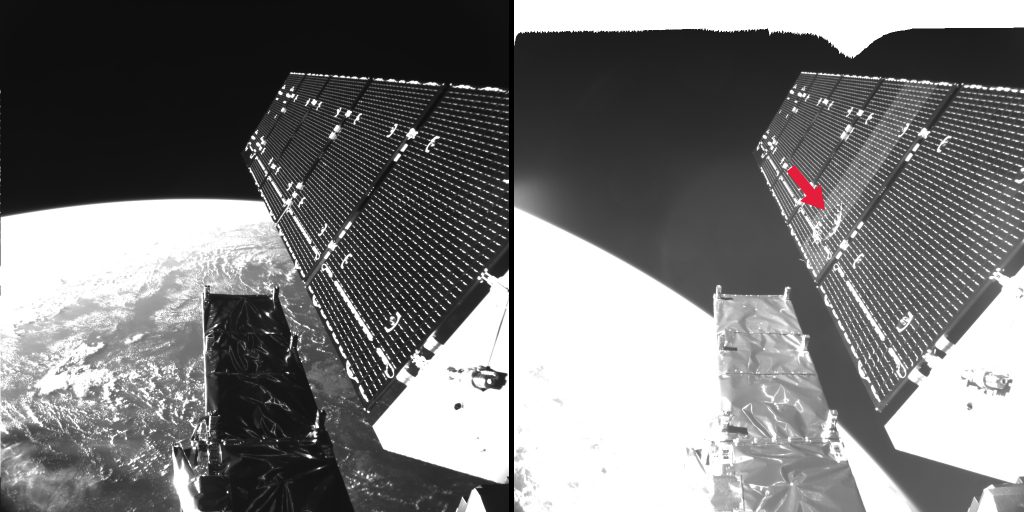
Sentinel-1A solar array before & after Credit: ESA

Sentinel-1A solar array before & after Credit: ESA

The one showing the impact penetration appears to indicate that the impacting object hit from the back side of the solar array, exiting out the front side, and it imparted a torque that caused the spacecraft to rotate in a certain fashion which also fits with the ‘telemetry’ (spacecraft status information) readings.

This is an important clue, as most debris objects do, in fact, impinge and collide from directions parallel to the plane of the flight direction, and almost never from top-down or from bottom-up, while natural micrometeoroids impinge also from above – since they are not bound to orbits around Earth. The precise impact location revealed by the images was one of the missing clues in our equations.

Since the image gives us a good indication of the impacting object’s directionality, we are analysing this to see if we can exclude one or the other.

What’s your initial suspicion?

With what we know now, my inclination is to strongly suspect this was a space-debris impact. At the determined impactor size of a few millimetres, our models suggest that the number of space debris is larger than that of meteoroids. If we could determine the impact directionality more precisely we might be able to confirm this hypothesis.

How will this affect future missions?

With growing impact risk in orbit, we might face a situation where future spacecraft must be designed to cater for such unpredictable energetic impacts.

You can’t avoid the risk entirely, or avoid an impact that destroys your satellite, but you can take certain design steps – for example, you can design solar arrays to have excess margin in the power they generate and other systems to have more redundancy and more robustness.

Then, when an impact does happen, and you survive it, you aren’t faced with a serious loss of power.

This also highlights the overall risk due to the existing space debris environment. All space-faring organisations must ensure that mitigation guidelines are followed and that we don’t do anything to cause more debris.

It also highlights the need to start removing defunct satellites and other large objects from orbit, so that they in turn do not cause cascading debris growth.

We appear to have survived this unexpected collision with minimal impact on this particular satellite. We may not be so fortuitous next time.

Editor’s note: On the question of how this event may affect future missions, Pierre Potin, ESA’s Sentinel-1 mission manager, adds that:

The on-board camera(s), which were not supposed to be used after LEOP (the initial launch and early orbit phase), has proved to be very useful in this case. From this experience, one could recommend embarking such cameras on future satellites – given that they will have to have a more appropriate design and pass some stringent environmental tests to ensure that they last the life of the mission.


from Rocket Science http://ift.tt/2bXqjnx
v

Since launch in 2014, Europe’s Sentinel-1A spacecraft has performed flawlessly, delivering a wealth of advanced radar imagery for Europe’s Copernicus programme. Later joined in orbit by sister satellite Sentinel-1B, the tandem mission recently delivered images of the zone in central Italy devastated by an earthquake on 24 August.

Sentinel-1, the first in the family of Copernicus satellites, is used to monitor many aspects of our environment, from detecting and tracking oil spills and mapping sea ice to monitoring movement in land surfaces and mapping changes in the way land is used. It also plays a crucial role in providing timely information to help respond to natural disasters and assist humanitarian relief efforts. Credit: ESA/ATG medialab

Sentinel-1, the first in the family of Copernicus satellites, is used to monitor many aspects of our environment, from detecting and tracking oil spills and mapping sea ice to monitoring movement in land surfaces and mapping changes in the way land is used. It also plays a crucial role in providing timely information to help respond to natural disasters and assist humanitarian relief efforts. Credit: ESA/ATG medialab

Ironically, just the day before, on 23 August, a solar panel on Sentinel-1A was hit by a millimetre-sized particle. The event has had, to date, no effect on the spacecraft’s routine operations, and such hits are not unexpected according to ESA’s Space Debris Office.

In fact, the effects of such hits on other spacecraft might have caused anomalies noticed by numerous satellite operators in past years, but it has been very difficult to definitely determine the cause, since other possible root causes could explain the effect.

In this case, however, the Sentinel-1A satellite is equipped with on-board cameras (meant to provide visual confirmation of solar array deployment shortly after launch and since switched off) and this system was switched back on to provide a view of the affected array, giving quick visual confirmation that an impact had occurred and providing clues as to what sort of strike may have happened.

We spoke with Holger Krag, Head of ESA’s Space Debris Office at ESOC, the European Space Operations Centre, Darmstadt, Germany, to get more details on his team’s involvement in this fascinating investigation.

Can you tell us in a nutshell what happened with Sentinel-1A?

As we do for other Earth missions, we routinely provide conjunction warnings for potential collisions between the Sentinel-series of satellites and known, catalogued space debris objects.

On 23 August, mission controllers working on Sentinel-1A noticed some odd occurrences. First, they saw a relatively sudden drop in power generated on board by the solar arrays, starting at 17:07 UTC (19:07 CEST), while on the same day ESOC’s Flight Dynamics team noticed that the orbit had inexplicably changed (referred to as a ‘discontinuity’) and that the satellite’s attitude – its orientation in space – had changed. All these pointed to a common cause – an impact of some sort. That’s when we were notified.

Holger Krag Credit: ESA

Holger Krag Credit: ESA

We should note, as mentioned in the initial web news, that the power reduction is relatively small [less than 5% – Ed.] compared to the overall power generated by the solar panel, which remains much higher than what the satellite needs to perform routine operations.

Also the small change in attitude was automatically compensated for by the spacecraft’s attitude and orbit control system, and the change in orbit can be compensated for in the next routine orbit correction manoeuvre, which Sentinel-1A does every week, so no permanent effect on the mission is expected.

What was your first step?

Our first reaction was to check the space debris catalogue that we maintain for ESA and we confirmed that no known object was expected to come anywhere close enough to run the risk of a collision at that time. So whatever the colliding object was, it was not previously known to us.

From our catalogue, we have a very good idea of all debris objects at the Sentinel-1A altitude, about 700 km, that are larger than about 5 cm or so (these are trackable via radar). A collision with any objects in the catalogue would also have generated much more severe effects, up to the complete destruction of the spacecraft. The effects noted by the Sentinel-1A operators pointed more to an object of a few millimeters diameter.

When we used the observed orbit and attitude change, we applied some basic physics to the balance of impulses and angular momentum, which confirmed the estimated size of a few millimeters. However, currently, we are not able to conclude whether the impact was due to an artificial object or due to a naturally occurring micrometeoroid. That’s a really interesting and challenging question that we’re now trying to solve, so we’ve got our Sherlock Holmes’ ‘deerstalker’ caps on!

How significant was this impact?

The object had a significant impact velocity component toward the spacecraft. It basically came out of the flight direction with some sideward component. If it had hit the main body of the satellite, it very well could have led to significant damage.

On average, human-caused debris objects have a relative impact velocity of around 11 km/second at Sentinel-1A’s orbit. Even at a few mm diameter, this means that a collision with a solar array can be significant. We know from ground tests that hyper-velocity impacts generate a plasma and electrostatic discharge. If power conducting cables are hit, ground tests have shown that a short circuit can be generated. Hence, there can be more than just mechanical damage.

If a debris collision occurs, it is common for a satellite to be hit on its solar arrays – these present the largest cross-sectional area – and this is less damaging, as we see in this case.

Conversely, natural micrometeroids are travelling with relative speeds at or greater than 20 km/second, hence for a meteoroid a smaller size would suffice to generate the same observed effect. This is why we cannot rule out a micrometeoroid as one explanation at this stage.

This event here is special in many ways. For example, ESA have analysed solar arrays from Hubble after spending a long time in space. One array was full of micro-craters, but a massive feature like the one Sentinel-1A has never been observed, which shows that such events are still rare.

What information do the photos provide?

The photos are excellent and a very rare bit of evidence – indeed, I’ve never seen an impact from which we got such photos.

Sentinel-1A solar array before & after Credit: ESA

Sentinel-1A solar array before & after Credit: ESA

The one showing the impact penetration appears to indicate that the impacting object hit from the back side of the solar array, exiting out the front side, and it imparted a torque that caused the spacecraft to rotate in a certain fashion which also fits with the ‘telemetry’ (spacecraft status information) readings.

This is an important clue, as most debris objects do, in fact, impinge and collide from directions parallel to the plane of the flight direction, and almost never from top-down or from bottom-up, while natural micrometeoroids impinge also from above – since they are not bound to orbits around Earth. The precise impact location revealed by the images was one of the missing clues in our equations.

Since the image gives us a good indication of the impacting object’s directionality, we are analysing this to see if we can exclude one or the other.

What’s your initial suspicion?

With what we know now, my inclination is to strongly suspect this was a space-debris impact. At the determined impactor size of a few millimetres, our models suggest that the number of space debris is larger than that of meteoroids. If we could determine the impact directionality more precisely we might be able to confirm this hypothesis.

How will this affect future missions?

With growing impact risk in orbit, we might face a situation where future spacecraft must be designed to cater for such unpredictable energetic impacts.

You can’t avoid the risk entirely, or avoid an impact that destroys your satellite, but you can take certain design steps – for example, you can design solar arrays to have excess margin in the power they generate and other systems to have more redundancy and more robustness.

Then, when an impact does happen, and you survive it, you aren’t faced with a serious loss of power.

This also highlights the overall risk due to the existing space debris environment. All space-faring organisations must ensure that mitigation guidelines are followed and that we don’t do anything to cause more debris.

It also highlights the need to start removing defunct satellites and other large objects from orbit, so that they in turn do not cause cascading debris growth.

We appear to have survived this unexpected collision with minimal impact on this particular satellite. We may not be so fortuitous next time.

Editor’s note: On the question of how this event may affect future missions, Pierre Potin, ESA’s Sentinel-1 mission manager, adds that:

The on-board camera(s), which were not supposed to be used after LEOP (the initial launch and early orbit phase), has proved to be very useful in this case. From this experience, one could recommend embarking such cameras on future satellites – given that they will have to have a more appropriate design and pass some stringent environmental tests to ensure that they last the life of the mission.


from Rocket Science http://ift.tt/2bXqjnx
v

adds 2