aads

Peak Perseid mornings: August 11, 12, 13

The composite image above – from John Ashley at Glacier National Park in Montana, in 2016 – perfectly captures the feeling of standing outside as dawn is approaching, after a peak night of Perseid meteor-watching. As viewed from anywhere in the Northern Hemisphere, the Perseids’ radiant point is highest at dawn, and so the meteors rain down from overhead. Unfortunately, in 2019, the moon is in the way of this shower. View the full image here.

When is the peak of the Perseid meteor shower in 2019? The most meteors are most likely to fall in the predawn hours on August 13, yet under the light of a bright waxing gibbous moon. The mornings of August 11 and 12 are surely worth trying, too, especially as there will be more moon-free viewing time on these mornings … a larger window between moonset and dawn. Although the brighter Perseids will overcome the moonlight, there’s nothing like a dark sky for meteor watching. During the coming peak of the 2019 Perseid shower, the moon will be in the sky as night falls. So moonset is the key factor. Visit the Sunrise Sunset Calendars site to find out when the moon sets in your sky, remembering to check the moonrise and moonset box.

In dark skies – no moon and no city lights – the Perseids have been known to usher in 50 to 60 meteors per hour, or more, at their peak.

So here are the tasks before you, if you want to watch meteors in 2019. Find out the time of moonset on the morning(s) you want to watch. Find a country location, far from city lights. Plan to watch during the hours between moonset and dawn.

Can’t get out of town? Then go to the darkest sky you can find near you (a beach? a park?) as late at night as you can, preferably just before dawn. Situate yourself in the shadow of a tree or building, if there are lights around. Look up, and hope for the best! Who knows … you might catch a shooting star.

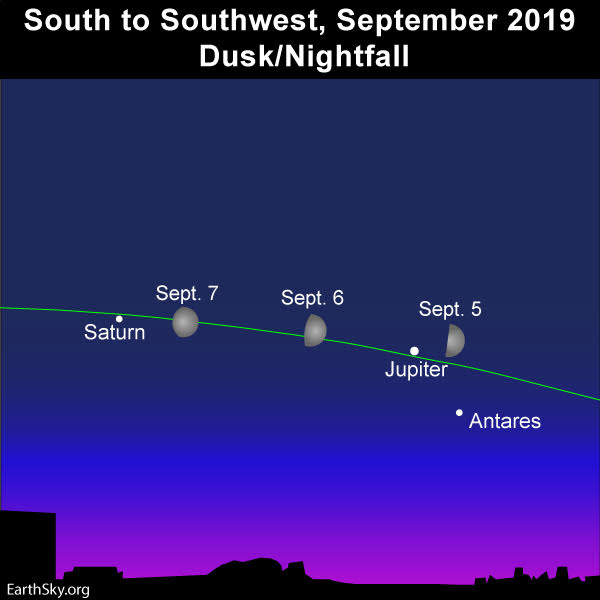
By the way, as a consolation prize, there are some bright stars and planets near the moon on these nights. Read more: Moon, Jupiter, Saturn … Perseid meteors?

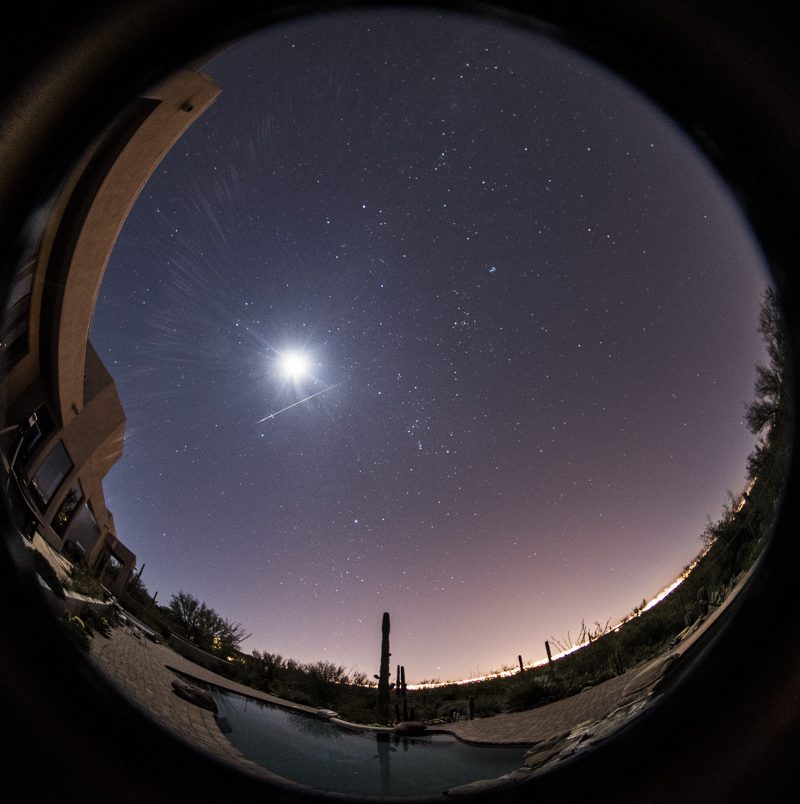
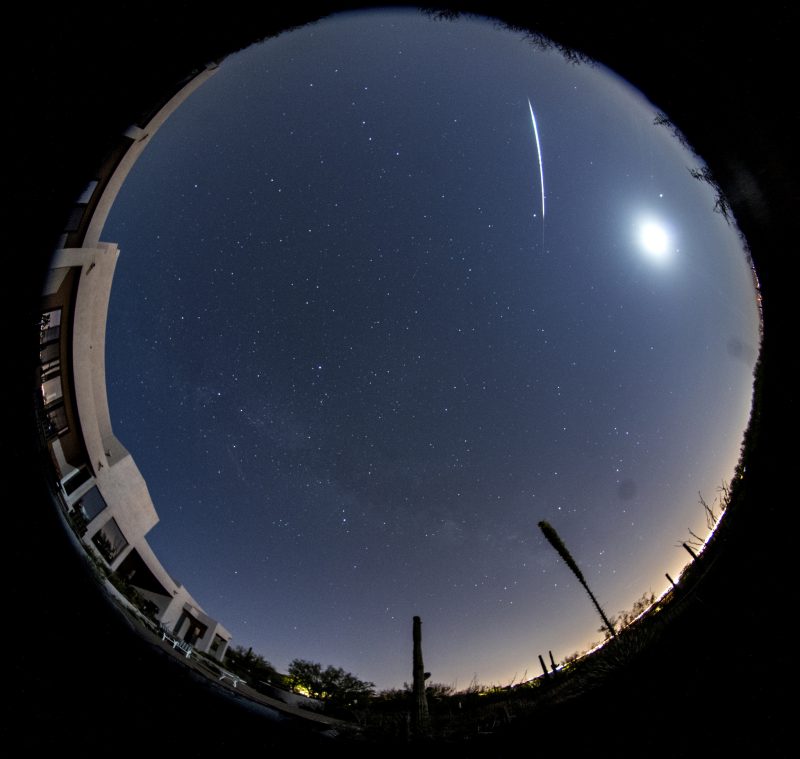
Circular panorama view of the Tucson skyline and a bright Perseid meteor.

The Perseids begin in July every year and rise slowly to their August peak. Eliot Herman in Tucson, Arizona, captured this bright Perseid meteor on the morning of August 8, 2019. Thank you, Eliot!

Can you watch the shower in the evening hours? In years when the moon is down during those hours, in the Northern Hemisphere, you might see a smattering of Perseid meteors in the evening. Plus, evening is the best time of night to try to catch an earthgrazer, which is an elongated, long-lasting meteor that travels horizontally across the sky. Earthgrazers are rare but most memorable if you’re lucky enough to spot one.

What if you’re in the Southern Hemisphere? From the Southern Hemisphere, the first meteors – and possible earthgrazers – won’t be flying until after midnight or the wee hours of the morning.

In either the Northern or the Southern Hemisphere, the greatest number of meteors streak the sky in the few hours before dawn.

Enjoying EarthSky so far? Sign up for our free daily newsletter today!

The earliest historical account of Perseid activity comes from a Chinese record in 36 A.D., where it was said that:

… more than 100 meteors flew in the morning.

Numerous references to the August Perseids appear in Chinese, Japanese and Korean records throughout the 8th, 9th, 10th and 11th centuries. Meanwhile, according to ancient western skylore, the Perseid shower commemorates the time when the god Zeus visited the mortal maiden Danaë in the form of a shower of gold. Zeus and Danaë became the parents of Perseus the Hero – from whose constellation the Perseid meteors radiate. More about the Perseid’s radiant point below.

The Perseid meteors happen around this time every year, as Earth in its orbit crosses the orbital path of Comet Swift-Tuttle. Dusty debris left behind by this comet smashes into Earth’s upper atmosphere, lighting up the nighttime as fiery Perseid meteors. The meteors start out slowly in the evening hours, begin to pick up steam after midnight and put out the greatest numbers in the dark hours before dawn.
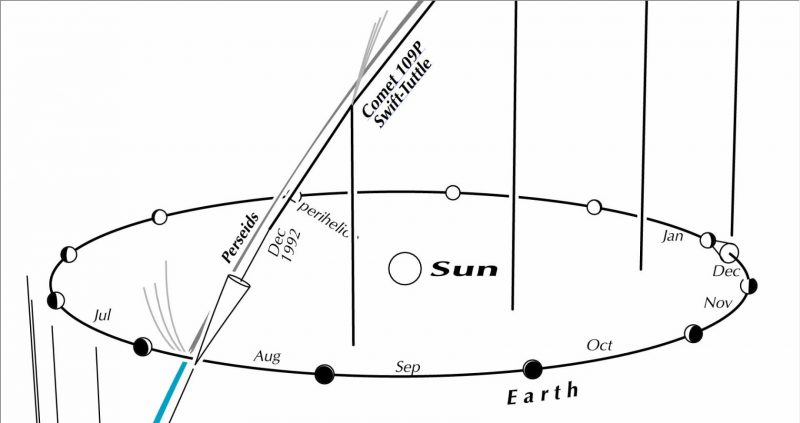
Diagram of Earth's orbit with part of long vertical orbit intersecting it.

The parent comet of the Perseids – Comet Swift-Tuttle – takes about 130 years to orbit the sun once. We see the meteor shower when Earth intersects the comet’s orbit each year, and debris left behind in its orbit enters our atmosphere. Chart via Guy Ottewell. More awesome Perseid charts from Guy in this post from last year.

The paths of the Perseid meteors, when traced backward, appear to originate in the constellation Perseus. Hence, this meteor shower’s name. While out there peering into dark skies, try looking for the Perseid’s radiant point. You don’t need to find it to enjoy the meteors, but it’s fun to find.

Perseus itself isn’t all that easy to find, but a nearby constellation – Cassiopeia the Queen – is. Look northward for Cassiopeia. It has a very distinctive shape of the letter W or the number 3. See it? Good.
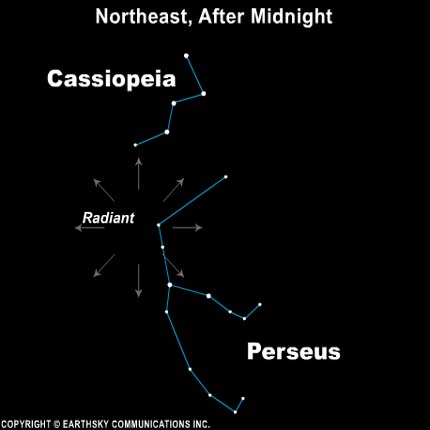
Constellations Cassiopeia and Perseus with radial arrows from near top of Perseus.

The constellation Perseus, radiant for the annual Perseid meteor shower. The easy-to-spot constellation Cassiopeia is nearby.

Want to go deeper? Then look for the Double Cluster in Perseus. This dual cluster of stars almost exactly marks the radiant point of the Perseid meteor shower. You can find it by scanning with your binoculars between Perseus and Cassiopeia.

Although the Double Cluster can be seen with the unaided eye in a dark country sky, the Double Clusters’ stars burst into view through binoculars. The clusters are more formally known as NGC 884 (Chi Persei) and NGC 869 (h Persei). The Double Cluster is thought to be over 7,000 light-years away from us, in the Perseus arm of the Milky Way galaxy.
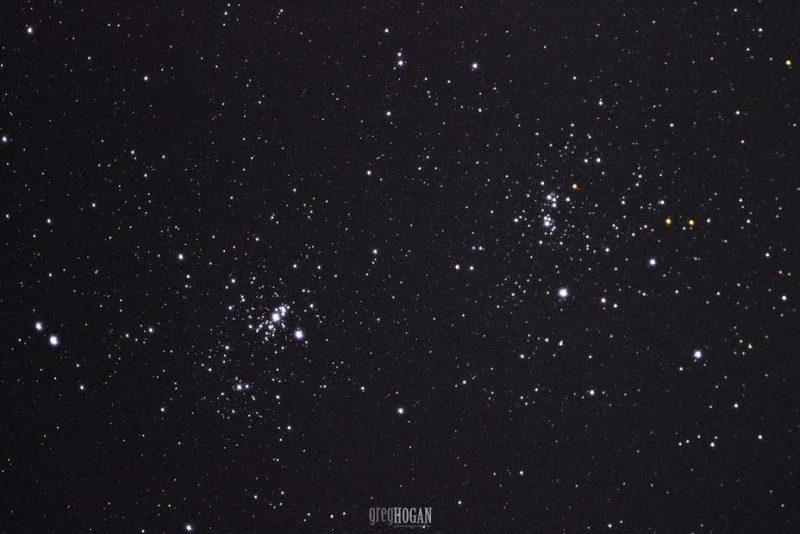
Star field with two bunches of dozens of stars apiece.

Double cluster in Perseus via Greg Hogan of Kathleen, Georgia.

Now here’s the good news. You don’t need to know the constellation Perseus to watch the Perseid meteor shower. You don’t need to find the radiant point. The Perseids do radiate from there, but they will appear in all parts of a dark night sky.

Here’s all you do need to know about the radiant point. As viewed from the Northern Hemisphere, the radiant sits low in the northeast sky at evening and climbs upward throughout the night. The higher that the radiant is in your sky, the more Perseid meteors you’re likely to see. For the Perseids, the radiant is highest before dawn.
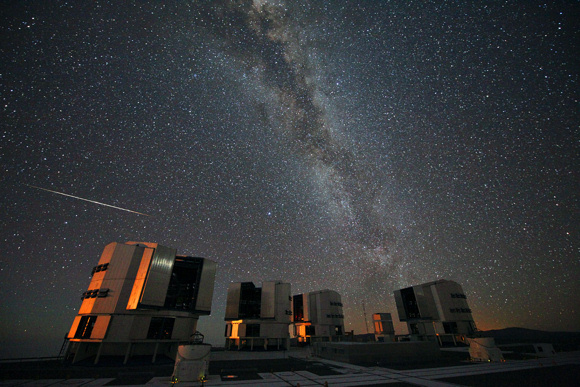
Milky Way over observatory buildings with a meteor streak above a building on the left.

Some Perseid meteors will be visible in the Southern Hemisphere, although the numbers will not be as high. Photo via the European Southern Observatory/S. Guisard in northern Chile.

Looking for a dark area to observe from? Check out EarthSky’s interactive, worldwide Best Places to Stargaze map.

Bottom line: The mornings leading up to August 13, 2019, should be decent for meteor-watching, providing you can find a way to work around the pesky moon. The moon is brighter in the sky on each of those mornings, and the dark window between moonset and dawn steadily shrinks as the peak morning – August 13 – approaches. We recommend watching across several mornings, before the peak, this year. Find moonset times for your location at Sunrise Sunset Calendars.

EarthSky’s meteor shower guide for 2019


from EarthSky https://ift.tt/33mnViZ

The composite image above – from John Ashley at Glacier National Park in Montana, in 2016 – perfectly captures the feeling of standing outside as dawn is approaching, after a peak night of Perseid meteor-watching. As viewed from anywhere in the Northern Hemisphere, the Perseids’ radiant point is highest at dawn, and so the meteors rain down from overhead. Unfortunately, in 2019, the moon is in the way of this shower. View the full image here.

When is the peak of the Perseid meteor shower in 2019? The most meteors are most likely to fall in the predawn hours on August 13, yet under the light of a bright waxing gibbous moon. The mornings of August 11 and 12 are surely worth trying, too, especially as there will be more moon-free viewing time on these mornings … a larger window between moonset and dawn. Although the brighter Perseids will overcome the moonlight, there’s nothing like a dark sky for meteor watching. During the coming peak of the 2019 Perseid shower, the moon will be in the sky as night falls. So moonset is the key factor. Visit the Sunrise Sunset Calendars site to find out when the moon sets in your sky, remembering to check the moonrise and moonset box.

In dark skies – no moon and no city lights – the Perseids have been known to usher in 50 to 60 meteors per hour, or more, at their peak.

So here are the tasks before you, if you want to watch meteors in 2019. Find out the time of moonset on the morning(s) you want to watch. Find a country location, far from city lights. Plan to watch during the hours between moonset and dawn.

Can’t get out of town? Then go to the darkest sky you can find near you (a beach? a park?) as late at night as you can, preferably just before dawn. Situate yourself in the shadow of a tree or building, if there are lights around. Look up, and hope for the best! Who knows … you might catch a shooting star.

By the way, as a consolation prize, there are some bright stars and planets near the moon on these nights. Read more: Moon, Jupiter, Saturn … Perseid meteors?

Circular panorama view of the Tucson skyline and a bright Perseid meteor.

The Perseids begin in July every year and rise slowly to their August peak. Eliot Herman in Tucson, Arizona, captured this bright Perseid meteor on the morning of August 8, 2019. Thank you, Eliot!

Can you watch the shower in the evening hours? In years when the moon is down during those hours, in the Northern Hemisphere, you might see a smattering of Perseid meteors in the evening. Plus, evening is the best time of night to try to catch an earthgrazer, which is an elongated, long-lasting meteor that travels horizontally across the sky. Earthgrazers are rare but most memorable if you’re lucky enough to spot one.

What if you’re in the Southern Hemisphere? From the Southern Hemisphere, the first meteors – and possible earthgrazers – won’t be flying until after midnight or the wee hours of the morning.

In either the Northern or the Southern Hemisphere, the greatest number of meteors streak the sky in the few hours before dawn.

Enjoying EarthSky so far? Sign up for our free daily newsletter today!

The earliest historical account of Perseid activity comes from a Chinese record in 36 A.D., where it was said that:

… more than 100 meteors flew in the morning.

Numerous references to the August Perseids appear in Chinese, Japanese and Korean records throughout the 8th, 9th, 10th and 11th centuries. Meanwhile, according to ancient western skylore, the Perseid shower commemorates the time when the god Zeus visited the mortal maiden Danaë in the form of a shower of gold. Zeus and Danaë became the parents of Perseus the Hero – from whose constellation the Perseid meteors radiate. More about the Perseid’s radiant point below.

The Perseid meteors happen around this time every year, as Earth in its orbit crosses the orbital path of Comet Swift-Tuttle. Dusty debris left behind by this comet smashes into Earth’s upper atmosphere, lighting up the nighttime as fiery Perseid meteors. The meteors start out slowly in the evening hours, begin to pick up steam after midnight and put out the greatest numbers in the dark hours before dawn.

Diagram of Earth's orbit with part of long vertical orbit intersecting it.

The parent comet of the Perseids – Comet Swift-Tuttle – takes about 130 years to orbit the sun once. We see the meteor shower when Earth intersects the comet’s orbit each year, and debris left behind in its orbit enters our atmosphere. Chart via Guy Ottewell. More awesome Perseid charts from Guy in this post from last year.

The paths of the Perseid meteors, when traced backward, appear to originate in the constellation Perseus. Hence, this meteor shower’s name. While out there peering into dark skies, try looking for the Perseid’s radiant point. You don’t need to find it to enjoy the meteors, but it’s fun to find.

Perseus itself isn’t all that easy to find, but a nearby constellation – Cassiopeia the Queen – is. Look northward for Cassiopeia. It has a very distinctive shape of the letter W or the number 3. See it? Good.

Constellations Cassiopeia and Perseus with radial arrows from near top of Perseus.

The constellation Perseus, radiant for the annual Perseid meteor shower. The easy-to-spot constellation Cassiopeia is nearby.

Want to go deeper? Then look for the Double Cluster in Perseus. This dual cluster of stars almost exactly marks the radiant point of the Perseid meteor shower. You can find it by scanning with your binoculars between Perseus and Cassiopeia.

Although the Double Cluster can be seen with the unaided eye in a dark country sky, the Double Clusters’ stars burst into view through binoculars. The clusters are more formally known as NGC 884 (Chi Persei) and NGC 869 (h Persei). The Double Cluster is thought to be over 7,000 light-years away from us, in the Perseus arm of the Milky Way galaxy.

Star field with two bunches of dozens of stars apiece.

Double cluster in Perseus via Greg Hogan of Kathleen, Georgia.

Now here’s the good news. You don’t need to know the constellation Perseus to watch the Perseid meteor shower. You don’t need to find the radiant point. The Perseids do radiate from there, but they will appear in all parts of a dark night sky.

Here’s all you do need to know about the radiant point. As viewed from the Northern Hemisphere, the radiant sits low in the northeast sky at evening and climbs upward throughout the night. The higher that the radiant is in your sky, the more Perseid meteors you’re likely to see. For the Perseids, the radiant is highest before dawn.

Milky Way over observatory buildings with a meteor streak above a building on the left.

Some Perseid meteors will be visible in the Southern Hemisphere, although the numbers will not be as high. Photo via the European Southern Observatory/S. Guisard in northern Chile.

Looking for a dark area to observe from? Check out EarthSky’s interactive, worldwide Best Places to Stargaze map.

Bottom line: The mornings leading up to August 13, 2019, should be decent for meteor-watching, providing you can find a way to work around the pesky moon. The moon is brighter in the sky on each of those mornings, and the dark window between moonset and dawn steadily shrinks as the peak morning – August 13 – approaches. We recommend watching across several mornings, before the peak, this year. Find moonset times for your location at Sunrise Sunset Calendars.

EarthSky’s meteor shower guide for 2019


from EarthSky https://ift.tt/33mnViZ

News digest – personalised breast cancer blood test, AI funding boost, ‘calorie tax’ and burgers

Highly sensitive blood test could improve breast cancer treatment

We teamed up with scientists in the US to put a new personalised breast cancer blood test through its paces. The Mail Online reports our study’s results, which showed the test could pick up early breast cancer. Once fully developed, the highly sensitive blood test could give doctors a new way to monitor the disease and even help some women avoid unnecessary surgery. Our press release has the details.

Johnson pledges £250 million for NHS AI lab

The Guardian reports the Prime Minister’s latest funding announcement, a £250 million investment in artificial intelligence (AI) to help the NHS test how it could use AI technology in more ways. AI is already being used in some hospitals, and the NHS is testing whether it could be used to help with breast screening. Some organisations however, have pointed out the potential challenges that might come with this financial boost. They say out dated NHS IT systems may not be compatible with the new technology and that there may be difficulty in recruiting data scientists to work in these new labs.

UK to ease visa restriction for top scientists

Boris Johnson also announced his intentions to make the immigration system easier for scientists and their families after Brexit. The Guardian covered Johnson’s suggestions for a “fast-track” visa route for exceptional scientists and proposals that could mean those hoping to immigrate to pursue their scientific career would not need an offer of employment before entering the UK.

Increased bowel cancer screening rates in Scotland thanks to new test

The introduction of a simpler bowel cancer screening test in Scotland has led to a significant increase in those taking part in the programme. For the first time, more than 60% of those eligible to take the test have used it, with the greatest rise in those living in deprived areas. Read BBC Scotland’s article for more info.

Cadbury’s to reduce calories in kids treats

One of the UK’s most popular chocolate brands says it will reduce the size of the chocolate bars they market to kids. The Independent reports that Cadbury’s move is intending to bring the confectionery in line with Public Health England’s advice that snacks and treats from children should contain no more than 100 calories.

Hormone injections show promise in helping people lose weight

People with obesity are sometimes offered gastric bypass surgery. One of the ways this operation can help people lose weight is by changing the balance of hormones in the body that affect food digestion. Now scientists in London have developed a hormone injection that could mimic some of the effects of this major surgical procedure. The results of the very small study, reported by the Telegraph, showed that people given the injection over four weeks lost weight, but not as much as those who had the procedure.

Government should introduce ‘calorie tax’, says health campaigners

Two health campaign groups are urging the government to introduce a ‘calorie tax’ on foods loaded with fat and sugar, says the Independent. Action on Sugar and Action on Salt say that charging the food industry for making unhealthy products would force them to improve the nutritional quality of their goods.

Lung cancer immunotherapy combo added to Cancer Drugs Fund

An immunotherapy drug combo has been recommended as a treatment for some patients with lung cancer on the NHS in England. Our report covers the decision, which will give some patients access to a combo that’s been shown to improve survival in people with squamous non small cell lung cancer that has spread to other parts of the body. It will be available on the Cancer Drugs Fund (CDF) while more data is collected on its long-term benefits. However, a targeted drug with potential to slow the progress of ovarian cancer has been rejected.

Makeup of bacteria in pancreatic tumours linked to survival

Researchers in the US have uncovered a link between the number of different types of bacteria found in people’s pancreatic tumours and how long they live. Their early animal studies also suggest that it might be possible to change the composition of bacteria to improve survival, but as we explain in this report, there’s still a lot of work to do in the hunt for new treatments.

And finally

According to a new study covered by The Sun, swapping beef burgers for chicken burgers could reduce a person’s risk of developing breast cancer. The US study followed 42,000 people and found that those who ate red meat were more likely to develop breast cancer compared to those who ate poultry. But the study only looked at people with a family history of breast cancer, which may already put them at a higher risk. More research is needed in a wider range of people before we can say for certain that there is a link between breast cancer and consuming red meat.

Gabi


from Cancer Research UK – Science blog https://ift.tt/2ONzMUb

Highly sensitive blood test could improve breast cancer treatment

We teamed up with scientists in the US to put a new personalised breast cancer blood test through its paces. The Mail Online reports our study’s results, which showed the test could pick up early breast cancer. Once fully developed, the highly sensitive blood test could give doctors a new way to monitor the disease and even help some women avoid unnecessary surgery. Our press release has the details.

Johnson pledges £250 million for NHS AI lab

The Guardian reports the Prime Minister’s latest funding announcement, a £250 million investment in artificial intelligence (AI) to help the NHS test how it could use AI technology in more ways. AI is already being used in some hospitals, and the NHS is testing whether it could be used to help with breast screening. Some organisations however, have pointed out the potential challenges that might come with this financial boost. They say out dated NHS IT systems may not be compatible with the new technology and that there may be difficulty in recruiting data scientists to work in these new labs.

UK to ease visa restriction for top scientists

Boris Johnson also announced his intentions to make the immigration system easier for scientists and their families after Brexit. The Guardian covered Johnson’s suggestions for a “fast-track” visa route for exceptional scientists and proposals that could mean those hoping to immigrate to pursue their scientific career would not need an offer of employment before entering the UK.

Increased bowel cancer screening rates in Scotland thanks to new test

The introduction of a simpler bowel cancer screening test in Scotland has led to a significant increase in those taking part in the programme. For the first time, more than 60% of those eligible to take the test have used it, with the greatest rise in those living in deprived areas. Read BBC Scotland’s article for more info.

Cadbury’s to reduce calories in kids treats

One of the UK’s most popular chocolate brands says it will reduce the size of the chocolate bars they market to kids. The Independent reports that Cadbury’s move is intending to bring the confectionery in line with Public Health England’s advice that snacks and treats from children should contain no more than 100 calories.

Hormone injections show promise in helping people lose weight

People with obesity are sometimes offered gastric bypass surgery. One of the ways this operation can help people lose weight is by changing the balance of hormones in the body that affect food digestion. Now scientists in London have developed a hormone injection that could mimic some of the effects of this major surgical procedure. The results of the very small study, reported by the Telegraph, showed that people given the injection over four weeks lost weight, but not as much as those who had the procedure.

Government should introduce ‘calorie tax’, says health campaigners

Two health campaign groups are urging the government to introduce a ‘calorie tax’ on foods loaded with fat and sugar, says the Independent. Action on Sugar and Action on Salt say that charging the food industry for making unhealthy products would force them to improve the nutritional quality of their goods.

Lung cancer immunotherapy combo added to Cancer Drugs Fund

An immunotherapy drug combo has been recommended as a treatment for some patients with lung cancer on the NHS in England. Our report covers the decision, which will give some patients access to a combo that’s been shown to improve survival in people with squamous non small cell lung cancer that has spread to other parts of the body. It will be available on the Cancer Drugs Fund (CDF) while more data is collected on its long-term benefits. However, a targeted drug with potential to slow the progress of ovarian cancer has been rejected.

Makeup of bacteria in pancreatic tumours linked to survival

Researchers in the US have uncovered a link between the number of different types of bacteria found in people’s pancreatic tumours and how long they live. Their early animal studies also suggest that it might be possible to change the composition of bacteria to improve survival, but as we explain in this report, there’s still a lot of work to do in the hunt for new treatments.

And finally

According to a new study covered by The Sun, swapping beef burgers for chicken burgers could reduce a person’s risk of developing breast cancer. The US study followed 42,000 people and found that those who ate red meat were more likely to develop breast cancer compared to those who ate poultry. But the study only looked at people with a family history of breast cancer, which may already put them at a higher risk. More research is needed in a wider range of people before we can say for certain that there is a link between breast cancer and consuming red meat.

Gabi


from Cancer Research UK – Science blog https://ift.tt/2ONzMUb

Hubble’s new portrait of Jupiter

Very detailed full image of Jupiter.

View larger. | Hubble’s Wide Field Camera 3 was used to observe Jupiter at its opposition this past June, when Earth was passing between Jupiter and the sun, placing Jupiter opposite the sun in our sky, with its fully lighted hemisphere facing Earth. Jupiter was also about at its closest for the year (about 400 million miles from Earth) in June. Image via NASA and the Space Telescope Science Institute/ Hubblesite.org.

NASA and Space Telescope Science Institute in Baltimore released this new Hubble Space Telescope view of Jupiter yesterday (August 8, 2019). The telescope acquired the image on June 27. It’s beautiful, isn’t it? It’s reminiscent of some spacecraft images. Space fans waiting for the launch of the Webb Space Telescope – which will be the successor to the Hubble Space Telescope – will have to wait until 2021, but, in the meantime, Hubble’s still got it!

The image reveals Jupiter’s Great Red Spot, which has been seen to be disintegrating, or at least changing, recently, and which appears perhaps on the small side here, but still pretty robust. NASA wrote that this new image also reveals:

… a more intense color palette in the clouds swirling in Jupiter’s turbulent atmosphere than seen in previous years. The colors, and their changes, provide important clues to ongoing processes in Jupiter’s atmosphere.

The bands are created by differences in the thickness and height of the ammonia ice clouds. The colorful bands, which flow in opposite directions at various latitudes, result from different atmospheric pressures. Lighter bands rise higher and have thicker clouds than the darker bands.

Among the most striking features in the image are the rich colors of the clouds moving toward the Great Red Spot, a storm rolling counterclockwise between two bands of clouds. These two cloud bands, above and below the Great Red Spot, are moving in opposite directions. The red band above and to the right (northeast) of the Great Red Spot contains clouds moving westward and around the north of the giant tempest. The white clouds to the left (southwest) of the storm are moving eastward to the south of the spot.

All of Jupiter’s colorful cloud bands in this image are confined to the north and south by jet streams that remain constant, even when the bands change color. The bands are all separated by winds that can reach speeds of up to 400 miles (644 kilometers) per hour.

On the opposite side of the planet, the band of deep red color northeast of the Great Red Spot and the bright white band to the southeast of it become much fainter. The swirling filaments seen around the outer edge of the red super storm are high-altitude clouds that are being pulled in and around it.

The Great Red Spot is a towering structure shaped like a wedding cake, whose upper haze layer extends more than 3 miles (5 kilometers) higher than clouds in other areas. The gigantic structure, with a diameter slightly larger than Earth’s, is a high-pressure wind system called an anticyclone that has been slowly downsizing since the 1800s. The reason for this change in size is still unknown.

A worm-shaped feature located below the Great Red Spot is a cyclone, a vortex around a low-pressure area with winds spinning in the opposite direction from the Red Spot. Researchers have observed cyclones with a wide variety of different appearances across the planet. The two white oval-shaped features are anticyclones, like small versions of the Great Red Spot.

Another interesting detail is the color of the wide band at the equator. The bright orange color may be a sign that deeper clouds are starting to clear out, emphasizing red particles in the overlying haze.

Hubble acquired this image in visible light as part of its Outer Planets Atmospheres Legacy program, or OPAL. NASA’s goal for this program is to provide Hubble global views of the outer planets to look for changes in their storms, winds, and clouds.

Bottom line: New Hubble Space Telescope portrait of Jupiter.


from EarthSky https://ift.tt/31uMXLb
Very detailed full image of Jupiter.

View larger. | Hubble’s Wide Field Camera 3 was used to observe Jupiter at its opposition this past June, when Earth was passing between Jupiter and the sun, placing Jupiter opposite the sun in our sky, with its fully lighted hemisphere facing Earth. Jupiter was also about at its closest for the year (about 400 million miles from Earth) in June. Image via NASA and the Space Telescope Science Institute/ Hubblesite.org.

NASA and Space Telescope Science Institute in Baltimore released this new Hubble Space Telescope view of Jupiter yesterday (August 8, 2019). The telescope acquired the image on June 27. It’s beautiful, isn’t it? It’s reminiscent of some spacecraft images. Space fans waiting for the launch of the Webb Space Telescope – which will be the successor to the Hubble Space Telescope – will have to wait until 2021, but, in the meantime, Hubble’s still got it!

The image reveals Jupiter’s Great Red Spot, which has been seen to be disintegrating, or at least changing, recently, and which appears perhaps on the small side here, but still pretty robust. NASA wrote that this new image also reveals:

… a more intense color palette in the clouds swirling in Jupiter’s turbulent atmosphere than seen in previous years. The colors, and their changes, provide important clues to ongoing processes in Jupiter’s atmosphere.

The bands are created by differences in the thickness and height of the ammonia ice clouds. The colorful bands, which flow in opposite directions at various latitudes, result from different atmospheric pressures. Lighter bands rise higher and have thicker clouds than the darker bands.

Among the most striking features in the image are the rich colors of the clouds moving toward the Great Red Spot, a storm rolling counterclockwise between two bands of clouds. These two cloud bands, above and below the Great Red Spot, are moving in opposite directions. The red band above and to the right (northeast) of the Great Red Spot contains clouds moving westward and around the north of the giant tempest. The white clouds to the left (southwest) of the storm are moving eastward to the south of the spot.

All of Jupiter’s colorful cloud bands in this image are confined to the north and south by jet streams that remain constant, even when the bands change color. The bands are all separated by winds that can reach speeds of up to 400 miles (644 kilometers) per hour.

On the opposite side of the planet, the band of deep red color northeast of the Great Red Spot and the bright white band to the southeast of it become much fainter. The swirling filaments seen around the outer edge of the red super storm are high-altitude clouds that are being pulled in and around it.

The Great Red Spot is a towering structure shaped like a wedding cake, whose upper haze layer extends more than 3 miles (5 kilometers) higher than clouds in other areas. The gigantic structure, with a diameter slightly larger than Earth’s, is a high-pressure wind system called an anticyclone that has been slowly downsizing since the 1800s. The reason for this change in size is still unknown.

A worm-shaped feature located below the Great Red Spot is a cyclone, a vortex around a low-pressure area with winds spinning in the opposite direction from the Red Spot. Researchers have observed cyclones with a wide variety of different appearances across the planet. The two white oval-shaped features are anticyclones, like small versions of the Great Red Spot.

Another interesting detail is the color of the wide band at the equator. The bright orange color may be a sign that deeper clouds are starting to clear out, emphasizing red particles in the overlying haze.

Hubble acquired this image in visible light as part of its Outer Planets Atmospheres Legacy program, or OPAL. NASA’s goal for this program is to provide Hubble global views of the outer planets to look for changes in their storms, winds, and clouds.

Bottom line: New Hubble Space Telescope portrait of Jupiter.


from EarthSky https://ift.tt/31uMXLb

Moon, Jupiter, Saturn … Perseid meteors?

On the evenings of August 9, 10 and 11, 2019, people will be looking outside at the planets near the waxing gibbous moon and wondering about their meteor-watching chances for that night. After all, the peak of the annual Perseid meteor shower is likely the morning of August 13, and the Perseids are known to rise gradually to a peak. The days leading up to this shower’s peak are often quite good for meteor-watching. But that moon! It’ll definitely be in the way for much of the night, beginning August 9 and through the peak nights. The planets Jupiter and Saturn – near the moon on these nights – are consolation prizes at best.

The moon will set in the wee hours before dawn (although later and later each morning). If you want to watch meteors, try in the mornings before the peak, when there will be a very small window indeed between moonset and dawn.

Read more: All you need to know about Perseid meteors in 2019

Click here to find out when the moon sets in your sky, remembering to check the moonrise and moonset box.

And in the meantime, on these nights leading up to the Perseids’ peak, let the moon guide you to the gas giants Jupiter and Saturn. Despite the lunar glare, you should have no trouble seeing them. Jupiter ranks as the 4th-brightest celestial object to light up the sky, after the sun, moon and planet Venus. Right now, Venus is lost in the sun’s glare, and it’ll be gone throughout August 2019. There’s no way to mistake Venus for Jupiter this month. Saturn is fainter, but still as bright as the sky’s brightest stars. You’ll see Saturn, too, if your sky is clear.

The moon, Jupiter, Saturn – plus the nearby bright star Antares – pop out at nightfall. Afterwards, all these heavenly bodies will travel westward throughout the night. They travel westward for the same reason that the sun travels westward during the day. The Earth spins from west-to-east on its rotational axis, making it appear as if the sun, moon, planets and stars travel full circle westward around Earth each day while the Earth stays still. It’s really our spinning Earth that’s doing the moving.

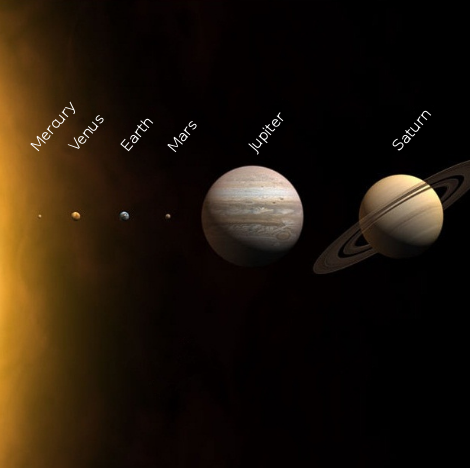
This illustration shows the bright planets, plus Earth, in their order outward from the sun. Their relative sizes are approximately right, but their distances from one another are – in reality – much more vast.

Meanwhile, the moon in its orbit is always moving eastward in front of the constellations of the zodiac. Because Saturn lodges to the east of Jupiter on the sky’s dome, the moon is moving toward Saturn on August 9, 10 and 11, 2019. Relative to the stars of the zodiac, the moon moves about 1/2 degree (its own angular diameter) eastward per hour or about 13 degrees eastward per day. After just one day, the moon’s change of position relative to the planets Jupiter and Saturn, plus the star Antares, will be obvious.

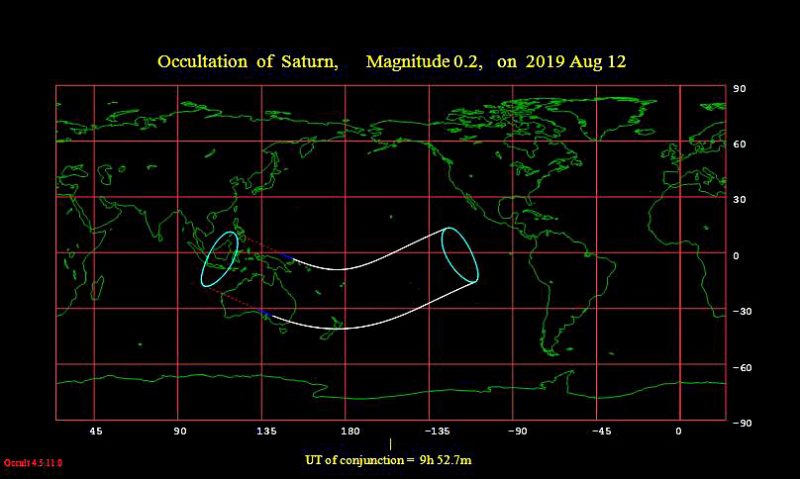
On August 11 or 12, depending on where you live worldwide, the moon will pass to the north of Saturn, right over Saturn, or to the south of Saturn. We refer you to the worldwide map below via IOTA (International Occultation Timing Association). Given clear skies, the swath of the world in between the white lines can watch the moon occult (cover over) Saturn in a nighttime sky.

Occultation of Saturn August 12, 2019.

The occultation of Saturn happens in a nighttime sky in between the white lines, at dusk in between the blue lines, and in a daytime sky in between the dotted red lines. Worldwide map via IOTA.

We give the local times for the occultation for two localities:

Sydney, Australia (August 12, 2019)
Occultation begins (Saturn disappears): 6:34 p.m. local time
Occultation ends (Saturn reappears): 7:23 p.m. local time

Auckland, New Zealand (August 12, 2019)
Occultation begins (Saturn disappears): 9:16 p.m. local time
Occultation ends (Saturn reappears): 10:15 p.m. local time

Click here for the occultation times for numerous localities but remember to convert Universal Time to local time. Here’s how.

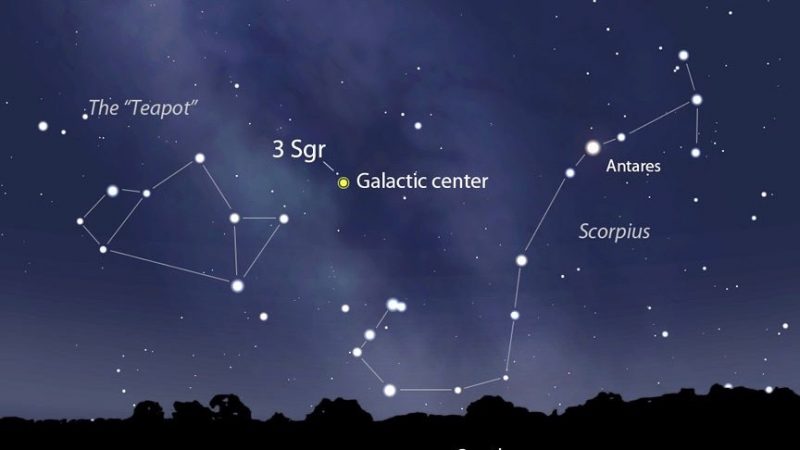
After the moon has moved out of the evening sky in the second half of August 2019, use Jupiter and Saturn to find the Teapot asterism (a prominent star pattern) in the constellation Sagittarius the Archer. This is the direction to the center of our Milky Way galaxy. In a dark sky, you might imagine “steam” (really, countless distant stars) billowing out of the Teapot’s spout, arching across the dome of sky. When you see the Teapot pattern, you’re seeing the combined glow of myriads of far-off suns in the flat disk of the galaxy, in the direction to the galaxy’s center.

From the Northern Hemisphere, look southward in July and August evenings to see these stars. From the Southern Hemisphere, look generally northward, higher in the sky and turn this chart upside down. Chart via AstroBob.

From the Northern Hemisphere, look southward August and September evenings to see these stars. From the Southern Hemisphere, look generally overhead or northward, higher in the sky and turn this chart upside down. Chart via AstroBob.

Read more: The Teapot, and the galaxy’s center

The Teapot of Sagittarius between the planets Saturn and Jupiter

In 2019, look for the Teapot asterism in between the planets Jupiter and Saturn.

Bottom line: The Perseid meteor shower is rising to its peak, so there’s bound to be some fist-shaking on the weekend of August 9, 10 and 11, 2019 at that bright moon. But the moon can also guide you to Jupiter and Saturn on these nights. Later, after the moon has moved away, you can use these two planets to locate the famous Teapot asterism in the constellation Sagittarius, which points the way to the center of our Milky Way galaxy.


from EarthSky https://ift.tt/2Kq9vak

On the evenings of August 9, 10 and 11, 2019, people will be looking outside at the planets near the waxing gibbous moon and wondering about their meteor-watching chances for that night. After all, the peak of the annual Perseid meteor shower is likely the morning of August 13, and the Perseids are known to rise gradually to a peak. The days leading up to this shower’s peak are often quite good for meteor-watching. But that moon! It’ll definitely be in the way for much of the night, beginning August 9 and through the peak nights. The planets Jupiter and Saturn – near the moon on these nights – are consolation prizes at best.

The moon will set in the wee hours before dawn (although later and later each morning). If you want to watch meteors, try in the mornings before the peak, when there will be a very small window indeed between moonset and dawn.

Read more: All you need to know about Perseid meteors in 2019

Click here to find out when the moon sets in your sky, remembering to check the moonrise and moonset box.

And in the meantime, on these nights leading up to the Perseids’ peak, let the moon guide you to the gas giants Jupiter and Saturn. Despite the lunar glare, you should have no trouble seeing them. Jupiter ranks as the 4th-brightest celestial object to light up the sky, after the sun, moon and planet Venus. Right now, Venus is lost in the sun’s glare, and it’ll be gone throughout August 2019. There’s no way to mistake Venus for Jupiter this month. Saturn is fainter, but still as bright as the sky’s brightest stars. You’ll see Saturn, too, if your sky is clear.

The moon, Jupiter, Saturn – plus the nearby bright star Antares – pop out at nightfall. Afterwards, all these heavenly bodies will travel westward throughout the night. They travel westward for the same reason that the sun travels westward during the day. The Earth spins from west-to-east on its rotational axis, making it appear as if the sun, moon, planets and stars travel full circle westward around Earth each day while the Earth stays still. It’s really our spinning Earth that’s doing the moving.

This illustration shows the bright planets, plus Earth, in their order outward from the sun. Their relative sizes are approximately right, but their distances from one another are – in reality – much more vast.

Meanwhile, the moon in its orbit is always moving eastward in front of the constellations of the zodiac. Because Saturn lodges to the east of Jupiter on the sky’s dome, the moon is moving toward Saturn on August 9, 10 and 11, 2019. Relative to the stars of the zodiac, the moon moves about 1/2 degree (its own angular diameter) eastward per hour or about 13 degrees eastward per day. After just one day, the moon’s change of position relative to the planets Jupiter and Saturn, plus the star Antares, will be obvious.

On August 11 or 12, depending on where you live worldwide, the moon will pass to the north of Saturn, right over Saturn, or to the south of Saturn. We refer you to the worldwide map below via IOTA (International Occultation Timing Association). Given clear skies, the swath of the world in between the white lines can watch the moon occult (cover over) Saturn in a nighttime sky.

Occultation of Saturn August 12, 2019.

The occultation of Saturn happens in a nighttime sky in between the white lines, at dusk in between the blue lines, and in a daytime sky in between the dotted red lines. Worldwide map via IOTA.

We give the local times for the occultation for two localities:

Sydney, Australia (August 12, 2019)
Occultation begins (Saturn disappears): 6:34 p.m. local time
Occultation ends (Saturn reappears): 7:23 p.m. local time

Auckland, New Zealand (August 12, 2019)
Occultation begins (Saturn disappears): 9:16 p.m. local time
Occultation ends (Saturn reappears): 10:15 p.m. local time

Click here for the occultation times for numerous localities but remember to convert Universal Time to local time. Here’s how.

After the moon has moved out of the evening sky in the second half of August 2019, use Jupiter and Saturn to find the Teapot asterism (a prominent star pattern) in the constellation Sagittarius the Archer. This is the direction to the center of our Milky Way galaxy. In a dark sky, you might imagine “steam” (really, countless distant stars) billowing out of the Teapot’s spout, arching across the dome of sky. When you see the Teapot pattern, you’re seeing the combined glow of myriads of far-off suns in the flat disk of the galaxy, in the direction to the galaxy’s center.

From the Northern Hemisphere, look southward in July and August evenings to see these stars. From the Southern Hemisphere, look generally northward, higher in the sky and turn this chart upside down. Chart via AstroBob.

From the Northern Hemisphere, look southward August and September evenings to see these stars. From the Southern Hemisphere, look generally overhead or northward, higher in the sky and turn this chart upside down. Chart via AstroBob.

Read more: The Teapot, and the galaxy’s center

The Teapot of Sagittarius between the planets Saturn and Jupiter

In 2019, look for the Teapot asterism in between the planets Jupiter and Saturn.

Bottom line: The Perseid meteor shower is rising to its peak, so there’s bound to be some fist-shaking on the weekend of August 9, 10 and 11, 2019 at that bright moon. But the moon can also guide you to Jupiter and Saturn on these nights. Later, after the moon has moved away, you can use these two planets to locate the famous Teapot asterism in the constellation Sagittarius, which points the way to the center of our Milky Way galaxy.


from EarthSky https://ift.tt/2Kq9vak

How to watch the Perseids in moonlight

Moonlit meteor, November 1, 2015, via Eliot Herman in Tucson, Arizona. He wrote: “I have 2 rules for meteors: avoid the moon, if possible, and if not embrace the situation. Make the adjustments and accept that, while the photos probably won’t be epic, it’s possible to record the good ones. The moon isn’t so bad. Clouds are …”

The 2019 Perseid meteor shower – on the mornings of August 11, 12 and 13 – will be hindered by bright moonlight. Check out this custom sunrise-sunset calendar, being sure to check the moon for moonrise/moonset times, to get the exact time of moonset in your location. Otherwise, here’s how to minimize the moon and optimize the 2019 Perseids.

1. Forget about the Perseid peak entirely and watch for meteors on the mornings of August 9 and 10. Take that, moon! You won’t see as many meteors as during a traditional, moon-free Perseid peak. But you will see some meteors!

2. Sprawl out in a moon shadow. If you plan to watch the Perseids in the light of the moon, notice that the moon casts shadows. Find a moon shadow somewhere that still provides you with a wide expanse of sky for meteor-viewing. A plateau area with high-standing mountains to block out the moon would work just fine. If you can’t do that, find a hedgerow of trees bordering a wide open field somewhere (though obtain permission, if it’s private land). Or simply sit in the shadow of a barn or other building. Ensconced within a moon shadow, and far from the glow of city lights, the night all of a sudden darkens while the meteors brighten.

3. Avoid city lights. This should go without saying, but just a reminder. A wide open area – a field or a lonely country road – is best if you’re serious about watching meteors.

4. Watch with a friend or friends, and try facing in different directions so that if someone sees a meteor, that person can call out – “meteor!” – to the rest.

5. Notice the speed and colors, if any, of the meteors.

6. Watch for meteor trains. A meteor train is a persistent glow in the air, left by some meteors after they have faded from view. Trains are caused by luminous ionized matter left in the wake of this incoming space debris. Hard to see in the moonlight, but watch for them!

7. Embrace the moon. We hear people bubble with excitement about seeing meteors in all sorts of conditions – moon or no moon – city lights or no city lights. And so, this week, try taking your lawn chair or blanket to a wide open location and bask in the moon’s bright light. You’ll see an occasional meteor streak by. It’ll be beautiful!

Eliot Herman in Tucson caught this image, as well as the image at the top of this post. He said this one – from early July, 2017 – is one of the the brightest meteors he caught in 2017, despite the moon. When we asked him for tips for shooting meteors in bright moonlight, he answered: “I shoot my images so that it is bright i.e. ISO 2500 at F5 for 15 sec in RAW (this is critical) at 8 mm fisheye. Using the RAW images in Photoshop, I adjust the white balance to look like the sky color, and then adjust saturation, gamma, exposure, and levels until the stars appear against a background that looks closer to reality. It’s not difficult to do this, takes just a few minutes to process one image. There are aspects like moonlight reflections that one has to live with. I do not mask or otherwise hide anything, although that can be done with in Photoshop. But I like my images to be real, so no subtractions. Meteors at +2 magnitude can easily be seen even in full moonlight. In dark skies, I shoot ISO 3200 F 3.5 for 15 seconds, and it is, of course, much better.”

Bottom line: The waxing moon will do its best to drown out the 2019 Perseid meteor shower. Here are 7 tips for enjoying the moonlit Perseids in 2019.


from EarthSky https://ift.tt/2YRT5PQ

Moonlit meteor, November 1, 2015, via Eliot Herman in Tucson, Arizona. He wrote: “I have 2 rules for meteors: avoid the moon, if possible, and if not embrace the situation. Make the adjustments and accept that, while the photos probably won’t be epic, it’s possible to record the good ones. The moon isn’t so bad. Clouds are …”

The 2019 Perseid meteor shower – on the mornings of August 11, 12 and 13 – will be hindered by bright moonlight. Check out this custom sunrise-sunset calendar, being sure to check the moon for moonrise/moonset times, to get the exact time of moonset in your location. Otherwise, here’s how to minimize the moon and optimize the 2019 Perseids.

1. Forget about the Perseid peak entirely and watch for meteors on the mornings of August 9 and 10. Take that, moon! You won’t see as many meteors as during a traditional, moon-free Perseid peak. But you will see some meteors!

2. Sprawl out in a moon shadow. If you plan to watch the Perseids in the light of the moon, notice that the moon casts shadows. Find a moon shadow somewhere that still provides you with a wide expanse of sky for meteor-viewing. A plateau area with high-standing mountains to block out the moon would work just fine. If you can’t do that, find a hedgerow of trees bordering a wide open field somewhere (though obtain permission, if it’s private land). Or simply sit in the shadow of a barn or other building. Ensconced within a moon shadow, and far from the glow of city lights, the night all of a sudden darkens while the meteors brighten.

3. Avoid city lights. This should go without saying, but just a reminder. A wide open area – a field or a lonely country road – is best if you’re serious about watching meteors.

4. Watch with a friend or friends, and try facing in different directions so that if someone sees a meteor, that person can call out – “meteor!” – to the rest.

5. Notice the speed and colors, if any, of the meteors.

6. Watch for meteor trains. A meteor train is a persistent glow in the air, left by some meteors after they have faded from view. Trains are caused by luminous ionized matter left in the wake of this incoming space debris. Hard to see in the moonlight, but watch for them!

7. Embrace the moon. We hear people bubble with excitement about seeing meteors in all sorts of conditions – moon or no moon – city lights or no city lights. And so, this week, try taking your lawn chair or blanket to a wide open location and bask in the moon’s bright light. You’ll see an occasional meteor streak by. It’ll be beautiful!

Eliot Herman in Tucson caught this image, as well as the image at the top of this post. He said this one – from early July, 2017 – is one of the the brightest meteors he caught in 2017, despite the moon. When we asked him for tips for shooting meteors in bright moonlight, he answered: “I shoot my images so that it is bright i.e. ISO 2500 at F5 for 15 sec in RAW (this is critical) at 8 mm fisheye. Using the RAW images in Photoshop, I adjust the white balance to look like the sky color, and then adjust saturation, gamma, exposure, and levels until the stars appear against a background that looks closer to reality. It’s not difficult to do this, takes just a few minutes to process one image. There are aspects like moonlight reflections that one has to live with. I do not mask or otherwise hide anything, although that can be done with in Photoshop. But I like my images to be real, so no subtractions. Meteors at +2 magnitude can easily be seen even in full moonlight. In dark skies, I shoot ISO 3200 F 3.5 for 15 seconds, and it is, of course, much better.”

Bottom line: The waxing moon will do its best to drown out the 2019 Perseid meteor shower. Here are 7 tips for enjoying the moonlit Perseids in 2019.


from EarthSky https://ift.tt/2YRT5PQ

Look around from Mars rover’s point of view

NASA’s Curiosity rover captured the 360-degree panorama, above, on June 18, 2019. The location, called “Teal Ridge,” is part of a larger region the rover has been exploring, which scientists call the “clay-bearing unit.”

The Curiosity rover landed on Mars seven years ago (August 6, 2012). Since then, it’s traveled a total of 13 miles (21 km) and ascended 1,207 feet (368 meters) to its current location. Scientists are looking for signs that Mars could have supported microbial life billions of years ago, when rivers and lakes could be found in Gale Crater.

Curiosity is now halfway through clay-bearing unit, which is on the side of Mount Sharp, inside Gale Crater. Rock samples that the rover has drilled here have revealed the highest amounts of clay minerals found during the mission.

Billions of years ago, says NASA, there were streams and lakes within the crater. Water changes the sediment that was deposited in the lakes, leaving behind lots of clay minerals in the region. Kristen Bennett of the U.S. Geological Survey is one of the co-leads for Curiosity’s clay-unit campaign. She said:

This area is one of the reasons we came to Gale Crater. We’ve been studying orbiter images of this area for 10 years, and we’re finally able to take a look up close.

Many-layered, rough-looking, oblong tan rock with rough flat top.

This mosaic of images shows a boulder-sized rock called “Strathdon,” which is made up of many complex layers. NASA’s Curiosity Mars rover took these images using its Mast Camera, or Mastcam, on July 9, 2019. Image via NASA/JPL-Caltech/MSSS.

Wavy horizontal striations in dark and light brown across surface of rock.

This mosaic of images shows layers of sediment on a boulder-sized rock called “Strathdon,” as seen by the Mars Hand Lens Imager (MAHLI) camera carried by NASA’s Curiosity rover. The images were taken on July 10, 2019. Image via NASA/JPL-Caltech/MSSS.

In July, Curiosity took detailed images of “Strathdon,” a rock made of dozens of sediment layers that have hardened into a brittle, wavy heap. Unlike the thin, flat layers associated with lake sediments, the wavy layers in the rock suggest a more dynamic environment, say NASA scientists. Wind, flowing water or both could have shaped this area.

According to Caltech’s Valerie Fox, the other campaign co-lead, both Teal Ridge and Strathdon represent changes in the landscape. She said:

We’re seeing an evolution in the ancient lake environment recorded in these rocks. It wasn’t just a static lake. It’s helping us move from a simplistic view of Mars going from wet to dry. Instead of a linear process, the history of water was more complicated.

Read more from NASA

Bottom line: Interactive panorama of Mars surface taken by the Curiosity rover in June 2019.


from EarthSky https://ift.tt/2ZLsMrS

NASA’s Curiosity rover captured the 360-degree panorama, above, on June 18, 2019. The location, called “Teal Ridge,” is part of a larger region the rover has been exploring, which scientists call the “clay-bearing unit.”

The Curiosity rover landed on Mars seven years ago (August 6, 2012). Since then, it’s traveled a total of 13 miles (21 km) and ascended 1,207 feet (368 meters) to its current location. Scientists are looking for signs that Mars could have supported microbial life billions of years ago, when rivers and lakes could be found in Gale Crater.

Curiosity is now halfway through clay-bearing unit, which is on the side of Mount Sharp, inside Gale Crater. Rock samples that the rover has drilled here have revealed the highest amounts of clay minerals found during the mission.

Billions of years ago, says NASA, there were streams and lakes within the crater. Water changes the sediment that was deposited in the lakes, leaving behind lots of clay minerals in the region. Kristen Bennett of the U.S. Geological Survey is one of the co-leads for Curiosity’s clay-unit campaign. She said:

This area is one of the reasons we came to Gale Crater. We’ve been studying orbiter images of this area for 10 years, and we’re finally able to take a look up close.

Many-layered, rough-looking, oblong tan rock with rough flat top.

This mosaic of images shows a boulder-sized rock called “Strathdon,” which is made up of many complex layers. NASA’s Curiosity Mars rover took these images using its Mast Camera, or Mastcam, on July 9, 2019. Image via NASA/JPL-Caltech/MSSS.

Wavy horizontal striations in dark and light brown across surface of rock.

This mosaic of images shows layers of sediment on a boulder-sized rock called “Strathdon,” as seen by the Mars Hand Lens Imager (MAHLI) camera carried by NASA’s Curiosity rover. The images were taken on July 10, 2019. Image via NASA/JPL-Caltech/MSSS.

In July, Curiosity took detailed images of “Strathdon,” a rock made of dozens of sediment layers that have hardened into a brittle, wavy heap. Unlike the thin, flat layers associated with lake sediments, the wavy layers in the rock suggest a more dynamic environment, say NASA scientists. Wind, flowing water or both could have shaped this area.

According to Caltech’s Valerie Fox, the other campaign co-lead, both Teal Ridge and Strathdon represent changes in the landscape. She said:

We’re seeing an evolution in the ancient lake environment recorded in these rocks. It wasn’t just a static lake. It’s helping us move from a simplistic view of Mars going from wet to dry. Instead of a linear process, the history of water was more complicated.

Read more from NASA

Bottom line: Interactive panorama of Mars surface taken by the Curiosity rover in June 2019.


from EarthSky https://ift.tt/2ZLsMrS

A mega-tsunami on ancient Mars?

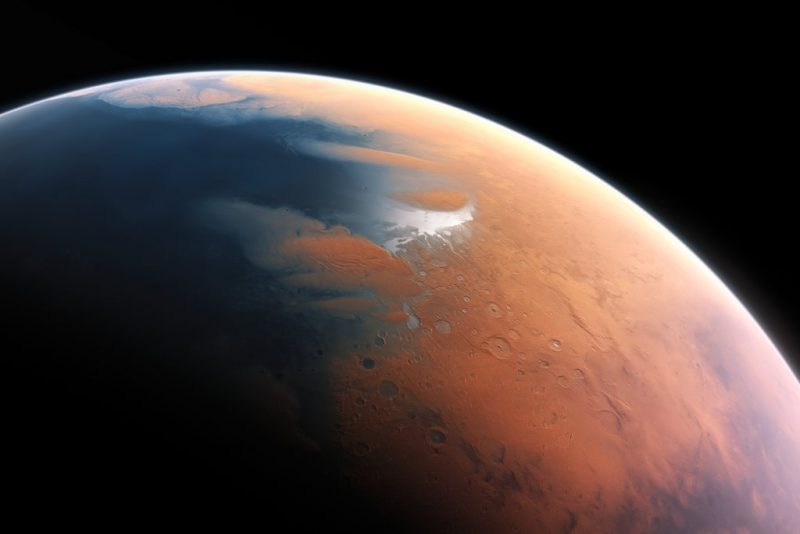
Orbital view of part of Mars with blue ocean to the left, the rest reddish tan with a few craters.

Artist’s concept showing a proposed Mars ocean, some 4 billion years ago. According to some researchers, the young planet Mars then would have had enough water to cover its entire surface in a liquid layer about 500 feet (140 meters) deep. But it’s more likely the liquid would have pooled to form an ocean occupying almost half of Mars’s northern hemisphere, in some regions reaching depths greater than a mile (1.6 km). Image via ESO/M. Kornmesser.

It’s now commonly accepted among scientists that Mars used to be a lot wetter than it is today, a few billion years ago. As well as rivers and lakes, there has been growing evidence for a former ocean in the northern hemisphere. Now, new research is lending support to the possibility that an asteroid slammed into that ocean 3.5 billion years ago, creating a mega-tsunami 1,000 feet (309 meters) high!

The new peer-reviewed findings, from Francois Costard, a scientist at the French National Centre for Scientific Research (CNRS), were first published in the Journal of Geophysical Research Planets on June 26, 2019.

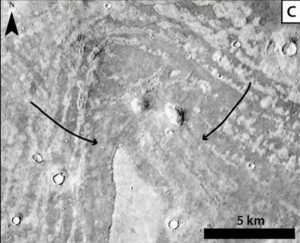
Costard has advocated his theory since 2017 to explain some unusual surface features called Thumbprint Terrain – concentric ridges that look like those in a thumbprint – in Mars’ Arabia Terra region. A very similar theory had also been suggested by two other groups of astronomers back in 2016. In their scenario, the asteroid impact caused not one but two tsunamis.

V-shaped area of concentric ridges peppered with craters and with two arrows marking locations.

Part of the Thumbprint Terrain in the Arabia Terra region of Mars, that might have been created by a mega-tsunami 3.5 billion years ago. Image via American Geophysical Union/Discover.

Now, Costard thinks he has found the impact crater that the asteroid created. He attempted to trace back the direction that the tsunami would have originated from, away from the Thumbprint Terrain. He narrowed down the possible impact location to 10 craters, before focusing on Lomonosov Crater. The shape of the crater indicates it was under water at the time, and it’s the right age (about 3 billion years old) and size (75 miles – 120 km – in diameter). From the new paper:

We attribute its broad and shallow rim, in part, to an impact into a shallow ocean as well as its subsequent erosion from the collapsing transient water cavity. The likely marine formation of the Lomonosov crater, and the apparent agreement in its age with that of the Thumbprint Terrain unit strongly suggests that it was the source crater of the tsunami. These results have implications for the stability of a late northern ocean on Mars.

If the tsunami scenario is correct, it has implications for the potential habitability of ancient Mars, since that means the northern ocean was still around 3.5 billion years ago. Until now, it has been thought that the planet lost most of its water closer to 3.7 billion years ago. That would allow an extra couple hundred million years in which life could have started. Alexis Rodriguez, a Mars geomorphologist at the Planetary Science Institute (PSI) in Tucson, Arizona, noted that the ocean sediments:

… may be a window into the subsurface habitability of Mars.

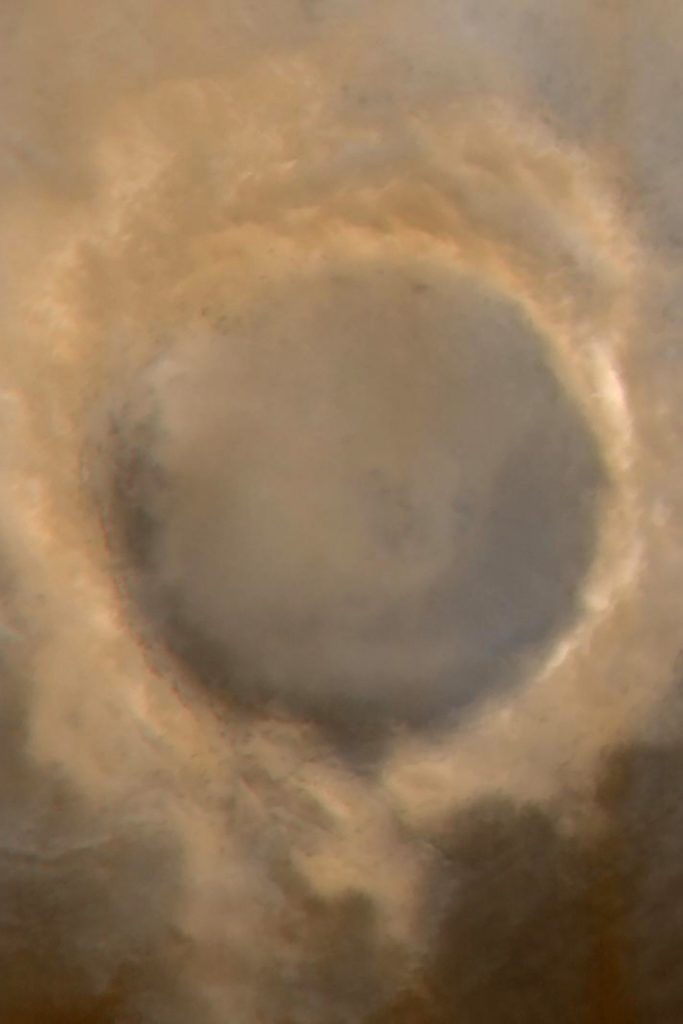
Fuzzy view of crater with dark brown, flat center and light tan rim.

Orbital view of Lomonosov Crater, as seen by NASA’s Mars Global Surveyor spacecraft. This crater may have been formed by the asteroid impact that caused the tsunami(s) in the ancient ocean. Image via NASA/JPL/MSSS/NASA Photojournal.

There’s still a lot we don’t know about water on ancient Mars and the climate conditions that allowed it to exist on Mars’ surface, something it does not do today. As Paul Byrne, a planetary geologist at North Carolina State University, said:

It’s fair to say that we don’t yet fully understand the history of Mars’s climate, and certainly, the climate models we use will continue to be improved.

While evidence for the possible ocean has grown, it’s still not absolutely definitive. But if the findings regarding the Thumbprint Terrain are accurate, that would be pretty compelling evidence for the ocean. After all, how could you have a tsunami without an ocean?

Even if there was no ocean, though, Mars was still plenty wet, with rain, groundwater, aquifers, rivers and lakes. Early Mars was a lot more like Earth in many ways, but then the planet lost most of its atmosphere – for reasons still being investigated and debated – and the water dried up.

There have been recent findings that suggest liquid water aquifers still exist deep underground, and the Recurring Slope Lineae (RSL) features on some slopes near the equator may be evidence for trickles of briny water on the surface, but otherwise most of Mars’ current water is in the form of ice, at the poles and underground. Landers and rovers have also seen frost, snow and clouds (both water and carbon dioxide types), and orbiters have photographed fog in canyons and craters. But compared to a few billion years ago, Mars is much drier now, and colder, than it used to be. So we can only imagine what it would have been like to be able to stand there and watch the asteroid plummet into that Martian ocean.

Bottom line: Evidence for a possible ancient ocean in Mars’ northern hemisphere has grown in recent years, and now additional evidence suggests that a massive asteroid impact created a mega-tsunami about 3.5 billion years ago.

Source: The Lomonosov Crater Impact Event: A Possible Mega-Tsunami Source on Mars

Via Discover


from EarthSky https://ift.tt/2yMY4mu
Orbital view of part of Mars with blue ocean to the left, the rest reddish tan with a few craters.

Artist’s concept showing a proposed Mars ocean, some 4 billion years ago. According to some researchers, the young planet Mars then would have had enough water to cover its entire surface in a liquid layer about 500 feet (140 meters) deep. But it’s more likely the liquid would have pooled to form an ocean occupying almost half of Mars’s northern hemisphere, in some regions reaching depths greater than a mile (1.6 km). Image via ESO/M. Kornmesser.

It’s now commonly accepted among scientists that Mars used to be a lot wetter than it is today, a few billion years ago. As well as rivers and lakes, there has been growing evidence for a former ocean in the northern hemisphere. Now, new research is lending support to the possibility that an asteroid slammed into that ocean 3.5 billion years ago, creating a mega-tsunami 1,000 feet (309 meters) high!

The new peer-reviewed findings, from Francois Costard, a scientist at the French National Centre for Scientific Research (CNRS), were first published in the Journal of Geophysical Research Planets on June 26, 2019.

Costard has advocated his theory since 2017 to explain some unusual surface features called Thumbprint Terrain – concentric ridges that look like those in a thumbprint – in Mars’ Arabia Terra region. A very similar theory had also been suggested by two other groups of astronomers back in 2016. In their scenario, the asteroid impact caused not one but two tsunamis.

V-shaped area of concentric ridges peppered with craters and with two arrows marking locations.

Part of the Thumbprint Terrain in the Arabia Terra region of Mars, that might have been created by a mega-tsunami 3.5 billion years ago. Image via American Geophysical Union/Discover.

Now, Costard thinks he has found the impact crater that the asteroid created. He attempted to trace back the direction that the tsunami would have originated from, away from the Thumbprint Terrain. He narrowed down the possible impact location to 10 craters, before focusing on Lomonosov Crater. The shape of the crater indicates it was under water at the time, and it’s the right age (about 3 billion years old) and size (75 miles – 120 km – in diameter). From the new paper:

We attribute its broad and shallow rim, in part, to an impact into a shallow ocean as well as its subsequent erosion from the collapsing transient water cavity. The likely marine formation of the Lomonosov crater, and the apparent agreement in its age with that of the Thumbprint Terrain unit strongly suggests that it was the source crater of the tsunami. These results have implications for the stability of a late northern ocean on Mars.

If the tsunami scenario is correct, it has implications for the potential habitability of ancient Mars, since that means the northern ocean was still around 3.5 billion years ago. Until now, it has been thought that the planet lost most of its water closer to 3.7 billion years ago. That would allow an extra couple hundred million years in which life could have started. Alexis Rodriguez, a Mars geomorphologist at the Planetary Science Institute (PSI) in Tucson, Arizona, noted that the ocean sediments:

… may be a window into the subsurface habitability of Mars.

Fuzzy view of crater with dark brown, flat center and light tan rim.

Orbital view of Lomonosov Crater, as seen by NASA’s Mars Global Surveyor spacecraft. This crater may have been formed by the asteroid impact that caused the tsunami(s) in the ancient ocean. Image via NASA/JPL/MSSS/NASA Photojournal.

There’s still a lot we don’t know about water on ancient Mars and the climate conditions that allowed it to exist on Mars’ surface, something it does not do today. As Paul Byrne, a planetary geologist at North Carolina State University, said:

It’s fair to say that we don’t yet fully understand the history of Mars’s climate, and certainly, the climate models we use will continue to be improved.

While evidence for the possible ocean has grown, it’s still not absolutely definitive. But if the findings regarding the Thumbprint Terrain are accurate, that would be pretty compelling evidence for the ocean. After all, how could you have a tsunami without an ocean?

Even if there was no ocean, though, Mars was still plenty wet, with rain, groundwater, aquifers, rivers and lakes. Early Mars was a lot more like Earth in many ways, but then the planet lost most of its atmosphere – for reasons still being investigated and debated – and the water dried up.

There have been recent findings that suggest liquid water aquifers still exist deep underground, and the Recurring Slope Lineae (RSL) features on some slopes near the equator may be evidence for trickles of briny water on the surface, but otherwise most of Mars’ current water is in the form of ice, at the poles and underground. Landers and rovers have also seen frost, snow and clouds (both water and carbon dioxide types), and orbiters have photographed fog in canyons and craters. But compared to a few billion years ago, Mars is much drier now, and colder, than it used to be. So we can only imagine what it would have been like to be able to stand there and watch the asteroid plummet into that Martian ocean.

Bottom line: Evidence for a possible ancient ocean in Mars’ northern hemisphere has grown in recent years, and now additional evidence suggests that a massive asteroid impact created a mega-tsunami about 3.5 billion years ago.

Source: The Lomonosov Crater Impact Event: A Possible Mega-Tsunami Source on Mars

Via Discover


from EarthSky https://ift.tt/2yMY4mu

61 Cygni is the Flying Star

Star field with two larger golden stars very close together in the center.

61 Cygni is a double star, captured here by Scott MacNeill at Frosty Drew Observatory, Charlestown, Rhode Island, in June 2015.

This star, 61 Cygni, isn’t one of the brightest stars. In fact, it takes some effort just to find it, because it is not much brighter than the faintest stars visible to the unaided human eye. It is, however, among the most important of stars visible without optical aid. That’s because it has one of the largest proper motions – that is, sideways motion along our line of sight – of any star in our sky.

Its large proper motion has given 61 Cygni the nickname Flying Star.

Large yellow circle and two smaller orange circles almost the same size as each other.

Size comparison of the sun (left), 61 Cygni A (lower) and 61 Cygni B (upper right). Image via RJHall/Wikimedia Commons.

Why does 61 Cygni have such a large proper motion? Think about two people who are running, one near you, and the other farther away. In contrast to the more distant landscape, the person closer to you would appear to cover more ground – more objects would pass behind him – than the person farther away.

In a similar way, the very distant stars appear “fixed” in relationship to each other. They’re actually all moving through space, but most are so far away that we can’t see them move. 61 Cygni is different. It moves relatively rapidly in front of the fixed stars because 61 Cygni is relatively near Earth. It is one of the closest stars to our sun and Earth.

While not the closest star to the sun (that honor goes to the Alpha Centauri system), 61 Cygni is just 11.4 light-years distant. That makes it the fourth-closest star visible to the unaided eye, after Alpha Centauri, Sirius, and Epsilon Eridani.

61 Cygni’s motion across our sky can’t be easily detected with the eye alone over the span of a human lifetime. Astronomers discovered its large proper motion via careful observation.

Diagram of two stars, one close, one far, moving the same distance.

Illustration via University of Oregon.

Two partly overlapping dotted ellipses, one nearly circular and one narrow.

The orbital motion of component B relative to component A as seem from Earth as well as the true appearance from face-on view. The time steps are approximately 10 years. Illustration via Wikimedia Commons.

Science of 61 Cygni. This star is classified as a K2V, which means that it is an orange (K2) “main sequence” (V) star.

61 Cygni isn’t just one star. It’s a binary star, whose double nature cannot be seen with the eye alone. There is a pair of K-type dwarf stars in the single point of light we see as 61 Cygni. They orbit each other with a period of about 659 years.

From hottest to coolest, the spectral sequence is OBAFGKM, with the sun being a yellow G type star, compared to the two K-type components of 61 Cygni. Even taken together, the two stars of 61 Cygni cannot match our local star in total energy output.

61 Cygni in history. 61 Cygni boasts no role in classical mythology. Being barely visible to the eye, the ancients apparently left no written reference to it at all. But its role in the history of astronomy is assured.

As early as the late 1700s, astronomers recognized that its apparent motion among the stars is far greater than the average. Although this motion would take centuries to notice with the unaided eye, telescopic observations revealed a motion so startling that 61 Cygni earned the nickname the Flying Star.

Those astronomers knew that its relatively fast motion indicates that the star is astronomically nearby. That fact prompted German astronomer F. W. Bessel to use 61 Cygni as the first star to have its distance measured by observation. As a result it is sometimes called “Bessel’s Star.”

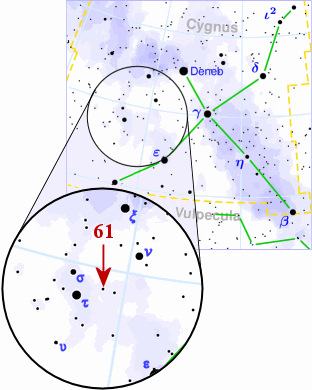
How to see 61 Cygni. 61 Cygni is roughly halfway between two other stars that you can probably identify. The brighter one is Deneb, brightest star in the constellation Cygnus the Swan. The other star is Zeta Cygni (otherwise known as Geinah), the end of the Swan’s east wing. You’ll find 61 Cygni between these two.

Several other similarly dim stars are located nearby, and an accurate star chart is needed to properly identify 61 Cygni. Have fun!

61 Cygni’s position is RA: 21h 06m 51s, dec: +38° 44′ 29″

Enjoying EarthSky? Sign up for our free daily newsletter today!

Bottom line: 61 Cygni is sometimes called the Flying Star. Although it’s not bright, it moves exceptionally rapidly against the background of more distant stars. Its motion reveals its nearness to Earth.


from EarthSky https://ift.tt/2OO9YXY
Star field with two larger golden stars very close together in the center.

61 Cygni is a double star, captured here by Scott MacNeill at Frosty Drew Observatory, Charlestown, Rhode Island, in June 2015.

This star, 61 Cygni, isn’t one of the brightest stars. In fact, it takes some effort just to find it, because it is not much brighter than the faintest stars visible to the unaided human eye. It is, however, among the most important of stars visible without optical aid. That’s because it has one of the largest proper motions – that is, sideways motion along our line of sight – of any star in our sky.

Its large proper motion has given 61 Cygni the nickname Flying Star.

Large yellow circle and two smaller orange circles almost the same size as each other.

Size comparison of the sun (left), 61 Cygni A (lower) and 61 Cygni B (upper right). Image via RJHall/Wikimedia Commons.

Why does 61 Cygni have such a large proper motion? Think about two people who are running, one near you, and the other farther away. In contrast to the more distant landscape, the person closer to you would appear to cover more ground – more objects would pass behind him – than the person farther away.

In a similar way, the very distant stars appear “fixed” in relationship to each other. They’re actually all moving through space, but most are so far away that we can’t see them move. 61 Cygni is different. It moves relatively rapidly in front of the fixed stars because 61 Cygni is relatively near Earth. It is one of the closest stars to our sun and Earth.

While not the closest star to the sun (that honor goes to the Alpha Centauri system), 61 Cygni is just 11.4 light-years distant. That makes it the fourth-closest star visible to the unaided eye, after Alpha Centauri, Sirius, and Epsilon Eridani.

61 Cygni’s motion across our sky can’t be easily detected with the eye alone over the span of a human lifetime. Astronomers discovered its large proper motion via careful observation.

Diagram of two stars, one close, one far, moving the same distance.

Illustration via University of Oregon.

Two partly overlapping dotted ellipses, one nearly circular and one narrow.

The orbital motion of component B relative to component A as seem from Earth as well as the true appearance from face-on view. The time steps are approximately 10 years. Illustration via Wikimedia Commons.

Science of 61 Cygni. This star is classified as a K2V, which means that it is an orange (K2) “main sequence” (V) star.

61 Cygni isn’t just one star. It’s a binary star, whose double nature cannot be seen with the eye alone. There is a pair of K-type dwarf stars in the single point of light we see as 61 Cygni. They orbit each other with a period of about 659 years.

From hottest to coolest, the spectral sequence is OBAFGKM, with the sun being a yellow G type star, compared to the two K-type components of 61 Cygni. Even taken together, the two stars of 61 Cygni cannot match our local star in total energy output.

61 Cygni in history. 61 Cygni boasts no role in classical mythology. Being barely visible to the eye, the ancients apparently left no written reference to it at all. But its role in the history of astronomy is assured.

As early as the late 1700s, astronomers recognized that its apparent motion among the stars is far greater than the average. Although this motion would take centuries to notice with the unaided eye, telescopic observations revealed a motion so startling that 61 Cygni earned the nickname the Flying Star.

Those astronomers knew that its relatively fast motion indicates that the star is astronomically nearby. That fact prompted German astronomer F. W. Bessel to use 61 Cygni as the first star to have its distance measured by observation. As a result it is sometimes called “Bessel’s Star.”

How to see 61 Cygni. 61 Cygni is roughly halfway between two other stars that you can probably identify. The brighter one is Deneb, brightest star in the constellation Cygnus the Swan. The other star is Zeta Cygni (otherwise known as Geinah), the end of the Swan’s east wing. You’ll find 61 Cygni between these two.

Several other similarly dim stars are located nearby, and an accurate star chart is needed to properly identify 61 Cygni. Have fun!

61 Cygni’s position is RA: 21h 06m 51s, dec: +38° 44′ 29″

Enjoying EarthSky? Sign up for our free daily newsletter today!

Bottom line: 61 Cygni is sometimes called the Flying Star. Although it’s not bright, it moves exceptionally rapidly against the background of more distant stars. Its motion reveals its nearness to Earth.


from EarthSky https://ift.tt/2OO9YXY

Butterfly trio

A yellow butterfly, a blue butterfly and an orange butterfly on pink flowering branches.

August 3, 2109. Image via Crystal Kolb.


from EarthSky https://ift.tt/2Kl1kvK
A yellow butterfly, a blue butterfly and an orange butterfly on pink flowering branches.

August 3, 2109. Image via Crystal Kolb.


from EarthSky https://ift.tt/2Kl1kvK

How do monarch butterflies know when it’s time to migrate?

Each fall, millions of North American monarch butterflies fly thousands of miles and somehow manage to find the same overwintering sites in central Mexican forests and along the California coast.

Once they get there, monarchs spend several months in what’s called diapause, a hormonally-controlled state of dormancy that helps the butterflies survive the winter. An internal timer – like an alarm clock going off – rouses the insects out of diapause, weeks before warming temperatures and longer days, to mate and begin spring’s northward migration.

How do the butterflies know when it’s time to migrate? It’s a question that’s long puzzled and intrigued scientists who study biological timing.

One such scientist is University of Michigan biologist D. André Green. Green’s new study of overwintering monarchs, published July 24, 2019, in the peer-reviewed journal Molecular Ecology, suggests that cold temperatures influence the diapause-termination timer, and his gene expression analyses help explain how cold temperature speeds up the monarchs’ internal timer. Green said in a statement:

These results are particularly interesting because they address a counterintuitive result: How does cold temperature, which normally slows down an organism’s metabolism and development, speed up diapause?

Read about how Green conducted his study.

Inside a large screened enclosure, a man with a monarch butterfly on the tip of his finger.

D. André Green holds a monarch butterfly in a University of Michigan outdoor insectary. Green studies monarch migration and the internal timer that tells the butterflies it’s time to wake from winter dormancy and prepare for their springtime journey northward. Image via Daryl Marshke, Michigan Photography.

Green said the findings have important implications for North America’s monarchs, whose populations have declined steadily for decades at the overwintering sites as the climate changes. According to the study:

Understanding how diapause dynamics are affected by environmental and anthropogenic factors at their overwintering sites may be critical for understanding North American monarch population decline and guiding future conservation efforts, a point highlighted by the record low number of monarchs recorded in the western North American monarch population in 2018.

A tree covered with thousands of butterflies.

Monarch butterflies at an overwintering site in central Mexico. Image via D. André Green.

The findings also suggest that monarchs will act as an important sentinel species for monitoring environmental change and disturbance at overwintering sites. If diapause ends too early, monarchs may lose some of the protective time the dormancy period provides.

Caterpillar with many narrow crossways stripes in black, yellow, and white, crawling on a leaf.

A monarch caterpillar on a milkweed leaf. Image via Daryl Marshke, Michigan Photography.

About 25 orange butterflies fluttering overhead against a blue sky.

Image via Monarch Watch.

Bottom line: A new study looks at how overwintering monarch butterflies know when it’s time to migrate.

Source: Monarch butterflies use an environmentally sensitive, internal timer to control overwintering dynamics

Via University of Michigan


from EarthSky https://ift.tt/2GRRuj4

Each fall, millions of North American monarch butterflies fly thousands of miles and somehow manage to find the same overwintering sites in central Mexican forests and along the California coast.

Once they get there, monarchs spend several months in what’s called diapause, a hormonally-controlled state of dormancy that helps the butterflies survive the winter. An internal timer – like an alarm clock going off – rouses the insects out of diapause, weeks before warming temperatures and longer days, to mate and begin spring’s northward migration.

How do the butterflies know when it’s time to migrate? It’s a question that’s long puzzled and intrigued scientists who study biological timing.

One such scientist is University of Michigan biologist D. André Green. Green’s new study of overwintering monarchs, published July 24, 2019, in the peer-reviewed journal Molecular Ecology, suggests that cold temperatures influence the diapause-termination timer, and his gene expression analyses help explain how cold temperature speeds up the monarchs’ internal timer. Green said in a statement:

These results are particularly interesting because they address a counterintuitive result: How does cold temperature, which normally slows down an organism’s metabolism and development, speed up diapause?

Read about how Green conducted his study.

Inside a large screened enclosure, a man with a monarch butterfly on the tip of his finger.

D. André Green holds a monarch butterfly in a University of Michigan outdoor insectary. Green studies monarch migration and the internal timer that tells the butterflies it’s time to wake from winter dormancy and prepare for their springtime journey northward. Image via Daryl Marshke, Michigan Photography.

Green said the findings have important implications for North America’s monarchs, whose populations have declined steadily for decades at the overwintering sites as the climate changes. According to the study:

Understanding how diapause dynamics are affected by environmental and anthropogenic factors at their overwintering sites may be critical for understanding North American monarch population decline and guiding future conservation efforts, a point highlighted by the record low number of monarchs recorded in the western North American monarch population in 2018.

A tree covered with thousands of butterflies.

Monarch butterflies at an overwintering site in central Mexico. Image via D. André Green.

The findings also suggest that monarchs will act as an important sentinel species for monitoring environmental change and disturbance at overwintering sites. If diapause ends too early, monarchs may lose some of the protective time the dormancy period provides.

Caterpillar with many narrow crossways stripes in black, yellow, and white, crawling on a leaf.

A monarch caterpillar on a milkweed leaf. Image via Daryl Marshke, Michigan Photography.

About 25 orange butterflies fluttering overhead against a blue sky.

Image via Monarch Watch.

Bottom line: A new study looks at how overwintering monarch butterflies know when it’s time to migrate.

Source: Monarch butterflies use an environmentally sensitive, internal timer to control overwintering dynamics

Via University of Michigan


from EarthSky https://ift.tt/2GRRuj4

Astronomers map our local cosmic void

A huge bubble-like empty area surrounded by gigantic lobe-like structures, denser areas in red.

View larger. | When you look at this artist’s rendition of the large-scale structure surrounding our Milky Way, you’ve got to think big! See the Milky Way? Those red-green-blue arrows each represent a distance 200 million light-years in length. According to new research, we’re at a boundary between our Local Void, and the high-density Virgo galaxy cluster. Image via R. Brent Tully/ IfA.

Astronomers have published a new study showing more of the vast cosmic structure surrounding our Milky Way galaxy. In recent decades, astronomers have realized that the galaxies in our universe have a vast honeycomb structure, consisting of great conglomerations of galaxies interspersed with vast cosmic voids. This team has now measured the motions of 18,000 galaxies and used those motions to infer the distribution of mass responsible for the motions. From there, they constructed three-dimensional maps of our local universe, showing the Milky Way’s place with respect to our local cosmic void, which they call the Local Void. This work was led by R. Brent Tully of the University of Hawaii Institute for Astronomy (IfA), who has worked in this area of study for many years. He and an international team published the new study on July 22, 2019, in the peer-reviewed Astrophysical Journal.

They’ve created some interesting views of their work including an interactive video, which you can see and play around with here. With the interactive model, you can pan, zoom, rotate, and pause/activate the time evolution of movement along orbits. The orbits are shown in a reference frame that removes the overall expansion of the universe. What we are seeing are the deviations from cosmic expansion caused by the interactions of local sources of gravity.

Representations of the void can also be seen in a video (below).

The universe is a tapestry of galaxy congregations and vast voids. In a new study being reported, Tully and his team apply the same tools from an earlier study to map the size and shape of an extensive empty region they called the Local Void that borders the Milky Way galaxy.

Galaxies not only move with the overall expansion of the universe, they also respond to the gravitational tug of their neighbors and regions with a lot of mass. As a consequence, relative to the overall expansion of the universe they are moving towards the densest areas and away from regions with little mass – the voids.
Although we live in a cosmic metropolis, back in 1987 Tully and Richard Fisher noted that our Milky Way galaxy is also at the edge of an extensive empty region that they called the Local Void. The existence of the Local Void has been widely accepted, but it remained poorly studied because it lies behind the center of our galaxy and is therefore heavily obscured from our view.

Now, Tully and his team have measured the motions of 18,000 galaxies in the Cosmicflows-3 compendium of galaxy distances, constructing a cosmographic map that highlights the boundary between the collection of matter and the absence of matter that defines the edge of the Local Void. They used the same technique in 2014 to identify the full extent of our home supercluster of over one hundred thousand galaxies, giving it the name Laniakea, meaning “immense heaven” in Hawaiian.

Cosmicflows-3: Cosmography of the Local Void from Daniel Pomarède on Vimeo.

For 30 years, astronomers have been trying to identify why the motions of the Milky Way, our nearest large galaxy neighbor Andromeda, and their smaller neighbors deviate from the overall expansion of the universe by over 600 km/s (1.3 million mph). The new study shows that roughly half of this motion is generated “locally” from the combination of a pull from the massive nearby Virgo Cluster and our participation in the expansion of the Local Void as it becomes ever emptier.

Representations of the void can be seen in a video and, alternatively, with an interactive model. With the interactive model, a viewer can pan, zoom, rotate, and pause/activate the time evolution of movement along orbits. The orbits are shown in a reference frame that removes the overall expansion of the universe. What we are seeing are the deviations from cosmic expansion caused by the interactions of local sources of gravity.

Bottom line: Astronomers have mapped gigantic structures encompassing vast, dense clusters of galaxies and bubble-like voids among them, with the Milky Way between the Local Void and the denser Virgo Cluster.

Source: Cosmicflows-3: Cosmography of the Local Void

Via IfA


from EarthSky https://ift.tt/2OIQt32
A huge bubble-like empty area surrounded by gigantic lobe-like structures, denser areas in red.

View larger. | When you look at this artist’s rendition of the large-scale structure surrounding our Milky Way, you’ve got to think big! See the Milky Way? Those red-green-blue arrows each represent a distance 200 million light-years in length. According to new research, we’re at a boundary between our Local Void, and the high-density Virgo galaxy cluster. Image via R. Brent Tully/ IfA.

Astronomers have published a new study showing more of the vast cosmic structure surrounding our Milky Way galaxy. In recent decades, astronomers have realized that the galaxies in our universe have a vast honeycomb structure, consisting of great conglomerations of galaxies interspersed with vast cosmic voids. This team has now measured the motions of 18,000 galaxies and used those motions to infer the distribution of mass responsible for the motions. From there, they constructed three-dimensional maps of our local universe, showing the Milky Way’s place with respect to our local cosmic void, which they call the Local Void. This work was led by R. Brent Tully of the University of Hawaii Institute for Astronomy (IfA), who has worked in this area of study for many years. He and an international team published the new study on July 22, 2019, in the peer-reviewed Astrophysical Journal.

They’ve created some interesting views of their work including an interactive video, which you can see and play around with here. With the interactive model, you can pan, zoom, rotate, and pause/activate the time evolution of movement along orbits. The orbits are shown in a reference frame that removes the overall expansion of the universe. What we are seeing are the deviations from cosmic expansion caused by the interactions of local sources of gravity.

Representations of the void can also be seen in a video (below).

The universe is a tapestry of galaxy congregations and vast voids. In a new study being reported, Tully and his team apply the same tools from an earlier study to map the size and shape of an extensive empty region they called the Local Void that borders the Milky Way galaxy.

Galaxies not only move with the overall expansion of the universe, they also respond to the gravitational tug of their neighbors and regions with a lot of mass. As a consequence, relative to the overall expansion of the universe they are moving towards the densest areas and away from regions with little mass – the voids.
Although we live in a cosmic metropolis, back in 1987 Tully and Richard Fisher noted that our Milky Way galaxy is also at the edge of an extensive empty region that they called the Local Void. The existence of the Local Void has been widely accepted, but it remained poorly studied because it lies behind the center of our galaxy and is therefore heavily obscured from our view.

Now, Tully and his team have measured the motions of 18,000 galaxies in the Cosmicflows-3 compendium of galaxy distances, constructing a cosmographic map that highlights the boundary between the collection of matter and the absence of matter that defines the edge of the Local Void. They used the same technique in 2014 to identify the full extent of our home supercluster of over one hundred thousand galaxies, giving it the name Laniakea, meaning “immense heaven” in Hawaiian.

Cosmicflows-3: Cosmography of the Local Void from Daniel Pomarède on Vimeo.

For 30 years, astronomers have been trying to identify why the motions of the Milky Way, our nearest large galaxy neighbor Andromeda, and their smaller neighbors deviate from the overall expansion of the universe by over 600 km/s (1.3 million mph). The new study shows that roughly half of this motion is generated “locally” from the combination of a pull from the massive nearby Virgo Cluster and our participation in the expansion of the Local Void as it becomes ever emptier.

Representations of the void can be seen in a video and, alternatively, with an interactive model. With the interactive model, a viewer can pan, zoom, rotate, and pause/activate the time evolution of movement along orbits. The orbits are shown in a reference frame that removes the overall expansion of the universe. What we are seeing are the deviations from cosmic expansion caused by the interactions of local sources of gravity.

Bottom line: Astronomers have mapped gigantic structures encompassing vast, dense clusters of galaxies and bubble-like voids among them, with the Milky Way between the Local Void and the denser Virgo Cluster.

Source: Cosmicflows-3: Cosmography of the Local Void

Via IfA


from EarthSky https://ift.tt/2OIQt32

When our Milky Way merged with an ancient dwarf galaxy

In 2018, astronomers proposed that that, in its early history, our Milky Way galaxy collided with and devoured a dwarf galaxy, thought to have been slightly more massive than the Small Magellanic Cloud. They call this hypothetical dwarf galaxy Gaia-Enceladus. Tantalizing evidence of this collision is a cluster of blue stars present in the Milky Way’s halo, which is a nearly spherical region of thinly scattered stars, globular clusters of stars, and tenuous gas surrounding our Milky Way. While scientists believed the collision and its subsequent merger led to the formation of our galaxy’s thick disk, the precise ages of these stars were unclear, until now.

Scientists from Instituto de Astrofisica de Canarias (IAC) in Spain used data from the Gaia spacecraft and pinned our galaxy’s most ancient stars – remnants of the merger – to be 10 to 13 billion years old. This provides evidence that the Milky Way–Gaia-Enceladus collision occurred 10 billion years ago. A statement from these scientists explains:

Thirteen billion years ago, stars began to form in two different stellar systems which then merged: one was a dwarf galaxy which we call Gaia-Enceladus, and the other was the main progenitor of our galaxy, some four times more massive and with a larger proportion of metals. Some ten billion years ago, there was a violent collision between the more massive system and Gaia-Enceladus. As a result some of its stars, and those of Gaia-Enceladus were set into chaotic motion, and eventually formed the halo of the present Milky Way. After that there were violent bursts of star formation until 6,000 million years ago, when the gas settled into the disk of the galaxy, and produced what we know as the thin disk.

Published in Nature Astronomy on July 22, 2019, this study marks the first time that accurate ages have been pinned to our galaxy’s stars which otherwise cannot be determined using any single method. It is also the first time that the exact time of the merger and its importance in our galaxy’s evolution has been confirmed.

The study’s lead author is Carme Gallart of the Instituto de Astrofísica de Canarias, who researches upon galaxy formation and evolution of stellar populations. She told EarthSky:

The Milky Way has experienced many mergers, which have mainly contributed to form its halo. But most of them were small dwarf galaxies. The merger with Gaia-Enceladus is the earliest and most massive one we know of.

The Milky Way was already forming stars at the time of this merger, which brought along a steady supply of gas, heightening the formation pace. Thus the Gaia-Enceladus merger is thought to have resulted in violent bursts of star formation for four billion years. The merger also helped maintain a thick disk-like structure of the galaxy where a bulk of stars take birth. Around 6 billion years ago, the gas abated into a thin disk that is seen today.

Today, all that is left of Gaia-Enceladus is a cluster of blue stars in Milky Way’s halo. Gallart said in a statement:

It’s a very gradual process–it’s not something like a car crash–it’s something that has an effect on the galaxy as a whole. It’s very massive so it happens slowly in human terms, not so slowly in cosmic time.

These precise measurements were possible with the data provided by the Gaia spacecraft, whose second data release was in April, 2018. Astronomers have been mining Gaia’s data to obtain all sorts of new insights about our Milky Way galaxy. Gaia calculates accurate distances of Milky Way’s stars within 6,500 light-years of Earth, which amounts to over a billion observations. Using these distances, Gallart and her team ascertained the luminosities and colours of the stars. This, coupled with state-of-the-art simulations allowed the team to determine the stars’ ages.

Of interest were the two distinct subpopulations within the Milky Way’s halo, including red stars from our galaxy and the blue remnants of Gaia-Enceladus. Gallart’s study provides evidence that these two populations have identical ages, with each one being at least 10 billion years old. The red stars were heated to extreme temperatures and flung out of the Milky Way during the merger and now reside alongside Gaia-Enceladus’ blue stars.

Artist's impression of the debris of the Gaia-Enceladus galaxy.

Artist’s impression of the debris of the Gaia-Enceladus galaxy. Image via Gaia

Bottom line: Accurate distances from Gaia have helped to determine the identical ages of red and blue star populations in the Milky Way’s halo. This result suggests that our Milky Way galaxy merged with the Gaia-Enceladus dwarf galaxy 10 billion years ago.

Nature 2019: Uncovering the birth of the Milky Way through accurate stellar ages with Gaia

Nature 2018: The merger that led to the formation of the Milky Way’s inner stellar halo and thick disk

The Astrophysical Journal 2018: In disguise or out of reach: first clues about in situ and accreted stars in the stellar halo of the Milky Way from Gaia DR2

Via IAC


from EarthSky https://ift.tt/2MMmyEu

In 2018, astronomers proposed that that, in its early history, our Milky Way galaxy collided with and devoured a dwarf galaxy, thought to have been slightly more massive than the Small Magellanic Cloud. They call this hypothetical dwarf galaxy Gaia-Enceladus. Tantalizing evidence of this collision is a cluster of blue stars present in the Milky Way’s halo, which is a nearly spherical region of thinly scattered stars, globular clusters of stars, and tenuous gas surrounding our Milky Way. While scientists believed the collision and its subsequent merger led to the formation of our galaxy’s thick disk, the precise ages of these stars were unclear, until now.

Scientists from Instituto de Astrofisica de Canarias (IAC) in Spain used data from the Gaia spacecraft and pinned our galaxy’s most ancient stars – remnants of the merger – to be 10 to 13 billion years old. This provides evidence that the Milky Way–Gaia-Enceladus collision occurred 10 billion years ago. A statement from these scientists explains:

Thirteen billion years ago, stars began to form in two different stellar systems which then merged: one was a dwarf galaxy which we call Gaia-Enceladus, and the other was the main progenitor of our galaxy, some four times more massive and with a larger proportion of metals. Some ten billion years ago, there was a violent collision between the more massive system and Gaia-Enceladus. As a result some of its stars, and those of Gaia-Enceladus were set into chaotic motion, and eventually formed the halo of the present Milky Way. After that there were violent bursts of star formation until 6,000 million years ago, when the gas settled into the disk of the galaxy, and produced what we know as the thin disk.

Published in Nature Astronomy on July 22, 2019, this study marks the first time that accurate ages have been pinned to our galaxy’s stars which otherwise cannot be determined using any single method. It is also the first time that the exact time of the merger and its importance in our galaxy’s evolution has been confirmed.

The study’s lead author is Carme Gallart of the Instituto de Astrofísica de Canarias, who researches upon galaxy formation and evolution of stellar populations. She told EarthSky:

The Milky Way has experienced many mergers, which have mainly contributed to form its halo. But most of them were small dwarf galaxies. The merger with Gaia-Enceladus is the earliest and most massive one we know of.

The Milky Way was already forming stars at the time of this merger, which brought along a steady supply of gas, heightening the formation pace. Thus the Gaia-Enceladus merger is thought to have resulted in violent bursts of star formation for four billion years. The merger also helped maintain a thick disk-like structure of the galaxy where a bulk of stars take birth. Around 6 billion years ago, the gas abated into a thin disk that is seen today.

Today, all that is left of Gaia-Enceladus is a cluster of blue stars in Milky Way’s halo. Gallart said in a statement:

It’s a very gradual process–it’s not something like a car crash–it’s something that has an effect on the galaxy as a whole. It’s very massive so it happens slowly in human terms, not so slowly in cosmic time.

These precise measurements were possible with the data provided by the Gaia spacecraft, whose second data release was in April, 2018. Astronomers have been mining Gaia’s data to obtain all sorts of new insights about our Milky Way galaxy. Gaia calculates accurate distances of Milky Way’s stars within 6,500 light-years of Earth, which amounts to over a billion observations. Using these distances, Gallart and her team ascertained the luminosities and colours of the stars. This, coupled with state-of-the-art simulations allowed the team to determine the stars’ ages.

Of interest were the two distinct subpopulations within the Milky Way’s halo, including red stars from our galaxy and the blue remnants of Gaia-Enceladus. Gallart’s study provides evidence that these two populations have identical ages, with each one being at least 10 billion years old. The red stars were heated to extreme temperatures and flung out of the Milky Way during the merger and now reside alongside Gaia-Enceladus’ blue stars.

Artist's impression of the debris of the Gaia-Enceladus galaxy.

Artist’s impression of the debris of the Gaia-Enceladus galaxy. Image via Gaia

Bottom line: Accurate distances from Gaia have helped to determine the identical ages of red and blue star populations in the Milky Way’s halo. This result suggests that our Milky Way galaxy merged with the Gaia-Enceladus dwarf galaxy 10 billion years ago.

Nature 2019: Uncovering the birth of the Milky Way through accurate stellar ages with Gaia

Nature 2018: The merger that led to the formation of the Milky Way’s inner stellar halo and thick disk

The Astrophysical Journal 2018: In disguise or out of reach: first clues about in situ and accreted stars in the stellar halo of the Milky Way from Gaia DR2

Via IAC


from EarthSky https://ift.tt/2MMmyEu

Moon, Antares, Jupiter from August 7 to 9

The chart above shows the path of the moon on August 7, 8 and 9, 2019, in front of the rather faint constellation Libra the Scales and then on to brighter Scorpius the Scorpion. First quarter moon comes on August 7, when you’ll see half the moon’s day side, what some call a half moon. First quarter moon falls on August 7 at 17:31 UTC. At U.S. time zones, that is 1:31 p.m. EDT, 12:31 p.m. CDT, 11:31 a.m. MDT and 10:31 a.m. PDT. A first quarter moon rises around midday and sets around midnight for all of us, everywhere on the globe. For us in the mainland U.S., the moon will be somewhat past first quarter at nightfall August 7. Along the Eastern Seaboard of northeastern United States, moonrise and the first quarter moon happen at nearly the same time, roughly around midday on August 7.

You might – or might not – see Libra’s two brightest stars, Zubenelgenubi and Zubeneschamali, in the moon’s glare on August 7. These two stars are modestly bright, and pretty easy to see on a dark night, yet may fade from view in a sky beset by moonlight or light pollution. After all, these Libra stars are about 5 times fainter than the red supergiant star Antares, which shines at 1st-magnitude brightness.

Last quarter Earth

Simulation of the last quarter Earth as seen from the 1st quarter moon. The terminator – shadow line between day and night – shows you where it’s sunset on Earth at the exact instant of the first quarter moon. Image via EarthView.

On August 7 and 8, the dark side of the waxing moon points in the direction of the star Antares and the king planet Jupiter. Although Antares and Jupiter shine fairly close to one another on the sky’s dome, you won’t have any trouble distinguishing Antares from Jupiter. The king planet outshines Antares by over 20 times. Of course, it’s only Jupiter’s nearness to Earth that causes it to look so bright. Jupiter is a planet, shining by reflected sunlight, while Antares is a star, shining by light made in its own interior.

The moon always travels in orbit around Earth eastward relative to the backdrop stars and planets of the zodiac. Antares and Jupiter reside to the east of the moon on both August 7 and 8, yet the moon will be much closer to Antares and Jupiter on August 8 than on August 7, for the whole Earth. By August 9, look for the moon to pair up quite closely with Jupiter.

The moon is now waxing (increasing) toward full moon. The dark side of a waxing moon always points eastward, in the moon’s direction of travel through the constellations of the zodiac. Even though the moon goes westward throughout the night because of the Earth’s rotation, the moon always journeys eastward through the zodiacal constellations because of its orbital motion. This orbital motion causes the moon to travel its own angular diameter of about 1/2 degree eastward – about the width of a pencil at arm’s length – per hour. That means you can notice the moon’s orbital motion tonight, just by noticing its distance from, say, Jupiter in early evening and again in the hour before midnight, when the moon is about to set.

Constellation Libra the Scales

Sky chart of the constellation Libra the Scales via IAU (International Astronomical Union).

In addition to Earth’s spin on its axis, and the moon’s motion in orbit around Earth, there’s another motion that causes a shift in heavenly objects. That is the motion of Earth’s orbit around the sun.

The Earth in its orbit circles some 30 degrees around the sun in one calendar month. Because of Earth’s orbital motion, next month’s first quarter moon will shine in a different spot on the zodiac than it does this month. The first quarter moon on August 7, 2019, shines in front of the constellation Libra. Yet, next month’s first quarter moon on September 6, 2019, will shine some 30 degrees east of where it does this month, nearer the king planet Jupiter and the star Antares.

Moon and planets adorn the evening twilight.

Although next month’s first quarter moon comes on September 6, 2019, at 3:10 Universal Time, the first quarter moon actually comes on the evening of September 5 at United States time zones: 11:10 p.m. EDT, 10:10 p.m. CDT, 9:10 p.m. MDT and 8:10 p.m. PDT.

Bottom line: On August 7, 8 and 9, 2019, watch for the waxing moon to move out of the constellation Libra as it heads for the gas giant planet Jupiter and the red supergiant star Antares.


from EarthSky https://ift.tt/2OFzxKG

The chart above shows the path of the moon on August 7, 8 and 9, 2019, in front of the rather faint constellation Libra the Scales and then on to brighter Scorpius the Scorpion. First quarter moon comes on August 7, when you’ll see half the moon’s day side, what some call a half moon. First quarter moon falls on August 7 at 17:31 UTC. At U.S. time zones, that is 1:31 p.m. EDT, 12:31 p.m. CDT, 11:31 a.m. MDT and 10:31 a.m. PDT. A first quarter moon rises around midday and sets around midnight for all of us, everywhere on the globe. For us in the mainland U.S., the moon will be somewhat past first quarter at nightfall August 7. Along the Eastern Seaboard of northeastern United States, moonrise and the first quarter moon happen at nearly the same time, roughly around midday on August 7.

You might – or might not – see Libra’s two brightest stars, Zubenelgenubi and Zubeneschamali, in the moon’s glare on August 7. These two stars are modestly bright, and pretty easy to see on a dark night, yet may fade from view in a sky beset by moonlight or light pollution. After all, these Libra stars are about 5 times fainter than the red supergiant star Antares, which shines at 1st-magnitude brightness.

Last quarter Earth

Simulation of the last quarter Earth as seen from the 1st quarter moon. The terminator – shadow line between day and night – shows you where it’s sunset on Earth at the exact instant of the first quarter moon. Image via EarthView.

On August 7 and 8, the dark side of the waxing moon points in the direction of the star Antares and the king planet Jupiter. Although Antares and Jupiter shine fairly close to one another on the sky’s dome, you won’t have any trouble distinguishing Antares from Jupiter. The king planet outshines Antares by over 20 times. Of course, it’s only Jupiter’s nearness to Earth that causes it to look so bright. Jupiter is a planet, shining by reflected sunlight, while Antares is a star, shining by light made in its own interior.

The moon always travels in orbit around Earth eastward relative to the backdrop stars and planets of the zodiac. Antares and Jupiter reside to the east of the moon on both August 7 and 8, yet the moon will be much closer to Antares and Jupiter on August 8 than on August 7, for the whole Earth. By August 9, look for the moon to pair up quite closely with Jupiter.

The moon is now waxing (increasing) toward full moon. The dark side of a waxing moon always points eastward, in the moon’s direction of travel through the constellations of the zodiac. Even though the moon goes westward throughout the night because of the Earth’s rotation, the moon always journeys eastward through the zodiacal constellations because of its orbital motion. This orbital motion causes the moon to travel its own angular diameter of about 1/2 degree eastward – about the width of a pencil at arm’s length – per hour. That means you can notice the moon’s orbital motion tonight, just by noticing its distance from, say, Jupiter in early evening and again in the hour before midnight, when the moon is about to set.

Constellation Libra the Scales

Sky chart of the constellation Libra the Scales via IAU (International Astronomical Union).

In addition to Earth’s spin on its axis, and the moon’s motion in orbit around Earth, there’s another motion that causes a shift in heavenly objects. That is the motion of Earth’s orbit around the sun.

The Earth in its orbit circles some 30 degrees around the sun in one calendar month. Because of Earth’s orbital motion, next month’s first quarter moon will shine in a different spot on the zodiac than it does this month. The first quarter moon on August 7, 2019, shines in front of the constellation Libra. Yet, next month’s first quarter moon on September 6, 2019, will shine some 30 degrees east of where it does this month, nearer the king planet Jupiter and the star Antares.

Moon and planets adorn the evening twilight.

Although next month’s first quarter moon comes on September 6, 2019, at 3:10 Universal Time, the first quarter moon actually comes on the evening of September 5 at United States time zones: 11:10 p.m. EDT, 10:10 p.m. CDT, 9:10 p.m. MDT and 8:10 p.m. PDT.

Bottom line: On August 7, 8 and 9, 2019, watch for the waxing moon to move out of the constellation Libra as it heads for the gas giant planet Jupiter and the red supergiant star Antares.


from EarthSky https://ift.tt/2OFzxKG

adds 2