Killer whales and dolphins have been spotted hunting together. Here’s a dolphin (top) with a pod of northern resident killer whales. Image via University of British Columbia (A.Trites)/ Dalhousie University (S. Fortune)/ Hakai Institute (K. Holmes)/ Leibniz Institute for Zoo/ Wildlife Research (X. Cheng)/ EurekAlert! (CC BY).
Killer whales and dolphins hunt together in a rare alliance
For the first time, researchers have documented killer whales and dolphins cooperatively hunting together. Researchers from the University of British Columbia said on December 11, 2025, that they observed the killer whales and dolphins during fieldwork in the waters off British Columbia, Canada, in August 2020. It’s the first confirmed scientific evidence of these two species working together during foraging. And it’s a remarkable example of inter-species teamwork in the wild.
Sarah Fortune of the University of British Columbia led the groundbreaking study. The researchers published their study in the peer-reviewed journal Scientific Reports on December 11, 2025.
From coexistence to collaboration
Marine biologists have long seen Pacific white-sided dolphins swimming close to killer whales in the waters off British Columbia. Until now, scientists lacked proof that the animals collaborated rather than merely tolerated each other. Fortune’s team tracked movements, recorded underwater video and acoustic signals and flew aerial drones to examine how the species interacted while searching for prey.
Scientists recorded these species underwater and from the air. In this video, you can see how the killer whales change their direction to follow the dolphins. And the dolphins look back to make sure the killer whales are following them. Video via Sarah Fortune et al.
Tracking orca movements and dolphin signals
The researchers followed nine northern resident killer whales, a population known for strong social bonds and a reliance on salmon. They observed 25 instances in which these killer whales changed course after encountering Pacific white-sided dolphins and then followed them on foraging dives. The researchers suggested that killer whales may quiet their own vocalizations to listen for the dolphins’ echolocation clicks, which could help them detect Chinook salmon (Oncorhynchus tshawytscha), a prey too large for dolphins to capture and swallow whole.
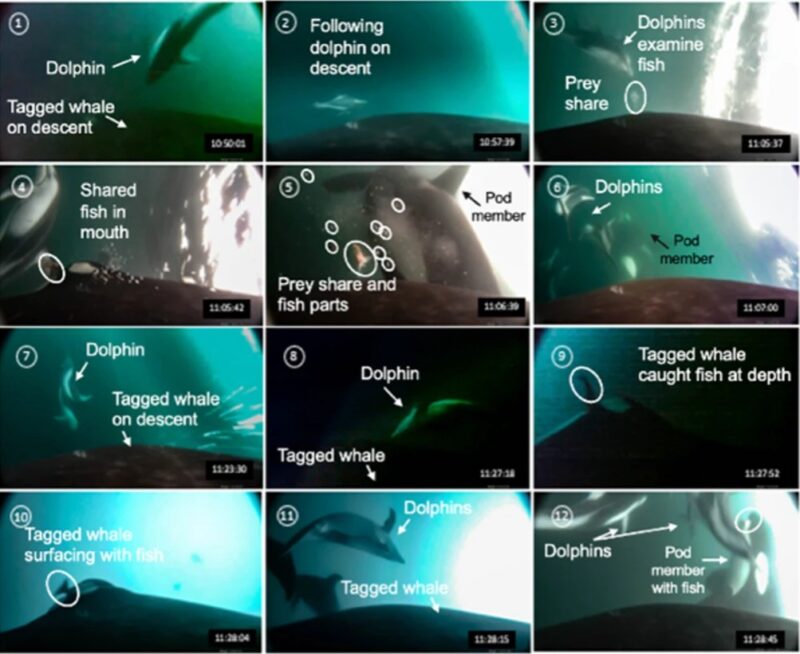
During the same observation period, the researchers documented eight cases of killer whales catching, eating and sharing Chinook salmon with other killer whales, while dolphins were present for four of these events. In one notable instance, dolphins scavenged the remains of an adult salmon that the killer whales had broken into smaller pieces, which the authors interpreted as intentional prey sharing rather than random scavenging.
These observations suggest killer whales might actively coordinate their hunting with dolphins. They use the dolphins’ sonar to improve prey detection, while dolphins gain access to food scraps too large for them to catch alone. The absence of aggression between the species further supports the idea of inter-species cooperation.
Dolphins use echolocation to find fish. Killer whales follow the dolphins, who lead them to the salmon (a treat for the killer whales). Video via Sarah Fortune et al.
Why cooperation benefits both killer whales and dolphins
The researchers suggested that the partnership benefits both animals. Killer whales gain improved prey detection, while dolphins gain access to food scraps and may also gain some protection from transient orca groups. The authors stressed the need for future studies to determine how often and how consistently this behavior occurs.
Killer whales find salmon thanks to dolphins, and dolphins get to eat smaller pieces of salmon that otherwise would be too big for them. Image via Sarah Fortune et al. (CC BY 4.0).
Whales and dolphins: A broader pattern of intelligence and play
This collaboration fits into a larger pattern of whale intelligence and social flexibility. Humpback whales, for example, blow bubble rings, a behavior many scientists interpret as a possible way to communicate with humans.
Humpbacks also use highly coordinated hunting strategies such as bubble-net feeding, in which groups trap fish inside bubble nets. Scientists consider this a “tool” that humpbacks use because of how they manipulate it to their purposes.
Beyond hunting, humpback whales frequently engage in playful interactions with dolphins, including synchronized swimming, breaching and gentle physical contact. These observations suggest that complex social curiosity may occur across whales and dolphins more broadly.
The newly documented partnership between killer whales and Pacific white-sided dolphins demonstrates a level of cooperation that scientists rarely observe between apex predators and smaller marine mammals. As researchers continue to study these interactions, they may uncover even more examples of collaboration in the ocean, thus reshaping how we understand marine ecosystems and the intelligence of the animals that inhabit them.
Bottom line: Killer whales and dolphins have been observed hunting together, sharing prey and skills in a rare and remarkable display of inter-species cooperation.
Killer whales and dolphins have been spotted hunting together. Here’s a dolphin (top) with a pod of northern resident killer whales. Image via University of British Columbia (A.Trites)/ Dalhousie University (S. Fortune)/ Hakai Institute (K. Holmes)/ Leibniz Institute for Zoo/ Wildlife Research (X. Cheng)/ EurekAlert! (CC BY).
Killer whales and dolphins hunt together in a rare alliance
For the first time, researchers have documented killer whales and dolphins cooperatively hunting together. Researchers from the University of British Columbia said on December 11, 2025, that they observed the killer whales and dolphins during fieldwork in the waters off British Columbia, Canada, in August 2020. It’s the first confirmed scientific evidence of these two species working together during foraging. And it’s a remarkable example of inter-species teamwork in the wild.
Sarah Fortune of the University of British Columbia led the groundbreaking study. The researchers published their study in the peer-reviewed journal Scientific Reports on December 11, 2025.
From coexistence to collaboration
Marine biologists have long seen Pacific white-sided dolphins swimming close to killer whales in the waters off British Columbia. Until now, scientists lacked proof that the animals collaborated rather than merely tolerated each other. Fortune’s team tracked movements, recorded underwater video and acoustic signals and flew aerial drones to examine how the species interacted while searching for prey.
Scientists recorded these species underwater and from the air. In this video, you can see how the killer whales change their direction to follow the dolphins. And the dolphins look back to make sure the killer whales are following them. Video via Sarah Fortune et al.
Tracking orca movements and dolphin signals
The researchers followed nine northern resident killer whales, a population known for strong social bonds and a reliance on salmon. They observed 25 instances in which these killer whales changed course after encountering Pacific white-sided dolphins and then followed them on foraging dives. The researchers suggested that killer whales may quiet their own vocalizations to listen for the dolphins’ echolocation clicks, which could help them detect Chinook salmon (Oncorhynchus tshawytscha), a prey too large for dolphins to capture and swallow whole.
During the same observation period, the researchers documented eight cases of killer whales catching, eating and sharing Chinook salmon with other killer whales, while dolphins were present for four of these events. In one notable instance, dolphins scavenged the remains of an adult salmon that the killer whales had broken into smaller pieces, which the authors interpreted as intentional prey sharing rather than random scavenging.
These observations suggest killer whales might actively coordinate their hunting with dolphins. They use the dolphins’ sonar to improve prey detection, while dolphins gain access to food scraps too large for them to catch alone. The absence of aggression between the species further supports the idea of inter-species cooperation.
Dolphins use echolocation to find fish. Killer whales follow the dolphins, who lead them to the salmon (a treat for the killer whales). Video via Sarah Fortune et al.
Why cooperation benefits both killer whales and dolphins
The researchers suggested that the partnership benefits both animals. Killer whales gain improved prey detection, while dolphins gain access to food scraps and may also gain some protection from transient orca groups. The authors stressed the need for future studies to determine how often and how consistently this behavior occurs.
Killer whales find salmon thanks to dolphins, and dolphins get to eat smaller pieces of salmon that otherwise would be too big for them. Image via Sarah Fortune et al. (CC BY 4.0).
Whales and dolphins: A broader pattern of intelligence and play
This collaboration fits into a larger pattern of whale intelligence and social flexibility. Humpback whales, for example, blow bubble rings, a behavior many scientists interpret as a possible way to communicate with humans.
Humpbacks also use highly coordinated hunting strategies such as bubble-net feeding, in which groups trap fish inside bubble nets. Scientists consider this a “tool” that humpbacks use because of how they manipulate it to their purposes.
Beyond hunting, humpback whales frequently engage in playful interactions with dolphins, including synchronized swimming, breaching and gentle physical contact. These observations suggest that complex social curiosity may occur across whales and dolphins more broadly.
The newly documented partnership between killer whales and Pacific white-sided dolphins demonstrates a level of cooperation that scientists rarely observe between apex predators and smaller marine mammals. As researchers continue to study these interactions, they may uncover even more examples of collaboration in the ocean, thus reshaping how we understand marine ecosystems and the intelligence of the animals that inhabit them.
Bottom line: Killer whales and dolphins have been observed hunting together, sharing prey and skills in a rare and remarkable display of inter-species cooperation.
The forms of aurora: From arcs to curtains and more
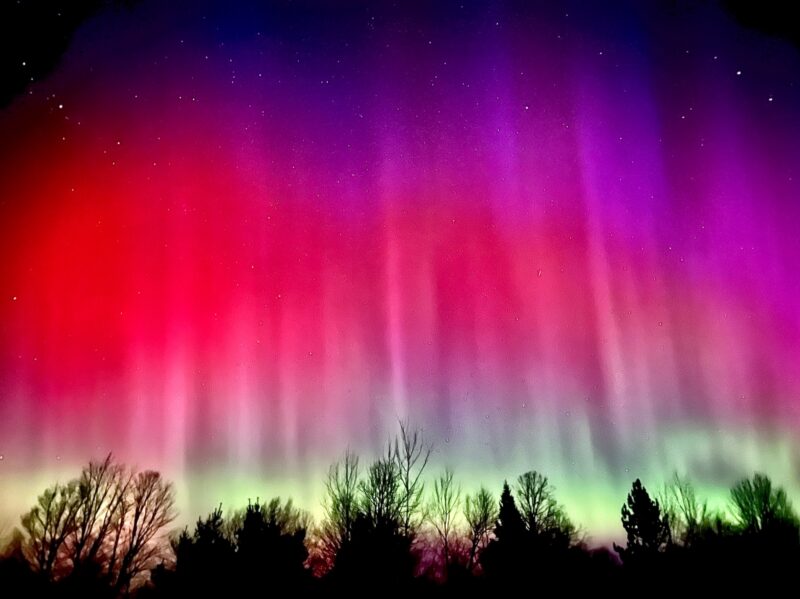
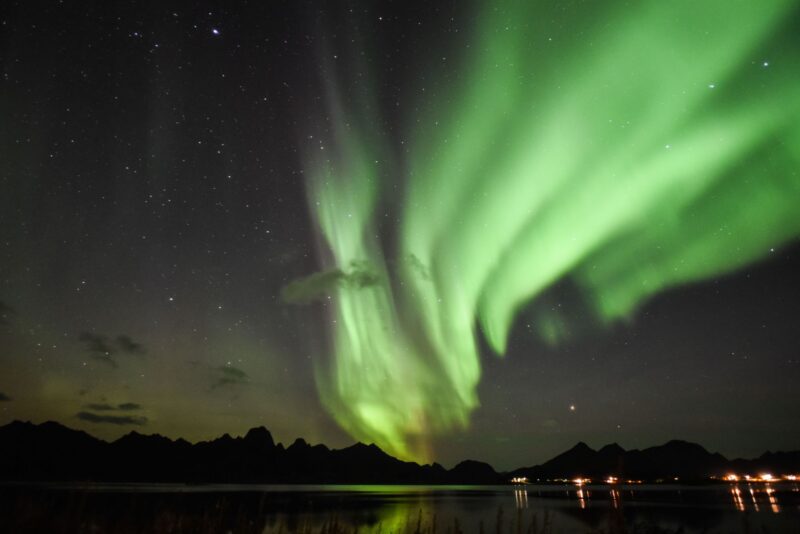
The aurora – or northern and southern lights – can take many shapes. And as you watch, the lights dance and flicker, morphing from a diffuse glow to rays that shoot up from the horizon to cinnamon-bun swirls. There are many names for the variety of auroral forms you can see. And there is no specific or definitive list of shapes, but here are some of the most common forms you might spot.
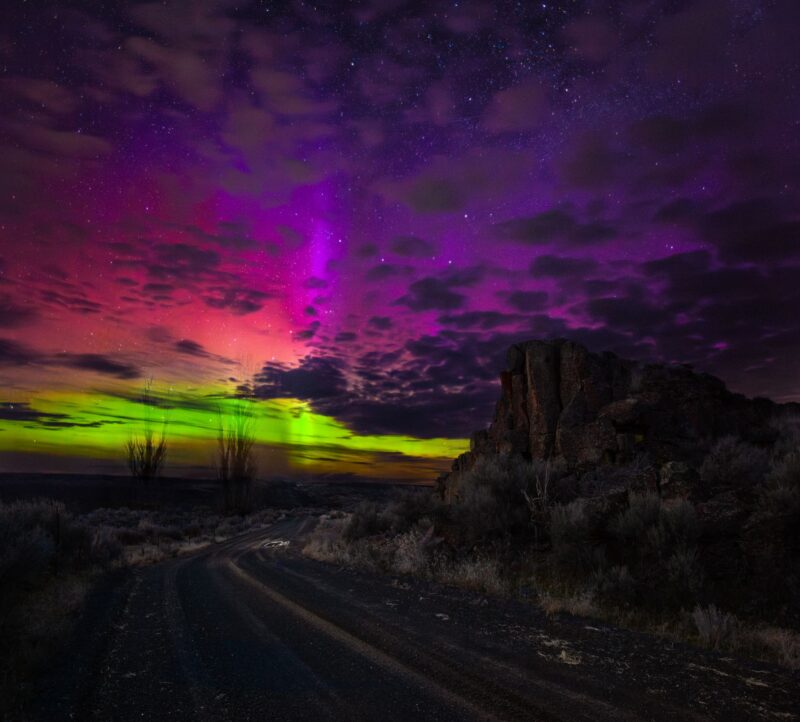
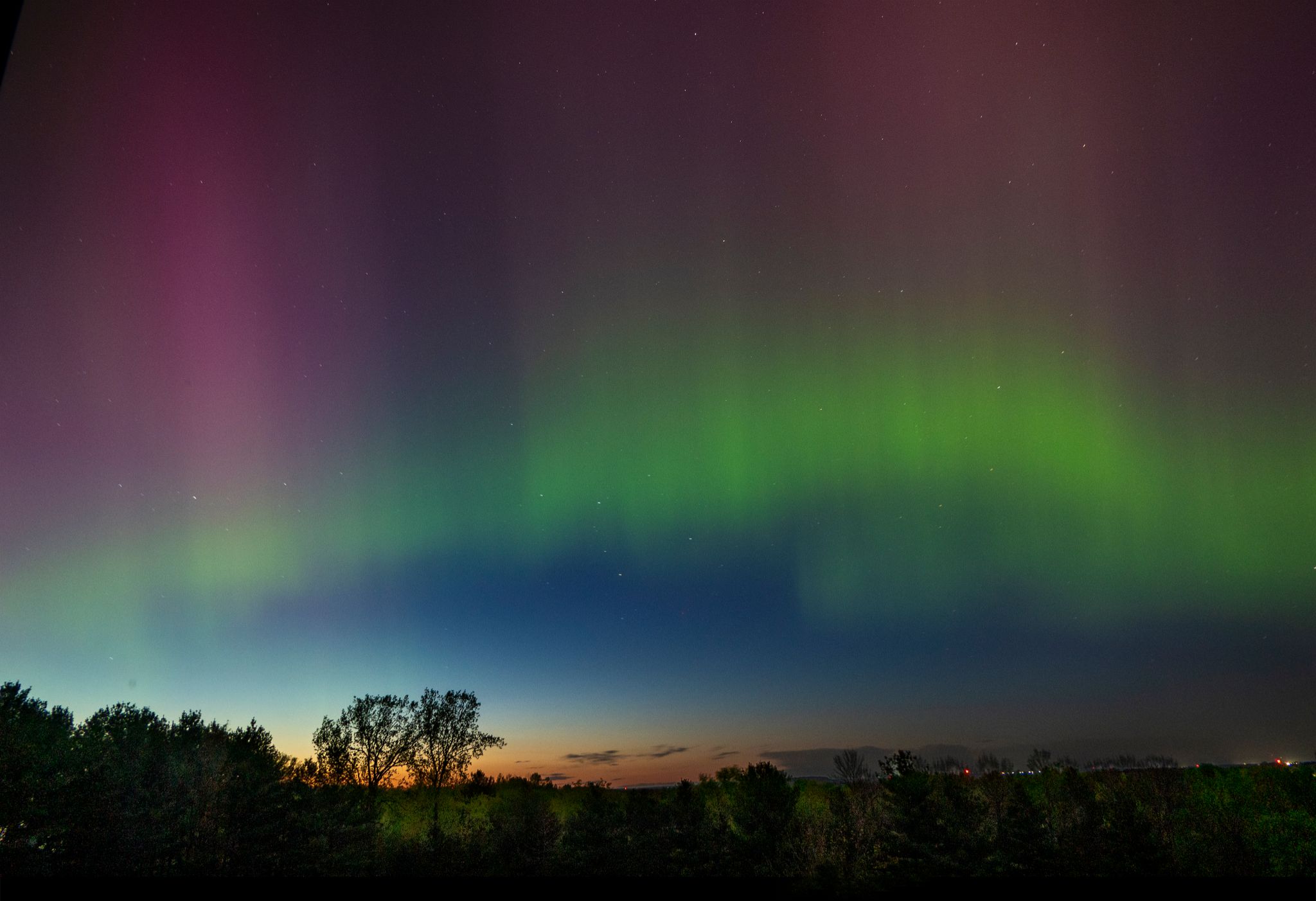
View at EarthSky Community Photos. | Susan Jensen in Irby, Washington, captured this view of the aurora through patchy clouds on April 2, 2025. Thank you, Susan! Do you know the names of the forms of aurora? Brush up on them here!
Diffuse glows
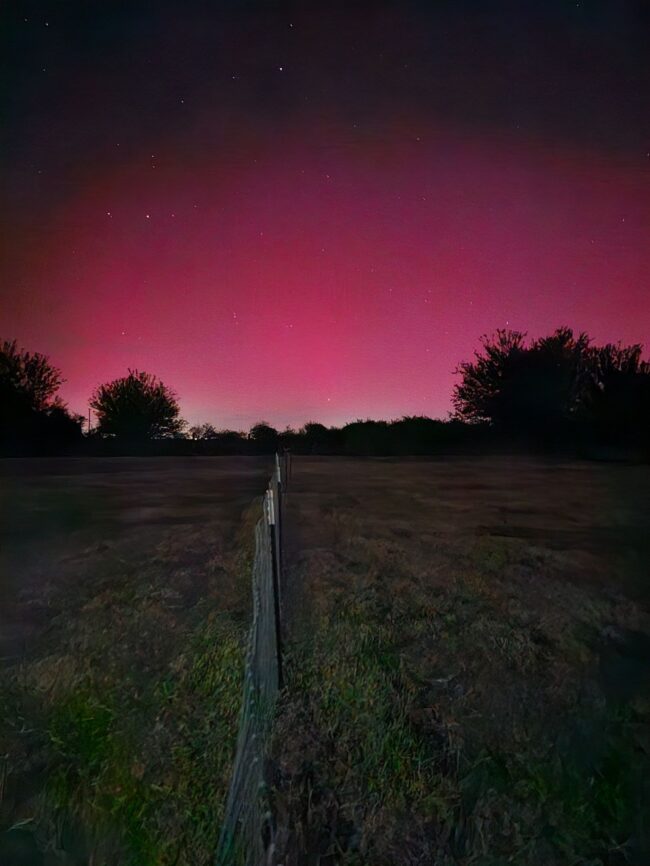
A diffuse glow on the horizon is a form of aurora that people often overlook. If your eyes are not adjusted to the dark or if you’re not in a dark-sky location, you can miss it altogether. And if you don’t know what you’re looking at, the glow of light in the distance might just look like light pollution from a distant city, dimly illuminating the sky.
But a diffuse glow is probably the most common type of aurora. You can see this form when geomagnetic activity is low or when a storm is just beginning or ending. It first starts as a faint, hazy glow that can spread to reach more areas of sky. Your camera will pick it up much more quickly than your eyes, which is also true of all auroral forms. Diffuse auroras don’t have any distinct edges or specific patterns.
Diffuse auroras occur when energetic electrons scatter widely before colliding with atmospheric particles, producing an even, cloud-like illumination instead of defined shapes.
An auroral arc might be the next step up in activity you see. Arcs can be smooth with curves (homogenous arcs) or look like streaks of upward brush strokes (rayed arcs). Sometimes arcs can look like ribbons undulating in the sky as they pulsate and flicker. But auroral arcs can also remain static or shift slowly.
This form of aurora happens when charged particles flow along magnetic field lines, creating a concentrated band of light at specific latitudes known as the auroral oval.
When activity starts to ramp up, you might see rays – or vertical streaks – shooting upward into the sky. You can have a single ray projecting upward from an otherwise diffuse glow, or you can have a sky filled with rays. The rays can converge overhead to create an auroral corona, discussed below.
Auroral rays form when the incoming particles follow individual magnetic field lines, creating parallel columns of light.
The curtain and drapery form of aurora is especially photogenic. This shape can resemble a billowing sheet or shimmering veil. Plus, it often ripples, giving it even more of a 3D appearance. Curtains are essentially auroral arcs bunched up in parallel lines.
This form of aurora also occurs because auroras line up parallel to magnetic field lines. But there is more at play, including currents and wave-particle interactions that help define the shape of the aurora. We still don’t know everything about how the aurora forms in the different shapes it does, and it’s an active area of research.
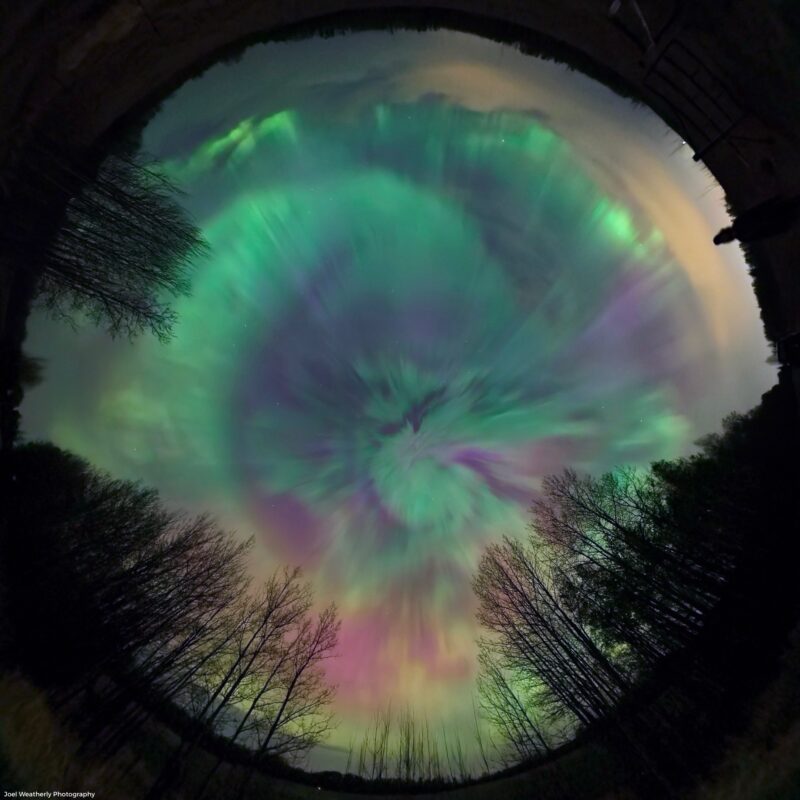
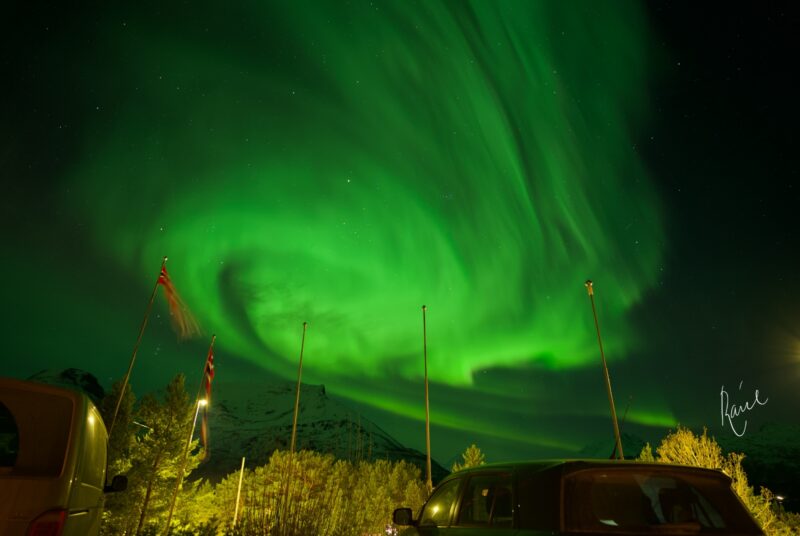
Sometimes the shapes of the aurora become very active, twisting into unique forms such as spirals and swirls. You will likely only see this shape during an especially strong geomagnetic storm or when you’re closer to one of the poles.
When you see spiraling or swirling aurora, you’re seeing the turbulent, shearing motions within the solar plasma, which is guided by Earth’s magnetic field lines.
And if you’re having a really great night, the aurora may dip so far south that you can see it right overhead. Perhaps it will even fill your sky from horizon to horizon! The name for the aurora when it appears overhead is corona. It can look as if it is beaming down right to touch you. If you see an auroral corona, consider yourself lucky.
Bottom line: Here are some of the forms of aurora that you might see in the sky. Some of the forms are more common, such as diffuse glows, while others are a sign of a big geomagnetic storm.
The forms of aurora: From arcs to curtains and more
The aurora – or northern and southern lights – can take many shapes. And as you watch, the lights dance and flicker, morphing from a diffuse glow to rays that shoot up from the horizon to cinnamon-bun swirls. There are many names for the variety of auroral forms you can see. And there is no specific or definitive list of shapes, but here are some of the most common forms you might spot.
View at EarthSky Community Photos. | Susan Jensen in Irby, Washington, captured this view of the aurora through patchy clouds on April 2, 2025. Thank you, Susan! Do you know the names of the forms of aurora? Brush up on them here!
Diffuse glows
A diffuse glow on the horizon is a form of aurora that people often overlook. If your eyes are not adjusted to the dark or if you’re not in a dark-sky location, you can miss it altogether. And if you don’t know what you’re looking at, the glow of light in the distance might just look like light pollution from a distant city, dimly illuminating the sky.
But a diffuse glow is probably the most common type of aurora. You can see this form when geomagnetic activity is low or when a storm is just beginning or ending. It first starts as a faint, hazy glow that can spread to reach more areas of sky. Your camera will pick it up much more quickly than your eyes, which is also true of all auroral forms. Diffuse auroras don’t have any distinct edges or specific patterns.
Diffuse auroras occur when energetic electrons scatter widely before colliding with atmospheric particles, producing an even, cloud-like illumination instead of defined shapes.
An auroral arc might be the next step up in activity you see. Arcs can be smooth with curves (homogenous arcs) or look like streaks of upward brush strokes (rayed arcs). Sometimes arcs can look like ribbons undulating in the sky as they pulsate and flicker. But auroral arcs can also remain static or shift slowly.
This form of aurora happens when charged particles flow along magnetic field lines, creating a concentrated band of light at specific latitudes known as the auroral oval.
When activity starts to ramp up, you might see rays – or vertical streaks – shooting upward into the sky. You can have a single ray projecting upward from an otherwise diffuse glow, or you can have a sky filled with rays. The rays can converge overhead to create an auroral corona, discussed below.
Auroral rays form when the incoming particles follow individual magnetic field lines, creating parallel columns of light.
The curtain and drapery form of aurora is especially photogenic. This shape can resemble a billowing sheet or shimmering veil. Plus, it often ripples, giving it even more of a 3D appearance. Curtains are essentially auroral arcs bunched up in parallel lines.
This form of aurora also occurs because auroras line up parallel to magnetic field lines. But there is more at play, including currents and wave-particle interactions that help define the shape of the aurora. We still don’t know everything about how the aurora forms in the different shapes it does, and it’s an active area of research.
Sometimes the shapes of the aurora become very active, twisting into unique forms such as spirals and swirls. You will likely only see this shape during an especially strong geomagnetic storm or when you’re closer to one of the poles.
When you see spiraling or swirling aurora, you’re seeing the turbulent, shearing motions within the solar plasma, which is guided by Earth’s magnetic field lines.
And if you’re having a really great night, the aurora may dip so far south that you can see it right overhead. Perhaps it will even fill your sky from horizon to horizon! The name for the aurora when it appears overhead is corona. It can look as if it is beaming down right to touch you. If you see an auroral corona, consider yourself lucky.
Bottom line: Here are some of the forms of aurora that you might see in the sky. Some of the forms are more common, such as diffuse glows, while others are a sign of a big geomagnetic storm.
The peak of the sun’s 11-year cycle of activity might be waning, but we’ve still had a fantastic year for seeing the aurora. And if you’ve been following EarthSky’s daily sun news, you know which nights give you the best odds to catch those elusive northern and southern lights. Our EarthSky community has been capturing gorgeous views of the aurora, and so have readers of Dan Zafra‘s travel photography blog, Capture the Atlas. Dan has once again shared his blog’s best northern lights photos of 2025.
This is the 8th annual edition of these stunning images The complete collection features 25 photographers representing 15 different nationalities. We’re sharing 10 of them here at EarthSky; see all 25 at Capture the Atlas. The images encompass both the northern and southern lights.
Do you have a great image of the aurora to share? You can submit it to us at EarthSky Community Photos.
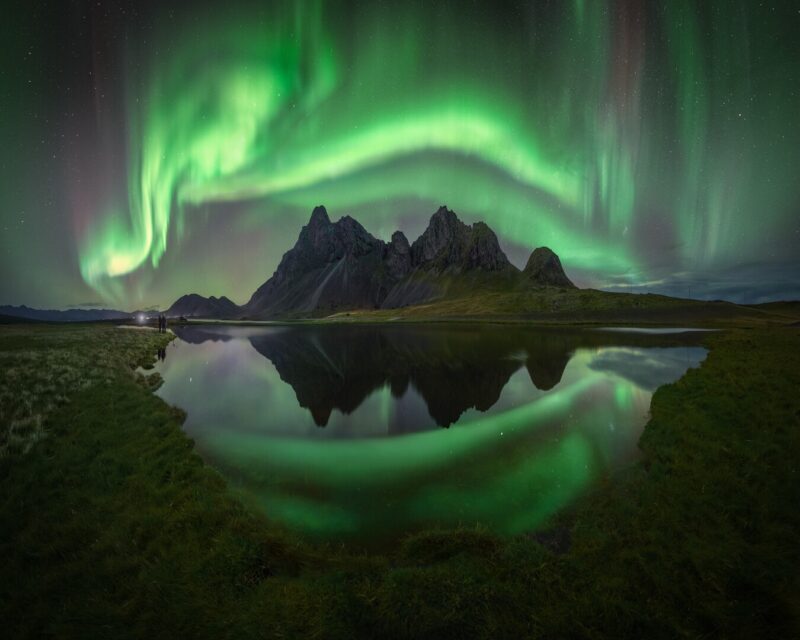
Sueños en Eystrahorn by Pablo Ruiz
Pablo Ruiz captured this image in Eystrahorn, Iceland. Pablo wrote: “Capturing a panorama with reflections and auroras that move so quickly is quite difficult. Auroras were already visible in the sky during the blue hour, so I quickly headed to the spot where I had planned the composition. The wind shifted, making it difficult to capture the reflections, but the moment the sky exploded, the wind stopped, and for a few brief moments, I achieved my dream photograph.” Image via Capture the Atlas. See more of the best northern lights photos below.
Lights and Ice by Tori Harp
Tori Harp at Aoraki/Mt. Cook National Park, New Zealand, took this image and wrote: “I originally found this ice cave, called a moulin, 8 months prior to setting up this shot. Glaciers are a dynamic environment, so I kept going back to monitor the changes. One magical night, everything finally came together. To my surprise, the aurora australis also lit up the sky. This dream shot ended up coming out better than I had originally envisioned, and I had a great night with my friends exploring the glacier!” Image via Capture the Atlas.
Frozen Silence Beneath the Lights by Nikki Born
Nikki Born captured this image at Riisitunturi National Park, Finland, and wrote: “Capturing the famous frozen trees of Riisitunturi beneath the northern lights had been a dream for years. In March 2025, we set out to make it happen. After hours of nothing, just as we were about to call it a night, the sky burst into vivid shades of green. It was an explosion of light and wonder.” Image via Capture the Atlas.
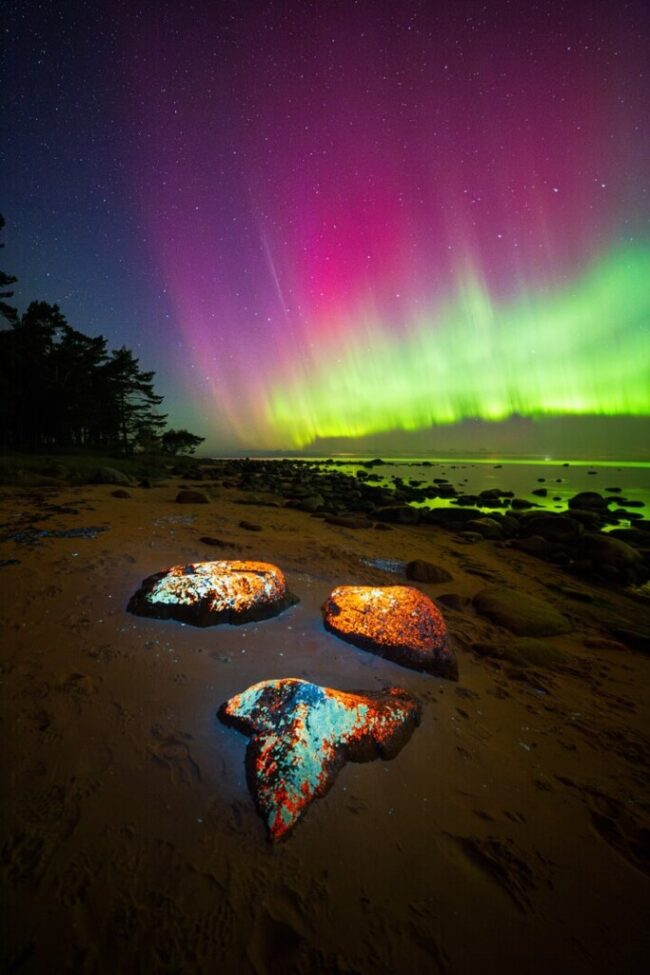
Neon Nightfall by Andres Papp
Andres Papp captured this image from Türisalu, Estonia. Andres wrote: “I shot this image on a quiet, rocky beach as a strong aurora storm rolled in from the north. At first, it was just a low green arc, but it quickly erupted into vertical curtains of lime and rare magenta. To connect the sky with the foreground, I illuminated the shoreline rocks with a strong 365 nm UV light torch, which made the minerals pop and added the surreal glow you see in the image.” Image via Capture the Atlas.
Gibson Steps Aurora by Jeff Cullen
Jeff Cullen captured the aurora from Great Ocean Road, Victoria, Australia. Jeff wrote: “I went down the 86 steps to the beach and crossed the sand to the Gog and Magog sea stacks. The clouds started to clear, and I was able to shoot some great images before the aurora died down. Climbing back up the stairs, the beams were so big and bright in the corner of my eye! I ran back down to the beach and quickly set up my camera again. This image shows the magic that happened that night; I was absolutely amazed and astounded that such a weak aurora forecast brought me such a brilliant show.” Image via Capture the Atlas.
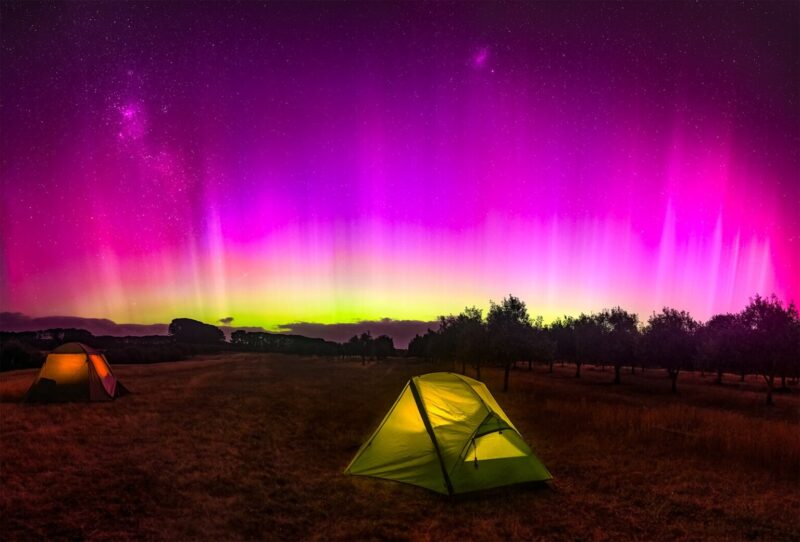
Celestial Fireworks on New Years by Sara Aurorae
Sara Aurorae captured this shot and wrote: “On New Year’s Day, beneath the dark Australian sky, my friends and I were met by celestial fireworks with the aurora australis unfurling in a sudden, breathtaking bloom above our quiet campsite in the Otways of Victoria. Ribbons of rose, violet and green shimmered, visible even to the unaided eye, as if the universe itself had heard our resolutions for 2025 and joined in our celebration.” Image via Capture the Atlas.
Llangrannog Aurora by Mathew Browne
Mathew Browne shared this image and wrote: “I was overjoyed to capture this otherworldly northern lights display on the rugged Ceredigion coast of West Wales. The village of Llangrannog is not known for its celestial displays; it is better known for its beach, dramatic cliffs and the statue of St. Crannog, who stands watch over the shoreline.” Image via Capture the Atlas.
Essence of the Arctic Night by Giulio Cobianchi
Giulio Cobianchi took this image from Haukland Beach in the Lofoten islands. Giulio wrote: “Autumn in the Arctic is the best time to capture the ‘double arc’ of the Milky Way and the aurora borealis. The nights have finally turned dark again after the endless summer days when the sun never sets. The summer Milky Way is already high in the sky shortly after sunset, and the northern lights return to dance across the sky in bands of pink, red, violet and green.” Image via Capture the Atlas.
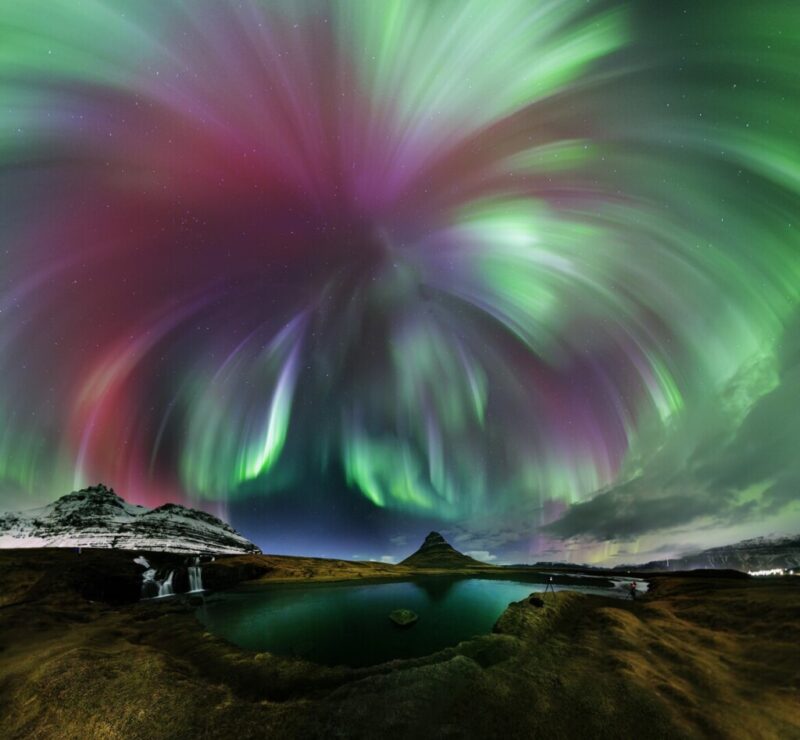
Corona Blast Aurora Geomagnetic Storm by Roi Levi
Roi Levy captured this view of the aurora from Kirkjufell, Iceland, during the March equinox. Roi wrote: “A geomagnetic storm structure brought a mesmerizing light show. A full-zenith auroral corona erupted overhead: powerful, bright pillars of light radiated across the sky, creating a stunning crown-light blast shape. Kirkjufell is one of Iceland’s most iconic mountains, and witnessing the aurora here was a one-of-a-kind experience. With the Kirkjufellsfoss waterfalls in the foreground, this image is a dynamic representation of the sweeping auroral corona.” Image via Capture the Atlas.
Speechless by Ralf Rohner
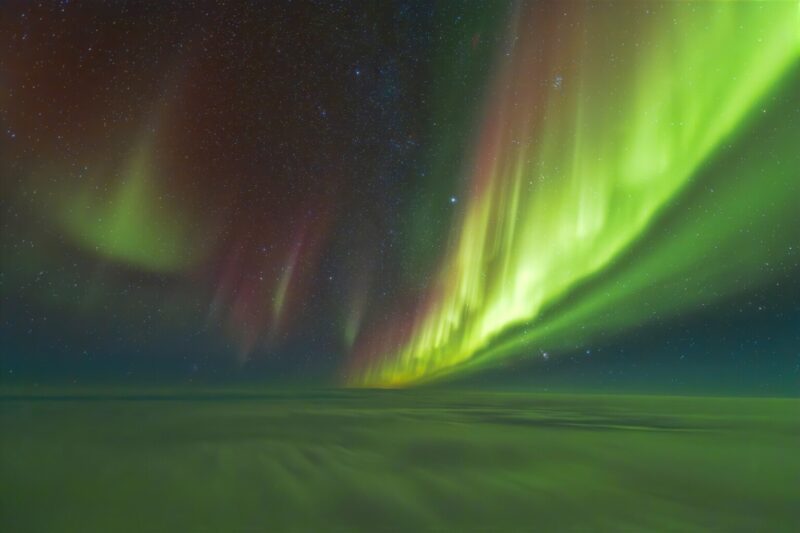
Ralf Rohner captured this image and wrote: “I was flying at 35,000 feet over Hudson Bay, Canada. The monotony can seem endless – until suddenly, everything changes. Above a silent sea of clouds, cocooned within a fragile shell of metal, curtains of light dance across the heavens, painting the darkness with vivid greens and purples.” Image via Capture the Atlas.
Bottom line: The blog Capture the Atlas announced its 2025 Northern Lights Photographer of the Year contest. This annual edition showcases 25 of the best aurora photos taken from all over the world. See some of the best northern lights photos in the world here.
The peak of the sun’s 11-year cycle of activity might be waning, but we’ve still had a fantastic year for seeing the aurora. And if you’ve been following EarthSky’s daily sun news, you know which nights give you the best odds to catch those elusive northern and southern lights. Our EarthSky community has been capturing gorgeous views of the aurora, and so have readers of Dan Zafra‘s travel photography blog, Capture the Atlas. Dan has once again shared his blog’s best northern lights photos of 2025.
This is the 8th annual edition of these stunning images The complete collection features 25 photographers representing 15 different nationalities. We’re sharing 10 of them here at EarthSky; see all 25 at Capture the Atlas. The images encompass both the northern and southern lights.
Do you have a great image of the aurora to share? You can submit it to us at EarthSky Community Photos.
Sueños en Eystrahorn by Pablo Ruiz
Pablo Ruiz captured this image in Eystrahorn, Iceland. Pablo wrote: “Capturing a panorama with reflections and auroras that move so quickly is quite difficult. Auroras were already visible in the sky during the blue hour, so I quickly headed to the spot where I had planned the composition. The wind shifted, making it difficult to capture the reflections, but the moment the sky exploded, the wind stopped, and for a few brief moments, I achieved my dream photograph.” Image via Capture the Atlas. See more of the best northern lights photos below.
Lights and Ice by Tori Harp
Tori Harp at Aoraki/Mt. Cook National Park, New Zealand, took this image and wrote: “I originally found this ice cave, called a moulin, 8 months prior to setting up this shot. Glaciers are a dynamic environment, so I kept going back to monitor the changes. One magical night, everything finally came together. To my surprise, the aurora australis also lit up the sky. This dream shot ended up coming out better than I had originally envisioned, and I had a great night with my friends exploring the glacier!” Image via Capture the Atlas.
Frozen Silence Beneath the Lights by Nikki Born
Nikki Born captured this image at Riisitunturi National Park, Finland, and wrote: “Capturing the famous frozen trees of Riisitunturi beneath the northern lights had been a dream for years. In March 2025, we set out to make it happen. After hours of nothing, just as we were about to call it a night, the sky burst into vivid shades of green. It was an explosion of light and wonder.” Image via Capture the Atlas.
Neon Nightfall by Andres Papp
Andres Papp captured this image from Türisalu, Estonia. Andres wrote: “I shot this image on a quiet, rocky beach as a strong aurora storm rolled in from the north. At first, it was just a low green arc, but it quickly erupted into vertical curtains of lime and rare magenta. To connect the sky with the foreground, I illuminated the shoreline rocks with a strong 365 nm UV light torch, which made the minerals pop and added the surreal glow you see in the image.” Image via Capture the Atlas.
Gibson Steps Aurora by Jeff Cullen
Jeff Cullen captured the aurora from Great Ocean Road, Victoria, Australia. Jeff wrote: “I went down the 86 steps to the beach and crossed the sand to the Gog and Magog sea stacks. The clouds started to clear, and I was able to shoot some great images before the aurora died down. Climbing back up the stairs, the beams were so big and bright in the corner of my eye! I ran back down to the beach and quickly set up my camera again. This image shows the magic that happened that night; I was absolutely amazed and astounded that such a weak aurora forecast brought me such a brilliant show.” Image via Capture the Atlas.
Celestial Fireworks on New Years by Sara Aurorae
Sara Aurorae captured this shot and wrote: “On New Year’s Day, beneath the dark Australian sky, my friends and I were met by celestial fireworks with the aurora australis unfurling in a sudden, breathtaking bloom above our quiet campsite in the Otways of Victoria. Ribbons of rose, violet and green shimmered, visible even to the unaided eye, as if the universe itself had heard our resolutions for 2025 and joined in our celebration.” Image via Capture the Atlas.
Llangrannog Aurora by Mathew Browne
Mathew Browne shared this image and wrote: “I was overjoyed to capture this otherworldly northern lights display on the rugged Ceredigion coast of West Wales. The village of Llangrannog is not known for its celestial displays; it is better known for its beach, dramatic cliffs and the statue of St. Crannog, who stands watch over the shoreline.” Image via Capture the Atlas.
Essence of the Arctic Night by Giulio Cobianchi
Giulio Cobianchi took this image from Haukland Beach in the Lofoten islands. Giulio wrote: “Autumn in the Arctic is the best time to capture the ‘double arc’ of the Milky Way and the aurora borealis. The nights have finally turned dark again after the endless summer days when the sun never sets. The summer Milky Way is already high in the sky shortly after sunset, and the northern lights return to dance across the sky in bands of pink, red, violet and green.” Image via Capture the Atlas.
Corona Blast Aurora Geomagnetic Storm by Roi Levi
Roi Levy captured this view of the aurora from Kirkjufell, Iceland, during the March equinox. Roi wrote: “A geomagnetic storm structure brought a mesmerizing light show. A full-zenith auroral corona erupted overhead: powerful, bright pillars of light radiated across the sky, creating a stunning crown-light blast shape. Kirkjufell is one of Iceland’s most iconic mountains, and witnessing the aurora here was a one-of-a-kind experience. With the Kirkjufellsfoss waterfalls in the foreground, this image is a dynamic representation of the sweeping auroral corona.” Image via Capture the Atlas.
Speechless by Ralf Rohner
Ralf Rohner captured this image and wrote: “I was flying at 35,000 feet over Hudson Bay, Canada. The monotony can seem endless – until suddenly, everything changes. Above a silent sea of clouds, cocooned within a fragile shell of metal, curtains of light dance across the heavens, painting the darkness with vivid greens and purples.” Image via Capture the Atlas.
Bottom line: The blog Capture the Atlas announced its 2025 Northern Lights Photographer of the Year contest. This annual edition showcases 25 of the best aurora photos taken from all over the world. See some of the best northern lights photos in the world here.
According to new research, polar bear DNA might be changing to help these creatures adapt to a changing climate. Image via Hans-Jurgen Mager/ Unsplash.
The Arctic Ocean current is at its warmest in the last 125,000 years, and temperatures continue to rise. Due to these warming temperatures, more than 2/3 of polar bears are expected to be extinct by 2050. Total extinction is predicted by the end of this century.
But in our new study, my colleagues and I found that the changing climate has been driving changes in polar bear DNA, potentially allowing them to more readily adapt to warmer habitats. Provided these polar bears can source enough food and breeding partners, this suggests they may potentially survive these new challenging climates.
Polar bear DNA is changing
We discovered a strong link between rising temperatures in southeast Greenland and changes in the polar bear genome, which is the entire set of DNA found in an organism. DNA is the instruction book inside every cell, guiding how an organism grows and develops.
In processes called transcription and translation, DNA is copied to generate RNA. These are messenger molecules that transmit genetic information. This can lead to the production of proteins, and copies of transposons, also known as “jumping genes.” These are mobile pieces of the genome that can move around and influence how other genes work.
Different regions, different genomes
Our research revealed big differences in the temperatures in the northeast of Greenland compared with the southeast. We used publicly available polar bear genetic data from a research group at the University of Washington, U.S., to support our study. This dataset was generated from blood samples collected from polar bears in both northern and south-eastern Greenland.
Our work built on a Washington University study which discovered that this southeastern population of Greenland polar bears was genetically different to the north-eastern population. Southeastern bears had migrated from the north and became isolated and separate approximately 200 years ago, it found.
Researchers from Washington had extracted RNA – the genetic messenger molecules – from polar bear blood samples and sequenced it. We used this sequencing to look at RNA expression – essentially showing which genes are active – in relation to the climate.
This gave us a detailed picture of gene activity, including the behavior of the “jumping genes,” or transposons.
Temperatures in Greenland have been closely monitored and recorded by the Danish Meteorological Institute. So we linked this climate data with the RNA data to explore how environmental changes may be influencing polar bear biology.
Polar bears face challenging conditions thanks to climate change. But they might be responding to this challenge at a genetic level. Image via Dick Val Beck/ Polar Bears International.
Impacts of temperature change
We found that temperatures in the southeast were significantly warmer and fluctuated more than in the northeast. This creates habitat changes and challenges for the polar bears living in these regions.
The loss of ice is a substantial problem for the polar bears. That’s because it reduces the availability of hunting platforms to catch seals, leading to isolation and food scarcity.
EarthSky’s Will Triggs spoke to Alysa McCall of Polar Bears International on Arctic Sea Ice day – July 15, 2025 – to hear about how the decline in arctic sea ice is affecting polar bears and beluga whales.
How climate is changing polar bear DNA
Over time, it’s not unusual for an organism’s DNA sequence to slowly change and evolve. But environmental stress, such as a warmer climate, can accelerate this process.
Transposons are like genetic puzzle pieces that can rearrange themselves, sometimes helping animals adapt to new environments. They come in many different families and have slightly different behaviors, but in essence are all mobile fragments that can reinsert randomly anywhere in the genome.
Approximately 38.1% of the polar bear genome is made up of transposons. For humans that figure is 45%, and plant genomes can be over 70% transposons.
There are small protective molecules called piwi-interacting RNAs (piRNAs) that can silence the activity of transposons. But when an environmental stress is too strong, these protective piRNAs cannot keep up with the invasive actions of transposons.
We found that the warmer southeast climate led to a mass mobilization of these transposons across the polar bear genome, changing its sequence. We also found that these transposon sequences appeared younger and more abundant in the southeastern bears. And over 1,500 of these sequences were upregulated, meaning gene activity was increased. That points to recent genetic changes that may help bears adapt to rising temperatures.
What exactly is changing in polar bear DNA?
Some of these elements overlap with genes linked to stress responses and metabolism, hinting at a possible role in coping with climate change. By studying these jumping genes, we uncovered how the polar bear genome adapts and responds in the shorter term to environmental stress and warmer climates.
Our research found that some genes linked to heat stress, aging and metabolism are behaving differently in the southeast population of polar bears. This suggests they might be adjusting to their warmer conditions.
Additionally, we found active jumping genes in parts of the genome that are involved in areas tied to fat processing, which is important when food is scarce. Considering that northern populations eat mainly fatty seals, this could mean that polar bears in the southeast are slowly adapting to eating the rougher plant-based diets that can be found in the warmer regions.
Overall, climate change is reshaping polar bear habitats, leading to genetic changes. Bears of southeastern Greenland are evolving to survive these new terrains and diets. Future research could include other polar bear populations living in challenging climates. Understanding these genetic changes helps researchers see how polar bears might survive in a warming world, and which populations are most at risk.
According to new research, polar bear DNA might be changing to help these creatures adapt to a changing climate. Image via Hans-Jurgen Mager/ Unsplash.
The Arctic Ocean current is at its warmest in the last 125,000 years, and temperatures continue to rise. Due to these warming temperatures, more than 2/3 of polar bears are expected to be extinct by 2050. Total extinction is predicted by the end of this century.
But in our new study, my colleagues and I found that the changing climate has been driving changes in polar bear DNA, potentially allowing them to more readily adapt to warmer habitats. Provided these polar bears can source enough food and breeding partners, this suggests they may potentially survive these new challenging climates.
Polar bear DNA is changing
We discovered a strong link between rising temperatures in southeast Greenland and changes in the polar bear genome, which is the entire set of DNA found in an organism. DNA is the instruction book inside every cell, guiding how an organism grows and develops.
In processes called transcription and translation, DNA is copied to generate RNA. These are messenger molecules that transmit genetic information. This can lead to the production of proteins, and copies of transposons, also known as “jumping genes.” These are mobile pieces of the genome that can move around and influence how other genes work.
Different regions, different genomes
Our research revealed big differences in the temperatures in the northeast of Greenland compared with the southeast. We used publicly available polar bear genetic data from a research group at the University of Washington, U.S., to support our study. This dataset was generated from blood samples collected from polar bears in both northern and south-eastern Greenland.
Our work built on a Washington University study which discovered that this southeastern population of Greenland polar bears was genetically different to the north-eastern population. Southeastern bears had migrated from the north and became isolated and separate approximately 200 years ago, it found.
Researchers from Washington had extracted RNA – the genetic messenger molecules – from polar bear blood samples and sequenced it. We used this sequencing to look at RNA expression – essentially showing which genes are active – in relation to the climate.
This gave us a detailed picture of gene activity, including the behavior of the “jumping genes,” or transposons.
Temperatures in Greenland have been closely monitored and recorded by the Danish Meteorological Institute. So we linked this climate data with the RNA data to explore how environmental changes may be influencing polar bear biology.
Polar bears face challenging conditions thanks to climate change. But they might be responding to this challenge at a genetic level. Image via Dick Val Beck/ Polar Bears International.
Impacts of temperature change
We found that temperatures in the southeast were significantly warmer and fluctuated more than in the northeast. This creates habitat changes and challenges for the polar bears living in these regions.
The loss of ice is a substantial problem for the polar bears. That’s because it reduces the availability of hunting platforms to catch seals, leading to isolation and food scarcity.
EarthSky’s Will Triggs spoke to Alysa McCall of Polar Bears International on Arctic Sea Ice day – July 15, 2025 – to hear about how the decline in arctic sea ice is affecting polar bears and beluga whales.
How climate is changing polar bear DNA
Over time, it’s not unusual for an organism’s DNA sequence to slowly change and evolve. But environmental stress, such as a warmer climate, can accelerate this process.
Transposons are like genetic puzzle pieces that can rearrange themselves, sometimes helping animals adapt to new environments. They come in many different families and have slightly different behaviors, but in essence are all mobile fragments that can reinsert randomly anywhere in the genome.
Approximately 38.1% of the polar bear genome is made up of transposons. For humans that figure is 45%, and plant genomes can be over 70% transposons.
There are small protective molecules called piwi-interacting RNAs (piRNAs) that can silence the activity of transposons. But when an environmental stress is too strong, these protective piRNAs cannot keep up with the invasive actions of transposons.
We found that the warmer southeast climate led to a mass mobilization of these transposons across the polar bear genome, changing its sequence. We also found that these transposon sequences appeared younger and more abundant in the southeastern bears. And over 1,500 of these sequences were upregulated, meaning gene activity was increased. That points to recent genetic changes that may help bears adapt to rising temperatures.
What exactly is changing in polar bear DNA?
Some of these elements overlap with genes linked to stress responses and metabolism, hinting at a possible role in coping with climate change. By studying these jumping genes, we uncovered how the polar bear genome adapts and responds in the shorter term to environmental stress and warmer climates.
Our research found that some genes linked to heat stress, aging and metabolism are behaving differently in the southeast population of polar bears. This suggests they might be adjusting to their warmer conditions.
Additionally, we found active jumping genes in parts of the genome that are involved in areas tied to fat processing, which is important when food is scarce. Considering that northern populations eat mainly fatty seals, this could mean that polar bears in the southeast are slowly adapting to eating the rougher plant-based diets that can be found in the warmer regions.
Overall, climate change is reshaping polar bear habitats, leading to genetic changes. Bears of southeastern Greenland are evolving to survive these new terrains and diets. Future research could include other polar bear populations living in challenging climates. Understanding these genetic changes helps researchers see how polar bears might survive in a warming world, and which populations are most at risk.
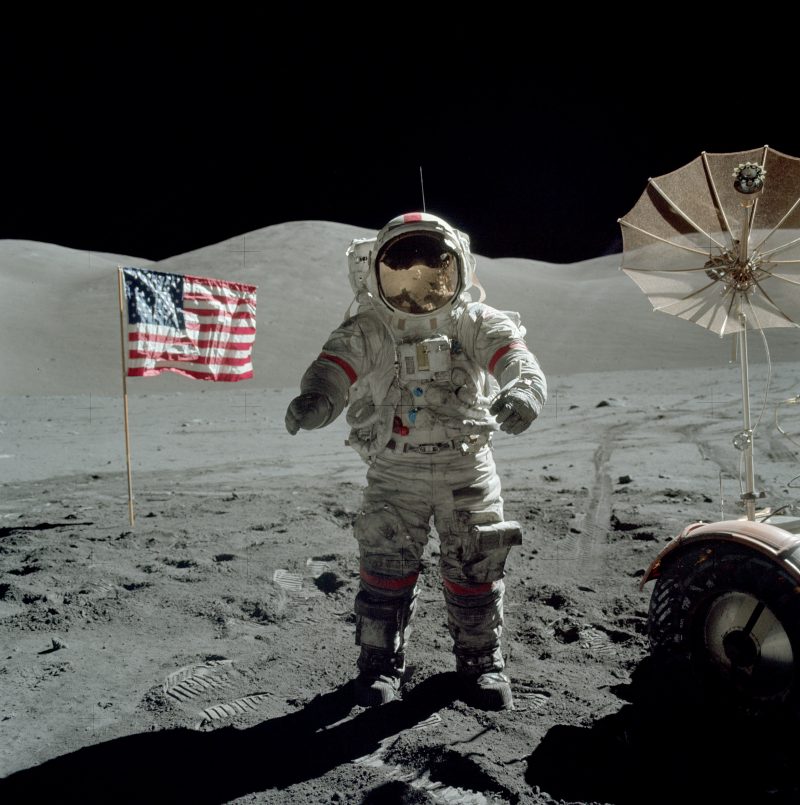
Astronaut Gene Cernan stands on the moon on December 13, 1972. The astronauts of Apollo 17 left the moon the next day. It’s now been 53 years since humans have touched the lunar surface. Image via NASA.
If you were born after December 14, 1972, no human has set foot on the moon in your lifetime. The final crewed mission to land on the moon, Apollo 17, left there 53 years ago today. Gene Cernan, the last person to touch the moon’s surface, spoke these words before departing:
As I take man’s last step from the surface, back home for some time to come (but we believe not too long into the future), I’d like to just say what I believe history will record: That America’s challenge of today has forged man’s destiny of tomorrow. And, as we leave the moon at Taurus-Littrow, we leave as we came and, God willing, as we shall return: with peace and hope for all mankind.
Future missions to the moon
With Artemis 1 successfully launching into lunar orbit and returning safely, we’ve finally begun to take steps toward the future that Cernan and so many others envisioned.
The next part of the Artemis program – Artemis 2 – will be a crewed mission. It’ll follow in the footsteps of Artemis 1 by orbiting the moon with humans aboard. Not until Artemis 3 will humans return to the lunar surface. Artemis 2 will likely fly in early 2026. And when will Artemis 3 fly? It’s currently scheduled for mid-2027, but most expect these timelines to shift further into the future.
SpaceX planned a mission to the moon called dearMoon, that would last for about a week and come within 125 miles (200 km) of the lunar surface. That mission was cancelled in 2024.
But, whether NASA reaches the moon first, or China, it should only be a few more years before humans once again set foot on the moon. When it happens, however it happens, the world will be watching with, as Gene Cernan said:
… Peace and hope for all.
Bottom line: It’s been 53 years since humans last set foot on the moon. The Apollo 17 astronauts left the lunar surface on December 14, 1972.
Astronaut Gene Cernan stands on the moon on December 13, 1972. The astronauts of Apollo 17 left the moon the next day. It’s now been 53 years since humans have touched the lunar surface. Image via NASA.
If you were born after December 14, 1972, no human has set foot on the moon in your lifetime. The final crewed mission to land on the moon, Apollo 17, left there 53 years ago today. Gene Cernan, the last person to touch the moon’s surface, spoke these words before departing:
As I take man’s last step from the surface, back home for some time to come (but we believe not too long into the future), I’d like to just say what I believe history will record: That America’s challenge of today has forged man’s destiny of tomorrow. And, as we leave the moon at Taurus-Littrow, we leave as we came and, God willing, as we shall return: with peace and hope for all mankind.
Future missions to the moon
With Artemis 1 successfully launching into lunar orbit and returning safely, we’ve finally begun to take steps toward the future that Cernan and so many others envisioned.
The next part of the Artemis program – Artemis 2 – will be a crewed mission. It’ll follow in the footsteps of Artemis 1 by orbiting the moon with humans aboard. Not until Artemis 3 will humans return to the lunar surface. Artemis 2 will likely fly in early 2026. And when will Artemis 3 fly? It’s currently scheduled for mid-2027, but most expect these timelines to shift further into the future.
SpaceX planned a mission to the moon called dearMoon, that would last for about a week and come within 125 miles (200 km) of the lunar surface. That mission was cancelled in 2024.
But, whether NASA reaches the moon first, or China, it should only be a few more years before humans once again set foot on the moon. When it happens, however it happens, the world will be watching with, as Gene Cernan said:
… Peace and hope for all.
Bottom line: It’s been 53 years since humans last set foot on the moon. The Apollo 17 astronauts left the lunar surface on December 14, 1972.
Can scientists detect life without knowing what it looks like?
When NASA scientists opened the sample return canister from the OSIRIS-REx asteroid sample mission in late 2023, they found something astonishing.
Dust and rock collected from the asteroid Bennu contained many of life’s building blocks, including all five nucleobases used in DNA and RNA, 14 of the 20 amino acids found in proteins, and a rich collection of other organic molecules. These are built primarily from carbon and hydrogen, and they often form the backbone of life’s chemistry.
For decades, scientists have predicted that early asteroids may have delivered the ingredients of life to Earth, and these findings seemed like promising evidence.
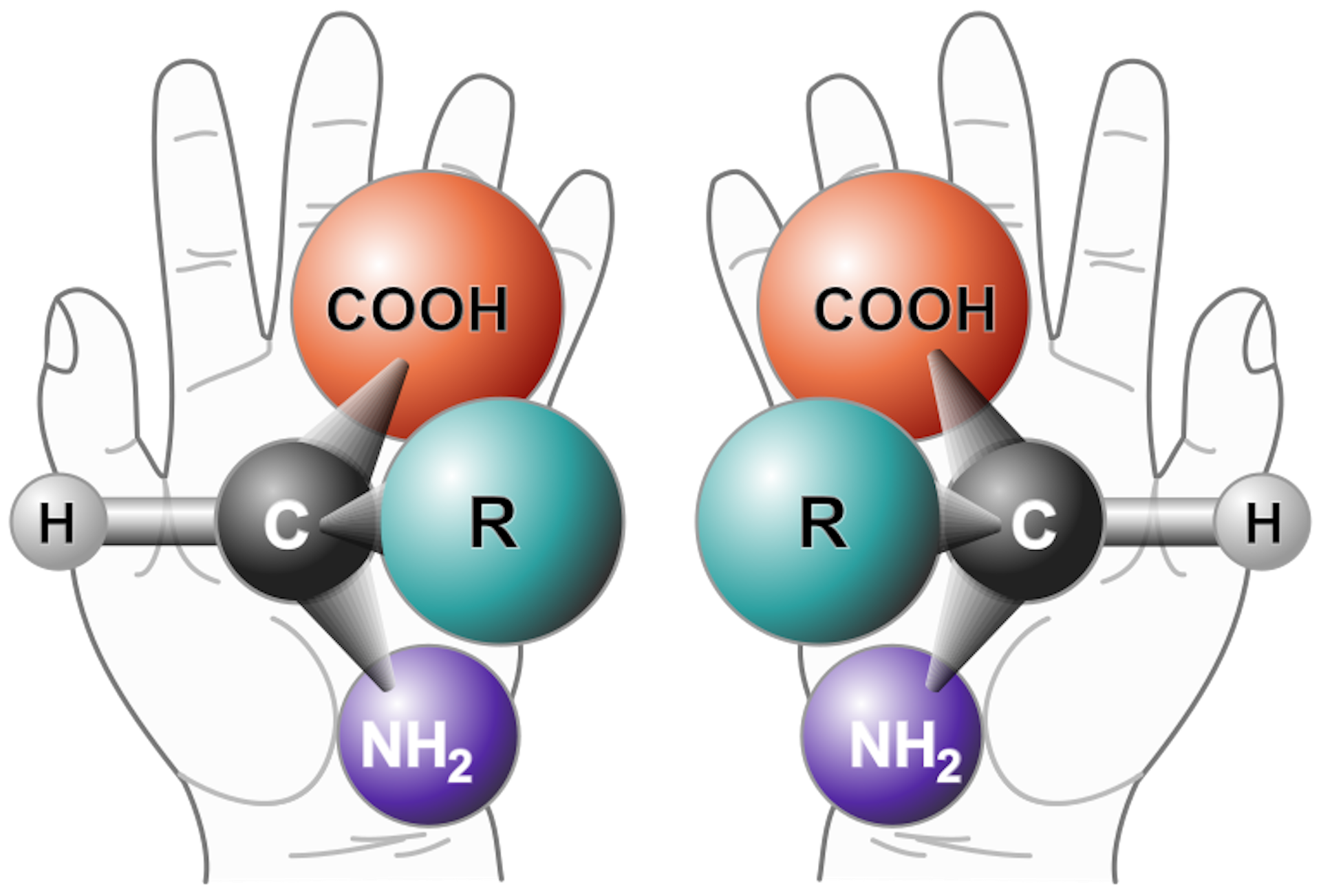
Even more surprising, these amino acids from Bennu were split almost evenly between “left-handed” and “right-handed” forms. Amino acids come in two mirror-image configurations, just like our left and right hands, called chiral forms.
On Earth, almost all biology requires the left-handed versions. If scientists had found a strong left-handed excess in Bennu, it would have suggested that life’s molecular asymmetry might have been inherited directly from space. Instead, the near-equal mixture points to a different story: Life’s left-handed preference likely emerged later, through processes on Earth, rather than being pre-imprinted in the material delivered by asteroids.
A ‘chiral’ molecule is one that is not superposable with another that is its mirror image, even if you rotate it.NASA
If space rocks can carry familiar ingredients but not the chemical “signature” that life leaves behind, then identifying the true signs of biology becomes extremely complicated.
These discoveries raise a deeper question – one that becomes more urgent as new missionstarget Mars, the Martian moons and theocean worldsof our solar system: How do researchers detect life when the chemistry alone begins to look “lifelike”? If nonliving materials can produce rich, organized mixtures of organic molecules, then the traditional signs we use to recognize biology may no longer be enough.
Asa computational scientiststudying biological signatures, I face this challenge directly. In my astrobiology work, I ask how to determine whether a collection of molecules was formed by complex geochemistry or by extraterrestrial biology, when exploring other planets.
In a new study in the journalPNAS Nexus, my colleagues and I developed a framework called LifeTracer to help answer this question. Instead of searching for a single molecule or structure that proves the presence of biology, we attempted to classify how likely mixtures of compounds preserved in rocks and meteorites were to contain traces of life by examining the full chemical patterns they contain.
Identifying potential biosignatures
The key idea behind our framework is that life produces molecules with purpose, while nonliving chemistry does not. Cells must store energy, build membranes and transmit information.Abiotic chemistryproduced by nonliving chemical processes, even when abundant, follows different rules because it is not shaped by metabolism or evolution.
Traditional biosignature approaches focus on searching for specific compounds, such as certain amino acids or lipid structures, or forchiral preferences, like left-handedness.
These signals can be powerful, but they are based entirely on the molecular patternsused by life on Earth. If weassume that alien life uses the same chemistry, we risk missing biology that is similar – but not identical – to our own, or misidentifying nonliving chemistry as a sign of life.
The Bennu results highlight this problem. The asteroid sample contained molecules familiar to life, yet nothing within it appears to have been alive.
To reduce the risk of assuming these molecules indicate life, we assembled a unique dataset of organic materials right at the dividing line between life and nonlife. We used samples from eightcarbon-rich meteoritesthat preserve abiotic chemistry from the early solar system, as well as 10 samples of soils and sedimentary materials from Earth, containing the degraded remnants of biological molecules from past or present life. Each sample contained tens of thousands of organic molecules, many present in low abundance and many whose structures could not be fully identified.
At NASA’sGoddard Space Flight Center, our team of scientists crushed each sample, added solvent and heated it to extract the organics — this process is like brewing tea. Then, we took the “tea” containing the extracted organics and passed it through two filtering columns thatseparated the complex mixture of organic molecules. Then, the organics were pushed into a chamber where we bombarded them with electrons until they broke into smaller fragments.
Traditionally, chemists use these mass fragments as puzzle pieces to reconstruct each molecular structure, but having tens of thousands of compounds in each sample presented a challenge.
LifeTracer
LifeTraceris a unique approach for data analysis: It works by taking in the fragmented puzzle pieces and analyzing them to find specific patterns, rather than reconstructing each structure.
It characterizes those puzzle pieces by their mass and two other chemical properties and then organizes them into a large matrix describing the set of molecules present in each sample. It then trains a machine learning model to distinguish between the meteorites and the terrestrial materials from Earth’s surface, based on the type of molecules present in each.
One of the most common forms of machine learning is called supervised learning. It works by taking many input and output pairs as examples and learns a rule to go from input to output. Even with only 18 samples as those examples, LifeTracer performed remarkably well. It consistently separated abiotic from biotic origins.
What mattered most to LifeTracer was not the presence of a specific molecule but the overall distribution of chemical fingerprints found in each sample. Meteorite samples tended to contain more volatile compounds – they evaporate or break apart more easily – which reflected the type of chemistry most common in the cold environment of space.
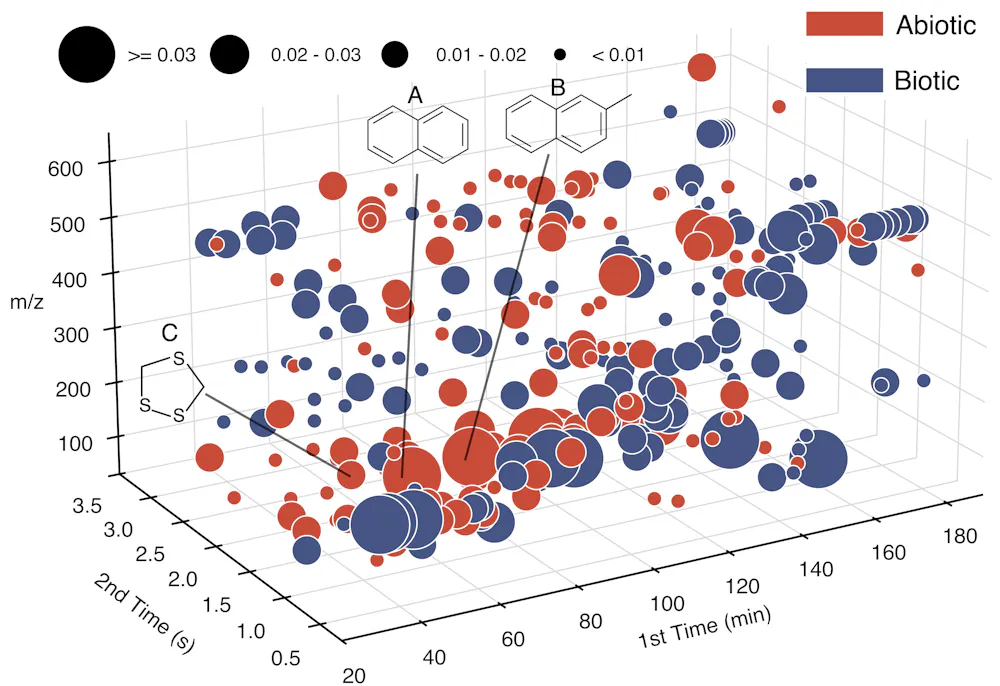
This figure shows compounds identified by LifeTracer, highlighting the most predictive molecular fragments that distinguish abiotic from biotic samples. The compounds in red are linked to abiotic chemistry, while the blue compounds are linked to biotic chemistry.Saeedi et al., 2025,CC BY-NC-ND
Some types of molecules, called polycyclic aromatic hydrocarbons, were present in both groups, but they had distinctive structural differences that the model could parse. A sulfur-containing compound, 1,2,4-trithiolane, emerged as a strong marker for abiotic samples, while terrestrial materials contained products formed through biological process.
These discoveries suggest that the contrast between life and nonlife is not defined by a single chemical clue but by how an entire suite of organic molecules is organized. By focusing on patterns rather than assumptions about which molecules life “should” use, approaches like LifeTracer open up new possibilities for evaluating samples returned frommissions to Mars,its moons Phobos and Deimos, Jupiter’s moon Europa and Saturn’s moon Enceladus.
Future samples will likely contain mixtures of organics from multiple sources, some biological and some not. Instead of relying only on a few familiar molecules, we can now assess whether the whole chemical landscape looks more like biology or random geochemistry.
LifeTracer is not a universal life detector. Rather, it provides a foundation for interpreting complex organic mixtures. The Bennu findings remind us that life-friendly chemistry may be widespread across the solar system, but that chemistry alone does not equal biology.
To tell the difference, scientists will need all the tools we can build — not only better spacecraft and instruments, but also smarter ways to read the stories written in the molecules they bring home.
By Amirali Aghazadeh, Assistant Professor of Electrical and Computer Engineering, Georgia Institute of Technology. This article is republished from The Conversation under a Creative Commons license. Read theoriginal article.
from ScienceBlogs - Where the world discusses science https://ift.tt/hSY9N3K
Can scientists detect life without knowing what it looks like?
When NASA scientists opened the sample return canister from the OSIRIS-REx asteroid sample mission in late 2023, they found something astonishing.
Dust and rock collected from the asteroid Bennu contained many of life’s building blocks, including all five nucleobases used in DNA and RNA, 14 of the 20 amino acids found in proteins, and a rich collection of other organic molecules. These are built primarily from carbon and hydrogen, and they often form the backbone of life’s chemistry.
For decades, scientists have predicted that early asteroids may have delivered the ingredients of life to Earth, and these findings seemed like promising evidence.
Even more surprising, these amino acids from Bennu were split almost evenly between “left-handed” and “right-handed” forms. Amino acids come in two mirror-image configurations, just like our left and right hands, called chiral forms.
On Earth, almost all biology requires the left-handed versions. If scientists had found a strong left-handed excess in Bennu, it would have suggested that life’s molecular asymmetry might have been inherited directly from space. Instead, the near-equal mixture points to a different story: Life’s left-handed preference likely emerged later, through processes on Earth, rather than being pre-imprinted in the material delivered by asteroids.
A ‘chiral’ molecule is one that is not superposable with another that is its mirror image, even if you rotate it.NASA
If space rocks can carry familiar ingredients but not the chemical “signature” that life leaves behind, then identifying the true signs of biology becomes extremely complicated.
These discoveries raise a deeper question – one that becomes more urgent as new missionstarget Mars, the Martian moons and theocean worldsof our solar system: How do researchers detect life when the chemistry alone begins to look “lifelike”? If nonliving materials can produce rich, organized mixtures of organic molecules, then the traditional signs we use to recognize biology may no longer be enough.
Asa computational scientiststudying biological signatures, I face this challenge directly. In my astrobiology work, I ask how to determine whether a collection of molecules was formed by complex geochemistry or by extraterrestrial biology, when exploring other planets.
In a new study in the journalPNAS Nexus, my colleagues and I developed a framework called LifeTracer to help answer this question. Instead of searching for a single molecule or structure that proves the presence of biology, we attempted to classify how likely mixtures of compounds preserved in rocks and meteorites were to contain traces of life by examining the full chemical patterns they contain.
Identifying potential biosignatures
The key idea behind our framework is that life produces molecules with purpose, while nonliving chemistry does not. Cells must store energy, build membranes and transmit information.Abiotic chemistryproduced by nonliving chemical processes, even when abundant, follows different rules because it is not shaped by metabolism or evolution.
Traditional biosignature approaches focus on searching for specific compounds, such as certain amino acids or lipid structures, or forchiral preferences, like left-handedness.
These signals can be powerful, but they are based entirely on the molecular patternsused by life on Earth. If weassume that alien life uses the same chemistry, we risk missing biology that is similar – but not identical – to our own, or misidentifying nonliving chemistry as a sign of life.
The Bennu results highlight this problem. The asteroid sample contained molecules familiar to life, yet nothing within it appears to have been alive.
To reduce the risk of assuming these molecules indicate life, we assembled a unique dataset of organic materials right at the dividing line between life and nonlife. We used samples from eightcarbon-rich meteoritesthat preserve abiotic chemistry from the early solar system, as well as 10 samples of soils and sedimentary materials from Earth, containing the degraded remnants of biological molecules from past or present life. Each sample contained tens of thousands of organic molecules, many present in low abundance and many whose structures could not be fully identified.
At NASA’sGoddard Space Flight Center, our team of scientists crushed each sample, added solvent and heated it to extract the organics — this process is like brewing tea. Then, we took the “tea” containing the extracted organics and passed it through two filtering columns thatseparated the complex mixture of organic molecules. Then, the organics were pushed into a chamber where we bombarded them with electrons until they broke into smaller fragments.
Traditionally, chemists use these mass fragments as puzzle pieces to reconstruct each molecular structure, but having tens of thousands of compounds in each sample presented a challenge.
LifeTracer
LifeTraceris a unique approach for data analysis: It works by taking in the fragmented puzzle pieces and analyzing them to find specific patterns, rather than reconstructing each structure.
It characterizes those puzzle pieces by their mass and two other chemical properties and then organizes them into a large matrix describing the set of molecules present in each sample. It then trains a machine learning model to distinguish between the meteorites and the terrestrial materials from Earth’s surface, based on the type of molecules present in each.
One of the most common forms of machine learning is called supervised learning. It works by taking many input and output pairs as examples and learns a rule to go from input to output. Even with only 18 samples as those examples, LifeTracer performed remarkably well. It consistently separated abiotic from biotic origins.
What mattered most to LifeTracer was not the presence of a specific molecule but the overall distribution of chemical fingerprints found in each sample. Meteorite samples tended to contain more volatile compounds – they evaporate or break apart more easily – which reflected the type of chemistry most common in the cold environment of space.
This figure shows compounds identified by LifeTracer, highlighting the most predictive molecular fragments that distinguish abiotic from biotic samples. The compounds in red are linked to abiotic chemistry, while the blue compounds are linked to biotic chemistry.Saeedi et al., 2025,CC BY-NC-ND
Some types of molecules, called polycyclic aromatic hydrocarbons, were present in both groups, but they had distinctive structural differences that the model could parse. A sulfur-containing compound, 1,2,4-trithiolane, emerged as a strong marker for abiotic samples, while terrestrial materials contained products formed through biological process.
These discoveries suggest that the contrast between life and nonlife is not defined by a single chemical clue but by how an entire suite of organic molecules is organized. By focusing on patterns rather than assumptions about which molecules life “should” use, approaches like LifeTracer open up new possibilities for evaluating samples returned frommissions to Mars,its moons Phobos and Deimos, Jupiter’s moon Europa and Saturn’s moon Enceladus.
Future samples will likely contain mixtures of organics from multiple sources, some biological and some not. Instead of relying only on a few familiar molecules, we can now assess whether the whole chemical landscape looks more like biology or random geochemistry.
LifeTracer is not a universal life detector. Rather, it provides a foundation for interpreting complex organic mixtures. The Bennu findings remind us that life-friendly chemistry may be widespread across the solar system, but that chemistry alone does not equal biology.
To tell the difference, scientists will need all the tools we can build — not only better spacecraft and instruments, but also smarter ways to read the stories written in the molecules they bring home.
By Amirali Aghazadeh, Assistant Professor of Electrical and Computer Engineering, Georgia Institute of Technology. This article is republished from The Conversation under a Creative Commons license. Read theoriginal article.
The Geminid meteor shower peaks all night on December 13-14, 2025. The planet Jupiter – brightest starlike object in the sky from late evening until dawn – will be near the Geminid radiant point. The waning crescent moon won’t interfere with these meteors this year. Many Geminid meteors are bright! Will any of them be as bright as Jupiter? Observe from a rural location from late evening until dawn. Have fun!
Predicted peak in 2025: is predicted** for 3 UTC on December 14 (9 p.m. CST on December 13). When to watch: Since the radiant rises in mid- to late evening, you can watch for Geminids nearly all night – from late evening until dawn – on December 13-14. The nights before and after might be good as well. Overall duration of shower: November 19 to December 24. This time period is when we’re passing through the Geminid meteor stream in space! Radiant: Rises in mid- to late evening, highest around 2 a.m. Note that, in 2025, the bright planet Jupiter is near the shower’s radiant point. See charts below. Nearest moon phase: In 2025, the last quarter moon falls at 20:52 UTC on December 11. So a waning crescent moon will rise a few hours after midnight on December 14. It’ll enhance – rather than interfere – with Geminid meteor watching this year. Expected meteors at peak, under ideal conditions: Under a dark sky with no moon, you might catch 120 Geminid meteors per hour! Note: The bold, bright – and sometimes colorful – Geminids give us one of the Northern Hemisphere’s best showers, especially in years when there’s no moon. They’re visible, at lower rates, from the Southern Hemisphere, too. The meteors are plentiful, rivaling the August Perseids, and the Geminid shower is one of the most beloved meteor showers of the year.
Diagram of the 2025 Geminid meteor shower as seen from above the Earth’s surface, looking down. Chart via Guy Ottewell’s 2025 Astronomical Calendar. Used with permission.
The Geminid meteor shower radiant point
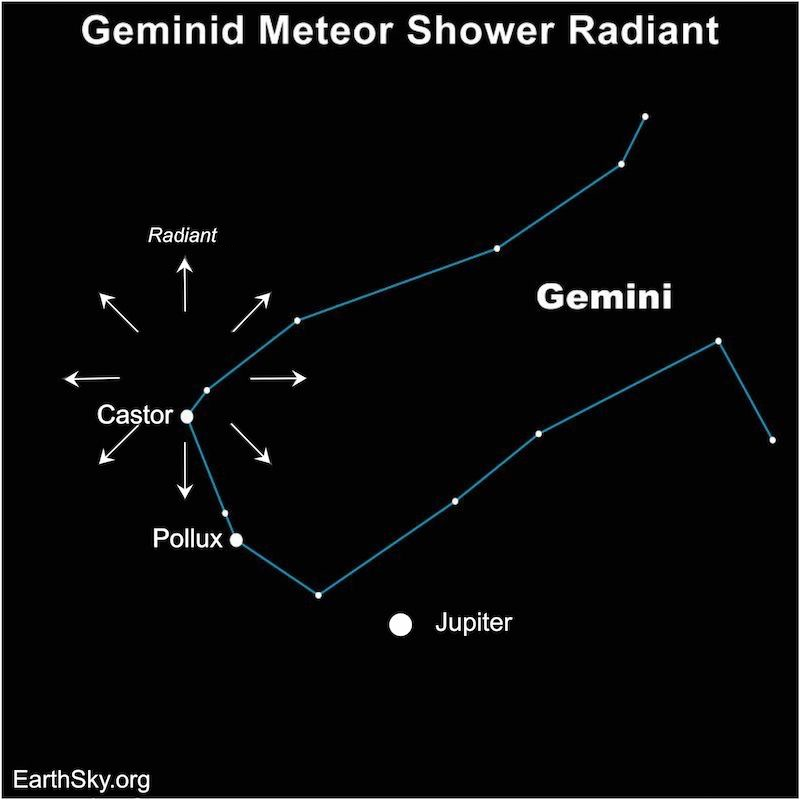
The Geminids’ radiant point nearly coincides with the bright star Castor in Gemini. That’s a chance alignment, of course, as Castor lies some 52 light-years away. Meanwhile, these meteors burn up in our world’s upper atmosphere, approximately 60 miles (100 km) above Earth’s surface.
Castor is noticeably near another bright star, the golden star Pollux of Gemini. And what’s that bright “star” on the other side of Pollux in 2025? It’s the planet Jupiter, the brightest starlike object in the December night sky.
Jupiter will let you easily picture the Geminids’ radiant point in 2025. But you don’t need to find a meteor shower’s radiant point to see the meteors. Meteors in annual showers appear in all parts of the sky. It’s even possible to have your back to the constellation Gemini and see a Geminid meteor fly by.
If you trace the path of a Geminid meteor backwards, though, you’ll find it comes from the radiant point.
Geminid meteors radiate from near the bright star Castor in the constellation Gemini the Twins, in the east on December evenings. And in 2025, the bright planet Jupiter is near the twin stars of Gemini. Chart via EarthSky.The 2025 Geminid meteor shower, seen from Earth’s surface, looking up. Image via Guy Ottewell. Used with permission.
An asteroid known as 3200 Phaethon is responsible for the Geminid meteor shower. This origin differs from most meteor showers, which result from comets, not asteroids. What’s the difference between a comet and an asteroid?
A comet is a dirty snowball, with a solid nucleus covered by a layer of ice which sublimates (turns from a solid to a gas) as the comet nears the sun. Comets are typically lightweight, with a density slightly heavier than water. They revolve around the sun in elongated orbits, going close to the sun, then going far from the sun. Seen through a telescope, a comet will show a coma, or head of the comet, as a nebulous patch of light around the nucleus, when it gets close to the sun. But when seen far from the sun, most comets appear starlike, because you see only the nucleus.
An asteroid, on the other hand, is a rock. Typically, an asteroid’s orbit is more circular than that of a comet. Through a telescope an asteroid also appears starlike.
These definitions worked well until a few decades ago. Larger telescopes began discovering asteroids far from the sun, and some of these objects, as they approached the sun, grew comas and tails, requiring the change of designation from asteroid to comet. For example, an odd object named Chiron, considered an asteroid when discovered in 1977, was reclassified as a comet in 1989 when it showed a coma. It orbits the sun every 50 years and travels from just inside the orbit of Saturn to the orbit of Uranus.
So an object initially considered an asteroid can be reclassified as a comet. Then, can the opposite occur? Can a comet be reclassified as an asteroid? Yes, it can. It is possible that a comet can shut down when its volatile materials become trapped beneath the nucleus’ surface. This is known as a dormant comet. When the comet loses all of its volatile materials, it is known as an extinct comet. The asteroid 3200 Phaethon seems to be an example of either a dormant or an extinct comet.
3200 Phaethon discovered in 1983
3200 Phaethon was discovered on images taken by IRAS (Infrared Astronomical Satellite) on October 11, 1983, by Simon Green and John Davies. Initially named 1983 TB, it was given an asteroid name, 3200 Phaethon, in 1985. After the orbit was calculated, Fred Whipple announced that this asteroid has the same orbit as the Geminid meteor shower. This was very unusual, since an asteroid had never been associated with a meteor shower. It’s still not known how material from the asteroid’s surface, or interior, is released into the meteoroid stream.
3200 Phaethon gets very close to the sun, half of the distance of the innermost planet, Mercury. Then it ventures out past the orbit of Mars. So the meteor material intersects Earth’s orbit every mid-December. Hence, the Geminid meteor shower.
The Japanese spacecraft DESTINY+ (Demonstration and Experiment of Space Technology for Interplanetary Voyage with Phaethon Flyby and Dust Science) is expected to launch in 2028 to visit this asteroid. It should arrive in the year 2030. One proposal from 2006 suggested crashing an object into 3200 Phaethon to produce an artificial meteor shower to better study the asteroid. DESTINY+, however, will not be hitting the asteroid.
Meanwhile, every year around mid-December, Earth will be passing through the stream of particles in space left behind by this asteroid. Those asteroid bits will hit our atmosphere and vaporize, and you can see them this December, and every December.
Radar images of near-Earth asteroid 3200 Phaethon generated by astronomers at the Arecibo Observatory on December 17, 2017. The 2017 encounter was the closest the asteroid will come to Earth until 2093. Image via NASA/ Wikipedia.
Geminid meteors tend to be bright
The Geminid meteor shower – always a favorite among the annual meteor showers – is expected to peak in 2025 on December 13-14. The Geminids are a reliable shower, especially for those who watch around 2 a.m. (your local time) from a dark-sky location.
We also often hear from those who see Geminid meteors in the late evening hours. Late evening is the best time to see super-bright earthgrazers. Read more about them below.
Geminid meteors tend to be bright and are often colorful. And in 2025, the bright planet Jupiter is in the sky all night, near the shower’s radiant point. Are any of the Geminids you see brighter than Jupiter?
How many meteors, when to look
The zenithal hourly rate for this shower is 120. During an optimum night for the Geminids, it’s possible to see 120 meteors – or more – per hour. Will you see that many? Maybe. On a dark night, near the peak of the shower (for all time zones), you can surely catch at least 50 or more meteors per hour.
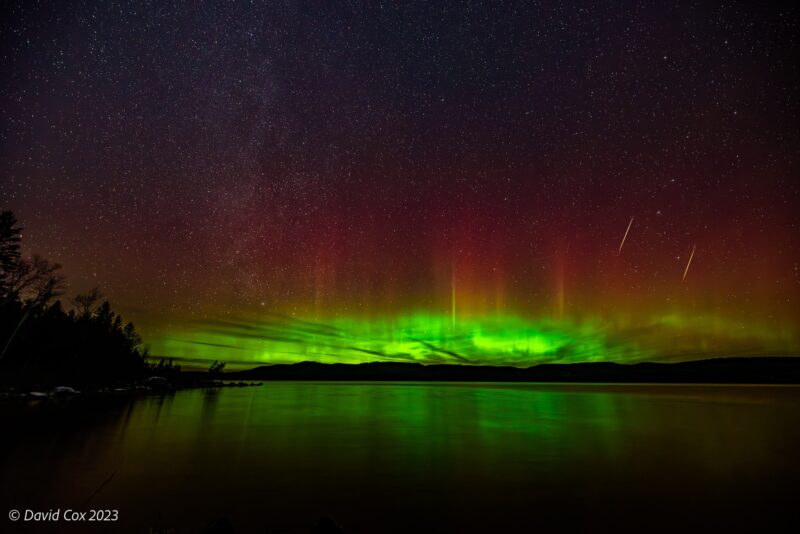
View at EarthSky Community Photos. | David Cox in Deep River, Ontario, Canada, captured these meteors and aurora on December 13-14, 2023. David wrote: “A pair of Geminid meteors on either side of the handle of the Big Dipper captured in a single 6 second exposure. A beautiful aurora was dancing for several hours as the Geminid meteors flashed.” Thank you!
Watch for earthgrazers in the evening hours
If the 2 a.m. observing time isn’t practical for you, don’t give up! Sure, you won’t see as many Geminid meteors in the early evening, when the constellation Gemini sits close to the eastern horizon, but since the radiant rises mid-evening it’s worth a try. Plus, the evening hours are the best time to try and catch an earthgrazer.
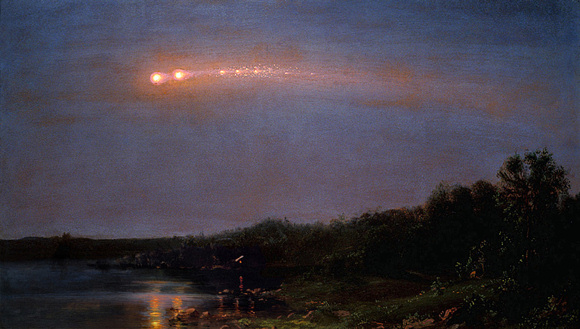
An earthgrazer is a slooow-moving, looong-lasting meteor that travels horizontally across the sky. Earthgrazers are rare but prove to be especially memorable, if you should be lucky enough to catch one.
Painting of 1860 earthgrazer fireball by Frederic Edwin Church. Image via Wikimedia Commons.
6 tips for Geminid meteor watchers
The most important thing, if you’re serious about watching meteors, is a dark, open sky.
The peak time of night for Geminids is around 2 a.m. for all parts of the globe. In 2025, a waning crescent moon will not interfere with the Geminid meteor shower.
When you’re meteor-watching, it’s good to bring along a buddy. Then the two of you can watch in different directions. When someone sees one, call out, “Meteor!” This technique will let you see more meteors than one person watching alone will see.
Be sure to give yourself at least an hour (or more) of observing time. It takes about 20 minutes for your eyes to adapt to the dark.
Be aware that meteors often come in spurts, interspersed with lulls.
Special equipment? None needed. Definitely consider a sleeping bag to stay warm. A thermos with a warm drink and a snack are always welcome. Plan to sprawl back in a hammock, lawn chair, pile of hay or blanket on the ground. Lie back in comfort, and look upward. The meteors will appear in all parts of the sky. Put your electronics away; they’ll ruin your night vision.
Geminid meteor shower photos from the EarthSky Community
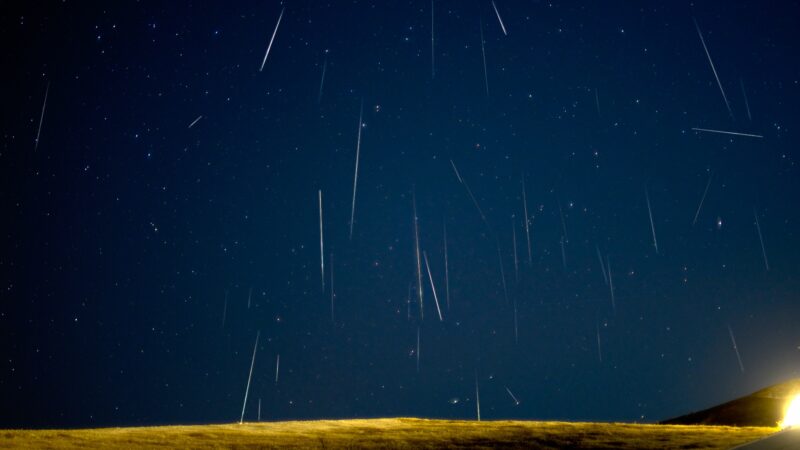
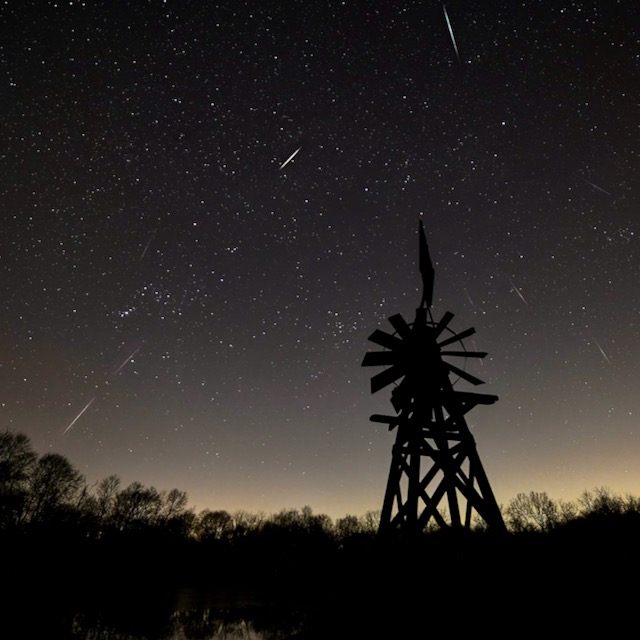
View at EarthSky Community Photos. | Tameem Altameemi of United Arab Emirates submitted this photo on December 14, 2024, and wrote: “Me and my brother decided to go to an area away from light pollution between the mountains in UAE, and despite the moonlight that filled the place, we were able to see and photograph many meteors and fireballs. A special and completely clear night. We hope that the next shower will be more fortunate.” Thank you, Tameem!View at EarthSky Community Photos. | Jan Curtis in Cheyenne, Wyoming, shared this composite image from December 14, 2023 – the morning after the Geminids’ peak – and wrote: “Despite the fog and wintery weather from December 12-14, last night was finally clear and I was able to catch the end of this year’s active Geminids. Taking 10s exposures for 10 hours, I was able to record about 69 meteors of which 42 are shown here. Bortle skies 5.0.” Thank you, Jan! Read about the Bortle scale.View at EarthSky Community Photos. | Brian Mollenkopf from Lancaster, Ohio, created this composite image with photos taken on December 14, 2023. The windmill is just in the perfect place, right under the radiant point. Nice location and image! Thank you, Brian.
Bottom line: The 2025 Geminid meteor shower peaks in a dark sky overnight on December 13-14. It’s one of the best meteor showers of the year and you can watch for them all night. Under ideal conditions, you might see over 100 meteors per hour.
**Predicted peak times and dates for meteor showers are from the American Meteor Society. Note that meteor shower peak times can vary.
The Geminid meteor shower peaks all night on December 13-14, 2025. The planet Jupiter – brightest starlike object in the sky from late evening until dawn – will be near the Geminid radiant point. The waning crescent moon won’t interfere with these meteors this year. Many Geminid meteors are bright! Will any of them be as bright as Jupiter? Observe from a rural location from late evening until dawn. Have fun!
Predicted peak in 2025: is predicted** for 3 UTC on December 14 (9 p.m. CST on December 13). When to watch: Since the radiant rises in mid- to late evening, you can watch for Geminids nearly all night – from late evening until dawn – on December 13-14. The nights before and after might be good as well. Overall duration of shower: November 19 to December 24. This time period is when we’re passing through the Geminid meteor stream in space! Radiant: Rises in mid- to late evening, highest around 2 a.m. Note that, in 2025, the bright planet Jupiter is near the shower’s radiant point. See charts below. Nearest moon phase: In 2025, the last quarter moon falls at 20:52 UTC on December 11. So a waning crescent moon will rise a few hours after midnight on December 14. It’ll enhance – rather than interfere – with Geminid meteor watching this year. Expected meteors at peak, under ideal conditions: Under a dark sky with no moon, you might catch 120 Geminid meteors per hour! Note: The bold, bright – and sometimes colorful – Geminids give us one of the Northern Hemisphere’s best showers, especially in years when there’s no moon. They’re visible, at lower rates, from the Southern Hemisphere, too. The meteors are plentiful, rivaling the August Perseids, and the Geminid shower is one of the most beloved meteor showers of the year.
Diagram of the 2025 Geminid meteor shower as seen from above the Earth’s surface, looking down. Chart via Guy Ottewell’s 2025 Astronomical Calendar. Used with permission.
The Geminid meteor shower radiant point
The Geminids’ radiant point nearly coincides with the bright star Castor in Gemini. That’s a chance alignment, of course, as Castor lies some 52 light-years away. Meanwhile, these meteors burn up in our world’s upper atmosphere, approximately 60 miles (100 km) above Earth’s surface.
Castor is noticeably near another bright star, the golden star Pollux of Gemini. And what’s that bright “star” on the other side of Pollux in 2025? It’s the planet Jupiter, the brightest starlike object in the December night sky.
Jupiter will let you easily picture the Geminids’ radiant point in 2025. But you don’t need to find a meteor shower’s radiant point to see the meteors. Meteors in annual showers appear in all parts of the sky. It’s even possible to have your back to the constellation Gemini and see a Geminid meteor fly by.
If you trace the path of a Geminid meteor backwards, though, you’ll find it comes from the radiant point.
Geminid meteors radiate from near the bright star Castor in the constellation Gemini the Twins, in the east on December evenings. And in 2025, the bright planet Jupiter is near the twin stars of Gemini. Chart via EarthSky.The 2025 Geminid meteor shower, seen from Earth’s surface, looking up. Image via Guy Ottewell. Used with permission.
An asteroid known as 3200 Phaethon is responsible for the Geminid meteor shower. This origin differs from most meteor showers, which result from comets, not asteroids. What’s the difference between a comet and an asteroid?
A comet is a dirty snowball, with a solid nucleus covered by a layer of ice which sublimates (turns from a solid to a gas) as the comet nears the sun. Comets are typically lightweight, with a density slightly heavier than water. They revolve around the sun in elongated orbits, going close to the sun, then going far from the sun. Seen through a telescope, a comet will show a coma, or head of the comet, as a nebulous patch of light around the nucleus, when it gets close to the sun. But when seen far from the sun, most comets appear starlike, because you see only the nucleus.
An asteroid, on the other hand, is a rock. Typically, an asteroid’s orbit is more circular than that of a comet. Through a telescope an asteroid also appears starlike.
These definitions worked well until a few decades ago. Larger telescopes began discovering asteroids far from the sun, and some of these objects, as they approached the sun, grew comas and tails, requiring the change of designation from asteroid to comet. For example, an odd object named Chiron, considered an asteroid when discovered in 1977, was reclassified as a comet in 1989 when it showed a coma. It orbits the sun every 50 years and travels from just inside the orbit of Saturn to the orbit of Uranus.
So an object initially considered an asteroid can be reclassified as a comet. Then, can the opposite occur? Can a comet be reclassified as an asteroid? Yes, it can. It is possible that a comet can shut down when its volatile materials become trapped beneath the nucleus’ surface. This is known as a dormant comet. When the comet loses all of its volatile materials, it is known as an extinct comet. The asteroid 3200 Phaethon seems to be an example of either a dormant or an extinct comet.
3200 Phaethon discovered in 1983
3200 Phaethon was discovered on images taken by IRAS (Infrared Astronomical Satellite) on October 11, 1983, by Simon Green and John Davies. Initially named 1983 TB, it was given an asteroid name, 3200 Phaethon, in 1985. After the orbit was calculated, Fred Whipple announced that this asteroid has the same orbit as the Geminid meteor shower. This was very unusual, since an asteroid had never been associated with a meteor shower. It’s still not known how material from the asteroid’s surface, or interior, is released into the meteoroid stream.
3200 Phaethon gets very close to the sun, half of the distance of the innermost planet, Mercury. Then it ventures out past the orbit of Mars. So the meteor material intersects Earth’s orbit every mid-December. Hence, the Geminid meteor shower.
The Japanese spacecraft DESTINY+ (Demonstration and Experiment of Space Technology for Interplanetary Voyage with Phaethon Flyby and Dust Science) is expected to launch in 2028 to visit this asteroid. It should arrive in the year 2030. One proposal from 2006 suggested crashing an object into 3200 Phaethon to produce an artificial meteor shower to better study the asteroid. DESTINY+, however, will not be hitting the asteroid.
Meanwhile, every year around mid-December, Earth will be passing through the stream of particles in space left behind by this asteroid. Those asteroid bits will hit our atmosphere and vaporize, and you can see them this December, and every December.
Radar images of near-Earth asteroid 3200 Phaethon generated by astronomers at the Arecibo Observatory on December 17, 2017. The 2017 encounter was the closest the asteroid will come to Earth until 2093. Image via NASA/ Wikipedia.
Geminid meteors tend to be bright
The Geminid meteor shower – always a favorite among the annual meteor showers – is expected to peak in 2025 on December 13-14. The Geminids are a reliable shower, especially for those who watch around 2 a.m. (your local time) from a dark-sky location.
We also often hear from those who see Geminid meteors in the late evening hours. Late evening is the best time to see super-bright earthgrazers. Read more about them below.
Geminid meteors tend to be bright and are often colorful. And in 2025, the bright planet Jupiter is in the sky all night, near the shower’s radiant point. Are any of the Geminids you see brighter than Jupiter?
How many meteors, when to look
The zenithal hourly rate for this shower is 120. During an optimum night for the Geminids, it’s possible to see 120 meteors – or more – per hour. Will you see that many? Maybe. On a dark night, near the peak of the shower (for all time zones), you can surely catch at least 50 or more meteors per hour.
View at EarthSky Community Photos. | David Cox in Deep River, Ontario, Canada, captured these meteors and aurora on December 13-14, 2023. David wrote: “A pair of Geminid meteors on either side of the handle of the Big Dipper captured in a single 6 second exposure. A beautiful aurora was dancing for several hours as the Geminid meteors flashed.” Thank you!
Watch for earthgrazers in the evening hours
If the 2 a.m. observing time isn’t practical for you, don’t give up! Sure, you won’t see as many Geminid meteors in the early evening, when the constellation Gemini sits close to the eastern horizon, but since the radiant rises mid-evening it’s worth a try. Plus, the evening hours are the best time to try and catch an earthgrazer.
An earthgrazer is a slooow-moving, looong-lasting meteor that travels horizontally across the sky. Earthgrazers are rare but prove to be especially memorable, if you should be lucky enough to catch one.
Painting of 1860 earthgrazer fireball by Frederic Edwin Church. Image via Wikimedia Commons.
6 tips for Geminid meteor watchers
The most important thing, if you’re serious about watching meteors, is a dark, open sky.
The peak time of night for Geminids is around 2 a.m. for all parts of the globe. In 2025, a waning crescent moon will not interfere with the Geminid meteor shower.
When you’re meteor-watching, it’s good to bring along a buddy. Then the two of you can watch in different directions. When someone sees one, call out, “Meteor!” This technique will let you see more meteors than one person watching alone will see.
Be sure to give yourself at least an hour (or more) of observing time. It takes about 20 minutes for your eyes to adapt to the dark.
Be aware that meteors often come in spurts, interspersed with lulls.
Special equipment? None needed. Definitely consider a sleeping bag to stay warm. A thermos with a warm drink and a snack are always welcome. Plan to sprawl back in a hammock, lawn chair, pile of hay or blanket on the ground. Lie back in comfort, and look upward. The meteors will appear in all parts of the sky. Put your electronics away; they’ll ruin your night vision.
Geminid meteor shower photos from the EarthSky Community
View at EarthSky Community Photos. | Tameem Altameemi of United Arab Emirates submitted this photo on December 14, 2024, and wrote: “Me and my brother decided to go to an area away from light pollution between the mountains in UAE, and despite the moonlight that filled the place, we were able to see and photograph many meteors and fireballs. A special and completely clear night. We hope that the next shower will be more fortunate.” Thank you, Tameem!View at EarthSky Community Photos. | Jan Curtis in Cheyenne, Wyoming, shared this composite image from December 14, 2023 – the morning after the Geminids’ peak – and wrote: “Despite the fog and wintery weather from December 12-14, last night was finally clear and I was able to catch the end of this year’s active Geminids. Taking 10s exposures for 10 hours, I was able to record about 69 meteors of which 42 are shown here. Bortle skies 5.0.” Thank you, Jan! Read about the Bortle scale.View at EarthSky Community Photos. | Brian Mollenkopf from Lancaster, Ohio, created this composite image with photos taken on December 14, 2023. The windmill is just in the perfect place, right under the radiant point. Nice location and image! Thank you, Brian.
Bottom line: The 2025 Geminid meteor shower peaks in a dark sky overnight on December 13-14. It’s one of the best meteor showers of the year and you can watch for them all night. Under ideal conditions, you might see over 100 meteors per hour.
**Predicted peak times and dates for meteor showers are from the American Meteor Society. Note that meteor shower peak times can vary.
Meet a spreading earthmoss known as Physcomitrella patens. It’s frequently used as a model organism for studies on plant evolution, development, and physiology. In this image, a reddish-brown sporophyte sits at the top center of a leafy gametophore. This capsule contains numerous spores inside. Scientists tested samples like these on the outside of the International Space Station (ISS) to see if they could tolerate the extreme airless environment. And they did. The moss survived in space for 9 months and could have lasted even longer. Image via Tomomichi Fujita/ EurekAlert! (CC BY-SA).
Space is a deadly environment, with no air, extreme temperature swings and harsh radiation. Could any life survive there?
Reasearchers in Japan tested a type of moss called spreading earthmoss on the exterior of the International Space Station.
The moss survived for nine months, and the spores were still able to reproduce when brought back to Earth.
Moss survived in space for 9 months
Can life exist in space? Not simply on other planets or moons, but in the cold, dark, airless void of space itself? Most organisms would perish almost immediately, to be sure. But researchers in Japan recently experimented with moss, with surprising results. They said on November 20, 2025, that more than 80% of their moss spores survived nine months on the outside of the International Space Station. Not only that, but when brought back to Earth, they were still capable of reproducing. Nature, it seems, is even tougher than we thought!
Amazingly, the results show that some primitive plants – not even just microorganisms – can survive long-term exposure to the extreme space environment.
The researchers published their peer-reviewed findings in the journal iScience on November 20, 2025.
A deadly environment for life
Space is a horrible place for life. The lack of air, radiation and extreme cold make it pretty much unsurvivable for life as we know it. As lead author Tomomichi Fujita at Hokkaido University in Japan stated:
Most living organisms, including humans, cannot survive even briefly in the vacuum of space. However, the moss spores retained their vitality after nine months of direct exposure. This provides striking evidence that the life that has evolved on Earth possesses, at the cellular level, intrinsic mechanisms to endure the conditions of space.
This #moss survived 9 months directly exposed to the vacuum space and could still reproduce after returning to Earth. ? ? spkl.io/63322AdFrpTomomichi Fujita & colleagues@cp-iscience.bsky.social
Researchers wanted to see if any Earthly life could survive in space’s deadly environment for the long term. To find out, they decided to do some experiments with a type of moss called spreading earthmoss, or Physcomitrium patens. The researchers sent hundreds of sporophytes – encapsulated moss spores – to the International Space Station in March 2022, aboard the Cygnus NG-17 spacecraft. They attached the sporophyte samples to the outside of the ISS, where they were exposed to the vacuum of space for 283 days.
By doing so, the samples were subjected to high levels of UV (ultraviolet) radiation and extreme swings of temperature. The samples later returned to Earth in January 2023.
The researchers tested three parts of the moss. These were the protonemata, or juvenile moss; brood cells, or specialized stem cells that emerge under stress conditions; and the sporophytes. Fujita said:
We anticipated that the combined stresses of space, including vacuum, cosmic radiation, extreme temperature fluctuations and microgravity, would cause far greater damage than any single stress alone.
Astronauts placed the moss samples on the outside of the International Space Station for the 9-month-long experiment. Incredibly, more than 80% of the the encapsulated spores survived the trip to space and back to Earth. Image via NASA/ Roscosmos.
The moss survived!
So, how did the moss do? The results were mixed, but overall showed that the moss could survive in space. The radiation was the most difficult aspect of the space environment to withstand. The sporophytes were the most resilient. Incredibly, they were able to survive and germinate after being exposed to -196 degrees Celsius (-320 degrees Fahrenheit) for more than a week. At the other extreme, they also survived in 55° degrees C (131 degrees F) heat for a month.
Some brood cells survived as well, but the encased spores were about 1,000 times more tolerant to the UV radiation.
On the other hand, none of the juvenile moss survived the high UV levels or the extreme temperatures.
Samples of moss spores that germinated after their 9-month exposure to space. Image via Dr. Chang-hyun Maeng/ Maika Kobayashi/ EurekAlert!. (CC BY-SA).
How did the spores survive?
So why did the encapsulated spores do so well? The researchers said the natural structure surrounding the spore itself helps to protect the spore. Essentially, it absorbs the UV radiation and surrounds the inner spore both physically and chemically to prevent damage.
As it turns out, this might be associated with the evolution of mosses. This is an adaptation that helped bryophytes – the group of plants to which mosses belong – to make the transition from aquatic to terrestrial plants 500 million years ago.
Overall, more than 80% of the spores survived the journey to space and then back to Earth. And only 11% were unable to germinate after being brought back to the lab on Earth. That’s impressive!
In addition, the researchers also tested the levels of chlorophyll in the spores. After the exposure to space, the spores still had normal amounts of chlorophyll, except for chlorophyll a specifically. In that case, there was a 20% reduction. Chlorophyll a is used in oxygenic photosynthesis. It absorbs the most energy from wavelengths of violet-blue and orange-red light.
The time available for the experiment was limited to the several months. However, the researchers wondered if the moss spores could have survived even longer. And using mathematical models, they determined the spores would likely have continued to live in space for about 15 years, or 5,600 days, altogether. The researchers note this prediction is a rough estimate. More data would still be needed to make that assessment even more accurate.
So the results show just how resilient moss is, and perhaps some other kinds of life, too. Fujita said:
This study demonstrates the astonishing resilience of life that originated on Earth.
Ultimately, we hope this work opens a new frontier toward constructing ecosystems in extraterrestrial environments such as the moon and Mars. I hope that our moss research will serve as a starting point.
Bottom line: In an experiment on the outside of the International Space Station, a species of moss survived in space for nine months. And it could have lasted much longer.
Meet a spreading earthmoss known as Physcomitrella patens. It’s frequently used as a model organism for studies on plant evolution, development, and physiology. In this image, a reddish-brown sporophyte sits at the top center of a leafy gametophore. This capsule contains numerous spores inside. Scientists tested samples like these on the outside of the International Space Station (ISS) to see if they could tolerate the extreme airless environment. And they did. The moss survived in space for 9 months and could have lasted even longer. Image via Tomomichi Fujita/ EurekAlert! (CC BY-SA).
Space is a deadly environment, with no air, extreme temperature swings and harsh radiation. Could any life survive there?
Reasearchers in Japan tested a type of moss called spreading earthmoss on the exterior of the International Space Station.
The moss survived for nine months, and the spores were still able to reproduce when brought back to Earth.
Moss survived in space for 9 months
Can life exist in space? Not simply on other planets or moons, but in the cold, dark, airless void of space itself? Most organisms would perish almost immediately, to be sure. But researchers in Japan recently experimented with moss, with surprising results. They said on November 20, 2025, that more than 80% of their moss spores survived nine months on the outside of the International Space Station. Not only that, but when brought back to Earth, they were still capable of reproducing. Nature, it seems, is even tougher than we thought!
Amazingly, the results show that some primitive plants – not even just microorganisms – can survive long-term exposure to the extreme space environment.
The researchers published their peer-reviewed findings in the journal iScience on November 20, 2025.
A deadly environment for life
Space is a horrible place for life. The lack of air, radiation and extreme cold make it pretty much unsurvivable for life as we know it. As lead author Tomomichi Fujita at Hokkaido University in Japan stated:
Most living organisms, including humans, cannot survive even briefly in the vacuum of space. However, the moss spores retained their vitality after nine months of direct exposure. This provides striking evidence that the life that has evolved on Earth possesses, at the cellular level, intrinsic mechanisms to endure the conditions of space.
This #moss survived 9 months directly exposed to the vacuum space and could still reproduce after returning to Earth. ? ? spkl.io/63322AdFrpTomomichi Fujita & colleagues@cp-iscience.bsky.social
Researchers wanted to see if any Earthly life could survive in space’s deadly environment for the long term. To find out, they decided to do some experiments with a type of moss called spreading earthmoss, or Physcomitrium patens. The researchers sent hundreds of sporophytes – encapsulated moss spores – to the International Space Station in March 2022, aboard the Cygnus NG-17 spacecraft. They attached the sporophyte samples to the outside of the ISS, where they were exposed to the vacuum of space for 283 days.
By doing so, the samples were subjected to high levels of UV (ultraviolet) radiation and extreme swings of temperature. The samples later returned to Earth in January 2023.
The researchers tested three parts of the moss. These were the protonemata, or juvenile moss; brood cells, or specialized stem cells that emerge under stress conditions; and the sporophytes. Fujita said:
We anticipated that the combined stresses of space, including vacuum, cosmic radiation, extreme temperature fluctuations and microgravity, would cause far greater damage than any single stress alone.
Astronauts placed the moss samples on the outside of the International Space Station for the 9-month-long experiment. Incredibly, more than 80% of the the encapsulated spores survived the trip to space and back to Earth. Image via NASA/ Roscosmos.
The moss survived!
So, how did the moss do? The results were mixed, but overall showed that the moss could survive in space. The radiation was the most difficult aspect of the space environment to withstand. The sporophytes were the most resilient. Incredibly, they were able to survive and germinate after being exposed to -196 degrees Celsius (-320 degrees Fahrenheit) for more than a week. At the other extreme, they also survived in 55° degrees C (131 degrees F) heat for a month.
Some brood cells survived as well, but the encased spores were about 1,000 times more tolerant to the UV radiation.
On the other hand, none of the juvenile moss survived the high UV levels or the extreme temperatures.
Samples of moss spores that germinated after their 9-month exposure to space. Image via Dr. Chang-hyun Maeng/ Maika Kobayashi/ EurekAlert!. (CC BY-SA).
How did the spores survive?
So why did the encapsulated spores do so well? The researchers said the natural structure surrounding the spore itself helps to protect the spore. Essentially, it absorbs the UV radiation and surrounds the inner spore both physically and chemically to prevent damage.
As it turns out, this might be associated with the evolution of mosses. This is an adaptation that helped bryophytes – the group of plants to which mosses belong – to make the transition from aquatic to terrestrial plants 500 million years ago.
Overall, more than 80% of the spores survived the journey to space and then back to Earth. And only 11% were unable to germinate after being brought back to the lab on Earth. That’s impressive!
In addition, the researchers also tested the levels of chlorophyll in the spores. After the exposure to space, the spores still had normal amounts of chlorophyll, except for chlorophyll a specifically. In that case, there was a 20% reduction. Chlorophyll a is used in oxygenic photosynthesis. It absorbs the most energy from wavelengths of violet-blue and orange-red light.
The time available for the experiment was limited to the several months. However, the researchers wondered if the moss spores could have survived even longer. And using mathematical models, they determined the spores would likely have continued to live in space for about 15 years, or 5,600 days, altogether. The researchers note this prediction is a rough estimate. More data would still be needed to make that assessment even more accurate.
So the results show just how resilient moss is, and perhaps some other kinds of life, too. Fujita said:
This study demonstrates the astonishing resilience of life that originated on Earth.
Ultimately, we hope this work opens a new frontier toward constructing ecosystems in extraterrestrial environments such as the moon and Mars. I hope that our moss research will serve as a starting point.
Bottom line: In an experiment on the outside of the International Space Station, a species of moss survived in space for nine months. And it could have lasted much longer.