
Killer whales and dolphins hunt together in a rare alliance
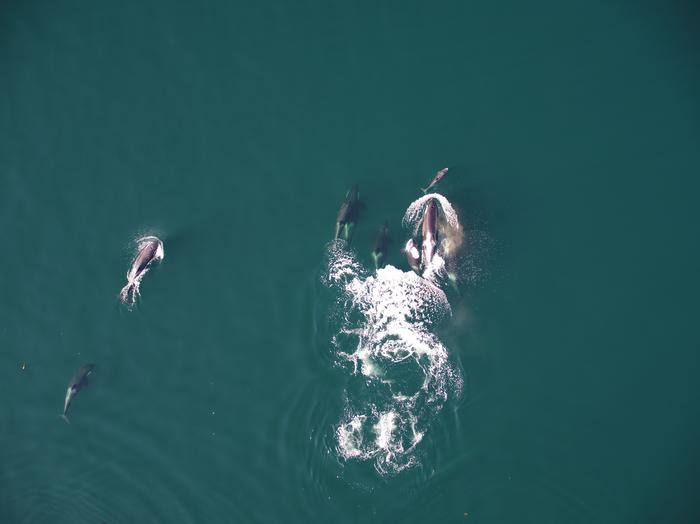
For the first time, researchers have documented killer whales and dolphins cooperatively hunting together. Researchers from the University of British Columbia said on December 11, 2025, that they observed the killer whales and dolphins during fieldwork in the waters off British Columbia, Canada, in August 2020. It’s the first confirmed scientific evidence of these two species working together during foraging. And it’s a remarkable example of inter-species teamwork in the wild.
Sarah Fortune of the University of British Columbia led the groundbreaking study. The researchers published their study in the peer-reviewed journal Scientific Reports on December 11, 2025.
From coexistence to collaboration
Marine biologists have long seen Pacific white-sided dolphins swimming close to killer whales in the waters off British Columbia. Until now, scientists lacked proof that the animals collaborated rather than merely tolerated each other. Fortune’s team tracked movements, recorded underwater video and acoustic signals and flew aerial drones to examine how the species interacted while searching for prey.
Scientists recorded these species underwater and from the air. In this video, you can see how the killer whales change their direction to follow the dolphins. And the dolphins look back to make sure the killer whales are following them. Video via Sarah Fortune et al.
Tracking orca movements and dolphin signals
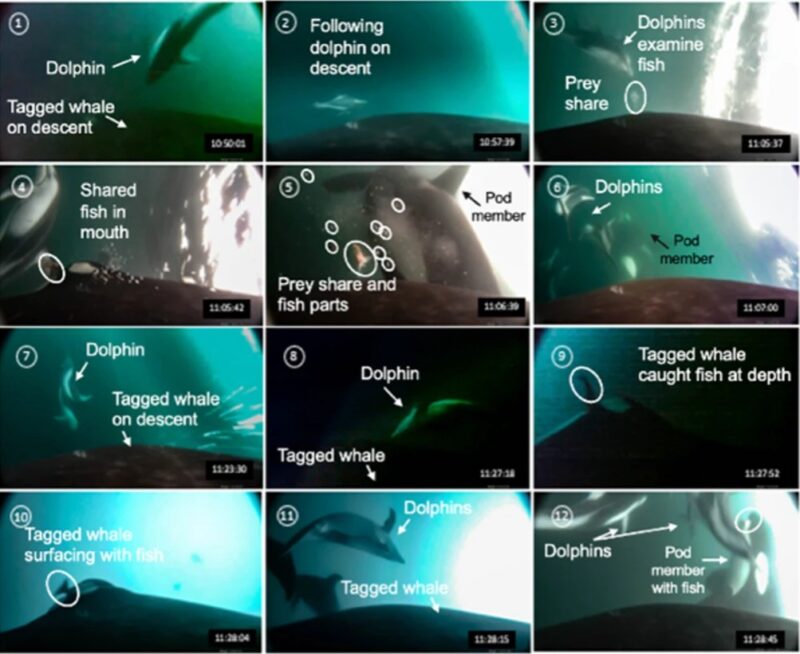
The researchers followed nine northern resident killer whales, a population known for strong social bonds and a reliance on salmon. They observed 25 instances in which these killer whales changed course after encountering Pacific white-sided dolphins and then followed them on foraging dives. The researchers suggested that killer whales may quiet their own vocalizations to listen for the dolphins’ echolocation clicks, which could help them detect Chinook salmon (Oncorhynchus tshawytscha), a prey too large for dolphins to capture and swallow whole.
During the same observation period, the researchers documented eight cases of killer whales catching, eating and sharing Chinook salmon with other killer whales, while dolphins were present for four of these events. In one notable instance, dolphins scavenged the remains of an adult salmon that the killer whales had broken into smaller pieces, which the authors interpreted as intentional prey sharing rather than random scavenging.
These observations suggest killer whales might actively coordinate their hunting with dolphins. They use the dolphins’ sonar to improve prey detection, while dolphins gain access to food scraps too large for them to catch alone. The absence of aggression between the species further supports the idea of inter-species cooperation.
Dolphins use echolocation to find fish. Killer whales follow the dolphins, who lead them to the salmon (a treat for the killer whales). Video via Sarah Fortune et al.
Why cooperation benefits both killer whales and dolphins
The researchers suggested that the partnership benefits both animals. Killer whales gain improved prey detection, while dolphins gain access to food scraps and may also gain some protection from transient orca groups. The authors stressed the need for future studies to determine how often and how consistently this behavior occurs.
Whales and dolphins: A broader pattern of intelligence and play
This collaboration fits into a larger pattern of whale intelligence and social flexibility. Humpback whales, for example, blow bubble rings, a behavior many scientists interpret as a possible way to communicate with humans.
Read more: Humpback whales communicate with us using “smoke” rings
Humpbacks also use highly coordinated hunting strategies such as bubble-net feeding, in which groups trap fish inside bubble nets. Scientists consider this a “tool” that humpbacks use because of how they manipulate it to their purposes.
Read more: Humpback whales manufacture and wield tools
Beyond hunting, humpback whales frequently engage in playful interactions with dolphins, including synchronized swimming, breaching and gentle physical contact. These observations suggest that complex social curiosity may occur across whales and dolphins more broadly.
Read more: Do whales and dolphins play together? Images and video here
What this discovery means for ocean science
The newly documented partnership between killer whales and Pacific white-sided dolphins demonstrates a level of cooperation that scientists rarely observe between apex predators and smaller marine mammals. As researchers continue to study these interactions, they may uncover even more examples of collaboration in the ocean, thus reshaping how we understand marine ecosystems and the intelligence of the animals that inhabit them.
Bottom line: Killer whales and dolphins have been observed hunting together, sharing prey and skills in a rare and remarkable display of inter-species cooperation.
Source: Cooperative foraging between dolphins and fish-eating killer whales
Read more: Killer whales make tools to scratch each other’s backs
Read more: Killer whales take 1 breath between dives
The post Killer whales and dolphins hunt together in a rare alliance first appeared on EarthSky.
from EarthSky https://ift.tt/BisDCl3
Killer whales and dolphins hunt together in a rare alliance
For the first time, researchers have documented killer whales and dolphins cooperatively hunting together. Researchers from the University of British Columbia said on December 11, 2025, that they observed the killer whales and dolphins during fieldwork in the waters off British Columbia, Canada, in August 2020. It’s the first confirmed scientific evidence of these two species working together during foraging. And it’s a remarkable example of inter-species teamwork in the wild.
Sarah Fortune of the University of British Columbia led the groundbreaking study. The researchers published their study in the peer-reviewed journal Scientific Reports on December 11, 2025.
From coexistence to collaboration
Marine biologists have long seen Pacific white-sided dolphins swimming close to killer whales in the waters off British Columbia. Until now, scientists lacked proof that the animals collaborated rather than merely tolerated each other. Fortune’s team tracked movements, recorded underwater video and acoustic signals and flew aerial drones to examine how the species interacted while searching for prey.
Scientists recorded these species underwater and from the air. In this video, you can see how the killer whales change their direction to follow the dolphins. And the dolphins look back to make sure the killer whales are following them. Video via Sarah Fortune et al.
Tracking orca movements and dolphin signals
The researchers followed nine northern resident killer whales, a population known for strong social bonds and a reliance on salmon. They observed 25 instances in which these killer whales changed course after encountering Pacific white-sided dolphins and then followed them on foraging dives. The researchers suggested that killer whales may quiet their own vocalizations to listen for the dolphins’ echolocation clicks, which could help them detect Chinook salmon (Oncorhynchus tshawytscha), a prey too large for dolphins to capture and swallow whole.
During the same observation period, the researchers documented eight cases of killer whales catching, eating and sharing Chinook salmon with other killer whales, while dolphins were present for four of these events. In one notable instance, dolphins scavenged the remains of an adult salmon that the killer whales had broken into smaller pieces, which the authors interpreted as intentional prey sharing rather than random scavenging.
These observations suggest killer whales might actively coordinate their hunting with dolphins. They use the dolphins’ sonar to improve prey detection, while dolphins gain access to food scraps too large for them to catch alone. The absence of aggression between the species further supports the idea of inter-species cooperation.
Dolphins use echolocation to find fish. Killer whales follow the dolphins, who lead them to the salmon (a treat for the killer whales). Video via Sarah Fortune et al.
Why cooperation benefits both killer whales and dolphins
The researchers suggested that the partnership benefits both animals. Killer whales gain improved prey detection, while dolphins gain access to food scraps and may also gain some protection from transient orca groups. The authors stressed the need for future studies to determine how often and how consistently this behavior occurs.
Whales and dolphins: A broader pattern of intelligence and play
This collaboration fits into a larger pattern of whale intelligence and social flexibility. Humpback whales, for example, blow bubble rings, a behavior many scientists interpret as a possible way to communicate with humans.
Read more: Humpback whales communicate with us using “smoke” rings
Humpbacks also use highly coordinated hunting strategies such as bubble-net feeding, in which groups trap fish inside bubble nets. Scientists consider this a “tool” that humpbacks use because of how they manipulate it to their purposes.
Read more: Humpback whales manufacture and wield tools
Beyond hunting, humpback whales frequently engage in playful interactions with dolphins, including synchronized swimming, breaching and gentle physical contact. These observations suggest that complex social curiosity may occur across whales and dolphins more broadly.
Read more: Do whales and dolphins play together? Images and video here
What this discovery means for ocean science
The newly documented partnership between killer whales and Pacific white-sided dolphins demonstrates a level of cooperation that scientists rarely observe between apex predators and smaller marine mammals. As researchers continue to study these interactions, they may uncover even more examples of collaboration in the ocean, thus reshaping how we understand marine ecosystems and the intelligence of the animals that inhabit them.
Bottom line: Killer whales and dolphins have been observed hunting together, sharing prey and skills in a rare and remarkable display of inter-species cooperation.
Source: Cooperative foraging between dolphins and fish-eating killer whales
Read more: Killer whales make tools to scratch each other’s backs
Read more: Killer whales take 1 breath between dives
The post Killer whales and dolphins hunt together in a rare alliance first appeared on EarthSky.
from EarthSky https://ift.tt/BisDCl3

Aucun commentaire:
Enregistrer un commentaire