
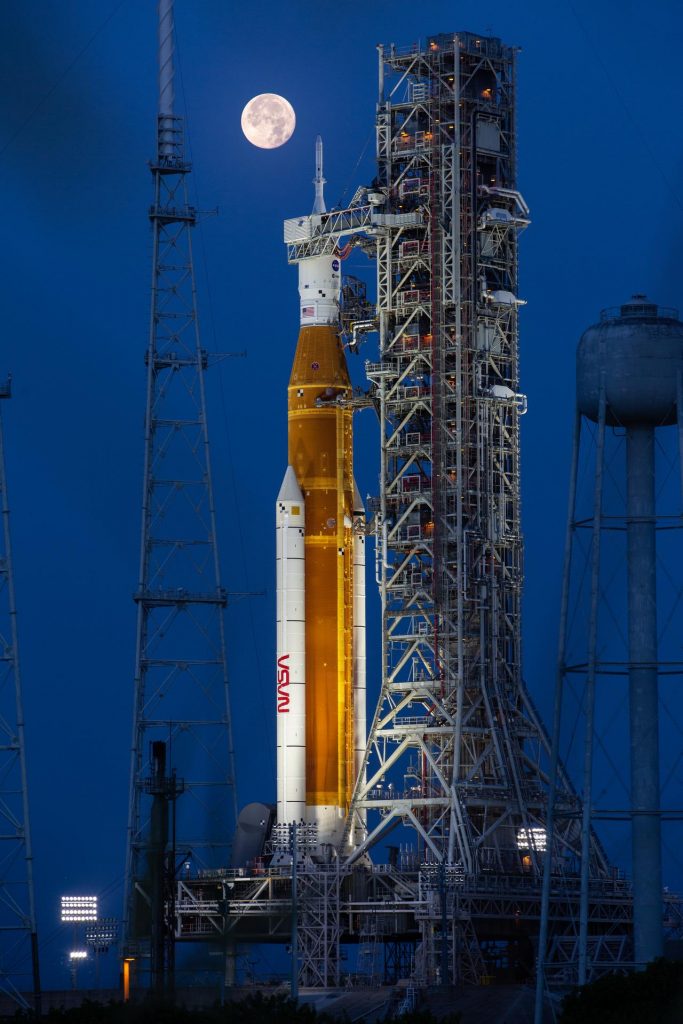
NASA schedules nighttime launch for Artemis 1
NASA’s mission controllers have set yet another new launch date – 12:07 a.m. ET (04:07 UTC) on November 14, 2022, from Kennedy Space Center in Florida – for the frequently delayed Artemis 1 lunar mission and humanity’s return to the moon. In what should present a spectacular light show if the weather allows, the latest attempt at a liftoff will be a fiery nighttime try.
NASA announced the update to the launch time and date – which presents a 69-minute launch window – via its blog. The agency said SLS is essentially still ready to fly following the most recent launch abort. The moonship is currently in the Vehicle Assembly Building, where it will undergo a minor makeover and a bit of primping prior to flight.
The rollout back to Launch Complex 39B is planned for early next month, NASA said:
Teams will perform standard maintenance to repair minor damage to the foam and cork on the thermal protection system and recharge or replace batteries on the rocket, several secondary payloads, and the flight termination system. The agency plans to roll the rocket back to the launch pad as early as Friday, November 4.
Should NASA stand down on November 14, there are two backup dates planned. Both are also nighttime launches:
NASA has requested backup launch opportunities for Wednesday, November 16, at 1:04 a.m. and Saturday, November 19, at 1:45 a.m., which are both two-hour launch windows. A launch on November 14 would result in a mission duration of about 25-and-a-half days with a splashdown in the Pacific Ocean Friday, December 9.
Moonship safe as Ian strikes land
The launch of Artemis 1 faced another major delay in the early autumn. The lunar mission was scheduled to fly on September 27, a launch date that was canceled as Tropical Storm Ian approached. Then, on Sunday, Ian rapidly intensified to hurricane strength. Its winds have now reached upper Category 4 strength of up to 155 mph (250 kph).
NASA said a skeleton crew remains with the rocketship, babysitting the vehicle while it weathers the storm safely inside the VAB:
As part of NASA’s hurricane preparedness protocol, a “ride out” team will remain in a safe location at Kennedy throughout the storm to monitor centerwide conditions. After the storm passes, they will conduct an assessment of facilities, property, and equipment. Once it is safe for additional employees to return to Kennedy, engineers will extend platforms to establish access to the rocket and spacecraft.
Keeping Artemis and Space Launch System Safe
Forecasters expect Ian to move up the Gulf Coast of Florida. And Kennedy Space Center is across the state, on the Atlantic coast. But Ian is likely to cut across Florida at some point. And no one can blame NASA for playing it safe with its Space Launch System rocket and space capsule, whose development has cost billions. Merritt Island, where KSC is located, is under six National Weather Service watches and warnings, including a tornado watch, as of 1 p.m. ET (17:00 UTC).
The space agency also reassured the public that an incident that set off a fire alarm at the VAB not long after the arrival of the moonship there on Tuesday never threatened the rocket or Artemis 1 staff.
The [alarm] came when an arc flash event occurred at a connector on an electrical panel in High Bay 3. A spark landed on a rope marking the boundary of the work area. The rope began to smolder, workers pulled the alarm, and employees evacuated the building safely.
No one was injured during the incident, and the Artemis 1 rocket and the Orion spacecraft were never at risk.
Safety precautions started early at KSC
In fact, the ship’s handlers have been prepping the SLS for a rollback to the VAB since last week’s decision not to launch on September 27. Officials delayed rollback as long as possible to keep the chance of launching on October 2 open.
That option is now off the table.
Moving the SLS back to the VAB is no easy task, either. According to Eric Berger, senior space editor at Ars Technica, NASA can only move the SLS to the VAB one last time, following today’s maneuvering.
And Florida’s governor declared a State of Emergency there in advance of the storm.
Due to weather predictions related to Hurricane Ian, @NASA teams will roll the #Artemis I @NASA_SLS rocket and @NASA_Orion spacecraft back to the Vehicle Assembly Building at @NASAKennedy.
First motion is targeted for 11 pm ET tonight: https://t.co/Bx7oanmpa4 pic.twitter.com/wwPds84R36
— NASA Artemis (@NASAArtemis) September 26, 2022
Rescheduling the launch date, again
After a successful cryogenic demonstration test performed on Wednesday (September 21), NASA said all systems were go for the launch attempt on Tuesday, September 27. But the weather had other plans. During a mission briefing on Friday (September 23), NASA manager Mike Bolger said:
By Wednesday night, we started turning our attention to moving forward toward that launch, and we realized that one of the things we’re going to have to pay attention to is the weather. So since then we’ve been keeping a close eye on [what was then] called Tropical Depression Number Nine [now Tropical Storm Ian].
NASA had planned to squeeze Artemis between two other ongoing missions. The first is the DART asteroid impact, which will monopolize the Deep Space Network when it impacts the asteroid Didymos B later today (September 26). And the second is the launch of the SpaceX Crew-5 mission to the International Space Station in early October. That mission has been delayed as well.
Scrub-a-dub-dub
There’ve been several scrubs of the Artemis 1 launch already, in late August and early September.
Get updates on Artemis 1 via NASA’s Artemis blog
“We’ll go when it’s ready.” NASA Administrator @SenBillNelson remarks on the Sept. 3 launch attempt of the #Artemis I flight test to the Moon. Updates are expected from the team as early as 4pm ET (20:00 UTC). https://t.co/dMVnvEQcfC pic.twitter.com/ClBhVRexLs
— NASA (@NASA) September 3, 2022
Frustrated at yet another scrub, the crowds head home from Kennedy. #Artemis1 pic.twitter.com/xDiVcu4rFC
— Jonathan Amos (@BBCAmos) September 3, 2022
Artemisn’t
— b1joe (@b1joe) August 29, 2022
The Artemis 1 story so far …
In case you haven’t been following it … Artemis 1 is the first of three missions planned to send humans back to the moon by the middle of this decade. And wow! It’s exciting. And difficult. Artemis 1 has all the dazzle of the earlier race to the moon in the 1960s … a giant rocket, with powerful thrust … an unmatched element of daring. It’s a big undertaking.
Of course, spaceflight fans are disappointed by the failure to launch so far. But many tempered their upset with good humor. And, as NASA officials said on September 3:
We won’t launch until we’re ready.
What Artemis 1 will do
Artemis 1’s objective is partly to test NASA’s Space Launch System – aka SLS – a vehicle comparable to the great Saturn V that carried the first astronauts to the moon in the Apollo program of the ’60s and ’70s.
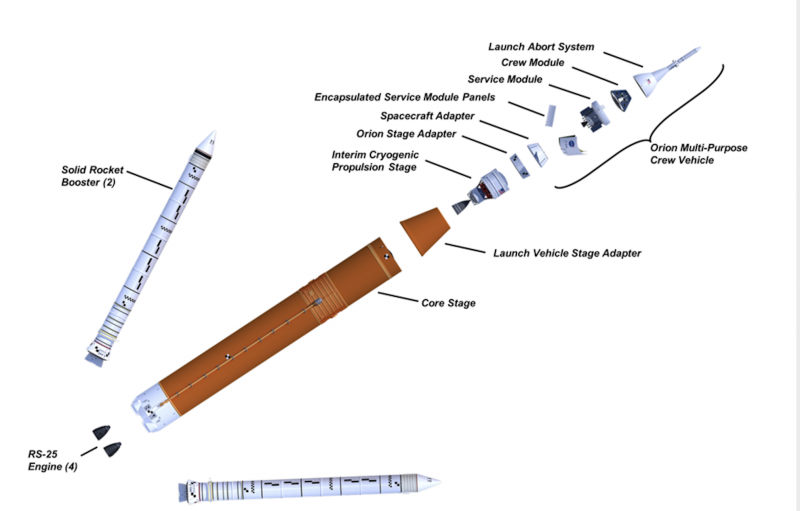
SLS is far more advanced than the Saturn V, technologically. But its main purpose is thrust. SLS will produce 8.8 million pounds (3.9 million kg) of thrust during liftoff and ascent, 15% more than the Saturn V. It’ll need that much thrust to loft a vehicle weighing nearly 6 million pounds (2.7 million kg) to orbit. Propelled by a pair of five-segment boosters and four RS-25 engines, the rocket will reach the period of greatest atmospheric force within 90 seconds, NASA says. After jettisoning its boosters, service module panels, and launch abort system, the core stage engines will shut down. At that point, the core stage will separate from the Orion spacecraft.
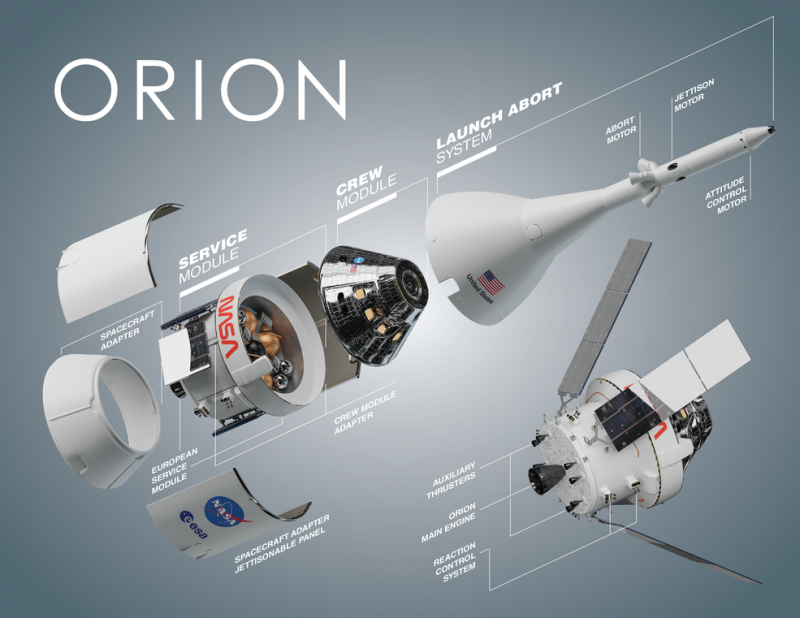
The Orion moonship is known officially as the Orion Multi-Purpose Crew Vehicle or Orion MPCV. It’ll go to Earth orbit atop SLS following launch. There, it’ll deploy its solar arrays and the Interim Cryogenic Propulsion Stage (ICPS) that’ll give the craft the big push needed to leave Earth’s orbit and travel toward the moon.
Not Orion’s first voyage
Orion already underwent an Earth-orbiting test in 2014, so this isn’t its first voyage to space. But it is its first trip to the moon, and it’ll get there via propulsion by a service module provided by the European Space Agency. The service module will supply the spacecraft’s main propulsion system and power (as well as house air and water for astronauts on future missions).
Orion’s mission
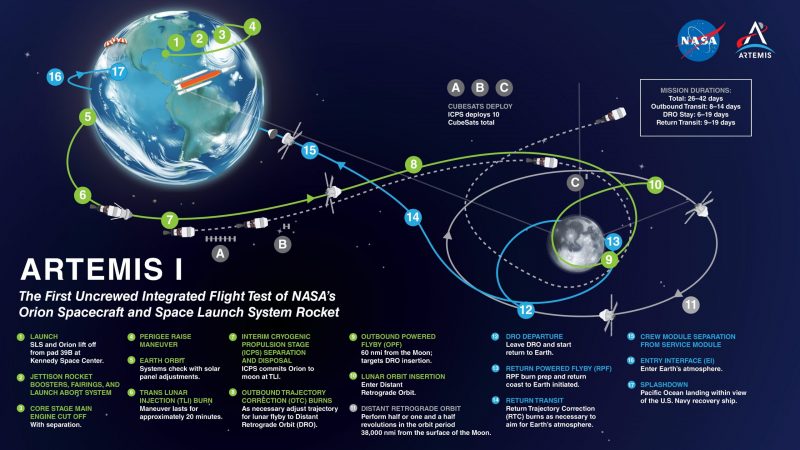
Orion will fly as close to the moon’s surface as about 62 miles (100 km). It’ll use the moon’s gravity to propel itself into an orbit about 40,000 miles (70,000 km) from the moon.
The spacecraft will stay in that orbit for about six days, collecting data. During that time, mission controllers will assess its performance. Then it’ll perform a second close flyby of the moon, coming within about 60 miles (100 km). Another precisely timed engine firing of the European-provided service module – in combination with the moon’s gravity – will accelerate the moonship back toward Earth. It’ll enter our planet’s atmosphere traveling at 25,000 mph (11 km/second), producing temperatures of approximately 5,000 degrees Fahrenheit (2,760 degrees Celsius). So it’ll go faster – and get hotter – than during its 2014 flight test.
In all, the mission will last about a month and travel a distance of 1.3 million miles. It’s expected to make a precision landing within eyesight of the recovery ship off the coast of San Diego, California.
What’s in the crew capsule?
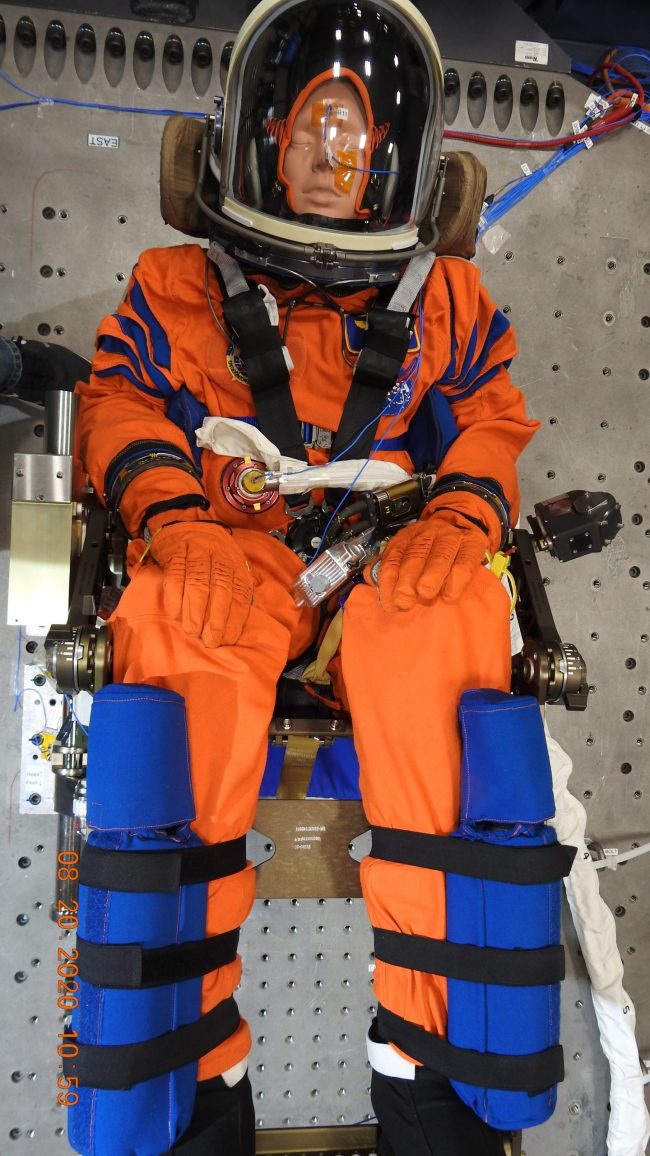
The Orion moonship won’t have a human crew during Artemis 1. Instead, a mannequin dressed in a bright orange spacesuit known as the Orion Crew Survival System will occupy the commander’s seat. NASA says the special suit is:
… designed for a custom fit and equipped with technology features to help protect astronauts on launch day, in emergency situations, throughout high-risk parts of missions near the moon, and during the high-speed return to Earth.
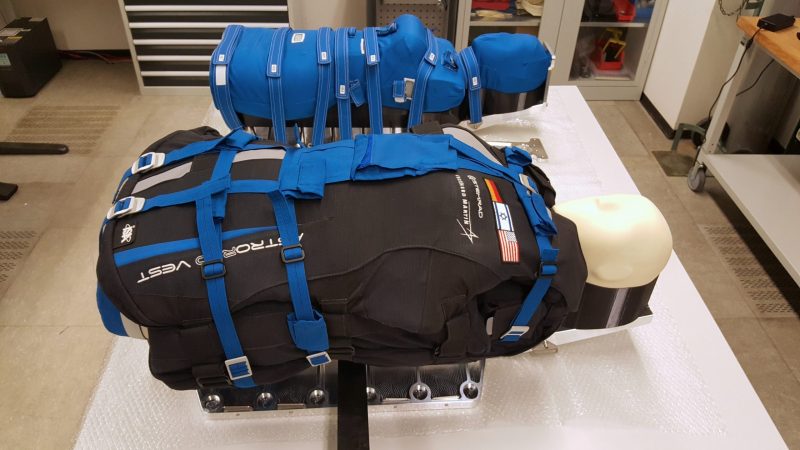
In addition, there will be two other “passengers,” two identical mannequin torsos equipped with radiation detectors. The Israel Space Agency and the German Aerospace Center designed this part of the mission. It’s an experiment to test the AstroRad radiation protection vest, which will provide data on radiation levels.
Snoopy will travel on Artemis
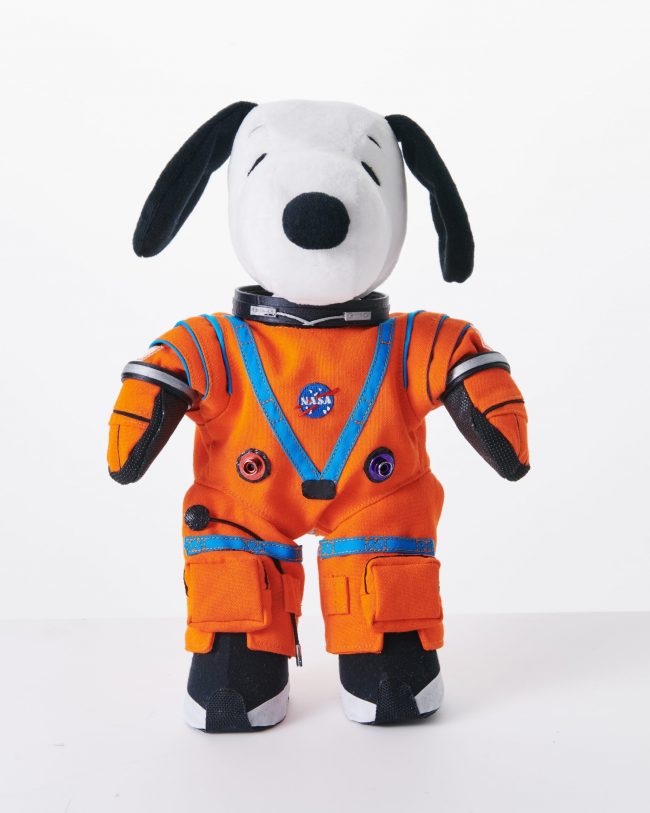
The mannequin and mannequin torsos will be strapped in. But NASA is also flying a “zero gravity indicator” in the form of a Snoopy cuddly toy, also dressed in an iconic orange NASA jumpsuit. The comic-book character Snoopy was a household name in the 1960s and ’70s, when the Apollo missions were flying. And Apollo 10 astronauts traveled to the moon for a final checkout, prior to the first human moon landing with Apollo 11 on July 20, 1969. Apollo 10 skimmed to within 50,000 feet of the moon’s surface, to “snoop around” (scout the Apollo 11 landing site). So, the crew named its lunar module “Snoopy.”
There have been delays
Many earthly spacecraft have visited the moon, but it has been 50 years since humans have walked its surface. And space visionaries have been dreaming for decades of a return to the moon. Although NASA first announced the Artemis program in December 2017, the development of the Orion crew capsule and the powerful SLS began earlier, in 2011. SpacePolicyOnline reported on March 14, 2022:
The first flight of SLS/Orion has been delayed again and again. In 2014, NASA committed to the first launch in November 2018. That slipped to December 2019-June 2020, then to mid-late 2021 and then to 2022. Now, at long last, they are almost ready to take flight.
Read more SLS/Orion history at SpacePolicyOnline, if you’re interested.
A return to the moon
Ultimately, the Artemis program aims to send the first humans back to the moon by the middle of this decade. When they go, they’ll be aiming for the moon’s south pole, a place that scientists have discovered in recent decades has large amounts of water ice. Water contains oxygen, so processing it will make it possible for future astronauts to stay longer.
Someday, visionaries still hope, we will have a permanent presence on the moon. And we will go to Mars.
Such dreams are an integral part of humanity’s natural wanderlust in the 21st century. And so future historians might look back at our time – and at the Artemis missions – as the moment humanity took a true giant leap to space, maybe this time for good.
We are going.
As @NASA prepares to send astronauts to the Moon under #Artemis, we have identified 13 candidate landing regions near the lunar South Pole.
Learn about the landing regions and what sets them apart: https://t.co/XagoqjMi9b pic.twitter.com/lUwJun9yh0
— NASA Artemis (@NASAArtemis) August 19, 2022
Get a visual of what Artemis will be doing
The trajectory for the Artemis mission has been updated by @NASAJPL Horizons following Monday’s cancelled launch. #Artemis is now scheduled to launch on Saturday, Sep 3, and return on Oct. 11. @NASAJPL @NASAArtemis pic.twitter.com/9TgWFzTPjH
— Tony Dunn (@tony873004) August 31, 2022
Bottom line: NASA will attempt to launch the SLS on the Artemis 1 mission on November 14, 2022.
The post Artemis 1: NASA sets November 14 for launch first appeared on EarthSky.
from EarthSky https://ift.tt/MnhHXTe
NASA schedules nighttime launch for Artemis 1
NASA’s mission controllers have set yet another new launch date – 12:07 a.m. ET (04:07 UTC) on November 14, 2022, from Kennedy Space Center in Florida – for the frequently delayed Artemis 1 lunar mission and humanity’s return to the moon. In what should present a spectacular light show if the weather allows, the latest attempt at a liftoff will be a fiery nighttime try.
NASA announced the update to the launch time and date – which presents a 69-minute launch window – via its blog. The agency said SLS is essentially still ready to fly following the most recent launch abort. The moonship is currently in the Vehicle Assembly Building, where it will undergo a minor makeover and a bit of primping prior to flight.
The rollout back to Launch Complex 39B is planned for early next month, NASA said:
Teams will perform standard maintenance to repair minor damage to the foam and cork on the thermal protection system and recharge or replace batteries on the rocket, several secondary payloads, and the flight termination system. The agency plans to roll the rocket back to the launch pad as early as Friday, November 4.
Should NASA stand down on November 14, there are two backup dates planned. Both are also nighttime launches:
NASA has requested backup launch opportunities for Wednesday, November 16, at 1:04 a.m. and Saturday, November 19, at 1:45 a.m., which are both two-hour launch windows. A launch on November 14 would result in a mission duration of about 25-and-a-half days with a splashdown in the Pacific Ocean Friday, December 9.
Moonship safe as Ian strikes land
The launch of Artemis 1 faced another major delay in the early autumn. The lunar mission was scheduled to fly on September 27, a launch date that was canceled as Tropical Storm Ian approached. Then, on Sunday, Ian rapidly intensified to hurricane strength. Its winds have now reached upper Category 4 strength of up to 155 mph (250 kph).
NASA said a skeleton crew remains with the rocketship, babysitting the vehicle while it weathers the storm safely inside the VAB:
As part of NASA’s hurricane preparedness protocol, a “ride out” team will remain in a safe location at Kennedy throughout the storm to monitor centerwide conditions. After the storm passes, they will conduct an assessment of facilities, property, and equipment. Once it is safe for additional employees to return to Kennedy, engineers will extend platforms to establish access to the rocket and spacecraft.
Keeping Artemis and Space Launch System Safe
Forecasters expect Ian to move up the Gulf Coast of Florida. And Kennedy Space Center is across the state, on the Atlantic coast. But Ian is likely to cut across Florida at some point. And no one can blame NASA for playing it safe with its Space Launch System rocket and space capsule, whose development has cost billions. Merritt Island, where KSC is located, is under six National Weather Service watches and warnings, including a tornado watch, as of 1 p.m. ET (17:00 UTC).
The space agency also reassured the public that an incident that set off a fire alarm at the VAB not long after the arrival of the moonship there on Tuesday never threatened the rocket or Artemis 1 staff.
The [alarm] came when an arc flash event occurred at a connector on an electrical panel in High Bay 3. A spark landed on a rope marking the boundary of the work area. The rope began to smolder, workers pulled the alarm, and employees evacuated the building safely.
No one was injured during the incident, and the Artemis 1 rocket and the Orion spacecraft were never at risk.
Safety precautions started early at KSC
In fact, the ship’s handlers have been prepping the SLS for a rollback to the VAB since last week’s decision not to launch on September 27. Officials delayed rollback as long as possible to keep the chance of launching on October 2 open.
That option is now off the table.
Moving the SLS back to the VAB is no easy task, either. According to Eric Berger, senior space editor at Ars Technica, NASA can only move the SLS to the VAB one last time, following today’s maneuvering.
And Florida’s governor declared a State of Emergency there in advance of the storm.
Due to weather predictions related to Hurricane Ian, @NASA teams will roll the #Artemis I @NASA_SLS rocket and @NASA_Orion spacecraft back to the Vehicle Assembly Building at @NASAKennedy.
First motion is targeted for 11 pm ET tonight: https://t.co/Bx7oanmpa4 pic.twitter.com/wwPds84R36
— NASA Artemis (@NASAArtemis) September 26, 2022
Rescheduling the launch date, again
After a successful cryogenic demonstration test performed on Wednesday (September 21), NASA said all systems were go for the launch attempt on Tuesday, September 27. But the weather had other plans. During a mission briefing on Friday (September 23), NASA manager Mike Bolger said:
By Wednesday night, we started turning our attention to moving forward toward that launch, and we realized that one of the things we’re going to have to pay attention to is the weather. So since then we’ve been keeping a close eye on [what was then] called Tropical Depression Number Nine [now Tropical Storm Ian].
NASA had planned to squeeze Artemis between two other ongoing missions. The first is the DART asteroid impact, which will monopolize the Deep Space Network when it impacts the asteroid Didymos B later today (September 26). And the second is the launch of the SpaceX Crew-5 mission to the International Space Station in early October. That mission has been delayed as well.
Scrub-a-dub-dub
There’ve been several scrubs of the Artemis 1 launch already, in late August and early September.
Get updates on Artemis 1 via NASA’s Artemis blog
“We’ll go when it’s ready.” NASA Administrator @SenBillNelson remarks on the Sept. 3 launch attempt of the #Artemis I flight test to the Moon. Updates are expected from the team as early as 4pm ET (20:00 UTC). https://t.co/dMVnvEQcfC pic.twitter.com/ClBhVRexLs
— NASA (@NASA) September 3, 2022
Frustrated at yet another scrub, the crowds head home from Kennedy. #Artemis1 pic.twitter.com/xDiVcu4rFC
— Jonathan Amos (@BBCAmos) September 3, 2022
Artemisn’t
— b1joe (@b1joe) August 29, 2022
The Artemis 1 story so far …
In case you haven’t been following it … Artemis 1 is the first of three missions planned to send humans back to the moon by the middle of this decade. And wow! It’s exciting. And difficult. Artemis 1 has all the dazzle of the earlier race to the moon in the 1960s … a giant rocket, with powerful thrust … an unmatched element of daring. It’s a big undertaking.
Of course, spaceflight fans are disappointed by the failure to launch so far. But many tempered their upset with good humor. And, as NASA officials said on September 3:
We won’t launch until we’re ready.
What Artemis 1 will do
Artemis 1’s objective is partly to test NASA’s Space Launch System – aka SLS – a vehicle comparable to the great Saturn V that carried the first astronauts to the moon in the Apollo program of the ’60s and ’70s.
SLS is far more advanced than the Saturn V, technologically. But its main purpose is thrust. SLS will produce 8.8 million pounds (3.9 million kg) of thrust during liftoff and ascent, 15% more than the Saturn V. It’ll need that much thrust to loft a vehicle weighing nearly 6 million pounds (2.7 million kg) to orbit. Propelled by a pair of five-segment boosters and four RS-25 engines, the rocket will reach the period of greatest atmospheric force within 90 seconds, NASA says. After jettisoning its boosters, service module panels, and launch abort system, the core stage engines will shut down. At that point, the core stage will separate from the Orion spacecraft.
The Orion moonship is known officially as the Orion Multi-Purpose Crew Vehicle or Orion MPCV. It’ll go to Earth orbit atop SLS following launch. There, it’ll deploy its solar arrays and the Interim Cryogenic Propulsion Stage (ICPS) that’ll give the craft the big push needed to leave Earth’s orbit and travel toward the moon.
Not Orion’s first voyage
Orion already underwent an Earth-orbiting test in 2014, so this isn’t its first voyage to space. But it is its first trip to the moon, and it’ll get there via propulsion by a service module provided by the European Space Agency. The service module will supply the spacecraft’s main propulsion system and power (as well as house air and water for astronauts on future missions).
Orion’s mission
Orion will fly as close to the moon’s surface as about 62 miles (100 km). It’ll use the moon’s gravity to propel itself into an orbit about 40,000 miles (70,000 km) from the moon.
The spacecraft will stay in that orbit for about six days, collecting data. During that time, mission controllers will assess its performance. Then it’ll perform a second close flyby of the moon, coming within about 60 miles (100 km). Another precisely timed engine firing of the European-provided service module – in combination with the moon’s gravity – will accelerate the moonship back toward Earth. It’ll enter our planet’s atmosphere traveling at 25,000 mph (11 km/second), producing temperatures of approximately 5,000 degrees Fahrenheit (2,760 degrees Celsius). So it’ll go faster – and get hotter – than during its 2014 flight test.
In all, the mission will last about a month and travel a distance of 1.3 million miles. It’s expected to make a precision landing within eyesight of the recovery ship off the coast of San Diego, California.
What’s in the crew capsule?
The Orion moonship won’t have a human crew during Artemis 1. Instead, a mannequin dressed in a bright orange spacesuit known as the Orion Crew Survival System will occupy the commander’s seat. NASA says the special suit is:
… designed for a custom fit and equipped with technology features to help protect astronauts on launch day, in emergency situations, throughout high-risk parts of missions near the moon, and during the high-speed return to Earth.
In addition, there will be two other “passengers,” two identical mannequin torsos equipped with radiation detectors. The Israel Space Agency and the German Aerospace Center designed this part of the mission. It’s an experiment to test the AstroRad radiation protection vest, which will provide data on radiation levels.
Snoopy will travel on Artemis
The mannequin and mannequin torsos will be strapped in. But NASA is also flying a “zero gravity indicator” in the form of a Snoopy cuddly toy, also dressed in an iconic orange NASA jumpsuit. The comic-book character Snoopy was a household name in the 1960s and ’70s, when the Apollo missions were flying. And Apollo 10 astronauts traveled to the moon for a final checkout, prior to the first human moon landing with Apollo 11 on July 20, 1969. Apollo 10 skimmed to within 50,000 feet of the moon’s surface, to “snoop around” (scout the Apollo 11 landing site). So, the crew named its lunar module “Snoopy.”
There have been delays
Many earthly spacecraft have visited the moon, but it has been 50 years since humans have walked its surface. And space visionaries have been dreaming for decades of a return to the moon. Although NASA first announced the Artemis program in December 2017, the development of the Orion crew capsule and the powerful SLS began earlier, in 2011. SpacePolicyOnline reported on March 14, 2022:
The first flight of SLS/Orion has been delayed again and again. In 2014, NASA committed to the first launch in November 2018. That slipped to December 2019-June 2020, then to mid-late 2021 and then to 2022. Now, at long last, they are almost ready to take flight.
Read more SLS/Orion history at SpacePolicyOnline, if you’re interested.
A return to the moon
Ultimately, the Artemis program aims to send the first humans back to the moon by the middle of this decade. When they go, they’ll be aiming for the moon’s south pole, a place that scientists have discovered in recent decades has large amounts of water ice. Water contains oxygen, so processing it will make it possible for future astronauts to stay longer.
Someday, visionaries still hope, we will have a permanent presence on the moon. And we will go to Mars.
Such dreams are an integral part of humanity’s natural wanderlust in the 21st century. And so future historians might look back at our time – and at the Artemis missions – as the moment humanity took a true giant leap to space, maybe this time for good.
We are going.
As @NASA prepares to send astronauts to the Moon under #Artemis, we have identified 13 candidate landing regions near the lunar South Pole.
Learn about the landing regions and what sets them apart: https://t.co/XagoqjMi9b pic.twitter.com/lUwJun9yh0
— NASA Artemis (@NASAArtemis) August 19, 2022
Get a visual of what Artemis will be doing
The trajectory for the Artemis mission has been updated by @NASAJPL Horizons following Monday’s cancelled launch. #Artemis is now scheduled to launch on Saturday, Sep 3, and return on Oct. 11. @NASAJPL @NASAArtemis pic.twitter.com/9TgWFzTPjH
— Tony Dunn (@tony873004) August 31, 2022
Bottom line: NASA will attempt to launch the SLS on the Artemis 1 mission on November 14, 2022.
The post Artemis 1: NASA sets November 14 for launch first appeared on EarthSky.
from EarthSky https://ift.tt/MnhHXTe

Aucun commentaire:
Enregistrer un commentaire