
Dramatic dimming is a supernova warning sign
If you want to catch a massive star as it goes supernova, look for it to dim dramatically first. Astronomers announced on October 13, 2022, that stars between 8 and 20 solar masses will suddenly become much dimmer in the months before they go supernova. The scientists called it an early warning system.
The scientists, from Liverpool John Moores University and the University of Montpellier, published their study in the peer-reviewed journal Monthly Notices of the Royal Astronomical Society on October 13, 2022.
Red supergiant stars
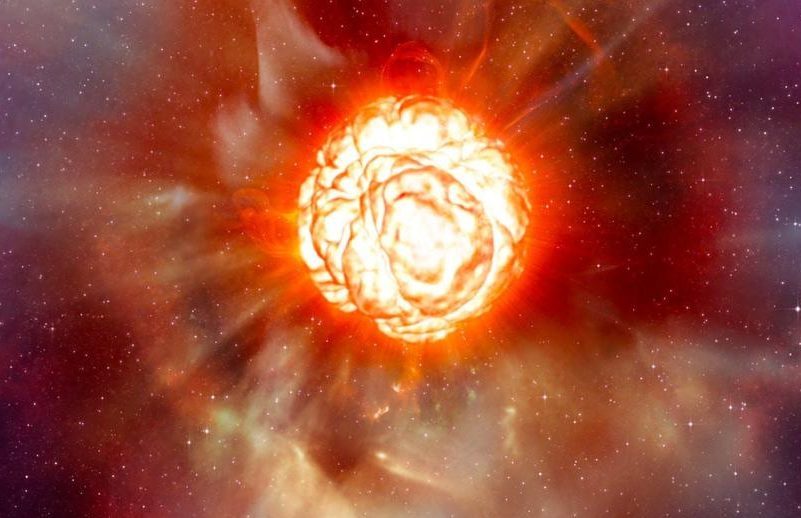
When massive stars between 8 and 20 solar masses near the end of their lives, they enter the red supergiant phase. A red supergiant is like a red giant star only bigger. Antares in Scorpius and Betelgeuse in Orion are examples of red supergiant stars.
Red supergiant stars will dramatically dim in their last few months, becoming about 100 times fainter in visible light. The dimming occurs because the stars suddenly accumulate material around them, blocking their starlight.
The scientists discovered this dusty cocoon accumulates quite fast, in the span of less than a year. The researchers made the first-ever simulations to show what red supergiants would look like inside these cloaking veils of dust.
Confirmation in old images
Archival images show stars that did explode appear normal and then, within a year, have accumulated enough dust to dramatically dim or even disappear. Benjamin Davies of Liverpool John Moores University said:
The dense material almost completely obscures the star, making it 100 times fainter in the visible part of the spectrum. This means that, the day before the star explodes, you likely wouldn’t be able to see it was there. Until now, we’ve only been able to get detailed observations of supernovae hours after they’ve already happened. With this early-warning system we can get ready to observe them real-time, to point the world’s best telescopes at the precursor stars, and watch them getting literally ripped apart in front of our eyes.
Betelgeuse waxes and wanes
Betelgeuse is probably the most famous red supergiant. The star underwent a period of dimming in 2019 and 2020. But it has since recovered. Betelgeuse regularly waxes and wanes in brightness. You can follow along at the Twitter account “Betelgeuse Status” @betelbot to see how it’s doing today. Will it dramatically dim anytime soon on its way to a supernova? No one knows. Keep watching to see!
Now at 124% of my usual brightness! #Betelgeuse pic.twitter.com/wc7O80LQRR
— Betelgeuse Status (@betelbot) October 12, 2022
Now at 95% of my usual brightness! #Betelgeuse pic.twitter.com/4nU8NEAPNq
— Betelgeuse Status (@betelbot) July 31, 2022
Bottom line: Scientists have found a supernova warning sign. Massive stars, from 8 to 20 solar masses, dramatically dim before going supernova.
Source: Explosion imminent: the appearance of red supergiants at the point of core-collapse
Via Royal Astronomical Society
The post A supernova warning sign: When massive stars dim first appeared on EarthSky.
from EarthSky https://ift.tt/NxrWIim
Dramatic dimming is a supernova warning sign
If you want to catch a massive star as it goes supernova, look for it to dim dramatically first. Astronomers announced on October 13, 2022, that stars between 8 and 20 solar masses will suddenly become much dimmer in the months before they go supernova. The scientists called it an early warning system.
The scientists, from Liverpool John Moores University and the University of Montpellier, published their study in the peer-reviewed journal Monthly Notices of the Royal Astronomical Society on October 13, 2022.
Red supergiant stars
When massive stars between 8 and 20 solar masses near the end of their lives, they enter the red supergiant phase. A red supergiant is like a red giant star only bigger. Antares in Scorpius and Betelgeuse in Orion are examples of red supergiant stars.
Red supergiant stars will dramatically dim in their last few months, becoming about 100 times fainter in visible light. The dimming occurs because the stars suddenly accumulate material around them, blocking their starlight.
The scientists discovered this dusty cocoon accumulates quite fast, in the span of less than a year. The researchers made the first-ever simulations to show what red supergiants would look like inside these cloaking veils of dust.
Confirmation in old images
Archival images show stars that did explode appear normal and then, within a year, have accumulated enough dust to dramatically dim or even disappear. Benjamin Davies of Liverpool John Moores University said:
The dense material almost completely obscures the star, making it 100 times fainter in the visible part of the spectrum. This means that, the day before the star explodes, you likely wouldn’t be able to see it was there. Until now, we’ve only been able to get detailed observations of supernovae hours after they’ve already happened. With this early-warning system we can get ready to observe them real-time, to point the world’s best telescopes at the precursor stars, and watch them getting literally ripped apart in front of our eyes.
Betelgeuse waxes and wanes
Betelgeuse is probably the most famous red supergiant. The star underwent a period of dimming in 2019 and 2020. But it has since recovered. Betelgeuse regularly waxes and wanes in brightness. You can follow along at the Twitter account “Betelgeuse Status” @betelbot to see how it’s doing today. Will it dramatically dim anytime soon on its way to a supernova? No one knows. Keep watching to see!
Now at 124% of my usual brightness! #Betelgeuse pic.twitter.com/wc7O80LQRR
— Betelgeuse Status (@betelbot) October 12, 2022
Now at 95% of my usual brightness! #Betelgeuse pic.twitter.com/4nU8NEAPNq
— Betelgeuse Status (@betelbot) July 31, 2022
Bottom line: Scientists have found a supernova warning sign. Massive stars, from 8 to 20 solar masses, dramatically dim before going supernova.
Source: Explosion imminent: the appearance of red supergiants at the point of core-collapse
Via Royal Astronomical Society
The post A supernova warning sign: When massive stars dim first appeared on EarthSky.
from EarthSky https://ift.tt/NxrWIim

Aucun commentaire:
Enregistrer un commentaire