The strange platypus has unveiled another new quirk. Scientists in Belgium said that the structures inside its hair cells are hollow. Previously we only knew bird feathers to have this unique trait. Image via Charles J. Sharp/ Wikipedia (CC BY-SA 4.0).
The platypus, one of the strangest animals on the planet, has surprised scientists once again. A team of researchers from Ghent University in Belgium has discovered that this egg-laying mammal from Australia has a microscopic feature in its hair never seen before in mammals. These structures inside platypus hairs are hollow, resembling those of bird feathers.
The findings, published on March 18, 2026, in the peer-reviewed journal Biology Letters, add yet another twist to the long list of traits that make the platypus so unique.
Platypus surprises never end
The platypus already looks like a mix of different animals. It has a bill like a duck, a tail like a beaver and a body like an otter. But its uniqueness goes far beyond its appearance. It’s a mammal, but it lays eggs instead of giving birth. Plus, it hunts by detecting electric signals produced by its prey’s muscles.
It also glows bluish-green under ultraviolet light, carries many more sex chromosomes than most mammals and shows unusual biological traits. Males are venomous, while females produce milk but do not have nipples.
Now, scientists have uncovered another surprising feature hidden deep inside its hair.
Platypus hairs contains melanosomes. Melanosomes are tiny structures inside animal cells that store pigment. But the researchers found that platypus’ melanosomes are hollow. Until now, scientists had only seen hollow melanosomes in bird feathers, not in mammals. The researchers wrote in the paper:
Excitingly, over 200 years after its description as something in between birds and mammals, we find additional convergence between the platypus and birds.
To investigate further, the team analyzed hair from 10 platypuses using powerful microscopes. They also compared the results with other animals, including echidnas – the platypus’ closest living relatives – as well as marsupials like wombats and Tasmanian devils. None of these animals showed hollow melanosomes. This makes the platypus the only known mammal with this trait among the 126 species studied so far. Lead author Jessica Leigh Dobson told Science News:
I find it very, very unlikely that it wouldn’t have been found already.
Deep within the platypus’ hair lies a birdlike feature never before observed in any other mammal. Image via Rainbow606/ Wikimedia Commons (CC BY-SA 3.0).
A shape that breaks the rules
The discovery became even more puzzling when researchers looked at the shape of these structures. Platypus melanosomes are not only hollow, but also spherical. That’s a combination never seen before in vertebrates.
In birds, hollow melanosomes tend to be rod-like or flattened. Some mammals do have spherical melanosomes, but those are always solid. The platypus, once again, does things differently.
Structures found in platypus hair possess a unique and unprecedented shape – different from their counterparts in other mammals and in birds – that challenge what scientists thought was possible in vertebrate biology. Image via Dr. Philip Bethge/ Wikimedia Commons (CC BY-SA 4.0).
A mystery scientists can’t explain
The team also studied the pigment inside the hair. They found mostly eumelanin, which produces brown and black tones. It also found possible traces of pheomelanin, responsible for red and yellow hues.
This result matches the animal’s dark coloration, but it creates a contradiction. Normally, spherical melanosomes link to pheomelanin, not eumelanin. Dobson told BBC Wildlife Magazine:
This doesn’t really conform with what we currently know about how melanosome shape correlates with color.
Platypuses vs birds: not the same shine
In birds, hollow melanosomes often create iridescence, a shimmering effect that produces shifting rainbow colors. However, platypus fur does not show this effect. Their coloration remains a simple brown.
Even more surprising, mammals that do show iridescence, such as golden moles and giant otter shrews, have solid melanosomes instead of hollow ones.
Although the hair contains birdlike hollow melanosomes, the platypus’ fur does not display the iridescent colors seen in birds, highlighting a striking difference between these animals. Image via Stefan Kraft/ Wikimedia Commons (CC BY-SA 3.0).
An unanswered question
For now, scientists still do not know why the platypus has hollow melanosomes. One idea suggests this feature could relate to its aquatic lifestyle. Possibly helping with insulation or another function unrelated to color. Tim Caro, an evolutionary ecologist at the University of Bristol in England, who was not involved with the research, told Science News:
My gut feeling is it’s nothing to do with color, it’s to do with some other lifestyle attribute.
But this raises another question. If this trait helps animals that live in water, why has it not appeared in other aquatic mammals? Dobson said at Agence France-Presse:
Further work is definitely needed to find out why they have them.
The platypus continues to astonish scientists with its constantly emerging, unexpected traits that defy conventional understanding of mammals. Image via Rainbow606/ Wikimedia Commons (CC BY-SA 3.0).
The platypus and its unique place in nature
There is only one species of platypus, and it lives exclusively in Australia. Yet despite decades of research, this unusual animal continues to challenge what we thought we knew.
Each new discovery only deepens the mystery, confirming the platypus as one of nature’s most puzzling and fascinating creatures … a species scientists are still far from fully understanding.
Exclusively found in Australia, the platypus remains a singular and fascinating creature whose unusual characteristics – including the mysterious hollow structures in its hair – continue to baffle scientists and raise more questions than answers about their function and role in the natural world. Image via Michael Jerrard/ Unsplash.
Bottom line: The platypus keeps amazing scientists: even its hair hides a strange secret that, until now, only birds were known to have.
The strange platypus has unveiled another new quirk. Scientists in Belgium said that the structures inside its hair cells are hollow. Previously we only knew bird feathers to have this unique trait. Image via Charles J. Sharp/ Wikipedia (CC BY-SA 4.0).
The platypus, one of the strangest animals on the planet, has surprised scientists once again. A team of researchers from Ghent University in Belgium has discovered that this egg-laying mammal from Australia has a microscopic feature in its hair never seen before in mammals. These structures inside platypus hairs are hollow, resembling those of bird feathers.
The findings, published on March 18, 2026, in the peer-reviewed journal Biology Letters, add yet another twist to the long list of traits that make the platypus so unique.
Platypus surprises never end
The platypus already looks like a mix of different animals. It has a bill like a duck, a tail like a beaver and a body like an otter. But its uniqueness goes far beyond its appearance. It’s a mammal, but it lays eggs instead of giving birth. Plus, it hunts by detecting electric signals produced by its prey’s muscles.
It also glows bluish-green under ultraviolet light, carries many more sex chromosomes than most mammals and shows unusual biological traits. Males are venomous, while females produce milk but do not have nipples.
Now, scientists have uncovered another surprising feature hidden deep inside its hair.
Platypus hairs contains melanosomes. Melanosomes are tiny structures inside animal cells that store pigment. But the researchers found that platypus’ melanosomes are hollow. Until now, scientists had only seen hollow melanosomes in bird feathers, not in mammals. The researchers wrote in the paper:
Excitingly, over 200 years after its description as something in between birds and mammals, we find additional convergence between the platypus and birds.
To investigate further, the team analyzed hair from 10 platypuses using powerful microscopes. They also compared the results with other animals, including echidnas – the platypus’ closest living relatives – as well as marsupials like wombats and Tasmanian devils. None of these animals showed hollow melanosomes. This makes the platypus the only known mammal with this trait among the 126 species studied so far. Lead author Jessica Leigh Dobson told Science News:
I find it very, very unlikely that it wouldn’t have been found already.
Deep within the platypus’ hair lies a birdlike feature never before observed in any other mammal. Image via Rainbow606/ Wikimedia Commons (CC BY-SA 3.0).
A shape that breaks the rules
The discovery became even more puzzling when researchers looked at the shape of these structures. Platypus melanosomes are not only hollow, but also spherical. That’s a combination never seen before in vertebrates.
In birds, hollow melanosomes tend to be rod-like or flattened. Some mammals do have spherical melanosomes, but those are always solid. The platypus, once again, does things differently.
Structures found in platypus hair possess a unique and unprecedented shape – different from their counterparts in other mammals and in birds – that challenge what scientists thought was possible in vertebrate biology. Image via Dr. Philip Bethge/ Wikimedia Commons (CC BY-SA 4.0).
A mystery scientists can’t explain
The team also studied the pigment inside the hair. They found mostly eumelanin, which produces brown and black tones. It also found possible traces of pheomelanin, responsible for red and yellow hues.
This result matches the animal’s dark coloration, but it creates a contradiction. Normally, spherical melanosomes link to pheomelanin, not eumelanin. Dobson told BBC Wildlife Magazine:
This doesn’t really conform with what we currently know about how melanosome shape correlates with color.
Platypuses vs birds: not the same shine
In birds, hollow melanosomes often create iridescence, a shimmering effect that produces shifting rainbow colors. However, platypus fur does not show this effect. Their coloration remains a simple brown.
Even more surprising, mammals that do show iridescence, such as golden moles and giant otter shrews, have solid melanosomes instead of hollow ones.
Although the hair contains birdlike hollow melanosomes, the platypus’ fur does not display the iridescent colors seen in birds, highlighting a striking difference between these animals. Image via Stefan Kraft/ Wikimedia Commons (CC BY-SA 3.0).
An unanswered question
For now, scientists still do not know why the platypus has hollow melanosomes. One idea suggests this feature could relate to its aquatic lifestyle. Possibly helping with insulation or another function unrelated to color. Tim Caro, an evolutionary ecologist at the University of Bristol in England, who was not involved with the research, told Science News:
My gut feeling is it’s nothing to do with color, it’s to do with some other lifestyle attribute.
But this raises another question. If this trait helps animals that live in water, why has it not appeared in other aquatic mammals? Dobson said at Agence France-Presse:
Further work is definitely needed to find out why they have them.
The platypus continues to astonish scientists with its constantly emerging, unexpected traits that defy conventional understanding of mammals. Image via Rainbow606/ Wikimedia Commons (CC BY-SA 3.0).
The platypus and its unique place in nature
There is only one species of platypus, and it lives exclusively in Australia. Yet despite decades of research, this unusual animal continues to challenge what we thought we knew.
Each new discovery only deepens the mystery, confirming the platypus as one of nature’s most puzzling and fascinating creatures … a species scientists are still far from fully understanding.
Exclusively found in Australia, the platypus remains a singular and fascinating creature whose unusual characteristics – including the mysterious hollow structures in its hair – continue to baffle scientists and raise more questions than answers about their function and role in the natural world. Image via Michael Jerrard/ Unsplash.
Bottom line: The platypus keeps amazing scientists: even its hair hides a strange secret that, until now, only birds were known to have.
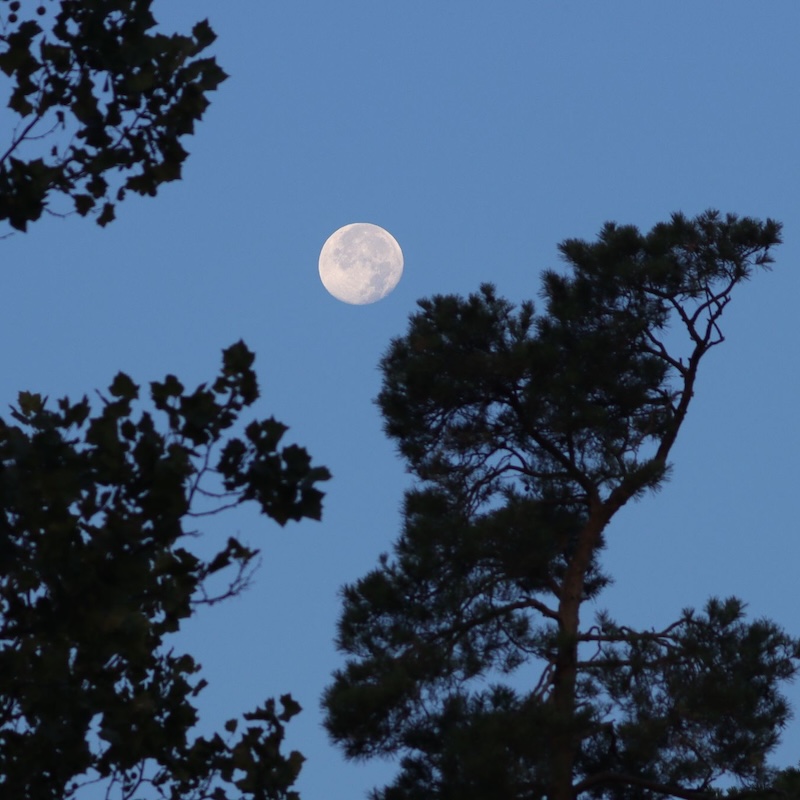
This month’s full Pink Moon came overnight on April 1-2, 2026. So this week’s moon is in a waning gibbous phase. Full moons rise at sunset. But waning gibbous moons rise later – and later – on each successive night.
And that means the moon sets later and later now, too. In the days following every full moon, you’ll find the moon setting in the west after sunrise. That makes the mornings following a full moon a good time to catch a daytime moon. Watch for it during the coming week, after sunrise, over your western horizon. It’ll appear pale against the blue sky. Thanks to what’s called the moon illusion, you might notice the daytime moon looking huge when close to the horizon.
The moon is up in the daytime half of the time. But, because it’s pale against the blue sky, it’s not as noticeable during the day as at night. Still, there are certain windows each month during which the daytime moon is most noticeable.
The coming week presents one of those windows. It’s a good time to watch for a daytime moon in the morning sky.
Then, the next last quarter moon will fall at 4:52 UTC on April 10, 2026. Last quarter moons rise in the middle of the night (no matter where you are on the globe). And they set around midday. Watch for the last quarter moon high in the sky before dawn.
Daytime moon photos from the EarthSky community
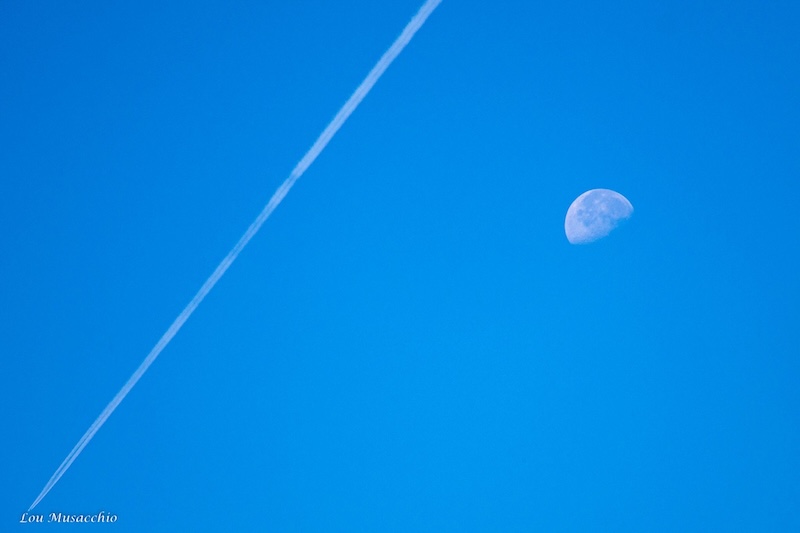
View at EarthSky Community Photos. | Mandy Daniels captured this image of the 1st quarter moon on February 24, 2026, from the UK. Thank you, Mandy! The 1st quarter moon rises at noon and sets at midnight. So watch for it high in the eastern sky mid-afternoon.View at EarthSky Community Photos. | Steven Sweet captured this image on September 9, 2025, from Canada and wrote: “Waning gibbous moon back in the morning sky a couple days after full.” Thank you, Steven! Be sure to watch for the daytime moon this week in the western morning sky.View at EarthSky Community Photos. | Lou Musacchio captured this image on September 12, 2025, from Canada and wrote: “I stepped outside to check on some feral baby kittens and saw the moon in the daytime sky with a contrail going across the sky.” Thank you, Lou!
Bottom line: Watch for the beautiful daytime moon this week, a pale orb floating against a blue sky in the morning hours. Look west! You’ll see it!
This month’s full Pink Moon came overnight on April 1-2, 2026. So this week’s moon is in a waning gibbous phase. Full moons rise at sunset. But waning gibbous moons rise later – and later – on each successive night.
And that means the moon sets later and later now, too. In the days following every full moon, you’ll find the moon setting in the west after sunrise. That makes the mornings following a full moon a good time to catch a daytime moon. Watch for it during the coming week, after sunrise, over your western horizon. It’ll appear pale against the blue sky. Thanks to what’s called the moon illusion, you might notice the daytime moon looking huge when close to the horizon.
The moon is up in the daytime half of the time. But, because it’s pale against the blue sky, it’s not as noticeable during the day as at night. Still, there are certain windows each month during which the daytime moon is most noticeable.
The coming week presents one of those windows. It’s a good time to watch for a daytime moon in the morning sky.
Then, the next last quarter moon will fall at 4:52 UTC on April 10, 2026. Last quarter moons rise in the middle of the night (no matter where you are on the globe). And they set around midday. Watch for the last quarter moon high in the sky before dawn.
Daytime moon photos from the EarthSky community
View at EarthSky Community Photos. | Mandy Daniels captured this image of the 1st quarter moon on February 24, 2026, from the UK. Thank you, Mandy! The 1st quarter moon rises at noon and sets at midnight. So watch for it high in the eastern sky mid-afternoon.View at EarthSky Community Photos. | Steven Sweet captured this image on September 9, 2025, from Canada and wrote: “Waning gibbous moon back in the morning sky a couple days after full.” Thank you, Steven! Be sure to watch for the daytime moon this week in the western morning sky.View at EarthSky Community Photos. | Lou Musacchio captured this image on September 12, 2025, from Canada and wrote: “I stepped outside to check on some feral baby kittens and saw the moon in the daytime sky with a contrail going across the sky.” Thank you, Lou!
Bottom line: Watch for the beautiful daytime moon this week, a pale orb floating against a blue sky in the morning hours. Look west! You’ll see it!
We’re entering the long meteor draught after the early January Quadrantids. Up next is the Lyrid meteor shower, they’ll be best after midnight and before dawn on April 22. And good news, they will be under a dark and moonless sky.
April 2026 meteors … the Lyrids
When to watch in 2026: After midnight and through dawn on the morning of April 22. The predicted** peak is 19:15 UTC on April 22. The peak of the Lyrids is narrow (no weeks-long stretches of meteor-watching, as with some showers). In 2026, the first quarter moon falls at 2:32 UTC on April 24. So meteor watching after midnight and before dawn on April 22 will be under a dark and moonless sky. Radiant: Rises before midnight, highest in the sky at dawn. Nearest moon phase: First quarter moon falls at 2:32 UTC on April 24. So a fat waxing crescent moon – that sets after midnight – won’t interfere with the peak morning of the 2026’s Lyrid meteor shower. The best time to watch is after midnight and before dawn on the morning of April 22. Duration of shower: April 15 to April 29. This time period is when we’re passing through the meteor stream in space! Expected meteors at peak, under ideal conditions: In a dark sky with no moon, you might see 10 to 15 Lyrids per hour. The Lyrids are known for uncommon surges that can sometimes bring rates of up to 100 per hour! Read more about Lyrid outbursts. Lyrids are known for their bright and colorful meteors, sometimes even producing fireballs. Fireballs are exceptionally bright meteors that outshine the planet Venus. Note for Southern Hemisphere: This shower’s radiant point is far to the north on the sky’s dome. So the Southern Hemisphere will see fewer Lyrid meteors. Still, you might see some! Meteor train possibilities? In a moonless sky, a few Lyrid meteors can leave persistent trains. That is, they leave a trail of ionized gases that glow for a few seconds after the meteor has passed. Lyrids are known to produce fireballs.
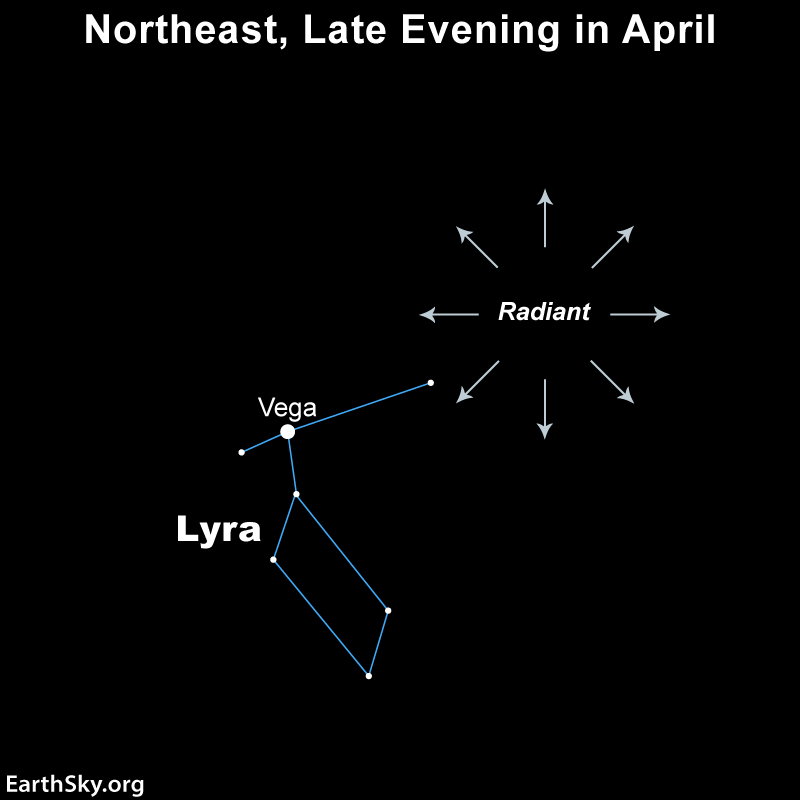
Lyrid meteors radiate from near the bright star Vega in the constellation Lyra the Harp. You don’t need to identify Vega or Lyra in order to watch the Lyrid meteor shower. But you do need to know when the radiant rises, in this case in the northeast before midnight. That’s why the Lyrids are typically best between midnight and dawn.
May 2026 meteors … the Eta Aquariids
When to watch: The best morning to watch is May 5, 2026, in the hours before dawn. The American Meteor Society is listing 3:51 UTC on May 5 as the shower’s predicted** peak time. The fact is that the peak of this shower stretches out over several days. So you can expect elevated numbers of meteors a few days before and after the peak time. The mornings of both May 4 and May 6 are also good times to watch! Nearest moon phase: The last quarter moon will fall at 21:10 UTC on May 9. So, there will be a waning gibbous moon in the post-midnight sky, that sets after sunrise. So the sky before dawn on the mornings around the predicted peak for the 2025 Eta Aquariids will compete with a bright gibbous moon. Find a way to block out the moon for a better view of the sky. The radiant: will rise in the wee hours, climbing toward its highest point at dawn. That’s why the hours before dawn will be the best time to watch this shower. Duration of shower: April 15 to May 27. This time period is when we’re passing through the Eta Aquariid meteor stream in space! Expected meteors at peak, under ideal conditions: The zenithal hourly rate (ZHR) of this shower (the rate at the shower’s peak, under a dark sky, with no moon, when the radiant is high in the sky) is 60. But be aware that the shower is best for latitudes like those in the southern half of the U.S. or even farther south, in the Southern Hemisphere. Note: The Eta Aquariids’ radiant will be on the ecliptic, which will ride low in the sky on spring mornings as seen from far northerly latitudes. This shower favors more southerly latitudes (like those in the southern U.S. or the Southern Hemisphere), where the radiant appears higher in the morning sky. It’s often the Southern Hemisphere’s best meteor shower of the year.
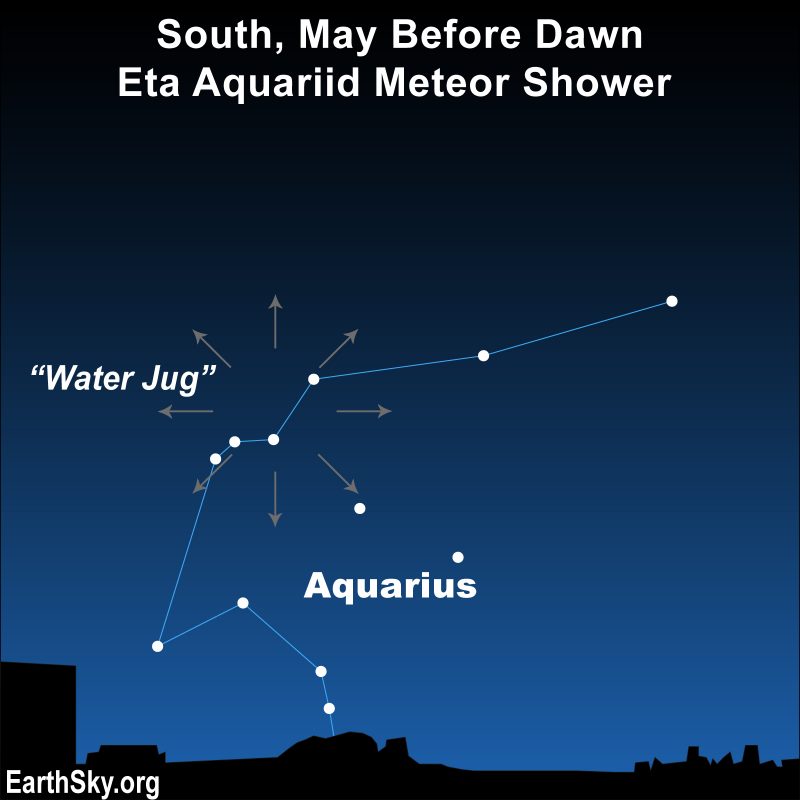
The radiant point of the Eta Aquariid meteor shower will be near the star Eta Aquarii in the constellation Aquarius the Water Bearer. The radiant will rise in the wee hours after midnight and will continue climbing toward its highest point at dawn. That highest point will be in the south as viewed from the Northern Hemisphere, closer to overhead for the Southern Hemisphere. That’s why the Southern Hemisphere will see more meteors (the radiant will be higher up), and it’s why – for all of us around the globe – the hours before dawn will be best for this shower.
June 2026 daytime meteor shower … the Arietids
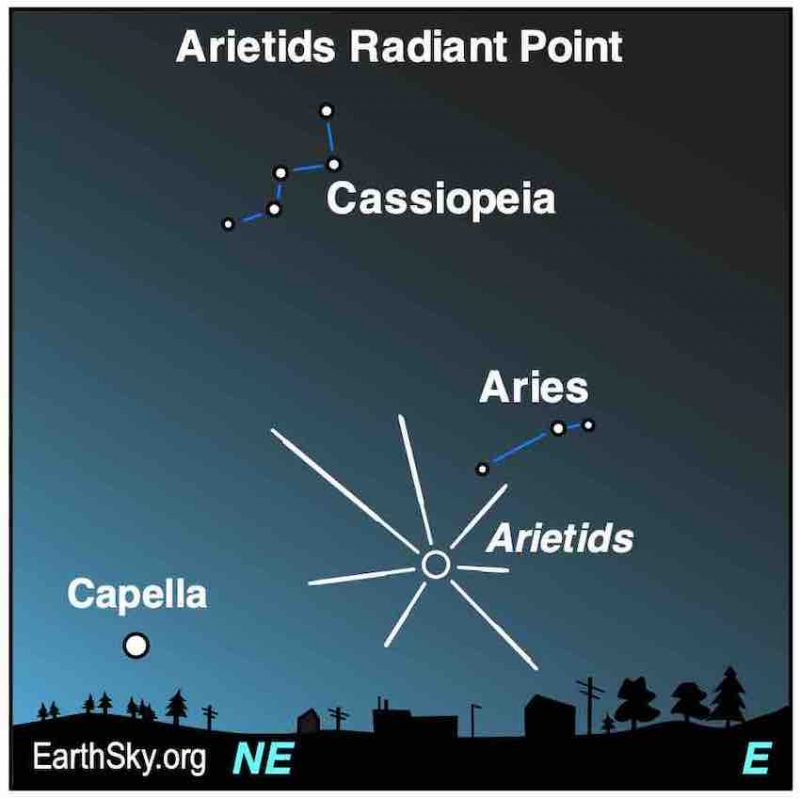
Most meteor showers are easy to observe. Just find a dark sky, and look up! But what about meteor showers that happen in the daytime, when the sun is up? The Arietids are sometimes said to be the most active daytime meteor shower. In 2026, their predicted** peak will be around the mornings of June 10. You might catch some Arietids around that morning in the dark hour before dawn.
When to watch: Watch from May 22 to July 3. There’s a predicted** peak for the mornings around June 10, 2026. Watch for them in the sunrise direction in the dark hour before dawn breaks. Nearest moon phase: In 2026, a 3rd quarter moon occurs at 10:00 UTC on June 8. So on the mornings around June 10, a thick waxing crescent moon will interfere with watching for meteors. Watch from a place that’s in the moon shadow or find a distant object to block out the light of the moon. Radiant: The shower’s radiant point – the point in the sky from which the meteors appear to radiate – is in the constellation Aries. You’ll find this constellation in the east before sunrise. Duration of shower: May 22 to July 3. Expected meteors at peak: This is tricky for daytime meteor showers because once the sun comes up, you won’t be able to see them. But the Arietids have a strong zenithal hourly rate (ZHR)! Meteor counts with radar and radio echoes have indicated a rate of 60 meteors per hour, and perhaps as high as 200 meteors per hour. Note: The Arietids are sometimes said to be the most active daytime meteor shower.
The Arietids are an active shower, but they’re visible mostly in daytime. Watch for them in the sunrise direction in the dark hour before dawn from May 22 to July 3. You’ll be looking for meteors that shoot up from the horizon. The radiant is below the constellation Aries the Ram. Chart by EarthSky.
Late July to mid-August 2026 meteors … the Delta Aquariids
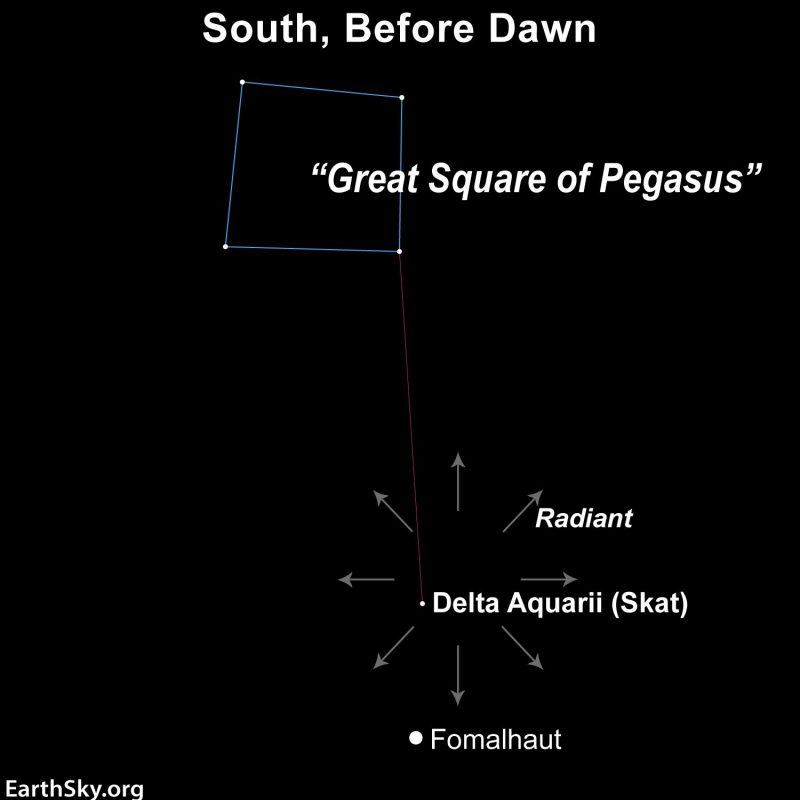
Predicted peak: The peak is predicted** for 10 UTC on July 30, 2026. But this shower doesn’t have a noticeable peak. It rambles along steadily from late July through early August, joining forces with the August Perseids. When to watch: Watch late July through early August, mid-evening to dawn. Duration of shower: July 18 to August 21. Radiant: Rises in mid-evening, highest around 2 a.m. and low in the sky by dawn. See chart below. Nearest moon phase: In 2026, the full moon falls at 14:36 UTC on July 29. Take advantage of the moon-free mornings – after midnight – the week before for watching the Delta Aquariids (and the early Perseids). Expected meteors at peak, under ideal conditions: The Delta Aquariids’ maximum hourly rate can reach 15 to 20 meteors in a dark sky with no moon. You’ll typically see plenty of Delta Aquariids mixed in with the Perseids, if you’re watching in early August. Note: Like May’s Eta Aquariids, July’s Delta Aquariids favors the Southern Hemisphere. Skywatchers at high northern latitudes tend to discount it. But the shower can be excellent from latitudes like those in the southern U.S. Delta Aquariid meteors tend to be fainter than Perseid meteors. So a moon-free dark sky is essential. About 5% to 10% of the Delta Aquariid meteors leave persistent trains, glowing ionized gas trails that last a second or two after the meteor has passed.
Delta Aquariid meteors radiate from near the star Skat, aka Delta Aquarii, in the constellation Aquarius the Water Bearer. This star is near bright Fomalhaut. In late July to early August, Fomalhaut is highest around 2 a.m. (on your clock no matter where you are). It’s southward from the Northern Hemisphere, closer to overhead from the Southern Hemisphere. Fomalhaut appears bright and solitary in the sky. To find it, draw a line roughly southward through the stars on the west side of the Great Square of Pegasus.
Mid-July to mid-August 2026 meteors … the Perseids
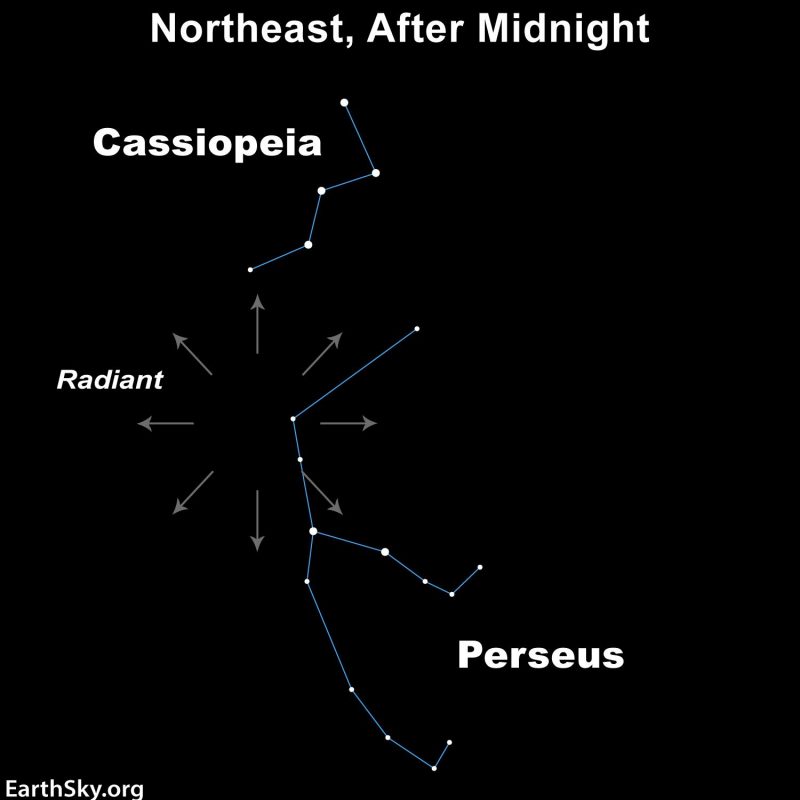
Predicted peak: The peak is predicted** for 14:53 UTC on August 13, 2026. So the mornings of August 12 and 13 are probably your best bets. August 14 might be good as well, but be aware that the Perseids tend to fall off rapidly after their peak. When to watch: The moon will be a new moon during 2026’s peak of the Perseid meteor shower. So you’ll have dark skies for meteor viewing. This shower rises to a peak gradually, then falls off rapidly. And Perseid meteors tend to strengthen in number as late night deepens into the wee hours before dawn. The shower is often best just before dawn. Radiant: The radiant rises in the middle of the night and is highest at dawn. See chart below. Nearest moon phase:The new moon falls at 17:37 UTC on August 12. In fact, those lucky enough to be observing the August 12 total solar eclipse, might see some Perseids during totality. Duration of shower: July 14 to September 1. This time period is when we’re passing through the meteor stream in space! Expected meteors at peak, under ideal conditions: Under a dark sky with no moon, skywatchers frequently report 90 meteors per hour, or more. In 2026, you’ll have a moonless sky to watch for Perseids. The August Perseid meteor shower is rich and steady, from early August through the peak. The meteors are colorful. And they frequently leave persistent trains. All of these factors make the Perseid shower perhaps the most beloved meteor shower for the Northern Hemisphere.
Perseid meteors radiate from a point in the constellation Perseus the Hero. The Perseid meteor shower radiant rises in late evening and is highest at dawn. Remember … you don’t have to find a shower’s radiant point to see meteors. The meteors will be flying in all parts of the sky.
Early October meteors … the Draconids
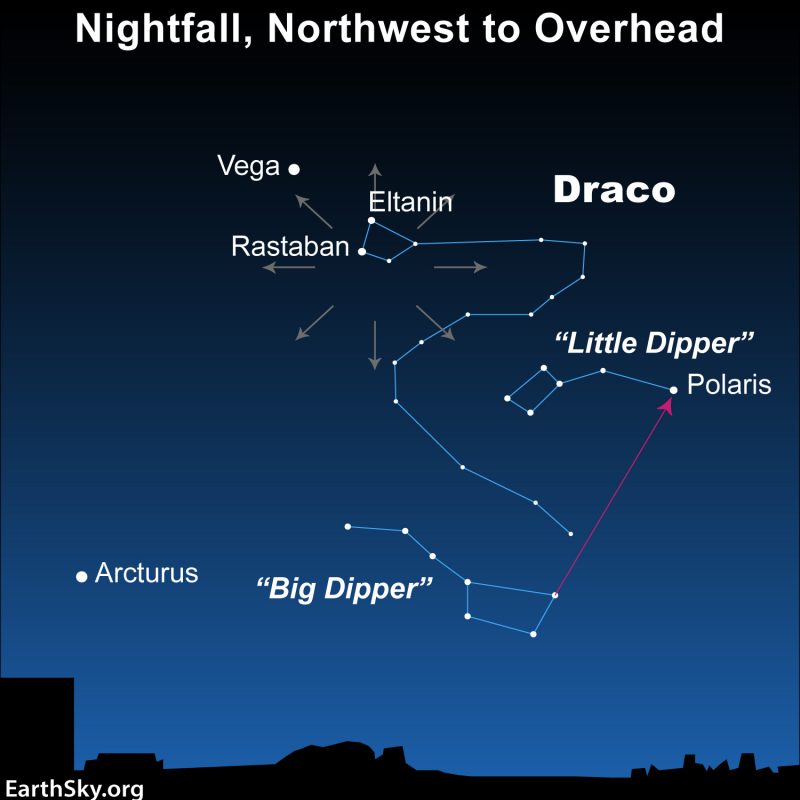
Predicted peak: The peak is predicted** for 1 UTC on October 9, 2026. When to watch: The best time to watch the Draconids in 2026 is as darkness falls on the evening of October 8 through the wee hours of the morning on October 9. Overall duration of shower: October 6 through 10. Radiant: Highest in the sky in the evening hours. See chart below. Nearest moon phase:new moon is 15:50 UTC on October 10. So a waning crescent moon in the morning sky shouldn’t interfere with watching for Draconid meteors this year. Expected meteors at peak, under ideal conditions: Under a dark sky with no moon, you might catch 10 Draconid meteors per hour. Note: The Draconid shower is a real oddity, in that the radiant point stands highest in the sky as darkness falls. That means that, unlike many meteor showers, more Draconids are likely to fly in the evening hours than in the morning hours after midnight. This shower is usually a sleeper, producing only a handful of languid meteors per hour in most years. But watch out if the Dragon awakes! In rare instances, fiery Draco has been known to spew forth many hundreds of meteors in a single hour. That possibility keeps many skywatchers outside during this shower. Since the parent comet of this shower – Comet 21P/Giacobini-Zinner – was at perihelion in March of 2025, does that mean we’ll see a storm of Draconid meteors this year? Maybe.
The radiant point for the Draconid meteor shower almost coincides with the head of the constellation Draco the Dragon in the northern sky. That’s why you can view the Draconids best from the Northern Hemisphere. This chart faces northward at nightfall in October. The Big Dipper sits low in the northwest. From the southern U.S. and comparable latitudes, in October, obstructions on your northern horizon might hide the Big Dipper from view. From farther south – say, the Southern Hemisphere – you won’t see the Dipper at all in the evening at this time of year. But, if you can spot it low in the sky, use the Big Dipper to star-hop to the star Polaris. Polaris marks the end star in the handle of the Little Dipper. Got all these stars? Then you should also be able to spot Eltanin and Rastaban, the Draconids’ radiant point, high in the northwest sky at nightfall in early October. Draconid meteors radiate from near these stars, which are known as the Dragon’s Eyes.
Late October meteors … the Orionids
Predicted peak: The peak is predicted** for 6:54 UTC on October 23, 2026. When to watch: Watch for Orionid meteors on the morning of October 23, starting after midnight through the wee hours before dawn. Overall duration of shower: September 26 to November 22. This time period is when we’re passing through the meteor stream in space! Radiant: The radiant rises before midnight and is highest in the sky around 2 a.m. See chart below. Nearest moon phase: The full moon falls at 4:12 UTC on October 26. So, during the Orionids’ peak, there’ll be a bright waxing gibbous moon visible after midnight. However, the moon will set several hours before dawn. So the best time to watch is during the dark hours before dawn. Expected meteors at peak, under ideal conditions: Under a dark sky with no moon, the Orionids exhibit a maximum of about 10 to 20 meteors per hour. Expect reduced rates this year because of moonlight. Note: These fast-moving meteors occasionally leave persistent trains. The Orionids sometimes produce bright fireballs.
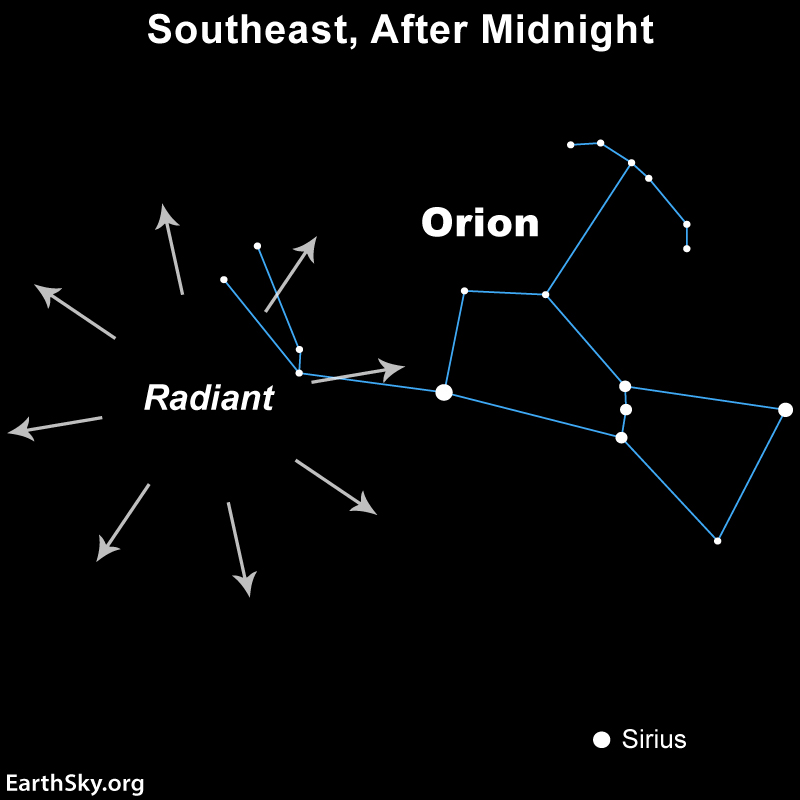
If you trace Orionid meteors backward on the sky’s dome, they seem to radiate from the upraised club of the famous constellation Orion the Hunter. This is the shower’s radiant point. The bright star near the radiant point is reddish Betelgeuse. Chart via EarthSky.
October into early November … the South and North Taurids
Predicted peak: The South Taurids’ predicted** peak is for 0:22 UTC on November 5, 2026. The North Taurids’ predicted** peak is for 6:59 UTC on November 9, 2026. Both the South and North Taurids don’t have very definite peaks. They ramble along in October and November and are especially noticeable from late October into early November, when they overlap. When to watch: Best around midnight when the radiant is highest in the sky. Overall duration of shower: The South Taurids run from about September 23 to November 12. North Taurids are active from about October 13 to December 2. This time period is when we’re passing through the Southern Taurid meteor stream in space! And time period is when we’re passing through the Northern Taurid meteor stream in space! Radiant: Rises in early evening, highest in the sky around midnight. See chart below. Nearest moon phases: In 2026, the new moon falls at 7:02 UTC on November 9. So moonlight will not interfere with Taurid meteors in 2026. You’ll catch Taurid meteors throughout October and November. Visit Sunrise Sunset Calendars to see moon rising times for your location. Be sure to check the moon rising time box. Expected meteors at peak, under ideal conditions: Under dark skies with no moon, both the South and North Taurid meteor showers produce about five meteors per hour (10 total when they overlap). Also, watch for fireballs. In most years, only one percent of all Taurid meteors are fireballs. In exceptional years, when the Earth passes through a concentrated field of debris, the percentage can be as high as seven percent. Note:Taurid meteors tend to be slow-moving but sometimes very bright. The showers sometimes produce fireballs, which made their cyclical reappearance in 2008, 2015 and 2022. The next predicted swarm or outburst of Taurid fireballs is in 2032.
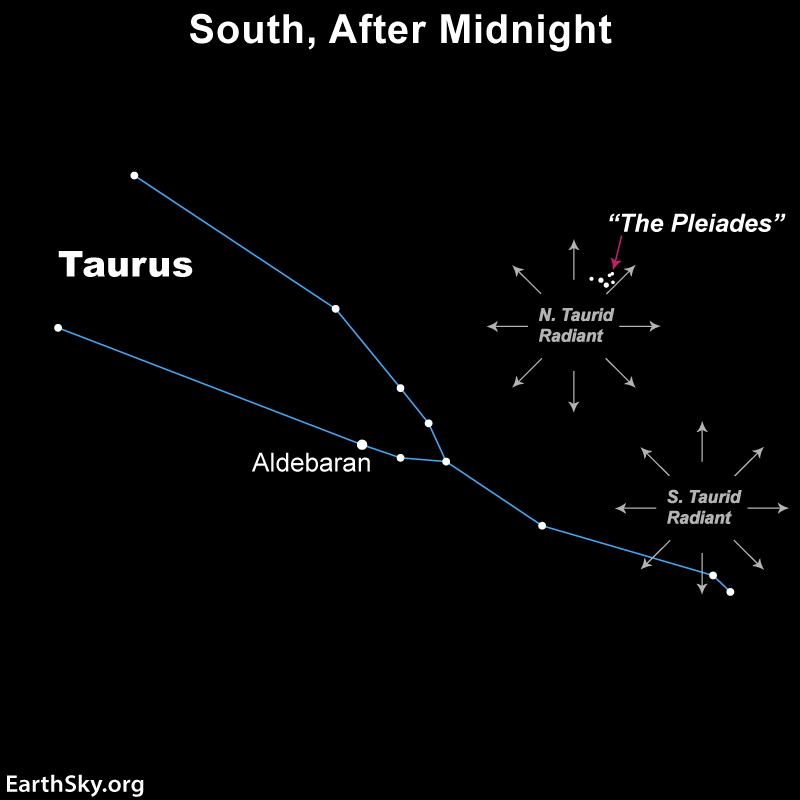
The Taurid meteors consist of 2 streams, the South Taurid meteors and North Taurid meteors. Both streams appear to originate from the constellation Taurus the Bull. Typically, you see the maximum numbers at or around midnight, when Taurus is highest in the sky.
Mid-November meteors … the Leonids
Predicted peak: The peak is predicted** for 0 UTC on November 18, 2026. When to watch: Watch late on the night of November 17 until dawn on November 18. The morning of November 17 might be worthwhile, too. Duration of shower: November 3 through December 2. This time period is when we’re passing through the meteor stream in space! Radiant: Rises around midnight, highest in the sky at dawn. Nearest moon phase: In 2026, the 1st quarter moon falls at 11:48 UTC on November 17. So the quarter moon might interfere with and of the fainter meteors in 2026. Expected meteors at peak, under ideal conditions: Under a dark sky with no moon, you might see 10 to 15 Leonid meteors per hour. In 2026, expect to see reduced numbers because of the 1st quarter moon. Note: The famous Leonid meteor shower produced one of the greatest meteor storms in living memory. Rates were as high as thousands of meteors per minute during a 15-minute span on the morning of November 17, 1966. That night, Leonid meteors did, briefly, fall like rain. Some who witnessed it had a strong impression of Earth moving through space, fording the meteor stream. Leonid meteor storms sometimes recur in cycles of 33 to 34 years. But the Leonids around the turn of the century – while wonderful for many observers – did not match the shower of 1966. And, in most years, the Lion whimpers rather than roars.
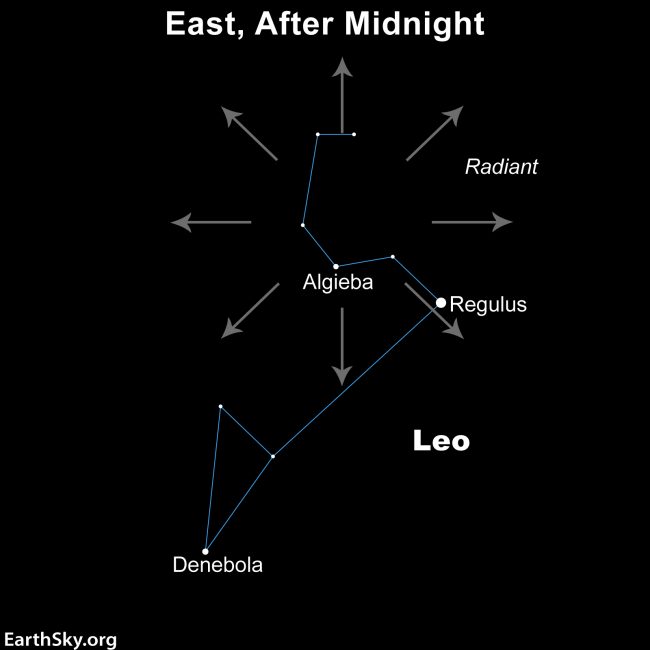
Leonids stream from a single point in the sky – their radiant point – in the constellation Leo the Lion. Leo rises just before midnight in mid-November. Regulus, the brightest star in Leo the, dots a backwards question mark of stars known as the Sickle.
Early to mid-December meteors … the Geminids
Predicted peak: is predicted** for 5:44 UTC on December 14, 2026. When to watch: Since the radiant rises in mid-evening, you can watch for Geminids all night on December 13-14. The days before and after might be good as well. A waxing crescent moon will not interfere with meteor watching. Overall duration of shower: November 19 to December 24. This time period is when we’re passing through the meteor stream in space! Radiant: Rises in mid-evening, highest around 2 a.m. See chart below. Nearest moon phase: In 2026, the first quarter moon falls several days after the predicted peak at 5:43 UTC on December 17. So you’ll have dark skies to watch for meteors. Expected meteors at peak, under ideal conditions: Under a dark sky with no moon, you might catch 120 Geminid meteors per hour. Note: The bold, bright – and sometimes colorful – Geminids give us one of the Northern Hemisphere’s best showers, especially in years when there’s no moon. They’re also visible, at lower rates, from the Southern Hemisphere. The meteors are plentiful, rivaling the August Perseids.
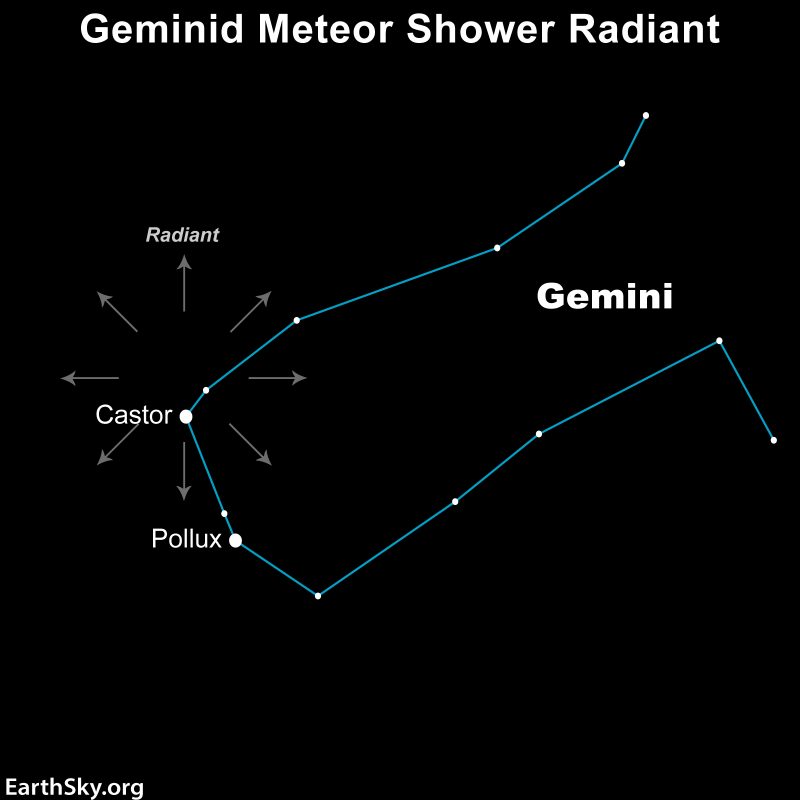
Watch the Geminid meteor shower around the night of December 13, 2026. The meteors radiate from near the bright star Castor in the constellation Gemini the Twins, in the east on December evenings, highest around 2 a.m. your local time (time on your clock for all parts of the globe). In 2026, a waxing crescent moon will not interfere with viewing the meteor shower.
Meteor shower around the December solstice … the Ursids
Predicted peak: is predicted** for 20:59 UTC on December 22, 2026. When to watch: Watch for Ursids on the evening of December 21st through dawn. You’ll have a moonlit sky for watching meteors. Duration of shower: Ursids range from December 13 to 24, so you might see some intermingling with the Geminids’ peak. This time period is when we’re passing through the meteor stream in space! Radiant: Circumpolar at northerly latitudes. Due to the northern location of the radiant point in the sky, these meteors are not well seen from southern latitudes and the Southern Hemisphere. Nearest moon phase: A full moon occurs at 1:28 UTC on December 24. So the bright gibbous moon will probably hinder seeing all but the brightest Ursids in 2026. Note: This low-key meteor shower – which always peaks around the solstice – is somewhat overlooked due to the holiday season. Its hourly rate – about 5 to 10 meteors per hour – is lower than that of the Geminid shower, which peaked over a week before. However, it’s had an occasional outburst of 100 meteors per hour. So the Ursids are worth a look! In 2026, you’ll have Ursid meteors in moonlight.
The Ursid meteor shower radiates between the Big Dipper and the Little Dipper. And depending on your latitude, the Big Dipper is low on – or below the – northern horizon in the December evening sky. It’ll climb higher as the night goes by. Chart via EarthSky.
Early January 2027 meteors … the Quadrantids
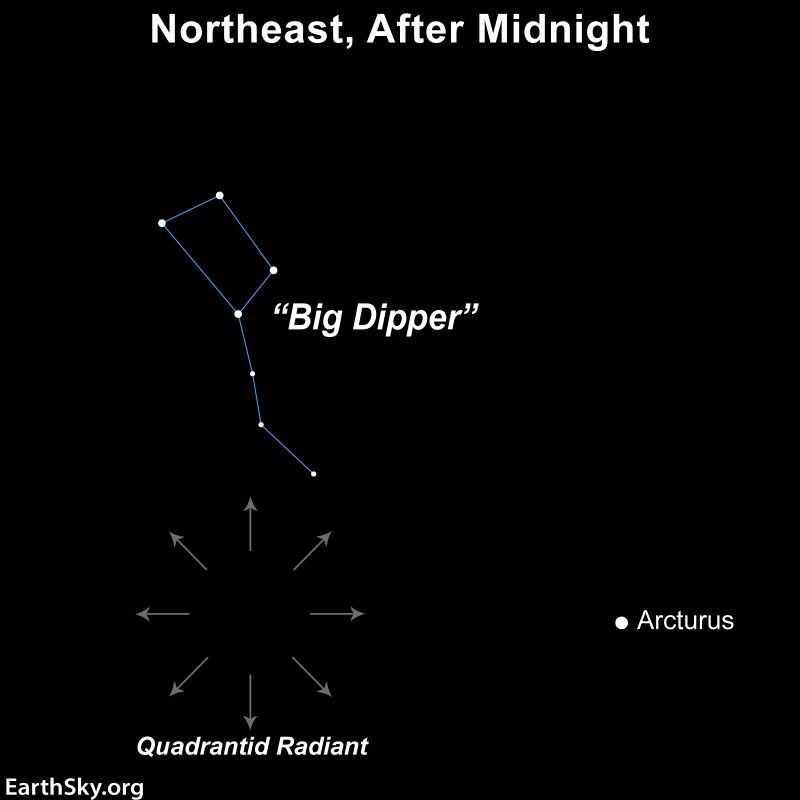
When to watch: The best time to watch for the 2027 Quadrantids is the hours before dawn on January 4. (The predicted peak** is 05:47 UTC on January 4). Nearest moon phase: A new moon will come at 20:24 UTC on January 7, 2027, so the waning crescent moon shouldn’t interfere with Quadrantid meteors. Radiant: Rises in the north-northeast after midnight and is highest before dawn. The radiant point for the Quadrantids is in a now-obsolete constellation, Quadrans Muralis the Mural Quadrant. Nowadays, we see the radiant near the famous Big Dipper asterism. Because the Quadrantid radiant is far to the north on the sky’s dome, this is mostly a far-northern shower, not as good for the Southern Hemisphere. Expected meteors at peak, under ideal conditions: Under a dark sky with no moon, when the radiant is high in the sky, the Quadrantids can (briefly) produce over 100 meteors per hour. In 2027, you’ll have dark skies and the Quadrantids often produce really bright meteors known as fireballs. Duration of shower: The Quadrantid meteor shower runs from mid-November through mid-January each year, according to this 2017 article in the journal Icarus. You might see a Quadrantid streak by any time during that interval. But most activity is centered on the peak. This time period is when we’re passing through the meteor stream in space! Note: The Quadrantid shower is one of four major meteor showers each year with a sharp peak (the other three are the Lyrids, Leonids, and Ursids).
The radiant point for the Quadrantid meteor shower is far to the north in the sky and so best seen from Earth’s Northern Hemisphere. From mid-northern latitudes, the radiant point for the Quadrantid meteor shower climbs over the horizon after midnight and is highest up before dawn.
Meteor shower guide: photos from the EarthSky community
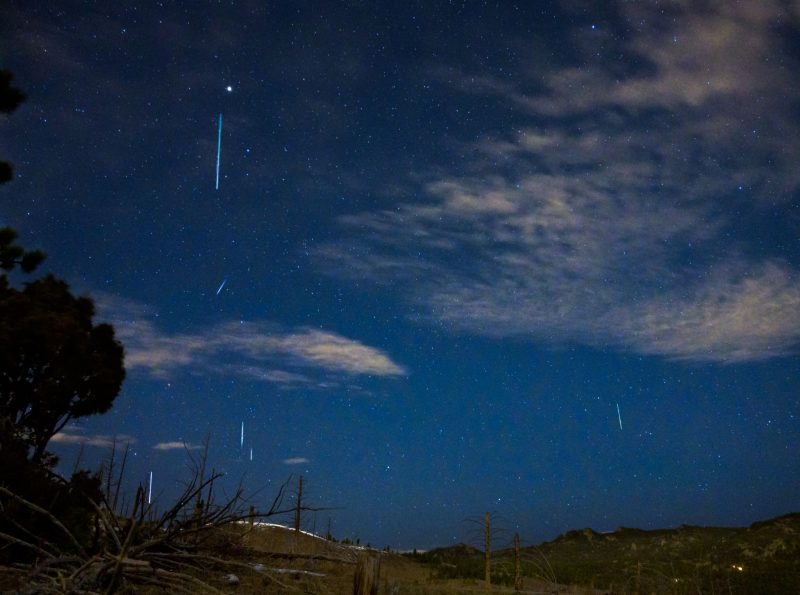
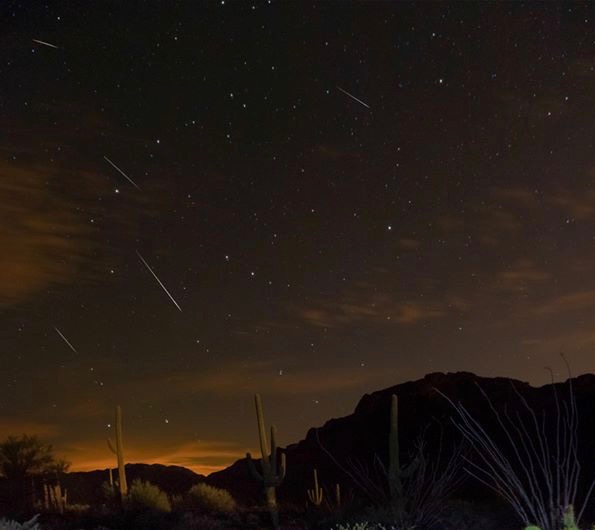
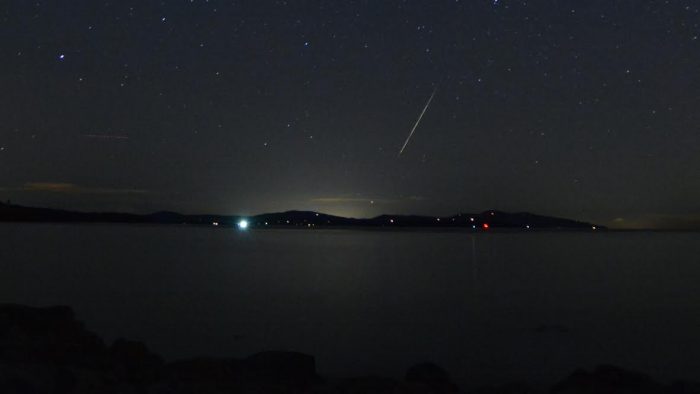
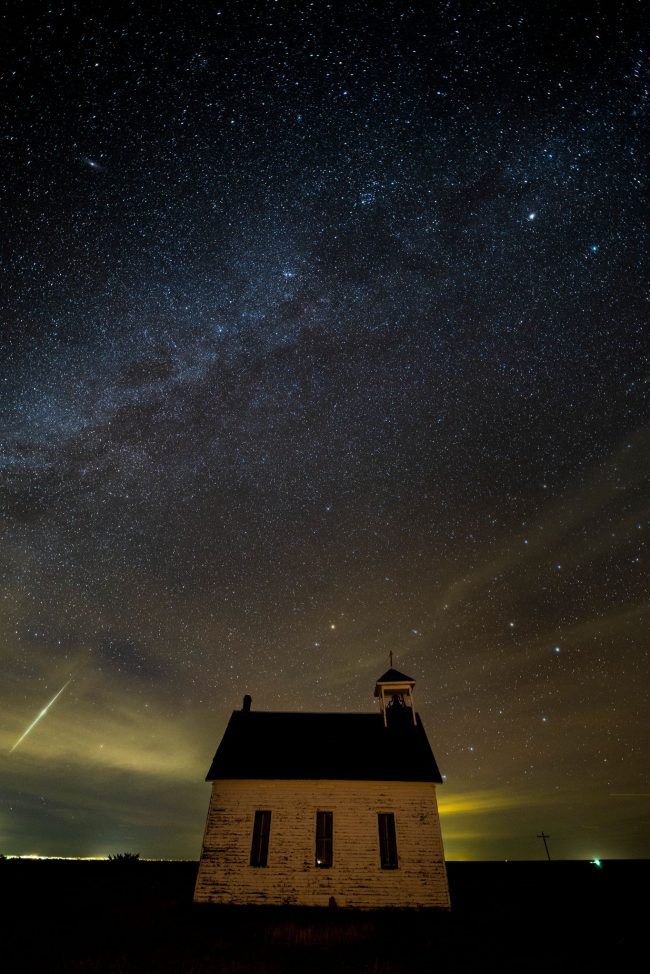
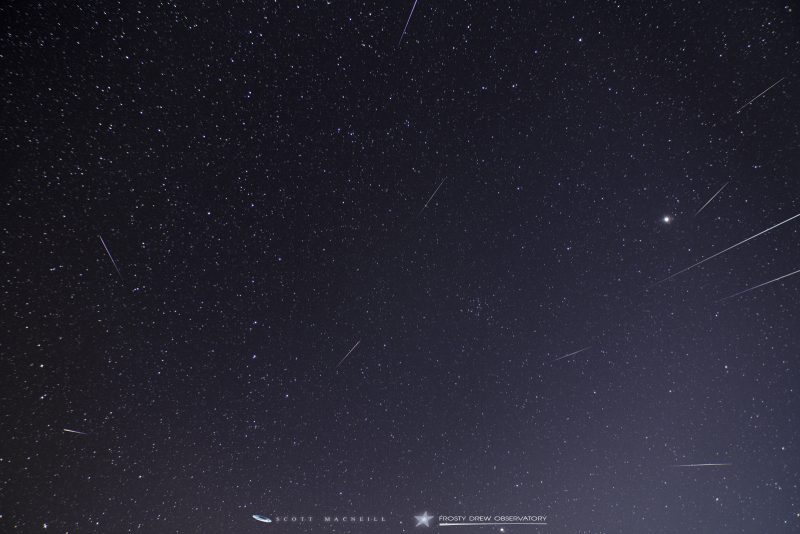
View at EarthSky Community Photos. | Photographer Thomas Hollowell in Colorado caught these Lyrid meteors on the morning of April 22, 2020, and said: “The 6 meteors in this frame were stacked in Photoshop on a set of 3 background frames.” Thanks, Thomas!Draconids near Tucson, Arizona, in 2013, by our friend Sean Parker Photography.James Younger sent in this photo during the 2015 peak of the Leonid meteor shower. It’s a meteor over the San Juan Islands in the Pacific Northwest.View at EarthSky Community Photos. | William Mathe captured this image on December 20, 2019, in Lindon, Colorado. He wrote: “My wife and I made a 100-mile jaunt out into the eastern plains to try to capture one or more meteors from the Ursid meteor shower. We took this image facing due north. As you can see, just to the right of the little white church is Ursa Major pointing up to Polaris, and just to the left is a green ‘fireball’ meteor that lit up the sky for a second or two.” Thank you, William!Quadrantid radiant composite via Scott MacNeill of Frosty Drew Observatory in Charleston, Rhode Island.
Meteor shower words of wisdom
A wise person once said that meteor showers are like fishing. You go, you enjoy nature … and sometimes you catch something.
Bottom line: Up next is the Lyrid meteor shower, they’ll be best after midnight and before dawn on April 22. And good news, they will be under a dark and moonless sky.
**Peak times for meteor showers provided by Robert Lunsford of the American Meteor Society. Note that predictions for meteor shower peak times may vary.Back to top.
We’re entering the long meteor draught after the early January Quadrantids. Up next is the Lyrid meteor shower, they’ll be best after midnight and before dawn on April 22. And good news, they will be under a dark and moonless sky.
April 2026 meteors … the Lyrids
When to watch in 2026: After midnight and through dawn on the morning of April 22. The predicted** peak is 19:15 UTC on April 22. The peak of the Lyrids is narrow (no weeks-long stretches of meteor-watching, as with some showers). In 2026, the first quarter moon falls at 2:32 UTC on April 24. So meteor watching after midnight and before dawn on April 22 will be under a dark and moonless sky. Radiant: Rises before midnight, highest in the sky at dawn. Nearest moon phase: First quarter moon falls at 2:32 UTC on April 24. So a fat waxing crescent moon – that sets after midnight – won’t interfere with the peak morning of the 2026’s Lyrid meteor shower. The best time to watch is after midnight and before dawn on the morning of April 22. Duration of shower: April 15 to April 29. This time period is when we’re passing through the meteor stream in space! Expected meteors at peak, under ideal conditions: In a dark sky with no moon, you might see 10 to 15 Lyrids per hour. The Lyrids are known for uncommon surges that can sometimes bring rates of up to 100 per hour! Read more about Lyrid outbursts. Lyrids are known for their bright and colorful meteors, sometimes even producing fireballs. Fireballs are exceptionally bright meteors that outshine the planet Venus. Note for Southern Hemisphere: This shower’s radiant point is far to the north on the sky’s dome. So the Southern Hemisphere will see fewer Lyrid meteors. Still, you might see some! Meteor train possibilities? In a moonless sky, a few Lyrid meteors can leave persistent trains. That is, they leave a trail of ionized gases that glow for a few seconds after the meteor has passed. Lyrids are known to produce fireballs.
Lyrid meteors radiate from near the bright star Vega in the constellation Lyra the Harp. You don’t need to identify Vega or Lyra in order to watch the Lyrid meteor shower. But you do need to know when the radiant rises, in this case in the northeast before midnight. That’s why the Lyrids are typically best between midnight and dawn.
May 2026 meteors … the Eta Aquariids
When to watch: The best morning to watch is May 5, 2026, in the hours before dawn. The American Meteor Society is listing 3:51 UTC on May 5 as the shower’s predicted** peak time. The fact is that the peak of this shower stretches out over several days. So you can expect elevated numbers of meteors a few days before and after the peak time. The mornings of both May 4 and May 6 are also good times to watch! Nearest moon phase: The last quarter moon will fall at 21:10 UTC on May 9. So, there will be a waning gibbous moon in the post-midnight sky, that sets after sunrise. So the sky before dawn on the mornings around the predicted peak for the 2025 Eta Aquariids will compete with a bright gibbous moon. Find a way to block out the moon for a better view of the sky. The radiant: will rise in the wee hours, climbing toward its highest point at dawn. That’s why the hours before dawn will be the best time to watch this shower. Duration of shower: April 15 to May 27. This time period is when we’re passing through the Eta Aquariid meteor stream in space! Expected meteors at peak, under ideal conditions: The zenithal hourly rate (ZHR) of this shower (the rate at the shower’s peak, under a dark sky, with no moon, when the radiant is high in the sky) is 60. But be aware that the shower is best for latitudes like those in the southern half of the U.S. or even farther south, in the Southern Hemisphere. Note: The Eta Aquariids’ radiant will be on the ecliptic, which will ride low in the sky on spring mornings as seen from far northerly latitudes. This shower favors more southerly latitudes (like those in the southern U.S. or the Southern Hemisphere), where the radiant appears higher in the morning sky. It’s often the Southern Hemisphere’s best meteor shower of the year.
The radiant point of the Eta Aquariid meteor shower will be near the star Eta Aquarii in the constellation Aquarius the Water Bearer. The radiant will rise in the wee hours after midnight and will continue climbing toward its highest point at dawn. That highest point will be in the south as viewed from the Northern Hemisphere, closer to overhead for the Southern Hemisphere. That’s why the Southern Hemisphere will see more meteors (the radiant will be higher up), and it’s why – for all of us around the globe – the hours before dawn will be best for this shower.
June 2026 daytime meteor shower … the Arietids
Most meteor showers are easy to observe. Just find a dark sky, and look up! But what about meteor showers that happen in the daytime, when the sun is up? The Arietids are sometimes said to be the most active daytime meteor shower. In 2026, their predicted** peak will be around the mornings of June 10. You might catch some Arietids around that morning in the dark hour before dawn.
When to watch: Watch from May 22 to July 3. There’s a predicted** peak for the mornings around June 10, 2026. Watch for them in the sunrise direction in the dark hour before dawn breaks. Nearest moon phase: In 2026, a 3rd quarter moon occurs at 10:00 UTC on June 8. So on the mornings around June 10, a thick waxing crescent moon will interfere with watching for meteors. Watch from a place that’s in the moon shadow or find a distant object to block out the light of the moon. Radiant: The shower’s radiant point – the point in the sky from which the meteors appear to radiate – is in the constellation Aries. You’ll find this constellation in the east before sunrise. Duration of shower: May 22 to July 3. Expected meteors at peak: This is tricky for daytime meteor showers because once the sun comes up, you won’t be able to see them. But the Arietids have a strong zenithal hourly rate (ZHR)! Meteor counts with radar and radio echoes have indicated a rate of 60 meteors per hour, and perhaps as high as 200 meteors per hour. Note: The Arietids are sometimes said to be the most active daytime meteor shower.
The Arietids are an active shower, but they’re visible mostly in daytime. Watch for them in the sunrise direction in the dark hour before dawn from May 22 to July 3. You’ll be looking for meteors that shoot up from the horizon. The radiant is below the constellation Aries the Ram. Chart by EarthSky.
Late July to mid-August 2026 meteors … the Delta Aquariids
Predicted peak: The peak is predicted** for 10 UTC on July 30, 2026. But this shower doesn’t have a noticeable peak. It rambles along steadily from late July through early August, joining forces with the August Perseids. When to watch: Watch late July through early August, mid-evening to dawn. Duration of shower: July 18 to August 21. Radiant: Rises in mid-evening, highest around 2 a.m. and low in the sky by dawn. See chart below. Nearest moon phase: In 2026, the full moon falls at 14:36 UTC on July 29. Take advantage of the moon-free mornings – after midnight – the week before for watching the Delta Aquariids (and the early Perseids). Expected meteors at peak, under ideal conditions: The Delta Aquariids’ maximum hourly rate can reach 15 to 20 meteors in a dark sky with no moon. You’ll typically see plenty of Delta Aquariids mixed in with the Perseids, if you’re watching in early August. Note: Like May’s Eta Aquariids, July’s Delta Aquariids favors the Southern Hemisphere. Skywatchers at high northern latitudes tend to discount it. But the shower can be excellent from latitudes like those in the southern U.S. Delta Aquariid meteors tend to be fainter than Perseid meteors. So a moon-free dark sky is essential. About 5% to 10% of the Delta Aquariid meteors leave persistent trains, glowing ionized gas trails that last a second or two after the meteor has passed.
Delta Aquariid meteors radiate from near the star Skat, aka Delta Aquarii, in the constellation Aquarius the Water Bearer. This star is near bright Fomalhaut. In late July to early August, Fomalhaut is highest around 2 a.m. (on your clock no matter where you are). It’s southward from the Northern Hemisphere, closer to overhead from the Southern Hemisphere. Fomalhaut appears bright and solitary in the sky. To find it, draw a line roughly southward through the stars on the west side of the Great Square of Pegasus.
Mid-July to mid-August 2026 meteors … the Perseids
Predicted peak: The peak is predicted** for 14:53 UTC on August 13, 2026. So the mornings of August 12 and 13 are probably your best bets. August 14 might be good as well, but be aware that the Perseids tend to fall off rapidly after their peak. When to watch: The moon will be a new moon during 2026’s peak of the Perseid meteor shower. So you’ll have dark skies for meteor viewing. This shower rises to a peak gradually, then falls off rapidly. And Perseid meteors tend to strengthen in number as late night deepens into the wee hours before dawn. The shower is often best just before dawn. Radiant: The radiant rises in the middle of the night and is highest at dawn. See chart below. Nearest moon phase:The new moon falls at 17:37 UTC on August 12. In fact, those lucky enough to be observing the August 12 total solar eclipse, might see some Perseids during totality. Duration of shower: July 14 to September 1. This time period is when we’re passing through the meteor stream in space! Expected meteors at peak, under ideal conditions: Under a dark sky with no moon, skywatchers frequently report 90 meteors per hour, or more. In 2026, you’ll have a moonless sky to watch for Perseids. The August Perseid meteor shower is rich and steady, from early August through the peak. The meteors are colorful. And they frequently leave persistent trains. All of these factors make the Perseid shower perhaps the most beloved meteor shower for the Northern Hemisphere.
Perseid meteors radiate from a point in the constellation Perseus the Hero. The Perseid meteor shower radiant rises in late evening and is highest at dawn. Remember … you don’t have to find a shower’s radiant point to see meteors. The meteors will be flying in all parts of the sky.
Early October meteors … the Draconids
Predicted peak: The peak is predicted** for 1 UTC on October 9, 2026. When to watch: The best time to watch the Draconids in 2026 is as darkness falls on the evening of October 8 through the wee hours of the morning on October 9. Overall duration of shower: October 6 through 10. Radiant: Highest in the sky in the evening hours. See chart below. Nearest moon phase:new moon is 15:50 UTC on October 10. So a waning crescent moon in the morning sky shouldn’t interfere with watching for Draconid meteors this year. Expected meteors at peak, under ideal conditions: Under a dark sky with no moon, you might catch 10 Draconid meteors per hour. Note: The Draconid shower is a real oddity, in that the radiant point stands highest in the sky as darkness falls. That means that, unlike many meteor showers, more Draconids are likely to fly in the evening hours than in the morning hours after midnight. This shower is usually a sleeper, producing only a handful of languid meteors per hour in most years. But watch out if the Dragon awakes! In rare instances, fiery Draco has been known to spew forth many hundreds of meteors in a single hour. That possibility keeps many skywatchers outside during this shower. Since the parent comet of this shower – Comet 21P/Giacobini-Zinner – was at perihelion in March of 2025, does that mean we’ll see a storm of Draconid meteors this year? Maybe.
The radiant point for the Draconid meteor shower almost coincides with the head of the constellation Draco the Dragon in the northern sky. That’s why you can view the Draconids best from the Northern Hemisphere. This chart faces northward at nightfall in October. The Big Dipper sits low in the northwest. From the southern U.S. and comparable latitudes, in October, obstructions on your northern horizon might hide the Big Dipper from view. From farther south – say, the Southern Hemisphere – you won’t see the Dipper at all in the evening at this time of year. But, if you can spot it low in the sky, use the Big Dipper to star-hop to the star Polaris. Polaris marks the end star in the handle of the Little Dipper. Got all these stars? Then you should also be able to spot Eltanin and Rastaban, the Draconids’ radiant point, high in the northwest sky at nightfall in early October. Draconid meteors radiate from near these stars, which are known as the Dragon’s Eyes.
Late October meteors … the Orionids
Predicted peak: The peak is predicted** for 6:54 UTC on October 23, 2026. When to watch: Watch for Orionid meteors on the morning of October 23, starting after midnight through the wee hours before dawn. Overall duration of shower: September 26 to November 22. This time period is when we’re passing through the meteor stream in space! Radiant: The radiant rises before midnight and is highest in the sky around 2 a.m. See chart below. Nearest moon phase: The full moon falls at 4:12 UTC on October 26. So, during the Orionids’ peak, there’ll be a bright waxing gibbous moon visible after midnight. However, the moon will set several hours before dawn. So the best time to watch is during the dark hours before dawn. Expected meteors at peak, under ideal conditions: Under a dark sky with no moon, the Orionids exhibit a maximum of about 10 to 20 meteors per hour. Expect reduced rates this year because of moonlight. Note: These fast-moving meteors occasionally leave persistent trains. The Orionids sometimes produce bright fireballs.
If you trace Orionid meteors backward on the sky’s dome, they seem to radiate from the upraised club of the famous constellation Orion the Hunter. This is the shower’s radiant point. The bright star near the radiant point is reddish Betelgeuse. Chart via EarthSky.
October into early November … the South and North Taurids
Predicted peak: The South Taurids’ predicted** peak is for 0:22 UTC on November 5, 2026. The North Taurids’ predicted** peak is for 6:59 UTC on November 9, 2026. Both the South and North Taurids don’t have very definite peaks. They ramble along in October and November and are especially noticeable from late October into early November, when they overlap. When to watch: Best around midnight when the radiant is highest in the sky. Overall duration of shower: The South Taurids run from about September 23 to November 12. North Taurids are active from about October 13 to December 2. This time period is when we’re passing through the Southern Taurid meteor stream in space! And time period is when we’re passing through the Northern Taurid meteor stream in space! Radiant: Rises in early evening, highest in the sky around midnight. See chart below. Nearest moon phases: In 2026, the new moon falls at 7:02 UTC on November 9. So moonlight will not interfere with Taurid meteors in 2026. You’ll catch Taurid meteors throughout October and November. Visit Sunrise Sunset Calendars to see moon rising times for your location. Be sure to check the moon rising time box. Expected meteors at peak, under ideal conditions: Under dark skies with no moon, both the South and North Taurid meteor showers produce about five meteors per hour (10 total when they overlap). Also, watch for fireballs. In most years, only one percent of all Taurid meteors are fireballs. In exceptional years, when the Earth passes through a concentrated field of debris, the percentage can be as high as seven percent. Note:Taurid meteors tend to be slow-moving but sometimes very bright. The showers sometimes produce fireballs, which made their cyclical reappearance in 2008, 2015 and 2022. The next predicted swarm or outburst of Taurid fireballs is in 2032.
The Taurid meteors consist of 2 streams, the South Taurid meteors and North Taurid meteors. Both streams appear to originate from the constellation Taurus the Bull. Typically, you see the maximum numbers at or around midnight, when Taurus is highest in the sky.
Mid-November meteors … the Leonids
Predicted peak: The peak is predicted** for 0 UTC on November 18, 2026. When to watch: Watch late on the night of November 17 until dawn on November 18. The morning of November 17 might be worthwhile, too. Duration of shower: November 3 through December 2. This time period is when we’re passing through the meteor stream in space! Radiant: Rises around midnight, highest in the sky at dawn. Nearest moon phase: In 2026, the 1st quarter moon falls at 11:48 UTC on November 17. So the quarter moon might interfere with and of the fainter meteors in 2026. Expected meteors at peak, under ideal conditions: Under a dark sky with no moon, you might see 10 to 15 Leonid meteors per hour. In 2026, expect to see reduced numbers because of the 1st quarter moon. Note: The famous Leonid meteor shower produced one of the greatest meteor storms in living memory. Rates were as high as thousands of meteors per minute during a 15-minute span on the morning of November 17, 1966. That night, Leonid meteors did, briefly, fall like rain. Some who witnessed it had a strong impression of Earth moving through space, fording the meteor stream. Leonid meteor storms sometimes recur in cycles of 33 to 34 years. But the Leonids around the turn of the century – while wonderful for many observers – did not match the shower of 1966. And, in most years, the Lion whimpers rather than roars.
Leonids stream from a single point in the sky – their radiant point – in the constellation Leo the Lion. Leo rises just before midnight in mid-November. Regulus, the brightest star in Leo the, dots a backwards question mark of stars known as the Sickle.
Early to mid-December meteors … the Geminids
Predicted peak: is predicted** for 5:44 UTC on December 14, 2026. When to watch: Since the radiant rises in mid-evening, you can watch for Geminids all night on December 13-14. The days before and after might be good as well. A waxing crescent moon will not interfere with meteor watching. Overall duration of shower: November 19 to December 24. This time period is when we’re passing through the meteor stream in space! Radiant: Rises in mid-evening, highest around 2 a.m. See chart below. Nearest moon phase: In 2026, the first quarter moon falls several days after the predicted peak at 5:43 UTC on December 17. So you’ll have dark skies to watch for meteors. Expected meteors at peak, under ideal conditions: Under a dark sky with no moon, you might catch 120 Geminid meteors per hour. Note: The bold, bright – and sometimes colorful – Geminids give us one of the Northern Hemisphere’s best showers, especially in years when there’s no moon. They’re also visible, at lower rates, from the Southern Hemisphere. The meteors are plentiful, rivaling the August Perseids.
Watch the Geminid meteor shower around the night of December 13, 2026. The meteors radiate from near the bright star Castor in the constellation Gemini the Twins, in the east on December evenings, highest around 2 a.m. your local time (time on your clock for all parts of the globe). In 2026, a waxing crescent moon will not interfere with viewing the meteor shower.
Meteor shower around the December solstice … the Ursids
Predicted peak: is predicted** for 20:59 UTC on December 22, 2026. When to watch: Watch for Ursids on the evening of December 21st through dawn. You’ll have a moonlit sky for watching meteors. Duration of shower: Ursids range from December 13 to 24, so you might see some intermingling with the Geminids’ peak. This time period is when we’re passing through the meteor stream in space! Radiant: Circumpolar at northerly latitudes. Due to the northern location of the radiant point in the sky, these meteors are not well seen from southern latitudes and the Southern Hemisphere. Nearest moon phase: A full moon occurs at 1:28 UTC on December 24. So the bright gibbous moon will probably hinder seeing all but the brightest Ursids in 2026. Note: This low-key meteor shower – which always peaks around the solstice – is somewhat overlooked due to the holiday season. Its hourly rate – about 5 to 10 meteors per hour – is lower than that of the Geminid shower, which peaked over a week before. However, it’s had an occasional outburst of 100 meteors per hour. So the Ursids are worth a look! In 2026, you’ll have Ursid meteors in moonlight.
The Ursid meteor shower radiates between the Big Dipper and the Little Dipper. And depending on your latitude, the Big Dipper is low on – or below the – northern horizon in the December evening sky. It’ll climb higher as the night goes by. Chart via EarthSky.
Early January 2027 meteors … the Quadrantids
When to watch: The best time to watch for the 2027 Quadrantids is the hours before dawn on January 4. (The predicted peak** is 05:47 UTC on January 4). Nearest moon phase: A new moon will come at 20:24 UTC on January 7, 2027, so the waning crescent moon shouldn’t interfere with Quadrantid meteors. Radiant: Rises in the north-northeast after midnight and is highest before dawn. The radiant point for the Quadrantids is in a now-obsolete constellation, Quadrans Muralis the Mural Quadrant. Nowadays, we see the radiant near the famous Big Dipper asterism. Because the Quadrantid radiant is far to the north on the sky’s dome, this is mostly a far-northern shower, not as good for the Southern Hemisphere. Expected meteors at peak, under ideal conditions: Under a dark sky with no moon, when the radiant is high in the sky, the Quadrantids can (briefly) produce over 100 meteors per hour. In 2027, you’ll have dark skies and the Quadrantids often produce really bright meteors known as fireballs. Duration of shower: The Quadrantid meteor shower runs from mid-November through mid-January each year, according to this 2017 article in the journal Icarus. You might see a Quadrantid streak by any time during that interval. But most activity is centered on the peak. This time period is when we’re passing through the meteor stream in space! Note: The Quadrantid shower is one of four major meteor showers each year with a sharp peak (the other three are the Lyrids, Leonids, and Ursids).
The radiant point for the Quadrantid meteor shower is far to the north in the sky and so best seen from Earth’s Northern Hemisphere. From mid-northern latitudes, the radiant point for the Quadrantid meteor shower climbs over the horizon after midnight and is highest up before dawn.
Meteor shower guide: photos from the EarthSky community
View at EarthSky Community Photos. | Photographer Thomas Hollowell in Colorado caught these Lyrid meteors on the morning of April 22, 2020, and said: “The 6 meteors in this frame were stacked in Photoshop on a set of 3 background frames.” Thanks, Thomas!Draconids near Tucson, Arizona, in 2013, by our friend Sean Parker Photography.James Younger sent in this photo during the 2015 peak of the Leonid meteor shower. It’s a meteor over the San Juan Islands in the Pacific Northwest.View at EarthSky Community Photos. | William Mathe captured this image on December 20, 2019, in Lindon, Colorado. He wrote: “My wife and I made a 100-mile jaunt out into the eastern plains to try to capture one or more meteors from the Ursid meteor shower. We took this image facing due north. As you can see, just to the right of the little white church is Ursa Major pointing up to Polaris, and just to the left is a green ‘fireball’ meteor that lit up the sky for a second or two.” Thank you, William!Quadrantid radiant composite via Scott MacNeill of Frosty Drew Observatory in Charleston, Rhode Island.
Meteor shower words of wisdom
A wise person once said that meteor showers are like fishing. You go, you enjoy nature … and sometimes you catch something.
Bottom line: Up next is the Lyrid meteor shower, they’ll be best after midnight and before dawn on April 22. And good news, they will be under a dark and moonless sky.
**Peak times for meteor showers provided by Robert Lunsford of the American Meteor Society. Note that predictions for meteor shower peak times may vary.Back to top.
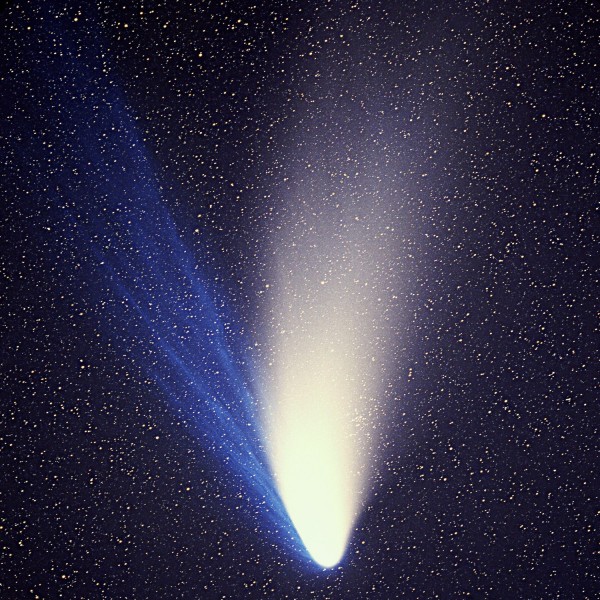
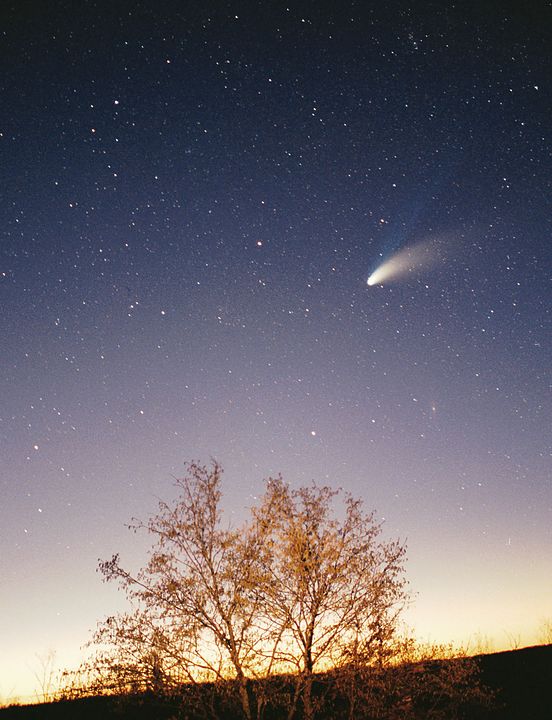
Comet Hale-Bopp with its prominent dust (white) and plasma (blue) tails. Photo via E. Kolmhofer, H. Raab; Johannes-Kepler-Observatory/ Wikimedia Commons (CC BY-SA 3.0).
Discovered by amateur astronomers: Comet Hale-Bopp was discovered on July 23, 1995, independently by Alan Hale and Thomas Bopp, two amateur astronomers.
Many people saw it! Comet Hale-Bopp became one of the brightest comets seen from Earth in the 20th century. It reached peak brightness in April 1997 and was visible to the unaided eye for a record-breaking 18 months.
Huge cometary nucleus: Comet Hale-Bopp’s nucleus, or icy core, was estimated to be about 25 miles (40 kilometers) in diameter, making it one of the largest cometary nuclei ever observed.
Twenty-nine years ago today – on April 1, 1997 – Comet Hale-Bopp reached its perihelion or closest point to the sun. It was slightly less than Earth’s distance from the sun at 0.9 astronomical units (AU). And it was bright, for a comet. Its brightness – though dispersed across a wider area than stars – exceeded that of any star in the sky except for Sirius, the sky’s brightest star.
Hale-Bopp is officially labeled C/1995 O1. It was one of the most-viewed comets in human history.
As seen from the Northern Hemisphere, Hale-Bopp was the brightest comet since Comet West, sometimes called the Great Comet of 1976. Hale-Bopp stayed visible with the unaided eye for a record of 18 months, twice as long as the previous record holder: the Great Comet of 1811. Some called Hale-Bopp the Great Comet of 1997 (although others disagreed that it met the criteria for a Great Comet).
One of the most-viewed comets ever
It attracted so many people not only because of its rarity and beauty, but also because it enabled people to jump – in their minds – back in time. Some 4,200 years ago, when Hale-Bopp last passed the Earth and sun, the Egyptian pyramids were newly being polished by sand, and the Epic of Gilgamesh, considered the first great work of Western literature, was not yet written.
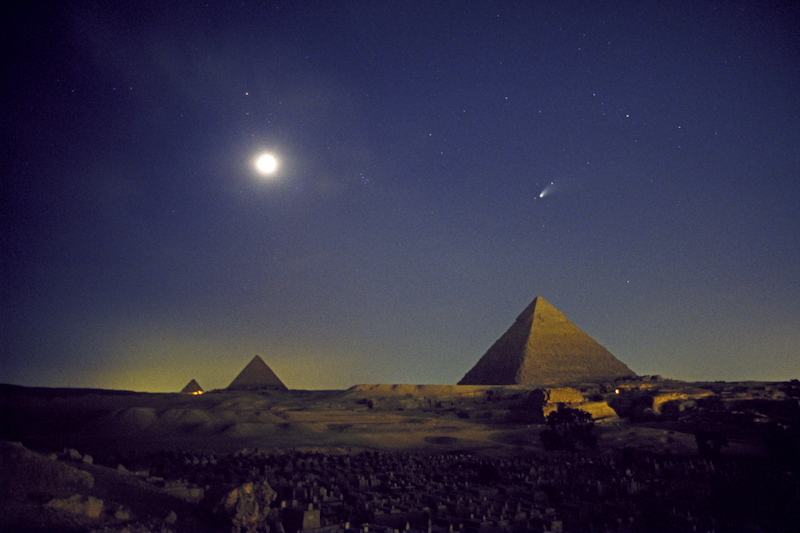
Comet Hale-Bopp above the pyramids of Giza, Egypt, in 1997, accompanied by the moon, the stars of Taurus the Bull and Perseus the Hero, and the Pleiades Cluster. Image via John Goldsmith/ ESA.
Comet Hale-Bopp discovery
Comet Hale-Bopp was discovered on July 23, 1995, by two independently observing amateur astronomers: Alan Hale and Thomas Bopp. At that time, the comet was a whopping 7.2 AU from the sun, which made it the most distant comet to ever be discovered by amateurs until that time.
What made that discovery possible was that Hale-Bopp was so bright. It was literally a thousand times brighter than Comet Halley had been at that same distance. Halley, one of the most famous comets, had visited the inner solar system a decade earlier. It was clear that Hale-Bopp was a very special comet, because comets typically don’t shine so brightly when they are beyond Jupiter’s orbit.
There were a few reasons explaining the comet’s unusual brightness. The main one is the enormous size of its nucleus, or core. Most cometary nuclei are thought to be no more than about 10 miles (16 km) across. The nucleus of Hale-Bopp had a diameter estimated to be between 25 and 40 miles across (40-65 km).
Comet Hale-Bopp from Pazin, Croatia, seen near perihelion. The Andromeda Galaxy is faintly visible to the lower right of the comet. Image via Philipp Salzgeber/ Wikimedia Commons (CC BY-SA 2.0 AT).
The orbit of Comet Hale-Bopp
Giant Jupiter is thought to have affected this comet’s orbit. Calculations suggest that Hale-Bopp appeared in Earth’s skies roughly 4,200 years ago. Now, though, the comet’s orbit is shorter. Astronomers think that – on what might have been its first voyage around the sun thousands of years ago – the comet almost collided with Jupiter. It passed very close to Jupiter again in April 1996, shortening its orbital period even further. The comet’s current orbital period is about 2,530 Earth years.
No records have been found of the comet’s passage 4,200 years ago, but that does not mean none were made. It most likely means that none survived. Around 2213 B.C., when the comet was visible, civilizations had been using the sky to track seasonal changes and other phenomena for a long time. They could not have missed Hale-Bopp.
Thus, in a way, Hale-Bopp is like a clock measuring time in millennia. It reminds us of the progress humankind has made since its last visit. Imagine what the world will look like when Comet Hale-Bopp next crosses our skies, sometime around the year 4380.
Where is the comet now?
Comet Hale-Bopp is in the constellation Octans, with an estimated magnitude of +20.14. The comet is over 4,702,313,489 miles (7,567,640,000 km) distant from the sun. Check the current location at theskylive.com.
Bottom line: Comet Hale-Bopp was at its closest point to the sun 29 years ago today. It was widely seen from the Northern Hemisphere. When will we see it again?
Comet Hale-Bopp with its prominent dust (white) and plasma (blue) tails. Photo via E. Kolmhofer, H. Raab; Johannes-Kepler-Observatory/ Wikimedia Commons (CC BY-SA 3.0).
Discovered by amateur astronomers: Comet Hale-Bopp was discovered on July 23, 1995, independently by Alan Hale and Thomas Bopp, two amateur astronomers.
Many people saw it! Comet Hale-Bopp became one of the brightest comets seen from Earth in the 20th century. It reached peak brightness in April 1997 and was visible to the unaided eye for a record-breaking 18 months.
Huge cometary nucleus: Comet Hale-Bopp’s nucleus, or icy core, was estimated to be about 25 miles (40 kilometers) in diameter, making it one of the largest cometary nuclei ever observed.
Twenty-nine years ago today – on April 1, 1997 – Comet Hale-Bopp reached its perihelion or closest point to the sun. It was slightly less than Earth’s distance from the sun at 0.9 astronomical units (AU). And it was bright, for a comet. Its brightness – though dispersed across a wider area than stars – exceeded that of any star in the sky except for Sirius, the sky’s brightest star.
Hale-Bopp is officially labeled C/1995 O1. It was one of the most-viewed comets in human history.
As seen from the Northern Hemisphere, Hale-Bopp was the brightest comet since Comet West, sometimes called the Great Comet of 1976. Hale-Bopp stayed visible with the unaided eye for a record of 18 months, twice as long as the previous record holder: the Great Comet of 1811. Some called Hale-Bopp the Great Comet of 1997 (although others disagreed that it met the criteria for a Great Comet).
One of the most-viewed comets ever
It attracted so many people not only because of its rarity and beauty, but also because it enabled people to jump – in their minds – back in time. Some 4,200 years ago, when Hale-Bopp last passed the Earth and sun, the Egyptian pyramids were newly being polished by sand, and the Epic of Gilgamesh, considered the first great work of Western literature, was not yet written.
Comet Hale-Bopp above the pyramids of Giza, Egypt, in 1997, accompanied by the moon, the stars of Taurus the Bull and Perseus the Hero, and the Pleiades Cluster. Image via John Goldsmith/ ESA.
Comet Hale-Bopp discovery
Comet Hale-Bopp was discovered on July 23, 1995, by two independently observing amateur astronomers: Alan Hale and Thomas Bopp. At that time, the comet was a whopping 7.2 AU from the sun, which made it the most distant comet to ever be discovered by amateurs until that time.
What made that discovery possible was that Hale-Bopp was so bright. It was literally a thousand times brighter than Comet Halley had been at that same distance. Halley, one of the most famous comets, had visited the inner solar system a decade earlier. It was clear that Hale-Bopp was a very special comet, because comets typically don’t shine so brightly when they are beyond Jupiter’s orbit.
There were a few reasons explaining the comet’s unusual brightness. The main one is the enormous size of its nucleus, or core. Most cometary nuclei are thought to be no more than about 10 miles (16 km) across. The nucleus of Hale-Bopp had a diameter estimated to be between 25 and 40 miles across (40-65 km).
Comet Hale-Bopp from Pazin, Croatia, seen near perihelion. The Andromeda Galaxy is faintly visible to the lower right of the comet. Image via Philipp Salzgeber/ Wikimedia Commons (CC BY-SA 2.0 AT).
The orbit of Comet Hale-Bopp
Giant Jupiter is thought to have affected this comet’s orbit. Calculations suggest that Hale-Bopp appeared in Earth’s skies roughly 4,200 years ago. Now, though, the comet’s orbit is shorter. Astronomers think that – on what might have been its first voyage around the sun thousands of years ago – the comet almost collided with Jupiter. It passed very close to Jupiter again in April 1996, shortening its orbital period even further. The comet’s current orbital period is about 2,530 Earth years.
No records have been found of the comet’s passage 4,200 years ago, but that does not mean none were made. It most likely means that none survived. Around 2213 B.C., when the comet was visible, civilizations had been using the sky to track seasonal changes and other phenomena for a long time. They could not have missed Hale-Bopp.
Thus, in a way, Hale-Bopp is like a clock measuring time in millennia. It reminds us of the progress humankind has made since its last visit. Imagine what the world will look like when Comet Hale-Bopp next crosses our skies, sometime around the year 4380.
Where is the comet now?
Comet Hale-Bopp is in the constellation Octans, with an estimated magnitude of +20.14. The comet is over 4,702,313,489 miles (7,567,640,000 km) distant from the sun. Check the current location at theskylive.com.
Bottom line: Comet Hale-Bopp was at its closest point to the sun 29 years ago today. It was widely seen from the Northern Hemisphere. When will we see it again?
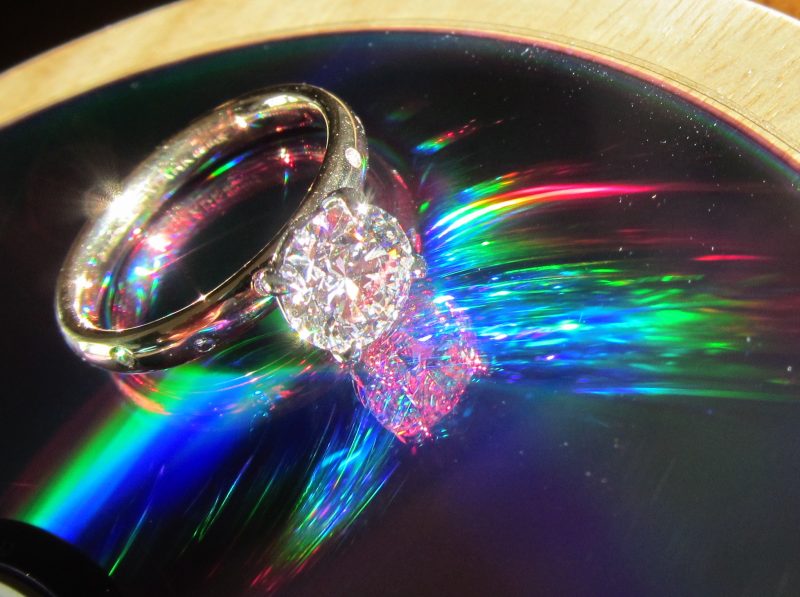
The April birthstone is the diamond. And a diamond solitaire ring is a popular choice for engagement rings. Image via EarthSky’s Marcy Curran.
The April birthstone
The April birthstone is the diamond. It’s treasured for its exceptional hardness and purity of color. Although the diamond is not the rarest of gems, it’s still one of the most popular gemstones.
As a result of a diamonds’ cold, sparkling fire, it’s held us spellbound for centuries. What’s more, it’s inspired rich, passionate myths of romance, intrigue, power, greed and magic. Today, the diamond is a symbol of enduring love, and often graces engagement rings.
The science of diamonds
Ancient Hindus, finding diamonds washed out of the ground after thunderstorms, believed bolts of lightning created them.
Of course, we know different now. In fact, diamonds are the rich cousins of graphite. Both are crystalline forms of pure carbon. But the enormous differences in their properties are a result of the way the carbon atoms bond together. In graphite, carbon atoms form in sheets that easily slide past each other, which makes graphite ideal as a lubricant and, of course, as pencil lead. On the other hand, diamond crystals are a tight-fisted network of carbon atoms securely bound in four directions. Thus, diamonds are the hardest naturally-occurring substance in the world.
So to achieve such a compact and strongly-held network of carbon atoms, it’s believed that diamonds crystallized deep under the Earth’s surface. At these depths – 90 to 120 miles deep (145 – 193 km) – the proper conditions for the formation of diamonds exist. That’s because pressures are more than 65,000 times that of the atmosphere at the Earth’s surface, with temperatures exceeding 2,700 degrees Fahrenheit (1,500 degrees Celsius). And as a matter of fact, such pressures and temperatures are reproduced in laboratories successfully creating synthetic diamonds.
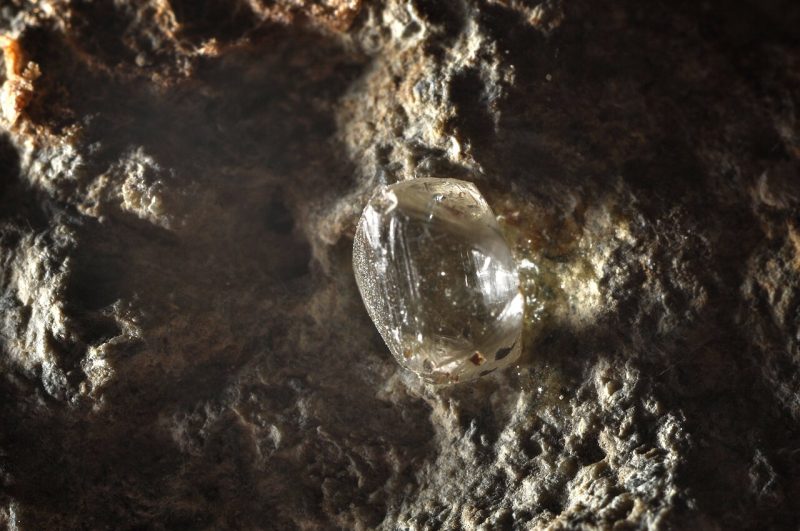
This is the typical shape of a rough diamond crystal. Its lustrous faces also indicate that this crystal is from a primary deposit. Image via Géry Parent/ Wikipedia (public domain).
The quality of diamonds
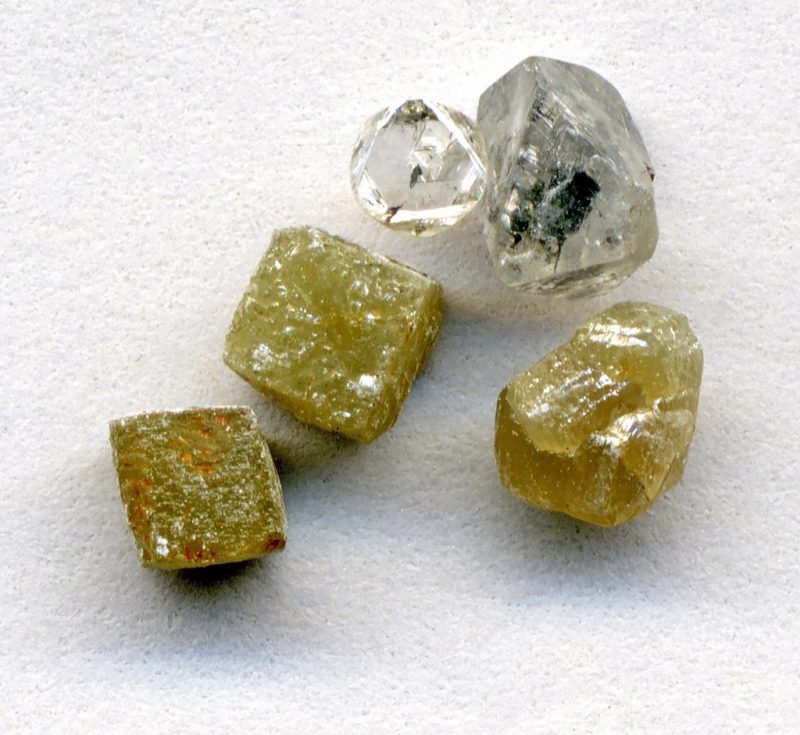
There are many kinds of diamonds: transparent, translucent, or opaque; ranging from colorless to sooty black, with many colors in between. Mostly transparent diamonds, those that are colorless or tinted, end up in jewelry. And then lower grade diamonds are for industrial use.
The color of a diamond depends on the kind of impurities embedded inside it. For example, yellow diamonds betray minute quantities of nitrogen, while boron imparts a bluish hue. As a matter of fact, some inclusions in diamonds have great scientific value. That’s because they are time capsules containing valuable information about conditions deep in the Earth’s upper mantle where diamonds form. Additionally, they offer clues to the formation and age of the diamond.
Different types of rough diamonds. Image via James St. John/ Wikipedia (CC BY 2.0).
Sources of the April birthstone
Diamonds are found in alluvial deposits or gravel swept away by streams, rivers, glaciers and ocean currents. Also, they are in sedimentary rock where gravel deposits and organic material are compressed into rock. Diamonds are in some samples of kimberlite, a type of volcanic rock first identified in Kimberley, South Africa. Also, the diamonds in kimberlite may be very old, perhaps as much as three billion years old. And even meteorites – bits of rocky space debris that land on Earth – often contain tiny flecks of diamonds.
Diamonds are crystals. Crystals are the ultimate form of symmetry in nature. Their shape reflects the internal orderly arrangement of atoms within the crystal. In diamonds, atoms of carbon are held tightly by covalent bonding, where two neighboring atoms share an electron, endowing the diamond crystal with great strength. But despite that hardness, diamonds can be cut with saws and polished with grinding wheels coated with tiny industrial diamond fragments. In their natural form, diamonds can appear quite unimpressive. But they are cut and polished by skilled craftsmen in a pattern that reflects and refracts the light among their facets to reveal the hidden beauty of the stone.
One of the most famous diamonds, the Hope Diamond, shown here in the National Museum of Natural History in Washington, D.C. Image via David Bjorgen/ Wikipedia (CC BY-SA 3.0).
Diamond lore
Some diamonds seem to have lived lives of their own. One legendary stone in the diamond hall of fame is the Koh-i-noor (“Mountain of Light”). The Koh-i-noor diamond is believed to be 5,000 years old, and was featured in the great Sanskrit epic The Mahabharata.
Originally owned by the Rajah of Malwa in India, the Koh-i-noor has since been a player in victories and defeats spanning India, Persia and Afghanistan. It was in the possession of the great Mogul dynasty from 1526 to 1739. Its owners included Shah Jehan, who built the Taj Mahal in memory of his queen Mumtaz. The Persian invader Nadir Shah briefly possessed it until his assassination in 1747. The jewel then fell into the hands of Afghan rulers who eventually surrendered it to the Rajah of Punjab, Ranjit Singh.
Two years after Ranjit Singh’s death in 1839, Punjab became part of India under British rule and they presented the stone to Queen Victoria. Then she had it cut from its original 187 carats to 108 carats to further enhance its beauty. After her death, the diamond became part of the British crown jewels. Queen Elizabeth (later the Queen Mother) wore it in her crown at her 1937 coronation. However, Camilla chose to wear another crown to Charles III’s coronation in 2023.
Find out about the birthstones for the other months of the year.
The April birthstone is the diamond. And a diamond solitaire ring is a popular choice for engagement rings. Image via EarthSky’s Marcy Curran.
The April birthstone
The April birthstone is the diamond. It’s treasured for its exceptional hardness and purity of color. Although the diamond is not the rarest of gems, it’s still one of the most popular gemstones.
As a result of a diamonds’ cold, sparkling fire, it’s held us spellbound for centuries. What’s more, it’s inspired rich, passionate myths of romance, intrigue, power, greed and magic. Today, the diamond is a symbol of enduring love, and often graces engagement rings.
The science of diamonds
Ancient Hindus, finding diamonds washed out of the ground after thunderstorms, believed bolts of lightning created them.
Of course, we know different now. In fact, diamonds are the rich cousins of graphite. Both are crystalline forms of pure carbon. But the enormous differences in their properties are a result of the way the carbon atoms bond together. In graphite, carbon atoms form in sheets that easily slide past each other, which makes graphite ideal as a lubricant and, of course, as pencil lead. On the other hand, diamond crystals are a tight-fisted network of carbon atoms securely bound in four directions. Thus, diamonds are the hardest naturally-occurring substance in the world.
So to achieve such a compact and strongly-held network of carbon atoms, it’s believed that diamonds crystallized deep under the Earth’s surface. At these depths – 90 to 120 miles deep (145 – 193 km) – the proper conditions for the formation of diamonds exist. That’s because pressures are more than 65,000 times that of the atmosphere at the Earth’s surface, with temperatures exceeding 2,700 degrees Fahrenheit (1,500 degrees Celsius). And as a matter of fact, such pressures and temperatures are reproduced in laboratories successfully creating synthetic diamonds.
This is the typical shape of a rough diamond crystal. Its lustrous faces also indicate that this crystal is from a primary deposit. Image via Géry Parent/ Wikipedia (public domain).
The quality of diamonds
There are many kinds of diamonds: transparent, translucent, or opaque; ranging from colorless to sooty black, with many colors in between. Mostly transparent diamonds, those that are colorless or tinted, end up in jewelry. And then lower grade diamonds are for industrial use.
The color of a diamond depends on the kind of impurities embedded inside it. For example, yellow diamonds betray minute quantities of nitrogen, while boron imparts a bluish hue. As a matter of fact, some inclusions in diamonds have great scientific value. That’s because they are time capsules containing valuable information about conditions deep in the Earth’s upper mantle where diamonds form. Additionally, they offer clues to the formation and age of the diamond.
Different types of rough diamonds. Image via James St. John/ Wikipedia (CC BY 2.0).
Sources of the April birthstone
Diamonds are found in alluvial deposits or gravel swept away by streams, rivers, glaciers and ocean currents. Also, they are in sedimentary rock where gravel deposits and organic material are compressed into rock. Diamonds are in some samples of kimberlite, a type of volcanic rock first identified in Kimberley, South Africa. Also, the diamonds in kimberlite may be very old, perhaps as much as three billion years old. And even meteorites – bits of rocky space debris that land on Earth – often contain tiny flecks of diamonds.
Diamonds are crystals. Crystals are the ultimate form of symmetry in nature. Their shape reflects the internal orderly arrangement of atoms within the crystal. In diamonds, atoms of carbon are held tightly by covalent bonding, where two neighboring atoms share an electron, endowing the diamond crystal with great strength. But despite that hardness, diamonds can be cut with saws and polished with grinding wheels coated with tiny industrial diamond fragments. In their natural form, diamonds can appear quite unimpressive. But they are cut and polished by skilled craftsmen in a pattern that reflects and refracts the light among their facets to reveal the hidden beauty of the stone.
One of the most famous diamonds, the Hope Diamond, shown here in the National Museum of Natural History in Washington, D.C. Image via David Bjorgen/ Wikipedia (CC BY-SA 3.0).
Diamond lore
Some diamonds seem to have lived lives of their own. One legendary stone in the diamond hall of fame is the Koh-i-noor (“Mountain of Light”). The Koh-i-noor diamond is believed to be 5,000 years old, and was featured in the great Sanskrit epic The Mahabharata.
Originally owned by the Rajah of Malwa in India, the Koh-i-noor has since been a player in victories and defeats spanning India, Persia and Afghanistan. It was in the possession of the great Mogul dynasty from 1526 to 1739. Its owners included Shah Jehan, who built the Taj Mahal in memory of his queen Mumtaz. The Persian invader Nadir Shah briefly possessed it until his assassination in 1747. The jewel then fell into the hands of Afghan rulers who eventually surrendered it to the Rajah of Punjab, Ranjit Singh.
Two years after Ranjit Singh’s death in 1839, Punjab became part of India under British rule and they presented the stone to Queen Victoria. Then she had it cut from its original 187 carats to 108 carats to further enhance its beauty. After her death, the diamond became part of the British crown jewels. Queen Elizabeth (later the Queen Mother) wore it in her crown at her 1937 coronation. However, Camilla chose to wear another crown to Charles III’s coronation in 2023.
Find out about the birthstones for the other months of the year.
A Starlink satellite unexpectedly broke up on March 29, 2026, while in orbit about 350 miles (560 km) above Earth. The satellite – numbered 34343 – had been in orbit for less than a year. It launched from Vandenberg Space Force Base in California on May 27, 2025. SpaceX said it is investigating the cause of the rapid unscheduled disassembly (RUD). It also claimed:
Latest analysis shows the event poses no new risk to the space station, its crew, or to the upcoming launch of NASA’s Artemis II mission.
Though not everyone is confident in this assessment.
Some debris from the Starlink breakup should fall back to Earth over the next few weeks. That’s according to LeoLabs, a company that uses global radar to track satellites and space debris in low-Earth orbit. Large, remaining pieces would not return for a few years, yet.
LeoLabs said the cause of the explosion was likely internal to the satellite and not a collision. If so, this raises many questions about the likelihood of this event recurring in any of the more than 10,000 Starlink satellites currently orbiting Earth. LeoLabs’ radar detected what it called:
… tens of objects in the vicinity of the satellite after the event.
And, in fact, LeoLabs compared the Sunday event to one that occurred back on December 17, 2025. On that date, Starlink satellite 35956 also experienced a RUD.
Unexpected debris in low-Earth orbit could collide with other satellites, setting of a chain reaction known as the Kessler syndrome.
LeoLabs detected a fragment creation event involving SpaceX Starlink 34343 on 29 March 2026.
On Sunday, March 29, Starlink satellite 34343 experienced an anomaly on-orbit, resulting in loss of communications with the satellite at ~560 km above Earth.
Latest analysis shows the event poses no new risk to the @Space_Station, its crew, or to the upcoming launch of NASA’s…
Artemis 2 is scheduled to launch to the moon on April 1, 2026. It will be the first crewed mission to the moon in more than 50 years. Does the debris pose a threat to the astronauts? SpaceX says no, but others aren’t so sure.
Astrophysicist and space sustainability analyst Jonathan McDowell, formerly of the Harvard and Smithsonian Center for Astrophysics, told Scientific American:
I don’t see how the risks can be nil. They are low because all the debris is expected to reenter quickly. But I’d like to hear more about why they assess the risk to be zero.
And if these Starlinks have been breaking up due to an inherent design flaw, McDowell said:
then the risks go up, a lot.
McDowell added:
The hope is that SpaceX will identify the root cause and proactively retire any particular subset of satellites that are found to be at risk.
Bottom line: A SpaceX Starlink satellite unexpectedly broke up in low-Earth orbit on March 29, 2026. Will the debris impact Artemis 2 or the space station?
A Starlink satellite unexpectedly broke up on March 29, 2026, while in orbit about 350 miles (560 km) above Earth. The satellite – numbered 34343 – had been in orbit for less than a year. It launched from Vandenberg Space Force Base in California on May 27, 2025. SpaceX said it is investigating the cause of the rapid unscheduled disassembly (RUD). It also claimed:
Latest analysis shows the event poses no new risk to the space station, its crew, or to the upcoming launch of NASA’s Artemis II mission.
Though not everyone is confident in this assessment.
Some debris from the Starlink breakup should fall back to Earth over the next few weeks. That’s according to LeoLabs, a company that uses global radar to track satellites and space debris in low-Earth orbit. Large, remaining pieces would not return for a few years, yet.
LeoLabs said the cause of the explosion was likely internal to the satellite and not a collision. If so, this raises many questions about the likelihood of this event recurring in any of the more than 10,000 Starlink satellites currently orbiting Earth. LeoLabs’ radar detected what it called:
… tens of objects in the vicinity of the satellite after the event.
And, in fact, LeoLabs compared the Sunday event to one that occurred back on December 17, 2025. On that date, Starlink satellite 35956 also experienced a RUD.
Unexpected debris in low-Earth orbit could collide with other satellites, setting of a chain reaction known as the Kessler syndrome.
LeoLabs detected a fragment creation event involving SpaceX Starlink 34343 on 29 March 2026.
On Sunday, March 29, Starlink satellite 34343 experienced an anomaly on-orbit, resulting in loss of communications with the satellite at ~560 km above Earth.
Latest analysis shows the event poses no new risk to the @Space_Station, its crew, or to the upcoming launch of NASA’s…
Artemis 2 is scheduled to launch to the moon on April 1, 2026. It will be the first crewed mission to the moon in more than 50 years. Does the debris pose a threat to the astronauts? SpaceX says no, but others aren’t so sure.
Astrophysicist and space sustainability analyst Jonathan McDowell, formerly of the Harvard and Smithsonian Center for Astrophysics, told Scientific American:
I don’t see how the risks can be nil. They are low because all the debris is expected to reenter quickly. But I’d like to hear more about why they assess the risk to be zero.
And if these Starlinks have been breaking up due to an inherent design flaw, McDowell said:
then the risks go up, a lot.
McDowell added:
The hope is that SpaceX will identify the root cause and proactively retire any particular subset of satellites that are found to be at risk.
Bottom line: A SpaceX Starlink satellite unexpectedly broke up in low-Earth orbit on March 29, 2026. Will the debris impact Artemis 2 or the space station?