EarthSky founder Deborah Byrd wants you to come to know the constellation Orion the Hunter. It’s one of the most famous constellations because it’s easy to identify, with several noticeably bright and interesting stars. Plus, Orion can help you visualize your place in the Milky Way galaxy. What’s not to like? Click here for the video. Prefer to read? See below!
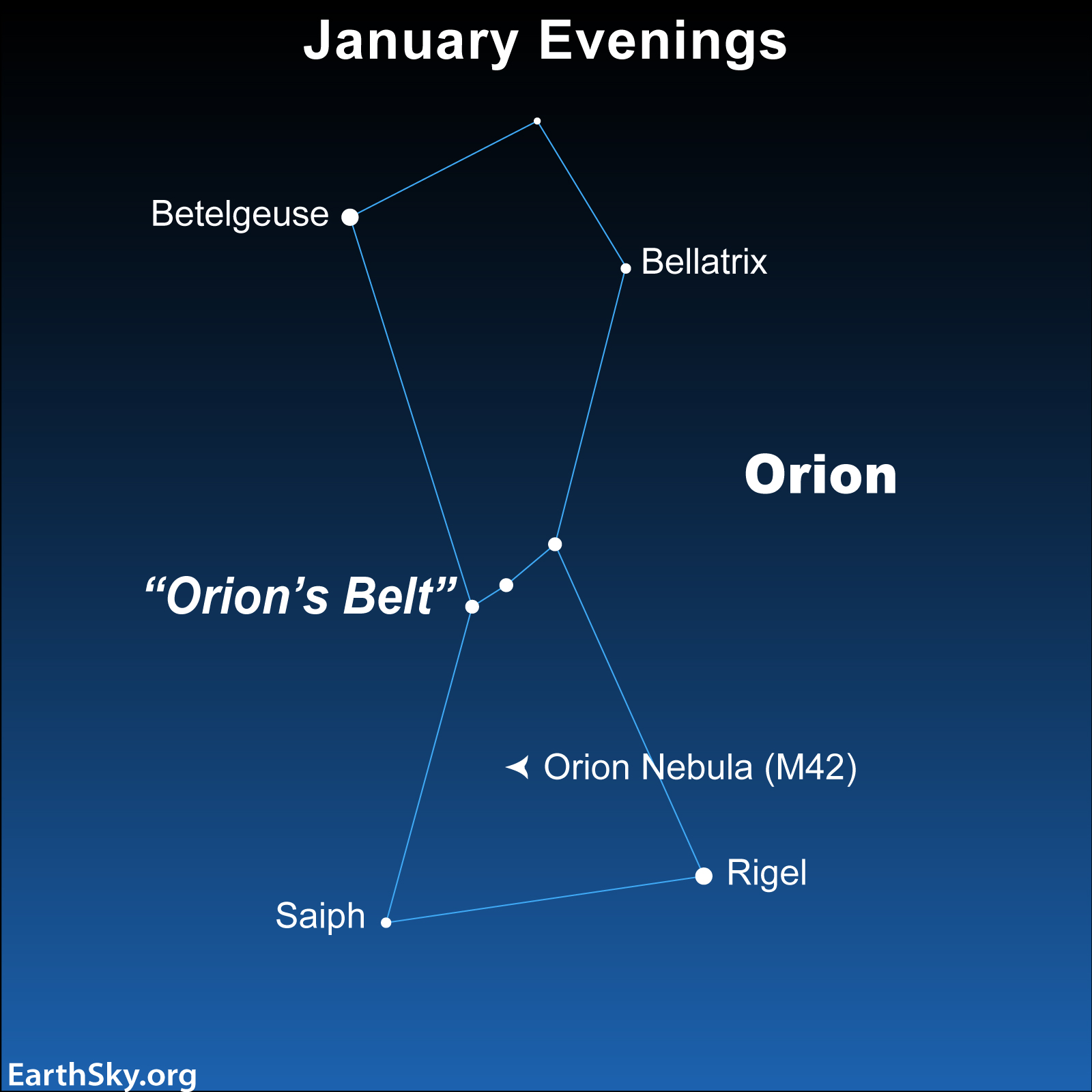
Tonight look for the constellation Orion the Hunter. It’s a constant companion on winter evenings in the Northern Hemisphere, and on summer nights in the Southern Hemisphere. Plus, it’s probably the easiest constellation to spot thanks to its distinctive Belt. Orion’s Belt consists of three medium-bright stars in a short, straight row at the Hunter’s waistline. So if you see any three equally bright stars in a row this evening, you’re probably looking at Orion. Do you want to be sure? There are two even brighter stars – one reddish and the other blue – on either side of the Belt stars.
If you want to learn just one constellation … this is a good one! And it’s a very easy constellation to spot. Those of us in the Northern Hemisphere see Orion the Hunter arcing across the southern sky on January evenings. Southern Hemisphere? Turn this chart upside-down, and look in your northern sky. To see a precise view from your location, try Stellarium Online.
When to look for Orion
As seen from mid-northern latitudes, you’ll find Orion in the southeast in the January early evening and shining high in the south by mid-to-late evening (around 9 to 10 p.m. local time, the time on your clock wherever you live). If you live at temperate latitudes south of the equator, you’ll see Orion high in your northern sky around that same hour.
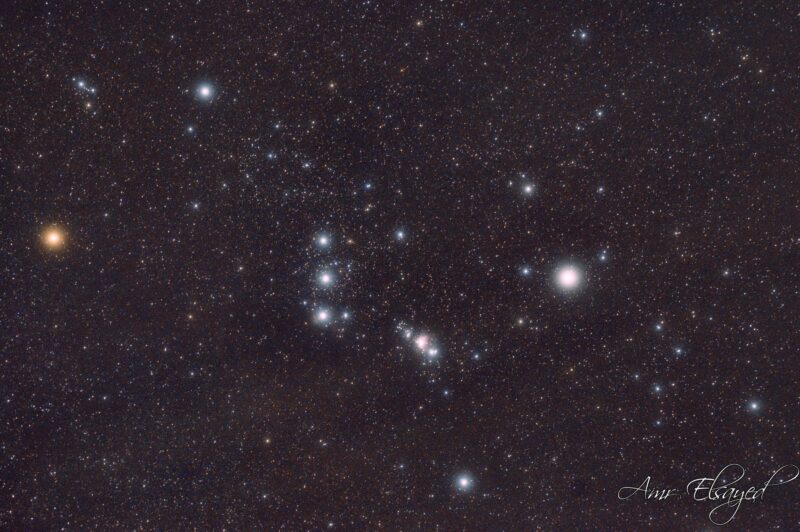
View at EarthSky Community Photos. | Aayan Shaikh in Sindhudurg, Maharashtra, India, shared this image of the constellation Orion the Hunter on November 21, 2025, and wrote: “One of the brightest and most iconic winter constellations. It contains one of the brightest nebulas of the sky, the Orion nebula.” Thank you, Aayan!
What to look for in Orion the Hunter
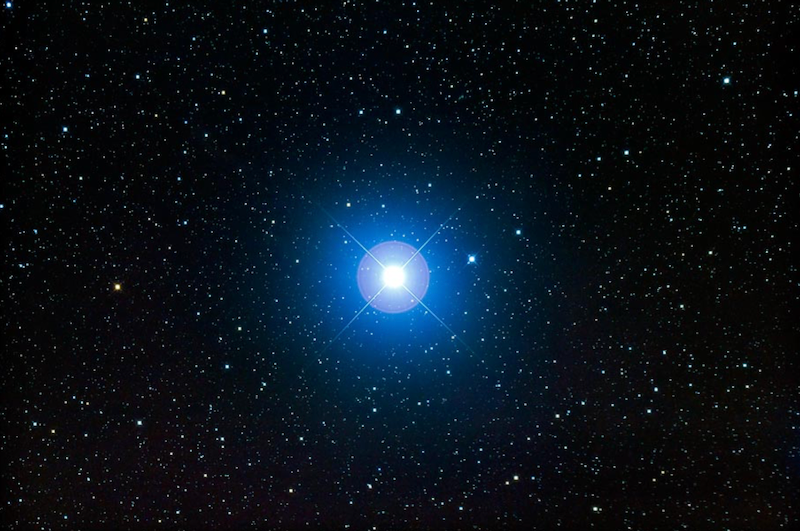
First, look for the two brightest stars in Orion: Betelgeuse and Rigel. Rigel’s distance is approximately 860 light-years. However, the distance to Betelgeuse has been harder for scientists to determine. The current estimate is about 700 light-years away, but uncertainties remain.
Next, take a moment to trace the Belt of Orion and the Sword that hangs from his belt. If one of the stars in the Sword looks blurry to you, that’s because you’re actually seeing the Orion Nebula. And if you use binoculars or a telescope to look at the Orion Nebula, you’ll start to see some shape in the gas and dust cloud.
View at EarthSky Community Photos. | Shivam Sanap imaged the Orion Nebula on August 2, 2025, from India, and wrote: “I captured the Orion nebula after a lot of hard work, and the results are truly amazing!”. Thank you, Shivam!
Connections between the stars
While the stars of constellations often look like they should be physically related and gravitationally bound, they usually are not.
However, some of Orion’s most famous stars do have a connection. Several of the brightest stars in Orion are members of our local spiral arm, sometimes called the Orion Arm or sometimes the Orion Spur of the Milky Way. Our local spiral arm lies between the Sagittarius and Perseus Arms of the Milky Way.
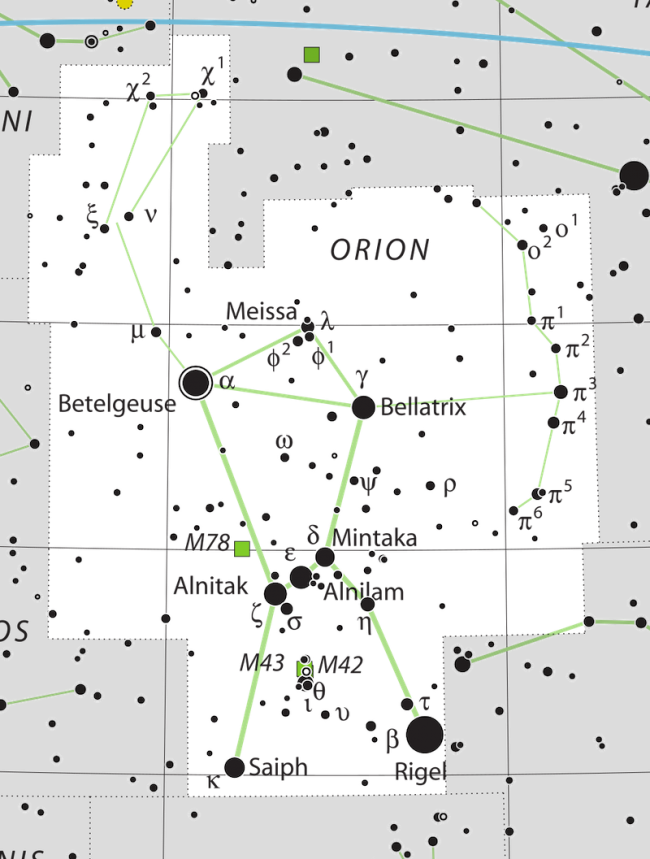
Now consider those three prominent Belt stars. They appear fainter than Rigel or Betelgeuse, and, not surprisingly, they’re farther away. As a matter of fact, they’re all giant stars located in the Orion Arm. These stars’ names and approximate distances are Mintaka (1,200 light-years), Alnilam (2,000 light-years), and Alnitak (1,260 light-years). When you look at these three stars, know that you’re looking across vast space, and into our local arm of the Milky Way galaxy.
View larger. | Artist’s concept of part of the Milky Way galaxy. Our sun is located in the Orion Arm, or Orion Spur, of the Milky Way. Several bright stars in Orion, including Rigel, Betelgeuse, the three stars in Orion’s Belt, and the Orion Nebula, also reside in the Orion Arm. Image via R. Hurt/ Wikimedia Commons (public domain).
Bottom line: Orion the Hunter is one of the easiest constellations to identify thanks to Orion’s Belt, the three medium-bright stars in a short, straight row at his waist.
EarthSky founder Deborah Byrd wants you to come to know the constellation Orion the Hunter. It’s one of the most famous constellations because it’s easy to identify, with several noticeably bright and interesting stars. Plus, Orion can help you visualize your place in the Milky Way galaxy. What’s not to like? Click here for the video. Prefer to read? See below!
Tonight look for the constellation Orion the Hunter. It’s a constant companion on winter evenings in the Northern Hemisphere, and on summer nights in the Southern Hemisphere. Plus, it’s probably the easiest constellation to spot thanks to its distinctive Belt. Orion’s Belt consists of three medium-bright stars in a short, straight row at the Hunter’s waistline. So if you see any three equally bright stars in a row this evening, you’re probably looking at Orion. Do you want to be sure? There are two even brighter stars – one reddish and the other blue – on either side of the Belt stars.
If you want to learn just one constellation … this is a good one! And it’s a very easy constellation to spot. Those of us in the Northern Hemisphere see Orion the Hunter arcing across the southern sky on January evenings. Southern Hemisphere? Turn this chart upside-down, and look in your northern sky. To see a precise view from your location, try Stellarium Online.
When to look for Orion
As seen from mid-northern latitudes, you’ll find Orion in the southeast in the January early evening and shining high in the south by mid-to-late evening (around 9 to 10 p.m. local time, the time on your clock wherever you live). If you live at temperate latitudes south of the equator, you’ll see Orion high in your northern sky around that same hour.
View at EarthSky Community Photos. | Aayan Shaikh in Sindhudurg, Maharashtra, India, shared this image of the constellation Orion the Hunter on November 21, 2025, and wrote: “One of the brightest and most iconic winter constellations. It contains one of the brightest nebulas of the sky, the Orion nebula.” Thank you, Aayan!
What to look for in Orion the Hunter
First, look for the two brightest stars in Orion: Betelgeuse and Rigel. Rigel’s distance is approximately 860 light-years. However, the distance to Betelgeuse has been harder for scientists to determine. The current estimate is about 700 light-years away, but uncertainties remain.
Next, take a moment to trace the Belt of Orion and the Sword that hangs from his belt. If one of the stars in the Sword looks blurry to you, that’s because you’re actually seeing the Orion Nebula. And if you use binoculars or a telescope to look at the Orion Nebula, you’ll start to see some shape in the gas and dust cloud.
View at EarthSky Community Photos. | Shivam Sanap imaged the Orion Nebula on August 2, 2025, from India, and wrote: “I captured the Orion nebula after a lot of hard work, and the results are truly amazing!”. Thank you, Shivam!
Connections between the stars
While the stars of constellations often look like they should be physically related and gravitationally bound, they usually are not.
However, some of Orion’s most famous stars do have a connection. Several of the brightest stars in Orion are members of our local spiral arm, sometimes called the Orion Arm or sometimes the Orion Spur of the Milky Way. Our local spiral arm lies between the Sagittarius and Perseus Arms of the Milky Way.
Now consider those three prominent Belt stars. They appear fainter than Rigel or Betelgeuse, and, not surprisingly, they’re farther away. As a matter of fact, they’re all giant stars located in the Orion Arm. These stars’ names and approximate distances are Mintaka (1,200 light-years), Alnilam (2,000 light-years), and Alnitak (1,260 light-years). When you look at these three stars, know that you’re looking across vast space, and into our local arm of the Milky Way galaxy.
View larger. | Artist’s concept of part of the Milky Way galaxy. Our sun is located in the Orion Arm, or Orion Spur, of the Milky Way. Several bright stars in Orion, including Rigel, Betelgeuse, the three stars in Orion’s Belt, and the Orion Nebula, also reside in the Orion Arm. Image via R. Hurt/ Wikimedia Commons (public domain).
Bottom line: Orion the Hunter is one of the easiest constellations to identify thanks to Orion’s Belt, the three medium-bright stars in a short, straight row at his waist.
View at EarthSky Community Photos. | Ross Stone captured this glowing aurora from the edge of Death Valley National Park last night. Thank you, Ross! Amid a severe geomagnetic storm, expectations were high for stunning auroral displays down to mid-latitudes, but the auroras were weaker and less widespread than expected. Read on to find out why.
On the evening of January 18, 2026, the sun unleashed a powerful X1.9 solar flare. This intense burst of energy launched a fast burst of solar material and magnetic fields – a coronal mass ejection (CME) – toward Earth. And when it reached our planet on the evening of January 19, it produced a rare G4 (severe) geomagnetic storm.
But while a severe storm holds the potential to trigger beautiful auroras at mid-latitudes, this storm’s real-world effects were surprisingly limited. Why? It was due to the storm’s magnetic makeup. The arrangement of the CME’s magnetic field limited how much energy actually reached Earth’s atmosphere, shaping which regions saw auroras and which did not.
The CME struck Earth’s magnetosphere at approximately 18:38 UTC on January 19, arriving with a sharp shock that immediately disturbed Earth’s magnetic field.
To understand what happened next, you need to know what Bz is. Bz describes whether the sun’s magnetic field is pointing north or south. This magnetic field is carried out into the solar system through the solar wind. And if the Bz is southward, it’s much easier for this solar wind to rush into Earth’s magnetosphere, or the magnetic bubble around our planet.
During the CME’s initial impact phase, the Bz briefly dipped strongly southward. So that allowed solar wind energy to flow efficiently into Earth’s magnetic field. This short-lived interaction quickly caused G4 (severe) geomagnetic storm levels, with Kp (another measure of Earth’s magnetic disturbance) exceeding 8.
Soon after the initial impact, the character of the severe geomagnetic storm changed dramatically. As Earth moved deeper into the core of the CME, the Bz – again, the orientation of the sun’s magnetic field – turned strongly northward.
This sustained northward orientation sharply limited the transfer of transfer into Earth’s magnetosphere. And that was what restricted the auroras, despite the overall strength of the storm.
This is why geomagnetic storm ratings can mislead
Conditions shifted southward again around 5:14 UTC on January 20, but the reversal was modest and short-lived. While this allowed for some renewed geomagnetic response, it was not sufficient to drive widespread auroras into mid or lower latitudes.
As a result, auroral activity remained largely confined to higher latitudes, even though the storm rating suggested a much wider impact. This severe solar storm clearly illustrates why Kp values and NOAA storm ratings alone do not fully describe auroral visibility or real-world effects.
Severe geomagnetic storm coincided with intense radiation event
Adding to the space weather complexity, the same X1.9 flare also triggered a solar radiation storm that reached S4 (severe) levels, making it the largest event in more than 20 years.
These storms occur when magnetic activity accelerates charged particles in the solar atmosphere to very high velocities. After making the journey to Earth in just tens of minutes, these then rain down at the poles. This can expose astronauts and those in high-latitude aircraft to increased radiation.
Not over yet
By the numbers, this was certainly a severe geomagnetic storm. But in practice, it was a selective and magnetically constrained event driven by an extremely strong CME. It is a reminder that space weather impacts depend on magnetic geometry, not just raw intensity.
This is what makes following space weather and chasing auroras both exciting and frustrating. Ultimately, it’s so rewarding when the sky finally delivers a spectacular show.
Bottom line: A powerful blast from the sun triggered a severe geomagnetic storm on the night of January 19, but the auroras weren’t as widespread as hoped. It’s because storm strength isn’t the only factor affecting auroras.
View at EarthSky Community Photos. | Ross Stone captured this glowing aurora from the edge of Death Valley National Park last night. Thank you, Ross! Amid a severe geomagnetic storm, expectations were high for stunning auroral displays down to mid-latitudes, but the auroras were weaker and less widespread than expected. Read on to find out why.
On the evening of January 18, 2026, the sun unleashed a powerful X1.9 solar flare. This intense burst of energy launched a fast burst of solar material and magnetic fields – a coronal mass ejection (CME) – toward Earth. And when it reached our planet on the evening of January 19, it produced a rare G4 (severe) geomagnetic storm.
But while a severe storm holds the potential to trigger beautiful auroras at mid-latitudes, this storm’s real-world effects were surprisingly limited. Why? It was due to the storm’s magnetic makeup. The arrangement of the CME’s magnetic field limited how much energy actually reached Earth’s atmosphere, shaping which regions saw auroras and which did not.
The CME struck Earth’s magnetosphere at approximately 18:38 UTC on January 19, arriving with a sharp shock that immediately disturbed Earth’s magnetic field.
To understand what happened next, you need to know what Bz is. Bz describes whether the sun’s magnetic field is pointing north or south. This magnetic field is carried out into the solar system through the solar wind. And if the Bz is southward, it’s much easier for this solar wind to rush into Earth’s magnetosphere, or the magnetic bubble around our planet.
During the CME’s initial impact phase, the Bz briefly dipped strongly southward. So that allowed solar wind energy to flow efficiently into Earth’s magnetic field. This short-lived interaction quickly caused G4 (severe) geomagnetic storm levels, with Kp (another measure of Earth’s magnetic disturbance) exceeding 8.
Soon after the initial impact, the character of the severe geomagnetic storm changed dramatically. As Earth moved deeper into the core of the CME, the Bz – again, the orientation of the sun’s magnetic field – turned strongly northward.
This sustained northward orientation sharply limited the transfer of transfer into Earth’s magnetosphere. And that was what restricted the auroras, despite the overall strength of the storm.
This is why geomagnetic storm ratings can mislead
Conditions shifted southward again around 5:14 UTC on January 20, but the reversal was modest and short-lived. While this allowed for some renewed geomagnetic response, it was not sufficient to drive widespread auroras into mid or lower latitudes.
As a result, auroral activity remained largely confined to higher latitudes, even though the storm rating suggested a much wider impact. This severe solar storm clearly illustrates why Kp values and NOAA storm ratings alone do not fully describe auroral visibility or real-world effects.
Severe geomagnetic storm coincided with intense radiation event
Adding to the space weather complexity, the same X1.9 flare also triggered a solar radiation storm that reached S4 (severe) levels, making it the largest event in more than 20 years.
These storms occur when magnetic activity accelerates charged particles in the solar atmosphere to very high velocities. After making the journey to Earth in just tens of minutes, these then rain down at the poles. This can expose astronauts and those in high-latitude aircraft to increased radiation.
Not over yet
By the numbers, this was certainly a severe geomagnetic storm. But in practice, it was a selective and magnetically constrained event driven by an extremely strong CME. It is a reminder that space weather impacts depend on magnetic geometry, not just raw intensity.
This is what makes following space weather and chasing auroras both exciting and frustrating. Ultimately, it’s so rewarding when the sky finally delivers a spectacular show.
Bottom line: A powerful blast from the sun triggered a severe geomagnetic storm on the night of January 19, but the auroras weren’t as widespread as hoped. It’s because storm strength isn’t the only factor affecting auroras.
The Crab nebula is a supernova remnant. It’s what’s left of an exploded star. A vast expanding cloud of gas and dust surrounding one of the densest objects in the universe, a neutron star.
Chinese astronomers noticed the sudden appearance of a star blazing in the daytime sky on July 4, 1054 CE. It likely outshone the brightest planet, Venus, and was temporarily the 3rd-brightest object in the sky, after the sun and moon. This “guest star” – the exploding supernova – remained visible in daylight for some 23 days. At night it shone near Tianguan – a star we now call Zeta Tauri, in the constellation Taurus the Bull – for nearly two years. Then it faded from view.
The supernova erupted – and the Crab nebula formed – about 6,500 light-years away.
Since the Crab nebula is located among some of the brightest stars and constellations – including Orion – in the heavens, it is easy to find. And it’s best placed for evening observing from late fall through early spring. You can spot the Crab nebula near the star Zeta Tauri, which is the end star of one of the horns of Taurus the Bull.
The Crab nebula and supernova in history
The ancestral Puebloan people in the American Southwest may have viewed the bright new star in 1054. A crescent moon was in the sky near the new star on the morning of July 5, the day following the observations by the Chinese. So the pictograph below, from Chaco Canyon in New Mexico, might depict the event. The multi-spiked star to the left represents the supernova near the crescent moon. Furthermore, the handprint above may signify the importance of the event or may be the artist’s signature.
After exploding onto the scene in 1054 and shining brightly for two years, there are no reports of anything unusual in this spot in the sky until 1731. Then in that year, English amateur astronomer John Bevis recorded an observation of a faint nebulosity. In 1758, French comet-hunter Charles Messier spotted the hazy patch. It became the first entry in his catalog of objects that were fuzzy but not comets, now known as the Messier Catalog. Thus, the Crab nebula has the name M1.
In 1844, astronomer William Parsons – the 3rd Earl of Rosse – observed M1 through his large telescope in Ireland. Because he described it as having a shape resembling a crab, that became its familiar nickname.
Yet it wasn’t until 1921 that people made the association between the Crab nebula and Chinese records of the 1054 guest star.
Ancestral Puebloan pictograph possibly depicting the Crab nebula supernova in 1054 CE in Chaco Canyon, New Mexico. Image via Alex Marentes/ Wikimedia Commons (CC BY-SA 2.0).
How to see the Crab nebula
Since this beautiful nebula shines at magnitude 8.4, it requires magnification to see. Fortunately, it’s relatively easy to find with binoculars or a telescope due to its location near several bright stars. Plus, it’s near several recognizable constellations. Although you can see it at some time of night all year except – from roughly May through July when it’s too close to the sun – the best observing is late in the Northern Hemisphere fall through early spring. And from the late spring to early fall in the Southern Hemisphere. Most Southern Hemisphere viewers can see it except for the extreme southern portions of the globe.
To find the Crab nebula, first draw an imaginary line from bright Betelgeuse in Orion to Capella in Auriga. About halfway along that line is the star Beta Tauri (or Elnath) on the Taurus-Auriga border.
Having identified Beta Tauri, backtrack a little more than a 3rd of the way back to Betelgeuse to find the fainter star Zeta Tauri. Scanning the area around Zeta Tauri should reveal a tiny, faint smudge. It’s about a degree (twice the width of the full moon) from Zeta Tauri and more or less in the direction of Beta Tauri.
View larger. | As shown here, you see the location of the Crab nebula (in the square crosshairs) relative to Capella, Betelgeuse, Beta Tauri and Zeta Tauri. Image via Stellarium. Used with permission.
Views through binoculars or a telescope
Binoculars and small telescopes are useful for finding the object and showing its roughly oblong shape. However, they won’t show the filamentary structure or any of its internal detail. Here are two examples showing what to expect in binoculars or through a telescope.
Simulated view of Zeta Tauri and the Crab nebula in a 7-degree field of view. Chart via Stellarium. Used with permission.
First, the eyepiece view, above, simulates a 7-degree field of view centered around Zeta Tauri. This is what you might expect from a 7 X 50 pair of binoculars. Of course, the exact orientation and visibility will range widely depending on time of observation, sky conditions and so on. Scan around Zeta Tauri for the faint nebulosity.
Simulated view of Zeta Tauri and Crab nebula with a 3.5-degree field of view. Chart via Stellarium. Used with permission.
Then the second image, above, simulates an approximately 3.5-degree view that you might see through a small telescope or finder scope. To give you a clear idea of scale, two full moons would fit with room to spare in the space between Zeta Tauri and the Crab nebula in this chart.
Keep in mind that exact conditions will vary.
Science of the Crab nebula
The Crab nebula is an oval gaseous nebula with fine filamentary (thread-like) structures, expanding at around 930 miles (1,500 km) per second. In its heart is a neutron star about the mass of the sun but only about 12-19 miles (20-30 km) in diameter. This neutron star is also a pulsar that spins about 30 times per second. The neutron star’s powerful magnetic field concentrates radiation emitted by the star as two beams that appear to flash periodically as the beams sweep into view. It lies about 6,500 light-years from Earth.
The flashing of the Crab nebula pulsar in infrared wavelengths. However, this view is considerably slower than its 30 times per second period. Image via Cambridge University Lucky Imaging Group/ Wikimedia Commons/ GFDL.The Hubble Space Telescope imaged the center of the Crab nebula in 2016. Notably, there’s a rapidly spinning neutron star at the center of the nebula, known as a pulsar. That’s the rightmost of the two stars near the center of the image. The bluish light is radiation emitted by electrons speeding at close to the speed of light along the neutron star’s powerful magnetic field. Scientists think the wispy circular features move out of the pulsar due to a shockwave that piles up highly energetic particles coming from high-speed winds emanating from the neutron star. Image via NASA/ ESA/ J. Hester/ M. Weisskopf.
The Crab nebula may be from a new type of supernova
For a long time scientists thought the Crab nebula was the remnant of a type II supernova. But in June 2021, scientists announced they’d finally found evidence for a new type of supernova, an electron-capture supernova. Consequently, they now believe the Crab nebula may be this type of supernova. Read more about this exciting discovery.
Views from the Hubble and Webb space telescopes
This side-by-side comparison of the Crab nebula as seen by the Hubble Space Telescope in optical light (left) and the James Webb Space Telescope in infrared light (right) reveals different details. By studying the collected Webb data, and consulting previous observations of the Crab taken by other telescopes like Hubble, astronomers can build a more comprehensive understanding of this supernova remnant. Hubble Image via NASA/ ESA J. Hester, A. Loll; Webb Image via NASA ESA CSA STScI T. Temim.
Views for our Community Photos
View at EarthSky Community Photos. | EarthSky’s own Marcy Curran from EarthSky, in Cheyenne, Wyoming, captured this telescopic view of the supernova remnant Messier 1 on April 12, 2025. Marcy wrote: “Here’s an image of M1 – aka the Crab nebula – a supernova remnant in the constellation of Taurus the Bull. The supernova appeared in 1054 AD. It was visible in daylight and could be seen at night for over a year. It’s known as the Crab nebula and in its center lies the Crab pulsar (a neutron star). M1 is in the constellation of Taurus and lies about 6,500 light-years away.” Thank you, Marcy!View at EarthSky Community Photos. | Jeremy Likness in Newport, Oregon, submitted this image on January 18, 2025, and wrote: “First nebula of the year! M1 Crab nebula.” Thank you, Jeremy! Jeremey used hydrogen alpha, sulfur, and oxygen filters to record M1.
The center of the Crab nebula is approximately at RA: 5h 34m 32s; Dec: +22° 0′ 52″
Bottom line: The Crab nebula is visible with binoculars and small telescopes, and relatively easy to find since it’s near bright stars in prominent constellations. Although astronomers long thought that it was the remnant of a type II supernova, there’s increasing evidence that it may have been a new type of supernova called an electron capture supernova.
The Crab nebula is a supernova remnant. It’s what’s left of an exploded star. A vast expanding cloud of gas and dust surrounding one of the densest objects in the universe, a neutron star.
Chinese astronomers noticed the sudden appearance of a star blazing in the daytime sky on July 4, 1054 CE. It likely outshone the brightest planet, Venus, and was temporarily the 3rd-brightest object in the sky, after the sun and moon. This “guest star” – the exploding supernova – remained visible in daylight for some 23 days. At night it shone near Tianguan – a star we now call Zeta Tauri, in the constellation Taurus the Bull – for nearly two years. Then it faded from view.
The supernova erupted – and the Crab nebula formed – about 6,500 light-years away.
Since the Crab nebula is located among some of the brightest stars and constellations – including Orion – in the heavens, it is easy to find. And it’s best placed for evening observing from late fall through early spring. You can spot the Crab nebula near the star Zeta Tauri, which is the end star of one of the horns of Taurus the Bull.
The Crab nebula and supernova in history
The ancestral Puebloan people in the American Southwest may have viewed the bright new star in 1054. A crescent moon was in the sky near the new star on the morning of July 5, the day following the observations by the Chinese. So the pictograph below, from Chaco Canyon in New Mexico, might depict the event. The multi-spiked star to the left represents the supernova near the crescent moon. Furthermore, the handprint above may signify the importance of the event or may be the artist’s signature.
After exploding onto the scene in 1054 and shining brightly for two years, there are no reports of anything unusual in this spot in the sky until 1731. Then in that year, English amateur astronomer John Bevis recorded an observation of a faint nebulosity. In 1758, French comet-hunter Charles Messier spotted the hazy patch. It became the first entry in his catalog of objects that were fuzzy but not comets, now known as the Messier Catalog. Thus, the Crab nebula has the name M1.
In 1844, astronomer William Parsons – the 3rd Earl of Rosse – observed M1 through his large telescope in Ireland. Because he described it as having a shape resembling a crab, that became its familiar nickname.
Yet it wasn’t until 1921 that people made the association between the Crab nebula and Chinese records of the 1054 guest star.
Ancestral Puebloan pictograph possibly depicting the Crab nebula supernova in 1054 CE in Chaco Canyon, New Mexico. Image via Alex Marentes/ Wikimedia Commons (CC BY-SA 2.0).
How to see the Crab nebula
Since this beautiful nebula shines at magnitude 8.4, it requires magnification to see. Fortunately, it’s relatively easy to find with binoculars or a telescope due to its location near several bright stars. Plus, it’s near several recognizable constellations. Although you can see it at some time of night all year except – from roughly May through July when it’s too close to the sun – the best observing is late in the Northern Hemisphere fall through early spring. And from the late spring to early fall in the Southern Hemisphere. Most Southern Hemisphere viewers can see it except for the extreme southern portions of the globe.
To find the Crab nebula, first draw an imaginary line from bright Betelgeuse in Orion to Capella in Auriga. About halfway along that line is the star Beta Tauri (or Elnath) on the Taurus-Auriga border.
Having identified Beta Tauri, backtrack a little more than a 3rd of the way back to Betelgeuse to find the fainter star Zeta Tauri. Scanning the area around Zeta Tauri should reveal a tiny, faint smudge. It’s about a degree (twice the width of the full moon) from Zeta Tauri and more or less in the direction of Beta Tauri.
View larger. | As shown here, you see the location of the Crab nebula (in the square crosshairs) relative to Capella, Betelgeuse, Beta Tauri and Zeta Tauri. Image via Stellarium. Used with permission.
Views through binoculars or a telescope
Binoculars and small telescopes are useful for finding the object and showing its roughly oblong shape. However, they won’t show the filamentary structure or any of its internal detail. Here are two examples showing what to expect in binoculars or through a telescope.
Simulated view of Zeta Tauri and the Crab nebula in a 7-degree field of view. Chart via Stellarium. Used with permission.
First, the eyepiece view, above, simulates a 7-degree field of view centered around Zeta Tauri. This is what you might expect from a 7 X 50 pair of binoculars. Of course, the exact orientation and visibility will range widely depending on time of observation, sky conditions and so on. Scan around Zeta Tauri for the faint nebulosity.
Simulated view of Zeta Tauri and Crab nebula with a 3.5-degree field of view. Chart via Stellarium. Used with permission.
Then the second image, above, simulates an approximately 3.5-degree view that you might see through a small telescope or finder scope. To give you a clear idea of scale, two full moons would fit with room to spare in the space between Zeta Tauri and the Crab nebula in this chart.
Keep in mind that exact conditions will vary.
Science of the Crab nebula
The Crab nebula is an oval gaseous nebula with fine filamentary (thread-like) structures, expanding at around 930 miles (1,500 km) per second. In its heart is a neutron star about the mass of the sun but only about 12-19 miles (20-30 km) in diameter. This neutron star is also a pulsar that spins about 30 times per second. The neutron star’s powerful magnetic field concentrates radiation emitted by the star as two beams that appear to flash periodically as the beams sweep into view. It lies about 6,500 light-years from Earth.
The flashing of the Crab nebula pulsar in infrared wavelengths. However, this view is considerably slower than its 30 times per second period. Image via Cambridge University Lucky Imaging Group/ Wikimedia Commons/ GFDL.The Hubble Space Telescope imaged the center of the Crab nebula in 2016. Notably, there’s a rapidly spinning neutron star at the center of the nebula, known as a pulsar. That’s the rightmost of the two stars near the center of the image. The bluish light is radiation emitted by electrons speeding at close to the speed of light along the neutron star’s powerful magnetic field. Scientists think the wispy circular features move out of the pulsar due to a shockwave that piles up highly energetic particles coming from high-speed winds emanating from the neutron star. Image via NASA/ ESA/ J. Hester/ M. Weisskopf.
The Crab nebula may be from a new type of supernova
For a long time scientists thought the Crab nebula was the remnant of a type II supernova. But in June 2021, scientists announced they’d finally found evidence for a new type of supernova, an electron-capture supernova. Consequently, they now believe the Crab nebula may be this type of supernova. Read more about this exciting discovery.
Views from the Hubble and Webb space telescopes
This side-by-side comparison of the Crab nebula as seen by the Hubble Space Telescope in optical light (left) and the James Webb Space Telescope in infrared light (right) reveals different details. By studying the collected Webb data, and consulting previous observations of the Crab taken by other telescopes like Hubble, astronomers can build a more comprehensive understanding of this supernova remnant. Hubble Image via NASA/ ESA J. Hester, A. Loll; Webb Image via NASA ESA CSA STScI T. Temim.
Views for our Community Photos
View at EarthSky Community Photos. | EarthSky’s own Marcy Curran from EarthSky, in Cheyenne, Wyoming, captured this telescopic view of the supernova remnant Messier 1 on April 12, 2025. Marcy wrote: “Here’s an image of M1 – aka the Crab nebula – a supernova remnant in the constellation of Taurus the Bull. The supernova appeared in 1054 AD. It was visible in daylight and could be seen at night for over a year. It’s known as the Crab nebula and in its center lies the Crab pulsar (a neutron star). M1 is in the constellation of Taurus and lies about 6,500 light-years away.” Thank you, Marcy!View at EarthSky Community Photos. | Jeremy Likness in Newport, Oregon, submitted this image on January 18, 2025, and wrote: “First nebula of the year! M1 Crab nebula.” Thank you, Jeremy! Jeremey used hydrogen alpha, sulfur, and oxygen filters to record M1.
The center of the Crab nebula is approximately at RA: 5h 34m 32s; Dec: +22° 0′ 52″
Bottom line: The Crab nebula is visible with binoculars and small telescopes, and relatively easy to find since it’s near bright stars in prominent constellations. Although astronomers long thought that it was the remnant of a type II supernova, there’s increasing evidence that it may have been a new type of supernova called an electron capture supernova.
The unique elephant shrew has the body of a mouse melded with the nose of an elephant. It’s an African mammal that lives life at full speed, plucking prey from crevices in leaves, roots and soil. It hunts along a network of narrow, cleared paths through the undergrowth, which it also uses to escape predators. The shrew carefully maintains and memorizes these routes, because its life depends on them. Unlike other shrews, the elephant shrew is not venomous; instead, it relies on speed, spatial memory and quick thinking to outsmart predators.
Elephant nose and athlete’s legs
The elephant shrew stands out for its long, flexible snout, which functions as a precision tool. At the very tip, tiny, highly mobile nostrils help it sniff out hidden prey with remarkable accuracy. The snout is also covered with numerous tactile and olfactory receptors. These are similar to the whiskers of other mammals, allowing the elephant shrew to feel and smell its surroundings without seeing them. Its long, thin and highly mobile tongue helps it capture insects in crevices, under leaves or among roots.
The elephant shrew’s large eyes and rounded ears complete its sensory system. The eyes detect rapid movements, while the ears pick up low-intensity sounds, such as the rustle of a predator moving through vegetation. Its most common predators are snakes, bird of prey and larger carnivorous mammals.
Its hind legs are long and athletic, designed for running and jumping without pause. They allow explosive acceleration and almost instantaneous changes of direction. An elephant shrew can cover hundreds of meters in seconds, reaching speeds of up to 17 mph (28 kph). It can also leap over 6.5 feet (2 meters) to evade predators or obstacles.
Its compact body and slender tail complete a lightweight, aerodynamic silhouette, enabling it to move at extreme speed and react in fractions of a second.
Equipped with a sensitive snout, sharp eyes, acute ears and powerful legs, the elephant shrew hunts with precision and moves with lightning speed, leaping and dodging to outsmart predators. This is a short-eared elephant shrew. Image via NaturPilot/ Shutterstock.
The high-speed life of the elephant shrew
Elephant shrews maintain networks of cleared paths in their habitats. They travel them daily, as if following an invisible map. These paths act like private highways, which the animal memorizes with pinpoint precision. The shrews actively keep these paths clear, removing leaves, twigs and other debris, ensuring that their routes remain fast and safe for both foraging and escape. Some territories feature complex networks of multiple intersecting paths, almost like a chaotic road system.
Elephant shrews rely on visual, olfactory and spatial cues to navigate. This allows them to choose the safest route even while fleeing. Their memory of these paths is so accurate that they can avoid obstacles and predators with remarkable speed and precision.
Their metabolism runs at full power, so they need to eat frequently. This high energy demand explains their constant activity and perpetual alertness. A single mistake – a poorly chosen path, a delayed jump or even a minor distraction – can expose them to a predator and cost them their lives. Maintaining their path networks is therefore not just convenient; it is critical for survival.
Living life at full speed, the elephant shrew races along memorized paths, fueled by a high metabolism and constant vigilance. This is an eastern rock elephant shrew. Image via simontonge/ iNaturalist.
Fast food and secret hiding spots
Elephant shrews eat insects, spiders and small invertebrates. Depending on habitat and season, they may also supplement their diets with fruits, vegetables, seeds or nectar.
The speed and coordination of the elephant shrew allow it to efficiently catch prey. The tongue and snout work together like an extremely precise pair of tweezers.
As for habitat, it lives in African savannas, scrublands and forests, always in areas with natural shelters. Also, it adapts its behavior to the environment, adjusting its routes and schedules according to threat levels.
The elephant shrew snatches prey with surgical precision and disappears into nature’s hiding places. They can use their snouts and tongues together like tweezers. Image via Clyde Nishimura/ Smithsonian’s National Zoo/ Rawpixel.
Is the elephant shrew venomous?
It’s a common misconception that elephant shrews are venomous. Unlike some of their shrew relatives, they have no toxins. Instead, elephant shrews rely on speed, sharp spatial memory and careful planning to evade predators. They even anticipate danger and pre-plan escape routes, demonstrating an impressive ability to process their environment. For them, survival depends on brains and legs, not venom.
Venomous shrews, by contrast, have adopted a very different strategy. Found mainly in Europe, Asia and North America — often in wet forests or along riverbanks — they use venom to immobilize insects, worms and even relatively large vertebrates. This allows them to store prey alive for later, reducing the need for constant hunting or extreme agility. While their bites can cause mild pain or inflammation, they are not dangerous to humans.
The elephant shrew isn’t venomous. It uses speed, memory and quick thinking, not toxins, for protection. This is a North African elephant shrew. Image via Galen B. Rathbun/ Wikipedia (CC BY 3.0).
African shrews are a venom-free clan
Currently, scientists recognize about 20 species of elephant shrews. All belong to the family Macroscelididae and live exclusively in Africa. Many elephant shrews form lifelong, monogamous pairs. And none produce venom, confirming that this group followed a completely different evolutionary path from venomous shrews.
Among the most striking elephant shrew species are the black and rufous sengi, known for its bold black and reddish color contrast; the rufous elephant shrew, known for its uniform reddish fur and great agility; the bushveld elephant shrew, characterized by excellent camouflage in dry, open environments; and the Karoo rock elephant shrew, notable for its partially bare tail and adaptation to desert and rocky habitats.
One of 20 African species, the black and rufous elephant shrew shares the family’s remarkable senses, cleverness and survival skills across the continent’s diverse landscapes. Image via Joey Makalintal/ Wikipedia (CC BY 2.0).
A tiny prodigy
In short, the elephant shrew demonstrates that size does not limit complexity. It runs, plans, remembers and adapts with astonishing efficiency. Thanks to its practical intelligence, spatial memory and extreme speed, it survives in demanding ecosystems where mistakes are costly.
In its world, a single error can mean disappearance. That’s why this small mammal deserves not only scientific attention but also a prominent place among the most fascinating animals on the planet.
Size doesn’t limit genius: the elephant shrew thrives on intelligence, memory and instinct. This is a western rock elephant shrew. Image via M_burger/ iNaturalist.
Bottom line: The elephant shrew is a small but clever creature. It survives using speed, memory and keen senses in a world where predators lurk at every turn.
The unique elephant shrew has the body of a mouse melded with the nose of an elephant. It’s an African mammal that lives life at full speed, plucking prey from crevices in leaves, roots and soil. It hunts along a network of narrow, cleared paths through the undergrowth, which it also uses to escape predators. The shrew carefully maintains and memorizes these routes, because its life depends on them. Unlike other shrews, the elephant shrew is not venomous; instead, it relies on speed, spatial memory and quick thinking to outsmart predators.
Elephant nose and athlete’s legs
The elephant shrew stands out for its long, flexible snout, which functions as a precision tool. At the very tip, tiny, highly mobile nostrils help it sniff out hidden prey with remarkable accuracy. The snout is also covered with numerous tactile and olfactory receptors. These are similar to the whiskers of other mammals, allowing the elephant shrew to feel and smell its surroundings without seeing them. Its long, thin and highly mobile tongue helps it capture insects in crevices, under leaves or among roots.
The elephant shrew’s large eyes and rounded ears complete its sensory system. The eyes detect rapid movements, while the ears pick up low-intensity sounds, such as the rustle of a predator moving through vegetation. Its most common predators are snakes, bird of prey and larger carnivorous mammals.
Its hind legs are long and athletic, designed for running and jumping without pause. They allow explosive acceleration and almost instantaneous changes of direction. An elephant shrew can cover hundreds of meters in seconds, reaching speeds of up to 17 mph (28 kph). It can also leap over 6.5 feet (2 meters) to evade predators or obstacles.
Its compact body and slender tail complete a lightweight, aerodynamic silhouette, enabling it to move at extreme speed and react in fractions of a second.
Equipped with a sensitive snout, sharp eyes, acute ears and powerful legs, the elephant shrew hunts with precision and moves with lightning speed, leaping and dodging to outsmart predators. This is a short-eared elephant shrew. Image via NaturPilot/ Shutterstock.
The high-speed life of the elephant shrew
Elephant shrews maintain networks of cleared paths in their habitats. They travel them daily, as if following an invisible map. These paths act like private highways, which the animal memorizes with pinpoint precision. The shrews actively keep these paths clear, removing leaves, twigs and other debris, ensuring that their routes remain fast and safe for both foraging and escape. Some territories feature complex networks of multiple intersecting paths, almost like a chaotic road system.
Elephant shrews rely on visual, olfactory and spatial cues to navigate. This allows them to choose the safest route even while fleeing. Their memory of these paths is so accurate that they can avoid obstacles and predators with remarkable speed and precision.
Their metabolism runs at full power, so they need to eat frequently. This high energy demand explains their constant activity and perpetual alertness. A single mistake – a poorly chosen path, a delayed jump or even a minor distraction – can expose them to a predator and cost them their lives. Maintaining their path networks is therefore not just convenient; it is critical for survival.
Living life at full speed, the elephant shrew races along memorized paths, fueled by a high metabolism and constant vigilance. This is an eastern rock elephant shrew. Image via simontonge/ iNaturalist.
Fast food and secret hiding spots
Elephant shrews eat insects, spiders and small invertebrates. Depending on habitat and season, they may also supplement their diets with fruits, vegetables, seeds or nectar.
The speed and coordination of the elephant shrew allow it to efficiently catch prey. The tongue and snout work together like an extremely precise pair of tweezers.
As for habitat, it lives in African savannas, scrublands and forests, always in areas with natural shelters. Also, it adapts its behavior to the environment, adjusting its routes and schedules according to threat levels.
The elephant shrew snatches prey with surgical precision and disappears into nature’s hiding places. They can use their snouts and tongues together like tweezers. Image via Clyde Nishimura/ Smithsonian’s National Zoo/ Rawpixel.
Is the elephant shrew venomous?
It’s a common misconception that elephant shrews are venomous. Unlike some of their shrew relatives, they have no toxins. Instead, elephant shrews rely on speed, sharp spatial memory and careful planning to evade predators. They even anticipate danger and pre-plan escape routes, demonstrating an impressive ability to process their environment. For them, survival depends on brains and legs, not venom.
Venomous shrews, by contrast, have adopted a very different strategy. Found mainly in Europe, Asia and North America — often in wet forests or along riverbanks — they use venom to immobilize insects, worms and even relatively large vertebrates. This allows them to store prey alive for later, reducing the need for constant hunting or extreme agility. While their bites can cause mild pain or inflammation, they are not dangerous to humans.
The elephant shrew isn’t venomous. It uses speed, memory and quick thinking, not toxins, for protection. This is a North African elephant shrew. Image via Galen B. Rathbun/ Wikipedia (CC BY 3.0).
African shrews are a venom-free clan
Currently, scientists recognize about 20 species of elephant shrews. All belong to the family Macroscelididae and live exclusively in Africa. Many elephant shrews form lifelong, monogamous pairs. And none produce venom, confirming that this group followed a completely different evolutionary path from venomous shrews.
Among the most striking elephant shrew species are the black and rufous sengi, known for its bold black and reddish color contrast; the rufous elephant shrew, known for its uniform reddish fur and great agility; the bushveld elephant shrew, characterized by excellent camouflage in dry, open environments; and the Karoo rock elephant shrew, notable for its partially bare tail and adaptation to desert and rocky habitats.
One of 20 African species, the black and rufous elephant shrew shares the family’s remarkable senses, cleverness and survival skills across the continent’s diverse landscapes. Image via Joey Makalintal/ Wikipedia (CC BY 2.0).
A tiny prodigy
In short, the elephant shrew demonstrates that size does not limit complexity. It runs, plans, remembers and adapts with astonishing efficiency. Thanks to its practical intelligence, spatial memory and extreme speed, it survives in demanding ecosystems where mistakes are costly.
In its world, a single error can mean disappearance. That’s why this small mammal deserves not only scientific attention but also a prominent place among the most fascinating animals on the planet.
Size doesn’t limit genius: the elephant shrew thrives on intelligence, memory and instinct. This is a western rock elephant shrew. Image via M_burger/ iNaturalist.
Bottom line: The elephant shrew is a small but clever creature. It survives using speed, memory and keen senses in a world where predators lurk at every turn.
View at EarthSky Community Photos. | Alexander Krivenyshev of WorldTimeZone.com captured this cloud-to-ground lightning between skyscrapers on July 14, 2023. Alexander wrote: “Lightning bolt strikes the Hudson River between lower Manhattan and Jersey City.” Thank you, Alexander! There are many lightning forms we can see. Read on to find out what they are.
Lightning forms capture our collective imagination
Lightning has captured people’s fascination for millennia. It’s embedded in mythology, religion and popular culture. Think of Thor in Norse mythology or Indra in Hinduism. In Australia, lightning is also associated with important creation ancestors such as shown in First Nations rock art. There are many different types of lightning … and many ways in which it influences our society and environment.
What exactly is lightning?
Lightning occurs due to a buildup of electric charge in clouds. This is similar to when you brush your hair or jump on a trampoline making your hair stand up on end, but to a much more extreme level.
This buildup in clouds happens due to different types of frozen and liquid water bumping into each other in the updrafts and downdrafts that occur due to convection. That is, from hotter air rising and colder air falling. The buildup of electric charge can become so extreme that electricity flows through the air. This is what we see as lightning.
We see the flash of the lightning almost as soon as it happens, but the sound of thunder comes later.
Sound takes about three seconds to travel one kilometer (or five seconds to travel one mile). Counting the time between the flash and the thunder can tell you the distance to the lightning. Just count the number of seconds and divide by three to find the distance in kilometers (or divide by five to find miles).
Earth also isn’t the only place where lightning exists. Scientists have also recently detected it on Mars for the first time.
There are two main types of lightning found on Earth:
Intra-cloud (or cloud-to-cloud) lightning goes from one part of a cloud to another part of a cloud, without ever reaching the ground. It might look like a cloud momentarily glows, often with the whole cloud appearing illuminated, sometimes without seeing the actual thin path the lightning takes. It occurs when the build-up of electric charge is different between different parts of a cloud, and is common because the lightning typically doesn’t have to travel far.
Cloud-to-ground lightning can occur when the buildup of electric charge becomes different between a part of the cloud and the ground. This is perhaps the most famous type of lightning. While impressive to witness, cloud-to-ground lightning is a real risk for human safety, causing many recorded deaths each year.
The rare types of lightning
There are also some other rarer, even more spectacular types of lightning:
Pyrogenic lightning can occur alongside extreme wildfires. These fires can sometimes generate lightning in their smoke plumes, known as pyrocumulonimbus clouds. This lightning can then ignite new fires far away, as occurred on Black Saturday near Melbourne in 2009. Similarly, lightning can also sometimes occur in other hot plumes such as from volcanic eruptions or nuclear bombs.
Upper atmospheric light phenomena related to lightning, also known as transient luminous events include sprites, blue jets, ELVEs and PIXIES. Science is still trying to understand details on why these have different characteristic shapes and colors. For example, sprites look like glowing red jellyfish, while blue jets are giant sapphire beams that shoot upwards into the sky. ELVEs look like glowing red halos while PIXIES are flashes of electric blue light atop a thunderstorm.
Ball lightning is something many people have claimed to see over the years. But similar to claims of other strange things – such as the Loch Ness Monster or aliens – it is yet to be scientifically verified. For example, there might be various other explanations for floating balls of light that people see, such as proposed for the Min Min lights in outback New South Wales potentially due to distant car headlights.
Lightning in a warming world
The thunderstorms that cause lightning are often seen as tall billowing clouds known as cumulonimbus. They look like giant cauliflowers floating in the sky, with an anvil shape at their top in mature thunderstorms.
Our recent study on thunderstorms and other weather systems suggests trends since the 1970s toward fewer thunderstorms in northern Australia and more near the southeast. There are still considerable uncertainties around how climate change influences thunderstorms and lightning.
In general, we know warmer air can hold more water vapor, which might help fuel more intense convective storms and lightning.
If more lightning occurs in a warmer world, the increase could in turn create more warming. That’s because lightning splits nitrogen and oxygen molecules in the atmosphere to produce ozone, which has a warming effect on the atmosphere. Ozone also contributes to air pollution, as it is a respiratory irritant.
However, lightning is far from the main cause of global warming, and more research is needed on these potential feedback processes to understand how important lightning could be in a warming climate.
So next time you are watching the spectacular light show during a storm, you might like to consider the various forms that lightning can take. It is one of the marvels of the world we live in, as well as of other worlds, to be enjoyed … from a safe distance.
View at EarthSky Community Photos. | Alexander Krivenyshev of WorldTimeZone.com captured this cloud-to-ground lightning between skyscrapers on July 14, 2023. Alexander wrote: “Lightning bolt strikes the Hudson River between lower Manhattan and Jersey City.” Thank you, Alexander! There are many lightning forms we can see. Read on to find out what they are.
Lightning forms capture our collective imagination
Lightning has captured people’s fascination for millennia. It’s embedded in mythology, religion and popular culture. Think of Thor in Norse mythology or Indra in Hinduism. In Australia, lightning is also associated with important creation ancestors such as shown in First Nations rock art. There are many different types of lightning … and many ways in which it influences our society and environment.
What exactly is lightning?
Lightning occurs due to a buildup of electric charge in clouds. This is similar to when you brush your hair or jump on a trampoline making your hair stand up on end, but to a much more extreme level.
This buildup in clouds happens due to different types of frozen and liquid water bumping into each other in the updrafts and downdrafts that occur due to convection. That is, from hotter air rising and colder air falling. The buildup of electric charge can become so extreme that electricity flows through the air. This is what we see as lightning.
We see the flash of the lightning almost as soon as it happens, but the sound of thunder comes later.
Sound takes about three seconds to travel one kilometer (or five seconds to travel one mile). Counting the time between the flash and the thunder can tell you the distance to the lightning. Just count the number of seconds and divide by three to find the distance in kilometers (or divide by five to find miles).
Earth also isn’t the only place where lightning exists. Scientists have also recently detected it on Mars for the first time.
There are two main types of lightning found on Earth:
Intra-cloud (or cloud-to-cloud) lightning goes from one part of a cloud to another part of a cloud, without ever reaching the ground. It might look like a cloud momentarily glows, often with the whole cloud appearing illuminated, sometimes without seeing the actual thin path the lightning takes. It occurs when the build-up of electric charge is different between different parts of a cloud, and is common because the lightning typically doesn’t have to travel far.
Cloud-to-ground lightning can occur when the buildup of electric charge becomes different between a part of the cloud and the ground. This is perhaps the most famous type of lightning. While impressive to witness, cloud-to-ground lightning is a real risk for human safety, causing many recorded deaths each year.
The rare types of lightning
There are also some other rarer, even more spectacular types of lightning:
Pyrogenic lightning can occur alongside extreme wildfires. These fires can sometimes generate lightning in their smoke plumes, known as pyrocumulonimbus clouds. This lightning can then ignite new fires far away, as occurred on Black Saturday near Melbourne in 2009. Similarly, lightning can also sometimes occur in other hot plumes such as from volcanic eruptions or nuclear bombs.
Upper atmospheric light phenomena related to lightning, also known as transient luminous events include sprites, blue jets, ELVEs and PIXIES. Science is still trying to understand details on why these have different characteristic shapes and colors. For example, sprites look like glowing red jellyfish, while blue jets are giant sapphire beams that shoot upwards into the sky. ELVEs look like glowing red halos while PIXIES are flashes of electric blue light atop a thunderstorm.
Ball lightning is something many people have claimed to see over the years. But similar to claims of other strange things – such as the Loch Ness Monster or aliens – it is yet to be scientifically verified. For example, there might be various other explanations for floating balls of light that people see, such as proposed for the Min Min lights in outback New South Wales potentially due to distant car headlights.
Lightning in a warming world
The thunderstorms that cause lightning are often seen as tall billowing clouds known as cumulonimbus. They look like giant cauliflowers floating in the sky, with an anvil shape at their top in mature thunderstorms.
Our recent study on thunderstorms and other weather systems suggests trends since the 1970s toward fewer thunderstorms in northern Australia and more near the southeast. There are still considerable uncertainties around how climate change influences thunderstorms and lightning.
In general, we know warmer air can hold more water vapor, which might help fuel more intense convective storms and lightning.
If more lightning occurs in a warmer world, the increase could in turn create more warming. That’s because lightning splits nitrogen and oxygen molecules in the atmosphere to produce ozone, which has a warming effect on the atmosphere. Ozone also contributes to air pollution, as it is a respiratory irritant.
However, lightning is far from the main cause of global warming, and more research is needed on these potential feedback processes to understand how important lightning could be in a warming climate.
So next time you are watching the spectacular light show during a storm, you might like to consider the various forms that lightning can take. It is one of the marvels of the world we live in, as well as of other worlds, to be enjoyed … from a safe distance.
View at EarthSky Community Photos. | Gwen Forrester in DeKalb County, Tennessee, captured Comet Lemmon on October 23, 2025. Thank you, Gwen! Comet Lemmon was one of the most inspiring comets of 2025. Here’s a look at what some of the best comets of 2026 are shaping up to be.
We already know of a few good comets speeding toward the inner solar system in 2026. At the moment, some outlets are already calling Comet 2025 R3 (PanSTARRS) the Great Comet of 2026. It will speed past our region of the solar system in April. But on January 13, a brand new sungrazing comet was discovered. The comet still only has a preliminary name: 6AC4721. This comet could become impressive in April, though it’s still a bit soon to know. We’ll keep you updated with all these comets and any new discoveries!
Comet C/2024 E1 (Wierzchos)
Polish astronomer Kacper Wierzchos at the University of Arizona discovered a new comet on March 3, 2024, that was then named for him. The comet has slowly been making its way closer to the inner solar system. On January 20, 2026, Comet Wierzchos – or C/2024 E1 – will reach perihelion, its closest approach to the sun.
Nearly a month later, on February 17, Wierzchos will be closest to Earth, at 94 million miles (151.5 million km) distant. That’s just a bit farther than the Earth-sun distance, or 1 astronomical unit (AU).
Currently, the comet is as bright as a magnitude 8 to 8.7 star. That means you should be able to easily pick it up using a small telescope. However, the comet has been extremely close to the southwestern horizon.
By February 23, 2026, Comet Wierzchos should be high enough for you to give it a try. Around then, it passes close to where we see a few galaxies in Cetus the Whale, including NGC 908 and 909. Afterward, Comet Wierzchos will continue to pass in front of some galaxies in Cetus, such as NGC 1065 on February 27. As this comet travels at around 105,000 miles per hour (46.773 km per second) relative to the sun, it appears near other galaxies just a day later.
The illustrations below are for the Northern Hemisphere. From late January, the best views of comet Wierzchos will be for observers in the Southern Hemisphere, facing the southwestern horizon just after sunset. The view will improve for southern observers during February, as the comet appears slightly higher over the west-southwest horizon just after sunset. In fact, Southern Hemisphere observers will have the best view of the closest approach to Earth on February 17. Then the comet is passing close to where we see stars HIP 6502 and 6771 in the constellation of Sculptor.
Finder charts for Comet 2024 E1 (Wierzchos)
This is the location of Comet 2024 E1 (Wierzchos) at 7 p.m. CST on February 23, 2026. It will appear near some galaxies in Cetus the Whale. Image via Stellarium/ Eddie Irizarry. Used with permission.This is the location of Comet 2024 E1 (Wierzchos) at 7:30 p.m. CST on February 27, 2026. It will appear close to more galaxies in Cetus the Whale. Image via Stellarium/ Eddie Irizarry. Used with permission..This is the location of Comet 2024 E1 (Wierzchos) at 8 p.m. CST on February 28, 2026. At this point, the comet will be in front of the stars and galaxies of Eridanus the River. Image via Stellarium/ Eddie Irizarry. Used with permission.
New discovery 6AC4721
On January 13, 2026, astronomers detected an object that appears to be a comet, and its trajectory suggests it will pass extremely close to the sun around April 4. Thus, it’s a sungrazer comet.
Astronomer Piero Sicoli from the Sormano Astronomical Observatory in Italy found that this object – temporarily known as comet candidate 6AC4721 – has an orbit very similar to comet C/1963 R1 (Pereyra). So it might be a fragment of it or another comet with a very similar trajectory of a type called Kreutz comets. These comets are named in honor of German astronomer Heinrich Kreutz.
Kreutz comets are a family of sungrazing comets. They pass extremely close to the sun and are thought to be big fragments of a huge comet that broke apart centuries ago.
Astronomers will give the new object a formal designation once it is confirmed. This should happen in the next few days, as it is already showing a small tail and diffuse coma.
A detail that has caught astronomers’ attention is that the new-found object is showing a magnitude of 18 at a distance of 2 AU. This suggests it should be decent sized, and therefore it might get bright as it approaches the sun in the next weeks. Preliminary observations suggest the newly found comet’s nucleus might have a diameter of 1.5 miles (2.4 km) or smaller.
Of course, there’s also a good chance it might disintegrate as it gets closer to our star, especially if it passes extremely close. Time will tell.
A few other comets that have passed really close to the sun and performed well include C/1965 S1 (Ikeya–Seki) and most recently, C/2011 W3 (Lovejoy). This kind of event does not occur often, so this will be a rare opportunity for scientists to learn more about sungrazer comets.
Comet C/2025 R3 (PanSTARRS)
Another celestial visitor on its way to the inner solar system is comet C/2025 R3, or PanSTARRS. Some outlets have already dubbed this the Great Comet of 2026. That’s because estimates of its brightness range from magnitude 7 all the way up to 3. A magnitude-3 comet would be visible to the unaided eye.
Comet PanSTARRS will be closest to the sun on April 19, 2026. Then it will then pass closest to Earth just a week later, on April 26. The comet will get as close as 45.5 million miles (73.2 million km) from Earth. That’s slightly closer than half the Earth-sun distance. When Comet PanSTARRS passes closest to Earth, it will be in the direction of where we see the sun. That’s because the comet will be passing between Earth and the sun at that time.
So, our best bet is to try to see the comet before it gets too close to the sun’s glare. And keep in mind this comet will be in the morning sky instead of the evening sky. A good date to try to spot the comet will be around April 11 and 12, 2026. At this time, the comet will be passing close to where we see some galaxies in the constellation Pegasus the Flying Horse just before sunrise.
Observers in the Southern Hemisphere will have to wait until late April to try to spot Comet PanSTARRS low in the western horizon just after sunset. But the situation rapidly improves from there in early May as the comet gets higher just after dusk.
Exactly how bright the comet will actually get remains to be seen.
Finder charts for Comet 2025 R3 (PanSTARRS)
This star chart shows the location of Comet 2025 R3 (PanSTARRS) at 5:30 a.m. CDT on April 11, 2026. On this date it will be among the stars of Pegasus the Flying Horse. Image via Stellarium/ Eddie Irizarry. Used with permission.This star chart shows the location of Comet 2025 R3 (PanSTARRS) at 5:30 a.m. CDT on April 12, 2026. The comet continues to glide on a backdrop of stars in Pegasus the Flying Horse. Image via Stellarium/ Eddie Irizarry. Used with permission./caption]
[caption id="attachment_533848" align="alignnone" width="800"] This star chart shows the location of Comet 2025 R3 (PanSTARRS) at 5:30 a.m. CDT on April 15, 2026. It will be near the variable star 75 Pegasus, within the Great Square of Pegasus the Flying Horse. Image via Stellarium/ Eddie Irizarry. Used with permission.
Comet 10P/Tempel 2
Back on July 4, 1873, Wilhelm Tempel discovered the comet that we now call 10P/Tempel 2. Comet Tempel 2 will visit during northern summer nights. And you’ll probably need binoculars or a small telescope to see it.
Comet 10P/Tempel 2 reaches perihelion – its closest point to the sun – on August 2, 2026. Then, just a day later, on August 3, the celestial visitor will be closest to Earth. It’s a short-period comet that orbits the sun every five years. Another fun fact is that it’s a Jupiter-family comet that will pass very close to the orbit of Mars this year. But while it will get close to Mars’ orbit, it won’t get close to the red planet itself.
This comet might reach around magnitude 8 during four months of the year: June, July, August and September. If so, you should be able to easily see it with a small telescope. Over these months, the comet will be traversing in front of the stars of Capricornus the Sea-goat and Aquarius the Water Bearer.
For observers in the Northern Hemisphere, Comet Tempel 2 becomes visible late in the night in early August. Meanwhile, those in the Southern Hemisphere will be able to see it from early in the night, and will thus have the best views during closest approach to Earth as the comet will be higher in the eastern sky.
It’s possible that Comet Tempel 2 will get even brighter. Some estimates put it up to magnitude 7 or 6.8 during closest approach to Earth on August 3. That would mean it might be visible using just binoculars.
The nucleus of Tempel 2 is around 6.5 miles (10.5 km) in diameter. During closest approach to our planet, the comet will pass about 38.5 million miles (61.9 million km) away.
Finder charts for Comet 10P/Tempel 2
Location of Comet 10P/Tempel 2 at 1 a.m. CDT on June 20, 2026. It will be among the stars of Aquarius the Water Bearer. Image via Stellarium/ Eddie Irizarry. Used with permission.Location of Comet 10P/Tempel 2 at 1 a.m. CDT on June 25, 2026. Image via Stellarium/ Eddie Irizarry. Used with permission.Location of Comet 10P/Tempel 2 at 1 a.m. CDT on July 1, 2026. The comet continues to be among the stars of Aquarius the Water Bearer. Image via Stellarium/ Eddie Irizarry. Used with permission.Location of Comet 10P/Tempel 2 at 11 p.m. CDT on August 3, 2026. At this time it will be in the constellation Capricornus the Sea-goat. Use binoculars and face southeast to see it at closest approach. Image via Stellarium/ Eddie Irizarry. Used with permission.
Comet 3I/ATLAS
We haven’t forgotten about interstellar comet 3I/ATLAS. It’s already moving out of the inner solar system, but it’s still visible through 8-inch and larger diameter telescopes and smaller ones equipped with cameras. Even though it’s gradually becoming fainter, many observers might still try to get one last view of it before it leaves our solar system forever.
Comet 3I/ATLAS is still in the constellation of Cancer the Crab. At 9 p.m. CST on January 19, 2026, it will pass close to where we see the galaxies NGC 2593 and NGC 2596. As of mid January, the interstellar visitor was showing a magnitude between 12 and 14, with its anti-tail clearly visible.
By comparing the comet’s location related to the background stars, you can detect its motion. And the motion appears slow, but only because of its great distance from us. It’s currently around 2 AU away, and it’s traveling at more than 130,000 miles per hour (209.2 kmh).
Comet 3I/ATLAS is still in our skies, though you’ll need optical aid to see it. Here’s its location on January 19, 2026, in Cancer the Crab. Image via Stellarium/ Eddie Irizarry. Used with permission.
There’s always the possibility that a new comet may be discovered and then become visible to the unaided eye. Meanwhile, these celestial visitors might provide nice views using optical aid.
Bottom line: What will be the best comets of 2026? Here’s a list of those we already know, and keep watching for new discoveries!
View at EarthSky Community Photos. | Gwen Forrester in DeKalb County, Tennessee, captured Comet Lemmon on October 23, 2025. Thank you, Gwen! Comet Lemmon was one of the most inspiring comets of 2025. Here’s a look at what some of the best comets of 2026 are shaping up to be.
We already know of a few good comets speeding toward the inner solar system in 2026. At the moment, some outlets are already calling Comet 2025 R3 (PanSTARRS) the Great Comet of 2026. It will speed past our region of the solar system in April. But on January 13, a brand new sungrazing comet was discovered. The comet still only has a preliminary name: 6AC4721. This comet could become impressive in April, though it’s still a bit soon to know. We’ll keep you updated with all these comets and any new discoveries!
Comet C/2024 E1 (Wierzchos)
Polish astronomer Kacper Wierzchos at the University of Arizona discovered a new comet on March 3, 2024, that was then named for him. The comet has slowly been making its way closer to the inner solar system. On January 20, 2026, Comet Wierzchos – or C/2024 E1 – will reach perihelion, its closest approach to the sun.
Nearly a month later, on February 17, Wierzchos will be closest to Earth, at 94 million miles (151.5 million km) distant. That’s just a bit farther than the Earth-sun distance, or 1 astronomical unit (AU).
Currently, the comet is as bright as a magnitude 8 to 8.7 star. That means you should be able to easily pick it up using a small telescope. However, the comet has been extremely close to the southwestern horizon.
By February 23, 2026, Comet Wierzchos should be high enough for you to give it a try. Around then, it passes close to where we see a few galaxies in Cetus the Whale, including NGC 908 and 909. Afterward, Comet Wierzchos will continue to pass in front of some galaxies in Cetus, such as NGC 1065 on February 27. As this comet travels at around 105,000 miles per hour (46.773 km per second) relative to the sun, it appears near other galaxies just a day later.
The illustrations below are for the Northern Hemisphere. From late January, the best views of comet Wierzchos will be for observers in the Southern Hemisphere, facing the southwestern horizon just after sunset. The view will improve for southern observers during February, as the comet appears slightly higher over the west-southwest horizon just after sunset. In fact, Southern Hemisphere observers will have the best view of the closest approach to Earth on February 17. Then the comet is passing close to where we see stars HIP 6502 and 6771 in the constellation of Sculptor.
Finder charts for Comet 2024 E1 (Wierzchos)
This is the location of Comet 2024 E1 (Wierzchos) at 7 p.m. CST on February 23, 2026. It will appear near some galaxies in Cetus the Whale. Image via Stellarium/ Eddie Irizarry. Used with permission.This is the location of Comet 2024 E1 (Wierzchos) at 7:30 p.m. CST on February 27, 2026. It will appear close to more galaxies in Cetus the Whale. Image via Stellarium/ Eddie Irizarry. Used with permission..This is the location of Comet 2024 E1 (Wierzchos) at 8 p.m. CST on February 28, 2026. At this point, the comet will be in front of the stars and galaxies of Eridanus the River. Image via Stellarium/ Eddie Irizarry. Used with permission.
New discovery 6AC4721
On January 13, 2026, astronomers detected an object that appears to be a comet, and its trajectory suggests it will pass extremely close to the sun around April 4. Thus, it’s a sungrazer comet.
Astronomer Piero Sicoli from the Sormano Astronomical Observatory in Italy found that this object – temporarily known as comet candidate 6AC4721 – has an orbit very similar to comet C/1963 R1 (Pereyra). So it might be a fragment of it or another comet with a very similar trajectory of a type called Kreutz comets. These comets are named in honor of German astronomer Heinrich Kreutz.
Kreutz comets are a family of sungrazing comets. They pass extremely close to the sun and are thought to be big fragments of a huge comet that broke apart centuries ago.
Astronomers will give the new object a formal designation once it is confirmed. This should happen in the next few days, as it is already showing a small tail and diffuse coma.
A detail that has caught astronomers’ attention is that the new-found object is showing a magnitude of 18 at a distance of 2 AU. This suggests it should be decent sized, and therefore it might get bright as it approaches the sun in the next weeks. Preliminary observations suggest the newly found comet’s nucleus might have a diameter of 1.5 miles (2.4 km) or smaller.
Of course, there’s also a good chance it might disintegrate as it gets closer to our star, especially if it passes extremely close. Time will tell.
A few other comets that have passed really close to the sun and performed well include C/1965 S1 (Ikeya–Seki) and most recently, C/2011 W3 (Lovejoy). This kind of event does not occur often, so this will be a rare opportunity for scientists to learn more about sungrazer comets.
Comet C/2025 R3 (PanSTARRS)
Another celestial visitor on its way to the inner solar system is comet C/2025 R3, or PanSTARRS. Some outlets have already dubbed this the Great Comet of 2026. That’s because estimates of its brightness range from magnitude 7 all the way up to 3. A magnitude-3 comet would be visible to the unaided eye.
Comet PanSTARRS will be closest to the sun on April 19, 2026. Then it will then pass closest to Earth just a week later, on April 26. The comet will get as close as 45.5 million miles (73.2 million km) from Earth. That’s slightly closer than half the Earth-sun distance. When Comet PanSTARRS passes closest to Earth, it will be in the direction of where we see the sun. That’s because the comet will be passing between Earth and the sun at that time.
So, our best bet is to try to see the comet before it gets too close to the sun’s glare. And keep in mind this comet will be in the morning sky instead of the evening sky. A good date to try to spot the comet will be around April 11 and 12, 2026. At this time, the comet will be passing close to where we see some galaxies in the constellation Pegasus the Flying Horse just before sunrise.
Observers in the Southern Hemisphere will have to wait until late April to try to spot Comet PanSTARRS low in the western horizon just after sunset. But the situation rapidly improves from there in early May as the comet gets higher just after dusk.
Exactly how bright the comet will actually get remains to be seen.
Finder charts for Comet 2025 R3 (PanSTARRS)
This star chart shows the location of Comet 2025 R3 (PanSTARRS) at 5:30 a.m. CDT on April 11, 2026. On this date it will be among the stars of Pegasus the Flying Horse. Image via Stellarium/ Eddie Irizarry. Used with permission.This star chart shows the location of Comet 2025 R3 (PanSTARRS) at 5:30 a.m. CDT on April 12, 2026. The comet continues to glide on a backdrop of stars in Pegasus the Flying Horse. Image via Stellarium/ Eddie Irizarry. Used with permission./caption]
[caption id="attachment_533848" align="alignnone" width="800"] This star chart shows the location of Comet 2025 R3 (PanSTARRS) at 5:30 a.m. CDT on April 15, 2026. It will be near the variable star 75 Pegasus, within the Great Square of Pegasus the Flying Horse. Image via Stellarium/ Eddie Irizarry. Used with permission.
Comet 10P/Tempel 2
Back on July 4, 1873, Wilhelm Tempel discovered the comet that we now call 10P/Tempel 2. Comet Tempel 2 will visit during northern summer nights. And you’ll probably need binoculars or a small telescope to see it.
Comet 10P/Tempel 2 reaches perihelion – its closest point to the sun – on August 2, 2026. Then, just a day later, on August 3, the celestial visitor will be closest to Earth. It’s a short-period comet that orbits the sun every five years. Another fun fact is that it’s a Jupiter-family comet that will pass very close to the orbit of Mars this year. But while it will get close to Mars’ orbit, it won’t get close to the red planet itself.
This comet might reach around magnitude 8 during four months of the year: June, July, August and September. If so, you should be able to easily see it with a small telescope. Over these months, the comet will be traversing in front of the stars of Capricornus the Sea-goat and Aquarius the Water Bearer.
For observers in the Northern Hemisphere, Comet Tempel 2 becomes visible late in the night in early August. Meanwhile, those in the Southern Hemisphere will be able to see it from early in the night, and will thus have the best views during closest approach to Earth as the comet will be higher in the eastern sky.
It’s possible that Comet Tempel 2 will get even brighter. Some estimates put it up to magnitude 7 or 6.8 during closest approach to Earth on August 3. That would mean it might be visible using just binoculars.
The nucleus of Tempel 2 is around 6.5 miles (10.5 km) in diameter. During closest approach to our planet, the comet will pass about 38.5 million miles (61.9 million km) away.
Finder charts for Comet 10P/Tempel 2
Location of Comet 10P/Tempel 2 at 1 a.m. CDT on June 20, 2026. It will be among the stars of Aquarius the Water Bearer. Image via Stellarium/ Eddie Irizarry. Used with permission.Location of Comet 10P/Tempel 2 at 1 a.m. CDT on June 25, 2026. Image via Stellarium/ Eddie Irizarry. Used with permission.Location of Comet 10P/Tempel 2 at 1 a.m. CDT on July 1, 2026. The comet continues to be among the stars of Aquarius the Water Bearer. Image via Stellarium/ Eddie Irizarry. Used with permission.Location of Comet 10P/Tempel 2 at 11 p.m. CDT on August 3, 2026. At this time it will be in the constellation Capricornus the Sea-goat. Use binoculars and face southeast to see it at closest approach. Image via Stellarium/ Eddie Irizarry. Used with permission.
Comet 3I/ATLAS
We haven’t forgotten about interstellar comet 3I/ATLAS. It’s already moving out of the inner solar system, but it’s still visible through 8-inch and larger diameter telescopes and smaller ones equipped with cameras. Even though it’s gradually becoming fainter, many observers might still try to get one last view of it before it leaves our solar system forever.
Comet 3I/ATLAS is still in the constellation of Cancer the Crab. At 9 p.m. CST on January 19, 2026, it will pass close to where we see the galaxies NGC 2593 and NGC 2596. As of mid January, the interstellar visitor was showing a magnitude between 12 and 14, with its anti-tail clearly visible.
By comparing the comet’s location related to the background stars, you can detect its motion. And the motion appears slow, but only because of its great distance from us. It’s currently around 2 AU away, and it’s traveling at more than 130,000 miles per hour (209.2 kmh).
Comet 3I/ATLAS is still in our skies, though you’ll need optical aid to see it. Here’s its location on January 19, 2026, in Cancer the Crab. Image via Stellarium/ Eddie Irizarry. Used with permission.
There’s always the possibility that a new comet may be discovered and then become visible to the unaided eye. Meanwhile, these celestial visitors might provide nice views using optical aid.
Bottom line: What will be the best comets of 2026? Here’s a list of those we already know, and keep watching for new discoveries!
Rigel is one of several brilliant stars that grace our night sky this time of the year. It’s also the brightest star in one of the most beloved of constellations, Orion the Hunter. Rigel appears blue-white to the eye. It’s a stunning contrast to red Betelgeuse, Orion’s second-brightest star. Classified as a blue supergiant, Rigel is in the latter stages of its stellar lifetime and will someday explode as a supernova. Hidden in Rigel’s brilliance are at least three other fainter companion stars that can only be detected using large telescopes.
How to find Rigel
At magnitude 0.13, Rigel is the 7th-brightest star in the night sky. It appears at a lower corner (or upper corner as seen from the Southern Hemisphere) of Orion the Hunter, one of the sky’s best-known constellations. It’s easy to spot because of its brightness and because of its distinctive blue-white color.
You can catch Orion in the east before dawn during the late Northern Hemisphere summer. It’ll emerge in the evening sky during the Northern Hemisphere’s late autumn. Then Orion shines prominently in the sky on northern winter (southern summer) evenings. By early March, as soon as the sun sets, Orion is at its highest in the sky. By early May, as seen from around the globe, Orion sets before the sky has a chance to get really dark.
Look for Orion
To find Rigel, first look for its constellation, Orion. You’ll notice three stars in a short, straight line. These stars mark Orion’s Belt. An imaginary line in the sky, heading generally southward – that’s at a right or 90-degree angle from Orion’s Belt – takes you to Rigel. (If you instead draw in the other direction, you’d come to Betelgeuse, with its distinctive reddish tinge.)
Do not confuse Rigel with Sirius, which is farther to the east and farther south. Sirius is similar in appearance, but significantly brighter than Rigel.
View at EarthSky Community Photos. | Here’s a closer look at the constellation Orion. Rigel appears as the bright star on the right with reddish Betelgeuse opposite it on the far left. Amr Elsayed in Fayoum, Egypt, captured this image of the night sky on December 6, 2024. Thanks, Amr!A map of Orion the Hunter, showing the location of Rigel. Image via IAU/ Sky & Telescope magazine/ Wikimedia Commons.
The science of Rigel
We couldn’t live as close to Rigel as we do to our sun. That’s because its surface temperature is much hotter, about 21,000 degrees Fahrenheit (11,600 degrees Celsius) in contrast to about 10,000 F (5,500 C) for the sun.
Counting all its radiation (not just visible light, but infrared, ultraviolet and so on), it emits about 120,000 times more energy than the sun. Astronomers calculate this luminosity based on a distance of 860 light-years, a distance derived from data collected by the Hipparcos space telescope. With such enormous energy, you might not be surprised to find that Rigel has only 21 times more mass, and is more than 70 times the diameter of our sun.
The blue-white star Rigel in the constellation Orion the Hunter. Image via Fred Espenak/ astropixels.com. Used with permission.
Rigel is a blue supergiant star, designated as type B8Ia. According to stellar evolution theory, it is a massive star entering the latter part of its life, having exhausted most of the hydrogen fuel in its core. It’s also a variable star that shows slight irregular fluctuations in brightness. Someday, it will explode as a supernova.
Yet Rigel is not one of the galaxy’s largest stars, as the video below – from the European Southern Observatory – shows.
A little-known fact about Rigel: it is the largest star in a multiple star system. There is a close companion about 400 times fainter. That “companion” is actually two stars that can only be resolved by large telescopes. And one of those two companion stars is what’s known as a spectroscopic binary: two stars so close they can be distinguished as two distinct entities only via spectroscopic observations.
In other words, the Rigel system has four known stars!
History and mythology
Historically, the brightest star in a constellation receives the designation Alpha, the second-brightest is Beta, and so on. This system isn’t used for Orion’s stars, however. Instead, the red star Betelgeuse is Alpha Orionis, and Rigel is Beta. But Rigel is the brightest star in Orion.
This deviation from standard stellar designations might be because Betelgeuse is a variable star and has been known to at least approach Rigel in brilliance. The German astronomer Johann Bayer applied the designation Beta Orionis to Rigel in the early 1600s. He sought to systematize stellar naming conventions. It’s possible Betelgeuse was brighter around this time. Nowadays, Rigel outshines Betelgeuse.
A depiction of Orion from Mercator‘s celestial globe, from the Harvard Map Collection. Rigel is labeled at its left foot. Gerardus Mercator was a 16th century geographer, cosmographer and cartographer from Rupelmonde, County of Flanders in modern-day Belgium. Image via Gerard Mercator/ Wikimedia Commons.
The name Rigel comes from an Arabic phrase frequently translated as “The left foot of the central one.” Although Orion was depicted as a giant or warrior in many cultures, in the original Arabic it might have been a reference to a black sheep with a white spot or spots. Thus in the original form, Rigel might have designated the left foot of a sheep! Now, however, many people know it as the left foot of Orion the Hunter.
Aurvandill’s big toe
The mythology related to Rigel is sparse and unclear. Perhaps the most interesting connection is in Norse mythology, which sometimes identified Orion with Aurvandill (also Orwandil, Earendel and others). According to some, Aurvandill was traveling with his companion, the god Thor, when his big toe froze in an unfortunate river-crossing incident. Thor broke off the frozen digit and threw it into the sky, where it became the star we see as Rigel. In some variations, Aurvandill’s other big toe became faint Alcor in Ursa Major.
Rigel’s position is RA: 05h 14m 32.3s, Dec: -08° 12′ 05.9”.
Bottom line: Rigel, the brightest star in the constellation Orion the Hunter, shines a brilliant bluish-white color. It’s much hotter and more massive than our sun, and someday, it will explode as a supernova.
Rigel is one of several brilliant stars that grace our night sky this time of the year. It’s also the brightest star in one of the most beloved of constellations, Orion the Hunter. Rigel appears blue-white to the eye. It’s a stunning contrast to red Betelgeuse, Orion’s second-brightest star. Classified as a blue supergiant, Rigel is in the latter stages of its stellar lifetime and will someday explode as a supernova. Hidden in Rigel’s brilliance are at least three other fainter companion stars that can only be detected using large telescopes.
How to find Rigel
At magnitude 0.13, Rigel is the 7th-brightest star in the night sky. It appears at a lower corner (or upper corner as seen from the Southern Hemisphere) of Orion the Hunter, one of the sky’s best-known constellations. It’s easy to spot because of its brightness and because of its distinctive blue-white color.
You can catch Orion in the east before dawn during the late Northern Hemisphere summer. It’ll emerge in the evening sky during the Northern Hemisphere’s late autumn. Then Orion shines prominently in the sky on northern winter (southern summer) evenings. By early March, as soon as the sun sets, Orion is at its highest in the sky. By early May, as seen from around the globe, Orion sets before the sky has a chance to get really dark.
Look for Orion
To find Rigel, first look for its constellation, Orion. You’ll notice three stars in a short, straight line. These stars mark Orion’s Belt. An imaginary line in the sky, heading generally southward – that’s at a right or 90-degree angle from Orion’s Belt – takes you to Rigel. (If you instead draw in the other direction, you’d come to Betelgeuse, with its distinctive reddish tinge.)
Do not confuse Rigel with Sirius, which is farther to the east and farther south. Sirius is similar in appearance, but significantly brighter than Rigel.
View at EarthSky Community Photos. | Here’s a closer look at the constellation Orion. Rigel appears as the bright star on the right with reddish Betelgeuse opposite it on the far left. Amr Elsayed in Fayoum, Egypt, captured this image of the night sky on December 6, 2024. Thanks, Amr!A map of Orion the Hunter, showing the location of Rigel. Image via IAU/ Sky & Telescope magazine/ Wikimedia Commons.
The science of Rigel
We couldn’t live as close to Rigel as we do to our sun. That’s because its surface temperature is much hotter, about 21,000 degrees Fahrenheit (11,600 degrees Celsius) in contrast to about 10,000 F (5,500 C) for the sun.
Counting all its radiation (not just visible light, but infrared, ultraviolet and so on), it emits about 120,000 times more energy than the sun. Astronomers calculate this luminosity based on a distance of 860 light-years, a distance derived from data collected by the Hipparcos space telescope. With such enormous energy, you might not be surprised to find that Rigel has only 21 times more mass, and is more than 70 times the diameter of our sun.
The blue-white star Rigel in the constellation Orion the Hunter. Image via Fred Espenak/ astropixels.com. Used with permission.
Rigel is a blue supergiant star, designated as type B8Ia. According to stellar evolution theory, it is a massive star entering the latter part of its life, having exhausted most of the hydrogen fuel in its core. It’s also a variable star that shows slight irregular fluctuations in brightness. Someday, it will explode as a supernova.
Yet Rigel is not one of the galaxy’s largest stars, as the video below – from the European Southern Observatory – shows.
A little-known fact about Rigel: it is the largest star in a multiple star system. There is a close companion about 400 times fainter. That “companion” is actually two stars that can only be resolved by large telescopes. And one of those two companion stars is what’s known as a spectroscopic binary: two stars so close they can be distinguished as two distinct entities only via spectroscopic observations.
In other words, the Rigel system has four known stars!
History and mythology
Historically, the brightest star in a constellation receives the designation Alpha, the second-brightest is Beta, and so on. This system isn’t used for Orion’s stars, however. Instead, the red star Betelgeuse is Alpha Orionis, and Rigel is Beta. But Rigel is the brightest star in Orion.
This deviation from standard stellar designations might be because Betelgeuse is a variable star and has been known to at least approach Rigel in brilliance. The German astronomer Johann Bayer applied the designation Beta Orionis to Rigel in the early 1600s. He sought to systematize stellar naming conventions. It’s possible Betelgeuse was brighter around this time. Nowadays, Rigel outshines Betelgeuse.
A depiction of Orion from Mercator‘s celestial globe, from the Harvard Map Collection. Rigel is labeled at its left foot. Gerardus Mercator was a 16th century geographer, cosmographer and cartographer from Rupelmonde, County of Flanders in modern-day Belgium. Image via Gerard Mercator/ Wikimedia Commons.
The name Rigel comes from an Arabic phrase frequently translated as “The left foot of the central one.” Although Orion was depicted as a giant or warrior in many cultures, in the original Arabic it might have been a reference to a black sheep with a white spot or spots. Thus in the original form, Rigel might have designated the left foot of a sheep! Now, however, many people know it as the left foot of Orion the Hunter.
Aurvandill’s big toe
The mythology related to Rigel is sparse and unclear. Perhaps the most interesting connection is in Norse mythology, which sometimes identified Orion with Aurvandill (also Orwandil, Earendel and others). According to some, Aurvandill was traveling with his companion, the god Thor, when his big toe froze in an unfortunate river-crossing incident. Thor broke off the frozen digit and threw it into the sky, where it became the star we see as Rigel. In some variations, Aurvandill’s other big toe became faint Alcor in Ursa Major.
Rigel’s position is RA: 05h 14m 32.3s, Dec: -08° 12′ 05.9”.
Bottom line: Rigel, the brightest star in the constellation Orion the Hunter, shines a brilliant bluish-white color. It’s much hotter and more massive than our sun, and someday, it will explode as a supernova.

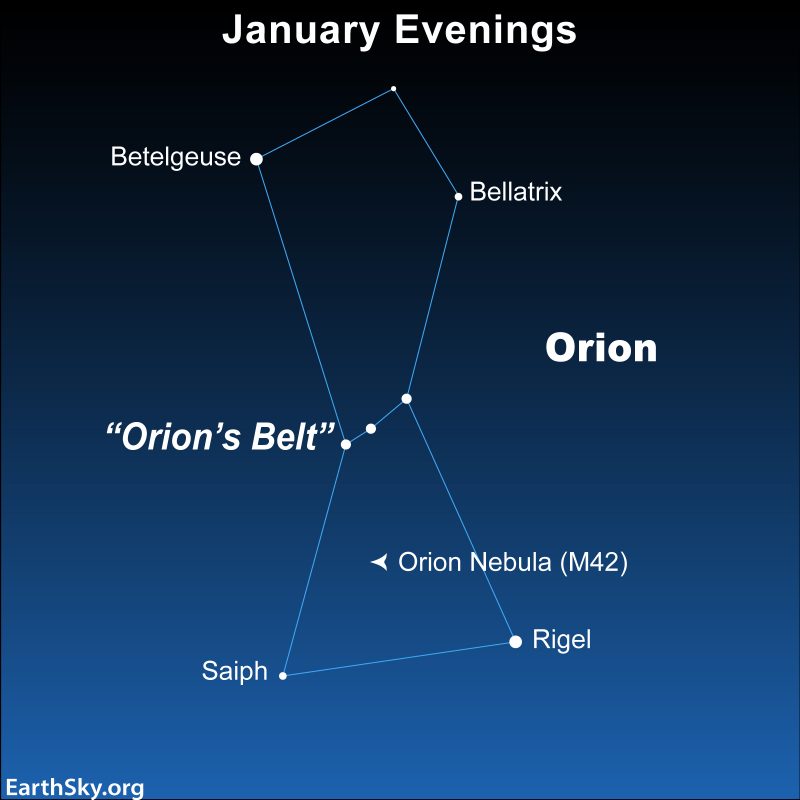

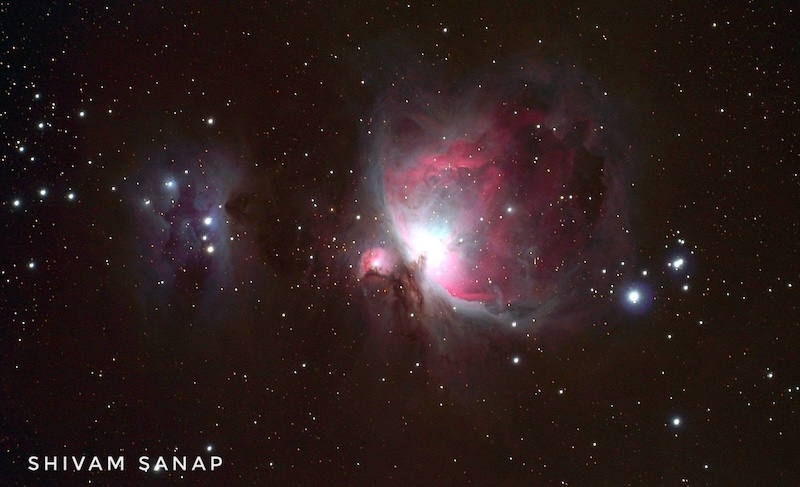
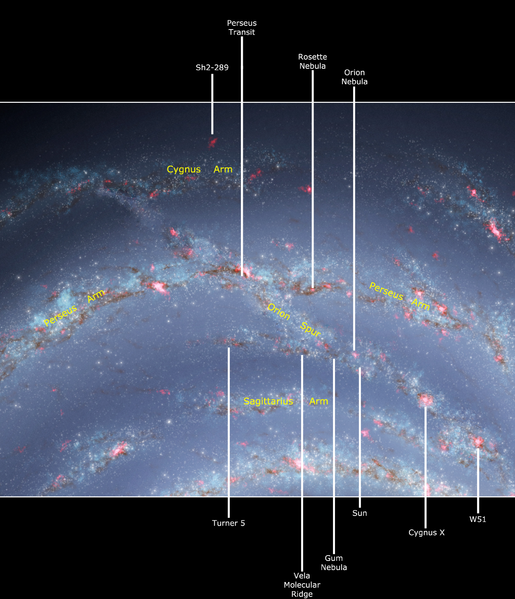


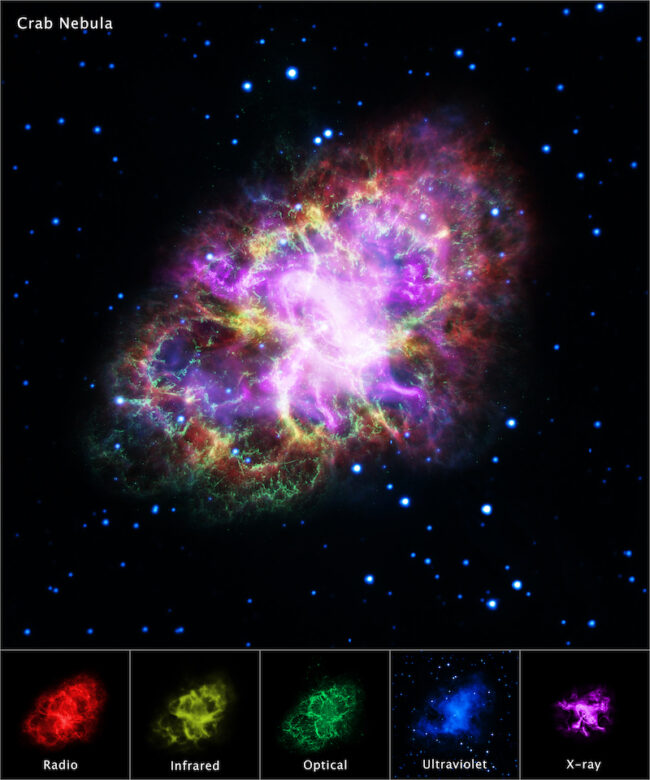
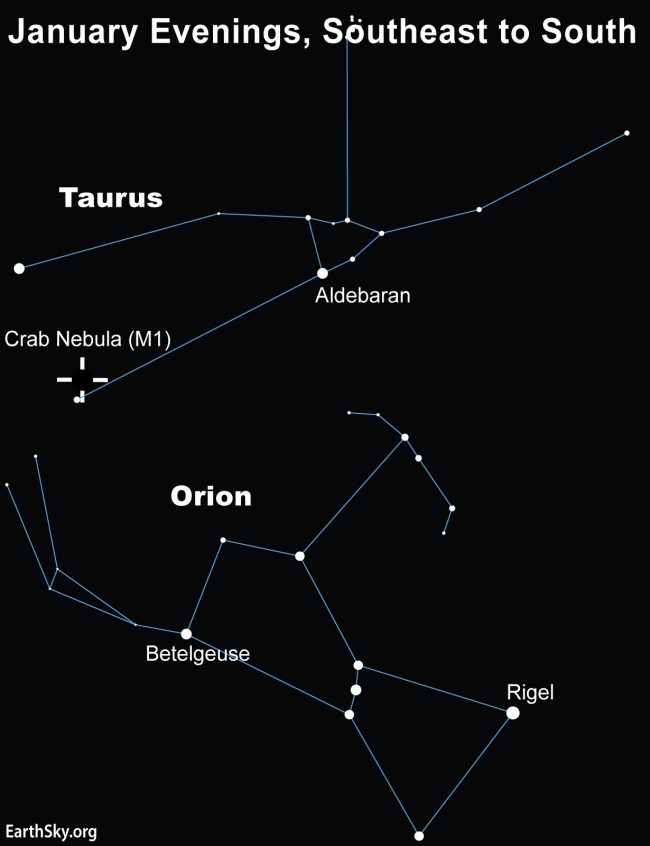

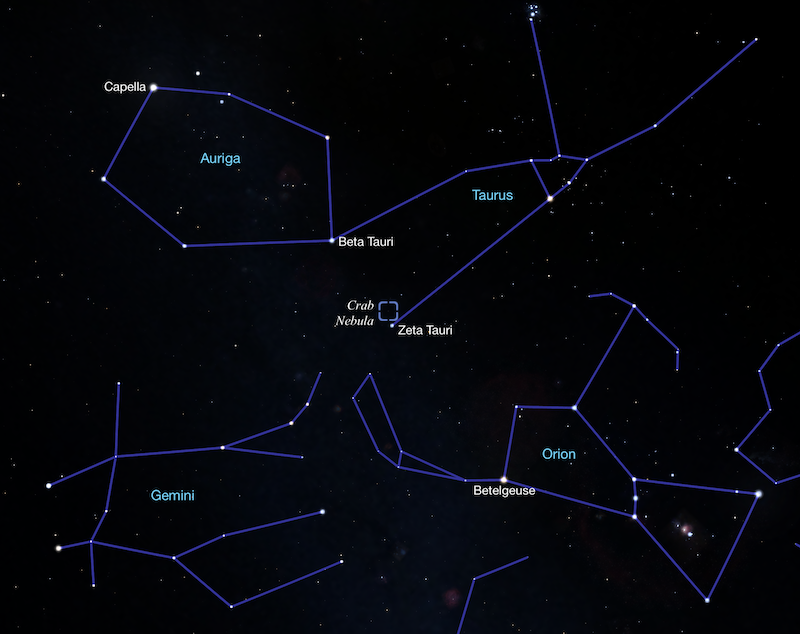
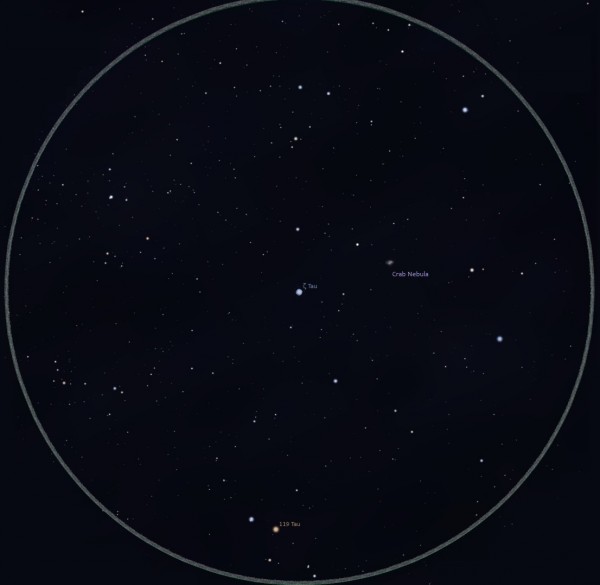
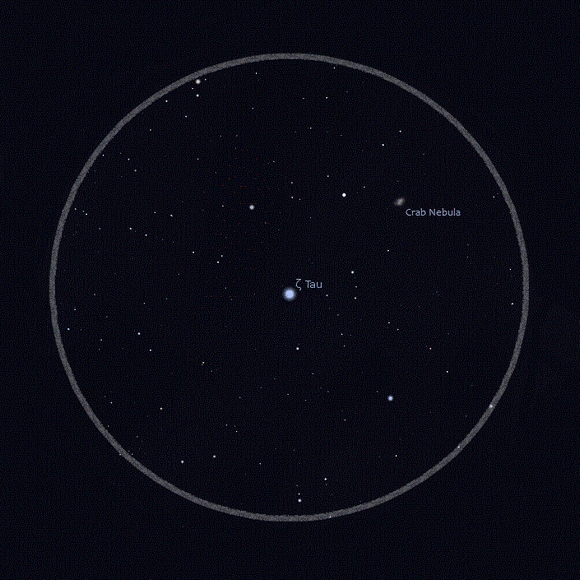
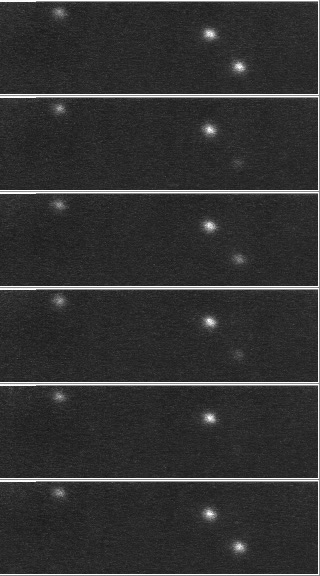


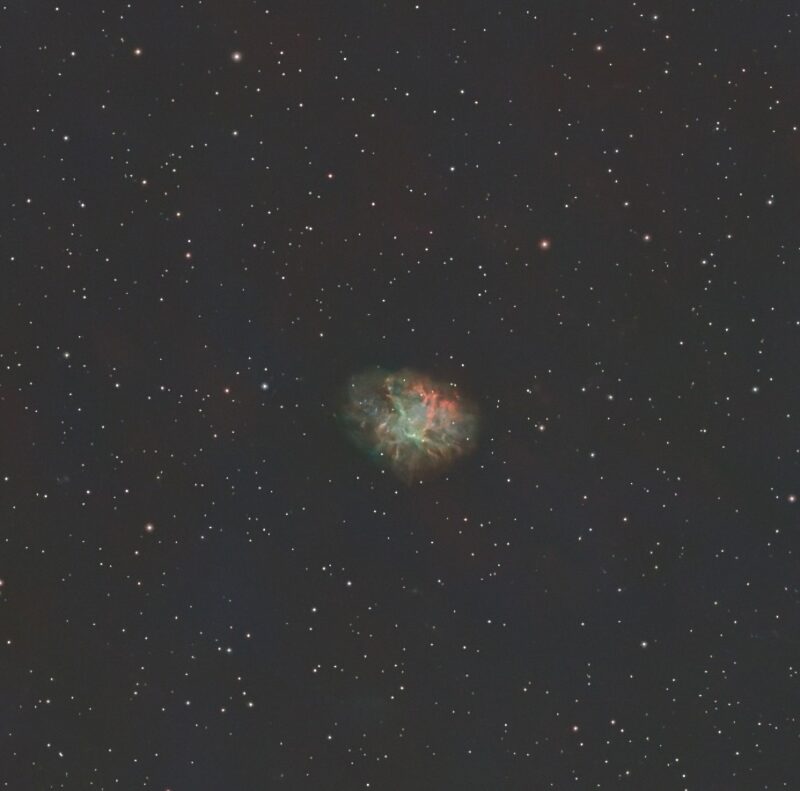


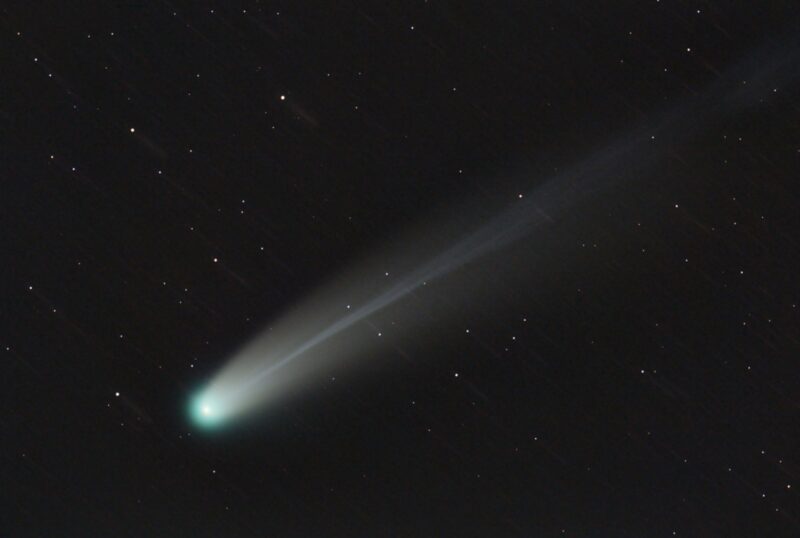


 This star chart shows the location of Comet 2025 R3 (PanSTARRS) at 5:30 a.m. CDT on April 15, 2026. It will be near the variable star 75 Pegasus, within the