aads

Foxes know the secret to surviving in nearly any habitat


Masters of adaptation and lightning-fast hunters, with a laugh you won’t forget! Foxes are full of surprises. Image via Jeremy Hynes/ Unsplash.

Foxes can be found in ecosystems all around the world. You can find different species of fox in dense forests, grasslands, arid deserts and even the icy Arctic. So what is the secret to their success? Foxes are intelligent animals that can adapt their behavior to fit with their environment. They have highly developed senses and impressive hunting skills, and they’re not afraid to eat whatever is available. In areas populated by humans, they can alter their schedules and change their diets. Plus, evolution has given them remarkable adaptations that allow them to thrive even in harsh environments.

Surprising facts about foxes’ amazing skills

Foxes can adjust their activity patterns according to food availability or the presence of other predators. And their tails are extraordinary tools. They provide stability while running, enable communication through subtle movements and act as an insulating layer that regulates temperature in both cold and warm climates.

Some of their most remarkable behaviors include:

Leaps of up to 7 feet (2 meters): In snowy areas, some foxes use a technique called pouncing. They spring into a rapid, precise arc to land on the snow and catch hidden rodents. Before leaping, they tilt their heads to listen to movements beneath the surface and calculate distance with astonishing accuracy.


Watch this red fox pouncing headfirst into snow. Video via Smithsonian Channel.

Strategic food hiding: When they acquire more food than they can eat, foxes bury it in small caches scattered throughout their territory. Their spatial memory allows them to remember dozens of these hiding spots for weeks.

Precise territorial marking: Foxes use scent glands, urine and visual signals to define hunting, travel and resting areas.

Over 40 different vocalizations: Foxes use screams, short barks, growls and even high-pitched “laughter” to communicate alarms, social contact, play or warnings.


Tickles! Video via Saveafox.

Notable speed and agility: Foxes can reach up to 31 miles per hour (50 kph) and react swiftly to obstacles or prey.

Chameleon-like fur in some species: The Arctic fox, for example, changes its coat color with the seasons as camouflage.

Extraordinary adaptation: Their varied diet and flexible behaviors allow foxes to thrive in vastly different environments.

The habitats and food sources of foxes in the wild

Foxes can live in temperate forests, grasslands, mountains, tundras, rocky areas and even deserts. Their omnivorous diet includes small mammals, birds, reptiles, insects, fruits, seeds and carrion, allowing them to exploit nearly any available resource.

Their underground dens are essential for their well-being, providing shelter from predators, a safe place to raise young and crucial thermal protection in extreme climates.

An orange fox in the middle of a rocky mountain covered in ice and snow.
Foxes are highly adaptable survivors, combining intelligence, agility and keen senses to thrive in diverse and often harsh environments. Image via Birger Strahl/ Unsplash.

The origin of foxes

Foxes belong to the subfamily Vulpinae, within the family Canidae, which also includes wolves, coyotes and domestic dogs. The genus Vulpes contains the “true foxes,” which belong to a single evolutionary group.

Other genera — such as Urocyon, Lycalopex and Otocyon — are commonly called foxes because they share the typical fox-like traits, such as slender snouts, bushy tails and erect ears. Plus they have similar behaviors. However, despite these similarities, the non-Vulpes foxes are not considered true foxes, as their ancestry and genetic lineage are distinct from Vulpes. In total, there are approximately 37 species of foxes, including both true foxes and these other fox-like canids.

Each genus of foxes — Vulpes, Urocyon, Lycalopex, Otocyon and others — has developed unique adaptations to survive in its environment. While all share characteristic fox-like traits and behaviors, each genus exhibits particular skills suited to its habitat. This diversity shows how foxes can look and act similarly, yet each faces its own challenges in the wild.

Fox species and their traits and adaptations

Here are facts about some of the most peculiar species of foxes.

Red fox (Vulpes vulpes)

The red fox is the most widely distributed fox species in the world, found in Europe, Asia, North America and northern Africa. Its key strength is its exceptional behavioral flexibility. It quickly adapts to new climates, food sources and even urban environments, adjusting its habits to avoid danger and seize opportunities. This ability to learn and adapt has allowed the red fox to thrive on nearly every continent and in landscapes heavily altered by humans.

An animal with mostly orange fur, a white belly and neck, black legs, a pointy snout and big ears.
A red fox. Image via Cody Boileau/ Unsplash.

Gray fox (Urocyon cinereoargenteus)

Native to the Americas, the gray fox is one of the few canids capable of climbing trees. Its strong, curved claws, combined with excellent coordination, allow it to ascend sloped trunks and rest on elevated branches. This behavior gives it a unique advantage: it can avoid terrestrial predators and access fruits or nests in heights unreachable to other foxes.

An animal with reddish and gray fur lying on a tree.
A gray fox lying on a tree branch. Image via Mitchell Hamilton/ Unsplash.

Culpeo (Lycalopex culpaeus)

Native to the Andes and nearby regions of South America, the culpeo is the largest South American fox. It is highly social, hunting in small groups, which allows it to tackle relatively large prey like birds and rabbits. Working together gives it a survival edge across the varied landscapes it inhabits, from rugged mountains to dry shrublands.

Medium-sized animal with dense fur and tail. It is mostly brown and gray.
A culpeo. Image via Juan Marcos Alvarez/ Pexels.

Bat-eared fox (Otocyon megalotis)

Native to Africa, the bat-eared fox is primarily insectivorous, feeding mostly on termites and other insects, which makes it unusual among foxes. It also displays a high level of social behavior, often foraging in pairs or small family groups.
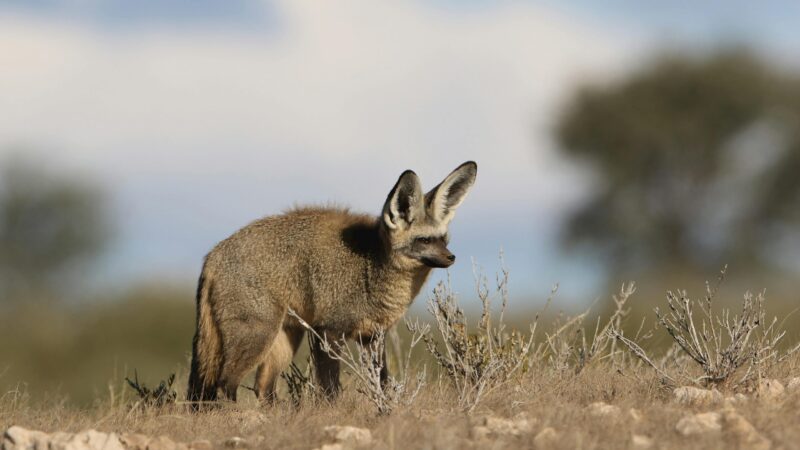
Animal with grayish fur, dark snout and huge, erect ears.
A bat-eared fox. Image via Derek Keats/ Pexels.

Extreme cases: Foxes in ice and sand

Arctic fox (Vulpes lagopus), master of extreme cold

Perfectly adapted to temperatures that can drop below –58°F (–50°C), the Arctic fox has fur that changes with the seasons. It’s white in winter to blend with the snow and brown or gray in summer to match the tundra. Interestingly, some Arctic foxes carry a rare genetic variation known as the “blue morph.” These foxes remain dark all year, providing a striking exception to their seasonal camouflage.

Animal with full white fur surrounded by snow.
An Arctic fox. Image via Jonatan Pie/ Unsplash.

The Arctic fox has paws fully covered in fur, which prevents heat loss and enables it to walk on snow, ice or sharp rocks. Its metabolism is so efficient that it can minimize energy expenditure during periods of scarcity.

Animal with dense, dark gray fur, surrounded by snow.
Arctic foxes change color with the seasons, except the rare blue morph, which stays dark year-round. Image via Jonatan Pie/ Unsplash.

Desert fox (Vulpes zerda) or fennec, survivor of sand and heat

The desert fox is small, light and extraordinarily adapted to the desert. Its light-colored fur reflects some solar radiation, and its enormous ears — up to 6 inches (15 cm) — act as a natural cooling system.

The desert fox’s ears contain a dense network of blood vessels just under the skin. When the fox needs to cool down, blood flow to the ears increases. The blood cools as it passes through the thin, exposed surface and returns to the body at a lower temperature, reducing internal heat.

Its tail, moderately bushy compared to other foxes, helps protect against both daytime heat and nighttime cold. It also provides balance on sand and can be wrapped around the body, including the nose, while sleeping to conserve warmth. This combination of adaptations makes the desert fox one of the most specialized foxes on the planet.

Small animal with light fur and very long ears, sitting on sand.
A desert fox. Image via Darrenquigley32/ Pixabay.

Birth, growth and learning in fox cubs

Fox cubs, also called kits or pups, are born after about eight weeks of gestation in protected dens. At birth, they are completely dependent: blind, deaf and covered with soft, dark fur.

During their first weeks, they stay inside the den, where the mother feeds and protects them. As they grow, they begin to explore cautiously. In many species, both parents help raise the young: the male provides food while the female cares for the cubs.

Learning is crucial. Young foxes play games that simulate hunting, chasing and defensive techniques. By six to seven months of age, they already have the skills needed to become independent and establish their own territory.

Foxes: Small animal with an orangish face and dark fur for the rest of the body.
Fox cubs have darker fur. Image via Rottonara/ Pixabay.

Conservation status of the fox

Many fox species maintain stable populations, like the red fox, but others are threatened by habitat loss, territorial fragmentation and climate change. Conserving ecosystems is key to their long-term survival.

With their soft steps and lively gaze, foxes traverse the world like little living enigmas, reminding us that even the most discreet animals have astonishing stories to tell.

Close up of an animal with orange fur, brown eyes and thin whiskers.
A quiet gaze that holds the wisdom of the wild. Image via Greg Johnson/ Unsplash.

Bottom line: From Arctic snow to desert sands, foxes survive in the wild with cunning, agility and impressive adaptability.

Read more:

How the lynx beat extinction: Lifeform of the week

The yak is an imposing giant of the high mountains

Kangaroo rats are desert dwellers: Lifeform of the week

The post Foxes know the secret to surviving in nearly any habitat first appeared on EarthSky.


from EarthSky https://ift.tt/dbYA0xh


Masters of adaptation and lightning-fast hunters, with a laugh you won’t forget! Foxes are full of surprises. Image via Jeremy Hynes/ Unsplash.

Foxes can be found in ecosystems all around the world. You can find different species of fox in dense forests, grasslands, arid deserts and even the icy Arctic. So what is the secret to their success? Foxes are intelligent animals that can adapt their behavior to fit with their environment. They have highly developed senses and impressive hunting skills, and they’re not afraid to eat whatever is available. In areas populated by humans, they can alter their schedules and change their diets. Plus, evolution has given them remarkable adaptations that allow them to thrive even in harsh environments.

Surprising facts about foxes’ amazing skills

Foxes can adjust their activity patterns according to food availability or the presence of other predators. And their tails are extraordinary tools. They provide stability while running, enable communication through subtle movements and act as an insulating layer that regulates temperature in both cold and warm climates.

Some of their most remarkable behaviors include:

Leaps of up to 7 feet (2 meters): In snowy areas, some foxes use a technique called pouncing. They spring into a rapid, precise arc to land on the snow and catch hidden rodents. Before leaping, they tilt their heads to listen to movements beneath the surface and calculate distance with astonishing accuracy.


Watch this red fox pouncing headfirst into snow. Video via Smithsonian Channel.

Strategic food hiding: When they acquire more food than they can eat, foxes bury it in small caches scattered throughout their territory. Their spatial memory allows them to remember dozens of these hiding spots for weeks.

Precise territorial marking: Foxes use scent glands, urine and visual signals to define hunting, travel and resting areas.

Over 40 different vocalizations: Foxes use screams, short barks, growls and even high-pitched “laughter” to communicate alarms, social contact, play or warnings.


Tickles! Video via Saveafox.

Notable speed and agility: Foxes can reach up to 31 miles per hour (50 kph) and react swiftly to obstacles or prey.

Chameleon-like fur in some species: The Arctic fox, for example, changes its coat color with the seasons as camouflage.

Extraordinary adaptation: Their varied diet and flexible behaviors allow foxes to thrive in vastly different environments.

The habitats and food sources of foxes in the wild

Foxes can live in temperate forests, grasslands, mountains, tundras, rocky areas and even deserts. Their omnivorous diet includes small mammals, birds, reptiles, insects, fruits, seeds and carrion, allowing them to exploit nearly any available resource.

Their underground dens are essential for their well-being, providing shelter from predators, a safe place to raise young and crucial thermal protection in extreme climates.

An orange fox in the middle of a rocky mountain covered in ice and snow.
Foxes are highly adaptable survivors, combining intelligence, agility and keen senses to thrive in diverse and often harsh environments. Image via Birger Strahl/ Unsplash.

The origin of foxes

Foxes belong to the subfamily Vulpinae, within the family Canidae, which also includes wolves, coyotes and domestic dogs. The genus Vulpes contains the “true foxes,” which belong to a single evolutionary group.

Other genera — such as Urocyon, Lycalopex and Otocyon — are commonly called foxes because they share the typical fox-like traits, such as slender snouts, bushy tails and erect ears. Plus they have similar behaviors. However, despite these similarities, the non-Vulpes foxes are not considered true foxes, as their ancestry and genetic lineage are distinct from Vulpes. In total, there are approximately 37 species of foxes, including both true foxes and these other fox-like canids.

Each genus of foxes — Vulpes, Urocyon, Lycalopex, Otocyon and others — has developed unique adaptations to survive in its environment. While all share characteristic fox-like traits and behaviors, each genus exhibits particular skills suited to its habitat. This diversity shows how foxes can look and act similarly, yet each faces its own challenges in the wild.

Fox species and their traits and adaptations

Here are facts about some of the most peculiar species of foxes.

Red fox (Vulpes vulpes)

The red fox is the most widely distributed fox species in the world, found in Europe, Asia, North America and northern Africa. Its key strength is its exceptional behavioral flexibility. It quickly adapts to new climates, food sources and even urban environments, adjusting its habits to avoid danger and seize opportunities. This ability to learn and adapt has allowed the red fox to thrive on nearly every continent and in landscapes heavily altered by humans.

An animal with mostly orange fur, a white belly and neck, black legs, a pointy snout and big ears.
A red fox. Image via Cody Boileau/ Unsplash.

Gray fox (Urocyon cinereoargenteus)

Native to the Americas, the gray fox is one of the few canids capable of climbing trees. Its strong, curved claws, combined with excellent coordination, allow it to ascend sloped trunks and rest on elevated branches. This behavior gives it a unique advantage: it can avoid terrestrial predators and access fruits or nests in heights unreachable to other foxes.

An animal with reddish and gray fur lying on a tree.
A gray fox lying on a tree branch. Image via Mitchell Hamilton/ Unsplash.

Culpeo (Lycalopex culpaeus)

Native to the Andes and nearby regions of South America, the culpeo is the largest South American fox. It is highly social, hunting in small groups, which allows it to tackle relatively large prey like birds and rabbits. Working together gives it a survival edge across the varied landscapes it inhabits, from rugged mountains to dry shrublands.

Medium-sized animal with dense fur and tail. It is mostly brown and gray.
A culpeo. Image via Juan Marcos Alvarez/ Pexels.

Bat-eared fox (Otocyon megalotis)

Native to Africa, the bat-eared fox is primarily insectivorous, feeding mostly on termites and other insects, which makes it unusual among foxes. It also displays a high level of social behavior, often foraging in pairs or small family groups.

Animal with grayish fur, dark snout and huge, erect ears.
A bat-eared fox. Image via Derek Keats/ Pexels.

Extreme cases: Foxes in ice and sand

Arctic fox (Vulpes lagopus), master of extreme cold

Perfectly adapted to temperatures that can drop below –58°F (–50°C), the Arctic fox has fur that changes with the seasons. It’s white in winter to blend with the snow and brown or gray in summer to match the tundra. Interestingly, some Arctic foxes carry a rare genetic variation known as the “blue morph.” These foxes remain dark all year, providing a striking exception to their seasonal camouflage.

Animal with full white fur surrounded by snow.
An Arctic fox. Image via Jonatan Pie/ Unsplash.

The Arctic fox has paws fully covered in fur, which prevents heat loss and enables it to walk on snow, ice or sharp rocks. Its metabolism is so efficient that it can minimize energy expenditure during periods of scarcity.

Animal with dense, dark gray fur, surrounded by snow.
Arctic foxes change color with the seasons, except the rare blue morph, which stays dark year-round. Image via Jonatan Pie/ Unsplash.

Desert fox (Vulpes zerda) or fennec, survivor of sand and heat

The desert fox is small, light and extraordinarily adapted to the desert. Its light-colored fur reflects some solar radiation, and its enormous ears — up to 6 inches (15 cm) — act as a natural cooling system.

The desert fox’s ears contain a dense network of blood vessels just under the skin. When the fox needs to cool down, blood flow to the ears increases. The blood cools as it passes through the thin, exposed surface and returns to the body at a lower temperature, reducing internal heat.

Its tail, moderately bushy compared to other foxes, helps protect against both daytime heat and nighttime cold. It also provides balance on sand and can be wrapped around the body, including the nose, while sleeping to conserve warmth. This combination of adaptations makes the desert fox one of the most specialized foxes on the planet.

Small animal with light fur and very long ears, sitting on sand.
A desert fox. Image via Darrenquigley32/ Pixabay.

Birth, growth and learning in fox cubs

Fox cubs, also called kits or pups, are born after about eight weeks of gestation in protected dens. At birth, they are completely dependent: blind, deaf and covered with soft, dark fur.

During their first weeks, they stay inside the den, where the mother feeds and protects them. As they grow, they begin to explore cautiously. In many species, both parents help raise the young: the male provides food while the female cares for the cubs.

Learning is crucial. Young foxes play games that simulate hunting, chasing and defensive techniques. By six to seven months of age, they already have the skills needed to become independent and establish their own territory.

Foxes: Small animal with an orangish face and dark fur for the rest of the body.
Fox cubs have darker fur. Image via Rottonara/ Pixabay.

Conservation status of the fox

Many fox species maintain stable populations, like the red fox, but others are threatened by habitat loss, territorial fragmentation and climate change. Conserving ecosystems is key to their long-term survival.

With their soft steps and lively gaze, foxes traverse the world like little living enigmas, reminding us that even the most discreet animals have astonishing stories to tell.

Close up of an animal with orange fur, brown eyes and thin whiskers.
A quiet gaze that holds the wisdom of the wild. Image via Greg Johnson/ Unsplash.

Bottom line: From Arctic snow to desert sands, foxes survive in the wild with cunning, agility and impressive adaptability.

Read more:

How the lynx beat extinction: Lifeform of the week

The yak is an imposing giant of the high mountains

Kangaroo rats are desert dwellers: Lifeform of the week

The post Foxes know the secret to surviving in nearly any habitat first appeared on EarthSky.


from EarthSky https://ift.tt/dbYA0xh
Fast-spinning asteroid 2025 MN45 rewrites rotation record

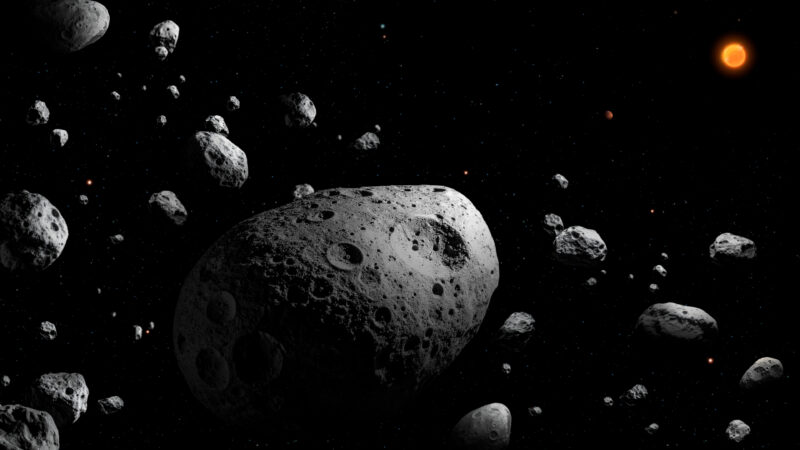
Fast-spinning asteroid: Rocky asteroid in a field of other asteroids. Sun and Jupiter in background.
This artist’s illustration depicts the fast-spinning asteroid 2025 MN45. It’s the fastest-rotating asteroid with a diameter greater than 500 meters (0.3 miles) that scientists have yet found; 2025 MN45 is 710 meters (0.44 miles) in diameter. The asteroid, which resides in the asteroid belt, completes a full rotation every 1.88 minutes. The NSF–DOE Vera C. Rubin Observatory made the discovery. And that’s the sun and Jupiter in the distance. Image via NSF–DOE Vera C. Rubin Observatory/ NOIRLab/ SLAC/ AURA/ P. Marenfeld.

EarthSky’s 2026 lunar calendar shows the moon phase for every day of the year. Available now. Get yours today!

Fast-spinning asteroid 2025 MN45 rewrites rotation record

The Vera C. Rubin Observatory has just discovered a “never before seen” fast-spinning asteroid. It sets a new speed standard for solar system objects larger than .5 kilometer (0.3 miles). NOIRLab said on January 7, 2026, that the asteroid – named 2025 MN45 – measures a whopping 710 meters (0.44 miles) and makes a full rotation every 1.88 minutes!

The whirling rocky body is one of 1,900 new solar system objects discovered during Rubin’s First Look Event in spring 2025. Among the freshly found minor planets were 19 super- and ultra-fast-rotating asteroids. 2025 MN45 lies in the main asteroid belt.

The Astrophysical Journal Letters published the peer-reviewed study on January 7, 2026.

Fast-spinning asteroid made of very strong stuff

Most main-belt asteroids are assemblages of small rocks loosely held together by gravity. That means if they spin too quickly, they fly apart. Because fast-spinning 2025 MN45 makes one rotation in less than two minutes, it must be extremely solid. NOIRLab’s press release said:

For objects in the main asteroid belt, the fast-rotation limit to avoid being fragmented is 2.2 hours; asteroids spinning faster than this must be structurally strong to remain intact. The faster an asteroid spins above this limit, and the larger its size, the stronger the material it must be made from.

The other recently discovered fast-spinning objects must also be made of quite stern stuff. The 16 super-fast rotators have periods of between 13 minutes and 2.2 hours. The three ultra-fast rotators – including 2025 MN45 – all complete a rotation in less than 5 minutes.

Sarah Greenstreet, NOIRLab assistant astronomer and lead of Rubin Observatory’s Solar System Science Collaboration’s Near-Earth Objects and Interstellar Objects working group, described the composition of such a fast-spinning asteroid as unusual:

We calculate that it would need a cohesive strength similar to that of solid rock. This is somewhat surprising since most asteroids are believed to be what we call ‘rubble pile’ asteroids, which means they are made of many, many small pieces of rock and debris that coalesced under gravity during solar system formation or subsequent collisions.


Watch EarthSky’s Dave Adalian discuss the world’s most powerful camera inside the Vera C. Rubin Telescope with Steven Bellavia.

1,900 asteroids discovered in about 10 hours

NOIRLab, which operates the world’s largest digital camera at the Rubin Observatory, tested the equipment during a commissioning phase in spring of 2025. The results of that brief first-light observation – approximately 10 hours of observing over seven nights in April and May – yielded a treasure trove of solar system objects.

It also yielded the first study based on data from the Rubin Observatory. The paper presents reliable rotation periods for 76 asteroids, including the 16 super- and three ultra-fast rotating objects. All 19 objects are longer than 90 meters (300 feet). And 2025 MN45 is the largest of those.

Young woman with long blonde bangs in front of a bookshelf.
Sarah Greenstreet, NOIRLab assistant astronomer and lead of Rubin Observatory’s Solar System Science Collaboration’s Near-Earth Objects and Interstellar Objects working group. Image via University of Washington.

Rubin can see distant asteroids more clearly

The majority of previously documented fast-spinning asteroids are near-Earth objects (NEOs). This, however, was mainly because the distance to the main asteroid belt made them difficult to observe from Earth. According to NOIRLab’s Greenstreet, the Rubin’s oversize camera has significantly extended humanity’s reach:

As this study demonstrates, even in early commissioning, Rubin is successfully allowing us to study a population of relatively small, very-rapidly-rotating main-belt asteroids that hadn’t been reachable before.

Only one of the newly discovered fast-spinning asteroids is an NEO. The rest lie between the orbits of Mars and Jupiter, as far away as the outside edge of the main asteroid belt. Besides 2025 MN45, other fast-spinning asteroids of note described are 2025 MJ71 (1.9-minute rotation period), 2025 MK41 (3.8-minute rotation period), 2025 MV71 (13-minute rotation period) and 2025 MG56 (16-minute rotation period).

Scientists expect many more fast-spinning asteroid discoveries once Rubin begins its decade-long Legacy Survey of Space and Time. That ambitious project aims to take hundreds of high-resolution images every night of the Southern Hemisphere sky. The data collected should lead future study of the makeup and formation history of fast-spinning asteroids.

Bottom line: 2025 MN45 – a newly discovered, fast-spinning asteroid – is the fastest-rotating object of its size scientists have yet discovered. It rotates once every 1.88 minutes.

Source: Lightcurves, Rotation Periods, and Colors for Vera C. Rubin Observatory’s First Asteroid Discoveries

Via NOIRLab

Read more: See the first Rubin Observatory images here!

The post Fast-spinning asteroid 2025 MN45 rewrites rotation record first appeared on EarthSky.


from EarthSky https://ift.tt/FiaeptN
Fast-spinning asteroid: Rocky asteroid in a field of other asteroids. Sun and Jupiter in background.
This artist’s illustration depicts the fast-spinning asteroid 2025 MN45. It’s the fastest-rotating asteroid with a diameter greater than 500 meters (0.3 miles) that scientists have yet found; 2025 MN45 is 710 meters (0.44 miles) in diameter. The asteroid, which resides in the asteroid belt, completes a full rotation every 1.88 minutes. The NSF–DOE Vera C. Rubin Observatory made the discovery. And that’s the sun and Jupiter in the distance. Image via NSF–DOE Vera C. Rubin Observatory/ NOIRLab/ SLAC/ AURA/ P. Marenfeld.

EarthSky’s 2026 lunar calendar shows the moon phase for every day of the year. Available now. Get yours today!

Fast-spinning asteroid 2025 MN45 rewrites rotation record

The Vera C. Rubin Observatory has just discovered a “never before seen” fast-spinning asteroid. It sets a new speed standard for solar system objects larger than .5 kilometer (0.3 miles). NOIRLab said on January 7, 2026, that the asteroid – named 2025 MN45 – measures a whopping 710 meters (0.44 miles) and makes a full rotation every 1.88 minutes!

The whirling rocky body is one of 1,900 new solar system objects discovered during Rubin’s First Look Event in spring 2025. Among the freshly found minor planets were 19 super- and ultra-fast-rotating asteroids. 2025 MN45 lies in the main asteroid belt.

The Astrophysical Journal Letters published the peer-reviewed study on January 7, 2026.

Fast-spinning asteroid made of very strong stuff

Most main-belt asteroids are assemblages of small rocks loosely held together by gravity. That means if they spin too quickly, they fly apart. Because fast-spinning 2025 MN45 makes one rotation in less than two minutes, it must be extremely solid. NOIRLab’s press release said:

For objects in the main asteroid belt, the fast-rotation limit to avoid being fragmented is 2.2 hours; asteroids spinning faster than this must be structurally strong to remain intact. The faster an asteroid spins above this limit, and the larger its size, the stronger the material it must be made from.

The other recently discovered fast-spinning objects must also be made of quite stern stuff. The 16 super-fast rotators have periods of between 13 minutes and 2.2 hours. The three ultra-fast rotators – including 2025 MN45 – all complete a rotation in less than 5 minutes.

Sarah Greenstreet, NOIRLab assistant astronomer and lead of Rubin Observatory’s Solar System Science Collaboration’s Near-Earth Objects and Interstellar Objects working group, described the composition of such a fast-spinning asteroid as unusual:

We calculate that it would need a cohesive strength similar to that of solid rock. This is somewhat surprising since most asteroids are believed to be what we call ‘rubble pile’ asteroids, which means they are made of many, many small pieces of rock and debris that coalesced under gravity during solar system formation or subsequent collisions.


Watch EarthSky’s Dave Adalian discuss the world’s most powerful camera inside the Vera C. Rubin Telescope with Steven Bellavia.

1,900 asteroids discovered in about 10 hours

NOIRLab, which operates the world’s largest digital camera at the Rubin Observatory, tested the equipment during a commissioning phase in spring of 2025. The results of that brief first-light observation – approximately 10 hours of observing over seven nights in April and May – yielded a treasure trove of solar system objects.

It also yielded the first study based on data from the Rubin Observatory. The paper presents reliable rotation periods for 76 asteroids, including the 16 super- and three ultra-fast rotating objects. All 19 objects are longer than 90 meters (300 feet). And 2025 MN45 is the largest of those.

Young woman with long blonde bangs in front of a bookshelf.
Sarah Greenstreet, NOIRLab assistant astronomer and lead of Rubin Observatory’s Solar System Science Collaboration’s Near-Earth Objects and Interstellar Objects working group. Image via University of Washington.

Rubin can see distant asteroids more clearly

The majority of previously documented fast-spinning asteroids are near-Earth objects (NEOs). This, however, was mainly because the distance to the main asteroid belt made them difficult to observe from Earth. According to NOIRLab’s Greenstreet, the Rubin’s oversize camera has significantly extended humanity’s reach:

As this study demonstrates, even in early commissioning, Rubin is successfully allowing us to study a population of relatively small, very-rapidly-rotating main-belt asteroids that hadn’t been reachable before.

Only one of the newly discovered fast-spinning asteroids is an NEO. The rest lie between the orbits of Mars and Jupiter, as far away as the outside edge of the main asteroid belt. Besides 2025 MN45, other fast-spinning asteroids of note described are 2025 MJ71 (1.9-minute rotation period), 2025 MK41 (3.8-minute rotation period), 2025 MV71 (13-minute rotation period) and 2025 MG56 (16-minute rotation period).

Scientists expect many more fast-spinning asteroid discoveries once Rubin begins its decade-long Legacy Survey of Space and Time. That ambitious project aims to take hundreds of high-resolution images every night of the Southern Hemisphere sky. The data collected should lead future study of the makeup and formation history of fast-spinning asteroids.

Bottom line: 2025 MN45 – a newly discovered, fast-spinning asteroid – is the fastest-rotating object of its size scientists have yet discovered. It rotates once every 1.88 minutes.

Source: Lightcurves, Rotation Periods, and Colors for Vera C. Rubin Observatory’s First Asteroid Discoveries

Via NOIRLab

Read more: See the first Rubin Observatory images here!

The post Fast-spinning asteroid 2025 MN45 rewrites rotation record first appeared on EarthSky.


from EarthSky https://ift.tt/FiaeptN

The Hyades star cluster: The Face of Taurus the Bull

A starry sky with labels showing Jupiter, the Hyades star cluster and Pleiades.
View at EarthSky Community Photos. | Chuck Reinhart in Vincennes, Indiana, submitted this photo on December 5, 2024, and wrote: “The planet Jupiter holds court with the Hyades star cluster and the Pleiades star cluster.” Thank you, Chuck.

EarthSky’s 2026 lunar calendar shows the moon phase for every day of the year. Available now. Get yours today!

The Hyades: a nearby star cluster

With the exception of the Ursa Major Moving Group, the Hyades cluster is the closest star cluster to Earth, at a distance of 150 light-years. This compact cluster with the distinctive shape of the letter V is very easy to spot in the night sky.

The V shape represents the Face of the Bull in the constellation Taurus. The bright star Aldebaran is part of the V. Aldebaran represents the Bull’s fiery red eye.

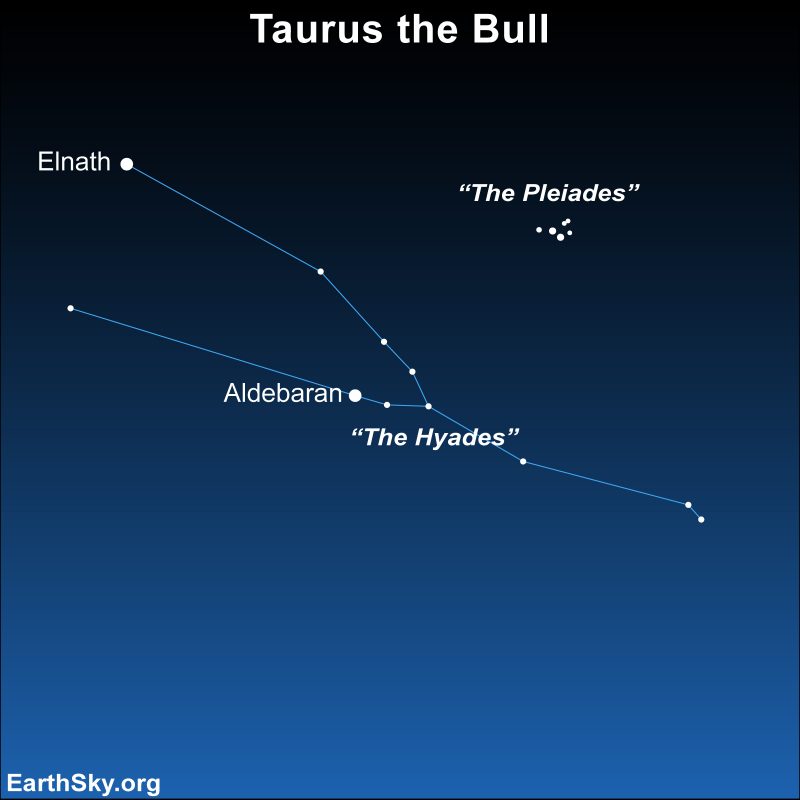
Star chart: Fork-shaped constellation with lines with Aldebaran labeled, and small cluster labeled Pleiades at the top of the constellation.
Taurus the Bull contains 2 star clusters that are easy to spot: the Hyades and the Pleiades. Aldebaran appears as part of the Hyades cluster. Although it’s a foreground star, it’s not a member of the star cluster. It’s much closer to us in space than the other Hyades stars.

Finding the Hyades

The Hyades cluster is easy to find by using Orion’s Belt, a compact and noticeable line of three blue-white stars in the constellation Orion the Hunter. Draw a line westward (generally toward your sunset direction) through the Belt stars, and you will come to the bright reddish star Aldebaran, the Bull’s fiery red eye.

Although Aldebaran isn’t a true member of the Hyades star cluster, this bright star is a great guide to this cluster. In fact, Aldebaran is only about 65 light-years distant. The actual cluster lies about 2 1/2 times farther off. This is what we call a “line-of-sight coincidence.”

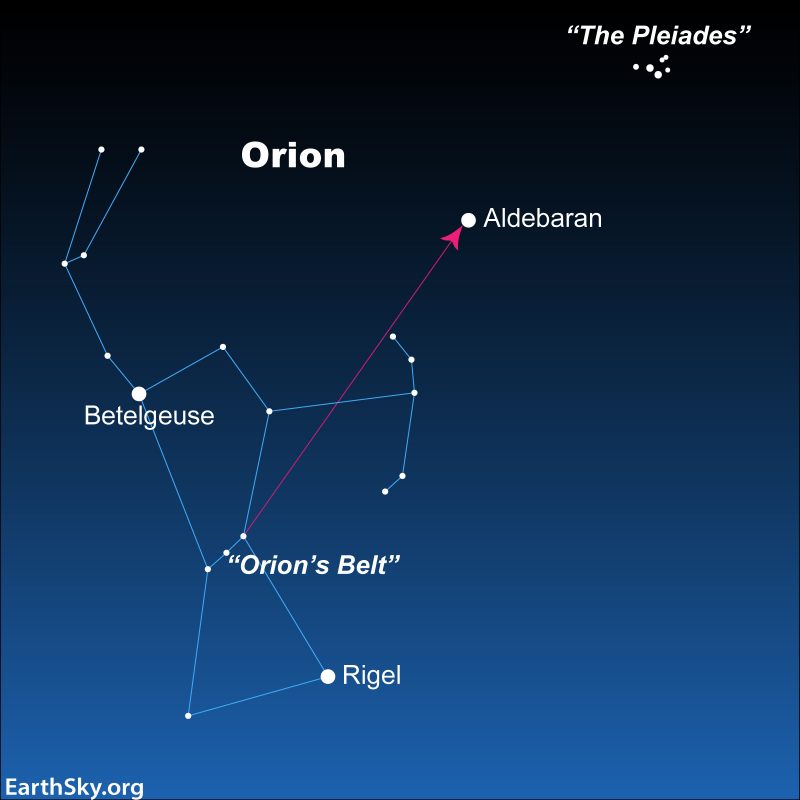
Sky chart showing an arrow from Orion's Belt to the star Aldebaran, at top right. The Pleiades is in the upper right.
If you can find the prominent constellation Orion the Hunter, you can find the bright red star Aldebaran. Orion’s Belt always points to Aldebaran. And, extending that line generally takes you toward the Pleiades, or Seven Sisters, too.

Use binoculars or a telescope to see the Hyades star cluster

The V-shaped figure of stars (except Aldebaran) highlights the brightest of the Hyades’ few hundred stars. About a dozen or more Hyades stars are visible to the unaided eye in a dark country sky. Then if you use binoculars or a small telescope, dozens of the cluster’s stars pop into view. From the Northern Hemisphere, observers see the Hyades cluster best in the evening sky from around January to April. From the Southern Hemisphere, observers see the Hyades cluster best in the evening sky from December to February.

Additionally, the constellation Taurus the Bull is home to another bright star cluster: the Pleiades or Seven Sisters. In contrast to the Hyades, the Pleiades cluster is more distant, at some 430 light-years away. However, both the Hyades and Pleiades are easily visible to the unaided eye. Also, both are enhanced by viewing with binoculars.

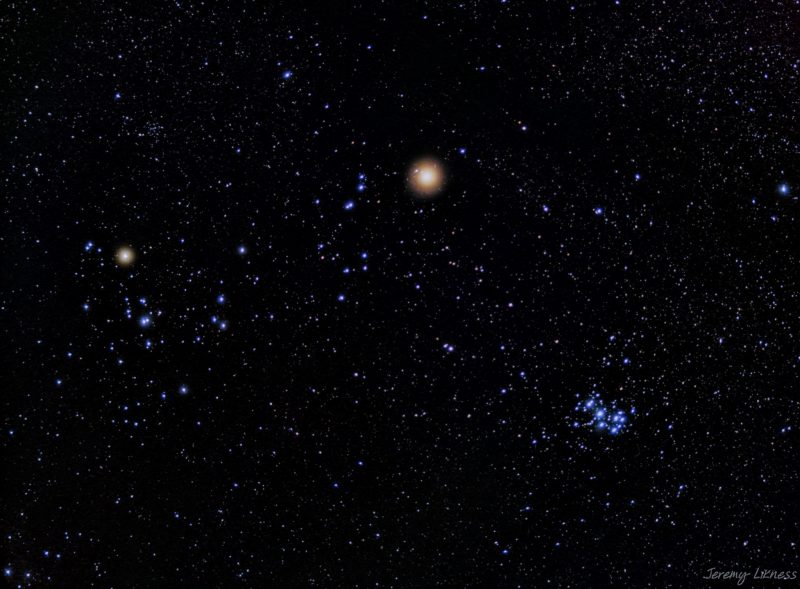
Hyades Star Cluster: Star field with 2 big, bright, orangish star-like objects and little bunch of bright blue stars.
View at EarthSky Community Photos. | Jeremy Likness in Monroe, Washington, captured this view of the Hyades and the Pleiades on January 8, 2023. Also shown is the planet Mars as it passed in front of the stars in the constellation Taurus. Jeremy wrote: “A winter triangle: the bright star Aldebaran, Mars and M45 [the Pleiades]. The Pleiades were bright and clear in the winter sky.” Thank you, Jeremy!

History and mythology of the Hyades star cluster

According to sky lore, the teary Hyades are the daughters of Atlas and Aethra. The sisters are forever crying for their brother Hyas, who was killed by a lion or a boar. Plus, the Hyades are the half-sisters to the Pleiades, the daughters of Atlas and Pleione. The gods purposely kept Atlas’ daughters – the Hyades and the Pleaides – out of reach of Orion and his lustful pursuits.

So the gods transformed Hyas into the constellation Aquarius, and the lion that killed him into the constellation Leo. Then the gods placed Aquarius and Leo on opposite sides of the sky for Hyas’ protection. That’s why Aquarius and Leo do not appear in the same sky together. So as one constellation sets in the west, the other rises in the east, and vice versa.

Hyades science

Although the Hyades and Pleaides are half-sisters in mythology, science finds no close relationship in space between these two star clusters.

Astronomers find that the Pleiades are composed of hot blue-white suns in the heyday of youth. So that puts the age of the cluster at about 100 million years. In contrast, the cooler red giant and white dwarf stars found in the Hyades indicate a vastly older cluster over 600 million years old.

Interestingly, astronomers suspect an actual kinship between the Hyades cluster and the Beehive star cluster in the constellation Cancer the Crab. Even though these two star clusters are separated from one another by hundreds of light-years, they are akin in age and travel in a similar direction in space. Thus, astronomers believe that these clusters might have originated from the same gaseous nebula some 700 to 800 million years ago.

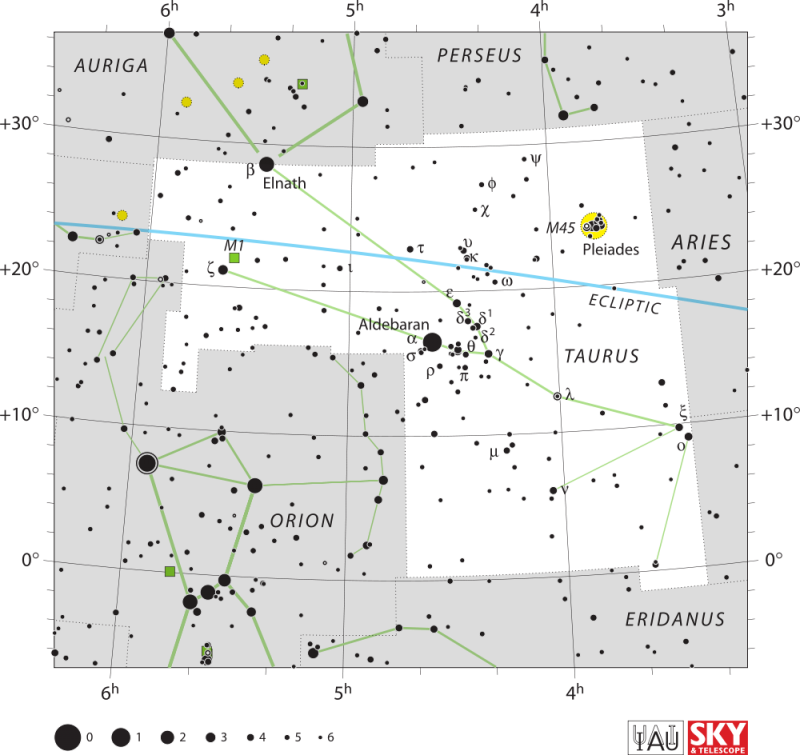
Chart with stars in black on white showing constellations Orion and Taurus.
This star chart for Taurus the Bull shows the location of Aldebaran in the V-shaped Head of Taurus the Bull. That V-shaped pattern is the Hyades star cluster. Additionally, you can see M1, the Crab Nebula, between the star Elnath (Beta Tauri) and Zeta Tauri. Chart via IAU/ Wikimedia Commons (CC BY 3.0).

Is the Hyades cluster being destroyed?

Enjoying EarthSky? Sign up for our free daily newsletter today!

Bottom line: Look for the V-shape Hyades star cluster of Taurus the Bull in the evening sky. It represents the Face of the Bull and it’s beautiful in binoculars.

Read more: Lost sisters of the Pleiades are scattered across the sky

The post The Hyades star cluster: The Face of Taurus the Bull first appeared on EarthSky.


from EarthSky https://ift.tt/BQuKp4M
A starry sky with labels showing Jupiter, the Hyades star cluster and Pleiades.
View at EarthSky Community Photos. | Chuck Reinhart in Vincennes, Indiana, submitted this photo on December 5, 2024, and wrote: “The planet Jupiter holds court with the Hyades star cluster and the Pleiades star cluster.” Thank you, Chuck.

EarthSky’s 2026 lunar calendar shows the moon phase for every day of the year. Available now. Get yours today!

The Hyades: a nearby star cluster

With the exception of the Ursa Major Moving Group, the Hyades cluster is the closest star cluster to Earth, at a distance of 150 light-years. This compact cluster with the distinctive shape of the letter V is very easy to spot in the night sky.

The V shape represents the Face of the Bull in the constellation Taurus. The bright star Aldebaran is part of the V. Aldebaran represents the Bull’s fiery red eye.

Star chart: Fork-shaped constellation with lines with Aldebaran labeled, and small cluster labeled Pleiades at the top of the constellation.
Taurus the Bull contains 2 star clusters that are easy to spot: the Hyades and the Pleiades. Aldebaran appears as part of the Hyades cluster. Although it’s a foreground star, it’s not a member of the star cluster. It’s much closer to us in space than the other Hyades stars.

Finding the Hyades

The Hyades cluster is easy to find by using Orion’s Belt, a compact and noticeable line of three blue-white stars in the constellation Orion the Hunter. Draw a line westward (generally toward your sunset direction) through the Belt stars, and you will come to the bright reddish star Aldebaran, the Bull’s fiery red eye.

Although Aldebaran isn’t a true member of the Hyades star cluster, this bright star is a great guide to this cluster. In fact, Aldebaran is only about 65 light-years distant. The actual cluster lies about 2 1/2 times farther off. This is what we call a “line-of-sight coincidence.”

Sky chart showing an arrow from Orion's Belt to the star Aldebaran, at top right. The Pleiades is in the upper right.
If you can find the prominent constellation Orion the Hunter, you can find the bright red star Aldebaran. Orion’s Belt always points to Aldebaran. And, extending that line generally takes you toward the Pleiades, or Seven Sisters, too.

Use binoculars or a telescope to see the Hyades star cluster

The V-shaped figure of stars (except Aldebaran) highlights the brightest of the Hyades’ few hundred stars. About a dozen or more Hyades stars are visible to the unaided eye in a dark country sky. Then if you use binoculars or a small telescope, dozens of the cluster’s stars pop into view. From the Northern Hemisphere, observers see the Hyades cluster best in the evening sky from around January to April. From the Southern Hemisphere, observers see the Hyades cluster best in the evening sky from December to February.

Additionally, the constellation Taurus the Bull is home to another bright star cluster: the Pleiades or Seven Sisters. In contrast to the Hyades, the Pleiades cluster is more distant, at some 430 light-years away. However, both the Hyades and Pleiades are easily visible to the unaided eye. Also, both are enhanced by viewing with binoculars.

Hyades Star Cluster: Star field with 2 big, bright, orangish star-like objects and little bunch of bright blue stars.
View at EarthSky Community Photos. | Jeremy Likness in Monroe, Washington, captured this view of the Hyades and the Pleiades on January 8, 2023. Also shown is the planet Mars as it passed in front of the stars in the constellation Taurus. Jeremy wrote: “A winter triangle: the bright star Aldebaran, Mars and M45 [the Pleiades]. The Pleiades were bright and clear in the winter sky.” Thank you, Jeremy!

History and mythology of the Hyades star cluster

According to sky lore, the teary Hyades are the daughters of Atlas and Aethra. The sisters are forever crying for their brother Hyas, who was killed by a lion or a boar. Plus, the Hyades are the half-sisters to the Pleiades, the daughters of Atlas and Pleione. The gods purposely kept Atlas’ daughters – the Hyades and the Pleaides – out of reach of Orion and his lustful pursuits.

So the gods transformed Hyas into the constellation Aquarius, and the lion that killed him into the constellation Leo. Then the gods placed Aquarius and Leo on opposite sides of the sky for Hyas’ protection. That’s why Aquarius and Leo do not appear in the same sky together. So as one constellation sets in the west, the other rises in the east, and vice versa.

Hyades science

Although the Hyades and Pleaides are half-sisters in mythology, science finds no close relationship in space between these two star clusters.

Astronomers find that the Pleiades are composed of hot blue-white suns in the heyday of youth. So that puts the age of the cluster at about 100 million years. In contrast, the cooler red giant and white dwarf stars found in the Hyades indicate a vastly older cluster over 600 million years old.

Interestingly, astronomers suspect an actual kinship between the Hyades cluster and the Beehive star cluster in the constellation Cancer the Crab. Even though these two star clusters are separated from one another by hundreds of light-years, they are akin in age and travel in a similar direction in space. Thus, astronomers believe that these clusters might have originated from the same gaseous nebula some 700 to 800 million years ago.

Chart with stars in black on white showing constellations Orion and Taurus.
This star chart for Taurus the Bull shows the location of Aldebaran in the V-shaped Head of Taurus the Bull. That V-shaped pattern is the Hyades star cluster. Additionally, you can see M1, the Crab Nebula, between the star Elnath (Beta Tauri) and Zeta Tauri. Chart via IAU/ Wikimedia Commons (CC BY 3.0).

Is the Hyades cluster being destroyed?

Enjoying EarthSky? Sign up for our free daily newsletter today!

Bottom line: Look for the V-shape Hyades star cluster of Taurus the Bull in the evening sky. It represents the Face of the Bull and it’s beautiful in binoculars.

Read more: Lost sisters of the Pleiades are scattered across the sky

The post The Hyades star cluster: The Face of Taurus the Bull first appeared on EarthSky.


from EarthSky https://ift.tt/BQuKp4M

Final steps begin for Artemis 2, a crewed launch to the moon

A large orange cylinder and two rocket boosters inside a huge building.
This is NASA’s Space Launch System rocket inside the Vehicle Assembly Building in Florida on December 20, 2025. NASA said on January 9, 2026, that the Artemis 2 mission could launch as early as February 6, 2026. Image via NASA/ Joel Kowsky.

An updated schedule for the Artemis 2 mission to the moon

NASA said on January 9, 2026, that the final steps are underway for the first crewed Artemis mission to the moon. The space agency said it would begin the 4-mile trek from the Vehicle Assembly Building to Launch Pad 39B no earlier than January 17. This journey takes around 12 hours. Once the rocket and spacecraft reach the launchpad, testing will begin. By the end of January, we can expect a wet dress rehearsal, when teams load the rocket fuel and perform a countdown without the astronauts present.

So when can we expect the launch of Artemis 2, the first return of astronauts to the moon in decades? The earliest launch window is on February 6, 2026. For this mission to the moon, Earth and the moon have to be in specific alignments at launch time. Therefore, the possible dates of launch through April 2026 are as follows:

February 6, 7, 8, 10 and 11

March 6, 7, 8, 9 and 11

April 1, 3, 4, 5 and 6

What is the Artemis 2 mission to the moon?

No nation has sent humans anywhere near the moon since Apollo 17 in December 1972. All crewed missions since then have remained in low Earth orbit, meaning humans haven’t traveled to the moon’s distance in more than 50 years. But that’s about to change.

The Artemis 2 mission – a crewed flight around the moon – could launch as early as February 2026. On November 20, 2025, NASA announced that the spacecraft was fully stacked in the Vehicle Assembly Building (VAB) on Cape Canaveral at Kennedy Space Center in Florida and ready for dress rehearsal. NASA said:

In the coming weeks, engineers and the Artemis 2 crew will conduct the 1st part of a Countdown Demonstration Test at Kennedy, a dress rehearsal for launch day. The crew will don their Orion crew survival system spacesuits and venture to their rocket before being secured inside Orion, which the crew recently named Integrity, simulating the final moments of the countdown.

Because the rocket and spacecraft are not yet at the launch pad, the crew will board Orion inside the VAB. The test will serve as a final verification of the timeline for the crew and supporting teams on the ground. A second part of the test, preparing for an emergency at the launch pad, will occur after the rocket and spacecraft roll out to Launch Pad 39B.

The following mission, Artemis 3 – which will be the first mission to return humans to the moon’s surface since the Apollo missions of the 1960s and ’70s – was slated for September 2026. It has been delayed until at least mid-2027.

Multiple levels indoors with a tall rocket standing upright behind struts.
On Novevmeber 20, 2025, NASA said online that Artemis 2 is stacked. The communication systems have been tested and the team were then gearing up for a launch day dress rehearsal. Image via NASA/ Kim Shiflett.

Integrity

The Artemis 2 crew said they chose the name Integrity because it:

… embodies the foundation of trust, respect, candor, and humility across the crew and the many engineers, technicians, scientists, planners, and dreamers required for mission success.

The name is also a nod to the extensive integrated effort – from the more than 300,000 spacecraft components to the thousands of people across the world – that must come together to venture to the moon and back, inspire the world, and set course for a long-term presence at the moon.

Artemis: Cloudy sky over enormous building with American flag and NASA logo. A huge orange cylinder lying next to it, with tiny people.
Back in July 2024, the Artemis 2 moon rocket core (orange, lying horizontally), could be seen in front of NASA’s Vehicle Assembly Building (VAB) at Kennedy Space Center in Florida. Scientists and engineers had been at work inside the VAB through the late summer and fall, preparing for Artemis 2’s September 2025 launch (now delayed until as early as February 2026). Image via Greg Diesel Walck for EarthSky.

When will Artemis reach the moon?

The goal of Artemis is to return astronauts to the moon for the first time in more than 50 years. The program is in some sense a stepping-stone mission. Ultimate goals include a lunar base and human missions to Mars.

Artemis 1 successfully completed its mission in 2022 with an uncrewed test flight that orbited the moon. Artemis 2 will send a crewed mission around the moon. And Artemis 3 will return humans to the lunar surface.

And Artemis 4, another mission to take humans to the moon, was supposed to follow no earlier than September 2028. Of the four missions, Artemis 4 is the most ambitious. Its goals include:

  • Multiple launches and spacecraft dockings in lunar orbit.
  • Delivering an International Habitation (I-Hab) module to the Gateway space station in lunar orbit.
  • Landing two astronauts on the moon, where they will spend a week collecting samples, conducting science experiments, rover operations, and moon walks.
A spacecraft in the foreground, and the moon in the background.
Here’s NASA’s uncrewed Artemis 1 Orion spacecraft capturing a selfie as it flew near the moon in November 2022. Image via NASA.

The astronauts who will circle the moon with Artemis

The four Artemis 2 astronauts have already been chosen and were announced on April 3, 2023. They are Christina Hammock Koch, Victor Glover, Reid Wiseman and Canadian Jeremy Hansen. Learn more about them below.

Christina Koch

Victor Glover

Reid Wiseman

Jeremy Hansen

The vision of the Artemis program

Ultimately, the Artemis program aims to send the first humans back to the moon this decade. When they go, they’ll be aiming for the moon’s south pole, a place that scientists – as discovered in recent decades – has large amounts of water ice. Water contains oxygen, so processing it will make it possible for future astronauts to stay longer.

Someday, visionaries still hope, we will have a permanent presence on the moon, and we will go to Mars.

Indeed, such dreams are an integral part of humanity’s natural wanderlust in the 21st century. And so future historians might look back at our time – and at the Artemis missions – as the moment humanity took a true giant leap to space, maybe this time for good.


Are we going to BOTH the moon AND Mars? EarthSky’s Deborah Byrd spoke with Eric Berger – the senior space editor at Ars Technica – on March 24, 2025, about the Artemis mission, and about what we know so far about the plan to go to Mars. Watch the video in the player above or on YouTube.

Bottom line: NASA said on January 9, 2026, that the final steps were underway to send Artemis 2 to the moon. Get the possible launch dates here.

Read more: New NASA moon suit makes its debut

Ice on the moon is widespread, new study shows

The post Final steps begin for Artemis 2, a crewed launch to the moon first appeared on EarthSky.


from EarthSky https://ift.tt/IlV3urG
A large orange cylinder and two rocket boosters inside a huge building.
This is NASA’s Space Launch System rocket inside the Vehicle Assembly Building in Florida on December 20, 2025. NASA said on January 9, 2026, that the Artemis 2 mission could launch as early as February 6, 2026. Image via NASA/ Joel Kowsky.

An updated schedule for the Artemis 2 mission to the moon

NASA said on January 9, 2026, that the final steps are underway for the first crewed Artemis mission to the moon. The space agency said it would begin the 4-mile trek from the Vehicle Assembly Building to Launch Pad 39B no earlier than January 17. This journey takes around 12 hours. Once the rocket and spacecraft reach the launchpad, testing will begin. By the end of January, we can expect a wet dress rehearsal, when teams load the rocket fuel and perform a countdown without the astronauts present.

So when can we expect the launch of Artemis 2, the first return of astronauts to the moon in decades? The earliest launch window is on February 6, 2026. For this mission to the moon, Earth and the moon have to be in specific alignments at launch time. Therefore, the possible dates of launch through April 2026 are as follows:

February 6, 7, 8, 10 and 11

March 6, 7, 8, 9 and 11

April 1, 3, 4, 5 and 6

What is the Artemis 2 mission to the moon?

No nation has sent humans anywhere near the moon since Apollo 17 in December 1972. All crewed missions since then have remained in low Earth orbit, meaning humans haven’t traveled to the moon’s distance in more than 50 years. But that’s about to change.

The Artemis 2 mission – a crewed flight around the moon – could launch as early as February 2026. On November 20, 2025, NASA announced that the spacecraft was fully stacked in the Vehicle Assembly Building (VAB) on Cape Canaveral at Kennedy Space Center in Florida and ready for dress rehearsal. NASA said:

In the coming weeks, engineers and the Artemis 2 crew will conduct the 1st part of a Countdown Demonstration Test at Kennedy, a dress rehearsal for launch day. The crew will don their Orion crew survival system spacesuits and venture to their rocket before being secured inside Orion, which the crew recently named Integrity, simulating the final moments of the countdown.

Because the rocket and spacecraft are not yet at the launch pad, the crew will board Orion inside the VAB. The test will serve as a final verification of the timeline for the crew and supporting teams on the ground. A second part of the test, preparing for an emergency at the launch pad, will occur after the rocket and spacecraft roll out to Launch Pad 39B.

The following mission, Artemis 3 – which will be the first mission to return humans to the moon’s surface since the Apollo missions of the 1960s and ’70s – was slated for September 2026. It has been delayed until at least mid-2027.

Multiple levels indoors with a tall rocket standing upright behind struts.
On Novevmeber 20, 2025, NASA said online that Artemis 2 is stacked. The communication systems have been tested and the team were then gearing up for a launch day dress rehearsal. Image via NASA/ Kim Shiflett.

Integrity

The Artemis 2 crew said they chose the name Integrity because it:

… embodies the foundation of trust, respect, candor, and humility across the crew and the many engineers, technicians, scientists, planners, and dreamers required for mission success.

The name is also a nod to the extensive integrated effort – from the more than 300,000 spacecraft components to the thousands of people across the world – that must come together to venture to the moon and back, inspire the world, and set course for a long-term presence at the moon.

Artemis: Cloudy sky over enormous building with American flag and NASA logo. A huge orange cylinder lying next to it, with tiny people.
Back in July 2024, the Artemis 2 moon rocket core (orange, lying horizontally), could be seen in front of NASA’s Vehicle Assembly Building (VAB) at Kennedy Space Center in Florida. Scientists and engineers had been at work inside the VAB through the late summer and fall, preparing for Artemis 2’s September 2025 launch (now delayed until as early as February 2026). Image via Greg Diesel Walck for EarthSky.

When will Artemis reach the moon?

The goal of Artemis is to return astronauts to the moon for the first time in more than 50 years. The program is in some sense a stepping-stone mission. Ultimate goals include a lunar base and human missions to Mars.

Artemis 1 successfully completed its mission in 2022 with an uncrewed test flight that orbited the moon. Artemis 2 will send a crewed mission around the moon. And Artemis 3 will return humans to the lunar surface.

And Artemis 4, another mission to take humans to the moon, was supposed to follow no earlier than September 2028. Of the four missions, Artemis 4 is the most ambitious. Its goals include:

  • Multiple launches and spacecraft dockings in lunar orbit.
  • Delivering an International Habitation (I-Hab) module to the Gateway space station in lunar orbit.
  • Landing two astronauts on the moon, where they will spend a week collecting samples, conducting science experiments, rover operations, and moon walks.
A spacecraft in the foreground, and the moon in the background.
Here’s NASA’s uncrewed Artemis 1 Orion spacecraft capturing a selfie as it flew near the moon in November 2022. Image via NASA.

The astronauts who will circle the moon with Artemis

The four Artemis 2 astronauts have already been chosen and were announced on April 3, 2023. They are Christina Hammock Koch, Victor Glover, Reid Wiseman and Canadian Jeremy Hansen. Learn more about them below.

Christina Koch

Victor Glover

Reid Wiseman

Jeremy Hansen

The vision of the Artemis program

Ultimately, the Artemis program aims to send the first humans back to the moon this decade. When they go, they’ll be aiming for the moon’s south pole, a place that scientists – as discovered in recent decades – has large amounts of water ice. Water contains oxygen, so processing it will make it possible for future astronauts to stay longer.

Someday, visionaries still hope, we will have a permanent presence on the moon, and we will go to Mars.

Indeed, such dreams are an integral part of humanity’s natural wanderlust in the 21st century. And so future historians might look back at our time – and at the Artemis missions – as the moment humanity took a true giant leap to space, maybe this time for good.


Are we going to BOTH the moon AND Mars? EarthSky’s Deborah Byrd spoke with Eric Berger – the senior space editor at Ars Technica – on March 24, 2025, about the Artemis mission, and about what we know so far about the plan to go to Mars. Watch the video in the player above or on YouTube.

Bottom line: NASA said on January 9, 2026, that the final steps were underway to send Artemis 2 to the moon. Get the possible launch dates here.

Read more: New NASA moon suit makes its debut

Ice on the moon is widespread, new study shows

The post Final steps begin for Artemis 2, a crewed launch to the moon first appeared on EarthSky.


from EarthSky https://ift.tt/IlV3urG

Mars sometimes is bright and sometimes is faint

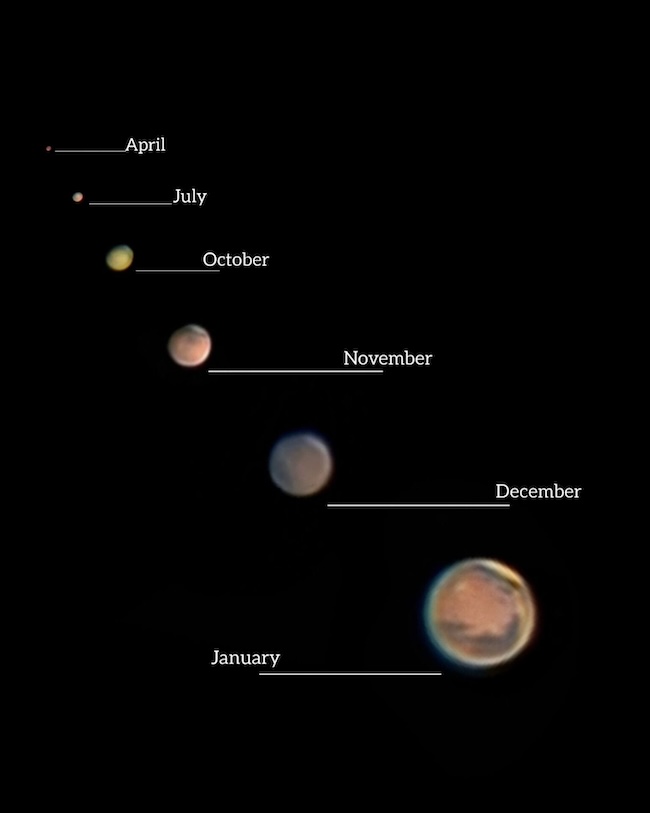
Six images of Mars taken from April 2024 to January 2025 to show the difference in size.
View at EarthSky Community Photos. | Vedant Pandey of India submitted this composite image of Mars racing toward its January 2025 opposition. Vedant wrote: “I used my 5-inch Maksutov telescope and smartphone camera to capture Mars over a period of 10 months.” Thank you, Vedant!
  • Mars can appear bright or faint in our sky depending on its distance from Earth. It’ll spend 2026 becoming bright again, as Earth catches up to it in orbit around the sun. Mars will be at its brightest again in February 2027.
  • Mars’ superior conjunction, when it’s most behind the sun from Earth, falls on January 9, 2026. Afterwards, Mars will emerge into the morning sky around April or May for the Northern Hemisphere, and maybe as soon as late February for the Southern Hemisphere.
  • By the last few months of 2026 – with Earth hot on its heels in orbit around the sun – Mars will be rapidly brightening, moving over into the evening sky and racing toward its opposition on February 2027.

Mars in 2026

How to see Mars in the sky: Once Mars emerges into the morning sky (late February 2026 for Southern Hemisphere, April or May 2026 for the Northern Hemisphere), it will shine fairly brightly, but not brightly enough to be noticeable. Mars will hang – reddish, somber, not very bright – in the eastern predawn sky for many months of 2026. As the year progresses, Mars will start to brighten and move higher in the sky. Earth will again be catching up to Mars in the race of the planets. And, as a result, Mars will be shifting over into our evening sky. By the time Mars passes close to Jupiter – around November 15, 2026 – it’ll be a sight to behold near the giant planet!
Next opposition for Mars will be February 19, 2027. Mars will be in front of Leo the Lion at its 2027 opposition.
Next Mars-Earth closest distance will be February 20, 2027. Mars will be about 63 million miles (101 million km) from Earth on that date. Hence 2027 is what’s known as an aphelic opposition of Mars. That is, the planet will reach its aphelion, or farthest point from the sun, on March 2, 2027. So Mars will be about as far from Earth as it can be at this 2027 opposition. Note: Mars reaches opposition about every 26 months, or about every two Earth years.

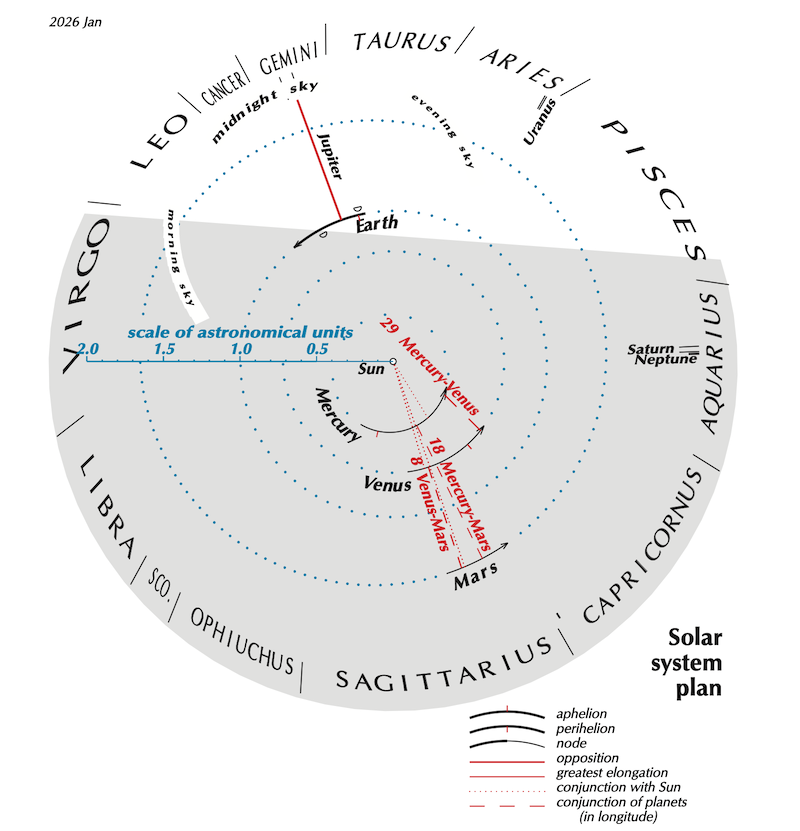
Circle with sun at center, planets around, and zodiac names on outer edge.
Heliocentric view of solar system, January 2026. Chart via Guy Ottewell’s 2026 Astronomical Calendar. Used with permission. Plus Guy Ottewell explains heliocentric charts here.

Sometimes, Mars is bright

Mars’ dramatic swings in brightness (and its red color) are why the early stargazers named Mars for their god of war.

Sometimes the war god rests. And sometimes he grows fierce! These changes are part of the reason Mars is so fascinating to watch in the night sky.

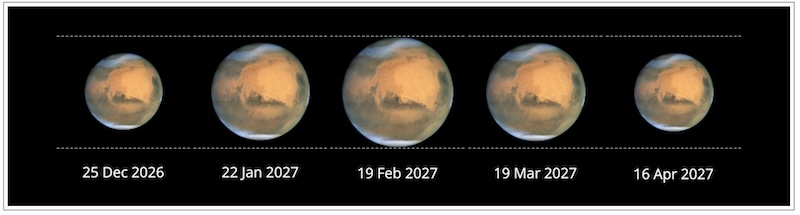
Five images of Mars, full size, about 3/4 size, and half size or less, for succeeding dates.
When Mars passes opposition, every 2 years, it appears large and bright for only a few weeks. The panel above shows the change in Mars’ apparent size from December 2026 to April 2027. Mars will appear 13.8 arcseconds wide on February 19, 2027. Image via Dominic Ford/ In-The-Sky.org. Used with permission.
Charts showing the growing disk size of Mars for 2026.
As Earth races toward Mars as it heads for its next opposition in February 2027, it grows in apparent size and increases in brightness. Chart via Guy Ottewell’s 2026 Astronomical Calendar. Used with permission.

Want to follow Mars? Bookmark EarthSky’s monthly night sky guide.

Mars isn’t very big

To understand why Mars varies so much in brightness in Earth’s sky, first realize that it isn’t a very big world. It’s only 4,219 miles (6,790 km) in diameter, making it only slightly more than half Earth’s size (7,922 miles or 12,750 km in diameter).

On the other hand, consider Mars in contrast to Jupiter, the biggest planet in our solar system. Jupiter is 86,881 miles (140,000 km) in diameter. As an illustration, more than 20 planets the size of Mars could be lined up side by side in front of Jupiter. Basically, Jupiter always looks bright, because it’s so big.

Not so for little Mars, however. Rather, its extremes in brightness have to do with its nearness (or lack of nearness) to Earth.

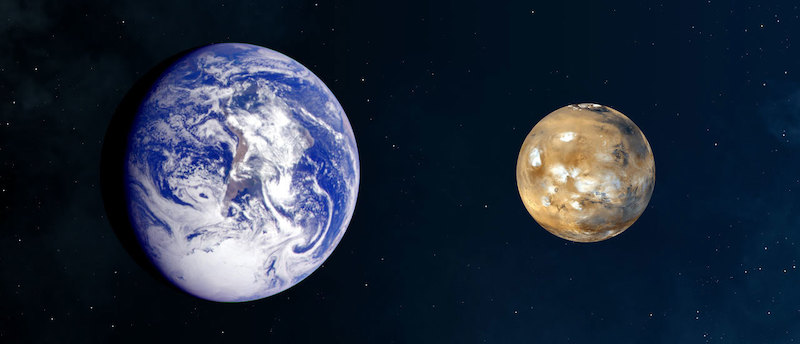
Space photos of Earth and Mars side by side, on black background, with Earth much bigger.
Mars isn’t very big, so its brightness – when it is bright – isn’t due to its bigness, as is true of Jupiter. Mars’ brightness, or lack of brightness, is all about how close we are to the red planet. It’s all about where Earth and Mars are, relative to each other, in their respective orbits around the sun. Image via NASA.

Future Martian oppositions

As mentioned above, the next opposition of Mars – when will appear at its brightest in Earth’s sky for that two-year period – will be February 2027. At the 2027 opposition, Mars will not be as big and bright as it was in 2025. Check out the chart at C. Seligman’s Mars oppositions page that lists all oppositions of Mars from 1995 to 2037.

Earth and Mars orbits with Mars in different sizes at different points around its orbit.
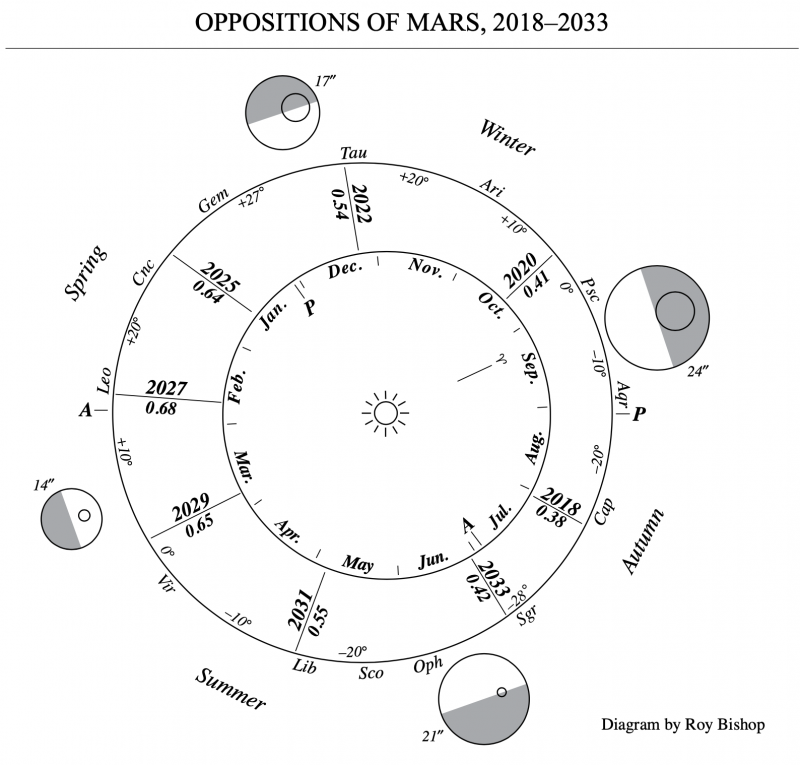
There’s a 15-year cycle of Mars, whereby the red planet is brighter and fainter at opposition. In July 2018, we were at the peak of the 2-year cycle – and the peak of the 15-year cycle – and Mars was very, very bright! In 2020, we were also at the peak of the 2-year cycle; however, Earth and Mars were farther apart at Mars’ opposition than they were in 2018. Still, 2020’s opposition of Mars was excellent. And, in December 2022, Mars had a good opposition but appeared smaller and dimmer than in 2020, since we were farther away from it. And the February 2027 opposition will find Mars smaller and dimmer than Mars was in 2025. Diagram by Roy L. Bishop. Copyright Royal Astronomical Society of Canada. Used with permission. Visit the RASC eStore to purchase the Observer’s Handbook, a necessary tool for all skywatchers.

EarthSky Community Photos

Composite of Mars path across the sky, a chain of red dots making a large loop against a starry background.
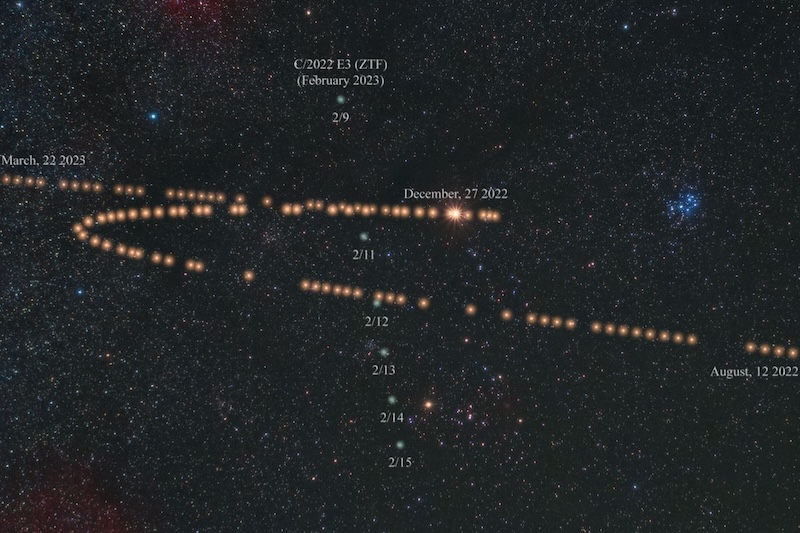
View at EarthSky Community Photos. | Paolo Bardelli of Italy made this composite image and wrote: “On January 16, 2025, Mars was at opposition. The previous one occurred on December 8, 2022, when it became the brightest object in the night sky. During these periods, tracing the apparent motion of the red planet from evening to evening is very interesting, as a real ‘noose’ is created, with a double reversal of its movement. This put ancient sky observers in crisis at the time when the geocentric theory was dominant. Putting things in their place, it turned out to be a simple perspective effect, due to the mutual motion of Earth and Mars. This image is the sum of a sequence taken every useful evening, clouds permitting, from August 12, 2022, to March 22, 2023. The background is the sum of 22 shots of the area of the sky where Mars was located, the rich star field of the constellation Taurus. By coincidence, in February 2023 the path of comet C/2022 E3 (ZTF) crossed the noose.” Thank you, Paolo!
Planet with a big reddish area and dark swath in the middle and a white ice cap at the top.
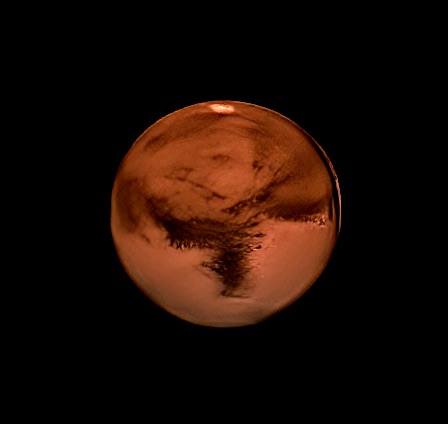
View at EarthSky Community Photos. | B Martin in Riverside, California, captured this image of red Mars on December 15, 2024, just 1 month before Earth went between the red planet and the sun, bringing Mars closest for this 2-year period. B wrote: “Mars was around maybe 45 degrees up. I saw it in live view, I knew it was a banger … Bonus, you can see the shadow of the cloud of the ribbon white long cloud stream on the lower left. The shadow is in the direction hugging the right of the cloud. The shadow is dark brown in color as it casts on the Martian sand.” Thank you for sharing, B!

Seeing red

Mars appears as a reddish light in the sky and, therefore, is often called the red planet. Other obvious red dots in the sky are reddish-orange Aldebaran and the famous red supergiant Betelgeuse. So, it is fun to contrast Mars’ color and intensity of red with that of Aldebaran or Betelgeuse.

And then there is red Antares. Antares is Greek for rival of Ares (Ares being the Greek name for Mars). Antares is sometimes said to be the anti-Mars due to its competing red color. For a few months every couple of years Mars is much brighter than Antares. Also, every couple of years Mars passes near Antares, as if taunting the star. Mars moves rapidly through the heavens and Antares is fixed to the starry firmament.

What makes them red?

Surface temperature is what determines the colors of the stars. The hottest stars are blue and the coolest stars are red. In fact, from hottest to coolest, the colors of stars range from blue, white, yellow, orange and red. And while the colors of stars might be hard to detect, some stars – like Aldebaran, Antares and Betelgeuse – are noticeably colorful.

On the other hand, Mars appears red for a different reason. It’s red because of iron oxide in the dust that covers this desert world. Iron oxide gives rust and blood their red color. Rovers on Mars sampled the Martian dust and determined it contains three colors: reds, browns and oranges. So those three colors are what you may see when you gaze upon Mars.

Do you see red when you look at Mars, Aldebaran, Antares and Betelgeuse? Are they the same color? Do you see any other colors of stars?

Orange ball with well-defined dark marks and white spot at the north pole.
View at EarthSky Community Photos. | Nancy Ricigliano captured Mars from Long Island, New York, on October 6, 2020, when it was closest to Earth. Thank you, Nancy. See more photos of Mars at its closest in 2020.

Bottom line: In 2026, Mars will emerge in the morning sky around April and be visible in the morning sky the rest of the year. Its next opposition – when it will be at its brightest – is in February 2027.

Moon and Mars! Fav photos of December 7 occultation

Photos of bright Mars in 2018, from the EarthSky community

Photos of bright Mars in 2020, from the EarthSky community

The post Mars sometimes is bright and sometimes is faint first appeared on EarthSky.


from EarthSky https://ift.tt/sSiGd6b
Six images of Mars taken from April 2024 to January 2025 to show the difference in size.
View at EarthSky Community Photos. | Vedant Pandey of India submitted this composite image of Mars racing toward its January 2025 opposition. Vedant wrote: “I used my 5-inch Maksutov telescope and smartphone camera to capture Mars over a period of 10 months.” Thank you, Vedant!
  • Mars can appear bright or faint in our sky depending on its distance from Earth. It’ll spend 2026 becoming bright again, as Earth catches up to it in orbit around the sun. Mars will be at its brightest again in February 2027.
  • Mars’ superior conjunction, when it’s most behind the sun from Earth, falls on January 9, 2026. Afterwards, Mars will emerge into the morning sky around April or May for the Northern Hemisphere, and maybe as soon as late February for the Southern Hemisphere.
  • By the last few months of 2026 – with Earth hot on its heels in orbit around the sun – Mars will be rapidly brightening, moving over into the evening sky and racing toward its opposition on February 2027.

Mars in 2026

How to see Mars in the sky: Once Mars emerges into the morning sky (late February 2026 for Southern Hemisphere, April or May 2026 for the Northern Hemisphere), it will shine fairly brightly, but not brightly enough to be noticeable. Mars will hang – reddish, somber, not very bright – in the eastern predawn sky for many months of 2026. As the year progresses, Mars will start to brighten and move higher in the sky. Earth will again be catching up to Mars in the race of the planets. And, as a result, Mars will be shifting over into our evening sky. By the time Mars passes close to Jupiter – around November 15, 2026 – it’ll be a sight to behold near the giant planet!
Next opposition for Mars will be February 19, 2027. Mars will be in front of Leo the Lion at its 2027 opposition.
Next Mars-Earth closest distance will be February 20, 2027. Mars will be about 63 million miles (101 million km) from Earth on that date. Hence 2027 is what’s known as an aphelic opposition of Mars. That is, the planet will reach its aphelion, or farthest point from the sun, on March 2, 2027. So Mars will be about as far from Earth as it can be at this 2027 opposition. Note: Mars reaches opposition about every 26 months, or about every two Earth years.

Circle with sun at center, planets around, and zodiac names on outer edge.
Heliocentric view of solar system, January 2026. Chart via Guy Ottewell’s 2026 Astronomical Calendar. Used with permission. Plus Guy Ottewell explains heliocentric charts here.

Sometimes, Mars is bright

Mars’ dramatic swings in brightness (and its red color) are why the early stargazers named Mars for their god of war.

Sometimes the war god rests. And sometimes he grows fierce! These changes are part of the reason Mars is so fascinating to watch in the night sky.

Five images of Mars, full size, about 3/4 size, and half size or less, for succeeding dates.
When Mars passes opposition, every 2 years, it appears large and bright for only a few weeks. The panel above shows the change in Mars’ apparent size from December 2026 to April 2027. Mars will appear 13.8 arcseconds wide on February 19, 2027. Image via Dominic Ford/ In-The-Sky.org. Used with permission.
Charts showing the growing disk size of Mars for 2026.
As Earth races toward Mars as it heads for its next opposition in February 2027, it grows in apparent size and increases in brightness. Chart via Guy Ottewell’s 2026 Astronomical Calendar. Used with permission.

Want to follow Mars? Bookmark EarthSky’s monthly night sky guide.

Mars isn’t very big

To understand why Mars varies so much in brightness in Earth’s sky, first realize that it isn’t a very big world. It’s only 4,219 miles (6,790 km) in diameter, making it only slightly more than half Earth’s size (7,922 miles or 12,750 km in diameter).

On the other hand, consider Mars in contrast to Jupiter, the biggest planet in our solar system. Jupiter is 86,881 miles (140,000 km) in diameter. As an illustration, more than 20 planets the size of Mars could be lined up side by side in front of Jupiter. Basically, Jupiter always looks bright, because it’s so big.

Not so for little Mars, however. Rather, its extremes in brightness have to do with its nearness (or lack of nearness) to Earth.

Space photos of Earth and Mars side by side, on black background, with Earth much bigger.
Mars isn’t very big, so its brightness – when it is bright – isn’t due to its bigness, as is true of Jupiter. Mars’ brightness, or lack of brightness, is all about how close we are to the red planet. It’s all about where Earth and Mars are, relative to each other, in their respective orbits around the sun. Image via NASA.

Future Martian oppositions

As mentioned above, the next opposition of Mars – when will appear at its brightest in Earth’s sky for that two-year period – will be February 2027. At the 2027 opposition, Mars will not be as big and bright as it was in 2025. Check out the chart at C. Seligman’s Mars oppositions page that lists all oppositions of Mars from 1995 to 2037.

Earth and Mars orbits with Mars in different sizes at different points around its orbit.
There’s a 15-year cycle of Mars, whereby the red planet is brighter and fainter at opposition. In July 2018, we were at the peak of the 2-year cycle – and the peak of the 15-year cycle – and Mars was very, very bright! In 2020, we were also at the peak of the 2-year cycle; however, Earth and Mars were farther apart at Mars’ opposition than they were in 2018. Still, 2020’s opposition of Mars was excellent. And, in December 2022, Mars had a good opposition but appeared smaller and dimmer than in 2020, since we were farther away from it. And the February 2027 opposition will find Mars smaller and dimmer than Mars was in 2025. Diagram by Roy L. Bishop. Copyright Royal Astronomical Society of Canada. Used with permission. Visit the RASC eStore to purchase the Observer’s Handbook, a necessary tool for all skywatchers.

EarthSky Community Photos

Composite of Mars path across the sky, a chain of red dots making a large loop against a starry background.
View at EarthSky Community Photos. | Paolo Bardelli of Italy made this composite image and wrote: “On January 16, 2025, Mars was at opposition. The previous one occurred on December 8, 2022, when it became the brightest object in the night sky. During these periods, tracing the apparent motion of the red planet from evening to evening is very interesting, as a real ‘noose’ is created, with a double reversal of its movement. This put ancient sky observers in crisis at the time when the geocentric theory was dominant. Putting things in their place, it turned out to be a simple perspective effect, due to the mutual motion of Earth and Mars. This image is the sum of a sequence taken every useful evening, clouds permitting, from August 12, 2022, to March 22, 2023. The background is the sum of 22 shots of the area of the sky where Mars was located, the rich star field of the constellation Taurus. By coincidence, in February 2023 the path of comet C/2022 E3 (ZTF) crossed the noose.” Thank you, Paolo!
Planet with a big reddish area and dark swath in the middle and a white ice cap at the top.
View at EarthSky Community Photos. | B Martin in Riverside, California, captured this image of red Mars on December 15, 2024, just 1 month before Earth went between the red planet and the sun, bringing Mars closest for this 2-year period. B wrote: “Mars was around maybe 45 degrees up. I saw it in live view, I knew it was a banger … Bonus, you can see the shadow of the cloud of the ribbon white long cloud stream on the lower left. The shadow is in the direction hugging the right of the cloud. The shadow is dark brown in color as it casts on the Martian sand.” Thank you for sharing, B!

Seeing red

Mars appears as a reddish light in the sky and, therefore, is often called the red planet. Other obvious red dots in the sky are reddish-orange Aldebaran and the famous red supergiant Betelgeuse. So, it is fun to contrast Mars’ color and intensity of red with that of Aldebaran or Betelgeuse.

And then there is red Antares. Antares is Greek for rival of Ares (Ares being the Greek name for Mars). Antares is sometimes said to be the anti-Mars due to its competing red color. For a few months every couple of years Mars is much brighter than Antares. Also, every couple of years Mars passes near Antares, as if taunting the star. Mars moves rapidly through the heavens and Antares is fixed to the starry firmament.

What makes them red?

Surface temperature is what determines the colors of the stars. The hottest stars are blue and the coolest stars are red. In fact, from hottest to coolest, the colors of stars range from blue, white, yellow, orange and red. And while the colors of stars might be hard to detect, some stars – like Aldebaran, Antares and Betelgeuse – are noticeably colorful.

On the other hand, Mars appears red for a different reason. It’s red because of iron oxide in the dust that covers this desert world. Iron oxide gives rust and blood their red color. Rovers on Mars sampled the Martian dust and determined it contains three colors: reds, browns and oranges. So those three colors are what you may see when you gaze upon Mars.

Do you see red when you look at Mars, Aldebaran, Antares and Betelgeuse? Are they the same color? Do you see any other colors of stars?

Orange ball with well-defined dark marks and white spot at the north pole.
View at EarthSky Community Photos. | Nancy Ricigliano captured Mars from Long Island, New York, on October 6, 2020, when it was closest to Earth. Thank you, Nancy. See more photos of Mars at its closest in 2020.

Bottom line: In 2026, Mars will emerge in the morning sky around April and be visible in the morning sky the rest of the year. Its next opposition – when it will be at its brightest – is in February 2027.

Moon and Mars! Fav photos of December 7 occultation

Photos of bright Mars in 2018, from the EarthSky community

Photos of bright Mars in 2020, from the EarthSky community

The post Mars sometimes is bright and sometimes is faint first appeared on EarthSky.


from EarthSky https://ift.tt/sSiGd6b

Earliest, hottest galaxy cluster gas could upend models

Earliest, hottest galaxy cluster: Artwork of galaxies with jets surrounded by hot, red gas.
Artist’s impression of a galaxy cluster forming in the early universe. These are active galaxies, with radio jets spewing abundant hot gas into the space between the cluster members. This earliest, hottest galaxy cluster gas on record formed earlier than astronomers expected, and the gas between the galaxies was shockingly hot. Image via Lingxiao Yuan/ The University of British Columbia.

EarthSky’s 2026 lunar calendar is available now. Get yours today! Makes a great gift.

  • Astronomers have discovered the earliest, hottest galaxy cluster gas yet. The active galaxies in this early universe cluster have jets that spew hot gas into space, creating a gas cloud that surrounds them.
  • The scorching cloud of gas threaded between clusters of galaxies is five times hotter than current models predict. Astronomers did not expect such active, hot gas around galaxies only 1.4 billion years after the Big Bang.
  • The discovery highlights gaps in our models of galaxy cluster formation. The researchers want to know what this early activity tells us about how present galaxy clusters formed.

The University of British Columbia posted this original story on January 5, 2026. Edits by EarthSky.

Earliest, hottest galaxy cluster gas could upend models

An international team of astronomers led by Canadian researchers said on January 5, 2026, that it has found something the universe wasn’t supposed to have: a galaxy cluster blazing with hot gas just 1.4 billion years after the Big Bang. That’s far earlier and hotter than theory predicts.

The peer-reviewed journal Nature published the result on January 5, 2026. The discovery could upend current models of galaxy cluster formation. These models predict that such temperatures occur only in more mature, stable galaxy clusters later in the universe’s life.

Lead author Dazhi Zhou of the University of British Columbia said:

We didn’t expect to see such a hot cluster atmosphere so early in cosmic history. In fact, at first I was skeptical about the signal as it was too strong to be real. But after months of verification, we’ve confirmed this gas is at least five times hotter than predicted, and even hotter and more energetic than what we find in many present-day clusters.

Co-author Scott Chapman of Dalhousie University said:

This tells us that something in the early universe, likely three recently discovered supermassive black holes in the cluster, were already pumping huge amounts of energy into the surroundings and shaping the young cluster, much earlier and more strongly than we thought.

Investigating a baby cluster

Peering back in time about 12 billion years, the researchers focused on a ‘baby’ galaxy cluster called SPT2349-56. To do so, the research team used a cluster of radio telescopes called the Atacama Large Millimeter/submillimeter Array (ALMA).

This infant cluster is massive for its relative youth, with a core measuring about 500,000 light-years across. That’s comparable to the size of the halo surrounding the Milky Way. It contains more than 30 active galaxies. And it forms stars more than 5,000 times faster than our own galaxy, all in a very compact region.

The research team focused on a cosmological tool called the Sunyaev-Zeldovich effect. This effect can help scientists work out the thermal energy of the intracluster medium: the gas existing between the galaxies of a given cluster.

Chapman said:

Understanding galaxy clusters is the key to understanding the biggest galaxies in the universe. These massive galaxies mostly reside in clusters, and their evolution is heavily shaped by the very strong environment of the clusters as they form, including the intracluster medium.

Supermassive black hole heating

Current models suggest the massive reservoirs of gas that form the intracluster medium are collected, and then heated, by gravitational interactions. This happens as an immature, unstable galaxy cluster matures and collapses inward to a stable state. The new finding suggests this birth is more explosive, and that scientists may need to rethink the sequence and speed of galaxy cluster evolution.

The researchers now want to investigate how all the pieces fit together. Zhou said:

We want to figure out how the intense star formation, the active black holes and this overheated atmosphere interact, and what it tells us about how present galaxy clusters were built. How can all of this be happening at once in such a young, compact system?

Bottom line: Astronomers have discovered the earliest, hottest galaxy cluster gas yet. This scorching gas between galaxies is much hotter than predicted for so early in the universe.

Source: Sunyaev–Zeldovich detection of hot intracluster gas at redshift 4.3
Via University of British Columbia

The post Earliest, hottest galaxy cluster gas could upend models first appeared on EarthSky.


from EarthSky https://ift.tt/hB5Cfc3
Earliest, hottest galaxy cluster: Artwork of galaxies with jets surrounded by hot, red gas.
Artist’s impression of a galaxy cluster forming in the early universe. These are active galaxies, with radio jets spewing abundant hot gas into the space between the cluster members. This earliest, hottest galaxy cluster gas on record formed earlier than astronomers expected, and the gas between the galaxies was shockingly hot. Image via Lingxiao Yuan/ The University of British Columbia.

EarthSky’s 2026 lunar calendar is available now. Get yours today! Makes a great gift.

  • Astronomers have discovered the earliest, hottest galaxy cluster gas yet. The active galaxies in this early universe cluster have jets that spew hot gas into space, creating a gas cloud that surrounds them.
  • The scorching cloud of gas threaded between clusters of galaxies is five times hotter than current models predict. Astronomers did not expect such active, hot gas around galaxies only 1.4 billion years after the Big Bang.
  • The discovery highlights gaps in our models of galaxy cluster formation. The researchers want to know what this early activity tells us about how present galaxy clusters formed.

The University of British Columbia posted this original story on January 5, 2026. Edits by EarthSky.

Earliest, hottest galaxy cluster gas could upend models

An international team of astronomers led by Canadian researchers said on January 5, 2026, that it has found something the universe wasn’t supposed to have: a galaxy cluster blazing with hot gas just 1.4 billion years after the Big Bang. That’s far earlier and hotter than theory predicts.

The peer-reviewed journal Nature published the result on January 5, 2026. The discovery could upend current models of galaxy cluster formation. These models predict that such temperatures occur only in more mature, stable galaxy clusters later in the universe’s life.

Lead author Dazhi Zhou of the University of British Columbia said:

We didn’t expect to see such a hot cluster atmosphere so early in cosmic history. In fact, at first I was skeptical about the signal as it was too strong to be real. But after months of verification, we’ve confirmed this gas is at least five times hotter than predicted, and even hotter and more energetic than what we find in many present-day clusters.

Co-author Scott Chapman of Dalhousie University said:

This tells us that something in the early universe, likely three recently discovered supermassive black holes in the cluster, were already pumping huge amounts of energy into the surroundings and shaping the young cluster, much earlier and more strongly than we thought.

Investigating a baby cluster

Peering back in time about 12 billion years, the researchers focused on a ‘baby’ galaxy cluster called SPT2349-56. To do so, the research team used a cluster of radio telescopes called the Atacama Large Millimeter/submillimeter Array (ALMA).

This infant cluster is massive for its relative youth, with a core measuring about 500,000 light-years across. That’s comparable to the size of the halo surrounding the Milky Way. It contains more than 30 active galaxies. And it forms stars more than 5,000 times faster than our own galaxy, all in a very compact region.

The research team focused on a cosmological tool called the Sunyaev-Zeldovich effect. This effect can help scientists work out the thermal energy of the intracluster medium: the gas existing between the galaxies of a given cluster.

Chapman said:

Understanding galaxy clusters is the key to understanding the biggest galaxies in the universe. These massive galaxies mostly reside in clusters, and their evolution is heavily shaped by the very strong environment of the clusters as they form, including the intracluster medium.

Supermassive black hole heating

Current models suggest the massive reservoirs of gas that form the intracluster medium are collected, and then heated, by gravitational interactions. This happens as an immature, unstable galaxy cluster matures and collapses inward to a stable state. The new finding suggests this birth is more explosive, and that scientists may need to rethink the sequence and speed of galaxy cluster evolution.

The researchers now want to investigate how all the pieces fit together. Zhou said:

We want to figure out how the intense star formation, the active black holes and this overheated atmosphere interact, and what it tells us about how present galaxy clusters were built. How can all of this be happening at once in such a young, compact system?

Bottom line: Astronomers have discovered the earliest, hottest galaxy cluster gas yet. This scorching gas between galaxies is much hotter than predicted for so early in the universe.

Source: Sunyaev–Zeldovich detection of hot intracluster gas at redshift 4.3
Via University of British Columbia

The post Earliest, hottest galaxy cluster gas could upend models first appeared on EarthSky.


from EarthSky https://ift.tt/hB5Cfc3

See Mira the Wonderful now and brightest in February or March

Mira: Star chart: the constellation Cetus the Whale in deep dusk. An arrow points to Mira's place in the sky.
Look for Mira soon after sunset in January, February and March 2026. Mira is part of the constellation Cetus the Whale (or Sea Monster). It’s the friendliest-looking monster you’ll ever see. In a dark sky, look for the lopsided pentagon that makes up the Whale’s Head. Will you see Mira? Only if the star is near its maximum brightness. In 2026, that’s expected to happen sometime in February or March. In January, Cetus and Mira will set around midnight. Then in February, it’ll be setting earlier each night, at around 10:30 p.m. your local time at month’s end. And finally it’ll set before dark sometime in March. Check Stellarium for a view from your location.

EarthSky’s 2026 lunar calendar shows the moon phase for every day of 2026. Available now. Get yours today!

Mira the Wonderful

Although stars appear to shine at a constant brilliance, many are variable stars. They brighten and dim over many different timescales. Their changes in brightness are often too small to be perceptible to the unaided eye. But the star Mira, aka Omicron Ceti, is different. Its brightness changes are large and distinctly noticeable to the eye.

Depending on when you look for Mira, this reddish star in the constellation Cetus the Whale might or might not be visible. It goes through its bright-to-faint-to-bright cycle about every 332 days. And Mira is not visible from late March to June because it’s too close to the sun then.

If you’d like to see this unusual star in 2026, now’s your chance.

Mira brightened enough in December 2025 to be visible to the eye in a dark sky. It should reach its maximum brightness in February or March 2026, when it’ll be setting late evening (your local time). Note, it’ll set four minutes earlier each day. Generally, you can see it with the unaided eye for about six weeks before it reaches maximum brightness and over two months afterwards. Of course that depends on when Mira reaches its maximum brightness. In 2026, Mira might still be visible to the eye in a dark sky when it’s lost in the sun’s glare.

Then in 2027, it’s maximum will be in January sometime.

How it got its nickname

Early astronomers noticed this star’s dramatic and regular changes in brightness. Mira sparkles in the sky, getting progressively dimmer, and a few months later, it’s gone! Then, after some months, it’s back again. Its brightness changes led the 17th century astronomer Johannes Hevelius to name the star Mira, from the Latin word for wonderful or astonishing.

So now Mira is on track to hit another brightness peak in February or March 2026. How bright will it get? That’s a question many variable star observers are eagerly waiting to find out. You can check current observations here.

Now you see it, now you don’t

Mira has an average peak brightness of magnitude 3.5. It’s not one of the sky’s brightest stars, even when brightest. It gradually fades to around magnitude 9 (too faint to see with the eye; for reference, in a dark sky, the unaided eye can barely detect a magnitude 6 star). Then it rebounds back to its peak brightness. So Mira undergoes about a 159-fold change in brightness, as it moves through its 332-day brightness cycle.

It’s impossible to predict exactly how bright or faint Mira will become at each maximum. Have a look at the graph below, called a light curve. Mira-watchers contribute their observations to the American Association of Variable Star Observers (AAVSO). The AAVSO creates an ongoing light curve for Mira, using its Light Curve Generator tool. The light curve below covers the last 10 years. The parts of the plot with no data were when Mira was close to the sun. In 2019 and 2022, Mira was as bright as magnitude 2. That’s almost as bright as Polaris, the North Star, not the sky’s brightest star, but a respectably bright star.

Graph with sawtooth line made of very many small overlapping circles.
This graph shows how Mira’s brightness has changed over the past 10 years. It plots the brightness of Mira vs. time, as measured by variable star observers. Notice its greatest and least brightness vary slightly from cycle to cycle. For instance, Mira was almost at magnitude 2 in 2019 and 2022. In 2017, it hit a low of magnitude 10.5. Image generated by the AAVSO Light Curve Generator tool. We acknowledge with thanks the variable star observations from the AAVSO International Database contributed by observers worldwide.

How to see Mira

Catch Mira while now while it’s heading toward its brightest! Then keep watching it as it fades away. Its peak brightness for 2026 comes in February or March. At that time, Mira is in the southwest as darkness falls (your local time) and sets a few hours before midnight. However, it’s in the constellation of Cetus which isn’t a prominent constellation. It’s faint. You’ll want a dark sky to see it. If you have a dark sky, you can pick out the Whale’s lopsided pentagon of a Head. Check Stellarium for a precise view and timing from your location.

Look for it again in early 2027

The next upcoming predicted maximum brightnesses for Mira is January or February 2027. Look for Mira around then! That’s when, according to predictions, it should be at its brightest.

Also, look at the chart below. Notice that the distinctive nearby V-shaped Hyades star cluster in Taurus the Bull points to Cetus and its star Mira.

Star chart with labeled stars and constellations outlined in blue, with a small circle for Mira in Cetus.
View larger. | Cetus is a faint constellation, and Mira isn’t super bright, even when brightest. Look for them in a dark sky. In this star chart, the V-shaped Hyades star cluster points the way to Mira. Note that Mira might or might not be the brightest star in Cetus. That’s usually the star Menkar, but … who knows? We won’t know for sure how bright Mira will get until its maximum brightness in February or March 2026. Star chart via Stellarium. Used with permission.
Sky photo with outlines of constellations with planets and Mira labeled in a starry night landscape.
View larger. | Astrophotographer Alan Dyer captured what he described as a “busy sky” on October 15, 2020. Mars was just past its opposition. Mira had just reached its peak brightness, shining at magnitude 3.4 in this image. He even caught Uranus and Neptune! Image via Alan Dyer/ AmazingSky.com/ Flickr. Used with permission.
Star chart of constellation Cetus, with many labeled stars in black on white, connected with green lines.
Stars in the constellation Cetus, including Mira. For comparison stars: Alpha (Menkar) is magnitude 2.5, Delta is 4.1, and Gamma is 3.5. Image via IAU/ Sky & Telescope/ Wikimedia Commons (CC BY 3.0).

Mira science

Early astronomers marveled at Mira’s brightness changes and considered them a great mystery. But modern astronomers know Mira as a red giant star. It’s slightly more massive than our sun but at least 330 times larger in size. Its huge surface area makes it more than 8,000 times more luminous. Mira is some 300 light-years away. It’s thought to be around 6 billion years old. Mira has a faint white dwarf companion star.

There are many types of pulsating variable stars known today. But Mira was the first of its type discovered. And so, astronomers named an entire class of variable stars after it. Mira variables are stars that have one to a few times the mass of our sun. They’re near the end of their stellar lifetime, at the red giant stage. Mira variables have pulsation periods from 80 to 1,000 days, brightness variations from 2.5 to 10 visual magnitudes, and tend to shed material from their outer layers.

So Mira’s brightness changes aren’t due, for example, to some external factor (such as a disk around the star). They’re caused by the actual expansion and contraction of the entire star, every 332 days. This expansion-contraction oscillation is a complex phenomenon related to changes in the rate that radiation escapes from the star.

Mira’s story is of special interest since our sun will someday follow the same stellar evolutionary path. About 5 billion years from now, our sun will become a Mira variable.

Two large, pixelated red-orange spots on a black background.
Mira (on the right) and its companion, imaged in ultraviolet wavelengths by the Hubble Space Telescope in 1995. The 2 stars are about 70 astronomical units (AU) apart, and appear 0.6 arcseconds apart on the sky’s dome. Image via NASA/ STScI.

Why Mira’s brightness changes

For much of its existence, Mira converted hydrogen to helium at its core as a main sequence star. When that fuel was exhausted, its core contracted, causing it to heat up. That heating triggered a new round of hydrogen-to-helium nuclear fusion in a shell around the core, causing Mira to balloon in size into a red giant star. Meanwhile, the collapsing core continued to heat up until it became hot enough for the fusion of helium to carbon, and some oxygen.

Mira is currently at a stage in its stellar evolution called the asymptotic giant branch. Its core of carbon and oxygen is inert. However, the star is still actively “burning” a layer of helium around the core, converting it to carbon. And just outside it, a shell of hydrogen is being converted to helium.

The outer layers of Mira are weakly held by gravity and are starting to waft away. Mira will eventually shed its material to form a planetary nebula, with its exposed hot core – a white dwarf star – left behind.

Mira’s 13-light-year-long tail

In 2006, the Galaxy Evolution Explorer telescope obtained ultraviolet images of Mira that surprised scientists. They revealed a long comet-like tail of material trailing the star as it sped through ambient galactic gas. Mira moves through space at about 290,000 miles per hour (466,700 km/h). The tail, about 13 light-years long, is composed of gases and dust released by Mira over the last 30,000 years. The amount of gases and dust in Mira’s tail equal about 3,000 times the Earth’s mass.

Starfield with a blue comet-like feature, a bright clump at the right and a tail stretching out to the left.
NASA’s Galaxy Evolution Explorer telescope acquired this image of Mira in 2006. Captured in ultraviolet wavelengths, the image shows a long tail of gas and dust shed by Mira. The tail is some 13 light-years in length! That’s about 3 times the distance between our sun and the next-nearest stars. Mira itself is hidden from view in this image, in the clump of gas at the extreme right. Image via NASA/ JPL-Caltech.

Mira in history

Did the earliest stargazers notice Mira as it appeared disappeared and reappeared? If they did, they left no records of this star. The star’s earliest known history begins only 400 years ago, when Dutch astronomer David Fabricius first noticed Mira. That was in the year 1596. He assumed Mira was a nova because, as novae do, the star faded away after a few months. However, Fabricus relocated the star 13 years later. It must have surprised him!

Another Dutch astronomer, Johannes Holwarda, was the first to identify Mira as a variable star, and determined a period of 11 months. That value was refined in 1667 by French astronomer Ismael Bouillaud to 333 days, very close to the currently accepted value of 332 days.

Mira got its name, meaning wonderful or astonishing in Latin, from Johannes Hevelius in 1642.

The position of Mira is RA: 02h 19m 21s, Dec: -02° 58′ 39″.

Latest observations of Mira from AAVSO

Bottom line: Mira is a variable star that undergoes periodic changes in brightness every 332 days, ranging from a maximum brightness of around 3.5 visual magnitudes to a minimum brightness of about 9 magnitudes. It’s expected to be brightest in February or March 2026.

Read more: Mira Revisited, from the AAVSO

The post See Mira the Wonderful now and brightest in February or March first appeared on EarthSky.


from EarthSky https://ift.tt/2iK8wMc
Mira: Star chart: the constellation Cetus the Whale in deep dusk. An arrow points to Mira's place in the sky.
Look for Mira soon after sunset in January, February and March 2026. Mira is part of the constellation Cetus the Whale (or Sea Monster). It’s the friendliest-looking monster you’ll ever see. In a dark sky, look for the lopsided pentagon that makes up the Whale’s Head. Will you see Mira? Only if the star is near its maximum brightness. In 2026, that’s expected to happen sometime in February or March. In January, Cetus and Mira will set around midnight. Then in February, it’ll be setting earlier each night, at around 10:30 p.m. your local time at month’s end. And finally it’ll set before dark sometime in March. Check Stellarium for a view from your location.

EarthSky’s 2026 lunar calendar shows the moon phase for every day of 2026. Available now. Get yours today!

Mira the Wonderful

Although stars appear to shine at a constant brilliance, many are variable stars. They brighten and dim over many different timescales. Their changes in brightness are often too small to be perceptible to the unaided eye. But the star Mira, aka Omicron Ceti, is different. Its brightness changes are large and distinctly noticeable to the eye.

Depending on when you look for Mira, this reddish star in the constellation Cetus the Whale might or might not be visible. It goes through its bright-to-faint-to-bright cycle about every 332 days. And Mira is not visible from late March to June because it’s too close to the sun then.

If you’d like to see this unusual star in 2026, now’s your chance.

Mira brightened enough in December 2025 to be visible to the eye in a dark sky. It should reach its maximum brightness in February or March 2026, when it’ll be setting late evening (your local time). Note, it’ll set four minutes earlier each day. Generally, you can see it with the unaided eye for about six weeks before it reaches maximum brightness and over two months afterwards. Of course that depends on when Mira reaches its maximum brightness. In 2026, Mira might still be visible to the eye in a dark sky when it’s lost in the sun’s glare.

Then in 2027, it’s maximum will be in January sometime.

How it got its nickname

Early astronomers noticed this star’s dramatic and regular changes in brightness. Mira sparkles in the sky, getting progressively dimmer, and a few months later, it’s gone! Then, after some months, it’s back again. Its brightness changes led the 17th century astronomer Johannes Hevelius to name the star Mira, from the Latin word for wonderful or astonishing.

So now Mira is on track to hit another brightness peak in February or March 2026. How bright will it get? That’s a question many variable star observers are eagerly waiting to find out. You can check current observations here.

Now you see it, now you don’t

Mira has an average peak brightness of magnitude 3.5. It’s not one of the sky’s brightest stars, even when brightest. It gradually fades to around magnitude 9 (too faint to see with the eye; for reference, in a dark sky, the unaided eye can barely detect a magnitude 6 star). Then it rebounds back to its peak brightness. So Mira undergoes about a 159-fold change in brightness, as it moves through its 332-day brightness cycle.

It’s impossible to predict exactly how bright or faint Mira will become at each maximum. Have a look at the graph below, called a light curve. Mira-watchers contribute their observations to the American Association of Variable Star Observers (AAVSO). The AAVSO creates an ongoing light curve for Mira, using its Light Curve Generator tool. The light curve below covers the last 10 years. The parts of the plot with no data were when Mira was close to the sun. In 2019 and 2022, Mira was as bright as magnitude 2. That’s almost as bright as Polaris, the North Star, not the sky’s brightest star, but a respectably bright star.

Graph with sawtooth line made of very many small overlapping circles.
This graph shows how Mira’s brightness has changed over the past 10 years. It plots the brightness of Mira vs. time, as measured by variable star observers. Notice its greatest and least brightness vary slightly from cycle to cycle. For instance, Mira was almost at magnitude 2 in 2019 and 2022. In 2017, it hit a low of magnitude 10.5. Image generated by the AAVSO Light Curve Generator tool. We acknowledge with thanks the variable star observations from the AAVSO International Database contributed by observers worldwide.

How to see Mira

Catch Mira while now while it’s heading toward its brightest! Then keep watching it as it fades away. Its peak brightness for 2026 comes in February or March. At that time, Mira is in the southwest as darkness falls (your local time) and sets a few hours before midnight. However, it’s in the constellation of Cetus which isn’t a prominent constellation. It’s faint. You’ll want a dark sky to see it. If you have a dark sky, you can pick out the Whale’s lopsided pentagon of a Head. Check Stellarium for a precise view and timing from your location.

Look for it again in early 2027

The next upcoming predicted maximum brightnesses for Mira is January or February 2027. Look for Mira around then! That’s when, according to predictions, it should be at its brightest.

Also, look at the chart below. Notice that the distinctive nearby V-shaped Hyades star cluster in Taurus the Bull points to Cetus and its star Mira.

Star chart with labeled stars and constellations outlined in blue, with a small circle for Mira in Cetus.
View larger. | Cetus is a faint constellation, and Mira isn’t super bright, even when brightest. Look for them in a dark sky. In this star chart, the V-shaped Hyades star cluster points the way to Mira. Note that Mira might or might not be the brightest star in Cetus. That’s usually the star Menkar, but … who knows? We won’t know for sure how bright Mira will get until its maximum brightness in February or March 2026. Star chart via Stellarium. Used with permission.
Sky photo with outlines of constellations with planets and Mira labeled in a starry night landscape.
View larger. | Astrophotographer Alan Dyer captured what he described as a “busy sky” on October 15, 2020. Mars was just past its opposition. Mira had just reached its peak brightness, shining at magnitude 3.4 in this image. He even caught Uranus and Neptune! Image via Alan Dyer/ AmazingSky.com/ Flickr. Used with permission.
Star chart of constellation Cetus, with many labeled stars in black on white, connected with green lines.
Stars in the constellation Cetus, including Mira. For comparison stars: Alpha (Menkar) is magnitude 2.5, Delta is 4.1, and Gamma is 3.5. Image via IAU/ Sky & Telescope/ Wikimedia Commons (CC BY 3.0).

Mira science

Early astronomers marveled at Mira’s brightness changes and considered them a great mystery. But modern astronomers know Mira as a red giant star. It’s slightly more massive than our sun but at least 330 times larger in size. Its huge surface area makes it more than 8,000 times more luminous. Mira is some 300 light-years away. It’s thought to be around 6 billion years old. Mira has a faint white dwarf companion star.

There are many types of pulsating variable stars known today. But Mira was the first of its type discovered. And so, astronomers named an entire class of variable stars after it. Mira variables are stars that have one to a few times the mass of our sun. They’re near the end of their stellar lifetime, at the red giant stage. Mira variables have pulsation periods from 80 to 1,000 days, brightness variations from 2.5 to 10 visual magnitudes, and tend to shed material from their outer layers.

So Mira’s brightness changes aren’t due, for example, to some external factor (such as a disk around the star). They’re caused by the actual expansion and contraction of the entire star, every 332 days. This expansion-contraction oscillation is a complex phenomenon related to changes in the rate that radiation escapes from the star.

Mira’s story is of special interest since our sun will someday follow the same stellar evolutionary path. About 5 billion years from now, our sun will become a Mira variable.

Two large, pixelated red-orange spots on a black background.
Mira (on the right) and its companion, imaged in ultraviolet wavelengths by the Hubble Space Telescope in 1995. The 2 stars are about 70 astronomical units (AU) apart, and appear 0.6 arcseconds apart on the sky’s dome. Image via NASA/ STScI.

Why Mira’s brightness changes

For much of its existence, Mira converted hydrogen to helium at its core as a main sequence star. When that fuel was exhausted, its core contracted, causing it to heat up. That heating triggered a new round of hydrogen-to-helium nuclear fusion in a shell around the core, causing Mira to balloon in size into a red giant star. Meanwhile, the collapsing core continued to heat up until it became hot enough for the fusion of helium to carbon, and some oxygen.

Mira is currently at a stage in its stellar evolution called the asymptotic giant branch. Its core of carbon and oxygen is inert. However, the star is still actively “burning” a layer of helium around the core, converting it to carbon. And just outside it, a shell of hydrogen is being converted to helium.

The outer layers of Mira are weakly held by gravity and are starting to waft away. Mira will eventually shed its material to form a planetary nebula, with its exposed hot core – a white dwarf star – left behind.

Mira’s 13-light-year-long tail

In 2006, the Galaxy Evolution Explorer telescope obtained ultraviolet images of Mira that surprised scientists. They revealed a long comet-like tail of material trailing the star as it sped through ambient galactic gas. Mira moves through space at about 290,000 miles per hour (466,700 km/h). The tail, about 13 light-years long, is composed of gases and dust released by Mira over the last 30,000 years. The amount of gases and dust in Mira’s tail equal about 3,000 times the Earth’s mass.

Starfield with a blue comet-like feature, a bright clump at the right and a tail stretching out to the left.
NASA’s Galaxy Evolution Explorer telescope acquired this image of Mira in 2006. Captured in ultraviolet wavelengths, the image shows a long tail of gas and dust shed by Mira. The tail is some 13 light-years in length! That’s about 3 times the distance between our sun and the next-nearest stars. Mira itself is hidden from view in this image, in the clump of gas at the extreme right. Image via NASA/ JPL-Caltech.

Mira in history

Did the earliest stargazers notice Mira as it appeared disappeared and reappeared? If they did, they left no records of this star. The star’s earliest known history begins only 400 years ago, when Dutch astronomer David Fabricius first noticed Mira. That was in the year 1596. He assumed Mira was a nova because, as novae do, the star faded away after a few months. However, Fabricus relocated the star 13 years later. It must have surprised him!

Another Dutch astronomer, Johannes Holwarda, was the first to identify Mira as a variable star, and determined a period of 11 months. That value was refined in 1667 by French astronomer Ismael Bouillaud to 333 days, very close to the currently accepted value of 332 days.

Mira got its name, meaning wonderful or astonishing in Latin, from Johannes Hevelius in 1642.

The position of Mira is RA: 02h 19m 21s, Dec: -02° 58′ 39″.

Latest observations of Mira from AAVSO

Bottom line: Mira is a variable star that undergoes periodic changes in brightness every 332 days, ranging from a maximum brightness of around 3.5 visual magnitudes to a minimum brightness of about 9 magnitudes. It’s expected to be brightest in February or March 2026.

Read more: Mira Revisited, from the AAVSO

The post See Mira the Wonderful now and brightest in February or March first appeared on EarthSky.


from EarthSky https://ift.tt/2iK8wMc

adds 2