aads

See Mira the Wonderful now and brightest in February or March

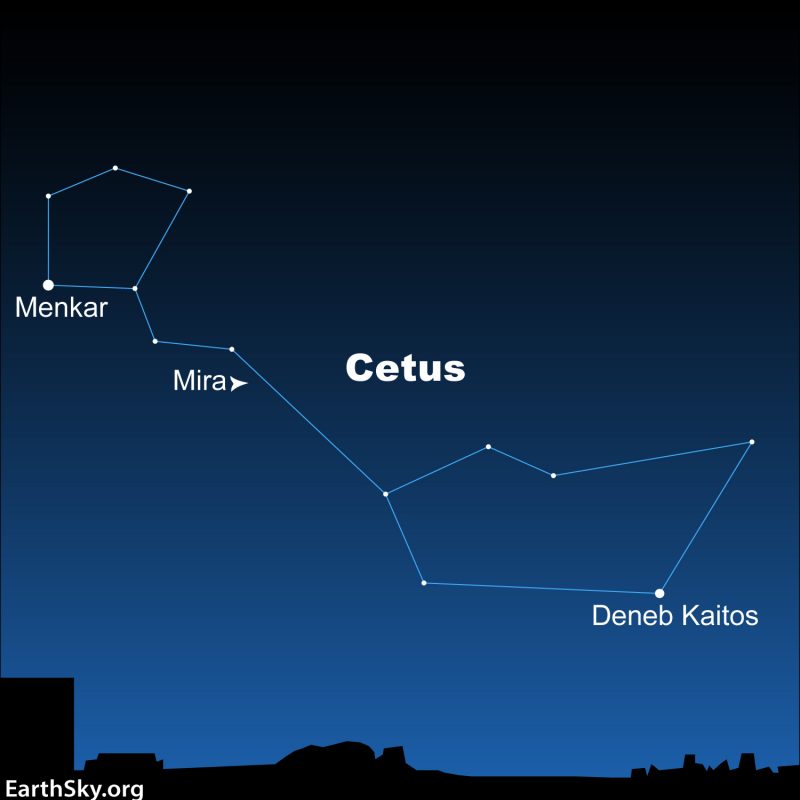
Mira: Star chart: the constellation Cetus the Whale in deep dusk. An arrow points to Mira's place in the sky.
Look for Mira soon after sunset in January, February and March 2026. Mira is part of the constellation Cetus the Whale (or Sea Monster). It’s the friendliest-looking monster you’ll ever see. In a dark sky, look for the lopsided pentagon that makes up the Whale’s Head. Will you see Mira? Only if the star is near its maximum brightness. In 2026, that’s expected to happen sometime in February or March. In January, Cetus and Mira will set around midnight. Then in February, it’ll be setting earlier each night, at around 10:30 p.m. your local time at month’s end. And finally it’ll set before dark sometime in March. Check Stellarium for a view from your location.

EarthSky’s 2026 lunar calendar shows the moon phase for every day of 2026. Available now. Get yours today!

Mira the Wonderful

Although stars appear to shine at a constant brilliance, many are variable stars. They brighten and dim over many different timescales. Their changes in brightness are often too small to be perceptible to the unaided eye. But the star Mira, aka Omicron Ceti, is different. Its brightness changes are large and distinctly noticeable to the eye.

Depending on when you look for Mira, this reddish star in the constellation Cetus the Whale might or might not be visible. It goes through its bright-to-faint-to-bright cycle about every 332 days. And Mira is not visible from late March to June because it’s too close to the sun then.

If you’d like to see this unusual star in 2026, now’s your chance.

Mira brightened enough in December 2025 to be visible to the eye in a dark sky. It should reach its maximum brightness in February or March 2026, when it’ll be setting late evening (your local time). Note, it’ll set four minutes earlier each day. Generally, you can see it with the unaided eye for about six weeks before it reaches maximum brightness and over two months afterwards. Of course that depends on when Mira reaches its maximum brightness. In 2026, Mira might still be visible to the eye in a dark sky when it’s lost in the sun’s glare.

Then in 2027, it’s maximum will be in January sometime.

How it got its nickname

Early astronomers noticed this star’s dramatic and regular changes in brightness. Mira sparkles in the sky, getting progressively dimmer, and a few months later, it’s gone! Then, after some months, it’s back again. Its brightness changes led the 17th century astronomer Johannes Hevelius to name the star Mira, from the Latin word for wonderful or astonishing.

So now Mira is on track to hit another brightness peak in February or March 2026. How bright will it get? That’s a question many variable star observers are eagerly waiting to find out. You can check current observations here.

Now you see it, now you don’t

Mira has an average peak brightness of magnitude 3.5. It’s not one of the sky’s brightest stars, even when brightest. It gradually fades to around magnitude 9 (too faint to see with the eye; for reference, in a dark sky, the unaided eye can barely detect a magnitude 6 star). Then it rebounds back to its peak brightness. So Mira undergoes about a 159-fold change in brightness, as it moves through its 332-day brightness cycle.

It’s impossible to predict exactly how bright or faint Mira will become at each maximum. Have a look at the graph below, called a light curve. Mira-watchers contribute their observations to the American Association of Variable Star Observers (AAVSO). The AAVSO creates an ongoing light curve for Mira, using its Light Curve Generator tool. The light curve below covers the last 10 years. The parts of the plot with no data were when Mira was close to the sun. In 2019 and 2022, Mira was as bright as magnitude 2. That’s almost as bright as Polaris, the North Star, not the sky’s brightest star, but a respectably bright star.

Graph with sawtooth line made of very many small overlapping circles.
This graph shows how Mira’s brightness has changed over the past 10 years. It plots the brightness of Mira vs. time, as measured by variable star observers. Notice its greatest and least brightness vary slightly from cycle to cycle. For instance, Mira was almost at magnitude 2 in 2019 and 2022. In 2017, it hit a low of magnitude 10.5. Image generated by the AAVSO Light Curve Generator tool. We acknowledge with thanks the variable star observations from the AAVSO International Database contributed by observers worldwide.

How to see Mira

Catch Mira while now while it’s heading toward its brightest! Then keep watching it as it fades away. Its peak brightness for 2026 comes in February or March. At that time, Mira is in the southwest as darkness falls (your local time) and sets a few hours before midnight. However, it’s in the constellation of Cetus which isn’t a prominent constellation. It’s faint. You’ll want a dark sky to see it. If you have a dark sky, you can pick out the Whale’s lopsided pentagon of a Head. Check Stellarium for a precise view and timing from your location.

Look for it again in early 2027

The next upcoming predicted maximum brightnesses for Mira is January or February 2027. Look for Mira around then! That’s when, according to predictions, it should be at its brightest.

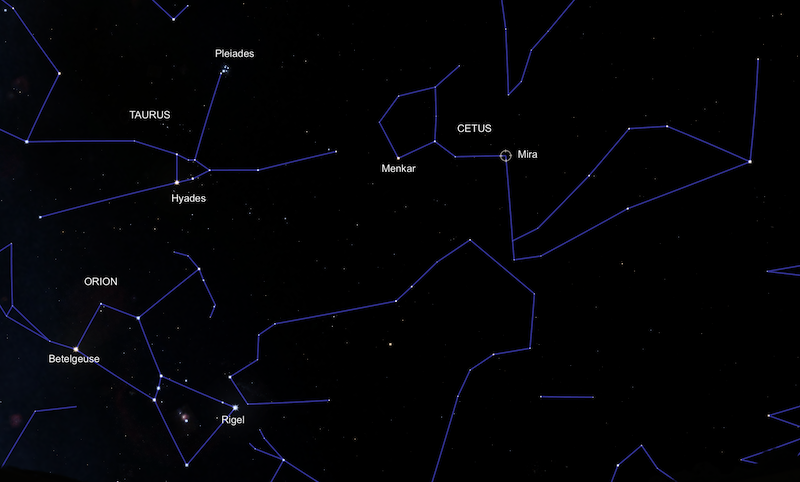
Also, look at the chart below. Notice that the distinctive nearby V-shaped Hyades star cluster in Taurus the Bull points to Cetus and its star Mira.
Star chart with labeled stars and constellations outlined in blue, with a small circle for Mira in Cetus.
View larger. | Cetus is a faint constellation, and Mira isn’t super bright, even when brightest. Look for them in a dark sky. In this star chart, the V-shaped Hyades star cluster points the way to Mira. Note that Mira might or might not be the brightest star in Cetus. That’s usually the star Menkar, but … who knows? We won’t know for sure how bright Mira will get until its maximum brightness in February or March 2026. Star chart via Stellarium. Used with permission.
Sky photo with outlines of constellations with planets and Mira labeled in a starry night landscape.
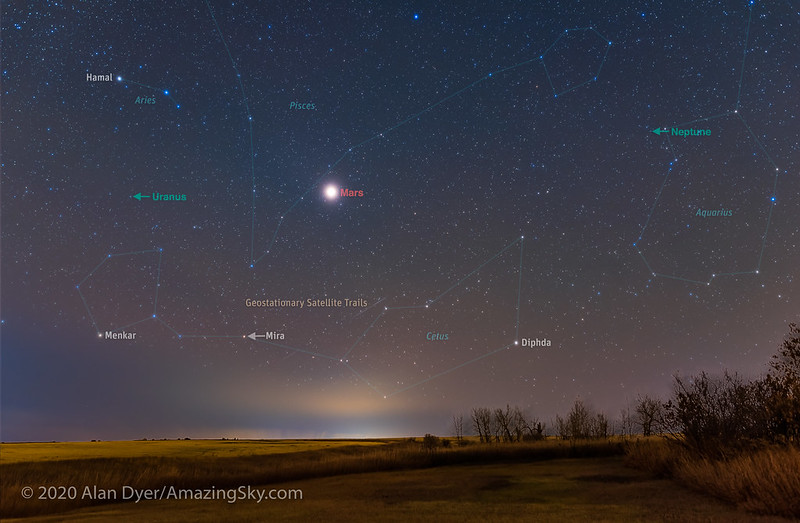
View larger. | Astrophotographer Alan Dyer captured what he described as a “busy sky” on October 15, 2020. Mars was just past its opposition. Mira had just reached its peak brightness, shining at magnitude 3.4 in this image. He even caught Uranus and Neptune! Image via Alan Dyer/ AmazingSky.com/ Flickr. Used with permission.
Star chart of constellation Cetus, with many labeled stars in black on white, connected with green lines.
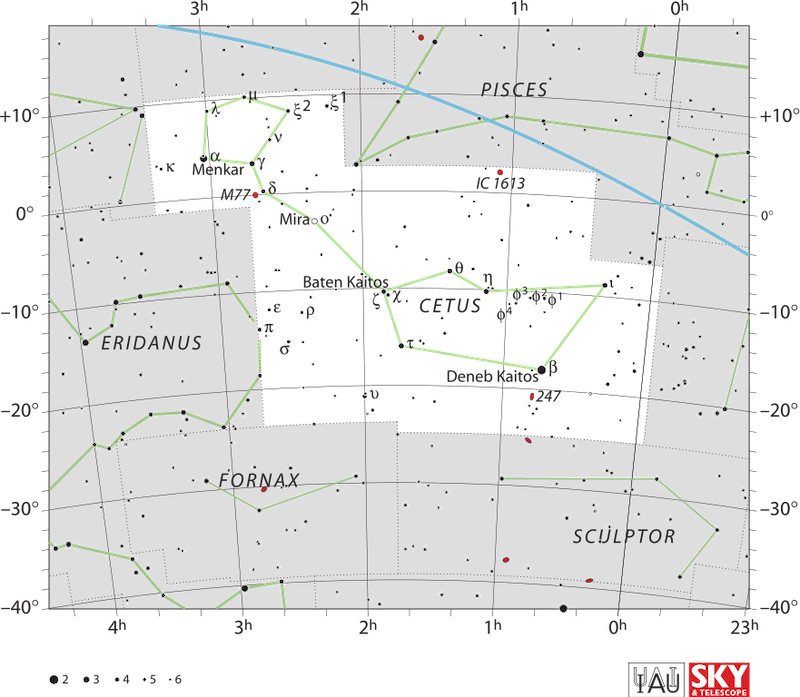
Stars in the constellation Cetus, including Mira. For comparison stars: Alpha (Menkar) is magnitude 2.5, Delta is 4.1, and Gamma is 3.5. Image via IAU/ Sky & Telescope/ Wikimedia Commons (CC BY 3.0).

Mira science

Early astronomers marveled at Mira’s brightness changes and considered them a great mystery. But modern astronomers know Mira as a red giant star. It’s slightly more massive than our sun but at least 330 times larger in size. Its huge surface area makes it more than 8,000 times more luminous. Mira is some 300 light-years away. It’s thought to be around 6 billion years old. Mira has a faint white dwarf companion star.

There are many types of pulsating variable stars known today. But Mira was the first of its type discovered. And so, astronomers named an entire class of variable stars after it. Mira variables are stars that have one to a few times the mass of our sun. They’re near the end of their stellar lifetime, at the red giant stage. Mira variables have pulsation periods from 80 to 1,000 days, brightness variations from 2.5 to 10 visual magnitudes, and tend to shed material from their outer layers.

So Mira’s brightness changes aren’t due, for example, to some external factor (such as a disk around the star). They’re caused by the actual expansion and contraction of the entire star, every 332 days. This expansion-contraction oscillation is a complex phenomenon related to changes in the rate that radiation escapes from the star.

Mira’s story is of special interest since our sun will someday follow the same stellar evolutionary path. About 5 billion years from now, our sun will become a Mira variable.

Two large, pixelated red-orange spots on a black background.
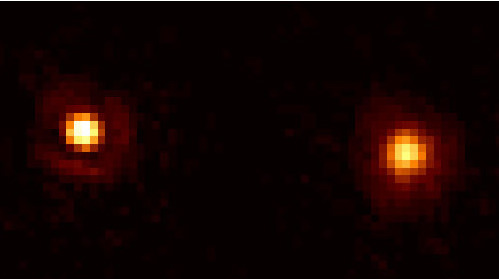
Mira (on the right) and its companion, imaged in ultraviolet wavelengths by the Hubble Space Telescope in 1995. The 2 stars are about 70 astronomical units (AU) apart, and appear 0.6 arcseconds apart on the sky’s dome. Image via NASA/ STScI.

Why Mira’s brightness changes

For much of its existence, Mira converted hydrogen to helium at its core as a main sequence star. When that fuel was exhausted, its core contracted, causing it to heat up. That heating triggered a new round of hydrogen-to-helium nuclear fusion in a shell around the core, causing Mira to balloon in size into a red giant star. Meanwhile, the collapsing core continued to heat up until it became hot enough for the fusion of helium to carbon, and some oxygen.

Mira is currently at a stage in its stellar evolution called the asymptotic giant branch. Its core of carbon and oxygen is inert. However, the star is still actively “burning” a layer of helium around the core, converting it to carbon. And just outside it, a shell of hydrogen is being converted to helium.

The outer layers of Mira are weakly held by gravity and are starting to waft away. Mira will eventually shed its material to form a planetary nebula, with its exposed hot core – a white dwarf star – left behind.

Mira’s 13-light-year-long tail

In 2006, the Galaxy Evolution Explorer telescope obtained ultraviolet images of Mira that surprised scientists. They revealed a long comet-like tail of material trailing the star as it sped through ambient galactic gas. Mira moves through space at about 290,000 miles per hour (466,700 km/h). The tail, about 13 light-years long, is composed of gases and dust released by Mira over the last 30,000 years. The amount of gases and dust in Mira’s tail equal about 3,000 times the Earth’s mass.

Starfield with a blue comet-like feature, a bright clump at the right and a tail stretching out to the left.
NASA’s Galaxy Evolution Explorer telescope acquired this image of Mira in 2006. Captured in ultraviolet wavelengths, the image shows a long tail of gas and dust shed by Mira. The tail is some 13 light-years in length! That’s about 3 times the distance between our sun and the next-nearest stars. Mira itself is hidden from view in this image, in the clump of gas at the extreme right. Image via NASA/ JPL-Caltech.

Mira in history

Did the earliest stargazers notice Mira as it appeared disappeared and reappeared? If they did, they left no records of this star. The star’s earliest known history begins only 400 years ago, when Dutch astronomer David Fabricius first noticed Mira. That was in the year 1596. He assumed Mira was a nova because, as novae do, the star faded away after a few months. However, Fabricus relocated the star 13 years later. It must have surprised him!

Another Dutch astronomer, Johannes Holwarda, was the first to identify Mira as a variable star, and determined a period of 11 months. That value was refined in 1667 by French astronomer Ismael Bouillaud to 333 days, very close to the currently accepted value of 332 days.

Mira got its name, meaning wonderful or astonishing in Latin, from Johannes Hevelius in 1642.

The position of Mira is RA: 02h 19m 21s, Dec: -02° 58′ 39″.

Latest observations of Mira from AAVSO

Bottom line: Mira is a variable star that undergoes periodic changes in brightness every 332 days, ranging from a maximum brightness of around 3.5 visual magnitudes to a minimum brightness of about 9 magnitudes. It’s expected to be brightest in February or March 2026.

Read more: Mira Revisited, from the AAVSO

The post See Mira the Wonderful now and brightest in February or March first appeared on EarthSky.


from EarthSky https://ift.tt/2iK8wMc
Mira: Star chart: the constellation Cetus the Whale in deep dusk. An arrow points to Mira's place in the sky.
Look for Mira soon after sunset in January, February and March 2026. Mira is part of the constellation Cetus the Whale (or Sea Monster). It’s the friendliest-looking monster you’ll ever see. In a dark sky, look for the lopsided pentagon that makes up the Whale’s Head. Will you see Mira? Only if the star is near its maximum brightness. In 2026, that’s expected to happen sometime in February or March. In January, Cetus and Mira will set around midnight. Then in February, it’ll be setting earlier each night, at around 10:30 p.m. your local time at month’s end. And finally it’ll set before dark sometime in March. Check Stellarium for a view from your location.

EarthSky’s 2026 lunar calendar shows the moon phase for every day of 2026. Available now. Get yours today!

Mira the Wonderful

Although stars appear to shine at a constant brilliance, many are variable stars. They brighten and dim over many different timescales. Their changes in brightness are often too small to be perceptible to the unaided eye. But the star Mira, aka Omicron Ceti, is different. Its brightness changes are large and distinctly noticeable to the eye.

Depending on when you look for Mira, this reddish star in the constellation Cetus the Whale might or might not be visible. It goes through its bright-to-faint-to-bright cycle about every 332 days. And Mira is not visible from late March to June because it’s too close to the sun then.

If you’d like to see this unusual star in 2026, now’s your chance.

Mira brightened enough in December 2025 to be visible to the eye in a dark sky. It should reach its maximum brightness in February or March 2026, when it’ll be setting late evening (your local time). Note, it’ll set four minutes earlier each day. Generally, you can see it with the unaided eye for about six weeks before it reaches maximum brightness and over two months afterwards. Of course that depends on when Mira reaches its maximum brightness. In 2026, Mira might still be visible to the eye in a dark sky when it’s lost in the sun’s glare.

Then in 2027, it’s maximum will be in January sometime.

How it got its nickname

Early astronomers noticed this star’s dramatic and regular changes in brightness. Mira sparkles in the sky, getting progressively dimmer, and a few months later, it’s gone! Then, after some months, it’s back again. Its brightness changes led the 17th century astronomer Johannes Hevelius to name the star Mira, from the Latin word for wonderful or astonishing.

So now Mira is on track to hit another brightness peak in February or March 2026. How bright will it get? That’s a question many variable star observers are eagerly waiting to find out. You can check current observations here.

Now you see it, now you don’t

Mira has an average peak brightness of magnitude 3.5. It’s not one of the sky’s brightest stars, even when brightest. It gradually fades to around magnitude 9 (too faint to see with the eye; for reference, in a dark sky, the unaided eye can barely detect a magnitude 6 star). Then it rebounds back to its peak brightness. So Mira undergoes about a 159-fold change in brightness, as it moves through its 332-day brightness cycle.

It’s impossible to predict exactly how bright or faint Mira will become at each maximum. Have a look at the graph below, called a light curve. Mira-watchers contribute their observations to the American Association of Variable Star Observers (AAVSO). The AAVSO creates an ongoing light curve for Mira, using its Light Curve Generator tool. The light curve below covers the last 10 years. The parts of the plot with no data were when Mira was close to the sun. In 2019 and 2022, Mira was as bright as magnitude 2. That’s almost as bright as Polaris, the North Star, not the sky’s brightest star, but a respectably bright star.

Graph with sawtooth line made of very many small overlapping circles.
This graph shows how Mira’s brightness has changed over the past 10 years. It plots the brightness of Mira vs. time, as measured by variable star observers. Notice its greatest and least brightness vary slightly from cycle to cycle. For instance, Mira was almost at magnitude 2 in 2019 and 2022. In 2017, it hit a low of magnitude 10.5. Image generated by the AAVSO Light Curve Generator tool. We acknowledge with thanks the variable star observations from the AAVSO International Database contributed by observers worldwide.

How to see Mira

Catch Mira while now while it’s heading toward its brightest! Then keep watching it as it fades away. Its peak brightness for 2026 comes in February or March. At that time, Mira is in the southwest as darkness falls (your local time) and sets a few hours before midnight. However, it’s in the constellation of Cetus which isn’t a prominent constellation. It’s faint. You’ll want a dark sky to see it. If you have a dark sky, you can pick out the Whale’s lopsided pentagon of a Head. Check Stellarium for a precise view and timing from your location.

Look for it again in early 2027

The next upcoming predicted maximum brightnesses for Mira is January or February 2027. Look for Mira around then! That’s when, according to predictions, it should be at its brightest.

Also, look at the chart below. Notice that the distinctive nearby V-shaped Hyades star cluster in Taurus the Bull points to Cetus and its star Mira.
Star chart with labeled stars and constellations outlined in blue, with a small circle for Mira in Cetus.
View larger. | Cetus is a faint constellation, and Mira isn’t super bright, even when brightest. Look for them in a dark sky. In this star chart, the V-shaped Hyades star cluster points the way to Mira. Note that Mira might or might not be the brightest star in Cetus. That’s usually the star Menkar, but … who knows? We won’t know for sure how bright Mira will get until its maximum brightness in February or March 2026. Star chart via Stellarium. Used with permission.
Sky photo with outlines of constellations with planets and Mira labeled in a starry night landscape.
View larger. | Astrophotographer Alan Dyer captured what he described as a “busy sky” on October 15, 2020. Mars was just past its opposition. Mira had just reached its peak brightness, shining at magnitude 3.4 in this image. He even caught Uranus and Neptune! Image via Alan Dyer/ AmazingSky.com/ Flickr. Used with permission.
Star chart of constellation Cetus, with many labeled stars in black on white, connected with green lines.
Stars in the constellation Cetus, including Mira. For comparison stars: Alpha (Menkar) is magnitude 2.5, Delta is 4.1, and Gamma is 3.5. Image via IAU/ Sky & Telescope/ Wikimedia Commons (CC BY 3.0).

Mira science

Early astronomers marveled at Mira’s brightness changes and considered them a great mystery. But modern astronomers know Mira as a red giant star. It’s slightly more massive than our sun but at least 330 times larger in size. Its huge surface area makes it more than 8,000 times more luminous. Mira is some 300 light-years away. It’s thought to be around 6 billion years old. Mira has a faint white dwarf companion star.

There are many types of pulsating variable stars known today. But Mira was the first of its type discovered. And so, astronomers named an entire class of variable stars after it. Mira variables are stars that have one to a few times the mass of our sun. They’re near the end of their stellar lifetime, at the red giant stage. Mira variables have pulsation periods from 80 to 1,000 days, brightness variations from 2.5 to 10 visual magnitudes, and tend to shed material from their outer layers.

So Mira’s brightness changes aren’t due, for example, to some external factor (such as a disk around the star). They’re caused by the actual expansion and contraction of the entire star, every 332 days. This expansion-contraction oscillation is a complex phenomenon related to changes in the rate that radiation escapes from the star.

Mira’s story is of special interest since our sun will someday follow the same stellar evolutionary path. About 5 billion years from now, our sun will become a Mira variable.
Two large, pixelated red-orange spots on a black background.
Mira (on the right) and its companion, imaged in ultraviolet wavelengths by the Hubble Space Telescope in 1995. The 2 stars are about 70 astronomical units (AU) apart, and appear 0.6 arcseconds apart on the sky’s dome. Image via NASA/ STScI.

Why Mira’s brightness changes

For much of its existence, Mira converted hydrogen to helium at its core as a main sequence star. When that fuel was exhausted, its core contracted, causing it to heat up. That heating triggered a new round of hydrogen-to-helium nuclear fusion in a shell around the core, causing Mira to balloon in size into a red giant star. Meanwhile, the collapsing core continued to heat up until it became hot enough for the fusion of helium to carbon, and some oxygen.

Mira is currently at a stage in its stellar evolution called the asymptotic giant branch. Its core of carbon and oxygen is inert. However, the star is still actively “burning” a layer of helium around the core, converting it to carbon. And just outside it, a shell of hydrogen is being converted to helium.

The outer layers of Mira are weakly held by gravity and are starting to waft away. Mira will eventually shed its material to form a planetary nebula, with its exposed hot core – a white dwarf star – left behind.

Mira’s 13-light-year-long tail

In 2006, the Galaxy Evolution Explorer telescope obtained ultraviolet images of Mira that surprised scientists. They revealed a long comet-like tail of material trailing the star as it sped through ambient galactic gas. Mira moves through space at about 290,000 miles per hour (466,700 km/h). The tail, about 13 light-years long, is composed of gases and dust released by Mira over the last 30,000 years. The amount of gases and dust in Mira’s tail equal about 3,000 times the Earth’s mass.
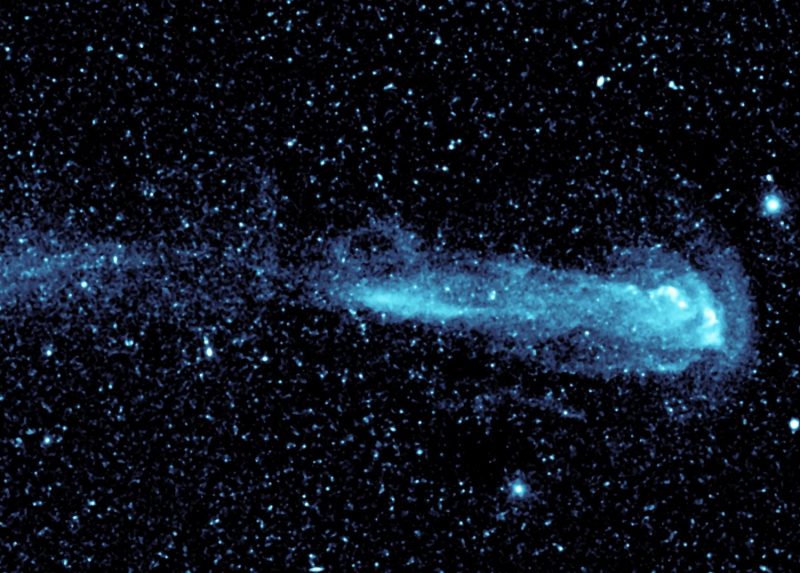
Starfield with a blue comet-like feature, a bright clump at the right and a tail stretching out to the left.
NASA’s Galaxy Evolution Explorer telescope acquired this image of Mira in 2006. Captured in ultraviolet wavelengths, the image shows a long tail of gas and dust shed by Mira. The tail is some 13 light-years in length! That’s about 3 times the distance between our sun and the next-nearest stars. Mira itself is hidden from view in this image, in the clump of gas at the extreme right. Image via NASA/ JPL-Caltech.

Mira in history

Did the earliest stargazers notice Mira as it appeared disappeared and reappeared? If they did, they left no records of this star. The star’s earliest known history begins only 400 years ago, when Dutch astronomer David Fabricius first noticed Mira. That was in the year 1596. He assumed Mira was a nova because, as novae do, the star faded away after a few months. However, Fabricus relocated the star 13 years later. It must have surprised him!

Another Dutch astronomer, Johannes Holwarda, was the first to identify Mira as a variable star, and determined a period of 11 months. That value was refined in 1667 by French astronomer Ismael Bouillaud to 333 days, very close to the currently accepted value of 332 days.

Mira got its name, meaning wonderful or astonishing in Latin, from Johannes Hevelius in 1642.

The position of Mira is RA: 02h 19m 21s, Dec: -02° 58′ 39″.

Latest observations of Mira from AAVSO

Bottom line: Mira is a variable star that undergoes periodic changes in brightness every 332 days, ranging from a maximum brightness of around 3.5 visual magnitudes to a minimum brightness of about 9 magnitudes. It’s expected to be brightest in February or March 2026.

Read more: Mira Revisited, from the AAVSO

The post See Mira the Wonderful now and brightest in February or March first appeared on EarthSky.


from EarthSky https://ift.tt/2iK8wMc

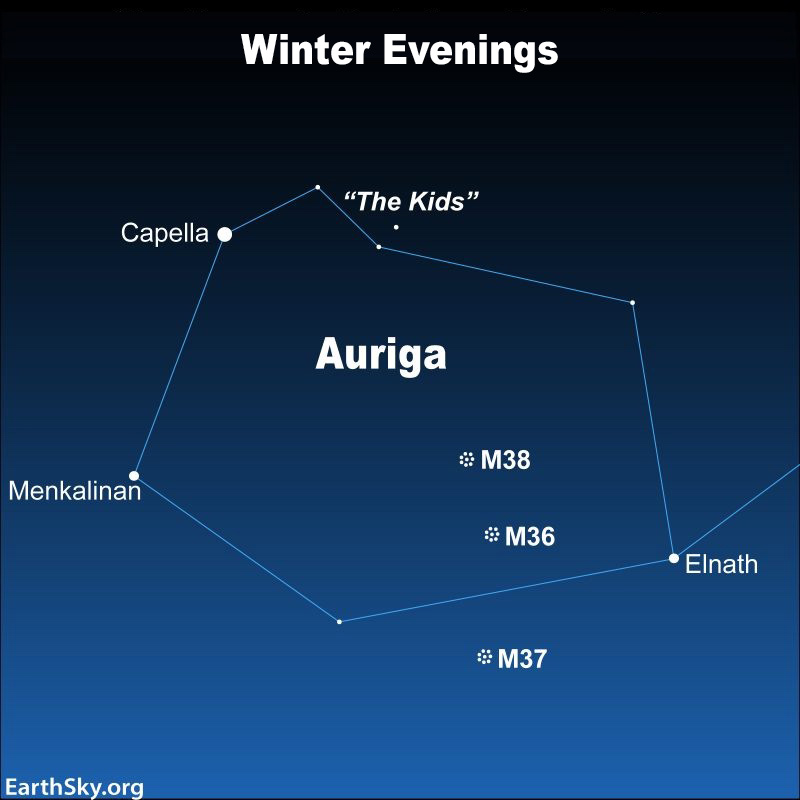
Capella is sometimes called the Goat Star

Star chart showing the constellation Auriga with Capella and other objects labeled.
The bright star Capella in the constellation Auriga the Charioteer is a flashy star when close to the horizon. That’s because it’s bright at magnitude 0.24. To be sure you’ve found Capella, look for a little triangle of stars nearby. Capella is sometimes called the Goat Star, and the little triangle of stars is an asterism called The Kids.

EarthSky’s 2026 lunar calendar is available now. Get yours today! Makes a great gift.

Capella shines brightly on winter nights

The star Capella is prominent on Northern Hemisphere winter evenings. It’s also known as Alpha Aurigae because it’s the brightest star in the constellation Auriga the Charioteer. Capella is the northernmost star in the huge asterism, or star pattern, known as the Winter Hexagon, and the 6th-brightest star in our night sky.

Capella may look like one star, but it’s actually four stars. More about the Capella system below.

Capella – aka as the Goat Star – is the Latin word for nanny goat.

The point of light we see as Capella looks distinctly golden. And Capella shares spectral type – type G – with our sun. In fact, Capella is the biggest and brightest yellow star in our sky. It’s much bigger and brighter than our sun in absolute terms, and, of course, much farther away at a distance of about 42 light-years. That’s in contrast to our sun’s distance of 8 light-minutes.

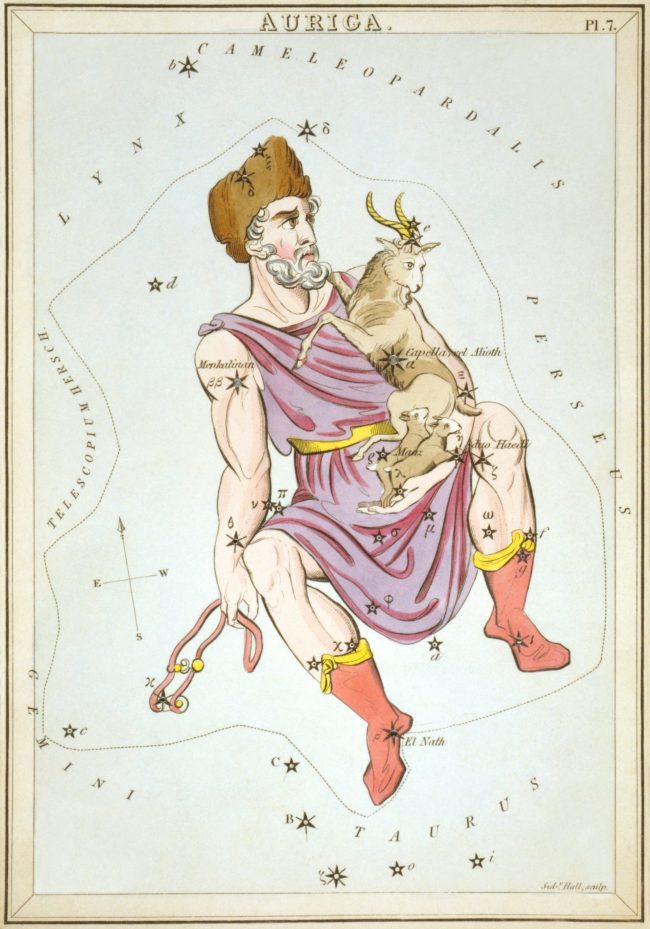
Antique colored etching of man in Greek garb holding 3 small goats, with scattered stars all over.
Auriga as depicted in Urania’s Mirror, a set of constellation cards published in London circa 1825. Capella, the Goat Star, is a goat that the Charioteer carries on his shoulder. Notice the 2 baby goats – known as The Kids – at the larger goat’s feet. Image via Wikipedia (public domain).

How to find it in the night sky

From mid-latitudes of the U.S. and Europe, Capella is far enough to the north that it’s visible at some time of the night all year round. For those of us in the Northern Hemisphere, it’s easier to see in winter, when you’ll find golden Capella high overhead before bedtime. In the autumn, when Capella is lower near the northeastern horizon and appearing through a thick layer of Earth’s atmosphere, the star twinkles brightly, flashing colors of red, blue and green.

Capella is the brightest star in a five-sided pentagonal shape that makes up the constellation Auriga the Charioteer. The shape is difficult to reconcile with the idea of a man driving a chariot, but it’s a noticeable pattern and easy to find.

Here is the key to knowing you’ve found Capella. Near it, you’ll find a tiny asterism – a noticeable pattern on the sky’s dome – consisting of three fainter stars. This little triangle of stars is The Kids, and it makes Capella instantly recognizable.

To see a precise view from your location, try Stellarium Online.

Science of Capella

Like so many stars that appear single to the eye, Capella is a quadruple star system consisting of two binary stars.

The A star in the Capella system is what’s called a spectroscopic binary. That is, the two stars are so close that a normal telescope cannot separate them. However, their different light signatures, as astronomers can see using spectroscopy, “splits” the star, thereby recognizing it as two stars. Both Capella Aa and Capella Ab, as they’re called, have roughly 10 times our sun’s diameter. They emit about 80 and 50 times more overall light than our sun, respectively. Casual observers will not be able to separate these stars through backyard telescopes.

Old yellow giants

Capella Aa and Ab are both yellow giant stars at the end of their normal lifetimes. Because each star is about 2 1/2 times more massive than our sun, the two components of Capella likely are also younger. This is because more massive stars have higher internal pressures, which causes them to burn their nuclear fuel faster and to have shorter lifespans. The two stars of Capella are in a transitional period from the smaller, hotter stars they once were, to the cooler and larger red giants they must ultimately become in their final phase. However, for now, their surface temperatures fall in the range of spectral type G.

The secondary pair, Capella H and Capella L, are small and cool red dwarfs. They are about 10,000 astronomical units (AU) from the first pair.

Astronomers measure the combined magnitude of this system as 0.08.

2 large, labeled yellowish globes, 1 somewhat larger, with 3 much smaller ones, 1 labeled Sol.
Artist’s concept of the 2 primary stars in the Capella system, known as Capella Aa and Capella Ab. They’re shown here with their sizes in contrast to our sun (labeled Sol in this image), and the other 2 components, Capella H and L. Image via Wikimedia Commons (public domain).

History and mythology of Auriga’s brightest star

For such a large constellation with such a bright star, the mythology of Auriga and Capella is sparse. The constellation has been associated with the Greek sea god Poseidon (the Roman god Neptune). Other stories say Auriga represents Erichthonius, the ancient lame king of Athens who invented the horse-drawn chariot.

Auriga seems to have been associated with shepherds and flocks, so the title of nanny goat – “she-goat” – for Capella is reasonable. However, neither Capella nor its constellation Auriga figures prominently in any major mythological stories from Greek or Roman culture.

Richard Hinkley Allen, in his famed book Star Names, says that the ancient Arabs called the star Capella by a name that meant “The Driver” and implies that this star was a shepherd driving a flock across the sky. The flock might have been the nearby star cluster the Pleiades, although – instead of sheep or goats – early Arabian stargazers saw this pattern composed of camels. Capella was also apparently important in ancient Egypt. It appears on the Dendera Zodiac as a mummified cat.

In China, Capella and four other stars of Auriga were known as the Five Chariots. The other four stars are Auriga’s Beta, Theta, Kappa and Gamma (El Nath, which is now Beta Tauri).

Capella’s position is RA: 5h 16m 41.4s, Dec: +45° 59′ 53″.

Enjoying EarthSky? Sign up for our free daily newsletter today!

Bottom line: Capella, the Goat Star, is the brightest star in the constellation Auriga the Charioteer and the 6th brightest star in the night sky. Capella is prominent in the Northern Hemisphere’s winter sky and makes up one of the points in the Winter Hexagon.

The post Capella is sometimes called the Goat Star first appeared on EarthSky.


from EarthSky https://ift.tt/XwUmQLs
Star chart showing the constellation Auriga with Capella and other objects labeled.
The bright star Capella in the constellation Auriga the Charioteer is a flashy star when close to the horizon. That’s because it’s bright at magnitude 0.24. To be sure you’ve found Capella, look for a little triangle of stars nearby. Capella is sometimes called the Goat Star, and the little triangle of stars is an asterism called The Kids.

EarthSky’s 2026 lunar calendar is available now. Get yours today! Makes a great gift.

Capella shines brightly on winter nights

The star Capella is prominent on Northern Hemisphere winter evenings. It’s also known as Alpha Aurigae because it’s the brightest star in the constellation Auriga the Charioteer. Capella is the northernmost star in the huge asterism, or star pattern, known as the Winter Hexagon, and the 6th-brightest star in our night sky.

Capella may look like one star, but it’s actually four stars. More about the Capella system below.

Capella – aka as the Goat Star – is the Latin word for nanny goat.

The point of light we see as Capella looks distinctly golden. And Capella shares spectral type – type G – with our sun. In fact, Capella is the biggest and brightest yellow star in our sky. It’s much bigger and brighter than our sun in absolute terms, and, of course, much farther away at a distance of about 42 light-years. That’s in contrast to our sun’s distance of 8 light-minutes.

Antique colored etching of man in Greek garb holding 3 small goats, with scattered stars all over.
Auriga as depicted in Urania’s Mirror, a set of constellation cards published in London circa 1825. Capella, the Goat Star, is a goat that the Charioteer carries on his shoulder. Notice the 2 baby goats – known as The Kids – at the larger goat’s feet. Image via Wikipedia (public domain).

How to find it in the night sky

From mid-latitudes of the U.S. and Europe, Capella is far enough to the north that it’s visible at some time of the night all year round. For those of us in the Northern Hemisphere, it’s easier to see in winter, when you’ll find golden Capella high overhead before bedtime. In the autumn, when Capella is lower near the northeastern horizon and appearing through a thick layer of Earth’s atmosphere, the star twinkles brightly, flashing colors of red, blue and green.

Capella is the brightest star in a five-sided pentagonal shape that makes up the constellation Auriga the Charioteer. The shape is difficult to reconcile with the idea of a man driving a chariot, but it’s a noticeable pattern and easy to find.

Here is the key to knowing you’ve found Capella. Near it, you’ll find a tiny asterism – a noticeable pattern on the sky’s dome – consisting of three fainter stars. This little triangle of stars is The Kids, and it makes Capella instantly recognizable.

To see a precise view from your location, try Stellarium Online.

Science of Capella

Like so many stars that appear single to the eye, Capella is a quadruple star system consisting of two binary stars.

The A star in the Capella system is what’s called a spectroscopic binary. That is, the two stars are so close that a normal telescope cannot separate them. However, their different light signatures, as astronomers can see using spectroscopy, “splits” the star, thereby recognizing it as two stars. Both Capella Aa and Capella Ab, as they’re called, have roughly 10 times our sun’s diameter. They emit about 80 and 50 times more overall light than our sun, respectively. Casual observers will not be able to separate these stars through backyard telescopes.

Old yellow giants

Capella Aa and Ab are both yellow giant stars at the end of their normal lifetimes. Because each star is about 2 1/2 times more massive than our sun, the two components of Capella likely are also younger. This is because more massive stars have higher internal pressures, which causes them to burn their nuclear fuel faster and to have shorter lifespans. The two stars of Capella are in a transitional period from the smaller, hotter stars they once were, to the cooler and larger red giants they must ultimately become in their final phase. However, for now, their surface temperatures fall in the range of spectral type G.

The secondary pair, Capella H and Capella L, are small and cool red dwarfs. They are about 10,000 astronomical units (AU) from the first pair.

Astronomers measure the combined magnitude of this system as 0.08.

2 large, labeled yellowish globes, 1 somewhat larger, with 3 much smaller ones, 1 labeled Sol.
Artist’s concept of the 2 primary stars in the Capella system, known as Capella Aa and Capella Ab. They’re shown here with their sizes in contrast to our sun (labeled Sol in this image), and the other 2 components, Capella H and L. Image via Wikimedia Commons (public domain).

History and mythology of Auriga’s brightest star

For such a large constellation with such a bright star, the mythology of Auriga and Capella is sparse. The constellation has been associated with the Greek sea god Poseidon (the Roman god Neptune). Other stories say Auriga represents Erichthonius, the ancient lame king of Athens who invented the horse-drawn chariot.

Auriga seems to have been associated with shepherds and flocks, so the title of nanny goat – “she-goat” – for Capella is reasonable. However, neither Capella nor its constellation Auriga figures prominently in any major mythological stories from Greek or Roman culture.

Richard Hinkley Allen, in his famed book Star Names, says that the ancient Arabs called the star Capella by a name that meant “The Driver” and implies that this star was a shepherd driving a flock across the sky. The flock might have been the nearby star cluster the Pleiades, although – instead of sheep or goats – early Arabian stargazers saw this pattern composed of camels. Capella was also apparently important in ancient Egypt. It appears on the Dendera Zodiac as a mummified cat.

In China, Capella and four other stars of Auriga were known as the Five Chariots. The other four stars are Auriga’s Beta, Theta, Kappa and Gamma (El Nath, which is now Beta Tauri).

Capella’s position is RA: 5h 16m 41.4s, Dec: +45° 59′ 53″.

Enjoying EarthSky? Sign up for our free daily newsletter today!

Bottom line: Capella, the Goat Star, is the brightest star in the constellation Auriga the Charioteer and the 6th brightest star in the night sky. Capella is prominent in the Northern Hemisphere’s winter sky and makes up one of the points in the Winter Hexagon.

The post Capella is sometimes called the Goat Star first appeared on EarthSky.


from EarthSky https://ift.tt/XwUmQLs

Cloud-9 is a new type of object: a failed galaxy

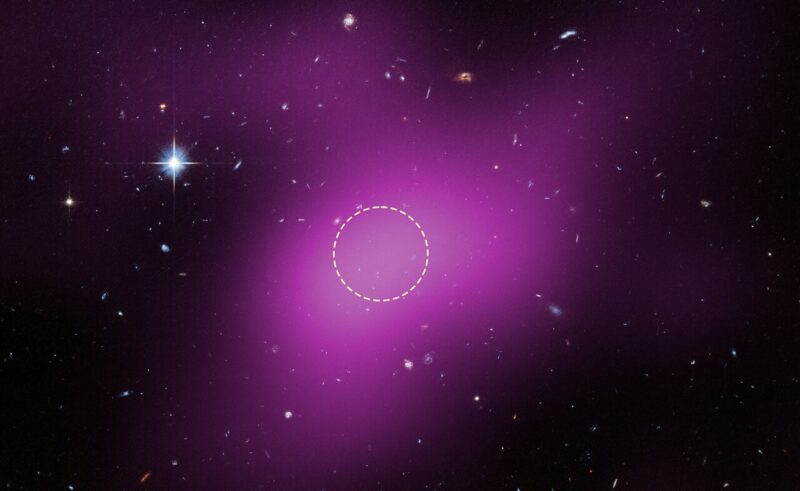
Cloud-9: A purplish glow with a dotted circle near the center of the concentration on a background of galaxies.
This image shows the location of Cloud-9, which is 14 million light-years from Earth. The diffuse magenta is radio data from the ground-based Very Large Array (VLA), showing the presence of the cloud. The dashed circle marks the peak of radio emission, where researchers focused their search for stars. Follow-up observations by the Hubble Space Telescope found no stars within the cloud. The few objects that appear within its boundaries are background galaxies. Before the Hubble observations, scientists could argue that Cloud-9 is a faint dwarf galaxy whose stars could not be seen with ground-based telescopes due to the lack of sensitivity. Image via NASA/ ESA/ G. Anand (STScI)/ and A. Benitez-Llambay (Univ. of Milan-Bicocca). Image processing: J. DePasquale (STScI).
  • Cloud-9 is a new kind of object. Astronomers have identified the first-known starless, gas-rich, dark-matter-dominated cloud. They believe it’s a relic from the early universe.
  • It’s a failed galaxy. Cloud-9 contains abundant neutral hydrogen but no stars. Its existence suggests there are many other small, dark matter-dominated structures in the universe.
  • The lack of stars in Cloud-9 provides a unique window into the intrinsic properties of dark-matter clouds. Future surveys should help discover more of these relics.

ESA published this original article on January 5, 2026. Edits by EarthSky.

EarthSky’s 2026 lunar calendar is available now. Get yours today! Makes a great gift.

Cloud-9 is a new type of object: a failed galaxy

A team using the NASA/ESA Hubble Space Telescope has uncovered a new type of astronomical object. It’s a starless, gas-rich, dark-matter cloud that astronomers consider a relic or remnant of early galaxy formation. Nicknamed Cloud-9, this is the first confirmed detection of an object of its type in the universe. The finding furthers the understanding of galaxy formation, the early universe and the nature of dark matter itself.

Principal investigator Alejandro Benitez-Llambay of the Milano-Bicocca University in Milan, Italy, said:

This is a tale of a failed galaxy. In science, we usually learn more from the failures than from the successes. In this case, seeing no stars is what proves the theory right. It tells us that we have found in the local universe a primordial building block of a galaxy that hasn’t formed.

Team member Andrew Fox of AURA/STScI for the European Space Agency added:

This cloud is a window into the dark universe. We know from theory that most of the mass in the universe is expected to be dark matter, but it’s difficult to detect this dark material because it doesn’t emit light. Cloud-9 gives us a rare look at a dark-matter-dominated cloud.

The Astrophysical Journal Letters published the peer-reviewed result on November 10, 2025. And the team presented the results at a press conference at the 247th meeting of the American Astronomical Society on January 5, 2026.

The relic is a RELHIC

Astronomers call the object a Reionization-Limited H I Cloud, or RELHIC. The term H I refers to neutral hydrogen. And RELHIC describes a natal hydrogen cloud from the universe’s early days, a fossil leftover that has not formed stars. For years, scientists have looked for evidence of such a theoretical phantom object. It wasn’t until they turned Hubble toward the cloud, confirming that it is indeed starless, that they found support for the theory.

Lead author Gagandeep Anand of STScI said:

Before we used Hubble, you could argue that this is a faint dwarf galaxy that we could not see with ground-based telescopes. They just didn’t go deep enough in sensitivity to uncover stars. But with Hubble’s Advanced Camera for Surveys, we’re able to nail down that there’s nothing there.

The discovery of this relic cloud was a surprise. Team member Rachael Beaton of STScI said:

Among our galactic neighbors, there might be a few abandoned houses out there.

RELHICs are thought to be dark-matter clouds that were not able to accumulate enough gas to form stars. They represent a window into the early stages of galaxy formation. Cloud-9 suggests the existence of many other small, dark matter-dominated structures in the universe … other failed galaxies. This discovery provides new insights into the dark components of the universe that are difficult to study through traditional observations, which focus on bright objects like stars and galaxies.

Cloud-9 is different from other hydrogen clouds

Scientists have been studying hydrogen clouds near the Milky Way for many years. These clouds tend to be much bigger and irregular than Cloud-9. Compared with other observed clouds, Cloud-9 is smaller, more compact and highly spherical. That makes it look very different from other clouds.

The core of this object is composed of neutral hydrogen and is about 4,900 light-years in diameter. The hydrogen gas in Cloud-9 is approximately 1 million times the mass of the sun. But if the pressure of the gas is balancing the gravity of the dark matter cloud, which it appears to be, Cloud-9 must be heavily dominated by dark matter, at about 5 billion solar masses.

Cloud-9 is an example of the structures and the mysteries that don’t involve stars. Just looking at stars doesn’t give the full picture. Studying the gas and dark matter helps provide a more complete understanding of what’s going on in these systems in a way we wouldn’t otherwise know.

Observationally, identifying these failed galaxies is challenging because nearby objects outshine them. Such systems are also vulnerable to environmental effects like ram-pressure stripping, which can remove gas as the cloud moves through intergalactic space. These factors further reduce their expected numbers.

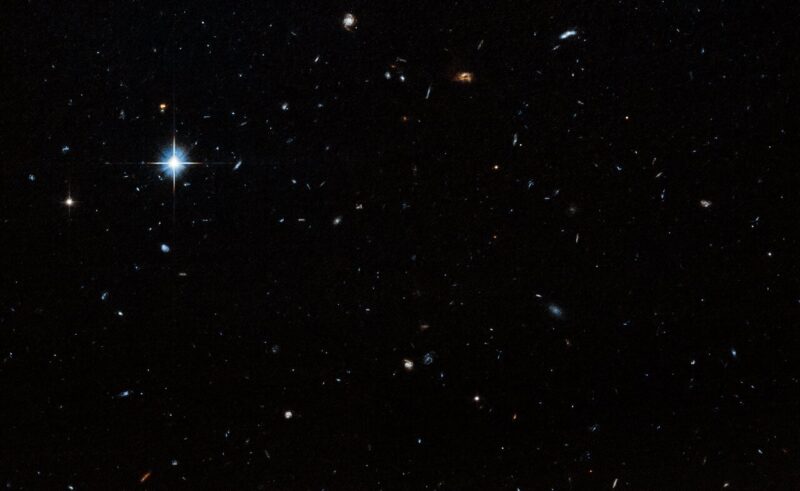
Star field showing distant galaxies and mostly blackness.
Cloud-9 is a faint and dark failed galaxy. This image, without the overlay of radio data from the Very Large Array, shows how it remains hidden in visible light alone. Image via NASA/ ESA/ G. Anand (STScI)/ and A. Benitez-Llambay (Univ. of Milan-Bicocca). Image processing: J. DePasquale (STScI).

The discovery of this unique object

The starless relic was discovered three years ago as part of a radio survey by the Five-hundred-meter (1,640 feet) Aperture Spherical Telescope (FAST) in Guizhou, China. The Green Bank Telescope and the Very Large Array facilities in the United States later confirmed the finding. But only with Hubble could researchers definitively determine that the failed galaxy contains no stars.

Cloud-9 was simply named sequentially, having been the ninth gas cloud identified on the outskirts of a nearby spiral galaxy, Messier 94 (M94). The cloud is close to M94 and appears to have a physical association with the galaxy. High-resolution radio data show slight gas distortions, possibly indicating interaction between the cloud and galaxy.

The cloud may eventually form a galaxy in the future, provided it grows more massive. Although astronomers are still speculating how that would occur. If it were much bigger – say, more than 5 billion times the mass of our sun – it would have collapsed, formed stars and become a galaxy that would be no different than any other galaxy we see. If it were much smaller than that, the gas could have been dispersed and ionized and there wouldn’t be much left. But it’s in a sweet spot where it could remain as a RELHIC.

The lack of stars in this object provides a unique window into the intrinsic properties of dark matter clouds. The rarity of such objects and the potential for future surveys is expected to enhance the discovery of more of these failed galaxies, resulting in insights into the early universe and the physics of dark matter.

Bottom line: Cloud-9 is the first example astronomers have found of a failed galaxy. It contains no stars but is home to dark matter.

Source: The First RELHIC? Cloud-9 is a Starless Gas Cloud

Via ESA

Read more: Did we just see dark matter? Scientists express skepticism

Read more: Dark matter might leave a colorful ‘fingerprint’ on light

The post Cloud-9 is a new type of object: a failed galaxy first appeared on EarthSky.


from EarthSky https://ift.tt/7wzjMFP
Cloud-9: A purplish glow with a dotted circle near the center of the concentration on a background of galaxies.
This image shows the location of Cloud-9, which is 14 million light-years from Earth. The diffuse magenta is radio data from the ground-based Very Large Array (VLA), showing the presence of the cloud. The dashed circle marks the peak of radio emission, where researchers focused their search for stars. Follow-up observations by the Hubble Space Telescope found no stars within the cloud. The few objects that appear within its boundaries are background galaxies. Before the Hubble observations, scientists could argue that Cloud-9 is a faint dwarf galaxy whose stars could not be seen with ground-based telescopes due to the lack of sensitivity. Image via NASA/ ESA/ G. Anand (STScI)/ and A. Benitez-Llambay (Univ. of Milan-Bicocca). Image processing: J. DePasquale (STScI).
  • Cloud-9 is a new kind of object. Astronomers have identified the first-known starless, gas-rich, dark-matter-dominated cloud. They believe it’s a relic from the early universe.
  • It’s a failed galaxy. Cloud-9 contains abundant neutral hydrogen but no stars. Its existence suggests there are many other small, dark matter-dominated structures in the universe.
  • The lack of stars in Cloud-9 provides a unique window into the intrinsic properties of dark-matter clouds. Future surveys should help discover more of these relics.

ESA published this original article on January 5, 2026. Edits by EarthSky.

EarthSky’s 2026 lunar calendar is available now. Get yours today! Makes a great gift.

Cloud-9 is a new type of object: a failed galaxy

A team using the NASA/ESA Hubble Space Telescope has uncovered a new type of astronomical object. It’s a starless, gas-rich, dark-matter cloud that astronomers consider a relic or remnant of early galaxy formation. Nicknamed Cloud-9, this is the first confirmed detection of an object of its type in the universe. The finding furthers the understanding of galaxy formation, the early universe and the nature of dark matter itself.

Principal investigator Alejandro Benitez-Llambay of the Milano-Bicocca University in Milan, Italy, said:

This is a tale of a failed galaxy. In science, we usually learn more from the failures than from the successes. In this case, seeing no stars is what proves the theory right. It tells us that we have found in the local universe a primordial building block of a galaxy that hasn’t formed.

Team member Andrew Fox of AURA/STScI for the European Space Agency added:

This cloud is a window into the dark universe. We know from theory that most of the mass in the universe is expected to be dark matter, but it’s difficult to detect this dark material because it doesn’t emit light. Cloud-9 gives us a rare look at a dark-matter-dominated cloud.

The Astrophysical Journal Letters published the peer-reviewed result on November 10, 2025. And the team presented the results at a press conference at the 247th meeting of the American Astronomical Society on January 5, 2026.

The relic is a RELHIC

Astronomers call the object a Reionization-Limited H I Cloud, or RELHIC. The term H I refers to neutral hydrogen. And RELHIC describes a natal hydrogen cloud from the universe’s early days, a fossil leftover that has not formed stars. For years, scientists have looked for evidence of such a theoretical phantom object. It wasn’t until they turned Hubble toward the cloud, confirming that it is indeed starless, that they found support for the theory.

Lead author Gagandeep Anand of STScI said:

Before we used Hubble, you could argue that this is a faint dwarf galaxy that we could not see with ground-based telescopes. They just didn’t go deep enough in sensitivity to uncover stars. But with Hubble’s Advanced Camera for Surveys, we’re able to nail down that there’s nothing there.

The discovery of this relic cloud was a surprise. Team member Rachael Beaton of STScI said:

Among our galactic neighbors, there might be a few abandoned houses out there.

RELHICs are thought to be dark-matter clouds that were not able to accumulate enough gas to form stars. They represent a window into the early stages of galaxy formation. Cloud-9 suggests the existence of many other small, dark matter-dominated structures in the universe … other failed galaxies. This discovery provides new insights into the dark components of the universe that are difficult to study through traditional observations, which focus on bright objects like stars and galaxies.

Cloud-9 is different from other hydrogen clouds

Scientists have been studying hydrogen clouds near the Milky Way for many years. These clouds tend to be much bigger and irregular than Cloud-9. Compared with other observed clouds, Cloud-9 is smaller, more compact and highly spherical. That makes it look very different from other clouds.

The core of this object is composed of neutral hydrogen and is about 4,900 light-years in diameter. The hydrogen gas in Cloud-9 is approximately 1 million times the mass of the sun. But if the pressure of the gas is balancing the gravity of the dark matter cloud, which it appears to be, Cloud-9 must be heavily dominated by dark matter, at about 5 billion solar masses.

Cloud-9 is an example of the structures and the mysteries that don’t involve stars. Just looking at stars doesn’t give the full picture. Studying the gas and dark matter helps provide a more complete understanding of what’s going on in these systems in a way we wouldn’t otherwise know.

Observationally, identifying these failed galaxies is challenging because nearby objects outshine them. Such systems are also vulnerable to environmental effects like ram-pressure stripping, which can remove gas as the cloud moves through intergalactic space. These factors further reduce their expected numbers.

Star field showing distant galaxies and mostly blackness.
Cloud-9 is a faint and dark failed galaxy. This image, without the overlay of radio data from the Very Large Array, shows how it remains hidden in visible light alone. Image via NASA/ ESA/ G. Anand (STScI)/ and A. Benitez-Llambay (Univ. of Milan-Bicocca). Image processing: J. DePasquale (STScI).

The discovery of this unique object

The starless relic was discovered three years ago as part of a radio survey by the Five-hundred-meter (1,640 feet) Aperture Spherical Telescope (FAST) in Guizhou, China. The Green Bank Telescope and the Very Large Array facilities in the United States later confirmed the finding. But only with Hubble could researchers definitively determine that the failed galaxy contains no stars.

Cloud-9 was simply named sequentially, having been the ninth gas cloud identified on the outskirts of a nearby spiral galaxy, Messier 94 (M94). The cloud is close to M94 and appears to have a physical association with the galaxy. High-resolution radio data show slight gas distortions, possibly indicating interaction between the cloud and galaxy.

The cloud may eventually form a galaxy in the future, provided it grows more massive. Although astronomers are still speculating how that would occur. If it were much bigger – say, more than 5 billion times the mass of our sun – it would have collapsed, formed stars and become a galaxy that would be no different than any other galaxy we see. If it were much smaller than that, the gas could have been dispersed and ionized and there wouldn’t be much left. But it’s in a sweet spot where it could remain as a RELHIC.

The lack of stars in this object provides a unique window into the intrinsic properties of dark matter clouds. The rarity of such objects and the potential for future surveys is expected to enhance the discovery of more of these failed galaxies, resulting in insights into the early universe and the physics of dark matter.

Bottom line: Cloud-9 is the first example astronomers have found of a failed galaxy. It contains no stars but is home to dark matter.

Source: The First RELHIC? Cloud-9 is a Starless Gas Cloud

Via ESA

Read more: Did we just see dark matter? Scientists express skepticism

Read more: Dark matter might leave a colorful ‘fingerprint’ on light

The post Cloud-9 is a new type of object: a failed galaxy first appeared on EarthSky.


from EarthSky https://ift.tt/7wzjMFP

Cassiopeia and the Big Dipper in January skies

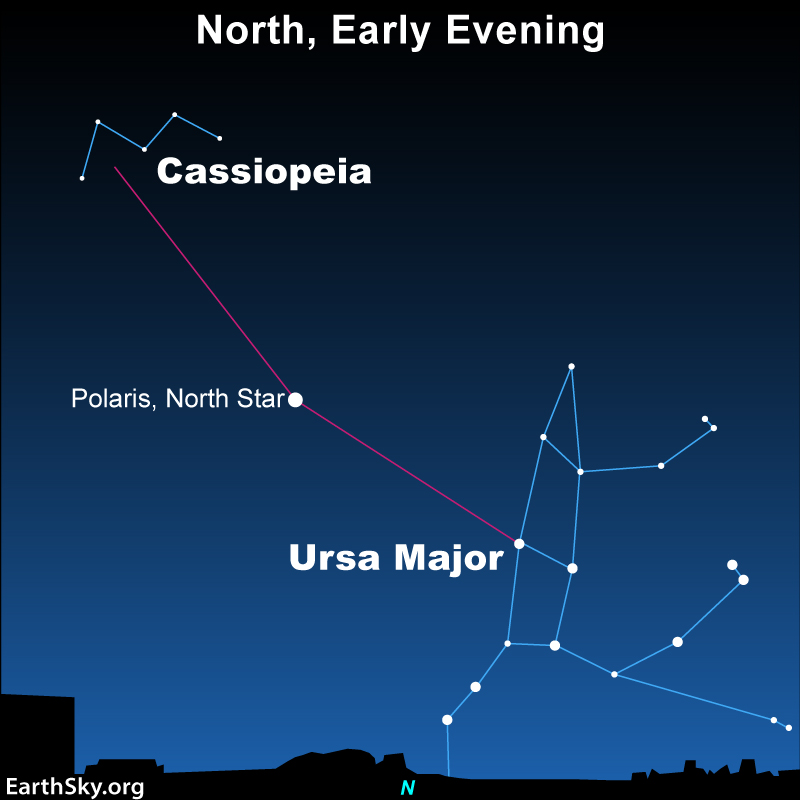
Cassiopeia and the Big Dipper: Sky chart: 2 labeled constellations with a purple line from each leading to Polaris in the middle.
Cassiopeia and the Big Dipper revolve opposite each other around Polaris, the North Star. Depending on your location on the globe, you can see Cassiopeia and the Big Dipper if you look north in January. And if you look north before dawn, their positions will be reversed from this chart. To see a precise view from your location, try Stellarium Online. Chart via EarthSky.

Cassiopeia and the Big Dipper in the night sky

Tonight, look for the northern sky’s two most prominent sky patterns – the constellation Cassiopeia the Queen and the Big Dipper. Cassiopeia and the Big Dipper circle around Polaris, the North Star, once a day, every day. What’s more, they are opposite each other, one on either side of the North Star.

Cassiopeia

At nightfall, the constellation Cassiopeia the Queen is easy to recognize in the northern sky. This constellation looks like a W or M and contains five moderately bright stars. Plus, the distinctive shape of Cassiopeia makes it very noticeable among the stars of the northern sky.

The Big Dipper

And, of course, Ursa Major the Greater Bear – which contains the Big Dipper asterism – is one of the most famous star patterns. At nightfall this month, Cassiopeia shines high in the north while the Dipper lurks low. In fact, they are always on opposite sides of the North Star. From the southern half of the U.S., the Big Dipper is partly or totally beneath the horizon this month in the evening hours. North of about 40 degrees north latitude (the latitude of Denver, Colorado, and Beijing, China), the Big Dipper always stays above the horizon (if your horizon is level). To see a precise view from your location, try Stellarium Online.

They circle around Polaris all night

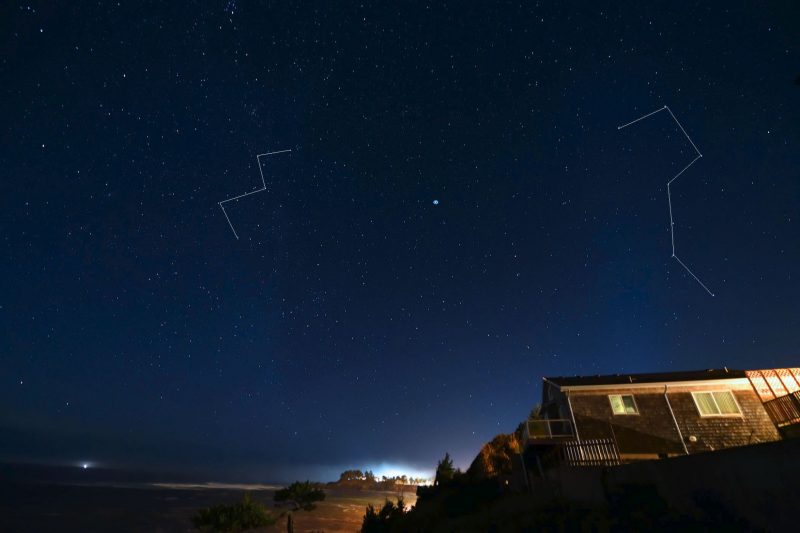
Night sky with one bright star in the middle, with outlined Cassiopeia and Big Dipper to sides.
View at EarthSky Community Photos. | Cecille Kennedy in Depoe Bay, Oregon, captured this photo of Cassiopeia and the Big Dipper with the North Star, Polaris, between them. She wrote: “The stars twinkle bright over the Pacific Ocean horizon. There’s the North Star, or Polaris, between Cassiopeia the Queen and the Big Dipper.” Thanks, Cecille!

But remember, their positions change as the night passes, as the great carousel of stars wheels westward (counterclockwise) around Polaris, the North Star. You’ll notice Polaris resides halfway between Cassiopeia and the Big Dipper. As a result, they are like riders on opposite sides of a Ferris wheel. Thus, looking northward, they rotate counterclockwise around Polaris – the star that marks the sky’s north celestial pole – once a day. Then approximately every 12 hours, as Earth spins beneath the heavens, Cassiopeia and the Big Dipper trade places in the sky.

Thus, around midnight tonight, Cassiopeia circles directly west (left) of Polaris, whereas the Big Dipper sweeps to Polaris’ east (right). And then, before dawn tomorrow the Big Dipper climbs right above the North Star, while Cassiopeia swings directly below.

Animated sky diagram of Cassiopeia stars and Big Dipper circling around Polaris in the center.
The Big Dipper and constellation Cassiopeia circle around Polaris, the North Star, in a period of 23 hours and 56 minutes. The Dipper is circumpolar at 41 degrees north latitude, and all latitudes farther north. Image via Mjchael/ Wikipedia (CC BY-SA 2.5).

Bottom line: Watch the celestial clock and its two great big hour hands – Cassiopeia and the Big Dipper – as they swing around the North Star each and every night!

Easily locate stars and constellations during any day and time with EarthSky’s Planisphere.

The post Cassiopeia and the Big Dipper in January skies first appeared on EarthSky.


from EarthSky https://ift.tt/m8YDWST
Cassiopeia and the Big Dipper: Sky chart: 2 labeled constellations with a purple line from each leading to Polaris in the middle.
Cassiopeia and the Big Dipper revolve opposite each other around Polaris, the North Star. Depending on your location on the globe, you can see Cassiopeia and the Big Dipper if you look north in January. And if you look north before dawn, their positions will be reversed from this chart. To see a precise view from your location, try Stellarium Online. Chart via EarthSky.

Cassiopeia and the Big Dipper in the night sky

Tonight, look for the northern sky’s two most prominent sky patterns – the constellation Cassiopeia the Queen and the Big Dipper. Cassiopeia and the Big Dipper circle around Polaris, the North Star, once a day, every day. What’s more, they are opposite each other, one on either side of the North Star.

Cassiopeia

At nightfall, the constellation Cassiopeia the Queen is easy to recognize in the northern sky. This constellation looks like a W or M and contains five moderately bright stars. Plus, the distinctive shape of Cassiopeia makes it very noticeable among the stars of the northern sky.

The Big Dipper

And, of course, Ursa Major the Greater Bear – which contains the Big Dipper asterism – is one of the most famous star patterns. At nightfall this month, Cassiopeia shines high in the north while the Dipper lurks low. In fact, they are always on opposite sides of the North Star. From the southern half of the U.S., the Big Dipper is partly or totally beneath the horizon this month in the evening hours. North of about 40 degrees north latitude (the latitude of Denver, Colorado, and Beijing, China), the Big Dipper always stays above the horizon (if your horizon is level). To see a precise view from your location, try Stellarium Online.

They circle around Polaris all night

Night sky with one bright star in the middle, with outlined Cassiopeia and Big Dipper to sides.
View at EarthSky Community Photos. | Cecille Kennedy in Depoe Bay, Oregon, captured this photo of Cassiopeia and the Big Dipper with the North Star, Polaris, between them. She wrote: “The stars twinkle bright over the Pacific Ocean horizon. There’s the North Star, or Polaris, between Cassiopeia the Queen and the Big Dipper.” Thanks, Cecille!

But remember, their positions change as the night passes, as the great carousel of stars wheels westward (counterclockwise) around Polaris, the North Star. You’ll notice Polaris resides halfway between Cassiopeia and the Big Dipper. As a result, they are like riders on opposite sides of a Ferris wheel. Thus, looking northward, they rotate counterclockwise around Polaris – the star that marks the sky’s north celestial pole – once a day. Then approximately every 12 hours, as Earth spins beneath the heavens, Cassiopeia and the Big Dipper trade places in the sky.

Thus, around midnight tonight, Cassiopeia circles directly west (left) of Polaris, whereas the Big Dipper sweeps to Polaris’ east (right). And then, before dawn tomorrow the Big Dipper climbs right above the North Star, while Cassiopeia swings directly below.

Animated sky diagram of Cassiopeia stars and Big Dipper circling around Polaris in the center.
The Big Dipper and constellation Cassiopeia circle around Polaris, the North Star, in a period of 23 hours and 56 minutes. The Dipper is circumpolar at 41 degrees north latitude, and all latitudes farther north. Image via Mjchael/ Wikipedia (CC BY-SA 2.5).

Bottom line: Watch the celestial clock and its two great big hour hands – Cassiopeia and the Big Dipper – as they swing around the North Star each and every night!

Easily locate stars and constellations during any day and time with EarthSky’s Planisphere.

The post Cassiopeia and the Big Dipper in January skies first appeared on EarthSky.


from EarthSky https://ift.tt/m8YDWST

Why no retrograde motion for Mars in 2026?

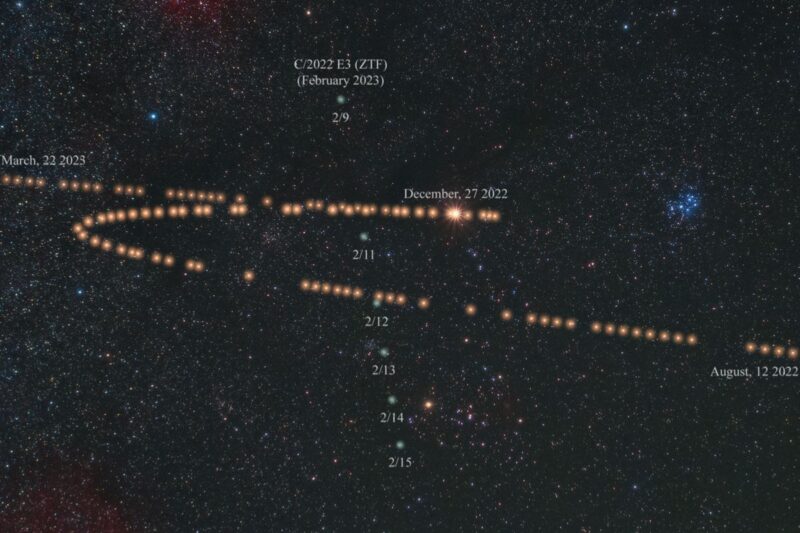
A series of many red dots, making a line that arcs back for part of its length, in a starry sky.
View at EarthSky Community Photos. | This composite image, by Paolo Bardelli in Italy, shows the motion of the planet Mars in front of the stars over 7 months in 2022 and 2023. That was when, as measured against the fixed stars, Mars appeared to change its normal course of motion – eastward in front of the stars – and, for a time, to move westward. This “backward” motion of the planets is called retrograde motion. Mars won’t have any retrograde motion in 2026. But it’ll begin retrograde in early 2027, some 6 weeks before we on Earth pass between Mars and the sun on February 19, 2027. Thank you, Paolo!

The retrograde or “backward” motion of an outer planet – like Jupiter, Saturn or Mars – is an illusion, a trick of perspective. Mars will begin its next retrograde – a milestone in the orbits of Earth and Mars around the sun – around January 10, 2027. At that time, Mars will appear toward the west in front of the stars, in contrast to its regular eastward motion.

Some retrograde motion is an illusion

As measured against the fixed stars, planets typically appear to move eastward. But, sometimes, they seem to pause briefly in this eastward motion. They reach what astronomers call a stationary point. Then, for some months, the planet moves westward (backward) in front of the stars. Mars will reach its next stationary point on January 10, 2027. Astronomers (and astrologers) call a planet’s westward motion its retrograde motion.

Though it baffled ancient stargazers, we know now that this type of retrograde motion is an illusion.

You can experience this illusion in an earthbound way, the next time you pass a car on the highway. As you approach a slower car, it’s clearly moving in the same direction you are. But, as you pull alongside and pass it – from your vantage point in the faster car – the slower car may appear to move backwards for a moment. Then, as you pull ahead of it, the car appears to resume its forward motion.

The same thing happens whenever Earth prepares to pass a slower-moving planet whose orbit is bigger than ours. Earth is due to pass between Mars and the sun on February 19, 2027. When we go between the sun and Mars (or another outer planet), these planets – all of which move more slowly than Earth in orbit – appear to reverse course in our sky.

Read more: Why is Mars sometimes bright and sometimes faint?

The 2026 EarthSky lunar calendar makes a great gift. Get yours today!


Mars making a retrograde loop in front of stars.
An animation showing the retrograde motion of Mars in the summer of 2003. Planets typically move toward the east in front of the stars. When they move west, they’re said to be undergoing retrograde motion. The illusion is caused by our perspective, as seen from Earth. Image via Wikimedia Commons (CC BY-SA 4.0).
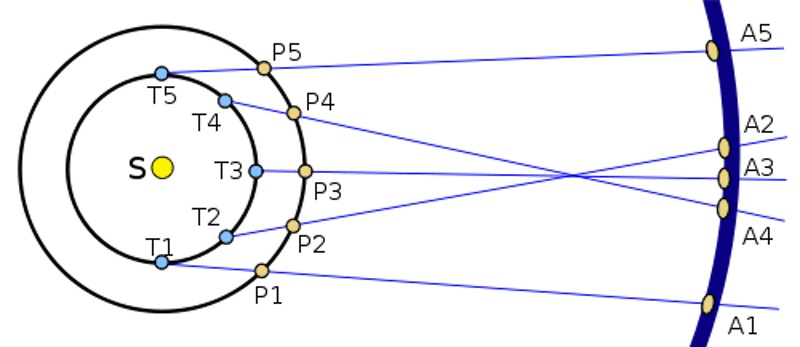
Diagram with orbits of inner and outer planets and lines of sight between them at different positions.
A schematic of how retrograde motion works when Earth (T) passes an outer planet (P) as they both orbit the sun (S). The changing viewing angle from Earth makes the projection of the planet against the celestial sphere (A) move backwards (A2-A4) as we pass the slower, outer planet. Image via Wikimedia Commons (GFDL).

It baffled early astronomers

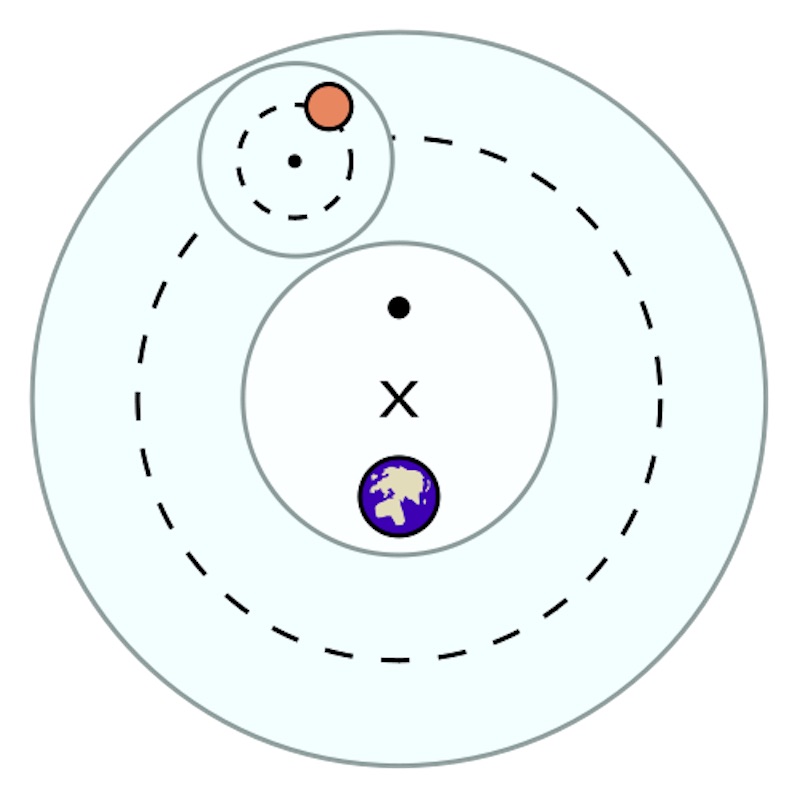
Early astronomers believed Earth lay at the center of the universe. And so they went to complicated lengths to attempt to explain retrograde motion in that Earth-centered universe. They theorized each planet not only orbited Earth, but also spun around a moving point on their orbit known as an epicycle.

Imagine whipping a ball on a length of string around your hand while you turned in place. That’s similar to the ancient view of retrograde motion.

When it became generally accepted that Earth and the other planets orbited the sun, suddenly retrograde motion made a lot more sense.

Diagram: Large circular orbits around Earth, with a smaller circle within one of the large orbits.
A schematic of how astronomers envisioned the motion of the planets before Copernicus. The Earth sat near the center of the universe. The planets moved around a small circle (the epicycle) which in turn moved along a larger circle (the deferent). The deferent was centered on a point (X) midway between the Earth and another spot called the equant. Image via Wikimedia Commons (public domain).

Retrograde motion on other worlds

If you could see the sky from another planet besides Earth, retrograde illusions would lead to your seeing some very strange phenomena. On Mercury, for example, the sun sometimes appears to move in retrograde. As Mercury speeds through its closest approach to the sun, its orbital speed overtakes its rotational speed. An astronaut on the surface would see the sun partially rise, then dip back below the horizon, then rise again before resuming its east-to-west trek across the sky. The result is that, once a year, Mercury gets two sunrises on the same day!

Other retrograde motion is real

Astronomers also use the word retrograde to describe true backward motion among planets and moons.

Venus, for example, rotates or spins on its axis in the opposite direction from every other planet in the solar system. If the clouds ever parted, hypothetical Venusians would see the sun rise in the west and set in the east. Astronomers would say that Venus rotates in a retrograde manner.

Some moons also have retrograde orbits around their planets. In other words, most of the large moons orbit in the same direction that their planet spins … but not Triton, for example, the largest moon of Neptune. It orbits opposite the direction of Neptune’s spin.

Among the smaller asteroid-like moons that swarm about the giant planets, many have retrograde orbits.

It’s the same word: retrograde. But now there’s no illusion. Whether speaking of a planet’s rotation – or its orbit – if it’s opposite what you’d expect, astronomers call it retrograde.

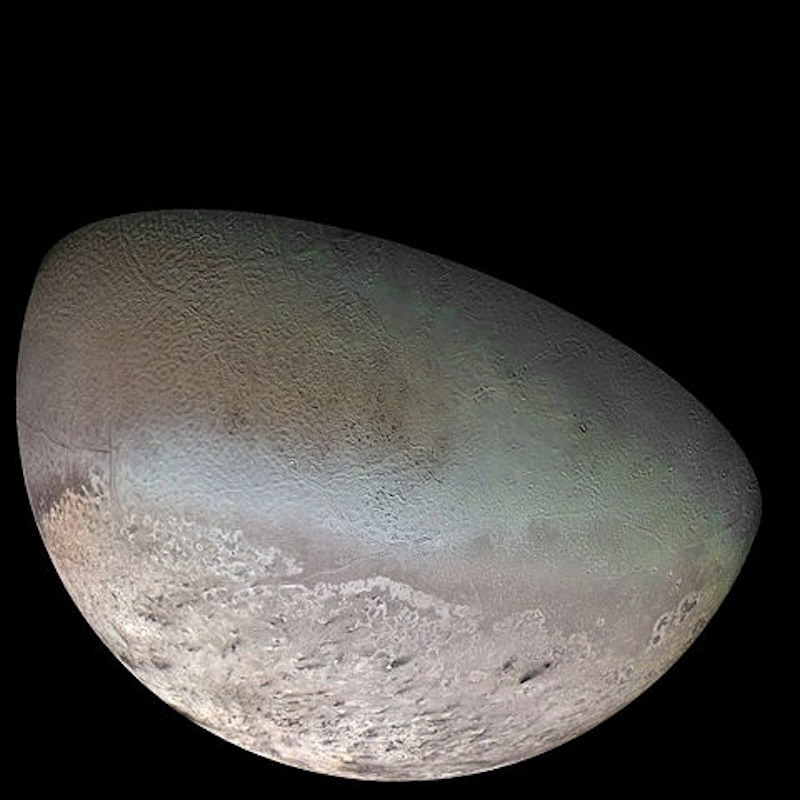
Light-colored, blotchy planet-like body half in shadow.
A photomosaic from Voyager 2 of Neptune’s largest moon, Triton. The moon orbits Neptune opposite the direction that the planet rotates. Does this mean that Triton came from the Kuiper Belt and was eventually captured by the ice giant? Image via NASA/ Jet Propulsion Lab/ U.S. Geological Survey.

How does it happen?

According to modern astronomers, a true retrograde orbit for an orbiting moon most likely stems from a capture. Triton, for example, might have come out of the Kuiper Belt, the region of icy debris beyond Neptune. Perhaps a collision in the belt sent Triton careening inward toward the sun. A close encounter with Neptune could have slowed it down, forcing it to settle into a backward orbit.

In past decades, astronomers have also discovered planets in distant solar systems with retrograde orbits. These exoplanets orbit their suns in the opposite direction from how the star rotates.

It’s puzzling, because planets form out of debris disks that orbit young stars. And those orbiting disks share the star’s rotation. So how does a planet end up with a true backward orbit? The only way – some astronomers believe – is either by a near-collision with another planet, or if another star once passed too close to the system.

Either way, close encounters can disrupt the orbits of planets and set them on a backward path!

Bottom line: Mars won’t have any retrograde – or westward – motion in 2026. What is retrograde motion? An explanation, and bizarre examples on other worlds, here.

Read more: Why is Mars sometimes bright and sometimes faint?

The post Why no retrograde motion for Mars in 2026? first appeared on EarthSky.


from EarthSky https://ift.tt/Dz5vJp9
A series of many red dots, making a line that arcs back for part of its length, in a starry sky.
View at EarthSky Community Photos. | This composite image, by Paolo Bardelli in Italy, shows the motion of the planet Mars in front of the stars over 7 months in 2022 and 2023. That was when, as measured against the fixed stars, Mars appeared to change its normal course of motion – eastward in front of the stars – and, for a time, to move westward. This “backward” motion of the planets is called retrograde motion. Mars won’t have any retrograde motion in 2026. But it’ll begin retrograde in early 2027, some 6 weeks before we on Earth pass between Mars and the sun on February 19, 2027. Thank you, Paolo!

The retrograde or “backward” motion of an outer planet – like Jupiter, Saturn or Mars – is an illusion, a trick of perspective. Mars will begin its next retrograde – a milestone in the orbits of Earth and Mars around the sun – around January 10, 2027. At that time, Mars will appear toward the west in front of the stars, in contrast to its regular eastward motion.

Some retrograde motion is an illusion

As measured against the fixed stars, planets typically appear to move eastward. But, sometimes, they seem to pause briefly in this eastward motion. They reach what astronomers call a stationary point. Then, for some months, the planet moves westward (backward) in front of the stars. Mars will reach its next stationary point on January 10, 2027. Astronomers (and astrologers) call a planet’s westward motion its retrograde motion.

Though it baffled ancient stargazers, we know now that this type of retrograde motion is an illusion.

You can experience this illusion in an earthbound way, the next time you pass a car on the highway. As you approach a slower car, it’s clearly moving in the same direction you are. But, as you pull alongside and pass it – from your vantage point in the faster car – the slower car may appear to move backwards for a moment. Then, as you pull ahead of it, the car appears to resume its forward motion.

The same thing happens whenever Earth prepares to pass a slower-moving planet whose orbit is bigger than ours. Earth is due to pass between Mars and the sun on February 19, 2027. When we go between the sun and Mars (or another outer planet), these planets – all of which move more slowly than Earth in orbit – appear to reverse course in our sky.

Read more: Why is Mars sometimes bright and sometimes faint?

The 2026 EarthSky lunar calendar makes a great gift. Get yours today!

Mars making a retrograde loop in front of stars.
An animation showing the retrograde motion of Mars in the summer of 2003. Planets typically move toward the east in front of the stars. When they move west, they’re said to be undergoing retrograde motion. The illusion is caused by our perspective, as seen from Earth. Image via Wikimedia Commons (CC BY-SA 4.0).
Diagram with orbits of inner and outer planets and lines of sight between them at different positions.
A schematic of how retrograde motion works when Earth (T) passes an outer planet (P) as they both orbit the sun (S). The changing viewing angle from Earth makes the projection of the planet against the celestial sphere (A) move backwards (A2-A4) as we pass the slower, outer planet. Image via Wikimedia Commons (GFDL).

It baffled early astronomers

Early astronomers believed Earth lay at the center of the universe. And so they went to complicated lengths to attempt to explain retrograde motion in that Earth-centered universe. They theorized each planet not only orbited Earth, but also spun around a moving point on their orbit known as an epicycle.

Imagine whipping a ball on a length of string around your hand while you turned in place. That’s similar to the ancient view of retrograde motion.

When it became generally accepted that Earth and the other planets orbited the sun, suddenly retrograde motion made a lot more sense.

Diagram: Large circular orbits around Earth, with a smaller circle within one of the large orbits.
A schematic of how astronomers envisioned the motion of the planets before Copernicus. The Earth sat near the center of the universe. The planets moved around a small circle (the epicycle) which in turn moved along a larger circle (the deferent). The deferent was centered on a point (X) midway between the Earth and another spot called the equant. Image via Wikimedia Commons (public domain).

Retrograde motion on other worlds

If you could see the sky from another planet besides Earth, retrograde illusions would lead to your seeing some very strange phenomena. On Mercury, for example, the sun sometimes appears to move in retrograde. As Mercury speeds through its closest approach to the sun, its orbital speed overtakes its rotational speed. An astronaut on the surface would see the sun partially rise, then dip back below the horizon, then rise again before resuming its east-to-west trek across the sky. The result is that, once a year, Mercury gets two sunrises on the same day!

Other retrograde motion is real

Astronomers also use the word retrograde to describe true backward motion among planets and moons.

Venus, for example, rotates or spins on its axis in the opposite direction from every other planet in the solar system. If the clouds ever parted, hypothetical Venusians would see the sun rise in the west and set in the east. Astronomers would say that Venus rotates in a retrograde manner.

Some moons also have retrograde orbits around their planets. In other words, most of the large moons orbit in the same direction that their planet spins … but not Triton, for example, the largest moon of Neptune. It orbits opposite the direction of Neptune’s spin.

Among the smaller asteroid-like moons that swarm about the giant planets, many have retrograde orbits.

It’s the same word: retrograde. But now there’s no illusion. Whether speaking of a planet’s rotation – or its orbit – if it’s opposite what you’d expect, astronomers call it retrograde.

Light-colored, blotchy planet-like body half in shadow.
A photomosaic from Voyager 2 of Neptune’s largest moon, Triton. The moon orbits Neptune opposite the direction that the planet rotates. Does this mean that Triton came from the Kuiper Belt and was eventually captured by the ice giant? Image via NASA/ Jet Propulsion Lab/ U.S. Geological Survey.

How does it happen?

According to modern astronomers, a true retrograde orbit for an orbiting moon most likely stems from a capture. Triton, for example, might have come out of the Kuiper Belt, the region of icy debris beyond Neptune. Perhaps a collision in the belt sent Triton careening inward toward the sun. A close encounter with Neptune could have slowed it down, forcing it to settle into a backward orbit.

In past decades, astronomers have also discovered planets in distant solar systems with retrograde orbits. These exoplanets orbit their suns in the opposite direction from how the star rotates.

It’s puzzling, because planets form out of debris disks that orbit young stars. And those orbiting disks share the star’s rotation. So how does a planet end up with a true backward orbit? The only way – some astronomers believe – is either by a near-collision with another planet, or if another star once passed too close to the system.

Either way, close encounters can disrupt the orbits of planets and set them on a backward path!

Bottom line: Mars won’t have any retrograde – or westward – motion in 2026. What is retrograde motion? An explanation, and bizarre examples on other worlds, here.

Read more: Why is Mars sometimes bright and sometimes faint?

The post Why no retrograde motion for Mars in 2026? first appeared on EarthSky.


from EarthSky https://ift.tt/Dz5vJp9

Supermassive black holes in all galaxies? Maybe not

Supermassive black holes: Two images of galaxies with insets, one showing a bright spot the other showing nothing.
View larger. | In recent decades, we’ve come to understand most large galaxies as having central supermassive black holes. Our own galaxy, the Milky Way, has one. And the similarly sized galaxy NGC 6278, on the left, has one. But a new study of 1,600 galaxies suggests many of the smaller ones – like PGC 03620 (right) – don’t contain supermassive black holes. X-rays image via NASA/CXC/SAO/F. Zou et al. Optical image via SDSS. Image processing via NASA/CXC/SAO/N. Wolk.
  • Scientists might have been tempted to think that supermassive black holes were at the heart of every galaxy. But that’s not what a new study found.
  • Looking at X-ray data from 1,600 galaxies, the researchers found that while most massive galaxies do have central supermassive black holes, only about 30% of smaller galaxies do.
  • The result supports the theory that giant black holes are born big from the collapse of enormous gas clouds.

NASA published this original story on December 11, 2025. Edits by EarthSky.

EarthSky’s 2026 lunar calendar is available now. Get yours today! Makes a great gift.

Supermassive black holes not at the core of all galaxies

Most smaller galaxies may not have supermassive black holes in their centers. That’s according to a recent study using NASA’s Chandra X-ray Observatory. This contrasts with the common idea that nearly every galaxy has one of these giant black holes within their cores.

A team of astronomers used data from over 1,600 galaxies collected in more than two decades of the Chandra mission. The researchers looked at galaxies ranging in heft from more than 10 times the mass of the Milky Way down to dwarf galaxies, which have stellar masses less than a few percent of that of our home galaxy. The Astrophysical Journal published the peer-reviewed results on October 6, 2025. NASA announced the findings in a press release on December 11, 2025.

The team has reported that only about 30% of dwarf galaxies likely contain supermassive black holes. Fan Zou of the University of Michigan in Ann Arbor, led the study. Zou said:

It’s important to get an accurate black hole head count in these smaller galaxies. It’s more than just bookkeeping. Our study gives clues about how supermassive black holes are born. It also provides crucial hints about how often black hole signatures in dwarf galaxies can be found with new or future telescopes.

How can we see black holes to study them?

As material falls onto black holes, friction heats it and produces X-rays. Many of the massive galaxies in the study contain bright X-ray sources in their centers. And that’s a clear signature of supermassive black holes. The team concluded that more than 90% of massive galaxies – including those with the mass of the Milky Way – contain supermassive black holes.

However, smaller galaxies in the study usually did not have these unambiguous black hole signals. Galaxies with masses less than 3 billion suns – about the mass of the Large Magellanic Cloud, a neighbor to the Milky Way – usually do not contain bright X-ray sources in their centers.

The researchers considered two possible explanations for this lack of X-ray sources. The first is that the fraction of galaxies containing massive black holes is much lower for these less-massive galaxies. The second is the amount of X-rays produced by matter falling onto these black holes is so faint that Chandra cannot detect it. Co-author Elena Gallo from the University of Michigan said:

We think, based on our analysis of the Chandra data, that there really are fewer black holes in these smaller galaxies than in their larger counterparts.

Determining which solution is correct

To reach their conclusion, Zou and his colleagues considered both possibilities for the lack of X-ray sources in small galaxies in their large Chandra sample. The amount of gas falling onto a black hole determines how bright or faint they are in X-rays. Scientists expect smaller black holes to pull in less gas than larger black holes. So they should be fainter in X-rays and often not detectable. The researchers confirmed this expectation.

However, they found an additional deficit of X-ray sources in less massive galaxies beyond the expected decline from decreases in the amount of gas falling inward. But scientists can account for this additional deficit if many of the low-mass galaxies simply don’t have any black holes at their centers. The team’s conclusion was that the drop in X-ray detections in lower-mass galaxies reflects a true decrease in the number of black holes located in these galaxies.

Implications for how supermassive black holes form

This result could have important implications for understanding how supermassive black holes form. There are currently two main theories. One is that they grow from smaller black holes, created when giant stars run out of fuel and collapse. The second idea is that the giant black holes are born big from the collapse of enormous gas clouds, so that they have the mass of thousands of suns to begin with. The team’s findings suggest the latter is more likely.

Co-author Anil Seth of the University of Utah said:

The formation of big black holes is expected to be rarer, in the sense that it occurs preferentially in the most massive galaxies being formed, so that would explain why we don’t find black holes in all the smaller galaxies.

This study supports the theory where giant black holes are born already weighing several thousand times the sun’s mass. If the other idea were true, the researchers said they would have expected smaller galaxies to likely have the same fraction of black holes as larger ones.

This result also could have important implications for the rates of black hole mergers from the collisions of dwarf galaxies. A much lower number of black holes would result in fewer sources of gravitational waves to be detected in the future by the Laser Interferometer Space Antenna. The number of black holes tearing stars apart in dwarf galaxies will also be smaller.

Bottom line: A new study looked at 1,600 galaxies and found that the cores of small galaxies are less likely to be home to supermassive black holes.

Source: Central Massive Black Holes Are Not Ubiquitous in Local Low-Mass Galaxies

Via NASA

The post Supermassive black holes in all galaxies? Maybe not first appeared on EarthSky.


from EarthSky https://ift.tt/Htef2nx
Supermassive black holes: Two images of galaxies with insets, one showing a bright spot the other showing nothing.
View larger. | In recent decades, we’ve come to understand most large galaxies as having central supermassive black holes. Our own galaxy, the Milky Way, has one. And the similarly sized galaxy NGC 6278, on the left, has one. But a new study of 1,600 galaxies suggests many of the smaller ones – like PGC 03620 (right) – don’t contain supermassive black holes. X-rays image via NASA/CXC/SAO/F. Zou et al. Optical image via SDSS. Image processing via NASA/CXC/SAO/N. Wolk.
  • Scientists might have been tempted to think that supermassive black holes were at the heart of every galaxy. But that’s not what a new study found.
  • Looking at X-ray data from 1,600 galaxies, the researchers found that while most massive galaxies do have central supermassive black holes, only about 30% of smaller galaxies do.
  • The result supports the theory that giant black holes are born big from the collapse of enormous gas clouds.

NASA published this original story on December 11, 2025. Edits by EarthSky.

EarthSky’s 2026 lunar calendar is available now. Get yours today! Makes a great gift.

Supermassive black holes not at the core of all galaxies

Most smaller galaxies may not have supermassive black holes in their centers. That’s according to a recent study using NASA’s Chandra X-ray Observatory. This contrasts with the common idea that nearly every galaxy has one of these giant black holes within their cores.

A team of astronomers used data from over 1,600 galaxies collected in more than two decades of the Chandra mission. The researchers looked at galaxies ranging in heft from more than 10 times the mass of the Milky Way down to dwarf galaxies, which have stellar masses less than a few percent of that of our home galaxy. The Astrophysical Journal published the peer-reviewed results on October 6, 2025. NASA announced the findings in a press release on December 11, 2025.

The team has reported that only about 30% of dwarf galaxies likely contain supermassive black holes. Fan Zou of the University of Michigan in Ann Arbor, led the study. Zou said:

It’s important to get an accurate black hole head count in these smaller galaxies. It’s more than just bookkeeping. Our study gives clues about how supermassive black holes are born. It also provides crucial hints about how often black hole signatures in dwarf galaxies can be found with new or future telescopes.

How can we see black holes to study them?

As material falls onto black holes, friction heats it and produces X-rays. Many of the massive galaxies in the study contain bright X-ray sources in their centers. And that’s a clear signature of supermassive black holes. The team concluded that more than 90% of massive galaxies – including those with the mass of the Milky Way – contain supermassive black holes.

However, smaller galaxies in the study usually did not have these unambiguous black hole signals. Galaxies with masses less than 3 billion suns – about the mass of the Large Magellanic Cloud, a neighbor to the Milky Way – usually do not contain bright X-ray sources in their centers.

The researchers considered two possible explanations for this lack of X-ray sources. The first is that the fraction of galaxies containing massive black holes is much lower for these less-massive galaxies. The second is the amount of X-rays produced by matter falling onto these black holes is so faint that Chandra cannot detect it. Co-author Elena Gallo from the University of Michigan said:

We think, based on our analysis of the Chandra data, that there really are fewer black holes in these smaller galaxies than in their larger counterparts.

Determining which solution is correct

To reach their conclusion, Zou and his colleagues considered both possibilities for the lack of X-ray sources in small galaxies in their large Chandra sample. The amount of gas falling onto a black hole determines how bright or faint they are in X-rays. Scientists expect smaller black holes to pull in less gas than larger black holes. So they should be fainter in X-rays and often not detectable. The researchers confirmed this expectation.

However, they found an additional deficit of X-ray sources in less massive galaxies beyond the expected decline from decreases in the amount of gas falling inward. But scientists can account for this additional deficit if many of the low-mass galaxies simply don’t have any black holes at their centers. The team’s conclusion was that the drop in X-ray detections in lower-mass galaxies reflects a true decrease in the number of black holes located in these galaxies.

Implications for how supermassive black holes form

This result could have important implications for understanding how supermassive black holes form. There are currently two main theories. One is that they grow from smaller black holes, created when giant stars run out of fuel and collapse. The second idea is that the giant black holes are born big from the collapse of enormous gas clouds, so that they have the mass of thousands of suns to begin with. The team’s findings suggest the latter is more likely.

Co-author Anil Seth of the University of Utah said:

The formation of big black holes is expected to be rarer, in the sense that it occurs preferentially in the most massive galaxies being formed, so that would explain why we don’t find black holes in all the smaller galaxies.

This study supports the theory where giant black holes are born already weighing several thousand times the sun’s mass. If the other idea were true, the researchers said they would have expected smaller galaxies to likely have the same fraction of black holes as larger ones.

This result also could have important implications for the rates of black hole mergers from the collisions of dwarf galaxies. A much lower number of black holes would result in fewer sources of gravitational waves to be detected in the future by the Laser Interferometer Space Antenna. The number of black holes tearing stars apart in dwarf galaxies will also be smaller.

Bottom line: A new study looked at 1,600 galaxies and found that the cores of small galaxies are less likely to be home to supermassive black holes.

Source: Central Massive Black Holes Are Not Ubiquitous in Local Low-Mass Galaxies

Via NASA

The post Supermassive black holes in all galaxies? Maybe not first appeared on EarthSky.


from EarthSky https://ift.tt/Htef2nx

Why is Jupiter closest to Earth 1 day before opposition?

Animation: tan, banded Jupiter rotating, with the big oval red spot crossing it, and two bright dots for moons nearby.
View at EarthSky Community Photos. | Steven Bellavia in Surry, Virginia, created this animation of Jupiter from images captured in the wee hours of October 19, 2023. It’s a beauty! Thank you, Steve. And, if you look closely, you can see Jupiter’s moons Europa and Io, in the upper left and right, respectively. Wow!

Jupiter closest to Earth January 9, 2026

Have you noticed a very bright object in the east earlier each evening? That’s the giant planet Jupiter, now brighter than all the stars!

Jupiter’s closest point to the Earth for 2026 comes on January 9. That’s when the distance between the Earth and Jupiter will be at its least for 2026. Jupiter will be 393 million miles, or 633 million km, away from Earth (and 484 million miles, or 780 million km, away from the sun). This translates to 35 light-minutes away from Earth.

Less than 24 hours later – at 8 UTC (2 a.m. CST) on January 10, 2026 – Jupiter will reach opposition, when it’s opposite the sun in our sky. That’ll happen as Earth flies (more or less) between the sun and Jupiter.

So Jupiter is closest less than a day before we go between it and the sun. Why? Why wouldn’t those two events happen simultaneously?

Simple diagram of orbits, showing Earth between an outer planet and the sun.
Opposition happens when Earth flies between an outer planet, like Jupiter, and the sun. Why isn’t Jupiter closest on the day we go between it and the sun? Illustration via Heavens-Above. Used with permission.

Why isn’t Jupiter closest at opposition?

Opposition happens when Earth and Jupiter line up with the sun. But because both planets are moving on curved, slightly tilted paths, the moment of perfect alignment isn’t always the exact moment of closest distance. Earth can pass closest to Jupiter a little before or after opposition — sometimes by just hours, sometimes by a day or two.

When Jupiter reached opposition on September 26, 2022, it was closer to Earth than at any time in about 70 years. That’s because 2022 was a perihelion year for Jupiter — the point in its 12-year orbit when the giant planet was closest to the sun. During that opposition, Jupiter was just 367 million miles (591 million km) from Earth.

So here’s the key idea: it was the close timing between Jupiter’s once-a-year opposition and its once-every-12-years perihelion that produced that unusually close approach in 2022.

Every year since then, as Earth has passed between Jupiter and the sun, the distance between our two planets has been a little greater. That’s because Jupiter has been moving farther from the sun with each passing day since perihelion.

In fact, Jupiter will keep getting farther from the sun until 2028, when it reaches aphelion — the farthest point in its orbit. As a result, in years like 2026, Jupiter’s closest approach comes a day or so before opposition.

After 2028, Jupiter will begin moving closer to the sun again. And then the timing flips: Jupiter’s closest point to Earth will tend to come hours or a day or so after opposition, instead of before.

Bottom line: Jupiter’s closest point to the Earth in 2026, is on January 9. The distance between the sun and Jupiter will be 393 million miles, or 633 million km.

Animated diagram, small black dot orbiting large blue object in elongated oval path.
This animation shows an orbit that’s vastly more elliptical than either Earth’s or Jupiter’s. Still, you get the idea. Perihelion = closest to sun. Aphelion = farthest from sun. Image via Brandir/ Wikimedia Commons (GFDL).

2022 Geocentric ephemeris for Jupiter
2023 Geocentric ephemeris for Jupiter
2024 Geocentric ephemeris for Jupiter
2025 Geocentric ephemeris for Jupiter
2026 Geocentric ephemeris for Jupiter

2022 Geocentric ephemeris for sun
2023 Geocentric ephemeris for sun
2024 Geocentric ephemeris for sun
2025 Geocentric ephemeris for sun
2026 Geocentric ephemeris for sun

Read more How to see and enjoy Jupiter’s moons

The post Why is Jupiter closest to Earth 1 day before opposition? first appeared on EarthSky.


from EarthSky https://ift.tt/F3IbJxo
Animation: tan, banded Jupiter rotating, with the big oval red spot crossing it, and two bright dots for moons nearby.
View at EarthSky Community Photos. | Steven Bellavia in Surry, Virginia, created this animation of Jupiter from images captured in the wee hours of October 19, 2023. It’s a beauty! Thank you, Steve. And, if you look closely, you can see Jupiter’s moons Europa and Io, in the upper left and right, respectively. Wow!

Jupiter closest to Earth January 9, 2026

Have you noticed a very bright object in the east earlier each evening? That’s the giant planet Jupiter, now brighter than all the stars!

Jupiter’s closest point to the Earth for 2026 comes on January 9. That’s when the distance between the Earth and Jupiter will be at its least for 2026. Jupiter will be 393 million miles, or 633 million km, away from Earth (and 484 million miles, or 780 million km, away from the sun). This translates to 35 light-minutes away from Earth.

Less than 24 hours later – at 8 UTC (2 a.m. CST) on January 10, 2026 – Jupiter will reach opposition, when it’s opposite the sun in our sky. That’ll happen as Earth flies (more or less) between the sun and Jupiter.

So Jupiter is closest less than a day before we go between it and the sun. Why? Why wouldn’t those two events happen simultaneously?

Simple diagram of orbits, showing Earth between an outer planet and the sun.
Opposition happens when Earth flies between an outer planet, like Jupiter, and the sun. Why isn’t Jupiter closest on the day we go between it and the sun? Illustration via Heavens-Above. Used with permission.

Why isn’t Jupiter closest at opposition?

Opposition happens when Earth and Jupiter line up with the sun. But because both planets are moving on curved, slightly tilted paths, the moment of perfect alignment isn’t always the exact moment of closest distance. Earth can pass closest to Jupiter a little before or after opposition — sometimes by just hours, sometimes by a day or two.

When Jupiter reached opposition on September 26, 2022, it was closer to Earth than at any time in about 70 years. That’s because 2022 was a perihelion year for Jupiter — the point in its 12-year orbit when the giant planet was closest to the sun. During that opposition, Jupiter was just 367 million miles (591 million km) from Earth.

So here’s the key idea: it was the close timing between Jupiter’s once-a-year opposition and its once-every-12-years perihelion that produced that unusually close approach in 2022.

Every year since then, as Earth has passed between Jupiter and the sun, the distance between our two planets has been a little greater. That’s because Jupiter has been moving farther from the sun with each passing day since perihelion.

In fact, Jupiter will keep getting farther from the sun until 2028, when it reaches aphelion — the farthest point in its orbit. As a result, in years like 2026, Jupiter’s closest approach comes a day or so before opposition.

After 2028, Jupiter will begin moving closer to the sun again. And then the timing flips: Jupiter’s closest point to Earth will tend to come hours or a day or so after opposition, instead of before.

Bottom line: Jupiter’s closest point to the Earth in 2026, is on January 9. The distance between the sun and Jupiter will be 393 million miles, or 633 million km.

Animated diagram, small black dot orbiting large blue object in elongated oval path.
This animation shows an orbit that’s vastly more elliptical than either Earth’s or Jupiter’s. Still, you get the idea. Perihelion = closest to sun. Aphelion = farthest from sun. Image via Brandir/ Wikimedia Commons (GFDL).

2022 Geocentric ephemeris for Jupiter
2023 Geocentric ephemeris for Jupiter
2024 Geocentric ephemeris for Jupiter
2025 Geocentric ephemeris for Jupiter
2026 Geocentric ephemeris for Jupiter

2022 Geocentric ephemeris for sun
2023 Geocentric ephemeris for sun
2024 Geocentric ephemeris for sun
2025 Geocentric ephemeris for sun
2026 Geocentric ephemeris for sun

Read more How to see and enjoy Jupiter’s moons

The post Why is Jupiter closest to Earth 1 day before opposition? first appeared on EarthSky.


from EarthSky https://ift.tt/F3IbJxo

adds 2