aads

What if a small black hole devoured you?

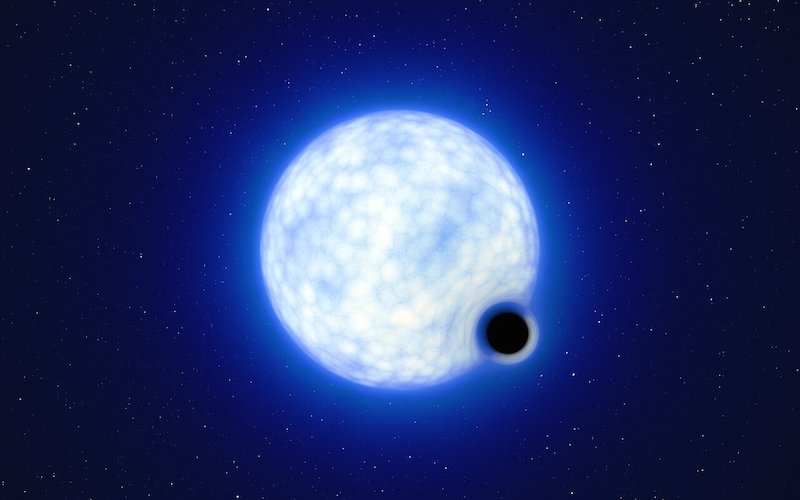
Small black hole: Large glowing white globe with a smaller black orb next to it.
View larger. | Artist’s concept of a black hole system containing a dormant black hole orbiting a massive companion star. A researcher at Vanderbilt University examined what would happen to the human body in an encounter with a small black hole. Image via ESO/ L. Calçada.

EarthSky isn’t powered by billionaires. We’re powered by you.
Support EarthSky’s 2025 Donation Campaign and help keep science accessible.

  • What would happen if a small black hole from the early universe passed through a human body? That’s what Robert Scherrer of Vanderbilt University wanted to know.
  • Scherrer said it would depend on the size of the black hole. However, a supersonic shockwave could blast through tissue like a bullet. And tidal forces could tear apart cells.
  • Black holes might be responsible for dark matter in the universe. So understanding more about black holes might also help scientists understand dark matter better.

Mary-Lou Watkinson wrote this story for Vanderbilt University on October 21, 2025. Edits by EarthSky.

What would a small black hole do to the human body?

Some people may worry about being bitten by a snake or spider, but have you ever considered what would happen if a small black hole tried to pass through your body? Vanderbilt University in Nashville, Tennessee, said on October 21, 2025, that one of its professors, Robert Scherrer, proposed an answer to that question in the International Journal of Modern Physics. Scherrer set out to find what the gravitational effects would be if a primordial black hole passed through the human body, helping scientists better understand the properties of dark matter.

Primordial black holes are hypothetical black holes that formed in the early universe, possibly within the 1st second after the Big Bang. They have potential masses ranging from 100,000 times less than a paperclip to 100,000 times more than the sun. Some researchers think these black holes may make up some, or all, of the universe’s dark matter.

In his article, Scherrer examined the minimum size of a primordial black hole needed to cause significant injury to a person. Knowing this information can then help determine the properties of this type of dark matter, such as its mass.

Building on previous research

The article builds upon Scherrer’s previous study, in collaboration with Jagjit Singh Sidhu and Glenn Starkman from Case Western Reserve University in Cleveland, Ohio. That study looked at macroscopic dark matter (MACROs). MACROs are a broad class of hypothetical dark matter that are large and made of many particles. They found MACROs would cause sufficient destruction to the human body. Given that no deaths by MACROs have been reported, they could then set limits on the properties of these particles. Scherrer said:

I knew that I could carry over some of those calculations to the study of primordial black holes. Recent observations of gravitational radiation from black hole mergers, as well as new images of black holes, have revived interest in the subject of black holes in general. Plus, I remembered reading a science fiction story back in the 1970s where someone dies from having a black hole pass through them. I wanted to see if this would be possible.

A man with white hair and glasses smiling for the camera.
Robert Scherrer examined what would happen to the human body if a small black hole passed through it. Image via Vanderbilt University.

What happens what a small black hole passes through the human body?

Scherrer examined two potential gravitational effects caused by a primordial black hole passing through the human body: supersonic shock waves and tidal gravitational forces.

A supersonic shock wave forms when an object moves faster than the speed of sound, and it creates a powerful disturbance in the shape of a cone. When passing through a human body, a primordial black hole would generate these shock waves on its path, destroying human tissues along the way, similar to a bullet entering the body.

The black hole would also produce tidal gravitational forces, or the difference in the strength of gravity between two points. This would create a tensile force. A tensile force pulls and stretches materials. This strong force would tear human cells apart, with the cells most sensitive to these forces being those in the brain.

How likely is such a fate?

While these findings could help scientists determine the mass of primordial black holes as dark matter, do you need to add death by primordial black hole to your list of fears? Scherrer said:

Primordial black holes are theoretically possible, but they might not even exist. A sufficiently large primordial black hole, about the size of an asteroid or larger, would cause serious injury or death if it passed through you. It would behave like a gunshot. A smaller primordial black hole could pass through you, and you wouldn’t even notice it. However, the density of these black holes is so low that such an encounter is essentially never going to happen.

Bottom line: A professor of physics from Vanderbilt University, Robert Scherrer, describes what would happen to the human body if a small black hole passed through it.

Source: Gravitational effects of a small primordial black hole passing through the human body

Via Vanderbilt University

The post What if a small black hole devoured you? first appeared on EarthSky.


from EarthSky https://ift.tt/Nu8ZMQL
Small black hole: Large glowing white globe with a smaller black orb next to it.
View larger. | Artist’s concept of a black hole system containing a dormant black hole orbiting a massive companion star. A researcher at Vanderbilt University examined what would happen to the human body in an encounter with a small black hole. Image via ESO/ L. Calçada.

EarthSky isn’t powered by billionaires. We’re powered by you.
Support EarthSky’s 2025 Donation Campaign and help keep science accessible.

  • What would happen if a small black hole from the early universe passed through a human body? That’s what Robert Scherrer of Vanderbilt University wanted to know.
  • Scherrer said it would depend on the size of the black hole. However, a supersonic shockwave could blast through tissue like a bullet. And tidal forces could tear apart cells.
  • Black holes might be responsible for dark matter in the universe. So understanding more about black holes might also help scientists understand dark matter better.

Mary-Lou Watkinson wrote this story for Vanderbilt University on October 21, 2025. Edits by EarthSky.

What would a small black hole do to the human body?

Some people may worry about being bitten by a snake or spider, but have you ever considered what would happen if a small black hole tried to pass through your body? Vanderbilt University in Nashville, Tennessee, said on October 21, 2025, that one of its professors, Robert Scherrer, proposed an answer to that question in the International Journal of Modern Physics. Scherrer set out to find what the gravitational effects would be if a primordial black hole passed through the human body, helping scientists better understand the properties of dark matter.

Primordial black holes are hypothetical black holes that formed in the early universe, possibly within the 1st second after the Big Bang. They have potential masses ranging from 100,000 times less than a paperclip to 100,000 times more than the sun. Some researchers think these black holes may make up some, or all, of the universe’s dark matter.

In his article, Scherrer examined the minimum size of a primordial black hole needed to cause significant injury to a person. Knowing this information can then help determine the properties of this type of dark matter, such as its mass.

Building on previous research

The article builds upon Scherrer’s previous study, in collaboration with Jagjit Singh Sidhu and Glenn Starkman from Case Western Reserve University in Cleveland, Ohio. That study looked at macroscopic dark matter (MACROs). MACROs are a broad class of hypothetical dark matter that are large and made of many particles. They found MACROs would cause sufficient destruction to the human body. Given that no deaths by MACROs have been reported, they could then set limits on the properties of these particles. Scherrer said:

I knew that I could carry over some of those calculations to the study of primordial black holes. Recent observations of gravitational radiation from black hole mergers, as well as new images of black holes, have revived interest in the subject of black holes in general. Plus, I remembered reading a science fiction story back in the 1970s where someone dies from having a black hole pass through them. I wanted to see if this would be possible.

A man with white hair and glasses smiling for the camera.
Robert Scherrer examined what would happen to the human body if a small black hole passed through it. Image via Vanderbilt University.

What happens what a small black hole passes through the human body?

Scherrer examined two potential gravitational effects caused by a primordial black hole passing through the human body: supersonic shock waves and tidal gravitational forces.

A supersonic shock wave forms when an object moves faster than the speed of sound, and it creates a powerful disturbance in the shape of a cone. When passing through a human body, a primordial black hole would generate these shock waves on its path, destroying human tissues along the way, similar to a bullet entering the body.

The black hole would also produce tidal gravitational forces, or the difference in the strength of gravity between two points. This would create a tensile force. A tensile force pulls and stretches materials. This strong force would tear human cells apart, with the cells most sensitive to these forces being those in the brain.

How likely is such a fate?

While these findings could help scientists determine the mass of primordial black holes as dark matter, do you need to add death by primordial black hole to your list of fears? Scherrer said:

Primordial black holes are theoretically possible, but they might not even exist. A sufficiently large primordial black hole, about the size of an asteroid or larger, would cause serious injury or death if it passed through you. It would behave like a gunshot. A smaller primordial black hole could pass through you, and you wouldn’t even notice it. However, the density of these black holes is so low that such an encounter is essentially never going to happen.

Bottom line: A professor of physics from Vanderbilt University, Robert Scherrer, describes what would happen to the human body if a small black hole passed through it.

Source: Gravitational effects of a small primordial black hole passing through the human body

Via Vanderbilt University

The post What if a small black hole devoured you? first appeared on EarthSky.


from EarthSky https://ift.tt/Nu8ZMQL
Why don’t we feel Earth’s spin?

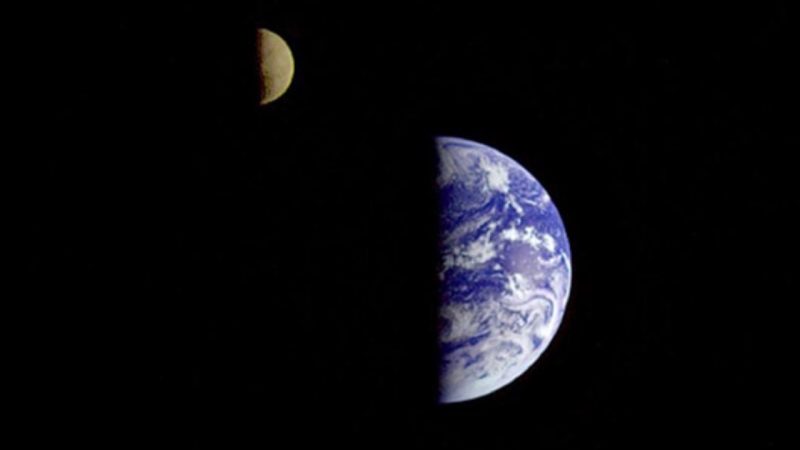
Earth's spin: Right half the moon and right half of the Earth from space. Black background.
The Galileo spacecraft captured this image of the Earth and moon in 1992. A few ancient astronomers proposed Earth’s spin after studying the motion of stars in the sky. Image via NASA.

We live in uncertain times. But things are always so much more peaceful, looking up. Please help EarthSky keep going! Donate today.

Earth’s spin is constant. Why don’t we feel it?

Earth spins on its axis once in every 24-hour day. At Earth’s equator, the speed of Earth’s spin is about 1,000 miles per hour (1,600 km per hour). This day-night spin has carried you around under the sun and stars every day of your life. And yet you don’t feel Earth spinning. Why not? It’s because you and everything else – including Earth’s oceans and atmosphere – are spinning along with the Earth at the same constant speed.

If Earth’s spin was suddenly to speed up or slow down, you would definitely feel it. That’s because it would be a feeling similar to riding along in a fast car, and having someone either speed up or slam on the brakes!

Think about riding in a car or flying in a plane. If the ride is going smoothly, you can almost convince yourself you’re not moving. A jumbo jet flies at about 500 miles per hour (about 800 kph), or about half as fast as the Earth spins at its equator. But, while you’re riding on that jet, if you close your eyes, you don’t feel like you’re moving at all. And when the flight attendant comes by and pours coffee into your cup, the coffee doesn’t fly to the back of the plane. That’s because the coffee, the cup and you are all moving at the same rate as the plane.

Now think about what would happen if the car or plane wasn’t moving at a constant rate. But instead, it is speeding up and slowing down. Then, when the flight attendant poured your coffee … look out!

Discovering the Earth rotates on its axis

The constant spin of the Earth had our ancestors confused about the true nature of the cosmos. They noticed that the stars, the sun, and the moon all appeared to move above the Earth. However, they couldn’t feel the Earth move. So, they logically interpreted this observation to mean that Earth was stationary and “the heavens” moved above us.

With the notable exception of the early Greek scientist Aristarchus of Samos, the world’s great thinkers upheld the geocentric (Earth-centered) idea of the cosmos for many centuries. In fact, Aristarchus first proposed a heliocentric (sun-centered) model of the universe hundreds of years BCE.

It wasn’t until the 16th century that the heliocentric model of Copernicus began to be discussed and understood. While not without errors, Copernicus’ model eventually convinced the world that Earth spun on its axis beneath the stars. And it also moved in orbit around the sun.

By the way, a time exposure of the northern sky reveals the apparent motion of all the stars around Polaris, the North Star. And this apparent motion is due to Earth’s spin. An example of “star trails” is below.

Arcs of light circling around one spot.
View at EarthSky Community Photos. | Jeff Grubbs in Elgin, Arizona, captured these star trails on May 22, 2025. Thanks, Jeff! You can see all the stars circling around the star Polaris. Learn how to create photos of star trails with long exposures.

Bottom line: We don’t feel Earth spin on its axis because Earth’s spin is steady – and moves at a constant rate in orbit around the sun – carrying us as passengers right along with it.

Read more: Our solar system is moving 3 times faster than expected

The post Why don’t we feel Earth’s spin? first appeared on EarthSky.


from EarthSky https://ift.tt/sHQ8nRj
Earth's spin: Right half the moon and right half of the Earth from space. Black background.
The Galileo spacecraft captured this image of the Earth and moon in 1992. A few ancient astronomers proposed Earth’s spin after studying the motion of stars in the sky. Image via NASA.

We live in uncertain times. But things are always so much more peaceful, looking up. Please help EarthSky keep going! Donate today.

Earth’s spin is constant. Why don’t we feel it?

Earth spins on its axis once in every 24-hour day. At Earth’s equator, the speed of Earth’s spin is about 1,000 miles per hour (1,600 km per hour). This day-night spin has carried you around under the sun and stars every day of your life. And yet you don’t feel Earth spinning. Why not? It’s because you and everything else – including Earth’s oceans and atmosphere – are spinning along with the Earth at the same constant speed.

If Earth’s spin was suddenly to speed up or slow down, you would definitely feel it. That’s because it would be a feeling similar to riding along in a fast car, and having someone either speed up or slam on the brakes!

Think about riding in a car or flying in a plane. If the ride is going smoothly, you can almost convince yourself you’re not moving. A jumbo jet flies at about 500 miles per hour (about 800 kph), or about half as fast as the Earth spins at its equator. But, while you’re riding on that jet, if you close your eyes, you don’t feel like you’re moving at all. And when the flight attendant comes by and pours coffee into your cup, the coffee doesn’t fly to the back of the plane. That’s because the coffee, the cup and you are all moving at the same rate as the plane.

Now think about what would happen if the car or plane wasn’t moving at a constant rate. But instead, it is speeding up and slowing down. Then, when the flight attendant poured your coffee … look out!

Discovering the Earth rotates on its axis

The constant spin of the Earth had our ancestors confused about the true nature of the cosmos. They noticed that the stars, the sun, and the moon all appeared to move above the Earth. However, they couldn’t feel the Earth move. So, they logically interpreted this observation to mean that Earth was stationary and “the heavens” moved above us.

With the notable exception of the early Greek scientist Aristarchus of Samos, the world’s great thinkers upheld the geocentric (Earth-centered) idea of the cosmos for many centuries. In fact, Aristarchus first proposed a heliocentric (sun-centered) model of the universe hundreds of years BCE.

It wasn’t until the 16th century that the heliocentric model of Copernicus began to be discussed and understood. While not without errors, Copernicus’ model eventually convinced the world that Earth spun on its axis beneath the stars. And it also moved in orbit around the sun.

By the way, a time exposure of the northern sky reveals the apparent motion of all the stars around Polaris, the North Star. And this apparent motion is due to Earth’s spin. An example of “star trails” is below.

Arcs of light circling around one spot.
View at EarthSky Community Photos. | Jeff Grubbs in Elgin, Arizona, captured these star trails on May 22, 2025. Thanks, Jeff! You can see all the stars circling around the star Polaris. Learn how to create photos of star trails with long exposures.

Bottom line: We don’t feel Earth spin on its axis because Earth’s spin is steady – and moves at a constant rate in orbit around the sun – carrying us as passengers right along with it.

Read more: Our solar system is moving 3 times faster than expected

The post Why don’t we feel Earth’s spin? first appeared on EarthSky.


from EarthSky https://ift.tt/sHQ8nRj

Colorful life on exoplanets might be lurking in clouds

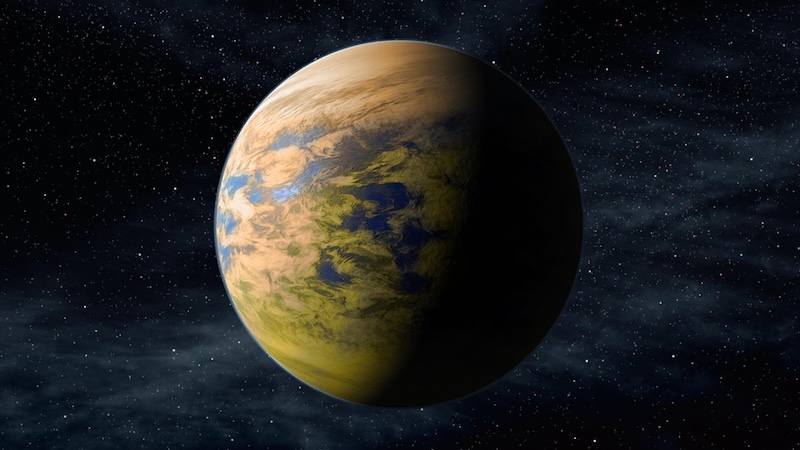
Colorful life on exoplanets: Rocky planet with bright, colorful clouds in its atmosphere.
View larger. | Artist’s concept of a rocky planet like Earth with colorful microbes in its clouds. The microorganisms have biopigments similar to ones on Earth. New research shows that telescopes could detect signs of such colorful life on exoplanets around distant stars. Image via Adam B. Langeveld/ Carl Sagan Institute/ Cornell University. Adapted from NASA/ Ames/ JPL-Caltech.

EarthSky isn’t powered by billionaires. We’re powered by you.
Support EarthSky’s 2025 Donation Campaign and help keep science accessible.

  • On Earth, colorful microbes float in the clouds and high up in the atmosphere. Could the same be true on some exoplanets around other stars?
  • Alien microbes could be detected by their colorful biopigments, a team of researchers said.
  • Such pigments could be a strong biosignature when searching for signs of life on exoplanets.

To search for life on exoplanets, look for their colors

Searching for possible signs of life on immensely distant and small exoplanets is not an easy task. But a team of scientists led by researchers at Cornell University in Ithaca, New York, have come up with a new strategy. On November 11, 2025, the researchers said they could look for the colors of microorganisms in a planet’s clouds. With this in mind, they created the first reflectance spectra – a color-coded key – of diverse and colorful microorganisms that live in the clouds here on Earth. So now, with this key, astronomers can study the clouds of an exoplanet for possible hints of life.

On Earth, the colors of the microbes come from their biopigments. These are the colors produced by living organisms, such as the iridescence of a bird wing or the pink of a flower’s petal.

Of course, any colorful microbes in exoplanet clouds would need to be abundant enough that scientists could detect them by their spectra. But it’s an intriguing new idea for searching for alien life.

The researchers published their peer-reviewed findings in The Astrophysical Journal Letters on November 11, 2025.

Colorful microbes in Earth’s clouds

On Earth, microbes are everywhere, even in the clouds. Some of those aerial organisms have distinct, colorful biopigments. Lead author and astrobiologist Lígia Coelho, at Cornell University, said:

There is a vibrant community of microorganisms in our atmosphere that produce colorful biopigments, which have fascinated biologists for years. I thought astronomers should know about them.

On Earth, microbes in the atmosphere produce their colorful pigments to help protect themselves against the stronger ultraviolet radiation from the sun, dryness and extreme temperatures.

Co-author Lisa Kaltenegger, also at Cornell University, added:

Finding colorful life in Earth’s atmosphere has opened a completely new possibility for finding life on other planets.

How To Spot Life In The Clouds On Other Worldsastrobiology.com/2025/11/how-… #astrobiology #exoplanet #biosignatures

Astrobiology (@astrobiology.bsky.social) 2025-11-12T19:48:13.505Z

Cloud microbes are rare on Earth

In Earth’s clouds, the colorful microbes are rarer than on the surface, but they are there. Coelho’s team required specialized techniques to collect them. They used a latex sounding balloon, aka a weather balloon. The researchers gathered them in the stratosphere, at between 13 and 18 miles (21 and 29 km) altitude.

As co-author Brent Christner at the University of Florida noted:

Our work has shown that cells are present in air masses at altitudes up to 38 kilometers (24 miles). At lower altitudes in the stratosphere, where ozone can provide some degree of protection from mutagenic wavelengths of UV, we recovered a number of bacteria that remain viable. A selection of these was analyzed in our current study with Lígia.

Smiling woman with eyeglasses and dark hair holding a flask with some dark liquid inside it in a laboratory.
Lígia Coelho at Cornell University is the lead author of the new study about possible colorful microbes in the atmospheres of exoplanets. Image via Lígia Coelho.

Colorful life on exoplanets, too?

The researchers said if these colorful microbes exist here on Earth, maybe they could be in the clouds of other planets, too. Kaltenegger said:

Now, we have a chance to uncover life even if the sky is filled with clouds on exoplanets. We thought clouds would hide life from us, but surprisingly they could help us find life.

Another bonus is that the colorful spectra could be a potential biosignature even when the planet is completely covered by clouds or haze. Other types of biosignatures might be obscured from detection.

The researchers determined that if a planet had widespread pigmented microbes in its clouds, it would look significantly different from a planet that did not have them. The planet hosting the microbes would also need to be humid.

Biopigments as powerful biosignatures

Since they are intrinsically connected to life, biopigments are a powerful biosignature, at least on Earth. So finding them in the clouds of an exoplanet would be strong evidence for microbial life. Coelho said:

Biopigments have a universal character on our planet. They give us tools to fight stresses like radiation, dryness and lack of resources. We produce them, and so do bacteria, archaea, algae, plants and other animals. They are powerful biosignatures and we’ve discovered a new way to look for them: through the clouds of distant worlds. And if life looks like this, we finally have the tools to recognize it.

Planet banded with turbulent blue, white and tan clouds, on black background.
View larger. | Although not the same as the colorful biosignatures, there is a still-unexplained phenomenon in Venus’ atmosphere called the unknown absorber. Something in the clouds absorbs ultraviolet light in a manner that some scientists theorize might actually be due to microbes floating in the clouds. Japan’s Akatsuki orbiter took this stunning ultraviolet image of Venus on December 23, 2016. Image via JAXA/ ISAS/ DARTS/ Kevin M. Gill/ Flickr. Used with permission.

Microbes in Venus’ clouds?

The strategy of looking for biopigments is reminiscent of the much-debated possibility of microbes in the atmosphere of Venus. That idea gained much traction in 2020 with the reported detection of phosphine, a possible biosignature gas. Also, scientists later detected ammonia.

But even before that, scientists had found a puzzling phenomenon in Venus’ atmosphere: unusual dark patches called the unknown absorbers. Basically, something in the upper atmosphere is unexpectedly absorbing ultraviolet light. Some scientists have theorized it could be microbes. The answer to this mystery is still unknown, although some recent studies have suggested that iron-bearing minerals might be responsible.

And while biopigment-type colors don’t seem to be part of the Venus phenomenon, it is a reminder that planetary atmospheres and clouds can be home to microbial life, at least on Earth.

Bottom line: Researchers suggest searching for colorful life on exoplanets by looking for spectral features similar those in Earth’s clouds caused by airborne microbes.

Source: Colors of Life in the Clouds: Biopigments of Atmospheric Microorganisms as a New Signature to Detect Life on Planets like Earth

Via Cornell University

Read more: Colors of life on exoplanets

Read more: Want to find alien life? Look for patterns of energy

The post Colorful life on exoplanets might be lurking in clouds first appeared on EarthSky.


from EarthSky https://ift.tt/hFjZOKi
Colorful life on exoplanets: Rocky planet with bright, colorful clouds in its atmosphere.
View larger. | Artist’s concept of a rocky planet like Earth with colorful microbes in its clouds. The microorganisms have biopigments similar to ones on Earth. New research shows that telescopes could detect signs of such colorful life on exoplanets around distant stars. Image via Adam B. Langeveld/ Carl Sagan Institute/ Cornell University. Adapted from NASA/ Ames/ JPL-Caltech.

EarthSky isn’t powered by billionaires. We’re powered by you.
Support EarthSky’s 2025 Donation Campaign and help keep science accessible.

  • On Earth, colorful microbes float in the clouds and high up in the atmosphere. Could the same be true on some exoplanets around other stars?
  • Alien microbes could be detected by their colorful biopigments, a team of researchers said.
  • Such pigments could be a strong biosignature when searching for signs of life on exoplanets.

To search for life on exoplanets, look for their colors

Searching for possible signs of life on immensely distant and small exoplanets is not an easy task. But a team of scientists led by researchers at Cornell University in Ithaca, New York, have come up with a new strategy. On November 11, 2025, the researchers said they could look for the colors of microorganisms in a planet’s clouds. With this in mind, they created the first reflectance spectra – a color-coded key – of diverse and colorful microorganisms that live in the clouds here on Earth. So now, with this key, astronomers can study the clouds of an exoplanet for possible hints of life.

On Earth, the colors of the microbes come from their biopigments. These are the colors produced by living organisms, such as the iridescence of a bird wing or the pink of a flower’s petal.

Of course, any colorful microbes in exoplanet clouds would need to be abundant enough that scientists could detect them by their spectra. But it’s an intriguing new idea for searching for alien life.

The researchers published their peer-reviewed findings in The Astrophysical Journal Letters on November 11, 2025.

Colorful microbes in Earth’s clouds

On Earth, microbes are everywhere, even in the clouds. Some of those aerial organisms have distinct, colorful biopigments. Lead author and astrobiologist Lígia Coelho, at Cornell University, said:

There is a vibrant community of microorganisms in our atmosphere that produce colorful biopigments, which have fascinated biologists for years. I thought astronomers should know about them.

On Earth, microbes in the atmosphere produce their colorful pigments to help protect themselves against the stronger ultraviolet radiation from the sun, dryness and extreme temperatures.

Co-author Lisa Kaltenegger, also at Cornell University, added:

Finding colorful life in Earth’s atmosphere has opened a completely new possibility for finding life on other planets.

How To Spot Life In The Clouds On Other Worldsastrobiology.com/2025/11/how-… #astrobiology #exoplanet #biosignatures

Astrobiology (@astrobiology.bsky.social) 2025-11-12T19:48:13.505Z

Cloud microbes are rare on Earth

In Earth’s clouds, the colorful microbes are rarer than on the surface, but they are there. Coelho’s team required specialized techniques to collect them. They used a latex sounding balloon, aka a weather balloon. The researchers gathered them in the stratosphere, at between 13 and 18 miles (21 and 29 km) altitude.

As co-author Brent Christner at the University of Florida noted:

Our work has shown that cells are present in air masses at altitudes up to 38 kilometers (24 miles). At lower altitudes in the stratosphere, where ozone can provide some degree of protection from mutagenic wavelengths of UV, we recovered a number of bacteria that remain viable. A selection of these was analyzed in our current study with Lígia.

Smiling woman with eyeglasses and dark hair holding a flask with some dark liquid inside it in a laboratory.
Lígia Coelho at Cornell University is the lead author of the new study about possible colorful microbes in the atmospheres of exoplanets. Image via Lígia Coelho.

Colorful life on exoplanets, too?

The researchers said if these colorful microbes exist here on Earth, maybe they could be in the clouds of other planets, too. Kaltenegger said:

Now, we have a chance to uncover life even if the sky is filled with clouds on exoplanets. We thought clouds would hide life from us, but surprisingly they could help us find life.

Another bonus is that the colorful spectra could be a potential biosignature even when the planet is completely covered by clouds or haze. Other types of biosignatures might be obscured from detection.

The researchers determined that if a planet had widespread pigmented microbes in its clouds, it would look significantly different from a planet that did not have them. The planet hosting the microbes would also need to be humid.

Biopigments as powerful biosignatures

Since they are intrinsically connected to life, biopigments are a powerful biosignature, at least on Earth. So finding them in the clouds of an exoplanet would be strong evidence for microbial life. Coelho said:

Biopigments have a universal character on our planet. They give us tools to fight stresses like radiation, dryness and lack of resources. We produce them, and so do bacteria, archaea, algae, plants and other animals. They are powerful biosignatures and we’ve discovered a new way to look for them: through the clouds of distant worlds. And if life looks like this, we finally have the tools to recognize it.

Planet banded with turbulent blue, white and tan clouds, on black background.
View larger. | Although not the same as the colorful biosignatures, there is a still-unexplained phenomenon in Venus’ atmosphere called the unknown absorber. Something in the clouds absorbs ultraviolet light in a manner that some scientists theorize might actually be due to microbes floating in the clouds. Japan’s Akatsuki orbiter took this stunning ultraviolet image of Venus on December 23, 2016. Image via JAXA/ ISAS/ DARTS/ Kevin M. Gill/ Flickr. Used with permission.

Microbes in Venus’ clouds?

The strategy of looking for biopigments is reminiscent of the much-debated possibility of microbes in the atmosphere of Venus. That idea gained much traction in 2020 with the reported detection of phosphine, a possible biosignature gas. Also, scientists later detected ammonia.

But even before that, scientists had found a puzzling phenomenon in Venus’ atmosphere: unusual dark patches called the unknown absorbers. Basically, something in the upper atmosphere is unexpectedly absorbing ultraviolet light. Some scientists have theorized it could be microbes. The answer to this mystery is still unknown, although some recent studies have suggested that iron-bearing minerals might be responsible.

And while biopigment-type colors don’t seem to be part of the Venus phenomenon, it is a reminder that planetary atmospheres and clouds can be home to microbial life, at least on Earth.

Bottom line: Researchers suggest searching for colorful life on exoplanets by looking for spectral features similar those in Earth’s clouds caused by airborne microbes.

Source: Colors of Life in the Clouds: Biopigments of Atmospheric Microorganisms as a New Signature to Detect Life on Planets like Earth

Via Cornell University

Read more: Colors of life on exoplanets

Read more: Want to find alien life? Look for patterns of energy

The post Colorful life on exoplanets might be lurking in clouds first appeared on EarthSky.


from EarthSky https://ift.tt/hFjZOKi

A fast-growing supermassive black hole in the early universe

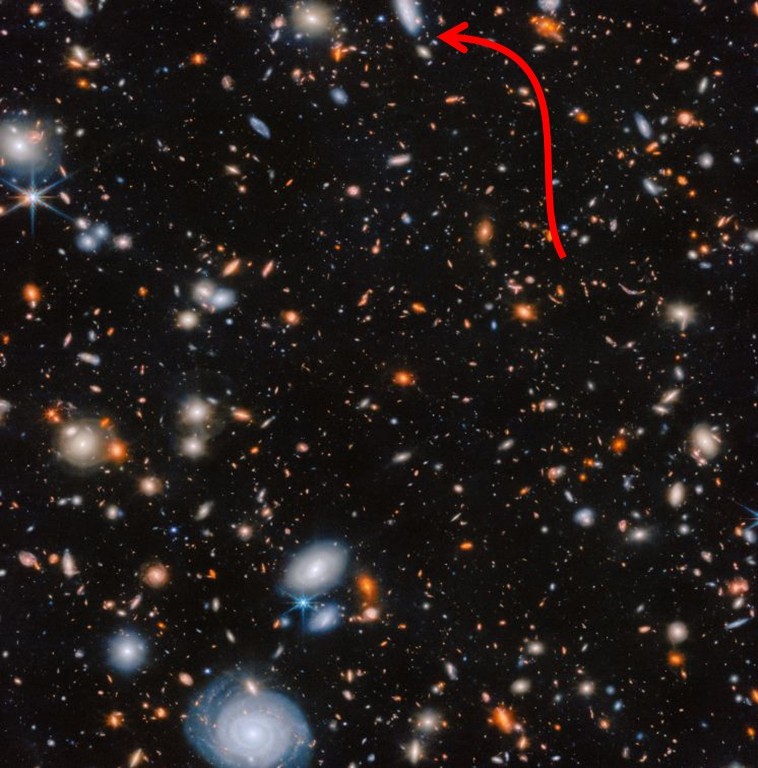
Supermassive black hole: Black background densely packed with myriads of galaxies near and far, and a red arrow pointing at a small dot.
The James Webb Space Telescope captured this image of galaxies floating through space. At top is a Little Red Dot, indicated by the arrow. (See closeup below.) It’s an extremely distant galaxy, which we see only 570 million years after the Big Bang. At the core of the galaxy is a supermassive black hole that is unusually large for the young universe. Image via ESA/ Webb, NASA & CSA, G. Rihtaršic (University of Ljubljana, FMF), R. Tripodi (University of Ljubljana, FMF) (CC BY 4.0).

Science matters. Wonder matters. You matter.
Join our 2025 Donation Campaign today.

A fast-growing supermassive black hole in the early universe

When the James Webb Space Telescope looks back in time to the earliest years of our universe, it sees Little Red Dots. Astronomers think these Little Red Dots are galaxies with growing supermassive black holes. On November 19, 2025, the European Space Agency said Webb has now spotted a Little Red Dot just 570 million years after the Big Bang with a growing supermassive black hole. The black hole is so large that it challenges current theories of galaxy formation.

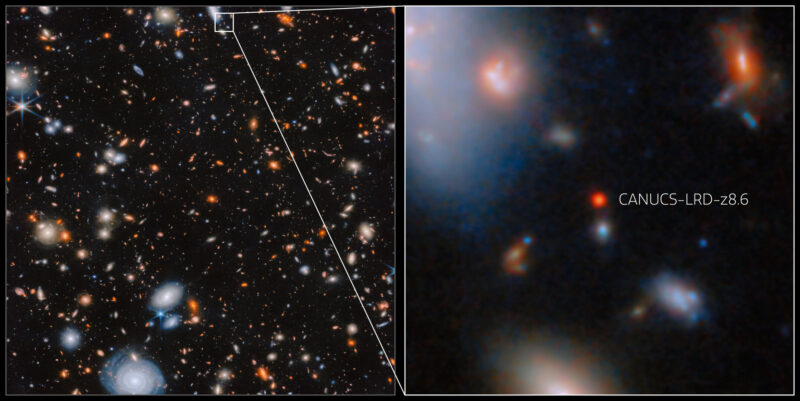
Astronomers have named the galaxy CANUCS-LRD-z8.6. The z8.6 refers to the object’s redshift, or how much light its light has shifted to the red end of the spectrum, which tells us how far away it is. So we see this galaxy as it was 570 million years after the Big Bang, or how it was more than 13 billion years ago. Other spectral features of this galaxy indicate that it contains a supermassive black hole feeding at a rapid rate. More rapid than even current theory could account for.

Lead author Roberta Tripodi of the University of Ljubljana in Slovenia and National Institute for Astrophysics in Rome said:

This discovery is truly remarkable. We’ve observed a galaxy from less than 600 million years after the Big Bang, and not only is it hosting a supermassive black hole, but the black hole is growing rapidly, far faster than we would expect in such a galaxy at this early time. This challenges our understanding of black hole and galaxy formation in the early universe and opens up new avenues of research into how these objects came to be.

The researchers published their peer-reviewed study in Nature Communications on November 19, 2025.

Spectra provide insights

When looking at the galaxy’s spectrum, the team saw gas that was highly ionized. Ionized gas is when atoms have been stripped of their electrons, usually by high temperatures. And in this case, the ionized gas suggested it was rotating quickly around a central black hole. The spectra could also tell them the black hole’s mass, and it was more than the researchers expected compared to the size of its galaxy.

In addition, they could see from the spectra that the galaxy had not yet produced many heavy elements. This confirmed that it was still young. Most of its stars had not yet had time to evolve and explode in supernovas, spreading the heavier elements.

Not only could they measure the mass of the black hole, but they could measure the mass of the galaxy’s stars. Co-author Nicholas Martis of the University of Ljubljana said:

The spectral features revealed by Webb provided clear signs of an accreting black hole at the center of the galaxy, something that could not have been observed with previous technology. What makes this even more compelling is that the galaxy’s black hole is overmassive compared to its stellar mass. This suggests that black holes in the early universe may have grown much faster than the galaxies that host them.

Rethinking old theories

With such a large black hole in such a young galaxy, astronomers are rethinking how galaxies and black holes grew in the early days of the universe. The galaxy CANUCS-LRD-z8.6 and its supermassive black hole suggest that black holes may have grown more quickly in the early universe. Co-author Maruša Bradac of the University of Ljubljana said:

This discovery is an exciting step in understanding the formation of the first supermassive black holes in the universe. The unexpected rapid growth of the black hole in this galaxy raises questions about the processes that allowed such massive objects to emerge so early. As we continue to analyze the data, we hope to find more galaxies like CANUCS-LRD-z8.6, which could provide us with even greater insights into the origins of black holes and galaxies.

Next, the team will make more observations, this time with both Webb and the Atacama Large Millimetre/submillimetre Array (ALMA). They hope to better understand how black holes and galaxies co-evolved in the first billion years of cosmic history.

At left is a dense field of galaxies, at right is a closeup showing one bright red dot.
This closeup allows you to see the Little Red Dot that is galaxy CANUCS-LRD-z8.6. It lies in the direction of the constellation Leo the Lion. We are seeing the galaxy and its supermassive black hole just 570 million years after the Big Bang. Image via ESA/ Webb, NASA & CSA, G. Rihtaršic (University of Ljubljana, FMF), R. Tripodi (University of Ljubljana, FMF) (CC BY 4.0).

Bottom line: Astronomers have spotted a galaxy in the early universe that has a supermassive black hole at its core that is much bigger than they expected.

Source: Extreme properties of a compact and massive accreting black hole host in the first 500 Myr

Via ESA

The post A fast-growing supermassive black hole in the early universe first appeared on EarthSky.


from EarthSky https://ift.tt/vKCi813
Supermassive black hole: Black background densely packed with myriads of galaxies near and far, and a red arrow pointing at a small dot.
The James Webb Space Telescope captured this image of galaxies floating through space. At top is a Little Red Dot, indicated by the arrow. (See closeup below.) It’s an extremely distant galaxy, which we see only 570 million years after the Big Bang. At the core of the galaxy is a supermassive black hole that is unusually large for the young universe. Image via ESA/ Webb, NASA & CSA, G. Rihtaršic (University of Ljubljana, FMF), R. Tripodi (University of Ljubljana, FMF) (CC BY 4.0).

Science matters. Wonder matters. You matter.
Join our 2025 Donation Campaign today.

A fast-growing supermassive black hole in the early universe

When the James Webb Space Telescope looks back in time to the earliest years of our universe, it sees Little Red Dots. Astronomers think these Little Red Dots are galaxies with growing supermassive black holes. On November 19, 2025, the European Space Agency said Webb has now spotted a Little Red Dot just 570 million years after the Big Bang with a growing supermassive black hole. The black hole is so large that it challenges current theories of galaxy formation.

Astronomers have named the galaxy CANUCS-LRD-z8.6. The z8.6 refers to the object’s redshift, or how much light its light has shifted to the red end of the spectrum, which tells us how far away it is. So we see this galaxy as it was 570 million years after the Big Bang, or how it was more than 13 billion years ago. Other spectral features of this galaxy indicate that it contains a supermassive black hole feeding at a rapid rate. More rapid than even current theory could account for.

Lead author Roberta Tripodi of the University of Ljubljana in Slovenia and National Institute for Astrophysics in Rome said:

This discovery is truly remarkable. We’ve observed a galaxy from less than 600 million years after the Big Bang, and not only is it hosting a supermassive black hole, but the black hole is growing rapidly, far faster than we would expect in such a galaxy at this early time. This challenges our understanding of black hole and galaxy formation in the early universe and opens up new avenues of research into how these objects came to be.

The researchers published their peer-reviewed study in Nature Communications on November 19, 2025.

Spectra provide insights

When looking at the galaxy’s spectrum, the team saw gas that was highly ionized. Ionized gas is when atoms have been stripped of their electrons, usually by high temperatures. And in this case, the ionized gas suggested it was rotating quickly around a central black hole. The spectra could also tell them the black hole’s mass, and it was more than the researchers expected compared to the size of its galaxy.

In addition, they could see from the spectra that the galaxy had not yet produced many heavy elements. This confirmed that it was still young. Most of its stars had not yet had time to evolve and explode in supernovas, spreading the heavier elements.

Not only could they measure the mass of the black hole, but they could measure the mass of the galaxy’s stars. Co-author Nicholas Martis of the University of Ljubljana said:

The spectral features revealed by Webb provided clear signs of an accreting black hole at the center of the galaxy, something that could not have been observed with previous technology. What makes this even more compelling is that the galaxy’s black hole is overmassive compared to its stellar mass. This suggests that black holes in the early universe may have grown much faster than the galaxies that host them.

Rethinking old theories

With such a large black hole in such a young galaxy, astronomers are rethinking how galaxies and black holes grew in the early days of the universe. The galaxy CANUCS-LRD-z8.6 and its supermassive black hole suggest that black holes may have grown more quickly in the early universe. Co-author Maruša Bradac of the University of Ljubljana said:

This discovery is an exciting step in understanding the formation of the first supermassive black holes in the universe. The unexpected rapid growth of the black hole in this galaxy raises questions about the processes that allowed such massive objects to emerge so early. As we continue to analyze the data, we hope to find more galaxies like CANUCS-LRD-z8.6, which could provide us with even greater insights into the origins of black holes and galaxies.

Next, the team will make more observations, this time with both Webb and the Atacama Large Millimetre/submillimetre Array (ALMA). They hope to better understand how black holes and galaxies co-evolved in the first billion years of cosmic history.

At left is a dense field of galaxies, at right is a closeup showing one bright red dot.
This closeup allows you to see the Little Red Dot that is galaxy CANUCS-LRD-z8.6. It lies in the direction of the constellation Leo the Lion. We are seeing the galaxy and its supermassive black hole just 570 million years after the Big Bang. Image via ESA/ Webb, NASA & CSA, G. Rihtaršic (University of Ljubljana, FMF), R. Tripodi (University of Ljubljana, FMF) (CC BY 4.0).

Bottom line: Astronomers have spotted a galaxy in the early universe that has a supermassive black hole at its core that is much bigger than they expected.

Source: Extreme properties of a compact and massive accreting black hole host in the first 500 Myr

Via ESA

The post A fast-growing supermassive black hole in the early universe first appeared on EarthSky.


from EarthSky https://ift.tt/vKCi813

Edwin Hubble born today and the expanding universe

Edwin Hubble: Black-and-white photo of a young man sitting next to a small telescope.
Edwin Hubble as a young man. It was then that he said, “If only I could find some principle for whose sake I could leave everything else and devote my life.” He found it, in astronomy. Hubble’s work in astronomy in the 20th century became the foundation for Big Bang theory. Image via this video.

Your support = more science, more stars, more wonder.
Donate to EarthSky and be part of something bigger.

Who was Edwin Hubble?

Happy birthday, Edwin Hubble, born on November 20, 1889. The Hubble Space Telescope bears his name. His work became the basis for our modern cosmology: our idea of the universe as a whole.

Hubble was a multitalented man who majored in science as an undergraduate at the University of Chicago. To keep a promise to his dying father, he studied law. In addition, he was also an amateur heavyweight boxer and reportedly turned down the chance to fight professionally. As a graduate student, he returned to science at Yerkes Observatory in Wisconsin. In 1919, he accepted a position at the prestigious Mount Wilson Observatory in California, where he remained until his death in 1953. Shortly before his death, Hubble became the first astronomer to use the newly completed, famous Hale Telescope at the Palomar Observatory near San Diego, California. At the time, the 200-inch (5.1-meter) was among the largest in the world.

Hubble helped astronomers see that we live in an expanding universe, where the galaxies are moving away from one another. This discovery is known as Hubble’s law (or the Hubble-Lemaître law). At its simplest, the law states that, the more distant the galaxy, the faster it is moving away from us. Indeed, this is at the heart of our modern cosmology. The entire universe – space, time and matter – is thought to have been born in a Big Bang.

Multicolored fuzzy specks and tiny oblongs on a black background, with text in white.
This image is the Hubble eXtreme Deep Field, released in 2012. Nearly every speck of light here is a separate galaxy beyond our Milky Way. Read more about this image here. Image via Hubble.

Edwin Hubble’s special place in the history of astronomy

More than a hundred years ago, most astronomers believed our whole universe consisted of just one galaxy: our own Milky Way. In the 1920s, Hubble was among the first to recognize that there is a universe of galaxies beyond the boundaries of our Milky Way. What a truly mind-blowing realization!

Edwin Hubble observed stars in a hazy patch of light that at the time was known as the Andromeda nebula. Specifically, Hubble observed variable stars, those that change in brightness. He measured the period of how long a star took to dim and brighten. From the period of brightening, he calculated the star’s intrinsic brightness. From that, he could calculate the distance. That’s when he realized that the stars in this nebula were so far away that it couldn’t exist within our own galaxy.

At the time, many astronomers believed that the Andromeda nebula was a forming solar system within the Milky Way’s boundaries. Hubble showed that this patch of light was really a separate galaxy. Now, thanks to Hubble, we know it today as the Andromeda galaxy. In fact, it is the nearest large spiral galaxy beyond the Milky Way.

A galaxy in Andromeda

The Andromeda galaxy is about 2.5 million light-years beyond our Milky Way. We also know that other galaxies extend around us in space for many billions of light-years. To people in the 1920s, though, this was a revelation. As soon as astronomers learned that spiral nebulae like the one in Andromeda are separate galaxies, the known universe got a whole lot bigger, indeed.

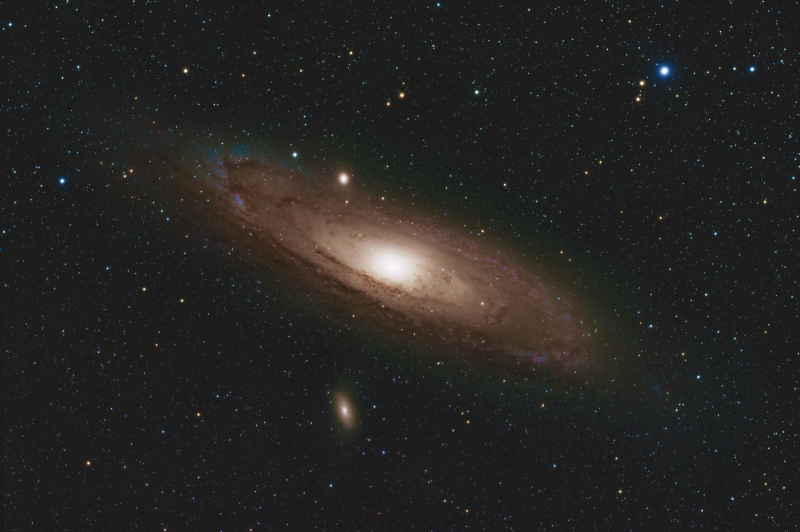
Very oblique view of fuzzy, yellowish spiral with glowing white center, dark lanes and foreground stars.
View at EarthSky Community Photos. | Paul Wilson in Paso Robles, California, captured this view of the Andromeda Galaxy on August 18, 2023. Thank you, Paul! In Hubble’s time, astronomers believed this object resided within our own Milky Way galaxy. Hubble used a class of variable stars called Cepheid variables to show that the Andromeda Galaxy is an island of stars in space external to our Milky Way.

Enter the expanding universe

But was this huge universe stationary? Or was it expanding? Or contracting?

The answer involved the light of galaxies as a whole. Astronomers observed shifts toward the red end of the spectrum in distant galaxies’ light. They interpreted this red shift as a sign that the galaxies are moving away from us. Hubble and his colleagues compared the distance estimates to other galaxies’ with their red shifts. On March 15, 1929, Hubble published his observation that the farthest galaxies are moving away faster than the closest ones.

This is the insight that initially became known as Hubble’s law.

Albert Einstein was supposedly elated to hear of Hubble’s work. Einstein’s Theory of Relativity implied that the universe must either be expanding or contracting. Einstein himself, however, had rejected this notion. Instead, he had favored the accepted idea that the universe was stationary and had always existed.

When Hubble presented his evidence of the expansion of the universe, Einstein embraced the idea. In fact, he called his adherence to the old idea his “greatest blunder.”

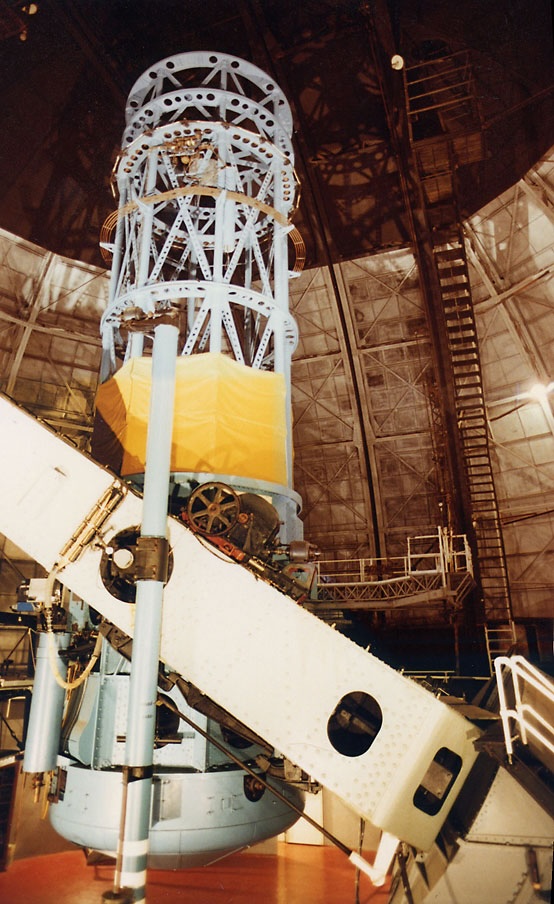
Giant telescope inside a dome.
The 100-inch (2.5 m) Hooker telescope at Mount Wilson Observatory near Los Angeles, California. This is the telescope that Edwin Hubble used to measure galaxy redshifts and discover the general expansion of the universe. Image via Andrew Dunn/ Wikimedia. Used with permission.

Renaming Hubble’s law

In late October 2018, members of the IAU voted to change the name of the Hubble law to Hubble-Lemaître law. This change gives credit to the Belgian astronomer and priest Georges Lemaître. Of the 4,060 voting astronomers (of around 11,072 eligible members), 78% favored of this change.

In the 1920s, Georges Lemaître – a Belgian Catholic priest, mathematician, astronomer – also described how the expansion of the universe causes galaxies to move away from Earth at speeds proportional to their distance.

Piero Benvenuti is a former IAU general secretary who proposed the name change. He told Nature that the new terminology is a recommendation only, saying:

If people will continue to use the Hubble law naming, nobody will object.

Read more from Nature: Belgian priest recognized in Hubble-law name change

Image of a man in a suit and dress shirt with a tie, smoking a pipe.
Edwin Hubble. Image via Johan Hagemeyer/ Wikimedia. Used with permission.

Bottom line: Edwin Hubble’s birthday is November 20, 1889. Hubble showed there are separate galaxies beyond our Milky Way and that the more distant the galaxy, the faster it moves away from us. The Hubble Space Telescope bears his name.

Hubble eXtreme Deep Field

Pandora’s Cluster is Webb’s newest deep field image

Webb observes the Hubble Ultra Deep Field

The post Edwin Hubble born today and the expanding universe first appeared on EarthSky.


from EarthSky https://ift.tt/3z4CRFM
Edwin Hubble: Black-and-white photo of a young man sitting next to a small telescope.
Edwin Hubble as a young man. It was then that he said, “If only I could find some principle for whose sake I could leave everything else and devote my life.” He found it, in astronomy. Hubble’s work in astronomy in the 20th century became the foundation for Big Bang theory. Image via this video.

Your support = more science, more stars, more wonder.
Donate to EarthSky and be part of something bigger.

Who was Edwin Hubble?

Happy birthday, Edwin Hubble, born on November 20, 1889. The Hubble Space Telescope bears his name. His work became the basis for our modern cosmology: our idea of the universe as a whole.

Hubble was a multitalented man who majored in science as an undergraduate at the University of Chicago. To keep a promise to his dying father, he studied law. In addition, he was also an amateur heavyweight boxer and reportedly turned down the chance to fight professionally. As a graduate student, he returned to science at Yerkes Observatory in Wisconsin. In 1919, he accepted a position at the prestigious Mount Wilson Observatory in California, where he remained until his death in 1953. Shortly before his death, Hubble became the first astronomer to use the newly completed, famous Hale Telescope at the Palomar Observatory near San Diego, California. At the time, the 200-inch (5.1-meter) was among the largest in the world.

Hubble helped astronomers see that we live in an expanding universe, where the galaxies are moving away from one another. This discovery is known as Hubble’s law (or the Hubble-Lemaître law). At its simplest, the law states that, the more distant the galaxy, the faster it is moving away from us. Indeed, this is at the heart of our modern cosmology. The entire universe – space, time and matter – is thought to have been born in a Big Bang.

Multicolored fuzzy specks and tiny oblongs on a black background, with text in white.
This image is the Hubble eXtreme Deep Field, released in 2012. Nearly every speck of light here is a separate galaxy beyond our Milky Way. Read more about this image here. Image via Hubble.

Edwin Hubble’s special place in the history of astronomy

More than a hundred years ago, most astronomers believed our whole universe consisted of just one galaxy: our own Milky Way. In the 1920s, Hubble was among the first to recognize that there is a universe of galaxies beyond the boundaries of our Milky Way. What a truly mind-blowing realization!

Edwin Hubble observed stars in a hazy patch of light that at the time was known as the Andromeda nebula. Specifically, Hubble observed variable stars, those that change in brightness. He measured the period of how long a star took to dim and brighten. From the period of brightening, he calculated the star’s intrinsic brightness. From that, he could calculate the distance. That’s when he realized that the stars in this nebula were so far away that it couldn’t exist within our own galaxy.

At the time, many astronomers believed that the Andromeda nebula was a forming solar system within the Milky Way’s boundaries. Hubble showed that this patch of light was really a separate galaxy. Now, thanks to Hubble, we know it today as the Andromeda galaxy. In fact, it is the nearest large spiral galaxy beyond the Milky Way.

A galaxy in Andromeda

The Andromeda galaxy is about 2.5 million light-years beyond our Milky Way. We also know that other galaxies extend around us in space for many billions of light-years. To people in the 1920s, though, this was a revelation. As soon as astronomers learned that spiral nebulae like the one in Andromeda are separate galaxies, the known universe got a whole lot bigger, indeed.

Very oblique view of fuzzy, yellowish spiral with glowing white center, dark lanes and foreground stars.
View at EarthSky Community Photos. | Paul Wilson in Paso Robles, California, captured this view of the Andromeda Galaxy on August 18, 2023. Thank you, Paul! In Hubble’s time, astronomers believed this object resided within our own Milky Way galaxy. Hubble used a class of variable stars called Cepheid variables to show that the Andromeda Galaxy is an island of stars in space external to our Milky Way.

Enter the expanding universe

But was this huge universe stationary? Or was it expanding? Or contracting?

The answer involved the light of galaxies as a whole. Astronomers observed shifts toward the red end of the spectrum in distant galaxies’ light. They interpreted this red shift as a sign that the galaxies are moving away from us. Hubble and his colleagues compared the distance estimates to other galaxies’ with their red shifts. On March 15, 1929, Hubble published his observation that the farthest galaxies are moving away faster than the closest ones.

This is the insight that initially became known as Hubble’s law.

Albert Einstein was supposedly elated to hear of Hubble’s work. Einstein’s Theory of Relativity implied that the universe must either be expanding or contracting. Einstein himself, however, had rejected this notion. Instead, he had favored the accepted idea that the universe was stationary and had always existed.

When Hubble presented his evidence of the expansion of the universe, Einstein embraced the idea. In fact, he called his adherence to the old idea his “greatest blunder.”

Giant telescope inside a dome.
The 100-inch (2.5 m) Hooker telescope at Mount Wilson Observatory near Los Angeles, California. This is the telescope that Edwin Hubble used to measure galaxy redshifts and discover the general expansion of the universe. Image via Andrew Dunn/ Wikimedia. Used with permission.

Renaming Hubble’s law

In late October 2018, members of the IAU voted to change the name of the Hubble law to Hubble-Lemaître law. This change gives credit to the Belgian astronomer and priest Georges Lemaître. Of the 4,060 voting astronomers (of around 11,072 eligible members), 78% favored of this change.

In the 1920s, Georges Lemaître – a Belgian Catholic priest, mathematician, astronomer – also described how the expansion of the universe causes galaxies to move away from Earth at speeds proportional to their distance.

Piero Benvenuti is a former IAU general secretary who proposed the name change. He told Nature that the new terminology is a recommendation only, saying:

If people will continue to use the Hubble law naming, nobody will object.

Read more from Nature: Belgian priest recognized in Hubble-law name change

Image of a man in a suit and dress shirt with a tie, smoking a pipe.
Edwin Hubble. Image via Johan Hagemeyer/ Wikimedia. Used with permission.

Bottom line: Edwin Hubble’s birthday is November 20, 1889. Hubble showed there are separate galaxies beyond our Milky Way and that the more distant the galaxy, the faster it moves away from us. The Hubble Space Telescope bears his name.

Hubble eXtreme Deep Field

Pandora’s Cluster is Webb’s newest deep field image

Webb observes the Hubble Ultra Deep Field

The post Edwin Hubble born today and the expanding universe first appeared on EarthSky.


from EarthSky https://ift.tt/3z4CRFM

Lost sisters of the Pleiades are scattered across the sky

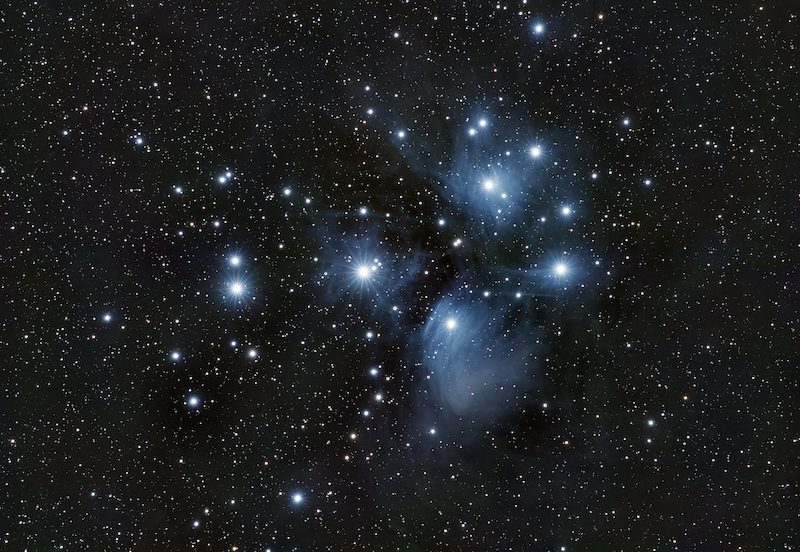
Several bright blue stars surrounded with glowing blue wisps, with many fainter stars in the background.
The Pleiades star cluster, a favorite of stargazers, is actually part of a group that has more than 3,000 stars. Image via Shireen Gonzaga.

Your support = more science, more stars, more wonder.
Donate to EarthSky and be part of something bigger.

  • Astronomers have discovered that the Pleiades star cluster has more than 3,000 sibling stars scattered across the sky. They formed from the same giant gas cloud.
  • The researchers used data from TESS and Gaia to identify these far-flung stellar siblings.
  • Known collectively as the Greater Pleiades Complex, these stars span nearly 2,000 light-years across the sky.

The 7 sisters have more than 3,000 siblings

The Pleiades star cluster – aka the Seven Sisters – is a favorite of stargazers. This much-loved pattern of stars, currently visible in the eastern evening sky, is an open star cluster. Stars in open clusters are young and formed from the same giant molecular gas cloud. Previous studies said there were about 1,000 stars in the Pleiades. But on November 12, 2025, astronomers at the University of North Carolina at Chapel Hill said they’ve discovered many more of its stellar siblings scattered across the sky. In fact, the new count includes more than 3,000 stars. These stars originated from the same molecular gas cloud, and they’re in the process of moving farther away from home.

Lead author Andrew Boyle of the University of North Carolina at Chapel Hill said:

This study changes how we see the Pleiades: not just seven bright stars, but thousands of long-lost siblings scattered across the whole sky.

And co-author Andrew Mann of the University of North Carolina at Chapel Hill added:

We’re realizing that many stars near the sun are part of massive extended stellar families with complex structures. Our work provides a new way to uncover these hidden relationships.

The researchers published their findings in the peer-reviewed Astrophysical Journal on November 12, 2025.

The birth of stars

Groups of stars, which can have thousands of members, develop in enormous molecular gas clouds. In each of these clouds, massive clumps of gas undergo gravitational collapse to form protostars. Eventually, nuclear fusion ignites within their cores to create young stars.

As the gases clear out, the sibling stars appear in the sky as an open star cluster. To date, astronomers have found more than 1,100 open star clusters in our home galaxy, the Milky Way.

Over timescales of several million years, stars in an open cluster disperse. That is what’s happening right now in the Pleiades.

Tracking down Pleiades sibling stars

The study, funded by the National Science Foundation, used sophisticated statistical techniques to analyze data from several thousand nearby stars. The goal was to identify potential siblings of the Pleiades. Researchers used data from NASA’s Transiting Exoplanet Survey Satellite (TESS). In addition, they looked at data from the Gaia space telescope, which the European Space Agency recently decommissioned.

A key property they examined was the spin rate of the stars. This is a sort of cosmic clock to roughly determine the age of stars. They can look at this property because young stars spin rapidly while older stars spin more slowly.

The team looked at the rotation measurements of nearby stars from TESS. They also used data from Gaia to study the precise positions and motions of the stars. Then, they combined these data to identify the most likely candidates that once belonged to the Pleiades. Boyle said:

By measuring how stars spin, we can identify stellar groups too scattered to detect with traditional methods, opening a new window into the hidden architecture of our galaxy.

The sisterhood of the Pleiades

As a result, the astronomers uncovered more than 3,000 stars distributed over almost 2,000 light-years. They named it the Greater Pleiades Complex.

The scientists based their conclusions on several factors. For instance, these stars had roughly the same ages. Moreover, they had similar velocities (speed and direction) in space and similar chemical abundances. With this information, the researchers identified stars that they could trace back to have originated from the same giant molecular cloud.

Are there more undiscovered stars in the Greater Pleiades Complex? Looking ahead, a new batch of data from Gaia – which the mission team has not yet released – may provide more clues. In addition, the new Vera C. Rubin Telescope will soon provide a treasure trove of more data. The scientists also hope to apply their analysis techniques to study other open star clusters. And, they say, this work will help them better understand how star systems form and evolve, including our own solar neighborhood.

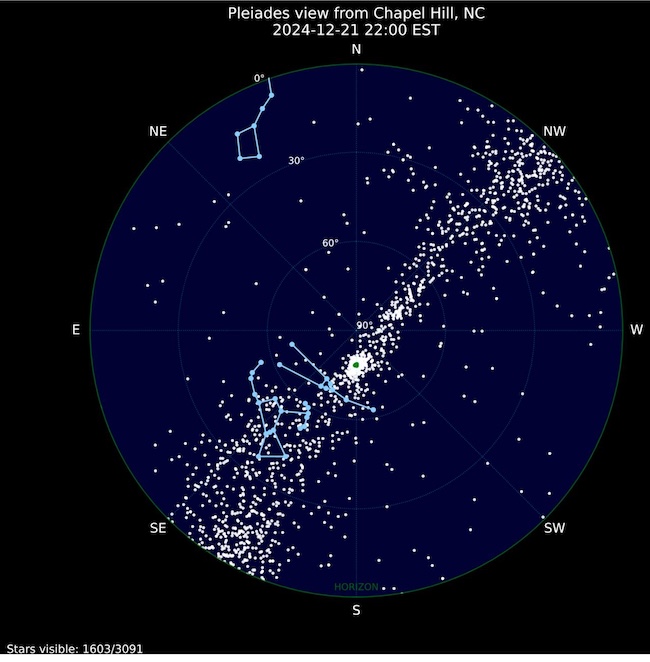
Diagram of sky with many stars in a long streak, the Pleiades in the center, and 3 constellations outlined.
Near the center of this sky chart is the Pleiades star cluster, in green. The white dots spreading out from the 7 Sisters represent the Greater Pleiades Complex scattered across the night sky. Only 1,603 of the 3,091 stars appear in the plot. The blue lines show Orion, Taurus and the Big Dipper. Image via Boyle, A. W. et al./ Astrophysical Journal.
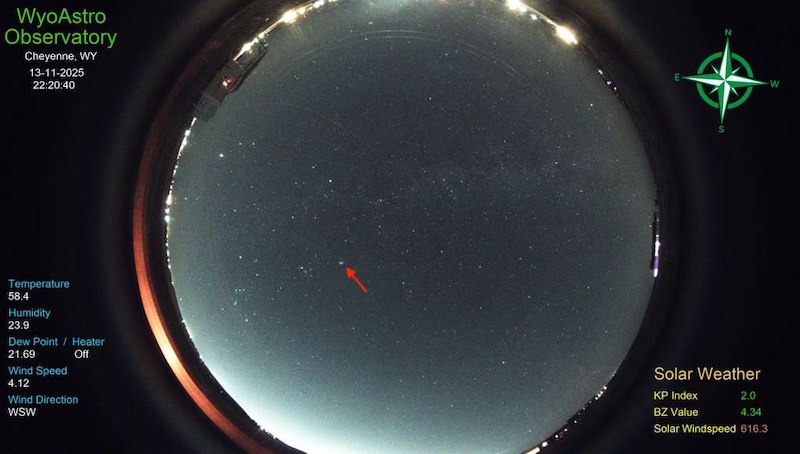
A circular image of the whole starry sky with a tiny group of stars marked with an arrow.
This all-sky image taken on November 13, 2025 in Wyoming shows a view of the night sky. The red arrow points at the Pleiades star cluster, showing its prominence among the stars. Image via Marcy Curran/ WyoAstro Observatory.

The Pleiades, an iconic asterism in the night sky

The Pleiades star cluster is an asterism – or popular grouping of stars – which is also known as the Seven Sisters and Messier 45. In addition, it is known as Subaru in Japan and even has a popular line of cars named after it. Across the world, this iconic star cluster is associated with many ancient mythologies. It’s even mentioned three times in the Hebrew Bible (Old Testament) by its Hebrew name, Khima.

A metal oval with 6 4-pointed shiny metal stars of different sizes arranged like the Pleiades.
The Subaru car logo depicts the Pleiades star cluster as 6 stars. Most people see 6, not 7 stars, as you need very good eyesight. Image via Shireen Gonzaga.

Where to find the Pleiades star cluster

The Pleiades is 444 light-years away, making it one of the closest open clusters. It’s located in the constellation Taurus the Bull. Moreover, astronomers think its stars formed about 127 million years ago, at a time when early Cretaceous dinosaurs roamed the Earth.

Most of the stars in the Pleiades are bright, hot, blue stars. You can also see dust clouds around those stars in long-exposure images. However, astronomers have concluded these are not the remnants of the gas cloud that birthed the stars. Instead, the stars happen to be moving through an unrelated dust cloud.

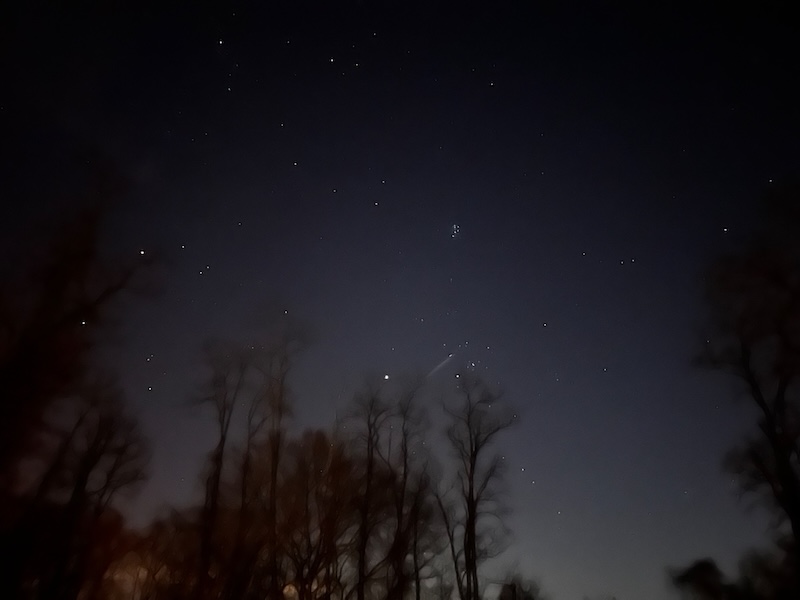
The starry night sky with trees at the bottom and a tiny bunch of stars in the middle above.
View at EarthSky Community Photos. | Sudhir Sharma took this image with an iPhone 13 Pro on December 17, 2024, from Stormville, New York. In it, you can see the Pleiades in the upper center. Thank you, Sudhir, for this lovely photo!

Bottom line: Astronomers have discovered that the Pleiades star cluster has more than 3,000 sibling stars that originated from the same giant molecular cloud.

Source: Lost Sisters Found: TESS and Gaia Reveal a Dissolving Pleiades Complex

Via the University of North Carolina at Chapel Hill

Read more: The Pleiades – or 7 Sisters – known around the world

Read more: Messier objects are fuzzy patches in the night sky

The post Lost sisters of the Pleiades are scattered across the sky first appeared on EarthSky.


from EarthSky https://ift.tt/wY6DSzh
Several bright blue stars surrounded with glowing blue wisps, with many fainter stars in the background.
The Pleiades star cluster, a favorite of stargazers, is actually part of a group that has more than 3,000 stars. Image via Shireen Gonzaga.

Your support = more science, more stars, more wonder.
Donate to EarthSky and be part of something bigger.

  • Astronomers have discovered that the Pleiades star cluster has more than 3,000 sibling stars scattered across the sky. They formed from the same giant gas cloud.
  • The researchers used data from TESS and Gaia to identify these far-flung stellar siblings.
  • Known collectively as the Greater Pleiades Complex, these stars span nearly 2,000 light-years across the sky.

The 7 sisters have more than 3,000 siblings

The Pleiades star cluster – aka the Seven Sisters – is a favorite of stargazers. This much-loved pattern of stars, currently visible in the eastern evening sky, is an open star cluster. Stars in open clusters are young and formed from the same giant molecular gas cloud. Previous studies said there were about 1,000 stars in the Pleiades. But on November 12, 2025, astronomers at the University of North Carolina at Chapel Hill said they’ve discovered many more of its stellar siblings scattered across the sky. In fact, the new count includes more than 3,000 stars. These stars originated from the same molecular gas cloud, and they’re in the process of moving farther away from home.

Lead author Andrew Boyle of the University of North Carolina at Chapel Hill said:

This study changes how we see the Pleiades: not just seven bright stars, but thousands of long-lost siblings scattered across the whole sky.

And co-author Andrew Mann of the University of North Carolina at Chapel Hill added:

We’re realizing that many stars near the sun are part of massive extended stellar families with complex structures. Our work provides a new way to uncover these hidden relationships.

The researchers published their findings in the peer-reviewed Astrophysical Journal on November 12, 2025.

The birth of stars

Groups of stars, which can have thousands of members, develop in enormous molecular gas clouds. In each of these clouds, massive clumps of gas undergo gravitational collapse to form protostars. Eventually, nuclear fusion ignites within their cores to create young stars.

As the gases clear out, the sibling stars appear in the sky as an open star cluster. To date, astronomers have found more than 1,100 open star clusters in our home galaxy, the Milky Way.

Over timescales of several million years, stars in an open cluster disperse. That is what’s happening right now in the Pleiades.

Tracking down Pleiades sibling stars

The study, funded by the National Science Foundation, used sophisticated statistical techniques to analyze data from several thousand nearby stars. The goal was to identify potential siblings of the Pleiades. Researchers used data from NASA’s Transiting Exoplanet Survey Satellite (TESS). In addition, they looked at data from the Gaia space telescope, which the European Space Agency recently decommissioned.

A key property they examined was the spin rate of the stars. This is a sort of cosmic clock to roughly determine the age of stars. They can look at this property because young stars spin rapidly while older stars spin more slowly.

The team looked at the rotation measurements of nearby stars from TESS. They also used data from Gaia to study the precise positions and motions of the stars. Then, they combined these data to identify the most likely candidates that once belonged to the Pleiades. Boyle said:

By measuring how stars spin, we can identify stellar groups too scattered to detect with traditional methods, opening a new window into the hidden architecture of our galaxy.

The sisterhood of the Pleiades

As a result, the astronomers uncovered more than 3,000 stars distributed over almost 2,000 light-years. They named it the Greater Pleiades Complex.

The scientists based their conclusions on several factors. For instance, these stars had roughly the same ages. Moreover, they had similar velocities (speed and direction) in space and similar chemical abundances. With this information, the researchers identified stars that they could trace back to have originated from the same giant molecular cloud.

Are there more undiscovered stars in the Greater Pleiades Complex? Looking ahead, a new batch of data from Gaia – which the mission team has not yet released – may provide more clues. In addition, the new Vera C. Rubin Telescope will soon provide a treasure trove of more data. The scientists also hope to apply their analysis techniques to study other open star clusters. And, they say, this work will help them better understand how star systems form and evolve, including our own solar neighborhood.

Diagram of sky with many stars in a long streak, the Pleiades in the center, and 3 constellations outlined.
Near the center of this sky chart is the Pleiades star cluster, in green. The white dots spreading out from the 7 Sisters represent the Greater Pleiades Complex scattered across the night sky. Only 1,603 of the 3,091 stars appear in the plot. The blue lines show Orion, Taurus and the Big Dipper. Image via Boyle, A. W. et al./ Astrophysical Journal.
A circular image of the whole starry sky with a tiny group of stars marked with an arrow.
This all-sky image taken on November 13, 2025 in Wyoming shows a view of the night sky. The red arrow points at the Pleiades star cluster, showing its prominence among the stars. Image via Marcy Curran/ WyoAstro Observatory.

The Pleiades, an iconic asterism in the night sky

The Pleiades star cluster is an asterism – or popular grouping of stars – which is also known as the Seven Sisters and Messier 45. In addition, it is known as Subaru in Japan and even has a popular line of cars named after it. Across the world, this iconic star cluster is associated with many ancient mythologies. It’s even mentioned three times in the Hebrew Bible (Old Testament) by its Hebrew name, Khima.

A metal oval with 6 4-pointed shiny metal stars of different sizes arranged like the Pleiades.
The Subaru car logo depicts the Pleiades star cluster as 6 stars. Most people see 6, not 7 stars, as you need very good eyesight. Image via Shireen Gonzaga.

Where to find the Pleiades star cluster

The Pleiades is 444 light-years away, making it one of the closest open clusters. It’s located in the constellation Taurus the Bull. Moreover, astronomers think its stars formed about 127 million years ago, at a time when early Cretaceous dinosaurs roamed the Earth.

Most of the stars in the Pleiades are bright, hot, blue stars. You can also see dust clouds around those stars in long-exposure images. However, astronomers have concluded these are not the remnants of the gas cloud that birthed the stars. Instead, the stars happen to be moving through an unrelated dust cloud.

The starry night sky with trees at the bottom and a tiny bunch of stars in the middle above.
View at EarthSky Community Photos. | Sudhir Sharma took this image with an iPhone 13 Pro on December 17, 2024, from Stormville, New York. In it, you can see the Pleiades in the upper center. Thank you, Sudhir, for this lovely photo!

Bottom line: Astronomers have discovered that the Pleiades star cluster has more than 3,000 sibling stars that originated from the same giant molecular cloud.

Source: Lost Sisters Found: TESS and Gaia Reveal a Dissolving Pleiades Complex

Via the University of North Carolina at Chapel Hill

Read more: The Pleiades – or 7 Sisters – known around the world

Read more: Messier objects are fuzzy patches in the night sky

The post Lost sisters of the Pleiades are scattered across the sky first appeared on EarthSky.


from EarthSky https://ift.tt/wY6DSzh

Uranus at opposition on November 21, 2025

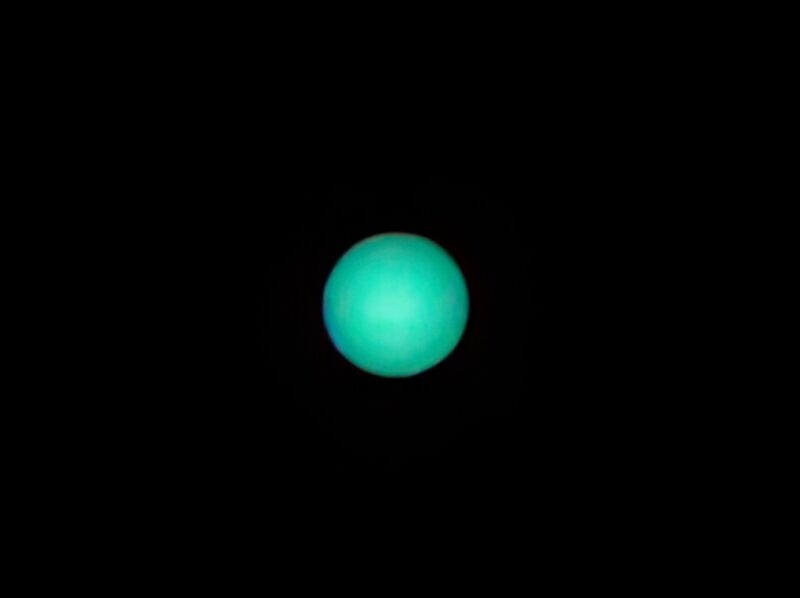
Uranus at opposition: Green sphere that is a little lighter in the middle. Black background.
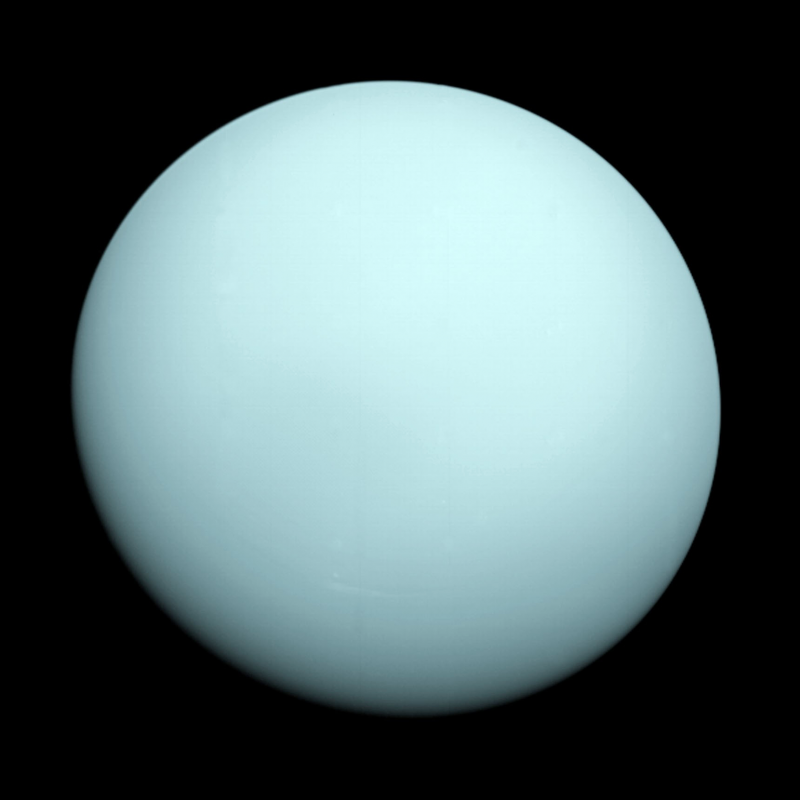
View at EarthSky Community Photos. | Nancy Ricigliano in Long Island, New York, captured this image on November 13, 2023, and wrote: “When I found out Uranus was at opposition I figured I would give it a try. I was able to capture it in an eyepiece but had a difficult time finding it with my camera. It took me about an hour but I finally found it and was thrilled to capture this planet that is the 7th planet from the sun.” Thank you! Read more about Uranus at opposition in 2025.

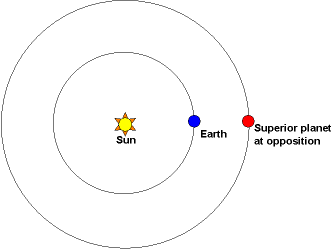
Our planet Earth will swing between the sun and the 7th planet – Uranus – at 12 UTC on November 21, 2025. That means we’re now smack in the middle of the best time of year to see this outer planet. Have you ever spotted Uranus? Indeed, it’s theoretically possible to see with the eye alone. But, in practice, Uranus is tough to locate without optical aid. Still, it’s easier with Uranus opposite the sun. It’s rising in the east as the sun sets in the west, highest in the sky at midnight.

We live in uncertain times. But things are always so much more peaceful, looking up. Please help EarthSky keep going!

Uranus at opposition

When and where to watch in 2025: Uranus is theoretically visible to the unaided eye – assuming you have good eyesight – and you are under a dark sky. And the planet is easily visible in good binoculars or a telescope. By the time of its November 21 opposition, Uranus is rising in the east at sunset and visible all night. It’ll remain in the evening sky through April of 2026.
Opposition for Uranus will fall at 12 UTC on November 21, 2025. That’s 6 a.m. CST.
Brightness at opposition: The 7th planet shines most brightly for 2025, at magnitude +5.6. In fact, Uranus shines at this brightness from about mid-October to mid-December. So, it should be possible to glimpse Uranus with the unaided eye, if you have dark-sky conditions. Find printable finder charts for Uranus here.
Distance from Earth: At opposition in 2025, Uranus is at its least distance from Earth at 2.6 light-hours or 18.5 astronomical units (AU).
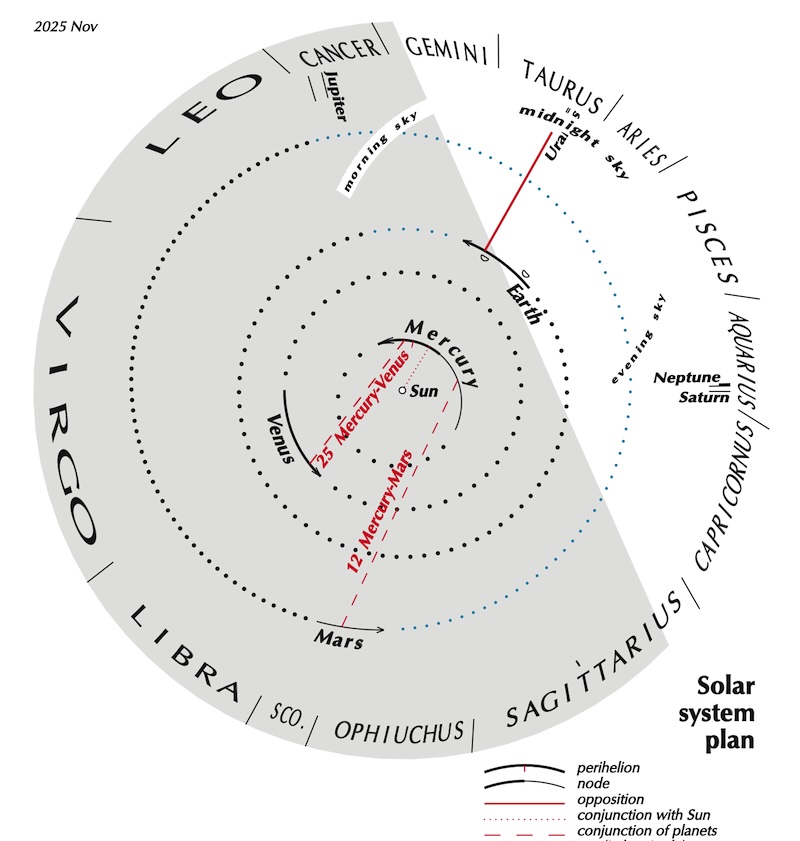
Constellation at opposition: At this 2025 opposition, Uranus is in front of the constellation Taurus the Bull.
Through a telescope: Uranus appears as a tiny, greenish disk 3.8 arcseconds across. In addition, look for up to four moons of Uranus as well.
Note: William Herschel discovered Uranus in 1781. It was the first planet to be discovered in modern times, and the first to be discovered with a telescope. It expanded the known limits of our solar system. Herschel called the new planet “the Georgium Sidus” (the Georgian Planet) in honor of King George III of England. However, the other planets were named from classical mythology. So the German astronomer Johann Elert Bode later suggested Uranus, in order to bring Uranus into conformity with the other planets’ names. In mythology, Uranus is the ancient Greek deity of the heavens, the earliest supreme god. His mythological granddaughter, Urania, is the goddess of astronomy. The name Uranus for this planet didn’t come into common use, however, until 1850.

Quick facts about oppositions

The period around opposition is the best time of the year to see an outer planet, and opposition itself is the moment at the center of that optimal viewing period.

Think of us on Earth, sweeping between the sun and Uranus in our smaller, faster orbit. Around the same time as Uranus reaches opposition, it is also making its closest approach to Earth.

Read more about opposition

Simple diagram of orbits of Earth and a superior planet.
Opposition happens when Earth flies between an outer planet, like Uranus, and the sun. Illustration via Heavens-Above. Used with permission.

For precise sun and Uranus rising times at your location:

Old Farmer’s Almanac (U.S. and Canada)

timeanddate.com (worldwide)

Stellarium (online planetarium program)

In-the-sky information and finder chart from your location

View from above the solar system, November 2025

Circle with sun at center, planets around, and zodiac names on outer edge.
Heliocentric view of solar system, November 2025. Chart via Guy Ottewell’s 2025 Astronomical Calendar. Used with permission. Plus Guy Ottewell explains heliocentric charts here.

How often is Uranus at opposition?

Uranus is the 7th planet from our sun. A year on Uranus is 84.4 Earth-years long. So, because Uranus’ orbit around the sun is so gigantic, and because Earth whips around the sun so quickly in comparison, Uranus’ opposition date falls about four days later each year.

2024 Uranus opposition – November 16
2025 Uranus opposition – November 21
2026 Uranus opposition – November 25

Smooth, featureless pale blue ball on black background.
Uranus as seen by Voyager 2 on January 14, 1986. Image via NASA/ JPL-Caltech.

Earth and Uranus at opposition

Our planet Earth swings between the sun and Uranus on November 21, 2025, placing us right at the best time of the year to see the outer planet. Why? Because in November 2025, Uranus is opposite the sun in our sky. It rises in the east as the sun sets in the west. November 21, 2025, is when Uranus reaches its yearly opposition.

And because Uranus is opposite the sun in November 2025, it climbs highest for the night at midnight (midway between sunset and sunrise). So, Uranus stays out all night long. Also, around the time of opposition, Earth’s motion brings Uranus closest to Earth for 2025. The planet shines at its brightest in our sky. How bright is that? Not very bright.

The fact is, even at its brightest, Uranus is still quite faint. Indeed, it’s barely perceptible as a dim speck of light to the unaided eye, even under dark skies. At a magnitude +5.6, Uranus shines no more brilliantly than the sky’s faintest visible stars. Given a dark sky free of light pollution, you might see Uranus with the eye alone. But you’ll need to have a good finder chart to know right where to look for this distant world in the constellation Taurus.

Distance to Uranus

At its closest point to Earth, Uranus is still twice as far away from us as its next-door neighbor, Saturn. At opposition, Uranus will be just shy of 19 astronomical units away from Earth and 20 AU from the sun. (One astronomical unit equals the average distance of Earth from the sun).

Other Uranus observing opportunities

While opposition is mathematically the best time to view Uranus due to its nearness and brightness, another great opportunity is when the dim planet is near a brighter, closer planet, or near the moon. For example, when Venus or Mars pass close to distant Uranus as seen from our point of view, we get an easy guidepost to point us to the gas giant. In fact, Venus passed 2.4 degrees south of Uranus on July 4, 2025.

Deep blue sky with scattered stars, small circled dot labeled Uranus, and larger dot labeled Venus.
View at EarthSky Community Photos. | Jim Bruzek of Dayton, Maryland, captured this image on March 30, 2023, and wrote: “Venus and Uranus at dusk from Dayton, Maryland.” Thank you, Jim!

Bottom line: Uranus reaches opposition on November 21, 2025. At this time, it’s brightest for the year and visible to the eye under optimum observing conditions. Here’s how to see it.

Read more: Seasons of Uranus, a sideways world with strange seasons

Read more: Uranus discovered by accident in 1781

See also: Geocentric ephemeris for Uranus 2025

See also: Geocentric ephemeris for the Sun: 2025

The post Uranus at opposition on November 21, 2025 first appeared on EarthSky.


from EarthSky https://ift.tt/IeMiDAT
Uranus at opposition: Green sphere that is a little lighter in the middle. Black background.
View at EarthSky Community Photos. | Nancy Ricigliano in Long Island, New York, captured this image on November 13, 2023, and wrote: “When I found out Uranus was at opposition I figured I would give it a try. I was able to capture it in an eyepiece but had a difficult time finding it with my camera. It took me about an hour but I finally found it and was thrilled to capture this planet that is the 7th planet from the sun.” Thank you! Read more about Uranus at opposition in 2025.

Our planet Earth will swing between the sun and the 7th planet – Uranus – at 12 UTC on November 21, 2025. That means we’re now smack in the middle of the best time of year to see this outer planet. Have you ever spotted Uranus? Indeed, it’s theoretically possible to see with the eye alone. But, in practice, Uranus is tough to locate without optical aid. Still, it’s easier with Uranus opposite the sun. It’s rising in the east as the sun sets in the west, highest in the sky at midnight.

We live in uncertain times. But things are always so much more peaceful, looking up. Please help EarthSky keep going!

Uranus at opposition

When and where to watch in 2025: Uranus is theoretically visible to the unaided eye – assuming you have good eyesight – and you are under a dark sky. And the planet is easily visible in good binoculars or a telescope. By the time of its November 21 opposition, Uranus is rising in the east at sunset and visible all night. It’ll remain in the evening sky through April of 2026.
Opposition for Uranus will fall at 12 UTC on November 21, 2025. That’s 6 a.m. CST.
Brightness at opposition: The 7th planet shines most brightly for 2025, at magnitude +5.6. In fact, Uranus shines at this brightness from about mid-October to mid-December. So, it should be possible to glimpse Uranus with the unaided eye, if you have dark-sky conditions. Find printable finder charts for Uranus here.
Distance from Earth: At opposition in 2025, Uranus is at its least distance from Earth at 2.6 light-hours or 18.5 astronomical units (AU).
Constellation at opposition: At this 2025 opposition, Uranus is in front of the constellation Taurus the Bull.
Through a telescope: Uranus appears as a tiny, greenish disk 3.8 arcseconds across. In addition, look for up to four moons of Uranus as well.
Note: William Herschel discovered Uranus in 1781. It was the first planet to be discovered in modern times, and the first to be discovered with a telescope. It expanded the known limits of our solar system. Herschel called the new planet “the Georgium Sidus” (the Georgian Planet) in honor of King George III of England. However, the other planets were named from classical mythology. So the German astronomer Johann Elert Bode later suggested Uranus, in order to bring Uranus into conformity with the other planets’ names. In mythology, Uranus is the ancient Greek deity of the heavens, the earliest supreme god. His mythological granddaughter, Urania, is the goddess of astronomy. The name Uranus for this planet didn’t come into common use, however, until 1850.

Quick facts about oppositions

The period around opposition is the best time of the year to see an outer planet, and opposition itself is the moment at the center of that optimal viewing period.

Think of us on Earth, sweeping between the sun and Uranus in our smaller, faster orbit. Around the same time as Uranus reaches opposition, it is also making its closest approach to Earth.

Read more about opposition

Simple diagram of orbits of Earth and a superior planet.
Opposition happens when Earth flies between an outer planet, like Uranus, and the sun. Illustration via Heavens-Above. Used with permission.

For precise sun and Uranus rising times at your location:

Old Farmer’s Almanac (U.S. and Canada)

timeanddate.com (worldwide)

Stellarium (online planetarium program)

In-the-sky information and finder chart from your location

View from above the solar system, November 2025

Circle with sun at center, planets around, and zodiac names on outer edge.
Heliocentric view of solar system, November 2025. Chart via Guy Ottewell’s 2025 Astronomical Calendar. Used with permission. Plus Guy Ottewell explains heliocentric charts here.

How often is Uranus at opposition?

Uranus is the 7th planet from our sun. A year on Uranus is 84.4 Earth-years long. So, because Uranus’ orbit around the sun is so gigantic, and because Earth whips around the sun so quickly in comparison, Uranus’ opposition date falls about four days later each year.

2024 Uranus opposition – November 16
2025 Uranus opposition – November 21
2026 Uranus opposition – November 25

Smooth, featureless pale blue ball on black background.
Uranus as seen by Voyager 2 on January 14, 1986. Image via NASA/ JPL-Caltech.

Earth and Uranus at opposition

Our planet Earth swings between the sun and Uranus on November 21, 2025, placing us right at the best time of the year to see the outer planet. Why? Because in November 2025, Uranus is opposite the sun in our sky. It rises in the east as the sun sets in the west. November 21, 2025, is when Uranus reaches its yearly opposition.

And because Uranus is opposite the sun in November 2025, it climbs highest for the night at midnight (midway between sunset and sunrise). So, Uranus stays out all night long. Also, around the time of opposition, Earth’s motion brings Uranus closest to Earth for 2025. The planet shines at its brightest in our sky. How bright is that? Not very bright.

The fact is, even at its brightest, Uranus is still quite faint. Indeed, it’s barely perceptible as a dim speck of light to the unaided eye, even under dark skies. At a magnitude +5.6, Uranus shines no more brilliantly than the sky’s faintest visible stars. Given a dark sky free of light pollution, you might see Uranus with the eye alone. But you’ll need to have a good finder chart to know right where to look for this distant world in the constellation Taurus.

Distance to Uranus

At its closest point to Earth, Uranus is still twice as far away from us as its next-door neighbor, Saturn. At opposition, Uranus will be just shy of 19 astronomical units away from Earth and 20 AU from the sun. (One astronomical unit equals the average distance of Earth from the sun).

Other Uranus observing opportunities

While opposition is mathematically the best time to view Uranus due to its nearness and brightness, another great opportunity is when the dim planet is near a brighter, closer planet, or near the moon. For example, when Venus or Mars pass close to distant Uranus as seen from our point of view, we get an easy guidepost to point us to the gas giant. In fact, Venus passed 2.4 degrees south of Uranus on July 4, 2025.

Deep blue sky with scattered stars, small circled dot labeled Uranus, and larger dot labeled Venus.
View at EarthSky Community Photos. | Jim Bruzek of Dayton, Maryland, captured this image on March 30, 2023, and wrote: “Venus and Uranus at dusk from Dayton, Maryland.” Thank you, Jim!

Bottom line: Uranus reaches opposition on November 21, 2025. At this time, it’s brightest for the year and visible to the eye under optimum observing conditions. Here’s how to see it.

Read more: Seasons of Uranus, a sideways world with strange seasons

Read more: Uranus discovered by accident in 1781

See also: Geocentric ephemeris for Uranus 2025

See also: Geocentric ephemeris for the Sun: 2025

The post Uranus at opposition on November 21, 2025 first appeared on EarthSky.


from EarthSky https://ift.tt/IeMiDAT

adds 2