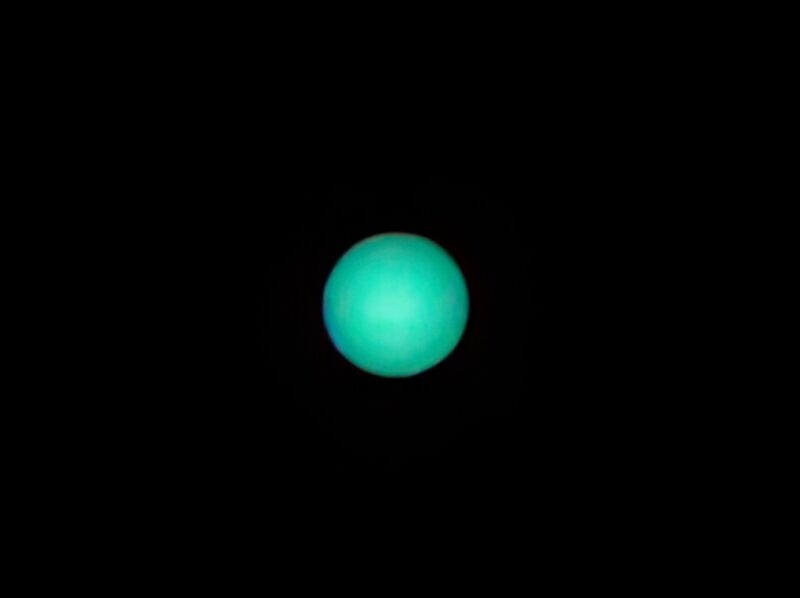
View at EarthSky Community Photos. | Nancy Ricigliano in Long Island, New York, captured this image on November 13, 2023, and wrote: “When I found out Uranus was at opposition I figured I would give it a try. I was able to capture it in an eyepiece but had a difficult time finding it with my camera. It took me about an hour but I finally found it and was thrilled to capture this planet that is the 7th planet from the sun.” Thank you! Read more about Uranus at opposition in 2025.
Our planet Earth will swing between the sun and the 7th planet – Uranus – at 12 UTC on November 21, 2025. That means we’re now smack in the middle of the best time of year to see this outer planet. Have you ever spotted Uranus? Indeed, it’s theoretically possible to see with the eye alone. But, in practice, Uranus is tough to locate without optical aid. Still, it’s easier with Uranus opposite the sun. It’s rising in the east as the sun sets in the west, highest in the sky at midnight.
When and where to watch in 2025: Uranus is theoretically visible to the unaided eye – assuming you have good eyesight – and you are under a dark sky. And the planet is easily visible in good binoculars or a telescope. By the time of its November 21 opposition, Uranus is rising in the east at sunset and visible all night. It’ll remain in the evening sky through April of 2026. Opposition for Uranus will fall at 12 UTC on November 21, 2025. That’s 6 a.m. CST. Brightness at opposition: The 7th planet shines most brightly for 2025, at magnitude +5.6. In fact, Uranus shines at this brightness from about mid-October to mid-December. So, it should be possible to glimpse Uranus with the unaided eye, if you have dark-sky conditions. Find printable finder charts for Uranus here. Distance from Earth: At opposition in 2025, Uranus is at its least distance from Earth at 2.6 light-hours or 18.5 astronomical units (AU). Constellation at opposition: At this 2025 opposition, Uranus is in front of the constellation Taurus the Bull. Through a telescope: Uranus appears as a tiny, greenish disk 3.8 arcseconds across. In addition, look for up to four moons of Uranus as well. Note: William Herschel discovered Uranus in 1781. It was the first planet to be discovered in modern times, and the first to be discovered with a telescope. It expanded the known limits of our solar system. Herschel called the new planet “the Georgium Sidus” (the Georgian Planet) in honor of King George III of England. However, the other planets were named from classical mythology. So the German astronomer Johann Elert Bode later suggested Uranus, in order to bring Uranus into conformity with the other planets’ names. In mythology, Uranus is the ancient Greek deity of the heavens, the earliest supreme god. His mythological granddaughter, Urania, is the goddess of astronomy. The name Uranus for this planet didn’t come into common use, however, until 1850.
Quick facts about oppositions
The period around opposition is the best time of the year to see an outer planet, and opposition itself is the moment at the center of that optimal viewing period.
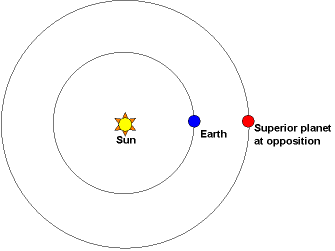
Think of us on Earth, sweeping between the sun and Uranus in our smaller, faster orbit. Around the same time as Uranus reaches opposition, it is also making its closest approach to Earth.
Uranus is the 7th planet from our sun. A year on Uranus is 84.4 Earth-years long. So, because Uranus’ orbit around the sun is so gigantic, and because Earth whips around the sun so quickly in comparison, Uranus’ opposition date falls about four days later each year.
2024 Uranus opposition – November 16
2025 Uranus opposition – November 21
2026 Uranus opposition – November 25
Uranus as seen by Voyager 2 on January 14, 1986. Image via NASA/ JPL-Caltech.
Earth and Uranus at opposition
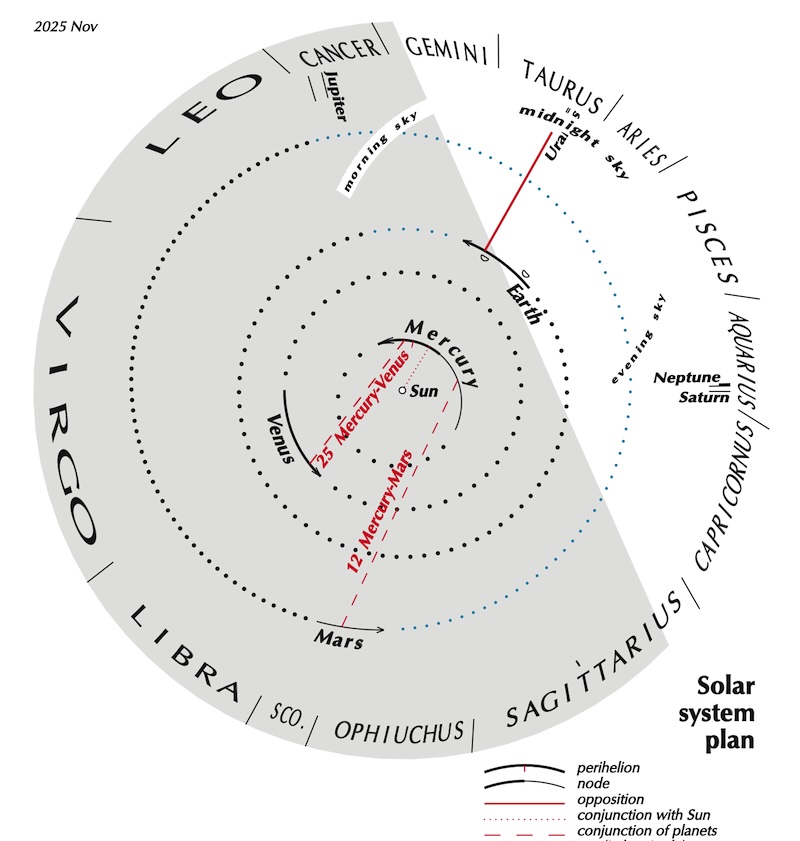
Our planet Earth swings between the sun and Uranus on November 21, 2025, placing us right at the best time of the year to see the outer planet. Why? Because in November 2025, Uranus is opposite the sun in our sky. It rises in the east as the sun sets in the west. November 21, 2025, is when Uranus reaches its yearly opposition.
And because Uranus is opposite the sun in November 2025, it climbs highest for the night at midnight (midway between sunset and sunrise). So, Uranus stays out all night long. Also, around the time of opposition, Earth’s motion brings Uranus closest to Earth for 2025. The planet shines at its brightest in our sky. How bright is that? Not very bright.
The fact is, even at its brightest, Uranus is still quite faint. Indeed, it’s barely perceptible as a dim speck of light to the unaided eye, even under dark skies. At a magnitude +5.6, Uranus shines no more brilliantly than the sky’s faintest visible stars. Given a dark sky free of light pollution, you might see Uranus with the eye alone. But you’ll need to have a good finder chart to know right where to look for this distant world in the constellation Taurus.
Distance to Uranus
At its closest point to Earth, Uranus is still twice as far away from us as its next-door neighbor, Saturn. At opposition, Uranus will be just shy of 19 astronomical units away from Earth and 20 AU from the sun. (One astronomical unit equals the average distance of Earth from the sun).
Other Uranus observing opportunities
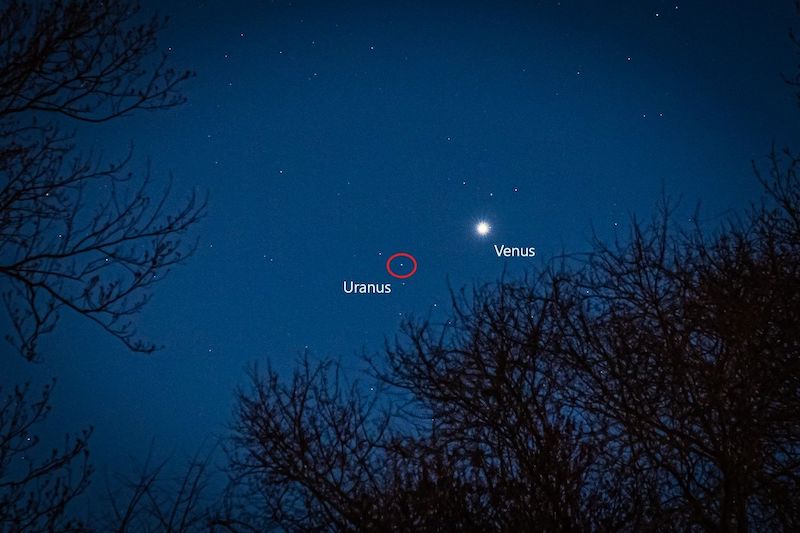
While opposition is mathematically the best time to view Uranus due to its nearness and brightness, another great opportunity is when the dim planet is near a brighter, closer planet, or near the moon. For example, when Venus or Mars pass close to distant Uranus as seen from our point of view, we get an easy guidepost to point us to the gas giant. In fact, Venus passed 2.4 degrees south of Uranus on July 4, 2025.
View at EarthSky Community Photos. | Jim Bruzek of Dayton, Maryland, captured this image on March 30, 2023, and wrote: “Venus and Uranus at dusk from Dayton, Maryland.” Thank you, Jim!
Bottom line: Uranus reaches opposition on November 21, 2025. At this time, it’s brightest for the year and visible to the eye under optimum observing conditions. Here’s how to see it.
View at EarthSky Community Photos. | Nancy Ricigliano in Long Island, New York, captured this image on November 13, 2023, and wrote: “When I found out Uranus was at opposition I figured I would give it a try. I was able to capture it in an eyepiece but had a difficult time finding it with my camera. It took me about an hour but I finally found it and was thrilled to capture this planet that is the 7th planet from the sun.” Thank you! Read more about Uranus at opposition in 2025.
Our planet Earth will swing between the sun and the 7th planet – Uranus – at 12 UTC on November 21, 2025. That means we’re now smack in the middle of the best time of year to see this outer planet. Have you ever spotted Uranus? Indeed, it’s theoretically possible to see with the eye alone. But, in practice, Uranus is tough to locate without optical aid. Still, it’s easier with Uranus opposite the sun. It’s rising in the east as the sun sets in the west, highest in the sky at midnight.
When and where to watch in 2025: Uranus is theoretically visible to the unaided eye – assuming you have good eyesight – and you are under a dark sky. And the planet is easily visible in good binoculars or a telescope. By the time of its November 21 opposition, Uranus is rising in the east at sunset and visible all night. It’ll remain in the evening sky through April of 2026. Opposition for Uranus will fall at 12 UTC on November 21, 2025. That’s 6 a.m. CST. Brightness at opposition: The 7th planet shines most brightly for 2025, at magnitude +5.6. In fact, Uranus shines at this brightness from about mid-October to mid-December. So, it should be possible to glimpse Uranus with the unaided eye, if you have dark-sky conditions. Find printable finder charts for Uranus here. Distance from Earth: At opposition in 2025, Uranus is at its least distance from Earth at 2.6 light-hours or 18.5 astronomical units (AU). Constellation at opposition: At this 2025 opposition, Uranus is in front of the constellation Taurus the Bull. Through a telescope: Uranus appears as a tiny, greenish disk 3.8 arcseconds across. In addition, look for up to four moons of Uranus as well. Note: William Herschel discovered Uranus in 1781. It was the first planet to be discovered in modern times, and the first to be discovered with a telescope. It expanded the known limits of our solar system. Herschel called the new planet “the Georgium Sidus” (the Georgian Planet) in honor of King George III of England. However, the other planets were named from classical mythology. So the German astronomer Johann Elert Bode later suggested Uranus, in order to bring Uranus into conformity with the other planets’ names. In mythology, Uranus is the ancient Greek deity of the heavens, the earliest supreme god. His mythological granddaughter, Urania, is the goddess of astronomy. The name Uranus for this planet didn’t come into common use, however, until 1850.
Quick facts about oppositions
The period around opposition is the best time of the year to see an outer planet, and opposition itself is the moment at the center of that optimal viewing period.
Think of us on Earth, sweeping between the sun and Uranus in our smaller, faster orbit. Around the same time as Uranus reaches opposition, it is also making its closest approach to Earth.
Uranus is the 7th planet from our sun. A year on Uranus is 84.4 Earth-years long. So, because Uranus’ orbit around the sun is so gigantic, and because Earth whips around the sun so quickly in comparison, Uranus’ opposition date falls about four days later each year.
2024 Uranus opposition – November 16
2025 Uranus opposition – November 21
2026 Uranus opposition – November 25
Uranus as seen by Voyager 2 on January 14, 1986. Image via NASA/ JPL-Caltech.
Earth and Uranus at opposition
Our planet Earth swings between the sun and Uranus on November 21, 2025, placing us right at the best time of the year to see the outer planet. Why? Because in November 2025, Uranus is opposite the sun in our sky. It rises in the east as the sun sets in the west. November 21, 2025, is when Uranus reaches its yearly opposition.
And because Uranus is opposite the sun in November 2025, it climbs highest for the night at midnight (midway between sunset and sunrise). So, Uranus stays out all night long. Also, around the time of opposition, Earth’s motion brings Uranus closest to Earth for 2025. The planet shines at its brightest in our sky. How bright is that? Not very bright.
The fact is, even at its brightest, Uranus is still quite faint. Indeed, it’s barely perceptible as a dim speck of light to the unaided eye, even under dark skies. At a magnitude +5.6, Uranus shines no more brilliantly than the sky’s faintest visible stars. Given a dark sky free of light pollution, you might see Uranus with the eye alone. But you’ll need to have a good finder chart to know right where to look for this distant world in the constellation Taurus.
Distance to Uranus
At its closest point to Earth, Uranus is still twice as far away from us as its next-door neighbor, Saturn. At opposition, Uranus will be just shy of 19 astronomical units away from Earth and 20 AU from the sun. (One astronomical unit equals the average distance of Earth from the sun).
Other Uranus observing opportunities
While opposition is mathematically the best time to view Uranus due to its nearness and brightness, another great opportunity is when the dim planet is near a brighter, closer planet, or near the moon. For example, when Venus or Mars pass close to distant Uranus as seen from our point of view, we get an easy guidepost to point us to the gas giant. In fact, Venus passed 2.4 degrees south of Uranus on July 4, 2025.
View at EarthSky Community Photos. | Jim Bruzek of Dayton, Maryland, captured this image on March 30, 2023, and wrote: “Venus and Uranus at dusk from Dayton, Maryland.” Thank you, Jim!
Bottom line: Uranus reaches opposition on November 21, 2025. At this time, it’s brightest for the year and visible to the eye under optimum observing conditions. Here’s how to see it.
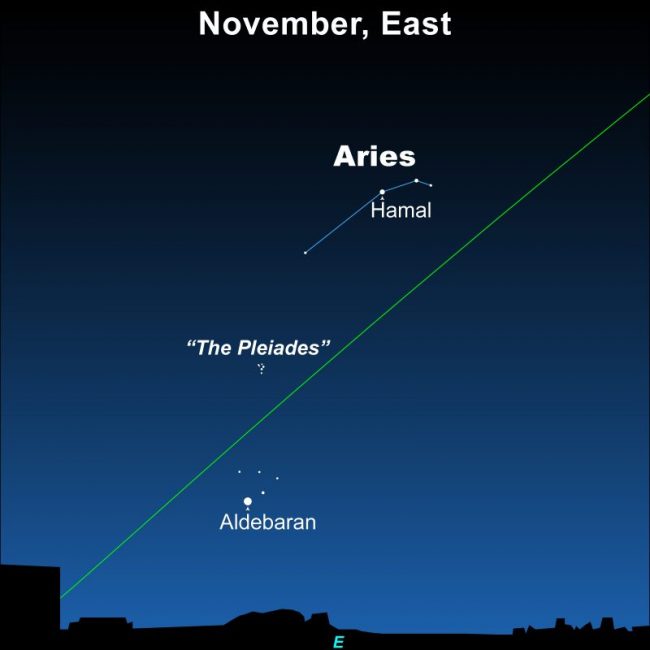
Most people see the constellation Aries the Ram as 3 stars in a compact grouping. The stars are Hamal (brightest), Sheratan and Mesarthim. Use the bright star Aldebaran and the star clusters the Hyades and Pleiades to help find Aries. Chart via EarthSky.
Start watching for Hamal in November
Hamal – also known as Alpha Arietis – shines as the brightest star in the constellation Aries the Ram. This star and two others – Sheratan and Mesarthim – make up the Head of the Ram. Aries is small. But the compact pattern of these three stars makes Aries relatively easy to find.
As seen from mid-northern latitudes, Hamal lights up the eastern sky on November evenings, will shine high in the southern sky by January evenings, and will sit low in the west by March evenings. This star is easily visible from Earth’s Southern Hemisphere, too. Try Stellarium to find Hamal’s height in your sky from your exact location on the globe.
As seen from the whole Earth, Hamal disappears from the night sky around April. It returns to the eastern sky before sunrise by about June, to begin another cycle of visibility.
Aries finder chart
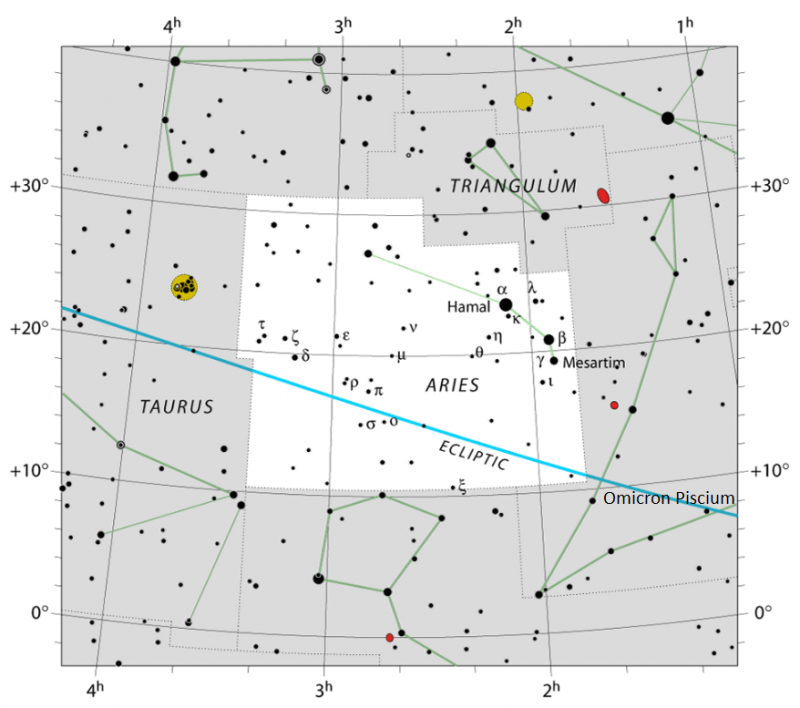
Constellation chart of Aries the Ram. Nowadays the sun passes in front of the constellation Aries from about April 19 to May 13. Image via IAU/ Wikimedia (CC BY 4.0).
Hamal was an equinox star
It’s fun to spot Hamal and its brother stars in the night sky. As an ancient equinox star, Hamal also has a profound significance in the history of astronomy.
In our modern era, if you could see the stars in daytime, you’d see the sun and Hamal in conjunction – lined up with one another, due north and south in right ascension – on or near April 24.
But, long ago, they were in conjunction exactly at the March equinox.
Nowadays, April 24 – the date of Hamal’s conjunction with the sun – is a little more than a month after the March equinox, which always takes place around March 20. This is the Northern Hemisphere’s spring equinox, and it’s a time of renewal throughout the northern half of Earth. So of course this time of year had significance to our ancestors, who were very much aware of their connection to the land and sky.
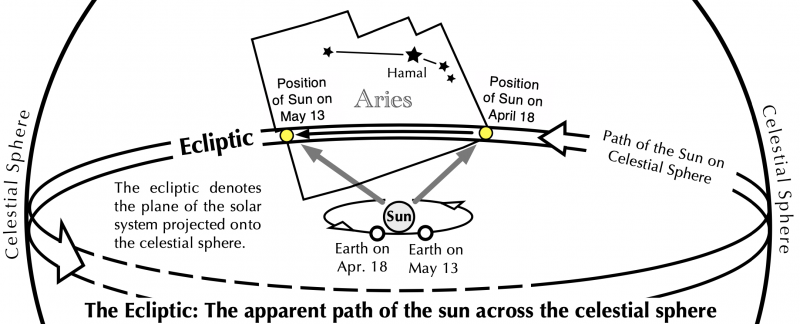
As the Earth orbits the sun, the sun appears to move across our sky, passing stars on the celestial sphere, including Hamal. In the past, the sun was in conjunction with Hamal at the March equinox. But no more. In our time, the sun is in front of the stars of Aries from April 18 until May 13. Image via John Goss.
Precession of the equinoxes
If you could backtrack some 2,500 years, you’d find the annual conjunction of the sun and Hamal happening on the March equinox. In fact, if you could backtrack 2,200 years, we’d also find the March equinox sun in conjunction with another star in Aries, Sheratan.
So you see that the location of the sun at the March equinox sun drifts in front of the stars. It moves westward in front of the backdrop constellations by about one degree (two sun diameters) every 72 years. This drifting is due to a well-known motion of Earth called precession, or sometimes the precession of the equinoxes.
The March equinox sun shone in front of the constellation Aries from about 2,000 to 100 BCE. At present, the sun shines in front of the constellation Pisces on the March equinox.
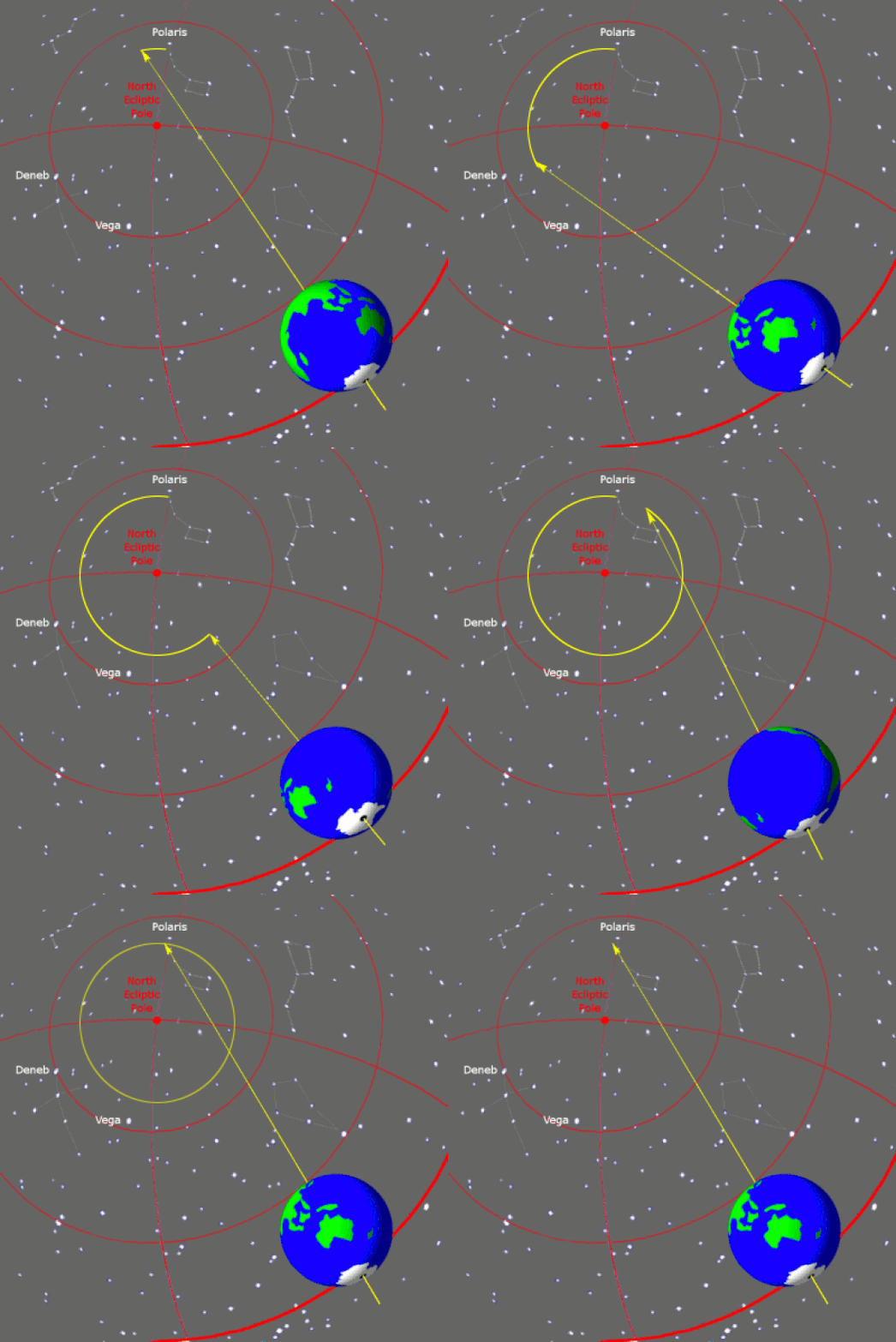
The 26,000-year cycle of precession. It’s caused by a wobble of Earth. Over this cycle, Earth’s northern axis can be imagined to trace out a circle on the celestial sphere. Therefore, precession causes Earth’s northern axis to point to different stars. Thus the identity of Earth’s pole star, or North Star, shifts over the cycle of 26,000 years. Image via Tfr000/ Wikimedia Commons (CC BY-SA 3.0).
First point of Aries
Even though the sun is no longer in front of Aries at the time of the March equinox, many people pay homage to the Ram and still refer to the March equinox point as the First Point of Aries.
This point on the celestial sphere – now in Pisces, due to precession – is one of the two points on the celestial sphere at which the celestial equator crosses the ecliptic. The other point – not as well known – is called the First Point of Libra (although it is now in Virgo), located exactly 180 degrees from it.
The First Point of Aries is considered to be the celestial “prime meridian” from which right ascension (like longitude in earthly coordinate systems) is calculated.
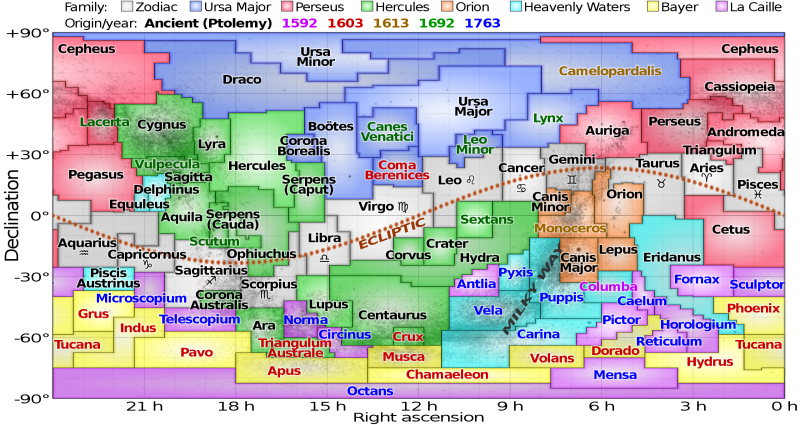
View larger. | The First Point of Aries is the point on the celestial equator at both the left and right extremes of this sky chart. The ecliptic (orange dotted sine curve) also passes through it. The First Point of Aries defines the ecliptic coordinate of 0 degrees longitude (or right ascension) and 0 degrees latitude (or declination). And note that the First Point of Aries is no longer in Aries. Now, due to precession, it’s in Pisces. Chart via Cmglee/ Timwi/ CC0/ NASA/ Wikimedia Commons (public domain).
Bottom line: The star Hamal is the brightest star in Aries the Ram. Thousands of years ago, the sun was in conjunction – or aligned north and south – with this star at the time of the March equinox.
Most people see the constellation Aries the Ram as 3 stars in a compact grouping. The stars are Hamal (brightest), Sheratan and Mesarthim. Use the bright star Aldebaran and the star clusters the Hyades and Pleiades to help find Aries. Chart via EarthSky.
Start watching for Hamal in November
Hamal – also known as Alpha Arietis – shines as the brightest star in the constellation Aries the Ram. This star and two others – Sheratan and Mesarthim – make up the Head of the Ram. Aries is small. But the compact pattern of these three stars makes Aries relatively easy to find.
As seen from mid-northern latitudes, Hamal lights up the eastern sky on November evenings, will shine high in the southern sky by January evenings, and will sit low in the west by March evenings. This star is easily visible from Earth’s Southern Hemisphere, too. Try Stellarium to find Hamal’s height in your sky from your exact location on the globe.
As seen from the whole Earth, Hamal disappears from the night sky around April. It returns to the eastern sky before sunrise by about June, to begin another cycle of visibility.
Aries finder chart
Constellation chart of Aries the Ram. Nowadays the sun passes in front of the constellation Aries from about April 19 to May 13. Image via IAU/ Wikimedia (CC BY 4.0).
Hamal was an equinox star
It’s fun to spot Hamal and its brother stars in the night sky. As an ancient equinox star, Hamal also has a profound significance in the history of astronomy.
In our modern era, if you could see the stars in daytime, you’d see the sun and Hamal in conjunction – lined up with one another, due north and south in right ascension – on or near April 24.
But, long ago, they were in conjunction exactly at the March equinox.
Nowadays, April 24 – the date of Hamal’s conjunction with the sun – is a little more than a month after the March equinox, which always takes place around March 20. This is the Northern Hemisphere’s spring equinox, and it’s a time of renewal throughout the northern half of Earth. So of course this time of year had significance to our ancestors, who were very much aware of their connection to the land and sky.
As the Earth orbits the sun, the sun appears to move across our sky, passing stars on the celestial sphere, including Hamal. In the past, the sun was in conjunction with Hamal at the March equinox. But no more. In our time, the sun is in front of the stars of Aries from April 18 until May 13. Image via John Goss.
Precession of the equinoxes
If you could backtrack some 2,500 years, you’d find the annual conjunction of the sun and Hamal happening on the March equinox. In fact, if you could backtrack 2,200 years, we’d also find the March equinox sun in conjunction with another star in Aries, Sheratan.
So you see that the location of the sun at the March equinox sun drifts in front of the stars. It moves westward in front of the backdrop constellations by about one degree (two sun diameters) every 72 years. This drifting is due to a well-known motion of Earth called precession, or sometimes the precession of the equinoxes.
The March equinox sun shone in front of the constellation Aries from about 2,000 to 100 BCE. At present, the sun shines in front of the constellation Pisces on the March equinox.
The 26,000-year cycle of precession. It’s caused by a wobble of Earth. Over this cycle, Earth’s northern axis can be imagined to trace out a circle on the celestial sphere. Therefore, precession causes Earth’s northern axis to point to different stars. Thus the identity of Earth’s pole star, or North Star, shifts over the cycle of 26,000 years. Image via Tfr000/ Wikimedia Commons (CC BY-SA 3.0).
First point of Aries
Even though the sun is no longer in front of Aries at the time of the March equinox, many people pay homage to the Ram and still refer to the March equinox point as the First Point of Aries.
This point on the celestial sphere – now in Pisces, due to precession – is one of the two points on the celestial sphere at which the celestial equator crosses the ecliptic. The other point – not as well known – is called the First Point of Libra (although it is now in Virgo), located exactly 180 degrees from it.
The First Point of Aries is considered to be the celestial “prime meridian” from which right ascension (like longitude in earthly coordinate systems) is calculated.
View larger. | The First Point of Aries is the point on the celestial equator at both the left and right extremes of this sky chart. The ecliptic (orange dotted sine curve) also passes through it. The First Point of Aries defines the ecliptic coordinate of 0 degrees longitude (or right ascension) and 0 degrees latitude (or declination). And note that the First Point of Aries is no longer in Aries. Now, due to precession, it’s in Pisces. Chart via Cmglee/ Timwi/ CC0/ NASA/ Wikimedia Commons (public domain).
Bottom line: The star Hamal is the brightest star in Aries the Ram. Thousands of years ago, the sun was in conjunction – or aligned north and south – with this star at the time of the March equinox.
If you live by the coast and are tired of seagulls stealing your food with the same confidence as your cousin raiding your fridge, this discovery is for you. A team of researchers from the University of Exeter has found — after a seaside tour of nine Cornish towns in England — that shouting at thieving seagulls works surprisingly well. Yes, you read that right: science is officially giving you permission to vent.
The research team published its study in the peer-reviewed journal Biology Letters on November 12, 2025.
Beach battles: Shout first, eat later
The experiment was simple but clever. Scientists placed a closed Tupperware filled with fries — because even science needs snacks — and waited for a curious gull to appear. As soon as the bird approached, the researchers played one of three options. The first was a man shouting “No, stay away, that’s my food!” The second was the same phrase spoken in a normal voice. And third was the relaxed song of a robin, the least intimidating soundtrack in the animal kingdom.
The results were clear. Nearly half the gulls flew away when they heard the shouting, while the normal voice only made them walk away, like someone backing off from a nosy neighbor. In contrast, 70% of the gulls stayed by the Tupperware when they heard the robin song, probably thinking: “Ah, ambient music, perfect.”
You can try to convince thieving seagulls not to steal your food … Or you can just shout. This tip is science approved. Image via Stevebidmead/ Pixabay.
Thieving seagulls are listening, choose your words wisely
The scientists adjusted all recordings to the same volume, so the gulls weren’t reacting to loudness but to how the words were said. This suggests they can detect nuances in human voices, something previously observed almost exclusively in domesticated animals accustomed to recognizing human speech. That a gull can read your passive-aggressive vibes before most people gives you something to think about.
The goal of the study was to show that you don’t need violence to convince these birds, who are just looking for food, much like us when we’re hungry. The final takeaway is simple: if a seagull is eyeing your lunch, talking to it might make it think twice. But if you want immediate results, a good shout works best. Scientifically approved and emotionally liberating. Let’s be honest: holding onto your lunch is a small but satisfying victory.
Snack attack: Seagulls on a foodie mission
Bottom line: Thieving seagulls judge your every word. Shout loud, save your fries and savor the sweet victory of a lunch defended. This is beach war!
If you live by the coast and are tired of seagulls stealing your food with the same confidence as your cousin raiding your fridge, this discovery is for you. A team of researchers from the University of Exeter has found — after a seaside tour of nine Cornish towns in England — that shouting at thieving seagulls works surprisingly well. Yes, you read that right: science is officially giving you permission to vent.
The research team published its study in the peer-reviewed journal Biology Letters on November 12, 2025.
Beach battles: Shout first, eat later
The experiment was simple but clever. Scientists placed a closed Tupperware filled with fries — because even science needs snacks — and waited for a curious gull to appear. As soon as the bird approached, the researchers played one of three options. The first was a man shouting “No, stay away, that’s my food!” The second was the same phrase spoken in a normal voice. And third was the relaxed song of a robin, the least intimidating soundtrack in the animal kingdom.
The results were clear. Nearly half the gulls flew away when they heard the shouting, while the normal voice only made them walk away, like someone backing off from a nosy neighbor. In contrast, 70% of the gulls stayed by the Tupperware when they heard the robin song, probably thinking: “Ah, ambient music, perfect.”
You can try to convince thieving seagulls not to steal your food … Or you can just shout. This tip is science approved. Image via Stevebidmead/ Pixabay.
Thieving seagulls are listening, choose your words wisely
The scientists adjusted all recordings to the same volume, so the gulls weren’t reacting to loudness but to how the words were said. This suggests they can detect nuances in human voices, something previously observed almost exclusively in domesticated animals accustomed to recognizing human speech. That a gull can read your passive-aggressive vibes before most people gives you something to think about.
The goal of the study was to show that you don’t need violence to convince these birds, who are just looking for food, much like us when we’re hungry. The final takeaway is simple: if a seagull is eyeing your lunch, talking to it might make it think twice. But if you want immediate results, a good shout works best. Scientifically approved and emotionally liberating. Let’s be honest: holding onto your lunch is a small but satisfying victory.
Snack attack: Seagulls on a foodie mission
Bottom line: Thieving seagulls judge your every word. Shout loud, save your fries and savor the sweet victory of a lunch defended. This is beach war!
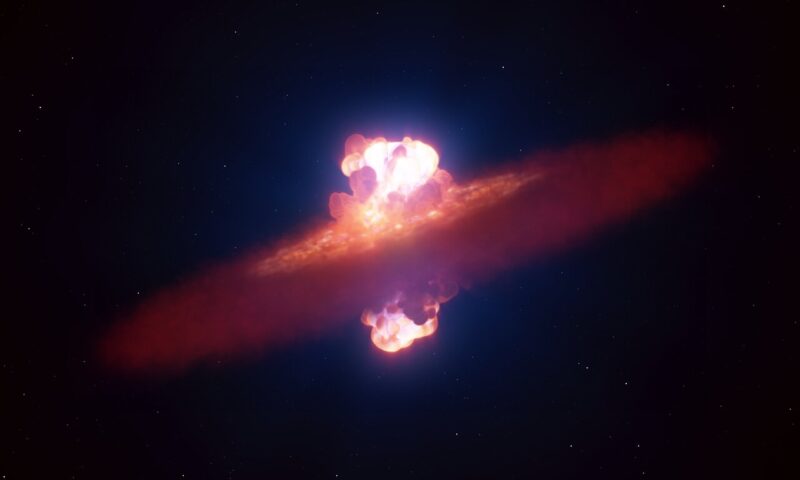
This artist’s impression shows a star going supernova. About 22 million light-years away, the supernova – SN 2024ggi – exploded in the galaxy NGC 3621. Using the ESO’s Very Large Telescope, astronomers managed to capture the very early stage of the supernova when the blast was breaking through the star’s surface. Observing the breakout so early on – just 26 hours after the supernova was first detected – revealed its true shape. The supernova broke out in an olive-like form. This marks the first ever observation of the shape of a supernova explosion at this very early stage. Image via ESO/ L. Calçada.
Astronomers captured a supernova explosion just 26 hours after it began. They used ESO’s Very Large Telescope to observe SN 2024ggi at the moment its shockwave burst through the star’s surface.
The blast was olive-shaped rather than spherical. It was the first time astronomers have seen a supernova explosion at its earliest stage.
This knowledge enables astronomers to rule out some supernova models and add new information to improve others. It provides insights into the powerful deaths of massive stars.
Shape of a supernova detected 1 day after explosion
When the supernova explosion SN 2024ggi was first detected on the night of April 10, 2024, Yi Yang, an assistant professor at Tsinghua University in Beijing, China, and the lead author of the new study, had just landed in San Francisco after a long-haul flight. He knew he had to act quickly. Twelve hours later, he had sent an observing proposal to ESO, which, after a very quick approval process, pointed its Very Large Telescope (VLT) in Chile at the supernova on April 11, just 26 hours after the initial detection.
SN 2024ggi is in the galaxy NGC 3621 in the direction of the constellation Hydra. It’s “only” 22 million light-years away, close by in astronomical terms. With a large telescope and the right instrument, the international team knew they had a rare opportunity to unravel the shape of the explosion shortly after it happened. Dietrich Baade, an ESO astronomer in Germany, is co-author of the peer-reviewed study published November 12, 2025, in Science Advances. Baade said:
The first VLT observations captured the phase during which matter – accelerated by the explosion near the center of the star – shot through the star’s surface. For a few hours, the geometry of the star and its explosion could be, and were, observed together.
Yang said:
The geometry of a supernova explosion provides fundamental information on stellar evolution and the physical processes leading to these cosmic fireworks.
Watch a video about the shape of a supernova.
A massive star explodes
Scientists are still debating the exact mechanisms behind supernova explosions of massive stars, those with more than eight times the mass of the sun. It’s a fundamental question scientists want to address. This supernova’s progenitor was a red supergiant star. It had a mass 12 to 15 times that of the sun and a radius 500 times larger. Thus, SN 2024ggi is a classical example of a massive-star explosion.
During its life, a typical star keeps its spherical shape due to a precise equilibrium of the gravitational force that wants to squeeze it and the pressure of its nuclear engine that wants to expand it. When it runs out of fuel, the nuclear engine starts sputtering. For massive stars, this marks the beginning of a supernova. The core of the dying star collapses, the mass shells around fall onto it and bounce off. This rebound shock then propagates outward, disrupting the star.
Once the shock breaks through the surface, it unleashes immense amounts of energy. The supernova then brightens dramatically to the point we can observe it. During a short-lived phase, we can study the supernova’s initial “breakout” shape before the explosion interacts with the material surrounding the dying star.
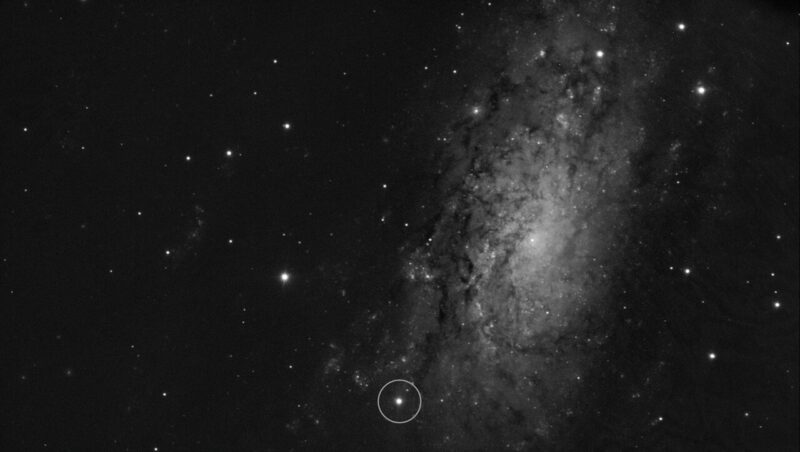
This image shows the location of the supernova SN 2024ggi in the galaxy NGC 3621. The image is from April 11, 2024, just 26 hours after the initial detection of the supernova. The FORS2 instrument on ESO’s Very Large Telescope (VLT) captured the image. FORS2 enables astronomers to obtain spectra in polarized light. This technique provides crucial information about the shape of the explosion even though it appears as a single point as seen from Earth. Image via ESO/ Y. Yang et al.
Revealing the shape of a supernova
This is what astronomers have now achieved for the very first time with ESO’s VLT, using a technique called “spectropolarimetry.” Lifan Wang, co-author and professor at Texas A&M University in the U.S., was a student at ESO at the start of his astronomy career. Wang said:
Spectropolarimetry delivers information about the geometry of the explosion that other types of observation cannot provide because the angular scales are too tiny.
Even though the exploding star appears as a single point, the polarization of its light carries hidden clues about its geometry, which the team was able to unravel.
A blast shaped like an olive
The FORS2 instrument installed on the VLT captured the blast. With the FORS2 data, astronomers found the initial blast of material was shaped like an olive. As the explosion spread outward and collided with the matter around the star, the shape flattened. But the axis of symmetry of the ejecta remained the same. Yang said:
These findings suggest a common physical mechanism that drives the explosion of many massive stars, which manifests a well-defined axial symmetry and acts on large scales.
So now, astronomers can already rule out some of the current supernova models and add new information to improve others. The information provides insights into the powerful deaths of massive stars. Co-author and ESO astronomer Ferdinando Patat said:
This discovery not only reshapes our understanding of stellar explosions, but also demonstrates what can be achieved when science transcends borders. It’s a powerful reminder that curiosity, collaboration and swift action can unlock profound insights into the physics shaping our universe.
Bottom line: After a supernova exploded in a distant galaxy, astronomers used quick work to point a telescope at the blast and detect the shape of a supernova just one day later.
This artist’s impression shows a star going supernova. About 22 million light-years away, the supernova – SN 2024ggi – exploded in the galaxy NGC 3621. Using the ESO’s Very Large Telescope, astronomers managed to capture the very early stage of the supernova when the blast was breaking through the star’s surface. Observing the breakout so early on – just 26 hours after the supernova was first detected – revealed its true shape. The supernova broke out in an olive-like form. This marks the first ever observation of the shape of a supernova explosion at this very early stage. Image via ESO/ L. Calçada.
Astronomers captured a supernova explosion just 26 hours after it began. They used ESO’s Very Large Telescope to observe SN 2024ggi at the moment its shockwave burst through the star’s surface.
The blast was olive-shaped rather than spherical. It was the first time astronomers have seen a supernova explosion at its earliest stage.
This knowledge enables astronomers to rule out some supernova models and add new information to improve others. It provides insights into the powerful deaths of massive stars.
Shape of a supernova detected 1 day after explosion
When the supernova explosion SN 2024ggi was first detected on the night of April 10, 2024, Yi Yang, an assistant professor at Tsinghua University in Beijing, China, and the lead author of the new study, had just landed in San Francisco after a long-haul flight. He knew he had to act quickly. Twelve hours later, he had sent an observing proposal to ESO, which, after a very quick approval process, pointed its Very Large Telescope (VLT) in Chile at the supernova on April 11, just 26 hours after the initial detection.
SN 2024ggi is in the galaxy NGC 3621 in the direction of the constellation Hydra. It’s “only” 22 million light-years away, close by in astronomical terms. With a large telescope and the right instrument, the international team knew they had a rare opportunity to unravel the shape of the explosion shortly after it happened. Dietrich Baade, an ESO astronomer in Germany, is co-author of the peer-reviewed study published November 12, 2025, in Science Advances. Baade said:
The first VLT observations captured the phase during which matter – accelerated by the explosion near the center of the star – shot through the star’s surface. For a few hours, the geometry of the star and its explosion could be, and were, observed together.
Yang said:
The geometry of a supernova explosion provides fundamental information on stellar evolution and the physical processes leading to these cosmic fireworks.
Watch a video about the shape of a supernova.
A massive star explodes
Scientists are still debating the exact mechanisms behind supernova explosions of massive stars, those with more than eight times the mass of the sun. It’s a fundamental question scientists want to address. This supernova’s progenitor was a red supergiant star. It had a mass 12 to 15 times that of the sun and a radius 500 times larger. Thus, SN 2024ggi is a classical example of a massive-star explosion.
During its life, a typical star keeps its spherical shape due to a precise equilibrium of the gravitational force that wants to squeeze it and the pressure of its nuclear engine that wants to expand it. When it runs out of fuel, the nuclear engine starts sputtering. For massive stars, this marks the beginning of a supernova. The core of the dying star collapses, the mass shells around fall onto it and bounce off. This rebound shock then propagates outward, disrupting the star.
Once the shock breaks through the surface, it unleashes immense amounts of energy. The supernova then brightens dramatically to the point we can observe it. During a short-lived phase, we can study the supernova’s initial “breakout” shape before the explosion interacts with the material surrounding the dying star.
This image shows the location of the supernova SN 2024ggi in the galaxy NGC 3621. The image is from April 11, 2024, just 26 hours after the initial detection of the supernova. The FORS2 instrument on ESO’s Very Large Telescope (VLT) captured the image. FORS2 enables astronomers to obtain spectra in polarized light. This technique provides crucial information about the shape of the explosion even though it appears as a single point as seen from Earth. Image via ESO/ Y. Yang et al.
Revealing the shape of a supernova
This is what astronomers have now achieved for the very first time with ESO’s VLT, using a technique called “spectropolarimetry.” Lifan Wang, co-author and professor at Texas A&M University in the U.S., was a student at ESO at the start of his astronomy career. Wang said:
Spectropolarimetry delivers information about the geometry of the explosion that other types of observation cannot provide because the angular scales are too tiny.
Even though the exploding star appears as a single point, the polarization of its light carries hidden clues about its geometry, which the team was able to unravel.
A blast shaped like an olive
The FORS2 instrument installed on the VLT captured the blast. With the FORS2 data, astronomers found the initial blast of material was shaped like an olive. As the explosion spread outward and collided with the matter around the star, the shape flattened. But the axis of symmetry of the ejecta remained the same. Yang said:
These findings suggest a common physical mechanism that drives the explosion of many massive stars, which manifests a well-defined axial symmetry and acts on large scales.
So now, astronomers can already rule out some of the current supernova models and add new information to improve others. The information provides insights into the powerful deaths of massive stars. Co-author and ESO astronomer Ferdinando Patat said:
This discovery not only reshapes our understanding of stellar explosions, but also demonstrates what can be achieved when science transcends borders. It’s a powerful reminder that curiosity, collaboration and swift action can unlock profound insights into the physics shaping our universe.
Bottom line: After a supernova exploded in a distant galaxy, astronomers used quick work to point a telescope at the blast and detect the shape of a supernova just one day later.
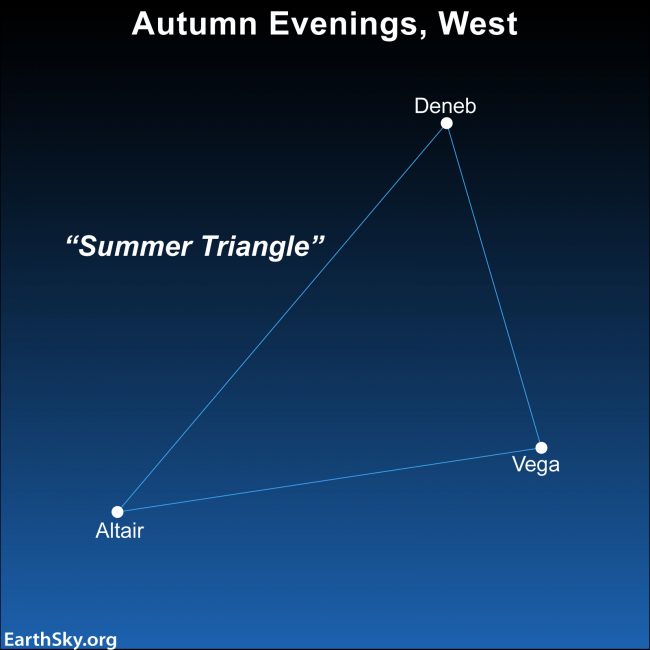
The Summer Triangle is a famous asterism, consisting of 3 bright stars overhead in northern summer. But you can also easily see it through the northern autumn, and even into winter. Chart via EarthSky.
The Summer Triangle and its 3 stars
The Summer Triangle is the signature star formation in the Northern Hemisphere’s summer sky. However, as the September equinox comes and goes – and as the weeks of autumn begin to slide by – you’ll still notice this famous trio of stars. So, look for the Summer Triangle after dark in early November. It will actually continue to shine after dark in November and December, and is even visible still in January. Look for it tonight in the early evening, high in your western sky.
By the way, the Summer Triangle isn’t a constellation. It’s an asterism, or an obvious pattern or group of stars with a popular name. In fact, the Summer Triangle consists of three bright stars in three separate constellations. The bright star Vega is in Lyra the Harp. Deneb is in Cygnus the Swan. And Altair is in Aquila the Eagle.
In the month of June – around the June solstice – the Summer Triangle pops out in the east as darkness falls and shines all night long. But now – after sunset in November – the Summer Triangle appears high in the western evening sky. As evening deepens, the Summer Triangle descends westward, with all three of its stars staying above the horizon until mid-to-late evening.
Altair – the Summer Triangle’s southernmost star – will set around 10 to 11 p.m. tonight at mid-northern latitudes. Notice where you see the Summer Triangle at a given time this evening. The Summer Triangle will return to this same place in the sky some four minutes earlier with each passing day, or two hours earlier with each passing month.
Look for Orion, too
Then as the Summer Triangle sinks close to the western horizon around mid-evening, turn around to see Orion the Hunter – the signpost constellation of winter – rising in the east.
Bottom line: Look westward this evening for the three brilliant stars of the humongous Summer Triangle: Vega, Deneb and Altair. In fact, you can still see the Summer Triangle through January.
The Summer Triangle is a famous asterism, consisting of 3 bright stars overhead in northern summer. But you can also easily see it through the northern autumn, and even into winter. Chart via EarthSky.
The Summer Triangle and its 3 stars
The Summer Triangle is the signature star formation in the Northern Hemisphere’s summer sky. However, as the September equinox comes and goes – and as the weeks of autumn begin to slide by – you’ll still notice this famous trio of stars. So, look for the Summer Triangle after dark in early November. It will actually continue to shine after dark in November and December, and is even visible still in January. Look for it tonight in the early evening, high in your western sky.
By the way, the Summer Triangle isn’t a constellation. It’s an asterism, or an obvious pattern or group of stars with a popular name. In fact, the Summer Triangle consists of three bright stars in three separate constellations. The bright star Vega is in Lyra the Harp. Deneb is in Cygnus the Swan. And Altair is in Aquila the Eagle.
In the month of June – around the June solstice – the Summer Triangle pops out in the east as darkness falls and shines all night long. But now – after sunset in November – the Summer Triangle appears high in the western evening sky. As evening deepens, the Summer Triangle descends westward, with all three of its stars staying above the horizon until mid-to-late evening.
Altair – the Summer Triangle’s southernmost star – will set around 10 to 11 p.m. tonight at mid-northern latitudes. Notice where you see the Summer Triangle at a given time this evening. The Summer Triangle will return to this same place in the sky some four minutes earlier with each passing day, or two hours earlier with each passing month.
Look for Orion, too
Then as the Summer Triangle sinks close to the western horizon around mid-evening, turn around to see Orion the Hunter – the signpost constellation of winter – rising in the east.
Bottom line: Look westward this evening for the three brilliant stars of the humongous Summer Triangle: Vega, Deneb and Altair. In fact, you can still see the Summer Triangle through January.
The Leonid meteor shower is back! Leonid meteors are already flying. The peak is on the morning of November 17. You might also try watching on the morning of November 18. Learn when, where, and how to see the 2025 Leonids at their best in this video, which first aired on Wednesday, November 12. EarthSky’s Deborah Byrd, Marcy Curran and John Goss explain it all, and tell you why the Leonids are one of the most famous meteor showers of the year. Whether you’re a seasoned skywatcher or heading out for your first meteor shower, we’ll help you make the most of it. Peak nights: Around November 16–18, 2025. Best viewing: After midnight, under a dark sky. Watch in the player above, or on YouTube.
Predicted peak: The peak is predicted** for 18 UTC on November 17, 2025. When to watch: Watch late on the night of November 16 until dawn on November 17. The morning of the 18th might be worthwhile, too. Duration of shower: November 3 through December 2. This time period is when we’re passing through the meteor stream in space! Radiant: Rises around midnight, highest in the sky at dawn. Nearest moon phase: In 2025, the new moon falls at 6:47 UTC on November 20. So the slender waning crescent moon will not interfere with meteors in 2025. Expected meteors at peak, under ideal conditions: Under a dark sky with no moon, you might see 10 to 15 Leonid meteors per hour. Note: The famous Leonid meteor shower produced one of the greatest meteor storms in living memory. Rates were as high as thousands of meteors per minute during a 15-minute span on the morning of November 17, 1966. That night, Leonid meteors did, briefly, fall like rain. Some who witnessed it had a strong impression of Earth moving through space, fording the meteor stream. Leonid meteor storms sometimes recur in cycles of 33 to 34 years. But the Leonids around the turn of the century – while wonderful for many observers – did not match the shower of 1966. And, in most years, the Lion whimpers rather than roars.
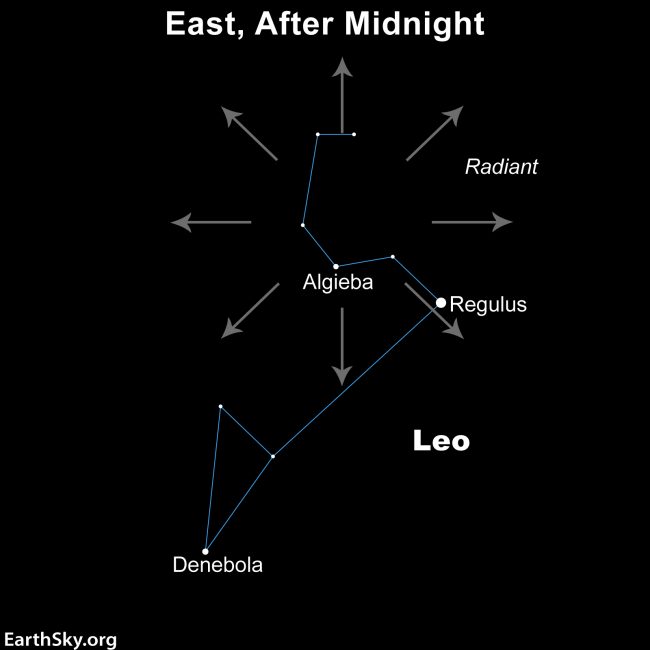
The Leonids stream from a single point in the sky – their radiant point – in the constellation Leo the Lion. Leo rises just before midnight in mid-November. Regulus, the brightest star in Leo the, dots a backwards question mark of stars known as the Sickle.
The parent comet of the Leonid meteor shower
From the late, great Don Machholz (1952-2022), who discovered 12 comets …
Periodic Comet Tempel-Tuttle, officially known as 55P/Tempel-Tuttle, is responsible for the Leonid meteor shower. William Tempel of Marseille Observatory in France discovered this comet on the evening of December 19, 1865. He found the comet in the northern sky, located in a part of the sky under the North Star, near the star Beta Ursae Minoris.
Word of the comet discovery became known throughout Europe, but the news had not yet spread to the United States. Horace Tuttle of Harvard College Observatory picked up the comet 17 days later, on the evening of January 5, 1866. Because this was an independent discovery, Tuttle’s name was added to the comet. Based upon the measurements during this visit of the comet, scientists calculated an orbit of 33.17 years. Astronomers quickly realized that the meteor storms and showers which occurred in mid-November of each year were the result of this comet.
One would think that there would be great interest in recovering this comet as it came back to the earth’s vicinity in 1899. But there wasn’t much interest in seeing the comet, everyone wanted to see a meteor storm. So, observers missed the comet in 1899. Also missing was a great meteor shower that year.
Scientists expected the next return in 1932. The observatories, using photographic plates with narrow field-of-view telescopes, missed it then too. And again, a major meteor shower did not materialize.
The comet was finally recovered in 1965. The brightest the comet got that year was 16th magnitude, visible only in very large telescopes. A spectacular meteor storm followed in 1966. On the next return, in early 1998, the comet was bright enough that you could see it in binoculars. This pass produced additional impressive meteor showers in 1999-2001. 55P/Tempel-Tuttle is due back in early 2031.
With so much anticipation with the 1998 return and the expected meteor storms, several astronomers calculated the exact time and intensity of the storm. And they were accurate. This was the first instance of correct predictions. It is done by analyzing filaments of material expelled from each trip of the comet through the inner solar system. Quite often, a filament left behind by the comet hundreds of years ago will intersect the earth and produce a fabulous shower.
The Leonids: a meteor shower that revolutionized meteor science.
Note: This article, Leonids 1901-2100, gives specific meteor predictions for each year for this shower from the year 2001 to 2100.
The radiant of the Leonid meteor shower
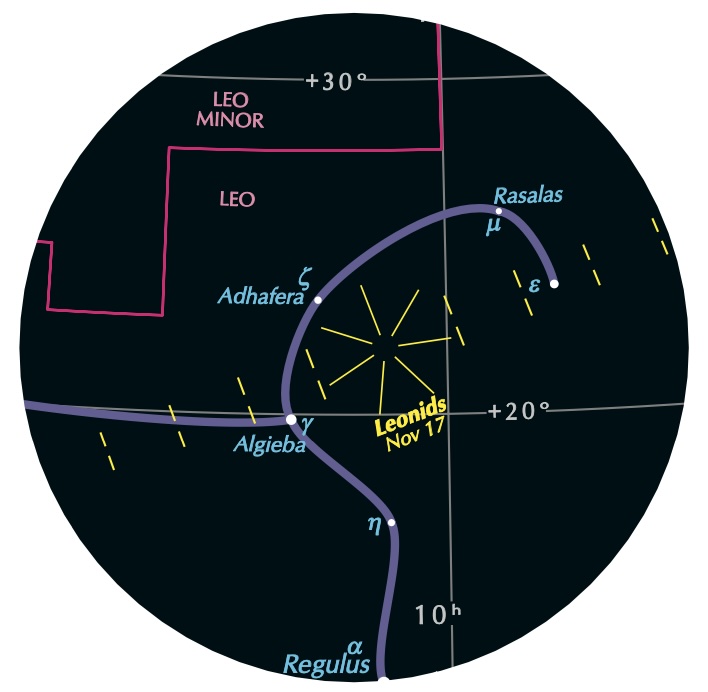
The 2024 Leonid meteor shower, seen in sky mode (from the Earth’s surface, looking up). On the morning of November 17, 2025, the radiant appears to originate inside the Sickle of Leo the Lion. Chart via Guy Ottewell’s Astronomical Calendar. Used with permission.
Which direction should I look to see the Leonid meteor shower?
Meteors in annual showers get their names from the point in the starry sky from which they appear to radiate. This shower’s name comes from the constellation Leo the Lion, because these meteors radiate outward from the vicinity of stars representing the Lion’s Mane.
If you trace the paths of Leonid meteors backward on the sky’s dome, they do seem to stream from near the star Algieba in the constellation Leo. The point in the sky from which they appear to radiate is the radiant point. This radiant point is an optical illusion. It’s like standing on railroad tracks and peering off into the distance to see the tracks converge. The illusion of the radiant point comes from the fact that the meteors – much like the railroad tracks – are moving on parallel paths.
In recent years, people have gotten the mistaken idea that you must know the whereabouts of a meteor shower’s radiant point in order to watch the meteor shower. You don’t need to. The meteors often don’t become visible until they are 30 degrees or so from their radiant point. They are streaking out from the radiant in all directions.
Thus, the Leonid meteors – like meteors in all annual showers – will appear in all parts of the sky.
Old woodcuts depicting the 1833 Leonid meteor storm known as “the night the stars fell.” Image via Wikimedia Commons (public domain).
A history of meteor storms
Scientists don’t expect a Leonid meteor storm this year. Most astronomers say you need more than 1,000 meteors an hour to consider a shower a storm. That’s far from the 10 to 15 meteors per hour the Leonids deliver in average years.
The Leonid shower is famous for producing meteor storms, though. The parent comet, Tempel-Tuttle, completes a single orbit around the sun about once every 33 years. It releases fresh material every time it approaches the sun. Since the 19th century, skywatchers have looked for Leonid meteor storms about every 33 years, beginning with the meteor storm of 1833, which witnesses said produced more than 100,000 meteors an hour.
The next great Leonid storms were about 33 years later, in 1866 and 1867. In 1899, a meteor storm did not materialize. In fact, the anticipation of a great meteor storm was so high, and the results so disappointing, that many astronomers felt it was the worst blow ever suffered by astronomy in the eyes of the public.
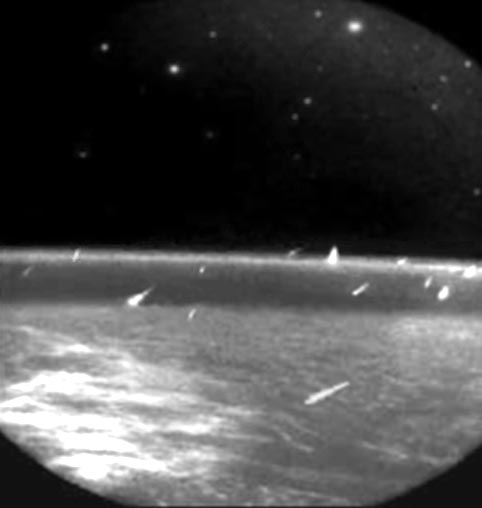
Leonid meteors viewed from space in 1997. Image via NASA.
Some Leonid meteor storms last century
Not until 1966 did the next spectacular Leonid storm occur, this time over the Americas. In 1966, observers in the southwest United States reported seeing 40 to 50 meteors per second (that’s 2,400 to 3,000 meteors per minute) during a span of 15 minutes on the morning of November 17, 1966.
In 2001, another great Leonid meteor storm occurred (though not as great as 1966). Spaceweather.com reported:
The display began on Sunday morning, November 18, when Earth glided into a dust cloud shed by Comet Tempel-Tuttle in 1766. Thousands of meteors per hour rained over North America and Hawaii. Then, on Monday morning November 19 (local time in Asia), it happened again: Earth entered a second cometary debris cloud from Tempel-Tuttle. Thousands more Leonids then fell over East Asian countries and Australia.
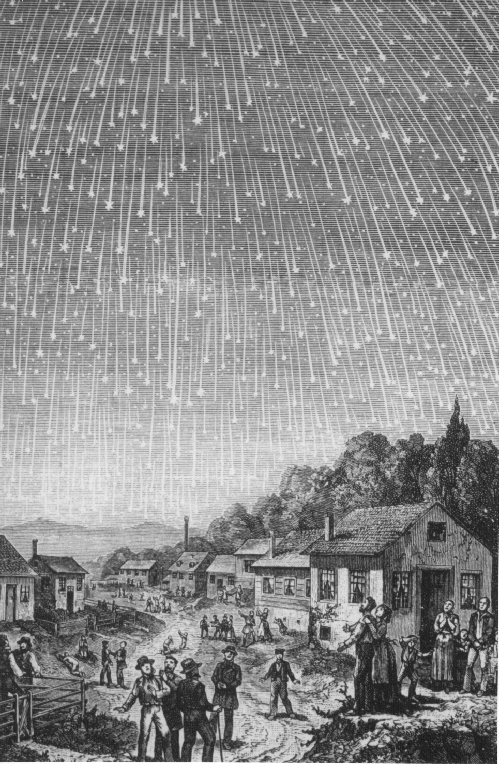
The night the stars fell. Engraving by Adolf Vollmy (1889). Image via Wikimedia Commons (public domain).
The Leonid meteor shower of 1833
Adolf Vollmy produced the famous engraving above of the 1833 Leonid meteor shower for the Adventist book “Bible Readings for the Home Circle.” It’s based on a painting by Swiss artist Karl Jauslin, which, in turn, was based on a first-person account of the 1833 storm by a minister, Joseph Harvey Waggoner, who saw the 1833 shower on his way from Florida to New Orleans.
In that famous shower, hundreds of thousands of meteors per hour fell. It was the first recorded meteor storm of modern times.
Leonid meteors from the EarthSky Community
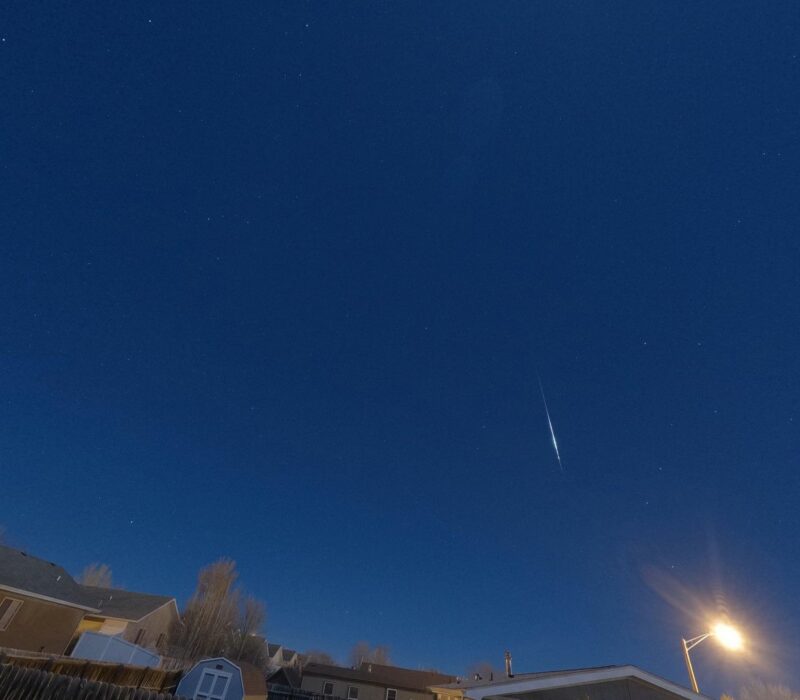
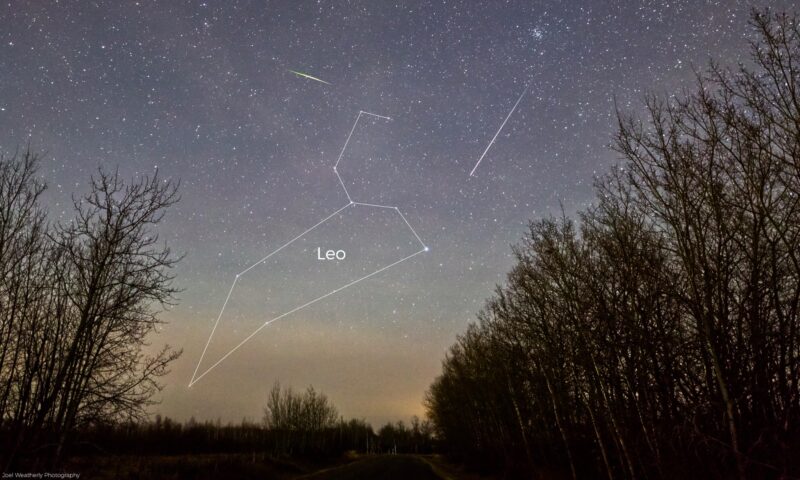
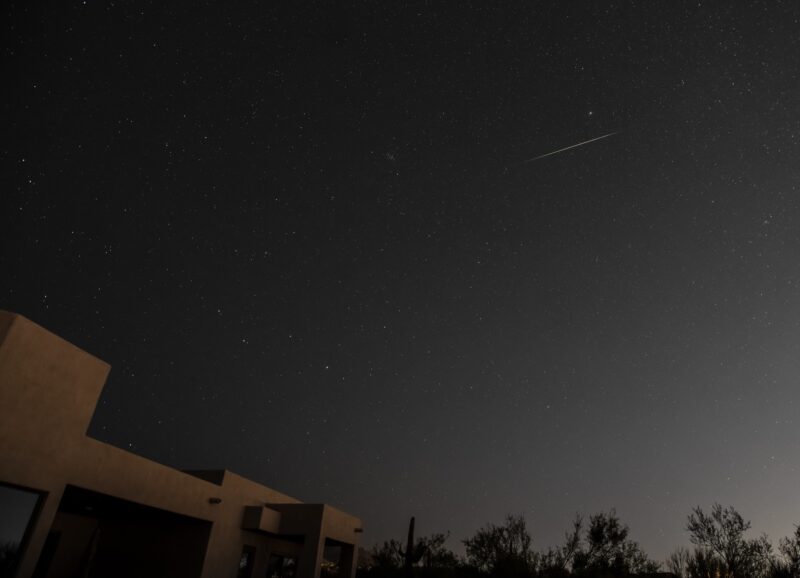
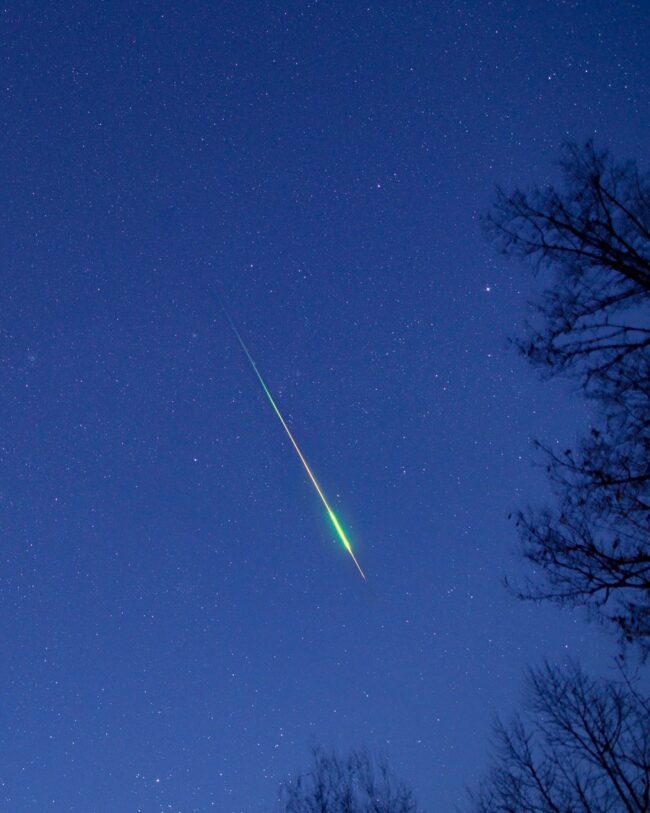
View at EarthSky Community Photos. | Kathie O’Donnell in Rapid City, South Dakota, captured this Leonid on November 18, 2024, after 2 nights of searching in the northern sky. She wrote: “This one looks to be very bright considering the moon was hanging out.” Thank you, Kathie!View at EarthSky Community Photos. | Joel Weatherly in Edmonton, Alberta, Canada, shared this composite image on November 18, 2023, and wrote: “Last night, the Leonids peaked with several meteors, including a few bright, long-lasting ones, racing across Leo. The brilliant meteor to the right of Leo produced a persistent train that remained visible for roughly five minutes.” Thank you Joel!View at EarthSky Community Photos. | Eliot Herman in Tucson, Arizona, photographed this early Leonid meteor on November 12, 2023, about 6 days before the peak. Thank you, Eliot.
More Leonid meteor shower photos from the EarthSky Community
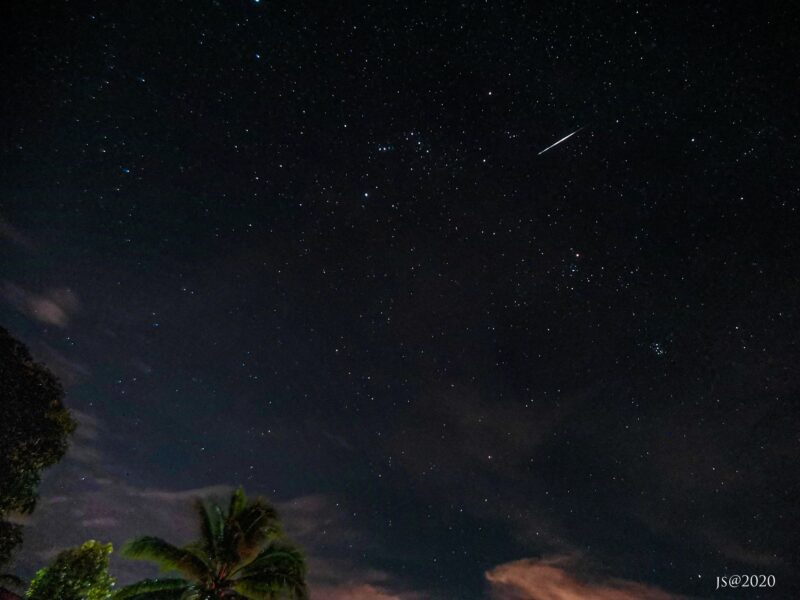
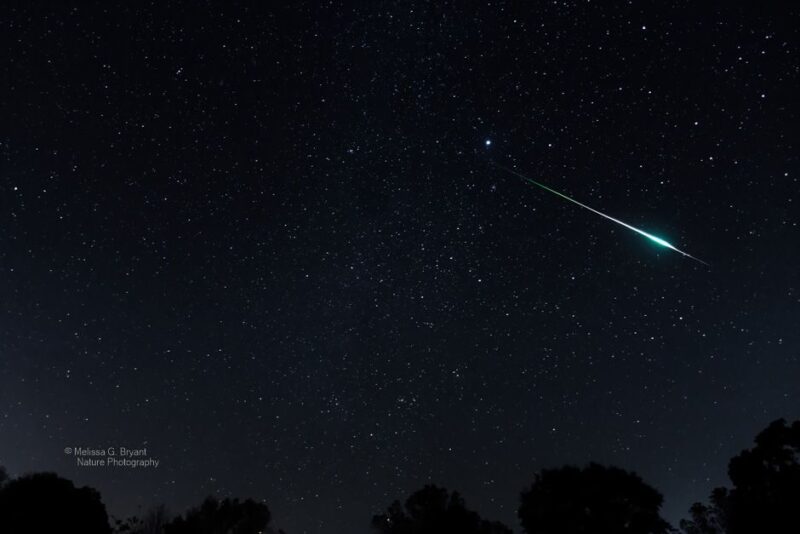
View at EarthSky Community Photos. | Jojie Shazri in Lawas, Sarawak, Malaysia, captured this image on November 21, 2020, and wrote: “The Leonid meteor fireball streaked near the Bellatrix star.” Thank you, Jojie! Bellatrix represents Orion’s left shoulder, can you see it?View at EarthSky Community Photos. | James Reynolds in Leicester, North Carolina, took this photo on November 17, 2020, and wrote: “I’ve spent many hours on photography expeditions trying to capture meteors before. I couldn’t sleep, so I decided to just get up and sit out on our deck a little before 5:30 and set up the tripod and see if I could photo any Leonids. I clicked the remote shutter button about one second before perhaps the biggest, brightest, most colorful meteor I’ve ever seen blew up in-frame. I took a few more exposures (that all had a red glow where the meteor had been), packed it up, went back inside, and slept like a baby!” Thank you, James!View at EarthSky Community Photos. | Melissa Bryant in Bowman, Georgia, went out to see the meteor shower on November 17, 2020, and wrote: “I was out at the right time and right position. After the third shot I got this awesome meteor streaking across. It was awesome to see and get a photo of it.” Thank you, Melissa!
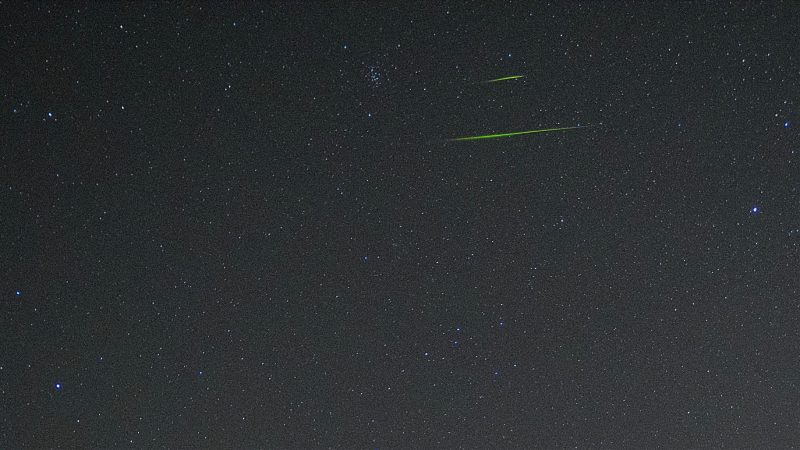
View larger to see the colors better. | Eliot Herman in Tucson, Arizona, shared this double Leonid meteor photo, captured 2 days before the peak of the shower in 2018. Eliot commented: “The Leonids are the greenest meteors I see.” And he has seen a lot of meteors!
Bottom line: In 2025, watch for Leonids after midnight until dawn on November 17. The radiant point rises around midnight and is highest in the sky at dawn. A waning crescent moon will offer dark skies for the Leonid meteors this year.
**Predicted peak times and dates for meteor showers are from the American Meteor Society. Note that meteor shower peak times can vary.
The Leonid meteor shower is back! Leonid meteors are already flying. The peak is on the morning of November 17. You might also try watching on the morning of November 18. Learn when, where, and how to see the 2025 Leonids at their best in this video, which first aired on Wednesday, November 12. EarthSky’s Deborah Byrd, Marcy Curran and John Goss explain it all, and tell you why the Leonids are one of the most famous meteor showers of the year. Whether you’re a seasoned skywatcher or heading out for your first meteor shower, we’ll help you make the most of it. Peak nights: Around November 16–18, 2025. Best viewing: After midnight, under a dark sky. Watch in the player above, or on YouTube.
Predicted peak: The peak is predicted** for 18 UTC on November 17, 2025. When to watch: Watch late on the night of November 16 until dawn on November 17. The morning of the 18th might be worthwhile, too. Duration of shower: November 3 through December 2. This time period is when we’re passing through the meteor stream in space! Radiant: Rises around midnight, highest in the sky at dawn. Nearest moon phase: In 2025, the new moon falls at 6:47 UTC on November 20. So the slender waning crescent moon will not interfere with meteors in 2025. Expected meteors at peak, under ideal conditions: Under a dark sky with no moon, you might see 10 to 15 Leonid meteors per hour. Note: The famous Leonid meteor shower produced one of the greatest meteor storms in living memory. Rates were as high as thousands of meteors per minute during a 15-minute span on the morning of November 17, 1966. That night, Leonid meteors did, briefly, fall like rain. Some who witnessed it had a strong impression of Earth moving through space, fording the meteor stream. Leonid meteor storms sometimes recur in cycles of 33 to 34 years. But the Leonids around the turn of the century – while wonderful for many observers – did not match the shower of 1966. And, in most years, the Lion whimpers rather than roars.
The Leonids stream from a single point in the sky – their radiant point – in the constellation Leo the Lion. Leo rises just before midnight in mid-November. Regulus, the brightest star in Leo the, dots a backwards question mark of stars known as the Sickle.
The parent comet of the Leonid meteor shower
From the late, great Don Machholz (1952-2022), who discovered 12 comets …
Periodic Comet Tempel-Tuttle, officially known as 55P/Tempel-Tuttle, is responsible for the Leonid meteor shower. William Tempel of Marseille Observatory in France discovered this comet on the evening of December 19, 1865. He found the comet in the northern sky, located in a part of the sky under the North Star, near the star Beta Ursae Minoris.
Word of the comet discovery became known throughout Europe, but the news had not yet spread to the United States. Horace Tuttle of Harvard College Observatory picked up the comet 17 days later, on the evening of January 5, 1866. Because this was an independent discovery, Tuttle’s name was added to the comet. Based upon the measurements during this visit of the comet, scientists calculated an orbit of 33.17 years. Astronomers quickly realized that the meteor storms and showers which occurred in mid-November of each year were the result of this comet.
One would think that there would be great interest in recovering this comet as it came back to the earth’s vicinity in 1899. But there wasn’t much interest in seeing the comet, everyone wanted to see a meteor storm. So, observers missed the comet in 1899. Also missing was a great meteor shower that year.
Scientists expected the next return in 1932. The observatories, using photographic plates with narrow field-of-view telescopes, missed it then too. And again, a major meteor shower did not materialize.
The comet was finally recovered in 1965. The brightest the comet got that year was 16th magnitude, visible only in very large telescopes. A spectacular meteor storm followed in 1966. On the next return, in early 1998, the comet was bright enough that you could see it in binoculars. This pass produced additional impressive meteor showers in 1999-2001. 55P/Tempel-Tuttle is due back in early 2031.
With so much anticipation with the 1998 return and the expected meteor storms, several astronomers calculated the exact time and intensity of the storm. And they were accurate. This was the first instance of correct predictions. It is done by analyzing filaments of material expelled from each trip of the comet through the inner solar system. Quite often, a filament left behind by the comet hundreds of years ago will intersect the earth and produce a fabulous shower.
The Leonids: a meteor shower that revolutionized meteor science.
Note: This article, Leonids 1901-2100, gives specific meteor predictions for each year for this shower from the year 2001 to 2100.
The radiant of the Leonid meteor shower
The 2024 Leonid meteor shower, seen in sky mode (from the Earth’s surface, looking up). On the morning of November 17, 2025, the radiant appears to originate inside the Sickle of Leo the Lion. Chart via Guy Ottewell’s Astronomical Calendar. Used with permission.
Which direction should I look to see the Leonid meteor shower?
Meteors in annual showers get their names from the point in the starry sky from which they appear to radiate. This shower’s name comes from the constellation Leo the Lion, because these meteors radiate outward from the vicinity of stars representing the Lion’s Mane.
If you trace the paths of Leonid meteors backward on the sky’s dome, they do seem to stream from near the star Algieba in the constellation Leo. The point in the sky from which they appear to radiate is the radiant point. This radiant point is an optical illusion. It’s like standing on railroad tracks and peering off into the distance to see the tracks converge. The illusion of the radiant point comes from the fact that the meteors – much like the railroad tracks – are moving on parallel paths.
In recent years, people have gotten the mistaken idea that you must know the whereabouts of a meteor shower’s radiant point in order to watch the meteor shower. You don’t need to. The meteors often don’t become visible until they are 30 degrees or so from their radiant point. They are streaking out from the radiant in all directions.
Thus, the Leonid meteors – like meteors in all annual showers – will appear in all parts of the sky.
Old woodcuts depicting the 1833 Leonid meteor storm known as “the night the stars fell.” Image via Wikimedia Commons (public domain).
A history of meteor storms
Scientists don’t expect a Leonid meteor storm this year. Most astronomers say you need more than 1,000 meteors an hour to consider a shower a storm. That’s far from the 10 to 15 meteors per hour the Leonids deliver in average years.
The Leonid shower is famous for producing meteor storms, though. The parent comet, Tempel-Tuttle, completes a single orbit around the sun about once every 33 years. It releases fresh material every time it approaches the sun. Since the 19th century, skywatchers have looked for Leonid meteor storms about every 33 years, beginning with the meteor storm of 1833, which witnesses said produced more than 100,000 meteors an hour.
The next great Leonid storms were about 33 years later, in 1866 and 1867. In 1899, a meteor storm did not materialize. In fact, the anticipation of a great meteor storm was so high, and the results so disappointing, that many astronomers felt it was the worst blow ever suffered by astronomy in the eyes of the public.
Leonid meteors viewed from space in 1997. Image via NASA.
Some Leonid meteor storms last century
Not until 1966 did the next spectacular Leonid storm occur, this time over the Americas. In 1966, observers in the southwest United States reported seeing 40 to 50 meteors per second (that’s 2,400 to 3,000 meteors per minute) during a span of 15 minutes on the morning of November 17, 1966.
In 2001, another great Leonid meteor storm occurred (though not as great as 1966). Spaceweather.com reported:
The display began on Sunday morning, November 18, when Earth glided into a dust cloud shed by Comet Tempel-Tuttle in 1766. Thousands of meteors per hour rained over North America and Hawaii. Then, on Monday morning November 19 (local time in Asia), it happened again: Earth entered a second cometary debris cloud from Tempel-Tuttle. Thousands more Leonids then fell over East Asian countries and Australia.
The night the stars fell. Engraving by Adolf Vollmy (1889). Image via Wikimedia Commons (public domain).
The Leonid meteor shower of 1833
Adolf Vollmy produced the famous engraving above of the 1833 Leonid meteor shower for the Adventist book “Bible Readings for the Home Circle.” It’s based on a painting by Swiss artist Karl Jauslin, which, in turn, was based on a first-person account of the 1833 storm by a minister, Joseph Harvey Waggoner, who saw the 1833 shower on his way from Florida to New Orleans.
In that famous shower, hundreds of thousands of meteors per hour fell. It was the first recorded meteor storm of modern times.
Leonid meteors from the EarthSky Community
View at EarthSky Community Photos. | Kathie O’Donnell in Rapid City, South Dakota, captured this Leonid on November 18, 2024, after 2 nights of searching in the northern sky. She wrote: “This one looks to be very bright considering the moon was hanging out.” Thank you, Kathie!View at EarthSky Community Photos. | Joel Weatherly in Edmonton, Alberta, Canada, shared this composite image on November 18, 2023, and wrote: “Last night, the Leonids peaked with several meteors, including a few bright, long-lasting ones, racing across Leo. The brilliant meteor to the right of Leo produced a persistent train that remained visible for roughly five minutes.” Thank you Joel!View at EarthSky Community Photos. | Eliot Herman in Tucson, Arizona, photographed this early Leonid meteor on November 12, 2023, about 6 days before the peak. Thank you, Eliot.
More Leonid meteor shower photos from the EarthSky Community
View at EarthSky Community Photos. | Jojie Shazri in Lawas, Sarawak, Malaysia, captured this image on November 21, 2020, and wrote: “The Leonid meteor fireball streaked near the Bellatrix star.” Thank you, Jojie! Bellatrix represents Orion’s left shoulder, can you see it?View at EarthSky Community Photos. | James Reynolds in Leicester, North Carolina, took this photo on November 17, 2020, and wrote: “I’ve spent many hours on photography expeditions trying to capture meteors before. I couldn’t sleep, so I decided to just get up and sit out on our deck a little before 5:30 and set up the tripod and see if I could photo any Leonids. I clicked the remote shutter button about one second before perhaps the biggest, brightest, most colorful meteor I’ve ever seen blew up in-frame. I took a few more exposures (that all had a red glow where the meteor had been), packed it up, went back inside, and slept like a baby!” Thank you, James!View at EarthSky Community Photos. | Melissa Bryant in Bowman, Georgia, went out to see the meteor shower on November 17, 2020, and wrote: “I was out at the right time and right position. After the third shot I got this awesome meteor streaking across. It was awesome to see and get a photo of it.” Thank you, Melissa!
View larger to see the colors better. | Eliot Herman in Tucson, Arizona, shared this double Leonid meteor photo, captured 2 days before the peak of the shower in 2018. Eliot commented: “The Leonids are the greenest meteors I see.” And he has seen a lot of meteors!
Bottom line: In 2025, watch for Leonids after midnight until dawn on November 17. The radiant point rises around midnight and is highest in the sky at dawn. A waning crescent moon will offer dark skies for the Leonid meteors this year.
**Predicted peak times and dates for meteor showers are from the American Meteor Society. Note that meteor shower peak times can vary.
Nectophrynoides luhomeroensis is one of the new toad species from the Eastern Arc Mountains of Tanzania. It gives birth to live young, bypassing the tadpole stage. In addition, you’ll notice from the images in this article that these toads vary greatly in color. Image via John Lyarkurwa/ University of Copenhagen.
Scientists discovered three new tree-dwelling toad species in Tanzania’s Eastern Arc Mountains that give birth to live young, skipping the tadpole stage.
This rare reproductive strategy, seen in less than 1% of frog species, allows them to reproduce away from water.
Researchers used DNA analysis of preserved specimens, some over 120 years old, to identify the new species, which now face threats from habitat loss and climate change.
Some frogs skip the tadpole stage
Scientists have discovered three new tree-dwelling toad species in the mountain forests of Tanzania, Africa. On November 6, 2025, researchers from the University of Copenhagen said that these toads bypass the tadpole stage and give birth to live toadlets. This reproductive strategy, which occurs in only 1% of frog species, enables these creatures to breed away from water.
Mark Scherz, at the Natural History Museum Denmark, is a co-author of a paper on this discovery. He said:
It’s common knowledge that frogs grow from tadpoles; it’s one of the classic metamorphosis paradigms in biology. But the nearly 8,000 frog species actually have a wide variety of reproductive modes, many of which don’t closely resemble that famous story.
In addition, Christoph Liedtke at the Spanish National Research Council, another paper co-author, added:
Live bearing is exceptionally rare among frogs and toads, practiced by less than 1% of frogs species, making these new species exceptionally interesting.
The researchers published their findings in the peer-reviewed journal Vertebrate Zoology on November 6, 2025.
Another Nectophrynoides luhomeroensis toad from the Eastern Arc Mountains of Tanzania. Image via Michele Menegon/ University of Copenhagen.
Pregnant toads
Did you know that toads are a type of frog? Most frogs lay eggs in water. Then, the eggs hatch to release tadpoles that swim in water like fish, breathing through their gills. But that phase does not last long, however. In fact, they eventually develop legs, lose their tails and can leave the water as air-breathing frogs.
The three new toad species belong to a group of African toads called Nectophrynoides, or just “tree toads.” They are found in the lush forests of the Eastern Arc Mountains in Tanzania.
However, a few frog species bypass the tadpole stage altogether. For instance, in female tree toads, egg fertilization occurs internally. The embryos develop inside their bodies, and they subsequently give birth to fully developed tiny toads. It’s an evolutionary adaptation that allows them to thrive in trees, away from bodies of water.
Nectophrynoides uhehe is one of the new toad species from the Eastern Arc Mountains of Tanzania. Image via Michele Menegon/ University of Copenhagen.Another Nectophrynoides uhehe from the Eastern Arc Mountains of Tanzania. Image via Michele Menegon/ University of Copenhagen.
Using DNA analysis of preserved specimens to discover new toad species
Historically, scientists first learned of live-bearing tree frogs in 1905, when a German researcher, Gustav Tornier, presented a study of a toad species from Tanzania, Africa. At the time, it was the only known frog with this mode of reproduction. But now, researchers have also found similar reproductive strategies in frogs from South America and Southeast Asia.
Tornier’s frog collection is preserved at the Museum für Naturkunde in Berlin. In this new study, the scientists analyzed the DNA of these and other specimens.
Alice Petzold of the University of Potsdam is a paper co-author. She commented:
Some of these specimens were collected over 120 years ago. Our museomics work was able to reveal exactly which populations those old specimens belonged to, giving us a lot more confidence for future work on these toads.
Furthermore, the paper’s lead author, Christian Thrane at the University of Copenhagen, added:
Phylogenetic [study of evolutionary history and relationship between species] work from a few years ago had already let us know there was previously unrecognized diversity among these toads. But by traveling to different natural history museums and examining hundreds of preserved toads, I was able to get a better idea of their morphological diversity, so we could describe these new species.
Nectophrynoides viviparus is one of the 3 new toad species from the Eastern Arc Mountains of Tanzania. Image via Michele Menegon/ University of Copenhagen.Another Nectophrynoides viviparus from the Eastern Arc Mountains of Tanzania. Image via Michele Menegon/ University of Copenhagen.
The toads’ habitat is under threat
The researchers said many live-bearing tree frogs live in small, fragmented environments. And their forest homes are being threatened by deforestation, mining and climate change.
The 3 new Nectophrynoides toads inhabit forest along rainforest streams in the Eastern Arc Mountains of Tanzania. Image via MicheleMenegon / University of Copenhagen.
These three new species from the Eastern Arc Mountains of Tanzania are no exception. Indeed, they live in a biodiversity hotspot that is home to creatures found nowhere else on our planet.
Sadly, most tree toads are already on the brink of extinction, and their future is uncertain. John Lyakurwa, a paper co-author from the University of Dar es Salaam, Tanzania, warned:
The forests where these toads are known to occur are disappearing quickly.
Bottom line: Scientists have discovered three new tree-dwelling toad species in the mountain forests of Tanzania, Africa, that give birth to live young toadlets.
Nectophrynoides luhomeroensis is one of the new toad species from the Eastern Arc Mountains of Tanzania. It gives birth to live young, bypassing the tadpole stage. In addition, you’ll notice from the images in this article that these toads vary greatly in color. Image via John Lyarkurwa/ University of Copenhagen.
Scientists discovered three new tree-dwelling toad species in Tanzania’s Eastern Arc Mountains that give birth to live young, skipping the tadpole stage.
This rare reproductive strategy, seen in less than 1% of frog species, allows them to reproduce away from water.
Researchers used DNA analysis of preserved specimens, some over 120 years old, to identify the new species, which now face threats from habitat loss and climate change.
Some frogs skip the tadpole stage
Scientists have discovered three new tree-dwelling toad species in the mountain forests of Tanzania, Africa. On November 6, 2025, researchers from the University of Copenhagen said that these toads bypass the tadpole stage and give birth to live toadlets. This reproductive strategy, which occurs in only 1% of frog species, enables these creatures to breed away from water.
Mark Scherz, at the Natural History Museum Denmark, is a co-author of a paper on this discovery. He said:
It’s common knowledge that frogs grow from tadpoles; it’s one of the classic metamorphosis paradigms in biology. But the nearly 8,000 frog species actually have a wide variety of reproductive modes, many of which don’t closely resemble that famous story.
In addition, Christoph Liedtke at the Spanish National Research Council, another paper co-author, added:
Live bearing is exceptionally rare among frogs and toads, practiced by less than 1% of frogs species, making these new species exceptionally interesting.
The researchers published their findings in the peer-reviewed journal Vertebrate Zoology on November 6, 2025.
Another Nectophrynoides luhomeroensis toad from the Eastern Arc Mountains of Tanzania. Image via Michele Menegon/ University of Copenhagen.
Pregnant toads
Did you know that toads are a type of frog? Most frogs lay eggs in water. Then, the eggs hatch to release tadpoles that swim in water like fish, breathing through their gills. But that phase does not last long, however. In fact, they eventually develop legs, lose their tails and can leave the water as air-breathing frogs.
The three new toad species belong to a group of African toads called Nectophrynoides, or just “tree toads.” They are found in the lush forests of the Eastern Arc Mountains in Tanzania.
However, a few frog species bypass the tadpole stage altogether. For instance, in female tree toads, egg fertilization occurs internally. The embryos develop inside their bodies, and they subsequently give birth to fully developed tiny toads. It’s an evolutionary adaptation that allows them to thrive in trees, away from bodies of water.
Nectophrynoides uhehe is one of the new toad species from the Eastern Arc Mountains of Tanzania. Image via Michele Menegon/ University of Copenhagen.Another Nectophrynoides uhehe from the Eastern Arc Mountains of Tanzania. Image via Michele Menegon/ University of Copenhagen.
Using DNA analysis of preserved specimens to discover new toad species
Historically, scientists first learned of live-bearing tree frogs in 1905, when a German researcher, Gustav Tornier, presented a study of a toad species from Tanzania, Africa. At the time, it was the only known frog with this mode of reproduction. But now, researchers have also found similar reproductive strategies in frogs from South America and Southeast Asia.
Tornier’s frog collection is preserved at the Museum für Naturkunde in Berlin. In this new study, the scientists analyzed the DNA of these and other specimens.
Alice Petzold of the University of Potsdam is a paper co-author. She commented:
Some of these specimens were collected over 120 years ago. Our museomics work was able to reveal exactly which populations those old specimens belonged to, giving us a lot more confidence for future work on these toads.
Furthermore, the paper’s lead author, Christian Thrane at the University of Copenhagen, added:
Phylogenetic [study of evolutionary history and relationship between species] work from a few years ago had already let us know there was previously unrecognized diversity among these toads. But by traveling to different natural history museums and examining hundreds of preserved toads, I was able to get a better idea of their morphological diversity, so we could describe these new species.
Nectophrynoides viviparus is one of the 3 new toad species from the Eastern Arc Mountains of Tanzania. Image via Michele Menegon/ University of Copenhagen.Another Nectophrynoides viviparus from the Eastern Arc Mountains of Tanzania. Image via Michele Menegon/ University of Copenhagen.
The toads’ habitat is under threat
The researchers said many live-bearing tree frogs live in small, fragmented environments. And their forest homes are being threatened by deforestation, mining and climate change.
The 3 new Nectophrynoides toads inhabit forest along rainforest streams in the Eastern Arc Mountains of Tanzania. Image via MicheleMenegon / University of Copenhagen.
These three new species from the Eastern Arc Mountains of Tanzania are no exception. Indeed, they live in a biodiversity hotspot that is home to creatures found nowhere else on our planet.
Sadly, most tree toads are already on the brink of extinction, and their future is uncertain. John Lyakurwa, a paper co-author from the University of Dar es Salaam, Tanzania, warned:
The forests where these toads are known to occur are disappearing quickly.
Bottom line: Scientists have discovered three new tree-dwelling toad species in the mountain forests of Tanzania, Africa, that give birth to live young toadlets.