aads

Scientists discover toads that give birth to live young

Toads: Closeup of light brown toad with dark markings, and prominent eyes facing the camera.
Nectophrynoides luhomeroensis is one of the new toad species from the Eastern Arc Mountains of Tanzania. It gives birth to live young, bypassing the tadpole stage. In addition, you’ll notice from the images in this article that these toads vary greatly in color. Image via John Lyarkurwa/ University of Copenhagen.

Millions come to EarthSky for night sky news and trusted science.
Your donation keeps us free and accessible for all.

  • Scientists discovered three new tree-dwelling toad species in Tanzania’s Eastern Arc Mountains that give birth to live young, skipping the tadpole stage.
  • This rare reproductive strategy, seen in less than 1% of frog species, allows them to reproduce away from water.
  • Researchers used DNA analysis of preserved specimens, some over 120 years old, to identify the new species, which now face threats from habitat loss and climate change.

Some frogs skip the tadpole stage

Scientists have discovered three new tree-dwelling toad species in the mountain forests of Tanzania, Africa. On November 6, 2025, researchers from the University of Copenhagen said that these toads bypass the tadpole stage and give birth to live toadlets. This reproductive strategy, which occurs in only 1% of frog species, enables these creatures to breed away from water.

Mark Scherz, at the Natural History Museum Denmark, is a co-author of a paper on this discovery. He said:

It’s common knowledge that frogs grow from tadpoles; it’s one of the classic metamorphosis paradigms in biology. But the nearly 8,000 frog species actually have a wide variety of reproductive modes, many of which don’t closely resemble that famous story.

In addition, Christoph Liedtke at the Spanish National Research Council, another paper co-author, added:

Live bearing is exceptionally rare among frogs and toads, practiced by less than 1% of frogs species, making these new species exceptionally interesting.

The researchers published their findings in the peer-reviewed journal Vertebrate Zoology on November 6, 2025.

Closeup of light brown toad with dark brown marking seen from the side.
Another Nectophrynoides luhomeroensis toad from the Eastern Arc Mountains of Tanzania. Image via Michele Menegon/ University of Copenhagen.

Pregnant toads

Did you know that toads are a type of frog? Most frogs lay eggs in water. Then, the eggs hatch to release tadpoles that swim in water like fish, breathing through their gills. But that phase does not last long, however. In fact, they eventually develop legs, lose their tails and can leave the water as air-breathing frogs.

The three new toad species belong to a group of African toads called Nectophrynoides, or just “tree toads.” They are found in the lush forests of the Eastern Arc Mountains in Tanzania.

However, a few frog species bypass the tadpole stage altogether. For instance, in female tree toads, egg fertilization occurs internally. The embryos develop inside their bodies, and they subsequently give birth to fully developed tiny toads. It’s an evolutionary adaptation that allows them to thrive in trees, away from bodies of water.


Closeup side view of shiny black toad with white toes and chin and big dark eyes.
Nectophrynoides uhehe is one of the new toad species from the Eastern Arc Mountains of Tanzania. Image via Michele Menegon/ University of Copenhagen.
A light brown toad with brown black patches.
Another Nectophrynoides uhehe from the Eastern Arc Mountains of Tanzania. Image via Michele Menegon/ University of Copenhagen.

Using DNA analysis of preserved specimens to discover new toad species

Historically, scientists first learned of live-bearing tree frogs in 1905, when a German researcher, Gustav Tornier, presented a study of a toad species from Tanzania, Africa. At the time, it was the only known frog with this mode of reproduction. But now, researchers have also found similar reproductive strategies in frogs from South America and Southeast Asia.

Tornier’s frog collection is preserved at the Museum für Naturkunde in Berlin. In this new study, the scientists analyzed the DNA of these and other specimens.

Alice Petzold of the University of Potsdam is a paper co-author. She commented:

Some of these specimens were collected over 120 years ago. Our museomics work was able to reveal exactly which populations those old specimens belonged to, giving us a lot more confidence for future work on these toads.

Furthermore, the paper’s lead author, Christian Thrane at the University of Copenhagen, added:

Phylogenetic [study of evolutionary history and relationship between species] work from a few years ago had already let us know there was previously unrecognized diversity among these toads. But by traveling to different natural history museums and examining hundreds of preserved toads, I was able to get a better idea of their morphological diversity, so we could describe these new species.


A light brown toad sitting on a fern leaf.
Nectophrynoides viviparus is one of the 3 new toad species from the Eastern Arc Mountains of Tanzania. Image via Michele Menegon/ University of Copenhagen.
A light gray toad with black sides and back and big dark eyes, perched on fern leaves.
Another Nectophrynoides viviparus from the Eastern Arc Mountains of Tanzania. Image via Michele Menegon/ University of Copenhagen.

The toads’ habitat is under threat

The researchers said many live-bearing tree frogs live in small, fragmented environments. And their forest homes are being threatened by deforestation, mining and climate change.

A stream in a dim forest with heavily vegetated forest floor.
The 3 new Nectophrynoides toads inhabit forest along rainforest streams in the Eastern Arc Mountains of Tanzania. Image via MicheleMenegon / University of Copenhagen.

These three new species from the Eastern Arc Mountains of Tanzania are no exception. Indeed, they live in a biodiversity hotspot that is home to creatures found nowhere else on our planet.

Sadly, most tree toads are already on the brink of extinction, and their future is uncertain. John Lyakurwa, a paper co-author from the University of Dar es Salaam, Tanzania, warned:

The forests where these toads are known to occur are disappearing quickly.

Bottom line: Scientists have discovered three new tree-dwelling toad species in the mountain forests of Tanzania, Africa, that give birth to live young toadlets.

Source: Museomics and integrative taxonomy reveal three new species of glandular viviparous tree toads (Nectophrynoides) in Tanzania’s Eastern Arc Mountains (Anura: Bufonidae)

Via University of Copenhagen

Read more: Mexican burrowing toad looks like a deflated balloon

The post Scientists discover toads that give birth to live young first appeared on EarthSky.


from EarthSky https://ift.tt/93HSW0C
Toads: Closeup of light brown toad with dark markings, and prominent eyes facing the camera.
Nectophrynoides luhomeroensis is one of the new toad species from the Eastern Arc Mountains of Tanzania. It gives birth to live young, bypassing the tadpole stage. In addition, you’ll notice from the images in this article that these toads vary greatly in color. Image via John Lyarkurwa/ University of Copenhagen.

Millions come to EarthSky for night sky news and trusted science.
Your donation keeps us free and accessible for all.

  • Scientists discovered three new tree-dwelling toad species in Tanzania’s Eastern Arc Mountains that give birth to live young, skipping the tadpole stage.
  • This rare reproductive strategy, seen in less than 1% of frog species, allows them to reproduce away from water.
  • Researchers used DNA analysis of preserved specimens, some over 120 years old, to identify the new species, which now face threats from habitat loss and climate change.

Some frogs skip the tadpole stage

Scientists have discovered three new tree-dwelling toad species in the mountain forests of Tanzania, Africa. On November 6, 2025, researchers from the University of Copenhagen said that these toads bypass the tadpole stage and give birth to live toadlets. This reproductive strategy, which occurs in only 1% of frog species, enables these creatures to breed away from water.

Mark Scherz, at the Natural History Museum Denmark, is a co-author of a paper on this discovery. He said:

It’s common knowledge that frogs grow from tadpoles; it’s one of the classic metamorphosis paradigms in biology. But the nearly 8,000 frog species actually have a wide variety of reproductive modes, many of which don’t closely resemble that famous story.

In addition, Christoph Liedtke at the Spanish National Research Council, another paper co-author, added:

Live bearing is exceptionally rare among frogs and toads, practiced by less than 1% of frogs species, making these new species exceptionally interesting.

The researchers published their findings in the peer-reviewed journal Vertebrate Zoology on November 6, 2025.

Closeup of light brown toad with dark brown marking seen from the side.
Another Nectophrynoides luhomeroensis toad from the Eastern Arc Mountains of Tanzania. Image via Michele Menegon/ University of Copenhagen.

Pregnant toads

Did you know that toads are a type of frog? Most frogs lay eggs in water. Then, the eggs hatch to release tadpoles that swim in water like fish, breathing through their gills. But that phase does not last long, however. In fact, they eventually develop legs, lose their tails and can leave the water as air-breathing frogs.

The three new toad species belong to a group of African toads called Nectophrynoides, or just “tree toads.” They are found in the lush forests of the Eastern Arc Mountains in Tanzania.

However, a few frog species bypass the tadpole stage altogether. For instance, in female tree toads, egg fertilization occurs internally. The embryos develop inside their bodies, and they subsequently give birth to fully developed tiny toads. It’s an evolutionary adaptation that allows them to thrive in trees, away from bodies of water.

Closeup side view of shiny black toad with white toes and chin and big dark eyes.
Nectophrynoides uhehe is one of the new toad species from the Eastern Arc Mountains of Tanzania. Image via Michele Menegon/ University of Copenhagen.
A light brown toad with brown black patches.
Another Nectophrynoides uhehe from the Eastern Arc Mountains of Tanzania. Image via Michele Menegon/ University of Copenhagen.

Using DNA analysis of preserved specimens to discover new toad species

Historically, scientists first learned of live-bearing tree frogs in 1905, when a German researcher, Gustav Tornier, presented a study of a toad species from Tanzania, Africa. At the time, it was the only known frog with this mode of reproduction. But now, researchers have also found similar reproductive strategies in frogs from South America and Southeast Asia.

Tornier’s frog collection is preserved at the Museum für Naturkunde in Berlin. In this new study, the scientists analyzed the DNA of these and other specimens.

Alice Petzold of the University of Potsdam is a paper co-author. She commented:

Some of these specimens were collected over 120 years ago. Our museomics work was able to reveal exactly which populations those old specimens belonged to, giving us a lot more confidence for future work on these toads.

Furthermore, the paper’s lead author, Christian Thrane at the University of Copenhagen, added:

Phylogenetic [study of evolutionary history and relationship between species] work from a few years ago had already let us know there was previously unrecognized diversity among these toads. But by traveling to different natural history museums and examining hundreds of preserved toads, I was able to get a better idea of their morphological diversity, so we could describe these new species.

A light brown toad sitting on a fern leaf.
Nectophrynoides viviparus is one of the 3 new toad species from the Eastern Arc Mountains of Tanzania. Image via Michele Menegon/ University of Copenhagen.
A light gray toad with black sides and back and big dark eyes, perched on fern leaves.
Another Nectophrynoides viviparus from the Eastern Arc Mountains of Tanzania. Image via Michele Menegon/ University of Copenhagen.

The toads’ habitat is under threat

The researchers said many live-bearing tree frogs live in small, fragmented environments. And their forest homes are being threatened by deforestation, mining and climate change.

A stream in a dim forest with heavily vegetated forest floor.
The 3 new Nectophrynoides toads inhabit forest along rainforest streams in the Eastern Arc Mountains of Tanzania. Image via MicheleMenegon / University of Copenhagen.

These three new species from the Eastern Arc Mountains of Tanzania are no exception. Indeed, they live in a biodiversity hotspot that is home to creatures found nowhere else on our planet.

Sadly, most tree toads are already on the brink of extinction, and their future is uncertain. John Lyakurwa, a paper co-author from the University of Dar es Salaam, Tanzania, warned:

The forests where these toads are known to occur are disappearing quickly.

Bottom line: Scientists have discovered three new tree-dwelling toad species in the mountain forests of Tanzania, Africa, that give birth to live young toadlets.

Source: Museomics and integrative taxonomy reveal three new species of glandular viviparous tree toads (Nectophrynoides) in Tanzania’s Eastern Arc Mountains (Anura: Bufonidae)

Via University of Copenhagen

Read more: Mexican burrowing toad looks like a deflated balloon

The post Scientists discover toads that give birth to live young first appeared on EarthSky.


from EarthSky https://ift.tt/93HSW0C
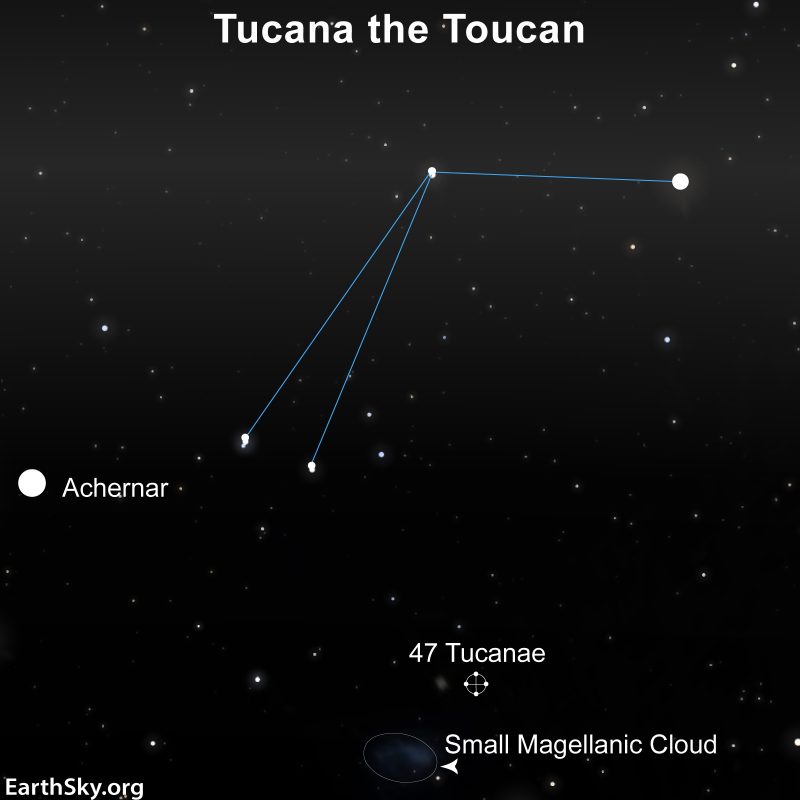
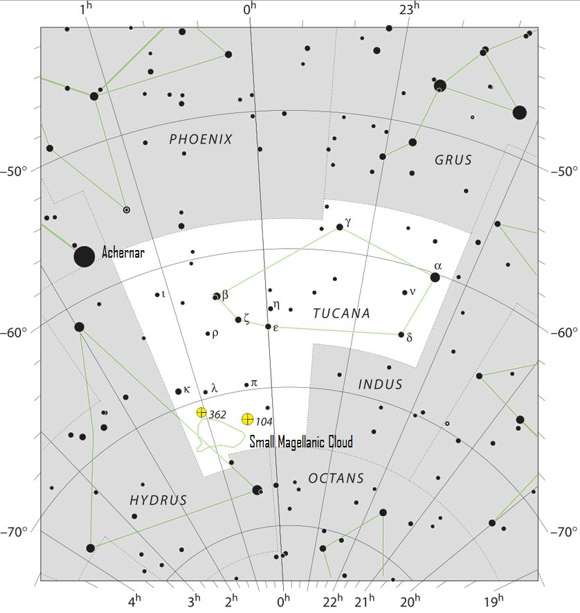
Tucana the Toucan is home to the Small Magellanic Cloud

Star chart with four stars connected by lines and Achernar, 47 Tucanae and Small Magellanic Cloud labeled.
The claim to fame for Tucana the Toucan is that it’s in the same direction in the sky as where we see the Small Magellanic Cloud, a dwarf galaxy orbiting our Milky Way. Plus, it’s also home to another beautiful deep-sky object, visible to the unaided eye: the globular star cluster 47 Tucanae. Chart via EarthSky.

We’ve never needed good science more than we do right now.
Support EarthSky in 2025 and help us keep it going strong.

Tucana the Toucan, deep in southern skies

The constellation Tucana the Toucan is visible year-round from Earth’s Southern Hemisphere. That’s because it’s near the south celestial pole, the point in the sky around which all southern stars revolve. So those of us in the Northern Hemisphere would have to travel southward on Earth’s globe to see Tucana. And, once we got there, we’d find that the stars of this constellation aren’t particularly bright or remarkable. Yet many of us know Tucana by name. Why?

It’s because this constellation is famous for being home to the Small Magellanic Cloud, the fuzzy patch in the sky that represents one of two relatively large dwarf galaxies orbiting our home galaxy, the Milky Way. Plus, southern stargazers know that a large globular star cluster – 47 Tucanae, visible to the unaided eye – is also located within the boundaries of Tucana. In fact, this constellation’s stars are harder to pick out than the globular cluster and galaxy that anchor its southern edge.

Stars of Tucana the Toucan

The brightest star in Tucana is Alpha Tucanae, a magnitude 2.87 star that lies almost 200 light-years from Earth.

Meanwhile, on the opposite side of the constellation from Alpha is Beta Tucanae, a star system containing six stars loosely bound together. Beta 1 is the brightest and shines at magnitude 4.36. Beta 2 shines at magnitude 4.53, and Beta 3 shines at 5.07. Overall, the whole Beta Tucanae system is an average of 140 light-years from Earth.

Star chart with stars in black on white, showing Tucana, the star Achernar, and the Small Magellanic Cloud.
You’ll find the Small Magellanic Cloud in the southeast corner of the constellation Tucana. The nearby bright star is Achernar, across the border in the constellation Eridanus the River. Chart by IAU. Used with permission.

Small Magellanic Cloud

Despite its great distance of 197,000 light-years, the Small Magellanic Cloud is one of the closest galaxies to Earth. You can see it without optical aid as a misty, cloudy patch from dark-sky locations. The Small Magellanic Cloud is an irregular galaxy but has a central bar as part of its structure, making it look like a disturbed former spiral. It’s the smaller of the two satellite galaxies in the Southern Hemisphere skies, with the larger being aptly named the Large Magellanic Cloud.

The Small Magellanic Cloud has many clusters and nebulae within its expanse. Indeed, it’s an excellent target for a telescope: clusters stream through its length and from one tail. The Small Magellanic Cloud’s nearby kin, the Large Magellanic Cloud, lies in the constellations Mensa and Dorado. In addition, both of these nearby galaxies are being sucked inward by our Milky Way galaxy and will eventually be absorbed by it.

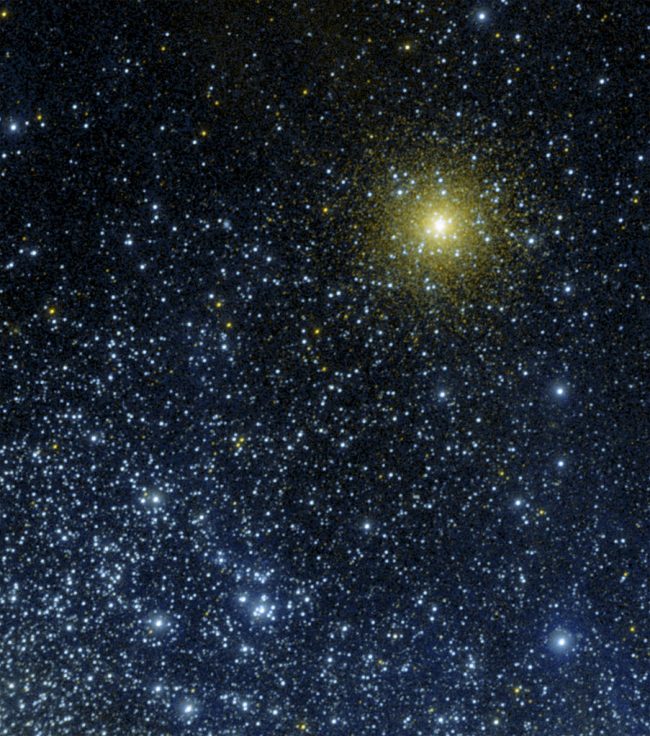
Large, hazy cluster of reddish and white stars, with tight cluster ball of stars to the right.
The Small Magellanic Cloud galaxy is a striking feature of the southern sky, but visible-light telescopes cannot get a clear view. Like the “cloud” in its name, the satellite galaxy also harbors obscuring dust clouds. The Visible and Infrared Survey Telescope for Astronomy (VISTA) allows a clearer view of the Small Magellanic Cloud. Notice also globular cluster 47 Tucanae to the right of the galaxy. Image via ESO/ VISTA VMC.
11 dish telescopes in front of starry background with 2 small, fuzzy, glowing patches in the sky.
View larger. | Can you spot Tucana the Toucan in this image of the night sky over the ALMA telescopes in Chile? The Small Magellanic Cloud lies within the border of Tucana. The bright ball of light to the upper right of the Small Magellanic Cloud is the globular cluster 47 Tucanae. Imagine the Toucan standing with its feet on the Small Magellanic Cloud. Image via ESO/ C. Malin.

47 Tucanae

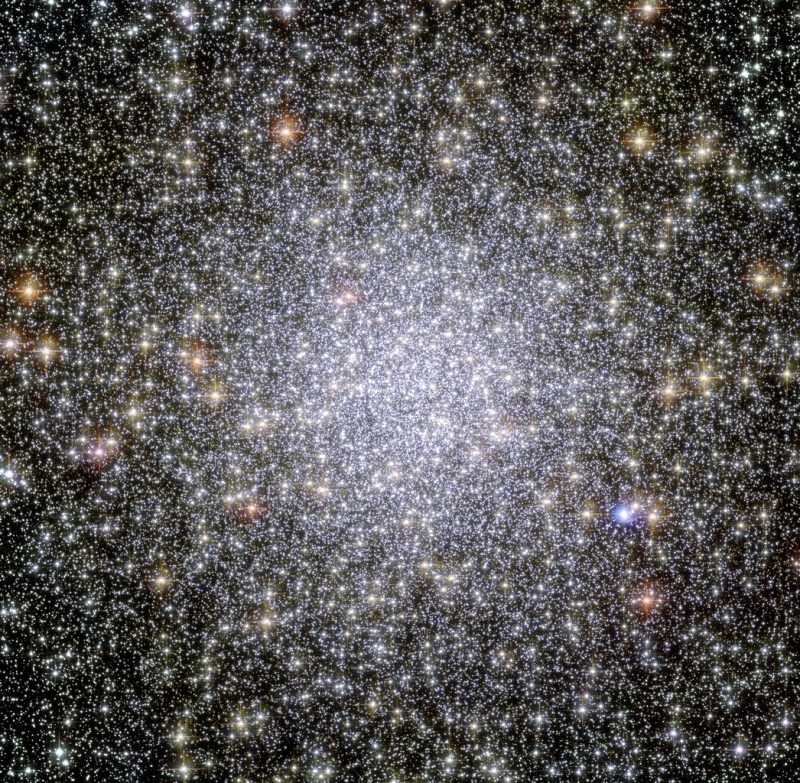
The globular cluster 47 Tucanae also bears the catalog name NGC 104. It shines bright at magnitude 4.0 and is easily visible with the unaided eye. In excellent seeing conditions, it appears as large as the full moon. In fact, it’s the second brightest globular cluster of the Milky Way and contains millions of stars. Use binoculars or a telescope to resolve thousands of stars in the cluster.
47 Tucanae lies 14,500 light-years away. The Small Magellanic Cloud and 47 Tucanae may look close together, but that is only a line-of-sight coincidence. The Small Magellanic Cloud is about 14 times farther away.

Densely packed cluster of thousands of stars, diffuse toward the edges, with some orangish dots on the outskirts.
The Southern Hemisphere’s 47 Tucanae is the second brightest globular cluster in the sky as viewed from Earth. Millions of stars create this cluster. Image via NASA/ ESA/ the Hubble Heritage/ Wikimedia Commons (CC BY 4.0).

Bonus globular cluster

Want a bonus observing target? On the opposite edge of the Small Magellanic Cloud’s curving shape from 47 Tucanae is NGC 362, another bright globular cluster. NGC 362 is a bit dimmer than 47 Tucanae, at magnitude 6.4, but still a good target in binoculars or small telescopes.

Small, hazy circular yellowish star cluster on the outskirts of a larger, irregular group of blue stars.
The globular cluster NGC 362 appears on the outskirts of the Small Magellanic Cloud. NGC 362 orbits the Milky Way in a highly eccentric orbit. Image via NASA/ JPL-Caltech/ University of Virginia/ R. Schiavon/ Wikimedia Commons (public domain).

The Hubble Deep Field South

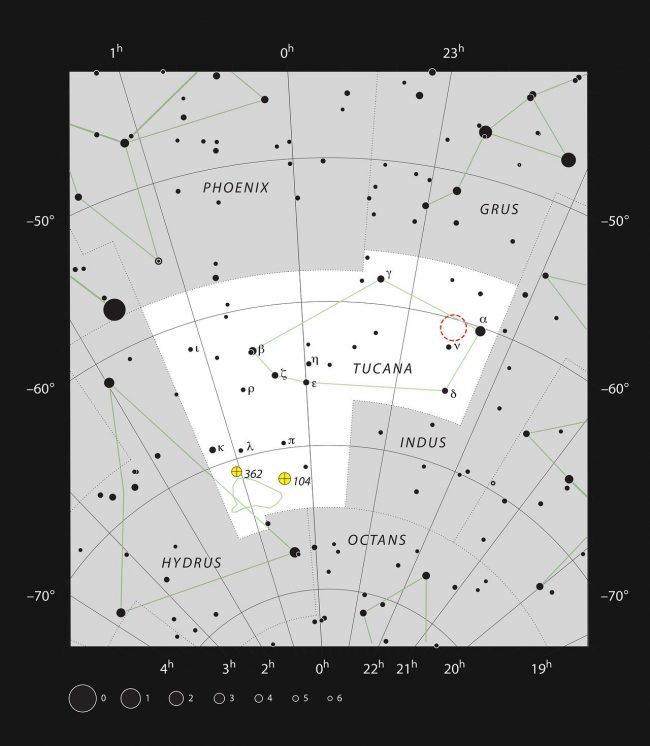
The Hubble Space Telescope took a series of famous images called “deep fields” starting in the 1990s. In these images, the space telescope stared at what mostly looks like a blank area of sky for a long period of time, allowing the faint background objects to come to light. One of these images, the Hubble Deep Field South, came from a region of Tucana.

Star chart of Tucana in white with black dots for stars and green lines for constellations.
View larger. | The red circle shows the location of the Hubble Deep Field South in the southern constellation of Tucana the Toucan. All the stars on this chart are visible to the unaided eye on a dark, clear night. Image via ESO.
Black background sprinkled with very many yellow and white small-to-tiny ovals, dots and spirals.
View larger. | This image – Hubble Deep Field South – from the NASA/ ESA Hubble Space Telescope is one of the 1st deepest visible/ultraviolet light images of the universe. The Hubble Space Telescope captured a tiny region of Tucana the Toucan in this image. Take some time to admire the huge array of galaxies in the deepest depths of space and from the early years of the universe. Image via R. Williams and the HDF-S team/ ESO.

Bottom line: Tucana the Toucan is a constellation in the Southern Hemisphere that’s a cinch to spot. Look for our little satellite galaxy, the Small Magellanic Cloud. Two easy-to-observe globular clusters also reside here.

The post Tucana the Toucan is home to the Small Magellanic Cloud first appeared on EarthSky.


from EarthSky https://ift.tt/iAgMnwJ
Star chart with four stars connected by lines and Achernar, 47 Tucanae and Small Magellanic Cloud labeled.
The claim to fame for Tucana the Toucan is that it’s in the same direction in the sky as where we see the Small Magellanic Cloud, a dwarf galaxy orbiting our Milky Way. Plus, it’s also home to another beautiful deep-sky object, visible to the unaided eye: the globular star cluster 47 Tucanae. Chart via EarthSky.

We’ve never needed good science more than we do right now.
Support EarthSky in 2025 and help us keep it going strong.

Tucana the Toucan, deep in southern skies

The constellation Tucana the Toucan is visible year-round from Earth’s Southern Hemisphere. That’s because it’s near the south celestial pole, the point in the sky around which all southern stars revolve. So those of us in the Northern Hemisphere would have to travel southward on Earth’s globe to see Tucana. And, once we got there, we’d find that the stars of this constellation aren’t particularly bright or remarkable. Yet many of us know Tucana by name. Why?

It’s because this constellation is famous for being home to the Small Magellanic Cloud, the fuzzy patch in the sky that represents one of two relatively large dwarf galaxies orbiting our home galaxy, the Milky Way. Plus, southern stargazers know that a large globular star cluster – 47 Tucanae, visible to the unaided eye – is also located within the boundaries of Tucana. In fact, this constellation’s stars are harder to pick out than the globular cluster and galaxy that anchor its southern edge.

Stars of Tucana the Toucan

The brightest star in Tucana is Alpha Tucanae, a magnitude 2.87 star that lies almost 200 light-years from Earth.

Meanwhile, on the opposite side of the constellation from Alpha is Beta Tucanae, a star system containing six stars loosely bound together. Beta 1 is the brightest and shines at magnitude 4.36. Beta 2 shines at magnitude 4.53, and Beta 3 shines at 5.07. Overall, the whole Beta Tucanae system is an average of 140 light-years from Earth.

Star chart with stars in black on white, showing Tucana, the star Achernar, and the Small Magellanic Cloud.
You’ll find the Small Magellanic Cloud in the southeast corner of the constellation Tucana. The nearby bright star is Achernar, across the border in the constellation Eridanus the River. Chart by IAU. Used with permission.

Small Magellanic Cloud

Despite its great distance of 197,000 light-years, the Small Magellanic Cloud is one of the closest galaxies to Earth. You can see it without optical aid as a misty, cloudy patch from dark-sky locations. The Small Magellanic Cloud is an irregular galaxy but has a central bar as part of its structure, making it look like a disturbed former spiral. It’s the smaller of the two satellite galaxies in the Southern Hemisphere skies, with the larger being aptly named the Large Magellanic Cloud.

The Small Magellanic Cloud has many clusters and nebulae within its expanse. Indeed, it’s an excellent target for a telescope: clusters stream through its length and from one tail. The Small Magellanic Cloud’s nearby kin, the Large Magellanic Cloud, lies in the constellations Mensa and Dorado. In addition, both of these nearby galaxies are being sucked inward by our Milky Way galaxy and will eventually be absorbed by it.

Large, hazy cluster of reddish and white stars, with tight cluster ball of stars to the right.
The Small Magellanic Cloud galaxy is a striking feature of the southern sky, but visible-light telescopes cannot get a clear view. Like the “cloud” in its name, the satellite galaxy also harbors obscuring dust clouds. The Visible and Infrared Survey Telescope for Astronomy (VISTA) allows a clearer view of the Small Magellanic Cloud. Notice also globular cluster 47 Tucanae to the right of the galaxy. Image via ESO/ VISTA VMC.
11 dish telescopes in front of starry background with 2 small, fuzzy, glowing patches in the sky.
View larger. | Can you spot Tucana the Toucan in this image of the night sky over the ALMA telescopes in Chile? The Small Magellanic Cloud lies within the border of Tucana. The bright ball of light to the upper right of the Small Magellanic Cloud is the globular cluster 47 Tucanae. Imagine the Toucan standing with its feet on the Small Magellanic Cloud. Image via ESO/ C. Malin.

47 Tucanae

The globular cluster 47 Tucanae also bears the catalog name NGC 104. It shines bright at magnitude 4.0 and is easily visible with the unaided eye. In excellent seeing conditions, it appears as large as the full moon. In fact, it’s the second brightest globular cluster of the Milky Way and contains millions of stars. Use binoculars or a telescope to resolve thousands of stars in the cluster.

47 Tucanae lies 14,500 light-years away. The Small Magellanic Cloud and 47 Tucanae may look close together, but that is only a line-of-sight coincidence. The Small Magellanic Cloud is about 14 times farther away.

Densely packed cluster of thousands of stars, diffuse toward the edges, with some orangish dots on the outskirts.
The Southern Hemisphere’s 47 Tucanae is the second brightest globular cluster in the sky as viewed from Earth. Millions of stars create this cluster. Image via NASA/ ESA/ the Hubble Heritage/ Wikimedia Commons (CC BY 4.0).

Bonus globular cluster

Want a bonus observing target? On the opposite edge of the Small Magellanic Cloud’s curving shape from 47 Tucanae is NGC 362, another bright globular cluster. NGC 362 is a bit dimmer than 47 Tucanae, at magnitude 6.4, but still a good target in binoculars or small telescopes.

Small, hazy circular yellowish star cluster on the outskirts of a larger, irregular group of blue stars.
The globular cluster NGC 362 appears on the outskirts of the Small Magellanic Cloud. NGC 362 orbits the Milky Way in a highly eccentric orbit. Image via NASA/ JPL-Caltech/ University of Virginia/ R. Schiavon/ Wikimedia Commons (public domain).

The Hubble Deep Field South

The Hubble Space Telescope took a series of famous images called “deep fields” starting in the 1990s. In these images, the space telescope stared at what mostly looks like a blank area of sky for a long period of time, allowing the faint background objects to come to light. One of these images, the Hubble Deep Field South, came from a region of Tucana.

Star chart of Tucana in white with black dots for stars and green lines for constellations.
View larger. | The red circle shows the location of the Hubble Deep Field South in the southern constellation of Tucana the Toucan. All the stars on this chart are visible to the unaided eye on a dark, clear night. Image via ESO.
Black background sprinkled with very many yellow and white small-to-tiny ovals, dots and spirals.
View larger. | This image – Hubble Deep Field South – from the NASA/ ESA Hubble Space Telescope is one of the 1st deepest visible/ultraviolet light images of the universe. The Hubble Space Telescope captured a tiny region of Tucana the Toucan in this image. Take some time to admire the huge array of galaxies in the deepest depths of space and from the early years of the universe. Image via R. Williams and the HDF-S team/ ESO.

Bottom line: Tucana the Toucan is a constellation in the Southern Hemisphere that’s a cinch to spot. Look for our little satellite galaxy, the Small Magellanic Cloud. Two easy-to-observe globular clusters also reside here.

The post Tucana the Toucan is home to the Small Magellanic Cloud first appeared on EarthSky.


from EarthSky https://ift.tt/iAgMnwJ

Amazing aurora photos capture the ‘sky on fire’ last night

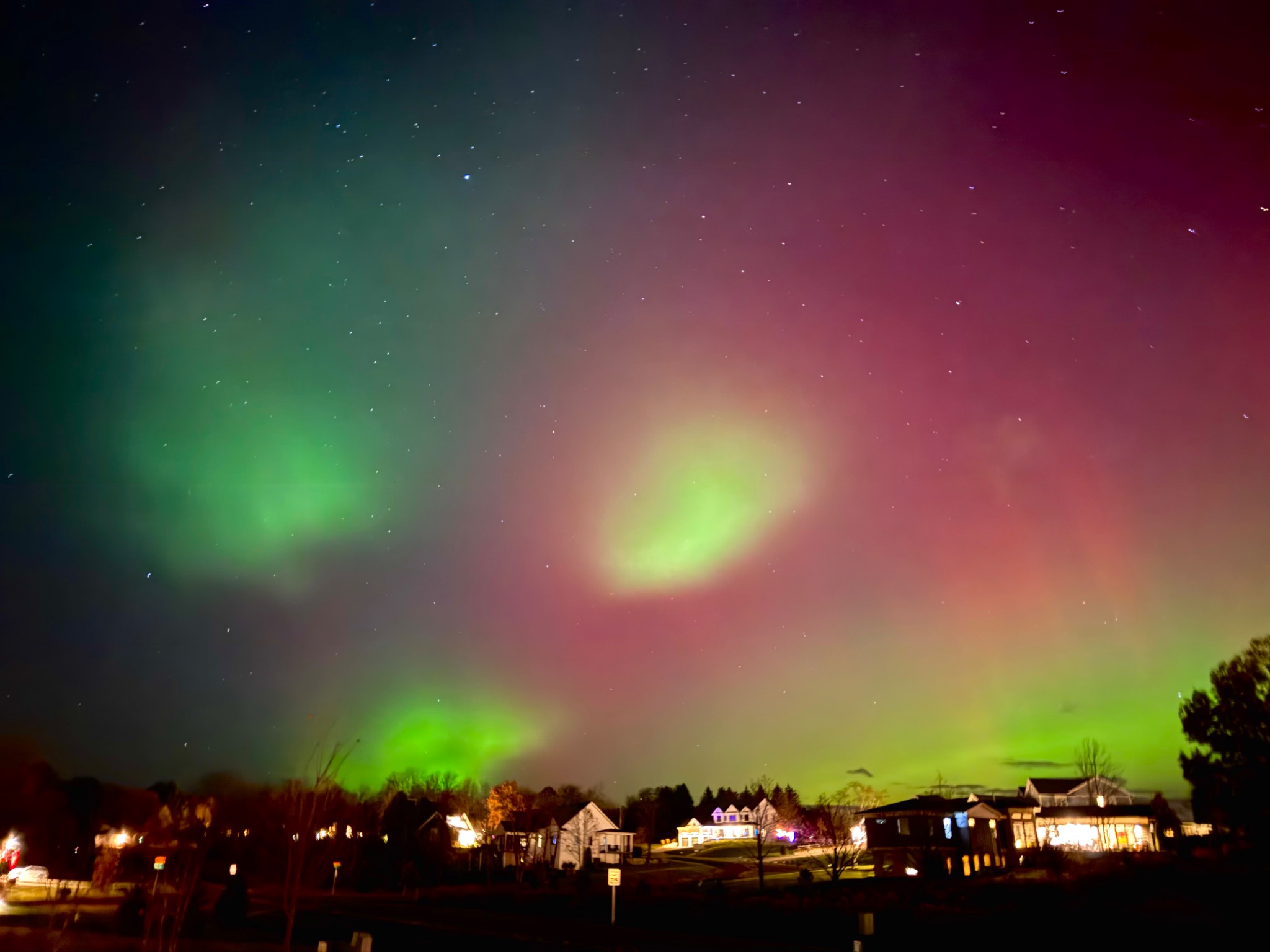
Background red aurora with bright green blobs.
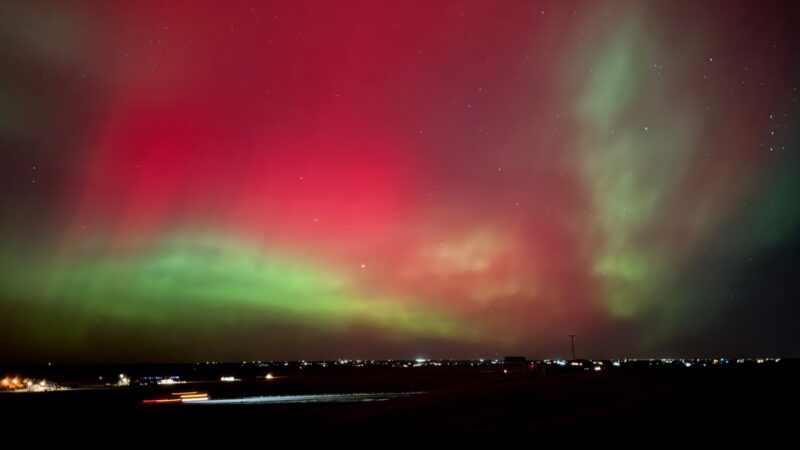
View at EarthSky Community Photos. | EarthSky’s Kelly Kizer Whitt captured the northern lights from near Madison, Wisconsin, on November 11, 2025. Kelly wrote: “An amazing night of aurora. In front of the red curtains we had bright green active blobs. One of the better displays I’ve seen.” Thank you, Kelly! Enjoy more aurora photos below.

Vivid reds and greens exploded across the sky on Tuesday night, November 11, 2025, as auroras dipped into southern-US latitudes and beyond. EarthSky community members from around the globe captured fabulous photos of the display. See some of the editor’s picks here.

The lights appeared after several bursts of sun-stuff – coronal mass ejections, or CMEs – impacted Earth’s magnetic field, triggering a severe (G4) geomagnetic storm.

And we’re expecting more auroras on Wednesday night, too! The sun has been particularly active lately, shooting off a number of X flares and coronal mass ejections. Stay up to date with our daily sun news.

Did you get a great photo of the aurora? Submit it to us!

An active night of aurora!

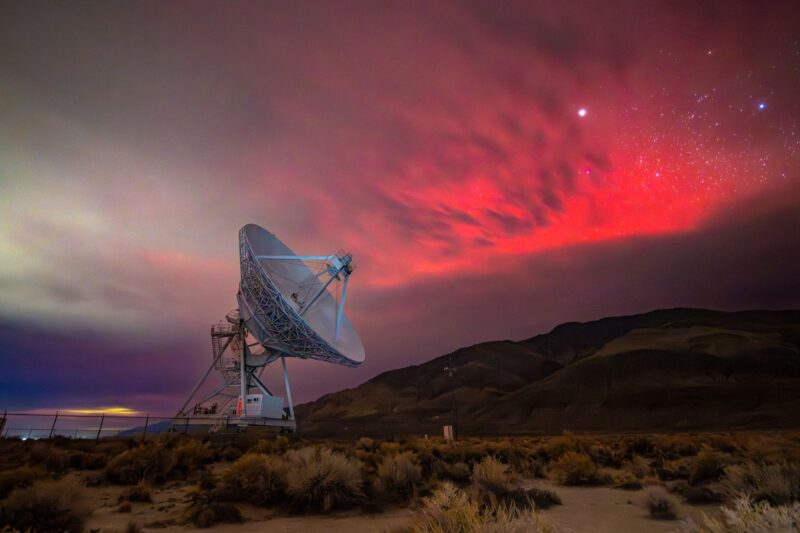
Radio telescope with the shape of a cone located in an open field. The sky looks deep red and there are many bright stars.
View at EarthSky Community Photos. | Ross Stone in Big Pine, California, captured this stunning view on November 11, 2025, and wrote: “The NRAO radio telescope in Owens Valley and the beautiful red aurora in the November sky. This was awesome, and the sky was so bright.” Thank you, Ross!
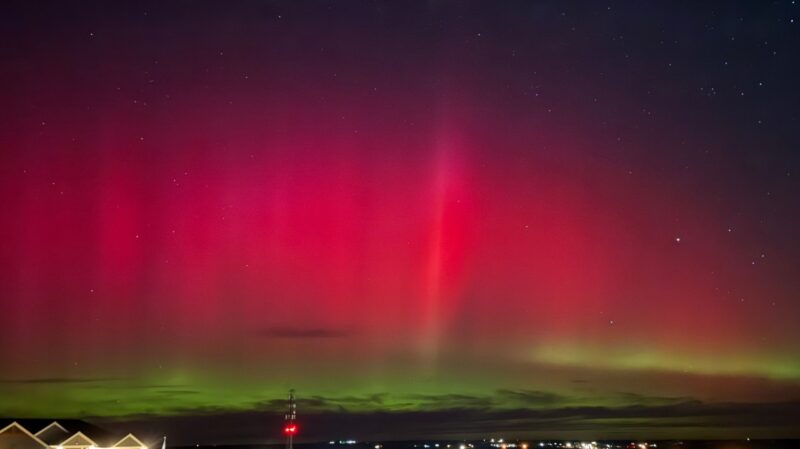
Red curtains of aurora with green at the base.
View at EarthSky Community Photos. | EarthSky’s Marcy Curran in Cheyenne, Wyoming, captured a beautiful display of aurora on November 11, 2025. Marcy wrote: “Aurora put on quite a show from Wyoming tonight. Lots of reds and green easily visible to the eye. We live in a semi-rural spot.” Thank you, Marcy!
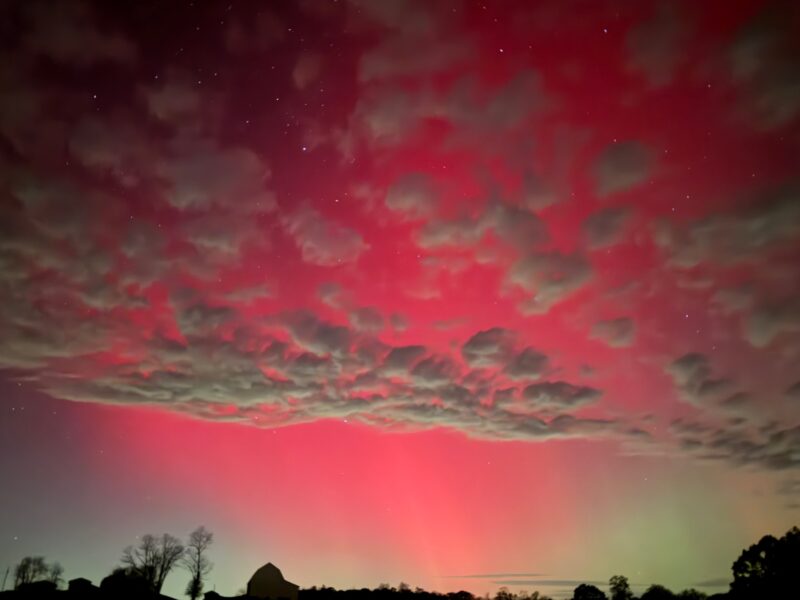
A few thin clouds in the sky. Pink/red pillars of light break through and are visible in all the sky.
View at EarthSky Community Photos. | Darrell Reese could see the aurora on November 11, 2025, from Ohio! Thank you for sharing your photo Darrell.
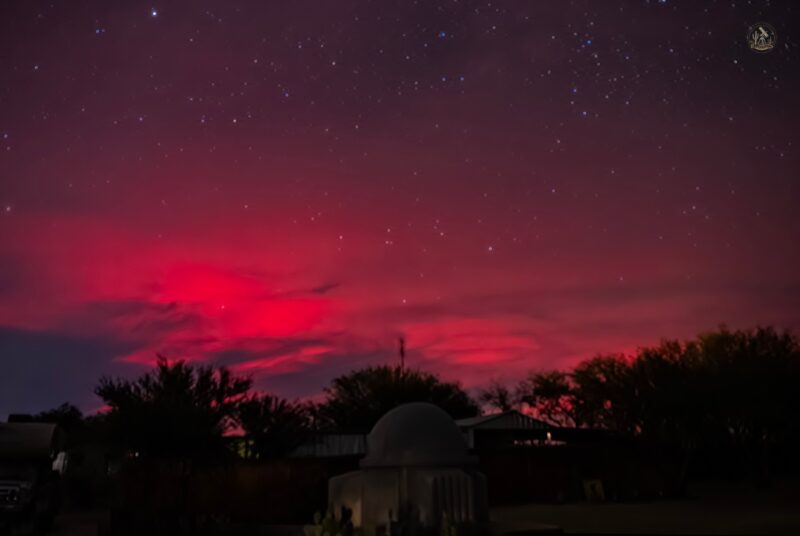
A small observatory on the ground, the sky covered with a pink light and many blue and white stars.
View at EarthSky Community Photos. | Jelieta Walinski shared this wonderful image from the Desert Bloom Observatory in Arizona. She wrote: “I stepped outside, camera in hand, and there it was … a crimson veil glimmering above the desert horizon. As clouds drifted in, they blurred the stars and bloomed their light, yet the magic lingered. I pressed the shutter and caught the sky’s rare blush.” Thank you, Jelieta!

Aurora photos from our community

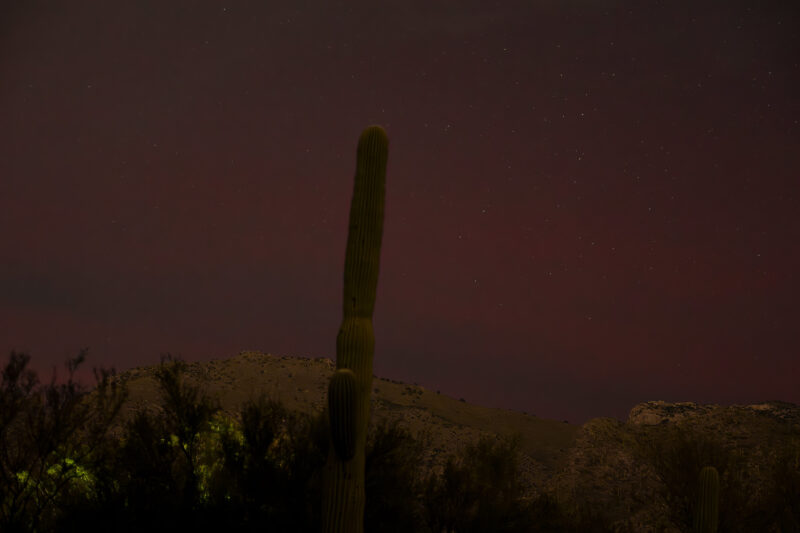
Desert scenery at night with a cactus silhouette and a faint red glow in the sky.
View at EarthSky Community Photos. | Eliot Herman in Tucson, Arizona, captured this aurora on November 11, 2025. Eliot wrote: “Seeing an aurora in Arizona at the southern border is exceptional, but this has been an exceptional year. As night fell, the sky turned magenta in the north, bright for about 20 minutes and faded, perhaps to become bright again sometime in the night. I shot wide angle and this telephoto to get a Saguaro framed in the aurora — being an exceptional scene this far south.” Thank you, Eliot!
A wide-angle view at night with a diffuse red light in the sky and a house in the foreground.
View at EarthSky Community Photos. | Steve Wilson in Salina, Kansas, captured this aurora on November 11, 2025. Steve wrote: “Had reports of very strong magnetic storms from the sun so I saw that the northern lights may be visible here in Kansas, so I got my camera set up on tripod with y 14mm wide angle lens and pointed north to get some photos. Chose this one as one of many I took.” Thank you, Steve!
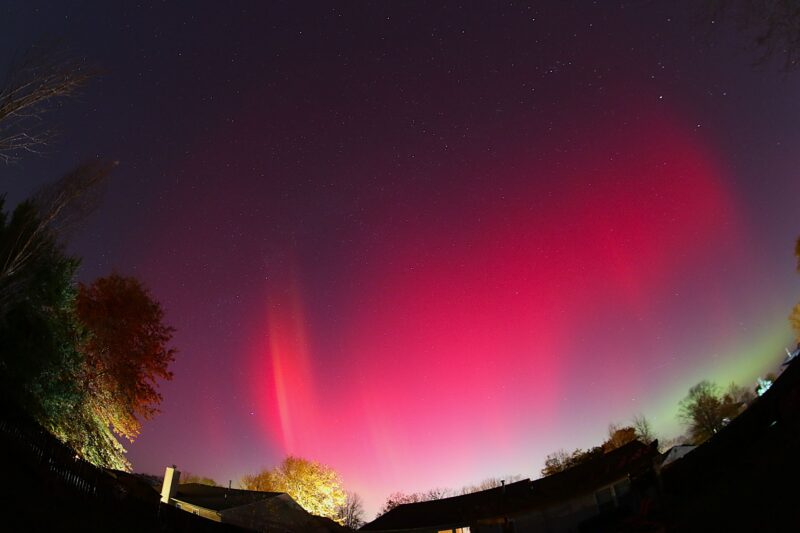
A wide-angle view at night with red and green light in the sky and a house in the foreground.
View at EarthSky Community Photos. | Bill Kozar in Taylorsville, Indiana, captured this aurora on November 11, 2025. Bill wrote: “A friend told me the auroras were active, and he was not kidding. The fish eye lens could not take it all in at times.” Thank you, Bill!
Sky at night with red and green curtains of light and pine trees in the foreground.
View at EarthSky Community Photos. | Joel Weatherly in Edmonton, Alberta, Canada, captured this aurora on November 11, 2025. Joel wrote: “Tonight, the auroras have been sporting a vibrant red hue. As seen from Edmonton, the activity was most prominent in the southern sky (Saturn is the bright point at the top of the tree) as the auroral oval arched overhead.” Thank you, Joel!

More aurora photos from our community

Out of focus image with a thin tree in the foreground, and a pink and yellow sky in the background. There are blurry stars in the distance.
View at EarthSky Community Photos. | John Ashley in Rio Rico, Arizona, captured this wonderful view on November 11, 2025, and wrote: “Bright reds in tonight’s aurora were visible for about 30 minutes, then faded back to a diffuse, colorless glow.” Thank you, John.
Wide view of the sky, with red and green colors. There are some white dots for the stars.
View at EarthSky Community Photos. | Martin Curran in Cheyenne, Wyoming, photographed the aurora on November 11, 2025, and wrote: “This is facing east. You can spot Orion, to the right, Jupiter in the middle with Castor and Pollux above it. Wow, what a show tonight and it’s still going strong.” Thank you, Martin!
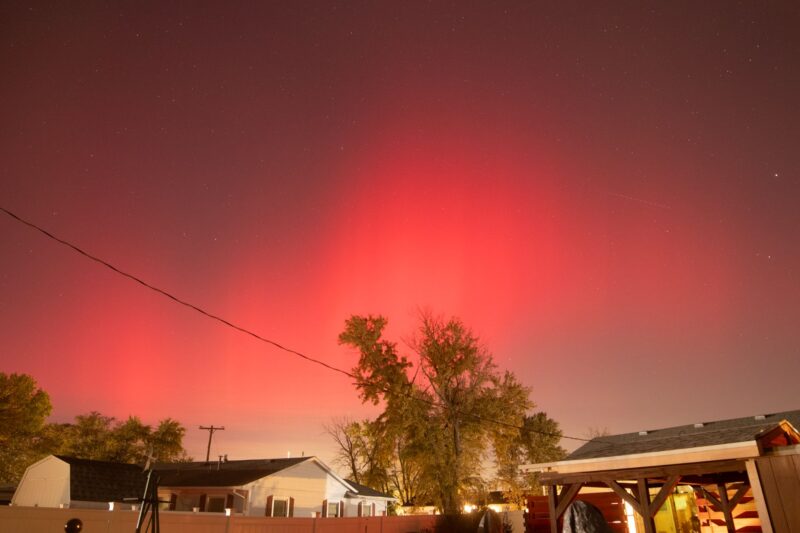
Deep red glow in the sky, 2 trees in the foreground and a few houses in the distance.
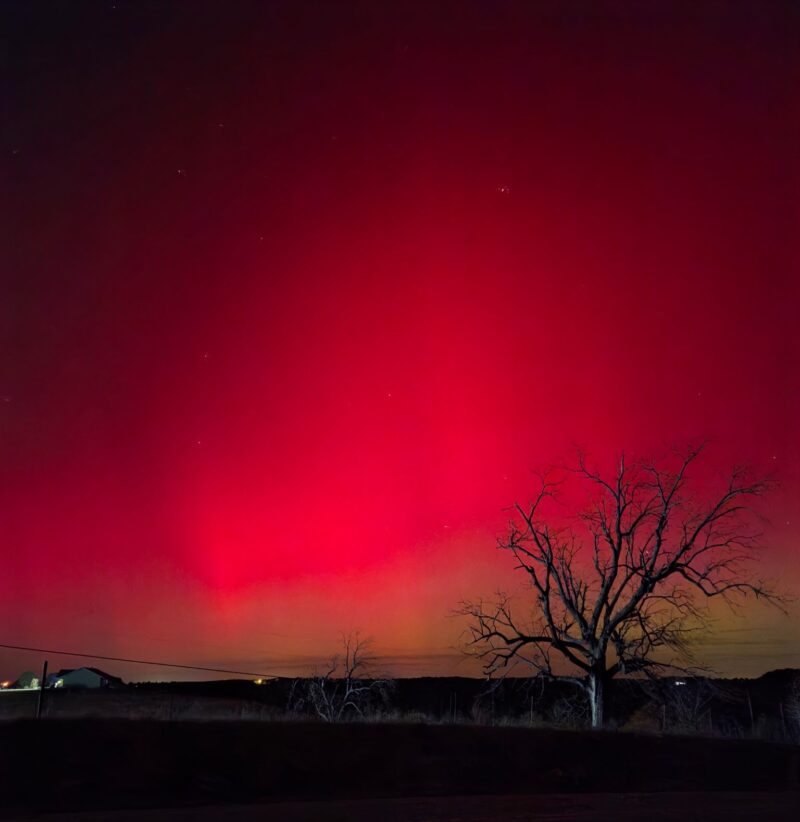
View at EarthSky Community Photos. | Ruth Goodwin-Hager in Eureka Springs, Arkansas, shared this image from November 11, 2025, and wrote: “I banged on my neighbors’ doors and recruited others to come outside and see the fabulous lights. It’s been 30 years since I’ve seen northern lights from my backyard like this. Amazing!” Thank you, Ruth!

Can’t stop, won’t stop!

Aurora showing purple and pink rays with light green on the horizon.
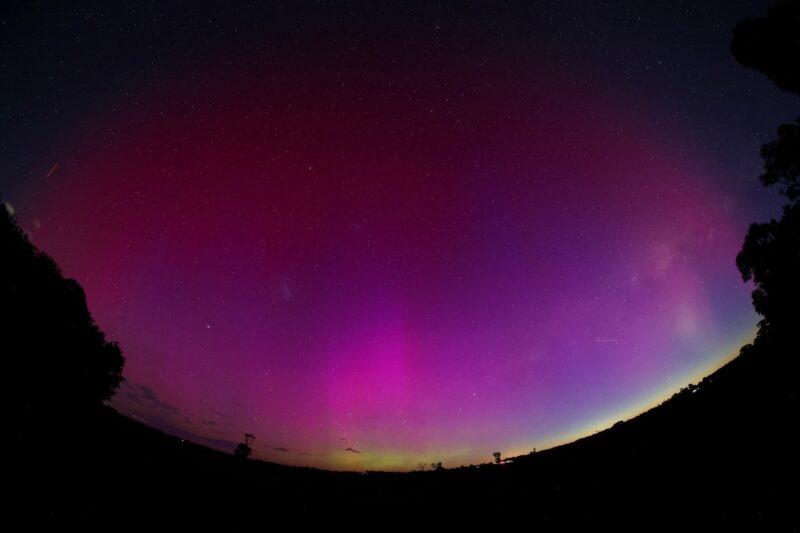
View at EarthSky Community Photos. | Peter Brouwer in Lindenow, Victoria, Australia, captured the aurora australis last night. Peter wrote: “Taken from our garden.” Thank you, Peter!
Clouds near the horizon, then green and then pinkish red extending nearly overhead.
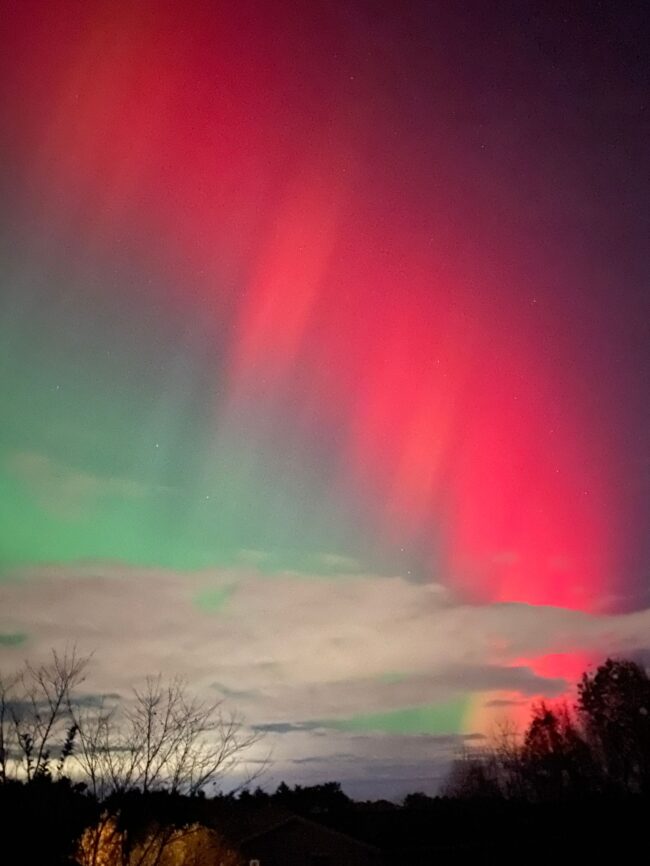
View at EarthSky Community Photos. | Patricia Evans in Seabrook, New Hampshire, captured the aurora on November 11, 2025. Patricia wrote: “Aurora borealis honors Veterans Day. I was afraid that the cloud cover would prevent viewing the Aurora Borealis but the reds and greens were amazingly intense! What a goosebump moment!” Thank you, Patricia!

Bottom line: Stargazers saw vivid reds and greens paint the sky last night, November 11, 2025, as auroras dipped into southern-US latitudes and beyond.

The post Amazing aurora photos capture the ‘sky on fire’ last night first appeared on EarthSky.


from EarthSky https://ift.tt/wxtQzfi
Background red aurora with bright green blobs.
View at EarthSky Community Photos. | EarthSky’s Kelly Kizer Whitt captured the northern lights from near Madison, Wisconsin, on November 11, 2025. Kelly wrote: “An amazing night of aurora. In front of the red curtains we had bright green active blobs. One of the better displays I’ve seen.” Thank you, Kelly! Enjoy more aurora photos below.

Vivid reds and greens exploded across the sky on Tuesday night, November 11, 2025, as auroras dipped into southern-US latitudes and beyond. EarthSky community members from around the globe captured fabulous photos of the display. See some of the editor’s picks here.

The lights appeared after several bursts of sun-stuff – coronal mass ejections, or CMEs – impacted Earth’s magnetic field, triggering a severe (G4) geomagnetic storm.

And we’re expecting more auroras on Wednesday night, too! The sun has been particularly active lately, shooting off a number of X flares and coronal mass ejections. Stay up to date with our daily sun news.

Did you get a great photo of the aurora? Submit it to us!

An active night of aurora!

Radio telescope with the shape of a cone located in an open field. The sky looks deep red and there are many bright stars.
View at EarthSky Community Photos. | Ross Stone in Big Pine, California, captured this stunning view on November 11, 2025, and wrote: “The NRAO radio telescope in Owens Valley and the beautiful red aurora in the November sky. This was awesome, and the sky was so bright.” Thank you, Ross!
Red curtains of aurora with green at the base.
View at EarthSky Community Photos. | EarthSky’s Marcy Curran in Cheyenne, Wyoming, captured a beautiful display of aurora on November 11, 2025. Marcy wrote: “Aurora put on quite a show from Wyoming tonight. Lots of reds and green easily visible to the eye. We live in a semi-rural spot.” Thank you, Marcy!
A few thin clouds in the sky. Pink/red pillars of light break through and are visible in all the sky.
View at EarthSky Community Photos. | Darrell Reese could see the aurora on November 11, 2025, from Ohio! Thank you for sharing your photo Darrell.
A small observatory on the ground, the sky covered with a pink light and many blue and white stars.
View at EarthSky Community Photos. | Jelieta Walinski shared this wonderful image from the Desert Bloom Observatory in Arizona. She wrote: “I stepped outside, camera in hand, and there it was … a crimson veil glimmering above the desert horizon. As clouds drifted in, they blurred the stars and bloomed their light, yet the magic lingered. I pressed the shutter and caught the sky’s rare blush.” Thank you, Jelieta!

Aurora photos from our community

Desert scenery at night with a cactus silhouette and a faint red glow in the sky.
View at EarthSky Community Photos. | Eliot Herman in Tucson, Arizona, captured this aurora on November 11, 2025. Eliot wrote: “Seeing an aurora in Arizona at the southern border is exceptional, but this has been an exceptional year. As night fell, the sky turned magenta in the north, bright for about 20 minutes and faded, perhaps to become bright again sometime in the night. I shot wide angle and this telephoto to get a Saguaro framed in the aurora — being an exceptional scene this far south.” Thank you, Eliot!
A wide-angle view at night with a diffuse red light in the sky and a house in the foreground.
View at EarthSky Community Photos. | Steve Wilson in Salina, Kansas, captured this aurora on November 11, 2025. Steve wrote: “Had reports of very strong magnetic storms from the sun so I saw that the northern lights may be visible here in Kansas, so I got my camera set up on tripod with y 14mm wide angle lens and pointed north to get some photos. Chose this one as one of many I took.” Thank you, Steve!
A wide-angle view at night with red and green light in the sky and a house in the foreground.
View at EarthSky Community Photos. | Bill Kozar in Taylorsville, Indiana, captured this aurora on November 11, 2025. Bill wrote: “A friend told me the auroras were active, and he was not kidding. The fish eye lens could not take it all in at times.” Thank you, Bill!
Sky at night with red and green curtains of light and pine trees in the foreground.
View at EarthSky Community Photos. | Joel Weatherly in Edmonton, Alberta, Canada, captured this aurora on November 11, 2025. Joel wrote: “Tonight, the auroras have been sporting a vibrant red hue. As seen from Edmonton, the activity was most prominent in the southern sky (Saturn is the bright point at the top of the tree) as the auroral oval arched overhead.” Thank you, Joel!

More aurora photos from our community

Out of focus image with a thin tree in the foreground, and a pink and yellow sky in the background. There are blurry stars in the distance.
View at EarthSky Community Photos. | John Ashley in Rio Rico, Arizona, captured this wonderful view on November 11, 2025, and wrote: “Bright reds in tonight’s aurora were visible for about 30 minutes, then faded back to a diffuse, colorless glow.” Thank you, John.
Wide view of the sky, with red and green colors. There are some white dots for the stars.
View at EarthSky Community Photos. | Martin Curran in Cheyenne, Wyoming, photographed the aurora on November 11, 2025, and wrote: “This is facing east. You can spot Orion, to the right, Jupiter in the middle with Castor and Pollux above it. Wow, what a show tonight and it’s still going strong.” Thank you, Martin!
Deep red glow in the sky, 2 trees in the foreground and a few houses in the distance.
View at EarthSky Community Photos. | Ruth Goodwin-Hager in Eureka Springs, Arkansas, shared this image from November 11, 2025, and wrote: “I banged on my neighbors’ doors and recruited others to come outside and see the fabulous lights. It’s been 30 years since I’ve seen northern lights from my backyard like this. Amazing!” Thank you, Ruth!

Can’t stop, won’t stop!

Aurora showing purple and pink rays with light green on the horizon.
View at EarthSky Community Photos. | Peter Brouwer in Lindenow, Victoria, Australia, captured the aurora australis last night. Peter wrote: “Taken from our garden.” Thank you, Peter!
Clouds near the horizon, then green and then pinkish red extending nearly overhead.
View at EarthSky Community Photos. | Patricia Evans in Seabrook, New Hampshire, captured the aurora on November 11, 2025. Patricia wrote: “Aurora borealis honors Veterans Day. I was afraid that the cloud cover would prevent viewing the Aurora Borealis but the reds and greens were amazingly intense! What a goosebump moment!” Thank you, Patricia!

Bottom line: Stargazers saw vivid reds and greens paint the sky last night, November 11, 2025, as auroras dipped into southern-US latitudes and beyond.

The post Amazing aurora photos capture the ‘sky on fire’ last night first appeared on EarthSky.


from EarthSky https://ift.tt/wxtQzfi

Hidden ocean on Enceladus might be stable enough for life

Ocean on Enceladus: Bluish orb with large bright plumes of material shooting outward from the surface and a spacecraft nearby.
Artist’s concept of the Cassini spacecraft sweeping past Saturn’s moon Enceladus and its famous water vapor plumes. In a new analysis of data from the Cassini mission, scientists measured heat flow at both of its poles for the 1st time. The study showed the subsurface ocean on Enceladus is likely stable enough to be habitable for life. Image via NASA/ JPL-Caltech.
  • Saturn’s moon Enceladus has a salty, global subsurface ocean similar to Earth’s oceans. Is it habitable? Could there actually be life there?
  • Enceladus’ ocean is likely stable enough to support life, a new analysis of Cassini data showed.
  • Scientists measured heat flow at the moon’s north pole for the 1st time. This heat loss at both poles is evidence that the ocean is stable over long geological time periods.

Millions come to EarthSky for night sky news and trusted science.
Your donation keeps us free and accessible for all.

A stable, habitable ocean on Enceladus?

Scientists have found yet more evidence that the subsurface ocean on Saturn’s moon Enceladus might be habitable. Researchers from the University of Oxford, Southwest Research Institute (SwRI) in Texas and the Planetary Science Institute (PSI) in Arizona said on November 10, 2025, that they have confirmed heat flow at the moon’s north pole, not just the south pole as first thought. This indicates that Enceladus is generating a lot more heat inside than previously known. This suggests the ocean has been stable over the long term geologically. It’s an exciting new finding hinting at how this alien ocean just might be home for some form of life.

The researchers used data from the now-finished Cassini mission for their new study.

Previously, scientists thought heat was escaping into space only from Enceladus’ south pole. That is where the huge water vapor plumes erupt from long cracks in the icy surface called tiger stripes. NASA’s Cassini spacecraft previously flew through the plumes and sampled them to analyze their composition.

The intriguing new peer-reviewed results were published in Science Advances on November 7, 2025.

Heat loss at Enceladus’ north pole

Scientists have thought that the north pole on Enceladus was much less geologically active than its south pole. That made sense, since it’s at the south pole where the tiger stripes and plumes are located. And scientists had only measured heat loss at the south pole.

But now, it seems there might be some geological activity at the north pole after all. The researchers compared Cassini observations of the north polar region in deep winter (in 2005) and summer (in 2015). They then measured how much energy Enceladus loses from its “warm” subsurface ocean (32 degrees Fahrenheit or 0 degrees Celsius) as heat travels through the icy outer shell to the surface (–370 degrees F, or -223 degrees C) and then radiates into space.

Lead author Georgina Miles at the Southwest Research Institute (SwRI) and a visiting scientist at the Department of Physics, University of Oxford, said:

Eking out the subtle surface temperature variations caused by Enceladus’ conductive heat flow from its daily and seasonal temperature changes was a challenge, and was only made possible by Cassini’s extended missions.

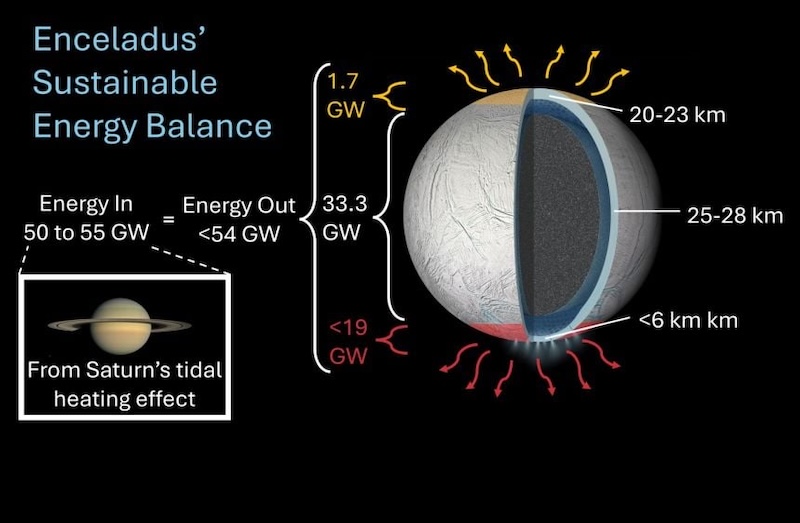
Cutaway view of a whitish sphere with dark interior, with text labels on black background. Curved yellow and red arrows radiate away from the top and bottom of the sphere.
View larger. | This infographic depicts heat transfer from Enceladus’ subsurface ocean, at both the north and south poles. This balance shows the ocean is stable over the long term and increases the chances of it being habitable. Image via University of Oxford/ NASA/ JPL-CalTech/ Space Science Institute (PIA19656 and PIA11141).
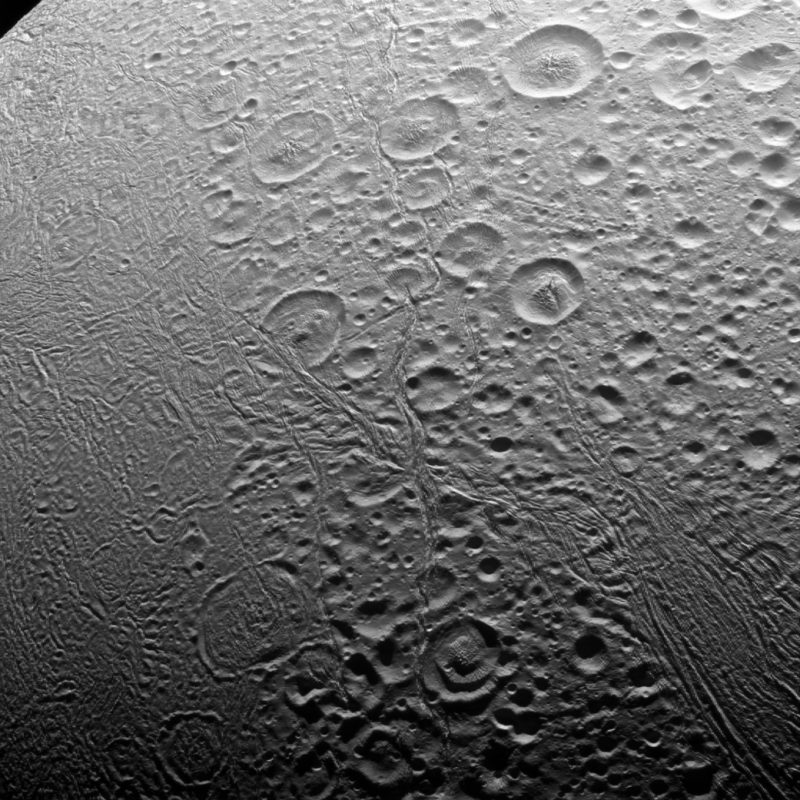
Grayish moon covered in craters.
View larger. | A visible-light image of Enceladus’ north pole, taken by Cassini on November 27, 2016. The terrain is much more cratered than in the south, but the infrared images – and the cracks in the surface seen here – show there has been at least some geological activity in the region. Image via NASA/ JPL-Caltech.

North pole warmer than expected

Researchers modeled the expected surface temperatures during the polar night and compared them with infrared observations from the Cassini Composite InfraRed Spectrometer (CIRS). And – surprise – they found the surface at the north pole was about 7 Kelvin warmer than expected. According to the researchers, only heat leaking from the ocean below could explain that.

The researchers measured the heat flow at 46 ± 4 milliwatts per square meter. That’s equivalent to 2/3 of the heat loss (per unit area) through Earth’s continental crusts. This is a total heat loss of 35 gigawatts for all of Enceladus. That equals 66 million solar panels (with an output of 530 watts) or 10,500 wind turbines (with an output of 3.4 megawatts).

The results also show the ice shell thickness at the north pole to be about 12-19 miles (20-30 km). This is consistent with previous models.

Interestingly, another team of researchers said in 2020 that they found evidence for plumes at Enceladus’ north pole, as well. They are thought to be smaller and weaker than the ones at the south pole. But if confirmed, they would fit with the new evidence for heat leaking from the ocean at the north pole, through cracks in the ice crust.

NEW: Latest findings from NASA’s Cassini mission show that Enceladus – one of Saturn’s moons and a top contender for extra-terrestrial life – is losing heat from both poles, suggesting it could stay stable enough for life to form.Read more ??

University of Oxford (@ox.ac.uk) 2025-11-10T16:10:19.457171907Z

Evidence for a stable ocean on Enceladus

The researchers then combined the heat loss at both poles for a total of about 54 gigawatts. Notably, that is close to what models predicted for heat input from tidal forces in the ocean. Why is that significant? It means there is a balance between heat production and heat loss. That would allow the subsurface ocean to remain stable for a long time.

The tidal heating – caused by Saturn’s gravity tugging on Enceladus – would maintain this balance. This is important. If the ocean doesn’t gain enough energy, it would eventually freeze solid. If there’s too much energy, however, then that could alter the chemistry of the ocean, perhaps making it less habitable.

Smiling woman wearing a blue shirt.
Georgina Miles at the Southwest Research Institute (SwRI) is the lead author of the new study about heat loss and the habitability of Enceladus’ subsurface ocean. Image via ResearchGate.

Enceladus: An abode of life?

The evidence has mounted in recent years that Enceladus’ ocean is potentially habitable. Cassini found all of the necessary ingredients in the water vapor plumes, including complex organics and phosphorous. The ocean is also salty, but not too salty. There is also evidence for hydrothermal activity – hydrothermal vents – on the ocean floor, much like in Earth’s oceans.

But more study is needed, including from future missions going back to Enceladus. And as with Cassini, it can take many years to go through all of the data. As Miles noted:

Our study highlights the need for long-term missions to ocean worlds that may harbor life, and the fact the data might not reveal all its secrets until decades after it has been obtained.

Bottom line: The subsurface ocean on Enceladus is stable enough for life, a new study of data from the Cassini mission suggests. Heat flow at both poles provides the clues.

Source: Endogenic heat at Enceladus’ north pole

Via University of Oxford

Read more: Do the organics in Enceladus’ ocean point to habitability?

Read more: Enceladus’ ocean even more habitable than thought

The post Hidden ocean on Enceladus might be stable enough for life first appeared on EarthSky.


from EarthSky https://ift.tt/zFbmoPv
Ocean on Enceladus: Bluish orb with large bright plumes of material shooting outward from the surface and a spacecraft nearby.
Artist’s concept of the Cassini spacecraft sweeping past Saturn’s moon Enceladus and its famous water vapor plumes. In a new analysis of data from the Cassini mission, scientists measured heat flow at both of its poles for the 1st time. The study showed the subsurface ocean on Enceladus is likely stable enough to be habitable for life. Image via NASA/ JPL-Caltech.
  • Saturn’s moon Enceladus has a salty, global subsurface ocean similar to Earth’s oceans. Is it habitable? Could there actually be life there?
  • Enceladus’ ocean is likely stable enough to support life, a new analysis of Cassini data showed.
  • Scientists measured heat flow at the moon’s north pole for the 1st time. This heat loss at both poles is evidence that the ocean is stable over long geological time periods.

Millions come to EarthSky for night sky news and trusted science.
Your donation keeps us free and accessible for all.

A stable, habitable ocean on Enceladus?

Scientists have found yet more evidence that the subsurface ocean on Saturn’s moon Enceladus might be habitable. Researchers from the University of Oxford, Southwest Research Institute (SwRI) in Texas and the Planetary Science Institute (PSI) in Arizona said on November 10, 2025, that they have confirmed heat flow at the moon’s north pole, not just the south pole as first thought. This indicates that Enceladus is generating a lot more heat inside than previously known. This suggests the ocean has been stable over the long term geologically. It’s an exciting new finding hinting at how this alien ocean just might be home for some form of life.

The researchers used data from the now-finished Cassini mission for their new study.

Previously, scientists thought heat was escaping into space only from Enceladus’ south pole. That is where the huge water vapor plumes erupt from long cracks in the icy surface called tiger stripes. NASA’s Cassini spacecraft previously flew through the plumes and sampled them to analyze their composition.

The intriguing new peer-reviewed results were published in Science Advances on November 7, 2025.

Heat loss at Enceladus’ north pole

Scientists have thought that the north pole on Enceladus was much less geologically active than its south pole. That made sense, since it’s at the south pole where the tiger stripes and plumes are located. And scientists had only measured heat loss at the south pole.

But now, it seems there might be some geological activity at the north pole after all. The researchers compared Cassini observations of the north polar region in deep winter (in 2005) and summer (in 2015). They then measured how much energy Enceladus loses from its “warm” subsurface ocean (32 degrees Fahrenheit or 0 degrees Celsius) as heat travels through the icy outer shell to the surface (–370 degrees F, or -223 degrees C) and then radiates into space.

Lead author Georgina Miles at the Southwest Research Institute (SwRI) and a visiting scientist at the Department of Physics, University of Oxford, said:

Eking out the subtle surface temperature variations caused by Enceladus’ conductive heat flow from its daily and seasonal temperature changes was a challenge, and was only made possible by Cassini’s extended missions.

Cutaway view of a whitish sphere with dark interior, with text labels on black background. Curved yellow and red arrows radiate away from the top and bottom of the sphere.
View larger. | This infographic depicts heat transfer from Enceladus’ subsurface ocean, at both the north and south poles. This balance shows the ocean is stable over the long term and increases the chances of it being habitable. Image via University of Oxford/ NASA/ JPL-CalTech/ Space Science Institute (PIA19656 and PIA11141).
Grayish moon covered in craters.
View larger. | A visible-light image of Enceladus’ north pole, taken by Cassini on November 27, 2016. The terrain is much more cratered than in the south, but the infrared images – and the cracks in the surface seen here – show there has been at least some geological activity in the region. Image via NASA/ JPL-Caltech.

North pole warmer than expected

Researchers modeled the expected surface temperatures during the polar night and compared them with infrared observations from the Cassini Composite InfraRed Spectrometer (CIRS). And – surprise – they found the surface at the north pole was about 7 Kelvin warmer than expected. According to the researchers, only heat leaking from the ocean below could explain that.

The researchers measured the heat flow at 46 ± 4 milliwatts per square meter. That’s equivalent to 2/3 of the heat loss (per unit area) through Earth’s continental crusts. This is a total heat loss of 35 gigawatts for all of Enceladus. That equals 66 million solar panels (with an output of 530 watts) or 10,500 wind turbines (with an output of 3.4 megawatts).

The results also show the ice shell thickness at the north pole to be about 12-19 miles (20-30 km). This is consistent with previous models.

Interestingly, another team of researchers said in 2020 that they found evidence for plumes at Enceladus’ north pole, as well. They are thought to be smaller and weaker than the ones at the south pole. But if confirmed, they would fit with the new evidence for heat leaking from the ocean at the north pole, through cracks in the ice crust.

NEW: Latest findings from NASA’s Cassini mission show that Enceladus – one of Saturn’s moons and a top contender for extra-terrestrial life – is losing heat from both poles, suggesting it could stay stable enough for life to form.Read more ??

University of Oxford (@ox.ac.uk) 2025-11-10T16:10:19.457171907Z

Evidence for a stable ocean on Enceladus

The researchers then combined the heat loss at both poles for a total of about 54 gigawatts. Notably, that is close to what models predicted for heat input from tidal forces in the ocean. Why is that significant? It means there is a balance between heat production and heat loss. That would allow the subsurface ocean to remain stable for a long time.

The tidal heating – caused by Saturn’s gravity tugging on Enceladus – would maintain this balance. This is important. If the ocean doesn’t gain enough energy, it would eventually freeze solid. If there’s too much energy, however, then that could alter the chemistry of the ocean, perhaps making it less habitable.

Smiling woman wearing a blue shirt.
Georgina Miles at the Southwest Research Institute (SwRI) is the lead author of the new study about heat loss and the habitability of Enceladus’ subsurface ocean. Image via ResearchGate.

Enceladus: An abode of life?

The evidence has mounted in recent years that Enceladus’ ocean is potentially habitable. Cassini found all of the necessary ingredients in the water vapor plumes, including complex organics and phosphorous. The ocean is also salty, but not too salty. There is also evidence for hydrothermal activity – hydrothermal vents – on the ocean floor, much like in Earth’s oceans.

But more study is needed, including from future missions going back to Enceladus. And as with Cassini, it can take many years to go through all of the data. As Miles noted:

Our study highlights the need for long-term missions to ocean worlds that may harbor life, and the fact the data might not reveal all its secrets until decades after it has been obtained.

Bottom line: The subsurface ocean on Enceladus is stable enough for life, a new study of data from the Cassini mission suggests. Heat flow at both poles provides the clues.

Source: Endogenic heat at Enceladus’ north pole

Via University of Oxford

Read more: Do the organics in Enceladus’ ocean point to habitability?

Read more: Enceladus’ ocean even more habitable than thought

The post Hidden ocean on Enceladus might be stable enough for life first appeared on EarthSky.


from EarthSky https://ift.tt/zFbmoPv

Pegasus the Flying Horse, and the best sky story ever

Pegasus the Flying Horse

Pegasus the Flying Horse rises in the east on autumn evenings in the Northern Hemisphere (spring evenings in the Southern Hemisphere). It dominates the sky with its giant square asterism, fittingly called the Great Square. In mythology, Pegasus figured into the greatest – surely the most elaborate – of all sky myths. This one is from ancient Greece some 3,000 years ago. According to the myth, Pegasus was the flying horse ridden by Perseus the Hero, as he swooped in to save Princess Andromeda from a sea monster. There’s more to the story, which you’ll find in the video at the top of this page.

Today, we see Pegasus as the 7th-largest of the 88 official constellations. And Pegasus is easy to find. On fall evenings in the Northern Hemisphere, this constellation climbs above the eastern horizon, reaching a spot nearly overhead by late fall.

Its asterism – the Great Square of Pegasus – is huge. The square alone is 20 degrees wide from top to bottom. That’s the span of two fist-widths held at arm’s length.

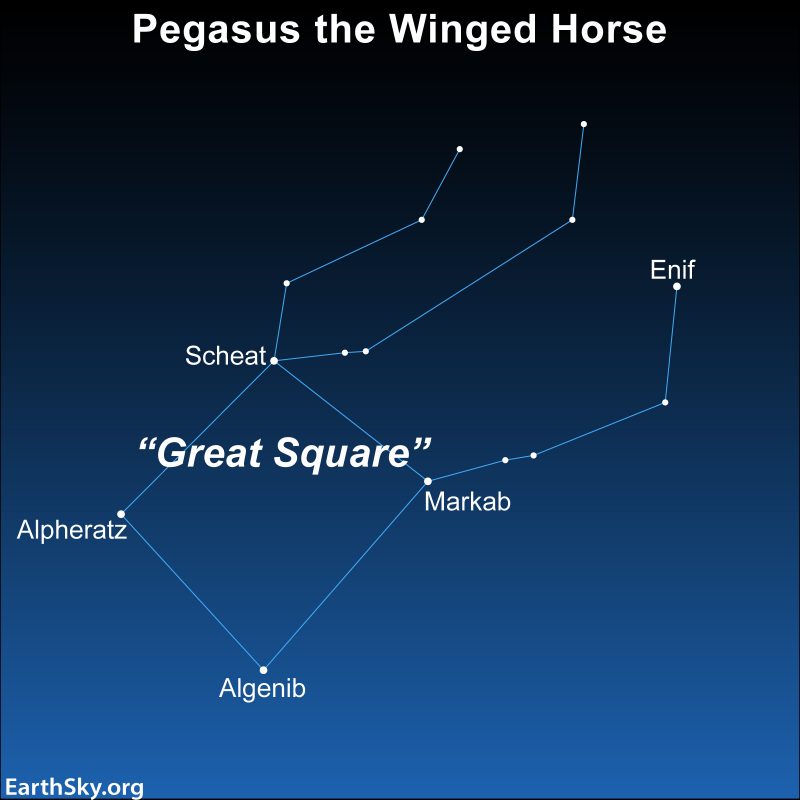
Sky chart with numerous labeled stars and lines between them making a large square with legs.
On autumn evenings in the Northern Hemisphere – spring evenings in the Southern Hemisphere – Pegasus the Flying Horse is ascending in the east in the evening hours. You’ll most easily notice the giant, square-shaped asterism within Pegasus, called the Great Square.

Stars of Pegasus

As it rises in the evening, the star in the Great Square closest to the horizon is Algenib, with a magnitude of 2.8. It lies 390 light-years away. The star on the opposite corner of the square from Algenib is Scheat, a magnitude 2.4 star lying 199 light-years away. The star to the south in the square is Markab, a magnitude 2.5 star at a distance of 140 light-years. And the final star in the square is Alpheratz. Technically, Alpheratz lies just across the border of Pegasus and is actually a member of the constellation Andromeda. Alpheratz is the brightest of the four stars at magnitude 2.1 and lies 97 light-years away.

The Great Square marks the body of the flying horse. Trails leading off the west side of the square mark the front legs and head of Pegasus. Extending out from Markab, two stars at magnitude 3.4 and 3.5, Homam and Biham, lead the way to the head star, magnitude 2.4 star Enif. This star is helpful in finding the globular cluster M15.

Find the forelegs of Pegasus off of Scheat. Five degrees west of Scheat is 3rd magnitude star Matar. As the brightest leg star in Pegasus, it’s helpful in finding a couple of notable galaxies.

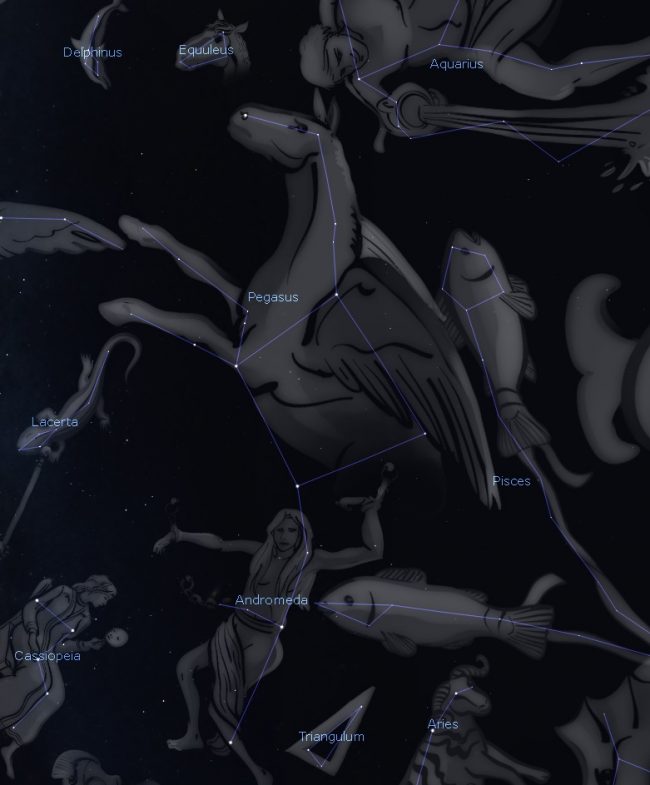
Star chart with pictures of Pegasus the Flying Horse and neighboring constellations.
Pegasus the Flying Horse is a giant constellation that rises in the east on October evenings. Image via Stellarium. Used with permission.

The asterism of the Great Square

The Great Square of Pegasus can look like a huge diamond. Think of it as a giant baseball diamond rising during playoffs month in the east after dark. Asterisms, such as the Great Square, are groups of stars that aren’t labeled as constellations but are easy to recognize.

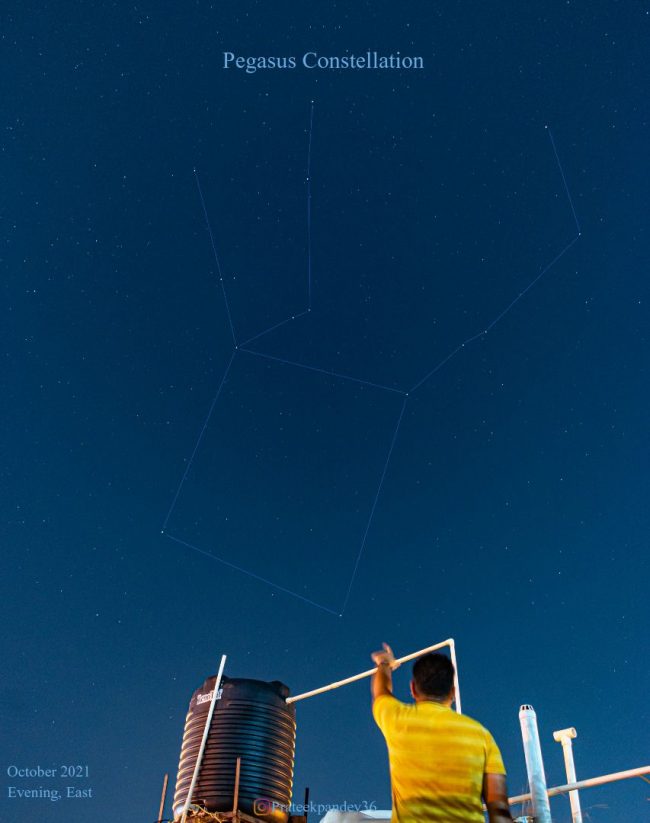
Night sky photo with lines between stars and a man pointing up at the constellation.
View at EarthSky Community Photos. | Prateek Pandey in Bhopal, India, captured this photo of Pegasus. He wrote: “Pegasus is named after the winged horse in Greek mythology. Curiously, the constellation Pegasus only represents the top half of the horse. In some depictions, the horse is shown rising out of the water. Viewed best in autumn, turn your eyes to the east as the night falls, and see the winged horse rising high up in the sky.” Thank you, Prateek!

Using Pegasus to find the Andromeda Galaxy

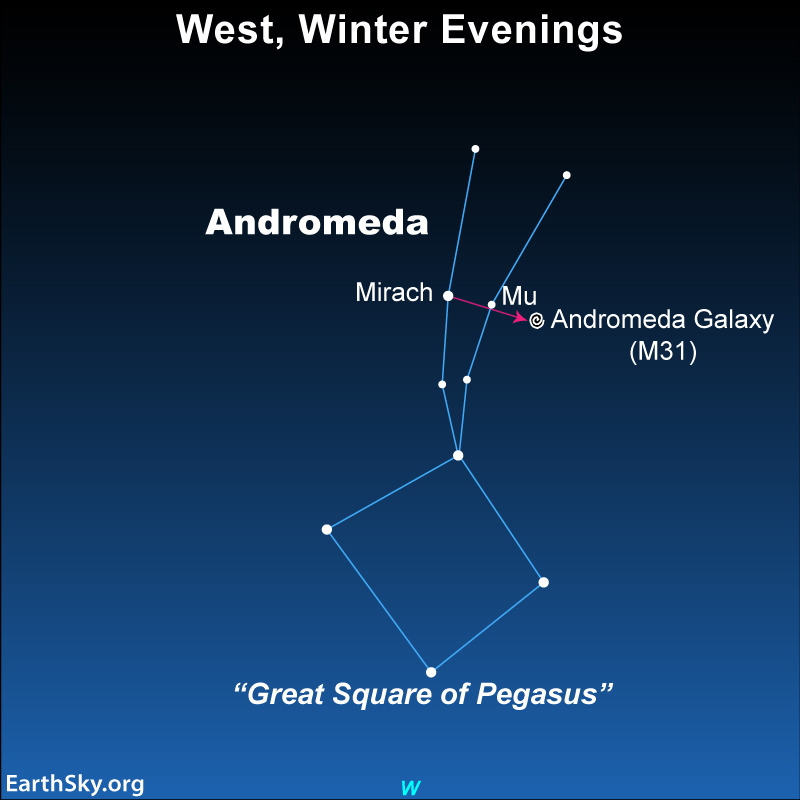
Pegasus is close to the constellation Andromeda, so it’s useful for star-hopping to the Andromeda galaxy. You’ll need a dark-sky site to track down Andromeda without optical aid. It’s much easier to spot with binoculars or a telescope. Follow this link for more information on how to use Pegasus to find Andromeda.

Star chart: Lines showing constellations with large square and arrow pointing to galaxy symbol.
Find the Andromeda Galaxy (M31) by star-hopping from the Great Square of Pegasus. Chart via EarthSky.
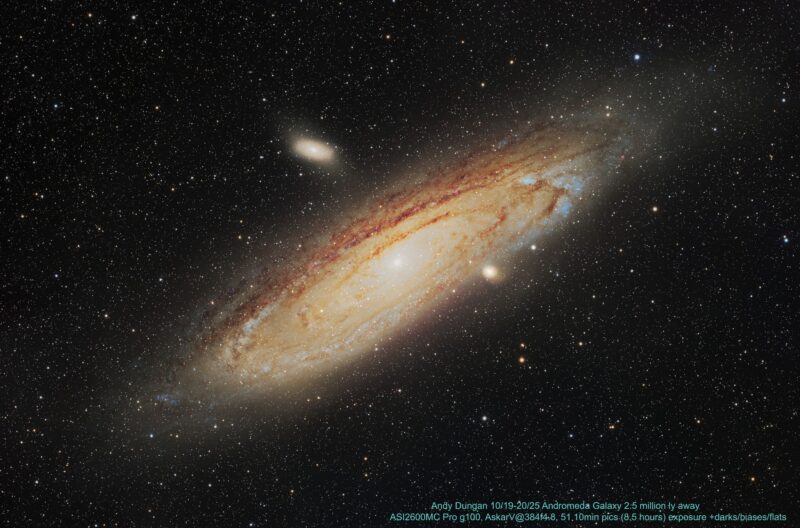
A huge, glowing spiral with 2 small fuzzy patches nearby, among thousands of foreground stars.
View at EarthSky Community Photos. | Andy Dungan near Cotopaxi, Colorado, captured Messier 31, the Andromeda galaxy, on October 20, 2025. Andy wrote: “The part that always amazes me about the Andromeda galaxy is that it is close to the same size as the moon when you look at them from Earth. Andromeda is really big. And, at 2.5 million light-years away, it’s the closest large galaxy to us in the universe!” Thank you, Andy!

Stephan’s Quintet

Pegasus is home to many galaxy clusters. The most famous is probably Stephan’s Quintet, a favorite target among astrophotographers. This tight gathering of five galaxies has a faint magnitude of 13.6. The largest and brightest, NGC 7320, has a small redshift compared to the other four, revealing that it is probably not a physical member of the group and just a line-of-sight coincidence.

Fun fact: In the 1946 movie It’s a Wonderful Life, angels in heaven discussing George Bailey are depicted as the galaxies in Stephan’s Quintet.

A large spiral with multiple small, nebulous objects, over a rich background of stars.
View at EarthSky Community Photos. | Andy Dungan near Cotopaxi, Colorado, captured two galaxy groups, namely Stephan’s Quintet and the Deer Lick Group, both in the constellation Pegasus, on October 27, 2024. Andy wrote: “Over the years I have run into pictures and discussions of these two objects. Both are rather small and close together. Their data and histories are fun too. Both of these would be seen better with a 2,000 mm telescope and my 600 mm telescope with a small format camera takes a pretty good pic. What fun exploring the universe is. I seem to be on a roll lately, lots of clear skies and a motivated photographer.” Thank you, Andy!
A cluster of galaxies including large colorful spirals and two galaxies merging.
This image of Stephan’s Quintet is from 2009, courtesy of the Hubble Space Telescope. Image via Wikimedia Commons (public domain)/ NASA/ ESA/ and the Hubble SM4 ERO Team.

Other galaxies in Pegasus the Flying Horse

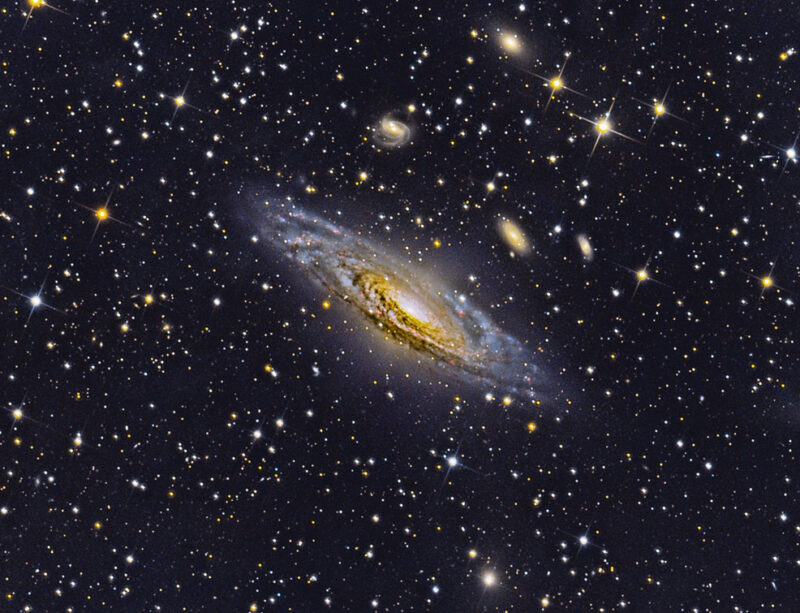
Three other notable galaxy clusters lie in Pegasus. The brightest is magnitude 9.5 and is just half a degree from Stephan’s Quintet. The cluster has the curious name Deer Lick Group. Follow Scheat to Matar and then about 4.5 degrees farther and slightly north of the direction you were heading. This will bring you to the Deer Lick Group, NGC 7331. Here you’ll find one large spiral galaxy and a spattering of smaller ones.

Large, oblique spiral galaxy and some smaller spiral and elliptical galaxies nearby in star field.
The Deer Lick Group contains one large spiral galaxy and other smaller galaxies. It lies in the constellation Pegasus. Image via W4sm astro/ Wikimedia Commons (CC BY-SA 4.0).

The Pegasus I Cluster lies on the southern edge of the constellation not far from the circlet of Pisces. At a distance of 8 degrees from Markab on the sky’s dome, the Pegasus I Cluster is a grouping with a magnitude of 11.1. The galaxy cluster requires a large telescope to see or a long-exposure photograph, but it reveals a beautiful and striking number of galaxies.

The Pegasus II Cluster lies back within the square of Pegasus. Halfway between Alpheratz and Scheat, it lies just inside the border of a line that would be drawn connecting these two stars. A bit dimmer at magnitude 12.6, the Pegasus II Cluster (NGC 7720) is a powerful radio source, the target of much scientific study.

Globular Cluster M15 in Pegasus the Flying Horse

One other deep-sky object of note in Pegasus is the globular cluster M15. You can find M15 easily using the head and neck stars of Pegasus. Start with the star Markab and go to the two dimmer stars that mark the neck. From the last star of the neck (Biham) to the brighter head star Enif, continue a line straight out for a little more than 4 degrees. Here you will find the magnitude 6.4 globular cluster M15. It lies about 33,600 light-years away and will show up nicely in a pair of binoculars.

Countless colorful points of light clustered together with a bright center and spilling outward into a starfield.
You can find the globular cluster M15 in the constellation Pegasus. It shines at magnitude 6.4. Image via Mount Lemmon SkyCenter Schulman Telescope/ Adam Block/ Wikimedia Commons (CC BY-SA 4.0).

First exoplanet around a sun-like star

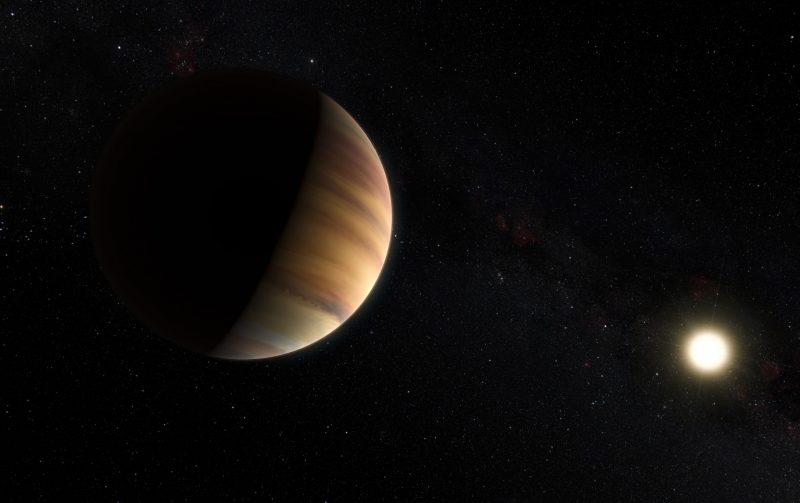
Astronomers discovered the first exoplanet orbiting a sun-like star in the constellation Pegasus. They named the planet 51 Pegasi b after the star it orbits. Didier Queloz and Michel Mayor discovered the planet in 1995 and received the Nobel Prize in Physics for their discovery in 2019.

Yellow, brown, and tan striped planet with distant yellowish-white star.
Artist’s concept of the hot Jupiter exoplanet 51 Pegasi b. The first planet discovered around a sun-like star, 51 Pegasi b lies about 50 light-years from Earth in the constellation Pegasus the Flying Horse. Image via ESO/ M. Kornmesser/ Nick Risinger/ Wikimedia Commons (CC BY 4.0).

Bottom line: Pegasus the Flying Horse is a giant constellation that dominates autumn skies in the Northern Hemisphere (spring skies in the Southern Hemisphere). The constellation contains a famous asterism called the Great Square.

The post Pegasus the Flying Horse, and the best sky story ever first appeared on EarthSky.


from EarthSky https://ift.tt/QYp1gdM

Pegasus the Flying Horse

Pegasus the Flying Horse rises in the east on autumn evenings in the Northern Hemisphere (spring evenings in the Southern Hemisphere). It dominates the sky with its giant square asterism, fittingly called the Great Square. In mythology, Pegasus figured into the greatest – surely the most elaborate – of all sky myths. This one is from ancient Greece some 3,000 years ago. According to the myth, Pegasus was the flying horse ridden by Perseus the Hero, as he swooped in to save Princess Andromeda from a sea monster. There’s more to the story, which you’ll find in the video at the top of this page.

Today, we see Pegasus as the 7th-largest of the 88 official constellations. And Pegasus is easy to find. On fall evenings in the Northern Hemisphere, this constellation climbs above the eastern horizon, reaching a spot nearly overhead by late fall.

Its asterism – the Great Square of Pegasus – is huge. The square alone is 20 degrees wide from top to bottom. That’s the span of two fist-widths held at arm’s length.

Sky chart with numerous labeled stars and lines between them making a large square with legs.
On autumn evenings in the Northern Hemisphere – spring evenings in the Southern Hemisphere – Pegasus the Flying Horse is ascending in the east in the evening hours. You’ll most easily notice the giant, square-shaped asterism within Pegasus, called the Great Square.

Stars of Pegasus

As it rises in the evening, the star in the Great Square closest to the horizon is Algenib, with a magnitude of 2.8. It lies 390 light-years away. The star on the opposite corner of the square from Algenib is Scheat, a magnitude 2.4 star lying 199 light-years away. The star to the south in the square is Markab, a magnitude 2.5 star at a distance of 140 light-years. And the final star in the square is Alpheratz. Technically, Alpheratz lies just across the border of Pegasus and is actually a member of the constellation Andromeda. Alpheratz is the brightest of the four stars at magnitude 2.1 and lies 97 light-years away.

The Great Square marks the body of the flying horse. Trails leading off the west side of the square mark the front legs and head of Pegasus. Extending out from Markab, two stars at magnitude 3.4 and 3.5, Homam and Biham, lead the way to the head star, magnitude 2.4 star Enif. This star is helpful in finding the globular cluster M15.

Find the forelegs of Pegasus off of Scheat. Five degrees west of Scheat is 3rd magnitude star Matar. As the brightest leg star in Pegasus, it’s helpful in finding a couple of notable galaxies.

Star chart with pictures of Pegasus the Flying Horse and neighboring constellations.
Pegasus the Flying Horse is a giant constellation that rises in the east on October evenings. Image via Stellarium. Used with permission.

The asterism of the Great Square

The Great Square of Pegasus can look like a huge diamond. Think of it as a giant baseball diamond rising during playoffs month in the east after dark. Asterisms, such as the Great Square, are groups of stars that aren’t labeled as constellations but are easy to recognize.

Night sky photo with lines between stars and a man pointing up at the constellation.
View at EarthSky Community Photos. | Prateek Pandey in Bhopal, India, captured this photo of Pegasus. He wrote: “Pegasus is named after the winged horse in Greek mythology. Curiously, the constellation Pegasus only represents the top half of the horse. In some depictions, the horse is shown rising out of the water. Viewed best in autumn, turn your eyes to the east as the night falls, and see the winged horse rising high up in the sky.” Thank you, Prateek!

Using Pegasus to find the Andromeda Galaxy

Pegasus is close to the constellation Andromeda, so it’s useful for star-hopping to the Andromeda galaxy. You’ll need a dark-sky site to track down Andromeda without optical aid. It’s much easier to spot with binoculars or a telescope. Follow this link for more information on how to use Pegasus to find Andromeda.

Star chart: Lines showing constellations with large square and arrow pointing to galaxy symbol.
Find the Andromeda Galaxy (M31) by star-hopping from the Great Square of Pegasus. Chart via EarthSky.
A huge, glowing spiral with 2 small fuzzy patches nearby, among thousands of foreground stars.
View at EarthSky Community Photos. | Andy Dungan near Cotopaxi, Colorado, captured Messier 31, the Andromeda galaxy, on October 20, 2025. Andy wrote: “The part that always amazes me about the Andromeda galaxy is that it is close to the same size as the moon when you look at them from Earth. Andromeda is really big. And, at 2.5 million light-years away, it’s the closest large galaxy to us in the universe!” Thank you, Andy!

Stephan’s Quintet

Pegasus is home to many galaxy clusters. The most famous is probably Stephan’s Quintet, a favorite target among astrophotographers. This tight gathering of five galaxies has a faint magnitude of 13.6. The largest and brightest, NGC 7320, has a small redshift compared to the other four, revealing that it is probably not a physical member of the group and just a line-of-sight coincidence.

Fun fact: In the 1946 movie It’s a Wonderful Life, angels in heaven discussing George Bailey are depicted as the galaxies in Stephan’s Quintet.

A large spiral with multiple small, nebulous objects, over a rich background of stars.
View at EarthSky Community Photos. | Andy Dungan near Cotopaxi, Colorado, captured two galaxy groups, namely Stephan’s Quintet and the Deer Lick Group, both in the constellation Pegasus, on October 27, 2024. Andy wrote: “Over the years I have run into pictures and discussions of these two objects. Both are rather small and close together. Their data and histories are fun too. Both of these would be seen better with a 2,000 mm telescope and my 600 mm telescope with a small format camera takes a pretty good pic. What fun exploring the universe is. I seem to be on a roll lately, lots of clear skies and a motivated photographer.” Thank you, Andy!
A cluster of galaxies including large colorful spirals and two galaxies merging.
This image of Stephan’s Quintet is from 2009, courtesy of the Hubble Space Telescope. Image via Wikimedia Commons (public domain)/ NASA/ ESA/ and the Hubble SM4 ERO Team.

Other galaxies in Pegasus the Flying Horse

Three other notable galaxy clusters lie in Pegasus. The brightest is magnitude 9.5 and is just half a degree from Stephan’s Quintet. The cluster has the curious name Deer Lick Group. Follow Scheat to Matar and then about 4.5 degrees farther and slightly north of the direction you were heading. This will bring you to the Deer Lick Group, NGC 7331. Here you’ll find one large spiral galaxy and a spattering of smaller ones.

Large, oblique spiral galaxy and some smaller spiral and elliptical galaxies nearby in star field.
The Deer Lick Group contains one large spiral galaxy and other smaller galaxies. It lies in the constellation Pegasus. Image via W4sm astro/ Wikimedia Commons (CC BY-SA 4.0).

The Pegasus I Cluster lies on the southern edge of the constellation not far from the circlet of Pisces. At a distance of 8 degrees from Markab on the sky’s dome, the Pegasus I Cluster is a grouping with a magnitude of 11.1. The galaxy cluster requires a large telescope to see or a long-exposure photograph, but it reveals a beautiful and striking number of galaxies.

The Pegasus II Cluster lies back within the square of Pegasus. Halfway between Alpheratz and Scheat, it lies just inside the border of a line that would be drawn connecting these two stars. A bit dimmer at magnitude 12.6, the Pegasus II Cluster (NGC 7720) is a powerful radio source, the target of much scientific study.

Globular Cluster M15 in Pegasus the Flying Horse

One other deep-sky object of note in Pegasus is the globular cluster M15. You can find M15 easily using the head and neck stars of Pegasus. Start with the star Markab and go to the two dimmer stars that mark the neck. From the last star of the neck (Biham) to the brighter head star Enif, continue a line straight out for a little more than 4 degrees. Here you will find the magnitude 6.4 globular cluster M15. It lies about 33,600 light-years away and will show up nicely in a pair of binoculars.

Countless colorful points of light clustered together with a bright center and spilling outward into a starfield.
You can find the globular cluster M15 in the constellation Pegasus. It shines at magnitude 6.4. Image via Mount Lemmon SkyCenter Schulman Telescope/ Adam Block/ Wikimedia Commons (CC BY-SA 4.0).

First exoplanet around a sun-like star

Astronomers discovered the first exoplanet orbiting a sun-like star in the constellation Pegasus. They named the planet 51 Pegasi b after the star it orbits. Didier Queloz and Michel Mayor discovered the planet in 1995 and received the Nobel Prize in Physics for their discovery in 2019.

Yellow, brown, and tan striped planet with distant yellowish-white star.
Artist’s concept of the hot Jupiter exoplanet 51 Pegasi b. The first planet discovered around a sun-like star, 51 Pegasi b lies about 50 light-years from Earth in the constellation Pegasus the Flying Horse. Image via ESO/ M. Kornmesser/ Nick Risinger/ Wikimedia Commons (CC BY 4.0).

Bottom line: Pegasus the Flying Horse is a giant constellation that dominates autumn skies in the Northern Hemisphere (spring skies in the Southern Hemisphere). The constellation contains a famous asterism called the Great Square.

The post Pegasus the Flying Horse, and the best sky story ever first appeared on EarthSky.


from EarthSky https://ift.tt/QYp1gdM

1st 3D temperature map of exoplanet shows dynamic atmosphere

3D temperature map of exoplanet: Large planet with bands in its atmosphere, next to a large, bright yellowish sun with flares on its surface.
View larger. | Astronomers have created a 3D temperature map of the exoplanet known as WASP-18b. It’s the 1st 3D temperature map ever for any exoplanet. The exoplanet, an ultra-hot Jupiter, is about 400 light-years from Earth. The map reveals hot spots and colder regions on the dayside of the tidally locked planet. Image via NASA/ Goddard Space Flight Center.
  • WASP-18b is a hot Jupiter exoplanet about 400 light-years from Earth. The same side of this scorching-hot planet always faces its star.
  • Astronomers created a 3D temperature map of WASP-18b. It is the 1st such map of an exoplanet ever achieved. What does it show?
  • The map reveals distinct variations in temperature and chemical composition of the atmosphere on the side of the planet facing its star.

Millions come to EarthSky for night sky news and trusted science.
Your donation keeps us free and accessible for all.

1st 3D temperature map of exoplanet

For the first time, astronomers have created a three-dimensional (3D) temperature map of a distant exoplanet. The planet, WASP-18b, is a scorching ultra-hot Jupiter about 400 light-years away. The researchers, co-led by the University of Maryland in College Park and Cornell University in Ithaca, New York, said on October 28, 2025, that the map revealed three distinct temperature zones. This is the first time astronomers have used a technique called 3D eclipse mapping, or spectroscopic eclipse mapping.

The new study uses data from NASA’s James Webb Space Telescope. With the same data, some of the researchers in this study had previously created a 2D map of the same planet in 2023.

WASP-18b has a mass equivalent to 10 Jupiters. Being very close to its star, it completes an orbit in only 23 hours. Consequently, this also means it is extremely hot, with a temperature of almost 5,000 degrees Fahrenheit (2,760 degrees Celsius).

The peer-reviewed results of the new study were published in Nature Astronomy on October 28, 2025.

#UMD astronomer Megan Weiner Mansfield co-led the creation of the first 3D temperature map for a distant exoplanet.Published in Nature Astronomy, the team's technique lays the groundwork for more detailed future explorations of faraway planets. ?

UMD Science (@umdscience.bsky.social) 2025-11-04T23:19:02.257Z

Mapping a distant exoplanet

Astronomers used an eclipse mapping technique so they could see the exoplanet’s temperatures in 3D. Despite the star and planet’s huge size differences, astronomers can detect tiny changes from the light of a planet as its star starts to pass in front of – or eclipse – the planet. The press release explained:

Scientists can link minute changes in light to an exoplanet’s specific regions to produce a brightness map that, when rendered in multiple colors, can map out temperatures in latitude, longitude and altitude.

As co-lead author Megan Weiner Mansfield at the University of Maryland said:

This technique is really the only one that can probe all three dimensions at once: latitude, longitude and altitude. This gives us a higher level of detail than we’ve ever had to study these celestial bodies.

A map of the exoplanet’s atmosphere

Since WASP-18b is a gas giant planet, astronomers can only map its outer atmosphere. But the mapping can reveal variations in the clouds and temperature of the atmosphere. Ryan Challener, the other co-lead author at Cornell University, said:

Eclipse mapping allows us to image exoplanets that we can’t see directly, because their host stars are too bright. With this telescope and this new technique, we can start to understand exoplanets along the same lines as our solar system neighbors.

Chart showing 25 ovals with a bright reddish spot inside each one.
View larger. | Set of 2D maps for 25 different light wavelengths showing WASP-18b. The researchers then combined the individual maps to create the 3D temperature map. Image via Challener et al./ Nature Astronomy (Open Access/ CC BY 4.0).

Observing in many wavelengths

For the previous 2D map, researchers used only one wavelength of light. But the new 3D map uses many different wavelengths. The Webb telescope’s Near-Infrared Imager and Slitless Spectrograph (NIRISS) instrument made the observations. Various colors in the map refer to different temperatures and altitudes in the planet’s atmosphere. As Challener explained:

If you build a map at a wavelength that water absorbs, you’ll see the water deck in the atmosphere, whereas a wavelength that water does not absorb will probe deeper. If you put those together, you can get a 3D map of the temperatures in this atmosphere.

Distinct regions in the atmosphere

Overall, the results show that WASP-18b has distinct regions or zones in its atmosphere on the dayside of the planet. WASP-18b is tidally locked to its star. This means that the same side of the planet always faces the star. That’s the planet’s dayside. This is similar to how the same side of the moon always faces Earth. On WASP-18b, the regions vary in both temperature and chemical composition.

Also, in the area where the light from the star most directly hits the planet, there is a “hot spot.” A colder “ring” surrounds the hot spot. The researchers said the hot spot and ring are due to winds not being strong enough to redistribute the heat from the hot spot into the surrounding atmosphere. In addition, there is less water vapor in the hot spot than the average for the planet overall. This is the first time such variations have been mapped on a single exoplanet. Mansfield said:

We’ve seen this happen on a population level, where you can see a cooler planet that has water and then a hotter planet that doesn’t have water. But this is the first time we’ve seen this be broken across one planet instead. It’s one atmosphere, but we see cooler regions that have water and hotter regions where the water’s being broken apart. That had been predicted by theory, but it’s really exciting to actually see this with real observations.

Smiling man with eyeglasses wearing a blue shirt.
Ryan Challener at Cornell University is the co-lead author of the new study about WASP-18b. Image via Cornell University.
Smiling woman with long hair and eyeglasses wearing a light blue sleeveless shirt.
Megan Weiner Mansfield at the University of Maryland is the co-lead author of the new study about WASP-18b. Image via GitHub.

Using the 3D temperature map for more hot Jupiters

Now, the researchers want this 3D mapping technique to be extended to other hot Jupiters as well. And indeed, astronomers have already found hundreds of them. It is also hoped that astronomers will be able to produce similar 3D maps of smaller rocky exoplanets, too. That would be exciting, because some of them could be potentially habitable for life. As Mansfield explained:

It’s very exciting to finally have the tools to see and map out the temperatures of a different planet in this much detail. It’s set us up to possibly use the technique on other types of exoplanets. For example, if a planet doesn’t have an atmosphere, we can still use the technique to map the temperature of the surface itself to possibly understand its composition. Although WASP-18b was more predictable, I believe we will have the chance to see things that we could never have expected before.

Last February, another group of astronomers announced the first 3D weather map of an exoplanet, another hot Jupiter called WASP-121b. That one, however, was a weather map, while the new one is the temperature map. The researchers used the ESPRESSO instrument on the Very Large Telescope (VLT) in Chile to make the previous weather map.

Bottom line: Astronomers have created the 1st 3D temperature map of a distant exoplanet. The planet, WASP-18b, is a scorching ultra-hot Jupiter 400 light-years away.

Source: Horizontal and vertical exoplanet thermal structure from a JWST spectroscopic eclipse map

Via University of Maryland

Read more: Double hot Jupiters: How do these rare gigantic worlds form?

Read more: Our 1st 3D weather map from a distant exoplanet

The post 1st 3D temperature map of exoplanet shows dynamic atmosphere first appeared on EarthSky.


from EarthSky https://ift.tt/h9SqEtr
3D temperature map of exoplanet: Large planet with bands in its atmosphere, next to a large, bright yellowish sun with flares on its surface.
View larger. | Astronomers have created a 3D temperature map of the exoplanet known as WASP-18b. It’s the 1st 3D temperature map ever for any exoplanet. The exoplanet, an ultra-hot Jupiter, is about 400 light-years from Earth. The map reveals hot spots and colder regions on the dayside of the tidally locked planet. Image via NASA/ Goddard Space Flight Center.
  • WASP-18b is a hot Jupiter exoplanet about 400 light-years from Earth. The same side of this scorching-hot planet always faces its star.
  • Astronomers created a 3D temperature map of WASP-18b. It is the 1st such map of an exoplanet ever achieved. What does it show?
  • The map reveals distinct variations in temperature and chemical composition of the atmosphere on the side of the planet facing its star.

Millions come to EarthSky for night sky news and trusted science.
Your donation keeps us free and accessible for all.

1st 3D temperature map of exoplanet

For the first time, astronomers have created a three-dimensional (3D) temperature map of a distant exoplanet. The planet, WASP-18b, is a scorching ultra-hot Jupiter about 400 light-years away. The researchers, co-led by the University of Maryland in College Park and Cornell University in Ithaca, New York, said on October 28, 2025, that the map revealed three distinct temperature zones. This is the first time astronomers have used a technique called 3D eclipse mapping, or spectroscopic eclipse mapping.

The new study uses data from NASA’s James Webb Space Telescope. With the same data, some of the researchers in this study had previously created a 2D map of the same planet in 2023.

WASP-18b has a mass equivalent to 10 Jupiters. Being very close to its star, it completes an orbit in only 23 hours. Consequently, this also means it is extremely hot, with a temperature of almost 5,000 degrees Fahrenheit (2,760 degrees Celsius).

The peer-reviewed results of the new study were published in Nature Astronomy on October 28, 2025.

#UMD astronomer Megan Weiner Mansfield co-led the creation of the first 3D temperature map for a distant exoplanet.Published in Nature Astronomy, the team's technique lays the groundwork for more detailed future explorations of faraway planets. ?

UMD Science (@umdscience.bsky.social) 2025-11-04T23:19:02.257Z

Mapping a distant exoplanet

Astronomers used an eclipse mapping technique so they could see the exoplanet’s temperatures in 3D. Despite the star and planet’s huge size differences, astronomers can detect tiny changes from the light of a planet as its star starts to pass in front of – or eclipse – the planet. The press release explained:

Scientists can link minute changes in light to an exoplanet’s specific regions to produce a brightness map that, when rendered in multiple colors, can map out temperatures in latitude, longitude and altitude.

As co-lead author Megan Weiner Mansfield at the University of Maryland said:

This technique is really the only one that can probe all three dimensions at once: latitude, longitude and altitude. This gives us a higher level of detail than we’ve ever had to study these celestial bodies.

A map of the exoplanet’s atmosphere

Since WASP-18b is a gas giant planet, astronomers can only map its outer atmosphere. But the mapping can reveal variations in the clouds and temperature of the atmosphere. Ryan Challener, the other co-lead author at Cornell University, said:

Eclipse mapping allows us to image exoplanets that we can’t see directly, because their host stars are too bright. With this telescope and this new technique, we can start to understand exoplanets along the same lines as our solar system neighbors.

Chart showing 25 ovals with a bright reddish spot inside each one.
View larger. | Set of 2D maps for 25 different light wavelengths showing WASP-18b. The researchers then combined the individual maps to create the 3D temperature map. Image via Challener et al./ Nature Astronomy (Open Access/ CC BY 4.0).

Observing in many wavelengths

For the previous 2D map, researchers used only one wavelength of light. But the new 3D map uses many different wavelengths. The Webb telescope’s Near-Infrared Imager and Slitless Spectrograph (NIRISS) instrument made the observations. Various colors in the map refer to different temperatures and altitudes in the planet’s atmosphere. As Challener explained:

If you build a map at a wavelength that water absorbs, you’ll see the water deck in the atmosphere, whereas a wavelength that water does not absorb will probe deeper. If you put those together, you can get a 3D map of the temperatures in this atmosphere.

Distinct regions in the atmosphere

Overall, the results show that WASP-18b has distinct regions or zones in its atmosphere on the dayside of the planet. WASP-18b is tidally locked to its star. This means that the same side of the planet always faces the star. That’s the planet’s dayside. This is similar to how the same side of the moon always faces Earth. On WASP-18b, the regions vary in both temperature and chemical composition.

Also, in the area where the light from the star most directly hits the planet, there is a “hot spot.” A colder “ring” surrounds the hot spot. The researchers said the hot spot and ring are due to winds not being strong enough to redistribute the heat from the hot spot into the surrounding atmosphere. In addition, there is less water vapor in the hot spot than the average for the planet overall. This is the first time such variations have been mapped on a single exoplanet. Mansfield said:

We’ve seen this happen on a population level, where you can see a cooler planet that has water and then a hotter planet that doesn’t have water. But this is the first time we’ve seen this be broken across one planet instead. It’s one atmosphere, but we see cooler regions that have water and hotter regions where the water’s being broken apart. That had been predicted by theory, but it’s really exciting to actually see this with real observations.

Smiling man with eyeglasses wearing a blue shirt.
Ryan Challener at Cornell University is the co-lead author of the new study about WASP-18b. Image via Cornell University.
Smiling woman with long hair and eyeglasses wearing a light blue sleeveless shirt.
Megan Weiner Mansfield at the University of Maryland is the co-lead author of the new study about WASP-18b. Image via GitHub.

Using the 3D temperature map for more hot Jupiters

Now, the researchers want this 3D mapping technique to be extended to other hot Jupiters as well. And indeed, astronomers have already found hundreds of them. It is also hoped that astronomers will be able to produce similar 3D maps of smaller rocky exoplanets, too. That would be exciting, because some of them could be potentially habitable for life. As Mansfield explained:

It’s very exciting to finally have the tools to see and map out the temperatures of a different planet in this much detail. It’s set us up to possibly use the technique on other types of exoplanets. For example, if a planet doesn’t have an atmosphere, we can still use the technique to map the temperature of the surface itself to possibly understand its composition. Although WASP-18b was more predictable, I believe we will have the chance to see things that we could never have expected before.

Last February, another group of astronomers announced the first 3D weather map of an exoplanet, another hot Jupiter called WASP-121b. That one, however, was a weather map, while the new one is the temperature map. The researchers used the ESPRESSO instrument on the Very Large Telescope (VLT) in Chile to make the previous weather map.

Bottom line: Astronomers have created the 1st 3D temperature map of a distant exoplanet. The planet, WASP-18b, is a scorching ultra-hot Jupiter 400 light-years away.

Source: Horizontal and vertical exoplanet thermal structure from a JWST spectroscopic eclipse map

Via University of Maryland

Read more: Double hot Jupiters: How do these rare gigantic worlds form?

Read more: Our 1st 3D weather map from a distant exoplanet

The post 1st 3D temperature map of exoplanet shows dynamic atmosphere first appeared on EarthSky.


from EarthSky https://ift.tt/h9SqEtr

New sea anemone builds homes for hermit crabs

Sea anemone: 4 images of a pinkish, round creature with tentacles at the top, attached to a small crab.
The recently discovered sea anemone Paracalliactis tsukisome creates a home for hermit crabs. Image via Yoshigawa et al./ Kumamoto University.

Scientists have discovered a new species of sea anemone, Paracalliactis tsukisome, which inhabits the depths of the Pacific Ocean off the coast of Japan. Researchers from Kumamoto University in Japan said on October 22, 2025, that this organism, with a delicate pink hue, possesses an unusual ability. It creates a kind of shell using its own secretions to house hermit crabs, forming a unique symbiotic relationship. The anemone’s name, tsukisome, comes from a word found in Japan’s oldest collection of poems – the Manyoshu – and evokes the idea of sincere and enduring love.

The research team published their study in the peer-reviewed journal Royal Society Open Science on October 22, 2025.

Discovery of the sea anemone Paracalliactis tsukisome

The team, led by Akihiro Yoshikawa of Kumamoto University, together with Takato Izumi of Fukuyama University and Kensuke Yanagi of Chiba Museum of Natural History and Institute, collected specimens at depths of 656 to 1,640 feet (200 to 500 meters) in the Kumano-Nada and Suruga Bay areas.

Unlike common anemones, this species can create a hardened form. The new anemone secretes a substance that can form a shell-like structure, or a carcinoecium. And it’s this structure that can provide a larger living space for a host hermit crab.

Morphological and genetic analyses confirmed that the anemone belongs to the genus Paracalliactis, though it has distinct features that justify its classification as a new species.

Additionally, 3D tomography images revealed the anemone always attaches itself in the same direction on the shell, indicating a certain degree of spatial awareness. And that’s something that’s rare in radially symmetrical animals.

A radial animal (or one with radial symmetry) has a body organized around a central axis, so it can be divided into equal parts, like the slices of a pizza.

6 images zooming in. They show the structure the anemone creates.
The anemone secretes a substance that forms a structure around the shell, expanding and reinforcing the crab’s refuge. Image via Yoshigawa et al.

Mutual benefit in the depths of the ocean

Scientists performed analyses to determine what P. tsukisome eats. They discovered that it partially feeds on the waste and organic remains of its host. In turn, the crabs associated with this anemone species grow larger than crabs that don’t participate in this mutual relationship. This interdependence suggests a long co-evolutionary process in which both species benefit. One gains food and shelter, while the other gains protection and an expanded home.

Hermit crabs living with the new species of anemone reach significantly larger sizes than related species that lack such companionship. This difference suggests their relationship with P. tsukisome provides tangible ecological advantages. The carcinoecium – the structure the anemone builds around the shell – expands and reinforces the crab’s refuge, allowing it to continue using it as it grows.

Normally, hermit crabs must change shells several times during their lives. This exposes them to predators while searching for a new home. But thanks to its collaboration with the anemone, the crab reduces that risk and conserves energy. In turn, that might result in more stable and prolonged growth. Moreover, the anemone serves as a living shield, warding off potential attackers with its stinging tentacles.

2 images of anemones. They look round and have long, thin tentacles at the top.
This is a symbiotic relationship. The anemone feeds on the crab secretions, and the crab earns a bigger and stronger shell. Plus, the anemone has stinging tentacles to protect its companion from predators. Image via Yoshigawa et al.

Cultural and scientific significance

The name tsukisome, which alludes to the pale pink color of the peach blossom, evokes in ancient poetry a discreet and sincere form of love. The researchers chose this term to reflect the harmony between the anemone and its hermit companion.

This discovery also highlights the biological diversity of Japan’s deep-sea environments, many of which remain unexplored and are threatened by bottom trawling.

4 images of hermit crabs with a tubular anemone on top. Only one doesn't have tentacles and looks like a mushroom.
The scientists that made the discovery named the anemone tsukisome because it evokes the idea of sincere and enduring love in Japanese. Image via Yoshigawa et al.

Looking ahead

The case of P. tsukisome provides an exceptional opportunity to study how simple organisms can develop spatial orientation and asymmetric structures. These phenomena are uncommon among radially symmetrical animals.

Scientists hope future behavioral experiments in aquariums will shed light on how these anemones decide the direction of their growth.

As it is frequently caught as bycatch, this species could become an accessible research model and an appealing ambassador for deep-sea ecosystems. Its discovery not only expands our understanding of marine evolution, but it also serves as a reminder of the beauty of the bond that unites two lives in the vast ocean.

Map of Japan with some areas labeled.
The scientists found the sea anemone off the coast of Japan, in the Pacific Ocean. Frequently caught as bycatch, this species could serve as an accessible research model and a compelling ambassador for deep-sea ecosystems. Image via Yoshigawa-et-al.

Bottom line: A team of scientists has discovered a sea anemone that secretes a substance that becomes a hardened home for hermit crabs. The animals have a mutually beneficial relationship.

Source: Mutualism on the deep-sea floor: a novel shell-forming sea anemone in symbiosis with a hermit crab

Via Kumamoto University

Read more: Blackwater photography reveals new fish-anemone interactions

Read more: New fish species named for Princess Mononoke

The post New sea anemone builds homes for hermit crabs first appeared on EarthSky.


from EarthSky https://ift.tt/gFv4JdA
Sea anemone: 4 images of a pinkish, round creature with tentacles at the top, attached to a small crab.
The recently discovered sea anemone Paracalliactis tsukisome creates a home for hermit crabs. Image via Yoshigawa et al./ Kumamoto University.

Scientists have discovered a new species of sea anemone, Paracalliactis tsukisome, which inhabits the depths of the Pacific Ocean off the coast of Japan. Researchers from Kumamoto University in Japan said on October 22, 2025, that this organism, with a delicate pink hue, possesses an unusual ability. It creates a kind of shell using its own secretions to house hermit crabs, forming a unique symbiotic relationship. The anemone’s name, tsukisome, comes from a word found in Japan’s oldest collection of poems – the Manyoshu – and evokes the idea of sincere and enduring love.

The research team published their study in the peer-reviewed journal Royal Society Open Science on October 22, 2025.

Discovery of the sea anemone Paracalliactis tsukisome

The team, led by Akihiro Yoshikawa of Kumamoto University, together with Takato Izumi of Fukuyama University and Kensuke Yanagi of Chiba Museum of Natural History and Institute, collected specimens at depths of 656 to 1,640 feet (200 to 500 meters) in the Kumano-Nada and Suruga Bay areas.

Unlike common anemones, this species can create a hardened form. The new anemone secretes a substance that can form a shell-like structure, or a carcinoecium. And it’s this structure that can provide a larger living space for a host hermit crab.

Morphological and genetic analyses confirmed that the anemone belongs to the genus Paracalliactis, though it has distinct features that justify its classification as a new species.

Additionally, 3D tomography images revealed the anemone always attaches itself in the same direction on the shell, indicating a certain degree of spatial awareness. And that’s something that’s rare in radially symmetrical animals.

A radial animal (or one with radial symmetry) has a body organized around a central axis, so it can be divided into equal parts, like the slices of a pizza.

6 images zooming in. They show the structure the anemone creates.
The anemone secretes a substance that forms a structure around the shell, expanding and reinforcing the crab’s refuge. Image via Yoshigawa et al.

Mutual benefit in the depths of the ocean

Scientists performed analyses to determine what P. tsukisome eats. They discovered that it partially feeds on the waste and organic remains of its host. In turn, the crabs associated with this anemone species grow larger than crabs that don’t participate in this mutual relationship. This interdependence suggests a long co-evolutionary process in which both species benefit. One gains food and shelter, while the other gains protection and an expanded home.

Hermit crabs living with the new species of anemone reach significantly larger sizes than related species that lack such companionship. This difference suggests their relationship with P. tsukisome provides tangible ecological advantages. The carcinoecium – the structure the anemone builds around the shell – expands and reinforces the crab’s refuge, allowing it to continue using it as it grows.

Normally, hermit crabs must change shells several times during their lives. This exposes them to predators while searching for a new home. But thanks to its collaboration with the anemone, the crab reduces that risk and conserves energy. In turn, that might result in more stable and prolonged growth. Moreover, the anemone serves as a living shield, warding off potential attackers with its stinging tentacles.

2 images of anemones. They look round and have long, thin tentacles at the top.
This is a symbiotic relationship. The anemone feeds on the crab secretions, and the crab earns a bigger and stronger shell. Plus, the anemone has stinging tentacles to protect its companion from predators. Image via Yoshigawa et al.

Cultural and scientific significance

The name tsukisome, which alludes to the pale pink color of the peach blossom, evokes in ancient poetry a discreet and sincere form of love. The researchers chose this term to reflect the harmony between the anemone and its hermit companion.

This discovery also highlights the biological diversity of Japan’s deep-sea environments, many of which remain unexplored and are threatened by bottom trawling.

4 images of hermit crabs with a tubular anemone on top. Only one doesn't have tentacles and looks like a mushroom.
The scientists that made the discovery named the anemone tsukisome because it evokes the idea of sincere and enduring love in Japanese. Image via Yoshigawa et al.

Looking ahead

The case of P. tsukisome provides an exceptional opportunity to study how simple organisms can develop spatial orientation and asymmetric structures. These phenomena are uncommon among radially symmetrical animals.

Scientists hope future behavioral experiments in aquariums will shed light on how these anemones decide the direction of their growth.

As it is frequently caught as bycatch, this species could become an accessible research model and an appealing ambassador for deep-sea ecosystems. Its discovery not only expands our understanding of marine evolution, but it also serves as a reminder of the beauty of the bond that unites two lives in the vast ocean.

Map of Japan with some areas labeled.
The scientists found the sea anemone off the coast of Japan, in the Pacific Ocean. Frequently caught as bycatch, this species could serve as an accessible research model and a compelling ambassador for deep-sea ecosystems. Image via Yoshigawa-et-al.

Bottom line: A team of scientists has discovered a sea anemone that secretes a substance that becomes a hardened home for hermit crabs. The animals have a mutually beneficial relationship.

Source: Mutualism on the deep-sea floor: a novel shell-forming sea anemone in symbiosis with a hermit crab

Via Kumamoto University

Read more: Blackwater photography reveals new fish-anemone interactions

Read more: New fish species named for Princess Mononoke

The post New sea anemone builds homes for hermit crabs first appeared on EarthSky.


from EarthSky https://ift.tt/gFv4JdA

adds 2