aads

How to see Earth’s shadow at sunrise and sunset


EarthSky’s Kelly Kizer Whitt explains how to see Earth’s shadow and the Belt of Venus, in this video.

Earth’s shadow is easy to see

Like all worlds orbiting a sun, Earth casts a shadow. It extends some 870,000 miles (1.4 million km) into space. And like all shadows, the shadow of Earth is always opposite the sun. You can see the shadow of Earth cast onto Earth’s atmosphere twice daily as a bluish band adjacent to the horizon. It’s easy to see in the sky. Just look east after sunset or west before sunrise.

Plus, the pretty band of pink that lies on top of Earth’s bluish shadow is called the Belt of Venus. More on that below!

What to look for to see Earth’s shadow

You’ll see Earth’s shadow as deep blue-gray. It’s darker than the blue of the twilight sky.

The shadow of the Earth is big. It helps to be on a hill or somewhere you have a long view to the horizon. You might have to turn your head this way and that – along the arc of the horizon opposite the sun – to see the whole thing. And, just so you’ll recognize it more easily, remember that the shadow is curved, in exactly the same way that the whole Earth is curved.

Once you spot it, don’t go back inside just yet. Wait a while, and watch Earth’s shadow ascending or descending at exactly the same rate that the sun is rising or setting on the opposite horizon.

And here’s a fun thought … night itself is a shadow. When night falls, you’re standing within the shadow of Earth.
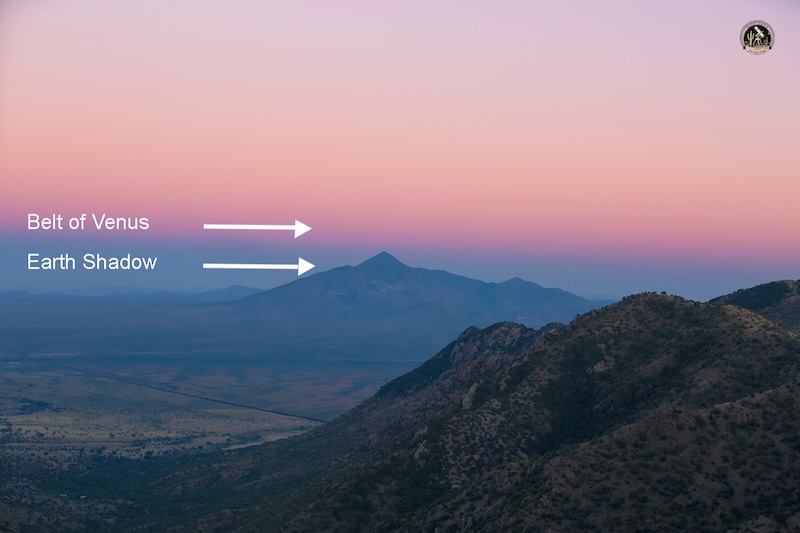
Twilight sky showing the pinkish Belt of Venus and Earth's shadow over distant mountains.
View at EarthSky Community Photos. | Jelieta Walinski Ph.D captured this image on November 5, 2025, from Arizona and wrote: “As twilight embraced Montezuma Pass, I turned my lens toward the quiet horizon with Mexico resting beneath the breath of dusk. There it was, the Belt of Venus, a delicate blush of rose-pink caressing the edge of the world, wrapped above the deepening Earth’s shadow, a quiet blue veil cast by our own planet upon its sky. This ethereal belt forms when sunlight scatters through Earth’s atmosphere, reflecting from the opposite horizon just as the sun dips below it. The pink hue arises from backscattered reddened sunlight, while the darker band beneath is the Earth’s umbra, slowly rising as night claims the day. Between these two — light and shadow — the heavens whisper of cycles eternal: dusk to dawn, day to night, and the tender reminder that even Earth casts beauty in its own shadow.” Thank you, Jelieta!

What exactly is the Belt of Venus?

The Belt of Venus, that pink band of sky above Earth’s shadow, also has the name of the anti-twilight arch. So, for example, during sunset, the colors of twilight will be happening in the west, and when you turn to the opposite horizon, you’ll see the anti-twilight arch. You’ve probably noticed that sometimes the whole sky seems colorful at sunset. There’s a good chance that what you’re seeing opposite the sunset is Earth’s shadow and the Belt of Venus.

When the sun is below the horizon, some of the sun’s rays of light still reach our atmosphere. The light passes through our atmosphere and – at the antisolar point – it backscatters. That light then reaches back to us in shades of pink.

You might think that the Belt of Venus got its name from the planet Venus. Venus, orbiting inside Earth’s orbit, never strays far from the sun in our sky. So we often see it around sunrise and sunset. But, of course, the sun is on the opposite side of the sky from the Belt of Venus. So if Venus is visible in the sky, it’s near the sun, not on the opposite horizon.

Instead, like many other objects we know in the sky, it gets its name from ancient myth. The Belt of Venus is named for the Goddess of Love’s pink girdle.

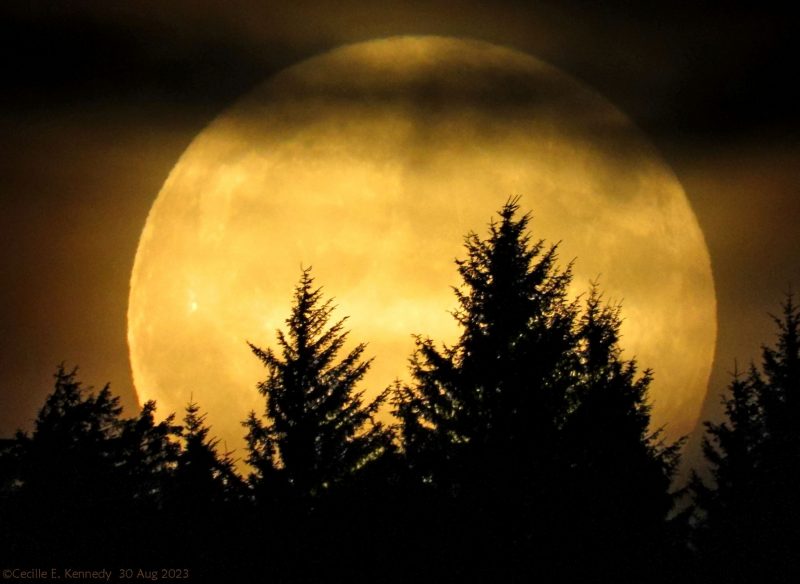
Full Super Harvest Moon shining brightly in Earth's shadow over the ocean with trees in the foreground.
View at EarthSky Community Photos. | Cecille Kennedy captured this image on October 7, 2025, from Oregon and wrote: “Harvest Super Moon setting at Pirate Cove with the Belt of Venus colors.” Thank you, Cecille!

Our shadow is why we see lunar eclipses

Earth’s shadow extends so far into space that it can touch the moon. In fact, that’s what a lunar eclipse is. It’s the moon within Earth’s shadow.

When the sun, Earth and moon align in space (nearly or perfectly), with the Earth between the sun and moon, then Earth’s shadow falls on the moon’s face. That’s when people on Earth see the shadow gradually turn a bright full moon into a dark lunar eclipse.

As seen from Earth’s surface, there are typically two or more lunar eclipses every year. Some are total, some are partial, and others are a subtle kind of eclipse known as penumbral.

During a lunar eclipse, a very small amount of light from the sun filters through Earth’s atmosphere onto Earth’s shadow on the moon. It’s why – at the middle part of a total lunar eclipse – the shadow on the moon looks reddish.
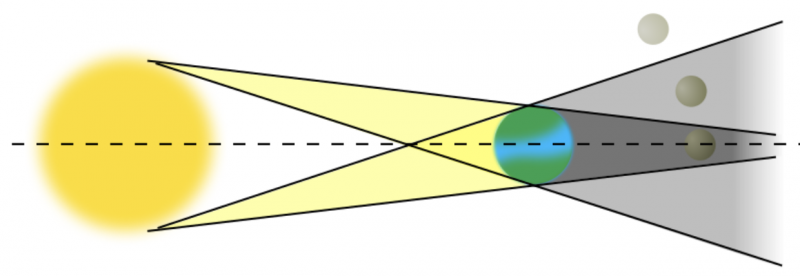
Diagram of sun, Earth and moon, with Earth's shadow extending into space, falling on the moon.
A lunar eclipse takes place when the sun, Earth and full moon line up in space. The full moon passes through Earth’s shadow. Image via Wikimedia Commons (CC0 1.0 Universal Public Domain).

The view from space

Another way to get an awareness of Earth’s shadow is simply to think about it as seen from space.

The image below provides a beautiful global view of Earth at night. It’s a composite image, assembled from data acquired by the Suomi National Polar-orbiting Partnership (Suomi NPP) satellite over nine days in April 2012 and 13 days in October 2012.

The dark part is, of course, in Earth’s shadow.
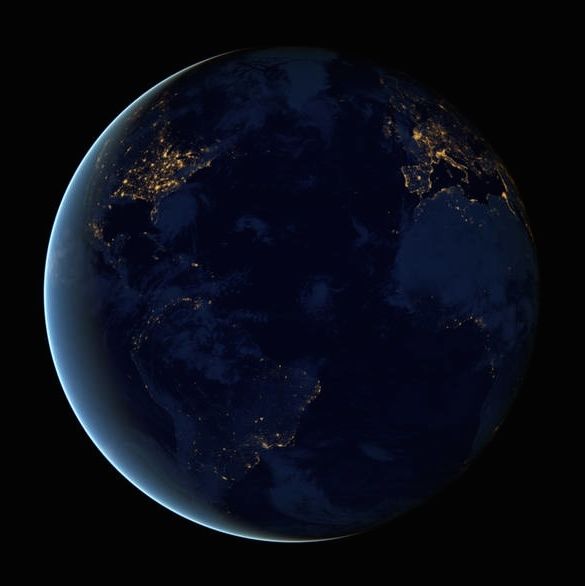
Full Earth at night, mostly very deep blue with small patches of light and light along one edge.
Global view of Earth at night. Image via NASA.

Photos of Earth’s shadow

EarthSky’s global community shares amazing photos with us every day. Here are some of their images of Earth’s shadow. Do you have a great photo to share? Send it to us!
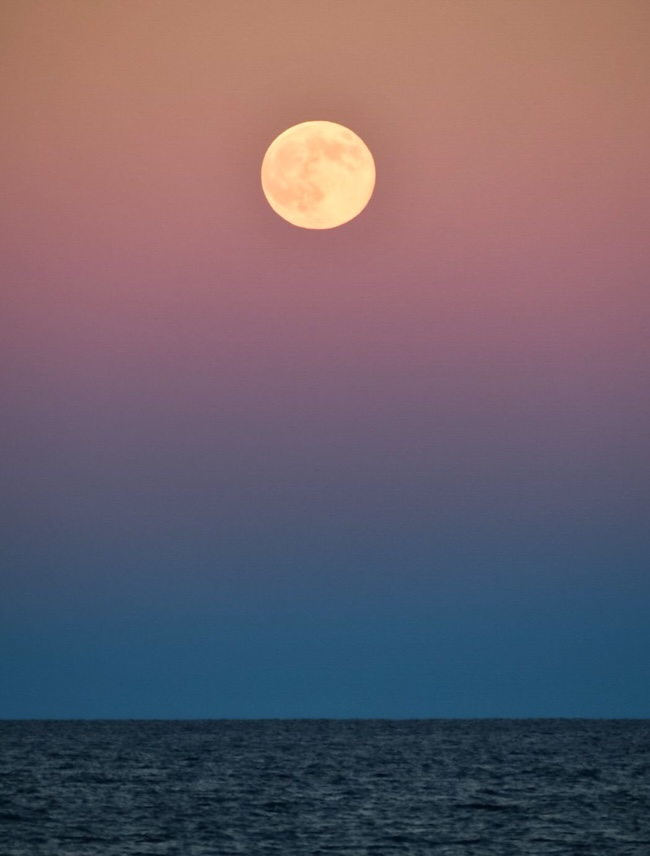

Full Super Hunter's Moon shining brightly in Earth's shadow.
View at EarthSky Community Photos. | Teresa Molinaro captured this image on November 5, 2025, from Italy and wrote: “The November full moon rises above the sea, bathed in the twilight colors of the Earth’s shadow on the atmosphere and the rosy Belt of Venus.” Thank you, Teresa!
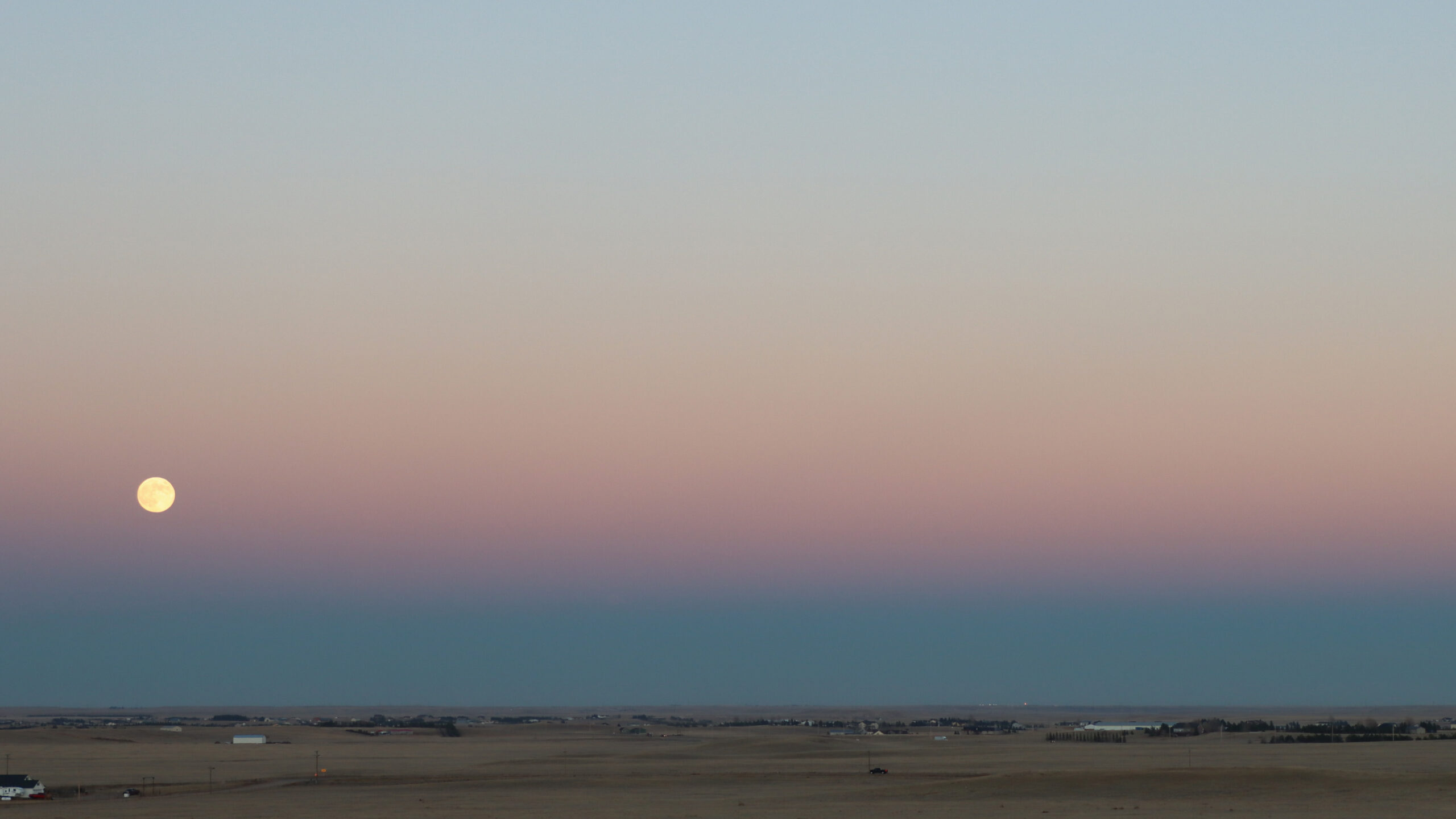
A panorama of a flat countryside with a few houses and on the far horizon is a curved band of blue with pink above.
View larger. | Jan Curtis captured this view of the full moon rising in Earth’s shadow with the pink Belt of Venus above on November 30, 2020, from Wyoming. In this image, you can see the curve of the blue shadow that mimics the curve of Earth. Image via Jan Curtis. Used with permission.
A full supermoon lying in the Belt of Venus and above Earth's shadow on a distant horizon.
Marcy Curran captured this image from Wyoming of the full Super Beaver Moon on November 15, 2024, lying in the Belt of Venus and above Earth’s shadow.
Looking down a hill past houses to horizon, where a blue band fades into a pink band, under yellow and light blue.
View at EarthSky Community Photos. | EarthSky’s own Kelly Kizer Whitt captured this image of Earth’s shadow and the Belt of Venus on November 13, 2023.
Earth's shadow: Snowy mountain rising from foggy lowland, against blue sky with a horizontal, fuzzy light pink stripe.
View at EarthSky Community Photos. | Stephanie Longo captured this image of Earth’s shadow (on the right side) and the pink Belt of Venus before sunrise on February 2, 2020. Thank you, Stephanie!
Large, nearly full moon rising behind blue, pink and orange horizontally striped sky over deep blue sea.
View at EarthSky Community Photos. | Cissy Beasley captured the moon from Rockport, Texas. She wrote: “As a professional nature photographer, I eagerly embrace opportunities to capture scenes of sunrises and sunsets, and the moon. Last night, I found a nice spot for documenting the rising moon amid the Belt of Venus. Here is what I saw!” Gorgeous, Cissy. Thank you!

Bottom line: You can see Earth’s shadow in both the evening and morning sky. It appears as a bluish band opposite the sun. Above that you may see a pink band, which carries the pretty name of the Belt of Venus.

The post How to see Earth’s shadow at sunrise and sunset first appeared on EarthSky.


from EarthSky https://ift.tt/cbjgN7Z


EarthSky’s Kelly Kizer Whitt explains how to see Earth’s shadow and the Belt of Venus, in this video.

Earth’s shadow is easy to see

Like all worlds orbiting a sun, Earth casts a shadow. It extends some 870,000 miles (1.4 million km) into space. And like all shadows, the shadow of Earth is always opposite the sun. You can see the shadow of Earth cast onto Earth’s atmosphere twice daily as a bluish band adjacent to the horizon. It’s easy to see in the sky. Just look east after sunset or west before sunrise.

Plus, the pretty band of pink that lies on top of Earth’s bluish shadow is called the Belt of Venus. More on that below!

What to look for to see Earth’s shadow

You’ll see Earth’s shadow as deep blue-gray. It’s darker than the blue of the twilight sky.

The shadow of the Earth is big. It helps to be on a hill or somewhere you have a long view to the horizon. You might have to turn your head this way and that – along the arc of the horizon opposite the sun – to see the whole thing. And, just so you’ll recognize it more easily, remember that the shadow is curved, in exactly the same way that the whole Earth is curved.

Once you spot it, don’t go back inside just yet. Wait a while, and watch Earth’s shadow ascending or descending at exactly the same rate that the sun is rising or setting on the opposite horizon.

And here’s a fun thought … night itself is a shadow. When night falls, you’re standing within the shadow of Earth.

Twilight sky showing the pinkish Belt of Venus and Earth's shadow over distant mountains.
View at EarthSky Community Photos. | Jelieta Walinski Ph.D captured this image on November 5, 2025, from Arizona and wrote: “As twilight embraced Montezuma Pass, I turned my lens toward the quiet horizon with Mexico resting beneath the breath of dusk. There it was, the Belt of Venus, a delicate blush of rose-pink caressing the edge of the world, wrapped above the deepening Earth’s shadow, a quiet blue veil cast by our own planet upon its sky. This ethereal belt forms when sunlight scatters through Earth’s atmosphere, reflecting from the opposite horizon just as the sun dips below it. The pink hue arises from backscattered reddened sunlight, while the darker band beneath is the Earth’s umbra, slowly rising as night claims the day. Between these two — light and shadow — the heavens whisper of cycles eternal: dusk to dawn, day to night, and the tender reminder that even Earth casts beauty in its own shadow.” Thank you, Jelieta!

What exactly is the Belt of Venus?

The Belt of Venus, that pink band of sky above Earth’s shadow, also has the name of the anti-twilight arch. So, for example, during sunset, the colors of twilight will be happening in the west, and when you turn to the opposite horizon, you’ll see the anti-twilight arch. You’ve probably noticed that sometimes the whole sky seems colorful at sunset. There’s a good chance that what you’re seeing opposite the sunset is Earth’s shadow and the Belt of Venus.

When the sun is below the horizon, some of the sun’s rays of light still reach our atmosphere. The light passes through our atmosphere and – at the antisolar point – it backscatters. That light then reaches back to us in shades of pink.

You might think that the Belt of Venus got its name from the planet Venus. Venus, orbiting inside Earth’s orbit, never strays far from the sun in our sky. So we often see it around sunrise and sunset. But, of course, the sun is on the opposite side of the sky from the Belt of Venus. So if Venus is visible in the sky, it’s near the sun, not on the opposite horizon.

Instead, like many other objects we know in the sky, it gets its name from ancient myth. The Belt of Venus is named for the Goddess of Love’s pink girdle.

Full Super Harvest Moon shining brightly in Earth's shadow over the ocean with trees in the foreground.
View at EarthSky Community Photos. | Cecille Kennedy captured this image on October 7, 2025, from Oregon and wrote: “Harvest Super Moon setting at Pirate Cove with the Belt of Venus colors.” Thank you, Cecille!

Our shadow is why we see lunar eclipses

Earth’s shadow extends so far into space that it can touch the moon. In fact, that’s what a lunar eclipse is. It’s the moon within Earth’s shadow.

When the sun, Earth and moon align in space (nearly or perfectly), with the Earth between the sun and moon, then Earth’s shadow falls on the moon’s face. That’s when people on Earth see the shadow gradually turn a bright full moon into a dark lunar eclipse.

As seen from Earth’s surface, there are typically two or more lunar eclipses every year. Some are total, some are partial, and others are a subtle kind of eclipse known as penumbral.

During a lunar eclipse, a very small amount of light from the sun filters through Earth’s atmosphere onto Earth’s shadow on the moon. It’s why – at the middle part of a total lunar eclipse – the shadow on the moon looks reddish.

Diagram of sun, Earth and moon, with Earth's shadow extending into space, falling on the moon.
A lunar eclipse takes place when the sun, Earth and full moon line up in space. The full moon passes through Earth’s shadow. Image via Wikimedia Commons (CC0 1.0 Universal Public Domain).

The view from space

Another way to get an awareness of Earth’s shadow is simply to think about it as seen from space.

The image below provides a beautiful global view of Earth at night. It’s a composite image, assembled from data acquired by the Suomi National Polar-orbiting Partnership (Suomi NPP) satellite over nine days in April 2012 and 13 days in October 2012.

The dark part is, of course, in Earth’s shadow.

Full Earth at night, mostly very deep blue with small patches of light and light along one edge.
Global view of Earth at night. Image via NASA.

Photos of Earth’s shadow

EarthSky’s global community shares amazing photos with us every day. Here are some of their images of Earth’s shadow. Do you have a great photo to share? Send it to us!
Full Super Hunter's Moon shining brightly in Earth's shadow.
View at EarthSky Community Photos. | Teresa Molinaro captured this image on November 5, 2025, from Italy and wrote: “The November full moon rises above the sea, bathed in the twilight colors of the Earth’s shadow on the atmosphere and the rosy Belt of Venus.” Thank you, Teresa!
A panorama of a flat countryside with a few houses and on the far horizon is a curved band of blue with pink above.
View larger. | Jan Curtis captured this view of the full moon rising in Earth’s shadow with the pink Belt of Venus above on November 30, 2020, from Wyoming. In this image, you can see the curve of the blue shadow that mimics the curve of Earth. Image via Jan Curtis. Used with permission.
A full supermoon lying in the Belt of Venus and above Earth's shadow on a distant horizon.
Marcy Curran captured this image from Wyoming of the full Super Beaver Moon on November 15, 2024, lying in the Belt of Venus and above Earth’s shadow.
Looking down a hill past houses to horizon, where a blue band fades into a pink band, under yellow and light blue.
View at EarthSky Community Photos. | EarthSky’s own Kelly Kizer Whitt captured this image of Earth’s shadow and the Belt of Venus on November 13, 2023.
Earth's shadow: Snowy mountain rising from foggy lowland, against blue sky with a horizontal, fuzzy light pink stripe.
View at EarthSky Community Photos. | Stephanie Longo captured this image of Earth’s shadow (on the right side) and the pink Belt of Venus before sunrise on February 2, 2020. Thank you, Stephanie!
Large, nearly full moon rising behind blue, pink and orange horizontally striped sky over deep blue sea.
View at EarthSky Community Photos. | Cissy Beasley captured the moon from Rockport, Texas. She wrote: “As a professional nature photographer, I eagerly embrace opportunities to capture scenes of sunrises and sunsets, and the moon. Last night, I found a nice spot for documenting the rising moon amid the Belt of Venus. Here is what I saw!” Gorgeous, Cissy. Thank you!

Bottom line: You can see Earth’s shadow in both the evening and morning sky. It appears as a bluish band opposite the sun. Above that you may see a pink band, which carries the pretty name of the Belt of Venus.

The post How to see Earth’s shadow at sunrise and sunset first appeared on EarthSky.


from EarthSky https://ift.tt/cbjgN7Z

Halley’s Comet is Edmond Halley’s namesake. Happy birthday, Edmond!

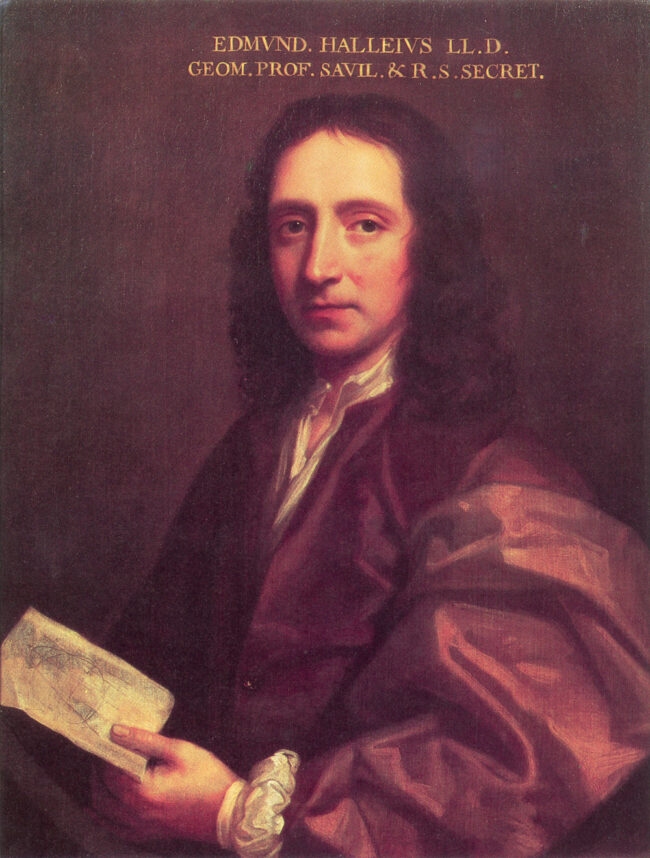
Painting of a man with long, dark, wavy hair. He is wearing an academic robe and holding a book.
Portrait of Edmond Halley circa 1687 by Thomas Murray. Halley is famous for discovering that comets are objects that orbit the sun and can reappear in our skies. Halley’s Comet is named for him. Image via Wikimedia Commons.

Science matters. Wonder matters. You matter.
Join our 2025 Donation Campaign today.

The scientist behind Halley’s Comet

November 8, 1656, is the birthdate of English astronomer and mathematician Edmond Halley. Born near London, he grew to become the first to make the leap of the imagination required to understand that comets orbit our sun. And he was the first to calculate the orbit of a comet, now one of the most famous of all comets, named Comet Halley in his honor.

Halley was also friends with Isaac Newton. He contributed to Newton’s development of the theory of gravity, which helped establish our modern era of science, in part by removing all doubt that we live on a planet orbiting around the sun.

When Halley’s Comet last appeared in Earth’s skies in 1986, an international fleet of spacecraft were there to meet it. This famous comet will return again in 2061 on its 76-year journey around the sun. It’s famous partly because it tends to be a bright comet in Earth’s skies. And the length of its orbit – approximately 76 years – isn’t so different from that of a human lifespan. So, most people can see Comet Halley once in a lifetime, while some lucky people might be able to see it twice.

But it’s also famous for another reason. In Edmond Halley’s time, people didn’t know that comets were like planets, bound in orbit by the sun. They didn’t know that some comets, like Halley’s Comet, return over and over.

Halley’s prediction

In 1704, Halley became a professor of geometry at Oxford University. The following year, he published A Synopsis of the Astronomy of Comets. The book contains the parabolic orbits of 24 comets that graced Earth’s skies from 1337 to 1698.

It was in this book that Halley made his magnificent prediction.

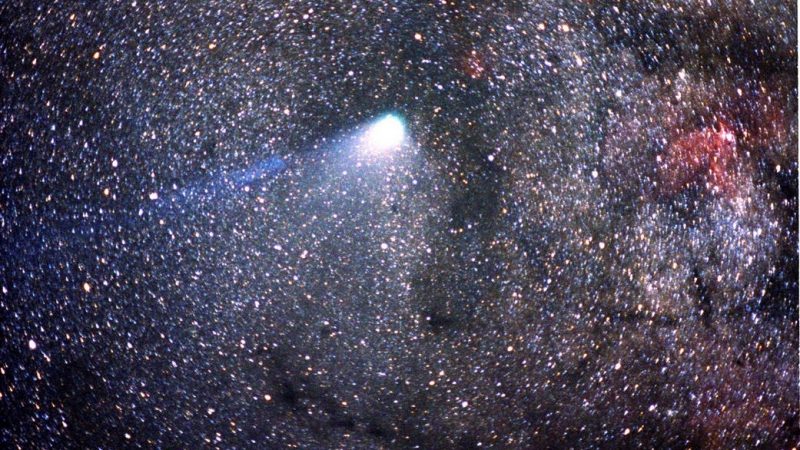
Large bright white spot with wide, faint bluish tail on very dense starry background.
Halley’s Comet, photographed in 1986. Image via NASA.

The return of Halley’s Comet

In his book, Halley remarked on three comets that appeared in 1531, 1607 and 1682. He used Isaac Newton’s theories of gravitation and planetary motions to compute the orbits of these comets. He found remarkable similarities in their orbits. Then Halley made what was, at that time, a stunning prediction. He said these three comets must in fact be a single comet, which returns periodically every 76 years.

He then predicted the comet would return, saying:

Hence I dare venture to foretell, that it will return again in the year 1758.

Halley didn’t live to see his prediction verified. It was 16 years after his death that – right on schedule, in 1758 – the comet did return, amazing the scientific world and the public.

It was the first comet ever predicted to return. Thus, we now call it Halley’s Comet, in honor of Edmond Halley.

Where is Halley’s Comet now?

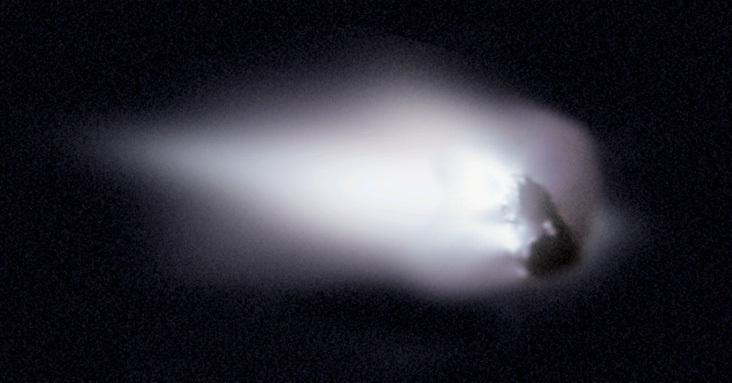
Halley's Comet: Close photo of a globular icy chunk moving in black space, surrounded by an oblong cloud of haze.
During the last return of Halley’s Comet – in 1986 – the European spacecraft Giotto became one of the first spacecraft ever to encounter and photograph a comet’s nucleus, or core. It swept past the nucleus of Halley’s Comet as it receded from the sun. Image via Halley Multicolor Camera Team/ Giotto Project/ ESA/ NASA.

Halley, Flamsteed and a Mercury transit

The 17th century was an exciting time to be a scientist in England. The scientific revolution gave birth to the Royal Society of London when Halley was only a child. Members of the Royal Society – physicians and natural philosophers who were some of the earliest adopters of the scientific method – met weekly. The first Astronomer Royal was John Flamsteed, remembered in part for the creation of the Royal Observatory at Greenwich, which still exists today.

After entering Queen’s College in Oxford as a student in 1673, Halley met Flamsteed. Halley had the chance to visit him in his observatory on a few occasions, during which Flamsteed encouraged him to pursue astronomy.

At that time, Flamsteed’s project was to assemble an accurate catalog of the northern stars with his telescope. Halley thought he would do the same, but with stars of the Southern Hemisphere.

Halley’s Southern Hemisphere expedition

His journey southward began in November 1676, even before he obtained his university degree. He sailed aboard a ship from the East India Company to the island of St. Helena, still one of the most remote islands in the world and the southernmost territory occupied by the British. His father and King Charles II financed the trip.

Bad weather made Halley’s work difficult. But, despite this, when he turned to sail back home in January 1678, he brought records of the longitude and latitude of 341 stars and many other observations. One of these observations was a transit of Mercury, about which he wrote:

This sight … is by far the noblest astronomy affords.

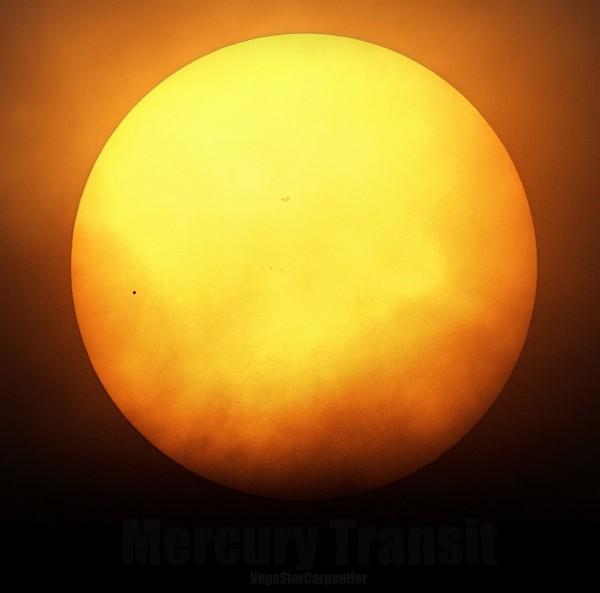
Large yellow-orange ball partly within diffuse clouds, with tiny black dot on its face.
Here’s the May 9, 2016, transit of Mercury via VegaStar C/LIARD of France. In this image, Mercury is the small black dot on the left side of the sun. Mercury also transited the sun on November 11, 2019. Read about the 2019 Mercury transit.

Cracking the code of planetary motion

Halley published his catalog of southern stars by the end of 1678. And – as the first work of its genre – it was a huge success. No one had ever attempted to determine the locations of southern stars with a telescope before. The catalog was Halley’s glorious debut as an astronomer. In the same year, he received his M.A. from the University of Oxford and was elected a fellow of the Royal Society.

Halley visited Isaac Newton in Cambridge for the first time in 1684. A group of Royal Society members, including physicist and biologist Robert Hooke, architect Christopher Wren and Isaac Newton, were trying to crack the code of planetary motion. Halley was the youngest to join the trio in their mission to use mathematics to describe how – and why – the planets move around the sun. They were all competing against one another to find the solution first, which was very motivating. Their problem was to find a mechanical model that would keep the planet orbiting around the sun without it escaping the orbit or falling into the star.

Hooke and Halley determined that the solution to this problem would be a force that keeps a planet in orbit around a star and must decrease as the inverse square of its distance from the star. Today we know this as the inverse-square law.

Hooke and Halley were on the right track, but they were not able to create a theoretical orbit that would match observations, despite Wren donating a monetary prize.

Newton solves it

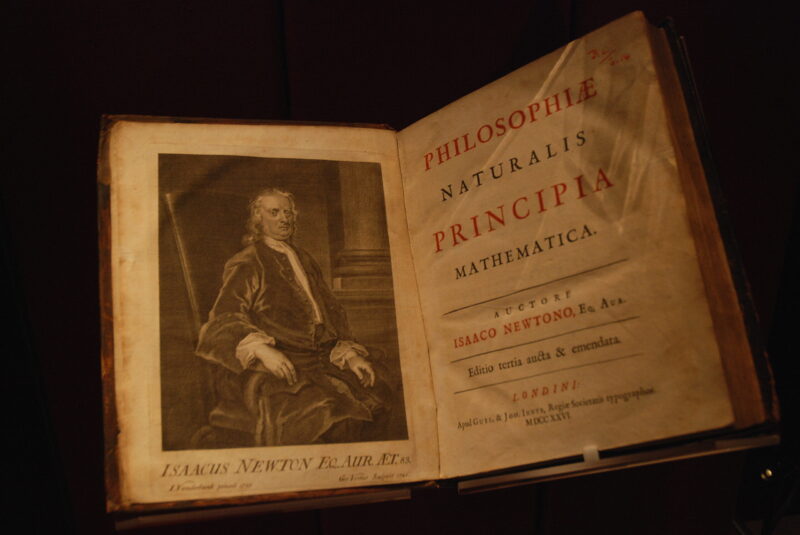
Halley explained the concept to Newton, also explaining that he couldn’t prove it. Newton, encouraged by Halley, developed Halley’s work into one of the most famous scientific works to this day, Mathematical Principles of Natural Philosophy, often referred to simply as Newton’s Principia.

Small book, open, with portrait of Newton on left page and Latin title printed in red and black on right page.
Copy of the third edition of Newton’s Principia (1726) at the John Reynolds Library in Manchester, England. Image via Wikimedia Commons (CC BY-SA 3.0).

Halley became Astronomer Royal

Halley is also known for his work in meteorology. He put his talent of giving meaning to great amounts of data to use by creating a map of the world in 1686.

The map showed the most important winds above the oceans and is the first meteorological chart ever published.

Halley kept traveling and working on many other projects, such as attempting to link mortality and age in a population. This data became important for actuaries calculating life insurance.

In 1720, Halley succeeded Flamsteed and became the second Astronomer Royal at Greenwich.

Long world map with the oceans covered in tiny arrows and no details on continents.
View larger. | Edmond Halley’s 1686 map of the world, which charts the directions of trade winds and monsoons, is considered the 1st meteorological map. Image via Wikipedia.

Bottom line: Astronomer Edmond Halley is famous for predicting the return of the comet that we now know as Halley’s Comet. Edmond was born on November 8, 1656.

The post Halley’s Comet is Edmond Halley’s namesake. Happy birthday, Edmond! first appeared on EarthSky.


from EarthSky https://ift.tt/A9j321q
Painting of a man with long, dark, wavy hair. He is wearing an academic robe and holding a book.
Portrait of Edmond Halley circa 1687 by Thomas Murray. Halley is famous for discovering that comets are objects that orbit the sun and can reappear in our skies. Halley’s Comet is named for him. Image via Wikimedia Commons.

Science matters. Wonder matters. You matter.
Join our 2025 Donation Campaign today.

The scientist behind Halley’s Comet

November 8, 1656, is the birthdate of English astronomer and mathematician Edmond Halley. Born near London, he grew to become the first to make the leap of the imagination required to understand that comets orbit our sun. And he was the first to calculate the orbit of a comet, now one of the most famous of all comets, named Comet Halley in his honor.

Halley was also friends with Isaac Newton. He contributed to Newton’s development of the theory of gravity, which helped establish our modern era of science, in part by removing all doubt that we live on a planet orbiting around the sun.

When Halley’s Comet last appeared in Earth’s skies in 1986, an international fleet of spacecraft were there to meet it. This famous comet will return again in 2061 on its 76-year journey around the sun. It’s famous partly because it tends to be a bright comet in Earth’s skies. And the length of its orbit – approximately 76 years – isn’t so different from that of a human lifespan. So, most people can see Comet Halley once in a lifetime, while some lucky people might be able to see it twice.

But it’s also famous for another reason. In Edmond Halley’s time, people didn’t know that comets were like planets, bound in orbit by the sun. They didn’t know that some comets, like Halley’s Comet, return over and over.

Halley’s prediction

In 1704, Halley became a professor of geometry at Oxford University. The following year, he published A Synopsis of the Astronomy of Comets. The book contains the parabolic orbits of 24 comets that graced Earth’s skies from 1337 to 1698.

It was in this book that Halley made his magnificent prediction.

Large bright white spot with wide, faint bluish tail on very dense starry background.
Halley’s Comet, photographed in 1986. Image via NASA.

The return of Halley’s Comet

In his book, Halley remarked on three comets that appeared in 1531, 1607 and 1682. He used Isaac Newton’s theories of gravitation and planetary motions to compute the orbits of these comets. He found remarkable similarities in their orbits. Then Halley made what was, at that time, a stunning prediction. He said these three comets must in fact be a single comet, which returns periodically every 76 years.

He then predicted the comet would return, saying:

Hence I dare venture to foretell, that it will return again in the year 1758.

Halley didn’t live to see his prediction verified. It was 16 years after his death that – right on schedule, in 1758 – the comet did return, amazing the scientific world and the public.

It was the first comet ever predicted to return. Thus, we now call it Halley’s Comet, in honor of Edmond Halley.

Where is Halley’s Comet now?

Halley's Comet: Close photo of a globular icy chunk moving in black space, surrounded by an oblong cloud of haze.
During the last return of Halley’s Comet – in 1986 – the European spacecraft Giotto became one of the first spacecraft ever to encounter and photograph a comet’s nucleus, or core. It swept past the nucleus of Halley’s Comet as it receded from the sun. Image via Halley Multicolor Camera Team/ Giotto Project/ ESA/ NASA.

Halley, Flamsteed and a Mercury transit

The 17th century was an exciting time to be a scientist in England. The scientific revolution gave birth to the Royal Society of London when Halley was only a child. Members of the Royal Society – physicians and natural philosophers who were some of the earliest adopters of the scientific method – met weekly. The first Astronomer Royal was John Flamsteed, remembered in part for the creation of the Royal Observatory at Greenwich, which still exists today.

After entering Queen’s College in Oxford as a student in 1673, Halley met Flamsteed. Halley had the chance to visit him in his observatory on a few occasions, during which Flamsteed encouraged him to pursue astronomy.

At that time, Flamsteed’s project was to assemble an accurate catalog of the northern stars with his telescope. Halley thought he would do the same, but with stars of the Southern Hemisphere.

Halley’s Southern Hemisphere expedition

His journey southward began in November 1676, even before he obtained his university degree. He sailed aboard a ship from the East India Company to the island of St. Helena, still one of the most remote islands in the world and the southernmost territory occupied by the British. His father and King Charles II financed the trip.

Bad weather made Halley’s work difficult. But, despite this, when he turned to sail back home in January 1678, he brought records of the longitude and latitude of 341 stars and many other observations. One of these observations was a transit of Mercury, about which he wrote:

This sight … is by far the noblest astronomy affords.

Large yellow-orange ball partly within diffuse clouds, with tiny black dot on its face.
Here’s the May 9, 2016, transit of Mercury via VegaStar C/LIARD of France. In this image, Mercury is the small black dot on the left side of the sun. Mercury also transited the sun on November 11, 2019. Read about the 2019 Mercury transit.

Cracking the code of planetary motion

Halley published his catalog of southern stars by the end of 1678. And – as the first work of its genre – it was a huge success. No one had ever attempted to determine the locations of southern stars with a telescope before. The catalog was Halley’s glorious debut as an astronomer. In the same year, he received his M.A. from the University of Oxford and was elected a fellow of the Royal Society.

Halley visited Isaac Newton in Cambridge for the first time in 1684. A group of Royal Society members, including physicist and biologist Robert Hooke, architect Christopher Wren and Isaac Newton, were trying to crack the code of planetary motion. Halley was the youngest to join the trio in their mission to use mathematics to describe how – and why – the planets move around the sun. They were all competing against one another to find the solution first, which was very motivating. Their problem was to find a mechanical model that would keep the planet orbiting around the sun without it escaping the orbit or falling into the star.

Hooke and Halley determined that the solution to this problem would be a force that keeps a planet in orbit around a star and must decrease as the inverse square of its distance from the star. Today we know this as the inverse-square law.

Hooke and Halley were on the right track, but they were not able to create a theoretical orbit that would match observations, despite Wren donating a monetary prize.

Newton solves it

Halley explained the concept to Newton, also explaining that he couldn’t prove it. Newton, encouraged by Halley, developed Halley’s work into one of the most famous scientific works to this day, Mathematical Principles of Natural Philosophy, often referred to simply as Newton’s Principia.

Small book, open, with portrait of Newton on left page and Latin title printed in red and black on right page.
Copy of the third edition of Newton’s Principia (1726) at the John Reynolds Library in Manchester, England. Image via Wikimedia Commons (CC BY-SA 3.0).

Halley became Astronomer Royal

Halley is also known for his work in meteorology. He put his talent of giving meaning to great amounts of data to use by creating a map of the world in 1686.

The map showed the most important winds above the oceans and is the first meteorological chart ever published.

Halley kept traveling and working on many other projects, such as attempting to link mortality and age in a population. This data became important for actuaries calculating life insurance.

In 1720, Halley succeeded Flamsteed and became the second Astronomer Royal at Greenwich.

Long world map with the oceans covered in tiny arrows and no details on continents.
View larger. | Edmond Halley’s 1686 map of the world, which charts the directions of trade winds and monsoons, is considered the 1st meteorological map. Image via Wikipedia.

Bottom line: Astronomer Edmond Halley is famous for predicting the return of the comet that we now know as Halley’s Comet. Edmond was born on November 8, 1656.

The post Halley’s Comet is Edmond Halley’s namesake. Happy birthday, Edmond! first appeared on EarthSky.


from EarthSky https://ift.tt/A9j321q

Comet Lemmon is closest to the sun on November 8

Watch a compilation of Comet Lemmon pics from EarthSky community members around the globe. Thanks to all who submitted!

See more images of Comet Lemmon in our community photos gallery here.

Science matters. Wonder matters. You matter.
Join our 2025 Donation Campaign today.

Comet Lemmon might be the best comet of 2025

Comet Lemmon (C/2025 A6) has been the best comet of 2025. And it favors Northern Hemisphere observers. Comet Lemmon has been just at the edge of visibility with the unaided eye from a dark-sky site in late October and early November. Right now it’s competing with a bright moon, but you can still see it with the aid of binoculars.

The comet was closest to Earth on October 21, 2025. And Comet Lemmon will reach its closest point to the sun on November 8.

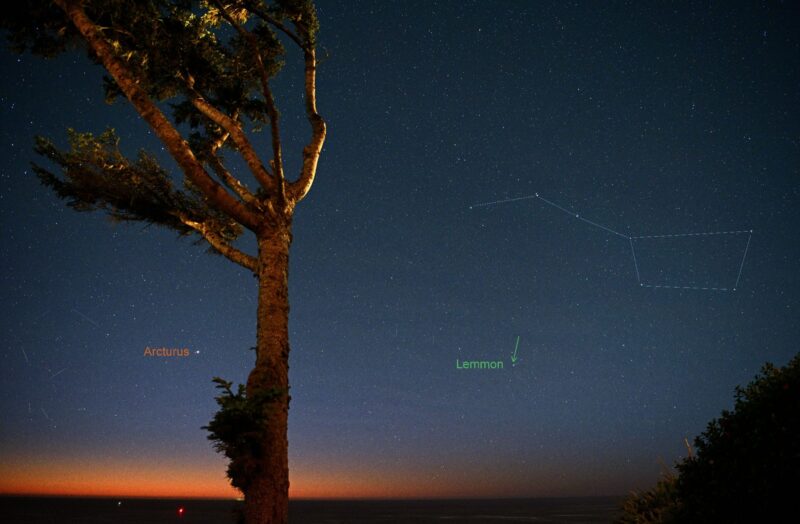
A tree with a darkening sky behind showing the Big Dipper and a small fuzzy comet below it.
View at EarthSky Community Photos. | Cecille Kennedy in Depoe Bay, Oregon, captured Comet Lemmon under the Big Dipper on October 14, 2025. Thank you, Cecille!

How to see Comet Lemmon

Comet Lemmon favors Northern Hemisphere viewers. It spent much of October near the Big Dipper. But on northern fall evenings, the Big Dipper is quite low on the horizon. So the farther north you are, the better your chances. Reports are that the comet has reached about magnitude 4, which makes it a pretty good target, even for beginning observers.

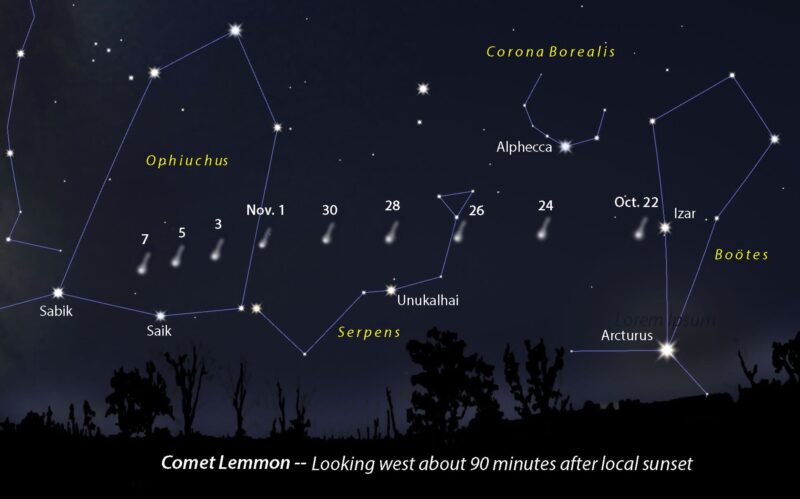
So Comet Lemmon is at its brightest around now. Use the charts here to find its location in the sky.

A finder chart showing the path of Comet Lemmon across the western sky after sunset, from about mid-October onward.
Finder chart for Comet Lemmon (C/2025 A6) in the evening sky as soon as true darkness falls. That might be some 90 minutes after sunset. Face northwest and use binoculars to help spot it and then see if it’s visible to the unaided eye. Image via Bob King (Astro Bob). Used with permission.

Other comets in the sky now

Comet Lemmon is just one of a number of comets currently in our sky. The most famous is probably the interstellar comet, 3I/ATLAS, which was closest to the sun in late October.

Another comet that recently came upon the scene is Comet SWAN. But for that one you’ll definitely need optical aid.

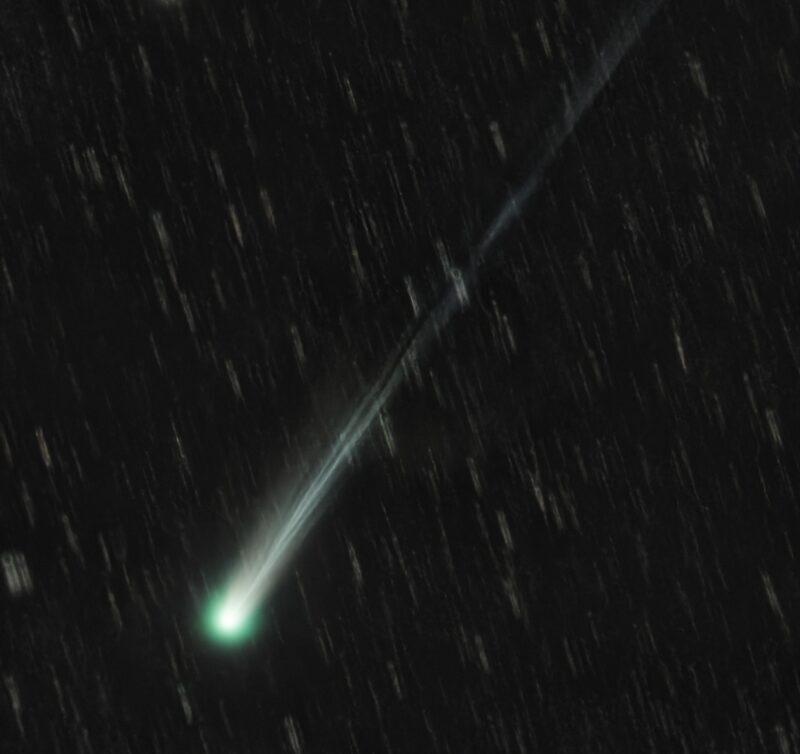
A bright oval with a long, straight tail reaching to the upper right.
View at EarthSky Community Photos. | Steven Bellavia in Smithfield, Virginia, captured Comet Lemmon on October 2, 2025. Steven wrote: “C/2025 A6 (Lemmon), as it approaches perihelion, on November 8, 2025. I was easily able to see the head in my Celestron 15×70 SkyMaster Pro binoculars.” Thank you, Steven!

History of Comet C/2025 A6 Lemmon

Astronomers using the 60-inch (1.5-meter) telescope at Mt. Lemmon, Arizona, discovered this comet back on January 3, 2025. There are also precovery images of the comet in PanSTARRS data from as early as November 12, 2024. The term precovery is one that astronomers use to mean pre-discovery recovery. So the comet was on images earlier than those in which it was discovered. But they did not realize it was there until they went back and looked for it. Using these extended data, astronomers have been able to calculate its orbit. And it has an orbit that takes it about 1,350 years to circle the sun once.

Images of Comet Lemmon

Glowing coma of Comet Lemmon with a thin tail streaming away from it.
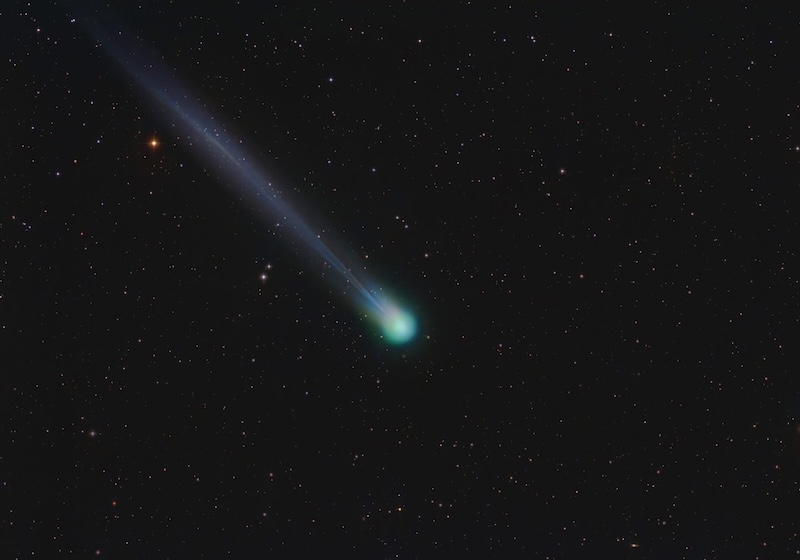
View at EarthSky Community Photos. | Craig Patterson captured this image of Comet Lemmon on October 10, 2025, from Lubbock, Texas. Thank you, Craig!
Round, fuzzy glowing ball in a starfield and it has a long tail.
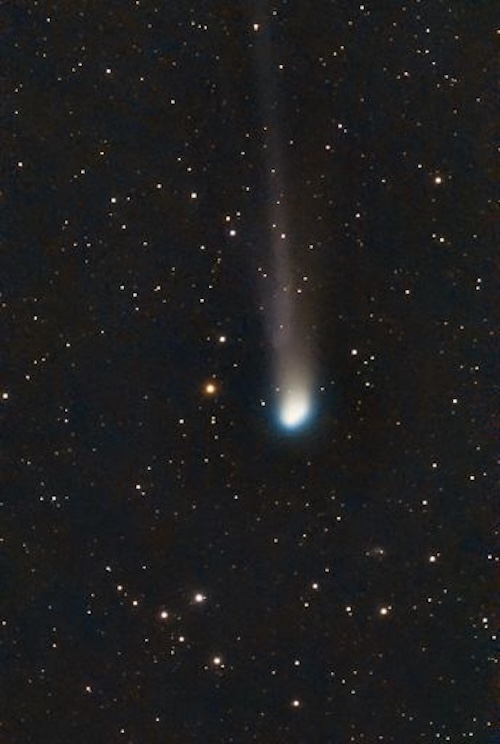
View at EarthSky Community Photos. | Stéphane Picard captured Comet C/2025 A6 from Quispamsis, New Brunswick, Canada, on October 4, 2025. Stéphane wrote: “Comet C/2025 A6 Lemmon is hanging near the Big Dipper in the early morning hours before sunrise. Although not visible to the unaided eye yet, it may become visible later this month. It is currently heading inwards towards our sun at a speed of almost 60 km/s (134,200 mph).” Thank you, Stéphane!
Fuzzy glowing ball in a starfield with a long tail.
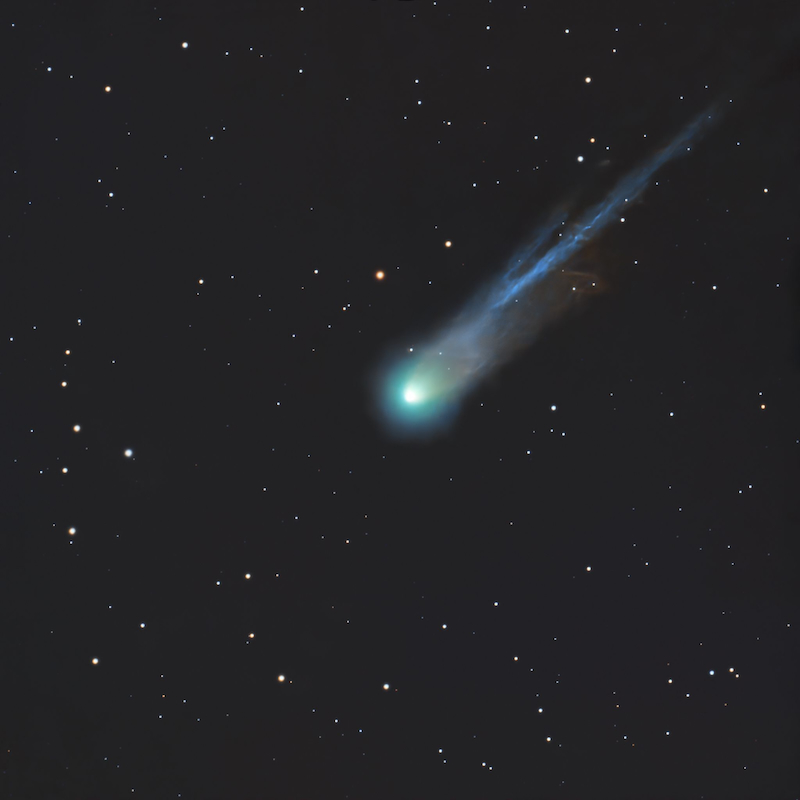
View at EarthSky Community Photos. | Mario Rana in Hampton, Virginia, caught the comet on October 4, 2025. Thank you, Mario.
Foggy light at night in the valley with a greenish-blue long-tailed comet above.
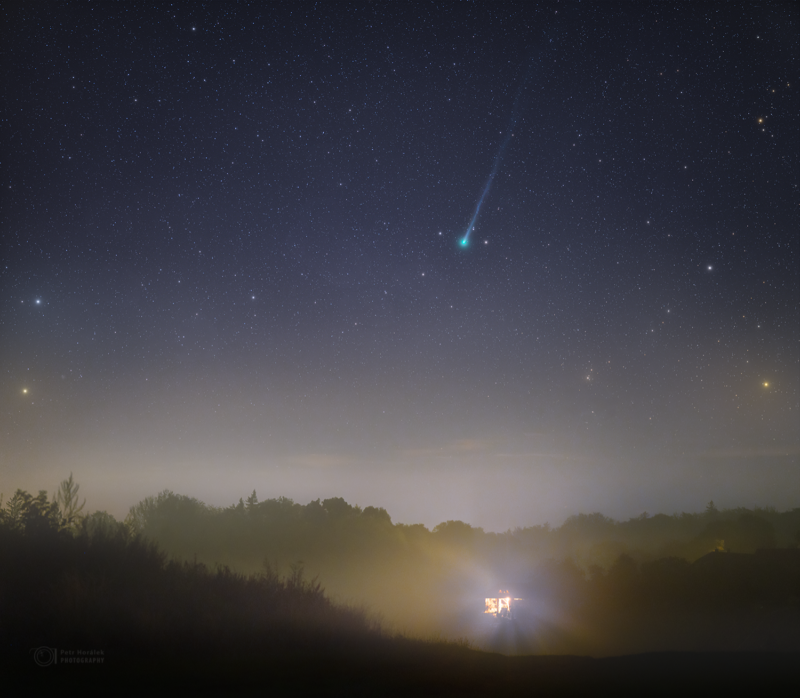
View at EarthSky Community Photos. | Petr Horálek in Prosec u Sece, Czech Republic, captured Comet Lemmon on October 1, 2025. Petr wrote: “The beautiful comet is now located in Ursa Major and starts to be circumpolar from northern mid-latitudes. My observation was truly dramatic, as the approaching fog made the view and photography increasingly challenging. Eventually, here is the result, showing a truly significant ion tail of the comet, visible even in small binoculars. Small, but lovely comet, indeed!” Thank you, Petr!

More images

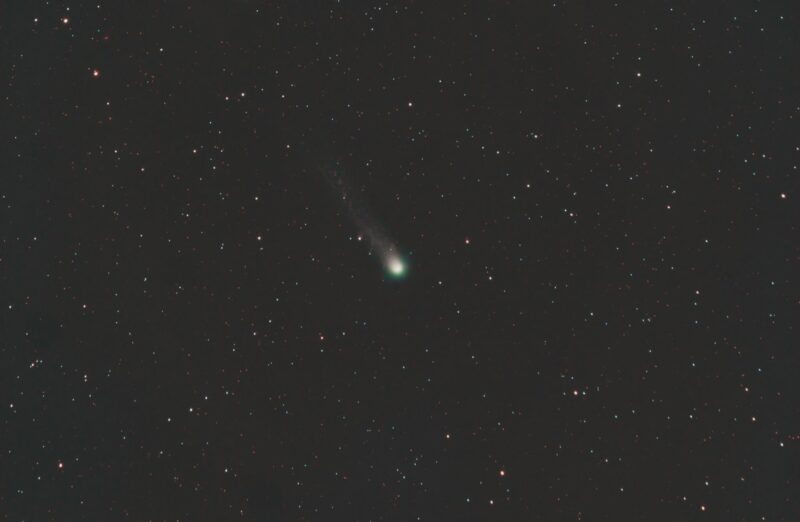
A greenish, fuzzy object at center amid a field of stars, with a faint, short tail.
View at EarthSky Community Photos. | David Hoskin in Halifax, Nova Scotia, Canada, captured Comet A6 Lemmon on September 29, 2025. David wrote: “The comet continues to brighten and may, from a dark site, become visible to the unaided eye by late October.” Thank you, David!
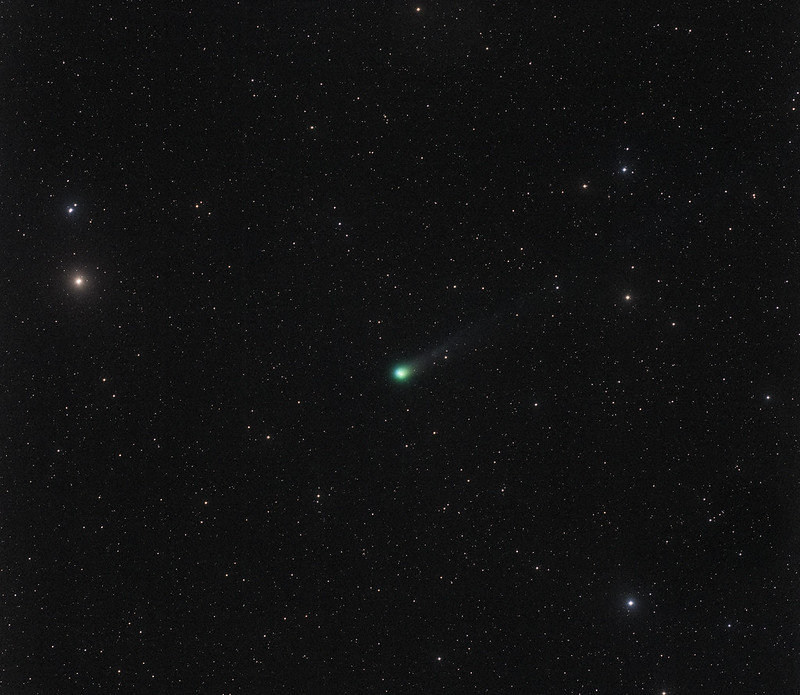
Starfield with a small, fuzzy green glowing object with a barely perceptible short tail.
Eliot Herman captured Comet A6 Lemmon using a remote iTelescope on September 29, 2025. Thank you, Eliot!
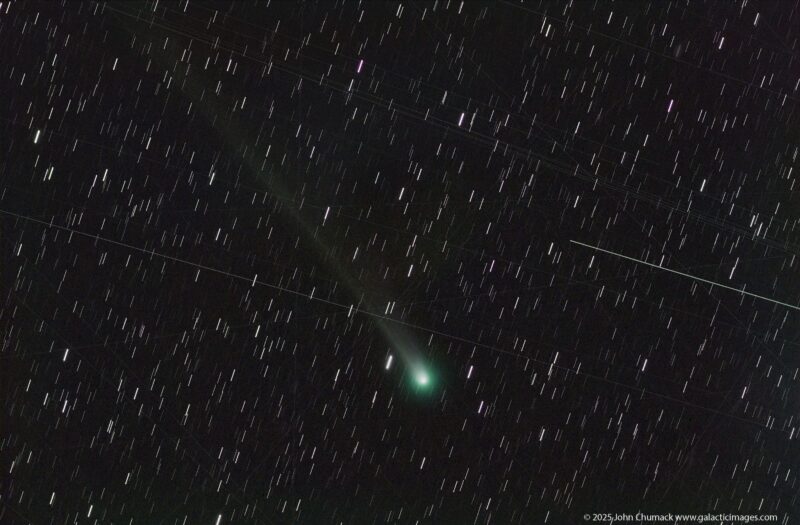
Comet Lemmon: Starfield with a green comet with a faint tail extending to the upper left.
View at EarthSky Community Photos. | John Chumack in Yellow Springs, Ohio, captured Comet Lemmon (C/2025 A6) along with some satellite trails on September 27, 2025. John wrote: “Early Saturday morning I had to wait an hour longer just for it to clear the trees in the northeast. I was finally able to image it around 6:00 a.m., with dawn rising fast, and the satellite traffic was crazy.” Thank you, John!
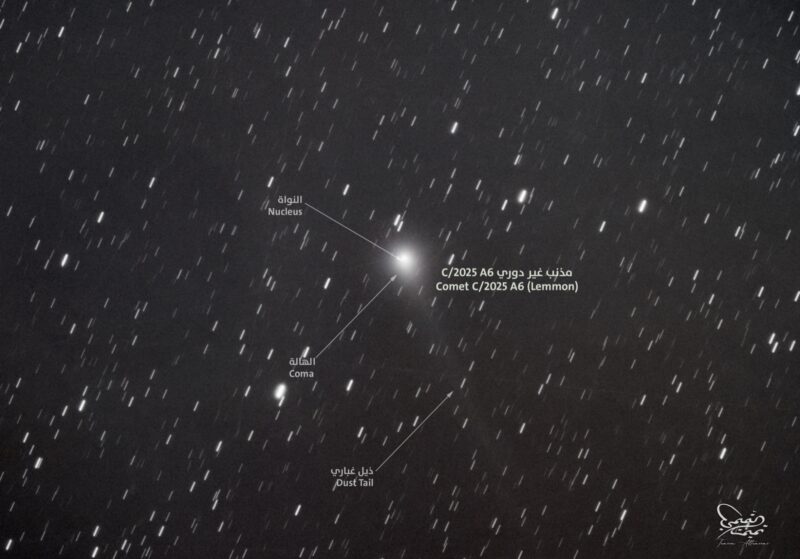
Starfield with a bright, fuzzy glowing object at center labeled and other nearby stars.
View at EarthSky Community Photos. | Tameem Altameemi in the United Arab Emirates captured Comet Lemmon on September 19, 2025. Tameem wrote: “This non-periodic comet is currently shining at magnitude +8, making it a fine telescopic target. In the image, you can see the bright nucleus at the core, the surrounding coma of gas and dust, and a faint dust tail stretching away from the sun. Unlike periodic comets that return on a regular cycle, C/2025 A6 follows a very elongated orbit and may not return for thousands of years, if ever.” Thank you, Tameem!

Bottom line: Comet Lemmon reaches its closest point to the sun on November 8. See a finder chart and some great images of it here.

5 bright comets approaching Earth. Charts here!

Interstellar object 3I/ATLAS brightening quickly

New comet C/2025 R2 (SWAN) is becoming more visible

The post Comet Lemmon is closest to the sun on November 8 first appeared on EarthSky.


from EarthSky https://ift.tt/wq43eKV

Watch a compilation of Comet Lemmon pics from EarthSky community members around the globe. Thanks to all who submitted!

See more images of Comet Lemmon in our community photos gallery here.

Science matters. Wonder matters. You matter.
Join our 2025 Donation Campaign today.

Comet Lemmon might be the best comet of 2025

Comet Lemmon (C/2025 A6) has been the best comet of 2025. And it favors Northern Hemisphere observers. Comet Lemmon has been just at the edge of visibility with the unaided eye from a dark-sky site in late October and early November. Right now it’s competing with a bright moon, but you can still see it with the aid of binoculars.

The comet was closest to Earth on October 21, 2025. And Comet Lemmon will reach its closest point to the sun on November 8.

A tree with a darkening sky behind showing the Big Dipper and a small fuzzy comet below it.
View at EarthSky Community Photos. | Cecille Kennedy in Depoe Bay, Oregon, captured Comet Lemmon under the Big Dipper on October 14, 2025. Thank you, Cecille!

How to see Comet Lemmon

Comet Lemmon favors Northern Hemisphere viewers. It spent much of October near the Big Dipper. But on northern fall evenings, the Big Dipper is quite low on the horizon. So the farther north you are, the better your chances. Reports are that the comet has reached about magnitude 4, which makes it a pretty good target, even for beginning observers.

So Comet Lemmon is at its brightest around now. Use the charts here to find its location in the sky.

A finder chart showing the path of Comet Lemmon across the western sky after sunset, from about mid-October onward.
Finder chart for Comet Lemmon (C/2025 A6) in the evening sky as soon as true darkness falls. That might be some 90 minutes after sunset. Face northwest and use binoculars to help spot it and then see if it’s visible to the unaided eye. Image via Bob King (Astro Bob). Used with permission.

Other comets in the sky now

Comet Lemmon is just one of a number of comets currently in our sky. The most famous is probably the interstellar comet, 3I/ATLAS, which was closest to the sun in late October.

Another comet that recently came upon the scene is Comet SWAN. But for that one you’ll definitely need optical aid.

A bright oval with a long, straight tail reaching to the upper right.
View at EarthSky Community Photos. | Steven Bellavia in Smithfield, Virginia, captured Comet Lemmon on October 2, 2025. Steven wrote: “C/2025 A6 (Lemmon), as it approaches perihelion, on November 8, 2025. I was easily able to see the head in my Celestron 15×70 SkyMaster Pro binoculars.” Thank you, Steven!

History of Comet C/2025 A6 Lemmon

Astronomers using the 60-inch (1.5-meter) telescope at Mt. Lemmon, Arizona, discovered this comet back on January 3, 2025. There are also precovery images of the comet in PanSTARRS data from as early as November 12, 2024. The term precovery is one that astronomers use to mean pre-discovery recovery. So the comet was on images earlier than those in which it was discovered. But they did not realize it was there until they went back and looked for it. Using these extended data, astronomers have been able to calculate its orbit. And it has an orbit that takes it about 1,350 years to circle the sun once.

Images of Comet Lemmon

Glowing coma of Comet Lemmon with a thin tail streaming away from it.
View at EarthSky Community Photos. | Craig Patterson captured this image of Comet Lemmon on October 10, 2025, from Lubbock, Texas. Thank you, Craig!
Round, fuzzy glowing ball in a starfield and it has a long tail.
View at EarthSky Community Photos. | Stéphane Picard captured Comet C/2025 A6 from Quispamsis, New Brunswick, Canada, on October 4, 2025. Stéphane wrote: “Comet C/2025 A6 Lemmon is hanging near the Big Dipper in the early morning hours before sunrise. Although not visible to the unaided eye yet, it may become visible later this month. It is currently heading inwards towards our sun at a speed of almost 60 km/s (134,200 mph).” Thank you, Stéphane!
Fuzzy glowing ball in a starfield with a long tail.
View at EarthSky Community Photos. | Mario Rana in Hampton, Virginia, caught the comet on October 4, 2025. Thank you, Mario.
Foggy light at night in the valley with a greenish-blue long-tailed comet above.
View at EarthSky Community Photos. | Petr Horálek in Prosec u Sece, Czech Republic, captured Comet Lemmon on October 1, 2025. Petr wrote: “The beautiful comet is now located in Ursa Major and starts to be circumpolar from northern mid-latitudes. My observation was truly dramatic, as the approaching fog made the view and photography increasingly challenging. Eventually, here is the result, showing a truly significant ion tail of the comet, visible even in small binoculars. Small, but lovely comet, indeed!” Thank you, Petr!

More images

A greenish, fuzzy object at center amid a field of stars, with a faint, short tail.
View at EarthSky Community Photos. | David Hoskin in Halifax, Nova Scotia, Canada, captured Comet A6 Lemmon on September 29, 2025. David wrote: “The comet continues to brighten and may, from a dark site, become visible to the unaided eye by late October.” Thank you, David!
Starfield with a small, fuzzy green glowing object with a barely perceptible short tail.
Eliot Herman captured Comet A6 Lemmon using a remote iTelescope on September 29, 2025. Thank you, Eliot!
Comet Lemmon: Starfield with a green comet with a faint tail extending to the upper left.
View at EarthSky Community Photos. | John Chumack in Yellow Springs, Ohio, captured Comet Lemmon (C/2025 A6) along with some satellite trails on September 27, 2025. John wrote: “Early Saturday morning I had to wait an hour longer just for it to clear the trees in the northeast. I was finally able to image it around 6:00 a.m., with dawn rising fast, and the satellite traffic was crazy.” Thank you, John!
Starfield with a bright, fuzzy glowing object at center labeled and other nearby stars.
View at EarthSky Community Photos. | Tameem Altameemi in the United Arab Emirates captured Comet Lemmon on September 19, 2025. Tameem wrote: “This non-periodic comet is currently shining at magnitude +8, making it a fine telescopic target. In the image, you can see the bright nucleus at the core, the surrounding coma of gas and dust, and a faint dust tail stretching away from the sun. Unlike periodic comets that return on a regular cycle, C/2025 A6 follows a very elongated orbit and may not return for thousands of years, if ever.” Thank you, Tameem!

Bottom line: Comet Lemmon reaches its closest point to the sun on November 8. See a finder chart and some great images of it here.

5 bright comets approaching Earth. Charts here!

Interstellar object 3I/ATLAS brightening quickly

New comet C/2025 R2 (SWAN) is becoming more visible

The post Comet Lemmon is closest to the sun on November 8 first appeared on EarthSky.


from EarthSky https://ift.tt/wq43eKV

Typhoon Kalmaegi hits Vietnam, with 114 dead in Philippines

Satellite imagery of devastating Typhoon Kalmaegi near Vietnam on November 6, 2025. Image via JAXA P-Tree system/ Wikipedia (CC BY 4.0).

As of 12:30 UTC, November 6, deadly Typhoon Kalmaegi has just made landfall in Vietnam, having killed at least 114 people in the Philippines earlier this week.

Kalmaegi became the 20th tropical cyclone to hit the Philippines this year when it made landfall on Tuesday, leaving homes flattened, entire towns flooded, and 127 people still missing. Philippines President Ferdinand Marcos Jr declared a ‘state of calamity’ this morning as recovery efforts continue, and ahead of the arrival of another storm – Typhoon Uwan – in the coming days.

Typhoon Kalmaegi has been strengthening in recent days while barreling towards Vietnam’s coastline, where devastating waves of up to 26 feet (8m) have been forecast. And now, the BBC is reporting that the typhoon has just made landfall.

This comes with the country already battling intense flooding this week, which has already killed at least 35 people. And, according to the BBC, the typhoon will bring another 8-16 inches (20-40 cm) of rain, with the possibility of up to 24 inches (60 cm) in some spots.

Find live updates here.

BREAKING: The Philippines declares a state of emergency after Typhoon Kalmaegi leaves at least 114 dead and hundreds missing in central provinces.

The Associated Press (@apnews.com) 2025-11-06T03:44:57.957Z

Typhoon Kalmaegi caused devastation in the Philippines

As Typhoon Kalmaegi bears down on the Vietnam, recovery efforts continue in the Philippines. The worst effects of Kalmaegi, referred to in the Philippines as Tino, were felt in the region of Cebu, home to some 3.4 million people. According to the BBC:

Damage to Cebu’s residential areas was extensive, with many small buildings swept away and a thick carpet of mud left by the retreating floodwaters.

This comes just over a month after a powerful 6.9-magnitude earthquake hit the province, killing over 70 people and displacing over 20,000, Reuters said.

And the nightmare continues for the nation, with another storm – Typhoon Uwan – expected to make landfall. It was partly for this reason that Philippines President Ferdinand Marcos Jr declared a state of calamity this morning, defined as a condition involving mass casualty, major damage to property, disruption to means of livelihoods for people in affected areas.

Bottom line: Typhoon Kalmaegi has just reached Vietnam, having left a trail of devastation and at least 114 dead in the Philippines earlier this week.

The post Typhoon Kalmaegi hits Vietnam, with 114 dead in Philippines first appeared on EarthSky.


from EarthSky https://ift.tt/rB3oF7l
Satellite imagery of devastating Typhoon Kalmaegi near Vietnam on November 6, 2025. Image via JAXA P-Tree system/ Wikipedia (CC BY 4.0).

As of 12:30 UTC, November 6, deadly Typhoon Kalmaegi has just made landfall in Vietnam, having killed at least 114 people in the Philippines earlier this week.

Kalmaegi became the 20th tropical cyclone to hit the Philippines this year when it made landfall on Tuesday, leaving homes flattened, entire towns flooded, and 127 people still missing. Philippines President Ferdinand Marcos Jr declared a ‘state of calamity’ this morning as recovery efforts continue, and ahead of the arrival of another storm – Typhoon Uwan – in the coming days.

Typhoon Kalmaegi has been strengthening in recent days while barreling towards Vietnam’s coastline, where devastating waves of up to 26 feet (8m) have been forecast. And now, the BBC is reporting that the typhoon has just made landfall.

This comes with the country already battling intense flooding this week, which has already killed at least 35 people. And, according to the BBC, the typhoon will bring another 8-16 inches (20-40 cm) of rain, with the possibility of up to 24 inches (60 cm) in some spots.

Find live updates here.

BREAKING: The Philippines declares a state of emergency after Typhoon Kalmaegi leaves at least 114 dead and hundreds missing in central provinces.

The Associated Press (@apnews.com) 2025-11-06T03:44:57.957Z

Typhoon Kalmaegi caused devastation in the Philippines

As Typhoon Kalmaegi bears down on the Vietnam, recovery efforts continue in the Philippines. The worst effects of Kalmaegi, referred to in the Philippines as Tino, were felt in the region of Cebu, home to some 3.4 million people. According to the BBC:

Damage to Cebu’s residential areas was extensive, with many small buildings swept away and a thick carpet of mud left by the retreating floodwaters.

This comes just over a month after a powerful 6.9-magnitude earthquake hit the province, killing over 70 people and displacing over 20,000, Reuters said.

And the nightmare continues for the nation, with another storm – Typhoon Uwan – expected to make landfall. It was partly for this reason that Philippines President Ferdinand Marcos Jr declared a state of calamity this morning, defined as a condition involving mass casualty, major damage to property, disruption to means of livelihoods for people in affected areas.

Bottom line: Typhoon Kalmaegi has just reached Vietnam, having left a trail of devastation and at least 114 dead in the Philippines earlier this week.

The post Typhoon Kalmaegi hits Vietnam, with 114 dead in Philippines first appeared on EarthSky.


from EarthSky https://ift.tt/rB3oF7l

Almach, a quadruple star system in Andromeda

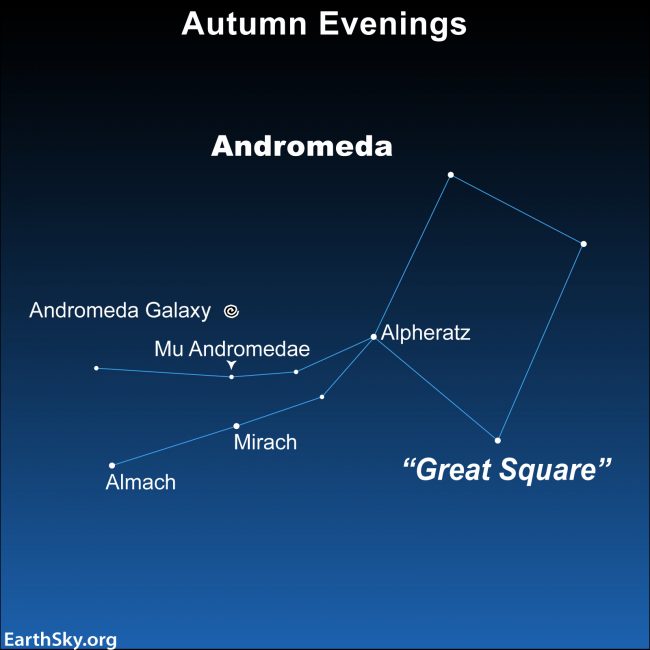
Sky chart showing Andromeda, with Andromeda Galaxy, Great Square and several stars labeled including Almach.
In skylore, the star Almach, or Gamma Andromedae, marks the Princess Andromeda’s left foot. Almach looks like a single star to the unaided eye, but it’s really 4 stars. Chart via EarthSky.

Millions come to EarthSky for night sky news and trusted science.
Your donation keeps us free and accessible for all.

Almach is 4 stars

The constellation Andromeda the Chained Lady is renowned for the Andromeda galaxy. But even a modest telescope will show another excellent target in Andromeda: the multiple star system Almach (Gamma Andromedae). Indeed, it appears through a small telescope as one of the finest double stars in all the heavens. One component of this telescopic double appears golden, and the other component appears indigo blue. In addition, further research has shown that Almach is really four stars.

Some double star aficionados believe Almach’s vibrancy of color even surpasses that of the star Albireo in the constellation Cygnus, generally regarded as the sky’s finest double star. In autumn, both Almach and Albireo are there for the viewing, so check them out and decide for yourself.

Also, try different eyepieces at your small telescope, to see which one gives you the most vivid view of this colorful double. And, if you put the scope out-of-focus, the colors will show even more.

Today, it’s known that the smaller blue star is a triple star system, making Almach four stars in all. This quadruple star system is located an estimated 350 light-years away.

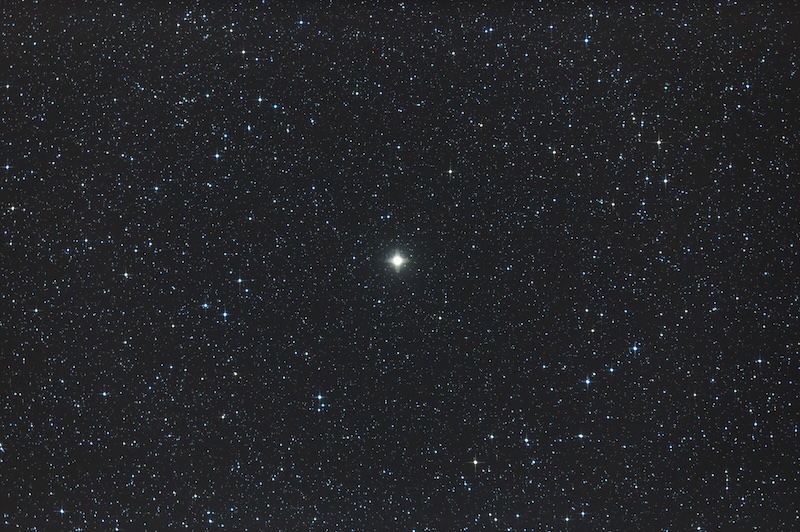
Black sky with lots of stars and one bright one in the center.
Gamma Andromedae, aka Almach, is a double star (not resolved here in this wide-field view) located in the constellation Andromeda. Image via Alan Dyer/ Amazingsky.com. Used with permission.
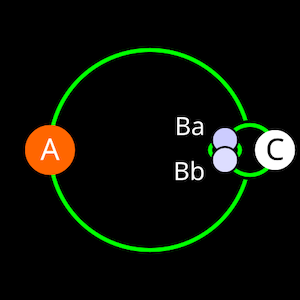
3 intersecting circles, 1 large and 2 small, with colored dots representing stars.
The colorful telescopic double star Almach is really 4 stars. The fainter component is actually a triple star system. Image via Antonsusi/ Wikipedia. Used with permission.

Star-system science

German astronomer Johann Tobias Mayer was the first to report Almach or Gamma Andromedae as double in 1778. The main components of the star system are named GammaAndromedae and Gamma2 Andromedae or Gamma Andromedae A and Gamma Andromedae BC. The apparent pair of contrasting stars appears to be around 10 arcseconds apart in the sky. The single star and the triple star system orbit each other with a period of around 4700 years.

The brighter component, Gamma1 Andromedae, shines at a magnitude of +2.26. It’s a K-type giant star. Compared to our sun, this star is 80 times bigger in radius, big enough to reach the orbit of Venus. It has a surface temperature of 4500 K (about 4200 C or 7600 F) and is 2,000 times more luminous than our sun with a rotational velocity of 17 km/s (about 10 mps).

Gamma2 Andromedae itself is a multiple star system with spectroscopic binaries Gamma Andromedae B and Gamma Andromedae C. These 5th and 6th magnitude dwarf binaries orbit each other in 63.7 years and are separated by barely 0.3 arcseconds. That translates to approximately 33 astronomical units (AU, or Earth-sun distances), comparable to the distance between our sun and the planet Neptune. The brighter star of the two, Gamma Andromedae B, is another binary system. Its companion is detectable only with a spectrograph. The two stars are very close and orbit each other in 2.7 days. The estimated mass for this triple star system is 8.7 solar masses. Gamma2 is thus a triple-star system, making Almach a quadruple-star system.

How to find the star Almach

In skylore, Almach marks Andromeda’s left foot. Star-hop to Almach from the Great Square of Pegasus, the signature star formation of Northern Hemisphere autumn.

Two streamers of stars fly outward from the Great Square, starting at the star Alpheratz. These streamers of stars are the constellation Andromeda.

Then, jump three stars over on the lower streamer to locate Almach. At 2nd-magnitude brightness, Almach shines pretty much on a par with the stars of the Big Dipper.

Almach shines relatively close to the famous variable star Algol in the constellation Perseus. In fact, when Algol shines at maximum brilliance, it matches Almach in brightness.

Bottom line: Almach looks single to the eye. But a small telescope transforms Almach into two colorful suns, one golden and the other blue. And astronomical research has revealed that one component is a triple star system, making the Almach system four stars in all.

Mirfak: Perseus’ brightest star

Capella: Golden Goat Star

Enjoying EarthSky? Sign up for our free daily newsletter today!

The post Almach, a quadruple star system in Andromeda first appeared on EarthSky.


from EarthSky https://ift.tt/ctobRK8
Sky chart showing Andromeda, with Andromeda Galaxy, Great Square and several stars labeled including Almach.
In skylore, the star Almach, or Gamma Andromedae, marks the Princess Andromeda’s left foot. Almach looks like a single star to the unaided eye, but it’s really 4 stars. Chart via EarthSky.

Millions come to EarthSky for night sky news and trusted science.
Your donation keeps us free and accessible for all.

Almach is 4 stars

The constellation Andromeda the Chained Lady is renowned for the Andromeda galaxy. But even a modest telescope will show another excellent target in Andromeda: the multiple star system Almach (Gamma Andromedae). Indeed, it appears through a small telescope as one of the finest double stars in all the heavens. One component of this telescopic double appears golden, and the other component appears indigo blue. In addition, further research has shown that Almach is really four stars.

Some double star aficionados believe Almach’s vibrancy of color even surpasses that of the star Albireo in the constellation Cygnus, generally regarded as the sky’s finest double star. In autumn, both Almach and Albireo are there for the viewing, so check them out and decide for yourself.

Also, try different eyepieces at your small telescope, to see which one gives you the most vivid view of this colorful double. And, if you put the scope out-of-focus, the colors will show even more.

Today, it’s known that the smaller blue star is a triple star system, making Almach four stars in all. This quadruple star system is located an estimated 350 light-years away.

Black sky with lots of stars and one bright one in the center.
Gamma Andromedae, aka Almach, is a double star (not resolved here in this wide-field view) located in the constellation Andromeda. Image via Alan Dyer/ Amazingsky.com. Used with permission.
3 intersecting circles, 1 large and 2 small, with colored dots representing stars.
The colorful telescopic double star Almach is really 4 stars. The fainter component is actually a triple star system. Image via Antonsusi/ Wikipedia. Used with permission.

Star-system science

German astronomer Johann Tobias Mayer was the first to report Almach or Gamma Andromedae as double in 1778. The main components of the star system are named GammaAndromedae and Gamma2 Andromedae or Gamma Andromedae A and Gamma Andromedae BC. The apparent pair of contrasting stars appears to be around 10 arcseconds apart in the sky. The single star and the triple star system orbit each other with a period of around 4700 years.

The brighter component, Gamma1 Andromedae, shines at a magnitude of +2.26. It’s a K-type giant star. Compared to our sun, this star is 80 times bigger in radius, big enough to reach the orbit of Venus. It has a surface temperature of 4500 K (about 4200 C or 7600 F) and is 2,000 times more luminous than our sun with a rotational velocity of 17 km/s (about 10 mps).

Gamma2 Andromedae itself is a multiple star system with spectroscopic binaries Gamma Andromedae B and Gamma Andromedae C. These 5th and 6th magnitude dwarf binaries orbit each other in 63.7 years and are separated by barely 0.3 arcseconds. That translates to approximately 33 astronomical units (AU, or Earth-sun distances), comparable to the distance between our sun and the planet Neptune. The brighter star of the two, Gamma Andromedae B, is another binary system. Its companion is detectable only with a spectrograph. The two stars are very close and orbit each other in 2.7 days. The estimated mass for this triple star system is 8.7 solar masses. Gamma2 is thus a triple-star system, making Almach a quadruple-star system.

How to find the star Almach

In skylore, Almach marks Andromeda’s left foot. Star-hop to Almach from the Great Square of Pegasus, the signature star formation of Northern Hemisphere autumn.

Two streamers of stars fly outward from the Great Square, starting at the star Alpheratz. These streamers of stars are the constellation Andromeda.

Then, jump three stars over on the lower streamer to locate Almach. At 2nd-magnitude brightness, Almach shines pretty much on a par with the stars of the Big Dipper.

Almach shines relatively close to the famous variable star Algol in the constellation Perseus. In fact, when Algol shines at maximum brilliance, it matches Almach in brightness.

Bottom line: Almach looks single to the eye. But a small telescope transforms Almach into two colorful suns, one golden and the other blue. And astronomical research has revealed that one component is a triple star system, making the Almach system four stars in all.

Mirfak: Perseus’ brightest star

Capella: Golden Goat Star

Enjoying EarthSky? Sign up for our free daily newsletter today!

The post Almach, a quadruple star system in Andromeda first appeared on EarthSky.


from EarthSky https://ift.tt/ctobRK8

Universe’s expansion is slowing down, not speeding up

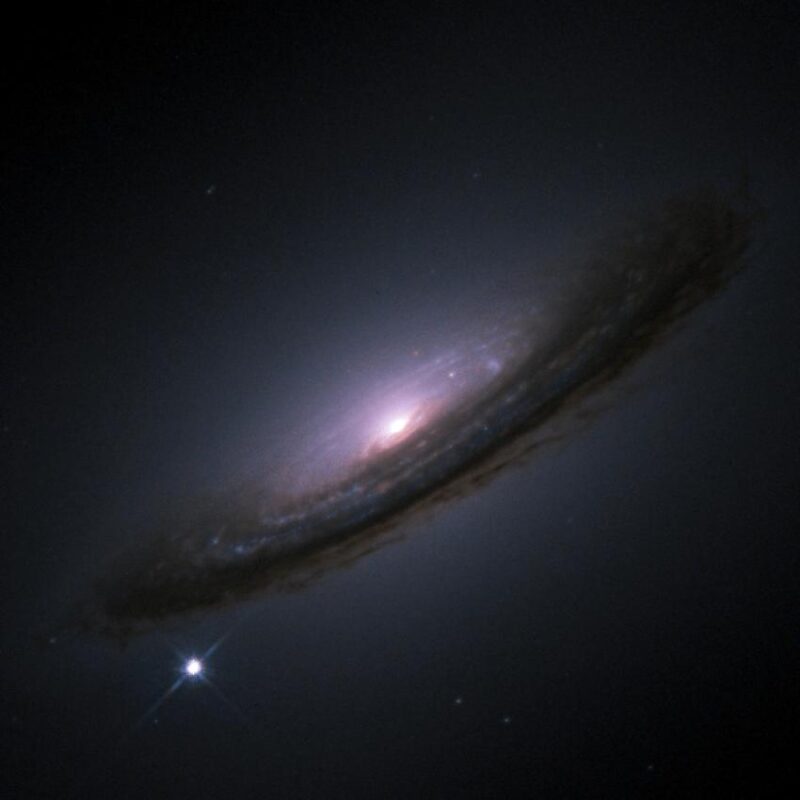
Universe's expansion: A spiral galaxy with a bright point of light in the lower left.
Researchers used type Ia supernovas, similar to SN1994d pictured above in its host galaxy NGC4526, to help establish that the universe’s expansion may actually have started to slow. For decades, scientists have believed the universe’s expansion was accelerating. The new research upends that paradigm. Image via NASA/ ESA/ RAS.

STORY IS EMBARGOED UNTIL 00:01 GMT on Thursday 6 November/ 6:01 p.m. CST Wed Nov 5

  • The universe’s expansion has already begun to slow, says a new study from Yonsei University. This challenges the long-held belief that the universe is rapidly accelerating due to dark energy.
  • Researchers found that type Ia supernovas – the “standard candles” used to measure cosmic expansion – are affected by the age of their progenitor stars. Thus, previous evidence for acceleration may be faulty.
  • After correcting for this bias, the data no longer fit the standard Lambda-CDM cosmological model. Now, it aligns with newer evidence that dark energy weakens and evolves over time. This would mark a huge paradigm shift in cosmology.

The Royal Astronomical Society published this original story at 00:01 GMT on November 6, 2025. Edits by EarthSky.

Universe’s expansion is slowing down, not speeding up

The universe’s expansion may actually have started to slow rather than accelerating at an ever-increasing rate as previously thought, a new study suggests.

The “remarkable” findings published November 6, 2025, in Monthly Notices of the Royal Astronomical Society cast doubt on the long-standing theory that a mysterious force known as dark energy is driving distant galaxies away increasingly faster.

Instead, they show no evidence of an accelerating universe.

If the results are confirmed, it could open an entirely new chapter in scientists’ quest to uncover the true nature of dark energy, resolve the Hubble tension, and understand the past and future of the universe.

The universe is in a phase of decelerated expansion

Lead researcher Young-Wook Lee of Yonsei University in South Korea said:

Our study shows that the universe has already entered a phase of decelerated expansion at the present epoch and that dark energy evolves with time much more rapidly than previously thought.

If these results are confirmed, it would mark a major paradigm shift in cosmology since the discovery of dark energy 27 years ago.

For the past three decades, astronomers have widely believed that the universe is expanding at an ever-increasing rate, driven by an unseen phenomenon called dark energy that acts as a kind of anti-gravity.

This conclusion, based on distance measurements to faraway galaxies using type Ia supernovas, earned the 2011 Nobel Prize in Physics.

A new look at type 1a supernovas as standard candles

However, a team of astronomers at Yonsei University have now put forward new evidence that type Ia supernovas, long regarded as the universe’s standard candles, are in fact strongly affected by the age of their progenitor stars.

Even after luminosity standardization, supernovas from younger stellar populations appear systematically fainter, while those from older populations appear brighter.

Based on a much larger host-galaxy sample of 300 galaxies, the new study confirmed this effect at extremely high significance (99.999% confidence). This suggests that the dimming of distant supernovas arises not only from cosmological effects but also from stellar astrophysics effects.

When this systematic bias was corrected, the supernova data no longer matched the standard Lambda-CDM cosmological model with a cosmological constant, researchers said.

Instead, it aligned far better with a new model favored by the Dark Energy Spectroscopic Instrument (DESI) project, derived from baryonic acoustic oscillations (BAO) – effectively the sound of the Big Bang – and cosmic microwave background (CMB) data.

The corrected supernova data and the BAO+CMB-only results both indicate that dark energy weakens and evolves significantly with time.

More importantly, when the corrected supernova data were combined with BAO and CMB results, the standard Lambda-CDM model was ruled out with overwhelming significance, the researchers said.

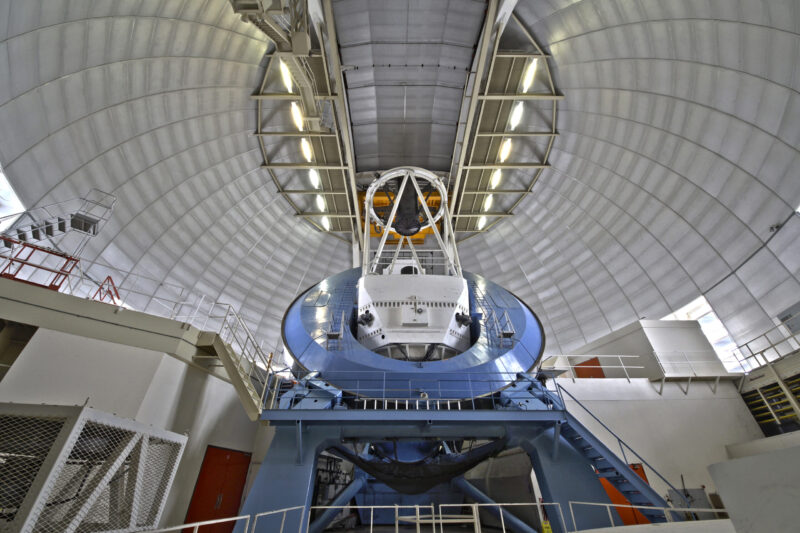
A telescope inside a dome.
DESI is a state-of-the-art instrument which maps distant objects to study dark energy. Image via Marilyn Sargent/ Berkeley Lab/ RAS/ CC BY 4.0.

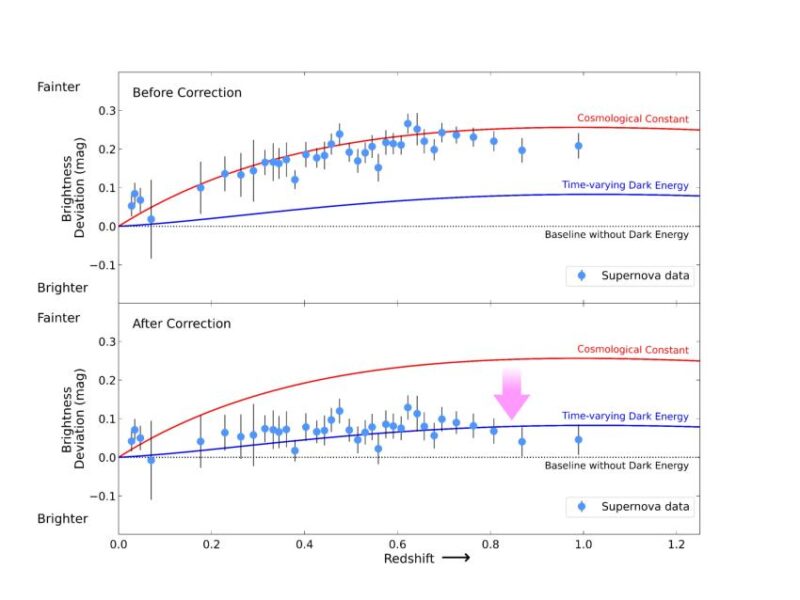
A look at the data

Two graphs, one showing hashmarks on a curving line and one showing them below on a different line.
The Hubble residual diagram before (top) and after (bottom) the age-bias correction. Corrections are applied to supernova data from the Dark Energy Survey project. After correction, the dataset no longer supports the Lambda-CDM model (red line) with a cosmological constant. But instead it more closely fits with a time-varying dark energy model favored by a combined analysis using only baryonic acoustic oscillations and cosmic microwave background data (blue line). Image via Son et al./ RAS/ CC BY 4.0.
Line graph with 4 different colored lines going in different directions from high to low.
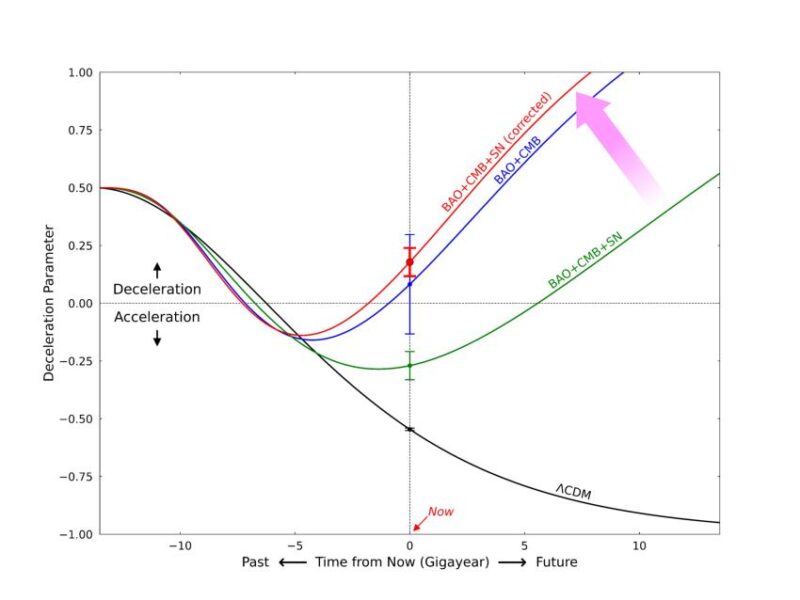
This diagram shows how the universe appears to be in a state of decelerated expansion (red line). The dotted vertical line marks the present epoch, while the black line shows the Lambda-CDM prediction. The green and red lines represent the new study’s model before (green) and after (red) age-bias correction, consistent with baryonic acoustic oscillations and cosmic microwave background data (blue line). Image via RAS/ Son et al./ CC BY 4.0.

The universe’s expansion is not rapidly accelerating

Most surprising of all, this combined analysis indicates the universe is not accelerating today as previously thought. Instead, it has already transitioned into a state of decelerated expansion.

Professor Lee said:

In the DESI project, the key results were obtained by combining uncorrected supernova data with baryonic acoustic oscillations measurements, leading to the conclusion that while the universe will decelerate in the future, it is still accelerating at present.

By contrast, our analysis — which applies the age-bias correction — shows that the universe has already entered a decelerating phase today. Remarkably, this agrees with what is independently predicted from BAO-only or BAO+CMB analyses, though this fact has received little attention so far.

To further confirm their results, the Yonsei team are now carrying out an “evolution-free test.” It uses only supernovas from young, coeval host galaxies across the full redshift range. The first results already support their main conclusion.

Co-author Chul Chung said:

Within the next five years, with the Vera C. Rubin Observatory discovering more than 20,000 new supernova host galaxies, precise age measurements will allow for a far more robust and definitive test of supernova cosmology.

The Vera C. Rubin Observatory, which sits on a mountain in the Chilean Andes, is home to the world’s most powerful digital camera. It began scientific operations this year and could answer vital questions about our own solar system and the wider universe.

A white telescope dome and buildings sit atop a parched landscape.
The Vera C. Rubin Observatory began scientific operations this year and could answer vital questions about our own solar system and the wider universe. Image via RubinObs/ NOIRLab/ SLAC/ NSF/ DOE/ AURA/ RAS.

Dark energy is still mysterious

After the Big Bang and the rapid expansion of the universe some 13.8 billion years ago, gravity slowed it down. But in 1998, it was established that 9 billion years after the universe began, its expansion had started to speed up again, driven by a mysterious force.

Astronomers dubbed this dark energy, but despite it making up about 70% of the universe, it is still considered to be one of the greatest mysteries in science.

Last year, data from DESI in Tucson, Arizona, suggested that the force exerted by dark energy had changed over time. And more evidence for that has been growing ever since.

The hope is that with these new tools in their arsenal, astronomers will now be better equipped to find clues about what exactly dark energy is and how it influences the universe.

Bottom line: New research suggests that we don’t live in an rapidly accelerating, expanding universe after all. DESI data suggest the universe’s expansion is already slowing.

Source: Strong Progenitor Age-bias in Supernova Cosmology. II. Alignment with DESI BAO and Signs of a Non-Accelerating Universe

Via Royal Astronomical Society

Read more: A new data release hints dark energy may be weakening

The post Universe’s expansion is slowing down, not speeding up first appeared on EarthSky.


from EarthSky https://ift.tt/HD1RBP5
Universe's expansion: A spiral galaxy with a bright point of light in the lower left.
Researchers used type Ia supernovas, similar to SN1994d pictured above in its host galaxy NGC4526, to help establish that the universe’s expansion may actually have started to slow. For decades, scientists have believed the universe’s expansion was accelerating. The new research upends that paradigm. Image via NASA/ ESA/ RAS.

STORY IS EMBARGOED UNTIL 00:01 GMT on Thursday 6 November/ 6:01 p.m. CST Wed Nov 5

  • The universe’s expansion has already begun to slow, says a new study from Yonsei University. This challenges the long-held belief that the universe is rapidly accelerating due to dark energy.
  • Researchers found that type Ia supernovas – the “standard candles” used to measure cosmic expansion – are affected by the age of their progenitor stars. Thus, previous evidence for acceleration may be faulty.
  • After correcting for this bias, the data no longer fit the standard Lambda-CDM cosmological model. Now, it aligns with newer evidence that dark energy weakens and evolves over time. This would mark a huge paradigm shift in cosmology.

The Royal Astronomical Society published this original story at 00:01 GMT on November 6, 2025. Edits by EarthSky.

Universe’s expansion is slowing down, not speeding up

The universe’s expansion may actually have started to slow rather than accelerating at an ever-increasing rate as previously thought, a new study suggests.

The “remarkable” findings published November 6, 2025, in Monthly Notices of the Royal Astronomical Society cast doubt on the long-standing theory that a mysterious force known as dark energy is driving distant galaxies away increasingly faster.

Instead, they show no evidence of an accelerating universe.

If the results are confirmed, it could open an entirely new chapter in scientists’ quest to uncover the true nature of dark energy, resolve the Hubble tension, and understand the past and future of the universe.

The universe is in a phase of decelerated expansion

Lead researcher Young-Wook Lee of Yonsei University in South Korea said:

Our study shows that the universe has already entered a phase of decelerated expansion at the present epoch and that dark energy evolves with time much more rapidly than previously thought.

If these results are confirmed, it would mark a major paradigm shift in cosmology since the discovery of dark energy 27 years ago.

For the past three decades, astronomers have widely believed that the universe is expanding at an ever-increasing rate, driven by an unseen phenomenon called dark energy that acts as a kind of anti-gravity.

This conclusion, based on distance measurements to faraway galaxies using type Ia supernovas, earned the 2011 Nobel Prize in Physics.

A new look at type 1a supernovas as standard candles

However, a team of astronomers at Yonsei University have now put forward new evidence that type Ia supernovas, long regarded as the universe’s standard candles, are in fact strongly affected by the age of their progenitor stars.

Even after luminosity standardization, supernovas from younger stellar populations appear systematically fainter, while those from older populations appear brighter.

Based on a much larger host-galaxy sample of 300 galaxies, the new study confirmed this effect at extremely high significance (99.999% confidence). This suggests that the dimming of distant supernovas arises not only from cosmological effects but also from stellar astrophysics effects.

When this systematic bias was corrected, the supernova data no longer matched the standard Lambda-CDM cosmological model with a cosmological constant, researchers said.

Instead, it aligned far better with a new model favored by the Dark Energy Spectroscopic Instrument (DESI) project, derived from baryonic acoustic oscillations (BAO) – effectively the sound of the Big Bang – and cosmic microwave background (CMB) data.

The corrected supernova data and the BAO+CMB-only results both indicate that dark energy weakens and evolves significantly with time.

More importantly, when the corrected supernova data were combined with BAO and CMB results, the standard Lambda-CDM model was ruled out with overwhelming significance, the researchers said.

A telescope inside a dome.
DESI is a state-of-the-art instrument which maps distant objects to study dark energy. Image via Marilyn Sargent/ Berkeley Lab/ RAS/ CC BY 4.0.

A look at the data

Two graphs, one showing hashmarks on a curving line and one showing them below on a different line.
The Hubble residual diagram before (top) and after (bottom) the age-bias correction. Corrections are applied to supernova data from the Dark Energy Survey project. After correction, the dataset no longer supports the Lambda-CDM model (red line) with a cosmological constant. But instead it more closely fits with a time-varying dark energy model favored by a combined analysis using only baryonic acoustic oscillations and cosmic microwave background data (blue line). Image via Son et al./ RAS/ CC BY 4.0.
Line graph with 4 different colored lines going in different directions from high to low.
This diagram shows how the universe appears to be in a state of decelerated expansion (red line). The dotted vertical line marks the present epoch, while the black line shows the Lambda-CDM prediction. The green and red lines represent the new study’s model before (green) and after (red) age-bias correction, consistent with baryonic acoustic oscillations and cosmic microwave background data (blue line). Image via RAS/ Son et al./ CC BY 4.0.

The universe’s expansion is not rapidly accelerating

Most surprising of all, this combined analysis indicates the universe is not accelerating today as previously thought. Instead, it has already transitioned into a state of decelerated expansion.

Professor Lee said:

In the DESI project, the key results were obtained by combining uncorrected supernova data with baryonic acoustic oscillations measurements, leading to the conclusion that while the universe will decelerate in the future, it is still accelerating at present.

By contrast, our analysis — which applies the age-bias correction — shows that the universe has already entered a decelerating phase today. Remarkably, this agrees with what is independently predicted from BAO-only or BAO+CMB analyses, though this fact has received little attention so far.

To further confirm their results, the Yonsei team are now carrying out an “evolution-free test.” It uses only supernovas from young, coeval host galaxies across the full redshift range. The first results already support their main conclusion.

Co-author Chul Chung said:

Within the next five years, with the Vera C. Rubin Observatory discovering more than 20,000 new supernova host galaxies, precise age measurements will allow for a far more robust and definitive test of supernova cosmology.

The Vera C. Rubin Observatory, which sits on a mountain in the Chilean Andes, is home to the world’s most powerful digital camera. It began scientific operations this year and could answer vital questions about our own solar system and the wider universe.

A white telescope dome and buildings sit atop a parched landscape.
The Vera C. Rubin Observatory began scientific operations this year and could answer vital questions about our own solar system and the wider universe. Image via RubinObs/ NOIRLab/ SLAC/ NSF/ DOE/ AURA/ RAS.

Dark energy is still mysterious

After the Big Bang and the rapid expansion of the universe some 13.8 billion years ago, gravity slowed it down. But in 1998, it was established that 9 billion years after the universe began, its expansion had started to speed up again, driven by a mysterious force.

Astronomers dubbed this dark energy, but despite it making up about 70% of the universe, it is still considered to be one of the greatest mysteries in science.

Last year, data from DESI in Tucson, Arizona, suggested that the force exerted by dark energy had changed over time. And more evidence for that has been growing ever since.

The hope is that with these new tools in their arsenal, astronomers will now be better equipped to find clues about what exactly dark energy is and how it influences the universe.

Bottom line: New research suggests that we don’t live in an rapidly accelerating, expanding universe after all. DESI data suggest the universe’s expansion is already slowing.

Source: Strong Progenitor Age-bias in Supernova Cosmology. II. Alignment with DESI BAO and Signs of a Non-Accelerating Universe

Via Royal Astronomical Society

Read more: A new data release hints dark energy may be weakening

The post Universe’s expansion is slowing down, not speeding up first appeared on EarthSky.


from EarthSky https://ift.tt/HD1RBP5

The moon illusion makes the moon look huge!


Here are some tips for viewing the moon, including how to check the moon illusion, from EarthSky’s John Goss.

Science matters. Wonder matters. You matter.
Join our 2025 Donation Campaign today.

The moon illusion is a trick of the mind

We’ve all seen a full moon looming large shortly after it rises, when it’s still hugging the horizon. And it’s true that the moon is sometimes closer to Earth than at other times, making it minutely larger in our sky. Yet the difference is barely discernible. When the moon viewed near the horizon looks larger than usual, your brain is playing a trick on you. It’s called the moon illusion.

You can check it out tonight, on the Super Hunter’s Moon. It’ll be the closest moon – or supermoon – of 2025. And this larger than normal moon will look huge – and bright – near the horizon.

Read more: What’s a supermoon? Here are the supermoons in 2025

It’s all an illusion

We still don’t know the precise cause of the moon illusion. But the video above, from AsapSCIENCE, offers some explanations.

A common theory is when the moon is near the horizon, you’re seeing it in the company of many familiar visual reference points: trees, buildings, mountains and so on. Your brain automatically compares the moon to these reference points. But when the moon is higher up, there’s nothing to compare it to. As AsapSCIENCE says:

The moon seems smaller against the vastness of the night sky.

Prove it to yourself

Maybe you’d like to test this theory yourself. According to NASA, here are some ways to prove it to yourself:

Hold up your outstretched index finger next to the moon. You’ll find that your fingernail and the moon are about the same size. Or try looking at the moon through a paper tube, or bend over and look backward between your legs. When you view it like this, the moon will be nowhere near as big as it had seemed.

Or NASA suggests:

Another ironclad way to size-check the moon is to take a photo when it’s near the horizon, and another when it’s high in the sky. If you keep your camera zoom settings the same, you’ll find that the moon is the same width, side to side, in both photos.

What about a red or orange moon?

By the way, there’s a second phenomenon that the moon displays when we see it near the horizon. That is, a low moon often appears red or orange in color. That reddish color is not an illusion. It’s a true physical effect, caused by the fact that – when the moon is low in the sky – you’re seeing it through a greater thickness of Earth’s atmosphere than when it’s overhead. The atmosphere filters out the bluer wavelengths of moonlight (which is really reflected sunlight). Meanwhile, it allows the red component of moonlight to travel straight through to your eyes. So a low moon is likely to look red or orange to you.

So how do people get those photos of extra big moons seen near a horizon? Photographers use zoom lenses and have familiar objects in the foreground making the more distant moon look huge. So they’re the result of photographic tricks and techniques, which you can read about here or here.

Huge, orange full moon occupies almost all the frame. There are spindly evergreen tree tops in the foreground.
View at EarthSky Community Photos. | Cecille Kennedy from Oregon shared this image on October 17, 2024, and wrote: “The Hunter’s Supermoon is the largest of 4 supermoons in 2024. The full moon’s effulgence shone through the thin fog cover. Its lower rim, the lower edge is deep crimson.” Thank you!

Some photos from our EarthSky Community

Large, golden full moon at horizon with silhouette of tall, vertical trees, probably firs, in front.
View at EarthSky Community Photos. | A great example of the moon illusion from Stephanie Becker in Soda Springs, California. She captured this image of the July full supermoon on July 2, 2023. Thank you, Stephanie!
Huge golden moon partly above horizon with line of clouds and evergreen trees silhouetted.
View at EarthSky Community Photos. | Cecille Kennedy in Depoe Bay, Oregon, captured this image on August 30, 2023. Cecille wrote: “The blue supermoon shines behind the clouds as it rises over the hills and the trees. A few minutes before the moon rose, the clouds were lavender rose pink. Then the lovely moon appeared.” Thank you, Cecille!

If you get a great photo of the Super Hunter’s Moon, you can submit it here. We would love to see it!

Bottom line: It’s the Super Hunter’s Moon tonight. You might see a large-looking moon low in the sky. It’s the moon illusion that makes the moon look so big.

Read more: Does a supermoon have a super effect on us?

Read more: Expect high tides following a full supermoon

The post The moon illusion makes the moon look huge! first appeared on EarthSky.


from EarthSky https://ift.tt/ThRuzDI


Here are some tips for viewing the moon, including how to check the moon illusion, from EarthSky’s John Goss.

Science matters. Wonder matters. You matter.
Join our 2025 Donation Campaign today.

The moon illusion is a trick of the mind

We’ve all seen a full moon looming large shortly after it rises, when it’s still hugging the horizon. And it’s true that the moon is sometimes closer to Earth than at other times, making it minutely larger in our sky. Yet the difference is barely discernible. When the moon viewed near the horizon looks larger than usual, your brain is playing a trick on you. It’s called the moon illusion.

You can check it out tonight, on the Super Hunter’s Moon. It’ll be the closest moon – or supermoon – of 2025. And this larger than normal moon will look huge – and bright – near the horizon.

Read more: What’s a supermoon? Here are the supermoons in 2025

It’s all an illusion

We still don’t know the precise cause of the moon illusion. But the video above, from AsapSCIENCE, offers some explanations.

A common theory is when the moon is near the horizon, you’re seeing it in the company of many familiar visual reference points: trees, buildings, mountains and so on. Your brain automatically compares the moon to these reference points. But when the moon is higher up, there’s nothing to compare it to. As AsapSCIENCE says:

The moon seems smaller against the vastness of the night sky.

Prove it to yourself

Maybe you’d like to test this theory yourself. According to NASA, here are some ways to prove it to yourself:

Hold up your outstretched index finger next to the moon. You’ll find that your fingernail and the moon are about the same size. Or try looking at the moon through a paper tube, or bend over and look backward between your legs. When you view it like this, the moon will be nowhere near as big as it had seemed.

Or NASA suggests:

Another ironclad way to size-check the moon is to take a photo when it’s near the horizon, and another when it’s high in the sky. If you keep your camera zoom settings the same, you’ll find that the moon is the same width, side to side, in both photos.

What about a red or orange moon?

By the way, there’s a second phenomenon that the moon displays when we see it near the horizon. That is, a low moon often appears red or orange in color. That reddish color is not an illusion. It’s a true physical effect, caused by the fact that – when the moon is low in the sky – you’re seeing it through a greater thickness of Earth’s atmosphere than when it’s overhead. The atmosphere filters out the bluer wavelengths of moonlight (which is really reflected sunlight). Meanwhile, it allows the red component of moonlight to travel straight through to your eyes. So a low moon is likely to look red or orange to you.

So how do people get those photos of extra big moons seen near a horizon? Photographers use zoom lenses and have familiar objects in the foreground making the more distant moon look huge. So they’re the result of photographic tricks and techniques, which you can read about here or here.

Huge, orange full moon occupies almost all the frame. There are spindly evergreen tree tops in the foreground.
View at EarthSky Community Photos. | Cecille Kennedy from Oregon shared this image on October 17, 2024, and wrote: “The Hunter’s Supermoon is the largest of 4 supermoons in 2024. The full moon’s effulgence shone through the thin fog cover. Its lower rim, the lower edge is deep crimson.” Thank you!

Some photos from our EarthSky Community

Large, golden full moon at horizon with silhouette of tall, vertical trees, probably firs, in front.
View at EarthSky Community Photos. | A great example of the moon illusion from Stephanie Becker in Soda Springs, California. She captured this image of the July full supermoon on July 2, 2023. Thank you, Stephanie!
Huge golden moon partly above horizon with line of clouds and evergreen trees silhouetted.
View at EarthSky Community Photos. | Cecille Kennedy in Depoe Bay, Oregon, captured this image on August 30, 2023. Cecille wrote: “The blue supermoon shines behind the clouds as it rises over the hills and the trees. A few minutes before the moon rose, the clouds were lavender rose pink. Then the lovely moon appeared.” Thank you, Cecille!

If you get a great photo of the Super Hunter’s Moon, you can submit it here. We would love to see it!

Bottom line: It’s the Super Hunter’s Moon tonight. You might see a large-looking moon low in the sky. It’s the moon illusion that makes the moon look so big.

Read more: Does a supermoon have a super effect on us?

Read more: Expect high tides following a full supermoon

The post The moon illusion makes the moon look huge! first appeared on EarthSky.


from EarthSky https://ift.tt/ThRuzDI

adds 2