aads

Delta Aquariids 2020: All you need to know

Representation of Earth's orbit around the sun, crossing a wide arc of tiny dots that represent cometary debris.

Meteors in annual showers happen when Earth encounters debris left behind by a comet. Astronomers have learned to calculate the various streams of debris in space, left behind by comets as various passages near the sun. Image by AstroBob.

Late July 2020 – around July 28 – presents the nominal peak of the Delta Aquariid meteor shower. But don’t let that date thwart you, if you have a chance to be in a dark place for meteor-watching, anytime before, while the moon is still a waxing crescent and setting in the evening hours. The shower offers more meteors after midnight and is best viewed during the predawn hours.

Find out the moons’ setting time in your sky via Sunrise Sunset Calendars, remembering to check the Moonrise and moonset box.

The long and rambling Delta Aquariid shower is officially active from about July 12 to August 23 each year. The coming new moon on July 31/August 1 (depending on your time zone) means lovely waning crescents in the optimum predawn hours in late July. It means dark skies throughout most of the night all through the first week of August.

The Delta Aquariid shower favors the Southern Hemisphere, though is still visible from mid-northern latitudes. In years when the moon is out of the way, the broad maximum of this shower can be expected to produce 10 to 20 meteors per hour. But, even in early August, you’ll likely see some Perseids, too. This shower overlaps with the more famous Perseid meteor shower, which in early August is rising to its peak (this year on the mornings of August 11, 12 and 13, though under the light of a wide waning crescent moon). Those who observe the Perseids are likely to see some Delta Aquariid meteors flying on the same nights.

For the Delta Aquariids, as for most meteor showers, the best viewing hours are after midnight and before dawn for all time zones around the world.

Everything you need to know: Perseid meteor shower
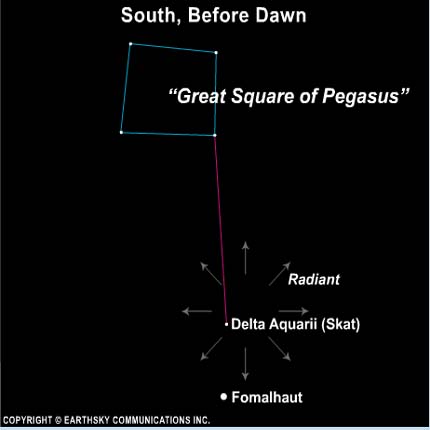
Chart with Great Square, line to bright star, arrows pointing out from spot near closeby dim star.

The radiant point for Delta Aquariid shower is near star Skat, or Delta Aquarii. This star is near in the sky to a much brighter star, Fomalhaut, which can be found roughly on a line drawn southward through the stars on the west side of the Great Square. This chart shows the Northern Hemisphere view. From the Southern Hemisphere, the radiant is closer to overhead. And don’t worry too much about radiant points. The meteors will appear in all parts of the sky.

How can I tell Perseid meteors from Delta Aquariid meteors? This is where the concept of a radiant point comes in handy. If you trace all the Delta Aquariid meteors backward, they appear to radiate from a certain point in front of the constellation Aquarius the Water Bearer, which, as viewed from the Northern Hemisphere, arcs across the southern sky. The radiant point of the shower nearly aligns with the star Skat (Delta Aquarii). The meteor shower is named in the honor of this star.

Meanwhile, the Perseids radiate from the constellation Perseus, in the northeast to high in the north between midnight and dawn. So – assuming you’re in the Northern Hemisphere – if you’re watching the Perseids, and you see meteors coming from the northeast or north … they are Perseids. If you see them coming from the south … they are Delta Aquariids. In a particularly rich year for meteors, if you have a dark sky, you might even see them cross paths! It can be an awesome display.

The Delta Aquariid meteors may tend to be a bit fainter than the Perseids and meteors seen in other major showers. That makes a dark sky free of moonlight even more imperative for watching the annual Delta Aquariid shower. About five to ten percent of the Delta Aquariid meteors leave persistent trains – glowing ionized gas trails that last a second or two after the meteor has passed. The meteors burn up in the upper atmosphere about 60 miles (100 km) above Earth’s surface.

Rememeber, you never have to locate a shower’s radiant point to enjoy the meteors. However, it does help to have a dark night without moonlight. This year – in 2020 – the Delta Aquariids at its peak in late July will be somewhat marred by a waxing gibbous moon, and August Perseids will be somewhat marred by the last quarter and wide waning crescent moon.
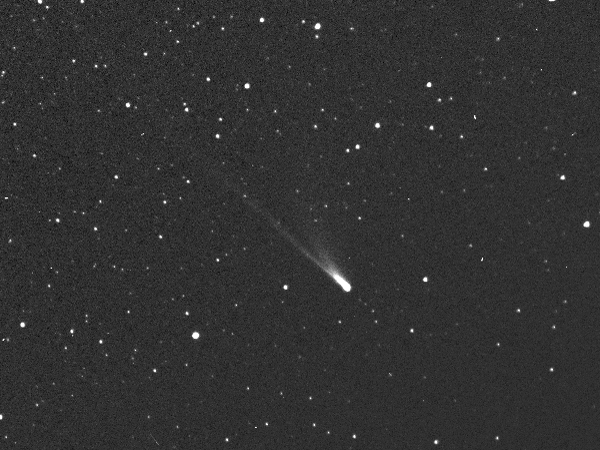
Starry background, largish bright dot with two fuzzy tails.

Comet 96P Machholz, the possible parent of the Delta Aquariid meteor shower, was discovered on May 12, 1986, by Donald Machholz. Image via Wikimedia Commons.

Delta Aquariid meteors may come from Comet 96P Machholz. Meteor showers happen when our planet Earth crosses the orbital path of a comet. When a comet nears the sun and warms up, it sheds bits and pieces that spread out into that comet’s orbital stream. This comet debris slams into the Earth’s upper atmosphere at about 90,000 miles (150,000 km) per hour, vaporizing – burning up – as meteors or shooting stars.

The parent body of the Delta Aquariid meteor is not known with certainty. It was once thought to have originated from the breakup of what are now the Marsden and Kracht sungrazing comets. More recently, Comet 96P Machholz has loomed as the primary candidate for being the Delta Aquariids’ parent body.

Donald Machholz discovered this comet in 1986. It’s a short-period comet whose orbit carries it around the sun once in a little over five years. At aphelion – its greatest distance from the sun – this comet goes out beyond the orbit of Jupiter. At perihelion – its closest point to the sun – Comet 96P Machholz swings well inside Mercury’s orbit. Comet 96P Machholz last came to perihelion on October 27, 2017, and will next come to perihelion on January 31, 2023.

Starry sky with Milky Way visible and fuzzy bright green dot with short glowing trail near horizon.

David S. Brown caught this meteor in late July in 2014, in southwest Wyoming.
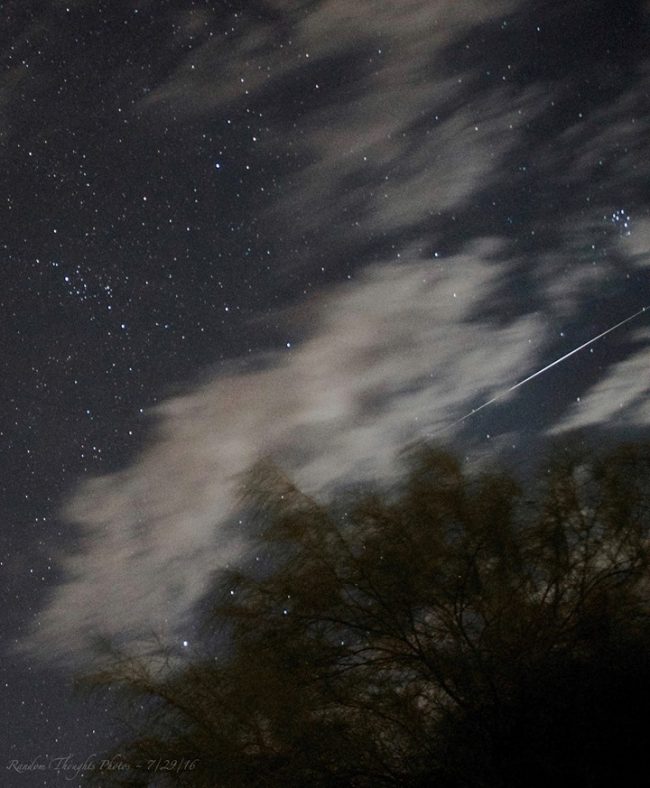
Long bright diagonal line streaking among clouds.

Kelly Dreller caught this meteor in late July of 2016, in Lake Havasu City, Arizona.

Bottom line: The Delta Aquariid meteor shower lacks a very definite peak. It rambles along pretty steadily in late July and August, intermingling with the Perseids. The expected nominal peak happens in late July, and in 2020, comes a day or so after the first quarter moon on July 27, 2020. From any time zone, the best viewing window lasts for several hours, centered on roughly 2 a.m. (3 a.m. daylight saving time). Find an open sky away from artificial lights, lie down on a reclining lawn chair and look upward.

Everything you need to know: Perseid meteor shower


from EarthSky https://ift.tt/30Tf32p
Representation of Earth's orbit around the sun, crossing a wide arc of tiny dots that represent cometary debris.

Meteors in annual showers happen when Earth encounters debris left behind by a comet. Astronomers have learned to calculate the various streams of debris in space, left behind by comets as various passages near the sun. Image by AstroBob.

Late July 2020 – around July 28 – presents the nominal peak of the Delta Aquariid meteor shower. But don’t let that date thwart you, if you have a chance to be in a dark place for meteor-watching, anytime before, while the moon is still a waxing crescent and setting in the evening hours. The shower offers more meteors after midnight and is best viewed during the predawn hours.

Find out the moons’ setting time in your sky via Sunrise Sunset Calendars, remembering to check the Moonrise and moonset box.

The long and rambling Delta Aquariid shower is officially active from about July 12 to August 23 each year. The coming new moon on July 31/August 1 (depending on your time zone) means lovely waning crescents in the optimum predawn hours in late July. It means dark skies throughout most of the night all through the first week of August.

The Delta Aquariid shower favors the Southern Hemisphere, though is still visible from mid-northern latitudes. In years when the moon is out of the way, the broad maximum of this shower can be expected to produce 10 to 20 meteors per hour. But, even in early August, you’ll likely see some Perseids, too. This shower overlaps with the more famous Perseid meteor shower, which in early August is rising to its peak (this year on the mornings of August 11, 12 and 13, though under the light of a wide waning crescent moon). Those who observe the Perseids are likely to see some Delta Aquariid meteors flying on the same nights.

For the Delta Aquariids, as for most meteor showers, the best viewing hours are after midnight and before dawn for all time zones around the world.

Everything you need to know: Perseid meteor shower

Chart with Great Square, line to bright star, arrows pointing out from spot near closeby dim star.

The radiant point for Delta Aquariid shower is near star Skat, or Delta Aquarii. This star is near in the sky to a much brighter star, Fomalhaut, which can be found roughly on a line drawn southward through the stars on the west side of the Great Square. This chart shows the Northern Hemisphere view. From the Southern Hemisphere, the radiant is closer to overhead. And don’t worry too much about radiant points. The meteors will appear in all parts of the sky.

How can I tell Perseid meteors from Delta Aquariid meteors? This is where the concept of a radiant point comes in handy. If you trace all the Delta Aquariid meteors backward, they appear to radiate from a certain point in front of the constellation Aquarius the Water Bearer, which, as viewed from the Northern Hemisphere, arcs across the southern sky. The radiant point of the shower nearly aligns with the star Skat (Delta Aquarii). The meteor shower is named in the honor of this star.

Meanwhile, the Perseids radiate from the constellation Perseus, in the northeast to high in the north between midnight and dawn. So – assuming you’re in the Northern Hemisphere – if you’re watching the Perseids, and you see meteors coming from the northeast or north … they are Perseids. If you see them coming from the south … they are Delta Aquariids. In a particularly rich year for meteors, if you have a dark sky, you might even see them cross paths! It can be an awesome display.

The Delta Aquariid meteors may tend to be a bit fainter than the Perseids and meteors seen in other major showers. That makes a dark sky free of moonlight even more imperative for watching the annual Delta Aquariid shower. About five to ten percent of the Delta Aquariid meteors leave persistent trains – glowing ionized gas trails that last a second or two after the meteor has passed. The meteors burn up in the upper atmosphere about 60 miles (100 km) above Earth’s surface.

Rememeber, you never have to locate a shower’s radiant point to enjoy the meteors. However, it does help to have a dark night without moonlight. This year – in 2020 – the Delta Aquariids at its peak in late July will be somewhat marred by a waxing gibbous moon, and August Perseids will be somewhat marred by the last quarter and wide waning crescent moon.

Starry background, largish bright dot with two fuzzy tails.

Comet 96P Machholz, the possible parent of the Delta Aquariid meteor shower, was discovered on May 12, 1986, by Donald Machholz. Image via Wikimedia Commons.

Delta Aquariid meteors may come from Comet 96P Machholz. Meteor showers happen when our planet Earth crosses the orbital path of a comet. When a comet nears the sun and warms up, it sheds bits and pieces that spread out into that comet’s orbital stream. This comet debris slams into the Earth’s upper atmosphere at about 90,000 miles (150,000 km) per hour, vaporizing – burning up – as meteors or shooting stars.

The parent body of the Delta Aquariid meteor is not known with certainty. It was once thought to have originated from the breakup of what are now the Marsden and Kracht sungrazing comets. More recently, Comet 96P Machholz has loomed as the primary candidate for being the Delta Aquariids’ parent body.

Donald Machholz discovered this comet in 1986. It’s a short-period comet whose orbit carries it around the sun once in a little over five years. At aphelion – its greatest distance from the sun – this comet goes out beyond the orbit of Jupiter. At perihelion – its closest point to the sun – Comet 96P Machholz swings well inside Mercury’s orbit. Comet 96P Machholz last came to perihelion on October 27, 2017, and will next come to perihelion on January 31, 2023.

Starry sky with Milky Way visible and fuzzy bright green dot with short glowing trail near horizon.

David S. Brown caught this meteor in late July in 2014, in southwest Wyoming.

Long bright diagonal line streaking among clouds.

Kelly Dreller caught this meteor in late July of 2016, in Lake Havasu City, Arizona.

Bottom line: The Delta Aquariid meteor shower lacks a very definite peak. It rambles along pretty steadily in late July and August, intermingling with the Perseids. The expected nominal peak happens in late July, and in 2020, comes a day or so after the first quarter moon on July 27, 2020. From any time zone, the best viewing window lasts for several hours, centered on roughly 2 a.m. (3 a.m. daylight saving time). Find an open sky away from artificial lights, lie down on a reclining lawn chair and look upward.

Everything you need to know: Perseid meteor shower


from EarthSky https://ift.tt/30Tf32p
M6 and M7 in the Scorpion’s Tail

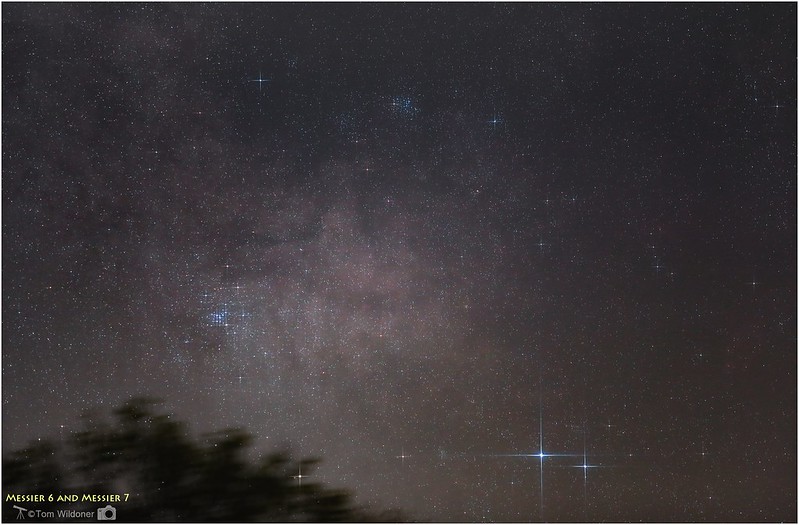
A photo showing the stars Shaula and Lesath with the star clusters M6 and M7 nearby.

If you have a dark sky, you can see 2 famous star clusters – Messier 6 and Messier 7 – in the constellation Scorpius the Scorpion. In this photo, Messier 7 – aka Ptolemy’s Cluster – is above the tree on the left. Messier 6, the Butterfly Cluster, is a bit smaller, positioned near the center top of the image. Shaula and Lesath, the stinger stars in Scorpius are prominent in the lower right. Image via Flickr user Tom Wildoner.

There are two spectacular star clusters near the “stinger stars” — Shaula and Lesath — in the constellation Scorpius. Messier 6 and Messier 7, abbreviated by astronomers as M6 and M7, are what’s known as open star clusters. They’re a crowd of stars that were formed from the same interstellar cloud. You can see them on summer evenings in the Northern Hemisphere, or winter evenings if you live in the Southern Hemisphere. They’re best viewed in a dark sky, and are a stunning sight through binoculars.

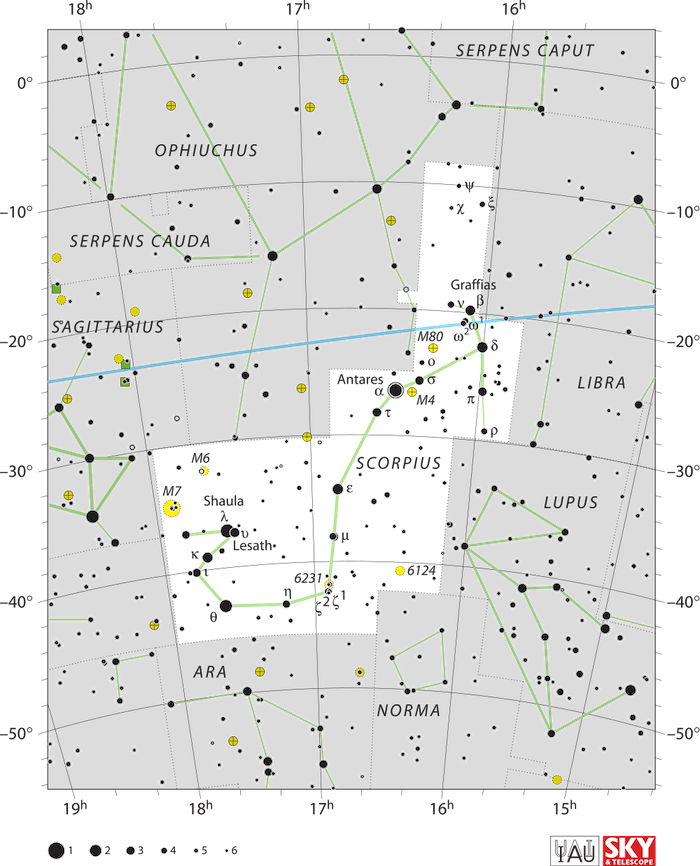
A star chart with the J-shaped outline of Scorpius drawn on the stars.

A map of the constellation Scorpius. The stinger stars, Shaula and Lesath, are at the end of the J-shaped constellation. If you draw an imaginary line from Lesath through Shaula, it will lead you to the star cluster M7. Image via IAU / Sky & Telescope / Wikimedia Commons.

How to find M6 and M7. These two star clusters are easy to spot in a dark sky near the curved tail of the constellation Scorpius. Scorpius is shaped like the letter J. There are two stars, Shaula and Lesath, at the end of the curved part of the J – the Scorpion’s Tail. They’re known as the Cat’s Eyes, or the stinger of Scorpius. If you draw an imaginary line from Lesath through Shaula, you’ll find M7, which is the brighter and larger of the two star clusters. From M7, M6 is only a short hop away.

Although M6 and M7 can be seen with the unaided eye on a dark, moonless night, the brilliance and beauty of these deep sky objects are magnificent through binoculars. You can’t miss them, assuming you have a dark sky.

An image of the night sky featuring M6 and M7 near Shaula and Lesath. In the foreground, firefly light trails appear in the silhouette of trees and over water.

The 2 stars noticeably close together in this photo are Shaula and Lesath, representing the Stinger of the constellation Scorpius the Scorpion. The 2 fuzzy objects near these stars – to their left in this photo – are Messier 7 and Messier 6. And the streaks in the foreground? Fireflies dancing on a summer night in Yellowwood Lake, Indiana. Image via Zolt Levay / Flickr.

If you’re in the northern U.S., Canada, or a similar latitude, you’ll need an unobstructed horizon towards the south to find M6 and M7. They are highest in the sky when due south, and even then, never climb very high in the sky. Meanwhile, from latitudes like those in the southern U.S., the clusters are easy to spot when highest in the south, above the Scorpion’s Tail. From the equator and most of the Southern Hemisphere, Scorpius is much easier to view,

In mid-June, these clusters bedeck the sky around midnight (1 a.m. daylight saving time in the US). Keep in mind that all the stars (and star clusters) return to the same place in the sky some 4 minutes earlier with each passing day, or 2 hours earlier with each passing month. Therefore, M6 and M7 appear highest in the sky at about 10 p.m. (11 p.m. daylight saving time) in mid-July, and 8 p.m. (9 p.m. daylight saving time) in mid-August.

M6 and M7 science. Even though M6 (Butterfly Cluster) and M7 (Ptolemy’s Cluster) appear close together on the sky’s dome, they are actually far apart in space. M6 is thought to be about 1,600 light years away, while M7 is about 980 light years. Thus the clusters are not related to each other, but only appear near each other along our line of sight.

But, within each cluster, the stars are related. Each cluster was born from a single interstellar cloud of gas and dust. The hundreds of stars in each cluster are indeed sibling stars, in that they are gravitationally bound to one another and travel in the same direction through space. Such a collection of stars are known as open star clusters.

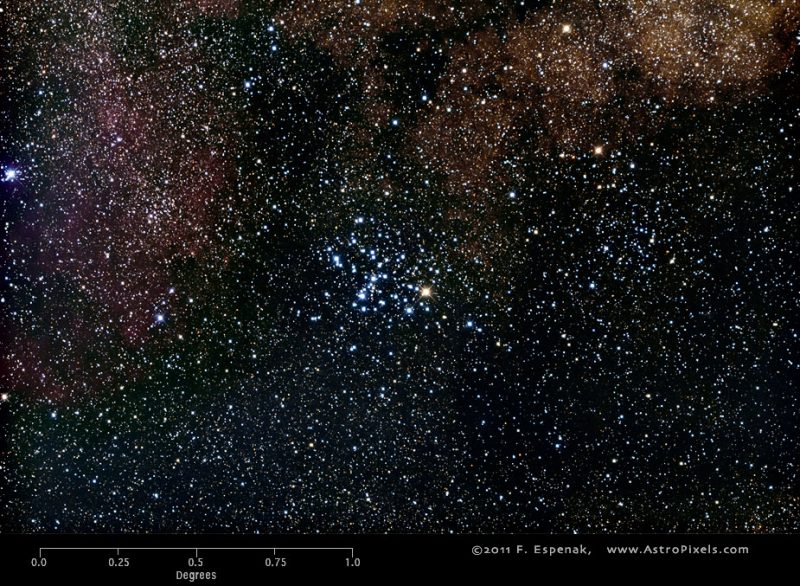
A photo showing a tight grouping of mostly blue-white stars against a backdrop of fainter stars.

Messier 6 through a wide field telescope and camera. Image via Fred Espenak.

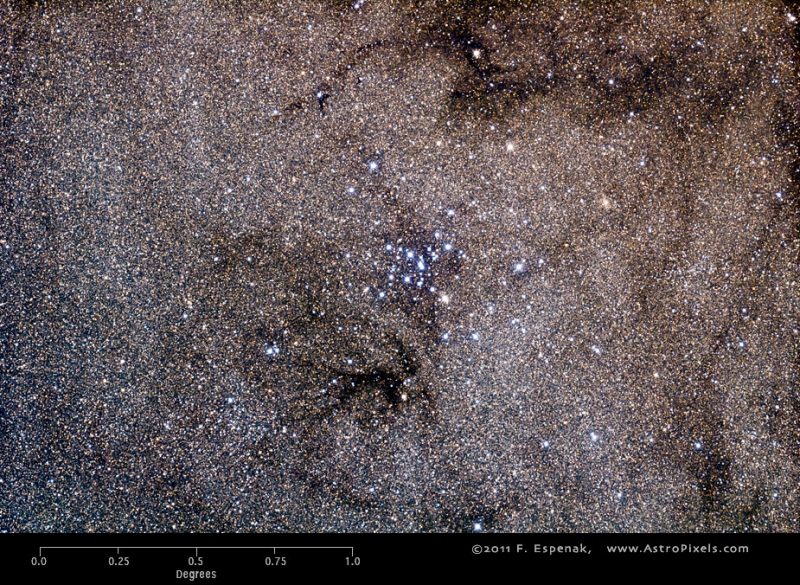
A photo showing a tight grouping of mostly blue-white stars against a backdrop of many fainter stars and some dark dust lanes.

Messier 7 through a wide field telescope and camera. Image via Fred Espenak.

M6 and M7 reside near the galactic equator, the region on the sky’s dome where star clusters, star clouds, and nebulae most abound. Once you find M6 and M7, try locating other deep-sky binocular doubles, such as M8 and M20, and M16 and M17. Unlike M6 and M7, which reside within the Orion spiral arm of the Milky Way galaxy, these deep-sky wonders loom farther away, in the next spiral arm inward, the Sagittarius arm. (M6 and M7 are established open star clusters. But M8 and M20, and M16 and M17, are still incubating clouds of star formation.)

Bottom line: Messier 6 and Messier 7 are striking star clusters near the tail of Scorpius. They’re ideally viewed in dark sky conditions using binoculars.


from EarthSky https://ift.tt/30HjCyn
A photo showing the stars Shaula and Lesath with the star clusters M6 and M7 nearby.

If you have a dark sky, you can see 2 famous star clusters – Messier 6 and Messier 7 – in the constellation Scorpius the Scorpion. In this photo, Messier 7 – aka Ptolemy’s Cluster – is above the tree on the left. Messier 6, the Butterfly Cluster, is a bit smaller, positioned near the center top of the image. Shaula and Lesath, the stinger stars in Scorpius are prominent in the lower right. Image via Flickr user Tom Wildoner.

There are two spectacular star clusters near the “stinger stars” — Shaula and Lesath — in the constellation Scorpius. Messier 6 and Messier 7, abbreviated by astronomers as M6 and M7, are what’s known as open star clusters. They’re a crowd of stars that were formed from the same interstellar cloud. You can see them on summer evenings in the Northern Hemisphere, or winter evenings if you live in the Southern Hemisphere. They’re best viewed in a dark sky, and are a stunning sight through binoculars.

A star chart with the J-shaped outline of Scorpius drawn on the stars.

A map of the constellation Scorpius. The stinger stars, Shaula and Lesath, are at the end of the J-shaped constellation. If you draw an imaginary line from Lesath through Shaula, it will lead you to the star cluster M7. Image via IAU / Sky & Telescope / Wikimedia Commons.

How to find M6 and M7. These two star clusters are easy to spot in a dark sky near the curved tail of the constellation Scorpius. Scorpius is shaped like the letter J. There are two stars, Shaula and Lesath, at the end of the curved part of the J – the Scorpion’s Tail. They’re known as the Cat’s Eyes, or the stinger of Scorpius. If you draw an imaginary line from Lesath through Shaula, you’ll find M7, which is the brighter and larger of the two star clusters. From M7, M6 is only a short hop away.

Although M6 and M7 can be seen with the unaided eye on a dark, moonless night, the brilliance and beauty of these deep sky objects are magnificent through binoculars. You can’t miss them, assuming you have a dark sky.

An image of the night sky featuring M6 and M7 near Shaula and Lesath. In the foreground, firefly light trails appear in the silhouette of trees and over water.

The 2 stars noticeably close together in this photo are Shaula and Lesath, representing the Stinger of the constellation Scorpius the Scorpion. The 2 fuzzy objects near these stars – to their left in this photo – are Messier 7 and Messier 6. And the streaks in the foreground? Fireflies dancing on a summer night in Yellowwood Lake, Indiana. Image via Zolt Levay / Flickr.

If you’re in the northern U.S., Canada, or a similar latitude, you’ll need an unobstructed horizon towards the south to find M6 and M7. They are highest in the sky when due south, and even then, never climb very high in the sky. Meanwhile, from latitudes like those in the southern U.S., the clusters are easy to spot when highest in the south, above the Scorpion’s Tail. From the equator and most of the Southern Hemisphere, Scorpius is much easier to view,

In mid-June, these clusters bedeck the sky around midnight (1 a.m. daylight saving time in the US). Keep in mind that all the stars (and star clusters) return to the same place in the sky some 4 minutes earlier with each passing day, or 2 hours earlier with each passing month. Therefore, M6 and M7 appear highest in the sky at about 10 p.m. (11 p.m. daylight saving time) in mid-July, and 8 p.m. (9 p.m. daylight saving time) in mid-August.

M6 and M7 science. Even though M6 (Butterfly Cluster) and M7 (Ptolemy’s Cluster) appear close together on the sky’s dome, they are actually far apart in space. M6 is thought to be about 1,600 light years away, while M7 is about 980 light years. Thus the clusters are not related to each other, but only appear near each other along our line of sight.

But, within each cluster, the stars are related. Each cluster was born from a single interstellar cloud of gas and dust. The hundreds of stars in each cluster are indeed sibling stars, in that they are gravitationally bound to one another and travel in the same direction through space. Such a collection of stars are known as open star clusters.

A photo showing a tight grouping of mostly blue-white stars against a backdrop of fainter stars.

Messier 6 through a wide field telescope and camera. Image via Fred Espenak.

A photo showing a tight grouping of mostly blue-white stars against a backdrop of many fainter stars and some dark dust lanes.

Messier 7 through a wide field telescope and camera. Image via Fred Espenak.

M6 and M7 reside near the galactic equator, the region on the sky’s dome where star clusters, star clouds, and nebulae most abound. Once you find M6 and M7, try locating other deep-sky binocular doubles, such as M8 and M20, and M16 and M17. Unlike M6 and M7, which reside within the Orion spiral arm of the Milky Way galaxy, these deep-sky wonders loom farther away, in the next spiral arm inward, the Sagittarius arm. (M6 and M7 are established open star clusters. But M8 and M20, and M16 and M17, are still incubating clouds of star formation.)

Bottom line: Messier 6 and Messier 7 are striking star clusters near the tail of Scorpius. They’re ideally viewed in dark sky conditions using binoculars.


from EarthSky https://ift.tt/30HjCyn

Comet NEOWISE’s tails

This 40-image conglomerate, digitally enhanced, was captured July 19, 2020 through the dark skies of the Gobi Desert in Inner Mongolia, China. Image credit & copyright: Zixuan Lin (Beijing Normal U.)/ APOD

EarthSky’s yearly crowd-funding campaign is in progress. In 2020, we are donating 8.5% to No Kids Hungry. Please donate to help us keep going, and help feed a kid!

Astronomy Picture of the Day (APOD) originally published this post on July 22, 2020. Re-printed here with permission.

What is creating the structure in comet NEOWISE’s tails?

Of the two tails evident, the blue ion tail on the left points directly away from the sun and is pushed out by the flowing and charged solar wind. Structure in the ion tail comes from different rates of expelled blue-glowing ions from the comet’s nucleus, as well as the always complex and continually changing structure of our sun’s wind.

Most unusual for Comet C/2020 F3 (NEOWISE), though, is the wavy structure of its dust tail. This dust tail is pushed out by sunlight, but curves as heavier dust particles are better able to resist this light pressure and continue along a solar orbit.

Comet NEOWISE’s impressive dust-tail striations are not fully understood, as yet, but likely related to rotating streams of sun-reflecting grit liberated by ice melting on its 3-mile (5-km) wide nucleus.

Comet NEOWISE will make it closest pass to the Earth today (July 23, 2020) as it moves out from the sun. The comet, already fading but still visible to the unaided eye, should fade more rapidly as it recedes from the Earth.

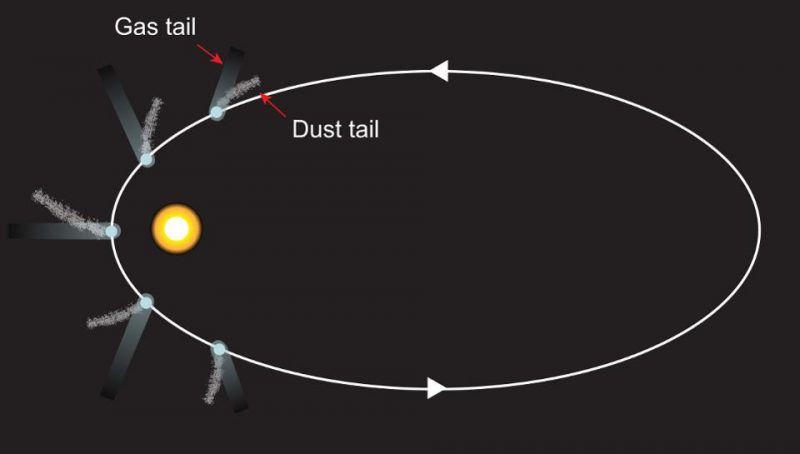
A comet’s orbit showing the different directions of the gas and dust tails as the comet passes the sun. Image via Sergey Prokudin-Gorsky/ okatah / Wikipedia.

Bottom line: Info about the structure in Comet NEOWISE’s two tails.


from EarthSky https://ift.tt/2CYTc2O

This 40-image conglomerate, digitally enhanced, was captured July 19, 2020 through the dark skies of the Gobi Desert in Inner Mongolia, China. Image credit & copyright: Zixuan Lin (Beijing Normal U.)/ APOD

EarthSky’s yearly crowd-funding campaign is in progress. In 2020, we are donating 8.5% to No Kids Hungry. Please donate to help us keep going, and help feed a kid!

Astronomy Picture of the Day (APOD) originally published this post on July 22, 2020. Re-printed here with permission.

What is creating the structure in comet NEOWISE’s tails?

Of the two tails evident, the blue ion tail on the left points directly away from the sun and is pushed out by the flowing and charged solar wind. Structure in the ion tail comes from different rates of expelled blue-glowing ions from the comet’s nucleus, as well as the always complex and continually changing structure of our sun’s wind.

Most unusual for Comet C/2020 F3 (NEOWISE), though, is the wavy structure of its dust tail. This dust tail is pushed out by sunlight, but curves as heavier dust particles are better able to resist this light pressure and continue along a solar orbit.

Comet NEOWISE’s impressive dust-tail striations are not fully understood, as yet, but likely related to rotating streams of sun-reflecting grit liberated by ice melting on its 3-mile (5-km) wide nucleus.

Comet NEOWISE will make it closest pass to the Earth today (July 23, 2020) as it moves out from the sun. The comet, already fading but still visible to the unaided eye, should fade more rapidly as it recedes from the Earth.

A comet’s orbit showing the different directions of the gas and dust tails as the comet passes the sun. Image via Sergey Prokudin-Gorsky/ okatah / Wikipedia.

Bottom line: Info about the structure in Comet NEOWISE’s two tails.


from EarthSky https://ift.tt/2CYTc2O

A powerful 7.8-magnitude quake struck Alaska last night

Map showing narrow peninsula with dot in the sea near it and concentric circles around the dot.

The July 21, 2020, 7.8-magnitude earthquake struck off the coast of the Alaskan Peninsula, about 17 miles (27 km) deep. Image via USGS.

According to Alaska Public Media, residents across coastal Alaska – from Homer to Unalaska – woke to the sounds of sirens and phone alerts last night, warning them of a possible tsunami. Many quickly left home, moving to higher ground. The warnings followed a 7.8-magnitude earthquake – a very powerful earthquake – that struck off coastal Alaska at around 10:15 p.m., local time, on Tuesday, July 21, 2020. The earthquake was centered offshore, 60 miles (98 km) south-southeast of Perryville, Alaska, according to the U.S. Geological Survey (USGS). All tsunami warnings and advisories were canceled early Wednesday morning, according to the National Weather Service.

The Associated Press reported:

Hundreds wore masks against the spread of the coronavirus as they gathered in shelters.

Kodiak Police Sgt. Mike Sorter told the Associated Press early Wednesday morning:

No reports of any damage. No injuries were reported. Everything is nominal.

There have been multiple, smaller aftershocks since the main quake.

Bottom line: A July 21, 2020, earthquake off coastal Alaska measured 7.8 magnitude. It prompted a tsunami warning, which was later rescinded.


from EarthSky https://ift.tt/3fRGz8f
Map showing narrow peninsula with dot in the sea near it and concentric circles around the dot.

The July 21, 2020, 7.8-magnitude earthquake struck off the coast of the Alaskan Peninsula, about 17 miles (27 km) deep. Image via USGS.

According to Alaska Public Media, residents across coastal Alaska – from Homer to Unalaska – woke to the sounds of sirens and phone alerts last night, warning them of a possible tsunami. Many quickly left home, moving to higher ground. The warnings followed a 7.8-magnitude earthquake – a very powerful earthquake – that struck off coastal Alaska at around 10:15 p.m., local time, on Tuesday, July 21, 2020. The earthquake was centered offshore, 60 miles (98 km) south-southeast of Perryville, Alaska, according to the U.S. Geological Survey (USGS). All tsunami warnings and advisories were canceled early Wednesday morning, according to the National Weather Service.

The Associated Press reported:

Hundreds wore masks against the spread of the coronavirus as they gathered in shelters.

Kodiak Police Sgt. Mike Sorter told the Associated Press early Wednesday morning:

No reports of any damage. No injuries were reported. Everything is nominal.

There have been multiple, smaller aftershocks since the main quake.

Bottom line: A July 21, 2020, earthquake off coastal Alaska measured 7.8 magnitude. It prompted a tsunami warning, which was later rescinded.


from EarthSky https://ift.tt/3fRGz8f

Planetary alignment? Increase in volcanoes?

Oblique chart of solar system with orbits shown.

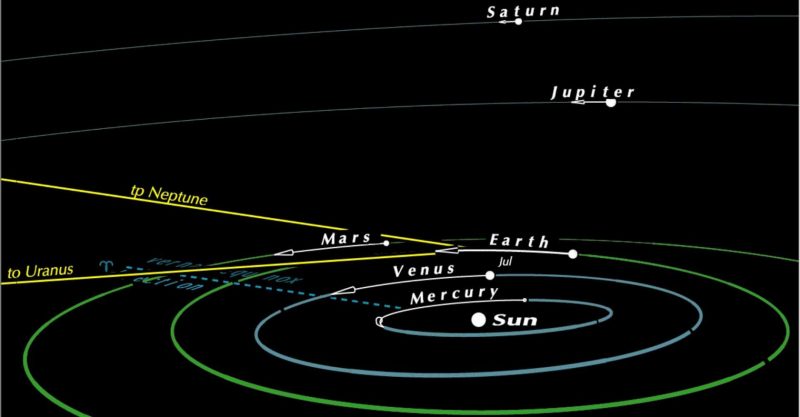
View larger. | In this space view, from a distance of 6 astronomical units (sun-Earth distances) from the sun – at latitude 15 degrees north of the ecliptic plane and longitude 120 degrees – the courses of the planets are shown for the month of July 2020. There are sightlines to Uranus and Neptune because they are in a different direction. Chart via Guy Ottewell’s blog.

Originally published July 21, 2020, at Guy Ottewell’s blog. Reprinted with permission. Don’t miss Guy’s new book : “Venus, A Longer View.”

There’s been discussion among the commenters at my blog about a current alignment of planets and about whether its tidal stress on Earth could have effects, such as increased volcanism. So I thought I’d show where the planets are in July 2020.

The ecliptic heliocentric longitudes of the planets at July 21 are:

Mercury 349
Venus 328
Earth 299
Mars 328
Jupiter 293
Saturn 299
Uranus 38
Neptune 349

So, yes – at present – some of the planets happen to be roughly on a spoke outward from the sun.

EarthSky’s yearly crowd-funding campaign is in progress. In 2020, we are donating 8.5% to No Kids Hungry. Please donate to help us keep going, and help feed a kid!

Two panes, both showing several bright dots in the sky.

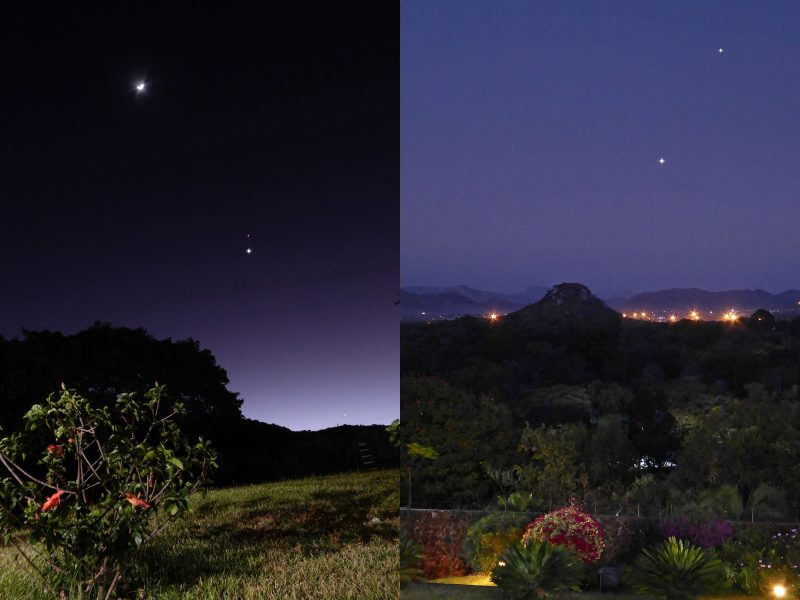
View at EarthSky Community Photos. | One consequence of the planets being located, more or less, in the same general direction from the sun is that we can see several planets in the sky simultaneously. This “alignment” in July 2020 – not a precise alignment, but more like a grouping of planets – enables us to see all 5 visible planets in the morning sky now. Peter Lowenstein caught them on July 15, 2020. He wrote: “… (on the left) the waning moon (above), star Aldebaran (red), planet Venus (very bright) and planet Mercury (bottom, in bright twilight just above the ridgeline) rising to the northeast … (on the right) the planets Saturn (above) and Jupiter (below) setting to the south-west of Murambi Heights, Mutare, Zimbabwe, at dawn.” Thank you, Peter!

The tidal force of body A on body B is the difference between its gravitational pull on the side of B nearer to it and on the side farther. That’s why there is a high tide on the side of Earth nearest to the moon and also on the opposite side.

Let’s give some distances in kilometers.

The distance between the centers of moon and Earth is 384,000 (average, approximate). The radius of Earth is 6,378. So the moon’s distances to the near and far sides are 384,000-6,378 = 377,622, and 384,000+6,378 = 390,378. In other words, the difference between those is about 3 percent.

The distance of Jupiter from Earth is about 780,000,000,000. So the distances from Jupiter to the nearer and farther sides of Earth are 780,000,000,000 minus and plus 6,378. The difference between those is about 0.0016 percent. As you can see … this is a very, very small effect, not enough to cause an uptick in earthly volcanoes.

There have been several planet-alignment scares. The Jupiter Effect (1974), by John Gribbin and Stephen Plagemann, predicted that a line-up on March 10, 1982 would cause catastrophes including a great earthquake on the San Andreas Fault.

That did not happen.

There was some evidence that – around March 10, 1982 – global tides may have been 40 micrometers (40 thousandths of a millimeter) higher than average.

The only other part of the prediction that came true was that the book was a best-seller.

1970's style cover of the book The Jupiter Effect.

You can still find old copies of The Jupiter Effect around. Image via Amazon.

Bottom line: Yes, in July 2020 some of the planets happen to lie roughly along a spoke outward from the sun. No, there’s no reason to suspect an increase in earthquakes or volcanoes.


from EarthSky https://ift.tt/2ZR3SJG
Oblique chart of solar system with orbits shown.

View larger. | In this space view, from a distance of 6 astronomical units (sun-Earth distances) from the sun – at latitude 15 degrees north of the ecliptic plane and longitude 120 degrees – the courses of the planets are shown for the month of July 2020. There are sightlines to Uranus and Neptune because they are in a different direction. Chart via Guy Ottewell’s blog.

Originally published July 21, 2020, at Guy Ottewell’s blog. Reprinted with permission. Don’t miss Guy’s new book : “Venus, A Longer View.”

There’s been discussion among the commenters at my blog about a current alignment of planets and about whether its tidal stress on Earth could have effects, such as increased volcanism. So I thought I’d show where the planets are in July 2020.

The ecliptic heliocentric longitudes of the planets at July 21 are:

Mercury 349
Venus 328
Earth 299
Mars 328
Jupiter 293
Saturn 299
Uranus 38
Neptune 349

So, yes – at present – some of the planets happen to be roughly on a spoke outward from the sun.

EarthSky’s yearly crowd-funding campaign is in progress. In 2020, we are donating 8.5% to No Kids Hungry. Please donate to help us keep going, and help feed a kid!

Two panes, both showing several bright dots in the sky.

View at EarthSky Community Photos. | One consequence of the planets being located, more or less, in the same general direction from the sun is that we can see several planets in the sky simultaneously. This “alignment” in July 2020 – not a precise alignment, but more like a grouping of planets – enables us to see all 5 visible planets in the morning sky now. Peter Lowenstein caught them on July 15, 2020. He wrote: “… (on the left) the waning moon (above), star Aldebaran (red), planet Venus (very bright) and planet Mercury (bottom, in bright twilight just above the ridgeline) rising to the northeast … (on the right) the planets Saturn (above) and Jupiter (below) setting to the south-west of Murambi Heights, Mutare, Zimbabwe, at dawn.” Thank you, Peter!

The tidal force of body A on body B is the difference between its gravitational pull on the side of B nearer to it and on the side farther. That’s why there is a high tide on the side of Earth nearest to the moon and also on the opposite side.

Let’s give some distances in kilometers.

The distance between the centers of moon and Earth is 384,000 (average, approximate). The radius of Earth is 6,378. So the moon’s distances to the near and far sides are 384,000-6,378 = 377,622, and 384,000+6,378 = 390,378. In other words, the difference between those is about 3 percent.

The distance of Jupiter from Earth is about 780,000,000,000. So the distances from Jupiter to the nearer and farther sides of Earth are 780,000,000,000 minus and plus 6,378. The difference between those is about 0.0016 percent. As you can see … this is a very, very small effect, not enough to cause an uptick in earthly volcanoes.

There have been several planet-alignment scares. The Jupiter Effect (1974), by John Gribbin and Stephen Plagemann, predicted that a line-up on March 10, 1982 would cause catastrophes including a great earthquake on the San Andreas Fault.

That did not happen.

There was some evidence that – around March 10, 1982 – global tides may have been 40 micrometers (40 thousandths of a millimeter) higher than average.

The only other part of the prediction that came true was that the book was a best-seller.

1970's style cover of the book The Jupiter Effect.

You can still find old copies of The Jupiter Effect around. Image via Amazon.

Bottom line: Yes, in July 2020 some of the planets happen to lie roughly along a spoke outward from the sun. No, there’s no reason to suspect an increase in earthquakes or volcanoes.


from EarthSky https://ift.tt/2ZR3SJG

Are the Earth’s magnetic poles about to swap places?

Globe of Earth with curved lines shooting out of the North Pole area and bending around Earth.

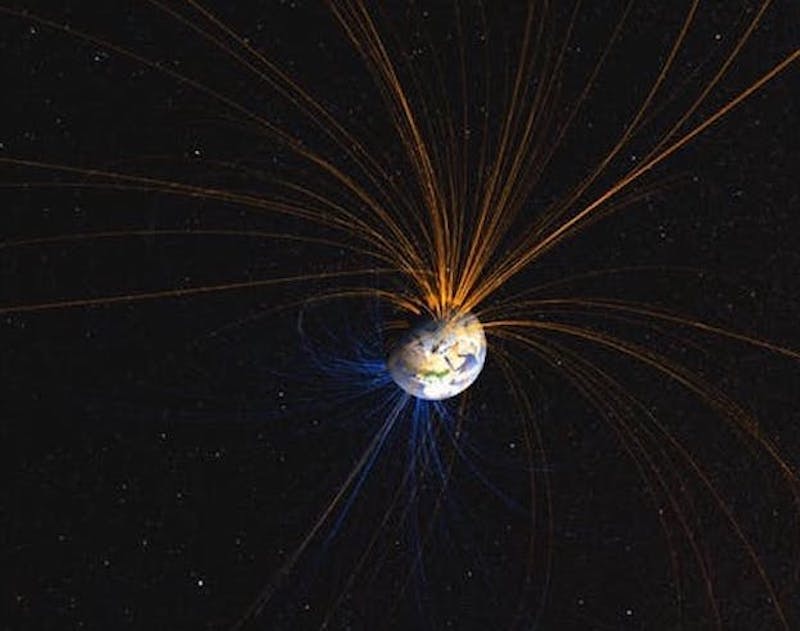
Earth’s magnetic field extends from the Earth’s interior out into space, surrounding our planet like an invisible force field , protecting life from harmful solar radiation by deflecting away charged particles from the sun. But this field is continuously changing. Indeed, our planet’s history includes numerous global magnetic reversals, where north and south magnetic poles swap places. Image via NASA Goddard Space Flight Center/ The Conversation.

EarthSky’s yearly crowd-funding campaign is in progress. In 2020, we are donating 8.5% to No Kids Hungry. Please donate to help us keep going, and help feed a kid!

By Yael Annemiek Engbers, University of Liverpool and Andrew Biggin, University of Liverpool

Deep inside the Earth, liquid iron is flowing and generating the Earth’s magnetic field, which protects our atmosphere and satellites against harmful radiation from the sun. This field changes over time, and also behaves differently in different parts of the world. The field can even change polarity completely, with the magnetic north and south poles switching places. This is called a reversal and last happened 780,000 years ago.

Mountains, valley and blue sky.

Saint Helena, where Earth’s magnetic field behaves strangely. Image via Umomos/ Shutterstock/ The Conversation.

Between South America and southern Africa, there is an enigmatic magnetic region called the South Atlantic Anomaly, where the field is a lot weaker than we would expect. Weak and unstable fields are thought to precede magnetic reversals, so some have argued this feature may be evidence that we are facing one.

Now our new study, published June 12, 2020, in the Proceedings of the National Academy of Sciences, has uncovered how long the field in the South Atlantic has been acting up – and sheds light on whether it is something to worry about.

Weak magnetic fields make us more prone to magnetic storms that have the potential to knock out electronic infrastructure, including power grids. The magnetic field of the South Atlantic Anomaly is already so weak that it can adversely affect satellites and their technology when they fly past it. The strange region is thought to be related to a patch of magnetic field that is pointing a different direction to the rest at the top of the planet’s liquid outer core at a depth of 1,795 miles (2,889 km) within the Earth.

Stretched oval map of Earth with mostly blue along the middle and mostly red and black toward Arctic and Antarctic.

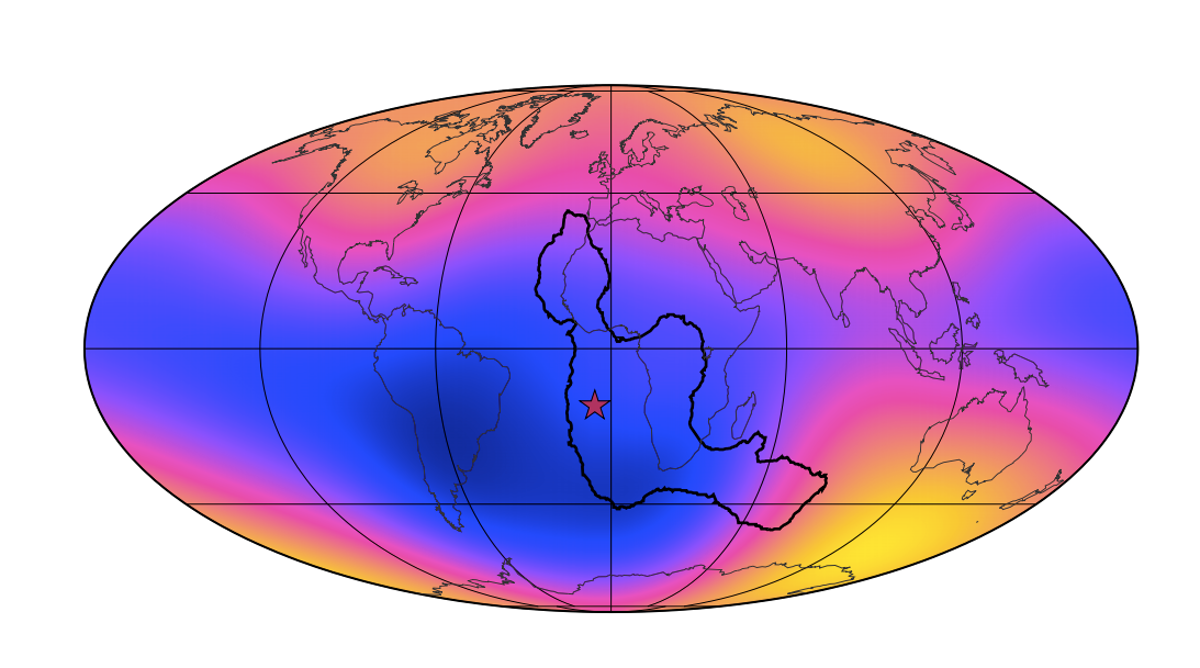
The geomagnetic field at Earth’s surface with the South Atlantic Anomaly outlined in black and St. Helena marked with a star. Colors range from weak fields (blue) to strong fields (yellow). Image via Richard K. Bono/ The Conversation.

This “reverse flux patch” itself has grown over the last 250 years. But we don’t know whether it is simply a one-off product of the chaotic motions of the outer core fluid or rather the latest in a series of anomalies within this particular region over long time frames.

If it is a non-recurring feature, then its current location is not significant – it could happen anywhere, perhaps randomly. But if this is the case, the question of whether its increasing size and depth could mark the start of a new reversal remains.

If it is the latest in a string of features reoccurring over millions of years, however, then this would make a reversal less likely. But it would require a specific explanation for what was causing the magnetic field to act strangely in this particular place.

Volcanic rocks

To find out, we travelled to Saint Helena – an island in the middle of the South Atlantic Ocean. This island, where Napoleon was exiled to and eventually died in 1821, is made of volcanic rocks. These originate from two separate volcanoes and were erupted from between eight million and 11.5 million years ago.

Female scientist with neon green vest and yellow hard hat operating a large drill.

Lead author Yael Engbers is drilling a core on Saint Helena. Image via Andy Biggin/ The Conversation.

When volcanic rocks cool down, small grains of iron-oxide in them get magnetized and therefore save the direction and strength of the Earth’s magnetic field at that time and place. We collected some of those rocks and brought them back to our lab in Liverpool, where we carried out experiments to find out what the magnetic field was like at the time of eruption.

Our results showed us that the field at Saint Helena had very different directions throughout the time of eruption, showing us that the field in this region was much less stable than in other places. It therefore challenges the idea that the abnormality has only been around for only a few centuries. Instead, the whole region has likely been unstable on a timescale of millions of years. This implies the current situation is not as rare as some scientists had assumed, making it less likely that it represents the start of a reversal.

A window into Earth’s interior

So what could explain the odd magnetic region? The liquid outer core that is generating it moves (by convection) at such high speeds that changes can occur on very short, human timescales. The outer core interacts with a layer called the mantle on top of it, which moves far slower. That means the mantle is unlikely to have changed very much in the last ten million years.

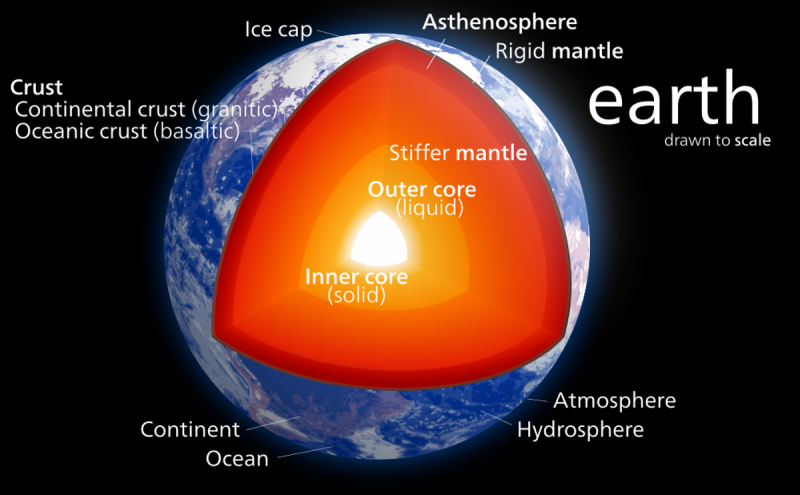
Cutaway view of Earth with labeled yellow, orange and red layers above a white center.

Earth’s inner structure. Image via Wikipedia.

From seismic waves passing through the Earth, we have some insight into the structure of the mantle. Underneath Africa there is a large feature in the lowermost mantle where the waves move extra slow through the Earth – meaning there’s most likely an unusually warm region of the lowermost mantle. This possibly causes a different interaction with the outer core at that specific location, which could explain the strange behavior of the magnetic field in the South Atlantic.

Another aspect of the inside of the Earth is the inner core, which is a solid ball the size of Pluto beneath the outer core. This solid feature is slowly growing, but not at the same rate everywhere. There is a possibility that it is growing faster on one side, causing a flow inside the outer core that is reaching the outer boundary with the rocky mantle just under the Atlantic hemisphere. This may be causing irregular behavior of the magnetic field on the long timescales we found on Saint Helena.

Although there are still many questions about the exact cause of the irregular behavior in the South Atlantic, this study shows us that it has been around for millions of years and is most likely a result of geophysical interactions in the Earth’s mysterious interior.

Yael Annemiek Engbers, Ph.D. candidate, University of Liverpool and Andrew Biggin, Professor of Palaeomagnetism, University of Liverpool

This article is republished from The Conversation under a Creative Commons license. Read the original article.

Bottom line: Is Earth facing a magnetic pole reversal soon? Hear from the authors of a new study, on a strange anomaly that might be a clue.

The Conversation


from EarthSky https://ift.tt/3jrepTL
Globe of Earth with curved lines shooting out of the North Pole area and bending around Earth.

Earth’s magnetic field extends from the Earth’s interior out into space, surrounding our planet like an invisible force field , protecting life from harmful solar radiation by deflecting away charged particles from the sun. But this field is continuously changing. Indeed, our planet’s history includes numerous global magnetic reversals, where north and south magnetic poles swap places. Image via NASA Goddard Space Flight Center/ The Conversation.

EarthSky’s yearly crowd-funding campaign is in progress. In 2020, we are donating 8.5% to No Kids Hungry. Please donate to help us keep going, and help feed a kid!

By Yael Annemiek Engbers, University of Liverpool and Andrew Biggin, University of Liverpool

Deep inside the Earth, liquid iron is flowing and generating the Earth’s magnetic field, which protects our atmosphere and satellites against harmful radiation from the sun. This field changes over time, and also behaves differently in different parts of the world. The field can even change polarity completely, with the magnetic north and south poles switching places. This is called a reversal and last happened 780,000 years ago.

Mountains, valley and blue sky.

Saint Helena, where Earth’s magnetic field behaves strangely. Image via Umomos/ Shutterstock/ The Conversation.

Between South America and southern Africa, there is an enigmatic magnetic region called the South Atlantic Anomaly, where the field is a lot weaker than we would expect. Weak and unstable fields are thought to precede magnetic reversals, so some have argued this feature may be evidence that we are facing one.

Now our new study, published June 12, 2020, in the Proceedings of the National Academy of Sciences, has uncovered how long the field in the South Atlantic has been acting up – and sheds light on whether it is something to worry about.

Weak magnetic fields make us more prone to magnetic storms that have the potential to knock out electronic infrastructure, including power grids. The magnetic field of the South Atlantic Anomaly is already so weak that it can adversely affect satellites and their technology when they fly past it. The strange region is thought to be related to a patch of magnetic field that is pointing a different direction to the rest at the top of the planet’s liquid outer core at a depth of 1,795 miles (2,889 km) within the Earth.

Stretched oval map of Earth with mostly blue along the middle and mostly red and black toward Arctic and Antarctic.

The geomagnetic field at Earth’s surface with the South Atlantic Anomaly outlined in black and St. Helena marked with a star. Colors range from weak fields (blue) to strong fields (yellow). Image via Richard K. Bono/ The Conversation.

This “reverse flux patch” itself has grown over the last 250 years. But we don’t know whether it is simply a one-off product of the chaotic motions of the outer core fluid or rather the latest in a series of anomalies within this particular region over long time frames.

If it is a non-recurring feature, then its current location is not significant – it could happen anywhere, perhaps randomly. But if this is the case, the question of whether its increasing size and depth could mark the start of a new reversal remains.

If it is the latest in a string of features reoccurring over millions of years, however, then this would make a reversal less likely. But it would require a specific explanation for what was causing the magnetic field to act strangely in this particular place.

Volcanic rocks

To find out, we travelled to Saint Helena – an island in the middle of the South Atlantic Ocean. This island, where Napoleon was exiled to and eventually died in 1821, is made of volcanic rocks. These originate from two separate volcanoes and were erupted from between eight million and 11.5 million years ago.

Female scientist with neon green vest and yellow hard hat operating a large drill.

Lead author Yael Engbers is drilling a core on Saint Helena. Image via Andy Biggin/ The Conversation.

When volcanic rocks cool down, small grains of iron-oxide in them get magnetized and therefore save the direction and strength of the Earth’s magnetic field at that time and place. We collected some of those rocks and brought them back to our lab in Liverpool, where we carried out experiments to find out what the magnetic field was like at the time of eruption.

Our results showed us that the field at Saint Helena had very different directions throughout the time of eruption, showing us that the field in this region was much less stable than in other places. It therefore challenges the idea that the abnormality has only been around for only a few centuries. Instead, the whole region has likely been unstable on a timescale of millions of years. This implies the current situation is not as rare as some scientists had assumed, making it less likely that it represents the start of a reversal.

A window into Earth’s interior

So what could explain the odd magnetic region? The liquid outer core that is generating it moves (by convection) at such high speeds that changes can occur on very short, human timescales. The outer core interacts with a layer called the mantle on top of it, which moves far slower. That means the mantle is unlikely to have changed very much in the last ten million years.

Cutaway view of Earth with labeled yellow, orange and red layers above a white center.

Earth’s inner structure. Image via Wikipedia.

From seismic waves passing through the Earth, we have some insight into the structure of the mantle. Underneath Africa there is a large feature in the lowermost mantle where the waves move extra slow through the Earth – meaning there’s most likely an unusually warm region of the lowermost mantle. This possibly causes a different interaction with the outer core at that specific location, which could explain the strange behavior of the magnetic field in the South Atlantic.

Another aspect of the inside of the Earth is the inner core, which is a solid ball the size of Pluto beneath the outer core. This solid feature is slowly growing, but not at the same rate everywhere. There is a possibility that it is growing faster on one side, causing a flow inside the outer core that is reaching the outer boundary with the rocky mantle just under the Atlantic hemisphere. This may be causing irregular behavior of the magnetic field on the long timescales we found on Saint Helena.

Although there are still many questions about the exact cause of the irregular behavior in the South Atlantic, this study shows us that it has been around for millions of years and is most likely a result of geophysical interactions in the Earth’s mysterious interior.

Yael Annemiek Engbers, Ph.D. candidate, University of Liverpool and Andrew Biggin, Professor of Palaeomagnetism, University of Liverpool

This article is republished from The Conversation under a Creative Commons license. Read the original article.

Bottom line: Is Earth facing a magnetic pole reversal soon? Hear from the authors of a new study, on a strange anomaly that might be a clue.

The Conversation


from EarthSky https://ift.tt/3jrepTL

Northern Cross: Backbone of Milky Way

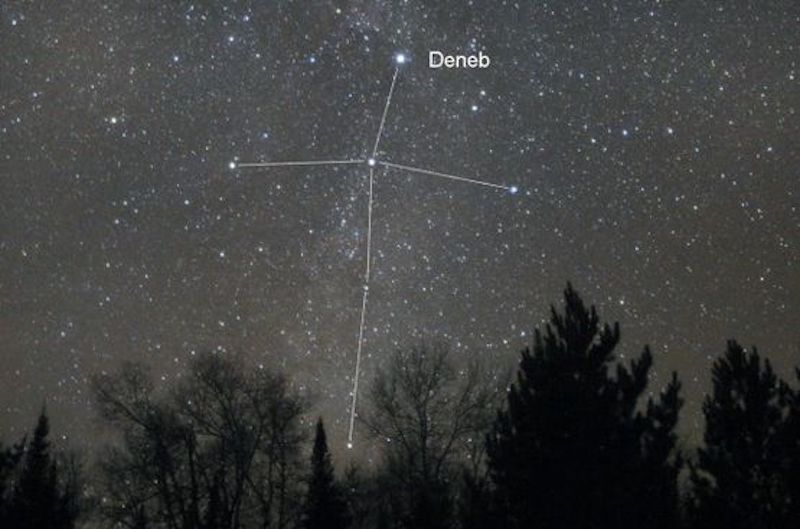
Photo of night sky with many stars, Milky Way, and lines drawn in a cross shape between bright stars.

Northern Cross, with bright star Deneb at the top of the Cross, on a November evening. Image via AstroBob.

The Northern Cross is a clipped version of the constellation Cygnus the Swan, and is really an asterism – a pattern of stars that is not a recognized constellation. However, most people have an easier time making out the Northern Cross than they do Cygnus the Swan.

EarthSky’s yearly crowd-funding campaign is in progress. In 2020, we are donating 8.5% to No Kids Hungry. Please donate to help us keep going, and help feed a kid!

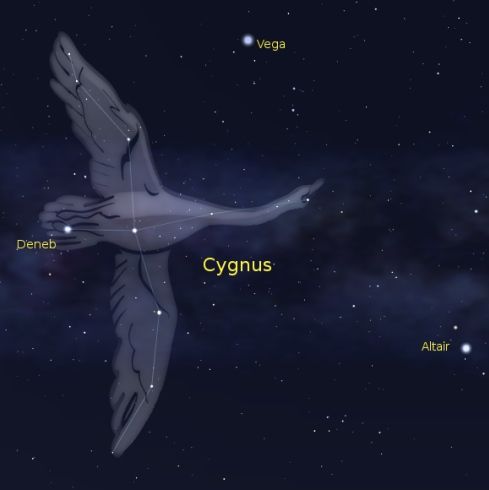
Chart of starry sky with picture of lona-necked flying swan constellation and Deneb, Altair, and Vega labeled.

The Northern Cross is an asterism, or noticeable pattern of stars. It’s within a true constellation – Cygnus the Swan. The Northern Cross and Swan pattern are inside a larger asterism, consisting of three bright stars, called the Summer Triangle. Image via Bob Mohler.

Starry sky with constellations Lyra, Aquila, and Cygnus, and stars of Summer Triangle.

Northern Cross and Summer Triangle. Image via Susan Jensen.

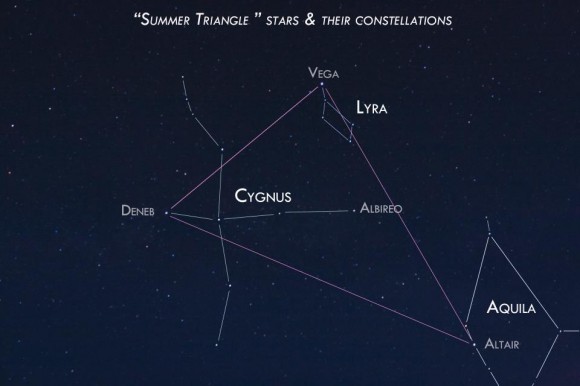
How to find the Northern Cross. The first step to locating the Northern Cross (or Cygnus the Swan) is to find the Northern Cross’ most brilliant star, Deneb. Deneb marks the top of the Northern Cross. Deneb is perhaps just as well known for being one the three brilliant stars of the Summer Triangle, along with the even brighter stars Vega and Altair. Knowing the three stars of the Summer Triangle gives you good footing for locating the Northern Cross, which is embedded within the Summer Triangle asterism.

Roughly halfway between Altair to Vega, and somewhat offset toward Deneb, look for the brightest star in that part of the sky. That’s Albireo. Although a modestly bright star, Albireo is easy to see on a clear, dark night. Since there are no similarly bright stars near Albireo, it is fairly easy to find. Once you locate Deneb and Albireo, you’re only a hop and a skip away from piecing together the Northern Cross.

Starry sky with lines between bright stars forming a cross shape, with Deneb and Albireo labeled.

The Northern Cross, a clipped version of the constellation Cygnus the Swan. Image via Janne/ Flickr.

Backbone of Milky Way. The Northern Cross serves to point out the Milky Way – the luminescent river of stars passing through the Northern Cross and stretching all across the sky.

You need a clear, dark sky to see this hazy swath of sky, whose “haze” is really myriad stars. But it’s a sight well worth pursuing. The Milky Way band we see stretched across our sky is an edgewise view into the disk of our galaxy, the flat part of the galaxy where nearly all the visible stars are.

Keep in mind, though, that all the stars outside this band visible to your unaided eye still belong to our home galaxy, the Milky Way.

When you look at the Northern Cross, you’re looking directly into the Milky Way disk, where the soft glow of millions of stars glazes over the heavens. In fact, the galactic plane (equator) runs right through the Northern Cross, encircling the sky above and below the horizon.

On some clear, dark night, use binoculars and the Northern Cross to enjoy the star fields, star clusters and nebulae that abound within the disk of the Milky Way galaxy!

Northern Cross as a marker of seasons. As seen from mid-northern latitudes, the Northern Cross is out for at least part of the night all year around. It’s out all night in summer. On Northern Hemisphere summer nights, the Northern Cross shines in the east at nightfall, sweeps high overhead after midnight, and swings to the west by daybreak. By the time northern autumn arrives, the Northern Cross is still out from nightfall till midnight, but it appears high overhead at evening and sets in the northwest after midnight. When winter comes, the Northern cross is standing upright over your northwest horizon.

When you see the Northern Cross in the east on summer evenings, it’s sideways to the horizon. On autumn evenings, the Northern Cross beams high overhead but runs diagonally across the sky. On a winter evening, this wondrous star formation stands vertically to the horizon!

Bottom line: The Northern Cross is an “asterism” or recognizable pattern of stars, part of the constellation Cygnus the Swan. How to find it in your sky.


from EarthSky https://ift.tt/2ZQ13ZF
Photo of night sky with many stars, Milky Way, and lines drawn in a cross shape between bright stars.

Northern Cross, with bright star Deneb at the top of the Cross, on a November evening. Image via AstroBob.

The Northern Cross is a clipped version of the constellation Cygnus the Swan, and is really an asterism – a pattern of stars that is not a recognized constellation. However, most people have an easier time making out the Northern Cross than they do Cygnus the Swan.

EarthSky’s yearly crowd-funding campaign is in progress. In 2020, we are donating 8.5% to No Kids Hungry. Please donate to help us keep going, and help feed a kid!

Chart of starry sky with picture of lona-necked flying swan constellation and Deneb, Altair, and Vega labeled.

The Northern Cross is an asterism, or noticeable pattern of stars. It’s within a true constellation – Cygnus the Swan. The Northern Cross and Swan pattern are inside a larger asterism, consisting of three bright stars, called the Summer Triangle. Image via Bob Mohler.

Starry sky with constellations Lyra, Aquila, and Cygnus, and stars of Summer Triangle.

Northern Cross and Summer Triangle. Image via Susan Jensen.

How to find the Northern Cross. The first step to locating the Northern Cross (or Cygnus the Swan) is to find the Northern Cross’ most brilliant star, Deneb. Deneb marks the top of the Northern Cross. Deneb is perhaps just as well known for being one the three brilliant stars of the Summer Triangle, along with the even brighter stars Vega and Altair. Knowing the three stars of the Summer Triangle gives you good footing for locating the Northern Cross, which is embedded within the Summer Triangle asterism.

Roughly halfway between Altair to Vega, and somewhat offset toward Deneb, look for the brightest star in that part of the sky. That’s Albireo. Although a modestly bright star, Albireo is easy to see on a clear, dark night. Since there are no similarly bright stars near Albireo, it is fairly easy to find. Once you locate Deneb and Albireo, you’re only a hop and a skip away from piecing together the Northern Cross.

Starry sky with lines between bright stars forming a cross shape, with Deneb and Albireo labeled.

The Northern Cross, a clipped version of the constellation Cygnus the Swan. Image via Janne/ Flickr.

Backbone of Milky Way. The Northern Cross serves to point out the Milky Way – the luminescent river of stars passing through the Northern Cross and stretching all across the sky.

You need a clear, dark sky to see this hazy swath of sky, whose “haze” is really myriad stars. But it’s a sight well worth pursuing. The Milky Way band we see stretched across our sky is an edgewise view into the disk of our galaxy, the flat part of the galaxy where nearly all the visible stars are.

Keep in mind, though, that all the stars outside this band visible to your unaided eye still belong to our home galaxy, the Milky Way.

When you look at the Northern Cross, you’re looking directly into the Milky Way disk, where the soft glow of millions of stars glazes over the heavens. In fact, the galactic plane (equator) runs right through the Northern Cross, encircling the sky above and below the horizon.

On some clear, dark night, use binoculars and the Northern Cross to enjoy the star fields, star clusters and nebulae that abound within the disk of the Milky Way galaxy!

Northern Cross as a marker of seasons. As seen from mid-northern latitudes, the Northern Cross is out for at least part of the night all year around. It’s out all night in summer. On Northern Hemisphere summer nights, the Northern Cross shines in the east at nightfall, sweeps high overhead after midnight, and swings to the west by daybreak. By the time northern autumn arrives, the Northern Cross is still out from nightfall till midnight, but it appears high overhead at evening and sets in the northwest after midnight. When winter comes, the Northern cross is standing upright over your northwest horizon.

When you see the Northern Cross in the east on summer evenings, it’s sideways to the horizon. On autumn evenings, the Northern Cross beams high overhead but runs diagonally across the sky. On a winter evening, this wondrous star formation stands vertically to the horizon!

Bottom line: The Northern Cross is an “asterism” or recognizable pattern of stars, part of the constellation Cygnus the Swan. How to find it in your sky.


from EarthSky https://ift.tt/2ZQ13ZF

adds 2