aads

A nova, briefly visible in southern skies

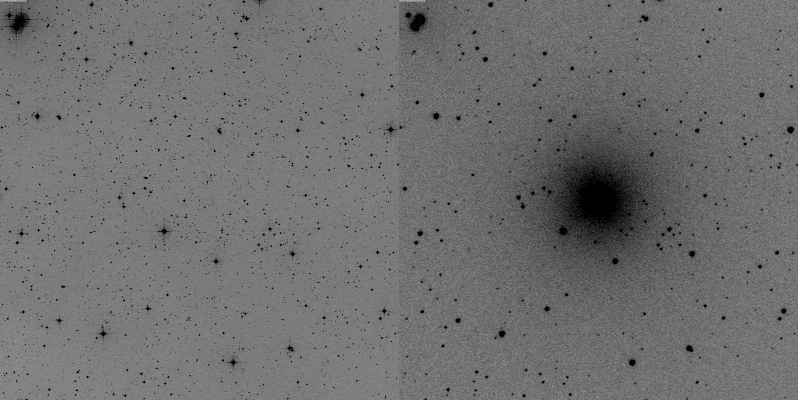
Animated gif of a star field with stars in black on gray, into which a large, fuzzy star suddenly appears.

A nova is a star that suddenly pops into view. Early stargazers thought they were new stars. Today, we know differently. Image via Ernesto Guido (@comets77 on Twitter).

Veteran comet hunter Robert McNaught from Coonabarabran, Australia, must have been perplexed – and then surprised – and then delighted when he noticed something peculiar on CCD images of the night sky, taken July 15, 2020. It was a faint, but visible star where none had appeared before. Such a star is called a nova, from a Latin word meaning new. This one is in front of the southern constellation Reticulum. Once confirmed by other astronomers, and reported in The Astronomer’s Telegram on July 16, the object was quickly announced to the world’s community of variable star observers as Nova Reticuli 2020 (N Ret 2020).

It’s a rare find: a nova visible to the eye!
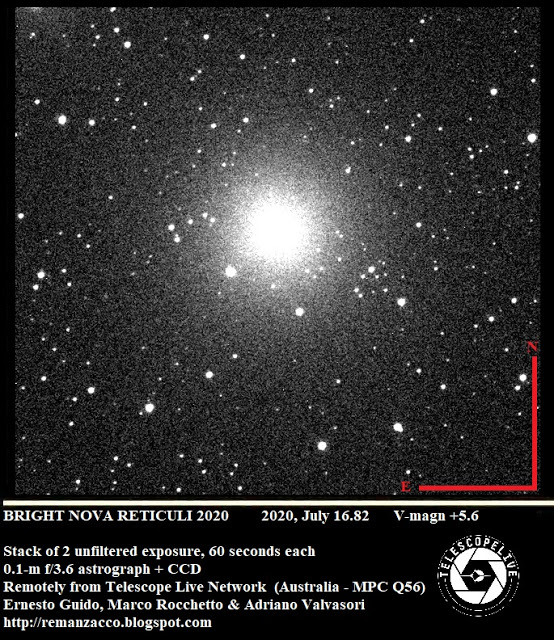
Star field with one much larger bright star in the middle.

Nova Reticulum 2020, via Comets & Asteroids.

Astronomers have determined that this outburst is of the sort called a classical nova. That is, it’s created in a double-star system where one star is a white dwarf and the other is an ordinary main sequence star, not dissimilar from our sun. These two stars are close together in space, orbiting one another on a timescale of only hours. Because they’re close – and because the white dwarf is a collapsed object with very powerful gravity (a teaspoon of white dwarf material would weigh several tons) – hydrogen from the main sequence star is drawn into an accretion disk around the white dwarf. Eventually, this hydrogen piles onto the surface of the white dwarf. As explained on the website Cosmos from Swinburne University:

As more hydrogen (and helium) is accreted, the pressure and temperature at the bottom of this surface layer increase until sufficient to trigger nuclear fusion reactions [the same process that causes our sun and most other stars to shine]. These reactions rapidly convert the hydrogen into heavier elements creating a runaway thermonuclear reaction where the energy released by the hydrogen burning increases the temperature, which in turn drives up the rate of hydrogen burning.

The energy released through this process ejects the majority of the unburnt hydrogen from the surface of the star in a shell of material moving at speeds of up to 1,500 km/s. This produces a bright but short-lived burst of light – the nova.

A classical nova outburst can occur again and again in a system of this kind.

Nova Reticulum 2020 is associated with a known object in the database of the American Association of Variable Star Observers, labeled MGAB-V207 and categorized as a cataclysmic variable star. These sorts of stars are known to undergo classical nova outbursts due to mass transfer between a main sequence star and a white dwarf.

Small white dwarf star, surrounded by a disk of material flowing from its much larger companion star.

In a classical nova, a dense white dwarf pulls material from a companion star. The material piles up on the white dwarf’s surface until thermonuclear processes begin, creating an outburst. Image via NASA/ JPL-Caltech.

Can you see Nova Reticuli 2020? Possibly, if it hasn’t faded yet, and if you live in the Southern Hemisphere, where the constellation Reticulum can be seen. On July 17, writing at Astronomy.com, Alison Klesman said Nova Reticuli 2020 was shining at around magnitude 5.

That is, it’s visible to the eye, but only barely.

If it’s still visible to the eye, you will need a very dark to see the nova. If you have that – and a constellation chart to show you how to find Reticulum – look first for the bright stars Alpha and Gamma Doradus, shown on the chart below (apologies for the blurriness of the chart; be sure to view it larger).

Good luck!
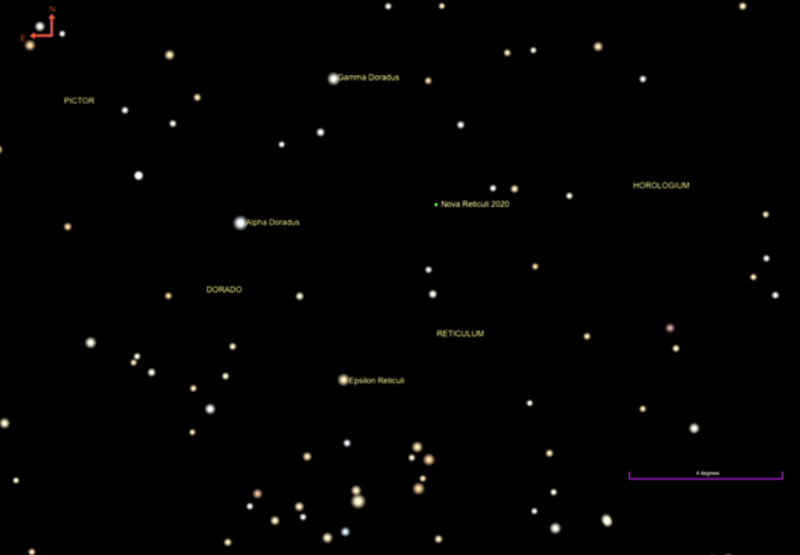
View larger. | If you live in the Southern Hemipshere, you can see the constellation Reticulum and the nova. You can pinpoint Nova Reticuli 2020 by looking roughly 5 degrees west of magnitude 3.3 Alpha Doradus and 4.25 degrees southwest of magnitude 4.3 Gamma Doradus. Notice that these 2 stars make a triangle with the nova. If the nova has gotten fainter, try using binoculars to bring it into view. Image via Alison Klesman/ Astronomy.com.
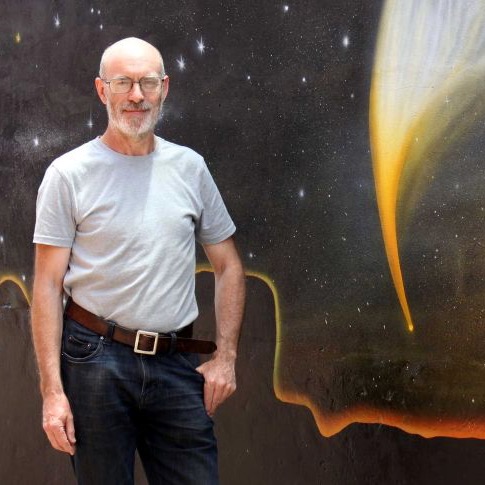
A bald, bearded man in a t-shirt, standing in front of a mural showing a comet.

Congratulations to comet hunter Robert McNaught, who was the first to spot Nova Reticuli 2020! Image via Abc.net.au.

Bottom line: Astronomers have spotted a classical nova outburst in a type of variable star that involves a white dwarf orbiting a main sequence star. Nova Reticulum 2020 has been briefly visible from the Southern Hemisphere. At this writing, we do not know if it is still visible.

Via The Astronomer’s Telegram

Via the American Association of Variable Star Observers

Via Astronomy.com


from EarthSky https://ift.tt/3fVIbOB
Animated gif of a star field with stars in black on gray, into which a large, fuzzy star suddenly appears.

A nova is a star that suddenly pops into view. Early stargazers thought they were new stars. Today, we know differently. Image via Ernesto Guido (@comets77 on Twitter).

Veteran comet hunter Robert McNaught from Coonabarabran, Australia, must have been perplexed – and then surprised – and then delighted when he noticed something peculiar on CCD images of the night sky, taken July 15, 2020. It was a faint, but visible star where none had appeared before. Such a star is called a nova, from a Latin word meaning new. This one is in front of the southern constellation Reticulum. Once confirmed by other astronomers, and reported in The Astronomer’s Telegram on July 16, the object was quickly announced to the world’s community of variable star observers as Nova Reticuli 2020 (N Ret 2020).

It’s a rare find: a nova visible to the eye!

Star field with one much larger bright star in the middle.

Nova Reticulum 2020, via Comets & Asteroids.

Astronomers have determined that this outburst is of the sort called a classical nova. That is, it’s created in a double-star system where one star is a white dwarf and the other is an ordinary main sequence star, not dissimilar from our sun. These two stars are close together in space, orbiting one another on a timescale of only hours. Because they’re close – and because the white dwarf is a collapsed object with very powerful gravity (a teaspoon of white dwarf material would weigh several tons) – hydrogen from the main sequence star is drawn into an accretion disk around the white dwarf. Eventually, this hydrogen piles onto the surface of the white dwarf. As explained on the website Cosmos from Swinburne University:

As more hydrogen (and helium) is accreted, the pressure and temperature at the bottom of this surface layer increase until sufficient to trigger nuclear fusion reactions [the same process that causes our sun and most other stars to shine]. These reactions rapidly convert the hydrogen into heavier elements creating a runaway thermonuclear reaction where the energy released by the hydrogen burning increases the temperature, which in turn drives up the rate of hydrogen burning.

The energy released through this process ejects the majority of the unburnt hydrogen from the surface of the star in a shell of material moving at speeds of up to 1,500 km/s. This produces a bright but short-lived burst of light – the nova.

A classical nova outburst can occur again and again in a system of this kind.

Nova Reticulum 2020 is associated with a known object in the database of the American Association of Variable Star Observers, labeled MGAB-V207 and categorized as a cataclysmic variable star. These sorts of stars are known to undergo classical nova outbursts due to mass transfer between a main sequence star and a white dwarf.

Small white dwarf star, surrounded by a disk of material flowing from its much larger companion star.

In a classical nova, a dense white dwarf pulls material from a companion star. The material piles up on the white dwarf’s surface until thermonuclear processes begin, creating an outburst. Image via NASA/ JPL-Caltech.

Can you see Nova Reticuli 2020? Possibly, if it hasn’t faded yet, and if you live in the Southern Hemisphere, where the constellation Reticulum can be seen. On July 17, writing at Astronomy.com, Alison Klesman said Nova Reticuli 2020 was shining at around magnitude 5.

That is, it’s visible to the eye, but only barely.

If it’s still visible to the eye, you will need a very dark to see the nova. If you have that – and a constellation chart to show you how to find Reticulum – look first for the bright stars Alpha and Gamma Doradus, shown on the chart below (apologies for the blurriness of the chart; be sure to view it larger).

Good luck!

View larger. | If you live in the Southern Hemipshere, you can see the constellation Reticulum and the nova. You can pinpoint Nova Reticuli 2020 by looking roughly 5 degrees west of magnitude 3.3 Alpha Doradus and 4.25 degrees southwest of magnitude 4.3 Gamma Doradus. Notice that these 2 stars make a triangle with the nova. If the nova has gotten fainter, try using binoculars to bring it into view. Image via Alison Klesman/ Astronomy.com.

A bald, bearded man in a t-shirt, standing in front of a mural showing a comet.

Congratulations to comet hunter Robert McNaught, who was the first to spot Nova Reticuli 2020! Image via Abc.net.au.

Bottom line: Astronomers have spotted a classical nova outburst in a type of variable star that involves a white dwarf orbiting a main sequence star. Nova Reticulum 2020 has been briefly visible from the Southern Hemisphere. At this writing, we do not know if it is still visible.

Via The Astronomer’s Telegram

Via the American Association of Variable Star Observers

Via Astronomy.com


from EarthSky https://ift.tt/3fVIbOB

New view of old light adds twist to debate over universe’s age

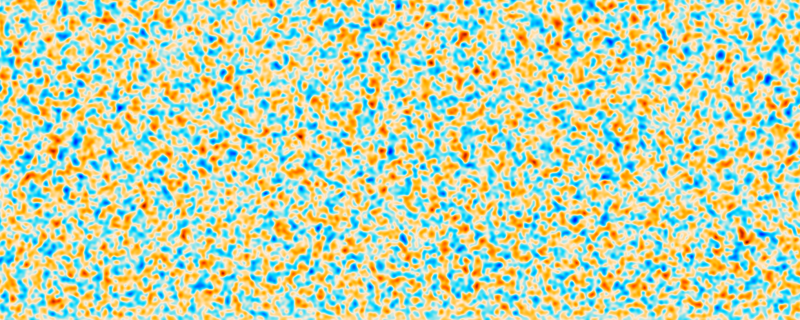
Blue and red speckles on a white background.

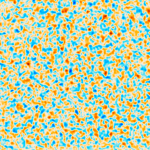
A portion of a new picture of the oldest light in the universe, aka the cosmic microwave background. This part covers a section of the sky 50 times the moon’s width, representing a region of space 20 billion light-years across. Image via Atacama Cosmology Telescope/ ACT Collaboration/ Simons Foundation.

Written by Thomas Sumner for the Simons Foundation. Originally published July 15, 2020.

From a mountain high in Chile’s Atacama Desert, astronomers with the National Science Foundation’s Atacama Cosmology Telescope (ACT) have taken a fresh look at the oldest light in the universe [otherwise known as the cosmic microwave background]. Their new observations plus a bit of cosmic geometry suggest that the universe is 13.77 billion years old, give or take 40 million years.

The new estimate matches the one provided by the standard model of the universe and measurements of the same light made by the Planck satellite. This adds a fresh twist to an ongoing debate in the astrophysics community, said Simone Aiola, first author of one of two new papers on the findings posted to arXiv.org.

In 2019, a research team measuring the movements of galaxies calculated that the universe is hundreds of millions of years younger than the Planck team predicted. That discrepancy suggested that a new model for the universe might be needed and sparked concerns that one of the sets of measurements might be incorrect. Aiola, a researcher at the Flatiron Institute’s Center for Computational Astrophysics in New York City, commented:

Now we’ve come up with an answer where Planck and ACT agree. It speaks to the fact that these difficult measurements are reliable.

The age of the universe also reveals how fast the cosmos is expanding, a number quantified by the Hubble constant. The new measurements from the Atacama Cosmology Telescope suggest a Hubble constant of 67.6 kilometers per second per megaparsec. That means an object 1 megaparsec (around 3.26 million light-years) from Earth is moving away from us at 67.6 kilometers per second due to the expansion of the universe. This result agrees almost exactly with the previous estimate of 67.4 kilometers per second per megaparsec by the Planck satellite team, but it’s slower than the 74 kilometers per second per megaparsec inferred from the measurements of galaxies.

Upside down cone-shaped telescope on a desert plain, with mountains in the background.

The Atacama Cosmology Telescope. Using new measurements from this telescope of the cosmic microwave background, scientists have refined calculations of the universe’s age. Image via Debra Kellner/ Simons Foundation.

Steve Choi of Cornell University, first author of the other paper posted to arXiv.org, said:

I didn’t have a particular preference for any specific value. It was going to be interesting one way or another. We find an expansion rate that is right on the estimate by the Planck satellite team. This gives us more confidence in measurements of the universe’s oldest light.

The close agreement between the ACT and Planck results and the standard cosmological model is bittersweet, Aiola said:

It’s good to know that our model right now is robust, but it would have been nice to see a hint of something new.

Still, the disagreement with the 2019 study of the motions of galaxies maintains the possibility that unknown physics may be at play, he said.

Like the Planck satellite, ACT peers at the afterglow of the Big Bang. This light, known as the cosmic microwave background, marks a time 380,000 years after the universe’s birth when protons and electrons joined to form the first atoms. Before that time, the cosmos was opaque to light.

If scientists can estimate how far light from the cosmic microwave background traveled to reach Earth, they can calculate the universe’s age. That’s easier said than done, though. Judging cosmic distances from Earth is hard. So instead, scientists measure the angle in the sky between two distant objects, with Earth and the two objects forming a cosmic triangle. If scientists also know the physical separation between those objects, they can use high school geometry to estimate the distance of the objects from Earth.

Subtle variations in the glow of the cosmic microwave background offer anchor points to form the other two vertices of the triangle. Those variations in temperature and polarization resulted from quantum fluctuations in the early universe that got amplified by the expanding universe into regions of varying density. (The denser patches would go on to form galaxy clusters.) Scientists have a strong enough understanding of the universe’s early years to know that these variations in the cosmic microwave background should typically be spaced out every billion light-years for temperature and half that for polarization. (For scale, our Milky Way galaxy is about 200,000 light-years in diameter.)

ACT measured the cosmic microwave background fluctuations with unprecedented resolution, taking a closer look at the polarization of the light. Suzanne Staggs, ACT’s principal investigator and the Henry deWolf Smyth Professor of Physics at Princeton University, said:

The Planck satellite measured the same light, but by measuring its polarization in higher fidelity, the new picture from ACT reveals more of the oldest patterns we’ve ever seen.

As ACT continues making observations, astronomers will have an even clearer picture of the cosmic microwave background and a more exact idea of how long ago the cosmos began. The ACT team will also scour those observations for signs of physics that doesn’t fit the standard cosmological model. Such strange physics could resolve the disagreement between the predictions of the age and expansion rate of the universe arising from the measurements of the cosmic microwave background and the motions of galaxies. Mark Devlin, ACT’s deputy director and the Reese W. Flower Professor of Astronomy and Astrophysics at the University of Pennsylvania, said:

We’re continuing to observe half the sky from Chile with our telescope. As the precision of both techniques increases, the pressure to resolve the conflict will only grow.

Bottom line: Astronomers have taken a fresh look at the oldest light in the universe, otherwise known as the cosmic microwave background. Their new observations suggest that the universe is 13.77 billion years old, give or take 40 million years.

Source: The Atacama Cosmology Telescope: DR4 Maps and Cosmological Parameters

Source: The Atacama Cosmology Telescope: A Measurement of the Cosmic Microwave Background Power Spectra at 98 and 150 GHz

Via the Simons Foundation


from EarthSky https://ift.tt/2Cjk5id
Blue and red speckles on a white background.

A portion of a new picture of the oldest light in the universe, aka the cosmic microwave background. This part covers a section of the sky 50 times the moon’s width, representing a region of space 20 billion light-years across. Image via Atacama Cosmology Telescope/ ACT Collaboration/ Simons Foundation.

Written by Thomas Sumner for the Simons Foundation. Originally published July 15, 2020.

From a mountain high in Chile’s Atacama Desert, astronomers with the National Science Foundation’s Atacama Cosmology Telescope (ACT) have taken a fresh look at the oldest light in the universe [otherwise known as the cosmic microwave background]. Their new observations plus a bit of cosmic geometry suggest that the universe is 13.77 billion years old, give or take 40 million years.

The new estimate matches the one provided by the standard model of the universe and measurements of the same light made by the Planck satellite. This adds a fresh twist to an ongoing debate in the astrophysics community, said Simone Aiola, first author of one of two new papers on the findings posted to arXiv.org.

In 2019, a research team measuring the movements of galaxies calculated that the universe is hundreds of millions of years younger than the Planck team predicted. That discrepancy suggested that a new model for the universe might be needed and sparked concerns that one of the sets of measurements might be incorrect. Aiola, a researcher at the Flatiron Institute’s Center for Computational Astrophysics in New York City, commented:

Now we’ve come up with an answer where Planck and ACT agree. It speaks to the fact that these difficult measurements are reliable.

The age of the universe also reveals how fast the cosmos is expanding, a number quantified by the Hubble constant. The new measurements from the Atacama Cosmology Telescope suggest a Hubble constant of 67.6 kilometers per second per megaparsec. That means an object 1 megaparsec (around 3.26 million light-years) from Earth is moving away from us at 67.6 kilometers per second due to the expansion of the universe. This result agrees almost exactly with the previous estimate of 67.4 kilometers per second per megaparsec by the Planck satellite team, but it’s slower than the 74 kilometers per second per megaparsec inferred from the measurements of galaxies.

Upside down cone-shaped telescope on a desert plain, with mountains in the background.

The Atacama Cosmology Telescope. Using new measurements from this telescope of the cosmic microwave background, scientists have refined calculations of the universe’s age. Image via Debra Kellner/ Simons Foundation.

Steve Choi of Cornell University, first author of the other paper posted to arXiv.org, said:

I didn’t have a particular preference for any specific value. It was going to be interesting one way or another. We find an expansion rate that is right on the estimate by the Planck satellite team. This gives us more confidence in measurements of the universe’s oldest light.

The close agreement between the ACT and Planck results and the standard cosmological model is bittersweet, Aiola said:

It’s good to know that our model right now is robust, but it would have been nice to see a hint of something new.

Still, the disagreement with the 2019 study of the motions of galaxies maintains the possibility that unknown physics may be at play, he said.

Like the Planck satellite, ACT peers at the afterglow of the Big Bang. This light, known as the cosmic microwave background, marks a time 380,000 years after the universe’s birth when protons and electrons joined to form the first atoms. Before that time, the cosmos was opaque to light.

If scientists can estimate how far light from the cosmic microwave background traveled to reach Earth, they can calculate the universe’s age. That’s easier said than done, though. Judging cosmic distances from Earth is hard. So instead, scientists measure the angle in the sky between two distant objects, with Earth and the two objects forming a cosmic triangle. If scientists also know the physical separation between those objects, they can use high school geometry to estimate the distance of the objects from Earth.

Subtle variations in the glow of the cosmic microwave background offer anchor points to form the other two vertices of the triangle. Those variations in temperature and polarization resulted from quantum fluctuations in the early universe that got amplified by the expanding universe into regions of varying density. (The denser patches would go on to form galaxy clusters.) Scientists have a strong enough understanding of the universe’s early years to know that these variations in the cosmic microwave background should typically be spaced out every billion light-years for temperature and half that for polarization. (For scale, our Milky Way galaxy is about 200,000 light-years in diameter.)

ACT measured the cosmic microwave background fluctuations with unprecedented resolution, taking a closer look at the polarization of the light. Suzanne Staggs, ACT’s principal investigator and the Henry deWolf Smyth Professor of Physics at Princeton University, said:

The Planck satellite measured the same light, but by measuring its polarization in higher fidelity, the new picture from ACT reveals more of the oldest patterns we’ve ever seen.

As ACT continues making observations, astronomers will have an even clearer picture of the cosmic microwave background and a more exact idea of how long ago the cosmos began. The ACT team will also scour those observations for signs of physics that doesn’t fit the standard cosmological model. Such strange physics could resolve the disagreement between the predictions of the age and expansion rate of the universe arising from the measurements of the cosmic microwave background and the motions of galaxies. Mark Devlin, ACT’s deputy director and the Reese W. Flower Professor of Astronomy and Astrophysics at the University of Pennsylvania, said:

We’re continuing to observe half the sky from Chile with our telescope. As the precision of both techniques increases, the pressure to resolve the conflict will only grow.

Bottom line: Astronomers have taken a fresh look at the oldest light in the universe, otherwise known as the cosmic microwave background. Their new observations suggest that the universe is 13.77 billion years old, give or take 40 million years.

Source: The Atacama Cosmology Telescope: DR4 Maps and Cosmological Parameters

Source: The Atacama Cosmology Telescope: A Measurement of the Cosmic Microwave Background Power Spectra at 98 and 150 GHz

Via the Simons Foundation


from EarthSky https://ift.tt/2Cjk5id

This day in 2013: The Day the Earth Smiled

Via NASA/JPL/SSI/CICLOPS / Mother Jones

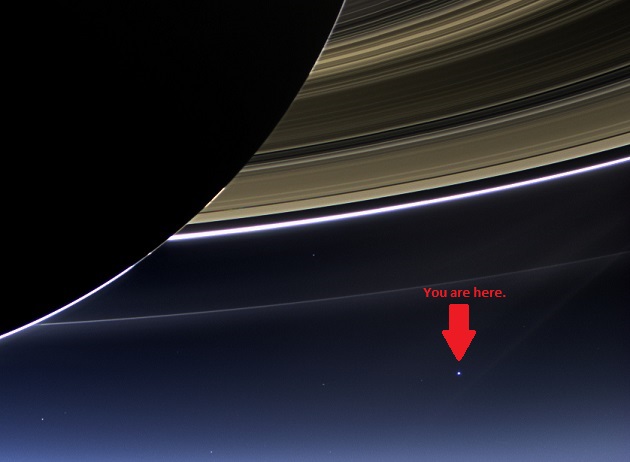
The famous The Day the Earth Smiled photo, taken by Cassini on July 19, 2013. Image via NASA/ JPL/ SSI/ CICLOPS/ Mother Jones.

July 19, 2013 – The Day the Earth Smiled. On this date, humanity acquired its third-ever image – and one of the most awe-inspiring space photos ever – of Earth from the outer solar system. The planet Saturn eclipsed the sun from the vantage point of the orbiting Cassini spacecraft, and we on Earth cast our thoughts toward space and our tiny place in it. The imaging team later dubbed this image The Day the Earth Smiled. The two previous images – Pale Blue Orb image by Cassini in 2006 and Pale Blue Dot image by Voyager in 1990 are also discussed below.

On July 19, 2013, NASA’s Cassini spacecraft had been orbiting Saturn and weaving in and among its moons since 2004. On that day, the spacecraft was aligned in such a way that Saturn eclipsed the sun as seen from its vantage point. With the sun’s light blocked, space scientists captured the third-ever picture of Earth and Earth’s moon, from the outer solar system, from hundreds of millions of miles away.

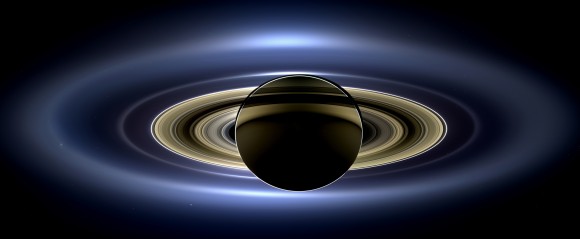
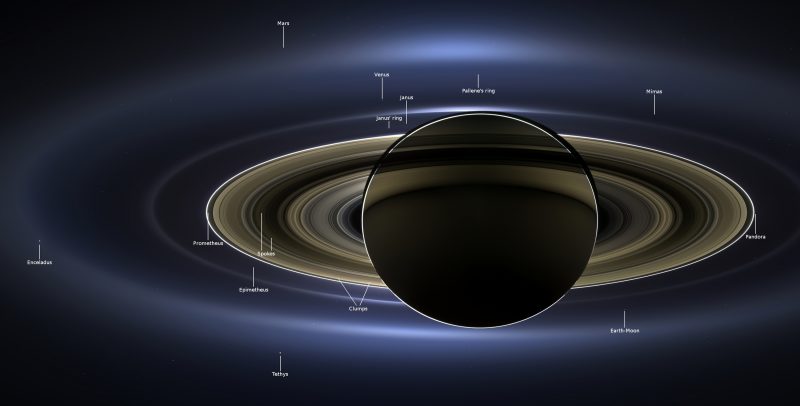
As Cassini slipped into Saturn’s shadow that day, it was also able capture images of the planets Venus and Mars, Saturn’s backlit rings, and several of Saturn’s moons, all at once. You can see the dark side of Saturn, its bright limb, the main rings and the F ring, G and E rings. This view looks toward the unilluminated side of the rings from about 20 degrees below the ring plane.

View larger. | NASA’s Cassini spacecraft took this natural-color portrait on July 19, 2013, which is the first image to show Saturn, its moons, and rings, plus Earth, Venus, and Mars, all together. Image and Caption Credit: NASA/JPL-Caltech/SSI

View larger. | NASA’s Cassini spacecraft took this natural-color portrait on July 19, 2013. It’s the third-ever image of Earth from the outer solar system, and the first image to show Saturn, its moons, and rings, plus Earth and its moon, Venus, and Mars, all together. Image via NASA/ JPL-Caltech/ SSI. Read more about this image from NASA.

Dark planet surrounded by bright rings with text annotations and stars in background.

View larger. | Annotated image of Saturn and the view from Saturn, taken by Cassini on July 19, 2013. Image via NASA/ JPL-Caltech/ SSI.

The occasion defined the first time that people had advance notice they would be photographed from another world. NASA invited everyone on Earth to turn skyward and to wave as their image was taken from hundreds of millions of miles away. As the day approached, Carolyn Porco, Cassini imaging team lead at the Space Science Institute in Boulder, Colorado, said people should:

… look up, think about our cosmic place, think about our planet, how unusual it is, how lush and life-giving it is, think about your own existence, think about the magnitude of the accomplishment that this picture-taking session entails. We have a spacecraft at Saturn. We are truly interplanetary explorers. Think about all that, and smile.

Thus, The Day the Earth Smiled was born. Porco was also involved with the planning of the earlier Pale Blue Orb and Pale Blue Dot images.

NASA said the natural-color image is as the human eye would see it, if you had been there with Cassini. Using both its wide-angle and narrow-angle cameras, the spacecraft captured a total of 323 photographs over a four-hour period of time, but only 141 images were used to create this panoramic mosaic. This mosaic is also one of 33 “footprints” that cover the entire ring system and Saturn itself.

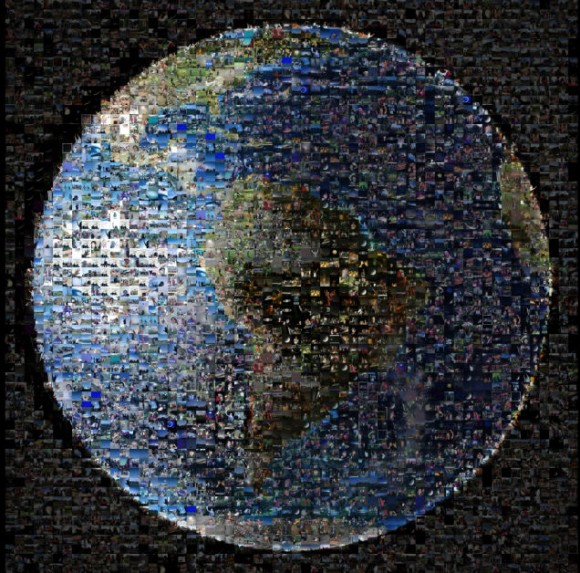
View larger. | Collage of people on Earth waving at the Cassini spacecraft and planet Saturn on July 19, 2013,

View larger. | Collage of people on Earth on July 19, 2013. Image via NASA. Read more about this image.

Many tiny photos in small squares.

A closer view of some of the many photos that make up the collage. Image via NASA/ Gizmodo.

This incredible image – released by NASA on July 23, 2013 – spans a distance of 404,880 miles — roughly twice the distance from the Earth to the moon. Cassini was about 898 million miles (1.45 billion km) away from Earth at the time. That distance is nearly 10 times the distance from the sun to Earth.

Porco also said:

Ever since we caught sight of the Earth among the rings of Saturn in September 2006 in a mosaic that has become one of Cassini’s most beloved images, I have wanted to do it all over again, only better. This time, I wanted to turn the entire event into an opportunity for everyone around the globe to savor the uniqueness of our planet and the preciousness of the life on it.

She accomplished that, and much more.

There is also another very cool associated image from this day, a collage of people on Earth, created to help celebrate the occasion. Over 1,400 individual photos come together to depict a view of the Earth. On the same day that The Day the Earth Smiled image was taken, participants from 40 countries took photos of themselves waving at Saturn. This awesome collage is the result. The images were streamed to NASA/ JPL-Caltech via Twitter, Facebook, Flickr, Instagram, Google+ and email.

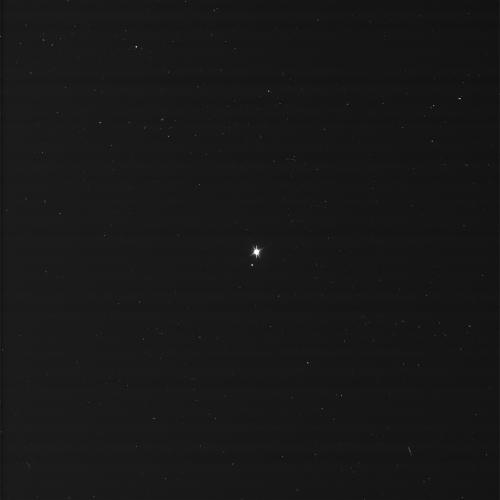
An early raw image of the Earth and moon, as seen from Saturn by Cassini spacecraft on July 19, 2013. Earth is the brighter dot; moon to lower left. Via NASA/JPL-Caltech/SSI.

An earlier raw image of the Earth and moon, as seen from Saturn by the Cassini spacecraft on July 19, 2013. Earth is the brighter dot; the moon is to the lower left. Image via NASA/ JPL-Caltech/ Space Science Institute/ Medium.

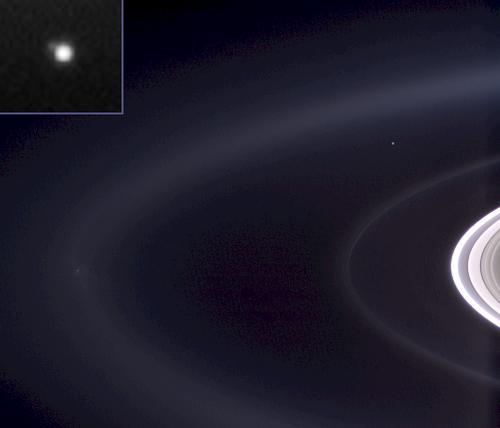
Not since NASA's Voyager 1 spacecraft saw our home as a pale blue dot from beyond the orbit of Neptune has Earth been imaged in color from the outer solar system. Now, Cassini casts powerful eyes on our home planet, and captures Earth, a pale blue orb -- and a faint suggestion of our moon -- among the glories of the Saturn system. Image Credit: NASA/JPL/Space Science Institute. Read more about this image here.

This image is known as the Pale Blue Orb. The Cassini spacecraft captured it back in 2006, showing the Earth and moon as tiny dots seen through Saturn’s rings. Image via NASA/ JPL/ Space Science Institute.

Pale Blue Orb image by Cassini, 2006. This was the second-ever image of Earth taken from the outer solar system, taken on February 15, 2006, just two years after Cassini began orbiting Saturn. At the time, the spacecraft was about 930 million miles (1.5 billion km) from Earth. The Earth and moon appear as a tiny blue dot on the right side of the image, just above center. When magnified, you can just make out the moon as a slight “protrusion” on the upper left side of the Earth.

As with the 2013 image, the 2006 image was made possible by the passing of Saturn directly in front of the sun as seen from Cassini.

You can read more about the Pale Blue Orb image here.

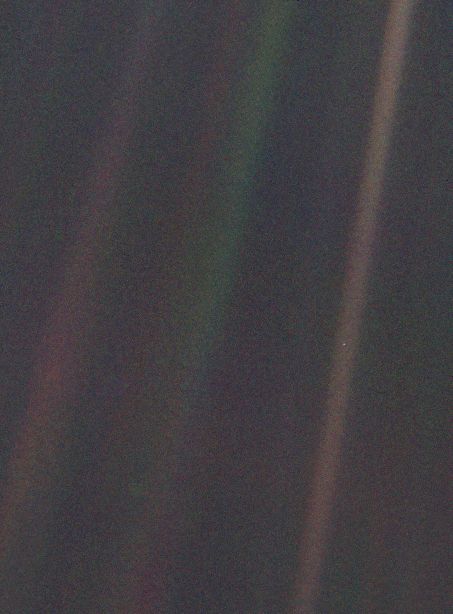
Pale Blue Dot image by Voyager, 1990. The first image ever taken of Earth from the outer solar system – and the most distant image, still – was acquired by NASA’s Voyager 1 spacecraft on February 14, 1990. Its distance from Earth at the time was 4 billion miles (6.4 billion km). The image showed Earth as a pale blue dot, hence the name. Earth appears as a very tiny crescent only 0.12 pixel in size. Voyager 1 had reached the edge of the solar system, 12 years after its launch and it had completed its primary mission.

This narrow-angle color image of the Earth, dubbed 'Pale Blue Dot', is a part of the first ever 'portrait' of the solar system taken by Voyager 1. The spacecraft acquired a total of 60 frames for a mosaic of the solar system from a distance of more than 4 billion miles from Earth and about 32 degrees above the ecliptic. From Voyager's great distance Earth is a mere point of light, less than the size of a picture element even in the narrow-angle camera. Earth was a crescent only 0.12 pixel in size. Coincidentally, Earth lies right in the center of one of the scattered light rays resulting from taking the image so close to the sun. This blown-up image of the Earth was taken through three color filters -- violet, blue and green -- and recombined to produce the color image. The background features in the image are artifacts resulting from the magnification. Image Credit: NASA/JPL

This is a photo known as the Pale Blue Dot – the first of only three images of Earth taken from the outer solar system so far. The “dot” – our world, Earth – is on the right side of the photo, about halfway down. Image via NASA/ JPL. Read more about this image here.

At the request of astronomer Carl Sagan, the spacecraft was commanded by NASA to turn around and photograph the planets of the solar system. The solar system mosaic was interesting, but this image – the image of our tiny world in space, surrounded by emptiness – was heart-rending. About this image, Carl Sagan later famously said, in part:

Look again at that dot. That’s here. That’s home. That’s us. On it everyone you love, everyone you know, everyone you ever heard of, every human being who ever was, lived out their lives. The aggregate of our joy and suffering, thousands of confident religions, ideologies, and economic doctrines, every hunter and forager, every hero and coward, every creator and destroyer of civilization, every king and peasant, every young couple in love, every mother and father, hopeful child, inventor and explorer, every teacher of morals, every corrupt politician, every superstar, every supreme leader, every saint and sinner in the history of our species lived there-on a mote of dust suspended in a sunbeam.

Smiling woman on red background.

Carolyn Porco, leader of the Cassini imaging team, who played an instrumental role in the planning and taking of all three iconic photos. Image via Carolyn Porco.

Read more about the Pale Blue Dot image and about what Carl Sagan said.

Bottom line: NASA’s Cassini spacecraft, which orbited Saturn until 2017, took the third-ever picture of Earth from the outer solar system on today’s date, July 19, 2013. The image came to be called The Day Earth Smiled. This followed two previous similar pictures taken in 1990 and 2006.


from EarthSky https://ift.tt/2ZK7ddQ
Via NASA/JPL/SSI/CICLOPS / Mother Jones

The famous The Day the Earth Smiled photo, taken by Cassini on July 19, 2013. Image via NASA/ JPL/ SSI/ CICLOPS/ Mother Jones.

July 19, 2013 – The Day the Earth Smiled. On this date, humanity acquired its third-ever image – and one of the most awe-inspiring space photos ever – of Earth from the outer solar system. The planet Saturn eclipsed the sun from the vantage point of the orbiting Cassini spacecraft, and we on Earth cast our thoughts toward space and our tiny place in it. The imaging team later dubbed this image The Day the Earth Smiled. The two previous images – Pale Blue Orb image by Cassini in 2006 and Pale Blue Dot image by Voyager in 1990 are also discussed below.

On July 19, 2013, NASA’s Cassini spacecraft had been orbiting Saturn and weaving in and among its moons since 2004. On that day, the spacecraft was aligned in such a way that Saturn eclipsed the sun as seen from its vantage point. With the sun’s light blocked, space scientists captured the third-ever picture of Earth and Earth’s moon, from the outer solar system, from hundreds of millions of miles away.

As Cassini slipped into Saturn’s shadow that day, it was also able capture images of the planets Venus and Mars, Saturn’s backlit rings, and several of Saturn’s moons, all at once. You can see the dark side of Saturn, its bright limb, the main rings and the F ring, G and E rings. This view looks toward the unilluminated side of the rings from about 20 degrees below the ring plane.

View larger. | NASA’s Cassini spacecraft took this natural-color portrait on July 19, 2013, which is the first image to show Saturn, its moons, and rings, plus Earth, Venus, and Mars, all together. Image and Caption Credit: NASA/JPL-Caltech/SSI

View larger. | NASA’s Cassini spacecraft took this natural-color portrait on July 19, 2013. It’s the third-ever image of Earth from the outer solar system, and the first image to show Saturn, its moons, and rings, plus Earth and its moon, Venus, and Mars, all together. Image via NASA/ JPL-Caltech/ SSI. Read more about this image from NASA.

Dark planet surrounded by bright rings with text annotations and stars in background.

View larger. | Annotated image of Saturn and the view from Saturn, taken by Cassini on July 19, 2013. Image via NASA/ JPL-Caltech/ SSI.

The occasion defined the first time that people had advance notice they would be photographed from another world. NASA invited everyone on Earth to turn skyward and to wave as their image was taken from hundreds of millions of miles away. As the day approached, Carolyn Porco, Cassini imaging team lead at the Space Science Institute in Boulder, Colorado, said people should:

… look up, think about our cosmic place, think about our planet, how unusual it is, how lush and life-giving it is, think about your own existence, think about the magnitude of the accomplishment that this picture-taking session entails. We have a spacecraft at Saturn. We are truly interplanetary explorers. Think about all that, and smile.

Thus, The Day the Earth Smiled was born. Porco was also involved with the planning of the earlier Pale Blue Orb and Pale Blue Dot images.

NASA said the natural-color image is as the human eye would see it, if you had been there with Cassini. Using both its wide-angle and narrow-angle cameras, the spacecraft captured a total of 323 photographs over a four-hour period of time, but only 141 images were used to create this panoramic mosaic. This mosaic is also one of 33 “footprints” that cover the entire ring system and Saturn itself.

View larger. | Collage of people on Earth waving at the Cassini spacecraft and planet Saturn on July 19, 2013,

View larger. | Collage of people on Earth on July 19, 2013. Image via NASA. Read more about this image.

Many tiny photos in small squares.

A closer view of some of the many photos that make up the collage. Image via NASA/ Gizmodo.

This incredible image – released by NASA on July 23, 2013 – spans a distance of 404,880 miles — roughly twice the distance from the Earth to the moon. Cassini was about 898 million miles (1.45 billion km) away from Earth at the time. That distance is nearly 10 times the distance from the sun to Earth.

Porco also said:

Ever since we caught sight of the Earth among the rings of Saturn in September 2006 in a mosaic that has become one of Cassini’s most beloved images, I have wanted to do it all over again, only better. This time, I wanted to turn the entire event into an opportunity for everyone around the globe to savor the uniqueness of our planet and the preciousness of the life on it.

She accomplished that, and much more.

There is also another very cool associated image from this day, a collage of people on Earth, created to help celebrate the occasion. Over 1,400 individual photos come together to depict a view of the Earth. On the same day that The Day the Earth Smiled image was taken, participants from 40 countries took photos of themselves waving at Saturn. This awesome collage is the result. The images were streamed to NASA/ JPL-Caltech via Twitter, Facebook, Flickr, Instagram, Google+ and email.

An early raw image of the Earth and moon, as seen from Saturn by Cassini spacecraft on July 19, 2013. Earth is the brighter dot; moon to lower left. Via NASA/JPL-Caltech/SSI.

An earlier raw image of the Earth and moon, as seen from Saturn by the Cassini spacecraft on July 19, 2013. Earth is the brighter dot; the moon is to the lower left. Image via NASA/ JPL-Caltech/ Space Science Institute/ Medium.

Not since NASA's Voyager 1 spacecraft saw our home as a pale blue dot from beyond the orbit of Neptune has Earth been imaged in color from the outer solar system. Now, Cassini casts powerful eyes on our home planet, and captures Earth, a pale blue orb -- and a faint suggestion of our moon -- among the glories of the Saturn system. Image Credit: NASA/JPL/Space Science Institute. Read more about this image here.

This image is known as the Pale Blue Orb. The Cassini spacecraft captured it back in 2006, showing the Earth and moon as tiny dots seen through Saturn’s rings. Image via NASA/ JPL/ Space Science Institute.

Pale Blue Orb image by Cassini, 2006. This was the second-ever image of Earth taken from the outer solar system, taken on February 15, 2006, just two years after Cassini began orbiting Saturn. At the time, the spacecraft was about 930 million miles (1.5 billion km) from Earth. The Earth and moon appear as a tiny blue dot on the right side of the image, just above center. When magnified, you can just make out the moon as a slight “protrusion” on the upper left side of the Earth.

As with the 2013 image, the 2006 image was made possible by the passing of Saturn directly in front of the sun as seen from Cassini.

You can read more about the Pale Blue Orb image here.

Pale Blue Dot image by Voyager, 1990. The first image ever taken of Earth from the outer solar system – and the most distant image, still – was acquired by NASA’s Voyager 1 spacecraft on February 14, 1990. Its distance from Earth at the time was 4 billion miles (6.4 billion km). The image showed Earth as a pale blue dot, hence the name. Earth appears as a very tiny crescent only 0.12 pixel in size. Voyager 1 had reached the edge of the solar system, 12 years after its launch and it had completed its primary mission.

This narrow-angle color image of the Earth, dubbed 'Pale Blue Dot', is a part of the first ever 'portrait' of the solar system taken by Voyager 1. The spacecraft acquired a total of 60 frames for a mosaic of the solar system from a distance of more than 4 billion miles from Earth and about 32 degrees above the ecliptic. From Voyager's great distance Earth is a mere point of light, less than the size of a picture element even in the narrow-angle camera. Earth was a crescent only 0.12 pixel in size. Coincidentally, Earth lies right in the center of one of the scattered light rays resulting from taking the image so close to the sun. This blown-up image of the Earth was taken through three color filters -- violet, blue and green -- and recombined to produce the color image. The background features in the image are artifacts resulting from the magnification. Image Credit: NASA/JPL

This is a photo known as the Pale Blue Dot – the first of only three images of Earth taken from the outer solar system so far. The “dot” – our world, Earth – is on the right side of the photo, about halfway down. Image via NASA/ JPL. Read more about this image here.

At the request of astronomer Carl Sagan, the spacecraft was commanded by NASA to turn around and photograph the planets of the solar system. The solar system mosaic was interesting, but this image – the image of our tiny world in space, surrounded by emptiness – was heart-rending. About this image, Carl Sagan later famously said, in part:

Look again at that dot. That’s here. That’s home. That’s us. On it everyone you love, everyone you know, everyone you ever heard of, every human being who ever was, lived out their lives. The aggregate of our joy and suffering, thousands of confident religions, ideologies, and economic doctrines, every hunter and forager, every hero and coward, every creator and destroyer of civilization, every king and peasant, every young couple in love, every mother and father, hopeful child, inventor and explorer, every teacher of morals, every corrupt politician, every superstar, every supreme leader, every saint and sinner in the history of our species lived there-on a mote of dust suspended in a sunbeam.

Smiling woman on red background.

Carolyn Porco, leader of the Cassini imaging team, who played an instrumental role in the planning and taking of all three iconic photos. Image via Carolyn Porco.

Read more about the Pale Blue Dot image and about what Carl Sagan said.

Bottom line: NASA’s Cassini spacecraft, which orbited Saturn until 2017, took the third-ever picture of Earth from the outer solar system on today’s date, July 19, 2013. The image came to be called The Day Earth Smiled. This followed two previous similar pictures taken in 1990 and 2006.


from EarthSky https://ift.tt/2ZK7ddQ

Summer Triangle and smallest constellations

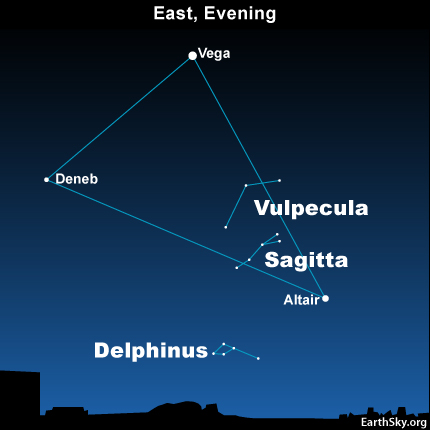
The Summer Triangle is not a constellation but a large asterism consisting of three bright stars in three separate constellations. These stars are Vega, Deneb and Altair. If you can find the Summer Triangle, you can use it to locate three of the sky’s smallest constellations: Vulpecula the Fox, Delphinus the Dolphin and Sagitta the Arrow. All three would be impossible to see from the city, but they’re lots of fun to see in a dark sky.

How can you find them? Look at the detailed chart below, and try picking out Vega, Deneb and Altair. Notice the large triangle they make if you draw lines between them. This triangle pattern – which is easily found in the sky on Northern Hemisphere summer evenings – is the Summer Triangle.

Now – still using the chart at the bottom of this post – or maybe after purchasing this awesome constellation chart from the store at Skyandtelescope.org – look within and around the Summer Triangle for Delphinus, Sagitta and Vulpecula.

Delphinus is a truly delightful little constellation that really resembles a dolphin leaping among the waves. Delphinus is one of the earliest constellations, first catalogued by the Greek astronomer Ptolemy in the second century. Sometimes, Delphinus is said to be the Dolphin that carried a Greek poet – Arion – safely away from his enemies. Other times, this sky Dolphin is said to represent the dolphin sent by the sea god Poseidon to find Amphitrite, the Nereid he wanted to marry.

Sagitta – the third smallest constellation in our sky – is near Vulpecula on the sky’s dome. Its name means “the arrow” in Latin. If you look for Sagitta, you’ll see why. This little star pattern does have a shape reminiscent of an arrow. Sagitta is also one of the earliest constellations, named by Ptolemy in the second century. Sagitta is sometimes said to be an arrow shot from the bow of Hercules, a mythological hero and god.

Vulpecula means “the little fox” in Latin, and it’s the hardest to find of these three small constellations because it lacks a distinctive shape. Vulpecula is a relatively new constellation, introduced by the Polish astronomer Johannes Hevelius in the late 17th century. If you’re up for a binocular challenge, also try finding the Coathanger asterism in Vulpecula.

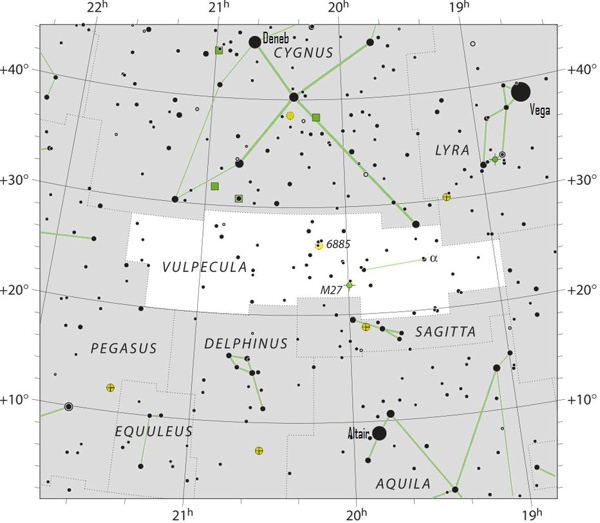
Star chart, black stars on light background, of constellation Vulpecula.

View larger. | Once you’re familiar with the Summer Triangle, star-hop from there to the nearby small constellations. Chart via IAU and Sky & Telescope (Roger Sinnott & Rick Fienberg)/Wikimedia Commons.

Want more about the Summer Triangle? Check out these articles.

Part 1: Vega and its constellation Lyra

Part 2: Deneb and its constellation Cygnus

Part 3: Altair and its constellation Aquila

Bottom line: You need a dark country sky to see these 3 small constellations: Vulpecula the Fox, Delphinus the Dolphin and Sagitta the Arrow.


from EarthSky https://ift.tt/30PY3d8

The Summer Triangle is not a constellation but a large asterism consisting of three bright stars in three separate constellations. These stars are Vega, Deneb and Altair. If you can find the Summer Triangle, you can use it to locate three of the sky’s smallest constellations: Vulpecula the Fox, Delphinus the Dolphin and Sagitta the Arrow. All three would be impossible to see from the city, but they’re lots of fun to see in a dark sky.

How can you find them? Look at the detailed chart below, and try picking out Vega, Deneb and Altair. Notice the large triangle they make if you draw lines between them. This triangle pattern – which is easily found in the sky on Northern Hemisphere summer evenings – is the Summer Triangle.

Now – still using the chart at the bottom of this post – or maybe after purchasing this awesome constellation chart from the store at Skyandtelescope.org – look within and around the Summer Triangle for Delphinus, Sagitta and Vulpecula.

Delphinus is a truly delightful little constellation that really resembles a dolphin leaping among the waves. Delphinus is one of the earliest constellations, first catalogued by the Greek astronomer Ptolemy in the second century. Sometimes, Delphinus is said to be the Dolphin that carried a Greek poet – Arion – safely away from his enemies. Other times, this sky Dolphin is said to represent the dolphin sent by the sea god Poseidon to find Amphitrite, the Nereid he wanted to marry.

Sagitta – the third smallest constellation in our sky – is near Vulpecula on the sky’s dome. Its name means “the arrow” in Latin. If you look for Sagitta, you’ll see why. This little star pattern does have a shape reminiscent of an arrow. Sagitta is also one of the earliest constellations, named by Ptolemy in the second century. Sagitta is sometimes said to be an arrow shot from the bow of Hercules, a mythological hero and god.

Vulpecula means “the little fox” in Latin, and it’s the hardest to find of these three small constellations because it lacks a distinctive shape. Vulpecula is a relatively new constellation, introduced by the Polish astronomer Johannes Hevelius in the late 17th century. If you’re up for a binocular challenge, also try finding the Coathanger asterism in Vulpecula.

Star chart, black stars on light background, of constellation Vulpecula.

View larger. | Once you’re familiar with the Summer Triangle, star-hop from there to the nearby small constellations. Chart via IAU and Sky & Telescope (Roger Sinnott & Rick Fienberg)/Wikimedia Commons.

Want more about the Summer Triangle? Check out these articles.

Part 1: Vega and its constellation Lyra

Part 2: Deneb and its constellation Cygnus

Part 3: Altair and its constellation Aquila

Bottom line: You need a dark country sky to see these 3 small constellations: Vulpecula the Fox, Delphinus the Dolphin and Sagitta the Arrow.


from EarthSky https://ift.tt/30PY3d8

New moon is July 20, 2020

Extremely thin, threadlike crescent against blue background.

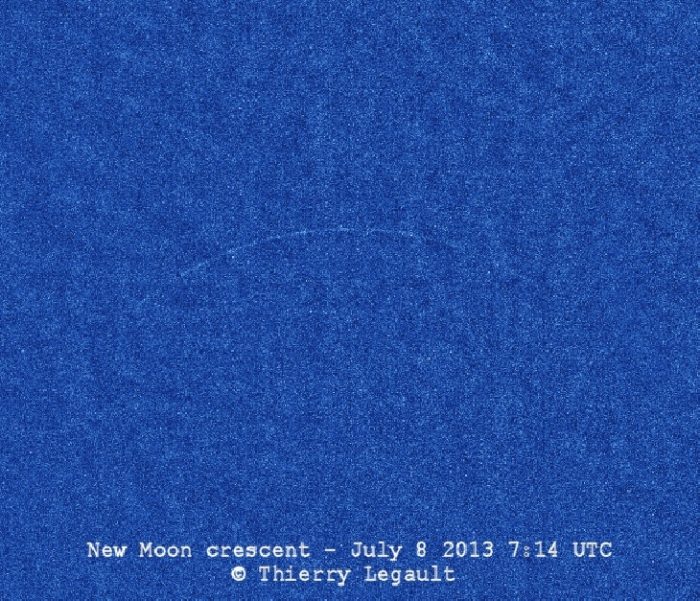
Youngest possible lunar crescent, with the moon’s age being exactly zero when this photo was taken – at the instant of new moon – 07:14 UTC on July 8, 2013. Image by Thierry Legault.

When the moon is new, it’s most nearly between the Earth and sun for any particular month. There’s a new moon about once a month, because the moon takes about a month to orbit Earth. Most of the time, the new moon passes not in front of the sun, but simply near it in our sky. That’s why, in most months, there’s no solar eclipse. In June 2020, however, the moon will pass dead-on in front of the sun, causing an annular – or ring – solar eclipse. Read more about the solar eclipse here.

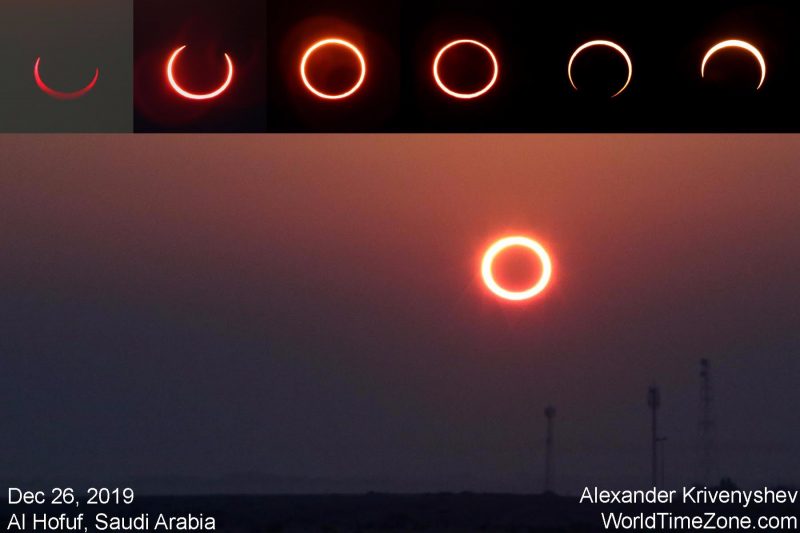
Annular solar eclipse.

View at EarthSky Community Photos. | Annular solar eclipse of December 26, 2019. Alexander Krivenyshev of the website WorldTimeZone.com caught it at Al Hofuf, Saudi Arabia. Thank you, Alexander! Read more about the June 21, 2020 annular solar eclipse.

The photo of a new moon at the top of this page shows the moon as it passed near the sun on July 8, 2013. There was no eclipse that day; it was an ordinary new moon.

New moons typically can’t be seen, or at least they can’t without special equipment and a lot of moon-photography experience. Thierry Legault was able to catch the photo at top – the moon at the instant it was new – because the moon that month passed to one side of the sun, and the faintest of lunar crescents was visible.

Either way – in front of the sun or just near it – on the day of new moon, the moon travels across the sky with the sun during the day, hidden in the sun’s glare.

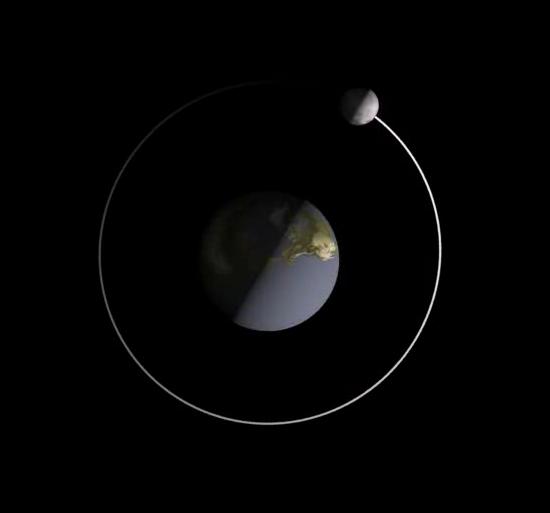
Half-lit Earth from north, and half-lit moon with divisions between dark and light sides lined up.

Click here to see animation. As seen from the north side of the moon’s orbital plane, the Earth rotates counterclockwise on its rotational axis, and the moon revolves counterclockwise around Earth. In the linked animation note that the new moon happens when the moon is on the same side of Earth as the sun.

Some people use the term new moon for a thin crescent moon visible in the west after sunset. You always see these little crescents – which set shortly after the sun – a day or two after each month’s new moon. Astronomers don’t call these little crescent moons new moons, however. In the language of astronomy, this slim crescent is called a young moon.

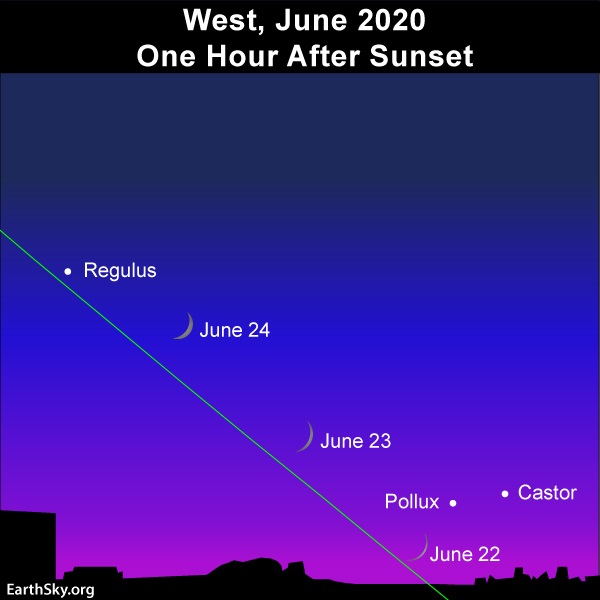
The June 2020 young moon will sweep from the twin stars Castor and Pollux toward Regulus in the few days following new moon.

Positions of young moon relative to Castor, Pollux, and Regulus.

The young moon and stars in June, 2020. Beginning around June 22, watch day by day for a wider waxing crescent moon to be higher up at sunset, and to stay out longer after sundown.

New moons, and young moons, are fascinating to many. The Farmer’s Almanac, for example, still offers information on gardening by the moon. And many cultures have holidays based on moon phases.

Bottom line: New moons generally can’t be seen. They cross the sky with the sun during the day. This month’s new moon happens on July 20 at 17:32 UTC. Afterward – beginning around July 21 – the moon will return to the evening sky.

Read more: What’s the youngest moon you can see?

Read more: Top 4 keys to understanding moon phases

Help EarthSky keep going! Please donate.


from EarthSky https://ift.tt/2QpMvsB
Extremely thin, threadlike crescent against blue background.

Youngest possible lunar crescent, with the moon’s age being exactly zero when this photo was taken – at the instant of new moon – 07:14 UTC on July 8, 2013. Image by Thierry Legault.

When the moon is new, it’s most nearly between the Earth and sun for any particular month. There’s a new moon about once a month, because the moon takes about a month to orbit Earth. Most of the time, the new moon passes not in front of the sun, but simply near it in our sky. That’s why, in most months, there’s no solar eclipse. In June 2020, however, the moon will pass dead-on in front of the sun, causing an annular – or ring – solar eclipse. Read more about the solar eclipse here.

Annular solar eclipse.

View at EarthSky Community Photos. | Annular solar eclipse of December 26, 2019. Alexander Krivenyshev of the website WorldTimeZone.com caught it at Al Hofuf, Saudi Arabia. Thank you, Alexander! Read more about the June 21, 2020 annular solar eclipse.

The photo of a new moon at the top of this page shows the moon as it passed near the sun on July 8, 2013. There was no eclipse that day; it was an ordinary new moon.

New moons typically can’t be seen, or at least they can’t without special equipment and a lot of moon-photography experience. Thierry Legault was able to catch the photo at top – the moon at the instant it was new – because the moon that month passed to one side of the sun, and the faintest of lunar crescents was visible.

Either way – in front of the sun or just near it – on the day of new moon, the moon travels across the sky with the sun during the day, hidden in the sun’s glare.

Half-lit Earth from north, and half-lit moon with divisions between dark and light sides lined up.

Click here to see animation. As seen from the north side of the moon’s orbital plane, the Earth rotates counterclockwise on its rotational axis, and the moon revolves counterclockwise around Earth. In the linked animation note that the new moon happens when the moon is on the same side of Earth as the sun.

Some people use the term new moon for a thin crescent moon visible in the west after sunset. You always see these little crescents – which set shortly after the sun – a day or two after each month’s new moon. Astronomers don’t call these little crescent moons new moons, however. In the language of astronomy, this slim crescent is called a young moon.

The June 2020 young moon will sweep from the twin stars Castor and Pollux toward Regulus in the few days following new moon.

Positions of young moon relative to Castor, Pollux, and Regulus.

The young moon and stars in June, 2020. Beginning around June 22, watch day by day for a wider waxing crescent moon to be higher up at sunset, and to stay out longer after sundown.

New moons, and young moons, are fascinating to many. The Farmer’s Almanac, for example, still offers information on gardening by the moon. And many cultures have holidays based on moon phases.

Bottom line: New moons generally can’t be seen. They cross the sky with the sun during the day. This month’s new moon happens on July 20 at 17:32 UTC. Afterward – beginning around July 21 – the moon will return to the evening sky.

Read more: What’s the youngest moon you can see?

Read more: Top 4 keys to understanding moon phases

Help EarthSky keep going! Please donate.


from EarthSky https://ift.tt/2QpMvsB

News digest – smoking ban, HPV and prostate cancer, genetic testing and plain packaging

Cigarette in ashtray

With news about the coronavirus pandemic developing daily, we want to make sure everyone affected by cancer gets the information they need during this time. 

We’re pulling together the latest government and NHS health updates from across the UK in a separate blog post, which we’re updating regularly. 

Smoking ban outside pubs and restaurants  

Wales’ health minister announced potential plans to ban smoking outside pubs, cafés and restaurants in Wales, reports BBC News.

Peers have urged ministers to consider similar measures. Our director of prevention, Alison Cox, said that being stuck in a queue or outside a café, escaping second hand smoke isn’t an easy option anymore. “Tobacco remains the leading cause of cancer in the UK, and if the government wants to achieve its goal of 5% smoking prevalence by 2020, we need to support people to quit. Better regulation of smokefree environments wherever people gather merits further consideration.”

Precision medicine develops targeted lung cancer treatment 

Results from a Cancer Research UK-funded precision medicine trial has revealed more about how different non small cell lung cancers respond to targeted treatments, as our blog post explains. 

Targeted treatment for leukaemia approved for NHS  

A new targeted treatment for acute myeloid leukaemia (AML) is now an option for some adults on NHS England, after new data analysis confirmed the gilteritinib could be considered a life-extending therapy. Get the full story in our news report.  

BRCA gene testing could help prevent cancer deaths  

The Times (£) and iNews report on research estimating the cost-effectiveness of testing all women for faulty versions of the BRCA genes, which are known to increase the risk of breast and ovarian cancers. Results suggest that UK-wide BRCA testing could help to prevent tens of thousands of cancer deaths by identifying those at greater risk of developing the disease.

Experts have praised the findings as an important step forward but said that further research is needed to assess the impact, in particular the potential for over diagnosis and treatment, as well as steps to manage the anxiety the programme might cause for people who test positive.

Scientists claim link between HPV and prostate cancer 

A new review from Australian researchers claims that the human papillomavirus (HPV) – known to cause most cervical cancers and some other cancers, including penile and anal cancer – may also cause prostate cancer. 

But despite the headlines, the review didn’t add anything new to suggest that HPV infection causes prostate cancer or that HPV vaccinations should be encouraged for other cancer types. Commenting on the research, our health information manager, Karis Betts, added that no actual mechanism by which the virus causes prostate cancer was proposed, and they drew their conclusions from just 26 papers.  

“A review of this type is only as useful as the papers included in it, which unfortunately only looked at whether people with prostate cancer had HPV, not whether people with HPV went on to develop prostate cancer more often than those without it.” 

UK tobacco sales fell in response to plain packaging 

New reports show cigarettes sales fell by about 20 million in the month after plain packaging rules and increased taxes were introduced. Research funded by us and the British Heart Foundation also revealed that overall revenue for the tobacco industry dropped by 13% in the same month. Medical experts are urging governments around the world to consider plain packaging as an effective way of de-incentivising smoking. More on this at The Guardian.  

And finally…. 

Our chief executive officer, Michelle Mitchell, has revealed our new 3-year plan to help us rebuild and adapt to our drop income through the COVID-19 pandemic. Find out more about our post-COVID strategy in our blog post.  

Scarlett Sangster is a writer for PA Media Group


from Cancer Research UK – Science blog https://ift.tt/2DRYA8l
Cigarette in ashtray

With news about the coronavirus pandemic developing daily, we want to make sure everyone affected by cancer gets the information they need during this time. 

We’re pulling together the latest government and NHS health updates from across the UK in a separate blog post, which we’re updating regularly. 

Smoking ban outside pubs and restaurants  

Wales’ health minister announced potential plans to ban smoking outside pubs, cafés and restaurants in Wales, reports BBC News.

Peers have urged ministers to consider similar measures. Our director of prevention, Alison Cox, said that being stuck in a queue or outside a café, escaping second hand smoke isn’t an easy option anymore. “Tobacco remains the leading cause of cancer in the UK, and if the government wants to achieve its goal of 5% smoking prevalence by 2020, we need to support people to quit. Better regulation of smokefree environments wherever people gather merits further consideration.”

Precision medicine develops targeted lung cancer treatment 

Results from a Cancer Research UK-funded precision medicine trial has revealed more about how different non small cell lung cancers respond to targeted treatments, as our blog post explains. 

Targeted treatment for leukaemia approved for NHS  

A new targeted treatment for acute myeloid leukaemia (AML) is now an option for some adults on NHS England, after new data analysis confirmed the gilteritinib could be considered a life-extending therapy. Get the full story in our news report.  

BRCA gene testing could help prevent cancer deaths  

The Times (£) and iNews report on research estimating the cost-effectiveness of testing all women for faulty versions of the BRCA genes, which are known to increase the risk of breast and ovarian cancers. Results suggest that UK-wide BRCA testing could help to prevent tens of thousands of cancer deaths by identifying those at greater risk of developing the disease.

Experts have praised the findings as an important step forward but said that further research is needed to assess the impact, in particular the potential for over diagnosis and treatment, as well as steps to manage the anxiety the programme might cause for people who test positive.

Scientists claim link between HPV and prostate cancer 

A new review from Australian researchers claims that the human papillomavirus (HPV) – known to cause most cervical cancers and some other cancers, including penile and anal cancer – may also cause prostate cancer. 

But despite the headlines, the review didn’t add anything new to suggest that HPV infection causes prostate cancer or that HPV vaccinations should be encouraged for other cancer types. Commenting on the research, our health information manager, Karis Betts, added that no actual mechanism by which the virus causes prostate cancer was proposed, and they drew their conclusions from just 26 papers.  

“A review of this type is only as useful as the papers included in it, which unfortunately only looked at whether people with prostate cancer had HPV, not whether people with HPV went on to develop prostate cancer more often than those without it.” 

UK tobacco sales fell in response to plain packaging 

New reports show cigarettes sales fell by about 20 million in the month after plain packaging rules and increased taxes were introduced. Research funded by us and the British Heart Foundation also revealed that overall revenue for the tobacco industry dropped by 13% in the same month. Medical experts are urging governments around the world to consider plain packaging as an effective way of de-incentivising smoking. More on this at The Guardian.  

And finally…. 

Our chief executive officer, Michelle Mitchell, has revealed our new 3-year plan to help us rebuild and adapt to our drop income through the COVID-19 pandemic. Find out more about our post-COVID strategy in our blog post.  

Scarlett Sangster is a writer for PA Media Group


from Cancer Research UK – Science blog https://ift.tt/2DRYA8l

Altair and Aquila the Eagle

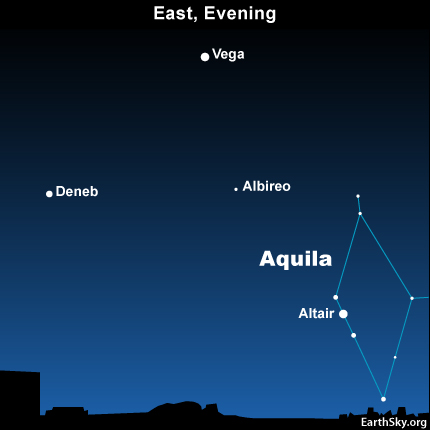
In the east after dark on these July evenings, look near the horizon for Altair, the brightest star in the constellation Aquila the Eagle. This is the bottom star of the Summer Triangle; that is, it’s the last of these three bright stars to ascend over the horizon. This star is 16.7 light-years from our sun and is one of the closest stars visible to the unaided eye.

You will recognize Altair by the two fainter stars on either side of it. In her classic book “The Friendly Stars” (1907), Martha Evans Martin described the three this way:

Then there comes a soft June evening, with its lovely twilight that begins with the last song of the woodthrush and ends with the first strenuous admonitions of the whippoorwill; and, almost as if it were an impulse of nature, one walks to the eastern end of the porch and looks for Altair. It is sure to be there smiling at one just over the tree-tops, with a bright companion on either side, the three gently advancing in a straight line as if they were walking the Milky Way hand in hand and three abreast.

And indeed the Great Rift of the summer Milky Way passes through the Summer Triangle, between the stars Vega and Altair. In dark skies in June, July and August, you can see rich star fields with your binoculars on both sides of the Great Rift.

In modern western culture, Altair is probably best known for being the home star system of the aliens in the 1956 science fiction film “Forbidden Planet”. But in Asian cultures, Altair and the star Vega figure in one of the most beautiful of all stories of the night sky. In Japan, for example, Vega is sometimes called Tanabata (or Orihime), a celestial princess or goddess. She falls in love with a mortal, Kengyu (or Hikoboshi), represented by the star Altair. Read the rest of the story here.

The whole Summer Triangle area is great to observe with binoculars or in dark skies with just your eyes. If you like finding hidden pictures, get set to find a Coathanger, the North American Nebula (NGC7000) and the Ring Nebula (M57).

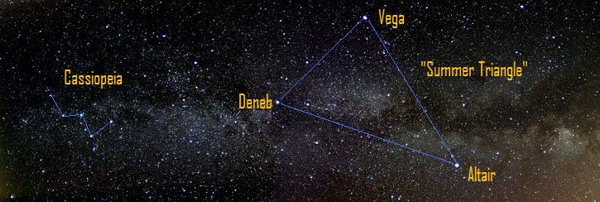
Panorama of Milky Way with dark streak along middle and Summer Triangle lines drawn in, Cassiopeia to one side.

The Great Rift of the Milky Way passes through the constellation Cassiopeia and the Summer Triangle.

Our Summer Triangle series also includes:

Part 1: Vega and its constellation Lyra

Part 2: Deneb and its constellation Cygnus

Bottom line: The star Altair in Aquila the Eagle appears in the east on July evenings. You’ll recognize it by the 2 fainter stars on either side of it.

Donate: Your support means the world to us


from EarthSky https://ift.tt/2GmEdhV

In the east after dark on these July evenings, look near the horizon for Altair, the brightest star in the constellation Aquila the Eagle. This is the bottom star of the Summer Triangle; that is, it’s the last of these three bright stars to ascend over the horizon. This star is 16.7 light-years from our sun and is one of the closest stars visible to the unaided eye.

You will recognize Altair by the two fainter stars on either side of it. In her classic book “The Friendly Stars” (1907), Martha Evans Martin described the three this way:

Then there comes a soft June evening, with its lovely twilight that begins with the last song of the woodthrush and ends with the first strenuous admonitions of the whippoorwill; and, almost as if it were an impulse of nature, one walks to the eastern end of the porch and looks for Altair. It is sure to be there smiling at one just over the tree-tops, with a bright companion on either side, the three gently advancing in a straight line as if they were walking the Milky Way hand in hand and three abreast.

And indeed the Great Rift of the summer Milky Way passes through the Summer Triangle, between the stars Vega and Altair. In dark skies in June, July and August, you can see rich star fields with your binoculars on both sides of the Great Rift.

In modern western culture, Altair is probably best known for being the home star system of the aliens in the 1956 science fiction film “Forbidden Planet”. But in Asian cultures, Altair and the star Vega figure in one of the most beautiful of all stories of the night sky. In Japan, for example, Vega is sometimes called Tanabata (or Orihime), a celestial princess or goddess. She falls in love with a mortal, Kengyu (or Hikoboshi), represented by the star Altair. Read the rest of the story here.

The whole Summer Triangle area is great to observe with binoculars or in dark skies with just your eyes. If you like finding hidden pictures, get set to find a Coathanger, the North American Nebula (NGC7000) and the Ring Nebula (M57).

Panorama of Milky Way with dark streak along middle and Summer Triangle lines drawn in, Cassiopeia to one side.

The Great Rift of the Milky Way passes through the constellation Cassiopeia and the Summer Triangle.

Our Summer Triangle series also includes:

Part 1: Vega and its constellation Lyra

Part 2: Deneb and its constellation Cygnus

Bottom line: The star Altair in Aquila the Eagle appears in the east on July evenings. You’ll recognize it by the 2 fainter stars on either side of it.

Donate: Your support means the world to us


from EarthSky https://ift.tt/2GmEdhV

adds 2