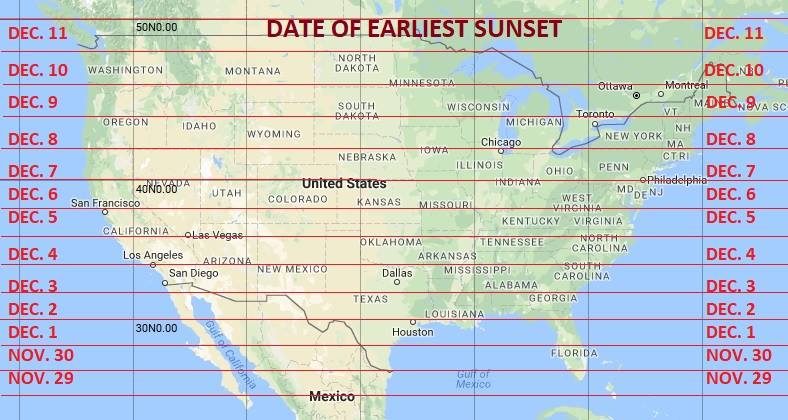
For the southernmost U.S and similar latitudes – around 30 degrees N. latitude – the earliest sunsets of the year happen in late November and early December. For latitudes further north – around 40 degrees N. latitude – the year’s earliest sunsets happen around December 7. That would be the latitude of New York City; Philadelphia, Pennsylvania; Kansas City, Missouri; Denver, Colorado; Reno, Nevada; Beijing, China; Madrid, Spain; Naples, Italy.
Southern Hemisphere? For 40 degrees S. latitude, the year’s earliest sunrises happen around December 7, as you progress toward your year’s longest day at the December solstice.
Closer to the Arctic and Antarctic Circles, the earliest sunset and earliest sunrise happen nearer the solstice.
The exact date of the Northern Hemisphere’s earliest sunset and the Southern Hemisphere’s earliest sunrise varies by latitude. But, at temperate latitudes, both of these annual hallmarks in our sky come a few to several weeks before the December solstice, not on the solstice as you might expect.
Stephen Aman shared his map of the United States that lists the dates of the year’s earliest sunset for various latitudes. Thank you Stephen!
Have an optical aid? Try spotting Neptune, the solar system’s farthest planet, close to the red planet Mars on the sky’s dome. On December 7, 2018, Mars and Neptune showcase the closest conjunction of two planets in all of 2018. Read more.
The next solstice in 2018 comes on December 21 and marks an unofficial beginning for winter in the Northern Hemisphere. For this hemisphere, this upcoming solstice brings the shortest day and longest night of the year.
Why isn’t the earliest sunset on the year’s shortest day?
It’s because of the discrepancy between the clock and the sun. A clock ticks off exactly 24 hours from one noon to the next. But an actual day – as measured by the spin of the Earth, from what is called one “solar noon” to the next – rarely equals 24 hours exactly.
Solar noon is also called simply midday. It refers to that instant when the sun reaches its highest point for the day. In the month of December, the time period from one solar noon to the next is actually half a minute longer than 24 hours. On December 7, the sun reaches its noontime position at 11:52 a.m. local standard time. Two weeks later – on the winter solstice – the sun will reach its noontime position around 11:59 a.m. That’s 7 minutes later than on December 7.
Click here to know the clock time for sunrise, solar noon and sunset plus day length in your part of the world, remembering to check the solar noon and day length boxes.
The later clock time for solar noon also means a later clock time for sunrise and sunset. The table below helps to explain.
For Philadelphia, Pennsylvania
Date
Sunrise
Solar Noon (Midday)
Sunset
Daylight Hours
December 7
7:09 a.m.
11:52 a.m.
4:35 p.m.
9 hours 27 minutes
December 21
7:19 a.m.
11:59 a.m.
4:39 p.m.
9 hours 21 minutes
As you might have guessed, the latest sunrises and sunsets aren’t on the day of the solstice either. For middle latitudes in the Northern Hemisphere, the latest sunrises come in early January.
So there’s variation in the exact dates, but the sequence is always the same for both hemispheres. First: earliest sunset before the winter solstice, the winter solstice itself, latest sunrise after the winter solstice. Half a year later: earliest sunrise before the summer solstice, the summer solstice itself, latest sunset.
The earliest and latest sunsets and sunrises are lovely phenomena that happen around every solstice. People around the world notice them and often ask about them.
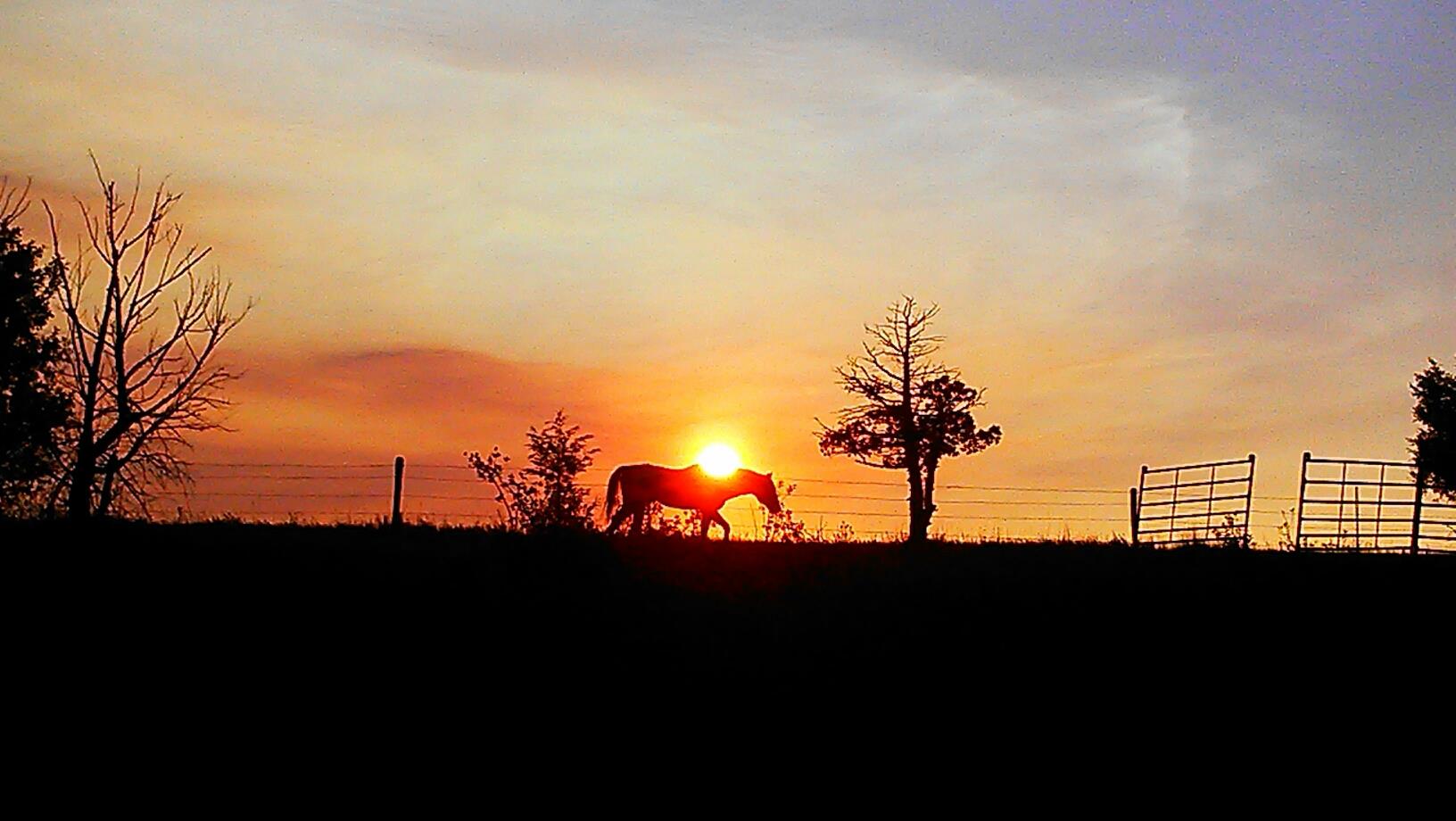
EarthSky Facebook friend Dutch McClintock in Livingston, Montana took this photo. Livingston’s latitude is about 45 degrees N., so – for Dutch and all those living at that latitude – the earliest sunset will happen closer to the December solstice.
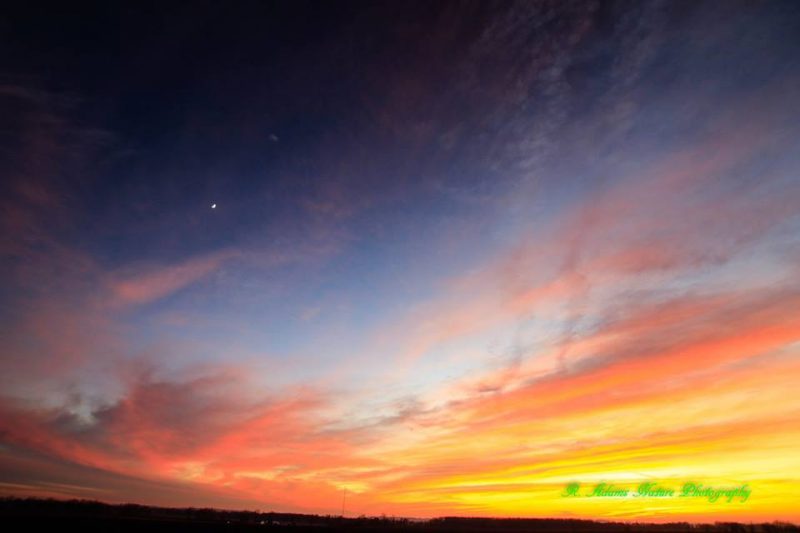
December sunset in Pike County, Illinois via Russ Adams. The earliest sunsets for this location happen in early December.
Hong Kong sunset, at the Hong Kong Science Park, from Kins Cheung. Hong Kong is at 22 degrees N. latitude, so the earliest sunset there has already happened.
Sunset in Manila by EarthSky Facebook frieind Jv Noriega. Manila is at 14 degrees N. latitude, so the earliest sunset there happens even earlier than in Hong Kong
Bottom line: The 2018 solstice comes on December 21, but the earliest sunsets at mid-northern latitudes – say, 40 degrees N. happen on or near December 7. Latitudes closer to the equator had their earliest sunset in late November, or earlier in December. Latitudes closer to the Arctic Circle have their earliest sunset closer to the December solstice.
For the southernmost U.S and similar latitudes – around 30 degrees N. latitude – the earliest sunsets of the year happen in late November and early December. For latitudes further north – around 40 degrees N. latitude – the year’s earliest sunsets happen around December 7. That would be the latitude of New York City; Philadelphia, Pennsylvania; Kansas City, Missouri; Denver, Colorado; Reno, Nevada; Beijing, China; Madrid, Spain; Naples, Italy.
Southern Hemisphere? For 40 degrees S. latitude, the year’s earliest sunrises happen around December 7, as you progress toward your year’s longest day at the December solstice.
Closer to the Arctic and Antarctic Circles, the earliest sunset and earliest sunrise happen nearer the solstice.
The exact date of the Northern Hemisphere’s earliest sunset and the Southern Hemisphere’s earliest sunrise varies by latitude. But, at temperate latitudes, both of these annual hallmarks in our sky come a few to several weeks before the December solstice, not on the solstice as you might expect.
Stephen Aman shared his map of the United States that lists the dates of the year’s earliest sunset for various latitudes. Thank you Stephen!
Have an optical aid? Try spotting Neptune, the solar system’s farthest planet, close to the red planet Mars on the sky’s dome. On December 7, 2018, Mars and Neptune showcase the closest conjunction of two planets in all of 2018. Read more.
The next solstice in 2018 comes on December 21 and marks an unofficial beginning for winter in the Northern Hemisphere. For this hemisphere, this upcoming solstice brings the shortest day and longest night of the year.
Why isn’t the earliest sunset on the year’s shortest day?
It’s because of the discrepancy between the clock and the sun. A clock ticks off exactly 24 hours from one noon to the next. But an actual day – as measured by the spin of the Earth, from what is called one “solar noon” to the next – rarely equals 24 hours exactly.
Solar noon is also called simply midday. It refers to that instant when the sun reaches its highest point for the day. In the month of December, the time period from one solar noon to the next is actually half a minute longer than 24 hours. On December 7, the sun reaches its noontime position at 11:52 a.m. local standard time. Two weeks later – on the winter solstice – the sun will reach its noontime position around 11:59 a.m. That’s 7 minutes later than on December 7.
Click here to know the clock time for sunrise, solar noon and sunset plus day length in your part of the world, remembering to check the solar noon and day length boxes.
The later clock time for solar noon also means a later clock time for sunrise and sunset. The table below helps to explain.
For Philadelphia, Pennsylvania
Date
Sunrise
Solar Noon (Midday)
Sunset
Daylight Hours
December 7
7:09 a.m.
11:52 a.m.
4:35 p.m.
9 hours 27 minutes
December 21
7:19 a.m.
11:59 a.m.
4:39 p.m.
9 hours 21 minutes
As you might have guessed, the latest sunrises and sunsets aren’t on the day of the solstice either. For middle latitudes in the Northern Hemisphere, the latest sunrises come in early January.
So there’s variation in the exact dates, but the sequence is always the same for both hemispheres. First: earliest sunset before the winter solstice, the winter solstice itself, latest sunrise after the winter solstice. Half a year later: earliest sunrise before the summer solstice, the summer solstice itself, latest sunset.
The earliest and latest sunsets and sunrises are lovely phenomena that happen around every solstice. People around the world notice them and often ask about them.
EarthSky Facebook friend Dutch McClintock in Livingston, Montana took this photo. Livingston’s latitude is about 45 degrees N., so – for Dutch and all those living at that latitude – the earliest sunset will happen closer to the December solstice.
December sunset in Pike County, Illinois via Russ Adams. The earliest sunsets for this location happen in early December.
Hong Kong sunset, at the Hong Kong Science Park, from Kins Cheung. Hong Kong is at 22 degrees N. latitude, so the earliest sunset there has already happened.
Sunset in Manila by EarthSky Facebook frieind Jv Noriega. Manila is at 14 degrees N. latitude, so the earliest sunset there happens even earlier than in Hong Kong
Bottom line: The 2018 solstice comes on December 21, but the earliest sunsets at mid-northern latitudes – say, 40 degrees N. happen on or near December 7. Latitudes closer to the equator had their earliest sunset in late November, or earlier in December. Latitudes closer to the Arctic Circle have their earliest sunset closer to the December solstice.
If lung cancers are found at an early stage, the chance of treating them successfully is higher. In part one of this series, we discussed clinical trials that have tested if CT scans could be used for lung screening. In part two, we investigate research that’s happening right now in the hunt for better ways to detect lung cancers early and give people a better chance of surviving.
Reducing the harms of lung screening
There are two main disadvantages to screening for early lung cancers, which have mostly been discovered through research on CT scans.
Screening uses a test to detect signs of a disease in people without symptoms. But some people can end up having unnecessary tests when what’s found isn’t serious (a ‘false positive’). Others will receive unnecessary treatment for tumours that never would have caused them any harm, so-called overdiagnosis and overtreatment.
This means unnecessary surgery, radiotherapy and chemotherapy for some, which can be dangerous with long-lasting side effects – especially for older, frailer patients.
That’s why doctors and researchers have been scrutinising how to better interpret lung CT scans. In the time that has passed since the first major lung cancer screening trial was carried out, doctors have learned much more about how lung cancers might behave differently. And those results are beginning to unravel the differences between abnormalities that are more likely to be cancer and those that aren’t.
We can more accurately identify nodules that don’t need further investigation. And researchers are developing new and better software too, so computers will be able to analyse scans and give an immediate result
– Professor Sam Janes, UCL and University College London Hospitals NHS Foundation Trust
Professor Sam Janes, a specialist consultant at the Cancer Research UK Lung Cancer Centre of Excellence, is one of those doctors. And he says a lot has changed in low dose CT scans since the large US National Lung Screening Trial opened in 2002.
The characteristics of a lung abnormality (called a nodule), including its size, shape and how quickly it grows, can help tell how likely that growth is to be cancer, says Janes.
“We understand a lot better now what a harmless nodule looks and behaves like compared to an aggressive cancer.
“We can more accurately identify nodules that don’t need further investigation. And researchers are developing new and better software too, so computers will be able to analyse scans and give an immediate result.
“That will lessen the anxiety of waiting, plus computers will probably be better than the human eye at working out if a growth is risky or not,” he adds.
Experts have pulled together this information and drawn up clinical guidelines for doctors to help them identify harmless nodules, nodules that need monitoring, and those that are likely to be cancer and need further investigation. This is helping doctors give better advice on what treatment or monitoring to pursue. While the guidelines weren’t developed for screening, the information is being used to help design studies that test screening. And doctors can have these guidelines at their fingertips during clinics, thanks to a smartphone app we developed.
Janes has also just announced he will be leading the latest, and largest, UK lung cancer screening study at University College London Hospitals NHS Foundation Trust (UCLH) and UCL. Based in London, a key part of the SUMMIT study will invite around 25,000 smokers or former smokers aged 50-77 to have a CT scan as part of a lung ‘health check’.
Other researchers are trying to work out how to tailor any potential future screening invitations, by finding people whose medical history suggests they’re at higher risk of lung cancer. Professor David Baldwin is a Nottingham-based lung cancer expert we’re funding to work with researchers in the Netherlands and Leeds. They’ll be analysing large, anonymised databases of electronic GP records, looking for hallmarks of people who go on to develop lung cancer, and testing how to accurately identify others at risk.
Another long-standing challenge of screening with CT scans is that the procedure exposes people to damage from radiation, especially if they have repeat scans. But thanks to better technology that gives off lower doses of radiation, this exposure is falling.
So, research is steadily reducing the risks posed by radiation and false alarms in low dose CT screening for people at high risk of lung cancer, and working out who to invite.
In the meantime, could new technology complement the information gleaned from scans, or potentially even replace them?
New technology – blood and breath tests
One idea that scientists are pursuing is looking for small traces of cancer in blood samples.
As cancer develops and grows it can shed detectable signs into the blood, including tumour cells, strands of tumour DNA and its chemical cousin RNA, and tiny DNA-filled sacs called exosomes. Scientists want to find out if these traces can be fished out of blood samples to detect lung cancers early.
A blood test for DNA shed by cancer cells has shown potential to be better than scans at spotting early signs that a patient’s lung cancer has come back after treatment. In this scenario, researchers have a sample of the original lung tumour and know what to look for in the blood. So it’s a far-cry from using blood tests in healthy people without symptoms.
In our experience, not all tumours behave the same, some release more DNA than others. And in lung cancer the ones that release the most DNA may unfortunately be the most aggressive
– Dr Chris Abbosh, Cancer Research UK-funded scientist
“There’s lots of excitement at the possibility of finding these tiny traces of DNA in blood samples and using this information alongside other diagnostic tools such as a CT scan to bring more clarity to whether a growth is a dangerous cancer and needs treating,” he says. “But we need more research and development, as there are several barriers we need to overcome with this technology.
“Firstly, we think a tumour would have to be quite big before we’d be able to pick up these tiny traces in a small blood sample – therefore the sensitivity of current tests is an issue now. Plus, in an early detection setting, we wouldn’t have a sample of the tumour to guide what DNA mistakes to look for, so we’d need technology that can probe for hundreds of possible DNA mistakes that can occur in cancer and accurately call their presence or absence with a low degree of error.
“In our experience, not all tumours behave the same, some release more DNA than others. And in lung cancer the ones that release the most DNA may unfortunately be the most aggressive. We need to understand more about the relationship between tumour DNA release, cancer type and how a cancer behaves to determine how useful DNA detection will be for screening purposes.”
But technology is improving all the time. And researchers can now separate out small numbers of cancer cells or amounts of tumour DNA from blood that were impossible to detect even just a few years ago. In a second part of their London-based SUMMIT study, Janes and his team, working in collaboration with a US company called GRAIL, will be looking at the potential for a blood test to detect multiple cancers earlier, including lung cancer.
Researchers are also looking at alternative approaches to fishing out faulty tumour DNA – some are looking for changes in chemical tags put on DNA (called DNA methylation) and others are examining how changes in our immune system might act as a sign that cancer is developing.
Just as cancers can leave a trace in blood samples, they can also release tell-tale signs in the air we breathe out. A spin-out company from Cambridge University, called Owlstone Medical, has developed a breath test that can detect smelly molecules given off by lung cancers. The breath test is being studied in clinical trials to find out whether it’s accurate and sensitive enough to be considered as a potential screening test instead of CT scans.
Another interesting area of research is looking for ‘fingerprints’ of DNA damage in a nose swab. Current and former smokers are at the highest risk of lung cancer, and some interesting research from the US has shown that patterns of genetic mistakes in the DNA of smoke-exposed cells lining the nose and upper airways might indicate lung cancer risk.
The test is still being studied in clinical trials involving people who are having a biopsy to determine if a growth is cancerous or not. And the next steps will be finding out how precise it is in people who don’t have any symptoms.
Both cervical and bowel cancers develop from abnormal cells. And it’s these growths that the screening tests aim to find. In doing so, the tests offer a window of opportunity to remove the cells at the same time, because if they’re left untreated some will go on to become a cancer.
Could a preventative approach work for some lung cancers too?
Lung cancers develop from patches of abnormal cells, called lesions, which can be spotted with a bronchoscope that uses special fluorescent light.
People can be referred for a bronchoscopy for a variety of lung problems. It gives doctors a chance to take a closer look inside the lungs for what’s causing the issues, and sometimes they spot lesions that could develop in to cancer.
This wouldn’t prevent all lung cancers. But if the trial shows a positive result, it could give doctors an extra treatment option in people who have a lesion spotted during a bronchoscopy and potentially prevent some of these lesions going on to become lung cancers.
The road ahead
Tackling lung cancer is one of our urgent priorities, and one way to do this is ensuring that more lung cancers are detected at an early stage when they are more likely to be treated successfully.
Screening is being studied as a potential way to achieve this goal.
Because screening causes harm to people taking part, experts must carefully weigh up the benefits against the harms in everyone being screened. But thanks to research into CT scans and how to interpret them, those risks could be lower for people in future if screening becomes the norm.
There are several other technologies being developed that could also add to the information from a CT scan. They have the potential to give doctors a more accurate picture of the threat a growth poses, and may even replace CT scans as a more reliable test. Hopefully in the future there will be more precise and safer ways for doctors to spot potentially aggressive lung tumours.
For now, it’s a complicated picture and there’s lots to consider. But researchers are working extremely hard to bring more clarity to the situation and improve the outlook for those diagnosed with lung cancer in the future.
Emma
If you’re worried that you are experiencing symptoms of lung cancer, it’s important you get checked by a doctor.
from Cancer Research UK – Science blog https://ift.tt/2KXLkOW
If lung cancers are found at an early stage, the chance of treating them successfully is higher. In part one of this series, we discussed clinical trials that have tested if CT scans could be used for lung screening. In part two, we investigate research that’s happening right now in the hunt for better ways to detect lung cancers early and give people a better chance of surviving.
Reducing the harms of lung screening
There are two main disadvantages to screening for early lung cancers, which have mostly been discovered through research on CT scans.
Screening uses a test to detect signs of a disease in people without symptoms. But some people can end up having unnecessary tests when what’s found isn’t serious (a ‘false positive’). Others will receive unnecessary treatment for tumours that never would have caused them any harm, so-called overdiagnosis and overtreatment.
This means unnecessary surgery, radiotherapy and chemotherapy for some, which can be dangerous with long-lasting side effects – especially for older, frailer patients.
That’s why doctors and researchers have been scrutinising how to better interpret lung CT scans. In the time that has passed since the first major lung cancer screening trial was carried out, doctors have learned much more about how lung cancers might behave differently. And those results are beginning to unravel the differences between abnormalities that are more likely to be cancer and those that aren’t.
We can more accurately identify nodules that don’t need further investigation. And researchers are developing new and better software too, so computers will be able to analyse scans and give an immediate result
– Professor Sam Janes, UCL and University College London Hospitals NHS Foundation Trust
Professor Sam Janes, a specialist consultant at the Cancer Research UK Lung Cancer Centre of Excellence, is one of those doctors. And he says a lot has changed in low dose CT scans since the large US National Lung Screening Trial opened in 2002.
The characteristics of a lung abnormality (called a nodule), including its size, shape and how quickly it grows, can help tell how likely that growth is to be cancer, says Janes.
“We understand a lot better now what a harmless nodule looks and behaves like compared to an aggressive cancer.
“We can more accurately identify nodules that don’t need further investigation. And researchers are developing new and better software too, so computers will be able to analyse scans and give an immediate result.
“That will lessen the anxiety of waiting, plus computers will probably be better than the human eye at working out if a growth is risky or not,” he adds.
Experts have pulled together this information and drawn up clinical guidelines for doctors to help them identify harmless nodules, nodules that need monitoring, and those that are likely to be cancer and need further investigation. This is helping doctors give better advice on what treatment or monitoring to pursue. While the guidelines weren’t developed for screening, the information is being used to help design studies that test screening. And doctors can have these guidelines at their fingertips during clinics, thanks to a smartphone app we developed.
Janes has also just announced he will be leading the latest, and largest, UK lung cancer screening study at University College London Hospitals NHS Foundation Trust (UCLH) and UCL. Based in London, a key part of the SUMMIT study will invite around 25,000 smokers or former smokers aged 50-77 to have a CT scan as part of a lung ‘health check’.
Other researchers are trying to work out how to tailor any potential future screening invitations, by finding people whose medical history suggests they’re at higher risk of lung cancer. Professor David Baldwin is a Nottingham-based lung cancer expert we’re funding to work with researchers in the Netherlands and Leeds. They’ll be analysing large, anonymised databases of electronic GP records, looking for hallmarks of people who go on to develop lung cancer, and testing how to accurately identify others at risk.
Another long-standing challenge of screening with CT scans is that the procedure exposes people to damage from radiation, especially if they have repeat scans. But thanks to better technology that gives off lower doses of radiation, this exposure is falling.
So, research is steadily reducing the risks posed by radiation and false alarms in low dose CT screening for people at high risk of lung cancer, and working out who to invite.
In the meantime, could new technology complement the information gleaned from scans, or potentially even replace them?
New technology – blood and breath tests
One idea that scientists are pursuing is looking for small traces of cancer in blood samples.
As cancer develops and grows it can shed detectable signs into the blood, including tumour cells, strands of tumour DNA and its chemical cousin RNA, and tiny DNA-filled sacs called exosomes. Scientists want to find out if these traces can be fished out of blood samples to detect lung cancers early.
A blood test for DNA shed by cancer cells has shown potential to be better than scans at spotting early signs that a patient’s lung cancer has come back after treatment. In this scenario, researchers have a sample of the original lung tumour and know what to look for in the blood. So it’s a far-cry from using blood tests in healthy people without symptoms.
In our experience, not all tumours behave the same, some release more DNA than others. And in lung cancer the ones that release the most DNA may unfortunately be the most aggressive
– Dr Chris Abbosh, Cancer Research UK-funded scientist
“There’s lots of excitement at the possibility of finding these tiny traces of DNA in blood samples and using this information alongside other diagnostic tools such as a CT scan to bring more clarity to whether a growth is a dangerous cancer and needs treating,” he says. “But we need more research and development, as there are several barriers we need to overcome with this technology.
“Firstly, we think a tumour would have to be quite big before we’d be able to pick up these tiny traces in a small blood sample – therefore the sensitivity of current tests is an issue now. Plus, in an early detection setting, we wouldn’t have a sample of the tumour to guide what DNA mistakes to look for, so we’d need technology that can probe for hundreds of possible DNA mistakes that can occur in cancer and accurately call their presence or absence with a low degree of error.
“In our experience, not all tumours behave the same, some release more DNA than others. And in lung cancer the ones that release the most DNA may unfortunately be the most aggressive. We need to understand more about the relationship between tumour DNA release, cancer type and how a cancer behaves to determine how useful DNA detection will be for screening purposes.”
But technology is improving all the time. And researchers can now separate out small numbers of cancer cells or amounts of tumour DNA from blood that were impossible to detect even just a few years ago. In a second part of their London-based SUMMIT study, Janes and his team, working in collaboration with a US company called GRAIL, will be looking at the potential for a blood test to detect multiple cancers earlier, including lung cancer.
Researchers are also looking at alternative approaches to fishing out faulty tumour DNA – some are looking for changes in chemical tags put on DNA (called DNA methylation) and others are examining how changes in our immune system might act as a sign that cancer is developing.
Just as cancers can leave a trace in blood samples, they can also release tell-tale signs in the air we breathe out. A spin-out company from Cambridge University, called Owlstone Medical, has developed a breath test that can detect smelly molecules given off by lung cancers. The breath test is being studied in clinical trials to find out whether it’s accurate and sensitive enough to be considered as a potential screening test instead of CT scans.
Another interesting area of research is looking for ‘fingerprints’ of DNA damage in a nose swab. Current and former smokers are at the highest risk of lung cancer, and some interesting research from the US has shown that patterns of genetic mistakes in the DNA of smoke-exposed cells lining the nose and upper airways might indicate lung cancer risk.
The test is still being studied in clinical trials involving people who are having a biopsy to determine if a growth is cancerous or not. And the next steps will be finding out how precise it is in people who don’t have any symptoms.
Both cervical and bowel cancers develop from abnormal cells. And it’s these growths that the screening tests aim to find. In doing so, the tests offer a window of opportunity to remove the cells at the same time, because if they’re left untreated some will go on to become a cancer.
Could a preventative approach work for some lung cancers too?
Lung cancers develop from patches of abnormal cells, called lesions, which can be spotted with a bronchoscope that uses special fluorescent light.
People can be referred for a bronchoscopy for a variety of lung problems. It gives doctors a chance to take a closer look inside the lungs for what’s causing the issues, and sometimes they spot lesions that could develop in to cancer.
This wouldn’t prevent all lung cancers. But if the trial shows a positive result, it could give doctors an extra treatment option in people who have a lesion spotted during a bronchoscopy and potentially prevent some of these lesions going on to become lung cancers.
The road ahead
Tackling lung cancer is one of our urgent priorities, and one way to do this is ensuring that more lung cancers are detected at an early stage when they are more likely to be treated successfully.
Screening is being studied as a potential way to achieve this goal.
Because screening causes harm to people taking part, experts must carefully weigh up the benefits against the harms in everyone being screened. But thanks to research into CT scans and how to interpret them, those risks could be lower for people in future if screening becomes the norm.
There are several other technologies being developed that could also add to the information from a CT scan. They have the potential to give doctors a more accurate picture of the threat a growth poses, and may even replace CT scans as a more reliable test. Hopefully in the future there will be more precise and safer ways for doctors to spot potentially aggressive lung tumours.
For now, it’s a complicated picture and there’s lots to consider. But researchers are working extremely hard to bring more clarity to the situation and improve the outlook for those diagnosed with lung cancer in the future.
Emma
If you’re worried that you are experiencing symptoms of lung cancer, it’s important you get checked by a doctor.
The Shaft Scene in the Lascaux Caves in France. It’s one of the world’s most famous examples of ancient cave art, featuring a dying man and several animals. Researchers now say artwork might commemorate a comet strike around 15,200 BC. Image via Alistair Coombs.
A new study says that some of the world’s oldest cave paintings reveal that ancient people had relatively advanced knowledge of astronomy. According the new analysis, some of the paintings are not simply depictions of wild animals, as was previously thought. Instead, the animal symbols represent star constellations in the night sky, and are used to represent dates and mark events such as comet strikes.
Researchers from the Universities of Edinburgh and Kent studied details of Paleolithic and Neolithic art featuring animal symbols at sites in Turkey, Spain, France and Germany. They found all the sites used the same method of date-keeping based on sophisticated astronomy, even though the art was separated in time by tens of thousands of years. The team confirmed their findings by comparing the age of many examples of cave art – known from chemically dating the paints used – with the positions of stars in ancient times as predicted by sophisticated software.
According to the study, published November 2, 2018, in the Athens Journal of History, the cave paintings suggest that, perhaps as far back as 40,000 years ago, humans kept track of time using knowledge of how the position of the stars slowly changes over thousands of years.
For example, the findings suggest that ancient people understood an effect caused by the gradual shift of Earth’s rotational axis. Discovery of this phenomenon, called precession of the equinoxes – motion of the equinoxes along the ecliptic (the plane of Earth’s orbit) – was previously credited to the ancient Greeks.
The findings indicate that the astronomical insights of ancient people were far greater than previously believed. Their knowledge may have aided navigation of the open seas, the researchers say, with implications for our understanding of prehistoric human migration.
Martin Sweatman, of the University of Edinburgh’s School of Engineering, led the study, Sweatman said in a statement:
Early cave art shows that people had advanced knowledge of the night sky within the last ice age. Intellectually, they were hardly any different to us today.
The researchers reinterpreted earlier findings from a study of stone carvings at one of these sites – Göbekli Tepe in modern-day Turkey – which is interpreted as a memorial to a devastating comet strike around 11,000 B.C. This strike was thought to have initiated a mini ice-age known as the Younger Dryas period.
The Shaft Scene in the Lascaux Caves in France. It’s one of the world’s most famous examples of ancient cave art, featuring a dying man and several animals. Researchers now say artwork might commemorate a comet strike around 15,200 BC. Image via Alistair Coombs.
A new study says that some of the world’s oldest cave paintings reveal that ancient people had relatively advanced knowledge of astronomy. According the new analysis, some of the paintings are not simply depictions of wild animals, as was previously thought. Instead, the animal symbols represent star constellations in the night sky, and are used to represent dates and mark events such as comet strikes.
Researchers from the Universities of Edinburgh and Kent studied details of Paleolithic and Neolithic art featuring animal symbols at sites in Turkey, Spain, France and Germany. They found all the sites used the same method of date-keeping based on sophisticated astronomy, even though the art was separated in time by tens of thousands of years. The team confirmed their findings by comparing the age of many examples of cave art – known from chemically dating the paints used – with the positions of stars in ancient times as predicted by sophisticated software.
According to the study, published November 2, 2018, in the Athens Journal of History, the cave paintings suggest that, perhaps as far back as 40,000 years ago, humans kept track of time using knowledge of how the position of the stars slowly changes over thousands of years.
For example, the findings suggest that ancient people understood an effect caused by the gradual shift of Earth’s rotational axis. Discovery of this phenomenon, called precession of the equinoxes – motion of the equinoxes along the ecliptic (the plane of Earth’s orbit) – was previously credited to the ancient Greeks.
The findings indicate that the astronomical insights of ancient people were far greater than previously believed. Their knowledge may have aided navigation of the open seas, the researchers say, with implications for our understanding of prehistoric human migration.
Martin Sweatman, of the University of Edinburgh’s School of Engineering, led the study, Sweatman said in a statement:
Early cave art shows that people had advanced knowledge of the night sky within the last ice age. Intellectually, they were hardly any different to us today.
The researchers reinterpreted earlier findings from a study of stone carvings at one of these sites – Göbekli Tepe in modern-day Turkey – which is interpreted as a memorial to a devastating comet strike around 11,000 B.C. This strike was thought to have initiated a mini ice-age known as the Younger Dryas period.
View larger. | Artist’s concept of the great round star clusters known as globular star clusters, scattered among galaxies of the Coma galaxy cluster. The Hubble Telescope found them during a survey. Studying them will let astronomers map dark matter in the huge galaxy cluster. Image via HubbleSite .
Our Milky Way galaxy’s globular star clusters are its oldest inhabitants. These clusters lie not in the flat plane of our galaxy, but instead are gravitationally bound to our galaxy in a great sphere centered on the galaxy’s center. These clusters are thought to have been left behind when a cloud of primordial gas and dust flattened out to make our spiral Milky Way. Today, amateur astronomers love to peer toward globular clusters because they’re beautiful and symmetrical, like big cosmic dandelions gone to seed (except the “seeds” are stars). We tend to think of globular clusters as bound to our Milky Way galaxy and another galaxy. So it’s surprising to hear of globular clusters scattered between galaxies in the Coma galaxy cluster, some 300 million light-years away.
A survey with the Hubble Space Telescope revealed the globular clusters in the Coma galaxy cluster. This cluster holds over 1,000 galaxies. In a paper published November 9, 2018, in the peer-reviewed Astrophysical Journal, astronomers reported on finding the clusters and said they can now use this globular cluster field to map the distribution of matter and dark matter in the Coma galaxy cluster.
Let’s go back for a minute, to our Milky Way’s globular clusters. About 150 globular clusters orbit our Milky Way. NASA recently compared them to:
… bees buzzing around a hive. They are the earliest homesteaders of our galaxy, containing the universe’s oldest known stars.
We knew other galaxies had their own systems of globular clusters, too. Every galaxy of sufficient mass in our Local Group of galaxies has its associated group of globular clusters. Almost every large galaxy surveyed has been found to possess a system of globular clusters.
But finding them “scattered” is something different.
M13, aka the Great Cluster in Hercules. This object is a globular star cluster belonging to our Milky Way galaxy. It’s one of the most popular sights in the sky for Northern Hemisphere amateur astronomers. Photo via Bareket Observatory in Israel, via CelestronImages.
Peering into the heart of the giant Coma cluster of galaxies, astronomers using the Hubble Space Telescope captured a whopping 22,426 globular star clusters. The survey found the globular clusters scattered in space among the 1,000 galaxies inside the Coma cluster. NASA said these clusters have been:
…orphaned from their home galaxy due to galaxy near-collisions inside the traffic-jammed galaxy cluster. Because they are so numerous in the Coma cluster, they are excellent tracers of the entire gravitational field that keeps the galaxies from flinging off into space.
The gravity is a tracer of the distribution of dark matter.
Surprised? It’s not often you hear the words globular cluster and dark matter in the same sentence. Dark matter, astronomers believe, is a form of matter that we cannot see. It appears to make up a substantial portion of the mass of our universe. In a statement at HubbleSite, these astronomers explained:
Because globular clusters are much smaller than entire galaxies — and much more abundant — they are a much better tracer of how the fabric of space is distorted by the Coma cluster’s gravity. In fact, the Coma cluster is one of the first places where observed gravitational anomalies were considered to be indicative of a lot of unseen mass in the universe — later to be called ‘dark matter.’
The astronomers’ statement said that – in the new study – Hubble revealed that some globular clusters line up along bridge-like patterns:
This is telltale evidence for interactions between galaxies where they gravitationally tug on each other like pulling taffy.
Such gravitational tugging is possibly indicative of dark matter at work. The astronomers say they will continue these studies, in order to learn more.
Bottom line: Peering into the heart of the giant Coma cluster of galaxies, the Hubble Space Telescope captured a whopping 22,426 globular star clusters scattered among the cluster’s 1,000 galaxies.
View larger. | Artist’s concept of the great round star clusters known as globular star clusters, scattered among galaxies of the Coma galaxy cluster. The Hubble Telescope found them during a survey. Studying them will let astronomers map dark matter in the huge galaxy cluster. Image via HubbleSite .
Our Milky Way galaxy’s globular star clusters are its oldest inhabitants. These clusters lie not in the flat plane of our galaxy, but instead are gravitationally bound to our galaxy in a great sphere centered on the galaxy’s center. These clusters are thought to have been left behind when a cloud of primordial gas and dust flattened out to make our spiral Milky Way. Today, amateur astronomers love to peer toward globular clusters because they’re beautiful and symmetrical, like big cosmic dandelions gone to seed (except the “seeds” are stars). We tend to think of globular clusters as bound to our Milky Way galaxy and another galaxy. So it’s surprising to hear of globular clusters scattered between galaxies in the Coma galaxy cluster, some 300 million light-years away.
A survey with the Hubble Space Telescope revealed the globular clusters in the Coma galaxy cluster. This cluster holds over 1,000 galaxies. In a paper published November 9, 2018, in the peer-reviewed Astrophysical Journal, astronomers reported on finding the clusters and said they can now use this globular cluster field to map the distribution of matter and dark matter in the Coma galaxy cluster.
Let’s go back for a minute, to our Milky Way’s globular clusters. About 150 globular clusters orbit our Milky Way. NASA recently compared them to:
… bees buzzing around a hive. They are the earliest homesteaders of our galaxy, containing the universe’s oldest known stars.
We knew other galaxies had their own systems of globular clusters, too. Every galaxy of sufficient mass in our Local Group of galaxies has its associated group of globular clusters. Almost every large galaxy surveyed has been found to possess a system of globular clusters.
But finding them “scattered” is something different.
M13, aka the Great Cluster in Hercules. This object is a globular star cluster belonging to our Milky Way galaxy. It’s one of the most popular sights in the sky for Northern Hemisphere amateur astronomers. Photo via Bareket Observatory in Israel, via CelestronImages.
Peering into the heart of the giant Coma cluster of galaxies, astronomers using the Hubble Space Telescope captured a whopping 22,426 globular star clusters. The survey found the globular clusters scattered in space among the 1,000 galaxies inside the Coma cluster. NASA said these clusters have been:
…orphaned from their home galaxy due to galaxy near-collisions inside the traffic-jammed galaxy cluster. Because they are so numerous in the Coma cluster, they are excellent tracers of the entire gravitational field that keeps the galaxies from flinging off into space.
The gravity is a tracer of the distribution of dark matter.
Surprised? It’s not often you hear the words globular cluster and dark matter in the same sentence. Dark matter, astronomers believe, is a form of matter that we cannot see. It appears to make up a substantial portion of the mass of our universe. In a statement at HubbleSite, these astronomers explained:
Because globular clusters are much smaller than entire galaxies — and much more abundant — they are a much better tracer of how the fabric of space is distorted by the Coma cluster’s gravity. In fact, the Coma cluster is one of the first places where observed gravitational anomalies were considered to be indicative of a lot of unseen mass in the universe — later to be called ‘dark matter.’
The astronomers’ statement said that – in the new study – Hubble revealed that some globular clusters line up along bridge-like patterns:
This is telltale evidence for interactions between galaxies where they gravitationally tug on each other like pulling taffy.
Such gravitational tugging is possibly indicative of dark matter at work. The astronomers say they will continue these studies, in order to learn more.
Bottom line: Peering into the heart of the giant Coma cluster of galaxies, the Hubble Space Telescope captured a whopping 22,426 globular star clusters scattered among the cluster’s 1,000 galaxies.
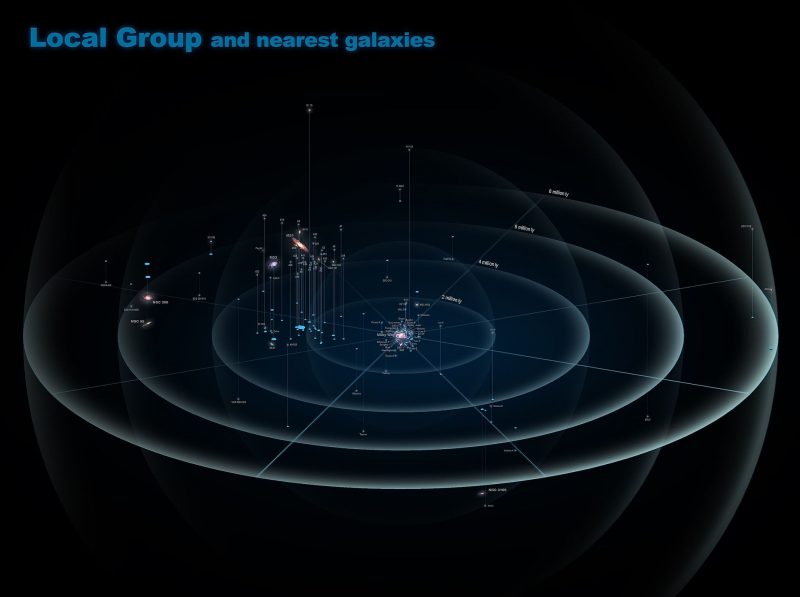
View larger. | Artist’s concept showing our Milky Way galaxy, its satellite galaxies, and other galaxies in our Local Group. The Milky Way isn’t really the center of anything; that’s just the way the image is drawn. The 3 largest galaxies in the Local Group are, in descending order, the Andromeda galaxy, the Milky Way, and M33 also known as the Triangulum Galaxy. Image via Wikimedia Commons.
We know where our galaxy is located, but only locally speaking. The Milky Way galaxy is one of more than 54 galaxies known as the Local Group. The three largest members of the group are our Milky Way (second-biggest), the Andromeda galaxy (biggest) and the Triangulum Galaxy. The other galaxies in the Local Group are dwarf galaxies, and they’re mostly clustered around the three larger galaxies.
The illustration above is a bit misleading because it suggests our Milky Way galaxy lies at the center of the Local Group. It doesn’t, of course, but the image is organized that way, presumably to honor our human perspective.
On the other hand, the Local Group does have a gravitational center. It’s somewhere between the Milky Way and the Andromeda Galaxy.
The Local Group has a diameter of about 10 million light-years.
Astronomers have also discovered that our Local Group is on the outskirts of a giant supercluster of galaxies, known as the Virgo Supercluster.
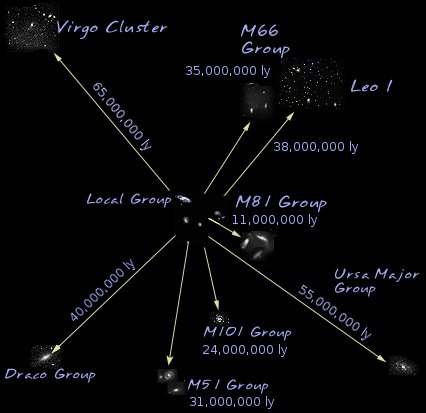
Distances from the Local Group for selected groups and clusters within our local supercluster, called the Virgo Supercluster. Image via Wikimedia Commons.
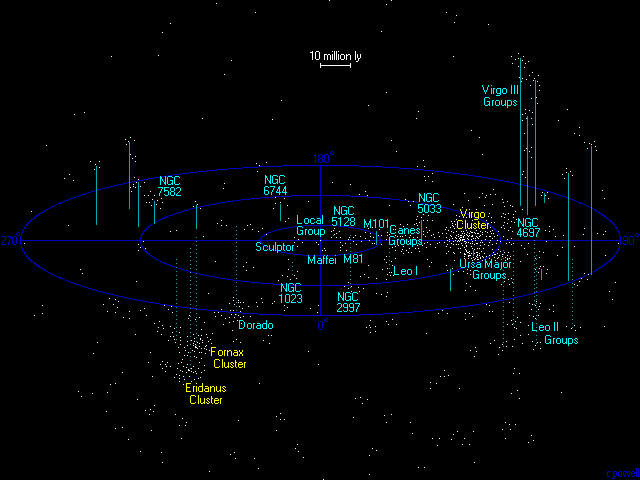
Another artist’s concept of the Virgo Supercluster, via Wikimedia Commons.
At least 100 galaxy groups and clusters are located within the Virgo Supercluster. Its diameter is thought to be about 110 million light-years.
The Virgo Supercluster may be part of an even-larger structure that astronomers call the Laniakea Supercluster. It consists of perhaps 100,000 galaxies stretched out over some 520 million light-years.
The Laniakea Supercluster is one of many such vast structures in space, known to astronomers at this time.
Map of superclusters within the nearby universe, with Laniakea shown in yellow. Image via Wikimedia Commons.
Bottom line: A word about our Milky Way galaxy within the Local Group, and beyond.
from EarthSky https://ift.tt/2QzuICw
View larger. | Artist’s concept showing our Milky Way galaxy, its satellite galaxies, and other galaxies in our Local Group. The Milky Way isn’t really the center of anything; that’s just the way the image is drawn. The 3 largest galaxies in the Local Group are, in descending order, the Andromeda galaxy, the Milky Way, and M33 also known as the Triangulum Galaxy. Image via Wikimedia Commons.
We know where our galaxy is located, but only locally speaking. The Milky Way galaxy is one of more than 54 galaxies known as the Local Group. The three largest members of the group are our Milky Way (second-biggest), the Andromeda galaxy (biggest) and the Triangulum Galaxy. The other galaxies in the Local Group are dwarf galaxies, and they’re mostly clustered around the three larger galaxies.
The illustration above is a bit misleading because it suggests our Milky Way galaxy lies at the center of the Local Group. It doesn’t, of course, but the image is organized that way, presumably to honor our human perspective.
On the other hand, the Local Group does have a gravitational center. It’s somewhere between the Milky Way and the Andromeda Galaxy.
The Local Group has a diameter of about 10 million light-years.
Astronomers have also discovered that our Local Group is on the outskirts of a giant supercluster of galaxies, known as the Virgo Supercluster.
Distances from the Local Group for selected groups and clusters within our local supercluster, called the Virgo Supercluster. Image via Wikimedia Commons.
Another artist’s concept of the Virgo Supercluster, via Wikimedia Commons.
At least 100 galaxy groups and clusters are located within the Virgo Supercluster. Its diameter is thought to be about 110 million light-years.
The Virgo Supercluster may be part of an even-larger structure that astronomers call the Laniakea Supercluster. It consists of perhaps 100,000 galaxies stretched out over some 520 million light-years.
The Laniakea Supercluster is one of many such vast structures in space, known to astronomers at this time.
Map of superclusters within the nearby universe, with Laniakea shown in yellow. Image via Wikimedia Commons.
Bottom line: A word about our Milky Way galaxy within the Local Group, and beyond.
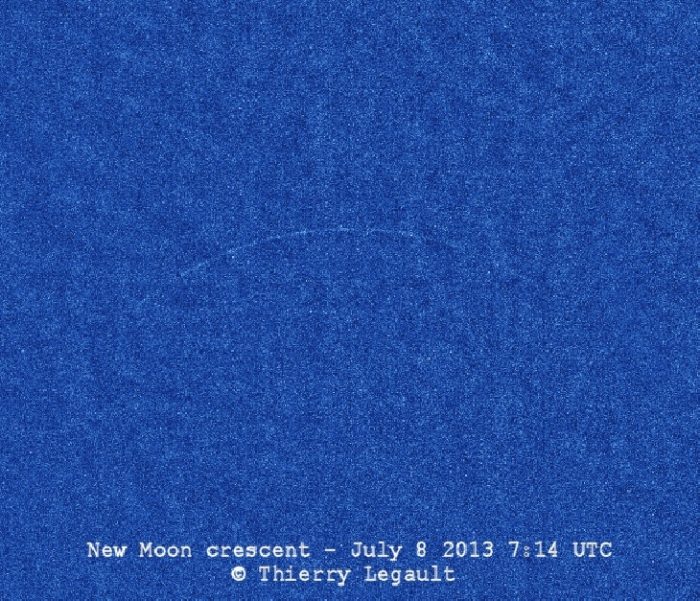
Youngest possible lunar crescent, with the moon’s age being exactly zero when this photo was taken — at the instant of new moon – 07:14 UTC on July 8, 2013. Image by Thierry Legault.
When the moon is most nearly between the Earth and sun for any particular month, astronomers say it is new. New moon falls on December 7, 2018, at 07:20 UTC; translate UTC to your time.
We don’t see a new moon in the sky, unless there’s a solar eclipse, with the moon directly in front of the sun. The image above shows a new moon, not in eclipse, but taken by an expert using special equipment.
Most of the time, the new moon passes not in front of the sun, but simply near it in our sky. Either way – in front of the sun or just near it – on the day of new moon, the moon travels across the sky with the sun during the day, hidden in the sun’s glare.
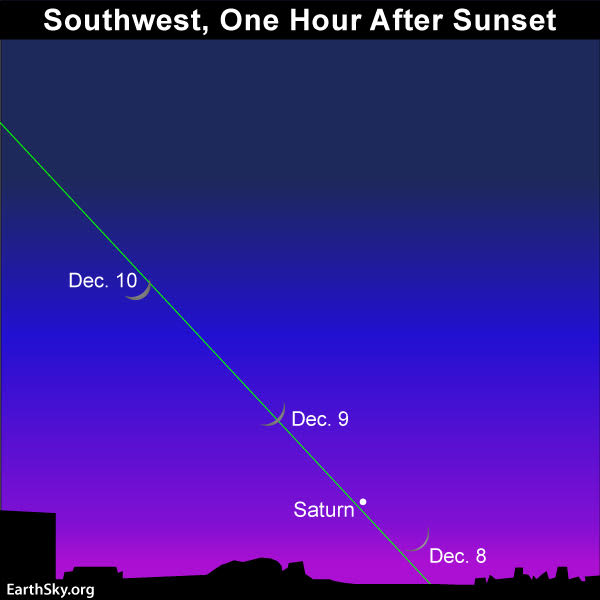
In the language of astronomy – a day or two after each month’s new moon – a slim crescent moon always becomes visible in the west after sunset. Astronomers call this slim crescent a young moon. This month’s young moon will be near Saturn, as shown on the chart below:
Let the waxing crescent moon help guide your eye to the planet Saturn on December 8, 9 and 10, 2018. Saturn will drop into the sunset glare – and leave the evening sky – soon thereafter. Read more.
New moons, and young moons, are fascinating to many. The Farmer’s Almanac, for example, still offers information on gardening by the moon. And many cultures have holidays based on moon phases.
Most of us will never see a new moon, unless we witness a total solar eclipse. Here’s a new moon covering the sun, in an eclipse that swept across the continental U.S. on August 21, 2017. Beverley Sinclair, who saw the 2017 eclipse outside Charleston, South Carolina, wrote: “The skies were very cloudy leading up to totality but, miraculously, slowly cleared as totality approached. This photo shows the diamond ring and Bailey’s beads.”
As the moon orbits Earth, it changes phase in an orderly way. Follow the links below to understand the phases of the moon.
Youngest possible lunar crescent, with the moon’s age being exactly zero when this photo was taken — at the instant of new moon – 07:14 UTC on July 8, 2013. Image by Thierry Legault.
When the moon is most nearly between the Earth and sun for any particular month, astronomers say it is new. New moon falls on December 7, 2018, at 07:20 UTC; translate UTC to your time.
We don’t see a new moon in the sky, unless there’s a solar eclipse, with the moon directly in front of the sun. The image above shows a new moon, not in eclipse, but taken by an expert using special equipment.
Most of the time, the new moon passes not in front of the sun, but simply near it in our sky. Either way – in front of the sun or just near it – on the day of new moon, the moon travels across the sky with the sun during the day, hidden in the sun’s glare.
In the language of astronomy – a day or two after each month’s new moon – a slim crescent moon always becomes visible in the west after sunset. Astronomers call this slim crescent a young moon. This month’s young moon will be near Saturn, as shown on the chart below:
Let the waxing crescent moon help guide your eye to the planet Saturn on December 8, 9 and 10, 2018. Saturn will drop into the sunset glare – and leave the evening sky – soon thereafter. Read more.
New moons, and young moons, are fascinating to many. The Farmer’s Almanac, for example, still offers information on gardening by the moon. And many cultures have holidays based on moon phases.
Most of us will never see a new moon, unless we witness a total solar eclipse. Here’s a new moon covering the sun, in an eclipse that swept across the continental U.S. on August 21, 2017. Beverley Sinclair, who saw the 2017 eclipse outside Charleston, South Carolina, wrote: “The skies were very cloudy leading up to totality but, miraculously, slowly cleared as totality approached. This photo shows the diamond ring and Bailey’s beads.”
As the moon orbits Earth, it changes phase in an orderly way. Follow the links below to understand the phases of the moon.
Tonight – or any December evening – find the famous constellations Orion the Hunter, and see the Milky Way running behind it. Orion is bright and can be seen from inside smaller cities. For the Milky Way, you’ll need a dark sky!
Throughout December, the constellation Orion is up by mid-evening; by that, we mean by midway between sunset and midnight. Like all the starry sky, Orion rises earlier each evening, and, by late December, Orion is seen at nightfall or early evening. That’s true for the Southern and Northern Hemispheres, by the way.
Orion is a summer constellation for the Southern Hemisphere.
For us in the Northern Hemisphere, because this constellation is up on our long December and January nights, we tend to associate Orion with the winter season.
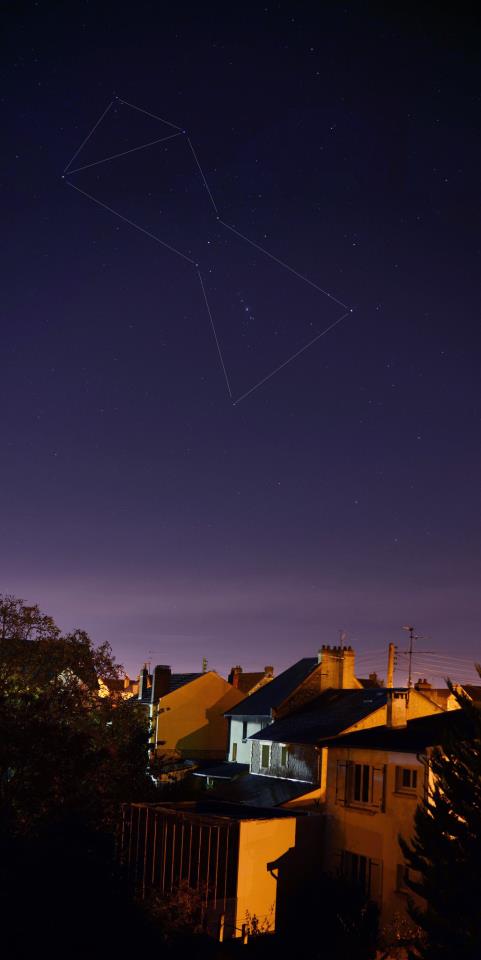
View larger. | Orion ascending over Normandy, France as seen by EarthSky Facebook friend Mohamed Laaifat. Thank you, Mohamed.
As seen from this hemisphere, after Orion rises, the three stars of Orion’s Belt jut pretty much straight up from the horizon. Look on either side of the Belt stars for two very bright stars. One is the reddish star Betelgeuse. The other is bright, blue-white Rigel.
Because so many people are familiar with Orion, this constellation is a great jumping off spot for finding the pathway of stars known as the Milky Way, assuming you have a dark sky. Given a dark sky, you can see this archway of stars running near Betelgeuse on the sky’s dome, as shown on the chart at the top of this post.
When we look at this band of luminescence, we’re viewing the galactic disk edgewise – the combined glow of billions of stars. You may know that – in the month of August – the Milky Way appears broad and bright during the evening hours. At that time of year, in the evening, all of us on Earth are gazing toward the center of the galaxy.
Now Earth has traveled in its orbit around the sun, and our evening sky is pointing out in a different direction. If you see the Milky Way near the constellation Orion this month, you might think it’s very faint in contrast to the August Milky Way. That’s because now we’re looking toward the galaxy’s outer edge, and there are fewer stars between us and intergalactic space.
Bottom line: You can find one of the most famous constellations – Orion the Hunter – plus see the Milky Way tonight.
Tonight – or any December evening – find the famous constellations Orion the Hunter, and see the Milky Way running behind it. Orion is bright and can be seen from inside smaller cities. For the Milky Way, you’ll need a dark sky!
Throughout December, the constellation Orion is up by mid-evening; by that, we mean by midway between sunset and midnight. Like all the starry sky, Orion rises earlier each evening, and, by late December, Orion is seen at nightfall or early evening. That’s true for the Southern and Northern Hemispheres, by the way.
Orion is a summer constellation for the Southern Hemisphere.
For us in the Northern Hemisphere, because this constellation is up on our long December and January nights, we tend to associate Orion with the winter season.
View larger. | Orion ascending over Normandy, France as seen by EarthSky Facebook friend Mohamed Laaifat. Thank you, Mohamed.
As seen from this hemisphere, after Orion rises, the three stars of Orion’s Belt jut pretty much straight up from the horizon. Look on either side of the Belt stars for two very bright stars. One is the reddish star Betelgeuse. The other is bright, blue-white Rigel.
Because so many people are familiar with Orion, this constellation is a great jumping off spot for finding the pathway of stars known as the Milky Way, assuming you have a dark sky. Given a dark sky, you can see this archway of stars running near Betelgeuse on the sky’s dome, as shown on the chart at the top of this post.
When we look at this band of luminescence, we’re viewing the galactic disk edgewise – the combined glow of billions of stars. You may know that – in the month of August – the Milky Way appears broad and bright during the evening hours. At that time of year, in the evening, all of us on Earth are gazing toward the center of the galaxy.
Now Earth has traveled in its orbit around the sun, and our evening sky is pointing out in a different direction. If you see the Milky Way near the constellation Orion this month, you might think it’s very faint in contrast to the August Milky Way. That’s because now we’re looking toward the galaxy’s outer edge, and there are fewer stars between us and intergalactic space.
Bottom line: You can find one of the most famous constellations – Orion the Hunter – plus see the Milky Way tonight.