aads

COP24: UN climate change conference, what’s at stake and what you need to know

Reprint of article originally posted on UN NEWS on Nov 29, 2018. Click here to access the original.

As global temperatures continue to rise, climate action is lagging and the window of opportunity is closing. On Sunday, the United Nations will kick off critical negotiations on how to address the problem collectively and urgently, during a two-week climate change conference in Katowice, Poland, known as “COP24”. 

Sirajganj Bangladesh Oct 2016 

IOM/Amanda Nero A boy watches the shore from a boat near Sirajganj, a community affected by severe erosion that has left many displaced. Sirajganj, Bangladesh. October 2016

Thousands of world leaders, experts, activists, creative thinkers, and private sector and local community representatives will gather to work on a collective action plan to realize critical commitments made by all the countries of the world in Paris, three years ago.

UN News put together this guide to COP 24 to answer some of the biggest questions you may have and make sure you’re all caught up, with a ringside seat on the action.

1. The basics: UNFCCC, UNEP, WMO, IPCC, COP 24, Kyoto Protocol, Paris Agreement... can someone please make sense of all this?

These acronyms and place names all represent international tools and terms that, under the leadership of the UN, were created to help advance climate action globally. They all play a specific and different role in focussing us all on achieving environmental sustainability. Here’s how it fits together:

In 1992, the UN organised a major event in Rio de Janeiro called the Earth Summit, in which the UN Framework Convention on Climate Change (UNFCCC) was adopted.

In this treaty, nations agreed to "stabilize greenhouse gas concentrations in the atmosphere” to prevent dangerous interference from human activity on the climate system. Today, the treaty has 197 signatories. Every year since the treaty entered into force in 1994, a “conference of the parties” – a COP – is held to discuss how to move forward and, since there have been 23 COPs so far, this year’s will be the 24th, or “COP 24”.

Because the UNFCCC had non-binding limits on greenhouse gas emissions for individual countries and no enforcement mechanism, various “extensions” to this treaty were negotiated during these COPs, including: the famous Kyoto Protocol in 1997, which defined emission limits for developed nations to be achieved by 2012; and the Paris Agreement, adopted in 2015, in which all countries of the world agreed to step up efforts to limit global warming to 1.5°C above pre-industrial temperatures and boost climate action financing.

Two agencies support the scientific work of the UN on climate change: the UN Environment Programme (UNEP) and the World Meteorological Organization (WMO). Together, they set up the Intergovernmental Panel on Climate Change (IPCC) in 1988, which is made of hundreds of experts, dedicated to assessing data and providing reliable scientific evidence for the climate action negotiations, including the upcoming ones in Katowice.

2. The UN seems to be having a lot of conferences and summits on this subject… Is any of it, well... fruitful?

These meetings have been vital to find a global consensus on an issue that requires a global solution.  Although progress has been much slower than needed, the process — which has been as challenging as it is ambitious – has worked to bring all countries with very different circumstances, together. Progress has been made every step of the way. Some of the concrete actions taken so far prove one thing: climate action has a real positive impact and can truly help us prevent the worst.

Here are some notable achievements so far:

At least 57 countries have managed to bring their greenhouse gas emissions down to the levels required to curb global warming.

- There are at least 51 “carbon pricing” initiatives in the works; charging those who emit carbon dioxide per tonne emitted.

- In 2015, 18 high-income countries committed to donating US$100 billion a year for climate action in developing countries. So far, over $70 billion have been mobilised.

3. Why is everyone talking about the Paris Agreement?

The Paris document – which provides the world with the only viable option for addressing climate change – has been ratified by 184 parties, and entered into force in November 2016.

The commitments contained in it are significant:

- Limit global average temperature rise to well below 2°C and pursue efforts to limit the temperature increase to 1.5°C.

- Ramp up financing for climate action, including the annual $100 billion goal from donor nations for lower-income countries.

- Develop national climate plans by 2020, including their self-determined goals and targets.

- Protect beneficial ecosystems that absorb greenhouse gases, including forests.

- Strengthen resilience and reduce vulnerability to climate change.

- Finalize a work programme to implement the agreement in 2018.

The United States, which joined the Agreement in 2016, announced its intention in July 2017, to withdraw from it. However, the nation remains a party to the Agreement at least until November 2020, which is the earliest that it can legally request to withdraw from it.

4. Why is +1.5°C a critical line?

According to scientific research assessed by the IPCC, keeping global warming to no more than 1.5°C global average over pre-industrial levels, will help stave off devastating permanent damage to the planet and its people, including: the irreversible loss of habitat for animals in the Arctic and Antarctic; much more frequent instances of deadly  extreme heatwater scarcity that could affect over 300 million people; the disappearance of coral reefs which are essential for entire communities and marine life; sea level rise which is threatening the future and economy of entire small island nations, etc.

All in all, the UN estimates that 420 million fewer people could be affected by climate change if we manage to stick to a 1.5°C increase, instead of 2°C.

We are still far from turning the corner toward a carbon-neutral future, and the need to move forward is greater than ever. The data tells us it is still possible to limit climate change to 1.5°C, but the window of opportunity is closing and it will require unprecedented changes in all aspects of society.

5. So why is COP 24 important?

This year’s COP in Katowice, Poland, is particularly crucial because 2018 is the deadline that the signatories of the Paris Agreement agreed upon in order to adopt a work programme for the implementation of the Paris commitments. This requires the singular most important ingredient: trust between all countries.

Among the many elements that need to be ironed out is the financing of climate action worldwide. Because the clock is ticking on climate change, the world cannot afford to waste more time: we must collectively agree on a bold, decisive, ambitious and accountable way forward.

The discussions will be based on scientific evidence gathered over the years and assessed by experts. Namely and primarily the following reports:

- October’s “wake up call” Report on Global Warming of 1.5˚C, by the IPCC.

2018 Emissions Gap Report, by UNEP.

2018 Bulletin on greenhouse gas concentrations, by the WMO.

2018 Ozone Depletion Assessment, by the WMO and UNEP.

7. How can you follow the discussions at COP24?

There are many ways you can keep up to speed on the action:

- Subscribe to our “Climate Change” newsletter topic here so you can receive daily UN News highlights from Poland;

- Check this page regularly, as it will collect all the top stories filed from Katowice.

- Follow the hashtag #ClimateAction on Twitter;

8. How can you participate in the discussion and do your part for climate action?

You can join the Climate Action ActNow.bot which will recommend everyday actions to save the planet and tally up the number of actions taken to measure the impact that collective action can have.

By sharing your climate action efforts on social media, you can help encourage more people to act as well.

In addition, the People’s Seat initiative, launched by the UNFCCC Secretariat, ensures you can contribute directly to the conversation at COP 24. So make sure to #TakeYourSeat and speak up! 

9. What are some examples of initiatives that the UN is supporting to tackle climate change?

As the UN is mainstreaming environmental sustainability across is work, UN News has been highlighting some examples of projects, supported by UNEP or the UN Development Programme (UNDP), that show the pathway to climate action: in rural eastern Europe, farmers and entrepreneurs can cut emissions, one bog at a time; in the Lake Chad region, tens of thousands of drought-resistant trees are being planted; in Guatemala, the reintroduction of smallholder cocoa production in Guatemala is helping address both economic and environmental problems; in Bhutan, the power of traditional knowledge is being harnessed to support livelihoods and nature preservation; in Timor-Leste, a new generation of green infrastructure is being built; in the Democratic Republic of the Congo, small behavioural change is leading to great impact.

10. Why is the UN also planning a Climate Change Summit in 2019?

To build on the outcomes of COP 24, and to strengthen climate action and ambition at the highest possible levels, UN Secretary-General António Guterresis convening a Climate Change Summit next September. In advance of the 2020 deadline for countries to finalize their national climate plans, the Summit is designed to focus on practical initiatives to limit emissions and build resilience. 

The Summit will focus on driving action in six areas: transition to renewable energy; funding of climate action and carbon pricing; reducing emissions from industry; using nature as a solution; sustainable cities and local action; and climate change resilience. 

COP24: UN climate change conference, what’s at stake and what you need to know, UN News, Nov 29, 2018 

Receive UN daily updates directly in your inbox - Subscribe here to “Climate Change” topic


from Skeptical Science https://ift.tt/2KNPV6l

Reprint of article originally posted on UN NEWS on Nov 29, 2018. Click here to access the original.

As global temperatures continue to rise, climate action is lagging and the window of opportunity is closing. On Sunday, the United Nations will kick off critical negotiations on how to address the problem collectively and urgently, during a two-week climate change conference in Katowice, Poland, known as “COP24”. 

Sirajganj Bangladesh Oct 2016 

IOM/Amanda Nero A boy watches the shore from a boat near Sirajganj, a community affected by severe erosion that has left many displaced. Sirajganj, Bangladesh. October 2016

Thousands of world leaders, experts, activists, creative thinkers, and private sector and local community representatives will gather to work on a collective action plan to realize critical commitments made by all the countries of the world in Paris, three years ago.

UN News put together this guide to COP 24 to answer some of the biggest questions you may have and make sure you’re all caught up, with a ringside seat on the action.

1. The basics: UNFCCC, UNEP, WMO, IPCC, COP 24, Kyoto Protocol, Paris Agreement... can someone please make sense of all this?

These acronyms and place names all represent international tools and terms that, under the leadership of the UN, were created to help advance climate action globally. They all play a specific and different role in focussing us all on achieving environmental sustainability. Here’s how it fits together:

In 1992, the UN organised a major event in Rio de Janeiro called the Earth Summit, in which the UN Framework Convention on Climate Change (UNFCCC) was adopted.

In this treaty, nations agreed to "stabilize greenhouse gas concentrations in the atmosphere” to prevent dangerous interference from human activity on the climate system. Today, the treaty has 197 signatories. Every year since the treaty entered into force in 1994, a “conference of the parties” – a COP – is held to discuss how to move forward and, since there have been 23 COPs so far, this year’s will be the 24th, or “COP 24”.

Because the UNFCCC had non-binding limits on greenhouse gas emissions for individual countries and no enforcement mechanism, various “extensions” to this treaty were negotiated during these COPs, including: the famous Kyoto Protocol in 1997, which defined emission limits for developed nations to be achieved by 2012; and the Paris Agreement, adopted in 2015, in which all countries of the world agreed to step up efforts to limit global warming to 1.5°C above pre-industrial temperatures and boost climate action financing.

Two agencies support the scientific work of the UN on climate change: the UN Environment Programme (UNEP) and the World Meteorological Organization (WMO). Together, they set up the Intergovernmental Panel on Climate Change (IPCC) in 1988, which is made of hundreds of experts, dedicated to assessing data and providing reliable scientific evidence for the climate action negotiations, including the upcoming ones in Katowice.

2. The UN seems to be having a lot of conferences and summits on this subject… Is any of it, well... fruitful?

These meetings have been vital to find a global consensus on an issue that requires a global solution.  Although progress has been much slower than needed, the process — which has been as challenging as it is ambitious – has worked to bring all countries with very different circumstances, together. Progress has been made every step of the way. Some of the concrete actions taken so far prove one thing: climate action has a real positive impact and can truly help us prevent the worst.

Here are some notable achievements so far:

At least 57 countries have managed to bring their greenhouse gas emissions down to the levels required to curb global warming.

- There are at least 51 “carbon pricing” initiatives in the works; charging those who emit carbon dioxide per tonne emitted.

- In 2015, 18 high-income countries committed to donating US$100 billion a year for climate action in developing countries. So far, over $70 billion have been mobilised.

3. Why is everyone talking about the Paris Agreement?

The Paris document – which provides the world with the only viable option for addressing climate change – has been ratified by 184 parties, and entered into force in November 2016.

The commitments contained in it are significant:

- Limit global average temperature rise to well below 2°C and pursue efforts to limit the temperature increase to 1.5°C.

- Ramp up financing for climate action, including the annual $100 billion goal from donor nations for lower-income countries.

- Develop national climate plans by 2020, including their self-determined goals and targets.

- Protect beneficial ecosystems that absorb greenhouse gases, including forests.

- Strengthen resilience and reduce vulnerability to climate change.

- Finalize a work programme to implement the agreement in 2018.

The United States, which joined the Agreement in 2016, announced its intention in July 2017, to withdraw from it. However, the nation remains a party to the Agreement at least until November 2020, which is the earliest that it can legally request to withdraw from it.

4. Why is +1.5°C a critical line?

According to scientific research assessed by the IPCC, keeping global warming to no more than 1.5°C global average over pre-industrial levels, will help stave off devastating permanent damage to the planet and its people, including: the irreversible loss of habitat for animals in the Arctic and Antarctic; much more frequent instances of deadly  extreme heatwater scarcity that could affect over 300 million people; the disappearance of coral reefs which are essential for entire communities and marine life; sea level rise which is threatening the future and economy of entire small island nations, etc.

All in all, the UN estimates that 420 million fewer people could be affected by climate change if we manage to stick to a 1.5°C increase, instead of 2°C.

We are still far from turning the corner toward a carbon-neutral future, and the need to move forward is greater than ever. The data tells us it is still possible to limit climate change to 1.5°C, but the window of opportunity is closing and it will require unprecedented changes in all aspects of society.

5. So why is COP 24 important?

This year’s COP in Katowice, Poland, is particularly crucial because 2018 is the deadline that the signatories of the Paris Agreement agreed upon in order to adopt a work programme for the implementation of the Paris commitments. This requires the singular most important ingredient: trust between all countries.

Among the many elements that need to be ironed out is the financing of climate action worldwide. Because the clock is ticking on climate change, the world cannot afford to waste more time: we must collectively agree on a bold, decisive, ambitious and accountable way forward.

The discussions will be based on scientific evidence gathered over the years and assessed by experts. Namely and primarily the following reports:

- October’s “wake up call” Report on Global Warming of 1.5˚C, by the IPCC.

2018 Emissions Gap Report, by UNEP.

2018 Bulletin on greenhouse gas concentrations, by the WMO.

2018 Ozone Depletion Assessment, by the WMO and UNEP.

7. How can you follow the discussions at COP24?

There are many ways you can keep up to speed on the action:

- Subscribe to our “Climate Change” newsletter topic here so you can receive daily UN News highlights from Poland;

- Check this page regularly, as it will collect all the top stories filed from Katowice.

- Follow the hashtag #ClimateAction on Twitter;

8. How can you participate in the discussion and do your part for climate action?

You can join the Climate Action ActNow.bot which will recommend everyday actions to save the planet and tally up the number of actions taken to measure the impact that collective action can have.

By sharing your climate action efforts on social media, you can help encourage more people to act as well.

In addition, the People’s Seat initiative, launched by the UNFCCC Secretariat, ensures you can contribute directly to the conversation at COP 24. So make sure to #TakeYourSeat and speak up! 

9. What are some examples of initiatives that the UN is supporting to tackle climate change?

As the UN is mainstreaming environmental sustainability across is work, UN News has been highlighting some examples of projects, supported by UNEP or the UN Development Programme (UNDP), that show the pathway to climate action: in rural eastern Europe, farmers and entrepreneurs can cut emissions, one bog at a time; in the Lake Chad region, tens of thousands of drought-resistant trees are being planted; in Guatemala, the reintroduction of smallholder cocoa production in Guatemala is helping address both economic and environmental problems; in Bhutan, the power of traditional knowledge is being harnessed to support livelihoods and nature preservation; in Timor-Leste, a new generation of green infrastructure is being built; in the Democratic Republic of the Congo, small behavioural change is leading to great impact.

10. Why is the UN also planning a Climate Change Summit in 2019?

To build on the outcomes of COP 24, and to strengthen climate action and ambition at the highest possible levels, UN Secretary-General António Guterresis convening a Climate Change Summit next September. In advance of the 2020 deadline for countries to finalize their national climate plans, the Summit is designed to focus on practical initiatives to limit emissions and build resilience. 

The Summit will focus on driving action in six areas: transition to renewable energy; funding of climate action and carbon pricing; reducing emissions from industry; using nature as a solution; sustainable cities and local action; and climate change resilience. 

COP24: UN climate change conference, what’s at stake and what you need to know, UN News, Nov 29, 2018 

Receive UN daily updates directly in your inbox - Subscribe here to “Climate Change” topic


from Skeptical Science https://ift.tt/2KNPV6l

Live coverage of spacecraft arrival at asteroid December 3

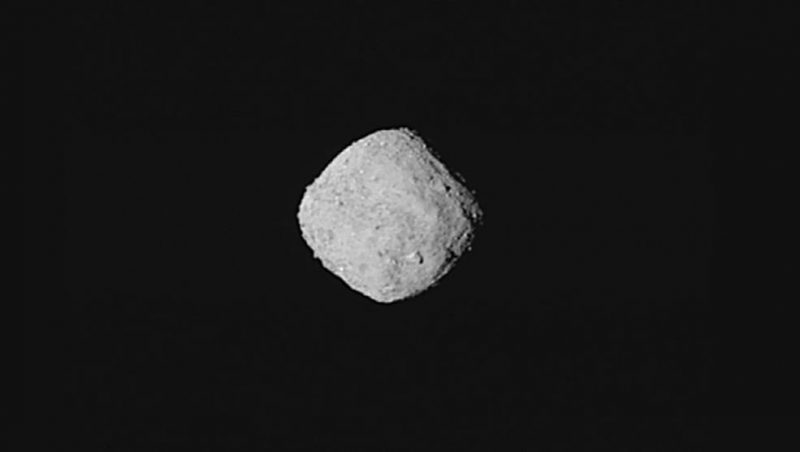
This “super-resolution” view of asteroid Bennu was created using eight images obtained by NASA’s OSIRIS-REx spacecraft on October 29, 2018, from a distance of about 205 miles (330 km). Image via NASA/Goddard/University of Arizona.

NASA’s OSIRIS-REx spacecraft is scheduled to rendezvous with its targeted asteroid, Bennu, on Monday, December 3, 2018, at approximately 17:00 UTC (noon EST). Translate UTC to your time.

NASA will air a live event from 16:45 to 17:15 UTC (11:45 a.m.to 12:15 p.m. EST) to highlight the arrival of the agency’s first asteroid sample return mission. You can watch on NASA TV, Facebook Live, Ustream, YouTube and NASA Live. NASA TV also will air an arrival preview program starting at 16:15 UTC (11:15 a.m. EST).

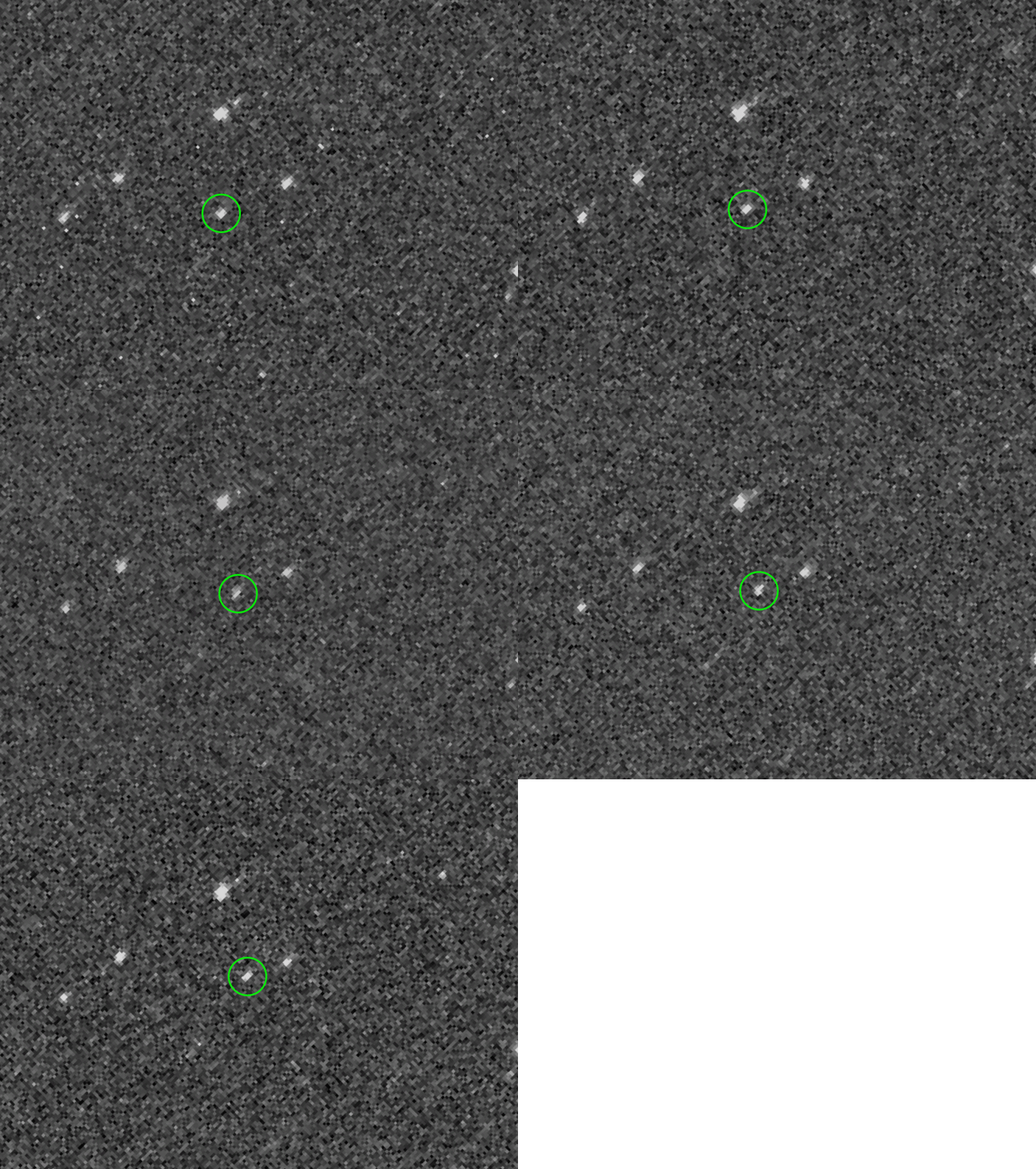
This animation consists of 5 of the 1st images of asteroid Bennu via the OSIRIS-REx mission, acquired August 17, 2018, at 1.4 million miles (2.3 million km), or almost 6 times the distance between the Earth and moon. The asteroid is visible as a moving object against the stars in front of the constellation Serpens. The spacecraft is due to arrive at the asteroid on December 3, 2018. Image via NASA/Goddard/University of Arizona.

OSIRIS-REx (Origins, Spectral Interpretation, Resource Identification, Security-Regolith Explorer) launched in September 2016 and has been slowly approaching Bennu. OSIRIS-REx is NASA’s first mission to visit a near-Earth asteroid, survey the surface, collect a sample and deliver it back to Earth. The spacecraft will spend almost a year surveying the asteroid with the goal of selecting a location that is safe and scientifically interesting to collect the sample.

That asteroid sample is expected to return to Earth via free fall from space, until it reaches an altitude of 20.8 miles (33.5 km), when a first parachute will deploy. At 1.9 miles (3 km), the main parachute will be released, bringing the capsule with its precious cargo from Bennu in for a soft landing in the Utah desert on September 24, 2023.

EarthSky lunar calendars are cool! They make great gifts. Order now. Going fast!

Bottom line: The OSIRIS-REx spacecraft is scheduled to rendezvous with its targeted asteroid, Bennu, on Monday, December 3, 2018, at approximately 17:00 UTC (noon EST).

Via NASA


from EarthSky https://ift.tt/2PdGCNK

This “super-resolution” view of asteroid Bennu was created using eight images obtained by NASA’s OSIRIS-REx spacecraft on October 29, 2018, from a distance of about 205 miles (330 km). Image via NASA/Goddard/University of Arizona.

NASA’s OSIRIS-REx spacecraft is scheduled to rendezvous with its targeted asteroid, Bennu, on Monday, December 3, 2018, at approximately 17:00 UTC (noon EST). Translate UTC to your time.

NASA will air a live event from 16:45 to 17:15 UTC (11:45 a.m.to 12:15 p.m. EST) to highlight the arrival of the agency’s first asteroid sample return mission. You can watch on NASA TV, Facebook Live, Ustream, YouTube and NASA Live. NASA TV also will air an arrival preview program starting at 16:15 UTC (11:15 a.m. EST).

This animation consists of 5 of the 1st images of asteroid Bennu via the OSIRIS-REx mission, acquired August 17, 2018, at 1.4 million miles (2.3 million km), or almost 6 times the distance between the Earth and moon. The asteroid is visible as a moving object against the stars in front of the constellation Serpens. The spacecraft is due to arrive at the asteroid on December 3, 2018. Image via NASA/Goddard/University of Arizona.

OSIRIS-REx (Origins, Spectral Interpretation, Resource Identification, Security-Regolith Explorer) launched in September 2016 and has been slowly approaching Bennu. OSIRIS-REx is NASA’s first mission to visit a near-Earth asteroid, survey the surface, collect a sample and deliver it back to Earth. The spacecraft will spend almost a year surveying the asteroid with the goal of selecting a location that is safe and scientifically interesting to collect the sample.

That asteroid sample is expected to return to Earth via free fall from space, until it reaches an altitude of 20.8 miles (33.5 km), when a first parachute will deploy. At 1.9 miles (3 km), the main parachute will be released, bringing the capsule with its precious cargo from Bennu in for a soft landing in the Utah desert on September 24, 2023.

EarthSky lunar calendars are cool! They make great gifts. Order now. Going fast!

Bottom line: The OSIRIS-REx spacecraft is scheduled to rendezvous with its targeted asteroid, Bennu, on Monday, December 3, 2018, at approximately 17:00 UTC (noon EST).

Via NASA


from EarthSky https://ift.tt/2PdGCNK

Will December’s full moon be a supermoon?

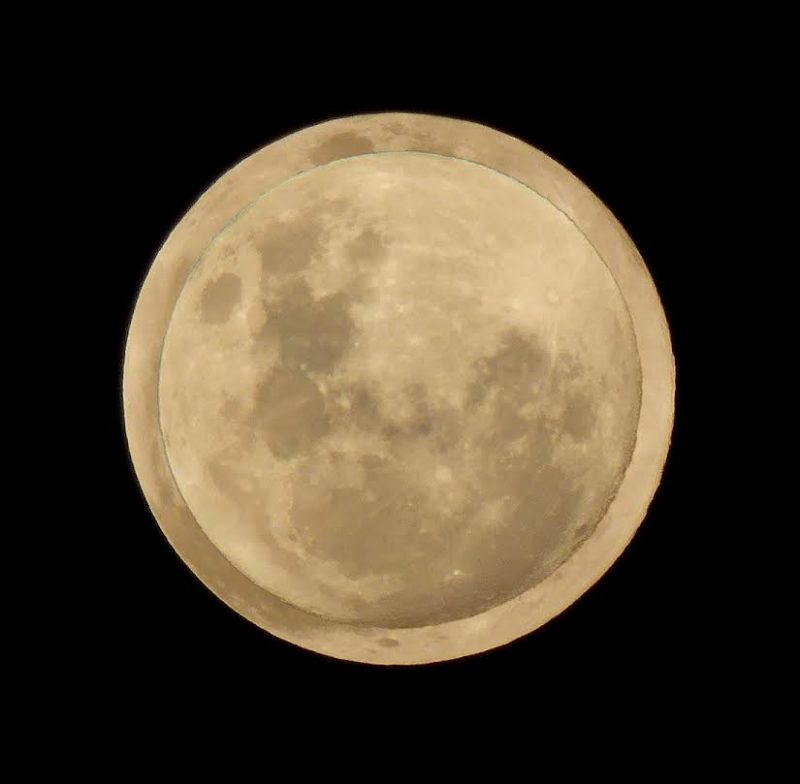
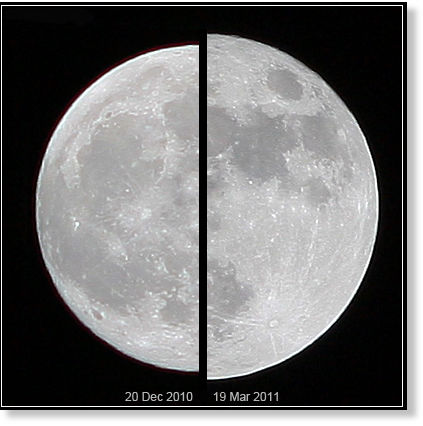
Apparent size of a full supermoon, or close moon, contrasted with a full micro-moon, or far moon. Image by Peter Lowenstein.

The last of 2018’s 13 full moons will fall on December 22. This full moon will rank as the 3rd-closest one of 2018, but it’s less than clear whether it should be dubbed a supermoon, mainly because commentators disagree on what constitutes a supermoon.

EarthSky lunar calendars are cool! They make great gifts. Order now. Going fast!

Who are the commentators, and what do they say? The International Astronomical Union (IAU) is the group generally recognized for naming and defining things in astronomy. But the IAU has been, so far, silent on the subject of supermoons, which, professional astronomers tend to call perigean full moons.

Meanwhile, Fred Espenak, the go-to astronomer on all things related to lunar and solar eclipses (Mr. Eclipse!), lists the full moons of January 2 and 31, plus December 22, 2018, as full moon supermoons in his post, full moon at perigee.

We might also consider the astrologer Richard Nolle. Whatever your thoughts or feelings are on astrology, Nolle is, after all, the person who coined the term supermoon. Of the 13 full moons that take place in 2018, he lists only the two January full moons as supermoons. The supermoon definition, as originally defined by Nolle, comes with ambiguity. That’s why there are different answers to the question of the number of supermoons in 2018.

Click here to learn more about Richard Nolle

Click here to learn more about Fred Espenak

Astrophysicist Fred Espenak, aka Mr. Eclipse – a 30-year NASA veteran and world-renowned expert on eclipses – says the January 12, 2017, full moon is a supermoon in his post Moon in 2017.

We refer you to two different supermoon tables for the 21st century (2001 to 2100). Here is Richard Nolle’s table, and here is Fred Espenak’s table.

Richard Nolle lists only two full moon supermoons for 2018:

2018 January 2

2018 January 31

Meanwhile, Fred Espenak lists three full moon supermoons in 2018:

2018 January 2

2018 January 31

2018 December 22

Why are their lists different? It all goes back to the definition of the word supermoon.

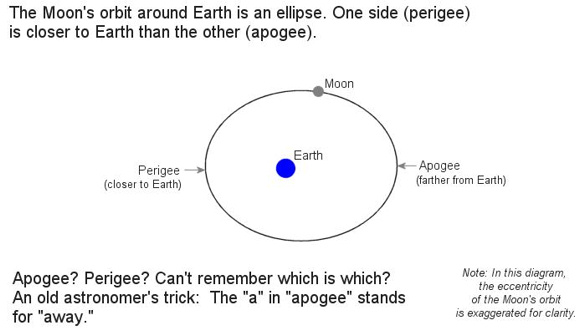
Here’s one thing we all can agree on. Supermoons are based on lunar perigee and apogee. Each month, the moon comes closest to Earth at perigee and swings farthest away at apogee.

Image credit: NASA. The moon's orbit is closer to being a circle than the diagram suggests. The moon is closest to Earth in its orbit at perigee and farthest away at apogee.

Image via NASA.

In his original definition, Richard Nolle defined a supermoon as:

… a new or full moon which occurs with the moon at or near (within 90% of) its closest approach to Earth in a given orbit.

If a new or full moon aligns with apogee, then it’s at 0% of its closest approach to Earth. On the other hand, if a new or full moon aligns with perigee, then it’s at 100% of its closest approach to Earth. That’s something we can all agree on.

But the phrase 90% of perigee is ambiguous. Read on.

Anthony Lynch in Dublin, Ireland, wrote on May 24,

A 2013 supermoon, as captured by EarthSky Facebook friend Anthony Lynch in Dublin, Ireland.

Nolle’s 90% is based on 2018’s closest perigee and farthest apogee. Looking at Richard Nolle’s list for all the supermoons in the 21st century, it appears that Richard Nolle bases his 90% figure on the year’s closest perigee and farthest apogee. Take the year 2018, for instance, whereby any new or full moon coming closer than 362,146.6 km qualifies as a supermoon.

This year, in 2018, the moon comes closest to Earth on January 1 (356,565 kilometers) and swings farthest away one fortnight (two weeks) later, on January 15 (406,464 kilometers). That’s a difference of 49,899 km (406,464 – 356,565 = 49,899 km). Ninety percent of 49,899 km equals 44,909.1 kilometers (0.9 x 49,899 = 44,909.1). Presumably, any new or full moon coming closer than 361,554.9 kilometers (406,464 – 44,909.1 = 361,554.9) would be “at or near (within 90% of) its closest approach to Earth.”

Farthest apogee (2018): 406,464 km
Closest perigee (2018): 356,565 km
Difference: 49,899 km

90% x 49,899 = 44,909.1 km

406,464 – 44,909.1 = 361,554.9 km = 90% of moon’s closest distance to Earth

Thus, figuring out “90% of the moon’s closest approach to Earth” by the year’s closest perigee and farthest apogee, any new or full moon swinging closer than 361,554.9 km to Earth in 2018 counts as a supermoon.

Since the full moon on December 22, 2018, only comes within 363,368 km of Earth, it doesn’t count as a supermoon on Richard Nolle’s list.

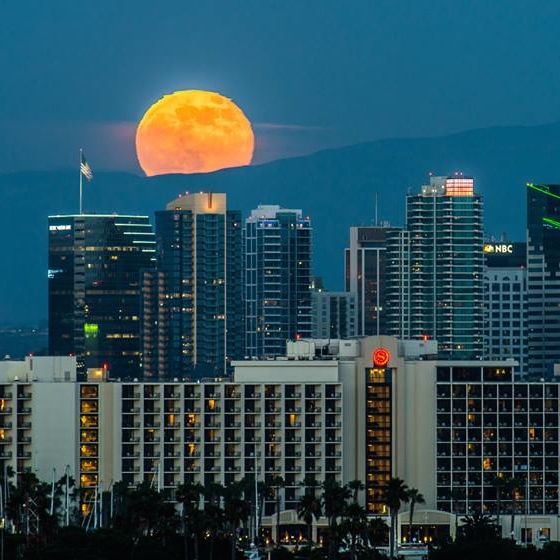
Full moon via Evgeny Yorobe Photography

July 2014 supermoon via Evgeny Yorobe Photography.

Espenak’s 90% based on perigee and apogee of each month’s orbit. Ironically, Fred Espenak’s full supermoon list might more strictly adhere to Richard Nolle’s definition (at least as it is written) than Richard Nolle himself does.

Once again, Richard Nolle describes a supermoon as:

… a new or full moon which occurs with the Moon at or near (within 90% of) its closest approach to Earth in a given orbit.

If given orbit can be taken to mean current monthly orbit, then the December 2018 full moon comes to within 94.8% of its closest approach to Earth relative to the most recent perigee and the upcoming apogee.

December 12, 2018 apogee: 405,177 km
December 24, 2018 perigee: 361,062 km
Difference: 44,115 km

December 12, 2018 apogee: 405,177 km
December 22, 2018 full moon: 363,368 km
Difference: 41,809 km

41,809/44,115 = 0.9477 (94.77%) = distance of the December 2018 full moon relative to the most recent apogee and upcoming perigee

Depending on what meaning we give to the words in a given orbit, we could say the December 12 apogee = 0% of the moon’s closest approach to Earth for this orbit, and the December 24 perigee = 100% of the moon’s closest approach to Earth.

That being the case, then the December full moon comes to within 94.8% of its closest approach to Earth for the month.

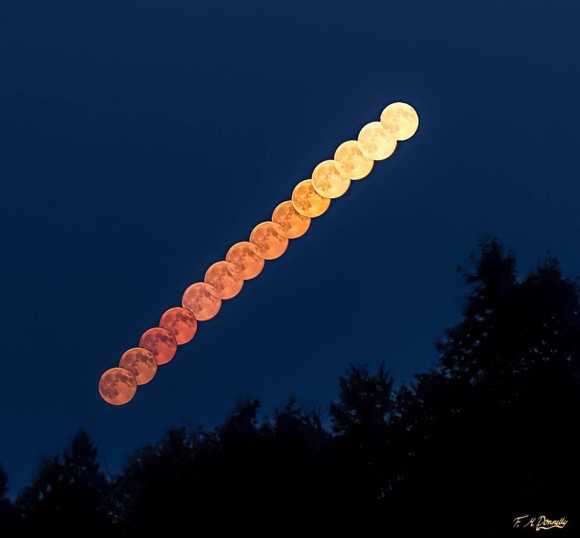
Super cool super-moonrise composite from Fiona M. Donnelly in Ontario.

Super cool super-moonrise composite from Fiona M. Donnelly in Ontario. This photo is from the August 2014 supermoon.

December full moon’s distance relative to 2018’s closest perigee/farthest apogee. However, if we compute the percentage distance of the December full moon relative to the year’s farthest apogee and closest perigee, then the December full moon only comes to within 86.2% of its closest approach to Earth:

Farthest apogee (2018): 406,464 km
Closest perigee (2018): 356,565 km
Difference: 49,899 km

Farthest apogee (2018): 406,464 km
December full moon (2018): 363,368 km
Difference: 43,096 km

43,096/49,899 = 0.864 (86.4%) = distance of the December full moon relative to the year’s farthest apogee and closest perigee

Contrasting a full supermoon (full moon at perigee) with a micro-moon (full moon at apogee). Image credit: Stefano Sciarpetti

Another contrast of a full supermoon (full moon at perigee) with a micro-moon (full moon at apogee). Image via Stefano Sciarpetti.

Is the December full moon a supermoon? Depends on which perigee/apogee distances you choose. The moon’s perigee and apogee distances vary throughout the year, so it appears that the limiting distance for the supermoon depends on which perigee and apogee distances are being used to compute 90% of the moon’s closest approach to Earth.

If we choose the year’s closest perigee and farthest apogee, as Nolle did, we narrow the definition of supermoon.

If we choose the perigee and apogee for a given monthly orbit, as Espenak did, then we broaden the definition of supermoon.

Given the narrower definition, the full moon on December 22, 2018, is not a supermoon, but given the broader one, it is.

Take your choice!

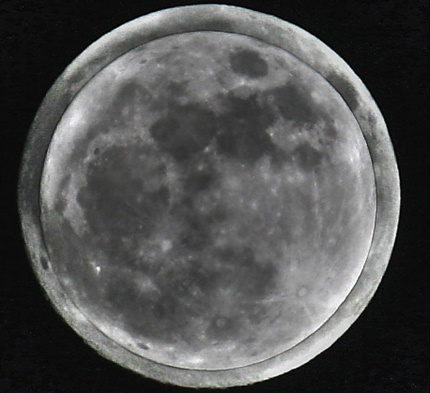
The moon's apparent size in our sky depends on its distance from Earth. The supermoon of March 19, 2011 (right), compared to an average moon of December 20, 2010 (left). Image by Marco Langbroek of the Netherlands via Wikimedia Commons.

The moon’s apparent size in our sky depends on its distance from Earth. The supermoon of March 19, 2011 (right), compared to an average moon of December 20, 2010 (left). Image by Marco Langbroek of the Netherlands via Wikimedia Commons.

Bottom line: At least two commentators – Richard Nolle and Fred Espenak – disagree on whether the December 22, 2018, full moon should be called a supermoon. Is it? If you define a supermoon based on the year’s closest perigee and farthest apogee, then the December 2018 full moon is not a supermoon. If you define a supermoon based on the perigee and apogee for a given monthly orbit, then it is a supermoon. Take your choice!


from EarthSky https://ift.tt/2BKzdSi

Apparent size of a full supermoon, or close moon, contrasted with a full micro-moon, or far moon. Image by Peter Lowenstein.

The last of 2018’s 13 full moons will fall on December 22. This full moon will rank as the 3rd-closest one of 2018, but it’s less than clear whether it should be dubbed a supermoon, mainly because commentators disagree on what constitutes a supermoon.

EarthSky lunar calendars are cool! They make great gifts. Order now. Going fast!

Who are the commentators, and what do they say? The International Astronomical Union (IAU) is the group generally recognized for naming and defining things in astronomy. But the IAU has been, so far, silent on the subject of supermoons, which, professional astronomers tend to call perigean full moons.

Meanwhile, Fred Espenak, the go-to astronomer on all things related to lunar and solar eclipses (Mr. Eclipse!), lists the full moons of January 2 and 31, plus December 22, 2018, as full moon supermoons in his post, full moon at perigee.

We might also consider the astrologer Richard Nolle. Whatever your thoughts or feelings are on astrology, Nolle is, after all, the person who coined the term supermoon. Of the 13 full moons that take place in 2018, he lists only the two January full moons as supermoons. The supermoon definition, as originally defined by Nolle, comes with ambiguity. That’s why there are different answers to the question of the number of supermoons in 2018.

Click here to learn more about Richard Nolle

Click here to learn more about Fred Espenak

Astrophysicist Fred Espenak, aka Mr. Eclipse – a 30-year NASA veteran and world-renowned expert on eclipses – says the January 12, 2017, full moon is a supermoon in his post Moon in 2017.

We refer you to two different supermoon tables for the 21st century (2001 to 2100). Here is Richard Nolle’s table, and here is Fred Espenak’s table.

Richard Nolle lists only two full moon supermoons for 2018:

2018 January 2

2018 January 31

Meanwhile, Fred Espenak lists three full moon supermoons in 2018:

2018 January 2

2018 January 31

2018 December 22

Why are their lists different? It all goes back to the definition of the word supermoon.

Here’s one thing we all can agree on. Supermoons are based on lunar perigee and apogee. Each month, the moon comes closest to Earth at perigee and swings farthest away at apogee.

Image credit: NASA. The moon's orbit is closer to being a circle than the diagram suggests. The moon is closest to Earth in its orbit at perigee and farthest away at apogee.

Image via NASA.

In his original definition, Richard Nolle defined a supermoon as:

… a new or full moon which occurs with the moon at or near (within 90% of) its closest approach to Earth in a given orbit.

If a new or full moon aligns with apogee, then it’s at 0% of its closest approach to Earth. On the other hand, if a new or full moon aligns with perigee, then it’s at 100% of its closest approach to Earth. That’s something we can all agree on.

But the phrase 90% of perigee is ambiguous. Read on.

Anthony Lynch in Dublin, Ireland, wrote on May 24,

A 2013 supermoon, as captured by EarthSky Facebook friend Anthony Lynch in Dublin, Ireland.

Nolle’s 90% is based on 2018’s closest perigee and farthest apogee. Looking at Richard Nolle’s list for all the supermoons in the 21st century, it appears that Richard Nolle bases his 90% figure on the year’s closest perigee and farthest apogee. Take the year 2018, for instance, whereby any new or full moon coming closer than 362,146.6 km qualifies as a supermoon.

This year, in 2018, the moon comes closest to Earth on January 1 (356,565 kilometers) and swings farthest away one fortnight (two weeks) later, on January 15 (406,464 kilometers). That’s a difference of 49,899 km (406,464 – 356,565 = 49,899 km). Ninety percent of 49,899 km equals 44,909.1 kilometers (0.9 x 49,899 = 44,909.1). Presumably, any new or full moon coming closer than 361,554.9 kilometers (406,464 – 44,909.1 = 361,554.9) would be “at or near (within 90% of) its closest approach to Earth.”

Farthest apogee (2018): 406,464 km
Closest perigee (2018): 356,565 km
Difference: 49,899 km

90% x 49,899 = 44,909.1 km

406,464 – 44,909.1 = 361,554.9 km = 90% of moon’s closest distance to Earth

Thus, figuring out “90% of the moon’s closest approach to Earth” by the year’s closest perigee and farthest apogee, any new or full moon swinging closer than 361,554.9 km to Earth in 2018 counts as a supermoon.

Since the full moon on December 22, 2018, only comes within 363,368 km of Earth, it doesn’t count as a supermoon on Richard Nolle’s list.

Full moon via Evgeny Yorobe Photography

July 2014 supermoon via Evgeny Yorobe Photography.

Espenak’s 90% based on perigee and apogee of each month’s orbit. Ironically, Fred Espenak’s full supermoon list might more strictly adhere to Richard Nolle’s definition (at least as it is written) than Richard Nolle himself does.

Once again, Richard Nolle describes a supermoon as:

… a new or full moon which occurs with the Moon at or near (within 90% of) its closest approach to Earth in a given orbit.

If given orbit can be taken to mean current monthly orbit, then the December 2018 full moon comes to within 94.8% of its closest approach to Earth relative to the most recent perigee and the upcoming apogee.

December 12, 2018 apogee: 405,177 km
December 24, 2018 perigee: 361,062 km
Difference: 44,115 km

December 12, 2018 apogee: 405,177 km
December 22, 2018 full moon: 363,368 km
Difference: 41,809 km

41,809/44,115 = 0.9477 (94.77%) = distance of the December 2018 full moon relative to the most recent apogee and upcoming perigee

Depending on what meaning we give to the words in a given orbit, we could say the December 12 apogee = 0% of the moon’s closest approach to Earth for this orbit, and the December 24 perigee = 100% of the moon’s closest approach to Earth.

That being the case, then the December full moon comes to within 94.8% of its closest approach to Earth for the month.

Super cool super-moonrise composite from Fiona M. Donnelly in Ontario.

Super cool super-moonrise composite from Fiona M. Donnelly in Ontario. This photo is from the August 2014 supermoon.

December full moon’s distance relative to 2018’s closest perigee/farthest apogee. However, if we compute the percentage distance of the December full moon relative to the year’s farthest apogee and closest perigee, then the December full moon only comes to within 86.2% of its closest approach to Earth:

Farthest apogee (2018): 406,464 km
Closest perigee (2018): 356,565 km
Difference: 49,899 km

Farthest apogee (2018): 406,464 km
December full moon (2018): 363,368 km
Difference: 43,096 km

43,096/49,899 = 0.864 (86.4%) = distance of the December full moon relative to the year’s farthest apogee and closest perigee

Contrasting a full supermoon (full moon at perigee) with a micro-moon (full moon at apogee). Image credit: Stefano Sciarpetti

Another contrast of a full supermoon (full moon at perigee) with a micro-moon (full moon at apogee). Image via Stefano Sciarpetti.

Is the December full moon a supermoon? Depends on which perigee/apogee distances you choose. The moon’s perigee and apogee distances vary throughout the year, so it appears that the limiting distance for the supermoon depends on which perigee and apogee distances are being used to compute 90% of the moon’s closest approach to Earth.

If we choose the year’s closest perigee and farthest apogee, as Nolle did, we narrow the definition of supermoon.

If we choose the perigee and apogee for a given monthly orbit, as Espenak did, then we broaden the definition of supermoon.

Given the narrower definition, the full moon on December 22, 2018, is not a supermoon, but given the broader one, it is.

Take your choice!

The moon's apparent size in our sky depends on its distance from Earth. The supermoon of March 19, 2011 (right), compared to an average moon of December 20, 2010 (left). Image by Marco Langbroek of the Netherlands via Wikimedia Commons.

The moon’s apparent size in our sky depends on its distance from Earth. The supermoon of March 19, 2011 (right), compared to an average moon of December 20, 2010 (left). Image by Marco Langbroek of the Netherlands via Wikimedia Commons.

Bottom line: At least two commentators – Richard Nolle and Fred Espenak – disagree on whether the December 22, 2018, full moon should be called a supermoon. Is it? If you define a supermoon based on the year’s closest perigee and farthest apogee, then the December 2018 full moon is not a supermoon. If you define a supermoon based on the perigee and apogee for a given monthly orbit, then it is a supermoon. Take your choice!


from EarthSky https://ift.tt/2BKzdSi

Messier 33: 2nd-closest spiral galaxy

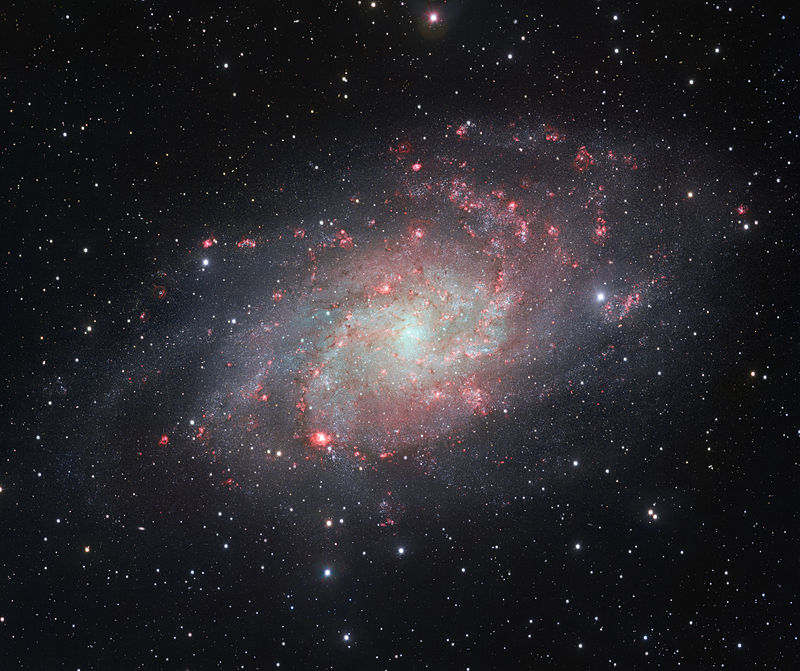
Say hello to the much-photographed Triangulum galaxy – aka Messier 33 – a face-on pinwheel of swarming suns and the second-nearest spiral galaxy to our Milky Way. This galaxy is only about 2.7 million light-years away. It’s huge, with a diameter about half that of our Milky Way. But it’s turned face on to us and thus has a low surface brightness in our sky. Although theoretically visible to the unaided eye under dark sky conditions, it’s still not easy to spot in binoculars or even a telescope. Keep reading to learn more about this nearby, face-on, very beautiful spiral galaxy.

EarthSky lunar calendars are cool! They make great gifts. Order now. Going fast!

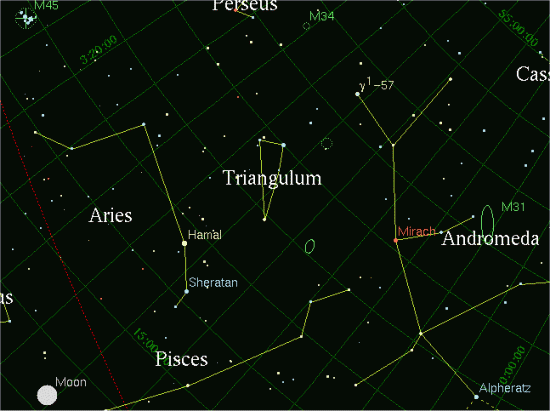
Constellation Triangulum. Notice its relationship to the constellation Andromeda and especially the star Mirach in Andromeda. Via astronomy.net

Constellation Triangulum. Notice its relationship to the constellation Andromeda and the star Mirach in Andromeda. The Andromeda galaxy is marked as M31. Via astronomy.net.

Via ESO Public Outreach

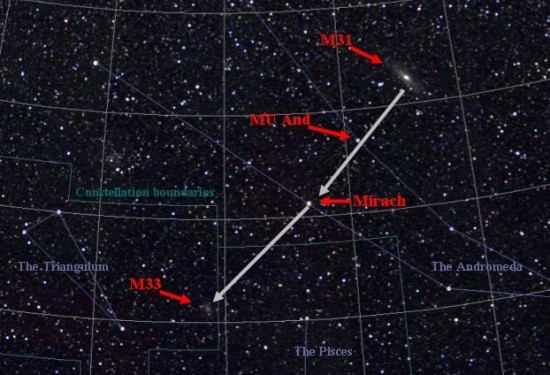
Here’s the star Mirach in Andromeda again. Notice that the Triangulum galaxy (M33) is about equidistant from this star as the Andromeda galaxy (M31). In other words, once you find Mirach and the Andromeda galaxy, a line between them will point, more or less, to the Triangulum galaxy. Via ESO Public Outreach.

How to find the Triangulum galaxy. Have you ever seen the Andromeda galaxy (Messier 31), closest spiral galaxy to our Milky Way? If not, try finding the Andromeda galaxy before you take on the Triangulum galaxy. Here are two ways to find the Andromeda galaxy:

Use constellation Cassiopeia to find Andromeda galaxy

Use Great Square of Pegasus to find Andromeda Galaxy

The Andromeda galaxy shines 8 to 9 times more brightly than the Triangulum galaxy, which is the most distant object that you can easily see with the unaided eye. Fortunately, the Triangulum and Andromeda galaxies are a relatively close 15 degrees apart (for reference, a fist-width at an arm length approximates 10 degrees).

Star-hop to the Andromeda galaxy to orient yourself to the Triangulum galaxy. As seen on the sky chart, the star Mirach stands about midway between the two galaxies. Once you find Mirach and the Andromeda galaxy, you can draw a line between them to point in the general direction of the Triangulum galaxy.

Now for a word of warning: even if you’re staring right at the Triangulum galaxy, it’s still possible to miss it. You won’t see the galaxy’s stars at all. Sometimes, this galaxy looks almost transparent, like a water spot on a window. The small blob in your binocular field might resemble an unwashed spot on an otherwise clean window. If you’ve never seen this deep-sky object before, it’s hard to know what to look for.

Once you finally spot the Triangulum galaxy, you may wonder how you overlooked it so many times before.

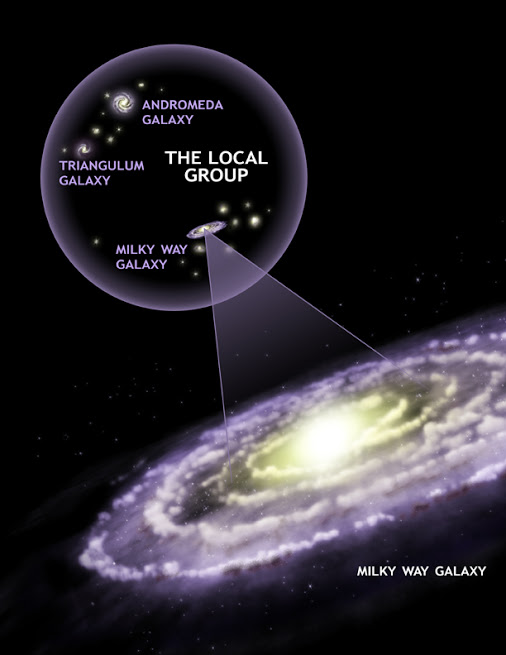
Artist's illustration of our Local Group via Chandra X-Ray Observatory.

Artist’s concept of our Local Group via Chandra X-Ray Observatory.

Science of the Triangulum galaxy. The Triangulum galaxy is located at a distance of about 2.7 million light-years from our Milky Way. It’s a spiral galaxy, whose face-on orientation has given it the nickname Pinwheel Galaxy (another face-on spiral, Messier 101, also has this nickname).

The Triangulum galaxy is the third-largest member of our Local Group of galaxies. Our Local Group consists of several dozen galaxies; our Milky Way, the Andromeda galaxy and the Triangulum galaxy are the largest members.

After the Milky Way and Andromeda galaxies, the Triangulum galaxy ranks as the third-largest Local Group member. Its diameter is about 50,000 light-years, or about one-half that of our Milky Way. It’s thought to contain some 40 billion stars, in contrast to 400 billion for the Milky Way, and a trillion (1,000 billion) stars for Andromeda.

In 2004, astronomers found evidence for a clumpy stream of hydrogen gas linking the Triangulum galaxy with the nearby Andromeda galaxy. A year later, astronomers were able to estimate the proper motion – or sideways motion on our sky’s dome – of the Triangulum galaxy for the first time. They found that this galaxy is moving towards the Andromeda galaxy. Afterwards, some astronomers suggested the Triangulum galaxy might be a satellite of the Andromeda galaxy. In other words, over a timescale so vast we haven’t yet comprehended it, the Triangulum galaxy might orbit around the Andromeda galaxy.

It’s well known that the Andromeda galaxy is moving toward our Milky Way and that a collision between the two galaxies will occur some 4 billion years from now. Meanwhile, the fate of the Triangulum Galaxy isn’t known for certain. It might someday be torn apart and absorbed by the Andromeda galaxy. It might participate in the collision between the Milky Way and Andromeda galaxies.

Two other possibilities are a collision with the Milky Way before Andromeda arrives or an ejection from the Local Group.

It’s safe to say that the fate of these great galaxies is beyond human knowledge at this time!

Enjoying EarthSky? Sign up for our free daily newsletter today!

Bottom line: The Triangulum galaxy is the second-closest large spiral galaxy at 2.7 million light-years away. It’s turned face-on to us and so appears faint in our sky.


from EarthSky https://ift.tt/1w9dITB

Say hello to the much-photographed Triangulum galaxy – aka Messier 33 – a face-on pinwheel of swarming suns and the second-nearest spiral galaxy to our Milky Way. This galaxy is only about 2.7 million light-years away. It’s huge, with a diameter about half that of our Milky Way. But it’s turned face on to us and thus has a low surface brightness in our sky. Although theoretically visible to the unaided eye under dark sky conditions, it’s still not easy to spot in binoculars or even a telescope. Keep reading to learn more about this nearby, face-on, very beautiful spiral galaxy.

EarthSky lunar calendars are cool! They make great gifts. Order now. Going fast!

Constellation Triangulum. Notice its relationship to the constellation Andromeda and especially the star Mirach in Andromeda. Via astronomy.net

Constellation Triangulum. Notice its relationship to the constellation Andromeda and the star Mirach in Andromeda. The Andromeda galaxy is marked as M31. Via astronomy.net.

Via ESO Public Outreach

Here’s the star Mirach in Andromeda again. Notice that the Triangulum galaxy (M33) is about equidistant from this star as the Andromeda galaxy (M31). In other words, once you find Mirach and the Andromeda galaxy, a line between them will point, more or less, to the Triangulum galaxy. Via ESO Public Outreach.

How to find the Triangulum galaxy. Have you ever seen the Andromeda galaxy (Messier 31), closest spiral galaxy to our Milky Way? If not, try finding the Andromeda galaxy before you take on the Triangulum galaxy. Here are two ways to find the Andromeda galaxy:

Use constellation Cassiopeia to find Andromeda galaxy

Use Great Square of Pegasus to find Andromeda Galaxy

The Andromeda galaxy shines 8 to 9 times more brightly than the Triangulum galaxy, which is the most distant object that you can easily see with the unaided eye. Fortunately, the Triangulum and Andromeda galaxies are a relatively close 15 degrees apart (for reference, a fist-width at an arm length approximates 10 degrees).

Star-hop to the Andromeda galaxy to orient yourself to the Triangulum galaxy. As seen on the sky chart, the star Mirach stands about midway between the two galaxies. Once you find Mirach and the Andromeda galaxy, you can draw a line between them to point in the general direction of the Triangulum galaxy.

Now for a word of warning: even if you’re staring right at the Triangulum galaxy, it’s still possible to miss it. You won’t see the galaxy’s stars at all. Sometimes, this galaxy looks almost transparent, like a water spot on a window. The small blob in your binocular field might resemble an unwashed spot on an otherwise clean window. If you’ve never seen this deep-sky object before, it’s hard to know what to look for.

Once you finally spot the Triangulum galaxy, you may wonder how you overlooked it so many times before.

Artist's illustration of our Local Group via Chandra X-Ray Observatory.

Artist’s concept of our Local Group via Chandra X-Ray Observatory.

Science of the Triangulum galaxy. The Triangulum galaxy is located at a distance of about 2.7 million light-years from our Milky Way. It’s a spiral galaxy, whose face-on orientation has given it the nickname Pinwheel Galaxy (another face-on spiral, Messier 101, also has this nickname).

The Triangulum galaxy is the third-largest member of our Local Group of galaxies. Our Local Group consists of several dozen galaxies; our Milky Way, the Andromeda galaxy and the Triangulum galaxy are the largest members.

After the Milky Way and Andromeda galaxies, the Triangulum galaxy ranks as the third-largest Local Group member. Its diameter is about 50,000 light-years, or about one-half that of our Milky Way. It’s thought to contain some 40 billion stars, in contrast to 400 billion for the Milky Way, and a trillion (1,000 billion) stars for Andromeda.

In 2004, astronomers found evidence for a clumpy stream of hydrogen gas linking the Triangulum galaxy with the nearby Andromeda galaxy. A year later, astronomers were able to estimate the proper motion – or sideways motion on our sky’s dome – of the Triangulum galaxy for the first time. They found that this galaxy is moving towards the Andromeda galaxy. Afterwards, some astronomers suggested the Triangulum galaxy might be a satellite of the Andromeda galaxy. In other words, over a timescale so vast we haven’t yet comprehended it, the Triangulum galaxy might orbit around the Andromeda galaxy.

It’s well known that the Andromeda galaxy is moving toward our Milky Way and that a collision between the two galaxies will occur some 4 billion years from now. Meanwhile, the fate of the Triangulum Galaxy isn’t known for certain. It might someday be torn apart and absorbed by the Andromeda galaxy. It might participate in the collision between the Milky Way and Andromeda galaxies.

Two other possibilities are a collision with the Milky Way before Andromeda arrives or an ejection from the Local Group.

It’s safe to say that the fate of these great galaxies is beyond human knowledge at this time!

Enjoying EarthSky? Sign up for our free daily newsletter today!

Bottom line: The Triangulum galaxy is the second-closest large spiral galaxy at 2.7 million light-years away. It’s turned face-on to us and so appears faint in our sky.


from EarthSky https://ift.tt/1w9dITB

2018 SkS Weekly Climate Change & Global Warming News Roundup #48

A chronological listing of news articles posted on the Skeptical Science Facebook Page during the past week, i.e., Sunday, Nov 25 through Saturday, Dec. 1

Editor's Pick

Climate change signals and impacts continue in 2018

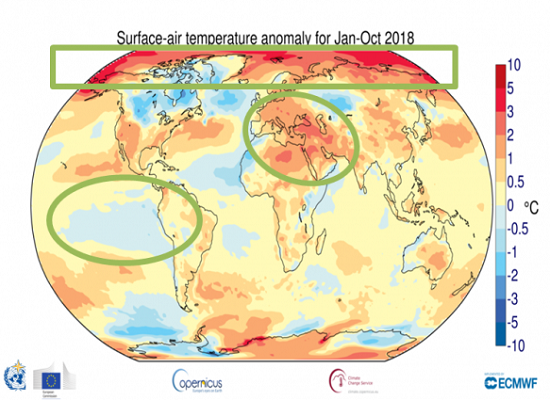
Global Surface Temperature Anomalies Jan-Oct 2018 WMO 


The long-term warming trend has continued in 2018, with the average global temperature set to be the fourth highest on record. The 20 warmest years on record have been in the past 22 years, with the top four in the past four years, according to the World Meteorological Organization (WMO).

Other tell-tale signs of climate change, including sea level rise, ocean heat and acidification and sea-ice and glacier melt continue, whilst extreme weather left a trail of devastation on all continents, according to the WMO provisional Statement on the State of the Climate in 2018. It includes details of impacts of climate change based on contributions from a wide range of United Nations partners.

The report shows that the global average temperature for the first ten months of the year was nearly 1°C above the pre-industrial baseline (1850-1900). This is based on five independently maintained global temperature data sets.

“We are not on track to meet climate change targets and rein in temperature increases,” said WMO Secretary-General Petteri Taalas. “Greenhouse gas concentrations are once again at record levels and if the current trend continues we may see temperature increases 3-5°C by the end of the century. If we exploit all known fossil fuel resources, the temperature rise will be considerably higher,” he said.

“It is worth repeating once again that we are the first generation to fully understand climate change and the last generation to be able to do something about it,” said Mr Taalas.

The Intergovernmental Panel on Climate Change (IPCC) special report on Global Warming of 1.5°C reported that the average global temperature for the decade 2006-2015 was 0.86°C above the pre-industrial baseline. The average increase above the same baseline for the most recent decade 2009-2018 was about 0.93°C and for the past five years, 2014-2018, was 1.04°C above the pre-industrial baseline.

“These are more than just numbers,” said WMO Deputy Secretary-General Elena Manaenkova.

“Every fraction of a degree of warming makes a difference to human health and access to food and fresh water, to the extinction of animals and plants, to the survival of coral reefs and marine life. It makes a difference to economic productivity, food security, and to the resilience of our infrastructure and cities. It makes a difference to the speed of glacier melt and water supplies, and the future of low-lying islands and coastal communities. Every extra bit matters,” said Ms Manaenkova.

The WMO report adds to the authoritative scientific evidence that will inform UN climate change negotiations from 2-14 December in Katowice, Poland. The key objective of the meeting is to adopt the implementation guidelines of the Paris Agreement on Climate Change, which aims to hold the global average temperature increase to as close as possible to 1.5°C.

The IPCC report on Global Warming of 1.5°C said that this target was physically possible but would require unprecedented changes in our lifestyle, energy and transport systems. It showed how keeping temperature increases below 2°C would reduce the risks to human well-being, ecosystems and sustainable development.

National meteorological and hydrological services have been contributing to national climate assessments. A new U.S. federal report detailed how climate change is affecting the environment, agriculture, energy, land and water resources, transportation, and human health and welfare, with a risk that it will lead to growing losses to American infrastructure and property and impede the rate of economic growth over this century.

A UK assessment published 26 November warned summer temperatures could be up to 5.4°C hotter and summer rainfall could decrease by up to 47% by 2070, and sea levels in London could rise by 1.15m by 2100. A Swiss report on climate scenarios released on 13 November said that Switzerland is becoming hotter and drier, but will also struggle with heavier rainfall in the future and its famed ski resorts will have less snow.

“The WMO community is enhancing the translation of science into services. This will support countries in generating national climate scenarios and predictions and developing tailored climate services to reduce risks associated with climate change and increasingly extreme weather. WMO is also working to develop integrated tools to monitor and manage greenhouse gas emissions and carbon sinks,” said WMO Chief Scientist and Research Director Pavel Kabat.

Highlights of the provisional statement on the state of the climate

Temperatures: 2018 started with a weak La Niña event, which continued until March. By October, however, sea-surface temperatures in the eastern Tropical Pacific were showing signs of a return to El Niño conditions, although the atmosphere as yet shows little response. If El Niño develops, 2019 is likely to be warmer than 2018.

Greenhouse gases:  In 2017, carbon dioxide, methane and nitrous oxide concentrations reached new highs, according to WMO Greenhouse Gas Bulletin. Data from a number of locations, including Mauna Loa (Hawaii) and Cape Grim (Tasmania) indicate that they continued to increase in 2018.

Oceans: The oceans absorb more than 90% of the energy trapped by greenhouse gases and 25% of anthropogenic CO2 emissions, making them warmer and more acidic. For each 3-month period until September 2018, ocean heat content was the highest or second highest on record. Global Mean Sea Level from January to July 2018 was around 2 to 3 mm higher than the same period in 2017.

Sea ice: Arctic sea-ice extent was well below average throughout 2018 with record-low levels in the first two months of the year. The annual maximum occurred in mid-March and was the third lowest on record. The minimum extent in September was the 6th smallest on record, meaning that all 12 smallest September extents have been in the past 12 years. Antarctic sea-ice extent was also well below average throughout 2018. The annual minimum extent occurred in late February and was ranked as one of the two lowest extents. 

Extreme Weather

Tropical Storms:  The number of tropical cyclones was above average in all four Northern Hemisphere basins, with 70 reported by 20 November, compared to the long-term average of 53, leading to many casualties. The Northeast Pacific basin was especially active, with an Accumulated Cyclone Energy that was the highest since reliable satellite records began.

Two of the strongest tropical cyclones were Mangkhut, which impacted the Philippines, Hong Kong SAR and China, and Yutu, which brought devastation in the Mariana Islands. Jebi was the strongest typhoon to hit Japan since 1993, Son-Tinh caused flooding in Viet Nam and Laos, whilst Soulik contributed to flooding on the Korean peninsula. Hurricanes Florence and Michael were associated with huge economic damage and considerable loss of life in the United States. Gita, in the South Pacific, was the most intense and most expensive cyclone to ever hit Tonga.

Floods and rainfall: In August, the southwest Indian state of Kerala suffered the worst flooding since the 1920s, displacing more than 1.4 million people from their homes and affecting more than 5.4 million. Large parts of western Japan experienced destructive flooding in late June and early July, killing at least 230 people and destroying thousands of homes. Flooding affected many parts of east Africa in March and April. This included Kenya and Somalia, which had previously been suffering from severe drought, as well as Ethiopia and northern and central Tanzania.  An intense low-pressure system in the Mediterranean Sea in late October brought flooding, high winds and loss of life.

Heatwaves and drought: Large parts of Europe experienced exceptional heat and drought through the late spring and summer of 2018, leading to wildfires in Scandinavia. In July and August, there were numerous record high temperatures north of the Arctic Circle, and record long runs of warm temperatures., including 25 consecutive days above 25 °C in Helsinki (Finland). Parts of Germany had a long spell of days above 30°C, whilst a heatwave in France was associated with a number of deaths.  It was also an exceptionally warm and dry period in the United Kingdom and Ireland. A short but intense heatwave affected Spain and Portugal in early August.

Dry conditions were especially persistent in Germany, the Czech Republic, western Poland, the Netherlands, Belgium and parts of France. The Rhine approached record low flows by mid-October, seriously disrupting river transport.

Eastern Australia experienced significant drought during 2018, especially New South Wales and southern Queensland, with much of the region receiving less than half its average rainfall for the period from January to September.  Severe drought affected Uruguay, and northern and central Argentina, in late 2017 and early 2018, leading to heavy agricultural losses.

Both Japan and the Republic of Korea saw new national heat records (41.1 °C and 41.0°C respectively.)

Oman reported one of the highest known minimum overnight temperature of 42.6 °C in June. Algeria saw a new national of 51.3 °C in July.

Cold and snow: One of the most significant cold outbreaks of recent years affected Europe in late February and early March.

Wildfires: Major wildfires affected Athens (Greece) on 23 July, with many fatalities. British Columbia in Canada broke its record for the most area burned in a fire season for the second successive year. California suffered devastating wildfires, with November’s Camp Fire being the deadliest fire in over a century for the U.S.A. 

Other Impacts

The provisional statement contained details of impacts of climate change, based on contributions from the Food and Agriculture Organization (FAO), International Organization for Migration (IOM), UN Environment Programme (UNEP), UNESCO’s Intergovernmental Oceanographic Commission (IOC), UN High Commission for Refugees UNHCR) and World Food Programme (WFP). This section will be expanded in the final statement, to be released in March 2019.

Exposure of agriculture sectors to climate extremes is threatening to reverse gains made in ending malnutrition. New evidence shows a rise in world hunger after a prolonged decline. In 2017, the number of undernourished people was estimated to have increased to 821 million, according The State of Food Security and Nutrition in the World 2018, by to FAO, WFP, the International Fund for Agricultural Development, the UN Children’s Fund and the World Health Organization. Africa is the region where climate events had the biggest impact on acute food insecurity and malnutrition in 2017, affecting 59 million people in 24 countries and requiring urgent humanitarian action. Much of the vulnerability to climate variability is associated with the dryland farming and pastoral rangeland systems supporting 70–80% of the continent’s rural population.

Out of the 17.7 million Internally Displaced Persons tracked by the IOM, 2.3 million people were displaced due to disasters linked to weather and climate events as of September 2018. In Somalia, some 642 000 new internal displacements were recorded between January and July 2018 by UNHCR, with flooding the primary reason for displacement (43%), followed by drought (29%), and conflict (26%).

UN agencies including UNESCO-IOC and UNEP are tracking environmental impacts associated with climate change include coral bleaching, reduced levels of oxygen in the oceans, loss of “Blue Carbon” associated with coastal ecosystems such as mangroves and salt marshes. Climate change also exposes peatlands currently protected by permafrost to thawing and possible increased methane emissions and loss of carbon, and the associated sea-level rise increases the risks of coastal erosion and salination of freshwater peatlands.

Climate change signals and impacts continue in 2018, Press Release, World Meteorological Organization (WM0), Nov 29, 2018

Notes for Editors

Information used in this report is sourced from a large number of National Meteorological and Hydrological Services (NMHSs) and associated institutions, as well as Regional Climate Centres, the World Climate Research Programme (WCRP), the Global Atmosphere Watch (GAW) and Global Cryosphere Watch. Information has also been supplied by a number of other United Nations agencies, including the Food and Agriculture Organization (FAO), the World Food Programme (WFP), the United Nations High Commissioner for Refugees (UNHCR), the International Organization for Migration (IOM), the Intergovernmental Oceanographic Commission of UNESCO (IOC-UNESCO) and UN Environment

WMO uses datasets (based on monthly climatological data from observing sites) from the United States National Oceanic and Atmospheric Administration, NASA’s Goddard Institute for Space Studies, and the United Kingdom’s Met Office Hadley Centre and the University of East Anglia’s Climatic Research Unit in the United Kingdom.

It also uses reanalysis datasets from the European Centre for Medium Range Weather Forecasts and its Copernicus Climate Change Service, and the Japan Meteorological Agency.  This method combines millions of meteorological and marine observations, including from satellites, with models to produce a complete reanalysis of the atmosphere. The combination of observations with models makes it possible to estimate temperatures at any time and in any place across the globe, even in data-sparse areas such as the polar regions.

Story map featuring the Climate statement

Weather and Climate events 2018 interactive map

See also:  Key Climate Indicators table  


Links posted on Facebook

Sun Nov 25, 2018

Mon Nov 26, 2018

Tue Nov 27, 2018

Wed Nov 28, 2018

Thu Nov 29, 2018

Fri Nov 30, 2018

Sat Dec 1, 2018


from Skeptical Science https://ift.tt/2U5EB9W
A chronological listing of news articles posted on the Skeptical Science Facebook Page during the past week, i.e., Sunday, Nov 25 through Saturday, Dec. 1

Editor's Pick

Climate change signals and impacts continue in 2018

Global Surface Temperature Anomalies Jan-Oct 2018 WMO 


The long-term warming trend has continued in 2018, with the average global temperature set to be the fourth highest on record. The 20 warmest years on record have been in the past 22 years, with the top four in the past four years, according to the World Meteorological Organization (WMO).

Other tell-tale signs of climate change, including sea level rise, ocean heat and acidification and sea-ice and glacier melt continue, whilst extreme weather left a trail of devastation on all continents, according to the WMO provisional Statement on the State of the Climate in 2018. It includes details of impacts of climate change based on contributions from a wide range of United Nations partners.

The report shows that the global average temperature for the first ten months of the year was nearly 1°C above the pre-industrial baseline (1850-1900). This is based on five independently maintained global temperature data sets.

“We are not on track to meet climate change targets and rein in temperature increases,” said WMO Secretary-General Petteri Taalas. “Greenhouse gas concentrations are once again at record levels and if the current trend continues we may see temperature increases 3-5°C by the end of the century. If we exploit all known fossil fuel resources, the temperature rise will be considerably higher,” he said.

“It is worth repeating once again that we are the first generation to fully understand climate change and the last generation to be able to do something about it,” said Mr Taalas.

The Intergovernmental Panel on Climate Change (IPCC) special report on Global Warming of 1.5°C reported that the average global temperature for the decade 2006-2015 was 0.86°C above the pre-industrial baseline. The average increase above the same baseline for the most recent decade 2009-2018 was about 0.93°C and for the past five years, 2014-2018, was 1.04°C above the pre-industrial baseline.

“These are more than just numbers,” said WMO Deputy Secretary-General Elena Manaenkova.

“Every fraction of a degree of warming makes a difference to human health and access to food and fresh water, to the extinction of animals and plants, to the survival of coral reefs and marine life. It makes a difference to economic productivity, food security, and to the resilience of our infrastructure and cities. It makes a difference to the speed of glacier melt and water supplies, and the future of low-lying islands and coastal communities. Every extra bit matters,” said Ms Manaenkova.

The WMO report adds to the authoritative scientific evidence that will inform UN climate change negotiations from 2-14 December in Katowice, Poland. The key objective of the meeting is to adopt the implementation guidelines of the Paris Agreement on Climate Change, which aims to hold the global average temperature increase to as close as possible to 1.5°C.

The IPCC report on Global Warming of 1.5°C said that this target was physically possible but would require unprecedented changes in our lifestyle, energy and transport systems. It showed how keeping temperature increases below 2°C would reduce the risks to human well-being, ecosystems and sustainable development.

National meteorological and hydrological services have been contributing to national climate assessments. A new U.S. federal report detailed how climate change is affecting the environment, agriculture, energy, land and water resources, transportation, and human health and welfare, with a risk that it will lead to growing losses to American infrastructure and property and impede the rate of economic growth over this century.

A UK assessment published 26 November warned summer temperatures could be up to 5.4°C hotter and summer rainfall could decrease by up to 47% by 2070, and sea levels in London could rise by 1.15m by 2100. A Swiss report on climate scenarios released on 13 November said that Switzerland is becoming hotter and drier, but will also struggle with heavier rainfall in the future and its famed ski resorts will have less snow.

“The WMO community is enhancing the translation of science into services. This will support countries in generating national climate scenarios and predictions and developing tailored climate services to reduce risks associated with climate change and increasingly extreme weather. WMO is also working to develop integrated tools to monitor and manage greenhouse gas emissions and carbon sinks,” said WMO Chief Scientist and Research Director Pavel Kabat.

Highlights of the provisional statement on the state of the climate

Temperatures: 2018 started with a weak La Niña event, which continued until March. By October, however, sea-surface temperatures in the eastern Tropical Pacific were showing signs of a return to El Niño conditions, although the atmosphere as yet shows little response. If El Niño develops, 2019 is likely to be warmer than 2018.

Greenhouse gases:  In 2017, carbon dioxide, methane and nitrous oxide concentrations reached new highs, according to WMO Greenhouse Gas Bulletin. Data from a number of locations, including Mauna Loa (Hawaii) and Cape Grim (Tasmania) indicate that they continued to increase in 2018.

Oceans: The oceans absorb more than 90% of the energy trapped by greenhouse gases and 25% of anthropogenic CO2 emissions, making them warmer and more acidic. For each 3-month period until September 2018, ocean heat content was the highest or second highest on record. Global Mean Sea Level from January to July 2018 was around 2 to 3 mm higher than the same period in 2017.

Sea ice: Arctic sea-ice extent was well below average throughout 2018 with record-low levels in the first two months of the year. The annual maximum occurred in mid-March and was the third lowest on record. The minimum extent in September was the 6th smallest on record, meaning that all 12 smallest September extents have been in the past 12 years. Antarctic sea-ice extent was also well below average throughout 2018. The annual minimum extent occurred in late February and was ranked as one of the two lowest extents. 

Extreme Weather

Tropical Storms:  The number of tropical cyclones was above average in all four Northern Hemisphere basins, with 70 reported by 20 November, compared to the long-term average of 53, leading to many casualties. The Northeast Pacific basin was especially active, with an Accumulated Cyclone Energy that was the highest since reliable satellite records began.

Two of the strongest tropical cyclones were Mangkhut, which impacted the Philippines, Hong Kong SAR and China, and Yutu, which brought devastation in the Mariana Islands. Jebi was the strongest typhoon to hit Japan since 1993, Son-Tinh caused flooding in Viet Nam and Laos, whilst Soulik contributed to flooding on the Korean peninsula. Hurricanes Florence and Michael were associated with huge economic damage and considerable loss of life in the United States. Gita, in the South Pacific, was the most intense and most expensive cyclone to ever hit Tonga.

Floods and rainfall: In August, the southwest Indian state of Kerala suffered the worst flooding since the 1920s, displacing more than 1.4 million people from their homes and affecting more than 5.4 million. Large parts of western Japan experienced destructive flooding in late June and early July, killing at least 230 people and destroying thousands of homes. Flooding affected many parts of east Africa in March and April. This included Kenya and Somalia, which had previously been suffering from severe drought, as well as Ethiopia and northern and central Tanzania.  An intense low-pressure system in the Mediterranean Sea in late October brought flooding, high winds and loss of life.

Heatwaves and drought: Large parts of Europe experienced exceptional heat and drought through the late spring and summer of 2018, leading to wildfires in Scandinavia. In July and August, there were numerous record high temperatures north of the Arctic Circle, and record long runs of warm temperatures., including 25 consecutive days above 25 °C in Helsinki (Finland). Parts of Germany had a long spell of days above 30°C, whilst a heatwave in France was associated with a number of deaths.  It was also an exceptionally warm and dry period in the United Kingdom and Ireland. A short but intense heatwave affected Spain and Portugal in early August.

Dry conditions were especially persistent in Germany, the Czech Republic, western Poland, the Netherlands, Belgium and parts of France. The Rhine approached record low flows by mid-October, seriously disrupting river transport.

Eastern Australia experienced significant drought during 2018, especially New South Wales and southern Queensland, with much of the region receiving less than half its average rainfall for the period from January to September.  Severe drought affected Uruguay, and northern and central Argentina, in late 2017 and early 2018, leading to heavy agricultural losses.

Both Japan and the Republic of Korea saw new national heat records (41.1 °C and 41.0°C respectively.)

Oman reported one of the highest known minimum overnight temperature of 42.6 °C in June. Algeria saw a new national of 51.3 °C in July.

Cold and snow: One of the most significant cold outbreaks of recent years affected Europe in late February and early March.

Wildfires: Major wildfires affected Athens (Greece) on 23 July, with many fatalities. British Columbia in Canada broke its record for the most area burned in a fire season for the second successive year. California suffered devastating wildfires, with November’s Camp Fire being the deadliest fire in over a century for the U.S.A. 

Other Impacts

The provisional statement contained details of impacts of climate change, based on contributions from the Food and Agriculture Organization (FAO), International Organization for Migration (IOM), UN Environment Programme (UNEP), UNESCO’s Intergovernmental Oceanographic Commission (IOC), UN High Commission for Refugees UNHCR) and World Food Programme (WFP). This section will be expanded in the final statement, to be released in March 2019.

Exposure of agriculture sectors to climate extremes is threatening to reverse gains made in ending malnutrition. New evidence shows a rise in world hunger after a prolonged decline. In 2017, the number of undernourished people was estimated to have increased to 821 million, according The State of Food Security and Nutrition in the World 2018, by to FAO, WFP, the International Fund for Agricultural Development, the UN Children’s Fund and the World Health Organization. Africa is the region where climate events had the biggest impact on acute food insecurity and malnutrition in 2017, affecting 59 million people in 24 countries and requiring urgent humanitarian action. Much of the vulnerability to climate variability is associated with the dryland farming and pastoral rangeland systems supporting 70–80% of the continent’s rural population.

Out of the 17.7 million Internally Displaced Persons tracked by the IOM, 2.3 million people were displaced due to disasters linked to weather and climate events as of September 2018. In Somalia, some 642 000 new internal displacements were recorded between January and July 2018 by UNHCR, with flooding the primary reason for displacement (43%), followed by drought (29%), and conflict (26%).

UN agencies including UNESCO-IOC and UNEP are tracking environmental impacts associated with climate change include coral bleaching, reduced levels of oxygen in the oceans, loss of “Blue Carbon” associated with coastal ecosystems such as mangroves and salt marshes. Climate change also exposes peatlands currently protected by permafrost to thawing and possible increased methane emissions and loss of carbon, and the associated sea-level rise increases the risks of coastal erosion and salination of freshwater peatlands.

Climate change signals and impacts continue in 2018, Press Release, World Meteorological Organization (WM0), Nov 29, 2018

Notes for Editors

Information used in this report is sourced from a large number of National Meteorological and Hydrological Services (NMHSs) and associated institutions, as well as Regional Climate Centres, the World Climate Research Programme (WCRP), the Global Atmosphere Watch (GAW) and Global Cryosphere Watch. Information has also been supplied by a number of other United Nations agencies, including the Food and Agriculture Organization (FAO), the World Food Programme (WFP), the United Nations High Commissioner for Refugees (UNHCR), the International Organization for Migration (IOM), the Intergovernmental Oceanographic Commission of UNESCO (IOC-UNESCO) and UN Environment

WMO uses datasets (based on monthly climatological data from observing sites) from the United States National Oceanic and Atmospheric Administration, NASA’s Goddard Institute for Space Studies, and the United Kingdom’s Met Office Hadley Centre and the University of East Anglia’s Climatic Research Unit in the United Kingdom.

It also uses reanalysis datasets from the European Centre for Medium Range Weather Forecasts and its Copernicus Climate Change Service, and the Japan Meteorological Agency.  This method combines millions of meteorological and marine observations, including from satellites, with models to produce a complete reanalysis of the atmosphere. The combination of observations with models makes it possible to estimate temperatures at any time and in any place across the globe, even in data-sparse areas such as the polar regions.

Story map featuring the Climate statement

Weather and Climate events 2018 interactive map

See also:  Key Climate Indicators table  


Links posted on Facebook

Sun Nov 25, 2018

Mon Nov 26, 2018

Tue Nov 27, 2018

Wed Nov 28, 2018

Thu Nov 29, 2018

Fri Nov 30, 2018

Sat Dec 1, 2018


from Skeptical Science https://ift.tt/2U5EB9W

Small asteroid to sweep close this weekend

Very small asteroid 2018 WV1 on November 30 – slightly more than a day prior to its closest approach to Earth – via Northolt Branch Observatories.

Daniel Bamberger of Northolt Branch Observatories, a private observatory in Northolt, London, U.K., wrote late last night (November 30, 2018) about a small asteroid – just discovered – that will sweep extremely close to Earth Sunday morning, December 2, 2018. The asteroid designated 2018 WV1 will sweep closest at 03:11 UTC on Sunday. It will come within 0.09 lunar distances (32,911 km / 20,450 miles), making it the third-closest asteroid to pass Earth this year. Its estimated diameter is between 8.2 and 18.3 feet (2.5 and 5.6 meters). Bamgerger wrote:

2018 WV1 was found on November 29 at the Catalina Sky Survey in Arizona, USA. It will make a close encounter on Sunday morning, coming within 27,000 km (16,800 mi) from the Earth’s surface – closer than the geostationary satellites.

Besides its very close approach, 2018 WV1 is interesting for several reasons. One is its very low velocity relative to Earth: This makes it very likely that 2018 WV1 is a piece of lunar ejecta, a fragment of the moon that was ejected into space when a larger asteroid hit the moon a long time ago.

When 2018 WV1 was discovered, the initial orbit showed a 2% chance of hitting the Earth in early December. Luckily, that possibility was ruled out soon after.

Even if it had hit us, the object is too small to be a threat.

To help further refine its orbit, we have observed 2018 WV1 tonight from [Northolt Branch Observatories]. The asteroid was at a distance of 285,000 km from Earth at that time, and approaching, still a faint object at 19th magnitude.

According to The Watchers, since the beginning of 2018, observatories on Earth have detected 70 asteroids with flyby distance within 1 lunar distance.

Bottom line: Astronomers found asteroid 2018 WV1 on November 29. On December 2, it will pass closer to Earth than geosynchronous satellites.


from EarthSky https://ift.tt/2Q58DME

Very small asteroid 2018 WV1 on November 30 – slightly more than a day prior to its closest approach to Earth – via Northolt Branch Observatories.

Daniel Bamberger of Northolt Branch Observatories, a private observatory in Northolt, London, U.K., wrote late last night (November 30, 2018) about a small asteroid – just discovered – that will sweep extremely close to Earth Sunday morning, December 2, 2018. The asteroid designated 2018 WV1 will sweep closest at 03:11 UTC on Sunday. It will come within 0.09 lunar distances (32,911 km / 20,450 miles), making it the third-closest asteroid to pass Earth this year. Its estimated diameter is between 8.2 and 18.3 feet (2.5 and 5.6 meters). Bamgerger wrote:

2018 WV1 was found on November 29 at the Catalina Sky Survey in Arizona, USA. It will make a close encounter on Sunday morning, coming within 27,000 km (16,800 mi) from the Earth’s surface – closer than the geostationary satellites.

Besides its very close approach, 2018 WV1 is interesting for several reasons. One is its very low velocity relative to Earth: This makes it very likely that 2018 WV1 is a piece of lunar ejecta, a fragment of the moon that was ejected into space when a larger asteroid hit the moon a long time ago.

When 2018 WV1 was discovered, the initial orbit showed a 2% chance of hitting the Earth in early December. Luckily, that possibility was ruled out soon after.

Even if it had hit us, the object is too small to be a threat.

To help further refine its orbit, we have observed 2018 WV1 tonight from [Northolt Branch Observatories]. The asteroid was at a distance of 285,000 km from Earth at that time, and approaching, still a faint object at 19th magnitude.

According to The Watchers, since the beginning of 2018, observatories on Earth have detected 70 asteroids with flyby distance within 1 lunar distance.

Bottom line: Astronomers found asteroid 2018 WV1 on November 29. On December 2, it will pass closer to Earth than geosynchronous satellites.


from EarthSky https://ift.tt/2Q58DME

Golden virga at sunset

Image via Peter Lowenstein.

Peter Lowenstein in Mutare, Zimbabwe has contributed many amazing photos to EarthSky. Here’s what he told us about this image:

The first rains of the rainy season have fallen in Mutare over the past three days and humidity has been high. This afternoon cloud started to clear allowing the setting sun to emerge and shine brightly from a gap beneath it. Then something strange happened. At 10 minutes to 6:00, a patch of mist produced by condensation from moist cooling air began to reflect the setting sunlight to produce a bright spherical and then oblong apparition which floated for a minute or two directly above Hospital Hill. A short time later more widespread sunlit veils of condensation started to form and then developed into beautiful thin curtains of golden virga which for a few minutes shone brightly and remained suspended in the air.

Camera: Panasonic Lumix DMC TZ60 in sunset scene mode.

We’ve all seen virga, but maybe not known what it’s called. Virga is rain that evaporates before it hits the ground.

Thanks Peter!

Bottom line: Photo of virga in Mutare, Zimbabwe.

EarthSky lunar calendars are cool! They make great gifts. Order now. Going fast!


from EarthSky https://ift.tt/2reMyfH

Image via Peter Lowenstein.

Peter Lowenstein in Mutare, Zimbabwe has contributed many amazing photos to EarthSky. Here’s what he told us about this image:

The first rains of the rainy season have fallen in Mutare over the past three days and humidity has been high. This afternoon cloud started to clear allowing the setting sun to emerge and shine brightly from a gap beneath it. Then something strange happened. At 10 minutes to 6:00, a patch of mist produced by condensation from moist cooling air began to reflect the setting sunlight to produce a bright spherical and then oblong apparition which floated for a minute or two directly above Hospital Hill. A short time later more widespread sunlit veils of condensation started to form and then developed into beautiful thin curtains of golden virga which for a few minutes shone brightly and remained suspended in the air.

Camera: Panasonic Lumix DMC TZ60 in sunset scene mode.

We’ve all seen virga, but maybe not known what it’s called. Virga is rain that evaporates before it hits the ground.

Thanks Peter!

Bottom line: Photo of virga in Mutare, Zimbabwe.

EarthSky lunar calendars are cool! They make great gifts. Order now. Going fast!


from EarthSky https://ift.tt/2reMyfH

adds 2