aads

Science Snaps: spotting lung cancers’ ‘crime hotspots’

Image of a lung biopsy sample stained to reveal immune 'hotspots' next to a map of London showing crime levels.

This entry is part 24 of 24 in the series Science Snaps

To tackle crime, you need to know where it’s happening and why.

London’s Metropolitan Police collect and analyse data on crimes committed in different neighbourhoods and map local crime rates compared to the average across the capital. The stats highlight ‘hotspots’, like in the map above, that can focus efforts and resources.

Research has shown that cancers are like a complex city, with bustling neighbourhoods of different cells, some of which are more dangerous than others.

In the mix are immune cells, which operate much like a city’s police force. And that’s why scientists are turning to crime-mapping tech as a new way to look at cancers.

We visited a researcher who’s applying these statistical methods to analyse lung tumours. And in the hunt for ‘hotspots’ of immune activity, she hopes to produce maps that could predict how patients will respond to treatment.

Mapping cancer evolution

Dr Yinyin Yuan, a Cancer Research UK scientist based at The Institute of Cancer Research, London, pulls up a picture on her computer. It’s an image of a patient’s lung tumour sample taken using a microscope. They’ve volunteered to have their cancer analysed as part of the Cancer Research UK-funded TRACERx study, which is giving our scientists the greatest possible understanding of the biology of lung tumours.

As part of this study, Yuan is developing an artificial intelligence program to allow researchers to probe the cellular neighbourhoods inside the tumour.

Their aim is to understand how the body’s immune system responds to cancer as it evolves and develops.

“Cancer cells don’t live alone, and we need to understand how they interact and the evolutionary pressure they’re under, to be able to stay one step ahead and anticipate cancer’s next move,” she says.

Crime scene investigation

Stained in colourful shades of pink and purple, but with no discernible features, it’s difficult to see how the images of cancer samples on Yuan’s screen could tell us anything about a patient’s disease. But as she flips the image, it’s transformed into a map that clearly points to one region being different to its neighbour.

And it’s the transformation of images like these, as shown below, that are revealing a snapshot of the body’s immune cells interacting with different parts of the lung cancer.

A lung biopsy sample with immune 'hotspots' highlighted

A lung biopsy sample with immune ‘hotspots’ highlighted in blue.

“Here we’ve applied the same rules used to identify crime hotspots in London,” says Yuan. “Police look at the number of crimes committed according to the population of a given area. And we look at the same within a tumour.”

Computer scientists in Yuan’s lab are developing an algorithm that can identify different types of cells within a tumour. This will help to build of picture of where each individual cell sits and how it interacts with neighbouring cells.

The team don’t just want to spot the regions carrying the most immune cells. Instead, they want to see where the number is high compared to the number of cancer cells.

“It’s in these immune ‘hotspots’ where the body’s immune system is recognising and interacting with cancer cells, and where we think immunotherapies are more likely to work,” she adds.

Dr Yuan’s computer programme detects which cancer cells are close to and interacting with the body’s immune system to create heatmaps.

Dr Yuan’s computer programme detects which cancer cells are close to and interacting with the body’s immune system to create heatmaps.

The challenge of lung cancer

Delving into the intricacies of lung cancer is no small feat and TRACERx involves the collaboration of over 200 researchers and clinicians based at centres across the country, including staff at the Cancer Research UK Lung Cancer Centre of Excellence and UCL.

The study has already taught us that no two parts of a lung tumour are genetically identical – different regions evolve separately, creating a mess of different tumour characteristics that make the disease very difficult to treat. And this is reflected in different levels of immune activity.

While some parts of the tumour are packed with immune cells, others appear to be completely deserted. And according to Yuan, there’s lots to gain from studying these areas too.

“We’re just as interested in parts of the tumour that are ‘immune cold’,” Yuan says. “These regions may have evolved to hide from the body’s natural defences and we want to find out how.

“If we can understand the processes that lead to immune evasion, we can look for and develop new targeted treatment options.”

Bringing AI to the clinic

Image showing lung sample stained to reveal immune 'hotspots'

Information about the evolutionary changes that lead to immune hot and cold spots could be used to develop targeted treatments.

Despite pushing the boundaries of new technologies, Yuan’s lab is grounded in the clinic.

Pathologists from the University of Leicester and the Francis Crick Institute in London are teaching Yuan’s computer system to identify 8 different types of immune cell. “It’s like we’re downloading the brain of a pathologist,” says Yuan. “We want the computer to copy their thinking process.”

“In the lab, pathologists spend hours identifying and counting different cell types, but with our algorithm, this painstaking task can be completed almost instantly.”

Mapping out cancer’s immune hotspots in this way gives us an entirely new way to look at tumours. In the future this could allow doctors to predict how well a patient will respond to certain treatments, and even help personalise care.

“What we’re hoping for is the perfect marriage of artificial intelligence and clinical practice,” adds Yuan. “As our algorithms become smarter, we’ll be able to analyse tumour samples very quickly and in immense detail, giving doctors the best picture of a patient’s tumour and informing the most suitable course of action for them.”

Kathryn is a senior science media officer at Cancer Research UK 


from Cancer Research UK – Science blog https://ift.tt/2KzrMQS
Image of a lung biopsy sample stained to reveal immune 'hotspots' next to a map of London showing crime levels.

This entry is part 24 of 24 in the series Science Snaps

To tackle crime, you need to know where it’s happening and why.

London’s Metropolitan Police collect and analyse data on crimes committed in different neighbourhoods and map local crime rates compared to the average across the capital. The stats highlight ‘hotspots’, like in the map above, that can focus efforts and resources.

Research has shown that cancers are like a complex city, with bustling neighbourhoods of different cells, some of which are more dangerous than others.

In the mix are immune cells, which operate much like a city’s police force. And that’s why scientists are turning to crime-mapping tech as a new way to look at cancers.

We visited a researcher who’s applying these statistical methods to analyse lung tumours. And in the hunt for ‘hotspots’ of immune activity, she hopes to produce maps that could predict how patients will respond to treatment.

Mapping cancer evolution

Dr Yinyin Yuan, a Cancer Research UK scientist based at The Institute of Cancer Research, London, pulls up a picture on her computer. It’s an image of a patient’s lung tumour sample taken using a microscope. They’ve volunteered to have their cancer analysed as part of the Cancer Research UK-funded TRACERx study, which is giving our scientists the greatest possible understanding of the biology of lung tumours.

As part of this study, Yuan is developing an artificial intelligence program to allow researchers to probe the cellular neighbourhoods inside the tumour.

Their aim is to understand how the body’s immune system responds to cancer as it evolves and develops.

“Cancer cells don’t live alone, and we need to understand how they interact and the evolutionary pressure they’re under, to be able to stay one step ahead and anticipate cancer’s next move,” she says.

Crime scene investigation

Stained in colourful shades of pink and purple, but with no discernible features, it’s difficult to see how the images of cancer samples on Yuan’s screen could tell us anything about a patient’s disease. But as she flips the image, it’s transformed into a map that clearly points to one region being different to its neighbour.

And it’s the transformation of images like these, as shown below, that are revealing a snapshot of the body’s immune cells interacting with different parts of the lung cancer.

A lung biopsy sample with immune 'hotspots' highlighted

A lung biopsy sample with immune ‘hotspots’ highlighted in blue.

“Here we’ve applied the same rules used to identify crime hotspots in London,” says Yuan. “Police look at the number of crimes committed according to the population of a given area. And we look at the same within a tumour.”

Computer scientists in Yuan’s lab are developing an algorithm that can identify different types of cells within a tumour. This will help to build of picture of where each individual cell sits and how it interacts with neighbouring cells.

The team don’t just want to spot the regions carrying the most immune cells. Instead, they want to see where the number is high compared to the number of cancer cells.

“It’s in these immune ‘hotspots’ where the body’s immune system is recognising and interacting with cancer cells, and where we think immunotherapies are more likely to work,” she adds.

Dr Yuan’s computer programme detects which cancer cells are close to and interacting with the body’s immune system to create heatmaps.

Dr Yuan’s computer programme detects which cancer cells are close to and interacting with the body’s immune system to create heatmaps.

The challenge of lung cancer

Delving into the intricacies of lung cancer is no small feat and TRACERx involves the collaboration of over 200 researchers and clinicians based at centres across the country, including staff at the Cancer Research UK Lung Cancer Centre of Excellence and UCL.

The study has already taught us that no two parts of a lung tumour are genetically identical – different regions evolve separately, creating a mess of different tumour characteristics that make the disease very difficult to treat. And this is reflected in different levels of immune activity.

While some parts of the tumour are packed with immune cells, others appear to be completely deserted. And according to Yuan, there’s lots to gain from studying these areas too.

“We’re just as interested in parts of the tumour that are ‘immune cold’,” Yuan says. “These regions may have evolved to hide from the body’s natural defences and we want to find out how.

“If we can understand the processes that lead to immune evasion, we can look for and develop new targeted treatment options.”

Bringing AI to the clinic

Image showing lung sample stained to reveal immune 'hotspots'

Information about the evolutionary changes that lead to immune hot and cold spots could be used to develop targeted treatments.

Despite pushing the boundaries of new technologies, Yuan’s lab is grounded in the clinic.

Pathologists from the University of Leicester and the Francis Crick Institute in London are teaching Yuan’s computer system to identify 8 different types of immune cell. “It’s like we’re downloading the brain of a pathologist,” says Yuan. “We want the computer to copy their thinking process.”

“In the lab, pathologists spend hours identifying and counting different cell types, but with our algorithm, this painstaking task can be completed almost instantly.”

Mapping out cancer’s immune hotspots in this way gives us an entirely new way to look at tumours. In the future this could allow doctors to predict how well a patient will respond to certain treatments, and even help personalise care.

“What we’re hoping for is the perfect marriage of artificial intelligence and clinical practice,” adds Yuan. “As our algorithms become smarter, we’ll be able to analyse tumour samples very quickly and in immense detail, giving doctors the best picture of a patient’s tumour and informing the most suitable course of action for them.”

Kathryn is a senior science media officer at Cancer Research UK 


from Cancer Research UK – Science blog https://ift.tt/2KzrMQS

Lone Wanaka Tree in New Zealand

The famous tree of Lake Wanaka, in New Zealand, by @GrafixArt_photo and @Weerazak.

Do you use Instagram? Then chances are you’ve seen photos of this partially submerged willow tree, standing alone in Lake Wanaka, on New Zealand’s South Island. #ThatWanakaTree has become an Instagram celebrity over the last few years. Our thanks to Samir Belhamra, who posted it at EarthSky Facebook this weekend.

Read more: That Wanaka Tree, New Zealand’s Most Instagram-Famous Tree


from EarthSky https://ift.tt/2zkO6cD

The famous tree of Lake Wanaka, in New Zealand, by @GrafixArt_photo and @Weerazak.

Do you use Instagram? Then chances are you’ve seen photos of this partially submerged willow tree, standing alone in Lake Wanaka, on New Zealand’s South Island. #ThatWanakaTree has become an Instagram celebrity over the last few years. Our thanks to Samir Belhamra, who posted it at EarthSky Facebook this weekend.

Read more: That Wanaka Tree, New Zealand’s Most Instagram-Famous Tree


from EarthSky https://ift.tt/2zkO6cD

2018 SkS Weekly Climate Change & Global Warming Digest #47

Story of the Week... Toon of the Week... SkS in the News... Coming Soon on SkS... Climate Feedback Insights... SkS Week in Review... Poster of the Week...

Story of the Week...

Climate-heating greenhouse gases at record levels, says UN

Carbon dioxide, methane and nitrous oxide are far above pre-industrial levels

Coal-fired Power Plant in Poland 

A power station in Poland close to the borders with Germany and the Czech Republic. Photograph: Florian Gaertner/Photothek/Getty Images 

The main greenhouse gas emissions driving climate change have all reached record levels, the UN’s meteorology experts have reported.

Carbon dioxide, methane and nitrous oxide are now far above pre-industrial levels, with no sign of a reversal of the upward trend, a World Meteorological Organization report says.

“The last time the Earth experienced a comparable concentration of CO2 was 3-5m years ago, when the temperature was 2-3C warmer and sea level was 10-20 metres higher than now,” said the WMO secretary general, Petteri Taalas.

“The science is clear. Without rapid cuts in CO2 and other greenhouse gases, climate change will have increasingly destructive and irreversible impacts on life on Earth. The window of opportunity for action is almost closed.”

Levels of CO2 rose to a global average of 405.5 parts per million in the atmosphere in 2017 – almost 50% higher than before the industrial revolution.

Levels of methane, a potent greenhouse gas responsible for about 17% of global warming are now 2.5 times higher than pre-industrial times owing to emissions from cattle, rice paddies and leaks from oil and gas wells.

Nitrous oxide, which also warms the planet and destroys the Earth’s protective ozone layer, is now over 20% higher than pre-industrial levels. About 40% of N2O comes from human activities including soil degradation, fertiliser use and industry.

Climate-heating greenhouse gases at record levels, says UN by Damian Carrington, Environment, Guardian, Nov 22, 2018 


Toon of the Week...

2018 Toon 47 


SkS in the News

The origins of Skeptical Science and its rebuttals to the top 10 climate myth are the focus of the MNPR News article, How to talk climate change with skeptical relatives during the holidays by Cody Nelson & Paul Huttner.

In his New York Times article, It’s Cold Outside? Gather Around the Turkey and Argue About Climate Change, John Schwartz refers reader to Skeptical Science in the following paragraph:

If you must rebut, take a deep breath and excuse yourself for research. With the internet on our phones, a quick trip to the bathroom is like visiting the library, and sites like Skeptical Science and the denial response collection at Grist can be helpful.  


Coming Soon on SkS...

  • Discussing climate change on the net (Baerbel)
  • Why does CO2 cause the Greenhouse Effect?! (Adam Levy)
  • New findings on ocean warming: 5 questions answered (Scott Denning)
  • Global coal use may have peaked in 2014, says latest IEA World Energy Outlook (Simon Evans)
  • New research this week (Ari)
  • 2018 SkS Weekly Climate Change & Global Warming News Roundup #48 (John Hartz)
  • 2018 SkS Weekly Climate Change & Global Warming Weekly Digest #48 (John Hartz)

Climate Feedback Insights...

False claims of a coming ice age spread through ecosystem of unreliable news sites, blogs, and social media accounts

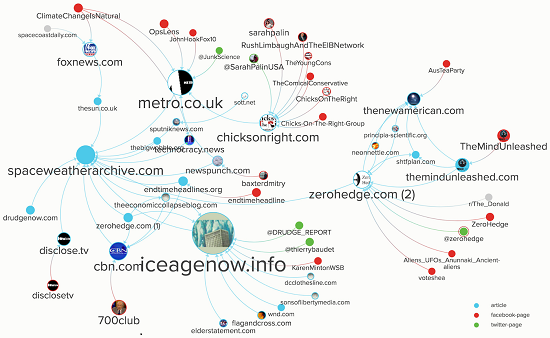
Figure – The network of outlets, blogs, and social media profiles who have shared and endorsed the claim that an imminent “mini ice age” would be coming based on a misinterpretation of the original article at Space Weather Archive. Dot sizes are proportional to the total number of shares and interactions on social media; arrows represent citations from an article/social media profile to its source.

Solar Minimum expected to cool the upper-atmosphere

Recently, a claim that we are heading towards a mini ice age has been popping up across the web. This was the subject of a widely discussed Metro article titled “A mini ice age could be on the way which means it will get very, very cold”. Similar claims that we would be heading towards an imminent “mini ice age” were also repeated without verification throughout a network of unreliable outlets for climate news including Sputnik, The Sun, Fox News, and numerous hyper-partisan blogs such as Zero Hedge, Principia Scientific, IceAgeNow, Alien-Star… (listed in the table below).

The stories claim to be based on a September 27th article at Space Weather Archive, in which NASA scientist Martin Mlynczak discusses the influence of current low solar activity on the Earth’s thermosphere—a layer of the atmosphere that begins about 65 miles above the surface. Mlynczak explained to Climate Feedback that headline claims of coming cold weather are “false”:

There is no relationship between the natural cycle of cooling and warming in the thermosphere and the weather/climate at Earth’s surface. NASA and other climate researchers continue to see a warming trend in the troposphere, the layer of atmosphere closest to Earth’s surface.

Update (22 Nov. 2018):
The Metro article has been updated following publication of our review. The author completely changed the title and the main claim of the article, making it clear that no mini ice age would be imminent. Read the details in our claim review: “Metro’s claims of coming “mini ice age” have no basis in reality

Update (23 Nov. 2018):
The Sun article has also been updated to clarify that the low temperatures would not influence the Earth’s climate. See details here.

False claims of a coming ice age spread through ecosystem of unreliable news sites, blogs, and social media accounts by Emmanuel M Vincent, Insights, Climate Feedback, Nov 21, 2018


SkS Week in Review... 


Poster of the Week...

 2018 Poster 47


from Skeptical Science https://ift.tt/2PXnDMJ

Story of the Week... Toon of the Week... SkS in the News... Coming Soon on SkS... Climate Feedback Insights... SkS Week in Review... Poster of the Week...

Story of the Week...

Climate-heating greenhouse gases at record levels, says UN

Carbon dioxide, methane and nitrous oxide are far above pre-industrial levels

Coal-fired Power Plant in Poland 

A power station in Poland close to the borders with Germany and the Czech Republic. Photograph: Florian Gaertner/Photothek/Getty Images 

The main greenhouse gas emissions driving climate change have all reached record levels, the UN’s meteorology experts have reported.

Carbon dioxide, methane and nitrous oxide are now far above pre-industrial levels, with no sign of a reversal of the upward trend, a World Meteorological Organization report says.

“The last time the Earth experienced a comparable concentration of CO2 was 3-5m years ago, when the temperature was 2-3C warmer and sea level was 10-20 metres higher than now,” said the WMO secretary general, Petteri Taalas.

“The science is clear. Without rapid cuts in CO2 and other greenhouse gases, climate change will have increasingly destructive and irreversible impacts on life on Earth. The window of opportunity for action is almost closed.”

Levels of CO2 rose to a global average of 405.5 parts per million in the atmosphere in 2017 – almost 50% higher than before the industrial revolution.

Levels of methane, a potent greenhouse gas responsible for about 17% of global warming are now 2.5 times higher than pre-industrial times owing to emissions from cattle, rice paddies and leaks from oil and gas wells.

Nitrous oxide, which also warms the planet and destroys the Earth’s protective ozone layer, is now over 20% higher than pre-industrial levels. About 40% of N2O comes from human activities including soil degradation, fertiliser use and industry.

Climate-heating greenhouse gases at record levels, says UN by Damian Carrington, Environment, Guardian, Nov 22, 2018 


Toon of the Week...

2018 Toon 47 


SkS in the News

The origins of Skeptical Science and its rebuttals to the top 10 climate myth are the focus of the MNPR News article, How to talk climate change with skeptical relatives during the holidays by Cody Nelson & Paul Huttner.

In his New York Times article, It’s Cold Outside? Gather Around the Turkey and Argue About Climate Change, John Schwartz refers reader to Skeptical Science in the following paragraph:

If you must rebut, take a deep breath and excuse yourself for research. With the internet on our phones, a quick trip to the bathroom is like visiting the library, and sites like Skeptical Science and the denial response collection at Grist can be helpful.  


Coming Soon on SkS...

  • Discussing climate change on the net (Baerbel)
  • Why does CO2 cause the Greenhouse Effect?! (Adam Levy)
  • New findings on ocean warming: 5 questions answered (Scott Denning)
  • Global coal use may have peaked in 2014, says latest IEA World Energy Outlook (Simon Evans)
  • New research this week (Ari)
  • 2018 SkS Weekly Climate Change & Global Warming News Roundup #48 (John Hartz)
  • 2018 SkS Weekly Climate Change & Global Warming Weekly Digest #48 (John Hartz)

Climate Feedback Insights...

False claims of a coming ice age spread through ecosystem of unreliable news sites, blogs, and social media accounts

Figure – The network of outlets, blogs, and social media profiles who have shared and endorsed the claim that an imminent “mini ice age” would be coming based on a misinterpretation of the original article at Space Weather Archive. Dot sizes are proportional to the total number of shares and interactions on social media; arrows represent citations from an article/social media profile to its source.

Solar Minimum expected to cool the upper-atmosphere

Recently, a claim that we are heading towards a mini ice age has been popping up across the web. This was the subject of a widely discussed Metro article titled “A mini ice age could be on the way which means it will get very, very cold”. Similar claims that we would be heading towards an imminent “mini ice age” were also repeated without verification throughout a network of unreliable outlets for climate news including Sputnik, The Sun, Fox News, and numerous hyper-partisan blogs such as Zero Hedge, Principia Scientific, IceAgeNow, Alien-Star… (listed in the table below).

The stories claim to be based on a September 27th article at Space Weather Archive, in which NASA scientist Martin Mlynczak discusses the influence of current low solar activity on the Earth’s thermosphere—a layer of the atmosphere that begins about 65 miles above the surface. Mlynczak explained to Climate Feedback that headline claims of coming cold weather are “false”:

There is no relationship between the natural cycle of cooling and warming in the thermosphere and the weather/climate at Earth’s surface. NASA and other climate researchers continue to see a warming trend in the troposphere, the layer of atmosphere closest to Earth’s surface.

Update (22 Nov. 2018):
The Metro article has been updated following publication of our review. The author completely changed the title and the main claim of the article, making it clear that no mini ice age would be imminent. Read the details in our claim review: “Metro’s claims of coming “mini ice age” have no basis in reality

Update (23 Nov. 2018):
The Sun article has also been updated to clarify that the low temperatures would not influence the Earth’s climate. See details here.

False claims of a coming ice age spread through ecosystem of unreliable news sites, blogs, and social media accounts by Emmanuel M Vincent, Insights, Climate Feedback, Nov 21, 2018


SkS Week in Review... 


Poster of the Week...

 2018 Poster 47


from Skeptical Science https://ift.tt/2PXnDMJ

I saw a cloud with rainbow colors. What causes it?

Ken Christison wrote on November 18, 2018: “We had some beautiful iridescence in the clouds late this afternoon. Seen from northeastern North Carolina.” Thank you, Ken!

Sky watchers often report seeing rainbow colors in clouds. There are various kinds of halos and colored arcs and even true rainbows you might see associated with clouds, but – if the rainbow-like colors are randomly distributed, and if the sun is nearby – what you’re seeing is likely an iridescent cloud.

These sorts of clouds are caused by especially tiny ice crystals or water droplets in the air. Larger ice crystals produce lunar or solar halos, but tiny ice crystals or water droplets cause light to be diffracted – spread out – creating this rainbow-like effect in the clouds.

The images on this page are mostly via the EarthSky community. Our thanks to all who contributed!

By the way, it’s easy to confuse circumhorizon arcs with iridescent clouds. Here’s how to tell the difference.

Read more about iridescent clouds on Les Cowley’s great website Atmospheric Optics

Kino Obusan caught this iridescent cloud on July 15, 2016 from Batangas, Philippines.

Kino Obusan caught these iridescent clouds – one on the right and one on the left – on July 15, 2016, from Batangas, Philippines. “It was my first time to see a rare cloud phenomenon like this.” Thank you, Kino!

Our friend Dave Walker in the UK caught another iridescent cloud in 2013. He wrote,

Our friend Dave Walker in the UK caught another iridescent cloud in 2013. He wrote, “There’s been a lot of very high cloud recently, always a cue for me to look out for more atmospheric optics.”

The best way to see an iridescent cloud is to place the sun itself behind some foreground object, a building or mountain, for example. Other aids are dark glasses, or observing the sky reflected in a convex mirror or in a pool of water. EarthSky Facebook friend Duke Marsh captured this image in 2012 in New Albany, Indiana.

The best way to see an iridescent cloud is to place the sun itself behind some foreground object, a building or mountain, for example. Other aids are dark glasses, or observing the sky reflected in a convex mirror or in a pool of water. EarthSky Facebook friend Duke Marsh captured this image in 2012 in New Albany, Indiana.

Charles Loyd wrote in 2014:

Charles Loyd wrote in 2014: “I was outside and my 9-year-old daughter looked up and asked why there was a rainbow in the clouds … “

The moon with Jupiter and iridescent clouds, Shot in Greece, by Nikolaos Pantazis?

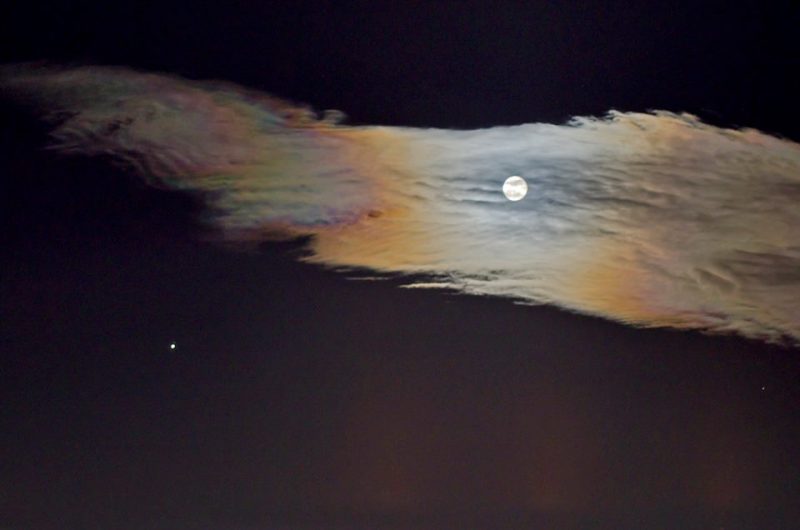
The moon with Jupiter and iridescent clouds, seen over Greece in 2015 by Nikolaus Pantazis.

Cloud iridescence captured by George Quiroga via Wikimedia Commons.

The colors in an iridescent cloud tend to be subtle and are usually pastel, but in some cases they can be vivid. Here is cloud iridescence captured by George Quiroga in Boynton Beach, Florida, in 2012. Image via Wikimedia Commons.

Bottom line: You might on occasion see a rainbow-like cloud. They’re fairly rare, but people do spot them, and we sometimes receive photos of them. They’re caused by the presence of very tiny ice crystals or water droplets in the air, which cause light to be diffracted (spread out).

The 2019 lunar calendars are here! Order yours before they’re gone. Makes a great gift.


from EarthSky https://ift.tt/2P1KoK3

Ken Christison wrote on November 18, 2018: “We had some beautiful iridescence in the clouds late this afternoon. Seen from northeastern North Carolina.” Thank you, Ken!

Sky watchers often report seeing rainbow colors in clouds. There are various kinds of halos and colored arcs and even true rainbows you might see associated with clouds, but – if the rainbow-like colors are randomly distributed, and if the sun is nearby – what you’re seeing is likely an iridescent cloud.

These sorts of clouds are caused by especially tiny ice crystals or water droplets in the air. Larger ice crystals produce lunar or solar halos, but tiny ice crystals or water droplets cause light to be diffracted – spread out – creating this rainbow-like effect in the clouds.

The images on this page are mostly via the EarthSky community. Our thanks to all who contributed!

By the way, it’s easy to confuse circumhorizon arcs with iridescent clouds. Here’s how to tell the difference.

Read more about iridescent clouds on Les Cowley’s great website Atmospheric Optics

Kino Obusan caught this iridescent cloud on July 15, 2016 from Batangas, Philippines.

Kino Obusan caught these iridescent clouds – one on the right and one on the left – on July 15, 2016, from Batangas, Philippines. “It was my first time to see a rare cloud phenomenon like this.” Thank you, Kino!

Our friend Dave Walker in the UK caught another iridescent cloud in 2013. He wrote,

Our friend Dave Walker in the UK caught another iridescent cloud in 2013. He wrote, “There’s been a lot of very high cloud recently, always a cue for me to look out for more atmospheric optics.”

The best way to see an iridescent cloud is to place the sun itself behind some foreground object, a building or mountain, for example. Other aids are dark glasses, or observing the sky reflected in a convex mirror or in a pool of water. EarthSky Facebook friend Duke Marsh captured this image in 2012 in New Albany, Indiana.

The best way to see an iridescent cloud is to place the sun itself behind some foreground object, a building or mountain, for example. Other aids are dark glasses, or observing the sky reflected in a convex mirror or in a pool of water. EarthSky Facebook friend Duke Marsh captured this image in 2012 in New Albany, Indiana.

Charles Loyd wrote in 2014:

Charles Loyd wrote in 2014: “I was outside and my 9-year-old daughter looked up and asked why there was a rainbow in the clouds … “

The moon with Jupiter and iridescent clouds, Shot in Greece, by Nikolaos Pantazis?

The moon with Jupiter and iridescent clouds, seen over Greece in 2015 by Nikolaus Pantazis.

Cloud iridescence captured by George Quiroga via Wikimedia Commons.

The colors in an iridescent cloud tend to be subtle and are usually pastel, but in some cases they can be vivid. Here is cloud iridescence captured by George Quiroga in Boynton Beach, Florida, in 2012. Image via Wikimedia Commons.

Bottom line: You might on occasion see a rainbow-like cloud. They’re fairly rare, but people do spot them, and we sometimes receive photos of them. They’re caused by the presence of very tiny ice crystals or water droplets in the air, which cause light to be diffracted (spread out).

The 2019 lunar calendars are here! Order yours before they’re gone. Makes a great gift.


from EarthSky https://ift.tt/2P1KoK3

Hear Opportunity’s 5,000th sunrise on Mars

Scientists used what is called data sonification techniques to create the soundtrack you’ll hear in the video above. The sounds are based on data gathered by a now-silent robotic Mars rover – Opportunity – as it witnessed its 5,000th Mars sunrise on Mars. Domenico Vicinanza of Anglia Ruskin University and Genevieve Williams of the University of Exeter created the piece of music – which they call Mars Soundscapes – and presented it at the NASA booth at the Supercomputing SC18 Conference in Dallas in mid-November, 2018.

They created the music by scanning a picture from left to right, pixel by pixel, and looking at brightness and color information. Then they combined that information with terrain elevation. They used algorithms to assign each element a specific pitch and melody. A statement about the piece of music from Anglia Ruskin University explained:

The quiet, slow harmonies are a consequence of the dark background and the brighter, higher pitched sounds towards the middle of the piece are created by the sonification of the bright sun disk.

It’s an interesting and sometimes beautiful piece of music, and a poignant tribute to Opportunity, which has been sitting silent on Mars’ surface since last June after a Mars dust storm went global and swept over it.

The 2019 lunar calendars are here! Order yours before they’re gone. Makes a great gift.

Here’s a view from the Opportunity rover on Sol 4958 (January 4, 2018), the rover’s 4,958th day on Mars. The rover was inside Mars’ Perseverance Valley, on the inner slope of the western rim of Endeavour Crater. Notice the pattern of rock stripes on the ground; they were a surprise to scientists. Image via NASA/ NinePlanets.

NASA is still attempting to hail Opportunity, so far without success.

Prior to going silent, the solar-powered Opportunity was the longest-running rover mission on Mars. It saw its 5,000th Mars sunrise on February 16, 2018, marking its 5,000th sol (5,137.46 Earth days) on Mars. Oppotunity was originally planned as a 90-sol mission.

Opportunity’s 5,000th sunrise came roughly 14 Earth years (and 7.48 Martian years) after the rover first landed on January 25, 2004.

From its position on the western rim of the Endeavour Crater, Opportunity’s 5,000th sunrise appeared over the basin’s eastern rim, about 14 miles (22 km) away. This location, one-third of the way down Perseverance Valley, is more than 28 miles (45 km) from Opportunity’s original landing site.

We hope we haven’t heard the last from Oppotunity, but, if we have, this piece of music will become part of its expansive legacy.

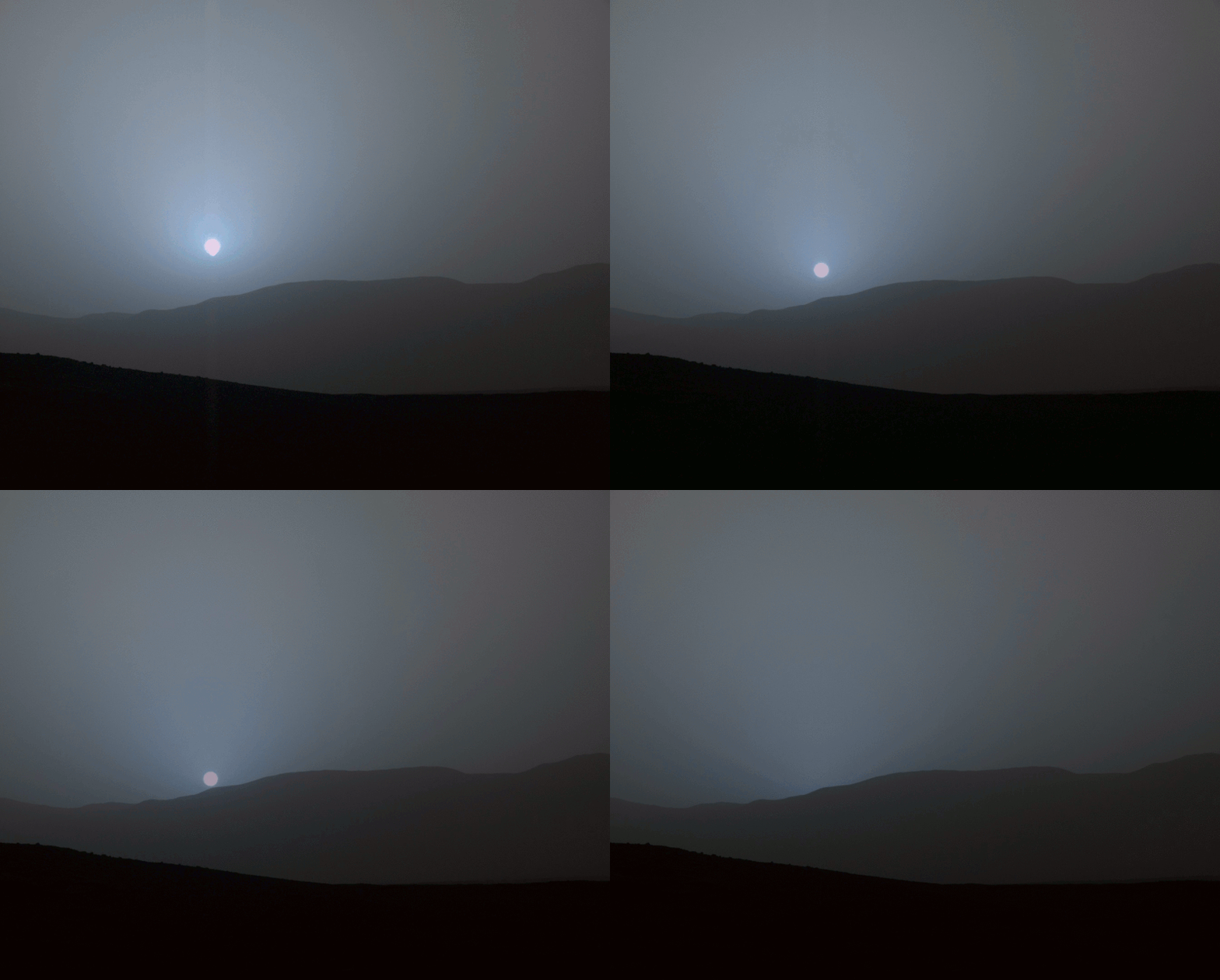
This isn’t a sunrise; it’s 4 images of a sunset on Mars captured by the Curiosity rover on April 15, 2015 at the conclusion of that’s mission’s 956th sol, or Martian day. Curiosity is still up and running on Mars, and, as of November 23, 2018, has been on Mars for 2,239 sols.

Bottom line: Scientists used data sonification to transform a photo of the Opportunity rover’s 5,000th sunrise on Mars into a piece of music.

Via Anglia Ruskin University.


from EarthSky https://ift.tt/2AnExt9

Scientists used what is called data sonification techniques to create the soundtrack you’ll hear in the video above. The sounds are based on data gathered by a now-silent robotic Mars rover – Opportunity – as it witnessed its 5,000th Mars sunrise on Mars. Domenico Vicinanza of Anglia Ruskin University and Genevieve Williams of the University of Exeter created the piece of music – which they call Mars Soundscapes – and presented it at the NASA booth at the Supercomputing SC18 Conference in Dallas in mid-November, 2018.

They created the music by scanning a picture from left to right, pixel by pixel, and looking at brightness and color information. Then they combined that information with terrain elevation. They used algorithms to assign each element a specific pitch and melody. A statement about the piece of music from Anglia Ruskin University explained:

The quiet, slow harmonies are a consequence of the dark background and the brighter, higher pitched sounds towards the middle of the piece are created by the sonification of the bright sun disk.

It’s an interesting and sometimes beautiful piece of music, and a poignant tribute to Opportunity, which has been sitting silent on Mars’ surface since last June after a Mars dust storm went global and swept over it.

The 2019 lunar calendars are here! Order yours before they’re gone. Makes a great gift.

Here’s a view from the Opportunity rover on Sol 4958 (January 4, 2018), the rover’s 4,958th day on Mars. The rover was inside Mars’ Perseverance Valley, on the inner slope of the western rim of Endeavour Crater. Notice the pattern of rock stripes on the ground; they were a surprise to scientists. Image via NASA/ NinePlanets.

NASA is still attempting to hail Opportunity, so far without success.

Prior to going silent, the solar-powered Opportunity was the longest-running rover mission on Mars. It saw its 5,000th Mars sunrise on February 16, 2018, marking its 5,000th sol (5,137.46 Earth days) on Mars. Oppotunity was originally planned as a 90-sol mission.

Opportunity’s 5,000th sunrise came roughly 14 Earth years (and 7.48 Martian years) after the rover first landed on January 25, 2004.

From its position on the western rim of the Endeavour Crater, Opportunity’s 5,000th sunrise appeared over the basin’s eastern rim, about 14 miles (22 km) away. This location, one-third of the way down Perseverance Valley, is more than 28 miles (45 km) from Opportunity’s original landing site.

We hope we haven’t heard the last from Oppotunity, but, if we have, this piece of music will become part of its expansive legacy.

This isn’t a sunrise; it’s 4 images of a sunset on Mars captured by the Curiosity rover on April 15, 2015 at the conclusion of that’s mission’s 956th sol, or Martian day. Curiosity is still up and running on Mars, and, as of November 23, 2018, has been on Mars for 2,239 sols.

Bottom line: Scientists used data sonification to transform a photo of the Opportunity rover’s 5,000th sunrise on Mars into a piece of music.

Via Anglia Ruskin University.


from EarthSky https://ift.tt/2AnExt9

Landing on Mars is still hard

Artist’s concept of NASA’s Curiosity rover approaching Mars prior to landing successfully in 2012. Image via NASA/JPL-Caltech.

Engineers and scientists at NASA’s Jet Propulsion Laboratory in Pasadena, California, are working hard this weekend, preparing for another daring attempt to land a spacecraft on the surface of the planet Mars. The InSight spacecraft – designed to study Mars’ interior – is scheduled to land on Monday, November 26, 2018 (details on how to watch here). It’ll be NASA’s 10th Mars landing attempt, and NASA has been mostly successful. But, because of its thin atmosphere, Mars overall has a much lower success rate for spacecraft landings than the Earth, the moon or Venus. And – along with other nations of the world – NASA has had its failures. And that’s why Thomas Zurbuchen, associate administrator for the Science Mission Directorate at NASA Headquarters in Washington, said late last week in a statement:

Landing on Mars is hard. It takes skill, focus and years of preparation …

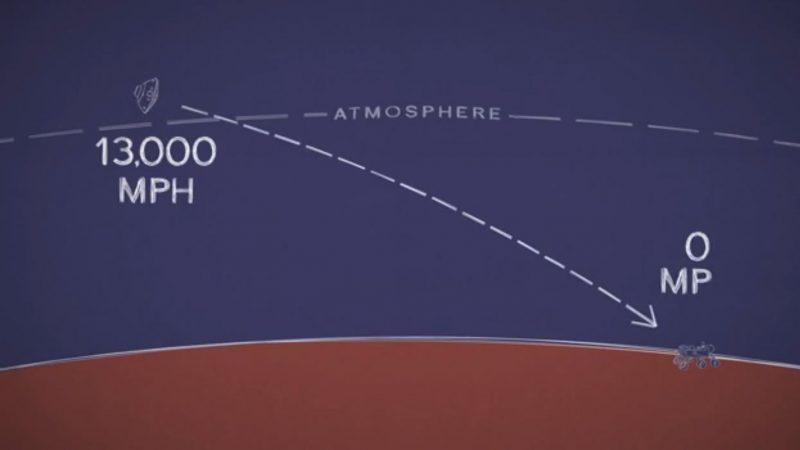
No doubt about it, Monday’s Mars landing attempt will be a nail-biter. Consider the speed at which the craft has to hit Mars’ atmosphere, and then, in a very short time, slow down enough to land. When NASA’s InSight spacecraft hits the top of the Martian atmosphere on Monday, it’ll be traveling at 12,300 mph (19,800 kph). During its descent through Mars’ atmosphere, it needs to slow down to 5 mph (8 kph) – about human jogging speed – before its three legs touch down on Martian soil.

That extreme deceleration has to happen in just under seven minutes, a timeframe known to NASA engineers as:

… seven minutes of terror.

In that seven minutes, the InSight lander has to deploy its parachute and landing legs, spot the surface with radar instruments, and fire 12 engines to help it slow down. All of these actions are preprogrammed because, due to the finite speed of light, NASA engineers can’t make changes to the procedure if something goes wrong. They can’t even track the descent in real time.

In fact, traveling at the speed of light (186,000 miles per second or about 300 km per second), signals from the InSight craft will need about eight minutes to reach Earth. That means that, by the time NASA engineers – and the rest of us – learn that InSight has reached the top of Mars’ atmosphere, the lander will have already touched down safely or crashed.

Why is landing on Mars so hard? The video below, from MinutePhysics, does a good job explaining it.

InSight stands for Interior Exploration using Seismic Investigations, Geodesy and Heat Transport. It’s the first mission designed to study the deep interior of Mars. InSight blasted off from Vandenberg Air Force Base in Central California on May 5, 2018, and, so far, engineers have described InSight’s flight to Mars as “uneventful.” But, said Rob Grover, about InSight’s entry, descent and landing:

There’s a reason engineers call landing on Mars ‘seven minutes of terror.’ We can’t joystick the landing, so we have to rely on the commands we pre-program into the spacecraft. We’ve spent years testing our plans, learning from other Mars landings and studying all the conditions Mars can throw at us. And we’re going to stay vigilant till InSight settles into its home in the Elysium Planitia region.

How will NASA engineers and scientists know when the craft has landed safely? Read more: How will NASA know when InSight touches down?

Want more details on the landing? The video below is for you:

Lori Glaze, acting director of the Planetary Science Division at NASA Headquarters, commented:

Landing on Mars is exciting, but scientists are looking forward to the time after InSight lands. Once InSight is settled on the red planet and its instruments are deployed, it will start collecting valuable information about the structure of Mars’ deep interior – information that will help us understand the formation and evolution of all rocky planets, including the one we call home.

Sue Smrekar, the InSight mission’s deputy principal investigator at JPL, added:

Previous missions haven’t gone more than skin-deep at Mars. InSight scientists can’t wait to explore the heart of Mars.

Read EarthSky’s 2016 article on this subject: Landing on Mars is hard

Read more: List of failed and successful Mars missions

On Monday, November 26 … Watch the Insight Mars landing

Here’s where InSight will touch down on Monday

The InSight spacecraft will be traveling at 12,300 mph (19,800 kph) when it hits the top of Mars’ atmosphere on Monday. It’ll need to slow down to 5 mph (8 kph) before touchdown. Image via NASA.

Bottom line: Landing on Mars is hard. Watch on Monday, November 26, 2018, as NASA’s InSight lander – designed to study Mars’ interior – attempts to land.

Via NASA

The 2019 lunar calendars are here! Order yours before they’re gone. Makes a great gift.


from EarthSky https://ift.tt/2DUYkEt

Artist’s concept of NASA’s Curiosity rover approaching Mars prior to landing successfully in 2012. Image via NASA/JPL-Caltech.

Engineers and scientists at NASA’s Jet Propulsion Laboratory in Pasadena, California, are working hard this weekend, preparing for another daring attempt to land a spacecraft on the surface of the planet Mars. The InSight spacecraft – designed to study Mars’ interior – is scheduled to land on Monday, November 26, 2018 (details on how to watch here). It’ll be NASA’s 10th Mars landing attempt, and NASA has been mostly successful. But, because of its thin atmosphere, Mars overall has a much lower success rate for spacecraft landings than the Earth, the moon or Venus. And – along with other nations of the world – NASA has had its failures. And that’s why Thomas Zurbuchen, associate administrator for the Science Mission Directorate at NASA Headquarters in Washington, said late last week in a statement:

Landing on Mars is hard. It takes skill, focus and years of preparation …

No doubt about it, Monday’s Mars landing attempt will be a nail-biter. Consider the speed at which the craft has to hit Mars’ atmosphere, and then, in a very short time, slow down enough to land. When NASA’s InSight spacecraft hits the top of the Martian atmosphere on Monday, it’ll be traveling at 12,300 mph (19,800 kph). During its descent through Mars’ atmosphere, it needs to slow down to 5 mph (8 kph) – about human jogging speed – before its three legs touch down on Martian soil.

That extreme deceleration has to happen in just under seven minutes, a timeframe known to NASA engineers as:

… seven minutes of terror.

In that seven minutes, the InSight lander has to deploy its parachute and landing legs, spot the surface with radar instruments, and fire 12 engines to help it slow down. All of these actions are preprogrammed because, due to the finite speed of light, NASA engineers can’t make changes to the procedure if something goes wrong. They can’t even track the descent in real time.

In fact, traveling at the speed of light (186,000 miles per second or about 300 km per second), signals from the InSight craft will need about eight minutes to reach Earth. That means that, by the time NASA engineers – and the rest of us – learn that InSight has reached the top of Mars’ atmosphere, the lander will have already touched down safely or crashed.

Why is landing on Mars so hard? The video below, from MinutePhysics, does a good job explaining it.

InSight stands for Interior Exploration using Seismic Investigations, Geodesy and Heat Transport. It’s the first mission designed to study the deep interior of Mars. InSight blasted off from Vandenberg Air Force Base in Central California on May 5, 2018, and, so far, engineers have described InSight’s flight to Mars as “uneventful.” But, said Rob Grover, about InSight’s entry, descent and landing:

There’s a reason engineers call landing on Mars ‘seven minutes of terror.’ We can’t joystick the landing, so we have to rely on the commands we pre-program into the spacecraft. We’ve spent years testing our plans, learning from other Mars landings and studying all the conditions Mars can throw at us. And we’re going to stay vigilant till InSight settles into its home in the Elysium Planitia region.

How will NASA engineers and scientists know when the craft has landed safely? Read more: How will NASA know when InSight touches down?

Want more details on the landing? The video below is for you:

Lori Glaze, acting director of the Planetary Science Division at NASA Headquarters, commented:

Landing on Mars is exciting, but scientists are looking forward to the time after InSight lands. Once InSight is settled on the red planet and its instruments are deployed, it will start collecting valuable information about the structure of Mars’ deep interior – information that will help us understand the formation and evolution of all rocky planets, including the one we call home.

Sue Smrekar, the InSight mission’s deputy principal investigator at JPL, added:

Previous missions haven’t gone more than skin-deep at Mars. InSight scientists can’t wait to explore the heart of Mars.

Read EarthSky’s 2016 article on this subject: Landing on Mars is hard

Read more: List of failed and successful Mars missions

On Monday, November 26 … Watch the Insight Mars landing

Here’s where InSight will touch down on Monday

The InSight spacecraft will be traveling at 12,300 mph (19,800 kph) when it hits the top of Mars’ atmosphere on Monday. It’ll need to slow down to 5 mph (8 kph) before touchdown. Image via NASA.

Bottom line: Landing on Mars is hard. Watch on Monday, November 26, 2018, as NASA’s InSight lander – designed to study Mars’ interior – attempts to land.

Via NASA

The 2019 lunar calendars are here! Order yours before they’re gone. Makes a great gift.


from EarthSky https://ift.tt/2DUYkEt

How will NASA know when InSight touches down?

Artist’s concept of MarCO CubeSats – briefcase-sized spacecraft traveling with the InSight mission – relaying data from the InSight lander as it enters the Martian atmosphere. Image via NASA/JPL-Caltech.

What’s the sound of a touchdown on Mars?

If you’re at NASA’s Jet Propulsion Laboratory, it sounds like winning the Super Bowl: cheers, laughter and lots of hollering.

But in the minutes before that, NASA’s InSight team will be monitoring the Mars lander’s radio signals using a variety of spacecraft – and even radio telescopes here on Earth – to suss out what’s happening 91 million miles (146 million km) away.

Because these signals are captured by several spacecraft, they’re relayed to Earth in different ways and at different times. That means the mission team may know right away when InSight touches down, or they may have to wait up to several hours.

Here’s how NASA will be listening for the next Mars landing on November 26, 2018.

Radio Telescopes

As the InSight lander descends into Mars’ atmosphere, it will broadcast simple radio signals called “tones” back to Earth. Engineers will be tuning in from two locations: the National Science Foundation’s Green Bank Observatory in Green Bank, West Virginia and the Max Planck Institute for Radio Astronomy’s facility at Effelsberg, Germany. Their results will be relayed to Mission Control at JPL and engineers at Lockheed Martin Space in Denver.

These tones don’t reveal much information, but radio engineers can interpret them to track key events during InSight’s entry, descent and landing (EDL). For example, when InSight deploys its parachute, a shift in velocity changes the frequency of the signal. This is caused by what’s called the Doppler effect, which is the same thing that occurs when you hear a siren change in pitch as an ambulance goes by. Looking for signals like these will allow the team to know how InSight’s EDL is progressing.

Mars Cube One (MarCO)

Two briefcase-sized spacecraft are flying behind InSight and will attempt to relay its signals to Earth. Belonging to a class of spacecraft called CubeSats, the MarCOs are being tested as a way for future missions to send home data during EDL.

The MarCOs are experimental technology. But if they work as they should, the pair will transmit the whole story of EDL as it’s unfolding. That might include an image from InSight of the Martian surface right after the lander touches down.

InSight

After it touches down, InSight will essentially yell:

I made it!

Seven minutes later, the spacecraft says it again – but a little louder and clearer.

The first time, it will communicate with a tone beacon that the radio telescopes will try to detect. The second time, it will send a “beep” from its more powerful X-band antenna, which should now be pointed at Earth. This beep includes slightly more information and is only heard if the spacecraft is in a healthy, functioning state. If NASA’s Deep Space Network picks up this beep, it’s a good sign that InSight survived landing. Engineers will need to wait until early evening to find out if the lander successfully deployed its solar arrays.

Mars Reconnaissance Orbiter (MRO)

Besides the MarCO CubeSats, NASA’s MRO will be soaring over Mars, recording InSight’s data during descent.

MRO will hold on to the data it records during EDL as it disappears over the Martian horizon. When it comes back around from the other side, it will play back that data for engineers to study. By 3 p.m. PST (6 p.m. EST), they should be able to piece together MRO’s recording of the landing.

MRO’s recording is similar to an airplane’s black box, which means that it could also prove important if InSight doesn’t successfully touch down.

2001 Mars Odyssey

NASA’s longest-lived spacecraft at Mars will also relay data after InSight has touched down. Odyssey will relay the entire history of InSight’s descent to Mars, as well as a couple images. It will also relay confirmation that InSight’s solar arrays, which are vital to the spacecraft’s survival, fully deployed. Engineers will have this data just before 5:30 p.m. PST (8:30 p.m. EST).

Odyssey will also serve as a data relay for InSight during surface operations, along with MRO, NASA’s Mars Atmosphere and Volatile Evolution mission (MAVEN) and the European Space Agency’s Trace Gas Orbiter.

Artist’s concept of the Mars Insight spacecraft landing on Mars, via NASA.

Bottom line: Here’s how NASA will know the fate of its InSight lander, as it attempts to land on Mars on Monday, November 26, 2018.

The 2019 lunar calendars are here! Order yours before they’re gone. Makes a great gift.

Via NASA


from EarthSky https://ift.tt/2Sdnm4W

Artist’s concept of MarCO CubeSats – briefcase-sized spacecraft traveling with the InSight mission – relaying data from the InSight lander as it enters the Martian atmosphere. Image via NASA/JPL-Caltech.

What’s the sound of a touchdown on Mars?

If you’re at NASA’s Jet Propulsion Laboratory, it sounds like winning the Super Bowl: cheers, laughter and lots of hollering.

But in the minutes before that, NASA’s InSight team will be monitoring the Mars lander’s radio signals using a variety of spacecraft – and even radio telescopes here on Earth – to suss out what’s happening 91 million miles (146 million km) away.

Because these signals are captured by several spacecraft, they’re relayed to Earth in different ways and at different times. That means the mission team may know right away when InSight touches down, or they may have to wait up to several hours.

Here’s how NASA will be listening for the next Mars landing on November 26, 2018.

Radio Telescopes

As the InSight lander descends into Mars’ atmosphere, it will broadcast simple radio signals called “tones” back to Earth. Engineers will be tuning in from two locations: the National Science Foundation’s Green Bank Observatory in Green Bank, West Virginia and the Max Planck Institute for Radio Astronomy’s facility at Effelsberg, Germany. Their results will be relayed to Mission Control at JPL and engineers at Lockheed Martin Space in Denver.

These tones don’t reveal much information, but radio engineers can interpret them to track key events during InSight’s entry, descent and landing (EDL). For example, when InSight deploys its parachute, a shift in velocity changes the frequency of the signal. This is caused by what’s called the Doppler effect, which is the same thing that occurs when you hear a siren change in pitch as an ambulance goes by. Looking for signals like these will allow the team to know how InSight’s EDL is progressing.

Mars Cube One (MarCO)

Two briefcase-sized spacecraft are flying behind InSight and will attempt to relay its signals to Earth. Belonging to a class of spacecraft called CubeSats, the MarCOs are being tested as a way for future missions to send home data during EDL.

The MarCOs are experimental technology. But if they work as they should, the pair will transmit the whole story of EDL as it’s unfolding. That might include an image from InSight of the Martian surface right after the lander touches down.

InSight

After it touches down, InSight will essentially yell:

I made it!

Seven minutes later, the spacecraft says it again – but a little louder and clearer.

The first time, it will communicate with a tone beacon that the radio telescopes will try to detect. The second time, it will send a “beep” from its more powerful X-band antenna, which should now be pointed at Earth. This beep includes slightly more information and is only heard if the spacecraft is in a healthy, functioning state. If NASA’s Deep Space Network picks up this beep, it’s a good sign that InSight survived landing. Engineers will need to wait until early evening to find out if the lander successfully deployed its solar arrays.

Mars Reconnaissance Orbiter (MRO)

Besides the MarCO CubeSats, NASA’s MRO will be soaring over Mars, recording InSight’s data during descent.

MRO will hold on to the data it records during EDL as it disappears over the Martian horizon. When it comes back around from the other side, it will play back that data for engineers to study. By 3 p.m. PST (6 p.m. EST), they should be able to piece together MRO’s recording of the landing.

MRO’s recording is similar to an airplane’s black box, which means that it could also prove important if InSight doesn’t successfully touch down.

2001 Mars Odyssey

NASA’s longest-lived spacecraft at Mars will also relay data after InSight has touched down. Odyssey will relay the entire history of InSight’s descent to Mars, as well as a couple images. It will also relay confirmation that InSight’s solar arrays, which are vital to the spacecraft’s survival, fully deployed. Engineers will have this data just before 5:30 p.m. PST (8:30 p.m. EST).

Odyssey will also serve as a data relay for InSight during surface operations, along with MRO, NASA’s Mars Atmosphere and Volatile Evolution mission (MAVEN) and the European Space Agency’s Trace Gas Orbiter.

Artist’s concept of the Mars Insight spacecraft landing on Mars, via NASA.

Bottom line: Here’s how NASA will know the fate of its InSight lander, as it attempts to land on Mars on Monday, November 26, 2018.

The 2019 lunar calendars are here! Order yours before they’re gone. Makes a great gift.

Via NASA


from EarthSky https://ift.tt/2Sdnm4W

adds 2