aads

Watch for the moon and the Twins

On November 25 and 26, 2018 – before going to bed, look for the moon in your eastern sky. It’ll be a bright waning gibbous moon, and you might notice two bright stars in its vicinity. These stars are noticeable for being both bright and close together on the sky’s dome, and that is why – in legends of the sky – they often represent Twins.

The stars are Castor and Pollux in the constellation Gemini.

From mid-northern latitudes, they appear over your eastern horizon with the moon by around 8 to 9 p.m. From the Southern Hemisphere, they all ascend in the east a bit later in the evening. If you’re not one for staying up late, you can always get up before dawn to view the moon and Gemini stars in the morning sky. Then they’ll be in the west!

The bright moon will make it difficult to see the entire, faint starlit figure of the Twins for the next few nights. But Castor and Pollux are bright! You should be able to pick them out, even when the moon is close.

The 2019 lunar calendars are here! Order yours before they’re gone. Makes a great gift.
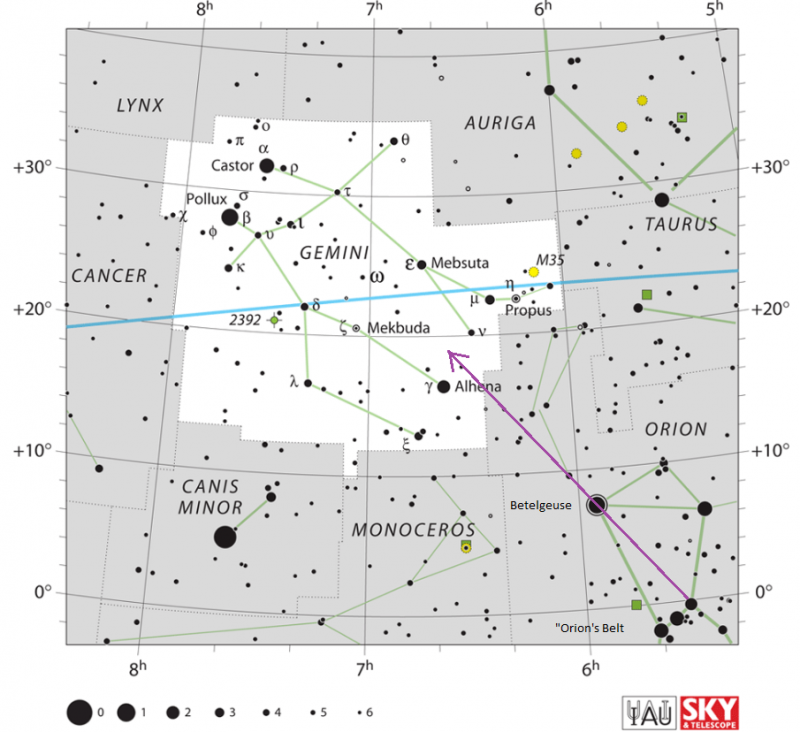
Sky chart of the constellation Gemini via IAU. When the moon is no longer in front of Gemini, draw an imaginary line from the westernmost star of Orion’s Belt and through the bright ruddy star Betelgeuse to locate the Gemini stars, Castor and Pollux.

The constellation Orion is also fairly close to the moon on November 25, and the Giant Hunter might dazzle you with his many bright stars. You’ll always know you’re seeing Orion if you notice its Belt stars: three medium-bright stars in a short, straight row.

Several days from now, when the moon drops out of the constellation Gemini, you can always star-hop to Castor and Pollux from Orion. Simply draw an imaginary line from Orion’s Belt through the bright star Betelgeuse to find the Gemini stars, Castor and Pollux. This way of finding the Gemini’s two brightest stars works in both the Northern and Southern Hemispheres.
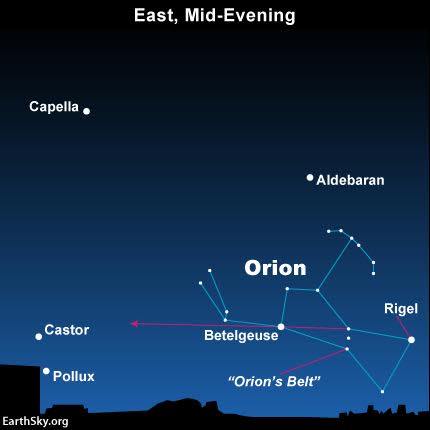
Are you familiar with the constellation Orion and the line of three stars known as Orion’s Belt? If, so you can star-hop to the Gemini stars Castor and Pollux.

At mid-northern latitudes – like those in the mainland United States – the constellations Gemini and Orion rise at approximately the same time. However, at more northerly latitudes – like those in Alaska – Gemini rises before Orion. That far north, the Big Dipper is visible at early evening, so you can use the Big Dipper bowl to star-hop to Castor and Pollux.
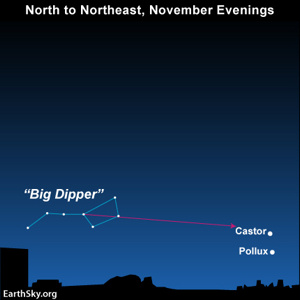
Use the Big Dipper bowl to star-hop to Castor and Pollux

Use the Big Dipper bowl to star-hop to Castor and Pollux

At more southerly latitudes, as in the northern tropics and the Southern Hemisphere, Orion rises before Gemini.

The starry sky is one great big connect-the-dots book. Learn how to star-hop with certain key stars, and you can more easily orient yourself to the night sky when traveling to faraway latitudes.

By the way, the star Castor in the constellation Gemini very closely marks the radiant point for the Gemini meteor shower, which peaks every year around December 13 or 14.

Bottom line: The waning gibbous moon offers some guidance on the nights of November 25 and 26, as its shines between the constellation Orion and the Gemini stars Castor and Pollux.

EarthSky astronomy kits are perfect for beginners. Order yours from the EarthSky store.

Donate: Your support means the world to us


from EarthSky https://ift.tt/2ScKujF

On November 25 and 26, 2018 – before going to bed, look for the moon in your eastern sky. It’ll be a bright waning gibbous moon, and you might notice two bright stars in its vicinity. These stars are noticeable for being both bright and close together on the sky’s dome, and that is why – in legends of the sky – they often represent Twins.

The stars are Castor and Pollux in the constellation Gemini.

From mid-northern latitudes, they appear over your eastern horizon with the moon by around 8 to 9 p.m. From the Southern Hemisphere, they all ascend in the east a bit later in the evening. If you’re not one for staying up late, you can always get up before dawn to view the moon and Gemini stars in the morning sky. Then they’ll be in the west!

The bright moon will make it difficult to see the entire, faint starlit figure of the Twins for the next few nights. But Castor and Pollux are bright! You should be able to pick them out, even when the moon is close.

The 2019 lunar calendars are here! Order yours before they’re gone. Makes a great gift.

Sky chart of the constellation Gemini via IAU. When the moon is no longer in front of Gemini, draw an imaginary line from the westernmost star of Orion’s Belt and through the bright ruddy star Betelgeuse to locate the Gemini stars, Castor and Pollux.

The constellation Orion is also fairly close to the moon on November 25, and the Giant Hunter might dazzle you with his many bright stars. You’ll always know you’re seeing Orion if you notice its Belt stars: three medium-bright stars in a short, straight row.

Several days from now, when the moon drops out of the constellation Gemini, you can always star-hop to Castor and Pollux from Orion. Simply draw an imaginary line from Orion’s Belt through the bright star Betelgeuse to find the Gemini stars, Castor and Pollux. This way of finding the Gemini’s two brightest stars works in both the Northern and Southern Hemispheres.

Are you familiar with the constellation Orion and the line of three stars known as Orion’s Belt? If, so you can star-hop to the Gemini stars Castor and Pollux.

At mid-northern latitudes – like those in the mainland United States – the constellations Gemini and Orion rise at approximately the same time. However, at more northerly latitudes – like those in Alaska – Gemini rises before Orion. That far north, the Big Dipper is visible at early evening, so you can use the Big Dipper bowl to star-hop to Castor and Pollux.

Use the Big Dipper bowl to star-hop to Castor and Pollux

Use the Big Dipper bowl to star-hop to Castor and Pollux

At more southerly latitudes, as in the northern tropics and the Southern Hemisphere, Orion rises before Gemini.

The starry sky is one great big connect-the-dots book. Learn how to star-hop with certain key stars, and you can more easily orient yourself to the night sky when traveling to faraway latitudes.

By the way, the star Castor in the constellation Gemini very closely marks the radiant point for the Gemini meteor shower, which peaks every year around December 13 or 14.

Bottom line: The waning gibbous moon offers some guidance on the nights of November 25 and 26, as its shines between the constellation Orion and the Gemini stars Castor and Pollux.

EarthSky astronomy kits are perfect for beginners. Order yours from the EarthSky store.

Donate: Your support means the world to us


from EarthSky https://ift.tt/2ScKujF

2018 SkS Weekly Climate Change & Global Warming News Roundup #47

A chronological listing of news articles posted on the Skeptical Science Facebook Page during the past week, i.e., Sunday, Nov 18 through Saturday, Nov 24.

Editor's Pick

Climate Change Puts U.S. Economy and Lives at Risk, and Costs Are Rising, Federal Agencies Warn

The National Climate Assessment describes increasing heat, fire and flood damage. It's a stark contrast to Trump's energy policies and climate claims.

Louisiana Flooding 2015 

The National Climate Assessment warns of increasing extreme rainfall events, like the storm that flooded communities across a large swath of Louisiana in 2016. Credit: Joe Raedle/Getty Images  

The U.S. government's climate scientists issued a blunt warning on Friday, writing that global warming is a growing threat to human life, property and ecosystems across the country, and that the economic damage—from worsening heat waves, extreme weather, sea level rise, droughts and wildfires—will spiral in the coming decades.

The country can reduce those costs if the U.S. and the rest of the world cut their greenhouse gas emissions, particularly the burning of fossil fuels. Capping global greenhouse gas emissions to limit warming to 2 degrees Celsius (3.6°F) or less would avoid hundreds of billions of dollars of future damages, according to the Fourth National Climate Assessment, written by a science panel representing 13 federal agencies.

The report, like a recent comprehensive assessment issued by the United Nations, signaled the mounting urgency for governments to act quickly to reduce greenhouse gas emissions before locking in high risks. And it underscored, without saying so directly, how the Trump administration is moving in the opposite direction.

Climate Change Puts U.S. Economy and Lives at Risk, and Costs Are Rising, Federal Agencies Warn by Bob Berwyn, InsideClimate News, Nov 23, 2018


Links posted on Facebook

Sun Nov 18, 2018

Mon Nov 19, 2018

Tue Nov 20, 2018

Wed Nov 21, 2018 

Thu Nov 22, 2018 

Fri Nov 23, 2018 

Sat, Nov 24, 2018 


from Skeptical Science https://ift.tt/2TG4b59
A chronological listing of news articles posted on the Skeptical Science Facebook Page during the past week, i.e., Sunday, Nov 18 through Saturday, Nov 24.

Editor's Pick

Climate Change Puts U.S. Economy and Lives at Risk, and Costs Are Rising, Federal Agencies Warn

The National Climate Assessment describes increasing heat, fire and flood damage. It's a stark contrast to Trump's energy policies and climate claims.

Louisiana Flooding 2015 

The National Climate Assessment warns of increasing extreme rainfall events, like the storm that flooded communities across a large swath of Louisiana in 2016. Credit: Joe Raedle/Getty Images  

The U.S. government's climate scientists issued a blunt warning on Friday, writing that global warming is a growing threat to human life, property and ecosystems across the country, and that the economic damage—from worsening heat waves, extreme weather, sea level rise, droughts and wildfires—will spiral in the coming decades.

The country can reduce those costs if the U.S. and the rest of the world cut their greenhouse gas emissions, particularly the burning of fossil fuels. Capping global greenhouse gas emissions to limit warming to 2 degrees Celsius (3.6°F) or less would avoid hundreds of billions of dollars of future damages, according to the Fourth National Climate Assessment, written by a science panel representing 13 federal agencies.

The report, like a recent comprehensive assessment issued by the United Nations, signaled the mounting urgency for governments to act quickly to reduce greenhouse gas emissions before locking in high risks. And it underscored, without saying so directly, how the Trump administration is moving in the opposite direction.

Climate Change Puts U.S. Economy and Lives at Risk, and Costs Are Rising, Federal Agencies Warn by Bob Berwyn, InsideClimate News, Nov 23, 2018


Links posted on Facebook

Sun Nov 18, 2018

Mon Nov 19, 2018

Tue Nov 20, 2018

Wed Nov 21, 2018 

Thu Nov 22, 2018 

Fri Nov 23, 2018 

Sat, Nov 24, 2018 


from Skeptical Science https://ift.tt/2TG4b59

Summer Triangle in northern autumn

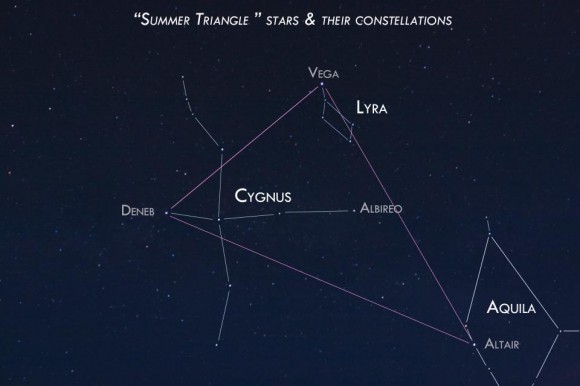
In late November and early December, look west in the evening for the Summer Triangle. It’s the signature star formation of our Northern Hemisphere summer, but you can see it in northern autumn, too. The Summer Triangle showcases three brilliant stars – Vega, Deneb and Altair – in three separate constellations. The Summer Triangle will still shines in the western evening sky (at mid-northern latitudes or farther north).

What’s more, the Summer Triangle will continue to shine after dark throughout December and January. Look for it tonight at early evening, high in your western sky.

The 2019 lunar calendars are here! Order yours before they’re gone. Makes a great gift.

Here is the Summer Triangle asterism – three bright stars in three different constellations – as photographed by EarthSky Facebook friend Susan Jensen in Odessa, Washington. Thank you, Susan!

In the month of June – around the June solstice – the Summer Triangle pops out in the east as darkness falls and shines all night long. But now – in late November – the Summer Triangle appears way high in the west at evening. As evening deepens, the Summer Triangle descends westward, with all three of its stars staying above the horizon until mid-to-late evening.

Altair – the Summer Triangle’s most southerly star – will set around 9:30 to 10:30 p.m. tonight at mid-northern latitudes. Notice where you see the Summer Triangle at a given time this evening. The Summer Triangle will return to this same place in the sky some 4 minutes earlier with each passing day, or 2 hours earlier with each passing month.

As the Summer Triangle sinks close the western horizon around mid-evening, turn around to see Orion – the signpost constellation of winter – rising in the east.

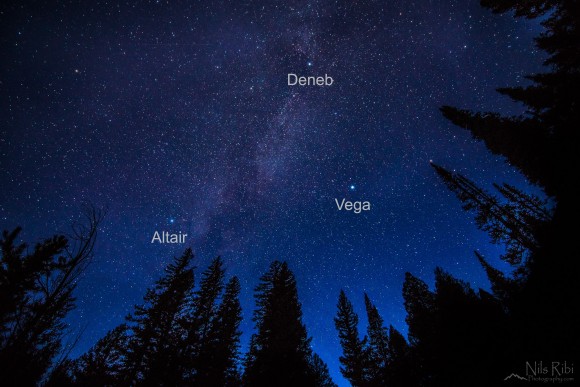
Nils Ribi caught this photo of the Summer Triangle on a northern autumn evening - November 8, 2014. View larger and read Nils' story of this photo.

Nils Ribi caught this photo of the Summer Triangle in November, 2014.

Bottom line: Look westward this evening for the three brilliant stars of the humongous Summer Triangle: Vega, Deneb and Altair.

EarthSky astronomy kits are perfect for beginners. Order yours from the EarthSky store.


from EarthSky https://ift.tt/2DHdRGT

In late November and early December, look west in the evening for the Summer Triangle. It’s the signature star formation of our Northern Hemisphere summer, but you can see it in northern autumn, too. The Summer Triangle showcases three brilliant stars – Vega, Deneb and Altair – in three separate constellations. The Summer Triangle will still shines in the western evening sky (at mid-northern latitudes or farther north).

What’s more, the Summer Triangle will continue to shine after dark throughout December and January. Look for it tonight at early evening, high in your western sky.

The 2019 lunar calendars are here! Order yours before they’re gone. Makes a great gift.

Here is the Summer Triangle asterism – three bright stars in three different constellations – as photographed by EarthSky Facebook friend Susan Jensen in Odessa, Washington. Thank you, Susan!

In the month of June – around the June solstice – the Summer Triangle pops out in the east as darkness falls and shines all night long. But now – in late November – the Summer Triangle appears way high in the west at evening. As evening deepens, the Summer Triangle descends westward, with all three of its stars staying above the horizon until mid-to-late evening.

Altair – the Summer Triangle’s most southerly star – will set around 9:30 to 10:30 p.m. tonight at mid-northern latitudes. Notice where you see the Summer Triangle at a given time this evening. The Summer Triangle will return to this same place in the sky some 4 minutes earlier with each passing day, or 2 hours earlier with each passing month.

As the Summer Triangle sinks close the western horizon around mid-evening, turn around to see Orion – the signpost constellation of winter – rising in the east.

Nils Ribi caught this photo of the Summer Triangle on a northern autumn evening - November 8, 2014. View larger and read Nils' story of this photo.

Nils Ribi caught this photo of the Summer Triangle in November, 2014.

Bottom line: Look westward this evening for the three brilliant stars of the humongous Summer Triangle: Vega, Deneb and Altair.

EarthSky astronomy kits are perfect for beginners. Order yours from the EarthSky store.


from EarthSky https://ift.tt/2DHdRGT

Here’s where InSight will touch down on Monday

The Mars Odyssey orbiter took this image of the target landing site for NASA’s InSight lander, a year before the mission’s May 2018 launch. The site is an 81-mile long, 17-mile-wide (130-km long, 27-km wide) landing ellipse on the western edge of a flat, smooth expanse of lava plain called Elysium Planitia, about 4 degrees north of Mars’ equator. Image via NASA/JPL-Caltech.

After a 205-day journey that began on May 5, 2018, NASA’s InSight mission will touch down on Mars on November 26. Its solar panels will unfurl within a few hours of touchdown. NASA chose the site of the touchdown in the Elysium Planitia – high plains near the Martian equator – as the site for the November 26 landing, not because it’s the most beautiful place on Mars or the most geologically compelling, but because, as NASA quipped in a statement earlier this month, it’s:

… just plain perfect.

In other words, Bruce Banerdt – InSight principal investigator at NASA’s Jet Propulsion Laboratory in Pasadena, California – said:

If Elysium Planitia were an ice cream, it would be vanilla.

EarthSky’s 2019 lunar calendars are here! Order yours before they’re gone. Makes a great gift.

Artist’s concept of the smooth, flat ground dominating InSight’s landing ellipse in Elysium Planitia. Image via NASA/JPL-Caltech.

Why a plain-vanilla landing site for InSight? Unlike previous missions to Mars that’ve investigated its canyons, volcanoes, rocks and soil – InSight (Interior Exploration using Seismic Investigations, Geodesy and Heat Transport) is designed to study Mars’ interior. The three-legged lander – not a rover – will remain wherever it touches down. Its mission is sensing and studying evidence buried far below the planet’s surface to study the deep interior of Mars. Tom Hoffman – InSight project manager at JPL – said:

For the first time ever, the evaluation for a Mars landing site had to consider what lay below the surface of Mars. We needed not just a safe place to land, but also a workspace that’s penetrable by our 16-foot-long (5-meter) heat-flow probe.

Of 22 sites considered, only Elysium Planitia met the basic engineering constraints, and was also neither too rocky nor too windy.

NASA said that the site also needs to be bright enough and warm enough to power the solar cells while keeping its electronics within temperature limits for an entire Martian year (26 Earth months). So the team focused on a band around the equator, where the lander’s solar array would have adequate sunlight to power its systems year-round. Finding an area that would be safe enough for InSight to land and then deploy its solar panels and instruments without obstructions took a little longer. Hoffman said:

The site has to be a low-enough elevation to have sufficient atmosphere above it for a safe landing, because the spacecraft will rely first on atmospheric friction with its heat shield and then on a parachute digging into Mars’ tenuous atmosphere for a large portion of its deceleration. And after the chute has fallen away and the braking rockets have kicked in for final descent, there needs to be a flat expanse to land on – not too undulating and relatively free of rocks that could tip the tri-legged Mars lander.

Banerdt added:

If you were a Martian coming to explore Earth’s interior like we are exploring Mars’ interior, it wouldn’t matter if you put down in the middle of Kansas or the beaches of Oahu. While I’m looking forward to those first images from the surface, I am even more eager to see the first data sets revealing what is happening deep below our landing pads.

The beauty of this mission is happening below the surface. Elysium Planitia is perfect.

The landing site for InSight, in relation to landing sites for 7 previous missions, is shown on a topographic map of Mars. Image via NASA/JPL-Caltech.

Bottom line: NASA chose Elysium Planitia as the landing site for the InSight spacecraft’s touchdown on November 26, 2018.

Via NASA


from EarthSky https://ift.tt/2FdmjAl

The Mars Odyssey orbiter took this image of the target landing site for NASA’s InSight lander, a year before the mission’s May 2018 launch. The site is an 81-mile long, 17-mile-wide (130-km long, 27-km wide) landing ellipse on the western edge of a flat, smooth expanse of lava plain called Elysium Planitia, about 4 degrees north of Mars’ equator. Image via NASA/JPL-Caltech.

After a 205-day journey that began on May 5, 2018, NASA’s InSight mission will touch down on Mars on November 26. Its solar panels will unfurl within a few hours of touchdown. NASA chose the site of the touchdown in the Elysium Planitia – high plains near the Martian equator – as the site for the November 26 landing, not because it’s the most beautiful place on Mars or the most geologically compelling, but because, as NASA quipped in a statement earlier this month, it’s:

… just plain perfect.

In other words, Bruce Banerdt – InSight principal investigator at NASA’s Jet Propulsion Laboratory in Pasadena, California – said:

If Elysium Planitia were an ice cream, it would be vanilla.

EarthSky’s 2019 lunar calendars are here! Order yours before they’re gone. Makes a great gift.

Artist’s concept of the smooth, flat ground dominating InSight’s landing ellipse in Elysium Planitia. Image via NASA/JPL-Caltech.

Why a plain-vanilla landing site for InSight? Unlike previous missions to Mars that’ve investigated its canyons, volcanoes, rocks and soil – InSight (Interior Exploration using Seismic Investigations, Geodesy and Heat Transport) is designed to study Mars’ interior. The three-legged lander – not a rover – will remain wherever it touches down. Its mission is sensing and studying evidence buried far below the planet’s surface to study the deep interior of Mars. Tom Hoffman – InSight project manager at JPL – said:

For the first time ever, the evaluation for a Mars landing site had to consider what lay below the surface of Mars. We needed not just a safe place to land, but also a workspace that’s penetrable by our 16-foot-long (5-meter) heat-flow probe.

Of 22 sites considered, only Elysium Planitia met the basic engineering constraints, and was also neither too rocky nor too windy.

NASA said that the site also needs to be bright enough and warm enough to power the solar cells while keeping its electronics within temperature limits for an entire Martian year (26 Earth months). So the team focused on a band around the equator, where the lander’s solar array would have adequate sunlight to power its systems year-round. Finding an area that would be safe enough for InSight to land and then deploy its solar panels and instruments without obstructions took a little longer. Hoffman said:

The site has to be a low-enough elevation to have sufficient atmosphere above it for a safe landing, because the spacecraft will rely first on atmospheric friction with its heat shield and then on a parachute digging into Mars’ tenuous atmosphere for a large portion of its deceleration. And after the chute has fallen away and the braking rockets have kicked in for final descent, there needs to be a flat expanse to land on – not too undulating and relatively free of rocks that could tip the tri-legged Mars lander.

Banerdt added:

If you were a Martian coming to explore Earth’s interior like we are exploring Mars’ interior, it wouldn’t matter if you put down in the middle of Kansas or the beaches of Oahu. While I’m looking forward to those first images from the surface, I am even more eager to see the first data sets revealing what is happening deep below our landing pads.

The beauty of this mission is happening below the surface. Elysium Planitia is perfect.

The landing site for InSight, in relation to landing sites for 7 previous missions, is shown on a topographic map of Mars. Image via NASA/JPL-Caltech.

Bottom line: NASA chose Elysium Planitia as the landing site for the InSight spacecraft’s touchdown on November 26, 2018.

Via NASA


from EarthSky https://ift.tt/2FdmjAl

A 1st glimpse of the Magellanic Clouds

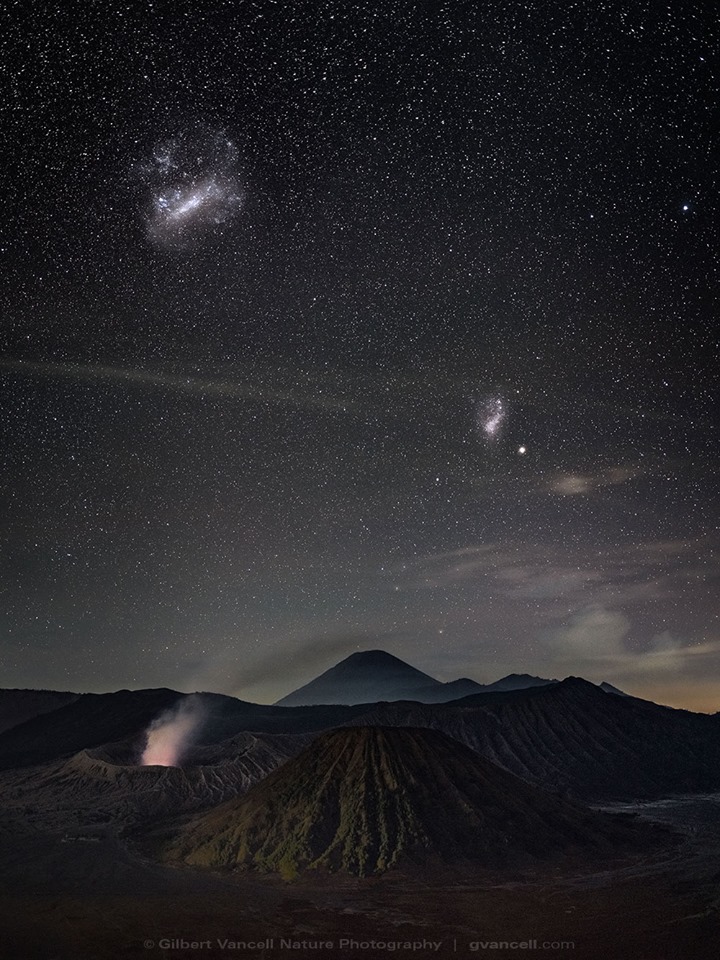
Gilbert Vancell Nature Photography wrote: “The Magellanic Clouds over Bromo Semeru Tengger National Park, Java, Indonesia. My 1st time shooting the Magellanic Clouds, and couldn’t have been anyplace better! Read more about my experience shooting this marvel of Nature.”

Read more: The spectacular Large Magellanic Cloud

Read more: Small Magellanic Cloud

Read more: Bromo Tengger Semeru National Park


from EarthSky https://ift.tt/2P170Ko

Gilbert Vancell Nature Photography wrote: “The Magellanic Clouds over Bromo Semeru Tengger National Park, Java, Indonesia. My 1st time shooting the Magellanic Clouds, and couldn’t have been anyplace better! Read more about my experience shooting this marvel of Nature.”

Read more: The spectacular Large Magellanic Cloud

Read more: Small Magellanic Cloud

Read more: Bromo Tengger Semeru National Park


from EarthSky https://ift.tt/2P170Ko

News digest – junk food ad ban, cancer-killing viruses, immunotherapy on the NHS and sugar supplements

Immune cells

London Mayor bans junk food ads on public transport

To help tackle rising levels of obesity in the capital, the Major of London, Sadiq Kahn, has announced a ban on junk food marketing across public transport. According to the BBC, ads for food and drink high in fat, sugar and salt will vanish from the Underground, Overground, buses and bus shelters by February next year. Our news report has the details.

Engineered virus kills cancer cells and cells that help cancer grow

Our scientists in Oxford have engineered a virus that not only attacks cancer cells, but also helps destroy normal cells that help tumour cells grow in the lab. The Independent covered this research and the video below catches the virus in action.

Immunotherapy and chemo combo made available for some NHS lung cancer patients

The Mail Online covers new draft guidance from the National Institute for Health and Care Excellence (NICE) that means some patients with a type of lung cancer will be able to take the immunotherapy drug pembrolizumab (Keytruda) with standard chemo. A clinical trial showed the combination boosted survival. Read our news report for the full story.

Immunotherapy drug to be made available for some NHS patients with advanced skin cancer

Another win for patients who might benefit from pembrolizumab: the drug will also soon be an option for people with melanoma that has spread to the lymph nodes and who have already had surgery. The approval comes following trial data showing it could stop the cancer from coming back. We covered this one too.

Sugary drinks tax raised almost £154 million so far

Since its introduction in April this year, the Soft Drinks Industry Levy (commonly known as the sugar tax) has raised £153.8 million, reports the BBC. The Government says the tax is on track to raise its projected £240 million by the end of the financial year.

NHS to save money on branded drugs

According to the Health Secretary, Matt Hancock, the NHS will save almost £1 billion on medicines next year after a new deal was reached with the pharmaceutical industry. The agreement included a cap on how much the NHS pays drug firms for branded treatments. The Sun covered this announcement.

And finally

Headlines on research in mice suggested that a sugar supplement called mannose could soon treat cancer in people. Even though tumours in the mice shrank after eating mannose and receiving chemotherapy, our scientists who led the research said they hadn’t yet fully investigated how this impacted the health of the mice. So, there’s quite a lot of work to do before we’ll know if it’s safe to test the same approach in people. Mannose can be bought over the counter to treat short-term health conditions like urinary tract infections, so our blog post explains why patients shouldn’t be rushing to health food shops just yet.

Gabi


from Cancer Research UK – Science blog https://ift.tt/2QimCxZ
Immune cells

London Mayor bans junk food ads on public transport

To help tackle rising levels of obesity in the capital, the Major of London, Sadiq Kahn, has announced a ban on junk food marketing across public transport. According to the BBC, ads for food and drink high in fat, sugar and salt will vanish from the Underground, Overground, buses and bus shelters by February next year. Our news report has the details.

Engineered virus kills cancer cells and cells that help cancer grow

Our scientists in Oxford have engineered a virus that not only attacks cancer cells, but also helps destroy normal cells that help tumour cells grow in the lab. The Independent covered this research and the video below catches the virus in action.

Immunotherapy and chemo combo made available for some NHS lung cancer patients

The Mail Online covers new draft guidance from the National Institute for Health and Care Excellence (NICE) that means some patients with a type of lung cancer will be able to take the immunotherapy drug pembrolizumab (Keytruda) with standard chemo. A clinical trial showed the combination boosted survival. Read our news report for the full story.

Immunotherapy drug to be made available for some NHS patients with advanced skin cancer

Another win for patients who might benefit from pembrolizumab: the drug will also soon be an option for people with melanoma that has spread to the lymph nodes and who have already had surgery. The approval comes following trial data showing it could stop the cancer from coming back. We covered this one too.

Sugary drinks tax raised almost £154 million so far

Since its introduction in April this year, the Soft Drinks Industry Levy (commonly known as the sugar tax) has raised £153.8 million, reports the BBC. The Government says the tax is on track to raise its projected £240 million by the end of the financial year.

NHS to save money on branded drugs

According to the Health Secretary, Matt Hancock, the NHS will save almost £1 billion on medicines next year after a new deal was reached with the pharmaceutical industry. The agreement included a cap on how much the NHS pays drug firms for branded treatments. The Sun covered this announcement.

And finally

Headlines on research in mice suggested that a sugar supplement called mannose could soon treat cancer in people. Even though tumours in the mice shrank after eating mannose and receiving chemotherapy, our scientists who led the research said they hadn’t yet fully investigated how this impacted the health of the mice. So, there’s quite a lot of work to do before we’ll know if it’s safe to test the same approach in people. Mannose can be bought over the counter to treat short-term health conditions like urinary tract infections, so our blog post explains why patients shouldn’t be rushing to health food shops just yet.

Gabi


from Cancer Research UK – Science blog https://ift.tt/2QimCxZ

New research, November 12-18, 2018

A selection of new climate related research articles is shown below.

Climate change

Seasonal climatic effects and feedbacks of anthropogenic heat release due to global energy consumption with CAM5

A method for investigating the relative importance of three components in overall uncertainty of climate projections

Temperature, precipitation, wind

A Recent Shift Toward an El Niño‐Like Ocean State in the Tropical Pacific and the Resumption of Ocean Warming

Precipitation Characteristic Changes due to Global Warming in a High‐Resolution (16‐km) ECMWF Simulation

Investigating the causes of increased 20th-century fall precipitation over the southeastern United States

Global observational evidence of strong linkage between dew point temperature and precipitation extremes

Wind over the Adriatic Region in CORDEX Climate Change Scenarios

Simulating Arctic 2-m air temperature and its linear trends using the HIRHAM5 regional climate model

Regional trend changes in recent surface warming

Comparison of land–ocean warming ratios in updated observed records and CMIP5 climate models (open access)

Extreme events

Extreme temperature and rainfall events in National Capital Region of India (New Delhi) in the recent decades and its possible impacts

Future projections of extreme temperature events in different sub-regions of China

Drought legacies are dependent on water table depth, wood anatomy and drought timing across the eastern US

Future projection of droughts over major river basins in Southern Africa at specific global warming levels

Drought characterization over India under projected climate scenario

Asymmetric relationships between ENSO and entrance tropical cyclones in the South China Sea during fall

Interdecadal variability of the location of maximum intensity of category 4‐5 typhoons and its implication on landfall intensity in East Asia

Projecting Changes in Societally Impactful Northeastern U.S. Snowstorms

The intensity and motion of hybrid cyclones in the Australian region in a composite potential vorticity framework

Synoptic climatology of hybrid cyclones in the Australian region

Multiple climate hazards in Eurasian drylands

Forcings and feedbacks

A hierarchical statistical framework for emergent constraints: application to snow‐albedo feedback

Global IWV trends and variability in atmospheric reanalyses and GPS observations (open access)

Indirect Influence of Humidity on Atmospheric Spectra near 4 μm

Impacts of distribution patterns of cloud optical depth on the calculation of radiative forcing

Global changes in the diurnal cycle of surface ozone

Driving factors of aerosol properties over the foothills of central Himalayas based on 8.5 years continuous measurements

Solar cycle characteristics and their application in the prediction of cycle 25

Cryosphere

Variability in Basal Melting Beneath Pine Island Ice Shelf on Weekly to Monthly Timescales

Control of ocean temperature on Jakobshavn Isbræ's present and future mass loss

Localized plumes drive front‐wide ocean melting of a Greenlandic tidewater glacier

Groundwater in catchments headed by temperate glaciers: A review

A coupled glacier–hydrology model and its application in eastern Pamir

Snow hydrology in the upper Yellow River basin under climate change: a land‐surface modeling perspective

Exploration of Antarctic Ice Sheet 100-year contribution to sea level rise and associated model uncertainties using the ISSM framework (open access)

The Energetics of Extensive Melt Water Flooding of Level Arctic Sea Ice

Estimating snow depth over Arctic sea ice from calibrated dual-frequency radar freeboards (open access)

Hydrosphere 

Sea level interannual variability along the west coast of India

Coastal Sea level rise around the China Seas

Runoff from glacier ice and seasonal snow in High Asia: separating melt water sources in river flow (open access)

GNSS-derived PWV and comparison with radiosonde and ECMWF ERA-Interim data over mainland China

Understanding the spatial differences in terrestrial water storage variations in the Tibetan Plateau from 2002 to 2016

Atmospheric and oceanic circulation

The mechanisms of the Atlantic Meridional Overturning Circulation slowdown induced by Arctic sea ice decline

On the variability of the Atlantic meridional overturning circulation transports in coupled CMIP5 simulations

Increasing Atlantic Ocean heat transport in the latest generation coupled ocean‐atmosphere models: The role of air‐sea interaction

Regional Changes in the Mean Position and Variability of the Tropical Edge

Inter-model uncertainty in the change of ENSO’s amplitude under global warming: Role of the response of atmospheric circulation to SST anomalies

The Role of Hadley Circulation and Lapse-Rate Changes for the Future European Summer Climate

Carbon and nitrogen cycles

Contribution of soil inorganic carbon to atmospheric CO2: More important than previously thought (open access)

Uncertainty in United States coastal wetland greenhouse gas inventorying (open access)

Magnitude, pattern and controls of carbon flux and carbon use efficiency in China's typical forests

Climate change impacts 

Mankind

The Influence of Interannual Climate Variability on Regional Violent Crime Rates in the United States (open access)

Societal causes of, and responses to, ocean acidification (open access)

Economic and biophysical impacts on agriculture under 1.5 °C and 2 °C warming (open access)

Analysis of wheat farmers’ risk perceptions and attitudes: evidence from Punjab, Pakistan

Ricardian analysis of climate change–agriculture linkages in Pakistan

The effects of monthly air temperature and rainfall variations on the reproductive performance and lambing distribution of the Jezersko-Solčava sheep

Environmental change, adaptation strategies and the relevance of migration in Sub-Saharan drylands (open access)

Demographic variation and change in the Inuit Arctic (open access)

Biosphere

Pinatubo volcanic eruption exacerbated an abrupt coral mortality event in 1991 summer

Ocean acidification reduces hardness and stiffness of the Portuguese oyster shell with impaired microstructure: a hierarchical analysis (open access)

Impact of carbonate saturation on large Caribbean benthic foraminifera assemblages (open access)

Limiting the high impacts of Amazon forest dieback with no-regrets science and policy action

Introduced garden plants are strong competitors of native and alien residents under simulated climate change

Increasing temperature seasonality may overwhelm shifts in soil moisture to favor shrub over grass dominance in Colorado Plateau drylands

Reduced carbon use efficiency and increased microbial turnover with soil warming

Susceptibility of European freshwater fish to climate change: species profiling based on life‐history and environmental characteristics

Antagonistic effects of temperature and dissolved organic carbon on fish growth in California mountain lakes

Effects of climate and demography on reproductive phenology of a harvested marine fish population (open access)

Climatically controlled reproduction drives interannual growth variability in a temperate tree species (open access)

The effect of the 2013–2016 high temperature anomaly in the subarctic Northeast Pacific (the “Blob”) on net community production (open access)

Northward expanding resident species benefit from warming winters through increased foraging rates and predator vigilance (open access)

Is oxygen limitation in warming waters a valid mechanism to explain decreased body sizes in aquatic ectotherms? (open access)

Climate change mitigation

Climate change communication

Utilizing the Dynamic Role of Objects to Enhance Cross-Cultural Climate Change Collaborations

Testing the Influence of Recent Weather on Perceptions of Personal Experience With Climate Change and Extreme Weather in New York State

Climate change and the agricultural sector in Ireland: examining farmer awareness and willingness to adopt new advisory mitigation tools

Climate Policy

Why the social cost of carbon will always be disputed (open access)

The Paris Agreement and climate change negotiations: Small Islands, big players

Climate, air quality, and health benefits of a carbon fee-and-rebate bill in Massachusetts, USA (open access)

Health co-benefits and the development of climate change mitigation policies in the European Union

Energy production

Is it the end of the line for Light Water Reactor technology or can China and Russia save the day?

Effectiveness of crop residuals in ethanol and pyrolysis-based electricity production: A stochastic analysis under uncertain climate impacts

Promoting LPG, clean woodburning cookstoves or both? Climate change mitigation implications of integrated household energy transition scenarios in rural Mexico (open access)

Governing energy transitions and regional economic development: Evidence from three Brazilian states

Does transmission unbundling increase wind power generation in the United States?

Emission savings

Can constitutions bring about revolutions? How to enhance decarbonization success

Southern California megacity CO2, CH4, and CO flux estimates using ground- and space-based remote sensing and a Lagrangian model (open access)

Other papers 

Palaeoclimatology

The onset and rate of Holocene Neoglacial cooling in the Arctic

Link between the North Atlantic Oscillation and the surface mass balance components of the Greenland Ice Sheet under preindustrial and last interglacial climates: a study with a coupled global circulation model (open access)

Asymmetric Cooling of the Atlantic and Pacific Arctic during the Past Two Millennia: A Dual Observation‐Modeling Study

Solar activities and climate change during the last millennium recorded in Korean chronicles

Back to the future? Late Holocene marine food web structure in a warm climatic phase as a predictor of trophodynamics in a warmer South‐Western Atlantic Ocean

Other environmental issues 

Substantial changes in air pollution across China during 2015–2017 (open access)


from Skeptical Science https://ift.tt/2PP3NTN

A selection of new climate related research articles is shown below.

Climate change

Seasonal climatic effects and feedbacks of anthropogenic heat release due to global energy consumption with CAM5

A method for investigating the relative importance of three components in overall uncertainty of climate projections

Temperature, precipitation, wind

A Recent Shift Toward an El Niño‐Like Ocean State in the Tropical Pacific and the Resumption of Ocean Warming

Precipitation Characteristic Changes due to Global Warming in a High‐Resolution (16‐km) ECMWF Simulation

Investigating the causes of increased 20th-century fall precipitation over the southeastern United States

Global observational evidence of strong linkage between dew point temperature and precipitation extremes

Wind over the Adriatic Region in CORDEX Climate Change Scenarios

Simulating Arctic 2-m air temperature and its linear trends using the HIRHAM5 regional climate model

Regional trend changes in recent surface warming

Comparison of land–ocean warming ratios in updated observed records and CMIP5 climate models (open access)

Extreme events

Extreme temperature and rainfall events in National Capital Region of India (New Delhi) in the recent decades and its possible impacts

Future projections of extreme temperature events in different sub-regions of China

Drought legacies are dependent on water table depth, wood anatomy and drought timing across the eastern US

Future projection of droughts over major river basins in Southern Africa at specific global warming levels

Drought characterization over India under projected climate scenario

Asymmetric relationships between ENSO and entrance tropical cyclones in the South China Sea during fall

Interdecadal variability of the location of maximum intensity of category 4‐5 typhoons and its implication on landfall intensity in East Asia

Projecting Changes in Societally Impactful Northeastern U.S. Snowstorms

The intensity and motion of hybrid cyclones in the Australian region in a composite potential vorticity framework

Synoptic climatology of hybrid cyclones in the Australian region

Multiple climate hazards in Eurasian drylands

Forcings and feedbacks

A hierarchical statistical framework for emergent constraints: application to snow‐albedo feedback

Global IWV trends and variability in atmospheric reanalyses and GPS observations (open access)

Indirect Influence of Humidity on Atmospheric Spectra near 4 μm

Impacts of distribution patterns of cloud optical depth on the calculation of radiative forcing

Global changes in the diurnal cycle of surface ozone

Driving factors of aerosol properties over the foothills of central Himalayas based on 8.5 years continuous measurements

Solar cycle characteristics and their application in the prediction of cycle 25

Cryosphere

Variability in Basal Melting Beneath Pine Island Ice Shelf on Weekly to Monthly Timescales

Control of ocean temperature on Jakobshavn Isbræ's present and future mass loss

Localized plumes drive front‐wide ocean melting of a Greenlandic tidewater glacier

Groundwater in catchments headed by temperate glaciers: A review

A coupled glacier–hydrology model and its application in eastern Pamir

Snow hydrology in the upper Yellow River basin under climate change: a land‐surface modeling perspective

Exploration of Antarctic Ice Sheet 100-year contribution to sea level rise and associated model uncertainties using the ISSM framework (open access)

The Energetics of Extensive Melt Water Flooding of Level Arctic Sea Ice

Estimating snow depth over Arctic sea ice from calibrated dual-frequency radar freeboards (open access)

Hydrosphere 

Sea level interannual variability along the west coast of India

Coastal Sea level rise around the China Seas

Runoff from glacier ice and seasonal snow in High Asia: separating melt water sources in river flow (open access)

GNSS-derived PWV and comparison with radiosonde and ECMWF ERA-Interim data over mainland China

Understanding the spatial differences in terrestrial water storage variations in the Tibetan Plateau from 2002 to 2016

Atmospheric and oceanic circulation

The mechanisms of the Atlantic Meridional Overturning Circulation slowdown induced by Arctic sea ice decline

On the variability of the Atlantic meridional overturning circulation transports in coupled CMIP5 simulations

Increasing Atlantic Ocean heat transport in the latest generation coupled ocean‐atmosphere models: The role of air‐sea interaction

Regional Changes in the Mean Position and Variability of the Tropical Edge

Inter-model uncertainty in the change of ENSO’s amplitude under global warming: Role of the response of atmospheric circulation to SST anomalies

The Role of Hadley Circulation and Lapse-Rate Changes for the Future European Summer Climate

Carbon and nitrogen cycles

Contribution of soil inorganic carbon to atmospheric CO2: More important than previously thought (open access)

Uncertainty in United States coastal wetland greenhouse gas inventorying (open access)

Magnitude, pattern and controls of carbon flux and carbon use efficiency in China's typical forests

Climate change impacts 

Mankind

The Influence of Interannual Climate Variability on Regional Violent Crime Rates in the United States (open access)

Societal causes of, and responses to, ocean acidification (open access)

Economic and biophysical impacts on agriculture under 1.5 °C and 2 °C warming (open access)

Analysis of wheat farmers’ risk perceptions and attitudes: evidence from Punjab, Pakistan

Ricardian analysis of climate change–agriculture linkages in Pakistan

The effects of monthly air temperature and rainfall variations on the reproductive performance and lambing distribution of the Jezersko-Solčava sheep

Environmental change, adaptation strategies and the relevance of migration in Sub-Saharan drylands (open access)

Demographic variation and change in the Inuit Arctic (open access)

Biosphere

Pinatubo volcanic eruption exacerbated an abrupt coral mortality event in 1991 summer

Ocean acidification reduces hardness and stiffness of the Portuguese oyster shell with impaired microstructure: a hierarchical analysis (open access)

Impact of carbonate saturation on large Caribbean benthic foraminifera assemblages (open access)

Limiting the high impacts of Amazon forest dieback with no-regrets science and policy action

Introduced garden plants are strong competitors of native and alien residents under simulated climate change

Increasing temperature seasonality may overwhelm shifts in soil moisture to favor shrub over grass dominance in Colorado Plateau drylands

Reduced carbon use efficiency and increased microbial turnover with soil warming

Susceptibility of European freshwater fish to climate change: species profiling based on life‐history and environmental characteristics

Antagonistic effects of temperature and dissolved organic carbon on fish growth in California mountain lakes

Effects of climate and demography on reproductive phenology of a harvested marine fish population (open access)

Climatically controlled reproduction drives interannual growth variability in a temperate tree species (open access)

The effect of the 2013–2016 high temperature anomaly in the subarctic Northeast Pacific (the “Blob”) on net community production (open access)

Northward expanding resident species benefit from warming winters through increased foraging rates and predator vigilance (open access)

Is oxygen limitation in warming waters a valid mechanism to explain decreased body sizes in aquatic ectotherms? (open access)

Climate change mitigation

Climate change communication

Utilizing the Dynamic Role of Objects to Enhance Cross-Cultural Climate Change Collaborations

Testing the Influence of Recent Weather on Perceptions of Personal Experience With Climate Change and Extreme Weather in New York State

Climate change and the agricultural sector in Ireland: examining farmer awareness and willingness to adopt new advisory mitigation tools

Climate Policy

Why the social cost of carbon will always be disputed (open access)

The Paris Agreement and climate change negotiations: Small Islands, big players

Climate, air quality, and health benefits of a carbon fee-and-rebate bill in Massachusetts, USA (open access)

Health co-benefits and the development of climate change mitigation policies in the European Union

Energy production

Is it the end of the line for Light Water Reactor technology or can China and Russia save the day?

Effectiveness of crop residuals in ethanol and pyrolysis-based electricity production: A stochastic analysis under uncertain climate impacts

Promoting LPG, clean woodburning cookstoves or both? Climate change mitigation implications of integrated household energy transition scenarios in rural Mexico (open access)

Governing energy transitions and regional economic development: Evidence from three Brazilian states

Does transmission unbundling increase wind power generation in the United States?

Emission savings

Can constitutions bring about revolutions? How to enhance decarbonization success

Southern California megacity CO2, CH4, and CO flux estimates using ground- and space-based remote sensing and a Lagrangian model (open access)

Other papers 

Palaeoclimatology

The onset and rate of Holocene Neoglacial cooling in the Arctic

Link between the North Atlantic Oscillation and the surface mass balance components of the Greenland Ice Sheet under preindustrial and last interglacial climates: a study with a coupled global circulation model (open access)

Asymmetric Cooling of the Atlantic and Pacific Arctic during the Past Two Millennia: A Dual Observation‐Modeling Study

Solar activities and climate change during the last millennium recorded in Korean chronicles

Back to the future? Late Holocene marine food web structure in a warm climatic phase as a predictor of trophodynamics in a warmer South‐Western Atlantic Ocean

Other environmental issues 

Substantial changes in air pollution across China during 2015–2017 (open access)


from Skeptical Science https://ift.tt/2PP3NTN

adds 2