aads

Sugar supplement slows cancer growth in mice, but patients shouldn’t rush to health food shops

Almost every cell in our body is powered by a sugar molecule called glucose. To use glucose as fuel, cells have to break it down into bite-size chunks. And these bite-size chunks help cells function properly.

Cancer cells grow and multiply quickly, which means they need a lot of fuel. And they too rely on glucose to survive.

That’s why scientists have been investigating what happens to cancer cells when they’re starved of glucose. Even though some studies have found that limiting glucose can stop cancer cells from growing, there’s no way to stop cancer cells from taking up glucose in a person without also starving their healthy cells.

Luckily, the human body can use more than one type of sugar. And cancer cells sometimes make and process energy differently to healthy cells. Researchers at the Cancer Research UK Beatson Institute in Glasgow have been looking at how different types of sugar affect growing cancer cells. And in new research, published today in Nature, they’ve uncovered how a molecule like glucose, called mannose, might interfere with cancer cells’ energy supplies.

Stunting tumour growth

Mannose is part of the same family as glucose, sharing a similar molecular shape. So, the team were interested to see what happened when cells growing in the lab were also given mannose.

They studied the inner workings of different types of cancer cells and found that mannose didn’t stop glucose being taken up by the cells, but it did stop them growing. They realised that mannose might be interfering with the way cancer cells break down glucose, stalling their growth.

To find out more, the team monitored the effects of feeding mannose to mice with cancer. Pancreatic cancers, skin cancers and lung cancers all stopped growing when the mice were given mannose supplements three times a week. There also seemed to be no effect on healthy cells.

“Taking mannose did not significantly affect the weight or health of the mice,” says Professor Kevin Ryan, who led the research.

“However, our study didn’t do a detailed analysis of every tissue, so it is not certain that mannose is completely safe.”

The study also looked at other sugars but found that mannose was the most effective at slowing the growth of tumours.

Mannose boosted how well chemo worked in mice

The team also found that mannose boosted cancer cell death when taken alongside chemotherapy.

Mice who were given chemotherapy and mannose together lived longer than those who received no treatment or just chemo or mannose alone. “We were interested to see if mannose enhanced chemotherapy treatment,” says Ryan, “We found that using chemotherapy and mannose separately did reduce the tumour size but using them together had a greater effect and increased life expectancy.”

Mannose supplements

This study offers fascinating insight into how interfering with the way cells make and use sugar could one day treat cancer. But Ryan is clear that it’s certainly not recommended for patients to start taking mannose based on these findings.

While there is promise for future treatments involving mannose, it would be very inadvisable for cancer patients to start using it now.

– Professor Kevin Ryan, lead author

“My worry is that mannose can be bought in tablet form over the counter in pharmacies and health food shops,” he says. “At the moment it can be used to treat urinary tract infections (UTIs) and relieve symptoms for people with carbohydrate deficiencies.”

Despite it being used in these specific cases, mannose hasn’t gone through the appropriate clinical trials and testing to be sure it’s safe to give to people with cancer. Only then could researchers plan to take on the bigger challenge of running trials to see if it would make a better cancer treatment than what’s already available.

“While there is promise for future treatments involving mannose, it would be very inadvisable for cancer patients to start using it now,” says Ryan. “Cancer patients taking mannose for a long period of time that are likely to have weakened immune systems from cancer treatment are not the same as people using mannose in the short-term for UTIs.”

Mannose research is still early stage

The future role of mannose in cancer patients’ treatment isn’t clear. Because of the effects they saw in mice who took mannose and chemo together, Ryan says he doesn’t imagine it as something that can directly treat cancer on its own. Instead, he predicts mannose could act as more of a side kick to existing treatment.

“We think mannose could be the difference between having a small percentage of the tumour leftover after chemotherapy compared to having no residual tumour leftover at all,” he says.

The future of mannose

Before mannose can move to clinical trials, more research needs to be done in the lab.

Even though this study suggests mannose has the potential to slow growing tumours, the research is still at a very early stage. And we can’t presume that the same effects will happen in people. This research also focused on mice with only a small number of tumour types. Ryan and his team now want to see if the same effects happen in mice with other types of cancer.

“We want to find out what tumour cell lines respond to mannose and which don’t,” he says.

Although there is still a long way to go, the study shows promise in managing tumour growth. And if it’s successfully tested in rigorous clinical trials, mannose could have a part to play in improving treatment for some cancer patients in the future.

Lily


from Cancer Research UK – Science blog https://ift.tt/2Bq9caV

Almost every cell in our body is powered by a sugar molecule called glucose. To use glucose as fuel, cells have to break it down into bite-size chunks. And these bite-size chunks help cells function properly.

Cancer cells grow and multiply quickly, which means they need a lot of fuel. And they too rely on glucose to survive.

That’s why scientists have been investigating what happens to cancer cells when they’re starved of glucose. Even though some studies have found that limiting glucose can stop cancer cells from growing, there’s no way to stop cancer cells from taking up glucose in a person without also starving their healthy cells.

Luckily, the human body can use more than one type of sugar. And cancer cells sometimes make and process energy differently to healthy cells. Researchers at the Cancer Research UK Beatson Institute in Glasgow have been looking at how different types of sugar affect growing cancer cells. And in new research, published today in Nature, they’ve uncovered how a molecule like glucose, called mannose, might interfere with cancer cells’ energy supplies.

Stunting tumour growth

Mannose is part of the same family as glucose, sharing a similar molecular shape. So, the team were interested to see what happened when cells growing in the lab were also given mannose.

They studied the inner workings of different types of cancer cells and found that mannose didn’t stop glucose being taken up by the cells, but it did stop them growing. They realised that mannose might be interfering with the way cancer cells break down glucose, stalling their growth.

To find out more, the team monitored the effects of feeding mannose to mice with cancer. Pancreatic cancers, skin cancers and lung cancers all stopped growing when the mice were given mannose supplements three times a week. There also seemed to be no effect on healthy cells.

“Taking mannose did not significantly affect the weight or health of the mice,” says Professor Kevin Ryan, who led the research.

“However, our study didn’t do a detailed analysis of every tissue, so it is not certain that mannose is completely safe.”

The study also looked at other sugars but found that mannose was the most effective at slowing the growth of tumours.

Mannose boosted how well chemo worked in mice

The team also found that mannose boosted cancer cell death when taken alongside chemotherapy.

Mice who were given chemotherapy and mannose together lived longer than those who received no treatment or just chemo or mannose alone. “We were interested to see if mannose enhanced chemotherapy treatment,” says Ryan, “We found that using chemotherapy and mannose separately did reduce the tumour size but using them together had a greater effect and increased life expectancy.”

Mannose supplements

This study offers fascinating insight into how interfering with the way cells make and use sugar could one day treat cancer. But Ryan is clear that it’s certainly not recommended for patients to start taking mannose based on these findings.

While there is promise for future treatments involving mannose, it would be very inadvisable for cancer patients to start using it now.

– Professor Kevin Ryan, lead author

“My worry is that mannose can be bought in tablet form over the counter in pharmacies and health food shops,” he says. “At the moment it can be used to treat urinary tract infections (UTIs) and relieve symptoms for people with carbohydrate deficiencies.”

Despite it being used in these specific cases, mannose hasn’t gone through the appropriate clinical trials and testing to be sure it’s safe to give to people with cancer. Only then could researchers plan to take on the bigger challenge of running trials to see if it would make a better cancer treatment than what’s already available.

“While there is promise for future treatments involving mannose, it would be very inadvisable for cancer patients to start using it now,” says Ryan. “Cancer patients taking mannose for a long period of time that are likely to have weakened immune systems from cancer treatment are not the same as people using mannose in the short-term for UTIs.”

Mannose research is still early stage

The future role of mannose in cancer patients’ treatment isn’t clear. Because of the effects they saw in mice who took mannose and chemo together, Ryan says he doesn’t imagine it as something that can directly treat cancer on its own. Instead, he predicts mannose could act as more of a side kick to existing treatment.

“We think mannose could be the difference between having a small percentage of the tumour leftover after chemotherapy compared to having no residual tumour leftover at all,” he says.

The future of mannose

Before mannose can move to clinical trials, more research needs to be done in the lab.

Even though this study suggests mannose has the potential to slow growing tumours, the research is still at a very early stage. And we can’t presume that the same effects will happen in people. This research also focused on mice with only a small number of tumour types. Ryan and his team now want to see if the same effects happen in mice with other types of cancer.

“We want to find out what tumour cell lines respond to mannose and which don’t,” he says.

Although there is still a long way to go, the study shows promise in managing tumour growth. And if it’s successfully tested in rigorous clinical trials, mannose could have a part to play in improving treatment for some cancer patients in the future.

Lily


from Cancer Research UK – Science blog https://ift.tt/2Bq9caV

For arid, Mars-like desert, rain brings death

A small, ephemeral lagoon in the hyperarid core of the Atacama Desert. Image via: Carlos González-Silva/Cornell Chronicle.

After encountering never-before-seen rainfall at the arid core of Chile’s Atacama Desert, a team of planetary astrobiologists found that the heavy precipitation wiped out most of the microbes that had lived there.

The Atacama Desert is the driest place on Earth. It receives just millimeters of rain each year, on average, and its parched conditions make it a commonly used stand-in for Mars.

Image via beautifulworld.com.

Last year, an international team of scientists working in the Atacama were astounded to find multiple lagoons of liquid water there — the ephemeral runoff from an unusual rain event in June 2017. But the rainfall that created these ponds didn’t result in a bloom of life, the researchers found. Instead, it was actually lethal to the majority of microbes adapted to the extreme aridity of the Atacama.

Alberto Fairen, a Cornell University astrobiologist is co-author of the study, published November 12, 2018, in the peer-reviewed journal Scientific Reports. Fairen said in a statement:

When the rains came to the Atacama, we were hoping for majestic blooms and deserts springing to life. Instead, we learned the contrary, as we found that rain in the hyperarid core of the Atacama Desert caused a massive extinction of most of the indigenous microbial species there.

The hyperdry soils before the rains were inhabited by up to 16 different, ancient microbe species. After it rained, there were only two to four microbe species found in the lagoons. The extinction event was massive.

This lagoon appeared in 2017 in Chile’s Atacama Desert. It evaporated months later. image via Carlos González-Silva.

The core of Atacama rarely, if ever, sees rain. But thanks to changing climate over the Pacific Ocean, according to the new paper, that part of the desert experienced rain events on March 25 and August 9, 2015. It rained again on June 7, 2017. Climate models suggest that similar rain events may take place about once every century, but there has been no evidence of rain for the past 500 years.

These findings have implications for future spacecraft missions, the researchers said, that will collect samples from other planets: Incubating dry soil samples in aqueous solutions, as was done with the Viking landers on Mars in the 1970s, may have the inadvertent effect of killing microbial life.

The surprise precipitation also has implications for the biology of Mars, the researchers said. Large deposits of nitrates at the Atacama Desert offer evidence of long periods of extreme dryness. These nitrate deposits are food for microbes. The nitrates concentrated at valley bottoms and former lakes about 13 million years ago. Fairen said:

Nitrate deposits are the evidence. This may represent an analog to the nitrate deposits recently discovered on Mars by the rover Curiosity … Our results show for the first time that providing suddenly large amounts of water to microorganisms – exquisitely adapted to extract meager and elusive moisture from the most hyperdry environments – will kill them from osmotic shock.

A historically rare rainbow in the Atacama Desert. Image via: Carlos González-Silva/Cornell Chronicle.

The 2019 lunar calendars are here! Order yours before they’re gone. Makes a great gift.

Bottom line: A team of planetary astrobiologists found that heavy precipitation in the arid Atacama Desert killed most of the microbes that lived there.

Source: Unprecedented rains decimate surface microbial communities in the hyperarid core of the Atacama Desert

Via Cornell University


from EarthSky https://ift.tt/2PJLOxO

A small, ephemeral lagoon in the hyperarid core of the Atacama Desert. Image via: Carlos González-Silva/Cornell Chronicle.

After encountering never-before-seen rainfall at the arid core of Chile’s Atacama Desert, a team of planetary astrobiologists found that the heavy precipitation wiped out most of the microbes that had lived there.

The Atacama Desert is the driest place on Earth. It receives just millimeters of rain each year, on average, and its parched conditions make it a commonly used stand-in for Mars.

Image via beautifulworld.com.

Last year, an international team of scientists working in the Atacama were astounded to find multiple lagoons of liquid water there — the ephemeral runoff from an unusual rain event in June 2017. But the rainfall that created these ponds didn’t result in a bloom of life, the researchers found. Instead, it was actually lethal to the majority of microbes adapted to the extreme aridity of the Atacama.

Alberto Fairen, a Cornell University astrobiologist is co-author of the study, published November 12, 2018, in the peer-reviewed journal Scientific Reports. Fairen said in a statement:

When the rains came to the Atacama, we were hoping for majestic blooms and deserts springing to life. Instead, we learned the contrary, as we found that rain in the hyperarid core of the Atacama Desert caused a massive extinction of most of the indigenous microbial species there.

The hyperdry soils before the rains were inhabited by up to 16 different, ancient microbe species. After it rained, there were only two to four microbe species found in the lagoons. The extinction event was massive.

This lagoon appeared in 2017 in Chile’s Atacama Desert. It evaporated months later. image via Carlos González-Silva.

The core of Atacama rarely, if ever, sees rain. But thanks to changing climate over the Pacific Ocean, according to the new paper, that part of the desert experienced rain events on March 25 and August 9, 2015. It rained again on June 7, 2017. Climate models suggest that similar rain events may take place about once every century, but there has been no evidence of rain for the past 500 years.

These findings have implications for future spacecraft missions, the researchers said, that will collect samples from other planets: Incubating dry soil samples in aqueous solutions, as was done with the Viking landers on Mars in the 1970s, may have the inadvertent effect of killing microbial life.

The surprise precipitation also has implications for the biology of Mars, the researchers said. Large deposits of nitrates at the Atacama Desert offer evidence of long periods of extreme dryness. These nitrate deposits are food for microbes. The nitrates concentrated at valley bottoms and former lakes about 13 million years ago. Fairen said:

Nitrate deposits are the evidence. This may represent an analog to the nitrate deposits recently discovered on Mars by the rover Curiosity … Our results show for the first time that providing suddenly large amounts of water to microorganisms – exquisitely adapted to extract meager and elusive moisture from the most hyperdry environments – will kill them from osmotic shock.

A historically rare rainbow in the Atacama Desert. Image via: Carlos González-Silva/Cornell Chronicle.

The 2019 lunar calendars are here! Order yours before they’re gone. Makes a great gift.

Bottom line: A team of planetary astrobiologists found that heavy precipitation in the arid Atacama Desert killed most of the microbes that lived there.

Source: Unprecedented rains decimate surface microbial communities in the hyperarid core of the Atacama Desert

Via Cornell University


from EarthSky https://ift.tt/2PJLOxO

Aurora and Milky Way over Norway

Image via SteveHobbie.

The 2019 lunar calendars are here! Order yours before they’re gone. Makes a great gift.


from EarthSky https://ift.tt/2PFoilA

Come to know the Pleiades, or 7 Sisters

Tonight, look for the tiny, misty dipper of stars known as the Pleiades or Seven Sisters. The image at top – from Krishnan Subramanian near Mumbai, India – shows a laser pointer indicating its location. Krishnan wrote:

The Pleiades star cluster is also called Krithika in India. Photo taken from Neral near Mumbai … The event was a stargazing night to see Leonids and also to know more about the galaxies, constellations and stars.

November is the month of the Pleiades star cluster. On these November nights, the Pleiades cluster shines from nightfall until dawn. It’s low in the east at nightfall, high overhead around midnight and low in the west before dawn. Locate it by the bright star Aldebaran this evening, or any evening soon.

You can view the Pleiades with either the unaided eye or an optical aid, on these November nights. The Pleiades cluster is one of the most recognizable star patterns in the night sky. Its six brightest stars do look like a little dipper. In fact, people in the Northern Hemisphere often mistake the Pleiades for the real Little Dipper asterism, which is located farther north on the sky’s dome. The misty-looking dipper of the Pleiades hovers over the northeastern horizon as darkness falls. It moves across the night sky from east to west, much like the sun does during the day.

Do you love stargazing? Order an EarthSky planisphere

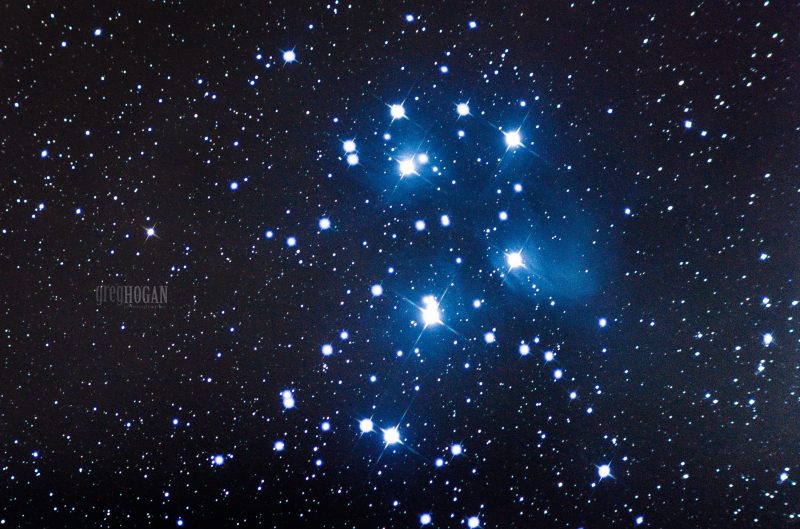
View larger. | EarthSky community member Greg Hogan captured this image of the Pleiades on November 11, 2015. He wrote:

EarthSky community member Greg Hogan captured this image of the Pleiades in November, 2015.

By the way, another name for the Pleiades is the Seven Sisters. But if you look with your eye alone, it’s likely you’ll only see six stars in the Pleiades. Some old Greek legends explore what might have happened to the missing sister, sometimes called the Lost Pleiad.

In the Northern Hemisphere, the Pleiades’ all night appearance coincides with late autumn. As this part of the world moves toward winter, it’s easy to imagine the Pleiades as a frosty patch on the dome of night. But in the Southern Hemisphere now, where spring flowers are blooming, this cluster of nocturnal suns watches over the season of awakening and agriculture. In South Africa, for example, the Pleiades are called the hoeing-stars.

Yearly, on or near November 21, the Pleiades cluster culminates – reaches its highest point in the sky – at midnight. (In this instance, midnight means midway between sunset and sunrise.) Historically, the midnight culmination of the Pleiades was very significant to many ancient and primitive peoples. Some of these Pleiades midnight celebrations still linger into the present, such as the old Druid rite of Halloween. Although the midnight culmination date for the Pleiades advances over the long course of time, the date of Halloween has remained fixed by tradition.

Tom Wildoner of LeisurelyScientist.com captured this image of the Pleiades on October 31, 2016.

Bottom line: Watch for the sky’s most celebrated star cluster – the Pleiades – a tiny, misty dipper-shaped star cluster adorning the sky all night long on these November nights.

More about the Pleiades: Famous Seven Sisters


from EarthSky https://ift.tt/2TwTkKW

Tonight, look for the tiny, misty dipper of stars known as the Pleiades or Seven Sisters. The image at top – from Krishnan Subramanian near Mumbai, India – shows a laser pointer indicating its location. Krishnan wrote:

The Pleiades star cluster is also called Krithika in India. Photo taken from Neral near Mumbai … The event was a stargazing night to see Leonids and also to know more about the galaxies, constellations and stars.

November is the month of the Pleiades star cluster. On these November nights, the Pleiades cluster shines from nightfall until dawn. It’s low in the east at nightfall, high overhead around midnight and low in the west before dawn. Locate it by the bright star Aldebaran this evening, or any evening soon.

You can view the Pleiades with either the unaided eye or an optical aid, on these November nights. The Pleiades cluster is one of the most recognizable star patterns in the night sky. Its six brightest stars do look like a little dipper. In fact, people in the Northern Hemisphere often mistake the Pleiades for the real Little Dipper asterism, which is located farther north on the sky’s dome. The misty-looking dipper of the Pleiades hovers over the northeastern horizon as darkness falls. It moves across the night sky from east to west, much like the sun does during the day.

Do you love stargazing? Order an EarthSky planisphere

View larger. | EarthSky community member Greg Hogan captured this image of the Pleiades on November 11, 2015. He wrote:

EarthSky community member Greg Hogan captured this image of the Pleiades in November, 2015.

By the way, another name for the Pleiades is the Seven Sisters. But if you look with your eye alone, it’s likely you’ll only see six stars in the Pleiades. Some old Greek legends explore what might have happened to the missing sister, sometimes called the Lost Pleiad.

In the Northern Hemisphere, the Pleiades’ all night appearance coincides with late autumn. As this part of the world moves toward winter, it’s easy to imagine the Pleiades as a frosty patch on the dome of night. But in the Southern Hemisphere now, where spring flowers are blooming, this cluster of nocturnal suns watches over the season of awakening and agriculture. In South Africa, for example, the Pleiades are called the hoeing-stars.

Yearly, on or near November 21, the Pleiades cluster culminates – reaches its highest point in the sky – at midnight. (In this instance, midnight means midway between sunset and sunrise.) Historically, the midnight culmination of the Pleiades was very significant to many ancient and primitive peoples. Some of these Pleiades midnight celebrations still linger into the present, such as the old Druid rite of Halloween. Although the midnight culmination date for the Pleiades advances over the long course of time, the date of Halloween has remained fixed by tradition.

Tom Wildoner of LeisurelyScientist.com captured this image of the Pleiades on October 31, 2016.

Bottom line: Watch for the sky’s most celebrated star cluster – the Pleiades – a tiny, misty dipper-shaped star cluster adorning the sky all night long on these November nights.

More about the Pleiades: Famous Seven Sisters


from EarthSky https://ift.tt/2TwTkKW

How to watch Insight Mars landing November 26

This illustration shows a simulated view of NASA’s InSight lander firing retrorockets to slow down as it descends toward the surface of Mars. Image via NASA/JPL-Caltech.

On Monday, November 26, 2018, NASA’s Mars Interior Exploration using Seismic Investigations, Geodesy and Heat Transport (InSight) lander is scheduled to land on Mars. The spacecraft will touch down at approximately 3 p.m. EST (8 p.m. UTC; translate UTC to your time). Watch coverage of the event on NASA TV. Live landing commentary runs from 2:00-3:30 p.m. EST (7-8:30 p.m. UTC)

Ways to watch:
Watch on NASA TV.
Watch NASA TV on USTREAM
Follow the mission and watch the landing on Twitter and Facebook.

Launched on May 5, 2018, InSight marks NASA’s first Mars landing since the Curiosity rover in 2012. The landing will kick off a two-year mission in which InSight will become the first spacecraft to study Mars’ deep interior. Its data also will help scientists understand the formation of all rocky worlds, including our own.

InSight is being followed to Mars by two mini-spacecraft comprising NASA’s Mars Cube One (MarCO), the first deep-space mission for CubeSats. If MarCO makes its planned Mars flyby, it will attempt to relay data from InSight as it enters the planet’s atmosphere and lands. Here’s where Insight will touch down.

So far, there are about 80 live viewing events around the world scheduled for the public to watch the InSight landing. For a complete list of landing event watch parties, go here.

For a full list of websites broadcasting InSight landing events, go here.

Bottom line: How to watch the landing of NASA’s Mars Insight spacecraft on November 26, 2018.

Via NASA


from EarthSky https://ift.tt/2Fv7mJS

This illustration shows a simulated view of NASA’s InSight lander firing retrorockets to slow down as it descends toward the surface of Mars. Image via NASA/JPL-Caltech.

On Monday, November 26, 2018, NASA’s Mars Interior Exploration using Seismic Investigations, Geodesy and Heat Transport (InSight) lander is scheduled to land on Mars. The spacecraft will touch down at approximately 3 p.m. EST (8 p.m. UTC; translate UTC to your time). Watch coverage of the event on NASA TV. Live landing commentary runs from 2:00-3:30 p.m. EST (7-8:30 p.m. UTC)

Ways to watch:
Watch on NASA TV.
Watch NASA TV on USTREAM
Follow the mission and watch the landing on Twitter and Facebook.

Launched on May 5, 2018, InSight marks NASA’s first Mars landing since the Curiosity rover in 2012. The landing will kick off a two-year mission in which InSight will become the first spacecraft to study Mars’ deep interior. Its data also will help scientists understand the formation of all rocky worlds, including our own.

InSight is being followed to Mars by two mini-spacecraft comprising NASA’s Mars Cube One (MarCO), the first deep-space mission for CubeSats. If MarCO makes its planned Mars flyby, it will attempt to relay data from InSight as it enters the planet’s atmosphere and lands. Here’s where Insight will touch down.

So far, there are about 80 live viewing events around the world scheduled for the public to watch the InSight landing. For a complete list of landing event watch parties, go here.

For a full list of websites broadcasting InSight landing events, go here.

Bottom line: How to watch the landing of NASA’s Mars Insight spacecraft on November 26, 2018.

Via NASA


from EarthSky https://ift.tt/2Fv7mJS

Today in science: Edwin Hubble and the expanding universe

Edwin Hubble

November 20, 1889. Happy birthday, Edwin Hubble! The Hubble Space Telescope is named for this astronomer, because Hubble’s work helped define our modern cosmology, our idea of the universe as a whole.

The 2019 lunar calendars are here! Order yours before they’re gone. Makes a great gift.

Hubble helped astronomers see that we live in an expanding universe, one in which every galaxy is moving away from every other. If you read an introductory book about galaxies, or take an introductory class on them, you’ll likely encounter what’s known as Hubble’s law. In its simplest form, it states that, the more distant the galaxy, the faster it is moving away from us. This concept lies at the heart of our modern cosmology, in which the entire universe – space, time and matter – is thought to have been born in a Big Bang.

In 2018, the International Astronomical Union, or IAU, voted to rename Hubble’s law as the Hubble-Lemaître law. More about that change below.

So what did Edwin Hubble do to deserve such a special place in the history of astronomy?

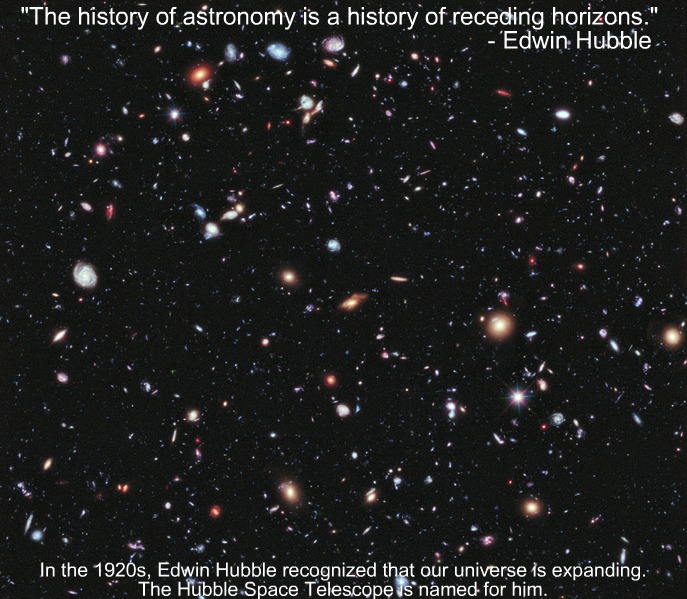
This image is the Hubble eXtreme Deep Field, released in 2012. Read more about this image here.

This image is the Hubble eXtreme Deep Field, released in 2012. Nearly every speck of light here is a separate galaxy, beyond our Milky Way. Read more about this image here.

Consider that most astronomers 100 years ago believed that our whole universe consisted of just one galaxy, our own Milky Way. In the 1920s, Hubble was among the first to recognize that there is a universe of galaxies located beyond the boundaries of our Milky Way.

During the 1920s, Edwin Hubble observed stars that vary in brightness in a patch of light known at the time as the Andromeda nebula. He knew that these stars changed in brightness in a way that depended on their true brightness. He then saw how bright they looked to find the distance to the Andromeda nebula.

At the time, many astronomers believed that the Andromeda nebula was a forming solar system, located within the Milky Way’s boundaries. Hubble showed that this patch of light was really a separate galaxy – what we know today as the Andromeda galaxy – the nearest large spiral galaxy beyond our Milky Way.

Today, we know that this nearest large spiral galaxy, the Andromeda galaxy – is 2.2 million light-years beyond our Milky Way. We also know that other galaxies extend around us in space for many billions of light-years. But to people in the 1920s, it was a revelation! As soon as the spiral nebulae – like the Andromeda galaxy – were revealed as separate galaxies, the known universe got much bigger!

The Andromeda galaxy and two satellite galaxies as seen through a powerful telescope. In Hubble's time, astronomers believed this object resided within our own Milky Way galaxy. Hubble's work revealed that it is an island of stars in space, external to our Milky Way. Image via NOAO

The Andromeda galaxy and two satellite galaxies as seen through a powerful telescope. In Hubble’s time, astronomers believed this object resided within our own Milky Way galaxy. Hubble used a class of variable stars called Cepheid variables to show that the Andromeda galaxy is an island of stars in space, external to our Milky Way. Image via NOAO.

But was this huge universe stationary? Or was it expanding, or contracting?

The answer involved the light of galaxies as a whole. Astronomers observed that the light of distant galaxies was shifted toward the red end of the light spectrum. This red shift was interpreted as a sign that the galaxies are moving away from us. Hubble and his colleagues compared the distance estimates to galaxies with their red shifts. And – on March 15, 1929 – Hubble published his observation that the farthest galaxies are moving away faster than the closest ones.

This is the insight that became known as Hubble’s law.

It’s said that Albert Einstein was elated to hear of Hubble’s work. Einstein’s Theory of Relativity implied that the universe must either be expanding or contracting. But Einstein himself rejected this notion in favor of the accepted idea that the universe was stationary and had always existed. When Hubble presented his evidence of the expansion of the universe, Einstein embraced the idea. He called his adherence to the old idea “my greatest blunder.”

Hubble was a multi-talented man. Although he majored in science as an undergraduate at the University of Chicago, a promise to his dying father caused him to take up a study of the law. He was also an amateur heavyweight boxer, and reportedly turned down the chance to fight professionally. He returned to science as a graduate student at Yerkes Observatory in Wisconsin. In 1919, he accepted a position at the prestigious Mount Wilson Observatory in California, where he remained until his death in 1953. Shortly before his death, Hubble became the first astronomer to use the newly completed, famous, then-giant 200-inch (5.1-meter) reflector Hale Telescope at the Palomar Observatory near San Diego, California.

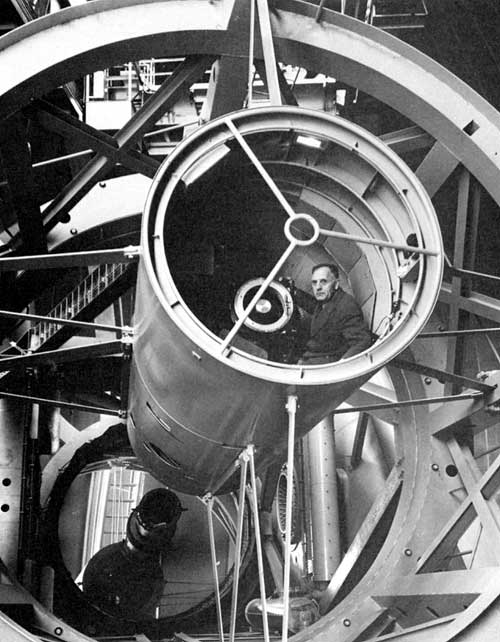
Edwin Hubble in the observer’s cage at the top of the tube of the 200-inch telescope on Palomar Mountain. The telescope was considered a marvel of technology when it was dedicated in 1948, much as the Hubble Space Telescope – named for Edwin Hubble – is today. Image courtesy Mount Wilson and Palomar Observatories/AIP.

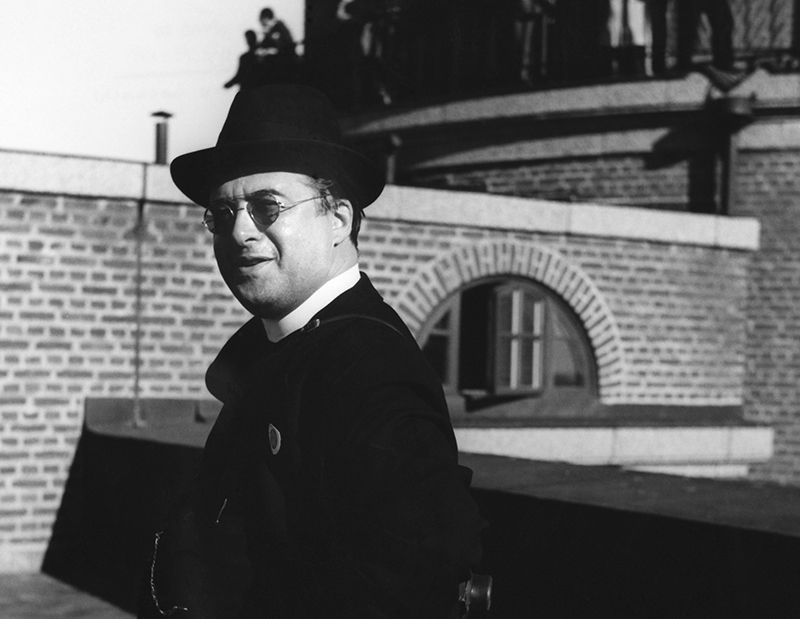
Renaming Hubble’s law as the Hubble-Lemaître law. In late October 2018, members of the International Astronomical Union – best-known among non-astronomers for demoting Pluto from major planet status in 2006 – voted to change the name of the Hubble law to honor the Belgian priest and astronomer Georges Lemaître.

Henceforth, the IAU recommended, the Hubble law would be known as the Hubble-Lemaître law. Of the 4,060 astronomers who cast votes (out of around 11,072 eligible members), 78 percent were in favor of this change.

In fact, in the 1920s, Georges Lemaître did describe, in the French language, how the expansion of the universe would cause galaxies to move away from Earth at speeds proportional to their distance. He described the relationship between a galaxy’s recessional speed and its distance some two years before Edwin Hubble did.

Among professional astronomers and students of the history of science, Lemaître’s name has long been known and honored for his achievement. Now the IAU has voted an acknowledgement of Lemaître’s contribution. Writing in Nature on October 30, 2018, Elizabeth Gibney said:

The move seems to be the first time an organization has voted to alter the name of a scientific law – although some scientists doubt whether the change will be noticed. The IAU has been the arbiter of planet and moon names since 1919, and oversees astronomers’ official catalogue of star names, but it has no formal mandate over the names of scientific laws.

Piero Benvenuti is a former IAU general secretary who proposed the name change. He told Nature that the new terminology is a recommendation only, saying:

If people will continue to use the Hubble law naming, nobody will object.

It remains to be seen if astronomers and their students will slowly shift into using the name Hubble-Lemaître law, instead of Hubble law. Checking a Google search engine today (November 2018), we are finding 119,000 results for this new name.

We’ll see what has happened in a year or two, when we check again!

Read more from Nature: Belgian priest recognized in Hubble-law name change

Belgian priest and astronomer Georges Lemaître published a paper on the expansion of the universe in 1927. Image via Emilio Segre Visual Archives/AIP/SPL/Nature.

Bottom line: Edwin Hubble’s birthday is November 20, 1889. Hubble showed there are separate galaxies beyond our Milky Way and that the more distant the galaxy, the faster it moves away from us. The Hubble Space Telescope is named for him.

Deepest view we have yet, into our universe: the Hubble eXtreme Deep Field


from EarthSky https://ift.tt/2QZiDDp

Edwin Hubble

November 20, 1889. Happy birthday, Edwin Hubble! The Hubble Space Telescope is named for this astronomer, because Hubble’s work helped define our modern cosmology, our idea of the universe as a whole.

The 2019 lunar calendars are here! Order yours before they’re gone. Makes a great gift.

Hubble helped astronomers see that we live in an expanding universe, one in which every galaxy is moving away from every other. If you read an introductory book about galaxies, or take an introductory class on them, you’ll likely encounter what’s known as Hubble’s law. In its simplest form, it states that, the more distant the galaxy, the faster it is moving away from us. This concept lies at the heart of our modern cosmology, in which the entire universe – space, time and matter – is thought to have been born in a Big Bang.

In 2018, the International Astronomical Union, or IAU, voted to rename Hubble’s law as the Hubble-Lemaître law. More about that change below.

So what did Edwin Hubble do to deserve such a special place in the history of astronomy?

This image is the Hubble eXtreme Deep Field, released in 2012. Read more about this image here.

This image is the Hubble eXtreme Deep Field, released in 2012. Nearly every speck of light here is a separate galaxy, beyond our Milky Way. Read more about this image here.

Consider that most astronomers 100 years ago believed that our whole universe consisted of just one galaxy, our own Milky Way. In the 1920s, Hubble was among the first to recognize that there is a universe of galaxies located beyond the boundaries of our Milky Way.

During the 1920s, Edwin Hubble observed stars that vary in brightness in a patch of light known at the time as the Andromeda nebula. He knew that these stars changed in brightness in a way that depended on their true brightness. He then saw how bright they looked to find the distance to the Andromeda nebula.

At the time, many astronomers believed that the Andromeda nebula was a forming solar system, located within the Milky Way’s boundaries. Hubble showed that this patch of light was really a separate galaxy – what we know today as the Andromeda galaxy – the nearest large spiral galaxy beyond our Milky Way.

Today, we know that this nearest large spiral galaxy, the Andromeda galaxy – is 2.2 million light-years beyond our Milky Way. We also know that other galaxies extend around us in space for many billions of light-years. But to people in the 1920s, it was a revelation! As soon as the spiral nebulae – like the Andromeda galaxy – were revealed as separate galaxies, the known universe got much bigger!

The Andromeda galaxy and two satellite galaxies as seen through a powerful telescope. In Hubble's time, astronomers believed this object resided within our own Milky Way galaxy. Hubble's work revealed that it is an island of stars in space, external to our Milky Way. Image via NOAO

The Andromeda galaxy and two satellite galaxies as seen through a powerful telescope. In Hubble’s time, astronomers believed this object resided within our own Milky Way galaxy. Hubble used a class of variable stars called Cepheid variables to show that the Andromeda galaxy is an island of stars in space, external to our Milky Way. Image via NOAO.

But was this huge universe stationary? Or was it expanding, or contracting?

The answer involved the light of galaxies as a whole. Astronomers observed that the light of distant galaxies was shifted toward the red end of the light spectrum. This red shift was interpreted as a sign that the galaxies are moving away from us. Hubble and his colleagues compared the distance estimates to galaxies with their red shifts. And – on March 15, 1929 – Hubble published his observation that the farthest galaxies are moving away faster than the closest ones.

This is the insight that became known as Hubble’s law.

It’s said that Albert Einstein was elated to hear of Hubble’s work. Einstein’s Theory of Relativity implied that the universe must either be expanding or contracting. But Einstein himself rejected this notion in favor of the accepted idea that the universe was stationary and had always existed. When Hubble presented his evidence of the expansion of the universe, Einstein embraced the idea. He called his adherence to the old idea “my greatest blunder.”

Hubble was a multi-talented man. Although he majored in science as an undergraduate at the University of Chicago, a promise to his dying father caused him to take up a study of the law. He was also an amateur heavyweight boxer, and reportedly turned down the chance to fight professionally. He returned to science as a graduate student at Yerkes Observatory in Wisconsin. In 1919, he accepted a position at the prestigious Mount Wilson Observatory in California, where he remained until his death in 1953. Shortly before his death, Hubble became the first astronomer to use the newly completed, famous, then-giant 200-inch (5.1-meter) reflector Hale Telescope at the Palomar Observatory near San Diego, California.

Edwin Hubble in the observer’s cage at the top of the tube of the 200-inch telescope on Palomar Mountain. The telescope was considered a marvel of technology when it was dedicated in 1948, much as the Hubble Space Telescope – named for Edwin Hubble – is today. Image courtesy Mount Wilson and Palomar Observatories/AIP.

Renaming Hubble’s law as the Hubble-Lemaître law. In late October 2018, members of the International Astronomical Union – best-known among non-astronomers for demoting Pluto from major planet status in 2006 – voted to change the name of the Hubble law to honor the Belgian priest and astronomer Georges Lemaître.

Henceforth, the IAU recommended, the Hubble law would be known as the Hubble-Lemaître law. Of the 4,060 astronomers who cast votes (out of around 11,072 eligible members), 78 percent were in favor of this change.

In fact, in the 1920s, Georges Lemaître did describe, in the French language, how the expansion of the universe would cause galaxies to move away from Earth at speeds proportional to their distance. He described the relationship between a galaxy’s recessional speed and its distance some two years before Edwin Hubble did.

Among professional astronomers and students of the history of science, Lemaître’s name has long been known and honored for his achievement. Now the IAU has voted an acknowledgement of Lemaître’s contribution. Writing in Nature on October 30, 2018, Elizabeth Gibney said:

The move seems to be the first time an organization has voted to alter the name of a scientific law – although some scientists doubt whether the change will be noticed. The IAU has been the arbiter of planet and moon names since 1919, and oversees astronomers’ official catalogue of star names, but it has no formal mandate over the names of scientific laws.

Piero Benvenuti is a former IAU general secretary who proposed the name change. He told Nature that the new terminology is a recommendation only, saying:

If people will continue to use the Hubble law naming, nobody will object.

It remains to be seen if astronomers and their students will slowly shift into using the name Hubble-Lemaître law, instead of Hubble law. Checking a Google search engine today (November 2018), we are finding 119,000 results for this new name.

We’ll see what has happened in a year or two, when we check again!

Read more from Nature: Belgian priest recognized in Hubble-law name change

Belgian priest and astronomer Georges Lemaître published a paper on the expansion of the universe in 1927. Image via Emilio Segre Visual Archives/AIP/SPL/Nature.

Bottom line: Edwin Hubble’s birthday is November 20, 1889. Hubble showed there are separate galaxies beyond our Milky Way and that the more distant the galaxy, the faster it moves away from us. The Hubble Space Telescope is named for him.

Deepest view we have yet, into our universe: the Hubble eXtreme Deep Field


from EarthSky https://ift.tt/2QZiDDp

How rare are November hurricanes?

Preliminary summary of the tracks of all tropical cyclones in the Atlantic Basin during the 2018 hurricane season. Image via TheHurricaneEditorMaker/Wikimedia.

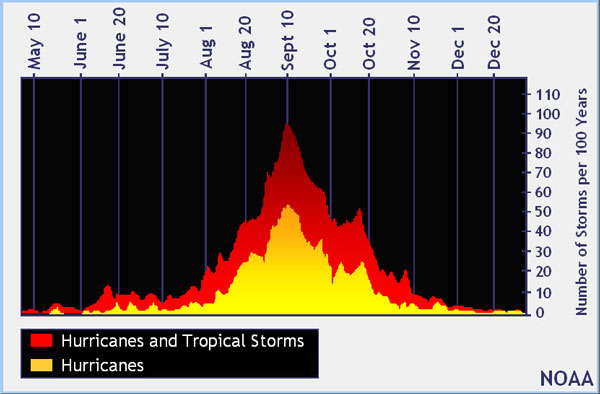
Hurricane season in the Atlantic basin, an area that includes the North Atlantic Ocean, Caribbean Sea, and Gulf of Mexico, ends on November 30th. Hurricanes during November are rare events, but they do occur and they can be deadly. In general, one November hurricane can be expected in the Atlantic basin every three or so years.

Hurricanes during November are rare because of the onset of cooler ocean temperatures and changes in wind shear in the Northern Hemisphere. These conditions are less favorable for the development of hurricanes. The hurricane season for the Atlantic basin runs from June 1 to November 30, which is the timeframe during which most hurricanes develop.

According to data compiled by NOAA’s Atlantic Oceanographic and Meteorological Laboratory for the years 1851–2015, there have been 58 November hurricanes in total and only five that made landfall in the U.S. Now compare those numbers to the data for the month of September, which is the peak of hurricane season. During the same 164 year period, there were 395 September hurricanes and 107 that made landfall. That is a 6.8-fold decrease in the number of hurricanes that developed during those months, and a 21.4-fold decrease in the number that made landfall.

The Weather Channel, by using data collected since 1950, has estimated that a November hurricane will occur roughly once every three years. That article does a great job of summarizing some famous November hurricanes including Hurricane Kate and Hurricane Otto. Hurricane Kate made landfall just before Thanksgiving on November 21, 1985, near Mexico Beach, Florida. This represents the latest that a hurricane has made landfall according to modern recordkeeping. In long-term records dating back to 1851, the record for the latest landfall goes to Hurricane Otto, which came onshore at Nicaragua on Thanksgiving, November 24, 2016.

Together, the above data illustrate that November hurricanes are indeed a rare occurrence. However, these storms can be deadly and damaging.

Monthly frequency of tropical storms and hurricanes. Image via U.S. National Oceanic and Atmospheric Administration (NOAA).

To date, there have been 15 named storms including eight hurricanes and two major hurricanes (greater than a category 3) during the 2018 hurricane season. Quiet conditions are expected for the next several days, but don’t let your guard down just yet.

EarthSky’s 2019 lunar calendars are here! Order yours before they’re gone. Makes a great gift.

Bottom line: November hurricanes are rare events, but they do occur and they can be deadly. The record for the latest U.S. landfall is held by Hurricane Otto, which came onshore on Thanksgiving, November 24, 2016. The 2018 Atlantic hurricane season will end November 30th.


from EarthSky https://ift.tt/2DOfZ0j

Preliminary summary of the tracks of all tropical cyclones in the Atlantic Basin during the 2018 hurricane season. Image via TheHurricaneEditorMaker/Wikimedia.

Hurricane season in the Atlantic basin, an area that includes the North Atlantic Ocean, Caribbean Sea, and Gulf of Mexico, ends on November 30th. Hurricanes during November are rare events, but they do occur and they can be deadly. In general, one November hurricane can be expected in the Atlantic basin every three or so years.

Hurricanes during November are rare because of the onset of cooler ocean temperatures and changes in wind shear in the Northern Hemisphere. These conditions are less favorable for the development of hurricanes. The hurricane season for the Atlantic basin runs from June 1 to November 30, which is the timeframe during which most hurricanes develop.

According to data compiled by NOAA’s Atlantic Oceanographic and Meteorological Laboratory for the years 1851–2015, there have been 58 November hurricanes in total and only five that made landfall in the U.S. Now compare those numbers to the data for the month of September, which is the peak of hurricane season. During the same 164 year period, there were 395 September hurricanes and 107 that made landfall. That is a 6.8-fold decrease in the number of hurricanes that developed during those months, and a 21.4-fold decrease in the number that made landfall.

The Weather Channel, by using data collected since 1950, has estimated that a November hurricane will occur roughly once every three years. That article does a great job of summarizing some famous November hurricanes including Hurricane Kate and Hurricane Otto. Hurricane Kate made landfall just before Thanksgiving on November 21, 1985, near Mexico Beach, Florida. This represents the latest that a hurricane has made landfall according to modern recordkeeping. In long-term records dating back to 1851, the record for the latest landfall goes to Hurricane Otto, which came onshore at Nicaragua on Thanksgiving, November 24, 2016.

Together, the above data illustrate that November hurricanes are indeed a rare occurrence. However, these storms can be deadly and damaging.

Monthly frequency of tropical storms and hurricanes. Image via U.S. National Oceanic and Atmospheric Administration (NOAA).

To date, there have been 15 named storms including eight hurricanes and two major hurricanes (greater than a category 3) during the 2018 hurricane season. Quiet conditions are expected for the next several days, but don’t let your guard down just yet.

EarthSky’s 2019 lunar calendars are here! Order yours before they’re gone. Makes a great gift.

Bottom line: November hurricanes are rare events, but they do occur and they can be deadly. The record for the latest U.S. landfall is held by Hurricane Otto, which came onshore on Thanksgiving, November 24, 2016. The 2018 Atlantic hurricane season will end November 30th.


from EarthSky https://ift.tt/2DOfZ0j

adds 2