aads

How rare are November hurricanes?

Preliminary summary of the tracks of all tropical cyclones in the Atlantic Basin during the 2018 hurricane season. Image via TheHurricaneEditorMaker/Wikimedia.

Hurricane season in the Atlantic basin, an area that includes the North Atlantic Ocean, Caribbean Sea, and Gulf of Mexico, ends on November 30th. Hurricanes during November are rare events, but they do occur and they can be deadly. In general, one November hurricane can be expected in the Atlantic basin every three or so years.

Hurricanes during November are rare because of the onset of cooler ocean temperatures and changes in wind shear in the Northern Hemisphere. These conditions are less favorable for the development of hurricanes. The hurricane season for the Atlantic basin runs from June 1 to November 30, which is the timeframe during which most hurricanes develop.

According to data compiled by NOAA’s Atlantic Oceanographic and Meteorological Laboratory for the years 1851–2015, there have been 58 November hurricanes in total and only five that made landfall in the U.S. Now compare those numbers to the data for the month of September, which is the peak of hurricane season. During the same 164 year period, there were 395 September hurricanes and 107 that made landfall. That is a 6.8-fold decrease in the number of hurricanes that developed during those months, and a 21.4-fold decrease in the number that made landfall.

The Weather Channel, by using data collected since 1950, has estimated that a November hurricane will occur roughly once every three years. That article does a great job of summarizing some famous November hurricanes including Hurricane Kate and Hurricane Otto. Hurricane Kate made landfall just before Thanksgiving on November 21, 1985, near Mexico Beach, Florida. This represents the latest that a hurricane has made landfall according to modern recordkeeping. In long-term records dating back to 1851, the record for the latest landfall goes to Hurricane Otto, which came onshore at Nicaragua on Thanksgiving, November 24, 2016.

Together, the above data illustrate that November hurricanes are indeed a rare occurrence. However, these storms can be deadly and damaging.
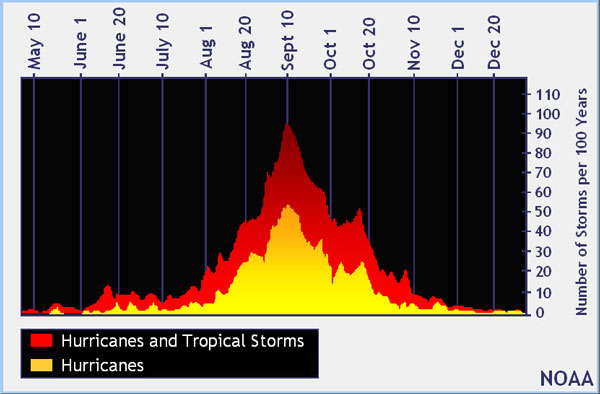
Monthly frequency of tropical storms and hurricanes. Image via U.S. National Oceanic and Atmospheric Administration (NOAA).

To date, there have been 15 named storms including eight hurricanes and two major hurricanes (greater than a category 3) during the 2018 hurricane season. Quiet conditions are expected for the next several days, but don’t let your guard down just yet.

EarthSky’s 2019 lunar calendars are here! Order yours before they’re gone. Makes a great gift.

Bottom line: November hurricanes are rare events, but they do occur and they can be deadly. The record for the latest U.S. landfall is held by Hurricane Otto, which came onshore on Thanksgiving, November 24, 2016. The 2018 Atlantic hurricane season will end November 30th.


from EarthSky https://ift.tt/2DOfZ0j

Preliminary summary of the tracks of all tropical cyclones in the Atlantic Basin during the 2018 hurricane season. Image via TheHurricaneEditorMaker/Wikimedia.

Hurricane season in the Atlantic basin, an area that includes the North Atlantic Ocean, Caribbean Sea, and Gulf of Mexico, ends on November 30th. Hurricanes during November are rare events, but they do occur and they can be deadly. In general, one November hurricane can be expected in the Atlantic basin every three or so years.

Hurricanes during November are rare because of the onset of cooler ocean temperatures and changes in wind shear in the Northern Hemisphere. These conditions are less favorable for the development of hurricanes. The hurricane season for the Atlantic basin runs from June 1 to November 30, which is the timeframe during which most hurricanes develop.

According to data compiled by NOAA’s Atlantic Oceanographic and Meteorological Laboratory for the years 1851–2015, there have been 58 November hurricanes in total and only five that made landfall in the U.S. Now compare those numbers to the data for the month of September, which is the peak of hurricane season. During the same 164 year period, there were 395 September hurricanes and 107 that made landfall. That is a 6.8-fold decrease in the number of hurricanes that developed during those months, and a 21.4-fold decrease in the number that made landfall.

The Weather Channel, by using data collected since 1950, has estimated that a November hurricane will occur roughly once every three years. That article does a great job of summarizing some famous November hurricanes including Hurricane Kate and Hurricane Otto. Hurricane Kate made landfall just before Thanksgiving on November 21, 1985, near Mexico Beach, Florida. This represents the latest that a hurricane has made landfall according to modern recordkeeping. In long-term records dating back to 1851, the record for the latest landfall goes to Hurricane Otto, which came onshore at Nicaragua on Thanksgiving, November 24, 2016.

Together, the above data illustrate that November hurricanes are indeed a rare occurrence. However, these storms can be deadly and damaging.

Monthly frequency of tropical storms and hurricanes. Image via U.S. National Oceanic and Atmospheric Administration (NOAA).

To date, there have been 15 named storms including eight hurricanes and two major hurricanes (greater than a category 3) during the 2018 hurricane season. Quiet conditions are expected for the next several days, but don’t let your guard down just yet.

EarthSky’s 2019 lunar calendars are here! Order yours before they’re gone. Makes a great gift.

Bottom line: November hurricanes are rare events, but they do occur and they can be deadly. The record for the latest U.S. landfall is held by Hurricane Otto, which came onshore on Thanksgiving, November 24, 2016. The 2018 Atlantic hurricane season will end November 30th.


from EarthSky https://ift.tt/2DOfZ0j

Moon near Uranus on November 20

Tonight – November 20, 2018 – as the moon travels in front of the constellations of the zodiac, it’ll appear in the general direction of the planet Uranus. Both the moon and Uranus are near the border of the constellations Pisces and Aries tonight. Although the bright moon will drown out Uranus from view tonight, the moon will mark the approximate position of Uranus in the starry sky.

Near-infrared view of the ice giant planet Uranus, its rings and some of its moons. Image via European Southern Observatory.

What will you see of Pisces and Aries on this moonlit night? Hard to say, but you might make out Hamal, the brightest star in the constellation Aries, and possibly the four stars of the Great Square of Pegasus, as shown on the sky chart below, via the International Astronomical Union (IAU).

Sky chart of the constellation Pisces

The constellation Pisces is best seen on a moonless night. Many stargazers use the Square of Pegasus to locate Pisces. Click here for a sky chart showing you Uranus’ position in Pisces for 2018.

If you’re familiar with the Great Square of Pegasus, you might be able to star-hop from there to find the constellations Pisces and Aries on a moonless evening in late November or the first week or two of December 2018. Uranus resides in front of the constellation Aries but very near the ecliptic and the Pisces border. Your best bet to finding Uranus is to locate the 4th-magnitude star Omicron Piscium in Pisces, which is easily visible to the unaided eye on a dark night.

Most stargazers need binoculars, a moon-free night and a detailed sky chart, like the one here or here. This world is bigger than Earth, but it’s also 20 times farther from the sun than Earth is from the sun.

Uranus is the seventh planet outward from the sun. Even on a moonless night, Uranus appears no brighter than the faintest visible stars.

The moon – presently near the border of the constellations Pisces and Aries – is waxing toward full and will be in front of the constellation Taurus on the night of the full moon.

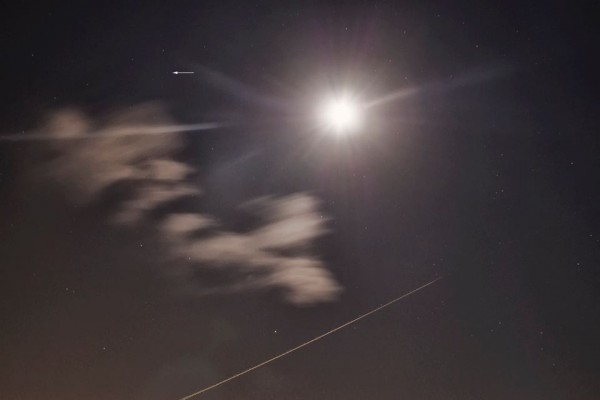
The moon with clouds and a contrail. Faint planet Uranus is at the arrow tip. Photo taken November 21, 2015 by Nikolaos Pantazis in Greece.

The moon with clouds and a contrail. Faint planet Uranus is at the arrow tip. Photo taken November 21, 2015 by Nikolaos Pantazis in Greece.

Bottom line: On the night of November 20, 2018, the moon is located along our line of sight to the faint planet Uranus. But don’t expect to see Uranus in the moon’s glare.

Easily locate stars and constellations during any day and time with EarthSky’s Planisphere.


from EarthSky https://ift.tt/2BjusPv

Tonight – November 20, 2018 – as the moon travels in front of the constellations of the zodiac, it’ll appear in the general direction of the planet Uranus. Both the moon and Uranus are near the border of the constellations Pisces and Aries tonight. Although the bright moon will drown out Uranus from view tonight, the moon will mark the approximate position of Uranus in the starry sky.

Near-infrared view of the ice giant planet Uranus, its rings and some of its moons. Image via European Southern Observatory.

What will you see of Pisces and Aries on this moonlit night? Hard to say, but you might make out Hamal, the brightest star in the constellation Aries, and possibly the four stars of the Great Square of Pegasus, as shown on the sky chart below, via the International Astronomical Union (IAU).

Sky chart of the constellation Pisces

The constellation Pisces is best seen on a moonless night. Many stargazers use the Square of Pegasus to locate Pisces. Click here for a sky chart showing you Uranus’ position in Pisces for 2018.

If you’re familiar with the Great Square of Pegasus, you might be able to star-hop from there to find the constellations Pisces and Aries on a moonless evening in late November or the first week or two of December 2018. Uranus resides in front of the constellation Aries but very near the ecliptic and the Pisces border. Your best bet to finding Uranus is to locate the 4th-magnitude star Omicron Piscium in Pisces, which is easily visible to the unaided eye on a dark night.

Most stargazers need binoculars, a moon-free night and a detailed sky chart, like the one here or here. This world is bigger than Earth, but it’s also 20 times farther from the sun than Earth is from the sun.

Uranus is the seventh planet outward from the sun. Even on a moonless night, Uranus appears no brighter than the faintest visible stars.

The moon – presently near the border of the constellations Pisces and Aries – is waxing toward full and will be in front of the constellation Taurus on the night of the full moon.

The moon with clouds and a contrail. Faint planet Uranus is at the arrow tip. Photo taken November 21, 2015 by Nikolaos Pantazis in Greece.

The moon with clouds and a contrail. Faint planet Uranus is at the arrow tip. Photo taken November 21, 2015 by Nikolaos Pantazis in Greece.

Bottom line: On the night of November 20, 2018, the moon is located along our line of sight to the faint planet Uranus. But don’t expect to see Uranus in the moon’s glare.

Easily locate stars and constellations during any day and time with EarthSky’s Planisphere.


from EarthSky https://ift.tt/2BjusPv

See it! The weekend’s meteor showers

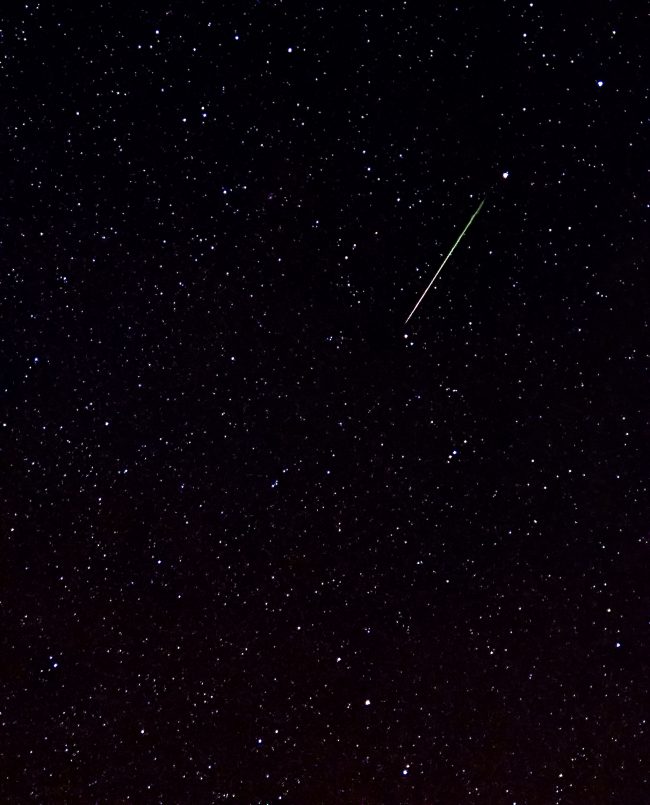
Ken Christison wrote on November 17, 2018: “I caught a nice fireball this morning while shooting the Antares launch from my yard in northeastern North Carolina.”

Veteran meteor photographer Eliot Herman in Tucson, Arizona called this year’s Leonid shower “a treasure hunt.” Yes, they were sparse, he said, but he caught some. Of this particular catch, he wrote: “Created a smoke trail that persisted for about 5 minutes. The first image after meteor flash is shown.”

Meteor and fog

Michael Holland captured this Leonid meteor through light fog on the morning of November 18, 2018, from Lake Gibson, Fla. GoPro Hero 4 Silver, ISO 800 20 second exposure. Check the bottom of this post for more from Michael Holland.

Paul Armstrong in Exmoor, U.K. wrote: “After reading your post about the Leonid meteor shower, managed to catch a photo in the early hours of Sunday morning.”

Leonid meteor above ruined building

Joel Coombs caught a Leonid meteor above a ruined building in the ghost town of Delamar – north of Las Vegas, Nevada – on November 18, 2018. D800E, 14 – 24mm F2.8 lens @ 14mm F2.8, ISO3200, 15 second exposure.

Leonid meteor photo against a starry sky.

Richard Coffman took this photo of a Leonid meteor on Sunday morning, November 18, at 4 a.m. Sony A 77 2.8 f ISO1250 24 Sec.

More from Michael Holland:

Botton line: Many said the Leonids were sparse at their peak in 2018. Still, EarthSky community photographers captured some photos.


from EarthSky https://ift.tt/2A3NE1X

Ken Christison wrote on November 17, 2018: “I caught a nice fireball this morning while shooting the Antares launch from my yard in northeastern North Carolina.”

Veteran meteor photographer Eliot Herman in Tucson, Arizona called this year’s Leonid shower “a treasure hunt.” Yes, they were sparse, he said, but he caught some. Of this particular catch, he wrote: “Created a smoke trail that persisted for about 5 minutes. The first image after meteor flash is shown.”

Meteor and fog

Michael Holland captured this Leonid meteor through light fog on the morning of November 18, 2018, from Lake Gibson, Fla. GoPro Hero 4 Silver, ISO 800 20 second exposure. Check the bottom of this post for more from Michael Holland.

Paul Armstrong in Exmoor, U.K. wrote: “After reading your post about the Leonid meteor shower, managed to catch a photo in the early hours of Sunday morning.”

Leonid meteor above ruined building

Joel Coombs caught a Leonid meteor above a ruined building in the ghost town of Delamar – north of Las Vegas, Nevada – on November 18, 2018. D800E, 14 – 24mm F2.8 lens @ 14mm F2.8, ISO3200, 15 second exposure.

Leonid meteor photo against a starry sky.

Richard Coffman took this photo of a Leonid meteor on Sunday morning, November 18, at 4 a.m. Sony A 77 2.8 f ISO1250 24 Sec.

More from Michael Holland:

Botton line: Many said the Leonids were sparse at their peak in 2018. Still, EarthSky community photographers captured some photos.


from EarthSky https://ift.tt/2A3NE1X

Pleiades star cluster, aka Seven Sisters

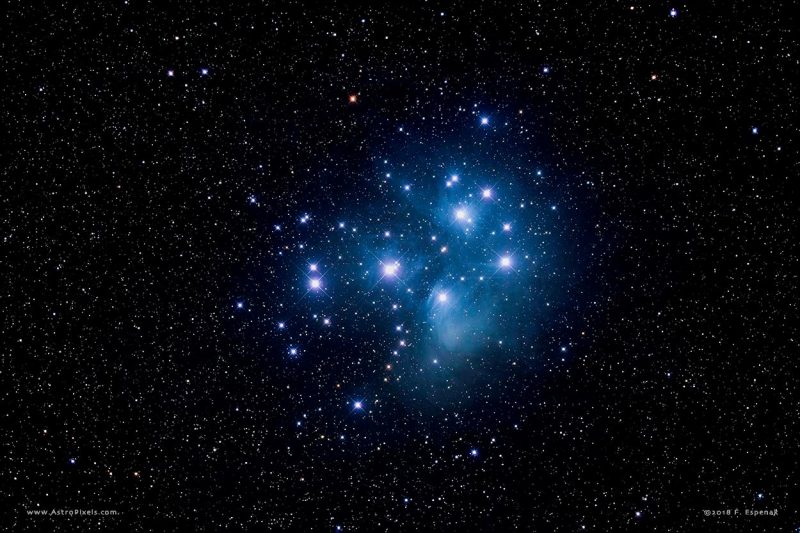
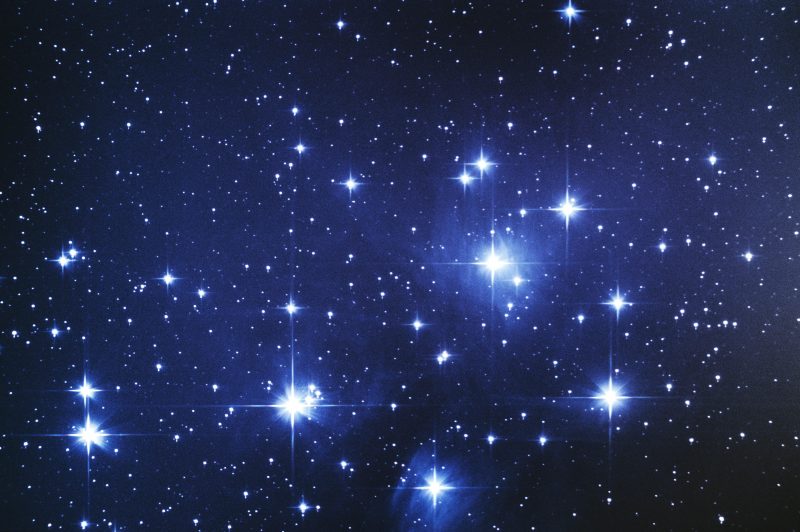
Fred Espenak – aka Mr. Eclipse – posted this image at EarthSky Facebook this weekend (November 18, 2018). He wrote: “M45, the Pleiades star cluster. It’s visible on November nights in the eastern sky as a tiny dipper-shaped clump of stars. Definitely one of the most beautiful open star clusters in the sky. This image is a stack of 20 individual 5-minute exposures through a Takahashi Epsilon 180ED Hyperbolic Astrograph using a Canon 6D DSLR.” Thanks, Fred!

The Pleiades star cluster – also known as the Seven Sisters or M45 – is visible from virtually every part of the globe. It can be seen from as far north as the North Pole, and farther south than the southernmost tip of South America. It looks like a tiny misty dipper of stars.

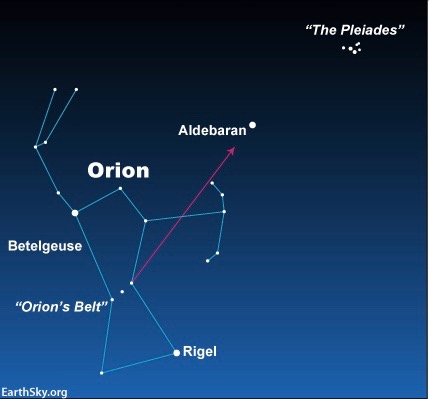
If you’re familiar with the famous constellation Orion, it can help you be sure you’ve found the Pleiades. See the three stars in a row in Orion? That’s Orion’s Belt. Draw a line through these stars to the V-shaped pattern of stars with a bright star in its midst. The V-shaped pattern is the Face of Taurus the Bull. The bright star in the V – called Aldebaran – depicts the Bull’s Eye. A bit past Aldebaran, you’ll see the Pleiades cluster, which marks the Bull’s Shoulder.

The 2019 lunar calendars are here! Order yours before they’re gone. Makes a great gift.

If you can find the prominent constellation Orion, you can find the Pleiades. Orion’s Belt points to the bright reddish star Aldebaran … then generally toward the Pleiades.

The Pleiades and Aldebaran. The star name Aldebaran comes from an Arabic word for follower. It’s thought to be a reference to this star’s forever chasing the Pleiades across the heavens. As a general rule, the Pleiades cluster rises into the eastern sky before Aldebaran rises, and sets in the west before Aldebaran sets.

The only exception to this rule happens at far southern latitudes – for example, at South America’s Tierra del Fuego – where the Pleiades rise a short while after Aldebaran rises.

In our Northern Hemispheres skies, the Pleiades cluster is associated with the winter season. It’s easy to imagine this misty patch of icy-blue suns as hoarfrost clinging to the dome of night. Frosty November is often called the month of the Pleiades, because it’s at this time that the Pleiades shine from dusk until dawn. But you can see the Pleiades cluster in the evening sky well into April.

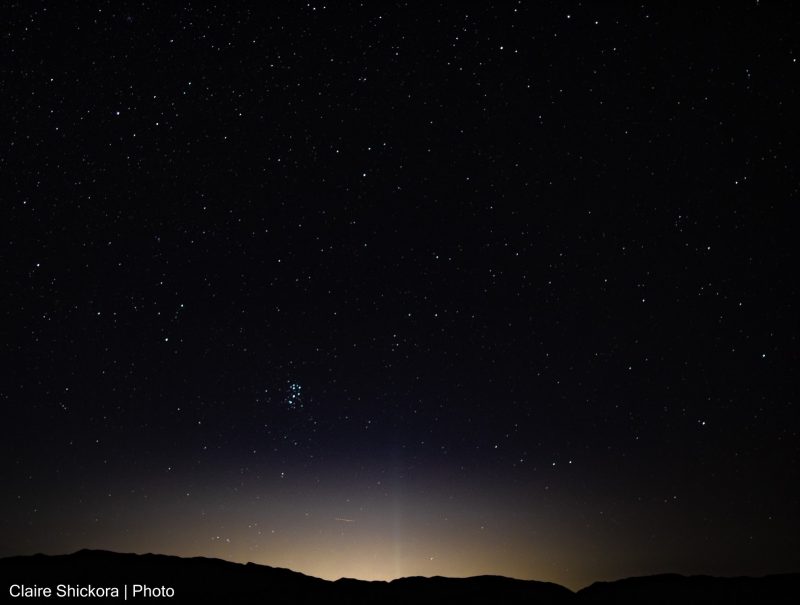
View larger. | Claire L. Shickora wrote from Delight’s Hot Springs Resort in California, in early November, 2018: “The Pleiades was outstanding, even with the local light pollution!”

Tom Wildoner captured this image on October 31, 2016, too. He wrote:

Tom Wildoner in Weatherly, Pennsylvania, captured this image on October 31, 2016. He wrote: “It shows the Seven Sisters, Pleiades star cluster, rising in the east behind some maple trees still sporting some late leaves.”

Legend of the Lost Pleiad. Most people see 6, not 7, Pleiades stars in a dark country sky.

However, the story about the lost 7th Pleiad harbors a universal theme. The astronomer Robert Burnham Jr. found the lost Pleaid myth prevalent in the star lore of European, African, Asian, Indonesian, Native American and Aboriginal Australian populations.

Moreover, Burnham suggested that the “lost Pleiad” may have basis in fact. After all, modern astronomy has found that the 7th brightest Pleiades star – Pleione – is a complicated and hard-to-understand “shell star” that goes through numerous permutations. These changes cause this star to vary in brightness.

Plus people with exceptional eyesight have been known to see many more stars in the Pleiades cluster. Claims go up as high as 20 stars. Agnes Clerke, an astronomer and writer in the late 1800s, reported that Michael Maestlin, the mentor of Johannes Kepler, mapped out 11 Pleiades stars before the invention of the telescope.

To see more than 6 or 7 Pleaides stars, you must have very good eyesight (or a pair of binoculars). And you must be willing to spend time under a dark, moonless sky. Stephen O’Meara, a dark-sky connoisseur, claims that eyes dark-adapted for 30 minutes are 6 times more sensitive to light than eyes dark-adapted for 15 minutes. The surest way to see additional Pleiades stars is to look at this cluster through binoculars or low power in a telescope.

The Lost Pleiad, a painting by French artist William-Adolphe Bouguereau (1825-1905). Image via Wikimedia Commons.

Pleiades as calendar, in history and in modern science. Historically, the Pleiades have served as a calendar for many civilizations. The Greek name “Pleiades” probably means “to sail.” In the ancient Mediterranean world, the day that the Pleaides cluster first appeared in the morning sky before sunrise announced the opening of the navigation season.

The modern-day festival of Halloween originates from an old Druid rite that coincided with the midnight culmination of the Pleiades cluster. It was believed that the veil dividing the living from the dead is at its thinnest when the Pleaides culminates – reaches its highest point in the sky – at midnight.

On a lighter note, the Zuni of New Mexico call the Pleiades the “Seed Stars,” because this cluster’s disappearance in the evening sky every spring signals the seed-planting season.

In both myth and science, the Pleiades are considered to be sibling stars. Modern astronomers say the Pleiades stars were born from the same cloud of gas and dust some 100 million years ago. This gravitationally bound cluster of several hundred stars looms some 430 light-years distant, and these sibling stars drift through space together at about 25 miles per second. Many of these Pleiades stars shine hundreds of times more brightly than our sun.

Enjoying EarthSky? Sign up for our free daily newsletter today!

The Pleiades - aka the Seven Sisters - captured by Greg Hogan in Kathleen, Georgia on October 31, 2016.

The Pleiades – aka the Seven Sisters – captured by Greg Hogan in Kathleen, Georgia, on October 31, 2016.

The Pleiades star cluster by Ernie Rossi in Florida. Russ Drum submitted it and wrote: “The Pleiades (aka the Seven Sisters) is an open star cluster located in the constellation Taurus the Bull. It’s also known as the Halloween Cluster because it’s almost overhead in the sky at midnight on Halloween, October 31.”

Bottom line: November is often called the month of the Pleiades – or Seven Sisters – because it’s at this time that the Pleiades shine from dusk until dawn.


from EarthSky https://ift.tt/2SgTchN

Fred Espenak – aka Mr. Eclipse – posted this image at EarthSky Facebook this weekend (November 18, 2018). He wrote: “M45, the Pleiades star cluster. It’s visible on November nights in the eastern sky as a tiny dipper-shaped clump of stars. Definitely one of the most beautiful open star clusters in the sky. This image is a stack of 20 individual 5-minute exposures through a Takahashi Epsilon 180ED Hyperbolic Astrograph using a Canon 6D DSLR.” Thanks, Fred!

The Pleiades star cluster – also known as the Seven Sisters or M45 – is visible from virtually every part of the globe. It can be seen from as far north as the North Pole, and farther south than the southernmost tip of South America. It looks like a tiny misty dipper of stars.

If you’re familiar with the famous constellation Orion, it can help you be sure you’ve found the Pleiades. See the three stars in a row in Orion? That’s Orion’s Belt. Draw a line through these stars to the V-shaped pattern of stars with a bright star in its midst. The V-shaped pattern is the Face of Taurus the Bull. The bright star in the V – called Aldebaran – depicts the Bull’s Eye. A bit past Aldebaran, you’ll see the Pleiades cluster, which marks the Bull’s Shoulder.

The 2019 lunar calendars are here! Order yours before they’re gone. Makes a great gift.

If you can find the prominent constellation Orion, you can find the Pleiades. Orion’s Belt points to the bright reddish star Aldebaran … then generally toward the Pleiades.

The Pleiades and Aldebaran. The star name Aldebaran comes from an Arabic word for follower. It’s thought to be a reference to this star’s forever chasing the Pleiades across the heavens. As a general rule, the Pleiades cluster rises into the eastern sky before Aldebaran rises, and sets in the west before Aldebaran sets.

The only exception to this rule happens at far southern latitudes – for example, at South America’s Tierra del Fuego – where the Pleiades rise a short while after Aldebaran rises.

In our Northern Hemispheres skies, the Pleiades cluster is associated with the winter season. It’s easy to imagine this misty patch of icy-blue suns as hoarfrost clinging to the dome of night. Frosty November is often called the month of the Pleiades, because it’s at this time that the Pleiades shine from dusk until dawn. But you can see the Pleiades cluster in the evening sky well into April.

View larger. | Claire L. Shickora wrote from Delight’s Hot Springs Resort in California, in early November, 2018: “The Pleiades was outstanding, even with the local light pollution!”

Tom Wildoner captured this image on October 31, 2016, too. He wrote:

Tom Wildoner in Weatherly, Pennsylvania, captured this image on October 31, 2016. He wrote: “It shows the Seven Sisters, Pleiades star cluster, rising in the east behind some maple trees still sporting some late leaves.”

Legend of the Lost Pleiad. Most people see 6, not 7, Pleiades stars in a dark country sky.

However, the story about the lost 7th Pleiad harbors a universal theme. The astronomer Robert Burnham Jr. found the lost Pleaid myth prevalent in the star lore of European, African, Asian, Indonesian, Native American and Aboriginal Australian populations.

Moreover, Burnham suggested that the “lost Pleiad” may have basis in fact. After all, modern astronomy has found that the 7th brightest Pleiades star – Pleione – is a complicated and hard-to-understand “shell star” that goes through numerous permutations. These changes cause this star to vary in brightness.

Plus people with exceptional eyesight have been known to see many more stars in the Pleiades cluster. Claims go up as high as 20 stars. Agnes Clerke, an astronomer and writer in the late 1800s, reported that Michael Maestlin, the mentor of Johannes Kepler, mapped out 11 Pleiades stars before the invention of the telescope.

To see more than 6 or 7 Pleaides stars, you must have very good eyesight (or a pair of binoculars). And you must be willing to spend time under a dark, moonless sky. Stephen O’Meara, a dark-sky connoisseur, claims that eyes dark-adapted for 30 minutes are 6 times more sensitive to light than eyes dark-adapted for 15 minutes. The surest way to see additional Pleiades stars is to look at this cluster through binoculars or low power in a telescope.

The Lost Pleiad, a painting by French artist William-Adolphe Bouguereau (1825-1905). Image via Wikimedia Commons.

Pleiades as calendar, in history and in modern science. Historically, the Pleiades have served as a calendar for many civilizations. The Greek name “Pleiades” probably means “to sail.” In the ancient Mediterranean world, the day that the Pleaides cluster first appeared in the morning sky before sunrise announced the opening of the navigation season.

The modern-day festival of Halloween originates from an old Druid rite that coincided with the midnight culmination of the Pleiades cluster. It was believed that the veil dividing the living from the dead is at its thinnest when the Pleaides culminates – reaches its highest point in the sky – at midnight.

On a lighter note, the Zuni of New Mexico call the Pleiades the “Seed Stars,” because this cluster’s disappearance in the evening sky every spring signals the seed-planting season.

In both myth and science, the Pleiades are considered to be sibling stars. Modern astronomers say the Pleiades stars were born from the same cloud of gas and dust some 100 million years ago. This gravitationally bound cluster of several hundred stars looms some 430 light-years distant, and these sibling stars drift through space together at about 25 miles per second. Many of these Pleiades stars shine hundreds of times more brightly than our sun.

Enjoying EarthSky? Sign up for our free daily newsletter today!

The Pleiades - aka the Seven Sisters - captured by Greg Hogan in Kathleen, Georgia on October 31, 2016.

The Pleiades – aka the Seven Sisters – captured by Greg Hogan in Kathleen, Georgia, on October 31, 2016.

The Pleiades star cluster by Ernie Rossi in Florida. Russ Drum submitted it and wrote: “The Pleiades (aka the Seven Sisters) is an open star cluster located in the constellation Taurus the Bull. It’s also known as the Halloween Cluster because it’s almost overhead in the sky at midnight on Halloween, October 31.”

Bottom line: November is often called the month of the Pleiades – or Seven Sisters – because it’s at this time that the Pleiades shine from dusk until dawn.


from EarthSky https://ift.tt/2SgTchN

Use Big Dipper to find star Capella

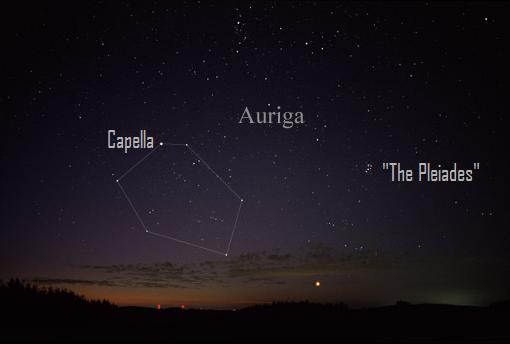
Tonight – or any autumn or winter evening – if you can see the Big Dipper, use its famous pointer stars (which point to Polaris, the North Star) to find the bright golden star Capella in the constellation Auriga the Charioteer. The top two bowl stars point toward Capella, as we depict on the chart at the top of this post.

Capella is sometimes called the Goat Star. In fact, the star name Capella is the Latin word for nanny goat. Near Capella, you’ll find a tiny asterism – a noticeable pattern on the sky’s dome – consisting of three fainter stars. This little triangle of stars is called the Kids.

The phrase spring up and fall down gives you some idea of the Big Dipper’s place in the evening sky. On fall evenings for us in the Northern Hemisphere, the Big Dipper sits way down low in the northern sky.

On northern spring evenings, the Big Dipper shines high above Polaris, the North Star.

From the Southern Hemisphere: Sorry, y’all. These are northern stars and not easily visible to you … unless you come visit our part of the world!

From the far southern U.S. and similar latitudes: You won’t see the Big Dipper on these November evenings, either. From more southerly latitudes in the Northern Hemisphere, the Big Dipper is below your northern horizon on autumn evenings. Even in the northern states, it’ll be possible to miss the Big Dipper if obstructions block your view of the northern sky. However, the Big Dipper swings full circle around Polaris, the North Star, once a day. Thus, from these latitudes, the Big Dipper will appear fairly high in the northeast sky before morning dawn in November.

It’s a long jump from the Big Dipper bowl stars to Capella. Our chart at top goes all the way from northwest to northeast. That’s about one-fourth the way around the horizon.

And remember, the Big Dipper and Capella move throughout the night, and throughout the year, but – no matter when and where you see them – they are part of the “fixed” star background … and so always maintain this relationship to one another.

The bright star Capella and its constellation Auriga the Charioteer as seen in the east-northeast sky. Image via Wikimedia Commons

Bottom line: You’ve heard of the “pointer” stars of the Big Dipper? They point to the North Star. You can also use them to find the star Capella, aka the Goat Star.

Donate: Your support means the world to us

Enjoying EarthSky so far? Sign up for our free daily newsletter today!

Easily locate stars and constellations during any day and time with EarthSky’s Planisphere.


from EarthSky https://ift.tt/2BgjUAI

Tonight – or any autumn or winter evening – if you can see the Big Dipper, use its famous pointer stars (which point to Polaris, the North Star) to find the bright golden star Capella in the constellation Auriga the Charioteer. The top two bowl stars point toward Capella, as we depict on the chart at the top of this post.

Capella is sometimes called the Goat Star. In fact, the star name Capella is the Latin word for nanny goat. Near Capella, you’ll find a tiny asterism – a noticeable pattern on the sky’s dome – consisting of three fainter stars. This little triangle of stars is called the Kids.

The phrase spring up and fall down gives you some idea of the Big Dipper’s place in the evening sky. On fall evenings for us in the Northern Hemisphere, the Big Dipper sits way down low in the northern sky.

On northern spring evenings, the Big Dipper shines high above Polaris, the North Star.

From the Southern Hemisphere: Sorry, y’all. These are northern stars and not easily visible to you … unless you come visit our part of the world!

From the far southern U.S. and similar latitudes: You won’t see the Big Dipper on these November evenings, either. From more southerly latitudes in the Northern Hemisphere, the Big Dipper is below your northern horizon on autumn evenings. Even in the northern states, it’ll be possible to miss the Big Dipper if obstructions block your view of the northern sky. However, the Big Dipper swings full circle around Polaris, the North Star, once a day. Thus, from these latitudes, the Big Dipper will appear fairly high in the northeast sky before morning dawn in November.

It’s a long jump from the Big Dipper bowl stars to Capella. Our chart at top goes all the way from northwest to northeast. That’s about one-fourth the way around the horizon.

And remember, the Big Dipper and Capella move throughout the night, and throughout the year, but – no matter when and where you see them – they are part of the “fixed” star background … and so always maintain this relationship to one another.

The bright star Capella and its constellation Auriga the Charioteer as seen in the east-northeast sky. Image via Wikimedia Commons

Bottom line: You’ve heard of the “pointer” stars of the Big Dipper? They point to the North Star. You can also use them to find the star Capella, aka the Goat Star.

Donate: Your support means the world to us

Enjoying EarthSky so far? Sign up for our free daily newsletter today!

Easily locate stars and constellations during any day and time with EarthSky’s Planisphere.


from EarthSky https://ift.tt/2BgjUAI

2018 SkS Weekly Climate Change & Global Warming Digest #46

Story of the Week... Toon of the Week... SkS in the News... Photo of the Week... SkS Spotlights... Coming Soon on SkS... Poster of the Week... SkS Week in Review... 

Story of the Week...

Scientists acknowledge key errors in study of how fast the oceans are warming

A major study claimed the oceans were warming much faster than previously thought. But researchers now say they can’t necessarily make that claim.

Arctic Sea Ice Victoria Strait Summer 2017

The sun sets over sea ice floating on the Victoria Strait along the Northwest Passage in the Canadian Arctic Archipelago during the summer of 2017. (AP Photo/David Goldman)

Scientists behind a major study that claimed the Earth’s oceans are warming faster than previously thought now say their work contained inadvertent errors that made their conclusions seem more certain than they actually are.

Two weeks after the high-profile study was published in the journal Nature, its authors have submitted corrections to the publication. The Scripps Institution of Oceanography, home to several of the researchers involved, also noted the problems in the scientists' work and corrected a news release on its website, which previously had asserted that the study detailed how the Earth’s oceans “have absorbed 60 percent more heat than previously thought.”

“Unfortunately, we made mistakes here,” said Ralph Keeling, a climate scientist at Scripps, who was a co-author of the study. “I think the main lesson is that you work as fast as you can to fix mistakes when you find them.”

Scientists acknowledge key errors in study of how fast the oceans are warming by Chris Mooney & Brady Dennis, Energy & Environment, Washington Post, Nov 14, 2018 


Toon of the Week...

2018 Toon 46 


SkS in the News

[To be added.]


Photo of the Week...

Paradise CA Nov 2018

In this aerial photo, a burned neighborhood is seen in Paradise, California on November 15, 2018. JOSH EDELSON / AFP / GETTY IMAGES

California Wildfires: Where Is the Climate Change Outrage? by Bruce Melton, Environment & Health, Truthout, Nov 17, 2018 


SkS Highlights...

New weather app 'a quantum leap' for understanding extreme events

https://skepticalscience.com//pics/DrJoshuaSoderholmAustralia.jpg 

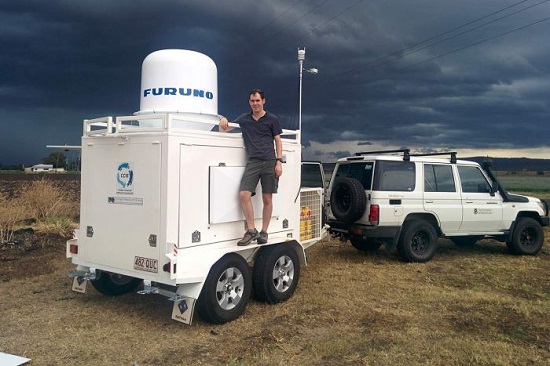
Dr Soderholm says extreme weather can be missed by instruments because weather radars could not see close to the ground.

New weather app 'a quantum leap' for understanding extreme events by Shelley Lloyd, Weather, ABC News (Australia), Nov 21, 2018


Coming Soon on SkS...

  • The Scientific Consensus on Climate Change (Sarah Finnie Robinson)
  • Did bombing during second world war cool global temperatures? (Alan Robock)
  • New findings on ocean warming: 5 questions answered (Scott Denning)
  • Global coal use may have peaked in 2014, says latest IEA World Energy Outlook (Simon Evans)
  • New research this week (Ari Jokimäki)
  • 2018 SkS Weekly Climate Change & Global Warming News Roundup #47 (John Hartz)
  • 2018 SkS Weekly Climate Change & Global Warming Digest #47 (John Hartz)

Poster of the Week...

2018 Poster 46 


SkS Week in Review... 


from Skeptical Science https://ift.tt/2Q8YmOE

Story of the Week... Toon of the Week... SkS in the News... Photo of the Week... SkS Spotlights... Coming Soon on SkS... Poster of the Week... SkS Week in Review... 

Story of the Week...

Scientists acknowledge key errors in study of how fast the oceans are warming

A major study claimed the oceans were warming much faster than previously thought. But researchers now say they can’t necessarily make that claim.

Arctic Sea Ice Victoria Strait Summer 2017

The sun sets over sea ice floating on the Victoria Strait along the Northwest Passage in the Canadian Arctic Archipelago during the summer of 2017. (AP Photo/David Goldman)

Scientists behind a major study that claimed the Earth’s oceans are warming faster than previously thought now say their work contained inadvertent errors that made their conclusions seem more certain than they actually are.

Two weeks after the high-profile study was published in the journal Nature, its authors have submitted corrections to the publication. The Scripps Institution of Oceanography, home to several of the researchers involved, also noted the problems in the scientists' work and corrected a news release on its website, which previously had asserted that the study detailed how the Earth’s oceans “have absorbed 60 percent more heat than previously thought.”

“Unfortunately, we made mistakes here,” said Ralph Keeling, a climate scientist at Scripps, who was a co-author of the study. “I think the main lesson is that you work as fast as you can to fix mistakes when you find them.”

Scientists acknowledge key errors in study of how fast the oceans are warming by Chris Mooney & Brady Dennis, Energy & Environment, Washington Post, Nov 14, 2018 


Toon of the Week...

2018 Toon 46 


SkS in the News

[To be added.]


Photo of the Week...

Paradise CA Nov 2018

In this aerial photo, a burned neighborhood is seen in Paradise, California on November 15, 2018. JOSH EDELSON / AFP / GETTY IMAGES

California Wildfires: Where Is the Climate Change Outrage? by Bruce Melton, Environment & Health, Truthout, Nov 17, 2018 


SkS Highlights...

New weather app 'a quantum leap' for understanding extreme events

https://skepticalscience.com//pics/DrJoshuaSoderholmAustralia.jpg 

Dr Soderholm says extreme weather can be missed by instruments because weather radars could not see close to the ground.

New weather app 'a quantum leap' for understanding extreme events by Shelley Lloyd, Weather, ABC News (Australia), Nov 21, 2018


Coming Soon on SkS...

  • The Scientific Consensus on Climate Change (Sarah Finnie Robinson)
  • Did bombing during second world war cool global temperatures? (Alan Robock)
  • New findings on ocean warming: 5 questions answered (Scott Denning)
  • Global coal use may have peaked in 2014, says latest IEA World Energy Outlook (Simon Evans)
  • New research this week (Ari Jokimäki)
  • 2018 SkS Weekly Climate Change & Global Warming News Roundup #47 (John Hartz)
  • 2018 SkS Weekly Climate Change & Global Warming Digest #47 (John Hartz)

Poster of the Week...

2018 Poster 46 


SkS Week in Review... 


from Skeptical Science https://ift.tt/2Q8YmOE

Lunar Outpost unveils small, exploratory moon rovers

A test model of the Lunar Resource Prospector rover. Image via Lunar Outpost.

The goal of returning human explorers to the moon seems like a long way off, but there is progress being made, including in the private sector. This past week, the Colorado-based aerospace company Lunar Outpost publicly demonstrated its new lunar rover concept for the first time. The rover – called the Lunar Resource Prospector – was shown driving and drilling in simulated lunar regolith at a new lunar testbed facility, overseen by the Colorado School of Mines’ Center for Space Resources, on November 13, 2018.

The Lunar Resource Prospector rovers are small, only weighing only about 22 pounds (10 kilograms). That’s in contrast to the Curiosity rover, a car-sized rover currently exploring Gale Crater on Mars, which has a mass of 1,982 pounds (899 kg). Yet swarms of little moon rovers like these play a key role in the dream of establishing a permanent human presence on the moon.

For example, these little rovers are designed to provide exploration data for what is called In-Situ Resource Utilization (ISRU). That is, they’re designed to go to the moon ahead of future crewed missions, so that the human missions can be more effectively and efficiently organized. The rovers will be “scouting” for resources, needed since future crewed missions won’t be able to bring all of the supplies that they need with them. Instead, they’ll need to make use of resources on the moon itself, such as water, precious metals and Helium-3, which is rare on Earth.

Other flyby/orbiting robotic missions to the moon have learned that those resources are there, on the moon’s surface. The data from earlier missions has been used to create general resource models of the moon’s surface. Now, Lunar Outpost said, the models require ground-truthing to establish the optimal landing sites and plan future resource extraction operations.

Another view of a test model of a Lunar Resource Prospector rover. Image via Lunar Outpost.

As envisioned, the Lunar Resource Prospectors will autonomously explore the moon’s surface in groups, mapping both surface and subsurface resources. They’ll navigate along planned waypoints, while avoiding obstacles and hazards such as rocks and craters. While primarily autonomous, they can also be operated remotely if needed by human astronauts.

If NASA’s planned Lunar Orbital Platform-Gateway goes ahead and is built, the rovers could also use it as a central hub of operations.

All of this is to help prepare for permanent human settlements on the moon. As AJ Gemer, chief technology officer of Lunar Outpost, told Inverse:

We want to see as many people living and working on the moon as possible in our lifetimes.

These rovers differ significantly from previous rover missions, on both the moon and Mars. On the moon, astronauts would use just one rover at each of their landing sites, and Mars rover missions have consisted of one to two highly advanced robots at most for a given mission – such as the twin MER rovers, Spirit and Opportunity. Curiosity is a single, even larger and more advanced rover.

But the Lunar Prospectors would operate in “swarms” of multiple rovers – called Autonomous Lunar Prospecting Swarms (ALPS). Not only could ALPS map much larger areas, they also don’t need to take breaks the way that their human operators would.

Closer view of a front wheel on the test model. Image via Lunar Outpost.

So what are these rovers actually like, design and instrument-wise?

I mentioned they are small (22 pounds, or 10 kg) each. Even so, half of that is available for extra payloads other than navigation and prospecting, and the rovers will be able to drill into the lunar surface and analyze those samples from depths greater than remote sensing missions in orbit can measure.

The rovers also have a forward-facing mass spectrometer to scan the surface for resources travel to the regions of highest concentration, similar to “following the vein” of ore in terrestrial mining. A space-rated 360 Laser Imaging, Detection, and Ranging (LIDAR) system will be used to create maps of surface features with unprecedented centimeter-scale resolution. That system will also allow ALPS to see in the dark – even in deep, permanently shadowed crater or lava tubes. Lunar prospecting will become a real thing thanks to the Lunar Resource Prospectors!

The rovers will even be equipped with 4K video capability, showing the lunar surface with better clarity than ever before.

Both NASA and ESA have plans for future bases on the moon. Companies like Lunar Outpost can help make it happen. Image via ESA/Foster + Partners.

The Lunar Resource Prospector rovers are also economical – they can be mass-produced and customized for various mission tasks, which is vital in the space industry, where missions can be prohibitively expensive.

Lunar Outpost is expected to announce details about the first mission in mid-2019.

Also, the Lunar Resource Prospector rover mission should not be confused with NASA’s Lunar Prospector orbital mission, which was launched on January 6, 1998. That mission was a single orbiter and has no connection to Lunar Outpost.

Bottom line: Although it may still be a few years off, private companies – along with NASA and other space agencies – are getting closer to returning to the moon, with plans of eventually going there to stay permanently with human settlements. Using the latest technologies, rovers such as Lunar Resource Prospector and other missions will help bring that dream a big step closer to reality.

Via Lunar Outpost


from EarthSky https://ift.tt/2zf1KOa

A test model of the Lunar Resource Prospector rover. Image via Lunar Outpost.

The goal of returning human explorers to the moon seems like a long way off, but there is progress being made, including in the private sector. This past week, the Colorado-based aerospace company Lunar Outpost publicly demonstrated its new lunar rover concept for the first time. The rover – called the Lunar Resource Prospector – was shown driving and drilling in simulated lunar regolith at a new lunar testbed facility, overseen by the Colorado School of Mines’ Center for Space Resources, on November 13, 2018.

The Lunar Resource Prospector rovers are small, only weighing only about 22 pounds (10 kilograms). That’s in contrast to the Curiosity rover, a car-sized rover currently exploring Gale Crater on Mars, which has a mass of 1,982 pounds (899 kg). Yet swarms of little moon rovers like these play a key role in the dream of establishing a permanent human presence on the moon.

For example, these little rovers are designed to provide exploration data for what is called In-Situ Resource Utilization (ISRU). That is, they’re designed to go to the moon ahead of future crewed missions, so that the human missions can be more effectively and efficiently organized. The rovers will be “scouting” for resources, needed since future crewed missions won’t be able to bring all of the supplies that they need with them. Instead, they’ll need to make use of resources on the moon itself, such as water, precious metals and Helium-3, which is rare on Earth.

Other flyby/orbiting robotic missions to the moon have learned that those resources are there, on the moon’s surface. The data from earlier missions has been used to create general resource models of the moon’s surface. Now, Lunar Outpost said, the models require ground-truthing to establish the optimal landing sites and plan future resource extraction operations.

Another view of a test model of a Lunar Resource Prospector rover. Image via Lunar Outpost.

As envisioned, the Lunar Resource Prospectors will autonomously explore the moon’s surface in groups, mapping both surface and subsurface resources. They’ll navigate along planned waypoints, while avoiding obstacles and hazards such as rocks and craters. While primarily autonomous, they can also be operated remotely if needed by human astronauts.

If NASA’s planned Lunar Orbital Platform-Gateway goes ahead and is built, the rovers could also use it as a central hub of operations.

All of this is to help prepare for permanent human settlements on the moon. As AJ Gemer, chief technology officer of Lunar Outpost, told Inverse:

We want to see as many people living and working on the moon as possible in our lifetimes.

These rovers differ significantly from previous rover missions, on both the moon and Mars. On the moon, astronauts would use just one rover at each of their landing sites, and Mars rover missions have consisted of one to two highly advanced robots at most for a given mission – such as the twin MER rovers, Spirit and Opportunity. Curiosity is a single, even larger and more advanced rover.

But the Lunar Prospectors would operate in “swarms” of multiple rovers – called Autonomous Lunar Prospecting Swarms (ALPS). Not only could ALPS map much larger areas, they also don’t need to take breaks the way that their human operators would.

Closer view of a front wheel on the test model. Image via Lunar Outpost.

So what are these rovers actually like, design and instrument-wise?

I mentioned they are small (22 pounds, or 10 kg) each. Even so, half of that is available for extra payloads other than navigation and prospecting, and the rovers will be able to drill into the lunar surface and analyze those samples from depths greater than remote sensing missions in orbit can measure.

The rovers also have a forward-facing mass spectrometer to scan the surface for resources travel to the regions of highest concentration, similar to “following the vein” of ore in terrestrial mining. A space-rated 360 Laser Imaging, Detection, and Ranging (LIDAR) system will be used to create maps of surface features with unprecedented centimeter-scale resolution. That system will also allow ALPS to see in the dark – even in deep, permanently shadowed crater or lava tubes. Lunar prospecting will become a real thing thanks to the Lunar Resource Prospectors!

The rovers will even be equipped with 4K video capability, showing the lunar surface with better clarity than ever before.

Both NASA and ESA have plans for future bases on the moon. Companies like Lunar Outpost can help make it happen. Image via ESA/Foster + Partners.

The Lunar Resource Prospector rovers are also economical – they can be mass-produced and customized for various mission tasks, which is vital in the space industry, where missions can be prohibitively expensive.

Lunar Outpost is expected to announce details about the first mission in mid-2019.

Also, the Lunar Resource Prospector rover mission should not be confused with NASA’s Lunar Prospector orbital mission, which was launched on January 6, 1998. That mission was a single orbiter and has no connection to Lunar Outpost.

Bottom line: Although it may still be a few years off, private companies – along with NASA and other space agencies – are getting closer to returning to the moon, with plans of eventually going there to stay permanently with human settlements. Using the latest technologies, rovers such as Lunar Resource Prospector and other missions will help bring that dream a big step closer to reality.

Via Lunar Outpost


from EarthSky https://ift.tt/2zf1KOa

adds 2