NASA released the video above on YouTube on Friday (November 16, 2018) and released it via Twitter Saturday. It’s a teaser, essentially a trailor, read by voiceover actor Mike Rowe, for the space agency’s plan to establish a permanent human presence on the moon and then venture beyond, to Mars. As of Sunday morning, the video had 732,295 views; we predict it’ll pick up speed and go viral this week because – although it doesn’t say much – what it does say is so inspiring, for example:
This is about sustainable science and feeding forward the advance of the human spirit … because we are the pioneers, the thinkers, the star-sailors, the visionaries, the do-ers … and because we stand on the shoulders of giants to go farther than humanity has ever been.
How long have we space fans waited for words like these from NASA? A long time.
And if the words echo the style of American politics in recent years, they should. NASA’s current focus on establishing a sustainable presence on the moon and Mars are, in part, an answer to the Space Policy Directive-1, signed by Donald Trump at the end of 2017. The directive:
… calls for the NASA administrator to ‘lead an innovative and sustainable program of exploration with commercial and international partners to enable human expansion across the solar system and to bring back to Earth new knowledge and opportunities.’
The effort will more effectively organize government, private industry, and international efforts toward returning humans on the moon, and will lay the foundation that will eventually enable human exploration of Mars.
Elsewhere on EarthSky today, we’re reporting on a related effort, centered around a return to the moon, describing the role a Colorado-based private company – called Lunar Outpost – might play in this effort, by creating and building small, exploratory moon rovers.
But back to the new video. In a speech read during it, NASA said:
We’ve taken giant leaps and left our mark in the heavens.
Now we’re building the next chapter, returning to the moon to stay, and preparing to go beyond. We are NASA – and after 60 years, we’re just getting started.
We're returning to the Moon, preparing to go beyond to Mars. We are going. We are NASA. pic.twitter.com/y24AaicGRy
Bottom line: A new NASA video – posted to YouTube on November 16, 2018 – is a teaser for NASA’s shifted focus on establishing a human presence on the moon, and venturing outward to Mars.
from EarthSky https://ift.tt/2QXCqDz
NASA released the video above on YouTube on Friday (November 16, 2018) and released it via Twitter Saturday. It’s a teaser, essentially a trailor, read by voiceover actor Mike Rowe, for the space agency’s plan to establish a permanent human presence on the moon and then venture beyond, to Mars. As of Sunday morning, the video had 732,295 views; we predict it’ll pick up speed and go viral this week because – although it doesn’t say much – what it does say is so inspiring, for example:
This is about sustainable science and feeding forward the advance of the human spirit … because we are the pioneers, the thinkers, the star-sailors, the visionaries, the do-ers … and because we stand on the shoulders of giants to go farther than humanity has ever been.
How long have we space fans waited for words like these from NASA? A long time.
And if the words echo the style of American politics in recent years, they should. NASA’s current focus on establishing a sustainable presence on the moon and Mars are, in part, an answer to the Space Policy Directive-1, signed by Donald Trump at the end of 2017. The directive:
… calls for the NASA administrator to ‘lead an innovative and sustainable program of exploration with commercial and international partners to enable human expansion across the solar system and to bring back to Earth new knowledge and opportunities.’
The effort will more effectively organize government, private industry, and international efforts toward returning humans on the moon, and will lay the foundation that will eventually enable human exploration of Mars.
Elsewhere on EarthSky today, we’re reporting on a related effort, centered around a return to the moon, describing the role a Colorado-based private company – called Lunar Outpost – might play in this effort, by creating and building small, exploratory moon rovers.
But back to the new video. In a speech read during it, NASA said:
We’ve taken giant leaps and left our mark in the heavens.
Now we’re building the next chapter, returning to the moon to stay, and preparing to go beyond. We are NASA – and after 60 years, we’re just getting started.
We're returning to the Moon, preparing to go beyond to Mars. We are going. We are NASA. pic.twitter.com/y24AaicGRy
Bottom line: A new NASA video – posted to YouTube on November 16, 2018 – is a teaser for NASA’s shifted focus on establishing a human presence on the moon, and venturing outward to Mars.
Since the age of the Roman Empire and the story of how the twins Romulus and Remus were raised by a wolf, tales of interspecies adoptions have captivated the human imagination. The story that emerged from Canada’s St. Lawrence River in July of 2018 was no exception. While researching belugas, a group of scientists captured drone footage of a young male narwhal, more than 1,000 kilometers south of his Arctic home, swimming with a pod of belugas.
It sounds like something straight out of Disney’s “Finding Nemo.” But in the three years since the narwhal was first spotted with his adopted family, this real-life drama has been playing out in the waters of the St. Lawrence estuary. And the unlikely alliance has researchers scratching their heads.
The cause of this consternation? A funny word called adoption.
In the human realm, adoption is seen as a benevolent act, but in the wild it poses a real evolutionary dilemma. This is because the goal of every organism in the natural world is to reproduce and transfer its genes to future generations. Adoption is puzzling because it requires an individual to invest resources into another’s offspring, with no guarantee of passing on its own genetic material. Despite this, adoption is well-documented across the animal kingdom.
The question is, why?
Understanding when and where we see cases of adoption often comes down to understanding how adoption can provide a benefit to the foster parents or adoptive group members. In other words, how can investing in another’s offspring actually increase the potential for adoptive parents to contribute genes to future generations?
A family matter
One possibility is through the adoption of kin.
Since related individuals share genes, by raising family, animals can help to ensure the survival of their own DNA. This is the most widely documented explanation for foster care in the wild. Many social species, including lions, primates and elephants have been known to care for or raise the offspring of a mother, sister, aunt or other relative.
But scientists from the Kluane Red Squirrel Project have found that social species aren’t the only animals that adopt kin. In the icy north of Canada’s Yukon, red squirrel mothers preferentially adopt orphaned relatives. This is intriguing because red squirrels are territorial rodents that live in isolation. Even so, red squirrels were able to identify relatives and actively chose to foster pups to which they were related. Out of thousands of litters, researchers only identified five cases of adoption, all of which were orphaned kin.
A red squirrel mother carries a 25-day old pup to a new nest. Image via Erin Siracusa.
You scratch my back, I scratch yours
But adopting individuals with shared genes isn’t the only way that potential foster parents can benefit. Reciprocity, or an “exchange of favors,” might also motivate shared parenting. Under certain circumstances unrelated females will swap “babysitting” duties. This has the benefit of allowing the mother to forage more efficiently without youngsters tagging along.
Alternatively, mothers might nurse each other’s offspring, providing temporary relief from maternal duties. Scientists are still uncertain, however, how important reciprocity might be for facilitating allonursing – non-maternal milk provisioning – or other forms of foster care provided by non-relatives.
Practice makes perfect
Even more puzzling are circumstances in which adoptions occur between members of different species. Such cases can’t be explained either by shared genes or reciprocity among group members, and while interspecies adoptions are rare in the wild, they aren’t unheard of. For instance, in 2004, researchers in Brazil observed an infant marmoset being cared for by two female capuchin monkeys.
Since interspecies adoptions are so uncommon, it’s challenging to understand why they occur. One possibility is that adoption provides an opportunity for young females to practice their mothering skills. Scientists believe that proficiency in parenting is based on learned as well as innate behaviors.
In elephant seals, experienced mothers are more successful in raising offspring. Researchers think that these benefits of maternal experience may be one reason adoption occurs so frequently in this species. By practicing with adopted young, females can ensure that they are competent mothers when it comes time to raise their own offspring.
Mistakes do happen
Of course, not every instance of adoption is likely to be beneficial for the adoptive parent. One simple cause of mistaken foster care is reproductive error.
Breeding females that have recently lost their young are often still behaviorally and physiologically ready to provide maternal care. In such cases, a female’s motherly instinct may be so strong that it leads her to mistakenly redirect her care toward unrelated young.
Alternatively, parents may simply be bamboozled into raising another species’ young. Brown-headed cowbirds lay their eggs in the nest of an unsuspecting host who, unable to distinguish the cowbird’s offspring, will raise the young as their own.
All for one and one for all?
But in the chilly waters of the St. Lawrence River, a different sort of adoption story is unfolding. The welcoming of a young narwhal into a pod of juvenile male belugas cannot be explained by kin selection, reciprocity or maternal instinct … leaving what?
It’s a good question, and frankly, scientists are still uncertain. One possibility is that adopting a lone individual might provide a benefit for the entire group. For instance, having a larger pod might offer protection from predators.
This “safety in numbers” benefit has been suggested as an explanation for adoption in other species. Alternatively, both narwhals and belugas are highly social animals and the benefits of social companionship alone might lead to this unlikely alliance.
This is particularly true given that narwhals and belugas do not directly compete for food. Narwhals feed on deepwater fish, while belugas prefer surface-dwelling salmon and capelin. The costs of adoption are therefore likely to be low.
In the end, the narwhal’s adoption might be one of the many natural mysteries that scientists have yet to solve. Nevertheless, footage of this long-tusked, gray-skinned cetacean frolicking with its fellow belugas is offering people worldwide a rare glimpse into an animal behavior almost never seen in the wild.
Since the age of the Roman Empire and the story of how the twins Romulus and Remus were raised by a wolf, tales of interspecies adoptions have captivated the human imagination. The story that emerged from Canada’s St. Lawrence River in July of 2018 was no exception. While researching belugas, a group of scientists captured drone footage of a young male narwhal, more than 1,000 kilometers south of his Arctic home, swimming with a pod of belugas.
It sounds like something straight out of Disney’s “Finding Nemo.” But in the three years since the narwhal was first spotted with his adopted family, this real-life drama has been playing out in the waters of the St. Lawrence estuary. And the unlikely alliance has researchers scratching their heads.
The cause of this consternation? A funny word called adoption.
In the human realm, adoption is seen as a benevolent act, but in the wild it poses a real evolutionary dilemma. This is because the goal of every organism in the natural world is to reproduce and transfer its genes to future generations. Adoption is puzzling because it requires an individual to invest resources into another’s offspring, with no guarantee of passing on its own genetic material. Despite this, adoption is well-documented across the animal kingdom.
The question is, why?
Understanding when and where we see cases of adoption often comes down to understanding how adoption can provide a benefit to the foster parents or adoptive group members. In other words, how can investing in another’s offspring actually increase the potential for adoptive parents to contribute genes to future generations?
A family matter
One possibility is through the adoption of kin.
Since related individuals share genes, by raising family, animals can help to ensure the survival of their own DNA. This is the most widely documented explanation for foster care in the wild. Many social species, including lions, primates and elephants have been known to care for or raise the offspring of a mother, sister, aunt or other relative.
But scientists from the Kluane Red Squirrel Project have found that social species aren’t the only animals that adopt kin. In the icy north of Canada’s Yukon, red squirrel mothers preferentially adopt orphaned relatives. This is intriguing because red squirrels are territorial rodents that live in isolation. Even so, red squirrels were able to identify relatives and actively chose to foster pups to which they were related. Out of thousands of litters, researchers only identified five cases of adoption, all of which were orphaned kin.
A red squirrel mother carries a 25-day old pup to a new nest. Image via Erin Siracusa.
You scratch my back, I scratch yours
But adopting individuals with shared genes isn’t the only way that potential foster parents can benefit. Reciprocity, or an “exchange of favors,” might also motivate shared parenting. Under certain circumstances unrelated females will swap “babysitting” duties. This has the benefit of allowing the mother to forage more efficiently without youngsters tagging along.
Alternatively, mothers might nurse each other’s offspring, providing temporary relief from maternal duties. Scientists are still uncertain, however, how important reciprocity might be for facilitating allonursing – non-maternal milk provisioning – or other forms of foster care provided by non-relatives.
Practice makes perfect
Even more puzzling are circumstances in which adoptions occur between members of different species. Such cases can’t be explained either by shared genes or reciprocity among group members, and while interspecies adoptions are rare in the wild, they aren’t unheard of. For instance, in 2004, researchers in Brazil observed an infant marmoset being cared for by two female capuchin monkeys.
Since interspecies adoptions are so uncommon, it’s challenging to understand why they occur. One possibility is that adoption provides an opportunity for young females to practice their mothering skills. Scientists believe that proficiency in parenting is based on learned as well as innate behaviors.
In elephant seals, experienced mothers are more successful in raising offspring. Researchers think that these benefits of maternal experience may be one reason adoption occurs so frequently in this species. By practicing with adopted young, females can ensure that they are competent mothers when it comes time to raise their own offspring.
Mistakes do happen
Of course, not every instance of adoption is likely to be beneficial for the adoptive parent. One simple cause of mistaken foster care is reproductive error.
Breeding females that have recently lost their young are often still behaviorally and physiologically ready to provide maternal care. In such cases, a female’s motherly instinct may be so strong that it leads her to mistakenly redirect her care toward unrelated young.
Alternatively, parents may simply be bamboozled into raising another species’ young. Brown-headed cowbirds lay their eggs in the nest of an unsuspecting host who, unable to distinguish the cowbird’s offspring, will raise the young as their own.
All for one and one for all?
But in the chilly waters of the St. Lawrence River, a different sort of adoption story is unfolding. The welcoming of a young narwhal into a pod of juvenile male belugas cannot be explained by kin selection, reciprocity or maternal instinct … leaving what?
It’s a good question, and frankly, scientists are still uncertain. One possibility is that adopting a lone individual might provide a benefit for the entire group. For instance, having a larger pod might offer protection from predators.
This “safety in numbers” benefit has been suggested as an explanation for adoption in other species. Alternatively, both narwhals and belugas are highly social animals and the benefits of social companionship alone might lead to this unlikely alliance.
This is particularly true given that narwhals and belugas do not directly compete for food. Narwhals feed on deepwater fish, while belugas prefer surface-dwelling salmon and capelin. The costs of adoption are therefore likely to be low.
In the end, the narwhal’s adoption might be one of the many natural mysteries that scientists have yet to solve. Nevertheless, footage of this long-tusked, gray-skinned cetacean frolicking with its fellow belugas is offering people worldwide a rare glimpse into an animal behavior almost never seen in the wild.
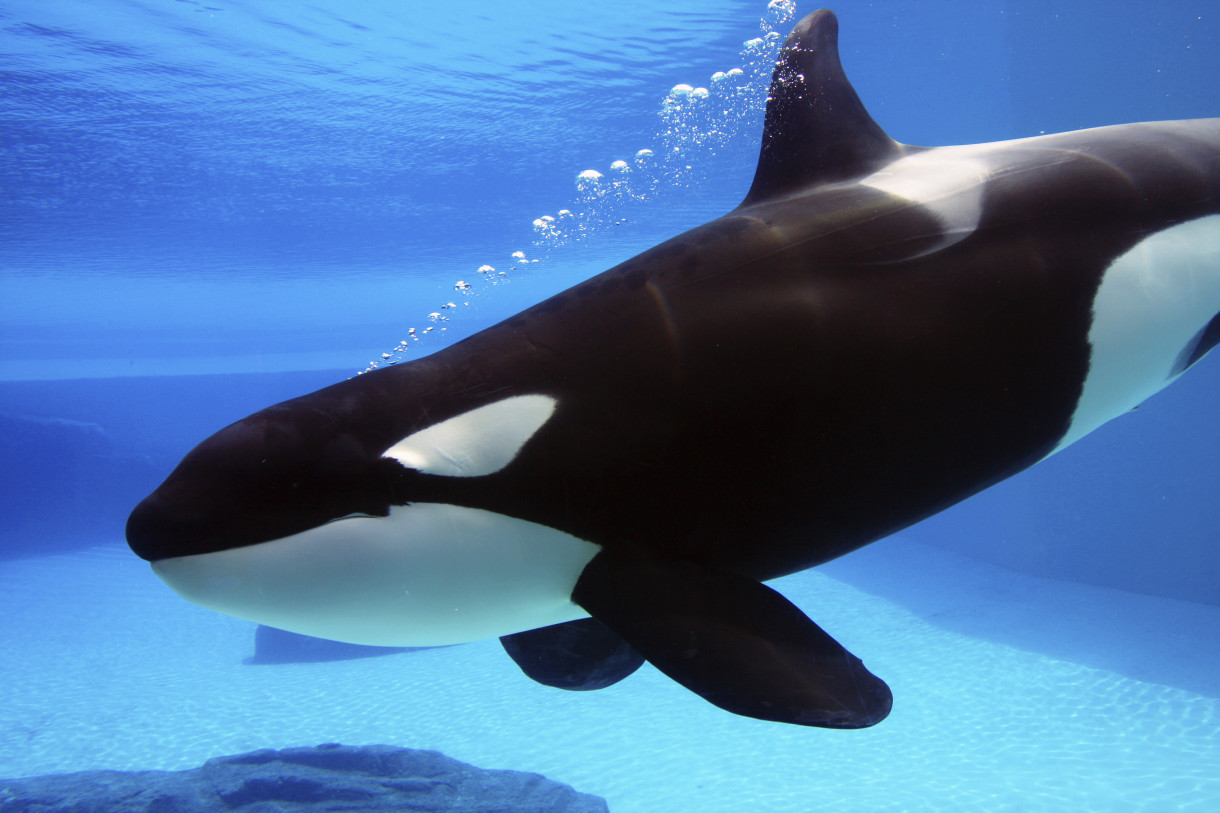
Killer whales display personality traits similar to those of humans and chimpanzees, such as playfulness, cheerfulness and affection, according to research published in the peer-reviewedJournal of Comparative Psychology on November 15, 2018.
Researchers in Spain analyzed the personality traits of 24 captive killer whales (Orcinus orca) at SeaWorld Orlando, SeaWorld San Diego and the Loro Parque zoo in Tenerife, Spain, which operates its killer whale program in partnership with SeaWorld. Six of the killer whales were caught in the wild while the remainder were among of the last killer whales to be born in Seaworld’s now-defunct killer breeding program. SeaWorld’s breeding program ended in 2016 after the company came under fire for its treatment of killer whales. Previous research with captive killer whales showed that captivity can alter the personality of killer whales, increasing neuroticism and aggression. Physical changes, such as dorsal fin collapse, also have been observed.
Researchers involved in the current study said they conducted their work with captive killer whales because of the difficulty of trying to assess personality traits of killer whales in the wild.
They noted that the personality traits observed in this small sample size of captive killer whales – whose personality traits appeared similar to those of humans and chimpanzees – could differ from the personality traits of killer whales in the wild.
Trainers and other staff who worked closely with the killer whales completed surveys ranking each animal on a list of 38 personality traits, including playfulness, independence, stubbornness, bravery, sensitivity and protectiveness. Those traits were analyzed and compared with previous studies of the same personality traits for chimpanzees and humans. Read more about how to researchers conducted the study here.
Lead researcher Yulán Úbeda is a doctoral student in psychology at the University of Girona in Spain. Úbeda said in a statement:
These similar personality traits may have developed because they were necessary to form complex social interactions in tightly knit groups that we see in killer whales, humans and other primates.
Killer whales in the wild can live into their 90s, in tightly knit pods that hunt together and share their food, displaying advanced communication skills and cooperation.
Killer whale in the wild, playing with a block of ice. Image via Wikipedia.
Researchers found that the personality traits of killer whales were similar to those of both humans and chimpanzees, but more similar to chimpanzees. According to the researchers:
…Killer whales were similar to chimpanzees and humans for the extraversion factor (e.g., playful, gregarious and sociable). Killer whales and chimpanzees also shared a combination of personality traits for conscientiousness (e.g., constant, stubborn and protective) and agreeableness (e.g., patient, peaceable and not bullying), along with some personality traits relating to dominance.
Bottom line: A new study suggests that killer whales share some personality traits with humans and chimps.
Killer whales display personality traits similar to those of humans and chimpanzees, such as playfulness, cheerfulness and affection, according to research published in the peer-reviewedJournal of Comparative Psychology on November 15, 2018.
Researchers in Spain analyzed the personality traits of 24 captive killer whales (Orcinus orca) at SeaWorld Orlando, SeaWorld San Diego and the Loro Parque zoo in Tenerife, Spain, which operates its killer whale program in partnership with SeaWorld. Six of the killer whales were caught in the wild while the remainder were among of the last killer whales to be born in Seaworld’s now-defunct killer breeding program. SeaWorld’s breeding program ended in 2016 after the company came under fire for its treatment of killer whales. Previous research with captive killer whales showed that captivity can alter the personality of killer whales, increasing neuroticism and aggression. Physical changes, such as dorsal fin collapse, also have been observed.
Researchers involved in the current study said they conducted their work with captive killer whales because of the difficulty of trying to assess personality traits of killer whales in the wild.
They noted that the personality traits observed in this small sample size of captive killer whales – whose personality traits appeared similar to those of humans and chimpanzees – could differ from the personality traits of killer whales in the wild.
Trainers and other staff who worked closely with the killer whales completed surveys ranking each animal on a list of 38 personality traits, including playfulness, independence, stubbornness, bravery, sensitivity and protectiveness. Those traits were analyzed and compared with previous studies of the same personality traits for chimpanzees and humans. Read more about how to researchers conducted the study here.
Lead researcher Yulán Úbeda is a doctoral student in psychology at the University of Girona in Spain. Úbeda said in a statement:
These similar personality traits may have developed because they were necessary to form complex social interactions in tightly knit groups that we see in killer whales, humans and other primates.
Killer whales in the wild can live into their 90s, in tightly knit pods that hunt together and share their food, displaying advanced communication skills and cooperation.
Killer whale in the wild, playing with a block of ice. Image via Wikipedia.
Researchers found that the personality traits of killer whales were similar to those of both humans and chimpanzees, but more similar to chimpanzees. According to the researchers:
…Killer whales were similar to chimpanzees and humans for the extraversion factor (e.g., playful, gregarious and sociable). Killer whales and chimpanzees also shared a combination of personality traits for conscientiousness (e.g., constant, stubborn and protective) and agreeableness (e.g., patient, peaceable and not bullying), along with some personality traits relating to dominance.
Bottom line: A new study suggests that killer whales share some personality traits with humans and chimps.
An international team of researchers has discovered a large meteorite impact crater hiding beneath more than a half-mile (about 1 km) of ice in northwest Greenland. The crater — the first of any size found under the Greenland ice sheet — is one of the 25 largest impact craters on Earth, measuring roughly 1,000 feet (300 meters) deep and more than 19 miles (30 km) in diameter, bigger than Paris or the Beltway around Washington, DC.
The crater formed less than 3 million years ago, according to the study, when an iron meteorite more than half a mile wide smashed into northwest Greenland. The resulting depression was subsequently covered by ice.
Kurt Kjær is a professor at the Center for GeoGenetics at the Natural History Museum of Denmark and lead author of the study, published November 14, 2018 in the peer-reviewed journal Science Advances. Kjær said that the crater’s condition indicates the impact might have occurred toward the end of the last ice age, which would place the resulting crater among the youngest on the planet. Kjær said:
The crater is exceptionally well-preserved and that is surprising because glacier ice is an incredibly efficient erosive agent that would have quickly removed traces of the impact.
Location of Hiawatha Glacier Crater in Greenland. Image via Wikipedia.
Radar data from an intensive aerial survey of the Hiawatha crater in May 2016 is shown here in aqua-colored curtains. A blue arrow points to the central peak of the crater. Image via NASA/Cindy Starr.
The researchers first spotted the crater in July 2015, while they were inspecting a new map of the topography beneath Greenland’s ice sheet that used ice-penetrating radar data primarily from NASA’s Operation IceBridge — a multi-year airborne mission to track changes in polar ice — and earlier NASA airborne missions in Greenland. The scientists noticed an enormous, previously unexamined circular depression under Hiawatha Glacier, sitting at the very edge of the ice sheet in northwestern Greenland.
Using satellite imagery, the team also examined the surface of the ice in the Hiawatha Glacier region and quickly found evidence of a circular pattern on the ice surface that matched the one observed in the bed topography map.
The Hiawatha impact crater is covered by the Greenland Ice Sheet, which flows just beyond the crater rim, forming a semi-circular edge. Part of this edge (top of photo) and a tongue of ice that breaches the crater’s rim are shown in this photo taken during a NASA Operation IceBridge flight on April 17, 2018. Image via NASA/John Sonntag.
To confirm their suspicions, in May 2016 the team sent a research plane to fly over the Hiawatha Glacier and map the crater and the overlying ice with a state-of-the-art ice-penetrating radar. In the summers of 2016 and 2017, the research team returned to the Hiawatha Glacier to map tectonic structures in the rock near the foot of the glacier and collect samples of sediments washed out from the depression through a meltwater channel.
Nicolaj Larsen of Aarhus University in Denmark is one of the authors of the study. Larsen said in a statement:
Some of the quartz sand coming from the crater had planar deformation features indicative of a violent impact; this is conclusive evidence that the depression beneath the Hiawatha Glacier is a meteorite crater.
An international team of researchers has discovered a large meteorite impact crater hiding beneath more than a half-mile (about 1 km) of ice in northwest Greenland. The crater — the first of any size found under the Greenland ice sheet — is one of the 25 largest impact craters on Earth, measuring roughly 1,000 feet (300 meters) deep and more than 19 miles (30 km) in diameter, bigger than Paris or the Beltway around Washington, DC.
The crater formed less than 3 million years ago, according to the study, when an iron meteorite more than half a mile wide smashed into northwest Greenland. The resulting depression was subsequently covered by ice.
Kurt Kjær is a professor at the Center for GeoGenetics at the Natural History Museum of Denmark and lead author of the study, published November 14, 2018 in the peer-reviewed journal Science Advances. Kjær said that the crater’s condition indicates the impact might have occurred toward the end of the last ice age, which would place the resulting crater among the youngest on the planet. Kjær said:
The crater is exceptionally well-preserved and that is surprising because glacier ice is an incredibly efficient erosive agent that would have quickly removed traces of the impact.
Location of Hiawatha Glacier Crater in Greenland. Image via Wikipedia.
Radar data from an intensive aerial survey of the Hiawatha crater in May 2016 is shown here in aqua-colored curtains. A blue arrow points to the central peak of the crater. Image via NASA/Cindy Starr.
The researchers first spotted the crater in July 2015, while they were inspecting a new map of the topography beneath Greenland’s ice sheet that used ice-penetrating radar data primarily from NASA’s Operation IceBridge — a multi-year airborne mission to track changes in polar ice — and earlier NASA airborne missions in Greenland. The scientists noticed an enormous, previously unexamined circular depression under Hiawatha Glacier, sitting at the very edge of the ice sheet in northwestern Greenland.
Using satellite imagery, the team also examined the surface of the ice in the Hiawatha Glacier region and quickly found evidence of a circular pattern on the ice surface that matched the one observed in the bed topography map.
The Hiawatha impact crater is covered by the Greenland Ice Sheet, which flows just beyond the crater rim, forming a semi-circular edge. Part of this edge (top of photo) and a tongue of ice that breaches the crater’s rim are shown in this photo taken during a NASA Operation IceBridge flight on April 17, 2018. Image via NASA/John Sonntag.
To confirm their suspicions, in May 2016 the team sent a research plane to fly over the Hiawatha Glacier and map the crater and the overlying ice with a state-of-the-art ice-penetrating radar. In the summers of 2016 and 2017, the research team returned to the Hiawatha Glacier to map tectonic structures in the rock near the foot of the glacier and collect samples of sediments washed out from the depression through a meltwater channel.
Nicolaj Larsen of Aarhus University in Denmark is one of the authors of the study. Larsen said in a statement:
Some of the quartz sand coming from the crater had planar deformation features indicative of a violent impact; this is conclusive evidence that the depression beneath the Hiawatha Glacier is a meteorite crater.
Tonight, watch for Orion the Hunter – perhaps the easiest-to-identify of all constellations – rising at mid-evening. It’s around late November and early December that people begin to notice Orion in the evening sky, and to comment on it. Orion will climb over your eastern horizon by around 9 p.m. tonight. You can find this constellation and watch it for months to come.
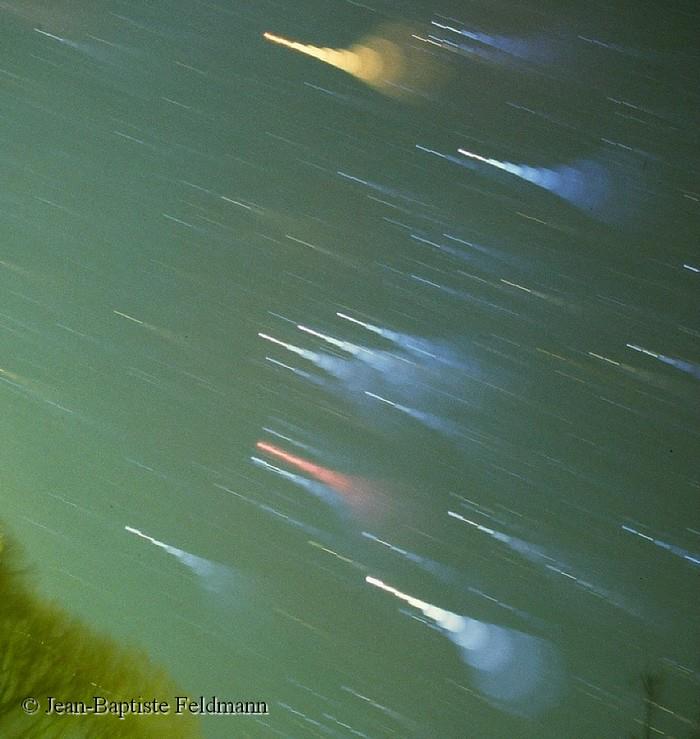
The most noticeable part of Orion is the pattern called Orion’s Belt: three medium-bright stars in a short, straight row. As seen from mid-northern latitudes, Orion appears to be lying on his side – with his Belt stars pointing upward – when he first ascends into our eastern sky in mid-evening at this time of year. Orion’s two brightest stars — Betelgeuse and Rigel — shine on opposite sides of the Belt.
Stars trails of constellation Orion via EarthSky Facebook friend Jean Baptiste Feldman. Can you pick out the three stars in Orion’s Belt? Notice also the different colors of the stars in Orion.
As night passes, and Earth spins beneath the sky, Orion will climb higher in our sky. When this constellation is highest in the south, it is a huge, noticeable star pattern. But Orion doesn’t reach its highest point until an hour or two after midnight (that’s local time, for all times zones around the world) at this time of year.
Like all the stars, Orion’s stars rise some four minutes earlier with each passing day, or about two hours earlier with each passing month. If you see Orion shining in the east at 9:00 p.m. tonight, look for Orion to be in the same place in the sky at about 7:00 p.m. a month from now. Or if Orion is due south at 1:30 a.m. tomorrow, look for Orion to be due south at 11:30 p.m. in late December.
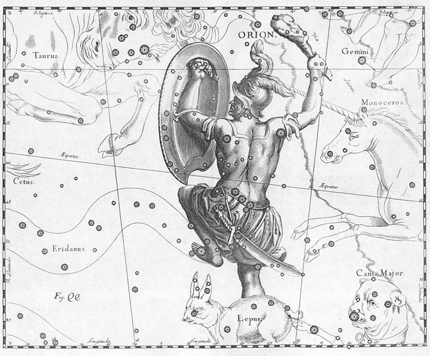
Mirror view of Orion the Hunter from Johannes Hevelius' Uranographia (1690)
This shift in Orion’s location is due to Earth’s movement in orbit around the sun. As we move around the sun, our perspective on the stars surrounding us shifts. At the same hour daily, all the stars in the eastern half of sky climb up a bit higher, whereas all the stars in the western half of sky sink a bit closer to the western horizon.
Are you familiar with the W- or M-shaped constellation Cassiopeia the Queen? Or Polaris, the North Star? As Orion rises in the east this evening, look for Cassiopeia to soar to her highest point for the night, above Polaris in the northern sky.
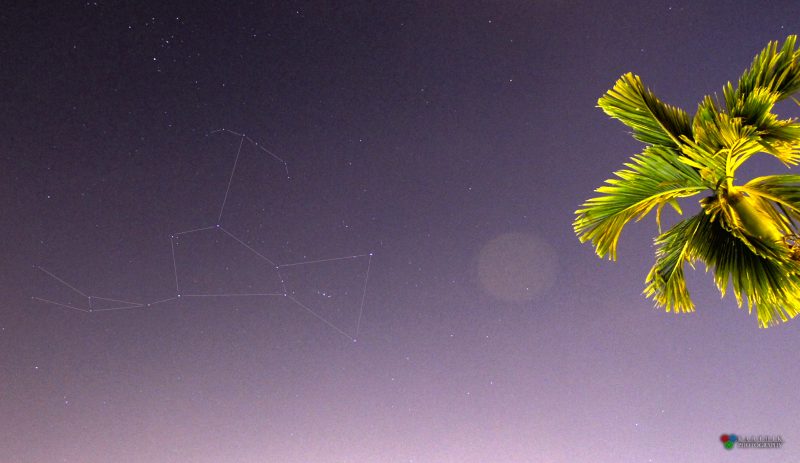
Karthik Easvur caught the constellation Orion on November 26, 2016, from his balcony in Hyderabad, India. The round translucent object in the photo, by the way, is a lens flare – an internal reflection from Karthik’s camera – likely caused by the same artificial light that’s illuminating the palm tree on the right.
Bottom line: By late November, the famous constellation Orion the Hunter is back in the evening sky! Its most recognizable feature is a short, straight line of 3 medium-bright stars.
Tonight, watch for Orion the Hunter – perhaps the easiest-to-identify of all constellations – rising at mid-evening. It’s around late November and early December that people begin to notice Orion in the evening sky, and to comment on it. Orion will climb over your eastern horizon by around 9 p.m. tonight. You can find this constellation and watch it for months to come.
The most noticeable part of Orion is the pattern called Orion’s Belt: three medium-bright stars in a short, straight row. As seen from mid-northern latitudes, Orion appears to be lying on his side – with his Belt stars pointing upward – when he first ascends into our eastern sky in mid-evening at this time of year. Orion’s two brightest stars — Betelgeuse and Rigel — shine on opposite sides of the Belt.
Stars trails of constellation Orion via EarthSky Facebook friend Jean Baptiste Feldman. Can you pick out the three stars in Orion’s Belt? Notice also the different colors of the stars in Orion.
As night passes, and Earth spins beneath the sky, Orion will climb higher in our sky. When this constellation is highest in the south, it is a huge, noticeable star pattern. But Orion doesn’t reach its highest point until an hour or two after midnight (that’s local time, for all times zones around the world) at this time of year.
Like all the stars, Orion’s stars rise some four minutes earlier with each passing day, or about two hours earlier with each passing month. If you see Orion shining in the east at 9:00 p.m. tonight, look for Orion to be in the same place in the sky at about 7:00 p.m. a month from now. Or if Orion is due south at 1:30 a.m. tomorrow, look for Orion to be due south at 11:30 p.m. in late December.
Mirror view of Orion the Hunter from Johannes Hevelius' Uranographia (1690)
This shift in Orion’s location is due to Earth’s movement in orbit around the sun. As we move around the sun, our perspective on the stars surrounding us shifts. At the same hour daily, all the stars in the eastern half of sky climb up a bit higher, whereas all the stars in the western half of sky sink a bit closer to the western horizon.
Are you familiar with the W- or M-shaped constellation Cassiopeia the Queen? Or Polaris, the North Star? As Orion rises in the east this evening, look for Cassiopeia to soar to her highest point for the night, above Polaris in the northern sky.
Karthik Easvur caught the constellation Orion on November 26, 2016, from his balcony in Hyderabad, India. The round translucent object in the photo, by the way, is a lens flare – an internal reflection from Karthik’s camera – likely caused by the same artificial light that’s illuminating the palm tree on the right.
Bottom line: By late November, the famous constellation Orion the Hunter is back in the evening sky! Its most recognizable feature is a short, straight line of 3 medium-bright stars.
A chronological listing of news articles posted on the Skeptical Science Facebook Page during the past week, i.e., Sunday, Nov 11 through Saturday, Nov 17.
Editor's Pick
Policies of China, Russia and Canada threaten 5C climate change, study finds
Ranking of countries’ goals shows even EU on course for more than double safe level of warming
Vendors near a state-owned coal-fired power plant in China. Photograph: Kevin Frayer/Getty Images
China, Russia and Canada’s current climate policies would drive the world above a catastrophic 5C of warming by the end of the century, according to a study that ranks the climate goals of different countries.
The US and Australia are only slightly behind with both pushing the global temperature rise dangerously over 4C above pre-industrial levels says the paper, while even the EU, which is usually seen as a climate leader, is on course to more than double the 1.5C that scientists say is a moderately safe level of heating.
The aim of the paper is to inform climate negotiators as they begin a two-year process of ratcheting up climate commitments, which currently fall far short of the 1.5-to-2C goal set in France three years ago.
The related website also serves as a guide to how nations are sharing the burden of responding to the greatest environmental threat humankind has ever faced.
A chronological listing of news articles posted on the Skeptical Science Facebook Page during the past week, i.e., Sunday, Nov 11 through Saturday, Nov 17.
Editor's Pick
Policies of China, Russia and Canada threaten 5C climate change, study finds
Ranking of countries’ goals shows even EU on course for more than double safe level of warming
Vendors near a state-owned coal-fired power plant in China. Photograph: Kevin Frayer/Getty Images
China, Russia and Canada’s current climate policies would drive the world above a catastrophic 5C of warming by the end of the century, according to a study that ranks the climate goals of different countries.
The US and Australia are only slightly behind with both pushing the global temperature rise dangerously over 4C above pre-industrial levels says the paper, while even the EU, which is usually seen as a climate leader, is on course to more than double the 1.5C that scientists say is a moderately safe level of heating.
The aim of the paper is to inform climate negotiators as they begin a two-year process of ratcheting up climate commitments, which currently fall far short of the 1.5-to-2C goal set in France three years ago.
The related website also serves as a guide to how nations are sharing the burden of responding to the greatest environmental threat humankind has ever faced.
This simulation shows a merger between 2 galaxies. In the merger’s late stages, the nuclei, or central portions, of the galaxies become very luminous due to emission from gas falling rapidly onto their central supermassive black holes. Read more about this video here.
The University of Florida reported on November 9, 2018, that a team of its researchers – led by led by Michael Koss of Eureka Scientific Inc. in Kirkland, Washington – has just completed the largest-yet survey of the cores of nearby galaxies in near-infrared light. The team used more than 20 years of high-resolution images from the vast archive of the Hubble Space Telescope, and they used images from the W. M. Keck Observatory in Hawaii. Looking in the infrared let them peer through the gas and dust surrounding the galaxies’ cores. They were specifically looking for merging galaxies, places where close pairs of supermassive black holes were coalescing into mega black holes. And they weren’t disappointed. Koss commented in a statement:
Seeing the pairs of merging galaxy nuclei [or cores] associated with these huge black holes, so close together, was pretty amazing.
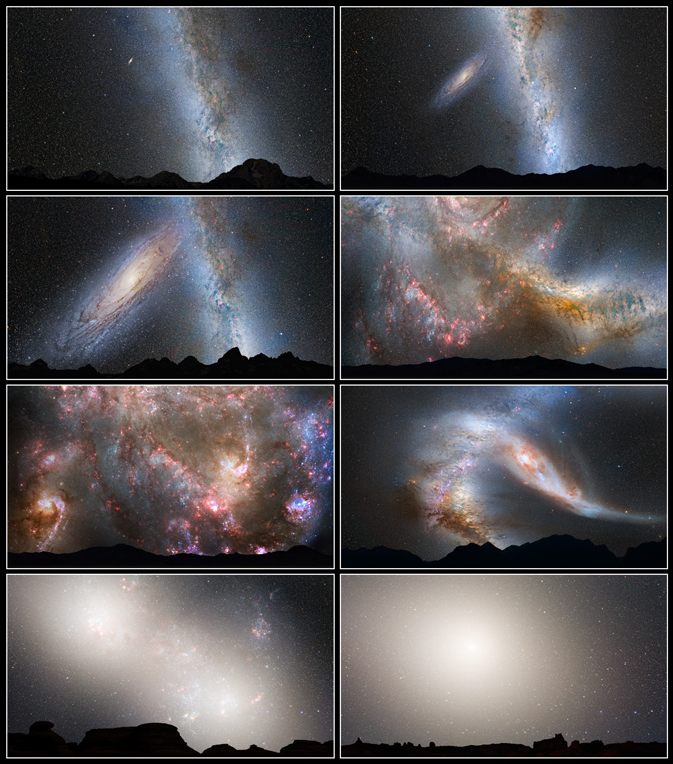
The survey galaxies’ average distance was 330 million light-years from Earth. But the survey results offer a glimpse of what will likely happen closer to home, some 4.5 billion years from now, when our Milky Way galaxy combines with the neighboring Andromeda Galaxy. At that time, as these scientists said:
… their respective central black holes smash together.
This series of illustrations shows the predicted merger – billions of years from now – between our Milky Way galaxy and the neighboring Andromeda Galaxy. Read more about these images, which are via NASA/ESA/Z. Levay and R. van der Marel, STScI/T. Hallas, and A. Mellinger.
Study team member Laura Blecha of the University of Florida, in Gainesville, said:
Computer simulations of galaxy smashups show us that black holes grow fastest during the final stages of mergers, near the time when the black holes interact, and that’s what we have found in our survey.
The fact that black holes grow faster and faster as mergers progress tells us galaxy encounters are really important for our understanding of how these objects got to be so monstrously big.
How big are they? The supermassive black hole at the center of our Milky Way, for example, is thought to be about 4 million times the mass of our sun. The Andromeda Galaxy is bigger than the Milky Way (it’s the biggest galaxy in our Local Group), and its central black hole is bigger, too. Estimates typically run up over 100 million solar masses. Beyond our Local Group, the supermassive black holes inside distant galaxies may be even more massive.
These images reveal the final stage of a union between a pair of galactic nuclei in the messy cores of colliding galaxies. The image at left, taken by Hubble’s Wide Field Camera 3, shows the merging galaxy NGC 6240. A close-up of the two brilliant cores of this galactic union is shown at right. This view, taken in infrared light, pierces the dense cloud of dust and gas encasing the two colliding galaxies and uncovers the active cores. The hefty black holes in these cores are growing quickly as they feast on gas kicked up by the galaxy merger. The black holes’ speedy growth occurs during the last 10 million to 20 million years of the merger. Image via NASA/ESA/M. Koss (Eureka Scientific Inc.).
Galaxy mergers appears to be common events in our universe, and they were even more common in the early universe than they are now. They don’t happen quickly. These astronomers said:
A galaxy merger is a slow process lasting more than a billion years as two galaxies, under the inexorable pull of gravity, dance toward each other before finally joining together.
Simulations reveal that galaxies kick up plenty of gas and dust as they undergo this slow-motion train wreck.
Images of 4 other colliding galaxies, along with close-up views of their coalescing nuclei in the bright cores, are shown beneath the Hubble snapshots of NGC 6240. The left image of each pair, showing the merging galaxies, was taken by the Panoramic Survey Telescope and Rapid Response System (Pan-STARRS). The right image, showing the bright cores, was taken in near-infrared light by the W. M. Keck Observatory in Hawaii, using adaptive optics to sharpen the view. The nuclei in each of the Hubble and Keck Observatory infrared photos are only about 3,000 light-years apart — a near-embrace in cosmic terms. If there are pairs of black holes, they will likely merge within the next 10 million years to form a more massive black hole. Image iva NASA/ESA/M. Koss (Eureka Scientific, Inc.)/W. M. Keck Observatory/Panoramic Survey Telescope and Rapid Response System (Pan-STARRS).
The astronomers described the scene this way:
The ejected material often forms a thick curtain around the centers of the coalescing galaxies, shielding them from view in visible light. Some of the material also falls onto the black holes at the cores of the merging galaxies. The black holes grow at a fast clip as they engorge themselves with their cosmic food, and, being messy eaters, they cause the infalling gas to blaze brightly. This speedy growth occurs during the last 10 million to 20 million years of the union. The Hubble and Keck Observatory images captured close-up views of this final stage, when the bulked-up black holes are only about 3,000 light-years apart — a near-embrace in cosmic terms.
It’s not easy to find galaxy nuclei so close together. Most prior observations of colliding galaxies have caught the coalescing black holes at earlier stages when they were about 10 times farther away. The late stage of the merger process is so elusive because the interacting galaxies are encased in dense dust and gas and require high-resolution observations in infrared light that can see through the clouds and pinpoint the locations of the two merging nuclei.
The team first searched for visually obscured, active black holes by sifting through 10 years’ worth of X-ray data from the Burst Alert Telescope (BAT) aboard NASA’s Neil Gehrels Swift Telescope, a high-energy space observatory. Koss explained:
Gas falling onto the black holes emits X-rays, and the brightness of the X-rays tells you how quickly the black hole is growing. I didn’t know if we would find hidden mergers, but we suspected, based on computer simulations, that they would be in heavily shrouded galaxies.Therefore we tried to peer through the dust with the sharpest images possible, in hopes of finding coalescing black holes.
The researchers combed through the Hubble archive, identifying those merging galaxies they spotted in the X-ray data. They then used the Keck Observatory’s super-sharp, near-infrared vision to observe a larger sample of the X-ray-producing black holes not found in the Hubble archive. Koss said:
People had conducted studies to look for these close interacting black holes before, but what really enabled this particular study were the X-rays that can break through the cocoon of dust. We also looked a bit farther in the universe so that we could survey a larger volume of space, giving us a greater chance of finding more luminous, rapidly growing black holes.
Many of the galaxies within the survey distance of 330 million light-years are similar in size to the Milky Way and Andromeda galaxies. The team analyzed 96 galaxies from the Keck Observatory and 385 galaxies from the Hubble archive found in 38 different Hubble observation programs. The sample galaxies are representative of what astronomers would find by conducting an all-sky survey.
To verify their results, Koss’s team compared the survey galaxies with 176 other galaxies from the Hubble archive that lack actively growing black holes. The comparison confirmed that the luminous cores found in the researchers’ census of dusty interacting galaxies are indeed a signature of rapidly growing black-hole pairs headed for a collision. The astronomers also said:
When the two supermassive black holes in each of these systems finally come together in millions of years, their encounters will produce strong gravitational waves. Gravitational waves produced by the collision of two stellar-mass black holes have already been detected by the Laser Interferometer Gravitational-Wave Observatory (LIGO). Observatories such as the planned NASA/ESA space-based Laser Interferometer Space Antenna (LISA) will be able to detect the lower-frequency gravitational waves from supermassive black-hole mergers, which are a million times more massive than those detected by LIGO.
Future infrared telescopes, such as NASA’s planned James Webb Space Telescope and a new generation of giant ground-based telescopes, will provide an even better probe of dusty galaxy collisions by measuring the masses, growth rate, and dynamics of close black-hole pairs. The Webb telescope may also be able to look in mid-infrared light to uncover more galaxy interactions so encased in thick gas and dust that even near-infrared light cannot penetrate them.
Bottom line: Astronomers observe in the near-infrared to peer through clouds of dust and gas in the cores of distant, merging galaxies, and observe supermassive black holes forming mega black holes.
This simulation shows a merger between 2 galaxies. In the merger’s late stages, the nuclei, or central portions, of the galaxies become very luminous due to emission from gas falling rapidly onto their central supermassive black holes. Read more about this video here.
The University of Florida reported on November 9, 2018, that a team of its researchers – led by led by Michael Koss of Eureka Scientific Inc. in Kirkland, Washington – has just completed the largest-yet survey of the cores of nearby galaxies in near-infrared light. The team used more than 20 years of high-resolution images from the vast archive of the Hubble Space Telescope, and they used images from the W. M. Keck Observatory in Hawaii. Looking in the infrared let them peer through the gas and dust surrounding the galaxies’ cores. They were specifically looking for merging galaxies, places where close pairs of supermassive black holes were coalescing into mega black holes. And they weren’t disappointed. Koss commented in a statement:
Seeing the pairs of merging galaxy nuclei [or cores] associated with these huge black holes, so close together, was pretty amazing.
The survey galaxies’ average distance was 330 million light-years from Earth. But the survey results offer a glimpse of what will likely happen closer to home, some 4.5 billion years from now, when our Milky Way galaxy combines with the neighboring Andromeda Galaxy. At that time, as these scientists said:
… their respective central black holes smash together.
This series of illustrations shows the predicted merger – billions of years from now – between our Milky Way galaxy and the neighboring Andromeda Galaxy. Read more about these images, which are via NASA/ESA/Z. Levay and R. van der Marel, STScI/T. Hallas, and A. Mellinger.
Study team member Laura Blecha of the University of Florida, in Gainesville, said:
Computer simulations of galaxy smashups show us that black holes grow fastest during the final stages of mergers, near the time when the black holes interact, and that’s what we have found in our survey.
The fact that black holes grow faster and faster as mergers progress tells us galaxy encounters are really important for our understanding of how these objects got to be so monstrously big.
How big are they? The supermassive black hole at the center of our Milky Way, for example, is thought to be about 4 million times the mass of our sun. The Andromeda Galaxy is bigger than the Milky Way (it’s the biggest galaxy in our Local Group), and its central black hole is bigger, too. Estimates typically run up over 100 million solar masses. Beyond our Local Group, the supermassive black holes inside distant galaxies may be even more massive.
These images reveal the final stage of a union between a pair of galactic nuclei in the messy cores of colliding galaxies. The image at left, taken by Hubble’s Wide Field Camera 3, shows the merging galaxy NGC 6240. A close-up of the two brilliant cores of this galactic union is shown at right. This view, taken in infrared light, pierces the dense cloud of dust and gas encasing the two colliding galaxies and uncovers the active cores. The hefty black holes in these cores are growing quickly as they feast on gas kicked up by the galaxy merger. The black holes’ speedy growth occurs during the last 10 million to 20 million years of the merger. Image via NASA/ESA/M. Koss (Eureka Scientific Inc.).
Galaxy mergers appears to be common events in our universe, and they were even more common in the early universe than they are now. They don’t happen quickly. These astronomers said:
A galaxy merger is a slow process lasting more than a billion years as two galaxies, under the inexorable pull of gravity, dance toward each other before finally joining together.
Simulations reveal that galaxies kick up plenty of gas and dust as they undergo this slow-motion train wreck.
Images of 4 other colliding galaxies, along with close-up views of their coalescing nuclei in the bright cores, are shown beneath the Hubble snapshots of NGC 6240. The left image of each pair, showing the merging galaxies, was taken by the Panoramic Survey Telescope and Rapid Response System (Pan-STARRS). The right image, showing the bright cores, was taken in near-infrared light by the W. M. Keck Observatory in Hawaii, using adaptive optics to sharpen the view. The nuclei in each of the Hubble and Keck Observatory infrared photos are only about 3,000 light-years apart — a near-embrace in cosmic terms. If there are pairs of black holes, they will likely merge within the next 10 million years to form a more massive black hole. Image iva NASA/ESA/M. Koss (Eureka Scientific, Inc.)/W. M. Keck Observatory/Panoramic Survey Telescope and Rapid Response System (Pan-STARRS).
The astronomers described the scene this way:
The ejected material often forms a thick curtain around the centers of the coalescing galaxies, shielding them from view in visible light. Some of the material also falls onto the black holes at the cores of the merging galaxies. The black holes grow at a fast clip as they engorge themselves with their cosmic food, and, being messy eaters, they cause the infalling gas to blaze brightly. This speedy growth occurs during the last 10 million to 20 million years of the union. The Hubble and Keck Observatory images captured close-up views of this final stage, when the bulked-up black holes are only about 3,000 light-years apart — a near-embrace in cosmic terms.
It’s not easy to find galaxy nuclei so close together. Most prior observations of colliding galaxies have caught the coalescing black holes at earlier stages when they were about 10 times farther away. The late stage of the merger process is so elusive because the interacting galaxies are encased in dense dust and gas and require high-resolution observations in infrared light that can see through the clouds and pinpoint the locations of the two merging nuclei.
The team first searched for visually obscured, active black holes by sifting through 10 years’ worth of X-ray data from the Burst Alert Telescope (BAT) aboard NASA’s Neil Gehrels Swift Telescope, a high-energy space observatory. Koss explained:
Gas falling onto the black holes emits X-rays, and the brightness of the X-rays tells you how quickly the black hole is growing. I didn’t know if we would find hidden mergers, but we suspected, based on computer simulations, that they would be in heavily shrouded galaxies.Therefore we tried to peer through the dust with the sharpest images possible, in hopes of finding coalescing black holes.
The researchers combed through the Hubble archive, identifying those merging galaxies they spotted in the X-ray data. They then used the Keck Observatory’s super-sharp, near-infrared vision to observe a larger sample of the X-ray-producing black holes not found in the Hubble archive. Koss said:
People had conducted studies to look for these close interacting black holes before, but what really enabled this particular study were the X-rays that can break through the cocoon of dust. We also looked a bit farther in the universe so that we could survey a larger volume of space, giving us a greater chance of finding more luminous, rapidly growing black holes.
Many of the galaxies within the survey distance of 330 million light-years are similar in size to the Milky Way and Andromeda galaxies. The team analyzed 96 galaxies from the Keck Observatory and 385 galaxies from the Hubble archive found in 38 different Hubble observation programs. The sample galaxies are representative of what astronomers would find by conducting an all-sky survey.
To verify their results, Koss’s team compared the survey galaxies with 176 other galaxies from the Hubble archive that lack actively growing black holes. The comparison confirmed that the luminous cores found in the researchers’ census of dusty interacting galaxies are indeed a signature of rapidly growing black-hole pairs headed for a collision. The astronomers also said:
When the two supermassive black holes in each of these systems finally come together in millions of years, their encounters will produce strong gravitational waves. Gravitational waves produced by the collision of two stellar-mass black holes have already been detected by the Laser Interferometer Gravitational-Wave Observatory (LIGO). Observatories such as the planned NASA/ESA space-based Laser Interferometer Space Antenna (LISA) will be able to detect the lower-frequency gravitational waves from supermassive black-hole mergers, which are a million times more massive than those detected by LIGO.
Future infrared telescopes, such as NASA’s planned James Webb Space Telescope and a new generation of giant ground-based telescopes, will provide an even better probe of dusty galaxy collisions by measuring the masses, growth rate, and dynamics of close black-hole pairs. The Webb telescope may also be able to look in mid-infrared light to uncover more galaxy interactions so encased in thick gas and dust that even near-infrared light cannot penetrate them.
Bottom line: Astronomers observe in the near-infrared to peer through clouds of dust and gas in the cores of distant, merging galaxies, and observe supermassive black holes forming mega black holes.