aads

View from space: Camp Fire burns through Paradise

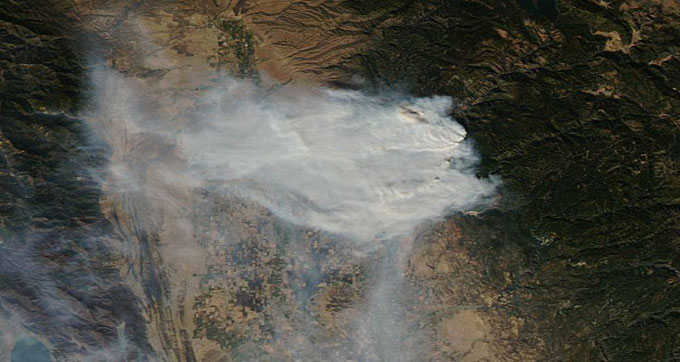
Short-wave infrared (red) captured by Landsat 8 satellite shows the full extent of the actively burning area of the Camp Fire 4 hours after it started on November 8, 2018. The red patches are fires that leapfrogged in front of the primary burn front, which was growing at a rate of approximately 3 miles (5 km) per hour. The northeastern, upwind edge of the burn lies beneath and parallel to three high-tension power lines running along Highway 70, about a mile and a half northeast of a town called Pulga and a site identified as a possible origin of the fire.Earth Engine image by Jeff Chambers.

On Thursday (November 15, 2018), University of California Berkeley released a series of satellite images of the area around Paradise, California that captured the Camp Fire on November 8, 2018, when the fire was only four hours old, yet had already burned halfway through the city.

The images were generated by Jeff Chambers, a Berkeley professor of geography. Chambers used Google’s Earth Engine, which combines an analysis platform, detailed maps, and daily downloads of publicly-available Earth-imaging data from orbiting satellites. The Landsat 8 satellite happened to snap its once-every-16-days shot of that area at 10:45 a.m. local time on Thursday, November 8. See more images here.

Chambers used the satellite data to clock the fire’s speed at about 3 miles (5 km) per hour during its first four hours, driven in part by flying embers that caused the fire to leapfrog up to 2.5 miles (4 km) ahead of the advancing fire front.

As of Thursday, the Camp Fire had scorched 140,000 acres, left at least 56 people dead and destroyed more than 8,700 residences, making it the most destructive fire in California history. It is only 40 percent contained.

Via Berkeley

Bottom line: Satellite image of the area around Paradise, California, on the morning of November 8, 2018 shows the Camp Fire when it was only 4 hours old, yet had already burned halfway through the city.

The 2019 lunar calendars are here! Order yours before they’re gone. Makes a great gift.


from EarthSky https://ift.tt/2QLEHBv

Short-wave infrared (red) captured by Landsat 8 satellite shows the full extent of the actively burning area of the Camp Fire 4 hours after it started on November 8, 2018. The red patches are fires that leapfrogged in front of the primary burn front, which was growing at a rate of approximately 3 miles (5 km) per hour. The northeastern, upwind edge of the burn lies beneath and parallel to three high-tension power lines running along Highway 70, about a mile and a half northeast of a town called Pulga and a site identified as a possible origin of the fire.Earth Engine image by Jeff Chambers.

On Thursday (November 15, 2018), University of California Berkeley released a series of satellite images of the area around Paradise, California that captured the Camp Fire on November 8, 2018, when the fire was only four hours old, yet had already burned halfway through the city.

The images were generated by Jeff Chambers, a Berkeley professor of geography. Chambers used Google’s Earth Engine, which combines an analysis platform, detailed maps, and daily downloads of publicly-available Earth-imaging data from orbiting satellites. The Landsat 8 satellite happened to snap its once-every-16-days shot of that area at 10:45 a.m. local time on Thursday, November 8. See more images here.

Chambers used the satellite data to clock the fire’s speed at about 3 miles (5 km) per hour during its first four hours, driven in part by flying embers that caused the fire to leapfrog up to 2.5 miles (4 km) ahead of the advancing fire front.

As of Thursday, the Camp Fire had scorched 140,000 acres, left at least 56 people dead and destroyed more than 8,700 residences, making it the most destructive fire in California history. It is only 40 percent contained.

Via Berkeley

Bottom line: Satellite image of the area around Paradise, California, on the morning of November 8, 2018 shows the Camp Fire when it was only 4 hours old, yet had already burned halfway through the city.

The 2019 lunar calendars are here! Order yours before they’re gone. Makes a great gift.


from EarthSky https://ift.tt/2QLEHBv

News digest – NHS staff shortages, cervical screening error, HPV jab catch-up and ‘fat-clogged’ cells

NHS staff shortages could reach 350,000 by 2030

The NHS faces a growing staff crisis that could leave hospitals short of 350,000 staff by 2030, reports The Guardian. The figures come from three leading health sector think tanks, who warn that not addressing the staffing gap could lead to spiralling waiting times and worsening patient care.

We’ve estimated that NHS cancer staff numbers will need to double in the next 10 years to cope with growing demand. Our blog post has the figures.

Targeted drug gets initial ‘no’ for women with advanced ovarian cancer

The targeted drug olaparib (Lynparza) has been initially rejected on the NHS for women with advanced ovarian cancer whose cells carry a faulty BRCA gene and have previously responded to chemotherapy, reports the Mail Online. Olaparib is already used to treat these women on the NHS at later stages of their disease after other rounds treatment, but extending its use wasn’t deemed cost-effective. The initial review came after clinical trial results showed offering olaparib earlier could hold the disease at bay after chemo. The decision will be reviewed in April 2019.

Standard chemo still most effective for HPV-positive throat cancer

Standard chemotherapy remains the most effective way to treatment throat cancer caused by the human papillomavirus (HPV). Patients treated with radiotherapy and the chemotherapy drug cisplatin were more likely to be alive 2 years later than those treated with radiotherapy and a targeted drug. And side effects were similar in both groups. Our news report has the details.

Cervical screening letter error affects nearly 50,000 women

Almost 50,000 women weren’t sent NHS letters about cervical screening, reports the Telegraph. Some of these letters contained screening results, but the majority are believed to have been appointment invitations or reminders. NHS England say that so far, the error isn’t known to have caused any harm.

Cancer screening review launched in England

NHS England has launched a review of cancer screening programmes, reports BBC News. The review will cover the 3 national screening programmes – breast, cervical and bowel – and will look at if they’re making the best use of technology and how to ensure the necessary staff are trained to deliver the programmes. The review will also look to learn lessons from the recent high-profile cervical and breast screening mistakes. The report is expected next summer.

Boys may not be offered HPV ‘catch-up’ jab

The Government may not offer boys ‘catch-up’ vaccinations for 14 to 18 year old bolds who will miss out on the HPV vaccine, reports Pulse and the Mail Online. Earlier this year, the Government announced that boys in England would be offered the human papillomavirus (HPV) jab, which had previously only been available for girls. HPV linked to 7 cancers, including throat, penis and cervical cancers. Read our blog post for details on the proposed boys’ vaccination programme.

Are smokers who spend time with vapers more likely to attempt to quit?

New research, funded by Cancer Research UK, found that smokers who regularly spend time with vapers were around 20% more likely to have made a recent attempt to quit. But the researchers believe that spending time with vapers was not the reason behind the recent quit attempt. A much stronger indicator was if an individual used an e-cigarette themselves. ITV News has the story.

Statins prevent breast cancer spread in mice

Scientists have found that cholesterol-lowering drugs, called statins, could help prevent breast cancer spreading to other organs in mice. The Sun covered the early research, which tested the drug in mice and on human cells in the lab. In these experiments, statins reduced the growth of breast cancer cells in other organs like the lungs and the liver, but the drug didn’t stop the growth of the original tumour. Clinical trials will be needed to test if the drug could benefit people with breast cancer.

BBC Radio 5 Live visits the Francis Crick Institute

On Wednesday, BBC Radio 5 Live joined us at the Francis Crick Institute in London, speaking to some of our amazing researchers and patient advocates, as well as our executive director of Research and Innovation.

Call for UK ‘freakshake’ ban

Campaign group Action on Sugar called for a ban on so-called ‘freakshakes’ and milkshakes with over 300 calories this week, the Independent reports. Freakshakes are milkshakes that have extra sweets, cake and chocolates added. One high street restaurant was found to sell a 1280 calorie freakshake that contained 39 teaspoons of sugar.

And finally

Scientists have uncovered a potential new explanation for how obesity can affect the immune system. BBC News covered the new research, which found that fatty by-products can accumulate in type of immune cell that play an important role in killing cancer cells. In lab tests this ‘fat-clogging’ stopped the immune cells from working properly. But the BBC’s headline was a stretch to suggest this definitively explains how obesity causes cancer. Find out more about the leading theories for how obesity can cause cancer in this blog post.

Katie


from Cancer Research UK – Science blog https://ift.tt/2PBbKf6

NHS staff shortages could reach 350,000 by 2030

The NHS faces a growing staff crisis that could leave hospitals short of 350,000 staff by 2030, reports The Guardian. The figures come from three leading health sector think tanks, who warn that not addressing the staffing gap could lead to spiralling waiting times and worsening patient care.

We’ve estimated that NHS cancer staff numbers will need to double in the next 10 years to cope with growing demand. Our blog post has the figures.

Targeted drug gets initial ‘no’ for women with advanced ovarian cancer

The targeted drug olaparib (Lynparza) has been initially rejected on the NHS for women with advanced ovarian cancer whose cells carry a faulty BRCA gene and have previously responded to chemotherapy, reports the Mail Online. Olaparib is already used to treat these women on the NHS at later stages of their disease after other rounds treatment, but extending its use wasn’t deemed cost-effective. The initial review came after clinical trial results showed offering olaparib earlier could hold the disease at bay after chemo. The decision will be reviewed in April 2019.

Standard chemo still most effective for HPV-positive throat cancer

Standard chemotherapy remains the most effective way to treatment throat cancer caused by the human papillomavirus (HPV). Patients treated with radiotherapy and the chemotherapy drug cisplatin were more likely to be alive 2 years later than those treated with radiotherapy and a targeted drug. And side effects were similar in both groups. Our news report has the details.

Cervical screening letter error affects nearly 50,000 women

Almost 50,000 women weren’t sent NHS letters about cervical screening, reports the Telegraph. Some of these letters contained screening results, but the majority are believed to have been appointment invitations or reminders. NHS England say that so far, the error isn’t known to have caused any harm.

Cancer screening review launched in England

NHS England has launched a review of cancer screening programmes, reports BBC News. The review will cover the 3 national screening programmes – breast, cervical and bowel – and will look at if they’re making the best use of technology and how to ensure the necessary staff are trained to deliver the programmes. The review will also look to learn lessons from the recent high-profile cervical and breast screening mistakes. The report is expected next summer.

Boys may not be offered HPV ‘catch-up’ jab

The Government may not offer boys ‘catch-up’ vaccinations for 14 to 18 year old bolds who will miss out on the HPV vaccine, reports Pulse and the Mail Online. Earlier this year, the Government announced that boys in England would be offered the human papillomavirus (HPV) jab, which had previously only been available for girls. HPV linked to 7 cancers, including throat, penis and cervical cancers. Read our blog post for details on the proposed boys’ vaccination programme.

Are smokers who spend time with vapers more likely to attempt to quit?

New research, funded by Cancer Research UK, found that smokers who regularly spend time with vapers were around 20% more likely to have made a recent attempt to quit. But the researchers believe that spending time with vapers was not the reason behind the recent quit attempt. A much stronger indicator was if an individual used an e-cigarette themselves. ITV News has the story.

Statins prevent breast cancer spread in mice

Scientists have found that cholesterol-lowering drugs, called statins, could help prevent breast cancer spreading to other organs in mice. The Sun covered the early research, which tested the drug in mice and on human cells in the lab. In these experiments, statins reduced the growth of breast cancer cells in other organs like the lungs and the liver, but the drug didn’t stop the growth of the original tumour. Clinical trials will be needed to test if the drug could benefit people with breast cancer.

BBC Radio 5 Live visits the Francis Crick Institute

On Wednesday, BBC Radio 5 Live joined us at the Francis Crick Institute in London, speaking to some of our amazing researchers and patient advocates, as well as our executive director of Research and Innovation.

Call for UK ‘freakshake’ ban

Campaign group Action on Sugar called for a ban on so-called ‘freakshakes’ and milkshakes with over 300 calories this week, the Independent reports. Freakshakes are milkshakes that have extra sweets, cake and chocolates added. One high street restaurant was found to sell a 1280 calorie freakshake that contained 39 teaspoons of sugar.

And finally

Scientists have uncovered a potential new explanation for how obesity can affect the immune system. BBC News covered the new research, which found that fatty by-products can accumulate in type of immune cell that play an important role in killing cancer cells. In lab tests this ‘fat-clogging’ stopped the immune cells from working properly. But the BBC’s headline was a stretch to suggest this definitively explains how obesity causes cancer. Find out more about the leading theories for how obesity can cause cancer in this blog post.

Katie


from Cancer Research UK – Science blog https://ift.tt/2PBbKf6

Science Surgery: ‘Why do never-smokers get lung cancer?’

This entry is part of 12 in the series Science Surgery

Our Science Surgery series answers your cancer science questions.

Janette asked: “Why do never-smokers get lung cancer?”

“It’s a question that often comes up in the clinic,” says Dr Mariam Jamal-Hanjani, an oncologist and clinical researcher specialising in lung cancer at University College London. “And it’s one that researchers have been asking for decades.”

The link between smoking and lung cancer has been known for almost 70 years. It’s the biggest cause of lung cancer in the UK, with around 7 in 10 lung cancers caused by smoking cigarettes. But there’s also a group of people who develop lung cancer and have never lit a cigarette.

“Around 10-15% of the lung cancer patients I see have never smoked,” says Jamal-Hanjani, who’s working on two Cancer Research UK-funded studies. “But we don’t always know why it is that these people get lung cancer.”

According to Jamal-Hanjani, the data suggests that genetics play a role, as well as environmental or occupational exposures.

Spotting DNA differences

When you compare lung cancers in smokers and never-smokers, differences start to emerge. The first of which is the types of lung cancer they develop.

“Smokers can develop all types of lung cancers, although the association is stronger for small cell lung cancer and squamous cell carcinoma, whereas never-smokers are more likely to develop a non small cell lung cancer called lung adenocarcinoma,” says Jamal-Hanjani.

Types of lung cancer

Lung cancer is divided into 2 main groups:

  • small cell lung cancer, and
  • non small cell lung cancer.

They behave in different ways and respond to treatment differently. Around 9 in 10 lung cancers are small cell lung cancer.

There are also differences when you look at the DNA inside the tumour cells.

Non-smokers who develop lung cancer are more likely to have cells with a fault in a gene called EGFR. This fault is commonly found in Asian women who had never smoked and developed lung cancer. But according to Jamal-Hanjani, it’s seen in other people too.

“If you’ve never smoked you’re more likely to have a lung cancer that’s driven by a fault in one or potentially more genes,” she says. “And these aren’t necessarily genetic faults that you’re born with, they’re faults that develop during someone’s lifetime.”

These DNA faults can offer up new options for treatment. For example, changes in the EGFR gene can be targeted by drugs like elortinib (Tarceva) and gefitinib (Iressa).

Looking for environmental risks

To understand what might increase someone’s risk of cancer, researchers study large groups of people for many years, to look for links between exposure to something and lung cancer.

“These are really tough studies because they need to involve big numbers of people and long periods of follow up. And you need to clearly demonstrate that people who were exposed to something develop cancer, and that there are no other factors that could explain the association.”

To make it easier to exclude other risk factors, scientists will often run ‘case controlled’ studies.

“You might have one person who was exposed to second hand smoke, and then you’ll have another patient within the study who’s matched to that person in every way other than the fact they weren’t exposed to second hand smoke,” says Jamal-Hanjani. “And then you look in big numbers to see if the group of patients who were exposed to smoke were more likely to develop lung cancer.”

Studies like this have shown that being exposed to second hand smoke, for example by living with someone who smokes, can increase a person’s risk of lung cancer by almost a third.

Researchers have also discovered that exposure to asbestos, radon gas or tiny particles that come from diesel exhausts and construction sites can increase someone’s risk of lung cancer. But the individual risks are small.

Staying vigilant

Overall, the risk of developing lung cancer if you’ve never smoked is far lower than if you have or still do. But Jamal-Hanjani says that this shouldn’t lead to a blind sense of security.

“I’ve had patients who had a persistent cough or who were coughing up blood, but believed that because they had never smoked they couldn’t possibly have lung cancer. And it’s not true. There’s still a chance they could develop lung cancer and it not have anything to do with cigarettes. So, people should always seek advice from their doctor if they notice any changes.”

Katie

We’d like to thank Janette for asking this question. If you’d like to ask us something, post a comment below or email sciencesurgery@cancer.org.uk with your question and first name. 


from Cancer Research UK – Science blog https://ift.tt/2ON0w1z

This entry is part of 12 in the series Science Surgery

Our Science Surgery series answers your cancer science questions.

Janette asked: “Why do never-smokers get lung cancer?”

“It’s a question that often comes up in the clinic,” says Dr Mariam Jamal-Hanjani, an oncologist and clinical researcher specialising in lung cancer at University College London. “And it’s one that researchers have been asking for decades.”

The link between smoking and lung cancer has been known for almost 70 years. It’s the biggest cause of lung cancer in the UK, with around 7 in 10 lung cancers caused by smoking cigarettes. But there’s also a group of people who develop lung cancer and have never lit a cigarette.

“Around 10-15% of the lung cancer patients I see have never smoked,” says Jamal-Hanjani, who’s working on two Cancer Research UK-funded studies. “But we don’t always know why it is that these people get lung cancer.”

According to Jamal-Hanjani, the data suggests that genetics play a role, as well as environmental or occupational exposures.

Spotting DNA differences

When you compare lung cancers in smokers and never-smokers, differences start to emerge. The first of which is the types of lung cancer they develop.

“Smokers can develop all types of lung cancers, although the association is stronger for small cell lung cancer and squamous cell carcinoma, whereas never-smokers are more likely to develop a non small cell lung cancer called lung adenocarcinoma,” says Jamal-Hanjani.

Types of lung cancer

Lung cancer is divided into 2 main groups:

  • small cell lung cancer, and
  • non small cell lung cancer.

They behave in different ways and respond to treatment differently. Around 9 in 10 lung cancers are small cell lung cancer.

There are also differences when you look at the DNA inside the tumour cells.

Non-smokers who develop lung cancer are more likely to have cells with a fault in a gene called EGFR. This fault is commonly found in Asian women who had never smoked and developed lung cancer. But according to Jamal-Hanjani, it’s seen in other people too.

“If you’ve never smoked you’re more likely to have a lung cancer that’s driven by a fault in one or potentially more genes,” she says. “And these aren’t necessarily genetic faults that you’re born with, they’re faults that develop during someone’s lifetime.”

These DNA faults can offer up new options for treatment. For example, changes in the EGFR gene can be targeted by drugs like elortinib (Tarceva) and gefitinib (Iressa).

Looking for environmental risks

To understand what might increase someone’s risk of cancer, researchers study large groups of people for many years, to look for links between exposure to something and lung cancer.

“These are really tough studies because they need to involve big numbers of people and long periods of follow up. And you need to clearly demonstrate that people who were exposed to something develop cancer, and that there are no other factors that could explain the association.”

To make it easier to exclude other risk factors, scientists will often run ‘case controlled’ studies.

“You might have one person who was exposed to second hand smoke, and then you’ll have another patient within the study who’s matched to that person in every way other than the fact they weren’t exposed to second hand smoke,” says Jamal-Hanjani. “And then you look in big numbers to see if the group of patients who were exposed to smoke were more likely to develop lung cancer.”

Studies like this have shown that being exposed to second hand smoke, for example by living with someone who smokes, can increase a person’s risk of lung cancer by almost a third.

Researchers have also discovered that exposure to asbestos, radon gas or tiny particles that come from diesel exhausts and construction sites can increase someone’s risk of lung cancer. But the individual risks are small.

Staying vigilant

Overall, the risk of developing lung cancer if you’ve never smoked is far lower than if you have or still do. But Jamal-Hanjani says that this shouldn’t lead to a blind sense of security.

“I’ve had patients who had a persistent cough or who were coughing up blood, but believed that because they had never smoked they couldn’t possibly have lung cancer. And it’s not true. There’s still a chance they could develop lung cancer and it not have anything to do with cigarettes. So, people should always seek advice from their doctor if they notice any changes.”

Katie

We’d like to thank Janette for asking this question. If you’d like to ask us something, post a comment below or email sciencesurgery@cancer.org.uk with your question and first name. 


from Cancer Research UK – Science blog https://ift.tt/2ON0w1z

The many ways climate change worsens California wildfires

This is the first entry in a Dana's new monthly column with Yale Climate Connections

NASA photoNow designated as California’s deadliest fire, the still-raging Camp Fire by November 13 had led to 42 deaths, with many residents still unaccounted for and more than 7,000 structures destroyed. (Image credit: NASA)

California has been ravaged by record wildfires in recent years. 2017 was the state’s costliest and most destructive fire season on record. The Mendocino wildfire in July 2018 was California’s largest-ever by a whopping 60 percent.

Even though California’s wildfire season has traditionally ended in October, the Camp Fire raging in November 2018 is the state’s most destructive on record.

The data tell the story: Six of California’s ten most destructive wildfires on record have now struck in just the past three years.

President Trump’s tweets suggesting forest mismanagement is to blame for California’s wildfire woes, and threatening to withhold federal funding, have prompted widespread rebukes for their insensitivity as thousands of citizens flee the fires – some, tragically, unsuccessfully – and as an affront to thousands of weary firefighters.

The reality is that about 57 percent of the state’s forests are owned and managed by the federal government, and another 40 percent by families, companies, and Native American tribes. Forest management does play some role in creating wildfire fuel, but some wildfires aren’t even located in forests. Moreover, scientific evidence clearly shows that climate change is exacerbating California’s wildfires in different ways:

  • Higher temperatures dry out vegetation and soil, creating more wildfire fuel.'
  • Climate change is shortening the California rainy season, thus extending the fire season.
  • Climate change is also strengthening the Santa Ana winds that fan particularly dangerous wildfires in Southern California.
  • The warming atmosphere is slowing the jet stream, leading to more California heat waves and high-pressure ridges in the Pacific. Those ridges deflect from the state some storms that would otherwise bring much-needed moisture to slow the spread of fires.

The Golden State’s hotter, drier conditions

Global warming causes higher temperatures, and 2014 through 2018 have been California’s five hottest years on record. This pattern leads to an increase in evapotranspiration – the combination of evaporation and transpiration transferring more moisture from land and water surfaces and plants to the atmosphere. Essentially, global warming causes plants and soil to dry out as the atmosphere holds more water vapor.

On top of this direct drying effect, climate change is causing a shift in rain patterns. Northern California has received only one inch of rain this season, which is about one-fifth of normal. A 2018 paper published in Nature Climate Change, led by UCLA’s Daniel Swain, found that as a result of global warming, California’s rainy season will become increasingly concentrated in the winter months between December and February. April, May, September, October, and November will become increasingly dry, meaning that the state’s wildfire season will start earlier and end later. As Swain noted in an informative Twitter thread about California’s November 2018 wildfires,

If Northern California had received anywhere near the typical amount of autumn precipitation this year (around 4-5 in. of rain near #CampFire point of origin), explosive fire behavior & stunning tragedy in #Paradise would almost certainly not have occurred.

With these hotter, drier conditions extending late into the year, wildfires have become larger, and they spread faster, cause more damage, and are more difficult to contain.

In Southern California, stronger Santa Ana winds

In a 2006 paper published in Geophysical Research letters, Berkeley scientists Norman Miller and Nicole Schlegel predicted that global warming would push the Southern California fire season associated with Santa Ana winds into the winter months. Those Santa Ana fires are especially costly because of the speed at which they spread due to the winds and because of their proximity to urban areas. The November 2018 Woolsey fire around Malibu and Thousand Oaks, California, is a tragic example.

Researchers of a 2015 study published in Environmental Research Letters, led by Yufang Jin at UC Davis, forecast that the area burned by Southern California wildfires will increase by about 70 percent by mid-century as a result of the drier, hotter, windier conditions caused by global warming. And these Southern California wildfires often occur outside of forests, according to the president of the Pasadena Fire Association.

Connections to the Arctic and jet stream

Rutgers climate scientist Jennifer Francis over the past decade has been researching the connection between changes in the Arctic and extreme weather patterns throughout the Northern Hemisphere. In recent years a growing number of climate scientists have found evidence supporting her groundbreaking research.

The Northern Hemisphere jet stream is a result of the temperature difference between the cold Arctic and warmer lower latitudes in regions like North America and Europe. But the Arctic is the fastest-warming region on Earth, largely because as reflective sea ice disappears, the Arctic surface is increasingly covered by dark oceans that absorb more sunlight. The rapidly-warming Arctic is shrinking the temperature difference between that region and the lower latitudes, which in turn weakens the jet stream. As a result, rather than a fast-moving flow of air, the jet stream increasingly is taking a slow, meandering path across the Northern Hemisphere.

Click here to read the rest


from Skeptical Science https://ift.tt/2DHptdW

This is the first entry in a Dana's new monthly column with Yale Climate Connections

NASA photoNow designated as California’s deadliest fire, the still-raging Camp Fire by November 13 had led to 42 deaths, with many residents still unaccounted for and more than 7,000 structures destroyed. (Image credit: NASA)

California has been ravaged by record wildfires in recent years. 2017 was the state’s costliest and most destructive fire season on record. The Mendocino wildfire in July 2018 was California’s largest-ever by a whopping 60 percent.

Even though California’s wildfire season has traditionally ended in October, the Camp Fire raging in November 2018 is the state’s most destructive on record.

The data tell the story: Six of California’s ten most destructive wildfires on record have now struck in just the past three years.

President Trump’s tweets suggesting forest mismanagement is to blame for California’s wildfire woes, and threatening to withhold federal funding, have prompted widespread rebukes for their insensitivity as thousands of citizens flee the fires – some, tragically, unsuccessfully – and as an affront to thousands of weary firefighters.

The reality is that about 57 percent of the state’s forests are owned and managed by the federal government, and another 40 percent by families, companies, and Native American tribes. Forest management does play some role in creating wildfire fuel, but some wildfires aren’t even located in forests. Moreover, scientific evidence clearly shows that climate change is exacerbating California’s wildfires in different ways:

  • Higher temperatures dry out vegetation and soil, creating more wildfire fuel.'
  • Climate change is shortening the California rainy season, thus extending the fire season.
  • Climate change is also strengthening the Santa Ana winds that fan particularly dangerous wildfires in Southern California.
  • The warming atmosphere is slowing the jet stream, leading to more California heat waves and high-pressure ridges in the Pacific. Those ridges deflect from the state some storms that would otherwise bring much-needed moisture to slow the spread of fires.

The Golden State’s hotter, drier conditions

Global warming causes higher temperatures, and 2014 through 2018 have been California’s five hottest years on record. This pattern leads to an increase in evapotranspiration – the combination of evaporation and transpiration transferring more moisture from land and water surfaces and plants to the atmosphere. Essentially, global warming causes plants and soil to dry out as the atmosphere holds more water vapor.

On top of this direct drying effect, climate change is causing a shift in rain patterns. Northern California has received only one inch of rain this season, which is about one-fifth of normal. A 2018 paper published in Nature Climate Change, led by UCLA’s Daniel Swain, found that as a result of global warming, California’s rainy season will become increasingly concentrated in the winter months between December and February. April, May, September, October, and November will become increasingly dry, meaning that the state’s wildfire season will start earlier and end later. As Swain noted in an informative Twitter thread about California’s November 2018 wildfires,

If Northern California had received anywhere near the typical amount of autumn precipitation this year (around 4-5 in. of rain near #CampFire point of origin), explosive fire behavior & stunning tragedy in #Paradise would almost certainly not have occurred.

With these hotter, drier conditions extending late into the year, wildfires have become larger, and they spread faster, cause more damage, and are more difficult to contain.

In Southern California, stronger Santa Ana winds

In a 2006 paper published in Geophysical Research letters, Berkeley scientists Norman Miller and Nicole Schlegel predicted that global warming would push the Southern California fire season associated with Santa Ana winds into the winter months. Those Santa Ana fires are especially costly because of the speed at which they spread due to the winds and because of their proximity to urban areas. The November 2018 Woolsey fire around Malibu and Thousand Oaks, California, is a tragic example.

Researchers of a 2015 study published in Environmental Research Letters, led by Yufang Jin at UC Davis, forecast that the area burned by Southern California wildfires will increase by about 70 percent by mid-century as a result of the drier, hotter, windier conditions caused by global warming. And these Southern California wildfires often occur outside of forests, according to the president of the Pasadena Fire Association.

Connections to the Arctic and jet stream

Rutgers climate scientist Jennifer Francis over the past decade has been researching the connection between changes in the Arctic and extreme weather patterns throughout the Northern Hemisphere. In recent years a growing number of climate scientists have found evidence supporting her groundbreaking research.

The Northern Hemisphere jet stream is a result of the temperature difference between the cold Arctic and warmer lower latitudes in regions like North America and Europe. But the Arctic is the fastest-warming region on Earth, largely because as reflective sea ice disappears, the Arctic surface is increasingly covered by dark oceans that absorb more sunlight. The rapidly-warming Arctic is shrinking the temperature difference between that region and the lower latitudes, which in turn weakens the jet stream. As a result, rather than a fast-moving flow of air, the jet stream increasingly is taking a slow, meandering path across the Northern Hemisphere.

Click here to read the rest


from Skeptical Science https://ift.tt/2DHptdW

Climate science comeback strategies: Al Gore said what?

This is a re-post from Yale Climate Connections by Karin Kirk
Communicating imageCredit: Image by Karin Kirk.

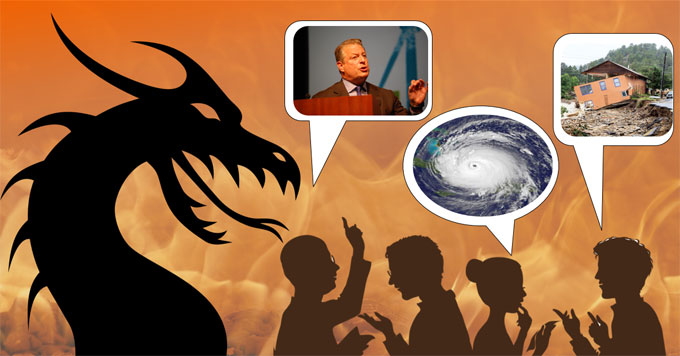
Don’t feed the trolls. You’ve heard this advice before, but how can anyone sit on their hands when the trolls are just so … wrong? When you encounter a rude and inaccurate comment, often the best bet is to ignore it altogether. But if you’re feeling inspired, you can look beyond the toxicity and aim for a productive outcome. The thing you ought not do, however, is take the bait and lock horns with the offender. That’s a certain path to a lose-lose situation.

What would you do if confronted with this comment?

The High Priest of Environmental Causes Al Gore was out promoting his waste of cellulose In January, 2006 – when promoting his Oscar-winning (yes, Oscar-winning) documentary, An Inconvenient Truth – Gore declared that unless we took “drastic measures” to reduce greenhouse gasses, the world would reach a “point of no return” in a mere ten years. He called it a “true planetary emergency.” Well, the ten years passed today, we’re still here, and the climate activists have postponed the apocalypse. Again.

Tracing the spread of the myth

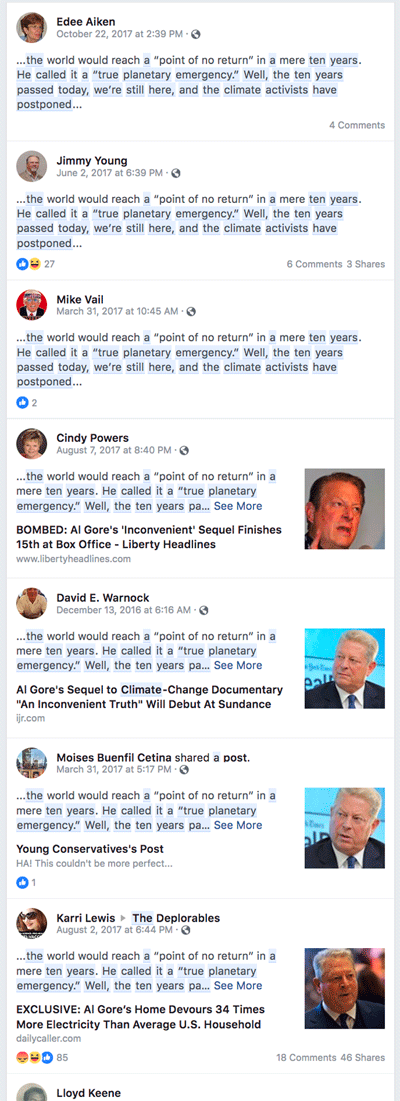
This gem appeared among a volley of comments on the Facebook page of a science advocacy organization. But the text was not the work of the commenter.
Facebook posts

Further searching revealed the origin of this snippet. By plugging parts of the quote into a search engine and comparing the dates of publication, it was possible to track the spread of this quote across the web. The original idea appeared to emerge from a climate denial blog. A few weeks later, the same sentiment resurfaced, with obviously similar wording, in an article in the National Review, a conservative publication. From there, the quote has been circulated widely by climate contrarians, and in some cases, spread by what appear to be fake social media accounts.

This small example shows how misinformation germinates within dubious sources like anti-science blogs, then spreads into sympathetic media, and gets shared and re-shared outward from there. Welcome to the disinformation age.

Rebuttal Strategy #1 – Correct the science

The myth is mean-spirited, for sure. But is it true? Not even close, according to Scott Denning, professor of atmospheric science at Colorado State University. Denning’s faculty webpage details his expertise in carbon cycling and trace gas transport, but then offers an unusual credential: “takes special delight in engaging hostile audiences.”

Indeed, Denning has twice been a guest speaker at Heartland Institute conferences on climate change. Though he vehemently disagrees with Heartland’s stance on climate change, he reasons, “Ignoring climate contrarians has not made them go away.” Thus, he’s honed his methods to meaningfully engage people who dismiss climate science.

Denning’s first advice? Don’t fall into the trap of “fighting fire with fire.” Instead, he advises, “Find the nugget of a claim underneath the vitriol.”

It is not true that climate scientists predicted global catastrophe by 2018. Reading past the unhelpful tone, the logic behind this claim is as follows:

Premise 1: Emissions of CO2 and other greenhouse gases have continued and CO2 has continued to rise.

Premise 2: The consequences of the resulting warming so far aren’t all that bad.

Conclusion: Therefore global warming due to rising CO2 is not a problem and emissions can continue to rise without bound.

With the claim stripped of the inflammatory tone, it’s easy to examine in the light of day. The next step, says Denning, is to “dispatch with [the false claim] quickly and convincingly.”

The conclusion does not follow logically from the premises. CO2 and temperature have indeed continued to rise just as scientists predicted. Worse, the CO2 won’t go away when we eventually stop burning carbon, which is why the longer we wait, the more “drastic” measures we will have to take to avoid very serious damages to the world and our economy.

Denning explains, “I’m responding to the implication that there’s no urgency to reducing emissions. This is buried in the nastiness of the comment, but it’s the essence of the commenter’s message, so the thing we must refute.”

Inflammatory rhetoric intended to make you mad – so mad that you might not even catch the nonsensical claim. Denning describes it as “a multilayered trap,” because the comments are “personal, nasty, and inaccurate.”

The tone doesn’t make Denning shy away from addressing the comment, but it does shape the way he targets his rebuttal. “This kind of insulting rhetoric is precisely where we don’t want to go in the response.”

Strategy #2 – Expose the myth, misinformation, or fallacy

John Cook, research assistant professor at the Center for Climate Change Communication at George Mason University, likes to use “parallel arguments” to help dismantle pervasive myths. In other words, take away everything to do with climate change and look at a situation similar to the one in the myth. At that point, it’s easy to “expose the poor logic in misinformation,” says Cook. To make his message memorable, Cook captures the parallel argument in a cartoon and a short rebuttal.

This climate myth argues that we haven’t felt climate impacts yet so CO2 emissions are not a problem. This is like jumping from a height and commenting halfway down that you haven’t felt any impact yet so everything’s fine. We are committing actions now that will have consequences in the future.

Cartoon on falling

And for the record, we are experiencing climate impacts now. Heat waves are getting hotter and more frequent, droughts are intensifying, and warmer oceans are fueling hurricanes.

This myth supposes that we’re waiting for an apocalypse to arrive. But one needn’t look very far to realize the impacts of climate change are already at our doorsteps.

Strategy #3 – Engage in dialogue

De-escalation is a common technique in conflict resolution. While this climate myth intentionally stokes antagonism, Karin Tamerius illustrates how to walk the conversation back to practical turf.

You know, I think the word “emergency” probably means different things to different people. What would it take for you to see pollution as a planetary emergency?

Tamerius is no stranger to controversy. In fact, she routinely poses difficult questions and wrangles with members of her SMART Politics Facebook community. All the while, she’s using her background in political psychology to help people communicate more effectively on the topics of the day.

Tamerius prefers to begin her engagement with a question. “I’m trying to redirect attention from the credibility of one person (Al Gore), to what this person believes,” she says. “If I can find out what matters to them, I can address those concerns specifically.”

By steering the conversation away from the arena of partisan politics, Tamerius hopes to uncover deeper understanding. “After determining how they define ’emergency,’ I would turn to finding out how close they think we are to an emergency now,” she says. In the face of copy/paste talking points, probing how someone knows something can bring the conversation to a more rational place.

“The best way to change this person’s mind about who climate activists are and what they stand for is through example,” she says. “Attacks should be ignored or sidestepped, not engaged.”

Strategy #4 – Be persuasive

Rachel Molloy, of Redmond, Washington, is an art director and a determined volunteer who seeks to advance climate policy. She’s currently dedicating her time to build support for a Washington state ballot initiative that would implement statewide carbon pricing. Meanwhile, she’s also volunteering with the Climate Reality Project Leadership Corps. From knocking on doors, to visiting schools, to responding to never-ending false claims on social media, Molloy tirelessly strives to help people understand the need for climate action. And she’s no stranger to the false narratives that surround climate change.

As she considers the Al Gore myth, Molloy quickly targets the claim that impacts have not occurred. “This is demonstrably incorrect,” she writes. She starts by leveraging the power of personal experiences.

We are seeing signs of widespread planetary problems. This summer offers plenty of evidence for that.

My daughters had to wear face masks for the first time just to play outside in the smoke and falling ash, as our wildfire costs ballooned over budget, and our air quality fell among the worst in the world.

She then proceeds to a larger scale:

The National Weather Service called Hurricane Florence “the storm of a lifetime” for the Carolinas, and recently Hurricane Harvey dropped “historic amounts of rainfall” of more than 60 inches. The storms are getting bigger and our USA record-keepers are exactly who is warning us on that.

When responding to misinformation on social media, Molloy always references credible sources. She selects some of those sources with an eye toward their potential resonance with her audience. For example, for fiscal conservatives who might be swayed by the rising price tag of climate change, she shares NOAA’s tally of weather and climate disasters.
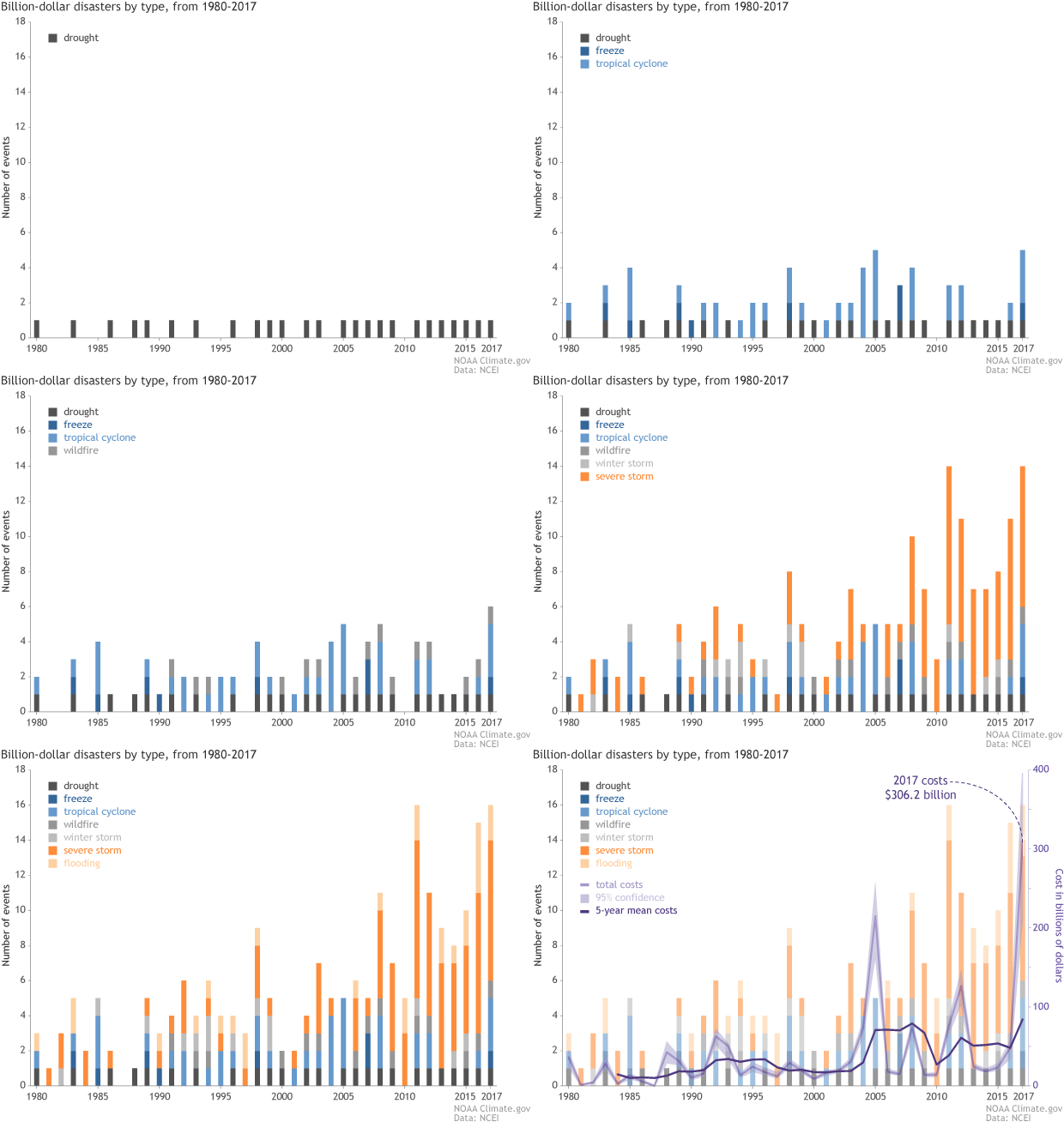
AnimationWhether you look at the number of events or the (inflation-adjusted) price tag, the upward trend of weather and climate disasters is clear. Source: NOAA.

Molloy keeps a “stockpile” of sources that are likely to be viewed as credible by conservatives: Ronald Reagan, George W. Bush, Exxon, and Chevron – all have supported taking action on climate change.

From Ronald Reagan to the 2017 Trump Administration National Climate Assessment … the science and the findings have been clear. Impacts from a warmer world are expensive and those costs are accelerating. 2017 just cost us +$300 billion, that’s some very expensive inaction, right here, right now.

Following a similar playbook as Dunning, Cook, and Tamerius, Molloy sidesteps the obvious attempts to drag the argument into the swamp. “Stay calm,” she advises. “I try to get the conversation back to credible sources and factual information at all times, and remain civil and patient throughout.”

Molloy understands that persuasion is a delicate balance, and she’s found that backing off the arguing and sharing some optimism about solutions can present an appealing détente. “Constantly be looking for that small offer of friendship or the crack in the door of someone willing to see that you are presenting a solid foundation that we can all stand on.”

The author is grateful to John Cook of George Mason University for his advice and recommendations on this project.

This series will continue to explore different facets of climate communication, while showcasing the voices of scientists, communicators, and everyday people.


from Skeptical Science https://ift.tt/2RSn0jM

This is a re-post from Yale Climate Connections by Karin Kirk

Communicating imageCredit: Image by Karin Kirk.

Don’t feed the trolls. You’ve heard this advice before, but how can anyone sit on their hands when the trolls are just so … wrong? When you encounter a rude and inaccurate comment, often the best bet is to ignore it altogether. But if you’re feeling inspired, you can look beyond the toxicity and aim for a productive outcome. The thing you ought not do, however, is take the bait and lock horns with the offender. That’s a certain path to a lose-lose situation.

What would you do if confronted with this comment?

The High Priest of Environmental Causes Al Gore was out promoting his waste of cellulose In January, 2006 – when promoting his Oscar-winning (yes, Oscar-winning) documentary, An Inconvenient Truth – Gore declared that unless we took “drastic measures” to reduce greenhouse gasses, the world would reach a “point of no return” in a mere ten years. He called it a “true planetary emergency.” Well, the ten years passed today, we’re still here, and the climate activists have postponed the apocalypse. Again.

Tracing the spread of the myth

This gem appeared among a volley of comments on the Facebook page of a science advocacy organization. But the text was not the work of the commenter.

Facebook posts

Further searching revealed the origin of this snippet. By plugging parts of the quote into a search engine and comparing the dates of publication, it was possible to track the spread of this quote across the web. The original idea appeared to emerge from a climate denial blog. A few weeks later, the same sentiment resurfaced, with obviously similar wording, in an article in the National Review, a conservative publication. From there, the quote has been circulated widely by climate contrarians, and in some cases, spread by what appear to be fake social media accounts.

This small example shows how misinformation germinates within dubious sources like anti-science blogs, then spreads into sympathetic media, and gets shared and re-shared outward from there. Welcome to the disinformation age.

Rebuttal Strategy #1 – Correct the science

The myth is mean-spirited, for sure. But is it true? Not even close, according to Scott Denning, professor of atmospheric science at Colorado State University. Denning’s faculty webpage details his expertise in carbon cycling and trace gas transport, but then offers an unusual credential: “takes special delight in engaging hostile audiences.”

Indeed, Denning has twice been a guest speaker at Heartland Institute conferences on climate change. Though he vehemently disagrees with Heartland’s stance on climate change, he reasons, “Ignoring climate contrarians has not made them go away.” Thus, he’s honed his methods to meaningfully engage people who dismiss climate science.

Denning’s first advice? Don’t fall into the trap of “fighting fire with fire.” Instead, he advises, “Find the nugget of a claim underneath the vitriol.”

It is not true that climate scientists predicted global catastrophe by 2018. Reading past the unhelpful tone, the logic behind this claim is as follows:

Premise 1: Emissions of CO2 and other greenhouse gases have continued and CO2 has continued to rise.

Premise 2: The consequences of the resulting warming so far aren’t all that bad.

Conclusion: Therefore global warming due to rising CO2 is not a problem and emissions can continue to rise without bound.

With the claim stripped of the inflammatory tone, it’s easy to examine in the light of day. The next step, says Denning, is to “dispatch with [the false claim] quickly and convincingly.”

The conclusion does not follow logically from the premises. CO2 and temperature have indeed continued to rise just as scientists predicted. Worse, the CO2 won’t go away when we eventually stop burning carbon, which is why the longer we wait, the more “drastic” measures we will have to take to avoid very serious damages to the world and our economy.

Denning explains, “I’m responding to the implication that there’s no urgency to reducing emissions. This is buried in the nastiness of the comment, but it’s the essence of the commenter’s message, so the thing we must refute.”

Inflammatory rhetoric intended to make you mad – so mad that you might not even catch the nonsensical claim. Denning describes it as “a multilayered trap,” because the comments are “personal, nasty, and inaccurate.”

The tone doesn’t make Denning shy away from addressing the comment, but it does shape the way he targets his rebuttal. “This kind of insulting rhetoric is precisely where we don’t want to go in the response.”

Strategy #2 – Expose the myth, misinformation, or fallacy

John Cook, research assistant professor at the Center for Climate Change Communication at George Mason University, likes to use “parallel arguments” to help dismantle pervasive myths. In other words, take away everything to do with climate change and look at a situation similar to the one in the myth. At that point, it’s easy to “expose the poor logic in misinformation,” says Cook. To make his message memorable, Cook captures the parallel argument in a cartoon and a short rebuttal.

This climate myth argues that we haven’t felt climate impacts yet so CO2 emissions are not a problem. This is like jumping from a height and commenting halfway down that you haven’t felt any impact yet so everything’s fine. We are committing actions now that will have consequences in the future.

Cartoon on falling

And for the record, we are experiencing climate impacts now. Heat waves are getting hotter and more frequent, droughts are intensifying, and warmer oceans are fueling hurricanes.

This myth supposes that we’re waiting for an apocalypse to arrive. But one needn’t look very far to realize the impacts of climate change are already at our doorsteps.

Strategy #3 – Engage in dialogue

De-escalation is a common technique in conflict resolution. While this climate myth intentionally stokes antagonism, Karin Tamerius illustrates how to walk the conversation back to practical turf.

You know, I think the word “emergency” probably means different things to different people. What would it take for you to see pollution as a planetary emergency?

Tamerius is no stranger to controversy. In fact, she routinely poses difficult questions and wrangles with members of her SMART Politics Facebook community. All the while, she’s using her background in political psychology to help people communicate more effectively on the topics of the day.

Tamerius prefers to begin her engagement with a question. “I’m trying to redirect attention from the credibility of one person (Al Gore), to what this person believes,” she says. “If I can find out what matters to them, I can address those concerns specifically.”

By steering the conversation away from the arena of partisan politics, Tamerius hopes to uncover deeper understanding. “After determining how they define ’emergency,’ I would turn to finding out how close they think we are to an emergency now,” she says. In the face of copy/paste talking points, probing how someone knows something can bring the conversation to a more rational place.

“The best way to change this person’s mind about who climate activists are and what they stand for is through example,” she says. “Attacks should be ignored or sidestepped, not engaged.”

Strategy #4 – Be persuasive

Rachel Molloy, of Redmond, Washington, is an art director and a determined volunteer who seeks to advance climate policy. She’s currently dedicating her time to build support for a Washington state ballot initiative that would implement statewide carbon pricing. Meanwhile, she’s also volunteering with the Climate Reality Project Leadership Corps. From knocking on doors, to visiting schools, to responding to never-ending false claims on social media, Molloy tirelessly strives to help people understand the need for climate action. And she’s no stranger to the false narratives that surround climate change.

As she considers the Al Gore myth, Molloy quickly targets the claim that impacts have not occurred. “This is demonstrably incorrect,” she writes. She starts by leveraging the power of personal experiences.

We are seeing signs of widespread planetary problems. This summer offers plenty of evidence for that.

My daughters had to wear face masks for the first time just to play outside in the smoke and falling ash, as our wildfire costs ballooned over budget, and our air quality fell among the worst in the world.

She then proceeds to a larger scale:

The National Weather Service called Hurricane Florence “the storm of a lifetime” for the Carolinas, and recently Hurricane Harvey dropped “historic amounts of rainfall” of more than 60 inches. The storms are getting bigger and our USA record-keepers are exactly who is warning us on that.

When responding to misinformation on social media, Molloy always references credible sources. She selects some of those sources with an eye toward their potential resonance with her audience. For example, for fiscal conservatives who might be swayed by the rising price tag of climate change, she shares NOAA’s tally of weather and climate disasters.

AnimationWhether you look at the number of events or the (inflation-adjusted) price tag, the upward trend of weather and climate disasters is clear. Source: NOAA.

Molloy keeps a “stockpile” of sources that are likely to be viewed as credible by conservatives: Ronald Reagan, George W. Bush, Exxon, and Chevron – all have supported taking action on climate change.

From Ronald Reagan to the 2017 Trump Administration National Climate Assessment … the science and the findings have been clear. Impacts from a warmer world are expensive and those costs are accelerating. 2017 just cost us +$300 billion, that’s some very expensive inaction, right here, right now.

Following a similar playbook as Dunning, Cook, and Tamerius, Molloy sidesteps the obvious attempts to drag the argument into the swamp. “Stay calm,” she advises. “I try to get the conversation back to credible sources and factual information at all times, and remain civil and patient throughout.”

Molloy understands that persuasion is a delicate balance, and she’s found that backing off the arguing and sharing some optimism about solutions can present an appealing détente. “Constantly be looking for that small offer of friendship or the crack in the door of someone willing to see that you are presenting a solid foundation that we can all stand on.”

The author is grateful to John Cook of George Mason University for his advice and recommendations on this project.

This series will continue to explore different facets of climate communication, while showcasing the voices of scientists, communicators, and everyday people.


from Skeptical Science https://ift.tt/2RSn0jM

What are the climate change consequences of the midterm elections?

This is a re-post from the Bulletin of the Atomic Scientists

Over the past two years, the Trump administration, aided by the Republican-controlled Congress, has eroded the Obama administration’s policy efforts to curb global warming. Climate activists had hoped to reverse some of those losses in this year’s midterm elections, but the results were a mixed bag. Here is the rundown of where we stand.

What can House Democrats do with the majority? 

The Democrats won control of the House of Representatives and will hold about 232 seats (53 percent) starting in 2019. This gives them control over legislation in that chamber of Congress. Democrats will become House committee chairs, who choose the bills that receive a hearing and a vote in a given committee. Democrats will also be able to choose the Speaker of the House – likely to be Nancy Pelosi – who decides what bills come to the floor for a vote after they’ve passed out of committees.

We’re thus in a similar scenario as in 2009, when House Democrats led by Nancy Pelosi passed the American Clean Energy and Security Act carbon cap and trade bill. At that time, Democrats had a majority in the Senate, but not a 60-vote supermajority. Because the bill lacked the votes to defeat a Republican filibuster, it was never brought to the Senate floor for a vote. Republicans now hold the Senate and White House, so climate legislation has no chance of passing until either Democrats take control of those branches (and overcome a Senate filibuster), or a significant number of Republican lawmakers stop denying the need to address the existential threat posed by climate change.

In the meantime, Democrats can now play a major role in setting the federal budget, which means they can protect funding for climate science research and for federal agencies like the EPA. So, we can at least keep learning about the dangers posed by climate change as the Trump administration tries to increase the carbon pollution that’s creating those threats. The House Science Committee will now be controlled by Democrats rather than some of Congress’ worst science-denying Republicans like Lamar Smith (retired) and Dana Rohrabacher (defeated), and thus will thankfully no longer hold theatrical hearings to deny basic climate science.

Democratic governors can play a big climate role

Democratic candidates gained seven governorships and will now lead 23 states representing 173 million Americans (53.5 percent of the population). Given the federal government’s inability to pass climate legislation, states are playing an increasingly important role. Governor Jerry Brown has made California a world leader in implementing policies to meet the Paris climate targets.

Consider North Carolina, whose Republican governor in 2012 signed a bill blocking state agencies from considering climate science research in coastal sea level rise projections. He was replaced by Democratic governor Roy Cooper in 2017, who signed an executive order calling on the state to meet the Paris climate targets. Or New Jersey Democratic Governor Phil Murphy, who reversed Chris Christie’s decision to withdraw from the regional carbon cap and trade system. Or consider Virginia Democratic Governor Ralph Northam, who has pledged to join the cap and trade system.

In the midterm elections, Michigan, Maine, Colorado, Nevada, New Mexico, and Illinois elected governors who have endorsed 50 percent renewable energy standards or higher. We can now expect to see more states take up the climate leadership role abandoned by the Trump administration.

Oil industry spending killed several green ballot initiatives

Washington voters rejected the state’s second carbon tax proposition in the past two elections, after the oil industry spent $30 million on ads to defeat it. However, Democratic Governor Jay Inslee is determined to implement climate legislation in Washington.

In Colorado, the oil and gas industry spent nearly $40 million to defeat an anti-fracking amendment, and was successful. In Arizona, the state’s biggest utility spent $30 million to defeat a proposition to require the state to obtain 50 percent of its electricity from renewable sources.

But there was also some good news for climate advocates in the ballot initiatives. Californians voted to keep the state’s gas tax. Floridians passed a measure to ban offshore drilling. And Nevadans approved an amendment requiring electric utilities to acquire 50 percent of their electricity from renewable resources by 2030.

Climate Solutions Caucus shrinks

The Climate Solutions Caucus was a bipartisan group of 45 Republicans and 45 Democrats whose goal was to explore climate policy solutions. However, the Caucus was heavily criticized for its lack of action, and its members were labeled ‘Climate Peacocks.’ For example, in a purely symbolic vote, only four of the Republican Caucus members voted against condemning carbon taxes. Republican leader Carlos Curbelo introduced a carbon tax bill of his own, but only two fellow Republican Caucus members were willing to co-sponsor it.

It was a rough night for Republican Climate Solutions Caucus members. Curbelo lost his election, along with a dozen of his cohorts. Eight more Republican members retired from Congress. That leaves about 23 of the 45 Caucus conservatives in office starting in 2019, having lost their leader.

This was an expected outcome – the moderate Republicans who are more likely to be relatively realistic about climate change also tended to be the most vulnerable in a wave election. Democrats can now control the legislative agenda in the House, but there are fewer moderate Republicans left in office who might work with them on climate bills. On the one hand, that means climate legislation won’t be watered down by compromise; on the other hand, even fewer Republicans will sign on.

Climate change will regrettably remain a politically polarized issue in America until at least 2021. But Democrats gained the critically important control of the House and its committees, and even more importantly, of a number of state governorships. Over the next two years, it will be up to the individual states to advance the climate agenda by accelerating the transition away from fossil fuels.


from Skeptical Science https://ift.tt/2DGjVQN

This is a re-post from the Bulletin of the Atomic Scientists

Over the past two years, the Trump administration, aided by the Republican-controlled Congress, has eroded the Obama administration’s policy efforts to curb global warming. Climate activists had hoped to reverse some of those losses in this year’s midterm elections, but the results were a mixed bag. Here is the rundown of where we stand.

What can House Democrats do with the majority? 

The Democrats won control of the House of Representatives and will hold about 232 seats (53 percent) starting in 2019. This gives them control over legislation in that chamber of Congress. Democrats will become House committee chairs, who choose the bills that receive a hearing and a vote in a given committee. Democrats will also be able to choose the Speaker of the House – likely to be Nancy Pelosi – who decides what bills come to the floor for a vote after they’ve passed out of committees.

We’re thus in a similar scenario as in 2009, when House Democrats led by Nancy Pelosi passed the American Clean Energy and Security Act carbon cap and trade bill. At that time, Democrats had a majority in the Senate, but not a 60-vote supermajority. Because the bill lacked the votes to defeat a Republican filibuster, it was never brought to the Senate floor for a vote. Republicans now hold the Senate and White House, so climate legislation has no chance of passing until either Democrats take control of those branches (and overcome a Senate filibuster), or a significant number of Republican lawmakers stop denying the need to address the existential threat posed by climate change.

In the meantime, Democrats can now play a major role in setting the federal budget, which means they can protect funding for climate science research and for federal agencies like the EPA. So, we can at least keep learning about the dangers posed by climate change as the Trump administration tries to increase the carbon pollution that’s creating those threats. The House Science Committee will now be controlled by Democrats rather than some of Congress’ worst science-denying Republicans like Lamar Smith (retired) and Dana Rohrabacher (defeated), and thus will thankfully no longer hold theatrical hearings to deny basic climate science.

Democratic governors can play a big climate role

Democratic candidates gained seven governorships and will now lead 23 states representing 173 million Americans (53.5 percent of the population). Given the federal government’s inability to pass climate legislation, states are playing an increasingly important role. Governor Jerry Brown has made California a world leader in implementing policies to meet the Paris climate targets.

Consider North Carolina, whose Republican governor in 2012 signed a bill blocking state agencies from considering climate science research in coastal sea level rise projections. He was replaced by Democratic governor Roy Cooper in 2017, who signed an executive order calling on the state to meet the Paris climate targets. Or New Jersey Democratic Governor Phil Murphy, who reversed Chris Christie’s decision to withdraw from the regional carbon cap and trade system. Or consider Virginia Democratic Governor Ralph Northam, who has pledged to join the cap and trade system.

In the midterm elections, Michigan, Maine, Colorado, Nevada, New Mexico, and Illinois elected governors who have endorsed 50 percent renewable energy standards or higher. We can now expect to see more states take up the climate leadership role abandoned by the Trump administration.

Oil industry spending killed several green ballot initiatives

Washington voters rejected the state’s second carbon tax proposition in the past two elections, after the oil industry spent $30 million on ads to defeat it. However, Democratic Governor Jay Inslee is determined to implement climate legislation in Washington.

In Colorado, the oil and gas industry spent nearly $40 million to defeat an anti-fracking amendment, and was successful. In Arizona, the state’s biggest utility spent $30 million to defeat a proposition to require the state to obtain 50 percent of its electricity from renewable sources.

But there was also some good news for climate advocates in the ballot initiatives. Californians voted to keep the state’s gas tax. Floridians passed a measure to ban offshore drilling. And Nevadans approved an amendment requiring electric utilities to acquire 50 percent of their electricity from renewable resources by 2030.

Climate Solutions Caucus shrinks

The Climate Solutions Caucus was a bipartisan group of 45 Republicans and 45 Democrats whose goal was to explore climate policy solutions. However, the Caucus was heavily criticized for its lack of action, and its members were labeled ‘Climate Peacocks.’ For example, in a purely symbolic vote, only four of the Republican Caucus members voted against condemning carbon taxes. Republican leader Carlos Curbelo introduced a carbon tax bill of his own, but only two fellow Republican Caucus members were willing to co-sponsor it.

It was a rough night for Republican Climate Solutions Caucus members. Curbelo lost his election, along with a dozen of his cohorts. Eight more Republican members retired from Congress. That leaves about 23 of the 45 Caucus conservatives in office starting in 2019, having lost their leader.

This was an expected outcome – the moderate Republicans who are more likely to be relatively realistic about climate change also tended to be the most vulnerable in a wave election. Democrats can now control the legislative agenda in the House, but there are fewer moderate Republicans left in office who might work with them on climate bills. On the one hand, that means climate legislation won’t be watered down by compromise; on the other hand, even fewer Republicans will sign on.

Climate change will regrettably remain a politically polarized issue in America until at least 2021. But Democrats gained the critically important control of the House and its committees, and even more importantly, of a number of state governorships. Over the next two years, it will be up to the individual states to advance the climate agenda by accelerating the transition away from fossil fuels.


from Skeptical Science https://ift.tt/2DGjVQN

New research, November 5-11, 2018

A selection of new climate related research articles is shown below.

Climate change mitigation

Zero CO2 emissions for an ultra-large city by 2050: case study for Beijing

Climate change communication

Developing a model of climate change behavior among adolescents

Petro-hegemony and the matrix of resistance: What can Standing Rock’s Water Protectors teach us about organizing for climate justice in the United States?

Information leverage: The adoption of clean cooking fuel in Bhutan

Storylines: an alternative approach to representing uncertainty in physical aspects of climate change (open access)

Climate Policy

When less is more: limits to international transfers under article 6 of the Paris Agreement (open access)

Combining Carbon Taxation and Offset Payments: A New Approach to Climate Policy in Low-Income Countries

Cap-and-trade versus carbon taxes: which market mechanism gets the most attention?

Empirical assessment of sustainable energy markets in the EU-28

Active Learning and Optimal Climate Policy

Evaluating the quality of municipal climate change plans in Canada

Energy production

Deforestation risks posed by oil palm expansion in the Peruvian Amazon (open access)

Carbon emissions accounting for China’s coal mining sector: invisible sources of climate change

Undesirable and desirable energy congestion measurements for regional coal-fired power generation industry in China

Implementation of EU energy policy priorities in the Baltic Sea Region countries: Sustainability assessment based on neutrosophic MULTIMOORA method

Summer co-variability of surface climate for renewable energy across the contiguous United States: role of the North Atlantic subtropical high

Assessing climate change impacts on California hydropower generation and ancillary services provision

Emission savings

Energy efficient technology adoption in low-income households in the European Union – What is the evidence?

Finance and the Earth system – Exploring the links between financial actors and non-linear changes in the climate system

Measuring what works: quantifying greenhouse gas emission reductions of behavioural interventions to reduce driving, meat consumption, and household energy use (open access)

The greenhouse gas cost of agricultural intensification with groundwater irrigation in a Midwest U.S. row cropping system (open access)

Deforestation and secondary growth in Costa Rica along the path of development

Geoengineering

Global streamflow and flood response to stratospheric aerosol geoengineering (open access)

Solar Geoengineering Research in India (open access)

Climate change

Predictability of European winter 2016/2017 (open access)

Shifts in timing of local growing season in China during 1961–2012

Temperature, precipitation, wind

Analysis of Climate Trends and Leading Modes of Climate Variability for MENA Region

The Uneven Nature of Daily Precipitation and Its Change

Extreme temperature and precipitation changes associated with four degree of global warming above pre‐industrial levels

Heterogeneity of scaling of the observed global temperature data

Extreme events

Poleward migration of the destructive effects of tropical cyclones during the 20th century

On the instabilities of tropical cyclones generated by cloud resolving models (open access)

Global estimates of damaging hail hazard (open access)

A Statistical Analysis of Hail Events and Their Environmental Conditions in China during 2008-2015

Drought occurrence in the sub-humid eco-climatic zone of Nigeria

Uncertainty Analysis of Simulations of the Turn‐of‐the‐Century Drought in the Western United States

Forcings and feedbacks

Probabilistic reasoning about measurements of equilibrium climate sensitivity: combining disparate lines of evidence (open access)

The role of the nonlinearity of the Stefan-Boltzmann law on the structure of radiatively forced temperature change

The Arctic Cloud Puzzle: Using ACLOUD/PASCAL Multi-Platform Observations to Unravel the Role of Clouds and Aerosol Particles in Arctic Amplification (open access)

Balanced Cloud Radiative Effects Across a Range of Dynamical Conditions Over the Tropical West Pacific

Exploring the temporal trends and seasonal behaviour of tropospheric trace gases over Pakistan by exploiting satellite observations

Decadal shifts in wind patterns reduced continental outflow and suppressed ozone trend in the 2010s in the lower troposphere over Japan

Aerosol vertical distribution and sources estimation at a site of the Yangtze River Delta region of China

Cryosphere

Meteorological Drivers and Large-Scale Climate Forcing of West Antarctic Surface Melt

The aftermath of Petermann Glacier calving events (2008‐2012): Ice island size distributions and meltwater dispersal

Interannual sea ice thickness variability in the Bay of Bothnia (open access)

Understanding End‐of‐century Snowpack Changes Over California's Sierra Nevada

Hydrosphere 

Future wave conditions of Europe, in response to high‐end climate change scenarios

Use of satellite soil moisture to diagnose climate model representations of European soil moisture ‐ air temperature coupling strength

Environmental and biological controls on monthly and annual evapotranspiration in China’s Loess Plateau

Atmospheric and oceanic circulation

Contrasting mechanisms of summer blocking over western Eurasia

Last century warming over the Canadian Atlantic shelves linked to weak Atlantic Meridional Overturning Circulation

Climate‐Driven Change in the North Atlantic and Arctic Oceans Can Greatly Reduce the Circulation of the North Sea (open access)

Carbon and nitrogen cycles

Ecosystem carbon transit versus turnover times in response to climate warming and rising atmospheric CO2 concentration (open access)

Predominance of methanogens over methanotrophs in rewetted fens characterized by high methane emissions (open access)

Impacts of temperature and soil characteristics on methane production and oxidation in Arctic tundra (open access)

Resolving shelf‐break exchange around the European north‐west shelf

Carbon sequestration in riparian forests: A global synthesis and meta‐analysis (open access)

Natural forests exhibit higher carbon sequestration and lower water consumption than planted forests in China (open access)

Global soil nitrous oxide emissions since the pre‐industrial era estimated by an ensemble of Terrestrial Biosphere Models: Magnitude, attribution and uncertainty

Greenhouse gas production and transport in desert soils of the southwestern USA

Climate change impacts 

Mankind

Extreme temperature and mortality: evidence from China

Climate conditions and work-related fatigue among professional drivers (open access)

Risk perception and decision-making: do farmers consider risks from climate change? (open access)

Climate change perceptions and adaptations of smallholder farmers in Eastern Kenya

Impacts of climate change on apple tree cultivation areas in Iran

Analysis of the spatiotemporal variability of droughts and the effects of drought on potato production in northern China

Biosphere

21st century climate change impacts on marine animal biomass and ecosystem structure across ocean basins

Compositional response of Amazon forests to climate change (open access)

Protected areas act as a buffer against detrimental effects of climate change—Evidence from large‐scale, long‐term abundance data (open access)

Chlorophyll‐a in Antarctic landfast sea ice: a first synthesis of historical ice‐core data

Predicting shifts in the functional composition of tropical forests under increased drought and CO2 from trade‐offs among plant hydraulic traits

Variability of bio-climatology indicators in the Southwest China under climate warming during 1961–2015

Spatial variation in herbivory, climate and isolation predicts plant height and fruit phenotype in Plectritis congesta populations on islands

Melting Arctic sea ice: Implications for nonindigenous species (NIS) spread in the United States

Stand basal area and solar radiation amplify white spruce climate sensitivity in interior Alaska: evidence from carbon isotopes and tree rings

Local adaptation primes cold‐edge populations for range expansion but not warming‐induced range shifts

Past the climate optimum: Recruitment is declining at the world's highest juniper shrublines on the Tibetan Plateau

Variations in land surface phenology and their response to climate change in Yangtze River basin during 1982–2015

Climate change does not affect seafood quality of a common targeted fish

Other impacts

Hierarchical sensitivity analysis for simulating barrier island geomorphologic responses to future storms and sea-level rise

Other papers

General climate science

A roadmap to climate data rescue services (open access)

Palaeoclimatology

Burning-derived vanillic acid in an Arctic ice core from Tunu, northeastern Greenland (open access)

Global Cooling Contributed to the Establishment of a Modern‐Like East Asian Monsoon Climate by the Early Miocene 


from Skeptical Science https://ift.tt/2RVh3Te

A selection of new climate related research articles is shown below.

Climate change mitigation

Zero CO2 emissions for an ultra-large city by 2050: case study for Beijing

Climate change communication

Developing a model of climate change behavior among adolescents

Petro-hegemony and the matrix of resistance: What can Standing Rock’s Water Protectors teach us about organizing for climate justice in the United States?

Information leverage: The adoption of clean cooking fuel in Bhutan

Storylines: an alternative approach to representing uncertainty in physical aspects of climate change (open access)

Climate Policy

When less is more: limits to international transfers under article 6 of the Paris Agreement (open access)

Combining Carbon Taxation and Offset Payments: A New Approach to Climate Policy in Low-Income Countries

Cap-and-trade versus carbon taxes: which market mechanism gets the most attention?

Empirical assessment of sustainable energy markets in the EU-28

Active Learning and Optimal Climate Policy

Evaluating the quality of municipal climate change plans in Canada

Energy production

Deforestation risks posed by oil palm expansion in the Peruvian Amazon (open access)

Carbon emissions accounting for China’s coal mining sector: invisible sources of climate change

Undesirable and desirable energy congestion measurements for regional coal-fired power generation industry in China

Implementation of EU energy policy priorities in the Baltic Sea Region countries: Sustainability assessment based on neutrosophic MULTIMOORA method

Summer co-variability of surface climate for renewable energy across the contiguous United States: role of the North Atlantic subtropical high

Assessing climate change impacts on California hydropower generation and ancillary services provision

Emission savings

Energy efficient technology adoption in low-income households in the European Union – What is the evidence?

Finance and the Earth system – Exploring the links between financial actors and non-linear changes in the climate system

Measuring what works: quantifying greenhouse gas emission reductions of behavioural interventions to reduce driving, meat consumption, and household energy use (open access)

The greenhouse gas cost of agricultural intensification with groundwater irrigation in a Midwest U.S. row cropping system (open access)

Deforestation and secondary growth in Costa Rica along the path of development

Geoengineering

Global streamflow and flood response to stratospheric aerosol geoengineering (open access)

Solar Geoengineering Research in India (open access)

Climate change

Predictability of European winter 2016/2017 (open access)

Shifts in timing of local growing season in China during 1961–2012

Temperature, precipitation, wind

Analysis of Climate Trends and Leading Modes of Climate Variability for MENA Region

The Uneven Nature of Daily Precipitation and Its Change

Extreme temperature and precipitation changes associated with four degree of global warming above pre‐industrial levels

Heterogeneity of scaling of the observed global temperature data

Extreme events

Poleward migration of the destructive effects of tropical cyclones during the 20th century

On the instabilities of tropical cyclones generated by cloud resolving models (open access)

Global estimates of damaging hail hazard (open access)

A Statistical Analysis of Hail Events and Their Environmental Conditions in China during 2008-2015

Drought occurrence in the sub-humid eco-climatic zone of Nigeria

Uncertainty Analysis of Simulations of the Turn‐of‐the‐Century Drought in the Western United States

Forcings and feedbacks

Probabilistic reasoning about measurements of equilibrium climate sensitivity: combining disparate lines of evidence (open access)

The role of the nonlinearity of the Stefan-Boltzmann law on the structure of radiatively forced temperature change

The Arctic Cloud Puzzle: Using ACLOUD/PASCAL Multi-Platform Observations to Unravel the Role of Clouds and Aerosol Particles in Arctic Amplification (open access)

Balanced Cloud Radiative Effects Across a Range of Dynamical Conditions Over the Tropical West Pacific

Exploring the temporal trends and seasonal behaviour of tropospheric trace gases over Pakistan by exploiting satellite observations

Decadal shifts in wind patterns reduced continental outflow and suppressed ozone trend in the 2010s in the lower troposphere over Japan

Aerosol vertical distribution and sources estimation at a site of the Yangtze River Delta region of China

Cryosphere

Meteorological Drivers and Large-Scale Climate Forcing of West Antarctic Surface Melt

The aftermath of Petermann Glacier calving events (2008‐2012): Ice island size distributions and meltwater dispersal

Interannual sea ice thickness variability in the Bay of Bothnia (open access)

Understanding End‐of‐century Snowpack Changes Over California's Sierra Nevada

Hydrosphere 

Future wave conditions of Europe, in response to high‐end climate change scenarios

Use of satellite soil moisture to diagnose climate model representations of European soil moisture ‐ air temperature coupling strength

Environmental and biological controls on monthly and annual evapotranspiration in China’s Loess Plateau

Atmospheric and oceanic circulation

Contrasting mechanisms of summer blocking over western Eurasia

Last century warming over the Canadian Atlantic shelves linked to weak Atlantic Meridional Overturning Circulation

Climate‐Driven Change in the North Atlantic and Arctic Oceans Can Greatly Reduce the Circulation of the North Sea (open access)

Carbon and nitrogen cycles

Ecosystem carbon transit versus turnover times in response to climate warming and rising atmospheric CO2 concentration (open access)

Predominance of methanogens over methanotrophs in rewetted fens characterized by high methane emissions (open access)

Impacts of temperature and soil characteristics on methane production and oxidation in Arctic tundra (open access)

Resolving shelf‐break exchange around the European north‐west shelf

Carbon sequestration in riparian forests: A global synthesis and meta‐analysis (open access)

Natural forests exhibit higher carbon sequestration and lower water consumption than planted forests in China (open access)

Global soil nitrous oxide emissions since the pre‐industrial era estimated by an ensemble of Terrestrial Biosphere Models: Magnitude, attribution and uncertainty

Greenhouse gas production and transport in desert soils of the southwestern USA

Climate change impacts 

Mankind

Extreme temperature and mortality: evidence from China

Climate conditions and work-related fatigue among professional drivers (open access)

Risk perception and decision-making: do farmers consider risks from climate change? (open access)

Climate change perceptions and adaptations of smallholder farmers in Eastern Kenya

Impacts of climate change on apple tree cultivation areas in Iran

Analysis of the spatiotemporal variability of droughts and the effects of drought on potato production in northern China

Biosphere

21st century climate change impacts on marine animal biomass and ecosystem structure across ocean basins

Compositional response of Amazon forests to climate change (open access)

Protected areas act as a buffer against detrimental effects of climate change—Evidence from large‐scale, long‐term abundance data (open access)

Chlorophyll‐a in Antarctic landfast sea ice: a first synthesis of historical ice‐core data

Predicting shifts in the functional composition of tropical forests under increased drought and CO2 from trade‐offs among plant hydraulic traits

Variability of bio-climatology indicators in the Southwest China under climate warming during 1961–2015

Spatial variation in herbivory, climate and isolation predicts plant height and fruit phenotype in Plectritis congesta populations on islands

Melting Arctic sea ice: Implications for nonindigenous species (NIS) spread in the United States

Stand basal area and solar radiation amplify white spruce climate sensitivity in interior Alaska: evidence from carbon isotopes and tree rings

Local adaptation primes cold‐edge populations for range expansion but not warming‐induced range shifts

Past the climate optimum: Recruitment is declining at the world's highest juniper shrublines on the Tibetan Plateau

Variations in land surface phenology and their response to climate change in Yangtze River basin during 1982–2015

Climate change does not affect seafood quality of a common targeted fish

Other impacts

Hierarchical sensitivity analysis for simulating barrier island geomorphologic responses to future storms and sea-level rise

Other papers

General climate science

A roadmap to climate data rescue services (open access)

Palaeoclimatology

Burning-derived vanillic acid in an Arctic ice core from Tunu, northeastern Greenland (open access)

Global Cooling Contributed to the Establishment of a Modern‐Like East Asian Monsoon Climate by the Early Miocene 


from Skeptical Science https://ift.tt/2RVh3Te

adds 2