The sun has made life on the innermost planets, Mercury and Venus, impossible, due to the intense radiation and colossal amounts of energetic material it blasts in every direction, creating the ever-changing conditions in space known as space weather.
Considering all of this, how did life come to thrive on Earth? Our magnetic field protects us from the solar wind — the constant stream of electrons, protons and heavier ions from the sun — and from coronal mass ejections (CMEs), the sun’s occasional outbursts of billion-ton clouds of solar plasma into space.
But the most extreme space weather events, arrivals of fast CMEs or high-speed solar-wind streams, disturb our protective magnetic shield, creating geomagnetic storms at Earth.
These storms have the potential to cause serious problems for modern technological systems, disrupting or damaging satellites in space and the multitude of services – like navigation and telecoms – that rely on them, blacking out power grids and radio communication and creating a radiation hazard for astronauts in space, even serving potentially harmful doses of radiation to astronauts on future missions to the moon or Mars.
The sun has made life on the innermost planets, Mercury and Venus, impossible, due to the intense radiation and colossal amounts of energetic material it blasts in every direction, creating the ever-changing conditions in space known as space weather.
Considering all of this, how did life come to thrive on Earth? Our magnetic field protects us from the solar wind — the constant stream of electrons, protons and heavier ions from the sun — and from coronal mass ejections (CMEs), the sun’s occasional outbursts of billion-ton clouds of solar plasma into space.
But the most extreme space weather events, arrivals of fast CMEs or high-speed solar-wind streams, disturb our protective magnetic shield, creating geomagnetic storms at Earth.
These storms have the potential to cause serious problems for modern technological systems, disrupting or damaging satellites in space and the multitude of services – like navigation and telecoms – that rely on them, blacking out power grids and radio communication and creating a radiation hazard for astronauts in space, even serving potentially harmful doses of radiation to astronauts on future missions to the moon or Mars.
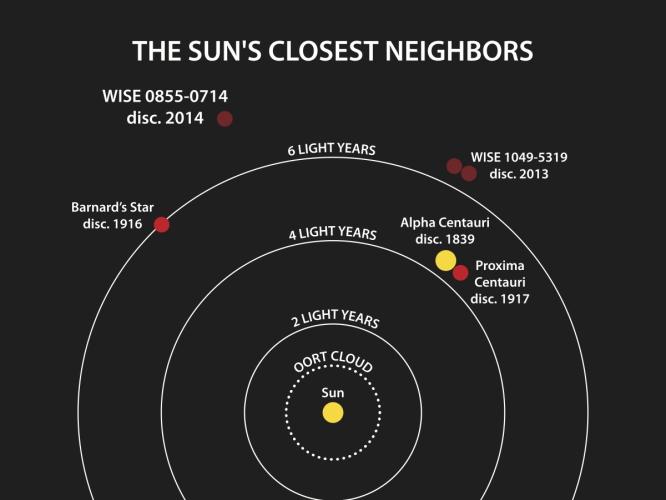
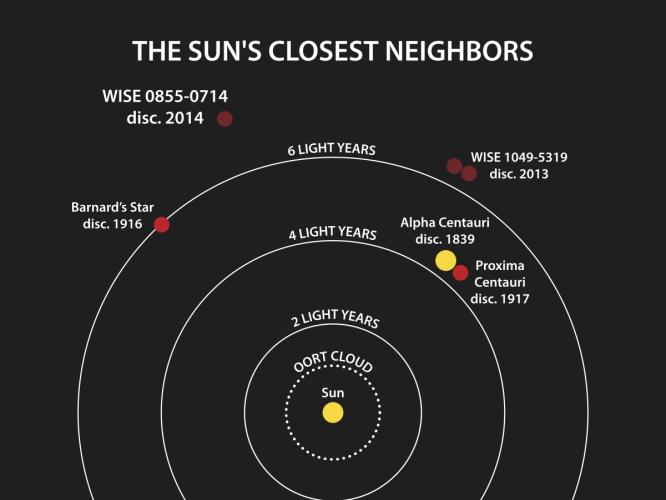
Our sun’s closest neighbors among the stars, including Barnard’s Star. Image via NASA PhotoJournal.
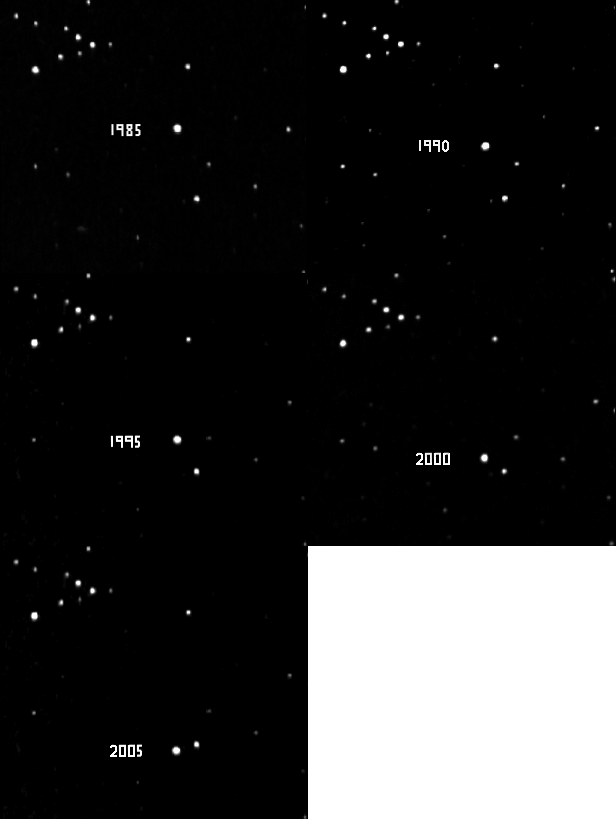
Perhaps you know that, over the scale of our human lifespans, the stars appear fixed relative to one another. But Barnard’s Star – sometimes called Barnard’s Runaway Star – holds a speed record of sorts as the fastest-moving star in Earth’s skies. It moves fast with respect to other stars because it’s relatively close, only about 6 light-years away. What does its fast motion mean? It means Barnard’s Star is nearby, and also that it’s not moving with the general stream of stars around the Milky Way’s center. Instead, Barnard’s Star is merely passing through our neighborhood of space. Relative to other stars, Barnard’s Star moves 10.3 arcseconds per year, or about the width of a full moon in 174 years. This might not seem like much. But – to astronomers – Barnard’s Star is virtually zipping across the sky.
But, of course, that’s not the only reason this star is famous!
Barnard’s star, 1985 to 2005. Most stars are fixed with respect to each other, but – being close to us – Barnard’s Star appears to move. Image via Steve Quirk/ Wikimedia Commons.
Barnard’s Star in history and popular culture. Yerkes Observatory astronomer E. E. Barnard discovered the large proper motion of Barnard’s Star – that is, motion across our line of sight – in 1916.
He noticed it while comparing photographs of the same part of the sky taken in 1894 and again in 1916. The star appeared in significantly different positions, betraying its rapid motion.
Later, Harvard astronomer Edward Pickering found the star on photographic plates taken in 1888.
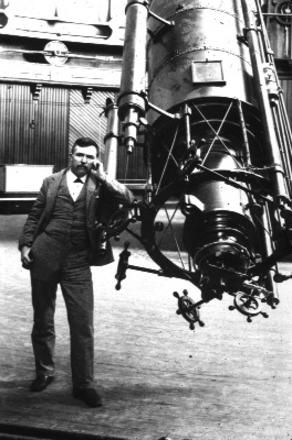
Barnard’s Star is named for this astronomer, E.E. Barnard, seen here posing with the 36-inch refractor at Lick Observatory. Image via OneMinuteAstronomer.
Barnard’s star came to our attention barely 100 years ago and can’t be seen with the human eye, so the ancients didn’t know about it. It doesn’t figure into the lore of any constellation or cultural tradition. But that doesn’t mean that it doesn’t a have certain mystique about it that extends beyond the known facts.
For example, even as long ago as the 1960s and ’70s – long before successful planet-hunters like the Kepler spacecraft – there were suggestions that Barnard’s Star might have a family of planets. At that time, reported discrepancies in the motion of the star led to a claim that at least one Jupiter-size planet, and possibly several planets, orbit it. Although the evidence was disputed and the claim now largely discredited, there has remained a chance of planetary discoveries. And, indeed, in November 2018 an international team of astronomers announced it was “99 percent confident” that a planet for Barnard’s Star has now been found.
The long-standing rumor of planets for Barnard’s Star secured this star’s place in science fiction. It’s featured in, for example, “The Hitchhiker’s Guide to the Galaxy” by Douglas Adams; “The Garden of Rama” by Arthur C. Clarke and Gentry Lee; and several novels of physicist Robert L. Forward. In these works, the fictional planets of Barnard’s Star are locations for early colonization or way-stations for exploration further into the cosmos.
Barnard’s Star also was the hypothetical target of Project Daedalus, a design study by members of the British Interplanetary Society, in which they envisioned an interstellar craft that could reach its destination within a human lifetime.
And Barnard’s Star has been featured in online games.
Clearly, Barnard’s Star captures peoples’ imaginations!
Image via BBC/ Sky at Night/ Paul Wootton. Read more.
How to see Barnard’s Star. Barnard’s Star is faint; its visual magnitude of about 9.5. Thus this star can’t be seen with the eye alone.
Whats more, its motion – though large in astronomical terms – is still too slow to be noticed in a single night or even easily across a human lifetime.
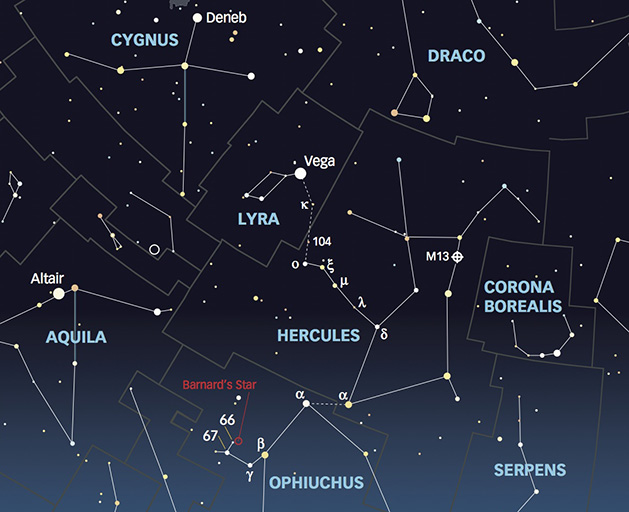
Since Barnard’s Star can’t be seen without powerful binoculars or a telescope, finding it requires both experience and perseverance. It is located in the direction of the constellation Ophiuchus the Serpent Bearer, which is well placed for viewing on June, July and August evenings.
Because Barnard’s Star is a telescopic object, details on how to observe it are beyond the scope of this article, but Britain’s Sky at Night magazine has a good procedure online here: http://bit.ly/2rZNDe1
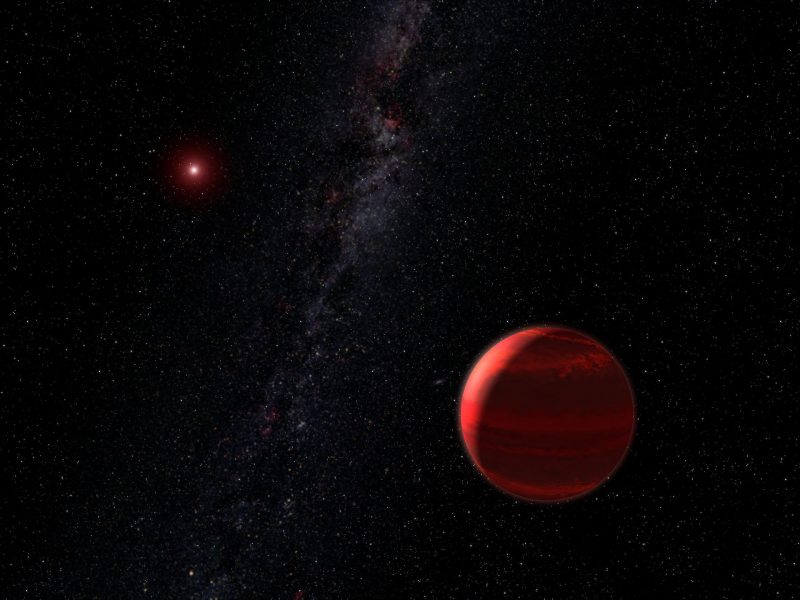
Artist’s concept of a red dwarf star – similar to Barnard’s Star – with a planet of about 12 Jupiter-masses. In reality, Barnard’s Star is considerably older than our sun, which could affect the potential for finding life there. Image via NASA/ESA/G. Bacon (STScI)/Wikimedia Commons.
The science of Barnard’s Star. The fame of Barnard’s Star is in its novelty, the fact that it moves fastest through Earth’s skies. But its real importance to astronomy lies in the fact that being so close, it is one of the best sources for studying red dwarfs, the most abundant stars in the universe.
With only about 14 percent of the solar mass and less than 20 percent of the radius, it would take roughly seven Barnard’s Stars to match the mass of our sun, and 133 to match our sun’s volume.
Like all stars, Barnard’s Star shines via thermonuclear fusion, changing light elements (hydrogen) into more massive elements (helium), while releasing enormous amounts of energy. Even so, the lower mass of Barnard’s Star makes it about 2,500 times less powerful than our sun.
In other words, Barnard’s Star is much dimmer and cooler than our sun. If it replaced the sun in our solar system, it would shine only about four ten-thousandths as brightly as our sun. At the same time, it would be about 100 times brighter than a full moon. No life on Earth would be possible if we orbited Barnard’s Star instead of our sun, however. The much-decreased stellar heat would plunge Earth’s global temperatures to hundreds of degrees below zero.
Although very common, red dwarfs like Barnard’s Star are typically dim. Thus they are notoriously faint and hard to study. In fact, not a single red dwarf can be seen with the unaided human eye. But because Barnard’s Star is relatively close and bright, it has become a go-to model for all things red dwarf.
At nearly six light-years‘ distance, Barnard’s Star is often cited as the second-closest star to our sun (and Earth). This is true only if you consider the triple star system Alpha Centauri as one star.
Proxima Centauri, the smallest and faintest of Alpha Centauri’s three components, is the closest known star to the sun at just 4.24 light years away. It, too, is a red dwarf. So Barnard’s Star is only the second-closest red dwarf star. It is perhaps more important for astronomical purposes, though, because Proxima is four times fainter and thus harder to study.
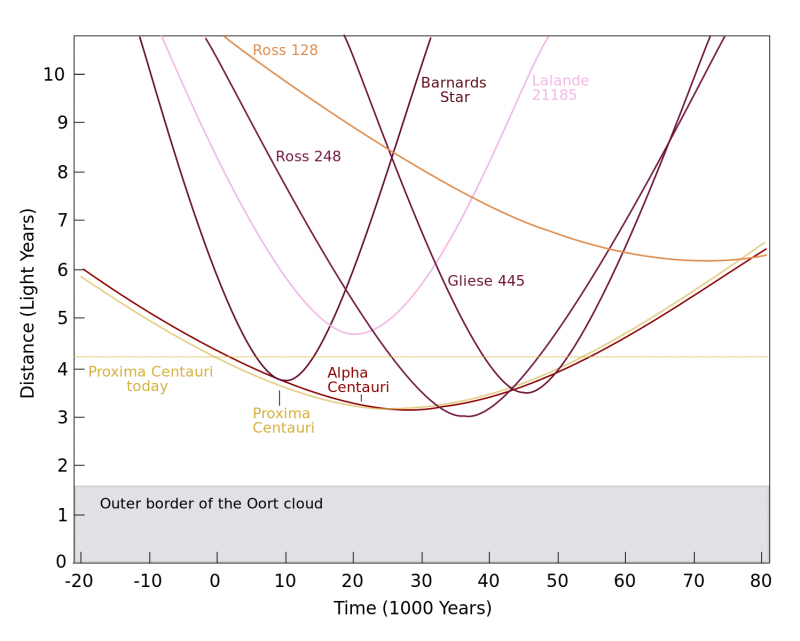
Of course, all stars are moving through the space of our Milky Way galaxy. So even the “fixed” stars move over time. This illustration shows the distances to the nearest stars – including Barnard’s Star – in a time range between 20,000 years in the past and 80,000 years in the future. Image via FrancescoA/Wikimedia Commons.
Bottom line: Barnard’s Star is the fastest-moving star in Earth’s skies, in terms of its proper motion. It moves fast because it’s relatively close, only about 6 light-years away.
Our sun’s closest neighbors among the stars, including Barnard’s Star. Image via NASA PhotoJournal.
Perhaps you know that, over the scale of our human lifespans, the stars appear fixed relative to one another. But Barnard’s Star – sometimes called Barnard’s Runaway Star – holds a speed record of sorts as the fastest-moving star in Earth’s skies. It moves fast with respect to other stars because it’s relatively close, only about 6 light-years away. What does its fast motion mean? It means Barnard’s Star is nearby, and also that it’s not moving with the general stream of stars around the Milky Way’s center. Instead, Barnard’s Star is merely passing through our neighborhood of space. Relative to other stars, Barnard’s Star moves 10.3 arcseconds per year, or about the width of a full moon in 174 years. This might not seem like much. But – to astronomers – Barnard’s Star is virtually zipping across the sky.
But, of course, that’s not the only reason this star is famous!
Barnard’s star, 1985 to 2005. Most stars are fixed with respect to each other, but – being close to us – Barnard’s Star appears to move. Image via Steve Quirk/ Wikimedia Commons.
Barnard’s Star in history and popular culture. Yerkes Observatory astronomer E. E. Barnard discovered the large proper motion of Barnard’s Star – that is, motion across our line of sight – in 1916.
He noticed it while comparing photographs of the same part of the sky taken in 1894 and again in 1916. The star appeared in significantly different positions, betraying its rapid motion.
Later, Harvard astronomer Edward Pickering found the star on photographic plates taken in 1888.
Barnard’s Star is named for this astronomer, E.E. Barnard, seen here posing with the 36-inch refractor at Lick Observatory. Image via OneMinuteAstronomer.
Barnard’s star came to our attention barely 100 years ago and can’t be seen with the human eye, so the ancients didn’t know about it. It doesn’t figure into the lore of any constellation or cultural tradition. But that doesn’t mean that it doesn’t a have certain mystique about it that extends beyond the known facts.
For example, even as long ago as the 1960s and ’70s – long before successful planet-hunters like the Kepler spacecraft – there were suggestions that Barnard’s Star might have a family of planets. At that time, reported discrepancies in the motion of the star led to a claim that at least one Jupiter-size planet, and possibly several planets, orbit it. Although the evidence was disputed and the claim now largely discredited, there has remained a chance of planetary discoveries. And, indeed, in November 2018 an international team of astronomers announced it was “99 percent confident” that a planet for Barnard’s Star has now been found.
The long-standing rumor of planets for Barnard’s Star secured this star’s place in science fiction. It’s featured in, for example, “The Hitchhiker’s Guide to the Galaxy” by Douglas Adams; “The Garden of Rama” by Arthur C. Clarke and Gentry Lee; and several novels of physicist Robert L. Forward. In these works, the fictional planets of Barnard’s Star are locations for early colonization or way-stations for exploration further into the cosmos.
Barnard’s Star also was the hypothetical target of Project Daedalus, a design study by members of the British Interplanetary Society, in which they envisioned an interstellar craft that could reach its destination within a human lifetime.
And Barnard’s Star has been featured in online games.
Clearly, Barnard’s Star captures peoples’ imaginations!
Image via BBC/ Sky at Night/ Paul Wootton. Read more.
How to see Barnard’s Star. Barnard’s Star is faint; its visual magnitude of about 9.5. Thus this star can’t be seen with the eye alone.
Whats more, its motion – though large in astronomical terms – is still too slow to be noticed in a single night or even easily across a human lifetime.
Since Barnard’s Star can’t be seen without powerful binoculars or a telescope, finding it requires both experience and perseverance. It is located in the direction of the constellation Ophiuchus the Serpent Bearer, which is well placed for viewing on June, July and August evenings.
Because Barnard’s Star is a telescopic object, details on how to observe it are beyond the scope of this article, but Britain’s Sky at Night magazine has a good procedure online here: http://bit.ly/2rZNDe1
Artist’s concept of a red dwarf star – similar to Barnard’s Star – with a planet of about 12 Jupiter-masses. In reality, Barnard’s Star is considerably older than our sun, which could affect the potential for finding life there. Image via NASA/ESA/G. Bacon (STScI)/Wikimedia Commons.
The science of Barnard’s Star. The fame of Barnard’s Star is in its novelty, the fact that it moves fastest through Earth’s skies. But its real importance to astronomy lies in the fact that being so close, it is one of the best sources for studying red dwarfs, the most abundant stars in the universe.
With only about 14 percent of the solar mass and less than 20 percent of the radius, it would take roughly seven Barnard’s Stars to match the mass of our sun, and 133 to match our sun’s volume.
Like all stars, Barnard’s Star shines via thermonuclear fusion, changing light elements (hydrogen) into more massive elements (helium), while releasing enormous amounts of energy. Even so, the lower mass of Barnard’s Star makes it about 2,500 times less powerful than our sun.
In other words, Barnard’s Star is much dimmer and cooler than our sun. If it replaced the sun in our solar system, it would shine only about four ten-thousandths as brightly as our sun. At the same time, it would be about 100 times brighter than a full moon. No life on Earth would be possible if we orbited Barnard’s Star instead of our sun, however. The much-decreased stellar heat would plunge Earth’s global temperatures to hundreds of degrees below zero.
Although very common, red dwarfs like Barnard’s Star are typically dim. Thus they are notoriously faint and hard to study. In fact, not a single red dwarf can be seen with the unaided human eye. But because Barnard’s Star is relatively close and bright, it has become a go-to model for all things red dwarf.
At nearly six light-years‘ distance, Barnard’s Star is often cited as the second-closest star to our sun (and Earth). This is true only if you consider the triple star system Alpha Centauri as one star.
Proxima Centauri, the smallest and faintest of Alpha Centauri’s three components, is the closest known star to the sun at just 4.24 light years away. It, too, is a red dwarf. So Barnard’s Star is only the second-closest red dwarf star. It is perhaps more important for astronomical purposes, though, because Proxima is four times fainter and thus harder to study.
Of course, all stars are moving through the space of our Milky Way galaxy. So even the “fixed” stars move over time. This illustration shows the distances to the nearest stars – including Barnard’s Star – in a time range between 20,000 years in the past and 80,000 years in the future. Image via FrancescoA/Wikimedia Commons.
Bottom line: Barnard’s Star is the fastest-moving star in Earth’s skies, in terms of its proper motion. It moves fast because it’s relatively close, only about 6 light-years away.
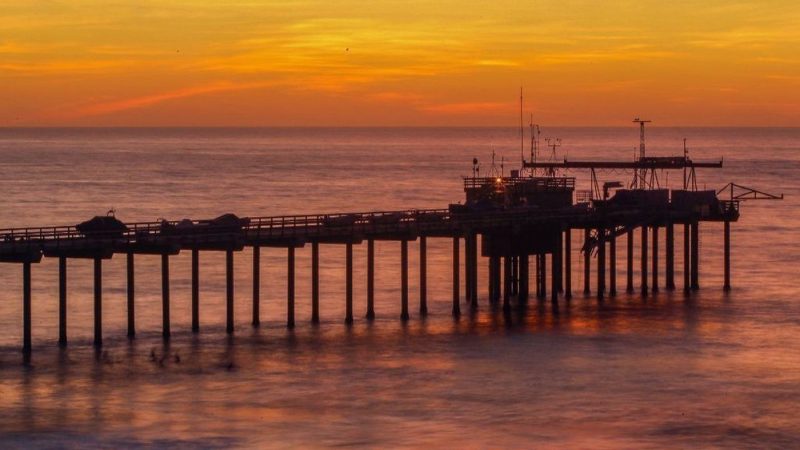
Scripps Pier after sunset in La Jolla, California. Image via Hayne Palmour IV/ San Diego Union-Tribune/ os Angeles Times.https://ift.tt/2B5P6CL
This is good news. It is less certain today that Earth’s oceans are 60% warmer than we thought (although they may still be that warm). As reported in the Los Angeles Times today (November 14, 2018), researchers with UC San Diego’s Scripps Institution of Oceanography and Princeton University have had to walk back a widely reported scientific result – based on a paper published in Nature last month – showing that showed Earth’s oceans were heating up dramatically faster than previously thought, as a result of climate change.
The October 31 paper in Nature stated the oceans had warmed 60% more than outlined by the United Nations’ Intergovernmental Panel on Climate Change (IPCC). On November 6, mathematician Nic Lewis posted his criticisms of the paper at Judith Curry’s blog. Both Lewis and Curry are critics of the scientific consensus that global warming is ongoing and human-caused.
In his November 6 blog post, Lewis pointed out flaws in the October 31 paper. The authors of the October 31 paper now say they’ve redone their calculations, and – although they find the ocean is still likely warmer than the estimate used by the IPCC – they agree that they “miffed” the range of probability. They can no longer support the earlier statement of a heat increase 60% greater than indicated. They now say there is a larger range of probability, between 10% and 70%, as other studies have already found.
A correction has been submitted to Nature.
The Los Angeles Times reported that one of the co-author’s on the paper – Ralph Keeling at the Scripps Institution of Oceanography – “took full blame” and thanked Lewis for alerting him to the mistake. Keeling told the Los Angeles Times:
When we were confronted with his insight it became immediately clear there was an issue there. We’re grateful to have it be pointed out quickly so that we could correct it quickly.
In the meantime, the Twitter-verse today has done the expected in a situation like this, where a widely reported and dramatic climate result has had to be walked back. Many are making comments like this one:
We always knew it was garbage but will the globalists agree with reality or deny it once more? ** 'We Really Muffed The Error Margins': Global Warming Report Rendered Worthless After Scientists Point Out Flaw In Ocean-Warming Survey https://t.co/uVzwS7UE36
— ?? Chuck Patriot Santa Dude Nellis ?? (@NascarChuck336) November 14, 2018
But cooler heads on Twitter and elsewhere in the media are also weighing in, pointing out – as has been necessary to point out time and again – that science is not a “body of facts.” Science is a process. Part of the reason scientists publish is so that other scientists can find errors in their work, so that the errors can be corrected.
All scientists know this. The Los Angeles Times explained it this way:
While papers are peer-reviewed before they’re published, new findings must always be reproduced before gaining widespread acceptance throughout the scientific community …
The Times quoted Gerald Meehl, a climate scientist at the National Center for Atmospheric Research in Boulder, Colorado, as saying:
This is how the process works. Every paper that comes out is not bulletproof or infallible. If it doesn’t stand up under scrutiny, you review the findings.
Climate contrarian uncovers scientific error, upends major ocean warming study.
Scientists don't cry "fake news", they accept the blame, fix the problem and move on… https://t.co/kL09DHRjqz
Bottom line: An error has been found in the October 31, 2018 paper published in Nature – showing an increase in ocean warming 60% greater than that estimated by the IPCC. The authors have acknowledged the error, and a correction has been submitted to Nature.
October 31 paper in Nature: Quantification of ocean heat uptake from changes in atmospheric O2 and CO2 composition
Scripps Pier after sunset in La Jolla, California. Image via Hayne Palmour IV/ San Diego Union-Tribune/ os Angeles Times.https://ift.tt/2B5P6CL
This is good news. It is less certain today that Earth’s oceans are 60% warmer than we thought (although they may still be that warm). As reported in the Los Angeles Times today (November 14, 2018), researchers with UC San Diego’s Scripps Institution of Oceanography and Princeton University have had to walk back a widely reported scientific result – based on a paper published in Nature last month – showing that showed Earth’s oceans were heating up dramatically faster than previously thought, as a result of climate change.
The October 31 paper in Nature stated the oceans had warmed 60% more than outlined by the United Nations’ Intergovernmental Panel on Climate Change (IPCC). On November 6, mathematician Nic Lewis posted his criticisms of the paper at Judith Curry’s blog. Both Lewis and Curry are critics of the scientific consensus that global warming is ongoing and human-caused.
In his November 6 blog post, Lewis pointed out flaws in the October 31 paper. The authors of the October 31 paper now say they’ve redone their calculations, and – although they find the ocean is still likely warmer than the estimate used by the IPCC – they agree that they “miffed” the range of probability. They can no longer support the earlier statement of a heat increase 60% greater than indicated. They now say there is a larger range of probability, between 10% and 70%, as other studies have already found.
A correction has been submitted to Nature.
The Los Angeles Times reported that one of the co-author’s on the paper – Ralph Keeling at the Scripps Institution of Oceanography – “took full blame” and thanked Lewis for alerting him to the mistake. Keeling told the Los Angeles Times:
When we were confronted with his insight it became immediately clear there was an issue there. We’re grateful to have it be pointed out quickly so that we could correct it quickly.
In the meantime, the Twitter-verse today has done the expected in a situation like this, where a widely reported and dramatic climate result has had to be walked back. Many are making comments like this one:
We always knew it was garbage but will the globalists agree with reality or deny it once more? ** 'We Really Muffed The Error Margins': Global Warming Report Rendered Worthless After Scientists Point Out Flaw In Ocean-Warming Survey https://t.co/uVzwS7UE36
— ?? Chuck Patriot Santa Dude Nellis ?? (@NascarChuck336) November 14, 2018
But cooler heads on Twitter and elsewhere in the media are also weighing in, pointing out – as has been necessary to point out time and again – that science is not a “body of facts.” Science is a process. Part of the reason scientists publish is so that other scientists can find errors in their work, so that the errors can be corrected.
All scientists know this. The Los Angeles Times explained it this way:
While papers are peer-reviewed before they’re published, new findings must always be reproduced before gaining widespread acceptance throughout the scientific community …
The Times quoted Gerald Meehl, a climate scientist at the National Center for Atmospheric Research in Boulder, Colorado, as saying:
This is how the process works. Every paper that comes out is not bulletproof or infallible. If it doesn’t stand up under scrutiny, you review the findings.
Climate contrarian uncovers scientific error, upends major ocean warming study.
Scientists don't cry "fake news", they accept the blame, fix the problem and move on… https://t.co/kL09DHRjqz
Bottom line: An error has been found in the October 31, 2018 paper published in Nature – showing an increase in ocean warming 60% greater than that estimated by the IPCC. The authors have acknowledged the error, and a correction has been submitted to Nature.
October 31 paper in Nature: Quantification of ocean heat uptake from changes in atmospheric O2 and CO2 composition
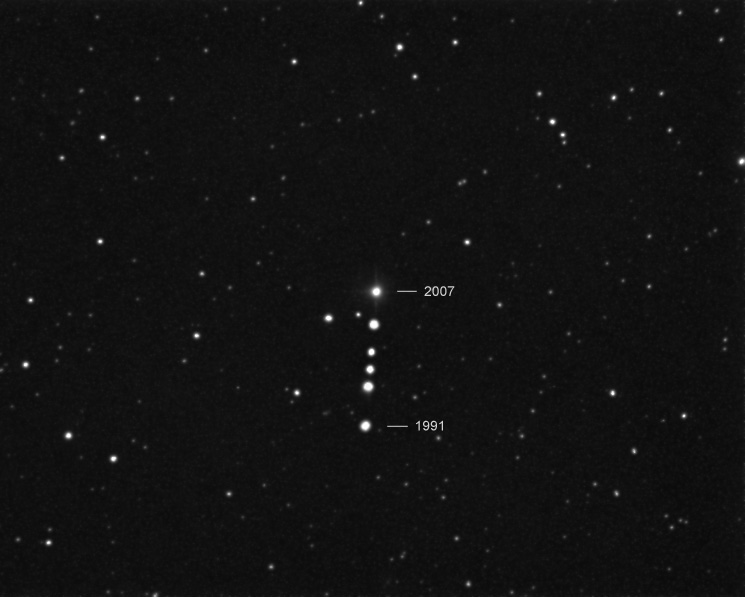
Barnard’s star – the 2nd closest star to Earth – has a large proper motion on our sky’s dome. This image – via One-Minute Astronomer – shows its motion from 1991 to 2007. Now, this very nearby star is known to have a planet.
Astronomers have discovered thousands of exoplanets in recent years – even an Earth-sized planet orbiting the nearest star to our sun – Proxima Centauri. Today (November 14, 2018), they’re announcing another exciting finding, a super-Earth planet orbiting the closest single star (and second-closest star system) to our own sun at only 6 light-years away, Barnard’s Star.
The planet has been labeled Barnard’s Star b (GJ 699 b). Its discovery has been decades in the making!
Indeed, Barnard’s Star was among the first to be announced – from the early 1960s to the early 1970s – as having an orbiting planet. Astronomer Peter van de Kamp argued he saw “wobbles” in the star’s motion across our sky, indicating one or more planets tugging on the star. He was in error, with the apparent positional shifts apparently caused by adjustments in the telescope lens, but the mystique of Barnard’s Star endured.
That mystique, and the nearness of this star to Earth, must have helped encourage an international team of astronomers to work hard to find a planet for Barnard’s Star. The team – including astronomers from the European Southern Observatory ( ESO), the Carnegie Institution for Science and elsewhere – has published its paper announcing the discovery in the peer-reviewed journal Nature.
The astronomers found the planet via the same method van de Kamp used in the 1960s and ’70s – which is called the radial velocity method – aided by instruments with vastly greater power and sensitivity, plus modern computers. The new planet for Barnard’s Star was found by analyzing 20 years of combined data from various telescopes, stitched together to create an exceptionally large database. According to lead author Ignasi Ribas of Spain’s Institute of Space Studies of Catalonia:
We used observations from seven different instruments, spanning 20 years of measurements, making this one of the largest and most extensive datasets ever used for precise radial velocity studies. The combination of all data led to a total of 771 measurements — a huge amount of information!
And, indeed, Barnard’s Star b is the smallest and most distant planet from its star to be found so far using radial velocity.
Our sun’s closest neighbors among the stars, including Barnard’s Star. Image via NASA PhotoJournal.
The radial velocity technique relies on the fact that a planet’s gravity causes tiny wobbles in the orbit of its star. The technique is based on the fact that not only does the star’s gravity affect any orbiting planets, but those planets can also affect the star, albeit to a much lesser degree.
This technique has been used to find hundreds of planets. We now have decades of archival data at our disposal. The precision of new measurements continues to improve, opening the doors to new parameters of space, such as super-Earth planets in cool orbits like Barnard’s Star b.
Astronomers are confident that the planet is real and not a false detection. Ignasi Ribas commented:
After a very careful analysis, we are over 99 percent confident that the planet is there. However, we’ll continue to observe this fast-moving star to exclude possible, but improbable, natural variations of the stellar brightness which could masquerade as a planet.
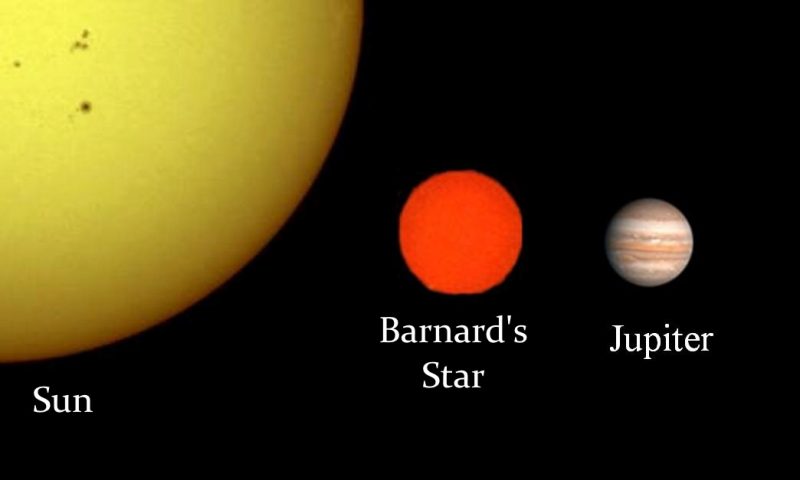
Barnard’s Star is a red dwarf star. It’s small; here’s its size compared to that of our sun and Jupiter, our solar system’s largest planet. Image via Wikimedia Commons.
Barnard’s Star b appears to be a super-Earth – a type of exoplanet that is larger than Earth but smaller than Uranus or Neptune. It has a mass 3.2 times that of Earth and orbits its star every 233 days. At that distance, because the star is smaller and cooler than our sun – only emitting 0.4 % of our sun’s radiant energy – the planet is colder than Earth, with an estimated surface temperature of -238 degrees Fahrenheit (-150 degrees Celsius). This makes it unlikely to be habitable, although little is known still about specific conditions on the planet.
We have all worked very hard on this breakthrough. This discovery is the result of a large collaboration organized in the context of the Red Dots project, which included contributions from teams all over the world. Follow-up observations are already underway at different observatories worldwide.
These astronomers also note that, since the planet is close, it will be an ideal target for NASA’s upcoming Wide Field Infrared Survey Telescope (WFIRST). It might also be possible to observe Barnard’s Star via the European Space Agency’s Gaia mission, whose second data release earlier this year has yielded a huge bounty of new and exciting insights in astronomy.
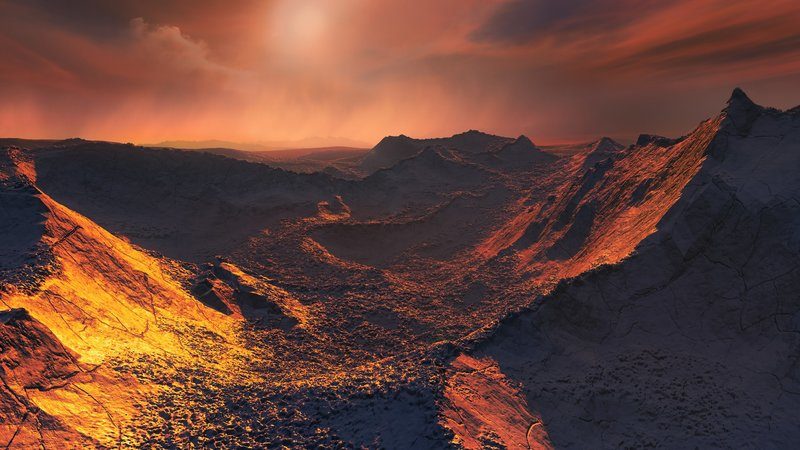
Artist’s concept of the surface of the newly discovered planet, called Barnard’s Star b. Image via ESO/ M. Kornmesser.
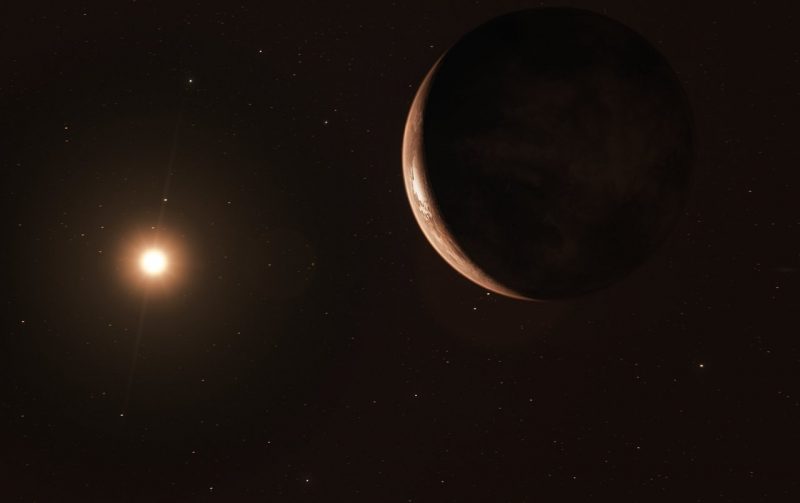
Artist’s concept of Barnard’s Star b. Image via ESO/ M. Kornmesser.
At six light-years away, Barnard’s Star is the closest single star to our sun, but fourth closest star overall, after the three stars that make up the Alpha Centauri triple-star system, which includes Proxima Centauri. It is a red dwarf star, known to produce some flaring, but less active than most other known red dwarfs in terms of stellar flare activity. Like red dwarfs generally, this star is smaller – and believed to be older – than our sun.
Even though it is the second-closest star system, Barnard’s Star is too faint to be seen with the human eye.
The star is named for Yerkes Observatory astronomer E. E. Barnard, who was the first to notice its large proper motion – or sideways motion on our sky’s dome – in 1916. The large proper motion of Barnard’s Star is caused in part by the star’s nearness to Earth, but also by the fact that Barnard’s Star – and its newly found planet – are merely passing through our neighborhood of space, as opposed to moving in the same general stream as our sun and other nearby stars around the galaxy’s center. Over the long course of astronomical time, Barnard’s Star will move farther away!
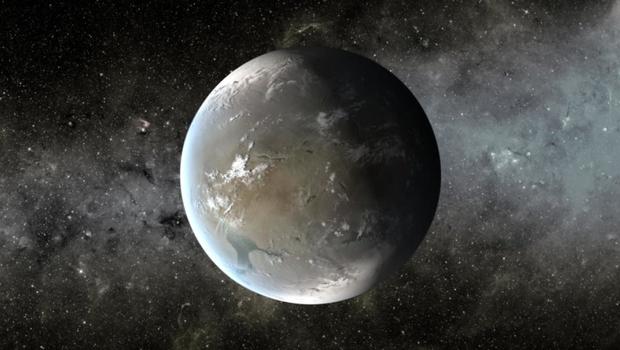
Barnard’s Star b is a super-Earth, like Kepler-62f (artist’s concept). Image via NASA Ames/JPL-Caltech/T. Pyle.
Bottom line: The discovery of a super-Earth exoplanet so close to our solar system is exciting, even if the planet is unlikely to be habitable. The fact that many such worlds have already been found, and now this one so close by means that they must likely be common throughout the galaxy, increasing the chances that some of them, or their Earth-sized cousins, could indeed support life.
Barnard’s star – the 2nd closest star to Earth – has a large proper motion on our sky’s dome. This image – via One-Minute Astronomer – shows its motion from 1991 to 2007. Now, this very nearby star is known to have a planet.
Astronomers have discovered thousands of exoplanets in recent years – even an Earth-sized planet orbiting the nearest star to our sun – Proxima Centauri. Today (November 14, 2018), they’re announcing another exciting finding, a super-Earth planet orbiting the closest single star (and second-closest star system) to our own sun at only 6 light-years away, Barnard’s Star.
The planet has been labeled Barnard’s Star b (GJ 699 b). Its discovery has been decades in the making!
Indeed, Barnard’s Star was among the first to be announced – from the early 1960s to the early 1970s – as having an orbiting planet. Astronomer Peter van de Kamp argued he saw “wobbles” in the star’s motion across our sky, indicating one or more planets tugging on the star. He was in error, with the apparent positional shifts apparently caused by adjustments in the telescope lens, but the mystique of Barnard’s Star endured.
That mystique, and the nearness of this star to Earth, must have helped encourage an international team of astronomers to work hard to find a planet for Barnard’s Star. The team – including astronomers from the European Southern Observatory ( ESO), the Carnegie Institution for Science and elsewhere – has published its paper announcing the discovery in the peer-reviewed journal Nature.
The astronomers found the planet via the same method van de Kamp used in the 1960s and ’70s – which is called the radial velocity method – aided by instruments with vastly greater power and sensitivity, plus modern computers. The new planet for Barnard’s Star was found by analyzing 20 years of combined data from various telescopes, stitched together to create an exceptionally large database. According to lead author Ignasi Ribas of Spain’s Institute of Space Studies of Catalonia:
We used observations from seven different instruments, spanning 20 years of measurements, making this one of the largest and most extensive datasets ever used for precise radial velocity studies. The combination of all data led to a total of 771 measurements — a huge amount of information!
And, indeed, Barnard’s Star b is the smallest and most distant planet from its star to be found so far using radial velocity.
Our sun’s closest neighbors among the stars, including Barnard’s Star. Image via NASA PhotoJournal.
The radial velocity technique relies on the fact that a planet’s gravity causes tiny wobbles in the orbit of its star. The technique is based on the fact that not only does the star’s gravity affect any orbiting planets, but those planets can also affect the star, albeit to a much lesser degree.
This technique has been used to find hundreds of planets. We now have decades of archival data at our disposal. The precision of new measurements continues to improve, opening the doors to new parameters of space, such as super-Earth planets in cool orbits like Barnard’s Star b.
Astronomers are confident that the planet is real and not a false detection. Ignasi Ribas commented:
After a very careful analysis, we are over 99 percent confident that the planet is there. However, we’ll continue to observe this fast-moving star to exclude possible, but improbable, natural variations of the stellar brightness which could masquerade as a planet.
Barnard’s Star is a red dwarf star. It’s small; here’s its size compared to that of our sun and Jupiter, our solar system’s largest planet. Image via Wikimedia Commons.
Barnard’s Star b appears to be a super-Earth – a type of exoplanet that is larger than Earth but smaller than Uranus or Neptune. It has a mass 3.2 times that of Earth and orbits its star every 233 days. At that distance, because the star is smaller and cooler than our sun – only emitting 0.4 % of our sun’s radiant energy – the planet is colder than Earth, with an estimated surface temperature of -238 degrees Fahrenheit (-150 degrees Celsius). This makes it unlikely to be habitable, although little is known still about specific conditions on the planet.
We have all worked very hard on this breakthrough. This discovery is the result of a large collaboration organized in the context of the Red Dots project, which included contributions from teams all over the world. Follow-up observations are already underway at different observatories worldwide.
These astronomers also note that, since the planet is close, it will be an ideal target for NASA’s upcoming Wide Field Infrared Survey Telescope (WFIRST). It might also be possible to observe Barnard’s Star via the European Space Agency’s Gaia mission, whose second data release earlier this year has yielded a huge bounty of new and exciting insights in astronomy.
Artist’s concept of the surface of the newly discovered planet, called Barnard’s Star b. Image via ESO/ M. Kornmesser.
Artist’s concept of Barnard’s Star b. Image via ESO/ M. Kornmesser.
At six light-years away, Barnard’s Star is the closest single star to our sun, but fourth closest star overall, after the three stars that make up the Alpha Centauri triple-star system, which includes Proxima Centauri. It is a red dwarf star, known to produce some flaring, but less active than most other known red dwarfs in terms of stellar flare activity. Like red dwarfs generally, this star is smaller – and believed to be older – than our sun.
Even though it is the second-closest star system, Barnard’s Star is too faint to be seen with the human eye.
The star is named for Yerkes Observatory astronomer E. E. Barnard, who was the first to notice its large proper motion – or sideways motion on our sky’s dome – in 1916. The large proper motion of Barnard’s Star is caused in part by the star’s nearness to Earth, but also by the fact that Barnard’s Star – and its newly found planet – are merely passing through our neighborhood of space, as opposed to moving in the same general stream as our sun and other nearby stars around the galaxy’s center. Over the long course of astronomical time, Barnard’s Star will move farther away!
Barnard’s Star b is a super-Earth, like Kepler-62f (artist’s concept). Image via NASA Ames/JPL-Caltech/T. Pyle.
Bottom line: The discovery of a super-Earth exoplanet so close to our solar system is exciting, even if the planet is unlikely to be habitable. The fact that many such worlds have already been found, and now this one so close by means that they must likely be common throughout the galaxy, increasing the chances that some of them, or their Earth-sized cousins, could indeed support life.
View larger. | The new-born island of Surtsey, off the coast of Iceland, on November 30, 1963. Howell Williams captured this photo 16 days after the start of the eruption that created Surtsey. Image via NOAA.
November 14, 1963. On this date, a cook aboard a trawler called Ísleifur II – sailing south of Iceland – spotted a column of dark smoke rising from the surface of the sea. The ship’s captain thought it be a boat on fire and turned his vessel to investigate. What they found was an island in the process of being born. There were explosive volcanic eruptions originating from below the sea surface, belching black columns of ash.
The new island was later named Surtsey, for Surtr, a fire jötunn (a mythological race of Norse giants).
The eruption continued for several years. After just a few days, the new island measured over 1,640 feet (500 meters) in length and had reached a height above the sea surface of 147 feet (45 meters).
And it continued to grow. By April of 1965, ash had blocked sea water from the crater area. Lava flows became prominent, forming a hard cap of solid rocks over the lower slopes of the new island. This prevented the waves from washing away the island.
The eruption ultimately lasted 3 1/2 years, ending in June 1967.
New island off the coast of Pakistan, one day after it emerged from the waves on September 24, 2013. Image via BBC World News Facebook.
Surtsey is only the most famous, or one of the most famous, of the islands known to have emerged from below the sea surface in living memory. For example, on September 24, 2013, an earthquake caused the birth of a new mud island off Pakistan’s southern coast.
Another famous example from the 20th century is Anak Krakatau (“child of Krakatoa”), which formed in the flooded caldera of that Indonesian volcano in 1930.
Today, wind and wave erosion eat away at Surtsey steadily, reclaiming some of its land mass. As of 2002, Surtsey’s surface area was 1.4 square kilometers (0.54 square miles), according to the Surtsey Research Society. Scientists estimate that, if the current rate of erosion doesn’t change, the island will be mostly at or below sea level by 2100. At that time, though, the tougher core of the island will be exposed. Afterwards, Surtsey might last several more centuries.
The birth of this new landform wasn’t the end of Surtsey’s story. In the first spring after Surtsey emerged from the sea surface, seeds and other plant parts were found washed up on the newly formed shore. In the spring of 1965, the first higher plant was discovered at the shoreline: a sea rocket (Cakile arctica).
Since then, Surtsey – whose north shore touches the Arctic Circle – has provided scientists a laboratory to observe how plants and animals establish themselves in new territory.
In 1965, it was declared a nature reserve for the study of ecological succession, that is, how plants, insects, birds, seals, and other forms of life have since established themselves on the island over time.
Bottom line: New islands are sometimes born, and frequently disappear again, on human timescales. The most famous new island in living memory may be Surtsey, off the southern coast of Iceland, which began to emerge on November 14, 1963.
from EarthSky https://ift.tt/2zawb8x
View larger. | The new-born island of Surtsey, off the coast of Iceland, on November 30, 1963. Howell Williams captured this photo 16 days after the start of the eruption that created Surtsey. Image via NOAA.
November 14, 1963. On this date, a cook aboard a trawler called Ísleifur II – sailing south of Iceland – spotted a column of dark smoke rising from the surface of the sea. The ship’s captain thought it be a boat on fire and turned his vessel to investigate. What they found was an island in the process of being born. There were explosive volcanic eruptions originating from below the sea surface, belching black columns of ash.
The new island was later named Surtsey, for Surtr, a fire jötunn (a mythological race of Norse giants).
The eruption continued for several years. After just a few days, the new island measured over 1,640 feet (500 meters) in length and had reached a height above the sea surface of 147 feet (45 meters).
And it continued to grow. By April of 1965, ash had blocked sea water from the crater area. Lava flows became prominent, forming a hard cap of solid rocks over the lower slopes of the new island. This prevented the waves from washing away the island.
The eruption ultimately lasted 3 1/2 years, ending in June 1967.
New island off the coast of Pakistan, one day after it emerged from the waves on September 24, 2013. Image via BBC World News Facebook.
Surtsey is only the most famous, or one of the most famous, of the islands known to have emerged from below the sea surface in living memory. For example, on September 24, 2013, an earthquake caused the birth of a new mud island off Pakistan’s southern coast.
Another famous example from the 20th century is Anak Krakatau (“child of Krakatoa”), which formed in the flooded caldera of that Indonesian volcano in 1930.
Today, wind and wave erosion eat away at Surtsey steadily, reclaiming some of its land mass. As of 2002, Surtsey’s surface area was 1.4 square kilometers (0.54 square miles), according to the Surtsey Research Society. Scientists estimate that, if the current rate of erosion doesn’t change, the island will be mostly at or below sea level by 2100. At that time, though, the tougher core of the island will be exposed. Afterwards, Surtsey might last several more centuries.
The birth of this new landform wasn’t the end of Surtsey’s story. In the first spring after Surtsey emerged from the sea surface, seeds and other plant parts were found washed up on the newly formed shore. In the spring of 1965, the first higher plant was discovered at the shoreline: a sea rocket (Cakile arctica).
Since then, Surtsey – whose north shore touches the Arctic Circle – has provided scientists a laboratory to observe how plants and animals establish themselves in new territory.
In 1965, it was declared a nature reserve for the study of ecological succession, that is, how plants, insects, birds, seals, and other forms of life have since established themselves on the island over time.
Bottom line: New islands are sometimes born, and frequently disappear again, on human timescales. The most famous new island in living memory may be Surtsey, off the southern coast of Iceland, which began to emerge on November 14, 1963.
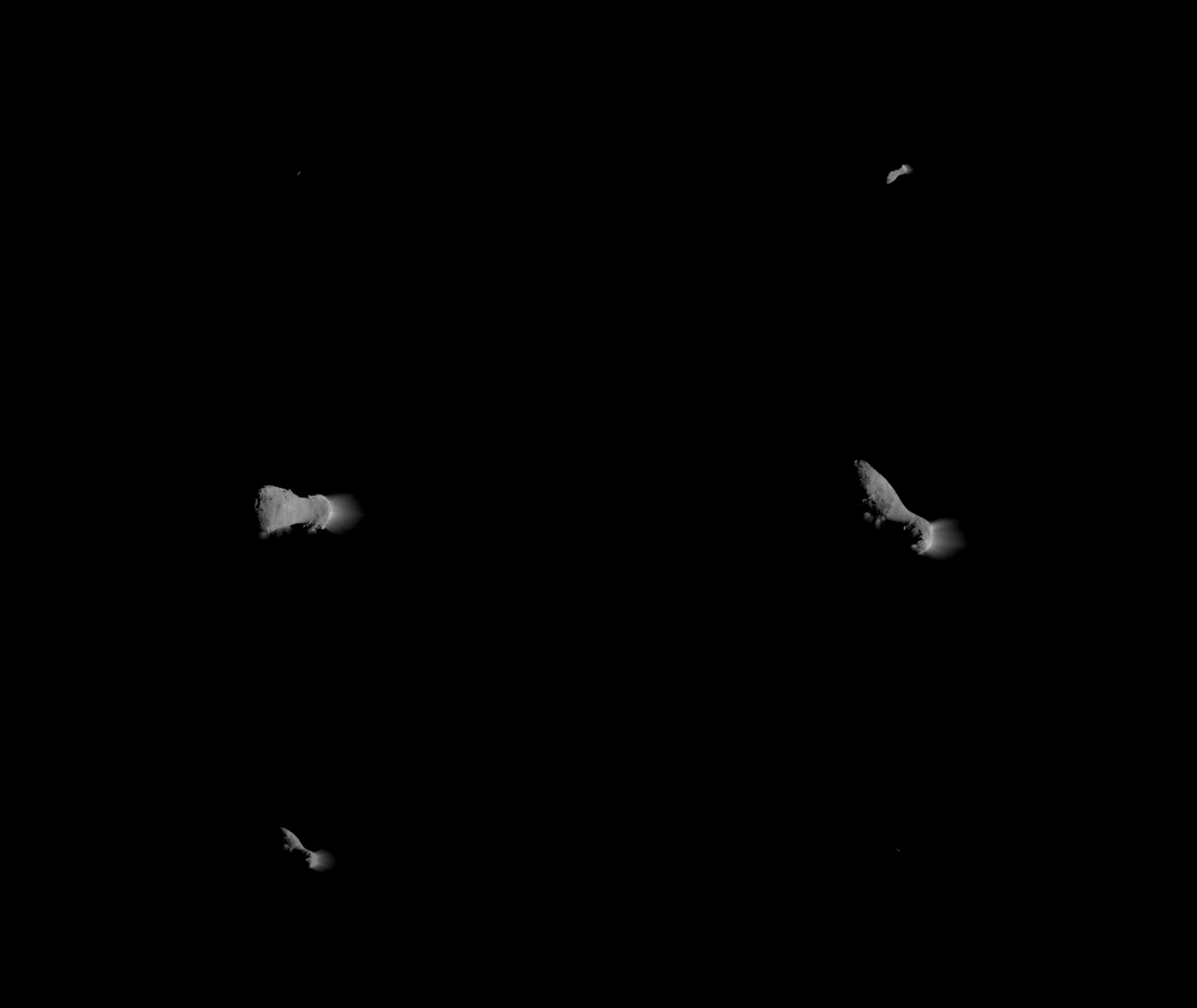
This video clip was compiled from images taken by NASA’s EPOXI mission spacecraft during its flyby of comet Hartley 2 on November 4, 2010. Image via NASA/JPL-Caltech/UMD.
Funding for small object studies – asteroids and comets – has increased over the past several decades, mainly since astronomers realized that space rocks sometimes do strike the Earth. Now – thanks to adequate funding over decades – scientists believe they have a good handle on the paths through space of the major asteroids, the ones that would literally rock our world if they collided with us. And, fortunately, no major asteroid is known for certain to be on a collision course with Earth at the present time. But small asteroids do pass us all the time, too, in a mass range capable of causing local damage. Some close-passing asteroids are discovered only after they’ve passed closest. What’s more, scientists have come to recognize, in the most profound way, that asteroids can serve as resources for humanity, especially as we venture out into space. Thus NASA is still all-in for studying asteroids, and on November 7, 2018, it released these six reasons why. Note that we’ve changed the order of these six items, from NASA’s original article.
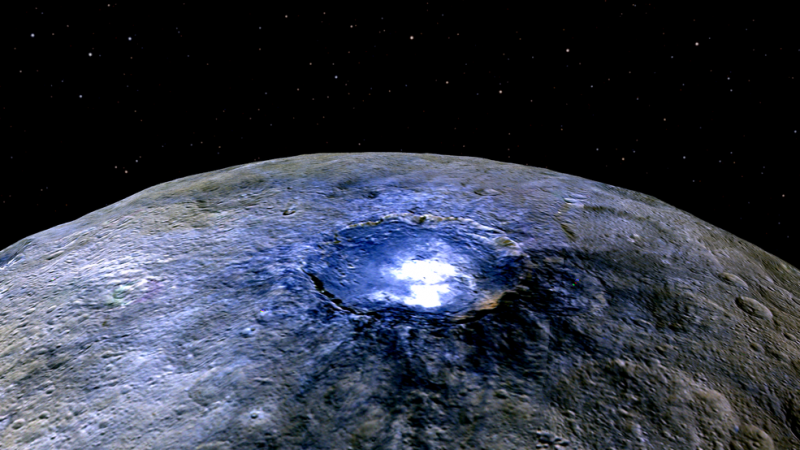
This is Ceres, the 1st asteroid ever to be discovered, in the year 1801. In recent years, the Dawn spacecraft has orbited it and obtained stunning close-up images. What you’re seeing here is Occator Crater (in false color), home to Ceres’ most famous bright spots, which are apparently salt deposits. Image via NASA/JPL-Caltech/UCLA/MPS/DLR/IDA.
1. Asteroids can serve as pit stops – and provide resources – for future space exploration.
Decades ago, visionaries began in earnest speaking of asteroids and comets as places to mine for resources needed by space-faring humans. NASA pointed out:
There are no gas stations in space yet, but scientists and engineers are already starting to think about how asteroids could one day serve as refueling stations for spacecraft on the way to farther-flung destinations. These small worlds might also help astronauts restock their supplies. For example, asteroid Bennu [target of the ongoing OSIRIS-REx mission] likely has water bound in clay minerals, which could perhaps one day be harvested for hydrating thirsty space travelers.
Scientists also suggest asteroids might be mined, and the materials in space used in space for further exploration.
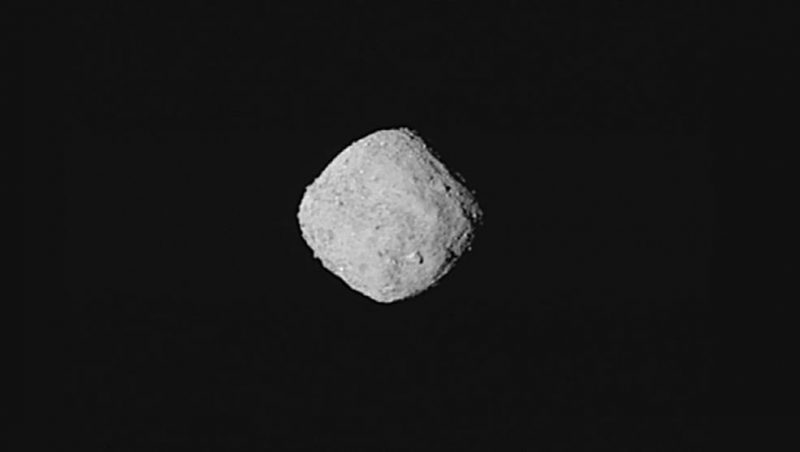
This “super-resolution” view of asteroid Bennu was created using 8 images obtained by NASA’s OSIRIS-REx spacecraft on October 29, 2018, from a distance of about 205 miles (330 km). Image via NASA/Goddard/University of Arizona.
2. Some asteroids or comets may be hazards to Earth.
When speaking of hazardous asteroids, NASA specifically mentioned asteroid Bennu again. As it happens, this asteroid is one of the most potentially hazardous asteroids to Earth currently known, even though the odds of its colliding with Earth are relatively small. NASA said:
… scientists estimate Bennu has a 1-in-2,700 chance of impacting our planet during one of its close approaches to Earth in the late 22nd century. Right now, scientists can predict Bennu’s path quite precisely through the year 2135, when the asteroid will make one of its close passes by Earth. Close observations by OSIRIS-REx will get an even tighter handle on Bennu’s journey, and help scientists working on safeguarding our planet against hazardous asteroids to better understand what it would take to deflect one on an impact trajectory.
This animation shows how NASA’s Double Asteroid Redirection Test (DART) would target and strike the smaller (left) element of the binary asteroid Didymos to demonstrate how a kinetic impact could potentially redirect an asteroid as part of the agency’s planetary defense program.
Another upcoming mission that will test a technique for defending the planet from naturally occurring impact hazards is NASA’s Double Asteroid Redirection Test (DART) mission, which will attempt to change a small asteroid’s motion by colliding with it, in a precise way.
DART’s target is Didymos, a binary asteroid composed of two objects orbiting each other. The larger body is about half a mile (800 meters) across, with a small moonlet that is less than one-tenth of a mile (150 meters) wide. An asteroid this size could result in widespread regional damage if one were to impact Earth.
DART will deliberately crash itself into the moonlet to slightly change the small object’s orbital speed. Telescopes on Earth will then measure this change in speed by observing the new period of time it takes the moonlet to complete an orbit around the main body, which is expected to be a change of less than a fraction of one percent. But even that small of change could be enough to make a predicted impactor miss Earth in some future impact scenario. The spacecraft, being built by the Johns Hopkins University Applied Physics Laboratory, is scheduled for launch in spring-summer 2021.
Didymos and Bennu are just two of the almost 19,000 known near-Earth asteroids. There are over 8,300 known near-Earth asteroids the size of the moonlet of Didymos and larger, but scientists estimate that about 25,000 asteroids in that size range exist in near-Earth space.
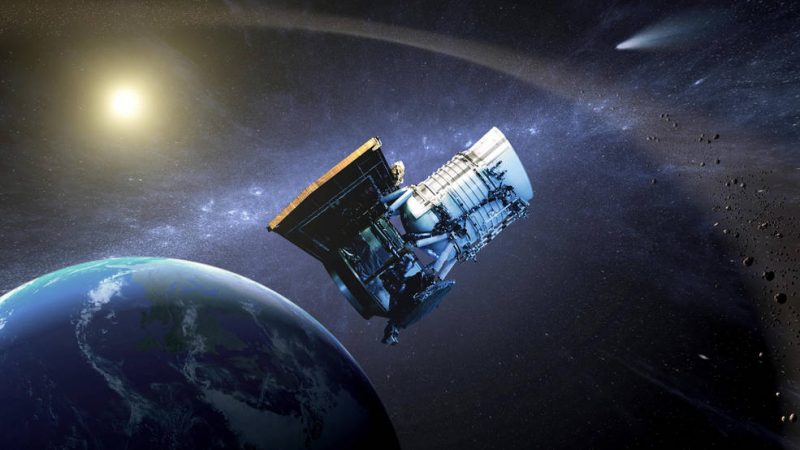
Artist’s concept shows the Wide-field Infrared Survey Explorer, or WISE, spacecraft, in its orbit around Earth. In its NEOWISE mission it finds and characterizes asteroids. Image via NASA/JPL-Caltech.
A space telescope is currently helping scientists discover and understand these near-Earth objects, including potential hazards. It’s called NEOWISE, and Amy Mainzer is its principal investigator. She said:
For most asteroids, we know little about them except for their orbit and how bright they look. With NEOWISE, we can use the heat emitted from the objects to give us a better assessment of their sizes. That’s important because asteroid impacts can pack quite a punch, and the amount of energy depends strongly on the size of the object.
But asteroids and comets – even those in near-Earth space – weren’t always considered hazards to our world. In fact …
3. Asteroids and comets may have delivered the elements of life to Earth.
Consider asteroid Bennu again, target of the OSIRIS-REx mission. Bennu may be loaded with molecules of carbon and water, both of which are necessary for life as we know it. Scientists believe that – as Earth formed, and afterward – objects like Bennu rained down and delivered these materials to our planet. These objects did not have oceans themselves, but rather water molecules bound up in minerals. A substantial percentage of Earth’s water is thought to have come from small bodies like Bennu (the rest of Earth’s water likely came from an even more primeval source, the solar nebula). NASA said:
By studying Bennu, we can better understand the kinds of objects that allowed a barren young Earth to blossom with life.
Bennu likely originated in the main asteroid belt between Mars and Jupiter, and it’s thought to have survived a catastrophic collision that happened between 800 million and 2 billion years ago. Scientists think a big, carbon-rich asteroid shattered into thousands of pieces, and Bennu is one of the remnants. Rather than a solid object, Bennu is thought to be a “rubble pile” asteroid – a loose collection of rocks stuck together through gravity and another force scientists call cohesion. OSIRIS-REx, which will arrive at Bennu in early December 2018, after a 1.2-billion-mile (2-billion-km) journey, and will bring back a sample of this intriguing object to Earth in a sample-return capsule in 2023.
The Japanese Hayabusa-2 mission is also looking at an asteroid from the same family of bodies thought to have delivered ingredients for life to Earth. Currently in orbit at asteroid Ryugu, with small hopping rovers on the surface (see images from the rovers here), the mission will collect samples and return them in a capsule to Earth for analysis by the end of 2020.
But there’s more. Small bodies in space didn’t just supply the ingredients for life. They also supplied the ingredients for the planets themselves, Earth included.
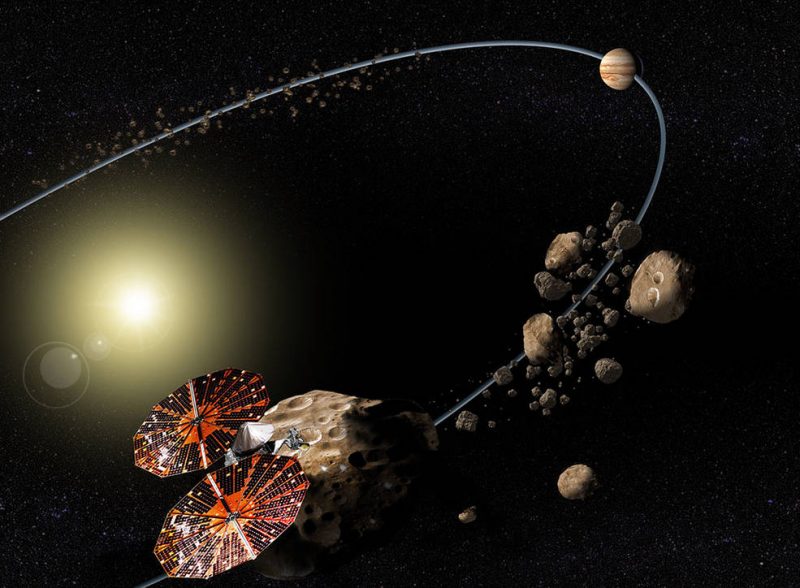
Artist’s concept of NASA’s Lucy mission, due to launch in October 2021. The mission will investigate the swarms of asteroids known as Trojans – which orbit in Jupiter’s orbit – for the 1st time. It’ll thoroughly investigate 6 Trojans (3 asteroids in each of 2 Trojan swarms). Image via NASA/SwRI
4. Essentially, asteroids were the building blocks of planets.
Our solar system as we know it today formed from grains of dust – tiny particles of rock, metal and ice – swirling in a disk around our infant sun. Most of the material from this disk fell into the newborn star, but some bits avoided that fate and stuck together, growing into asteroids, comets and even planets. Lots of leftovers from that process have survived to this day. The growth of planets from smaller objects is one piece of our history that asteroids and comets can help us investigate. NASA said:
Two ancient fossils providing clues to this story are Vesta and Ceres, the largest bodies in the asteroid belt between Mars and Jupiter. NASA’s Dawn spacecraft, which recently ended its mission, orbited both of them … While many asteroids are loose collections of rubble, the interiors of Vesta and Ceres are layered, with the densest material at their cores … This indicates both of these bodies were on their way to becoming planets, but their growth was stunted. They never had enough material to get as big as the major planets.
5. Asteroids and comets help astronomers trace solar system evolution.
NASA said:
Most of the material that formed our solar system, including Earth, didn’t live to tell the tale. It fell into the sun or was ejected beyond the reaches of our most powerful telescopes; only a small fraction formed the planets. But there are some renegade remnants of the early days when the stuff of planets swirled with an uncertain fate around the sun.
A particularly catastrophic time for the solar system was between 50 and 500 million years after the sun formed. Jupiter and Saturn, our system’s most massive giants, reorganized the objects around them as their gravity interacted with smaller worlds such as asteroids. Uranus and Neptune may have originated closer to the sun and been kicked outward as Jupiter and Saturn moved around. Saturn, in fact, may have prevented Jupiter from “eating” some of the terrestrial planets, including Earth, as its gravity counteracted Jupiter’s further movement toward the sun.
Farther afield, the New Horizons spacecraft is currently on its way to a distant object called 2014 MU69, nicknamed “Ultima Thule” by the mission. One billion miles farther from the sun than Pluto, MU69 is a resident of the Kuiper Belt, a region of ice-rich objects beyond the orbit of Neptune. Objects like MU69 may represent the most primitive, or unaltered, material that remains in the solar system. While the planets orbit in ellipses around the sun, MU69 and many other Kuiper Belt objects have very circular orbits, suggesting they have not moved from their original paths in 4.5 billion years. These objects may represent the building blocks of Pluto and other distant icy worlds like it. New Horizons will make its closest approach to MU69 on January 1, 2019 – the farthest planetary flyby in history.
Artist’s concept of NASA’s New Horizons spacecraft encountering 2014 MU69, a Kuiper Belt object that orbits the sun 1 billion miles (1.6 billion kilometers) beyond Pluto, on January 1, 2019. Image via NASA/JHUAPL/SwRI.
6. Asteroids and comets help astronomers understand processes in an evolving solar system
Have you ever seen the zodiacal light? At this time of year, from the Northern Hemisphere, it’s easiest to see before dawn and is sometimes called the false dawn. This mysterious light is really scattered sunlight, from dust in the region of the sky where the planets orbit. This dsut dust is left over from the collisions of small bodies such as comets and asteroids. The zodiacal light is an indication that our solar system is still active, NASA said, adding:
Zodiacal dust around other stars indicates that they, too, may harbor active planetary systems.
Dust from small bodies has had an important role in our planet in particular. About 100 tons of meteoritic material and dust material fall on Earth every day. Some of it comes from comets, whose activity has direct implications for Earth’s evolution. As comets approach the sun and experience its heat, gases inside the comet bubble up and carry away dusty material from the comet – including ingredients for life. NASA’s Stardust spacecraft flew by comet 81P/Wild in 2004 and found that cometary dust contains amino acids, which are building blocks of life.
Occasional outbursts of gas and dust observed in comets indicate activity on or near their surfaces, such as landslides. The European Space Agency’s Rosetta mission, which completed its exploration of comet 67P/Churyumov-Gerasimenko in 2016, delivered unprecedented insights about cometary activity. Among the changes in the comet, the spacecraft observed a massive cliff collapse, a large crack get bigger and a boulder move. Ramy El-Maarry, a member of the U.S. Rosetta science team from the University of Colorado, Boulder, said in 2017:
We discovered that boulders the size of a large truck could be moved across the comet’s surface a distance as long as one-and-a-half football fields.
Comets also influence planetary motion today. As Jupiter continues to fling comets outward, it moves inward ever so slightly because of the gravitational dance with the icy bodies. Neptune, meanwhile, throws comets inward and in turn gets a tiny outward push. Uranus and Saturn are also moving outward very slowly in this process.
Thus the small bodies in space – the asteroids and comets – have established themselves as vital objects of study in astronomy. NASA has more to say on this subject, which you can read here.
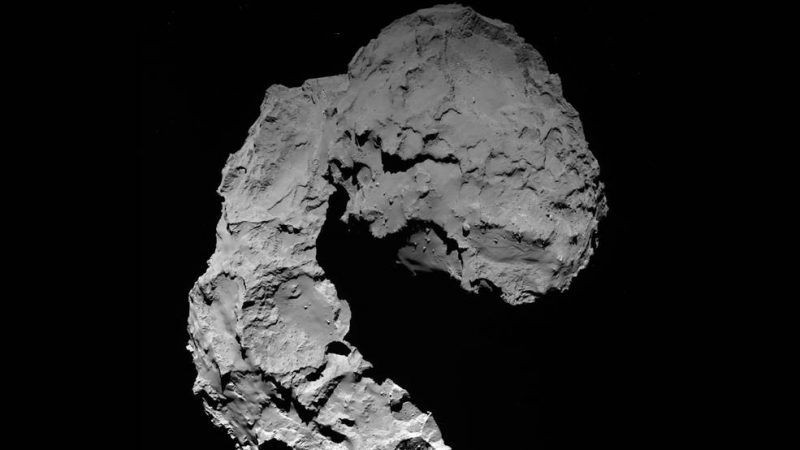
This view shows Comet 67P/Churyumov-Gerasimenko as seen by the OSIRIS wide-angle camera on ESA’s Rosetta spacecraft on September 29, 2016, when Rosetta was at an altitude of 14 miles (23 km). Image via ESA/Rosetta/MPS for OSIRIS Team MPS/UPD/LAM/IAA/SSO/INTA/UPM/DASP/IDA.
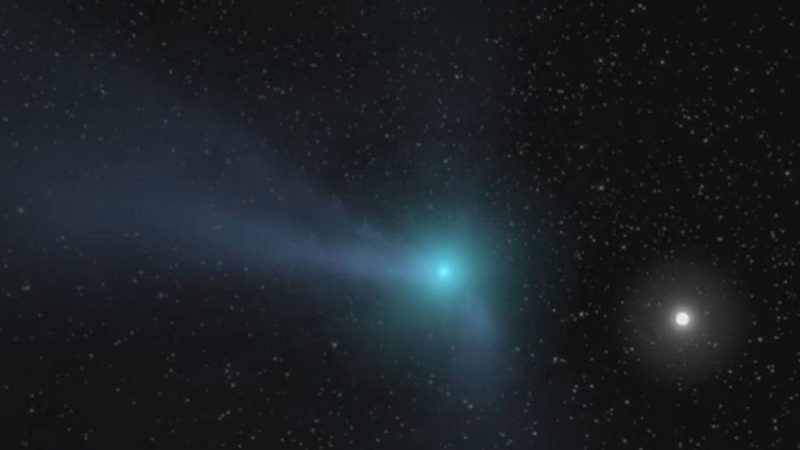
An animation portrays a comet as it approaches the inner solar system. Light from the sun warms the comet’s core, or nucleus, an object so small it cannot be seen at this scale. Click here to view animation. Image via NASA/JPL-Caltech.
Bottom line: Six reasons to study asteroids, comets and other space rocks.
This video clip was compiled from images taken by NASA’s EPOXI mission spacecraft during its flyby of comet Hartley 2 on November 4, 2010. Image via NASA/JPL-Caltech/UMD.
Funding for small object studies – asteroids and comets – has increased over the past several decades, mainly since astronomers realized that space rocks sometimes do strike the Earth. Now – thanks to adequate funding over decades – scientists believe they have a good handle on the paths through space of the major asteroids, the ones that would literally rock our world if they collided with us. And, fortunately, no major asteroid is known for certain to be on a collision course with Earth at the present time. But small asteroids do pass us all the time, too, in a mass range capable of causing local damage. Some close-passing asteroids are discovered only after they’ve passed closest. What’s more, scientists have come to recognize, in the most profound way, that asteroids can serve as resources for humanity, especially as we venture out into space. Thus NASA is still all-in for studying asteroids, and on November 7, 2018, it released these six reasons why. Note that we’ve changed the order of these six items, from NASA’s original article.
This is Ceres, the 1st asteroid ever to be discovered, in the year 1801. In recent years, the Dawn spacecraft has orbited it and obtained stunning close-up images. What you’re seeing here is Occator Crater (in false color), home to Ceres’ most famous bright spots, which are apparently salt deposits. Image via NASA/JPL-Caltech/UCLA/MPS/DLR/IDA.
1. Asteroids can serve as pit stops – and provide resources – for future space exploration.
Decades ago, visionaries began in earnest speaking of asteroids and comets as places to mine for resources needed by space-faring humans. NASA pointed out:
There are no gas stations in space yet, but scientists and engineers are already starting to think about how asteroids could one day serve as refueling stations for spacecraft on the way to farther-flung destinations. These small worlds might also help astronauts restock their supplies. For example, asteroid Bennu [target of the ongoing OSIRIS-REx mission] likely has water bound in clay minerals, which could perhaps one day be harvested for hydrating thirsty space travelers.
Scientists also suggest asteroids might be mined, and the materials in space used in space for further exploration.
This “super-resolution” view of asteroid Bennu was created using 8 images obtained by NASA’s OSIRIS-REx spacecraft on October 29, 2018, from a distance of about 205 miles (330 km). Image via NASA/Goddard/University of Arizona.
2. Some asteroids or comets may be hazards to Earth.
When speaking of hazardous asteroids, NASA specifically mentioned asteroid Bennu again. As it happens, this asteroid is one of the most potentially hazardous asteroids to Earth currently known, even though the odds of its colliding with Earth are relatively small. NASA said:
… scientists estimate Bennu has a 1-in-2,700 chance of impacting our planet during one of its close approaches to Earth in the late 22nd century. Right now, scientists can predict Bennu’s path quite precisely through the year 2135, when the asteroid will make one of its close passes by Earth. Close observations by OSIRIS-REx will get an even tighter handle on Bennu’s journey, and help scientists working on safeguarding our planet against hazardous asteroids to better understand what it would take to deflect one on an impact trajectory.
This animation shows how NASA’s Double Asteroid Redirection Test (DART) would target and strike the smaller (left) element of the binary asteroid Didymos to demonstrate how a kinetic impact could potentially redirect an asteroid as part of the agency’s planetary defense program.
Another upcoming mission that will test a technique for defending the planet from naturally occurring impact hazards is NASA’s Double Asteroid Redirection Test (DART) mission, which will attempt to change a small asteroid’s motion by colliding with it, in a precise way.
DART’s target is Didymos, a binary asteroid composed of two objects orbiting each other. The larger body is about half a mile (800 meters) across, with a small moonlet that is less than one-tenth of a mile (150 meters) wide. An asteroid this size could result in widespread regional damage if one were to impact Earth.
DART will deliberately crash itself into the moonlet to slightly change the small object’s orbital speed. Telescopes on Earth will then measure this change in speed by observing the new period of time it takes the moonlet to complete an orbit around the main body, which is expected to be a change of less than a fraction of one percent. But even that small of change could be enough to make a predicted impactor miss Earth in some future impact scenario. The spacecraft, being built by the Johns Hopkins University Applied Physics Laboratory, is scheduled for launch in spring-summer 2021.
Didymos and Bennu are just two of the almost 19,000 known near-Earth asteroids. There are over 8,300 known near-Earth asteroids the size of the moonlet of Didymos and larger, but scientists estimate that about 25,000 asteroids in that size range exist in near-Earth space.
Artist’s concept shows the Wide-field Infrared Survey Explorer, or WISE, spacecraft, in its orbit around Earth. In its NEOWISE mission it finds and characterizes asteroids. Image via NASA/JPL-Caltech.
A space telescope is currently helping scientists discover and understand these near-Earth objects, including potential hazards. It’s called NEOWISE, and Amy Mainzer is its principal investigator. She said:
For most asteroids, we know little about them except for their orbit and how bright they look. With NEOWISE, we can use the heat emitted from the objects to give us a better assessment of their sizes. That’s important because asteroid impacts can pack quite a punch, and the amount of energy depends strongly on the size of the object.
But asteroids and comets – even those in near-Earth space – weren’t always considered hazards to our world. In fact …
3. Asteroids and comets may have delivered the elements of life to Earth.
Consider asteroid Bennu again, target of the OSIRIS-REx mission. Bennu may be loaded with molecules of carbon and water, both of which are necessary for life as we know it. Scientists believe that – as Earth formed, and afterward – objects like Bennu rained down and delivered these materials to our planet. These objects did not have oceans themselves, but rather water molecules bound up in minerals. A substantial percentage of Earth’s water is thought to have come from small bodies like Bennu (the rest of Earth’s water likely came from an even more primeval source, the solar nebula). NASA said:
By studying Bennu, we can better understand the kinds of objects that allowed a barren young Earth to blossom with life.
Bennu likely originated in the main asteroid belt between Mars and Jupiter, and it’s thought to have survived a catastrophic collision that happened between 800 million and 2 billion years ago. Scientists think a big, carbon-rich asteroid shattered into thousands of pieces, and Bennu is one of the remnants. Rather than a solid object, Bennu is thought to be a “rubble pile” asteroid – a loose collection of rocks stuck together through gravity and another force scientists call cohesion. OSIRIS-REx, which will arrive at Bennu in early December 2018, after a 1.2-billion-mile (2-billion-km) journey, and will bring back a sample of this intriguing object to Earth in a sample-return capsule in 2023.
The Japanese Hayabusa-2 mission is also looking at an asteroid from the same family of bodies thought to have delivered ingredients for life to Earth. Currently in orbit at asteroid Ryugu, with small hopping rovers on the surface (see images from the rovers here), the mission will collect samples and return them in a capsule to Earth for analysis by the end of 2020.
But there’s more. Small bodies in space didn’t just supply the ingredients for life. They also supplied the ingredients for the planets themselves, Earth included.
Artist’s concept of NASA’s Lucy mission, due to launch in October 2021. The mission will investigate the swarms of asteroids known as Trojans – which orbit in Jupiter’s orbit – for the 1st time. It’ll thoroughly investigate 6 Trojans (3 asteroids in each of 2 Trojan swarms). Image via NASA/SwRI
4. Essentially, asteroids were the building blocks of planets.
Our solar system as we know it today formed from grains of dust – tiny particles of rock, metal and ice – swirling in a disk around our infant sun. Most of the material from this disk fell into the newborn star, but some bits avoided that fate and stuck together, growing into asteroids, comets and even planets. Lots of leftovers from that process have survived to this day. The growth of planets from smaller objects is one piece of our history that asteroids and comets can help us investigate. NASA said:
Two ancient fossils providing clues to this story are Vesta and Ceres, the largest bodies in the asteroid belt between Mars and Jupiter. NASA’s Dawn spacecraft, which recently ended its mission, orbited both of them … While many asteroids are loose collections of rubble, the interiors of Vesta and Ceres are layered, with the densest material at their cores … This indicates both of these bodies were on their way to becoming planets, but their growth was stunted. They never had enough material to get as big as the major planets.
5. Asteroids and comets help astronomers trace solar system evolution.
NASA said:
Most of the material that formed our solar system, including Earth, didn’t live to tell the tale. It fell into the sun or was ejected beyond the reaches of our most powerful telescopes; only a small fraction formed the planets. But there are some renegade remnants of the early days when the stuff of planets swirled with an uncertain fate around the sun.
A particularly catastrophic time for the solar system was between 50 and 500 million years after the sun formed. Jupiter and Saturn, our system’s most massive giants, reorganized the objects around them as their gravity interacted with smaller worlds such as asteroids. Uranus and Neptune may have originated closer to the sun and been kicked outward as Jupiter and Saturn moved around. Saturn, in fact, may have prevented Jupiter from “eating” some of the terrestrial planets, including Earth, as its gravity counteracted Jupiter’s further movement toward the sun.
Farther afield, the New Horizons spacecraft is currently on its way to a distant object called 2014 MU69, nicknamed “Ultima Thule” by the mission. One billion miles farther from the sun than Pluto, MU69 is a resident of the Kuiper Belt, a region of ice-rich objects beyond the orbit of Neptune. Objects like MU69 may represent the most primitive, or unaltered, material that remains in the solar system. While the planets orbit in ellipses around the sun, MU69 and many other Kuiper Belt objects have very circular orbits, suggesting they have not moved from their original paths in 4.5 billion years. These objects may represent the building blocks of Pluto and other distant icy worlds like it. New Horizons will make its closest approach to MU69 on January 1, 2019 – the farthest planetary flyby in history.
Artist’s concept of NASA’s New Horizons spacecraft encountering 2014 MU69, a Kuiper Belt object that orbits the sun 1 billion miles (1.6 billion kilometers) beyond Pluto, on January 1, 2019. Image via NASA/JHUAPL/SwRI.
6. Asteroids and comets help astronomers understand processes in an evolving solar system
Have you ever seen the zodiacal light? At this time of year, from the Northern Hemisphere, it’s easiest to see before dawn and is sometimes called the false dawn. This mysterious light is really scattered sunlight, from dust in the region of the sky where the planets orbit. This dsut dust is left over from the collisions of small bodies such as comets and asteroids. The zodiacal light is an indication that our solar system is still active, NASA said, adding:
Zodiacal dust around other stars indicates that they, too, may harbor active planetary systems.
Dust from small bodies has had an important role in our planet in particular. About 100 tons of meteoritic material and dust material fall on Earth every day. Some of it comes from comets, whose activity has direct implications for Earth’s evolution. As comets approach the sun and experience its heat, gases inside the comet bubble up and carry away dusty material from the comet – including ingredients for life. NASA’s Stardust spacecraft flew by comet 81P/Wild in 2004 and found that cometary dust contains amino acids, which are building blocks of life.
Occasional outbursts of gas and dust observed in comets indicate activity on or near their surfaces, such as landslides. The European Space Agency’s Rosetta mission, which completed its exploration of comet 67P/Churyumov-Gerasimenko in 2016, delivered unprecedented insights about cometary activity. Among the changes in the comet, the spacecraft observed a massive cliff collapse, a large crack get bigger and a boulder move. Ramy El-Maarry, a member of the U.S. Rosetta science team from the University of Colorado, Boulder, said in 2017:
We discovered that boulders the size of a large truck could be moved across the comet’s surface a distance as long as one-and-a-half football fields.
Comets also influence planetary motion today. As Jupiter continues to fling comets outward, it moves inward ever so slightly because of the gravitational dance with the icy bodies. Neptune, meanwhile, throws comets inward and in turn gets a tiny outward push. Uranus and Saturn are also moving outward very slowly in this process.
Thus the small bodies in space – the asteroids and comets – have established themselves as vital objects of study in astronomy. NASA has more to say on this subject, which you can read here.
This view shows Comet 67P/Churyumov-Gerasimenko as seen by the OSIRIS wide-angle camera on ESA’s Rosetta spacecraft on September 29, 2016, when Rosetta was at an altitude of 14 miles (23 km). Image via ESA/Rosetta/MPS for OSIRIS Team MPS/UPD/LAM/IAA/SSO/INTA/UPM/DASP/IDA.
An animation portrays a comet as it approaches the inner solar system. Light from the sun warms the comet’s core, or nucleus, an object so small it cannot be seen at this scale. Click here to view animation. Image via NASA/JPL-Caltech.
Bottom line: Six reasons to study asteroids, comets and other space rocks.
These next several evenings – November 14, 15 and 16 – highlight the moon and Mars coming quite close together on the sky’s dome. Look first for the moon, and you can’t miss the red planet Mars, which shines more brilliantly than a 1st-magnitude star all month long. For us in North America, the moon will swing closest to Mars for the month on the evening of November 15.
Of course, the moon and Mars are not truly close together in space, but more or less reside on the same line of sight. At present, the moon is about 250,000 miles (400,000 km) away from us, whereas Mars lies about 330 times the moon’s distance from Earth. Click here to know the moon’s present phase and present distance from Earth, and click here to know Mars’ present distance from Earth in astronomical units (sun-Earth distance).
After the moon and Mars first pop out at dusk or nightfall, watch for the brilliant twosome to move westward across the sky during the evening hours. They’ll finally set in the west quite late at night, very possibly after your bedtime. Click here for a recommended almanac that’ll give you the moon’s and Mars’ setting times in your sky.
Michael Daugherty caught Mars near the moon on September 19, 2018, shining over Balboa peer in Newport Beach, California. Thank you, Michael!
Although the moon and Mars appear to travel westward in Earth’s sky, due to the Earth rotating on its axis from west to east, the moon and Mars are actually traveling eastward relative to the background stars of the zodiac. Our moon only takes 27 1/3 days to travel full circle in front of the constellations of the zodiac, but it takes Mars some 1.88 Earth-years to do likewise. For that reason, the moon laps Mars once every month in Earth’s sky.
According to Astropixels.com, the moon will swing one degree (two moon-diameters) south of Mars on November 16, at 4:16 Universal Time. At U.S. time zones, that’s November 15, at 23:16 (11:16 p.m.) EST, 22:16 (10:16 p.m.) CST, 21:16 (9:16 p.m.) MST, 20:16 (8:16 p.m.) PST, 19:16 (7:16 p.m.) AKST and 18:16 (6:16 p.m.) HST.
When an almanac tells you that the moon comes to within so many degrees of a planet or star, it usually means as viewed from the center of the Earth. But as viewed from different places on the Earth’s surface, the moon may appear closer – or farther away – from Mars (or a given star), due to a phenomenon known as lunar parallax. At more northerly latitudes, the moon will appear to swing father away from Mars; yet, from more southerly latitudes, the moon will appear to swing closer to Mars.
Worldwide map of the lunar occultation of Mars via IOTA. Click here to find out the occultation times in Universal Time.
In fact, if you were at just the right spot in the far southern tip of South America (Argentina and Chile), you could actually watch the moon occult (pass in front of) Mars on the night of November 15-16. For instance, from Chile Chico, Chile, the moon will actually occult (cover over) Mars on November 16, 2018, with Mars disappearing behind the dark side of the moon at 2:22 a.m. local time and reappearing on the moon’s lit side at 3:09 a.m. local time.
Enjoy the celestial spectacle in mid-November 2018, as the waxing moon and the red planet Mars couple up in the evening sky.
from EarthSky https://ift.tt/2qNDZs9
These next several evenings – November 14, 15 and 16 – highlight the moon and Mars coming quite close together on the sky’s dome. Look first for the moon, and you can’t miss the red planet Mars, which shines more brilliantly than a 1st-magnitude star all month long. For us in North America, the moon will swing closest to Mars for the month on the evening of November 15.
Of course, the moon and Mars are not truly close together in space, but more or less reside on the same line of sight. At present, the moon is about 250,000 miles (400,000 km) away from us, whereas Mars lies about 330 times the moon’s distance from Earth. Click here to know the moon’s present phase and present distance from Earth, and click here to know Mars’ present distance from Earth in astronomical units (sun-Earth distance).
After the moon and Mars first pop out at dusk or nightfall, watch for the brilliant twosome to move westward across the sky during the evening hours. They’ll finally set in the west quite late at night, very possibly after your bedtime. Click here for a recommended almanac that’ll give you the moon’s and Mars’ setting times in your sky.
Michael Daugherty caught Mars near the moon on September 19, 2018, shining over Balboa peer in Newport Beach, California. Thank you, Michael!
Although the moon and Mars appear to travel westward in Earth’s sky, due to the Earth rotating on its axis from west to east, the moon and Mars are actually traveling eastward relative to the background stars of the zodiac. Our moon only takes 27 1/3 days to travel full circle in front of the constellations of the zodiac, but it takes Mars some 1.88 Earth-years to do likewise. For that reason, the moon laps Mars once every month in Earth’s sky.
According to Astropixels.com, the moon will swing one degree (two moon-diameters) south of Mars on November 16, at 4:16 Universal Time. At U.S. time zones, that’s November 15, at 23:16 (11:16 p.m.) EST, 22:16 (10:16 p.m.) CST, 21:16 (9:16 p.m.) MST, 20:16 (8:16 p.m.) PST, 19:16 (7:16 p.m.) AKST and 18:16 (6:16 p.m.) HST.
When an almanac tells you that the moon comes to within so many degrees of a planet or star, it usually means as viewed from the center of the Earth. But as viewed from different places on the Earth’s surface, the moon may appear closer – or farther away – from Mars (or a given star), due to a phenomenon known as lunar parallax. At more northerly latitudes, the moon will appear to swing father away from Mars; yet, from more southerly latitudes, the moon will appear to swing closer to Mars.
Worldwide map of the lunar occultation of Mars via IOTA. Click here to find out the occultation times in Universal Time.
In fact, if you were at just the right spot in the far southern tip of South America (Argentina and Chile), you could actually watch the moon occult (pass in front of) Mars on the night of November 15-16. For instance, from Chile Chico, Chile, the moon will actually occult (cover over) Mars on November 16, 2018, with Mars disappearing behind the dark side of the moon at 2:22 a.m. local time and reappearing on the moon’s lit side at 3:09 a.m. local time.
Enjoy the celestial spectacle in mid-November 2018, as the waxing moon and the red planet Mars couple up in the evening sky.