aads

1st quarter moon is November 15

A 1st quarter moon as captured by Duke Marsh in Indiana. Thank you, Duke!

A first quarter moon rises around noon and sets around midnight. You’ll likely spot it in late afternoon or early evening, high up in the sky. At this moon phase, the moon is showing us precisely half of its lighted half.

Or you might say that – at first quarter moon – we’re seeing half the moon’s day side.

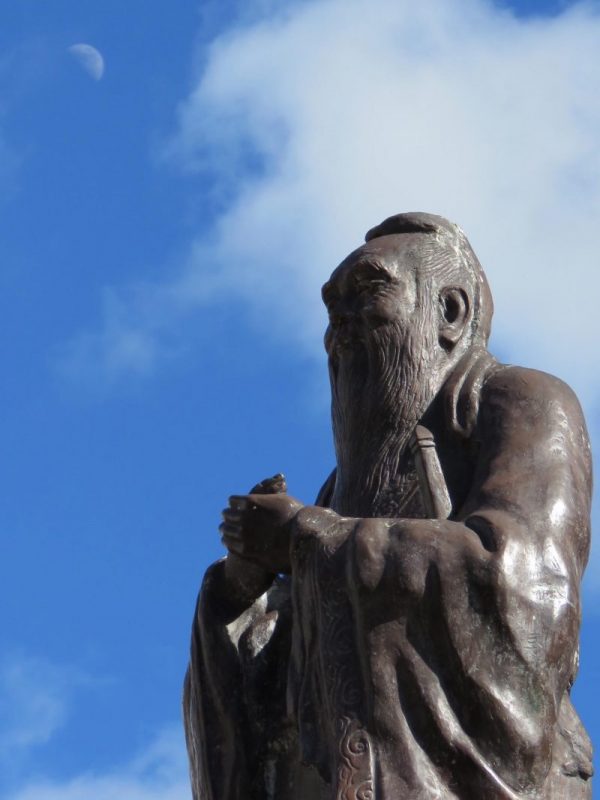
Confucius and the 1st quarter moon (51.7%). Chinatown, Honolulu – September 16, 2018 – via Jenney Disimon. Thanks, Jenney!

We call this moon a quarter and not a half because it is one quarter of the way around in its orbit of Earth, as measured from one new moon to the next. Also, although a first quarter moon appears half-lit to us, the illuminated portion we see of a first quarter moon truly is just a quarter. We’re now seeing half the moon’s day side, that is. Another lighted quarter of the moon shines just as brightly in the direction opposite Earth!

And what about the term half moon? That’s a beloved term, but not an official one.

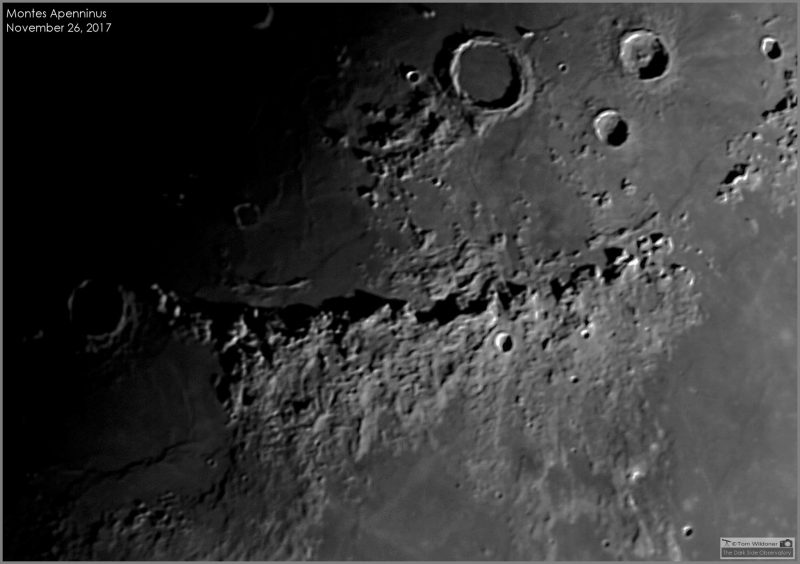
Tom Wildoner wrote: “One of my favorite areas to photograph on the moon near the 1st quarter! I captured this view of the sun lighting up the mountain range called Montes Apenninus. The moon was casting a nice shadow on the back side of the mountains. This mountain range is about 370 miles (600 km) long with some of the peaks rising as high as 3.1 miles (5 km).”

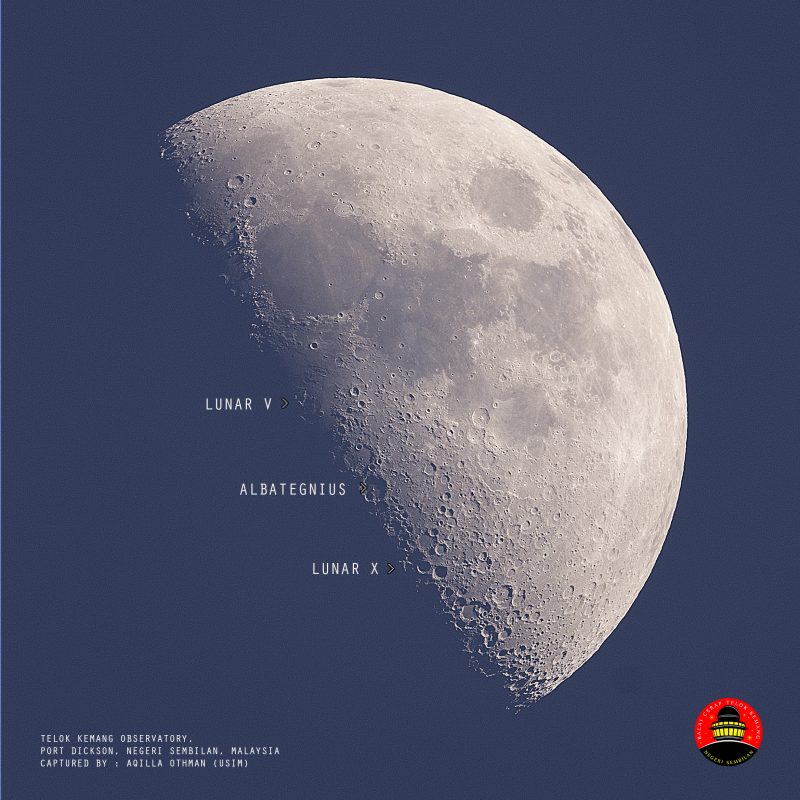
Here’s something else to look for on a 1st quarter moon. Aqilla Othman in Port Dickson, Negeri Sembilan, Malaysia, caught this photo in May, 2017. Notice that he caught Lunar X and Lunar V. These are similar features on the moon that fleetingly take an X or V shape when the moon appears in a 1st quarter phase from Earth.

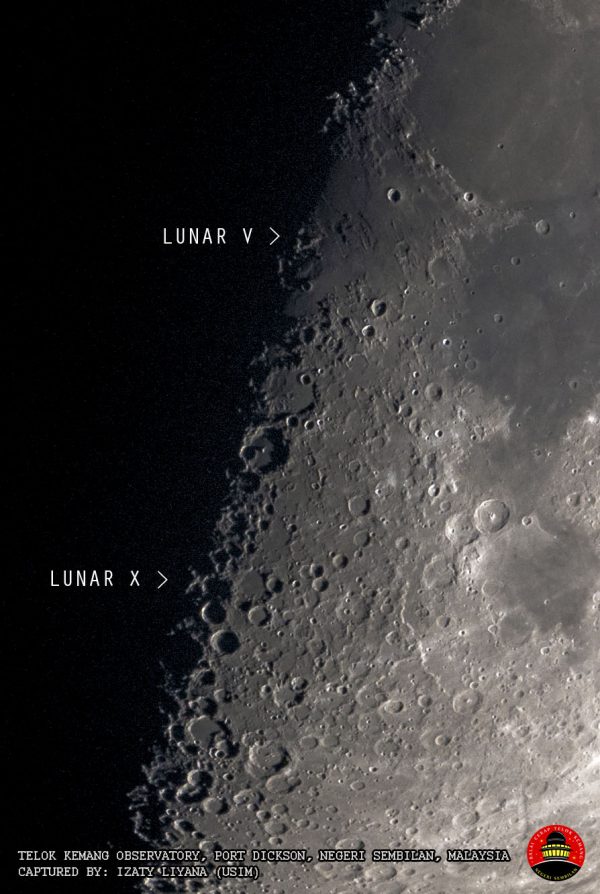
Here’s a closer look at Lunar X and Lunar V. Photo taken in May 2017 by Izaty Liyana in Port Dickson, Negeri Sembilan, Malaysia. What is Lunar X?

As the moon orbits Earth, it changes phase in an orderly way. Follow the links below to understand the phases of the moon.

New moon
Waxing crescent moon
First quarter moon
Waxing gibbous moon
Full moon
Waning gibbous moon
Last quarter moon
Waning crescent moon

Read more: 4 keys to understanding moon phases

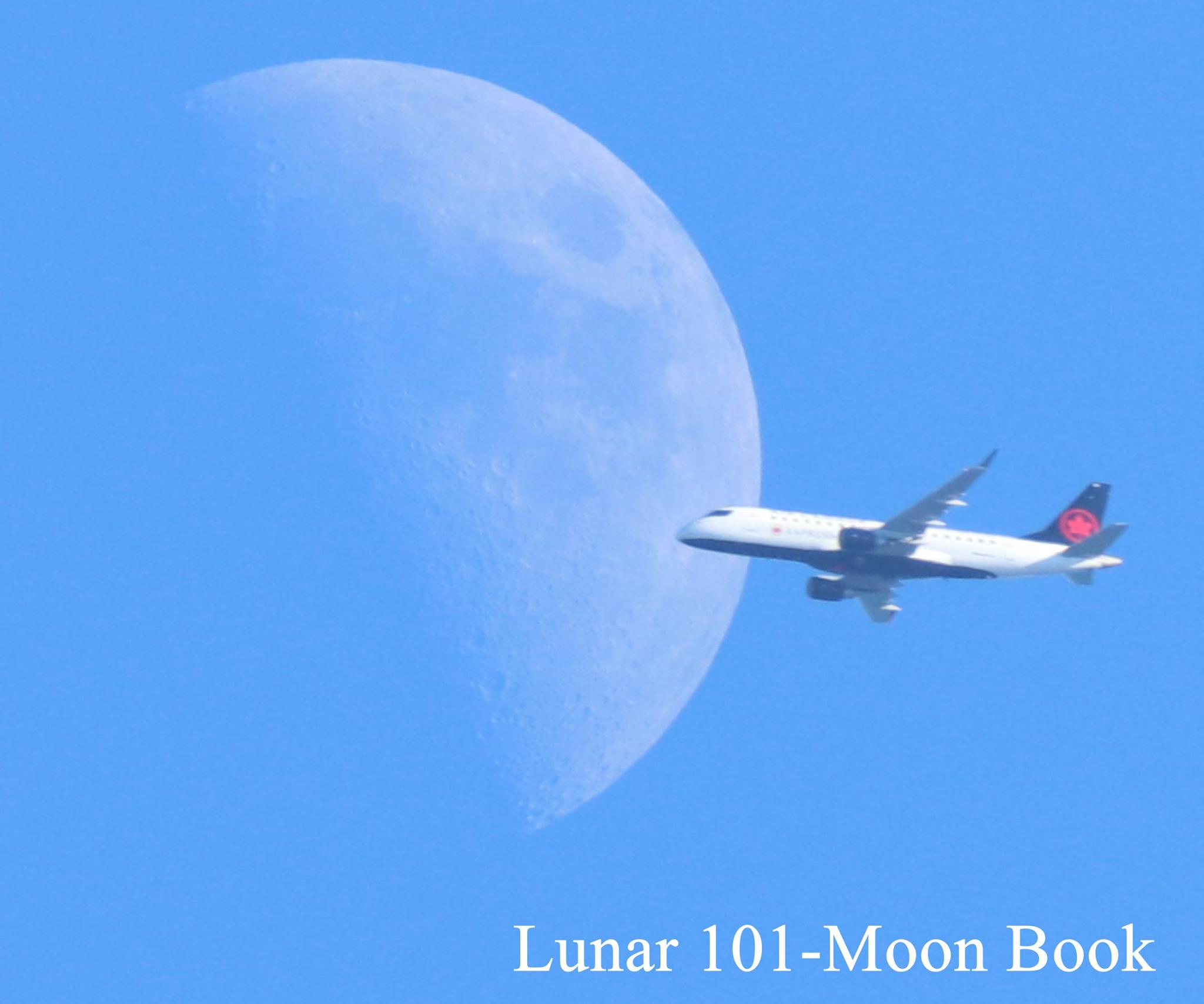
September 16, 2018, 1st quarter moon – in a hazy blue sky, before sunset – over Toronto, via Steven A. Sweet of Lunar 101-Moon Book.

Bottom line: The first quarter moon comes on November 15 at 14:54 UTC; translate UTC to your time. As viewed from the whole Earth, it’s high up at sunset, looking like half a pie.

Check out EarthSky’s guide to the bright planets.

Help EarthSky keep going! Please donate.


from EarthSky https://ift.tt/2OIzLvs

A 1st quarter moon as captured by Duke Marsh in Indiana. Thank you, Duke!

A first quarter moon rises around noon and sets around midnight. You’ll likely spot it in late afternoon or early evening, high up in the sky. At this moon phase, the moon is showing us precisely half of its lighted half.

Or you might say that – at first quarter moon – we’re seeing half the moon’s day side.

Confucius and the 1st quarter moon (51.7%). Chinatown, Honolulu – September 16, 2018 – via Jenney Disimon. Thanks, Jenney!

We call this moon a quarter and not a half because it is one quarter of the way around in its orbit of Earth, as measured from one new moon to the next. Also, although a first quarter moon appears half-lit to us, the illuminated portion we see of a first quarter moon truly is just a quarter. We’re now seeing half the moon’s day side, that is. Another lighted quarter of the moon shines just as brightly in the direction opposite Earth!

And what about the term half moon? That’s a beloved term, but not an official one.

Tom Wildoner wrote: “One of my favorite areas to photograph on the moon near the 1st quarter! I captured this view of the sun lighting up the mountain range called Montes Apenninus. The moon was casting a nice shadow on the back side of the mountains. This mountain range is about 370 miles (600 km) long with some of the peaks rising as high as 3.1 miles (5 km).”

Here’s something else to look for on a 1st quarter moon. Aqilla Othman in Port Dickson, Negeri Sembilan, Malaysia, caught this photo in May, 2017. Notice that he caught Lunar X and Lunar V. These are similar features on the moon that fleetingly take an X or V shape when the moon appears in a 1st quarter phase from Earth.

Here’s a closer look at Lunar X and Lunar V. Photo taken in May 2017 by Izaty Liyana in Port Dickson, Negeri Sembilan, Malaysia. What is Lunar X?

As the moon orbits Earth, it changes phase in an orderly way. Follow the links below to understand the phases of the moon.

New moon
Waxing crescent moon
First quarter moon
Waxing gibbous moon
Full moon
Waning gibbous moon
Last quarter moon
Waning crescent moon

Read more: 4 keys to understanding moon phases

September 16, 2018, 1st quarter moon – in a hazy blue sky, before sunset – over Toronto, via Steven A. Sweet of Lunar 101-Moon Book.

Bottom line: The first quarter moon comes on November 15 at 14:54 UTC; translate UTC to your time. As viewed from the whole Earth, it’s high up at sunset, looking like half a pie.

Check out EarthSky’s guide to the bright planets.

Help EarthSky keep going! Please donate.


from EarthSky https://ift.tt/2OIzLvs

Venus hovers near Spica

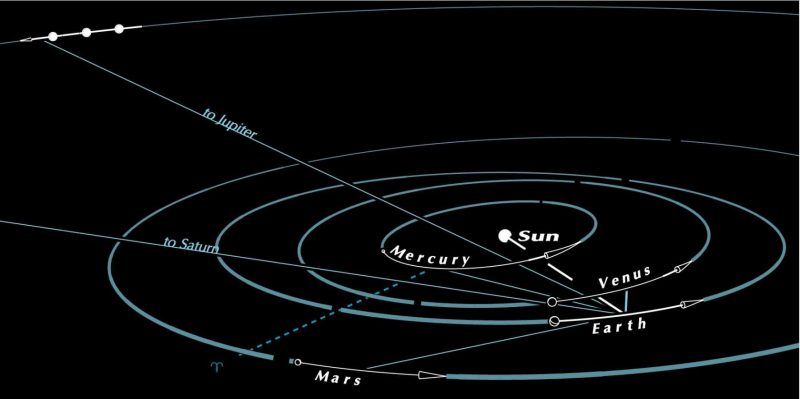
Planets in space on November 14, 2018 – the day that Venus and the star Spica (not shown at this scale) appear closest in our sky. Notice that Venus is near our line of sight to the sun now. That’s why we see it so low in the east before sunrise. Chart via Guy Ottewell’s blog.

Originally published at Guy Ottewell’s blog. Used with permission.

On November 14, 2018, Venus comes to an apparent halt; that is, it ceases to move westward in right ascension, relatively to the background constellations. The movement is curved, because Venus is in the part of its orbit that slopes northward (to cross the ecliptic on November 22), so the moment of halting in ecliptic longitude – that is, relative to the ecliptic – comes 56 hours later, on November 16.

If the timing had been slightly different, Venus appearing for us a little to the right, it would reach the same direction as Spica and might even occult the great star. What will actually happen is an appulse (a moment of nearest approach) without a conjunction of either kind, right ascension or longitude.

The 1.5° minimum of this Venus-Spica appulse comes at November 15 at 00:00 UTC. That is is back in November 14 by American clocks – 7 p.m. for the Eastern time zone, 4 p.m. for California. Translate UTC to your time.

The chart at the top of this post shows what is happening in planetary space.

In that space-based view, you are looking from a viewpoint outward from Earth and 15° north of the ecliptic plane. Shown are the paths of the planets in November, and sight-lines from Earth at the beginning of November 14. Our sightline to Venus is 26° west of our sightline to the sun. This is the elongation at which Venus reaches its stationary moment (the moment mentioned above, when it ceases moving westward relative to the background constellations). The elongation from the sun continues to increase, because the sun is moving eastward for us more rapidly than Venus yet is. Not until January 6, 2019 will Venus be at maximum morning elongation, 47° from the sun, our sightline to it tangent to its orbit.

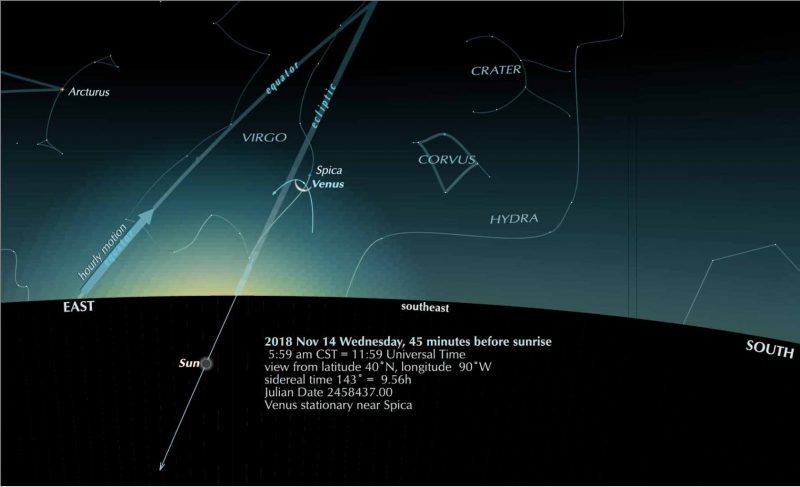
Venus and Spica have been near each other for some days, and will remain so for a few days longer. The nearest we can get to seeing Venus and Spica closest together is the morning of Wednesday, November 14. Here is what the predawn sky will look like:

Venus and Spica, November 14, 2018, as seen from about 40 degrees N. latitude on Earth. Chart via Guy Ottewell’s blog. https://ift.tt/2PsiLPh

The arrows through the moving bodies represent, this time, their movements (relative to the starry background) over a span of 30 days, so that you can see here, too, Venus’s sweep toward Spica. The straight arrow for the sun is over the same 30 days, so you can see why it is that, though Venus begins its chase eastward, it is as yet still becoming more separated from the sun.

Venus appears 5.5 magnitudes brighter than Spica (the 15th brightest star), a factor of 160 in light. Whereas Venus is about 0.31 astronomical units or 29,000,000 miles (47,000,000 km) from us at this time (increasing that distance as it goes on around its orbit), Spica’s distance may be 260 light-years, or about 1,500,000,000,000,000 miles (2,500,000,000,000,000 km). More than 50,000,000 times farther.

How can a star be small, a cloud immense?

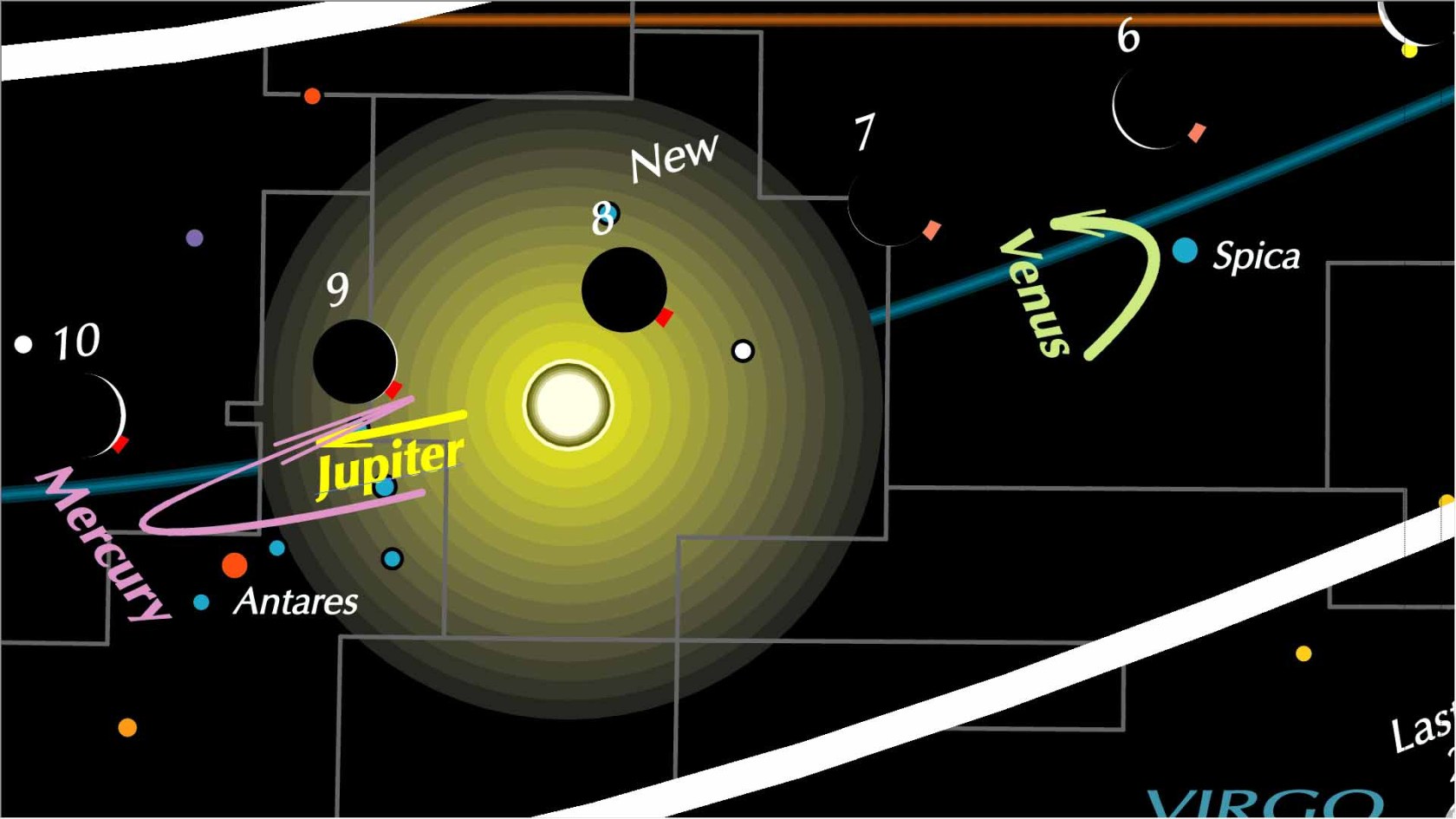
By the way, watch out for a new product from my website – UniversalWorkshop.com – to be called the Zodiacal Wavy Chart. This is a snippet of it:

A piece of the all-new Zodiacal Wavy Chart, via Guy Ottewell’s blog.

I’ll let you know when it becomes available, after we’ve solved the means of production.

And there will be a parallel product called Astronomical Calendars Any-Year, a bottomless barrel of information of which this is a snippet:

Together, the Wavy Chart and the Any-Year Calendar will go far to replace my former large and laborious printed books, the Astronomical Calendars, whose print form ended in 2016 but which still can be seen, in part, online.

Charts and lists have their complementary advantages. It was while working on the Wavy Chart for the present year that I noticed the wriggly movement of Venus near to Spica in November. Such motions stand out more readily in a picture than in a table of numbers. The table mentions that Venus becomes “stationary in right ascension”, and then “in longitude”, but it’s the chart that enlivens these dry statements.

Bottom line: Watch for Venus and Spica near each other before sunup in mid-November, 2018.


from EarthSky https://ift.tt/2PT5Fdi

Planets in space on November 14, 2018 – the day that Venus and the star Spica (not shown at this scale) appear closest in our sky. Notice that Venus is near our line of sight to the sun now. That’s why we see it so low in the east before sunrise. Chart via Guy Ottewell’s blog.

Originally published at Guy Ottewell’s blog. Used with permission.

On November 14, 2018, Venus comes to an apparent halt; that is, it ceases to move westward in right ascension, relatively to the background constellations. The movement is curved, because Venus is in the part of its orbit that slopes northward (to cross the ecliptic on November 22), so the moment of halting in ecliptic longitude – that is, relative to the ecliptic – comes 56 hours later, on November 16.

If the timing had been slightly different, Venus appearing for us a little to the right, it would reach the same direction as Spica and might even occult the great star. What will actually happen is an appulse (a moment of nearest approach) without a conjunction of either kind, right ascension or longitude.

The 1.5° minimum of this Venus-Spica appulse comes at November 15 at 00:00 UTC. That is is back in November 14 by American clocks – 7 p.m. for the Eastern time zone, 4 p.m. for California. Translate UTC to your time.

The chart at the top of this post shows what is happening in planetary space.

In that space-based view, you are looking from a viewpoint outward from Earth and 15° north of the ecliptic plane. Shown are the paths of the planets in November, and sight-lines from Earth at the beginning of November 14. Our sightline to Venus is 26° west of our sightline to the sun. This is the elongation at which Venus reaches its stationary moment (the moment mentioned above, when it ceases moving westward relative to the background constellations). The elongation from the sun continues to increase, because the sun is moving eastward for us more rapidly than Venus yet is. Not until January 6, 2019 will Venus be at maximum morning elongation, 47° from the sun, our sightline to it tangent to its orbit.

Venus and Spica have been near each other for some days, and will remain so for a few days longer. The nearest we can get to seeing Venus and Spica closest together is the morning of Wednesday, November 14. Here is what the predawn sky will look like:

Venus and Spica, November 14, 2018, as seen from about 40 degrees N. latitude on Earth. Chart via Guy Ottewell’s blog. https://ift.tt/2PsiLPh

The arrows through the moving bodies represent, this time, their movements (relative to the starry background) over a span of 30 days, so that you can see here, too, Venus’s sweep toward Spica. The straight arrow for the sun is over the same 30 days, so you can see why it is that, though Venus begins its chase eastward, it is as yet still becoming more separated from the sun.

Venus appears 5.5 magnitudes brighter than Spica (the 15th brightest star), a factor of 160 in light. Whereas Venus is about 0.31 astronomical units or 29,000,000 miles (47,000,000 km) from us at this time (increasing that distance as it goes on around its orbit), Spica’s distance may be 260 light-years, or about 1,500,000,000,000,000 miles (2,500,000,000,000,000 km). More than 50,000,000 times farther.

How can a star be small, a cloud immense?

By the way, watch out for a new product from my website – UniversalWorkshop.com – to be called the Zodiacal Wavy Chart. This is a snippet of it:

A piece of the all-new Zodiacal Wavy Chart, via Guy Ottewell’s blog.

I’ll let you know when it becomes available, after we’ve solved the means of production.

And there will be a parallel product called Astronomical Calendars Any-Year, a bottomless barrel of information of which this is a snippet:

Together, the Wavy Chart and the Any-Year Calendar will go far to replace my former large and laborious printed books, the Astronomical Calendars, whose print form ended in 2016 but which still can be seen, in part, online.

Charts and lists have their complementary advantages. It was while working on the Wavy Chart for the present year that I noticed the wriggly movement of Venus near to Spica in November. Such motions stand out more readily in a picture than in a table of numbers. The table mentions that Venus becomes “stationary in right ascension”, and then “in longitude”, but it’s the chart that enlivens these dry statements.

Bottom line: Watch for Venus and Spica near each other before sunup in mid-November, 2018.


from EarthSky https://ift.tt/2PT5Fdi

All you need to know: 2018’s Leonid meteor shower

Leonid meteors, viewed from space in 1997. Image via NASA

Leonid meteors, viewed from space in 1997. Image via NASA.

November’s wonderful Leonid meteor shower happens every year around November 17 or 18, as our world crosses the orbital path of Comet Tempel-Tuttle. Like many comets, Tempel-Tuttle litters its orbit with bits of debris. It’s when this cometary debris enters Earth’s atmosphere and vaporizes that we see the Leonid meteor shower. In 2018, the peak mornings of the shower are expected from midnight to dawn on Saturday, November 17 and Sunday, November 18. Although a bright waxing gibbous moon will be out for some of the night on the peak dates, try watching this shower during the predawn hours, or after the moon has set.

Click here to find out when the moon sets in your sky.

Although this shower is known for its periodic storms, no Leonid storm is expected this year. Keep reading to learn more.

Live by the moon! Order your 2019 EarthSky moon calendar today!

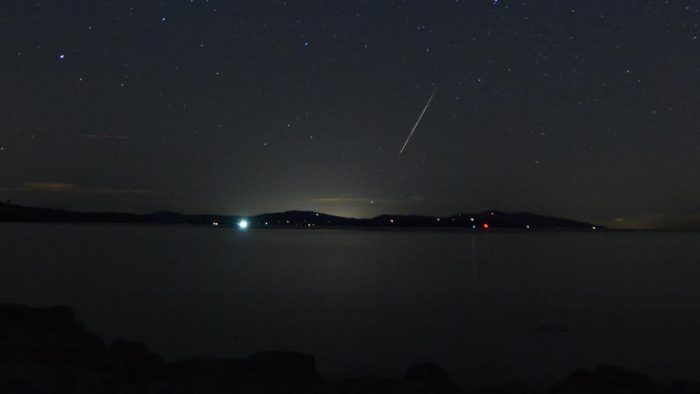
James Younger sent in this photo during the 2015 peak of the Leonid meteor shower. It's a meteor over the San Juan Islands in the Pacific Northwest, between the U.S. mainland and Vancouver Island, British Columbia. The San Juans are part of the U.S. state of Washington.

James Younger sent in this photo during the 2015 peak of the Leonid meteor shower. It’s a meteor over the San Juan Islands in the Pacific Northwest, between the U.S. mainland and Vancouver Island, British Columbia.

How many Leonid meteors will you see in 2018? The answer, as always, depends on when you watch, and the clarity and darkness of your night sky. This shower has been known to produce meteor storms, but no Leonid storm is expected this year. The Leonids are usually a modest shower, with typical rates of about 10 to 15 meteors per hour at the peak, in the darkness before dawn. Your best bet is to watch between moonset and dawn.

Click here and check the astronomical twilight and moonrise and moonset boxes to find out when the moon sets and dawn begins.

When should you watch for Leonid meteors in 2018? Knowing what time to watch is easy. As with most meteor showers, the best time to watch the Leonids is usually between the hours of midnight and dawn. The expected peak morning is Saturday, November 17 or Sunday, November 18. That’s the mornings (not the evenings) of November 17 and 18.

Photo by Eliot Herman in Tucson, Arizona.

Can you see a meteor in bright moonlight? Yes, if it’s bright enough. Photo taken in late October 2016 by Eliot Herman in Tucson, Arizona. Moonlight will surely drown out many Leonid meteors in 2018, but, if you watch, you might catch a few!

Where should you watch the meteor shower? We hear lots of reports from people who see meteors from yards, decks, streets and especially highways in and around cities. But the best place to watch a meteor shower is always in the country. Just go far enough from town that glittering stars, the same stars drowned by city lights, begin to pop into view.

Find a place to watch – or recommend a place – at EarthSky’s Best Places to Stargaze page.

City, state and national parks are often great places to watch meteor showers. Try googling the name of your state or city with the words city park, state park or national park. Then, be sure to go to the park early in the day and find a wide open area with a good view of the sky in all directions.

When night falls, you’ll probably be impatient to see meteors. But remember that the shower is best after midnight. Catch a nap in early evening if you can. After midnight, lie back comfortably and watch as best you can in all parts of the sky.

Sometimes friends like to watch together, facing different directions. When somebody sees one, they can call out meteor! Then everyone can quickly turn to get a glimpse.

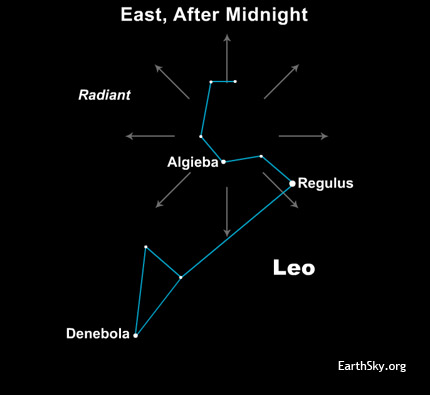
Regulus, the brightest star in the constellation Leo the Lion, dots a backwards question mark of stars known as the Sickle. If you trace all the Leonid meteors backward, they appear to radiate from this area of the sky.

Which direction should I look to see the Leonids? Meteors in annual showers are named for the point in our sky from which they appear to radiate. This shower is named for the constellation Leo the Lion, because these meteors radiate outward from the vicinity of stars representing the Lion’s Mane.

If you trace the paths of Leonid meteors backward on the sky’s dome, they do seem to stream from near the star Algieba in the constellation Leo. The point in the sky from which they appear to radiate is called the radiant point. This radiant point is an optical illusion. It’s like standing on railroad tracks and peering off into the distance to see the tracks converge. The illusion of the radiant point is caused by the fact that the meteors – much like the railroad tracks – are moving on parallel paths.

In recent years, people have gotten the mistaken idea that you must know the whereabouts of a meteor shower’s radiant point in order to watch the meteor shower. You don’t need to. The meteors often don’t become visible until they are 30 degrees or so from their radiant point. They are streaking out from the radiant in all directions.

Thus the Leonid meteors – like meteors in all annual showers – will appear in all parts of the sky.

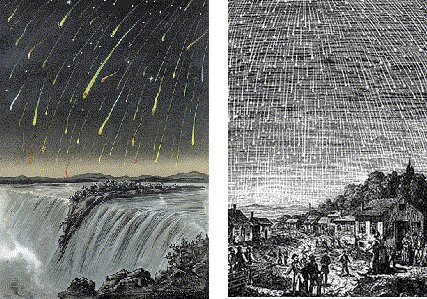
Old woodcuts depicting 1833 Leonid meteor storm.

Will the Leonids produce a meteor storm in 2018? No. Not this year. Most astronomers say you need more than 1,000 meteors an hour to consider a shower as a storm. That’s a far cry from the 10 to 15 meteors per hour predicted for this year. Still, seeing even one bright meteor can make your night.

The Leonid shower is known for producing meteor storms, though. The parent comet – Tempel-Tuttle – completes a single orbit around the sun about once every 33 years. It releases fresh material every time it enters the inner solar system and approaches the sun. Since the 19th century, skywatchers have watched for Leonid meteor storms about every 33 years, beginning with the meteor storm of 1833, said to produce more than 100,000 meteors an hour.

The next great Leonid storms were seen about 33 years later, in 1866 and 1867.

Then a meteor storm was predicted for 1899, but did not materialize.

It wasn’t until 1966 that the next spectacular Leonid storm was seen, this time over the Americas. In 1966, observers in the southwest United States reported seeing 40 to 50 meteors per second (that’s 2,400 to 3,000 meteors per minute!) during a span of 15 minutes on the morning of November 17, 1966.

In 2001, another great Leonid meteor storm occurred. Spaceweather.com reported:

The display began on Sunday morning, November 18, when Earth glided into a dust cloud shed by Comet Tempel-Tuttle in 1766. Thousands of meteors per hour rained over North America and Hawaii. Then, on Monday morning November 19 (local time in Asia), it happened again: Earth entered a second cometary debris cloud from Tempel-Tuttle. Thousands more Leonids then fell over east Asian countries and Australia.

View SpaceWeather’s 2001 Leonid meteor gallery.

Bottom line: If you want to watch the 2018 Leonid meteor shower, just know that the predawn hours are best for meteor watching. The greatest numbers of meteors usually fall in the dark hours before dawn.

EarthSky’s meteor shower guide for 2018

Enjoying EarthSky? Sign up for our free daily newsletter today!

Easily locate stars and constellations during any day and time with EarthSky’s Planisphere.


from EarthSky https://ift.tt/2z7sobX
Leonid meteors, viewed from space in 1997. Image via NASA

Leonid meteors, viewed from space in 1997. Image via NASA.

November’s wonderful Leonid meteor shower happens every year around November 17 or 18, as our world crosses the orbital path of Comet Tempel-Tuttle. Like many comets, Tempel-Tuttle litters its orbit with bits of debris. It’s when this cometary debris enters Earth’s atmosphere and vaporizes that we see the Leonid meteor shower. In 2018, the peak mornings of the shower are expected from midnight to dawn on Saturday, November 17 and Sunday, November 18. Although a bright waxing gibbous moon will be out for some of the night on the peak dates, try watching this shower during the predawn hours, or after the moon has set.

Click here to find out when the moon sets in your sky.

Although this shower is known for its periodic storms, no Leonid storm is expected this year. Keep reading to learn more.

Live by the moon! Order your 2019 EarthSky moon calendar today!

James Younger sent in this photo during the 2015 peak of the Leonid meteor shower. It's a meteor over the San Juan Islands in the Pacific Northwest, between the U.S. mainland and Vancouver Island, British Columbia. The San Juans are part of the U.S. state of Washington.

James Younger sent in this photo during the 2015 peak of the Leonid meteor shower. It’s a meteor over the San Juan Islands in the Pacific Northwest, between the U.S. mainland and Vancouver Island, British Columbia.

How many Leonid meteors will you see in 2018? The answer, as always, depends on when you watch, and the clarity and darkness of your night sky. This shower has been known to produce meteor storms, but no Leonid storm is expected this year. The Leonids are usually a modest shower, with typical rates of about 10 to 15 meteors per hour at the peak, in the darkness before dawn. Your best bet is to watch between moonset and dawn.

Click here and check the astronomical twilight and moonrise and moonset boxes to find out when the moon sets and dawn begins.

When should you watch for Leonid meteors in 2018? Knowing what time to watch is easy. As with most meteor showers, the best time to watch the Leonids is usually between the hours of midnight and dawn. The expected peak morning is Saturday, November 17 or Sunday, November 18. That’s the mornings (not the evenings) of November 17 and 18.

Photo by Eliot Herman in Tucson, Arizona.

Can you see a meteor in bright moonlight? Yes, if it’s bright enough. Photo taken in late October 2016 by Eliot Herman in Tucson, Arizona. Moonlight will surely drown out many Leonid meteors in 2018, but, if you watch, you might catch a few!

Where should you watch the meteor shower? We hear lots of reports from people who see meteors from yards, decks, streets and especially highways in and around cities. But the best place to watch a meteor shower is always in the country. Just go far enough from town that glittering stars, the same stars drowned by city lights, begin to pop into view.

Find a place to watch – or recommend a place – at EarthSky’s Best Places to Stargaze page.

City, state and national parks are often great places to watch meteor showers. Try googling the name of your state or city with the words city park, state park or national park. Then, be sure to go to the park early in the day and find a wide open area with a good view of the sky in all directions.

When night falls, you’ll probably be impatient to see meteors. But remember that the shower is best after midnight. Catch a nap in early evening if you can. After midnight, lie back comfortably and watch as best you can in all parts of the sky.

Sometimes friends like to watch together, facing different directions. When somebody sees one, they can call out meteor! Then everyone can quickly turn to get a glimpse.

Regulus, the brightest star in the constellation Leo the Lion, dots a backwards question mark of stars known as the Sickle. If you trace all the Leonid meteors backward, they appear to radiate from this area of the sky.

Which direction should I look to see the Leonids? Meteors in annual showers are named for the point in our sky from which they appear to radiate. This shower is named for the constellation Leo the Lion, because these meteors radiate outward from the vicinity of stars representing the Lion’s Mane.

If you trace the paths of Leonid meteors backward on the sky’s dome, they do seem to stream from near the star Algieba in the constellation Leo. The point in the sky from which they appear to radiate is called the radiant point. This radiant point is an optical illusion. It’s like standing on railroad tracks and peering off into the distance to see the tracks converge. The illusion of the radiant point is caused by the fact that the meteors – much like the railroad tracks – are moving on parallel paths.

In recent years, people have gotten the mistaken idea that you must know the whereabouts of a meteor shower’s radiant point in order to watch the meteor shower. You don’t need to. The meteors often don’t become visible until they are 30 degrees or so from their radiant point. They are streaking out from the radiant in all directions.

Thus the Leonid meteors – like meteors in all annual showers – will appear in all parts of the sky.

Old woodcuts depicting 1833 Leonid meteor storm.

Will the Leonids produce a meteor storm in 2018? No. Not this year. Most astronomers say you need more than 1,000 meteors an hour to consider a shower as a storm. That’s a far cry from the 10 to 15 meteors per hour predicted for this year. Still, seeing even one bright meteor can make your night.

The Leonid shower is known for producing meteor storms, though. The parent comet – Tempel-Tuttle – completes a single orbit around the sun about once every 33 years. It releases fresh material every time it enters the inner solar system and approaches the sun. Since the 19th century, skywatchers have watched for Leonid meteor storms about every 33 years, beginning with the meteor storm of 1833, said to produce more than 100,000 meteors an hour.

The next great Leonid storms were seen about 33 years later, in 1866 and 1867.

Then a meteor storm was predicted for 1899, but did not materialize.

It wasn’t until 1966 that the next spectacular Leonid storm was seen, this time over the Americas. In 1966, observers in the southwest United States reported seeing 40 to 50 meteors per second (that’s 2,400 to 3,000 meteors per minute!) during a span of 15 minutes on the morning of November 17, 1966.

In 2001, another great Leonid meteor storm occurred. Spaceweather.com reported:

The display began on Sunday morning, November 18, when Earth glided into a dust cloud shed by Comet Tempel-Tuttle in 1766. Thousands of meteors per hour rained over North America and Hawaii. Then, on Monday morning November 19 (local time in Asia), it happened again: Earth entered a second cometary debris cloud from Tempel-Tuttle. Thousands more Leonids then fell over east Asian countries and Australia.

View SpaceWeather’s 2001 Leonid meteor gallery.

Bottom line: If you want to watch the 2018 Leonid meteor shower, just know that the predawn hours are best for meteor watching. The greatest numbers of meteors usually fall in the dark hours before dawn.

EarthSky’s meteor shower guide for 2018

Enjoying EarthSky? Sign up for our free daily newsletter today!

Easily locate stars and constellations during any day and time with EarthSky’s Planisphere.


from EarthSky https://ift.tt/2z7sobX

Star Al Risha binds the Fishes of Pisces

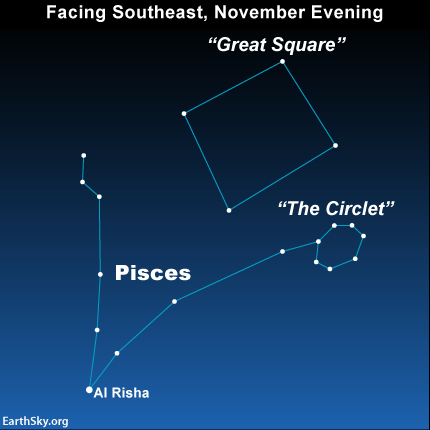
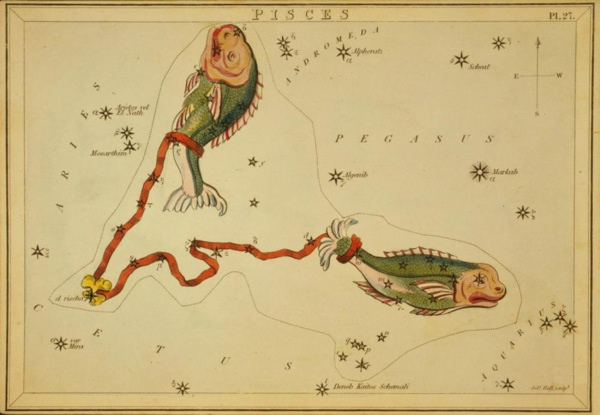
The constellation Pisces appears in the shape of the letter V. Al Risha lies at the tip of the V, where the two lines come together. You might also notice The Circlet in Pisces.

The constellation Pisces appears in the shape of the letter V. Al Risha lies at the tip of the V, where the two lines come together. You might also notice The Circlet in Pisces. It can help you find the V, and Al Risha.

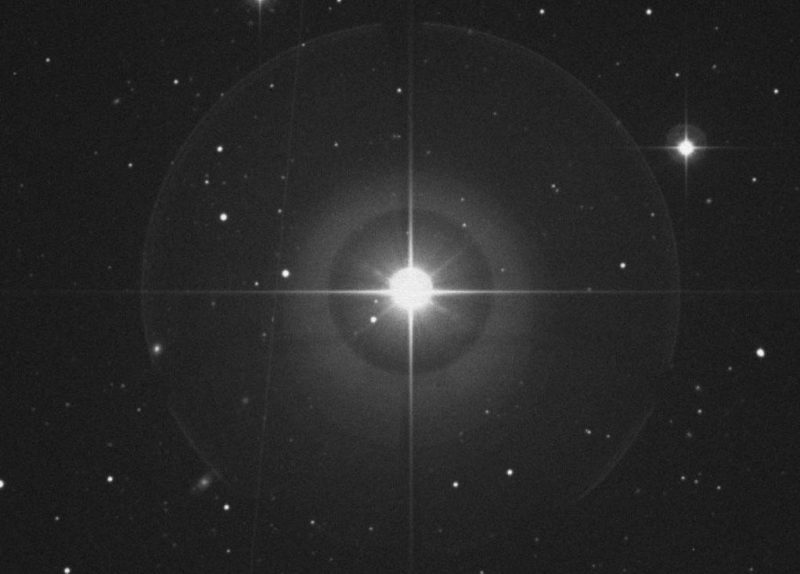
Alpha Piscium, or Al Risha (also spelled Alrisha), isn’t one of the sky’s brightest stars. In fact, it’s only about 4th magnitude, which is getting down to a level of faintness that requires a dark sky to see.

The 2019 lunar calendars are here! Order yours before they’re gone. Makes a great gift.

But Al Risha is a fascinating star in a prominent place in the zodiacal constellation Pisces the Fishes, which is one of the sky’s most graceful and beautiful constellations. It’s also very easy to pick out in Pisces if you have a dark sky.

Pisces the Fishes is always shown as a pair of fish, swimming in opposite directions. The Western Fish lies in the graceful line of stars south of the Great Square of Pegasus, and the Northern Fish is another line of stars to the east of the Square. Al Risha represents the knot or cord that ties the two Fish together by ribbons at their tails. In fact, Al Risha means “the cord” in Arabic.

Al Risha via STScI

Al Risha, the Alpha star of Pisces the Fishes, via the Space Telescope Science Institute.

Northern Hemisphere autumn (or Southern Hemisphere spring) is a good time to see the constellation Pisces, with the star Al Risha at its heart, in the evening sky. As seen from across the globe, Pisces reaches its high point for the night at about 10 p.m. local standard time in early November and at about 8 p.m. in early December.

If you can find the Great Square of Pegasus – which really is very noticeable as a large square pattern on the sky’s dome, with four medium-bright stars marking its corners – you can find Pisces. You can, that is, if your sky is dark enough. To find a dark location near you, visit EarthSky’s Stargazing Page. Zoom out for worldwide coverage.

You’ll probably pick out the Western Fish first, because it contains an asterism – or noticeable pattern of stars – known as the Circlet. The little circle of faint stars forming the Circlet in Pisces can be seen easily in a dark sky on the southern edge of the Great Square.

The rest of the constellation Pisces forms a beautiful V shape – like the letter V – on two sides of the Square.

Pisces the Fishes illustration via the Old Book Art Image gallery.

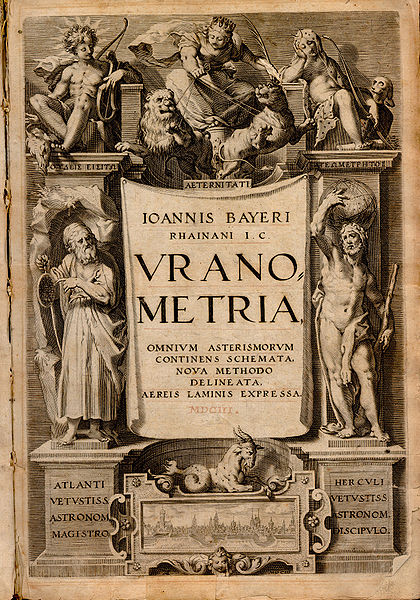
Title page copperplate engraving for Johann Bayer’s Uranometria, courtesy of the United States Naval Observatory Library via Wikimedia Commons.

Al Risha in star history and mythology. Although the star Al Risha is not very bright, its location within its constellation – at the tip of the V in Pisces – makes it very noticeable.

That’s surely why the German astronomer Johann Bayer, in 1603, gave this star the designation Alpha in his star atlas Uranometria (named after Urania, the Greek Muse of Astronomy), even though Al Risha is only the third-brightest star in its constellation. Bayer’s system was to assign a Greek letter (alpha, beta, gamma and so on) to each star he catalogued, combined with the Latin name of the star’s parent constellation in genitive (possessive) form. So, for example, the star Al Risha is also Alpha Piscium, the Alpha star of Pisces.

Most of the time, the Alpha star is the brightest star in a constellation, but not always. There are two brighter stars in Pisces (although not much brighter). They are Eta and Gamma Piscium. Al Risha, by the way, is also one of the only stars in Pisces with a proper name. The early Arabian stargazers, who named it, noticed it, too.

In Roman mythology, the constellation Pisces is associated with the legend of Venus and Cupid (or, in the Greek myths, Aphrodite and her son Eros). These two escaped the monster Typhon (or Typhoon) by transforming themselves into fishes and jumping into a river. Venus and Cupid are said to have bound themselves together so that, in escaping the monster, they would not be separated. The gods were pleased and placed the Fishes in the sky to commemorate the event.

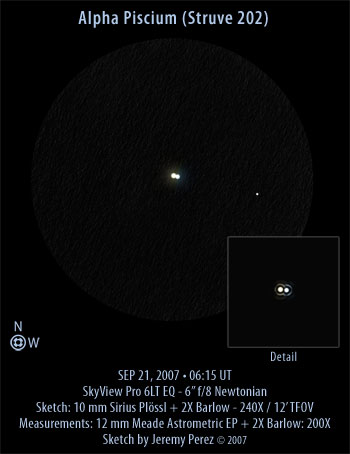
A drawing of the two stars that make up what we see as one – Al Risha. This drawing is by Jeremy Perez of the interesting website The Belt of Venus.

Al Risha in science. Al Risha appears single, but it is a close double star, that is, two stars orbiting a common center of gravity. It consists of pair of class A stars that lie some 120 A.U. (astronomical units) apart, with one A.U. equaling one Earth-sun distance. So the two stars that we see as Al Risha are in fact separated by 120 times the distance between our Earth and sun, or about the distance between our sun and Pluto.

The two stars in the Al Risha system take 720 years to orbit each other. Yet these stars appear so close together from our earthly vantage point that amateur astronomers using backyard telescopes must look carefully to see both of them. Plus, from our perspective, the two stars are appearing to get closer together as they pursue their vast mutual orbit. It’s estimated they will appear closest, as seen from Earth, in the year 2060. Both stars are white, though some observers have reported subtle colors.

Al Risha’s position is: RA 02h 02m 03s, Dec +02° 45′ 50″

Bottom line: The star Al Risha, or Alrisha, shines at the point of the V-shaped constellation Pisces the Fishes.

Enjoying EarthSky? Sign up for our free daily newsletter today!

Pisces? Here’s your constellation


from EarthSky https://ift.tt/2PryaPU
The constellation Pisces appears in the shape of the letter V. Al Risha lies at the tip of the V, where the two lines come together. You might also notice The Circlet in Pisces.

The constellation Pisces appears in the shape of the letter V. Al Risha lies at the tip of the V, where the two lines come together. You might also notice The Circlet in Pisces. It can help you find the V, and Al Risha.

Alpha Piscium, or Al Risha (also spelled Alrisha), isn’t one of the sky’s brightest stars. In fact, it’s only about 4th magnitude, which is getting down to a level of faintness that requires a dark sky to see.

The 2019 lunar calendars are here! Order yours before they’re gone. Makes a great gift.

But Al Risha is a fascinating star in a prominent place in the zodiacal constellation Pisces the Fishes, which is one of the sky’s most graceful and beautiful constellations. It’s also very easy to pick out in Pisces if you have a dark sky.

Pisces the Fishes is always shown as a pair of fish, swimming in opposite directions. The Western Fish lies in the graceful line of stars south of the Great Square of Pegasus, and the Northern Fish is another line of stars to the east of the Square. Al Risha represents the knot or cord that ties the two Fish together by ribbons at their tails. In fact, Al Risha means “the cord” in Arabic.

Al Risha via STScI

Al Risha, the Alpha star of Pisces the Fishes, via the Space Telescope Science Institute.

Northern Hemisphere autumn (or Southern Hemisphere spring) is a good time to see the constellation Pisces, with the star Al Risha at its heart, in the evening sky. As seen from across the globe, Pisces reaches its high point for the night at about 10 p.m. local standard time in early November and at about 8 p.m. in early December.

If you can find the Great Square of Pegasus – which really is very noticeable as a large square pattern on the sky’s dome, with four medium-bright stars marking its corners – you can find Pisces. You can, that is, if your sky is dark enough. To find a dark location near you, visit EarthSky’s Stargazing Page. Zoom out for worldwide coverage.

You’ll probably pick out the Western Fish first, because it contains an asterism – or noticeable pattern of stars – known as the Circlet. The little circle of faint stars forming the Circlet in Pisces can be seen easily in a dark sky on the southern edge of the Great Square.

The rest of the constellation Pisces forms a beautiful V shape – like the letter V – on two sides of the Square.

Pisces the Fishes illustration via the Old Book Art Image gallery.

Title page copperplate engraving for Johann Bayer’s Uranometria, courtesy of the United States Naval Observatory Library via Wikimedia Commons.

Al Risha in star history and mythology. Although the star Al Risha is not very bright, its location within its constellation – at the tip of the V in Pisces – makes it very noticeable.

That’s surely why the German astronomer Johann Bayer, in 1603, gave this star the designation Alpha in his star atlas Uranometria (named after Urania, the Greek Muse of Astronomy), even though Al Risha is only the third-brightest star in its constellation. Bayer’s system was to assign a Greek letter (alpha, beta, gamma and so on) to each star he catalogued, combined with the Latin name of the star’s parent constellation in genitive (possessive) form. So, for example, the star Al Risha is also Alpha Piscium, the Alpha star of Pisces.

Most of the time, the Alpha star is the brightest star in a constellation, but not always. There are two brighter stars in Pisces (although not much brighter). They are Eta and Gamma Piscium. Al Risha, by the way, is also one of the only stars in Pisces with a proper name. The early Arabian stargazers, who named it, noticed it, too.

In Roman mythology, the constellation Pisces is associated with the legend of Venus and Cupid (or, in the Greek myths, Aphrodite and her son Eros). These two escaped the monster Typhon (or Typhoon) by transforming themselves into fishes and jumping into a river. Venus and Cupid are said to have bound themselves together so that, in escaping the monster, they would not be separated. The gods were pleased and placed the Fishes in the sky to commemorate the event.

A drawing of the two stars that make up what we see as one – Al Risha. This drawing is by Jeremy Perez of the interesting website The Belt of Venus.

Al Risha in science. Al Risha appears single, but it is a close double star, that is, two stars orbiting a common center of gravity. It consists of pair of class A stars that lie some 120 A.U. (astronomical units) apart, with one A.U. equaling one Earth-sun distance. So the two stars that we see as Al Risha are in fact separated by 120 times the distance between our Earth and sun, or about the distance between our sun and Pluto.

The two stars in the Al Risha system take 720 years to orbit each other. Yet these stars appear so close together from our earthly vantage point that amateur astronomers using backyard telescopes must look carefully to see both of them. Plus, from our perspective, the two stars are appearing to get closer together as they pursue their vast mutual orbit. It’s estimated they will appear closest, as seen from Earth, in the year 2060. Both stars are white, though some observers have reported subtle colors.

Al Risha’s position is: RA 02h 02m 03s, Dec +02° 45′ 50″

Bottom line: The star Al Risha, or Alrisha, shines at the point of the V-shaped constellation Pisces the Fishes.

Enjoying EarthSky? Sign up for our free daily newsletter today!

Pisces? Here’s your constellation


from EarthSky https://ift.tt/2PryaPU

Could consciousness come down to the way things vibrate?

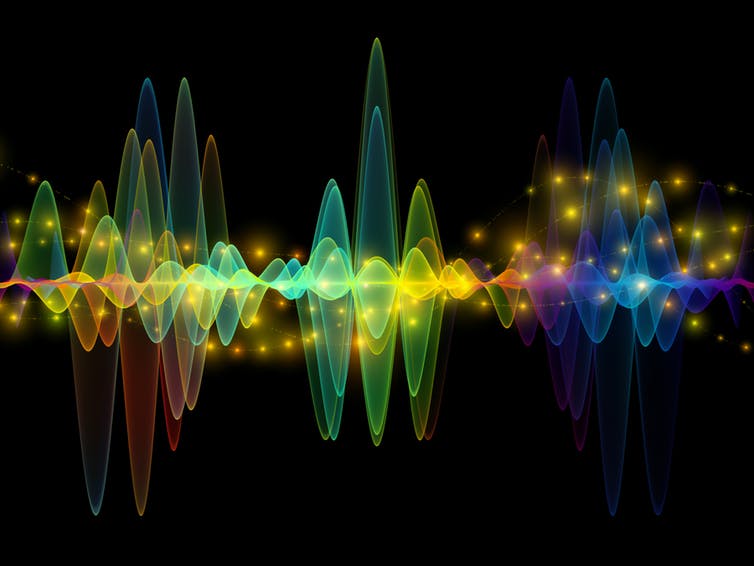
What do synchronized vibrations add to the mind/body question? Image via agsandrew/Shutterstock.com.

By Tam Hunt, University of California, Santa Barbara

Why is my awareness here, while yours is over there? Why is the universe split in two for each of us, into a subject and an infinity of objects? How is each of us our own center of experience, receiving information about the rest of the world out there? Why are some things conscious and others apparently not? Is a rat conscious? A gnat? A bacterium?

These questions are all aspects of the ancient “mind-body problem,” which asks, essentially: What is the relationship between mind and matter? It’s resisted a generally satisfying conclusion for thousands of years.

The mind-body problem enjoyed a major rebranding over the last two decades. Now it’s generally known as the hard problem of consciousness, after philosopher David Chalmers coined this term in a now classic paper and further explored it in his 1996 book, “The Conscious Mind: In Search of a Fundamental Theory.”

Chalmers thought the mind-body problem should be called “hard” in comparison to what, with tongue in cheek, he called the “easy” problems of neuroscience: How do neurons and the brain work at the physical level? Of course they’re not actually easy at all. But his point was that they’re relatively easy compared to the truly difficult problem of explaining how consciousness relates to matter.

Over the last decade, my colleague, University of California, Santa Barbara psychology professor Jonathan Schooler and I have developed what we call a resonance theory of consciousness. We suggest that resonance – another word for synchronized vibrations – is at the heart of not only human consciousness but also animal consciousness and of physical reality more generally. It sounds like something the hippies might have dreamed up – it’s all vibrations, man! – but stick with me.

How do things in nature – like flashing fireflies – spontaneously synchronize? Image via Suzanne Tucker/Shutterstock.com.

All about the vibrations

All things in our universe are constantly in motion, vibrating. Even objects that appear to be stationary are in fact vibrating, oscillating, resonating, at various frequencies. Resonance is a type of motion, characterized by oscillation between two states. And ultimately all matter is just vibrations of various underlying fields. As such, at every scale, all of nature vibrates.

Something interesting happens when different vibrating things come together: They will often start, after a little while, to vibrate together at the same frequency. They “sync up,” sometimes in ways that can seem mysterious. This is described as the phenomenon of spontaneous self-organization.

Mathematician Steven Strogatz provides various examples from physics, biology, chemistry and neuroscience to illustrate sync – his term for resonance – in his 2003 book “Sync: How Order Emerges from Chaos in the Universe, Nature, and Daily Life,” including:

– When fireflies of certain species come together in large gatherings, they start flashing in sync, in ways that can still seem a little mystifying.

– Lasers are produced when photons of the same power and frequency sync up.

– The moon’s rotation is exactly synced with its orbit around the Earth such that we always see the same face.

Examining resonance leads to potentially deep insights about the nature of consciousness and about the universe more generally.

External electrodes can record a brain’s activity. Image via vasara/Shutterstock.com.

Sync inside your skull

Neuroscientists have identified sync in their research, too. Large-scale neuron firing occurs in human brains at measurable frequencies, with mammalian consciousness thought to be commonly associated with various kinds of neuronal sync.

For example, German neurophysiologist Pascal Fries has explored the ways in which various electrical patterns sync in the brain to produce different types of human consciousness.

Fries focuses on gamma, beta and theta waves. These labels refer to the speed of electrical oscillations in the brain, measured by electrodes placed on the outside of the skull. Groups of neurons produce these oscillations as they use electrochemical impulses to communicate with each other. It’s the speed and voltage of these signals that, when averaged, produce EEG waves that can be measured at signature cycles per second.

Each type of synchronized activity is associated with certain types of brain function. Image via artellia/Shutterstock.com.

Gamma waves are associated with large-scale coordinated activities like perception, meditation or focused consciousness; beta with maximum brain activity or arousal; and theta with relaxation or daydreaming. These three wave types work together to produce, or at least facilitate, various types of human consciousness, according to Fries. But the exact relationship between electrical brain waves and consciousness is still very much up for debate.

Fries calls his concept communication through coherence. For him, it’s all about neuronal synchronization. Synchronization, in terms of shared electrical oscillation rates, allows for smooth communication between neurons and groups of neurons. Without this kind of synchronized coherence, inputs arrive at random phases of the neuron excitability cycle and are ineffective, or at least much less effective, in communication.

A resonance theory of consciousness

Our resonance theory builds upon the work of Fries and many others, with a broader approach that can help to explain not only human and mammalian consciousness, but also consciousness more broadly.

Based on the observed behavior of the entities that surround us, from electrons to atoms to molecules, to bacteria to mice, bats, rats, and on, we suggest that all things may be viewed as at least a little conscious. This sounds strange at first blush, but panpsychism – the view that all matter has some associated consciousness – is an increasingly accepted position with respect to the nature of consciousness.

The panpsychist argues that consciousness did not emerge at some point during evolution. Rather, it’s always associated with matter and vice versa – they’re two sides of the same coin. But the large majority of the mind associated with the various types of matter in our universe is extremely rudimentary. An electron or an atom, for example, enjoys just a tiny amount of consciousness. But as matter becomes more interconnected and rich, so does the mind, and vice versa, according to this way of thinking.

Biological organisms can quickly exchange information through various biophysical pathways, both electrical and electrochemical. Non-biological structures can only exchange information internally using heat/thermal pathways – much slower and far less rich in information in comparison. Living things leverage their speedier information flows into larger-scale consciousness than what would occur in similar-size things like boulders or piles of sand, for example. There’s much greater internal connection and thus far more “going on” in biological structures than in a boulder or a pile of sand.

Under our approach, boulders and piles of sand are mere aggregates, just collections of highly rudimentary conscious entities at the atomic or molecular level only. That’s in contrast to what happens in biological life forms where the combinations of these micro-conscious entities together create a higher level macro-conscious entity. For us, this combination process is the hallmark of biological life.

The central thesis of our approach is this: the particular linkages that allow for large-scale consciousness – like those humans and other mammals enjoy – result from a shared resonance among many smaller constituents. The speed of the resonant waves that are present is the limiting factor that determines the size of each conscious entity in each moment.

As a particular shared resonance expands to more and more constituents, the new conscious entity that results from this resonance and combination grows larger and more complex. So the shared resonance in a human brain that achieves gamma synchrony, for example, includes a far larger number of neurons and neuronal connections than is the case for beta or theta rhythms alone.

What about larger inter-organism resonance like the cloud of fireflies with their little lights flashing in sync? Researchers think their bioluminescent resonance arises due to internal biological oscillators that automatically result in each firefly syncing up with its neighbors.

Is this group of fireflies enjoying a higher level of group consciousness? Probably not, since we can explain the phenomenon without recourse to any intelligence or consciousness. But in biological structures with the right kind of information pathways and processing power, these tendencies toward self-organization can and often do produce larger-scale conscious entities.

Our resonance theory of consciousness attempts to provide a unified framework that includes neuroscience, as well as more fundamental questions of neurobiology and biophysics, and also the philosophy of mind. It gets to the heart of the differences that matter when it comes to consciousness and the evolution of physical systems.

It is all about vibrations, but it’s also about the type of vibrations and, most importantly, about shared vibrations.

Tam Hunt, Affiliate Guest in Psychology, University of California, Santa Barbara

This article is republished from The Conversation under a Creative Commons license. Read the original article.

The 2019 lunar calendars are here! Order yours before they’re gone. Makes a great gift.

Bottom line: A vibration resonance theory of human consciousness.

The Conversation


from EarthSky https://ift.tt/2qIdDYz

What do synchronized vibrations add to the mind/body question? Image via agsandrew/Shutterstock.com.

By Tam Hunt, University of California, Santa Barbara

Why is my awareness here, while yours is over there? Why is the universe split in two for each of us, into a subject and an infinity of objects? How is each of us our own center of experience, receiving information about the rest of the world out there? Why are some things conscious and others apparently not? Is a rat conscious? A gnat? A bacterium?

These questions are all aspects of the ancient “mind-body problem,” which asks, essentially: What is the relationship between mind and matter? It’s resisted a generally satisfying conclusion for thousands of years.

The mind-body problem enjoyed a major rebranding over the last two decades. Now it’s generally known as the hard problem of consciousness, after philosopher David Chalmers coined this term in a now classic paper and further explored it in his 1996 book, “The Conscious Mind: In Search of a Fundamental Theory.”

Chalmers thought the mind-body problem should be called “hard” in comparison to what, with tongue in cheek, he called the “easy” problems of neuroscience: How do neurons and the brain work at the physical level? Of course they’re not actually easy at all. But his point was that they’re relatively easy compared to the truly difficult problem of explaining how consciousness relates to matter.

Over the last decade, my colleague, University of California, Santa Barbara psychology professor Jonathan Schooler and I have developed what we call a resonance theory of consciousness. We suggest that resonance – another word for synchronized vibrations – is at the heart of not only human consciousness but also animal consciousness and of physical reality more generally. It sounds like something the hippies might have dreamed up – it’s all vibrations, man! – but stick with me.

How do things in nature – like flashing fireflies – spontaneously synchronize? Image via Suzanne Tucker/Shutterstock.com.

All about the vibrations

All things in our universe are constantly in motion, vibrating. Even objects that appear to be stationary are in fact vibrating, oscillating, resonating, at various frequencies. Resonance is a type of motion, characterized by oscillation between two states. And ultimately all matter is just vibrations of various underlying fields. As such, at every scale, all of nature vibrates.

Something interesting happens when different vibrating things come together: They will often start, after a little while, to vibrate together at the same frequency. They “sync up,” sometimes in ways that can seem mysterious. This is described as the phenomenon of spontaneous self-organization.

Mathematician Steven Strogatz provides various examples from physics, biology, chemistry and neuroscience to illustrate sync – his term for resonance – in his 2003 book “Sync: How Order Emerges from Chaos in the Universe, Nature, and Daily Life,” including:

– When fireflies of certain species come together in large gatherings, they start flashing in sync, in ways that can still seem a little mystifying.

– Lasers are produced when photons of the same power and frequency sync up.

– The moon’s rotation is exactly synced with its orbit around the Earth such that we always see the same face.

Examining resonance leads to potentially deep insights about the nature of consciousness and about the universe more generally.

External electrodes can record a brain’s activity. Image via vasara/Shutterstock.com.

Sync inside your skull

Neuroscientists have identified sync in their research, too. Large-scale neuron firing occurs in human brains at measurable frequencies, with mammalian consciousness thought to be commonly associated with various kinds of neuronal sync.

For example, German neurophysiologist Pascal Fries has explored the ways in which various electrical patterns sync in the brain to produce different types of human consciousness.

Fries focuses on gamma, beta and theta waves. These labels refer to the speed of electrical oscillations in the brain, measured by electrodes placed on the outside of the skull. Groups of neurons produce these oscillations as they use electrochemical impulses to communicate with each other. It’s the speed and voltage of these signals that, when averaged, produce EEG waves that can be measured at signature cycles per second.

Each type of synchronized activity is associated with certain types of brain function. Image via artellia/Shutterstock.com.

Gamma waves are associated with large-scale coordinated activities like perception, meditation or focused consciousness; beta with maximum brain activity or arousal; and theta with relaxation or daydreaming. These three wave types work together to produce, or at least facilitate, various types of human consciousness, according to Fries. But the exact relationship between electrical brain waves and consciousness is still very much up for debate.

Fries calls his concept communication through coherence. For him, it’s all about neuronal synchronization. Synchronization, in terms of shared electrical oscillation rates, allows for smooth communication between neurons and groups of neurons. Without this kind of synchronized coherence, inputs arrive at random phases of the neuron excitability cycle and are ineffective, or at least much less effective, in communication.

A resonance theory of consciousness

Our resonance theory builds upon the work of Fries and many others, with a broader approach that can help to explain not only human and mammalian consciousness, but also consciousness more broadly.

Based on the observed behavior of the entities that surround us, from electrons to atoms to molecules, to bacteria to mice, bats, rats, and on, we suggest that all things may be viewed as at least a little conscious. This sounds strange at first blush, but panpsychism – the view that all matter has some associated consciousness – is an increasingly accepted position with respect to the nature of consciousness.

The panpsychist argues that consciousness did not emerge at some point during evolution. Rather, it’s always associated with matter and vice versa – they’re two sides of the same coin. But the large majority of the mind associated with the various types of matter in our universe is extremely rudimentary. An electron or an atom, for example, enjoys just a tiny amount of consciousness. But as matter becomes more interconnected and rich, so does the mind, and vice versa, according to this way of thinking.

Biological organisms can quickly exchange information through various biophysical pathways, both electrical and electrochemical. Non-biological structures can only exchange information internally using heat/thermal pathways – much slower and far less rich in information in comparison. Living things leverage their speedier information flows into larger-scale consciousness than what would occur in similar-size things like boulders or piles of sand, for example. There’s much greater internal connection and thus far more “going on” in biological structures than in a boulder or a pile of sand.

Under our approach, boulders and piles of sand are mere aggregates, just collections of highly rudimentary conscious entities at the atomic or molecular level only. That’s in contrast to what happens in biological life forms where the combinations of these micro-conscious entities together create a higher level macro-conscious entity. For us, this combination process is the hallmark of biological life.

The central thesis of our approach is this: the particular linkages that allow for large-scale consciousness – like those humans and other mammals enjoy – result from a shared resonance among many smaller constituents. The speed of the resonant waves that are present is the limiting factor that determines the size of each conscious entity in each moment.

As a particular shared resonance expands to more and more constituents, the new conscious entity that results from this resonance and combination grows larger and more complex. So the shared resonance in a human brain that achieves gamma synchrony, for example, includes a far larger number of neurons and neuronal connections than is the case for beta or theta rhythms alone.

What about larger inter-organism resonance like the cloud of fireflies with their little lights flashing in sync? Researchers think their bioluminescent resonance arises due to internal biological oscillators that automatically result in each firefly syncing up with its neighbors.

Is this group of fireflies enjoying a higher level of group consciousness? Probably not, since we can explain the phenomenon without recourse to any intelligence or consciousness. But in biological structures with the right kind of information pathways and processing power, these tendencies toward self-organization can and often do produce larger-scale conscious entities.

Our resonance theory of consciousness attempts to provide a unified framework that includes neuroscience, as well as more fundamental questions of neurobiology and biophysics, and also the philosophy of mind. It gets to the heart of the differences that matter when it comes to consciousness and the evolution of physical systems.

It is all about vibrations, but it’s also about the type of vibrations and, most importantly, about shared vibrations.

Tam Hunt, Affiliate Guest in Psychology, University of California, Santa Barbara

This article is republished from The Conversation under a Creative Commons license. Read the original article.

The 2019 lunar calendars are here! Order yours before they’re gone. Makes a great gift.

Bottom line: A vibration resonance theory of human consciousness.

The Conversation


from EarthSky https://ift.tt/2qIdDYz
My sister’s cancer diagnosis: ‘I just remember waiting for news all the time’

A photo of Rachel with her sister Thekla (left) and her mother (right).

Every experience of cancer is different, and that includes the impact it has on a family. But one thing remains consistent – the NHS staff who help diagnose and treat patients in their darkest hours.

Rachel, from East Sussex, shares how her sister Thekla’s breast cancer diagnosis has affected the family so far.

“I was with my sister the day before she got her lump tested. I remember reassuring her, saying that I’ve had a lump in my armpit before and it turned out to be nothing.

“The next day she went to the doctor and had it tested. She had to wait one week from her biopsy to her diagnosis. It felt so long.

“When it turned out to be cancer, it came as a complete shock. It was the most horrible thing I’ve ever been told.

“She had just had her second child who was less than a year old. Her tumour was 11 and half centimetres long but was hard to detect as she’d been breast feeding.”

‘The colour was drained from my world’

A photo Rachel's sister, Thekla, with her family.

Rachel’s sister, Thekla, with her family.

Thekla was diagnosed with breast cancer in April this year, at the age of 40. The surgeon who diagnosed Thekla explained that she’d probably had the tumour for about a year, and it was likely to have spread, but that they wouldn’t be sure until she had an MRI scan.

“Those were the darkest days. The colour was drained from my world.”

Sadly, this wasn’t Rachel’s first experience of cancer. Her mum had been diagnosed with breast cancer through routine breast screening in 2015. Fortunately, the cancer was spotted at a very early stage and hadn’t spread.

“Although I felt concerned with my mum, I knew there was a treatment plan for her and that she’d get out the other side. Her breast cancer nurse specialist had reassured her it was caught at a very early stage. With my sister, there was so much uncertainty about how bad it was. I thought I was going to lose her. She’s so young, it seemed so unfair.

“I remember just waiting for news all the time. How bad was it? Has it spread? When was treatment starting?”

Thekla describes the 2 weeks between diagnosis and results of MRI as the darkest, most frightening of time of her life, feeling utterly numb to the news. Thankfully, when Thekla’s scan results came back, it was discovered that the cancer hadn’t spread.

“When we got her results back, I wanted treatment to start immediately, I was so worried about it spreading. It was a horrible time,’’ Rachel says.

‘My sister’s life will be changed forever’

Thekla started chemotherapy a couple weeks after her first scan, all within the targets set for NHS departments. But any moment of pause weighs heavy for the family.

“She felt tired and sick and couldn’t work. It was difficult for her to look after her two young children,” says Rachel.

After a few more sessions of chemotherapy, they found that the treatment wasn’t shrinking the cancer as they’d hoped. Thekla has now started hormone therapy, which blocks or lowers the levels of hormone molecules in the body to try and stop or slow down cancer growth. Fortunately, the treatment has started to take effect.

“It’s been a terrifying experience, but now we have more hope, and my sister is feeling more positive.

“I’m glad the NHS treated her like a person and not just a statistic. I felt like they were fighting for her so that made me a bit relieved. I know it must be an incredibly hard job and they’ve made such a difference. Their professionalism and little acts of kindness go a long way.

“She still has a long way to go. My sister’s life will be changed forever. But Thekla will take any consequences of treatment if it means she gets another day with her children.’’

Kirsten Rhodes is a campaigning officer at Cancer Research UK

Have your say

The weeks from Thekla’s diagnosis to starting her treatment were the darkest time for her and her family. Thanks to the incredible work of the NHS staff, Thekla is feeling more positive about the future. But it’s getting tougher for NHS staff to diagnose cancers quickly and care for their patients due to staff shortages.

We would like to thank Rachel and her family for sharing their story and helping raise awareness about the impact of cancer on their family. If you’ve been affected and need to talk to someone, you can call our nurses on freephone 0808 800 4040 or contact them via this online form.


from Cancer Research UK – Science blog https://ift.tt/2qFbixw
A photo of Rachel with her sister Thekla (left) and her mother (right).

Every experience of cancer is different, and that includes the impact it has on a family. But one thing remains consistent – the NHS staff who help diagnose and treat patients in their darkest hours.

Rachel, from East Sussex, shares how her sister Thekla’s breast cancer diagnosis has affected the family so far.

“I was with my sister the day before she got her lump tested. I remember reassuring her, saying that I’ve had a lump in my armpit before and it turned out to be nothing.

“The next day she went to the doctor and had it tested. She had to wait one week from her biopsy to her diagnosis. It felt so long.

“When it turned out to be cancer, it came as a complete shock. It was the most horrible thing I’ve ever been told.

“She had just had her second child who was less than a year old. Her tumour was 11 and half centimetres long but was hard to detect as she’d been breast feeding.”

‘The colour was drained from my world’

A photo Rachel's sister, Thekla, with her family.

Rachel’s sister, Thekla, with her family.

Thekla was diagnosed with breast cancer in April this year, at the age of 40. The surgeon who diagnosed Thekla explained that she’d probably had the tumour for about a year, and it was likely to have spread, but that they wouldn’t be sure until she had an MRI scan.

“Those were the darkest days. The colour was drained from my world.”

Sadly, this wasn’t Rachel’s first experience of cancer. Her mum had been diagnosed with breast cancer through routine breast screening in 2015. Fortunately, the cancer was spotted at a very early stage and hadn’t spread.

“Although I felt concerned with my mum, I knew there was a treatment plan for her and that she’d get out the other side. Her breast cancer nurse specialist had reassured her it was caught at a very early stage. With my sister, there was so much uncertainty about how bad it was. I thought I was going to lose her. She’s so young, it seemed so unfair.

“I remember just waiting for news all the time. How bad was it? Has it spread? When was treatment starting?”

Thekla describes the 2 weeks between diagnosis and results of MRI as the darkest, most frightening of time of her life, feeling utterly numb to the news. Thankfully, when Thekla’s scan results came back, it was discovered that the cancer hadn’t spread.

“When we got her results back, I wanted treatment to start immediately, I was so worried about it spreading. It was a horrible time,’’ Rachel says.

‘My sister’s life will be changed forever’

Thekla started chemotherapy a couple weeks after her first scan, all within the targets set for NHS departments. But any moment of pause weighs heavy for the family.

“She felt tired and sick and couldn’t work. It was difficult for her to look after her two young children,” says Rachel.

After a few more sessions of chemotherapy, they found that the treatment wasn’t shrinking the cancer as they’d hoped. Thekla has now started hormone therapy, which blocks or lowers the levels of hormone molecules in the body to try and stop or slow down cancer growth. Fortunately, the treatment has started to take effect.

“It’s been a terrifying experience, but now we have more hope, and my sister is feeling more positive.

“I’m glad the NHS treated her like a person and not just a statistic. I felt like they were fighting for her so that made me a bit relieved. I know it must be an incredibly hard job and they’ve made such a difference. Their professionalism and little acts of kindness go a long way.

“She still has a long way to go. My sister’s life will be changed forever. But Thekla will take any consequences of treatment if it means she gets another day with her children.’’

Kirsten Rhodes is a campaigning officer at Cancer Research UK

Have your say

The weeks from Thekla’s diagnosis to starting her treatment were the darkest time for her and her family. Thanks to the incredible work of the NHS staff, Thekla is feeling more positive about the future. But it’s getting tougher for NHS staff to diagnose cancers quickly and care for their patients due to staff shortages.

We would like to thank Rachel and her family for sharing their story and helping raise awareness about the impact of cancer on their family. If you’ve been affected and need to talk to someone, you can call our nurses on freephone 0808 800 4040 or contact them via this online form.


from Cancer Research UK – Science blog https://ift.tt/2qFbixw

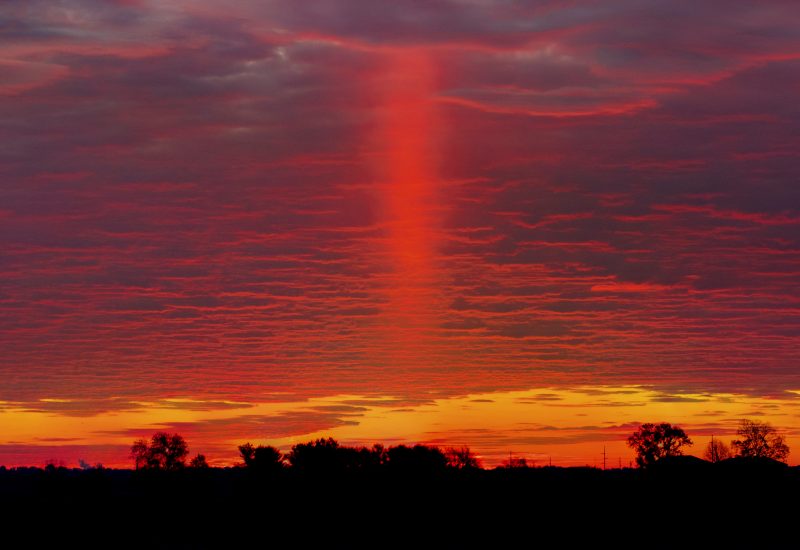
Sun pillar over Indiana

November 11, 2018, photo by Charlie Winstead in Vanderburgh County, Indiana. Nikon D500, 1/6 sec, f/8, 70mm, ISO 320.

Read more: What is a sun pillar, or light pillar?

The 2019 lunar calendars are here! Order yours before they’re gone. Makes a great gift.


from EarthSky https://ift.tt/2OFLjiM

November 11, 2018, photo by Charlie Winstead in Vanderburgh County, Indiana. Nikon D500, 1/6 sec, f/8, 70mm, ISO 320.

Read more: What is a sun pillar, or light pillar?

The 2019 lunar calendars are here! Order yours before they’re gone. Makes a great gift.


from EarthSky https://ift.tt/2OFLjiM

adds 2