aads

New research, October 29 - November 4, 2018

A selection of new climate related research articles is shown below.

Climate change impacts 

Mankind

Altered Disease Risk from Climate Change (A special issue in EcoHealth)

Climate change perception: an analysis of climate change and risk perceptions among farmer types of Indian Western Himalayas

Climate change adaptation and mitigation – a hitherto neglected gender-sensitive public health perspective

Associations between ambient temperature and daily hospital admissions for rheumatic heart disease in Shanghai, China

Investigation on fatal accidents in Chinese construction industry between 2004 and 2016

Drivers of diversity in human thermal perception – A review for holistic comfort models (open access)

Quantifying the effect of rain events on outdoor thermal comfort in a high-density city, Hong Kong

Bridging Research and Policy on Climate Change and Conflict

The potential effects of climate change on air quality across the conterminous US at 2030 under three Representative Concentration Pathways (open access)

Climate change implications for irrigation and groundwater in the Republican River Basin, USA (open access)

Using impact response surfaces to analyse the likelihood of impacts on crop yield under probabilistic climate change (open access)

Are agricultural researchers working on the right crops to enable food and nutrition security under future climates? (open access)

Machine learning methods for crop yield prediction and climate change impact assessment in agriculture (open access)

Analysis of meteorological dryness/wetness features for spring wheat production in the Ili River basin, China

Effects of large‐scale climate anomalies on crop reference evapotranspiration in the main grain‐production area of China

Assessing the climate change impacts of cocoa growing districts in Ghana: the livelihood vulnerability index analysis

Yield response to climate, management, and genotype: a large-scale observational analysis to identify climate-adaptive crop management practices in high-input maize systems (open access)

A Reappraisal of the Thermal Growing Season Length across Europe

Enough is enough: how West African farmers judge water sufficiency

Of climate and weather: Examining Canadian farm and livestock organization discourses from 2010 to 2015

Designing collaborative governance: Insights from the drought contingency planning process for the lower Colorado River basin

Biosphere

The influence of climatic legacies on the distribution of dryland biocrust communities

Soil microbial moisture dependences and responses to drying‐rewetting: the legacy of 18 years drought

Comparison of budburst phenology trends and precision among participants in a citizen science program

Adaptation of soil microbial growth to temperature: using a tropical elevation gradient to predict future changes

The response of boreal peatland community composition and NDVI to hydrologic change, warming, and elevated carbon dioxide (open access)

Functional reorganization of marine fish nurseries under climate warming

Climate change threatens central Tunisian nut orchards

Tree rings reveal long-term changes in growth resilience in Southern European riparian forests

Boreal tree growth exhibits decadal‐scale ecological memory to drought and insect defoliation, but no negative response to their interaction

Tree resilience to drought increases in the Tibetan Plateau (open access)

Warming impacts on early life stages increase the vulnerability and delay the population recovery of a long‐lived habitat‐forming macroalga

Miami heat: urban heat islands influence the thermal suitability of habitats for ectotherms

Other impacts

Forest fire hazard during 2000–2016 in Zhejiang province of the typical subtropical region, China

Evaluating regional resiliency of coastal wetlands to sea level rise through hypsometry‐based modeling (open access)

Climate change mitigation

Climate change communication

Educational Backgrounds of TV Weathercasters (open access)

Perceptions of mountainous people on climate change, livelihood practices and climatic shocks: A case study of Swat District, Pakistan

Climate Policy

Effect of carbon tax on the industrial competitiveness of Chongqing, China

Energy production

The existence of barriers and proposed recommendations for the development of renewable energy in Indian perspective

Emission savings

CO2-equivalent emissions from European passenger vehicles in the years 1995–2015 based on real-world use: Assessing the climate benefit of the European “diesel boom” (open access)

Club convergence and spatial distribution dynamics of carbon intensity in China’s construction industry

Geoengineering

Targeting carbon dioxide removal in the European Union (open access)

Climate change

Science directions in a post‐COP21‐world of transient climate change: enabling regional to local predictions in support of reliable climate information (open access)

East Asian climate under global warming: understanding and projection

Temperature, precipitation, wind

ENSO-related Global Ocean Heat Content Variations

The importance of unresolved biases in 20th century sea-surface temperature observations (open access)

Formation of contrasting March surface air temperature trends in the eastern Bering Sea and the Sea of Okhotsk during 1979–2015

Long term variability of the northerly winds over the Eastern Mediterranean as seen from historical wind observations

Quantifying the Importance of Rapid Adjustments for Global Precipitation Changes (open access)

Extreme events

Spatiotemporal Analysis of Near-Miss Violent Tornadoes in the United States

Plant‐physiological responses to rising CO2 modify simulated daily runoff intensity with implications for global‐scale flood risk assessment

On the decadal predictability of the frequency of flood events across the U.S. Midwest

Rainfall threshold determination for flash flood warning in mountainous catchments with consideration of antecedent soil moisture and rainfall pattern

Flood mapping under uncertainty: a case study in the Canadian prairies

Characteristics of meteorological droughts in northwestern India

Mechanisms and Early Warning of Drought Disasters: An Experimental Drought Meteorology Research over China (DroughtEX_China) (open access)

Projecting changes in societally‐impactful northeastern U.S. snowstorms

Forcings and feedbacks

Rapid and reliable assessment of methane impacts on climate (open access)

Impact of climate change on solar irradiation and variability over the iberian peninsula using regional climate models

Effective radiative forcing in the aerosol–climate model CAM5.3-MARC-ARG (open access)

Additional global climate cooling by clouds due to ice crystal complexity (open access)

Characterizing uncertainties in the ESA-CCI land cover map of the epoch 2010 and their impacts on MPI-ESM climate simulations (open access)

Cryosphere

Impact of the recent atmospheric circulation change in summer on the future surface mass balance of the Greenland Ice Sheet (open access)

Basal control of supraglacial meltwater catchments on the Greenland Ice Sheet (open access)

Soil thermal conductivity and its influencing factors at the Tanggula permafrost region on the Qinghai–Tibet Plateau

Detecting soil freeze/thaw onsets in Alaska using SMAP and ASCAT data

Improving Met Office seasonal predictions of Arctic sea ice using assimilation of CryoSat-2 thickness (open access)

Mechanisms for and predictability of a drastic reduction in the Arctic sea ice: APPOSITE data with climate model MIROC

Widespread and accelerated decrease of observed mean and extreme snow depth over Europe

Basal ice formation in snow cover in Northern Finland between 1948 and 2016 (open access)

Hydrosphere 

Evolution of 21st Century Sea‐level Rise Projections (open access)

Combined use of multiple drought indices for global assessment of dry gets drier and wet gets wetter paradigm

Climate change expectations in the upper Tigris River basin, Turkey

Cooling and freshening of the West Spitsbergen Current by shelf‐origin cold core lenses

Atmospheric and oceanic circulation

Performance of CMIP5 models in the simulation of Indian summer monsoon

A robust constraint on the temperature and height of the extratropical tropopause

West African Monsoon: current state and future projections in a high-resolution AGCM (open access)

Reassessing the Role of the Indo‐Pacific in the Ocean's Global Overturning Circulation

Weakened anomalous western North Pacific anticyclone during El Niño decaying summer under a warmer climate: Dominant role of the weakened impact of tropical Indian Ocean on the atmosphere

Carbon and nitrogen cycles

Differences of soil CO2 flux in two contrasting subalpine ecosystems on the eastern edge of the Qinghai-Tibetan Plateau: A four-year study

Nitrous oxide emissions from inland waters: Are IPCC estimates too high?

Total deposition of nitrogen in Swiss forests: Comparison of assessment methods and evaluation of changes over two decades

Other papers

General climate science

100 Years Later: Reflecting on Alfred Wegener’s Contributions to Tornado Research in Europe (open access)

Heat‐engine and entropy‐production analyses of the world ocean

Palaeoclimatology

A Pinus cembra L. tree-ring record for late spring to late summer temperature in the Rhaetian Alps, Italy

Dendrochronological potential of four neotropical dry-forest tree species: climate-growth correlations in Northeast Brazil

Other environmental issues 

Mortality and hospitalizations due to cardiovascular and respiratory diseases associated with air pollution in Iran: A systematic review and meta-analysis

Effects of air pollutants on occurrences of influenza-like illness and laboratory-confirmed influenza in Hefei, China

Trends in air pollutants and health impacts in three Swedish cities over the past three decades (open access)

Public Attention to Natural Hazard Warnings in Social Media in China


from Skeptical Science https://ift.tt/2qCEbu0

A selection of new climate related research articles is shown below.

Climate change impacts 

Mankind

Altered Disease Risk from Climate Change (A special issue in EcoHealth)

Climate change perception: an analysis of climate change and risk perceptions among farmer types of Indian Western Himalayas

Climate change adaptation and mitigation – a hitherto neglected gender-sensitive public health perspective

Associations between ambient temperature and daily hospital admissions for rheumatic heart disease in Shanghai, China

Investigation on fatal accidents in Chinese construction industry between 2004 and 2016

Drivers of diversity in human thermal perception – A review for holistic comfort models (open access)

Quantifying the effect of rain events on outdoor thermal comfort in a high-density city, Hong Kong

Bridging Research and Policy on Climate Change and Conflict

The potential effects of climate change on air quality across the conterminous US at 2030 under three Representative Concentration Pathways (open access)

Climate change implications for irrigation and groundwater in the Republican River Basin, USA (open access)

Using impact response surfaces to analyse the likelihood of impacts on crop yield under probabilistic climate change (open access)

Are agricultural researchers working on the right crops to enable food and nutrition security under future climates? (open access)

Machine learning methods for crop yield prediction and climate change impact assessment in agriculture (open access)

Analysis of meteorological dryness/wetness features for spring wheat production in the Ili River basin, China

Effects of large‐scale climate anomalies on crop reference evapotranspiration in the main grain‐production area of China

Assessing the climate change impacts of cocoa growing districts in Ghana: the livelihood vulnerability index analysis

Yield response to climate, management, and genotype: a large-scale observational analysis to identify climate-adaptive crop management practices in high-input maize systems (open access)

A Reappraisal of the Thermal Growing Season Length across Europe

Enough is enough: how West African farmers judge water sufficiency

Of climate and weather: Examining Canadian farm and livestock organization discourses from 2010 to 2015

Designing collaborative governance: Insights from the drought contingency planning process for the lower Colorado River basin

Biosphere

The influence of climatic legacies on the distribution of dryland biocrust communities

Soil microbial moisture dependences and responses to drying‐rewetting: the legacy of 18 years drought

Comparison of budburst phenology trends and precision among participants in a citizen science program

Adaptation of soil microbial growth to temperature: using a tropical elevation gradient to predict future changes

The response of boreal peatland community composition and NDVI to hydrologic change, warming, and elevated carbon dioxide (open access)

Functional reorganization of marine fish nurseries under climate warming

Climate change threatens central Tunisian nut orchards

Tree rings reveal long-term changes in growth resilience in Southern European riparian forests

Boreal tree growth exhibits decadal‐scale ecological memory to drought and insect defoliation, but no negative response to their interaction

Tree resilience to drought increases in the Tibetan Plateau (open access)

Warming impacts on early life stages increase the vulnerability and delay the population recovery of a long‐lived habitat‐forming macroalga

Miami heat: urban heat islands influence the thermal suitability of habitats for ectotherms

Other impacts

Forest fire hazard during 2000–2016 in Zhejiang province of the typical subtropical region, China

Evaluating regional resiliency of coastal wetlands to sea level rise through hypsometry‐based modeling (open access)

Climate change mitigation

Climate change communication

Educational Backgrounds of TV Weathercasters (open access)

Perceptions of mountainous people on climate change, livelihood practices and climatic shocks: A case study of Swat District, Pakistan

Climate Policy

Effect of carbon tax on the industrial competitiveness of Chongqing, China

Energy production

The existence of barriers and proposed recommendations for the development of renewable energy in Indian perspective

Emission savings

CO2-equivalent emissions from European passenger vehicles in the years 1995–2015 based on real-world use: Assessing the climate benefit of the European “diesel boom” (open access)

Club convergence and spatial distribution dynamics of carbon intensity in China’s construction industry

Geoengineering

Targeting carbon dioxide removal in the European Union (open access)

Climate change

Science directions in a post‐COP21‐world of transient climate change: enabling regional to local predictions in support of reliable climate information (open access)

East Asian climate under global warming: understanding and projection

Temperature, precipitation, wind

ENSO-related Global Ocean Heat Content Variations

The importance of unresolved biases in 20th century sea-surface temperature observations (open access)

Formation of contrasting March surface air temperature trends in the eastern Bering Sea and the Sea of Okhotsk during 1979–2015

Long term variability of the northerly winds over the Eastern Mediterranean as seen from historical wind observations

Quantifying the Importance of Rapid Adjustments for Global Precipitation Changes (open access)

Extreme events

Spatiotemporal Analysis of Near-Miss Violent Tornadoes in the United States

Plant‐physiological responses to rising CO2 modify simulated daily runoff intensity with implications for global‐scale flood risk assessment

On the decadal predictability of the frequency of flood events across the U.S. Midwest

Rainfall threshold determination for flash flood warning in mountainous catchments with consideration of antecedent soil moisture and rainfall pattern

Flood mapping under uncertainty: a case study in the Canadian prairies

Characteristics of meteorological droughts in northwestern India

Mechanisms and Early Warning of Drought Disasters: An Experimental Drought Meteorology Research over China (DroughtEX_China) (open access)

Projecting changes in societally‐impactful northeastern U.S. snowstorms

Forcings and feedbacks

Rapid and reliable assessment of methane impacts on climate (open access)

Impact of climate change on solar irradiation and variability over the iberian peninsula using regional climate models

Effective radiative forcing in the aerosol–climate model CAM5.3-MARC-ARG (open access)

Additional global climate cooling by clouds due to ice crystal complexity (open access)

Characterizing uncertainties in the ESA-CCI land cover map of the epoch 2010 and their impacts on MPI-ESM climate simulations (open access)

Cryosphere

Impact of the recent atmospheric circulation change in summer on the future surface mass balance of the Greenland Ice Sheet (open access)

Basal control of supraglacial meltwater catchments on the Greenland Ice Sheet (open access)

Soil thermal conductivity and its influencing factors at the Tanggula permafrost region on the Qinghai–Tibet Plateau

Detecting soil freeze/thaw onsets in Alaska using SMAP and ASCAT data

Improving Met Office seasonal predictions of Arctic sea ice using assimilation of CryoSat-2 thickness (open access)

Mechanisms for and predictability of a drastic reduction in the Arctic sea ice: APPOSITE data with climate model MIROC

Widespread and accelerated decrease of observed mean and extreme snow depth over Europe

Basal ice formation in snow cover in Northern Finland between 1948 and 2016 (open access)

Hydrosphere 

Evolution of 21st Century Sea‐level Rise Projections (open access)

Combined use of multiple drought indices for global assessment of dry gets drier and wet gets wetter paradigm

Climate change expectations in the upper Tigris River basin, Turkey

Cooling and freshening of the West Spitsbergen Current by shelf‐origin cold core lenses

Atmospheric and oceanic circulation

Performance of CMIP5 models in the simulation of Indian summer monsoon

A robust constraint on the temperature and height of the extratropical tropopause

West African Monsoon: current state and future projections in a high-resolution AGCM (open access)

Reassessing the Role of the Indo‐Pacific in the Ocean's Global Overturning Circulation

Weakened anomalous western North Pacific anticyclone during El Niño decaying summer under a warmer climate: Dominant role of the weakened impact of tropical Indian Ocean on the atmosphere

Carbon and nitrogen cycles

Differences of soil CO2 flux in two contrasting subalpine ecosystems on the eastern edge of the Qinghai-Tibetan Plateau: A four-year study

Nitrous oxide emissions from inland waters: Are IPCC estimates too high?

Total deposition of nitrogen in Swiss forests: Comparison of assessment methods and evaluation of changes over two decades

Other papers

General climate science

100 Years Later: Reflecting on Alfred Wegener’s Contributions to Tornado Research in Europe (open access)

Heat‐engine and entropy‐production analyses of the world ocean

Palaeoclimatology

A Pinus cembra L. tree-ring record for late spring to late summer temperature in the Rhaetian Alps, Italy

Dendrochronological potential of four neotropical dry-forest tree species: climate-growth correlations in Northeast Brazil

Other environmental issues 

Mortality and hospitalizations due to cardiovascular and respiratory diseases associated with air pollution in Iran: A systematic review and meta-analysis

Effects of air pollutants on occurrences of influenza-like illness and laboratory-confirmed influenza in Hefei, China

Trends in air pollutants and health impacts in three Swedish cities over the past three decades (open access)

Public Attention to Natural Hazard Warnings in Social Media in China


from Skeptical Science https://ift.tt/2qCEbu0

Did natural batteries create Mars’ organic carbon?

Mars as seen by one of the Viking orbiters in the late 1970s. We now know there are organics there, but where did they come from? Image via NASA.

For a long time, it wasn’t known if organic compounds – compounds containing carbon – existed on Mars. They are ubiquitous within living things on Earth, but – due to its thinner atmosphere – these compounds would be destroyed on Mars’ surface by strong incoming ultraviolet radiation. Still, scientists have thought that there should be some organics on Mars – hidden within rocks or perhaps just under the surface – even if just very simple ones from the meteorites that strike Mars regularly. Various landers and rovers found hints of organics, but nothing too substantial. Then, earlier in 2018, the Curiosity rover finally hit pay dirt, finding evidence for abundant organics in the ancient mudstone rocks in Gale crater, which used to be a martian lake billions of years ago. These carbon molecules ranged from simple to fairly complex, but their actual origin was still unknown. They could be created by abiotic processes (without life). Or they could be the molecular remains of once-living organisms.

Now, a new study by scientists at the Carnegie Institute for Science has shown one possible way that these or similar organics might have been created on Mars. The new peer-reviewed paper – by Andrew Steele and his colleagues – has been published in Science Advances.

The researchers studied organics found in three martian meteorites – Tissint, Nakhla, and NWA 1950 – and compared them to the organics discovered by Curiosity. They found that both sets of organic carbon were quite similar, suggesting a possible similar origin. From the paper:

Here, we show that martian meteorites Tissint, Nakhla, and NWA 1950 have an inventory of organic carbon species associated with fluid-mineral reactions that are remarkably consistent with those detected by the Mars Science Laboratory mission [with its Curiosity rover].

Earlier this year, NASA’s Curiosity rover found organic carbon compounds in ancient mudstones, similar to ones previously discovered in martian meteorites. Image via NASA/GSFC.

Previously, in 2012, Steele led another team that determined the organics found in 10 different martian meteorites was indigenous to Mars, not contamination from Earth, but also was not biological in origin. But if those carbon deposits were not biological, then how did they form? According to Steele:

Revealing the processes by which organic carbon compounds form on Mars has been a matter of tremendous interest for understanding its potential for habitability.

Basically, according to the paper, Mars’ organics may have originated from a series of electrochemical reactions between briny liquids and volcanic minerals, in other words, natural “batteries.”

So what about the organics found by Curiosity? Steele and his team looked closer at the organics in the meteorites – using advanced microscopy and spectroscopy – and found that they were likely created by electrochemical corrosion of minerals in martian rocks by a surrounding salty liquid brine. As Steele noted:

The discovery that natural systems can essentially form a small corrosion-powered battery that drives electrochemical reactions between minerals and surrounding liquid has major implications for the astrobiology field.

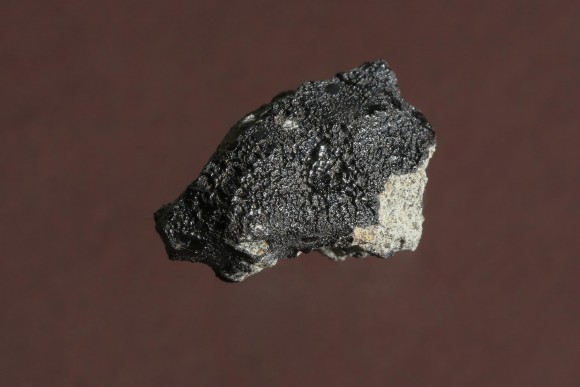
The Tissint martian meteorite, one of several that were found to contain organic material. Image via Alain Herzog/EPFL.

A high-resolution transmission electron micrograph (scale 50nm), from a transmission electron microscope, of a grain from the martian meteorite Nakhla. The organic carbon layers are found between the intact “tines.” This texture is created when the volcanic minerals of the Martian rock interact with a salty brine and become the anode and cathode of a naturally occurring battery in a corrosion reaction. This reaction would then have enough energy – under certain conditions – to synthesize organic carbon. Image via Andrew Steele/Science Advances.

Does this prove the Curiosity organics were created in the same way? No, but it is a viable answer. Curiosity itself is somewhat limited in being able to determine whether any organics are biological in origin or not. The upcoming 2020 rover will be able to do that, NASA has said.

The team further postulates that similar processes could also occur on Jupiter’s moon Europa, Saturn’s moon Enceladus and other bodies in our solar system – anywhere that igneous rocks are surrounded by salty brines. This could also have a bearing on their potential habitability as well.

Bottom line: The origin of organics on Mars is still unknown, but this new study from the Carnegie Institute for Science may hold some important clues for how at least some of them were created.

Source: Organic synthesis on Mars by electrochemical reduction of CO2

Via Carnegie Institution for Science


from EarthSky https://ift.tt/2zHec8O

Mars as seen by one of the Viking orbiters in the late 1970s. We now know there are organics there, but where did they come from? Image via NASA.

For a long time, it wasn’t known if organic compounds – compounds containing carbon – existed on Mars. They are ubiquitous within living things on Earth, but – due to its thinner atmosphere – these compounds would be destroyed on Mars’ surface by strong incoming ultraviolet radiation. Still, scientists have thought that there should be some organics on Mars – hidden within rocks or perhaps just under the surface – even if just very simple ones from the meteorites that strike Mars regularly. Various landers and rovers found hints of organics, but nothing too substantial. Then, earlier in 2018, the Curiosity rover finally hit pay dirt, finding evidence for abundant organics in the ancient mudstone rocks in Gale crater, which used to be a martian lake billions of years ago. These carbon molecules ranged from simple to fairly complex, but their actual origin was still unknown. They could be created by abiotic processes (without life). Or they could be the molecular remains of once-living organisms.

Now, a new study by scientists at the Carnegie Institute for Science has shown one possible way that these or similar organics might have been created on Mars. The new peer-reviewed paper – by Andrew Steele and his colleagues – has been published in Science Advances.

The researchers studied organics found in three martian meteorites – Tissint, Nakhla, and NWA 1950 – and compared them to the organics discovered by Curiosity. They found that both sets of organic carbon were quite similar, suggesting a possible similar origin. From the paper:

Here, we show that martian meteorites Tissint, Nakhla, and NWA 1950 have an inventory of organic carbon species associated with fluid-mineral reactions that are remarkably consistent with those detected by the Mars Science Laboratory mission [with its Curiosity rover].

Earlier this year, NASA’s Curiosity rover found organic carbon compounds in ancient mudstones, similar to ones previously discovered in martian meteorites. Image via NASA/GSFC.

Previously, in 2012, Steele led another team that determined the organics found in 10 different martian meteorites was indigenous to Mars, not contamination from Earth, but also was not biological in origin. But if those carbon deposits were not biological, then how did they form? According to Steele:

Revealing the processes by which organic carbon compounds form on Mars has been a matter of tremendous interest for understanding its potential for habitability.

Basically, according to the paper, Mars’ organics may have originated from a series of electrochemical reactions between briny liquids and volcanic minerals, in other words, natural “batteries.”

So what about the organics found by Curiosity? Steele and his team looked closer at the organics in the meteorites – using advanced microscopy and spectroscopy – and found that they were likely created by electrochemical corrosion of minerals in martian rocks by a surrounding salty liquid brine. As Steele noted:

The discovery that natural systems can essentially form a small corrosion-powered battery that drives electrochemical reactions between minerals and surrounding liquid has major implications for the astrobiology field.

The Tissint martian meteorite, one of several that were found to contain organic material. Image via Alain Herzog/EPFL.

A high-resolution transmission electron micrograph (scale 50nm), from a transmission electron microscope, of a grain from the martian meteorite Nakhla. The organic carbon layers are found between the intact “tines.” This texture is created when the volcanic minerals of the Martian rock interact with a salty brine and become the anode and cathode of a naturally occurring battery in a corrosion reaction. This reaction would then have enough energy – under certain conditions – to synthesize organic carbon. Image via Andrew Steele/Science Advances.

Does this prove the Curiosity organics were created in the same way? No, but it is a viable answer. Curiosity itself is somewhat limited in being able to determine whether any organics are biological in origin or not. The upcoming 2020 rover will be able to do that, NASA has said.

The team further postulates that similar processes could also occur on Jupiter’s moon Europa, Saturn’s moon Enceladus and other bodies in our solar system – anywhere that igneous rocks are surrounded by salty brines. This could also have a bearing on their potential habitability as well.

Bottom line: The origin of organics on Mars is still unknown, but this new study from the Carnegie Institute for Science may hold some important clues for how at least some of them were created.

Source: Organic synthesis on Mars by electrochemical reduction of CO2

Via Carnegie Institution for Science


from EarthSky https://ift.tt/2zHec8O

Galaxy-scale fountain seen in full glory

Composite image of the Abell 2597 galaxy cluster showing the fountain-like flow of gas powered by the supermassive black hole in the central galaxy. Image via NRAO.

The National Radio Astronomy Observatory (NRAO) released this new image on November 6, 2018. It’s a composite image of a giant elliptical galaxy – surrounded by a sprawling cluster of other galaxies – known as Abell 2597. The yellow parts of the image come from observations made by the Atacama Large Millimeter/submillimeter Array (ALMA) and show a relatively cold gas. The red is data from ESO’s Very Large Telescope (VLT) showing hot hydrogen gas in the same region. The purple shows extended hot, ionized gas as imaged by Chandra X-ray Observatory.

The 2019 lunar calendars are here! Order yours before they’re gone. Makes a great gift.

This vast structure is a billion light-years from Earth. It’s one of our universe’s most massive structures. At the core of Abell 2597, NRAO said:

… a supermassive black hole is powering the cosmic equivalent of a monumental fountain, drawing in vast stores of cold molecular gas and spraying them back out again in an ongoing cycle.

Astronomers have long theorized that fountains such as this continually recirculate a galaxy’s star-forming fuel. But new data from ALMA – based on observations of Abell 2597 – show the first clear and compelling evidence for the simultaneous infalling and outflow of gas driven by a supermassive black hole. The researchers reported their observations in the peer-reviewed Astrophysical Journal.

Artist’s concept of Abell 2597 showing the central supermassive black hole expelling cold, molecular gas – like the pump of a giant galactic fountain. Image via NRAO/AUI/NSF; D. Berry.

Astrophysicist Grant Tremblay at the Harvard-Smithsonian Center for Astrophysics is lead author on the new paper. He said in a statement:

The supermassive black hole at the center of this giant galaxy acts like a mechanical ‘pump’ in a water fountain. This is one of the first systems in which we find clear evidence for both cold molecular gas inflow toward the black hole and outflow or uplift from the jets that the black hole launches.

According to the researchers, this entire system operates via a self-regulating feedback loop. The infalling material provides power for the fountain as it “drains” toward the central black hole, like water entering the pump of a fountain. This infalling gas then causes the black hole to ignite with activity, launching high-velocity jets of super-heated material that shoot out of the galaxy. As it travels, this material pushes out clumps and streamers of gas into the galaxy’s expansive halo, where it eventually rains back in on the black hole, triggering the entire process anew.

In total, about three billion solar masses of molecular gas is part of this fountain, forming a filamentary nebula that spans the innermost 100,000 light-years of the galaxy.

ALMA image of cold molecular gas in Abell 2597. Image via NRAO/G. Tremblay et al.

In an earlier study by the same authors published in the journal Nature, the researchers were able to verify the interconnection between the black hole and the galactic fountain by observing the region across a range of wavelengths, or portions of the spectrum. By studying the location and motion of molecules of carbon monoxide (CO) with ALMA, which shine brightly in millimeter-wavelength light, the researchers could measure the motion of the gas as it falls in toward the black hole.

Earlier data from the Multi-Unit Spectroscopic Explorer (MUSE) on ESO’s Very Large Telescope (VLT) revealed warm, ionized gas being expelled from the galaxy – essentially the plume of the fountain. The new ALMA observations found clumps of cold, molecular gas in precisely the same locations as the warm gas seen in the earlier observations. Tremblay commented:

The unique aspect here is a very detailed coupled analysis of the source using data from ALMA and the MUSE instrument. The two facilities make for an incredibly powerful combination. ALMA revealed the distribution and motions of the cold molecular gas clouds, and MUSE did the same for the warm ionized gas.

The ALMA and MUSE data were combined with a new, ultra-deep observation of the cluster by NASA’s Chandra X-ray Observatory, revealing the hot phase of this fountain in exquisite detail, noted the researchers.

The observations also very convincingly support the hypothesis that the warm ionized and cold molecular nebulas are one and the same, with the warm ionized gas merely being the “shell” around the cold molecular cores that churn within this galaxy-scale fountain.

This multiwavelength approach offers an uncommonly complete picture of this system. Tremblay noted:

It’s like observing the rain cloud, rain, and puddle all at the same time.

While this is just one observation of one galaxy, the astronomers speculate that they may be observing a process that is common in galaxies and fundamental to their evolution.

Animation of the MUSE H-alpha data showing the different velocities of material in the “galactic fountain.” Image via ESO/G. Tremblay et al./NRAO.

Bottom line: At the core of the giant elliptical galaxy Abell 2597, a supermassive black hole is powering the cosmic equivalent of a gargantuan, ongoing fountain.

Source: A Galaxy-scale Fountain of Cold Molecular Gas Pumped by a Black Hole

Via NRAO


from EarthSky https://ift.tt/2SYfq8L

Composite image of the Abell 2597 galaxy cluster showing the fountain-like flow of gas powered by the supermassive black hole in the central galaxy. Image via NRAO.

The National Radio Astronomy Observatory (NRAO) released this new image on November 6, 2018. It’s a composite image of a giant elliptical galaxy – surrounded by a sprawling cluster of other galaxies – known as Abell 2597. The yellow parts of the image come from observations made by the Atacama Large Millimeter/submillimeter Array (ALMA) and show a relatively cold gas. The red is data from ESO’s Very Large Telescope (VLT) showing hot hydrogen gas in the same region. The purple shows extended hot, ionized gas as imaged by Chandra X-ray Observatory.

The 2019 lunar calendars are here! Order yours before they’re gone. Makes a great gift.

This vast structure is a billion light-years from Earth. It’s one of our universe’s most massive structures. At the core of Abell 2597, NRAO said:

… a supermassive black hole is powering the cosmic equivalent of a monumental fountain, drawing in vast stores of cold molecular gas and spraying them back out again in an ongoing cycle.

Astronomers have long theorized that fountains such as this continually recirculate a galaxy’s star-forming fuel. But new data from ALMA – based on observations of Abell 2597 – show the first clear and compelling evidence for the simultaneous infalling and outflow of gas driven by a supermassive black hole. The researchers reported their observations in the peer-reviewed Astrophysical Journal.

Artist’s concept of Abell 2597 showing the central supermassive black hole expelling cold, molecular gas – like the pump of a giant galactic fountain. Image via NRAO/AUI/NSF; D. Berry.

Astrophysicist Grant Tremblay at the Harvard-Smithsonian Center for Astrophysics is lead author on the new paper. He said in a statement:

The supermassive black hole at the center of this giant galaxy acts like a mechanical ‘pump’ in a water fountain. This is one of the first systems in which we find clear evidence for both cold molecular gas inflow toward the black hole and outflow or uplift from the jets that the black hole launches.

According to the researchers, this entire system operates via a self-regulating feedback loop. The infalling material provides power for the fountain as it “drains” toward the central black hole, like water entering the pump of a fountain. This infalling gas then causes the black hole to ignite with activity, launching high-velocity jets of super-heated material that shoot out of the galaxy. As it travels, this material pushes out clumps and streamers of gas into the galaxy’s expansive halo, where it eventually rains back in on the black hole, triggering the entire process anew.

In total, about three billion solar masses of molecular gas is part of this fountain, forming a filamentary nebula that spans the innermost 100,000 light-years of the galaxy.

ALMA image of cold molecular gas in Abell 2597. Image via NRAO/G. Tremblay et al.

In an earlier study by the same authors published in the journal Nature, the researchers were able to verify the interconnection between the black hole and the galactic fountain by observing the region across a range of wavelengths, or portions of the spectrum. By studying the location and motion of molecules of carbon monoxide (CO) with ALMA, which shine brightly in millimeter-wavelength light, the researchers could measure the motion of the gas as it falls in toward the black hole.

Earlier data from the Multi-Unit Spectroscopic Explorer (MUSE) on ESO’s Very Large Telescope (VLT) revealed warm, ionized gas being expelled from the galaxy – essentially the plume of the fountain. The new ALMA observations found clumps of cold, molecular gas in precisely the same locations as the warm gas seen in the earlier observations. Tremblay commented:

The unique aspect here is a very detailed coupled analysis of the source using data from ALMA and the MUSE instrument. The two facilities make for an incredibly powerful combination. ALMA revealed the distribution and motions of the cold molecular gas clouds, and MUSE did the same for the warm ionized gas.

The ALMA and MUSE data were combined with a new, ultra-deep observation of the cluster by NASA’s Chandra X-ray Observatory, revealing the hot phase of this fountain in exquisite detail, noted the researchers.

The observations also very convincingly support the hypothesis that the warm ionized and cold molecular nebulas are one and the same, with the warm ionized gas merely being the “shell” around the cold molecular cores that churn within this galaxy-scale fountain.

This multiwavelength approach offers an uncommonly complete picture of this system. Tremblay noted:

It’s like observing the rain cloud, rain, and puddle all at the same time.

While this is just one observation of one galaxy, the astronomers speculate that they may be observing a process that is common in galaxies and fundamental to their evolution.

Animation of the MUSE H-alpha data showing the different velocities of material in the “galactic fountain.” Image via ESO/G. Tremblay et al./NRAO.

Bottom line: At the core of the giant elliptical galaxy Abell 2597, a supermassive black hole is powering the cosmic equivalent of a gargantuan, ongoing fountain.

Source: A Galaxy-scale Fountain of Cold Molecular Gas Pumped by a Black Hole

Via NRAO


from EarthSky https://ift.tt/2SYfq8L

Tips for watching Taurid meteors

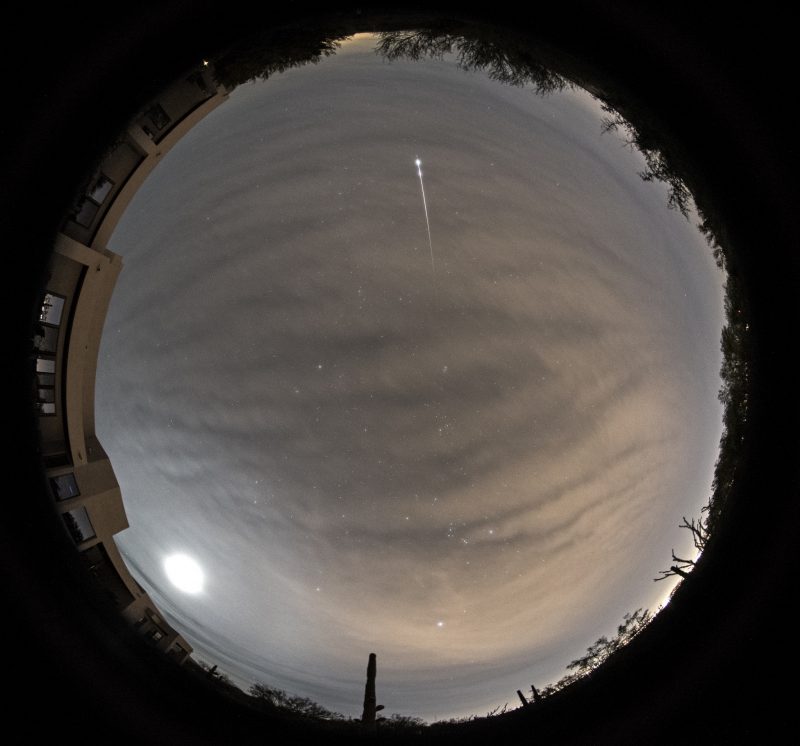
Photo top of post: Taurid fireball on the evening of October 21, 2017 from Joanne West at Gold Canyon, Arizona. Read more about this photo.

This year isn’t like 2015, which was an incredible year for seeing Taurid fireballs (2015 photos here). But we’ve been seeing some Taurid photos, and this weekend is another good time to look for these meteors. This long-lasting shower – which, with its sister shower, the South Taurids – runs throughout late October and November. The nominal peak of the North Taurids is on the night of November 11-12, 2018. Generally, this shower is at its strongest for several hours, centered around midnight local time (that midnight, the time on your clock, no matter where you are on the globe).

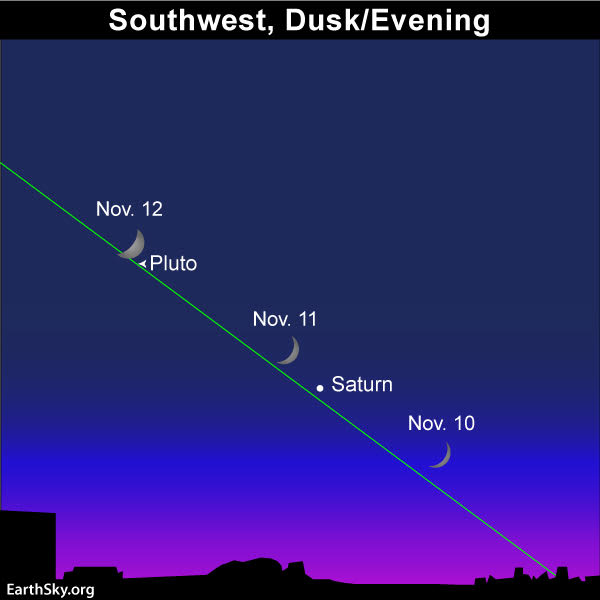
This weekend, a waxing crescent moon sets at relatively early evening, providing moon-free skies for the expected peak date of the North Taurid meteor shower.

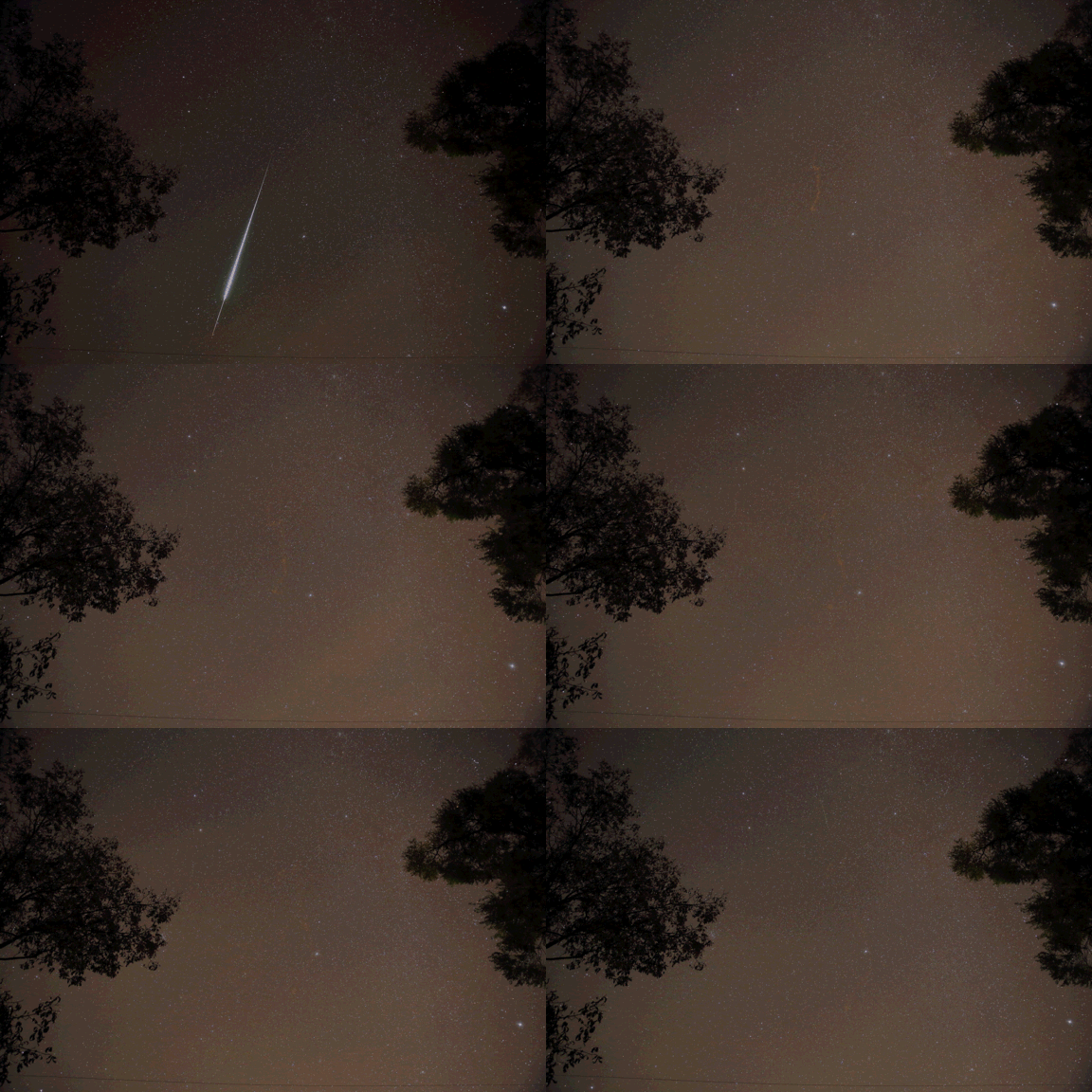
Check out this dust trail! Gregory Thompson in Ulster County, New York captured this meteor on November 4, 2018, as well as the dust trail it left behind. He wrote: “The camera captured the dust trail for more than 18 minutes. This .gif image shows about 10 minutes of frames!”

In 2015, we received many reports and photos of bright and amazing Taurid fireballs. The Taurids may have a seven-year cycle for such amazing activity. We’re still waiting on the final word on the 2018 Taurids, and we have had reports of a few fireballs this year … but not nearly as many as in 2015.

Still, keep watching. Meteor showers – by their nature – are hard to predict. They are, after all, the result of streams of debris in space. We don’t have those debris streams precisely mapped. So you never know for sure what is in store, when you watch a meteor shower. Some tips for watching below …

Taurid fireball through light clouds. Eliot Herman in Tucson, Arizona caught this meteor on November 1, 2018.

Note for Southern Hemisphere stargazers: Everything we’re saying here applies to you, too!

1. Keep your expectations real. The South Taurids peak has already passed. And there’s no sharp peak to North Taurids, so don’t expect a shower in the sense of a shower of rain. You might not see any more than five North Taurids an hour, but you can still might see a few South Taurid meteors in the mix. It’s not necessarily the number of Taurids that makes this shower amazing. Instead …

2. Watch for fireballs! Both the North and South Taurids are known for having a high percentage of fireballs – extra-bright meteors. That’s what you want to watch for this year. To increase your chances of seeing a really bright meteor …

3. Watch in the hours around midnight. That’s when the radiant point, in the constellation Taurus the Bull, will be well above your horizon. That’s true for both the Northern and Southern Hemisphere, by the way.

4. If you do need to watch in the evening hours, be aware that the meteors tend to be few and far between at that time. However, if you’re lucky, you might catch an earthgrazer meteor, which is a slow-moving and long-lasting meteor that travels horizontally across the sky. Worth a try! Plus, the waxing crescent moon will leave the sky at relatively early evening!

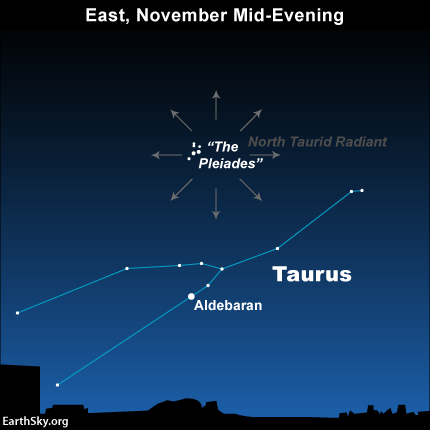
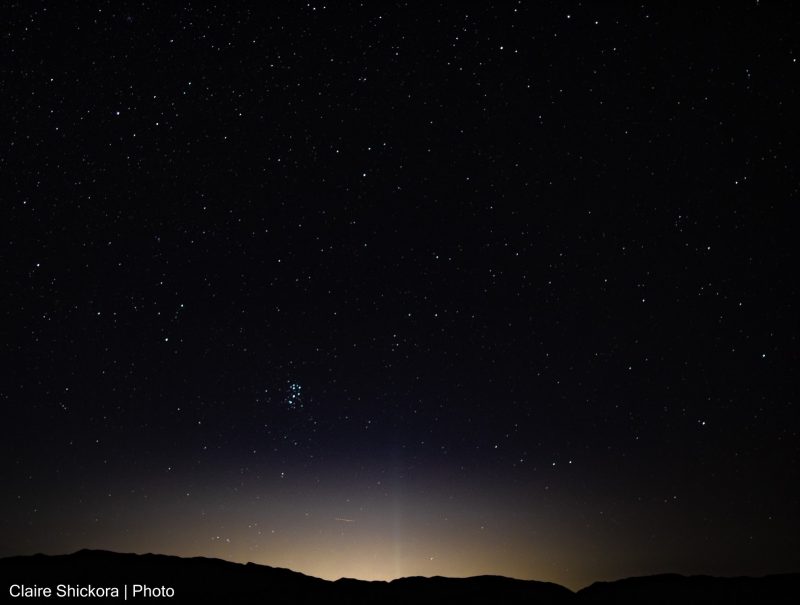
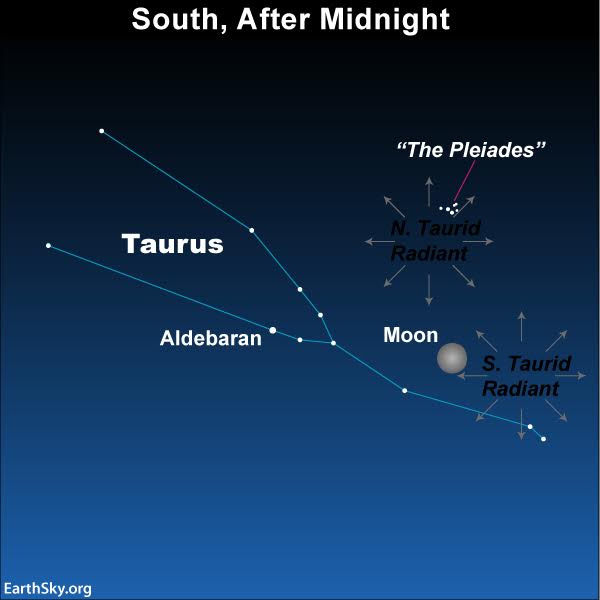
5. The North Taurid meteors’ radiant point is in the constellation Taurus the Bull. In fact, the radiant for this shower is not far from the famous Pleiades star cluster, also known as the Seven Sisters, in Taurus. You don’t need to identify this constellation to see the meteors. They will appear all over the sky. Still, it helps to know when the radiant rises. Taurus rises over the northeast horizon around 7 to 8 p.m. at mid-northern latitudes. At temperate latitudes in the Southern Hemisphere, Taurus rises a few hours later.

6. Yes, you can watch the shower no matter where you are on Earth. The constellation Taurus climbs upward as evening deepens into late night, and soars highest for the night shortly after midnight. The higher that Taurus appears in your sky, the more meteors that you’re likely to see. Because Taurus is a northern constellation, it climbs higher in the Northern Hemisphere sky than for our cousins in the Southern Hemisphere.

7. Find a dark place to observe. You don’t need to find the constellation Taurus to enjoy the North Taurid meteor shower. But it does help to find a dark, open sky. Be sure to take along a reclining lawn chair for comfort.

8. Clouded out? Missed it? Nah! This shower will be active for another month or so. However, the waxing moon will make moonlight more of a factor in the weeks ahead.

It’s time to purchase your 2019 EarthSky moon calendar! Makes a swell gift.

The radiant point of November's North Taurid meteor shower.

The radiant point of November’s North Taurid meteor shower is in the constellation Taurus the Bull, near the Pleiades star cluster, also known as the Seven Sisters.

The Pleiades star cluster, also known as the Seven Sisters, marks the radiant for the North Taurid meteor shower. This cluster is part of the constellation Taurus the Bull. Photo by Dave Dehetre on Flickr.

A close-up of the Pleiades star cluster. See the little dipper-shaped cluster on the chart above? That’s the Pleiades. It’s easy to see in the night sky. Photo by Dave Dehetre on Flickr.

The moon will set at early evening, providing dark skies for the North Taurid meteor shower. You might enjoy knowing that the moon will be sweeping past Saturn this weekend. For the fun of it, we show the dwarf planet Pluto, although it’s over 300 thousand times fainter than Saturn.

Bottom line: Meteor forecasters are calling for the night of November 11-12, 2018, to be the peak night of the North Taurid meteor. This shower has been known to produce fireballs – very bright meteors. Watch for them.

Easily locate stars and constellations during any day and time with EarthSky’s Planisphere.

EarthSky’s meteor shower guide for 2018


from EarthSky https://ift.tt/2PSRSTQ

Photo top of post: Taurid fireball on the evening of October 21, 2017 from Joanne West at Gold Canyon, Arizona. Read more about this photo.

This year isn’t like 2015, which was an incredible year for seeing Taurid fireballs (2015 photos here). But we’ve been seeing some Taurid photos, and this weekend is another good time to look for these meteors. This long-lasting shower – which, with its sister shower, the South Taurids – runs throughout late October and November. The nominal peak of the North Taurids is on the night of November 11-12, 2018. Generally, this shower is at its strongest for several hours, centered around midnight local time (that midnight, the time on your clock, no matter where you are on the globe).

This weekend, a waxing crescent moon sets at relatively early evening, providing moon-free skies for the expected peak date of the North Taurid meteor shower.

Check out this dust trail! Gregory Thompson in Ulster County, New York captured this meteor on November 4, 2018, as well as the dust trail it left behind. He wrote: “The camera captured the dust trail for more than 18 minutes. This .gif image shows about 10 minutes of frames!”

In 2015, we received many reports and photos of bright and amazing Taurid fireballs. The Taurids may have a seven-year cycle for such amazing activity. We’re still waiting on the final word on the 2018 Taurids, and we have had reports of a few fireballs this year … but not nearly as many as in 2015.

Still, keep watching. Meteor showers – by their nature – are hard to predict. They are, after all, the result of streams of debris in space. We don’t have those debris streams precisely mapped. So you never know for sure what is in store, when you watch a meteor shower. Some tips for watching below …

Taurid fireball through light clouds. Eliot Herman in Tucson, Arizona caught this meteor on November 1, 2018.

Note for Southern Hemisphere stargazers: Everything we’re saying here applies to you, too!

1. Keep your expectations real. The South Taurids peak has already passed. And there’s no sharp peak to North Taurids, so don’t expect a shower in the sense of a shower of rain. You might not see any more than five North Taurids an hour, but you can still might see a few South Taurid meteors in the mix. It’s not necessarily the number of Taurids that makes this shower amazing. Instead …

2. Watch for fireballs! Both the North and South Taurids are known for having a high percentage of fireballs – extra-bright meteors. That’s what you want to watch for this year. To increase your chances of seeing a really bright meteor …

3. Watch in the hours around midnight. That’s when the radiant point, in the constellation Taurus the Bull, will be well above your horizon. That’s true for both the Northern and Southern Hemisphere, by the way.

4. If you do need to watch in the evening hours, be aware that the meteors tend to be few and far between at that time. However, if you’re lucky, you might catch an earthgrazer meteor, which is a slow-moving and long-lasting meteor that travels horizontally across the sky. Worth a try! Plus, the waxing crescent moon will leave the sky at relatively early evening!

5. The North Taurid meteors’ radiant point is in the constellation Taurus the Bull. In fact, the radiant for this shower is not far from the famous Pleiades star cluster, also known as the Seven Sisters, in Taurus. You don’t need to identify this constellation to see the meteors. They will appear all over the sky. Still, it helps to know when the radiant rises. Taurus rises over the northeast horizon around 7 to 8 p.m. at mid-northern latitudes. At temperate latitudes in the Southern Hemisphere, Taurus rises a few hours later.

6. Yes, you can watch the shower no matter where you are on Earth. The constellation Taurus climbs upward as evening deepens into late night, and soars highest for the night shortly after midnight. The higher that Taurus appears in your sky, the more meteors that you’re likely to see. Because Taurus is a northern constellation, it climbs higher in the Northern Hemisphere sky than for our cousins in the Southern Hemisphere.

7. Find a dark place to observe. You don’t need to find the constellation Taurus to enjoy the North Taurid meteor shower. But it does help to find a dark, open sky. Be sure to take along a reclining lawn chair for comfort.

8. Clouded out? Missed it? Nah! This shower will be active for another month or so. However, the waxing moon will make moonlight more of a factor in the weeks ahead.

It’s time to purchase your 2019 EarthSky moon calendar! Makes a swell gift.

The radiant point of November's North Taurid meteor shower.

The radiant point of November’s North Taurid meteor shower is in the constellation Taurus the Bull, near the Pleiades star cluster, also known as the Seven Sisters.

The Pleiades star cluster, also known as the Seven Sisters, marks the radiant for the North Taurid meteor shower. This cluster is part of the constellation Taurus the Bull. Photo by Dave Dehetre on Flickr.

A close-up of the Pleiades star cluster. See the little dipper-shaped cluster on the chart above? That’s the Pleiades. It’s easy to see in the night sky. Photo by Dave Dehetre on Flickr.

The moon will set at early evening, providing dark skies for the North Taurid meteor shower. You might enjoy knowing that the moon will be sweeping past Saturn this weekend. For the fun of it, we show the dwarf planet Pluto, although it’s over 300 thousand times fainter than Saturn.

Bottom line: Meteor forecasters are calling for the night of November 11-12, 2018, to be the peak night of the North Taurid meteor. This shower has been known to produce fireballs – very bright meteors. Watch for them.

Easily locate stars and constellations during any day and time with EarthSky’s Planisphere.

EarthSky’s meteor shower guide for 2018


from EarthSky https://ift.tt/2PSRSTQ

Climate change science comeback strategies: 'In it for the money'

This is a re-post from Yale Climate Connections by Karin Kirk

Conversation graphicImage by Karin Kirk.

When you don’t like the message, attack the messenger. It’s an age-old tactic and an easy way to energize opposition while distracting from the real issue at hand.

With climate change, ad-hominem attacks on scientists are intended to shake public trust in the scientific evidence that underpin the whole issue. After all, who could be more villainous than the world’s climate scientists? Does one really think this group of bicycle-riding, organic-cotton-wearing PhDs might be pulling off a skillfully-coordinated global conspiracy, one involving 100 years of research from hundreds of scientists all over the world?

The notion of scientists-as-conspiracists seems preposterous – but for those who have never met a practicing scientist, are unfamiliar with the scientific process, and are emotionally invested in the idea that humans aren’t changing the climate, maybe it does seem plausible that climate scientists are stealthily, greedily, falsifying their reports to score the next big grant.

Ergo, this common complaint from those alleging climate scientists are “in it for the money”:

Most climate science is being paid for to prove a hypothesis, not disprove it. Scientists are getting funding to prove a result based on a single variable. And, guess what? Of course they’re going to prove it to keep getting paid. Scientists are told, “Take a million bucks, and prove global warming is a result of manmade CO2.” That’s what’s happening in climate science, and it’s not the way science is supposed to work.

This is a modified version of a comment on a science news Facebook page.

Such sentiments are reliable laugh lines at professional scientific conferences, but given how pervasive they are, they’re not funny at all. Nonetheless, they can spur some good questions. How do research grants work? Why won’t this myth die? And where’s the real financial lever in the climate change debate?

Read on to see how three experts in science and communication unpack this misconception and clear the air.

Strategy #1 – Correct the science

For a glimpse into the life of a research scientist, let’s first turn to Katharine Hayhoe of Texas Tech. As a top-notch atmospheric scientist, evangelical Christian, and adept communicator, Hayhoe offers an unusually well rounded outlook. She’s a frequent spokesperson for building awareness about climate change.

First, Hayhoe personalizes the message by sharing her perspective as a scientist.

One of the most frequent objections I hear is, “you scientists are just in it for the money.”

What many people don’t realize, though, is that most of us could easily have chosen a different field – like astrophysics, where I began my education – where we’d make exactly the same money. Or, we could use our skills in industry, working for a fossil fuel company (I interned at Exxon during my master’s degree and published several papers with Exxon scientists), and earn easily ten times what we do now. If I wanted to make more money, there are a lot of ways smart people with technical skills could do that without putting up with the harassment climate scientists receive every day.

Then she adds the facts: money from research grants isn’t making people rich. It just covers basic costs, sometimes just barely.

None of the research money I receive goes into my personal pocket; instead, it’s used to pay graduate students the princely sum of about $25k per year and around $2,000 a pop to publish our research papers.

Hayhoe doesn’t let her feathers get ruffled by the assertion. “Their question or objection deserves respect,” she says. But, she asserts, it’s important to “show that we have a clear and rational answer to this objection.”

Strategy #2 – Expose the myth, misinformation, or fallacy

Wonder why some of these climate myths stick around forever, despite their being wrong? That’s because they’re designed with a strong understanding of how human brains hang onto information. These messages offer the precise fodder their intended audience wants to hear (irrespective of whether the information is true or not), and they are “sticky.” That is, they are short, simple, and easy to remember and repeat. Repeatable messages beget even more repeating, and pretty soon the refrain seems so familiar that it must be true. Interests opposed to action on climate change have spent nearly $3 billion on disinformation campaigns, plus over $2 billion on lobbying and campaign contributions in just 10 years, according to investigations by InsideClimate News. That kind of cash buys some well-designed and well-distributed messaging.

John Cook and the volunteers at Skeptical Science have written a handy guide to debunking climate myths. Their responses are short, sweet, and easy to remember.

“The golden rule of debunking is to fight sticky myths with stickier facts,” says Cook. “In other words, it’s not enough to show that a myth is wrong. We also need to dislodge it with a factual replacement.”

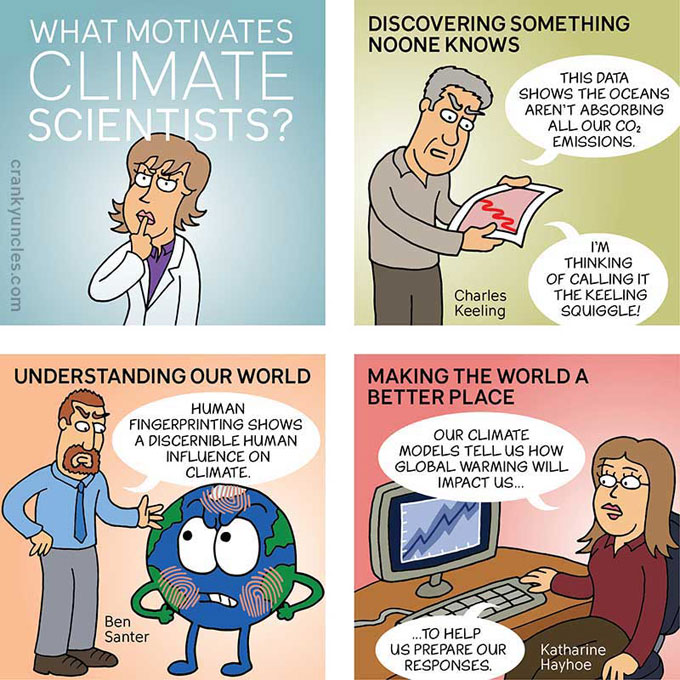
Applying that idea to the topic at hand, Cook points out, “If the myth is that scientists are motivated by money, we need to dislodge that myth by explaining what really motivates scientists.”

Scientists don’t get funding to prove what we already know – their job is to push our boundaries of knowledge. Science also makes incredibly valuable contributions to society – helping us build a safer, healthier world.

Motivation cartoon 1


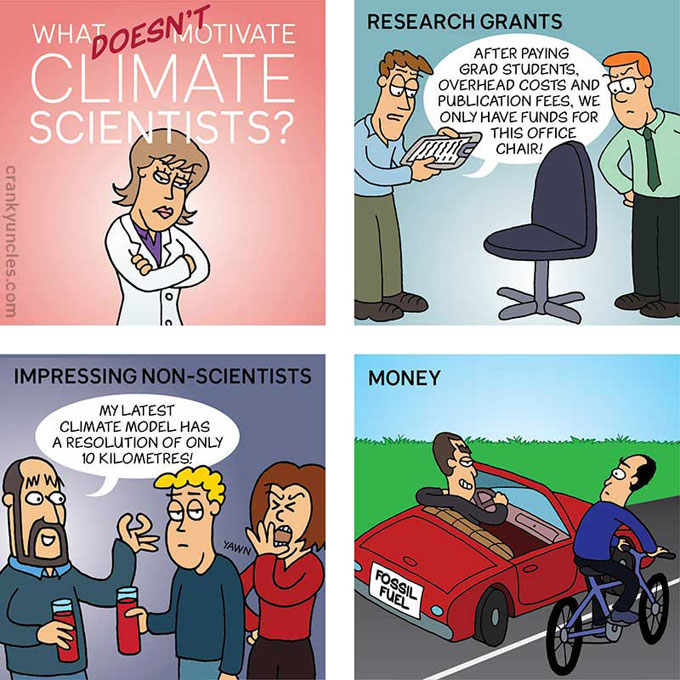
Motivation cartoon 2

Funding for scientific research doesn’t go into scientists’ pockets. It goes into the operational costs of research programs. If climate scientists were truly interested in money, they have other more lucrative options.

“This is an ideal opportunity to explain how science really works,” offers Cook, pointing to a silver lining in mythbusting – it opens the floor for sharing better information.

Strategy #3 – Engage in dialogue

Karin Tamerius, of SMART Politics, offers her take on this myth. She begins by indicating agreement with the commenter and asking a question to kick off a dialog. Tamerius points out that asking “gotcha” style questions is unlikely to promote dialogue. Instead, she takes a few steps back, to the point where there’s a potential opening for a less controversial avenue that can be explored together.

“You are absolutely right that money can corrupt science. That’s one of the reasons I try to get my information from a wide variety of sources. Which science sources do you think are most trustworthy?”

As she considers her next step, Tamerius takes stock of the underlying concern of the commenter, “This person seems wary of scientific sources,” she observes. Much of the debate on any issue nowadays involves rote repetition of messages coming from one’s preferred camp, and Tamerius strives to get beyond that. “I’m trying to encourage the other person to reflect on where they get their information. My hope is to turn that skeptical spotlight back on their own sources of information.”

As for where the conversation might lead, Tamerius strives for both parties’ being “able to talk about how to tell ‘good’ science from ‘junk’ science,” she says. “Ideally, we would walk away from the conversation with a few reliable scientific sources we can agree on.”

Want to try your hand at being radically civil? SMART Politics hosts a Facebook groupthat runs practice discussions touching on different themes and topics.

Strategy #4 – Be persuasive

When it comes to changing minds, it takes a blend of solid facts, an appreciation for the concerns of your audience, and a compelling delivery. For this multi-pronged approach, we return to Katharine Hayhoe. While some scientists report their research results and leave it at that, others wade directly into the public conversation. Hayhoe has nearly 54,000 Twitter followers, and her Global Weirding video series illustrates key elements of persuasion.

To grapple with the influences of money in climate science, Hayhoe doesn’t shy away from exposing the real financial forces in play – corporate powers that, for decades, have attempted to derail the climate change conversation.

Let’s look at who really has the most to lose when it comes to weaning ourselves off the old, dirty ways of getting energy. … Take the 10 richest corporations in the world. Eight of them depend partially or even totally on the extraction and consumption of fossil fuels for their bottom line. Yes, 80% of the richest corporations in the world have everything to lose from giving up fossil fuels.

So yes, I absolutely agree: let’s follow the money. I think we can see where it leads!

Lastly, Hayhoe offers solutions, with a blend of inspiration, optimism, and patriotism.

But let’s also consider this: we are currently undergoing as big a transition as we did when we went from horse-drawn buggies to the Model T Ford. Globally, renewable energy investment has outstripped fossil fuel investment since 2014. And China and India know this. They’re not investing in fossil fuels. They’re shutting down coal-fired plants and flooding coal mines and covering them in solar panels.

The money of the future IS in green energy. We are being left behind. Did you know that China already leads the world in wind and solar energy production? Are you okay with that?

One of Hayhoe’s hallmarks is her optimism about clean energy solutions. Paradoxically, concern for a low-carbon economy is what drove fossil fuel interests to cast doubt on the science of climate change in the first place. But as it turns out, most people actually like the idea of clean energy. Few would advocate for a life with more pollution.

“Acknowledge their objection, respect it, answer it, but then turn the conversation to the real issue: solutions,” advises Hayhoe. “As long as we can agree on the solutions, what’s the problem?”


from Skeptical Science https://ift.tt/2Dt3wiL

This is a re-post from Yale Climate Connections by Karin Kirk

Conversation graphicImage by Karin Kirk.

When you don’t like the message, attack the messenger. It’s an age-old tactic and an easy way to energize opposition while distracting from the real issue at hand.

With climate change, ad-hominem attacks on scientists are intended to shake public trust in the scientific evidence that underpin the whole issue. After all, who could be more villainous than the world’s climate scientists? Does one really think this group of bicycle-riding, organic-cotton-wearing PhDs might be pulling off a skillfully-coordinated global conspiracy, one involving 100 years of research from hundreds of scientists all over the world?

The notion of scientists-as-conspiracists seems preposterous – but for those who have never met a practicing scientist, are unfamiliar with the scientific process, and are emotionally invested in the idea that humans aren’t changing the climate, maybe it does seem plausible that climate scientists are stealthily, greedily, falsifying their reports to score the next big grant.

Ergo, this common complaint from those alleging climate scientists are “in it for the money”:

Most climate science is being paid for to prove a hypothesis, not disprove it. Scientists are getting funding to prove a result based on a single variable. And, guess what? Of course they’re going to prove it to keep getting paid. Scientists are told, “Take a million bucks, and prove global warming is a result of manmade CO2.” That’s what’s happening in climate science, and it’s not the way science is supposed to work.

This is a modified version of a comment on a science news Facebook page.

Such sentiments are reliable laugh lines at professional scientific conferences, but given how pervasive they are, they’re not funny at all. Nonetheless, they can spur some good questions. How do research grants work? Why won’t this myth die? And where’s the real financial lever in the climate change debate?

Read on to see how three experts in science and communication unpack this misconception and clear the air.

Strategy #1 – Correct the science

For a glimpse into the life of a research scientist, let’s first turn to Katharine Hayhoe of Texas Tech. As a top-notch atmospheric scientist, evangelical Christian, and adept communicator, Hayhoe offers an unusually well rounded outlook. She’s a frequent spokesperson for building awareness about climate change.

First, Hayhoe personalizes the message by sharing her perspective as a scientist.

One of the most frequent objections I hear is, “you scientists are just in it for the money.”

What many people don’t realize, though, is that most of us could easily have chosen a different field – like astrophysics, where I began my education – where we’d make exactly the same money. Or, we could use our skills in industry, working for a fossil fuel company (I interned at Exxon during my master’s degree and published several papers with Exxon scientists), and earn easily ten times what we do now. If I wanted to make more money, there are a lot of ways smart people with technical skills could do that without putting up with the harassment climate scientists receive every day.

Then she adds the facts: money from research grants isn’t making people rich. It just covers basic costs, sometimes just barely.

None of the research money I receive goes into my personal pocket; instead, it’s used to pay graduate students the princely sum of about $25k per year and around $2,000 a pop to publish our research papers.

Hayhoe doesn’t let her feathers get ruffled by the assertion. “Their question or objection deserves respect,” she says. But, she asserts, it’s important to “show that we have a clear and rational answer to this objection.”

Strategy #2 – Expose the myth, misinformation, or fallacy

Wonder why some of these climate myths stick around forever, despite their being wrong? That’s because they’re designed with a strong understanding of how human brains hang onto information. These messages offer the precise fodder their intended audience wants to hear (irrespective of whether the information is true or not), and they are “sticky.” That is, they are short, simple, and easy to remember and repeat. Repeatable messages beget even more repeating, and pretty soon the refrain seems so familiar that it must be true. Interests opposed to action on climate change have spent nearly $3 billion on disinformation campaigns, plus over $2 billion on lobbying and campaign contributions in just 10 years, according to investigations by InsideClimate News. That kind of cash buys some well-designed and well-distributed messaging.

John Cook and the volunteers at Skeptical Science have written a handy guide to debunking climate myths. Their responses are short, sweet, and easy to remember.

“The golden rule of debunking is to fight sticky myths with stickier facts,” says Cook. “In other words, it’s not enough to show that a myth is wrong. We also need to dislodge it with a factual replacement.”

Applying that idea to the topic at hand, Cook points out, “If the myth is that scientists are motivated by money, we need to dislodge that myth by explaining what really motivates scientists.”

Scientists don’t get funding to prove what we already know – their job is to push our boundaries of knowledge. Science also makes incredibly valuable contributions to society – helping us build a safer, healthier world.

Motivation cartoon 1


Motivation cartoon 2

Funding for scientific research doesn’t go into scientists’ pockets. It goes into the operational costs of research programs. If climate scientists were truly interested in money, they have other more lucrative options.

“This is an ideal opportunity to explain how science really works,” offers Cook, pointing to a silver lining in mythbusting – it opens the floor for sharing better information.

Strategy #3 – Engage in dialogue

Karin Tamerius, of SMART Politics, offers her take on this myth. She begins by indicating agreement with the commenter and asking a question to kick off a dialog. Tamerius points out that asking “gotcha” style questions is unlikely to promote dialogue. Instead, she takes a few steps back, to the point where there’s a potential opening for a less controversial avenue that can be explored together.

“You are absolutely right that money can corrupt science. That’s one of the reasons I try to get my information from a wide variety of sources. Which science sources do you think are most trustworthy?”

As she considers her next step, Tamerius takes stock of the underlying concern of the commenter, “This person seems wary of scientific sources,” she observes. Much of the debate on any issue nowadays involves rote repetition of messages coming from one’s preferred camp, and Tamerius strives to get beyond that. “I’m trying to encourage the other person to reflect on where they get their information. My hope is to turn that skeptical spotlight back on their own sources of information.”

As for where the conversation might lead, Tamerius strives for both parties’ being “able to talk about how to tell ‘good’ science from ‘junk’ science,” she says. “Ideally, we would walk away from the conversation with a few reliable scientific sources we can agree on.”

Want to try your hand at being radically civil? SMART Politics hosts a Facebook groupthat runs practice discussions touching on different themes and topics.

Strategy #4 – Be persuasive

When it comes to changing minds, it takes a blend of solid facts, an appreciation for the concerns of your audience, and a compelling delivery. For this multi-pronged approach, we return to Katharine Hayhoe. While some scientists report their research results and leave it at that, others wade directly into the public conversation. Hayhoe has nearly 54,000 Twitter followers, and her Global Weirding video series illustrates key elements of persuasion.

To grapple with the influences of money in climate science, Hayhoe doesn’t shy away from exposing the real financial forces in play – corporate powers that, for decades, have attempted to derail the climate change conversation.

Let’s look at who really has the most to lose when it comes to weaning ourselves off the old, dirty ways of getting energy. … Take the 10 richest corporations in the world. Eight of them depend partially or even totally on the extraction and consumption of fossil fuels for their bottom line. Yes, 80% of the richest corporations in the world have everything to lose from giving up fossil fuels.

So yes, I absolutely agree: let’s follow the money. I think we can see where it leads!

Lastly, Hayhoe offers solutions, with a blend of inspiration, optimism, and patriotism.

But let’s also consider this: we are currently undergoing as big a transition as we did when we went from horse-drawn buggies to the Model T Ford. Globally, renewable energy investment has outstripped fossil fuel investment since 2014. And China and India know this. They’re not investing in fossil fuels. They’re shutting down coal-fired plants and flooding coal mines and covering them in solar panels.

The money of the future IS in green energy. We are being left behind. Did you know that China already leads the world in wind and solar energy production? Are you okay with that?

One of Hayhoe’s hallmarks is her optimism about clean energy solutions. Paradoxically, concern for a low-carbon economy is what drove fossil fuel interests to cast doubt on the science of climate change in the first place. But as it turns out, most people actually like the idea of clean energy. Few would advocate for a life with more pollution.

“Acknowledge their objection, respect it, answer it, but then turn the conversation to the real issue: solutions,” advises Hayhoe. “As long as we can agree on the solutions, what’s the problem?”


from Skeptical Science https://ift.tt/2Dt3wiL

'Potato gene' reveals how ancient Andeans adapted to starchy diet

A woman sells potatoes at a market in the Andes. DNA analyses show that ancient populations of the Peruvian highlands adapted to the introduction of agriculture in ways distinct from other global populations. 

By Carol Clark

Potatoes, native to South America, became an agricultural crop thousands of years ago in the Andean highlands of Peru. And just as the ancient Andean people turned wild tubers into the domesticated potato, the potato may have altered the genomes of the Andeans who made it a staple of their diet.

Science Advances published the findings. DNA analyses show that ancient populations of the Peruvian highlands adapted to the introduction of agriculture and an extreme, high-altitude environment in ways distinct from other global populations.

“We see a different configuration of a gene associated with starch digestion in the small intestine — MGAM — in the agricultural ancient Andean genome samples, but not in hunter-gatherers down the coast,” says Emory University geneticist John Lindo, first author of the paper. “It suggests a sort of co-evolution between an agricultural crop and human beings.”

In contrast, European populations that began consuming more grains with the rise of agriculture show different genomic changes. Research has shown that their genomes have an increased number of copies of the gene coding for amylase — an enzyme in saliva that breaks down starch.

Lindo, an assistant professor of anthropology at Emory, integrates the approaches of ancient whole genomes, statistical modeling and functional methods into ancient DNA research. The international team of 17 researchers also included Anna Di Rienzo of the University of Chicago (who specializes in physiology and genetics) and high-altitude archeologists Mark Aldenderfer, from the University of California, Merced, and Randall Haas, from the University of California, Davis.

The study looked at seven ancient whole genomes from the Lake Titicaca region of the Andean highlands of Peru, dating back from 1,800 to 7,000 years. The researchers also compared the ancient whole genomes with 64 modern-day genomes from both highland Andean populations and lowland populations in Chile, to identify genetic adaptions that took place before the arrival of Europeans in the 1500s.

The hardy potato helped people adapt to the harsh environment of the Andean highlands.

The Andean highlands make an ideal natural laboratory for ancient DNA studies, due to the strong selective pressure needed for ancient populations to adapt to altitudes greater than 2,500 meters. “Frigid temperatures, low oxygen levels and intense ultraviolet radiation make the highlands one of the most extreme environments that human beings have occupied,” Lindo says. “It provides a glimpse of our potential for adaptability.”

Both the ancient and modern high-altitude populations showed strong positive selection on variants in the MGAM gene, which is evident by at least 1,800 years ago. That fits with archeological evidence indicating that the domesticated potato — a crop resistant to cold that grows mainly underground — became a staple of the Peruvian highlands as far back as 3,400 years ago.

The researchers also discovered that the Andean highland population’s genomes do not share the same genetic changes previously seen in Tibetan genomes in response to hypoxia, or low levels of oxygen. That suggests that the Andean genomes adapted to high altitude in different ways.

One possibility uncovered in the study is differentiation in the DST gene, which has been linked to proper cardiac muscle in mice. DST histone modifications in the Andean genomes associated with blood and the right ventricle of the heart may correlate to the tendency of Andean highlanders to have enlarged right ventricles. That finding fits with a previous study suggesting that Andeans may have adapted to high altitude hypoxia via cardiovascular modifications.

A gene flow analysis found that the low- and high-elevation populations split between 8,200 to 9,200 years ago.

The arrival of the Spanish in South America — who brought new diseases, along with social disruption and war — coincided with an estimated reduction of 90 percent of the total Andean population. The current analysis, however, showed that the effective breeding population in the highlands went down by only 27 percent.

“We found a very strong selection in the highlands population on an immune gene that has been correlated with smallpox, which may have had a protective effect,” Lindo says. The harsh environment of the highlands, he adds, may have also buffered them from the devastation seen in the lowlands.

“Understanding the diet, environment and historical events of various ancestries, and how those ancestries adapted to these factors, may be one way to understand some health disparities among different populations,” Lindo says.

Related:
DNA analysis adds twist to ancient story of a Native American group
Malawi yields oldest-known human DNA from Africa

Photos: Getty Images

from eScienceCommons https://ift.tt/2JOTysi
A woman sells potatoes at a market in the Andes. DNA analyses show that ancient populations of the Peruvian highlands adapted to the introduction of agriculture in ways distinct from other global populations. 

By Carol Clark

Potatoes, native to South America, became an agricultural crop thousands of years ago in the Andean highlands of Peru. And just as the ancient Andean people turned wild tubers into the domesticated potato, the potato may have altered the genomes of the Andeans who made it a staple of their diet.

Science Advances published the findings. DNA analyses show that ancient populations of the Peruvian highlands adapted to the introduction of agriculture and an extreme, high-altitude environment in ways distinct from other global populations.

“We see a different configuration of a gene associated with starch digestion in the small intestine — MGAM — in the agricultural ancient Andean genome samples, but not in hunter-gatherers down the coast,” says Emory University geneticist John Lindo, first author of the paper. “It suggests a sort of co-evolution between an agricultural crop and human beings.”

In contrast, European populations that began consuming more grains with the rise of agriculture show different genomic changes. Research has shown that their genomes have an increased number of copies of the gene coding for amylase — an enzyme in saliva that breaks down starch.

Lindo, an assistant professor of anthropology at Emory, integrates the approaches of ancient whole genomes, statistical modeling and functional methods into ancient DNA research. The international team of 17 researchers also included Anna Di Rienzo of the University of Chicago (who specializes in physiology and genetics) and high-altitude archeologists Mark Aldenderfer, from the University of California, Merced, and Randall Haas, from the University of California, Davis.

The study looked at seven ancient whole genomes from the Lake Titicaca region of the Andean highlands of Peru, dating back from 1,800 to 7,000 years. The researchers also compared the ancient whole genomes with 64 modern-day genomes from both highland Andean populations and lowland populations in Chile, to identify genetic adaptions that took place before the arrival of Europeans in the 1500s.

The hardy potato helped people adapt to the harsh environment of the Andean highlands.

The Andean highlands make an ideal natural laboratory for ancient DNA studies, due to the strong selective pressure needed for ancient populations to adapt to altitudes greater than 2,500 meters. “Frigid temperatures, low oxygen levels and intense ultraviolet radiation make the highlands one of the most extreme environments that human beings have occupied,” Lindo says. “It provides a glimpse of our potential for adaptability.”

Both the ancient and modern high-altitude populations showed strong positive selection on variants in the MGAM gene, which is evident by at least 1,800 years ago. That fits with archeological evidence indicating that the domesticated potato — a crop resistant to cold that grows mainly underground — became a staple of the Peruvian highlands as far back as 3,400 years ago.

The researchers also discovered that the Andean highland population’s genomes do not share the same genetic changes previously seen in Tibetan genomes in response to hypoxia, or low levels of oxygen. That suggests that the Andean genomes adapted to high altitude in different ways.

One possibility uncovered in the study is differentiation in the DST gene, which has been linked to proper cardiac muscle in mice. DST histone modifications in the Andean genomes associated with blood and the right ventricle of the heart may correlate to the tendency of Andean highlanders to have enlarged right ventricles. That finding fits with a previous study suggesting that Andeans may have adapted to high altitude hypoxia via cardiovascular modifications.

A gene flow analysis found that the low- and high-elevation populations split between 8,200 to 9,200 years ago.

The arrival of the Spanish in South America — who brought new diseases, along with social disruption and war — coincided with an estimated reduction of 90 percent of the total Andean population. The current analysis, however, showed that the effective breeding population in the highlands went down by only 27 percent.

“We found a very strong selection in the highlands population on an immune gene that has been correlated with smallpox, which may have had a protective effect,” Lindo says. The harsh environment of the highlands, he adds, may have also buffered them from the devastation seen in the lowlands.

“Understanding the diet, environment and historical events of various ancestries, and how those ancestries adapted to these factors, may be one way to understand some health disparities among different populations,” Lindo says.

Related:
DNA analysis adds twist to ancient story of a Native American group
Malawi yields oldest-known human DNA from Africa

Photos: Getty Images

from eScienceCommons https://ift.tt/2JOTysi

Pleiades ascending

Claire L. Shickora at Delight’s Hot Springs Resort in Tecopa, California wrote: “The Pleiades was outstanding, even with the local light pollution!”

Here’s a beautiful shot of the Pleiades star cluster – also known as the Seven Sisters – ascending in the eastern sky each evening now. See the tiny cluster that looks like a dipper, with its handle pointing downward? That’s it.

This little cluster marks the approximate radiant point of the South and North Taurid meteor showers, both of which are long-lasting showers, going on now. The Pleiades is part of the constellation Taurus the Bull, and the meteors take their name from this constellation. Taurus is pretty easy to spot, but the Pleiades is very easy. Just remember it’s a tiny cluster – dipper-shaped – ascending in the eastern sky throughout the evening hours now.

Thanks for the photo, Claire L. Shickora!

Read more: Pleiades cluster, aka Seven Sisters

Read more: Tips for watching Taurid meteors

If you trace the Taurid meteors backward, you’ll see that these meteors appear to come from the constellation Taurus the Bull, and its famous Pleiades star cluster. Read more.

Bottom line: A November, 2018, photo of the Pleiades star cluster, which marks the approximate radiant point for the Taurid meteor shower.


from EarthSky https://ift.tt/2QuCV7y

Claire L. Shickora at Delight’s Hot Springs Resort in Tecopa, California wrote: “The Pleiades was outstanding, even with the local light pollution!”

Here’s a beautiful shot of the Pleiades star cluster – also known as the Seven Sisters – ascending in the eastern sky each evening now. See the tiny cluster that looks like a dipper, with its handle pointing downward? That’s it.

This little cluster marks the approximate radiant point of the South and North Taurid meteor showers, both of which are long-lasting showers, going on now. The Pleiades is part of the constellation Taurus the Bull, and the meteors take their name from this constellation. Taurus is pretty easy to spot, but the Pleiades is very easy. Just remember it’s a tiny cluster – dipper-shaped – ascending in the eastern sky throughout the evening hours now.

Thanks for the photo, Claire L. Shickora!

Read more: Pleiades cluster, aka Seven Sisters

Read more: Tips for watching Taurid meteors

If you trace the Taurid meteors backward, you’ll see that these meteors appear to come from the constellation Taurus the Bull, and its famous Pleiades star cluster. Read more.

Bottom line: A November, 2018, photo of the Pleiades star cluster, which marks the approximate radiant point for the Taurid meteor shower.


from EarthSky https://ift.tt/2QuCV7y

adds 2