aads

Here’s where Mars InSight will touch down November 26

This artist’s concept depicts the smooth, flat ground that dominates InSight’s landing ellipse in the Elysium Planitia region of Mars. Image via NASA/JPL-Caltech.

NASA has chosen an area in the Elysium Planitia – high plains near the Martian equator – as the site for the landing of the InSight spacecraft later this month (November 26, 2018). Of 22 sites considered, only Elysium Planitia met the basic engineering constraints, and was also neither too rocky or too windy.

Previous missions to Mars have investigated the planet’s surface by studying its canyons, volcanoes, rocks and soil. But InSight (Interior Exploration using Seismic Investigations, Geodesy and Heat Transport) is a three-legged lander – not a rover – and will remain wherever it touches down. Its mission is sensing and studying evidence buried far below the planet’s surface to study the deep interior of Mars. Tom Hoffman is InSight project manager at JPL. Hoffman said in a statement:

For the first time ever, the evaluation for a Mars landing site had to consider what lay below the surface of Mars. We needed not just a safe place to land, but also a workspace that’s penetrable by our 16-foot-long (5-meter) heat-flow probe.

The landing site for InSight, in relation to landing sites for seven previous missions, is shown on a topographic map of Mars. Image via NASA/JPL-Caltech.

EarthSky’s 2019 lunar calendars are here! Order yours before they’re gone. Makes a great gift.

NASA said that the site also needs to be bright enough and warm enough to power the solar cells while keeping its electronics within temperature limits for an entire Martian year (26 Earth months). So the team focused on a band around the equator, where the lander’s solar array would have adequate sunlight to power its systems year-round. Finding an area that would be safe enough for InSight to land and then deploy its solar panels and instruments without obstructions took a little longer. Hoffman said:

The site has to be a low-enough elevation to have sufficient atmosphere above it for a safe landing, because the spacecraft will rely first on atmospheric friction with its heat shield and then on a parachute digging into Mars’ tenuous atmosphere for a large portion of its deceleration. And after the chute has fallen away and the braking rockets have kicked in for final descent, there needs to be a flat expanse to land on – not too undulating and relatively free of rocks that could tip the tri-legged Mars lander.

The site is an 81-mile long, 17-mile-wide (130-km-long, 27-km-wide) landing ellipse on the western edge of a flat, smooth expanse of lava plain.

Bruce Banerdt is InSight principal investigator at NASA’s Jet Propulsion Laboratory (JPL) in Pasadena, California. Banerdt said:

If you were a Martian coming to explore Earth’s interior like we are exploring Mars’ interior, it wouldn’t matter if you put down in the middle of Kansas or the beaches of Oahu. While I’m looking forward to those first images from the surface, I am even more eager to see the first data sets revealing what is happening deep below our landing pads. The beauty of this mission is happening below the surface. Elysium Planitia is perfect.

This map shows the single area under continuing evaluation as the InSight mission’s Mars landing site, as of a year before the mission’s May 2016 launch. The finalist ellipse marked is within the northern portion of flat-lying Elysium Planitia about four degrees north of Mars’ equator. Image via NASA/JPL-Caltech.

After a 205-day journey that began on May 5, 2018, NASA’s InSight mission will touch down on Mars on November 26. Its solar panels will unfurl within a few hours of touchdown.

Bottom line: NASA has chosen Elysium Planitia as the landing site for the InSight spacecraft’s touchdown on November 26, 2018.

Via NASA


from EarthSky https://ift.tt/2FdmjAl

This artist’s concept depicts the smooth, flat ground that dominates InSight’s landing ellipse in the Elysium Planitia region of Mars. Image via NASA/JPL-Caltech.

NASA has chosen an area in the Elysium Planitia – high plains near the Martian equator – as the site for the landing of the InSight spacecraft later this month (November 26, 2018). Of 22 sites considered, only Elysium Planitia met the basic engineering constraints, and was also neither too rocky or too windy.

Previous missions to Mars have investigated the planet’s surface by studying its canyons, volcanoes, rocks and soil. But InSight (Interior Exploration using Seismic Investigations, Geodesy and Heat Transport) is a three-legged lander – not a rover – and will remain wherever it touches down. Its mission is sensing and studying evidence buried far below the planet’s surface to study the deep interior of Mars. Tom Hoffman is InSight project manager at JPL. Hoffman said in a statement:

For the first time ever, the evaluation for a Mars landing site had to consider what lay below the surface of Mars. We needed not just a safe place to land, but also a workspace that’s penetrable by our 16-foot-long (5-meter) heat-flow probe.

The landing site for InSight, in relation to landing sites for seven previous missions, is shown on a topographic map of Mars. Image via NASA/JPL-Caltech.

EarthSky’s 2019 lunar calendars are here! Order yours before they’re gone. Makes a great gift.

NASA said that the site also needs to be bright enough and warm enough to power the solar cells while keeping its electronics within temperature limits for an entire Martian year (26 Earth months). So the team focused on a band around the equator, where the lander’s solar array would have adequate sunlight to power its systems year-round. Finding an area that would be safe enough for InSight to land and then deploy its solar panels and instruments without obstructions took a little longer. Hoffman said:

The site has to be a low-enough elevation to have sufficient atmosphere above it for a safe landing, because the spacecraft will rely first on atmospheric friction with its heat shield and then on a parachute digging into Mars’ tenuous atmosphere for a large portion of its deceleration. And after the chute has fallen away and the braking rockets have kicked in for final descent, there needs to be a flat expanse to land on – not too undulating and relatively free of rocks that could tip the tri-legged Mars lander.

The site is an 81-mile long, 17-mile-wide (130-km-long, 27-km-wide) landing ellipse on the western edge of a flat, smooth expanse of lava plain.

Bruce Banerdt is InSight principal investigator at NASA’s Jet Propulsion Laboratory (JPL) in Pasadena, California. Banerdt said:

If you were a Martian coming to explore Earth’s interior like we are exploring Mars’ interior, it wouldn’t matter if you put down in the middle of Kansas or the beaches of Oahu. While I’m looking forward to those first images from the surface, I am even more eager to see the first data sets revealing what is happening deep below our landing pads. The beauty of this mission is happening below the surface. Elysium Planitia is perfect.

This map shows the single area under continuing evaluation as the InSight mission’s Mars landing site, as of a year before the mission’s May 2016 launch. The finalist ellipse marked is within the northern portion of flat-lying Elysium Planitia about four degrees north of Mars’ equator. Image via NASA/JPL-Caltech.

After a 205-day journey that began on May 5, 2018, NASA’s InSight mission will touch down on Mars on November 26. Its solar panels will unfurl within a few hours of touchdown.

Bottom line: NASA has chosen Elysium Planitia as the landing site for the InSight spacecraft’s touchdown on November 26, 2018.

Via NASA


from EarthSky https://ift.tt/2FdmjAl

Go young moon hunting this week

The photo above was taken in November, 2017, by Patrick Casaert in Meaux, France. Notice that this very young moon appears sideways with respect to the bottom of the photo. If you’re in the Northern Hemisphere – and you see the moon on November 8, 9 or 10, 2018 – it’ll likely be oriented sideways to your sunset horizon. That’s because – in autumn – the young crescent moon is located to the side of the sun in our evening sky, not above the sun as it is right now for the Southern Hemisphere (where it’s spring).

On November 8, 2018, you might (or might not) spot the young moon in your western sky after sunset. Generally, it’s difficult to catch a pale, whisker-thin waxing crescent moon that’s less than 24 hours old (24 hours past new moon). New moon was November 7 at 16:02 UTC.

Exactly 24 hours after this month’s new moon – that is, at 16:02 UTC on November 8, 2018 – the line of sunset crosses western Europe and Africa. By the time sunset reaches the Americas, the moon will be well over 24 hours old. Image via US Naval Observatory.

So Asia will have a tough time spotting the moon on November 8, but your chance to see it will improve as sunset comes to increasingly western longitudes. As the sun sets for western Europe and Africa on November 8, the moon will be approximately one day old. In that part of the world, the moon will most likely set somewhat less than one hour after sunset.

In the Americas on November 8, the moon will be more than a day old and therefore easier to spot. Still, the autumn angle of the ecliptic will keep the moon low in the twilight sky. You’ll have to search to see it!

If you miss the young moon at dusk November 8, try again on November 9 or 10. Day after day, a wider crescent moon will stay out later after sunset and will be easier to catch at early evening, as shown on the chart below:

At northerly latitudes, like those in the U.S. and Europe, it’ll be a challenge to spot the young moon, plus the planet Mercury, in the glow of evening dusk on November 8, 2018. Easier on November 9 and 10!

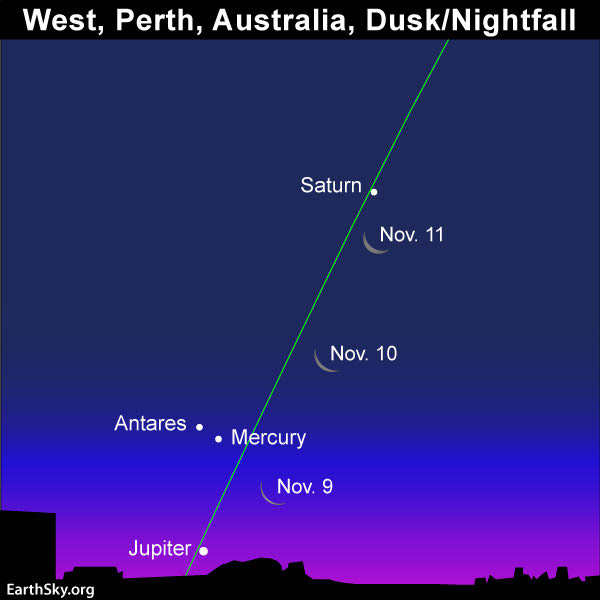
Live in the Southern Hemisphere? Given an unobstructed horizon in the direction of sunset, you have a good chance of catching the young moon near the planets Mercury and Jupiter on or near November 9, 2018. Will you see it on November 8 (not shown on chart)? Maybe!

As for the Americas, the moon will be well over 24 hours old at sunset, and, for the most of the Americas, the slender crescent will stay out for over one hour after sundown. All the same, you’ll want to find an unobstructed horizon in the direction of sunset for your young moon quest. Binoculars may come in handy as well.

Want to know the age of the moon at sunset for your part of the world? Click here and remember to check the Moon phases plus Moonrise and moonset boxes. (For example, at Philadelphia, Pennsylvania, the moon is 29 hours 49 minutes old at sunset November 8, because the new moon occurred at 11:03 a.m. local time on November 7 and the sun sets at 4:52 p.m.local time on November 8.)

Do you know your cardinal directions and are you familiar with the concept of azimuth? If so, you can obtain the azimuth reading of moonset (or sunset) by way of the US Naval Observatory (remember to check the moon or sun as your celestial object of interest) or via TimeandDate.

Or, more simply, you can search for the young waxing crescent moon, with the unaided eye or binoculars, near the sunset point on the horizon. For a double bonus, seek out the planet Mercury, too, although this world will be considerably easier to spot from the Southern Hemisphere.

Read more: Mercury visible at southerly latitudes

Bottom line: These next several days – November 8, 9 and 10, 2018 – look for the young waxing crescent moon in the western sky after sunset. With each passing day, the lunar crescent will widen, to appear higher up in the sky at sunset and to stay out later after dark. Good luck!


from EarthSky https://ift.tt/2PN61Cb

The photo above was taken in November, 2017, by Patrick Casaert in Meaux, France. Notice that this very young moon appears sideways with respect to the bottom of the photo. If you’re in the Northern Hemisphere – and you see the moon on November 8, 9 or 10, 2018 – it’ll likely be oriented sideways to your sunset horizon. That’s because – in autumn – the young crescent moon is located to the side of the sun in our evening sky, not above the sun as it is right now for the Southern Hemisphere (where it’s spring).

On November 8, 2018, you might (or might not) spot the young moon in your western sky after sunset. Generally, it’s difficult to catch a pale, whisker-thin waxing crescent moon that’s less than 24 hours old (24 hours past new moon). New moon was November 7 at 16:02 UTC.

Exactly 24 hours after this month’s new moon – that is, at 16:02 UTC on November 8, 2018 – the line of sunset crosses western Europe and Africa. By the time sunset reaches the Americas, the moon will be well over 24 hours old. Image via US Naval Observatory.

So Asia will have a tough time spotting the moon on November 8, but your chance to see it will improve as sunset comes to increasingly western longitudes. As the sun sets for western Europe and Africa on November 8, the moon will be approximately one day old. In that part of the world, the moon will most likely set somewhat less than one hour after sunset.

In the Americas on November 8, the moon will be more than a day old and therefore easier to spot. Still, the autumn angle of the ecliptic will keep the moon low in the twilight sky. You’ll have to search to see it!

If you miss the young moon at dusk November 8, try again on November 9 or 10. Day after day, a wider crescent moon will stay out later after sunset and will be easier to catch at early evening, as shown on the chart below:

At northerly latitudes, like those in the U.S. and Europe, it’ll be a challenge to spot the young moon, plus the planet Mercury, in the glow of evening dusk on November 8, 2018. Easier on November 9 and 10!

Live in the Southern Hemisphere? Given an unobstructed horizon in the direction of sunset, you have a good chance of catching the young moon near the planets Mercury and Jupiter on or near November 9, 2018. Will you see it on November 8 (not shown on chart)? Maybe!

As for the Americas, the moon will be well over 24 hours old at sunset, and, for the most of the Americas, the slender crescent will stay out for over one hour after sundown. All the same, you’ll want to find an unobstructed horizon in the direction of sunset for your young moon quest. Binoculars may come in handy as well.

Want to know the age of the moon at sunset for your part of the world? Click here and remember to check the Moon phases plus Moonrise and moonset boxes. (For example, at Philadelphia, Pennsylvania, the moon is 29 hours 49 minutes old at sunset November 8, because the new moon occurred at 11:03 a.m. local time on November 7 and the sun sets at 4:52 p.m.local time on November 8.)

Do you know your cardinal directions and are you familiar with the concept of azimuth? If so, you can obtain the azimuth reading of moonset (or sunset) by way of the US Naval Observatory (remember to check the moon or sun as your celestial object of interest) or via TimeandDate.

Or, more simply, you can search for the young waxing crescent moon, with the unaided eye or binoculars, near the sunset point on the horizon. For a double bonus, seek out the planet Mercury, too, although this world will be considerably easier to spot from the Southern Hemisphere.

Read more: Mercury visible at southerly latitudes

Bottom line: These next several days – November 8, 9 and 10, 2018 – look for the young waxing crescent moon in the western sky after sunset. With each passing day, the lunar crescent will widen, to appear higher up in the sky at sunset and to stay out later after dark. Good luck!


from EarthSky https://ift.tt/2PN61Cb

Curiosity rover on the move again

NASA’s Curiosity Mars Rover sent this snapshot on Tuesday (November 6, 2018). Image via NASA.

The 2019 lunar calendars are here! Order yours before they’re gone. Makes a great gift.

NASA’s Mars Curiosity rover is driving and conducting science again after experiencing a memory anomaly in September. The rover drove about 197 feet (60 meters) over the past weekend to a site called Lake Orcadie, pushing its total odometry to over 12 miles (20 kilometers). This was Curiosity’s longest drive since experiencing a memory anomaly on September 15, 2018. The rover switched to a spare computer, called the Side-A computer, on October 3.

As is the case with many spacecraft, Curiosity was designed with two, redundant computers – in this case, referred to as a Side-A and a Side-B computer – so that it can continue operations if one experiences a glitch. After reviewing several options, JPL engineers recommended that the rover switch from Side B to Side A.

A self-portrait of NASA’s Curiosity rover taken on Sol 2082 (June 15, 2018). A Martian dust storm has reduced sunlight and visibility at the rover’s location in Gale Crater. Image via NASA/JPL-Caltech.

Curiosity’s engineering team at NASA’s Jet Propulsion Laboratory continues to diagnose the anomaly on the Side B computer. Curiosity used the Side A computer initially after landing on Mars in August 2012. Side A experienced hardware and software issues over five years ago, NASA said, leaving the rover uncommandable and running down its battery. At that time, the team successfully switched to Side B. Engineers have since diagnosed and quarantined the part of Side A’s memory that was affected so that computer is again available to support the mission. Steven Lee of JPL is Curiosity’s deputy project manager. Lee said in a statement:

At this point, we’re confident we’ll be getting back to full operations, but it’s too early to say how soon. We are operating on Side A starting today, but it could take us time to fully understand the root cause of the issue and devise workarounds for the memory on Side B.

We spent the last week checking out Side A and preparing it for the swap. It’s certainly possible to run the mission on the Side-A computer if we really need to. But our plan is to switch back to Side B as soon as we can fix the problem to utilize its larger memory size.

Bottom line: NASA’s Mars Curiosity rover has made its longest drive since experiencing a memory anomaly on September 15, 2018.

Via NASA


from EarthSky https://ift.tt/2RJJC6b

NASA’s Curiosity Mars Rover sent this snapshot on Tuesday (November 6, 2018). Image via NASA.

The 2019 lunar calendars are here! Order yours before they’re gone. Makes a great gift.

NASA’s Mars Curiosity rover is driving and conducting science again after experiencing a memory anomaly in September. The rover drove about 197 feet (60 meters) over the past weekend to a site called Lake Orcadie, pushing its total odometry to over 12 miles (20 kilometers). This was Curiosity’s longest drive since experiencing a memory anomaly on September 15, 2018. The rover switched to a spare computer, called the Side-A computer, on October 3.

As is the case with many spacecraft, Curiosity was designed with two, redundant computers – in this case, referred to as a Side-A and a Side-B computer – so that it can continue operations if one experiences a glitch. After reviewing several options, JPL engineers recommended that the rover switch from Side B to Side A.

A self-portrait of NASA’s Curiosity rover taken on Sol 2082 (June 15, 2018). A Martian dust storm has reduced sunlight and visibility at the rover’s location in Gale Crater. Image via NASA/JPL-Caltech.

Curiosity’s engineering team at NASA’s Jet Propulsion Laboratory continues to diagnose the anomaly on the Side B computer. Curiosity used the Side A computer initially after landing on Mars in August 2012. Side A experienced hardware and software issues over five years ago, NASA said, leaving the rover uncommandable and running down its battery. At that time, the team successfully switched to Side B. Engineers have since diagnosed and quarantined the part of Side A’s memory that was affected so that computer is again available to support the mission. Steven Lee of JPL is Curiosity’s deputy project manager. Lee said in a statement:

At this point, we’re confident we’ll be getting back to full operations, but it’s too early to say how soon. We are operating on Side A starting today, but it could take us time to fully understand the root cause of the issue and devise workarounds for the memory on Side B.

We spent the last week checking out Side A and preparing it for the swap. It’s certainly possible to run the mission on the Side-A computer if we really need to. But our plan is to switch back to Side B as soon as we can fix the problem to utilize its larger memory size.

Bottom line: NASA’s Mars Curiosity rover has made its longest drive since experiencing a memory anomaly on September 15, 2018.

Via NASA


from EarthSky https://ift.tt/2RJJC6b

One of the oldest stars in the universe

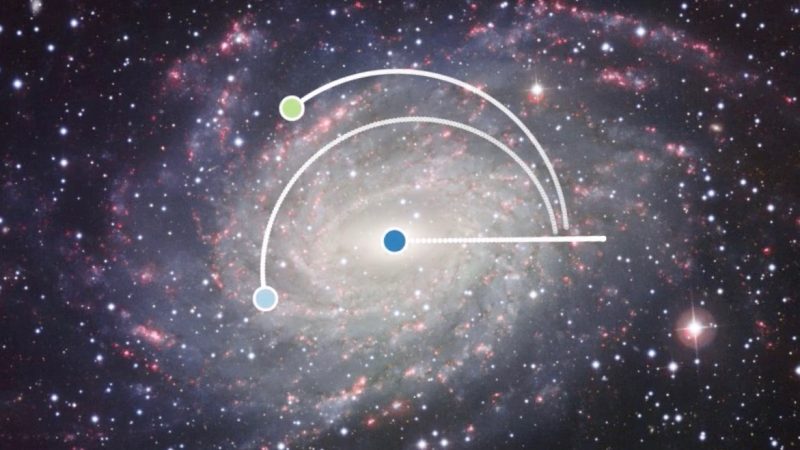
The newly discovered star system (shown in blue) orbits within our Milky Way galaxy, in an orbit not unlike that of our sun (shown in green). Image via Kevin Schlaufman/Johns Hopkins.

The first stars to form after the Big Bang would have been made entirely of elements made in the Big Bang itself: the lightest and simplest elements like hydrogen, helium and lithium. The heavier and more complex elements – which astronomers call metals – were made in subsequent stars’ thermonuclear furnaces. The first stars seeded the universe with the heavier elements when they exploded as supernovae. So when astronomers find a star with mostly light elements – and few heavier elements – they conclude it’s one of the universe’s very early stars. That’s the case with a star announced by Johns Hopkins University on November 5, 2018. This 13.5 billion-year-old star – a very tiny star in our own Milky Way galaxy – appears to be one of the oldest stars known and it’s also the new record-holder for stars with the fewest heavy elements known so far.

The Johns Hopkins astronomers said this star is made almost entirely – but still not exclusively – from materials spewed from the Big Bang. They said in a statement:

The discovery of this [star] means more stars with very low mass and very low metal content are likely out there – perhaps even the universe’s very first stars. The star is unusual because unlike other stars with very low metal content, it is part of the Milky Way’s ‘thin disk’ – the part of the galaxy in which the sun resides. And because this star is so old, researchers say it’s possible that our galactic neighborhood is at least 3 billion years older than previously thought.

And that is very interesting news! These findings have been accepted for publication in the peer-reviewed Astrophysical Journal.

The star carries the unwieldy label of 2MASS J18082002-5104378 B. The paper’s lead author is astronomer Kevin Schlaufman of Johns Hopkins. He said:

This star is maybe one in 10 million. It tells us something very important about the first generations of stars.

One interesting feature of the star is its orbit, which is unlike that of most metal-poor stars. Like our sun, the star never gets too far from the plane of the galaxy. In contrast, most ultra-metal-poor stars have orbits that take them across the galaxy and far from its plane.

This research is based on observations made using the Magellan Clay Telescope at Las Campanas Observatory in Chile and the Gemini Observatories in Chile and Hawaii. The astronomers said:

This star’s extremely low metallicity indicates that in a cosmic family tree, it could be as little as one generation removed from the Big Bang. Indeed, it is the new record holder for the star with the smallest complement of heavy elements – it has about the same heavy element content as the planet Mercury. In contrast, our sun is thousands of generations down that line and has a heavy element content equal to 14 Jupiters.

Astronomers have found around 30 ancient, ‘ultra-metal-poor’ stars with the approximate mass of the sun. The star Schlaufman and his team found is only 14 percent the mass of the sun.

The star is part of a two-star system orbiting around a common point. The team found the tiny, almost invisibly faint ‘secondary’ star after another group of astronomers discovered the much brighter ‘primary’ star and measured its composition by studying a high-resolution optical spectrum of its light. The presence or absence of dark lines in a star’s spectrum can identify the elements it contains, such as carbon, oxygen, hydrogen, iron, and more. In this case, the star had extremely low metallicity. Those astronomers also identified unusual behavior in the star system that implied the presence of a neutron star or black hole. Schlaufman and his team found that to be incorrect, but in doing so they discovered the visible star’s much smaller companion.

The existence of the smaller companion star turned out to be the big discovery. Schlaufman’s team was able to infer its mass by studying the primary star’s slight ‘wobble’ as the little star’s gravity tugged at it.

It’s only been in the past couple of decades that astronomers have had hopes of finding the first stars, and oldest stars, in our universe. Prior to the late 1990s, they believed that only massive stars could have formed in the earliest stages of the universe — and they could never be observed because they burn through their fuel and explode quickly as supernovae.

As astronomical simulations became more sophisticated – that is, as we learned more about how nature works in the vast realm of the cosmos – it began to seem that in certain situations, a star from the very early universe with particularly low mass could still exist, even more than 13 billion years since the Big Bang. The astronomers’ statement explained:

Unlike huge stars, low-mass ones can live for exceedingly long times. Red dwarf stars, for instance, with a fraction of the mass of the sun, are thought to live to trillions of years.

The discovery of this new ultra-metal-poor star – 2MASS J18082002-5104378 B – opens up the possibility of observing even older stars. Schlaufman said:

If our inference is correct, then low-mass stars that have a composition exclusively the outcome of the Big Bang can exist. Even though we have not yet found an object like that in our galaxy, it can exist.

The newly discovered star is only 14 percent the size of our sun. It’s the new record holder for the star with the fewest heavy elements, indicating it formed early in the history of our cosmos, before the universe had a chance to be seeded with the heavy elements made inside stars and released in supernova explosions. Image via Kevin Schlaufman/Johns Hopkins.

Bottom line: A newly discovered star – labeled 2MASS J18082002-5104378 B – turns out to have the least amount of heavy elements or “metals” known in a star so far. That means it formed in the very early universe, not long after the Big Bang.

Source: An Ultra Metal-poor Star Near the Hydrogen-burning Limit

Via Johns Hopkins

The 2019 lunar calendars are here! Order yours before they’re gone. Makes a great gift.


from EarthSky https://ift.tt/2FiClsm

The newly discovered star system (shown in blue) orbits within our Milky Way galaxy, in an orbit not unlike that of our sun (shown in green). Image via Kevin Schlaufman/Johns Hopkins.

The first stars to form after the Big Bang would have been made entirely of elements made in the Big Bang itself: the lightest and simplest elements like hydrogen, helium and lithium. The heavier and more complex elements – which astronomers call metals – were made in subsequent stars’ thermonuclear furnaces. The first stars seeded the universe with the heavier elements when they exploded as supernovae. So when astronomers find a star with mostly light elements – and few heavier elements – they conclude it’s one of the universe’s very early stars. That’s the case with a star announced by Johns Hopkins University on November 5, 2018. This 13.5 billion-year-old star – a very tiny star in our own Milky Way galaxy – appears to be one of the oldest stars known and it’s also the new record-holder for stars with the fewest heavy elements known so far.

The Johns Hopkins astronomers said this star is made almost entirely – but still not exclusively – from materials spewed from the Big Bang. They said in a statement:

The discovery of this [star] means more stars with very low mass and very low metal content are likely out there – perhaps even the universe’s very first stars. The star is unusual because unlike other stars with very low metal content, it is part of the Milky Way’s ‘thin disk’ – the part of the galaxy in which the sun resides. And because this star is so old, researchers say it’s possible that our galactic neighborhood is at least 3 billion years older than previously thought.

And that is very interesting news! These findings have been accepted for publication in the peer-reviewed Astrophysical Journal.

The star carries the unwieldy label of 2MASS J18082002-5104378 B. The paper’s lead author is astronomer Kevin Schlaufman of Johns Hopkins. He said:

This star is maybe one in 10 million. It tells us something very important about the first generations of stars.

One interesting feature of the star is its orbit, which is unlike that of most metal-poor stars. Like our sun, the star never gets too far from the plane of the galaxy. In contrast, most ultra-metal-poor stars have orbits that take them across the galaxy and far from its plane.

This research is based on observations made using the Magellan Clay Telescope at Las Campanas Observatory in Chile and the Gemini Observatories in Chile and Hawaii. The astronomers said:

This star’s extremely low metallicity indicates that in a cosmic family tree, it could be as little as one generation removed from the Big Bang. Indeed, it is the new record holder for the star with the smallest complement of heavy elements – it has about the same heavy element content as the planet Mercury. In contrast, our sun is thousands of generations down that line and has a heavy element content equal to 14 Jupiters.

Astronomers have found around 30 ancient, ‘ultra-metal-poor’ stars with the approximate mass of the sun. The star Schlaufman and his team found is only 14 percent the mass of the sun.

The star is part of a two-star system orbiting around a common point. The team found the tiny, almost invisibly faint ‘secondary’ star after another group of astronomers discovered the much brighter ‘primary’ star and measured its composition by studying a high-resolution optical spectrum of its light. The presence or absence of dark lines in a star’s spectrum can identify the elements it contains, such as carbon, oxygen, hydrogen, iron, and more. In this case, the star had extremely low metallicity. Those astronomers also identified unusual behavior in the star system that implied the presence of a neutron star or black hole. Schlaufman and his team found that to be incorrect, but in doing so they discovered the visible star’s much smaller companion.

The existence of the smaller companion star turned out to be the big discovery. Schlaufman’s team was able to infer its mass by studying the primary star’s slight ‘wobble’ as the little star’s gravity tugged at it.

It’s only been in the past couple of decades that astronomers have had hopes of finding the first stars, and oldest stars, in our universe. Prior to the late 1990s, they believed that only massive stars could have formed in the earliest stages of the universe — and they could never be observed because they burn through their fuel and explode quickly as supernovae.

As astronomical simulations became more sophisticated – that is, as we learned more about how nature works in the vast realm of the cosmos – it began to seem that in certain situations, a star from the very early universe with particularly low mass could still exist, even more than 13 billion years since the Big Bang. The astronomers’ statement explained:

Unlike huge stars, low-mass ones can live for exceedingly long times. Red dwarf stars, for instance, with a fraction of the mass of the sun, are thought to live to trillions of years.

The discovery of this new ultra-metal-poor star – 2MASS J18082002-5104378 B – opens up the possibility of observing even older stars. Schlaufman said:

If our inference is correct, then low-mass stars that have a composition exclusively the outcome of the Big Bang can exist. Even though we have not yet found an object like that in our galaxy, it can exist.

The newly discovered star is only 14 percent the size of our sun. It’s the new record holder for the star with the fewest heavy elements, indicating it formed early in the history of our cosmos, before the universe had a chance to be seeded with the heavy elements made inside stars and released in supernova explosions. Image via Kevin Schlaufman/Johns Hopkins.

Bottom line: A newly discovered star – labeled 2MASS J18082002-5104378 B – turns out to have the least amount of heavy elements or “metals” known in a star so far. That means it formed in the very early universe, not long after the Big Bang.

Source: An Ultra Metal-poor Star Near the Hydrogen-burning Limit

Via Johns Hopkins

The 2019 lunar calendars are here! Order yours before they’re gone. Makes a great gift.


from EarthSky https://ift.tt/2FiClsm

E.T., we’re home!

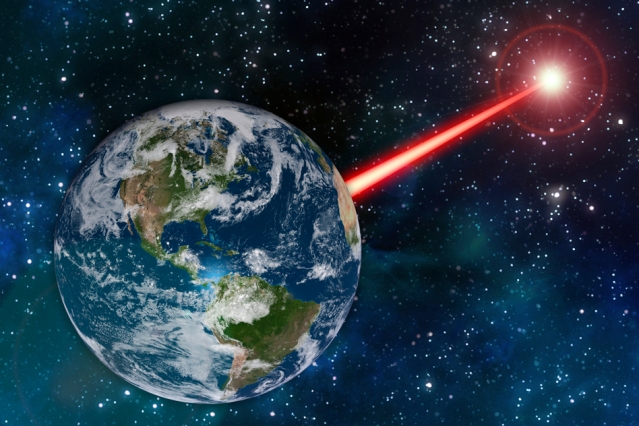
Artist’s concept of using laser technology on Earth to emit a beacon strong enough to attract attention from as far as 20,000 light years away. Image via MIT.

There’s a longstanding argument about whether – if alien civilizations do exist beyond our Earth – we should make our presence known to them. That argument has been going on since at least 1974, when the Arecibo Interstellar Message became the first message from Earth intentionally transmitted outward. Whether we should or should not transmit our whereabouts in the galaxy is an interesting question, and a question separate from the issue of how to do it. But the how of it is interesting, too. On November 4, 2018, Massachusetts Institute of Technology (MIT) announced that one of its graduate students has figured out a novel approach, using lasers. MIT explained in a statement:

If extraterrestrial intelligence exists somewhere in our galaxy, a new MIT study proposes that laser technology on Earth could, in principle, be fashioned into something of a planetary porch light — a beacon strong enough to attract attention from as far as 20,000 light years away.

Graduate student James Clark is the author of what he calls a “feasibility study.” This student-led study, surprisingly, has now been published in the peer-reviewed Astrophysical Journal. The findings suggest that if a high-powered 1- to 2-megawatt laser were focused through a massive 30- to 45-meter telescope and aimed out into space, the combination would produce a beam of infrared radiation strong enough to stand out from the sun’s energy. MIT said:

Such a signal could be detectable by alien astronomers performing a cursory survey of our section of the Milky Way — especially if those astronomers live in nearby systems, such as around Proxima Centauri, the nearest star to Earth, or TRAPPIST-1, a star about 40 light-years away that hosts seven exoplanets, three of which are potentially habitable.

If the signal is spotted from either of these nearby systems, the study finds, the same megawatt laser could be used to send a brief message in the form of pulses similar to Morse code.

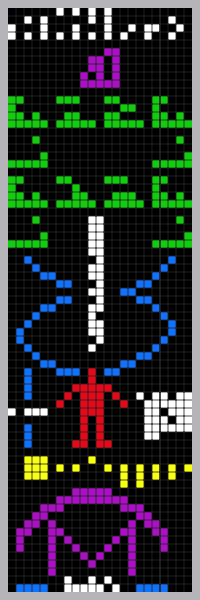
The Arecibo message as sent 1974 from the Arecibo Observatory. Via Wikimedia Commons.

The Arecibo message – 1st intentional radio message to space, for the purpose of revealing our presence – as sent 1974 from the Arecibo Observatory. Via Wikimedia Commons. Click here for an explanation of each part of the message.

Clark began looking into the idea of using lasers to signal extraterrestrials as part of a project for a course at MIT called Spacecraft and Aircraft Sensors and Instrumentation, taught by Clark’s advisor Kerri Cahoy. Clark said:

I wanted to see if I could take the kinds of telescopes and lasers that we’re building today, and make a detectable beacon out of them.

MIT explained:

He started with a simple conceptual design involving a large infrared laser and a telescope through which to further focus the laser’s intensity. His aim was to produce an infrared signal that was at least 10 times greater than the sun’s natural variation of infrared emissions. Such an intense signal, he reasoned, would be enough to stand out against the sun’s own infrared signal, in any ‘cursory survey by an extraterrestrial intelligence.’

He analyzed combinations of lasers and telescopes of various wattage and size, and found that a 2-megawatt laser, pointed through a 30-meter telescope, could produce a signal strong enough to be easily detectable by astronomers in Proxima Centauri b, a planet that orbits our closest star, 4 light-years away. Similarly, a 1-megawatt laser, directed through a 45-meter telescope, would generate a clear signal in any survey conducted by astronomers within the TRAPPIST-1 planetary system, about 40 light-years away. Either setup, he estimated, could produce a generally detectable signal from up to 20,000 light-years away.

Both scenarios would require laser and telescope technology that has either already been developed, or is within practical reach. For instance, Clark calculated that the required laser power of 1 to 2 megawatts is equivalent to that of the U.S. Air Force’s Airborne Laser, a now-defunct megawatt laser that was meant to fly aboard a military jet for the purpose of shooting ballistic missiles out of the sky. He also found that while a 30-meter telescope considerably dwarfs any existing observatory on Earth today, there are plans to build such massive telescopes in the near future, including the 24-meter Giant Magellan Telescope and the 39-meter European Extremely Large Telescope, both of which are currently under construction in Chile.

Clark envisions that, like these massive observatories, a laser beacon should be built atop a mountain, to minimize the amount of atmosphere the laser would have to penetrate before beaming out into space.

For safety’s sake – to prevent any potential for damage to people’s vision, or spacecraft cameras, from wandering into the beam of such a powerful laser – Clark also recommended building his laser on the far side of the moon. He added:

In general, this was a feasibility study. Whether or not this is a good idea, that’s a discussion for future work.

What do you think? If the technical and safety problems could be solved – and assuming this idea would work in actuality – should we be signaling our presence to alien civilizations? Tell us what you think, in the comments below.

Bottom line: An MIT grad student has a published a new study in one of astronomy’s most prestigious journals about using existing laser technology to signal our presence to possible extraterrestrial civilizations on distant worlds. Good idea?

Source: Optical Detection of Lasers with Near-term Technology at Interstellar Distances

Via MIT News

The 2019 lunar calendars are here! Order yours before they’re gone. Makes a great gift.


from EarthSky https://ift.tt/2F6j11D

Artist’s concept of using laser technology on Earth to emit a beacon strong enough to attract attention from as far as 20,000 light years away. Image via MIT.

There’s a longstanding argument about whether – if alien civilizations do exist beyond our Earth – we should make our presence known to them. That argument has been going on since at least 1974, when the Arecibo Interstellar Message became the first message from Earth intentionally transmitted outward. Whether we should or should not transmit our whereabouts in the galaxy is an interesting question, and a question separate from the issue of how to do it. But the how of it is interesting, too. On November 4, 2018, Massachusetts Institute of Technology (MIT) announced that one of its graduate students has figured out a novel approach, using lasers. MIT explained in a statement:

If extraterrestrial intelligence exists somewhere in our galaxy, a new MIT study proposes that laser technology on Earth could, in principle, be fashioned into something of a planetary porch light — a beacon strong enough to attract attention from as far as 20,000 light years away.

Graduate student James Clark is the author of what he calls a “feasibility study.” This student-led study, surprisingly, has now been published in the peer-reviewed Astrophysical Journal. The findings suggest that if a high-powered 1- to 2-megawatt laser were focused through a massive 30- to 45-meter telescope and aimed out into space, the combination would produce a beam of infrared radiation strong enough to stand out from the sun’s energy. MIT said:

Such a signal could be detectable by alien astronomers performing a cursory survey of our section of the Milky Way — especially if those astronomers live in nearby systems, such as around Proxima Centauri, the nearest star to Earth, or TRAPPIST-1, a star about 40 light-years away that hosts seven exoplanets, three of which are potentially habitable.

If the signal is spotted from either of these nearby systems, the study finds, the same megawatt laser could be used to send a brief message in the form of pulses similar to Morse code.

The Arecibo message as sent 1974 from the Arecibo Observatory. Via Wikimedia Commons.

The Arecibo message – 1st intentional radio message to space, for the purpose of revealing our presence – as sent 1974 from the Arecibo Observatory. Via Wikimedia Commons. Click here for an explanation of each part of the message.

Clark began looking into the idea of using lasers to signal extraterrestrials as part of a project for a course at MIT called Spacecraft and Aircraft Sensors and Instrumentation, taught by Clark’s advisor Kerri Cahoy. Clark said:

I wanted to see if I could take the kinds of telescopes and lasers that we’re building today, and make a detectable beacon out of them.

MIT explained:

He started with a simple conceptual design involving a large infrared laser and a telescope through which to further focus the laser’s intensity. His aim was to produce an infrared signal that was at least 10 times greater than the sun’s natural variation of infrared emissions. Such an intense signal, he reasoned, would be enough to stand out against the sun’s own infrared signal, in any ‘cursory survey by an extraterrestrial intelligence.’

He analyzed combinations of lasers and telescopes of various wattage and size, and found that a 2-megawatt laser, pointed through a 30-meter telescope, could produce a signal strong enough to be easily detectable by astronomers in Proxima Centauri b, a planet that orbits our closest star, 4 light-years away. Similarly, a 1-megawatt laser, directed through a 45-meter telescope, would generate a clear signal in any survey conducted by astronomers within the TRAPPIST-1 planetary system, about 40 light-years away. Either setup, he estimated, could produce a generally detectable signal from up to 20,000 light-years away.

Both scenarios would require laser and telescope technology that has either already been developed, or is within practical reach. For instance, Clark calculated that the required laser power of 1 to 2 megawatts is equivalent to that of the U.S. Air Force’s Airborne Laser, a now-defunct megawatt laser that was meant to fly aboard a military jet for the purpose of shooting ballistic missiles out of the sky. He also found that while a 30-meter telescope considerably dwarfs any existing observatory on Earth today, there are plans to build such massive telescopes in the near future, including the 24-meter Giant Magellan Telescope and the 39-meter European Extremely Large Telescope, both of which are currently under construction in Chile.

Clark envisions that, like these massive observatories, a laser beacon should be built atop a mountain, to minimize the amount of atmosphere the laser would have to penetrate before beaming out into space.

For safety’s sake – to prevent any potential for damage to people’s vision, or spacecraft cameras, from wandering into the beam of such a powerful laser – Clark also recommended building his laser on the far side of the moon. He added:

In general, this was a feasibility study. Whether or not this is a good idea, that’s a discussion for future work.

What do you think? If the technical and safety problems could be solved – and assuming this idea would work in actuality – should we be signaling our presence to alien civilizations? Tell us what you think, in the comments below.

Bottom line: An MIT grad student has a published a new study in one of astronomy’s most prestigious journals about using existing laser technology to signal our presence to possible extraterrestrial civilizations on distant worlds. Good idea?

Source: Optical Detection of Lasers with Near-term Technology at Interstellar Distances

Via MIT News

The 2019 lunar calendars are here! Order yours before they’re gone. Makes a great gift.


from EarthSky https://ift.tt/2F6j11D

Almach: Quadruple star system

View larger. | Through even a modest telescope, the star Almach (Gamma Andromedae) appears as one of the finest double stars in all the heavens. EarthSky friend on Google+ Scott MacNeill captured this shot with the aid of a 12

Through even a modest telescope, the star Almach (Gamma Andromedae) appears as one of the finest double stars in all the heavens. EarthSky friend Scott MacNeill captured this shot with the aid of a 12-inch Newtonian telescope. Thank you, Scott!

The 2019 lunar calendars are here! Order yours before they’re gone. Makes a great gift.

The constellation Andromeda the Princess is renowned for the Andromeda galaxy, but anyone with even a modest telescope would be remiss to overlook Andromeda’s star Almach (Gamma Andromedae), which appears in a telescope as one of the finest double stars in all the heavens. One component of this telescopic double appears golden, and the other component appears indigo blue. What’s more, further research has shown that Almach is really four stars.

Almach looks like a single star to the unaided eye. In skylore, Almach marks the Princess Andromeda's left foot.

Almach looks like a single star to the unaided eye. In skylore, Almach marks the Princess Andromeda’s left foot.

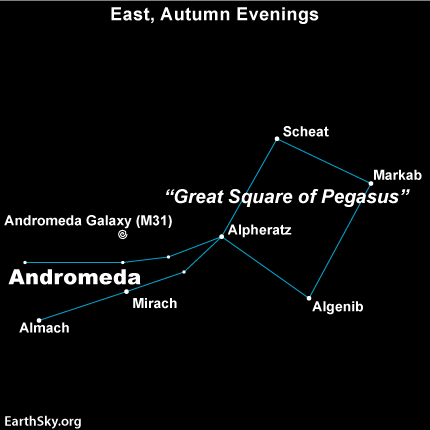
How to find the star Almach. In skylore, Almach marks the Princess Andromeda’s left foot. Star-hop to Almach from the Great Square of Pegasus, the signature star formation of Northern Hemisphere autumn.

Two streamers of stars fly outward from the Great Square, starting at the star Alpheratz. These streamers of stars are the constellation Andromeda.

Jump three stars over on the lower streamer to locate Almach. At second-magnitude brightness, Almach shines pretty much on a par with the stars of the Big Dipper.

This star – or we should say star system – is located an estimated 350 light-years away.

Notice the star Almach in the upper right of this photo, almost directly above the Pleiades star cluster. Photo via aquinoktium on Flickr.

Notice the star Almach in the upper right of this photo, almost directly above the Pleiades star cluster. Photo via aquinoktium on Flickr.

Almach looks single, but is really four stars. Look through the telescope to see Almach transform into two colorful suns. The larger sun appears golden, and the smaller one appears blue.

Practiced telescope users recommend a magnification of 75X or so for the most vivid view of this colorful double.

Some double star aficionados believe Almach’s vibrancy of color even surpasses that of the star Albireo in the constellation Cygnus, generally regarded as the sky’s finest double star. In autumn, both Almach and Albireo are there for the viewing, so check them out and decide for yourself.

The colorful telescopic double star Almach is really four stars. The fainter blue component is actually triple.

The double nature of Almach has been known since 1778, when the astronomer Johann Tobias Mayer viewed them through one of the early telescopes.

Today, it’s known that the smaller blue star is also a triple star system, making Almach four stars in all.

Almach shines relatively close to the famous variable star Algol in the constellation Perseus. When Algol shines at maximum brilliance, it matches Almach in brightness.

Enjoying EarthSky? Sign up for our free daily newsletter today!

Bottom line: Almach looks single to the eye. But astrononomical research has revealed that one component is a triple star system, with four stars in all.

Mirfak: Perseus’ brightest star

Capella: Golden Goat Star


from EarthSky https://ift.tt/2qwWL6T
View larger. | Through even a modest telescope, the star Almach (Gamma Andromedae) appears as one of the finest double stars in all the heavens. EarthSky friend on Google+ Scott MacNeill captured this shot with the aid of a 12

Through even a modest telescope, the star Almach (Gamma Andromedae) appears as one of the finest double stars in all the heavens. EarthSky friend Scott MacNeill captured this shot with the aid of a 12-inch Newtonian telescope. Thank you, Scott!

The 2019 lunar calendars are here! Order yours before they’re gone. Makes a great gift.

The constellation Andromeda the Princess is renowned for the Andromeda galaxy, but anyone with even a modest telescope would be remiss to overlook Andromeda’s star Almach (Gamma Andromedae), which appears in a telescope as one of the finest double stars in all the heavens. One component of this telescopic double appears golden, and the other component appears indigo blue. What’s more, further research has shown that Almach is really four stars.

Almach looks like a single star to the unaided eye. In skylore, Almach marks the Princess Andromeda's left foot.

Almach looks like a single star to the unaided eye. In skylore, Almach marks the Princess Andromeda’s left foot.

How to find the star Almach. In skylore, Almach marks the Princess Andromeda’s left foot. Star-hop to Almach from the Great Square of Pegasus, the signature star formation of Northern Hemisphere autumn.

Two streamers of stars fly outward from the Great Square, starting at the star Alpheratz. These streamers of stars are the constellation Andromeda.

Jump three stars over on the lower streamer to locate Almach. At second-magnitude brightness, Almach shines pretty much on a par with the stars of the Big Dipper.

This star – or we should say star system – is located an estimated 350 light-years away.

Notice the star Almach in the upper right of this photo, almost directly above the Pleiades star cluster. Photo via aquinoktium on Flickr.

Notice the star Almach in the upper right of this photo, almost directly above the Pleiades star cluster. Photo via aquinoktium on Flickr.

Almach looks single, but is really four stars. Look through the telescope to see Almach transform into two colorful suns. The larger sun appears golden, and the smaller one appears blue.

Practiced telescope users recommend a magnification of 75X or so for the most vivid view of this colorful double.

Some double star aficionados believe Almach’s vibrancy of color even surpasses that of the star Albireo in the constellation Cygnus, generally regarded as the sky’s finest double star. In autumn, both Almach and Albireo are there for the viewing, so check them out and decide for yourself.

The colorful telescopic double star Almach is really four stars. The fainter blue component is actually triple.

The double nature of Almach has been known since 1778, when the astronomer Johann Tobias Mayer viewed them through one of the early telescopes.

Today, it’s known that the smaller blue star is also a triple star system, making Almach four stars in all.

Almach shines relatively close to the famous variable star Algol in the constellation Perseus. When Algol shines at maximum brilliance, it matches Almach in brightness.

Enjoying EarthSky? Sign up for our free daily newsletter today!

Bottom line: Almach looks single to the eye. But astrononomical research has revealed that one component is a triple star system, with four stars in all.

Mirfak: Perseus’ brightest star

Capella: Golden Goat Star


from EarthSky https://ift.tt/2qwWL6T

New moon is November 7

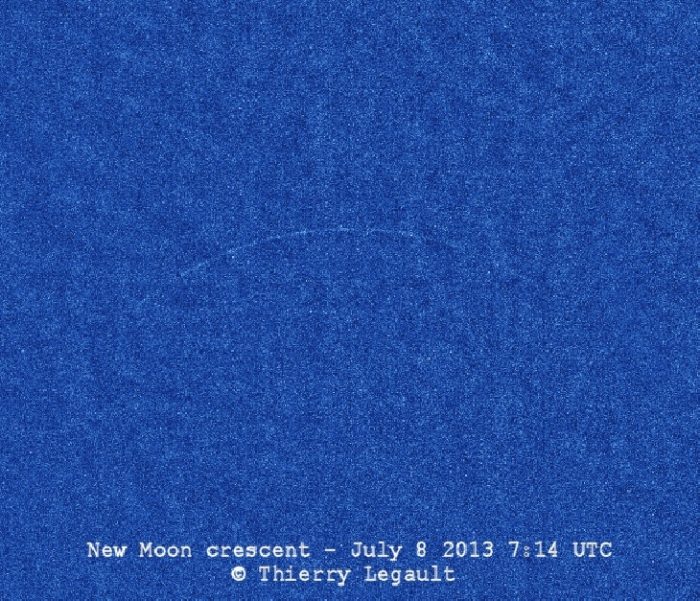
View larger. | Youngest possible lunar crescent, with the moon's age being exactly zero when this photo was taken — at the precise moment of the new moon - at 7:14 a.m. UTC on July 8, 2013. Image by Thierry Legault. Visit his website. Used with permission.

Youngest possible lunar crescent, with the moon’s age being exactly zero when this photo was taken — at the instant of new moon – 07:14 UTC on July 8, 2013. Image by Thierry Legault.

When the moon is most nearly between the Earth and sun for any particular month, astronomers say it is new. New moon falls on November 7, 2018, at 16:02 UTC; translate UTC to your time. This new moon marks the Hindu festival of Diwali.

The 2019 lunar calendars are here! Order yours before they’re gone. Makes a great gift.

We don’t see a new moon in the sky, unless there’s a solar eclipse, with the moon directly in front of the sun. The image above shows a new moon, not in eclipse, but taken by an expert using special equipment.

Most of the time, the new moon passes not in front of the sun, but simply near it in our sky. Either way – in front of the sun or just near it – on the day of new moon, the moon travels across the sky with the sun during the day, hidden in the sun’s glare.

In the language of astronomy – a day or two after each month’s new moon – a slim crescent moon always becomes visible in the west after sunset. Astronomers call this slim crescent a young moon.

New moons, and young moons, are fascinating to many. The Farmer’s Almanac, for example, still offers information on gardening by the moon. And many cultures have holidays based on moon phases.

And, of course, many look forward to the return of the moon to the evening sky. This always happens a day or two after new moon.

Most of us will never see a new moon, unless we witness a total solar eclipse. Here’s a new moon covering the sun, in an eclipse that swept across the continental U.S. on August 21, 2017. Beverley Sinclair, who saw the 2017 eclipse outside Charleston, South Carolina, wrote: “The skies were very cloudy leading up to totality but, miraculously, slowly cleared as totality approached. This photo shows the diamond ring and Bailey’s beads.”

As the moon orbits Earth, it changes phase in an orderly way. Follow the links below to understand the phases of the moon.

New moon
Waxing crescent moon
First quarter moon
Waxing gibbous moon
Full moon
Waning gibbous moon
Last quarter moon
Waning crescent moon

Read more: 4 keys to understanding moon phases

Bottom line: New moon is November 7, 2018, at 16:02 UTC; translate UTC to your time.

Check out EarthSky’s guide to the bright planets.

Help EarthSky keep going! Please donate.


from EarthSky https://ift.tt/2QpMvsB
View larger. | Youngest possible lunar crescent, with the moon's age being exactly zero when this photo was taken — at the precise moment of the new moon - at 7:14 a.m. UTC on July 8, 2013. Image by Thierry Legault. Visit his website. Used with permission.

Youngest possible lunar crescent, with the moon’s age being exactly zero when this photo was taken — at the instant of new moon – 07:14 UTC on July 8, 2013. Image by Thierry Legault.

When the moon is most nearly between the Earth and sun for any particular month, astronomers say it is new. New moon falls on November 7, 2018, at 16:02 UTC; translate UTC to your time. This new moon marks the Hindu festival of Diwali.

The 2019 lunar calendars are here! Order yours before they’re gone. Makes a great gift.

We don’t see a new moon in the sky, unless there’s a solar eclipse, with the moon directly in front of the sun. The image above shows a new moon, not in eclipse, but taken by an expert using special equipment.

Most of the time, the new moon passes not in front of the sun, but simply near it in our sky. Either way – in front of the sun or just near it – on the day of new moon, the moon travels across the sky with the sun during the day, hidden in the sun’s glare.

In the language of astronomy – a day or two after each month’s new moon – a slim crescent moon always becomes visible in the west after sunset. Astronomers call this slim crescent a young moon.

New moons, and young moons, are fascinating to many. The Farmer’s Almanac, for example, still offers information on gardening by the moon. And many cultures have holidays based on moon phases.

And, of course, many look forward to the return of the moon to the evening sky. This always happens a day or two after new moon.

Most of us will never see a new moon, unless we witness a total solar eclipse. Here’s a new moon covering the sun, in an eclipse that swept across the continental U.S. on August 21, 2017. Beverley Sinclair, who saw the 2017 eclipse outside Charleston, South Carolina, wrote: “The skies were very cloudy leading up to totality but, miraculously, slowly cleared as totality approached. This photo shows the diamond ring and Bailey’s beads.”

As the moon orbits Earth, it changes phase in an orderly way. Follow the links below to understand the phases of the moon.

New moon
Waxing crescent moon
First quarter moon
Waxing gibbous moon
Full moon
Waning gibbous moon
Last quarter moon
Waning crescent moon

Read more: 4 keys to understanding moon phases

Bottom line: New moon is November 7, 2018, at 16:02 UTC; translate UTC to your time.

Check out EarthSky’s guide to the bright planets.

Help EarthSky keep going! Please donate.


from EarthSky https://ift.tt/2QpMvsB

adds 2