Tonight, or any clear November evening, try using the Great Square of Pegasus to star-hop your way to a view out our galaxy’s south window. In other words, you’ll be looking away from the flat plane of our Milky Way – where most of our galaxy’s stars reside – and toward intergalactic space. You can do this no matter what part of Earth you’re standing on.
From the Northern Hemisphere: The Great Square of Pegasus appears high in the south to overhead by around 9 p.m local time in early November, 8 p.m. local time in mid-November and 7 p.m. local time in late November. This large asterism really does look like a large square pattern, with four medium-bright stars marking the corners. Draw a line through the Great Square’s two westernmost (or right-hand stars), and extend that line southward to land on the bright star Fomalhaut in the constellation Piscis Austrinus the Southern Fish.
From the Southern Hemisphere: Follow the directions above, but – instead of looking southward to overhead for the Great Square – you’ll be looking low in the north. You’ll still draw your line southward, but, in your sky – starting at the Great Square – that means you’ll draw the line upwards to Fomalhaut. Just take the chart at the top of this post, and turn it upside-down!
Why find Fomalhaut? When you look at this star – sometimes called the Loneliest Star – you are looking some 90 degrees from the plane of our galaxy’s equator.
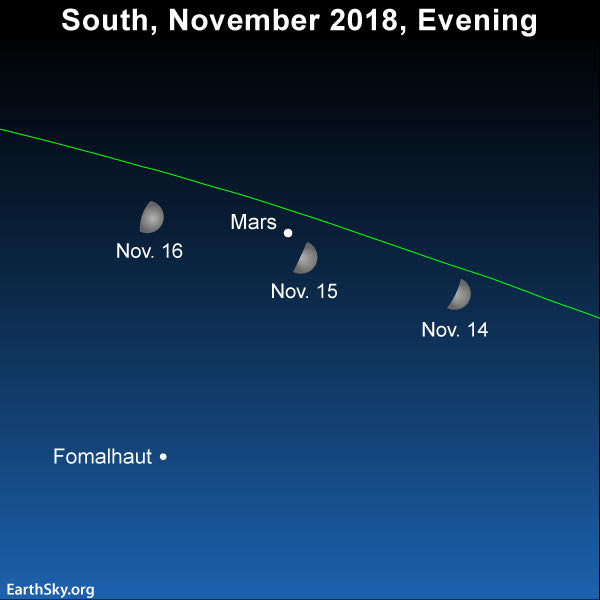
In November 2018, you can also use the bright red planet Mars to help you guide your eye to Fomalhaut. Moreover, you can use the moon to find Mars on November 14, 15 and 16, 2018.
Our Milky Way galaxy is round and flat, like a pancake. When you look toward Fomalhaut, you’re looking away from the pancake, and out the south window of the galaxy. In other words, we’re looking away from the star-packed disk of the galaxy, into extragalactic space and the realm of galaxies.
Want the exact location of the south galactic pole? It lies east of Fomalhaut, in the faint constellation Sculptor.
The south galactic pole lies in the direction of the constellation Sculptor.
Bottom line: Tonight, try using the Great Square of Pegasus to find the star Fomalhaut. Once you’ve found Fomalhaut, you’re on your way to visualizing looking out the south window of our Milky Way galaxy.
Tonight, or any clear November evening, try using the Great Square of Pegasus to star-hop your way to a view out our galaxy’s south window. In other words, you’ll be looking away from the flat plane of our Milky Way – where most of our galaxy’s stars reside – and toward intergalactic space. You can do this no matter what part of Earth you’re standing on.
From the Northern Hemisphere: The Great Square of Pegasus appears high in the south to overhead by around 9 p.m local time in early November, 8 p.m. local time in mid-November and 7 p.m. local time in late November. This large asterism really does look like a large square pattern, with four medium-bright stars marking the corners. Draw a line through the Great Square’s two westernmost (or right-hand stars), and extend that line southward to land on the bright star Fomalhaut in the constellation Piscis Austrinus the Southern Fish.
From the Southern Hemisphere: Follow the directions above, but – instead of looking southward to overhead for the Great Square – you’ll be looking low in the north. You’ll still draw your line southward, but, in your sky – starting at the Great Square – that means you’ll draw the line upwards to Fomalhaut. Just take the chart at the top of this post, and turn it upside-down!
Why find Fomalhaut? When you look at this star – sometimes called the Loneliest Star – you are looking some 90 degrees from the plane of our galaxy’s equator.
In November 2018, you can also use the bright red planet Mars to help you guide your eye to Fomalhaut. Moreover, you can use the moon to find Mars on November 14, 15 and 16, 2018.
Our Milky Way galaxy is round and flat, like a pancake. When you look toward Fomalhaut, you’re looking away from the pancake, and out the south window of the galaxy. In other words, we’re looking away from the star-packed disk of the galaxy, into extragalactic space and the realm of galaxies.
Want the exact location of the south galactic pole? It lies east of Fomalhaut, in the faint constellation Sculptor.
The south galactic pole lies in the direction of the constellation Sculptor.
Bottom line: Tonight, try using the Great Square of Pegasus to find the star Fomalhaut. Once you’ve found Fomalhaut, you’re on your way to visualizing looking out the south window of our Milky Way galaxy.
When the object now known as ‘Oumuamua was first discovered a year ago, it caught astronomers by surprise. It’s an oddly elongated, tumbling object whose orbit indicated it came from outside our solar system. Although interstellar objects – natural objects like comets or asteroids that move between solar systems – had been expected, no object like this one had been seen before. So what was it? Scientists and others immediately began speculating and devising theories. Asteroid? Comet? Shard of a destroyed planet? On November 1, 2018, a new paper was released that raises again the possibility that ‘Oumuamua might be artificial – something like a lightsail or solar sail, a spacecraft whose propulsion method is the radiation pressure or “wind” from stars.
Artist’s concept of the strange interstellar object ‘Oumuamua, if it is indeed a rocky body, based on available data. Image via ESO/M. Kornmesser.
When ‘Oumuamua swept through our solar system in late 2017, it was moving quickly. There was limited time to observe it with telescopes before it rounded our sun and then left our solar system again. Being small and far away, even at closest approach to our sun, didn’t help matters either.
Astronomers did learn that ‘Oumuamua was an oddball. Its trajectory told astronomers it had originated from outside the solar system, but its shape, as best as could be determined, didn’t match that of most known asteroids or comets. Still, at first, scientists thought it was an asteroid. Then, by northern summer of 2018, scientists leaned more toward it being a comet. But, if it were a comet, why didn’t ‘Oumuamua show outgassing – ie. a characteristic cometary coma or tail – when it was closest to the sun? A study by Roman Rafikov, an astrophysicist at the University of Cambridge, showed that the forces that should have produced a tail should also have affected the object’s spin, but they did not.
That’s when the idea arose that ‘Oumuamua might not be an asteroid or a comet, but rather a “shard” from a planet destroyed by a white dwarf star. As noted in Quanta Magazine on October 10, 2018:
In particular, the acceleration would have torqued ‘Oumuamua to such a degree that it would have spun apart, breaking up into smaller pieces. If ‘Oumuamua were a comet … it would not have survived.
If it’s an asteroid, then it’s really unusual, with exotic scenarios for its formation. [Rafikov] proposed such a scenario earlier this year, whereby an ordinary star dies, forming a white dwarf, and in the process rips apart a planet and launches the shards clear across the galaxy.
‘Oumuamua is one of those shards. ‘Basically, it’s a messenger from a dead star,’ [Rafikov] said.
All along, some people speculated that ‘Oumuamua might not be a natural object, that it might instead be something artificial, sent to “check out” our inner solar system. Occam’s razor – where the simplest explanation is usually the correct one – supported the idea that it was probably a natural object, albeit an unusual one.
Our best view of ‘Oumuamua, from the William Herschel Telescope on October 29th, 2017. Image via Queen’s University Belfast/William Herschel Telescope.
So ‘Oumuamua was unusual for its deduced shaped (it wasn’t able to be fully resolved with telescopes, however) and lack of outgassing when nearest the sun, as would have been expected from a comet. Plus, there was another feature of ‘Oumuamua that caught astronomers’ attention. Earlier this year, as it was heading back out of the solar system, it was observed to slightly accelerate in speed.
This acceleration was determined not to be caused by the gravitational influence of the sun or any planet in our solar system. It was a puzzle. Outgassing could do it, but no outgassing was ever observed, either. Also, outgassing would have affected the object’s spin, but that was not seen either, even though the object was tumbling, according to the limited observations.
The new paper suggests that solar radiation pressure – created by the momentum of photons coming from the sun – could instead be the cause of the increased speed. Sounds plausible, and this is where the story really gets interesting.
According to calculations, for radiation pressure to be the cause of the acceleration,’Oumuamua would need to be a thin object with a small mass-to-area ratio. It would need to be a thin sheet, roughly 0.01 inch (0.3 mm) thick and 65 feet (20 meters) in radius.
As Paul Gilster explained in an excellent post on Centauri-Dreams.org:
I was intrigued enough at this point to ask Dr. Loeb about those dimensions, which vary with albedo (the incident light reflected by a surface). He told me that the 20-meter figure would be the radius if the object is a perfect reflector, though the size would be larger if the value for the albedo is smaller. We do see variations in reflected light as ‘Oumuamua rotates over an eight-hour spin period. Thus, considering the object as a thin surface, we could imagine a conical or hollow cylindrical shape.
‘You can easily envision that by rotating a curved piece of paper and looking at its net surface area from different viewing angles,’ Loeb told me.
The trajectory of ‘Oumuamua through the solar system. Image via Guy Ottewell’s blog.
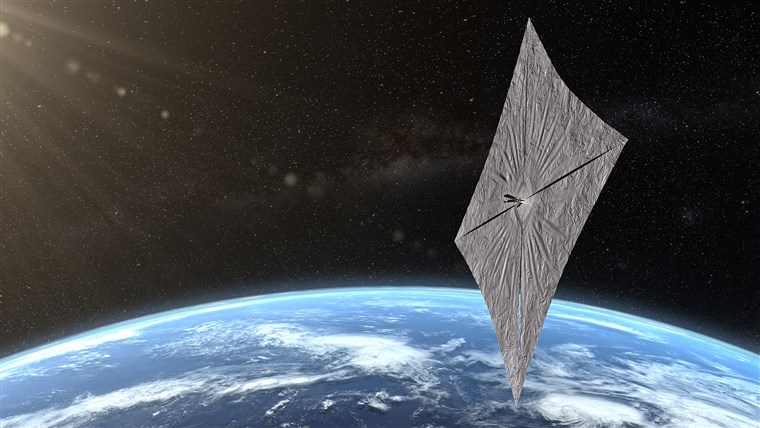
If the speed increase was caused by solar radiation pressure – and that isn’t known for sure yet – then the object would need to have a thin, sheet-like surface according to the researchers. That’s where lightsails come in, which are already being tested by NASA and other space agencies as a method of propulsion throughout the solar system – using a giant thin “sail” to collect photons from the sun and create momentum. From the new paper:
Considering an artificial origin, one possibility is a lightsail floating in interstellar space as debris from an advanced technological equipment (Loeb 2018). Lightsails with similar dimensions have been designed and constructed by our own civilization, including the IKAROS project and the Starshot initiative. The lightsail technology might be abundantly used for transportation of cargos between planets (Guillochon and Loeb 2015) or between stars (Lingam and Loeb 2017). In the former case, dynamical ejection from a planetary system could result in space debris of equipment that is not operational any more (Loeb 2018) and is floating at the characteristic speed of stars relative to each other in the Solar neighborhood.
The new paper has caused a lot of speculation and debate! Unfortunately, ‘Oumuamua itself can’t serve as a source of further answers; it is now too far away for any additional observations. The best hope now is that another similar object will be found in the near future.
Applying Occam’s razor, it is still most likely that ‘Oumuamua is a natural, yet very unusual object, based on the limited data available.
However, if the solar radiation pressure idea could be confirmed somehow, that would make things very interesting indeed.
Artist’s concept of the IKAROS space probe with lightsail. Image via Wikimedia Commons/Andrzej Mirecki.
Want more about this idea? The results were initially discussed in Paul Gilster’s post at Centauri-Dreams.org on October 29, 2018.
Lastly, because life does sometimes imitate art, look for the definitive work of science fiction related to the idea of interstellar objects sweeping through our solar system, by British writer Arthur C. Clarke. The book is Rendezvous with Rama, first published in 1973.
Bottom line: ‘Oumuamua was the first interstellar object observed to enter our solar system, and it brought with it many questions. Unfortunately, most of those questions will probably remain unanswered, since ‘Oumuamua is now too far away for additional observations.
When the object now known as ‘Oumuamua was first discovered a year ago, it caught astronomers by surprise. It’s an oddly elongated, tumbling object whose orbit indicated it came from outside our solar system. Although interstellar objects – natural objects like comets or asteroids that move between solar systems – had been expected, no object like this one had been seen before. So what was it? Scientists and others immediately began speculating and devising theories. Asteroid? Comet? Shard of a destroyed planet? On November 1, 2018, a new paper was released that raises again the possibility that ‘Oumuamua might be artificial – something like a lightsail or solar sail, a spacecraft whose propulsion method is the radiation pressure or “wind” from stars.
Artist’s concept of the strange interstellar object ‘Oumuamua, if it is indeed a rocky body, based on available data. Image via ESO/M. Kornmesser.
When ‘Oumuamua swept through our solar system in late 2017, it was moving quickly. There was limited time to observe it with telescopes before it rounded our sun and then left our solar system again. Being small and far away, even at closest approach to our sun, didn’t help matters either.
Astronomers did learn that ‘Oumuamua was an oddball. Its trajectory told astronomers it had originated from outside the solar system, but its shape, as best as could be determined, didn’t match that of most known asteroids or comets. Still, at first, scientists thought it was an asteroid. Then, by northern summer of 2018, scientists leaned more toward it being a comet. But, if it were a comet, why didn’t ‘Oumuamua show outgassing – ie. a characteristic cometary coma or tail – when it was closest to the sun? A study by Roman Rafikov, an astrophysicist at the University of Cambridge, showed that the forces that should have produced a tail should also have affected the object’s spin, but they did not.
That’s when the idea arose that ‘Oumuamua might not be an asteroid or a comet, but rather a “shard” from a planet destroyed by a white dwarf star. As noted in Quanta Magazine on October 10, 2018:
In particular, the acceleration would have torqued ‘Oumuamua to such a degree that it would have spun apart, breaking up into smaller pieces. If ‘Oumuamua were a comet … it would not have survived.
If it’s an asteroid, then it’s really unusual, with exotic scenarios for its formation. [Rafikov] proposed such a scenario earlier this year, whereby an ordinary star dies, forming a white dwarf, and in the process rips apart a planet and launches the shards clear across the galaxy.
‘Oumuamua is one of those shards. ‘Basically, it’s a messenger from a dead star,’ [Rafikov] said.
All along, some people speculated that ‘Oumuamua might not be a natural object, that it might instead be something artificial, sent to “check out” our inner solar system. Occam’s razor – where the simplest explanation is usually the correct one – supported the idea that it was probably a natural object, albeit an unusual one.
Our best view of ‘Oumuamua, from the William Herschel Telescope on October 29th, 2017. Image via Queen’s University Belfast/William Herschel Telescope.
So ‘Oumuamua was unusual for its deduced shaped (it wasn’t able to be fully resolved with telescopes, however) and lack of outgassing when nearest the sun, as would have been expected from a comet. Plus, there was another feature of ‘Oumuamua that caught astronomers’ attention. Earlier this year, as it was heading back out of the solar system, it was observed to slightly accelerate in speed.
This acceleration was determined not to be caused by the gravitational influence of the sun or any planet in our solar system. It was a puzzle. Outgassing could do it, but no outgassing was ever observed, either. Also, outgassing would have affected the object’s spin, but that was not seen either, even though the object was tumbling, according to the limited observations.
The new paper suggests that solar radiation pressure – created by the momentum of photons coming from the sun – could instead be the cause of the increased speed. Sounds plausible, and this is where the story really gets interesting.
According to calculations, for radiation pressure to be the cause of the acceleration,’Oumuamua would need to be a thin object with a small mass-to-area ratio. It would need to be a thin sheet, roughly 0.01 inch (0.3 mm) thick and 65 feet (20 meters) in radius.
As Paul Gilster explained in an excellent post on Centauri-Dreams.org:
I was intrigued enough at this point to ask Dr. Loeb about those dimensions, which vary with albedo (the incident light reflected by a surface). He told me that the 20-meter figure would be the radius if the object is a perfect reflector, though the size would be larger if the value for the albedo is smaller. We do see variations in reflected light as ‘Oumuamua rotates over an eight-hour spin period. Thus, considering the object as a thin surface, we could imagine a conical or hollow cylindrical shape.
‘You can easily envision that by rotating a curved piece of paper and looking at its net surface area from different viewing angles,’ Loeb told me.
The trajectory of ‘Oumuamua through the solar system. Image via Guy Ottewell’s blog.
If the speed increase was caused by solar radiation pressure – and that isn’t known for sure yet – then the object would need to have a thin, sheet-like surface according to the researchers. That’s where lightsails come in, which are already being tested by NASA and other space agencies as a method of propulsion throughout the solar system – using a giant thin “sail” to collect photons from the sun and create momentum. From the new paper:
Considering an artificial origin, one possibility is a lightsail floating in interstellar space as debris from an advanced technological equipment (Loeb 2018). Lightsails with similar dimensions have been designed and constructed by our own civilization, including the IKAROS project and the Starshot initiative. The lightsail technology might be abundantly used for transportation of cargos between planets (Guillochon and Loeb 2015) or between stars (Lingam and Loeb 2017). In the former case, dynamical ejection from a planetary system could result in space debris of equipment that is not operational any more (Loeb 2018) and is floating at the characteristic speed of stars relative to each other in the Solar neighborhood.
The new paper has caused a lot of speculation and debate! Unfortunately, ‘Oumuamua itself can’t serve as a source of further answers; it is now too far away for any additional observations. The best hope now is that another similar object will be found in the near future.
Applying Occam’s razor, it is still most likely that ‘Oumuamua is a natural, yet very unusual object, based on the limited data available.
However, if the solar radiation pressure idea could be confirmed somehow, that would make things very interesting indeed.
Artist’s concept of the IKAROS space probe with lightsail. Image via Wikimedia Commons/Andrzej Mirecki.
Want more about this idea? The results were initially discussed in Paul Gilster’s post at Centauri-Dreams.org on October 29, 2018.
Lastly, because life does sometimes imitate art, look for the definitive work of science fiction related to the idea of interstellar objects sweeping through our solar system, by British writer Arthur C. Clarke. The book is Rendezvous with Rama, first published in 1973.
Bottom line: ‘Oumuamua was the first interstellar object observed to enter our solar system, and it brought with it many questions. Unfortunately, most of those questions will probably remain unanswered, since ‘Oumuamua is now too far away for additional observations.
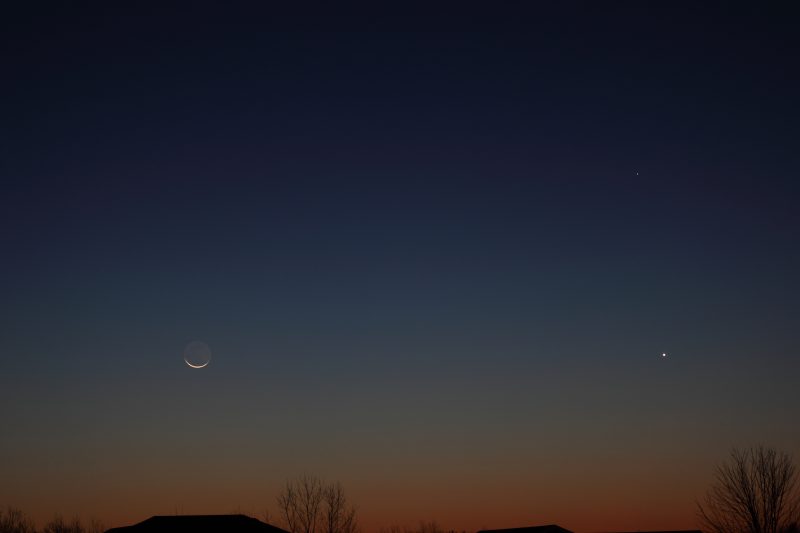
Michael C Dupree wrote, “Waning crescent moon- the last before the new moon tomorrow, and the most elusive of moon phases to see and photograph – and Venus before sunrise. Above the WWII Memorial Campanile, Kansas University, Lawrence Kansas, November 6, 2018.”
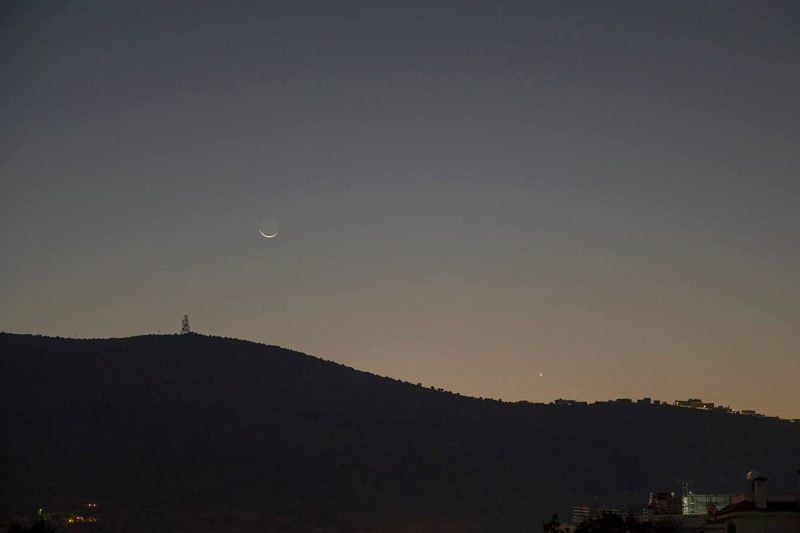
Nikolaos Pantazis – south of Athens, Greece – caught the waning crescent moon rising with planet Venus and Spica, on November 6, 2018.
Venus with crescent moon at sunrise – November 6, 2018 – from John Shaw in Lincoln, Nebraska.
Kaliannan Shanmugasundaram wrote from Soeng Sang Town, Thailand on November 6, 2018: “As a newcomer to astronomy, I have been watching the moon, sun and stars and reading articles on EarthSky. Living in a small village in NE region of Thailand, for retirement, I have been taking photos of the sky and its wonderful creations. I was lucky to see the crescent moon and Venus on the east sky, just above the field. I wish to share the photo with the readers of EarthSky.” Thank you, Kaliannan!
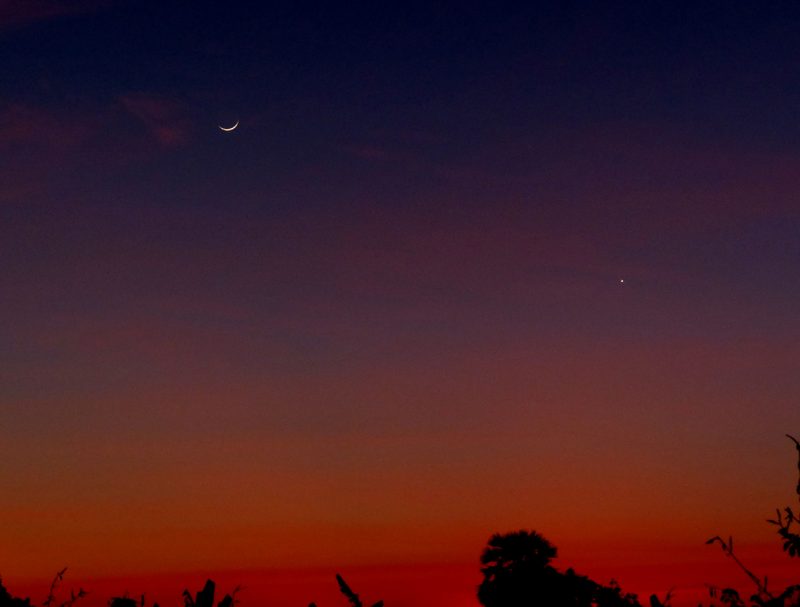
Don Thousand caught the moon and Venus on November 5, 2018 with an iPhone 6s. He wrote: “Waning crescent moon and waxing Venus over the Rio Hardy at Rancho Mil, Baja California.”
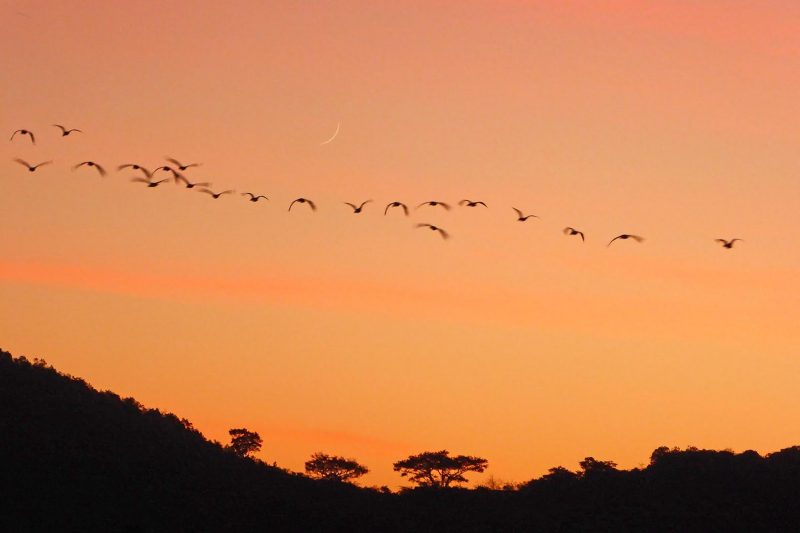
By the way – from the Southern Hemisphere now – Venus would have been harder to see. But Peter Lowenstein in Mutare, Zimbabwe did catch the November 6 very old moon, with a flock of White Faced Whistling Ducks in a brightly colored dawn sky. He wrote: “I have tried many times to photograph them without success as the light is usually low, they fly fast and the camera either does not have time to focus or the pictures are affected by low shutter speed blur. This time they were headed towards the light and their motion was in the direction of the field of view. Perfect shot! Camera: Hand-held Panasonic Lumix DMC-TZ60 in sunset scene mode.” Thanks, Peter!
Bottom line: Photos of the moon and Venus before dawn.
from EarthSky https://ift.tt/2SQ8pGX
Michael C Dupree wrote, “Waning crescent moon- the last before the new moon tomorrow, and the most elusive of moon phases to see and photograph – and Venus before sunrise. Above the WWII Memorial Campanile, Kansas University, Lawrence Kansas, November 6, 2018.”
Nikolaos Pantazis – south of Athens, Greece – caught the waning crescent moon rising with planet Venus and Spica, on November 6, 2018.
Venus with crescent moon at sunrise – November 6, 2018 – from John Shaw in Lincoln, Nebraska.
Kaliannan Shanmugasundaram wrote from Soeng Sang Town, Thailand on November 6, 2018: “As a newcomer to astronomy, I have been watching the moon, sun and stars and reading articles on EarthSky. Living in a small village in NE region of Thailand, for retirement, I have been taking photos of the sky and its wonderful creations. I was lucky to see the crescent moon and Venus on the east sky, just above the field. I wish to share the photo with the readers of EarthSky.” Thank you, Kaliannan!
Don Thousand caught the moon and Venus on November 5, 2018 with an iPhone 6s. He wrote: “Waning crescent moon and waxing Venus over the Rio Hardy at Rancho Mil, Baja California.”
By the way – from the Southern Hemisphere now – Venus would have been harder to see. But Peter Lowenstein in Mutare, Zimbabwe did catch the November 6 very old moon, with a flock of White Faced Whistling Ducks in a brightly colored dawn sky. He wrote: “I have tried many times to photograph them without success as the light is usually low, they fly fast and the camera either does not have time to focus or the pictures are affected by low shutter speed blur. This time they were headed towards the light and their motion was in the direction of the field of view. Perfect shot! Camera: Hand-held Panasonic Lumix DMC-TZ60 in sunset scene mode.” Thanks, Peter!
Bottom line: Photos of the moon and Venus before dawn.
When fluids move around our body, molecules from nearby cells bathed in these fluids can get swept up and carried away. Researchers are betting that some of these molecules offer clues about disease.
Blood is one of the hottest fluids in research right now, particularly for cancer. This is because the blood offers a rich source of information that can be accessed in a relatively non-invasive way. Rogue cancer cells or tumour DNA can be fished from a patient’s blood to help doctors to learn more about the disease.
But to develop tests that detect molecules like tumour DNA, scientists need to know what to look for. And with around 9 to 12 pints of blood flowing around the average adult, rare pieces of tumour DNA can be hard to find.
That’s why our brain tumour scientists in Cambridge have turned to fishing for clues in another liquid that surrounds the brain and spinal cord, the cerebral spinal fluid (CSF). And in a new study, published in EMBO Molecular Medicine, they’ve uncovered signs of brain tumours in the CSF that could get them one step closer to developing a liquid biopsy for these diseases.
What is a liquid biopsy?
A test that analyses tumour DNA, cancer cells or other molecules fished from different liquid-based patient samples, such as the blood. These experimental tests can help doctors learn more about their patient’s cancer in a less invasive way.
“The main challenge for detecting any circulating tumour DNA is filtering the information in the blood circulation from all the other cells in the body that are also dying,” says Dr Florent Moulière, from the Cancer Research UK Cambridge Institute who co-led the study.
What is circulating tumour DNA?
Like healthy cells, tumour cells go through a cycle of growing, dividing and dying. When they die they spill out bits of broken DNA. These DNA fragments sometimes enter nearby bodily fluids, such as the blood or CSF, and float around freely.
The CSF, however, feeds directly into the brain and, depending on where the brain tumour is, can directly contact the tumour.
“In the brain the background noise from all the normal cells is much lower than that in the blood, because brain cells aren’t dividing at the same rate as cells in the rest of the body,” says Moulière.
So the CSF seemed like a good place to start the hunt for brain tumour DNA.
Fishing for brain tumour DNA
The team looked at CSF samples from 13 patients with aggressive brain tumours.
What we tried to do was identify patterns or marks within DNA that say: ‘This is from the tumour’.
– Richard Mair, co-lead author
They looked for fragments of tumour DNA floating free in the CSF.
Previous research suggests fragments released from tumours are smaller than those released by healthy cells, so they designed their lab tests to pick up these shorter sections. Detection was a success in the CSF samples of 5 patients, which has never been done before.
“Essentially what we tried to do was identify patterns or marks within DNA that say: ‘This is from the tumour’,” says Richard Mair, a neurosurgeon who co-led the study.
A larger catch
To make sure is was tumour DNA that they were picking up, Moulière and Mair also fished in the CSF for certain areas of repetition in a tumour’s genetic code.
Repetition in the genetic code of human cells is normal, but this is generally more common in tumour cells. These changes can mean large chunks of DNA are added or lost when tumour cells divide, making their DNA look different to healthy DNA.
Crucially, the team managed to spot these large DNA changes using a very cheap technique called shallow whole-genome sequencing.
“There have been a few papers looking into CSF liquid biopsies for brain tumours, but they use very complex and expensive techniques,” says Mair. “We’ve shown that the same things can be done cheaply in an easier way.”
A special case
This study shows that traces of brain tumour DNA can be detected in the CSF without the need for expensive techniques. But there was another interesting finding.
CSF samples might be able to reflect the entire repertoire of genetic changes found in brain tumours.
– Dr Florent Moulière, co-lead author
When a brain tumour patient has surgery, surgeons send several pieces of the tumour to the lab to work out how aggressive it is. But brain tumour cells can look different to one another, even within the same tumour.
“When you take sections of a tumour and test them you’re not getting an understanding of the genetic makeup of the whole tumour,” says Moulière, “just that section you’ve taken a biopsy of.”
Interestingly, they found the genetic changes in one patient’ surgery samples matched those in the CSF, but the CSF sample contained genetic changes that weren’t found in some of the tissue samples.
“This suggests that CSF samples might be able to reflect the entire repertoire of genetic changes found in brain tumours,” says Moulière.
Catching this genetic detail may give liquid biopsies the upper hand on invasive tissue samples and point to potential new routes to treatment.
“We don’t have the medications to do this yet, but one day we might be able to target precision therapies based on this genetic information,” says Mair.
Is a brain tumour blood test possible?
If tumour DNA can be detected in the CSF, Moulière says there’s no reason why the cheap technique couldn’t be adapted to work in the blood.
A liquid biopsy for people with brain tumours that would dramatically improve their quality of life.
– Richard Mair, co-lead author
“I see these patients all the time,” says Mair. “There are various applications for liquid biopsy for people with brain tumours that would dramatically improve their quality of life.”
For one, a brain tumour DNA-detecting blood test would mean patients could have quick and regular check-ups to make sure their treatment is working.
“There are also certain cancers of the brain where the best treatment isn’t necessarily surgery,” says Mair. “This could be because the tumour is too widespread or involved in regions of the brain that are too delicate to operate on.”
Some brain tumours are also better treated with chemotherapy and radiotherapy. “If we could identify a genomic marker that indicates this it could save them a risky surgical procedure,” he says.
More to do
The current technique can only pick up tumour DNA if the tumour contacts the fluid surrounding the brain. The signal is all or nothing and potentially explains why tumour DNA was only detected in 5 out of 13 patients.
“It’s very important to improve this analysis so we can then start to move this method towards working with blood,” says Moulière.
But for now, these results mark a promising start towards better ways to monitor brain tumours and show, that when looking for brain tumour DNA, our scientists are casting their nets in the right direction.
Gabi
from Cancer Research UK – Science blog https://ift.tt/2JHTtX7
When fluids move around our body, molecules from nearby cells bathed in these fluids can get swept up and carried away. Researchers are betting that some of these molecules offer clues about disease.
Blood is one of the hottest fluids in research right now, particularly for cancer. This is because the blood offers a rich source of information that can be accessed in a relatively non-invasive way. Rogue cancer cells or tumour DNA can be fished from a patient’s blood to help doctors to learn more about the disease.
But to develop tests that detect molecules like tumour DNA, scientists need to know what to look for. And with around 9 to 12 pints of blood flowing around the average adult, rare pieces of tumour DNA can be hard to find.
That’s why our brain tumour scientists in Cambridge have turned to fishing for clues in another liquid that surrounds the brain and spinal cord, the cerebral spinal fluid (CSF). And in a new study, published in EMBO Molecular Medicine, they’ve uncovered signs of brain tumours in the CSF that could get them one step closer to developing a liquid biopsy for these diseases.
What is a liquid biopsy?
A test that analyses tumour DNA, cancer cells or other molecules fished from different liquid-based patient samples, such as the blood. These experimental tests can help doctors learn more about their patient’s cancer in a less invasive way.
“The main challenge for detecting any circulating tumour DNA is filtering the information in the blood circulation from all the other cells in the body that are also dying,” says Dr Florent Moulière, from the Cancer Research UK Cambridge Institute who co-led the study.
What is circulating tumour DNA?
Like healthy cells, tumour cells go through a cycle of growing, dividing and dying. When they die they spill out bits of broken DNA. These DNA fragments sometimes enter nearby bodily fluids, such as the blood or CSF, and float around freely.
The CSF, however, feeds directly into the brain and, depending on where the brain tumour is, can directly contact the tumour.
“In the brain the background noise from all the normal cells is much lower than that in the blood, because brain cells aren’t dividing at the same rate as cells in the rest of the body,” says Moulière.
So the CSF seemed like a good place to start the hunt for brain tumour DNA.
Fishing for brain tumour DNA
The team looked at CSF samples from 13 patients with aggressive brain tumours.
What we tried to do was identify patterns or marks within DNA that say: ‘This is from the tumour’.
– Richard Mair, co-lead author
They looked for fragments of tumour DNA floating free in the CSF.
Previous research suggests fragments released from tumours are smaller than those released by healthy cells, so they designed their lab tests to pick up these shorter sections. Detection was a success in the CSF samples of 5 patients, which has never been done before.
“Essentially what we tried to do was identify patterns or marks within DNA that say: ‘This is from the tumour’,” says Richard Mair, a neurosurgeon who co-led the study.
A larger catch
To make sure is was tumour DNA that they were picking up, Moulière and Mair also fished in the CSF for certain areas of repetition in a tumour’s genetic code.
Repetition in the genetic code of human cells is normal, but this is generally more common in tumour cells. These changes can mean large chunks of DNA are added or lost when tumour cells divide, making their DNA look different to healthy DNA.
Crucially, the team managed to spot these large DNA changes using a very cheap technique called shallow whole-genome sequencing.
“There have been a few papers looking into CSF liquid biopsies for brain tumours, but they use very complex and expensive techniques,” says Mair. “We’ve shown that the same things can be done cheaply in an easier way.”
A special case
This study shows that traces of brain tumour DNA can be detected in the CSF without the need for expensive techniques. But there was another interesting finding.
CSF samples might be able to reflect the entire repertoire of genetic changes found in brain tumours.
– Dr Florent Moulière, co-lead author
When a brain tumour patient has surgery, surgeons send several pieces of the tumour to the lab to work out how aggressive it is. But brain tumour cells can look different to one another, even within the same tumour.
“When you take sections of a tumour and test them you’re not getting an understanding of the genetic makeup of the whole tumour,” says Moulière, “just that section you’ve taken a biopsy of.”
Interestingly, they found the genetic changes in one patient’ surgery samples matched those in the CSF, but the CSF sample contained genetic changes that weren’t found in some of the tissue samples.
“This suggests that CSF samples might be able to reflect the entire repertoire of genetic changes found in brain tumours,” says Moulière.
Catching this genetic detail may give liquid biopsies the upper hand on invasive tissue samples and point to potential new routes to treatment.
“We don’t have the medications to do this yet, but one day we might be able to target precision therapies based on this genetic information,” says Mair.
Is a brain tumour blood test possible?
If tumour DNA can be detected in the CSF, Moulière says there’s no reason why the cheap technique couldn’t be adapted to work in the blood.
A liquid biopsy for people with brain tumours that would dramatically improve their quality of life.
– Richard Mair, co-lead author
“I see these patients all the time,” says Mair. “There are various applications for liquid biopsy for people with brain tumours that would dramatically improve their quality of life.”
For one, a brain tumour DNA-detecting blood test would mean patients could have quick and regular check-ups to make sure their treatment is working.
“There are also certain cancers of the brain where the best treatment isn’t necessarily surgery,” says Mair. “This could be because the tumour is too widespread or involved in regions of the brain that are too delicate to operate on.”
Some brain tumours are also better treated with chemotherapy and radiotherapy. “If we could identify a genomic marker that indicates this it could save them a risky surgical procedure,” he says.
More to do
The current technique can only pick up tumour DNA if the tumour contacts the fluid surrounding the brain. The signal is all or nothing and potentially explains why tumour DNA was only detected in 5 out of 13 patients.
“It’s very important to improve this analysis so we can then start to move this method towards working with blood,” says Moulière.
But for now, these results mark a promising start towards better ways to monitor brain tumours and show, that when looking for brain tumour DNA, our scientists are casting their nets in the right direction.
Gabi
from Cancer Research UK – Science blog https://ift.tt/2JHTtX7
Today – November 6, 2018 – the planet Mercury reaches its greatest eastern elongation, that is, its maximum angular separation of 23 degrees from the setting sun for this evening apparition. As seen from the whole Earth, Mercury entered the evening sky (at superior conjunction) on September 21, 2018, and it’ll leave it (at inferior conjunction) on November 27, 2018.
Not to scale. An inferior planet – a planet that orbits the sun inside of Earth’s orbit – appears in the evening sky at its greatest eastern elongation, and in the morning sky at its greatest western elongation. The 2 inferior planets are Mercury and Venus, residing at a mean distance of 0.387 and 0.723 astronomical units from the sun, respectively.
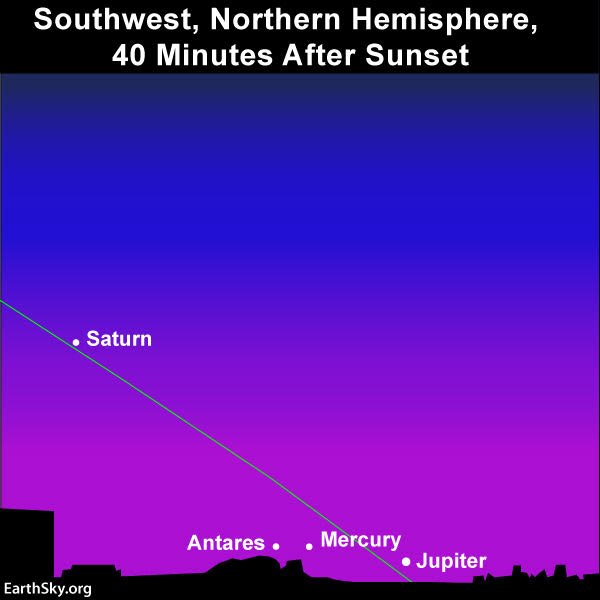
It’s the same distance from the sun, on the sky’s dome, for all of us. Yet whether you see Mercury easily or not will depend on where you are on the Earth’s globe. Which hemisphere sees it better? Notice that our chart at top is set for the Southern Hemisphere, and notice that the ecliptic – or path of the sun, moon and planets across our sky – makes a steep angle with the evening horizon, as shown on the chart above.
Peter Lowenstein from Mutare, Zimbabwe (20 degrees south latitude) managed to catch Mercury in between the star Antares (top) and the planet Jupiter (bottom) 40 minutes after sunset on November 5, 2018. Thank you Peter!
That steep ecliptic angle will make Mercury much easier to see from southerly latitudes on Earth’s globe than from our latitudes in the Northern Hemisphere. Contrast the sky chart (and photo) for the Southern Hemisphere above with the sky chart (and photo) below for mid-northern latitudes in the Northern Hemisphere.
From northerly latitudes, like those in the U.S. and Europe, it’ll be much harder to spot the planets Mercury and Jupiter, plus the star Antares, after sunset.
The feature chart at the very top shows the western sky for one hour after sunset for around 30 degrees south latitude (South Africa, southern Australia). From these southerly latitudes, you even have a good chance of spotting the king planet Jupiter below Mercury and the bright star Antares above Mercury. But, even for this part of the world, you’ll want to find an unobstructed horizon in the direction of sunset to view these bright beauties popping out as dusk gives way to darkness. Jupiter is the brightest of the threesome, followed by Mercury and then the 1st-magnitude star Antares.
At 30 degrees south latitude, given an unobstructed western horizon, Jupiter will set about one hour after sunset, Mercury nearly two hours after sunset and Antares over two hours after sunset.
Meanwhile, at 40 degrees north latitude (such as at Philadelphia, Pennsylvania), Jupiter will set about 50 minutes after sunset whereas Mercury and Antares will set about one hour after the sun. It’ll be much harder to spot this threesome at northerly latitudes than in the Southern Hemisphere or the northern tropics.
If you want to give it a try anyway, be sure to bring along binoculars! Use them to scan along the horizon. If you spot the planets, you can remove the binoculars and try to see them with the eye.
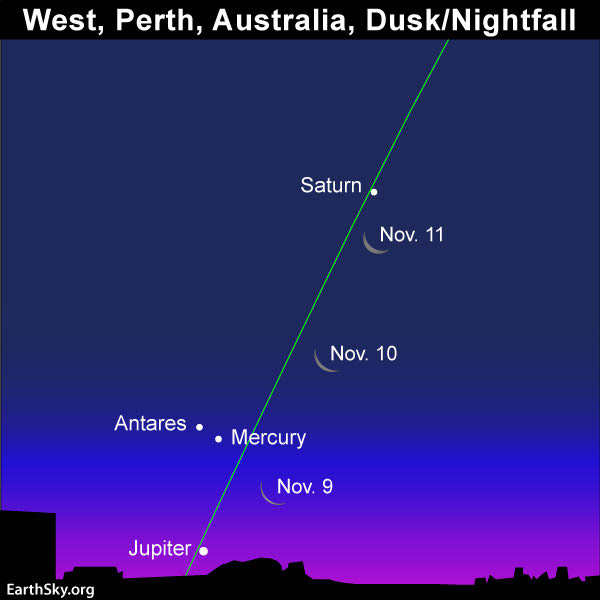
By the way, southerly latitudes will also enjoy a better view of the young waxing crescent moon pairing up with these two bright planets and Antares on or near November 9, 2018. The sky chart below is for Perth, Western Australia, but you can click here to find out when the sun, moon, Jupiter, Mercury and Antares set in your sky.
Live in the Southern Hemisphere? Given an unobstructed horizon in the direction of sunset, you have a good chance of catching the young waxing crescent moon near the planets Mercury and Jupiter.
Bottom line: On November 6, 2018, Mercury reaches its greatest eastern elongation from the sun. Those at southerly latitudes are more likely to spot Mercury (plus nearby Jupiter and Antares) as dusk deepens into nightfall.
from EarthSky https://ift.tt/2JIJjFP
Today – November 6, 2018 – the planet Mercury reaches its greatest eastern elongation, that is, its maximum angular separation of 23 degrees from the setting sun for this evening apparition. As seen from the whole Earth, Mercury entered the evening sky (at superior conjunction) on September 21, 2018, and it’ll leave it (at inferior conjunction) on November 27, 2018.
Not to scale. An inferior planet – a planet that orbits the sun inside of Earth’s orbit – appears in the evening sky at its greatest eastern elongation, and in the morning sky at its greatest western elongation. The 2 inferior planets are Mercury and Venus, residing at a mean distance of 0.387 and 0.723 astronomical units from the sun, respectively.
It’s the same distance from the sun, on the sky’s dome, for all of us. Yet whether you see Mercury easily or not will depend on where you are on the Earth’s globe. Which hemisphere sees it better? Notice that our chart at top is set for the Southern Hemisphere, and notice that the ecliptic – or path of the sun, moon and planets across our sky – makes a steep angle with the evening horizon, as shown on the chart above.
Peter Lowenstein from Mutare, Zimbabwe (20 degrees south latitude) managed to catch Mercury in between the star Antares (top) and the planet Jupiter (bottom) 40 minutes after sunset on November 5, 2018. Thank you Peter!
That steep ecliptic angle will make Mercury much easier to see from southerly latitudes on Earth’s globe than from our latitudes in the Northern Hemisphere. Contrast the sky chart (and photo) for the Southern Hemisphere above with the sky chart (and photo) below for mid-northern latitudes in the Northern Hemisphere.
From northerly latitudes, like those in the U.S. and Europe, it’ll be much harder to spot the planets Mercury and Jupiter, plus the star Antares, after sunset.
The feature chart at the very top shows the western sky for one hour after sunset for around 30 degrees south latitude (South Africa, southern Australia). From these southerly latitudes, you even have a good chance of spotting the king planet Jupiter below Mercury and the bright star Antares above Mercury. But, even for this part of the world, you’ll want to find an unobstructed horizon in the direction of sunset to view these bright beauties popping out as dusk gives way to darkness. Jupiter is the brightest of the threesome, followed by Mercury and then the 1st-magnitude star Antares.
At 30 degrees south latitude, given an unobstructed western horizon, Jupiter will set about one hour after sunset, Mercury nearly two hours after sunset and Antares over two hours after sunset.
Meanwhile, at 40 degrees north latitude (such as at Philadelphia, Pennsylvania), Jupiter will set about 50 minutes after sunset whereas Mercury and Antares will set about one hour after the sun. It’ll be much harder to spot this threesome at northerly latitudes than in the Southern Hemisphere or the northern tropics.
If you want to give it a try anyway, be sure to bring along binoculars! Use them to scan along the horizon. If you spot the planets, you can remove the binoculars and try to see them with the eye.
By the way, southerly latitudes will also enjoy a better view of the young waxing crescent moon pairing up with these two bright planets and Antares on or near November 9, 2018. The sky chart below is for Perth, Western Australia, but you can click here to find out when the sun, moon, Jupiter, Mercury and Antares set in your sky.
Live in the Southern Hemisphere? Given an unobstructed horizon in the direction of sunset, you have a good chance of catching the young waxing crescent moon near the planets Mercury and Jupiter.
Bottom line: On November 6, 2018, Mercury reaches its greatest eastern elongation from the sun. Those at southerly latitudes are more likely to spot Mercury (plus nearby Jupiter and Antares) as dusk deepens into nightfall.
The extinct elephant bird – the largest bird known to science – was nocturnal and possibly blind. That’s according to new brain reconstruction research that found that the part of the bird’s brain that processed vision was tiny.
A nocturnal lifestyle is a trait shared by the elephant bird’s closest living relative, the kiwi — a practically blind, chicken-size bird that lives in New Zealand. According to Christopher Torres of University of Texas at Austin, that’s a clue that is helping scientists learn more about the elephant bird’s behavior and habitat. Torres led the research, which was published October 31, 2018, in the peer-reviewed journal Proceedings of the Royal Society B. Torres said in a statement:
Studying brain shape is a really useful way of connecting ecology – the relationship between the bird and the environment – and anatomy.
Elephant birds were large, flightless and lived in what is now Madagascar until a mixture of habitat loss and potential human meddling led to their demise between 500 and 1,000 years ago. Torres said:
Humans lived alongside, and even hunted, elephant birds for thousands of years. But we still know practically nothing about their lives. We don’t even really know exactly when or why they went extinct.
A digital brain reconstruction of the recently extinct elephant bird revealed that its optic lobe was virtually absent, a trait that indicates it was nocturnal and possibly blind. The kiwi, the closest living relative of the elephant bird, also has an absent optic lobe, nocturnal behavior and very poor eyesight. In contrast, the tinamous, a distant elephant bird relative, has good eyesight and a prominent optic lobe. Image via Chris Torres/University of Texas at Austin.
Scientists had previously assumed that elephant birds were similar to other big, flightless birds, like emus and ostriches — both of which are active during the day and have good eyesight. But the new brain reconstructions suggest that elephant birds had distinctly different lifestyles. Read more about how the scientists conducted the study here.
Andrew Iwaniuk is an associate professor at the University of Lethbridge and an expert on brain evolution in birds who was not involved with the research. Iwaniuk said that he had a similar reaction to the findings.
I was surprised that the visual system is so small in a bird this big. For a bird this large to evolve a nocturnal lifestyle is truly bizarre and speaks to an ecology unlike that of their closest relatives or any other bird species that we know of.
The extinct elephant bird – the largest bird known to science – was nocturnal and possibly blind. That’s according to new brain reconstruction research that found that the part of the bird’s brain that processed vision was tiny.
A nocturnal lifestyle is a trait shared by the elephant bird’s closest living relative, the kiwi — a practically blind, chicken-size bird that lives in New Zealand. According to Christopher Torres of University of Texas at Austin, that’s a clue that is helping scientists learn more about the elephant bird’s behavior and habitat. Torres led the research, which was published October 31, 2018, in the peer-reviewed journal Proceedings of the Royal Society B. Torres said in a statement:
Studying brain shape is a really useful way of connecting ecology – the relationship between the bird and the environment – and anatomy.
Elephant birds were large, flightless and lived in what is now Madagascar until a mixture of habitat loss and potential human meddling led to their demise between 500 and 1,000 years ago. Torres said:
Humans lived alongside, and even hunted, elephant birds for thousands of years. But we still know practically nothing about their lives. We don’t even really know exactly when or why they went extinct.
A digital brain reconstruction of the recently extinct elephant bird revealed that its optic lobe was virtually absent, a trait that indicates it was nocturnal and possibly blind. The kiwi, the closest living relative of the elephant bird, also has an absent optic lobe, nocturnal behavior and very poor eyesight. In contrast, the tinamous, a distant elephant bird relative, has good eyesight and a prominent optic lobe. Image via Chris Torres/University of Texas at Austin.
Scientists had previously assumed that elephant birds were similar to other big, flightless birds, like emus and ostriches — both of which are active during the day and have good eyesight. But the new brain reconstructions suggest that elephant birds had distinctly different lifestyles. Read more about how the scientists conducted the study here.
Andrew Iwaniuk is an associate professor at the University of Lethbridge and an expert on brain evolution in birds who was not involved with the research. Iwaniuk said that he had a similar reaction to the findings.
I was surprised that the visual system is so small in a bird this big. For a bird this large to evolve a nocturnal lifestyle is truly bizarre and speaks to an ecology unlike that of their closest relatives or any other bird species that we know of.
On November 2, scientists from NOAA and NASA reported that the maximum size of the 2018 ozone hole over the Antarctic was slightly above average.
According to the report, this year’s ozone hole reached an average area coverage of 8.83 million square miles (22.9 square km), almost three times the size of the contiguous United States. It ranks 13th largest out of 40 years of NASA satellite observations.
Ozone is a molecule comprised of three oxygen atoms. A layer of ozone high in the atmosphere surrounds the entire Earth. It protects life on our planet from the harmful effects of the sun’s ultraviolet rays. First detected in 1985, the ozone hole is not technically a hole where no ozone is present, but is instead a region of exceptionally depleted ozone in the stratosphere over the Antarctic. This region of depleted ozone typically begins to appear at the beginning of Southern Hemisphere spring (August–October).
The ozone hole over Antarctica reaches an annual maximum extent every year during southern winter. The depletion of ozone by chlorofluorocarbons (CFCs) in the atmosphere happens faster at colder temperatures and slows down as temperatures warm, so each October, the ozone layer begins to heal again for the year.
Scientists from NASA and NOAA track the ozone layer throughout the year and determine when the hole reaches its annual maximum extent. This year, the South Pole region of Antarctica was slightly colder than the previous few years, so the ozone hole grew larger.
However, scientists from NASA have developed models to predict what the ozone layer would have looked like without the 1987 Montreal Protocol, which banned the release of CFCs. Although the 2018 hole was slightly larger than that of 2017 or 2016, it was still much smaller than it would have been without the Montreal Protocol.
Scientists monitor the thickness of the ozone layer and its vertical distribution above the South Pole by regularly releasing weather balloons carrying ozone-measuring sensors up to 21 miles (~34 km) in altitude. This time-lapse photo from September 10, 2018, shows the flight path of a weather balloon as it rises into the atmosphere over the South Pole from the Amundsen-Scott South Pole Station. Image via Robert Schwarz/University of Minnesota.
Paul A. Newman is chief scientist for Earth Sciences at NASA’s Goddard Space Flight Center. Newman said in a statement:
Chlorine levels in the Antarctic stratosphere have fallen about 11 percent from the peak year in 2000. This year’s colder temperatures would have given us a much larger ozone hole if chlorine was still at levels we saw back in the year 2000.
On November 2, scientists from NOAA and NASA reported that the maximum size of the 2018 ozone hole over the Antarctic was slightly above average.
According to the report, this year’s ozone hole reached an average area coverage of 8.83 million square miles (22.9 square km), almost three times the size of the contiguous United States. It ranks 13th largest out of 40 years of NASA satellite observations.
Ozone is a molecule comprised of three oxygen atoms. A layer of ozone high in the atmosphere surrounds the entire Earth. It protects life on our planet from the harmful effects of the sun’s ultraviolet rays. First detected in 1985, the ozone hole is not technically a hole where no ozone is present, but is instead a region of exceptionally depleted ozone in the stratosphere over the Antarctic. This region of depleted ozone typically begins to appear at the beginning of Southern Hemisphere spring (August–October).
The ozone hole over Antarctica reaches an annual maximum extent every year during southern winter. The depletion of ozone by chlorofluorocarbons (CFCs) in the atmosphere happens faster at colder temperatures and slows down as temperatures warm, so each October, the ozone layer begins to heal again for the year.
Scientists from NASA and NOAA track the ozone layer throughout the year and determine when the hole reaches its annual maximum extent. This year, the South Pole region of Antarctica was slightly colder than the previous few years, so the ozone hole grew larger.
However, scientists from NASA have developed models to predict what the ozone layer would have looked like without the 1987 Montreal Protocol, which banned the release of CFCs. Although the 2018 hole was slightly larger than that of 2017 or 2016, it was still much smaller than it would have been without the Montreal Protocol.
Scientists monitor the thickness of the ozone layer and its vertical distribution above the South Pole by regularly releasing weather balloons carrying ozone-measuring sensors up to 21 miles (~34 km) in altitude. This time-lapse photo from September 10, 2018, shows the flight path of a weather balloon as it rises into the atmosphere over the South Pole from the Amundsen-Scott South Pole Station. Image via Robert Schwarz/University of Minnesota.
Paul A. Newman is chief scientist for Earth Sciences at NASA’s Goddard Space Flight Center. Newman said in a statement:
Chlorine levels in the Antarctic stratosphere have fallen about 11 percent from the peak year in 2000. This year’s colder temperatures would have given us a much larger ozone hole if chlorine was still at levels we saw back in the year 2000.