aads

Fake image of Diwali still circulating

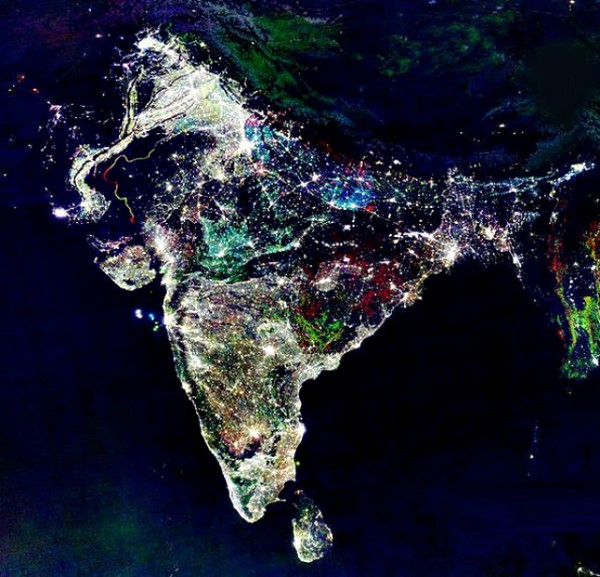
This image of India has been circulating on the Internet for years. Some claim it shows India during Diwali, but it doesn’t. Yes, it’s a real satellite image, but it’s a composite, with several different years of lighting combined together. Image via U.S. Defense Meteorological Satellite Program.

This week is Diwali in India, and that means it’s time for the image above – purportedly showing India at the time of Diwali, from space – to circulate on social media. In fact, this image been circulating all year. The Indian news website The Quint started tracking it as early as February 2018, and said:

If we look back in history to find out the biggest fake stories that have been circulated among Indians, there’s only one that can top the theory that Ricky Ponting had a spring attached to his bat in ICC World Cup 2003 Final, and that is the so-called satellite image of the Indian sub-continent taken on Diwali night by NASA.

Just like Diwali is incomplete without buying new clothes, playing cards with your family and lighting up the house, it is also incomplete, in the age of social media, without someone, year after year, sharing this fake image.

The 2019 lunar calendars are here! Order yours before they’re gone. Makes a great gift.

So … what is this image? It doesn’t show what it claims to show; that is, it doesn’t show India on a single night during the Diwali festival.

This image does come from satellite data. It’s based on data from U.S. Defense Meteorological Satellite Program satellites, and it’s a color-composite created in 2003 by scientist Chris Elvidge to highlight population growth over time. In this image, white areas show city lights that were visible prior to 1992, while blue, green, and red shades indicate city lights that became visible in 1992, 1998, and 2003 respectively.

Now, here’s a real image of India during Diwali:
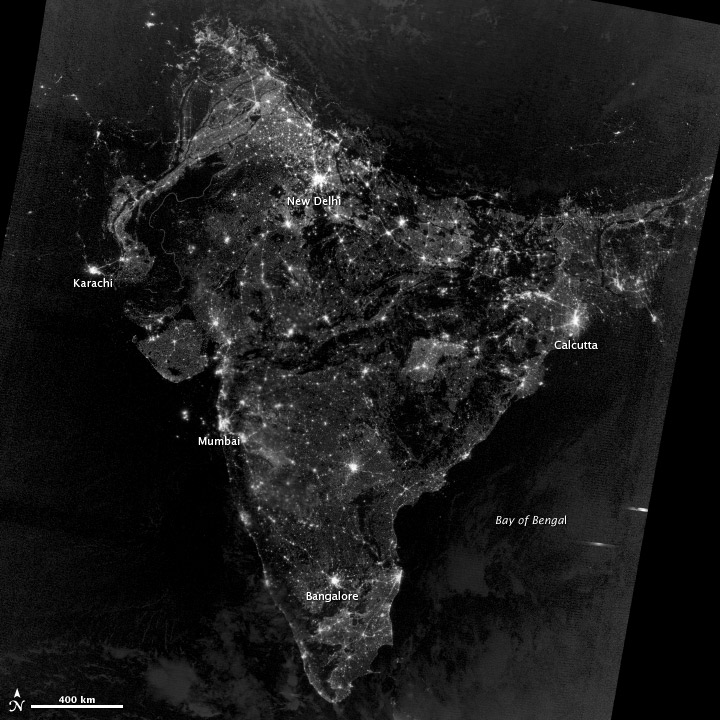
Real satellite image of India, taken during a Diwali festival. Image acquired November 12, 2012, via NASA’s Earth Observatory.

The image above – which has been artificially brightened – shows what India looked like from space on a night during Diwali, in this case in November, 2012. It’s what India looks like from space on a typical Diwali night … or on any night in India, according to NASA. In fact, according to NASA, the extra light produced during Diwali is so subtle that space images don’t show it.

The image above is from a NASA satellite known as Suomi NPP, for National Polar-orbiting Partnership. An instrument carried on this satellite – which detects light in a range of wavelengths from green to near-infrared – acquired this image in a single night. The image has been brightened to make the city lights easier to distinguish.

Most of the bright areas are cities and towns in India, which is home to more than 1.3 billion people and has 53 cities with populations over 1 million.

Cities in Bangladesh, Nepal, and Pakistan are also visible near the edges of the image above.

Diwali fireworks. A time-lapse composite of pictures taken on October 30, 2016, from 7 p.m. until 11 p/m. by Abhinav Singhai in New Delhi, India.

Diwali fireworks. A time-lapse composite of pictures taken on October 30, 2016, from 7 to 11 p.m. by Abhinav Singhai in New Delhi, India.

The Hindu festival of Diwali celebrates the victory of Good over the Evil and Light over Darkness. It also marks the beginning of the Hindu New Year. In 2018, Diwali falls on November 7, corresponding with November’s new moon at 16:02 UTC on that date.

This darkest, new moon night is called Kartika in the Hindu Lunisolar calendar – all the better to see the fireworks and enjoy the symbolic burning of lamps and candles. Diwali is a major holiday in India, and it’s also celebrated by millions across the world, from India, Nepal and Malaysia and on into the west (for example, in the UK).

It marks the homecoming of the God Lord Ram after vanquishing the demon king Ravana.

Lighting lamps, candles, and fireworks are a big part of Diwali. It’s a celebration of light! Can you see those celebratory lights from space? No. But you can enjoy it all the same.

Happy Diwali to all who celebrate it!

Bottom line: Diwali is a festival of light, and a persistent internet hoax shows a fake image of “India during Diwali, from space.” NASA says the extra light so many enjoy during Diwali would not be visible from space.


from EarthSky https://ift.tt/2PFh2We

This image of India has been circulating on the Internet for years. Some claim it shows India during Diwali, but it doesn’t. Yes, it’s a real satellite image, but it’s a composite, with several different years of lighting combined together. Image via U.S. Defense Meteorological Satellite Program.

This week is Diwali in India, and that means it’s time for the image above – purportedly showing India at the time of Diwali, from space – to circulate on social media. In fact, this image been circulating all year. The Indian news website The Quint started tracking it as early as February 2018, and said:

If we look back in history to find out the biggest fake stories that have been circulated among Indians, there’s only one that can top the theory that Ricky Ponting had a spring attached to his bat in ICC World Cup 2003 Final, and that is the so-called satellite image of the Indian sub-continent taken on Diwali night by NASA.

Just like Diwali is incomplete without buying new clothes, playing cards with your family and lighting up the house, it is also incomplete, in the age of social media, without someone, year after year, sharing this fake image.

The 2019 lunar calendars are here! Order yours before they’re gone. Makes a great gift.

So … what is this image? It doesn’t show what it claims to show; that is, it doesn’t show India on a single night during the Diwali festival.

This image does come from satellite data. It’s based on data from U.S. Defense Meteorological Satellite Program satellites, and it’s a color-composite created in 2003 by scientist Chris Elvidge to highlight population growth over time. In this image, white areas show city lights that were visible prior to 1992, while blue, green, and red shades indicate city lights that became visible in 1992, 1998, and 2003 respectively.

Now, here’s a real image of India during Diwali:

Real satellite image of India, taken during a Diwali festival. Image acquired November 12, 2012, via NASA’s Earth Observatory.

The image above – which has been artificially brightened – shows what India looked like from space on a night during Diwali, in this case in November, 2012. It’s what India looks like from space on a typical Diwali night … or on any night in India, according to NASA. In fact, according to NASA, the extra light produced during Diwali is so subtle that space images don’t show it.

The image above is from a NASA satellite known as Suomi NPP, for National Polar-orbiting Partnership. An instrument carried on this satellite – which detects light in a range of wavelengths from green to near-infrared – acquired this image in a single night. The image has been brightened to make the city lights easier to distinguish.

Most of the bright areas are cities and towns in India, which is home to more than 1.3 billion people and has 53 cities with populations over 1 million.

Cities in Bangladesh, Nepal, and Pakistan are also visible near the edges of the image above.

Diwali fireworks. A time-lapse composite of pictures taken on October 30, 2016, from 7 p.m. until 11 p/m. by Abhinav Singhai in New Delhi, India.

Diwali fireworks. A time-lapse composite of pictures taken on October 30, 2016, from 7 to 11 p.m. by Abhinav Singhai in New Delhi, India.

The Hindu festival of Diwali celebrates the victory of Good over the Evil and Light over Darkness. It also marks the beginning of the Hindu New Year. In 2018, Diwali falls on November 7, corresponding with November’s new moon at 16:02 UTC on that date.

This darkest, new moon night is called Kartika in the Hindu Lunisolar calendar – all the better to see the fireworks and enjoy the symbolic burning of lamps and candles. Diwali is a major holiday in India, and it’s also celebrated by millions across the world, from India, Nepal and Malaysia and on into the west (for example, in the UK).

It marks the homecoming of the God Lord Ram after vanquishing the demon king Ravana.

Lighting lamps, candles, and fireworks are a big part of Diwali. It’s a celebration of light! Can you see those celebratory lights from space? No. But you can enjoy it all the same.

Happy Diwali to all who celebrate it!

Bottom line: Diwali is a festival of light, and a persistent internet hoax shows a fake image of “India during Diwali, from space.” NASA says the extra light so many enjoy during Diwali would not be visible from space.


from EarthSky https://ift.tt/2PFh2We

Where sexes come by the thousands
The split gill mushroom Schizophyllum commune, a fungal species that includes more than 20,000 sexes. Image via Bernard Spragg.

By Antonis Rokas, Vanderbilt University

By the end of every spring semester, students in my introductory biology course at Vanderbilt University have become quite familiar with natural variation in human sex chromosomes. They know, for example, that most females have two X chromosomes and most males have one X and one Y chromosome. But in every thousand humans, there are typically a few whose biological sex doesn’t match their sex chromosomes, such as XX males and XY females, or whose sex chromosome combinations are not even XX or XY, such as XXX females and XYY males.

The 2019 lunar calendars are here! Order yours before they’re gone. Makes a great gift.

The relationship between the sex chromosomes we inherited from our parents and gender, and how people identify, has been in the news quite a lot recently, not least because the Trump administration is considering revising the definition of human genders.

As an evolutionary biologist who studies fungi, I often like to view such complex issues through the lens of life’s diversity. I believe that studying the reproductive strategies of fungi, and how the sex of these organisms is determined, offers a bewildering, but also fresh and surprising perspective of the sheer diversity with which, well, these organisms do it.

Saccharomyces cerevisiae, whose individuals have the ability to switch between two sexes. Image via Mogana Das Murtey and Patchamuthu Ramasamy.

The fungal masters of sex

Fungi are a wildly heterogeneous group of microorganisms that are typically embedded in their food and have the ability to digest it externally. The baker’s yeast that makes bread rise, the mold that makes blue cheese blue, and the mushrooms that make your pizza even more tasty are all examples of fungal organisms.

Unlike humans, sex in fungi is controlled by a specific and relatively small region – locus is the technical term – of DNA on a chromosome. For example, the sex locus of the baker’s yeast contains two different gene variants, which means that this organism has two sexes (or mating types) and individuals of one sex can only mate with individuals of the other.

The penicillin-producing Aspergillus nidulans, whose individuals contain both mating types. Image via 222fjb.

In contrast, several mushroom-forming species have two genetic regions that determine sex – let’s call them A and B; and instead of two variants, the A and B regions can each contain multiple variants – let’s number them A1, A2, and so on and B1, B2 and so on. As the sex of each individual is determined by the specific combination of gene variants in the two regions, the number of possible sexes within these species grows: A1B1, A1B2, A2B1, A2B2 and so on. Still with me?

Given that some species of mushroom-forming fungi harbor dozens to hundreds of A and B region variants, it is estimated that these organisms contain thousands of sexes. And did I mention that in some species there are more than two sex determining regions? Sex in some fungi is heady stuff. No wonder then that professor Lisa Vaillancourt at the University of Kentucky was inspired to use standard card decks to create “fungal mating games” to help her students navigate and appreciate the mating lives of fungi.

Candida albicans can undergo parasexuality, a process that confers the same genetic benefits as sex but that doesn’t involve the same mechanisms. Image via CDC/Dr. William Kaplan.

Switching and Selfing

But the surprises offered by peeking into fungal sex don’t end here. One key aspect of the sex life of the baker’s yeast worth mentioning is that they are capable of switching their sex, a strategy thought to have evolved to promote mating with siblings of the opposite sex. Several other fungi, such as the mold Aspergillus fumigatus, which is one of the major fungal pathogens affecting humans, have the same two-sex system as the baker’s yeast, albeit without the ability for switching. However, individuals of the penicillin-producing mold Aspergillus nidulans, a close relative of A. fumigatus, contain both variants of the sex locus in their own genomes. What’s the advantage? The ability, and choice, to either self-reproduce or to mate with another individual.

Now why this organism is also able to undergo a process called parasexuality, which confers all the genetic benefits of sex but without (you guessed it) sex, is a story for another time. In recent years, however, parasexuality is receiving lots of attention as it is also employed by the human commensal yeast Candida albicans, another major human pathogen responsible for vaginal yeast infections but also deadly systemic ones.

The split gill mushroom, Schizophyllum commune, is a species estimated to have 20,000 or more distinct sexes. Image via Doug Bowman from DeKalb, Illinois, USA.

What is then the meaning of all this diversity? Detailed evolutionary analyses indicate that some of these reproductive lifestyles, such as the ability to self-reproduce, have evolved repeatedly and frequently throughout fungi from the same building block, the mating locus. And variation in reproductive systems among closely related species is quite common, suggesting that these transitions can take place – on an evolutionary timescale – relatively quickly and easily.

While the diversity of animal reproductive systems pales in comparison, multiple sexes have also been discovered in some ants and several different animals have also evolved the capacity to switch sex, such as certain fish species. Viewed from the lens of life’s diversity, we should not be surprised that we humans are variable too. Or as Stephen Jay Gould once put it, “Variation itself is nature’s only irreducible essence.”

Bottom line: For some fungi there are hundreds and even thousands of sexes and mating types.

Antonis Rokas, Cornelius Vanderbilt Chair in Biological Sciences and Professor of Biological Sciences and Biomedical Informatics, Vanderbilt University

This article is republished from The Conversation under a Creative Commons license. Read the original article.

The Conversation


from EarthSky https://ift.tt/2Ou8fS6

The split gill mushroom Schizophyllum commune, a fungal species that includes more than 20,000 sexes. Image via Bernard Spragg.

By Antonis Rokas, Vanderbilt University

By the end of every spring semester, students in my introductory biology course at Vanderbilt University have become quite familiar with natural variation in human sex chromosomes. They know, for example, that most females have two X chromosomes and most males have one X and one Y chromosome. But in every thousand humans, there are typically a few whose biological sex doesn’t match their sex chromosomes, such as XX males and XY females, or whose sex chromosome combinations are not even XX or XY, such as XXX females and XYY males.

The 2019 lunar calendars are here! Order yours before they’re gone. Makes a great gift.

The relationship between the sex chromosomes we inherited from our parents and gender, and how people identify, has been in the news quite a lot recently, not least because the Trump administration is considering revising the definition of human genders.

As an evolutionary biologist who studies fungi, I often like to view such complex issues through the lens of life’s diversity. I believe that studying the reproductive strategies of fungi, and how the sex of these organisms is determined, offers a bewildering, but also fresh and surprising perspective of the sheer diversity with which, well, these organisms do it.

Saccharomyces cerevisiae, whose individuals have the ability to switch between two sexes. Image via Mogana Das Murtey and Patchamuthu Ramasamy.

The fungal masters of sex

Fungi are a wildly heterogeneous group of microorganisms that are typically embedded in their food and have the ability to digest it externally. The baker’s yeast that makes bread rise, the mold that makes blue cheese blue, and the mushrooms that make your pizza even more tasty are all examples of fungal organisms.

Unlike humans, sex in fungi is controlled by a specific and relatively small region – locus is the technical term – of DNA on a chromosome. For example, the sex locus of the baker’s yeast contains two different gene variants, which means that this organism has two sexes (or mating types) and individuals of one sex can only mate with individuals of the other.

The penicillin-producing Aspergillus nidulans, whose individuals contain both mating types. Image via 222fjb.

In contrast, several mushroom-forming species have two genetic regions that determine sex – let’s call them A and B; and instead of two variants, the A and B regions can each contain multiple variants – let’s number them A1, A2, and so on and B1, B2 and so on. As the sex of each individual is determined by the specific combination of gene variants in the two regions, the number of possible sexes within these species grows: A1B1, A1B2, A2B1, A2B2 and so on. Still with me?

Given that some species of mushroom-forming fungi harbor dozens to hundreds of A and B region variants, it is estimated that these organisms contain thousands of sexes. And did I mention that in some species there are more than two sex determining regions? Sex in some fungi is heady stuff. No wonder then that professor Lisa Vaillancourt at the University of Kentucky was inspired to use standard card decks to create “fungal mating games” to help her students navigate and appreciate the mating lives of fungi.

Candida albicans can undergo parasexuality, a process that confers the same genetic benefits as sex but that doesn’t involve the same mechanisms. Image via CDC/Dr. William Kaplan.

Switching and Selfing

But the surprises offered by peeking into fungal sex don’t end here. One key aspect of the sex life of the baker’s yeast worth mentioning is that they are capable of switching their sex, a strategy thought to have evolved to promote mating with siblings of the opposite sex. Several other fungi, such as the mold Aspergillus fumigatus, which is one of the major fungal pathogens affecting humans, have the same two-sex system as the baker’s yeast, albeit without the ability for switching. However, individuals of the penicillin-producing mold Aspergillus nidulans, a close relative of A. fumigatus, contain both variants of the sex locus in their own genomes. What’s the advantage? The ability, and choice, to either self-reproduce or to mate with another individual.

Now why this organism is also able to undergo a process called parasexuality, which confers all the genetic benefits of sex but without (you guessed it) sex, is a story for another time. In recent years, however, parasexuality is receiving lots of attention as it is also employed by the human commensal yeast Candida albicans, another major human pathogen responsible for vaginal yeast infections but also deadly systemic ones.

The split gill mushroom, Schizophyllum commune, is a species estimated to have 20,000 or more distinct sexes. Image via Doug Bowman from DeKalb, Illinois, USA.

What is then the meaning of all this diversity? Detailed evolutionary analyses indicate that some of these reproductive lifestyles, such as the ability to self-reproduce, have evolved repeatedly and frequently throughout fungi from the same building block, the mating locus. And variation in reproductive systems among closely related species is quite common, suggesting that these transitions can take place – on an evolutionary timescale – relatively quickly and easily.

While the diversity of animal reproductive systems pales in comparison, multiple sexes have also been discovered in some ants and several different animals have also evolved the capacity to switch sex, such as certain fish species. Viewed from the lens of life’s diversity, we should not be surprised that we humans are variable too. Or as Stephen Jay Gould once put it, “Variation itself is nature’s only irreducible essence.”

Bottom line: For some fungi there are hundreds and even thousands of sexes and mating types.

Antonis Rokas, Cornelius Vanderbilt Chair in Biological Sciences and Professor of Biological Sciences and Biomedical Informatics, Vanderbilt University

This article is republished from The Conversation under a Creative Commons license. Read the original article.

The Conversation


from EarthSky https://ift.tt/2Ou8fS6

Sunburst on a fall morning

Fall colors by Rasmi Syamalan, November, 2018.

Read more: Why leaves change color in fall


from EarthSky https://ift.tt/2zsBBen

Fall colors by Rasmi Syamalan, November, 2018.

Read more: Why leaves change color in fall


from EarthSky https://ift.tt/2zsBBen

Why leaves change color in fall

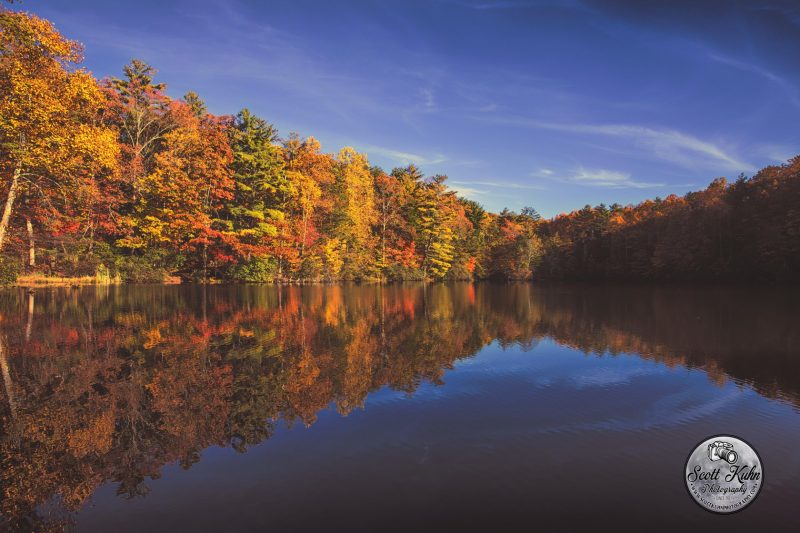
Scott Kuhn wrote on November 3, 2018: “Leaves popping with color this weekend in North Georgia.”

The 2019 lunar calendars are here! Order yours before they’re gone. Makes a great gift.

Throughout the spring and summer, the deep green color of chlorophyll, which helps plants absorb life-giving sunlight, hides any other colors present in the leaves of trees. The vivid yellows and oranges of fall leaves are there, but hidden. In the fall, trees break down the green pigments and nutrients stored in their leaves. The nutrients are shuttled into the tree’s roots for reuse in the spring. It’s then that the trees take on their autumn hues.

As leaves lose their chlorophyll, other pigments become visible to the human eye, according to Bryan A. Hanson, professor of chemistry and biochemistry at DePauw University who studies plant pigments. Some tree leaves turn mostly brown, indicating that all pigments are gone.

Autumn 2016 in the Colorado Rocky Mountains. Photo via Jessi Leigh Photography. Thanks Jessi!

Autumn in the Colorado Rocky Mountains. Photo via Jessi Leigh Photography.

Autumn leaves at Hurricane Mountain in the Adirondacks, New York, September, 2015. Photo by John Holmes. Thank you John!

Autumn leaves at Hurricane Mountain in the Adirondacks, New York. Photo via John Holmes.

Autumn leaf in about mid-September 2012 from our friend Colin Chatfield in Saskatoon, Saskatchewan.

Autumn leaf in about mid-September from our friend Colin Chatfield in Saskatoon, Saskatchewan.

Steven Arthur Sweet captured this image at Centennial Park in Toronto, Canada.

Burgundy and red colors are a different story. Dana A. Dudle is a DePauw professor of biology who researches red pigment in plant flowers, stems and leaves. Dudle said:

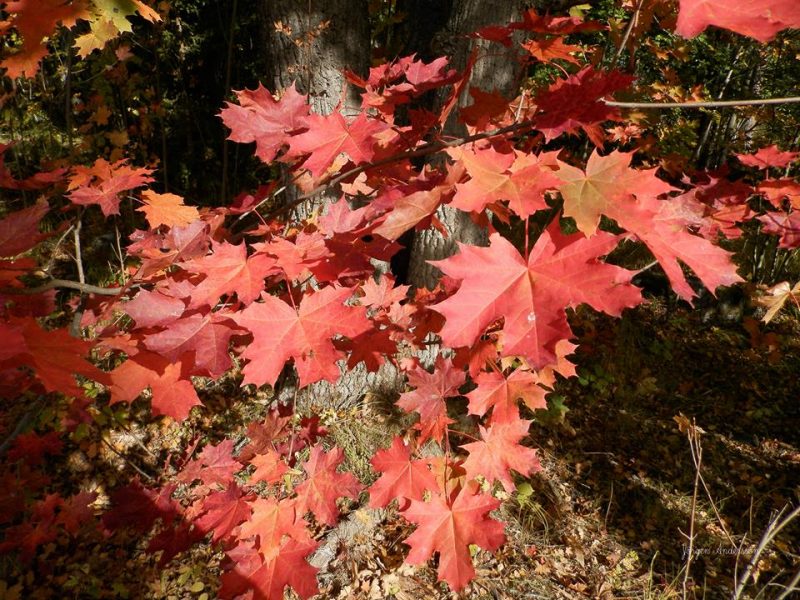
The red color is actively made in leaves by bright light and cold. The crisp, cold nights in the fall combine with bright, sunny days to spur production of red in leaves – especially in sugar maple and red maple trees. Burgundy leaves often result from a combination of red pigment and chlorophyll. Autumn seasons with a lot of sunny days and cold nights will have the brightest colors.

Image Credit: treehouse1977

Image via treehouse1977

In some cases, about half of a tree’s leaves are red/orange and the other half green. Dudle says that results from micro-environmental factors – such as only half the tree being exposed to sunlight or cold.

Hardwoods in the Midwest and on the East Coast are famous for good color selections. Some of the more reliably colorful trees, Hanson notes, are liquid amber trees (also called sweet gum) that turn a variety of colors on the same tree, and sometimes the same leaf. Ash tree leaves often turn a deep burgundy color. Ginkgo trees, although not native to North America, will feature an intense yellow, almost golden, color.

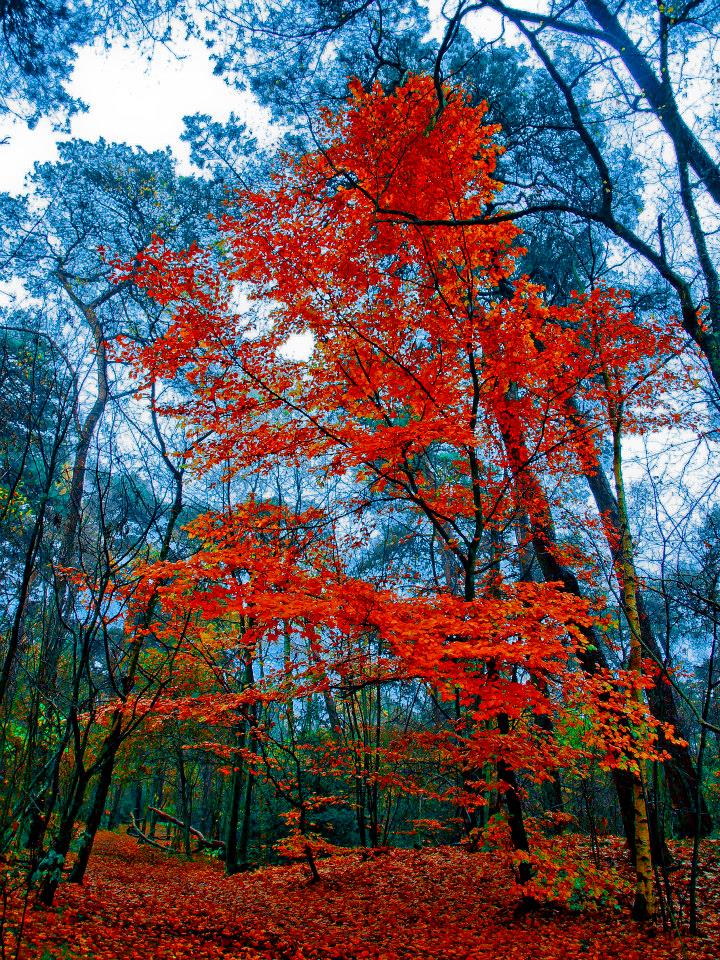
A lone red tree against bare branches. Photo via Daniel de Leeuw Photog.

A lone red tree against bare branches. Photo via Daniel de Leeuw Photog.

“Autumn picture from Sweden…” from our friend Jörgen Norrland

The colors are doing something for the plant, or they wouldn’t be there, said Hansen. But what is the colors’ purpose?

Scientists think that with some trees, pigments serve as a kind of sunscreen to filter out sunlight. Hanson said:

It’s an underappreciated fact that plants cannot take an infinite amount of sun. Some leaves, if they get too much sun, will get something equivalent of a sunburn. They get stressed out and die.

Image via Tosca Yemoh Zanon in London wishes

Image via Tosca Yemoh Zanon in London.

Another theory is that the color of a plant’s leaves is often related to the ability to warn away pests or attract insect pollinators. Hanson said:

In some cases, a plant and insect might have co-evolved. One of the more intriguing scientific theories is that the beautiful leaf colors we see today are indicative of a relationship between a plant and insects that developed millions of years ago. However, as the Earth’s climate changed over the years, the insects might have gone extinct, but the plant was able to survive for whatever reason.

Because plants evolve very slowly, we still see the colors. So leaf color is a fossil memory, something that existed for a reason millions of years ago but that serves no purpose now.

Image Credit: Ross Elliott

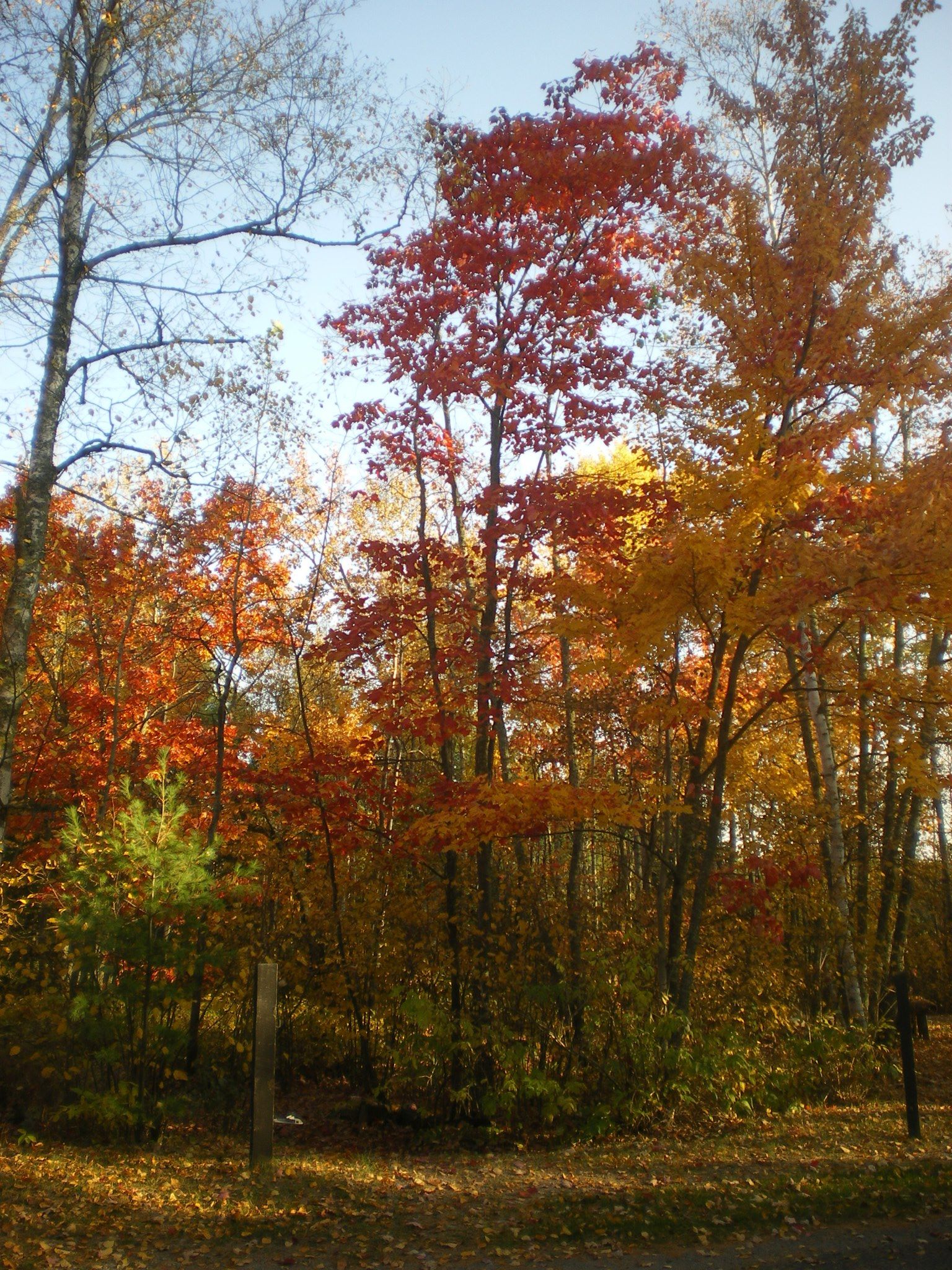
Early October in Hibbing, Minnesota. Photo via EarthSky Facebook friend Rosalbina Segura.

Enjoying EarthSky? Sign up for our free daily newsletter today!

Bottom line: Biologists discuss why leaves change color.

Read more from DePaux University


from EarthSky https://ift.tt/2SOeCDp

Scott Kuhn wrote on November 3, 2018: “Leaves popping with color this weekend in North Georgia.”

The 2019 lunar calendars are here! Order yours before they’re gone. Makes a great gift.

Throughout the spring and summer, the deep green color of chlorophyll, which helps plants absorb life-giving sunlight, hides any other colors present in the leaves of trees. The vivid yellows and oranges of fall leaves are there, but hidden. In the fall, trees break down the green pigments and nutrients stored in their leaves. The nutrients are shuttled into the tree’s roots for reuse in the spring. It’s then that the trees take on their autumn hues.

As leaves lose their chlorophyll, other pigments become visible to the human eye, according to Bryan A. Hanson, professor of chemistry and biochemistry at DePauw University who studies plant pigments. Some tree leaves turn mostly brown, indicating that all pigments are gone.

Autumn 2016 in the Colorado Rocky Mountains. Photo via Jessi Leigh Photography. Thanks Jessi!

Autumn in the Colorado Rocky Mountains. Photo via Jessi Leigh Photography.

Autumn leaves at Hurricane Mountain in the Adirondacks, New York, September, 2015. Photo by John Holmes. Thank you John!

Autumn leaves at Hurricane Mountain in the Adirondacks, New York. Photo via John Holmes.

Autumn leaf in about mid-September 2012 from our friend Colin Chatfield in Saskatoon, Saskatchewan.

Autumn leaf in about mid-September from our friend Colin Chatfield in Saskatoon, Saskatchewan.

Steven Arthur Sweet captured this image at Centennial Park in Toronto, Canada.

Burgundy and red colors are a different story. Dana A. Dudle is a DePauw professor of biology who researches red pigment in plant flowers, stems and leaves. Dudle said:

The red color is actively made in leaves by bright light and cold. The crisp, cold nights in the fall combine with bright, sunny days to spur production of red in leaves – especially in sugar maple and red maple trees. Burgundy leaves often result from a combination of red pigment and chlorophyll. Autumn seasons with a lot of sunny days and cold nights will have the brightest colors.

Image Credit: treehouse1977

Image via treehouse1977

In some cases, about half of a tree’s leaves are red/orange and the other half green. Dudle says that results from micro-environmental factors – such as only half the tree being exposed to sunlight or cold.

Hardwoods in the Midwest and on the East Coast are famous for good color selections. Some of the more reliably colorful trees, Hanson notes, are liquid amber trees (also called sweet gum) that turn a variety of colors on the same tree, and sometimes the same leaf. Ash tree leaves often turn a deep burgundy color. Ginkgo trees, although not native to North America, will feature an intense yellow, almost golden, color.

A lone red tree against bare branches. Photo via Daniel de Leeuw Photog.

A lone red tree against bare branches. Photo via Daniel de Leeuw Photog.

“Autumn picture from Sweden…” from our friend Jörgen Norrland

The colors are doing something for the plant, or they wouldn’t be there, said Hansen. But what is the colors’ purpose?

Scientists think that with some trees, pigments serve as a kind of sunscreen to filter out sunlight. Hanson said:

It’s an underappreciated fact that plants cannot take an infinite amount of sun. Some leaves, if they get too much sun, will get something equivalent of a sunburn. They get stressed out and die.

Image via Tosca Yemoh Zanon in London wishes

Image via Tosca Yemoh Zanon in London.

Another theory is that the color of a plant’s leaves is often related to the ability to warn away pests or attract insect pollinators. Hanson said:

In some cases, a plant and insect might have co-evolved. One of the more intriguing scientific theories is that the beautiful leaf colors we see today are indicative of a relationship between a plant and insects that developed millions of years ago. However, as the Earth’s climate changed over the years, the insects might have gone extinct, but the plant was able to survive for whatever reason.

Because plants evolve very slowly, we still see the colors. So leaf color is a fossil memory, something that existed for a reason millions of years ago but that serves no purpose now.

Image Credit: Ross Elliott

Early October in Hibbing, Minnesota. Photo via EarthSky Facebook friend Rosalbina Segura.

Enjoying EarthSky? Sign up for our free daily newsletter today!

Bottom line: Biologists discuss why leaves change color.

Read more from DePaux University


from EarthSky https://ift.tt/2SOeCDp

The US and Europe take a next step toward the moon

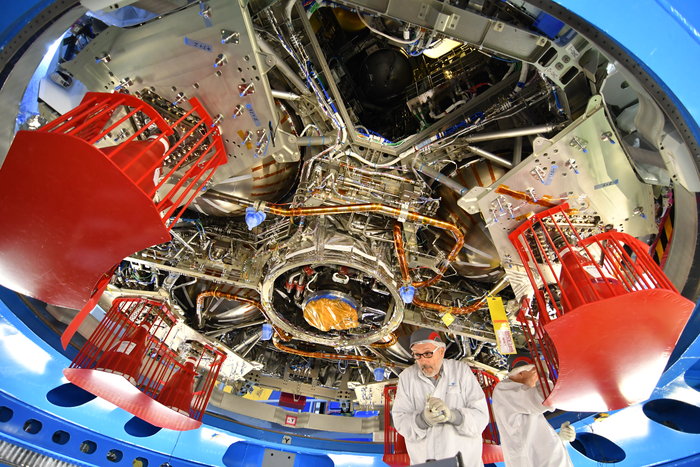
The European Service Module, viewed from below. Image via ESA/A. Conigli.

NASA’s Orion spacecraft – built to carry humans – is one step closer to its first mission to fly around the moon and back, the European Space Agency (ESA) said on October 30, 2018. It said its European Service Module – which will be used to power and propel the Orion spacecraft – will be shipped this week from Bremen, Germany, to the United States on an Antonov An-124 aircraft. It’ll depart in the early hours of November 5 and arrive at Kennedy Space Center in Florida on November 6. The ESM, designed in Italy and Germany, is a crucial European component of NASA’s ambitious Space Launch System or SLS; the Orion spacecraft part of SLS is designed to take astronauts back to the moon for the first time since the 1970s.

The European Service Module will hold fuel in large tanks, as well as water, oxygen and nitrogen for the astronauts, while radiators and heat exchangers will help keep the module at comfortable temperatures.

The 2019 lunar calendars are here! Order yours before they’re gone. Makes a great gift.

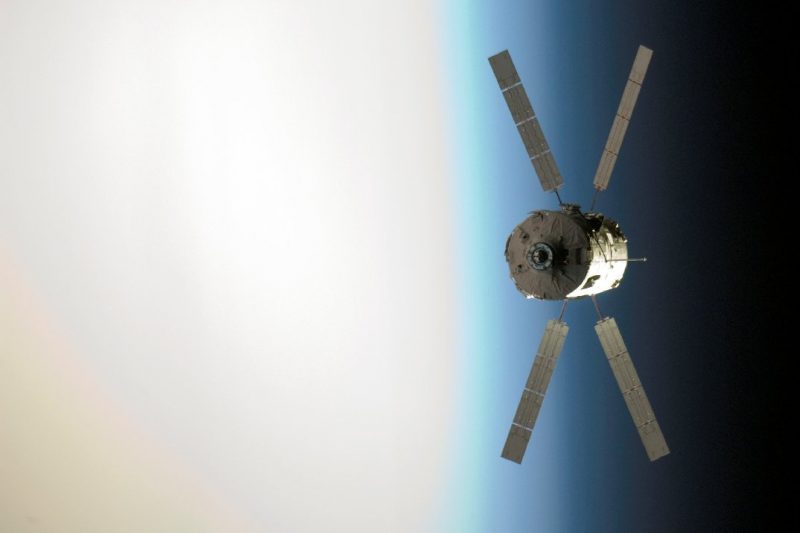
The module itself resembles ESA’s Automated Transfer Vehicle, which has been used to bring supplies to the International Space Station. The structure is the backbone of the entire vehicle, something like a car chassis. Three types of engines will help propel Orion during its excursions, and can turn the spacecraft in all directions. The module will be built by Airbus Defence and Space, and many other companies across Europe will also supply components.

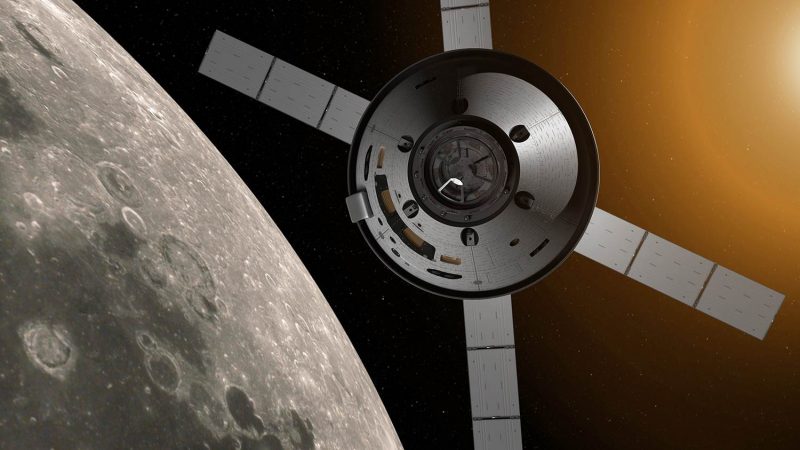
The European Service Module is an integral part of the Orion spacecraft, depicted here. Orion is designed to take astronauts back to the moon for the 1st time since the Apollo missions of the 1970s. Image via NASA.

This is the first time that a European-built system will serve as a critical element to power an American spacecraft; this is thanks largely to ESA’s existing Automated Transfer Vehicle program, mentioned above.

So what happens next?

At Kennedy Space Center, the European Service Module will be connected to the Orion crew module and its adapter in preparation for Exploration Mission-1. This mission is planned as an initial test flight without astronauts that will travel farther into space than any human-rated spacecraft has ever ventured before. This mission is expected to launch sometime in 2020.

A second European Service Module, similar to the first, is also now being developed. This one will be able to take a human crew on a trip around the moon. All of this activity is leading up to launches with components of the Gateway – a planned human-tended outpost in lunar orbit, designed to be used for both human and robotic exploration of the moon.

Orion is similar in design to ESA’s Automated Transfer Vehicle, which takes supplies to the International Space Station. Image via ESA/NASA.

ESM also recently completed its final integration and testing at the Airbus integration hall in Bremen.

Orion is the crewed capsule part of NASA’s Space Launch System, which, when completed, will be the most powerful rocket ever built. It will be able to take astronauts back to the moon, and more advanced versions of SLS will be capable of taking astronauts deeper into space, including to Mars. As outlined on the mission website:

After the first flight, the next step is to start sending people on bold missions to the moon and beyond. As SLS evolves over future missions to unprecedented accommodation of payload mass and volume and unrivaled performance, the rocket will allow NASA to send missions to deep space and reach distant destinations faster than ever before. On its second mission carrying Orion and astronauts, Exploration Mission-2, SLS will send Orion and its crew farther than people have traveled before around 250,000 miles from Earth, 10,000 miles beyond the moon.

SLS and Orion are America’s space vehicles and the foundation for missions carrying explorers to deep space. This new era of discovery requires all of humanity, including international and commercial partners, to help make these ventures possible and sustainable. Partners can help provide routine delivery of supplies and equipment needed to live and work on the moon and in deep space. SLS and Orion are planned to fly once or twice a year and will focus on dependable, safe flights for humans and large cargo.

Once operational, SLS will be the most powerful rocket ever built, and will be able to take a crewed Orion to the moon and beyond. Image via NASA.

Bottom line: The delivery of the European Service Module is another step toward the first launch of NASA’s Orion spacecraft – part of the Space Launch System – which is designed to take astronauts back to the moon for the first time in several decades. Human missions back to the moon are still some ways off, but the first launch of Orion will be a significant step closer.

Via ESA


from EarthSky https://ift.tt/2zrt6jJ

The European Service Module, viewed from below. Image via ESA/A. Conigli.

NASA’s Orion spacecraft – built to carry humans – is one step closer to its first mission to fly around the moon and back, the European Space Agency (ESA) said on October 30, 2018. It said its European Service Module – which will be used to power and propel the Orion spacecraft – will be shipped this week from Bremen, Germany, to the United States on an Antonov An-124 aircraft. It’ll depart in the early hours of November 5 and arrive at Kennedy Space Center in Florida on November 6. The ESM, designed in Italy and Germany, is a crucial European component of NASA’s ambitious Space Launch System or SLS; the Orion spacecraft part of SLS is designed to take astronauts back to the moon for the first time since the 1970s.

The European Service Module will hold fuel in large tanks, as well as water, oxygen and nitrogen for the astronauts, while radiators and heat exchangers will help keep the module at comfortable temperatures.

The 2019 lunar calendars are here! Order yours before they’re gone. Makes a great gift.

The module itself resembles ESA’s Automated Transfer Vehicle, which has been used to bring supplies to the International Space Station. The structure is the backbone of the entire vehicle, something like a car chassis. Three types of engines will help propel Orion during its excursions, and can turn the spacecraft in all directions. The module will be built by Airbus Defence and Space, and many other companies across Europe will also supply components.

The European Service Module is an integral part of the Orion spacecraft, depicted here. Orion is designed to take astronauts back to the moon for the 1st time since the Apollo missions of the 1970s. Image via NASA.

This is the first time that a European-built system will serve as a critical element to power an American spacecraft; this is thanks largely to ESA’s existing Automated Transfer Vehicle program, mentioned above.

So what happens next?

At Kennedy Space Center, the European Service Module will be connected to the Orion crew module and its adapter in preparation for Exploration Mission-1. This mission is planned as an initial test flight without astronauts that will travel farther into space than any human-rated spacecraft has ever ventured before. This mission is expected to launch sometime in 2020.

A second European Service Module, similar to the first, is also now being developed. This one will be able to take a human crew on a trip around the moon. All of this activity is leading up to launches with components of the Gateway – a planned human-tended outpost in lunar orbit, designed to be used for both human and robotic exploration of the moon.

Orion is similar in design to ESA’s Automated Transfer Vehicle, which takes supplies to the International Space Station. Image via ESA/NASA.

ESM also recently completed its final integration and testing at the Airbus integration hall in Bremen.

Orion is the crewed capsule part of NASA’s Space Launch System, which, when completed, will be the most powerful rocket ever built. It will be able to take astronauts back to the moon, and more advanced versions of SLS will be capable of taking astronauts deeper into space, including to Mars. As outlined on the mission website:

After the first flight, the next step is to start sending people on bold missions to the moon and beyond. As SLS evolves over future missions to unprecedented accommodation of payload mass and volume and unrivaled performance, the rocket will allow NASA to send missions to deep space and reach distant destinations faster than ever before. On its second mission carrying Orion and astronauts, Exploration Mission-2, SLS will send Orion and its crew farther than people have traveled before around 250,000 miles from Earth, 10,000 miles beyond the moon.

SLS and Orion are America’s space vehicles and the foundation for missions carrying explorers to deep space. This new era of discovery requires all of humanity, including international and commercial partners, to help make these ventures possible and sustainable. Partners can help provide routine delivery of supplies and equipment needed to live and work on the moon and in deep space. SLS and Orion are planned to fly once or twice a year and will focus on dependable, safe flights for humans and large cargo.

Once operational, SLS will be the most powerful rocket ever built, and will be able to take a crewed Orion to the moon and beyond. Image via NASA.

Bottom line: The delivery of the European Service Module is another step toward the first launch of NASA’s Orion spacecraft – part of the Space Launch System – which is designed to take astronauts back to the moon for the first time in several decades. Human missions back to the moon are still some ways off, but the first launch of Orion will be a significant step closer.

Via ESA


from EarthSky https://ift.tt/2zrt6jJ

What is a fogbow?

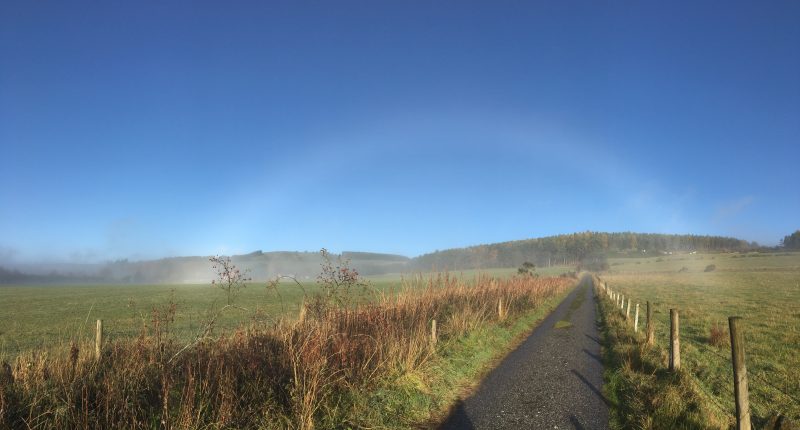
Edith Smith in Aberdeenshire, Scotland, captured this fogbow on November 1, 2018. She wrote: “The camera spotted it before I did with eye, as I was too engrossed in foggy conditions.”

Fogbows – sometimes called white rainbows, cloudbows or ghost rainbows – are made much as rainbows are, from the same configuration of sunlight and moisture. Rainbows happen when the air is filled with raindrops, and you always see a rainbow in the direction opposite the sun. Fogbows are much the same, always opposite the sun, but fogbows are caused by the small droplets inside a fog or cloud rather than larger raindrops.

Look for fogbows in a thin fog, when the sun is bright. You might see one when the sun breaks through a fog. Or watch for fogbows over the ocean.

Because the water droplets in fog are so small, fogbows have only weak colors or are colorless.

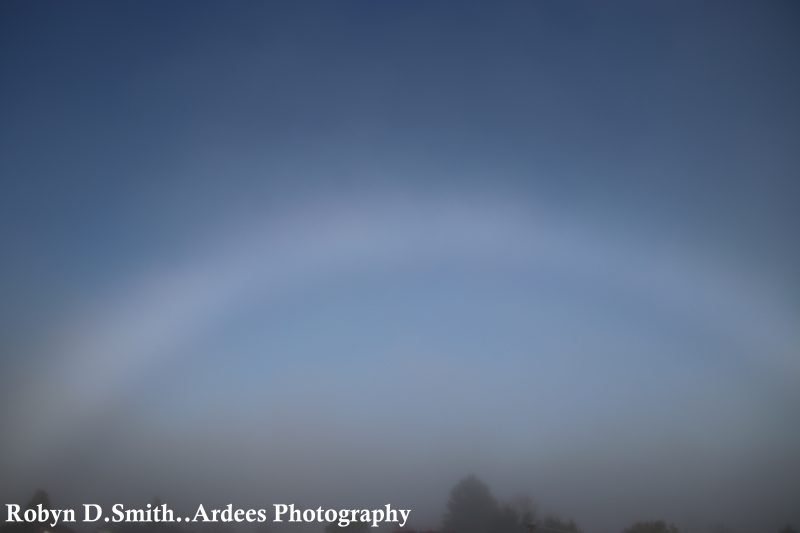
Wonderful fogbow caught by Robyn Smith in New Zealand on the morning of September 19, 2017 … “opposite the foggy sunrise.”

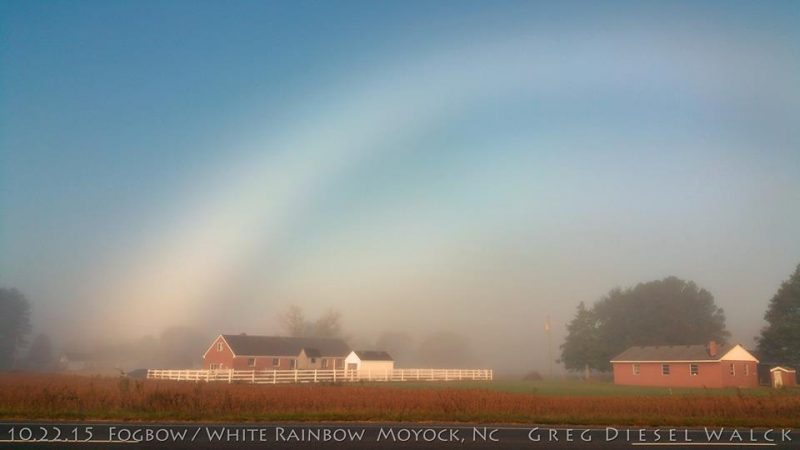
GregDiesel Landscape Photography wrote in October, 2015:

GregDiesel Landscape Photography wrote in October 2015: “Saw my first fogbow / white rainbow. Photo taken with cell phone. Moyock, North Carolina.”

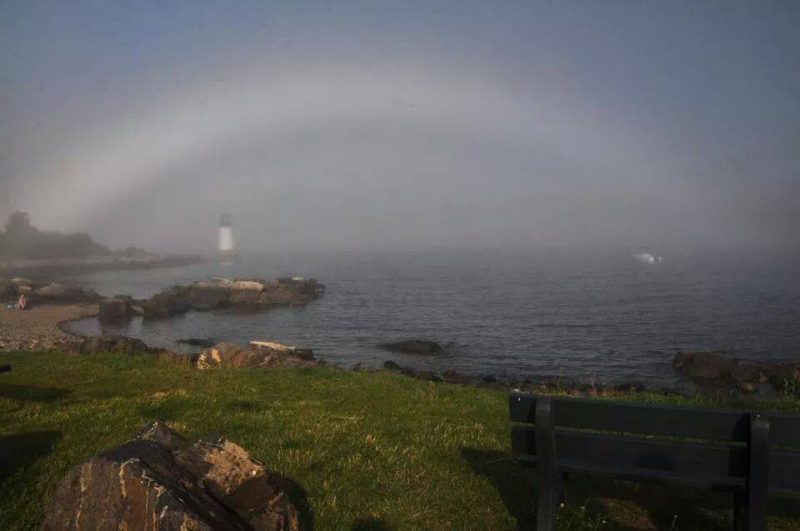
Katherine Keyes Millet captured this fogbow in July 2014 at Winter Island park in Salem, Massachusetts.

Katherine Keyes Millet captured this fogbow in July 2014 at Winter Island Park in Salem, Massachusetts.

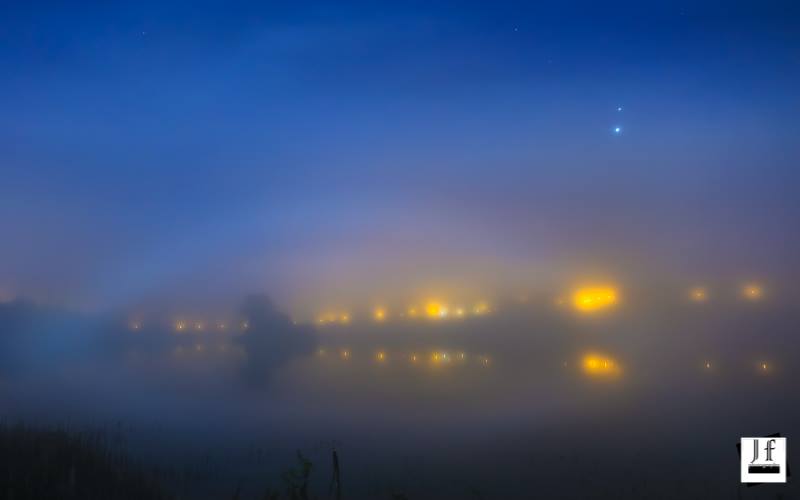
Venus and Jupiter above a fogbow in Blacklough, Dungannon, Ireland. Mars is up there, too, but tough to see. John Fagan captured them all in October, 2015.

Venus and Jupiter above a fogbow in Blacklough, Dungannon, Ireland. Mars is up there, too, but tough to see. John Fagan captured them all in October 2015.

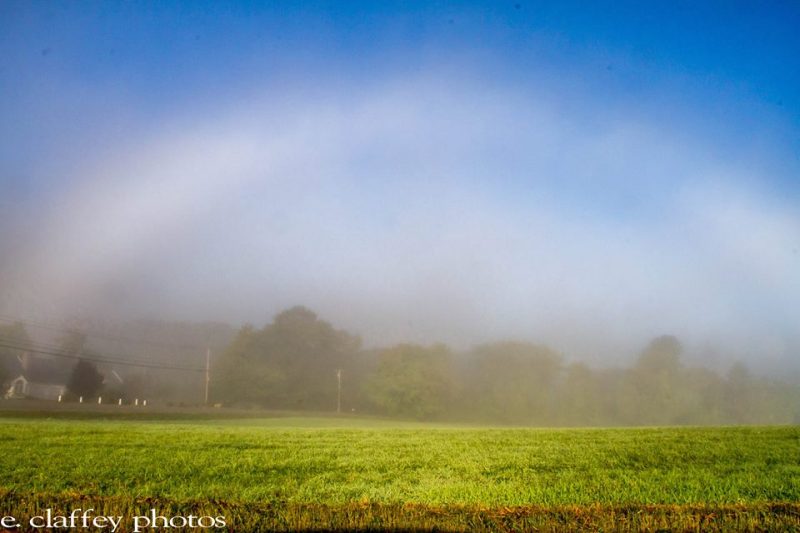
Eileen Claffey in Brookline, Massachusetts captured this fogbow over a field in September, 2014.

Eileen Claffey in Brookline, Massachusetts, captured this fogbow over a field in September 2014.

Les Cowley of the great website Atmospheric Optics says:

Look away from the sun and at an angle of 35-40 degrees from your shadow which marks the direction of the antisolar point. Some fogbows have very low contrast so look for small brightenings in the misty background. Once caught, they are unmistakable.

The sun must be less than 30-40 degrees high unless you are on a hill or high up on a ship where the mist and fogbow can be viewed from above.

Fogbows are huge, almost as large as a rainbow and much, much broader.

Look here for Les Cowley’s explanation of how fogbows form.

fogbow-August-24-Salamapaja

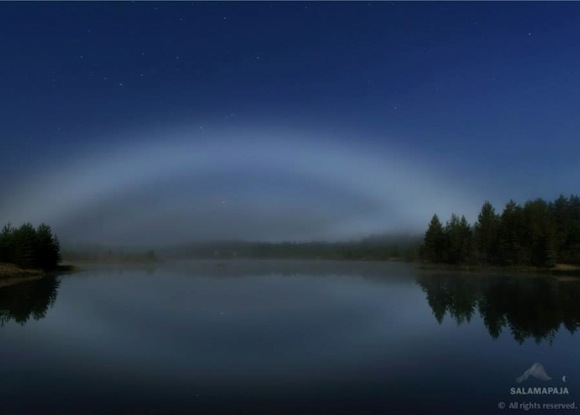
Thomas Kast in Finland captured this fogbow in 2013. He wrote: “In this rather cold August night (+8C [46F]) there was patchy fog, especially in open fields. This lake remained clear for a long time. At one point I saw this white bow with moon in waning gibbous phase behind me.”

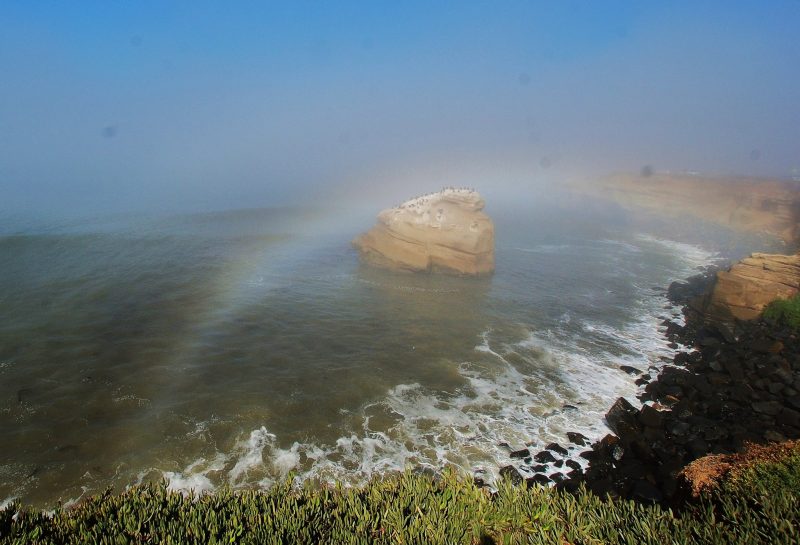
Jim Grant caught this fogbow over Sunset Cliffs in San Diego. He wrote:

Jim Grant caught this fogbow over Sunset Cliffs in San Diego. He wrote: “The skies were sunny and clear, and then the fog rolled in, and with it this beautiful fogbow.”

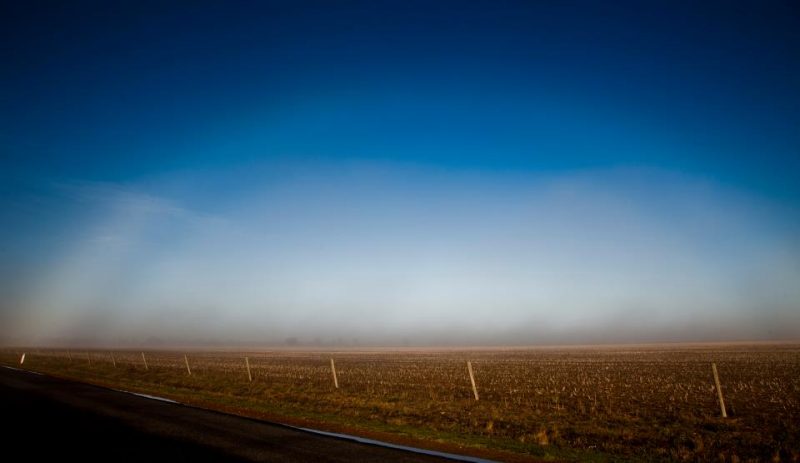
Lynton Brown of Australia captured this fogbow over a barren field, in autumn 2012.

Lynton Brown of Australia captured this fogbow over a barren field in the autumn of 2012.

Bottom line: Fogbows are made by much the same process as rainbows, but with the small water droplets inside a fog instead of larger raindrops. Because the water droplets in fog are so small, fogbows have only weak colors or are colorless.

The 2019 lunar calendars are here! Order yours before they’re gone. Makes a great gift.


from EarthSky https://ift.tt/2RuWZ9W

Edith Smith in Aberdeenshire, Scotland, captured this fogbow on November 1, 2018. She wrote: “The camera spotted it before I did with eye, as I was too engrossed in foggy conditions.”

Fogbows – sometimes called white rainbows, cloudbows or ghost rainbows – are made much as rainbows are, from the same configuration of sunlight and moisture. Rainbows happen when the air is filled with raindrops, and you always see a rainbow in the direction opposite the sun. Fogbows are much the same, always opposite the sun, but fogbows are caused by the small droplets inside a fog or cloud rather than larger raindrops.

Look for fogbows in a thin fog, when the sun is bright. You might see one when the sun breaks through a fog. Or watch for fogbows over the ocean.

Because the water droplets in fog are so small, fogbows have only weak colors or are colorless.

Wonderful fogbow caught by Robyn Smith in New Zealand on the morning of September 19, 2017 … “opposite the foggy sunrise.”

GregDiesel Landscape Photography wrote in October, 2015:

GregDiesel Landscape Photography wrote in October 2015: “Saw my first fogbow / white rainbow. Photo taken with cell phone. Moyock, North Carolina.”

Katherine Keyes Millet captured this fogbow in July 2014 at Winter Island park in Salem, Massachusetts.

Katherine Keyes Millet captured this fogbow in July 2014 at Winter Island Park in Salem, Massachusetts.

Venus and Jupiter above a fogbow in Blacklough, Dungannon, Ireland. Mars is up there, too, but tough to see. John Fagan captured them all in October, 2015.

Venus and Jupiter above a fogbow in Blacklough, Dungannon, Ireland. Mars is up there, too, but tough to see. John Fagan captured them all in October 2015.

Eileen Claffey in Brookline, Massachusetts captured this fogbow over a field in September, 2014.

Eileen Claffey in Brookline, Massachusetts, captured this fogbow over a field in September 2014.

Les Cowley of the great website Atmospheric Optics says:

Look away from the sun and at an angle of 35-40 degrees from your shadow which marks the direction of the antisolar point. Some fogbows have very low contrast so look for small brightenings in the misty background. Once caught, they are unmistakable.

The sun must be less than 30-40 degrees high unless you are on a hill or high up on a ship where the mist and fogbow can be viewed from above.

Fogbows are huge, almost as large as a rainbow and much, much broader.

Look here for Les Cowley’s explanation of how fogbows form.

fogbow-August-24-Salamapaja

Thomas Kast in Finland captured this fogbow in 2013. He wrote: “In this rather cold August night (+8C [46F]) there was patchy fog, especially in open fields. This lake remained clear for a long time. At one point I saw this white bow with moon in waning gibbous phase behind me.”

Jim Grant caught this fogbow over Sunset Cliffs in San Diego. He wrote:

Jim Grant caught this fogbow over Sunset Cliffs in San Diego. He wrote: “The skies were sunny and clear, and then the fog rolled in, and with it this beautiful fogbow.”

Lynton Brown of Australia captured this fogbow over a barren field, in autumn 2012.

Lynton Brown of Australia captured this fogbow over a barren field in the autumn of 2012.

Bottom line: Fogbows are made by much the same process as rainbows, but with the small water droplets inside a fog instead of larger raindrops. Because the water droplets in fog are so small, fogbows have only weak colors or are colorless.

The 2019 lunar calendars are here! Order yours before they’re gone. Makes a great gift.


from EarthSky https://ift.tt/2RuWZ9W

Moon is waning, but Venus is waxing!


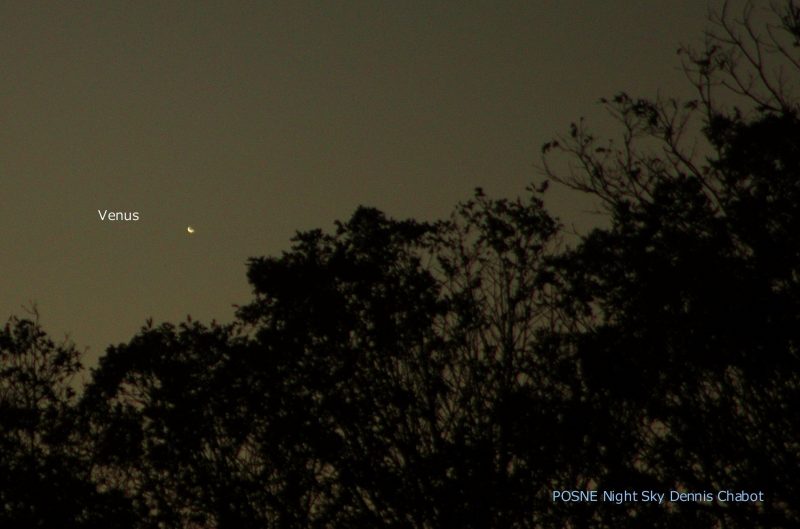
Dennis Chabot of POSNE NightSky caught Venus in the east before dawn on the morning of November 4, 2018. Telescopically, you can see that Venus is a crescent. That’s because it passed between us and the sun on October 26 … and its fully illuminated side, or day side, is still facing mostly away from us.

Read more: Watch for the waning moon and Venus


from EarthSky https://ift.tt/2Qh41is


Dennis Chabot of POSNE NightSky caught Venus in the east before dawn on the morning of November 4, 2018. Telescopically, you can see that Venus is a crescent. That’s because it passed between us and the sun on October 26 … and its fully illuminated side, or day side, is still facing mostly away from us.

Read more: Watch for the waning moon and Venus


from EarthSky https://ift.tt/2Qh41is

adds 2