aads

2018 SkS Weekly Climate Change & Global Warming Digest #44

Story of the Week... Toon of the Week... Quote of the Week... SkS in the News... SkS Spotlights... Coming Soon on SkS... Climate Feedback Reviews... SkS Week in Review... Poster of the Week...

Story of the Week...

Startling new research finds large buildup of heat in the oceans, suggesting a faster rate of global warming
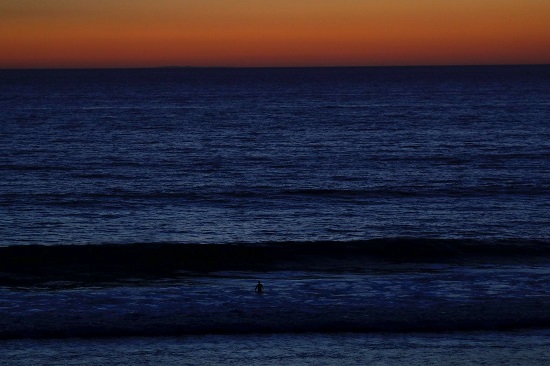
Moonlight Beach in Encinitas, CA

A post-sunset swimmer at Moonlight Beach in Encinitas, Calif., this month. (Mike Blake/Reuters) 

The world’s oceans have been soaking up far more excess heat in recent decades than scientists realized, suggesting that Earth could be set to warm even faster than predicted in the years ahead, according to new research published Wednesday.

Over the past quarter-century, Earth’s oceans have retained 60 percent more heat each year than scientists previously had thought, said Laure Resplandy, a geoscientist at Princeton University who led the startling study published Wednesday in the journal Nature. The difference represents an enormous amount of additional energy, originating from the sun and trapped by Earth’s atmosphere — the yearly amount representing more than eight times the world’s annual energy consumption.

In the scientific realm, the new findings help resolve long-running doubts about the rate of the warming of the oceans before 2007, when reliable measurements from devices called “Argo floats” were put to use worldwide. Before that, differing types of temperature records — and an overall lack of them — contributed to murkiness about how quickly the oceans were heating up.

The higher-than-expected amount of heat in the oceans means more heat is being retained within Earth’s climate system each year, rather than escaping into space. In essence, more heat in the oceans signals that global warming is more advanced than scientists thought. 

Startling new research finds large buildup of heat in the oceans, suggesting a faster rate of global warming by Chris Moody & Brady Dennis, Energy & Environment, Washington Post, Oct 31, 2018 


Toon of the Week...
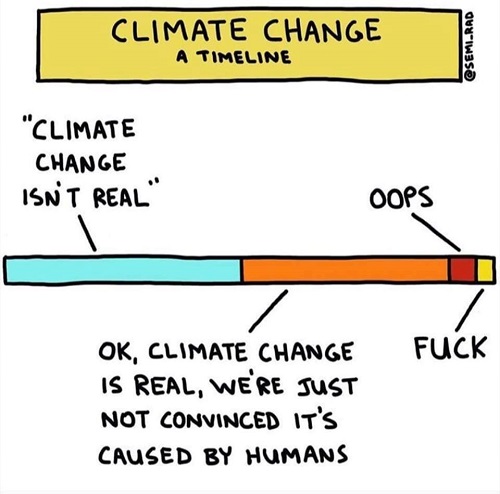
2918 Toon 44 


SkS in the News...

In his Op-ed, In praise of 'real' science, published in the Times Colonist (Victoria, BC), Geof Johnson wrote:

In the online journal Skeptical Science, John Cook, a research assistant professor at the Centre for Climate Change Communication at George Mason University, writes: “The assertion that humans are, one way or another, at the root of global warming is the position of the academies of science from 80 countries.” 


Quote of the Week

 “We thought that we got away with not a lot of warming in both the ocean and the atmosphere for the amount of CO2 that we emitted,” said Resplandy, who published the work with experts from the Scripps Institution of Oceanography and several other institutions in the United States, China, France and Germany. “But we were wrong. The planet warmed more than we thought. It was hidden from us just because we didn’t sample it right. But it was there. It was in the ocean already.”

Startling new research finds large buildup of heat in the oceans, suggesting a faster rate of global warming by Chris Moody & Brady Dennis, Energy & Environment, Washington Post, Oct 31, 2018  


SkS Spotlights...

Climate Action 100+

Climate Action 100+ is a five-year initiative led by investors to engage systemically important greenhouse gas emitters and other companies across the global economy that have significant opportunities to drive the clean energy transition and help achieve the goals of the Paris Agreement. Investors are calling on companies to improve governance on climate change, curb emissions and strengthen climate-related financial disclosures.

Investor representatives from AustralianSuper, California Public Employees’ Retirement System (CalPERS), HSBC Global Asset Management, Ircantec and Manulife Asset Management have helped to lead the design and development of Climate Action 100+. The initiative is coordinated by five partner organisations: Asia Investor Group on Climate Change (AIGCC); Ceres; Investor Group on Climate Change (IGCC); Institutional Investors Group on Climate Change (IIGCC); and Principles for Responsible Investment (PRI). It builds on the successful investor engagement programmes coordinated by the partner organisations over a number of years. 


Coming Soon on SkS...

  • How (not) to talk about climate change (Climate Adam)
  • Climate sensitivity uncertainties leading to more concern (Greenman)
  • Climate change science comeback strategies: 'In it for the money' (Karin Kirk)
  • What the US midterm election means for climate change (Dana)
  • New research this week (Ari)
  • 2018 SkS Weekly Climate Change & Global Warming News Roundup #45 (John Hartz)
  • 2018 SkS Weekly Climate Change & Global Warming Digest #45 (John Hartz)

Climate Feedback Reviews

Washington Post accurately describes ocean warming study with potential implications for future carbon budget
Climate Feedback 44

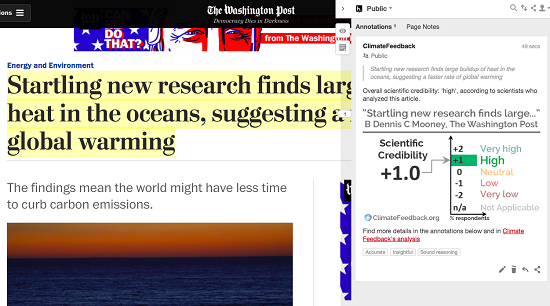
Climate Feedback asked a team of scientists to analyze the article, Startling new research finds large buildup of heat in the oceans, suggesting a faster rate of global warming by Chris Moody & Brady Dennis, Energy & Environment, Washington Post, Oct 31, 2018

Three scientists analyzed the article and estimate its overall scientific credibility to be 'high'.

A majority of reviewers tagged the article as: AccurateInsightfulSound reasoning.

Review Summary 

This article in The Washington Post covers a new study estimating the amount of heat energy that has accumulated in the ocean in recent decades. Such estimates have been limited because the most complete network of ocean temperatures did not exist until the 2000s. The new study uses an indirect method, instead relying on changes in atmospheric gases caused by warmer oceans. This method leads to a larger estimate of the ocean warming that resulted from human activities.

Scientists who reviewed the article found that it did a good job of describing the study, while noting that the study’s conclusions (and implications) require additional investigation. In particular, discussion among scientists has focused on clarifying what impact this study’s results have on our understanding of climate sensitivity (how much warming occurs from a given amount of greenhouse gas emissions) and, consequently, how much the world can emit before reaching 2 °C warming. 

Washington Post accurately describes ocean warming study with potential implications for future carbon budget, Edited by Scott Johnson, Climate Feedback, Nov 3, 2018


SkS Week in Review... 


Poster of the Week...

2018 Poster 44


from Skeptical Science https://ift.tt/2zqrG98

Story of the Week... Toon of the Week... Quote of the Week... SkS in the News... SkS Spotlights... Coming Soon on SkS... Climate Feedback Reviews... SkS Week in Review... Poster of the Week...

Story of the Week...

Startling new research finds large buildup of heat in the oceans, suggesting a faster rate of global warming

Moonlight Beach in Encinitas, CA

A post-sunset swimmer at Moonlight Beach in Encinitas, Calif., this month. (Mike Blake/Reuters) 

The world’s oceans have been soaking up far more excess heat in recent decades than scientists realized, suggesting that Earth could be set to warm even faster than predicted in the years ahead, according to new research published Wednesday.

Over the past quarter-century, Earth’s oceans have retained 60 percent more heat each year than scientists previously had thought, said Laure Resplandy, a geoscientist at Princeton University who led the startling study published Wednesday in the journal Nature. The difference represents an enormous amount of additional energy, originating from the sun and trapped by Earth’s atmosphere — the yearly amount representing more than eight times the world’s annual energy consumption.

In the scientific realm, the new findings help resolve long-running doubts about the rate of the warming of the oceans before 2007, when reliable measurements from devices called “Argo floats” were put to use worldwide. Before that, differing types of temperature records — and an overall lack of them — contributed to murkiness about how quickly the oceans were heating up.

The higher-than-expected amount of heat in the oceans means more heat is being retained within Earth’s climate system each year, rather than escaping into space. In essence, more heat in the oceans signals that global warming is more advanced than scientists thought. 

Startling new research finds large buildup of heat in the oceans, suggesting a faster rate of global warming by Chris Moody & Brady Dennis, Energy & Environment, Washington Post, Oct 31, 2018 


Toon of the Week...

2918 Toon 44 


SkS in the News...

In his Op-ed, In praise of 'real' science, published in the Times Colonist (Victoria, BC), Geof Johnson wrote:

In the online journal Skeptical Science, John Cook, a research assistant professor at the Centre for Climate Change Communication at George Mason University, writes: “The assertion that humans are, one way or another, at the root of global warming is the position of the academies of science from 80 countries.” 


Quote of the Week

 “We thought that we got away with not a lot of warming in both the ocean and the atmosphere for the amount of CO2 that we emitted,” said Resplandy, who published the work with experts from the Scripps Institution of Oceanography and several other institutions in the United States, China, France and Germany. “But we were wrong. The planet warmed more than we thought. It was hidden from us just because we didn’t sample it right. But it was there. It was in the ocean already.”

Startling new research finds large buildup of heat in the oceans, suggesting a faster rate of global warming by Chris Moody & Brady Dennis, Energy & Environment, Washington Post, Oct 31, 2018  


SkS Spotlights...

Climate Action 100+

Climate Action 100+ is a five-year initiative led by investors to engage systemically important greenhouse gas emitters and other companies across the global economy that have significant opportunities to drive the clean energy transition and help achieve the goals of the Paris Agreement. Investors are calling on companies to improve governance on climate change, curb emissions and strengthen climate-related financial disclosures.

Investor representatives from AustralianSuper, California Public Employees’ Retirement System (CalPERS), HSBC Global Asset Management, Ircantec and Manulife Asset Management have helped to lead the design and development of Climate Action 100+. The initiative is coordinated by five partner organisations: Asia Investor Group on Climate Change (AIGCC); Ceres; Investor Group on Climate Change (IGCC); Institutional Investors Group on Climate Change (IIGCC); and Principles for Responsible Investment (PRI). It builds on the successful investor engagement programmes coordinated by the partner organisations over a number of years. 


Coming Soon on SkS...

  • How (not) to talk about climate change (Climate Adam)
  • Climate sensitivity uncertainties leading to more concern (Greenman)
  • Climate change science comeback strategies: 'In it for the money' (Karin Kirk)
  • What the US midterm election means for climate change (Dana)
  • New research this week (Ari)
  • 2018 SkS Weekly Climate Change & Global Warming News Roundup #45 (John Hartz)
  • 2018 SkS Weekly Climate Change & Global Warming Digest #45 (John Hartz)

Climate Feedback Reviews

Washington Post accurately describes ocean warming study with potential implications for future carbon budget

Climate Feedback 44

Climate Feedback asked a team of scientists to analyze the article, Startling new research finds large buildup of heat in the oceans, suggesting a faster rate of global warming by Chris Moody & Brady Dennis, Energy & Environment, Washington Post, Oct 31, 2018

Three scientists analyzed the article and estimate its overall scientific credibility to be 'high'.

A majority of reviewers tagged the article as: AccurateInsightfulSound reasoning.

Review Summary 

This article in The Washington Post covers a new study estimating the amount of heat energy that has accumulated in the ocean in recent decades. Such estimates have been limited because the most complete network of ocean temperatures did not exist until the 2000s. The new study uses an indirect method, instead relying on changes in atmospheric gases caused by warmer oceans. This method leads to a larger estimate of the ocean warming that resulted from human activities.

Scientists who reviewed the article found that it did a good job of describing the study, while noting that the study’s conclusions (and implications) require additional investigation. In particular, discussion among scientists has focused on clarifying what impact this study’s results have on our understanding of climate sensitivity (how much warming occurs from a given amount of greenhouse gas emissions) and, consequently, how much the world can emit before reaching 2 °C warming. 

Washington Post accurately describes ocean warming study with potential implications for future carbon budget, Edited by Scott Johnson, Climate Feedback, Nov 3, 2018


SkS Week in Review... 


Poster of the Week...

2018 Poster 44


from Skeptical Science https://ift.tt/2zqrG98

Timelapse shows 25 years of Supernova 1987A

Image via Yvette Cendes/University of Toronto/Leiden Observatory.

One of the major astronomical events of the last century was Supernova 1987A. It was the closest observed supernova since Kepler’s Supernova, visible in 1604, and the first supernova visible in earthly skies since the invention of the telescope. It first appeared in Earth’s night skies – visible only from the Southern Hemisphere – on February 24, 1987. It stayed bright enough to see with the eye for many months. And then it faded, but astronomers with telescopes continued to follow it. Since then, Supernova 1987A has become one of the most studied objects in the history of astronomy. Last week, astronomers at the Dunlop Institute of the University of Toronto released the new timelapse shown at the top of this post, showing the supernova as it evolved over 25 years.

The supernova was the cataclysmic death of a blue supergiant star. It was located in the Large Magellanic Cloud, a small satellite galaxy of the Milky Way, at a distance of 168,000 light-years (and thus, of course, the supernova actually took place that many years ago). The Dunop Institute said of the new timelapse:

Yvette Cendes, a graduate student with the University of Toronto and the Leiden Observatory, has created a timelapse showing the aftermath of the supernova over a 25-year period, from 1992 to 2017. The images show the shockwave expanding outward and slamming into debris that ringed the original star before its demise.

In an accompanying paper, published in the Astrophysical Journal on October 31, Cendes and her colleagues add to the evidence that the expanding remnant is shaped – not like a ring like those of Saturn’s – but like a donut, a form known as a torus.

They also confirm that the shockwave has now picked up some one thousand kilometers per second [about 600 miles per second] in speed. The acceleration has occurred because the expanding torus has punched through the ring of debris.

The time-lapse was created from radio observations made with the CSIRO Australia Compact Telescope Array at the Paul Wild Observatory, New South Wales, Australia.

Read more via University of Toronto/Dunlap Institute

The 2019 lunar calendars are here! Order yours before they’re gone. Makes a great gift.

Bottom line: A new timelapse from Dunlop Institute at the University of Toronto shows Supernova 1987A evolving in the depths of space over 25 years.


from EarthSky https://ift.tt/2F2PE0f

Image via Yvette Cendes/University of Toronto/Leiden Observatory.

One of the major astronomical events of the last century was Supernova 1987A. It was the closest observed supernova since Kepler’s Supernova, visible in 1604, and the first supernova visible in earthly skies since the invention of the telescope. It first appeared in Earth’s night skies – visible only from the Southern Hemisphere – on February 24, 1987. It stayed bright enough to see with the eye for many months. And then it faded, but astronomers with telescopes continued to follow it. Since then, Supernova 1987A has become one of the most studied objects in the history of astronomy. Last week, astronomers at the Dunlop Institute of the University of Toronto released the new timelapse shown at the top of this post, showing the supernova as it evolved over 25 years.

The supernova was the cataclysmic death of a blue supergiant star. It was located in the Large Magellanic Cloud, a small satellite galaxy of the Milky Way, at a distance of 168,000 light-years (and thus, of course, the supernova actually took place that many years ago). The Dunop Institute said of the new timelapse:

Yvette Cendes, a graduate student with the University of Toronto and the Leiden Observatory, has created a timelapse showing the aftermath of the supernova over a 25-year period, from 1992 to 2017. The images show the shockwave expanding outward and slamming into debris that ringed the original star before its demise.

In an accompanying paper, published in the Astrophysical Journal on October 31, Cendes and her colleagues add to the evidence that the expanding remnant is shaped – not like a ring like those of Saturn’s – but like a donut, a form known as a torus.

They also confirm that the shockwave has now picked up some one thousand kilometers per second [about 600 miles per second] in speed. The acceleration has occurred because the expanding torus has punched through the ring of debris.

The time-lapse was created from radio observations made with the CSIRO Australia Compact Telescope Array at the Paul Wild Observatory, New South Wales, Australia.

Read more via University of Toronto/Dunlap Institute

The 2019 lunar calendars are here! Order yours before they’re gone. Makes a great gift.

Bottom line: A new timelapse from Dunlop Institute at the University of Toronto shows Supernova 1987A evolving in the depths of space over 25 years.


from EarthSky https://ift.tt/2F2PE0f

New study on ocean warming: 5 questions answered

The ocean absorbs about 90 percent of the excess heat produced as climate change warms the earth. Image via Image Catalog/Flickr.

By Scott Denning, Colorado State University

Editor’s note: A new study published October 31, 2018, by scientists in the United States, China, France and Germany estimates that the world’s oceans have absorbed much more excess heat from human-induced climate change than researchers had estimated up to now. This finding suggests that global warming may be even more advanced than previously thought. Atmospheric scientist Scott Denning explains how the new report arrived at this result and what it implies about the pace of climate change.

How do scientists measure ocean temperature and estimate how climate change is affecting it?

They use thermometers attached to thousands of bobbing robots floating at controlled depths throughout the oceans. This system of “Argo floats” was launched in the year 2000 and there are now about 4,000 of the floating instruments.

About once every 10 days, they cycle from the surface to a depth of 6,500 feet (1,981 meters), then bob back up to the surface to transmit their data by satellite. Each year this network collects about 100,000 measurements of the three-dimensional temperature distribution of the oceans.

The Argo measurements show that about 93 percent of the global warming caused by burning carbon for fuel is felt as changes in ocean temperature, while only a very small amount of this warming occurs in the air.

Normal cycle of an Argo float collecting ocean temperature and salinity data. Image via International Argo Program.

How dramatically do the findings in this study differ from levels of ocean warming that the Intergovernmental Panel on Climate Change has reported?

The new study finds that since 1991, the oceans have warmed about 60 percent faster than the average rate of warming estimated by studies summarized by the IPCC, which are based on data from Argo floats. This is a big deal.

Most of the difference comes from the earliest part of this period, before there were enough Argo floats in the oceans to properly represent the three-dimensional distribution of global water temperatures. The new data are complete all the way back to 1991, but the Argo data were really sparse until the mid-2000s.

The implication of faster ocean warming is that the effect of carbon dioxide on global warming is greater than we’d thought. We already knew that adding CO2 to the air was warming the world very rapidly. And the IPCC just warned in a special report that limiting global warming to 2.7 degrees Fahrenheit (1.5 degrees Celsius) above pre-industrial levels – a target that would avert many extreme impacts on humans and ecosystems – would require quickly reducing and eventually eliminating coal, oil and gas from the world energy supply. This study doesn’t change any of that, but it means we will need to eliminate fossil fuels even faster.

To limit global warming to 1.5 degrees Celsius [about 2.7 degrees F], the IPCC warns that greenhouse gas emissions would need to be drastically reduced over approximately the next decade. Image via IPCC.

What did these researchers do differently to arrive at a higher number?

They have measured tiny changes since 1991 in the concentrations of a few gases in the air – oxygen, nitrogen and carbon dioxide – with incredibly high precision. This is really hard to do, because the changes are extremely small compared to the large amounts already in the air.

Some of these gases from the air dissolve into the oceans. The water’s temperature dictates how much it can absorb. As water warms, the amount of a gas that can dissolve in it decreases – that’s why a soda or beer left open on the kitchen table goes flat. That same temperature dependence allowed the scientists to calculate total changes in global ocean heat content from 1991 to now, just using very precise measurements of the air itself.

If this study is accurate, what does it suggest we should expect in the way of major climate change impacts in the coming decades?

This study did not address climate impacts, but they are already well known. As the world warms, more water vapor evaporates from both oceans and land. This means that when big storms develop, there’s more water vapor in the air for them to “work with,” which will produce more extreme rain and snow and resulting winds.

Greater warming will mean increased water demand for crops and forests and pastures, more stress on irrigation and urban water supplies, and reduced food production. More water demand means more forest fires and smoke, shorter winters with less mountain snowpack, and increased stress on ecosystems, cities and the world economy. Because of these effects, nearly every government in the world has committed to rapid emissions cuts to limit global warming.

What this study suggests is that the climate is more sensitive to greenhouse gases than we previously thought. This means that in order to avoid the worst consequences of climate change, emissions will need to be cut faster and deeper.

Climate scientist Katharine Hayhoe explains the consequences of two degrees of warming above pre-industrial levels.

How will we know whether these findings hold up?

There are other groups making precise gas measurements, and many of them have data going back to the 1990s. Others will repeat the analyses made by these authors and check their results. There will also be careful work to reconcile the increased warming rate of the oceans with the Argo temperature data, the surface air temperature record, atmospheric data from balloons and measurements made from satellites. The real world must be consistent with all of the observations taken together, not just a subset.

This study very cleverly used data from the composition of the air itself going back nearly 30 years. We didn’t have Argo floats back then, but air samples are still available that can be analyzed decades later. Using a longer record of warming is much better for estimating the rate, because it’s less sensitive to year-to-year variations than a shorter record.

These scientists have given us a new and independent way to assess the sensitivity of long-term global warming to changes in atmospheric CO2 levels. I expect the findings will indeed hold up, and that we will be hearing a lot more about this new method in the future.

The 2019 lunar calendars are here! Order yours before they’re gone. Makes a great gift.

Scott Denning, Professor of Atmospheric Science, Colorado State University

This article is republished from The Conversation under a Creative Commons license. Read the original article.

Bottom line: Answers to questions about new study on warming oceans.

The Conversation


from EarthSky https://ift.tt/2SHKbyt

The ocean absorbs about 90 percent of the excess heat produced as climate change warms the earth. Image via Image Catalog/Flickr.

By Scott Denning, Colorado State University

Editor’s note: A new study published October 31, 2018, by scientists in the United States, China, France and Germany estimates that the world’s oceans have absorbed much more excess heat from human-induced climate change than researchers had estimated up to now. This finding suggests that global warming may be even more advanced than previously thought. Atmospheric scientist Scott Denning explains how the new report arrived at this result and what it implies about the pace of climate change.

How do scientists measure ocean temperature and estimate how climate change is affecting it?

They use thermometers attached to thousands of bobbing robots floating at controlled depths throughout the oceans. This system of “Argo floats” was launched in the year 2000 and there are now about 4,000 of the floating instruments.

About once every 10 days, they cycle from the surface to a depth of 6,500 feet (1,981 meters), then bob back up to the surface to transmit their data by satellite. Each year this network collects about 100,000 measurements of the three-dimensional temperature distribution of the oceans.

The Argo measurements show that about 93 percent of the global warming caused by burning carbon for fuel is felt as changes in ocean temperature, while only a very small amount of this warming occurs in the air.

Normal cycle of an Argo float collecting ocean temperature and salinity data. Image via International Argo Program.

How dramatically do the findings in this study differ from levels of ocean warming that the Intergovernmental Panel on Climate Change has reported?

The new study finds that since 1991, the oceans have warmed about 60 percent faster than the average rate of warming estimated by studies summarized by the IPCC, which are based on data from Argo floats. This is a big deal.

Most of the difference comes from the earliest part of this period, before there were enough Argo floats in the oceans to properly represent the three-dimensional distribution of global water temperatures. The new data are complete all the way back to 1991, but the Argo data were really sparse until the mid-2000s.

The implication of faster ocean warming is that the effect of carbon dioxide on global warming is greater than we’d thought. We already knew that adding CO2 to the air was warming the world very rapidly. And the IPCC just warned in a special report that limiting global warming to 2.7 degrees Fahrenheit (1.5 degrees Celsius) above pre-industrial levels – a target that would avert many extreme impacts on humans and ecosystems – would require quickly reducing and eventually eliminating coal, oil and gas from the world energy supply. This study doesn’t change any of that, but it means we will need to eliminate fossil fuels even faster.

To limit global warming to 1.5 degrees Celsius [about 2.7 degrees F], the IPCC warns that greenhouse gas emissions would need to be drastically reduced over approximately the next decade. Image via IPCC.

What did these researchers do differently to arrive at a higher number?

They have measured tiny changes since 1991 in the concentrations of a few gases in the air – oxygen, nitrogen and carbon dioxide – with incredibly high precision. This is really hard to do, because the changes are extremely small compared to the large amounts already in the air.

Some of these gases from the air dissolve into the oceans. The water’s temperature dictates how much it can absorb. As water warms, the amount of a gas that can dissolve in it decreases – that’s why a soda or beer left open on the kitchen table goes flat. That same temperature dependence allowed the scientists to calculate total changes in global ocean heat content from 1991 to now, just using very precise measurements of the air itself.

If this study is accurate, what does it suggest we should expect in the way of major climate change impacts in the coming decades?

This study did not address climate impacts, but they are already well known. As the world warms, more water vapor evaporates from both oceans and land. This means that when big storms develop, there’s more water vapor in the air for them to “work with,” which will produce more extreme rain and snow and resulting winds.

Greater warming will mean increased water demand for crops and forests and pastures, more stress on irrigation and urban water supplies, and reduced food production. More water demand means more forest fires and smoke, shorter winters with less mountain snowpack, and increased stress on ecosystems, cities and the world economy. Because of these effects, nearly every government in the world has committed to rapid emissions cuts to limit global warming.

What this study suggests is that the climate is more sensitive to greenhouse gases than we previously thought. This means that in order to avoid the worst consequences of climate change, emissions will need to be cut faster and deeper.

Climate scientist Katharine Hayhoe explains the consequences of two degrees of warming above pre-industrial levels.

How will we know whether these findings hold up?

There are other groups making precise gas measurements, and many of them have data going back to the 1990s. Others will repeat the analyses made by these authors and check their results. There will also be careful work to reconcile the increased warming rate of the oceans with the Argo temperature data, the surface air temperature record, atmospheric data from balloons and measurements made from satellites. The real world must be consistent with all of the observations taken together, not just a subset.

This study very cleverly used data from the composition of the air itself going back nearly 30 years. We didn’t have Argo floats back then, but air samples are still available that can be analyzed decades later. Using a longer record of warming is much better for estimating the rate, because it’s less sensitive to year-to-year variations than a shorter record.

These scientists have given us a new and independent way to assess the sensitivity of long-term global warming to changes in atmospheric CO2 levels. I expect the findings will indeed hold up, and that we will be hearing a lot more about this new method in the future.

The 2019 lunar calendars are here! Order yours before they’re gone. Makes a great gift.

Scott Denning, Professor of Atmospheric Science, Colorado State University

This article is republished from The Conversation under a Creative Commons license. Read the original article.

Bottom line: Answers to questions about new study on warming oceans.

The Conversation


from EarthSky https://ift.tt/2SHKbyt

2018 SkS Weekly Climate Change & Global Warming News Roundup #44

A chronological listing of news articles posted on the Skeptical Science Facebook Page during the past week from Sunday through noon on Friday.  

Editor's Pick

Earth’s carbon dioxide levels are likely the highest they've been in 15 million years

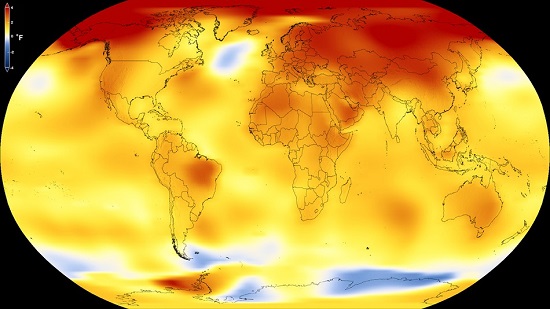
Earth’s average global temperature from 2013 to 2017, as compared to a baseline average from 1951 to 1980.

We’ve entered some profoundly unfamiliar planetary territory.

Amid a backdrop of U.S. politicians still questioning whether the changing climate is attributable to humans (it is), it's quite likely that we’ve actually boosted Earth's carbon dioxide — a potent greenhouse gas — to the highest levels they’ve been in some 15 million years. 

The number 15 million is dramatically higher than a statistic frequently cited by geologists and climate scientists: That today's carbon levels are the highest they've been on Earth in at least 800,000 years — as there's irrefutable proof trapped in the planet's ancient ice.

Though scientists emphasize that air bubbles preserved in ice are the gold carbon standard, there are less direct, though still quite reliable means to gauge Earth's long-ago carbon dioxide levels. These measurements, broadly called proxies, include the chemical make-up of long-dead plankton and the evidence stored in the breathing cells, or stomata, of ancient plants.

Scientists have identified this 15 million number by measuring and re-measuring proxies all over the world. 

Earth’s carbon dioxide levels are likely the highest they've been in 15 million years by Mark Kaufman, Science, Mashable, Oct 29, 2018


Links posted on Facebook

Sun Oct 28, 2018

Mon Oct 29, 2018

Tue Oct 30, 2018

Wed Oct 31, 2018

Thu Nov 1, 2018

Fri Nov 2, 2018


from Skeptical Science https://ift.tt/2Rs2C8Q
A chronological listing of news articles posted on the Skeptical Science Facebook Page during the past week from Sunday through noon on Friday.  

Editor's Pick

Earth’s carbon dioxide levels are likely the highest they've been in 15 million years

Earth’s average global temperature from 2013 to 2017, as compared to a baseline average from 1951 to 1980.

We’ve entered some profoundly unfamiliar planetary territory.

Amid a backdrop of U.S. politicians still questioning whether the changing climate is attributable to humans (it is), it's quite likely that we’ve actually boosted Earth's carbon dioxide — a potent greenhouse gas — to the highest levels they’ve been in some 15 million years. 

The number 15 million is dramatically higher than a statistic frequently cited by geologists and climate scientists: That today's carbon levels are the highest they've been on Earth in at least 800,000 years — as there's irrefutable proof trapped in the planet's ancient ice.

Though scientists emphasize that air bubbles preserved in ice are the gold carbon standard, there are less direct, though still quite reliable means to gauge Earth's long-ago carbon dioxide levels. These measurements, broadly called proxies, include the chemical make-up of long-dead plankton and the evidence stored in the breathing cells, or stomata, of ancient plants.

Scientists have identified this 15 million number by measuring and re-measuring proxies all over the world. 

Earth’s carbon dioxide levels are likely the highest they've been in 15 million years by Mark Kaufman, Science, Mashable, Oct 29, 2018


Links posted on Facebook

Sun Oct 28, 2018

Mon Oct 29, 2018

Tue Oct 30, 2018

Wed Oct 31, 2018

Thu Nov 1, 2018

Fri Nov 2, 2018


from Skeptical Science https://ift.tt/2Rs2C8Q

Dusk for Dawn mission to asteroids

NASA’s Dawn spacecraft has gone silent. The spacecraft missed scheduled communications sessions with NASA’s Deep Space Network on Wednesday (October 31, 2018) and Thursday (November 1). After the flight team eliminated other possible causes for the missed communications, mission managers concluded that the spacecraft finally ran out of hydrazine, the fuel that enables the spacecraft to control its pointing. With its hydrazine depleted, NASA said, Dawn can no longer keep its antennas trained on Earth to communicate with mission control or turn its solar panels to the sun to recharge.

The Dawn spacecraft launched in September 2007. Its mission was visit the two largest objects in the main asteroid belt – Vesta and Ceres. The spacecraft as traveled 4.3 billion miles (6.9 billion km) and is currently in orbit around the dwarf planet Ceres, where it will remain for decades.

This photo of Ceres and the bright regions of Occator Crater was one of the last views NASA’s Dawn spacecraft transmitted before it completed its mission. This view, which faces south, was captured on September 1, 2018 at an altitude of 2,340 miles (3,370 km) as the spacecraft was ascending in its elliptical orbit. Image via NASA/JPL-Caltech/UCLA/MPS/DLR/IDA.

Propelled by ion engines, the spacecraft achieved many firsts along the way. In 2011, when Dawn arrived at Vesta, the second largest world in the main asteroid belt, the spacecraft became the first to orbit a body in the region between Mars and Jupiter. In 2015, when Dawn went into orbit around Ceres, a dwarf planet that is also the largest world in the asteroid belt, the mission became the first to visit a dwarf planet and go into orbit around two destinations beyond Earth.

Mission Director and Chief Engineer Marc Rayman at NASA’s Jet Propulsion Laboratory (JPL) said in a statement:

The fact that my car’s license plate frame proclaims, ‘My other vehicle is in the main asteroid belt,’ shows how much pride I take in Dawn. The demands we put on Dawn were tremendous, but it met the challenge every time. It’s hard to say goodbye to this amazing spaceship, but it’s time.

According to a NASA statement:

The data Dawn beamed back to Earth from its four science experiments enabled scientists to compare two planet-like worlds that evolved very differently. Among its accomplishments, Dawn showed how important location was to the way objects in the early solar system formed and evolved. Dawn also reinforced the idea that dwarf planets could have hosted oceans over a significant part of their history – and potentially still do.

This artist’s rendering shows NASA’s Dawn spacecraft maneuvering above Ceres with its ion propulsion system. Dawn arrived into orbit at Ceres on March 6, 2015. Image via JPL.

The mission plan doesn’t provide the dramatic closure of a final, fiery plunge the way NASA’s Cassini spacecraft ended last year. That’s because Ceres has conditions of interest to scientists who study chemistry that leads to the development of life, so NASA follows strict planetary protection protocols for the disposal of the Dawn spacecraft. Dawn will remain in orbit for at least 20 years, and engineers have more than 99 percent confidence the orbit will last for at least 50 years.

Here’s more info about the Dawn mission:

The 2019 lunar calendars are here! Order yours before they’re gone. Makes a great gift.

Bottom line: The Dawn spacecraft has run out of fuel. The mission to explore the 2 largest bodies in the asteroid belt, Vesta and Ceres, it at an end.

Via NASA


from EarthSky https://ift.tt/2qpuAH5

NASA’s Dawn spacecraft has gone silent. The spacecraft missed scheduled communications sessions with NASA’s Deep Space Network on Wednesday (October 31, 2018) and Thursday (November 1). After the flight team eliminated other possible causes for the missed communications, mission managers concluded that the spacecraft finally ran out of hydrazine, the fuel that enables the spacecraft to control its pointing. With its hydrazine depleted, NASA said, Dawn can no longer keep its antennas trained on Earth to communicate with mission control or turn its solar panels to the sun to recharge.

The Dawn spacecraft launched in September 2007. Its mission was visit the two largest objects in the main asteroid belt – Vesta and Ceres. The spacecraft as traveled 4.3 billion miles (6.9 billion km) and is currently in orbit around the dwarf planet Ceres, where it will remain for decades.

This photo of Ceres and the bright regions of Occator Crater was one of the last views NASA’s Dawn spacecraft transmitted before it completed its mission. This view, which faces south, was captured on September 1, 2018 at an altitude of 2,340 miles (3,370 km) as the spacecraft was ascending in its elliptical orbit. Image via NASA/JPL-Caltech/UCLA/MPS/DLR/IDA.

Propelled by ion engines, the spacecraft achieved many firsts along the way. In 2011, when Dawn arrived at Vesta, the second largest world in the main asteroid belt, the spacecraft became the first to orbit a body in the region between Mars and Jupiter. In 2015, when Dawn went into orbit around Ceres, a dwarf planet that is also the largest world in the asteroid belt, the mission became the first to visit a dwarf planet and go into orbit around two destinations beyond Earth.

Mission Director and Chief Engineer Marc Rayman at NASA’s Jet Propulsion Laboratory (JPL) said in a statement:

The fact that my car’s license plate frame proclaims, ‘My other vehicle is in the main asteroid belt,’ shows how much pride I take in Dawn. The demands we put on Dawn were tremendous, but it met the challenge every time. It’s hard to say goodbye to this amazing spaceship, but it’s time.

According to a NASA statement:

The data Dawn beamed back to Earth from its four science experiments enabled scientists to compare two planet-like worlds that evolved very differently. Among its accomplishments, Dawn showed how important location was to the way objects in the early solar system formed and evolved. Dawn also reinforced the idea that dwarf planets could have hosted oceans over a significant part of their history – and potentially still do.

This artist’s rendering shows NASA’s Dawn spacecraft maneuvering above Ceres with its ion propulsion system. Dawn arrived into orbit at Ceres on March 6, 2015. Image via JPL.

The mission plan doesn’t provide the dramatic closure of a final, fiery plunge the way NASA’s Cassini spacecraft ended last year. That’s because Ceres has conditions of interest to scientists who study chemistry that leads to the development of life, so NASA follows strict planetary protection protocols for the disposal of the Dawn spacecraft. Dawn will remain in orbit for at least 20 years, and engineers have more than 99 percent confidence the orbit will last for at least 50 years.

Here’s more info about the Dawn mission:

The 2019 lunar calendars are here! Order yours before they’re gone. Makes a great gift.

Bottom line: The Dawn spacecraft has run out of fuel. The mission to explore the 2 largest bodies in the asteroid belt, Vesta and Ceres, it at an end.

Via NASA


from EarthSky https://ift.tt/2qpuAH5

News digest – forceful cancer cells, cervical screening, medicinal cannabis and misleading mobile phone headlines

Cervical screening could be stopped at 55 for some women if HPV test is used, says computer simulation

A computer model has estimated that cervical screening could be stopped at 55 if the order of screening tests is changed, the Mail Online reports. The HPV test detects signs of infection with the human papillomavirus, which causes virtually all cervical cancer cases, and the computer predicted that women who test negative at age 55 would have a very small risk of developing cervical cancer later in life. Our news report has the story.

Cancer cells exert stronger forces than ordinary cells

Research from University College London suggests that cancer cells can push through blood vessels with 200 hundred times the force of healthy cells. This could be the result of cancer cells having certain molecules on their surface that helps them cluster together and break through weak sections of blood vessel walls. The Mail Online has the full story.

Turing’s work could help develop personalised cancer treatments

Alan Turing’s codebreaking efforts that helped unlock the German forces’ Enigma Code in World War Two could be turned against cancer. The Telegraph explains how researchers at Edinburgh University believe that the same method Turing developed could one day be used to help develop personalised treatments.

Choice of cervical cancer surgery could affect survival

Two US studies have suggested that the type of surgery women undergo for cervical cancer could affect survival, the New York Times reports. The researchers found that women who underwent the minimally invasive surgery were four times more likely to see their cancer return. But survival was high in both groups, with 18 in 20 women alive four years after open surgery in one study, compared with 19 in 20 women who had minimally invasive surgery.

Medicinal cannabis prescribed in the UK

Cannabis-based products can be prescribed in the UK for the first time by specialist hospital doctors, BBC News reports. The products can only be prescribed when there is clear published evidence proving its benefit and if there are no other treatment options available. Cancer patients experiencing severe nausea and vomiting due to chemotherapy treatment might be able to benefit from the new ruling. For everything you need to know about cannabis and cancer, read our blog post.

Being over or underweight could affect life expectancy

BBC News reported on a large UK study that found people who fall in either the highest (obese) or lowest (underweight) Body Mass Index (BMI) range could have a reduced life expectancy. People with a “healthy” BMI over the age of 40 had a lower risk of dying from a range of diseases, including cancer.

And finally

The Sun reported this week that there is “clear evidence” that mobile phones are linked to cancer. The misleading headline suggests that mobile phone usage could cause heart and brain cancer, but findings were only in male rats exposed to much higher levels of radio frequency radiation than mobile phones expose humans to. Our blog post takes a closer look at the findings, but as it stands, there isn’t good evidence linking mobile phones and cancer in people.

Lily


from Cancer Research UK – Science blog https://ift.tt/2F38lkh

Cervical screening could be stopped at 55 for some women if HPV test is used, says computer simulation

A computer model has estimated that cervical screening could be stopped at 55 if the order of screening tests is changed, the Mail Online reports. The HPV test detects signs of infection with the human papillomavirus, which causes virtually all cervical cancer cases, and the computer predicted that women who test negative at age 55 would have a very small risk of developing cervical cancer later in life. Our news report has the story.

Cancer cells exert stronger forces than ordinary cells

Research from University College London suggests that cancer cells can push through blood vessels with 200 hundred times the force of healthy cells. This could be the result of cancer cells having certain molecules on their surface that helps them cluster together and break through weak sections of blood vessel walls. The Mail Online has the full story.

Turing’s work could help develop personalised cancer treatments

Alan Turing’s codebreaking efforts that helped unlock the German forces’ Enigma Code in World War Two could be turned against cancer. The Telegraph explains how researchers at Edinburgh University believe that the same method Turing developed could one day be used to help develop personalised treatments.

Choice of cervical cancer surgery could affect survival

Two US studies have suggested that the type of surgery women undergo for cervical cancer could affect survival, the New York Times reports. The researchers found that women who underwent the minimally invasive surgery were four times more likely to see their cancer return. But survival was high in both groups, with 18 in 20 women alive four years after open surgery in one study, compared with 19 in 20 women who had minimally invasive surgery.

Medicinal cannabis prescribed in the UK

Cannabis-based products can be prescribed in the UK for the first time by specialist hospital doctors, BBC News reports. The products can only be prescribed when there is clear published evidence proving its benefit and if there are no other treatment options available. Cancer patients experiencing severe nausea and vomiting due to chemotherapy treatment might be able to benefit from the new ruling. For everything you need to know about cannabis and cancer, read our blog post.

Being over or underweight could affect life expectancy

BBC News reported on a large UK study that found people who fall in either the highest (obese) or lowest (underweight) Body Mass Index (BMI) range could have a reduced life expectancy. People with a “healthy” BMI over the age of 40 had a lower risk of dying from a range of diseases, including cancer.

And finally

The Sun reported this week that there is “clear evidence” that mobile phones are linked to cancer. The misleading headline suggests that mobile phone usage could cause heart and brain cancer, but findings were only in male rats exposed to much higher levels of radio frequency radiation than mobile phones expose humans to. Our blog post takes a closer look at the findings, but as it stands, there isn’t good evidence linking mobile phones and cancer in people.

Lily


from Cancer Research UK – Science blog https://ift.tt/2F38lkh

Waning moon and Venus November 4 to 6

On the mornings of November 4, 5 and 6, 2018 – perhaps after staying out late or getting up early to look for Taurid meteors – let the waning crescent moon help guide your eye to the planet Venus at morning dawn.

Venus is the brightest planet, so you can see it very near the sunrise glare. It only entered the morning sky – passing between us and the sun – on October 26, 2018. So in early November, Venus is still extremely low in the eastern sky just before sunrise. It’s very near the sunrise point. We in the Northern Hemisphere have an advantage in viewing Venus before dawn at this time of year. It’s autumn for us, and the autumn angle of the ecliptic – or path of the sun, moon and planets – with respect to the morning horizon is always very steep. This means Venus will be above the sunrise, rather than to one side of it, as seen from this hemisphere. And that fact will make Venus easier to spot.

Find an unobstructed eastern horizon, and, if you have binoculars, bring them along. Venus will be higher up and easier to view in the morning sky as the month progresses. Each day throughout November 2018, this blazing beauty of a planet will rise sooner before sunrise and will brighten all the while.

Although Venus will be a fixture of the morning sky until mid-August 2019, it’ll shine at its brightest in late November and early December 2018, as the morning “star.”

At mid-northern latitudes, Venus rises roughly one hour before sunrise by around November 4. By the month’s end, Venus will rise some three hours before the sun.

At temperate latitudes in the Southern Hemisphere, Venus rises about one hour before sunup on or near November 6. By late November, Venus will rise two hours before the sun.

Read more about this weekend’s Taurid meteor shower

Brett Joseph captured Venus exceedingly low in the east – near the sunrise point, in a sky washed with bright twilight – on October 31, 2018. Way to go, Brett!

Bottom line: Venus has only now returned to the east before dawn. It’s very low in the sky as dawn breaks. You just might be lucky enough to catch the moon and Venus before daybreak on the mornings of November 4-6, 2018.


from EarthSky https://ift.tt/2Dk1lOg

On the mornings of November 4, 5 and 6, 2018 – perhaps after staying out late or getting up early to look for Taurid meteors – let the waning crescent moon help guide your eye to the planet Venus at morning dawn.

Venus is the brightest planet, so you can see it very near the sunrise glare. It only entered the morning sky – passing between us and the sun – on October 26, 2018. So in early November, Venus is still extremely low in the eastern sky just before sunrise. It’s very near the sunrise point. We in the Northern Hemisphere have an advantage in viewing Venus before dawn at this time of year. It’s autumn for us, and the autumn angle of the ecliptic – or path of the sun, moon and planets – with respect to the morning horizon is always very steep. This means Venus will be above the sunrise, rather than to one side of it, as seen from this hemisphere. And that fact will make Venus easier to spot.

Find an unobstructed eastern horizon, and, if you have binoculars, bring them along. Venus will be higher up and easier to view in the morning sky as the month progresses. Each day throughout November 2018, this blazing beauty of a planet will rise sooner before sunrise and will brighten all the while.

Although Venus will be a fixture of the morning sky until mid-August 2019, it’ll shine at its brightest in late November and early December 2018, as the morning “star.”

At mid-northern latitudes, Venus rises roughly one hour before sunrise by around November 4. By the month’s end, Venus will rise some three hours before the sun.

At temperate latitudes in the Southern Hemisphere, Venus rises about one hour before sunup on or near November 6. By late November, Venus will rise two hours before the sun.

Read more about this weekend’s Taurid meteor shower

Brett Joseph captured Venus exceedingly low in the east – near the sunrise point, in a sky washed with bright twilight – on October 31, 2018. Way to go, Brett!

Bottom line: Venus has only now returned to the east before dawn. It’s very low in the sky as dawn breaks. You just might be lucky enough to catch the moon and Venus before daybreak on the mornings of November 4-6, 2018.


from EarthSky https://ift.tt/2Dk1lOg

adds 2