aads

Watch for Taurid fireballs!

Various sources give wildly different dates for the peak date of the long-lasting South Taurid meteor shower (active from late September to late November). November 5, 2018 is one of those predicted dates. Thus the nights this weekend – and especially both November 4 and November 5, 2018 – are good nights to watch for meteors, possibly featuring a higher-than-average rate of South Taurid meteors.
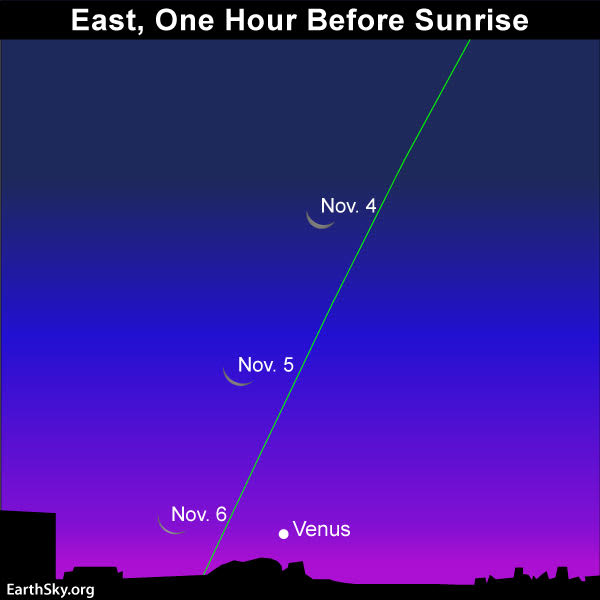
After a night of watching Taurid meteors, you just might lucky enough to catch the moon and Venus before daybreak.

There are actually two streams of Taurid meteors. Both the South and North Taurids (active from late October to early December, and which peak somewhere around November 12) are long, spread-out showers with no well-defined peak. If tonight and tomorrow are peak nights for the South Taurid meteor shower, you might see as many as five meteors per hour. But The American Meteor Society explains what’s awesome about the Taurid meteor showers:

The Taurids (both branches) are rich in fireballs and are often responsible for increased number of fireball reports from September through November.

Yes! Fireballs are the name of the game for the Taurids.
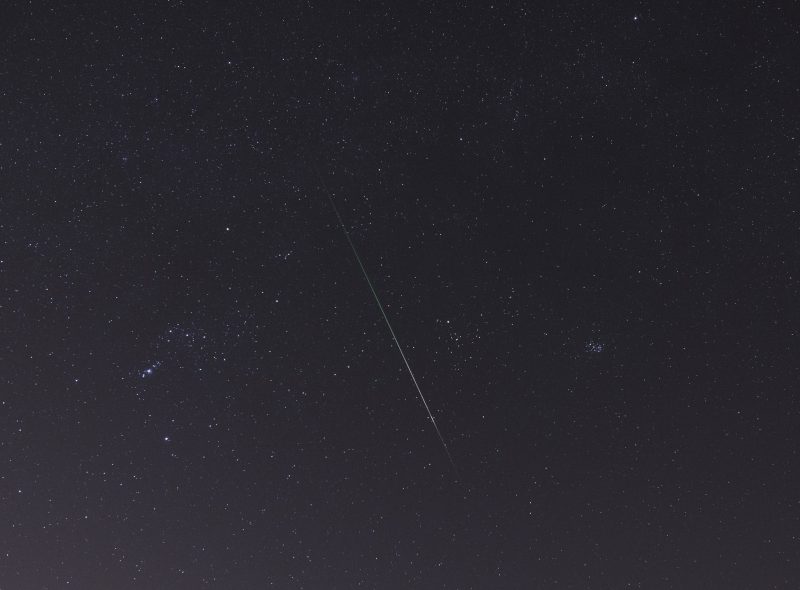
Eliot Herman in Tuscon, Arizona caught this bright Taurid on October 28, 2016. Go to his Flickr page to see it larger. Nice colors!

Eliot Herman in Tuscon, Arizona caught this bright Taurid on October 28, 2016. Go to his Flickr page if you want to see it larger. Nice colors!

Seeing a Taurid fireball – even if it’s just one – counts as a big thrill. And, by the way, a fireball is just another word for a particularly bright meteor.

What’s more, for once, the moon is cooperating.

The moon is now in a waning crescent phase. Rising shortly before sunrise, that means no moonlight to ruin the prime time viewing hours, centered on about 12:30 a.m. local time.

We’re guaranteed to have deliciously dark skies for the South Taurids tonight and tomorrow, to highlight any Taurid fireball that might come whizzing by.
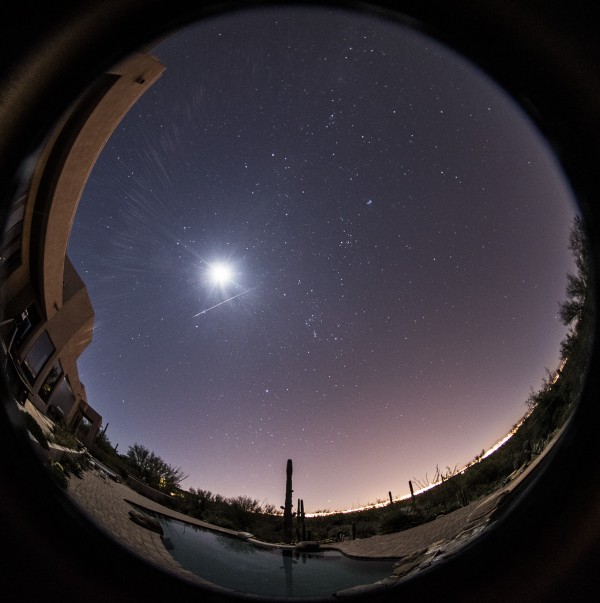
View larger. | Taurid fireball caught by Eliot Herman in Tucson at 3:38 a.m. on November 1, 2015. Thank you, Elliot!

You can see this meteor is radiating from the constellation Taurus the Bull. See that V-shaped pattern to the right of Orion? The three Belt stars of Orion point to it. That’s the Bull’s Face. Eliot Herman in Tucson caught this Taurid meteor, too, in 2015. The bright object was the moon! Thanks, Elliot.

The other Taurid shower – the North Taurids – should add a few more meteors to the mix from late night until dawn.

And again … the Taurid showers do not exhibit strong peaks. So if you’re clouded out tonight and tomorrow, no problem. Just keep watching. The two Taurid showers tend to overlap and to plateau in activity during the first few weeks in November.

On any given night, these rather slow-moving meteors produce the greatest numbers in the few hours after midnight.

Skywatchers are still remembering the Taurid fireballs they saw in 2015. The Taurids appear to have a 7-year cycle of bright fireballs, and 2015 was apparently a peak year! Read more about that, and see more fireball photos, here.

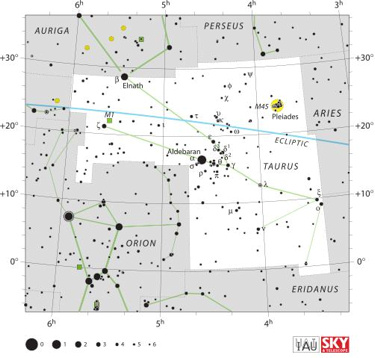
If you trace the South Taurid meteors backwards, they all appear to radiate from the constellation Taurus the Bull. As always, you don’t have to identify a meteor shower’s radiant point to watch the meteor shower. Just lie back comfortably and look up, in the hours between midnight and dawn.

By the way, the constellation Taurus itself is full of interesting things to see such as the Pleiades star cluster, the V-shaped Hyades cluster with bright Aldebaran in its midst.

Just be aware … you don’t need to find Taurus to watch the Taurid shower, for these meteors streak all over the sky.
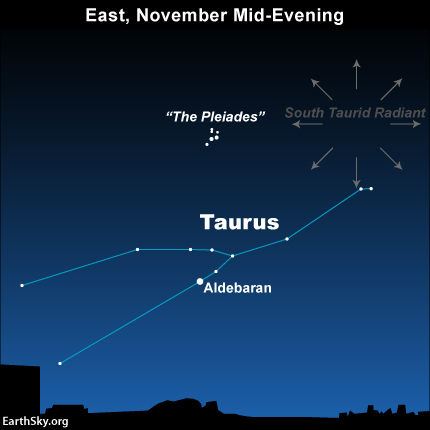
View larger. | The three stars of Orion always point to Aldebaran, the fiery eye of the Bull in the constellation Taurus.

Bottom line: The annual South Taurid meteor shower has been going on throughout October, and now the North Taurids have started at well. The peaks of these showers aren’t well defined. What’s cool about them are the possibility of fireballs, or very bright meteors … watch for them!

Enjoying EarthSky so far? Sign up for our free daily newsletter today!

EarthSky’s meteor shower guide for 2018

See it! Best photos of 2015 Taurid fireballs


from EarthSky https://ift.tt/2OmUq7U

Various sources give wildly different dates for the peak date of the long-lasting South Taurid meteor shower (active from late September to late November). November 5, 2018 is one of those predicted dates. Thus the nights this weekend – and especially both November 4 and November 5, 2018 – are good nights to watch for meteors, possibly featuring a higher-than-average rate of South Taurid meteors.

After a night of watching Taurid meteors, you just might lucky enough to catch the moon and Venus before daybreak.

There are actually two streams of Taurid meteors. Both the South and North Taurids (active from late October to early December, and which peak somewhere around November 12) are long, spread-out showers with no well-defined peak. If tonight and tomorrow are peak nights for the South Taurid meteor shower, you might see as many as five meteors per hour. But The American Meteor Society explains what’s awesome about the Taurid meteor showers:

The Taurids (both branches) are rich in fireballs and are often responsible for increased number of fireball reports from September through November.

Yes! Fireballs are the name of the game for the Taurids.

Eliot Herman in Tuscon, Arizona caught this bright Taurid on October 28, 2016. Go to his Flickr page to see it larger. Nice colors!

Eliot Herman in Tuscon, Arizona caught this bright Taurid on October 28, 2016. Go to his Flickr page if you want to see it larger. Nice colors!

Seeing a Taurid fireball – even if it’s just one – counts as a big thrill. And, by the way, a fireball is just another word for a particularly bright meteor.

What’s more, for once, the moon is cooperating.

The moon is now in a waning crescent phase. Rising shortly before sunrise, that means no moonlight to ruin the prime time viewing hours, centered on about 12:30 a.m. local time.

We’re guaranteed to have deliciously dark skies for the South Taurids tonight and tomorrow, to highlight any Taurid fireball that might come whizzing by.

View larger. | Taurid fireball caught by Eliot Herman in Tucson at 3:38 a.m. on November 1, 2015. Thank you, Elliot!

You can see this meteor is radiating from the constellation Taurus the Bull. See that V-shaped pattern to the right of Orion? The three Belt stars of Orion point to it. That’s the Bull’s Face. Eliot Herman in Tucson caught this Taurid meteor, too, in 2015. The bright object was the moon! Thanks, Elliot.

The other Taurid shower – the North Taurids – should add a few more meteors to the mix from late night until dawn.

And again … the Taurid showers do not exhibit strong peaks. So if you’re clouded out tonight and tomorrow, no problem. Just keep watching. The two Taurid showers tend to overlap and to plateau in activity during the first few weeks in November.

On any given night, these rather slow-moving meteors produce the greatest numbers in the few hours after midnight.

Skywatchers are still remembering the Taurid fireballs they saw in 2015. The Taurids appear to have a 7-year cycle of bright fireballs, and 2015 was apparently a peak year! Read more about that, and see more fireball photos, here.

If you trace the South Taurid meteors backwards, they all appear to radiate from the constellation Taurus the Bull. As always, you don’t have to identify a meteor shower’s radiant point to watch the meteor shower. Just lie back comfortably and look up, in the hours between midnight and dawn.

By the way, the constellation Taurus itself is full of interesting things to see such as the Pleiades star cluster, the V-shaped Hyades cluster with bright Aldebaran in its midst.

Just be aware … you don’t need to find Taurus to watch the Taurid shower, for these meteors streak all over the sky.

View larger. | The three stars of Orion always point to Aldebaran, the fiery eye of the Bull in the constellation Taurus.

Bottom line: The annual South Taurid meteor shower has been going on throughout October, and now the North Taurids have started at well. The peaks of these showers aren’t well defined. What’s cool about them are the possibility of fireballs, or very bright meteors … watch for them!

Enjoying EarthSky so far? Sign up for our free daily newsletter today!

EarthSky’s meteor shower guide for 2018

See it! Best photos of 2015 Taurid fireballs


from EarthSky https://ift.tt/2OmUq7U

Mobile phones and cancer: misleading headlines fail to mention rats

Mobile phone

Mobile phones are in the news following the release of results from a US research programme that tested if a certain type of radiation given off by phones can cause cancer. As a result, headlines are claiming that there’s now “clear evidence” linking mobile phones to cancer.

What the headlines fail to mention is that the studies these news stories are based on were carried out in rats. Dig a little deeper in to the news reports and you will see that there is mention of the use of rats in the studies. But some people won’t look beyond the headlines.

The studies also used radiation doses far higher than what we’d experience in the real-world.

Together, this means that even with the latest findings, there’s still no convincing evidence that mobile phones cause cancer in people.

What did the study do?

Researchers from the US National Toxicology Program looked at the effects of exposing a small number of rats to radiofrequency radiation like that given out by mobile phones.

Rats were exposed to intense radiofrequency radiation throughout the body for 9 hours every day, for their whole lifetime. This is far beyond the length of time people would normally be exposed to. And most of the doses of radiation tested were far higher than those emitted by mobile phones.

This is a point Professor Kevin McConway, emeritus professor of applied statistics at The Open University, also highlights, saying: “The lowest radiation levels used were equal to the safety limits imposed on mobile phone manufacturers, for the radiation when one is actually using the phone. The higher doses for the animals were four times those limits.”

This means that these results cannot be translated outside of the lab and into your pocket.

What did the study show?

Increased cancer risk wasn’t found in rats exposed to the lowest, and more realistic, levels of radiation. But the researchers did find that male rats exposed to high levels of radiofrequency radiation were more likely to develop a type of heart tumour. This wasn’t seen in female rats, and the researchers couldn’t give a reason for the difference. And despite what the news reports might suggest, the study couldn’t rule out that the increase in risk of other tumours in the brain and adrenal glands was just down to chance.

The researchers also noted that male rats exposed to radiofrequency radiation lived longer. Cancer risk increases with age, so it’s plausible that these rats had a higher chance of developing cancer just because they lived longer.

What you need to know

Research into mobile phones and cancer isn’t new and is still ongoing. Large studies in people, such as the INTERPHONE study and the Million Women Study, have found no increased risk of cancer from using mobile phones.

And considering these previous studies were in people, this latest study in rats, using conditions that don’t match normal phone use, shouldn’t ring alarm bells.

Weilin Wu is a health information officer at Cancer Research UK

Read more: 6 tips to spot cancer ‘fake news’


from Cancer Research UK – Science blog https://ift.tt/2SG8JrS
Mobile phone

Mobile phones are in the news following the release of results from a US research programme that tested if a certain type of radiation given off by phones can cause cancer. As a result, headlines are claiming that there’s now “clear evidence” linking mobile phones to cancer.

What the headlines fail to mention is that the studies these news stories are based on were carried out in rats. Dig a little deeper in to the news reports and you will see that there is mention of the use of rats in the studies. But some people won’t look beyond the headlines.

The studies also used radiation doses far higher than what we’d experience in the real-world.

Together, this means that even with the latest findings, there’s still no convincing evidence that mobile phones cause cancer in people.

What did the study do?

Researchers from the US National Toxicology Program looked at the effects of exposing a small number of rats to radiofrequency radiation like that given out by mobile phones.

Rats were exposed to intense radiofrequency radiation throughout the body for 9 hours every day, for their whole lifetime. This is far beyond the length of time people would normally be exposed to. And most of the doses of radiation tested were far higher than those emitted by mobile phones.

This is a point Professor Kevin McConway, emeritus professor of applied statistics at The Open University, also highlights, saying: “The lowest radiation levels used were equal to the safety limits imposed on mobile phone manufacturers, for the radiation when one is actually using the phone. The higher doses for the animals were four times those limits.”

This means that these results cannot be translated outside of the lab and into your pocket.

What did the study show?

Increased cancer risk wasn’t found in rats exposed to the lowest, and more realistic, levels of radiation. But the researchers did find that male rats exposed to high levels of radiofrequency radiation were more likely to develop a type of heart tumour. This wasn’t seen in female rats, and the researchers couldn’t give a reason for the difference. And despite what the news reports might suggest, the study couldn’t rule out that the increase in risk of other tumours in the brain and adrenal glands was just down to chance.

The researchers also noted that male rats exposed to radiofrequency radiation lived longer. Cancer risk increases with age, so it’s plausible that these rats had a higher chance of developing cancer just because they lived longer.

What you need to know

Research into mobile phones and cancer isn’t new and is still ongoing. Large studies in people, such as the INTERPHONE study and the Million Women Study, have found no increased risk of cancer from using mobile phones.

And considering these previous studies were in people, this latest study in rats, using conditions that don’t match normal phone use, shouldn’t ring alarm bells.

Weilin Wu is a health information officer at Cancer Research UK

Read more: 6 tips to spot cancer ‘fake news’


from Cancer Research UK – Science blog https://ift.tt/2SG8JrS

New research, October 22-28, 2018

A selection of new climate related research articles is shown below.

Climate change

Temperature, precipitation, wind

Radiosondes show that after decades of cooling the lower stratosphere is now warming

Verification of an approximate thermodynamic equation with application to study on Arctic stratospheric temperature changes

Global Wind Speed and Wave Height Extremes Derived from Long-duration Satellite Records

The interannual variability of wind energy resources across China and its relationship to large‐scale circulation changes

Changes in Canada's Climate: Trends in Indices Based on Daily Temperature and Precipitation Data (open access)

Recent trends of surface air temperatures over Kenya from 1971 to 2010

Central European air temperature: driving force analysis and causal influence of NAO

Temporal trends in absolute and relative extreme temperature events across North America

Projected extreme temperature and precipitation of the Great Lakes Basin

Spatiotemporal characteristics of future changes in precipitation and temperature in Central Asia

Modeling climate change impacts on precipitation in arid regions of Pakistan: a non-local model output statistics downscaling approach

Decadal Variability in Summer Precipitation over Eastern China and its Response to Sensible Heat over the Tibetan Plateau since the Early 2000s

Impact of urbanization on hourly precipitation in Beijing, China: Spatiotemporal patterns and causes

Increasing influence of central Pacific El Niño on the inter‐decadal variation of spring rainfall in northern Taiwan and southern China since 1980 (open access)

Predictability of Extreme Precipitation in Western U.S. Watersheds Based on Atmospheric River Occurrence, Intensity, and Duration

Extreme events

On modeling the maximum duration of dry spells: a simulation study under a Bayesian approach

Extratropical cyclone statistics during the last millennium and the 21st century (open access)

A statistical assessment of Southern Hemisphere tropical cyclone tracks in climate models

Urban floods in Hyderabad, India, under present and future rainfall scenarios: a case study

Interdependencies and Risk to People and Critical Food, Energy and Water Systems – 2013 Flood Boulder Colorado, USA (open access)

An Intensified Mode of Variability Modulating the Summer Heat Waves in Eastern Europe and Northern China (open access)

Impacts of synoptic and local factors on heat wave events over southeastern region of Korea in 2015

Attributing human influence on the July 2017 Chinese heatwave: the influence of sea-surface temperatures (open access)

Forcings and feedbacks

Evaluating Climate Sensitivity to CO2 Across Earth's History

Volcanic radiative forcing from 1979 to 2015

Understanding Rapid Adjustments to Diverse Forcing Agents

Evaluating cloud properties in an ensemble of regional online coupled models against satellite observations (open access)

The lifecycle of anvil clouds and the top-of-atmosphere radiation balance over the tropical west Pacific

Contrasting the effects of the 1850‐1975 increase in sulphate aerosols from North America and Europe on the Atlantic in the CESM model

Infrared radiation in the thermosphere near the end of solar cycle 24

Cryosphere

Arctic climate: changes in sea ice extent outweigh changes in snow cover (open access)

An Observationally‐Based Evaluation of Sub‐Grid Scale Ice Thickness Distributions Simulated in a Large‐Scale Sea Ice ‐ Ocean Model of the Arctic Ocean

Processes controlling Arctic and Antarctic sea ice predictability in the Community Earth System Model

Estimated Heat Budget during Summer Melt of Arctic First Year Sea Ice

The internal structure of the Brunt Ice Shelf from ice-penetrating radar analysis and implications for ice shelf fracture (open access)

Retrieval of Englacial Firn Aquifer Thickness from Ice‐Penetrating Radar Sounding in Southeastern Greenland

Spatiotemporal patterns of snow depth within the Swiss‐Austrian Alps for the past half century (1961 to 2012) and linkages to climate change

Permafrost thaw induced drying of wetlands at Scotty Creek, NWT, Canada (open access)

Linking permafrost thaw to shifting biogeochemistry and food web resources in an arctic river (open access)

A decade of remotely sensed observations highlight complex processes linked to coastal permafrost bluff erosion in the Arctic (open access)

Hydrosphere 

Climate change and water resources in arid regions: uncertainty of the baseline time period (open access)

Inter-comparison of satellite-retrieved and Global Land Data Assimilation System-simulated soil moisture datasets for global drought analysis

Projected increased risk of water deficit over major West African river basins under future climates

Atmospheric and oceanic circulation

Gulf Stream Variability in the Context of Quasi‐Decadal and Multidecadal Atlantic Climate Variability (open access)

A Nonstationary ENSO-NAO relationship due to AMO modulation

Carbon and nitrogen cycles

Satellite‐based estimation of particulate organic carbon export in the northern South China Sea

Emissions of nitrous oxide from continuous permafrost region in the Daxing'an Mountains, Northeast China

Quantifying the legacy of snowmelt timing on soil greenhouse gas emissions in a seasonally dry montane forest (open access)

Climate change impacts 

Mankind

Small island developing states and 1.5 °C (Introduction to special issue in Regional Environmental Change)

A global assessment of atoll island planform changes over the past decades

Responding to Climate-Related Security Risks: Reviewing Regional Organizations in Asia and Africa

Weather Extremes, Disasters, and Collective Violence: Conditions, Mechanisms, and Disaster-Related Policies in Recent Research

Multisource data based agricultural drought monitoring and agricultural loss in China

Simulating the impacts of climate change on soybean cyst nematode and the distribution of soybean

Cross-Sector Management of Extreme Heat Risks in Arizona (open access)

Vulnerability and its discontents: the past, present, and future of climate change vulnerability research (open access)

Nomads’ indigenous knowledge and their adaptation to climate changes in Semirom City in Central Iran

Biosphere

Wave refraction and reef island stability under rising sea level

Declining glacier cover threatens the biodiversity of alpine river diatom assemblages (open access)

Tree growth and water-use in hyper-arid Acacia occurs during the hottest and driest season

Combined effects of warming and nutrients on marine communities are moderated by predators and vary across functional groups (open access)

Genotypic variation in phenological plasticity: reciprocal common gardens reveal adaptive responses to warmer springs but not to fall frost

The Influence of Climate and Livestock Reservoirs on Human Cases of Giardiasis (open access)

Range change evolution of peatmosses (Sphagnum) within and between climate zones

Extreme drought pushes stream invertebrate communities over functional thresholds

The ability of macroalgae to mitigate the negative effects of ocean acidification on four species of North Atlantic bivalve (open access)

Local adaptation of trees at the range margins impacts range shifts in the face of climate change

Beyond the 1984 perspective: narrow focus on modern wildfire trends underestimates future risks to water security (open access)

Long‐term changes in the impacts of global warming on leaf phenology of four temperate tree species

Characterizing 32 years of shrub cover dynamics in southern Portugal using annual Landsat composites and machine learning regression modeling

Other impacts

A VIIRS direct broadcast algorithm for rapid response mapping of wildfire burned area in the western United States

Climate change mitigation

Cautious optimism and incremental goals towards stabilizing atmospheric CO2 (open access)

Climate change communication

Self-assessed understanding of climate change

Comparing farmers’ perceptions of climate change with meteorological data in three irrigated cropping zones of Punjab, Pakistan

Intergenerational learning: Are children key in spurring climate action?

Taking climate change here and now – mitigating ideological polarization with psychological distance

Climate Policy

A contingent approach to energy mix policy

Energy production

Effects of development of wind energy and associated changes in land use on bird densities in upland areas

2014 residential wood combustion survey: Results overview and spatial allocation of emissions estimates

Emission savings

Climate change mitigation potential of community-based initiatives in Europe

Groundwater depletion and associated CO2 emissions in India (open access)

Geoengineering

Solar radiation management not as effective as CO2 mitigation for Arctic sea ice loss in hitting the 1.5 and 2 °C COP climate targets (open access)

Comparison of the Fast and Slow Climate Response to Three Radiation Management Geoengineering Schemes

Other papers

General climate science

An objective global climatology of polar lows based on reanalysis data 


from Skeptical Science https://ift.tt/2QcJ8oA

A selection of new climate related research articles is shown below.

Climate change

Temperature, precipitation, wind

Radiosondes show that after decades of cooling the lower stratosphere is now warming

Verification of an approximate thermodynamic equation with application to study on Arctic stratospheric temperature changes

Global Wind Speed and Wave Height Extremes Derived from Long-duration Satellite Records

The interannual variability of wind energy resources across China and its relationship to large‐scale circulation changes

Changes in Canada's Climate: Trends in Indices Based on Daily Temperature and Precipitation Data (open access)

Recent trends of surface air temperatures over Kenya from 1971 to 2010

Central European air temperature: driving force analysis and causal influence of NAO

Temporal trends in absolute and relative extreme temperature events across North America

Projected extreme temperature and precipitation of the Great Lakes Basin

Spatiotemporal characteristics of future changes in precipitation and temperature in Central Asia

Modeling climate change impacts on precipitation in arid regions of Pakistan: a non-local model output statistics downscaling approach

Decadal Variability in Summer Precipitation over Eastern China and its Response to Sensible Heat over the Tibetan Plateau since the Early 2000s

Impact of urbanization on hourly precipitation in Beijing, China: Spatiotemporal patterns and causes

Increasing influence of central Pacific El Niño on the inter‐decadal variation of spring rainfall in northern Taiwan and southern China since 1980 (open access)

Predictability of Extreme Precipitation in Western U.S. Watersheds Based on Atmospheric River Occurrence, Intensity, and Duration

Extreme events

On modeling the maximum duration of dry spells: a simulation study under a Bayesian approach

Extratropical cyclone statistics during the last millennium and the 21st century (open access)

A statistical assessment of Southern Hemisphere tropical cyclone tracks in climate models

Urban floods in Hyderabad, India, under present and future rainfall scenarios: a case study

Interdependencies and Risk to People and Critical Food, Energy and Water Systems – 2013 Flood Boulder Colorado, USA (open access)

An Intensified Mode of Variability Modulating the Summer Heat Waves in Eastern Europe and Northern China (open access)

Impacts of synoptic and local factors on heat wave events over southeastern region of Korea in 2015

Attributing human influence on the July 2017 Chinese heatwave: the influence of sea-surface temperatures (open access)

Forcings and feedbacks

Evaluating Climate Sensitivity to CO2 Across Earth's History

Volcanic radiative forcing from 1979 to 2015

Understanding Rapid Adjustments to Diverse Forcing Agents

Evaluating cloud properties in an ensemble of regional online coupled models against satellite observations (open access)

The lifecycle of anvil clouds and the top-of-atmosphere radiation balance over the tropical west Pacific

Contrasting the effects of the 1850‐1975 increase in sulphate aerosols from North America and Europe on the Atlantic in the CESM model

Infrared radiation in the thermosphere near the end of solar cycle 24

Cryosphere

Arctic climate: changes in sea ice extent outweigh changes in snow cover (open access)

An Observationally‐Based Evaluation of Sub‐Grid Scale Ice Thickness Distributions Simulated in a Large‐Scale Sea Ice ‐ Ocean Model of the Arctic Ocean

Processes controlling Arctic and Antarctic sea ice predictability in the Community Earth System Model

Estimated Heat Budget during Summer Melt of Arctic First Year Sea Ice

The internal structure of the Brunt Ice Shelf from ice-penetrating radar analysis and implications for ice shelf fracture (open access)

Retrieval of Englacial Firn Aquifer Thickness from Ice‐Penetrating Radar Sounding in Southeastern Greenland

Spatiotemporal patterns of snow depth within the Swiss‐Austrian Alps for the past half century (1961 to 2012) and linkages to climate change

Permafrost thaw induced drying of wetlands at Scotty Creek, NWT, Canada (open access)

Linking permafrost thaw to shifting biogeochemistry and food web resources in an arctic river (open access)

A decade of remotely sensed observations highlight complex processes linked to coastal permafrost bluff erosion in the Arctic (open access)

Hydrosphere 

Climate change and water resources in arid regions: uncertainty of the baseline time period (open access)

Inter-comparison of satellite-retrieved and Global Land Data Assimilation System-simulated soil moisture datasets for global drought analysis

Projected increased risk of water deficit over major West African river basins under future climates

Atmospheric and oceanic circulation

Gulf Stream Variability in the Context of Quasi‐Decadal and Multidecadal Atlantic Climate Variability (open access)

A Nonstationary ENSO-NAO relationship due to AMO modulation

Carbon and nitrogen cycles

Satellite‐based estimation of particulate organic carbon export in the northern South China Sea

Emissions of nitrous oxide from continuous permafrost region in the Daxing'an Mountains, Northeast China

Quantifying the legacy of snowmelt timing on soil greenhouse gas emissions in a seasonally dry montane forest (open access)

Climate change impacts 

Mankind

Small island developing states and 1.5 °C (Introduction to special issue in Regional Environmental Change)

A global assessment of atoll island planform changes over the past decades

Responding to Climate-Related Security Risks: Reviewing Regional Organizations in Asia and Africa

Weather Extremes, Disasters, and Collective Violence: Conditions, Mechanisms, and Disaster-Related Policies in Recent Research

Multisource data based agricultural drought monitoring and agricultural loss in China

Simulating the impacts of climate change on soybean cyst nematode and the distribution of soybean

Cross-Sector Management of Extreme Heat Risks in Arizona (open access)

Vulnerability and its discontents: the past, present, and future of climate change vulnerability research (open access)

Nomads’ indigenous knowledge and their adaptation to climate changes in Semirom City in Central Iran

Biosphere

Wave refraction and reef island stability under rising sea level

Declining glacier cover threatens the biodiversity of alpine river diatom assemblages (open access)

Tree growth and water-use in hyper-arid Acacia occurs during the hottest and driest season

Combined effects of warming and nutrients on marine communities are moderated by predators and vary across functional groups (open access)

Genotypic variation in phenological plasticity: reciprocal common gardens reveal adaptive responses to warmer springs but not to fall frost

The Influence of Climate and Livestock Reservoirs on Human Cases of Giardiasis (open access)

Range change evolution of peatmosses (Sphagnum) within and between climate zones

Extreme drought pushes stream invertebrate communities over functional thresholds

The ability of macroalgae to mitigate the negative effects of ocean acidification on four species of North Atlantic bivalve (open access)

Local adaptation of trees at the range margins impacts range shifts in the face of climate change

Beyond the 1984 perspective: narrow focus on modern wildfire trends underestimates future risks to water security (open access)

Long‐term changes in the impacts of global warming on leaf phenology of four temperate tree species

Characterizing 32 years of shrub cover dynamics in southern Portugal using annual Landsat composites and machine learning regression modeling

Other impacts

A VIIRS direct broadcast algorithm for rapid response mapping of wildfire burned area in the western United States

Climate change mitigation

Cautious optimism and incremental goals towards stabilizing atmospheric CO2 (open access)

Climate change communication

Self-assessed understanding of climate change

Comparing farmers’ perceptions of climate change with meteorological data in three irrigated cropping zones of Punjab, Pakistan

Intergenerational learning: Are children key in spurring climate action?

Taking climate change here and now – mitigating ideological polarization with psychological distance

Climate Policy

A contingent approach to energy mix policy

Energy production

Effects of development of wind energy and associated changes in land use on bird densities in upland areas

2014 residential wood combustion survey: Results overview and spatial allocation of emissions estimates

Emission savings

Climate change mitigation potential of community-based initiatives in Europe

Groundwater depletion and associated CO2 emissions in India (open access)

Geoengineering

Solar radiation management not as effective as CO2 mitigation for Arctic sea ice loss in hitting the 1.5 and 2 °C COP climate targets (open access)

Comparison of the Fast and Slow Climate Response to Three Radiation Management Geoengineering Schemes

Other papers

General climate science

An objective global climatology of polar lows based on reanalysis data 


from Skeptical Science https://ift.tt/2QcJ8oA

5 weird ocean phenomena

Image via Senior Airman Brian Kelly, U.S. Air Force.

1. St. Elmo’s Fire

St. Elmo’s Fire is a colorful discharge of atmospheric electricity that typically occurs during a thunderstorm. When a sharp object (such as a ship’s mast) comes in contact with an extraordinarily high electrical field and a large number of electrons, the electrons can glow in various colors, like a neon sign, resulting in this rare phenomenon. St. Elmo is a derivation of St. Erasmus of Formia, one of the two patron saints of sailors.

Image via Capt. Jim Freda, Manasquan Inlet, New Jersey.

2. Fog tsunami

At first glance, this jarring sight looks like a giant tsunami rolling in from the ocean, but it’s actually a massive amount of fog. When conditions are just right in late spring or early summer, the condensation from warm air merging with cool ocean water can create this dramatic effect.

Weather system that caused a meteotsunami in New Jersey, June 2013. Image via Buddy Denham.

3. Meteotsunami

Meteotsunamis have characteristics similar to earthquake-generated tsunamis, but they are caused by air-pressure disturbances often associated with fast-moving weather systems, such as squall lines. These disturbances can generate waves in the ocean that travel at the same speed as the overhead weather system. Development of a meteotsunami depends on several factors, such as the intensity, direction, and speed of the air pressure as it travels over a water body. Like an earthquake-generated tsunami, a meteotsunami affects the entire water column and may become dangerous when it hits shallow water, which causes it to slow down and increase in height and intensity. Semi-enclosed water bodies like harbors, inlets, and bays can greatly intensify a meteotsunami.

4. Waterspout

A waterspout is a spinning column of air and mist that forms on lakes, rivers, and at sea. Waterspouts fall into two categories: fair weather and tornadic. Tornadic waterspouts are tornadoes that form over water, or move from land to water. They are associated with severe thunderstorms and are often accompanied by high winds and seas, large hail, and dangerous lightning. The tornadic variety are more dangerous than fair weather waterspouts, which generally are not associated with thunderstorms, and usually form along the dark flat base of a line of developing cumulus clouds. While tornadic waterspouts develop downward in a thunderstorm, a fair weather waterspout develops on the surface of the water and works its way upward. Fair weather waterspouts form in light wind conditions so they normally move very little.

5. Maelstrom

A maelstrom is a strong whirlpool that forms when opposing currents meet to form swirling water. Its name comes from the Dutch words malen (to whirl or grind) and strom (stream). A maelstrom can be dangerous due to powerful currents that occur below the surface, which can pull surrounding objects into its vortex.

The 2019 lunar calendars are here! Order yours before they’re gone. Makes a great gift.

Bottom line: Five weird ocean phenomena: St. Elmo’s fire, maelstrom, waterspout, fog tsunami, meteotsunami.

Via NOAA


from EarthSky https://ift.tt/2QcByu7

Image via Senior Airman Brian Kelly, U.S. Air Force.

1. St. Elmo’s Fire

St. Elmo’s Fire is a colorful discharge of atmospheric electricity that typically occurs during a thunderstorm. When a sharp object (such as a ship’s mast) comes in contact with an extraordinarily high electrical field and a large number of electrons, the electrons can glow in various colors, like a neon sign, resulting in this rare phenomenon. St. Elmo is a derivation of St. Erasmus of Formia, one of the two patron saints of sailors.

Image via Capt. Jim Freda, Manasquan Inlet, New Jersey.

2. Fog tsunami

At first glance, this jarring sight looks like a giant tsunami rolling in from the ocean, but it’s actually a massive amount of fog. When conditions are just right in late spring or early summer, the condensation from warm air merging with cool ocean water can create this dramatic effect.

Weather system that caused a meteotsunami in New Jersey, June 2013. Image via Buddy Denham.

3. Meteotsunami

Meteotsunamis have characteristics similar to earthquake-generated tsunamis, but they are caused by air-pressure disturbances often associated with fast-moving weather systems, such as squall lines. These disturbances can generate waves in the ocean that travel at the same speed as the overhead weather system. Development of a meteotsunami depends on several factors, such as the intensity, direction, and speed of the air pressure as it travels over a water body. Like an earthquake-generated tsunami, a meteotsunami affects the entire water column and may become dangerous when it hits shallow water, which causes it to slow down and increase in height and intensity. Semi-enclosed water bodies like harbors, inlets, and bays can greatly intensify a meteotsunami.

4. Waterspout

A waterspout is a spinning column of air and mist that forms on lakes, rivers, and at sea. Waterspouts fall into two categories: fair weather and tornadic. Tornadic waterspouts are tornadoes that form over water, or move from land to water. They are associated with severe thunderstorms and are often accompanied by high winds and seas, large hail, and dangerous lightning. The tornadic variety are more dangerous than fair weather waterspouts, which generally are not associated with thunderstorms, and usually form along the dark flat base of a line of developing cumulus clouds. While tornadic waterspouts develop downward in a thunderstorm, a fair weather waterspout develops on the surface of the water and works its way upward. Fair weather waterspouts form in light wind conditions so they normally move very little.

5. Maelstrom

A maelstrom is a strong whirlpool that forms when opposing currents meet to form swirling water. Its name comes from the Dutch words malen (to whirl or grind) and strom (stream). A maelstrom can be dangerous due to powerful currents that occur below the surface, which can pull surrounding objects into its vortex.

The 2019 lunar calendars are here! Order yours before they’re gone. Makes a great gift.

Bottom line: Five weird ocean phenomena: St. Elmo’s fire, maelstrom, waterspout, fog tsunami, meteotsunami.

Via NOAA


from EarthSky https://ift.tt/2QcByu7

Bold new plan announced to explore alien ocean worlds

Jupiter’s moon Europa is the best known of the ocean worlds in the solar system – apart from Earth of course. Image via NASA/JPL-Caltech/SETI Institute.

Not all that long ago, it was thought that Earth was the only place in the solar system with liquid water. Other planets and moons were either too hot or too cold. But now, thanks to various spacecraft sent out to explore these worlds, we know that is not the case. Water is actually abundant throughout the solar system, and some moons even have more water than Earth does. We just can’t see it on their surfaces – the water is, instead, below ground.

The 2019 lunar calendars are here! Order yours before they’re gone. Makes a great gift.

These moons are now known as ocean worlds, and a new peer-reviewed paper by a team led by Amanda R. Hendrix, a senior scientist at the Planetary Science Institute, seeks to identify strategies to better identify and explore these fascinating environments. Terry A. Hurford of NASA’s Goddard Space Flight Center is the co-lead author of the new paper, “The NASA Roadmap to Ocean Worlds,” which was just published in the journal Astrobiology.

Hendrix and Hurford co-chair the Roadmaps to Ocean Worlds (ROW) team of NASA’s Outer Planets Assessment Group. The ROW team wants to see emphasis placed on not just studying known water worlds, but also other candidate ones, as explained by Hendrix:

The overarching goal of an ocean worlds program, should be to identify ocean worlds, characterize their oceans, evaluate their habitability, search for life, and ultimately understand any life we find.

The investigation “roadmap” for the exploration of ocean worlds. Image via Amanda R. Hendrix/Terry A. Hurford et al., 2018/Mary Ann Liebert, Inc.

The charter of ROW includes the following recommendations:

Identify and prioritize science objectives for ocean worlds over the next several decades.

Design roadmap(s) to explore these worlds to address science objectives (including mission sequences, considering a sustained exploration effort).

Assess where each ocean world fits into the overall roadmap.

Summarize broad mission concepts (considering mission dependencies and international cooperation).

Recommend technology development and detailed mission studies in support of the next Decadal Survey.

Currently, the moons Europa, Enceladus and Titan are considered to be the highest priority for further study. Neptune’s moon Triton is the highest priority of still-unconfirmed ocean worlds.

Saturn’s moon Enceladus is a high-priority target for further study. It not only has an underground ocean, but also huge plumes of water vapor that erupt through cracks at the south pole. Image via NASA/JPL/Space Science Institute.

As the paper also notes, the foundation for studying these alien oceans should be our own oceans here on Earth, as outlined by Hendrix:

Progress needs to be made in the area of collaborations between Earth ocean scientists and extraterrestrial ocean scientists. In addition, to map out a coherent ocean worlds program, significant input is required from studies here on Earth; rigorous research and analysis studies are called for to enable some future ocean worlds missions to be thoughtfully planned and undertaken. The overarching goal of an ocean worlds program should be to identify ocean worlds, characterize their oceans, evaluate their habitability, search for life, and ultimately understand any life we find.

So just what are ocean worlds, according to the paper? Basically any moon or other body in the solar system (since Earth is the only planet to have one) that has a current liquid water ocean. The ocean does not need to be global although it does seem to be in most cases, in particular on Europa and Enceladus. The big difference is that Earth’s ocean is on the surface while all the other ones are subsurface.

As well as the methane/ethane seas and lakes on the surface, Saturn’s moon Titan is also thought to have a global subsurface water ocean. Image via A. D. Fortes/UCL/STFC.

Even Neptune’s moon Triton, in the far outer solar system, may have an underground ocean. Image via NASA/JPL/USGS.

Exploring these otherworldly oceans is exciting because, of course, our own oceans are teeming with life. Could the same be true for some of these other oceans as well? Scientists certainly see the potential, which is a major reason to study them to begin with. Everywhere on Earth there is water, there is life. There is growing evidence that the oceans on Europa and Enceladus have conditions favorable for some kinds of life, even if only microbial (but perhaps more), such as hydrothermal activity on the ocean floors. On Earth, even in the deepest waters, such environments are oases for a wide range of life, where vents provide heat and nutrients. Titan may also be of particular interest. From the paper:

Although Titan possesses a large subsurface ocean, it also has an abundant supply of a wide range of organic species and surface liquids, which are readily accessible and could harbor more exotic forms of life. Further, Titan may have transient surface liquid water such as impact melt pools and fresh cryovolcanic flows in contact with both solid and liquid surface organics. These environments present unique and important locations for investigating prebiotic chemistry and, potentially, the first steps toward life.

Bottom line: The new paper makes a strong case for why the ocean worlds in our solar system should be explored as thoroughly as possible, using knowledge about our own oceans as a roadmap. And maybe – just maybe – that exploration will result in the discovery that Earth’s oceans are not the only ones to be inhabited.

Source: The NASA Roadmap to Ocean Worlds

Via Planetary Science Institute


from EarthSky https://ift.tt/2AFXf0f

Jupiter’s moon Europa is the best known of the ocean worlds in the solar system – apart from Earth of course. Image via NASA/JPL-Caltech/SETI Institute.

Not all that long ago, it was thought that Earth was the only place in the solar system with liquid water. Other planets and moons were either too hot or too cold. But now, thanks to various spacecraft sent out to explore these worlds, we know that is not the case. Water is actually abundant throughout the solar system, and some moons even have more water than Earth does. We just can’t see it on their surfaces – the water is, instead, below ground.

The 2019 lunar calendars are here! Order yours before they’re gone. Makes a great gift.

These moons are now known as ocean worlds, and a new peer-reviewed paper by a team led by Amanda R. Hendrix, a senior scientist at the Planetary Science Institute, seeks to identify strategies to better identify and explore these fascinating environments. Terry A. Hurford of NASA’s Goddard Space Flight Center is the co-lead author of the new paper, “The NASA Roadmap to Ocean Worlds,” which was just published in the journal Astrobiology.

Hendrix and Hurford co-chair the Roadmaps to Ocean Worlds (ROW) team of NASA’s Outer Planets Assessment Group. The ROW team wants to see emphasis placed on not just studying known water worlds, but also other candidate ones, as explained by Hendrix:

The overarching goal of an ocean worlds program, should be to identify ocean worlds, characterize their oceans, evaluate their habitability, search for life, and ultimately understand any life we find.

The investigation “roadmap” for the exploration of ocean worlds. Image via Amanda R. Hendrix/Terry A. Hurford et al., 2018/Mary Ann Liebert, Inc.

The charter of ROW includes the following recommendations:

Identify and prioritize science objectives for ocean worlds over the next several decades.

Design roadmap(s) to explore these worlds to address science objectives (including mission sequences, considering a sustained exploration effort).

Assess where each ocean world fits into the overall roadmap.

Summarize broad mission concepts (considering mission dependencies and international cooperation).

Recommend technology development and detailed mission studies in support of the next Decadal Survey.

Currently, the moons Europa, Enceladus and Titan are considered to be the highest priority for further study. Neptune’s moon Triton is the highest priority of still-unconfirmed ocean worlds.

Saturn’s moon Enceladus is a high-priority target for further study. It not only has an underground ocean, but also huge plumes of water vapor that erupt through cracks at the south pole. Image via NASA/JPL/Space Science Institute.

As the paper also notes, the foundation for studying these alien oceans should be our own oceans here on Earth, as outlined by Hendrix:

Progress needs to be made in the area of collaborations between Earth ocean scientists and extraterrestrial ocean scientists. In addition, to map out a coherent ocean worlds program, significant input is required from studies here on Earth; rigorous research and analysis studies are called for to enable some future ocean worlds missions to be thoughtfully planned and undertaken. The overarching goal of an ocean worlds program should be to identify ocean worlds, characterize their oceans, evaluate their habitability, search for life, and ultimately understand any life we find.

So just what are ocean worlds, according to the paper? Basically any moon or other body in the solar system (since Earth is the only planet to have one) that has a current liquid water ocean. The ocean does not need to be global although it does seem to be in most cases, in particular on Europa and Enceladus. The big difference is that Earth’s ocean is on the surface while all the other ones are subsurface.

As well as the methane/ethane seas and lakes on the surface, Saturn’s moon Titan is also thought to have a global subsurface water ocean. Image via A. D. Fortes/UCL/STFC.

Even Neptune’s moon Triton, in the far outer solar system, may have an underground ocean. Image via NASA/JPL/USGS.

Exploring these otherworldly oceans is exciting because, of course, our own oceans are teeming with life. Could the same be true for some of these other oceans as well? Scientists certainly see the potential, which is a major reason to study them to begin with. Everywhere on Earth there is water, there is life. There is growing evidence that the oceans on Europa and Enceladus have conditions favorable for some kinds of life, even if only microbial (but perhaps more), such as hydrothermal activity on the ocean floors. On Earth, even in the deepest waters, such environments are oases for a wide range of life, where vents provide heat and nutrients. Titan may also be of particular interest. From the paper:

Although Titan possesses a large subsurface ocean, it also has an abundant supply of a wide range of organic species and surface liquids, which are readily accessible and could harbor more exotic forms of life. Further, Titan may have transient surface liquid water such as impact melt pools and fresh cryovolcanic flows in contact with both solid and liquid surface organics. These environments present unique and important locations for investigating prebiotic chemistry and, potentially, the first steps toward life.

Bottom line: The new paper makes a strong case for why the ocean worlds in our solar system should be explored as thoroughly as possible, using knowledge about our own oceans as a roadmap. And maybe – just maybe – that exploration will result in the discovery that Earth’s oceans are not the only ones to be inhabited.

Source: The NASA Roadmap to Ocean Worlds

Via Planetary Science Institute


from EarthSky https://ift.tt/2AFXf0f

Taurid fireballs this weekend?

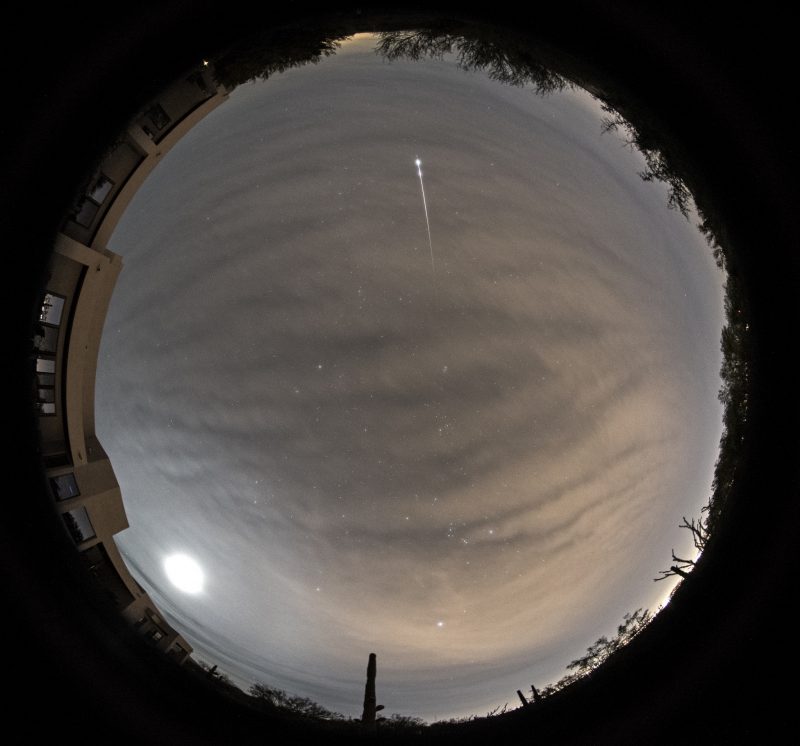
Taurid fireball through light clouds – November 1, 2018 – by Eliot Herman in Tucson, Arizona. Notice the moon, just rising, on the left.

The South and North Taurid meteor showers aren’t known for their large numbers of meteors, but they do offer a high percentage of fireballs, or exceptionally bright meteors. This shower made a huge splash three years ago, in 2015, when there were many, many reports and photos featuring Taurid fireball sightings. Higher rates of Taurid fireballs appear to happen in seven-year cycles. Grand fireball displays did indeed take place in 2008 and 2015. No elevated levels of fireballs are expected in 2018, but the absence of moonlight will make this a fine year for watching the South Taurid shower on and around its expected peak date of November 5.

So watch out for Taurid meteors – and possible fireballs – starting now and throughout the weekend.

The 2019 lunar calendars are here! Order yours before they’re gone. Makes a great gift.

Taurid fireball on the evening of October 21, 2017 – 10:27 p.m. – from Joanne West at Gold Canyon, Arizona. Eliot Herman in Tucson caught this same meteor. Read more about the 2 photos.

The prime time viewing hours are from late night until dawn, with the peak viewing coming just after the midnight hour. In general, the South Taurids offer about five meteors per hour at their peak, but the North Taurid shower may add a few more meteors to the mix. How many you’ll see will depend on how far from city lights you are … and how bright the meteors are. If they’re bright enough, they’ll overcome skies beset by light pollution.

Taurid meteors radiate from the constellation Taurus.

Taurid meteors radiate from the constellation Taurus, but they’ll appear in all parts of the sky.

The Taurid meteor stream consists of an extremely wide roadway of far-flung debris left behind by Comet 2P/Encke. When Earth travels through this belt of comet debris, bits and pieces of Comet 2P/Encke smash into the Earth’s upper atmosphere to vaporize as rather slow-moving Taurid meteors (28 km/17 miles per second).

Apparently, the original Taurid stream has been perturbed by Jupiter into two branches: South and North Taurids.

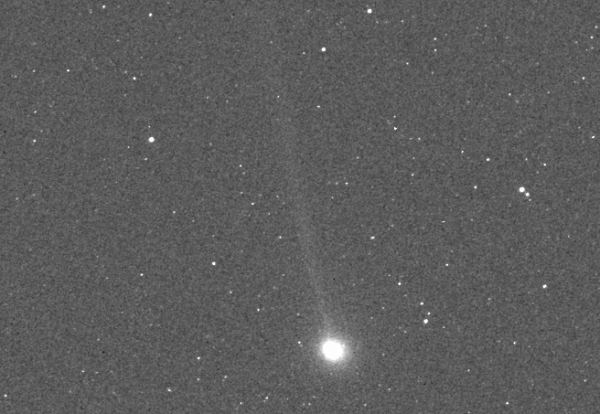
Comet Encke, parent of the Taurid meteor shower. Image credit: Messenger

Comet Encke, parent of the Taurid meteor shower. Image via Messenger.

Bottom line: With no moonlight to ruin the show, we’re hoping to see at least a smattering of Taurid fireballs in 2018! It’s time to start watching for them. What to expect from the South Taurid shower, and when to watch.


from EarthSky https://ift.tt/2AHknf3

Taurid fireball through light clouds – November 1, 2018 – by Eliot Herman in Tucson, Arizona. Notice the moon, just rising, on the left.

The South and North Taurid meteor showers aren’t known for their large numbers of meteors, but they do offer a high percentage of fireballs, or exceptionally bright meteors. This shower made a huge splash three years ago, in 2015, when there were many, many reports and photos featuring Taurid fireball sightings. Higher rates of Taurid fireballs appear to happen in seven-year cycles. Grand fireball displays did indeed take place in 2008 and 2015. No elevated levels of fireballs are expected in 2018, but the absence of moonlight will make this a fine year for watching the South Taurid shower on and around its expected peak date of November 5.

So watch out for Taurid meteors – and possible fireballs – starting now and throughout the weekend.

The 2019 lunar calendars are here! Order yours before they’re gone. Makes a great gift.

Taurid fireball on the evening of October 21, 2017 – 10:27 p.m. – from Joanne West at Gold Canyon, Arizona. Eliot Herman in Tucson caught this same meteor. Read more about the 2 photos.

The prime time viewing hours are from late night until dawn, with the peak viewing coming just after the midnight hour. In general, the South Taurids offer about five meteors per hour at their peak, but the North Taurid shower may add a few more meteors to the mix. How many you’ll see will depend on how far from city lights you are … and how bright the meteors are. If they’re bright enough, they’ll overcome skies beset by light pollution.

Taurid meteors radiate from the constellation Taurus.

Taurid meteors radiate from the constellation Taurus, but they’ll appear in all parts of the sky.

The Taurid meteor stream consists of an extremely wide roadway of far-flung debris left behind by Comet 2P/Encke. When Earth travels through this belt of comet debris, bits and pieces of Comet 2P/Encke smash into the Earth’s upper atmosphere to vaporize as rather slow-moving Taurid meteors (28 km/17 miles per second).

Apparently, the original Taurid stream has been perturbed by Jupiter into two branches: South and North Taurids.

Comet Encke, parent of the Taurid meteor shower. Image credit: Messenger

Comet Encke, parent of the Taurid meteor shower. Image via Messenger.

Bottom line: With no moonlight to ruin the show, we’re hoping to see at least a smattering of Taurid fireballs in 2018! It’s time to start watching for them. What to expect from the South Taurid shower, and when to watch.


from EarthSky https://ift.tt/2AHknf3

Scientists now processing images of asteroid Bennu

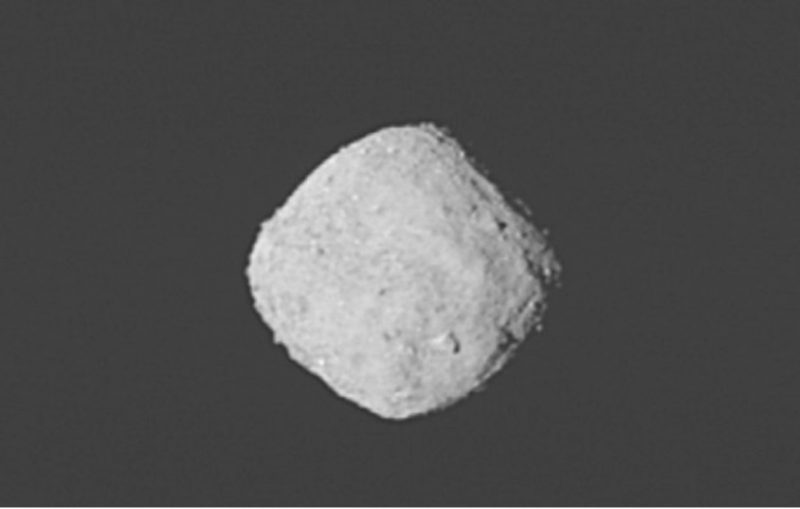
Image of asteroid Bennu created using 8 images obtained on October 29, 2018 by the OSIRIS-REx spacecraft from a distance of 205 miles (330 km). Image via NASA/ Goddard/ University of Arizona/ IAC.

NASA’s first mission to a near-Earth asteroid – 101955 Bennu – is now on its final approach, due to arrive December 3. The image above is one of the first to appear of the asteroid, processed by researchers from the Instituto de Astrofísica de Canarias (IAC), who are part of the mission’s Scientific Team. Javier Licandro and Julia de León of the Instituto de Astrofísica de Canarias (IAC) started working on the calibration of this image in preparation for the ones that will be obtained in December 2018, using color filters. A statement from IAC explained:

These first images of Bennu present a remarkable similarity with the ones recently obtained by the JAXA Hayabusa2 mission of another primitive asteroid, Ryugu. The fact that the Japanese mission has reached its target a little ahead of us turns out to be extremely interesting, as we can now interpret our results and compare to the results obtained by another mission almost on real time.

The studies done by the IAC team will also help to select the region on the surface of the asteroid from where a simple will be collected and returned back to the Earth in 2023.

Read more via IAC

Visit the OSIRIS-REx mission’s website

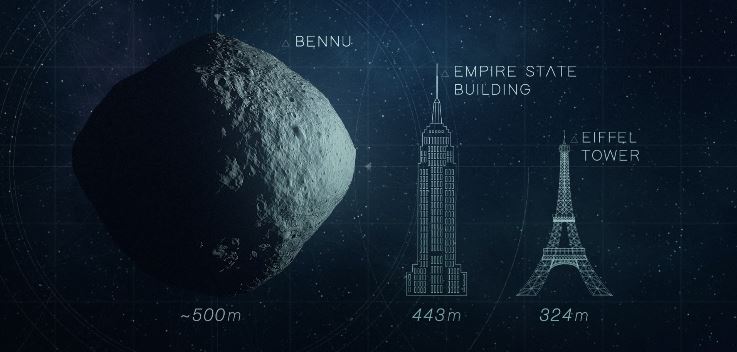
The size of asteroid Bennu, which is 1,614 feet (492 meters) wide, is compared with the Empire State Building and Eiffel Tower in this NASA image.

Bottom line: The OSIRIS-REx spacecraft – launched from Earth in September, 2016 – has begun acquiring images of the mission target, primitive asteroid Bennu, and scientists have begun processing them.


from EarthSky https://ift.tt/2qnfPV4

Image of asteroid Bennu created using 8 images obtained on October 29, 2018 by the OSIRIS-REx spacecraft from a distance of 205 miles (330 km). Image via NASA/ Goddard/ University of Arizona/ IAC.

NASA’s first mission to a near-Earth asteroid – 101955 Bennu – is now on its final approach, due to arrive December 3. The image above is one of the first to appear of the asteroid, processed by researchers from the Instituto de Astrofísica de Canarias (IAC), who are part of the mission’s Scientific Team. Javier Licandro and Julia de León of the Instituto de Astrofísica de Canarias (IAC) started working on the calibration of this image in preparation for the ones that will be obtained in December 2018, using color filters. A statement from IAC explained:

These first images of Bennu present a remarkable similarity with the ones recently obtained by the JAXA Hayabusa2 mission of another primitive asteroid, Ryugu. The fact that the Japanese mission has reached its target a little ahead of us turns out to be extremely interesting, as we can now interpret our results and compare to the results obtained by another mission almost on real time.

The studies done by the IAC team will also help to select the region on the surface of the asteroid from where a simple will be collected and returned back to the Earth in 2023.

Read more via IAC

Visit the OSIRIS-REx mission’s website

The size of asteroid Bennu, which is 1,614 feet (492 meters) wide, is compared with the Empire State Building and Eiffel Tower in this NASA image.

Bottom line: The OSIRIS-REx spacecraft – launched from Earth in September, 2016 – has begun acquiring images of the mission target, primitive asteroid Bennu, and scientists have begun processing them.


from EarthSky https://ift.tt/2qnfPV4

adds 2