aads

Use Big Dipper to find North Star

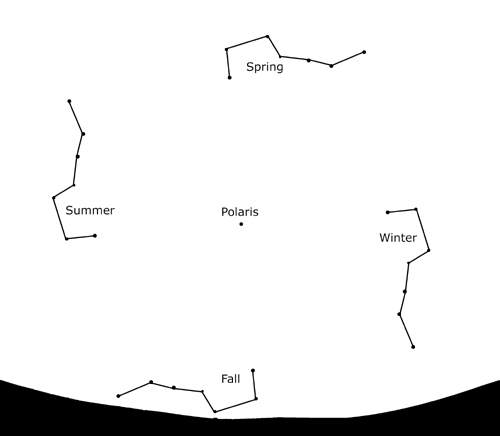
Tonight’s chart shows Polaris and the Big and Little Dippers for a September evening. You can use the Big Dipper to find Polaris, which is also known as the North Star. Notice that a line from the two outermost stars in the bowl of the Big Dipper points to Polaris. And notice that Polaris marks the tip of the handle of the Little Dipper.

The northern sky is a large clock, with Polaris at its center. The hour hand is a line drawn through Dubhe and Merak, the two pointer stars of the Big Dipper. Because the stars make a full circle in 23 hours 56 minutes instead of exactly 24 hours, this star clock is not exactly the same as the one on the wall, but with a little practice you can learn to read it well.

The Big and Little Dippers: All you need to know

EarthSky astronomy kits are perfect for beginners. Order today from the EarthSky store

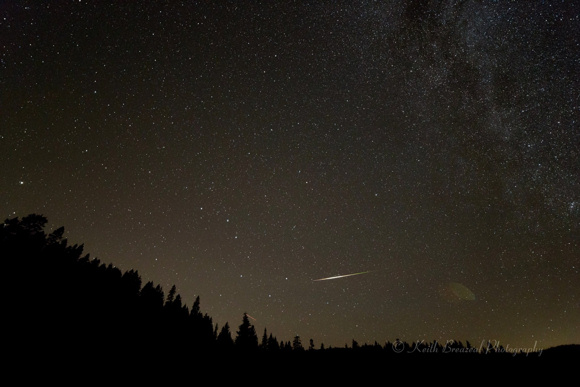
View larger. Keith Breazeal's photo of a meteor streaking past the Big Dipper. Perseid Meteor Shower 12-13 Aug 2015. One of the many captured last night at the Bear River Dam in the California Sierra Nevada mountains. This one was at 10:32 Canon 5D Mark III Rokinon 14mm f2.8 25 seconds ISO 5000. Thank you Keith!

View larger. | Keith Breazeal’s photo of a meteor streaking past the Big Dipper during the 2015 Perseid meteor shower. Captured at the Bear River Dam in the California Sierra Nevada mountains. Can you find Polaris in this photo?

The Big Dipper swings full circle – 360 degrees – around Polaris in about 23 hours and 56 minutes. In 24 hours, the Big Dipper actually swings more than full circle, or 361 degrees. Does that make a difference? Yes! It means that – if you look at the same time each evening – the Big Dipper will appear just a little bit lower in the northwestern evening sky.

If you’re in the northern U.S., Canada or at a similar latitude, the Big Dipper is circumpolar for you – always above the horizon. Image via burro.astr.cwru.edu

A month from now at mid-evening, the Big Dipper will be noticeably lower in the northwest. It’ll actually beneath the horizon as seen from the southern latitudes in the United States – although it’s circumpolar, or always above the northern horizon, as seen from the northern U.S., Canada and similarly northern latitudes.

The constant motion from night to night of these stars circling Polaris is a bit like a bear circling its prey, looking for a way to attack. Several ancient cultures from the Greeks and Romans to the Micmac Indians likened these stars to a bear.

In Greek mythology, the Big Dipper asterism represents the hindquarters and tail of the constellation Ursa Major, the Great Bear. The Micmacs saw the three stars of the Big Dipper handle as hunters chasing the bear.

Watch the Big and Little Dippers circle around Polaris tonight! To locate Polaris, the North Star, just draw a line between the two outer stars in the bowl of the Big Dipper.

Enjoying EarthSky so far? Sign up for our free daily newsletter today!


from EarthSky https://ift.tt/1L3HkUk

Tonight’s chart shows Polaris and the Big and Little Dippers for a September evening. You can use the Big Dipper to find Polaris, which is also known as the North Star. Notice that a line from the two outermost stars in the bowl of the Big Dipper points to Polaris. And notice that Polaris marks the tip of the handle of the Little Dipper.

The northern sky is a large clock, with Polaris at its center. The hour hand is a line drawn through Dubhe and Merak, the two pointer stars of the Big Dipper. Because the stars make a full circle in 23 hours 56 minutes instead of exactly 24 hours, this star clock is not exactly the same as the one on the wall, but with a little practice you can learn to read it well.

The Big and Little Dippers: All you need to know

EarthSky astronomy kits are perfect for beginners. Order today from the EarthSky store

View larger. Keith Breazeal's photo of a meteor streaking past the Big Dipper. Perseid Meteor Shower 12-13 Aug 2015. One of the many captured last night at the Bear River Dam in the California Sierra Nevada mountains. This one was at 10:32 Canon 5D Mark III Rokinon 14mm f2.8 25 seconds ISO 5000. Thank you Keith!

View larger. | Keith Breazeal’s photo of a meteor streaking past the Big Dipper during the 2015 Perseid meteor shower. Captured at the Bear River Dam in the California Sierra Nevada mountains. Can you find Polaris in this photo?

The Big Dipper swings full circle – 360 degrees – around Polaris in about 23 hours and 56 minutes. In 24 hours, the Big Dipper actually swings more than full circle, or 361 degrees. Does that make a difference? Yes! It means that – if you look at the same time each evening – the Big Dipper will appear just a little bit lower in the northwestern evening sky.

If you’re in the northern U.S., Canada or at a similar latitude, the Big Dipper is circumpolar for you – always above the horizon. Image via burro.astr.cwru.edu

A month from now at mid-evening, the Big Dipper will be noticeably lower in the northwest. It’ll actually beneath the horizon as seen from the southern latitudes in the United States – although it’s circumpolar, or always above the northern horizon, as seen from the northern U.S., Canada and similarly northern latitudes.

The constant motion from night to night of these stars circling Polaris is a bit like a bear circling its prey, looking for a way to attack. Several ancient cultures from the Greeks and Romans to the Micmac Indians likened these stars to a bear.

In Greek mythology, the Big Dipper asterism represents the hindquarters and tail of the constellation Ursa Major, the Great Bear. The Micmacs saw the three stars of the Big Dipper handle as hunters chasing the bear.

Watch the Big and Little Dippers circle around Polaris tonight! To locate Polaris, the North Star, just draw a line between the two outer stars in the bowl of the Big Dipper.

Enjoying EarthSky so far? Sign up for our free daily newsletter today!


from EarthSky https://ift.tt/1L3HkUk

2018 SkS Weekly Climate Change & Global Warming Digest #35

Calls to Action... Story of the Week... Editorial of the Week... El Niño/La Niña Update... Toon of the Week... Coming Soon on SkS... Climate Feedback Reviews... SkS Week in Review... Poster of the Week...

Calls to Action*...

Looking ahead...

Sat Sep 8 is an extremely important day for climate activists because they will be gathering in cities throughout the world to Rise Up for Climate. If you re not already plugged into an event in your area, you can easily do so by going to the official Rise Up for Climate website. From the global campaign's website:

On September 8, we’re planning thousands of rallies in cities and towns around the world to demand our local leaders commit to building a fossil free world that puts people and justice before profits.

No more stalling, no more delays: it’s time for a fast and fair transition to 100% renewable energy for all.

Real climate leadership rises from below. It means power in the hands of people not corporations. It means economic opportunity for workers and justice and dignity for frontline communities that are the hardest hit by the impacts of the fossil fuel industry and a warming world. 

Looking inside... 

Be sure to check out the next two sections of this digest — Story of the Week and Opinion of the Week. They address two inter-related issue re the hum race's ability to come to grips with the reality of man-made climate change and the need to effectively mitigate it srtarting now.

Looking behind...

Something that flew under my radar screen when it was released earlier this year...

Narrated by Danny Glover, A documentary special reveals how climate change science has been under systematic attack; the multi-million dollar campaign allowed a climate change denier to be elected president (a new version with updated content and music)

TRNN Documentary: Trump, The Koch Brothers and Their War on Climate Science, May 23, 2018

TRNN = The Real News Network, Baltimore, MD


*The views expressed in this section are those of John Hartz and do not necessarily reflect  consensus views of the SkS author team — it's nearly impossible to achieve consensus within a herd of cats.  


Story of the Week...

The Swedish 15-year-old who's cutting class to fight the climate crisis

Following Sweden’s hottest summer ever, Greta Thunberg decided to go on school strike at the parliament to get politicians to act

Greta Thurnberg Stockholm Sweden Aug 2018 

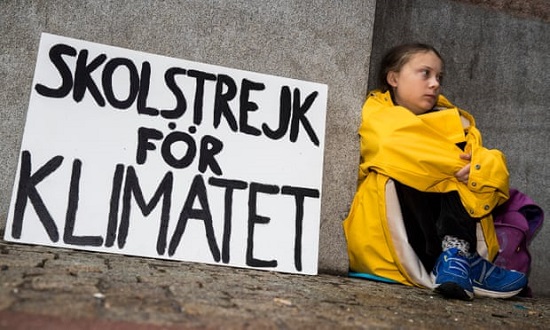
Greta Thunberg leads a school strike and sits outside of the Swedish Parliament, in an effort to force politicians to act on climate change. Photograph: Michael Campanella for the Guardian 

Why bother to learn anything in school if politicians won’t pay attention to the facts?

This simple realisation prompted Greta Thunberg, 15, to protest in the most effective way she knew. She is on strike, refusing to go to school until Sweden’s general election on 9 September to draw attention to the climate crisis.

Her protest has captured the imagination of a country that has been struck by heatwaves and wildfires in its hottest summer since records began 262 years ago.

Every day for two weeks, Thunberg has been sitting quietly on the cobblestones outside parliament in central Stockholm, handing out leaflets that declare: “I am doing this because you adults are shitting on my future.”

Thunberg herself is a diminutive girl with pigtails and a fleeting smile – not the stereotypical leader of a climate revolution.

“I am doing this because nobody else is doing anything. It is my moral responsibility to do what I can,” she says. “I want the politicians to prioritise the climate question, focus on the climate and treat it like a crisis.”

When people tell her she should be at school, she points to the textbooks in her satchel.

“I have my books here,” she says in flawless English. “But also I am thinking: what am I missing? What am I going to learn in school? Facts don’t matter any more, politicians aren’t listening to the scientists, so why should I learn?”

The Swedish 15-year-old who's cutting class to fight the climate crisis by David Crouch, Science, Guardian, Sep 1, 2018 


Opinion of the Week...

Would you put your child or grandchild on a plane that has a one chance in 20 of a disastrous crash?

It’s hard imagining anyone doing that, but it is essentially what we are doing to our kids and grandkids by not raising our voices about climate change and the 1-in-20 chance that disaster lies ahead for them. It is bad enough that we are likely on the path to exceed the 3.6 degree Fahrenheit goal stated in the Paris Agreement, which will result in dire consequences such as increasing droughts and wildfires and inundation of low lying coastal areas because of sea level rise.

If we continue on that path without taking the necessary actions to reduce greenhouse gas emissions, there is a 5 percent chance of catastrophic consequences — even an existential threat to humanity by mid-century, according to experts at the Scripps Institute. 

Uncontrolled climate change could result in disaster for our kids. Will we do something?, Opinion by Mike Hoffman, USA Today, Aug 1, 2018 


El Niño/La Niña Update...

With all signs highlighting a switch, from the La Nina to the forecast El Nino (formally called El Nino Southern Oscillation or ENSO) climate pattern for this fall 2018, and winter too, meteorologists and climatologists expect to have a better idea of how strong this El Nino event will become by late October into November.

"Looking at the latest 30-day and 90-day maps generated (for this Autumn 2018 which the Climate Prediction Center issued Aug. 16, 2018) it appears we're witnessing the incorporation of an El Nino event into the outlooks," said Allen Dutcher, associate state climatologist, Nebraska State Climate Office-Lincoln. "During the past four weeks, there's been a subtle shift toward a wetter pattern across the southern Plains, while the northern Plains has slipped towards the dry side."

Most weather signs are pointing to an El Nino weather pattern this fall and winter by Amy G. Hadachek, The Fence Post, Aug 31, 2018 


Toon of the Week...

2018 Toon 35 


Coming Soon on SkS...

 [To be added.] 


Climate Feedback Reviews...

[To be added.] 


SkS Week in Review... 

 [To be added.] 


Poster of the Week...

2018 Poster of the Week 


from Skeptical Science https://ift.tt/2NLVbIw

Calls to Action... Story of the Week... Editorial of the Week... El Niño/La Niña Update... Toon of the Week... Coming Soon on SkS... Climate Feedback Reviews... SkS Week in Review... Poster of the Week...

Calls to Action*...

Looking ahead...

Sat Sep 8 is an extremely important day for climate activists because they will be gathering in cities throughout the world to Rise Up for Climate. If you re not already plugged into an event in your area, you can easily do so by going to the official Rise Up for Climate website. From the global campaign's website:

On September 8, we’re planning thousands of rallies in cities and towns around the world to demand our local leaders commit to building a fossil free world that puts people and justice before profits.

No more stalling, no more delays: it’s time for a fast and fair transition to 100% renewable energy for all.

Real climate leadership rises from below. It means power in the hands of people not corporations. It means economic opportunity for workers and justice and dignity for frontline communities that are the hardest hit by the impacts of the fossil fuel industry and a warming world. 

Looking inside... 

Be sure to check out the next two sections of this digest — Story of the Week and Opinion of the Week. They address two inter-related issue re the hum race's ability to come to grips with the reality of man-made climate change and the need to effectively mitigate it srtarting now.

Looking behind...

Something that flew under my radar screen when it was released earlier this year...

Narrated by Danny Glover, A documentary special reveals how climate change science has been under systematic attack; the multi-million dollar campaign allowed a climate change denier to be elected president (a new version with updated content and music)

TRNN Documentary: Trump, The Koch Brothers and Their War on Climate Science, May 23, 2018

TRNN = The Real News Network, Baltimore, MD


*The views expressed in this section are those of John Hartz and do not necessarily reflect  consensus views of the SkS author team — it's nearly impossible to achieve consensus within a herd of cats.  


Story of the Week...

The Swedish 15-year-old who's cutting class to fight the climate crisis

Following Sweden’s hottest summer ever, Greta Thunberg decided to go on school strike at the parliament to get politicians to act

Greta Thurnberg Stockholm Sweden Aug 2018 

Greta Thunberg leads a school strike and sits outside of the Swedish Parliament, in an effort to force politicians to act on climate change. Photograph: Michael Campanella for the Guardian 

Why bother to learn anything in school if politicians won’t pay attention to the facts?

This simple realisation prompted Greta Thunberg, 15, to protest in the most effective way she knew. She is on strike, refusing to go to school until Sweden’s general election on 9 September to draw attention to the climate crisis.

Her protest has captured the imagination of a country that has been struck by heatwaves and wildfires in its hottest summer since records began 262 years ago.

Every day for two weeks, Thunberg has been sitting quietly on the cobblestones outside parliament in central Stockholm, handing out leaflets that declare: “I am doing this because you adults are shitting on my future.”

Thunberg herself is a diminutive girl with pigtails and a fleeting smile – not the stereotypical leader of a climate revolution.

“I am doing this because nobody else is doing anything. It is my moral responsibility to do what I can,” she says. “I want the politicians to prioritise the climate question, focus on the climate and treat it like a crisis.”

When people tell her she should be at school, she points to the textbooks in her satchel.

“I have my books here,” she says in flawless English. “But also I am thinking: what am I missing? What am I going to learn in school? Facts don’t matter any more, politicians aren’t listening to the scientists, so why should I learn?”

The Swedish 15-year-old who's cutting class to fight the climate crisis by David Crouch, Science, Guardian, Sep 1, 2018 


Opinion of the Week...

Would you put your child or grandchild on a plane that has a one chance in 20 of a disastrous crash?

It’s hard imagining anyone doing that, but it is essentially what we are doing to our kids and grandkids by not raising our voices about climate change and the 1-in-20 chance that disaster lies ahead for them. It is bad enough that we are likely on the path to exceed the 3.6 degree Fahrenheit goal stated in the Paris Agreement, which will result in dire consequences such as increasing droughts and wildfires and inundation of low lying coastal areas because of sea level rise.

If we continue on that path without taking the necessary actions to reduce greenhouse gas emissions, there is a 5 percent chance of catastrophic consequences — even an existential threat to humanity by mid-century, according to experts at the Scripps Institute. 

Uncontrolled climate change could result in disaster for our kids. Will we do something?, Opinion by Mike Hoffman, USA Today, Aug 1, 2018 


El Niño/La Niña Update...

With all signs highlighting a switch, from the La Nina to the forecast El Nino (formally called El Nino Southern Oscillation or ENSO) climate pattern for this fall 2018, and winter too, meteorologists and climatologists expect to have a better idea of how strong this El Nino event will become by late October into November.

"Looking at the latest 30-day and 90-day maps generated (for this Autumn 2018 which the Climate Prediction Center issued Aug. 16, 2018) it appears we're witnessing the incorporation of an El Nino event into the outlooks," said Allen Dutcher, associate state climatologist, Nebraska State Climate Office-Lincoln. "During the past four weeks, there's been a subtle shift toward a wetter pattern across the southern Plains, while the northern Plains has slipped towards the dry side."

Most weather signs are pointing to an El Nino weather pattern this fall and winter by Amy G. Hadachek, The Fence Post, Aug 31, 2018 


Toon of the Week...

2018 Toon 35 


Coming Soon on SkS...

 [To be added.] 


Climate Feedback Reviews...

[To be added.] 


SkS Week in Review... 

 [To be added.] 


Poster of the Week...

2018 Poster of the Week 


from Skeptical Science https://ift.tt/2NLVbIw

Last quarter moon is September 2-3

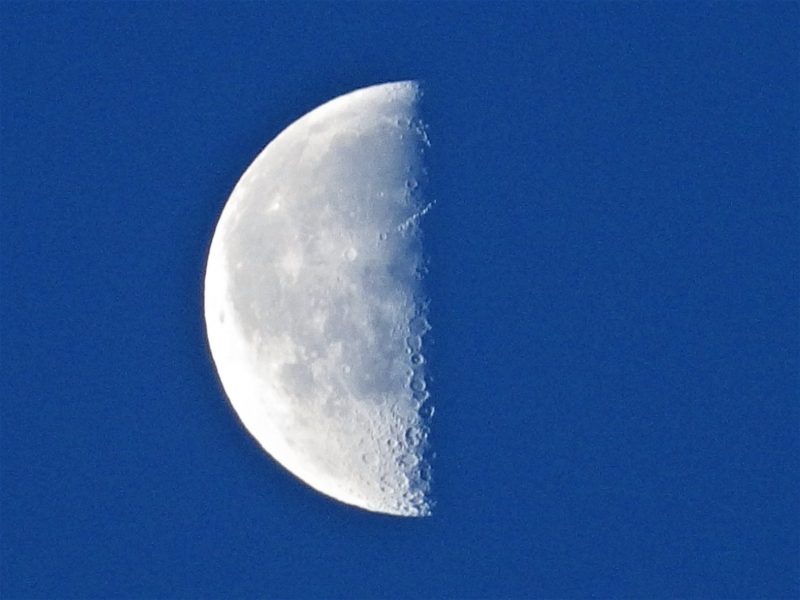
The moon was almost exactly at last quarter when Deirdre Horan in Dublin, Ireland, captured this photo. The terminator line, or line between light and dark on the moon, appears straight.

When the moon appears half-lit in sunshine and half-immersed in the moon’s own shadow – when it rises in the middle of the night – astronomers say it is at last quarter. Before sunrise on April 8, 2018, the moon was at or near its last quarter phase. A last quarter moon always rises in the middle of the night, appears at its highest in the sky around dawn, and sets around midday.

On a last quarter moon, the lunar terminator – the shadow line dividing day and night – shows you where it’s sunset on the moon.

A last quarter moon provides a great opportunity to think of yourself on a three-dimensional world in space. For example, it’s fun to see this moon just after moonrise, shortly after midnight. Then the lighted portion points downward, to the sun below your feet. Think of the last quarter moon as a mirror to the world you’re standing on. Think of yourself standing in the middle of Earth’s nightside, on the midnight portion of Earth.

Also, a last quarter moon can be used as a guidepost to Earth’s direction of motion in orbit around the sun.

In other words, when you look toward a last quarter moon high in the predawn sky, for example, you’re gazing out approximately along the path of Earth’s orbit, in a forward direction. The moon is moving in orbit around the sun with the Earth and never holds still. But, if we could somehow anchor the moon in space … tie it down, keep it still … Earth’s orbital speed of 18 miles per second would carry us across the space between us and the moon in only a few hours.

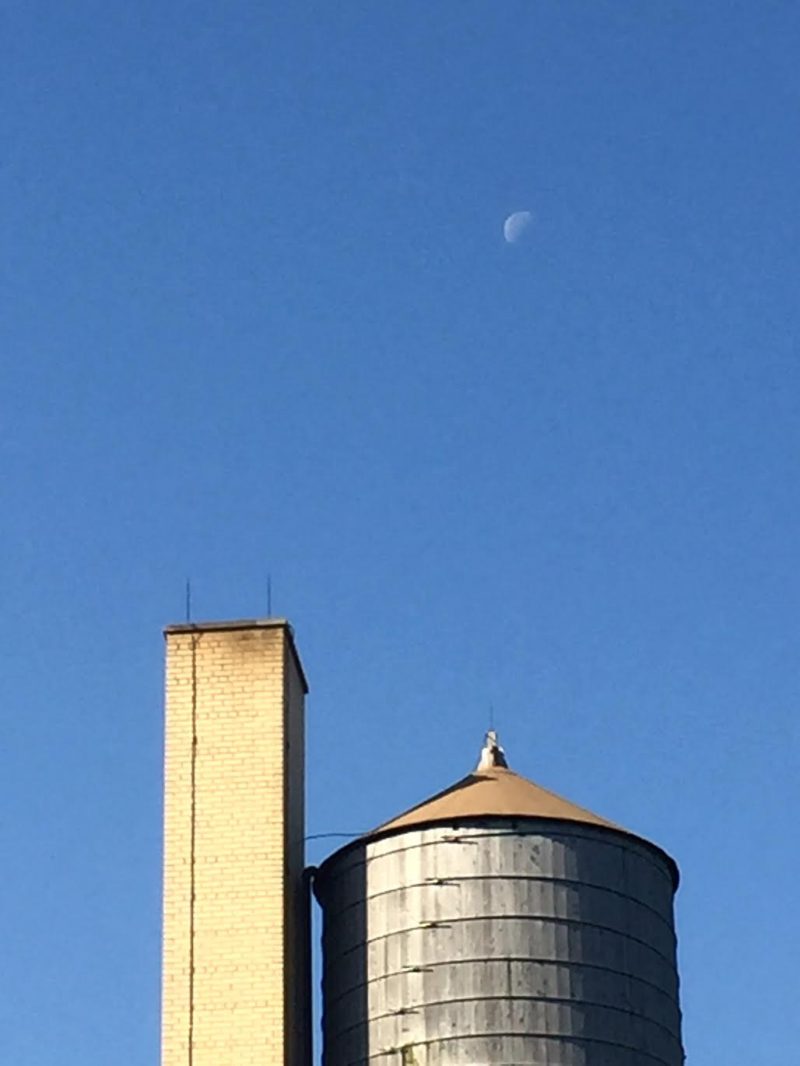
A great thing about this observation is that it can be done from anywhere, for example, as in the photo below, from large cities.

Ben Orlove wrote from New York City: “I was sitting in the roof garden of my building, and there was the moon, right in front of me. You were right, this is a perfect time to visualize … the Earth’s motion.”

As the moon orbits Earth, it changes phase in an orderly way. Follow the link below to understand the phases of the moon.

New moon
Waxing crescent moon
First quarter moon
Waxing gibbous moon
Full moon
Waning gibbous moon
Last quarter moon
Waning crescent moon

Read more: 4 keys to understanding moon phases

Bottom line: The next last quarter moon is September 3, 2018, at 02:37 UTC; translate UTC to your time.


from EarthSky https://ift.tt/1m8DkdY

The moon was almost exactly at last quarter when Deirdre Horan in Dublin, Ireland, captured this photo. The terminator line, or line between light and dark on the moon, appears straight.

When the moon appears half-lit in sunshine and half-immersed in the moon’s own shadow – when it rises in the middle of the night – astronomers say it is at last quarter. Before sunrise on April 8, 2018, the moon was at or near its last quarter phase. A last quarter moon always rises in the middle of the night, appears at its highest in the sky around dawn, and sets around midday.

On a last quarter moon, the lunar terminator – the shadow line dividing day and night – shows you where it’s sunset on the moon.

A last quarter moon provides a great opportunity to think of yourself on a three-dimensional world in space. For example, it’s fun to see this moon just after moonrise, shortly after midnight. Then the lighted portion points downward, to the sun below your feet. Think of the last quarter moon as a mirror to the world you’re standing on. Think of yourself standing in the middle of Earth’s nightside, on the midnight portion of Earth.

Also, a last quarter moon can be used as a guidepost to Earth’s direction of motion in orbit around the sun.

In other words, when you look toward a last quarter moon high in the predawn sky, for example, you’re gazing out approximately along the path of Earth’s orbit, in a forward direction. The moon is moving in orbit around the sun with the Earth and never holds still. But, if we could somehow anchor the moon in space … tie it down, keep it still … Earth’s orbital speed of 18 miles per second would carry us across the space between us and the moon in only a few hours.

A great thing about this observation is that it can be done from anywhere, for example, as in the photo below, from large cities.

Ben Orlove wrote from New York City: “I was sitting in the roof garden of my building, and there was the moon, right in front of me. You were right, this is a perfect time to visualize … the Earth’s motion.”

As the moon orbits Earth, it changes phase in an orderly way. Follow the link below to understand the phases of the moon.

New moon
Waxing crescent moon
First quarter moon
Waxing gibbous moon
Full moon
Waning gibbous moon
Last quarter moon
Waning crescent moon

Read more: 4 keys to understanding moon phases

Bottom line: The next last quarter moon is September 3, 2018, at 02:37 UTC; translate UTC to your time.


from EarthSky https://ift.tt/1m8DkdY

All 8 planets in 1 night, from Rome

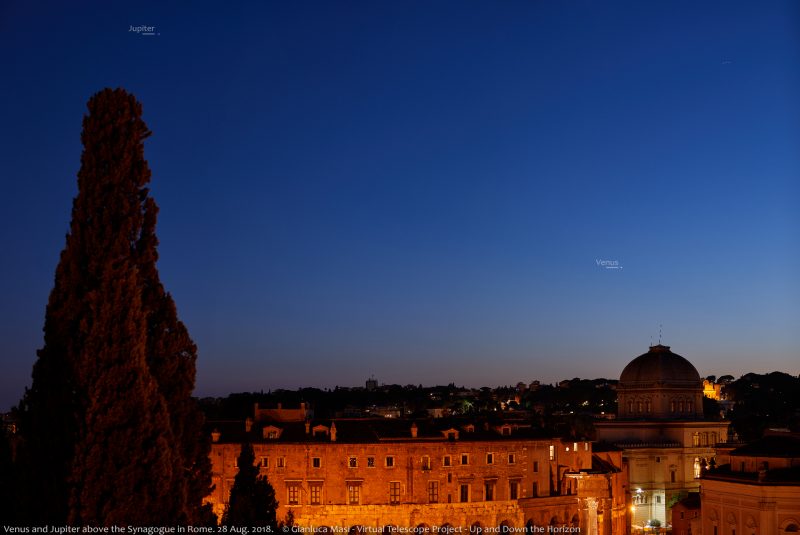
View larger. | As the night of August 28, 2018, began, Gianluca Masi of the Virtual Telescope Project caught the first planets – Venus and Jupiter – shining above the Great Synagogue of Rome, at sunset. Earth in the foreground qualifies as a planet, too.

This was was published originally at the Virtual Telescope Project and appears here with permission.

I have been thinking for decades about seeing and hopefully imagining all eight planets of our solar system in one night, from sunset to dawn. And I did it on the night of August 28-29, 2018, in a very special way: I imaged all of them from Rome, above the amazing monuments of the Eternal City. It was hard, but it was fun!

Spying the entire planetary family in one night is not straightforward. You need all the planets to be far enough from the sun, away from its intense light, but this happens from time to time. In 2016, I succeeded in observing and imaging the five bright planets – Mercury, Venus, Mars, Jupiter and Saturn – at a glance, when they offered a great view . Again, earlier this month, I could capture four of the five bright planets crossing the starry catwalk above Rome.

Of course, the Earth in the foreground qualified as a planet, too.

Since Pluto got demoted from being considered a planet in 2006, the remaining planets, the two faint ones – Uranus and Neptune – can be seen even with a very modest binocular. These two planets – which move slowly around the sun, and so slowly in front of the star background – have been for some years among the stars of Northern Hemisphere autumn, a season we are approaching. Uranus and Neptune are now up in the middle of the night.

Thus the official, current eight planets of our solar system are available for a wonderful grand tour, if you carefully choose the right moment, weather included.

And these days are just perfect!

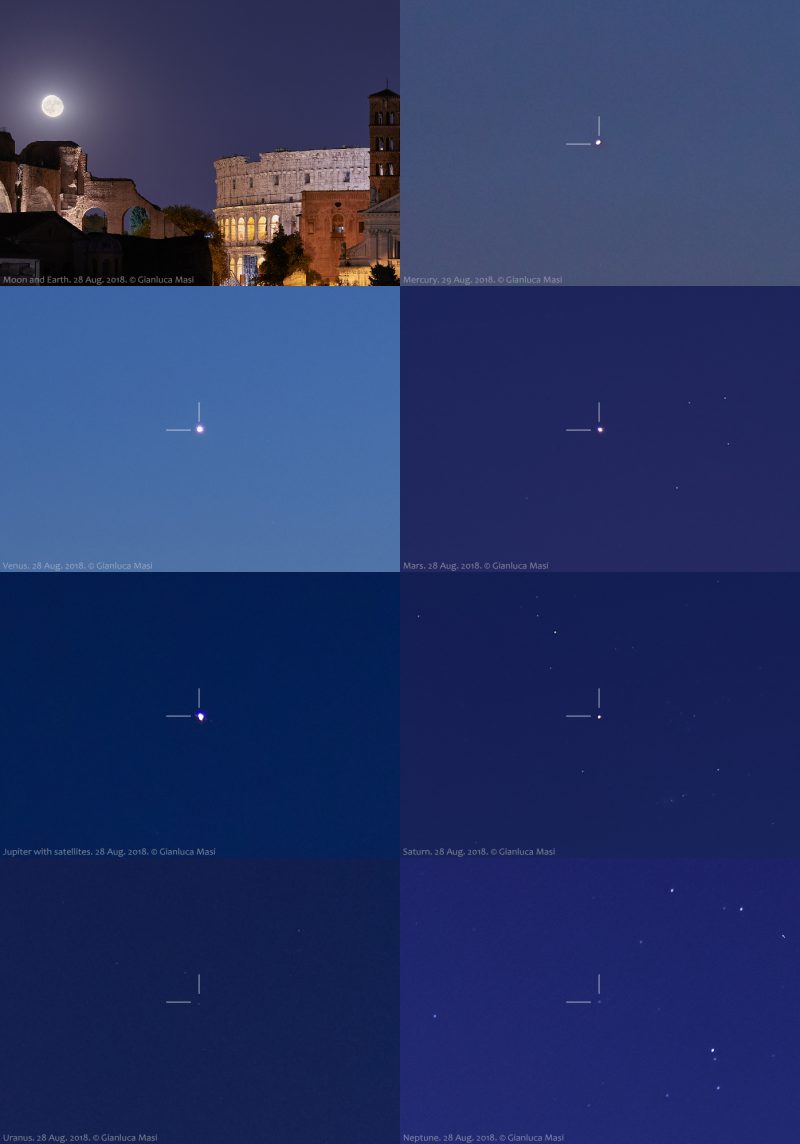
View larger. | Poster of the Gianluca Masi’s 8 planets in 1 night – August 28-29, 2018 – via Virtual Telescope Project.

With Venus leaving the evening sky pretty soon, I had to wait for Mercury to show at dawn. It is there now. I was ready to go, but in a special manner: instead of observing them in a plain way, I wanted to image them from Rome (not an easy location for Uranus and Neptune, being faint enough and difficult to see under severe light pollution), framing each with a monument of the Eternal City.

Such a solar system imaging marathon was never done with this idea in mind, to my knowledge.

I prepared my imaging gear, consisting of two Canon 5DmIV DSLR bodies and two lenses: a Canon EF 24-70mm f/2.8L II USM and a Canon EF 70-200mm f/2.8L IS II USM. Of course, I had a sturdy tripod to put all this on it.

As Uranus and especially Neptune are faint to see from a big city, I had to carefully select the imaging location and the monuments to include in their pictures. I studied this in depth, also considering my long-time experience in imaging the sky from the city, selecting some very suitable places, both for the imaging conditions and the presence of an illustrious monument. With everything set and ready to go, I decided to go out on the night of August 28-29, beginning this cosmic tour. The moon was also going to show, adding to the planetary family in a nice way.

Venus requires immediate action soon after sunset, as it leaves the sky soon after sunset.

Jupiter is not far from Venus, providing a great sight: two of the brightest celestial objects at a glance. My image of both of them, above the Synagogue of Rome, is at the top of this post. First two planets secured! Easily and safely, I would say.

Then, I changed my location, bringing with me the heavy payload I mentioned above. I understand why people looked at me in such a curious way.

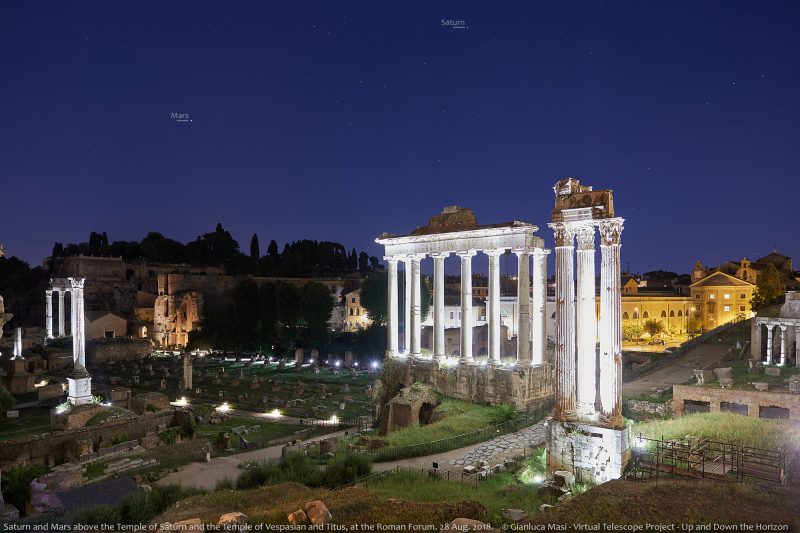
Next stop was the Roman Forum, to grab Saturn and Mars. I managed to include the Temple of Saturn (how appropriate!) and the Temple of Vespasian and Titus in such a capture. Seeing this area at night is always breathtaking and having planets and stars above is mind-blowing. In a few minutes, under a dozen curious eyes, I was ready and started imaging. The image is below; I hope you like it, too.

View larger. | As night deepened on August 28, 2018, Gianluca Masi caught the 4th and 5th planets, Saturn and Mars, above the Temple of Saturn and the Temple of Vespasian and Titus, in the Roman Forum.

Of course, I enjoyed all this with my very own eyes: technology is great, but as humans we need to feed our five senses with beauty. Time to leave for another planet!

The third stop was planned to capture Neptune, the farthest of the eight planets, hence the faintest. For the most difficult object, I wanted a legendary monument and luckily in Rome we have the immortal Colosseum. It was the gem of Rome I wanted in my picture of Neptune, despite that the planet was going to be visible as a mere dot of very faint light. I took 10 images, then I averaged them to increase the quality of the weak signal of Neptune and I must admit it worked very well.

Below you can check and judge yourself.

View larger. | Gianluca Masi caught Planet Neptune above the Colosseum and the Roman Forum on August 28, 2018. Photo via Virtual Telescope Project.

But I knew someone was going to enter the scenery and join the trip …

On the left of the picture above, you can see some glare. That is the moon rising behind the Basilica of Maxentius. Switching to my other camera, with a longer lens and, waiting for a while to have it perfectly placed, the moon joined the tour in a great way.

View larger. | The moon enters the scene on the Basilica of Maxentius, with the Colosseum on the right on August 28, 2018. Photo via Virtual Telescope Project.

Once done with the moon, I had to wait for Uranus to climb the sky, so I took a little rest. It was really needed, I cannot tell you how much I walked. I remembered I had no dinner, so I did a ride to home to get some energy back, later going out again, under the stars.

The location for Uranus was, again, the Roman Forum, where I studied this time a vertical image: I carefully included the small, but wonderful Pleiades open cluster, visible about midway up on the left side of the image as a very small dipper.

Uranus is marked and labelled for your convenience. This time, I averaged three images.
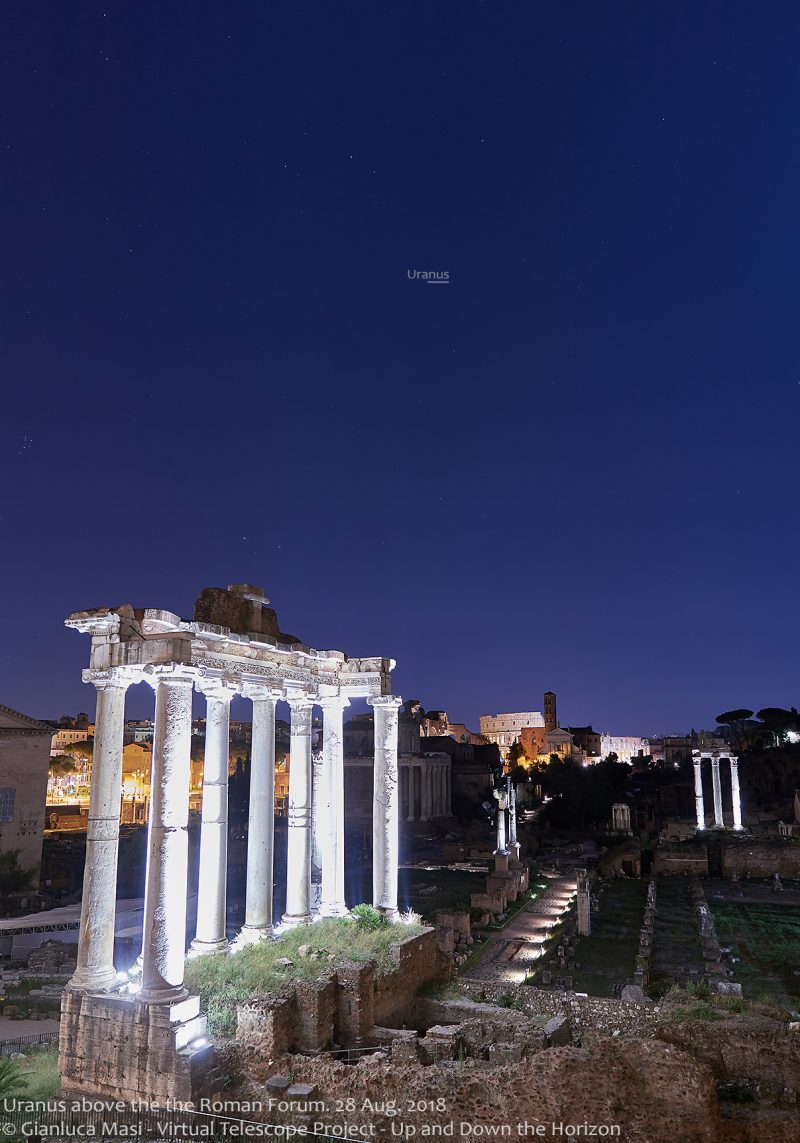
Uranus is discreetly shining above the Roman Forum, with the Pleiades star cluster – a tiny dipper – visible midway up on the left. August 28, 2018. Photo via Virtual Telescope Project.

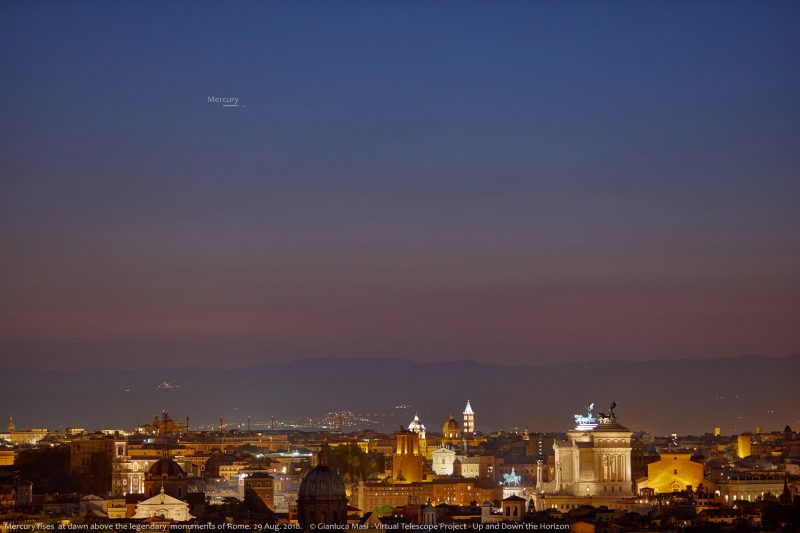
Then, the only missing planet was Mercury. It was going to rise at dawn, so I decided to go home and have a couple of hours of sleeping. When the clock alarm shouted it was time to move, I quickly left home and drove to the Janiculum Hill, facing east, where I had to wait for Mercury. I was alone there, the temperature was 19 Celsius degrees (66 degrees Fahrenheit) … Summer will not last forever.

I started imaging when Mercury was just a few degrees above the horizon, while the twilight already started and I could see the planet in my images first, then I could see it with the eye alone.

The panorama of Rome from there was honestly superb.

View larger. | Just before the sun rose, Gianluca Masi captured Mercury rising above Rome and its precious monuments, August 29, 2018. Photo via Virtual Telescope Project.

At this point the grand tour was over. I was very tired, but it was hard to leave, after such a journey. I traveled for billions of kilometers, back and forth through our solar system, spotting all its eight planets (Earth included, as the foreground in my images!) and the moon above some of the most precious monuments and symbols of our culture and history.

I hope this long report was able to bring to you my experience and feelings and that your time used to read it was well spent. I can say that living this experience was amazing, one of those things leaving great memories and feeding our love for the Cosmos and Beauty.

My friend Bob King wrote a nice article about seeing the eight planets, by the way. Check it out here!

You have a few days left to do the same journey, go out and try. Good luck!

Bottom line: All eight planets of our solar system, captured in one night, above the ancient monuments of Rome!

Help support the Virtual Telescope Project


from EarthSky https://ift.tt/2LQJBd0

View larger. | As the night of August 28, 2018, began, Gianluca Masi of the Virtual Telescope Project caught the first planets – Venus and Jupiter – shining above the Great Synagogue of Rome, at sunset. Earth in the foreground qualifies as a planet, too.

This was was published originally at the Virtual Telescope Project and appears here with permission.

I have been thinking for decades about seeing and hopefully imagining all eight planets of our solar system in one night, from sunset to dawn. And I did it on the night of August 28-29, 2018, in a very special way: I imaged all of them from Rome, above the amazing monuments of the Eternal City. It was hard, but it was fun!

Spying the entire planetary family in one night is not straightforward. You need all the planets to be far enough from the sun, away from its intense light, but this happens from time to time. In 2016, I succeeded in observing and imaging the five bright planets – Mercury, Venus, Mars, Jupiter and Saturn – at a glance, when they offered a great view . Again, earlier this month, I could capture four of the five bright planets crossing the starry catwalk above Rome.

Of course, the Earth in the foreground qualified as a planet, too.

Since Pluto got demoted from being considered a planet in 2006, the remaining planets, the two faint ones – Uranus and Neptune – can be seen even with a very modest binocular. These two planets – which move slowly around the sun, and so slowly in front of the star background – have been for some years among the stars of Northern Hemisphere autumn, a season we are approaching. Uranus and Neptune are now up in the middle of the night.

Thus the official, current eight planets of our solar system are available for a wonderful grand tour, if you carefully choose the right moment, weather included.

And these days are just perfect!

View larger. | Poster of the Gianluca Masi’s 8 planets in 1 night – August 28-29, 2018 – via Virtual Telescope Project.

With Venus leaving the evening sky pretty soon, I had to wait for Mercury to show at dawn. It is there now. I was ready to go, but in a special manner: instead of observing them in a plain way, I wanted to image them from Rome (not an easy location for Uranus and Neptune, being faint enough and difficult to see under severe light pollution), framing each with a monument of the Eternal City.

Such a solar system imaging marathon was never done with this idea in mind, to my knowledge.

I prepared my imaging gear, consisting of two Canon 5DmIV DSLR bodies and two lenses: a Canon EF 24-70mm f/2.8L II USM and a Canon EF 70-200mm f/2.8L IS II USM. Of course, I had a sturdy tripod to put all this on it.

As Uranus and especially Neptune are faint to see from a big city, I had to carefully select the imaging location and the monuments to include in their pictures. I studied this in depth, also considering my long-time experience in imaging the sky from the city, selecting some very suitable places, both for the imaging conditions and the presence of an illustrious monument. With everything set and ready to go, I decided to go out on the night of August 28-29, beginning this cosmic tour. The moon was also going to show, adding to the planetary family in a nice way.

Venus requires immediate action soon after sunset, as it leaves the sky soon after sunset.

Jupiter is not far from Venus, providing a great sight: two of the brightest celestial objects at a glance. My image of both of them, above the Synagogue of Rome, is at the top of this post. First two planets secured! Easily and safely, I would say.

Then, I changed my location, bringing with me the heavy payload I mentioned above. I understand why people looked at me in such a curious way.

Next stop was the Roman Forum, to grab Saturn and Mars. I managed to include the Temple of Saturn (how appropriate!) and the Temple of Vespasian and Titus in such a capture. Seeing this area at night is always breathtaking and having planets and stars above is mind-blowing. In a few minutes, under a dozen curious eyes, I was ready and started imaging. The image is below; I hope you like it, too.

View larger. | As night deepened on August 28, 2018, Gianluca Masi caught the 4th and 5th planets, Saturn and Mars, above the Temple of Saturn and the Temple of Vespasian and Titus, in the Roman Forum.

Of course, I enjoyed all this with my very own eyes: technology is great, but as humans we need to feed our five senses with beauty. Time to leave for another planet!

The third stop was planned to capture Neptune, the farthest of the eight planets, hence the faintest. For the most difficult object, I wanted a legendary monument and luckily in Rome we have the immortal Colosseum. It was the gem of Rome I wanted in my picture of Neptune, despite that the planet was going to be visible as a mere dot of very faint light. I took 10 images, then I averaged them to increase the quality of the weak signal of Neptune and I must admit it worked very well.

Below you can check and judge yourself.

View larger. | Gianluca Masi caught Planet Neptune above the Colosseum and the Roman Forum on August 28, 2018. Photo via Virtual Telescope Project.

But I knew someone was going to enter the scenery and join the trip …

On the left of the picture above, you can see some glare. That is the moon rising behind the Basilica of Maxentius. Switching to my other camera, with a longer lens and, waiting for a while to have it perfectly placed, the moon joined the tour in a great way.

View larger. | The moon enters the scene on the Basilica of Maxentius, with the Colosseum on the right on August 28, 2018. Photo via Virtual Telescope Project.

Once done with the moon, I had to wait for Uranus to climb the sky, so I took a little rest. It was really needed, I cannot tell you how much I walked. I remembered I had no dinner, so I did a ride to home to get some energy back, later going out again, under the stars.

The location for Uranus was, again, the Roman Forum, where I studied this time a vertical image: I carefully included the small, but wonderful Pleiades open cluster, visible about midway up on the left side of the image as a very small dipper.

Uranus is marked and labelled for your convenience. This time, I averaged three images.

Uranus is discreetly shining above the Roman Forum, with the Pleiades star cluster – a tiny dipper – visible midway up on the left. August 28, 2018. Photo via Virtual Telescope Project.

Then, the only missing planet was Mercury. It was going to rise at dawn, so I decided to go home and have a couple of hours of sleeping. When the clock alarm shouted it was time to move, I quickly left home and drove to the Janiculum Hill, facing east, where I had to wait for Mercury. I was alone there, the temperature was 19 Celsius degrees (66 degrees Fahrenheit) … Summer will not last forever.

I started imaging when Mercury was just a few degrees above the horizon, while the twilight already started and I could see the planet in my images first, then I could see it with the eye alone.

The panorama of Rome from there was honestly superb.

View larger. | Just before the sun rose, Gianluca Masi captured Mercury rising above Rome and its precious monuments, August 29, 2018. Photo via Virtual Telescope Project.

At this point the grand tour was over. I was very tired, but it was hard to leave, after such a journey. I traveled for billions of kilometers, back and forth through our solar system, spotting all its eight planets (Earth included, as the foreground in my images!) and the moon above some of the most precious monuments and symbols of our culture and history.

I hope this long report was able to bring to you my experience and feelings and that your time used to read it was well spent. I can say that living this experience was amazing, one of those things leaving great memories and feeding our love for the Cosmos and Beauty.

My friend Bob King wrote a nice article about seeing the eight planets, by the way. Check it out here!

You have a few days left to do the same journey, go out and try. Good luck!

Bottom line: All eight planets of our solar system, captured in one night, above the ancient monuments of Rome!

Help support the Virtual Telescope Project


from EarthSky https://ift.tt/2LQJBd0

Why you can smell rain

Your nose knows what’s on the way. Image via Lucy Chian/Unsplash.

By Tim Logan, Texas A&M University

When those first fat drops of summer rain fall to the hot, dry ground, have you ever noticed a distinctive odor? I have childhood memories of family members who were farmers describing how they could always “smell rain” right before a storm.

Of course rain itself has no scent. But moments before a rain event, an “earthy” smell known as petrichor does permeate the air. People call it musky, fresh – generally pleasant.

This smell actually comes from the moistening of the ground. Australian scientists first documented the process of petrichor formation in 1964 and scientists from the Massachusetts Institute of Technology further studied the mechanics of the process in the 2010s.

Petrichor’s main ingredients are made by plants and bacteria that live in the ground.. Image via Vovan/Shutterstock.

Petrichor is a combination of fragrant chemical compounds. Some are from oils made by plants. The main contributor to petrichor are actinobacteria. These tiny microorganisms can be found in rural and urban areas as well as in marine environments. They decompose dead or decaying organic matter into simple chemical compounds which can then become nutrients for developing plants and other organisms.

A byproduct of their activity is an organic compound called geosmin which contributes to the petrichor scent. Geosmin is a type of alcohol, like rubbing alcohol. Alcohol molecules tend to have a strong scent, but the complex chemical structure of geosmin makes it especially noticeable to people even at extremely low levels. Our noses can detect just a few parts of geosmin per trillion of air molecules.

During a prolonged period of dryness when it has not rained for several days, the decomposition activity rate of the actinobacteria slows down. Just before a rain event, the air becomes more humid and the ground begins to moisten. This process helps to speed up the activity of the actinobacteria and more geosmin is formed.

Before you see it, do you smell it? Image via Shutterstock.

When raindrops fall on the ground, especially porous surfaces such as loose soil or rough concrete, they will splatter and eject tiny particles called aerosols. The geosmin and other petrichor compounds that may be present on the ground or dissolved within the raindrop are released in aerosol form and carried by the wind to surrounding areas. If the rainfall is heavy enough, the petrichor scent can travel rapidly downwind and alert people that rain is soon on the way.

The scent eventually goes away after the storm has passed and the ground begins to dry. This leaves the actinobacteria lying in wait – ready to help us know when it might rain again.

Tim Logan, Instructional Assistant Professor of Atmospheric Sciences, Texas A&M University

This article was originally published on The Conversation. Read the original article.

Bottom line: What is the smell of rain? It’s called petrichor.

The Conversation


from EarthSky https://ift.tt/2NbMxFO

Your nose knows what’s on the way. Image via Lucy Chian/Unsplash.

By Tim Logan, Texas A&M University

When those first fat drops of summer rain fall to the hot, dry ground, have you ever noticed a distinctive odor? I have childhood memories of family members who were farmers describing how they could always “smell rain” right before a storm.

Of course rain itself has no scent. But moments before a rain event, an “earthy” smell known as petrichor does permeate the air. People call it musky, fresh – generally pleasant.

This smell actually comes from the moistening of the ground. Australian scientists first documented the process of petrichor formation in 1964 and scientists from the Massachusetts Institute of Technology further studied the mechanics of the process in the 2010s.

Petrichor’s main ingredients are made by plants and bacteria that live in the ground.. Image via Vovan/Shutterstock.

Petrichor is a combination of fragrant chemical compounds. Some are from oils made by plants. The main contributor to petrichor are actinobacteria. These tiny microorganisms can be found in rural and urban areas as well as in marine environments. They decompose dead or decaying organic matter into simple chemical compounds which can then become nutrients for developing plants and other organisms.

A byproduct of their activity is an organic compound called geosmin which contributes to the petrichor scent. Geosmin is a type of alcohol, like rubbing alcohol. Alcohol molecules tend to have a strong scent, but the complex chemical structure of geosmin makes it especially noticeable to people even at extremely low levels. Our noses can detect just a few parts of geosmin per trillion of air molecules.

During a prolonged period of dryness when it has not rained for several days, the decomposition activity rate of the actinobacteria slows down. Just before a rain event, the air becomes more humid and the ground begins to moisten. This process helps to speed up the activity of the actinobacteria and more geosmin is formed.

Before you see it, do you smell it? Image via Shutterstock.

When raindrops fall on the ground, especially porous surfaces such as loose soil or rough concrete, they will splatter and eject tiny particles called aerosols. The geosmin and other petrichor compounds that may be present on the ground or dissolved within the raindrop are released in aerosol form and carried by the wind to surrounding areas. If the rainfall is heavy enough, the petrichor scent can travel rapidly downwind and alert people that rain is soon on the way.

The scent eventually goes away after the storm has passed and the ground begins to dry. This leaves the actinobacteria lying in wait – ready to help us know when it might rain again.

Tim Logan, Instructional Assistant Professor of Atmospheric Sciences, Texas A&M University

This article was originally published on The Conversation. Read the original article.

Bottom line: What is the smell of rain? It’s called petrichor.

The Conversation


from EarthSky https://ift.tt/2NbMxFO

Catch Venus, Jupiter, Arcturus at dusk

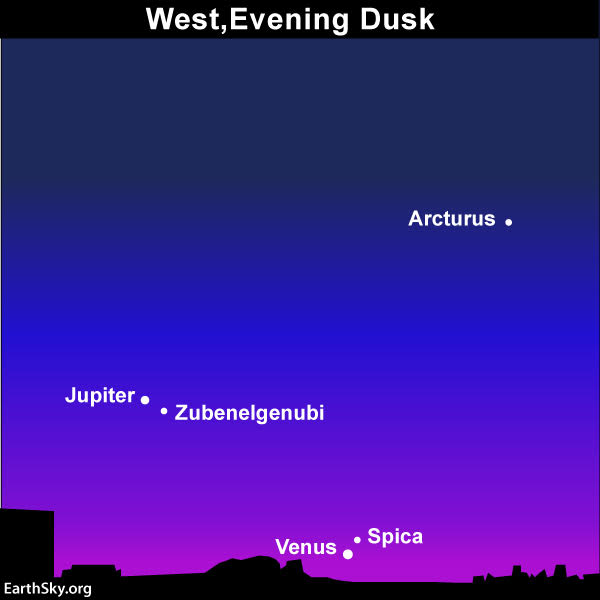
Throughout September, 2018, find an unobstructed horizon in the direction of sunset and watch for two brilliant planets and one bright star to pop out into the your western sky at dusk. In their order of brilliance, these bright beauties are the planets Venus and Jupiter, plus the star Arcturus. Given clear skies and an unobstructed western horizon, the gorgeous threesome – Venus, Jupiter and Arcturus – should be easy to view from most places worldwide.

The sky charts above and below are designed for around 40 degrees north latitude (United States, Spain, Turkey, Japan). If you live at far-northern latitudes, however, you might not see Venus. That’s because – for example – at 60 degrees north latitude (the latitude of Anchorage, Alaska), the sun and Venus set at about the same time.

From the Southern Hemisphere, you’ll see Jupiter more directly above Venus (rather than to Venus’ upper left). Moreover, Venus and Jupiter stay out considerably longer after sunset in the Southern Hemisphere than they do in the Northern Hemisphere.

If you can’t see the star Spica next to Venus or the star Zubenelgenubi next to Jupiter with the eye alone, try your luck with binoculars.

Arcturus is a different story altogether. From the tropical regions of the globe, Arcturus appears lower down in the sky, more to the right (rather than the upper right) of Venus and Jupiter. In early September 2018, at 20 degrees north latitude (Hawaii and Mexico City), Jupiter and Arcturus set about the same time; and at 20 degrees south latitude, it’s Venus and Arcturus that set at about the same time.

Farther south, in the temperate regions of the the Southern Hemisphere, Arcturus is found to the lower right of Venus. At these southerly latitudes, Arcturus sets before Venus does.

Click here for a recommended sky almanac giving you the settings times for the sun, Venus, Jupiter and Arcturus

Have binoculars? Aim them at Venus and you might spot Spica, the brightest star in the constellation Virgo the Maiden, in the same binocular field together. Then aim binoculars at Jupiter to view Zubenelgenubi, the alpha star of the constellation Libra the Scales, taking stage in the same binocular field with Jupiter. (See sky chart above.)

Bottom line: Look west at dusk throughout September, 2018, for a bright celestial threesome. In order of brightness, they are Venus, Jupiter and the star Arcturus.


from EarthSky https://ift.tt/2wB4C6J

Throughout September, 2018, find an unobstructed horizon in the direction of sunset and watch for two brilliant planets and one bright star to pop out into the your western sky at dusk. In their order of brilliance, these bright beauties are the planets Venus and Jupiter, plus the star Arcturus. Given clear skies and an unobstructed western horizon, the gorgeous threesome – Venus, Jupiter and Arcturus – should be easy to view from most places worldwide.

The sky charts above and below are designed for around 40 degrees north latitude (United States, Spain, Turkey, Japan). If you live at far-northern latitudes, however, you might not see Venus. That’s because – for example – at 60 degrees north latitude (the latitude of Anchorage, Alaska), the sun and Venus set at about the same time.

From the Southern Hemisphere, you’ll see Jupiter more directly above Venus (rather than to Venus’ upper left). Moreover, Venus and Jupiter stay out considerably longer after sunset in the Southern Hemisphere than they do in the Northern Hemisphere.

If you can’t see the star Spica next to Venus or the star Zubenelgenubi next to Jupiter with the eye alone, try your luck with binoculars.

Arcturus is a different story altogether. From the tropical regions of the globe, Arcturus appears lower down in the sky, more to the right (rather than the upper right) of Venus and Jupiter. In early September 2018, at 20 degrees north latitude (Hawaii and Mexico City), Jupiter and Arcturus set about the same time; and at 20 degrees south latitude, it’s Venus and Arcturus that set at about the same time.

Farther south, in the temperate regions of the the Southern Hemisphere, Arcturus is found to the lower right of Venus. At these southerly latitudes, Arcturus sets before Venus does.

Click here for a recommended sky almanac giving you the settings times for the sun, Venus, Jupiter and Arcturus

Have binoculars? Aim them at Venus and you might spot Spica, the brightest star in the constellation Virgo the Maiden, in the same binocular field together. Then aim binoculars at Jupiter to view Zubenelgenubi, the alpha star of the constellation Libra the Scales, taking stage in the same binocular field with Jupiter. (See sky chart above.)

Bottom line: Look west at dusk throughout September, 2018, for a bright celestial threesome. In order of brightness, they are Venus, Jupiter and the star Arcturus.


from EarthSky https://ift.tt/2wB4C6J

2018 SkS Weekly Climate Change & Global Warming News Roundup #35

A chronological listing of news articles posted on the Skeptical Science Facebook Page during the past week.

Editor's Pick

Most land-based ecosystems worldwide risk ‘major transformation’ due to climate change

most-land-based-ecosystems-worldwide-risk-major-transformation-due-to-climate-change-map-

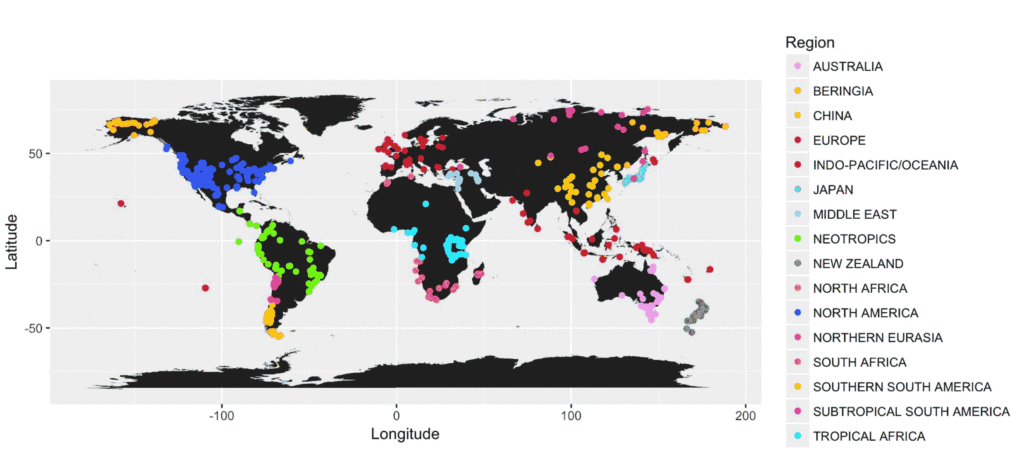
Researchers compiled and evaluated pollen and plant-fossil records from nearly 600 sites worldwide for their study of vegetation change. Map reprinted with permission from Nolan et al., Science, 2018 (10.1126/science.aan5360).

Without dramatic reductions in greenhouse-gas emissions, most of the planet’s land-based ecosystems—from its forests and grasslands to the deserts and tundra—are at high risk of “major transformation” due to climate change, according to a new study from an international research team.

The researchers used fossil records of global vegetation change that occurred during a period of post-glacial warming to project the magnitude of ecosystem transformations likely in the future under various greenhouse gas emissions scenarios.

They found that under a “business as usual” emissions scenario, in which little is done to rein in heat-trapping greenhouse-gas emissions, vegetation changes across the planet’s wild landscapes will likely be more far-reaching and disruptive than earlier studies suggested.

The changes would threaten global biodiversity and derail vital services that nature provides to humanity, such as water security, carbon storage and recreation, according to study co-author Jonathan Overpeck, dean of the School for Environment and Sustainability at the University of Michigan.

“If we allow climate change to go unchecked, the vegetation of this planet is going to look completely different than it does today, and that means a huge risk to the diversity of the planet,” said Overpeck, who conceived the idea for the study with corresponding author Stephen T. Jackson of the U.S. Geological Survey.

Most land-based ecosystems worldwide risk ‘major transformation’ due to climate change, Michigan News (University of Michigan), Aug 30, 2018


Links posted on Facebook

Sun Aug 26, 2018

Mon Aug 27, 2018

Tue Aug 28, 2018

Wed Aug 29, 2018

Thu Aug 30, 2018

Fri Aug 31 2018

Sat Sep1 2018


from Skeptical Science https://ift.tt/2wDt9az
A chronological listing of news articles posted on the Skeptical Science Facebook Page during the past week.

Editor's Pick

Most land-based ecosystems worldwide risk ‘major transformation’ due to climate change

most-land-based-ecosystems-worldwide-risk-major-transformation-due-to-climate-change-map-

Researchers compiled and evaluated pollen and plant-fossil records from nearly 600 sites worldwide for their study of vegetation change. Map reprinted with permission from Nolan et al., Science, 2018 (10.1126/science.aan5360).

Without dramatic reductions in greenhouse-gas emissions, most of the planet’s land-based ecosystems—from its forests and grasslands to the deserts and tundra—are at high risk of “major transformation” due to climate change, according to a new study from an international research team.

The researchers used fossil records of global vegetation change that occurred during a period of post-glacial warming to project the magnitude of ecosystem transformations likely in the future under various greenhouse gas emissions scenarios.

They found that under a “business as usual” emissions scenario, in which little is done to rein in heat-trapping greenhouse-gas emissions, vegetation changes across the planet’s wild landscapes will likely be more far-reaching and disruptive than earlier studies suggested.

The changes would threaten global biodiversity and derail vital services that nature provides to humanity, such as water security, carbon storage and recreation, according to study co-author Jonathan Overpeck, dean of the School for Environment and Sustainability at the University of Michigan.

“If we allow climate change to go unchecked, the vegetation of this planet is going to look completely different than it does today, and that means a huge risk to the diversity of the planet,” said Overpeck, who conceived the idea for the study with corresponding author Stephen T. Jackson of the U.S. Geological Survey.

Most land-based ecosystems worldwide risk ‘major transformation’ due to climate change, Michigan News (University of Michigan), Aug 30, 2018


Links posted on Facebook

Sun Aug 26, 2018

Mon Aug 27, 2018

Tue Aug 28, 2018

Wed Aug 29, 2018

Thu Aug 30, 2018

Fri Aug 31 2018

Sat Sep1 2018


from Skeptical Science https://ift.tt/2wDt9az

adds 2