aads

Gulf of Mexico 2018 dead zone forecast

In a statement released June 7, 2018, NOAA said scientific models suggest that this summer’s Gulf of Mexico hypoxic zone or “dead zone” will be approximately 5,780 square miles (14,760 square km), about the size of the U.S. state of Connecticut. That’s similar to the 33-year average of 5,460 square miles (14,140 square km), and smaller than 2017’s Gulf dead zone – which at 8,776 square miles (22,730 square km) was the largest measured since mapping began in 1985.

Hypoxic zones – aka “dead zones” – are areas in the ocean of such low oxygen concentration that animal life suffocates and dies. A dead zone forms in the Gulf of Mexico every summer. Nutrients from the Mississippi River watershed, particularly nitrogen and phosphorus, fertilize the Gulf’s surface waters to create excessive amounts of algae. When the algae decomposes in the deepest parts of the ocean, it leads to oxygen distress and can kill organisms even in the Gulf of Mexico’s richest waters. These low oxygen conditions threaten living resources including fish, shrimp and crabs, which humans depend upon for food and industry.

Scientists deploy a sensor to collect water to test oxygen levels in the Gulf of Mexico. Image via NOAA.

Even though NOAA is predicting an average dead zone this summer, the dead zone remains three times larger than the long-term target set by the Interagency Mississippi River and Gulf of Mexico Hypoxia Task Force, a group charged with reducing the Gulf dead zone.

An oxygen-starved hypoxic zone – commonly called a dead zone – shown in red, forms each summer in the Gulf of Mexico. Fish and shellfish either leave the oxygen-depleted waters or die, resulting in losses to commercial and sports fisheries. Image via NOAA.

Steve Thur is the director of NOAA’s National Centers for Coastal Ocean Science. Thur said:

The Gulf’s recurring summer hypoxic zone continues to put important habitats and valuable fisheries at risk. Although there has been some progress in reducing nutrients, the overall levels remain high and continue to strain the region’s coastal economies.

NOAA issues a dead zone forecast each year. The forecast is based on nitrogen runoff and river discharge data from the U.S. Geological Survey (USGS). The forecast assumes typical weather conditions, but the dead zone could be disrupted by hurricanes and tropical storms. A NOAA-supported monitoring survey will confirm the size of the 2018 Gulf dead zone in early August.

According to a NOAA statement:

Higher river discharge in May carries a larger nutrient load into the Gulf of Mexico, one factor that contributes to a larger hypoxic zone. This past May, discharge in the Mississippi and Atchafalaya rivers was about 4 percent above the long-term average (between 1980 and 2017). The USGS estimates that this near-average river discharge carried 115,000 metric tons of nitrate and 18,500 metric tons of phosphorus into the Gulf of Mexico in May. These nitrate loads were about 13 percent below the long-term average, and the phosphorus loads were about 10 percent above the long-term average.

Bottom line: NOAA scientists project that the 2018 summer hypoxic zone or ‘dead zone’ in the Gulf of Mexico will be about the size of Connecticut.

Read more from NOAA

Help EarthSky keep going! Please donate what you can to our annual crowd-funding campaign.


from EarthSky https://ift.tt/2JDi8zu

In a statement released June 7, 2018, NOAA said scientific models suggest that this summer’s Gulf of Mexico hypoxic zone or “dead zone” will be approximately 5,780 square miles (14,760 square km), about the size of the U.S. state of Connecticut. That’s similar to the 33-year average of 5,460 square miles (14,140 square km), and smaller than 2017’s Gulf dead zone – which at 8,776 square miles (22,730 square km) was the largest measured since mapping began in 1985.

Hypoxic zones – aka “dead zones” – are areas in the ocean of such low oxygen concentration that animal life suffocates and dies. A dead zone forms in the Gulf of Mexico every summer. Nutrients from the Mississippi River watershed, particularly nitrogen and phosphorus, fertilize the Gulf’s surface waters to create excessive amounts of algae. When the algae decomposes in the deepest parts of the ocean, it leads to oxygen distress and can kill organisms even in the Gulf of Mexico’s richest waters. These low oxygen conditions threaten living resources including fish, shrimp and crabs, which humans depend upon for food and industry.

Scientists deploy a sensor to collect water to test oxygen levels in the Gulf of Mexico. Image via NOAA.

Even though NOAA is predicting an average dead zone this summer, the dead zone remains three times larger than the long-term target set by the Interagency Mississippi River and Gulf of Mexico Hypoxia Task Force, a group charged with reducing the Gulf dead zone.

An oxygen-starved hypoxic zone – commonly called a dead zone – shown in red, forms each summer in the Gulf of Mexico. Fish and shellfish either leave the oxygen-depleted waters or die, resulting in losses to commercial and sports fisheries. Image via NOAA.

Steve Thur is the director of NOAA’s National Centers for Coastal Ocean Science. Thur said:

The Gulf’s recurring summer hypoxic zone continues to put important habitats and valuable fisheries at risk. Although there has been some progress in reducing nutrients, the overall levels remain high and continue to strain the region’s coastal economies.

NOAA issues a dead zone forecast each year. The forecast is based on nitrogen runoff and river discharge data from the U.S. Geological Survey (USGS). The forecast assumes typical weather conditions, but the dead zone could be disrupted by hurricanes and tropical storms. A NOAA-supported monitoring survey will confirm the size of the 2018 Gulf dead zone in early August.

According to a NOAA statement:

Higher river discharge in May carries a larger nutrient load into the Gulf of Mexico, one factor that contributes to a larger hypoxic zone. This past May, discharge in the Mississippi and Atchafalaya rivers was about 4 percent above the long-term average (between 1980 and 2017). The USGS estimates that this near-average river discharge carried 115,000 metric tons of nitrate and 18,500 metric tons of phosphorus into the Gulf of Mexico in May. These nitrate loads were about 13 percent below the long-term average, and the phosphorus loads were about 10 percent above the long-term average.

Bottom line: NOAA scientists project that the 2018 summer hypoxic zone or ‘dead zone’ in the Gulf of Mexico will be about the size of Connecticut.

Read more from NOAA

Help EarthSky keep going! Please donate what you can to our annual crowd-funding campaign.


from EarthSky https://ift.tt/2JDi8zu

Moon, Mercury, Venus June 14 to 16

After sunset these next several evenings – June 14, 15 and 16, 2018 – watch for the young waxing crescent moon to swing by our sun’s two inferior planets, Mercury and Venus. On all of these evenings, it’ll be easy to see Venus shortly after sundown. After all, Venus is the brightest planet and the second-brightest object in the night sky, after the moon. It’ll take a more heroic effort to spot Mercury beneath Venus. As for the moon, it’ll be tough to see – but possible to see – on June 14. And on June 15 and 16, the moon will be easy! All in all, we’re due for some very beautiful scenes in the evening twilight. Watch all three evenings … and get a sense for the moon’s movement in orbit around Earth.

Especially if you want to see Mercury – and the young, pale, whisker-thin crescent moon on June 14 – find an unobstructed horizon in the direction of sunset. You may need binoculars to spot the moon and/or Mercury in the glare of evening twilight.

The setting time for the sun, moon, Mercury and Venus varies around the world. On June 14, at middle North American latitudes, the moon and Mercury set close to one hour after sunset, and Venus about 2.5 hours after sundown. Click here for a recommended sky almanac that’ll provide you with precise setting times of these worlds in your sky.

After June 14, each following evening, the moon will appear as a wider crescent that’ll be higher up at sunset and stay out longer after dark. Try also to view the earthshine softly illuminating the dark (nighttime) side of the moon, with either the unaided eye or binoculars.

Earthshine is twice-reflected sunlight, with our planet Earth reflecting sunlight to the moon, and the moon, in turn, reflecting sunlight back to Earth.

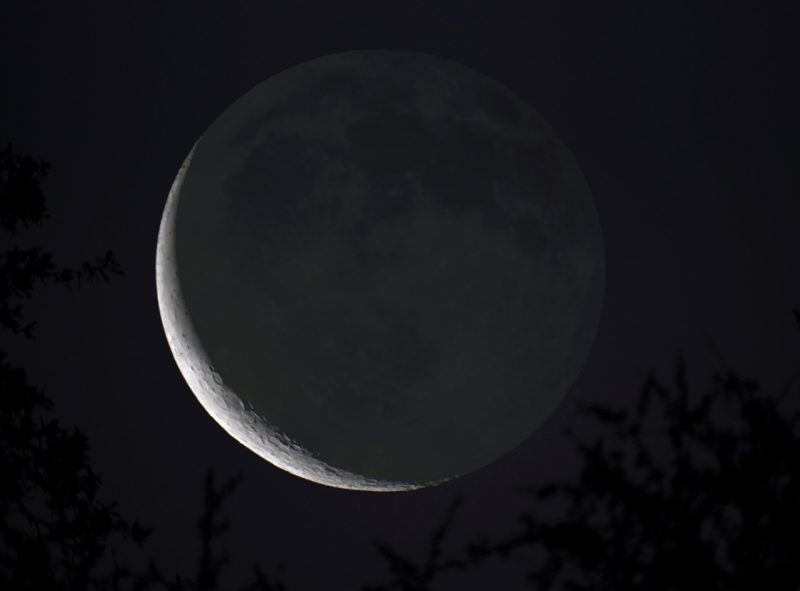
Waning crescent moon with earthshine via Robert Pettengill in Austin, Texas.

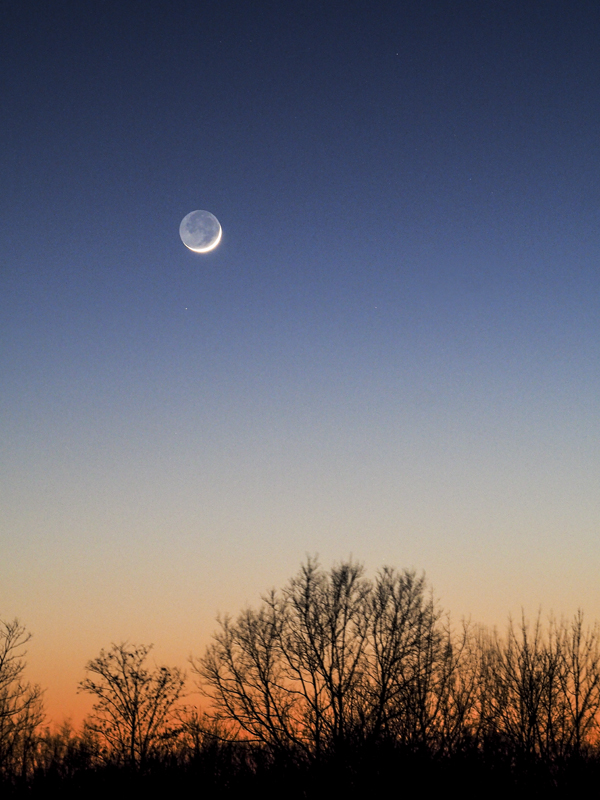
Young moon with earthshine from Judy Lundquist in Lawrenceburg, Kentucky. Earthshine is sunlight reflected from Earth, onto the moon.

You know how the late afternoon sun sinks downward in the western sky? Celestial objects seen after dark can also be seen to sink downward to that western horizon, as evening deepens. This apparent westward movement of celestial bodies – sun, moon, planets or stars – is really a reflection of the Earth spinning on its rotational axis from west-to-east. Earth’s spins makes it appear as if all these celestial bodies are moving westward while the Earth remains still. We can’t feel Earth’s spin, but, as these sky bodies testify, we know it’s there.

Meanwhile, if you watch on several evenings, at just the same time, you’ll note the moon’s movement upward from the western horizon. Each evening, the moon will be farther east on the sky’s dome than it was the day before. This eastward shift of the moon on our sky’s dome is a reflection of the moon’s eastward motion in orbit around Earth.

So watch as a great drama of sky motions unfolds in the west at dusk, as the moon sweeps by the two planets, Mercury and Venus, in mid-June 2018!

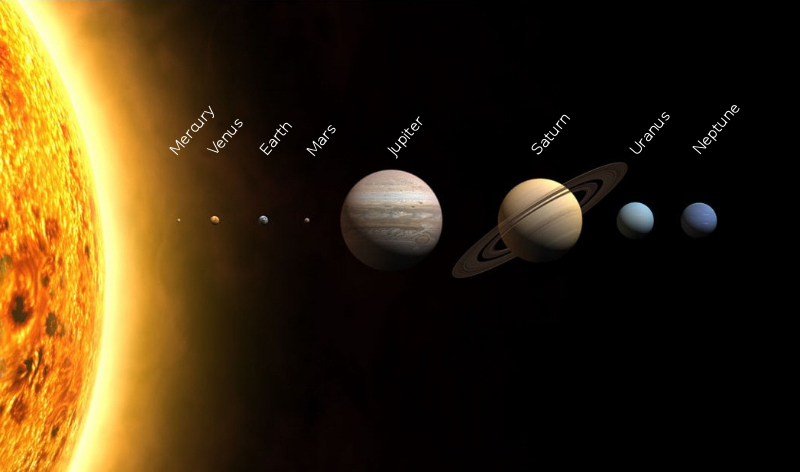
The relative sizes of the solar system planets via NASA. Distances are NOT to scale. Mercury and Venus are called inferior planets because they orbit the sun inside of Earth’s orbit.

Bottom line: On June 14, 15 and 16, 2018, the young moon swings by two planets in the western sky after sunset. They are Mercury and Venus.


from EarthSky https://ift.tt/2l781UP

After sunset these next several evenings – June 14, 15 and 16, 2018 – watch for the young waxing crescent moon to swing by our sun’s two inferior planets, Mercury and Venus. On all of these evenings, it’ll be easy to see Venus shortly after sundown. After all, Venus is the brightest planet and the second-brightest object in the night sky, after the moon. It’ll take a more heroic effort to spot Mercury beneath Venus. As for the moon, it’ll be tough to see – but possible to see – on June 14. And on June 15 and 16, the moon will be easy! All in all, we’re due for some very beautiful scenes in the evening twilight. Watch all three evenings … and get a sense for the moon’s movement in orbit around Earth.

Especially if you want to see Mercury – and the young, pale, whisker-thin crescent moon on June 14 – find an unobstructed horizon in the direction of sunset. You may need binoculars to spot the moon and/or Mercury in the glare of evening twilight.

The setting time for the sun, moon, Mercury and Venus varies around the world. On June 14, at middle North American latitudes, the moon and Mercury set close to one hour after sunset, and Venus about 2.5 hours after sundown. Click here for a recommended sky almanac that’ll provide you with precise setting times of these worlds in your sky.

After June 14, each following evening, the moon will appear as a wider crescent that’ll be higher up at sunset and stay out longer after dark. Try also to view the earthshine softly illuminating the dark (nighttime) side of the moon, with either the unaided eye or binoculars.

Earthshine is twice-reflected sunlight, with our planet Earth reflecting sunlight to the moon, and the moon, in turn, reflecting sunlight back to Earth.

Waning crescent moon with earthshine via Robert Pettengill in Austin, Texas.

Young moon with earthshine from Judy Lundquist in Lawrenceburg, Kentucky. Earthshine is sunlight reflected from Earth, onto the moon.

You know how the late afternoon sun sinks downward in the western sky? Celestial objects seen after dark can also be seen to sink downward to that western horizon, as evening deepens. This apparent westward movement of celestial bodies – sun, moon, planets or stars – is really a reflection of the Earth spinning on its rotational axis from west-to-east. Earth’s spins makes it appear as if all these celestial bodies are moving westward while the Earth remains still. We can’t feel Earth’s spin, but, as these sky bodies testify, we know it’s there.

Meanwhile, if you watch on several evenings, at just the same time, you’ll note the moon’s movement upward from the western horizon. Each evening, the moon will be farther east on the sky’s dome than it was the day before. This eastward shift of the moon on our sky’s dome is a reflection of the moon’s eastward motion in orbit around Earth.

So watch as a great drama of sky motions unfolds in the west at dusk, as the moon sweeps by the two planets, Mercury and Venus, in mid-June 2018!

The relative sizes of the solar system planets via NASA. Distances are NOT to scale. Mercury and Venus are called inferior planets because they orbit the sun inside of Earth’s orbit.

Bottom line: On June 14, 15 and 16, 2018, the young moon swings by two planets in the western sky after sunset. They are Mercury and Venus.


from EarthSky https://ift.tt/2l781UP

Air Force’s High-Speed Track Still Vital to Testing Efforts

The Air Force's high-speed track's passengers are pioneers of speed, science, and safety.

from https://ift.tt/2sS1h1y
The Air Force's high-speed track's passengers are pioneers of speed, science, and safety.

from https://ift.tt/2sS1h1y

ALMA spies 3 planets around a young star

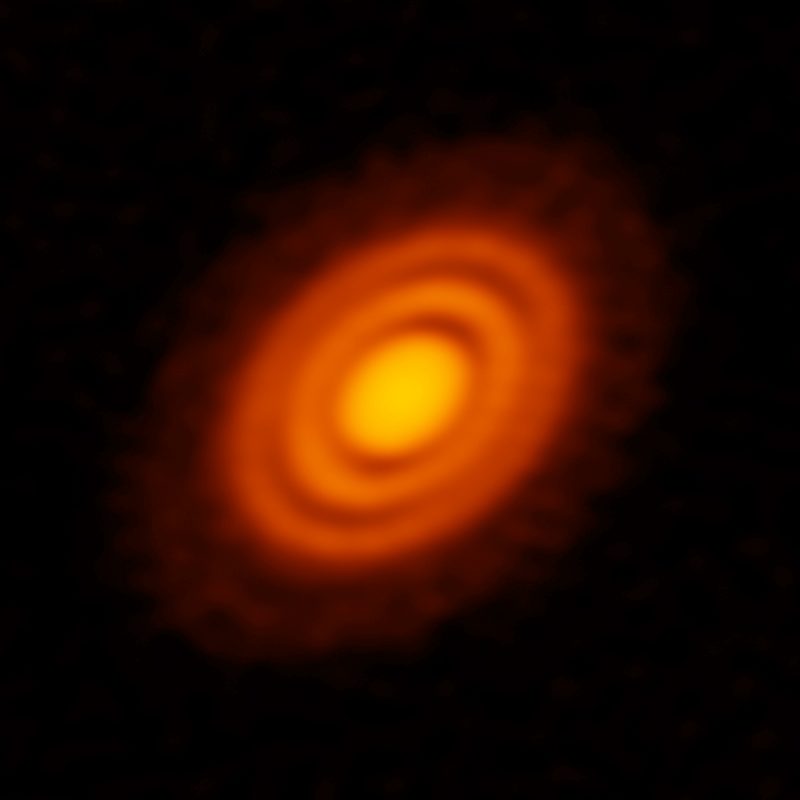
ALMA image of a disk of material surrounding the young star HD 163296. This dusty disk have been known since 2016 to have gaps in it, presumably from newly forming planets. Now astronomers see disturbances in the disk, indicating where 3 new planets are moving within the disk. Image via ALMA (ESO/NAOJ/NRAO); A. Isella; B. Saxton (NRAO/AUI/NSF).

Two independent teams of astronomers said today (June 13, 2018) that they’ve uncovered convincing evidence for three young planets orbiting within a protoplanetary disk – or planet-forming disk – around an infant star. The star is called HD 163296. It’s 330 light-years from Earth in the direction of the constellation Sagittarius. And it’s young – really young in astronomical terms – only about 4 million years old. That’s in contrast to our sun, with 4+ billion years under its belt. These astronomers used the ALMA telescope in Chile and a new planet-finding technique. What they’ve seen are three discrete disturbances in the young star’s gas-filled disk. They said this is:

… the strongest evidence yet that newly formed planets are in orbit there.

ALMA stands for Atacama Large Millimeter/submillimeter Array, and this telescope has been used extensively to study protoplanetary disks since it went online officially in March, 2013. The disks around very young stars like HD 163296 are filled with gas and dust. Stars themselves – and their planets – are born out of this material. So studying the disks is like the studying the birth throes of our own Earth and sun.

The two teams of astronomers both used ALMA in conjunction with a new planet-hunting technique that identifies unusual patterns in the flow of gas within a protoplanetary disk.

The astronomers reported their results in two separate journal articles, both in the peer-reviewed Astrophysical Journal Letters. The full references are listed at the bottom of this article, and you’ll find the actual papers online here and here.

The astronomers’ statement explained:

Rather than focusing on the dust within the disk, which was clearly imaged in earlier ALMA observation, the astronomers instead studied the distribution and motion of carbon monoxide (CO) gas throughout the disk. Molecules of CO naturally emit a very distinctive millimeter-wavelength light that ALMA can observe. Subtle changes in the wavelength of this light due to the Doppler effect provide a glimpse into the kinematics — or motion — of the gas in the disk.

If there were no planets, gas would move around a star in a very simple, predictable pattern known as Keplerian rotation.

But that’s not what these astronomers saw. Instead, they saw disturbances in the gas. Christophe Pinte of Monash University in Australia, lead author on one of the two papers, said:

It would take a relatively massive object, like a planet, to create localized disturbances in this otherwise orderly motion. Our new technique applies this principle to help us understand how planetary systems form.

These astronomers are hopeful their technique can be applied to other young stars throughout the galaxy, in order to study some of our galaxy’s youngest planets.

Read more about the two new studies from NRAO

Artist’s concept of protoplanets forming around a young star via ALMA (ESO/NAOJ/NRAO); A. Isella; B. Saxton (NRAO/AUI/NSF).

Bottom line: Astronomers using the ALMA telescope in Chile – and a new planet-hunting technique that identifies unusual patterns in gas flow – have detected disturbances in the disk of gas and dust around the very young star HD 163296. They say these disturbances represent strong evidence for 3 planets forming within the disk.

Sources:
A Kinematic Detection of Two Unseen Jupiter Mass Embedded Protoplanets, by R. Teague et al., 2018, to appear in Astrophysical Journal Letters.

Kinematic Evidence for an Embedded Protoplanet in a Circumstellar Disc, by C. Pinte et al., 2018, to appear in Astrophysical Journal Letters.


from EarthSky https://ift.tt/2yae9oA

ALMA image of a disk of material surrounding the young star HD 163296. This dusty disk have been known since 2016 to have gaps in it, presumably from newly forming planets. Now astronomers see disturbances in the disk, indicating where 3 new planets are moving within the disk. Image via ALMA (ESO/NAOJ/NRAO); A. Isella; B. Saxton (NRAO/AUI/NSF).

Two independent teams of astronomers said today (June 13, 2018) that they’ve uncovered convincing evidence for three young planets orbiting within a protoplanetary disk – or planet-forming disk – around an infant star. The star is called HD 163296. It’s 330 light-years from Earth in the direction of the constellation Sagittarius. And it’s young – really young in astronomical terms – only about 4 million years old. That’s in contrast to our sun, with 4+ billion years under its belt. These astronomers used the ALMA telescope in Chile and a new planet-finding technique. What they’ve seen are three discrete disturbances in the young star’s gas-filled disk. They said this is:

… the strongest evidence yet that newly formed planets are in orbit there.

ALMA stands for Atacama Large Millimeter/submillimeter Array, and this telescope has been used extensively to study protoplanetary disks since it went online officially in March, 2013. The disks around very young stars like HD 163296 are filled with gas and dust. Stars themselves – and their planets – are born out of this material. So studying the disks is like the studying the birth throes of our own Earth and sun.

The two teams of astronomers both used ALMA in conjunction with a new planet-hunting technique that identifies unusual patterns in the flow of gas within a protoplanetary disk.

The astronomers reported their results in two separate journal articles, both in the peer-reviewed Astrophysical Journal Letters. The full references are listed at the bottom of this article, and you’ll find the actual papers online here and here.

The astronomers’ statement explained:

Rather than focusing on the dust within the disk, which was clearly imaged in earlier ALMA observation, the astronomers instead studied the distribution and motion of carbon monoxide (CO) gas throughout the disk. Molecules of CO naturally emit a very distinctive millimeter-wavelength light that ALMA can observe. Subtle changes in the wavelength of this light due to the Doppler effect provide a glimpse into the kinematics — or motion — of the gas in the disk.

If there were no planets, gas would move around a star in a very simple, predictable pattern known as Keplerian rotation.

But that’s not what these astronomers saw. Instead, they saw disturbances in the gas. Christophe Pinte of Monash University in Australia, lead author on one of the two papers, said:

It would take a relatively massive object, like a planet, to create localized disturbances in this otherwise orderly motion. Our new technique applies this principle to help us understand how planetary systems form.

These astronomers are hopeful their technique can be applied to other young stars throughout the galaxy, in order to study some of our galaxy’s youngest planets.

Read more about the two new studies from NRAO

Artist’s concept of protoplanets forming around a young star via ALMA (ESO/NAOJ/NRAO); A. Isella; B. Saxton (NRAO/AUI/NSF).

Bottom line: Astronomers using the ALMA telescope in Chile – and a new planet-hunting technique that identifies unusual patterns in gas flow – have detected disturbances in the disk of gas and dust around the very young star HD 163296. They say these disturbances represent strong evidence for 3 planets forming within the disk.

Sources:
A Kinematic Detection of Two Unseen Jupiter Mass Embedded Protoplanets, by R. Teague et al., 2018, to appear in Astrophysical Journal Letters.

Kinematic Evidence for an Embedded Protoplanet in a Circumstellar Disc, by C. Pinte et al., 2018, to appear in Astrophysical Journal Letters.


from EarthSky https://ift.tt/2yae9oA

Benefits of curbing climate change far outweigh costs

Those who oppose policies to cut carbon pollution and slow climate change always claim that doing so will be too expensive and cripple the economy. They argue that instead we should maximize economic growth so that we can pay for climate damages and adaptation in the future. It’s an argument helped by the fact that models have essentially treated economic growth as an external factor that won’t be significantly impacted by climate change.

That assumption has been challenged in recent years, starting with a 2012 paper in theAmerican Economic Journal finding that higher temperatures reduce economic growth rates, particularly in poorer countries. A 2015 paper by Stanford scientists published inNature Climate Change built on this work, similarly finding that global warming will particularly hurt economic growth in poorer countries, and that “Optimal climate policy in this model stabilizes global temperature change below 2 degrees C.” This finding is consistent with the target set by the Paris climate accords. 

Later in 2015, a team of scientists led by Marshall Burke published a paper inNature finding a relationship between temperature and Gross Domestic Product, or GDP. There’s a sweet spot where regions with an average temperature around 13 degrees Celsius (55 degrees Fahrenheit) have the highest economic productivity. When temperatures are much hotter or colder, GDP falls. Countries like the United States, Japan, China, and many European countries happen to have temperatures right near that sweet spot, while many developing countries closer to the equator—in regions like Africa and southeast Asia—are already hotter than optimal. Consistent with the findings of the aforementioned studies, the economies of these poorer tropical countries will be particularly hard hit by global warming, because their climates are already sub-optimally hot.

Just recently, Burke led another team of scientists in research quantifying these economic costs of higher temperatures. Their latest paper, also published in Nature, found that limiting global warming to 1.5 degrees Celsius would likely save the global economy more than $20 trillion by the year 2100 as compared to 2 degrees Celsius warming—at a cost of about $300 billion. That means the benefits of curbing climate change would exceed the costs by about 70-to-1. The study also only accounts for temperature effects on GDP and not other damaging factors like sea level rise, and is thus likely a conservative estimate.

Burke’s study also estimated the economic impact of higher levels of global warming, if we fail to meet the Paris climate targets. For example, global warming of 3 degrees Celsius above pre-industrial temperatures in 2100 would reduce global GDP by about 10 percent as compared to 2 degrees Celsius global warming. A temperature of 4-to-5 degrees Celsius would make us 10 percent poorer yet, as compared to 3 degrees Celsius. Those would be massive economic losses that could exceed $100 trillion. And it wouldn’t just impact poor countries—a working paper recently published by the Federal Reserve Bank of Richmond found that global warming could significantly hamper economic growth in the United States as well, especially in the hotter Southern states. The paper found that if we meet the 2 degrees Celsius Paris climate target, US economic growth will only slow by about 5-to-10 percent, but global warming of 3-to-3.5 degrees Celsius would dampen the American economy by twice as much—10-to-20 percent.

It’s also worth noting that these are not controversial findings. Even economists and organizations most-cited by climate contrarians agree that further global warming will hurt the economy, and has been hurting the economies of poorer countries for about 40 years.

Click here to read the rest


from Skeptical Science https://ift.tt/2t6nsjP

Those who oppose policies to cut carbon pollution and slow climate change always claim that doing so will be too expensive and cripple the economy. They argue that instead we should maximize economic growth so that we can pay for climate damages and adaptation in the future. It’s an argument helped by the fact that models have essentially treated economic growth as an external factor that won’t be significantly impacted by climate change.

That assumption has been challenged in recent years, starting with a 2012 paper in theAmerican Economic Journal finding that higher temperatures reduce economic growth rates, particularly in poorer countries. A 2015 paper by Stanford scientists published inNature Climate Change built on this work, similarly finding that global warming will particularly hurt economic growth in poorer countries, and that “Optimal climate policy in this model stabilizes global temperature change below 2 degrees C.” This finding is consistent with the target set by the Paris climate accords. 

Later in 2015, a team of scientists led by Marshall Burke published a paper inNature finding a relationship between temperature and Gross Domestic Product, or GDP. There’s a sweet spot where regions with an average temperature around 13 degrees Celsius (55 degrees Fahrenheit) have the highest economic productivity. When temperatures are much hotter or colder, GDP falls. Countries like the United States, Japan, China, and many European countries happen to have temperatures right near that sweet spot, while many developing countries closer to the equator—in regions like Africa and southeast Asia—are already hotter than optimal. Consistent with the findings of the aforementioned studies, the economies of these poorer tropical countries will be particularly hard hit by global warming, because their climates are already sub-optimally hot.

Just recently, Burke led another team of scientists in research quantifying these economic costs of higher temperatures. Their latest paper, also published in Nature, found that limiting global warming to 1.5 degrees Celsius would likely save the global economy more than $20 trillion by the year 2100 as compared to 2 degrees Celsius warming—at a cost of about $300 billion. That means the benefits of curbing climate change would exceed the costs by about 70-to-1. The study also only accounts for temperature effects on GDP and not other damaging factors like sea level rise, and is thus likely a conservative estimate.

Burke’s study also estimated the economic impact of higher levels of global warming, if we fail to meet the Paris climate targets. For example, global warming of 3 degrees Celsius above pre-industrial temperatures in 2100 would reduce global GDP by about 10 percent as compared to 2 degrees Celsius global warming. A temperature of 4-to-5 degrees Celsius would make us 10 percent poorer yet, as compared to 3 degrees Celsius. Those would be massive economic losses that could exceed $100 trillion. And it wouldn’t just impact poor countries—a working paper recently published by the Federal Reserve Bank of Richmond found that global warming could significantly hamper economic growth in the United States as well, especially in the hotter Southern states. The paper found that if we meet the 2 degrees Celsius Paris climate target, US economic growth will only slow by about 5-to-10 percent, but global warming of 3-to-3.5 degrees Celsius would dampen the American economy by twice as much—10-to-20 percent.

It’s also worth noting that these are not controversial findings. Even economists and organizations most-cited by climate contrarians agree that further global warming will hurt the economy, and has been hurting the economies of poorer countries for about 40 years.

Click here to read the rest


from Skeptical Science https://ift.tt/2t6nsjP

What we inherited from bug-eating mammal ancestors

Detailed artistic reconstruction of an ancestral placental mammal living during the Age of Dinosaurs 66 million years ago, showing teeth adapted to capturing and eating insects. Image via Carl Buell.

The distant ancestors of all mammals – small, furry creatures that scurried around the feet of the dinosaurs 66 million years ago – were mostly insect-eaters. The genes for the special enzymes that enabled them to digest insects are still hanging around in nearly all mammal genomes today – including our human genome. That’s according to a new analysis of the genomes of 107 different species of mammals, published May 16, 2018, in the peer-reviewed journal Science Advances.

Study author Christopher Emerling is a postdoctoral fellow at University of California, Berkeley. Emerling said that even animals like tigers and seals that would never touch an insect have non-functional pieces of these genes sitting in their chromosomes, betraying their ancient ancestors’ diet. He said:

One of the coolest things is, if you look at humans, at Fido your dog, Whiskers your cat, your horse, your cow; pick any animal, generally speaking, they have remnants in their genomes of a time when mammals were small, probably insectivorous and running around when dinosaurs were still roaming Earth.

It is a signature in your genome that says, once upon a time you were not the dominant group of organisms on Earth. By looking at our genomes, we are looking at this ancestral past and a lifestyle that we don’t even live with anymore.

The genetic evidence corroborates the conclusions paleontologists reached years ago based on the shapes of fossils and teeth from early mammals. Emerling said:

In essence, we are looking at genomes and they are telling the same story as the fossils: that we think these animals were insectivorous and then dinosaurs went extinct. After the demise of these large carnivorous and herbivorous reptiles, mammals started changing their diets.

A spectral tarsier (Tarsius tarsier) feeding on a grasshopper in Tangkoko National Park, Northern Sulawesi, Indonesia. Tarsiers have five chitinase genes to digest the high amount of chitin in their insectivorous diet, which likely represents the ancestral condition of all placental animals, including humans. Image via Quentin Martinez.

The team looked at genes for enzymes called chitinases. These enzymes break down insects’ hard, outer shells, which are composed of a tough carbohydrate called chitin. They looked through the genomes of the largest group of mammals, those that have placentas that allow longer development in the womb, (that excludes marsupials like opossums and egg-laying monotremes like the platypus.) These placental mammals ranged from shrews and mice to elephants and whales.

In all, the team found five different chitinase enzyme genes. They found that the greater the percentage of insects in an animal’s diet, the more genes for chitinase it has. Emerling said:

The only species that have five chitinases today are highly insectivorous, that is, 80 to 100 percent of their diet consists of insects. Since the earliest placental mammals likely had five chitinases, we think that this makes for a strong argument that they were highly insectivorous.

We humans have one functioning chitinase gene. Emerling said tt’s not surprising that humans ahave a chitinase gene, since many humans today include insects in their diets. But it turns out that humans actually have remnants of three other chitinase genes in their genome, though none of them are functional. Emerling showed that these gene remnants in humans aren’t unique to humans or primates, but instead can be traced to the ancestral placental mammals.

As you would expect, ant and termite specialists such as aardvarks and certain armadillos have five functioning chitinase genes. But so do the insect-loving primates called tarsiers. They appear to be the only primates that have so many functional chitinase genes, Emerling said.

According to a statement from the researchers:

The story told by these chitinase genes is one of early mammals hunkering down eating insects while the big guys, the huge herbivorous dinosaurs like the brontosaurus and the big meat-eaters like T. rex gobbled up the most abundant food resources. Only 66 million years ago at the end of the Cretaceous Period, when all non-bird dinosaurs died out, were mammals able to expand into other niches, which they quickly did. The first carnivorous and herbivorous mammals, as indicated by their teeth, arose within 10 million years of the dinosaurs’ demise.

Bottom line: A new study says that today’s mammals – including humans – inherited genes to allow for insect-eating from mammals’ tiny distant ancestors.

Read more about the study from Berkeley

Help EarthSky keep going! Please donate what you can to our annual crowd-funding campaign.


from EarthSky https://ift.tt/2l4vsho

Detailed artistic reconstruction of an ancestral placental mammal living during the Age of Dinosaurs 66 million years ago, showing teeth adapted to capturing and eating insects. Image via Carl Buell.

The distant ancestors of all mammals – small, furry creatures that scurried around the feet of the dinosaurs 66 million years ago – were mostly insect-eaters. The genes for the special enzymes that enabled them to digest insects are still hanging around in nearly all mammal genomes today – including our human genome. That’s according to a new analysis of the genomes of 107 different species of mammals, published May 16, 2018, in the peer-reviewed journal Science Advances.

Study author Christopher Emerling is a postdoctoral fellow at University of California, Berkeley. Emerling said that even animals like tigers and seals that would never touch an insect have non-functional pieces of these genes sitting in their chromosomes, betraying their ancient ancestors’ diet. He said:

One of the coolest things is, if you look at humans, at Fido your dog, Whiskers your cat, your horse, your cow; pick any animal, generally speaking, they have remnants in their genomes of a time when mammals were small, probably insectivorous and running around when dinosaurs were still roaming Earth.

It is a signature in your genome that says, once upon a time you were not the dominant group of organisms on Earth. By looking at our genomes, we are looking at this ancestral past and a lifestyle that we don’t even live with anymore.

The genetic evidence corroborates the conclusions paleontologists reached years ago based on the shapes of fossils and teeth from early mammals. Emerling said:

In essence, we are looking at genomes and they are telling the same story as the fossils: that we think these animals were insectivorous and then dinosaurs went extinct. After the demise of these large carnivorous and herbivorous reptiles, mammals started changing their diets.

A spectral tarsier (Tarsius tarsier) feeding on a grasshopper in Tangkoko National Park, Northern Sulawesi, Indonesia. Tarsiers have five chitinase genes to digest the high amount of chitin in their insectivorous diet, which likely represents the ancestral condition of all placental animals, including humans. Image via Quentin Martinez.

The team looked at genes for enzymes called chitinases. These enzymes break down insects’ hard, outer shells, which are composed of a tough carbohydrate called chitin. They looked through the genomes of the largest group of mammals, those that have placentas that allow longer development in the womb, (that excludes marsupials like opossums and egg-laying monotremes like the platypus.) These placental mammals ranged from shrews and mice to elephants and whales.

In all, the team found five different chitinase enzyme genes. They found that the greater the percentage of insects in an animal’s diet, the more genes for chitinase it has. Emerling said:

The only species that have five chitinases today are highly insectivorous, that is, 80 to 100 percent of their diet consists of insects. Since the earliest placental mammals likely had five chitinases, we think that this makes for a strong argument that they were highly insectivorous.

We humans have one functioning chitinase gene. Emerling said tt’s not surprising that humans ahave a chitinase gene, since many humans today include insects in their diets. But it turns out that humans actually have remnants of three other chitinase genes in their genome, though none of them are functional. Emerling showed that these gene remnants in humans aren’t unique to humans or primates, but instead can be traced to the ancestral placental mammals.

As you would expect, ant and termite specialists such as aardvarks and certain armadillos have five functioning chitinase genes. But so do the insect-loving primates called tarsiers. They appear to be the only primates that have so many functional chitinase genes, Emerling said.

According to a statement from the researchers:

The story told by these chitinase genes is one of early mammals hunkering down eating insects while the big guys, the huge herbivorous dinosaurs like the brontosaurus and the big meat-eaters like T. rex gobbled up the most abundant food resources. Only 66 million years ago at the end of the Cretaceous Period, when all non-bird dinosaurs died out, were mammals able to expand into other niches, which they quickly did. The first carnivorous and herbivorous mammals, as indicated by their teeth, arose within 10 million years of the dinosaurs’ demise.

Bottom line: A new study says that today’s mammals – including humans – inherited genes to allow for insect-eating from mammals’ tiny distant ancestors.

Read more about the study from Berkeley

Help EarthSky keep going! Please donate what you can to our annual crowd-funding campaign.


from EarthSky https://ift.tt/2l4vsho

Watch spacewalk June 14

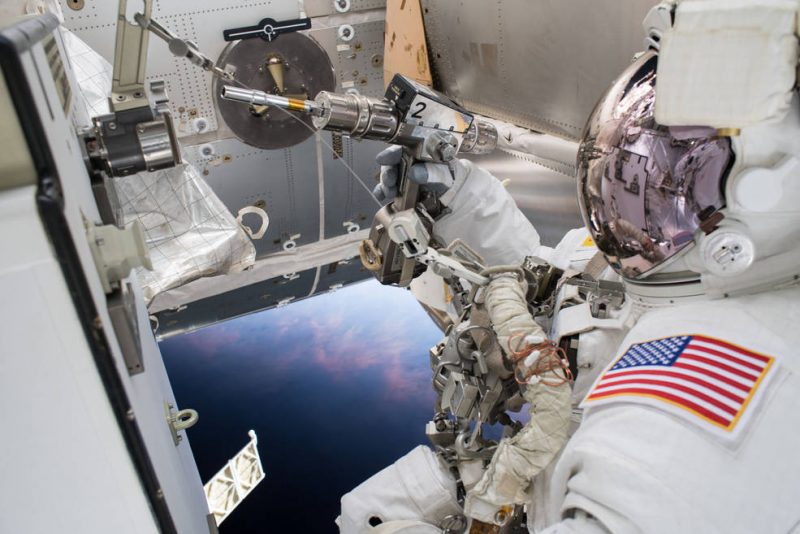
Image via NASA.

Two NASA astronauts aboard the International Space Station (ISS) will embark on a 6 1/2 spacewalk Thursday, June 14. NASA TV’s live coverage of the spacewalk will begin at 10:30 a.m. UTC (6:30 a.m. EDT), and the spacewalk itself is scheduled to start at 12:10 p.m. UCT (8:10 a.m EDT). Translate UTC to your time.

Watch here.

Astronauts Drew Feustel, commander of the station’s Expedition 56, and flight engineer Ricky Arnold will install new high-definition cameras to capture spacecraft docking with the International Space Station, including new American-made spacecraft with scheduled test flights later this year. Arnold will wear a suit bearing red stripes while Feustel’s suit will have no stripes.

According to a NASA statement:

The two spacewalkers will install brackets and high-definition cameras near an international docking adapter mated to the front end of the station’s Harmony module. The additions will provide enhanced views during the final phase of approach and docking of the SpaceX Crew Dragon and Boeing Starliner commercial crew spacecraft that will soon begin launching from American soil.

During their spacewalk, the astronauts also will swap out a camera assembly on the starboard truss of the station and close an aperture door on an external environmental imaging experiment outside the Japanese Kibo module. The imaging experiment hardware will be discarded on a future SpaceX cargo resupply mission.

Bottom line: Two International Space Station (ISS) astronauts will conduct a 6 1/2 hour spacewalk on June 14, 2018.

Read more from NASA

Help EarthSky keep going! Please donate what you can to our annual crowd-funding campaign.


from EarthSky https://ift.tt/2y7QchT

Image via NASA.

Two NASA astronauts aboard the International Space Station (ISS) will embark on a 6 1/2 spacewalk Thursday, June 14. NASA TV’s live coverage of the spacewalk will begin at 10:30 a.m. UTC (6:30 a.m. EDT), and the spacewalk itself is scheduled to start at 12:10 p.m. UCT (8:10 a.m EDT). Translate UTC to your time.

Watch here.

Astronauts Drew Feustel, commander of the station’s Expedition 56, and flight engineer Ricky Arnold will install new high-definition cameras to capture spacecraft docking with the International Space Station, including new American-made spacecraft with scheduled test flights later this year. Arnold will wear a suit bearing red stripes while Feustel’s suit will have no stripes.

According to a NASA statement:

The two spacewalkers will install brackets and high-definition cameras near an international docking adapter mated to the front end of the station’s Harmony module. The additions will provide enhanced views during the final phase of approach and docking of the SpaceX Crew Dragon and Boeing Starliner commercial crew spacecraft that will soon begin launching from American soil.

During their spacewalk, the astronauts also will swap out a camera assembly on the starboard truss of the station and close an aperture door on an external environmental imaging experiment outside the Japanese Kibo module. The imaging experiment hardware will be discarded on a future SpaceX cargo resupply mission.

Bottom line: Two International Space Station (ISS) astronauts will conduct a 6 1/2 hour spacewalk on June 14, 2018.

Read more from NASA

Help EarthSky keep going! Please donate what you can to our annual crowd-funding campaign.


from EarthSky https://ift.tt/2y7QchT

adds 2