aads

No Planet Nine? Collective gravity might explain weird orbits at solar system’s edge

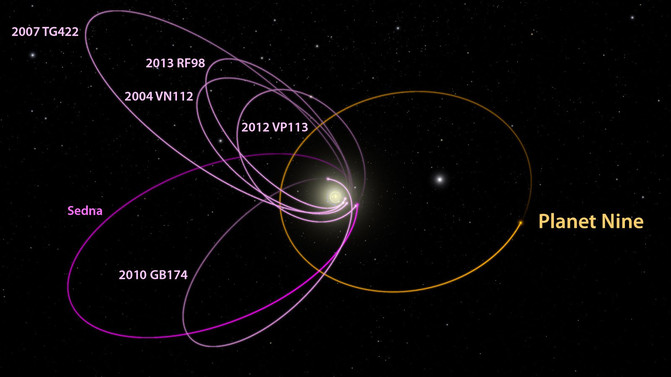
Caltech astronomers suggested in 2016 that orbits of these 6 extreme trans-Neptunian objects (in magenta) – all mysteriously aligned in one direction – might be explained by the presence of a Planet Nine (in orange) in our solar system. Despite searches, no Planet Nine has yet been found. Image via Caltech/R. Hurt (IPAC).

As recently as late May, an international team of researchers presented new evidence for an unknown Planet Nine at the fringes of our solar system. The evidence came from analysis of an oddball object in the outer solar system – 2015 BP519 (aka Caju) – whose unusual orbit had been predicted by computer models used by astronomers who’ve been searching for Planet Nine since 2016. Last week, however, other astronomers – members of the Eccentric Dynamics group at University of Colorado, Boulder – presented evidence that Planet Nine might not need to exist, after all. Ann-Marie Madigan, who leads the group, presented the group’s findings at last week’s American Astronomical Society meeting, which ran from June 3-7, 2018 in Denver. Her team’s statement said:

Bumper car-like interactions at the edges of our solar system — and not a mysterious ninth planet — may explain the the dynamics of strange bodies called “detached objects” …

In the new study, Madigan and colleagues Jacob Fleisig and Alexander Zderic, also of CU Boulder, looked carefully at the orbits of some of these objects. For example, they looked at the small outer solar system body 90377 Sedna, which orbits our sun at a distance of nearly 8 billion miles (13 billion km). The orbits of Sedna and a handful of other bodies at that distance look separated – or detached – from the rest of the solar system. These strange orbits are what led Caltech astronomers Mike Brown and Konstanin Batygin to propose a Planet Nine in the first place.

Brown and Batygin had suggested that an as-yet-unseen ninth planet – four times the size of Earth and 10 times Earth’s mass – may be lurking beyond Neptune. They suggested the unknown planet’s gravity was influencing the orbits of the “detached objects.” Since 2016, astronomers around the world have been searching for Planet Nine, but no one has found it yet.

Meanwhile, Madigan, Fleisig and Zderic have explored a new idea about the orbits of these outer solar system bodies. The new calculations show the orbits might be the result of these bodies jostling against each other and debris in that part of space. In that case, no Planet Nine would be needed. Madigan said:

There are so many of these bodies out there. What does their collective gravity do? We can solve a lot of these problems by just taking into account that question.

Ann-Marie Madigan, Jacob Fleisig and Alexander Zderic of the Eccentric Dynamics group at CU Boulder. Image via CU Boulder.

Madigan pointed out that the outer solar system is:

… an unusual place, gravitationally speaking.

Once you get further away from Neptune, things don’t make any sense, which is really exciting.

Her team’s statement explained:

Among the things that don’t make sense: Sedna. This minor planet takes more than 11,000 years to circumnavigate Earth’s sun and is a little smaller than Pluto … Sedna and other detached objects complete humongous, circle-shaped orbits that bring them nowhere close to big planets like Jupiter or Neptune. How they got out there on their own remains an ongoing mystery.

Madigan’s team didn’t originally intend to look for an alternate explanation for the orbits of detached bodies. Instead, Jacob Fleisig, an undergraduate studying astrophysics at CU Boulder, was engaged in developing computer simulations to explore the dynamics of orbits. Madigan said:

He came into my office one day and said, “I’m seeing some really cool stuff here.”

Fleisig had calculated that the orbits of icy objects beyond Neptune circle the sun like the hands of a clock. Some of those orbits, such as those belonging to asteroids, move like the minute hand, or relatively fast and in tandem. Others, the orbits of bigger objects like Sedna, move more slowly. They’re the hour hand. Eventually, those hands meet. Fleisig said:

You see a pileup of the orbits of smaller objects to one side of the sun. These orbits crash into the bigger body, and what happens is those interactions will change its orbit from an oval shape to a more circular shape.

In other words, Sedna’s orbit goes from normal to detached, entirely because of those small-scale interactions. The team’s findings also fall in line with recent observations. Research from 2012 noted that the bigger a detached object gets, the farther away its orbit becomes from the sun — exactly as Fleisig’s calculations show.
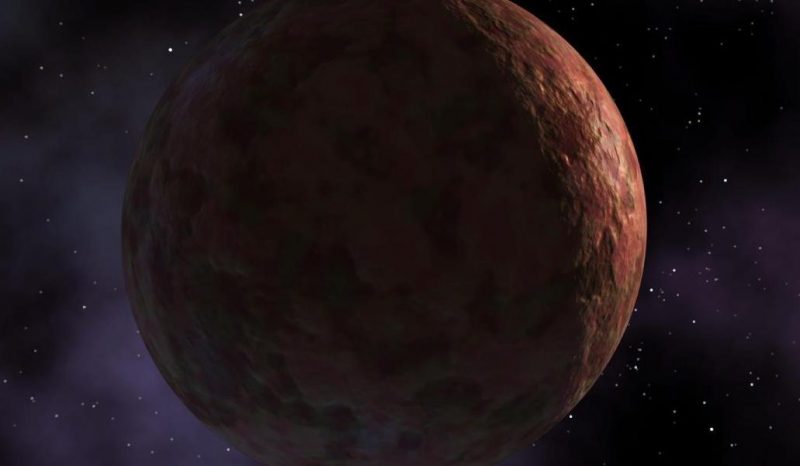
An artist’s rendering of Sedna, which looks reddish in color in telescope images. Image via NASA/JPL-Caltech.

These astronomers say their findings may provide clues about another phenomenon: the extinction of the dinosaurs. As space debris interacts in the outer solar system, the orbits of these objects tighten and widen in a repeating cycle. This cycle could wind up shooting comets toward the inner solar system on a predictable timescale. Fleisig said:

While we’re not able to say that this pattern killed the dinosaurs, it’s tantalizing.

Madigan added that the orbit of Sedna is one more example of just how interesting the outer solar system has become. She said:

The picture we draw of the outer solar system in textbooks may have to change. There’s a lot more stuff out there than we once thought, which is really cool.
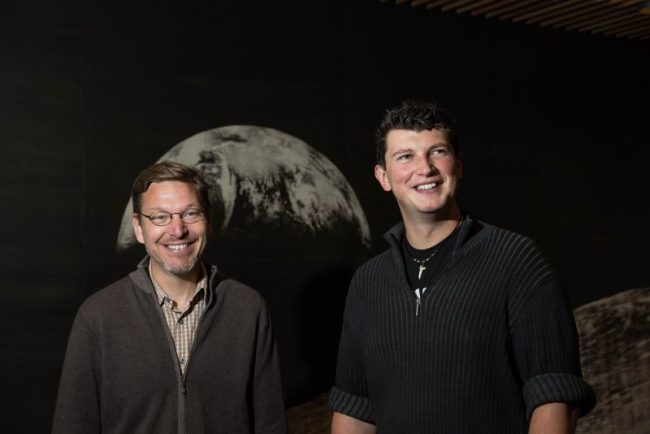
Astronomers Mike Brown and Konstanin Batygin (@KBatygin on Twitter), both of Caltech, proposed Planet Nine in 2016 and are still trying to investigate it. Image via Lance Hayashida/Caltech/NASA.

Bottom line: Astronomers at Caltech proposed a Planet Nine in 2016, and other astronomers around the world have been searching for it. Yet no one has spotted it. Meanwhile, there’s research suggesting we might not need a Planet Nine to explain the strange orbits of small bodies in the outer solar system.

Via CU Boulder


from EarthSky https://ift.tt/2sUG5qD
Caltech astronomers suggested in 2016 that orbits of these 6 extreme trans-Neptunian objects (in magenta) – all mysteriously aligned in one direction – might be explained by the presence of a Planet Nine (in orange) in our solar system. Despite searches, no Planet Nine has yet been found. Image via Caltech/R. Hurt (IPAC).

As recently as late May, an international team of researchers presented new evidence for an unknown Planet Nine at the fringes of our solar system. The evidence came from analysis of an oddball object in the outer solar system – 2015 BP519 (aka Caju) – whose unusual orbit had been predicted by computer models used by astronomers who’ve been searching for Planet Nine since 2016. Last week, however, other astronomers – members of the Eccentric Dynamics group at University of Colorado, Boulder – presented evidence that Planet Nine might not need to exist, after all. Ann-Marie Madigan, who leads the group, presented the group’s findings at last week’s American Astronomical Society meeting, which ran from June 3-7, 2018 in Denver. Her team’s statement said:

Bumper car-like interactions at the edges of our solar system — and not a mysterious ninth planet — may explain the the dynamics of strange bodies called “detached objects” …

In the new study, Madigan and colleagues Jacob Fleisig and Alexander Zderic, also of CU Boulder, looked carefully at the orbits of some of these objects. For example, they looked at the small outer solar system body 90377 Sedna, which orbits our sun at a distance of nearly 8 billion miles (13 billion km). The orbits of Sedna and a handful of other bodies at that distance look separated – or detached – from the rest of the solar system. These strange orbits are what led Caltech astronomers Mike Brown and Konstanin Batygin to propose a Planet Nine in the first place.

Brown and Batygin had suggested that an as-yet-unseen ninth planet – four times the size of Earth and 10 times Earth’s mass – may be lurking beyond Neptune. They suggested the unknown planet’s gravity was influencing the orbits of the “detached objects.” Since 2016, astronomers around the world have been searching for Planet Nine, but no one has found it yet.

Meanwhile, Madigan, Fleisig and Zderic have explored a new idea about the orbits of these outer solar system bodies. The new calculations show the orbits might be the result of these bodies jostling against each other and debris in that part of space. In that case, no Planet Nine would be needed. Madigan said:

There are so many of these bodies out there. What does their collective gravity do? We can solve a lot of these problems by just taking into account that question.

Ann-Marie Madigan, Jacob Fleisig and Alexander Zderic of the Eccentric Dynamics group at CU Boulder. Image via CU Boulder.

Madigan pointed out that the outer solar system is:

… an unusual place, gravitationally speaking.

Once you get further away from Neptune, things don’t make any sense, which is really exciting.

Her team’s statement explained:

Among the things that don’t make sense: Sedna. This minor planet takes more than 11,000 years to circumnavigate Earth’s sun and is a little smaller than Pluto … Sedna and other detached objects complete humongous, circle-shaped orbits that bring them nowhere close to big planets like Jupiter or Neptune. How they got out there on their own remains an ongoing mystery.

Madigan’s team didn’t originally intend to look for an alternate explanation for the orbits of detached bodies. Instead, Jacob Fleisig, an undergraduate studying astrophysics at CU Boulder, was engaged in developing computer simulations to explore the dynamics of orbits. Madigan said:

He came into my office one day and said, “I’m seeing some really cool stuff here.”

Fleisig had calculated that the orbits of icy objects beyond Neptune circle the sun like the hands of a clock. Some of those orbits, such as those belonging to asteroids, move like the minute hand, or relatively fast and in tandem. Others, the orbits of bigger objects like Sedna, move more slowly. They’re the hour hand. Eventually, those hands meet. Fleisig said:

You see a pileup of the orbits of smaller objects to one side of the sun. These orbits crash into the bigger body, and what happens is those interactions will change its orbit from an oval shape to a more circular shape.

In other words, Sedna’s orbit goes from normal to detached, entirely because of those small-scale interactions. The team’s findings also fall in line with recent observations. Research from 2012 noted that the bigger a detached object gets, the farther away its orbit becomes from the sun — exactly as Fleisig’s calculations show.

An artist’s rendering of Sedna, which looks reddish in color in telescope images. Image via NASA/JPL-Caltech.

These astronomers say their findings may provide clues about another phenomenon: the extinction of the dinosaurs. As space debris interacts in the outer solar system, the orbits of these objects tighten and widen in a repeating cycle. This cycle could wind up shooting comets toward the inner solar system on a predictable timescale. Fleisig said:

While we’re not able to say that this pattern killed the dinosaurs, it’s tantalizing.

Madigan added that the orbit of Sedna is one more example of just how interesting the outer solar system has become. She said:

The picture we draw of the outer solar system in textbooks may have to change. There’s a lot more stuff out there than we once thought, which is really cool.

Astronomers Mike Brown and Konstanin Batygin (@KBatygin on Twitter), both of Caltech, proposed Planet Nine in 2016 and are still trying to investigate it. Image via Lance Hayashida/Caltech/NASA.

Bottom line: Astronomers at Caltech proposed a Planet Nine in 2016, and other astronomers around the world have been searching for it. Yet no one has spotted it. Meanwhile, there’s research suggesting we might not need a Planet Nine to explain the strange orbits of small bodies in the outer solar system.

Via CU Boulder


from EarthSky https://ift.tt/2sUG5qD

How far away was that lightning?

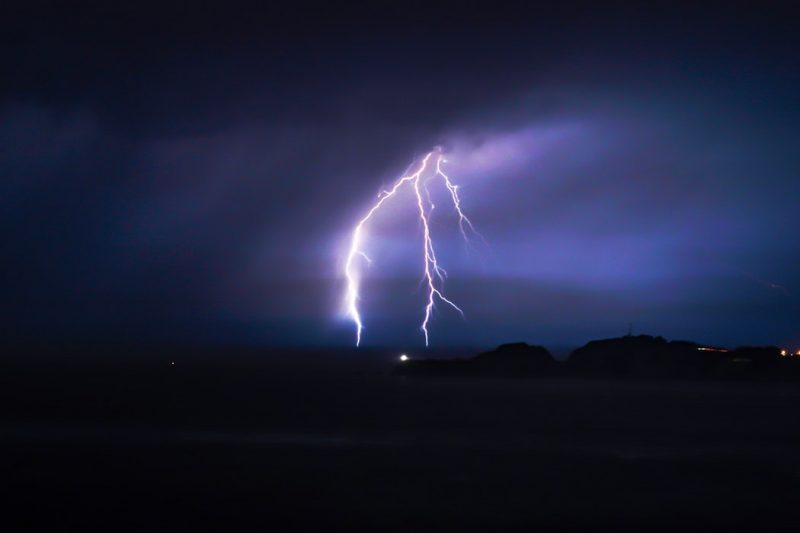
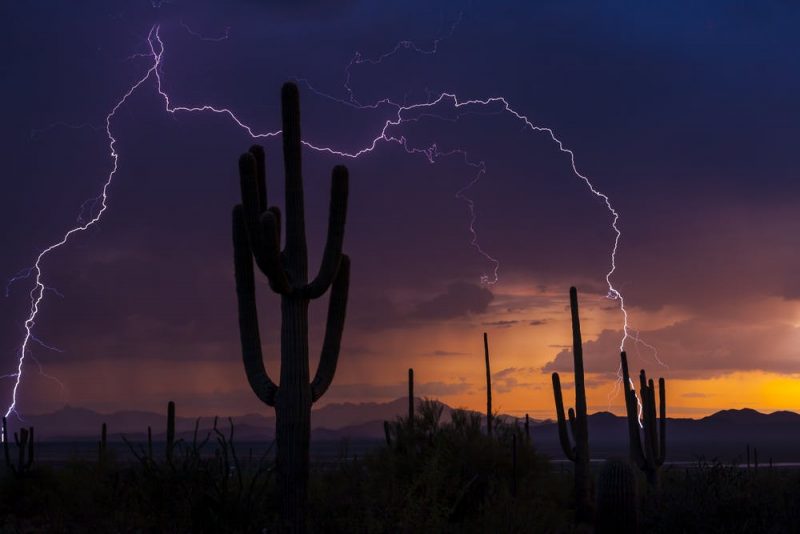
One one thousand, two one thousand … Image via Eric Ward/Unsplash

By Becky Bolinger, Colorado State University

You probably do it. It might be ingrained from when you were a kid, and now it’s almost automatic. You see the flash of lightning – and you immediately start counting the seconds till it thunders.

But does counting really get you a good estimate for how far away the lightning is? Is this one of those old wives’ tales, or is it actually based on science? In this case, we have physics to thank for this quick and easy – and pretty accurate – calculation.

So what happens when a big storm rolls in?

The lightning you see is the discharge of electricity that travels between clouds or to the ground. The thunder you hear is the rapid expansion of the air in response to the lightning’s intense heat.

If you’re really close to the lightning, you will see it and hear the thunder simultaneously. But when it’s far away, you see and hear the event at different times. That’s because light travels much faster than sound. Think of sitting in the nosebleed seats at a baseball game. You see the batter hit the ball a second before you hear the crack of the bat.

The visual part is instantaneous. Image via Pete Gregoire/Flickr.

When observing an event on Earth, you see things almost the instant they happen – the speed of light is so fast you can’t even detect the travel time. The speed of sound is much slower, which gives us time to do our calculation.

Let’s simplify the speed equation: Sound travels a little over 700 miles per hour, or 700 miles in 3,600 seconds. That means 7 miles traveled every 36 seconds. Make this even easier and round down to 7 miles every 35 seconds … or 1 mile every 5 seconds! Count to 5: If you hear thunder, the lightning occurred within 1 mile.

Now that you know how far away that lightning strike was, is it far enough to be a safe distance from the storm? That’s actually a trick question. Thunder can be heard up to 25 miles away, and lightning strikes have been documented to occur as far as 25 miles from thunderstorms – known as a “bolt from the blue.” So if you can hear thunder, you’re close enough to be hit by lightning, and sheltering indoors or in an enclosed car is your safest bet.

The ConversationAnd don’t count on the folk wisdom that lightning never strikes the same place twice to protect you. That one is just plain wrong. For example, lightning strikes the top of the Empire State Building an average of 23 times per year.
Becky Bolinger, Assistant State Climatologist and Research Scientist in Atmospheric Science, Colorado State University

This article was originally published on The Conversation. Read the original article.

Bottom line: An atmospheric scientist on using lightning to determine a thunderstorm’s distance.


from EarthSky https://ift.tt/2HymzFT

One one thousand, two one thousand … Image via Eric Ward/Unsplash

By Becky Bolinger, Colorado State University

You probably do it. It might be ingrained from when you were a kid, and now it’s almost automatic. You see the flash of lightning – and you immediately start counting the seconds till it thunders.

But does counting really get you a good estimate for how far away the lightning is? Is this one of those old wives’ tales, or is it actually based on science? In this case, we have physics to thank for this quick and easy – and pretty accurate – calculation.

So what happens when a big storm rolls in?

The lightning you see is the discharge of electricity that travels between clouds or to the ground. The thunder you hear is the rapid expansion of the air in response to the lightning’s intense heat.

If you’re really close to the lightning, you will see it and hear the thunder simultaneously. But when it’s far away, you see and hear the event at different times. That’s because light travels much faster than sound. Think of sitting in the nosebleed seats at a baseball game. You see the batter hit the ball a second before you hear the crack of the bat.

The visual part is instantaneous. Image via Pete Gregoire/Flickr.

When observing an event on Earth, you see things almost the instant they happen – the speed of light is so fast you can’t even detect the travel time. The speed of sound is much slower, which gives us time to do our calculation.

Let’s simplify the speed equation: Sound travels a little over 700 miles per hour, or 700 miles in 3,600 seconds. That means 7 miles traveled every 36 seconds. Make this even easier and round down to 7 miles every 35 seconds … or 1 mile every 5 seconds! Count to 5: If you hear thunder, the lightning occurred within 1 mile.

Now that you know how far away that lightning strike was, is it far enough to be a safe distance from the storm? That’s actually a trick question. Thunder can be heard up to 25 miles away, and lightning strikes have been documented to occur as far as 25 miles from thunderstorms – known as a “bolt from the blue.” So if you can hear thunder, you’re close enough to be hit by lightning, and sheltering indoors or in an enclosed car is your safest bet.

The ConversationAnd don’t count on the folk wisdom that lightning never strikes the same place twice to protect you. That one is just plain wrong. For example, lightning strikes the top of the Empire State Building an average of 23 times per year.
Becky Bolinger, Assistant State Climatologist and Research Scientist in Atmospheric Science, Colorado State University

This article was originally published on The Conversation. Read the original article.

Bottom line: An atmospheric scientist on using lightning to determine a thunderstorm’s distance.


from EarthSky https://ift.tt/2HymzFT

Watch a total lunar eclipse

31 Jan 2018 Total Lunar Eclipse animation from Colin Legg on Vimeo.

One of our favorite astrophotographers on the planet, Colin Legg of Australia, wrote to EarthSky to say:

I finally processed all the images I took of the January 31, 2018 total lunar eclipse … all 4,460!

The result is the video on this page. Lunar eclipses typically last a couple of hours, as Earth’s shadow slowly inches across the moon’s face, covers the moon completely and then slowly withdraws. This video gives you that experience, in only 37 seconds! Enjoy.

Thank you, Colin!

Visit Colin Legg Photography on Facebook

The January 31, 2018 eclipse was a super Blue Moon eclipse

See it! Super Blue Moon eclipse photos


from EarthSky https://ift.tt/2LBzKs8

31 Jan 2018 Total Lunar Eclipse animation from Colin Legg on Vimeo.

One of our favorite astrophotographers on the planet, Colin Legg of Australia, wrote to EarthSky to say:

I finally processed all the images I took of the January 31, 2018 total lunar eclipse … all 4,460!

The result is the video on this page. Lunar eclipses typically last a couple of hours, as Earth’s shadow slowly inches across the moon’s face, covers the moon completely and then slowly withdraws. This video gives you that experience, in only 37 seconds! Enjoy.

Thank you, Colin!

Visit Colin Legg Photography on Facebook

The January 31, 2018 eclipse was a super Blue Moon eclipse

See it! Super Blue Moon eclipse photos


from EarthSky https://ift.tt/2LBzKs8

2018 SkS Weekly Climate Change & Global Warming News Roundup #23

A chronological listing of news articles posted on the Skeptical Science Facebook Page during the past week.

Editor's Pick

Artificial Intelligence—A Game Changer for Climate Change and the Environment

Climate Model Los Alamos National Laboratory  

AI is continually improving climate models. Photo: Los Alamos National Lab 

As the planet continues to warm, climate change impacts are worsening. In 2016, there were 772 weather and disaster events, triple the number that occurred in 1980. Twenty percent of species currently face extinction, and that number could rise to 50 percent by 2100. And even if all countries keep their Paris climate pledges, by 2100, it’s likely that average global temperatures will be 3˚C higher than in pre-industrial times.

But we have a new tool to help us better manage the impacts of climate change and protect the planet: artificial intelligence (AI). AI refers to computer systems that “can sense their environment, think, learn, and act in response to what they sense and their programmed objectives,” according to a World Economic Forum report, Harnessing Artificial Intelligence for the Earth.

In India, AI has helped farmers get 30 percent higher groundnut yields per hectare by providing information on preparing the land, applying fertilizer and choosing sowing dates. In Norway, AI helped create a flexible and autonomous electric grid, integrating more renewable energy.

And AI has helped researchers achieve 89 to 99 percent accuracy in identifying tropical cyclones, weather fronts and atmospheric rivers, the latter of which can cause heavy precipitation and are often hard for humans to identify on their own. By improving weather forecasts, these types of programs can help keep people safe.

Artificial Intelligence—A Game Changer for Climate Change and the Environment by Renee Choo, State of the Planet, Earth Institute, June 5, 2018


Links posted on Facebook

Sun June 3, 2018

Mon June 4, 2018

Tue June 5, 2018

Wed June 6, 2018

Thu June 7, 2018

Fri June 8, 2018

Sat June 9, 2018


from Skeptical Science https://ift.tt/2JqJ3hE
A chronological listing of news articles posted on the Skeptical Science Facebook Page during the past week.

Editor's Pick

Artificial Intelligence—A Game Changer for Climate Change and the Environment

Climate Model Los Alamos National Laboratory  

AI is continually improving climate models. Photo: Los Alamos National Lab 

As the planet continues to warm, climate change impacts are worsening. In 2016, there were 772 weather and disaster events, triple the number that occurred in 1980. Twenty percent of species currently face extinction, and that number could rise to 50 percent by 2100. And even if all countries keep their Paris climate pledges, by 2100, it’s likely that average global temperatures will be 3˚C higher than in pre-industrial times.

But we have a new tool to help us better manage the impacts of climate change and protect the planet: artificial intelligence (AI). AI refers to computer systems that “can sense their environment, think, learn, and act in response to what they sense and their programmed objectives,” according to a World Economic Forum report, Harnessing Artificial Intelligence for the Earth.

In India, AI has helped farmers get 30 percent higher groundnut yields per hectare by providing information on preparing the land, applying fertilizer and choosing sowing dates. In Norway, AI helped create a flexible and autonomous electric grid, integrating more renewable energy.

And AI has helped researchers achieve 89 to 99 percent accuracy in identifying tropical cyclones, weather fronts and atmospheric rivers, the latter of which can cause heavy precipitation and are often hard for humans to identify on their own. By improving weather forecasts, these types of programs can help keep people safe.

Artificial Intelligence—A Game Changer for Climate Change and the Environment by Renee Choo, State of the Planet, Earth Institute, June 5, 2018


Links posted on Facebook

Sun June 3, 2018

Mon June 4, 2018

Tue June 5, 2018

Wed June 6, 2018

Thu June 7, 2018

Fri June 8, 2018

Sat June 9, 2018


from Skeptical Science https://ift.tt/2JqJ3hE

Kilauea volcano still going strong

The European Space Agency’s Copernicus Sentinel-2 captured these images of the Kilauea volcano on Hawaii’s Big Island. One is from May 23, 2018, and the other is from this past week (June 7). Image via ESA.

The European Space Agency (ESA) released this animated gif on June 8, 2018, showing the ongoing eruption of Kilauea Volcano in Hawaii. ESA said:

It is estimated that around 600 homes have been destroyed in one of the volcano’s most destructive eruptions in modern times. According to Hawaii County Mayor, Harry Kim, Kilauea has never destroyed so many homes in such a short time. It is one of five volcanoes on the Big Island and is one of the world’s most active volcanoes.

The Hawaiian Volcano Observatory issued this status report on Friday, June 8, 2018:

Vigorous eruption of lava continues from the lower East Rift Zone fissure system in the area of Leilani Estates.

Overnight, lava fountaining at Fissure 8 continue to reach heights of about 220 feet [67 meters] … There is no lava activity from the other fissures but Fissure 24 is incandescent and Fissures 24, 9, and 10 are fuming heavily.

Pele’s hair and other lightweight volcanic glass from high fountaining of Fissure 8 are falling downwind of the fissure and accumulating on the ground within Leilani Estates. High winds may waft lighter particles to greater distances. Residents are urged to minimize exposure to these volcanic particles, which can cause skin and eye irritation similar to volcanic ash.

Click here for the most recent map of lava flows.

Hawaiian Volcano Observatory field crews are on site tracking the fountains, lava flows, and spattering from Fissure 8 as conditions allow and are reporting information to Hawaii County Civil Defense. Observations are also collected on a daily basis from cracks in the area of Highway 130; no changes in temperature, crack width, or gas emissions have been noted.

Volcanic gas emissions remain very high from Fissure 8 eruptions. For the next few days, easterly wind conditions may bring vog not only to the south and west sides of the Island of Hawaii, but also upslope to the island’s interior.

The ocean entry is a hazardous area. Venturing too close to an ocean entry on land or the ocean exposes you to flying debris from sudden explosive interaction between lava and water. Also, the lava delta is unstable because it is built on unconsolidated lava fragments and sand. This loose material can easily be eroded away by surf, causing the new land to become unsupported and slide into the sea. Additionally, the interaction of lava with the ocean creates “laze”, a corrosive seawater plume laden with hydrochloric acid and fine volcanic particles that can irritate the skin, eyes, and lungs.

Magma continues to be supplied to the lower East Rift Zone. Seismicity remains relatively low in the area with numerous small magnitude earthquakes and low amplitude background tremor. Higher amplitude tremor is occasionally being recorded on seismic stations close to the ocean entry.

Additional ground cracking and outbreaks of lava in the area of the active fissures are possible. Residents downslope of the region of fissures should heed all Hawaii County Civil Defense messages and warnings.

USGS/HVO continues to monitor the lower East Rift Zone activity 24/7 in coordination with Hawaii County Civil Defense.

Kilauea Volcano Summit

At 2:44 AM HST, a small explosion occurred at the summit of Kilauea. No weather radar observations of plume heights are possible, but satellite data suggest that any plume that might have been generated did not exceed 10,000 feet above sea level. Since the small explosion, seismic activity in the summit region has been low. Inward slumping of the rim and walls of Halema`uma`u continues in response to ongoing subsidence at the summit.

Sulfur dioxide emissions from the volcano’s summit, while lower than those recorded in early-mid May, remain high enough to impact air quality in downwind regions. Additional bursts of gas released with intermittent explosive activity are also transported downwind and may temporarily affect air quality as well.

Bottom line: Kilauea on Hawaii’s Big Island is still in active eruption. Photos and videos here.

Subscribe to messages from the Hawaiian Volcano Observatory

Webcam images from Kilauea, via HVO

Recent photos and video of Kilauea and the surrounding area, from HVO

Lava Flow Maps, from HVO


from EarthSky https://ift.tt/2Ju50Ze

The European Space Agency’s Copernicus Sentinel-2 captured these images of the Kilauea volcano on Hawaii’s Big Island. One is from May 23, 2018, and the other is from this past week (June 7). Image via ESA.

The European Space Agency (ESA) released this animated gif on June 8, 2018, showing the ongoing eruption of Kilauea Volcano in Hawaii. ESA said:

It is estimated that around 600 homes have been destroyed in one of the volcano’s most destructive eruptions in modern times. According to Hawaii County Mayor, Harry Kim, Kilauea has never destroyed so many homes in such a short time. It is one of five volcanoes on the Big Island and is one of the world’s most active volcanoes.

The Hawaiian Volcano Observatory issued this status report on Friday, June 8, 2018:

Vigorous eruption of lava continues from the lower East Rift Zone fissure system in the area of Leilani Estates.

Overnight, lava fountaining at Fissure 8 continue to reach heights of about 220 feet [67 meters] … There is no lava activity from the other fissures but Fissure 24 is incandescent and Fissures 24, 9, and 10 are fuming heavily.

Pele’s hair and other lightweight volcanic glass from high fountaining of Fissure 8 are falling downwind of the fissure and accumulating on the ground within Leilani Estates. High winds may waft lighter particles to greater distances. Residents are urged to minimize exposure to these volcanic particles, which can cause skin and eye irritation similar to volcanic ash.

Click here for the most recent map of lava flows.

Hawaiian Volcano Observatory field crews are on site tracking the fountains, lava flows, and spattering from Fissure 8 as conditions allow and are reporting information to Hawaii County Civil Defense. Observations are also collected on a daily basis from cracks in the area of Highway 130; no changes in temperature, crack width, or gas emissions have been noted.

Volcanic gas emissions remain very high from Fissure 8 eruptions. For the next few days, easterly wind conditions may bring vog not only to the south and west sides of the Island of Hawaii, but also upslope to the island’s interior.

The ocean entry is a hazardous area. Venturing too close to an ocean entry on land or the ocean exposes you to flying debris from sudden explosive interaction between lava and water. Also, the lava delta is unstable because it is built on unconsolidated lava fragments and sand. This loose material can easily be eroded away by surf, causing the new land to become unsupported and slide into the sea. Additionally, the interaction of lava with the ocean creates “laze”, a corrosive seawater plume laden with hydrochloric acid and fine volcanic particles that can irritate the skin, eyes, and lungs.

Magma continues to be supplied to the lower East Rift Zone. Seismicity remains relatively low in the area with numerous small magnitude earthquakes and low amplitude background tremor. Higher amplitude tremor is occasionally being recorded on seismic stations close to the ocean entry.

Additional ground cracking and outbreaks of lava in the area of the active fissures are possible. Residents downslope of the region of fissures should heed all Hawaii County Civil Defense messages and warnings.

USGS/HVO continues to monitor the lower East Rift Zone activity 24/7 in coordination with Hawaii County Civil Defense.

Kilauea Volcano Summit

At 2:44 AM HST, a small explosion occurred at the summit of Kilauea. No weather radar observations of plume heights are possible, but satellite data suggest that any plume that might have been generated did not exceed 10,000 feet above sea level. Since the small explosion, seismic activity in the summit region has been low. Inward slumping of the rim and walls of Halema`uma`u continues in response to ongoing subsidence at the summit.

Sulfur dioxide emissions from the volcano’s summit, while lower than those recorded in early-mid May, remain high enough to impact air quality in downwind regions. Additional bursts of gas released with intermittent explosive activity are also transported downwind and may temporarily affect air quality as well.

Bottom line: Kilauea on Hawaii’s Big Island is still in active eruption. Photos and videos here.

Subscribe to messages from the Hawaiian Volcano Observatory

Webcam images from Kilauea, via HVO

Recent photos and video of Kilauea and the surrounding area, from HVO

Lava Flow Maps, from HVO


from EarthSky https://ift.tt/2Ju50Ze

Venus, Castor, Pollux on June 9 to 11

On June 9 to 11, 2018, look west after sunset to see the brightest planet Venus making a line with the Gemini stars, Castor and Pollux, on our sky’s dome.

They’ll pop into view as evening dusk gives way to nightfall.

So you’ll be looking in the sunset direction after the sun goes down. Venus (so bright!) will be the first “star” to pop out as night falls. Some people might see Venus as soon as 10 to 15 minutes after sunset (keen-eyed observers can spot it in a daytime sky), and of course you’ll see Venus the quickest if you scan for it with binoculars. The rest of us just need to wait. Never fear. If your sky is clear, you’ll easily see Venus.

Then, as dusk turn into darkness, look for the constellation Gemini’s two brightest stars, Castor and Pollux, to the north (or right) of Venus. Pollux rates as a 1st-magnitude star, or one of the brightest stars in our sky. Castor is slightly fainter, but also bright, the brightest of 2nd-magnitude stars. Yet both stars pale next to Venus, which outshines them by a hundredfold.

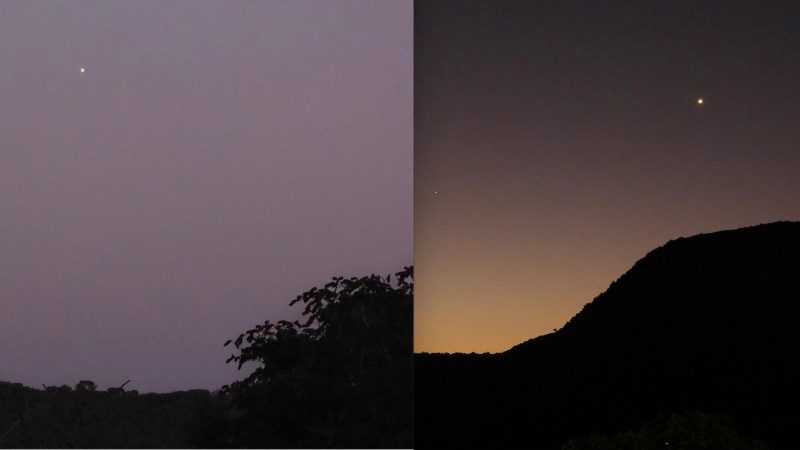
Got Venus? Quick! Turn around and look for Jupiter ascending in the east as night falls. It’s really fun to see the sky’s brightest planet (Venus) and 2nd-brightest planet (Jupiter) at the same time. As night passes, Venus will set, and Jupiter will ascend higher in the sky. Photo taken May 9, 2018 by Peter Lowenstein in Mutare, Zimbabwe.

Day by day, Venus is climbing away from the setting sun. But Castor and Pollux are sinking toward it, as they always do at this time of year. Venus is a planet in our solar system, and – remember – the word planet itself comes from an ancient root word meaning wanderer. Because they’re so much closer to us than the stars, planets move apart from the stars. Venus will remain in the evening sky until September or October 2018. But these Gemini stars will disappear in the sunset glare later this month, drawn inexorably into the solar glare by Earth’s own orbit around the sun, which is placing the sun between us and them. The exact date of their disappearance will vary, depending on where you live worldwide. It’d be fun to watch them each night, as long as you can!

The first day that a star disappears in the evening twilight is called a star’s heliacal setting. It’s similar to the more familiar term heliacal rising, which indicates when a star first becomes visible at morning dawn. The word heliacal, of course, just means related to the sun.

After its heliacal setting, a star is lost in the sun’s glare for some weeks or months, until it reappears in eastern morning twilight. All that time, Earth is moving along steadily in its orbit around the sun. It’s our movement around the sun that causes the stars to shift their positions across our sky, from one earthly season to another.

Thus coming to know even a few stars – being aware of their heliacal risings and settings – can place you in tune with nature on a grand and cosmic scale.

Constellation chart via IAU. In 2018, the sun passes in front of Gemini from June 21 to July 21.

Bottom line: At nightfall on June 9, 10 and 11, 2018, notice the brightest planet Venus making a line with the Gemini stars, Castor and Pollux. Then watch for these stars heliacal setting later this month.


from EarthSky https://ift.tt/2Jsrw4B

On June 9 to 11, 2018, look west after sunset to see the brightest planet Venus making a line with the Gemini stars, Castor and Pollux, on our sky’s dome.

They’ll pop into view as evening dusk gives way to nightfall.

So you’ll be looking in the sunset direction after the sun goes down. Venus (so bright!) will be the first “star” to pop out as night falls. Some people might see Venus as soon as 10 to 15 minutes after sunset (keen-eyed observers can spot it in a daytime sky), and of course you’ll see Venus the quickest if you scan for it with binoculars. The rest of us just need to wait. Never fear. If your sky is clear, you’ll easily see Venus.

Then, as dusk turn into darkness, look for the constellation Gemini’s two brightest stars, Castor and Pollux, to the north (or right) of Venus. Pollux rates as a 1st-magnitude star, or one of the brightest stars in our sky. Castor is slightly fainter, but also bright, the brightest of 2nd-magnitude stars. Yet both stars pale next to Venus, which outshines them by a hundredfold.

Got Venus? Quick! Turn around and look for Jupiter ascending in the east as night falls. It’s really fun to see the sky’s brightest planet (Venus) and 2nd-brightest planet (Jupiter) at the same time. As night passes, Venus will set, and Jupiter will ascend higher in the sky. Photo taken May 9, 2018 by Peter Lowenstein in Mutare, Zimbabwe.

Day by day, Venus is climbing away from the setting sun. But Castor and Pollux are sinking toward it, as they always do at this time of year. Venus is a planet in our solar system, and – remember – the word planet itself comes from an ancient root word meaning wanderer. Because they’re so much closer to us than the stars, planets move apart from the stars. Venus will remain in the evening sky until September or October 2018. But these Gemini stars will disappear in the sunset glare later this month, drawn inexorably into the solar glare by Earth’s own orbit around the sun, which is placing the sun between us and them. The exact date of their disappearance will vary, depending on where you live worldwide. It’d be fun to watch them each night, as long as you can!

The first day that a star disappears in the evening twilight is called a star’s heliacal setting. It’s similar to the more familiar term heliacal rising, which indicates when a star first becomes visible at morning dawn. The word heliacal, of course, just means related to the sun.

After its heliacal setting, a star is lost in the sun’s glare for some weeks or months, until it reappears in eastern morning twilight. All that time, Earth is moving along steadily in its orbit around the sun. It’s our movement around the sun that causes the stars to shift their positions across our sky, from one earthly season to another.

Thus coming to know even a few stars – being aware of their heliacal risings and settings – can place you in tune with nature on a grand and cosmic scale.

Constellation chart via IAU. In 2018, the sun passes in front of Gemini from June 21 to July 21.

Bottom line: At nightfall on June 9, 10 and 11, 2018, notice the brightest planet Venus making a line with the Gemini stars, Castor and Pollux. Then watch for these stars heliacal setting later this month.


from EarthSky https://ift.tt/2Jsrw4B

The Air Force is Looking for Innovative Tech Solutions

Air Force scientists are seeking innovators for ideas to enhance energy security and readiness.

from https://ift.tt/2M9JieV
Air Force scientists are seeking innovators for ideas to enhance energy security and readiness.

from https://ift.tt/2M9JieV

adds 2