aads

Tiny shrimp could influence global climate changes

When we think of global warming and climate change, most of us ignore the impacts that animals have on the environment. Climate affects animals, but is the reverse true? Can animals affect the climate?

I don’t know how to answer that question definitively, but I was fortunate enough to read a very recent paper from a top fluid dynamics research team from Stanford. The team, led by Dr. John Dabiri, is well known for their work on bio-inspired flow. Part of what they study is the influence of living organisms on fluid flow, especially flow of water in the oceans.

This team’s recent work deals with something called aggregate motion of swimmers and it was published in Nature this year. The researchers wanted to know what happens when thousands (or millions) of small creatures swim in a single direction. Can the wakes they create add up to a larger scale motion and can these motions affect the ocean waters that they swim through?
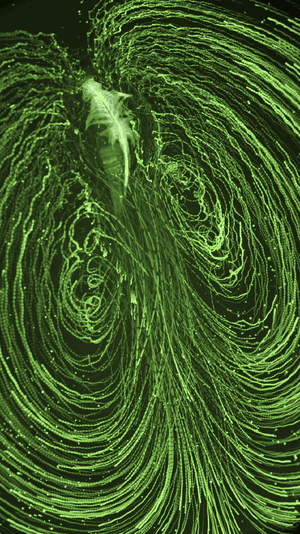
Flow pattern caused by krill motion.

Flow pattern caused by krill motion. Illustration: Houghton et al. (2018); Nature

The team fabricated large tanks and filled them with water and Artemis salina (a species of brine shrimp). Using LED lights they were able to get the shrimp to swim upwards and downwards in the tank, replicating their daily vertical migrations. In the oceans, the vertical motion is hundreds of meters, but in the experiment, the shrimp swam upwards and downwards just a few meters. 

Before the shrimp began their motion, the researchers measured the water stratification. That is, less dense water tends to rise to the top while heavier, more dense water sinks. In the oceans, as well as in experiments, the water density is dictated by its saltiness and the temperature. 

The authors discovered something amazing. After tricking the shrimp to swim upwards and downwards in the tank, the water stratification changed greatly. The shrimp brought heavier water upwards and lighter water downwards. While one or even a few hundred shrimp may not change the water structure, thousands of shrimp moving together can. A video of upward aggregate shrimp motion is shown here. Fluid motion from a single shrimp is shown here.

What the researchers also discovered was that shrimp, because they are dense, find it more difficult to swim upwards than downwards. Consequently, they have to create a strong propulsion jet when they swim upwards and virtually no propulsion jet when traveling downwards. Since these small propulsion jets are additive, shrimp cause much more mixing as they rise through the ocean waters compared to their descent. At the end of the day, the effect aggregate motion and turbulent mixing increased the normal mixing capacity of the water by a thousandfold.

I asked Dr. Dabiri about the importance of this project and he told me:

Click here to read the rest


from Skeptical Science https://ift.tt/2JA7msS

When we think of global warming and climate change, most of us ignore the impacts that animals have on the environment. Climate affects animals, but is the reverse true? Can animals affect the climate?

I don’t know how to answer that question definitively, but I was fortunate enough to read a very recent paper from a top fluid dynamics research team from Stanford. The team, led by Dr. John Dabiri, is well known for their work on bio-inspired flow. Part of what they study is the influence of living organisms on fluid flow, especially flow of water in the oceans.

This team’s recent work deals with something called aggregate motion of swimmers and it was published in Nature this year. The researchers wanted to know what happens when thousands (or millions) of small creatures swim in a single direction. Can the wakes they create add up to a larger scale motion and can these motions affect the ocean waters that they swim through?

Flow pattern caused by krill motion.

Flow pattern caused by krill motion. Illustration: Houghton et al. (2018); Nature

The team fabricated large tanks and filled them with water and Artemis salina (a species of brine shrimp). Using LED lights they were able to get the shrimp to swim upwards and downwards in the tank, replicating their daily vertical migrations. In the oceans, the vertical motion is hundreds of meters, but in the experiment, the shrimp swam upwards and downwards just a few meters. 

Before the shrimp began their motion, the researchers measured the water stratification. That is, less dense water tends to rise to the top while heavier, more dense water sinks. In the oceans, as well as in experiments, the water density is dictated by its saltiness and the temperature. 

The authors discovered something amazing. After tricking the shrimp to swim upwards and downwards in the tank, the water stratification changed greatly. The shrimp brought heavier water upwards and lighter water downwards. While one or even a few hundred shrimp may not change the water structure, thousands of shrimp moving together can. A video of upward aggregate shrimp motion is shown here. Fluid motion from a single shrimp is shown here.

What the researchers also discovered was that shrimp, because they are dense, find it more difficult to swim upwards than downwards. Consequently, they have to create a strong propulsion jet when they swim upwards and virtually no propulsion jet when traveling downwards. Since these small propulsion jets are additive, shrimp cause much more mixing as they rise through the ocean waters compared to their descent. At the end of the day, the effect aggregate motion and turbulent mixing increased the normal mixing capacity of the water by a thousandfold.

I asked Dr. Dabiri about the importance of this project and he told me:

Click here to read the rest


from Skeptical Science https://ift.tt/2JA7msS

New research, May 28 - June 3, 2018

A selection of new climate related research articles is shown below.

Climate change

Overcoming early career barriers to interdisciplinary climate change research

Projected climate over the Greater Horn of Africa under 1.5 °C and 2 °C global warming (open access)

Temperature, precipitation, wind

Analysis of past changes in wet bulb temperature in relation to snow making conditions based on long term observations Austria and Germany

"The number of snow making days changes least in October and most in December when averaged over all stations. Very high stations show more change in October and less change in December than the lower stations. Several stations show a significant decrease of snow making days per month, particularly in more recent sub-periods, but trends vary strongly between stations and for different sub-periods. Sub-periods with positive trends are present in earlier phases of the time series at some stations and inter-annual variability is generally 1–2 orders of magnitude greater than detected trends."

On the concordance of 21st century wind-wave climate projections

Spatiotemporal extremes of temperature and precipitation during 1960–2015 in the Yangtze River Basin (China) and impacts on vegetation dynamics

Comparison of two long-term and high-resolution satellite precipitation datasets in Xinjiang, China

The effects of 1.5 and 2 degrees of global warming on Africa in the CORDEX ensemble (open access)

Spatial distribution of unidirectional trends in temperature and temperature extremes in Pakistan

Spatial and temporal stability of temperature in the first-level basins of China during 1951–2013

Quantification of the changes in intensity and frequency of hourly extreme rainfall attributed climate change in Oman

Extreme events

A climatological assessment of drought impact on vegetation health index

Short-term changes in thermal perception associated with heatwave conditions in Melbourne, Australia

Spatial distribution patterns of global natural disasters based on biclustering

Rethinking flood risk communication (open access)

Increasing extent and intensity of thunderstorms observed over the Congo Basin from 1982 to 2016

Forcings and feedbacks

Surface energy balance closure at ten sites over the Tibetan plateau (open access)

Sensitivity of surface temperature to oceanic forcing via q-flux Green’s function experiments Part II: Feedback decomposition and polar amplification

1990–2016 surface solar radiation variability and trend over the Piedmont region (northwest Italy)

Solar dimming above temperate forests and its impact on local climate (open access)

Cryosphere

Seasonal variations of the backscattering coefficient measured by radar altimeters over the Antarctic Ice Sheet (open access)

Warm winter, thin ice? (open access)

Changing snow seasonality in the highlands of Kyrgyzstan (open access)

Hydrosphere

On observed aridity changes over the semiarid regions of India in a warming climate

Lake storage variation on the endorheic Tibetan Plateau and its attribution to climate change since the new millennium (open access)

Atmospheric and oceanic circulation

Responses of the Tropical Atmospheric Circulation to Climate Change and Connection to the Hydrological Cycle

Atlantic-Pacific Asymmetry in Deep Water Formation

The downward influence of uncertainty in the Northern Hemisphere stratospheric polar vortex response to climate change

Statistical occurrence and mechanisms of the 2014–2016 delayed super El Niño captured by a simple dynamical model

Carbon cycle

Vulnerability and resilience of the carbon exchange of a subarctic peatland to an extreme winter event (carbon cycle)

Climate change impacts

Bibliometric analysis of Climate Change Vulnerability Assessment research

Mankind

Will climate change benefit or hurt Russian grain production? A statistical evidence from a panel approach

"Our results indicate that CC might have a positive effect on winter wheat, spring wheat and spring barley productivity in a number of regions in the Northern and Siberian parts of Russia. However, due to the highly damaging CC impact on grain production in the most productive regions located in the South of the country, the overall impact tends to be negative."

Climate change adaptation in small island developing states: Insights and lessons from a meta-paradigmatic study

Mean air temperature as a risk factor for stroke mortality in São Paulo, Brazil

Diverse landscapes, diverse risks: synthesis of the special issue on climate change and adaptive capacity in a hotter, drier Southwestern United States

Impacts of a lengthening open water season on Alaskan coastal communities: deriving locally relevant indices from large-scale datasets and community observations (open access)

Global seafood consumption footprint (open access)

Cascading impacts of climate change on southwestern US cropland agriculture (open access)

The best laid plans: Impacts of politics on local climate change adaptation

Biosphere

Increasing global vegetation browning hidden in overall vegetation greening: Insights from time-varying trends

Long-term changes in migration timing of Song Thrush Turdus philomelos at the southern Baltic coast in response to temperatures on route and at breeding grounds

Temperature influences habitat preference of coral reef fishes: Will generalists become more specialised in a warming ocean?

Root responses to elevated CO2, warming and irrigation in a semi‐arid grassland: Integrating biomass, length and life span in a 5‐year field experiment

Increased body size along urbanization gradients at both community and intraspecific level in macro‐moths

Differential ecophysiological responses and resilience to heat wave events in four co-occurring temperate tree species (open access)

Effects of elevated CO2 and temperature on phytoplankton community biomass, species composition and photosynthesis during an experimentally induced autumn bloom in the western English Channel (open access)

Later springs green-up faster: the relation between onset and completion of green-up in deciduous forests of North America

Climate change mitigation

Time Trends and Persistence in the Global CO2 Emissions Across Europe

Climate change communication

Climate change communication from cities in the USA

Bonding and Bridging Relationships in Collaborative Forums Responding to Weather Warnings

Emission savings

Estimating the global warming emissions of the LCAXVII conference: connecting flights matter

National research funding and energy efficiency: Evidence from the National Science Foundation of China

Assessing fossil fuel CO2 emissions in California using atmospheric observations and models (open access)

A life cycle assessment of the environmental impacts of a beef system in the USA (open access)

Energy efficiency as a means to expand energy access: A Uganda roadmap

Development path of Chinese low-carbon cities based on index evaluation (open access)

The carbon footprint of agricultural crop cultivation in India

Energy production

Quantification of methane sources in the Athabasca Oil Sands Region of Alberta by aircraft mass balance (open access)

Should future wind speed changes be taken into account in wind farm development? (open access)

Decentralised electric power delivery for rural electrification in Pakistan

Willing to participate in vehicle-to-grid (V2G)? Why not!

China’s nuclear power under the global 1.5 °C target: Preliminary feasibility study and prospects (open access)

“I can live with nuclear energy if…”: Exploring public perceptions of nuclear energy in Singapore

How to peak carbon emissions in China's power sector: A regional perspective

Climate Policy

Distributing the Global Carbon Budget with climate justice criteria

Which policy instruments attract foreign direct investments in renewable energy?

The participation of core stakeholders in the design of, and challenges to, the US Clean Power Plan

Global mean temperature indicators linked to warming levels avoiding climate risks (open access)

Should Ethiopia and least developed countries exit from the Paris climate accord? – Geopolitical, development, and energy policy perspectives

Aligning climate action with the self-interest and short-term dominated priorities of decision-makers

Estimation of the cost of greenhouse gas reduction in Korea under the global scenario of 1.5 °C temperature increase

Other papers

General climate science

Multiple symptoms of total ozone recovery inside the Antarctic vortex during austral spring (open access)

On ozone trend detection: using coupled chemistry–climate simulations to investigate early signs of total column ozone recovery (open access)

Palaeoclimatology

Placing the Common Era in a Holocene context: millennial to centennial patterns and trends in the hydroclimate of North America over the past 2000 years (open access)

Environmental issues

Spatial Effects of Air Pollution on Public Health in China


from Skeptical Science https://ift.tt/2HAhZqM

A selection of new climate related research articles is shown below.

Climate change

Overcoming early career barriers to interdisciplinary climate change research

Projected climate over the Greater Horn of Africa under 1.5 °C and 2 °C global warming (open access)

Temperature, precipitation, wind

Analysis of past changes in wet bulb temperature in relation to snow making conditions based on long term observations Austria and Germany

"The number of snow making days changes least in October and most in December when averaged over all stations. Very high stations show more change in October and less change in December than the lower stations. Several stations show a significant decrease of snow making days per month, particularly in more recent sub-periods, but trends vary strongly between stations and for different sub-periods. Sub-periods with positive trends are present in earlier phases of the time series at some stations and inter-annual variability is generally 1–2 orders of magnitude greater than detected trends."

On the concordance of 21st century wind-wave climate projections

Spatiotemporal extremes of temperature and precipitation during 1960–2015 in the Yangtze River Basin (China) and impacts on vegetation dynamics

Comparison of two long-term and high-resolution satellite precipitation datasets in Xinjiang, China

The effects of 1.5 and 2 degrees of global warming on Africa in the CORDEX ensemble (open access)

Spatial distribution of unidirectional trends in temperature and temperature extremes in Pakistan

Spatial and temporal stability of temperature in the first-level basins of China during 1951–2013

Quantification of the changes in intensity and frequency of hourly extreme rainfall attributed climate change in Oman

Extreme events

A climatological assessment of drought impact on vegetation health index

Short-term changes in thermal perception associated with heatwave conditions in Melbourne, Australia

Spatial distribution patterns of global natural disasters based on biclustering

Rethinking flood risk communication (open access)

Increasing extent and intensity of thunderstorms observed over the Congo Basin from 1982 to 2016

Forcings and feedbacks

Surface energy balance closure at ten sites over the Tibetan plateau (open access)

Sensitivity of surface temperature to oceanic forcing via q-flux Green’s function experiments Part II: Feedback decomposition and polar amplification

1990–2016 surface solar radiation variability and trend over the Piedmont region (northwest Italy)

Solar dimming above temperate forests and its impact on local climate (open access)

Cryosphere

Seasonal variations of the backscattering coefficient measured by radar altimeters over the Antarctic Ice Sheet (open access)

Warm winter, thin ice? (open access)

Changing snow seasonality in the highlands of Kyrgyzstan (open access)

Hydrosphere

On observed aridity changes over the semiarid regions of India in a warming climate

Lake storage variation on the endorheic Tibetan Plateau and its attribution to climate change since the new millennium (open access)

Atmospheric and oceanic circulation

Responses of the Tropical Atmospheric Circulation to Climate Change and Connection to the Hydrological Cycle

Atlantic-Pacific Asymmetry in Deep Water Formation

The downward influence of uncertainty in the Northern Hemisphere stratospheric polar vortex response to climate change

Statistical occurrence and mechanisms of the 2014–2016 delayed super El Niño captured by a simple dynamical model

Carbon cycle

Vulnerability and resilience of the carbon exchange of a subarctic peatland to an extreme winter event (carbon cycle)

Climate change impacts

Bibliometric analysis of Climate Change Vulnerability Assessment research

Mankind

Will climate change benefit or hurt Russian grain production? A statistical evidence from a panel approach

"Our results indicate that CC might have a positive effect on winter wheat, spring wheat and spring barley productivity in a number of regions in the Northern and Siberian parts of Russia. However, due to the highly damaging CC impact on grain production in the most productive regions located in the South of the country, the overall impact tends to be negative."

Climate change adaptation in small island developing states: Insights and lessons from a meta-paradigmatic study

Mean air temperature as a risk factor for stroke mortality in São Paulo, Brazil

Diverse landscapes, diverse risks: synthesis of the special issue on climate change and adaptive capacity in a hotter, drier Southwestern United States

Impacts of a lengthening open water season on Alaskan coastal communities: deriving locally relevant indices from large-scale datasets and community observations (open access)

Global seafood consumption footprint (open access)

Cascading impacts of climate change on southwestern US cropland agriculture (open access)

The best laid plans: Impacts of politics on local climate change adaptation

Biosphere

Increasing global vegetation browning hidden in overall vegetation greening: Insights from time-varying trends

Long-term changes in migration timing of Song Thrush Turdus philomelos at the southern Baltic coast in response to temperatures on route and at breeding grounds

Temperature influences habitat preference of coral reef fishes: Will generalists become more specialised in a warming ocean?

Root responses to elevated CO2, warming and irrigation in a semi‐arid grassland: Integrating biomass, length and life span in a 5‐year field experiment

Increased body size along urbanization gradients at both community and intraspecific level in macro‐moths

Differential ecophysiological responses and resilience to heat wave events in four co-occurring temperate tree species (open access)

Effects of elevated CO2 and temperature on phytoplankton community biomass, species composition and photosynthesis during an experimentally induced autumn bloom in the western English Channel (open access)

Later springs green-up faster: the relation between onset and completion of green-up in deciduous forests of North America

Climate change mitigation

Time Trends and Persistence in the Global CO2 Emissions Across Europe

Climate change communication

Climate change communication from cities in the USA

Bonding and Bridging Relationships in Collaborative Forums Responding to Weather Warnings

Emission savings

Estimating the global warming emissions of the LCAXVII conference: connecting flights matter

National research funding and energy efficiency: Evidence from the National Science Foundation of China

Assessing fossil fuel CO2 emissions in California using atmospheric observations and models (open access)

A life cycle assessment of the environmental impacts of a beef system in the USA (open access)

Energy efficiency as a means to expand energy access: A Uganda roadmap

Development path of Chinese low-carbon cities based on index evaluation (open access)

The carbon footprint of agricultural crop cultivation in India

Energy production

Quantification of methane sources in the Athabasca Oil Sands Region of Alberta by aircraft mass balance (open access)

Should future wind speed changes be taken into account in wind farm development? (open access)

Decentralised electric power delivery for rural electrification in Pakistan

Willing to participate in vehicle-to-grid (V2G)? Why not!

China’s nuclear power under the global 1.5 °C target: Preliminary feasibility study and prospects (open access)

“I can live with nuclear energy if…”: Exploring public perceptions of nuclear energy in Singapore

How to peak carbon emissions in China's power sector: A regional perspective

Climate Policy

Distributing the Global Carbon Budget with climate justice criteria

Which policy instruments attract foreign direct investments in renewable energy?

The participation of core stakeholders in the design of, and challenges to, the US Clean Power Plan

Global mean temperature indicators linked to warming levels avoiding climate risks (open access)

Should Ethiopia and least developed countries exit from the Paris climate accord? – Geopolitical, development, and energy policy perspectives

Aligning climate action with the self-interest and short-term dominated priorities of decision-makers

Estimation of the cost of greenhouse gas reduction in Korea under the global scenario of 1.5 °C temperature increase

Other papers

General climate science

Multiple symptoms of total ozone recovery inside the Antarctic vortex during austral spring (open access)

On ozone trend detection: using coupled chemistry–climate simulations to investigate early signs of total column ozone recovery (open access)

Palaeoclimatology

Placing the Common Era in a Holocene context: millennial to centennial patterns and trends in the hydroclimate of North America over the past 2000 years (open access)

Environmental issues

Spatial Effects of Air Pollution on Public Health in China


from Skeptical Science https://ift.tt/2HAhZqM

It’s World Oceans Day. Your favorite ocean photos, right here

Paulo P. Pereira of Torres Vedras, Lisbon, Portugal, captured this image on June 5, 2018.

Overlooking the Atlantic Ocean, from the Georgia coast, by Greg Hogan.

Overlooking the Atlantic Ocean, from the Georgia coast, by Greg Hogan.

World Oceans Day 2018 – a global day of ocean celebration – takes place every year on June 8. The World Ocean Project first organized the day in 2002 as a time to celebrate the oceans and take steps to protect ocean health. This year’s action focus is the same as the focus as 2018’s Earth Day: plastic pollution in the oceans. You can find out more here.

West Bay, Dorset at sunset. Image via Roger Morgan.

“Into the Bay of Bengal” by Karthik Easvur.

Leo Carrillo State Beach Malibu California. Photo via Kristal Alaimo-Moritz Klear.

Twilight at Waimanalo Beach, Oahu Hawaii on June 4, 2017 via Chantel Dunlap.

Summer showers near Galveston, Texas by Brett Stone.

Summer showers near Galveston, Texas by Brett Stone.

San Francisco Bay by Matt Snow.

From Reykjanes Peninsula in Iceland, by Vladimir Zlvkovic.

From Reykjanes Peninsula in Iceland, by Vladimir Zlvkovic.

York Beach, Maine by Kevin Pratt.

From the Great Ocean Road in Australia by Malck Coolen Photography.

From the Great Ocean Road in Australia by Malck Coolen Photography.

“Seawater inlet of Indian Ocean where two seas of different texture meet!” by Sima Sweet.

Atlantic Ocean, off the coast of Cape Breton Island Canada, by Tynski Photographic.

Atlantic Ocean, off the coast of Cape Breton Island Canada, by Tynski Photographic.

Glenn Miles Photography took this photo from the north coast of Northern Ireland. Thank you, Glenn.

Glenn Miles Photography took this photo from the north coast of Northern Ireland. Thank you, Glenn.

Maine coast at sunrise by John Gravell.

Maine coast at sunrise by John Gravell.

Sunset in Truro, Massachusetts, looking toward Provincetown, by John Gravell.

Sunset in Truro, Massachusetts, looking toward Provincetown, by John Gravell.

“Loggerhead sea turtle tracks at sunrise on Florida’s beautiful east coast.” Photo: Rachel Smith. Thanks Rachel!

Enjoying EarthSky? Sign up for our free daily newsletter today!

Bottom line: Ocean photos from EarthSky friends across the globe in celebration of World Oceans Day 2018.


from EarthSky https://ift.tt/1AUNdol

Paulo P. Pereira of Torres Vedras, Lisbon, Portugal, captured this image on June 5, 2018.

Overlooking the Atlantic Ocean, from the Georgia coast, by Greg Hogan.

Overlooking the Atlantic Ocean, from the Georgia coast, by Greg Hogan.

World Oceans Day 2018 – a global day of ocean celebration – takes place every year on June 8. The World Ocean Project first organized the day in 2002 as a time to celebrate the oceans and take steps to protect ocean health. This year’s action focus is the same as the focus as 2018’s Earth Day: plastic pollution in the oceans. You can find out more here.

West Bay, Dorset at sunset. Image via Roger Morgan.

“Into the Bay of Bengal” by Karthik Easvur.

Leo Carrillo State Beach Malibu California. Photo via Kristal Alaimo-Moritz Klear.

Twilight at Waimanalo Beach, Oahu Hawaii on June 4, 2017 via Chantel Dunlap.

Summer showers near Galveston, Texas by Brett Stone.

Summer showers near Galveston, Texas by Brett Stone.

San Francisco Bay by Matt Snow.

From Reykjanes Peninsula in Iceland, by Vladimir Zlvkovic.

From Reykjanes Peninsula in Iceland, by Vladimir Zlvkovic.

York Beach, Maine by Kevin Pratt.

From the Great Ocean Road in Australia by Malck Coolen Photography.

From the Great Ocean Road in Australia by Malck Coolen Photography.

“Seawater inlet of Indian Ocean where two seas of different texture meet!” by Sima Sweet.

Atlantic Ocean, off the coast of Cape Breton Island Canada, by Tynski Photographic.

Atlantic Ocean, off the coast of Cape Breton Island Canada, by Tynski Photographic.

Glenn Miles Photography took this photo from the north coast of Northern Ireland. Thank you, Glenn.

Glenn Miles Photography took this photo from the north coast of Northern Ireland. Thank you, Glenn.

Maine coast at sunrise by John Gravell.

Maine coast at sunrise by John Gravell.

Sunset in Truro, Massachusetts, looking toward Provincetown, by John Gravell.

Sunset in Truro, Massachusetts, looking toward Provincetown, by John Gravell.

“Loggerhead sea turtle tracks at sunrise on Florida’s beautiful east coast.” Photo: Rachel Smith. Thanks Rachel!

Enjoying EarthSky? Sign up for our free daily newsletter today!

Bottom line: Ocean photos from EarthSky friends across the globe in celebration of World Oceans Day 2018.


from EarthSky https://ift.tt/1AUNdol

The secrets of night-shining clouds

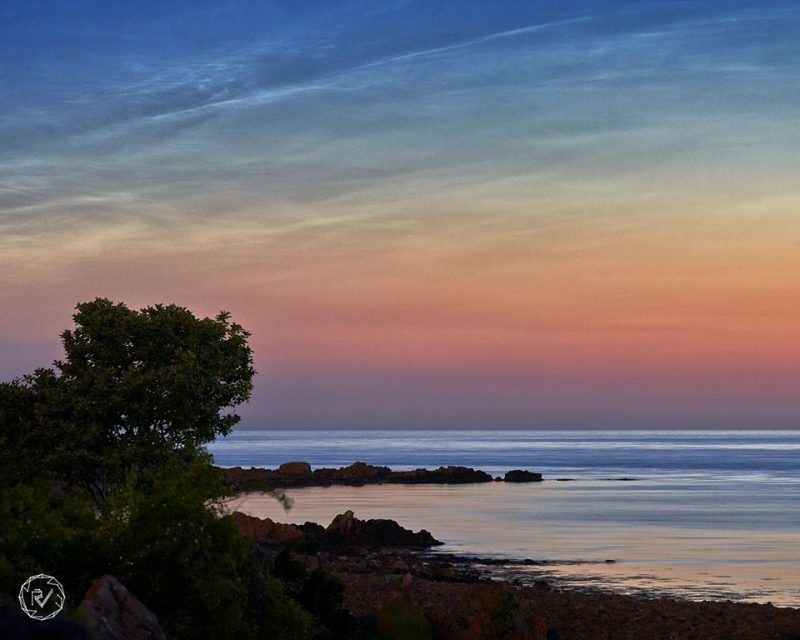
Noctilucent cloud season has returned to Earth’s high latitudes. Ruslan Merzlyakov in Denmark captured these clouds – which shine at night – on June 3, 2018. Canon EOS 6D + Samyang 14mm f/2.8 2-5”, f/2.8, ISO 160-800 HDR + focus stack.

People are reporting sightings of the silver-blue clouds – called noctilucent or night shining clouds – that light up summer night skies. These clouds are typically seen at high latitudes – say, about 45 degrees north or south – from May through August in the Northern Hemisphere, and from November through February in the Southern Hemisphere.

Every year around this time, we hear from people who begun spotting them again.

RV Photography wrote on June 5: “The magic that happens around 80 kilometers (50 miles) above the northern parts of this globe we all call home is back … the noctilucent clouds!!”

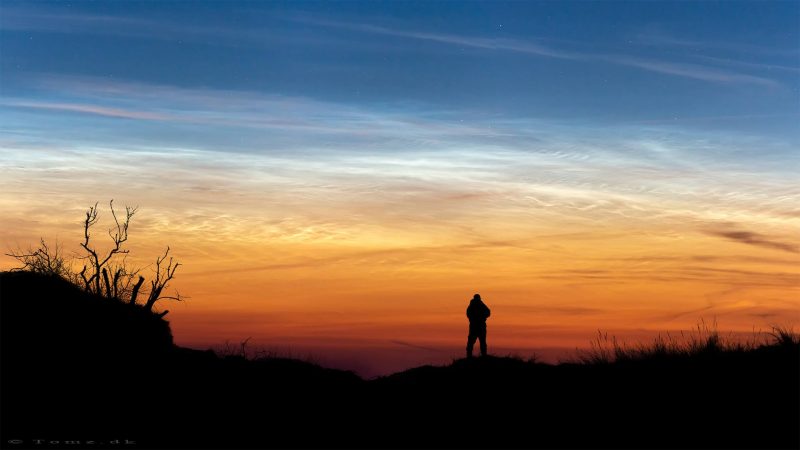
Noctilucent cloud selfie, by Thomas Tomz Henriksen, Denmark, June 3, 2018.

What are notilucent clouds? Noctilucent clouds form in the highest reaches of the atmosphere – the mesosphere – as much as 50 miles (80 km) above the Earth’s surface. They’re thought to be made of ice crystals that form on fine dust particles from meteors. They can only form when temperatures are incredibly low and when there’s water available to form ice crystals.

Why do these clouds – which require such cold temperatures – form in the summer? It’s because of the dynamics of the atmosphere. You actually get the coldest temperatures of the year near the poles in summer at that height in the mesosphere.

Here’s how it works: during summer, air close to the ground gets heated and rises. Since atmospheric pressure decreases with altitude, the rising air expands. When the air expands, it also cools down. This, along with other processes in the upper atmosphere, drives the air even higher causing it to cool even more. As a result, temperatures in the mesosphere can plunge to as low as -210 degrees Fahrenheit (-134 degrees Celsius).

In the Northern Hemisphere, the mesosphere often reaches these temperatures by mid-May, in most years.

Since the clouds are so sensitive to the atmospheric temperatures, they can act as a proxy for information about the wind circulation that causes these temperatures. First of all, they can tell scientists that the circulation exists, and also tell us something about the strength of the circulation.

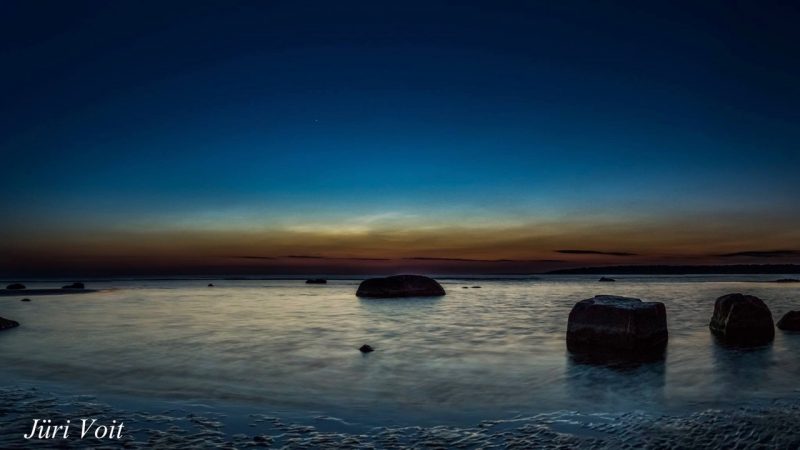
Noctilucent clouds - July 14, 2016 - by our friend Jüri Voit Photography in Estonia.

Noctilucent clouds – the morning of July 14, 2016 – by our friend Jüri Voit Photography in Estonia (58 degrees north latitude)

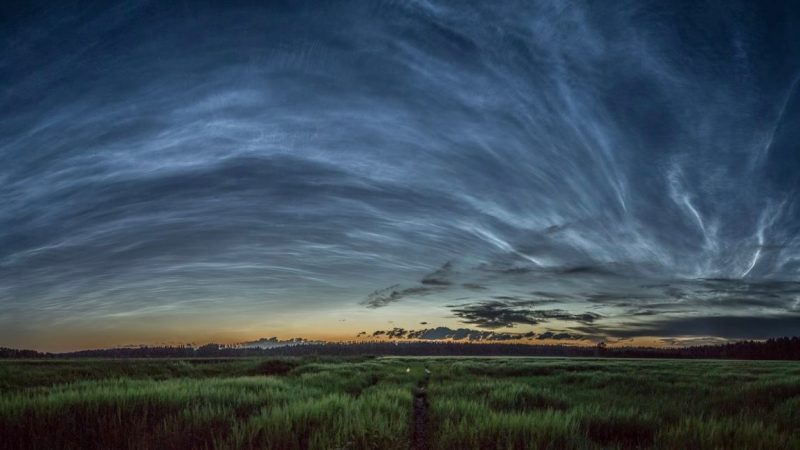
Here’s another by Jüri Voit Photography, who wrote on May 30, 2016: “Season of noctilucent clouds is open!”

View larger. | Noctilucent clouds - the electric-looking clouds near the horizon in this photo - and a greenish aurora, higher in the sky, seen by Harlan Thomas in Canada on June 8, 2015.

View larger. | Noctilucent clouds – the electric-looking clouds near the horizon in this photo – and a greenish aurora, higher in the sky. Photo taken by Harlan Thomas in Alberta, Canada, in June 2015.

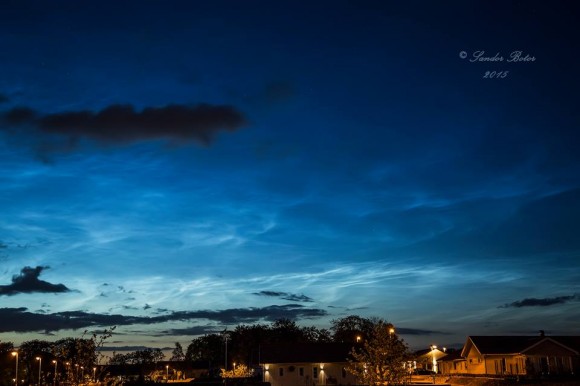
Sandor Botor in Sweden captured notilucent clouds on June 1, 2015. Thank you, Sandor!

Notilucent clouds over Sweden in June 2015 from EarthSky Facebook friend Sandor Botor.

How can I see noctilucent clouds? If you want to see the clouds, what steps should you take? Remember, you have to be at a relatively high latitude on Earth to see them: between about 45 degrees and 60 degrees north or south latitude.

For best results, look for these clouds from about May through August in the Northern Hemisphere, and from November through February in the Southern Hemisphere.

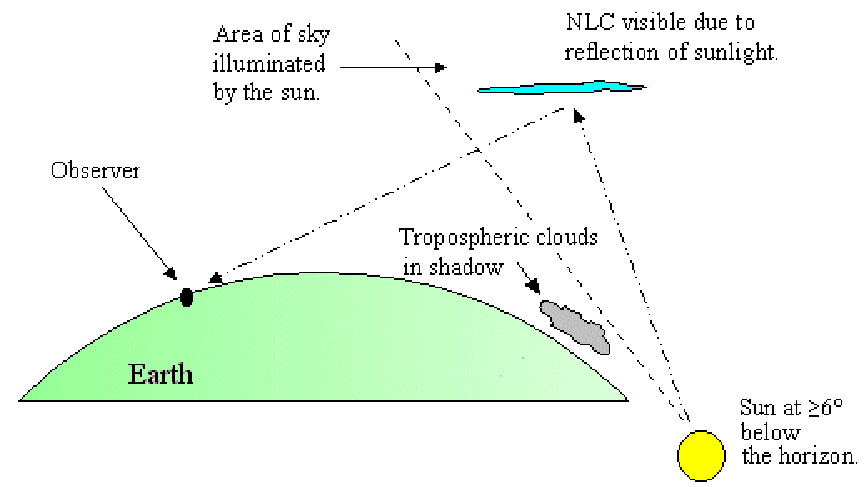
Noctilucent clouds are primarily visible when the sun is just below the horizon, say, from about 90 minutes to about two hours after sunset or before sunrise. At such times, when the sun is below the ground horizon but visible from the high altitude of noctilucent clouds, sunlight illuminates these clouds, causing them to glow in the dark night sky.

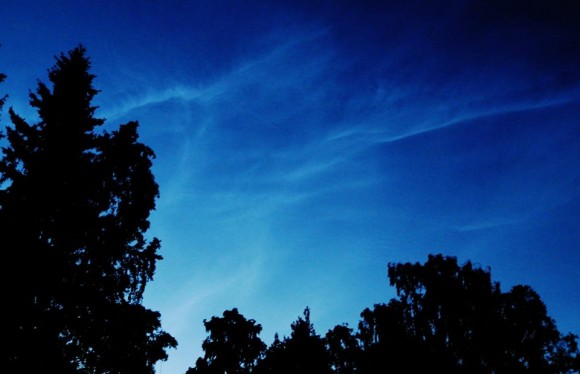
Jörgen Norrland Andersson saw the same display from Sweden on June 1.?

Noctilucent clouds over Sweden in June 2015 from Jörgen Norrland Andersson.

Scientists studying these clouds have included those from NASA’s AIM (Aeronomy of Ice in the Mesosphere) satellite. This satellite, launched in 2007, has observed noctilucent clouds using several onboard instruments to collect information such as temperature, atmospheric gases, ice crystal size and changes in the clouds, as well as the amount of meteoric space dust that enters the atmosphere. You can find out what they are learning here.

We see noctilucent clouds well after sunset, when other clouds have gone dark, because they're much higher up and can still catch sunlight and reflect it back to Earth. Illustration via NASA.

When the sun is below the ground horizon but visible from the high altitude of noctilucent clouds, sunlight illuminates these clouds, causing them to glow in the dark night sky. Illustration via NASA.

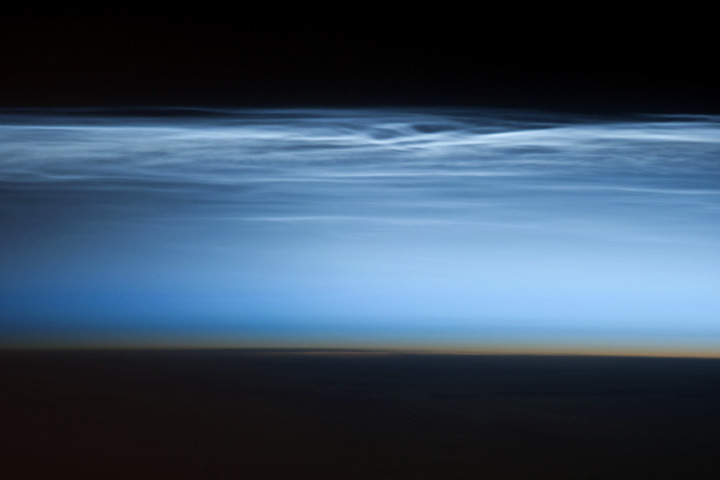
Noctilucent clouds can be seen from space, too. Astronauts in the International Space Station (ISS) took this photo on January 5, 2013, when ISS was over the Pacific Ocean south of French Polynesia. Below the brightly-lit noctilucent clouds, across the center of the image, the pale orange band is the stratosphere. Image via NASA.

Bottom line: Noctilucent or night-shining clouds form in the highest reaches of the atmosphere – the mesosphere – as much as 50 miles (80 km) above the Earth’s surface. They’re seen during summer in polar regions.

See SpaceWeather’s RealTime Noctilucent Cloud Gallery

Help EarthSky keep going! Please donate what you can to our annual crowd-funding campaign.


from EarthSky https://ift.tt/1ytqbj9

Noctilucent cloud season has returned to Earth’s high latitudes. Ruslan Merzlyakov in Denmark captured these clouds – which shine at night – on June 3, 2018. Canon EOS 6D + Samyang 14mm f/2.8 2-5”, f/2.8, ISO 160-800 HDR + focus stack.

People are reporting sightings of the silver-blue clouds – called noctilucent or night shining clouds – that light up summer night skies. These clouds are typically seen at high latitudes – say, about 45 degrees north or south – from May through August in the Northern Hemisphere, and from November through February in the Southern Hemisphere.

Every year around this time, we hear from people who begun spotting them again.

RV Photography wrote on June 5: “The magic that happens around 80 kilometers (50 miles) above the northern parts of this globe we all call home is back … the noctilucent clouds!!”

Noctilucent cloud selfie, by Thomas Tomz Henriksen, Denmark, June 3, 2018.

What are notilucent clouds? Noctilucent clouds form in the highest reaches of the atmosphere – the mesosphere – as much as 50 miles (80 km) above the Earth’s surface. They’re thought to be made of ice crystals that form on fine dust particles from meteors. They can only form when temperatures are incredibly low and when there’s water available to form ice crystals.

Why do these clouds – which require such cold temperatures – form in the summer? It’s because of the dynamics of the atmosphere. You actually get the coldest temperatures of the year near the poles in summer at that height in the mesosphere.

Here’s how it works: during summer, air close to the ground gets heated and rises. Since atmospheric pressure decreases with altitude, the rising air expands. When the air expands, it also cools down. This, along with other processes in the upper atmosphere, drives the air even higher causing it to cool even more. As a result, temperatures in the mesosphere can plunge to as low as -210 degrees Fahrenheit (-134 degrees Celsius).

In the Northern Hemisphere, the mesosphere often reaches these temperatures by mid-May, in most years.

Since the clouds are so sensitive to the atmospheric temperatures, they can act as a proxy for information about the wind circulation that causes these temperatures. First of all, they can tell scientists that the circulation exists, and also tell us something about the strength of the circulation.

Noctilucent clouds - July 14, 2016 - by our friend Jüri Voit Photography in Estonia.

Noctilucent clouds – the morning of July 14, 2016 – by our friend Jüri Voit Photography in Estonia (58 degrees north latitude)

Here’s another by Jüri Voit Photography, who wrote on May 30, 2016: “Season of noctilucent clouds is open!”

View larger. | Noctilucent clouds - the electric-looking clouds near the horizon in this photo - and a greenish aurora, higher in the sky, seen by Harlan Thomas in Canada on June 8, 2015.

View larger. | Noctilucent clouds – the electric-looking clouds near the horizon in this photo – and a greenish aurora, higher in the sky. Photo taken by Harlan Thomas in Alberta, Canada, in June 2015.

Sandor Botor in Sweden captured notilucent clouds on June 1, 2015. Thank you, Sandor!

Notilucent clouds over Sweden in June 2015 from EarthSky Facebook friend Sandor Botor.

How can I see noctilucent clouds? If you want to see the clouds, what steps should you take? Remember, you have to be at a relatively high latitude on Earth to see them: between about 45 degrees and 60 degrees north or south latitude.

For best results, look for these clouds from about May through August in the Northern Hemisphere, and from November through February in the Southern Hemisphere.

Noctilucent clouds are primarily visible when the sun is just below the horizon, say, from about 90 minutes to about two hours after sunset or before sunrise. At such times, when the sun is below the ground horizon but visible from the high altitude of noctilucent clouds, sunlight illuminates these clouds, causing them to glow in the dark night sky.

Jörgen Norrland Andersson saw the same display from Sweden on June 1.?

Noctilucent clouds over Sweden in June 2015 from Jörgen Norrland Andersson.

Scientists studying these clouds have included those from NASA’s AIM (Aeronomy of Ice in the Mesosphere) satellite. This satellite, launched in 2007, has observed noctilucent clouds using several onboard instruments to collect information such as temperature, atmospheric gases, ice crystal size and changes in the clouds, as well as the amount of meteoric space dust that enters the atmosphere. You can find out what they are learning here.

We see noctilucent clouds well after sunset, when other clouds have gone dark, because they're much higher up and can still catch sunlight and reflect it back to Earth. Illustration via NASA.

When the sun is below the ground horizon but visible from the high altitude of noctilucent clouds, sunlight illuminates these clouds, causing them to glow in the dark night sky. Illustration via NASA.

Noctilucent clouds can be seen from space, too. Astronauts in the International Space Station (ISS) took this photo on January 5, 2013, when ISS was over the Pacific Ocean south of French Polynesia. Below the brightly-lit noctilucent clouds, across the center of the image, the pale orange band is the stratosphere. Image via NASA.

Bottom line: Noctilucent or night-shining clouds form in the highest reaches of the atmosphere – the mesosphere – as much as 50 miles (80 km) above the Earth’s surface. They’re seen during summer in polar regions.

See SpaceWeather’s RealTime Noctilucent Cloud Gallery

Help EarthSky keep going! Please donate what you can to our annual crowd-funding campaign.


from EarthSky https://ift.tt/1ytqbj9

More mystery objects near Milky Way’s giant black hole

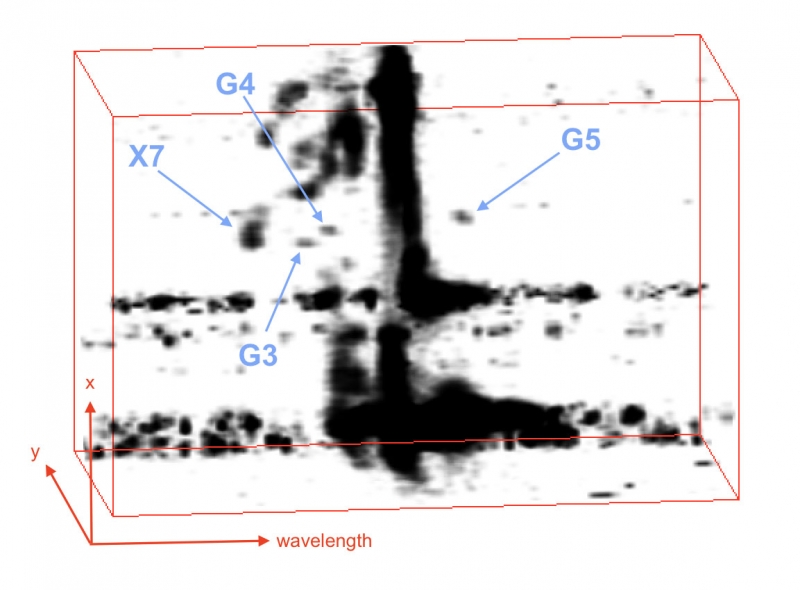
View larger. | Astronomers are tracking these mystery “G-objects” in the direction to the Milky Way’s center. They appear to be orbiting our galaxy’s central, supermassive black hole. Image via Keck Observatory.

Astronomers said on June 6, 2018 that they analyzed 12 years of data gathered at the W.M. Keck Observatory in Hawaii to discover several more of the bizarre objects known as G-objects. Only two examples were previously known of these strange galactic inhabitants, which are located behind a shroud of galactic dust, near Sagittarius A* (pronounced Sagittarius A-star), the supermassive black hole at our Milky Way galaxy’s heart. Astronomers discovered the first G-object – G1 – in 2004 and the second – G2 – in 2012. Both were thought to be gas clouds until they made their closest approach to the black hole. Both G1 and G2 somehow managed to survive the hole’s gravitational pull, which wouldn’t have happened if they were gas clouds; a 4-million-solar-mass black hole like Sagittarius A* can shred gas clouds apart. Now these same astronomers report three more of the strange G-objects – which they’ve labeled G3, G4 and G5 – near the galaxy’s heart. The astronomers said they:

… look like gas clouds, but behave like stars.

Astronomer Anna Ciurlo – a member of the Galactic Center Orbits Initiative at UCLA – led a team that reached this conclusion. She announced the team’s result at the American Astronomical Society meeting going on this week in Denver, Colorado. Ciurlo said in a statement:

These compact dusty stellar objects move extremely fast and close to our galaxy’s supermassive black hole. It is fascinating to watch them move from year to year. How did they get there? And what will they become? They must have an interesting story to tell.

Randy Campbell is science operations lead at Keck Observatory. He developed software called OsrsVol, short for OSIRIS-Volume Display, resulting in a custom volume rendering tool that let the astronomers separate G3, G4, and G5 from the dusty background in the direction to the galaxy’s center. Once the 3-D analysis was performed, the team could clearly distinguish the G-objects, which allowed them to follow their movement and see how they behave around the supermassive black hole. Campbell explained:

We started this project thinking that if we looked carefully at the complicated structure of gas and dust near the supermassive black hole, we might detect some subtle changes to the shape and velocity. It was quite surprising to detect several objects that have very distinct movement and characteristics that place them in the G-object class, or dusty stellar objects.

Astronomer Mark Morris of UCLA added:

If they were gas clouds, G1 and G2 would not have been able to stay intact. Our view of the G-objects is that they are bloated stars — stars that have become so large that the tidal forces exerted by the central black hole can pull matter off of their stellar atmospheres when the stars get close enough, but have a stellar core with enough mass to remain intact. The question is then, why are they so large?

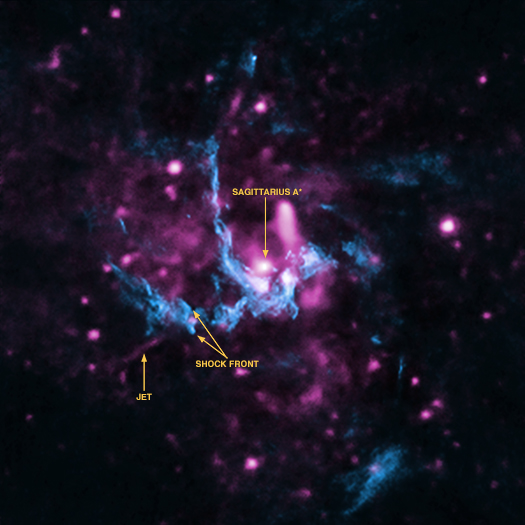
This composite image features both X-rays from NASA’s Chandra X-ray Observatory (purple) and radio data from NSF’s Very Large Array (blue). You can see the position of Sagittarius A* (Sgr A* for short). Image via Chandra.

These astronomers pointed out that something must have caused these stars to swell up. It’s possible they’re the result of a collision between two stars orbiting each other. Collisions like this could happen near the galaxy’s center, as the gravity of the giant black hole exerts its influence on the surrounding space. Over a long period of time, the astronomers said, the black hole’s gravity alters the orbits of the two stars in a binary system until the duo collides. A G-object could be a combined object, resulting from this violent merger. Morris said:

In the aftermath of such a merger, the resulting single object would be puffed up, or distended, for a rather long period of time, perhaps a million years, before it settles down and appears like a normal-sized star.

So the G-objects may be showing us some of the strange scenarios taking place at our galaxy’s center, among objects orbiting near Sagittarius A*. And they’re showing us that these events are happening quickly, relative to a typical astronomical timescale. A million years, for example, is a blink on that timescale, and yet we now see five of these objects. How many more are there, still to be discovered?

The team said they’ll continue to follow the size and shape of the known G-objects’ orbits, which could provide important clues as to how they formed. They said they’ll be paying close attention when these dusty stellar compact objects make their closest approach to the supermassive black hole. And that’s the bad news for us humans, because – although the events at the galaxy’s center are happening quickly on an astronomical timescale – still, outer space doesn’t operate on anything like a convenient human timescale. This close encounter is expected to occur 20 years from now for G3, and longer for G4 and G5.

Yet we know astronomers will be watching, because, as their statement explained:

This will allow [us] to further observe their behavior and see whether the objects remain intact just as G1 and G2 did, or become a snack for the supermassive black hole. Only then will they give away their true nature.

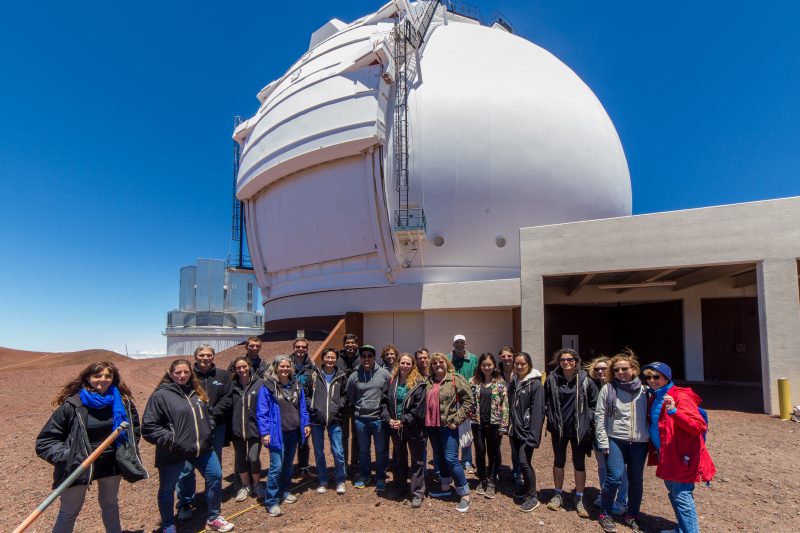
View larger. | The Galactic Center Orbits Initiative (GCOI) is headquartered at UCLA and led by astronomer Andrea Ghez, with additional members at University of Hawaii’s institute for Astronomy, California Institute of Technology, W. M. Keck Observatory, and Thirty Meter Telescope. Pictured here are members of GCOI in front of Keck Observatory on Maunakea, Hawaii during a visit in 217. Image via Keck Observatory.

Bottom line: Two previously known G-objects – G1 and G2 – came incredibly close to the Milky Way’s central black hole, yet survived. Now astronomers report 3 more of these mystery G-objects – which they’re calling G3, G4 and G5 – near the heart of our galaxy.

Via Keck Observatory


from EarthSky https://ift.tt/2kQJ3sG

View larger. | Astronomers are tracking these mystery “G-objects” in the direction to the Milky Way’s center. They appear to be orbiting our galaxy’s central, supermassive black hole. Image via Keck Observatory.

Astronomers said on June 6, 2018 that they analyzed 12 years of data gathered at the W.M. Keck Observatory in Hawaii to discover several more of the bizarre objects known as G-objects. Only two examples were previously known of these strange galactic inhabitants, which are located behind a shroud of galactic dust, near Sagittarius A* (pronounced Sagittarius A-star), the supermassive black hole at our Milky Way galaxy’s heart. Astronomers discovered the first G-object – G1 – in 2004 and the second – G2 – in 2012. Both were thought to be gas clouds until they made their closest approach to the black hole. Both G1 and G2 somehow managed to survive the hole’s gravitational pull, which wouldn’t have happened if they were gas clouds; a 4-million-solar-mass black hole like Sagittarius A* can shred gas clouds apart. Now these same astronomers report three more of the strange G-objects – which they’ve labeled G3, G4 and G5 – near the galaxy’s heart. The astronomers said they:

… look like gas clouds, but behave like stars.

Astronomer Anna Ciurlo – a member of the Galactic Center Orbits Initiative at UCLA – led a team that reached this conclusion. She announced the team’s result at the American Astronomical Society meeting going on this week in Denver, Colorado. Ciurlo said in a statement:

These compact dusty stellar objects move extremely fast and close to our galaxy’s supermassive black hole. It is fascinating to watch them move from year to year. How did they get there? And what will they become? They must have an interesting story to tell.

Randy Campbell is science operations lead at Keck Observatory. He developed software called OsrsVol, short for OSIRIS-Volume Display, resulting in a custom volume rendering tool that let the astronomers separate G3, G4, and G5 from the dusty background in the direction to the galaxy’s center. Once the 3-D analysis was performed, the team could clearly distinguish the G-objects, which allowed them to follow their movement and see how they behave around the supermassive black hole. Campbell explained:

We started this project thinking that if we looked carefully at the complicated structure of gas and dust near the supermassive black hole, we might detect some subtle changes to the shape and velocity. It was quite surprising to detect several objects that have very distinct movement and characteristics that place them in the G-object class, or dusty stellar objects.

Astronomer Mark Morris of UCLA added:

If they were gas clouds, G1 and G2 would not have been able to stay intact. Our view of the G-objects is that they are bloated stars — stars that have become so large that the tidal forces exerted by the central black hole can pull matter off of their stellar atmospheres when the stars get close enough, but have a stellar core with enough mass to remain intact. The question is then, why are they so large?

This composite image features both X-rays from NASA’s Chandra X-ray Observatory (purple) and radio data from NSF’s Very Large Array (blue). You can see the position of Sagittarius A* (Sgr A* for short). Image via Chandra.

These astronomers pointed out that something must have caused these stars to swell up. It’s possible they’re the result of a collision between two stars orbiting each other. Collisions like this could happen near the galaxy’s center, as the gravity of the giant black hole exerts its influence on the surrounding space. Over a long period of time, the astronomers said, the black hole’s gravity alters the orbits of the two stars in a binary system until the duo collides. A G-object could be a combined object, resulting from this violent merger. Morris said:

In the aftermath of such a merger, the resulting single object would be puffed up, or distended, for a rather long period of time, perhaps a million years, before it settles down and appears like a normal-sized star.

So the G-objects may be showing us some of the strange scenarios taking place at our galaxy’s center, among objects orbiting near Sagittarius A*. And they’re showing us that these events are happening quickly, relative to a typical astronomical timescale. A million years, for example, is a blink on that timescale, and yet we now see five of these objects. How many more are there, still to be discovered?

The team said they’ll continue to follow the size and shape of the known G-objects’ orbits, which could provide important clues as to how they formed. They said they’ll be paying close attention when these dusty stellar compact objects make their closest approach to the supermassive black hole. And that’s the bad news for us humans, because – although the events at the galaxy’s center are happening quickly on an astronomical timescale – still, outer space doesn’t operate on anything like a convenient human timescale. This close encounter is expected to occur 20 years from now for G3, and longer for G4 and G5.

Yet we know astronomers will be watching, because, as their statement explained:

This will allow [us] to further observe their behavior and see whether the objects remain intact just as G1 and G2 did, or become a snack for the supermassive black hole. Only then will they give away their true nature.

View larger. | The Galactic Center Orbits Initiative (GCOI) is headquartered at UCLA and led by astronomer Andrea Ghez, with additional members at University of Hawaii’s institute for Astronomy, California Institute of Technology, W. M. Keck Observatory, and Thirty Meter Telescope. Pictured here are members of GCOI in front of Keck Observatory on Maunakea, Hawaii during a visit in 217. Image via Keck Observatory.

Bottom line: Two previously known G-objects – G1 and G2 – came incredibly close to the Milky Way’s central black hole, yet survived. Now astronomers report 3 more of these mystery G-objects – which they’re calling G3, G4 and G5 – near the heart of our galaxy.

Via Keck Observatory


from EarthSky https://ift.tt/2kQJ3sG

Mars explorers wanted!

Image via NASA.

Whoa! EarthSky has nearly reach its funding goal for 2018. Click here to help.

Check out these posters and download one – or all of them – free. NASA originally developed these Mars Explorers Wanted posters for an exhibit at the Kennedy Space Center Visitor’s Complex in 2009. Now you can download full-sized posters and provide the files to your local print shop.

Here are a few of them. See them all here.

Farmers wanted for survival on Mars: Got a green thumb? This one’s for you! In space, you can grow tomatoes, lettuce, peas, and radishes just like you would find in your summer garden. New ways of growing fresh food will be needed to keep brave explorers alive. Download this poster here.

Teach on Mars and its moons: Learning is out of this world! Learning can take you places you’ve never dreamed of, including Mars and its two moons, Phobos and Deimos. No matter where we live, we can always learn something new, especially with teacher-heroes who guide us on our path, daring us to dream and grow! Download this poster here.

Explorers wanted on the journey to Mars: Hike the solar system’s largest canyon, Valles Marineris on Mars, where you can catch blue sunsets in the twilight, and see the two moons of Mars (Phobos and Deimos) in the night sky. Download this poster here.

Bottom line: Free Mars Explorers Wanted posters from NASA.

Via NASA


from EarthSky https://ift.tt/2sCd1VC

Image via NASA.

Whoa! EarthSky has nearly reach its funding goal for 2018. Click here to help.

Check out these posters and download one – or all of them – free. NASA originally developed these Mars Explorers Wanted posters for an exhibit at the Kennedy Space Center Visitor’s Complex in 2009. Now you can download full-sized posters and provide the files to your local print shop.

Here are a few of them. See them all here.

Farmers wanted for survival on Mars: Got a green thumb? This one’s for you! In space, you can grow tomatoes, lettuce, peas, and radishes just like you would find in your summer garden. New ways of growing fresh food will be needed to keep brave explorers alive. Download this poster here.

Teach on Mars and its moons: Learning is out of this world! Learning can take you places you’ve never dreamed of, including Mars and its two moons, Phobos and Deimos. No matter where we live, we can always learn something new, especially with teacher-heroes who guide us on our path, daring us to dream and grow! Download this poster here.

Explorers wanted on the journey to Mars: Hike the solar system’s largest canyon, Valles Marineris on Mars, where you can catch blue sunsets in the twilight, and see the two moons of Mars (Phobos and Deimos) in the night sky. Download this poster here.

Bottom line: Free Mars Explorers Wanted posters from NASA.

Via NASA


from EarthSky https://ift.tt/2sCd1VC

Explore 20 years of Earth data

We’re so grateful to you for the amazing response to EarthSky’s annual fund-raiser. It’s been one week … and we’ve nearly reached our goal! Can you help push us over the top? Donate here.

NASA has made 18 years of satellite images of Earth available for anyone to explore, on their interactive Worldview application. Earth-observing instruments aboard NASA’s Terra and Aqua satellites have recorded two decades of planetary change. Now, for the first time, all that imagery — from the first operational image to imagery acquired today — is available for you to access. And there’s a lot to see.

Go to Worldview.

This achievement is the result of more than a half-decade of work by several NASA teams, and represents the longest continuous daily global satellite observation record of Earth ever compiled.

View 2 decades of planetary change through imagery like this one at NASA’s Worldview. Image via NASA’s Goddard Space Flight Center.

According to a NASA statement:

The public can now browse all global imagery from the Moderate Resolution Imaging Spectroradiometer (MODIS) instrument [instrument onboard the satellites] quickly and easily from the comfort of a home computer. All global MODIS imagery dating back to the operational start of MODIS in 2000 is available through NASA’s Global Imagery Browse Services (GIBS) for viewing using NASA’s Worldview application. And there’s a lot to see.

For researchers, the ability to rapidly access and explore all MODIS global imagery greatly improves their use of these data. Santiago Gassó is an associate research scientist with NASA’s Goddard Earth Sciences Technology And Research program at Morgan State University, Baltimore. He said:

In the ’80s and ’90s, if you wanted to look at, say, clouds off the coast of California, you had to figure out the time of year when it was best to look at these clouds, then place a data request for a specific window of days when you thought the satellite overflew the area. You would get a physical tape with these images and have to put this into the processing system. Only then would you know if the image was usable. This process used to take from days to weeks.

Now, you can look at images for days, weeks and even years in a matter of minutes in Worldview, immediately find the images you need, and download them for use. It’s fantastic!

Bottom line: NASA’s Worldview application lets the public access 20 years of satellite images of Earth.

Read more from NASA


from EarthSky https://ift.tt/2JnfJ7H

We’re so grateful to you for the amazing response to EarthSky’s annual fund-raiser. It’s been one week … and we’ve nearly reached our goal! Can you help push us over the top? Donate here.

NASA has made 18 years of satellite images of Earth available for anyone to explore, on their interactive Worldview application. Earth-observing instruments aboard NASA’s Terra and Aqua satellites have recorded two decades of planetary change. Now, for the first time, all that imagery — from the first operational image to imagery acquired today — is available for you to access. And there’s a lot to see.

Go to Worldview.

This achievement is the result of more than a half-decade of work by several NASA teams, and represents the longest continuous daily global satellite observation record of Earth ever compiled.

View 2 decades of planetary change through imagery like this one at NASA’s Worldview. Image via NASA’s Goddard Space Flight Center.

According to a NASA statement:

The public can now browse all global imagery from the Moderate Resolution Imaging Spectroradiometer (MODIS) instrument [instrument onboard the satellites] quickly and easily from the comfort of a home computer. All global MODIS imagery dating back to the operational start of MODIS in 2000 is available through NASA’s Global Imagery Browse Services (GIBS) for viewing using NASA’s Worldview application. And there’s a lot to see.

For researchers, the ability to rapidly access and explore all MODIS global imagery greatly improves their use of these data. Santiago Gassó is an associate research scientist with NASA’s Goddard Earth Sciences Technology And Research program at Morgan State University, Baltimore. He said:

In the ’80s and ’90s, if you wanted to look at, say, clouds off the coast of California, you had to figure out the time of year when it was best to look at these clouds, then place a data request for a specific window of days when you thought the satellite overflew the area. You would get a physical tape with these images and have to put this into the processing system. Only then would you know if the image was usable. This process used to take from days to weeks.

Now, you can look at images for days, weeks and even years in a matter of minutes in Worldview, immediately find the images you need, and download them for use. It’s fantastic!

Bottom line: NASA’s Worldview application lets the public access 20 years of satellite images of Earth.

Read more from NASA


from EarthSky https://ift.tt/2JnfJ7H

adds 2