aads

Dunes on Pluto? Yes, but made of methane ice

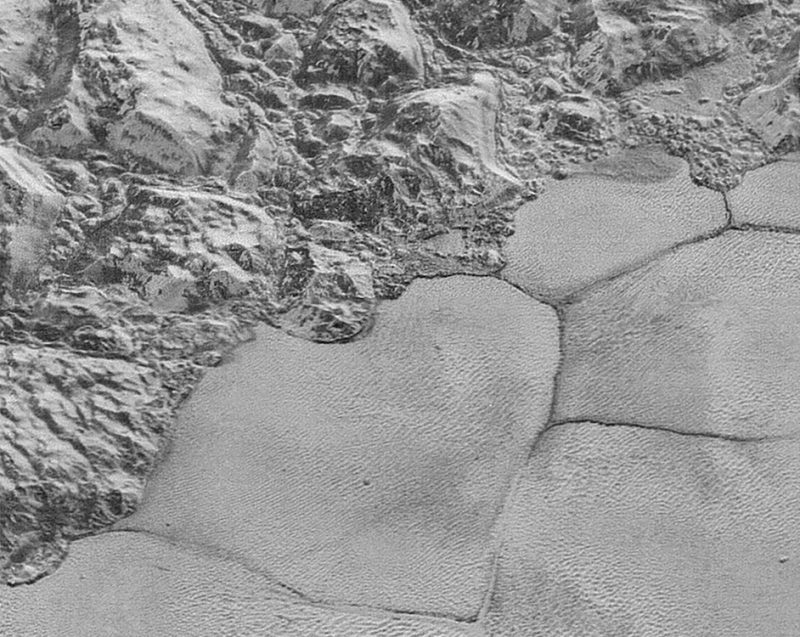
Image from New Horizons showing part of the edge of the Sputnik Planitia region. Methane dunes can be seen covering the smooth icy plains adjacent to the mountains. Image via NASA/JHUAPL/SwRI.

Help EarthSky keep going! Please donate what you can to our annual crowd-funding campaign.

We all know how common sand dunes are on Earth – just go to practically any desert region to see them in their various shapes and sizes. Thanks to robotic space explorers, we also know they exist elsewhere in the solar system, including Mars, Venus, Titan and even a comet. And now, as reported on June 1, 2018, there is one more place to add to the list – Pluto!

This cold, almost airless little world might seem like the last place to find dunes, but the New Horizons probe found them, according to new research that has been done with the images and data sent back in 2015.
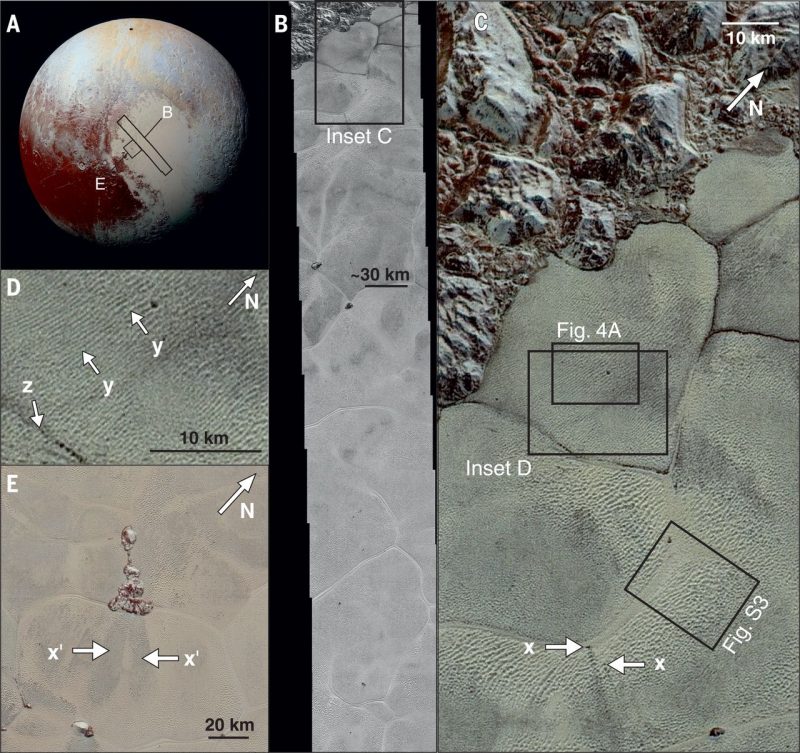
A collection of New Horizons imagery showing locations of dunes in Sputnik Planitia on Pluto. Image via Science.

From the new paper:

Wind-blown sand or ice dunes are known on Earth, Mars, Venus, Titan, and comet 67P/Churyumov-Gerasimenko. Telfer et al. used images taken by the New Horizons spacecraft to identify dunes in the Sputnik Planitia region on Pluto (see the Perspective by Hayes). Modeling shows that these dunes could be formed by sand-sized grains of solid methane ice transported in typical Pluto winds. The methane grains could have been lofted into the atmosphere by the melting of surrounding nitrogen ice or blown down from nearby mountains. Understanding how dunes form under Pluto conditions will help with interpreting similar features found elsewhere in the solar system.

As noted by Matt Telfer, a lecturer in physical geography at the University of Plymouth in England, in Space.com:

Pluto’s atmosphere and surface are interacting in a way that geologically/geomorphologically alters the surface. That’s exciting not just because it shows (again) the dynamism of these small, cold, dark distant worlds, but also for its inferences for very early solar system bodies.
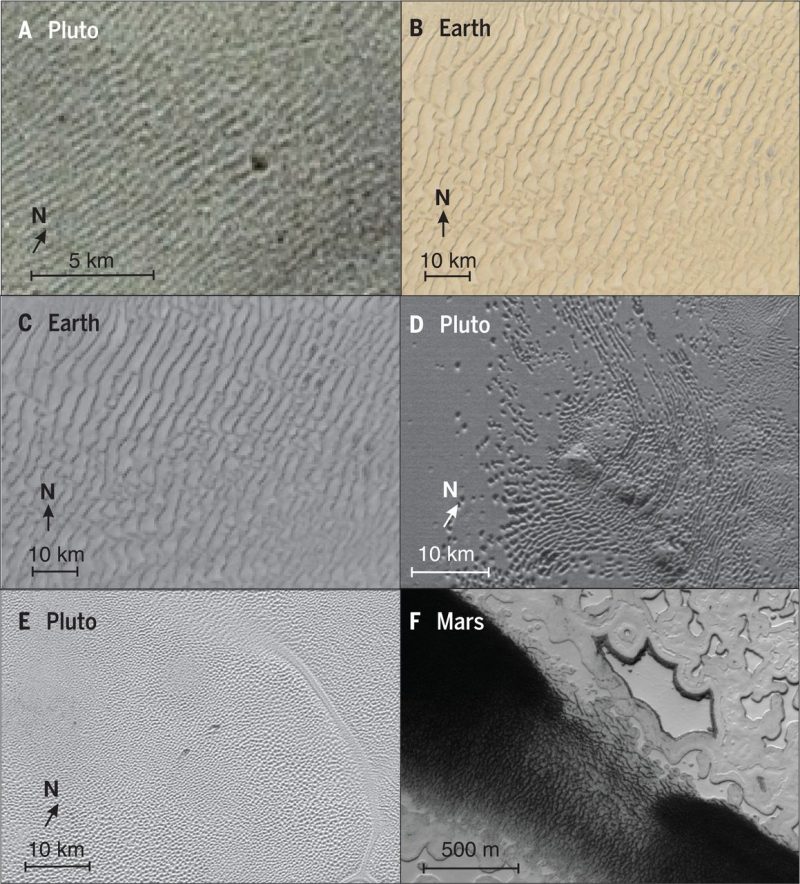
Comparison of dunes and sublimation features on Pluto, Earth and Mars. Image via NASA/JPL/University of Arizona (ESP_014342_0930_RED).

The dunes, first noticed as unusual ridges, were spotted along the western edge of Sputnik Planitia, a vast smooth plain of nitrogen ice, adjacent to the Al-Idrisi Montes mountain range (and in another uniquely Plutonian twist, the mountains on Pluto are composed of solid water ice, not rock). Upon closer inspection, they looked a lot like dunes, but were they? Another idea was that they could be sublimation pits, where sunlight causes icy material to sublime, and many had been seen elsewhere on Sputnik Planitia. According to Telfer:

We’re sure. It’s actually the relatively simple stuff, like their location, alignment (undisturbed by glacial movement, unlike the sublimation pits elsewhere), orientation (including the adjacent orthogonal wind streaks), and changes in regional orientation and spacing that nail it. It all makes perfect sense for dunes, and doesn’t match what we’d see for sublimation pits.

Thanks to New Horizons, we saw Pluto up close for the first time in history. Image via NASA/JHUAPL/SwRI.

On Pluto, however, the dunes are thought to be formed by grains of methane ice which originated in the mountains (where methane “snow” has also been seen), although nitrogen ice grains are another possibility. But the question is, how do they form? Pluto’s atmosphere, as it is, is extremely tenuous. As explained by Alexander Hayes, an assistant professor of astronomy at Cornell University:

What makes this discovery surprising is that the sediment can be mobilized despite Pluto’s tenuous atmosphere, with a surface pressure (1 Pa) that is a factor of 100,000 times lower than that on Earth.

According to the researchers, the dunes are most likely composed of methane ice particles, or possible nitrogen ice particles, not sand like on Earth. Their appearance, however, is very similar to dunes seen on Earth and elsewhere.

Stunning view of Pluto just after closest approach by New Horizons, with the hazy bluish atmosphere backlit by the sun. Image via NASA/JHUAPL/SwRI.

This discovery is an indication of another way in which Pluto mimics Earth, but in a way that is utterly unique and alien. Pluto has mountains, but they are made of rock-hard water ice, with methane snow on top. The icy plains are nitrogen ice, not water. The atmosphere is blue, but extremely thin compared to the atmosphere on Earth, or even Mars. There also also towering ice “spikes” resembling penitentes on Earth, but much larger. There is even evidence for a water ocean, but deep underground, similar to moons like Europa, Enceladus and Titan.

On Jan. 1, 2019, New Horizons will fly past another Kuiper Belt Object (KBO) called Ultima Thule (aka 2014 MU69). This will be the most distant object to ever be visited by a spacecraft in our solar system so far.

Bottom line: Expect the unexpected. That would seem to be a good rule of thumb to follow in planetary exploration. The dunes on Pluto are another good example of how incredible discoveries are being made by many spacecraft exploring our solar system. Coming across something which presumably shouldn’t be there, but is, is one of the most exciting things about space exploration. You just never know what you might find.

Source: Dunes on Pluto

Via Scientific American

Help EarthSky keep going! Please donate what you can to our annual crowd-funding campaign.


from EarthSky https://ift.tt/2JlHNs0

Image from New Horizons showing part of the edge of the Sputnik Planitia region. Methane dunes can be seen covering the smooth icy plains adjacent to the mountains. Image via NASA/JHUAPL/SwRI.

Help EarthSky keep going! Please donate what you can to our annual crowd-funding campaign.

We all know how common sand dunes are on Earth – just go to practically any desert region to see them in their various shapes and sizes. Thanks to robotic space explorers, we also know they exist elsewhere in the solar system, including Mars, Venus, Titan and even a comet. And now, as reported on June 1, 2018, there is one more place to add to the list – Pluto!

This cold, almost airless little world might seem like the last place to find dunes, but the New Horizons probe found them, according to new research that has been done with the images and data sent back in 2015.

A collection of New Horizons imagery showing locations of dunes in Sputnik Planitia on Pluto. Image via Science.

From the new paper:

Wind-blown sand or ice dunes are known on Earth, Mars, Venus, Titan, and comet 67P/Churyumov-Gerasimenko. Telfer et al. used images taken by the New Horizons spacecraft to identify dunes in the Sputnik Planitia region on Pluto (see the Perspective by Hayes). Modeling shows that these dunes could be formed by sand-sized grains of solid methane ice transported in typical Pluto winds. The methane grains could have been lofted into the atmosphere by the melting of surrounding nitrogen ice or blown down from nearby mountains. Understanding how dunes form under Pluto conditions will help with interpreting similar features found elsewhere in the solar system.

As noted by Matt Telfer, a lecturer in physical geography at the University of Plymouth in England, in Space.com:

Pluto’s atmosphere and surface are interacting in a way that geologically/geomorphologically alters the surface. That’s exciting not just because it shows (again) the dynamism of these small, cold, dark distant worlds, but also for its inferences for very early solar system bodies.

Comparison of dunes and sublimation features on Pluto, Earth and Mars. Image via NASA/JPL/University of Arizona (ESP_014342_0930_RED).

The dunes, first noticed as unusual ridges, were spotted along the western edge of Sputnik Planitia, a vast smooth plain of nitrogen ice, adjacent to the Al-Idrisi Montes mountain range (and in another uniquely Plutonian twist, the mountains on Pluto are composed of solid water ice, not rock). Upon closer inspection, they looked a lot like dunes, but were they? Another idea was that they could be sublimation pits, where sunlight causes icy material to sublime, and many had been seen elsewhere on Sputnik Planitia. According to Telfer:

We’re sure. It’s actually the relatively simple stuff, like their location, alignment (undisturbed by glacial movement, unlike the sublimation pits elsewhere), orientation (including the adjacent orthogonal wind streaks), and changes in regional orientation and spacing that nail it. It all makes perfect sense for dunes, and doesn’t match what we’d see for sublimation pits.

Thanks to New Horizons, we saw Pluto up close for the first time in history. Image via NASA/JHUAPL/SwRI.

On Pluto, however, the dunes are thought to be formed by grains of methane ice which originated in the mountains (where methane “snow” has also been seen), although nitrogen ice grains are another possibility. But the question is, how do they form? Pluto’s atmosphere, as it is, is extremely tenuous. As explained by Alexander Hayes, an assistant professor of astronomy at Cornell University:

What makes this discovery surprising is that the sediment can be mobilized despite Pluto’s tenuous atmosphere, with a surface pressure (1 Pa) that is a factor of 100,000 times lower than that on Earth.

According to the researchers, the dunes are most likely composed of methane ice particles, or possible nitrogen ice particles, not sand like on Earth. Their appearance, however, is very similar to dunes seen on Earth and elsewhere.

Stunning view of Pluto just after closest approach by New Horizons, with the hazy bluish atmosphere backlit by the sun. Image via NASA/JHUAPL/SwRI.

This discovery is an indication of another way in which Pluto mimics Earth, but in a way that is utterly unique and alien. Pluto has mountains, but they are made of rock-hard water ice, with methane snow on top. The icy plains are nitrogen ice, not water. The atmosphere is blue, but extremely thin compared to the atmosphere on Earth, or even Mars. There also also towering ice “spikes” resembling penitentes on Earth, but much larger. There is even evidence for a water ocean, but deep underground, similar to moons like Europa, Enceladus and Titan.

On Jan. 1, 2019, New Horizons will fly past another Kuiper Belt Object (KBO) called Ultima Thule (aka 2014 MU69). This will be the most distant object to ever be visited by a spacecraft in our solar system so far.

Bottom line: Expect the unexpected. That would seem to be a good rule of thumb to follow in planetary exploration. The dunes on Pluto are another good example of how incredible discoveries are being made by many spacecraft exploring our solar system. Coming across something which presumably shouldn’t be there, but is, is one of the most exciting things about space exploration. You just never know what you might find.

Source: Dunes on Pluto

Via Scientific American

Help EarthSky keep going! Please donate what you can to our annual crowd-funding campaign.


from EarthSky https://ift.tt/2JlHNs0

Globular clusters not as old as thought?

M13, aka the Great Cluster in Hercules. This object is a globular star cluster, perhaps the most famous one for Northern Hemisphere stargazers. Photo via Bareket Observatory in Israel, via CelestronImages.

Globular clusters – which are round, symmetrical clusters containing hundreds of thousands to millions of stars – were thought to be around 13 billion years old, nearly as old as the universe itself. The idea has been that the globular clusters formed early in the history of our galaxy, the Milky Way, and other galaxies, before these galaxies had a chance to flatten out into disks. Thus today we find the globular clusters scattered all around our galaxy’s center. New research from the University of Warwick – announced on June 4, 2018 – might affect that established view. The new work suggests that globular clusters aren’t as ancient as previously thought. They might be only around 9 billion years old.

The revised age estimate for globular clusters follows research into the age of binary star systems within the clusters. The new work has been accepted for publication in the peer-reviewed journal Monthly Notices of the Royal Astronomical Society.

Elizabeth Stanway of the University of Warwick led the research. A statement from her university said:

The discovery brings into question current theories on how galaxies, including the Milky Way, were formed – with between 150-180 clusters thought to exist in the Milky Way alone – as globular clusters had previously been thought to be almost as old as the universe itself.

These scientists were working with a computer model, called the new Binary Population and Spectral Synthesis (BPASS). It take the details of binary star evolution within the globular cluster into account, combining those theoretical ideas with actual observations of stars in globular star clusters. The statement said:

The evolutionary process sees two stars interacting in a binary system, where one star expands into a giant while the gravitational force of the smaller star strips away the atmosphere, comprising hydrogen and helium amongst other elements, of the giant. These stars are thought to be formed as the same time as the globular cluster itself.

Through using the BPASS models and calculating the age of the binary star systems the researchers were able to demonstrate that the globular cluster of which they are part was not as ancient as other models had suggested.

Artist’s concept of 2 gravitationally bound stars evolving within a globular cluster. These scientists used the ages of binary systems like this one to obtain a new estimate for the ages of the globulars. Image via Mark A. Garlick/University of Warwick.

Elizabeth Stanway said that the research’s findings point to new avenues of enquiry into how massive galaxies, and the stars contained within, are formed:

It’s important to note that there is still a lot of work to do – in particular looking at those very nearby systems where we can resolve individual stars rather than just considering the integrated light of a cluster – but this is an interesting and intriguing result.

If true, it changes our picture of the early stages of galaxy evolution and where the stars that have ended up in today’s massive galaxies, such as the Milky Way, may have formed. We aim to follow up this research in future, exploring both improvements in modelling and the observable predictions which arise from them.

About 150 globular star clusters surround our Milky Way galaxy. They orbit our galaxy’s center.

Bottom line: Elizabeth Stanway at the University of Warwick led a study of multiple stars systems within globular star clusters, resulting in a new age estimate for the globulars. Once thought to be as ancient as the universe itself, the globulars may be younger, perhaps only 9 billion years old, or 4 billion years younger than previously thought.

Source: Reevaluating Old Stellar Populations

Via University of Warwick


from EarthSky https://ift.tt/2JiSFXZ

M13, aka the Great Cluster in Hercules. This object is a globular star cluster, perhaps the most famous one for Northern Hemisphere stargazers. Photo via Bareket Observatory in Israel, via CelestronImages.

Globular clusters – which are round, symmetrical clusters containing hundreds of thousands to millions of stars – were thought to be around 13 billion years old, nearly as old as the universe itself. The idea has been that the globular clusters formed early in the history of our galaxy, the Milky Way, and other galaxies, before these galaxies had a chance to flatten out into disks. Thus today we find the globular clusters scattered all around our galaxy’s center. New research from the University of Warwick – announced on June 4, 2018 – might affect that established view. The new work suggests that globular clusters aren’t as ancient as previously thought. They might be only around 9 billion years old.

The revised age estimate for globular clusters follows research into the age of binary star systems within the clusters. The new work has been accepted for publication in the peer-reviewed journal Monthly Notices of the Royal Astronomical Society.

Elizabeth Stanway of the University of Warwick led the research. A statement from her university said:

The discovery brings into question current theories on how galaxies, including the Milky Way, were formed – with between 150-180 clusters thought to exist in the Milky Way alone – as globular clusters had previously been thought to be almost as old as the universe itself.

These scientists were working with a computer model, called the new Binary Population and Spectral Synthesis (BPASS). It take the details of binary star evolution within the globular cluster into account, combining those theoretical ideas with actual observations of stars in globular star clusters. The statement said:

The evolutionary process sees two stars interacting in a binary system, where one star expands into a giant while the gravitational force of the smaller star strips away the atmosphere, comprising hydrogen and helium amongst other elements, of the giant. These stars are thought to be formed as the same time as the globular cluster itself.

Through using the BPASS models and calculating the age of the binary star systems the researchers were able to demonstrate that the globular cluster of which they are part was not as ancient as other models had suggested.

Artist’s concept of 2 gravitationally bound stars evolving within a globular cluster. These scientists used the ages of binary systems like this one to obtain a new estimate for the ages of the globulars. Image via Mark A. Garlick/University of Warwick.

Elizabeth Stanway said that the research’s findings point to new avenues of enquiry into how massive galaxies, and the stars contained within, are formed:

It’s important to note that there is still a lot of work to do – in particular looking at those very nearby systems where we can resolve individual stars rather than just considering the integrated light of a cluster – but this is an interesting and intriguing result.

If true, it changes our picture of the early stages of galaxy evolution and where the stars that have ended up in today’s massive galaxies, such as the Milky Way, may have formed. We aim to follow up this research in future, exploring both improvements in modelling and the observable predictions which arise from them.

About 150 globular star clusters surround our Milky Way galaxy. They orbit our galaxy’s center.

Bottom line: Elizabeth Stanway at the University of Warwick led a study of multiple stars systems within globular star clusters, resulting in a new age estimate for the globulars. Once thought to be as ancient as the universe itself, the globulars may be younger, perhaps only 9 billion years old, or 4 billion years younger than previously thought.

Source: Reevaluating Old Stellar Populations

Via University of Warwick


from EarthSky https://ift.tt/2JiSFXZ

Find the Summer Triangle

June is here. In the Northern Hemisphere, the days are long, the sun is at its most intense for the year, and the weather is warm, but not as warm as it will be later this summer. And the summer sky is with us, too. The famous Summer Triangle is ascending in the eastern sky on these June evenings.

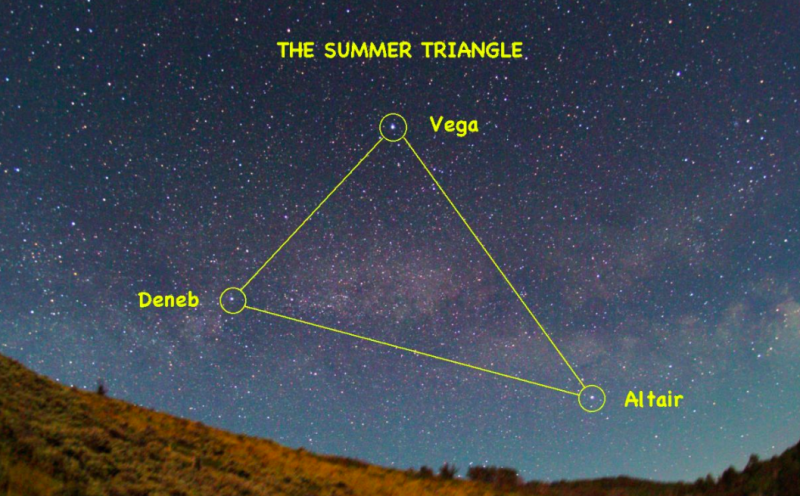
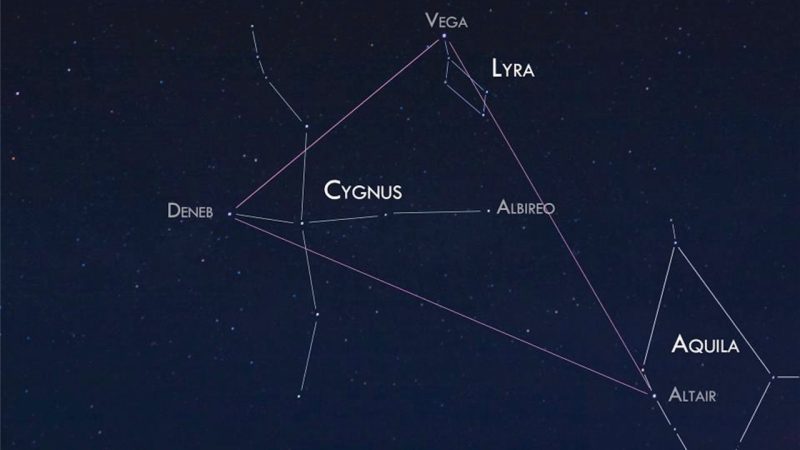
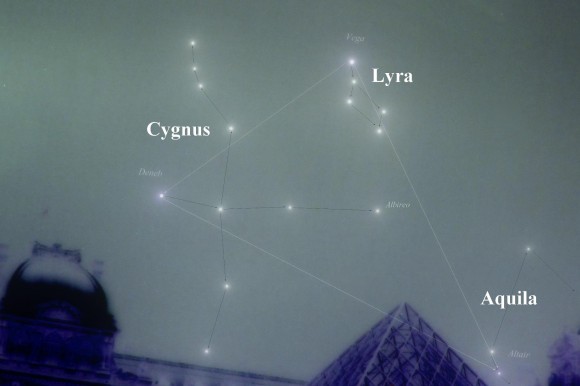
The Summer Triangle isn’t a constellation. It’s an asterism, or noticeable pattern of stars. This pattern consists of three bright stars in three separate constellations – Deneb in the constellation Cygnus the Swan, Vega in the constellation Lyra the Harp, and Altair in the constellation Aquila the Eagle.

Learn to recognize the Summer Triangle asterism now, and you can watch it all summer as it shifts higher in the east, then finally appears high overhead in the late northern summer and early northern autumn sky.

Help EarthSky keep going! Please donate what you can to our annual crowd-funding campaign.

Image via Susan Jensen in Odessa, Washington.

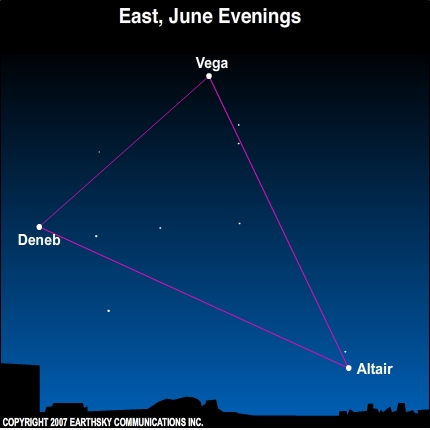
How to find the Summer Triangle. As night falls in June or July, look east for a sparkling blue-white star. That will be Vega, in Lyra. Reigning at the apex of the celebrated Summer Triangle, Vega is also the brightest of the Summer Triangle’s three stars, which all are bright enough to be seen from many light-polluted cities.

Look to the lower right of Vega to locate the Summer Triangle’s second brightest star. That’s Altair, the brightest star in the constellation Aquila the Eagle. A ruler held at an arm length fills the gap between these two stars.

Look to the lower left of Vega for another bright star – Deneb, the brightest in the constellation Cygnus the Swan and the third brightest in the Summer Triangle. An outstretched hand at an arm length approximates the distance from Vega to Deneb.

It’s difficult to convey the huge size of the Summer Triangle asterism. But you’ll see it. These three bright stars – Vega, Deneb and Altair – will become summertime favorites.

Look for these three bright stars in a triangle pattern, ascending in the east on June evenings.

The Summer Triangle, ascending in the east on June evenings.

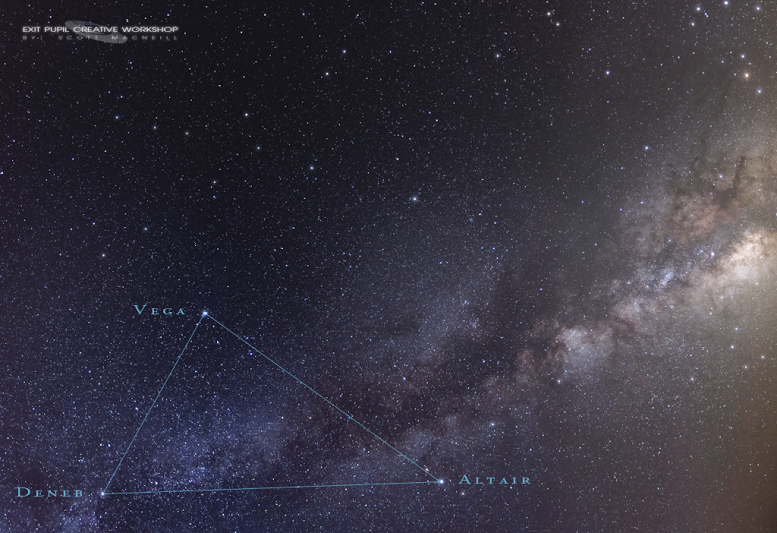
Summer Triangle as a road map to the Milky Way. If you’re lucky enough to be under a dark starry sky on a moonless night, you’ll see the great swath of stars passing in between the Summer Triangle stars Vega and Altair. The star Deneb bobs in the middle of this river of stars, which arcs across dark summer skies. This sky river is, of course, the edgewise view into our own Milky Way galaxy. Although every star that you see with the unaided eye is a member of the Milky Way, at this time of year we can see clearly into the galaxy’s flat disk, where most of the stars congregate. By August and September, we have a good view toward the galaxy’s center.

Once you master the Summer Triangle, you can always locate the Milky Way on a clear, dark night. How about making the most of a dark summer night to explore this band of stars – this starlit boulevard with its celestial delights? Use binoculars to reel in the gossamer beauty of it all, the haunting nebulae and bejeweled star clusters along the starlit trail.

Scott MacNeill of Exit Pupil Creative Workshop captured this photo of the Summer Triangle, constellation Hercules, bright Milky Way, and the bright red star Antares among more.

Summer Triangle as nature’s seasonal calendar. The Summer Triangle serves as a stellar calendar, marking the seasons. When the stars of the Summer Triangle light up the eastern twilight dusk in middle to late June, it’s a sure sign of the change of seasons, of spring giving way to summer. However, when the Summer Triangle is seen high in the south to overhead at dusk and early evening, the Summer Triangle’s change of position indicates that summer has ebbed into fall.

View larger. | Great Rift of Milky Way passes through the constellation Cassiopeia and the Summer Triangle.

A word about asterisms. As we mentioned above, asterisms aren’t constellations; they’re just patterns on the sky’s dome. Constellations generally come to us from ancient times. In the 1930s, the International Astronomical Union officially drew the boundaries of the 88 constellations we recognize today.

Meanwhile, you can make up and name your own asterisms, in much the same way you can recognize shapes in puffy clouds on a summer day.

Some asterisms are so obvious that they’re recognized around the world. The Summer Triangle is one of these.

So watch for the Summer Triangle. On June and July evenings, you’ll find it in the east at nightfall. It swings high overhead in the wee hours after midnight and sits rather high in the west at daybreak.

Summer Triangle and the top of the Louvre Pyramid from EarthSky Facebook friend VegaStar Carpentier in Paris.

Bottom line: It’s nearly summer in the Northern Hemisphere. Look for the Summer Triangle – three bright stars in three separate constellations – ascending in the east on June and July evenings.


from EarthSky https://ift.tt/29zy3sN

June is here. In the Northern Hemisphere, the days are long, the sun is at its most intense for the year, and the weather is warm, but not as warm as it will be later this summer. And the summer sky is with us, too. The famous Summer Triangle is ascending in the eastern sky on these June evenings.

The Summer Triangle isn’t a constellation. It’s an asterism, or noticeable pattern of stars. This pattern consists of three bright stars in three separate constellations – Deneb in the constellation Cygnus the Swan, Vega in the constellation Lyra the Harp, and Altair in the constellation Aquila the Eagle.

Learn to recognize the Summer Triangle asterism now, and you can watch it all summer as it shifts higher in the east, then finally appears high overhead in the late northern summer and early northern autumn sky.

Help EarthSky keep going! Please donate what you can to our annual crowd-funding campaign.

Image via Susan Jensen in Odessa, Washington.

How to find the Summer Triangle. As night falls in June or July, look east for a sparkling blue-white star. That will be Vega, in Lyra. Reigning at the apex of the celebrated Summer Triangle, Vega is also the brightest of the Summer Triangle’s three stars, which all are bright enough to be seen from many light-polluted cities.

Look to the lower right of Vega to locate the Summer Triangle’s second brightest star. That’s Altair, the brightest star in the constellation Aquila the Eagle. A ruler held at an arm length fills the gap between these two stars.

Look to the lower left of Vega for another bright star – Deneb, the brightest in the constellation Cygnus the Swan and the third brightest in the Summer Triangle. An outstretched hand at an arm length approximates the distance from Vega to Deneb.

It’s difficult to convey the huge size of the Summer Triangle asterism. But you’ll see it. These three bright stars – Vega, Deneb and Altair – will become summertime favorites.

Look for these three bright stars in a triangle pattern, ascending in the east on June evenings.

The Summer Triangle, ascending in the east on June evenings.

Summer Triangle as a road map to the Milky Way. If you’re lucky enough to be under a dark starry sky on a moonless night, you’ll see the great swath of stars passing in between the Summer Triangle stars Vega and Altair. The star Deneb bobs in the middle of this river of stars, which arcs across dark summer skies. This sky river is, of course, the edgewise view into our own Milky Way galaxy. Although every star that you see with the unaided eye is a member of the Milky Way, at this time of year we can see clearly into the galaxy’s flat disk, where most of the stars congregate. By August and September, we have a good view toward the galaxy’s center.

Once you master the Summer Triangle, you can always locate the Milky Way on a clear, dark night. How about making the most of a dark summer night to explore this band of stars – this starlit boulevard with its celestial delights? Use binoculars to reel in the gossamer beauty of it all, the haunting nebulae and bejeweled star clusters along the starlit trail.

Scott MacNeill of Exit Pupil Creative Workshop captured this photo of the Summer Triangle, constellation Hercules, bright Milky Way, and the bright red star Antares among more.

Summer Triangle as nature’s seasonal calendar. The Summer Triangle serves as a stellar calendar, marking the seasons. When the stars of the Summer Triangle light up the eastern twilight dusk in middle to late June, it’s a sure sign of the change of seasons, of spring giving way to summer. However, when the Summer Triangle is seen high in the south to overhead at dusk and early evening, the Summer Triangle’s change of position indicates that summer has ebbed into fall.

View larger. | Great Rift of Milky Way passes through the constellation Cassiopeia and the Summer Triangle.

A word about asterisms. As we mentioned above, asterisms aren’t constellations; they’re just patterns on the sky’s dome. Constellations generally come to us from ancient times. In the 1930s, the International Astronomical Union officially drew the boundaries of the 88 constellations we recognize today.

Meanwhile, you can make up and name your own asterisms, in much the same way you can recognize shapes in puffy clouds on a summer day.

Some asterisms are so obvious that they’re recognized around the world. The Summer Triangle is one of these.

So watch for the Summer Triangle. On June and July evenings, you’ll find it in the east at nightfall. It swings high overhead in the wee hours after midnight and sits rather high in the west at daybreak.

Summer Triangle and the top of the Louvre Pyramid from EarthSky Facebook friend VegaStar Carpentier in Paris.

Bottom line: It’s nearly summer in the Northern Hemisphere. Look for the Summer Triangle – three bright stars in three separate constellations – ascending in the east on June and July evenings.


from EarthSky https://ift.tt/29zy3sN

Find the Crow, Cup and Water Snake

Tonight, or any June evening, look south and west (below and to the right) of the star Spica for the constellations of Corvus the Crow, Crater the Cup, and Hydra the Water Snake.

You’ll be looking in the south to southwest sky around nightfall. In 2018, the brilliant “star” to the east (left) of the star Spica is really the planet Jupiter, which lights up the sky almost as soon as the sun goes down. Jupiter is near Zubenelgenubi, the alpha star in the constellation Libra the Scales. And Spica, the brightest star in the constellation Virgo, is your guide to the Crow, Cup and Water Snake.

Okay … got Spica? Now, as nightfall deepens into later evening, watch for a number of fainter stars to become visible. That’s when the Crow, Cup and the Water Snake will come into view.

In Greek mythology, Apollo sent the crow to fetch a cup of water. The crow, Corvus, got distracted eating figs. It was only after much delay that he finally remembered his mission. Rightly figuring that Apollo would be angry, the crow plucked a snake from the water and concocted a story about how it had attacked and delayed him.

Hydra the Water Snake with the orange star Alphard at its heart. Illustration via Deanspace.

Apollo was not fooled and angrily flung the Crow, Cup and Snake into the sky, placing the Crow and Cup on the Snake’s back.

Then the god ordered Hydra to never let the Crow drink from the Cup. As a further punishment, he ordered that the Crow could never sing again, only screech and caw.

None of these constellations has any bright stars, but Hydra holds the distinction of being the longest constellation in the heavens.

Bottom line: Use the bright star Spica to help you find the constellations of Corvus the Crow, Crater the Cup, and Hydra the Water Snake.

Enjoying EarthSky so far? Sign up for our free daily newsletter today!


from EarthSky https://ift.tt/1ROig9u

Tonight, or any June evening, look south and west (below and to the right) of the star Spica for the constellations of Corvus the Crow, Crater the Cup, and Hydra the Water Snake.

You’ll be looking in the south to southwest sky around nightfall. In 2018, the brilliant “star” to the east (left) of the star Spica is really the planet Jupiter, which lights up the sky almost as soon as the sun goes down. Jupiter is near Zubenelgenubi, the alpha star in the constellation Libra the Scales. And Spica, the brightest star in the constellation Virgo, is your guide to the Crow, Cup and Water Snake.

Okay … got Spica? Now, as nightfall deepens into later evening, watch for a number of fainter stars to become visible. That’s when the Crow, Cup and the Water Snake will come into view.

In Greek mythology, Apollo sent the crow to fetch a cup of water. The crow, Corvus, got distracted eating figs. It was only after much delay that he finally remembered his mission. Rightly figuring that Apollo would be angry, the crow plucked a snake from the water and concocted a story about how it had attacked and delayed him.

Hydra the Water Snake with the orange star Alphard at its heart. Illustration via Deanspace.

Apollo was not fooled and angrily flung the Crow, Cup and Snake into the sky, placing the Crow and Cup on the Snake’s back.

Then the god ordered Hydra to never let the Crow drink from the Cup. As a further punishment, he ordered that the Crow could never sing again, only screech and caw.

None of these constellations has any bright stars, but Hydra holds the distinction of being the longest constellation in the heavens.

Bottom line: Use the bright star Spica to help you find the constellations of Corvus the Crow, Crater the Cup, and Hydra the Water Snake.

Enjoying EarthSky so far? Sign up for our free daily newsletter today!


from EarthSky https://ift.tt/1ROig9u

Combining heartburn drugs and aspirin could help prevent oesophageal cancer in people at high risk

Aspirin cancer prevention

In the famous words of Benjamin Franklin: “An ounce of prevention is worth a pound of cure.”

While he may have been talking about fire safety rather than disease, this sentiment rings true for cancer too. If there was a way to stop cancer from developing, then the stress, costs and side effects that come with a diagnosis and treatment could be avoided.

The challenge is that not all cancers are preventable, and there’s no elixir of life to help us get around the biggest risk factor for the disease – getting older. But some can be prevented – around 4 in 10 in the UK – meaning there’s an opportunity to act and help reduce the burden of the disease.

For cancers where survival remains poor, like oesophageal cancer, there’s potential to make the greatest difference for people. That’s why many of our scientists are working in this area, and new research showcases the progress they’re making.

A new Cancer Research UK-funded clinical trial has found that two over-the-counter, widely available drugs could help cut cases of oesophageal cancer in people at higher risk of the disease. And when these drugs – a stomach acid blocker and aspirin – were used together, their effects were even greater.

“We weren’t expecting such overwhelmingly positive data,” says lead author Prof Janusz Jankowski from the Royal College of Surgeons in Ireland, who is presenting the findings at the 2018 American Society of Clinical Oncology (ASCO) Annual Meeting in Chicago.

“The drugs caused a reduction in overall death and oesophageal cancers. It really surprised us how big the effect was, the effect for strong acid prevention was 4 times higher than we expected.”

Questions remain, such as who might benefit most from these drugs, and can they specifically prevent deaths from oesophageal cancer? But the findings mark an important step towards progress against a disease that has lagged others.

Risk and reason

Oesophageal cancer begins in the food pipe (oesophagus). The disease often doesn’t cause clear symptoms during its early stages, meaning many cases are diagnosed late when they’ve spread and become difficult to treat. That’s one of the main reasons why survival for oesophageal cancer is stubbornly low, with just over 1 in 10 people surviving their disease for a decade or longer.

It’s time for this grim situation to be turned around, and our researchers are showing that’s possible.

This latest study centres on one of the risk factors for oesophageal cancer, a condition called Barrett’s oesophagus. This is where the cells that line the food pipe change from a layered, brick wall to looking more like a picket fence. Normally, this happens because of stomach acid making its way up the food pipe (acid reflux) and damaging the cells.

Over time, these cells can become so different to healthy cells that they turn cancerous. This only happens to between 1 and 5 people in every 100 with Barrett’s oesophagus, but with acid reflux on the rise, there’s an opportunity to intervene and make a difference.

Mining for gold

For the study, scientists wanted to find out whether giving people with Barrett’s oesophagus a drug – called a proton pump inhibitor (PPI) – to treat their acid reflux could prevent their condition from worsening, and cut cases of oesophageal cancer. They also wanted to test whether adding aspirin could have a beneficial effect too.

Working across the UK and Canada, the team recruited more than 2,557 adults with Barrett’s oesophagus and randomly assigned them one of four treatments every day:

  • A high dose of PPI with aspirin
  • A high dose of PPI without aspirin
  • A low dose of PPI with aspirin
  • A low dose of PPI without aspirin

These people were then followed for an average of 9 years, amounting to a mammoth 20,000 years of patient data.

“It’s the longest of its kind in terms of follow up,” says Jankowski. “And no one had ever looked at combining PPIs and aspirin before for cancer prevention. That’s meant it’s been building a real gold mine for data collection.”

When they dug into this data gold mine, they found that high dose PPI treatment not only reduced progression of people’s Barrett’s oesophagus, but cases of oesophageal cancer and the number of people dying from any cause were lower too. And when aspirin was added in to the mix, the effect was even greater.

“We were expecting PPI treatment to maybe reduce cases of oesophageal cancer by about 5%,” says Jankowski.

“But we found the reduction was more like 20% in people given a high daily dose, which took us all by shock.”

Importantly, the drugs seemed to be safe too, with very few people experiencing side effects. But this is an important concern with using drugs to prevent cancer in this way, particularly aspirin, which is linked with bleeding risks when used long-term.

A case for change

So, what is it about this combination that seems to be so effective? While PPIs work by taming the cells’ environment, making it less hostile from the stomach acid, aspirin is thought to have a calming effect on growing cells.

“If we imagine a cell as a car careeing down a motorway, aspirin is like a speed regulator. It slows down cell metabolism and generally dampens down ‘go’ signals that could accelerate growth,” explains Jankowski.

There’s no question of whether this study will be practice-changing.

– Professor Jankowski

“Whereas PPIs are like the truck that sprays grit on the road surface, making it less likely that the car will skid out of control when conditions become unfavourable.”

And with such encouraging results, Jankowski doesn’t think it will be long before the findings will hopefully start helping people outside of clinical trials.

“There’s no question of whether this study will be practice-changing,” he says. “We found low dose PPI therapy isn’t as effective as high dose, so the results could alter their use.”

But there are other questions remaining. How long do patients need to take these drugs for them to have a beneficial effect? Who is most likely to benefit from taking them? And importantly, can they prevent deaths specifically from oesophageal cancer?

These will be the focus of future research. And Jankowski says the researchers are already drawing up plans to extend the study and begin answering these questions. With that clarity, hopefully this work can begin making an impact on people’s lives.

Justine


from Cancer Research UK – Science blog https://ift.tt/2HlSqcU
Aspirin cancer prevention

In the famous words of Benjamin Franklin: “An ounce of prevention is worth a pound of cure.”

While he may have been talking about fire safety rather than disease, this sentiment rings true for cancer too. If there was a way to stop cancer from developing, then the stress, costs and side effects that come with a diagnosis and treatment could be avoided.

The challenge is that not all cancers are preventable, and there’s no elixir of life to help us get around the biggest risk factor for the disease – getting older. But some can be prevented – around 4 in 10 in the UK – meaning there’s an opportunity to act and help reduce the burden of the disease.

For cancers where survival remains poor, like oesophageal cancer, there’s potential to make the greatest difference for people. That’s why many of our scientists are working in this area, and new research showcases the progress they’re making.

A new Cancer Research UK-funded clinical trial has found that two over-the-counter, widely available drugs could help cut cases of oesophageal cancer in people at higher risk of the disease. And when these drugs – a stomach acid blocker and aspirin – were used together, their effects were even greater.

“We weren’t expecting such overwhelmingly positive data,” says lead author Prof Janusz Jankowski from the Royal College of Surgeons in Ireland, who is presenting the findings at the 2018 American Society of Clinical Oncology (ASCO) Annual Meeting in Chicago.

“The drugs caused a reduction in overall death and oesophageal cancers. It really surprised us how big the effect was, the effect for strong acid prevention was 4 times higher than we expected.”

Questions remain, such as who might benefit most from these drugs, and can they specifically prevent deaths from oesophageal cancer? But the findings mark an important step towards progress against a disease that has lagged others.

Risk and reason

Oesophageal cancer begins in the food pipe (oesophagus). The disease often doesn’t cause clear symptoms during its early stages, meaning many cases are diagnosed late when they’ve spread and become difficult to treat. That’s one of the main reasons why survival for oesophageal cancer is stubbornly low, with just over 1 in 10 people surviving their disease for a decade or longer.

It’s time for this grim situation to be turned around, and our researchers are showing that’s possible.

This latest study centres on one of the risk factors for oesophageal cancer, a condition called Barrett’s oesophagus. This is where the cells that line the food pipe change from a layered, brick wall to looking more like a picket fence. Normally, this happens because of stomach acid making its way up the food pipe (acid reflux) and damaging the cells.

Over time, these cells can become so different to healthy cells that they turn cancerous. This only happens to between 1 and 5 people in every 100 with Barrett’s oesophagus, but with acid reflux on the rise, there’s an opportunity to intervene and make a difference.

Mining for gold

For the study, scientists wanted to find out whether giving people with Barrett’s oesophagus a drug – called a proton pump inhibitor (PPI) – to treat their acid reflux could prevent their condition from worsening, and cut cases of oesophageal cancer. They also wanted to test whether adding aspirin could have a beneficial effect too.

Working across the UK and Canada, the team recruited more than 2,557 adults with Barrett’s oesophagus and randomly assigned them one of four treatments every day:

  • A high dose of PPI with aspirin
  • A high dose of PPI without aspirin
  • A low dose of PPI with aspirin
  • A low dose of PPI without aspirin

These people were then followed for an average of 9 years, amounting to a mammoth 20,000 years of patient data.

“It’s the longest of its kind in terms of follow up,” says Jankowski. “And no one had ever looked at combining PPIs and aspirin before for cancer prevention. That’s meant it’s been building a real gold mine for data collection.”

When they dug into this data gold mine, they found that high dose PPI treatment not only reduced progression of people’s Barrett’s oesophagus, but cases of oesophageal cancer and the number of people dying from any cause were lower too. And when aspirin was added in to the mix, the effect was even greater.

“We were expecting PPI treatment to maybe reduce cases of oesophageal cancer by about 5%,” says Jankowski.

“But we found the reduction was more like 20% in people given a high daily dose, which took us all by shock.”

Importantly, the drugs seemed to be safe too, with very few people experiencing side effects. But this is an important concern with using drugs to prevent cancer in this way, particularly aspirin, which is linked with bleeding risks when used long-term.

A case for change

So, what is it about this combination that seems to be so effective? While PPIs work by taming the cells’ environment, making it less hostile from the stomach acid, aspirin is thought to have a calming effect on growing cells.

“If we imagine a cell as a car careeing down a motorway, aspirin is like a speed regulator. It slows down cell metabolism and generally dampens down ‘go’ signals that could accelerate growth,” explains Jankowski.

There’s no question of whether this study will be practice-changing.

– Professor Jankowski

“Whereas PPIs are like the truck that sprays grit on the road surface, making it less likely that the car will skid out of control when conditions become unfavourable.”

And with such encouraging results, Jankowski doesn’t think it will be long before the findings will hopefully start helping people outside of clinical trials.

“There’s no question of whether this study will be practice-changing,” he says. “We found low dose PPI therapy isn’t as effective as high dose, so the results could alter their use.”

But there are other questions remaining. How long do patients need to take these drugs for them to have a beneficial effect? Who is most likely to benefit from taking them? And importantly, can they prevent deaths specifically from oesophageal cancer?

These will be the focus of future research. And Jankowski says the researchers are already drawing up plans to extend the study and begin answering these questions. With that clarity, hopefully this work can begin making an impact on people’s lives.

Justine


from Cancer Research UK – Science blog https://ift.tt/2HlSqcU

Big and Little Dippers easy on June evenings

Tonight, assuming you’re in the Northern Hemisphere, you can easily find the legendary Big Dipper, called The Plough by our friends in the U.K. or The Wagon throughout much of Europe. This familiar star pattern is high in the north at nightfall in June. Find it, and let it be your guide to the Little Dipper, too.

Help EarthSky keep going! Please donate what you can to our annual crowd-funding campaign.

You can find the Big Dipper easily because its shape really resembles a dipper. Meanwhile, the Little Dipper isn’t as easy to find. You need a dark sky to see the Little Dipper, so be sure to avoid city lights.

How do you find the Dippers? Assuming you’re in the Northern Hemisphere, simply face northward on a June evening, and watch for a large dipper-like pattern. That easy-to-see pattern will be the Big Dipper. Notice that the Big Dipper has two parts: a bowl and a handle. See the two outer stars in the bowl? They’re known as The Pointers because they point to the North Star, which is also known as Polaris.

Once you’ve found Polaris, you can find the Little Dipper. Polaris marks the end of the handle of the Little Dipper. You need a dark night to see the Little Dipper in full, because it’s so much fainter than its larger and brighter counterpart.

By the way, can you see the Big Dipper from Earth’s Southern Hemisphere? Yes, if you’re in the southern tropics. Much farther south, and it gets harder; as you go southward on Earth’s globe, the Dipper sinks closer and closer to the northern horizon.

Meanwhile, Polaris, the North Star, disappears beneath the horizon once you get south of the Earth’s equator.

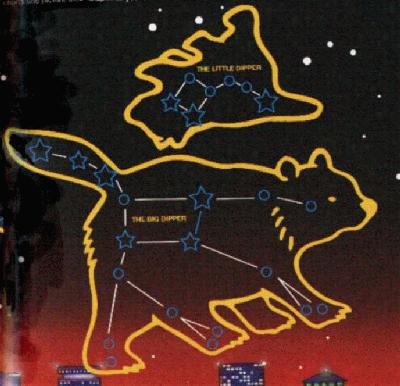
The Big and Little Dippers are asterisms - recognizable patterns of stars - within the constellations Ursa Major and Ursa Minor. Image via Dill Knob Observatory.

The Big and Little Dippers aren’t constellations. They’re asterisms, or noticeable star patterns. The Big Dipper is part of Ursa Major the Greater Bear. The Little Dipper belongs to Ursa Minor the Lesser Bear. Image via Dill Knob Observatory.

Richard Hinkley Allen in his book Star Names: Their Lore and Meaning claims the Greek constellation Ursa Minor was never mentioned in the literary works of Homer (9th century B.C.) or Hesiod (8th century B.C.). That’s probably because this constellation hadn’t been invented yet, that long ago.

According to the Greek geographer and historian Strabo (63 B.C. to A.D. 21?), the seven stars we see today as part of Ursa Minor (the Little Dipper) didn’t carry that name until 600 B.C. or so. Before that time, people saw this group of stars outlining the wings of the constellation Draco the Dragon.

When the seafaring Phoenicians visited the Greek philosopher Thales around 600 B.C., they showed him how to navigate by the stars. Purportedly, Thales clipped the Dragon’s wings to create a new constellation, possibly because this new way of looking at the stars enabled Greek sailors to more easily locate the north celestial pole.

But it’s not just our names for things in the sky that change. The sky itself changes, too. In our day, Polaris closely marks the north celestial pole in the sky. In 600 B.C. – thanks to the motion of precession – the stars Kochab and Pherkad more closely marked the position of the north celestial pole.

Kochab and Pherkad: Guardians of the Pole

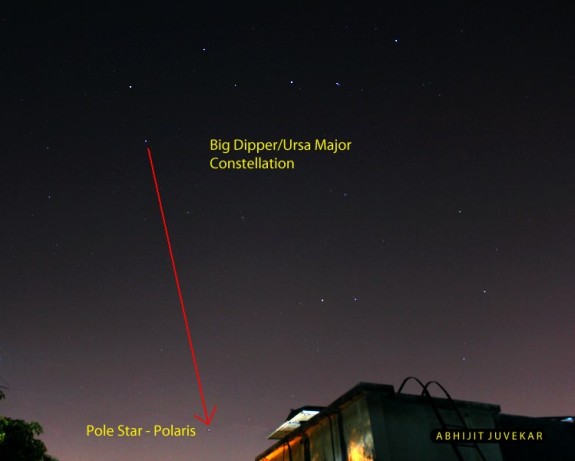
The two outer stars in the bowl of the Big Dipper always point to Polaris, the North Star. Image by EarthSky Facebook friend Abhijit Juvekar.

The two outer stars in the bowl of the Big Dipper always point to Polaris, the North Star. Image by EarthSky Facebook friend Abhijit Juvekar.

Bottom line: Look for the Big and Little Dippers in the north at nightfall!

Help EarthSky keep going! Please donate what you can to our annual crowd-funding campaign.

EarthSky astronomy kits are perfect for beginners. Order today from the EarthSky store


from EarthSky https://ift.tt/1ATscdS

Tonight, assuming you’re in the Northern Hemisphere, you can easily find the legendary Big Dipper, called The Plough by our friends in the U.K. or The Wagon throughout much of Europe. This familiar star pattern is high in the north at nightfall in June. Find it, and let it be your guide to the Little Dipper, too.

Help EarthSky keep going! Please donate what you can to our annual crowd-funding campaign.

You can find the Big Dipper easily because its shape really resembles a dipper. Meanwhile, the Little Dipper isn’t as easy to find. You need a dark sky to see the Little Dipper, so be sure to avoid city lights.

How do you find the Dippers? Assuming you’re in the Northern Hemisphere, simply face northward on a June evening, and watch for a large dipper-like pattern. That easy-to-see pattern will be the Big Dipper. Notice that the Big Dipper has two parts: a bowl and a handle. See the two outer stars in the bowl? They’re known as The Pointers because they point to the North Star, which is also known as Polaris.

Once you’ve found Polaris, you can find the Little Dipper. Polaris marks the end of the handle of the Little Dipper. You need a dark night to see the Little Dipper in full, because it’s so much fainter than its larger and brighter counterpart.

By the way, can you see the Big Dipper from Earth’s Southern Hemisphere? Yes, if you’re in the southern tropics. Much farther south, and it gets harder; as you go southward on Earth’s globe, the Dipper sinks closer and closer to the northern horizon.

Meanwhile, Polaris, the North Star, disappears beneath the horizon once you get south of the Earth’s equator.

The Big and Little Dippers are asterisms - recognizable patterns of stars - within the constellations Ursa Major and Ursa Minor. Image via Dill Knob Observatory.

The Big and Little Dippers aren’t constellations. They’re asterisms, or noticeable star patterns. The Big Dipper is part of Ursa Major the Greater Bear. The Little Dipper belongs to Ursa Minor the Lesser Bear. Image via Dill Knob Observatory.

Richard Hinkley Allen in his book Star Names: Their Lore and Meaning claims the Greek constellation Ursa Minor was never mentioned in the literary works of Homer (9th century B.C.) or Hesiod (8th century B.C.). That’s probably because this constellation hadn’t been invented yet, that long ago.

According to the Greek geographer and historian Strabo (63 B.C. to A.D. 21?), the seven stars we see today as part of Ursa Minor (the Little Dipper) didn’t carry that name until 600 B.C. or so. Before that time, people saw this group of stars outlining the wings of the constellation Draco the Dragon.

When the seafaring Phoenicians visited the Greek philosopher Thales around 600 B.C., they showed him how to navigate by the stars. Purportedly, Thales clipped the Dragon’s wings to create a new constellation, possibly because this new way of looking at the stars enabled Greek sailors to more easily locate the north celestial pole.

But it’s not just our names for things in the sky that change. The sky itself changes, too. In our day, Polaris closely marks the north celestial pole in the sky. In 600 B.C. – thanks to the motion of precession – the stars Kochab and Pherkad more closely marked the position of the north celestial pole.

Kochab and Pherkad: Guardians of the Pole

The two outer stars in the bowl of the Big Dipper always point to Polaris, the North Star. Image by EarthSky Facebook friend Abhijit Juvekar.

The two outer stars in the bowl of the Big Dipper always point to Polaris, the North Star. Image by EarthSky Facebook friend Abhijit Juvekar.

Bottom line: Look for the Big and Little Dippers in the north at nightfall!

Help EarthSky keep going! Please donate what you can to our annual crowd-funding campaign.

EarthSky astronomy kits are perfect for beginners. Order today from the EarthSky store


from EarthSky https://ift.tt/1ATscdS

Guatemala’s Fuego volcano erupts in fury

Fuego volcano moment of eruption – June 3, 2018 – via @MLopezSanMartin on Twitter.

Guatemala’s President Jimmy Morales has declared three days of national mourning after Sunday’s eruption of Volcan de Fuego, one of Central America’s most active volcanoes. According to media reports, it is the most powerful eruption since 1974. The eruption killed at least 25 people and injured many more. It spewed a river of hot lava that cut directly through the village of El Rodeo, at the foot of the volcano, burying the town and caused some deaths. Later, 18 bodies are said to have been found in the village of San Miguel Los Lotes. Meanwhile, the volcano belched thick, black smoke nearly six miles (10 km) into the air. Fleeing residents became covered in ash, and ash drifted the 27-mile (44-km) distance to Guatemala City, Guatemala’s capitol. More than 3,000 people were forced from their homes, according to media reports. The CONRED, Guatemala’s government agency for disaster relief, released a video of the event in which Consuelo Hernandez said:

Not everyone escaped, I think they were buried. We saw the lava was pouring through the corn fields and we ran toward a hill.

Rescue workers were hampered when roads were cut by the lava flows. The ash forced the closure of La Aurora International Airport, where the military assisted in clearing ash off of the runway.

Fuego volcano is famous for being almost constantly active at a low level. Small gas and ash eruptions occur every 15 to 20 minutes, but larger eruptions are rare. However, the volcano has been in a more active period since 2002.

The tweets below are from PNC Guatemala (@PNCdeGuatemala on Twitter), the national civil police force. If you click on each tweet, you will find an enlarged view, with a translation button below the tweets. They tell part of the story of yesterday’s dramatic events in Guatemala.

Bottom line:


from EarthSky https://ift.tt/2Jru5an

Fuego volcano moment of eruption – June 3, 2018 – via @MLopezSanMartin on Twitter.

Guatemala’s President Jimmy Morales has declared three days of national mourning after Sunday’s eruption of Volcan de Fuego, one of Central America’s most active volcanoes. According to media reports, it is the most powerful eruption since 1974. The eruption killed at least 25 people and injured many more. It spewed a river of hot lava that cut directly through the village of El Rodeo, at the foot of the volcano, burying the town and caused some deaths. Later, 18 bodies are said to have been found in the village of San Miguel Los Lotes. Meanwhile, the volcano belched thick, black smoke nearly six miles (10 km) into the air. Fleeing residents became covered in ash, and ash drifted the 27-mile (44-km) distance to Guatemala City, Guatemala’s capitol. More than 3,000 people were forced from their homes, according to media reports. The CONRED, Guatemala’s government agency for disaster relief, released a video of the event in which Consuelo Hernandez said:

Not everyone escaped, I think they were buried. We saw the lava was pouring through the corn fields and we ran toward a hill.

Rescue workers were hampered when roads were cut by the lava flows. The ash forced the closure of La Aurora International Airport, where the military assisted in clearing ash off of the runway.

Fuego volcano is famous for being almost constantly active at a low level. Small gas and ash eruptions occur every 15 to 20 minutes, but larger eruptions are rare. However, the volcano has been in a more active period since 2002.

The tweets below are from PNC Guatemala (@PNCdeGuatemala on Twitter), the national civil police force. If you click on each tweet, you will find an enlarged view, with a translation button below the tweets. They tell part of the story of yesterday’s dramatic events in Guatemala.

Bottom line:


from EarthSky https://ift.tt/2Jru5an

adds 2