aads

These distant moons may harbor life

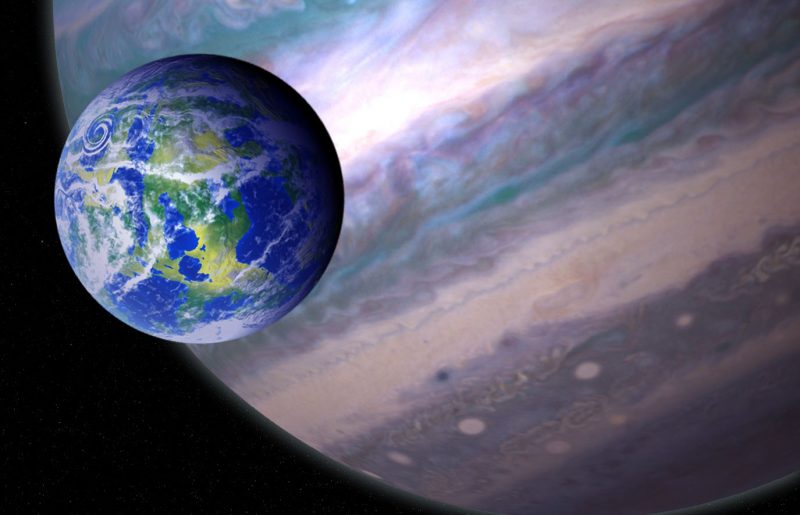
Artist’s concept of a potentially habitable exomoon orbiting a giant planet in a distant solar system. Image via NASA GSFC: Jay Friedlander and Britt Griswold/ UCR.

The search for tell-tale biosignatures – signs that distant life is affecting its planet’s atmosphere – is a next step in exoplanet research. We don’t mean biosignatures from alien intelligences, necessarily. Any form of life, including microbial life, might chemically alter its planet’s atmosphere. Biosignature studies are often mentioned in connection with the James Webb Space Telescope – Hubble’s successor – currently due to launch in 2020. Late last month (May 30, 2018) – in preparation for future biosignature searches by the Webb and other future telescopes – researchers at the University of California, Riverside and the University of Southern Queensland announced they’ve identified 121 giant exoplanets with orbits within the habitable zone – zone within which liquid water can exist – of their stars. Although no exomoons are yet known for these planets, it’s likely some exomoons do exist. Some might have atmospheres. Some might be supporting life, whose biosignatures we can detect.

The new study (online here) has been accepted for publication in the peer-reviewed Astrophysical Journal.

Wait. We don’t know of any exomoons, and yet we’re planning to study them? Consider that it wasn’t until 1995 that the star 51 Pegasi went down in history as the first main-sequence star – or star in the same stage of its evolution as our sun – known to have a planet. Now, astronomers know of thousands of exoplanets and exoplanet candidates. The discovery of exomoons is surely on the horizon. Astronomer Stephen Kane at UC Riverside – a co-author on the new research – said:

There are currently 175 known moons orbiting the eight planets in our solar system. While most of these moons orbit Saturn and Jupiter, which are outside the sun’s habitable zone, that may not be the case in other solar systems. Including rocky exomoons in our search for life in space will greatly expand the places we can look.

Help EarthSky keep going! Please donate what you can to our annual crowd-funding campaign.
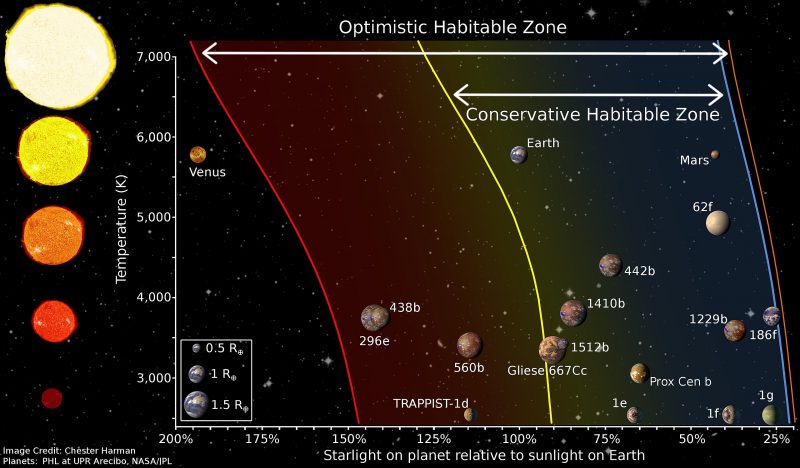
View larger. | The Habitable Zone. Shown is temperature vs starlight received. Important exoplanets are placed on the diagram, plus Earth, Venus, and Mars. Image via Chester Harman/ Wikimedia Commons.

The astronomers who conducted this study said their work will help guide the design of future telescopes that can detect exomoons. They pointed out that exomoons might provide a favorable environment for life, perhaps even better than Earth. That’s because they receive energy not only from their star, but also from radiation reflected from their planet.

Michelle Hill, an undergraduate student at the University of Southern Queensland who is working with Kane and will join UCR’s graduate program in the fall, was lead author on the new research. She commented:

Now that we have created a database of the known giant planets in the habitable zone of their star, observations of the best candidates for hosting potential exomoons will be made to help refine the expected exomoon properties. Our follow-up studies will help inform future telescope design so that we can detect these moons, study their properties, and look for signs of life.

Bottom line: Researchers in California and Australia say they’ve identified 121 giant planets whose moons might be capable of supporting life.

Source: Exploring Kepler Giant Planets in the Habitable Zone

Via URC

Help EarthSky keep going! Please donate what you can to our annual crowd-funding campaign.


from EarthSky https://ift.tt/2HhKJEr

Artist’s concept of a potentially habitable exomoon orbiting a giant planet in a distant solar system. Image via NASA GSFC: Jay Friedlander and Britt Griswold/ UCR.

The search for tell-tale biosignatures – signs that distant life is affecting its planet’s atmosphere – is a next step in exoplanet research. We don’t mean biosignatures from alien intelligences, necessarily. Any form of life, including microbial life, might chemically alter its planet’s atmosphere. Biosignature studies are often mentioned in connection with the James Webb Space Telescope – Hubble’s successor – currently due to launch in 2020. Late last month (May 30, 2018) – in preparation for future biosignature searches by the Webb and other future telescopes – researchers at the University of California, Riverside and the University of Southern Queensland announced they’ve identified 121 giant exoplanets with orbits within the habitable zone – zone within which liquid water can exist – of their stars. Although no exomoons are yet known for these planets, it’s likely some exomoons do exist. Some might have atmospheres. Some might be supporting life, whose biosignatures we can detect.

The new study (online here) has been accepted for publication in the peer-reviewed Astrophysical Journal.

Wait. We don’t know of any exomoons, and yet we’re planning to study them? Consider that it wasn’t until 1995 that the star 51 Pegasi went down in history as the first main-sequence star – or star in the same stage of its evolution as our sun – known to have a planet. Now, astronomers know of thousands of exoplanets and exoplanet candidates. The discovery of exomoons is surely on the horizon. Astronomer Stephen Kane at UC Riverside – a co-author on the new research – said:

There are currently 175 known moons orbiting the eight planets in our solar system. While most of these moons orbit Saturn and Jupiter, which are outside the sun’s habitable zone, that may not be the case in other solar systems. Including rocky exomoons in our search for life in space will greatly expand the places we can look.

Help EarthSky keep going! Please donate what you can to our annual crowd-funding campaign.

View larger. | The Habitable Zone. Shown is temperature vs starlight received. Important exoplanets are placed on the diagram, plus Earth, Venus, and Mars. Image via Chester Harman/ Wikimedia Commons.

The astronomers who conducted this study said their work will help guide the design of future telescopes that can detect exomoons. They pointed out that exomoons might provide a favorable environment for life, perhaps even better than Earth. That’s because they receive energy not only from their star, but also from radiation reflected from their planet.

Michelle Hill, an undergraduate student at the University of Southern Queensland who is working with Kane and will join UCR’s graduate program in the fall, was lead author on the new research. She commented:

Now that we have created a database of the known giant planets in the habitable zone of their star, observations of the best candidates for hosting potential exomoons will be made to help refine the expected exomoon properties. Our follow-up studies will help inform future telescope design so that we can detect these moons, study their properties, and look for signs of life.

Bottom line: Researchers in California and Australia say they’ve identified 121 giant planets whose moons might be capable of supporting life.

Source: Exploring Kepler Giant Planets in the Habitable Zone

Via URC

Help EarthSky keep going! Please donate what you can to our annual crowd-funding campaign.


from EarthSky https://ift.tt/2HhKJEr

Can you see better than your dog, cat, or goldfish?

A household scene as viewed by various pets and pests. Human eyesight is roughly 7 times sharper than a cat’s, 40 to 60 times sharper than a rat’s or a goldfish’s, and hundreds of times sharper than a fly’s or a mosquito’s. Image via Eleanor Caves.

Help EarthSky keep going! Please donate what you can to our annual crowd-funding campaign.

By Robin A.Smith/Duke University

Compared with many animals, human eyes aren’t particularly adept at distinguishing colors or seeing in dim light. But by one measure at least – something called visual acuity – commonly referred to as clarity of vision – human eyes can see fine details that most animals can’t. That’s according to a new study of animal vision that compared hundreds of species by the sharpness of their sight.

In a paper published in the May 2018 issue of the journal Trends in Ecology & Evolution, the researchers compiled previously published estimates of visual acuity for roughly 600 species of insects, birds, mammals, fish and other animals.

Eleanor Caves, a postdoctoral researcher at Duke University, is the study’s first author. She said that across the animal kingdom,

… Most species see the world with much less detail than we do.

Scientists compared hundreds of species by the sharpness of their sight. They found a 10,000-fold difference between the most sharp-sighted and the most blurry-eyed species, with humans ranking near the top. Image via Eugene Oliver.

The study measured acuity in terms of cycles per degree – that’s how many pairs of black and white parallel lines a species can discern within one degree of the field of vision before they turn into a smear of gray.

Researchers can’t ask a camel to identify letters on an eye chart. Instead, they estimate visual acuity based on an animal’s eye anatomy – such as the spacing and density of light-sensing structures – or using behavioral tests.

The limit of detail that human eyes can resolve is about 60 cycles per degree, which helps us make out road signs and recognize faces from afar. Chimpanzees and other primates can pick out similarly fine patterns.

A few birds of prey do better. For instance, the wedge-tailed eagle of Australia can see 140 cycles per degree, more than twice the limit of human visual acuity. Eagles can spot something as small as a rabbit while flying thousands of feet above the ground.

But apart from some eagles, vultures and falcons, the results show that most birds see fewer than 30 cycles per degree – less than half as much detail as humans. The same goes for fish. Caves said:

The highest acuity in a fish is still only about half as sharp as us.

Humans can resolve four to seven times more detail than dogs and cats, and more than a hundred times more than a mouse or a fruit fly. A person who sees less than 10 cycles per degree is considered legally blind. Most insects, it turns out, can’t see more than one.

Overall, the researchers found a 10,000-fold difference between the most sharp-sighted and the most blurry-eyed species.

The researchers also created a series of images showing how different scenes might appear to animals with different acuities, using a software package they developed called AcuityView. The software takes a digital photo and strips away all the spatial detail that may be too fine for a given animal to distinguish.

The image on the left shows the wings of a map butterfly as they might look to a jay looking for a snack, and on the right, to another member of its kind, such as a rival or potential mate. Image via Eleanor Caves.

The converted images reveal animal patterns that, while easy for some species to see, may be imperceptible to others, or only recognizable from a short distance.

Take the patterns on a butterfly’s wing. Scientists have debated the function of their spots, stripes and splotches. One common assumption is that they warn birds and other predators to stay away. It has also been proposed that they help butterflies check out or seduce potential mates.

The researchers determined that the wing patterns of, say, the map butterfly may be apparent to many birds, but to others of their kind their wing patterns are likely a blur, even from just a few inches away. Caves said:

I don’t actually think butterflies can see them.

A spider web as seen in bird vision (left), and fly vision (right). The zigzags on the spider’s web send a secret message to birds that their insect prey can’t see, even from less than a foot away. Image via Eleanor Caves.

Some animals may use such differences in acuity to send secret messages that sharper-sighted species can read but others can’t, Caves said. For instance, orb-weaver spiders decorate their webs with white silk zigzags, spirals and other designs whose function has been debated. One theory is that they keep larger animals from accidentally colliding with their delicate webs, like the window stickers used to keep birds from flying into the glass. Another idea is that they lure insect prey.

But images of spider web decorations as they might appear to different species suggest that, while birds can spot them from as far away as six feet, they are virtually invisible to houseflies and other small insects that might blunder into the spider’s sticky traps.

It seems the decorations help spiders alert birds to webs that might be in their flight path, without blowing their cover with the creatures they might be trying to catch for lunch.

The converted images the team produced don’t represent what animals actually see, the researchers caution. That’s because while the eyes take in visual information, the brain must make sense of it.

It is likely that certain things may be sharper or easier to detect thanks to edge enhancement and other forms of “post-processing” that occur once the visual information is relayed to the brain, Caves said. But the software gives researchers a sense of what visual information the brain has to work with. Caves said:

The point is that researchers who study animal interactions shouldn’t assume that different species perceive detail the same way we do.

Bottom line: A new study looks at how human eyesight compares to the vision of other animals and insects.

Help EarthSky keep going! Please donate what you can to our annual crowd-funding campaign.


from EarthSky https://ift.tt/2LTkkjH

A household scene as viewed by various pets and pests. Human eyesight is roughly 7 times sharper than a cat’s, 40 to 60 times sharper than a rat’s or a goldfish’s, and hundreds of times sharper than a fly’s or a mosquito’s. Image via Eleanor Caves.

Help EarthSky keep going! Please donate what you can to our annual crowd-funding campaign.

By Robin A.Smith/Duke University

Compared with many animals, human eyes aren’t particularly adept at distinguishing colors or seeing in dim light. But by one measure at least – something called visual acuity – commonly referred to as clarity of vision – human eyes can see fine details that most animals can’t. That’s according to a new study of animal vision that compared hundreds of species by the sharpness of their sight.

In a paper published in the May 2018 issue of the journal Trends in Ecology & Evolution, the researchers compiled previously published estimates of visual acuity for roughly 600 species of insects, birds, mammals, fish and other animals.

Eleanor Caves, a postdoctoral researcher at Duke University, is the study’s first author. She said that across the animal kingdom,

… Most species see the world with much less detail than we do.

Scientists compared hundreds of species by the sharpness of their sight. They found a 10,000-fold difference between the most sharp-sighted and the most blurry-eyed species, with humans ranking near the top. Image via Eugene Oliver.

The study measured acuity in terms of cycles per degree – that’s how many pairs of black and white parallel lines a species can discern within one degree of the field of vision before they turn into a smear of gray.

Researchers can’t ask a camel to identify letters on an eye chart. Instead, they estimate visual acuity based on an animal’s eye anatomy – such as the spacing and density of light-sensing structures – or using behavioral tests.

The limit of detail that human eyes can resolve is about 60 cycles per degree, which helps us make out road signs and recognize faces from afar. Chimpanzees and other primates can pick out similarly fine patterns.

A few birds of prey do better. For instance, the wedge-tailed eagle of Australia can see 140 cycles per degree, more than twice the limit of human visual acuity. Eagles can spot something as small as a rabbit while flying thousands of feet above the ground.

But apart from some eagles, vultures and falcons, the results show that most birds see fewer than 30 cycles per degree – less than half as much detail as humans. The same goes for fish. Caves said:

The highest acuity in a fish is still only about half as sharp as us.

Humans can resolve four to seven times more detail than dogs and cats, and more than a hundred times more than a mouse or a fruit fly. A person who sees less than 10 cycles per degree is considered legally blind. Most insects, it turns out, can’t see more than one.

Overall, the researchers found a 10,000-fold difference between the most sharp-sighted and the most blurry-eyed species.

The researchers also created a series of images showing how different scenes might appear to animals with different acuities, using a software package they developed called AcuityView. The software takes a digital photo and strips away all the spatial detail that may be too fine for a given animal to distinguish.

The image on the left shows the wings of a map butterfly as they might look to a jay looking for a snack, and on the right, to another member of its kind, such as a rival or potential mate. Image via Eleanor Caves.

The converted images reveal animal patterns that, while easy for some species to see, may be imperceptible to others, or only recognizable from a short distance.

Take the patterns on a butterfly’s wing. Scientists have debated the function of their spots, stripes and splotches. One common assumption is that they warn birds and other predators to stay away. It has also been proposed that they help butterflies check out or seduce potential mates.

The researchers determined that the wing patterns of, say, the map butterfly may be apparent to many birds, but to others of their kind their wing patterns are likely a blur, even from just a few inches away. Caves said:

I don’t actually think butterflies can see them.

A spider web as seen in bird vision (left), and fly vision (right). The zigzags on the spider’s web send a secret message to birds that their insect prey can’t see, even from less than a foot away. Image via Eleanor Caves.

Some animals may use such differences in acuity to send secret messages that sharper-sighted species can read but others can’t, Caves said. For instance, orb-weaver spiders decorate their webs with white silk zigzags, spirals and other designs whose function has been debated. One theory is that they keep larger animals from accidentally colliding with their delicate webs, like the window stickers used to keep birds from flying into the glass. Another idea is that they lure insect prey.

But images of spider web decorations as they might appear to different species suggest that, while birds can spot them from as far away as six feet, they are virtually invisible to houseflies and other small insects that might blunder into the spider’s sticky traps.

It seems the decorations help spiders alert birds to webs that might be in their flight path, without blowing their cover with the creatures they might be trying to catch for lunch.

The converted images the team produced don’t represent what animals actually see, the researchers caution. That’s because while the eyes take in visual information, the brain must make sense of it.

It is likely that certain things may be sharper or easier to detect thanks to edge enhancement and other forms of “post-processing” that occur once the visual information is relayed to the brain, Caves said. But the software gives researchers a sense of what visual information the brain has to work with. Caves said:

The point is that researchers who study animal interactions shouldn’t assume that different species perceive detail the same way we do.

Bottom line: A new study looks at how human eyesight compares to the vision of other animals and insects.

Help EarthSky keep going! Please donate what you can to our annual crowd-funding campaign.


from EarthSky https://ift.tt/2LTkkjH

Shelf cloud over Florida

Shelf cloud bringing rain or Ormond Beach, Florida on June 1, 2018. Rita Addison wrote: “I watched it move over us, taking many pictures in stages. So excited … wanted to share.” Thanks Rita!


from EarthSky https://ift.tt/2kMbiJ9

Shelf cloud bringing rain or Ormond Beach, Florida on June 1, 2018. Rita Addison wrote: “I watched it move over us, taking many pictures in stages. So excited … wanted to share.” Thanks Rita!


from EarthSky https://ift.tt/2kMbiJ9

2018 SkS Weekly Climate Change & Global Warming Digest #22

Story of the Week... Editorial of the Week... Toon of the Week... Quote of the Week... SkS in the News... Scholarly Paper of Note... Coming Soon on SkS... Climate Feedback Reviews... SkS Week in Review... Poster of the Week...

Story of the Week...

Gov. Brown says fallout from Trump quitting Paris accord is 'far more serious than anyone is saying'

CA Gov Jerry Brown

California Gov. Jerry Brown addresses the University of California Carbon and Climate Neutrality Summit in San Diego. (Howard Lipin / San Diego Union-Tribune)

His promised coal renaissance sputtered. Rollbacks of environmental protections are tangled in court. Even automakers aren’t on board for his push toward heavier-polluting cars.

But even so, a year after President Trump pulled out of the landmark Paris accord on climate change, the struggle to contain global warming has grown considerably more complicated without the prodding and encouragement once provided by the U.S. government.

And though many in the climate movement hope progress toward cutting emissions can continue despite Trump’s retreat, there are growing doubts about reaching the Paris agreement’s goal of limiting global warming to 2 degrees Celsius, if Washington does not re-engage soon.

In an interview, Gov. Jerry Brown acknowledged the hope felt by many climate activists because of efforts from states like his and by private companies. But he also said the world is only just beginning to feel the environmental harm inflicted by the Trump administration. 

Gov. Brown says fallout from Trump quitting Paris accord is 'far more serious than anyone is saying' by Evan Halper, Los Angeles Times, June 1, 2018 


Editorial of the Week...

Hope in the Era of Trump’s Climate Foolishness

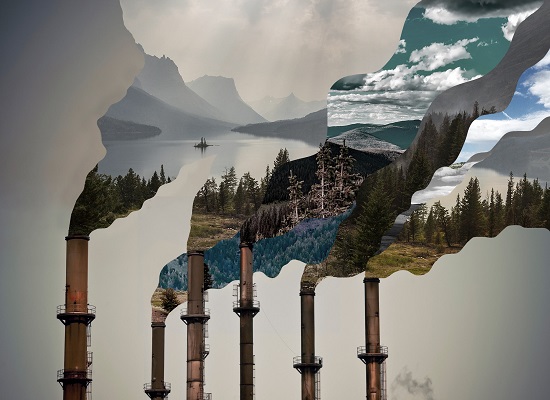
NY Times Editorial Graphic

Credit: Illustration by Matthieu Bourel; Photograph by Getty Images

Concluding paragraph...

In an ideal world, Americans would have a federal government that, as it has in the past, provides investment in new technologies, in research and development and in energy infrastructure. Instead, we are saddled with an administration that is preparing to force power companies to keep dirty and inefficient coal-burning power plants operating on the pretext that they are needed to protect national security. Until that changes, the voices of all those governors, mayors, corporate leaders and others who, after Mr. Trump’s withdrawal from the Paris agreement, proclaimed, “We AreStill In,” deserve praise and support. 

Hope in the Era of Trump’s Climate Foolishness, Editorial Board, New York Times, June 1, 2018 


Toon of the Week...

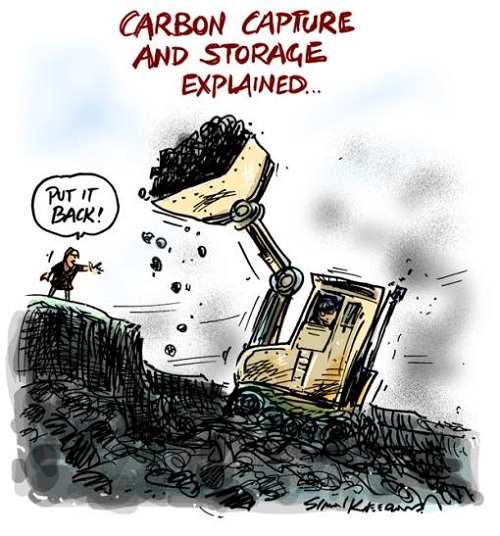
2018 Toon 22  


Quote of the Week...

“He has set in motion initiatives that will cause damage,” (CA Gov Jerry) Brown said, comparing the planet under Trump’s climate policies to a person who has just fallen from the top of the Empire State Building. “You are falling down four stories, but have 80 to go,” he said. “Maybe you are not damaged yet, but it is certain you will die.”

The governor said his overriding concern is that global progress has stalled. “This is real,” Brown said. “It is far more serious than anybody is saying.”

Gov. Brown says fallout from Trump quitting Paris accord is 'far more serious than anyone is saying' by Evan Halper, Los Angeles Times, June 1, 2018 


SkS in the News...

Michael Svoboda concludes his article, Truthsquading: Books and reports on the denial and obstruction of climate science (Yale Climate Connections, May 31, 2018) with the following:

Three Reports from Skeptical Science

A pivotal figure in the effort to counter global warming skepticism is John Cook, who started the Skeptical Science website in 2007, while still a student at the University of Queensland in Australia. Since then Cook has (co)authored reports to alert readers to the manufactured arguments they’re likely to encounter when discussing climate change in public. Two – The Scientific Guide to Global Warming Skepticsm (2010) and The Debunking Handbook (2011) – can be downloaded from the Skeptical Science website. The third, The Consensus Handbook (2018), is available from the Center for Climate Change Communication at George Mason University, where John Cook now works as a research assistant professor. 


Scholarly Paper of Note...

The underlying premise of this paper is that repetition of a narrow narrative that focuses exclusively on the impacts of climate change leaves the public with an overall sense of powerlessness. The paper focuses on five years of national media coverage of climate change in the U.S. Arctic, specifically stories about communities facing coastal erosion and relocation, to argue for journalism that provides a more representative view of the challenges posed by a warming climate. Such reporting would also include responses and innovations, and increase pressure on policymakers to act, rather than offering excuses for inaction.

Doom and Gloom: The Role of the Media in Public Disengagement on Climate Change by Elizabeth Arnold*, Harvard Kennedy School, May 29, 2018

*Joan Shorenstein Fellow, Spring 2018, and Associate Professor of Journalism, University of Alaska 


Coming Soon on SkS...

  • The attacks against solar power and EVs are ramping up (Dana)
  • New Video: Hot Ocean, Hurricanes, Houston, and Harvey (greenman)
  • Climate focused blogs around the world (BaerbelW)
  • Guest Post (John Abraham) 
  • New research this week (Ari)
  • 2017 SkS Weekly Climate Change & Global Warming News Roundup #23 (John Hartz)
  • 2017 SkS Weekly Climate Change & Global Warming Digest #23 (John Hartz)

Climate Feedback Reviews... 

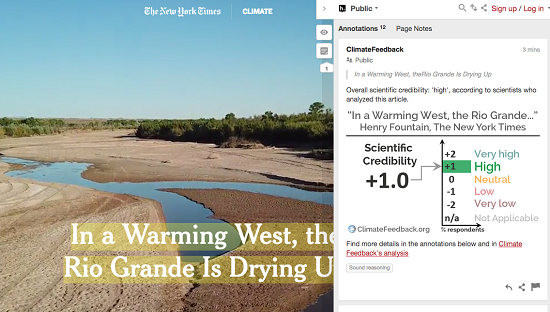
In a Warming West, the Rio Grande Is Drying Up

2018 Climate Feedback 22

Climate Feedback asked a team of scientists to review the article, In a Warming West, the Rio Grande Is Drying Up by Henry Fountain, Climate, New York Times, May 24, 2018

Two scientists analyzed the article and estimate its overall scientific credibility to be 'high'.

A majority of reviewers tagged the article as: Sound reasoning

Review Summary 

This article in The New York Times discusses water supply issues along the Rio Grande in New Mexico, and the projected impacts of climate change.

Scientists who reviewed the article generally found it to be an accurate description of research on this topic. However, they note that it’s important to remember that precipitation in this region can naturally vary on timescales longer than just one year to the next. Even changes from one decade to the next should be considered carefully in the context of variability—and water supply risks depend on both human-caused trends and that natural variability.

New York Times story accurately describes Rio Grande’s climate context, Edited by Scott Johnson, Climate Feedback, May 31, 2018


SkS Week in Review... 


Poster of the Week...

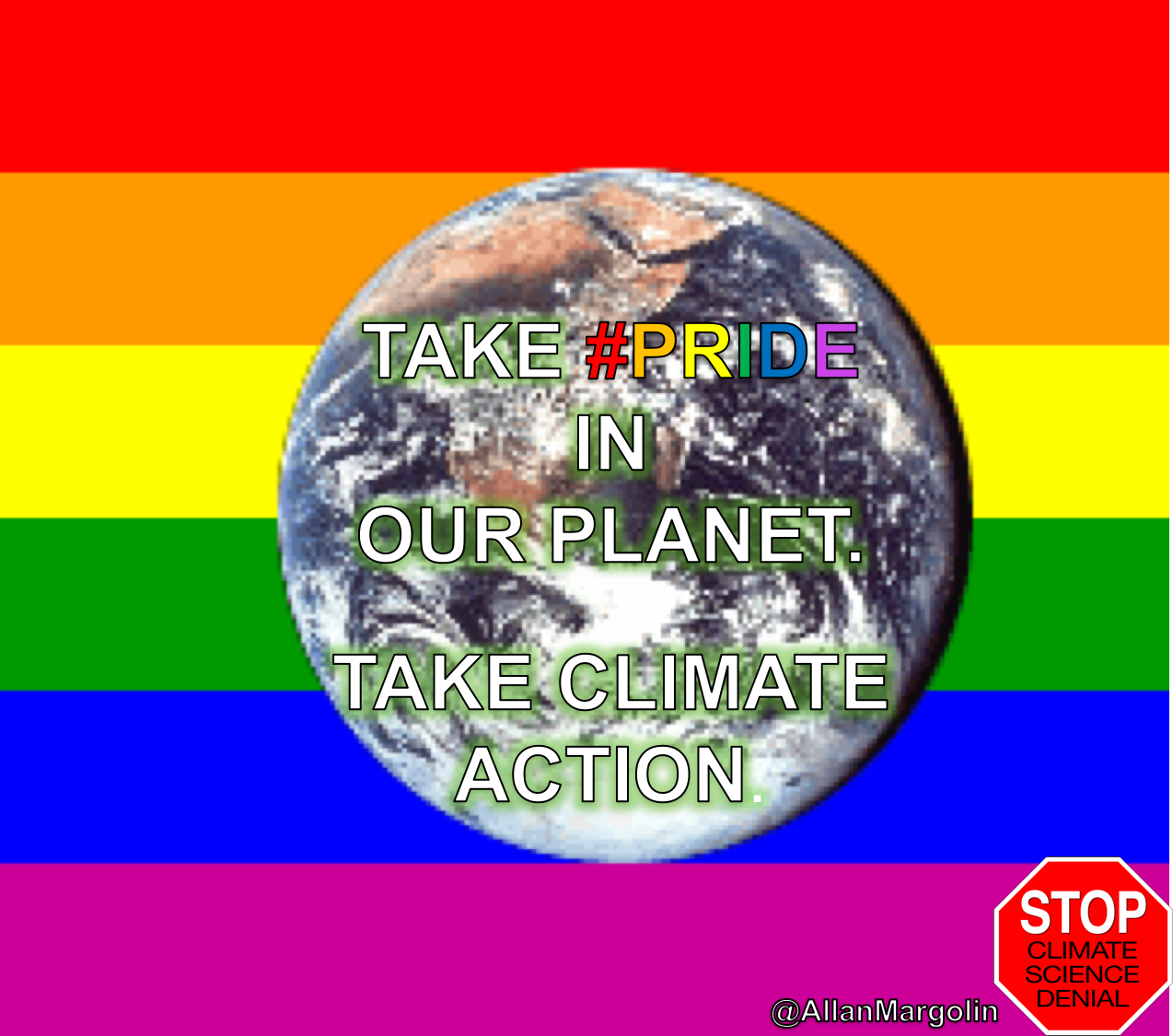
 2018 Poster 22


from Skeptical Science https://ift.tt/2stCQXY

Story of the Week... Editorial of the Week... Toon of the Week... Quote of the Week... SkS in the News... Scholarly Paper of Note... Coming Soon on SkS... Climate Feedback Reviews... SkS Week in Review... Poster of the Week...

Story of the Week...

Gov. Brown says fallout from Trump quitting Paris accord is 'far more serious than anyone is saying'

CA Gov Jerry Brown

California Gov. Jerry Brown addresses the University of California Carbon and Climate Neutrality Summit in San Diego. (Howard Lipin / San Diego Union-Tribune)

His promised coal renaissance sputtered. Rollbacks of environmental protections are tangled in court. Even automakers aren’t on board for his push toward heavier-polluting cars.

But even so, a year after President Trump pulled out of the landmark Paris accord on climate change, the struggle to contain global warming has grown considerably more complicated without the prodding and encouragement once provided by the U.S. government.

And though many in the climate movement hope progress toward cutting emissions can continue despite Trump’s retreat, there are growing doubts about reaching the Paris agreement’s goal of limiting global warming to 2 degrees Celsius, if Washington does not re-engage soon.

In an interview, Gov. Jerry Brown acknowledged the hope felt by many climate activists because of efforts from states like his and by private companies. But he also said the world is only just beginning to feel the environmental harm inflicted by the Trump administration. 

Gov. Brown says fallout from Trump quitting Paris accord is 'far more serious than anyone is saying' by Evan Halper, Los Angeles Times, June 1, 2018 


Editorial of the Week...

Hope in the Era of Trump’s Climate Foolishness

NY Times Editorial Graphic

Credit: Illustration by Matthieu Bourel; Photograph by Getty Images

Concluding paragraph...

In an ideal world, Americans would have a federal government that, as it has in the past, provides investment in new technologies, in research and development and in energy infrastructure. Instead, we are saddled with an administration that is preparing to force power companies to keep dirty and inefficient coal-burning power plants operating on the pretext that they are needed to protect national security. Until that changes, the voices of all those governors, mayors, corporate leaders and others who, after Mr. Trump’s withdrawal from the Paris agreement, proclaimed, “We AreStill In,” deserve praise and support. 

Hope in the Era of Trump’s Climate Foolishness, Editorial Board, New York Times, June 1, 2018 


Toon of the Week...

2018 Toon 22  


Quote of the Week...

“He has set in motion initiatives that will cause damage,” (CA Gov Jerry) Brown said, comparing the planet under Trump’s climate policies to a person who has just fallen from the top of the Empire State Building. “You are falling down four stories, but have 80 to go,” he said. “Maybe you are not damaged yet, but it is certain you will die.”

The governor said his overriding concern is that global progress has stalled. “This is real,” Brown said. “It is far more serious than anybody is saying.”

Gov. Brown says fallout from Trump quitting Paris accord is 'far more serious than anyone is saying' by Evan Halper, Los Angeles Times, June 1, 2018 


SkS in the News...

Michael Svoboda concludes his article, Truthsquading: Books and reports on the denial and obstruction of climate science (Yale Climate Connections, May 31, 2018) with the following:

Three Reports from Skeptical Science

A pivotal figure in the effort to counter global warming skepticism is John Cook, who started the Skeptical Science website in 2007, while still a student at the University of Queensland in Australia. Since then Cook has (co)authored reports to alert readers to the manufactured arguments they’re likely to encounter when discussing climate change in public. Two – The Scientific Guide to Global Warming Skepticsm (2010) and The Debunking Handbook (2011) – can be downloaded from the Skeptical Science website. The third, The Consensus Handbook (2018), is available from the Center for Climate Change Communication at George Mason University, where John Cook now works as a research assistant professor. 


Scholarly Paper of Note...

The underlying premise of this paper is that repetition of a narrow narrative that focuses exclusively on the impacts of climate change leaves the public with an overall sense of powerlessness. The paper focuses on five years of national media coverage of climate change in the U.S. Arctic, specifically stories about communities facing coastal erosion and relocation, to argue for journalism that provides a more representative view of the challenges posed by a warming climate. Such reporting would also include responses and innovations, and increase pressure on policymakers to act, rather than offering excuses for inaction.

Doom and Gloom: The Role of the Media in Public Disengagement on Climate Change by Elizabeth Arnold*, Harvard Kennedy School, May 29, 2018

*Joan Shorenstein Fellow, Spring 2018, and Associate Professor of Journalism, University of Alaska 


Coming Soon on SkS...

  • The attacks against solar power and EVs are ramping up (Dana)
  • New Video: Hot Ocean, Hurricanes, Houston, and Harvey (greenman)
  • Climate focused blogs around the world (BaerbelW)
  • Guest Post (John Abraham) 
  • New research this week (Ari)
  • 2017 SkS Weekly Climate Change & Global Warming News Roundup #23 (John Hartz)
  • 2017 SkS Weekly Climate Change & Global Warming Digest #23 (John Hartz)

Climate Feedback Reviews... 

In a Warming West, the Rio Grande Is Drying Up

2018 Climate Feedback 22

Climate Feedback asked a team of scientists to review the article, In a Warming West, the Rio Grande Is Drying Up by Henry Fountain, Climate, New York Times, May 24, 2018

Two scientists analyzed the article and estimate its overall scientific credibility to be 'high'.

A majority of reviewers tagged the article as: Sound reasoning

Review Summary 

This article in The New York Times discusses water supply issues along the Rio Grande in New Mexico, and the projected impacts of climate change.

Scientists who reviewed the article generally found it to be an accurate description of research on this topic. However, they note that it’s important to remember that precipitation in this region can naturally vary on timescales longer than just one year to the next. Even changes from one decade to the next should be considered carefully in the context of variability—and water supply risks depend on both human-caused trends and that natural variability.

New York Times story accurately describes Rio Grande’s climate context, Edited by Scott Johnson, Climate Feedback, May 31, 2018


SkS Week in Review... 


Poster of the Week...

 2018 Poster 22


from Skeptical Science https://ift.tt/2stCQXY

Small asteroid might have impacted Earth on Saturday

A small asteroid discovered on Saturday morning, June 2, 2018, surprised astronomers when its trajectory suggested it would pass very, very close to Earth just hours after being detected. The object has been given the temporary designation of ZLAF9B2. There are reports of sightings of a bright meteor, as well as a video that may be related to the event, from Barend Swanepoel in South Africa. He reports the video as being:

… taken near my dad’s farm between Ottosdal and Hartebeesfontein.

Another witness in South Africa described the meteor as very bright, and showing a yellow color.

This space rock had an estimated size of only 10-16 feet (3 to 5 meters) in diameter. If it struck (and sometimes they do, and meteorite pieces are found), it was too small to cause serious damages. In contrast, the impressive meteor seen over Chelyabinsk, Russia in February, 2013 was an estimated 60 feet wide (20 meters). It broke windows in six Russian cities and caused more than 1,500 people to seek medical attention, mostly due to injuries from flying glass. The June 2 asteroid wasn’t big enough to do anything like that, but it was big enough to produce a spectacular, very bright meteor.

The 60-inch (1.5-meter) telescope at Mt. Lemmon, which is part of the Catalina Sky Survey in Arizona, was the first to detect asteroid ZLAF9B2 on Saturday morning, according to clocks in North America.

According to NASA/JPL, asteroid ZLAF9B2 approached Earth at 35,344 miles per hour (56,880 km per hour).

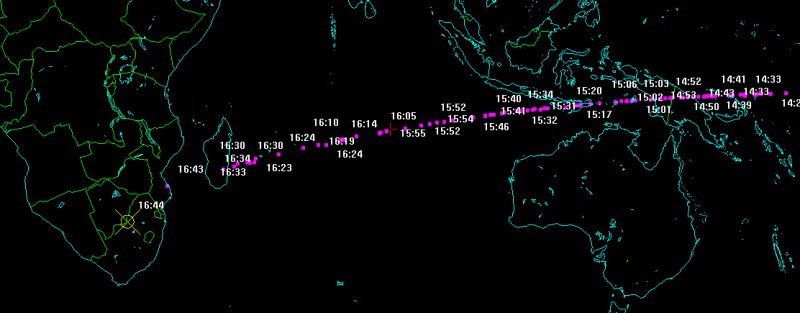
Models began suggesting that – in case of impact – the asteroid would enter Earth’s atmosphere somewhere between Indonesia, the Indian Ocean, or South Africa.

Trajectory models suggest small asteroid ZLAF9B2 impacted our atmosphere over South Africa on Saturday, and U.S. government sensors and satellites might confirm the event. Image via https://ift.tt/2LRI6g2

The reported observation of the color yellow in the sighted meteor is of interest because colors in a meteor provide a hint of its composition. Yellow suggest the rock contains sodium, as was also in the 2013 Chelyabinsk meteor.

Small asteroids are difficult to detect. Some space rocks might be dark, and may only reflect a small amount of sunlight as they may already be somewhat close to our planet.

However, as bigger asteroids reflect more light, they are usually detected weeks or months before closest approach.

Confirmation of the event is continuing to trickle in:

Bottom line: Trajectory models suggest small asteroid ZLAF9B2 impacted Earth’s atmosphere over South Africa on Saturday, June 2, 2018.


from EarthSky https://ift.tt/2JfIZ03

A small asteroid discovered on Saturday morning, June 2, 2018, surprised astronomers when its trajectory suggested it would pass very, very close to Earth just hours after being detected. The object has been given the temporary designation of ZLAF9B2. There are reports of sightings of a bright meteor, as well as a video that may be related to the event, from Barend Swanepoel in South Africa. He reports the video as being:

… taken near my dad’s farm between Ottosdal and Hartebeesfontein.

Another witness in South Africa described the meteor as very bright, and showing a yellow color.

This space rock had an estimated size of only 10-16 feet (3 to 5 meters) in diameter. If it struck (and sometimes they do, and meteorite pieces are found), it was too small to cause serious damages. In contrast, the impressive meteor seen over Chelyabinsk, Russia in February, 2013 was an estimated 60 feet wide (20 meters). It broke windows in six Russian cities and caused more than 1,500 people to seek medical attention, mostly due to injuries from flying glass. The June 2 asteroid wasn’t big enough to do anything like that, but it was big enough to produce a spectacular, very bright meteor.

The 60-inch (1.5-meter) telescope at Mt. Lemmon, which is part of the Catalina Sky Survey in Arizona, was the first to detect asteroid ZLAF9B2 on Saturday morning, according to clocks in North America.

According to NASA/JPL, asteroid ZLAF9B2 approached Earth at 35,344 miles per hour (56,880 km per hour).

Models began suggesting that – in case of impact – the asteroid would enter Earth’s atmosphere somewhere between Indonesia, the Indian Ocean, or South Africa.

Trajectory models suggest small asteroid ZLAF9B2 impacted our atmosphere over South Africa on Saturday, and U.S. government sensors and satellites might confirm the event. Image via https://ift.tt/2LRI6g2

The reported observation of the color yellow in the sighted meteor is of interest because colors in a meteor provide a hint of its composition. Yellow suggest the rock contains sodium, as was also in the 2013 Chelyabinsk meteor.

Small asteroids are difficult to detect. Some space rocks might be dark, and may only reflect a small amount of sunlight as they may already be somewhat close to our planet.

However, as bigger asteroids reflect more light, they are usually detected weeks or months before closest approach.

Confirmation of the event is continuing to trickle in:

Bottom line: Trajectory models suggest small asteroid ZLAF9B2 impacted Earth’s atmosphere over South Africa on Saturday, June 2, 2018.


from EarthSky https://ift.tt/2JfIZ03

Wildfire smoke messing with orangutans’ eating and sleep

Otto, an adult flanged male orangutan, avoiding fires and traveling through a smoke-filled forest in the Tuanan Orangutan Research Station in Indonesian Borneo. Image via Beth Barrow.

Help EarthSky keep going! Please donate what you can to our annual crowd-funding campaign.

Orangutans – already critically endangered due to habitat loss from logging and large-scale farming – might also face another threat from wildfire smoke. A new study, published May 15, 2018 in the peer-reviewed journal Scientific Reports, found that orangutans eat and rest more after fires, but don’t gain weight.

In 2015, researcher Wendy Erb, the Rutgers University Department of Anthropology, was studying male orangutans in the forests of Indonesian Borneo. A few weeks into the fire season – which happens annually, often due to smallholder farmers and plantations clearing forests to plant crops – Erb noticed a difference in the sound of the males’ “long call,” which scientists believe is used to attract females and warn other males. Erb said in a statement:

I thought they sounded raggedy, a little like humans who smoke a lot.

Erb decided to find out if the smoke the orangutans inhaled during the fires had affected their health. Erb studied four flanged male orangutans – males with large cheeks pads. The team analyzed the animals’ urine, as well as their behavior and discovered the big males traveled less, rested more and consumed more calories. They also produced more ketone bodies – molecules made by the liver from fatty acids during periods of low food intake – which was unexpected because the apes were eating more, not less. Why were these orangutans burning fat?

Erin Vogel, study co-author of the study and the Tuanan Research Station’s co-director, said:

It’s possible these males are burning fat because their energy is going to repairing tissue.

According to the study, the only new element in the orangutans’ lives was the three months of fire and smoke. The forests’ natural surface consists of peat, which is flammable, allowing the fires to burn underground for weeks. The fires were worse in 2015 because of a strong El Niño effect, which brought with it a severe drought.

A male orangutan at Tanjung Puting National Park in Central Kalimantan, Indonesia. Image via Terry Sunderland/CIFOR/Flickr.

Soil analyses suggest that wildfires have occurred in Borneo for millennia, but have become increasingly frequent and intense in recent decades due to deforestation and draining of peatlands. In 2015, Indonesia experienced the most severe fire activity and smoke pollution on record since the disastrous wildfires during the 1997 El Niño droughts.

According to a statement from the researchers:

The unexpected loss of nearly 100,000 Bornean orangutans from intact forests in Kalimantan between 1999 and 2015 indicates that habitat loss alone is not driving this critically endangered species’ declines. Increasingly frequent exposure to toxic smoke could have severe consequences for orangutans, other animals and people, and this research highlights the urgent need to understand the long-term and indirect impacts of Indonesia’s peatland fires, beyond the immediate loss of forests and their inhabitants.

Bottom line: A new study suggests that wildfire smoke may be affecting orangutans’ health.

Read more from Rutgers University


from EarthSky https://ift.tt/2JfGT0x

Otto, an adult flanged male orangutan, avoiding fires and traveling through a smoke-filled forest in the Tuanan Orangutan Research Station in Indonesian Borneo. Image via Beth Barrow.

Help EarthSky keep going! Please donate what you can to our annual crowd-funding campaign.

Orangutans – already critically endangered due to habitat loss from logging and large-scale farming – might also face another threat from wildfire smoke. A new study, published May 15, 2018 in the peer-reviewed journal Scientific Reports, found that orangutans eat and rest more after fires, but don’t gain weight.

In 2015, researcher Wendy Erb, the Rutgers University Department of Anthropology, was studying male orangutans in the forests of Indonesian Borneo. A few weeks into the fire season – which happens annually, often due to smallholder farmers and plantations clearing forests to plant crops – Erb noticed a difference in the sound of the males’ “long call,” which scientists believe is used to attract females and warn other males. Erb said in a statement:

I thought they sounded raggedy, a little like humans who smoke a lot.

Erb decided to find out if the smoke the orangutans inhaled during the fires had affected their health. Erb studied four flanged male orangutans – males with large cheeks pads. The team analyzed the animals’ urine, as well as their behavior and discovered the big males traveled less, rested more and consumed more calories. They also produced more ketone bodies – molecules made by the liver from fatty acids during periods of low food intake – which was unexpected because the apes were eating more, not less. Why were these orangutans burning fat?

Erin Vogel, study co-author of the study and the Tuanan Research Station’s co-director, said:

It’s possible these males are burning fat because their energy is going to repairing tissue.

According to the study, the only new element in the orangutans’ lives was the three months of fire and smoke. The forests’ natural surface consists of peat, which is flammable, allowing the fires to burn underground for weeks. The fires were worse in 2015 because of a strong El Niño effect, which brought with it a severe drought.

A male orangutan at Tanjung Puting National Park in Central Kalimantan, Indonesia. Image via Terry Sunderland/CIFOR/Flickr.

Soil analyses suggest that wildfires have occurred in Borneo for millennia, but have become increasingly frequent and intense in recent decades due to deforestation and draining of peatlands. In 2015, Indonesia experienced the most severe fire activity and smoke pollution on record since the disastrous wildfires during the 1997 El Niño droughts.

According to a statement from the researchers:

The unexpected loss of nearly 100,000 Bornean orangutans from intact forests in Kalimantan between 1999 and 2015 indicates that habitat loss alone is not driving this critically endangered species’ declines. Increasingly frequent exposure to toxic smoke could have severe consequences for orangutans, other animals and people, and this research highlights the urgent need to understand the long-term and indirect impacts of Indonesia’s peatland fires, beyond the immediate loss of forests and their inhabitants.

Bottom line: A new study suggests that wildfire smoke may be affecting orangutans’ health.

Read more from Rutgers University


from EarthSky https://ift.tt/2JfGT0x

Mars starts to rise before midnight

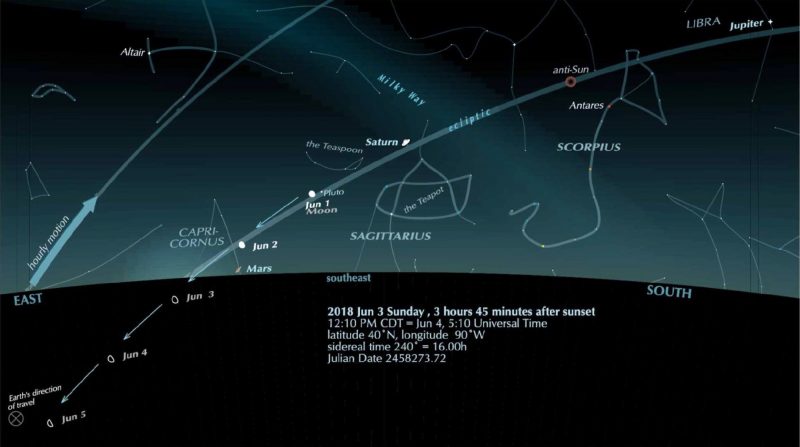
View larger. | Chart via Guy Ottewell.

Originally published at Guy Ottewell’s blog; reprinted here with permission

Mars is beginning to rise before midnight according to our picture, above, which is of the middle of the night between Sunday and Monday. This chart, which is set for my location in England, shows Mars one degree above the eastern horizon at ten minutes past midnight. The situation is much the time across the globe, although Mars’ exact rising time depends on how far north or south you are on Earth, and on how far east or west you are in your own time zone.

Also, the midnight rising of Mars is according clocks now on the summer regime of daylight saving time. They are one hour fast, pretending that 11 o’clock is “12.”

Here is part of my rising-and-setting graph for 2018:

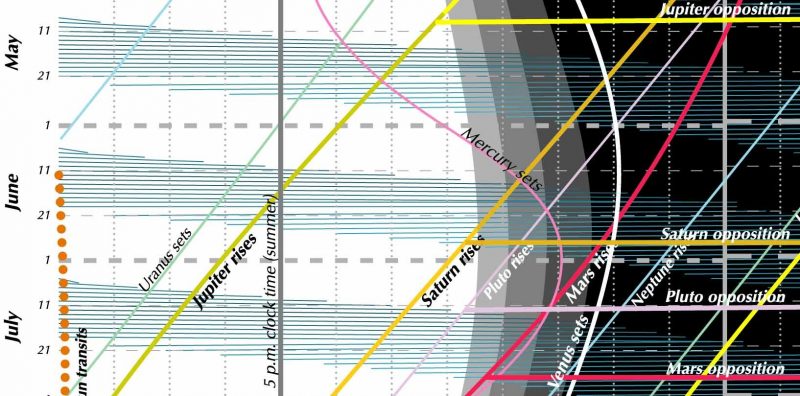
View larger. | A portion of 2018’s rising-and-setting graph – showing May, June and July – via Guy Ottewell.

The lavender vertical line near the right represents midnight; the slanting red curve labeled as Mars rises crossed it as long ago as May 12. If it were not for daylight saving time, Mars would have been rising before midnight for more than 10 days.

It has joined a late-evening-early-morning scene with Saturn and Jupiter, spread out over the zodiacal constellations of Capricornus, Sagittarius, Scorpius, and Libra, therefore enriched by Antares and the other starry features of the summer Milky Way.

Jupiter was at opposition on May 9; Saturn will be on June 27, Mars on July 27. The anti-sun point, sliding steadily eastward, meets each of these planets as it hovers on or near the ecliptic. The moon, too, rushed past the anti-sun point – that is, was full, or opposite the sun – on May 29. The moon is clearly dwindling as it passes 3 degrees north of Mars early Sunday morning (June 3 at 12 UTC).

During the night on Sunday, the moon rises about 20 minutes after Mars.

Mars was near the Beehive star cluster – aka M44, or Praesepe (The Manger) – in mid-April 2010. It is the bright reddish object in the upper left of this beautiful image by Peter Wienerroither. Used with permission.

Bottom line: Mars is now rising in the middle of the night. Its July 27 opposition will mark its brightest appearance in our sky since 2003. Mars is due to brighten dramatically before then … watch for it!

Read more: Mars brighter in 2018 than since 2003


from EarthSky https://ift.tt/2sqGvWy

View larger. | Chart via Guy Ottewell.

Originally published at Guy Ottewell’s blog; reprinted here with permission

Mars is beginning to rise before midnight according to our picture, above, which is of the middle of the night between Sunday and Monday. This chart, which is set for my location in England, shows Mars one degree above the eastern horizon at ten minutes past midnight. The situation is much the time across the globe, although Mars’ exact rising time depends on how far north or south you are on Earth, and on how far east or west you are in your own time zone.

Also, the midnight rising of Mars is according clocks now on the summer regime of daylight saving time. They are one hour fast, pretending that 11 o’clock is “12.”

Here is part of my rising-and-setting graph for 2018:

View larger. | A portion of 2018’s rising-and-setting graph – showing May, June and July – via Guy Ottewell.

The lavender vertical line near the right represents midnight; the slanting red curve labeled as Mars rises crossed it as long ago as May 12. If it were not for daylight saving time, Mars would have been rising before midnight for more than 10 days.

It has joined a late-evening-early-morning scene with Saturn and Jupiter, spread out over the zodiacal constellations of Capricornus, Sagittarius, Scorpius, and Libra, therefore enriched by Antares and the other starry features of the summer Milky Way.

Jupiter was at opposition on May 9; Saturn will be on June 27, Mars on July 27. The anti-sun point, sliding steadily eastward, meets each of these planets as it hovers on or near the ecliptic. The moon, too, rushed past the anti-sun point – that is, was full, or opposite the sun – on May 29. The moon is clearly dwindling as it passes 3 degrees north of Mars early Sunday morning (June 3 at 12 UTC).

During the night on Sunday, the moon rises about 20 minutes after Mars.

Mars was near the Beehive star cluster – aka M44, or Praesepe (The Manger) – in mid-April 2010. It is the bright reddish object in the upper left of this beautiful image by Peter Wienerroither. Used with permission.

Bottom line: Mars is now rising in the middle of the night. Its July 27 opposition will mark its brightest appearance in our sky since 2003. Mars is due to brighten dramatically before then … watch for it!

Read more: Mars brighter in 2018 than since 2003


from EarthSky https://ift.tt/2sqGvWy

adds 2