aads

Wildfire smoke messing with orangutans’ eating and sleep

Otto, an adult flanged male orangutan, avoiding fires and traveling through a smoke-filled forest in the Tuanan Orangutan Research Station in Indonesian Borneo. Image via Beth Barrow.

Help EarthSky keep going! Please donate what you can to our annual crowd-funding campaign.

Orangutans – already critically endangered due to habitat loss from logging and large-scale farming – might also face another threat from wildfire smoke. A new study, published May 15, 2018 in the peer-reviewed journal Scientific Reports, found that orangutans eat and rest more after fires, but don’t gain weight.

In 2015, researcher Wendy Erb, the Rutgers University Department of Anthropology, was studying male orangutans in the forests of Indonesian Borneo. A few weeks into the fire season – which happens annually, often due to smallholder farmers and plantations clearing forests to plant crops – Erb noticed a difference in the sound of the males’ “long call,” which scientists believe is used to attract females and warn other males. Erb said in a statement:

I thought they sounded raggedy, a little like humans who smoke a lot.

Erb decided to find out if the smoke the orangutans inhaled during the fires had affected their health. Erb studied four flanged male orangutans – males with large cheeks pads. The team analyzed the animals’ urine, as well as their behavior and discovered the big males traveled less, rested more and consumed more calories. They also produced more ketone bodies – molecules made by the liver from fatty acids during periods of low food intake – which was unexpected because the apes were eating more, not less. Why were these orangutans burning fat?

Erin Vogel, study co-author of the study and the Tuanan Research Station’s co-director, said:

It’s possible these males are burning fat because their energy is going to repairing tissue.

According to the study, the only new element in the orangutans’ lives was the three months of fire and smoke. The forests’ natural surface consists of peat, which is flammable, allowing the fires to burn underground for weeks. The fires were worse in 2015 because of a strong El Niño effect, which brought with it a severe drought.

A male orangutan at Tanjung Puting National Park in Central Kalimantan, Indonesia. Image via Terry Sunderland/CIFOR/Flickr.

Soil analyses suggest that wildfires have occurred in Borneo for millennia, but have become increasingly frequent and intense in recent decades due to deforestation and draining of peatlands. In 2015, Indonesia experienced the most severe fire activity and smoke pollution on record since the disastrous wildfires during the 1997 El Niño droughts.

According to a statement from the researchers:

The unexpected loss of nearly 100,000 Bornean orangutans from intact forests in Kalimantan between 1999 and 2015 indicates that habitat loss alone is not driving this critically endangered species’ declines. Increasingly frequent exposure to toxic smoke could have severe consequences for orangutans, other animals and people, and this research highlights the urgent need to understand the long-term and indirect impacts of Indonesia’s peatland fires, beyond the immediate loss of forests and their inhabitants.

Bottom line: A new study suggests that wildfire smoke may be affecting orangutans’ health.

Read more from Rutgers University


from EarthSky https://ift.tt/2JfGT0x

Otto, an adult flanged male orangutan, avoiding fires and traveling through a smoke-filled forest in the Tuanan Orangutan Research Station in Indonesian Borneo. Image via Beth Barrow.

Help EarthSky keep going! Please donate what you can to our annual crowd-funding campaign.

Orangutans – already critically endangered due to habitat loss from logging and large-scale farming – might also face another threat from wildfire smoke. A new study, published May 15, 2018 in the peer-reviewed journal Scientific Reports, found that orangutans eat and rest more after fires, but don’t gain weight.

In 2015, researcher Wendy Erb, the Rutgers University Department of Anthropology, was studying male orangutans in the forests of Indonesian Borneo. A few weeks into the fire season – which happens annually, often due to smallholder farmers and plantations clearing forests to plant crops – Erb noticed a difference in the sound of the males’ “long call,” which scientists believe is used to attract females and warn other males. Erb said in a statement:

I thought they sounded raggedy, a little like humans who smoke a lot.

Erb decided to find out if the smoke the orangutans inhaled during the fires had affected their health. Erb studied four flanged male orangutans – males with large cheeks pads. The team analyzed the animals’ urine, as well as their behavior and discovered the big males traveled less, rested more and consumed more calories. They also produced more ketone bodies – molecules made by the liver from fatty acids during periods of low food intake – which was unexpected because the apes were eating more, not less. Why were these orangutans burning fat?

Erin Vogel, study co-author of the study and the Tuanan Research Station’s co-director, said:

It’s possible these males are burning fat because their energy is going to repairing tissue.

According to the study, the only new element in the orangutans’ lives was the three months of fire and smoke. The forests’ natural surface consists of peat, which is flammable, allowing the fires to burn underground for weeks. The fires were worse in 2015 because of a strong El Niño effect, which brought with it a severe drought.

A male orangutan at Tanjung Puting National Park in Central Kalimantan, Indonesia. Image via Terry Sunderland/CIFOR/Flickr.

Soil analyses suggest that wildfires have occurred in Borneo for millennia, but have become increasingly frequent and intense in recent decades due to deforestation and draining of peatlands. In 2015, Indonesia experienced the most severe fire activity and smoke pollution on record since the disastrous wildfires during the 1997 El Niño droughts.

According to a statement from the researchers:

The unexpected loss of nearly 100,000 Bornean orangutans from intact forests in Kalimantan between 1999 and 2015 indicates that habitat loss alone is not driving this critically endangered species’ declines. Increasingly frequent exposure to toxic smoke could have severe consequences for orangutans, other animals and people, and this research highlights the urgent need to understand the long-term and indirect impacts of Indonesia’s peatland fires, beyond the immediate loss of forests and their inhabitants.

Bottom line: A new study suggests that wildfire smoke may be affecting orangutans’ health.

Read more from Rutgers University


from EarthSky https://ift.tt/2JfGT0x

Mars starts to rise before midnight

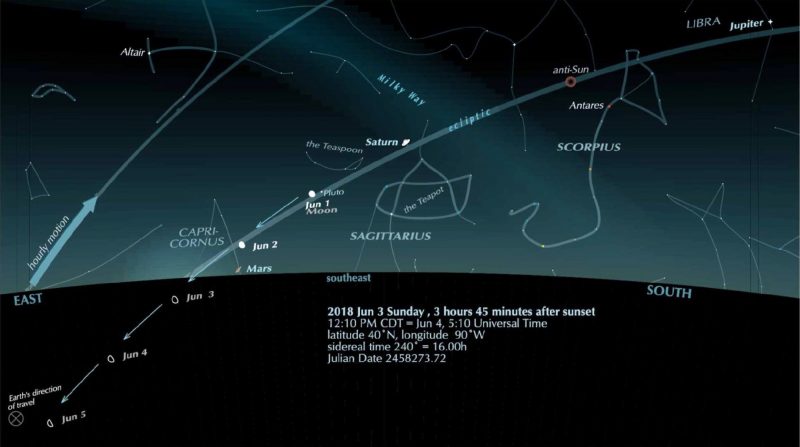
View larger. | Chart via Guy Ottewell.

Originally published at Guy Ottewell’s blog; reprinted here with permission

Mars is beginning to rise before midnight according to our picture, above, which is of the middle of the night between Sunday and Monday. This chart, which is set for my location in England, shows Mars one degree above the eastern horizon at ten minutes past midnight. The situation is much the time across the globe, although Mars’ exact rising time depends on how far north or south you are on Earth, and on how far east or west you are in your own time zone.

Also, the midnight rising of Mars is according clocks now on the summer regime of daylight saving time. They are one hour fast, pretending that 11 o’clock is “12.”

Here is part of my rising-and-setting graph for 2018:

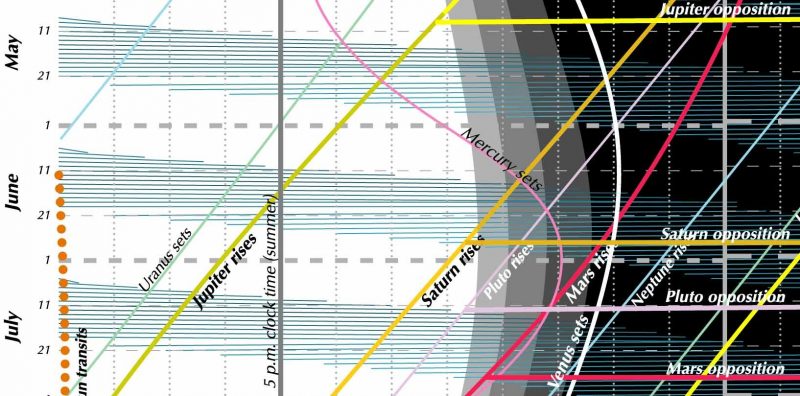
View larger. | A portion of 2018’s rising-and-setting graph – showing May, June and July – via Guy Ottewell.

The lavender vertical line near the right represents midnight; the slanting red curve labeled as Mars rises crossed it as long ago as May 12. If it were not for daylight saving time, Mars would have been rising before midnight for more than 10 days.

It has joined a late-evening-early-morning scene with Saturn and Jupiter, spread out over the zodiacal constellations of Capricornus, Sagittarius, Scorpius, and Libra, therefore enriched by Antares and the other starry features of the summer Milky Way.

Jupiter was at opposition on May 9; Saturn will be on June 27, Mars on July 27. The anti-sun point, sliding steadily eastward, meets each of these planets as it hovers on or near the ecliptic. The moon, too, rushed past the anti-sun point – that is, was full, or opposite the sun – on May 29. The moon is clearly dwindling as it passes 3 degrees north of Mars early Sunday morning (June 3 at 12 UTC).

During the night on Sunday, the moon rises about 20 minutes after Mars.

Mars was near the Beehive star cluster – aka M44, or Praesepe (The Manger) – in mid-April 2010. It is the bright reddish object in the upper left of this beautiful image by Peter Wienerroither. Used with permission.

Bottom line: Mars is now rising in the middle of the night. Its July 27 opposition will mark its brightest appearance in our sky since 2003. Mars is due to brighten dramatically before then … watch for it!

Read more: Mars brighter in 2018 than since 2003


from EarthSky https://ift.tt/2sqGvWy

View larger. | Chart via Guy Ottewell.

Originally published at Guy Ottewell’s blog; reprinted here with permission

Mars is beginning to rise before midnight according to our picture, above, which is of the middle of the night between Sunday and Monday. This chart, which is set for my location in England, shows Mars one degree above the eastern horizon at ten minutes past midnight. The situation is much the time across the globe, although Mars’ exact rising time depends on how far north or south you are on Earth, and on how far east or west you are in your own time zone.

Also, the midnight rising of Mars is according clocks now on the summer regime of daylight saving time. They are one hour fast, pretending that 11 o’clock is “12.”

Here is part of my rising-and-setting graph for 2018:

View larger. | A portion of 2018’s rising-and-setting graph – showing May, June and July – via Guy Ottewell.

The lavender vertical line near the right represents midnight; the slanting red curve labeled as Mars rises crossed it as long ago as May 12. If it were not for daylight saving time, Mars would have been rising before midnight for more than 10 days.

It has joined a late-evening-early-morning scene with Saturn and Jupiter, spread out over the zodiacal constellations of Capricornus, Sagittarius, Scorpius, and Libra, therefore enriched by Antares and the other starry features of the summer Milky Way.

Jupiter was at opposition on May 9; Saturn will be on June 27, Mars on July 27. The anti-sun point, sliding steadily eastward, meets each of these planets as it hovers on or near the ecliptic. The moon, too, rushed past the anti-sun point – that is, was full, or opposite the sun – on May 29. The moon is clearly dwindling as it passes 3 degrees north of Mars early Sunday morning (June 3 at 12 UTC).

During the night on Sunday, the moon rises about 20 minutes after Mars.

Mars was near the Beehive star cluster – aka M44, or Praesepe (The Manger) – in mid-April 2010. It is the bright reddish object in the upper left of this beautiful image by Peter Wienerroither. Used with permission.

Bottom line: Mars is now rising in the middle of the night. Its July 27 opposition will mark its brightest appearance in our sky since 2003. Mars is due to brighten dramatically before then … watch for it!

Read more: Mars brighter in 2018 than since 2003


from EarthSky https://ift.tt/2sqGvWy

2018 SkS Weekly Climate Change & Global Warming News Roundup #22

A chronological listing of news articles posted on the Skeptical Science Facebook Page during the past week.

Editor's Pick

It’s time to think seriously about cutting off the supply of fossil fuels

A new paper makes the case for supply-side climate policy.

Oil Platforms 

There is a bias in climate policy shared by analysts, politicians, and pundits across the political spectrum so common it is rarely remarked upon. To put it bluntly: Nobody, at least nobody in power, wants to restrict the supply of fossil fuels.

Policies that choke off fossil fuels at their origin — shutting down mines and wells; banning new ones; opting against new pipelines, refineries, and export terminals — have been embraced by climate activists, picking up steam with the Keystone pipeline protests and the recent direct action of the Valve Turners.

But they are looked upon with some disdain by the climate intelligentsia, who are united in their belief that such strategies are economically suboptimal and politically counterproductive.

Now a pair of economists has offered a cogent argument that the activists are onto something — that restrictive supply-side (RSS) climate policies have unique economic and political benefits and deserve a place alongside carbon prices and renewable energy supports in the climate policy toolkit.

“In our experience,” the authors write, “the climate policy community has for too long been excessively narrow in its preference for certain kinds of policy instruments (carbon taxes, cap-and trade), largely ignoring the characteristics of such instruments that affect their political feasibility and feedback effects.” I have written the same thing many times, so I think a climate policy argument that takes politics seriously deserves a close look.

To understand it, it helps to have a framework for classifying climate policies.

It’s time to think seriously about cutting off the supply of fossil fuels by David Roberts, Energy & Environment, Vox, May 31, 2018


Links posted on Facebook

Sun May 27, 2018

Mon May 28, 2018

Tue May 29, 2018

Wed May 30, 2018

Thu May 31, 2018

Fri June 1, 2018

Sat June 2, 2018


from Skeptical Science https://ift.tt/2J8tTtn
A chronological listing of news articles posted on the Skeptical Science Facebook Page during the past week.

Editor's Pick

It’s time to think seriously about cutting off the supply of fossil fuels

A new paper makes the case for supply-side climate policy.

Oil Platforms 

There is a bias in climate policy shared by analysts, politicians, and pundits across the political spectrum so common it is rarely remarked upon. To put it bluntly: Nobody, at least nobody in power, wants to restrict the supply of fossil fuels.

Policies that choke off fossil fuels at their origin — shutting down mines and wells; banning new ones; opting against new pipelines, refineries, and export terminals — have been embraced by climate activists, picking up steam with the Keystone pipeline protests and the recent direct action of the Valve Turners.

But they are looked upon with some disdain by the climate intelligentsia, who are united in their belief that such strategies are economically suboptimal and politically counterproductive.

Now a pair of economists has offered a cogent argument that the activists are onto something — that restrictive supply-side (RSS) climate policies have unique economic and political benefits and deserve a place alongside carbon prices and renewable energy supports in the climate policy toolkit.

“In our experience,” the authors write, “the climate policy community has for too long been excessively narrow in its preference for certain kinds of policy instruments (carbon taxes, cap-and trade), largely ignoring the characteristics of such instruments that affect their political feasibility and feedback effects.” I have written the same thing many times, so I think a climate policy argument that takes politics seriously deserves a close look.

To understand it, it helps to have a framework for classifying climate policies.

It’s time to think seriously about cutting off the supply of fossil fuels by David Roberts, Energy & Environment, Vox, May 31, 2018


Links posted on Facebook

Sun May 27, 2018

Mon May 28, 2018

Tue May 29, 2018

Wed May 30, 2018

Thu May 31, 2018

Fri June 1, 2018

Sat June 2, 2018


from Skeptical Science https://ift.tt/2J8tTtn

What makes a halo around the sun or moon?

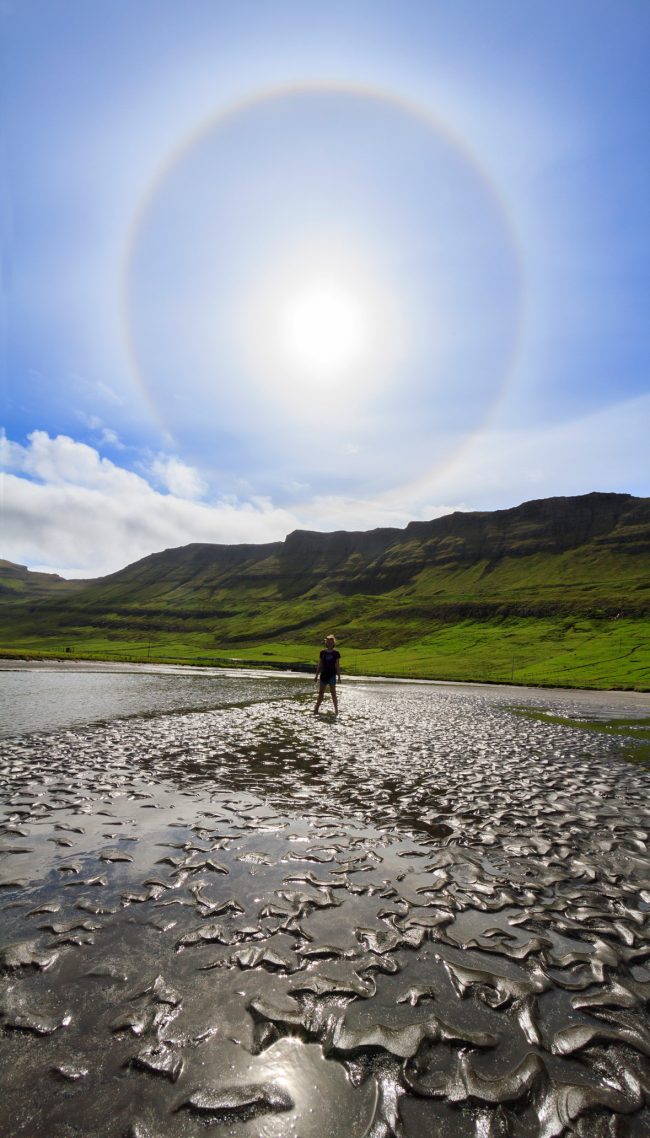
Robert Green of London caught this glorious solar halo on August 12, 2017 from Suðuroy, Faroe Islands. His daughter Mia is standing beneath!

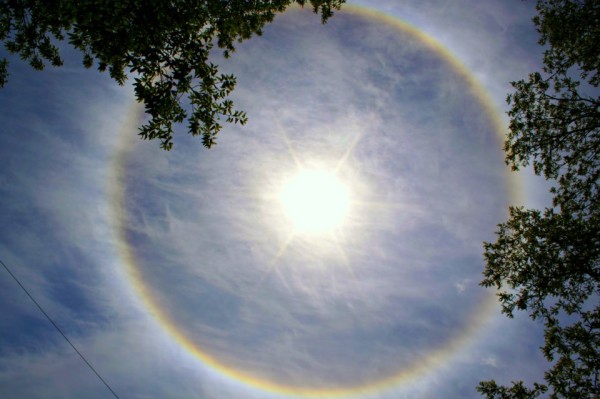
We get many messages throughout each year from people who’ve just spotted a large ring or circle of light around the sun or moon. Scientists call them 22-degree halos. Why? Because the ring has a radius of approximately 22° around the sun or moon.

People always ask, what causes these gigantic rings?

There’s an old weather saying: ring around the moon means rain soon. There’s truth to this saying, because high cirrus clouds often come before a storm. Notice in these photos that the sky looks fairly clear. After all, you can see the sun or moon. And yet halos are a sign of high thin cirrus clouds drifting 20,000 feet or more above our heads.

Help EarthSky keep going! Please donate what you can to our annual crowd-funding campaign.

lunar halo emerges

Eliot Herman wrote on May 5, 2018: “This shows the change that occurred over 7 minutes as a lunar halo emerged. It then persisted for about 40 minutes and disappeared with increasing clouds. Although it appears the halo is forming from an odd shape what is actually illuminated is the edge of the clouds just before the halo formed as the clouds drifted in front of the moon. But it does have a nice illusion of an odd shaped halo then becoming round.”

These clouds contain millions of tiny ice crystals. The halos you see are caused by both refraction, or splitting of light, and also by reflection, or glints of light from these ice crystals. The crystals have to be oriented and positioned just so with respect to your eye, in order for the halo to appear.

That’s why, like rainbows, halos around the sun – or moon – are personal. Everyone sees their own particular halo, made by their own particular ice crystals, which are different from the ice crystals making the halo of the person standing next to you.

Sheryl R. Garrison in Idaho caught the November 14 supermoon. She wrote:

Sheryl R. Garrison in Idaho caught the November 14, 2016 supermoon. She wrote: “I’ve caught lunar halos before but tonight was a first for me to catch one with an arc … The arc didn’t last for long, just enough time for me to grab the tripod.” By the way, this is a special type of 22-degree lunar halo, called a circumscribed halo.

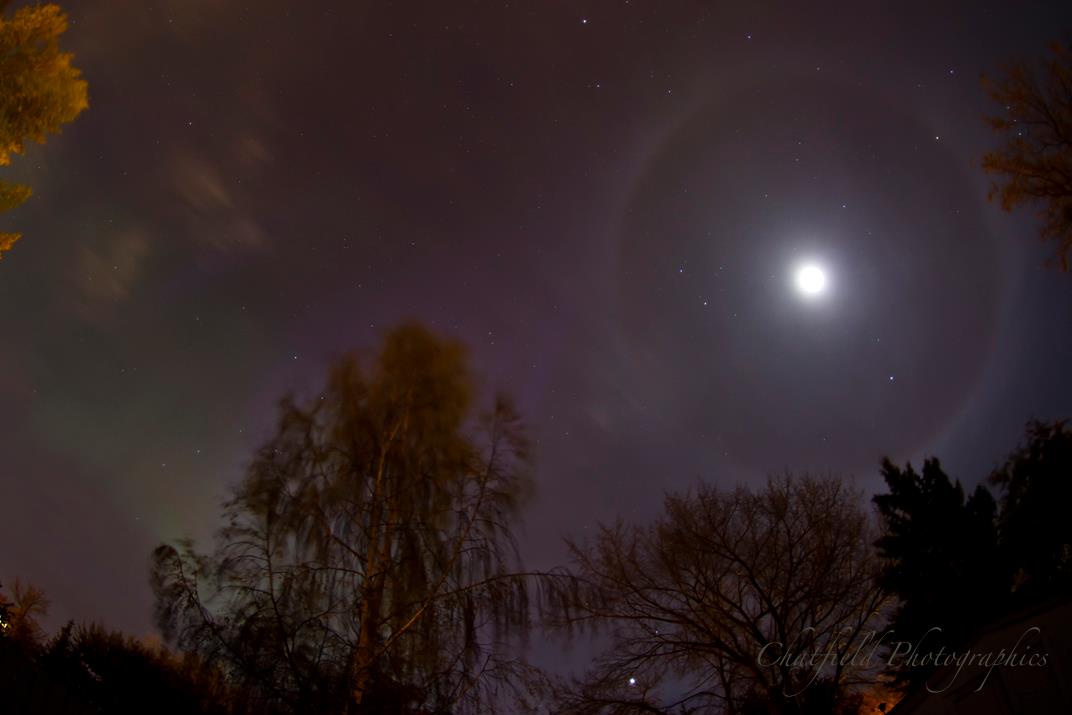
If you see a halo, notice this! Because moonlight isn’t very bright, lunar halos are mostly colorless, but you might notice more red on the inside and more blue on the outside of the halo. These colors are more noticeable in halos around the sun. If you do see a halo around the moon or sun, notice that the inner edge is sharp, while the outer edge is more diffuse. Also, notice that the sky surrounding the halo is darker than the rest of the sky.

A moon halo in Mandan, North Dakota by Marshall Lipp. February, 2015.

A moon halo in Mandan, North Dakota by Marshall Lipp. February, 2015.

Sun halo and sundogs. Captured 37,000 feet up, over Bhopal, India, on October 3, 2015. Photo by CB Devgun.

Sun halo and sundogs. Captured 37,000 feet up, over Bhopal, India, on October 3, 2015. Photo by CB Devgun.

Doug Waters in New Bern, North Carolina wrote:

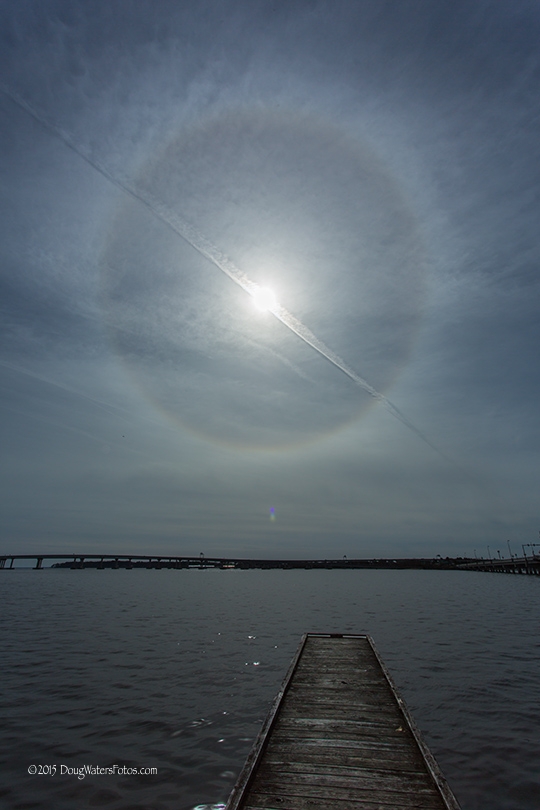
Doug Waters in New Bern, North Carolina caught this photo on February 4, 2015. He wrote: “High cyrus clouds from an approaching weather system presented the perfect opportunity for a halo to form around the sun, which appeared to be pierced by the con trail of a passing airliner.” Thanks for sharing your photo with EarthSky, Doug.

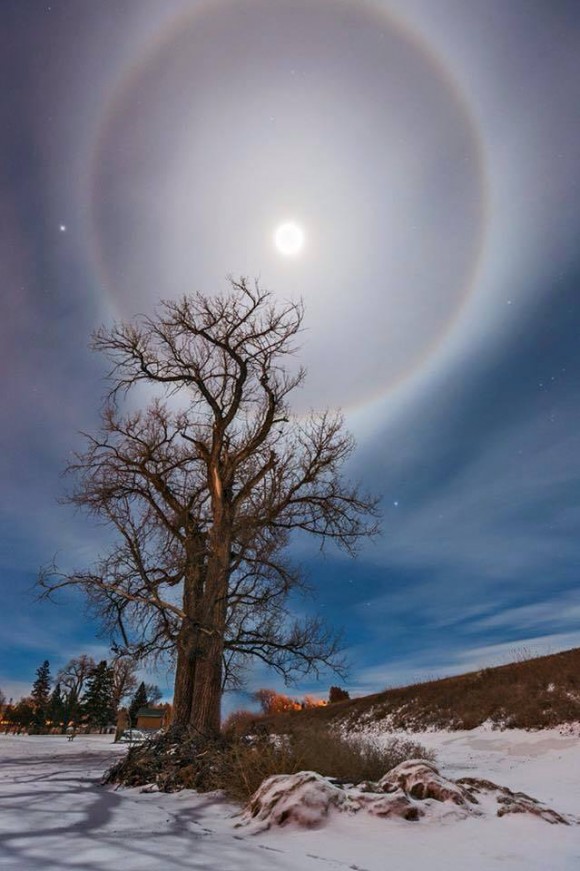
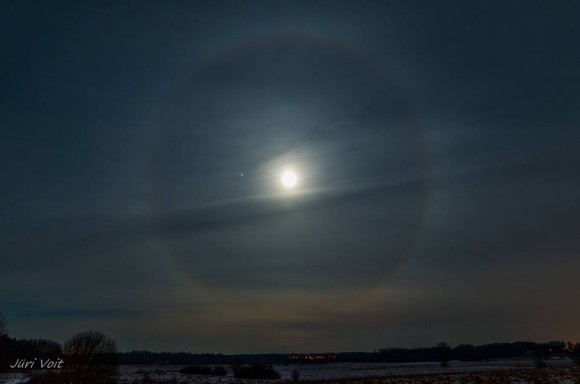
Jupiter and full moon witin lunar halo on February 3, 2015. Seen from Estonia by EarthSky Facebook friend Jüri Voit. See more moon and Jupiter pics.

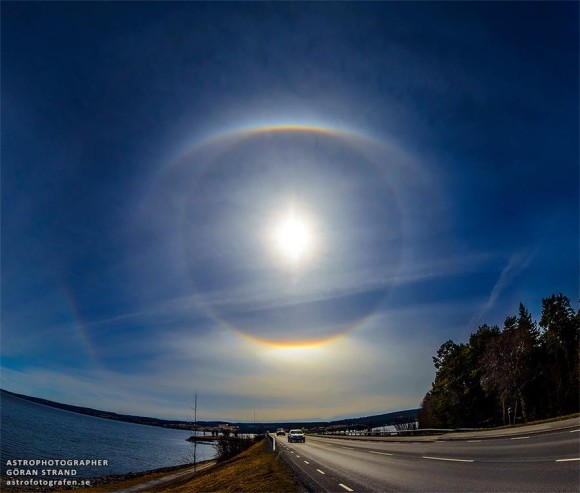
Halo around the sun, seen from Sweden on April 24, 2014 and captured by Fotograf Goran Strand.

Halo around the sun, seen from Sweden on April 24, 2014 and captured by Fotograf Goran Strand.

Moon halo captured by Aaron Robinson in Idaho Falls, Idaho on January 30, 2015.

Moon halo captured by Aaron Robinson in Idaho Falls, Idaho on January 30, 2015.

Abhinav Singhai captured this halo above wheat fields. Visit Abhinav Singhai's Flickr page

Abhinav Singhai captured this sun halo above wheat fields in November, 2014. Visit Abhinav Singhai’s Flickr page

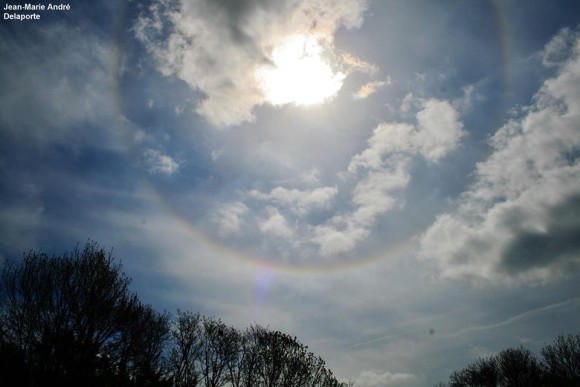
EarthSky Facebook friend Jean Marie Andre Delaporte captured this image of a halo around the sun in Normandy, France on April 23, 2014.

Jean Marie Andre Delaporte captured this image of a halo around the sun in Normandy, France in April, 2014.

Solar halo seen May 14, 2013 in Monmouth, NJ, as captured by EarthSky Facebook friend Stacey Baker-Bruno. Thank you, Stacey! See more photos of May 14, 2013 photo here.

Solar halo seen May 14, 2013 in Monmouth, NJ, as captured by EarthSky Facebook friend Stacey Baker-Bruno. Thank you, Stacey! See more photos of May 14, 2013 halo here.

Halos around the sun and moon are associated with storms. On the night Superstorm Sandy made landfall in 2012, we received photos of lunar halos from across the U.S., and even as far west in the U.S. as the state of Washington. EarthSky Facebook friend Susan Jensen in Odessa, Washington saw and photographed this delicate halo, as Sandy was carving its path of destruction along the U.S. East Coast.

Lunar halo – with greenish northern lights on the left – as seen on the morning of October 8, 2012 by EarthSky Facebook friend Colin Chatfield in Saskatoon, Saskatchewan, Canada.

View larger. | Sun halo seen in Tucson, Arizona in September, 2012 by EarthSky Facebook friend Sean Parker Photography. Thank you, Sean! More from Sean here.

Bottom line: Halos around the sun or moon are caused by high, thin cirrus clouds drifting high above your head. Tiny ice crystals in Earth’s atmosphere create the halos. They do it by refracting and reflecting the light. Lunar halos are signs that storms are nearby.

Help EarthSky keep going! Please donate what you can to our annual crowd-funding campaign.


from EarthSky https://ift.tt/12uTQsL

Robert Green of London caught this glorious solar halo on August 12, 2017 from Suðuroy, Faroe Islands. His daughter Mia is standing beneath!

We get many messages throughout each year from people who’ve just spotted a large ring or circle of light around the sun or moon. Scientists call them 22-degree halos. Why? Because the ring has a radius of approximately 22° around the sun or moon.

People always ask, what causes these gigantic rings?

There’s an old weather saying: ring around the moon means rain soon. There’s truth to this saying, because high cirrus clouds often come before a storm. Notice in these photos that the sky looks fairly clear. After all, you can see the sun or moon. And yet halos are a sign of high thin cirrus clouds drifting 20,000 feet or more above our heads.

Help EarthSky keep going! Please donate what you can to our annual crowd-funding campaign.

lunar halo emerges

Eliot Herman wrote on May 5, 2018: “This shows the change that occurred over 7 minutes as a lunar halo emerged. It then persisted for about 40 minutes and disappeared with increasing clouds. Although it appears the halo is forming from an odd shape what is actually illuminated is the edge of the clouds just before the halo formed as the clouds drifted in front of the moon. But it does have a nice illusion of an odd shaped halo then becoming round.”

These clouds contain millions of tiny ice crystals. The halos you see are caused by both refraction, or splitting of light, and also by reflection, or glints of light from these ice crystals. The crystals have to be oriented and positioned just so with respect to your eye, in order for the halo to appear.

That’s why, like rainbows, halos around the sun – or moon – are personal. Everyone sees their own particular halo, made by their own particular ice crystals, which are different from the ice crystals making the halo of the person standing next to you.

Sheryl R. Garrison in Idaho caught the November 14 supermoon. She wrote:

Sheryl R. Garrison in Idaho caught the November 14, 2016 supermoon. She wrote: “I’ve caught lunar halos before but tonight was a first for me to catch one with an arc … The arc didn’t last for long, just enough time for me to grab the tripod.” By the way, this is a special type of 22-degree lunar halo, called a circumscribed halo.

If you see a halo, notice this! Because moonlight isn’t very bright, lunar halos are mostly colorless, but you might notice more red on the inside and more blue on the outside of the halo. These colors are more noticeable in halos around the sun. If you do see a halo around the moon or sun, notice that the inner edge is sharp, while the outer edge is more diffuse. Also, notice that the sky surrounding the halo is darker than the rest of the sky.

A moon halo in Mandan, North Dakota by Marshall Lipp. February, 2015.

A moon halo in Mandan, North Dakota by Marshall Lipp. February, 2015.

Sun halo and sundogs. Captured 37,000 feet up, over Bhopal, India, on October 3, 2015. Photo by CB Devgun.

Sun halo and sundogs. Captured 37,000 feet up, over Bhopal, India, on October 3, 2015. Photo by CB Devgun.

Doug Waters in New Bern, North Carolina wrote:

Doug Waters in New Bern, North Carolina caught this photo on February 4, 2015. He wrote: “High cyrus clouds from an approaching weather system presented the perfect opportunity for a halo to form around the sun, which appeared to be pierced by the con trail of a passing airliner.” Thanks for sharing your photo with EarthSky, Doug.

Jupiter and full moon witin lunar halo on February 3, 2015. Seen from Estonia by EarthSky Facebook friend Jüri Voit. See more moon and Jupiter pics.

Halo around the sun, seen from Sweden on April 24, 2014 and captured by Fotograf Goran Strand.

Halo around the sun, seen from Sweden on April 24, 2014 and captured by Fotograf Goran Strand.

Moon halo captured by Aaron Robinson in Idaho Falls, Idaho on January 30, 2015.

Moon halo captured by Aaron Robinson in Idaho Falls, Idaho on January 30, 2015.

Abhinav Singhai captured this halo above wheat fields. Visit Abhinav Singhai's Flickr page

Abhinav Singhai captured this sun halo above wheat fields in November, 2014. Visit Abhinav Singhai’s Flickr page

EarthSky Facebook friend Jean Marie Andre Delaporte captured this image of a halo around the sun in Normandy, France on April 23, 2014.

Jean Marie Andre Delaporte captured this image of a halo around the sun in Normandy, France in April, 2014.

Solar halo seen May 14, 2013 in Monmouth, NJ, as captured by EarthSky Facebook friend Stacey Baker-Bruno. Thank you, Stacey! See more photos of May 14, 2013 photo here.

Solar halo seen May 14, 2013 in Monmouth, NJ, as captured by EarthSky Facebook friend Stacey Baker-Bruno. Thank you, Stacey! See more photos of May 14, 2013 halo here.

Halos around the sun and moon are associated with storms. On the night Superstorm Sandy made landfall in 2012, we received photos of lunar halos from across the U.S., and even as far west in the U.S. as the state of Washington. EarthSky Facebook friend Susan Jensen in Odessa, Washington saw and photographed this delicate halo, as Sandy was carving its path of destruction along the U.S. East Coast.

Lunar halo – with greenish northern lights on the left – as seen on the morning of October 8, 2012 by EarthSky Facebook friend Colin Chatfield in Saskatoon, Saskatchewan, Canada.

View larger. | Sun halo seen in Tucson, Arizona in September, 2012 by EarthSky Facebook friend Sean Parker Photography. Thank you, Sean! More from Sean here.

Bottom line: Halos around the sun or moon are caused by high, thin cirrus clouds drifting high above your head. Tiny ice crystals in Earth’s atmosphere create the halos. They do it by refracting and reflecting the light. Lunar halos are signs that storms are nearby.

Help EarthSky keep going! Please donate what you can to our annual crowd-funding campaign.


from EarthSky https://ift.tt/12uTQsL

News digest – cancer blood test, brain tumour vaccine, smoking, and how to predict a tumour’s future

‘Simple blood test’ still not the finished article

Blood tests to detect cancer regularly make the headlines, and an accurate test would be great news for patients. But, in reality, they’re rarely close to being widely used. The latest blood test story came from unpublished work presented at the large ASCO conference taking place in Chicago. Despite the headlines, the “holy grail” of cancer treatment is still some way off. The test was used on patients who had already been diagnosed. But didn’t pick up every cancer. And it was better at picking up some cancers types than others. Bigger studies are now needed to see if this blood test can pick up cancer before a person has symptoms, and ultimately if this can help save lives.

Vaccine against glioblastoma makes progress

Early results from a long-running study showed that brain tumour patients given a vaccine lived on average more than twice as long as those on standard treatment. The Guardian reports on the experimental vaccine that has been engineered to attack glioblastoma, an aggressive type of brain tumour.

Wales to ban smoking outside schools and hospitals

Wales has announced plans to become the first country in the UK to ban smoking outside schools and hospitals. The Express and The Sun report that the Welsh government hopes to extend the smoking ban by next summer, and will include playgrounds.

Smoking rates fall worldwide

More on smoking as The World Health Organisation released new figures showing the global pattern of smoking. The Telegraph points out that even though smoking rates declined globally overall, the number of smokers in poorer countries is rising.

MPs call for tax on unhealthy foods 

The Telegraph and The Sun report calls from MPs to tax unhealthy foods as another attempt to tackle the obesity crisis. They also suggested that the sugar tax should be extended to chocolate and puddings.

Tracking cancer’s past to predict its future

Our scientists have used computers and genetic data to piece together a cancer’s history. According to The Times (£), this could help researchers develop a way to predict the next steps that a tumour will take as it progresses. We talk to the scientists involved in the study in this blog post.

Can we teach an AI machine to recognise skin cancer?

Using more than 100,000 images, researchers have taught a computer how to recognise melanoma, an aggressive form of skin cancer, reports The Sun. The programme could one-day have the potential to help doctors diagnose skin cancer, but we need further studies to know if this technology could help accurately diagnose patients.

Antifungal treatment kills sleeping bowel cancer cells in mice

A common antifungal treatment for infected toenails has been shown to get rid of sleeping bowel cancer cells in the gut of mice, according to the Independent. Our researchers found that, as well as killing ‘active’ bowel cancer cells, it also hit those that lie in a dormant state. These cells can be responsible for the tumour coming back, and can be missed by some treatments. Read our press release for more.

Ovarian cancer drug approved for NHS use

The National Institute for Health and Care Excellence (Nice) has said the ovarian cancer drug niraparib can be made available to some women on the NHS in England and Wales. The Guardian reports that up to 850 women could benefit.

Everyday changes could avoid thousands of cancers a year

Around 500 cases of cancer in UK women could be prevented each week by keeping a healthy weight, eating more fibre and increasing exercise, reports The Sun and Mail Online. Our press release has the details.

And finally

One of the largest cancer conferences, the ASCO annual meeting, is taking place in Chicago. It’s where researchers gather to discuss their latest findings, with lots of stories making the papers. We’ll be covering the latest from the conference on our blog, and you can check out this post for a few tips to help you judge a story for yourself.

Gabi


from Cancer Research UK – Science blog https://ift.tt/2Jp3oDl

‘Simple blood test’ still not the finished article

Blood tests to detect cancer regularly make the headlines, and an accurate test would be great news for patients. But, in reality, they’re rarely close to being widely used. The latest blood test story came from unpublished work presented at the large ASCO conference taking place in Chicago. Despite the headlines, the “holy grail” of cancer treatment is still some way off. The test was used on patients who had already been diagnosed. But didn’t pick up every cancer. And it was better at picking up some cancers types than others. Bigger studies are now needed to see if this blood test can pick up cancer before a person has symptoms, and ultimately if this can help save lives.

Vaccine against glioblastoma makes progress

Early results from a long-running study showed that brain tumour patients given a vaccine lived on average more than twice as long as those on standard treatment. The Guardian reports on the experimental vaccine that has been engineered to attack glioblastoma, an aggressive type of brain tumour.

Wales to ban smoking outside schools and hospitals

Wales has announced plans to become the first country in the UK to ban smoking outside schools and hospitals. The Express and The Sun report that the Welsh government hopes to extend the smoking ban by next summer, and will include playgrounds.

Smoking rates fall worldwide

More on smoking as The World Health Organisation released new figures showing the global pattern of smoking. The Telegraph points out that even though smoking rates declined globally overall, the number of smokers in poorer countries is rising.

MPs call for tax on unhealthy foods 

The Telegraph and The Sun report calls from MPs to tax unhealthy foods as another attempt to tackle the obesity crisis. They also suggested that the sugar tax should be extended to chocolate and puddings.

Tracking cancer’s past to predict its future

Our scientists have used computers and genetic data to piece together a cancer’s history. According to The Times (£), this could help researchers develop a way to predict the next steps that a tumour will take as it progresses. We talk to the scientists involved in the study in this blog post.

Can we teach an AI machine to recognise skin cancer?

Using more than 100,000 images, researchers have taught a computer how to recognise melanoma, an aggressive form of skin cancer, reports The Sun. The programme could one-day have the potential to help doctors diagnose skin cancer, but we need further studies to know if this technology could help accurately diagnose patients.

Antifungal treatment kills sleeping bowel cancer cells in mice

A common antifungal treatment for infected toenails has been shown to get rid of sleeping bowel cancer cells in the gut of mice, according to the Independent. Our researchers found that, as well as killing ‘active’ bowel cancer cells, it also hit those that lie in a dormant state. These cells can be responsible for the tumour coming back, and can be missed by some treatments. Read our press release for more.

Ovarian cancer drug approved for NHS use

The National Institute for Health and Care Excellence (Nice) has said the ovarian cancer drug niraparib can be made available to some women on the NHS in England and Wales. The Guardian reports that up to 850 women could benefit.

Everyday changes could avoid thousands of cancers a year

Around 500 cases of cancer in UK women could be prevented each week by keeping a healthy weight, eating more fibre and increasing exercise, reports The Sun and Mail Online. Our press release has the details.

And finally

One of the largest cancer conferences, the ASCO annual meeting, is taking place in Chicago. It’s where researchers gather to discuss their latest findings, with lots of stories making the papers. We’ll be covering the latest from the conference on our blog, and you can check out this post for a few tips to help you judge a story for yourself.

Gabi


from Cancer Research UK – Science blog https://ift.tt/2Jp3oDl

Restricting global warming to 1.5C could ‘halve’ risk of biodiversity loss

This is a re-post from Carbon Brief by Daisy Dunne

Limiting global warming to 1.5C above pre-industrial levels rather than 2C could halve the number of vertebrate and plant species facing severe range loss by the end of the century, a study finds.

The analysis of more than 115,000 species finds that keeping warming at 1.5C – which is the aspirational target of the Paris Agreement – instead of 2C could also cut the number of insects facing severe range loss by two-thirds.

However, if countries fail to ramp up their efforts to address climate change, around a quarter of all vertebrates (animals with a spine), half of insects and 44% of plants could face severe range loss, the lead author tells Carbon Brief.

The greatest range losses are expected to occur in some of the world’s biodiversity hotspots, the author adds, including in the Amazon and southern Africa.

Although the findings are significant, the research does not explore all the factors relevant to species survival, including the impact of evolution, another scientist tells Carbon Brief.

Hostile planet

Climate change threatens wildlife in a host of ways. One way is by reducing a species’ geographical range – the extent of the area where it is able to survive.

This can occur when local temperatures become too hot for species to tolerate or when changing rainfall patterns affect the types of food available, for example. As a species’ range contracts, its risk of extinction can increase.

The new study, published in Science, uses a set of global climate models to explore how warming this century could affect the ranges of more than 115,000 species that live on land.

For the analysis, the researchers used four scenarios, including where warming is limited to, in order, 1.5C, 2C, 3.2C (which is the amount of warming anticipated if countries stick to their national pledges to cut emissions) and to 4.5C, the amount of warming expected under a “business as usual” scenario (“RCP8.5”).

The research finds that, if warming is limited to 2C, 8% of vertebrates, 18% of insects and 16% of plants could lose at least half of their current range by 2100.

However, if warming is limited to 1.5C, this risk is halved for vertebrates and plants, and cut by two-thirds for insects.

Unequal losses

The charts below show how future global warming is expected to affect the ranges of invertebrates (A), vertebrates (B) and plants (C) , and also a further breakdown of how warming could affect insects (D), mammals (E) and birds (F).

The x-axis shows temperature rise above pre-industrial levels, while the y-axis shows the proportion of species expected to lose more than half of their range.

On the charts, results for “no dispersal” (yellow) and “realistic dispersal” (blue) are shown. The “realistic dispersal” results consider the ability of animals to move away from their site of birth into new areas, explains lead author Prof Rachel Warren, a researcher of global change and environmental biology at the Tyndall Centre for Climate Change Research. She tells Carbon Brief:

“​’No dispersal’ means that we assume the animals don’t move. ‘Dispersal’ means species can move at rates they’ve been observed to move at in response to the climate change that has happened so far.”
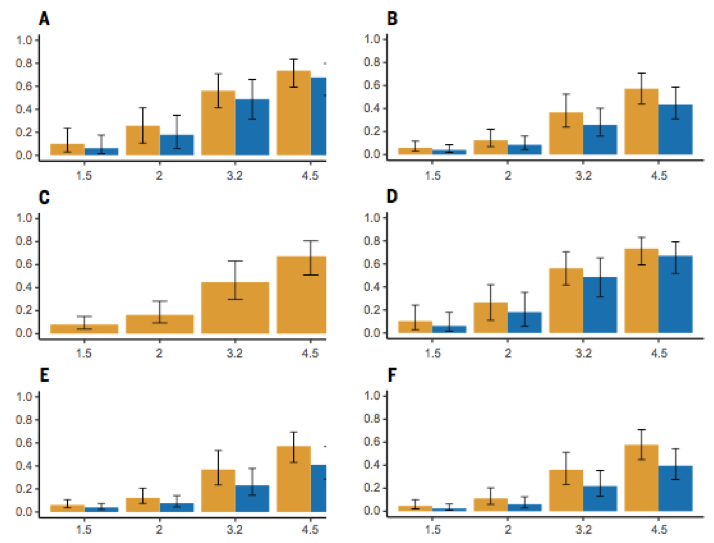
The proportion of species expected to lose more than half of their range by 2100 under different levels of temperature rise. Results are shown for invertebrates (A), vertebrates (B), plants (C), insects (D), mammals (E) and birds (F). Source: Warren et al. (2018)

The results show how invertebrates (A), such as insects, spiders and worms, are expected to lose a larger proportion of their range than vertebrates (B), such as mammals, birds and reptiles.

Insect species at a particularly high risk include key crop pollinators, including bees, hoverflies and blowflies, the research notes. This is due to a range of factors linked to insect physiology and lifestyle, says Warren:

“It is probably because they are ectothermic, which means that their body temperature is controlled externally, not internally, as in humans. Also they have life stages – eggs, larvae, pupae, as well as adults. Each of these stages might be vulnerable to different things, such as eggs drying out if there is too little rainfall.”
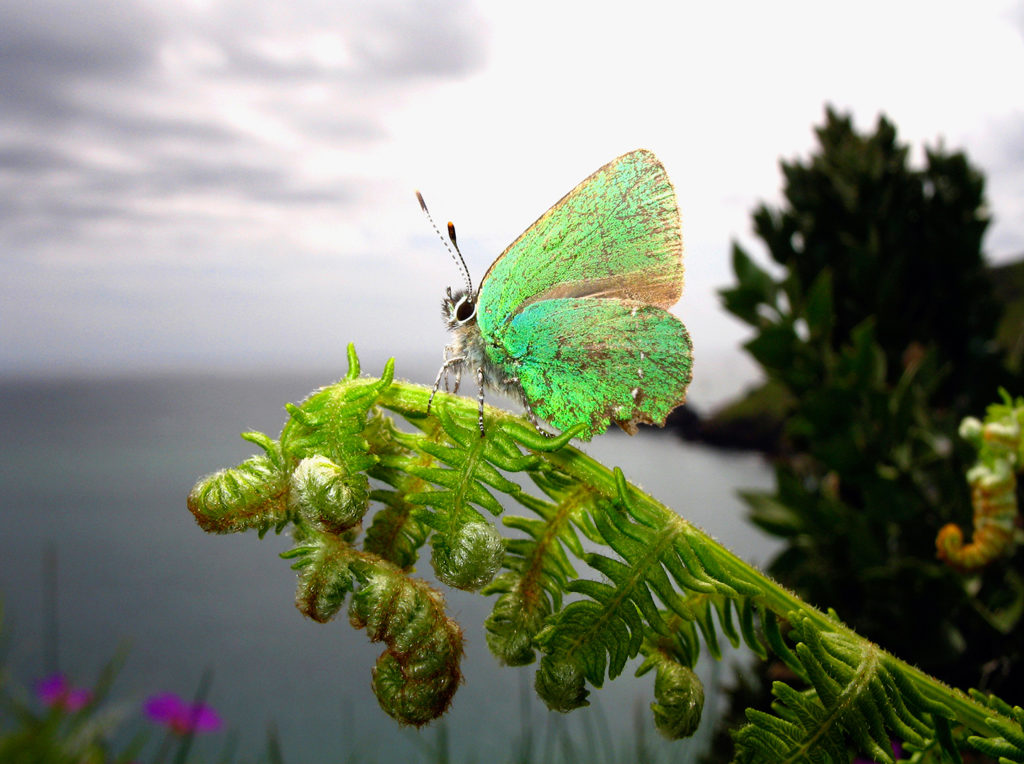
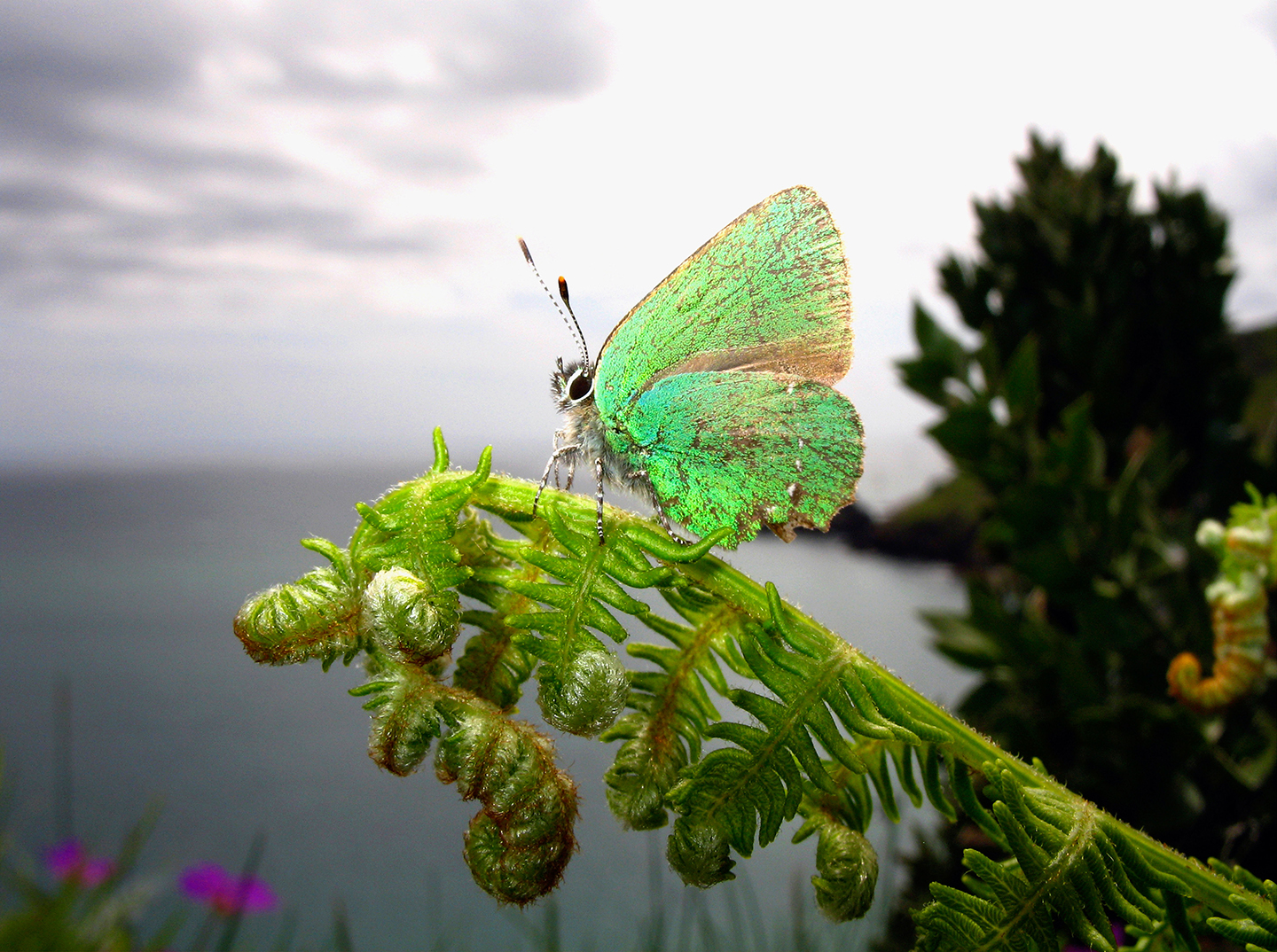
BMKF99 Green Hairstreak Butterfly perched on a fern, Devon Coast, UK.

Green Hairstreak Butterfly perched on a fern, Devon Coast, UK. Credit: Steve Bloom Images/Alamy Stock Photo.

For mammals (E) and birds (F), risks remain low at 1.5C but grow significantly larger as warming increases, the research finds. Mammals most at risk include critically endangered species such as the black rhino, which also faces significant challenges from habitat loss and poaching.

Warming hotspots

The maps below show how different levels of warming could affect global species diversity for vertebrates. The charts show the proportion of species expected to remain by 2100 – from 90-100% remaining (blue) down to just 0-10% of species remaining (red) – with and without the impact of dispersal.

The proportion of vertebrate species expected to remain in world regions by 2100 under different levels of temperature rise (from top to bottom: 1.5, 2, 3.2, 4.5C). Red shows 0-10% of species remaining while dark blue shows 90-100% remaining. Source: Warren et al. (2018)

The maps reveal that, if future global warming reaches 3.2-4.5C, striking biodiversity loss could occur in some of the world’s wildlife hotspots, including southern Africa and the Amazon – which is home to 30% of the world’s species.
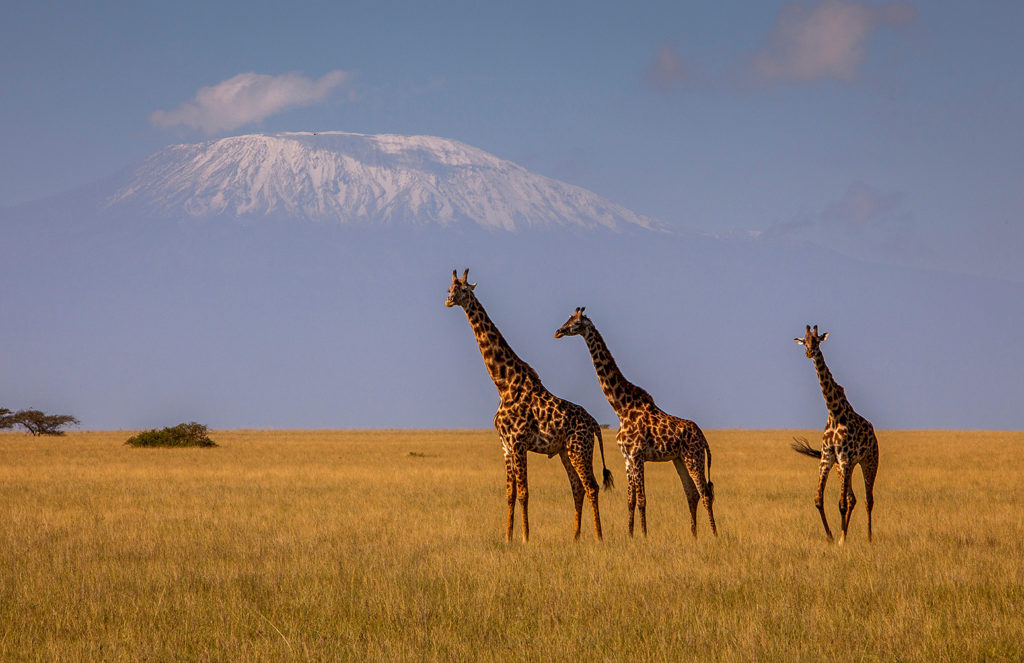
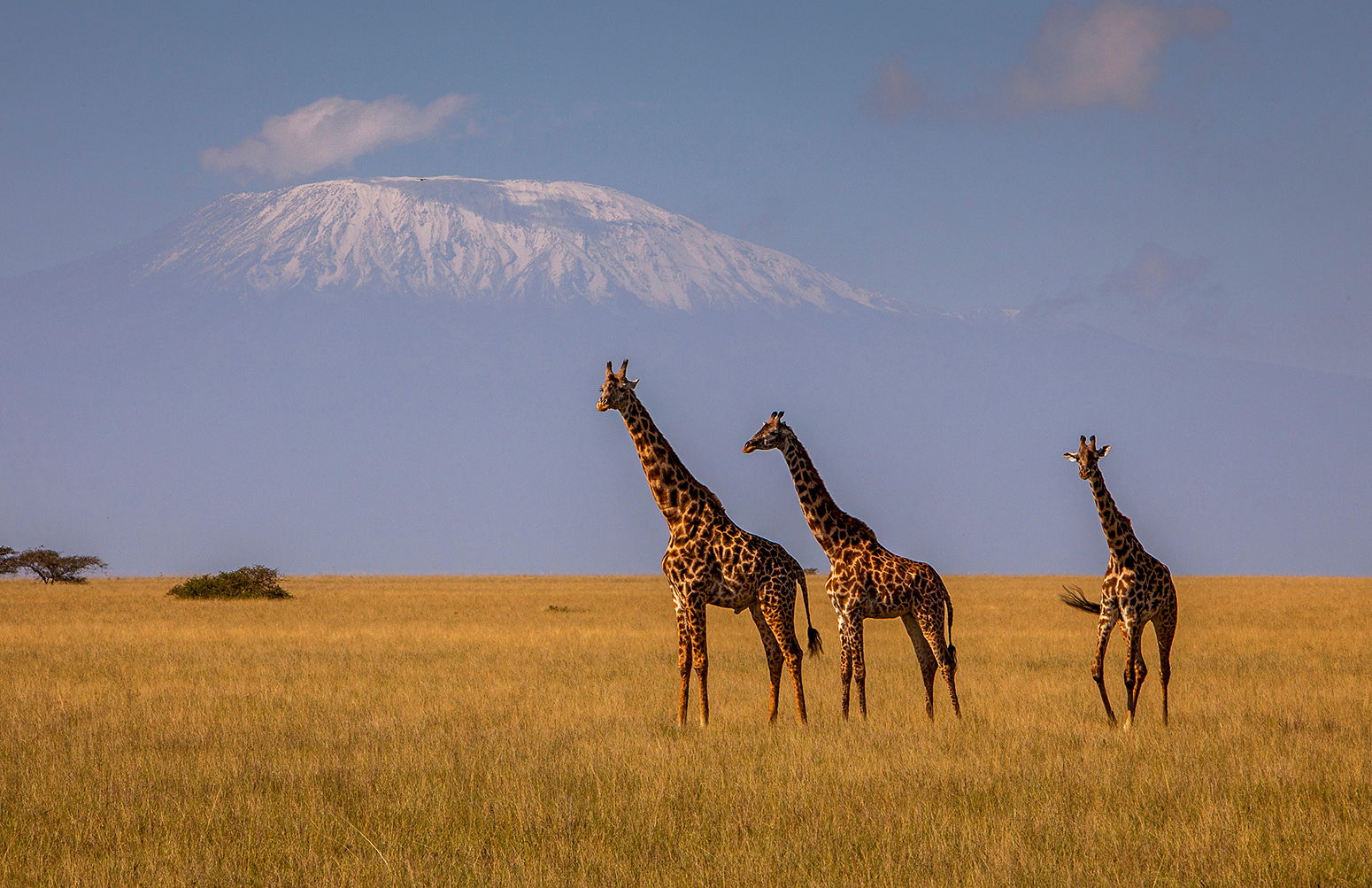
HNWCNF Giraffe, Giraffa camelopardalis, with Mount Kilimanjaro in the background, Chyulu Hills National Park, Kenya.

Giraffe in front of Mount Kilimanjaro, Chyulu Hills National Park, Kenya. Credit: Lucas Vallecillos/Alamy Stock Photo.

This could be because temperatures in the tropics and subtropics are relatively consistent from one season to the next, which means resident species are less used to large swings in temperature, says Warren:

“Here in the UK, we can have terrible summers and very nice ones – whereas in the tropics it’s much more predictable. This means that, in temperate lands, species are likely to be buffered against quite large natural climate variability. Whereas in the tropics, as the average climate changes, it could get quickly outside the range of natural variability that species are adapted to.”

Other regions expected to suffer species losses include Australia, the last remaining habitat of marsupials, and the high Arctic, home of the polar bear, the Arctic fox and caribou.

BECCS trade-off

The results show that meeting the Paris Agreement’s aspirational target of limiting warming to 1.5C would bring “substantial benefits” for wildlife, the scientists write in their research paper:

“Successful implementation of the Paris Agreement could lead to substantial benefits for global terrestrial [land] biodiversity…However, restricting warming to 1.5C may be difficult.”

This difficulty lies in the assumption that “negative emissions technologies” will be able to help the world meet the 1.5C target, the researchers say. Most scenarios envisaging how the world could limit warming 1.5C incorporate a negative emissions technology known as bioenergy with carbon capture and storage (BECCS).

Put simply, BECCS involves burning biomass – such as trees and crops – to generate energy and then capturing the resulting CO2 emissions before they are released into the air.

The technology has yet to be demonstrated on a commercial basis, and recent researchshows its potential may be more limited than previously thought.

Even if BECCS is developed on a wide scale, the researchers say, it could pose a significant threat to biodiversity.

That is because large scale BECCS could require up to 18% of the land surface to be converted to biomass plantations, they say, which would drive up competition for land.

This could lead to more deforestation and habitat loss to meet bioenergy and agriculture requirements, they say:

“New studies are exploring scenarios in which BECCS is produced from secondary biofuels, or in which there are dietary changes in humans, resulting in greatly reduced effects of indirect land-use change.”

Survival of the fittest

The study provides “phenomenal coverage” of how climate change could impact biodiversity, says Colin Carlson, a postdoctoral fellow at Georgetown University, who was not involved in the research. Carlson previously published a study looking at the impact of climate change on the world’s parasites. He tells Carbon Brief:

“I expect it’ll be one of the most significant papers in this discipline soon. The focus on climate change mitigation ties into a lot of hot button issues right now – not just Paris, but also alternative solutions for mitigation, like CO2 removal.”

However, the study does not include many of the factors that are key to species survival, says Prof Georgina Mace, director of the Centre for Biodiversity and Environment Research at University College London, who was not involved in the research. She tells Carbon Brief:

“For example, the presence of critical resources, such as food, prey and nest sites; extreme events, pressures from habitat loss, or changes to biotic interactions, often overwhelm climate change effects. So the range loss estimates in this paper have a lot of uncertainty that is not represented.”

The research also does not consider the possibility that some species may be able to evolve new adaptations to cope with climate change, she adds:

“The year 2100 is a long way ahead and species are continuously adapting and evolving; the strong selective pressures mean that many will adapt to deal with climate change. Over this period of time, several hundred generations for many insects, we can expect evolutionary adaptation.”


Warren, R. et al. (2018) The projected effect on insects, vertebrates, and plants of limiting global warming to 1.5C rather than 2C, doi/10.1126/science.aar3646


from Skeptical Science https://ift.tt/2J5NaQ0

This is a re-post from Carbon Brief by Daisy Dunne

Limiting global warming to 1.5C above pre-industrial levels rather than 2C could halve the number of vertebrate and plant species facing severe range loss by the end of the century, a study finds.

The analysis of more than 115,000 species finds that keeping warming at 1.5C – which is the aspirational target of the Paris Agreement – instead of 2C could also cut the number of insects facing severe range loss by two-thirds.

However, if countries fail to ramp up their efforts to address climate change, around a quarter of all vertebrates (animals with a spine), half of insects and 44% of plants could face severe range loss, the lead author tells Carbon Brief.

The greatest range losses are expected to occur in some of the world’s biodiversity hotspots, the author adds, including in the Amazon and southern Africa.

Although the findings are significant, the research does not explore all the factors relevant to species survival, including the impact of evolution, another scientist tells Carbon Brief.

Hostile planet

Climate change threatens wildlife in a host of ways. One way is by reducing a species’ geographical range – the extent of the area where it is able to survive.

This can occur when local temperatures become too hot for species to tolerate or when changing rainfall patterns affect the types of food available, for example. As a species’ range contracts, its risk of extinction can increase.

The new study, published in Science, uses a set of global climate models to explore how warming this century could affect the ranges of more than 115,000 species that live on land.

For the analysis, the researchers used four scenarios, including where warming is limited to, in order, 1.5C, 2C, 3.2C (which is the amount of warming anticipated if countries stick to their national pledges to cut emissions) and to 4.5C, the amount of warming expected under a “business as usual” scenario (“RCP8.5”).

The research finds that, if warming is limited to 2C, 8% of vertebrates, 18% of insects and 16% of plants could lose at least half of their current range by 2100.

However, if warming is limited to 1.5C, this risk is halved for vertebrates and plants, and cut by two-thirds for insects.

Unequal losses

The charts below show how future global warming is expected to affect the ranges of invertebrates (A), vertebrates (B) and plants (C) , and also a further breakdown of how warming could affect insects (D), mammals (E) and birds (F).

The x-axis shows temperature rise above pre-industrial levels, while the y-axis shows the proportion of species expected to lose more than half of their range.

On the charts, results for “no dispersal” (yellow) and “realistic dispersal” (blue) are shown. The “realistic dispersal” results consider the ability of animals to move away from their site of birth into new areas, explains lead author Prof Rachel Warren, a researcher of global change and environmental biology at the Tyndall Centre for Climate Change Research. She tells Carbon Brief:

“​’No dispersal’ means that we assume the animals don’t move. ‘Dispersal’ means species can move at rates they’ve been observed to move at in response to the climate change that has happened so far.”

The proportion of species expected to lose more than half of their range by 2100 under different levels of temperature rise. Results are shown for invertebrates (A), vertebrates (B), plants (C), insects (D), mammals (E) and birds (F). Source: Warren et al. (2018)

The results show how invertebrates (A), such as insects, spiders and worms, are expected to lose a larger proportion of their range than vertebrates (B), such as mammals, birds and reptiles.

Insect species at a particularly high risk include key crop pollinators, including bees, hoverflies and blowflies, the research notes. This is due to a range of factors linked to insect physiology and lifestyle, says Warren:

“It is probably because they are ectothermic, which means that their body temperature is controlled externally, not internally, as in humans. Also they have life stages – eggs, larvae, pupae, as well as adults. Each of these stages might be vulnerable to different things, such as eggs drying out if there is too little rainfall.”

BMKF99 Green Hairstreak Butterfly perched on a fern, Devon Coast, UK.

Green Hairstreak Butterfly perched on a fern, Devon Coast, UK. Credit: Steve Bloom Images/Alamy Stock Photo.

For mammals (E) and birds (F), risks remain low at 1.5C but grow significantly larger as warming increases, the research finds. Mammals most at risk include critically endangered species such as the black rhino, which also faces significant challenges from habitat loss and poaching.

Warming hotspots

The maps below show how different levels of warming could affect global species diversity for vertebrates. The charts show the proportion of species expected to remain by 2100 – from 90-100% remaining (blue) down to just 0-10% of species remaining (red) – with and without the impact of dispersal.

The proportion of vertebrate species expected to remain in world regions by 2100 under different levels of temperature rise (from top to bottom: 1.5, 2, 3.2, 4.5C). Red shows 0-10% of species remaining while dark blue shows 90-100% remaining. Source: Warren et al. (2018)

The maps reveal that, if future global warming reaches 3.2-4.5C, striking biodiversity loss could occur in some of the world’s wildlife hotspots, including southern Africa and the Amazon – which is home to 30% of the world’s species.

HNWCNF Giraffe, Giraffa camelopardalis, with Mount Kilimanjaro in the background, Chyulu Hills National Park, Kenya.

Giraffe in front of Mount Kilimanjaro, Chyulu Hills National Park, Kenya. Credit: Lucas Vallecillos/Alamy Stock Photo.

This could be because temperatures in the tropics and subtropics are relatively consistent from one season to the next, which means resident species are less used to large swings in temperature, says Warren:

“Here in the UK, we can have terrible summers and very nice ones – whereas in the tropics it’s much more predictable. This means that, in temperate lands, species are likely to be buffered against quite large natural climate variability. Whereas in the tropics, as the average climate changes, it could get quickly outside the range of natural variability that species are adapted to.”

Other regions expected to suffer species losses include Australia, the last remaining habitat of marsupials, and the high Arctic, home of the polar bear, the Arctic fox and caribou.

BECCS trade-off

The results show that meeting the Paris Agreement’s aspirational target of limiting warming to 1.5C would bring “substantial benefits” for wildlife, the scientists write in their research paper:

“Successful implementation of the Paris Agreement could lead to substantial benefits for global terrestrial [land] biodiversity…However, restricting warming to 1.5C may be difficult.”

This difficulty lies in the assumption that “negative emissions technologies” will be able to help the world meet the 1.5C target, the researchers say. Most scenarios envisaging how the world could limit warming 1.5C incorporate a negative emissions technology known as bioenergy with carbon capture and storage (BECCS).

Put simply, BECCS involves burning biomass – such as trees and crops – to generate energy and then capturing the resulting CO2 emissions before they are released into the air.

The technology has yet to be demonstrated on a commercial basis, and recent researchshows its potential may be more limited than previously thought.

Even if BECCS is developed on a wide scale, the researchers say, it could pose a significant threat to biodiversity.

That is because large scale BECCS could require up to 18% of the land surface to be converted to biomass plantations, they say, which would drive up competition for land.

This could lead to more deforestation and habitat loss to meet bioenergy and agriculture requirements, they say:

“New studies are exploring scenarios in which BECCS is produced from secondary biofuels, or in which there are dietary changes in humans, resulting in greatly reduced effects of indirect land-use change.”

Survival of the fittest

The study provides “phenomenal coverage” of how climate change could impact biodiversity, says Colin Carlson, a postdoctoral fellow at Georgetown University, who was not involved in the research. Carlson previously published a study looking at the impact of climate change on the world’s parasites. He tells Carbon Brief:

“I expect it’ll be one of the most significant papers in this discipline soon. The focus on climate change mitigation ties into a lot of hot button issues right now – not just Paris, but also alternative solutions for mitigation, like CO2 removal.”

However, the study does not include many of the factors that are key to species survival, says Prof Georgina Mace, director of the Centre for Biodiversity and Environment Research at University College London, who was not involved in the research. She tells Carbon Brief:

“For example, the presence of critical resources, such as food, prey and nest sites; extreme events, pressures from habitat loss, or changes to biotic interactions, often overwhelm climate change effects. So the range loss estimates in this paper have a lot of uncertainty that is not represented.”

The research also does not consider the possibility that some species may be able to evolve new adaptations to cope with climate change, she adds:

“The year 2100 is a long way ahead and species are continuously adapting and evolving; the strong selective pressures mean that many will adapt to deal with climate change. Over this period of time, several hundred generations for many insects, we can expect evolutionary adaptation.”


Warren, R. et al. (2018) The projected effect on insects, vertebrates, and plants of limiting global warming to 1.5C rather than 2C, doi/10.1126/science.aar3646


from Skeptical Science https://ift.tt/2J5NaQ0

New research, May 21-27, 2018

A selection of new climate related research articles is shown below.

Climate change mitigation

Climate change communication

Climate change as a polarizing cue: Framing effects on public support for low-carbon energy policies

"• We evaluate how framing affects support for four low-carbon energy policies among U.S. partisans.

• For Republicans, a climate change frame lowers support relative to pollution or security frames.

• We find framing effects for renewable energy, carbon tax, and fuel efficiency policies, but not nuclear power.

• No framing effects are observed among Democrats or Independents.

• Results support a motivated reasoning rather than heuristic processing mechanism."

Emission savings

Impact of cutting meat intake on hidden greenhouse gas emissions in an import-reliant city (open access)

Domestic energy consumption and climate change mitigation

Carbon footprints of grain-, forage-, and energy-based cropping systems in the North China plain

Exploring the development of electric vehicles under policy incentives: A scenario-based system dynamics model

Profiling energy efficiency tendency: A case for Turkish households

Rising wages and energy consumption transition in rural China

Framing policy on low emissions vehicles in terms of economic gains: Might the most straightforward gain be delivered by supply chain activity to support refuelling? (open access)

Climate change and the building sector: Modelling and energy implications to an office building in southern Europe

Energy production

Promises and limitations of nuclear fission energy in combating climate change

"In a strategy to eliminate all non-CCS coal power stations, some 1600 MW of nuclear power would be required and sufficient to cover the base load for the electrical energy supply system. This nuclear expansion should be accompanied by effective international safety assurances, including a mandate to stop construction of unsafe nuclear power plants. In the long term, after 2065, we expect inherently safe molten salt thorium reactors to compete with fusion reactors."

Has the relationship between non-fossil fuel energy sources and CO2 emissions changed over time? A cross-national study, 2000–2013

"Wind’s association with CO2 emissions became increasingly negative after the Great Recession (i.e., suppressed emissions at a greater rate). Nuclear’s association with CO2resembled a distorted U-shaped curve over time. Biomass’ elasticity fluctuated between positive and negative values. Solar and geothermal’s elasticity remained fairly consistent over the course of the analysis, and hydro’s elasticity increased over time but remained negative throughout the study’s temporal period."

Scarcity in abundance: The challenges of promoting energy access in the Southern African region

Insights into wind sites: Critically assessing the innovation, cost, and performance dynamics of global wind energy development

Analysis on the synergistic effect of sustainable development of coal industry under 1.5°C scenario

Palm oil supply chain complexity impedes implementation of corporate no-deforestation commitments

Expansion of nuclear power technology to new countries – SMRs, safety culture issues, and the need for an improved international safety regime

The burden of sustainability: Limits to sustainable bioenergy development in Norway

Estimating the EROI of whole systems for 100% renewable electricity supply capable of dealing with intermittency

Electricity generation technologies: Comparison of materials use, energy return on investment, jobs creation and CO2 emissions reduction

Steady state of energy: Feedbacks and leverages for promoting or preventing sustainable energy system development

The changing risk perception towards nuclear power in China after the Fukushima nuclear accident in Japan

Gone with the wind: A learning curve analysis of China's wind power industry

Explaining technological change in the US wind industry: Energy policies, technological learning, and collaboration

An information theory based robustness analysis of energy mix in US States

U.S. climate policy and the regional economics of electricity generation

Climate Policy

The global impacts of US climate policy: a model simulation using GCAM-TU and MAGICC

"Simulations by the Model for the Assessment of Greenhouse-gas Induced Climate Change (MAGICC) indicate that the temperature increase by 2100 would rise by 0.081°C–0.161°C compared to the three original RCPs (Representative Concentration Pathways) if US emissions were kept at their 2015 levels until 2100. The probability of staying below 2°C would decrease by 6–9% even if the US resumes mitigation efforts for achieving its Nationally Determined Contribution (NDC) target after 2025. It is estimated by GCAM-TU that, without US participation, increased reduction efforts are required for the rest of the world, including developing countries, in order to achieve the 2°C goal, resulting in 18% higher global cumulative mitigation costs from 2015 to 2100."

Striving for equivalency across the Alberta, British Columbia, Ontario and Québec carbon pricing systems: the Pan-Canadian carbon pricing benchmark

Can India grow and live within a 1.5 degree CO2 emissions budget?

Ecological modernization and responses for a low‐carbon future in the Gulf Cooperation Council countries

Whose carbon is burnable? Equity considerations in the allocation of a “right to extract”

The role of a low carbon fuel standard in achieving long-term GHG reduction targets

Achievability of the Paris Agreement targets in the EU: demand-side reduction potentials in a carbon budget perspective (open access)

Policy discussion for sustainable integrated electricity expansion in South Africa

Do electric vehicles need subsidies? Ownership costs for conventional, hybrid, and electric vehicles in 14 U.S. cities

Geoengineering

CESM1(WACCM) Stratospheric Aerosol Geoengineering Large Ensemble (GLENS) Project (open access)

Negative emissions: Part 1—research landscape and synthesis (open access)

Negative emissions—Part 2: Costs, potentials and side effects (open access)

Negative emissions—Part 3: Innovation and upscaling (open access)

Climate change

Temperature, precipitation, wind

Internal variability and regional climate trends in an Observational Large Ensemble

Detection of anthropogenic influence on fixed threshold indices of extreme temperature

Statistical analysis of trends in monthly precipitation at the Limbang River Basin, Sarawak (NW Borneo), Malaysia

Return times and return levels of July–September extreme rainfall over the major climatic sub-regions in Sahel

Extreme events

Rainfall–vegetation interaction regulates temperature anomalies during extreme dry events in the Horn of Africa (open access)

Hurricane Harvey Links to Ocean Heat Content and Climate Change Adaptation (open access)

Urbanization effects on heat waves in Fujian Province, Southeast China

Weathering Storms: Understanding the Impact of Natural Disasters in Central America

Forcings and feedbacks

Ocean Carbon Cycle Feedbacks Under Negative Emissions

Global Contributions of Incoming Radiation and Land Surface Conditions to Maximum Near‐Surface Air Temperature Variability and Trend (open access)

Memory of irrigation effects on hydroclimate and its modeling challenge (open access)

Cryosphere

Contrasting the Antarctic and Arctic atmospheric responses to projected sea ice loss in the late 21st Century

Atmospheric and oceanic circulation

Can the salt-advection feedback be detected in internal variability of the Atlantic Meridional Overturning Circulation?

Carbon cycle

Attributing the Carbon Cycle Impacts of CMIP5 Historical and Future Land Use and Land Cover Change in the Community Earth System Model (CESM1)

The impact of transport model differences on CO2 surface flux estimates from OCO-2 retrievals of column average CO2 (open access)

Multi-scale dynamics and environmental controls on net ecosystem CO2 exchange over a temperate semiarid shrubland

Climate change impacts

Mankind

Differences, or lack thereof, in wheat and maize yields under three low-warming scenarios (open access)

Economically robust protection against 21st century sea-level rise

Responding to multiple climate-linked stressors in a remote island context: the example of Yadua Island, Fiji (open access)

Climate variability and changes in the agricultural cycle in the Czech Lands from the sixteenth century to the present

Crop productivity changes in 1.5 °C and 2 °C worlds under climate sensitivity uncertainty (open access)

Drought and Distress in Southeastern Australia

Temporal and spatial variation in personal ambient temperatures for outdoor working populations in the southeastern USA

Biosphere

Ocean warming has a greater effect than acidification on the early life history development and swimming performance of a large circumglobal pelagic fish

Disentangling the effects of acidic air pollution, atmospheric CO2, and climate change on recent growth of red spruce trees in the Central Appalachian Mountains (open access)

Asymmetric effects of daytime and nighttime warming on spring phenology in the temperate grasslands of China

Temperature affects phenological synchrony in a tree-killing bark beetle

Scots pine radial growth response to climate and future projections at peat and mineral soils in the boreo-nemoral zone

Other papers

General climate science

SODA3: a new ocean climate reanalysis (open access)

A climatological study of air pollution potential in China

On the Identification of Ozone Recovery

Palaeoclimatology

The rise and fall of the Cretaceous Hot Greenhouse climate

Simulation of the Greenland Ice Sheet over two glacial–interglacial cycles: investigating a sub-ice-shelf melt parameterization and relative sea level forcing in an ice-sheet–ice-shelf model (open access)

How wet and dry spells evolve across the conterminous United States based on 555 years of paleoclimate data


from Skeptical Science https://ift.tt/2J4zG7m

A selection of new climate related research articles is shown below.

Climate change mitigation

Climate change communication

Climate change as a polarizing cue: Framing effects on public support for low-carbon energy policies

"• We evaluate how framing affects support for four low-carbon energy policies among U.S. partisans.

• For Republicans, a climate change frame lowers support relative to pollution or security frames.

• We find framing effects for renewable energy, carbon tax, and fuel efficiency policies, but not nuclear power.

• No framing effects are observed among Democrats or Independents.

• Results support a motivated reasoning rather than heuristic processing mechanism."

Emission savings

Impact of cutting meat intake on hidden greenhouse gas emissions in an import-reliant city (open access)

Domestic energy consumption and climate change mitigation

Carbon footprints of grain-, forage-, and energy-based cropping systems in the North China plain

Exploring the development of electric vehicles under policy incentives: A scenario-based system dynamics model

Profiling energy efficiency tendency: A case for Turkish households

Rising wages and energy consumption transition in rural China

Framing policy on low emissions vehicles in terms of economic gains: Might the most straightforward gain be delivered by supply chain activity to support refuelling? (open access)

Climate change and the building sector: Modelling and energy implications to an office building in southern Europe

Energy production

Promises and limitations of nuclear fission energy in combating climate change

"In a strategy to eliminate all non-CCS coal power stations, some 1600 MW of nuclear power would be required and sufficient to cover the base load for the electrical energy supply system. This nuclear expansion should be accompanied by effective international safety assurances, including a mandate to stop construction of unsafe nuclear power plants. In the long term, after 2065, we expect inherently safe molten salt thorium reactors to compete with fusion reactors."

Has the relationship between non-fossil fuel energy sources and CO2 emissions changed over time? A cross-national study, 2000–2013

"Wind’s association with CO2 emissions became increasingly negative after the Great Recession (i.e., suppressed emissions at a greater rate). Nuclear’s association with CO2resembled a distorted U-shaped curve over time. Biomass’ elasticity fluctuated between positive and negative values. Solar and geothermal’s elasticity remained fairly consistent over the course of the analysis, and hydro’s elasticity increased over time but remained negative throughout the study’s temporal period."

Scarcity in abundance: The challenges of promoting energy access in the Southern African region

Insights into wind sites: Critically assessing the innovation, cost, and performance dynamics of global wind energy development

Analysis on the synergistic effect of sustainable development of coal industry under 1.5°C scenario

Palm oil supply chain complexity impedes implementation of corporate no-deforestation commitments

Expansion of nuclear power technology to new countries – SMRs, safety culture issues, and the need for an improved international safety regime

The burden of sustainability: Limits to sustainable bioenergy development in Norway

Estimating the EROI of whole systems for 100% renewable electricity supply capable of dealing with intermittency

Electricity generation technologies: Comparison of materials use, energy return on investment, jobs creation and CO2 emissions reduction

Steady state of energy: Feedbacks and leverages for promoting or preventing sustainable energy system development

The changing risk perception towards nuclear power in China after the Fukushima nuclear accident in Japan

Gone with the wind: A learning curve analysis of China's wind power industry

Explaining technological change in the US wind industry: Energy policies, technological learning, and collaboration

An information theory based robustness analysis of energy mix in US States

U.S. climate policy and the regional economics of electricity generation

Climate Policy

The global impacts of US climate policy: a model simulation using GCAM-TU and MAGICC

"Simulations by the Model for the Assessment of Greenhouse-gas Induced Climate Change (MAGICC) indicate that the temperature increase by 2100 would rise by 0.081°C–0.161°C compared to the three original RCPs (Representative Concentration Pathways) if US emissions were kept at their 2015 levels until 2100. The probability of staying below 2°C would decrease by 6–9% even if the US resumes mitigation efforts for achieving its Nationally Determined Contribution (NDC) target after 2025. It is estimated by GCAM-TU that, without US participation, increased reduction efforts are required for the rest of the world, including developing countries, in order to achieve the 2°C goal, resulting in 18% higher global cumulative mitigation costs from 2015 to 2100."

Striving for equivalency across the Alberta, British Columbia, Ontario and Québec carbon pricing systems: the Pan-Canadian carbon pricing benchmark

Can India grow and live within a 1.5 degree CO2 emissions budget?

Ecological modernization and responses for a low‐carbon future in the Gulf Cooperation Council countries

Whose carbon is burnable? Equity considerations in the allocation of a “right to extract”

The role of a low carbon fuel standard in achieving long-term GHG reduction targets

Achievability of the Paris Agreement targets in the EU: demand-side reduction potentials in a carbon budget perspective (open access)

Policy discussion for sustainable integrated electricity expansion in South Africa

Do electric vehicles need subsidies? Ownership costs for conventional, hybrid, and electric vehicles in 14 U.S. cities

Geoengineering

CESM1(WACCM) Stratospheric Aerosol Geoengineering Large Ensemble (GLENS) Project (open access)

Negative emissions: Part 1—research landscape and synthesis (open access)

Negative emissions—Part 2: Costs, potentials and side effects (open access)

Negative emissions—Part 3: Innovation and upscaling (open access)

Climate change

Temperature, precipitation, wind

Internal variability and regional climate trends in an Observational Large Ensemble

Detection of anthropogenic influence on fixed threshold indices of extreme temperature

Statistical analysis of trends in monthly precipitation at the Limbang River Basin, Sarawak (NW Borneo), Malaysia

Return times and return levels of July–September extreme rainfall over the major climatic sub-regions in Sahel

Extreme events

Rainfall–vegetation interaction regulates temperature anomalies during extreme dry events in the Horn of Africa (open access)

Hurricane Harvey Links to Ocean Heat Content and Climate Change Adaptation (open access)

Urbanization effects on heat waves in Fujian Province, Southeast China

Weathering Storms: Understanding the Impact of Natural Disasters in Central America

Forcings and feedbacks

Ocean Carbon Cycle Feedbacks Under Negative Emissions

Global Contributions of Incoming Radiation and Land Surface Conditions to Maximum Near‐Surface Air Temperature Variability and Trend (open access)

Memory of irrigation effects on hydroclimate and its modeling challenge (open access)

Cryosphere

Contrasting the Antarctic and Arctic atmospheric responses to projected sea ice loss in the late 21st Century

Atmospheric and oceanic circulation

Can the salt-advection feedback be detected in internal variability of the Atlantic Meridional Overturning Circulation?

Carbon cycle

Attributing the Carbon Cycle Impacts of CMIP5 Historical and Future Land Use and Land Cover Change in the Community Earth System Model (CESM1)

The impact of transport model differences on CO2 surface flux estimates from OCO-2 retrievals of column average CO2 (open access)

Multi-scale dynamics and environmental controls on net ecosystem CO2 exchange over a temperate semiarid shrubland

Climate change impacts

Mankind

Differences, or lack thereof, in wheat and maize yields under three low-warming scenarios (open access)

Economically robust protection against 21st century sea-level rise

Responding to multiple climate-linked stressors in a remote island context: the example of Yadua Island, Fiji (open access)

Climate variability and changes in the agricultural cycle in the Czech Lands from the sixteenth century to the present

Crop productivity changes in 1.5 °C and 2 °C worlds under climate sensitivity uncertainty (open access)

Drought and Distress in Southeastern Australia

Temporal and spatial variation in personal ambient temperatures for outdoor working populations in the southeastern USA

Biosphere

Ocean warming has a greater effect than acidification on the early life history development and swimming performance of a large circumglobal pelagic fish

Disentangling the effects of acidic air pollution, atmospheric CO2, and climate change on recent growth of red spruce trees in the Central Appalachian Mountains (open access)

Asymmetric effects of daytime and nighttime warming on spring phenology in the temperate grasslands of China

Temperature affects phenological synchrony in a tree-killing bark beetle

Scots pine radial growth response to climate and future projections at peat and mineral soils in the boreo-nemoral zone

Other papers

General climate science

SODA3: a new ocean climate reanalysis (open access)

A climatological study of air pollution potential in China

On the Identification of Ozone Recovery

Palaeoclimatology

The rise and fall of the Cretaceous Hot Greenhouse climate

Simulation of the Greenland Ice Sheet over two glacial–interglacial cycles: investigating a sub-ice-shelf melt parameterization and relative sea level forcing in an ice-sheet–ice-shelf model (open access)

How wet and dry spells evolve across the conterminous United States based on 555 years of paleoclimate data


from Skeptical Science https://ift.tt/2J4zG7m

adds 2