aads

Patient data saves lives. Here’s how we use and protect it

How do we know how many people are diagnosed with cancer each year? Or how long people survive? Or how effective different treatments are?

The answers lie in patient data.

Data is the foundation of what we know about cancer. It tells us what’s working and what needs to change.

But data can be misused, as recent news stories involving Facebook have shown. And while people might not think too much about their data when things are going fine, they rightly care when things go wrong.

Data is vital to the work that we do. Here’s how one of the teams in Cancer Research UK uses it, and how it helps save lives.

What data do we use?

Vast amounts of data are collected about cancer patients. Each time a patient uses the NHS, data such as age, symptoms, prescriptions and treatment choices are collected.

It’s this data that the Cancer Intelligence team, Cancer Research UK’s in-house analysis specialists, uses. We don’t collect data directly from patients, but apply to access information from organisations such as Public Health England. This involves a stringent approval process and strict rules, including never accessing names or addresses of patients.

The data we access is sensitive, such as precise medical histories, age and gender. Because the data is ‘potentially identifiable’, meaning if enough of it was pieced together then it might be possible to work out who certain people are, it needs to be protected.

How do we keep data safe?

For us to use patient data there must be a balance between security and access – making data so secure it can’t be used defeats the point.

There are strict rules about who can see the data, how long we can have it and what we can use it for. We don’t even share it between different teams in Cancer Research UK, and we never publish confidential data when we report results from our projects.

If we don’t follow the rules there are serious legal consequences.

The Cancer Intelligence team has a secure system that keeps data as safe as possible while we have it. When we publish results of our statistical analyses, we make sure that nobody could be re-identified and that we don’t release any confidential information.

The team has worked with data for over 15 years. Recently we became the first part of any cancer research charity to be recognised by NHS Digital as having strong protections in place, meaning we have effective and tight control over the patient data we have.

Keeping confidential patient data secure is our priority. The data we use is vital as it lets us find patterns that tell us how well the health service is working and where it can improve. Here’s a selection of data projects that show how it works.

Bowel screening

Fewer people do the bowel cancer screening test than other national screening programmes. And it’s vital to work out why. Alongside Public Health England, we ran a trial involving a combination of advertising and direct mail, aiming to increase bowel screening uptake. We’re now analysing how effective the campaign was, using age, location, the date when the test kit was received and sent back. You can read more about this here.

Treatment variation

Despite having the same clinical guidelines, different cancer patients across the country are treated differently. We’re working on two projects using patient records, including age, ethnicity and healthcare, to understand why this happens for lung and ovarian cancer in England.

Linking clinical trials and survival data

We want to combine data collected from Cancer Research UK clinical trials with NHS treatment data. Understanding how effective clinical trials have been, how people who have been on trials respond to treatments, and what happens next, will help us understand how effective new drugs are.

How do we continue to improve?

We want patients to tell us their thoughts and concerns, so we’ve set up a group of patients and experts to recommend guidelines, improving how data is used and how we share what we do with the public.

Through this we’ve increased data awareness training for staff, and we’re sharing information on our projects that use sensitive patient data, including case studies.

Using and understanding cancer data is just as important as using and understanding cancer treatments. It has just as much power to save lives, and we’re committed to protecting it.

Amy Hirst is a communications officer in the Cancer Research UK Cancer Intelligence team 


from Cancer Research UK – Science blog https://ift.tt/2LqiIO9

How do we know how many people are diagnosed with cancer each year? Or how long people survive? Or how effective different treatments are?

The answers lie in patient data.

Data is the foundation of what we know about cancer. It tells us what’s working and what needs to change.

But data can be misused, as recent news stories involving Facebook have shown. And while people might not think too much about their data when things are going fine, they rightly care when things go wrong.

Data is vital to the work that we do. Here’s how one of the teams in Cancer Research UK uses it, and how it helps save lives.

What data do we use?

Vast amounts of data are collected about cancer patients. Each time a patient uses the NHS, data such as age, symptoms, prescriptions and treatment choices are collected.

It’s this data that the Cancer Intelligence team, Cancer Research UK’s in-house analysis specialists, uses. We don’t collect data directly from patients, but apply to access information from organisations such as Public Health England. This involves a stringent approval process and strict rules, including never accessing names or addresses of patients.

The data we access is sensitive, such as precise medical histories, age and gender. Because the data is ‘potentially identifiable’, meaning if enough of it was pieced together then it might be possible to work out who certain people are, it needs to be protected.

How do we keep data safe?

For us to use patient data there must be a balance between security and access – making data so secure it can’t be used defeats the point.

There are strict rules about who can see the data, how long we can have it and what we can use it for. We don’t even share it between different teams in Cancer Research UK, and we never publish confidential data when we report results from our projects.

If we don’t follow the rules there are serious legal consequences.

The Cancer Intelligence team has a secure system that keeps data as safe as possible while we have it. When we publish results of our statistical analyses, we make sure that nobody could be re-identified and that we don’t release any confidential information.

The team has worked with data for over 15 years. Recently we became the first part of any cancer research charity to be recognised by NHS Digital as having strong protections in place, meaning we have effective and tight control over the patient data we have.

Keeping confidential patient data secure is our priority. The data we use is vital as it lets us find patterns that tell us how well the health service is working and where it can improve. Here’s a selection of data projects that show how it works.

Bowel screening

Fewer people do the bowel cancer screening test than other national screening programmes. And it’s vital to work out why. Alongside Public Health England, we ran a trial involving a combination of advertising and direct mail, aiming to increase bowel screening uptake. We’re now analysing how effective the campaign was, using age, location, the date when the test kit was received and sent back. You can read more about this here.

Treatment variation

Despite having the same clinical guidelines, different cancer patients across the country are treated differently. We’re working on two projects using patient records, including age, ethnicity and healthcare, to understand why this happens for lung and ovarian cancer in England.

Linking clinical trials and survival data

We want to combine data collected from Cancer Research UK clinical trials with NHS treatment data. Understanding how effective clinical trials have been, how people who have been on trials respond to treatments, and what happens next, will help us understand how effective new drugs are.

How do we continue to improve?

We want patients to tell us their thoughts and concerns, so we’ve set up a group of patients and experts to recommend guidelines, improving how data is used and how we share what we do with the public.

Through this we’ve increased data awareness training for staff, and we’re sharing information on our projects that use sensitive patient data, including case studies.

Using and understanding cancer data is just as important as using and understanding cancer treatments. It has just as much power to save lives, and we’re committed to protecting it.

Amy Hirst is a communications officer in the Cancer Research UK Cancer Intelligence team 


from Cancer Research UK – Science blog https://ift.tt/2LqiIO9

Is Pluto made of a billion comets?

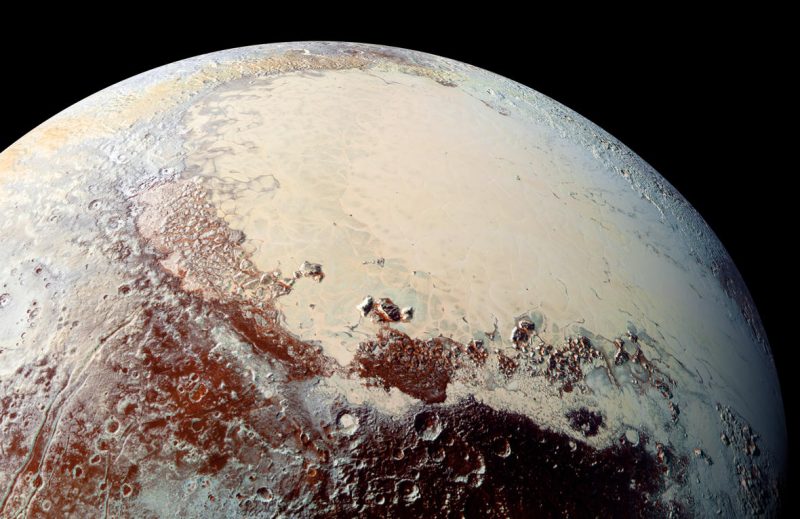
When the New Horizons spacecraft swept past the Pluto system in July 2015, it captured this image of a glacial expanse rich in nitrogen, carbon monoxide and methane ices. This is Sputnik Planitia. It forms the left lobe of the large, heart-shaped feature on Pluto’s surface. Image via NASA/Johns Hopkins University Applied Physics Laboratory/SwRI.

The idea of smaller bodies in space sticking together to make larger ones isn’t new. In fact, Earth and the other major planets are thought to have formed in just that way, billions of years ago, after what astronomers call planetesimals – rocklike objects orbiting the young sun – began colliding with one another. So the idea of Pluto forming from a billion comets seems logical enough. After all, Pluto orbits in the outer solar system, where things are colder. The outer solar system is the realm of icy comets, still sometimes called dirty snowballs. Since the New Horizons spacecraft passed Pluto in July 2015, astronomers have had unprecedented data about this planet. That’s how two scientists from the Southwest Research Institute (SwRI) in Boulder, Colorado, were able to scrutinize this idea, developing what they call the giant comet cosmochemical model of Pluto formation.

The peer-reviewed journal Icarus published their study on May 23, 2018.

The SwRI scientists used New Horizons’ data to take a hard look at Pluto’s composition. They compared what they learned about Pluto with data from a first-of-its kind comet mission, called Rosetta. In the Rosetta mission, a spacecraft accompanied a comet in its orbit around the sun for about two years.

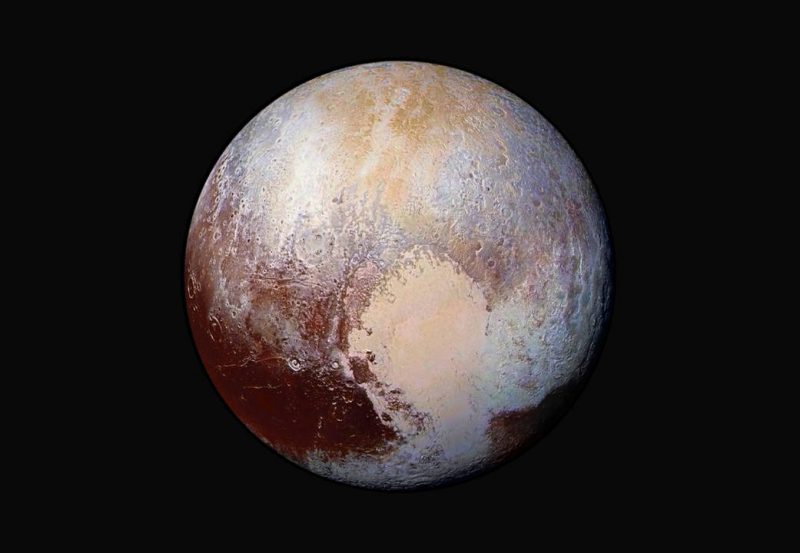
Tombaugh Regio is the name for Pluto’s heart-shaped feature. Sputnik Planitia forms the heart’s left lobe. Image via New Horizons spacecraft/NASA/JHUAPL/SwRI.

The SwRI scientists looked specifically at the nitrogen-rich ice in a region of Pluto called Sputnik Planitia. That is the large glacier that forms the left lobe of the bright heart-shaped feature seen in New Horizon images. Christopher Glein of SwRI, the new study’s lead author, commented in a statement:

We found an intriguing consistency between the estimated amount of nitrogen inside the glacier and the amount that would be expected if Pluto was formed by the agglomeration of roughly a billion comets or other Kuiper Belt objects similar in chemical composition to 67P, the comet explored by Rosetta.

He added:

Our research suggests that Pluto’s initial chemical makeup, inherited from cometary building blocks, was chemically modified by liquid water, perhaps even in a subsurface ocean.

For their new study, the scientists also investigated a possible model of Pluto’s formation, in which the dwarf planet formed from very cold ices with chemical composition more closely matching that of the sun than comets. They commented:

…the solar model also satisfies some constraints. While the research pointed to some interesting possibilities, many questions remain to be answered.

New Horizons gave us our first glimpse of Pluto when it swept past the planet in 2015. It also provided information on the composition of Pluto’s atmosphere and surface. These maps — assembled using New Horizons data — indicate regions rich in methane (CH4), nitrogen (N2), carbon monoxide (CO) and water (H2O) ices. Sputnik Planitia shows an especially strong signature of nitrogen near the equator. SwRI scientists combined these data with Rosetta’s comet 67P data to develop a proposed “giant comet” model for Pluto formation. Image via NASA/Johns Hopkins University Applied Physics Laboratory/SwRI.

Bottom line: By comparing data from the 1st-ever Pluto flyby and a 1st-ever comet rendezvous mission, scientists developed what they call ‘the giant comet’ model of Pluto formation.

Via SwRI

Source: Primordial N2 provides a cosmochemical explanation for the existence of Sputnik Planitia, Pluto


from EarthSky https://ift.tt/2KVGP6z

When the New Horizons spacecraft swept past the Pluto system in July 2015, it captured this image of a glacial expanse rich in nitrogen, carbon monoxide and methane ices. This is Sputnik Planitia. It forms the left lobe of the large, heart-shaped feature on Pluto’s surface. Image via NASA/Johns Hopkins University Applied Physics Laboratory/SwRI.

The idea of smaller bodies in space sticking together to make larger ones isn’t new. In fact, Earth and the other major planets are thought to have formed in just that way, billions of years ago, after what astronomers call planetesimals – rocklike objects orbiting the young sun – began colliding with one another. So the idea of Pluto forming from a billion comets seems logical enough. After all, Pluto orbits in the outer solar system, where things are colder. The outer solar system is the realm of icy comets, still sometimes called dirty snowballs. Since the New Horizons spacecraft passed Pluto in July 2015, astronomers have had unprecedented data about this planet. That’s how two scientists from the Southwest Research Institute (SwRI) in Boulder, Colorado, were able to scrutinize this idea, developing what they call the giant comet cosmochemical model of Pluto formation.

The peer-reviewed journal Icarus published their study on May 23, 2018.

The SwRI scientists used New Horizons’ data to take a hard look at Pluto’s composition. They compared what they learned about Pluto with data from a first-of-its kind comet mission, called Rosetta. In the Rosetta mission, a spacecraft accompanied a comet in its orbit around the sun for about two years.

Tombaugh Regio is the name for Pluto’s heart-shaped feature. Sputnik Planitia forms the heart’s left lobe. Image via New Horizons spacecraft/NASA/JHUAPL/SwRI.

The SwRI scientists looked specifically at the nitrogen-rich ice in a region of Pluto called Sputnik Planitia. That is the large glacier that forms the left lobe of the bright heart-shaped feature seen in New Horizon images. Christopher Glein of SwRI, the new study’s lead author, commented in a statement:

We found an intriguing consistency between the estimated amount of nitrogen inside the glacier and the amount that would be expected if Pluto was formed by the agglomeration of roughly a billion comets or other Kuiper Belt objects similar in chemical composition to 67P, the comet explored by Rosetta.

He added:

Our research suggests that Pluto’s initial chemical makeup, inherited from cometary building blocks, was chemically modified by liquid water, perhaps even in a subsurface ocean.

For their new study, the scientists also investigated a possible model of Pluto’s formation, in which the dwarf planet formed from very cold ices with chemical composition more closely matching that of the sun than comets. They commented:

…the solar model also satisfies some constraints. While the research pointed to some interesting possibilities, many questions remain to be answered.

New Horizons gave us our first glimpse of Pluto when it swept past the planet in 2015. It also provided information on the composition of Pluto’s atmosphere and surface. These maps — assembled using New Horizons data — indicate regions rich in methane (CH4), nitrogen (N2), carbon monoxide (CO) and water (H2O) ices. Sputnik Planitia shows an especially strong signature of nitrogen near the equator. SwRI scientists combined these data with Rosetta’s comet 67P data to develop a proposed “giant comet” model for Pluto formation. Image via NASA/Johns Hopkins University Applied Physics Laboratory/SwRI.

Bottom line: By comparing data from the 1st-ever Pluto flyby and a 1st-ever comet rendezvous mission, scientists developed what they call ‘the giant comet’ model of Pluto formation.

Via SwRI

Source: Primordial N2 provides a cosmochemical explanation for the existence of Sputnik Planitia, Pluto


from EarthSky https://ift.tt/2KVGP6z

Today in science: Kennedy’s moon speech

May 25, 1961. On this date, President John F. Kennedy gave a stirring speech before a joint session of Congress, in which he declared his intention to focus U.S. efforts on landing humans on the moon within a decade. His words ignited the work of a decade, in achieving the dream of a moon landing. Among other things, he said:

I believe that this nation should commit itself to achieving the goal, before this decade is out, of landing a man on the moon and returning him safely to the Earth.

The first human footsteps on the moon took place on July 20, 1969.

The video above doesn’t contain the whole speech – or the section about the moon – but you can hear an audio version of that entire speech here.

Enjoying EarthSky so far? Sign up for our free daily newsletter today!

Apollo 11 landing site, 1969. Image by Soerim via Wikimedia Commons.

Apollo 11 landing site, 1969. Image by Soerim via Wikimedia Commons.

Here is the full text of the space portion of President John F. Kennedy famous moon speech, delivered in person before a joint session of Congress May 25, 1961, below:

Section IX: Space:

Finally, if we are to win the battle that is now going on around the world between freedom and tyranny, the dramatic achievements in space which occurred in recent weeks should have made clear to us all, as did the Sputnik in 1957, the impact of this adventure on the minds of men everywhere, who are attempting to make a determination of which road they should take. Since early in my term, our efforts in space have been under review. With the advice of the Vice President, who is Chairman of the National Space Council, we have examined where we are strong and where we are not, where we may succeed and where we may not. Now it is time to take longer strides–time for a great new American enterprise–time for this nation to take a clearly leading role in space achievement, which in many ways may hold the key to our future on earth.

I believe we possess all the resources and talents necessary. But the facts of the matter are that we have never made the national decisions or marshaled the national resources required for such leadership. We have never specified long-range goals on an urgent time schedule, or managed our resources and our time so as to insure their fulfillment.

Recognizing the head start obtained by the Soviets with their large rocket engines, which gives them many months of lead-time, and recognizing the likelihood that they will exploit this lead for some time to come in still more impressive successes, we nevertheless are required to make new efforts on our own. For while we cannot guarantee that we shall one day be first, we can guarantee that any failure to make this effort will make us last. We take an additional risk by making it in full view of the world, but as shown by the feat of astronaut Shepard, this very risk enhances our stature when we are successful. But this is not merely a race. Space is open to us now; and our eagerness to share its meaning is not governed by the efforts of others. We go into space because whatever mankind must undertake, free men must fully share.

I therefore ask the Congress, above and beyond the increases I have earlier requested for space activities, to provide the funds which are needed to meet the following national goals:

First, I believe that this nation should commit itself to achieving the goal, before this decade is out, of landing a man on the moon and returning him safely to the Earth. No single space project in this period will be more impressive to mankind, or more important for the long-range exploration of space; and none will be so difficult or expensive to accomplish. We propose to accelerate the development of the appropriate lunar space craft. We propose to develop alternate liquid and solid fuel boosters, much larger than any now being developed, until certain which is superior. We propose additional funds for other engine development and for unmanned explorations–explorations which are particularly important for one purpose which this nation will never overlook: the survival of the man who first makes this daring flight. But in a very real sense, it will not be one man going to the moon–if we make this judgment affirmatively, it will be an entire nation. For all of us must work to put him there.

Secondly, an additional 23 million dollars, together with 7 million dollars already available, will accelerate development of the Rover nuclear rocket. This gives promise of some day providing a means for even more exciting and ambitious exploration of space, perhaps beyond the moon, perhaps to the very end of the solar system itself.

Third, an additional 50 million dollars will make the most of our present leadership, by accelerating the use of space satellites for world-wide communications.

Fourth, an additional 75 million dollars–of which 53 million dollars is for the Weather Bureau–will help give us at the earliest possible time a satellite system for world-wide weather observation.

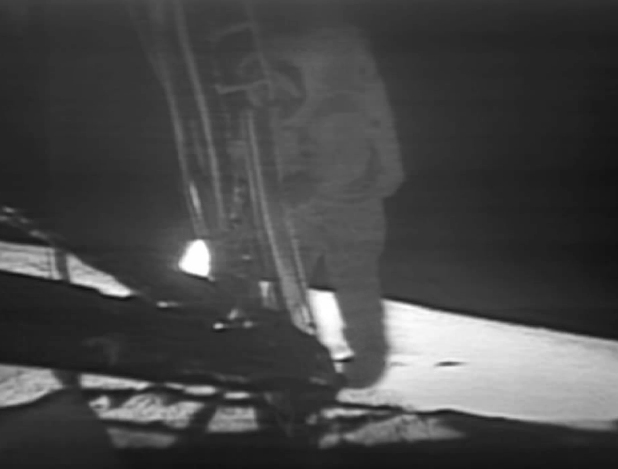
Historic first step by Neil Armstrong on the surface of the moon, July 20, 1969.

Historic first step by Neil Armstrong on the surface of the moon, July 20, 1969.

Let it be clear–and this is a judgment which the Members of the Congress must finally make–let it be clear that I am asking the Congress and the country to accept a firm commitment to a new course of action, a course which will last for many years and carry very heavy costs: 531 million dollars in fiscal ’62–an estimated 7 to 9 billion dollars additional over the next five years. If we are to go only half way, or reduce our sights in the face of difficulty, in my judgment it would be better not to go at all.

Now this is a choice which this country must make, and I am confident that under the leadership of the Space Committees of the Congress, and the Appropriating Committees, that you will consider the matter carefully.

It is a most important decision that we make as a nation. But all of you have lived through the last four years and have seen the significance of space and the adventures in space, and no one can predict with certainty what the ultimate meaning will be of mastery of space.

I believe we should go to the moon. But I think every citizen of this country as well as the Members of the Congress should consider the matter carefully in making their judgment, to which we have given attention over many weeks and months, because it is a heavy burden, and there is no sense in agreeing or desiring that the United States take an affirmative position in outer space, unless we are prepared to do the work and bear the burdens to make it successful. If we are not, we should decide today and this year.

This decision demands a major national commitment of scientific and technical manpower, materiel and facilities, and the possibility of their diversion from other important activities where they are already thinly spread. It means a degree of dedication, organization and discipline which have not always characterized our research and development efforts. It means we cannot afford undue work stoppages, inflated costs of material or talent, wasteful interagency rivalries, or a high turnover of key personnel.

New objectives and new money cannot solve these problems. They could in fact, aggravate them further–unless every scientist, every engineer, every serviceman, every technician, contractor, and civil servant gives his personal pledge that this nation will move forward, with the full speed of freedom, in the exciting adventure of space.

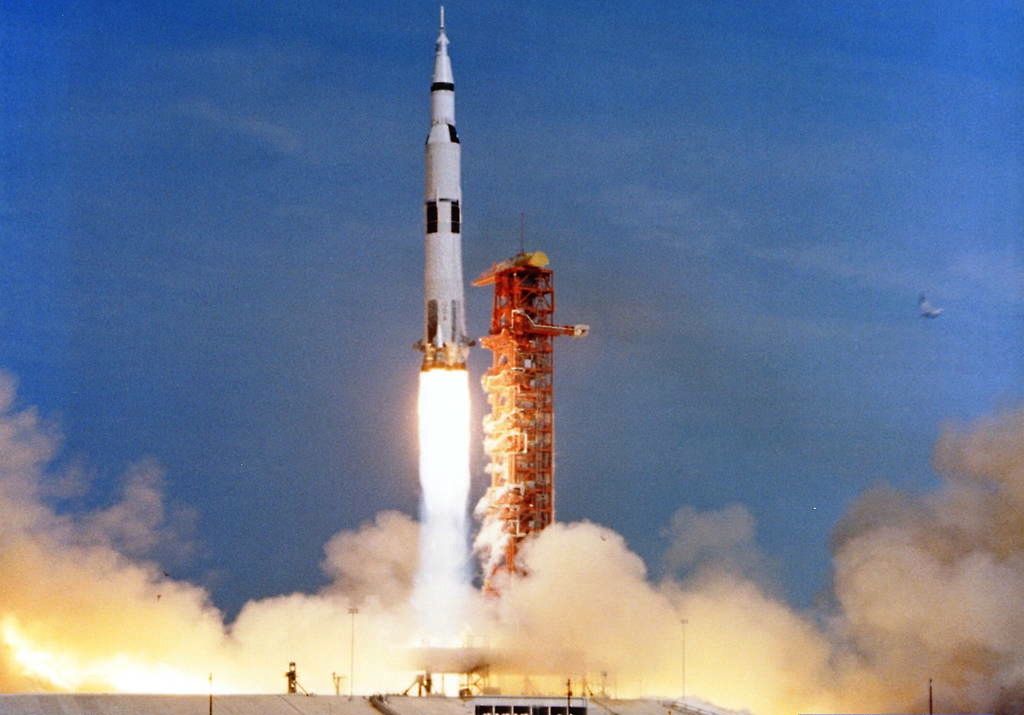
Apollo 11, which carried the first astronauts to set foot on the moon, launched on July 16, 1969. The human footsteps on the moon took place on July 20, 1969.

Apollo 11, which carried the first astronauts to set foot on the moon, launched on July 16, 1969. The human footsteps on the moon took place on July 20, 1969.

Bottom line: On May 25, 1961, President John F. Kennedy gave a stirring speech to a joint session of Congress declaring his intention to land humans on the moon with a decade.


from EarthSky https://ift.tt/1maM13F

May 25, 1961. On this date, President John F. Kennedy gave a stirring speech before a joint session of Congress, in which he declared his intention to focus U.S. efforts on landing humans on the moon within a decade. His words ignited the work of a decade, in achieving the dream of a moon landing. Among other things, he said:

I believe that this nation should commit itself to achieving the goal, before this decade is out, of landing a man on the moon and returning him safely to the Earth.

The first human footsteps on the moon took place on July 20, 1969.

The video above doesn’t contain the whole speech – or the section about the moon – but you can hear an audio version of that entire speech here.

Enjoying EarthSky so far? Sign up for our free daily newsletter today!

Apollo 11 landing site, 1969. Image by Soerim via Wikimedia Commons.

Apollo 11 landing site, 1969. Image by Soerim via Wikimedia Commons.

Here is the full text of the space portion of President John F. Kennedy famous moon speech, delivered in person before a joint session of Congress May 25, 1961, below:

Section IX: Space:

Finally, if we are to win the battle that is now going on around the world between freedom and tyranny, the dramatic achievements in space which occurred in recent weeks should have made clear to us all, as did the Sputnik in 1957, the impact of this adventure on the minds of men everywhere, who are attempting to make a determination of which road they should take. Since early in my term, our efforts in space have been under review. With the advice of the Vice President, who is Chairman of the National Space Council, we have examined where we are strong and where we are not, where we may succeed and where we may not. Now it is time to take longer strides–time for a great new American enterprise–time for this nation to take a clearly leading role in space achievement, which in many ways may hold the key to our future on earth.

I believe we possess all the resources and talents necessary. But the facts of the matter are that we have never made the national decisions or marshaled the national resources required for such leadership. We have never specified long-range goals on an urgent time schedule, or managed our resources and our time so as to insure their fulfillment.

Recognizing the head start obtained by the Soviets with their large rocket engines, which gives them many months of lead-time, and recognizing the likelihood that they will exploit this lead for some time to come in still more impressive successes, we nevertheless are required to make new efforts on our own. For while we cannot guarantee that we shall one day be first, we can guarantee that any failure to make this effort will make us last. We take an additional risk by making it in full view of the world, but as shown by the feat of astronaut Shepard, this very risk enhances our stature when we are successful. But this is not merely a race. Space is open to us now; and our eagerness to share its meaning is not governed by the efforts of others. We go into space because whatever mankind must undertake, free men must fully share.

I therefore ask the Congress, above and beyond the increases I have earlier requested for space activities, to provide the funds which are needed to meet the following national goals:

First, I believe that this nation should commit itself to achieving the goal, before this decade is out, of landing a man on the moon and returning him safely to the Earth. No single space project in this period will be more impressive to mankind, or more important for the long-range exploration of space; and none will be so difficult or expensive to accomplish. We propose to accelerate the development of the appropriate lunar space craft. We propose to develop alternate liquid and solid fuel boosters, much larger than any now being developed, until certain which is superior. We propose additional funds for other engine development and for unmanned explorations–explorations which are particularly important for one purpose which this nation will never overlook: the survival of the man who first makes this daring flight. But in a very real sense, it will not be one man going to the moon–if we make this judgment affirmatively, it will be an entire nation. For all of us must work to put him there.

Secondly, an additional 23 million dollars, together with 7 million dollars already available, will accelerate development of the Rover nuclear rocket. This gives promise of some day providing a means for even more exciting and ambitious exploration of space, perhaps beyond the moon, perhaps to the very end of the solar system itself.

Third, an additional 50 million dollars will make the most of our present leadership, by accelerating the use of space satellites for world-wide communications.

Fourth, an additional 75 million dollars–of which 53 million dollars is for the Weather Bureau–will help give us at the earliest possible time a satellite system for world-wide weather observation.

Historic first step by Neil Armstrong on the surface of the moon, July 20, 1969.

Historic first step by Neil Armstrong on the surface of the moon, July 20, 1969.

Let it be clear–and this is a judgment which the Members of the Congress must finally make–let it be clear that I am asking the Congress and the country to accept a firm commitment to a new course of action, a course which will last for many years and carry very heavy costs: 531 million dollars in fiscal ’62–an estimated 7 to 9 billion dollars additional over the next five years. If we are to go only half way, or reduce our sights in the face of difficulty, in my judgment it would be better not to go at all.

Now this is a choice which this country must make, and I am confident that under the leadership of the Space Committees of the Congress, and the Appropriating Committees, that you will consider the matter carefully.

It is a most important decision that we make as a nation. But all of you have lived through the last four years and have seen the significance of space and the adventures in space, and no one can predict with certainty what the ultimate meaning will be of mastery of space.

I believe we should go to the moon. But I think every citizen of this country as well as the Members of the Congress should consider the matter carefully in making their judgment, to which we have given attention over many weeks and months, because it is a heavy burden, and there is no sense in agreeing or desiring that the United States take an affirmative position in outer space, unless we are prepared to do the work and bear the burdens to make it successful. If we are not, we should decide today and this year.

This decision demands a major national commitment of scientific and technical manpower, materiel and facilities, and the possibility of their diversion from other important activities where they are already thinly spread. It means a degree of dedication, organization and discipline which have not always characterized our research and development efforts. It means we cannot afford undue work stoppages, inflated costs of material or talent, wasteful interagency rivalries, or a high turnover of key personnel.

New objectives and new money cannot solve these problems. They could in fact, aggravate them further–unless every scientist, every engineer, every serviceman, every technician, contractor, and civil servant gives his personal pledge that this nation will move forward, with the full speed of freedom, in the exciting adventure of space.

Apollo 11, which carried the first astronauts to set foot on the moon, launched on July 16, 1969. The human footsteps on the moon took place on July 20, 1969.

Apollo 11, which carried the first astronauts to set foot on the moon, launched on July 16, 1969. The human footsteps on the moon took place on July 20, 1969.

Bottom line: On May 25, 1961, President John F. Kennedy gave a stirring speech to a joint session of Congress declaring his intention to land humans on the moon with a decade.


from EarthSky https://ift.tt/1maM13F

Astronauts’ views of Mount Shasta

Mt. Shasta pokes out from the fog-filled valleys of the Klamath Mountains. North of the the mountain, the Great Basin Desert meets the Cascade Range. August 21, 2017. Image via NASA.

Here are two images of Mount Shasta captured by astronauts aboard the International Space Station (ISS) while orbiting over northern California at different times of the year.

Mt. Shasta, in the Shasta-Trinity National Forest, at the southern end of the Cascade mountain range, is an active stratovolcano that has erupted at least once per 800 years for the past 10,000 years, with an increased eruption frequency of about once per 250 years over the past 750 years.

Mt. Shasta is 14,180 feet (4,322 meters) above sea level, and typically snowcapped year-round. The photo above was taken in August 2017, when much of the snowpack had melted away. The zoomed-in photo below of the mountain’s peak was captured in April 2018 and shows a much greater snowpack on the mountain, with less rock visible.

April 1, 2018. Image via NASA.

Bottom line: Two images of California’s Mount Shasta taken from the International Space Station.

Read more from NASA’s Earth Observatory


from EarthSky https://ift.tt/2IJyiCO

Mt. Shasta pokes out from the fog-filled valleys of the Klamath Mountains. North of the the mountain, the Great Basin Desert meets the Cascade Range. August 21, 2017. Image via NASA.

Here are two images of Mount Shasta captured by astronauts aboard the International Space Station (ISS) while orbiting over northern California at different times of the year.

Mt. Shasta, in the Shasta-Trinity National Forest, at the southern end of the Cascade mountain range, is an active stratovolcano that has erupted at least once per 800 years for the past 10,000 years, with an increased eruption frequency of about once per 250 years over the past 750 years.

Mt. Shasta is 14,180 feet (4,322 meters) above sea level, and typically snowcapped year-round. The photo above was taken in August 2017, when much of the snowpack had melted away. The zoomed-in photo below of the mountain’s peak was captured in April 2018 and shows a much greater snowpack on the mountain, with less rock visible.

April 1, 2018. Image via NASA.

Bottom line: Two images of California’s Mount Shasta taken from the International Space Station.

Read more from NASA’s Earth Observatory


from EarthSky https://ift.tt/2IJyiCO

Beauty! Moon and Jupiter May 25 to 28

On May 25 to 28, 2018 – if you have a clear sky – you’ll surely notice a very bright “star” near the moon. This object is really a planet, Jupiter. Once Venus sets in the west, not long after the sun, the moon and Jupiter are the two brightest objects in the nighttime sky.

On some of these nights, you might notice a fainter true star – still one of our sky’s brightest stars – Spica in the moon’s glare. Spica is the brightest star in the constellation Virgo the Maiden, and it’s a key star of the zodiac. Though a 1st-magnitude star, Spica is some 20 times fainter than Jupiter. But Jupiter’s brightness, stems from its relative nearness to Earth, while Spica is a distant star, some 262 light-years away.

Spica’s magnitude is virtually the same as that of Antares, another key star of the zodiac. Want to compare them, but don’t know how to recognize Antares? Jupiter resides roughly midway between these two bright stars, and the moon will travel close Antares on the sky’s dome on May 28, as shown on the sky chart above.

Notice how nearly full and round the moon appears in our sky this weekend. Jupiter and the moon will be closest on May 27, and the moon will be full on May 29. Meanwhile, this is Jupiter’s opposition month; that is, Earth just flew between Jupiter and the sun, placing Jupiter opposite the sun in our sky. A full moon is also opposite the sun as seen from Earth.

Thus it’s no accident that Jupiter is close on the sky’s dome to this nearly full moon around now. Both Jupiter and the moon are, more or less, opposite the sun.

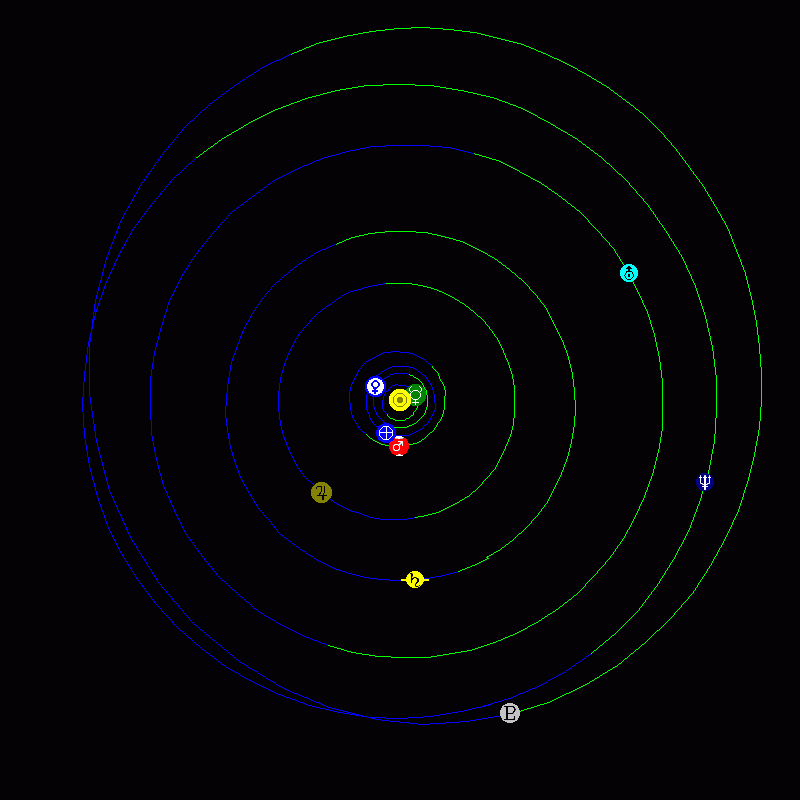
The planets in our solar system in late May 2018. The sun is the yellow ball at the center. Earth is the 3rd planet, and Jupiter is the 5th planet, from the sun. Earth passed between Jupiter and the sun on May 9, and then Jupiter was directly opposite the sun in our sky, rising at sunset. Now we’re offset from that sun-Jupiter line a bit, but Jupiter is still ascending in our eastern sky as the sun descends below our western horizon. Image via Fourmilab.

Two months from now – on July 27, 2018 – it’ll be Mars’ opposition, its first opposition in two years and its best one since 2003. Jupiter is brighter than Mars now, but just wait! Around late July, Mars will equal Jupiter in brightness … and it’ll shine with a red color!

In fact, in late July, Mars will shine better than 30 times brighter than stars like Spica and Antares, two of the brightest stars in our sky.

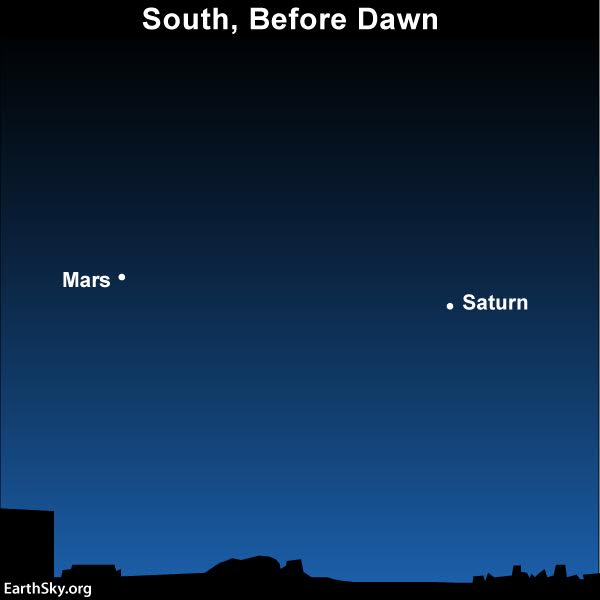
You can see Mars tonight, if you’re willing to stay up late or wake up early. It’s a noticeably bright star in the sky before dawn, near another planet, Saturn.

Get up before dawn to see the planets Mars and Saturn. Read more.

Back to the moon and Jupiter, though. You know the moon appears much larger than Jupiter in our sky. But that’s only because the moon is so much closer to Earth than Jupiter. At present, the moon lies nearly 245,000 miles (394,000 km) away, while Jupiter lies far beyond the moon, at nearly 1,700 times the moon’s distance from Earth. Click here to know the moon’s present distance from Earth in kilometers, miles or astronomical units (AU). Click here or click here to find out Jupiter’s present distance from Earth in astronomical units (AU).

Jupiter is truly the giant world of our solar system. In fact, Jupiter’s volume is greater than 1,300 Earths or 66,000 Earth-moons!

Jupiter is also some 318 times more massive than our planet Earth. The king planet is more than twice as massive as all the other solar system planets, dwarf planets, minor planet and moons combined.

Think about that as you see this great planet in the moon’s glare in the coming nights!

View larger. | As the Juno spacecraft swung away from Jupiter’s south pole following its close approach on April 1, 2018, it acquired the images to create this composite. Image via NASA/ SwRI/ MSSS/ Gerald Eichstädt/ Seán Doran. Read more about this image.

Bottom line: On the nights of May 25 to 28, 2018, the giant planet Jupiter is the brightest object in the moon’s vicinity. Spica in the constellation Virgo – and Antares in the constellation Scorpius – are also nearby.

Read more: Spica is a whirling double star

Read more: Antares is the Heart of the Scorpion


from EarthSky https://ift.tt/2IJ5wGw

On May 25 to 28, 2018 – if you have a clear sky – you’ll surely notice a very bright “star” near the moon. This object is really a planet, Jupiter. Once Venus sets in the west, not long after the sun, the moon and Jupiter are the two brightest objects in the nighttime sky.

On some of these nights, you might notice a fainter true star – still one of our sky’s brightest stars – Spica in the moon’s glare. Spica is the brightest star in the constellation Virgo the Maiden, and it’s a key star of the zodiac. Though a 1st-magnitude star, Spica is some 20 times fainter than Jupiter. But Jupiter’s brightness, stems from its relative nearness to Earth, while Spica is a distant star, some 262 light-years away.

Spica’s magnitude is virtually the same as that of Antares, another key star of the zodiac. Want to compare them, but don’t know how to recognize Antares? Jupiter resides roughly midway between these two bright stars, and the moon will travel close Antares on the sky’s dome on May 28, as shown on the sky chart above.

Notice how nearly full and round the moon appears in our sky this weekend. Jupiter and the moon will be closest on May 27, and the moon will be full on May 29. Meanwhile, this is Jupiter’s opposition month; that is, Earth just flew between Jupiter and the sun, placing Jupiter opposite the sun in our sky. A full moon is also opposite the sun as seen from Earth.

Thus it’s no accident that Jupiter is close on the sky’s dome to this nearly full moon around now. Both Jupiter and the moon are, more or less, opposite the sun.

The planets in our solar system in late May 2018. The sun is the yellow ball at the center. Earth is the 3rd planet, and Jupiter is the 5th planet, from the sun. Earth passed between Jupiter and the sun on May 9, and then Jupiter was directly opposite the sun in our sky, rising at sunset. Now we’re offset from that sun-Jupiter line a bit, but Jupiter is still ascending in our eastern sky as the sun descends below our western horizon. Image via Fourmilab.

Two months from now – on July 27, 2018 – it’ll be Mars’ opposition, its first opposition in two years and its best one since 2003. Jupiter is brighter than Mars now, but just wait! Around late July, Mars will equal Jupiter in brightness … and it’ll shine with a red color!

In fact, in late July, Mars will shine better than 30 times brighter than stars like Spica and Antares, two of the brightest stars in our sky.

You can see Mars tonight, if you’re willing to stay up late or wake up early. It’s a noticeably bright star in the sky before dawn, near another planet, Saturn.

Get up before dawn to see the planets Mars and Saturn. Read more.

Back to the moon and Jupiter, though. You know the moon appears much larger than Jupiter in our sky. But that’s only because the moon is so much closer to Earth than Jupiter. At present, the moon lies nearly 245,000 miles (394,000 km) away, while Jupiter lies far beyond the moon, at nearly 1,700 times the moon’s distance from Earth. Click here to know the moon’s present distance from Earth in kilometers, miles or astronomical units (AU). Click here or click here to find out Jupiter’s present distance from Earth in astronomical units (AU).

Jupiter is truly the giant world of our solar system. In fact, Jupiter’s volume is greater than 1,300 Earths or 66,000 Earth-moons!

Jupiter is also some 318 times more massive than our planet Earth. The king planet is more than twice as massive as all the other solar system planets, dwarf planets, minor planet and moons combined.

Think about that as you see this great planet in the moon’s glare in the coming nights!

View larger. | As the Juno spacecraft swung away from Jupiter’s south pole following its close approach on April 1, 2018, it acquired the images to create this composite. Image via NASA/ SwRI/ MSSS/ Gerald Eichstädt/ Seán Doran. Read more about this image.

Bottom line: On the nights of May 25 to 28, 2018, the giant planet Jupiter is the brightest object in the moon’s vicinity. Spica in the constellation Virgo – and Antares in the constellation Scorpius – are also nearby.

Read more: Spica is a whirling double star

Read more: Antares is the Heart of the Scorpion


from EarthSky https://ift.tt/2IJ5wGw

Climate Science websites around the world

Skeptical Science is not alone when it comes to sharing reliable information about climate science. There are many websites around the world which regularly write about the latest studies or set the record straight when misinformation gets spread. Our website is however somewhat unique as the backbone of SkS is our database cataloging and debunking more than 220 false claims made about the science of human-caused global warming.

In this article we highlight some international resources which share information about climate change and possibly even throw in some debunking for good measure in other languages than English. To get the ball rolling, here is what we have and are aware of thus far:

Brazil - Portuguese

Ciência e Clima

Ciencia-e-clima

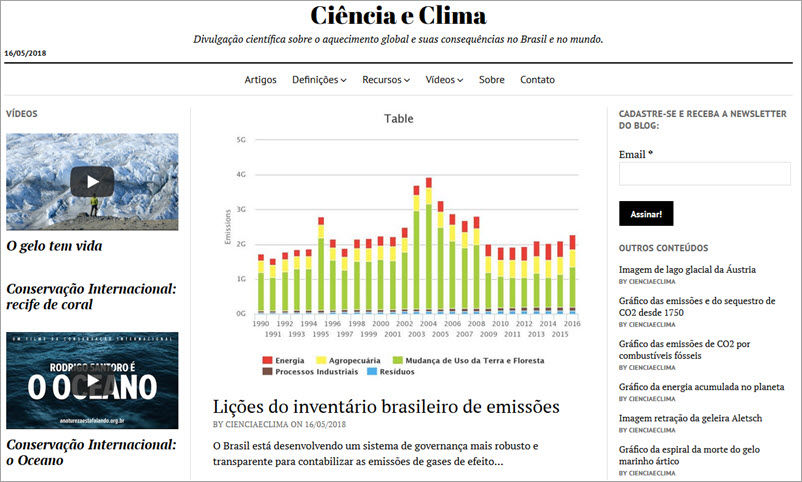
Five years ago Raphael Romanizia decided to start a site about climate change during his master studies. Around that time, Brazil had been introducing several regulations and initiatives related to climate change, and he believed that the site would fit in with the momentum. A reliable reference exclusively specialized on climate science and climate change had been missing.

The site's main focus is to increase public awareness about human-caused climate change and the strategy is to make scientific information easily accessible. It presents scientific content in several different formats, including articles about climate science research, videos, or charts and graphics (or here) with important pieces of information (commented or explained by the site).

It is also a personal project, developed without financing or any kind of support - yet.

Germany - German

klimafakten.de

klimafakten

Klimafakten.de went live in November 2011 shortly before COP17 in Durban, South Africa. This is our German partnersite which started out with 18 professional translations of our myth rebuttals, made possible through a grant from the European Climate Foundation (ECF). It has grown a lot since then and currently features more than 45 rebuttals.

Beyond the fact-checking, klimfakten.de also focuses on climate change communications. In regular news reports and feature stories it writes about new social science insights, innovative communication strategies and best practice. In its work it partners with Climate Outreach. As a sister-project of the Clean Energy Wire, klimafakten.de today is jointly funded by the Mercator Foundation and the European Climate Foundation (ECF).

Poland - Polish

Nauka o klimacie

Nauka-o-Klimacie

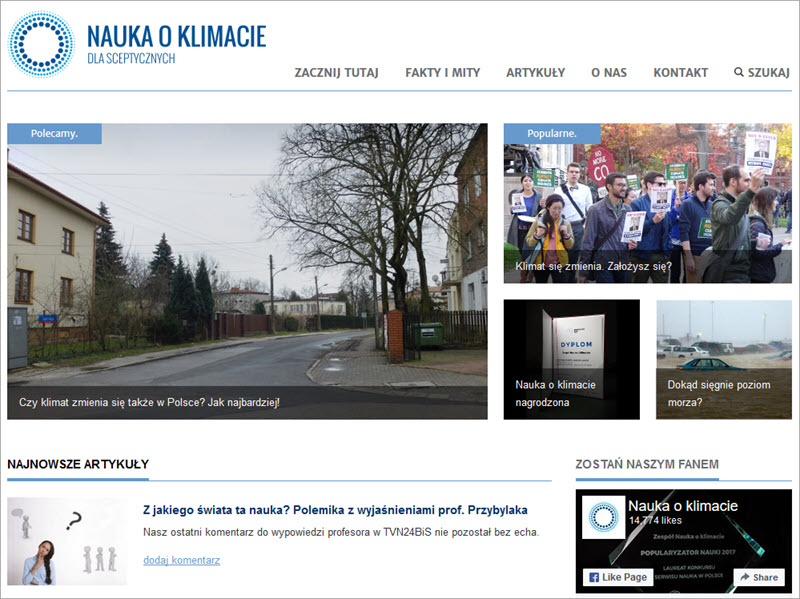
Nauka o Klimacie is run - among others - by Marcin Popkiewicz and Szymon Malowski and is our and klimafakten.de's partner site in Poland. Their website, apart from general climate-related education, is focused on Poland and the denial of human-caused climate change they encounter there mostly due to the country's dependence on coal. They take this on by "conventional" means such as lectures and media presence and "unconventional" ones such as climate quizzes with prizes or the "Climate Nonsense of the Year" (link to a Google-translate version) voting for the dumbest statements on climate made by journalists, politicians or other persons appearing in the Polish media. Their website also features a myth-debunking section with much of the content originating from Skeptical Science.

Any other websites?

If you know of any other similar non-English websites focused on climate change, please let us know either in the comments or via the contact form. We'll add them to the post once we've verified that the content is science-based. In addition, our rebuttals and graphics all come with a creative commons (CC) license and you are most welcome to make use of the already available translations for your own websites or add to the translations as Klimafakten and Nauka o Klimacie have been doing for several years.


from Skeptical Science https://ift.tt/2GPaax2

Skeptical Science is not alone when it comes to sharing reliable information about climate science. There are many websites around the world which regularly write about the latest studies or set the record straight when misinformation gets spread. Our website is however somewhat unique as the backbone of SkS is our database cataloging and debunking more than 220 false claims made about the science of human-caused global warming.

In this article we highlight some international resources which share information about climate change and possibly even throw in some debunking for good measure in other languages than English. To get the ball rolling, here is what we have and are aware of thus far:

Brazil - Portuguese

Ciência e Clima

Ciencia-e-clima

Five years ago Raphael Romanizia decided to start a site about climate change during his master studies. Around that time, Brazil had been introducing several regulations and initiatives related to climate change, and he believed that the site would fit in with the momentum. A reliable reference exclusively specialized on climate science and climate change had been missing.

The site's main focus is to increase public awareness about human-caused climate change and the strategy is to make scientific information easily accessible. It presents scientific content in several different formats, including articles about climate science research, videos, or charts and graphics (or here) with important pieces of information (commented or explained by the site).

It is also a personal project, developed without financing or any kind of support - yet.

Germany - German

klimafakten.de

klimafakten

Klimafakten.de went live in November 2011 shortly before COP17 in Durban, South Africa. This is our German partnersite which started out with 18 professional translations of our myth rebuttals, made possible through a grant from the European Climate Foundation (ECF). It has grown a lot since then and currently features more than 45 rebuttals.

Beyond the fact-checking, klimfakten.de also focuses on climate change communications. In regular news reports and feature stories it writes about new social science insights, innovative communication strategies and best practice. In its work it partners with Climate Outreach. As a sister-project of the Clean Energy Wire, klimafakten.de today is jointly funded by the Mercator Foundation and the European Climate Foundation (ECF).

Poland - Polish

Nauka o klimacie

Nauka-o-Klimacie

Nauka o Klimacie is run - among others - by Marcin Popkiewicz and Szymon Malowski and is our and klimafakten.de's partner site in Poland. Their website, apart from general climate-related education, is focused on Poland and the denial of human-caused climate change they encounter there mostly due to the country's dependence on coal. They take this on by "conventional" means such as lectures and media presence and "unconventional" ones such as climate quizzes with prizes or the "Climate Nonsense of the Year" (link to a Google-translate version) voting for the dumbest statements on climate made by journalists, politicians or other persons appearing in the Polish media. Their website also features a myth-debunking section with much of the content originating from Skeptical Science.

Any other websites?

If you know of any other similar non-English websites focused on climate change, please let us know either in the comments or via the contact form. We'll add them to the post once we've verified that the content is science-based. In addition, our rebuttals and graphics all come with a creative commons (CC) license and you are most welcome to make use of the already available translations for your own websites or add to the translations as Klimafakten and Nauka o Klimacie have been doing for several years.


from Skeptical Science https://ift.tt/2GPaax2

Scientists track major freshwater change

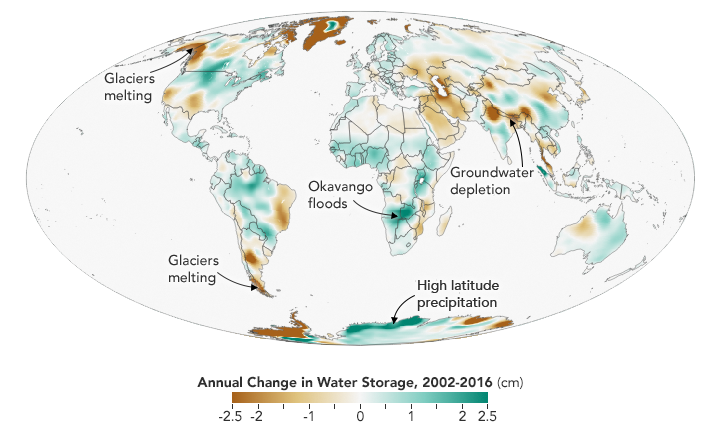
NASA Earth Observatory reported this week (May 23, 2018) on a new, first-of-its-kind study, combining 14 years of satellite observations with data on human activities, showing where and how freshwater is changing on Earth. When we say freshwater, we’re speaking of the water found in lakes, rivers, soil, snow, groundwater and ice. The peer-reviewed journal Nature published the study on May 16. Hydrologist Jay Famiglietti of NASA’s Jet Propulsion Laboratory, a study co-author, summed up the results when he said:

What we are witnessing is major hydrologic change. We see a distinctive pattern of the wet land areas of the world getting wetter—those are the high latitudes and the tropics—and the dry areas in between getting drier. Embedded within the dry areas, we see multiple hot spots resulting from groundwater depletion.

The study authors attribute the changes to a variety of factors, including water management, climate change, and natural cycles.

This map above depicts changes in water storage on Earth—on the surface, underground, and locked in ice and snow—between 2002 and 2016. Shades of green represent areas where freshwater levels have increased, while browns depict areas where they have been depleted. Image via NASA Earth Observatory

The research team analyzed 14 years of observations from the Gravity Recovery and Climate Experiment (GRACE) satellite to track trends in freshwater in 34 regions around the world. To put those trends in context, the scientists correlated GRACE findings with precipitation data from the Global Precipitation Climatology Project; with land cover imagery and data from Landsat; with irrigation maps; and with published reports of human activities in agriculture, mining, and reservoir operations.

Hydrologist Matt Rodell of NASA’s Goddard Space Flight Center, is the study lead author. He said:

A key goal was to distinguish shifts in terrestrial water storage caused by natural variability — wet periods and dry periods associated with El Niño and La Niña, for example — from trends related to climate change or human impacts, like pumping groundwater out of an aquifer faster than it is replenished.

Famiglietti commented that while some water loss, such as melting ice sheets and alpine glaciers, is driven by a warming global climate, more time and data are needed to determine the driving forces behind other patterns of freshwater change. He said:

The pattern of wet-getting-wetter, dry-getting-drier during the rest of the 21st century is predicted by the Intergovernmental Panel on Climate Change models. But we’ll need a much longer dataset to be able to definitively say whether climate change is responsible for the emergence of any similar pattern in the GRACE data.

The NASA Earth Observatory post had other interesting things to say about freshwater within specific usages (for example, to grow food) and in specific parts of the world. Read more at NASA Earth Observatory.

Satellite images of Lake Cachuma—which supplies Santa Barbara with drinking water on October 27, 2013, and October 26, 2016. The sharp decline in water levels has exposed much of the bottom of the reservoir. Image via NASA.

Satellite image of agricultural operations in Saudi Arabia’s Wadi As-Sirhan Basin, January 17, 2012. Image via NASA.

The great Okavango Delta in the Kalahari Desert is illuminated in the sun’s reflection point in this panorama taken from the International Space Station on June 6, 2014. Image via NASA.

Bottom line: A new study that maps where global freshwater is changing finds that Earth’s wet landscapes are getting wetter and dry areas are getting drier.


from EarthSky https://ift.tt/2s9WdEk

NASA Earth Observatory reported this week (May 23, 2018) on a new, first-of-its-kind study, combining 14 years of satellite observations with data on human activities, showing where and how freshwater is changing on Earth. When we say freshwater, we’re speaking of the water found in lakes, rivers, soil, snow, groundwater and ice. The peer-reviewed journal Nature published the study on May 16. Hydrologist Jay Famiglietti of NASA’s Jet Propulsion Laboratory, a study co-author, summed up the results when he said:

What we are witnessing is major hydrologic change. We see a distinctive pattern of the wet land areas of the world getting wetter—those are the high latitudes and the tropics—and the dry areas in between getting drier. Embedded within the dry areas, we see multiple hot spots resulting from groundwater depletion.

The study authors attribute the changes to a variety of factors, including water management, climate change, and natural cycles.

This map above depicts changes in water storage on Earth—on the surface, underground, and locked in ice and snow—between 2002 and 2016. Shades of green represent areas where freshwater levels have increased, while browns depict areas where they have been depleted. Image via NASA Earth Observatory

The research team analyzed 14 years of observations from the Gravity Recovery and Climate Experiment (GRACE) satellite to track trends in freshwater in 34 regions around the world. To put those trends in context, the scientists correlated GRACE findings with precipitation data from the Global Precipitation Climatology Project; with land cover imagery and data from Landsat; with irrigation maps; and with published reports of human activities in agriculture, mining, and reservoir operations.

Hydrologist Matt Rodell of NASA’s Goddard Space Flight Center, is the study lead author. He said:

A key goal was to distinguish shifts in terrestrial water storage caused by natural variability — wet periods and dry periods associated with El Niño and La Niña, for example — from trends related to climate change or human impacts, like pumping groundwater out of an aquifer faster than it is replenished.

Famiglietti commented that while some water loss, such as melting ice sheets and alpine glaciers, is driven by a warming global climate, more time and data are needed to determine the driving forces behind other patterns of freshwater change. He said:

The pattern of wet-getting-wetter, dry-getting-drier during the rest of the 21st century is predicted by the Intergovernmental Panel on Climate Change models. But we’ll need a much longer dataset to be able to definitively say whether climate change is responsible for the emergence of any similar pattern in the GRACE data.

The NASA Earth Observatory post had other interesting things to say about freshwater within specific usages (for example, to grow food) and in specific parts of the world. Read more at NASA Earth Observatory.

Satellite images of Lake Cachuma—which supplies Santa Barbara with drinking water on October 27, 2013, and October 26, 2016. The sharp decline in water levels has exposed much of the bottom of the reservoir. Image via NASA.

Satellite image of agricultural operations in Saudi Arabia’s Wadi As-Sirhan Basin, January 17, 2012. Image via NASA.

The great Okavango Delta in the Kalahari Desert is illuminated in the sun’s reflection point in this panorama taken from the International Space Station on June 6, 2014. Image via NASA.

Bottom line: A new study that maps where global freshwater is changing finds that Earth’s wet landscapes are getting wetter and dry areas are getting drier.


from EarthSky https://ift.tt/2s9WdEk

adds 2