aads

An even shorter non-bonding H…H distance

The competition for finding molecules with ever-closer non-bonding HH interactions is heating up. I have previously blogged about 1, a in,in-Bis(hydrosilane) designed by Pascal,1 with an HH distance of 1.57 Å, and also blogged about 2, the dimer of tri(di-t-butylphenyl)methane,2 where the distance between methine hydrogens on adjacent molecules is 1.566 Å.

Now Pascal reports on 3, which shows an even closer HH approach.3

The x-ray structure of 3 shows the in,in relationship of the two critical hydrogens, HA and HB. Though the positions of these hydrogens were refined, the C-H distance are artificially foreshortened. A variety of computed structures are reported, and these all support a very short HH non-bonding distance of about 1.52 Å. The B3PW91-D3/cc-pVTZ optimized structure is shown in Figure 1.

Figure 1. B3PW91-D3/cc-pVTZ optimized structure of 3.

The authors also note an unusual feature of the 1H NMR spectrum of 3: the HB signal appears as a double with JAB= 2.0 Hz. B3LYP/6–311++G(2df,2pd) NMR computations indicated a coupling of 3.1 Hz. This is the largest through-space coupling recorded.

References

1. Zong, J.; Mague, J. T.; Pascal, R. A., "Exceptional Steric Congestion in an in,in-Bis(hydrosilane)." J. Am. Chem. Soc. 2013, 135, 13235-13237, DOI: 10.1021/ja407398w.

2. Rösel, S.; Quanz, H.; Logemann, C.; Becker, J.; Mossou, E.; Cañadillas-Delgado, L.; Caldeweyher, E.; Grimme, S.; Schreiner, P. R., "London Dispersion Enables the Shortest Intermolecular Hydrocarbon H···H Contact." J. Am. Chem. Soc. 2017, 139, 7428–7431, DOI: 10.1021/jacs.7b01879.

3. Xiao, Y.; Mague, J. T.; Pascal, R. A., "An Exceptionally Close, Non-Bonded Hydrogen–Hydrogen Contact with Strong Through-Space Spin–Spin Coupling." Angew. Chem. Int. Ed. 2018, 57, 2244-2247, DOI: 10.1002/anie.201712304.

InChI

3: InChI=1S/C27H24S3/c1-4-17-13-28-10-16-11-29-14-18-5-2-8-21-24(18)27-23(17)20(7-1)26(21)22-9-3-6-19(25(22)27)15-30-12-16/h1-9,16,26-27H,10-15H2
InChIKey=NJBHGDPNFALCTL-UHFFFAOYSA-N


from Computational Organic Chemistry https://ift.tt/2ICvNpW

The competition for finding molecules with ever-closer non-bonding HH interactions is heating up. I have previously blogged about 1, a in,in-Bis(hydrosilane) designed by Pascal,1 with an HH distance of 1.57 Å, and also blogged about 2, the dimer of tri(di-t-butylphenyl)methane,2 where the distance between methine hydrogens on adjacent molecules is 1.566 Å.

Now Pascal reports on 3, which shows an even closer HH approach.3

The x-ray structure of 3 shows the in,in relationship of the two critical hydrogens, HA and HB. Though the positions of these hydrogens were refined, the C-H distance are artificially foreshortened. A variety of computed structures are reported, and these all support a very short HH non-bonding distance of about 1.52 Å. The B3PW91-D3/cc-pVTZ optimized structure is shown in Figure 1.

Figure 1. B3PW91-D3/cc-pVTZ optimized structure of 3.

The authors also note an unusual feature of the 1H NMR spectrum of 3: the HB signal appears as a double with JAB= 2.0 Hz. B3LYP/6–311++G(2df,2pd) NMR computations indicated a coupling of 3.1 Hz. This is the largest through-space coupling recorded.

References

1. Zong, J.; Mague, J. T.; Pascal, R. A., "Exceptional Steric Congestion in an in,in-Bis(hydrosilane)." J. Am. Chem. Soc. 2013, 135, 13235-13237, DOI: 10.1021/ja407398w.

2. Rösel, S.; Quanz, H.; Logemann, C.; Becker, J.; Mossou, E.; Cañadillas-Delgado, L.; Caldeweyher, E.; Grimme, S.; Schreiner, P. R., "London Dispersion Enables the Shortest Intermolecular Hydrocarbon H···H Contact." J. Am. Chem. Soc. 2017, 139, 7428–7431, DOI: 10.1021/jacs.7b01879.

3. Xiao, Y.; Mague, J. T.; Pascal, R. A., "An Exceptionally Close, Non-Bonded Hydrogen–Hydrogen Contact with Strong Through-Space Spin–Spin Coupling." Angew. Chem. Int. Ed. 2018, 57, 2244-2247, DOI: 10.1002/anie.201712304.

InChI

3: InChI=1S/C27H24S3/c1-4-17-13-28-10-16-11-29-14-18-5-2-8-21-24(18)27-23(17)20(7-1)26(21)22-9-3-6-19(25(22)27)15-30-12-16/h1-9,16,26-27H,10-15H2
InChIKey=NJBHGDPNFALCTL-UHFFFAOYSA-N


from Computational Organic Chemistry https://ift.tt/2ICvNpW

A case against killing spiders

He comes in peace. Image via Matt Bertone.

By Matt Bertone, North Carolina State University

I know it may be hard to convince you, but let me try: Don’t kill the next spider you see in your home.

Why? Because spiders are an important part of nature and our indoor ecosystem – as well as being fellow organisms in their own right.

People like to think of their dwellings as safely insulated from the outside world, but many types of spiders can be found inside. Some are accidentally trapped, while others are short-term visitors. Some species even enjoy the great indoors, where they happily live out their lives and make more spiders. These arachnids are usually secretive, and almost all you meet are neither aggressive nor dangerous. And they may be providing services like eating pests – some even eat other spiders.

A cobweb spider dispatches some prey that got snagged in its web. Image via Matt Bertone.

My colleagues and I conducted a visual survey of 50 North Carolina homes to inventory just which arthropods live under our roofs. Every single house we visited was home to spiders. The most common species we encountered were cobweb spiders and cellar spiders.

Both build webs where they lie in wait for prey to get caught. Cellar spiders sometimes leave their webs to hunt other spiders on their turf, mimicking prey to catch their cousins for dinner.

A cellar spider, sometimes called daddy longlegs (not to be confused with a harvestman). Image via Matt Bertone.

Although they are generalist predators, apt to eat anything they can catch, spiders regularly capture nuisance pests and even disease-carrying insects – for example, mosquitoes. There’s even a species of jumping spider that prefers to eat blood-filled mosquitoes in African homes. So killing a spider doesn’t just cost the arachnid its life, it may take an important predator out of your home.

It’s natural to fear spiders. They have lots of legs and almost all are venomous – though the majority of species have venom too weak to cause issues in humans, if their fangs can pierce our skin at all. Even entomologists themselves can fall prey to arachnophobia. I know a few spider researchers who overcame their fear by observing and working with these fascinating creatures. If they can do it, so can you!

An arachnologist’s story of growing up terrified of spiders but ultimately becoming fascinated by them.

Spiders are not out to get you and actually prefer to avoid humans; we are much more dangerous to them than vice versa. Bites from spiders are extremely rare. Although there are a few medically important species like widow spiders and recluses, even their bites are uncommon and rarely cause serious issues.

If you truly can’t stand that spider in your house, apartment, garage, or wherever, instead of smashing it, try to capture it and release it outside. It’ll find somewhere else to go, and both parties will be happier with the outcome.

The ConversationBut if you can stomach it, it’s OK to have spiders in your home. In fact, it’s normal. And frankly, even if you don’t see them, they’ll still be there. So consider a live-and-let-live approach to the next spider you encounter.

Matt Bertone, Extension Associate in Entomology, North Carolina State University

This article was originally published on The Conversation. Read the original article.

Bottom line: An entomologist makes a case against killing spiders in your home.


from EarthSky https://ift.tt/2J0xKvN

He comes in peace. Image via Matt Bertone.

By Matt Bertone, North Carolina State University

I know it may be hard to convince you, but let me try: Don’t kill the next spider you see in your home.

Why? Because spiders are an important part of nature and our indoor ecosystem – as well as being fellow organisms in their own right.

People like to think of their dwellings as safely insulated from the outside world, but many types of spiders can be found inside. Some are accidentally trapped, while others are short-term visitors. Some species even enjoy the great indoors, where they happily live out their lives and make more spiders. These arachnids are usually secretive, and almost all you meet are neither aggressive nor dangerous. And they may be providing services like eating pests – some even eat other spiders.

A cobweb spider dispatches some prey that got snagged in its web. Image via Matt Bertone.

My colleagues and I conducted a visual survey of 50 North Carolina homes to inventory just which arthropods live under our roofs. Every single house we visited was home to spiders. The most common species we encountered were cobweb spiders and cellar spiders.

Both build webs where they lie in wait for prey to get caught. Cellar spiders sometimes leave their webs to hunt other spiders on their turf, mimicking prey to catch their cousins for dinner.

A cellar spider, sometimes called daddy longlegs (not to be confused with a harvestman). Image via Matt Bertone.

Although they are generalist predators, apt to eat anything they can catch, spiders regularly capture nuisance pests and even disease-carrying insects – for example, mosquitoes. There’s even a species of jumping spider that prefers to eat blood-filled mosquitoes in African homes. So killing a spider doesn’t just cost the arachnid its life, it may take an important predator out of your home.

It’s natural to fear spiders. They have lots of legs and almost all are venomous – though the majority of species have venom too weak to cause issues in humans, if their fangs can pierce our skin at all. Even entomologists themselves can fall prey to arachnophobia. I know a few spider researchers who overcame their fear by observing and working with these fascinating creatures. If they can do it, so can you!

An arachnologist’s story of growing up terrified of spiders but ultimately becoming fascinated by them.

Spiders are not out to get you and actually prefer to avoid humans; we are much more dangerous to them than vice versa. Bites from spiders are extremely rare. Although there are a few medically important species like widow spiders and recluses, even their bites are uncommon and rarely cause serious issues.

If you truly can’t stand that spider in your house, apartment, garage, or wherever, instead of smashing it, try to capture it and release it outside. It’ll find somewhere else to go, and both parties will be happier with the outcome.

The ConversationBut if you can stomach it, it’s OK to have spiders in your home. In fact, it’s normal. And frankly, even if you don’t see them, they’ll still be there. So consider a live-and-let-live approach to the next spider you encounter.

Matt Bertone, Extension Associate in Entomology, North Carolina State University

This article was originally published on The Conversation. Read the original article.

Bottom line: An entomologist makes a case against killing spiders in your home.


from EarthSky https://ift.tt/2J0xKvN

Does Mars have a North Star?

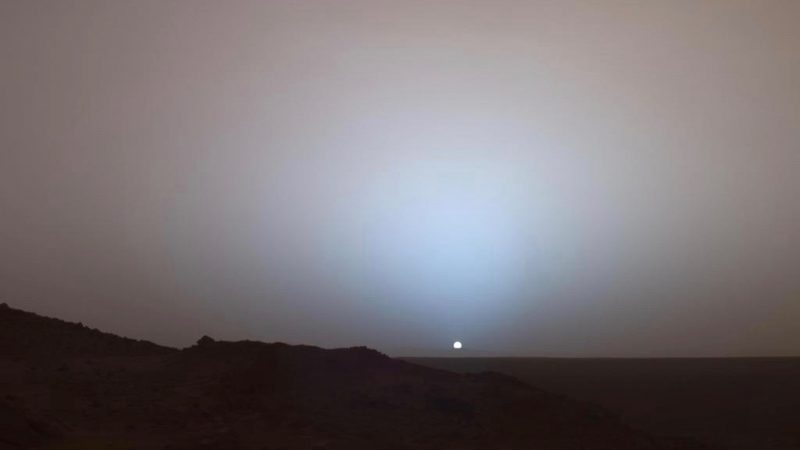
As the sun sets one the stark Martian landscape, stars come into view. Will future Mars colonists have a North Star to guide them? Image via NASA.

As the sun sets over the stark Martian landscape, stars come into view. Image by Mars rover Spirit, 2005, via NASA.

Mars is brighter in 2018 than since 2003

The North Star for Earth is Polaris. Does our next-door neighbor planet, Mars, have the same North Star as Earth? If not, does Mars have a star located more or less above its North Pole?

Every planet in our solar system spins on its axis. Earth’s spin is what defines the length of our day of approximately 24 hours. If you continue the imaginary line of a planet’s axis out into space – in a northern direction as measured from earthly north – it might point to a star that’s visible to the eye. Or it might not.

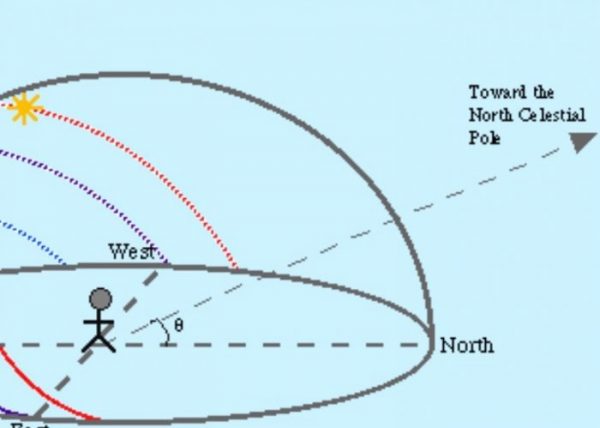
In this diagram, the arrow points to the north celestial pole and North Star. Its height above your horizon depends on your latitude. Image via solar.physics.montana.edu

In this diagram, the arrow points to the North Star. Its height above your horizon depends on your latitude. Image via solar.physics.montana.edu.

We call such stars pole stars, or North Stars. On Earth, that northern pole star – less than a degree from the north celestial pole – is the beloved star Polaris. Scouts and hikers know you can use Polaris to find the direction north, when compasses fail.

Meanwhile, Earth’s Southern Hemisphere doesn’t have a comparable South Star. The nearest visible star to the south celestial pole of Earth is about 9 degrees away.

So, does Mars have a North or South Star? The answer is … not in any satisfying way. There’s no bright North Star, and only a modestly-bright South Star, for Mars.

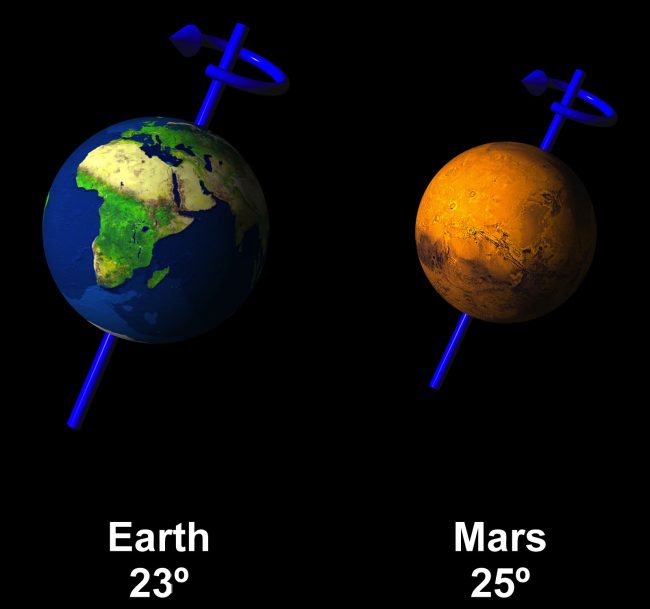
Earth's tilt is about 23-and-a-half degrees. Mars' tilt is about 25 degrees. Image via letsgomars.org

Earth’s tilt is about 23 1/2 degrees. Mars’ tilt is about 25 degrees. So Mars doesn’t have the same North Star as Earth. Image via Bad Astronomy.

In the northern sky as seen from Mars, the best candidate for a North Star is located on Mars’ sky dome about half a degree from Mars’ north celestial pole. That’s closer than Polaris is to Earth’s north celestial pole, but, while Polaris is relatively bright (50th brightest of all stars in the night sky), the star near Mars’ north celestial pole is faint.

In fact, this star is barely within the limit of visibility to the eye alone.

Mars’ north pole points to a spot in the sky that’s about midway between Deneb, the brightest star in the constellation Cygnus the Swan, and Alderamin, the brightest star in the constellation Cepheus the King. Click here to see the position of Mars’ north celestial pole between the constellations Cygnus and Cepheus.

Meanwhile, in the southern sky as seen from Mars, Kappa Velorum is only about three degrees from the Martian south celestial pole. That’s not as close as Polaris is to Earth’s north celestial pole, plus this star is only modestly bright, not nearly as bright as Polaris.

Future Mars colonists aren’t going to have a bright North Star – like our Polaris – to guide them.

On the other hand, if you were standing outside at night on the surface of Mars, you’d see some other cool stuff!

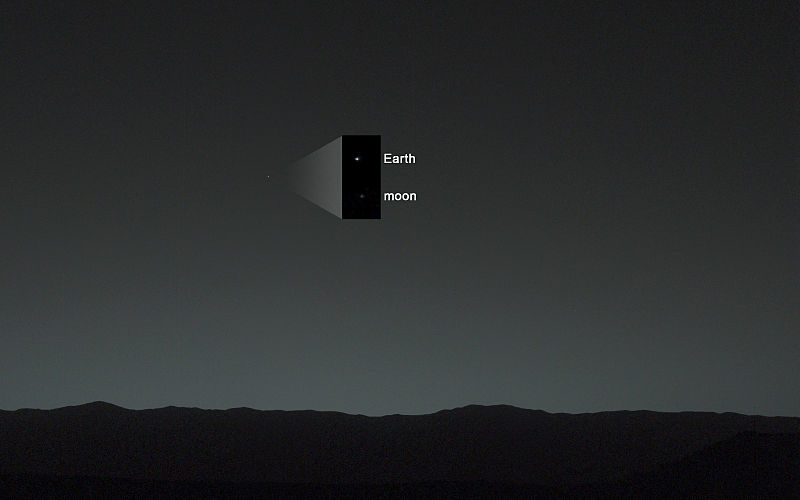
Earth and moon, as seen from Mars by the Curiosity rover on January 31, 2014. Read more about this image.

Earth and moon, as seen from Mars by the Curiosity rover in 2014. From Mars, you’d see both the Earth and moon with the eye alone. Read more about this image.

As seen from Mars, you could see Earth’s moon orbiting around Earth once each month. From Earth, we can’t see any other planets’ satellites with the unaided eye, but this amazing sight on Mars would be visible to the eye alone. Both the Earth and the moon would appear starlike.

In general, the Earth as seen from Mars would somewhat mimic our view of Venus as seen from Earth. By that we mean that – like Venus in relationship to Earth – Earth in relationship to Mars is an inner planet. It orbits closer to the sun than Mars. Thus Earth as seen from Mars would be a morning or evening “star” – just as Venus is as seen from our world.

And although both the Earth and moon would appear as stars to the unaided eye, observers on Mars with telescopes would sometimes see them as crescent worlds – just as we do Venus.

So … no North Star for Mars. But Martian stargazers wouldn’t lack for things to see!

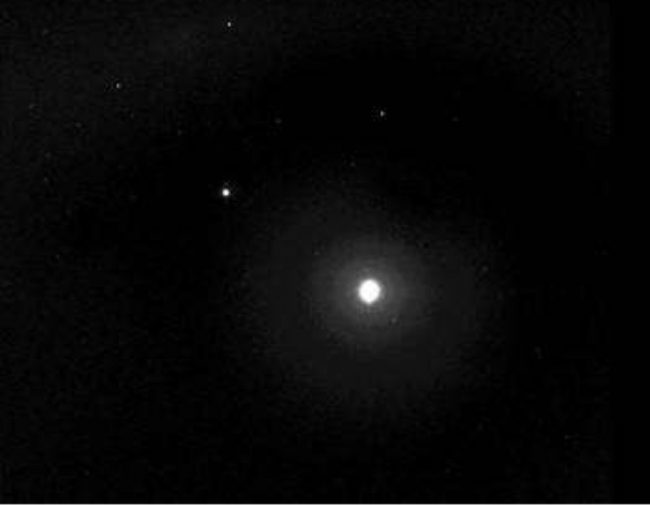
Time-lapse composite of the two tiny martian moons, as seen from Mars's surface. Phobos is the brighter moon. Deimos is fainter. Acquired by Mars rover Spirit on August 26, 2005. Tiny streaks mark the trails of background stars moving across the sky or the impact of cosmic rays lighting up random groups of pixels in the image. Read more about this image.

Here are Mars’ two tiny martian moons – Phobos and Deimos – as seen from Mars’ surface. Phobos is the brighter one. Deimos is fainter. From Mars, you’d see these two zipping along overhead. Acquired by Mars rover Spirit on August 26, 2005. Read more about this image.

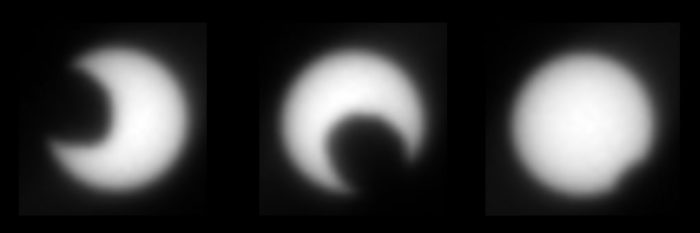
Mars' larger moon, Phobos, eclipsing the sun, as seen by NASA's Mars rover Opportunity. Read more about this image.

Mars’ moon Phobos eclipsing the sun in stages, as seen by NASA’s Mars rover Opportunity. Read more about this image.

Bottom line: Does planet Mars have a North Star akin to Earth’s North Star Polaris?


from EarthSky https://ift.tt/21o3lXi
As the sun sets one the stark Martian landscape, stars come into view. Will future Mars colonists have a North Star to guide them? Image via NASA.

As the sun sets over the stark Martian landscape, stars come into view. Image by Mars rover Spirit, 2005, via NASA.

Mars is brighter in 2018 than since 2003

The North Star for Earth is Polaris. Does our next-door neighbor planet, Mars, have the same North Star as Earth? If not, does Mars have a star located more or less above its North Pole?

Every planet in our solar system spins on its axis. Earth’s spin is what defines the length of our day of approximately 24 hours. If you continue the imaginary line of a planet’s axis out into space – in a northern direction as measured from earthly north – it might point to a star that’s visible to the eye. Or it might not.

In this diagram, the arrow points to the north celestial pole and North Star. Its height above your horizon depends on your latitude. Image via solar.physics.montana.edu

In this diagram, the arrow points to the North Star. Its height above your horizon depends on your latitude. Image via solar.physics.montana.edu.

We call such stars pole stars, or North Stars. On Earth, that northern pole star – less than a degree from the north celestial pole – is the beloved star Polaris. Scouts and hikers know you can use Polaris to find the direction north, when compasses fail.

Meanwhile, Earth’s Southern Hemisphere doesn’t have a comparable South Star. The nearest visible star to the south celestial pole of Earth is about 9 degrees away.

So, does Mars have a North or South Star? The answer is … not in any satisfying way. There’s no bright North Star, and only a modestly-bright South Star, for Mars.

Earth's tilt is about 23-and-a-half degrees. Mars' tilt is about 25 degrees. Image via letsgomars.org

Earth’s tilt is about 23 1/2 degrees. Mars’ tilt is about 25 degrees. So Mars doesn’t have the same North Star as Earth. Image via Bad Astronomy.

In the northern sky as seen from Mars, the best candidate for a North Star is located on Mars’ sky dome about half a degree from Mars’ north celestial pole. That’s closer than Polaris is to Earth’s north celestial pole, but, while Polaris is relatively bright (50th brightest of all stars in the night sky), the star near Mars’ north celestial pole is faint.

In fact, this star is barely within the limit of visibility to the eye alone.

Mars’ north pole points to a spot in the sky that’s about midway between Deneb, the brightest star in the constellation Cygnus the Swan, and Alderamin, the brightest star in the constellation Cepheus the King. Click here to see the position of Mars’ north celestial pole between the constellations Cygnus and Cepheus.

Meanwhile, in the southern sky as seen from Mars, Kappa Velorum is only about three degrees from the Martian south celestial pole. That’s not as close as Polaris is to Earth’s north celestial pole, plus this star is only modestly bright, not nearly as bright as Polaris.

Future Mars colonists aren’t going to have a bright North Star – like our Polaris – to guide them.

On the other hand, if you were standing outside at night on the surface of Mars, you’d see some other cool stuff!

Earth and moon, as seen from Mars by the Curiosity rover on January 31, 2014. Read more about this image.

Earth and moon, as seen from Mars by the Curiosity rover in 2014. From Mars, you’d see both the Earth and moon with the eye alone. Read more about this image.

As seen from Mars, you could see Earth’s moon orbiting around Earth once each month. From Earth, we can’t see any other planets’ satellites with the unaided eye, but this amazing sight on Mars would be visible to the eye alone. Both the Earth and the moon would appear starlike.

In general, the Earth as seen from Mars would somewhat mimic our view of Venus as seen from Earth. By that we mean that – like Venus in relationship to Earth – Earth in relationship to Mars is an inner planet. It orbits closer to the sun than Mars. Thus Earth as seen from Mars would be a morning or evening “star” – just as Venus is as seen from our world.

And although both the Earth and moon would appear as stars to the unaided eye, observers on Mars with telescopes would sometimes see them as crescent worlds – just as we do Venus.

So … no North Star for Mars. But Martian stargazers wouldn’t lack for things to see!

Time-lapse composite of the two tiny martian moons, as seen from Mars's surface. Phobos is the brighter moon. Deimos is fainter. Acquired by Mars rover Spirit on August 26, 2005. Tiny streaks mark the trails of background stars moving across the sky or the impact of cosmic rays lighting up random groups of pixels in the image. Read more about this image.

Here are Mars’ two tiny martian moons – Phobos and Deimos – as seen from Mars’ surface. Phobos is the brighter one. Deimos is fainter. From Mars, you’d see these two zipping along overhead. Acquired by Mars rover Spirit on August 26, 2005. Read more about this image.

Mars' larger moon, Phobos, eclipsing the sun, as seen by NASA's Mars rover Opportunity. Read more about this image.

Mars’ moon Phobos eclipsing the sun in stages, as seen by NASA’s Mars rover Opportunity. Read more about this image.

Bottom line: Does planet Mars have a North Star akin to Earth’s North Star Polaris?


from EarthSky https://ift.tt/21o3lXi

A tiny helicopter for Mars 2020

Reprinted with permission from AmericaSpace

Excitement has been building for NASA’s next rover mission to Mars, scheduled to launch sometime in 2020. Although it looks a lot like the current Curiosity rover, its mission will be to search directly for possible evidence of past life. Curiosity, on the other hand, is studying the ancient habitability of Gale Crater on Mars, which we now know used to hold a lake or series of lakes, focusing more on geology than biology.

And now the upcoming 2020 mission just got even better – NASA has approved the inclusion of a tiny drone-like helicopter to accompany the rover!

This is something never done before, and assuming it’s successful, will be the first time that Mars has been robotically explored by something other than an orbiter, lander or rover.

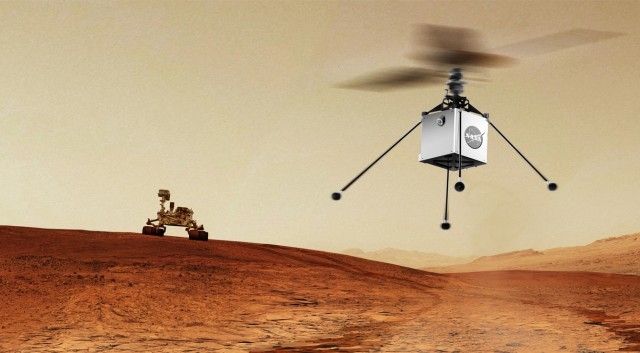
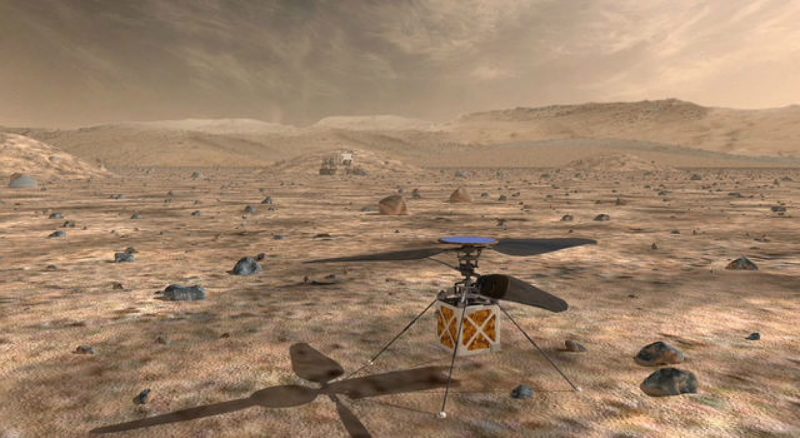
Artist’s concept of the Mars Helicopter, which will be sent to Mars along with the 2020 rover. Image via NASA/JPL-Caltech/AmericaSpace.

The Mars Helicopter will be a small, drone-like autonomous rotorcraft, designed specifically for Mars’ very thin atmosphere; it will provide a unique and exciting new way to see the Martian landscape as never before – a bird’s-eye view, if you will.

And of course, it’s just very cool. NASA Administrator Jim Bridenstine commented:

NASA has a proud history of firsts. The idea of a helicopter flying the skies of another planet is thrilling. The Mars Helicopter holds much promise for our future science, discovery, and exploration missions to Mars.

Having a helicopter would be useful in scouting out sites for further investigation by the rover. Being up in the air is a definite advantage. You can get a better overall view than from the ground or even from orbit.

The Mars Helicopter will be a first test of this kind of technology. Weighing under four pounds (1.8 kilograms), and with a body the size of a softball, the concept has already gone through four years of design, testing and redesign. Operating in Mars’ thin atmosphere isn’t as easy as on Earth, so the twin, counter-rotating blades will need to spin at almost 3,000 rpm, 10 times faster than a conventional helicopter. On the Martian surface, the atmosphere is equivalent to an altitude of 100,000 feet (30,000 meters) on Earth, so the helicopter needs to be able to fly in those conditions.

By comparison, the highest altitude record for a helicopter on Earth is 40,000 feet (12,000 meters).

Artist’s concept of the helicopter on Mars’ surface. After deployment, it’ll make a short first test flight, and then longer flights to different locations on Mars. Image via NASA/JPL-Caltech/AmericaSpace.

Mimi Aung, Mars Helicopter project manager at JPL, said:

To make it fly at that low atmospheric density, we had to scrutinize everything, make it as light as possible while being as strong and as powerful as it can possibly be.

The Mars Helicopter also includes solar cells to charge its lithium-ion batteries and a heater to keep it warm. The 2020 mission provides a perfect opportunity to test this first attempt at Mars aviation. Thomas Zurbuchen, Associate Administrator for NASA’s Science Mission Directorate, said:

Exploring the red planet with NASA’s Mars Helicopter exemplifies a successful marriage of science and technology innovation and is a unique opportunity to advance Mars exploration for the future. After the Wright Brothers proved 117 years ago that powered, sustained, and controlled flight was possible here on Earth, another group of American pioneers may prove the same can be done on another world.

NASA will conduct a 30-day flight test campaign of the helicopter. For the first flight, it will climb to about 10 feet (3 meters), and then hover for about 30 seconds. If all goes well, it will take gradually longer flights, up to a few hundred meters. Zurbuchen said:

The ability to see clearly what lies beyond the next hill is crucial for future explorers. We already have great views of Mars from the surface as well as from orbit. With the added dimension of a bird’s-eye view from a “marscopter,” we can only imagine what future missions will achieve.

The 2020 rover itself will be the most sophisticated ever sent to Mars so far. While other rovers have focused on geology and habitability, this one is designed to look directly for evidence of past microbial life on the red planet, with updated instruments, and will be the first life-focused mission since the Viking landers in the 1970s. It will also take rock and soil samples which will be preserved in small tubes, to be sent back to Earth at a later date and test technologies which could be used for future human missions.

The rover will launch in 2020 and land in February 2021. Meanwhile, NASA’s newest Mars mission, the InSight lander, was launched on May 5 and will land later this year. InSight will stay in one place, however, using a wide range of instruments to study the composition of the interior of Mars, to help scientists learn how the planet formed and evolved.

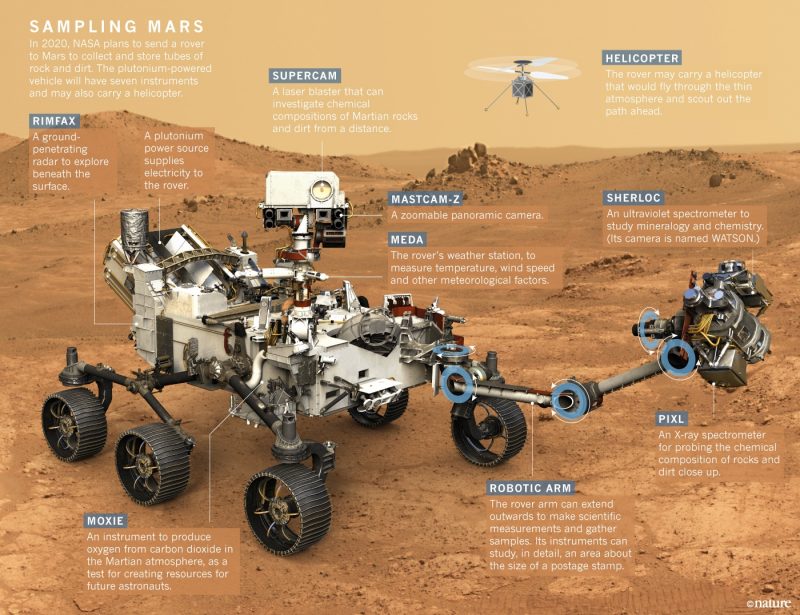
View larger. | Mars 2020 rover is similar in design to the Curiosity rover, but will focus on searching for evidence of past microbial life. The helicopter, now approved, will serve as a scout. Image via NASA/JPL-Caltech/Nature/AmericaSpace.

Bottom line: Mars’ atmosphere is thin. In order to stay aloft, the planned softball-sized Mars Helicopter – which will accompany the Mars 2020 mission – will have twin, counter-rotating blades that’ll bite into Mars’ thin air at about 10 times the rate of a helicopter on Earth.

Via NASA JPL and AmericaSpace


from EarthSky https://ift.tt/2GEZuAW

Reprinted with permission from AmericaSpace

Excitement has been building for NASA’s next rover mission to Mars, scheduled to launch sometime in 2020. Although it looks a lot like the current Curiosity rover, its mission will be to search directly for possible evidence of past life. Curiosity, on the other hand, is studying the ancient habitability of Gale Crater on Mars, which we now know used to hold a lake or series of lakes, focusing more on geology than biology.

And now the upcoming 2020 mission just got even better – NASA has approved the inclusion of a tiny drone-like helicopter to accompany the rover!

This is something never done before, and assuming it’s successful, will be the first time that Mars has been robotically explored by something other than an orbiter, lander or rover.

Artist’s concept of the Mars Helicopter, which will be sent to Mars along with the 2020 rover. Image via NASA/JPL-Caltech/AmericaSpace.

The Mars Helicopter will be a small, drone-like autonomous rotorcraft, designed specifically for Mars’ very thin atmosphere; it will provide a unique and exciting new way to see the Martian landscape as never before – a bird’s-eye view, if you will.

And of course, it’s just very cool. NASA Administrator Jim Bridenstine commented:

NASA has a proud history of firsts. The idea of a helicopter flying the skies of another planet is thrilling. The Mars Helicopter holds much promise for our future science, discovery, and exploration missions to Mars.

Having a helicopter would be useful in scouting out sites for further investigation by the rover. Being up in the air is a definite advantage. You can get a better overall view than from the ground or even from orbit.

The Mars Helicopter will be a first test of this kind of technology. Weighing under four pounds (1.8 kilograms), and with a body the size of a softball, the concept has already gone through four years of design, testing and redesign. Operating in Mars’ thin atmosphere isn’t as easy as on Earth, so the twin, counter-rotating blades will need to spin at almost 3,000 rpm, 10 times faster than a conventional helicopter. On the Martian surface, the atmosphere is equivalent to an altitude of 100,000 feet (30,000 meters) on Earth, so the helicopter needs to be able to fly in those conditions.

By comparison, the highest altitude record for a helicopter on Earth is 40,000 feet (12,000 meters).

Artist’s concept of the helicopter on Mars’ surface. After deployment, it’ll make a short first test flight, and then longer flights to different locations on Mars. Image via NASA/JPL-Caltech/AmericaSpace.

Mimi Aung, Mars Helicopter project manager at JPL, said:

To make it fly at that low atmospheric density, we had to scrutinize everything, make it as light as possible while being as strong and as powerful as it can possibly be.

The Mars Helicopter also includes solar cells to charge its lithium-ion batteries and a heater to keep it warm. The 2020 mission provides a perfect opportunity to test this first attempt at Mars aviation. Thomas Zurbuchen, Associate Administrator for NASA’s Science Mission Directorate, said:

Exploring the red planet with NASA’s Mars Helicopter exemplifies a successful marriage of science and technology innovation and is a unique opportunity to advance Mars exploration for the future. After the Wright Brothers proved 117 years ago that powered, sustained, and controlled flight was possible here on Earth, another group of American pioneers may prove the same can be done on another world.

NASA will conduct a 30-day flight test campaign of the helicopter. For the first flight, it will climb to about 10 feet (3 meters), and then hover for about 30 seconds. If all goes well, it will take gradually longer flights, up to a few hundred meters. Zurbuchen said:

The ability to see clearly what lies beyond the next hill is crucial for future explorers. We already have great views of Mars from the surface as well as from orbit. With the added dimension of a bird’s-eye view from a “marscopter,” we can only imagine what future missions will achieve.

The 2020 rover itself will be the most sophisticated ever sent to Mars so far. While other rovers have focused on geology and habitability, this one is designed to look directly for evidence of past microbial life on the red planet, with updated instruments, and will be the first life-focused mission since the Viking landers in the 1970s. It will also take rock and soil samples which will be preserved in small tubes, to be sent back to Earth at a later date and test technologies which could be used for future human missions.

The rover will launch in 2020 and land in February 2021. Meanwhile, NASA’s newest Mars mission, the InSight lander, was launched on May 5 and will land later this year. InSight will stay in one place, however, using a wide range of instruments to study the composition of the interior of Mars, to help scientists learn how the planet formed and evolved.

View larger. | Mars 2020 rover is similar in design to the Curiosity rover, but will focus on searching for evidence of past microbial life. The helicopter, now approved, will serve as a scout. Image via NASA/JPL-Caltech/Nature/AmericaSpace.

Bottom line: Mars’ atmosphere is thin. In order to stay aloft, the planned softball-sized Mars Helicopter – which will accompany the Mars 2020 mission – will have twin, counter-rotating blades that’ll bite into Mars’ thin air at about 10 times the rate of a helicopter on Earth.

Via NASA JPL and AmericaSpace


from EarthSky https://ift.tt/2GEZuAW

Deneb, tail of Cygnus the Swan

Tonight, look for Deneb, the brightest star in the constellation Cygnus the Swan. The night sky chart at the top of this post presents the view toward the northeast in mid-to-late evening during the month of May. It’s the view from mid-northern latitudes. It’s by looking in this direction that you can get a good look at the bright star Deneb, which should be visible even in tonight’s moon-drenched skies.

This star is part of not one but two striking star patterns. And it’s one of the most distant stars we can see with the eye alone, well over 1,000 light-years away.

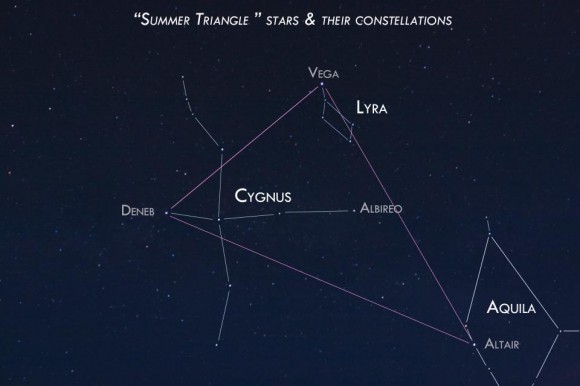
Here is the Summer Triangle asterism - three bright stars in three different constellations - as photographed by EarthSky Facebook friend Susan Jensen in Odessa, Washington. Thank you, Susan, for your excellent and beautiful work!

Here is the Summer Triangle asterism – three bright stars in three different constellations – as photographed by EarthSky Facebook friend Susan Jensen in Odessa, Washington. Thank you, Susan, for your excellent and beautiful work!

Deneb is part of the Summer Triangle pattern. Deneb – along with the stars Vega and Altair – is part of the famous Summer Triangle asterism, which will be well up in the east in mid-evening next month. On these Northern Hemisphere late spring evenings, you might not be able to see the whole Summer Triangle until later at night. The star Altair will be the last of these three stars to rise. But you can see the bright star Deneb to the lower left of Vega, the Summer Triangle’s brightest star.

Enjoying EarthSky so far? Sign up for our free daily newsletter today!

Deneb is also part of a smaller, cross-like pattern. Deneb is the brightest star in the constellation Cygnus the Swan. If you look at the cross-like pattern indicated on the chart at the top of this post, you might be able to imagine Deneb as the point marking the short tail of a long-necked swan flying toward the south. This is how early Arabian stargazers saw it. The name Deneb comes from the Arabic and means tail, and in skylore Deneb is often said to be the Tail of the Swan. The little star Albireo marks the Swan’s Head.

But there’s another way to see this pattern of stars that works equally well. In more modern skylore, this pattern is sometimes called the Northern Cross. It looks like a cross, right? If you prefer to see the Cross instead of the Swan, Deneb marks the head of the Cross.

Cross or Swan … this is a lovely pattern to pick out on the sky’s dome.

Astronomers know that Deneb is one of the most distant stars we can see with the eye alone. The exact distance to Deneb can only be estimated, with estimates ranging from about 1,425 light-years to perhaps as much as 7,000 light-years. At any of these estimated distances, Deneb is one of the farthest stars the unaided human eye can see. It is so far, that the light that reaches the Earth today started on its journey well more than 1,000 years ago.

More about Deneb: Very distant and very luminous

Bottom line: The star Deneb is part of the Summer Triangle asterism. And it’s part of the constellation Cygnus the Swan, which can also be seen as a Cross. Look for the star Deneb tonight! At well over 1,000 light-years away, it’s one of the most distant stars we can see with the eye alone.

A planisphere is virtually indispensable tool for beginning stargazers. Order your EarthSky planisphere from our store.


from EarthSky https://ift.tt/1HI1qUY

Tonight, look for Deneb, the brightest star in the constellation Cygnus the Swan. The night sky chart at the top of this post presents the view toward the northeast in mid-to-late evening during the month of May. It’s the view from mid-northern latitudes. It’s by looking in this direction that you can get a good look at the bright star Deneb, which should be visible even in tonight’s moon-drenched skies.

This star is part of not one but two striking star patterns. And it’s one of the most distant stars we can see with the eye alone, well over 1,000 light-years away.

Here is the Summer Triangle asterism - three bright stars in three different constellations - as photographed by EarthSky Facebook friend Susan Jensen in Odessa, Washington. Thank you, Susan, for your excellent and beautiful work!

Here is the Summer Triangle asterism – three bright stars in three different constellations – as photographed by EarthSky Facebook friend Susan Jensen in Odessa, Washington. Thank you, Susan, for your excellent and beautiful work!

Deneb is part of the Summer Triangle pattern. Deneb – along with the stars Vega and Altair – is part of the famous Summer Triangle asterism, which will be well up in the east in mid-evening next month. On these Northern Hemisphere late spring evenings, you might not be able to see the whole Summer Triangle until later at night. The star Altair will be the last of these three stars to rise. But you can see the bright star Deneb to the lower left of Vega, the Summer Triangle’s brightest star.

Enjoying EarthSky so far? Sign up for our free daily newsletter today!

Deneb is also part of a smaller, cross-like pattern. Deneb is the brightest star in the constellation Cygnus the Swan. If you look at the cross-like pattern indicated on the chart at the top of this post, you might be able to imagine Deneb as the point marking the short tail of a long-necked swan flying toward the south. This is how early Arabian stargazers saw it. The name Deneb comes from the Arabic and means tail, and in skylore Deneb is often said to be the Tail of the Swan. The little star Albireo marks the Swan’s Head.

But there’s another way to see this pattern of stars that works equally well. In more modern skylore, this pattern is sometimes called the Northern Cross. It looks like a cross, right? If you prefer to see the Cross instead of the Swan, Deneb marks the head of the Cross.

Cross or Swan … this is a lovely pattern to pick out on the sky’s dome.

Astronomers know that Deneb is one of the most distant stars we can see with the eye alone. The exact distance to Deneb can only be estimated, with estimates ranging from about 1,425 light-years to perhaps as much as 7,000 light-years. At any of these estimated distances, Deneb is one of the farthest stars the unaided human eye can see. It is so far, that the light that reaches the Earth today started on its journey well more than 1,000 years ago.

More about Deneb: Very distant and very luminous

Bottom line: The star Deneb is part of the Summer Triangle asterism. And it’s part of the constellation Cygnus the Swan, which can also be seen as a Cross. Look for the star Deneb tonight! At well over 1,000 light-years away, it’s one of the most distant stars we can see with the eye alone.

A planisphere is virtually indispensable tool for beginning stargazers. Order your EarthSky planisphere from our store.


from EarthSky https://ift.tt/1HI1qUY

Mars brighter in 2018 than since 2003

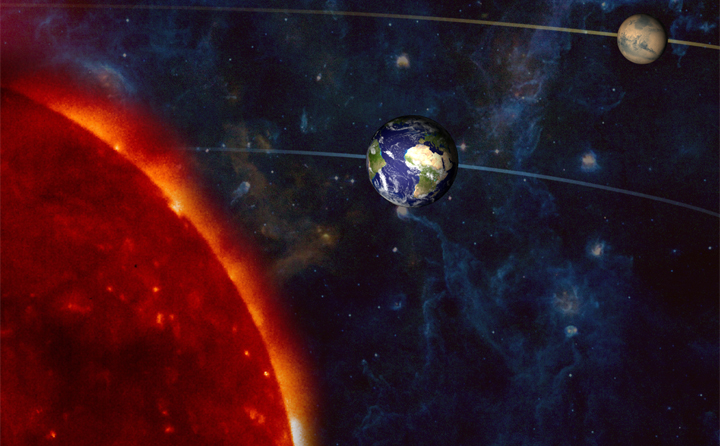
Artist’s concept of Earth (3rd planet from the sun) passing between the sun and Mars (4th planet from the sun). Not to scale. At such times, Mars appears opposite the sun in our sky, and astronomers say that Mars is in “opposition” to the sun. Mars will be in opposition next in July, 2018. Image via NASA.

Remember Mars in 2003? That was the year the red planet came closer to Earth than it had been in some 60,000 years. Mars can be faint, or it can be a bright planet. It can outshine most stars. But, in 2003, for a few months, Mars was exceedingly spectacular in our sky, outshining all the stars and planets except brilliant Venus. In 2018, Mars won’t be quite as bright as it was in 2003. But nearly!

It’ll dramatically brighten over the coming months to appear as a red dot of brilliant flame in our sky around late July, 2018.

Want to see Mars now? Check out EarthSky’s planet guide
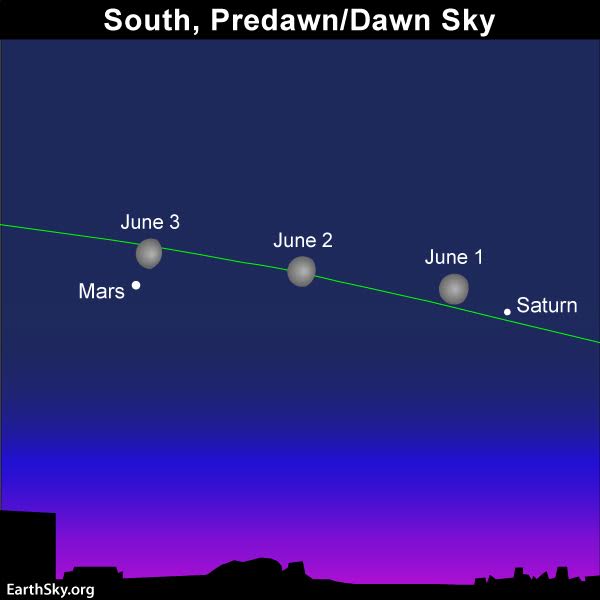
Watch for the moon to sweep past both Saturn and Mars in early June 2018.

More than any other bright planet, the appearance of Mars in our night sky changes from year to year. Its dramatic swings in brightness are part of what make Mars a fascinating planet to watch with the eye alone. Mars was faint throughout 2017. But it’s brighter now, as you might notice if you’ve been watching the planet in the predawn sky. Mars was very close to Saturn in early April (see photos), and it’s still near Saturn (though not as close) as you can see from the chart above. Jupiter is up before dawn now, too, and, when you contrast the brightness of Jupiter and Mars in April 2018, you might not believe that Mars will be brighter than Jupiter this July.

But it’s true. In late July 2018, around the time Earth sweeps between Mars and the sun, Mars will outshine Jupiter by some 1.8 times.

And that will be something to see!

See photos: A beautiful conjunction of Mars and Saturn in early April
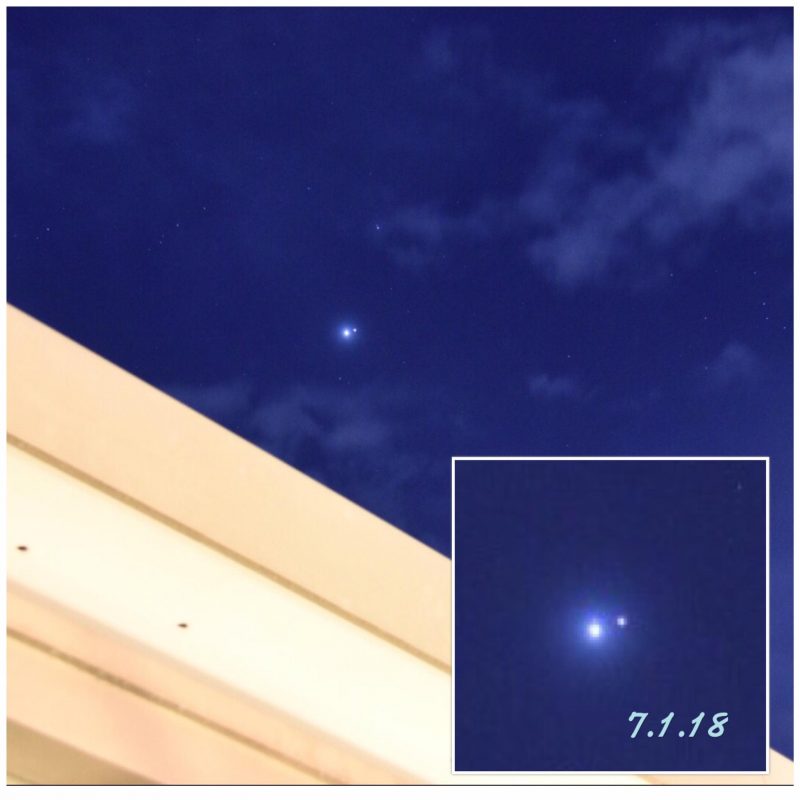
Brighter Jupiter, fainter Mars, on January 7, 2018, via Jenney Disimon in Sabah, North Borneo. Jupiter will remain steady in brightness. Mars will brighten dramatically, to outshine Jupiter and reign as the 4th brightest object in Earth’s sky – after Venus, the moon and the sun – from about July 7 to September 7, 2018.
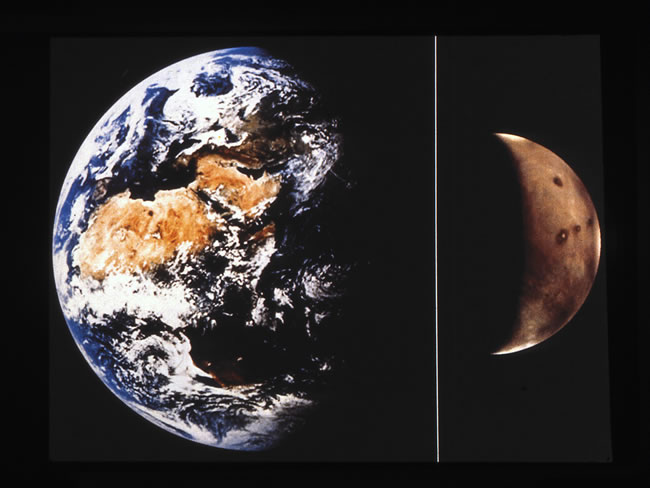
Mars isn’t very big, so its brightness – when it is bright – isn’t due to its bigness, as is true of Jupiter. Mars’ brightness, or lack of brightness, is all about how close it is to us. Image via Lunar and Planetary Institute.

So … why? Why does Mars sometimes appear very bright, and sometimes very faint?

The first thing to realize is that Mars isn’t a very big world. It is only 4,219 miles (6,790 km) in diameter, making it only slightly more than half as big as Earth at 7,922 miles (12,750 km) in diameter. So, when it’s bright, its brightness isn’t due to its bigness, as is the case with Jupiter.

The main reason for Mars’ extremes in brightness has to do with the proximity (or lack of proximity) of Earth and Mars during the orbits of both worlds around the sun. It’s about the nearness in space of our two worlds. Sometimes Earth and Mars are on the same side of the solar system, and hence near one another. At other times, as it was throughout most of 2017, Mars is far across the solar system from us.
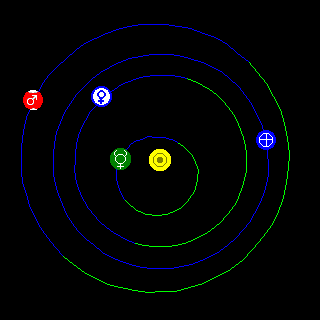
On this depiction via Fourmilab – Mars is red and Earth is blue. In early October 2017, Mars was relatively far across the solar system from Earth. The distance between our 2 worlds is relatively large, so Mars appears faint.

Here’s the Fourmilab depiction for April 23, 2018. Mars is red, Earth is blue. In contrast to the chart above, you can see that Earth and Mars are now closer together. Earth is catching up to Mars in the race of the planets around the sun. Thus, Mars is getting brighter!
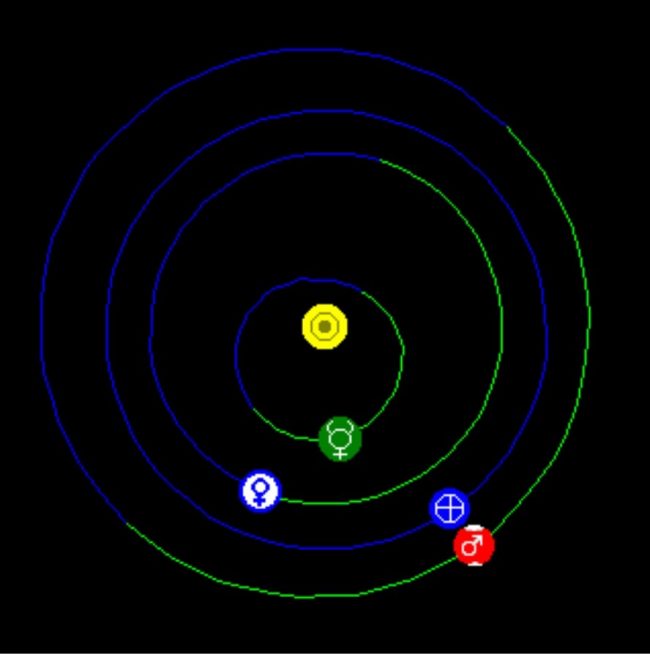
Earth will pass between between the sun and Mars on July 27, 2018. Then, the distance between our two worlds will be at its least for this 2-year period, and Mars will appear brightest in our sky. Image via Fourmilab.

Mars orbits the sun just one step outward from Earth’s orbit. Earth takes a year to orbit the sun once. Mars takes about two years to orbit once. Opposition for Mars – when Earth passes between Mars and the sun – happens every two years and 50 days.

So Mars’ brightness waxes and wanes in our sky about every two years. But 2018 is a very, very special year for Mars. Mars will appear brighter in our sky this year than it has since 2003.

The last opposition was on May 22, 2016. Around that time, Mars was very bright indeed in Earth’s sky. See photos of Mars in May, 2016.

Joanne Richard Escober caught this image of Mars, Saturn and Antares on May 28 at Apo Reef Natural Park, Occidental Mindoro, Philippines.

Joanne Richard Escober caught this image of Mars, Saturn and Antares on May 28, 2016 – around the time of Mars’ last opposition – at Apo Reef Natural Park, Occidental Mindoro, Philippines. Mars was very bright in 2016, but it’ll be even brighter in 2018!

This 2018 opposition of Mars isn’t an ordinary opposition. Astronomers will call it a perihelic opposition (or perihelic apparition) of Mars. The word perihelion refers the point in Mars’ orbit when it is closest to the sun. Maybe you can see that – in years when we pass between Mars and the sun, when Mars is also closest to the sun – Earth and Mars are closest. That’s what will be happening in 2018, and it’s why the Association of Lunar and Planetary Observers (ALPO) wrote:

The 2018 perihelic apparition of Mars will prove to be one of the most favorable since the 2003 apparition when the red planet came closest to Earth in 59,635 years (the year 57,617 B.C.).

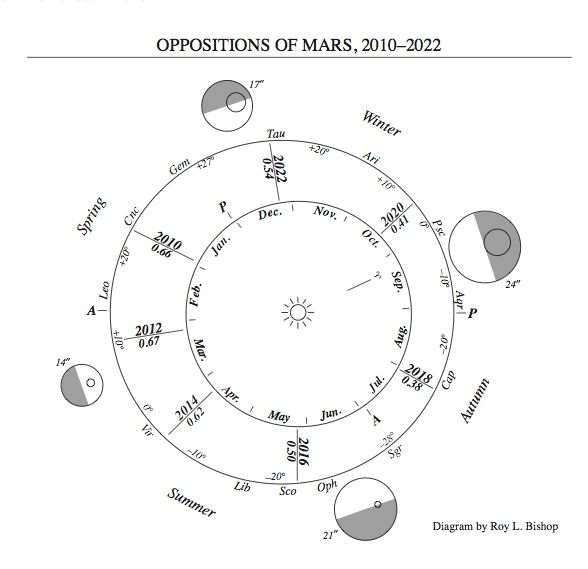
Diagram by Roy L. Bishop. Copyright Royal Astronomical Society of Canada. Used with permission. Visit the RASC estore to purchase the Observers Handbook, a necessary tool for all skywatchers.

Diagram by Roy L. Bishop. Copyright Royal Astronomical Society of Canada. Used with permission. Visit the RASC estore to purchase the Observers Handbook, a necessary tool for all skywatchers. Read more about this image.

According to ALPO, in 2003, Mars came within 34.6 million miles (55.7 million km) of Earth, closer than at any time in over nearly 60,000 years! It’ll be only 1.2 million miles (just under 2 million km) farther away in 2018. Closest approach for Mars in 2018 will take place on July 31, some four days after its July 27 opposition.

For a period of about two months, Mars will supplant Jupiter as the fourth brightest celestial body, after the sun, moon and Venus. Mars’ reign as the fourth-brightest celestial body (or third brightest in the nighttime sky, after the moon and Venus) will last from about July 7 to September 7.

So 2017 was, indeed, a lousy year for Mars. But just wait! Mars will be grand in 2018.

How can you find Mars throughout this year? Check out EarthSky’s monthly planet guide.
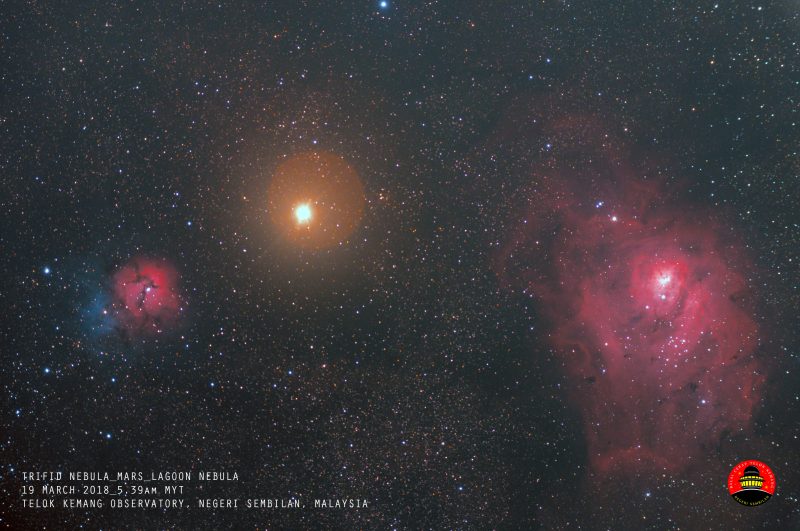
View larger. | Mars is the very bright orange object in the center of this photo, taken March 19, 2018. The Trifid Nebula is on the left, and the Lagoon Nebula is on the right, in this photo by Muzamir Mazlan. Sony A7s camera, Vixen ED103s telescope, Paramount MEII mounting, 39x30sec (ISO5000) stack with deepsky stacker and PS6.

Bottom line: Mars alternates years in appearing bright and faint in our night sky. 2017 was one of the off-years, but, in 2018, we’ll have a grand view of Mars … best since 2003!


from EarthSky https://ift.tt/21Jgj1f

Artist’s concept of Earth (3rd planet from the sun) passing between the sun and Mars (4th planet from the sun). Not to scale. At such times, Mars appears opposite the sun in our sky, and astronomers say that Mars is in “opposition” to the sun. Mars will be in opposition next in July, 2018. Image via NASA.

Remember Mars in 2003? That was the year the red planet came closer to Earth than it had been in some 60,000 years. Mars can be faint, or it can be a bright planet. It can outshine most stars. But, in 2003, for a few months, Mars was exceedingly spectacular in our sky, outshining all the stars and planets except brilliant Venus. In 2018, Mars won’t be quite as bright as it was in 2003. But nearly!

It’ll dramatically brighten over the coming months to appear as a red dot of brilliant flame in our sky around late July, 2018.

Want to see Mars now? Check out EarthSky’s planet guide

Watch for the moon to sweep past both Saturn and Mars in early June 2018.

More than any other bright planet, the appearance of Mars in our night sky changes from year to year. Its dramatic swings in brightness are part of what make Mars a fascinating planet to watch with the eye alone. Mars was faint throughout 2017. But it’s brighter now, as you might notice if you’ve been watching the planet in the predawn sky. Mars was very close to Saturn in early April (see photos), and it’s still near Saturn (though not as close) as you can see from the chart above. Jupiter is up before dawn now, too, and, when you contrast the brightness of Jupiter and Mars in April 2018, you might not believe that Mars will be brighter than Jupiter this July.

But it’s true. In late July 2018, around the time Earth sweeps between Mars and the sun, Mars will outshine Jupiter by some 1.8 times.

And that will be something to see!

See photos: A beautiful conjunction of Mars and Saturn in early April

Brighter Jupiter, fainter Mars, on January 7, 2018, via Jenney Disimon in Sabah, North Borneo. Jupiter will remain steady in brightness. Mars will brighten dramatically, to outshine Jupiter and reign as the 4th brightest object in Earth’s sky – after Venus, the moon and the sun – from about July 7 to September 7, 2018.

Mars isn’t very big, so its brightness – when it is bright – isn’t due to its bigness, as is true of Jupiter. Mars’ brightness, or lack of brightness, is all about how close it is to us. Image via Lunar and Planetary Institute.

So … why? Why does Mars sometimes appear very bright, and sometimes very faint?

The first thing to realize is that Mars isn’t a very big world. It is only 4,219 miles (6,790 km) in diameter, making it only slightly more than half as big as Earth at 7,922 miles (12,750 km) in diameter. So, when it’s bright, its brightness isn’t due to its bigness, as is the case with Jupiter.

The main reason for Mars’ extremes in brightness has to do with the proximity (or lack of proximity) of Earth and Mars during the orbits of both worlds around the sun. It’s about the nearness in space of our two worlds. Sometimes Earth and Mars are on the same side of the solar system, and hence near one another. At other times, as it was throughout most of 2017, Mars is far across the solar system from us.

On this depiction via Fourmilab – Mars is red and Earth is blue. In early October 2017, Mars was relatively far across the solar system from Earth. The distance between our 2 worlds is relatively large, so Mars appears faint.

Here’s the Fourmilab depiction for April 23, 2018. Mars is red, Earth is blue. In contrast to the chart above, you can see that Earth and Mars are now closer together. Earth is catching up to Mars in the race of the planets around the sun. Thus, Mars is getting brighter!

Earth will pass between between the sun and Mars on July 27, 2018. Then, the distance between our two worlds will be at its least for this 2-year period, and Mars will appear brightest in our sky. Image via Fourmilab.

Mars orbits the sun just one step outward from Earth’s orbit. Earth takes a year to orbit the sun once. Mars takes about two years to orbit once. Opposition for Mars – when Earth passes between Mars and the sun – happens every two years and 50 days.

So Mars’ brightness waxes and wanes in our sky about every two years. But 2018 is a very, very special year for Mars. Mars will appear brighter in our sky this year than it has since 2003.

The last opposition was on May 22, 2016. Around that time, Mars was very bright indeed in Earth’s sky. See photos of Mars in May, 2016.

Joanne Richard Escober caught this image of Mars, Saturn and Antares on May 28 at Apo Reef Natural Park, Occidental Mindoro, Philippines.

Joanne Richard Escober caught this image of Mars, Saturn and Antares on May 28, 2016 – around the time of Mars’ last opposition – at Apo Reef Natural Park, Occidental Mindoro, Philippines. Mars was very bright in 2016, but it’ll be even brighter in 2018!

This 2018 opposition of Mars isn’t an ordinary opposition. Astronomers will call it a perihelic opposition (or perihelic apparition) of Mars. The word perihelion refers the point in Mars’ orbit when it is closest to the sun. Maybe you can see that – in years when we pass between Mars and the sun, when Mars is also closest to the sun – Earth and Mars are closest. That’s what will be happening in 2018, and it’s why the Association of Lunar and Planetary Observers (ALPO) wrote:

The 2018 perihelic apparition of Mars will prove to be one of the most favorable since the 2003 apparition when the red planet came closest to Earth in 59,635 years (the year 57,617 B.C.).

Diagram by Roy L. Bishop. Copyright Royal Astronomical Society of Canada. Used with permission. Visit the RASC estore to purchase the Observers Handbook, a necessary tool for all skywatchers.

Diagram by Roy L. Bishop. Copyright Royal Astronomical Society of Canada. Used with permission. Visit the RASC estore to purchase the Observers Handbook, a necessary tool for all skywatchers. Read more about this image.

According to ALPO, in 2003, Mars came within 34.6 million miles (55.7 million km) of Earth, closer than at any time in over nearly 60,000 years! It’ll be only 1.2 million miles (just under 2 million km) farther away in 2018. Closest approach for Mars in 2018 will take place on July 31, some four days after its July 27 opposition.

For a period of about two months, Mars will supplant Jupiter as the fourth brightest celestial body, after the sun, moon and Venus. Mars’ reign as the fourth-brightest celestial body (or third brightest in the nighttime sky, after the moon and Venus) will last from about July 7 to September 7.

So 2017 was, indeed, a lousy year for Mars. But just wait! Mars will be grand in 2018.

How can you find Mars throughout this year? Check out EarthSky’s monthly planet guide.

View larger. | Mars is the very bright orange object in the center of this photo, taken March 19, 2018. The Trifid Nebula is on the left, and the Lagoon Nebula is on the right, in this photo by Muzamir Mazlan. Sony A7s camera, Vixen ED103s telescope, Paramount MEII mounting, 39x30sec (ISO5000) stack with deepsky stacker and PS6.

Bottom line: Mars alternates years in appearing bright and faint in our night sky. 2017 was one of the off-years, but, in 2018, we’ll have a grand view of Mars … best since 2003!


from EarthSky https://ift.tt/21Jgj1f

Infection theory could explain cause of common childhood leukaemia, says scientist

What causes cancer? If we know this then we can try to find ways to prevent it.

That’s why a review out today is important. It looks at all the evidence around a type of cancer called childhood acute lymphoblastic leukaemia (ALL), using evidence from published studies to try and pinpoint a cause.

And today in London, the scientist behind the review presented his theory, based on 30 years of work on the topic.

It’s important to say that the review only looked at childhood ALL. Because different types of cancer have different causes, these results won’t be the same for other forms of the disease.

What is ALL?

ALL is a type of blood cancer that starts in the bone marrow. It’s the most common type of leukaemia to affect children, with the highest incidence in young children aged 0 – 4 years. It can also affect adults, but can be considered a different disease.

Around 6 in 100,000 children aged 0-4 will be diagnosed with ALL each year. And around 9 in 10 of those will be cured by treatment.

This is good news, but treatment is still tough on patients and their families, and can cause long-term health issues. That’s why research looking at kinder treatment and ways to prevent this disease are so important.

“Childhood leukaemia is rare and it’s currently not known what or if there is anything that can be done to prevent it by either medical professionals or parents,” says Professor Charles Swanton, Cancer Research UK’s chief clinician.

Lots of different causes have been suggested, but many lack evidence or are implausible.

What’s today’s story?

So, Professor Mel Greaves, an expert in childhood leukaemia at The Institute of Cancer Research, London, pulled together all the evidence on causes of ALL to try to find a pattern.

Research, including looking at twins, led Greaves to propose that ALL begins following two steps:

  1. A genetic fault before birth creates susceptibility to leukaemia, but doesn’t have any other impact or symptoms. Greaves says this is surprisingly common – as many as 1 in 100 babies might have such a genetic fault.
  2. In around 1 in 100 of these cases a second genetic fault triggers ALL. Greaves’ work suggests that this second step is caused by common infections.

Both steps are needed for ALL – so children whose cells are exposed to just one of the steps won’t develop the disease. And that’s the case for most children.

“It’s important to emphasise that less than one per cent of children who have the genetic predisposition described in this review, go on to develop ALL,” says Swanton.

But the key point that Greaves presents is that ALL occurs when the second step happens in children whose immune systems haven’t been challenged early in life, and built up responses to those challenges. Exposure to some common or less serious infections or microbes might protect against this second step, and if children haven’t been exposed to them then they don’t get the protection.

Exactly which infections and microbes might protect children, and how they do this, isn’t clear. The same goes for the infections that trigger the second step on the path to the disease, but Greaves points to spikes in ALL cases shortly after spikes in seasonal and swine flu cases as a possible culprit.

Does this mean ALL is preventable?

“This research sheds light on how a form of childhood blood cancer might develop, implicating a complex combination of genetics and early exposure to germs and illness,” says Swanton.

And as Greaves says, we need to look at the bigger picture.

Having older siblings, being breastfed and being in a nursery before a child’s first birthday all seem to reduce the risk of getting ALL. And it might be that these experiences and others mean that the immune system learns to recognise more microbes and deals with them better.

“Parents are in no way to blame for this. If I’m right it’s a reflection of the way our society has moved,” says Greaves.

The way we live our lives now is much ‘cleaner’ than in the past – many diseases have been eradicated and we’re exposed to fewer microbes and infections than our grandparents. This is mostly a good thing, but it does mean that our immune systems have seen less action and can sometimes overreact to what should be harmless attacks.

This has been suggested to be behind some allergies and diseases like type 1 diabetes, and it’s what Greaves is suggesting is behind the second ALL step.

In theory this means that ALL might be preventable. But in practice this is incredibly difficult, especially when it’s not clear which microbes might help or harm, and how.

Should we be screening for the first pre-ALL gene fault?

Greaves says no.

Because the first genetic fault, or mutation, is quite common and doesn’t mean that ALL will develop, he says any screening test wouldn’t give a clear enough answer.

That means overdiagnosis would be an issue, and would give needless stress to families and be a huge logistical challenge.

What now?

Greaves says that this is the best theory for most ALL cases. But he’ll be doing more research to see if it holds up.

The next step will be to try to prevent the disease in mice that are engineered to carry similar triggers to childhood ALL.

Until then, parents shouldn’t be worried that they have or haven’t done something that led to a child’s ALL.

“If their child has an accidental mutation in the womb that’s nobody’s fault,” says Greaves.

Swanton agrees: “There’s nothing that we know of that could have been done to prevent their illness.”


from Cancer Research UK – Science blog https://ift.tt/2Le6t7r

What causes cancer? If we know this then we can try to find ways to prevent it.

That’s why a review out today is important. It looks at all the evidence around a type of cancer called childhood acute lymphoblastic leukaemia (ALL), using evidence from published studies to try and pinpoint a cause.

And today in London, the scientist behind the review presented his theory, based on 30 years of work on the topic.

It’s important to say that the review only looked at childhood ALL. Because different types of cancer have different causes, these results won’t be the same for other forms of the disease.

What is ALL?

ALL is a type of blood cancer that starts in the bone marrow. It’s the most common type of leukaemia to affect children, with the highest incidence in young children aged 0 – 4 years. It can also affect adults, but can be considered a different disease.

Around 6 in 100,000 children aged 0-4 will be diagnosed with ALL each year. And around 9 in 10 of those will be cured by treatment.

This is good news, but treatment is still tough on patients and their families, and can cause long-term health issues. That’s why research looking at kinder treatment and ways to prevent this disease are so important.

“Childhood leukaemia is rare and it’s currently not known what or if there is anything that can be done to prevent it by either medical professionals or parents,” says Professor Charles Swanton, Cancer Research UK’s chief clinician.

Lots of different causes have been suggested, but many lack evidence or are implausible.

What’s today’s story?

So, Professor Mel Greaves, an expert in childhood leukaemia at The Institute of Cancer Research, London, pulled together all the evidence on causes of ALL to try to find a pattern.

Research, including looking at twins, led Greaves to propose that ALL begins following two steps:

  1. A genetic fault before birth creates susceptibility to leukaemia, but doesn’t have any other impact or symptoms. Greaves says this is surprisingly common – as many as 1 in 100 babies might have such a genetic fault.
  2. In around 1 in 100 of these cases a second genetic fault triggers ALL. Greaves’ work suggests that this second step is caused by common infections.

Both steps are needed for ALL – so children whose cells are exposed to just one of the steps won’t develop the disease. And that’s the case for most children.

“It’s important to emphasise that less than one per cent of children who have the genetic predisposition described in this review, go on to develop ALL,” says Swanton.

But the key point that Greaves presents is that ALL occurs when the second step happens in children whose immune systems haven’t been challenged early in life, and built up responses to those challenges. Exposure to some common or less serious infections or microbes might protect against this second step, and if children haven’t been exposed to them then they don’t get the protection.

Exactly which infections and microbes might protect children, and how they do this, isn’t clear. The same goes for the infections that trigger the second step on the path to the disease, but Greaves points to spikes in ALL cases shortly after spikes in seasonal and swine flu cases as a possible culprit.

Does this mean ALL is preventable?

“This research sheds light on how a form of childhood blood cancer might develop, implicating a complex combination of genetics and early exposure to germs and illness,” says Swanton.

And as Greaves says, we need to look at the bigger picture.

Having older siblings, being breastfed and being in a nursery before a child’s first birthday all seem to reduce the risk of getting ALL. And it might be that these experiences and others mean that the immune system learns to recognise more microbes and deals with them better.

“Parents are in no way to blame for this. If I’m right it’s a reflection of the way our society has moved,” says Greaves.

The way we live our lives now is much ‘cleaner’ than in the past – many diseases have been eradicated and we’re exposed to fewer microbes and infections than our grandparents. This is mostly a good thing, but it does mean that our immune systems have seen less action and can sometimes overreact to what should be harmless attacks.

This has been suggested to be behind some allergies and diseases like type 1 diabetes, and it’s what Greaves is suggesting is behind the second ALL step.

In theory this means that ALL might be preventable. But in practice this is incredibly difficult, especially when it’s not clear which microbes might help or harm, and how.

Should we be screening for the first pre-ALL gene fault?

Greaves says no.

Because the first genetic fault, or mutation, is quite common and doesn’t mean that ALL will develop, he says any screening test wouldn’t give a clear enough answer.

That means overdiagnosis would be an issue, and would give needless stress to families and be a huge logistical challenge.

What now?

Greaves says that this is the best theory for most ALL cases. But he’ll be doing more research to see if it holds up.

The next step will be to try to prevent the disease in mice that are engineered to carry similar triggers to childhood ALL.

Until then, parents shouldn’t be worried that they have or haven’t done something that led to a child’s ALL.

“If their child has an accidental mutation in the womb that’s nobody’s fault,” says Greaves.

Swanton agrees: “There’s nothing that we know of that could have been done to prevent their illness.”


from Cancer Research UK – Science blog https://ift.tt/2Le6t7r

adds 2