aads

Yes, EVs are green and global warming is raising sea levels

Last week, the House Science, Space and Technology Committee held yet another climate science hearing similar to those from April 2017February 2017January 2016May 2015June 2014December 2013, and so on. It seems as though disputing established climate science is House Republicans’ favorite hobby. This time, it was Philip Duffy’s turn to spend two hours playing whack-a-mole with the committee Republicans’ endless supply of long-debunked climate myths.

Rep. Mo Brooks (R-AL) claimed that sea level rise is due to the White Cliffs of Dover tumbling into the ocean (yes, really), and his colleagues argued that scientists in the 1970s were predicting global cooling, that Earth is just returning to its “normal temperature,” that Antarctic ice is growing, and sea levels are hardly rising.

Self-contradictory sea level rise denial

Those last two claims originated from a Wall Street Journal (WSJ) editorialentered into the Congressional record by Chairman Lamar Smith (R-TX), written by Fred Singer. As the group Ozone Action documented, Singer has been a lifetime contrarian on virtually every scientific subject imaginable - acid rain, nuclear winter, nuclear waste, nuclear war, ozone depletion, secondhand smoke, amphibian population loss, and even minimum wage benefits. In recent decades he’s worked for a plethora of fossil fuel-funded think tanks, denying established climate science.

Singer’s WSJ editorial is difficult to follow, largely because it contradicts itself several times, saying:

there is also good data showing sea levels are in fact rising at an accelerating rate ... to keep the rate of rise constant, as observed...

Obviously if sea level rise is accelerating, it’s not increasing at a constant rate. The WSJ later “corrected” that first sentence, thus removing one of the few accurate statements in the editorial - sea level rise is indeed accelerating.

Singer’s explanation for why the accelerating sea level rise isn’t accelerating likewise contradicts itself:

the temperature of sea water has no direct effect on sea-level rise … accumulation of ice on the Antarctic continent has been offsetting the steric effect [sea level rise due to warming temperatures] for at least several centuries.

Here, Singer first claims that the basic physics of thermal expansion is wrong, or at least somehow doesn’t apply to ocean water, but then argues it is real and is merely being offset by ice growth on Antarctica. The latter claim is of course also wrong – Antarctica has been losing land ice and a recent study found that it’s responsible for 8% of sea level rise since 1993 (thermal expansion is the biggest contributor, at 42%). 

As one sea level researcher at Climate Feedback described Singer’s editorial, “If this were an essay in one of my undergraduate classes, he would fail.” The whole thing is complete nonsense, denying basic physics, and yet was published in the WSJ and entered into the congressional record. This is the material that House Republicans and their conservative media allies who reject climate science and oppose all climate policies find most compelling. That says a lot about the state of climate denial on the American right today.

Clean Electric Vehicles Denial

Around the same time, Politico ran a story written by Jonathan Lesser, who’s an energy industry consultant with the Koch-, Mercer-, tobacco industry-, and Exxon-funded Manhattan Institute (which Politico failed to mention). It claims, based on a Manhattan Institute report written by Lesser, that “more electric cars and trucks will mean more pollution.”

This conclusion rests upon a number of shaky assumptions. First, it considers not today’s power grid mix, but rather the US Energy Information Administration (EIA)’s projections out to the year 2050. The EIA is notorious for underestimating the growth of clean energy, and projects that coal will continue to supply 22% of US electricity 32 years hence. To put this in perspective, the share of US electricity supplied by coal fell from 51% in 2008 to 31% in 2016. According to an analysis by the Union of Concerned Scientists, nearly half of the remaining coal plants will likely retire or convert to natural gas in the near future. In short, the EIA is unrealistically bullish on fossil fuels.

Electricity generated by burning coal produces significant air pollution, and so using these assumptions, Lesser concludes that American electric cars will generate more air pollutants that are harmful to human health than gasoline-powered cars. But if the electricity generated to charge electric vehicles is cleaner than in his assumptions – a near-certainty – the conclusions won’t hold.

Lesser also admits that even with these conservative assumptions, carbon pollution emissions from electric cars would be at least 70% lower in 2050 than those from gasoline-powered cars. He dismisses this result by claiming “the [carbon pollution] reductions will have no impact on climate” (because it’s a small change relative to the carbon pollution from all American power generation), but this argument could apply to any individual effort to cut carbon pollution (it’s called a ‘Tragedy of the Commons’). In fact, transportation currently accounts for close to 30% of US carbon pollution, so switching to electric cars is a critically important step to tackle America’s large contribution to climate change.

Click here to read the rest


from Skeptical Science https://ift.tt/2IYDYfF

Last week, the House Science, Space and Technology Committee held yet another climate science hearing similar to those from April 2017February 2017January 2016May 2015June 2014December 2013, and so on. It seems as though disputing established climate science is House Republicans’ favorite hobby. This time, it was Philip Duffy’s turn to spend two hours playing whack-a-mole with the committee Republicans’ endless supply of long-debunked climate myths.

Rep. Mo Brooks (R-AL) claimed that sea level rise is due to the White Cliffs of Dover tumbling into the ocean (yes, really), and his colleagues argued that scientists in the 1970s were predicting global cooling, that Earth is just returning to its “normal temperature,” that Antarctic ice is growing, and sea levels are hardly rising.

Self-contradictory sea level rise denial

Those last two claims originated from a Wall Street Journal (WSJ) editorialentered into the Congressional record by Chairman Lamar Smith (R-TX), written by Fred Singer. As the group Ozone Action documented, Singer has been a lifetime contrarian on virtually every scientific subject imaginable - acid rain, nuclear winter, nuclear waste, nuclear war, ozone depletion, secondhand smoke, amphibian population loss, and even minimum wage benefits. In recent decades he’s worked for a plethora of fossil fuel-funded think tanks, denying established climate science.

Singer’s WSJ editorial is difficult to follow, largely because it contradicts itself several times, saying:

there is also good data showing sea levels are in fact rising at an accelerating rate ... to keep the rate of rise constant, as observed...

Obviously if sea level rise is accelerating, it’s not increasing at a constant rate. The WSJ later “corrected” that first sentence, thus removing one of the few accurate statements in the editorial - sea level rise is indeed accelerating.

Singer’s explanation for why the accelerating sea level rise isn’t accelerating likewise contradicts itself:

the temperature of sea water has no direct effect on sea-level rise … accumulation of ice on the Antarctic continent has been offsetting the steric effect [sea level rise due to warming temperatures] for at least several centuries.

Here, Singer first claims that the basic physics of thermal expansion is wrong, or at least somehow doesn’t apply to ocean water, but then argues it is real and is merely being offset by ice growth on Antarctica. The latter claim is of course also wrong – Antarctica has been losing land ice and a recent study found that it’s responsible for 8% of sea level rise since 1993 (thermal expansion is the biggest contributor, at 42%). 

As one sea level researcher at Climate Feedback described Singer’s editorial, “If this were an essay in one of my undergraduate classes, he would fail.” The whole thing is complete nonsense, denying basic physics, and yet was published in the WSJ and entered into the congressional record. This is the material that House Republicans and their conservative media allies who reject climate science and oppose all climate policies find most compelling. That says a lot about the state of climate denial on the American right today.

Clean Electric Vehicles Denial

Around the same time, Politico ran a story written by Jonathan Lesser, who’s an energy industry consultant with the Koch-, Mercer-, tobacco industry-, and Exxon-funded Manhattan Institute (which Politico failed to mention). It claims, based on a Manhattan Institute report written by Lesser, that “more electric cars and trucks will mean more pollution.”

This conclusion rests upon a number of shaky assumptions. First, it considers not today’s power grid mix, but rather the US Energy Information Administration (EIA)’s projections out to the year 2050. The EIA is notorious for underestimating the growth of clean energy, and projects that coal will continue to supply 22% of US electricity 32 years hence. To put this in perspective, the share of US electricity supplied by coal fell from 51% in 2008 to 31% in 2016. According to an analysis by the Union of Concerned Scientists, nearly half of the remaining coal plants will likely retire or convert to natural gas in the near future. In short, the EIA is unrealistically bullish on fossil fuels.

Electricity generated by burning coal produces significant air pollution, and so using these assumptions, Lesser concludes that American electric cars will generate more air pollutants that are harmful to human health than gasoline-powered cars. But if the electricity generated to charge electric vehicles is cleaner than in his assumptions – a near-certainty – the conclusions won’t hold.

Lesser also admits that even with these conservative assumptions, carbon pollution emissions from electric cars would be at least 70% lower in 2050 than those from gasoline-powered cars. He dismisses this result by claiming “the [carbon pollution] reductions will have no impact on climate” (because it’s a small change relative to the carbon pollution from all American power generation), but this argument could apply to any individual effort to cut carbon pollution (it’s called a ‘Tragedy of the Commons’). In fact, transportation currently accounts for close to 30% of US carbon pollution, so switching to electric cars is a critically important step to tackle America’s large contribution to climate change.

Click here to read the rest


from Skeptical Science https://ift.tt/2IYDYfF

Meet our solar system’s 1st-known permanent immigrant

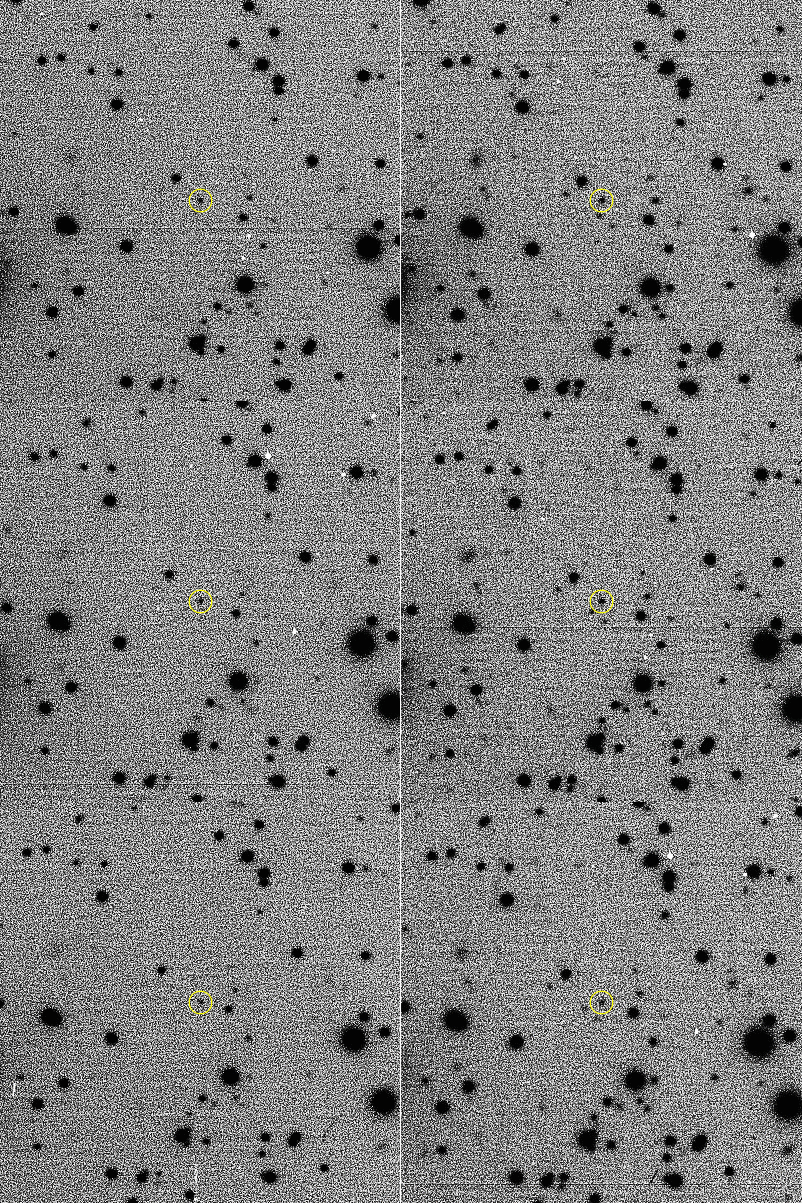
Images of 2015 BZ509 obtained at the Large Binocular Telescope Observatory (LBTO) that established its retrograde co-orbital nature. The bright stars and the asteroid (circled in yellow) appear black and the sky white in this negative image. Image via C. Veillet/Large Binocular Telescope Observatory/RAS.

A new study has discovered the first known permanent immigrant to our solar system. The asteroid, currently nestling in Jupiter’s orbit, is the first known asteroid to have been captured from another star system. The new work is published in the peer-reviewed Monthly Notices of the Royal Astronomical Society: Letters.

The object known as ‘Oumuamua was the last interstellar interloper to hit the headlines in 2017. However, it was just a tourist passing through, whereas this former exo-asteroid – given the catchy name (514107) 2015 BZ509 – is a long-term resident.

All of the planets in our solar system, and the vast majority of other objects as well, travel around the Sun in the same direction. However, 2015 BZ509 is different – it moves in the opposite direction in what is known as a “retrograde” orbit. Fathi Namouni, lead author of the study, said:

How the asteroid came to move in this way while sharing Jupiter’s orbit has until now been a mystery. If 2015 BZ509 were a native of our system, it should have had the same original direction as all of the other planets and asteroids, inherited from the cloud of gas and dust that formed them.

However, the team ran simulations to trace the location of 2015 BZ509 right back to the birth of our solar system, 4.5 billion years ago when the era of planet formation ended. These show that 2015 BZ509 has always moved in this way, and so could not have been there originally and must have been captured from another system. Helena Morais, the other member of the team, commented:

Asteroid immigration from other star systems occurs because the sun initially formed in a tightly-packed star cluster, where every star had its own system of planets and asteroids.

The close proximity of the stars, aided by the gravitational forces of the planets, help these systems attract, remove, and capture asteroids from one another.

The discovery of the first-known permanent asteroid immigrant in the solar system has important implications for the open problems of planet formation, solar system evolution, and possibly the origin of life itself, these astronomers said.

Understanding exactly when and how 2015 BZ509 settled in the solar system provides clues about the sun’s original star nursery, and about the potential enrichment of our early environment with components necessary for the appearance of life on Earth.

Image of stellar nursery NGC 604 (NASA/HST), where star systems are closely packed and asteroid exchange is thought to be possible. Asteroid (514107) 2015 BZ509 emigrated from its parent star and settled around the sun in a similar environment. Image via NASA/Hubble Heritage Team/RAS.

Bottom line: Mysterious asteroid 2015 BZ509 – currently nestling in Jupiter’s orbit – became less mysterious once astronomers realized it’s an immigrant, captured from another solar system.

Source: “An Interstellar Origin for Jupiter’s Retrograde Co-Orbital Asteroid,” F. Namouni & H. Morais, 2018, to be published in Monthly Notices of the Royal Astronomical Society: Letters
[https://ift.tt/2KJN9xP (after the embargo expires)].

Via RAS


from EarthSky https://ift.tt/2wXYloi

Images of 2015 BZ509 obtained at the Large Binocular Telescope Observatory (LBTO) that established its retrograde co-orbital nature. The bright stars and the asteroid (circled in yellow) appear black and the sky white in this negative image. Image via C. Veillet/Large Binocular Telescope Observatory/RAS.

A new study has discovered the first known permanent immigrant to our solar system. The asteroid, currently nestling in Jupiter’s orbit, is the first known asteroid to have been captured from another star system. The new work is published in the peer-reviewed Monthly Notices of the Royal Astronomical Society: Letters.

The object known as ‘Oumuamua was the last interstellar interloper to hit the headlines in 2017. However, it was just a tourist passing through, whereas this former exo-asteroid – given the catchy name (514107) 2015 BZ509 – is a long-term resident.

All of the planets in our solar system, and the vast majority of other objects as well, travel around the Sun in the same direction. However, 2015 BZ509 is different – it moves in the opposite direction in what is known as a “retrograde” orbit. Fathi Namouni, lead author of the study, said:

How the asteroid came to move in this way while sharing Jupiter’s orbit has until now been a mystery. If 2015 BZ509 were a native of our system, it should have had the same original direction as all of the other planets and asteroids, inherited from the cloud of gas and dust that formed them.

However, the team ran simulations to trace the location of 2015 BZ509 right back to the birth of our solar system, 4.5 billion years ago when the era of planet formation ended. These show that 2015 BZ509 has always moved in this way, and so could not have been there originally and must have been captured from another system. Helena Morais, the other member of the team, commented:

Asteroid immigration from other star systems occurs because the sun initially formed in a tightly-packed star cluster, where every star had its own system of planets and asteroids.

The close proximity of the stars, aided by the gravitational forces of the planets, help these systems attract, remove, and capture asteroids from one another.

The discovery of the first-known permanent asteroid immigrant in the solar system has important implications for the open problems of planet formation, solar system evolution, and possibly the origin of life itself, these astronomers said.

Understanding exactly when and how 2015 BZ509 settled in the solar system provides clues about the sun’s original star nursery, and about the potential enrichment of our early environment with components necessary for the appearance of life on Earth.

Image of stellar nursery NGC 604 (NASA/HST), where star systems are closely packed and asteroid exchange is thought to be possible. Asteroid (514107) 2015 BZ509 emigrated from its parent star and settled around the sun in a similar environment. Image via NASA/Hubble Heritage Team/RAS.

Bottom line: Mysterious asteroid 2015 BZ509 – currently nestling in Jupiter’s orbit – became less mysterious once astronomers realized it’s an immigrant, captured from another solar system.

Source: “An Interstellar Origin for Jupiter’s Retrograde Co-Orbital Asteroid,” F. Namouni & H. Morais, 2018, to be published in Monthly Notices of the Royal Astronomical Society: Letters
[https://ift.tt/2KJN9xP (after the embargo expires)].

Via RAS


from EarthSky https://ift.tt/2wXYloi

Astronomers spot exiled asteroid in outer reaches of solar system

An international team of astronomers has used ESO telescopes to investigate a relic of the primordial solar system. The team found that the unusual Kuiper Belt Object 2004 EW95 is a carbon-rich asteroid, which likely formed in the asteroid belt between Mars and Jupiter and has been flung billions of kilometers from its origin to its current home in the Kuiper Belt. This object is the first of its kind to be confirmed in the cold outer reaches of the solar system.

Read more about 2004 EW95 from the European Southern Observatory

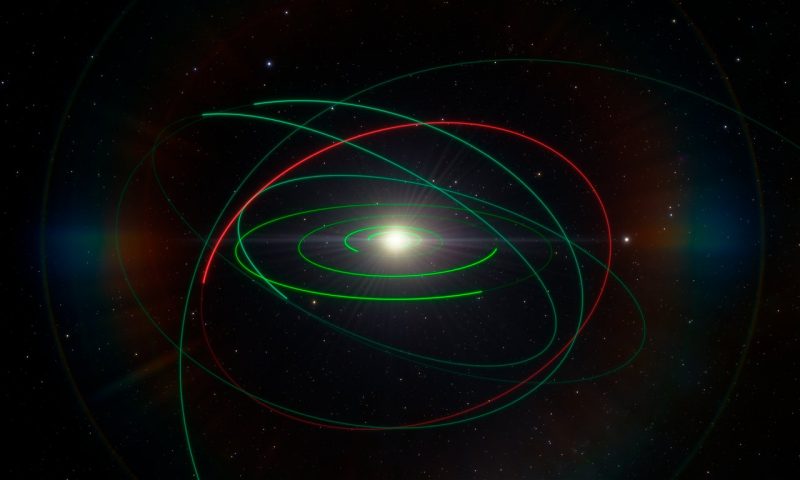
The red line in this image shows the orbit of 2004 EW95, with the orbits of other solar system bodies shown in green for comparison. Image via ESO/L. Calcada.


from EarthSky https://ift.tt/2GDgRSv

An international team of astronomers has used ESO telescopes to investigate a relic of the primordial solar system. The team found that the unusual Kuiper Belt Object 2004 EW95 is a carbon-rich asteroid, which likely formed in the asteroid belt between Mars and Jupiter and has been flung billions of kilometers from its origin to its current home in the Kuiper Belt. This object is the first of its kind to be confirmed in the cold outer reaches of the solar system.

Read more about 2004 EW95 from the European Southern Observatory

The red line in this image shows the orbit of 2004 EW95, with the orbits of other solar system bodies shown in green for comparison. Image via ESO/L. Calcada.


from EarthSky https://ift.tt/2GDgRSv

Milky Way center over Pondicherry, India

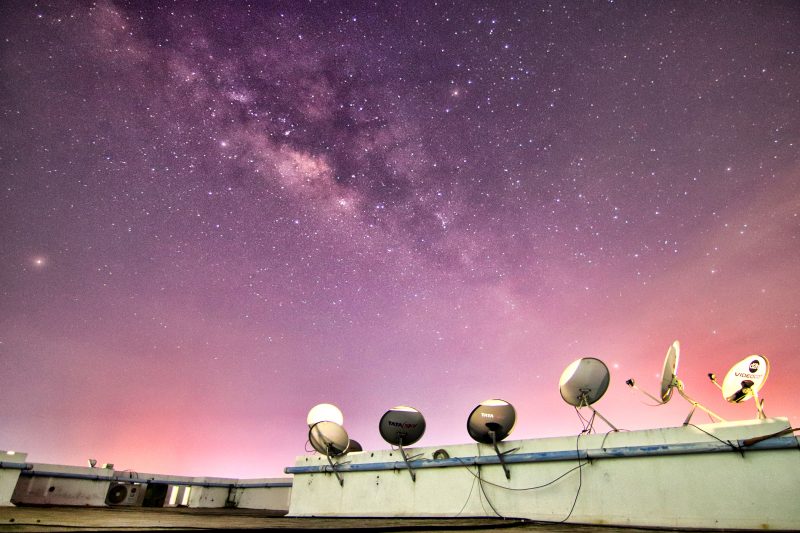
This photo is aimed toward the center of our Milky Way galaxy. Captured on May 18, 2018 by Karthik Easvur in Pondicherry, India. The bright object on the far left is Mars, still brightening, due to get brighter in 2018 than it has been since 2003.

Karthik Easvur submitted this image to EarthSky, saying:

The Milky Way galactic center that you see in this picture is the galactic center of 25,000 years ago … So, basically, it’s a 25,000-year-old picture … But actually, the picture was clicked a few days back… :)

Isn’t this amazing???

Thank you, Karthik, and yes, it is amazing!


from EarthSky https://ift.tt/2x1ZsDG

This photo is aimed toward the center of our Milky Way galaxy. Captured on May 18, 2018 by Karthik Easvur in Pondicherry, India. The bright object on the far left is Mars, still brightening, due to get brighter in 2018 than it has been since 2003.

Karthik Easvur submitted this image to EarthSky, saying:

The Milky Way galactic center that you see in this picture is the galactic center of 25,000 years ago … So, basically, it’s a 25,000-year-old picture … But actually, the picture was clicked a few days back… :)

Isn’t this amazing???

Thank you, Karthik, and yes, it is amazing!


from EarthSky https://ift.tt/2x1ZsDG

1st quarter moon and Regulus May 21

Tonight – May 21, 2018 – the half-lit first quarter moon passes 1.5o (3 moon-diameters) north of Regulus, the brightest star in the constellation Leo the Lion. Nearly everyone worldwide can use the moon to find the star Regulus on this night.

Just look for the moon in the evening sky. The nearby bright star will be Regulus.

There’s little chance of mistaking another star for Regulus, because Regulus is the only bright object within a stone’s throw of the May 21 moon. Still, you’ll find two much-brighter “stars” in the May 21 sky. A long jump to the east (toward the sunrise direction) is a planet, giant Jupiter. It’s the second-brightest starlike object in the May evening sky. And the brightest starlike object? That would be Venus, now sitting in the west at nightfall and early evening, setting not long after the sun.

You should start to notice for the moon in the vicinity of Jupiter beginning around May 25.

The moon reaches its half-illuminated first quarter phase on May 22 at 3:49 UTC. Although the first quarter moon happens at the same instant worldwide, the hour differs by time zone. Here, at United States time zones, the first quarter moon comes on May 21, at 11:49 p.m. EDT, 10:49 p.m. CDT, 9:49 p.m. MDT and 8:49 p.m. PDT. A first quarter moon rises around noon, and sets around midnight, as seen from around the world.

Want to know the exact phase of the moon at present? Click here. Want to know which constellation the moon is moving in front of right now? Click here.

No matter where you live worldwide, the moon always moves eastward relative to backdrop stars (and planets) of the zodiac. That’s in spite of the fact that the moon and Regulus move westward across the sky (like the sun in daytime) because of the Earth’s rotation. That eastward motion of the moon relative to the backdrop stars is a reflection of the moon’s orbit around Earth. Starting tonight and over the next several days, you can notice the orbital motion of the moon as it keep traveling eastward of the star Regulus.

Bottom line: Tonight – May 21, 2018 – the first quarter moon pairs up the star Regulus, the brightest star in the constellation Leo the Lion.


from EarthSky https://ift.tt/2qwHOQM

Tonight – May 21, 2018 – the half-lit first quarter moon passes 1.5o (3 moon-diameters) north of Regulus, the brightest star in the constellation Leo the Lion. Nearly everyone worldwide can use the moon to find the star Regulus on this night.

Just look for the moon in the evening sky. The nearby bright star will be Regulus.

There’s little chance of mistaking another star for Regulus, because Regulus is the only bright object within a stone’s throw of the May 21 moon. Still, you’ll find two much-brighter “stars” in the May 21 sky. A long jump to the east (toward the sunrise direction) is a planet, giant Jupiter. It’s the second-brightest starlike object in the May evening sky. And the brightest starlike object? That would be Venus, now sitting in the west at nightfall and early evening, setting not long after the sun.

You should start to notice for the moon in the vicinity of Jupiter beginning around May 25.

The moon reaches its half-illuminated first quarter phase on May 22 at 3:49 UTC. Although the first quarter moon happens at the same instant worldwide, the hour differs by time zone. Here, at United States time zones, the first quarter moon comes on May 21, at 11:49 p.m. EDT, 10:49 p.m. CDT, 9:49 p.m. MDT and 8:49 p.m. PDT. A first quarter moon rises around noon, and sets around midnight, as seen from around the world.

Want to know the exact phase of the moon at present? Click here. Want to know which constellation the moon is moving in front of right now? Click here.

No matter where you live worldwide, the moon always moves eastward relative to backdrop stars (and planets) of the zodiac. That’s in spite of the fact that the moon and Regulus move westward across the sky (like the sun in daytime) because of the Earth’s rotation. That eastward motion of the moon relative to the backdrop stars is a reflection of the moon’s orbit around Earth. Starting tonight and over the next several days, you can notice the orbital motion of the moon as it keep traveling eastward of the star Regulus.

Bottom line: Tonight – May 21, 2018 – the first quarter moon pairs up the star Regulus, the brightest star in the constellation Leo the Lion.


from EarthSky https://ift.tt/2qwHOQM

2018 SkS Weekly Climate Change & Global Warming Digest #20

Story of the Week... El Niño/La Niña Update... Toon of the Week... Quote of the Week... Coming Soon on SkS... Poster of the Week... Climate Feedback Reviews... SkS Week in Review... 97 Hours of Consensus...

Story of the Week...

Water shortages to be key environmental challenge of the century, Nasa warns

Freshwater supplies have already seriously declined in 19 global hotspots – from China to the Caspian Sea – due to overuse, groundbreaking study shows

Threewaterskloff Dam Reservoir SA

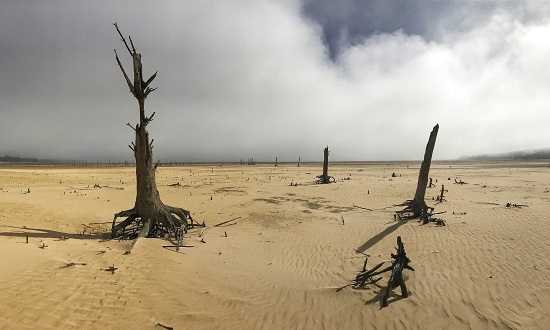
The Theewaterskloof Dam, a key source of water supply to Cape Town, South Africa ahead of the current water crisis. Photograph: Halden Krog/AP

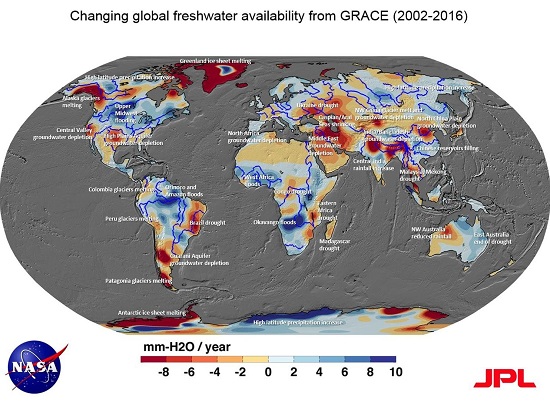
Water shortages are likely to be the key environmental challenge of this century, scientists from Nasa have warned, as new data has revealed a drying-out of swaths of the globe between the tropics and the high latitudes, with 19 hotspots where water depletion has been dramatic.

Areas in northern and eastern India, the Middle East, California and Australia are among the hotspots where overuse of water resources has caused a serious decline in the availability of freshwater that is already causing problems. Without strong action by governments to preserve water the situation in these areas is likely to worsen.

Some of these hotspots were previously undocumented or poorly understood: a region in north-western China, in Xinjiang province, has suffered dramatic declines despite receiving normal amounts of rainfall, owing to groundwater depletion from industry and irrigation.

Water shortages to be key environmental challenge of the century, Nasa warns by Fiona Harvey, Environment, Guardian, May 16, 2018 


El Niño/La Niña Update...

The La Niña event that overtook the tropical Pacific this past winter is officially over, according to the latest update from NOAA’s Climate Prediction Center. La Niña’s signature of heavier-than-usual rainfall in the western part of the basin has tapered off, and the cool surface waters in the central part of the basin are dissipating.

Adios, La Niña by Rebecca Lindsey, NOAA's Climate.gov, May 11, 2018


Toon of the Week...

2018 Toon 20 


Quote of the Week...

The complexity of climate science may always be at odds with the simplicity that's key to inspiring action.

Remember the hole in the ozone layer? It was more of a thin spot, but in the 1980s, that dramatic term may have helped spur a global movement to reduce certain pollutants staved off disaster.

It's too late to prevent anthropogenic climate change, or unnatural climate change, or global warming — call it what you will. But it isn't too late to slow the warming, and perhaps even reverse it. If only someone could sell the idea.

Inspiring Terms Are Simple. ‘Climate Change’ Isn’t., Opinion by Faye Flam, Bloomberg News, May 11, 2018 


Graphic of the Week...

Changing Global Freshwater Availability from GRACE (2002-2016) 


Coming Soon on SkS...

  • Yes, EVs are green and global warming is causing sea level rise (Dana)
  • Climate change is already making droughts worse (Benjamin Cook)
  • Global warming, hurricanes, and rain (John Abraham)
  • Climate science websites around the world (Baerbel)
  • New research this week (Ari)
  • 2017 SkS Weekly Climate Change & Global Warming News Roundup #21 (John Hartz)
  • 2017 SkS Weekly Climate Change & Global Warming Digest #21 (John Hartz)

Poster of the Week...

2018 Poster 20 


Climate Feedback Reviews... 

Wall Street Journal commentary grossly misleads readers about science of sea level rise

Climate Feedback 20

Climate Feedback asked its network of scientists to review the article, The Sea Is Rising, but Not Because of Climate Change, Opinion by Fred Singer, The Wall Street Journal, May 15, 2018.

Five scientists analyzed the article and estimate its overall scientific credibility to be 'very low'.

A majority of reviewers tagged the article as BiasedFlawed reasoning, Inaccurate, and Misleading

Review Summary

This commentary published by The Wall Street Journal, written by Fred Singer, claims that warming (and therefore greenhouse gas emissions) has no effect on global sea level rise. Although Singer concedes the physical fact that water expands as its temperature increases, he claims that this process must be offset by growth of Antarctic ice sheets.

Scientists who reviewed this opinion piece explained that it is contradicted by a wealth of data and research. Singer bases his conclusion entirely on a cherry-picked comparison of sea level rise 1915-1945 and a single study published in 1990, claiming a lack of accelerating sea level rise despite continued warming. But in fact, modern research utilizing all available data clearly indicates that sea level rise has accelerated, and is unambiguously the result of human-caused global warming.

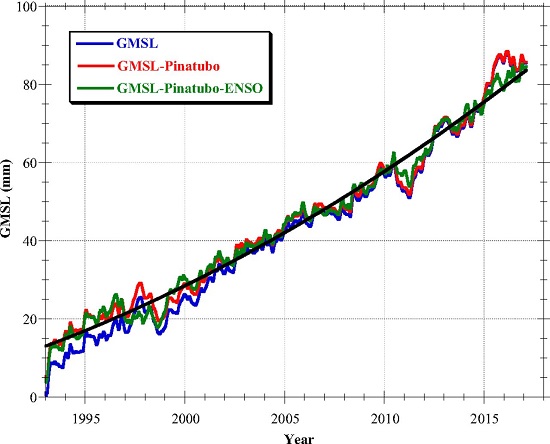
Since the 1990s for example, satellites have measured an acceleration in the rate of global sea level rise:


Seal Level Rise Satellite Observation 

Figure – Global mean sea level (blue), after removing an estimate for the impacts of the eruption of Mount Pinatubo (red), and after also removing the influence of El Niño (green), fit with a quadratic (black). From Nerem et al. (2018)  

Wall Street Journal commentary grossly misleads readers about science of sea level rise, Edited by Emmanuel M Vincent, Climate Feedback, May 18, 2018 


SkS Week in Review... 


97 Hours of Consensus...

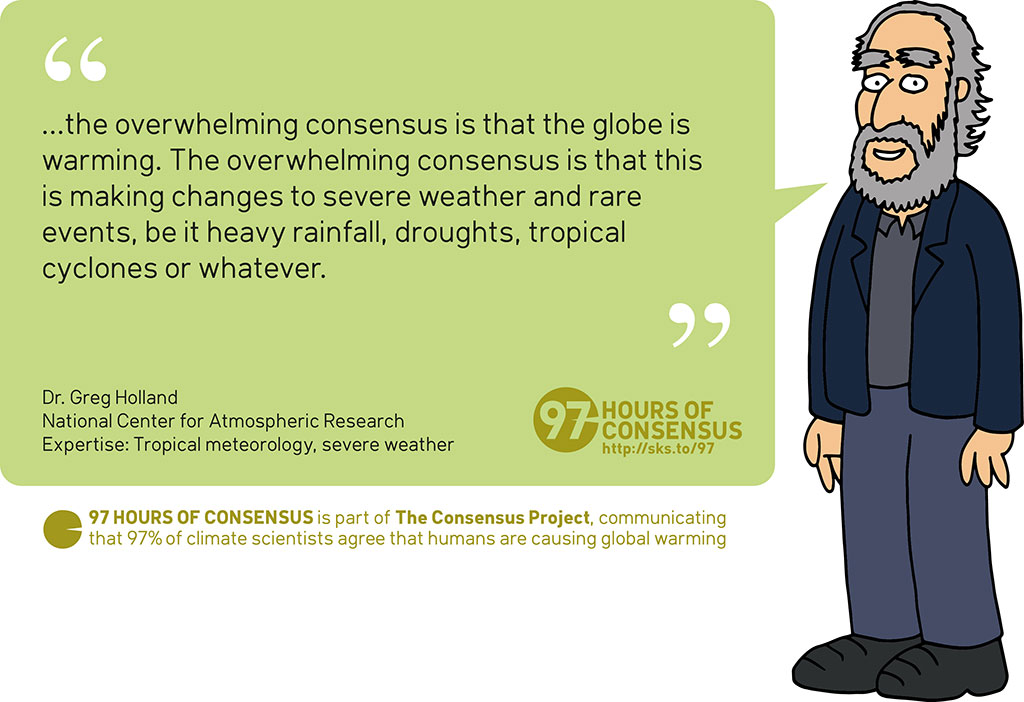
97 Hours: Greg Holland 


Greg Holland's bio page.

Quote derived from:

"I think we definitely need to actually change our habits so that we can leave our children and our children's children with a better world to live in. But in the meantime, over the rest of my lifetime and indeed the rest of your lifetime and many other people, we are going to have to adapt, we're going to have to accept that it's not gonna be six days per summer of extreme temperatures, it may be 20 days per summer of extreme temperatures and we have to take the appropriate actions to actually live with those conditions. 
...the overwhelming consensus is that the globe is warming. The overwhelming consensus is that this is making changes to severe weather and rare events, be it heavy rainfall, droughts, tropical cyclones or whatever." 

High resolution JPEG (1024 pixels wide)


from Skeptical Science https://ift.tt/2J01Pvg

Story of the Week... El Niño/La Niña Update... Toon of the Week... Quote of the Week... Coming Soon on SkS... Poster of the Week... Climate Feedback Reviews... SkS Week in Review... 97 Hours of Consensus...

Story of the Week...

Water shortages to be key environmental challenge of the century, Nasa warns

Freshwater supplies have already seriously declined in 19 global hotspots – from China to the Caspian Sea – due to overuse, groundbreaking study shows

Threewaterskloff Dam Reservoir SA

The Theewaterskloof Dam, a key source of water supply to Cape Town, South Africa ahead of the current water crisis. Photograph: Halden Krog/AP

Water shortages are likely to be the key environmental challenge of this century, scientists from Nasa have warned, as new data has revealed a drying-out of swaths of the globe between the tropics and the high latitudes, with 19 hotspots where water depletion has been dramatic.

Areas in northern and eastern India, the Middle East, California and Australia are among the hotspots where overuse of water resources has caused a serious decline in the availability of freshwater that is already causing problems. Without strong action by governments to preserve water the situation in these areas is likely to worsen.

Some of these hotspots were previously undocumented or poorly understood: a region in north-western China, in Xinjiang province, has suffered dramatic declines despite receiving normal amounts of rainfall, owing to groundwater depletion from industry and irrigation.

Water shortages to be key environmental challenge of the century, Nasa warns by Fiona Harvey, Environment, Guardian, May 16, 2018 


El Niño/La Niña Update...

The La Niña event that overtook the tropical Pacific this past winter is officially over, according to the latest update from NOAA’s Climate Prediction Center. La Niña’s signature of heavier-than-usual rainfall in the western part of the basin has tapered off, and the cool surface waters in the central part of the basin are dissipating.

Adios, La Niña by Rebecca Lindsey, NOAA's Climate.gov, May 11, 2018


Toon of the Week...

2018 Toon 20 


Quote of the Week...

The complexity of climate science may always be at odds with the simplicity that's key to inspiring action.

Remember the hole in the ozone layer? It was more of a thin spot, but in the 1980s, that dramatic term may have helped spur a global movement to reduce certain pollutants staved off disaster.

It's too late to prevent anthropogenic climate change, or unnatural climate change, or global warming — call it what you will. But it isn't too late to slow the warming, and perhaps even reverse it. If only someone could sell the idea.

Inspiring Terms Are Simple. ‘Climate Change’ Isn’t., Opinion by Faye Flam, Bloomberg News, May 11, 2018 


Graphic of the Week...

Changing Global Freshwater Availability from GRACE (2002-2016) 


Coming Soon on SkS...

  • Yes, EVs are green and global warming is causing sea level rise (Dana)
  • Climate change is already making droughts worse (Benjamin Cook)
  • Global warming, hurricanes, and rain (John Abraham)
  • Climate science websites around the world (Baerbel)
  • New research this week (Ari)
  • 2017 SkS Weekly Climate Change & Global Warming News Roundup #21 (John Hartz)
  • 2017 SkS Weekly Climate Change & Global Warming Digest #21 (John Hartz)

Poster of the Week...

2018 Poster 20 


Climate Feedback Reviews... 

Wall Street Journal commentary grossly misleads readers about science of sea level rise

Climate Feedback 20

Climate Feedback asked its network of scientists to review the article, The Sea Is Rising, but Not Because of Climate Change, Opinion by Fred Singer, The Wall Street Journal, May 15, 2018.

Five scientists analyzed the article and estimate its overall scientific credibility to be 'very low'.

A majority of reviewers tagged the article as BiasedFlawed reasoning, Inaccurate, and Misleading

Review Summary

This commentary published by The Wall Street Journal, written by Fred Singer, claims that warming (and therefore greenhouse gas emissions) has no effect on global sea level rise. Although Singer concedes the physical fact that water expands as its temperature increases, he claims that this process must be offset by growth of Antarctic ice sheets.

Scientists who reviewed this opinion piece explained that it is contradicted by a wealth of data and research. Singer bases his conclusion entirely on a cherry-picked comparison of sea level rise 1915-1945 and a single study published in 1990, claiming a lack of accelerating sea level rise despite continued warming. But in fact, modern research utilizing all available data clearly indicates that sea level rise has accelerated, and is unambiguously the result of human-caused global warming.

Since the 1990s for example, satellites have measured an acceleration in the rate of global sea level rise:


Seal Level Rise Satellite Observation 

Figure – Global mean sea level (blue), after removing an estimate for the impacts of the eruption of Mount Pinatubo (red), and after also removing the influence of El Niño (green), fit with a quadratic (black). From Nerem et al. (2018)  

Wall Street Journal commentary grossly misleads readers about science of sea level rise, Edited by Emmanuel M Vincent, Climate Feedback, May 18, 2018 


SkS Week in Review... 


97 Hours of Consensus...

97 Hours: Greg Holland 


Greg Holland's bio page.

Quote derived from:

"I think we definitely need to actually change our habits so that we can leave our children and our children's children with a better world to live in. But in the meantime, over the rest of my lifetime and indeed the rest of your lifetime and many other people, we are going to have to adapt, we're going to have to accept that it's not gonna be six days per summer of extreme temperatures, it may be 20 days per summer of extreme temperatures and we have to take the appropriate actions to actually live with those conditions. 
...the overwhelming consensus is that the globe is warming. The overwhelming consensus is that this is making changes to severe weather and rare events, be it heavy rainfall, droughts, tropical cyclones or whatever." 

High resolution JPEG (1024 pixels wide)


from Skeptical Science https://ift.tt/2J01Pvg

Top tips for poison ivy

Image via hspauldi

Image via hspauldi.

It feels like summer! Outdoor activities are in full swing, with kids going off to summer camp and adults hiking and mountain biking their way through the weekends. The trees are green. The flowers are blooming. Isn’t it glorious? Yet we mustn’t get too giddy in our outdoor merriment, lest we forget that there are dangers too. Because there in the woods, in the park, in your lawn even, lurks a trio of villains as bent on destruction as the three alien outlaws from Superman II. I’m speaking, of course, of poison ivy, poison oak, and poison sumac – three devious plants just itching for the chance to ruin your summer outings.

L-R, poison ivy/oak/sumac. Image via Kerry Wixted, carbon NYC, USDA.

Why do these plants make you itch? Aside from being flowering plants, members of the toxic trio bear little relation to their benign namesakes.* But they are related to each other. All three belong to the same genus – Toxicodendron – and share the same itch-producing component – an oil called urushiol.

It’s a fierce skin irritant. According to the Centers for Disease Control, between 80 and 90 percent of the U.S. population exhibits an allergic reaction to urushiol, and at doses as low as 50 micrograms (less than a grain of salt).

Urushiol is found it all parts of the plant (leaves, stems, even berries). It seeps from any damaged portion and stays active for, ugh, one to five years. While the leaves generally bloom from spring to fall, even the dead and withered remains of the plants can be sufficiently coated in urushiol to cause bouts of wintertime itching.

Tall poison ivy. Image credit: Jaknouse

Tall poison ivy. Image via Jaknouse.

Where are they most likely to be? Toxicodendrons are native to North America, with most U.S. states (and several Canadian provinces) being home to at least one, if not all, of the dreaded poisoners.

They’re frustratingly varied in appearance. Poison oak and poison ivy usually (but, sigh, not always) exhibit the infamous “leaves of three” configuration, but poison sumac sports anywhere from seven to 13 leaves. Leaves vary in color depending on the season, and growth patterns can be different even within the same species. Sometimes they’re shrubs, other times vines. Master of disguise poison ivy (Toxicodendron radicans) can be a shrub, a trailing vine, or a climbing vine.

Good luck staying out of its path.

Poison sumac (Toxicodendron vernix) is considered the most potent of the three, but luckily it doesn’t have the widest distribution. That honor goes to the frighteningly ubiquitous poison ivy.

Poison sumac also grows in areas that are less fun to hang out in – swamps and bogs and the like. (Though it would be an especially insult-to-injury-adding experience to have to wade through a bog only to discover you’d acquired a case of poison sumac in the process.)

Bad dog! Wait here while I get the hose. Image Credit: HunterJumper.

Bad dog! Wait here while I get the hose. Image via HunterJumper.

Look what the cat dragged in. And if picking up allergic contact dermatitis (medical lingo for miserable plant rash) directly from the source weren’t enough to worry about, you can also get it from your outdoor-loving pets.

Cats and dogs don’t seem terribly affected by urushiol, and they’re more than happy to carry it home to you on their furry little backs (and heads, and paws … what a mess). As with anything else that comes into contact with vicious Toxicodendrons, your pet will require thorough washing.

Some animals are so unfazed by urushiol, that they can eat the poisonous plants that cause our species so much grief. Birds consume the berries, deer and other mammals enjoy munching on the leaves. Some birds even use poison ivy vines as nest-making materials (note to self: stay far away from bird nests).

All this means amply broken, urushiol-oozing plants for you to encounter on your next summer picnic.

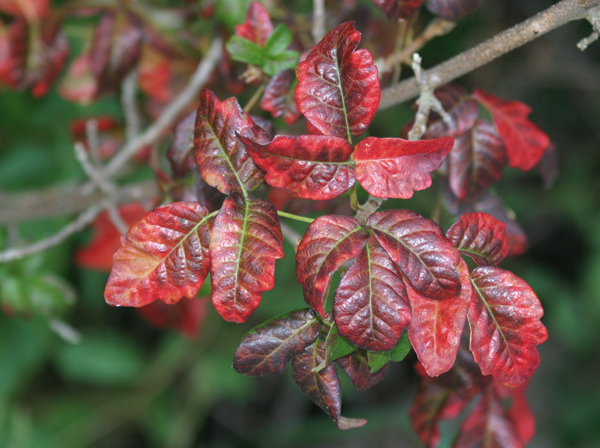
Poison oak in red, like your skin after touching it. Image: DavidDennisPhotos.com.

Poison oak in red, like your skin after touching it. Image via DavidDennisPhotos.com.

Top tips for sufferers. Some individuals are more profoundly allergic to urushiol than other, and the degree of reaction can change over time. The rash and blistering caused by the toxic oil is slowest to develop after the first exposure. During subsequent interactions with itchy plants, the body freaks out faster.

A number of people seem keen on the idea of building up a tolerance to urushiol so that they can march through poisonous flora with impunity. This isn’t complete insanity. Dermatological experiments on humans have demonstrated some success with this kind of desensitization, though the benefits weren’t always long lasting. However, do note that such studies were done under controlled conditions, using intramuscular injections of urushiol or pills designed to protect the digestive tract from the chemical’s full assault. Should you go out and eat a fistful of poison ivy to see if you can approximate their results on your own? I think you know the answer to that question (hint: it’s NO).

Contrary to popular belief, poison ivy/oak/sumac isn’t contagious, nor does it spread to other parts of your body (though it may seem like it does because the rash takes time to fully materialize). The only way it can be transmitted is through contact with the oil itself, so if you find yourself afflicted with the rash it’s important to track down every last trace of urushiol.

DO: Wash your skin thoroughly the instant you realize you’ve come into contact with itchy plants. If urushiol is washed off before it is fully absorbed into the skin, you can minimize the damage. You’ve got about 10 minutes, so get moving.

DO: Wash everything else that may have touched the poisonous plants. Clothes, shoes, water bottles. Friends and family members. Everything.

DON’T: Attempt to destroy the offending plants or any contaminated items with fire. Urushiol can become airborne when burned, and you do not want to be inhaling that stuff.

Symptom-wise, you can sooth the itching with the old Leiber/Stoller ocean-of-calamine-lotion remedy. But you might fare a bit better with an estuary of corticosteroid cream and perhaps a small pond of antihistamines, both of which also help reduce the inflammation.

If you’re especially fed up with these sadistic plants, you can also try moving to Alaska or Hawaii, both of which are Toxicodendron-free. However, you may just be trading in contact dermatitis for bigger problems like bears and volcanoes. So at least wait for the swelling to subside before making any rash decisions.

Don't eat these, they're not ready. Image Credit: Abhishek Jacob.

Don’t eat these. They’re not ready. Image via Abhishek Jacob.

BTW, cashews are related. Cashews are another urushiol-harboring plant in the Anacardiaceae family. Yes, delicious snack-tastic cashews were once scary, toxin-coated itch bags.

The nut (well, drupe technically) is housed in a double shell, and it is in the shell itself that urushiol is found. When cashews are processed, their shells are removed and any lingering poison is carefully cooked from the nut (even “raw” cashews are steamed before they hit the market).

This explains why cashews are so under-represented in bowls of unshelled nuts waiting to be opened with a festive nutcracker. Cracking a walnut is one thing, but unleashing cashews requires protective clothing.

* Poison sumac is the exception, non-itching varieties of sumac are in the same family as the itchy plants (Anacardiaceae.) But poison sumac is the oddball of the three in several ways.

Bottom line: Info on poison ivy, oak and sumac.


from EarthSky https://ift.tt/1RPdXus
Image via hspauldi

Image via hspauldi.

It feels like summer! Outdoor activities are in full swing, with kids going off to summer camp and adults hiking and mountain biking their way through the weekends. The trees are green. The flowers are blooming. Isn’t it glorious? Yet we mustn’t get too giddy in our outdoor merriment, lest we forget that there are dangers too. Because there in the woods, in the park, in your lawn even, lurks a trio of villains as bent on destruction as the three alien outlaws from Superman II. I’m speaking, of course, of poison ivy, poison oak, and poison sumac – three devious plants just itching for the chance to ruin your summer outings.

L-R, poison ivy/oak/sumac. Image via Kerry Wixted, carbon NYC, USDA.

Why do these plants make you itch? Aside from being flowering plants, members of the toxic trio bear little relation to their benign namesakes.* But they are related to each other. All three belong to the same genus – Toxicodendron – and share the same itch-producing component – an oil called urushiol.

It’s a fierce skin irritant. According to the Centers for Disease Control, between 80 and 90 percent of the U.S. population exhibits an allergic reaction to urushiol, and at doses as low as 50 micrograms (less than a grain of salt).

Urushiol is found it all parts of the plant (leaves, stems, even berries). It seeps from any damaged portion and stays active for, ugh, one to five years. While the leaves generally bloom from spring to fall, even the dead and withered remains of the plants can be sufficiently coated in urushiol to cause bouts of wintertime itching.

Tall poison ivy. Image credit: Jaknouse

Tall poison ivy. Image via Jaknouse.

Where are they most likely to be? Toxicodendrons are native to North America, with most U.S. states (and several Canadian provinces) being home to at least one, if not all, of the dreaded poisoners.

They’re frustratingly varied in appearance. Poison oak and poison ivy usually (but, sigh, not always) exhibit the infamous “leaves of three” configuration, but poison sumac sports anywhere from seven to 13 leaves. Leaves vary in color depending on the season, and growth patterns can be different even within the same species. Sometimes they’re shrubs, other times vines. Master of disguise poison ivy (Toxicodendron radicans) can be a shrub, a trailing vine, or a climbing vine.

Good luck staying out of its path.

Poison sumac (Toxicodendron vernix) is considered the most potent of the three, but luckily it doesn’t have the widest distribution. That honor goes to the frighteningly ubiquitous poison ivy.

Poison sumac also grows in areas that are less fun to hang out in – swamps and bogs and the like. (Though it would be an especially insult-to-injury-adding experience to have to wade through a bog only to discover you’d acquired a case of poison sumac in the process.)

Bad dog! Wait here while I get the hose. Image Credit: HunterJumper.

Bad dog! Wait here while I get the hose. Image via HunterJumper.

Look what the cat dragged in. And if picking up allergic contact dermatitis (medical lingo for miserable plant rash) directly from the source weren’t enough to worry about, you can also get it from your outdoor-loving pets.

Cats and dogs don’t seem terribly affected by urushiol, and they’re more than happy to carry it home to you on their furry little backs (and heads, and paws … what a mess). As with anything else that comes into contact with vicious Toxicodendrons, your pet will require thorough washing.

Some animals are so unfazed by urushiol, that they can eat the poisonous plants that cause our species so much grief. Birds consume the berries, deer and other mammals enjoy munching on the leaves. Some birds even use poison ivy vines as nest-making materials (note to self: stay far away from bird nests).

All this means amply broken, urushiol-oozing plants for you to encounter on your next summer picnic.

Poison oak in red, like your skin after touching it. Image: DavidDennisPhotos.com.

Poison oak in red, like your skin after touching it. Image via DavidDennisPhotos.com.

Top tips for sufferers. Some individuals are more profoundly allergic to urushiol than other, and the degree of reaction can change over time. The rash and blistering caused by the toxic oil is slowest to develop after the first exposure. During subsequent interactions with itchy plants, the body freaks out faster.

A number of people seem keen on the idea of building up a tolerance to urushiol so that they can march through poisonous flora with impunity. This isn’t complete insanity. Dermatological experiments on humans have demonstrated some success with this kind of desensitization, though the benefits weren’t always long lasting. However, do note that such studies were done under controlled conditions, using intramuscular injections of urushiol or pills designed to protect the digestive tract from the chemical’s full assault. Should you go out and eat a fistful of poison ivy to see if you can approximate their results on your own? I think you know the answer to that question (hint: it’s NO).

Contrary to popular belief, poison ivy/oak/sumac isn’t contagious, nor does it spread to other parts of your body (though it may seem like it does because the rash takes time to fully materialize). The only way it can be transmitted is through contact with the oil itself, so if you find yourself afflicted with the rash it’s important to track down every last trace of urushiol.

DO: Wash your skin thoroughly the instant you realize you’ve come into contact with itchy plants. If urushiol is washed off before it is fully absorbed into the skin, you can minimize the damage. You’ve got about 10 minutes, so get moving.

DO: Wash everything else that may have touched the poisonous plants. Clothes, shoes, water bottles. Friends and family members. Everything.

DON’T: Attempt to destroy the offending plants or any contaminated items with fire. Urushiol can become airborne when burned, and you do not want to be inhaling that stuff.

Symptom-wise, you can sooth the itching with the old Leiber/Stoller ocean-of-calamine-lotion remedy. But you might fare a bit better with an estuary of corticosteroid cream and perhaps a small pond of antihistamines, both of which also help reduce the inflammation.

If you’re especially fed up with these sadistic plants, you can also try moving to Alaska or Hawaii, both of which are Toxicodendron-free. However, you may just be trading in contact dermatitis for bigger problems like bears and volcanoes. So at least wait for the swelling to subside before making any rash decisions.

Don't eat these, they're not ready. Image Credit: Abhishek Jacob.

Don’t eat these. They’re not ready. Image via Abhishek Jacob.

BTW, cashews are related. Cashews are another urushiol-harboring plant in the Anacardiaceae family. Yes, delicious snack-tastic cashews were once scary, toxin-coated itch bags.

The nut (well, drupe technically) is housed in a double shell, and it is in the shell itself that urushiol is found. When cashews are processed, their shells are removed and any lingering poison is carefully cooked from the nut (even “raw” cashews are steamed before they hit the market).

This explains why cashews are so under-represented in bowls of unshelled nuts waiting to be opened with a festive nutcracker. Cracking a walnut is one thing, but unleashing cashews requires protective clothing.

* Poison sumac is the exception, non-itching varieties of sumac are in the same family as the itchy plants (Anacardiaceae.) But poison sumac is the oddball of the three in several ways.

Bottom line: Info on poison ivy, oak and sumac.


from EarthSky https://ift.tt/1RPdXus

adds 2