aads

Situation at Kilauea Volcano ‘steadily worsening’

Kilauea Volcano has been spewing lava and belching hazardous gases on Hawaii’s Big Island since early May, and the BBC reported on Sunday, May 20, 2018 that the situation for residents is “steadily worsening.” At the summit, a large explosion happened at around midnight on Friday night (May 18) into Saturday, sending a plume of volcanic gas some 10,000 feet (two miles, or 3 km) into the air. Early in the day on May 20, media outlets were reporting the first serious injury from Kilauea. HawaiiNewsNow reported:

The injured man was sitting on a balcony at his home when ‘lava spatter’ – projectile molten rock – landed on him. ‘It hit him on the shin and shattered everything there down on his leg,’ a spokeswoman for the county mayor said.

Lava spatters can weigh ‘as much a refrigerator,’ she told Reuters.

The man has reportedly been hospitalized with serious injuries.

In the meantime, on Saturday night, May 19, Hawaii Civil Defense confirmed that lava from Kilauea’s fissure 20 had entered the ocean, creating conditions for toxic laze. Laze is what happens when molten lava hits sea water; a chemical reaction creates “hazy and noxious conditions” laced with hydrochloric acid and tiny particles of glass. USGS said:

Even the wispy edges of it can cause skin and eye irritation and breathing difficulties.
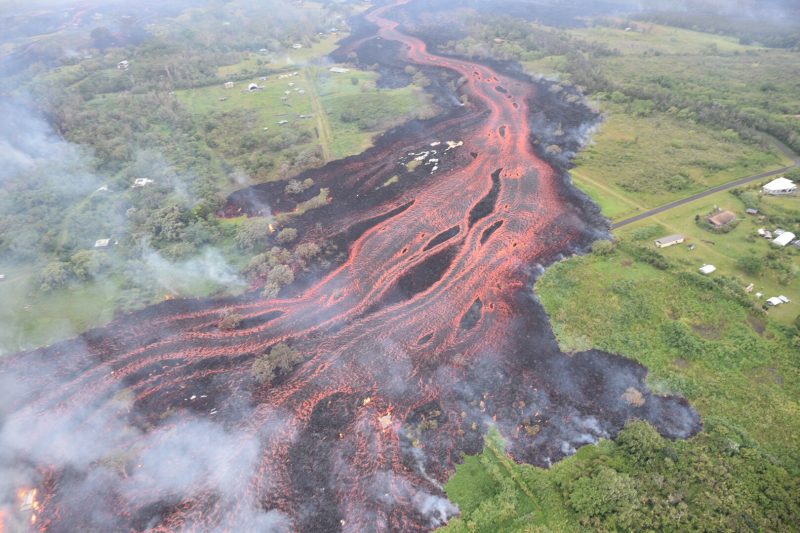
Helicopter overflight of Kilauea Volcano’s lower East Rift zone on May 19, 2018, around 8:18 a.m., HST. Lava flows emerging from the elongated fissure 16-20 form channels. The flow direction in this picture is from upper center to the lower left. Image via USGS.

The USGS reported on Saturday, May 19, 2018:

Eruption of lava and ground cracking in the area of Leilani Estates subdivision continues. Beginning yesterday and into today, the rate of lava eruption has increased. Fissure 17 is weakly active now, and Fissures 16-20 have merged into a continuous line of spatter and fountaining. Flows from the consolidated Fissure 20 crossed upper Pohoiki road late yesterday afternoon and continued flowing southward. This afternoon two flows from the merged fissure complex have joined less than a mile from the coast and continue to flow southward between Pohoiki and Opihikao Rds. The lava flow from Fissure 18 is stalled. It is unknown whether the flows will continue to advance, or stop, and new lava flows are likely given the rate of activity seen at the rift zone. Volcanic gas emissions remain very high. Read more

Click here for maps of recent activity at Kilauea Volcano

Click here for the latest photos and videos from USGS, at Kilauea

The following is the most recent video update from a USGS scientist (May 18):

More than 1,700 people have already evacuated their homes, particularly in the area around Leilani Estates, located in Hawaii’s District of Puna, where 27 homes had been destroyed as of May 9.

Helicopter overflight of the southeast coast of the Puna district during the early morning hours of May 19, 2018. Flows are moving downslope toward the ocean. Photograph courtesy of the Hawai`i County Fire Department/ via USGS.

The Hawaiian Volcano Observatory reported on May 14 on “speculative stories, rumors and blogs” about a possible Pacific-wide tsunami, caused by conditions at Kilauea:

There have been several recent highly speculative stories, rumors and blogs about the stability of the south flank of Kilauea and the potential for a catastrophic collapse that could generate a Pacific-wide tsunami. We wish to put these speculations in their proper context by presenting observations of the current situation and an assessment of past evidence of landslides from Kilauea.

There is no geologic evidence for past catastrophic collapses of K?lauea Volcano that would lead to a major Pacific tsunami, and such an event is extremely unlikely in the future based on monitoring of surface deformation … Geologic history combined with models of south flank motion suggest that the likelihood of a catastrophic failure event is incredibly remote. Read more.

The following video is from May 14, when a new fissure in Hawaii’s Puna District sent gases and lava exploding into the air, spurring officials to call for more evacuations as residents waited for a possible major eruption at Kilauea volcano’s summit.
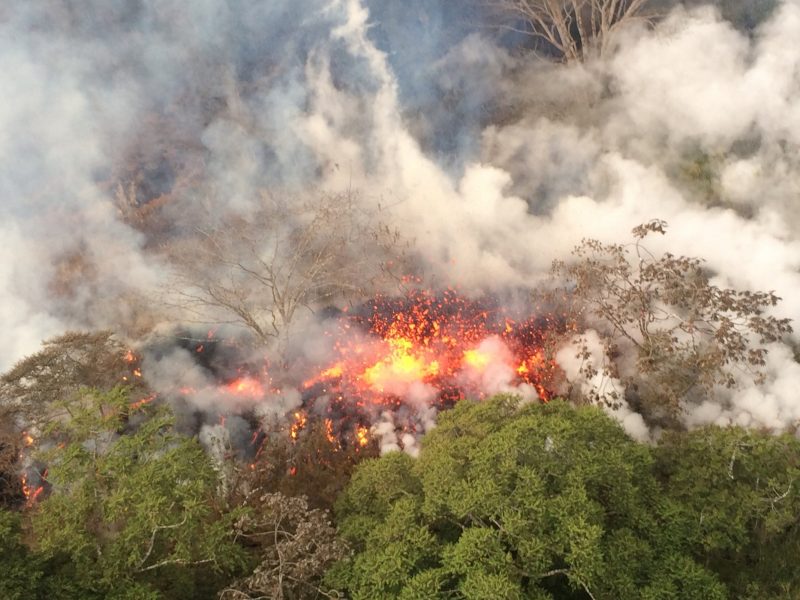
The view between Kilauea fissures 16 and 20 on May 16, 2018. Image via USGS.
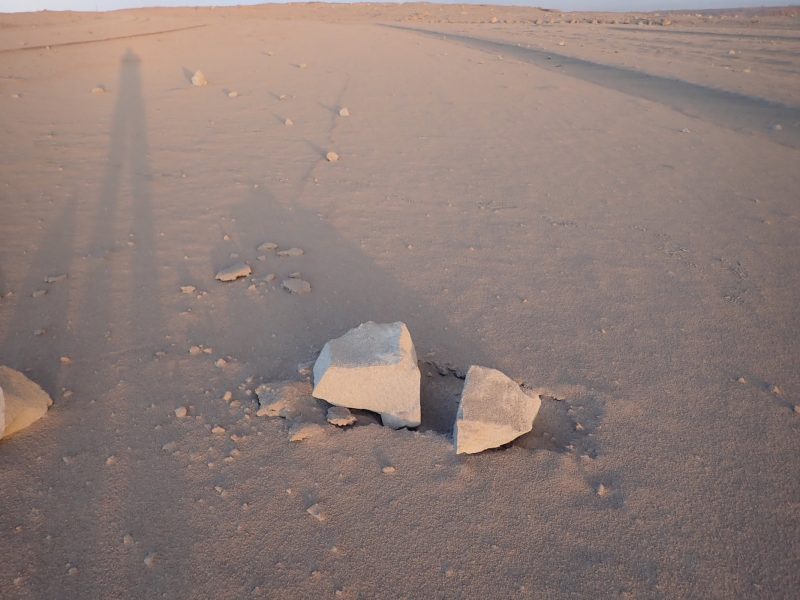
.

The Overlook vent on the summit of Kilauea threw out chunks of rock on May 16 that hit the ground near a parking lot, breaking apart on impact. The rocks were about 24 inches (60 cm) before they hit. Image via USGS.
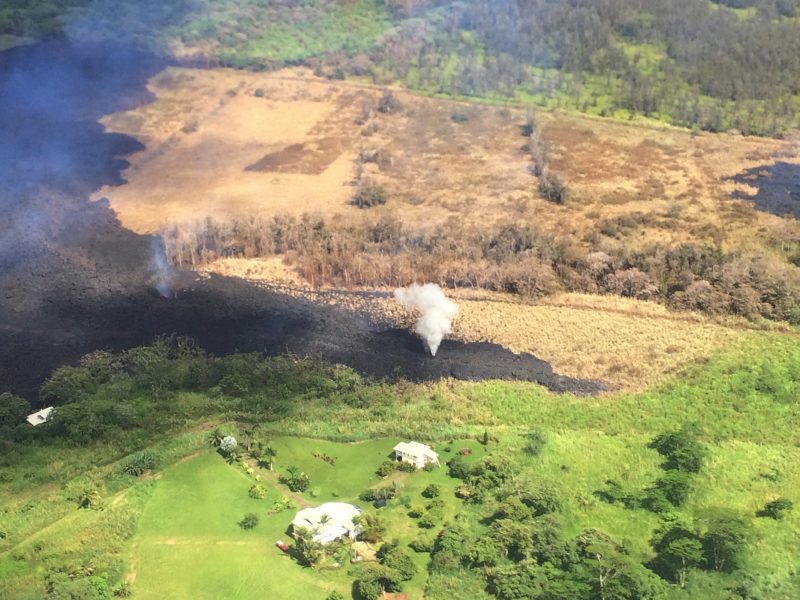
Steam jets out of Fissure 17 on May 14. Image via USGS.

A flow emerges from fissure 17 on May 13. Image via USGS.

Cracks on Highway 132 on the Big Island on May 13. Researchers marked the cracks with orange spray paint to track changes over time. Image via USGS.

Bottom line: A large explosion happened on the night of May 18, 2018 at Hawaii’s Kilauea Volcano. The 1st serious injury was reported on May 19. Molten lava reached the ocean on May 20, and the USGS warns of the release of toxic gases in a plume called a laze. Latest images and videos here.


from EarthSky https://ift.tt/2IySSFP

Kilauea Volcano has been spewing lava and belching hazardous gases on Hawaii’s Big Island since early May, and the BBC reported on Sunday, May 20, 2018 that the situation for residents is “steadily worsening.” At the summit, a large explosion happened at around midnight on Friday night (May 18) into Saturday, sending a plume of volcanic gas some 10,000 feet (two miles, or 3 km) into the air. Early in the day on May 20, media outlets were reporting the first serious injury from Kilauea. HawaiiNewsNow reported:

The injured man was sitting on a balcony at his home when ‘lava spatter’ – projectile molten rock – landed on him. ‘It hit him on the shin and shattered everything there down on his leg,’ a spokeswoman for the county mayor said.

Lava spatters can weigh ‘as much a refrigerator,’ she told Reuters.

The man has reportedly been hospitalized with serious injuries.

In the meantime, on Saturday night, May 19, Hawaii Civil Defense confirmed that lava from Kilauea’s fissure 20 had entered the ocean, creating conditions for toxic laze. Laze is what happens when molten lava hits sea water; a chemical reaction creates “hazy and noxious conditions” laced with hydrochloric acid and tiny particles of glass. USGS said:

Even the wispy edges of it can cause skin and eye irritation and breathing difficulties.

Helicopter overflight of Kilauea Volcano’s lower East Rift zone on May 19, 2018, around 8:18 a.m., HST. Lava flows emerging from the elongated fissure 16-20 form channels. The flow direction in this picture is from upper center to the lower left. Image via USGS.

The USGS reported on Saturday, May 19, 2018:

Eruption of lava and ground cracking in the area of Leilani Estates subdivision continues. Beginning yesterday and into today, the rate of lava eruption has increased. Fissure 17 is weakly active now, and Fissures 16-20 have merged into a continuous line of spatter and fountaining. Flows from the consolidated Fissure 20 crossed upper Pohoiki road late yesterday afternoon and continued flowing southward. This afternoon two flows from the merged fissure complex have joined less than a mile from the coast and continue to flow southward between Pohoiki and Opihikao Rds. The lava flow from Fissure 18 is stalled. It is unknown whether the flows will continue to advance, or stop, and new lava flows are likely given the rate of activity seen at the rift zone. Volcanic gas emissions remain very high. Read more

Click here for maps of recent activity at Kilauea Volcano

Click here for the latest photos and videos from USGS, at Kilauea

The following is the most recent video update from a USGS scientist (May 18):

More than 1,700 people have already evacuated their homes, particularly in the area around Leilani Estates, located in Hawaii’s District of Puna, where 27 homes had been destroyed as of May 9.

Helicopter overflight of the southeast coast of the Puna district during the early morning hours of May 19, 2018. Flows are moving downslope toward the ocean. Photograph courtesy of the Hawai`i County Fire Department/ via USGS.

The Hawaiian Volcano Observatory reported on May 14 on “speculative stories, rumors and blogs” about a possible Pacific-wide tsunami, caused by conditions at Kilauea:

There have been several recent highly speculative stories, rumors and blogs about the stability of the south flank of Kilauea and the potential for a catastrophic collapse that could generate a Pacific-wide tsunami. We wish to put these speculations in their proper context by presenting observations of the current situation and an assessment of past evidence of landslides from Kilauea.

There is no geologic evidence for past catastrophic collapses of K?lauea Volcano that would lead to a major Pacific tsunami, and such an event is extremely unlikely in the future based on monitoring of surface deformation … Geologic history combined with models of south flank motion suggest that the likelihood of a catastrophic failure event is incredibly remote. Read more.

The following video is from May 14, when a new fissure in Hawaii’s Puna District sent gases and lava exploding into the air, spurring officials to call for more evacuations as residents waited for a possible major eruption at Kilauea volcano’s summit.

The view between Kilauea fissures 16 and 20 on May 16, 2018. Image via USGS.

.

The Overlook vent on the summit of Kilauea threw out chunks of rock on May 16 that hit the ground near a parking lot, breaking apart on impact. The rocks were about 24 inches (60 cm) before they hit. Image via USGS.

Steam jets out of Fissure 17 on May 14. Image via USGS.

A flow emerges from fissure 17 on May 13. Image via USGS.

Cracks on Highway 132 on the Big Island on May 13. Researchers marked the cracks with orange spray paint to track changes over time. Image via USGS.

Bottom line: A large explosion happened on the night of May 18, 2018 at Hawaii’s Kilauea Volcano. The 1st serious injury was reported on May 19. Molten lava reached the ocean on May 20, and the USGS warns of the release of toxic gases in a plume called a laze. Latest images and videos here.


from EarthSky https://ift.tt/2IySSFP

A space ant fires its lasers

From ground-based telescopes, the so-called “Ant Nebula” (Menzel 3, or Mz 3) resembles the head and thorax of a garden-variety ant. Image via NASA, ESA and the Hubble Heritage Team (STScI/AURA).

Observations by the European Space Agency’s (ESA) Herschel space observatory of an unusual laser emission from the Ant Nebula suggest the presence of a double star system hidden at the nebula’s heart. That’s according to a new study published May 16, 2018, in the peer-reviewed journal Monthly Notices of the Royal Astronomical Society.

When low- to middle-weight stars – like our sun – approach the end of their lives they eventually become dense, white dwarf stars. In the process, they cast off their outer layers of gas and dust into space, creating a kaleidoscope of intricate patterns known as a planetary nebula.

The infrared Herschel observations suggest that the dramatic demise of the central star in the core of the Ant Nebula is even more theatrical than what might be implied by its colorful appearance in visible images – such as the image at the top of this post. The new data, say the study authors, reveal the Ant Nebula also beams intense laser emission from its core.

According to an ESA statement:

While lasers in everyday life today might mean special visual effects in music concerts, in space, focused emission is detected at different wavelengths under specific conditions. Only a few of these space infrared lasers are known.

By coincidence, astronomer Donald Menzel who first observed and classified this particular planetary nebula in the 1920s (it is officially known as Menzel 3 after him) was also one of the first to suggest that in certain conditions natural ‘light amplification by stimulated emission of radiation’ – from which the acronym ‘laser’ derives – could occur in gaseous nebulae. This was well before the discovery and first successful operation of lasers in laboratories in 1960, an occasion which is now celebrated annually on May 16 as International Day of Light.

Stellar evolution. Read more about this image. Image via ESA.

Isabel Aleman of University of Sao Paulo, Brazil, is the paper’s lead author She said:

When we observe Menzel 3, we see an amazingly intricate structure made up of ionized gas, but we cannot see the object in its center producing this pattern.

Thanks to the sensitivity and wide wavelength range of the Herschel observatory, we detected a very rare type of emission called hydrogen recombination line laser emission, which provided a way to reveal the nebula’s structure and physical conditions.

This kind of laser emission needs very dense gas close to the star. When the astronomers compared the observations with models, they found that the density of the laser-emitting gas is around 10 thousand times higher than that of the gas seen in typical planetary nebulae and in the lobes of the Ant Nebula itself.

Normally, the region close to the dead star – close in this case being about the distance of Saturn from the sun – is quite empty, because most of its material is ejected outwards. Any lingering gas would soon fall back onto it. According to study co-author Albert Zijlstra of University of Manchester:

The only way to keep gas close to the star is if it is orbiting around it in a disc. In this case, we have actually observed a dense disc in the very centre that is seen approximately edge-on. This orientation helps to amplify the laser signal. The disc suggests the white dwarf has a binary companion, because it is hard to get the ejected gas to go into orbit unless a companion star deflects it in the right direction.

The Herschel telescope in the clean room. Image via ESA.

Astronomers have not yet seen the expected second star, but they think that the mass from the dying companion star is being ejected and then captured by the compact central star of the original planetary nebula, producing the disc where the laser emission is produced.

Göran Pilbratt is ESA’s Herschel project scientist. He said:

This study suggests that the distinctive Ant Nebula as we see it today was created by the complex nature of a binary star system, which influences the shape, chemical properties, and evolution in these final stages of a star’s life.

Bottom line: Observations by ESA’s Hershel space telescope suggest the presence of a double star system hidden at the heart of the Ant Nebula.

Read more from ESA


from EarthSky https://ift.tt/2Lh5xin

From ground-based telescopes, the so-called “Ant Nebula” (Menzel 3, or Mz 3) resembles the head and thorax of a garden-variety ant. Image via NASA, ESA and the Hubble Heritage Team (STScI/AURA).

Observations by the European Space Agency’s (ESA) Herschel space observatory of an unusual laser emission from the Ant Nebula suggest the presence of a double star system hidden at the nebula’s heart. That’s according to a new study published May 16, 2018, in the peer-reviewed journal Monthly Notices of the Royal Astronomical Society.

When low- to middle-weight stars – like our sun – approach the end of their lives they eventually become dense, white dwarf stars. In the process, they cast off their outer layers of gas and dust into space, creating a kaleidoscope of intricate patterns known as a planetary nebula.

The infrared Herschel observations suggest that the dramatic demise of the central star in the core of the Ant Nebula is even more theatrical than what might be implied by its colorful appearance in visible images – such as the image at the top of this post. The new data, say the study authors, reveal the Ant Nebula also beams intense laser emission from its core.

According to an ESA statement:

While lasers in everyday life today might mean special visual effects in music concerts, in space, focused emission is detected at different wavelengths under specific conditions. Only a few of these space infrared lasers are known.

By coincidence, astronomer Donald Menzel who first observed and classified this particular planetary nebula in the 1920s (it is officially known as Menzel 3 after him) was also one of the first to suggest that in certain conditions natural ‘light amplification by stimulated emission of radiation’ – from which the acronym ‘laser’ derives – could occur in gaseous nebulae. This was well before the discovery and first successful operation of lasers in laboratories in 1960, an occasion which is now celebrated annually on May 16 as International Day of Light.

Stellar evolution. Read more about this image. Image via ESA.

Isabel Aleman of University of Sao Paulo, Brazil, is the paper’s lead author She said:

When we observe Menzel 3, we see an amazingly intricate structure made up of ionized gas, but we cannot see the object in its center producing this pattern.

Thanks to the sensitivity and wide wavelength range of the Herschel observatory, we detected a very rare type of emission called hydrogen recombination line laser emission, which provided a way to reveal the nebula’s structure and physical conditions.

This kind of laser emission needs very dense gas close to the star. When the astronomers compared the observations with models, they found that the density of the laser-emitting gas is around 10 thousand times higher than that of the gas seen in typical planetary nebulae and in the lobes of the Ant Nebula itself.

Normally, the region close to the dead star – close in this case being about the distance of Saturn from the sun – is quite empty, because most of its material is ejected outwards. Any lingering gas would soon fall back onto it. According to study co-author Albert Zijlstra of University of Manchester:

The only way to keep gas close to the star is if it is orbiting around it in a disc. In this case, we have actually observed a dense disc in the very centre that is seen approximately edge-on. This orientation helps to amplify the laser signal. The disc suggests the white dwarf has a binary companion, because it is hard to get the ejected gas to go into orbit unless a companion star deflects it in the right direction.

The Herschel telescope in the clean room. Image via ESA.

Astronomers have not yet seen the expected second star, but they think that the mass from the dying companion star is being ejected and then captured by the compact central star of the original planetary nebula, producing the disc where the laser emission is produced.

Göran Pilbratt is ESA’s Herschel project scientist. He said:

This study suggests that the distinctive Ant Nebula as we see it today was created by the complex nature of a binary star system, which influences the shape, chemical properties, and evolution in these final stages of a star’s life.

Bottom line: Observations by ESA’s Hershel space telescope suggest the presence of a double star system hidden at the heart of the Ant Nebula.

Read more from ESA


from EarthSky https://ift.tt/2Lh5xin

Which moon phase best for stargazing?

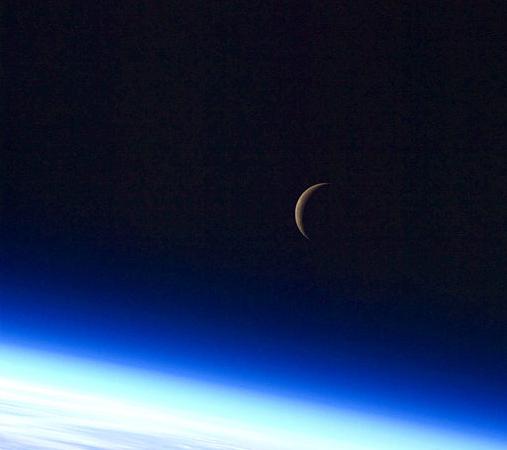
Tonight – May 20, 2018 – look for the lit side of the rather wide waxing crescent moon to point toward the dazzling planet Venus. The dark or night side of the moon points in the other direction, toward Regulus, the brightest star in the constellation Leo the Lion. We got this question:

Which phase of the moon would be best for stargazing, and why?

And the answer is … it depends on what you want to do. Some people enjoy watching the moon itself, as it waxes and wanes in our sky. Some enjoy the fact that the moon appears near bright stars and planets at certain times of the month. For instance, the first quarter moon will pair up with the bright star Regulus tomorrow night, on May 21.

People also use the moon as a signpost. For instance the lit side of tonight’s rather wide waxing crescent moon points westward, and the dark or nighttime side points eastward. This evening, as darkness falls, the lit side of the moon points toward the brilliant planet Venus, which lurks close to the western horizon at nightfall. On the other hand, the moon’s nighttime side points in the direction of Regulus, the brightest star in the constellation Leo the Lion.

The moon is our companion world, and we love her. But astronomers trying to observe faint objects typically avoid the moon. Image via NASA.

Some professional astronomers don’t care about observing the moon itself. They are more interested in observing objects in space much farther away than Earth’s moon. They look forward to moon-free nights, which let them look at deep-sky objects, such as galaxies, star clusters and nebulae. They like the moon at or near new phase! It’s best to look at these faint fuzzies in a night sky with little or no light.

Amateur astronomers using telescopes may also try to avoid the moon, because its glare interferes with the telescopic views of deep-sky objects. Especially around full moon, the moon casts a lot of light, washing out many nighttime treasures. At new moon, the moon is up during the day, not the nighttime. Around then, you won’t see the moon at all – unless you’re on just the right spot on Earth to watch one of the upcoming partial solar eclipses on July 13 and August 11, 2018.

In the meantime, what do we have to look forward to later this month? Watch for the moon to swing to the north of Regulus on May 21, north of the star Spica on May 25, and north of the planet Jupiter around May 27.

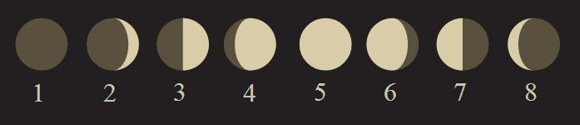
Moon phases: 1) new moon 2) waxing crescent 3) first quarter 4) waxing gibbous 5) full moon 6) waning gibbous 7) last quarter 8) waning crescent. For more, read Understanding moon phases

Moon phases: 1) new moon 2) waxing crescent 3) first quarter 4) waxing gibbous 5) full moon 6) waning gibbous 7) last quarter 8) waning crescent. For more, read Four keys to understanding moon phases

Bottom line: The best phase of the moon for stargazing depends on what you want to do. Some enjoy watching the moon itself. On the other hand, people using telescopes avoid the moon because its glare interferes with deep-sky objects.

A planisphere is virtually indispensable for beginning stargazers. Order your EarthSky planisphere today.

Four keys to understanding moon phases


from EarthSky https://ift.tt/1kIhego

Tonight – May 20, 2018 – look for the lit side of the rather wide waxing crescent moon to point toward the dazzling planet Venus. The dark or night side of the moon points in the other direction, toward Regulus, the brightest star in the constellation Leo the Lion. We got this question:

Which phase of the moon would be best for stargazing, and why?

And the answer is … it depends on what you want to do. Some people enjoy watching the moon itself, as it waxes and wanes in our sky. Some enjoy the fact that the moon appears near bright stars and planets at certain times of the month. For instance, the first quarter moon will pair up with the bright star Regulus tomorrow night, on May 21.

People also use the moon as a signpost. For instance the lit side of tonight’s rather wide waxing crescent moon points westward, and the dark or nighttime side points eastward. This evening, as darkness falls, the lit side of the moon points toward the brilliant planet Venus, which lurks close to the western horizon at nightfall. On the other hand, the moon’s nighttime side points in the direction of Regulus, the brightest star in the constellation Leo the Lion.

The moon is our companion world, and we love her. But astronomers trying to observe faint objects typically avoid the moon. Image via NASA.

Some professional astronomers don’t care about observing the moon itself. They are more interested in observing objects in space much farther away than Earth’s moon. They look forward to moon-free nights, which let them look at deep-sky objects, such as galaxies, star clusters and nebulae. They like the moon at or near new phase! It’s best to look at these faint fuzzies in a night sky with little or no light.

Amateur astronomers using telescopes may also try to avoid the moon, because its glare interferes with the telescopic views of deep-sky objects. Especially around full moon, the moon casts a lot of light, washing out many nighttime treasures. At new moon, the moon is up during the day, not the nighttime. Around then, you won’t see the moon at all – unless you’re on just the right spot on Earth to watch one of the upcoming partial solar eclipses on July 13 and August 11, 2018.

In the meantime, what do we have to look forward to later this month? Watch for the moon to swing to the north of Regulus on May 21, north of the star Spica on May 25, and north of the planet Jupiter around May 27.

Moon phases: 1) new moon 2) waxing crescent 3) first quarter 4) waxing gibbous 5) full moon 6) waning gibbous 7) last quarter 8) waning crescent. For more, read Understanding moon phases

Moon phases: 1) new moon 2) waxing crescent 3) first quarter 4) waxing gibbous 5) full moon 6) waning gibbous 7) last quarter 8) waning crescent. For more, read Four keys to understanding moon phases

Bottom line: The best phase of the moon for stargazing depends on what you want to do. Some enjoy watching the moon itself. On the other hand, people using telescopes avoid the moon because its glare interferes with deep-sky objects.

A planisphere is virtually indispensable for beginning stargazers. Order your EarthSky planisphere today.

Four keys to understanding moon phases


from EarthSky https://ift.tt/1kIhego

2018 SkS Weekly Climate Change & Global Warming News Roundup #20

A chronological listing of news articles posted on the Skeptical Science Facebook Page during the past week.

Editor's Pick

Urgent Climate Action Required to Protect Tens of Thousands of Species Worldwide, New Research Shows

Limiting global warming to 2 degrees and not the more ambitious 1.5 degrees would put far more species at risk of extinction. Insects are especially vulnerable.

Biodiversity

A mere half degree of extra global warming could mean profound risks for tens of thousands of the planet's species, scientists have found. Credit: Alex Wong/Getty Images

Humanity can powerfully improve the survival odds of tens of thousands of species, but only if nations dramatically raise their ambitions in the fight against climate change, according to new research published on Thursday in the journal Science.

One key to salvaging plant and vertebrate habitat and protecting the world's biodiversity is to limit warming to the most challenging benchmark established under the 2015 Paris treaty—1.5 degrees Celsius of warming—not to the treaty's less stringent 2 degree guardrail, the study found.

The study assessed, in more detail than ever before, a key measure of extinction risk: the shrinking size of each species' current geographical range, or natural habitat. It projected that for an alarming number of species, their range size would shrink by at least half as temperatures rise past the Paris goals.

If nations do no more than they have pledged so far to reduce their greenhouse gas emissions—and warming consequently shoots past 3 degrees by the end of this century—6 percent of all vertebrates would be at risk. So would 44 percent of plants and a whopping 49 percent of insects.

But the dangers would be greatly reduced if warming can be limited to 1.5 degrees. That might protect the overwhelming majority of the 115,000 species assessed by the researchers. Just 4 percent of vertebrates would lose more than half of their current range. Only 8 percent of plants and 6 percent of insects would face that risk.

Keeping warming to 2 degrees is not nearly as effective, they found. The additional half degree of warming would double the impact on plants and vertebrate species, and triple the impact on insects.

Urgent Climate Action Required to Protect Tens of Thousands of Species Worldwide, New Research Shows by John H Cushman Jr & Neela Banerjee, InsideClimate News, May 17, 2018


Links posted on Facebook

Sun May 13, 2018

Mon May 14, 2018

Tue May 15, 2018

Wed May 16, 2018

Thu May 17, 2018

Fri May 18, 2018

Sat May 19, 2018


from Skeptical Science https://ift.tt/2k8hzOR
A chronological listing of news articles posted on the Skeptical Science Facebook Page during the past week.

Editor's Pick

Urgent Climate Action Required to Protect Tens of Thousands of Species Worldwide, New Research Shows

Limiting global warming to 2 degrees and not the more ambitious 1.5 degrees would put far more species at risk of extinction. Insects are especially vulnerable.

Biodiversity

A mere half degree of extra global warming could mean profound risks for tens of thousands of the planet's species, scientists have found. Credit: Alex Wong/Getty Images

Humanity can powerfully improve the survival odds of tens of thousands of species, but only if nations dramatically raise their ambitions in the fight against climate change, according to new research published on Thursday in the journal Science.

One key to salvaging plant and vertebrate habitat and protecting the world's biodiversity is to limit warming to the most challenging benchmark established under the 2015 Paris treaty—1.5 degrees Celsius of warming—not to the treaty's less stringent 2 degree guardrail, the study found.

The study assessed, in more detail than ever before, a key measure of extinction risk: the shrinking size of each species' current geographical range, or natural habitat. It projected that for an alarming number of species, their range size would shrink by at least half as temperatures rise past the Paris goals.

If nations do no more than they have pledged so far to reduce their greenhouse gas emissions—and warming consequently shoots past 3 degrees by the end of this century—6 percent of all vertebrates would be at risk. So would 44 percent of plants and a whopping 49 percent of insects.

But the dangers would be greatly reduced if warming can be limited to 1.5 degrees. That might protect the overwhelming majority of the 115,000 species assessed by the researchers. Just 4 percent of vertebrates would lose more than half of their current range. Only 8 percent of plants and 6 percent of insects would face that risk.

Keeping warming to 2 degrees is not nearly as effective, they found. The additional half degree of warming would double the impact on plants and vertebrate species, and triple the impact on insects.

Urgent Climate Action Required to Protect Tens of Thousands of Species Worldwide, New Research Shows by John H Cushman Jr & Neela Banerjee, InsideClimate News, May 17, 2018


Links posted on Facebook

Sun May 13, 2018

Mon May 14, 2018

Tue May 15, 2018

Wed May 16, 2018

Thu May 17, 2018

Fri May 18, 2018

Sat May 19, 2018


from Skeptical Science https://ift.tt/2k8hzOR

TESS planet-hunter snaps 1st test image, swings by moon

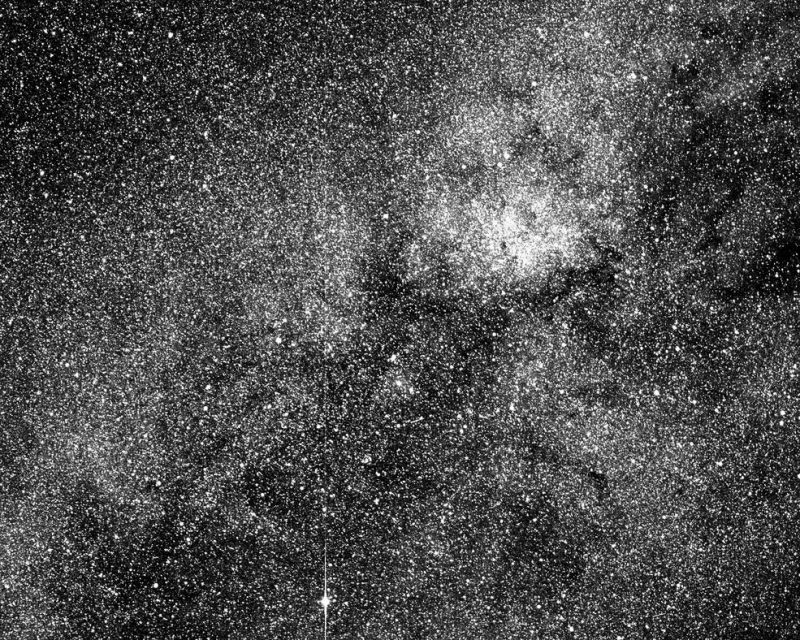
This is the 1st test image from the newly launched TESS planet-hunter, showing a swath of the southern sky along the plane of our Milky Way galaxy. The edge of the Coalsack Nebula is in the right upper corner and the bright star Beta Centauri is visible at the lower left edge. TESS is expected to cover more than 400 times as much sky as shown in this image with its 4 cameras during its initial 2-year search for exoplanets. Image via NASA/ MIT/ TESS.

NASA’s new planet hunter, the Transiting Exoplanet Survey Satellite – aka TESS – completed a successful lunar flyby on May 17, 2018. The flyby took place almost one month to the day after the craft’s April 18 launch from the Cape Canaveral Air Force Station in Florida. TESS swept about 5,000 miles (8,000 km) from the moon’s surface, in the process receiving a gravity boost from the moon that’ll help the craft achieve its final working orbit. In addition, the TESS science team used one of the spacecraft’s four cameras to snap a two-second test image (shown above), centered on the southern constellation Centaurus and showing more than 200,000 stars.

How many unseen worlds orbit these stars? TESS won’t probe them all (it’s designed for nearby stars), but it’ll find some of them!

Since its April 18 launch, TESS has undergone five of six scheduled thruster burns. It has traveled in a series of progressively more elongated orbits to reach the moon. NASA said TESS will undergo a final thruster burn on May 30 to enter its final science 13.7-day science orbit around Earth. The highly elliptical final orbit is designed to maximize the amount of sky the spacecraft can image.

NASA is expected to release the science-quality image from TESS – the spacecraft’s official first light image – in June. TESS is expected to begin science operations in mid-June.

TESS is the successor to the Kepler spacecraft, which discovered some 2,300 exoplanets over the course of its lifetime. NASA said in March that Kepler is expected to run out of fuel entirely within the next few months.

Unlike Kepler – which has a fixed field of view of the sky – TESS will search for exoplanets in some 85 percent of Earth’s sky. Scientists have divided the sky into 26 sectors. TESS will use its four wide-field cameras to map 13 sectors encompassing the southern sky during its first year of observations and 13 sectors of the northern sky during the second year.

TESS will be watching for phenomena called transits. A transit occurs when a planet passes in front of its star from the observer’s perspective, causing a periodic and regular dip in the star’s brightness. More than 78 percent of the confirmed exoplanets – including those found by Kepler – have been found using transits, NASA said.

Most of Kepler’s exoplanets orbit faint stars between 300 and 3,000 light-years from Earth. TESS will focus on much closer stars – between 30 and 300 light-years away – and some 30 to 100 times brighter than Kepler’s targets.

The brightness of these target stars will allow future researchers to use spectroscopy, the study of the absorption and emission of light, to determine a planet’s mass, density and atmospheric composition. Water, and other key molecules, in its atmosphere can give us hints about a planet’s capacity to harbor life.

Go, TESS!

Read more: How TESS will hunt for alien worlds

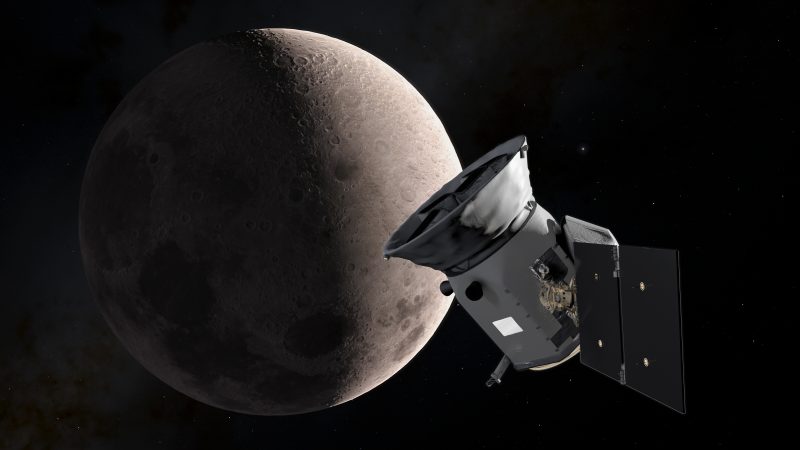
Artist’s concept of the Transiting Exoplanet Survey Satellite – TESS – which successfully completing a lunar flyby on May 17, 2018. The spacecraft passed about 5,000 miles (8,000 km) from the moon, which provided a gravitational assist that helped TESS sail toward its final working orbit. Image via NASA/ NASA Goddard Space Flight Center

Bottom line: The Transiting Exoplanet Survey Satellite – aka TESS – completed a successful lunar flyby on May 17, 2018, sweeping about 5,000 miles (8,000 km) from the moon’s surface. In the process, it received a gravity boost from the moon that’ll help the craft achieve its final working orbit. In addition, the TESS science team acquired a test image (top of page).

Via NASA


from EarthSky https://ift.tt/2ka5pFq

This is the 1st test image from the newly launched TESS planet-hunter, showing a swath of the southern sky along the plane of our Milky Way galaxy. The edge of the Coalsack Nebula is in the right upper corner and the bright star Beta Centauri is visible at the lower left edge. TESS is expected to cover more than 400 times as much sky as shown in this image with its 4 cameras during its initial 2-year search for exoplanets. Image via NASA/ MIT/ TESS.

NASA’s new planet hunter, the Transiting Exoplanet Survey Satellite – aka TESS – completed a successful lunar flyby on May 17, 2018. The flyby took place almost one month to the day after the craft’s April 18 launch from the Cape Canaveral Air Force Station in Florida. TESS swept about 5,000 miles (8,000 km) from the moon’s surface, in the process receiving a gravity boost from the moon that’ll help the craft achieve its final working orbit. In addition, the TESS science team used one of the spacecraft’s four cameras to snap a two-second test image (shown above), centered on the southern constellation Centaurus and showing more than 200,000 stars.

How many unseen worlds orbit these stars? TESS won’t probe them all (it’s designed for nearby stars), but it’ll find some of them!

Since its April 18 launch, TESS has undergone five of six scheduled thruster burns. It has traveled in a series of progressively more elongated orbits to reach the moon. NASA said TESS will undergo a final thruster burn on May 30 to enter its final science 13.7-day science orbit around Earth. The highly elliptical final orbit is designed to maximize the amount of sky the spacecraft can image.

NASA is expected to release the science-quality image from TESS – the spacecraft’s official first light image – in June. TESS is expected to begin science operations in mid-June.

TESS is the successor to the Kepler spacecraft, which discovered some 2,300 exoplanets over the course of its lifetime. NASA said in March that Kepler is expected to run out of fuel entirely within the next few months.

Unlike Kepler – which has a fixed field of view of the sky – TESS will search for exoplanets in some 85 percent of Earth’s sky. Scientists have divided the sky into 26 sectors. TESS will use its four wide-field cameras to map 13 sectors encompassing the southern sky during its first year of observations and 13 sectors of the northern sky during the second year.

TESS will be watching for phenomena called transits. A transit occurs when a planet passes in front of its star from the observer’s perspective, causing a periodic and regular dip in the star’s brightness. More than 78 percent of the confirmed exoplanets – including those found by Kepler – have been found using transits, NASA said.

Most of Kepler’s exoplanets orbit faint stars between 300 and 3,000 light-years from Earth. TESS will focus on much closer stars – between 30 and 300 light-years away – and some 30 to 100 times brighter than Kepler’s targets.

The brightness of these target stars will allow future researchers to use spectroscopy, the study of the absorption and emission of light, to determine a planet’s mass, density and atmospheric composition. Water, and other key molecules, in its atmosphere can give us hints about a planet’s capacity to harbor life.

Go, TESS!

Read more: How TESS will hunt for alien worlds

Artist’s concept of the Transiting Exoplanet Survey Satellite – TESS – which successfully completing a lunar flyby on May 17, 2018. The spacecraft passed about 5,000 miles (8,000 km) from the moon, which provided a gravitational assist that helped TESS sail toward its final working orbit. Image via NASA/ NASA Goddard Space Flight Center

Bottom line: The Transiting Exoplanet Survey Satellite – aka TESS – completed a successful lunar flyby on May 17, 2018, sweeping about 5,000 miles (8,000 km) from the moon’s surface. In the process, it received a gravity boost from the moon that’ll help the craft achieve its final working orbit. In addition, the TESS science team acquired a test image (top of page).

Via NASA


from EarthSky https://ift.tt/2ka5pFq

Scientists measure rise in ozone-destroying chemical

Timelapse photograph of a NOAA weather balloon, drifting over the South Pole. The balloon was carrying instruments to measure atmospheric ozone. Image via NOAA.

Trichlorofluoromethane – also called freon-11 or CFC-11 – was once widely used as a refrigerant, among other things, until it became known as an ozone-depleting chemical. In fact, it’s the second-most-abundant ozone-depleting chemical known. CFC stands for chlorofluorocarbon, and, as a group, these human-made chemicals are charged with, for example, the infamous hole in Earth’s ozone layer that forms over Antarctica each year. The Montreal Protocol, finalized in 1987, is the international treaty designed to protect Earth’s ozone layer. It called for the phase-out of substances like CFC-11, whose production was slated to end entirely by 2010. But a new analysis of long-term atmospheric measurements by NOAA scientists shows emissions of CFC-11 are rising again. NOAA said the increase is:

… most likely from new, unreported production from an unidentified source in East Asia.

The study reporting on the rise in CFC-11 was published May 16, 2018 in the peer-reviewed journal Nature. NOAA scientist Stephen Montzka, the study’s lead author, said:

We’re raising a flag to the global community to say, ‘This is what’s going on, and it is taking us away from timely recovery of the ozone layer.’ Further work is needed to figure out exactly why emissions of CFC-11 are increasing, and if something can be done about it soon.

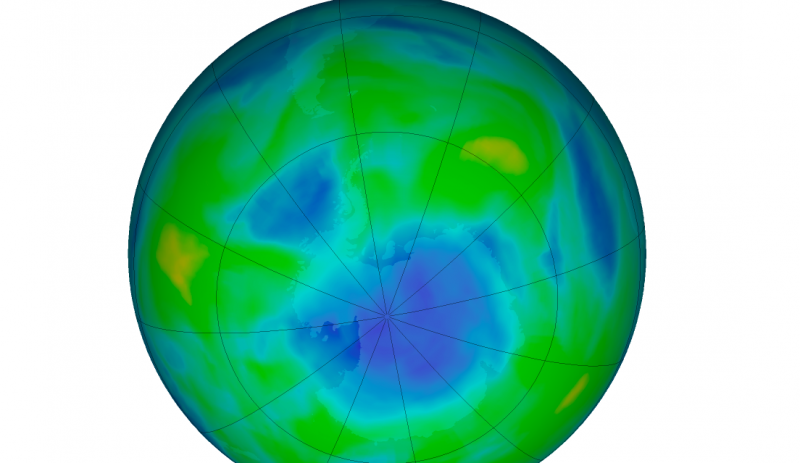
May 15, 2018 false-color view of total amount of ozone over Antarctica and the South Pole. The purple and blue colors are where there is the least ozone, and the yellows and reds are where there is more ozone. The ozone hole opens up in the Antarctic summertime and tends to be at its peak each year in September. View the latest status of the ozone layer at NASA Ozone Watch.

Chlorofluorocarbons, or CFCs, were once considered a triumph of modern chemistry. These chemicals were stable and versatile and were used in hundreds of products, from military systems to cans of hairspray.

That was until scientists around the world began to realize that this family of ‘wonder chemicals’ was damaging Earth’s protective ozone layer. There was disagreement and disbelief by some, of course, at first. But then British Antarctic Survey scientists reported an Antarctic ozone hole – the first one ever recognized – in a paper in Nature in May 1985. It came as a shock to the scientific community and the world. The Montreal Protocol was the result, and world leaders hailed it – and continue to hail it – as an example of effective global cooperation.

Is the ozone hole recovering? It’s important to remember that we’re talking about Earth processes here (as well as human processes), and Earth tends to move slowly in contrast to our human timescale. NASA just said in January 2018 that it had the first direct proof of ozone hole recovery due to the chemicals ban. That is, scientists for the first time showed – through direct satellite observations of the ozone hole – that levels of ozone-destroying chlorine are declining, resulting in less ozone depletion. The video below talks about that:

Montzka and his team of researchers from the the Cooperative Institute for Research In Environmental Sciences (CIRES), plus scientists from the UK and the Netherlands, are working to monitor ozone in Earth’s atmosphere. They said this is the first time that emissions of one of the three most abundant, long-lived CFCs have increased for a sustained period since production controls took effect in the late 1980s.

As we said above, chlorofluorocarbons are a very stable class of chemicals, and CFC-11 – in particular – has a long life in Earth’s atmosphere. That’s part of the reason it’s the second-most abundant ozone-depleting chemical in the atmosphere. Another part of the reason is that there are continuing emissions of CFC-11 from foam building insulation and appliances manufactured before the mid-1990s. A smaller amount of CFC-11 also exists today in older refrigerators and freezers.

Thanks to the Montreal Protocol, CFC-11 concentrations have declined by 15 percent from peak levels measured in 1993, these scientists said.

But – though concentrations of CFC-11 in the atmosphere are still declining – they’re declining more slowly than they would if there were no new sources, Montzka said.

The results from the new analysis of NOAA atmospheric measurements explain why. From 2014 to 2016, emissions of CFC-11 must have increased by 25 percent above the average measured from 2002 to 2012.

Scientists had been predicting that by the mid- to late century, the abundance of ozone-depleting gases would fall to levels last seen before the Antarctic ozone hole began to appear in the early 1980s.

Montzka said the new analysis can’t definitively explain why emissions of CFC-11 are increasing, but in the paper, the team discusses potential reasons why. Montzka said:

In the end, we concluded that it’s most likely that someone may be producing the CFC-11 that’s escaping to the atmosphere. We don’t know why they might be doing that and if it is being made for some specific purpose, or inadvertently as a side product of some other chemical process.

If the source of these new emissions can be identified and controlled soon, the damage to the ozone layer should be minor, Montzka said. If not remedied soon, however, substantial delays in ozone layer recovery could be expected.

Read more from NOAA

By the way, according to NASA, the 2017 ozone hole – which peaked, as they typically do, in September – was the smallest observed since 1988. That’s not necessarily because the Montreal Protocol is working (although it doubtless is working, albeit over a long timescale). Instead, it’s a result of the fact that Earth’s atmosphere is extremely complex, with many variables working together to create the big picture.

So it wasn’t the ban on CFCs, NASA said, that led to 2017’s small ozone hole. Instead, it was unusual warmth in the stratosphere that caused the smaller hole last year (and in 2016). After all, you might ask yourself … why did the ozone hole open over Antarctica in the first place, and not somewhere else? It’s because Antarctica is the coldest place on Earth, and the air above it is also very cold. Ozone depletion works best in very cold air. The record global warmth in recent years means a warmer stratosphere over Antarctica, with one result apparently being smaller ozone holes in 2017 and 2016.

Ozone depletion occurs in cold temperatures. That’s why the ozone hole reaches its annual maximum in September or October, at the end of Southern Hemisphere winter each year. And it’s why 2016 and 2017 – both record warm years – had smaller-than-usual ozone holes. Image via NASA/ NASA Ozone Watch/ Katy Mersmann.

Bottom line: Scientists engaged in monitoring ozone-depleting chemicals in Earth’s atmosphere have found that CFC-11 appears to be on the rise, despite an international ban on its production that went into effect in 2010.

Source: An unexpected and persistent increase in global emissions of ozone-depleting CFC-11


from EarthSky https://ift.tt/2k7XCrt

Timelapse photograph of a NOAA weather balloon, drifting over the South Pole. The balloon was carrying instruments to measure atmospheric ozone. Image via NOAA.

Trichlorofluoromethane – also called freon-11 or CFC-11 – was once widely used as a refrigerant, among other things, until it became known as an ozone-depleting chemical. In fact, it’s the second-most-abundant ozone-depleting chemical known. CFC stands for chlorofluorocarbon, and, as a group, these human-made chemicals are charged with, for example, the infamous hole in Earth’s ozone layer that forms over Antarctica each year. The Montreal Protocol, finalized in 1987, is the international treaty designed to protect Earth’s ozone layer. It called for the phase-out of substances like CFC-11, whose production was slated to end entirely by 2010. But a new analysis of long-term atmospheric measurements by NOAA scientists shows emissions of CFC-11 are rising again. NOAA said the increase is:

… most likely from new, unreported production from an unidentified source in East Asia.

The study reporting on the rise in CFC-11 was published May 16, 2018 in the peer-reviewed journal Nature. NOAA scientist Stephen Montzka, the study’s lead author, said:

We’re raising a flag to the global community to say, ‘This is what’s going on, and it is taking us away from timely recovery of the ozone layer.’ Further work is needed to figure out exactly why emissions of CFC-11 are increasing, and if something can be done about it soon.

May 15, 2018 false-color view of total amount of ozone over Antarctica and the South Pole. The purple and blue colors are where there is the least ozone, and the yellows and reds are where there is more ozone. The ozone hole opens up in the Antarctic summertime and tends to be at its peak each year in September. View the latest status of the ozone layer at NASA Ozone Watch.

Chlorofluorocarbons, or CFCs, were once considered a triumph of modern chemistry. These chemicals were stable and versatile and were used in hundreds of products, from military systems to cans of hairspray.

That was until scientists around the world began to realize that this family of ‘wonder chemicals’ was damaging Earth’s protective ozone layer. There was disagreement and disbelief by some, of course, at first. But then British Antarctic Survey scientists reported an Antarctic ozone hole – the first one ever recognized – in a paper in Nature in May 1985. It came as a shock to the scientific community and the world. The Montreal Protocol was the result, and world leaders hailed it – and continue to hail it – as an example of effective global cooperation.

Is the ozone hole recovering? It’s important to remember that we’re talking about Earth processes here (as well as human processes), and Earth tends to move slowly in contrast to our human timescale. NASA just said in January 2018 that it had the first direct proof of ozone hole recovery due to the chemicals ban. That is, scientists for the first time showed – through direct satellite observations of the ozone hole – that levels of ozone-destroying chlorine are declining, resulting in less ozone depletion. The video below talks about that:

Montzka and his team of researchers from the the Cooperative Institute for Research In Environmental Sciences (CIRES), plus scientists from the UK and the Netherlands, are working to monitor ozone in Earth’s atmosphere. They said this is the first time that emissions of one of the three most abundant, long-lived CFCs have increased for a sustained period since production controls took effect in the late 1980s.

As we said above, chlorofluorocarbons are a very stable class of chemicals, and CFC-11 – in particular – has a long life in Earth’s atmosphere. That’s part of the reason it’s the second-most abundant ozone-depleting chemical in the atmosphere. Another part of the reason is that there are continuing emissions of CFC-11 from foam building insulation and appliances manufactured before the mid-1990s. A smaller amount of CFC-11 also exists today in older refrigerators and freezers.

Thanks to the Montreal Protocol, CFC-11 concentrations have declined by 15 percent from peak levels measured in 1993, these scientists said.

But – though concentrations of CFC-11 in the atmosphere are still declining – they’re declining more slowly than they would if there were no new sources, Montzka said.

The results from the new analysis of NOAA atmospheric measurements explain why. From 2014 to 2016, emissions of CFC-11 must have increased by 25 percent above the average measured from 2002 to 2012.

Scientists had been predicting that by the mid- to late century, the abundance of ozone-depleting gases would fall to levels last seen before the Antarctic ozone hole began to appear in the early 1980s.

Montzka said the new analysis can’t definitively explain why emissions of CFC-11 are increasing, but in the paper, the team discusses potential reasons why. Montzka said:

In the end, we concluded that it’s most likely that someone may be producing the CFC-11 that’s escaping to the atmosphere. We don’t know why they might be doing that and if it is being made for some specific purpose, or inadvertently as a side product of some other chemical process.

If the source of these new emissions can be identified and controlled soon, the damage to the ozone layer should be minor, Montzka said. If not remedied soon, however, substantial delays in ozone layer recovery could be expected.

Read more from NOAA

By the way, according to NASA, the 2017 ozone hole – which peaked, as they typically do, in September – was the smallest observed since 1988. That’s not necessarily because the Montreal Protocol is working (although it doubtless is working, albeit over a long timescale). Instead, it’s a result of the fact that Earth’s atmosphere is extremely complex, with many variables working together to create the big picture.

So it wasn’t the ban on CFCs, NASA said, that led to 2017’s small ozone hole. Instead, it was unusual warmth in the stratosphere that caused the smaller hole last year (and in 2016). After all, you might ask yourself … why did the ozone hole open over Antarctica in the first place, and not somewhere else? It’s because Antarctica is the coldest place on Earth, and the air above it is also very cold. Ozone depletion works best in very cold air. The record global warmth in recent years means a warmer stratosphere over Antarctica, with one result apparently being smaller ozone holes in 2017 and 2016.

Ozone depletion occurs in cold temperatures. That’s why the ozone hole reaches its annual maximum in September or October, at the end of Southern Hemisphere winter each year. And it’s why 2016 and 2017 – both record warm years – had smaller-than-usual ozone holes. Image via NASA/ NASA Ozone Watch/ Katy Mersmann.

Bottom line: Scientists engaged in monitoring ozone-depleting chemicals in Earth’s atmosphere have found that CFC-11 appears to be on the rise, despite an international ban on its production that went into effect in 2010.

Source: An unexpected and persistent increase in global emissions of ozone-depleting CFC-11


from EarthSky https://ift.tt/2k7XCrt

Shelf cloud over New York

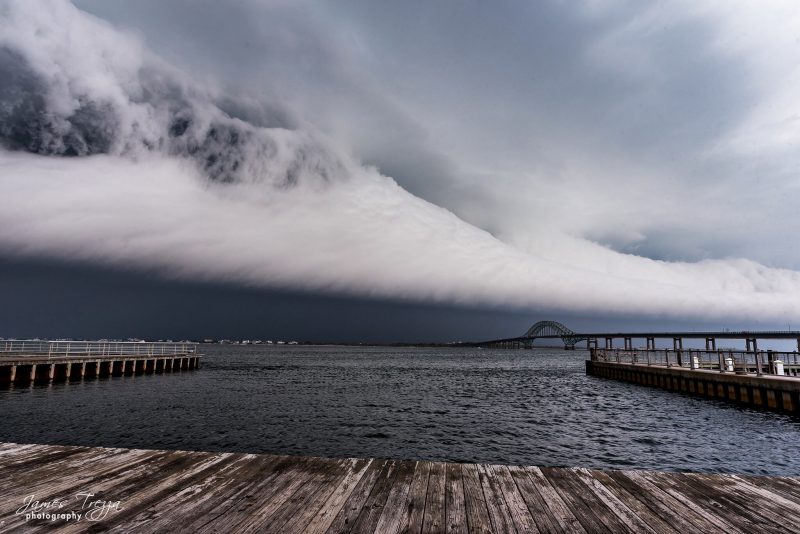
A shelf cloud moving over the Fire Island Inlet Bridge, on Long Island, New York – May 15, 2018 – submitted by James Trezza. Nikon D750 & Nikon 20mm.

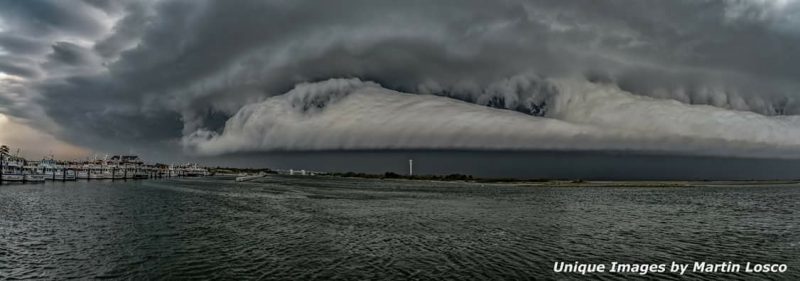
Marty Losco posted at EarthSky Facebook on May 15, describing this image as an: “… 8-shot pano of the shelf cloud that took over Long Island on May 15, 2018.”

Bottom line: Photos and videos of the turbulent clouds and shelf cloud over New York on May 15, 2018.

Visit Weather.com for an explanation: What Were Those Apocalyptic Clouds Over New York City Tuesday?


from EarthSky https://ift.tt/2wSZIol

A shelf cloud moving over the Fire Island Inlet Bridge, on Long Island, New York – May 15, 2018 – submitted by James Trezza. Nikon D750 & Nikon 20mm.

Marty Losco posted at EarthSky Facebook on May 15, describing this image as an: “… 8-shot pano of the shelf cloud that took over Long Island on May 15, 2018.”

Bottom line: Photos and videos of the turbulent clouds and shelf cloud over New York on May 15, 2018.

Visit Weather.com for an explanation: What Were Those Apocalyptic Clouds Over New York City Tuesday?


from EarthSky https://ift.tt/2wSZIol

adds 2