aads

What is peer review?

What exactly is peer review? Image via AJ Cann/Flickr.

.

By Andre Spicer, City, University of London and Thomas Roulet, University of Oxford

Peer review is one of the gold standards of science. It’s a process where scientists (“peers”) evaluate the quality of other scientists’ work. By doing this, they aim to ensure the work is rigorous, coherent, uses past research and adds to what we already knew.

Most scientific journals, conferences and grant applications have some sort of peer review system. In most cases it is “double blind” peer review. This means evaluators do not know the author(s), and the author(s) do not know the identity of the evaluators. The intention behind this system is to ensure evaluation is not biased.

The more prestigious the journal, conference, or grant, the more demanding will be the review process, and the more likely the rejection. This prestige is why these papers tend to be more read and more cited.

The process in details

The peer review process for journals involves at least three stages.

1. The desk evaluation stage

When a paper is submitted to a journal, it receives an initial evaluation by the chief editor, or an associate editor with relevant expertise.

At this stage, either can “desk reject” the paper: that is, reject the paper without sending it to blind referees. Generally, papers are desk rejected if the paper doesn’t fit the scope of the journal or there is a fundamental flaw which makes it unfit for publication.

In this case, the rejecting editors might write a letter summarising his or her concerns. Some journals, such as the British Medical Journal, desk reject up to two-thirds or more of the papers.

2. The blind review

If the editorial team judges there are no fundamental flaws, they send it for review to blind referees. The number of reviewers depends on the field: in finance there might be only one reviewer, while journals in other fields of social sciences might ask up to four reviewers. Those reviewers are selected by the editor on the basis of their expert knowledge and their absence of a link with the authors.

Reviewers will decide whether to reject the paper, to accept it as it is (which rarely happens) or to ask for the paper to be revised. This means the author needs to change the paper in line with the reviewers’ concerns.

Usually the reviews deal with the validity and rigour of the empirical method, and the importance and originality of the findings (what is called the “contribution” to the existing literature). The editor collects those comments, weights them, takes a decision, and writes a letter summarising the reviewers’ and his or her own concerns.

It can therefore happen that despite hostility on the part of the reviewers, the editor could offer the paper a subsequent round of revision. In the best journals in the social sciences, 10% to 20% of the papers are offered a “revise-and-resubmit” after the first round.

3. The revisions – if you are lucky enough

If the paper has not been rejected after this first round of review, it is sent back to the author(s) for a revision. The process is repeated as many times as necessary for the editor to reach a consensus point on whether to accept or reject the paper. In some cases this can last for several years.

Ultimately, less than 10% of the submitted papers are accepted in the best journals in the social sciences. The renowned journal Nature publishes around 7% of the submitted papers.

Strengths and weaknesses of the peer review process

The peer review process is seen as the gold standard in science because it ensures the rigour, novelty, and consistency of academic outputs. Typically, through rounds of review, flawed ideas are eliminated and good ideas are strengthened and improved. Peer reviewing also ensures that science is relatively independent.

Because scientific ideas are judged by other scientists, the crucial yardstick is scientific standards. If other people from outside of the field were involved in judging ideas, other criteria such as political or economic gain might be used to select ideas. Peer reviewing is also seen as a crucial way of removing personalities and bias from the process of judging knowledge.

Despite the undoubted strengths, the peer review process as we know it has been criticised. It involves a number of social interactions that might create biases – for example, authors might be identified by reviewers if they are in the same field, and desk rejections are not blind.

It might also favour incremental (adding to past research) rather than innovative (new) research. Finally, reviewers are human after all and can make mistakes, misunderstand elements, or miss errors.

Are there any alternatives?

Defenders of the peer review system say although there are flaws, we’re yet to find a better system to evaluate research. However, a number of innovations have been introduced in the academic review system to improve its objectivity and efficiency.

Some new open-access journals (such as PLOS ONE) publish papers with very little evaluation (they check the work is not deeply flawed methodologically). The focus there is on the post-publication peer review system: all readers can comment and criticise the paper.

Some journals such as Nature, have made part of the review process public (“open” review), offering a hybrid system in which peer review plays a role of primary gate keepers, but the public community of scholars judge in parallel (or afterwards in some other journals) the value of the research.

Another idea is to have a set of reviewers rating the paper each time it is revised. In this case, authors will be able to choose whether they want to invest more time in a revision to obtain a better rating, and get their work publicly recognised.

Andre Spicer, Professor of Organisational Behaviour, Cass Business School, City, University of London and Thomas Roulet, Novak Druce Research Fellow, University of Oxford

This article was originally published on The Conversation. Read the original article.

Bottom line: What is peer review? What it actually means and how it works.


from EarthSky https://ift.tt/2rP9anG

What exactly is peer review? Image via AJ Cann/Flickr.

.

By Andre Spicer, City, University of London and Thomas Roulet, University of Oxford

Peer review is one of the gold standards of science. It’s a process where scientists (“peers”) evaluate the quality of other scientists’ work. By doing this, they aim to ensure the work is rigorous, coherent, uses past research and adds to what we already knew.

Most scientific journals, conferences and grant applications have some sort of peer review system. In most cases it is “double blind” peer review. This means evaluators do not know the author(s), and the author(s) do not know the identity of the evaluators. The intention behind this system is to ensure evaluation is not biased.

The more prestigious the journal, conference, or grant, the more demanding will be the review process, and the more likely the rejection. This prestige is why these papers tend to be more read and more cited.

The process in details

The peer review process for journals involves at least three stages.

1. The desk evaluation stage

When a paper is submitted to a journal, it receives an initial evaluation by the chief editor, or an associate editor with relevant expertise.

At this stage, either can “desk reject” the paper: that is, reject the paper without sending it to blind referees. Generally, papers are desk rejected if the paper doesn’t fit the scope of the journal or there is a fundamental flaw which makes it unfit for publication.

In this case, the rejecting editors might write a letter summarising his or her concerns. Some journals, such as the British Medical Journal, desk reject up to two-thirds or more of the papers.

2. The blind review

If the editorial team judges there are no fundamental flaws, they send it for review to blind referees. The number of reviewers depends on the field: in finance there might be only one reviewer, while journals in other fields of social sciences might ask up to four reviewers. Those reviewers are selected by the editor on the basis of their expert knowledge and their absence of a link with the authors.

Reviewers will decide whether to reject the paper, to accept it as it is (which rarely happens) or to ask for the paper to be revised. This means the author needs to change the paper in line with the reviewers’ concerns.

Usually the reviews deal with the validity and rigour of the empirical method, and the importance and originality of the findings (what is called the “contribution” to the existing literature). The editor collects those comments, weights them, takes a decision, and writes a letter summarising the reviewers’ and his or her own concerns.

It can therefore happen that despite hostility on the part of the reviewers, the editor could offer the paper a subsequent round of revision. In the best journals in the social sciences, 10% to 20% of the papers are offered a “revise-and-resubmit” after the first round.

3. The revisions – if you are lucky enough

If the paper has not been rejected after this first round of review, it is sent back to the author(s) for a revision. The process is repeated as many times as necessary for the editor to reach a consensus point on whether to accept or reject the paper. In some cases this can last for several years.

Ultimately, less than 10% of the submitted papers are accepted in the best journals in the social sciences. The renowned journal Nature publishes around 7% of the submitted papers.

Strengths and weaknesses of the peer review process

The peer review process is seen as the gold standard in science because it ensures the rigour, novelty, and consistency of academic outputs. Typically, through rounds of review, flawed ideas are eliminated and good ideas are strengthened and improved. Peer reviewing also ensures that science is relatively independent.

Because scientific ideas are judged by other scientists, the crucial yardstick is scientific standards. If other people from outside of the field were involved in judging ideas, other criteria such as political or economic gain might be used to select ideas. Peer reviewing is also seen as a crucial way of removing personalities and bias from the process of judging knowledge.

Despite the undoubted strengths, the peer review process as we know it has been criticised. It involves a number of social interactions that might create biases – for example, authors might be identified by reviewers if they are in the same field, and desk rejections are not blind.

It might also favour incremental (adding to past research) rather than innovative (new) research. Finally, reviewers are human after all and can make mistakes, misunderstand elements, or miss errors.

Are there any alternatives?

Defenders of the peer review system say although there are flaws, we’re yet to find a better system to evaluate research. However, a number of innovations have been introduced in the academic review system to improve its objectivity and efficiency.

Some new open-access journals (such as PLOS ONE) publish papers with very little evaluation (they check the work is not deeply flawed methodologically). The focus there is on the post-publication peer review system: all readers can comment and criticise the paper.

Some journals such as Nature, have made part of the review process public (“open” review), offering a hybrid system in which peer review plays a role of primary gate keepers, but the public community of scholars judge in parallel (or afterwards in some other journals) the value of the research.

Another idea is to have a set of reviewers rating the paper each time it is revised. In this case, authors will be able to choose whether they want to invest more time in a revision to obtain a better rating, and get their work publicly recognised.

Andre Spicer, Professor of Organisational Behaviour, Cass Business School, City, University of London and Thomas Roulet, Novak Druce Research Fellow, University of Oxford

This article was originally published on The Conversation. Read the original article.

Bottom line: What is peer review? What it actually means and how it works.


from EarthSky https://ift.tt/2rP9anG

Could Mother Nature’s clinical trial help prevent more cancers?

One of the best ways to save lives from cancer is preventing tumours from developing in the first place.

But like any new treatment, ways to prevent cancer also have to be tested in clinical trials to make sure they work. Even something as widely used as aspirin, for example, is no exception and is currently being scrutinised in large-scale cancer prevention studies across the world, to make sure its potential benefits as well as harms are understood.

Clinical trials are still tests though, and there’s no guarantee that they will have a positive outcome. While we need trials to be certain that a new way to prevent cancer saves lives, a failure can be costly and potentially harm people.

But there’s an exciting new area of research that may help to better predict if a clinical trial is likely to succeed or not. And researchers can do this by simply by looking at the natural variety in our genes.

In a study published yesterday in the Journal of the National Cancer Institute, led by Professor Richard Martin from the University of Bristol, a team of researchers looked at genetic data from tens of thousands of people and compared it to a clinical trial that wasn’t successful. They wanted to see if their new method – called Mendelian randomisation – could have predicted the trial’s outcome.

The results were almost bang on the mark.

A trial with unintended consequences

Let’s hop back in time to 2001 and take a look at the newly launched Selenium and Vitamin E Cancer Prevention Trial (SELECT). Based on results from population and lab research, doctors set up the trial with the aim of finding out whether taking vitamin E or the chemical selenium as daily diet supplements could lower the risk of prostate cancer.

It was a large trial; more than 35,000 healthy men from the US, Puerto Rico and Canada signed up to take part.

The men were split into 4 groups and given a dummy pill, a vitamin E supplement, a selenium supplement, or both vitamin E and selenium together. Doctors measured levels of vitamin E and selenium in blood samples taken from the men, then kept records of what happened to the men over the next 5 years.

The first results from the trial were released in 2008, and the figures were concerning.

Although it was early days, the results suggested that men taking vitamin E by itself were at increased risk of developing prostate cancer, and suggested those taking selenium were at a higher risk of developing type 2 diabetes. Men taking part were told to stop taking their supplements.

Follow up results in 2011 confirmed the early findings – men taking vitamin E were at 17% increased risk of developing prostate cancer.

There was weaker evidence that while selenium didn’t affect the overall risk of prostate cancer and so didn’t prevent the disease as predicted, men were more likely to develop an aggressive form of the disease. And more men taking selenium developed diabetes, although again this link was less certain.

The trial was abandoned at a cost of $114m (£84.5m) and had led to more cases of prostate cancer. But that’s just science, right?

Was the answer in our genes all along?

According to Martin and his newly-published research published, there may have been a way to predict this result in advance.

The basis of ‘Mendelian randomisation’ is natural variation in our genes, says James Yarmolinsky, a PhD student in Martin’s lab and one of the study authors.

“We’re interested in genetic variation at certain locations in our DNA that we’re born with – called SNPs – that subtly affect differences that exist between individuals in many of their characteristics, like hair colour, body weight, and blood pressure,” Yarmolinsky says.

Even though as individuals we look quite different to each other, our DNA is remarkably similar: 99.5% identical. But SNPs can change the instructions of our DNA code, resulting in slightly different protein molecules being made. Such genetic differences give us variation as a species and are the backbone of evolution.

“We are studying these SNPs because of the way that we randomly inherit them from each of our parents,” Yarmolinsky says.

“This random process mimics how researchers carry out clinical trials to test out potential treatments for diseases, where people are randomly assigned to which treatment group they’re in. That’s why Mendelian randomization is sometimes called ‘Nature’s randomised controlled trial.’”

The researchers think in some cases, SNPs could give us better information than traditional studies of large groups of people, helping us understand things we could do to lower cancer risk, such as behaviour and lifestyle changes.

Starting with selenium

The level of selenium found in the bloodstream is partially down to a person’s genes, says Yarmolinsky.

So seeing if genetics can offer the same information as the SELECT trial found is “a good place to start”, he adds. Instead of the researchers changing the levels of selenium in trial participants’ bloodstreams using supplements, they could just look at how these levels vary naturally thanks to our genetics.

Previously published research had already identified a group of SNPs that are strongly linked to selenium levels in people’s blood.

There are 4 chemical ‘letters’ that make up DNA. Scientists spot SNPs by looking for variations in the sequence of letters throughout our DNA. “If we know what letter different groups of people have at each of these SNPs in their DNA, we can accurately compare differences between their selenium levels,” explains Yarmolinsky. “So the question we wanted to answer was could we use a set of these ‘selenium SNPs’ to replicate the results of the SELECT trial?”

At the end of the trial, the amount of selenium in blood samples from men taking the supplement increased by around 114 micrograms per litre of blood as compared to men not taking it. So the researchers used a set of SNPs that allowed them to estimate the effect of increasing blood selenium to a similar level as that achieved by the trial.

Then they looked at these same combinations of SNPs in more than 70,000 men who had taken part in other studies around the world, allowing them to recreate the groups from the original trial. They analysed how many of these men had actually gone on to develop prostate cancer to see what differences there were between the groups.

“The results were almost exactly the same as the SELECT trial,” says Yarmolinsky. “The overall risk of developing prostate cancer wasn’t increased in men with naturally higher levels of selenium.

“But, exactly the same as the clinical trial, men with high selenium levels who do get prostate cancer were at around 21% higher risk of developing an aggressive form of the disease.”

And there was a similar increase in the number of men developing type 2 diabetes as well.

Preventing more cancers

It’s still early days, but this study indicates that information from our DNA could help to better predict clinical trial results than more conventional population-based studies.

“Of course it depends on having SNPs that reliably tell you about the element of the environment you’re looking at,” says Yarmolinsky. “We couldn’t repeat the study looking at vitamin E, because we don’t have a good enough set of SNPs that can be used to predict people’s vitamin E levels.”

But it’s an intriguing idea and one with big potential.

“The trouble with the way that scientists have typically performed population studies is that there is often a lot of confounding information which makes it very hard to tease apart specific things, like differences in our diet or lifestyle, that influence cancer risk,” Yarmolinsky says.

Because there are so many of these differences, it’s very hard to understand the effects of any one thing in isolation. For example, people who have a poor diet may also be more likely to drink a lot of alcohol and be physically inactive, all of which affect a person’s cancer risk. This means population studies have to include hundreds of thousands of people, and even then this may not be enough to come up with a clear answer.

“Using information from SNPs is much less prone to bias, because the processes governing the inheritance of these DNA variations are random. So it’s generally easier to look at something in isolation without the results being confused by other aspects of people’s environments and lifestyles,” says Yarmolinsky.

Having more accurate information about things in our surroundings and lifestyle that affect cancer risk might help researchers to spot new ways to reduce the risk of the disease, and help better inform clinical prevention trials like SELECT.

“Who knows, if we’d have been able to do this kind of analysis before the SELECT trial was set up, maybe it wouldn’t have gone ahead,” says Yarmolinsky.

Decreasing the risk of these big clinical trials failing could save precious time, money, and not put people in harm’s way.

We’re constantly striving through the research we fund to find better, kinder treatments for cancer. But, as the saying goes, an ounce of prevention is worth a pound of cure. Research like this could help to find ways to reduce the burden of cancer in the UK.

And fewer people getting cancer would be a great thing.


from Cancer Research UK – Science blog https://ift.tt/2rO6S8p

One of the best ways to save lives from cancer is preventing tumours from developing in the first place.

But like any new treatment, ways to prevent cancer also have to be tested in clinical trials to make sure they work. Even something as widely used as aspirin, for example, is no exception and is currently being scrutinised in large-scale cancer prevention studies across the world, to make sure its potential benefits as well as harms are understood.

Clinical trials are still tests though, and there’s no guarantee that they will have a positive outcome. While we need trials to be certain that a new way to prevent cancer saves lives, a failure can be costly and potentially harm people.

But there’s an exciting new area of research that may help to better predict if a clinical trial is likely to succeed or not. And researchers can do this by simply by looking at the natural variety in our genes.

In a study published yesterday in the Journal of the National Cancer Institute, led by Professor Richard Martin from the University of Bristol, a team of researchers looked at genetic data from tens of thousands of people and compared it to a clinical trial that wasn’t successful. They wanted to see if their new method – called Mendelian randomisation – could have predicted the trial’s outcome.

The results were almost bang on the mark.

A trial with unintended consequences

Let’s hop back in time to 2001 and take a look at the newly launched Selenium and Vitamin E Cancer Prevention Trial (SELECT). Based on results from population and lab research, doctors set up the trial with the aim of finding out whether taking vitamin E or the chemical selenium as daily diet supplements could lower the risk of prostate cancer.

It was a large trial; more than 35,000 healthy men from the US, Puerto Rico and Canada signed up to take part.

The men were split into 4 groups and given a dummy pill, a vitamin E supplement, a selenium supplement, or both vitamin E and selenium together. Doctors measured levels of vitamin E and selenium in blood samples taken from the men, then kept records of what happened to the men over the next 5 years.

The first results from the trial were released in 2008, and the figures were concerning.

Although it was early days, the results suggested that men taking vitamin E by itself were at increased risk of developing prostate cancer, and suggested those taking selenium were at a higher risk of developing type 2 diabetes. Men taking part were told to stop taking their supplements.

Follow up results in 2011 confirmed the early findings – men taking vitamin E were at 17% increased risk of developing prostate cancer.

There was weaker evidence that while selenium didn’t affect the overall risk of prostate cancer and so didn’t prevent the disease as predicted, men were more likely to develop an aggressive form of the disease. And more men taking selenium developed diabetes, although again this link was less certain.

The trial was abandoned at a cost of $114m (£84.5m) and had led to more cases of prostate cancer. But that’s just science, right?

Was the answer in our genes all along?

According to Martin and his newly-published research published, there may have been a way to predict this result in advance.

The basis of ‘Mendelian randomisation’ is natural variation in our genes, says James Yarmolinsky, a PhD student in Martin’s lab and one of the study authors.

“We’re interested in genetic variation at certain locations in our DNA that we’re born with – called SNPs – that subtly affect differences that exist between individuals in many of their characteristics, like hair colour, body weight, and blood pressure,” Yarmolinsky says.

Even though as individuals we look quite different to each other, our DNA is remarkably similar: 99.5% identical. But SNPs can change the instructions of our DNA code, resulting in slightly different protein molecules being made. Such genetic differences give us variation as a species and are the backbone of evolution.

“We are studying these SNPs because of the way that we randomly inherit them from each of our parents,” Yarmolinsky says.

“This random process mimics how researchers carry out clinical trials to test out potential treatments for diseases, where people are randomly assigned to which treatment group they’re in. That’s why Mendelian randomization is sometimes called ‘Nature’s randomised controlled trial.’”

The researchers think in some cases, SNPs could give us better information than traditional studies of large groups of people, helping us understand things we could do to lower cancer risk, such as behaviour and lifestyle changes.

Starting with selenium

The level of selenium found in the bloodstream is partially down to a person’s genes, says Yarmolinsky.

So seeing if genetics can offer the same information as the SELECT trial found is “a good place to start”, he adds. Instead of the researchers changing the levels of selenium in trial participants’ bloodstreams using supplements, they could just look at how these levels vary naturally thanks to our genetics.

Previously published research had already identified a group of SNPs that are strongly linked to selenium levels in people’s blood.

There are 4 chemical ‘letters’ that make up DNA. Scientists spot SNPs by looking for variations in the sequence of letters throughout our DNA. “If we know what letter different groups of people have at each of these SNPs in their DNA, we can accurately compare differences between their selenium levels,” explains Yarmolinsky. “So the question we wanted to answer was could we use a set of these ‘selenium SNPs’ to replicate the results of the SELECT trial?”

At the end of the trial, the amount of selenium in blood samples from men taking the supplement increased by around 114 micrograms per litre of blood as compared to men not taking it. So the researchers used a set of SNPs that allowed them to estimate the effect of increasing blood selenium to a similar level as that achieved by the trial.

Then they looked at these same combinations of SNPs in more than 70,000 men who had taken part in other studies around the world, allowing them to recreate the groups from the original trial. They analysed how many of these men had actually gone on to develop prostate cancer to see what differences there were between the groups.

“The results were almost exactly the same as the SELECT trial,” says Yarmolinsky. “The overall risk of developing prostate cancer wasn’t increased in men with naturally higher levels of selenium.

“But, exactly the same as the clinical trial, men with high selenium levels who do get prostate cancer were at around 21% higher risk of developing an aggressive form of the disease.”

And there was a similar increase in the number of men developing type 2 diabetes as well.

Preventing more cancers

It’s still early days, but this study indicates that information from our DNA could help to better predict clinical trial results than more conventional population-based studies.

“Of course it depends on having SNPs that reliably tell you about the element of the environment you’re looking at,” says Yarmolinsky. “We couldn’t repeat the study looking at vitamin E, because we don’t have a good enough set of SNPs that can be used to predict people’s vitamin E levels.”

But it’s an intriguing idea and one with big potential.

“The trouble with the way that scientists have typically performed population studies is that there is often a lot of confounding information which makes it very hard to tease apart specific things, like differences in our diet or lifestyle, that influence cancer risk,” Yarmolinsky says.

Because there are so many of these differences, it’s very hard to understand the effects of any one thing in isolation. For example, people who have a poor diet may also be more likely to drink a lot of alcohol and be physically inactive, all of which affect a person’s cancer risk. This means population studies have to include hundreds of thousands of people, and even then this may not be enough to come up with a clear answer.

“Using information from SNPs is much less prone to bias, because the processes governing the inheritance of these DNA variations are random. So it’s generally easier to look at something in isolation without the results being confused by other aspects of people’s environments and lifestyles,” says Yarmolinsky.

Having more accurate information about things in our surroundings and lifestyle that affect cancer risk might help researchers to spot new ways to reduce the risk of the disease, and help better inform clinical prevention trials like SELECT.

“Who knows, if we’d have been able to do this kind of analysis before the SELECT trial was set up, maybe it wouldn’t have gone ahead,” says Yarmolinsky.

Decreasing the risk of these big clinical trials failing could save precious time, money, and not put people in harm’s way.

We’re constantly striving through the research we fund to find better, kinder treatments for cancer. But, as the saying goes, an ounce of prevention is worth a pound of cure. Research like this could help to find ways to reduce the burden of cancer in the UK.

And fewer people getting cancer would be a great thing.


from Cancer Research UK – Science blog https://ift.tt/2rO6S8p

Soaking in Another Victory

by Tom Damm

It’s a four-peat.

For the fourth consecutive year, the University of Maryland, College Park has won high honors in EPA’s Campus RainWorks Challenge, a national collegiate competition to design the best ideas for capturing stormwater on campus before it can harm waterways.

A UMD team took second place nationally in the Master Plan category for “The Champion Gateway” project.  The project blends green infrastructure features into a campus entryway and pedestrian corridor adjacent to a proposed light rail system.

Along with providing more aesthetic appeal, the 7.9-acre site design – with its 367 new trees, permeable pavement, bioswales, rain garden and soil improvements – generates some heady environmental benefits, like:

  • A 40 percent increase in tree canopy and a reduction in stormwater runoff of 44 percent.
  • An increase in permeable surface from 5 to 74 percent.
  • The removal of 273 pounds of air pollutants and the sequestering of 20,000 pounds of carbon dioxide – each year.

Green infrastructure allows stormwater to soak in rather than run off hard surfaces with contaminants in tow, flooding local streets and polluting local waters.

Chalking up impressive design numbers and wowing the judges is nothing new for UMD teams in the Campus RainWorks Challenge.

The university won first place awards in 2015 and 2016 for designs to retrofit a five-acre parking lot and to capture and treat stormwater on a seven-acre site next to the campus chapel, and won a second place award last year for its “(Un)loading Nutrients” design to transform a campus loading dock and adjacent parking lot into a safer pedestrian walkway with 6,660 square feet of plantings and 18 percent less impervious surface.

Dr. Victoria Chanse, a faculty advisor to all four UMD winning teams, said the competition “serves as an ongoing catalyst to encourage universities to develop innovative, sustainable learning landscapes that draw upon collaborations among students and faculty from a diverse set of disciplines.”

Check out more information on how stormwater runoff impacts your community.


About the Author: Tom Damm has been with EPA since 2002 and now serves as communications coordinator for the region’s Water Protection Division


from The EPA Blog https://ift.tt/2Iohnpi

by Tom Damm

It’s a four-peat.

For the fourth consecutive year, the University of Maryland, College Park has won high honors in EPA’s Campus RainWorks Challenge, a national collegiate competition to design the best ideas for capturing stormwater on campus before it can harm waterways.

A UMD team took second place nationally in the Master Plan category for “The Champion Gateway” project.  The project blends green infrastructure features into a campus entryway and pedestrian corridor adjacent to a proposed light rail system.

Along with providing more aesthetic appeal, the 7.9-acre site design – with its 367 new trees, permeable pavement, bioswales, rain garden and soil improvements – generates some heady environmental benefits, like:

  • A 40 percent increase in tree canopy and a reduction in stormwater runoff of 44 percent.
  • An increase in permeable surface from 5 to 74 percent.
  • The removal of 273 pounds of air pollutants and the sequestering of 20,000 pounds of carbon dioxide – each year.

Green infrastructure allows stormwater to soak in rather than run off hard surfaces with contaminants in tow, flooding local streets and polluting local waters.

Chalking up impressive design numbers and wowing the judges is nothing new for UMD teams in the Campus RainWorks Challenge.

The university won first place awards in 2015 and 2016 for designs to retrofit a five-acre parking lot and to capture and treat stormwater on a seven-acre site next to the campus chapel, and won a second place award last year for its “(Un)loading Nutrients” design to transform a campus loading dock and adjacent parking lot into a safer pedestrian walkway with 6,660 square feet of plantings and 18 percent less impervious surface.

Dr. Victoria Chanse, a faculty advisor to all four UMD winning teams, said the competition “serves as an ongoing catalyst to encourage universities to develop innovative, sustainable learning landscapes that draw upon collaborations among students and faculty from a diverse set of disciplines.”

Check out more information on how stormwater runoff impacts your community.


About the Author: Tom Damm has been with EPA since 2002 and now serves as communications coordinator for the region’s Water Protection Division


from The EPA Blog https://ift.tt/2Iohnpi

Meet the fastest-growing black hole

Image via ANU.

Astronomers announced on May 15, 2018 that they’ve identified the fastest-growing black hole yet known in the universe. They describe it as a monster that devours a mass equivalent to our sun every two days. They spied this black hole – which is also known as an ultra-luminous quasar – while looking back more than 12 billion years to what are called the cosmic dark ages of our universe.

At that time, this supermassive black hole was estimated to be the size of about 20 billion suns. It had a 1 percent growth rate every million years.

Christian Wolf of Australian National University (ANU) is lead author of the study of this object, which is labeled by the quasar name QSO SMSS~J215728.21-360215.1. Wolf said in a statement:

This black hole is growing so rapidly that it’s shining thousands of times more brightly than an entire galaxy, due to all of the gases it sucks in daily that cause lots of friction and heat.

If we had this monster sitting at the center of our Milky Way galaxy, it would appear 10 times brighter than a full moon. It would appear as an incredibly bright pin-point star that would almost wash out all of the stars in the sky.

The study is due to appear in the peer-reviewed journal Publications of the Astronomical Society of Australia (PASA).

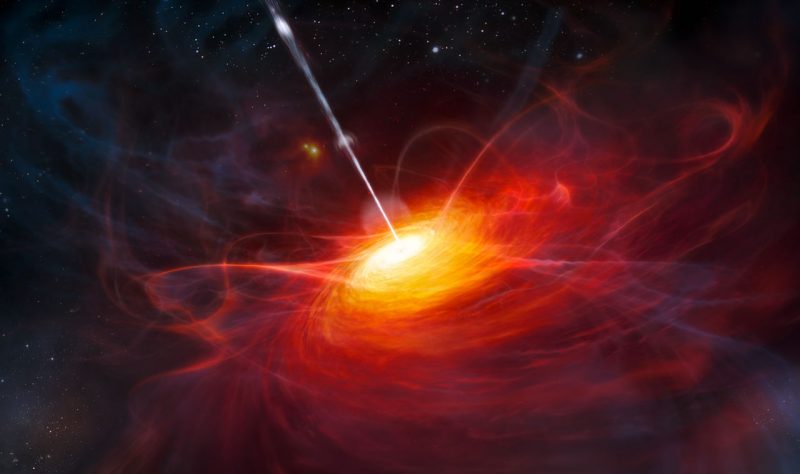
Artist’s rendering of the accretion disk of a supermassive black hole, located within a very distant quasar. Imagine this accretion disk much, much brighter, due to the great quantities of gas being sucked into the hole, and you’ll have the idea of the ultra-luminous system QSO SMSS~J215728.21-360215.1. Image via ESO/M. Kornmesse.

Wolf said the energy emitted from this newly-discovered supermassive black hole, also known as a quasar, was mostly ultraviolet light but also radiated x-rays. He said:

Again, if this monster was at the centre of the Milky Way it would likely make life on Earth impossible with the huge amounts of x-rays emanating from it.

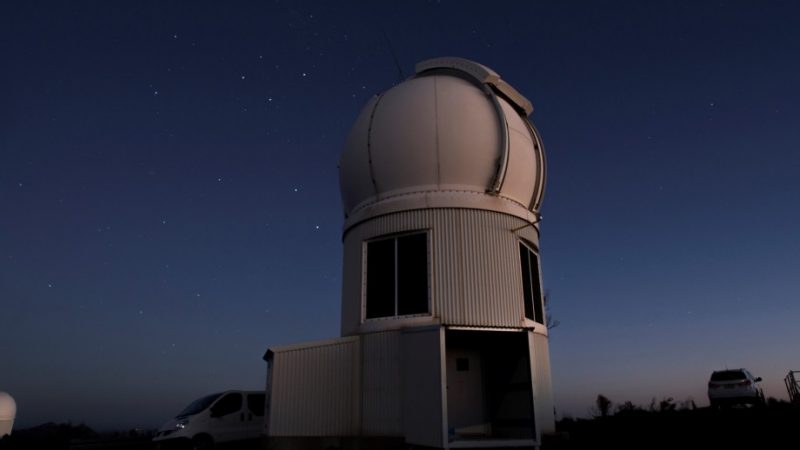
These astronomers used the SkyMapper telescope at Siding Spring Observatory in Australia to detect the light of this object in the near-infrared. They needed to look in that realm of the electromagnetic spectrum because the light waves had red-shifted over the billions of light years to Earth. Wolf said:

As the universe expands, space expands and that stretches the light waves and changes their color.

Wolf said that large and rapidly-growing black holes are exceedingly rare. He said he and his team have been searching for them with the SkyMapper telescope for several months now.

The European Space Agency’s Gaia satellite – an astrometry satellite, which measures tiny motions of celestial objects – also helped these find this supermassive black hole. Wolf said the Gaia satellite confirmed the object that they had found was sitting still, meaning that it was far away. Thus it was a candidate to be a very large quasar.

The discovery of the new supermassive black hole was confirmed using the spectrograph on the ANU 2.3 meter telescope to split colors into spectral lines. Wolf said:

We don’t know how this one grew so large, so quickly in the early days of the universe. The hunt is on to find even faster-growing black holes.

Wolf also said that, as these kinds of black holes shine, they can be used as beacons to see and study the formation of elements in the early galaxies of the universe.

Scientists can see the shadows of objects in front of the supermassive black hole.Fast-growing supermassive black holes also help to clear the fog around them by ionizing gases, which makes the universe more transparent.

Astronomers used the SkyMapper telescope at Siding Spring Observatory in Australia in the search for large and rapidly-growing black holes black holes. The Gaia satellite helped confirm its great distance from Earth. Image via ANU.

Bottom line: Astronomers have discovered the fastest-growing black hole yet.

Read more from Australian National University

Source: Discovery of the most ultra-luminous QSO using Gaia, SkyMapper and WISE


from EarthSky https://ift.tt/2k2CjHX

Image via ANU.

Astronomers announced on May 15, 2018 that they’ve identified the fastest-growing black hole yet known in the universe. They describe it as a monster that devours a mass equivalent to our sun every two days. They spied this black hole – which is also known as an ultra-luminous quasar – while looking back more than 12 billion years to what are called the cosmic dark ages of our universe.

At that time, this supermassive black hole was estimated to be the size of about 20 billion suns. It had a 1 percent growth rate every million years.

Christian Wolf of Australian National University (ANU) is lead author of the study of this object, which is labeled by the quasar name QSO SMSS~J215728.21-360215.1. Wolf said in a statement:

This black hole is growing so rapidly that it’s shining thousands of times more brightly than an entire galaxy, due to all of the gases it sucks in daily that cause lots of friction and heat.

If we had this monster sitting at the center of our Milky Way galaxy, it would appear 10 times brighter than a full moon. It would appear as an incredibly bright pin-point star that would almost wash out all of the stars in the sky.

The study is due to appear in the peer-reviewed journal Publications of the Astronomical Society of Australia (PASA).

Artist’s rendering of the accretion disk of a supermassive black hole, located within a very distant quasar. Imagine this accretion disk much, much brighter, due to the great quantities of gas being sucked into the hole, and you’ll have the idea of the ultra-luminous system QSO SMSS~J215728.21-360215.1. Image via ESO/M. Kornmesse.

Wolf said the energy emitted from this newly-discovered supermassive black hole, also known as a quasar, was mostly ultraviolet light but also radiated x-rays. He said:

Again, if this monster was at the centre of the Milky Way it would likely make life on Earth impossible with the huge amounts of x-rays emanating from it.

These astronomers used the SkyMapper telescope at Siding Spring Observatory in Australia to detect the light of this object in the near-infrared. They needed to look in that realm of the electromagnetic spectrum because the light waves had red-shifted over the billions of light years to Earth. Wolf said:

As the universe expands, space expands and that stretches the light waves and changes their color.

Wolf said that large and rapidly-growing black holes are exceedingly rare. He said he and his team have been searching for them with the SkyMapper telescope for several months now.

The European Space Agency’s Gaia satellite – an astrometry satellite, which measures tiny motions of celestial objects – also helped these find this supermassive black hole. Wolf said the Gaia satellite confirmed the object that they had found was sitting still, meaning that it was far away. Thus it was a candidate to be a very large quasar.

The discovery of the new supermassive black hole was confirmed using the spectrograph on the ANU 2.3 meter telescope to split colors into spectral lines. Wolf said:

We don’t know how this one grew so large, so quickly in the early days of the universe. The hunt is on to find even faster-growing black holes.

Wolf also said that, as these kinds of black holes shine, they can be used as beacons to see and study the formation of elements in the early galaxies of the universe.

Scientists can see the shadows of objects in front of the supermassive black hole.Fast-growing supermassive black holes also help to clear the fog around them by ionizing gases, which makes the universe more transparent.

Astronomers used the SkyMapper telescope at Siding Spring Observatory in Australia in the search for large and rapidly-growing black holes black holes. The Gaia satellite helped confirm its great distance from Earth. Image via ANU.

Bottom line: Astronomers have discovered the fastest-growing black hole yet.

Read more from Australian National University

Source: Discovery of the most ultra-luminous QSO using Gaia, SkyMapper and WISE


from EarthSky https://ift.tt/2k2CjHX

Chemistry students sing their studies, hoping for a good reaction


By Carol Clark

On the last day of the spring semester, during Bill Wuest’s “Principles of Reactivity” course, loud noises rattle the Atwood Chemistry Center’s Atomic Classroom. It isn’t explosions — it’s pop music mixed with bursts of laughter.

“This bond’s alright!” a group of Emory first-year students belts out on a YouTube video playing on screens before the class. Backed by the music of “Oh, What a Night,” they dance before a periodic table, write on a white board and mix chemicals in a lab while singing lyrics they wrote themselves: “Now I use a base to synthesize. It can readily be hydrolyzed. Mechanisms, what a sight!”

In just under four minutes, the students sing key lessons they learned over the semester about carbonyl mechanisms. “It’s basically describing how reactions go,” explains Rebecca Henderson, one of the performers. “A reaction is not normally just putting two chemicals together and — BOOM — a product comes out. There’s a lot of different steps involved and we wanted to describe some of them, and why a reaction goes down one pathway and not another.”

Henderson created the video and performed in it with classmates Carson Brooks, Lauren Cohen, Justine Griego and Alex Kim. They all played themselves in the video — except for Kim, who used powder to create a white patch in his hair and portray the professor.

“I love it when they mock me, they get extra points for that,” says Wuest, who has a natural, white streak of hair running through the center of his close-cropped dark hair.

Wuest, who joined Emory in the fall of 2017 as a Georgia Research Alliance Distinguished Investigator, directs an organic chemistry lab along with teaching undergraduates. He started having students make music parody videos while he was at Temple University.

“A lot of people think that chemistry is dry and boring but there’s a lot of creativity involved in it and that’s often overlooked in classrooms,” Wuest says.

The videos fit in well with Emory’s curriculum. Last fall, Emory became one of the first major research universities to completely overhaul how chemistry is taught, from introductory courses to capstone seminars. The new program, called Chemistry Unbound, moves away from teaching a narrow slice of chemistry every year to jumping into a big-picture understanding of chemistry’s central role across the sciences.


The video assignment helps with those big-picture concepts, Wuest says. Students form groups of up to six to make a two-to-four-minute educational video about some aspect of what they’ve learned in class. The video can either take the form of a musical parody of a well-known song or — for the less adventurous — a more straightforward lesson in the style of the Khan Academy website.

While Wuest is not the first to have chemistry students make videos, he is one of the few to actually measure their effect. With the help of his wife, Liesl Wuest, an educational analyst who also works at Emory, he has compared learning outcomes — in the form of exam performance before and after the videos — and found a strong correlation to improved scores.

His Temple students received extra credit, but not a grade, for making videos. Out of 130 students, 25 percent of them opted to do the videos. The average score for the class on an exam before the video project and an exam following the video project found that those who made videos had an average of 50 percent more improvement in their scores compared to those who opted out.

“Making the videos forces students to think about the material in new ways,” Wuest says. “It also makes the material more memorable to help it stick with them long term.”

Wuest refined the criteria for the video project and turned it into a graded requirement for his Emory classes. The top videos, based on accuracy and execution, will be housed on the Canvas learning management system so that future students can use them for inspiration and study aids.


“I was really impressed with the level of the videos this semester,” Wuest says. “They showcase the quality and the diversity of the students at Emory.”

Wuest plans to continue measuring the effect of the videos on learning. Many of the students, meanwhile, have given the video assignment a big thumb’s up.

“Not only do you learn the material, but it’s a fun experience,” says Dennis Jang, a first-year student.

Jang helped make a video called “I’ll Make a Chemist Out of You,” set to the song “I’ll Make a Man Out of You” from the Disney movie “Mulan.” The other first year students in his group included Muhammad Dhanani, Alex Fukunaga, Gaby Garcia and Jessie Kwong.

“The hardest part of this project was balancing the content and the comedy,” Jang says. “We presented some broad aspects of what we learned in class and some more specific aspects. And then we added humor to keep the audience watching.”

The formula worked. An informal vote following the screening of the videos in class, based on laughter and applause, showed “I’ll Make a Chemist Out of You” was the clear audience favorite.

“As we were watching all of the videos together we were laughing and just really enjoying being together,” Henderson says. “It was the final wrap-up of a great semester. Bill really knows how to make a true community out of a classroom.”

You can watch more of the videos by clicking here. 


Related:
Chemistry synthesizes radical overhaul of undergraduate curriculum

from eScienceCommons https://ift.tt/2k3eNdV


By Carol Clark

On the last day of the spring semester, during Bill Wuest’s “Principles of Reactivity” course, loud noises rattle the Atwood Chemistry Center’s Atomic Classroom. It isn’t explosions — it’s pop music mixed with bursts of laughter.

“This bond’s alright!” a group of Emory first-year students belts out on a YouTube video playing on screens before the class. Backed by the music of “Oh, What a Night,” they dance before a periodic table, write on a white board and mix chemicals in a lab while singing lyrics they wrote themselves: “Now I use a base to synthesize. It can readily be hydrolyzed. Mechanisms, what a sight!”

In just under four minutes, the students sing key lessons they learned over the semester about carbonyl mechanisms. “It’s basically describing how reactions go,” explains Rebecca Henderson, one of the performers. “A reaction is not normally just putting two chemicals together and — BOOM — a product comes out. There’s a lot of different steps involved and we wanted to describe some of them, and why a reaction goes down one pathway and not another.”

Henderson created the video and performed in it with classmates Carson Brooks, Lauren Cohen, Justine Griego and Alex Kim. They all played themselves in the video — except for Kim, who used powder to create a white patch in his hair and portray the professor.

“I love it when they mock me, they get extra points for that,” says Wuest, who has a natural, white streak of hair running through the center of his close-cropped dark hair.

Wuest, who joined Emory in the fall of 2017 as a Georgia Research Alliance Distinguished Investigator, directs an organic chemistry lab along with teaching undergraduates. He started having students make music parody videos while he was at Temple University.

“A lot of people think that chemistry is dry and boring but there’s a lot of creativity involved in it and that’s often overlooked in classrooms,” Wuest says.

The videos fit in well with Emory’s curriculum. Last fall, Emory became one of the first major research universities to completely overhaul how chemistry is taught, from introductory courses to capstone seminars. The new program, called Chemistry Unbound, moves away from teaching a narrow slice of chemistry every year to jumping into a big-picture understanding of chemistry’s central role across the sciences.


The video assignment helps with those big-picture concepts, Wuest says. Students form groups of up to six to make a two-to-four-minute educational video about some aspect of what they’ve learned in class. The video can either take the form of a musical parody of a well-known song or — for the less adventurous — a more straightforward lesson in the style of the Khan Academy website.

While Wuest is not the first to have chemistry students make videos, he is one of the few to actually measure their effect. With the help of his wife, Liesl Wuest, an educational analyst who also works at Emory, he has compared learning outcomes — in the form of exam performance before and after the videos — and found a strong correlation to improved scores.

His Temple students received extra credit, but not a grade, for making videos. Out of 130 students, 25 percent of them opted to do the videos. The average score for the class on an exam before the video project and an exam following the video project found that those who made videos had an average of 50 percent more improvement in their scores compared to those who opted out.

“Making the videos forces students to think about the material in new ways,” Wuest says. “It also makes the material more memorable to help it stick with them long term.”

Wuest refined the criteria for the video project and turned it into a graded requirement for his Emory classes. The top videos, based on accuracy and execution, will be housed on the Canvas learning management system so that future students can use them for inspiration and study aids.


“I was really impressed with the level of the videos this semester,” Wuest says. “They showcase the quality and the diversity of the students at Emory.”

Wuest plans to continue measuring the effect of the videos on learning. Many of the students, meanwhile, have given the video assignment a big thumb’s up.

“Not only do you learn the material, but it’s a fun experience,” says Dennis Jang, a first-year student.

Jang helped make a video called “I’ll Make a Chemist Out of You,” set to the song “I’ll Make a Man Out of You” from the Disney movie “Mulan.” The other first year students in his group included Muhammad Dhanani, Alex Fukunaga, Gaby Garcia and Jessie Kwong.

“The hardest part of this project was balancing the content and the comedy,” Jang says. “We presented some broad aspects of what we learned in class and some more specific aspects. And then we added humor to keep the audience watching.”

The formula worked. An informal vote following the screening of the videos in class, based on laughter and applause, showed “I’ll Make a Chemist Out of You” was the clear audience favorite.

“As we were watching all of the videos together we were laughing and just really enjoying being together,” Henderson says. “It was the final wrap-up of a great semester. Bill really knows how to make a true community out of a classroom.”

You can watch more of the videos by clicking here. 


Related:
Chemistry synthesizes radical overhaul of undergraduate curriculum

from eScienceCommons https://ift.tt/2k3eNdV

Scientists discover a new type of magnetic event

Space scientists recently uncovered a new type of magnetic event in the near-Earth environment. The new event happens just outside the outer boundary of Earth’s magnetosphere – the sphere around Earth within which our world’s magnetic field is the dominant field – in a region called the magnetosheath. Scientists using an innovative technique to squeeze extra information out of existing data learned that a process known as magnetic reconnection takes place in the magnetosheath. They reported their new discovery in a study in the peer-reviewed journal Nature on May 9, 2018.

Earth moving through space, with parts of its magnetosphere and magnetosheath labeled, via David Darling.

Before you shake your head and move on, consider this. Consider the famous Halloween Storms of the year 2003. They weren’t ordinary rain storms, but geomagnetic storms high in Earth’s atmosphere, triggered by massive solar flares erupting on the sun, which had sent X-rays zooming through our solar system. Along with the flares, the sun expelled giant clouds of solar material, called coronal mass ejections, or CMEs. The CMEs slammed into Earth’s magnetic field and pushed material and energy in toward Earth, creating the Halloween Storms, which caused brilliant auroras that could be seen as far south as Texas. NASA also said the 2003 solar storms:

… interfered with GPS signals and radio communications, and caused the Federal Aviation Administration to issue their first-ever warning to airlines to avoid excess radiation by flying at low altitudes.

Every step leading to these intense storms – the flare, the CME, the transfer of energy from the CME to Earth’s magnetosphere – was ultimately driven by the catalyst of magnetic reconnection.

Read about more recent events caused by CMEs

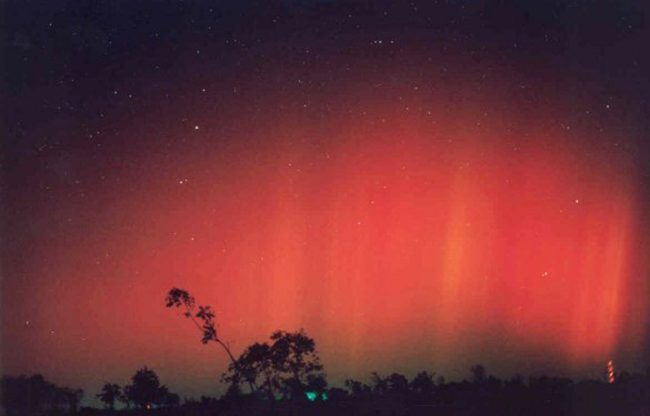
To a solar physicist, magnetic reconnection was the ultimate process driving the 2003 Halloween solar storms, which were so powerful that people saw auroras (northern lights) as far south as Texas and Florida. Christie Ponder captured this aurora image near Houston, Texas, on October 29, 2003. Image via NASA.

So you see magnetic reconnection is one of the most important processes in outer space, which is why scientists want to learn as much about it as they can. The new discovery found magnetic reconnection where it’s never been seen before — in turbulent plasma.

Plasma is a form of matter in which electrons wander freely among the nuclei of atoms. It’s been called a fourth state of matter, the other three being solid, liquid and gas. Tai Phan in the Space Sciences Laboratory at the University of California, Berkeley, and lead author on the paper, commented:

In the plasma universe, there are two important phenomena: magnetic reconnection and turbulence. This discovery bridges these two processes.

In a turbulent magnetic environment, magnetic field lines become scrambled. As the field lines cross, intense electric currents (shown here as bright regions) form and eventually trigger magnetic reconnection (indicated by a flash), which is an explosive event that releases magnetic energy accumulated in the current layers and ejects high-speed bi-directional jets of electrons. Image via NASA Goddard’s Conceptual Image Lab/Lisa Poje; Simulations by University of Chicago/Colby Haggerty; University of Delaware/Tulasi Parashar.

Scientists have seen magnetic reconnection many times in Earth’s magnetosphere, but usually under calm conditions. The new event – found in data from NASA’s Magnetospheric Multiscale Mission, or MMS – was in the magnetosheath, where the solar wind is extremely turbulent. NASA said:

Previously, scientists didn’t know if reconnection even could occur there, as the plasma is highly chaotic in that region. MMS found it does, but on scales much smaller than previous spacecraft could probe …

Compared to standard reconnection, in which broad jets of ions stream out from the site of reconnection, turbulent reconnection ejects narrow jets of electrons only a couple miles wide.

That is why MMS scientists had to:

… leverage the design of one instrument, the Fast Plasma Investigation, to create a technique to interpolate the data — essentially allowing them to read between the lines and gather extra data points — in order to resolve the jets.

Amy Rager, a graduate student at NASA’s Goddard Space Flight Center in Greenbelt, Maryland, and the scientist who developed the technique, said:

The key event of the paper happens in only 45 milliseconds. This would be one data point with the basic data. But instead we can get six to seven data points in that region with this method, allowing us to understand what is happening.

Using this new method, the MMS scientists said, they’re hopeful they can comb back through existing datasets to find more of these events … and potentially other unexpected discoveries as well.

Read more about this new study from NASA.

Earth is surrounded by a protective magnetic environment — the magnetosphere — shown here in blue, which deflects a supersonic stream of charged particles from the sun, known as the solar wind. As the particles flow around Earth’s magnetosphere, it forms a highly turbulent boundary layer called the magnetosheath, shown in yellow. Scientists, like those involved with NASA’s Magnetospheric Multiscale mission, are studying this turbulent region to help us learn more about our dynamic space environment. Video via NASA’s Goddard Space Flight Center/Mary Pat Hrybyk-Keith; NASA Goddard’s Conceptual Image Lab/Josh Masters

Bottom line: Scientists using data from NASA’s Magnetospheric Multiscale Mission have found a new type of magnetic event in Earth’s magnetosheath, a region just beyond the boundary of Earth’s magnetic field.

Source: Electron magnetic reconnection without ion coupling in Earth’s turbulent magnetosheath

Read more: The science of magnetic reconnection


from EarthSky https://ift.tt/2KsncT3

Space scientists recently uncovered a new type of magnetic event in the near-Earth environment. The new event happens just outside the outer boundary of Earth’s magnetosphere – the sphere around Earth within which our world’s magnetic field is the dominant field – in a region called the magnetosheath. Scientists using an innovative technique to squeeze extra information out of existing data learned that a process known as magnetic reconnection takes place in the magnetosheath. They reported their new discovery in a study in the peer-reviewed journal Nature on May 9, 2018.

Earth moving through space, with parts of its magnetosphere and magnetosheath labeled, via David Darling.

Before you shake your head and move on, consider this. Consider the famous Halloween Storms of the year 2003. They weren’t ordinary rain storms, but geomagnetic storms high in Earth’s atmosphere, triggered by massive solar flares erupting on the sun, which had sent X-rays zooming through our solar system. Along with the flares, the sun expelled giant clouds of solar material, called coronal mass ejections, or CMEs. The CMEs slammed into Earth’s magnetic field and pushed material and energy in toward Earth, creating the Halloween Storms, which caused brilliant auroras that could be seen as far south as Texas. NASA also said the 2003 solar storms:

… interfered with GPS signals and radio communications, and caused the Federal Aviation Administration to issue their first-ever warning to airlines to avoid excess radiation by flying at low altitudes.

Every step leading to these intense storms – the flare, the CME, the transfer of energy from the CME to Earth’s magnetosphere – was ultimately driven by the catalyst of magnetic reconnection.

Read about more recent events caused by CMEs

To a solar physicist, magnetic reconnection was the ultimate process driving the 2003 Halloween solar storms, which were so powerful that people saw auroras (northern lights) as far south as Texas and Florida. Christie Ponder captured this aurora image near Houston, Texas, on October 29, 2003. Image via NASA.

So you see magnetic reconnection is one of the most important processes in outer space, which is why scientists want to learn as much about it as they can. The new discovery found magnetic reconnection where it’s never been seen before — in turbulent plasma.

Plasma is a form of matter in which electrons wander freely among the nuclei of atoms. It’s been called a fourth state of matter, the other three being solid, liquid and gas. Tai Phan in the Space Sciences Laboratory at the University of California, Berkeley, and lead author on the paper, commented:

In the plasma universe, there are two important phenomena: magnetic reconnection and turbulence. This discovery bridges these two processes.

In a turbulent magnetic environment, magnetic field lines become scrambled. As the field lines cross, intense electric currents (shown here as bright regions) form and eventually trigger magnetic reconnection (indicated by a flash), which is an explosive event that releases magnetic energy accumulated in the current layers and ejects high-speed bi-directional jets of electrons. Image via NASA Goddard’s Conceptual Image Lab/Lisa Poje; Simulations by University of Chicago/Colby Haggerty; University of Delaware/Tulasi Parashar.

Scientists have seen magnetic reconnection many times in Earth’s magnetosphere, but usually under calm conditions. The new event – found in data from NASA’s Magnetospheric Multiscale Mission, or MMS – was in the magnetosheath, where the solar wind is extremely turbulent. NASA said:

Previously, scientists didn’t know if reconnection even could occur there, as the plasma is highly chaotic in that region. MMS found it does, but on scales much smaller than previous spacecraft could probe …

Compared to standard reconnection, in which broad jets of ions stream out from the site of reconnection, turbulent reconnection ejects narrow jets of electrons only a couple miles wide.

That is why MMS scientists had to:

… leverage the design of one instrument, the Fast Plasma Investigation, to create a technique to interpolate the data — essentially allowing them to read between the lines and gather extra data points — in order to resolve the jets.

Amy Rager, a graduate student at NASA’s Goddard Space Flight Center in Greenbelt, Maryland, and the scientist who developed the technique, said:

The key event of the paper happens in only 45 milliseconds. This would be one data point with the basic data. But instead we can get six to seven data points in that region with this method, allowing us to understand what is happening.

Using this new method, the MMS scientists said, they’re hopeful they can comb back through existing datasets to find more of these events … and potentially other unexpected discoveries as well.

Read more about this new study from NASA.

Earth is surrounded by a protective magnetic environment — the magnetosphere — shown here in blue, which deflects a supersonic stream of charged particles from the sun, known as the solar wind. As the particles flow around Earth’s magnetosphere, it forms a highly turbulent boundary layer called the magnetosheath, shown in yellow. Scientists, like those involved with NASA’s Magnetospheric Multiscale mission, are studying this turbulent region to help us learn more about our dynamic space environment. Video via NASA’s Goddard Space Flight Center/Mary Pat Hrybyk-Keith; NASA Goddard’s Conceptual Image Lab/Josh Masters

Bottom line: Scientists using data from NASA’s Magnetospheric Multiscale Mission have found a new type of magnetic event in Earth’s magnetosheath, a region just beyond the boundary of Earth’s magnetic field.

Source: Electron magnetic reconnection without ion coupling in Earth’s turbulent magnetosheath

Read more: The science of magnetic reconnection


from EarthSky https://ift.tt/2KsncT3

What is a coronal mass ejection?

Coronal mass ejection of February 27, 2000. A disk is being used to block out the light of the sun. The white circle indicates the sun’s surface. Image via NASA’s SOlar and Heliospheric Observatory (SOHO).

Every so often, the sun burps, with the power of 20 million nuclear bombs. These hiccups are known as coronal mass ejections or CMEs. They are powerful eruptions near the surface of the sun, driven by kinks in the solar magnetic field. The resulting shocks ripple through the solar system and can interrupt satellites and power grids on Earth.

During a CME, enormous bubbles of superheated gas – called plasma – are ejected from the sun.  Over the course of several hours, a billion tons of material are lifted off the sun’s surface and accelerated to speeds of a million miles per hour. This can happen several times a day when the sun is most active. During its quieter periods, CMEs occur only about once every five days.

See the sun now, via NASA’s Solar Dynamics Observatory

The underlying cause of CMEs is not well understood.  Astronomers agree, however, that the sun’s magnetic field plays a major role.  Because the sun is a fluid, turbulence tends to twist the magnetic field into complex contortions. Twist the field too much, and it kinks, much like a phone cord or toy Slinky. These kinks snap the magnetic field and can potentially drive vast amounts of plasma into space.

The plasma itself is a cloud of protons and electrons carried aloft by the solar wind. Traveling at a million miles per hour, the ejecta can cross the 93-million-mile (150-million-km) distance to Earth in just a few days. 

A jet moving that fast would get you from Los Angeles to New York in 18 seconds.

Because CMEs get blown off the sun in all directions, most don’t come anywhere near Earth. But every so often, an eruption is aimed right at us.  When the plasma cloud hits our planet, a geomagnetic storm follows. The shock wave of charged particles compresses the Earth’s dayside magnetic field while the nightside gets stretched out. Like an elongated rubber band, the terrestrial magnetic field eventually snaps back with the same amount of energy as a bolt of lightening.

The video below shows the particle flow around Earth as solar ejecta associated with a coronal mass ejection strike:

The onslaught of charged particles and the temporary restructuring of the Earth’s magnetic field has observable effects.  Auroral lights, usually only seen near the poles, can drift to lower latitudes and become more brilliant. The disturbance of the magnetic field can also expose Earth to deadly cosmic rays. The atmosphere still provides enough protection for everyone on the ground. But astronauts in space may receive lethal doses of radiation. During a solar storm in 1989, cosmonauts aboard the Mir space station received their maximum yearly radiation dose in just a few hours!

The real long-lasting danger comes from the storm’s effect on technology.  The flurry of magnetic activity and induced electric currents has the potential to severely disrupt power grids, satellites, communication networks—anything that uses electricity. When the sun aimed a CME at us in that 1989 I just mentioned, the resulting storm collapsed the Hydro-Québec power grid. Six million people were without power for nine hours.

But the 1989 storm is nothing compared to the geomagnetic storm of 1859.  Known as the Carrington Event, after amateur astronomer Richard Carrington who observed the flares that triggered the storm, it is the most powerful geomagnetic storm ever recorded. Aurora were observed as far south as Hawai’i and the Caribbean. Witnesses at higher latitudes reported being able to read newspapers by the light of the aurora alone. Telegraph networks around globe catastrophically failed; operators received shocks and telegraph paper caught on fire.

A repeat of the Carrington Event in today’s far more interconnected world would be devastating. Cascading failures could quickly shut power down to millions of people in a matter of minutes. Communication networks would fail and GPS satellites, upon which the entire air traffic system relies, would shut down. 

A repeat of 1859 could be truly catastrophic!

Obviously, we don’t want to be surprised by a powerful Earth-bound CME.  That’s why astronomers study the sun. Besides the joy of discovering how stars work, a better understanding of solar activity can help us be better prepared. With even just a few hours warning before an impending CME strike, we could safely shut down and protect essential services. Disruptions may then only last a few hours, rather than the days, weeks, and months that might otherwise occur.

CMEs are just another reminder of how fragile our pale blue dot is as it races around the sun.

CME on August 31, 2012

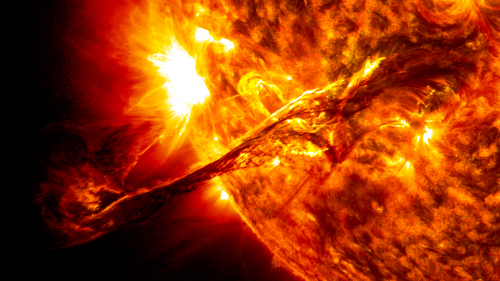
On August 31, 2012, the Solar Dynamics Observatory caught the sun launching streams of plasma into space at nearly 900 miles (about 1,400 km) per second. Image via NASA/GSFC/SDO.

Bottom line: Coronal mass ejections are powerful eruptions on the sun’s surface. Caused by instabilities in the sun’s magnetic field, they can launch a billion tons of superheated gas into space at over one million miles per hour. While most drift harmlessly across the solar system, occasionally one is aimed at Earth. When that happens, the resulting magnetic storm can severely disrupt electrical systems and produce brilliant auroral displays. 


from EarthSky https://ift.tt/1iPMJ3S

Coronal mass ejection of February 27, 2000. A disk is being used to block out the light of the sun. The white circle indicates the sun’s surface. Image via NASA’s SOlar and Heliospheric Observatory (SOHO).

Every so often, the sun burps, with the power of 20 million nuclear bombs. These hiccups are known as coronal mass ejections or CMEs. They are powerful eruptions near the surface of the sun, driven by kinks in the solar magnetic field. The resulting shocks ripple through the solar system and can interrupt satellites and power grids on Earth.

During a CME, enormous bubbles of superheated gas – called plasma – are ejected from the sun.  Over the course of several hours, a billion tons of material are lifted off the sun’s surface and accelerated to speeds of a million miles per hour. This can happen several times a day when the sun is most active. During its quieter periods, CMEs occur only about once every five days.

See the sun now, via NASA’s Solar Dynamics Observatory

The underlying cause of CMEs is not well understood.  Astronomers agree, however, that the sun’s magnetic field plays a major role.  Because the sun is a fluid, turbulence tends to twist the magnetic field into complex contortions. Twist the field too much, and it kinks, much like a phone cord or toy Slinky. These kinks snap the magnetic field and can potentially drive vast amounts of plasma into space.

The plasma itself is a cloud of protons and electrons carried aloft by the solar wind. Traveling at a million miles per hour, the ejecta can cross the 93-million-mile (150-million-km) distance to Earth in just a few days. 

A jet moving that fast would get you from Los Angeles to New York in 18 seconds.

Because CMEs get blown off the sun in all directions, most don’t come anywhere near Earth. But every so often, an eruption is aimed right at us.  When the plasma cloud hits our planet, a geomagnetic storm follows. The shock wave of charged particles compresses the Earth’s dayside magnetic field while the nightside gets stretched out. Like an elongated rubber band, the terrestrial magnetic field eventually snaps back with the same amount of energy as a bolt of lightening.

The video below shows the particle flow around Earth as solar ejecta associated with a coronal mass ejection strike:

The onslaught of charged particles and the temporary restructuring of the Earth’s magnetic field has observable effects.  Auroral lights, usually only seen near the poles, can drift to lower latitudes and become more brilliant. The disturbance of the magnetic field can also expose Earth to deadly cosmic rays. The atmosphere still provides enough protection for everyone on the ground. But astronauts in space may receive lethal doses of radiation. During a solar storm in 1989, cosmonauts aboard the Mir space station received their maximum yearly radiation dose in just a few hours!

The real long-lasting danger comes from the storm’s effect on technology.  The flurry of magnetic activity and induced electric currents has the potential to severely disrupt power grids, satellites, communication networks—anything that uses electricity. When the sun aimed a CME at us in that 1989 I just mentioned, the resulting storm collapsed the Hydro-Québec power grid. Six million people were without power for nine hours.

But the 1989 storm is nothing compared to the geomagnetic storm of 1859.  Known as the Carrington Event, after amateur astronomer Richard Carrington who observed the flares that triggered the storm, it is the most powerful geomagnetic storm ever recorded. Aurora were observed as far south as Hawai’i and the Caribbean. Witnesses at higher latitudes reported being able to read newspapers by the light of the aurora alone. Telegraph networks around globe catastrophically failed; operators received shocks and telegraph paper caught on fire.

A repeat of the Carrington Event in today’s far more interconnected world would be devastating. Cascading failures could quickly shut power down to millions of people in a matter of minutes. Communication networks would fail and GPS satellites, upon which the entire air traffic system relies, would shut down. 

A repeat of 1859 could be truly catastrophic!

Obviously, we don’t want to be surprised by a powerful Earth-bound CME.  That’s why astronomers study the sun. Besides the joy of discovering how stars work, a better understanding of solar activity can help us be better prepared. With even just a few hours warning before an impending CME strike, we could safely shut down and protect essential services. Disruptions may then only last a few hours, rather than the days, weeks, and months that might otherwise occur.

CMEs are just another reminder of how fragile our pale blue dot is as it races around the sun.

CME on August 31, 2012

On August 31, 2012, the Solar Dynamics Observatory caught the sun launching streams of plasma into space at nearly 900 miles (about 1,400 km) per second. Image via NASA/GSFC/SDO.

Bottom line: Coronal mass ejections are powerful eruptions on the sun’s surface. Caused by instabilities in the sun’s magnetic field, they can launch a billion tons of superheated gas into space at over one million miles per hour. While most drift harmlessly across the solar system, occasionally one is aimed at Earth. When that happens, the resulting magnetic storm can severely disrupt electrical systems and produce brilliant auroral displays. 


from EarthSky https://ift.tt/1iPMJ3S

adds 2