

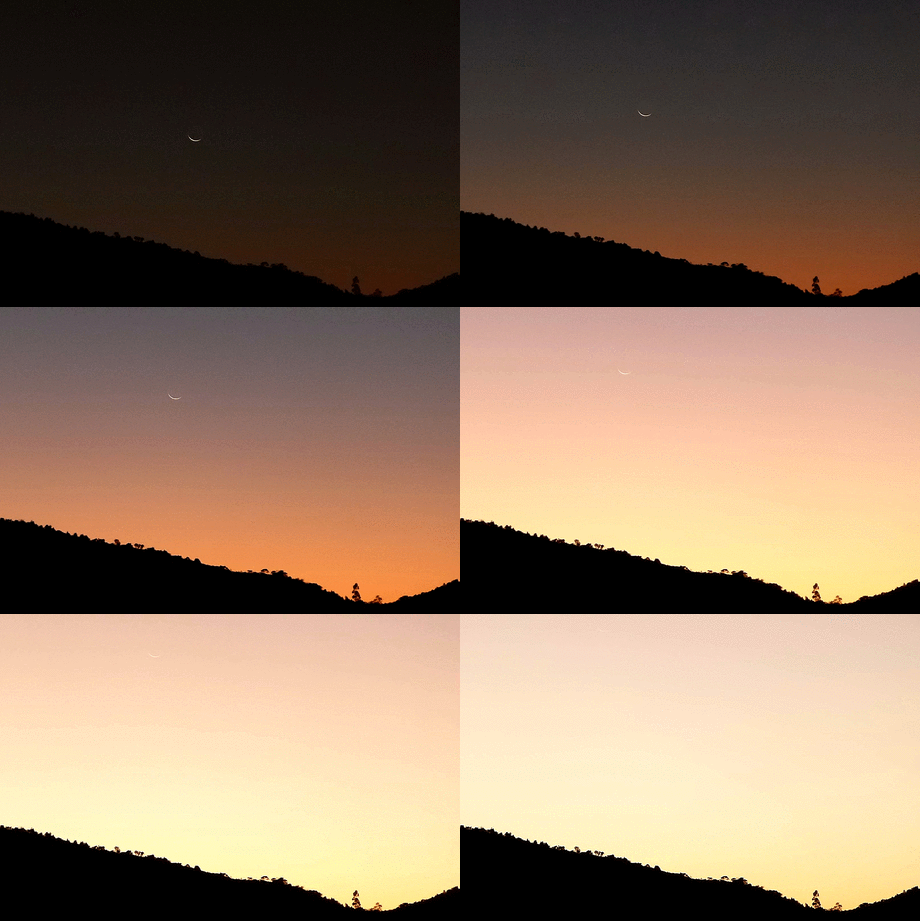
Image via Walter E. Elliott.
from EarthSky https://ift.tt/2Gnh1xp


On the evenings of May 16 to 18, 2018, watch for the young moon and the dazzling planet Venus at evening dusk.
The moon turned new on May 15, at 11:48 Coordinated Universal Time (UTC). At North American and U.S. time zones, that translates to 8:48 a.m. ADT, 7:48 a.m. EDT, 6:48 a.m. CDT, 5:48 a.m. MDT, 4:48 a.m. PDT, 3:48 a.m. Alaskan Time and 1:48 a.m. Hawaiian Time.
Most of the world has a reasonably good chance of catching the lunar crescent with the eye alone on May 16, given an unobstructed horizon and clear skies. North and South America, Hawaii and the islands of the Pacific have the advantage because – from those locations – a wider lunar crescent stays out longer after sundown on May 16. Even so, a good deal of the world’s Eastern Hemisphere will be in a decent position to catch the May 16 young moon and Venus as well.
On the evening of May 16, the whisker-thin and pale lunar crescent will be sitting low in the sky, below Venus. It’ll be to your advantage to find an unobstructed horizon in the direction of sunset on that evening.
On May 17, a wider lunar crescent will pair up more closely with Venus, and, moreover, stay out longer after dark. On May 18, the moon will be a wider crescent still, staying out still later in the evening. This movement of the moon from night to night is, of course, due to its motion in orbit around Earth.
Keep in mind that binoculars always come in handy for skywatching. That’ll be especially true on May 16, when the moon will be in bright twilight.
It’ll also help to know the time of moonset on these nights, from your location. The time of moonset varies around the world. Click here to find out when the moon sets in your sky, remembering to check the moonrise and moonset box. The moonset time presumes a level horizon, and moonset is defined as when the moon’s trailing (or upper) limb touches the horizon.
On any of these evenings, you should have little trouble catching Venus, assuming you have clear skies to the west after sunset. Once you spot Venus at dusk or early evening, turn around and look in the opposite direction. That bright beauty will be the king planet Jupiter, the second-brightest planet after Venus.
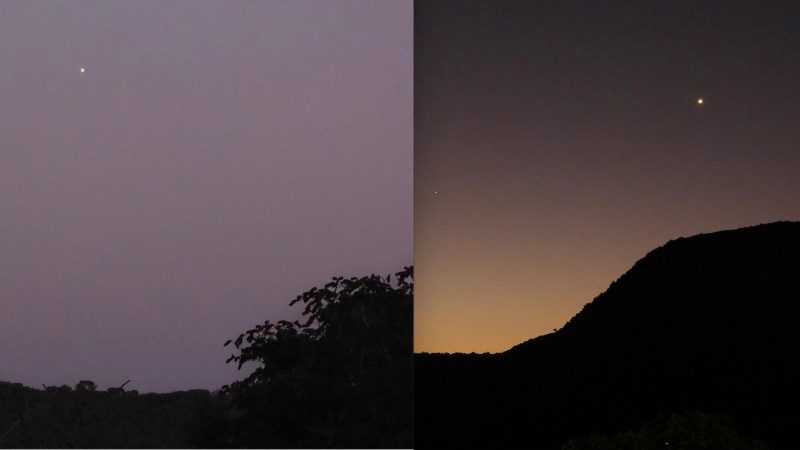
In May 2018, Jupiter – the 2nd-brightest planet – can be seen ascending in the east after sunset. Then … turn around. You’ll see Venus – the brightest planet – in the west after sunset. As night passes, Venus will set, and Jupiter will ascend higher in the sky. Photo taken May 9, 2018 by Peter Lowenstein in Mutare, Zimbabwe.
Jupiter, the fifth planet outward from the sun, is what’s called a superior planet. That is, it’s a planet that orbits the sun outside of Earth’s orbit around the sun. Through the telescope, a superior planet always appears full or close to full in Earth’s sky.
Venus, the second planet outward from the sun, is an inferior planet. It orbits the sun inside Earth’s orbit. Because Venus is an inferior planet, the telescope shows Venus going through the whole range of phases, much like a tiny, featureless moon.
If you looked through a telescope now, perhaps you’d expect Venus to display a phase to that of the waxing crescent moon we see on May 16 to 18. It’s natural to think that, because these two worlds reside so close on the sky’s dome. But, no, you wouldn’t see Venus in the same phase as a crescent moon now. The moon looks like a crescent now because it’s located in space just to one side of a line between the sun and Earth. On the other hand, Venus lies on the far side of the sun from Earth right now. If you saw it through a telescope, you’d find it in a waning gibbous phase, more than half lighted but less than full.
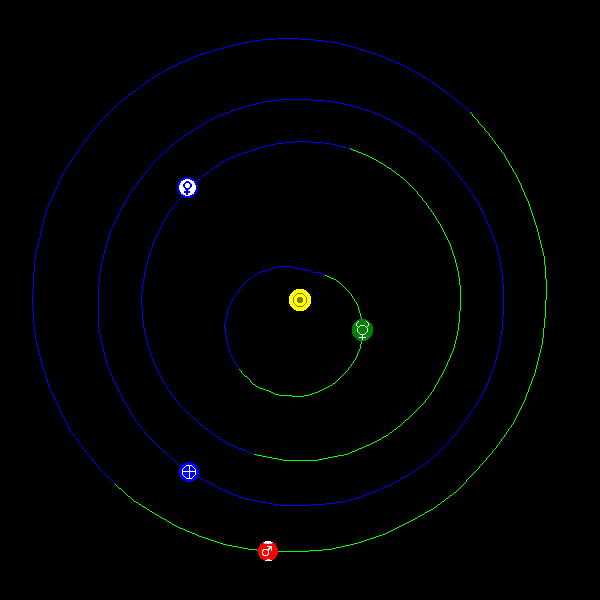
Image of the inner solar system – Mercury, Venus, Earth and Mars – via Solar System Live. Venus appears as a waning gibbous phase in the telescope during May 2018 because Venus lies on the far side of the sun as viewed from Earth.

On September 21, 2018 – the day of the September equinox for 2018 – Venus will be about 25% illuminated by sunlight. At that time, it’ll reside in between the sun and Earth.
Day by day in the coming months, Venus in its orbit will be sweeping up behind Earth in the race of the planets around the sun. In mid-August 2018, the telescope will reveal Venus as half-illuminated (like a last quarter moon). After that, the phase of Venus will continue to wane to a crescent phase.
Want to know the present phase of the moon and Venus? Click here.
Believe it or not, Venus will appear brightest in our evening sky around the September 2018 equinox, when it’s about 25% illuminated by sunshine.
Venus will finally disappear from the evening sky in October 2018.
Bottom line: There’s a beautiful sight in the west after sunset on May 16 to 18, 2018 … the brightest planet Venus near the returning young moon.
On the evenings of May 16 to 18, 2018, watch for the young moon and the dazzling planet Venus at evening dusk.
The moon turned new on May 15, at 11:48 Coordinated Universal Time (UTC). At North American and U.S. time zones, that translates to 8:48 a.m. ADT, 7:48 a.m. EDT, 6:48 a.m. CDT, 5:48 a.m. MDT, 4:48 a.m. PDT, 3:48 a.m. Alaskan Time and 1:48 a.m. Hawaiian Time.
Most of the world has a reasonably good chance of catching the lunar crescent with the eye alone on May 16, given an unobstructed horizon and clear skies. North and South America, Hawaii and the islands of the Pacific have the advantage because – from those locations – a wider lunar crescent stays out longer after sundown on May 16. Even so, a good deal of the world’s Eastern Hemisphere will be in a decent position to catch the May 16 young moon and Venus as well.
On the evening of May 16, the whisker-thin and pale lunar crescent will be sitting low in the sky, below Venus. It’ll be to your advantage to find an unobstructed horizon in the direction of sunset on that evening.
On May 17, a wider lunar crescent will pair up more closely with Venus, and, moreover, stay out longer after dark. On May 18, the moon will be a wider crescent still, staying out still later in the evening. This movement of the moon from night to night is, of course, due to its motion in orbit around Earth.
Keep in mind that binoculars always come in handy for skywatching. That’ll be especially true on May 16, when the moon will be in bright twilight.
It’ll also help to know the time of moonset on these nights, from your location. The time of moonset varies around the world. Click here to find out when the moon sets in your sky, remembering to check the moonrise and moonset box. The moonset time presumes a level horizon, and moonset is defined as when the moon’s trailing (or upper) limb touches the horizon.
On any of these evenings, you should have little trouble catching Venus, assuming you have clear skies to the west after sunset. Once you spot Venus at dusk or early evening, turn around and look in the opposite direction. That bright beauty will be the king planet Jupiter, the second-brightest planet after Venus.
In May 2018, Jupiter – the 2nd-brightest planet – can be seen ascending in the east after sunset. Then … turn around. You’ll see Venus – the brightest planet – in the west after sunset. As night passes, Venus will set, and Jupiter will ascend higher in the sky. Photo taken May 9, 2018 by Peter Lowenstein in Mutare, Zimbabwe.
Jupiter, the fifth planet outward from the sun, is what’s called a superior planet. That is, it’s a planet that orbits the sun outside of Earth’s orbit around the sun. Through the telescope, a superior planet always appears full or close to full in Earth’s sky.
Venus, the second planet outward from the sun, is an inferior planet. It orbits the sun inside Earth’s orbit. Because Venus is an inferior planet, the telescope shows Venus going through the whole range of phases, much like a tiny, featureless moon.
If you looked through a telescope now, perhaps you’d expect Venus to display a phase to that of the waxing crescent moon we see on May 16 to 18. It’s natural to think that, because these two worlds reside so close on the sky’s dome. But, no, you wouldn’t see Venus in the same phase as a crescent moon now. The moon looks like a crescent now because it’s located in space just to one side of a line between the sun and Earth. On the other hand, Venus lies on the far side of the sun from Earth right now. If you saw it through a telescope, you’d find it in a waning gibbous phase, more than half lighted but less than full.
Image of the inner solar system – Mercury, Venus, Earth and Mars – via Solar System Live. Venus appears as a waning gibbous phase in the telescope during May 2018 because Venus lies on the far side of the sun as viewed from Earth.
On September 21, 2018 – the day of the September equinox for 2018 – Venus will be about 25% illuminated by sunlight. At that time, it’ll reside in between the sun and Earth.
Day by day in the coming months, Venus in its orbit will be sweeping up behind Earth in the race of the planets around the sun. In mid-August 2018, the telescope will reveal Venus as half-illuminated (like a last quarter moon). After that, the phase of Venus will continue to wane to a crescent phase.
Want to know the present phase of the moon and Venus? Click here.
Believe it or not, Venus will appear brightest in our evening sky around the September 2018 equinox, when it’s about 25% illuminated by sunshine.
Venus will finally disappear from the evening sky in October 2018.
Bottom line: There’s a beautiful sight in the west after sunset on May 16 to 18, 2018 … the brightest planet Venus near the returning young moon.
In 1988 – the same year Nasa’s James Hansen warned Congress about the threats posed by human-caused global warming – water expert Peter Gleick wrote about the wet and dry extremes that it would create for California:
California will get the worst of all possible worlds – more flooding in the winter, less available water in the summer.
Three decades later, California has been ravaged by just this sort of weather whiplash. The state experienced its worst drought in over a millennium from 2012 to 2016, followed immediately by its wettest year on record in 2017. The consequences have been similarly extreme, including hellish record wildfires, narrowly-avoided catastrophic flooding at Oroville Dam, and deadly mudslides.
A study published last month in Nature Climate Change found that these wet and dry extremes will only worsen in California as temperatures continue to rise. As lead author Daniel Swain wrote:
most of California will likely experience a 100 – 200% increase in the frequency of very wet November-March “rainy seasons” … California will likely experience an increase of anywhere from 50% to 150% (highest in the south) in the frequency of very dry November-March periods … Since California is so dependent on precipitation during its relatively brief winter rainy season, even a single dry winter can quickly lead to adverse drought impacts upon agriculture and the environment.
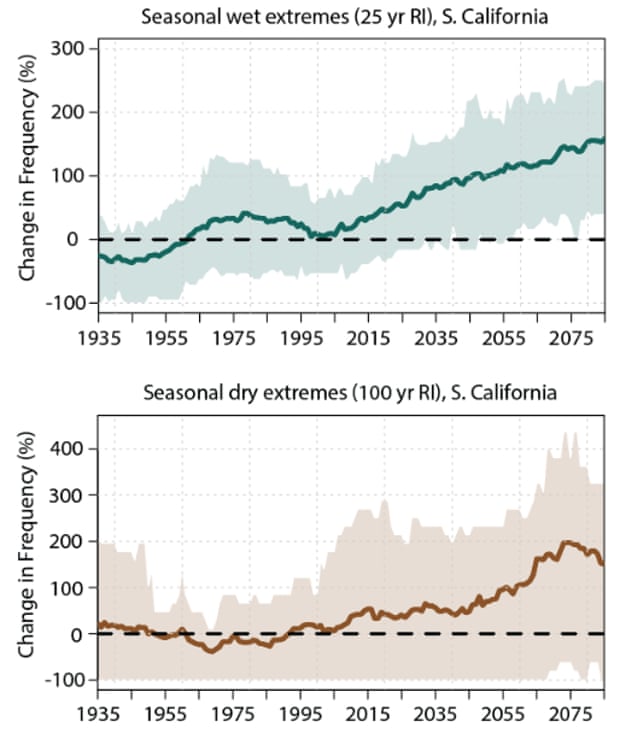
Relative change (in percent) in extremely wet seasons and extremely dry seasons by 2070-2100 in Southern California. Illustration: Swain et al. 2018, Nature Climate Change
The most dramatic impacts include wildfires that are larger and more frequent, and the most severe drought since recordkeeping began. Underlying these events is a long-term warming trend that has accelerated since the mid-1970s. In addition, spring snowmelt runoff is decreasing, sea levels are rising, glaciers are shrinking, lakes and ocean waters are warming, and plants and animals are migrating.
In short, climate change will continue to have severe consequences for California, whose economy recently surpassed that of the UK to become the fifth-largest in the world. But the state has also become a leader in trying to minimize those climate damages.
In 2006, Governor Arnold Schwarzenegger signed the Global Warming Solutions Act into law, whose most significant component was a carbon cap and trade system. The bill required California to reduce its greenhouse gas pollution to 1990 levels by 2020, and the state is on track to meet that goal despite a growing population and thriving economy with an $8.8bn surplus. California has proved that an economy can thrive with a price on carbon pollution in place.
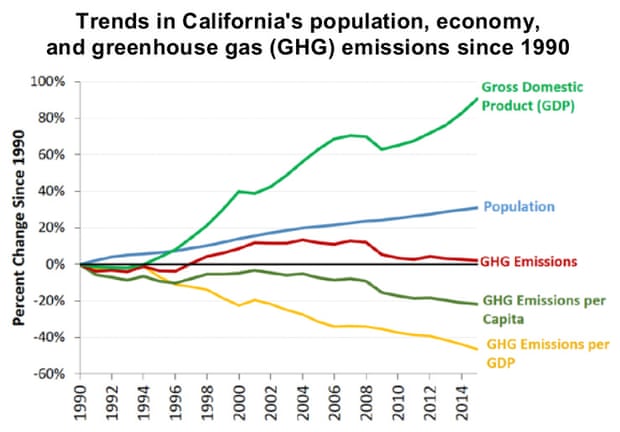
California greenhouse gas emissions, population, and GDP. Illustration: California Office of Environmental Health Hazard Assessment
In 2016, California passed an update to the California Global Warming Solutions Act requiring a 40% reduction in greenhouse gas pollution by 2030 on the way to the target 80% reduction below 1990 levels by 2050. California’s annual per capita emissions (11.5 tonnes of CO2-equivalent per person) are currently on par with those of Germany and Japan, and 40% lower than the US average.
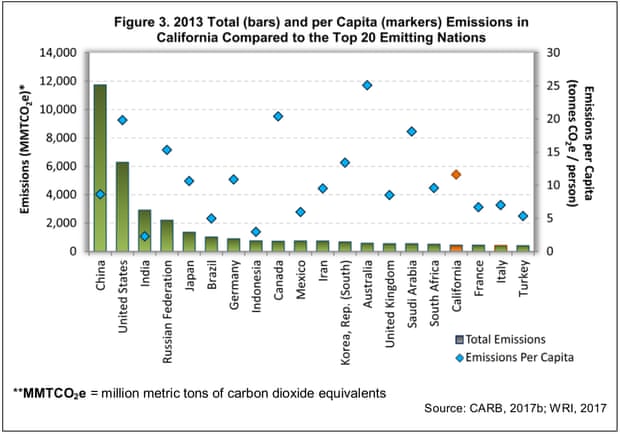
Greenhouse gas emissions in California and various countries. Illustration: California Office of Environmental Health Hazard Assessment
California is investing in climate change solutions, like pilot projects using farms to sequester carbon. More than half of the state’s electricity is generated by carbon-free sources (21% hydroelectric, 12% solar, 9% nuclear, 6% wind, 6% geothermal), and another 43% comes from natural gas.
In 1988 – the same year Nasa’s James Hansen warned Congress about the threats posed by human-caused global warming – water expert Peter Gleick wrote about the wet and dry extremes that it would create for California:
California will get the worst of all possible worlds – more flooding in the winter, less available water in the summer.
Three decades later, California has been ravaged by just this sort of weather whiplash. The state experienced its worst drought in over a millennium from 2012 to 2016, followed immediately by its wettest year on record in 2017. The consequences have been similarly extreme, including hellish record wildfires, narrowly-avoided catastrophic flooding at Oroville Dam, and deadly mudslides.
A study published last month in Nature Climate Change found that these wet and dry extremes will only worsen in California as temperatures continue to rise. As lead author Daniel Swain wrote:
most of California will likely experience a 100 – 200% increase in the frequency of very wet November-March “rainy seasons” … California will likely experience an increase of anywhere from 50% to 150% (highest in the south) in the frequency of very dry November-March periods … Since California is so dependent on precipitation during its relatively brief winter rainy season, even a single dry winter can quickly lead to adverse drought impacts upon agriculture and the environment.
Relative change (in percent) in extremely wet seasons and extremely dry seasons by 2070-2100 in Southern California. Illustration: Swain et al. 2018, Nature Climate Change
The most dramatic impacts include wildfires that are larger and more frequent, and the most severe drought since recordkeeping began. Underlying these events is a long-term warming trend that has accelerated since the mid-1970s. In addition, spring snowmelt runoff is decreasing, sea levels are rising, glaciers are shrinking, lakes and ocean waters are warming, and plants and animals are migrating.
In short, climate change will continue to have severe consequences for California, whose economy recently surpassed that of the UK to become the fifth-largest in the world. But the state has also become a leader in trying to minimize those climate damages.
In 2006, Governor Arnold Schwarzenegger signed the Global Warming Solutions Act into law, whose most significant component was a carbon cap and trade system. The bill required California to reduce its greenhouse gas pollution to 1990 levels by 2020, and the state is on track to meet that goal despite a growing population and thriving economy with an $8.8bn surplus. California has proved that an economy can thrive with a price on carbon pollution in place.
California greenhouse gas emissions, population, and GDP. Illustration: California Office of Environmental Health Hazard Assessment
In 2016, California passed an update to the California Global Warming Solutions Act requiring a 40% reduction in greenhouse gas pollution by 2030 on the way to the target 80% reduction below 1990 levels by 2050. California’s annual per capita emissions (11.5 tonnes of CO2-equivalent per person) are currently on par with those of Germany and Japan, and 40% lower than the US average.
Greenhouse gas emissions in California and various countries. Illustration: California Office of Environmental Health Hazard Assessment
California is investing in climate change solutions, like pilot projects using farms to sequester carbon. More than half of the state’s electricity is generated by carbon-free sources (21% hydroelectric, 12% solar, 9% nuclear, 6% wind, 6% geothermal), and another 43% comes from natural gas.
A sinking ship reaches new heights.
For a sinking ship the stern may be unusually low, the bow unusually high, and on average, the whole thing is going down. We cannot infer what is happening to the ship just by what is happening to one part. We must look at the entire ship.
It seems that at least one US Senator did not understand this relationship between the environment’s local extremes and global means when he found snow in front of the US capital, in February, and thought it meant that Global Warming had stopped.1 If he had watched the news that night, he might have realized that just a few hundred miles to the south it was unusually hot in Florida.
If we wait to take action on Climate Change until it is obvious to everyone that the ship is sinking, we may all be swimming.

As the Earth warms, some parts will still be cold. Let’s face it, the North and South Poles are just cold places. Some parts may experience colder temperatures for a while in response to a modified jet stream that draws cold, Arctic air further south than in the past. Cold days still happen, just less frequently.
Even as most of the world’s glaciers melt and the oceans rise, some places might still gain ice. This is because global warming causes the air to hold more moisture (7% more moisture for each 1°C of warming). Where this extra moisture hits cold air, the result is higher than normal snowfall. Places with increased snowfall that are persistently below 0°C gain ice.
Like the bow of a sinking ship that initially rises out of the water, isolated areas that defy the general trend do not mean the general trend is wrong. In time the trend will be obvious to all. But that point may be just before the ship disappears below the waves. We can’t wait for this to be obvious to US Senators before taking action.
Given enough time the ship eventually sinks, if we don’t get busy and start patching the holes.
1. From a Time article, February 27, 2015.
A sinking ship reaches new heights.
For a sinking ship the stern may be unusually low, the bow unusually high, and on average, the whole thing is going down. We cannot infer what is happening to the ship just by what is happening to one part. We must look at the entire ship.
It seems that at least one US Senator did not understand this relationship between the environment’s local extremes and global means when he found snow in front of the US capital, in February, and thought it meant that Global Warming had stopped.1 If he had watched the news that night, he might have realized that just a few hundred miles to the south it was unusually hot in Florida.
If we wait to take action on Climate Change until it is obvious to everyone that the ship is sinking, we may all be swimming.
As the Earth warms, some parts will still be cold. Let’s face it, the North and South Poles are just cold places. Some parts may experience colder temperatures for a while in response to a modified jet stream that draws cold, Arctic air further south than in the past. Cold days still happen, just less frequently.
Even as most of the world’s glaciers melt and the oceans rise, some places might still gain ice. This is because global warming causes the air to hold more moisture (7% more moisture for each 1°C of warming). Where this extra moisture hits cold air, the result is higher than normal snowfall. Places with increased snowfall that are persistently below 0°C gain ice.
Like the bow of a sinking ship that initially rises out of the water, isolated areas that defy the general trend do not mean the general trend is wrong. In time the trend will be obvious to all. But that point may be just before the ship disappears below the waves. We can’t wait for this to be obvious to US Senators before taking action.
Given enough time the ship eventually sinks, if we don’t get busy and start patching the holes.
1. From a Time article, February 27, 2015.
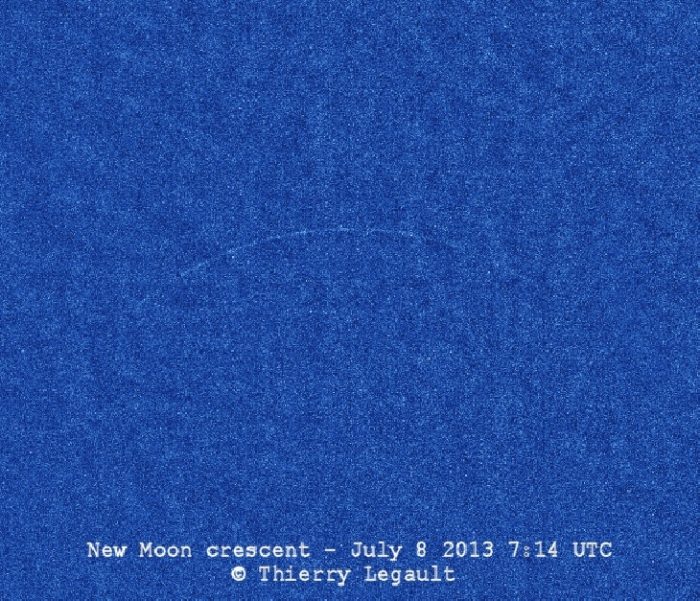
Youngest possible lunar crescent, with the moon’s age being exactly zero when this photo was taken — at the instant of new moon – 07:14 UTC on July 8, 2013. Image by Thierry Legault.
A moon at the new phase comes most nearly – for any particular month – to passing between the Earth and sun. New moon is May 15, 2018 at 11:48 UTC; translate UTC to your time.
New moons come once each month, as the moon orbits Earth. On the day of new moon – unless we’re viewing a total solar eclipse – we don’t see the new moon. That’s because a new moon rises when the sun rises. It sets when the sun sets. It crosses the sky with the sun during the day. Its fully illuminated face, or day side, is turned entirely away from us.
It’s only as the moon moves in orbit, as its lighted hemisphere begins to come into view from Earth, that we can see it in our sky. Then we see the moon in the west after sunset as a slim waxing crescent – what some call a young moon.
This month’s new moon marks the start of the Islamic holy month of Ramadan. Read more: When does Ramadan begin in 2018?
Bottom line: As the moon orbits Earth, it changes phase in an orderly way. New moon comes on May 15 at 11:48 UTC.
Four keys to understanding moon phases
Youngest possible lunar crescent, with the moon’s age being exactly zero when this photo was taken — at the instant of new moon – 07:14 UTC on July 8, 2013. Image by Thierry Legault.
A moon at the new phase comes most nearly – for any particular month – to passing between the Earth and sun. New moon is May 15, 2018 at 11:48 UTC; translate UTC to your time.
New moons come once each month, as the moon orbits Earth. On the day of new moon – unless we’re viewing a total solar eclipse – we don’t see the new moon. That’s because a new moon rises when the sun rises. It sets when the sun sets. It crosses the sky with the sun during the day. Its fully illuminated face, or day side, is turned entirely away from us.
It’s only as the moon moves in orbit, as its lighted hemisphere begins to come into view from Earth, that we can see it in our sky. Then we see the moon in the west after sunset as a slim waxing crescent – what some call a young moon.
This month’s new moon marks the start of the Islamic holy month of Ramadan. Read more: When does Ramadan begin in 2018?
Bottom line: As the moon orbits Earth, it changes phase in an orderly way. New moon comes on May 15 at 11:48 UTC.
Four keys to understanding moon phases

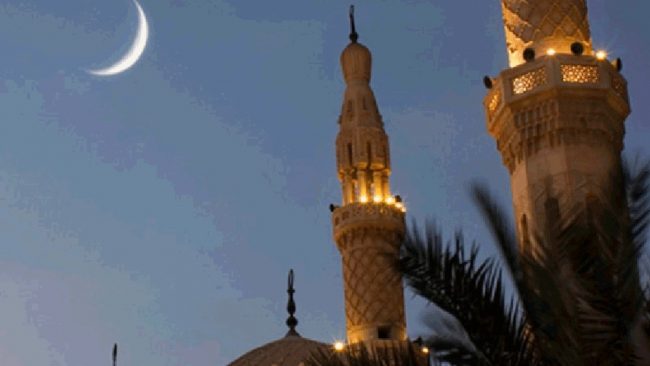
Traditionally, the first sighting of a young moon marks the beginning of Ramadan. Image via Emirates 24/7.
The Islamic holy month of Ramadan falls at a different time each year because the Islamic calendar is a lunar calendar, based on the moon’s natural cycles. That’s why there isn’t a fixed date for Ramadan, which is the 9th month in this calendar, traditionally determined by the sighting of a crescent moon. Today – May 15, 2018 – is the date of new moon, that is, a moon most directly between the Earth and sun for this month. New moon comes at 11:48 UTC today (12:48 p.m. London Time; 7:48 a.m. Eastern Daylight Time in the U.S; translate UTC to your time). We’ve seen some announcements that Ramadan in 2018 will begin this evening – the evening of May 15. We’ve seen other announcements that the beginning of Ramadan will be announced on May 15.
Will anyone on Earth be able to see the moon on this Tuesday evening with the eye alone? Yes. Possibly. Spring is the best time to see a very young moon (a moon visible in the west after sunset, in the hours or days after new moon). So the chances are best from Earth’s Northern Hemisphere, where it’s spring now. And chances are best for those for those living at longitudes farther and farther west from, say, London. The farther west you are, the more time will have passed on your clock since the instant of new moon. Thus, because the moon orbits Earth continuously, the moon will have had more time to move away from our line of sight to the sun, on the sky’s dome.
In other words, the farther west you are, the longer after sunset the moon will set. The darker your sky will be. For those reasons, the farther west you are from, say, London, on May 15, the more likely it is you’ll be to see the moon.
Let’s consider the youngest moon that can be seen with the eye alone. A young moon is a waxing crescent moon, seen in west just after sunset.
A longstanding, though somewhat doubtful, record for youngest moon seen with the eye was held by two British housemaids, said to have seen the moon 14-and-three-quarter hours after new moon, in the year 1916. That story has been around for over 100 years. Is it true? Who knows?
A more reliable record was achieved by well-known writer, photographer, and naturalist Stephen James O’Meara in May 1990. He saw a young crescent with the unaided eye 15 hours and 32 minutes after new moon. Stephen had amazing eyesight when he was younger; he saw a number of noteworthy astronomical sights. Click here to read more about the youngest moons it’s possible to see.
I haven’t heard of anyone besting Stephen’s record, so let’s assume 15 hours and 32 minutes is the record for the youngest moon.
Will it be possible to see a young moon after sunset on May 15 from, say, the Middle East? No. Let’s use Dubai in the United Arab Emirates as an example. Dubai is 4 hours ahead of UTC. New moon is 11:48 UTC on May 15; so new moon comes at 15:48 (3:48 p.m.) on Tuesday in Dubai. At sunset that evening (6:56 p.m.), as seen from Dubai, the moon will be only three hours old, invisible in the sun’s glare. And in fact, Dubai is one of the places where it’s been announced that the UAE’s moon-sighting committee will meet on May 15 to decide the start date of Ramadan.
How about London? No. At sunset on May 15, the moon will be a few hours older than it will be at sunset in Dubai, but not old enough to be visible to the eye after sunset.
Let’s keep going west. How about somewhere in North America? Consider Pacific Daylight Time, which is 7 hours behind UTC. New moon happens in, say, Los Angeles at 4:48 a.m. Pacific Daylight Time on Tuesday, May 15 (11:48 UTC – 7 = 4:48 a.m.). The sun sets in Los Angeles at 7:48 p.m. on May 15. Thus at sunset on May 15 – as seen from Los Angeles – the moon will be 15 hours old. Remember … 15 hours and 32 minutes is the record youngest moon. That record has been around since 1990. It’s doubtful it’ll be broken from the contiguous U.S. states on May 15 … but presumably it’s possible.
The best place to catch sight of the young moon on May 15 will be an island in the Pacific Ocean. Honolulu, Hawaii – for example – is 10 hours behind UTC. So new moon happens on May 15 at 1:48 a.m. for Honolulu. The sun sets in 7:03 p.m. on May 15. On that evening, after sunset, the moon will be about 17 hours old and definitely possible to see, though it’ll still be an extremely challenging observation. You’ll need a very clear sky after sunset, all the way to the western horizon. Binoculars will come in handy for finding the moon; once you spot it, try then taking the binoculars away and viewing the moon with the eye alone.
As you go west from Hawaii to the International Date Line, the potential for a young moon sighting on May 16 continues to get better. It get better still when you cross the International Date Line, into, say, Asia (again, we’re staying in the Northern Hemisphere, because the young moon is easier to see from this hemisphere at this time of year than it is from the Southern Hemisphere). From much of Asia on May 16, the young moon will be possible to see.
And – as Earth spins under the sky, and the moon moves in orbit, putting distance between itself and our line of sight to the sun – the moon will get easier and easier to see. It should most definitely be possible to see the moon from, say, India or the Middle East on May 16, assuming you have excellent sky conditions.
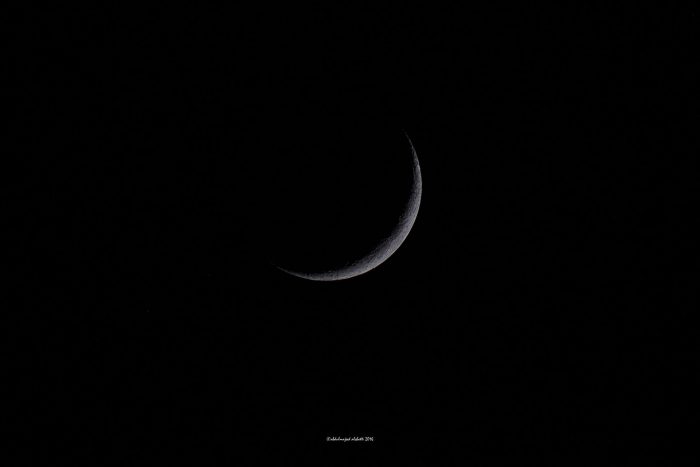
This young moon – June, 2016 – marked a beginning of Ramadan. Abdulmajeed Alshatti took this photo from Kuwait.
Ramadan, for observant Muslims, is a time of fasting, prayer and charitable giving.
Here is a beautiful poem about Ramadan, by Rumi, a 13th-century Persian poet and mystic:
O moon-faced Beloved,
the month of Ramadan has arrived
Cover the table
and open the path of praise.
O fickle busybody,
it’s time to change your ways.
Can you see the one who’s selling the halvah
how long will it be the halvah you desire?
Just a glimpse of the halvah-maker
has made you so sweet even honey says,
“I’ll put myself beneath your feet, like soil;
I’ll worship at your shrine.”
Your chick frets within the egg
with all your eating and choking.
Break out of your shell that your wings may grow.
Let yourself fly.
The lips of the Master are parched
from calling the Beloved.
The sound of your call resounds
through the horn of your empty belly.
Let nothing be inside of you.
Be empty: give your lips to the lips of the reed.
When like a reed you fill with His breath,
then you’ll taste sweetness.
Sweetness is hidden in the Breath
that fills the reed.
Be like Mary – by that sweet breath
a child grew within her.
– Rumi
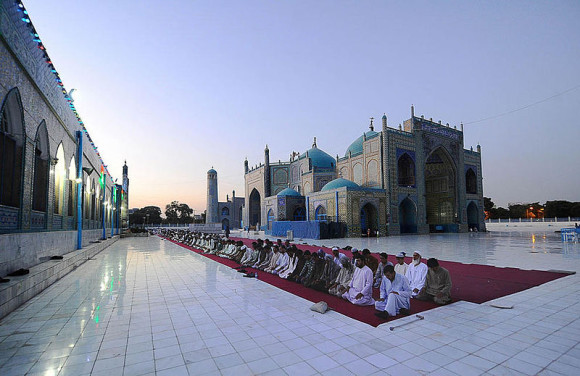
Men praying during Ramadan – a time of fasting, prayer and charitable giving – at the Blue Mosque in Mazar-i-Sharif, Afghanistan.
Bottom line: The Islamic holy month begins with the sighting of a young crescent moon. Some on islands in the Pacific might see the moon on May 15, 2018, but most will see it on May 16 or even May 17.
Traditionally, the first sighting of a young moon marks the beginning of Ramadan. Image via Emirates 24/7.
The Islamic holy month of Ramadan falls at a different time each year because the Islamic calendar is a lunar calendar, based on the moon’s natural cycles. That’s why there isn’t a fixed date for Ramadan, which is the 9th month in this calendar, traditionally determined by the sighting of a crescent moon. Today – May 15, 2018 – is the date of new moon, that is, a moon most directly between the Earth and sun for this month. New moon comes at 11:48 UTC today (12:48 p.m. London Time; 7:48 a.m. Eastern Daylight Time in the U.S; translate UTC to your time). We’ve seen some announcements that Ramadan in 2018 will begin this evening – the evening of May 15. We’ve seen other announcements that the beginning of Ramadan will be announced on May 15.
Will anyone on Earth be able to see the moon on this Tuesday evening with the eye alone? Yes. Possibly. Spring is the best time to see a very young moon (a moon visible in the west after sunset, in the hours or days after new moon). So the chances are best from Earth’s Northern Hemisphere, where it’s spring now. And chances are best for those for those living at longitudes farther and farther west from, say, London. The farther west you are, the more time will have passed on your clock since the instant of new moon. Thus, because the moon orbits Earth continuously, the moon will have had more time to move away from our line of sight to the sun, on the sky’s dome.
In other words, the farther west you are, the longer after sunset the moon will set. The darker your sky will be. For those reasons, the farther west you are from, say, London, on May 15, the more likely it is you’ll be to see the moon.
Let’s consider the youngest moon that can be seen with the eye alone. A young moon is a waxing crescent moon, seen in west just after sunset.
A longstanding, though somewhat doubtful, record for youngest moon seen with the eye was held by two British housemaids, said to have seen the moon 14-and-three-quarter hours after new moon, in the year 1916. That story has been around for over 100 years. Is it true? Who knows?
A more reliable record was achieved by well-known writer, photographer, and naturalist Stephen James O’Meara in May 1990. He saw a young crescent with the unaided eye 15 hours and 32 minutes after new moon. Stephen had amazing eyesight when he was younger; he saw a number of noteworthy astronomical sights. Click here to read more about the youngest moons it’s possible to see.
I haven’t heard of anyone besting Stephen’s record, so let’s assume 15 hours and 32 minutes is the record for the youngest moon.
Will it be possible to see a young moon after sunset on May 15 from, say, the Middle East? No. Let’s use Dubai in the United Arab Emirates as an example. Dubai is 4 hours ahead of UTC. New moon is 11:48 UTC on May 15; so new moon comes at 15:48 (3:48 p.m.) on Tuesday in Dubai. At sunset that evening (6:56 p.m.), as seen from Dubai, the moon will be only three hours old, invisible in the sun’s glare. And in fact, Dubai is one of the places where it’s been announced that the UAE’s moon-sighting committee will meet on May 15 to decide the start date of Ramadan.
How about London? No. At sunset on May 15, the moon will be a few hours older than it will be at sunset in Dubai, but not old enough to be visible to the eye after sunset.
Let’s keep going west. How about somewhere in North America? Consider Pacific Daylight Time, which is 7 hours behind UTC. New moon happens in, say, Los Angeles at 4:48 a.m. Pacific Daylight Time on Tuesday, May 15 (11:48 UTC – 7 = 4:48 a.m.). The sun sets in Los Angeles at 7:48 p.m. on May 15. Thus at sunset on May 15 – as seen from Los Angeles – the moon will be 15 hours old. Remember … 15 hours and 32 minutes is the record youngest moon. That record has been around since 1990. It’s doubtful it’ll be broken from the contiguous U.S. states on May 15 … but presumably it’s possible.
The best place to catch sight of the young moon on May 15 will be an island in the Pacific Ocean. Honolulu, Hawaii – for example – is 10 hours behind UTC. So new moon happens on May 15 at 1:48 a.m. for Honolulu. The sun sets in 7:03 p.m. on May 15. On that evening, after sunset, the moon will be about 17 hours old and definitely possible to see, though it’ll still be an extremely challenging observation. You’ll need a very clear sky after sunset, all the way to the western horizon. Binoculars will come in handy for finding the moon; once you spot it, try then taking the binoculars away and viewing the moon with the eye alone.
As you go west from Hawaii to the International Date Line, the potential for a young moon sighting on May 16 continues to get better. It get better still when you cross the International Date Line, into, say, Asia (again, we’re staying in the Northern Hemisphere, because the young moon is easier to see from this hemisphere at this time of year than it is from the Southern Hemisphere). From much of Asia on May 16, the young moon will be possible to see.
And – as Earth spins under the sky, and the moon moves in orbit, putting distance between itself and our line of sight to the sun – the moon will get easier and easier to see. It should most definitely be possible to see the moon from, say, India or the Middle East on May 16, assuming you have excellent sky conditions.
This young moon – June, 2016 – marked a beginning of Ramadan. Abdulmajeed Alshatti took this photo from Kuwait.
Ramadan, for observant Muslims, is a time of fasting, prayer and charitable giving.
Here is a beautiful poem about Ramadan, by Rumi, a 13th-century Persian poet and mystic:
O moon-faced Beloved,
the month of Ramadan has arrived
Cover the table
and open the path of praise.
O fickle busybody,
it’s time to change your ways.
Can you see the one who’s selling the halvah
how long will it be the halvah you desire?
Just a glimpse of the halvah-maker
has made you so sweet even honey says,
“I’ll put myself beneath your feet, like soil;
I’ll worship at your shrine.”
Your chick frets within the egg
with all your eating and choking.
Break out of your shell that your wings may grow.
Let yourself fly.
The lips of the Master are parched
from calling the Beloved.
The sound of your call resounds
through the horn of your empty belly.
Let nothing be inside of you.
Be empty: give your lips to the lips of the reed.
When like a reed you fill with His breath,
then you’ll taste sweetness.
Sweetness is hidden in the Breath
that fills the reed.
Be like Mary – by that sweet breath
a child grew within her.
– Rumi
Men praying during Ramadan – a time of fasting, prayer and charitable giving – at the Blue Mosque in Mazar-i-Sharif, Afghanistan.
Bottom line: The Islamic holy month begins with the sighting of a young crescent moon. Some on islands in the Pacific might see the moon on May 15, 2018, but most will see it on May 16 or even May 17.

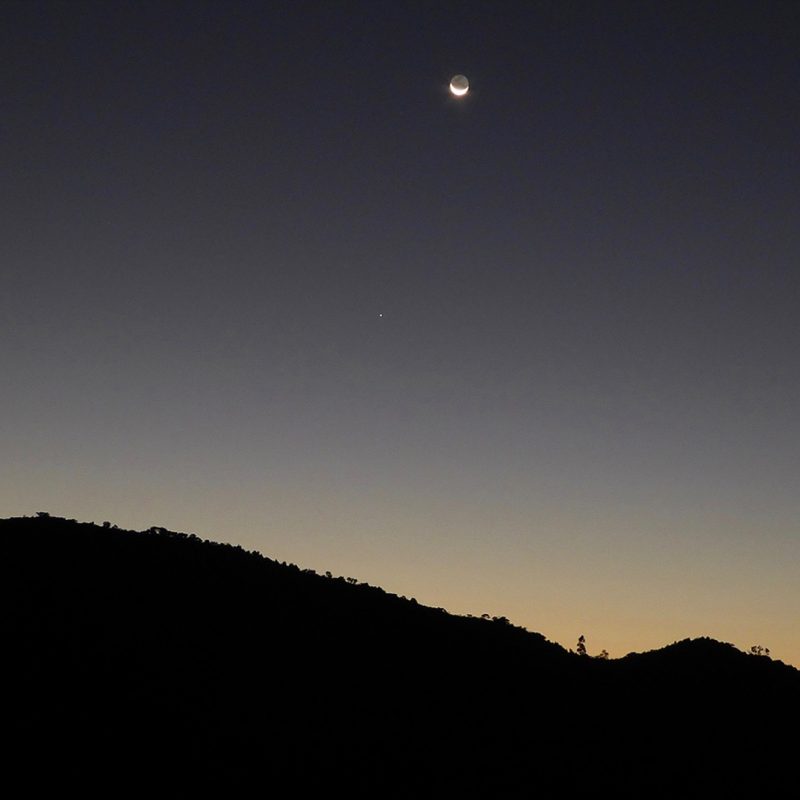
View larger. | May 13, 2018 photo of the old moon and Mercury by Peter Lowenstein. “Mercury remained visible below the moon for over 30 minutes due to very clear sky and a favourable Southern Hemisphere location.” Camera: Panasonic Lumix DMC-TZ60 in night and sunset scene modes with up to x 60 zoom magnification.
The past two mornings, the old moon – a waning crescent moon – has been visible in the east before dawn, near the planet Mercury. Here are two photos, one from May 13 (above) and the next from May 14 (below). Both photos were taken as the moon and Mercury rose over Cecil Kop Nature Reserve in Mutare, Zimbabwe.
Notice that on May 13, the moon was above Mercury. But on May 14, Mercury was above the moon. The moon’s motion in orbit around Earth caused this difference and caused the moon to sink into the sunrise glare – so that it would not be visible before dawn – on May 15.
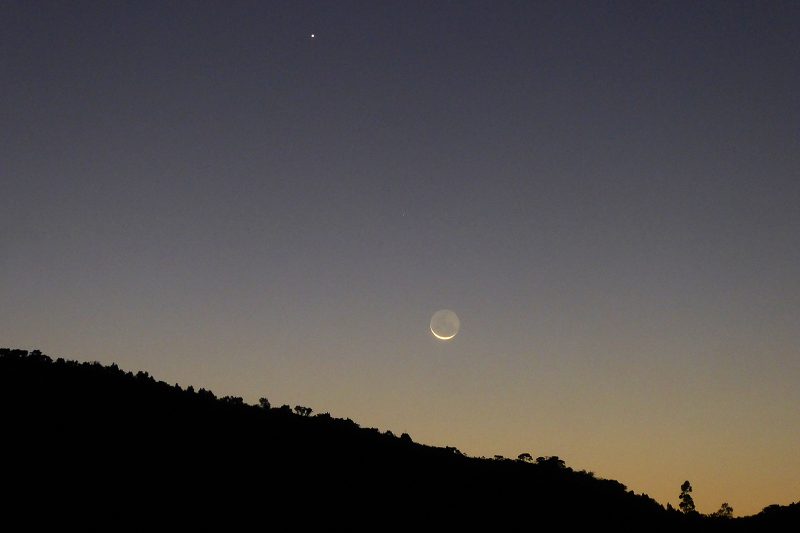
View larger. | May 14, 2018 photo of the old moon and Mercury by Peter Lowenstein. Panasonic Lumix DMC-TZ60’s in night and sunset scene modes with up to x60 zoom magnification.
Also, notice in the animation below what the still images above can’t show … that the moon and Mercury both were rising as these photos were taken. They were rising in the east for the same reason the sun does, because Earth is spinning under the sky.
Even on May 14, the moon remained faintly visible, ascending in the east, as dawn brightened.
Animation created from May 14 images, by Peter Lowenstein. Panasonic Lumix DMC-TZ60’s in night and sunset scene modes with up to x60 zoom magnification.
Bottom line: Images of the moon and innermost planet Mercury – now putting on a grand show from Earth’s Southern Hemisphere (but not the Northern Hemisphere) in the east before dawn.
View larger. | May 13, 2018 photo of the old moon and Mercury by Peter Lowenstein. “Mercury remained visible below the moon for over 30 minutes due to very clear sky and a favourable Southern Hemisphere location.” Camera: Panasonic Lumix DMC-TZ60 in night and sunset scene modes with up to x 60 zoom magnification.
The past two mornings, the old moon – a waning crescent moon – has been visible in the east before dawn, near the planet Mercury. Here are two photos, one from May 13 (above) and the next from May 14 (below). Both photos were taken as the moon and Mercury rose over Cecil Kop Nature Reserve in Mutare, Zimbabwe.
Notice that on May 13, the moon was above Mercury. But on May 14, Mercury was above the moon. The moon’s motion in orbit around Earth caused this difference and caused the moon to sink into the sunrise glare – so that it would not be visible before dawn – on May 15.
View larger. | May 14, 2018 photo of the old moon and Mercury by Peter Lowenstein. Panasonic Lumix DMC-TZ60’s in night and sunset scene modes with up to x60 zoom magnification.
Also, notice in the animation below what the still images above can’t show … that the moon and Mercury both were rising as these photos were taken. They were rising in the east for the same reason the sun does, because Earth is spinning under the sky.
Even on May 14, the moon remained faintly visible, ascending in the east, as dawn brightened.
Animation created from May 14 images, by Peter Lowenstein. Panasonic Lumix DMC-TZ60’s in night and sunset scene modes with up to x60 zoom magnification.
Bottom line: Images of the moon and innermost planet Mercury – now putting on a grand show from Earth’s Southern Hemisphere (but not the Northern Hemisphere) in the east before dawn.
