aads

What’s the youngest moon you can see?

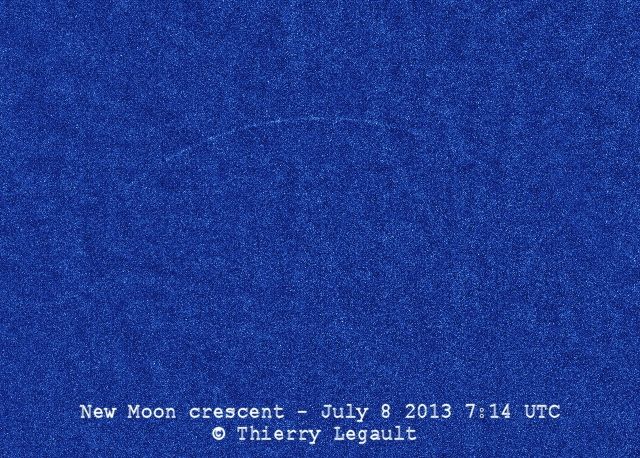
New record for youngest moon via Thierry Legault

Youngest lunar crescent, with the moon’s age being exactly zero when this photo was taken — at the precise moment of the new moon – at 07:14 UTC on July 8, 2013. Image by Thierry Legault. Visit his website. Used with permission.

On July 8, 2013, a new record was set for the youngest moon ever photographed (see photos on this page). Thierry Legault – shooting from in Elancourt, France (a suburb of Paris) – captured the July 2013 moon at the precise instant it was new, or most nearly between the Earth and sun for this lunar orbit. Legault’s image (above) shows the thinnest of lunar crescents, in full daylight (naturally, since a new moon is always near the sun in the sky), at 0714 UTC on July 8, 2013. Legault said on his website:

It is the youngest possible crescent, the age of the moon at this instant being exactly zero. Celestial north is up in the image, as well as the sun. The irregularities and discontinuities are caused by the relief at the edge of the lunar disk (mountains, craters).

What is the youngest moon you can see with your eye alone?

When Legault captured the image above, the sun and moon were separated only 4.4 degrees – about 9 solar diameters – on the sky’s dome. It is extremely difficult, and risky, to try to capture the moon at such a time. Not only is the sight of our companion world drowned in bright sunlight, but there is also a risk of unintentionally glimpsing the sun and thereby damaging one’s eyesight.

That’s why Legault used a special photographic set-up to capture this youngest possible moon. He wrote on his website.

In order to reduce the glare, the images have been taken in close infrared and a pierced screen, placed just in front of the telescope, prevents the sunlight from entering directly in the telescope.

Here is Thierry Legault and his set up for capturing the youngest possible moon. See more photos and read more on his website.

Here is Thierry Legault and his set up for capturing the youngest possible moon. See more photos and read more on his website.

What is the youngest moon you can see with your eye alone? It has long been a sport for amateur astronomers to spot the youngest moon with the eye alone. In order to see the young moon with your eye, the moon must have moved some distance from the sun on the sky’s dome. It always appears as a very slim crescent moon, seen low in the western sky for a short time after sunset. A longstanding, though somewhat doubtful record for youngest moon seen with the eye was held by two British housemaids, said to have seen the moon 14-and-three-quarter hours after new moon – in the year 1916.

A more reliable record was achieved by Stephen James O’Meara in May 1990; he saw the young crescent with the unaided eye 15 hours and 32 minutes after new moon. The record for youngest moon spotted with the eye using an optical aid passed to Mohsen Mirsaeed in 2002, who saw the moon 11 hours and 40 minutes after new moon.

But Legault’s photograph at the instant of new moon? That record can only be duplicated, not surpassed.

Very young moon like that you’re likely to see with the eye, as captured by EarthSky Facebook friend Susan Gies Jensen on February 10, 2013 in Odessa, Washington. Beautiful job, Susan! Thank you. View larger.

The moon passes more or less between the Earth and sun once each month at new moon. Then, unless you have a set-up like Thierry Legault’s, you will not see the moon because it is crossing the sky with the sun during the day. About a day after new moon, you’ll see a very thin waxing crescent moon setting shortly after the sun. The young moon appears as lighted crescent in the twilight sky, often with the darkened portion of the moon glowing dimly with earthshine.

How young a moon you can expect to see with your eye depends on the time of year and on sky conditions. It’s possible to see the youngest moons – the thinnest crescents, nearest the sunset – around the spring equinox. That would be March for the Northern Hemisphere or September for the Southern Hemisphere.

Bottom line: In our modern times, as astrophotographer Thierry Legault proved in 2013, it’s possible to capture a moon at the instant the moon is new. How about young moon sightings with the eye alone? The youngest possible moons, here.

Click here to check out Thierry Legault’s book on astrophotography.


from EarthSky https://ift.tt/2rPsPlr
New record for youngest moon via Thierry Legault

Youngest lunar crescent, with the moon’s age being exactly zero when this photo was taken — at the precise moment of the new moon – at 07:14 UTC on July 8, 2013. Image by Thierry Legault. Visit his website. Used with permission.

On July 8, 2013, a new record was set for the youngest moon ever photographed (see photos on this page). Thierry Legault – shooting from in Elancourt, France (a suburb of Paris) – captured the July 2013 moon at the precise instant it was new, or most nearly between the Earth and sun for this lunar orbit. Legault’s image (above) shows the thinnest of lunar crescents, in full daylight (naturally, since a new moon is always near the sun in the sky), at 0714 UTC on July 8, 2013. Legault said on his website:

It is the youngest possible crescent, the age of the moon at this instant being exactly zero. Celestial north is up in the image, as well as the sun. The irregularities and discontinuities are caused by the relief at the edge of the lunar disk (mountains, craters).

What is the youngest moon you can see with your eye alone?

When Legault captured the image above, the sun and moon were separated only 4.4 degrees – about 9 solar diameters – on the sky’s dome. It is extremely difficult, and risky, to try to capture the moon at such a time. Not only is the sight of our companion world drowned in bright sunlight, but there is also a risk of unintentionally glimpsing the sun and thereby damaging one’s eyesight.

That’s why Legault used a special photographic set-up to capture this youngest possible moon. He wrote on his website.

In order to reduce the glare, the images have been taken in close infrared and a pierced screen, placed just in front of the telescope, prevents the sunlight from entering directly in the telescope.

Here is Thierry Legault and his set up for capturing the youngest possible moon. See more photos and read more on his website.

Here is Thierry Legault and his set up for capturing the youngest possible moon. See more photos and read more on his website.

What is the youngest moon you can see with your eye alone? It has long been a sport for amateur astronomers to spot the youngest moon with the eye alone. In order to see the young moon with your eye, the moon must have moved some distance from the sun on the sky’s dome. It always appears as a very slim crescent moon, seen low in the western sky for a short time after sunset. A longstanding, though somewhat doubtful record for youngest moon seen with the eye was held by two British housemaids, said to have seen the moon 14-and-three-quarter hours after new moon – in the year 1916.

A more reliable record was achieved by Stephen James O’Meara in May 1990; he saw the young crescent with the unaided eye 15 hours and 32 minutes after new moon. The record for youngest moon spotted with the eye using an optical aid passed to Mohsen Mirsaeed in 2002, who saw the moon 11 hours and 40 minutes after new moon.

But Legault’s photograph at the instant of new moon? That record can only be duplicated, not surpassed.

Very young moon like that you’re likely to see with the eye, as captured by EarthSky Facebook friend Susan Gies Jensen on February 10, 2013 in Odessa, Washington. Beautiful job, Susan! Thank you. View larger.

The moon passes more or less between the Earth and sun once each month at new moon. Then, unless you have a set-up like Thierry Legault’s, you will not see the moon because it is crossing the sky with the sun during the day. About a day after new moon, you’ll see a very thin waxing crescent moon setting shortly after the sun. The young moon appears as lighted crescent in the twilight sky, often with the darkened portion of the moon glowing dimly with earthshine.

How young a moon you can expect to see with your eye depends on the time of year and on sky conditions. It’s possible to see the youngest moons – the thinnest crescents, nearest the sunset – around the spring equinox. That would be March for the Northern Hemisphere or September for the Southern Hemisphere.

Bottom line: In our modern times, as astrophotographer Thierry Legault proved in 2013, it’s possible to capture a moon at the instant the moon is new. How about young moon sightings with the eye alone? The youngest possible moons, here.

Click here to check out Thierry Legault’s book on astrophotography.


from EarthSky https://ift.tt/2rPsPlr

Find the Omega Centauri star cluster

The image above is from Greg Hogan of Kathleen, Georgia. Click here to view it larger.

Tonight – or any night in the coming weeks – let the sparkling blue-white star Spica act as your guide to the Omega Centauri globular star cluster. You can see this cluster with the unaided eye, if your sky is dark enough. Omega Centauri looks like a fairly faint (and possibly fuzzy) star. It’s a beautiful and very special star cluster. In any year, Spica can help you find it.

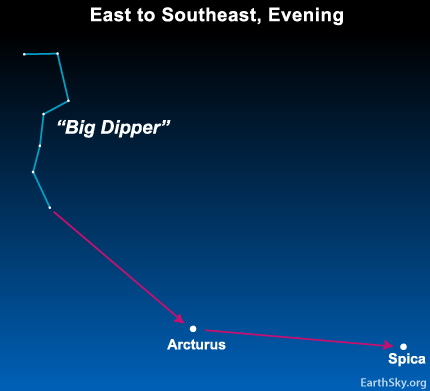
To find Omega Centauri, first find Spica, the brightest star in the constellation Virgo the Maiden. How can you find it? Check out the chart below, and keep reading …

EarthSky astronomy kits are perfect for beginners. Order today from the EarthSky store

Extend the handle of the Big Dipper to locate the stars Arcturus and Spica.

In any year, you can use the handle of the Big Dipper to locate the stars Arcturus and Spica.

Spica transits – climbs to its highest point in the sky – around 10 p.m local standard time (11 p.m. Daylight Saving Time) in mid-May for all locations around the globe. You can find Spica’s precise transit time for your sky at the US Naval Observatory.

As seen from the Northern Hemisphere, Spica and Omega Centauri transit due south at the same time. That means that – when Spica is highest in the south – Omega Centauri is, too. Look for Omega Centauri about 35o directly below Spica. A fist at an arm-length approximates 10o.

Enjoying EarthSky so far? Sign up for our free daily newsletter today!

Even at its highest, Omega Centauri is low in the south for Northern Hemisphere observers. But it’s conviently just below the bright star Spica. Finding Spica can lead you to this magnificent star cluster. Map via Sky&Telescope.com/ Stellarium

Omega Centauri is special in part because you can see it with your eye alone, assuming you have a dark-enough sky. Very few of the Milky Way galaxy’s 250 or so globular star clusters are readily visible without optics. Globular clusters are large, symmetrically shaped groupings of stars, fairly evenly distributed around the core of our Milky Way galaxy. Omega Centauri is the largest globular and finest globular star cluster visible to the eye alone.

People living south of 35o north latitude have a realistic chance of spotting Omega Centauri, though it’s been seen as far north as Point Pelee, Canada (42o north latitude). Best appreciated with a telescope, Omega Centauri, the largest and brightest of all globular star clusters, is a globe-shaped stellar city, teeming with millions of stars!

Omega Centauri star cluster, the finest globular star cluster visible in Earth’s skies. Image Credit: Jean-Paul Longchamp via Meade.com

Bottom line: Use the star Spica in the constellation Virgo to locate Omega Centauri on these springtime nights!

Donate: Your support means the world to us


from EarthSky https://ift.tt/1A7g48u

The image above is from Greg Hogan of Kathleen, Georgia. Click here to view it larger.

Tonight – or any night in the coming weeks – let the sparkling blue-white star Spica act as your guide to the Omega Centauri globular star cluster. You can see this cluster with the unaided eye, if your sky is dark enough. Omega Centauri looks like a fairly faint (and possibly fuzzy) star. It’s a beautiful and very special star cluster. In any year, Spica can help you find it.

To find Omega Centauri, first find Spica, the brightest star in the constellation Virgo the Maiden. How can you find it? Check out the chart below, and keep reading …

EarthSky astronomy kits are perfect for beginners. Order today from the EarthSky store

Extend the handle of the Big Dipper to locate the stars Arcturus and Spica.

In any year, you can use the handle of the Big Dipper to locate the stars Arcturus and Spica.

Spica transits – climbs to its highest point in the sky – around 10 p.m local standard time (11 p.m. Daylight Saving Time) in mid-May for all locations around the globe. You can find Spica’s precise transit time for your sky at the US Naval Observatory.

As seen from the Northern Hemisphere, Spica and Omega Centauri transit due south at the same time. That means that – when Spica is highest in the south – Omega Centauri is, too. Look for Omega Centauri about 35o directly below Spica. A fist at an arm-length approximates 10o.

Enjoying EarthSky so far? Sign up for our free daily newsletter today!

Even at its highest, Omega Centauri is low in the south for Northern Hemisphere observers. But it’s conviently just below the bright star Spica. Finding Spica can lead you to this magnificent star cluster. Map via Sky&Telescope.com/ Stellarium

Omega Centauri is special in part because you can see it with your eye alone, assuming you have a dark-enough sky. Very few of the Milky Way galaxy’s 250 or so globular star clusters are readily visible without optics. Globular clusters are large, symmetrically shaped groupings of stars, fairly evenly distributed around the core of our Milky Way galaxy. Omega Centauri is the largest globular and finest globular star cluster visible to the eye alone.

People living south of 35o north latitude have a realistic chance of spotting Omega Centauri, though it’s been seen as far north as Point Pelee, Canada (42o north latitude). Best appreciated with a telescope, Omega Centauri, the largest and brightest of all globular star clusters, is a globe-shaped stellar city, teeming with millions of stars!

Omega Centauri star cluster, the finest globular star cluster visible in Earth’s skies. Image Credit: Jean-Paul Longchamp via Meade.com

Bottom line: Use the star Spica in the constellation Virgo to locate Omega Centauri on these springtime nights!

Donate: Your support means the world to us


from EarthSky https://ift.tt/1A7g48u

Is Jupiter’s moon Europa venting plumes of water vapor?

Space scientists announced on Monday (May 14, 2018) that a reanalysis of data collected by the Galileo spacecraft in 1997 corroborates earlier suggestions that Jupiter’s moon Europa might be venting plumes of water vapor. This is very exciting news! It might mean that a planned space mission to Europa – called the Europa Clipper – could be programmed to fly through the plumes in order to sample Europa’s liquid ocean, which is buried below this moon’s thick ice crust. The goal would be to probe the question of whether Europa’s hidden ocean has the ingredients needed to support life. As Robert Pappalardo of NASA’s Jet Propulsion Laboratory in Pasadena, California, said in the video above:

There are better tools now, better computational techniques, better computing. We can go back and look at that old data set anew.

Pappalardo is Europa Clipper‘s project scientist. But he’s not the only one thrilled by the new finding. The research was led by space physicist Xianzhe Jia at the University of Michigan in Ann Arbor. Jia also is co-investigator for two instruments that will travel aboard Europa Clipper. His new study, outlining the possibility of Europa plumes, was published May 14 in the peer-reviewed journal Nature Astronomy.

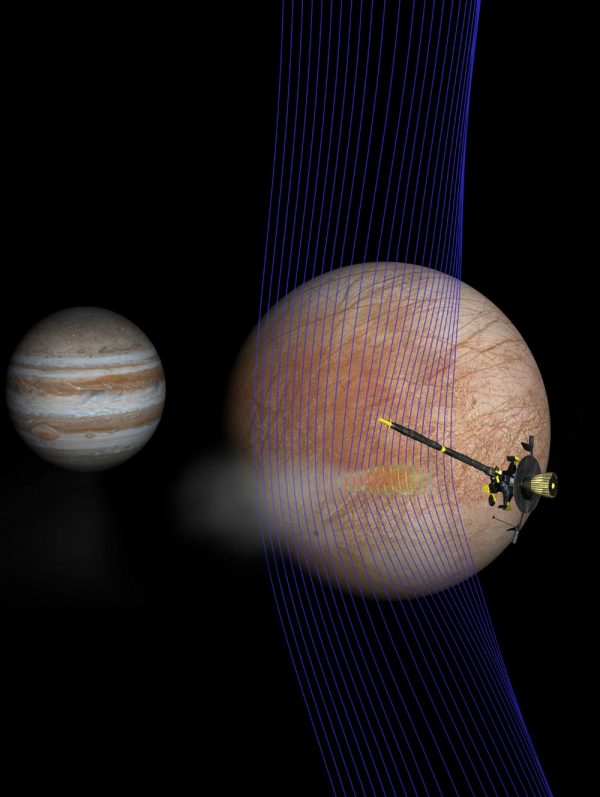
Artist’s illustration of Jupiter and Europa (in the foreground) with the Galileo spacecraft after its pass through a plume erupting from Europa’s surface. Image via NASA JPL.

Jia said it was Melissa McGrath of the SETI Institute that inspired his team to dive back into the Galileo data. McGrath is part of the Europa Clipper science team, too. Jia said that in a presentation she delivered to fellow team scientists, highlighting other Hubble observations of Europa:

One of the locations she mentioned rang a bell. Galileo actually did a flyby of that location, and it was the closest one we ever had. We realized we had to go back. We needed to see whether there was anything in the data that could tell us whether or not there was a plume.

A statement from NASA JPL further explained:

At the time of the 1997 flyby, about 124 miles (200 km) above Europa’s surface, the Galileo team didn’t suspect the spacecraft might be grazing a plume erupting from the icy moon. Now, Jia and his team believe, its path was fortuitous.

When they examined the information gathered during that flyby 21 years ago, sure enough, high-resolution magnetometer data showed something strange. Drawing on what scientists learned from exploring plumes on Saturn’s moon Enceladus — that material in plumes becomes ionized and leaves a characteristic blip in the magnetic field — they knew what to look for. And there it was on Europa — a brief, localized bend in the magnetic field that had never been explained.

Jia’s team then began to analyze the old data in earnest, feeding some of the old data into a new 3D computer model developed by his team at the University of Michigan.

The result that emerged, with a simulated plume, was a match to the Galileo data from 21 years ago. Robert Pappalardo said:

There now seem to be too many lines of evidence to dismiss plumes at Europa. This result makes the plumes seem to be much more real and, for me, is a tipping point. These are no longer uncertain blips on a faraway image.

The Europa Clipper mission may launch as early as June 2022. NASA said:

From its orbit of Jupiter, Europa Clipper will sail close by the moon in rapid, low-altitude flybys. If plumes are indeed spewing vapor from Europa’s ocean or subsurface lakes, Europa Clipper could sample the frozen liquid and dust particles. The mission team is gearing up now to look at potential orbital paths, and the new research will play into those discussions.

Pappalardo added:

If plumes exist, and we can directly sample what’s coming from the interior of Europa, then we can more easily get at whether Europa has the ingredients for life.

That’s what the mission is after. That’s the big picture.

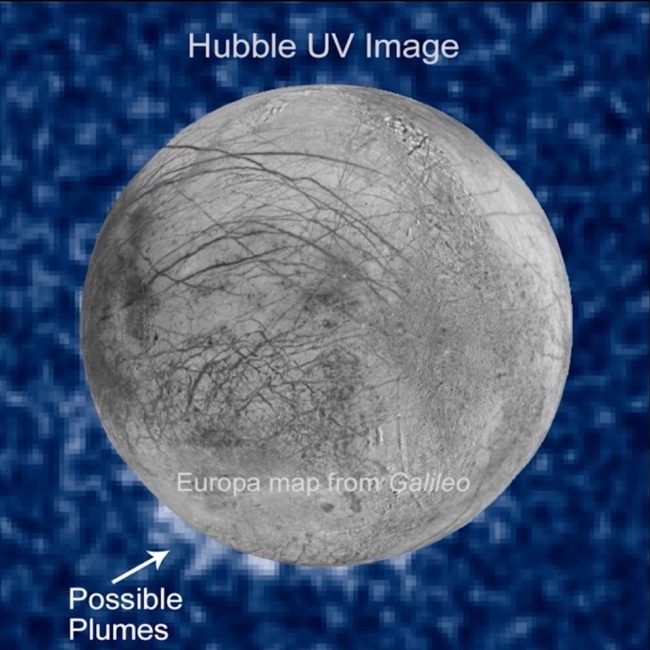
New science, mined from the archives. Data from NASA’s Galileo orbiter launched a generation ago yields new evidence of plumes, eruptions of water vapor, from Jupiter’s moon Europa. Video still, via NASA Jet Propulsion Laboratory.

Bottom line: A reanalysis of data collected by the Galileo spacecraft in 1997 corroborates earlier suggestions that Jupiter’s moon Europa might be venting plumes of water vapor.


from EarthSky https://ift.tt/2rJEFPd

Space scientists announced on Monday (May 14, 2018) that a reanalysis of data collected by the Galileo spacecraft in 1997 corroborates earlier suggestions that Jupiter’s moon Europa might be venting plumes of water vapor. This is very exciting news! It might mean that a planned space mission to Europa – called the Europa Clipper – could be programmed to fly through the plumes in order to sample Europa’s liquid ocean, which is buried below this moon’s thick ice crust. The goal would be to probe the question of whether Europa’s hidden ocean has the ingredients needed to support life. As Robert Pappalardo of NASA’s Jet Propulsion Laboratory in Pasadena, California, said in the video above:

There are better tools now, better computational techniques, better computing. We can go back and look at that old data set anew.

Pappalardo is Europa Clipper‘s project scientist. But he’s not the only one thrilled by the new finding. The research was led by space physicist Xianzhe Jia at the University of Michigan in Ann Arbor. Jia also is co-investigator for two instruments that will travel aboard Europa Clipper. His new study, outlining the possibility of Europa plumes, was published May 14 in the peer-reviewed journal Nature Astronomy.

Artist’s illustration of Jupiter and Europa (in the foreground) with the Galileo spacecraft after its pass through a plume erupting from Europa’s surface. Image via NASA JPL.

Jia said it was Melissa McGrath of the SETI Institute that inspired his team to dive back into the Galileo data. McGrath is part of the Europa Clipper science team, too. Jia said that in a presentation she delivered to fellow team scientists, highlighting other Hubble observations of Europa:

One of the locations she mentioned rang a bell. Galileo actually did a flyby of that location, and it was the closest one we ever had. We realized we had to go back. We needed to see whether there was anything in the data that could tell us whether or not there was a plume.

A statement from NASA JPL further explained:

At the time of the 1997 flyby, about 124 miles (200 km) above Europa’s surface, the Galileo team didn’t suspect the spacecraft might be grazing a plume erupting from the icy moon. Now, Jia and his team believe, its path was fortuitous.

When they examined the information gathered during that flyby 21 years ago, sure enough, high-resolution magnetometer data showed something strange. Drawing on what scientists learned from exploring plumes on Saturn’s moon Enceladus — that material in plumes becomes ionized and leaves a characteristic blip in the magnetic field — they knew what to look for. And there it was on Europa — a brief, localized bend in the magnetic field that had never been explained.

Jia’s team then began to analyze the old data in earnest, feeding some of the old data into a new 3D computer model developed by his team at the University of Michigan.

The result that emerged, with a simulated plume, was a match to the Galileo data from 21 years ago. Robert Pappalardo said:

There now seem to be too many lines of evidence to dismiss plumes at Europa. This result makes the plumes seem to be much more real and, for me, is a tipping point. These are no longer uncertain blips on a faraway image.

The Europa Clipper mission may launch as early as June 2022. NASA said:

From its orbit of Jupiter, Europa Clipper will sail close by the moon in rapid, low-altitude flybys. If plumes are indeed spewing vapor from Europa’s ocean or subsurface lakes, Europa Clipper could sample the frozen liquid and dust particles. The mission team is gearing up now to look at potential orbital paths, and the new research will play into those discussions.

Pappalardo added:

If plumes exist, and we can directly sample what’s coming from the interior of Europa, then we can more easily get at whether Europa has the ingredients for life.

That’s what the mission is after. That’s the big picture.

New science, mined from the archives. Data from NASA’s Galileo orbiter launched a generation ago yields new evidence of plumes, eruptions of water vapor, from Jupiter’s moon Europa. Video still, via NASA Jet Propulsion Laboratory.

Bottom line: A reanalysis of data collected by the Galileo spacecraft in 1997 corroborates earlier suggestions that Jupiter’s moon Europa might be venting plumes of water vapor.


from EarthSky https://ift.tt/2rJEFPd

Thousands of black holes near Milky Way center?

When you look at this image, you’re looking toward the center of our Milky Way galaxy, toward the giant black hole called Sagittarius A*. The white circles indicate likely binary systems containing white dwarf stars. The red circles indicate possible black holes. Image via Chandra X-ray Observatory.

Scientists using X-ray data said on May 9, 2018, that they now have evidence for a swarm of stellar-mass black holes – typically weighing between five to 30 times the mass of our sun – within three light-years of the center of our Milky Way galaxy. The galactic center is already known to be inhabited by a supermassive black hole, with some 4 million times the sun’s mass. Astronomers call this behemoth Sagittarius A* (pronounced Sagittarius A-star), and they’re calling the possible swarm of smaller black holes near it the Sagittarius A* Swarm.

The evidence takes the form of the discovery of just 12 stellar-mass black holes, identified via X-ray data near our galaxy’s center. Chuck Hailey of Columbia University in New York led the team that made the discovery, which was published in April in the peer-reviewed journal Nature. He said in a statement from Columbia:

Everything you’d ever want to learn about the way big black holes interact with little black holes, you can learn by studying this distribution. The Milky Way is really the only galaxy we have where we can study how supermassive black holes interact with little ones because we simply can’t see their interactions in other galaxies.

The scientists said this new evidence is the first confirmation of decades of theoretical studies of the dynamics of stars in galaxies, which have indicated that a large population of stellar mass black holes could drift inward over the eons and collect around the galaxies’ central supermassive black holes.

The researchers used Chandra data to search for X-ray binaries – systems where a black hole is locked in a close orbit with a star and is pulling matter from the star, resulting in X-ray emission – near Sagittarius A*. They studied the X-ray spectra — that is, the amount of X-rays seen at different energies — of sources within about 12 light-years of the galaxy’s heart. A statement from Chandra X-ray Observatory explained:

… they detected 14 X-ray binaries within about three light-years of Sgr A*. Two X-ray sources likely to contain neutron stars based on the detection of characteristic outbursts in previous studies were then eliminated from the analysis.

The dozen remaining X-ray binaries are identified in the labeled version of the image [above] using red colored circles. Other sources with relatively large amounts of high energy X-rays are labeled in white, and are mostly binaries containing white dwarf stars.

Hailey and his collaborators concluded that a majority of these dozen X-ray binaries are likely to contain black holes.

Sagittarius A* is about 26,000 light-years from Earth. The scientists said that – at this distance – only the brightest X-ray binaries containing black holes are likely to be detectable. Therefore, they said:

… the detections in this study imply that a much larger population of fainter, undetected X-ray binaries — at least 300 and up to 1,000 — containing stellar-mass black holes should be present around Sagittarius A*.

Read more via Chandra and Columbia University

Artist’s concept of the stellar-mass black holes found near the giant supermassive black hole at the center of our Milky Way galaxy, via Columbia University.

Bottom line: Astrophysicists found 12 possible black holes within three light-years of Sagittarius A*, the 4-billion-solar-mass black hole at the heart of our Milky Way galaxy. The smaller black holes could be the 1st known members of a black hole swarm.

Source: A density cusp of quiescent X-ray binaries in the central parsec of the Galaxy


from EarthSky https://ift.tt/2jYGCUl

When you look at this image, you’re looking toward the center of our Milky Way galaxy, toward the giant black hole called Sagittarius A*. The white circles indicate likely binary systems containing white dwarf stars. The red circles indicate possible black holes. Image via Chandra X-ray Observatory.

Scientists using X-ray data said on May 9, 2018, that they now have evidence for a swarm of stellar-mass black holes – typically weighing between five to 30 times the mass of our sun – within three light-years of the center of our Milky Way galaxy. The galactic center is already known to be inhabited by a supermassive black hole, with some 4 million times the sun’s mass. Astronomers call this behemoth Sagittarius A* (pronounced Sagittarius A-star), and they’re calling the possible swarm of smaller black holes near it the Sagittarius A* Swarm.

The evidence takes the form of the discovery of just 12 stellar-mass black holes, identified via X-ray data near our galaxy’s center. Chuck Hailey of Columbia University in New York led the team that made the discovery, which was published in April in the peer-reviewed journal Nature. He said in a statement from Columbia:

Everything you’d ever want to learn about the way big black holes interact with little black holes, you can learn by studying this distribution. The Milky Way is really the only galaxy we have where we can study how supermassive black holes interact with little ones because we simply can’t see their interactions in other galaxies.

The scientists said this new evidence is the first confirmation of decades of theoretical studies of the dynamics of stars in galaxies, which have indicated that a large population of stellar mass black holes could drift inward over the eons and collect around the galaxies’ central supermassive black holes.

The researchers used Chandra data to search for X-ray binaries – systems where a black hole is locked in a close orbit with a star and is pulling matter from the star, resulting in X-ray emission – near Sagittarius A*. They studied the X-ray spectra — that is, the amount of X-rays seen at different energies — of sources within about 12 light-years of the galaxy’s heart. A statement from Chandra X-ray Observatory explained:

… they detected 14 X-ray binaries within about three light-years of Sgr A*. Two X-ray sources likely to contain neutron stars based on the detection of characteristic outbursts in previous studies were then eliminated from the analysis.

The dozen remaining X-ray binaries are identified in the labeled version of the image [above] using red colored circles. Other sources with relatively large amounts of high energy X-rays are labeled in white, and are mostly binaries containing white dwarf stars.

Hailey and his collaborators concluded that a majority of these dozen X-ray binaries are likely to contain black holes.

Sagittarius A* is about 26,000 light-years from Earth. The scientists said that – at this distance – only the brightest X-ray binaries containing black holes are likely to be detectable. Therefore, they said:

… the detections in this study imply that a much larger population of fainter, undetected X-ray binaries — at least 300 and up to 1,000 — containing stellar-mass black holes should be present around Sagittarius A*.

Read more via Chandra and Columbia University

Artist’s concept of the stellar-mass black holes found near the giant supermassive black hole at the center of our Milky Way galaxy, via Columbia University.

Bottom line: Astrophysicists found 12 possible black holes within three light-years of Sagittarius A*, the 4-billion-solar-mass black hole at the heart of our Milky Way galaxy. The smaller black holes could be the 1st known members of a black hole swarm.

Source: A density cusp of quiescent X-ray binaries in the central parsec of the Galaxy


from EarthSky https://ift.tt/2jYGCUl

Is there life in the multiverse?

The word universe used to imply all that exists, but no longer. Today’s cosmologists – scientists who study the biggest of all possible big pictures – now consider the idea that our known universe might be just one of many unknown (and unknowable?) universes. They call this plethora of possible universes the multiverse. Now scientists in the U.K. and Australia have taken an interesting step toward probing the multiverse. Their work, which is based on computer simulations, suggests that life could potentially be common throughout the multiverse, if a multiverse exists. The findings are published May 14, 2018, in two related papers in the peer-reviewed journal Monthly Notices of the Royal Astronomical Society.

This research, and in fact the idea of a multiverse, stems from astrophysicists calculations regarding dark energy. That’s the mysterious force that appears to be accelerating the expansion of our universe.

In the 1980s, astronomers turned to multiverse theory to explain the “luckily small” amount of dark energy in our universe. This small amount of dark energy appeared to enable our universe to host life, while most universes in the multiverse could. In other words, current theories of the origin of the universe predict much more dark energy in our universe than is observed. But – according to most theories – larger amounts of dark energy would cause such a rapid expansion that it would dilute matter before any stars, planets or life could form.

How to explain this? The explanation could indeed be that, as Luke Barnes at Western Sydney University – lead author on one of the papers – explained, there could indeed be a multiverse and we in this universe just happen to have:

… a lucky [lottery] ticket.

That is, we just happen to live in a universe whose dark energy is small enough to enable the beautiful galaxies and stars we see to form, permiting life as we know it.

Or something else is happen. It’s the something else these researchers are exploring.

These researchers used computer simulations of the cosmos – produced under the EAGLE project – to learn that, in contrast to the results of earlier studies, adding dark energy to the universe – even up to a few hundred times the amount observed in our universe – would actually only have a modest impact upon star and planet formation.

If this is true, it opens up the possibility that life might be possible throughout a wider range of other universes (if they exist), the researchers said.

Jaime Salcido, a postgraduate student in Durham University’s Institute for Computational Cosmology, is lead author on the other newly published papers. He said:

For many physicists, the unexplained but seemingly special amount of dark energy in our universe is a frustrating puzzle.

Our simulations show that even if there was much more dark energy or even very little in the universe then it would only have a minimal effect on star and planet formation, raising the prospect that life could exist throughout the multiverse.

Read more about the new research from Durham University

By the way, one of the researchers here – Luke Barnes – is an excellent science explainer. In 2016, he wrote the script for the video below. While it doesn’t specifically mention the new research being discussed here, it does touch on the multiverse idea … and it’ll give you an idea of the sorts of things today’s astrophysicists and cosmologists think about.

Bottom line: New research shows that life might be common throughout the multiverse, if there is a multiverse.

Sources:
The impact of dark energy on galaxy formation. What does the future of Our Universe hold?

Galaxy Formation Efficiency and the Multiverse Explanation of the Cosmological Constant with EAGLE Simulations

Read more: Does Stephen Hawking’s final theory tame the multiverse?


from EarthSky https://ift.tt/2IGgKdW

The word universe used to imply all that exists, but no longer. Today’s cosmologists – scientists who study the biggest of all possible big pictures – now consider the idea that our known universe might be just one of many unknown (and unknowable?) universes. They call this plethora of possible universes the multiverse. Now scientists in the U.K. and Australia have taken an interesting step toward probing the multiverse. Their work, which is based on computer simulations, suggests that life could potentially be common throughout the multiverse, if a multiverse exists. The findings are published May 14, 2018, in two related papers in the peer-reviewed journal Monthly Notices of the Royal Astronomical Society.

This research, and in fact the idea of a multiverse, stems from astrophysicists calculations regarding dark energy. That’s the mysterious force that appears to be accelerating the expansion of our universe.

In the 1980s, astronomers turned to multiverse theory to explain the “luckily small” amount of dark energy in our universe. This small amount of dark energy appeared to enable our universe to host life, while most universes in the multiverse could. In other words, current theories of the origin of the universe predict much more dark energy in our universe than is observed. But – according to most theories – larger amounts of dark energy would cause such a rapid expansion that it would dilute matter before any stars, planets or life could form.

How to explain this? The explanation could indeed be that, as Luke Barnes at Western Sydney University – lead author on one of the papers – explained, there could indeed be a multiverse and we in this universe just happen to have:

… a lucky [lottery] ticket.

That is, we just happen to live in a universe whose dark energy is small enough to enable the beautiful galaxies and stars we see to form, permiting life as we know it.

Or something else is happen. It’s the something else these researchers are exploring.

These researchers used computer simulations of the cosmos – produced under the EAGLE project – to learn that, in contrast to the results of earlier studies, adding dark energy to the universe – even up to a few hundred times the amount observed in our universe – would actually only have a modest impact upon star and planet formation.

If this is true, it opens up the possibility that life might be possible throughout a wider range of other universes (if they exist), the researchers said.

Jaime Salcido, a postgraduate student in Durham University’s Institute for Computational Cosmology, is lead author on the other newly published papers. He said:

For many physicists, the unexplained but seemingly special amount of dark energy in our universe is a frustrating puzzle.

Our simulations show that even if there was much more dark energy or even very little in the universe then it would only have a minimal effect on star and planet formation, raising the prospect that life could exist throughout the multiverse.

Read more about the new research from Durham University

By the way, one of the researchers here – Luke Barnes – is an excellent science explainer. In 2016, he wrote the script for the video below. While it doesn’t specifically mention the new research being discussed here, it does touch on the multiverse idea … and it’ll give you an idea of the sorts of things today’s astrophysicists and cosmologists think about.

Bottom line: New research shows that life might be common throughout the multiverse, if there is a multiverse.

Sources:
The impact of dark energy on galaxy formation. What does the future of Our Universe hold?

Galaxy Formation Efficiency and the Multiverse Explanation of the Cosmological Constant with EAGLE Simulations

Read more: Does Stephen Hawking’s final theory tame the multiverse?


from EarthSky https://ift.tt/2IGgKdW

New views of Jupiter

View larger. | As the Juno spacecraft swung away from Jupiter’s south pole following its close approach on April 1, 2018, it acquired the images to create this composite. Image via NASA/ SwRI/ MSSS/ Gerald Eichstädt/ Seán Doran. Read more about this image via Europlanet.

Read more about this work by Gerald Eichstädt and Seán Doran from Europlanet


from EarthSky https://ift.tt/2rEpIim

View larger. | As the Juno spacecraft swung away from Jupiter’s south pole following its close approach on April 1, 2018, it acquired the images to create this composite. Image via NASA/ SwRI/ MSSS/ Gerald Eichstädt/ Seán Doran. Read more about this image via Europlanet.

Read more about this work by Gerald Eichstädt and Seán Doran from Europlanet


from EarthSky https://ift.tt/2rEpIim

Meet Corvus the Crow

One of my favorite constellations, little squarish Corvus the Crow, can be found in the south after sunset at this time of year. It’s not far from the bright star Spica – brightest light in the constellation Virgo the Maiden. Learn more about how to find Spica.

Once you find Spica in spring of any year, you’ll recognize the constellation Corvus. It’s always near the star Spica on the sky’s dome. It’s recognizable for its compact, boxy shape. But this year, in 2017, we have the dazzling planet Jupiter to guide us to the star Spica and the constellation Corvus.

Extend the handle of the Big Dipper to locate the stars Arcturus and Spica.

In any year, you can use the handle of the Big Dipper to locate the stars Arcturus and Spica.

Corvus is an easy constellation to pick out in the sky. In Greek mythology, Corvus was seen as the cupbearer to Apollo, god of the sun. In ancient Israel, Corvus wasn’t a crow. Instead, it was seen as a raven. In China, this grouping of stars had more distinction as an Imperial Chariot, riding on the wind.

Corvus is a friendly sight in the heavens. Along with all the stars, Corvus’s stars will be found a bit farther west at nightfall in the coming weeks and months as Earth moves around the sun. Check it out now and watch for it in the next few months. The bright star Spica – near Corvus on our sky’s dome – will always be there to guide your eye.

Bottom line: Use the star Spica to introduce yourself to the constellation Corvus the Crow.

Enjoying EarthSky so far? Sign up for our free daily newsletter today!


from EarthSky https://ift.tt/1gyVT9Z

One of my favorite constellations, little squarish Corvus the Crow, can be found in the south after sunset at this time of year. It’s not far from the bright star Spica – brightest light in the constellation Virgo the Maiden. Learn more about how to find Spica.

Once you find Spica in spring of any year, you’ll recognize the constellation Corvus. It’s always near the star Spica on the sky’s dome. It’s recognizable for its compact, boxy shape. But this year, in 2017, we have the dazzling planet Jupiter to guide us to the star Spica and the constellation Corvus.

Extend the handle of the Big Dipper to locate the stars Arcturus and Spica.

In any year, you can use the handle of the Big Dipper to locate the stars Arcturus and Spica.

Corvus is an easy constellation to pick out in the sky. In Greek mythology, Corvus was seen as the cupbearer to Apollo, god of the sun. In ancient Israel, Corvus wasn’t a crow. Instead, it was seen as a raven. In China, this grouping of stars had more distinction as an Imperial Chariot, riding on the wind.

Corvus is a friendly sight in the heavens. Along with all the stars, Corvus’s stars will be found a bit farther west at nightfall in the coming weeks and months as Earth moves around the sun. Check it out now and watch for it in the next few months. The bright star Spica – near Corvus on our sky’s dome – will always be there to guide your eye.

Bottom line: Use the star Spica to introduce yourself to the constellation Corvus the Crow.

Enjoying EarthSky so far? Sign up for our free daily newsletter today!


from EarthSky https://ift.tt/1gyVT9Z

adds 2